2 Timothy 1:2
2 Timothy 1:3
2 Timothy 1:4
2 Timothy 1:5
2 Timothy 1:6
2 Timothy 1:7
2 Timothy 1:8
2 Timothy 1:9
2 Timothy 1:10
2 Timothy 1:11
2 Timothy 1:12
2 Timothy 1:13
2 Timothy 1:14
2 Timothy 1:15
2 Timothy 1:16
2 Timothy 1:17
2 Timothy 1:18
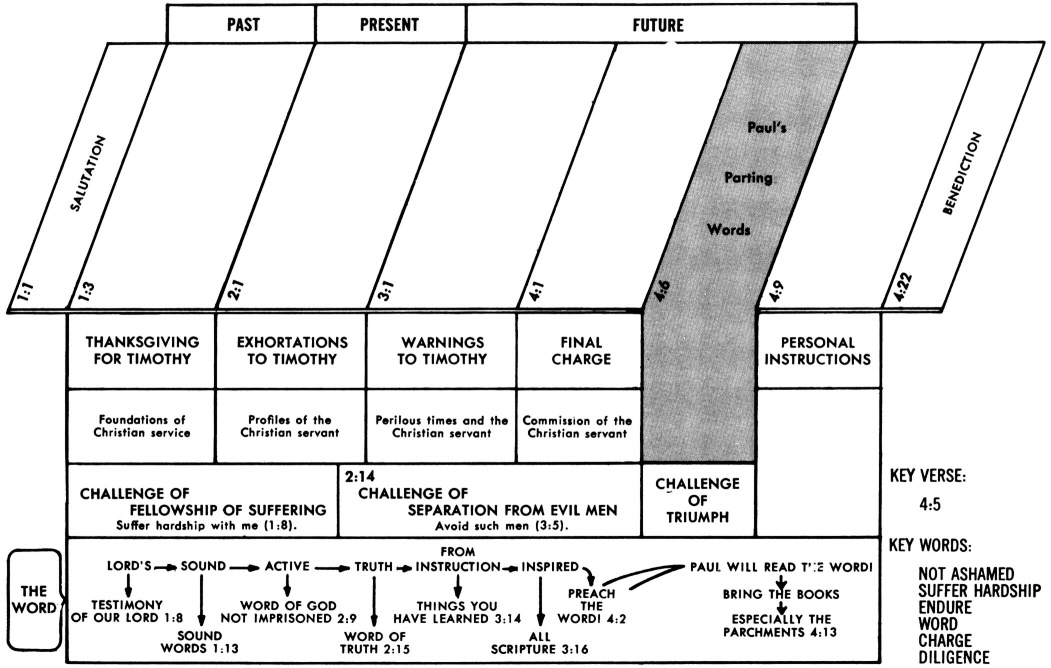
ENDURANCE AND SEPARATION IN THE MINISTRY
Click chart to enlarge
Charts from Jensen's Survey of the NT - used by permission
Second Timothy - Swindoll
| 2 TIMOTHY | |||
| 2 Timothy 1:1-18 | 2 Timothy 2:1-26 | 2 Timothy 3:1-17 | 2 Timothy 4:1-22 |
| Retain the Standard |
Rightly Divide the Word |
Difficult Times Will Come |
Preach the Word |
| PAST | PRESENT | FUTURE | |
| Foundation of Christian Service |
Pictures of Christian Servant |
Dangerous Times for Christian Servant |
Commission of Christian Servant |
| Unashamed as a Witness: Guard the Gospel |
Unashamed as a Workman: Suffer for the Gospel |
Adequate as a Workman: Continue in the Gospel |
Awarded as a Workman: Preach the Gospel |
| Power of the Gospel |
Perseverance of the Gospel Message | Protection of the Gospel |
Proclamation of the Gospel |
| Reminder | Requirements | Resistance | Requests |
| Encouragement in Ministry |
Examples in Ministry |
Exhortations in Ministry |
Exhortations to Fulfill Ministry |
| Commendation & Charge |
Commission to Fulfill |
Conflict to Face |
Course to Finish |
|
Compiled from Jensen's Survey of the NT and Wilkinson's Talk Thru the Bible |
|||
2 Timothy 1:7 For God has not given (3SAAI) us a spirit of timidity, but of power and love and discipline (NASB: Lockman)
Greek: ou gar edoken (3SAAI) hemin o theos pneuma deilias, alla dunameos kai agapes kai sophronismou.
Amplified:For God did not give us a spirit of timidity (of cowardice, of craven and cringing and fawning fear), but [He has given us a spirit] of power and of love and of calm and well-balanced mind and discipline and self-control. (Amplified Bible - Lockman)
KJV: For God hath not given us the spirit of fear; but of power, and of love, and of a sound mind.
NLT: For God has not given us a spirit of fear and timidity, but of power, love, and self-discipline. (NLT - Tyndale House)
Phillips: For God has not given us a spirit of fear, but a spirit of power and love and a sound mind. (Phillips: Touchstone)
Wuest: For God did not give to us a spirit of fearfulness, but of power and of love and of a sound mind. (Eerdmans Publishing)
FOR GOD HAS NOT GIVEN US A SPIRIT OF TIMIDITY: ou gar edoken (3SAAI) hemin o theos: pneuma deilias:
- Acts 20:24; 21:13; Ro 8:15; Heb 2:15; 1Jn 4:18
Related Passages:
Romans 8:15+ For you have not received a spirit of slavery leading to fear again, but you have received a spirit of adoption as sons by which we cry out, “Abba! Father!”
Hebrews 2:14-15+ Therefore, since the children share in flesh and blood, He Himself likewise also partook of the same, that through death He might render powerless him who had the power of death, that is, the devil, 15 and might free those who through fear of death were subject to slavery all their lives.
1 John 4:18+ There is no fear in love; but perfect love casts out fear, because fear involves punishment, and the one who fears is not perfected in love.
GOD THE
GREATEST GIVER
For God has not given us - This phrase reiterates again Who the gift is from. Note that not (ou) means absolutely not! So what? One practical application of this truth is that if are vacillating and apprehensive, we can be sure it is not from God but is because our focus is on ourselves and our own human resources rather than on the Lord and His fully sufficient resources.
Given is didomi which means to give of one’s own accord and with good will. That is the way God gives! The verb didomi is AORIST (effective action at a point in time but doesn't say exactly when) ACTIVE (subject performs action) INDICATIVE (mood of reality = actual event)"
For (gar) a causative particle standing always after one or more words in a clause and expressing the reason for what has been before, affirmed or implied. For, in the sense of because, and so forth.. Always pause, ponder and practice interrogating this term of explanation. Paul explains why he has exhorted Timothy to fan into flames the gift. Hiebert says Paul explains "the incentive for zeal" (called for in 2Ti 1:6), that it "lies in the spirit which God has given to us as Christians."
As Peter writes "His divine power has granted to us everything pertaining to life and godliness, through the true knowledge of Him who called us by His own glory and excellence. For by these He has granted to us His precious and magnificent promises, in order that by them you might become partakers of the divine nature, having escaped the corruption that is in the world by lust. (2Pe 1:3; 1:4 see notes 2Pe 1:3; 1:4).
Spirit (4151) (pneuma from pnéo = to breathe) means a blowing (wind), a breathing (breath) and can refer to the seat of the inner spiritual life of man, capacity to know God. Pneuma speaks of that divine influence by which the temperament or disposition of mind in Christians is affected, i.e., correcting, elevating, and ennobling, filling the mind with peace and joy. The spirit in this case stands opposed to the flesh (Jn 3:6)
Arnold Glasgow's words are fittingly applied to Timothy "Make your life a mission—not an intermission."
Spurgeon put it this way "It is an abomination to let the grass grow up to your knees and do nothing towards making it into hay. God never sent a man into the world to be idle. (Adding that) Now is the watchword of the wise.
D. Edmond Hiebert comments that ""Some would interpret "spirit" here to mean the Holy Spirit. It seems better… to regard the reference to the inner qualities, the spiritual character wrought in us by the Holy Spirit. This Spirit-wrought character, described negatively and positively, is the gift of God's grace. Negatively, it is "not a spirit of fearfulness." God did not give us a spirit of fearfulness, cowardice, or timidity, so that we cower and let our flame die down when confronted with the prospects of suffering. "But," on the contrary, God gave us a spirit "of power and love and discipline." These three graces are especially needed by one in Timothy's circumstances. Threatening clouds are rapidly darkening the sky; added to the prevailing local hostility to the planting and development of the Church there is now imperial hostility. In the face of these ominous developments there is need for power, aggressive energy in the face of difficulty, which overcomes the weakness of cowardice and enables one to work, to endure, to suffer, and to die if need be. Needed also is the spirit "of love," that self-forgetting love to Christ, the church, and the souls of men, which exhorts, warns, rebukes with boldness and fidelity at whatever risk of consequences to self. The third quality mentioned is "discipline." The original word means "the act of making sober, or calling to soundness of mind"… The meaning is rather that of self-control, self-discipline, the exercise of a sane, balanced mind. "As Paul grew older and richer in experience, he realized the value to the preacher of religious sanity" (Greene)." (2 Timothy by D. Edmond Hiebert) (Bolding added)
Spirit of timidity - Is Paul suggesting his young protégé is a "Timid Timothy"? Many commentaries and expositors take Paul's phrase as suggesting that Timothy was fearful. For example Guy King gently addresses the issue of Timothy's supposed timidity writing "However, Paul writes to brace him up; he assures him that he need not fear, with such a GOD above him, and before him, and behind him, and beneath him, and beside him, and within him. "What time I am afraid, I will trust in Thee", says David, in Ps 56:3; but Paul would prefer the prophet's word for him, "I will trust, and not be afraid", Is 12:2 - an attitude which, as a matter of fact, the Psalmist did also himself afterwards take up, in Ps 56:4 and Ps 56:11. We will not dare to criticize Timothy for any tendency to fear, for are we not also much inclined that way? How often we refrain from some right word, or action, because we are so dreadfully afraid of what other people would think, or say, or do! Do we not hesitate again and again from starting upon some good course, or undertaking, because of that stupid fear of falling, of not being able, after all, to carry it out, or to keep it up! Are we not constantly halted, or crippled, in Christian endeavour because we are afraid of looking a fool! Well, this "spirit of fear" has no right to be there. As we think of the old worthies of past days, how completely free they were of all such unworthy feeling. (2Timothy 1:3-7 Grandmotherly Religion)
The able expositor Steven Cole seems also to allude to some degree of reticence in young Timothy observing…
It seems that Timothy had a tendency to retreat from the front lines of serving Christ. He was rather shy and timid, and not in the best of health (1Ti 5:23). His relative youthfulness caused him to be a bit unsure of himself when difficult issues required confident leadership (1Ti 4:12). Once Paul had to write to the Corinthians (1Co 16:10), “Now if Timothy comes to you, see that he is with you without cause to be afraid.” Paul knew that the rowdy Corinthians might run roughshod over this insecure man.
As Paul sat chained in a Roman dungeon, awaiting execution, he knew that he had to hand off the torch to Timothy. So he wrote this final letter to encourage Timothy to keep running the race in spite of difficulties and opposition. He words should encourage any of us who may be tempted to draw back from actively serving the Lord to persevere. And this book exhorts all who know Christ, but are not serving, to get into the race.
In 2Ti 1:6-11, Paul is encouraging Timothy to continue serving the Lord with all of his strength, in spite of opposition. His flow of thought goes like this: “Because you are saved, you must serve (2Ti 1:6, 7); but when you serve, be prepared to suffer (2Ti 1:8); when you suffer, remember your salvation and God’s call to preach the gospel (2Ti 1:9, 10, 11).” Then Paul points to his own example of serving in spite of suffering (2Ti 1:12) and to the example of Onesiphorus (2Ti 1:16, 17, 18). The theme here is, even if you suffer for serving Christ, do not be ashamed of the gospel or of those who preach the gospel (2Ti 1:8, 12, 16). (2 Timothy 1:6-7 Saved to Serve)
Notice that Paul does not address this statement specifically to Timothy but "us", declaring that "God has not given us… ", and so he would seem to include himself in this statement. Furthermore, why would Paul send Timothy into spiritually difficult situations if he was so timid? For example, it is well known that Timothy was given leadership in the difficult venue of the church at Ephesus church, and it would seem quite unlikely that a timid soul would be entrusted with such an important post. Furthermore, why would Paul make statements like he did in Philippians if Timothy was so fearful…
For I have no one else of kindred spirit who will genuinely be concerned for your welfare. (Php 2:20-note)
Comment: The key word in regard to this discussion of Timothy's timidity is "kindred spirit" which is the Greek word isopsuchos (from ísos = equal + psuche = soul, mind) which literally means one of equal soul, thus like–minded or of like character and activated by the same motives. One would hardly classify Paul as a timid believer!
On the other hand, there is no question that when you receive a letter from your mentor explaining that most of his associates have left him (2Ti 1:15, 4:10, 16), that he has been imprisoned (2Ti 1:8, 11, 12, 16, 2:9) for the very truths he is trusting to you (2Ti 1:13, 14, 2:2, 3:10, 11, 4:1,2) and that he himself is about to die for that gospel (2Ti 4:6), would not these realities send a "shiver" through even the most bold of disciples? Indeed they would and such a real human reaction, far from detracting from one's usefulness, would actually make them potentially more effective in their ministry. In other words, such a person would not foolishly brush off the many hindrances to proclamation of the gospel, but be aware of them and in this awareness would understand that they could only "succeed" with the Lord's gracious gift (fully adequate!) of "power and love and sound mind." It is in the recognition and acknowledgment of our human weakness, that the Spirit of Christ can be strong (2Co 12:9, 10-note). The point is that timidity or fear is not an abnormal human emotion, but it should not be one's prevailing mindset, for we have all, like Timothy, been given the abundant provision of grace in God's "power and love and sound mind."
Timidity (1167) (deilia from deilos = fearful, timid as in Mt 8:26 where it equated their fear with little faith and in Septuagint of Jdg 7:3-note, other uses of deilos = Mk 4:40, Re 21:9, deiliao - used only in Jn 14:27) (this is the only use of deilia in the NT) means lack of mental or moral strength, timidity (lacking courage, self confidence, boldness or determination), reticence (inclination to be silent or uncommunicative in speech), cowardice (lack of courage or resolution) or shameful fear that is generated by weak, selfish character. The picture is one who is in a state of fear because of a lack of courage or moral strength.
As noted deilia is used only here in the NT, which makes a discussion of the definition more difficult than if there were numerous NT uses to compare the contextual uses. Deilia however is used in the Septuagint (LXX) which might help substantiate the meaning of deilia. For example Moses records…
Lev 26:36+ (or Lev 26:36ESV) As for those of you who may be left, I will also bring weakness into their hearts in the lands of their enemies. And the sound of a driven leaf will chase them and even when no one is pursuing, they will flee as though from the sword, and they will fall.
Comment: In Lv 26:36+, the Hebrew noun morek is translated "weakness" (NAS) or "faintness" (ESV) and conveys the idea of fearfulness or timidity (Dictionary of Biblical Languages with Semantic Domains). The Septuagint translators choice of deilia for morek is compatible with the definition outlined above. Morek is grouped in the TWOT in a list of Hebrew words that William White states all convey "The psychological notion of “weak resolve,” which is the basic and underlying meaning is easily understood in all of the contexts in which it occurs. (Theological Wordbook of the Old Testament) So again the Hebrew ideas conveyed by morek are very compatible with deilia signifying a lack of mental resolve which results in timidity or cowardice.
In addition Spicq writes that this word group (deilia, deiliao, deilos) is "Associated with phobos (Wis 4:17), eklusis (2 Macc 3:24), anandria (cf. 4 Macc 6:20), atolmia (Philo, Virtues 25; Josephus, Ant. 4.298; 15.142; Aeneas Tacticus, Polior. 16.20), faintheartedness or cowardice can be defined as “a failure of spirit caused by fear.” Rarely mentioned in the papyri, it is used for mere reserve or abstention, a lack of courage and of reaction, a sort of torpor, and finally fright (tarassō, Ps 55:4; John 14:27; Josephus, Ant. 5.216) which can become panic and terror in the face of extreme danger. Jesus reproaches the apostles for this psychological fear when they are terrified by the storm (Mt 8:26; Mk 4:40), because it involves a moral deficiency: they no longer have faith, or they have but little faith in the presence of the Savior, who has to reassure them. (Spicq, C., & Ernest, J. D. Theological Lexicon of the New Testament. 1:300-301. Peabody, MA.: Hendrickson)
Deilia is never used in a good sense, whereas another word for "fear" (phobos) can be used in either a good sense (fear of the Lord) or a bad sense. Deilia is only used here in the NT.
Related Resource:
- Click 4 part series on Biblically How to Handle Fear
Trench commenting on the comparison of deilia, phobos and eulabeia writes that "Of these three words the first, deilia, is used always in a bad sense; the second, phobos , is a middle term, capable of a good interpretation, capable of an evil, and lying indifferently between the two; the third, eulabeia, is quite predominantly used in a good sense, though it too has not altogether escaped being employed in an evil. (Trench, R. C. Synonyms of the New Testament. Page 34)
Friberg defines deilia "as a shameful state of fear from lack of courage (Friberg, T., Friberg, B., & Miller, N. F. Analytical Lexicon of the Greek New Testament. Baker Academic)
As noted above, although deilia is not used elsewhere in Scripture, Jesus does use the related verb deliao in His parting words of comfort to His disciples whose hearts were troubled and agitated…
Peace I leave with you; My peace I give to you; not as the world gives, do I give to you. Let not your heart be troubled, (present imperative = stop letting this happen. Verb tarasso = cause one inward commotion, take away calmness of mind, disturb equanimity; disquiet, make restless) nor let it be fearful. (Deliao = present imperative with a negative - conveying that may have been occurring so the idea is "Stop being fearful" or "Stop lacking courage".) (John 14:27)
So here we see the antidote for "fearfulness" or "timidity" is the peace that Christ gives. J Vernon McGee adds these practical comments on Jesus words in John 14:27…
The peace He is talking about here is not the peace of sins forgiven. This is the glorious, wonderful peace that comes to the heart of those who are fully yielded to the Lord Jesus Christ. It is the peace of heart and mind of those who are in the will of God." (McGee, J. V. Thru the Bible commentary. Vol. 4, page 464. Nashville: Thomas Nelson) (Or Listen to the Mp3 of John 14:16-31) (Bolding added)
Warren Wiersbe - The world bases its peace on its resources, while God’s peace depends on relationships. To be right with God means to enjoy the peace of God. The world depends on personal ability, but the Christian depends on spiritual adequacy in Christ. In the world, peace is something you hope for or work for; but to the Christian, peace is God’s wonderful gift, received by faith. Unsaved people enjoy peace when there is an absence of trouble; Christians enjoy peace in spite of trials because of the presence of power, the Holy Spirit. People in the world walk by sight and depend on the externals, but Christians walk by faith and depend on the eternals. (Wiersbe, W: Bible Exposition Commentary. 1989. Victor)
Fearfulness arises from our own natural condition and should never mark the spirit of the believer. The Lord is never responsible for our cowardice, our lack of confidence, or our being shameful of Him. Under the severe persecution of Nero, with Paul in prison and condemned to death, it would be natural for Timothy and other believers to be afraid and to refrain from speaking out for Christ.
Ray Stedman adds these practical thoughts - "I do not know any statement in Paul's writings that is more practically important to us than that ("God has not given us a spirit of fear"), because, if you are like me, you are oppressed and assaulted by a spirit of fear most of the time. Anxiety, worry, trembling about what is going to happen, a sense of terrible disaster looming, of chaos and crisis that is about to break upon us -- these are forms of fear; this is the spirit of fear. This verse says that these do not come from God. Did it ever occur to you that Christians are forbidden to fear? How many times in the Scriptures do we read that Jesus said, "Fear not!" (Ed: however not the same Greek word) "Let not your heart be troubled," {Jn 14:1, 14:27}. Do not let it go in that direction. Stop it when it starts going that way. God does not give us a spirit of fear. If we have such it is coming from another source, the enemy, who is the spirit of fear. (See the full sermon The Promise of Life)
John MacArthur records a powerful example of the spirit Paul is writing about in this verse - "During the Boxer Rebellion (1899–1900), extreme nationalist Chinese fomented a campaign of terror against officials of foreign governments, Christian missionaries, and even Chinese Christians. After they surrounded a certain mission station, they sealed all exits except one. They placed a cross in the dirt in front of the opened gate and told the missionaries and students that anyone who walked out and trampled the cross would be spared. According to reports, the first seven students who departed trampled the cross and were sent on their way. The eighth student, a young girl, approached the cross, knelt down, prayed for strength, carefully walked around the cross, and was immediately shot to death. The remaining 92 students, strengthened by that girl’s courageous example, also walked around the cross to their deaths. (MacArthur, J. 2 Timothy. Chicago: Moody Press)
Today in the Word - Mickey Mantle, the late Hall-of-Famer for the New York Yankees, was a teenager when the Yankees sent him back to the minors in 1951. Convinced he couldn't make it as a ballplayer, Mantle called his father, who came to Kansas City and found a tearful Mickey ready to quit the game. 'OK, son, if that's all the guts you have, you might as well come home with me and work in the zinc mines,' the elder Mantle said. His dad's challenge stung Mantle back to reality, and he went on to greatness. Paul's challenge to Timothy wasn't a stinging rebuke, but the apostle did urge his young spiritual son to 'get back in the game,' so to speak. For some reason, Timothy's spiritual fervor had begun to lag, even though he was in his youthful years (see 1Ti 4:12). He needed to rekindle the flame of his spiritual gift (2Ti 1:6) and get back in the game. (Ref)
People Of Courage - Police found it hard to believe, but an unarmed housewife captured three burglars singlehandedly. The woman had come home and found three men loading household items into their car parked in her driveway. She pulled her van behind their car and then ordered the men to carry her belongings back into the house and sit on the couch until the police arrived. Later, when asked why they didn't escape, she replied, "The Lord was with me… I wasn't going to move my van so they could get away. What was I to do? Run away?"
The apostle Paul also showed unusual courage. His friends probably thought he was being reckless when he insisted on going to Jerusalem after he had been warned of the danger that awaited him (Acts 21:11, 12, 13). A strong argument could be made for him to delay his trip. After all, on another occasion he had escaped from danger (Acts 9:23, 24, 25). Yet Paul knew what he had to do. With unwavering determination he courageously headed for Jerusalem.
It's not easy to know when such boldness is wise or foolish. Only the Spirit can show us. But one thing is sure, Christians have reason to be courageous. God is our helper. And when we rely on Him, He'll enable us to stand firm no matter what danger we may face. —Mart De Haan (Our Daily Bread, Copyright RBC Ministries, Grand Rapids, MI. Reprinted by permission. All rights reserved)
Ask God for good judgment and courage
To face unexpected events;
To follow the teachings of Scripture
Is the best, most effective defense. —HessCourage is fear that has said its prayers.
BUT OF POWER: alla dunameos kai agapes kai sophronismou:
- Micah 3:8; Zech 4:6; Lk 10:19; 24:49; Acts 1:8; 6:8; 9:22; 10:38; 1Cor 2:4
SUPERNATURAL
POWER
But - This is a strong term of contrast - always pause, ponder and practice interrogating, asking at least what is being contrasted?
Micah after condemning the false prophets, whose true character had been disclosed by their "bad fruit" -- receiving "no answer of God" (Micah 3:7; cp Dt 18:20, 21, 22, notes on "bad fruit" to aid discernment -Mt 7:16; 17; 18; 19; 20 - see notes Mt 7:16; 17; 18; 19; 20), Micah asserts his own power to reveal God's Word through the Holy Spirit. His own prophecies would soon be fulfilled, and thus he declares…
On the other hand I am filled with power (Lxx = ischus) -- (Where/Who is the Source of His power?) With the Spirit of the LORD-- And with justice and courage to make known to Jacob his rebellious act, even to Israel his sin. (Micah 3:8-note)
Zechariah hears the following famous words of encouragement for the civil leader Zerubbabel, regarding the rebuilding of the Temple in Jerusalem…
Then he (the angel speaking to Zechariah) answered and said to me, "This is the word of the LORD to Zerubbabel saying, 'Not by might nor by power, but by My Spirit,' says the LORD of hosts (see Jehovah Sabaoth). (Zech 4:6)
Comment: Neither is man's weakness a hindrance to God, nor is his strength an aid to God. O, how we need to remember this basic principle of spiritual life, cp John 15:5.
In some of our Lord's last words the King granted His apostles (and applicable to all believers of all ages) the following beatitude…
And behold, I am sending forth the promise of My Father upon you (the Holy Spirit); but you are to stay in the city until you are clothed with power (dunamis) from on high. (Luke 24:49)
Our Lord reiterated this glorious promise in Acts in what were literally His parting words before His ascension…
but you shall receive power (dunamis) when the Holy Spirit has come upon you; and you shall be My witnesses both in Jerusalem, and in all Judea and Samaria, and even to the remotest part of the earth. (Acts 1:8-note)
Regarding our power versus God's power C H Spurgeon phrased it this way -
Power in the creature is like water in the cistern.
Power in the Creator is like water in the fountain.
(From the The Mighty Arm)
Spurgeon's comment reminds me of the geophysical dynamics which give power to an artesian well. The artesian well flows freely because of the power of pressure of water at higher ground levels. (cp "rivers of living water from your innermost being" = Jn 7:37-39-note). What an incredible portrayal of the power of the Holy Spirit from on high ("higher ground"). What does the well have to do in order to function effectively? Two things: (1) Stay low! Spiritually this is not even subtle - God is opposed to ("stiff arms") the proud, but gives grace (cp "Spirit of grace" in Heb 10:29-note) to the humble." (James 4:6-note). So the message is stay humble. Understand that our power to live a supernatural life (e.g., to break the chains of addiction Ro 6:11-note, Ro 7:6-note, Ro 8:13-note, to love our wives continually like Christ loved the Church Eph 5:25-note, to continually let no unwholesome word proceed from our mouth - Eph 4:29-note, etc, etc), we have to continually humble ourselves under the mighty hand of God (1 Peter 5:6-note). (2) Secondly, we have to stay "open" so to speak. We have to keep the flow of the Spirit flowing. Sin stops up the flow of the Spirit (grieves Him - Eph 4:30-note, quenches Him - 1Thes 5:19-note), so we need to be sensitive to those times when we have offended Him by our thoughts, words or deeds, and we need to confess and repent (1John 1:9-note). Proverbs 28:13-note says "He who conceals his transgressions will not prosper, But he who confesses and forsakes them will find compassion." And what is the result? Amazing grace is bestowed and " innermost being shall flow rivers of living water" as the Spirit's power is unimpeded and unhindered! (See John 7:37-39-note). This begs two questions - Are you daily humbling yourself before God, yielding yourself to Him as a living and holy sacrifice (Romans 12:1-note), fully cognizant that it is not by your power, but by His (Zech 4:6), that will be enabled to a supernatural, abundant life in Christ? Secondly, are you quick to confess your sins that you might be a vessel set apart, useful to the Master and prepared for every good work, those good works of course being initiated and energized by the Holy Spirit flowing through one who is "confessed up" and "repented up" so to speak! Dear reader, what about your spiritual life? Are you experiencing supernatural power (the occurence of things that cannot be readily explained by natural means)? If not then pray Psalm 139:23-24 and confess any impurities in thought, word or deed that the Spirit brings to mind so that His work in and through you can flow unimpeded.

Hudson Taylor affirmed this axiom for every Christian worker - "Depend upon it. God's work done in God's way will never lack supplies. All God's giants have been weak men who did great things for God because they reckoned on His being with them. God uses men who are weak and feeble enough to lean on Him."
Dwight Edwards - The ministry is too hard for any of us to handle by ourselves, for we are utterly inadequate. But the same power which raised Christ from the dead is also available to us so that we can say with Paul, "Not that we are sufficient of ourselves to think of anything as being from ourselves, but our sufficiency is from God." (2Cor. 3:5-note)
Note the frequent association of the Spirit with Power - we need to grow in our knowledge and understanding and dependence on the filling with and poer of the Holy Spirit if we would live victorious Christian lives for the glory of the Father (Matthew 5:16, cp Php 2:15).
- Luke 4:14 And Jesus returned to Galilee in the power of the Spirit; and news about Him spread through all the surrounding district.
- Acts 1:8 but you shall receive power when the Holy Spirit has come upon you; and you shall be My witnesses both in Jerusalem, and in all Judea and Samaria, and even to the remotest part of the earth.”
- Acts 10:38 “You know of Jesus of Nazareth, how God anointed Him with the Holy Spirit and with power, and how He went about doing good, and healing all who were oppressed by the devil; for God was with Him.
- Romans 15:19 in the power of signs and wonders, in the power of the Spirit; so that from Jerusalem and round about as far as Illyricum I have fully preached the gospel of Christ.
- 1 Corinthians 2:4 And my message and my preaching were not in persuasive words of wisdom, but in demonstration of the Spirit and of power,
- Ephesians 3:16 that He would grant you, according to the riches of His glory, to be strengthened with power through His Spirit in the inner man;
- 1 Thessalonians 1:5 for our gospel did not come to you in word only, but also in power and in the Holy Spirit and with full conviction; just as you know what kind of men we proved to be among you for your sake.
Received… power - In 2Ti 2:1 (note) Paul uses the derivative verb endunamoo to exhort Timothy to be strong in the grace that is in Christ Jesus. "Be strong" is passive voice signifies something done to Timothy not by Timothy, in this case he is to be strengthened by a "force" outside of himself, that "force" designated as "the grace that is in Christ Jesus." How is Timothy to respond to the command to be empowered? By faith, relying solely on the power of the Holy Spirit and not his good intentions or resolutions. In other words he is to acknowledge that without Christ, he can do nothing (Jn 15:5). In summary, Timothy and all disciples of Christ must look outside themselves to the power of the Holy Spirit Who alone can provide the power necessary to live the Christian (Christ) life. You might argue that Paul does not mention the Spirit in 2Ti 2:1-note, but we need to keep in mind what Puritan writer John Owen said - "Everything God does he does as the triune God. Each Person of the Trinity is involved in every action of God. Yet at the same time each Person has a special role to fulfill in that work… There is no good that we receive from God but it is brought to us and wrought in us by the Holy Spirit. Nor is there in us any good towards God, any faith, love, obedience to his will, but what we are enabled to do so by the Holy Spirit."
So here in 2Ti 1:7 Paul reminds Timothy that he possesses the Source of power and then in 2Ti 2:1 he commands him to live in that power. And the Source of that power is not some impersonal cosmic force, but is the Person of the Holy Spirit. And so we walk out by faith, acknowledging that left to ourselves, we are powerless to live the supernatural (Christ) life. We acknowledge our surrender to rely fully on the power of the Spirit to enable us. Notice I did not say "help us" because the verb help implies we have some strength of our own and just need a "little push." Enablement implies we have no innate ability of our own! We can do nothing of our own (except believe and receive His enabling power). So by faith we renounce self-sufficiency and rely fully on the power of the Spirit Who provides divine power for a supernatural life and ministry. Don't misunderstand this spiritual dynamic - we are not saying "Let go and let God." Yes, the power is all from the Spirit, but we still have a responsibility to live in the light of His power, to walk obediently, etc, etc. You see this "synergistic" relation (God's provision, Man's responsibility) in Phil 2:12-13, verse 13 (note) being the divine provision and verse 12 (note) being the human practice.
Related Resources:
- Spirit-Filled Believers Are Like Artesian Wells
- The Holy Spirit-Walking Like Jesus Walked!
- Our Anointing - The Holy Spirit
- 1 Corinthians 2:10-16 Commentary
- 1 John 4:4 Commentary
- A Spirit Filled Church
- Acts 1:8 Commentary
- Ephesians 5:18 Commentary
- Expulsive Power of a New Affection
- Galatians 5:16 Commentary
- Illumination of the Bible
- Loving Obedience-Obedient Love
- Praying in the Spirit
- Spiritual Paradox in the Christian Life
- The Holy Spirit-2
Power (1411) (dunamis from dunamai = to be able, to have power) power especially achieving power. It refers to intrinsic power or inherent ability, the power or ability to carry out some function, the potential for functioning in some way (power, might, strength, ability, capability), the power residing in a thing by virtue of its nature.
Vine - (In 2Ti 1:7 dunamis) denotes the ability requisite for meeting difficulties and for the fulfillment of the service committed to us.
Dunamis (Click here for all the NT verses that use dunamis) is a key word in the NT being found in 115 verses in the NAS most often in the Gospels and especially by Dr. Luke and in the Revelation translated variously as: ability, 4; meaning, 1; mightily, 1; mighty, 1; miracle, 2; miracles, 17; miraculous powers, 3; power, 83; powers, 6; strength, 2; wealth, 1.
Matt. 7:22; 11:20, 21, 23; 13:54, 58; 14:2; 22:29; 24:29, 30; 25:15; 26:64; Mk. 5:30; 6:2, 5, 14; 9:1, 39; 12:24; 13:25, 26; 14:62; Lk. 1:17, 35; 4:14, 36; 5:17; 6:19; 8:46; 9:1; 10:13, 19; 19:37; 21:26, 27; 22:69; 24:49; Acts 1:8; 2:22; 3:12; 4:7, 33; 6:8; 8:10, 13; 10:38; 19:11; Ro 1:4, 16, 20; 8:38; 9:17; 15:13, 19; 1 Co. 1:18, 24; 2:4, 5; 4:19, 20; 5:4; 6:14; 12:10, 28, 29; 14:11; 15:24, 43, 56; 2Co 1:8; 4:7; 6:7; 8:3; 12:9, 12; 13:4; Gal. 3:5; Eph. 1:19, 21; 3:7, 16, 20; Phil. 3:10; Col. 1:11, 29; 1Th 1:5; 2Th 1:7, 11; 2:9; 2Ti 1:7, 8; 3:5; Heb. 1:3; 2:4; 6:5; 7:16; 11:11, 34; 1Pe 1:5; 3:22; 2Pe 1:3, 16; 2:11; Re 1:16; 3:8; 4:11; 5:12; 7:12; 11:17; 12:10; 13:2; 15:8; 17:13; 18:3; 19:1
Click here for all 369 verses that use dunamis in the non-apocryphal Septuagint (LXX). Many of the uses in the Psalms translate the Hebrew word for "host" (army or armies - e.g., "Lord of hosts" is Lord of power, where dunamis is plural). Other uses in Psalms speak of God's power to His saints for successful warfare…
(Ps 18:32) The God who girds me with strength, And makes my way blameless?
(Ps 18:39) For Thou hast girded me with strength for battle; Thou hast subdued under me those who rose up against me.
(Ps 46:1) For the choir director. A Psalm of the sons of Korah, set to Alamoth. A Song. God is our refuge and strength, A very present help in trouble.
(Ps 46:7) The LORD of hosts (dunamis) is with us; The God of Jacob is our stronghold. Selah.
(Ps 46:11) The LORD of hosts (dunamis) is with us; The God of Jacob is our stronghold. Selah.
Matthew and Mark fittingly use dunamis as a proper name of God = "Power" (see Matthew 26:64 , Mark 14:62)!
Dunamis is the implied ability or capacity to perform. It conveys the idea of effective, productive energy, rather than that which is raw and unbridled.
Dunamis is the word generally used by Paul of divine energy.
Scripture uses dunamis to describe deeds that exhibit the ability to function powerfully (deeds of power, miracles, wonders) (eg, see Mt 11:20, 23, 13:54, 58, etc)
Sometimes dunamis is used to represent an entity or being that functions with remarkable power, especially being used to describe angel as powers (eg, see Romans 8:38-note Ephesians 6:12-note)
There is an instructive use of dunamis later in 2 Timothy where Paul describes men…
holding to a form of godliness, although they have denied its power (dunamis); and avoid such men as these. (See 2 Timothy 3:5-note) (Comment: The point is that the so-called godliness of these men is a sham and devoid of any real divine power to break the power of Sin. Those who practice such deception enjoy the enjoy expressions of evangelical worship but they are violently at odds with the gospel’s internal effects of subduing sin and nurturing holiness. They lack the inherent ability or capability, the dunamis, because they lack the indwelling Spirit Who strengthens with power for which Paul prays in Ephesians 3:16 (note) The corollary is that those who possess the indwelling Spirit and divine dunamis have the inherent ability to wage victorious battle with the believer's three mortal enemies, the world, the flesh and the devil, all seeking to turn us from God and unto self -- flesh -- and its ungodly, unholy attitudes and actions. One can readily see the importance of praying for believers to be strengthened with dunamis power through the Spirit in their inner man - see Ep 3:16-note)
William MacDonald comments on Paul's reminder to Timothy of his access to God's "dunamis" writing that "Unlimited strength is at our disposal. Through the enabling of the Holy Spirit, the believer can serve valiantly, endure patiently, suffer triumphantly, and, if need be, die gloriously."
MacDonald quotes F B Meyer It is power. It is His power. It is great power; nothing less would suffice. It is exceeding great power, beyond the furthest cast of thought. This is the power which God used in our redemption, which He uses in our preservation, and which He will yet use in our glorification. Lewis Sperry Chafer writes: Paul wants to impress the believer with the greatness of the power which is engaged to accomplish for him everything that God has purposed according to His work of election, predestination and sovereign adoption." (Believer's Bible Commentary: Thomas Nelson)
Note that in his letter to the Ephesians Paul did not pray that believers might be given divine power but that they might be aware of the divine power they already possessed. ( Ep 1:18, 19, 20-See notes Ep 1:18-19; 20).
I pray that the eyes of your heart may be enlightened, so that you may know what is the hope of His calling, what are the riches of the glory of His inheritance in the saints, 19 and what is the surpassing greatness of His power (dunamis) toward us who believe. (What kind of power is Paul praying for?) These are in accordance with the working of the strength of His might 20 which He brought about in Christ, when He raised Him from the dead, and seated Him at His right hand in the heavenly places
Through Christ we have the resource of God’s own supernatural power, the very power (dunamis) He used to raise Christ from the dead. It is of utmost importance to understand that God does not provide His power for us to misappropriate for our own purposes. He provides His power to accomplish His purposes through us. When our trust is only in Him, and our desire is only to serve glorify Him, He is both willing and “able to do exceeding abundantly beyond all that we ask or think, according to the power that works within us (the indwelling Spirit)” (Ephesians 3:20-note).
Although God promises us and provides us with His dunamis power, we must learn wait upon His timing (Acts 1:8-note) and also be willing to humble ourselves that His power may be perfected in us (2Cor 12:9-note). Note that Jesus Himself had at least in one sense the same power available to believers today (see Lk 4:1,14,18 … God anointed Him with the Holy Spirit and with power. See also Acts 10:38 where we see that Jesus went about "doing good" after He had been anointed with the Spirit and power. In so doing Jesus provides every believer with the pattern we must seek to imitate, "doing good" as we are energized by the same supernatural power! These are the only good works which will endure eternally!)
Barclay writes that dunamis "can be used of any kind of extraordinary power. It can be used of the power of growth, of the powers of nature, of the power of a drug, of the power of a man’s genius. It always has the meaning of an effective power which does things and which any man can recognize. (John 2 - William Barclay's Daily Study Bible)
John MacArthur reminds us (as Paul was reminding Timothy) that because the "resources we have from our heavenly Father are power and love and discipline, when we are vacillating and apprehensive, we can be sure it is because our focus is on ourselves and our own human resources rather than on the Lord and His available divine resources." If God has told us to do something this verse takes away the excuse "I can't do it, it's too hard". (MacArthur, J. 2 Timothy. Chicago, Ill.: Moody Press.) (Bolding added)
Dunamis is the root from which we derive the English word dynamic, (synonyms = energetic, functioning, live, operative, working) which describes that which is marked by usually continuous and productive activity or change. That which is dynamic is characterized by energy or forces that produce motion, as opposed to that which is static. Another English word dynamite, is derived from dunamis and since dunamis is used by Paul to describe the "power of God", some have suggested that the gospel is "God’s dynamite". This is misapplication of this English derivative in an attempt to try to picture the life saving power of the gospel. Dunamis does not refer to explosive power, as if the gospel will blow men to bits but as discussed above, it refers to intrinsic power. The gospel is dynamic, God’s dynamic, and so is powerful in the transformation of human lives.
Regarding dunamis power available to believers today the Open Bible comments that…
"The power of the Holy Spirit was not designed solely for the first-century church. Rather, all Christians are indwelt by the Spirit and thus have His power available (1Corinthians 6:19). However, living the Christian life under the Spirit’s power must not be thought of as simply allowing the Spirit to take control while the believer does nothing. Believers still must live the Christian life, though they do it through the Spirit’s power. Romans 8:13 (note) says, “if by the Spirit you put to death the deeds of the body, you will live.” It is you who are to put to death the sinful deeds of the body, but you are to do it through the Spirit’s power. Christians who struggle in their own strength to live the Christian life will fail. They must by faith appropriate daily the power of the Holy Spirit (Ro 8:4; 8:5 -see notes Ro 8:4; 8:5). Described practically, this means that believers trust the Spirit to empower them in specific instances such as sharing their faith with others, resisting temptation, being faithful, and so on. There is no secret formula that makes the Spirit’s power available. It is simply a reliance on the Spirit to help." (The Open Bible: New King James Version. Nashville: Thomas Nelson Publishers)
Dunamis is the word most often translated as "miracles" ("miraculous powers") are defined as an extraordinary work of God, generally though transcending the ordinary powers of Nature; an extraordinary event manifesting divine intervention in human affairs; an event that is contrary to the established laws of nature and attributed to a supernatural cause.
- American Tract Society Miracle
- Bridgeway Bible Dictionary Miracles
- Baker's Evangelical Dictionary Miracle
- Charles Buck Dictionary Miracle
- CARM Theological Dictionary Miracle
- Easton's Bible Dictionary Miracle
- Fausset Bible Dictionary Miracles
- Holman Bible Dictionary Miracles, Signs, Wonders
- Hastings' Bible Dictionary Miracles
- Hastings' NT Dictionary Miracles (2) Miracles
- 1911 Encyclopedia Britannica Miracle
- International Standard Bible Encyclopedia Miracle Miracles, Gift of
- Kitto Biblical Cyclopedia Miracles
- The Jewish Encyclopedia Miracle
Tyndale Bible Dictionary defines a miracle as "A divine act by which God reveals himself to people. The classical definition of miracle assumes that it is contrary to natural law, but this is a misnomer for two reasons. First, many of the miracles of the Bible used nature rather than bypassed it (e.g., the wind that parted the Red Sea, Ex 14:21). Second, there no longer is a concept of “absolute natural laws”; rather, a phenomenon that is not readily explainable may reflect laws that scientists do not yet fully understand. In Scripture the element of faith is crucial; a natural approach cannot prove or disprove the presence of “miracle.” The timing and content of the process can be miraculous, even though the event may seem natural. The revelatory significance is also important. In every case God performed the miracle not merely as a “wonder” to inspire awe but as a “sign” to draw people to Himself. (Elwell, W. A., & Comfort, P. W. Tyndale Bible Dictionary. Wheaton, Ill.: Tyndale House Publishers)
Power as used by Paul here in 2 Timothy conveys the idea that Timothy (and all believers) have the God given inherent ability necessary for meeting difficulties and for the fulfillment of the service committed to us. God never commands us to do what He does not also enable us to complete. God gives us the power to overcome all obstacles and to face all dangers.
In Colossians Paul has an instructive use of "dunamis" explaining that ""for which (that he might present every man complete in Christ) also I labor (kopiao = engage in hard work implying difficulties and trouble and speaks of intense toil even sweating and straining to the point of exhaustion if necessary), striving (agonizomai - was used of an Olympic athlete giving their best as they competed in the games) according to His working (energeo = active work producing effect), that is working (energeo) in me in power (dunamis) (Col 1:29-note)
Comment: The struggle is carried on in proportion, not to Paul's natural powers, but to the mightily working energy of Christ within him. All his toil and hard labor would have been useless apart from God’s power (dunamis) in his life. Paul was most himself when he was least dependent on his own resources. So it is for all persons in Christ. We are not reliant on our own power, but that of Christ whose Presence works mightily within us. This truth answers the question often asked “How was it possible for one man (and a man with a thorn in the flesh!), even with the help of fellow-workers, to accomplish so much?” Day by day, yes even moment by moment Christ’s enabling Spirit was at work within Paul’s entire person, bestowing dunamis power upon body and soul. (for more discussion see note)
Peter uses dunamis to describe God's power which provides believers everything we need to live the Christian life writing..
Grace and peace be multiplied to you in the knowledge of God and of Jesus our Lord seeing that His divine power (dunamis - Christ’s inherent power is the source of the believer’s sufficiency - His power saves us in the first place, and His power energizes us to live holy lives from then on - this power is active, dynamic, and compelling—and it is mightily at work on our behalf. We don't always sense it, but it is there and available nonetheless) has granted to us everything (do you really believe this? The Greek word means everything with no exceptions!) pertaining to life (life to the fullest, as God intended and as is now possible only in Christ and continual reliance on His Spirit) and godliness (eusebeia = living reverently [with holy fear], loyally, and obediently toward God), through the true knowledge (epignosis - an intimate and complete knowledge - Don't miss what Peter is saying - As God's power is the source of godliness, full, experiential knowledge of Him is the channel - to know Him is eternal life [John 17:3] and progress in knowing Him is progress in godliness - Peter ends this letter [2Pe 3:18-note] calling for us to grow in this grace and knowledge and as we do we will be better equipped to "tap into" the divine provision in 2Pe 1:3) of Him who called us by His own glory and excellence. (2Pe 1:3-note)
John MacArthur in a thought parallel to the passage in 2 Peter explains where we get this dunamis power writing that…
It is the Word of God that infuses us with power, but there’s nothing worse than feeling like an impotent Christian. In Acts 1:8 (note) we read, “But ye shall receive power.” The Greek word for “power” is dunamis, which means “miraculous power” or “dynamite.” Now someone might say that you ought to be exploding all over the world with this tremendous power. But you say to yourself, “Exploding! I don’t even fizzle. I feel like a dud.” Someone else might say that you ought to be out there winning people to Jesus Christ. But you say, “Are you kidding? Not me. I’m like Moses, I—I—I—I can’t talk” (cf. Exodus 3:10). Sometimes we get hung up with our impotence because we really don’t know the “power” available to us. Listen, the Word of God will infuse us with “power.” From my own life I’ve realized that the more I know about the Word of God, the less I fear any situation, because the Word is my resource." (MacArthur, J., Jr. How to Study the Bible. John MacArthur's Bible Studies. Chicago: Moody Press ) (See also How to Study the Bible)
See related online studies by Dr MacArthur
- How to Study Your Bible: Interpretation
- What it Takes to Study God's Word;
- Steps to Solid Study
- How to Study Your Bible- Closing the Gaps
Related Resources:
- inductive Bible study
- observation
- context
- key words
- mark key words
- interrogate with the 5W/H questions
- term of conclusion
- term of explanation
- terms of purpose or result - so that, in order that, that, as a result
- term of contrast Consider the "5P's" - Pause to Ponder the Passage then Practice it in the Power of the Spirit
- expression of time - e.g. then; until
- term of comparison// simile // metaphor
- Guidelines for Figuring our Figurative Language
- Interpretation
- Observe With a Purpose
- Keep Context King
- Read Literally
- Compare Scripture with Scripture
- Consult Conservative Commentaries
- Application
In a key passage in Acts Jesus explains to His disciples that they..
shall receive power (dunamis) when the Holy Spirit has come upon you; and you shall be My witnesses (martus - English "martyr") both in Jerusalem, and in all Judea and Samaria, and even to the remotest part of the earth. (Acts 1:8-note)
John MacArthur commenting on Acts 1:8 writes that because of this dunamis power - "All believers have in them spiritual dynamite for use of gifts, service, fellowship, and witness. They need to experience the release of that power in their lives through not grieving the Spirit by sin (see Ephesians 4:30-note), and being continually filled and controlled by the Spirit (see Ephesians 5:18-note). The latter takes place as believers yield moment by moment control of their lives to Him, and is the same as yielding their minds to the Word (see Colossians 3:16-note). (MacArthur, J: Acts 1-12; Acts 13-28 Moody Press)
MacDonald adds that dunamis in Acts 1:8+ describes power which "is the grand indispensable of Christian witness. A man may be highly talented, intensively trained, and widely experienced, but without spiritual power he is ineffective. On the other hand, a man may be uneducated, unattractive, and unrefined, yet let him be endued with the power of the Holy Spirit and the world will turn out to see him burn for God." (Believer's Bible Commentary)
J Vernon McGee agrees with the previous comments on dunamis in Acts 1:8 adding that "Although it is our business today to get out the Word of God, there is no power in us, there is no power in the church, but there is power in the Holy Spirit. It is the Holy Spirit Who moves through an individual or through the church or through a radio program. The question is whether we permit Him to do so." (McGee, J V: Thru the Bible Commentary: Thomas Nelson) (Listen to his Mp3's on Acts)
What does this dunamis power to be a witness for Jesus look like? R Kent Hughes explains that "It radically touches our inner complexities—who we are deep inside. Not only must we have the message, the logos (Ed: The Gospel), but we must also attract the magnificent compliment that Sir Henry Stanley gave David Livingstone after discovering and spending time with him in Central Africa: “If I had been with him any longer, I would have been compelled to be a Christian, and he never spoke to me about it at all.” (Preaching the Word) David Livingstone’s witness went far beyond mere words because it was not his power but God's supernatural inherent (dunamis) power flowing through him.
THOUGHT - May the compliment be given to Livingstone be multiplied in our lives beloved, for the glory of God alone and for His Kingdom. God protect us from the danger of forgetting that we cannot do what only God can do and that God will not do what we can do.
Kenneth Wuest says that dunamis…
"power in the sense of that which overcomes resistance or effects a change" (In Mk 5:30 literal Greek = “Jesus, perceiving in Himself the out from Him power going out”) It was some of (Jesus') supernatural power which He felt leaving Him in the accomplishing of the miraculous cure".
(Describing the effect of the gospel Wuest writes) Paul chooses dunamis to describe the effectual working of the good news of salvation (See Romans 1:16 -note For I am not ashamed of the gospel, for it is the power [dunamis] of God for salvation to everyone who believes, to the Jew first and also to the Greek.). Dunamis is power, ability, inherent power residing in a thing by virtue of its nature, or, power which a person or thing exerts or puts forth. The gospel is the inherent, omnipotent power of God operating in the salvation of a lost soul that accepts it. “Unto” is eis a preposition often signifying result. The gospel is God’s power resulting in salvation to the one who believes. The definite article is absent before “power,” “The gospel is a power of God.” Denney says, “It does no injustice to render a ‘divine power.’ The conception of the gospel as a force pervades the epistles to the Corinthians; its proof, so to speak, is dynamical, not logical. It is demonstrated, not by argument, but by what it does; and looking to what it can do, Paul is proud to preach it anywhere.” Vincent says that the gospel is “not merely a powerful means in God’s hands, but in itself a divine energy.” It is the good news of salvation energized by the Holy Spirit. Our word “dynamite” is the transliteration of this Greek word but not its translation. Dunamis does not refer to an explosive powder. The Greeks knew nothing about gunpowder. The gospel is not the dynamite of God. It is a sweet and loving message of mercy and grace which the Holy Spirit in sovereign grace makes operative in the heart of the sinner elected to salvation before the foundation of the universe."
(Describing the effect of dunamis in Paul's prayer in Ephesians 3:20 (note) "Now to Him who is able to do exceeding abundantly beyond all that we ask or think, according to the power [dunamis] that works [energeo] within us") "The power (dunamis) that is putting forth energy in us (energeo), is the operation of the Holy Spirit in His work of sanctification. God is able to do for us and answer our prayers according to the efficiency, richness, and power of the working of the Spirit in our lives. This latter is determined by the yieldedness of the believer to the Holy Spirit. Thus, the saint determines what God is able to do for him. In His inherent ability, there is no limit to what God can do in and through the saint. But the saint limits the working of God in and through him by the degree of his yieldedness to the Spirit." (Wuest Word Studies - Eerdman Publishing Company Volume 1, Volume 2, Volume 3 - used by permission) (Bolding added) (See note on Ephesians 3:20)
Vance Havner emphasizes the necessity of a spirit of "power" in ministry writing that "We are seeing much today of service without the spirit. There is an appalling ignorance of the Person and work of the Holy Spirit in our great church bodies. It is not what is done for God that counts, but rather what is done by Him, the work of His Spirit through our yielded wills. Programs, propaganda, pep, personnel, these are not enough. There must be power. God's work must be done by God's people God's way."… He adds "The Quakers got their name from the fact that they trembled under the power of the Spirit. At least their faith shook them! Too many of us today are shaky about what we believe but not shaken by what we believe."… Too many people assemble at God's house who don't really believe in the power of God. Having begun in the Spirit, we live in the flesh… Never has the church had more wire stretched with less power in it. "All is vain unless the Spirit of the Holy One comes down." Sad to say, we seem not even to know that we have not the Spirit in power. If He ceased His work many church members would never know the difference. Like Samson, we wist not that He has departed, but we keep "shaking ourselves" in the prescribed calisthenics… Our righteousnesses are as filthy rags, and only when we see them so and rend our garments can we be clad in His righteousness alone to stand faultless before the Throne. And not only that, but the believer who would live and work in the power of God must rend the garments of self‑sufficiency and tear up the vestments of the flesh if he is to go clothed in the Lord. God will not drop the mantle of His Spirit around the dirty raiment of our own goodness. We must rend our own clothes if we wear the garment of God… Walking in the Spirit is exactly what the name means: not taking a "step" or a "stand" to pose like statues on the rock of a Bible truth, but living day by day in the name of Christ by the power of the Holy Spirit.
A. W. Tozer comments on the spirit of power Paul refers to declaring that "We are turning out from the Bible schools of this country year after year young men and women who know the theory of the Spirit-filled life but do not enjoy the experience. These go out into the churches to create in turn a generation of Christians who have never felt the power of the Spirit and who know nothing personally about the inner fire… The only power God recognizes in His church is the power of His Spirit whereas the only power actually recognized today by the majority of evangelicals is the power of man. God does His work by the operation of the Spirit, while Christian leaders attempt to do theirs by the power of trained and devoted intellect. Bright personality has taken the place of the divine afflatus. Everything that men do in their own strength and by means of their own abilities is done for time alone; the quality of eternity is not in it. Only what is done through the Eternal Spirit will abide eternally; all else is wood, hay, stubble… We have the blessed Holy Spirit present, and we are treating Him as if He were not present at all. We resist Him, disobey Him, quench Him and compromise with our hearts. We hear a sermon about Him and determine to learn more and do something about it. Our conviction wears off, and soon we go back to the same old dead level we were in before. We resist the blessed Comforter. He has come to comfort. He has come to teach. He is the Spirit of instruction. He has come to bring light for He is the Spirit of light. He comes to bring purity for He is the Spirit of holiness. He comes to bring power for He is the Spirit of power… God Almighty is saying to us, “I am not wanting to wake up the power that lies in you. Ye shall receive the power of the Holy Spirit coming upon you!” That is a different thing altogether. If we had only to be awakened, the Lord would simply have gone around waking us up—but we need more than this. We need to be endued with power from on high… many Christians spend a lot of time and energy in making excuses, because they have never broken through into a real offensive for God by the unlimited power of the Holy Spirit!… Many persons preach and teach. Many take part in the music. Certain ones try to administer God’s work—but if the power of God’s Spirit does not have freedom to energize all they do, these workers might just as well have stayed home."
Power Outage - The silence awakened me at 5:30 one morning. There was no gentle whir of fan blades, no reassuring hum from the refrigerator downstairs. A glance out the window confirmed that a power outage had left everyone in our neighborhood without electricity just as they would be preparing for work.
I realized that alarm clocks would not sound, and there would be no TV news. Coffee makers, toasters, hair dryers, and many telephones would be useless. Beginning a day without power was simply an inconvenience and a disruption of routine—but it felt like a disaster.
Then I thought of how often I rush into the day without spiritual power. I spend more time reading the newspaper than the Bible. Talk radio replaces listening to the Spirit. I react to difficult people and circumstances in a spirit of fear rather than the spirit of "power and of love and of a sound mind" that God has given us (2 Timothy 1:7). I must appear as spiritually unkempt as a person who dressed and groomed in the dark.
Our power outage was short-lived, but the lesson remains of my need to begin each day by seeking the Lord. His strength is not for my success or well-being, but so that I will glorify Christ by living in His power. —David C. McCasland (Our Daily Bread, Copyright RBC Ministries, Grand Rapids, MI. Reprinted by permission. All rights reserved)
There’s never a lack of God’s power
In prayer and reading His Word,
For Jesus in heaven is listening-
Your prayer will always be heard. —HessThe human spirit fails us unless the Holy Spirit fills us.
AND LOVE: kai agapes:
- Col 1:8 1Pet 1:22 see Torrey's Topic "Love to Man"
SUPERNATURAL LOVE
Elsewhere Paul explains that "the love of God has been poured out (past completed event at moment of salvation - picturing a lavish outpouring to the point of overflowing - God’s love is not rationed drop by drop but is from an endless divine reservoir, cp John 4:14, John 7:38, 39) within our hearts through the Holy Spirit who was given to us. (see note Romans 5:5)
Love (26)(agape) (Click word study of agape) describes the unconditional, unselfish, costly love that God is (1Jn 4:16) and which God shows (Jn 3:16) and which was "poured out within our hearts through the Holy Spirit who was given to us" at the time of our new birth (Ro 5:5-note). Agape love is unconditional, sacrificial love, the love hat love that God is. In short agape love is divine love, commanded by God, empowered by His Spirit, activated by personal choice of our will, not based on our feelings toward object of our love and manifested by specific actions.
Agape love is produced in the heart of the yielded, surrendered saint by the Holy Spirit (Gal 5:22-note) and has as its chief ingredient, self-sacrifice for the benefit of the one loved (cf Jn 3:16).
What does agape love look like in everyday life? How is agape manifest? The behavior of agape is clearly laid out for us in (1Cor 13:4, 5, 6, 7-see notes ). This love represents a choice of each individual's will which expresses itself in real and tangible action including the love for the souls of men (and so it speaks the truth in love).
RELATED RESOURCE:
Agape love is a prerequisite for the manifestation of the character of Christ in all our conduct and service for the Lord, otherwise we are nothing but "a noisy gong or a clanging cymbal." (1Cor 13:1+). As John says "There is no fear in love; but perfect love casts out fear because fear involves punishment, and the one who fears is not perfected in love. We love, because He first loved us." (1 John 4:18-19+)
Stedman has these comments on a spirit of love: "We are expected not only to be concerned about our struggles and problems, but others' too, and we long to reach out to them to help them with their problems. Nothing is more proof to me that a person is filled with the Spirit than when he evidences concern for somebody else's problems. That is the spirit of love."
MacArthur adds that Agape "is not emotional and conditional, as philos love often is, and has nothing in common with eros love, which is sensual and selfish (Ed note: this Greek word for "love" is not used in Scripture). The love we have from God is constant. It does not share the ebb and flow or the unpredictability of those other loves. It is a self-denying grace that says to others, in effect, “I will give myself away on your behalf.” Directed back to God, from whom it came, it says, “I will give my life and everything I have to serve you.”
AND DISCIPLINE: kai sophronismou:
SUPERNATURAL DISCIPLINE
Discipline or "sound mind" (4995) (sophronismos from sophron in turn from sozo = save + phren = mind) so literally this word describes "a saved mind" or "a sound mind". (See study of related word sophronos). Not only is such a mind secure and sound but it carries the additional idea that this mind is self-controlled, disciplined, and properly prioritized able to stay in control in success or failure.
Sophronismos describes sound-mindedness in action and the opposite mindset is one predisposed to excessive self-indulgence or lack of good sense.
Sophronismos describes the individual marked by a sense of sobriety (temperance, moderation), sound judgment, exercise of prudence, moderation, prudence (prudence includes the ability to govern and discipline oneself, sagacity or shrewdness in the management of affairs, skill and good judgment in the use of resources, caution or circumspection as to danger or risk).
Paul reminds Timothy that God has given us a mind which has the power to keep self (see flesh) in check and free from all excitement. The mind described here has a close parallel in (see Ro 8:5; 8:6; 8:7- notes Ro 8:5; 8:6; 8:7)
Gary Demarest adds that "the sound mind all alone can become merely academic or speculative. Power, love, and a sound mind, given to us by God Himself, is the antidote to the spirit of fear or timidity. (Briscoe, D. S., & Ogilvie, L. J. The Preacher's Commentary)
Discipline describes a person who is sensibly minded and balanced, who has his life under control.
The Amplified Version reads, "calm and well-balanced mind and discipline and self-control.
William MacDonald - The words a sound mind do not completely convey the thought. They might suggest that a Christian should be sane at all times, free from nervous breakdowns or other mental ailments. This verse has often been misused to teach that a Christian who is living close to the Lord could never be afflicted with any kind of mental ills. That is not a scriptural teaching. Many mental ills can be traced to inherited weaknesses. Many others may be the result of some physical condition not connected in any way with the person’s spiritual life. What this verse is teaching is that God has given us a spirit of self-control or self-mastery. We are to use discretion and not to act rashly, hastily, or foolishly. No matter how adverse our circumstances, we should maintain balanced judgment and act soberly. (MacDonald, W & Farstad, A. Believer's Bible Commentary: Thomas Nelson)
Guy King - "How infinitely more effective is a horse when its wild freedom gives place to a proper control. What a wholly revolutionized thing, will that wide-spread, sluggish water become if it is confined within narrow banks - able now in its swiftly-running energy to do things, and to turn things. It is all the difference between waters dissipated, or disciplined, that is suggested by this quality of self-mastery.
J Vernon McGee - A sound mind means discipline. In other words, God does not intend that defeat should be the norm of Christian living. We should be disciplined Christians rather than slaves to our emotions. We are all moved by our emotions. That is why people will send money to organizations that advertise with the picture of a poor, hungry, little orphan. But Christians are not to be motivated by their emotions. Our emotions are not to master us. We are to be disciplined. (McGee, J V: Thru the Bible Commentary: Thomas Nelson)
Ray Stedman adds these practical thoughts regarding discipline (sound mind): It is not fanaticism; it is not talking constantly about dreams, visions, special revelations and wonderful experiences. It is talking about sober, realistic appraisals of a situation, deciding the right thing to do, and then, steadfastly, quietly, moving to do it. That is the spirit of sound judgment."
William Barclay - The word sophronismos is one of those great Greek untranslatable words. Someone has defined it as “the sanity of saintliness.” Falconer defines it as “control of oneself in face of panic or of passion.” It is Christ alone Who can give us that self-mastery which will keep us alike from being swept away and from running away. No man can ever rule others unless he has first mastered himself. Sophronismos is that divinely given self-control which makes a man a great ruler of others because he is first of all the servant of Christ and the master of himself. (Barclay, W: The Daily Study Bible Series, Rev. ed. Philadelphia: The Westminster Press)
John MacArthur - God-given discipline allows believers to control every element of their lives, whether positive or negative. It allows them to experience success without becoming proud and to suffer failure without becoming bitter or hopeless. The disciplined life is the divinely ordered life, in which godly wisdom is applied to every situation… When we live by the godly discipline that our gracious Lord supplies, our priorities are placed in the right order, and every aspect of our lives is devoted to advancing the cause of Christ… The great spiritual triumvirate of power, love, and discipline belong to every believer. These are not natural endowments. We are not born with them, and they cannot be learned in a classroom or developed from experience. They are not the result of heritage or environment or instruction. But all believers possess these marvelous, God-given endowments: power, to be effective in His service; love, to have the right attitude toward Him and others; and discipline, to focus and apply every part of our lives according to His will. When those endowments are all present, marvelous results occur." (MacArthur, J. 2 Timothy. Chicago: Moody Press)
H A Ironside - These (power, love… sound mind) are the indications that one is really controlled by the Holy Spirit of God. These things will be manifest in the life; there will be power over sin; there will be power as we go out to win others to Christ; there will be power as we preach the gospel; there will be love for all men, “Because the love of God is shed abroad in our hearts by the Holy Ghost which is given unto us” (Romans 5:5). Then he speaks of a sound mind. The Spirit of God will not lead into fanaticism. I have heard a great many people talk about being filled with the Spirit who, as far as I could see, gave every evidence of an unsound mind. They were taken up with all kinds of queer, fantastical, emotional experiences. Where the Holy Ghost controls there will be a sound mind; the Spirit of God will guard our intellect so that we will serve God in a reasonable and intelligent way. In this Christ Himself is our example.
Reason Enough - If you are like most Christians, you didn't go through a long reasoning process before believing on Jesus. You heard the good news and realized you were a sinner and needed God's forgiveness. You understood that when Jesus died on the cross He took the punishment you deserved. You believed that He rose from the dead, and you placed your trust in Him. This simple act of faith gave you inner peace and brought you into a personal relationship with God.
Let's suppose, however, that a well-educated skeptic challenges you to present solid historical evidence for the truthfulness of the Gospels. Though some Christians can skillfully defend their faith, you might not be one of them. Does this mean you believe without reason and your faith is just wishful thinking? Not at all! You believe because God showed you your need and His provision for it. That's reason enough! And the peace you have comes from the Holy Spirit (Ro 8:16, 17-notes).
Study so that you can give reasons for believing in Christ. But don't worry if you don't have all the answers. The God who helped timid Timothy be a good soldier for Him (2 Ti 1:7; 2:1, 2, 3, 4) can use you too. Thank God for enabling you to believe. Then tell others what He has done for you. —Herbert Vander Lugt (Our Daily Bread, Copyright RBC Ministries, Grand Rapids, MI. — Reprinted by permission. All rights reserved)
"I put no faith in faith," he said,
"I only trust what's in my head."
So I told him that my reliance
Is faith in God, who thought of science. --Gustafson
The heart has its reasons which reason knows nothing of. --Pascal
Martin Neimoller (biography) was a Man with No Spirit of Fear - In 1934, Adolf Hitler summoned German church leaders to his Berlin office to berate them for insufficiently supporting his programs. Pastor Martin Niemoller explained that he was concerned only for the welfare of the church and of the German people. Hitler snapped,
You confine yourself to the church. I’ll take care of the German people.
Neimoller replied,
You said that ‘I will take care of the German people.’ But we too, as Christians and churchmen, have a responsibility toward the German people. That responsibility was entrusted to us by God, and neither you nor anyone in this world has the power to take it from us.
Hitler listened in silence, but that evening his Gestapo raided Neimoller's rectory, and a few days later a bomb exploded in his church. During the months and years following, he was closely watched by the secret police, and in June 1937, he preached these words to his church
We have no more thought of using our own powers to escape the arm of the authorities than had the apostles of old. We must obey God rather than man.
He was soon arrested and placed in solitary confinement.
Dr. Neimoller's trial began on February 7, 1938. That morning, a green-uniformed guard escorted the minister from his prison cell and through a series of underground passages toward the courtroom. Niemoller was overcome with terror and loneliness. What would become of him? Of his family? His church? What tortures awaited them all? The guard’s face was impassive, and he was silent as stone. But as they exited a tunnel to ascend a final flight of stairs, Niemoller heard a whisper. At first he didn’t know where it came from, for the voice was soft as a sigh. Then he realized that the officer was breathing into his ear the words of Proverbs 18:10
The name of the Lord is a strong tower;
the righteous run to it and are safe.
Neimoller's fear fell away, and the power of that verse sustained him through his trial and his years in Nazi concentration camps. (See related story of Dietrich Bonhoeffer)
Related Resources:
- Click here for A Simple Inductive Study on Proverbs 18:10 -- What Does it Mean to be Safe in Jehovah's Name?
- See summary chart on God's Names)
David Jeremiah - SPIRITUAL LIBERTY - 2 TIMOTHY 1:7 - We have been released from the spirit of fear by the Holy Spirit, who has placed us in the body of Christ. We have received the Spirit of adoption. This adoption provides for every believer release from the bondage that he once knew. The picture that Paul uses is the contrast between slavery and sonship. Slavery, with its fear and isolation, stands for our old lives before knowing Christ. We are told by the writer of Hebrews that Christ died that He might destroy the one who had the power of death and release those who were subject to a fear of death (Hebrews 2:14–15). The perfect love of God has cast out the fear to which we were once enslaved (2 Timothy 1:7; 1 John 4:18). Anything that involves a believer in fear of bondage cannot possibly be the work of the Holy Spirit of God. It must come either from his own heart of unbelief or as a temptation of the evil one. Our sonship implies perfect spiritual liberty and the absence of all legal features which would bring us once more under the Law. (Sanctuary)
Rob Morgan - Nightmare - On April 21, 1950, Rev. Wade Darby and his wife Mary returned from church visitation and retired for the evening. Near their bed, little Danny slept in his crib. At 2 A.M., Mary awoke to a nightmare. Someone was atop her, choking her. Her hand flew to Wade’s pillow, but she felt a wet mass where his head should have been. As she struggled with her attacker, the bed heaved, slats falling out. Danny awakened and began crying.
Mary wrested free and flew into the closet, but the angry voice said, “If you don’t come out, I’ll kill you and this baby.” As Mary prayed desperately, words sprang from her lips with no forethought: “Wade, get the gun from under the bed!” The couple had no gun, but the words did the trick, and the intruder fled.
Wade was rushed to the hospital with three skull fractures and a brain concussion, and both of them had knife wounds. But it soon became clear that physical healing would come easier than emotional healing. For weeks Mary lived with constant fear. Though the church relocated them in a new parsonage, the anxiety continued.
Such vicious, visceral fear yields to only one thing—the authoritative Word of God. The Lord gave Mary 2 Timothy 1:7: “For God has not given us a spirit of fear, but of power and of love and of a sound mind.” She quoted those words in the darkness of the night. They came to mind when panic arose. They calmed her in moments of alarm. And they gradually dissolved the dread, allowing peace to return to her soul.
When Wade returned to the pulpit following his recovery, the church was packed. Hearts were touched, lives were changed; and the Lord used the adversity to enlarge their church numerically and to glorify Himself.
Wade still carries the scars from that night, but those scars remind us of God’s power and love. We have now been married for half a century, and we don’t know to this day who the intruder was. But one thing I do know: God IS dependable. (From This Verse)
Matthew 7:22 (note) "Many will say to Me on that day, 'Lord, Lord, did we not prophesy in Your name, and in Your name cst out demons, and in Your name perform many miracles?'
Matthew 11:20 Then He began to reproach the cities in which most of His miracles were done, because they did not repent. 21 "Woe to you, Chorazin! Woe to you, Bethsaida! For if the miracles had occurred in Tyre and Sidon which occurred in you, they would have repented long ago in sackcloth and ashes.
Matthew 11:23 "And you, Capernaum, will not be exalted to heaven, will you? You shall descend to Hades; for if the miracles had occurred in Sodom which occurred in you, it would have remained to this day.
Matthew 13:54 And coming to His home town He began teaching them in their synagogue, so that they became astonished, and said, "Where did this man get this wisdom, and these miraculous powers?
Matthew 13:58 And He did not do many miracles there because of their unbelief.
Matthew 14:2 and said to his servants, "This is John the Baptist; he has risen from the dead; and that is why miraculous powers are at work in him."
Matthew 22:29 But Jesus answered and said to them, "You are mistaken, not understanding the Scriptures, or the power of God.
Matthew 24:29 "But immediately after the tribulation of those days the sun will be darkened, and the moon will not give its light, and the stars will fall from the sky, and the powers of the heavens will be shaken, 30 and then the sign of the Son of Man will appear in the sky, and then all the tribes of the earth will mourn, and they will see the Son of Man coming on the clouds of the sky with power and great glory.
Matthew 25:15 "And to one he gave five talents, to another, two, and to another, one, each according to his own ability; and he went on his journey.
Matthew 26:64 Jesus said to him, "You have said it yourself; nevertheless I tell you, hereafter you shall see the Son of Man sitting at the right hand of Power (see identical name of God in Mark 14:62), and coming on the clouds of heaven."
Mark 5:30 And immediately Jesus, perceiving in Himself that the power proceeding from Him had gone forth, turned around in the crowd and said, "Who touched My garments?"
Mark 6:2 And when the Sabbath had come, He began to teach in the synagogue; and the many listeners were astonished, saying, "Where did this man get these things, and what is this wisdom given to Him, and such miracles as these performed by His hands?
Mark 6:5 And He could do no miracle there except that He laid His hands upon a few sick people and healed them.
Mark 6:14 And King Herod heard of it, for His name had become well known; and people were saying, "John the Baptist has risen from the dead, and that is why these miraculous powers are at work in Him."
Mark 9:1 And He was saying to them, "Truly I say to you, there are some of those who are standing here who shall not taste death until they see the kingdom of God after it has come with power." (see Mk 13:25-26, 14:62, Mt 24:29, 30)
Mark 9:39 But Jesus said, "Do not hinder him, for there is no one who shall perform a miracle in My name, and be able soon afterward to speak evil of Me.
Mark 12:24 Jesus said to them, "Is this not the reason you are mistaken, that you do not understand the Scriptures, or the power of God?
Mark 13:25 and the stars will be falling from heaven, and the powers that are in the heavens will be shaken. 26 "And then they will see the Son of Man coming in clouds with great power and glory.
Mark 14:62 And Jesus said, "I am; and you shall see the Son of Man sitting at the right hand of Power, and coming with the clouds of heaven."
Luke 1:17 "And it is he who will go as a forerunner before Him in the spirit and power of Elijah, to turn the hearts of the fathers back to the children, and the disobedient to the attitude of the righteous; so as to make ready a people prepared for the Lord."
Luke 1:35 And the angel answered and said to her, "The Holy Spirit will come upon you, and the power of the Most High will overshadow you; and for that reason the holy offspring shall be called the Son of God.
Luke 4:14 And Jesus returned to Galilee in the power of the Spirit; and news about Him spread through all the surrounding district. (This verse speaks volumes about how we are to minister for the Lord today!)
Luke 4:36 And amazement came upon them all, and they began discussing with one another saying, "What is this message? For with authority and power He commands the unclean spirits, and they come out."
Luke 5:17 And it came about one day that He was teaching; and there were some Pharisees and teachers of the law sitting there, who had come from every village of Galilee and Judea and from Jerusalem; and the power of the Lord was present for Him to perform healing.
Luke 6:19 And all the multitude were trying to touch Him, for power was coming from Him and healing them all.
Luke 8:46 But Jesus said, "Someone did touch Me, for I was aware that power had gone out of Me."
Luke 9:1 And He called the twelve together, and gave them power and authority over all the demons, and to heal diseases.
Luke 10:13 "Woe to you, Chorazin! Woe to you, Bethsaida! For if the miracles had been performed in Tyre and Sidon which occurred in you, they would have repented long ago, sitting in sackcloth and ashes.
Luke 10:19 "Behold, I have given you authority to tread upon serpents and scorpions, and over all the power of the enemy, and nothing shall injure you.
Luke 19:37 And as He was now approaching, near the descent of the Mount of Olives, the whole multitude of the disciples began to praise God joyfully with a loud voice for all the miracles which they had seen,
Luke 21:26 men fainting from fear and the expectation of the things which are coming upon the world; for the powers of the heavens will be shaken. 27 "And then they will see the Son of Man coming in a cloud with power and great glory.
Luke 22:69 "But from now on the Son of Man will be seated at the right hand of the power of God."
Luke 24:49 "And behold, I am sending forth the promise of My Father upon you; but you are to stay in the city until you are clothed with power from on high."
Acts 1:8 but you shall receive power when the Holy Spirit has come upon you; and you shall be My witnesses both in Jerusalem, and in all Judea and Samaria, and even to the remotest part of the earth."
Acts 2:22 "Men of Israel, listen to these words: Jesus the Nazarene, a man attested to you by God with miracles and wonders and signs which God performed through Him in your midst, just as you yourselves know--
Acts 3:12 But when Peter saw this, he replied to the people, "Men of Israel, why do you marvel at this, or why do you gaze at us, as if by our own power or piety we had made him walk?
Acts 4:7 And when they had placed them in the center, they began to inquire, "By what power, or in what name, have you done this?"
Acts 4:33 And with great power the apostles were giving witness to the resurrection of the Lord Jesus, and abundant grace was upon them all.
Acts 6:8 And Stephen, full of grace and power, was performing great wonders and signs among the people.
Acts 8:10 and they all, from smallest to greatest, were giving attention to him, saying, "This man is what is called the Great Power of God."
Acts 8:13 And even Simon himself believed; and after being baptized, he continued on with Philip; and as he observed signs and great miracles taking place, he was constantly amazed.
Acts 10:38 "You know of Jesus of Nazareth, how God anointed Him with the Holy Spirit and with power, and how He went about doing good, and healing all who were oppressed by the devil; for God was with Him.
Acts 19:11 And God was performing extraordinary miracles by the hands of Paul,
Romans 1:4 (note) who was declared the Son of God with power by the resurrection from the dead, according to the Spirit of holiness, Jesus Christ our Lord,
Romans 1:16 (note) For I am not ashamed of the gospel, for it is the power of God for salvation to everyone who believes, to the Jew first and also to the Greek.
Romans 1:20 (note) For since the creation of the world His invisible attributes, His eternal power and divine nature, have been clearly seen, being understood through what has been made, so that they are without excuse.
Romans 8:38 (note) For I am convinced that neither death, nor life, nor angels, nor principalities, nor things present, nor things to come, nor powers,
Romans 9:17 (note) For the Scripture says to Pharaoh, "For this very purpose I raised you up, to demonstrate My power in you, and that My name might be proclaimed throughout the whole earth."
Romans 15:13 (note) Now may the God of hope fill you with all joy and peace in believing, that you may abound in hope by the power of the Holy Spirit.
Romans 15:19 (note) in the power of signs and wonders, in the power of the Spirit; so that from Jerusalem and round about as far as Illyricum I have fully preached the gospel of Christ.
1 Corinthians 1:18 For the word of the cross is to those who are perishing foolishness, but to us who are being saved it is the power of God.
1 Corinthians 1:24 but to those who are the called, both Jews and Greeks, Christ the power of God and the wisdom of God.
1 Corinthians 2:4 And my message and my preaching were not in persuasive words of wisdom, but in demonstration of the Spirit and of power,
1 Corinthians 2:5 that your faith should not rest on the wisdom of men, but on the power of God.
1 Corinthians 4:19 But I will come to you soon, if the Lord wills, and I shall find out, not the words of those who are arrogant, but their power. 20 For the kingdom of God does not consist in words, but in power.
1 Corinthians 5:4 In the name of our Lord Jesus, when you are assembled, and I with you in spirit, with the power of our Lord Jesus,
1 Corinthians 6:14 Now God has not only raised the Lord, but will also raise us up through His power.
1 Corinthians 12:10 and to another the effecting of miracles, and to another prophecy, and to another the distinguishing of spirits, to another various kinds of tongues, and to another the interpretation of tongues.
1 Corinthians 12:28 And God has appointed in the church, first apostles, second prophets, third teachers, then miracles, then gifts of healings, helps, administrations, various kinds of tongues. 29 All are not apostles, are they? All are not prophets, are they? All are not teachers, are they? All are not workers of miracles, are they?
1 Corinthians 14:11 If then I do not know the meaning (dunamis) of the language, I shall be to the one who speaks a barbarian, and the one who speaks will be a barbarian to me.
1 Corinthians 15:24 then comes the end, when He delivers up the kingdom to the God and Father, when He has abolished all rule and all authority and power.
1 Corinthians 15:43 it is sown in dishonor, it is raised in glory; it is sown in weakness, it is raised in power;
1 Corinthians 15:56 The sting of death is sin, and the power of sin is the law;
2 Corinthians 1:8 For we do not want you to be unaware, brethren, of our affliction which came to us in Asia, that we were burdened excessively, beyond our strength, so that we despaired even of life;
2 Corinthians 4:7 But we have this treasure in earthen vessels, that the surpassing greatness of the power may be of God and not from ourselves
2 Corinthians 6:7 in the word of truth, in the power of God; by the weapons of righteousness for the right hand and the left,
2 Corinthians 8:3 For I testify that according to their ability, and beyond their ability they gave of their own accord,
2 Corinthians 12:9 And He has said to me, "My grace is sufficient for you, for power is perfected in weakness." Most gladly, therefore, I will rather boast about my weaknesses, that the power of Christ may dwell in me.
2 Corinthians 12:12 The signs of a true apostle were performed among you with all perseverance, by signs and wonders and miracles.
2 Corinthians 13:4 For indeed He was crucified because of weakness, yet He lives because of the power of God. For we also are weak in Him, yet we shall live with Him because of the power of God directed toward you.
Galatians 3:5 Does He then, who provides you with the Spirit and works miracles among you, do it by the works of the Law, or by hearing with faith?
Ephesians 1:19 (note) and what is the surpassing greatness of His power toward us who believe. These are in accordance with the working of the strength of His might
Ephesians 1:21 (note) far above all rule and authority and power and dominion, and every name that is named, not only in this age, but also in the one to come.
Ephesians 3:7 (note) of which I was made a minister, according to the gift of God's grace which was given to me according to the working of His power.
Ephesians 3:16 (note) that He would grant you, according to the riches of His glory, to be strengthened with power through His Spirit in the inner man;
Ephesians 3:20 (note) Now to Him who is able to do exceeding abundantly beyond all that we ask or think, according to the power that works within us,
Philippians 3:10 (note) that I may know Him, and the power of His resurrection and the fellowship of His sufferings, being conformed to His death;
Colossians 1:11 (note) strengthened with all power, according to His glorious might, for the attaining of all steadfastness and patience; joyously
Colossians 1:29 (note) And for this purpose also I labor, striving according to His power, which mightily works within me.
1 Thessalonians 1:5 (note) for our gospel did not come to you in word only, but also in power and in the Holy Spirit and with full conviction; just as you know what kind of men we proved to be among you for your sake.
2 Thessalonians 1:7 and to give relief to you who are afflicted and to us as well when the Lord Jesus shall be revealed from heaven with His mighty angels in flaming fire,
2 Thessalonians 1:11 To this end also we pray for you always that our God may count you worthy of your calling, and fulfill every desire for goodness and the work of faith with power;
2 Thessalonians 2:9 that is, the one whose coming is in accord with the activity of Satan, with all power and signs and false wonders,
2 Timothy 1:7 (note) For God has not given us a spirit of timidity, but of power and love and discipline.
2 Timothy 1:8 (note) Therefore do not be ashamed of the testimony of our Lord, or of me His prisoner; but join with me in suffering for the gospel according to the power of God,
2 Timothy 3:5 (note) holding to a form of godliness, although they have denied its power; and avoid such men as these.
Hebrews 1:3 (note) And He is the radiance of His glory and the exact representation of His nature, and upholds all things by the word of His power. When He had made purification of sins, He sat down at the right hand of the Majesty on high;
Hebrews 2:4 (note) God also bearing witness with them, both by signs and wonders and by various miracles and by gifts of the Holy Spirit according to His own will.
Hebrews 6:5 (note) and have tasted the good word of God and the powers of the age to come,
Hebrews 7:16 (note) who has become such not on the basis of a law of physical requirement, but according to the power of an indestructible life.
Hebrews 11:11 (note) By faith even Sarah herself received ability to conceive, even beyond the proper time of life, since she considered Him faithful who had promised;
Hebrews 11:34 (note) quenched the power of fire, escaped the edge of the sword, from weakness were made strong, became mighty in war, put foreign armies to flight.
1 Peter 1:5 (note) who are protected by the power of God through faith for a salvation ready to be revealed in the last time.
1 Peter 3:22 (note) who is at the right hand of God, having gone into heaven, after angels and authorities and powers had been subjected to Him.
2 Peter 1:3 (note) seeing that His divine power has granted to us everything pertaining to life and godliness, through the true knowledge of Him who called us by His own glory and excellence.
2 Peter 1:16 (note) For we did not follow cleverly devised tales when we made known to you the power and coming of our Lord Jesus Christ, but we were eyewitnesses of His majesty.
2 Peter 2:11 (note) whereas angels who are greater in might and power do not bring a reviling judgment against them before the Lord.
Revelation 1:16 (note) And in His right hand He held seven stars; and out of His mouth came a sharp two-edged sword; and His face was like the sun shining in its strength.
Revelation 3:8 (note) 'I know your deeds. Behold, I have put before you an open door which no one can shut, because you have a little power, and have kept My word, and have not denied My name.
Revelation 4:11 (note) "Worthy art Thou, our Lord and our God, to receive glory and honor and power; for Thou didst create all things, and because of Thy will they existed, and were created."
Revelation 5:12 (note) saying with a loud voice, "Worthy is the Lamb that was slain to receive power and riches and wisdom and might and honor and glory and blessing."
Revelation 7:12 (note) saying, "Amen, blessing and glory and wisdom and thanksgiving and honor and power and might, be to our God forever and ever. Amen."
Revelation 11:17 (note) saying, "We give Thee thanks, O Lord God, the Almighty, who art and who wast, because Thou hast taken Thy great power and hast begun to reign.
Revelation 12:10 (note) And I heard a loud voice in heaven, saying, "Now the salvation, and the power, and the kingdom of our God and the authority of His Christ have come, for the accuser of our brethren has been thrown down, who accuses them before our God day and night.
Revelation 13:2 (note) And the beast which I saw was like a leopard, and his feet were like those of a bear, and his mouth like the mouth of a lion. And the dragon gave him his power and his throne and great authority.
Revelation 15:8 (note) And the temple was filled with smoke from the glory of God and from His power; and no one was able to enter the temple until the seven plagues of the seven angels were finished.
Revelation 17:13 (note) "These have one purpose and they give their power and authority to the beast.
Revelation 18:3 (note) "For all the nations have drunk of the wine of the passion of her immorality, and the kings of the earth have committed acts of immorality with her, and the merchants of the earth have become rich by the wealth (dunamis) of her sensuality."
Revelation 19:1 (note) After these things I heard, as it were, a loud voice of a great multitude in heaven, saying, "Hallelujah! Salvation and glory and power belong to our God;
Dunamis 369 verses in the Septuagint - Gen 21:22, 32; 26:26; Ex 6:26; 7:4; 12:17, 41, 51; 14:28; 15:4; Num 1:3, 20, 22, 24, 26, 28, 30, 32, 34, 36, 38, 40, 42, 45, 52; 2:3f, 6, 8ff, 13, 15f, 18f, 21, 23ff, 28, 30, 32; 6:21; 10:14ff, 18ff, 22ff; 31:6, 9, 14, 21, 48; 33:1; Deut 3:24; 6:5; 8:17f; 11:4; 16:17; Josh 4:24; 5:14; Jdg 3:29; 4:2, 7; 5:31; 6:12; 8:6, 21; 9:29; 11:1; 18:2; 20:44, 46; 21:10; Ruth 3:11; 4:11;
1Sam 2:4, 10; 10:26; 14:48, 52; 31:12; 2 Sam 6:2, 18f; 8:9; 10:7, 16, 18; 11:16; 13:28; 17:10, 25; 19:13; 20:23; 22:33, 40; 23:36; 24:4, 9; 1 Kgs 1:19, 25, 42, 52; 2:5; 10:2; 11:28; 15:20; 17:1; 18:15; 20:1, 15, 19, 25, 28; 2 Kgs 2:16; 3:14; 4:13; 5:1; 6:14f; 7:6; 9:5, 16; 11:15; 17:16; 18:17, 20; 19:20, 31; 21:3, 5; 23:4f; 24:16; 25:1, 5, 19, 23, 26; 1 Chr 5:18, 24; 7:2, 5, 7, 9, 11, 40; 8:40; 9:13; 11:26; 12:18, 21f; 13:8; 18:9; 19:16, 18; 20:1; 21:2; 25:1; 26:26; 27:3f; 29:2, 11; 2Chr 9:1; 13:3; 14:8f, 13; 16:4, 7f; 17:2, 14, 16f; 18:18; 20:21; 22:9; 23:14; 24:23f; 25:7, 9f, 13; 26:11, 13f; 28:9; 33:11, 14; 36:4; Ezra 2:69; 4:23; 8:22; 10:13; Neh 1:10; 2:9; 4:2; 5:5; 11:6; Esth 2:18;
Job 11:6; 12:13; 26:3; 28:11; 37:14; 39:19; 40:10, 16; 41:12, 22;
Ps 18:32, 39; 21:1, 13; 24:10; 30:7; 33:6, 16-17; 44:9; 46:1, 7, 11; 48:8, 13; 49:6; 54:1;
Ps 59:5, 11, 16; 60:10, 12; 63:2; 66:3; 68:11-12, 28, 33-35; 69:6; 74:13; 77:14; 80:4, 7, 14, 19; 84:1, 3, 7-8, 12; 89:8, 10, 17; 93:1; 103:21; 108:11, 13; 110:2-3; 118:15-6; 122:7; 136:15; 138:3; 140:7; 145:4, 6; 148:2; 150:1;
(Ps 18:32) The God who girds me with strength, And makes my way blameless?
(Ps 18:39) For Thou hast girded me with strength for battle; Thou hast subdued under me those who rose up against me.
(Ps 21:1) For the choir director. A Psalm of David. O Lord, in Thy strength the king will be glad, And in Thy salvation how greatly he will rejoice!
(Ps 21:13) Be Thou exalted, O LORD, in Thy strength; We will sing and praise Thy power.
(Ps 24:10) Who is this King of glory? The LORD of hosts (dunamis), He is the King of glory. Selah.
(Ps 30:7) O LORD, by Thy favor Thou hast made my mountain to stand strong; Thou didst hide Thy face, I was dismayed.
(Ps 33:6) By the word of the LORD the heavens were made, And by the breath of His mouth all their host (dunamis).
(Ps 33:16) The king is not saved by a mighty army (dunamis); A warrior is not delivered by great strength.
(Ps 33:17) A horse is a false hope for victory; Nor does it deliver anyone by its great strength.
(Ps 44:9) Yet Thou hast rejected us and brought us to dishonor, And dost not go out with our armies (dunamis).
(Ps 46:1) For the choir director. A Psalm of the sons of Korah, >set to Alamoth. A Song. God is our refuge and strength, A very present help in trouble.
(Ps 46:7) The LORD of hosts (dunamis) is with us; The God of Jacob is our stronghold. Selah.
(Ps 46:11) The LORD of hosts (dunamis) is with us; The God of Jacob is our stronghold. Selah.
(Ps 48:8) As we have heard, so have we seen In the city of the LORD of hosts (dunamis), in the city of our God; God will establish her forever. Selah.
(Ps 48:13) Consider her ramparts (translated roughly "the power of her heart"); Go through her palaces; That you may tell it to the next generation.
(Ps 49:6) Even those who trust in their wealth (Lxx = dunamis, "their strength"), And boast in the abundance of their riches?
(Ps 54:1) For the choir director; on stringed instruments. A Maskil of David, when the Ziphites came and said to Saul, “Is not David hiding himself among us?” Save me, O God, by Thy name, And vindicate me by Thy power.
(Ps 59:5) And Thou, O LORD God of hosts, the God of Israel, Awake to punish all the nations; Do not be gracious to any who are treacherous in iniquity. Selah.
(Ps 59:11) Do not slay them, lest my people forget; Scatter them by Thy power, and bring them down, O Lord, our shield.
(Ps 59:16) But as for me, I shall sing of Thy strength; Yes, I shall joyfully sing of Thy lovingkindness in the morning, For Thou hast been my stronghold, And a refuge in the day of my distress.
(Ps 60:10) Hast not Thou Thyself, O God, rejected us? And wilt Thou not go forth with our armies, O God?
(Ps 60:12) Through God we shall do valiantly (Heb = chayil = srength; Lxx = dunamis), And it is He who will tread down our adversaries.
(Ps 63:2) Thus I have beheld Thee in the sanctuary, To see Thy power and Thy glory.
(Ps 66:3) Say to God, “How awesome are Thy works! Because of the greatness of Thy power Thine enemies will give feigned obedience to Thee.
(Ps 68:11) The Lord gives the command; The women who proclaim the good tidings are a great host:
(Ps 68:12) “Kings of armies flee, they flee, And she who remains at home will divide the spoil!”
(Ps 68:28) Your God has commanded your strength; Show Thyself strong, O God, who hast acted on our behalf.
(Ps 68:33) To Him who rides upon the highest heavens, which are from ancient times; Behold, He speaks forth with His voice, a mighty voice ("voice of power")
(Ps 68:34) Ascribe strength to God; His majesty is over Israel, And His strength is in the skies.
(Ps 68:35) O God, Thou art awesome from Thy sanctuary. The God of Israel Himself gives strength and power to the people. Blessed be God!
(Ps 69:6) May those who wait for Thee not be ashamed through me, O Lord GOD of hosts; May those who seek Thee not be dishonored through me, O God of Israel,
(Ps 74:13) Thou didst divide the sea by Thy strength; Thou didst break the heads of the sea monsters in the waters.
(Ps 77:14) Thou art the God who workest wonders; Thou hast made known Thy strength among the peoples.
(Ps 80:4) O LORD God of hosts, How long wilt Thou be angry with the prayer of Thy people?
(Ps 80:7) O God of hosts, restore us, And cause Thy face to shine upon us, and we will be saved.
(Ps 80:14) O God of hosts, turn again now, we beseech Thee; Look down from heaven and see, and take care of this vine,
(Ps 80:19) O LORD God of hosts, restore us; Cause Thy face to shine upon us, and we will be saved.
(Ps 84:1) For the choir director; on the Gittith. A Psalm of the sons of Korah. How lovely are Thy dwelling places, O LORD of hosts!
(Ps 84:3) The bird also has found a house, And the swallow a nest for herself, where she may lay her young, Even Thine altars, O LORD of hosts, My King and my God.
(Ps 84:7) They go from strength to strength, Every one of them appears before God in Zion.
(Ps 84:8) O LORD God of hosts, hear my prayer; Give ear, O God of Jacob! Selah.
(Ps 84:12) O LORD of hosts, How blessed is the man who trusts in Thee!
(Ps 89:8) O LORD God of hosts, who is like Thee, O mighty LORD? Thy faithfulness also surrounds Thee.
(Ps 89:10) Thou Thyself didst crush Rahab like one who is slain; Thou didst scatter Thine enemies with Thy mighty arm.
(Ps 89:17) For Thou art the glory of their strength, And by Thy favor our horn is exalted.
(Ps 93:1) The LORD reigns, He is clothed with majesty; The LORD has clothed and girded Himself with strength; Indeed, the world is firmly established, it will not be moved.
(Ps 103:21) Bless the LORD, all you His hosts, You who serve Him, doing His will.
(Ps 108:11) Hast not Thou Thyself, O God, rejected us? And wilt Thou not go forth with our armies, O God?
(Ps 108:13) Through God we shall do valiantly; And it is He who will tread down our adversaries.
(Ps 110:2) The LORD will stretch forth Thy strong scepter from Zion, saying, “Rule in the midst of Thine enemies.”
(Ps 110:3) Thy people will volunteer freely in the day of Thy power; In holy array, from the womb of the dawn, Thy youth are to Thee as the dew.
(Ps 118:15) The sound of joyful shouting and salvation is in the tents of the righteous; The right hand of the LORD does valiantly (Heb = chayil = srength; Lxx = dunamis).
(Ps 122:7) “May peace be within your walls (? dunamis), And prosperity within your palaces.”
(Ps 136:15) But He overthrew Pharaoh and his army in the Red Sea, For His lovingkindness is everlasting.
(Ps 138:3) On the day I called Thou didst answer me; Thou didst make me bold with strength in my soul.
(Ps 140:7) “O GOD the Lord, the strength of my salvation, Thou hast covered my head in the day of battle.
(Ps 145:4) One generation shall praise Thy works to another, And shall declare Thy mighty acts.
(Ps 145:6) And men shall speak of the power of Thine awesome acts; And I will tell of Thy greatness.
(Ps 148:2) Praise Him, all His angels; Praise Him, all His hosts!
(Ps 150:1) Praise the LORD! Praise God in His sanctuary; Praise Him in His mighty expanse (dunamis - the firmament of his power.).
Eccl 9:10, 16; 10:10, 17; 12:3; Song 2:7; 3:5; 5:8; 8:4;
Isa 8:4; 36:2, 22; 42:13; 60:11;
Jer 3:23; 6:6; 16:21; 32:2; 33:12; 34:7, 21; 35:11; 37:5, 7, 10-11; 38:3; 39:1; 40:7, 13; 41:11, 13, 16; 42:1, 8; 43:4-5; 46:2; 51:3; 52:4, 8, 14, 25;
Ezek 17:17; 26:12; 27:10f, 18, 27; 28:4f; 29:18f; 32:24; 38:4, 15;
Dan 2:23; 3:20; 4:35; 6:23; 8:9f, 13; 10:1; 11:7, 10, 13, 25f;
Hos 10:13; Joel 2:11, 25; Obad 1:11, 13; Hab 3:19; Zeph 1:13; 2:9; Hag 2:22;
Zech 4:6; 7:4; 9:4;