2 Timothy 1:2
2 Timothy 1:3
2 Timothy 1:4
2 Timothy 1:5
2 Timothy 1:6
2 Timothy 1:7
2 Timothy 1:8
2 Timothy 1:9
2 Timothy 1:10
2 Timothy 1:11
2 Timothy 1:12
2 Timothy 1:13
2 Timothy 1:14
2 Timothy 1:15
2 Timothy 1:16
2 Timothy 1:17
2 Timothy 1:18
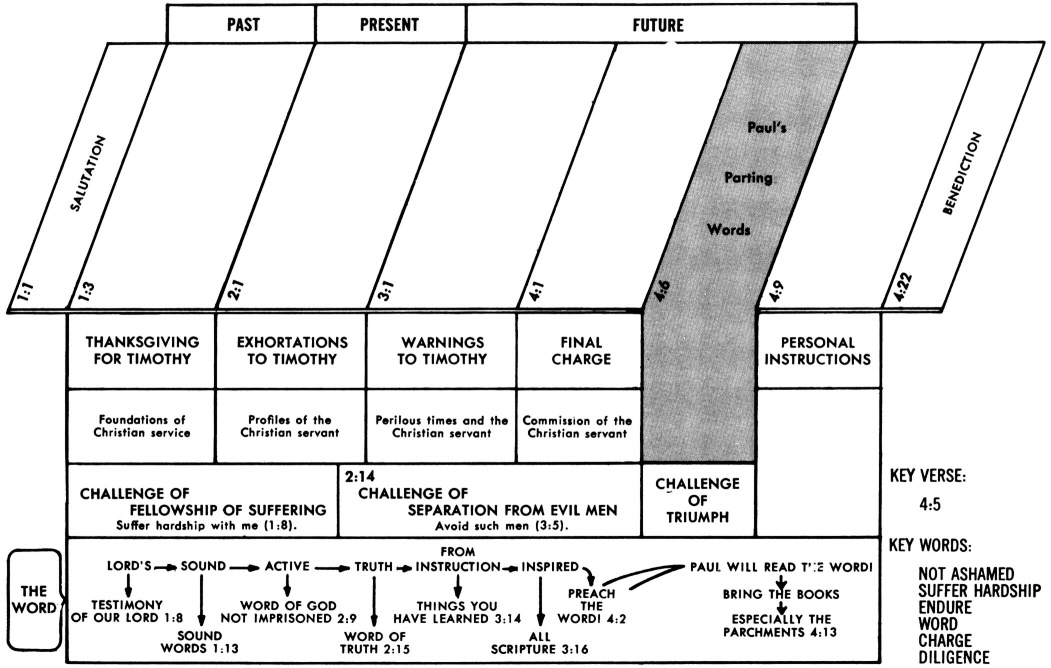
ENDURANCE AND SEPARATION IN THE MINISTRY
Click chart to enlarge
Charts from Jensen's Survey of the NT - used by permission
Second Timothy - Swindoll
| 2 TIMOTHY | |||
| 2 Timothy 1:1-18 | 2 Timothy 2:1-26 | 2 Timothy 3:1-17 | 2 Timothy 4:1-22 |
| Retain the Standard |
Rightly Divide the Word |
Difficult Times Will Come |
Preach the Word |
| PAST | PRESENT | FUTURE | |
| Foundation of Christian Service |
Pictures of Christian Servant |
Dangerous Times for Christian Servant |
Commission of Christian Servant |
| Unashamed as a Witness: Guard the Gospel |
Unashamed as a Workman: Suffer for the Gospel |
Adequate as a Workman: Continue in the Gospel |
Awarded as a Workman: Preach the Gospel |
| Power of the Gospel |
Perseverance of the Gospel Message | Protection of the Gospel |
Proclamation of the Gospel |
| Reminder | Requirements | Resistance | Requests |
| Encouragement in Ministry |
Examples in Ministry |
Exhortations in Ministry |
Exhortations to Fulfill Ministry |
| Commendation & Charge |
Commission to Fulfill |
Conflict to Face |
Course to Finish |
|
Compiled from Jensen's Survey of the NT and Wilkinson's Talk Thru the Bible |
|||
2 Timothy 1:9 Who has saved (AAPMSG) us and called (AAPMSG) us with a holy calling, not according to our works, but according to His own purpose and grace which was granted (APPFSA) us in Christ Jesus from all eternity (B: Lockman)
Greek: tou sosantos (AAPMSG) hemas kai kalesantos (AAPMSG) klesei hagia ou kata ta erga hemon alla kata idian prothesin kai charin, ten dotheisan (APPFSA) hemin en Christo Iesou pro chronon aionion,
GWT: God saved us and called us to be holy, not because of what we had done, but because of his own plan and kindness. Before the world began, God planned that Christ Jesus would show us God's kindness. (GWT)
KJV: Who hath saved us, and called us with an holy calling, not according to our works, but according to his own purpose and grace, which was given us in Christ Jesus before the world began,
NLT: It is God who saved us and chose us to live a holy life. He did this not because we deserved it, but because that was his plan long before the world began--to show his love and kindness to us through Christ Jesus. (NLT - Tyndale House)
Phillips: For he has rescued us from all that is really evil and called us to a life of holiness - not because of any of our achievements but for his own purpose. Before time began he planned to give us in Christ the grace to achieve this purpose (Phillips: Touchstone)
Wuest: The One who saved us and called us in the sphere of a holy calling, not according to our works, but according to His own private purpose and grace which was given us in Christ Jesus before the beginning of time.
YLT: who did save us, and did call with an holy calling, not according to our works, but according to His own purpose and grace, that was given to us in Christ Jesus, before the times of the ages,
WHO SAVED US: tou sosantos (AAPMSG) hemas:
- Mt 1:21. Ac 2:47. Ro 13:11 1Co 1:18. Ep 2:5, 8. 1 Ti 1:1. Ti 3:4, 5
- 2 Timothy 1 Resources - Multiple Sermons and Commentaries
In the Greek text, note that verses 8-11 are a single sentence.
Note that this next section is an expansion of the last word in the previous verse "God" and His infinite power. Paul simply cannot resist the opportunity to enlarge upon the gospel of God and what He did in providing the way (Note: Not "a way" but "the" only way, Jn 14:6 where the definite article "the" precedes way, truth, and life, cp Acts 4:12) of escape from the divine wrath to come, a wrath which was otherwise justly deserved by sinners such as he (and we).
Steven Cole has a poignant introduction in his exposition of this passage observing that…
Most evangelistic appeals today pitch the gospel as the way to have an abundant life. “Jesus came to offer you abundant life. Trust in Him and He will give you peace, joy, and a truly happy life.” While all of those claims are true if properly defined, what the salesman hasn’t told the potential customer is that your problems may grow much worse after you have trusted in Christ.
When we pitch Jesus as a better way to self-fulfillment, we’re promoting an Americanized message that is not identical with the biblical gospel. What if the potential convert is from a Muslim background? Will his life be one of trouble-free happiness if he trusts in Christ? His family will disown him and possibly kill him because he converted to Christianity. What if he is from China? He may lose his job or be sent to a labor camp on account of his Christian faith. In 2Ti 3:12 (note), Paul says,
“Indeed, all who desire to live godly in Christ Jesus will be persecuted.”
We had better present a gospel that is worth suffering for!
In the Greek text, 2Ti 1:8-11 are a single sentence. In 2Ti 1:8, Paul exhorts Timothy not to
“be ashamed of the testimony of our Lord, or of me His prisoner, but join with me in suffering for the gospel according to the power of God.”
Then in 2Ti 1:12, Paul states,
“For this reason, I also suffer these things, but I am not ashamed.”
So our text is sandwiched between an exhortation to embrace suffering for the gospel without shame and an example of one who had done so. The motive that Paul uses to urge Timothy to embrace suffering is the glorious gospel of God’s sovereign grace. He is saying that…
Because God has saved us by His sovereign grace, we should be willing to suffer for the gospel.
Getting a grasp of the glorious truth that God saved us according to His own purpose and grace, which was granted to us in Christ Jesus from all eternity, will give us the strength to endure suffering for the sake of the gospel. Remember, these words are coming to us from the Holy Spirit through the mouth of a man who is facing imminent execution on account of the gospel. So these truths are powerfully practical, but we must understand and submit to them in order to benefit from them. (Why Suffer for the Gospel? By Steven Cole)
Saved (4982) (sozo [word study]) has the basic meanings of to rescue from peril, danger or destruction (ultimately the "second death" in the Lake Of Fire - See also Garland's Births, Deaths, and Resurrections), to protect, to keep alive in either a physical or spiritual sense (the latter of course being the most important in eternal terms).
Sozo occurs 54x in the Gospels, 14 uses relating to deliverance from disease or demon possession (Mt 9:21, 22, Lk 8:36), 20x to the rescue of physical life from some impending peril or death (Mt 8:25; 14:30) and the remaining 20x referring to spiritual salvation (Mt 1:21; 10:22; Lk 8:12; Jn10:9).
Sozo - 106x in 99v in NAS = bring… safely(1), cured(1), ensure salvation(1), get(1), get well(2), made… well(6), made well(5), preserved(1), recover(1), restore(1), save(36), saved(50), saves(1), saving(1).
Matt 1:21; 8:25; 9:21f; 10:22; 14:30; 16:25; 19:25; 24:13, 22; 27:40, 42, 49; Mark 3:4; 5:23, 28, 34; 6:56; 8:35; 10:26, 52; 13:13, 20; 15:30f; 16:16; Luke 6:9; 7:50; 8:12, 36, 48, 50; 9:24; 13:23; 17:19; 18:26, 42; 19:10; 23:35, 37, 39; John 3:17; 5:34; 10:9; 11:12; 12:27, 47; Acts 2:21, 40, 47; 4:9, 12; 11:14; 14:9; 15:1, 11; 16:30f; 27:20, 31; Rom 5:9f; 8:24; 9:27; 10:9, 13; 11:14, 26; 1 Cor 1:18, 21; 3:15; 5:5; 7:16; 9:22; 10:33; 15:2; 2 Cor 2:15; Eph 2:5, 8; 1 Thess 2:16; 2 Thess 2:10; 1 Tim 1:15; 2:4, 15; 4:16; 2 Tim 1:9; 4:18; Titus 3:5; Heb 5:7; 7:25; Jas 1:21; 2:14; 4:12; 5:15, 20; 1 Pet 3:21; 4:18; Jude 1:5, 23.
Saved in this verse is in the aorist tense (as is the following verb "called") which signifies that God's act of saving (and calling) the believer was at a point in time. In other words in this context, the aorist tense speaks of a specific historical event.
Edwards points out that…
This is one of the few times in the NT where the word "save" (sozo) refers only to justification (salvation from the penalty of sin). In each case when save is used only for justification, it is used in a past tense (either aorist or perfect). Ep 2:8, Titus 3:5, Lk 8:12. It is interesting to note the contrast in the use of "save" here with 1Ti 4:16. In 1Ti 4:16, Timothy's salvation is still future and is conditional. Here Timothy's salvation is past and unconditional. Is there a contradiction? No, 1Ti 4:16 is talking about SANCTIFICATION (salvation from the power and effects of sin) while 2Ti 1:9 is in reference to JUSTIFICATION. Untold confusion has arisen by men forcing "justification" upon the word "save" whenever they see it in the NT.
We ought to note that it is God Who reached down and saved us. He initiated the process from before time eternal, He wooed us and won us by the convicting ministry of His Spirit, and He will consummate the process in His good time. Truly there can be no boasting on man's part for all we ever did was turn farther away from the One Who created and redeemed us. Inseparably linked to our salvation, is our calling. "… and called us with a holy calling." (2 Timothy Call to Completion)
Do you remember the day you were saved? (I only know the season myself = My Testimony to God's Grace). Paul’s is saying that since God has saved us and called us at a definite point of time, this glorious truth ought to strengthen our faith to be willing to suffer unashamedly. He has reminded Timothy that he (and we) have God's gifts (2Ti 1:7-note) and God's power (Recall to mind God's power = omnipotent) to overcome opposition (cp "overcomers" 1Jn 5:4, 5, Ro 8:35, 36-note, Ro 8:37, 38, 39-note). Beloved, as we suffer, let us be sure that we are suffering for doing good and not evil! (cp 1Pe 2:20-note, 1Pe 3:17-note)
Through the cleansing blood of the dying Lamb,
Through the pow’r of grace and the precious Name,
Through the light that beams from the Morning Star,
More than conquerors, conquerors we are.
(Play)
The apostle uses the perfect tense and says, "Who hath saved us." Believers in Christ Jesus are saved. They are not looked upon as persons who are in a hopeful state, and may ultimately be saved, but they are already saved. Salvation is not a blessing to be enjoyed upon the dying bed, and to be sung of in a future state above, but a matter to be obtained, received, promised, and enjoyed now. The Christian is perfectly saved in God’s purpose; God has ordained him unto salvation, and that purpose is complete. He is saved also as to the price which has been paid for him: “It is finished” was the cry of the Saviour ere he died. The believer is also perfectly saved in his covenant head, for as he fell in Adam, so he lives in Christ. This complete salvation is accompanied by a holy calling. Those whom the Saviour saved upon the cross are in due time effectually called by the power of God the Holy Spirit unto holiness: they leave their sins; they endeavour to be like Christ; they choose holiness, not out of any compulsion, but from the stress of a new nature, which leads them to rejoice in holiness just as naturally as aforetime they delighted in sin. God neither chose them nor called them because they were holy, but he called them that they might be holy, and holiness is the beauty produced by his workmanship in them. The excellencies which we see in a believer are as much the work of God as the atonement itself. Thus is brought out very sweetly the fulness of the grace of God. Salvation must be of grace, because the Lord is the author of it: and what motive but grace could move him to save the guilty? Salvation must be of grace, because the Lord works in such a manner that our righteousness is for ever excluded. Such is the believer’s privilege—a present salvation; such is the evidence that he is called to it—a holy life. (Morning and Evening)
Steven Cole has a good discussion on salvation writing…
As I’ve often said, salvation is a radical word. You don’t need saving if you’re in pretty good shape. All you need then is a little help. You need saving when you’re perishing and are helpless to save yourself. The Bible uses a number of metaphors to show that we are desperately helpless and unable to save ourselves. It says that we were dead in our sins (Eph. 2:1; John 11). It pictures us as blind (John 9; 2 Cor. 4:4), lost (Luke 15), leprous (Luke 5:12-14), crippled (Luke 5:18-25), deaf (Mark 7:31-35), and hardened in our hearts (Eph. 4:18). Salvation means that God came to us while we were His sinful enemies (Rom. 5:8, 10), rescued us from our helpless condition, and gave us new life as His free gift. As William Hendriksen put it (New Testament Commentary, 1 & 2 Timothy, Titus [Baker], p. 232), “God has delivered us from the greatest of all evils and he has placed us in possession of the greatest of all blessings.”
But here is where much controversy arises. Many will say, “It’s true that God saves us, but the sinner has to exercise his free will in order to accept God’s gift.” In other words, God has done His part by sending Christ to die for our sins, but now it’s up to us to accept Him. Implicit in this teaching is that everyone has the ability to believe in Christ. Without such ability, they say, God’s offer of salvation is a sham. What good is it to tell a sinner to trust in Christ if he is not able to trust in Christ?
Several things need to be said here. First, sinners must repent and trust in Christ to be saved. Christ commands sinners to repent and believe the gospel (Mark 1:15). But the command does not imply ability. Jesus plainly said (John 6:44, 65), “No one can come to Me unless the Father who sent Me draws him; and I will raise him up on the last day…. For this reason I have said to you, that no one can come to Me unless it has been granted him from the Father.” Clearly, the Father does not draw everyone to Christ, because Jesus promises to raise up on the last day all who come to Him through the Father’s drawing. But not all will be saved. Jesus said (Luke 10:22), “All things have been handed over to Me by My Father, and no one knows who the Son is except the Father, and who the Father is except the Son, and anyone to whom the Son wills to reveal Him.” Clearly, Jesus does not will to reveal the Father to everyone. When the disciples asked Jesus why He spoke to the multitudes in parables, He replied (Matt. 13:11), “To you it has been granted to know the mysteries of the kingdom of heaven, but to them it has not been granted.”
In John 8:43, 44, Jesus asked the unbelieving Jews, “Why do you not understand what I am saying? It is because you cannot hear My word. You are of your father the devil, and you want to do the desires of your father….” Jesus did not say, “It is because you chose by your free will not to hear My word,” but rather, “because you cannot hear My word.” Because they were not born again, they were of their father the devil, and they acted in accordance with their nature.
If we had time, I could multiply verses that say the same thing (e.g., Ro 8:7, 8; 1Cor. 2:14; 2Co 4:4; Ep 2:1, 2, 3; 4:17, 18). So to speak of “free will” is really misleading. As Martin Luther correctly argued against Erasmus (The Bondage of the Will), the fallen human will (before conversion) is in bondage to sin. Or, as Charles Wesley put it (“And Can it Be?”), “Long my imprisoned spirit lay, fast bound in sin and nature’s night….” God has to send that quickening (life-giving) ray to awaken us from our darkness, death, and bondage. At that instant, we respond in faith and repentance, which also come from God. It is God who saves us. (Why Suffer for the Gospel?)
AND CALLED US: kai kalesantos (AAPMSG):
- Ro 8:28, 30. 9:24. 1Th 1:4. 4:7. 2Th 2:13, 14. He 3:1. 1Pe 1:15, 16, 2:9, 20, 21. 2Pe 1:3
- 2 Timothy 1 Resources
GOD'S EFFECTUAL
CALLING
Called (2564) (kaleo [word study]) has several nuances including (1) to identify by name or attribute, call, call by name, name (Lk 1:59, Jn 10:3) (2) to request the presence of someone at a social gathering, invite (Mt 22:9) (3) to use authority to have a person or group appear or to summon (Mt 2:7) and (4) from the meanings ‘summon’ & ‘invite’ there develops the extended sense of to choose for receipt of a special benefit or experience which is the meaning in the context of the present verse (Heb 5:4 of God calling one to be priest, 1Pe 5:10 called to eternal glory).
Vincent comments that called "It is Paul’s technical term for God’s summoning men to salvation."
Jamieson rightly says "The call comes wholly from God and claims us wholly for God. (and adds that) “Holy” implies the separation of believers from the rest of the world unto God."
As John Gill says "The calling here spoken of is not to an office, nor a mere call by the external ministry of the word, but a call by special grace, to special privileges, to grace and glory; and is an high and heavenly one, and is here called holy."
Related Resources:
- What is the effectual calling/call?
- What does it mean that God draws us to salvation?
- Irresistible Grace - is it biblical?
WITH A HOLY CALLING: klesei hagia:
- Ro 8:28, 29, 30; 9:24; 1Th 4:7; 2Th 2:13,14; Heb 3:1; 1Pet 2:9; 2:21
- 2 Timothy 1 Resources
OUR CALLING SETS US APART
FROM THE SIN AND TO OUR SAVIOR
Edwards comments on the four aspects of our calling
1) It is a HOLY CALLING: The word "holy" (hagios) means "set apart." God has always desired His people to be set apart" people. Dt. 7:6, Isa. 52:11, 1 Pet. 1:15,16. We are to be "set apart" from sin and "set apart" to the Savior. Holiness is not an option for the believer, it is a family obligation for all those who are joined together in Christ. "Let everyone who names the name of the Lord depart from iniquity." II Tim. 2:19.
(2) It is an UNMERITED CALLING: "not according to our works but according to his own … grace." Our salvation and calling are utterly unmerited by US. Our righteous deeds are but "filthy rags" (Is. 64:6) and the only thing our lives truly merit is the wrath of Almighty God. Yet because of God's unfathomable love, He reached out to us who were dead in trespasses and sin and has made us alive together in Christ. (Eph 2:1-5). Isaac Watts put it well:
Alas and did my Savior bleed? and did my Sovereign die?
Would He devote that sacred head for such as worm as I?
Was it for crimes that I have done He groaned upon the tree?
Amazing pity! grace unknown! and love beyond degree!
Click to play & ponder the full hymn
(3) It is a PURPOSEFUL CALLING: "but according to His own purpose … " One of the greatest pursuits of our day is the pursuit for purpose in life. I remember reading a few years back about a man named Isaac Singer, Nobel Peace Prize winner for literature. In the article his very successful life was described in some detail and it appeared that he had lived a very full and rewarding life. But at the end of the article, Isaac Singer made a statement which I've never forgotten. He said, "But you know the same questions bother me today which bothered me fifty years ago." And number one among these questions was, "Why was I born?" No doubt Mr. Singer is not alone in his unfulfilled quest for purpose and meaning in life. In fact Dr. Karl Jung, the famous psychologist made the statement not long ago that "Purposelessness is the neurosis of our day." Yet God has provided a totally satisfying answer to the question of purpose. But it is important to note that this answer is "according to HIS OWN purpose." Until we are willing to live life for HIS purpose then we will chafe at His answer for it cuts across the grain of our natural desire for personal HAPPINESS. God's purpose (prothesis) for our lives is not personal HAPPINESS but personal HOLINESS (Christ-likeness) Ro 8:28,29.
God's great goal for our lives is to "conform us to the image of His Son" Ro 8:29. He will stop at nothing to bring about this holy task. Thus, the great purpose "set before" us is to be consumed with the calling of Christ-likeness and to unrelentlessly pursue this great goal, no matter what the cost. Like the apostle Paul, we should set as our primary purpose in life "to know Him, and the power of His resurrection, and the fellowship of His sufferings, being conformed to His death, if by any means I may attain to the resurrection from the dead." (Php 3:10,11)
(4) It is an ETERNAL CALLING. "which was given to us in Christ Jesus before time began." The pronoun "which" is probably referring back to both "purpose and grace." Here we catch a glimpse of the majestic sovereignty of God Who "works all things according to the counsel of His will" (Ep 1:11). God's purpose and grace were given to us in the person of Christ Jesus. But look when we received them: "before times eternal" (pro chronon aionion).
The human mind is simply incapable of fully grasping the immensity of truths such as these; yet it should not frustrate us that we are not able to pigeonhole God's eternal workings by our frail, finite intellects. Rather, truths such as these should stir our hearts to deeper appreciation and fuller worship of the great God we serve. "Oh the depth of the riches both of the wisdom and knowledge of God! How unsearchable are His judgments and His ways past finding out!" (Ro 11:33) What may appear to us to be taking place in the here and now, took place in the mind of God even before He set time in motion. Thus it is no accident that you and I are come upon the stage of human history at this particular point in time. We are simply playing a part God designed and decreed for us long, long ago even before the genesis of time itself. (2 Timothy Call to Completion)
In another letter Paul reminds the saints that…
God has not called us for the purpose of impurity (uncleanness, word used of graves), but in sanctification (holiness, "to dedicate ourselves to the most thorough purity" [Amp]). (1Th 4:7)
Moses describes what God's will is for His people…
For I am the LORD your God. Consecrate yourselves therefore, and be holy; for I am holy. And you shall not make yourselves unclean with any of the swarming things that swarm on the earth. (Leviticus 11:44+)
Matthew Poole comments on a holy calling noting that "in order to our obtaining it, hath effectually called, renewed, and sanctified us."
Holy (40) (hagios) defines a believer's calling as not profane, but separate from the corrupt, contaminated world. Believers are set apart (hagios) from sin and set apart for the Master's (kurios) use (cp 2Ti 2:21-note). (Click discussion of Be holy and holiness)
The holy calling is from God and is often referred to as His effectual call of a sinner to salvation in which the sinner called, willingly accepts the salvation God offers him. This is God’s invitation to man to accept the benefits of salvation. In short, in the epistles, God's calling always denotes an effective and successful calling.
Why is it referred to as a holy calling? Gill has this succinct answer:
The Author of it is holy; it is a call to holiness, and the means of it are holy; and in it persons have principles of grace and holiness implanted in them; and are influenced to live holy lives and conversations." Stated another way this calling is holy because it is not only the invitation to a holy life, but also to the holy life which the one called is expected to live. God has always desired His people to be a "set apart" people (Dt 7:6, Isa 52:11).
Holiness is not an option for the believer, it is a family obligation (see how His "children" are to act - 1Pe 1:15,16-notes) for all those who are joined together in Christ and all "who name the name of the Lord (are to) abstain (aorist imperative - do it now, sense of urgency) from wickedness." (2Ti 2:19-note, see Torrey's Topic "Character of Saints")
Related Resources:
The Christian’s holy calling is described in some detail in Ephesians 1–3, especially Eph 1:3-14 where we see the truths that saints are chosen (Ep 1:4-note), predestined (Ep 1:5-1:11-see notes Ep1:5, 11), adopted as sons (Ep 1:5-note), accepted in the Beloved (Ep 1:6-note), redeemed through His blood (Ep 1:7-note), forgiven (Ep 1:7-note), sealed with the Holy Spirit (Ep 1:13-note) and given the earnest of our inheritance (Ep 1:14-note).
In addition to a holy calling, saints also have a high ("upward") calling (Php 3:14-note) and a heavenly calling (He 3:1-note)
The called are those are benefactors of the calling of God. Ponder (and then Praise God for) the Scriptural associations (benefits/responsibilities) of the saint's calling…
- by grace (Kaleo - Gal 1:6)
- through the "gospel" that we "may gain the glory of our Lord Jesus Christ" (Kaleo - 2Th 2:14)
- to salvation (Kaleo - Ro 8:30-note)
- saints by calling (Kletos - 1Co 1:2)
- brought "into fellowship with His Son, Jesus Christ our Lord" (Kaleo - 1Co 1:9)
- both Jews and Greeks (Kletos - 1Co 1:24)
- not from among Jews only, but also from among Gentiles (Kaleo - Ro 9:24-note)
- according to His purpose (Kletos - Ro 8:28-note)
- to walk worthy (Kaleo - Ep 4:1- note)
- (to proclaim His excellencies) out of darkness into His marvelous light (Kaleo - 1Pe 2:9-note)
- for this purpose (to suffer… follow in His steps) - (Kaleo - 1Pe 2:21-note)
- heavenly calling (klesis) (Heb 3:1-note)
- (a holy calling) having been called (kaleo) "with a holy" calling (klesis) (2Ti 1:9-note)
- to be holy yourselves in all your behavior - (Kaleo - 1Pe 1:15-note)
- to inherit a blessing (following Christ's example) - (Kaleo -1Pe 3:9-note)
- to His eternal glory in Christ (Kaleo - 1Pe 5:10-note)
- and return in triumph "with Him" at the end of this age (Kletos - Re 17:14-note).
These magnificent truths on "called" should cause all the "called of Jesus Christ" to cry out "Glory!"
Hiebert comments on the two words saved and called writing that…
The order of the two terms, united under one article, is interesting. Boise observes 'As the order now stands, it presents the picture of one who is wandering away from God. He is stopped in his course. This first divine act saves him. He is then called, invited, with a holy calling-holy in contrast with the invitations to sin such as he had previously listened to. The calling is the work of God's holiness and it leads to holiness in the called.'" (2 Timothy by D. Edmond Hiebert).
Steven Cole notes that - One common objection to the view that salvation is totally by God’s grace is that such teaching will lead to licentiousness. The charge was leveled against Paul (Ro 3:8,6-see notes Romans 3:8; 6:1). But he always made it clear that God calls us to live holy lives. If someone claims to be saved but continues living in sin, he had better examine whether he was truly saved at all. Salvation that does not result in a life of progressive holiness is not genuine salvation. It dishonors the name of God when someone claims to be saved, especially someone in public ministry, but he lives in sin. While no one can be totally free from sin in this life, those whom God has saved will sin less as they grow in holiness in thought, word, and deed. God’s call to holiness is effectual, which is to say, it is something that He purposes and promises to accomplish in us. Yet at the same time, we must actively strive for holiness according to the means that God has provided. (Why Suffer for the Gospel? )
A beautiful illustration of the inherent idea of separation that is found in the word holiness comes from the world of nature - In the forests of northern Europe and Asia lives little animal called the ermine, known for his snow-white fur in winter. He instinctively protects his white coat against anything that would soil it. Fur hunters take advantage of this unusual trait of the ermine. They don’t set a snare to catch him, but instead they find his home, which is usually a cleft in a rock or a hollow in an old tree. They smear the entrance and interior with grime. Then the hunters set their dogs loose to find and chase the ermine. The frightened animal flees toward home but doesn’t enter because of the filth. Rather than soil his white coat, he is trapped by the dogs and captured while preserving his purity. For the ermine, purity is more precious than life. (Ed: O, that we all had the mindset of the ermine in winter!) ( H G Bosch Our Daily Bread, Copyright RBC Ministries, Grand Rapids, MI. Reprinted by permission. All rights reserved)

Dwight L. Moody (See "Why God Used Dwight L. Moody" by R. A. Torrey) once said that "A holy life will make the deepest impression. Lighthouses blow no horns, they just shine. “It is a great deal better to live a holy life than to talk about it. We are told to let our light shine, and if it does we won’t need to tell anybody it does. The light will be its own witness. Lighthouses don’t ring bells and fire cannon to call attention to their shining—they just shine.”
NOT ACCORDING TO OUR WORKS: ou kata ta erga hemon:
- Titus 3:5, Eph 2:8, 9,10, Ro 3:20, 4:5, 9:11, 11:5, 6; Gal 2:16
- Click discussion of good deeds
- 2 Timothy 1 Resources - Multiple Sermons and Commentaries
THERE IS NO SALVATION
BY OUR WORKS!
Not according to - Fittingly Paul uses the strongest Greek word for "not" (ou) to convey that there is absolutely no way works of a man can merit salvation. This false belief is so important to refute that he reiterates this same idea many times in his epistles…
Romans 3:20 (note) because by the works of the Law no flesh will be justified in His sight; for through the Law comes the knowledge of sin.
Romans 4:4 (note) Now to the one who works, his wage is not reckoned as a favor, but as what is due. 4:5 But to the one who does not work, but believes in Him who justifies the ungodly, his faith is reckoned as righteousness,
Romans 11:6 (note) But if it is by grace, it is no longer on the basis of works, otherwise grace is no longer grace.
Galatians 2:16 nevertheless knowing that a man is not justified by the works of the Law but through faith in Christ Jesus, even we have believed in Christ Jesus, that we may be justified by faith in Christ, and not by the works of the Law; since by the works of the Law shall no flesh be justified.
Ephesians 2:8 (note) For by grace you have been saved through faith; and that not of yourselves, it is the gift of God; 2:9 not as a result of works, that no one should boast. 2:10 For we are His workmanship, created in Christ Jesus for good works, which God prepared beforehand, that we should walk in them.
Titus 3:4 (note) But when the kindness of God our Savior and His love for mankind appeared, 3:5 He saved us, not on the basis of deeds which we have done in righteousness, but according to His mercy, by the washing of regeneration and renewing by the Holy Spirit, 3:6 whom He poured out upon us richly through Jesus Christ our Savior,
Our works have not the least trace of holiness to merit God's holy calling.
As Spurgeon once said "The first link between my soul and Christ is not my goodness but my badness, not my merit but my misery, not my riches but my need.
Saints were saved not according to their "good" works (none are good, no not one) but for or unto good works (Ep 2:10-note; Titus 2:14-note; He 10:24-note; 1Pe 2:12-note; Re 22:12-note) cf Acts 9:36 ,1Ti 6:18) the "ultimate" work being to bring glory to our Father in heaven.
Our righteous deeds are but "filthy rags" (Isa 64:6) and the only thing our lives truly merit is the wrath of Almighty God. Thus Paul always emphasizes that men are saved despite what they deserve, not because of what they deserve!
Gill explains man's "works" as "not properly good works (2Ti 2:21-note; 2Ti 3:17-note), being destitute of faith in Christ, and proceeding neither from a right principle, nor to a right end"… no matter how "good" they may appear to other men. (Jer 17:9,10) Salvation is not earned nor merited by anything that the sinner does.
Calvin astutely reasons that "If God chose us before the creation of the world He could not have considered the question of our works, which could have had no existence at a period when we ourselves were not."
John Blanchard's quip puts our works in their proper place - We are saved not by merit but by mercy.
Spurgeon - William Wickham being appointed by King Edward to build a stately church, wrote in the windows, "This work made William Wickham." When charged by the king for assuming the honour of that work to himself as the author, whereas he was only the overseer, he answered that he meant not that he made the work, but that the work made him, having before been very poor, and then in great credit.
Lord, when we read in thy Word that we must work out our own salvation, thy meaning is not that our salvation should be the effect of our work, but our work the evidence of our salvation.— Feathers for Arrows
Related Resources:
- Why is salvation by works the predominantly held viewpoint?
- Is salvation by faith alone, or by faith plus works?
- How can salvation be not of works when faith is required? Isn't believing a work?
- What does it mean to be saved by grace?
- Why is faith without works dead?
- What is the relationship of faith, works, and security in salvation?
- What does it mean that good works are the result of salvation?
BUT ACCORDING TO HIS OWN PURPOSE: alla kata idian prothesin:
- Dt 7:7, 7:8; Isa 14:26,27; Mt 11:25,26; Lk 10:21; Jn 15:16, Ro 8:28; 9:11, 12, 13, 16, 10:20, 1Co 1:27, 28, 29, Ep 1:3, 4, 5, 6, 7, 9, 11, 3:11
- 2 Timothy 1 Resources - Multiple Sermons and Commentaries
YOUR LIFE HAS GREAT
PURPOSE IN CHRIST
But according to - This is a humbling contrast of which we would be wise to never lose sight. He did not save us because of how famous we were, of how great we were, on the basis of what great things we had done, etc, but because it was His holy purpose! This is humbling and should stimulate great gratitude.
THOUGHT - This verse should elicit a joyous "Hallelujah!" from the heart of every saved sinner! Not only did God save us from Hell and promise us Heaven, but He gave us purpose until the day we enter Heaven! Are you fulfilling His purpose in your life? Do you really mean it when you pray "Thy will be done on earth as it is in Heaven?" Nothing else matters in time or eternity. His will for our short life (a vapor, a breath, a shadow) should be our warp and woof, our soul's desire, our passionate pursuit, our holy aim, our only aim. Jesus was clear when He said "“I am the vine, you are the branches; he who abides in Me and I in him, he bears much fruit, for apart from Me you can do nothing." (John 15:5).
Related Resources:
- The Will Of God
- How can I know God's will for my life? What does the Bible say about knowing God's will?
Jamieson adds that..
The origination of salvation was of His own purpose, flowing from His own goodness, not for works of ours coming first, but wholly because of His own gratuitous, electing love
His own - This phrase is emphatic in the Greek sentence. God was self-moved, impelled by motives, not from without, but from within Himself and "His own private purpose" (Wuest translation).
Hiebert adds that…
Only God's sovereign and wise purpose is the norm for our salvation. If our salvation depended on our own deserving, we might well despair, but it has its ground in God's eternal and unshakable purpose. And that purpose expressed itself in "grace," the unmerited favor of God toward us guilty sinners." (2 Timothy by D. Edmond Hiebert).
Purpose (4286) (prothesis from protithemai = set before oneself to be looked at or exposed to view and then to purpose or plan) is literally placing before or setting before and so means the setting forth of a thing or placing of it in view, a putting forward openly -- a presentation, setting forth, plan, design, purpose, resolve, will.
Prothesis has a secular Greek use meaning setting forth of something in public and in a similar NT use refers to the name give to the shewbread ("loaves of presentation") in the Temple which is "exposed before God". The bread before the Presence of the Lord consisted of twelve loaves of wheat bread offered every Sabbath (12 = number of the tribes of Israel) and arranged in two rows on the table before the Holy of Holies and to remain there for seven days. (See topics: Vincent's note below, The Shewbread; shewbread; table of shewbread or showbread).
The 11 non-apocryphal uses in the Septuagint (LXX) apply prothesis only to the shewbread (see Ex. 39:36; 40:4, 23; 1 Sa 21:6; 1 Chr. 9:32; 23:29; 28:16; 2 Chr. 2:4; 4:19; 13:11; 29:18). Prothesis meaning intention, purpose, plan, is found only in the apocryphal books of 2 Macc 3:8; 3 Macc. 1:22; 2:26; 5:12, 29.
The other major NT meaning of prothesis is purpose, which is something set up as an object or end to be attained. Purpose describes fixed intention in doing something or the reason for which something is done or for which something exists. It describes what one intends to accomplish or attain and suggests a settled determination (this is going to happen - see uses below that especially relate to God's purpose).
Richards observes that…
God's sovereignty is affirmed in both OT and NT. An important NT aspect of this affirmation is found in the repeated emphasis on that which God has purposed, planned, and decreed. Two Greek words, prothesis and boule, are particularly significant. Prothesis means "a plan" or "a resolve," denoting a decision that has been made. The NIV renders this word "purpose" in four of the twelve places where it appears in the NT (Ro 8:28; 9:11; Eph 1:11; 3:11). Boule is a strong term, indicating God's fixed intention. That which is his purpose stands utterly fixed and cannot be changed by any action of others. (Richards, L O: Expository Dictionary of Bible Words: Regency)
Prothesis speaks of the action of an individual setting before himself a proposed action. Thus, it presupposes deliberation upon a course of conduct, and then the determination to carry it through.
Prothesis was also used to denote the public lying in state of the dead (Plato, Leg., 12, 947b), public announcements (Aristot., Pol., 6, 8, p. 1322a 9), and later an intention (Polyb., 5, 35, 2). From Aristotle on prothesis was used to express purpose and as shown below Paul uses it of 'the Divine purpose of God for the salvation of mankind,' the 'purpose of the ages' determined in the Divine mind before the creation of the world". (Adapted in part from Brown, Colin, Editor. New International Dictionary of NT Theology. 1986. Zondervan)
Vincent writes that prothesis originally referred to…
a placing in public or setting before. Hence of the shew-bread, the loaves set forth before the Lord (see Mark 2:26). Something set before one as an object of attainment: a purpose.
Here in 2 Timothy God's purpose refers to His plan and grace is the means of accomplishing His plan (cf similar truth in 2Ti 1:1 "according to the will of God"). Note that several other passages also refer to God's purpose (cp Ro 8:28- note, Ro 9:11-note, Ep 1:11-note, Ep 3:11-note). Clearly one thing we learn from these "divine" uses of prothesis is that God is a very "purposeful" God, which should be a source of great comfort to our soul. He is not haphazard, hit or miss, but always on target and on time.
Prothesis is used 12 times in the NT…
Matthew 12:4 how he entered the house of God, and they ate the consecrated bread, which was not lawful for him to eat, nor for those with him, but for the priests alone?
Mark 2:26 how he entered the house of God in the time of Abiathar the high priest, and ate the consecrated bread, which is not lawful for anyone to eat except the priests, and he gave it also to those who were with him?"
Vincent's Note on prothesis in this passage: The shewbread (tous artous tes protheseos). Literally, the loaves of proposition, i.e., the loaves which were set forth before the Lord. The Jews called them the loaves of the face, i.e., of the presence of God. The bread was made of the finest wheaten flour that had been passed through eleven sieves. There were twelve loaves, or cakes, according to the number of tribes, ranged in two piles of six each. Each cake was made of about five pints of wheat. They were anointed in the middle with oil, in the form of a cross. According to tradition, each cake was five hand-breadths broad and ten long, but turned up at either end, two hand-breadths on each side, to resemble in outline the ark of the covenant. The shewbread was prepared on Friday, unless that day happened to be a feast-day that required sabbatical rest; in which case it was prepared on Thursday afternoon. The renewal of the shewbread was the first of the priestly functions on the commencement of the Sabbath. The bread which was taken off was deposited on the golden table in the porch of the sanctuary, and distributed among the outgoing and incoming courses of priests (compare save for the priests). It was eaten during the Sabbath, and in the temple itself, but only by such priests as were Levitically pure. This old bread, removed on the Sabbath morning, was that which David ate. (Word Studies in the New Testament 1:173-174)
Luke 6:4 how he entered the house of God, and took and ate the consecrated bread which is not lawful for any to eat except the priests alone, and gave it to his companions?"
Acts 11:23 Then when he had come and witnessed the grace of God, he rejoiced and began to encourage them all with resolute heart (Literally = with purpose of heart) to remain true to the Lord; (Here prothesis means purpose of heart, that is, with determination and/or devotion - compare to the Stoic use of this word)
Acts 27:13 And when a moderate south wind came up, supposing that they had gained their purpose, they weighed anchor and began sailing along Crete, close inshore.
Romans 8:28 (note) And we know that God causes all things to work together for good to those who love God, to those who are called according to His purpose.
Romans 9:11 (note) for though the twins were not yet born, and had not done anything good or bad, in order that God's purpose according to His choice might stand (God's purpose which operates by selection), not because of works, but because of Him Who calls (Here purpose speaks of God's doctrine of Predestination - see passage in Ephesians. Cp notes Romans 8:29, 30 and Ephesians 1:5.)
Ephesians 1:11 (note) also we have obtained an inheritance, having been predestined according to His purpose (God's "grand design") Who works all things after the counsel of His will,
Ephesians 3:11 (note) This was in accordance with the eternal purpose which He carried out in Christ Jesus our Lord,
2 Timothy 1:9 (note) who has saved us, and called us with a holy calling, not according to our works, but according to His own purpose and grace which was granted us in Christ Jesus from all eternity,
2 Timothy 3:10 (note) But you followed my teaching, conduct, purpose (the guiding motive of Paul's life and work), faith, patience, love, perseverance,
Hebrews 9:2 (note) For there was a tabernacle prepared, the outer one, in which were the lampstand and the table and the sacred bread; this is called the holy place.
MacDonald adds this thought worth pondering:
"Why should God have so loved ungodly sinners that He was willing to send His only Son to die for them? Why should He go to such a cost to save them from hell and to bring them to heaven so that they could spend eternity with Him? The only possible answer is: according to His own purpose and grace. The reason for His action did not lie in us. Rather, it lay in His own great heart of love. He loved us because He loved us!"
Along this same line of reasoning note that the word “own” warrants special attention, signifying that God’s purpose sprang solely from His good will and love and not from anything external to Himself.
Wuest adds that salvation
"is dominated by God’s purpose… that of glorifying Himself in the bestowal of salvation and in the life of the person who is the recipient of that salvation. Salvation, therefore, can never be earned. If it could, the sinner would be glorified. Salvation must be a free gift with no strings tied to it. And that is grace, the act of God giving salvation as a free gift to one who does not only not deserve it, but who deserves punishment for his sins. This grace is given us in Christ Jesus in the sense that He made the gift of salvation possible through His death on the Cross by which He satisfied the just requirements of the law which sinners broke, thus making it possible for a righteous God to show mercy to a hell-deserving sinner on the basis of justice satisfied. This grace was given us before the world began." (Wuest, K. S. Wuest's Word Studies from the Greek New Testament: Eerdmans
Dwight Edwards has some excellent thoughts regarding God's purpose
One of the greatest pursuits of our day is the pursuit for purpose in life. I remember reading a few years back about a man named Isaac Singer, Nobel Peace Prize winner for literature. In the article his very successful life was described in some detail and it appeared that he had lived a very full and rewarding life. But at the end of the article, Isaac Singer made a statement which I've never forgotten. He said, "But you know the same questions bother me today which bothered me fifty years ago." And number one among these questions was, "Why was I born?"
No doubt Mr. Singer is not alone in his unfulfilled quest for purpose and meaning in life… Yet God has provided a totally satisfying answer to the question of purpose. But it is important to note that this answer is "according to HIS OWN purpose." Until we are willing to live life for HIS purpose then we will chafe at His answer for it cuts across the grain of our natural desire for personal HAPPINESS. God's purpose for our lives is not personal HAPPINESS but personal HOLINESS (Christ-likeness) (Ro 8:28ff-note) God's great goal for our lives is to "conform us to the image of His Son" (Ro 8:29-note). He will stop at nothing to bring about this holy task. Thus, the great purpose "set before" us is to be consumed with the calling of Christ-likeness and to unrelentlessly pursue this great goal, no matter what the cost. Like the apostle Paul, we should set as our primary purpose in life
"that I may know Him and the power of His resurrection and the fellowship of His sufferings, being conformed to His death; in order that I may attain to the resurrection from the dead." (Php 3:10,11-note)
AND GRACE WHICH WAS GRANTED US: kai charin ten dotheisan (APPFSA) hemin:
- Grace - Acts 15:11
- Which was granted us - Jn 6:37; 10:28,29; 17:9; 1Cor 1:4, 3:21,22; Eph 1:3
- 2 Timothy 1 Resources - Multiple Sermons and Commentaries
GOD'S GIFT OF
GRACE
Grace (charis [word study]) is the beneficent disposition of God toward mankind. God's Riches At Christ's Expense. Unmerited favor from God to man. Grace is transforming power to save sinners and to keep them saved forever.
My God, how excellent Thy grace,
Whence all our hope and comfort spring!
The sons of Adam in distress
Fly to the shadow of thy wing.
--Isaac Watts
Grace is God's unmerited favor and supernatural enablement and empowerment for salvation and for daily sanctification (cp empowering/strengthening aspect of grace in 1Cor 15:10, 2Co 12:9-note, 2Ti 2:1-note). Grace is everything for nothing to those who don't deserve anything. Justice is getting what you deserve; mercy is not getting what you deserve; grace is getting what you do not deserve.
J. H. Jowett defined grace as holy love on the move.
Grace is needed for every service, mercy for every failure and peace for every circumstance.
Accept God's grace through faith, then prove his grace through works, for God does not save us by grace so that we might then live in disgrace (to His holy Name).
The grace of God does not find men fit for salvation, but makes them so. - Augustine
The only limits to God's grace are the limits we put on it.
Grace is as large in renewing us as sin was in defacing. - Stephen Charnock
Grace in the heart of man is an exotic. It is a new principle from without, sent down from heaven and implanted in his soul. - J. C. Ryle
As heat is opposed to cold, and light to darkness, so grace is opposed to sin. Fire and water may as well agree in the same vessel as grace and sin in the same heart. - Thomas Brooks
The law tells me how crooked I am. Grace comes along and straightens me out. - D. L. Moody
Grace is what all need, what none can merit and what God alone can give. - George Barlow
Saving grace makes a man as willing to leave his lusts as a slave is willing to leave his galley, or a prisoner his dungeon, or a thief his bolts, or a beggar his rags. - Thomas Brooks
"He gives more grace when the burdens grow greater.
He sends more strength when the labors increase,
To added affliction He addeth His mercy,
To multiplied trials, His multiplied peace.
When we have exhausted our store of endurance,
When our strength has failed 'ere the day is half done;
When we reach the end of our hoarded resources
Our Father's full giving is only begun.
His love has no limit, His grace has no measure.
His power no boundary known unto men;
For out of His infinite riches in Jesus
He giveth and giveth and giveth again."
-- Annie Flint Johnson
Spurgeon - Many are like that Indian who, passing up the mountain side pursuing game, grasped a shrub to prevent his slipping, and as its roots gave way they uncovered masses of pure silver, and thus the richest silver mine was discovered by a happy accident by one who looked not for it. These Gentiles discovered in Christ the righteousness which they needed, but which they had never dreamed of finding. This reminds us of our Lord's own parable: the man was ploughing with oxen, and on a sudden the ploughshare struck upon an unusual obstacle. He stopped the plough and turned up the soil, and lo! he found a crock of gold! This "treasure hid in a field" at once won his heart, and for joy thereof he sold all that he had, and bought the field. Grace finds men who else would never have found grace.— Barbed Arrows from the Quiver of C. H. Spurgeon
Granted (didomi) means to give of one’s own accord and with good will and is aorist tense which denotes the giving is a past completed action and in the passive voice signifies that the action proceeds from an outside source, i.e., from God in Christ Jesus.
Note when this was granted to us. As Vincent says
"The meaning… of this phrase (pro chronon aionion) is rightly given in A. V.: before the world began, that is, before time was reckoned by aeons or cycles. Then, in that timeless present, grace was given to us in God’s decree… The gift planned and ordered in the eternal counsels is here treated as an actual bestowment.”
IN CHRIST JESUS FROM ALL ETERNITY: en Christo Iesou pro chronon aionion:
- Jn 17:24; Acts 15:18; Ro 16:25; Eph 1:4; 3:11; 2Th 2:13, Titus 1:2; 1Pe 1:20; Rev 13:8; 17:8
- 2 Timothy 1 Resources - Multiple Sermons and Commentaries
From is the Greek preposition pro which is a marker of a point of time prior to another point of time, earlier than, before and would allow a translation such as "before the ages" and more literally "before eternal times". Try to comprehend that Truth! But don't try too hard… just fall down in worship & thanksgiving for the truth of your calling (election) and your predestination before time began!
As discussed, calling here is an effectual call to salvation and as used by Paul (and Peter) equates with the elect or chosen of God. And also note that here as elsewhere Paul’s reference to predestination ("from all eternity") is designed to strengthen and comfort saints, not to confuse and confound us.
THOUGHT - When one knows that God purposed his or her salvation from all eternity, it will give one the firm assurance that God will finish what He began (Php 1:6). In other words, we did not do anything to gain salvation before we were even born and if follows we cannot do anything to lose salvation once we are saved.
Related Resources:
- Eternal security - is it biblical?
- What is the relationship of faith, works, and security in salvation?
- Is eternal security a “license” to sin?
- Did Old Testament believers have eternal security?
Vincent notes that the Greek literally reads "before eternal times. If it is insisted that aionios means everlasting, this statement is absurd. It is impossible that anything should take place before everlasting times. That would be to say that there was a beginning of times which are from everlasting. Paul puts the beginnings of salvation in God’s purpose before the time of the world (1 Cor. 2:7; 1Pe 1:20-note); and Christ’s participation in the saving counsels of God prior to time, goes with the Pauline doctrine of Christ’s preexistence. The meaning, therefore, of this phrase is rightly given in A. V.: before the world began, that is, before time was reckoned by aeons or cycles. Then, in that timeless present, grace was given to us in God’s decree, not actually, since we did not exist. The gift planned and ordered in the eternal counsels is here treated as an actual bestowment. (Word Studies in the New Testament 4:291)
MacArthur adds "God sovereignly designed salvation, and He sovereignly initiates, sustains, and completes salvation. He has forgiven us, justified us, and delivered us from sin and Satan, from death and hell. In every sense and in every tense—past, present, and future—God is our Savior. (MacArthur, J. 2 Timothy. Chicago: Moody Press)
Note 2 truths about Christ - His preexistence (from all eternity) and His role as Mediator in Whom divine grace is made available from God to sinful mankind.
|
||||||||||
Morris comments on this remarkable revelation incomprehensible to our finite mind…
We who are "in Christ Jesus" were saved and called (past tense), not only before we consciously accepted Christ, but even before we were born and before He created the world (Ep 1:4-note; Re 2:10-note; Re 13:10-note; Re 17:8-note)! While we cannot understand this with our minds, we can apprehend it with our hearts, and thank the Lord. (Morris, Henry: Defenders Study Bible Notes Online - Conservative and literalistic interpretation = Recommended!) (Bolding added)
John Gill nicely summarizes this section on salvation commenting that…
It is a gift, and a free gift, not at all depending upon any conditions in the creature, and entirely proceeding from the sovereign will of God; and it was a gift from eternity; there was not only a purpose of grace in God's heart, and a promise of it so early, but there was a real donation of it in eternity: and though those to whom it was given did not then personally exist, yet Christ did, and he existed as a covenant head and representative of His people; and they were in Him, as members of Him, as represented by Him, being united to Him; and this grace was given to Him for them, and to them in Him; in Whom they were chosen, and in Whom they were blessed with all spiritual blessings."
Guy King says that Paul…
makes it quite clear that its blessing (of the Gospel) comes "not according to our works, but according to His own purpose and grace". There is still a multitude of people, even many church people, who think that acceptance with GOD is secured by their own merit, that entrance to Heaven is gained by their own good works. How insistently does the New Testament combat that self-flattering idea! Although salvation is "unto good works" - that is, it commits its recipients to a subsequent practical Christianity yet - it is not "of works" - that is, our works cannot win it. His finished Work for us must first be accepted "by faith," and then our continual works for Him must follow, as the mark of our gratitude and the fruit of our love. Such is the teaching, not of this present poor scribe, but of the inspired writer of Ep 2:8, 9-note, Ep 2:10-note. All comes of "His own purpose and grace": because of His infinite grace, He conceived the loving purpose of our salvation. When did He come by that purpose? Let us dare to take just a few steps into that realm of mystery, and note
How the Gospel is prepared. "Before the world began," says our verse 9. It was not a sudden whim of the Almighty: it was "prepared before the face (perhaps here = the existence) of all people", sang old Simeon, in Luke 2:31. Before the sin happened, before the sinner came, before the sinner's world was - the salvation plan was drawn up ready. The Lamb, Who is the Plan, "was foreordained before the foundation of the world," Peter was allowed to reveal to us, in 1Pe 1:20-note. That word "foundation" means "the architect's plan". He has the conception of his house in his mind; then he sets about drawing his plans. With his thoughts upon what will be the needs of those who will come to inhabit it, he puts in this and that - kitchen, bedrooms, coal cellar, bathroom, study, lounge, and so on. Our word suggests to us the Architect of the Universe, first conceiving, and then planning, this World - House for the habitation of men. All the while, His mind will be dwelling upon what will be their need. He sees them in His mind, as if they were already here in occupation of the house. "According to the foreknowledge," as 1Peter 1:2-note has it. The Architect knows that the chief need will be for the provision of a way of dealing with sin - so it is put down in the Plan. Even before the emergency of sin, there is the emergence of grace. In the course of time the Plan was put into effect and, as our passage (2Ti 1:10-note) says, "is now made manifest by the appearing of our Saviour Jesus Christ." Hebrews 9:24ff speaks of three appearances of Him - "He [hath] appeared to put away sin by the sacrifice of Himself"; He has gone back into Heaven "now to appear in the presence of God for us"; and "He [shall] appear the second time … unto salvation". (Reference)
Caught And Cleaned - There's a little church in the mountains west of Boise, Idaho, that recently celebrated its centennial. One part of the celebration was an enactment of the history of their church. Townspeople dressed in period costume portrayed the pastors who served their church over the years.
One of the former ministers was played by an old logger who had lived through much of the history of the church. The logger had come to faith in Christ as a result of that pastor's ministry.
He told of the efforts of the pastor to reach him—a hard-drinking, hard-living man with no interest in the gospel, a man who once said he "had never met a preacher he liked."
The minister was praying one day and complaining that he'd never win the logger to Christ, and that even if he did he wouldn't know what to do with him. The Lord's answer came to him in a way he could understand: "Don't worry about a thing. You 'catch' him, I'll 'clean' him."
It's a privilege to tell people about Christ. Salvation is "a holy calling, not according to our works, but according to His own purpose and grace" (2Timothy 1:9).
If we just keep fishing, we'll "catch" some, and God will make the foulest clean—just as He has done for us. —David H. Roper (Our Daily Bread, Copyright RBC Ministries, Grand Rapids, MI. Reprinted by permission. All rights reserved)
You've fished for men's souls for years,
Yet little success you can claim;
Keep casting the net where God leads—
Your faithfulness honors His name. —EgnerYou can never speak to the wrong person about Christ.