2 Timothy 2:2
2 Timothy 2:3
2 Timothy 2:4
2 Timothy 2:5
2 Timothy 2:6
2 Timothy 2:7
2 Timothy 2:8
2 Timothy 2:9
2 Timothy 2:10
2 Timothy 2:11
2 Timothy 2:12
2 Timothy 2:13
2 Timothy 2:14
2 Timothy 2:15
2 Timothy 2:16
2 Timothy 2:17
2 Timothy 2:18
2 Timothy 2:19
2 Timothy 2:20
2 Timothy 2:21
2 Timothy 2:22
2 Timothy 2:23
2 Timothy 2:24
2 Timothy 2:25
2 Timothy 2:26
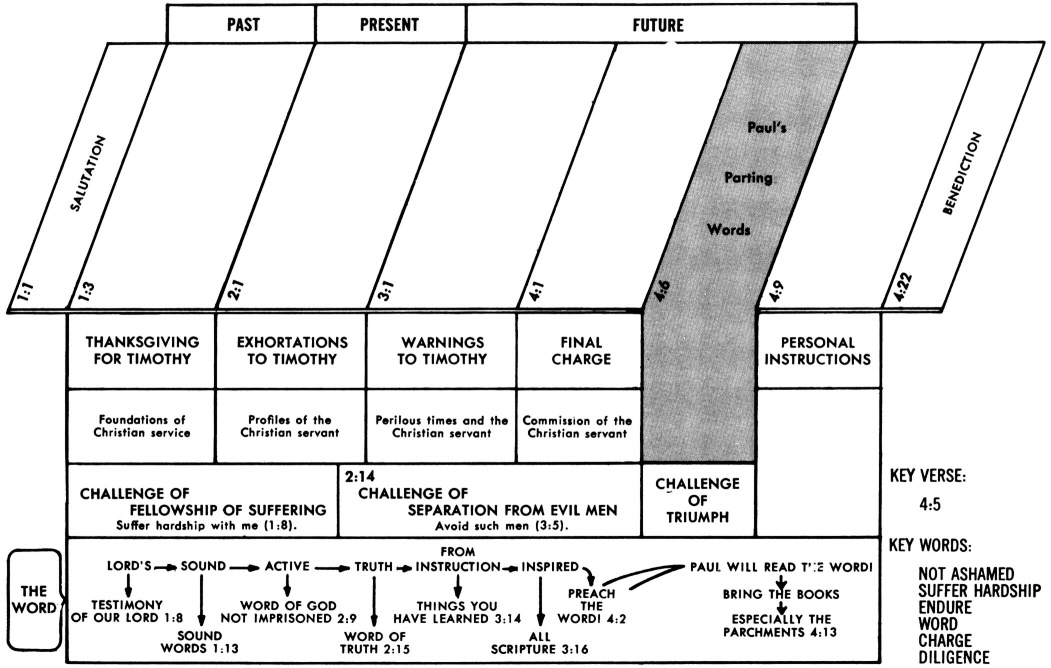
ENDURANCE AND SEPARATION IN THE MINISTRY
Click chart to enlarge
Charts from Jensen's Survey of the NT - used by permission
Second Timothy - Swindoll
| 2 TIMOTHY | |||
| 2 Timothy 1:1-18 | 2 Timothy 2:1-26 | 2 Timothy 3:1-17 | 2 Timothy 4:1-22 |
| Retain the Standard |
Rightly Divide the Word |
Difficult Times Will Come |
Preach the Word |
| PAST | PRESENT | FUTURE | |
| Foundation of Christian Service |
Pictures of Christian Servant |
Dangerous Times for Christian Servant |
Commission of Christian Servant |
| Unashamed as a Witness: Guard the Gospel |
Unashamed as a Workman: Suffer for the Gospel |
Adequate as a Workman: Continue in the Gospel |
Awarded as a Workman: Preach the Gospel |
| Power of the Gospel |
Perseverance of the Gospel Message | Protection of the Gospel |
Proclamation of the Gospel |
| Reminder | Requirements | Resistance | Requests |
| Encouragement in Ministry |
Examples in Ministry |
Exhortations in Ministry |
Exhortations to Fulfill Ministry |
| Commendation & Charge |
Commission to Fulfill |
Conflict to Face |
Course to Finish |
|
Compiled from Jensen's Survey of the NT and Wilkinson's Talk Thru the Bible |
|||
2 Timothy 2:11 It is a trustworthy statement: For if we died (1PAAI) with Him, we will also live (1PFAI) with Him; (NASB: Lockman)
Greek: pistos o logos; ei gar sunapethanomen, (1PAAI) kai suzesomen; (1PFAI)
Amplified: The saying is sure and worthy of confidence: If we have died with Him, we shall also live with Him. (Amplified Bible - Lockman)
KJV: It is a faithful saying: For if we be dead with him, we shall also live with him:
Phillips: I rely on this saying: If we died with him we shall also live with him: (Phillips: Touchstone)
Wuest: Trust-worthy is the word. For in view of the fact that we died with Him, we shall also live by means of Him.
Young's Literal: Stedfast is the word: For if we died together -- we also shall live together;
IT IS A TRUSTWORTHY STATEMENT: pistos ho logos:
- 2 Timothy Resources - Multiple Sermons and Commentaries
- 2 Timothy 2:8-13 Endurance - Steven Cole
- 2 Timothy 2:10-14: Motives for Sacrificial Ministry Part 2 - John MacArthur
A FAITHFUL
WORD
It - What is it? See the 5 trustworthy statements in the Pastoral Epistles - 1Ti 1:15; 3:1; 4:9; 2Ti 2:11; Titus 3:8
Trustworthy statement is literally a faithful (pistos) word (lógos here used to indicate a concept or thought). The Greek order of words is, “Faithful is the saying” or "Trustworthy is the word" the Greek word pistos first in the sentence which emphasizes the character of God's Word. It is trustworthy from Genesis 1:1 to Revelation 22:21! You can stake your life on it....not just for time but for eternity, for as Jesus said "Heaven and earth will (prophetic promise) pass away (cf 1Jn 2:17), BUT (term of contrast) My words will not (another prophetic promise) pass away." (Lk 21:33). Trustworthy statement is used five times in the Pastoral Epistles but nowhere else in the NT.
1 Timothy 1:15 It is a trustworthy statement, deserving full acceptance, that Christ Jesus came into the world to save sinners, among whom I am foremost of all.
1 Timothy 3:1 It is a trustworthy statement: if any man aspires to the office of overseer, it is a fine work he desires to do.
1 Timothy 4:9 It is a trustworthy statement deserving full acceptance.
2 Timothy 2:11 It is a trustworthy statement: For if we died with Him, we will also live with Him;
Titus 3:8 This is a trustworthy statement; and concerning these things I want you to speak confidently, so that those who have believed God will be careful to engage in good deeds. These things are good and profitable for men.
Hiebert feels this saying is a "motive for suffering for Christ's cause, Paul holds up the certainty of the relation between our conduct here and our future condition." (2 Timothy).
Paul seems to use this phrase to introduce a truth that was axiomatic, a truism in the early church that was commonly known and believed. The formula serves to place Paul’s stamp of approval on the content of the quotation.
Trustworthy (faithful) (4103)(pistos from peitho = to persuade - induce one by words to believe, have confidence) is something or someone who is worthy of faith or keeps promises and is applied to God, humans, His Word, etc Vincent gives a nice summary of the meaning of pistos, faithful, writing that it is used "(1), of one who shows Himself faithful in the discharge of a duty or the administration of a trust (Mt 24:45). Hence, trustworthy (2Ti 2:2). Of things that can be relied upon (2Ti 2:11). (2), Confiding; trusting; a believer (Gal 3:9; Acts16:1; 2Cor 6:15; 1Ti 5:16)" (Word Studies in the New Testament)
Webster says that "Faithful" means firm in adherence to whatever one owes allegiance and implies unswerving adherence to a person or thing or to the oath or promise by which a tie was contracted.
Statement (saying) (3055)(lógos from légō = to speak with words; English = logic, logical) means something said and describes a communication whereby the mind finds expression in words. Although Lógos is most often translated word which Webster defines as "something that is said, a statement, an utterance", the Greek understanding of lógos is somewhat more complex.
Morning and Evening Spurgeon - It is a faithful saying.” — 2Timothy 2:11 Paul has four of these “faithful sayings.” The first occurs in 1Timothy 1:15, “This is a faithful saying, and worthy of all acceptation, that Christ Jesus came into the world to save sinners.” The next is in 1 Timothy 4:8, “Godliness is profitable unto all things, having the promise of the life that now is, and of that which is to come. This is a faithful saying, and worthy of all acceptation.” The third is in 2Timothy 2:12, “It is a faithful saying—If we suffer with him we shall also reign with him”; and the fourth is in Titus 3:8, “This is a faithful saying, that they which have believed in God might be careful to maintain good works.” We may trace a connection between these faithful sayings. The first one lays the foundation of our eternal salvation in the free grace of God, as shown to us in the mission of the great Redeemer. The next affirms the double blessedness which we obtain through this salvation—the blessings of the upper and nether springs—of time and of eternity. The third shows one of the duties to which the chosen people are called; we are ordained to suffer for Christ with the promise that “if we suffer, we shall also reign with him.” The last sets forth the active form of Christian service, bidding us diligently to maintain good works. Thus we have the root of salvation in free grace; next, the privileges of that salvation in the life which now is, and in that which is to come; and we have also the two great branches of suffering with Christ and serving with Christ, loaded with the fruits of the Spirit. Treasure up these faithful sayings. Let them be the guides of our life, our comfort, and our instruction. The apostle of the Gentiles proved them to be faithful, they are faithful still, not one word shall fall to the ground; they are worthy of all acceptation, let us accept them now, and prove their faithfulness. Let these four faithful sayings be written on the four corners of my house.
Spurgeon on trustworthy statement - The saying is trustworthy This is one of the five trustworthy sayings that the apostle mentions. All those faithful sayings are weighty and important. I suppose that they may have come into the possession of the Church by having been uttered by some of those prophets who were raised up to cherish the infancy of the Church, such as Agabus, the daughters of Philip, and others. These may have been some of their more remarkable sayings that laid hold of the minds of good men, were quoted by the preachers and teachers, and so became current throughout the Church.
No doubt the apostle Paul gave his endorsement to many of these holy proverbs, but five of them he has encased in the amber of inspiration and handed down for our special note. Perhaps it may interest you to notice them as they occur. The first one—the best one, probably—is in 1 Tim 1:15: “The saying is trustworthy and worthy of all acceptance: Christ Jesus came into the world to save sinners, of whom I am the foremost.” I suppose that the good news was frequently conveyed by humble-minded Christians to the outside world in that short and compact form—“Christ Jesus came into the world to save sinners,” so that it was commonly known to be a saying among Christians.
The next trustworthy or true saying is in 1 Tim 3:1: “The saying is trustworthy: if anyone aspires to supervision, he desires a good work.” Any man who desires to oversee the church of God, and to be in the midst of the people as a shepherd, desires a good work. He will bring upon himself great anxiety, labor, and travail, but the work is honorable and has so large a spiritual reward that a man is wise to choose it and to give his whole life to it.
Another of these faithful sayings will be found in 1 Tim 4:8–10: “For the training of the body is somewhat profitable, but godliness is profitable for everything, because it holds promise for the present life and for the life to come. The statement is trustworthy and deserving of complete acceptance. For to this end we labor and suffer reproach, because we have put our hope in the living God, who is the Savior of all people, especially of believers.” Godliness has the profit of this life and the next. Therefore, godly men are content to suffer because they expect and receive an abundant blessing as the result of it at the hands of God. Such a proverb as this was greatly needed in persecuting times. It is valuable still in these greedy days, when men find godliness a hindrance to their hasty snatching at wealth and therefore turn aside unto ways of dishonesty and falsehood.
The next is the one here. The fifth is in Titus 3:8: “The saying is trustworthy, and I want you to insist concerning these things, so that those who have believed in God may be careful to engage in good deeds. These things are good and beneficial for people.” That those who believe in Jesus should manifest the holy character of their faith by their lives is another one of these faithful sayings. This comes with all the greater force from Paul, because he above all men was free from any suspicion of legality or the putting of human merit into the place of the grace of God that is received by faith.
And now, coming to the trustworthy saying before us, it may not strike you at first, but scholarly men have observed that the eleventh, twelfth, and thirteenth verses assume the form of a hymn. The Hebrew hymns were written in parallelisms, not, of course, in rhymes. These three verses are thought to have been one of the oldest of Christian hymns. This is a miniature psalm—one of those psalms and hymns and spiritual songs with which the saints of God used to edify one another. (Eternal Faithfulness Unaffected by Human Unbelief )
FOR IF WE DIED WITH HIM: ei gar sunapethanomen (1PAAI):
- Ro 6:3 6:4, 5 6:6, 7 6:8, 9, 10 Ro 6:11 Col 2:12 Col 3:3 Col 2:20
- 2 Timothy Resources - Multiple Sermons and Commentaries
- 2 Timothy 2:8-13 Endurance - Steven Cole
- 2 Timothy 2:10-14: Motives for Sacrificial Ministry Part 2 - John MacArthur
Related Passages:
Colossians 3:3 For you have died and your life is hidden with Christ in God.
Colossians 2:20 If (1st Class Condition = since) you have died with Christ to the elementary principles of the world, why, as if you were living in the world, do you submit yourself to decrees, such as,
Romans 6:3-10 Or do you not know that all of us who have been baptized into Christ Jesus have been baptized into His death? 4 Therefore we have been buried with Him through baptism into death, in order that as Christ was raised from the dead through the glory of the Father, so we too might walk in newness of life. 5 For if we have become united with Him in the likeness of His death, certainly we shall be also in the likeness of His resurrection, 6 knowing this, that our old self was crucified with Him (DEATH), that our body of sin might be done away with, that we should no longer be slaves to sin; 7 for he who has died is freed from sin. 8 Now if (1st Class Condition) we have died with Christ, we believe that we shall also live with Him, 9 knowing that Christ, having been raised from the dead, is never to die again; death no longer is master over Him. 10 For the death that He died, He died to sin, once for all; but the life that He lives, He lives to God.
Romans 6:11Even so consider (present imperative see our need to depend on the Holy Spirit to obey) yourselves to be dead to (THE POWER OF) sin, but alive to God in Christ Jesus.
For - Always be alert as to what this term of explanation is explaining. Pause and ponder asking for the Spirit's guidance. Paul is explaining the trustworthy statement.
If (ei) All 4 of the "if" conditions (the first two positive, the second two negative) in this "trustworthy statement" are in the first class condition (see notes on Conditional Clauses), which means that they are all assumed to be true or fulfilled conditions and can thus be accurately translated with "since" or "in view of the fact" in lieu of "if". Thus one could render this passage as
"since we died with Him" or "in view of the fact that we died with Him.”
Died with (4880) (sunapothnesko from sún = together + apothnesko = to die) refers to a believer's real dying (spiritually) with Christ. Aorist tense points to a definite event and could point to the past or alternatively could be timeless, the time being determined by the context. In this verse, although the natural reading points to a past tense event, one cannot be absolutely dogmatic. If could be a death that has already occurred but it could also refer to a death that is yet to transpire. If it is a past tense event (most likely), the death referred to is a spiritual death. Or alternatively if future (less likely), it would refer to a physical death, such a martyr's death, as Paul knew he was soon to experience.
NIV Study Bible (borrow) - The Greek grammatical construction here assumes that we died with Christ in the past, when he died for us on the cross. We are therefore assured that we will also live with him eternally.
C H Spurgeon - All the elect were virtually dead with Christ when He died upon the tree—they were on the cross, crucified with Him. In Him, as their representative, they rose from the tomb and live in newness of life. Because He lives, they shall live also. In due time the chosen are slain by the Spirit of God and so made dead with Christ to sin, to self-righteousness, to the world, the flesh, and the powers of darkness. It is then that they live with Jesus, His life becomes their life, and as He was, so are they also in this world. The Spirit of God breathes the quickening grace into those who were once dead in sin, and thus they live in union with Christ Jesus. When believers die, though they may be sawn asunder or burned at the stake, since they sleep in Jesus they are preserved from the destruction of death by Him and are made partakers of His immortality. May the Lord make us rooted and grounded in the mysterious but most consolatory doctrine of union with Christ Jesus. (Suffering and Reigning With Jesus)
When did we die with Him in the past? In a spiritual sense every believer has died with Christ to the power of sin and self as summarized most completely in Romans 6 (Ro 6:3, Ro 6:4-5, Ro 6-7, Ro 6:8-10, Ro 6:11; cf Gal 2:20, Gal 6:14). In view of the historical context, in which suffering and persecution for the Gospel are clearly a major theme in 2 Timothy, it is also possible that Paul may have had physical death, specifically martyrdom, in mind (cf Php1:21, 2Ti 4:6). I favor the former interpretation, for how else can one truly "endure" unless he has died and been raised to walk in newness of life (see Ro 6:4), walking supernaturally by the Spirit (Gal 5:16).
Because we now live in union with Christ Who is our Life (Colossians 3:4), we have the potential to be strong in the grace that is in Christ Jesus (2Ti 2:1) and to endure suffering for the Gospel. And so the two ideas (identification with the substitutionary death of Christ or a reference to martyrdom) are intertwined, for the one who has "died with Him" is one who will henceforth live a life that may in fact end in martyrdom (cf Acts 20:24), for "all who desire to live godly in Christ Jesus will be persecuted." (2Ti 3:12)
THE FOLLOWING COMMENTARIES
FAVOR SPIRITUAL DEATH
Expositor's Bible Commentary feels that since "we died with Him" is explained "in Romans 6:3-6. It is only as we die with Christ, by identification with Him in His death, that we can have spiritual life in Him...Right here and now we are to count ourselves "dead to sin but alive to God in Christ Jesus." The Pauline formula is "You have to die to live." (Expositor's Bible Commentary)
Morris writes that if we died with Him "reminds us of the great truth that Christ died for us and rose again, so that we can identify with Him by faith and receive eternal life (Romans 6:4-10; Galatians 2:20)." (Defender's Study Bible notes online for 2Timothy 2)
The Bible Knowledge Commentary is fairly dogmatic stating that "if we died with Him" "expresses the idea so powerfully portrayed in the rite of baptism and explained in Romans 6:2-23. The reference is not to martyrdom for Christ, but rather to a believer’s mystical identification with the death and life of Christ (cf. Col. 3:3). (Walvoord, J. F., Zuck, R. B., et al: The Bible Knowledge Commentary. 1985. Victor)
UBS Handbook Series - The verb here is in the aorist tense, indicating that a definite completed past event is being referred to. Since we are actually alive, this argues against interpreting death here in a physical sense, which some interpreters have suggested. It is more likely that death here is used in a figurative sense, referring to the death of the old self when one comes to trust in Christ Jesus. (Arichea, D. C., & Hatton, H. A Handbook on Paul's Letters to Timothy and to Titus. Page 202. New York: United Bible Societies)
The Evangelical Commentary - The “if” part of the first statement (2Ti 2:11) speaks of a past event (“died”) in which we, in union with Christ, died to sin (Ro 6:2–7). As a result of that death, “we will also live [here and now] with him,” that is, in the power of his resurrection life (see again Ro 6:4, 8, 11). (Elwell, W. A. Vol. 3: Evangelical commentary on the Bible. Grand Rapids, Mich.: Baker Book House)
W E Vine - this condition being fulfilled in the case of every believer, for all have died with Christ, the result is assured to all. This identification with Christ in His death takes place at conversion, for in the new birth we pass from death into life; we are crucified with Him and we become eternally identified with Him in His life. (Vine, W. . Collected writings of W. E. Vine. Nashville: Thomas Nelson)
John Piper - Warnings of lostness: 2Ti 2:12b–13, “If we deny him, he also will deny us; if we are faithless, he remains faithful — for he cannot deny himself.” I have heard 2Ti 2:13a used often to say that if we are faithless he will still be faithful to us. We will be saved. That is not what it says or means. For two reasons. It is parallel with 2Ti 2:12b, “If we deny him, he also will deny us.” That’s a quote from Jesus in Matthew 10:33, “Whoever denies me before men, I also will deny before my Father who is in heaven.” This is a threat of lostness, not a promise of salvation. And 2Ti 2:13a simply says it another way, “If we are faithless [deny him, reject him], He remains faithful” — not to us as if he were bound to save an unbeliever, but to Himself — “For he cannot deny himself.” This is a virtual quote from Romans 3:3–4, “What if some were unfaithful? Does their faithlessness nullify the faithfulness of God? By no means! Let God be true though every one were a liar.” The point is that God saves those who believe because belief glorifies his trustworthiness and God cannot deny that he is trustworthy. He cannot deny himself. He saves those whose faith magnify his name. For he cannot deny the infinite value of his name. So the fourth foundation stone of Timothy’s confidence is that the eternal life and the eternal reign that God promises to those who endure is rock-solid certain. The saying is trustworthy! God cannot deny himself. If you trust him and don’t throw away your faith, you live. If you throw it away as worthless, you lie, and you die. We’re not playing games, Timothy. God is gracious, trust him, be strong. Take your share of suffering. (He Cannot Deny Himself )
Dwight Edwards - The death in view here is probably not physical death, but the death of our old man as, described in Romans 6:1-5 And the great promise here is the absolute guarantee of forever living "with Him." It is of no small significance that the first motivation given Timothy here is that of complete assurance in his eternal destiny. This assurance is the foundation for all spiritual service since it determines the real motive for our service. We serve the Lord not to gain heaven; but we serve Him because we are already guaranteed heaven. (Ep 2:8,9; Jn 5:24)
Focus on the Bible concludes that "died with Him" "points to the Christian’s spiritual union with Jesus Christ in his death and resurrection (Rom. 6:3–10). The Christian has become a new person (2Co 5:17). He has died with Christ once for all to the ruling power of sin and self in his moral nature, and has risen once and for all with Christ to a new life in the practice of righteousness (2Co 5:14f.). Dying with Christ guarantees living with him now and hereafter. (Milne, D. J.. Focus on the Bible: 1 Timothy, 2 Timothy and Titus)
The Nelson Study Bible writes that "Believers are united with Christ in His death and resurrection (Ro 6:8), which became our death to sin and our resurrection to eternal life. (See page 1925 The Nelson Study Bible: NKJV)
Kenneth Wuest - The “if” in the Greek text is the particle of a fulfilled condition. Here is no hypothetical case, “if we be” (a.v.), but an, “in view of the fact that we died with Him,” the aorist speaking of a past fact, not a present condition. Paul refers to the same thing in Romans 6:1–10, where he speaks of the believer’s identification with Christ in His death and resurrection when He died on the Cross and was raised from the dead. The words, “We shall live with Him,” are in a context in which they are also found in Romans 6:8, “We shall live by means of Him.” He is our life." They should so be rendered here. We have the preposition sun with the instrumental case. The reference is to this present life as well as the life to come. (Wuest, K. S. Wuest's Word Studies from the Greek New Testament: Eerdmans)
J Vernon McGee - When did we die with Him? When He died over nineteen hundred years ago. When we come to Christ and receive Him as our Savior, His death becomes our death. We are identified with Him and are raised with Him in newness of life. This means that this very day He wants to live His life out through us by the power of the Holy Spirit. (See Thru the Bible Vol. 50: The Epistles (1 and 2 ...)
The Wycliffe Bible Commentary - Our justification and forgiveness is a death to sin and the curse of the Law. Live with him looks to the ultimate goal-eternal life, while including our present walk. (See Wycliffe Bible Commentary page 872)
The New American Commentary - The Greek construction in this context suggests a definite past event such as the conversion and baptism of a Christian (Col 2:12). Paul presented Christian conversion as a dying and rising with Christ. The type of commitment demonstrated in baptism would prepare a believer for the expression of his obedience as a martyr, but the primary reference is to death to self and not merely to martyrdom. (See 1, 2 Timothy, Titus: An Exegetical and Theological ... - Page 209)
Life Application Bible - The first couplet of this hymn contrasts death and life—the believer’s death to sin at the moment of salvation and the new life begun now with Christ in the world and in eternity. This phrase echoes Paul’s words in Romans 6:8. The entire passage in Romans 6:2-23 describes how believers are freed from the power of sin...Paul could confidently “endure everything for the sake of the elect” (2:10) because he knew the sure promises of God. (See 1 & 2 Timothy and Titus - Page 186)
THE FOLLOWING COMMENTARIES
FAVOR SPIRITUAL OR PHYSICAL DEATH
Wesley writes "Dead to sin, and ready to die for him."
Ryrie states that "if we died with Him" is "Perhaps a reference to the crucifixion of the sin nature, as in Gal. 2:20, or a reference to physical death. I.e., if we die physically, we shall be raised physically." (Borrow Ryrie Study Bible)
Geneva Study Bible - A reference to the believer’s union with Christ in His death on the cross (New Geneva study Bible. Nashville: Thomas Nelson)
William MacDonald writes that died with Him is is a description of all who have placed their faith in Christ because at that moment we died with Christ spiritually (which is to be sure a mystery) "We were buried with Him, and we rose again with Him from among the dead. Christ died as our Representative and Substitute. We should have died for our sins, but Christ died in our place. God reckons us to have died with Him, and this means that we shall also live with Him in heaven....Those who thus follow Him in death will likewise follow Him in resurrection. (Borrow Believer's Bible Commentary)
John Gill writes that "dead with him" refers to dead "with Christ, as all his people are, by virtue of union to him; they are dead with him, he and they being one, in a legal sense; when he died, they died with him; being crucified with him, as their head and representative, their old man, their sins, were also crucified with him, being imputed to him, and laid upon him; and through the efficacy of his death, they became dead to sin, both to its damning and governing power, and so are planted together in the likeness of his death; so that as he died unto sin once, and lives again to die no more, they die unto sin, and are alive to God, and shall live for ever. Moreover, this, agreeably to what follows, may be understood of the saints dying for Christ's sake, and the Gospel, whereby they are conformed unto him, and feel the fellowship of his sufferings, and so may be said to be dead with him: and such may assure themselves of the truth of what follows,
THE FOLLOWING COMMENTARIES
FAVOR PHYSICAL DEATH
D. Edmond Hiebert, takes the following approach to the interpretation of the death that is referred to writing that "The first pair ("died...live") points to the results of enduring ill treatment for Christ. "If we died with him." The tense of the word "died" naturally points to a past fact. Commentators differ as to the reference. One view regards it as symbolically pointing to...Romans 6:4, 8, when the believer was united with Christ in death as a spiritual reality. But the teaching in Romans 6 occurs in an entirely different context than the present passage. The context (Ed note: There is a heavy emphasis on suffering for the gospel, not only in the letter as a whole but also in the immediate preceding context - cf suffering in 2 Ti 2:3-4, 9-10, and Paul himself is destined for a martyr's death, cf 2 Ti 4:6) here seems rather to point to physical death as the highest point of suffering for Christ. The reference is then to a martyr's death now viewed from the standpoint of the crowning day.
Hiebert goes on to reason that the purpose of this "trustworthy statement" is "to give encouragement to suffer for Christ even unto death. If loyalty to Christ for us means physical death, the assurance is that "we shall also live with Him." Faithfulness to the point of the supreme sacrifice for Christ assures us of eternal fellowship with Him in resurrection glory." (2 Timothy by D. Edmond Hiebert)
William Barclay succinctly states that "it is the thought of martyrdom that is in Paul’s mind." (Daily Study Bible Series)
Guzik (mentions spiritual but favors physical death) - The Bible speaks of dying with Jesus in two ways: The first is common to all Christians, and is illustrated by baptism (Ro 6:2-3 where baptism speaks of "identification with" not "immersion under"): each one of us can have a "life-after-death" experience with Jesus - we can have our old life end with Jesus on the Cross, and have our new life begin with His being raised from the dead. The other way the Bible speaks of dying with Jesus is, of course, in the sense of martyrdom - of paying the ultimate price for following Jesus. This is probably Paul's idea here; he is saying, "If we die with Him, we aren't dead - we live with Him." Paul could say this while on death row!
John MacArthur also mentions spiritual death but favors a physical death writing that "If we died with Him may refer to the spiritual death of which Paul speaks in Romans. “Therefore we have been buried with Him through baptism into death,” he explains, “in order that as Christ was raised from the dead through the glory of the Father, so we too might walk in newness of life. For if we have become united with Him in the likeness of His death, certainly we shall be also in the likeness of His resurrection,… for he who has died is freed from sin. Now if we have died with Christ, we believe that we shall also live with Him” (Ro 6:4, 5, 7, 8).
On the other hand MacArthur goes on to note that "the context of 2 Timothy 2:11 seems to suggest that Paul here has martyrdom in mind. In that case, if someone has sacrificed his life for Christ, that is, has died with Him, that martyrdom gives evidence that he had spiritual life in Him and will live with Him throughout eternity. The martyr’s hope is eternal life after death." (MacArthur, J. 2 Timothy. Chicago: Moody Press)
We Died before We Came Here
When James Calvert went out as a missionary to the cannibals of the Fiji Islands, the captain of the ship sought to turn him back. "You will lose your life and the lives of those with you if you go among such savages," he cried. Calvert only replied, "We died before we came here."
See: Colossians 3:3; 2 Timothy 2:11
W H Griffith-Thomas comment on Romans 6:2
The rendering of the A.V., "We that are dead," needs correction into "We who died," or "We who have died." So also in Ro 6:7, 8, 11; Col. 2:20; 3:3; 2Ti 2:11. The change of rendering enables us to understand much more clearly our intimate and essential union with our Lord in His death. We died when He died.
Live to Dye
The proprietor of a drycleaning and dyeing business hung this quaint sign in his window: "We dye to live, we live to dye; the more we dye, the more we live; and the more we live, the more we dye." For the child of God, it is also true that the more he dies, the more he lives!
See: Romans 6:8, 11; 2 Timothy 2:11
James Smith - Christ and Discipleship. "If any will come after Me, let him deny himself, and take up his cross daily" (v. 23). Our sinful self ever plays the part of the elders and chief priests in rejecting Christ. Self must be denied if we would follow the steps of Him who "pleased not Himself." The Cross of Christ will ever be a shameful thing in the eyes of the world, but God forbid that we should glory, save in the Cross of our Lord Jesus Christ, by which we are crucified unto the world. This cross of discipleship is not thrust upon us, we are to take it up daily. It is absolutely necessary to a life of fellowship with Him (2 Tim. 2:11, 12).
Saving Ourselves By Julie Ackerman Link
2 Timothy 2:11
Inside, music was playing. Outside, leaves were falling. Catching a gust of wind, one of the last leaves of autumn blew briefly upward as I heard the phrase, “He is risen!” By the end of the song, however, the leaf had reached the ground. Gravity had overcome the breeze.
Later, I overheard three middle-aged women discussing diets, exercise, face-lifts, and other age-defying efforts. Like the leaf, they were trying to keep gravity from pulling them toward the inevitable.
Their conversation reminds me of the good works people do to try to save themselves from spiritual death. But just as leaves cannot keep from falling and people cannot keep from aging, no one can work hard enough to avoid the consequences of sin, which is death (Rom. 6:23).
At the crucifixion, mockers challenged Jesus to save Himself. Instead, He put His life into the hands of God, and God gave back to Him not only His own life but ours as well. To receive salvation, we too must simply put our lives into the hands of God, for if the Spirit of Him who raised Jesus from the dead lives in us, He will give life to us as well (Rom. 8:11).
The forces of sin outside cannot defeat the life of Christ inside.
Thank You, Jesus, for Your willingness to surrender to Your Father’s will. For if You had chosen to save Yourself, You could not have saved me. Amen. (Reprinted by permission from Our Daily Bread Ministries. Please do not repost the full devotional without their permission.)
Phillip Brooks—2 Tim. 2:11, 12.
Christ was humiliated into our condition that we might be exalted unto His. Christ was crucified with man that man might rejoice in being crucified with Christ. Both the depth to which He went to seek man and the height up to which He would carry man, were set forth in the cross. Alas for him who, … looking at the crucifixion, does not see both of these, does not learn at once how low his Saviour went to find him, and how high he may go if he will make his Saviour’s life his own!
I. 195.
O mine enemy,
Rejoice not over me!
Jesus waiteth to be gracious:
I will yet arise,
Mounting free and far
Past sun and star,
To a house prepared and spacious
In the skies.
Lord, for Thine own sake
Kindle my heart and break;
Make mine anguish efficacious
Wedded to Thine own:
Be not Thy dear pain,
Thy love in vain,
Thou who waitest to be gracious
On Thy Throne.
Christina Rossetti
John Bennett - Day by Day
2 Timothy 2:11 DEAD WITH HIM, WE SHALL ALSO LIVE WITH HIM
There are five faithful sayings in the epistles to Timothy and Titus. These could have been early New Testament spiritual songs shared by all believers, or maybe trustworthy statements of their beliefs frequently communicated.
The apostle Paul has already mentioned his sufferings, v. 9, and endurance of all kinds of trial, for the sake of the Christians of that time and the testimony of Christ, v. 10. He then writes the faithful saying, ‘for if we be dead with him’, v. 11. Because the immediate context is physical suffering it would seem that he is here referring to physical death, rather than judicial death as in Rom. 6:8. It is not that he has already died with Christ physically, but, as one commentator interprets this passage, ‘if at any time we have (or shall have) died with Him, we shall also live with Him’. The apostle had daily lived with the prospect of being martyred for Christ—indeed on one occasion, after witnessing for Christ at Lystra, he was stoned and supposed by those present to be dead, Acts 14:19. He affirms in another place, ‘Always bearing about in the body the dying of the Lord Jesus … for we which live are alway delivered unto death for Jesus’ sake’, 2 Cor. 4:10, 11.
The blessed prospect of the apostle, and all believers through this day of grace, is that, if and when we die, it will be ‘with Him’, He will be there with us, and then, glorious prospect, ‘we also shall live with Him’. There is nothing more certain for the believer. Men, generally, base their whole lives on material things, tangible things, things which can be touched, things which they believe have lasting qualities, but these things are transient and temporary. The things that will last are invisible and untouchable—but they can be grasped firmly by faith.
Many believers live constantly with the prospect of bitter persecution and even martyrdom. Whether we do or not, the wonderful prospect of all believers is that ‘we shall also live with Him’ for eternity. We may suffer in this world but what is that compared to the ‘far more exceeding and eternal weight of glory’, 2 Cor. 4:17, which we shall enjoy with Him. ‘Whether we live therefore, or die, we are the Lord’s’, Rom. 14:8.
J C Philpot
"It is a faithful saying--For if we be dead with him, we shall also live with him--if we suffer, we shall also reign with him." 2 Timothy 2:11, 12
To be partakers of Christ's crown, we must be partakers of Christ's cross. Union with him in suffering must precede union with him in glory. This is the express testimony of the Holy Spirit--"If so be that we suffer with him, that we may be also glorified together." The flesh and the world are to be crucified to us, and we to them; and this can only be by virtue of a living union with a crucified Lord. This made the Apostle say, "I am crucified with Christ--nevertheless I live; yet not I, but Christ lives in me--and the life which I now live in the flesh, I live by the faith of the Son of God, who loved me and gave himself for me." And again, "But God forbid that I should glory save in the cross of our Lord Jesus Christ, by whom the world is crucified unto me and I unto the world."
An experimental knowledge of crucifixion with his crucified Lord made Paul preach the cross, not only in its power to save, but in its power to sanctify. Through the cross, that is, through union and communion with him who suffered upon it, not only is there a fountain opened for all sin, but for all uncleanness (Zech. 13:1). Blood and water gushed from the side of Jesus when pierced by the Roman spear.
"This fountain so dear, he'll freely impart;
Unlocked by the spear, it gushed from his heart,
With blood and with water; the first to atone,
To cleanse us the latter; the fountain's but one."
"All my springs are in you," said the man after God's own heart; and well may we echo his words. All our springs, not only of pardon and peace, acceptance and justification, but of happiness and holiness, of wisdom and strength, of victory over the world, of mortification of a body of sin and death; of every fresh revival and renewal of hope and confidence; of all prayer and praise; of every new budding forth of the soul, as of Aaron's rod, in blossom and fruit; of every gracious feeling, spiritual desire, warm supplication, honest confession, melting contrition, and godly sorrow for sin--all these springs from that life which is hidden with Christ in God, are in a crucified Lord. Thus Christ crucified is, "to them who are saved, the power of God." And as he "of God is made unto us wisdom, righteousness, sanctification, and redemption," at the cross alone can we be made wise unto salvation, become righteous by a free justification, receive of his Spirit to make us holy, and be redeemed
The Paradox of Sacrifice
The Wall Street Journal once projected a striking paradox of our time when it reported: "The elms in South Park, Pittsburgh must come down because they are obstructing the monument to Joyce Kilmer. They have lifted their leafy arms so high that passer-bys can no longer read the inscription which begins: 'I think that I shall never see/A poem lovely as a tree.'"
In a world where people surrender their rights to preserve themselves, where cities are bombed to protect people, where nations wage war to preserve peace, where spending determines economy, it is tragically appropriate that trees should be sacrificed for a poem about trees.
Isn't it even more ironic that a single Christ would have to die so that we could find forgiveness of our sins?
See: 2 Corinthians 5:15; 2 Timothy 2:11
WE SHALL ALSO LIVE WITH HIM : kai suzesomen (1PFAI):
- Jn 14:19; 2Co 13:4; 1Th 4:17; 5:10 Ro 6:8 2Co 7:3
- 2 Timothy Resources - Multiple Sermons and Commentaries
- 2 Timothy 2:8-13 Endurance - Steven Cole
- 2 Timothy 2:10-14: Motives for Sacrificial Ministry Part 2 - John MacArthur
(John 14:19) “After a little while the world will no longer see Me, but you will see Me; because I live, you will live also.
(2Cor 13:4) For indeed He was crucified because of weakness, yet He lives because of the power of God. For we also are weak in Him, yet we will live with Him because of the power of God directed toward you.
(1Thess 4:17) Then we who are alive and remain will be caught up together with them in the clouds to meet the Lord in the air, and so we shall always be with the Lord.
(1Thess 5:10) who died for us, so that whether we are awake or asleep, we will live together with Him.
Shall live with (4800) (suzao from sun/syn = intimately together or with + zao = live) Zao is the essence of life and thus this verb combination conveys the picture that we have been entwined with the essence of Christ's life. We are identified with Him and because of His resurrection we share in and can experience the resurrection life of Jesus (walk in newness of life). Christ lives in us in the Person of the Holy Spirit. His life is in us. He is our life. In this present life and the life to come, which is likely Paul's meaning in this passage.
In the introduction of 2Timothy, Paul reminded Timothy of "the promise of life in Christ Jesus" (2Ti 1:1). We were buried with Him, risen with Him and now we live in Him, in Christ (cf locative of sphere).
Note that future tense (as in the present use) can be used to convey the idea of certainty and does not always refer just to a future event per se. Yes we will live with Christ in eternity future (and this should motivate us to live for Him now - cf 1Jn 3:2,3), but right now in "eternity present" we are enabled to live the Christian life because Christ lives in and through us (by the Spirit of Christ), as we daily die to self (even that death enabled by the Spirit), putting off the old filthy attitudes and actions associated with the self life and putting on the Lord Jesus Christ, manifesting the attitudes and actions of Christ, and all of this by the power of His indwelling Spirit. How else would it be possible to live like Christ? That's rhetorical! See (Ro 6:8) for a similar use of the future tense to indicate certainty.
The New American Commentary deduces that "The future tense of “we will … live” suggests that this is a reference to life in heaven. Although the reference is to heavenly life, there is a sense in which believers experience a beginning of eternal life now (John 5:24 where Jesus declared "Truly, truly, I say to you, he who hears My word, and believes Him who sent Me, has eternal life, and does not come into judgment, but has passed out of death into life.")” (Lea, T. D., & Griffin, H. P. Vol. 34: 1, 2 Timothy, Titus. The New American Commentary Page 209. Nashville: Broadman & Holman Publishers)
Hiebert summarizes this section writing that the 4 "if" statements can be divided into those who manifest belief and those who manifest unbelief "“The central truth of these pithy statements is that faith in Christ identifies the believer with Him in everything while unbelief just as surely separates men from Him.” (Hiebert, D Edmond: Second Timothy, p. 62)
Hendriksen agrees writing that "In the first two lines the if-clause describes the attitude-and action which proceeds from loyalty to Christ: we have died with (him), we endure (remain stedfast). In the last two lines the if-clause describes the attitude-and-action which proceeds from disloyalty. (Hendriksen, W., & Kistemaker, S. J. NT Commentary Set. Baker Book)
2 Timothy 2:12 If we endure), we will also reign with Him ; If we deny (1PFMI) Him, He also will deny us; (NASB: Lockman)
Greek: ei hupomenomen, (1PPAI) kai sumbasileusomen; (1PFAI) ei arnesometha, (1PFMI) kakeinos arnesetai (2SFMI) hemas
Amplified: If we endure, we shall also reign with Him. If we deny and disown and reject Him, He will also deny and disown and reject us. (Amplified Bible - Lockman)
KJV: If we suffer, we shall also reign with him: if we deny him, he also will deny us:
Phillips: if we suffer with him we shall also reign with him. If we deny him he will also deny us: (Phillips: Touchstone)
Wuest: If we are persevering, we shall also reign as kings with Him. If we shall deny Him, that One also will deny us.
Young's Literal: if we do endure together -- we shall also reign together; if we deny him, he also shall deny us;
IF WE ENDURE: ei hupomenomen (1PPAI):
- Mt 19:28,29; Acts 14:22; Ro 8:17; Phil 1:28; 2Th 1:4, 5, 6, 7, 8; 1Pe 4:13-16
- 2 Timothy Resources - Multiple Sermons and Commentaries
- 2 Timothy 2:8-13 Endurance - Steven Cole
- 2 Timothy 2:10-14: Motives for Sacrificial Ministry Part 2 - John MacArthur
(Matt 19:28) And Jesus said to them, “Truly I say to you, that you who have followed Me, in the regeneration when the Son of Man will sit on His glorious throne, you also shall sit upon twelve thrones, judging the twelve tribes of Israel.
(Matt 19:29) “And everyone who has left houses or brothers or sisters or father or mother or children or farms for My name’s sake, will receive many times as much, and will inherit eternal life.
PERSEVERANCE
CHARACTERIZES A SAINT
"If" means "If, as is the case, we are persevering..." In other words these were persevering. (see notes on Conditional Clauses)
Endure (5278) (hupomeno from hupó = under + meno = abide or remain) means literally to remain under but not simply with resignation, but with a vibrant hope. Hupomeno was a military term used of an army’s holding a vital position at all costs. Every hardship and every suffering was to be endured in order to hold fast, even as Paul was continually enduring "all things for the sake of those who are chosen that they also may obtain the salvation which is in Christ Jesus." (2 Ti 2:12)
The present tense calls for continuous enduring. We keep on bearing up under the load (Mt 24:13) in this life. We keep persevering in and under trials and hold to our faith in Christ (Who holds us). True faith always has the quality of permanence and in this sense all believers continue to endure (Heb 3:6, 14) We endure because the Spirit enables us to endure and thus endurance is a sure sign that one has the Spirit (Ro 8:9).
Hiebert explains that one's continued endurance "points to this continuing experience of bravely bearing up under the hardships and afflictions heaped upon the believer because of his relation to Christ. (Hiebert then adding) "By contrast, the second pair asserts the solemn warning that denial and unfaithfulness just as surely separate men from Christ." (D. Edmond Hiebert: 2 Timothy).
Expositor's Bible Commentary adds that endure is in the present tense for "It is only as we keep on enduring to the end that we will be saved in time of persecution (Mt 10:22; cf. context.). (Gaebelein, F, Editor: Expositor's Bible Commentary 6-Volume New Testament.)
Jesus declared to His disciples in the context of the difficult events that would accompany the end of the "age" (believers today still live in the same "age" as His disciples so the truth applies especially to us as we near the end of this "age" which precedes 7 years of Daniel's Seventieth Week which in turn precedes the next "age", the Messianic age when all the promises to Israel in the OT are literally fulfilled) that ""the one who endures (hupomeno) to the end, he shall be saved." (Matthew 24:13)
Don't let this verse confuse you. Jesus is not saying we will "earn" our salvation by our endurance. Endurance does not save anyone. Only saving faith in Christ saves. Jesus' point is that the one who is genuine will endure to the end not by gritting their teeth but because the Spirit of Christ indwells them and empowers them and will never lose them. If someone turns their back on Christ after first professing Him, and persists (not a momentary event like Peter's three denials) in that apostasy, they demonstrate by their failure to endure to the end that they are not genuinely saved. The same idea of the so-called "perseverance of the saints" is seen in numerous other NT passages, especially in the epistle to the Hebrews, where we read
"Christ was faithful as a Son over His house whose house we are, if we hold fast our confidence and the boast of our hope firm until the end." (Hebrew 3:6)
"Therefore, do not throw away your confidence, which has a great reward. 36 For you have need of endurance, so that when you have done the will of God, you may receive what was promised. 37 FOR YET IN A VERY LITTLE WHILE, HE WHO IS COMING WILL COME, AND WILL NOT DELAY. 38 BUT MY RIGHTEOUS ONE SHALL LIVE BY FAITH; AND IF HE SHRINKS BACK, (which would equate with "not endure") MY SOUL HAS NO PLEASURE IN HIM. 39 But we are not of those who shrink back to destruction (note the end of those who do not endure is not loss of rewards at the Judgment Seat of Christ, but loss their life eternally in the second death - some feel "destruction" should be interpreted as a "wasted" life but note what the immediate following context refers to - preserving of the soul, implying that destruction equates with failure to preserve one's soul, i.e., an unbeliever and not just the wasted life of a believer), but of those who have faith to the preserving of the soul. (Hebrews 10:35, 36, 37, 38, 39)
The reward of enduring now is not only that we prove our salvation genuine but that we are also rewarded with reigning as discussed in the coming Messianic Age and then the New Heaven and New Earth..
Charles Ryrie writes that "If we endure in this life, we shall reign in our glorified state" (The Ryrie Study Bible: New American Standard Translation: 1995. Moody Publishers)
ILLUSTRATION - In the olden time when the gospel was preached in Persia, one Hamedatha, a courtier of the king, having embraced the faith, was stripped of all his offices, driven from the palace, and compelled to feed camels. This he did with great content. The king passing by one day, saw his former favourite at his ignoble work, cleaning out the camel's stables. Taking pity upon him he took him into his palace, clothed him with sumptuous apparel, restored him to all his former honours, and made him sit at the royal table. In the midst of the dainty feast, he asked Hamedatha to renounce his faith. The courtier, rising from the table, tore off his garments with haste, left all the dainties behind him, and said, "Didst thou think that for such silly things as these I would deny my Lord and Master?" and away he went to the stable to his ignoble work. How honourable is all this! - Spurgeon
QUESTION - Perseverance of the Saints - is it biblical?
ANSWER - Perseverance of the saints is the name that is used to summarize what the Bible teaches about the eternal security of the believer. It answers the question, “Once a person is saved, can he lose his salvation?” Perseverance of the saints is the P in the acronym TULIP, which is commonly used to enumerate what are known as the five points of Calvinism. Because the term “perseverance of the saints” can cause people to have the wrong idea about what is meant, some people prefer to use terms like “preservation of the saints,” “eternal security,” or “held by God.” Each of these terms reveals some aspect of what the Bible teaches about the security of the believer. However, like any biblical doctrine, what is important is not the name assigned to the doctrine but how accurately it summarizes what the Bible teaches about that subject. No matter which name you use to refer to this important doctrine, a thorough study of the Bible will reveal that, when it is properly understood, it is an accurate description of what the Bible teaches.
The simplest explanation of this doctrine is the saying: “Once saved, always saved.” The Bible teaches that those who are born again will continue trusting in Christ forever. God, by His own power through the indwelling presence of the Holy Spirit, keeps or preserves the believer forever. This wonderful truth is seen in Ephesians 1:13-14, where we see that believers are “sealed with the Holy Spirit of promise, who is the guarantee of our inheritance until the redemption of the purchase possession, to the praise of His glory.” When we are born again, we receive the promised indwelling presence of the Holy Spirit that is God’s guarantee that He who began a good work in us will complete it (Philippians 1:6). In order for us to lose our salvation after receiving the promised Holy Spirit, God would have to break His promise or renege on His “guarantee,” which He cannot do. Therefore, the believer is eternally secure because God is eternally faithful.
The understanding of this doctrine really comes from understanding the unique and special love that God has for His children. Romans 8:28-39 tells us that 1) no one can bring a charge against God’s elect; 2) nothing can separate the elect from the love of Christ; 3) God makes everything work together for the good of the elect; and 4) all whom God saves will be glorified. God loves His children (the elect) so much that nothing can separate them from Him. Of course this same truth is seen in many other passages of Scripture as well. In John 10:27-30, Jesus says, “My sheep hear My voice, and I know them, and they follow Me; and I give eternal life to them, and they will never perish; and no one will snatch them out of My hand. My Father, who has given them to Me, is greater than all; and no one is able to snatch them out of the Father’s hand. I and the Father are one." Again, in John 6:37-47, we see Jesus stating that everyone who the Father gives to the Son will come to Him and He will raise all of them up at the last day.
Another evidence from Scripture of the eternal security of a believer is found in John 5:24, where Jesus says, “Truly, truly, I say to you, he who hears My word, and believes Him who sent Me, has eternal life, and does not come into judgment, but has passed out of death into life.” Notice that eternal life is not something we get in the future but is something that we have once we believe. By its very nature, eternal life must last forever, or it could not be eternal. This passage says that, if we believe the gospel, we have eternal life and will not come into judgment; therefore, it can be said we are eternally secure.
There is really very little scriptural basis that can be used to argue against the eternal security of the believer. While there are a few verses that, if not considered in their context, might give the impression that one could “fall from grace” or lose his salvation, when these verses are carefully considered in context it is clear that is not the case. Many people know someone who at one time expressed faith in Christ and who might have appeared to be a genuine Christian who later departed from the faith and now wants to have nothing to do with Christ or His church. These people might even deny the very existence of God. For those who do not want to accept what the Bible says about the security of the believer, these types of people are proof that the doctrine of eternal security cannot be right. However, the Bible indicates otherwise, and it teaches that people such as those who profess Christ as Savior at one time only to later walk away and deny Christ were never truly saved in the first place. For example, 1 John 2:19 says, "They went out from us, but they were not of us; for if they had been of us, they would have remained with us; but they went out from us, in order that it might be made manifest that they all are not truly of us." The Bible is also clear that not everyone who professes to be a Christian truly is. Jesus Himself says that not everyone who says, “Lord, Lord,” will enter the kingdom of heaven (Matthew 7:21-22). Rather than proving we can lose our salvation, those people who profess Christ and fall away simply reinforces the importance of testing our salvation to make sure we are in the faith (2 Corinthians 13:5) and making our calling and election sure by continually examining our lives to make sure we are growing in godliness (2 Peter 1:10).
One of the misconceptions about the doctrine of the perseverance of the saints is that it will lead to “carnal Christians” who believe that since they are eternally secure they can live whatever licentious lifestyle they wish and still be saved. But that is a misunderstanding of the doctrine and what the Bible teaches. A person who believes he can live any way he wants because he has professed Christ is not demonstrating true saving faith (1 John 2:3-4). Our eternal security rests on the biblical teaching that those whom God justifies, He will also glorify (Romans 8:29-30). Those who are saved will indeed be conformed to the image of Christ through the process of sanctification (1 Corinthians 6:11). When a person is saved, the Holy Spirit breaks the bondage of sin and gives the believer a new heart and a desire to seek holiness. Therefore a true Christian will desire to be obedient to God and will be convicted by the Holy Spirit when he sins. True Christians will never “live any way they want” because such behavior is impossible for someone who has been given a new nature (2 Corinthians 5:17).
Clearly, the doctrine of the perseverance of the saints does accurately represent what the Bible teaches on this important subject. If someone is truly saved, he has been made alive by the Holy Spirit and has a new heart with new desires. There is no way that one that has been “born again” can later be “unborn.” Because of His unique love for His children, God will keep all of His children safe from harm, and Jesus has promised that He would lose none of His sheep. The doctrine of the perseverance of the saints recognizes that true Christians will always persevere and are eternally secure because God keeps them that way. It is based on the fact that Jesus, the “author and perfecter of faith” (Hebrews 12:2), is able to completely save those whom the Father has given Him (Hebrews 7:25) and to keep them saved through all eternity. GotQuestions.org
Related Resource:
WE SHALL ALSO REIGN WITH HIM : kai sumbasileusomen (1PFAI):
- Rev 1:6,9; 5:10; Rev 20:4,6
- 2 Timothy Resources - Multiple Sermons and Commentaries
- 2 Timothy 2:8-13 Endurance - Steven Cole
- 2 Timothy 2:10-14: Motives for Sacrificial Ministry Part 2 - John MacArthur
Reign with (4821) (sumbasileuo from sun = together with + basileúo = to reign as king;cp basileia) means to be a coregent. Note that the preposition in this compound (and also in "died with" and "live with" above) is sun which conveys the sense of union with. It speaks of a more intimate association than does another Greek preposition (meta) which also means with. In context sun speaks of our inseparable identification with Christ.
Paul is referring to the saints as reigning as kings with the King of kings in the Messianic Kingdom.
Jesus promised that "he who overcomes (see explanation below as to the identity of overcomers) and he who keeps My deeds until the end, TO HIM I WILL GIVE AUTHORITY OVER THE NATIONS AND HE SHALL RULE THEM WITH A ROD OF IRON, AS THE VESSELS OF THE POTTER ARE BROKEN TO PIECES, as I also have received authority from My Father." (Rev 2:26, Rev 2:27)
Jesus in another promise to the overcomers (Jesus gives promises to overcomers in His address to each of the 7 churches of Revelation 2-3) at the church in Laodicea says that "He who overcomes, I will grant to him to sit down with Me on My throne, as I also overcame and sat down with My Father on His throne." (Rev 3:21)
Overcomers are not some select group of saints for John teaches us that "whatever is born of God overcomes the world; and this is the victory that has overcome the world-- our faith. And who is the one who overcomes the world, but he who believes that Jesus is the Son of God? (1John 5:4, 5)
The apostle John describes the future events in heaven in which the Lamb Who was slain received the sealed scroll (probably the "title deed" to the earth) from the Father prompting those who witnessed this event to sing a new song saying which includes a promise describing where saints will reign "Worthy art Thou to take the book, and to break its seals; for Thou wast slain, and didst purchase (our Kinsman Redeemer paid the purchase price in full when He shed His precious blood like a lamb) for God with Thy blood men from every tribe and tongue and people and nation. And Thou hast made them to be a kingdom ("kings" KJV) and priests to our God; and they will reign upon the earth." (Rev 5:9, Rev 5:10)
John describing the glorious Millennial kingdom of Christ on the earth (with the present curse removed, eg see Isa 11:6, 7, 8ff) writes "And I saw thrones, and they sat upon them, and judgment was given to them (in 1Cor 6:2, 3 Paul asks "do you not know that the saints will judge the world? And if the world is judged by you, are you not competent to constitute the smallest law courts? Do you not know that we shall judge angels? How much more, matters of this life?"). And I saw the souls of those who had been beheaded because of the testimony of Jesus and because of the word of God (during the great tribulation, e.g. see Rev 7:14), and those who had not worshiped the beast or his image, and had not received the mark upon their forehead and upon their hand; and they came to life (i.e., were resurrected) and reigned with Christ for 1000 years ("Millennium"). The rest of the dead (all those of all the ages who are still dead in their trespasses and sins) did not come to life until the 1000 years were completed (at the Great White Throne judgment where only spiritually dead will stand for sentencing to the Lake of fire). This is the first resurrection (this reference is not to "the dead" but to those beheaded who were resurrected and includes all believers of all ages who were resurrected at different "stages" of the "first resurrection, "but each in his own order: Christ the first fruits, after that those who are Christ's at His coming," 1Cor 15:23). Blessed and holy is the one who has a part in the first resurrection; over these the second death has no power (thus this resurrection includes all believers for over them the 2nd death has no power), but they will be priests of God and of Christ and will reign with Him for a 1000 years." (Re 20:4 Re 20:5, Re 20:6)
John describing the time of the New Heaven and New Earth (the "age" that follows the Messianic Age or the 1000 year reign of Christ on earth) declares that "there shall no longer be any night; and they shall not have need of the light of a lamp nor the light of the sun, because the Lord God shall illumine them; and they shall reign forever and ever. (Rev 22:5)
The other side of that truth is that those who do not endure give evidence that they do not belong to Christ and will not reign with Him.
Paul writes that we are "heirs of God and fellow heirs with Christ, if indeed we suffer with Him in order that we may also be glorified with Him." (Ro 8:17).
Morning and Evening (Spurgeon) - “If we suffer, we shall also reign with him.” 2 Timothy 2:12 We must not imagine that we are suffering for Christ, and with Christ, if we are not in Christ. Beloved friend, are you trusting to Jesus only? If not, whatever you may have to mourn over on earth, you are not “suffering with Christ,” and have no hope of reigning with him in heaven. Neither are we to conclude that all a Christian’s sufferings are sufferings with Christ, for it is essential that he be called by God to suffer. If we are rash and imprudent, and run into positions for which neither providence nor grace has fitted us, we ought to question whether we are not rather sinning than communing with Jesus. If we let passion take the place of judgment, and self-will reign instead of Scriptural authority, we shall fight the Lord’s battles with the devil’s weapons, and if we cut our own fingers we must not be surprised. Again, in troubles which come upon us as the result of sin, we must not dream that we are suffering with Christ. When Miriam spoke evil of Moses, and the leprosy polluted her, she was not suffering for God. Moreover, suffering which God accepts must have God’s glory as its end. If I suffer that I may earn a name, or win applause, I shall get no other reward than that of the Pharisee. It is requisite also that love to Jesus, and love to his elect, be ever the mainspring of all our patience. We must manifest the Spirit of Christ in meekness, gentleness, and forgiveness. Let us search and see if we truly suffer with Jesus. And if we do thus suffer, what is our “light affliction” compared with reigning with him? Oh it is so blessed to be in the furnace with Christ, and such an honour to stand in the pillory with him, that if there were no future reward, we might count ourselves happy in present honour; but when the recompense is so eternal, so infinitely more than we had any right to expect, shall we not take up the cross with alacrity, and go on our way rejoicing?
H R Reynolds - There are many ways of denying Christ, both by word and action. We may take the part of His enemies, or ignore His supreme claim to our allegiance; we may transform Him into a myth, a fairy tale, a subjective principle, or find a substitute in our own life for His grace; and we may assume that He is not the ground of our reconciliation, nor the giver of salvation, nor the sole Head of His Church. If so, we may reasonably fear, lest He should refuse to acknowledge us when upon His approval our eternal destiny will turn.
2 Timothy 2:12 “What’s it like to know you will one day wear the crown of England?” An American news reporter put that question to Prince Charles. Without hesitation, Charles replied, “Rough!” The future king expanded on this by describing the almost unbelievable discipline needed to groom a person for the throne. He had to become fluent in a number of languages, master history, mathematics, and the sciences, become expert in heraldry, diplomacy, and protocol, as well as serve in the military. Almost every waking moment has been devoted to his grooming. “It’s still rough,” said the potential monarch. “I really don’t have a life of my own.”
Normally we think of a prince as growing up with a silver spoon in his mouth and a kingdom for his playground. But it makes more sense to realize that an heir has to be groomed for the task ahead of him.
We, too, are destined to reign—with Christ. Now we are being groomed for the task.
Daily Light on the Daily Path - As we share abundantly in Christ’s sufferings, so through Christ we share abundantly in comfort too.
Share his sufferings.—But rejoice insofar as you share Christ’s sufferings, that you may also rejoice and be glad when his glory is revealed.—If we have died with him, we will also live with him.—If children, then heirs—heirs of God and fellow heirs with Christ, provided we suffer with him in order that we may also be glorified with him.
So when God desired to show more convincingly to the heirs of the promise the unchangeable character of his purpose, he guaranteed it with an oath, so that by two unchangeable things, in which it is impossible for God to lie, we who have fled for refuge might have strong encouragement to hold fast to the hope set before us.—Now may our Lord Jesus Christ himself, and God our Father, who loved us and gave us eternal comfort and good hope through grace, comfort your hearts and establish them in every good work and word.
2 Cor. 1:5; Phil. 3:10; 1 Pet. 4:13; 2 Tim. 2:11; Rom. 8:17; Heb. 6:17–18; 2 Thess. 2:16–17
IF WE DENY HIM HE WILL ALSO DENY US: ei arnesometha (1PFMI) kakeinos arnesetai (2SFMI) hemas:
- Pr 30:9; Mt 10:33; 26:35,75; Mk 8:38; Mt 10:33; Lk 9:26; 12:9; 1Jn 2:22; 1Jn 2:23; Jude 1:4; Rev 2:13; 3:8
- 2 Timothy Resources - Multiple Sermons and Commentaries
- 2 Timothy 2:8-13 Endurance - Steven Cole
- 2 Timothy 2:10-14: Motives for Sacrificial Ministry Part 2 - John MacArthur
DENIAL NOW BEGETS
DENIAL THEN!
It is interesting that the NIV translators choose "disown" instead of "deny": ."If we disown him, he will also disown us".
Edwards comments on "why NIV changed the familiar deny to disown. The reason is that deny means primarily "to declare untrue; assert the contrary of, contradict," whereas disown means "to refuse to acknowledge or accept as one's own" (American Heritage Dictionary). Thus, disown was more accurate when applied to persons as its object."
Disown is a strong word that leaves little doubt as to the intention of the NIV translators. Webster defines disown as "to refuse to acknowledge as one’s own, to repudiate any connection or identification with" (Merriam-Webster's Collegiate Dictionary) How could such a person claim to be a follower of Christ?
The Amplified version renders this verse quite graphically "If we deny and disown and reject Him, He will also deny and disown and reject us." WOE!
Note that the "If" (ei) means "If, as is the case, (FIRST CLASS CONDITION) we are denying Him..." (see the following note) In other words this is a true statement - some were denying Him even in this letter to Timothy...
"You are aware of the fact that all who are in Asia turned away from me, among whom are Phygelus and Hermogenes." (2Ti 1:15)
"their talk will spread like gangrene. Among them are Hymenaeus and Philetus, men who have gone astray from the truth saying that the resurrection has already taken place, and thus they upset the faith of some." (2Ti 2:17, 18)
holding to a form of godliness, although they have denied its power; and avoid such men as these" (2Ti 3:5)
And just as Jannes and Jambres opposed Moses, so these men also oppose the truth, men of depraved mind, rejected as regards the faith." (2Ti 3:8)
For the time will come when they will not endure sound doctrine; but wanting to have their ears tickled, they will accumulate for themselves teachers in accordance to their own desires; and will turn away their ears from the truth, and will turn aside to myths." (2Ti 4:3, 4)
Demas, having loved this present world, has deserted me and gone to Thessalonica; Crescens has gone to Galatia, Titus to Dalmatia." (2Ti 4:10)
At my first defense no one supported me, but all deserted me; may it not be counted against them." (2Ti 4:16)
Now the question one might raise about all these "denials" in 2 Timothy is whether they were of the "Petrine type" (transient) or the "Judas type" unto perdition and frankly it is only God who knows the heart of each of these individuals or groups. We don't have enough information on most of them to make a reasoned assessment. Certainly some appear to be clearly unbelievers, but we will leave that with God.
Wuest notes that "The “if” with “deny” and “believe not” is ei, the particle of a fulfilled condition. Some were denying Him and were unfaithful." (Wuest's Word Studies from the Greek New Testament) (Bolding added)
O Jesus, I have promised To serve Thee to the end;
Be Thou forever near me, My Master and my Friend:
I shall not fear the battle If Thou art by my side,
Nor wander from the pathway If Thou wilt be my Guide.
Deny (720) (arneomai from a = negation + rheo = utter, speak or say) literally means "to say no", to say one does not know about or is in any way related to some person or some thing. Arneomai means to refuse to agree or consent to something, to disclaim connection with or responsibility for, to say one does not know about or is in any way related to a person or event. To deny carries idea of conscious, purposeful action of one's will.
Arneomai - 33x in 30v - NAS = denied(10), denies(5), deny(12), denying(2), disowned(3), refused(1). Matt 10:33; 26:70, 72; Mark 14:68, 70; Luke 8:45; 9:23; 12:9; 22:57; John 1:20; 13:38; 18:25, 27; Acts 3:13f; 4:16; 7:35; 1 Tim 5:8; 2 Tim 2:12f; 3:5; Titus 1:16; 2:12; Heb 11:24; 2 Pet 2:1; 1 John 2:22f; Jude 1:4; Rev 2:13; 3:8.
One can discern two "types of denial" as exemplified in the following passages:
"TYPE 1"
A SETTLED
DENIAL
Paul described some evil men in Crete who manifest denial by their deeds, writing that they "profess (present tense = continually) to know God, but by their deeds (their actions speak louder than their words) they deny (present tense = habitually, continually disown and renounce, as their lifestyle) Him (by their actions), being detestable (loathsome, root word means to "stink"!) and disobedient, and worthless (unable to do anything that pleases God) for any good deed. (Titus 1:16)
Jude warns of a denial by one's lifestyle writing that "certain persons have crept in unnoticed (secretly, stealthily, subtly insinuating themselves), those who were long beforehand marked out for this condemnation, ungodly (corrupt in doctrine, depraved in conduct) persons who turn the grace of our God into licentiousness (unrestrained vice, gross immorality) and deny (present tense = continually, habitually, what what they say and how they live) our only Master and Lord, Jesus Christ." (Jude 1:4, Jude 1:1, 2, 3)
Jesus seems to speak of a denial by one's words declaring that "Everyone therefore who shall confess Me before men, I will also confess him before My Father who is in heaven. But whoever shall deny Me before men, I will also deny him before My Father who is in heaven." (Mt 10:32, 33)
John ask rhetorically "Who is the liar but the one who denies (present tense = continually, as one's habitual practice) that Jesus is the Christ? This is the antichrist, the one who denies (present tense = continually, habitually, what what they say and how they live) the Father and the Son. Whoever denies (present tense) the Son does not have the Father; the one who confesses (present tense) the Son has the Father also. (1Jn 2:22; 23)
Swindoll - Persecution has a way of separating genuine believers from interloping nonbelievers. Imposters will deny Christ and forsake the gospel before suffering for someone in whom they do not genuinely believe. Those who deny Him are not "in Christ" and never were. Therefore, those who are truly His people need not worry about cracking under torture and then losing their place in heaven (John 10:27-29). (See Insights on 1 & 2 Timothy, Titus - Page 194)
"TYPE 2"
A TRANSIENT
DENIAL
Luke records the events following Peter's denial of His Lord...
And the Lord turned (being carried away by the Roman soldiers) and looked at Peter. And Peter remembered the word of the Lord, how He had told him, "Before a cock crows today, you will deny Me three times." And he went out and wept bitterly (Note Peter's reaction to his denial). (Luke 22:61)
Matthew records that when Judas who denied Jesus by his deeds more than his words "saw that He had been condemned, he felt remorse (regret but not repentance) and returned the thirty pieces of silver to the chief priests and elders" (Mt 27:3)
Judas did not have a godly sorrow, for as Paul explains "the sorrow that is according to the will of God produces a repentance without regret, leading to salvation; but the sorrow of the world produces death." (2 Co 7:10)
Peter on the other hand did not just have a deep emotional reaction but a heart change brought forth fruit in keeping with his genuine repentance. Peter some 40 plus days after his denial of Jesus was brought before the Jewish ruling council in Jerusalem (Sanhedrin), was scourged (thrashing which resulted in the removal one's skin) for teaching about Jesus and was ordered to speak no more in the Name of Jesus. Luke records that in contrast to his previous "thrice denial", he and the other believers "went on their way from the presence of the Council, rejoicing (Peter and the others having been empowered by the Holy Spirit) that they had been considered worthy to suffer shame for His Name." (Acts 5:41)
The point of these passages is that there can be transient denial of Jesus or a settled denial of Jesus in which one persistently rejects Jesus as Lord and Savior. Clearly, the former circumstance represents a believer who is momentarily unfaithful whereas the latter group represents those who refuse to believe in Jesus. Which group is Paul referring to in this trustworthy statement "if we deny Him, He will deny us"? There is considerable divergence of opinion among the commentaries as discussed below. Take for example Demas in 2 Timothy 4:10. Was his desertion of Paul a momentary lapse or an indication of an unregenerate heart? Frankly, I don't think one can be absolutely dogmatic. Ultimately only God knows whether a man's denial is like Peter's "thrice denial" or represents a settled state of mind and heart. Paul's warning is that if one does exhibit a settled denial of Christ, then Christ will certainly deny that individual.
Jesus plainly taught that "Everyone therefore who shall confess Me before men, I will also confess him before My Father who is in heaven. But (note this strong contrast is clearly with those who are genuinely saved and that there is no mention of rewards in this context) whoever shall deny Me before men, I will also deny him before My Father Who is in heaven. (Mt 10:32, 33)
In the interest of being "fair and balanced", it should be noted that some commentators such as Warren Wiersbe (who I highly respect) interpret the denial in this trustworthy statement not as a denial which is permanent but which is temporary. These writers are forced to interpret the denial by Christ not as a denial that He knows them (so that they are not believers) but as a denial of rewards at the Judgment Seat of Christ. Thus they will not receive the rewards they would have had they not denied Him. This latter interpretation is "weak" because the statement specifically declares "He will deny us" not "He will deny us rewards" (see the following excellent technical note from the Net Bible). The plain reading of the "trustworthy statement" therefore favors the interpretation of the denial by Christ as not being a denial of rewards but of the individuals themselves. The result of this denial is eternal separation from God and the Lord Jesus Christ.
J Ligon Duncan on deny - If you think there's another way into fellowship with God apart from Jesus Christ, if you think there's another way of salvation and you seek that way, you turn your back on Christ, you deny Christ, and the Apostle Paul says this: “He will deny you.” Because He is the only name under heaven by which a person can be saved: Jesus Christ. (2 Timothy 2:10-13 The Results of the Resurrection)
H A Ironside - On the other hand, if we who have professed to be Christians turn away from Him and deny His name and prove our unreality, then He will deny us. He said, “Whosoever shall confess me before men, him shall the Son of man also confess before the angels of God: but he that denieth me before men shall be denied before the angels of God” (Luke 12:8-9). “Whosoever therefore shall be ashamed of me and of my words in this adulterous and sinful generation; of him also shall the Son of man be ashamed, when he cometh in the glory of his Father with the holy angels” (Mark 8:38). It is a challenge to reality. Mere profession does not save. (Commentary)
The NET Bible Note addresses the above interpretation writing that deny can be translated "renounce, disown, repudiate. It is important to note that the object of Christ’s denial is “us.” The text does not contain an implied object complement (“he will deny us [x]”), which would mean that Christ was withholding something from us (for example, “The owner denied his pets water”) Ed note: e.g. the text does not say He will "deny us [rewards]"), since the verb arneomai is not one of the category of verbs that normally occurs in these constructions (see Greek Grammar Beyond the Basics: An Exegetical Syntax of the New Testament. 182–8 9)." (The NET Bible Notes Biblical Studies Press) (Bolding added)
Marvin Vincent, author of the respected "Word Studies in the NT" which emphasizes the original Greek text writes that "Him (the object of the first deny) must be supplied. (Vincent then goes on to declare) The meaning of the last clause is, will not acknowledge us as His own. (2 Timothy 2: Greek Word Studies).
The IVP Bible Background Commentary concludes that "The faithfulness of God to His covenant is not suspended by the breach of that covenant by the unfaithful; but those individuals who break his covenant (Ed note: I think more accurately those who never entered into the New Covenant, for once truly united in Covenant with Christ they can never be lost) are not saved (See The IVP Bible Background Commentary: New Testament - Page 619)
The IVP New Testament Commentary note writes that Paul's "tone changes dramatically in the last two lines of verse 12: if we disown him, he will also disown us. This warning has the treachery of apostasy in view. Both the we and the us, as well as the language of denial (1Ti 5:8; 2Ti 3:5; Titus 1:16), show that Paul is thinking of rejection of the faith by those who profess it. Not only actual false teaching but also a rejection of the call to endure give evidence of a decision to deny Christ. Jesus’ own words may lie behind this warning: “whoever disowns me before men, I will disown him before my Father in heaven” (Mt 10:33). In that context too faithfulness includes a willingness to suffer, struggle and die. Rejection by Christ means exclusion from eternal life. (BorrowThe letters to Timothy and Titus or see 1-2 Timothy & Titus - Page 179) (Bolding added)
John MacArthur writes that this denial "Speaks of a final, permanent denial, such as that of an apostate, not the temporary failure of a true believer like Peter (Mt 26:72). Those who so deny Christ give evidence that they never truly belonged to Him (1Jn2:19) and face the fearful reality of one day being denied by Him (Mt10:33)." (Borrow The MacArthur Study Bible) (Bolding added)
In his commentary on 2 Timothy, MacArthur adds that "The Greek verb rendered deny is in the future tense, and the clause is therefore more clearly rendered, “If we ever deny Him” or “If in the future we deny Him.” It looks at some confrontation that makes the cost of confessing Christ very high and thereby tests one’s true faith. A person who fails to endure and hold onto his confession of Christ will deny Him, because he never belonged to Christ at all." (See 2 Timothy MacArthur New Testament Commentary - Page 64)
J Vernon McGee comments that Christ's denial of us "is very strong language. It reveals, however, that Paul believes that faith without works is dead (James 2:17 "Even so faith, if it has no works, is dead, being by itself."). You see, Paul and James never contradict each other. James is talking about the works of faith, and Paul is saying that genuine faith will produce works. Calvin put it like this: “Faith alone saves, but the faith that saves is not alone." (See Thru the Bible Vol. 50: The Epistles)
Charles Ryrie agrees writing that "Those who deny are professing (Ed note: profess = declare in words or appearances only) people who will in turn be disowned by Him (Mt 10:33; 2Jn 1:9)." (The Ryrie Study Bible) (Bolding added)
Albert Barnes (referring to his related comment on Jesus' denial in Mt 10:33) writes "We must be ashamed neither of the person, the character, the doctrines, nor the requirements of Christ. If we are; if we deny him in these things before people; if we are unwilling to express our attachment to him in every way possible, then it is RIGHT that he should "disown all connection with us," or deny us before God, and he WILL do it. (Barnes, A: Notes on the NT)
Expositor's Bible Commentary - The third proposition is negative: "If we disown him" (aorist tense, arnesometha), "he will also disown us." This is a serious warning. We cannot reject Christ without being rejected ourselves. (Gaebelein, F, Editor: Expositor's Bible Commentary) (Bolding and color added)
Hendriksen - When a person, because of unwillingness to suffer hardship for the sake of Christ and his cause, disowns the Lord (“I do not know the man!”), then, unless he repents (as Peter did after his denial), he will be disowned by the Lord in the great day of judgment (“I do not know you” cp Mt 7:23)." (Hendriksen, W., & Kistemaker, S. J. NT Commentary Set. Baker Book) (Bolding added)
William MacDonald - Those who deny Christ will be denied by Him. Here the thought is not of a temporary denial of the Savior under duress, as in the case of Peter, but a permanent, habitual denial of Him. These words describe an unbeliever—one who has never embraced the Lord Jesus by faith. All such will be denied by the Lord in a coming day, no matter how pious their profession might have been. (MacDonald, W & Farstad, A. Believer's Bible Commentary: Thomas Nelson) (Bolding added)
The Bible Knowledge Commentary agrees that the denial referred to here "speaks of the possibility of apostasy and the Lord’s ultimate rejection of those who professed Christ only temporarily. Instead of identifying with Christ, the apostate finally dissociates himself with Christ." (See Bible Knowledge Commentary - Page 754) (Bolding added)
Hiebert - the second pair asserts the solemn warning that denial and unfaithfulness just as surely separate men from Christ. “If we deny him” points to an awful possibility. Jesus Himself emphatically warned of the danger (Matt. 10:33; Mark 8:38). To close our eyes to this warning would be folly. William Kelly comments: There was danger in a day of declension particularly of departure not only from this or that divine principle but from Himself, and this permanently. Nor does the apostle bolster up the saints in what is the most dangerous delusion, that there is no danger. For dangers abound on all sides; and we ought to know that grievous times were to come in the last times. To “deny him” here does not point merely to a temporary weakness of faith, as in the case of Peter (Luke 22:54–62), but as the conclusion shows, means to deny our relation with Him as a permanent fact. The inevitable result is that “he also will deny us.” (Everyman's Bible Commentary - 2 Timothy)
Reformation Study Bible on denial - A sober warning against apostasy (Matt. 10:33).
Spurgeon - if we deny him - Dreadful “if,” and yet an “if” that is applicable to everyone of us. If the apostles, when they sat at the Last Supper, said, “Surely not I?” (Mark 14:19) surely we may say as we sit here, “Lord, shall I ever deny you?” You who say most loudly, “If they all fall away because of you, I will never fall away” (Matt 26:33), you are the most likely to do it. In what way can we deny Christ? Some deny Him openly as scoffers do, whose tongue walks through the earth and defies heaven. Others do this willfully and wickedly in a doctrinal way, as the Arians and Socinians do, who deny His deity. Those who deny His atonement, who rail against the inspiration of His Word—these come under the condemnation of those who deny Christ. There is a way of denying Christ without even speaking a word, and this is the more common. In the day of blasphemy and rebuke, many hide their heads. They are in company where they ought to speak up for Christ, but they put their hands on their mouths. They do not come forward to profess their faith in Jesus; they have a sort of faith, but it is one that yields no obedience. Jesus bids each believer to be baptized. They neglect His ordinance. Neglecting that, they also despise the weightier matters of the law. They will go up to the house of God because it is fashionable to go there. But if it were a matter of persecution, they would forsake the assembling of themselves together. In the day of battle, they are never on the Lord’s side. If there is a parade, and the banners are flying and the trumpets are sounding—if there are decorations and medals to be given away, here they are. But if the shots are flying, if trenches have to be carried and forts to be stormed, where are they? They have gone back to their dens, and there they will hide themselves until fair weather shall return. (Suffering and Reigning with Jesus)
Related Resources from Gotquestions.org:
- What was the reason behind Peter’s denial of Jesus? | GotQuestions.org
- What is apostasy and how can I recognize it?
- If our salvation is eternally secure, why does the Bible warn so strongly against apostasy?
- Is eternal security biblical?
- What is conditional security?
- Can a Christian lose salvation?
- Is there such a thing as an ex-Christian?
To reiterate Paul is not saying a momentary or transient denial of Christ indicates one is not a believer and will be denied by Christ. What Paul is describing is a settled, final denial that does not repent and thereby gives amply evidence of that individual's unregenerate heart. Note that Paul is not teaching that you can be genuinely saved and then lose your salvation. Scripture repeatedly underscores the eternal security of the one who is genuinely born from above by the regenerating work of the Spirit. This passage however should be a strong warning to those who have given a "mouth profession" ("mental assent") that they belief but who do not have a "heart possession" of Christ, and who demonstrate their unregenerate heart by their persistent denial of Christ be it through their attitude, their words, their actions or their overall lifestyle.
William Barclay - Then comes the other side of the matter: "If we deny him, he too will deny us." That is what Jesus Himself said: "So every one who acknowledges me before men, I also will acknowledge before my Father who is in heaven; but whoever denies me before men, I also will deny before my Father who is in heaven" (Matthew 10:32-33). Jesus Christ cannot vouch in eternity for a man who has refused to have anything to do with Him in time; but He is for ever true to the man who, however much he has failed, has tried to be true to Him (Ed comment and caveat: Barclay's statement might imply that one's efforts could "earn" acceptance by Jesus. The truth is that the only way a man or woman can "be true to Him" as the general direction of their life is if HE KEEPS US! cp 1Pe 1:5). These things are so because they are part of the very nature of God (Ed clarification: They have become partakers of the divine nature - 2Pe 1:4 having entered the New Covenant, a covenant which speaks of oneness, identification, communion...forever). A man may deny himself, but God cannot. "God is not man that he should lie, or a son of man that he should repent" (Numbers 23:19). God will never fail the man who has tried to be true to him (Ed: Again the same caveat regarding the word "tried" - our efforts can never merit salvation), but not even He can help the man who has refused to have anything to do with him. Long ago Tertullian said: "The man who is afraid to suffer cannot belong to him who suffered" (Tertullian: De Fuga, 14). Jesus died to be true to the will of God; and the Christian must follow that same will, whatever light may shine or shadow fall. (2 Timothy 2 - William Barclay's Daily Study Bible Commentary)
Bob Deffinbaugh writing about 2Ti 2:11-13 agrees that ...
These verses are somewhat problematic to the reader, because they may appear to contradict other Scriptures. I am speaking particularly of the second half of verse 12, which reads, “If we deny him, he will also deny us.” Does this mean that a Christian can lose his or her salvation? Too many verses tell us that this cannot be the case. (See, for example, John 10:27, 28, 29; Romans 8:28-39) (Ed comment: And I wholeheartedly agree that a genuine believer cannot under any circumstances lose their salvation!) What, then, is this verse saying? (My friend, Hampton Keathley IV, has proposed another possible solution, by appealing to the chiastic structure of this poem: If We Deny Him, He Also Will Deny Us))
I understand this poem or hymn to have two main parts, which should be divided in this way:
Part I: Reassurance for Saints:
If we died with him, we will also live with him.
If we endure, we will also reign with him (2Ti 2:11b-2Ti 2:12a).
Part II: Warning for Unbelievers:
If we deny him, he will also deny us.
13 If we are unfaithful, he remains faithful, since he cannot deny himself (2Ti 2:12b-2Ti 2:13).
All believers have died with Christ, and they have also been raised to new life in Him (Ro 6:1-11). Thus, those who have died with Christ have the assurance that they will also live with Him. This assumes the perseverance of the saints, which is reinforced by verse 12a: “If we endure, we will also reign with him.” Christians are those who have died and risen from the dead in Christ, and because they are Christians they will endure. Even in times of suffering this gives us the assurance that we will also reign with Him when He returns to establish His kingdom. (See also Romans 8:18-25)
The second half of the hymn turns to a word of warning for all those who are not true believers. If someone denies Him, our Lord will deny them (verse 12b, emphasis mine):
8 “I tell you, whoever acknowledges me before men, the Son of Man will also acknowledge before God’s angels. 9 But the one who denies me before men will be denied before God’s angels” (Luke 12:8, 9, emphasis mine [Ed: Bob Deffinbaugh's emphasis]).
The term “denies,” found in Luke 12:9, employs the same verb that Paul uses in 2 Timothy 2:12b.
The one who “denies” Christ is the one who does not believe.
In my opinion, 2Ti 2:13 is where we are tempted to get confused. We read this verse in the following manner:
If we, as Christians, are not faithful to God (at some point in our lives),
God remains faithful to us, because He cannot deny Himself.
The term which is rendered “unfaithful” in 2:13 is found 8 times in the New Testament.424 The term is used to describe the disciples “unbelief” with reference to our Lord’s resurrection (Mark 16:11; Luke 24:11, 41). In the other texts, excluding 2 Timothy 2:13, the term is used to depict the unbelief of the lost:
The one who believes and is baptized will be saved, but the one who does not believe will be condemned (Mark 16:16, emphasis mine [Ed: Bob Deffinbaugh's emphasis]).
Some were convinced by what he said, but others refused to believe (Acts 28:24, emphasis mine).
So you who believe see his value, but for those who do not believe, the stone that the builders rejected has become the cornerstone (1Peter 2:7, emphasis mine).
The meaning in all cases is unbelief (whether in Christ as Savior, or in Christ’s resurrection); the term is never used of unfaithfulness, or of a lapse in faith (as we see, for example, in our Lord’s disciples).
The last half of verse 12 and verse 13 refer to the same people – unbelievers.
I believe that the point of Paul’s words in verse 13 is clearly conveyed in another Pauline passage:
3 What then? If some did not believe, does their unbelief nullify the faithfulness of God? 4 Absolutely not! Let God be proven true, and all mankind shown up as liars, just as it is written: “so that you will be justified in your words and will prevail when you are judged” (Romans 3:3, 4, emphasis mine).
In the context in Romans, Paul has just shown that the Jews failed to live up to the law that they professed to esteem and uphold (Romans 2:17-29). The question he raises is this: “If the Jews have refused to believe in Jesus as the Messiah, does this mean that God’s promises are null and void?” “Does Israel’s lack of faith undermine and nullify the faithfulness of God?” Paul’s answer is very clear. “No!” Israel’s unbelief does not, in any way, undermine God’s covenant promises, or His faithfulness to these promises. God will show Himself true, even if all men prove to be liars (which they are). This is precisely the point Paul is making in 2Timothy 2:13. Men who deny the Savior will be denied by the Savior; they won’t get into heaven. Put differently, even though men don’t believe in Him, God will still remain faithful to Himself, and to His promises (and these promises include the threat of eternal torment, as well as His promises of blessing).
I believe that this way of interpreting this hymn is consistent with the overall message of 2 Timothy. On the one hand Paul encourages his “spiritual son” Timothy to endure in his (true) faith. On the other hand Paul warns of the condemnation of those false teachers who may very well be outside the faith (see, for example, 2Timothy 2:23, 24, 25). One might not be certain whether such folks are saved or not, which explains why Paul would say,
However, God’s solid foundation remains standing, bearing this seal: “The Lord knows those who are his,” and “Everyone who confesses the name of the Lord must turn away from evil” (2Timothy 2:19).
Let me make one last comment about the hymn Paul cites in 2Ti 2:11-13. The essence of this hymn is to stress the outcome of one’s faith or unbelief. Those who are saved and who endure in their faith (as Paul has exhorted Timothy to do) are assured of eternal life and a place of honor and authority in His kingdom (2Ti 2:11-12a). Unbelievers who deny the Savior are assured of rejection; they will have no part in the kingdom (2Ti 2:12b-13). These two destinies take place after the resurrection of the dead, the very thing the false teachers seek to deny in one way or another (see 1Corinthians 15:12; 2Timothy 2:18). (2 Timothy Perseverance in Difficult Days)
Phil Newton on deny - The word “deny” is the same as used in Titus 1:16, referring to the false professors who claimed to know God, “but by their deeds they deny Him, being detestable and disobedient and worthless for any good deed.” It conveys more than a momentary lapse, a slip in which we deny that we know the Lord, such as that of Simon Peter. Instead, it means that we disclaim or disown Him. It conveys repudiating Jesus Christ, repudiating His person and His all-sufficient death and resurrection, repudiating Him as the God-Man, repudiating Him as Lord. It expresses that someone declares that the truth about Jesus is not true [BDAG]. This is not just verbal but also disclaiming Jesus by one’s deeds. If someone remains in that mind of repudiation then Jesus declares that He will also repudiate him before the Father. “But whoever denies Me before men, I will also deny him before My Father who is in heaven” (Matt 10:33). Don’t you find this fascinating that this warning was part of ancient hymnody? Why is that the case? It’s because we learn much of our theology by what we sing. Paul likely had in mind Hymanaeus and Philetus, whom he describes as “men who have gone astray from the truth saying that the resurrection has already taken place” (2 Tim 2:17-18). It is a dangerous thing to repudiate the Son of God and His gospel. This implies that the one making such repudiation has not endured and therefore, has shown his true colors as an apostate. “Once saved, always saved?” No, never saved! They played the game by masquerading as Christians but the time comes when they are exposed by their own denial of Jesus Christ. (Why Endurance Matters 2 Timothy 2:10-13)
J C Philpot has a measured comment - "If we deny Him, He also will deny us," that is the next branch. The words have a twofold meaning; they apply to professors, and they apply to possessors. There were those in the Church who would deny Him, for there were those who never knew Him experimentally, and when the trial came, they would act as Judas acted. And then there were those who were real followers of Him, but when put to the test might act as Peter acted. (Union with Christ in Death and Life)
Brian Bell - Note the four conditional statements - “If”. Each statement is an action of the believer. His main point…the faithfulness of God! Listen to these “hang in there” lines for Timothy (& us). 2.29.4. 1st Stanza = Conversion – Jesus’ res gives us res life right now!.The proprietor of a dry cleaning and dyeing business hung this quaint sign in his window: "We dye to live, we live to dye; the more we dye, the more we live; and the more we live, the more we dye." For the child of God, the more he dies, the more he lives! . 2nd Stanza = Perseverance – Endure, hold your ground. Esp during affliction. 3rd Stanza = Apostasy – knowingly disown Him. 4th Stanza = Faithfulness – The final stanza comes as a surprise a magnificent reversal. (Sermon)
D. Edmond Hiebert commenting on the phrase "deny...deny" writes that
"By contrast, the second pair ("deny...deny") asserts the solemn warning that denial and unfaithfulness just as surely separate men from Christ. "If we deny him" points to an awful possibility. Jesus Himself emphatically warned of the danger (Mt 10:33 "But whoever shall deny Me before men, I will also deny him before My Father who is in heaven"; Mark 8:38 "For whoever is ashamed of Me and My words in this adulterous and sinful generation, the Son of Man will also be ashamed of him when He comes in the glory of His Father with the holy angels."). To close our eyes to this warning would be folly. William Kelly comments:
"There was danger in a day of declension particularly of departure not only from this or that divine principle but from Himself, and this permanently. Nor does the apostle bolster up the saints in what is the most dangerous delusion, that there is no danger. For dangers abound on all sides; and we ought to know that grievous times were to come in the last times."
To "deny him" here does not point merely to a temporary weakness of faith, as in the case of Peter (Luke 22:54-62), but as the conclusion shows, means to deny our relation with Him as a permanent fact. The inevitable result is that "he also will deny us."
The warning is repeated in the final sentence, "if we are faithless, he abideth faithful." To be "faithless" means to give up one's faith and the present tense denotes this as the habitual attitude, not a temporary lapse or obscuration (concealing) of faith. But in contrast to human faithlessness, "he abideth faithful," faithful to His warning that the unbelieving will be rejected.
"Christ will never depart from that solemn word, which pledges Him, at the last day, to own those who have owned Him, and to deny those who have denied Him" (Harvey).
His unchanging faithfulness arises out of the fact of His immutable nature. This is confirmed by the concluding statement which amplifies all of the preceding statements and forms the capstone for the whole. "For he cannot deny himself." As the unchanging Jehovah whose very nature is truth, He cannot be false to His own nature, nor to His word of promise to the faithful and His word of threatening to the faithless." (Second Timothy Everyman's Bible Commentary)
While the consensus of conservative commentaries interpret "if we deny Him" as indicative of an unbeliever, not everyone agrees. Dr Thomas Constable is one such writer who concludes that this a warning and goes on to explain that...
If the believer departs from following Christ faithfully during his or her life (i.e., apostatizes), Christ will deny him or her at the judgment seat of Christ (Mt 10:33; Mk 8:38; Lk 12:9; cf. Lk 19:22; Mt. 22:13). The unfaithful believer will not lose his salvation (1Jn 5:13) or all of his reward (1Pe 1:4), but he will lose some of his reward (1Co 3:12, 13, 14, 15; cf. Lk 19:24, 25, 26). To deny Christ clearly does not mean to deny Him only once or twice (cf. Luke 22:54-62) but to deny Him permanently since the other three human conditions in the couplets are permanent. (2 Timothy Expository Notes) (Bolding added)
Dr Thomas Constable seems to be implying that even those who deny Christ permanently are not unbelievers but at worst "apostatized" believers! To deny Christ permanently however hardly seems to be in agreement with Romans 10:9, 10. Although this website does quote Dr Constable, the discerning reader will note that he has other comments of this genre in dealing with issues of genuine salvation and the evidence of such, so due caution is recommended when consulting his commentary. In other words (and this admonition applies even to the words you are currently reading) continually be a Berean (see Acts 17:11). On the other hand, in fairness to Dr Constable's viewpoint, it should be noted that other writers also feel that Paul is referring to eternal rewards and not eternal life (E.g., see article by Keathley -- If We Deny Him, He Also Will Deny Us) However as one reads the literal words, there is no mention of rewards neither here or in the immediate context (context is king in interpretation!). One would seem to be hard pressed to defend the interpretation that Paul is describing partial loss of rewards.
John gives us an example of those who initially claimed to believe and accept Christ but who later denied Him when the cost became too high. John writes that because many of the things the Lord Jesus had taught in the preceding verses proved so distasteful "many of His disciples withdrew, and were not walking with Him anymore." (Jn 6:66) John's language indicates that the abandonment was decisive and final. In other words, many of the Jews who had previously followed Him, now left Him and were no longer willing to associate with Him. These "disciples" were never true "disciples" or genuine believers. They followed the Lord for various reasons, but not out of genuine love for Him or acceptance of Who He was. (See also John 8:31, 32 and notice these were Jews who had "believed" Jesus. Read the subsequent interchange between these "believing" Jews and Jesus in Jn 8:33-57 and note their final interchange with Him in Jn 8:58, 59! Had the Jews in Jn 8:31 experienced genuine salvation? What do you think? What does the text and Jesus Himself teach? cf Jesus' characterization of them in Jn 8:44 for example!)
Spurgeon on He also will deny us - In musing over this very dreadful sentence, I was led to think of various ways in which Jesus will deny us. He does this sometimes on earth. There are remarkable instances of persons who sought to save their lives and lost them. What must be the doom of those who deny Christ when they reach another world? Maybe they will appear with a sort of hope in their minds. They will come before the Judge with “Lord, Lord, open the door for us!” (Matt 25:11) “Who are you?” says He. “Lord, we once took the Lord’s Supper! Lord, we were members of the church, but there came very hard times. My mother told me to give up religion; father was angry; trade went bad. I was so mocked at, I could not stand it. Lord, I fell among evil acquaintances and they tempted me—I could not resist. I was your servant—I did love you—I always had love toward you in my heart, but I could not help it. I denied you and went to the world again.” What will Jesus say? “I do not know where you are from” (Luke 13:27). (Suffering and Reigning With Jesus)
Life Application Bible Commentary writes that "deny...deny"...
reveals that commitment to Christ must be total, no turning back; to disown results in being disowned. The Greek tense in the phrase “if we disown” is future. These words provided a solemn warning; but to deny Christ was unthinkable to the early Christians, even in the face of mounting persecution. True believers might be faithless and weak at times; they might falter when giving a testimony, but they would never disown their Lord. While the word deny has been used in place of “disown” (NRSV, NKJV), the meaning here implies deliberate refusal of Jesus as Lord. Jesus had already issued the warning:
“Whoever acknowledges me before men, I will also acknowledge him before my Father in heaven. But whoever disowns me before men, I will disown him before my Father in heaven” (Matthew 10:32, 33NIV).
The writer of Hebrews assured the faithful believers that
we are not among those who shrink back and so are lost, but among those who have faith and so are saved. (Hebrews 10:39NRSV)."
(See 1 & 2 Timothy and Titus - Page 188) (Bolding added)
The Geneva Study Bible writes that here Paul gives...
A sober warning against apostasy (abandonment of a previous loyalty, abandonment of one’s religious faith, defection from the faith)
G Campbell Morgan - The apostle next referred to his own experiences again. Briefly, but vividly, he said, "I suffer hardship unto bonds, as a malefactor." Paul was now in prison for the second time, and was ranked as one of the lowest criminals. Nevertheless, he was jubilant over the fact that "the Word of God is not bound." It is in fellowship with Christ that such experience is granted. "If we died with Him, we shall also live with Him; if we endure, we shall also reign with Him." This declaration is followed by the solemn warning, "If we shall deny Him, He also will deny us." for God must be faithful to Himself.
Hawker - Some of God's children have been not a little alarmed, at what is said of the Lord's denying them if they deny him. As if Christ's love of his people depended upon their love of him. But blessed be God! our love of Christ forms no standard for his love of us. 1 John 4:19. It is not the weakness and infirmity of Christ's dear children, in their daily frail and imperfect walk of faith that is here alluded to, which may truly be said to be a denial of Christ. For when I doubt his word, or call his providences or his promises in question, no doubt that these things proceed from unbelief. Such was the case of the Church. Isaiah 49:14; Lamentations 3:18. But this is not the denial the Apostle had in contemplation. The apostasy of hypocrites, and the false profession of those who call themselves Christians, which are so only in name, who deny Christ's Godhead, redemption by his blood, and the works of the Spirit; these, with others of a like nature, are the points Paul had in view, when speaking of the denial of Christ, which calls for His denial of us. And beyond all question, such denials must be followed with destruction. For so Christ hath said. Matthew 10:32-33; Mark 8:38. (Commentary)
Joseph Benson - If — Intimidated with these transitory evils, we desert his cause, and deny him — Before men, that we may escape suffering for him; he also will deny us — In the great day, before his Father and the holy angels, Matthew 10:33; Luke 12:9. If we believe not — That he will deny us, presuming upon his mercy; yet he abideth faithful — And will fulfil his threatenings on such as expose themselves to them; he cannot deny himself — Cannot falsify his word, or fail to make it good.
A C Gaebelein - And if any deny Him He will also deny them before His judgment seat (Matthew 10:33). These are solemn words little heeded in our days of laxity and declension.
Homily by T. Croskery in the Pulpit Commentary- FAMILIAR TRUTHS WITH A THREATENING ASPECT. "If we deny him, he also will deny us; if we believe not, yet he abideth faithful; for he cannot deny himself."
1. The denial of Christ is fatal. It is to reject the only Saviour. Some deny his Messiahship; some deny his Divinity; some deny him by their works, being ashamed of him and refusing to confess him; some deny him by open apostasy. In all these cases the denial involves our Lord's denial of them (Matthew 7:23; Matthew 10:23).
2. Our unbelief does not affect the essential faithfulness of Christ. "If we believe not, yet he abideth faithful." This does not mean that he will save us whether we believe in him or not; for he has just said that if we deny him he will also deny us, and faith is always an essential condition of salvation.
3. It means that he will abide faithful to his word of threatening, as well as to his nature and perfections; for he cannot falsify his declarations that "he that believeth not shall be condemned" (Mark 16:16). He will say to apostates in the last day, "I never knew you." It would be to deny himself to act otherwise. He cannot consistently with his character regard faith and unbelief as the same thing. Thus the apostle stimulates Timothy to fidelity by an exhibition at once of the bright and the dark sides of Divine truth.— (Commentary)
Matthew Poole...if we, upon prospect of danger, deny His truth, or desert the profession of Him, He in the day of judgment will not own us before His Father and the holy angels. (Matthew Poole's Commentary on the New Testament)
John Trapp - If we deny him] {See Trapp on "Matthew 10:33"} God usually retaliates, pays men home in their own coin, proportions jealousy to jealousy, provocation to provocation, Deuteronomy 22:21; Isaiah 66:3-4. (Here is Trapp on Mt 10:33) = Mt 10:33. But whosoever shall deny me] Not only utterly to renounce Christ, but out of base respects to dissemble him, is to deny him. Peter denied his Master as well in saying, "I wot not what thou sayest," as in swearing he never knew the man. The people of Israel, 1Kings 18:11, that held their peace only when the prophet had said, "If the Lord be God, follow him," are blamed, and worthily, for their detestable indifference. Indeed, they spake not against the prophet, but they dared not speak with him. Many such cold friends religion hath today. This they will dearly repent and rue, when they come to give account, with the world all on a light flame about their ears, and the elements falling upon them, as scalding lead or running bell metal. Him will I also deny before my Father] And the Father will entertain none but such as come commended to him by his Son Christ. He will surely cashier all others, as the Tirshatha did those proud priests, that grew ashamed of their profession, and could not find their register, Ezra 2:62.
The KJV Bible Commentary has an interesting note that...
the Greek verb here is future, “if we shall deny him.” Two things to remember here. First, Peter denied Christ three times, even though he was saved, but his reaction was conviction and contrition (Luke 22:61 records "And the Lord turned and looked at Peter. And Peter remembered the word of the Lord, how He had told him, "Before a cock crows today, you will deny Me three times. And he went out and wept bitterly."). Secondly, 1Jn 2:19 tells of those who
went out from us, but they were not of us; for if they had been of us, they would no doubt have continued with us: but they went out, that they might be made manifest that they were not all of us.
These were apostate. It must be remembered man only sees the outward, God sees the heart (1Sa 16:7)." (Dobson, E G, Charles Feinberg, E Hindson, Woodrow Kroll, H L. Wilmington: KJV Bible Commentary: Nelson) (Bolding added)
In a similar vein Jon Courson comments that...
“I never knew the man,” Peter cursed vehemently (Mt 26:74). Yet after His Resurrection, Jesus found Peter personally and ministered to him tenderly (John 21:16 "He said to him again a second time, "Simon, son of John, do you love Me?" He said^ to Him, "Yes, Lord; You know that I love You." He said to him, "Shepherd My sheep."). Thus, this verse doesn’t refer to those who stumble like Peter, but to those who decide repeatedly that they want nothing to do with Jesus." (See Jon Courson's Application Commentary: Volume 3, New ... - Page 1403) (Bolding added)
So although not every commentator agrees, the consensus seems to be that Paul's thought in this verse is not of a temporary denial of the Savior under duress, as in the case of Peter, but a permanent, habitual denial of Him. These words describe an unbeliever—one who has never embraced the Lord Jesus by faith. All such will be denied by the Lord in a coming day, no matter how pious their profession might have been. Those who interpret this first "deny" as reflective of a "backslidden" believer, are forced to explain the denial by Christ as a denial of rewards for unfaithfulness. Although certainly faithfulness will determine rewards, the text does not make that statement. To "soften" the message in my opinion does grave injustice to Paul's somber warning.
C H Spurgeon exhorts us to "Be out-and-out for Him; unfurl your colors, never hide them, but nail them to the mast, and say to all who ridicule the saints, “If you have any ill words for the followers of Christ, pour them out upon me. . . . but know this – ye shall hear it whether you like it or not - ‘I love Christ.’ (The Secret of Love to God)
ILLUSTRATION - You have read, I suppose, the death of Francis Spira. If you have ever read it, you never can forget it to your dying day. Francis Spira knew the truth; he was a reformer of no mean standing. But when brought to death, out of fear he recanted. In a short time he fell into despair and suffered hell upon earth. His shrieks and exclamations were so horrible that their record is almost too terrible for print. His doom was a warning to the age in which he lived.
My predecessor, Benjamin Keach, narrated another instance of one who, during Puritanic times, was very earnest for Puritanism. But afterward, when times of persecution arose, he forsook his profession. The scenes at his deathbed were thrilling and terrible. He declared that though he sought God, heaven was shut against him. Gates of brass seemed to be in his way; he was given up to overwhelming despair. At intervals he cursed; at other intervals he prayed, and so he perished without hope.
If we deny Christ, we may be delivered to such a fate. If we have stood highest and foremost in God’s Church and yet have not been brought to Christ, if we should become apostates, a high soar will bring a deep fall. (Spurgeon and here)
Sam Storms - 2 Timothy 2:11–13 Can A True Believer Deny Jesus?
Paul declares: “If we deny Him, He also will deny us” (v. 12). Paul is simply echoing the statement of Jesus in Matthew 10:32–33—“Everyone therefore who shall confess Me before men, I will also confess him before My Father who is in heaven. But whoever shall deny Me before men, I will also deny him before My Father who is in heaven.” Make no mistake about it: to deny Jesus, to repudiate him, to declare that he is not the Son of God incarnate and that he did not die for sinners and that he did not rise from the dead and that he is not the only way to the Father results in eternal death. Anyone and everyone who denies the Son shall himself/herself be denied.
Paul’s use of the first person plural “we” is simply a standard conversational convention or literary form found throughout the NT and used by everyone, even today. It is what might be called the “preacher’s ‘we’ ” in which the speaker or writer addresses everyone in his audience as a group. Jesus used the words “everyone” and “whoever” because he was himself the object of either the affirmation or denial under consideration. Paul does not have that luxury and thus makes use of a literary custom to drive home his point. Whoever denies the Son, regardless of their prior profession of faith, is lost. If someone has earlier professed faith in Jesus only later to blatantly and persistently deny him only proves that his earlier profession was that and no more. For other examples of the “preacher’s ‘we’ ” in a warning passage, see Heb. 2:3 and 12:25.
Note: The preacher’s “we” is used frequently in our preaching and writing today. If I am speaking to an audience in which I suspect are both Christians and non-Christians (and most likely all audiences contain both), I would say something like this: “People, hear me well. If we believe in Jesus we will be saved. However, if we turn our back on him and the offer of life that is based on his atoning sacrifice we will be forever lost.” In using such terms (“if” and “we”) I’m not suggesting that I don’t already believe in Jesus nor that I might deny him in the future. It is an appeal and a warning to anyone and everyone in which fundamental truths and their consequences are stated.
Be it also noted that Paul does not have in mind the kind of “denial” into which Peter fell. In Peter’s case, the “denial” was momentary and was followed by great remorse and repentance. The “denial” Paul has in view in 2 Timothy is both persistent and final, an utter and absolute repudiation of Jesus. Says Knight:
“The statement in the saying that we are now considering does not mean that Christ is not faithful to his promise to us, nor does it mean that our fall into a denial even as grave as Peter’s is unforgivable or that it from that time henceforth forever and ever seals our doom. The denial in view in the saying which calls forth Christ’s denial is not like that of Peter’s who later sought forgiveness but rather is a situation of hardness and permanence” (Sayings, 126). Dr. Sam Storms Enjoying God Ministries
A similar story summarized from Biblical Illustrator
Suffering and reigning with Jesus - C H Spurgeon
I. SUFFERING WITH JESUS, AND ITS REWARD. To suffer is the common lot of all men. It is not possible for us to escape from it. We come into this world through the gate of suffering, and over death’s door hangs the same escutcheon. If, then, a man hath sorrow, it doth not necessarily follow that he shall be rewarded for it, since it is the common lot brought upon all by sin. You may smart under the lashes of sorrow in this life, but this shall not deliver you from the wrath to come. The text implies most clearly that we must suffer with Christ in order to reign with Him.
1. We must not imagine that we are suffering for Christ, and with Christ, if we are not in Christ.
2. Supposing a man to be in Christ, yet it does not even then follow that all his sufferings are sufferings with Christ, for it is essential that he be called by God to suffer. If a good man were, out of mistaken views of mortification and self-denial, to mutilate his body, or to flog his flesh, aa many a sincere enthusiast has done, I might admire the man’s fortitude, but I should not allow for an instant that he was suffering with Christ.
3. Again, in troubles which come upon us as the result of sin, we must not think we are suffering with Christ. When Miriam spoke evil of Moses, and the leprosy polluted her, she was not suffering for God. When Uzziah thrust himself into the temple, and became a leper all his days, he could not say that he was afflicted for righteousness’ sake. If you speculate and lose your property, do not say that you are losing all for Christ’s sake; when you unite with bubble companies and are duped, do not whine about suffering for Christ--call it the fruit of your own folly. If you will put your hand into the fire and it gets burned, why, it is the nature of fire to burn you or anybody else; but be not so silly as to boast as though you were a martyr.
4. Be it observed, moreover, that suffering such as God accepts and rewards for Christ’s sake, must have God’s glory as its end.
5. I must mind, too, that love to Christ, and love to His elect, is ever the main-spring of all my patience; remembering the apostle’s words, “Though I give my body to be burned, and have not charity, it profiteth me nothing.”
6. I must not forget also that I must manifest the spirit of Christ, or else I do not suffer with Him. I have heard of a certain minister who, having had a great disagreement with many members in his church, preached from this text, “And Aaron held his peace.” The sermon was intended to pourtray himself as an astonishing instance of meekness; but as his previous words and actions had been quite sufficiently violent, a witty hearer observed, that the only likeness he could see between Aaron and the preacher was this, “Aaron held his peace, and the preacher did not.” I shall now very briefly show what are the forms of real suffering for Jesus in these days.
(1) Some suffer in their estates. I believe that to many Christians it is rather a gain than a loss, so far as pecuniary matters go, to be believers in Christ; but I meet with many cases--cases which I know to be genuine, where persons have had to suffer severely for conscience’ sake.
(2) More usually, however, the suffering takes the form of personal contempt.
(3) Believers have also to suffer slander and falsehood.
(4) Then again, if in your service for Christ you are enabled so to sacri fice yourself, that you bring upon yourself inconvenience and pain, labour and loss, then I think you are suffering with Christ.
(5) Let us not forget that contention with inbred lusts, denials of proud self, resistance of sin, and agony against Satan, are all forms of suffering with Christ.
(6) There is one more class of suffering which I shall mention, and that is, when friends forsake, or become foes. If you are thus called to suffer for Christ, will you quarrel with me if I say, in adding all up, what a very little it is compared with reigning with Jesus! “For our light affliction, which is but for a moment, worketh for us a far more exceeding and eternal weight of glory.” When I contrast our sufferings of to-day with those of the reign of Mary, or the persecutions of the Albigenses on the mountains, or the sufferings of Christians in Pagan Rome, why, ours are scarcely a pin’s prick: and yet what is the reward? We shall reign with Christ. There is no comparison between the service and the reward. Therefore it is all of grace. We are not merely to sit with Christ, but we are to reign with Christ.
II. DENYING CHRIST, AND ITS PENALTY. “If we deny Him, He also will deny us,” In what way can we deny Christ? Some deny Him openly as scoffers do, whose tongue walketh through the earth and defieth heaven. Others do this wilfully and wickedly in a doctrinal way, as the Arians and Socinians do, who deny His deity: those who deny His atonement, who rail against the inspiration of His Word, these come under the condemnation of those who deny Christ. There is a way of denying Christ without even speaking a word, and this is the more common. In the day of blasphemy and rebuke, many hide their heads. Are there not here some who have been baptized, and who come to the Lord’s table, but what is their character? Follow them home. I would to God they never had made a profession, because in their own houses they deny what in the house of God they have avowed. In musing over the very dreadful sentence which closes my text, “He also will deny us,” I was led to think of various ways in which Jesus will deny us. He does this sometimes on earth. You have read, I Suppose, the death of Francis Spira. If you have ever read it, you never can forget it to your dying day. Francis Spira knew the truth; he was a reformer of no mean standing; but when brought to death, out of fear, he recanted. In a short time he fell into despair, and suffered hell upon earth. His shrieks and exclamations were so horrible that their record is almost too terrible for print. His doom was a warning to the age in which he lived. Another instance is narrated by my predecessor, Benjamin Keach, of one who, during Puritanic times, was very earnest for Puritanism; but afterwards, when times of persecution arose, forsook his profession. The scenes at his deathbed were thrilling and terrible. He declared that though he sought God, heaven was shut against him; gates of brass seemed to be in his way, he was given up to overwhelming despair. At intervals he cursed, at other intervals he prayed, and so perished without hope. If we deny Christ, we may be delivered to such a fate. (C. H. Spurgeon.)
If we suffer we shall also reign within him.
The highest bidder for the crown of glory is the lowliest bearer of the cross of self-denial.
The photographer must have a negative, as he calls it, in order to furnish you with a picture. Now, the earthly cross is the negative from which the heavenly crown is to be made; the suffering and sorrow of the present time determining the glory, honor and immortality of the life to come.
A. J. GORDON.
Bless God for the wilderness; thank God for the long nights; be thankful that you have been in the school of poverty and have undergone the searching and testing of much discipline. Take the right view of your trials. You are nearer heaven for the graves you have dug if you have accepted bereavements in the right spirit; you are wiser for the losses you have bravely borne, you are nobler for all the sacrifices you have willingly completed. Sanctified affliction is an angel that never misses the gate of heaven.
JOSEPH PARKER.
2 Timothy 2:13 If we are (continually) faithless , He (continually) remains faithful, for He (absolutely) cannot deny Himself.(NASB: Lockman)
Greek: ei apistoumen, (1PPAI) ekeinos pistos menei (3SPAI) arnesasthai (AMN) gar heauton ou dunatai. (3SPPI)
Amplified: If we are faithless [do not believe and are untrue to Him], He remains true (faithful to His Word and His righteous character), for He cannot deny Himself. (Amplified Bible - Lockman)
KJV: If we believe not, yet he abideth faithful: he cannot deny himself.
Phillips: yet if we are faithless he always remains faithful. He cannot deny his own nature. (Phillips: Touchstone)
Wuest: If we are unfaithful, that One remains faithful, for to deny himself He is not able.
Young's Literal: if we are not stedfast, he remaineth stedfast; to deny himself he is not able.
IF WE ARE FAITHLESS: ei apistoumen (1PPAI):
- 2 Timothy Resources - Multiple Sermons and Commentaries
- 2 Timothy 2:8-13 Endurance - Steven Cole
- 2 Timothy 2:10-14: Motives for Sacrificial Ministry Part 2 - John MacArthur
If we are faithless (apisteo in present tense) can be rendered "In view of the fact that we are unfaithful" Paul is saying some were were unfaithful which refers to a lack of saving faith, not to weak or struggling faith. Unbelievers will ultimately deny Christ because their faith was not genuine.
“If we are faithless”--that is, untrue to the vows of our Christian profession, the faithlessness implies more than mere unbelief in any of the fundamental doctrines of the faith, such as the resurrection of the Lord or His divinity. (H. D. M. Spence, M. A.)
Are faithless (569) (apisteo from a = without + pistos [word study] = believing) means to be unfaithful, to doubt or not to acknowledge. This verb is in the present tense which pictures a continual, habitual unfaithfulness as shown by what they say and how they live. In context the implication is that a habitually "faithless" person is one who does not endure to the end and ultimately is one who denies Christ. The unsaved ultimately deny Christ, because they never had faith in Him for salvation.
Let's look at two (out of only 6 Mk. 16:11; Mk. 16:16; Lk. 24:11; Lk. 24:41; Acts 28:24; Rom. 3:3; 2 Tim. 2:13; 1 Pet. 2:7) uses of apisteo in the NT to help understand the meaning of this verb, and possibly shed some light on how one might interpret the present passage...
Peter uses apisteo to contrast believers and unbelievers writing that ""This precious value (Jesus Christ, our precious Cornerstone), then, is for you who (continually) believe (present tense). But for those who (continually) disbelieve (apisteo in the present tense) "THE STONE WHICH THE BUILDERS REJECTED, THIS BECAME THE VERY CORNER stone," and, "A STONE OF STUMBLING AND A ROCK OF OFFENSE"; for they stumble because they are disobedient to the word, and to this doom they were also appointed." (1Pe 2:7, 8)
Paul uses a similar combination of apisteo and pistis (faith, faithfulness) in Romans writing "What then? If some did not believe (apisteo), their unbelief (apistia) will not nullify the faithfulness (pistis) of God, will it? (The New Living Translation renders it "True, some of them were unfaithful; but just because they broke their promises, does that mean God will break his promises?") (Ro 3:3) Comment - Note the way this question is phrased in the Greek expects a negative answer!
It must be stated at the outset that the interpretation of this verse is "problematic", some interpreting the "continually faithless" or "continually disbelieving" as unbelievers and others as believers who exhibit a lapse of faith (which from the present tense would have to be more of a lifestyle than a single lapse here and there).
For example Gotquestions says "Even if we are unfaithful, or lacking faith, faithful He remains, for God cannot deny Himself. Once a person is in Christ (by belief in Him), God remains faithful to that person—He keeps His word (ED: NO ONE WOULD DISPUTE THAT STATEMENT! THE IMPORTANT DISTINCTION IS WHETHER A PERSON WHO SAID THEY "BELIEVED" AND LIVED "PRESENT TENSE" UNBELIEVING WAS EVER TRULY SAVED?). The one who believes has eternal life from the moment of faith (e.g., John 6:47; Romans 8:29–31). Nothing can separate a child of God from the love of God (Romans 8:38–39), because He is faithful to keep His promise." (ED: BUT BY SIMILAR LOGIC ONE COULD POSIT THAT BECAUSE HE IS FAITHFUL TO KEEP HIS PROMISE, HE IS FAITHFUL ALSO IN JUDGMENT OF THOSE WHO ARE CONTINUALLY UNFAITHFUL).
Gordon Fee writes "If we are faithless, he will remain faithful (cf. Rom. 3:3). This line is full of surprises, and it is also the one for which sharp differences of opinion exist regarding its interpretation. Some see it as a negative, corresponding to line 3. If we are faithless (i.e., if we commit apostasy), God must be faithful to himself and mete out judgment. Although such an understanding is possible, it seems highly improbable that this is what Paul himself intended. After all, that could have been said plainly. The lack of a future verb with the adverb “also,” as well as the fact that God’s faithfulness in the NT is always in behalf of his people, also tend to speak out against this view. (ED: NOTE HOW FEE PARSES HIS WORDS "SEEMS HIGHLY IMPROBABLE," ETC. CLEARLY THIS PASSAGE IS ONE WHICH WILL DIVIDE EXEGETES UNTIL THE DAY WE ALL SEE JESUS AND KNOW FULLY WHAT THE SPIRIT INTENDED!) (See 1 & 2 Timothy, Titus (Understanding the Bible Commentary Series))
Life Application Commentary- This last couplet of the hymn reveals the depth of the relationship between believers and Christ the Lord; when we fail at times, this does not mean God will reject us forever. These words apply not to faithless unbelievers, but to believers who at times fail the Lord. Humans, by their very nature, are prone to failure; and Christians, though born again, are still human. But even when believers act faithlessly, God remains faithful. Believers are secure in Christ’s promises. This does not give a license for faithlessness; rather, it eases our conscience when we fail, allowing us to come back to the Father and start anew. God does not deny those for whom he died. (see 1 and 2 Timothy and Titus - Page 189)
ESV Study Bible - Denying Christ envisions final apostasy, in contrast with a temporary lapse in trusting Christ (“if we are faithless”) (ED: NOTE THE PHRASE "TEMPORARY LAPSE" - AND YET PAUL USES THE PRESENT TENSE WHICH WOULD INDICATE A PERSISTENT "LAPSE" IN TRUSTING CHRIST!). Those who deny Jesus will be judged forever; but all believers sin, and God is faithful and will pardon, restore, and keep those who are truly his. (See ESV Study Bible - Page 6)
HCSB is similar to the ESV - To "deny Him" envisions apostasy, whereas "faithless" refers to a lapse in trust, which is something every believer does at some point.
Expositor's Bible Commentary (revised edition) - “If we are faithless, he will remain faithful, for he cannot disown [NASB, deny] himself” (see Bassler, “He Remains Faithful,” 173–83). The final clause, with its consoling message, balances the frightening prospect in the previous line of being disowned by Christ (cf. Guthrie, 158; Mounce, 517–18). God’s sovereignty and faithfulness remain untouched by human faithlessness (apisteō, GK 601). While there will be severe consequences for denying one’s Lord, God will always remain true to himself (1 Co 10:13; 1 Th 5:24). This Paul knew from personal experience. Prior to his conversion, he had acted in “unbelief” (apistia, GK 602; 1 Ti 1:13–14), but now the apostle’s greatest aspiration is to remain faithful to his Lord (2 Ti 4:8), confident of God’s preserving power and grace (1:12; 4:18). Once again, the present affirmation coheres closely with Paul’s teaching elsewhere: “What if some did not have faith [apisteō]? Will their lack of faith [apistia] nullify God’s faithfulness [pistis]? Not at all! Let God be true, and every man a liar” (Ro 3:3–4). Paul draws personal comfort from the fact that God is both sovereign and faithful at a time when Paul sits in prison, deserted by all but his closest associates (2 Ti 1:15; 4:10, 14–16). As in v. 9, it is not human performance but divine faithfulness that is the ultimate ground of assurance. At the same time, the closing line may prepare for the mention of Hymenaeus and Philetus in v. 17, asserting “that the faithlessness of some will not jeopardize God’s faithfulness to the elect, especially to faithful church leaders” and holding out hope both for those who “have been swayed by the message of the opposing teachers and have fallen into impiety” and even for the opponents themselves (Bassler, “He Remains Faithful,” 181–82; see vv. 24–26).
Some commentaries are rather non-committal like the KJV Commentary - "Believe not (Gr apisteuō) refers to unfaithfulness. There is an obvious play on words with he abideth faithful (Gr pistos). God has to remain true to His character. He cannot be unfaithful or deny Himself." Likewise the excellent commentator Warren Wiersbe says "But Paul makes it clear (2 Tim. 2:13) that even our own doubt and unbelief cannot change Him: “He abideth faithful; He cannot deny Himself.” This sounds like he is in the camp that does not see this as referring to unbelievers, but one cannot be certain from his comment.
J P Lilley has an interesting balanced comment (especially his comment regarding the Lord's faithfulness) - "If we are unbelieving towards Him, He abideth faithful alike to His unchangeable purpose, His promises and His threatenings. He cannot deny His nature and name as love: He is as little able to abjure (ED: to renounce upon oath, reject solemnly) His eternal righteousness or antagonism towards sin."
NET Note comment on 2Ti 2:13 succinctly states the two major interpretations - This could be (1) a word of warning (The Lord will exact punishment; he cannot deny his holiness) or (2) a word of hope (Because of who he is, he remains faithful to us despite our lapses). The latter is more likely, since Paul consistently cites God's faithfulness as a reassurance, not as a warning (cf. especially Rom 3:3; also 1 Cor 1:9; 10:13; 2 Cor 1:18; 1 Thess 5:24; 2 Thess 3:3).
Matthew Henry - He is faithful to his threatenings, and faithful to his promises. This truth makes sure the unbeliever's condemnation, and the believer's salvation.
POSB - Note that God means what He says: He will keep His Word. His promise of glory and His pronouncement of judgment are sure. Some people will be saved and glorified, and others will be denied and condemned.
The other camp interprets those who are faithless as unbelievers. If someone says they are a believer and yet by their life they continually manifest faithlessness to the end of their life, it seems unconscionable to label such a person as a genuine, "new creature in Christ" (2Co 5:17).
One thing no one disputes is that Paul is not saying these were believers who have lost their salvation because of their continual unfaithfulness, for this conclusion would counter numerous verses that undergird the security of the believer's salvation, assuming that it is a genuine conversion experience and the individual is a new creature in Christ as shown by the fact that the old life is gone and a new life has begun!
Wesley - That is, though some believe not, God will make good all his promises to them that do believe. He cannot deny himself - His word cannot fail.
Ralph Earle in the first edition (1984) of the Expositor's Bible Commentary writes "If we are faithless is in the present tense (apistoumen), indicating a settled state of refusing to believe in Jesus and obey him. But whatever we do, "he will remain faithful, for he cannot disown himself." God's faithfulness is eternal. (Bolding added)
Now compare the second edition (2006) of the Expositor's Bible Commentary with the comment written by Andreas Kostenberger - “If we are faithless, he will remain faithful, for he cannot disown [NASB, deny] himself” (see Bassler, “He Remains Faithful,” 173–83). The final clause, with its consoling message, balances the frightening prospect in the previous line of being disowned by Christ (cf. Guthrie, 158; Mounce, 517–18) (ED: CLEARLY THE IMPLICATION OF THIS STATEMENT IS THAT KOSTENBERGER FAVORS THESE AS FAITHLESS BELIEVERS" IN 2Ti 2:13). God’s sovereignty and faithfulness remain untouched by human faithlessness (apisteō, GK 601). While there will be severe consequences for denying one’s Lord, God will always remain true to himself (1 Co 10:13; 1 Th 5:24). This Paul knew from personal experience. Prior to his conversion, he had acted in “unbelief” (apistia, GK 602; 1 Ti 1:13–14), but now the apostle’s greatest aspiration is to remain faithful to his Lord (2 Ti 4:8), confident of God’s preserving power and grace (1:12; 4:18). Once again, the present affirmation coheres closely with Paul’s teaching elsewhere: “What if some did not have faith [apisteō]? Will their lack of faith [apistia] nullify God’s faithfulness [pistis]? Not at all! Let God be true, and every man a liar” (Ro 3:3–4). Paul draws personal comfort from the fact that God is both sovereign and faithful at a time when Paul sits in prison, deserted by all but his closest associates (2 Ti 1:15; 4:10, 14–16). As in v. 9, it is not human performance but divine faithfulness that is the ultimate ground of assurance. At the same time, the closing line may prepare for the mention of Hymenaeus and Philetus in v. 17, asserting “that the faithlessness of some will not jeopardize God’s faithfulness to the elect, especially to faithful church leaders” and holding out hope both for those who “have been swayed by the message of the opposing teachers and have fallen into impiety” and even for the opponents themselves (Bassler, “He Remains Faithful,” 181–82; see vv. 24–26).
Moody Bible Commentary - He will fulfill all His promises and make good His threats. Paul's primary emphasis is on God's faithfulness to save, but God also will be faithful to judge the unbelievers who deny Him (see the comments on Mt 10:32-33). (Borrow The Moody Bible commentary)
Kenneth Wuest quotes Marvin Vincent who writes that "If we believe not" is better translated "are faithless or untrue to him. Cp. Ro 3:3 (which reads "What then? If some did not believe, their unbelief will not nullify the faithfulness of God, will it?"). In Pastorals only here. (2 Timothy 2: Greek Word Studies).
Adam Clarke - If we believe not - Should we deny the faith and apostatize, he is the same, as true to his threatenings as to his promises; he cannot deny - act contrary to, himself.
Cambridge Bible for School and Colleges - if we are faithless giving both the play of words in the contrast ‘he abideth faithful’ and the stronger force required for the climax; as ‘sovereignty’ is better than ‘life,’ so a ‘faithless rejection’ is worse than ‘the denials of our weaker moments,’ a Judas than a Peter. The word ‘seems always in the N.T. to imply not ‘untrueness,’ ‘unfaithfulness,’ but definitely ‘unbelief.’ Ellicott Cf. Mark 16:11; Mark 16:16.
Albert Barnes - If we believe not, yet he abideth faithful - This cannot mean that, if we live in sin, he will certainly save us, as if he had made any promise to the elect, or formed any purpose that he would save them; whatever might be their conduct; because: (1) he had just said that if we deny him he will deny us; and, (2) there is no such promise in the Bible, and no such purpose has been formed. The promise is, that be that is a believer shall be saved, and there is no purpose to save any but such as lead holy lives. The meaning must be, that if we are unbelieving and unfaithful, Christ will remain true to his word, and we cannot hope to be saved. The object of the apostle evidently is, to excite Timothy to fidelity in the performance of duty, and to encourage him to bear trials, by the assurance that we cannot hope to escape if we are not faithful to the cause of the Saviour. This interpretation accords with the design which he had in view. He cannot deny himself - Implying that it would be a denial of his very nature to save those who are unfaithful. He is holy; and how can he save one who is unholy? His very nature is purity; and how can he save one who has no purity? Let no one, then, suppose that, because he is elected, he is safe, if he lives in sin. The electing purpose of God, indeed, makes salvation sure; but it is only for those who lead righteous lives. Nothing would be mere dishonorable for God than to resolve to save a man that lived habitually in sin; and if that were the doctrine of election, it would deserve all the opprobrium that has ever been heaped upon it.
What the Bible Teaches - It is averred by many that the strength of this clause is that if we are faithless, He will carry out His threats, i.e. He cannot deny Himself of the execution of what He has promised.
Young writes that 'God cannot be inconsistent with Himself. It would be inconsistent with His character to treat the faithful and the unfaithful alike."
John MacArthur - In this context, apisteō (are faithless) means lack of saving faith, not merely weak or unreliable faith. The unsaved ultimately deny Christ, because they never had faith in Him for salvation." (See 2 Timothy MacArthur New Testament Commentary - Page 66)
MacArthur Study Bible on faithless - This refers to a lack of saving faith, not to weak or struggling faith. Unbelievers will ultimately deny Christ because their faith was not genuine (cf. Jas 2:14-26).He remains faithful, for He cannot deny Himself. As faithful as Jesus is to save those who believe in Him (Jn 3:16), He is equally faithful to judge those who do not (Jn 3:18). To act any other way would be inconsistent with His holy, unchangeable nature. Cf. Heb 10:23. (SeeThe NASB, MacArthur Study Bible)
William MacDonald - This verse also describes unbelievers. Dinsdale Young explains: “God cannot be inconsistent with Himself. It would be inconsistent with His character to treat the faithful and the unfaithful alike. He is evermore true to righteousness, whatever we are.” The words should not be interpreted to teach that God’s faithfulness will be demonstrated in upholding those who are unbelieving. Such is not the case. If men are unbelieving, He must be faithful to His own character and must treat them accordingly. (Borrow Believer's Bible Commentary)
Van Oosterzee writes that "He is just as faithful in His threatenings as in His promises."
Hiebert - The warning is repeated in the final sentence, “if we are faithless, he abideth faithful.” To be “faithless” means to give up one’s faith and the present tense denotes this as the habitual attitude, not a temporary lapse or obscuration of faith. But in contrast to human faithlessness, “he abideth faithful,” faithful to His warning that the unbelieving will be rejected. “Christ will never depart from that solemn word, which pledges Him, at the last day, to own those who have owned Him, and to deny those who have denied Him” (Harvey). His unchanging faithfulness arises out of the fact of His immutable nature. This is confirmed by the concluding statement which amplifies all of the preceding statements and forms the capstone for the whole. “For he cannot deny himself.” As the unchanging Jehovah whose very nature is truth, He cannot be false to His own nature, nor to His word of promise to the faithful and His word of threatening to the faithless.(Everyman's Bible Commentary - 2 Timothy)
Josh Black - The opposite of a faith that leads to endurance is a denial that leads to retreat. That is covered in verses 12b-13. “If we deny him, he also will deny us; if we are faithless, he remains faithful— for he cannot deny himself.” While there is a positive truth that those who believe the gospel in such a way that leads to endurance there is a corresponding negative truth. These verses serve as a warning to us. If our lives are not faithful to gospel ministry then it shows that we may not actually believe the gospel and in effect have denied the gospel. If that is the case then God will deny us. He must stay faithful to his character.1
J Vernon McGee - God “cannot deny himself.” He cannot accept as true one who is false. That’s the reason He gave such a scathing denunciation of the religious rulers of His day. He called them hypocrites because they were pretending to be something they were not. If Christ accepted someone who is not genuine, He actually would be denying Himself because He is true. Therefore, we should be genuine, my friend. (See Thru the Bible Vol. 50: The Epistles) (Bolding)
John Stott - What then of the second phrase ‘if we are faithless, he remains faithful’? It has often been taken as a comforting assurance that, even if we turn away from Christ, he will not turn away from us, for he will never be faithless as we are. And it is true, of course, that God never exhibits the fickleness or the faithlessness of man. Yet the logic of the Christian hymn, with its two pairs of balancing epigrams, really demands a different interpretation. ‘If we deny him’ and ‘if we are faithless’ are parallels, which requires that ‘he will deny us’ and ‘he remains faithful’ be parallels also. In this case his ‘faithfulness’ when we are faithless will be faithfulness to his warnings. As William Hendriksen puts it: ‘Faithfulness on his part means carrying out his threats … as well as his promises.’ So he will deny us, as the earlier epigram asserts. Indeed, if he did not deny us (in faithfulness to his plain warnings), he would then deny himself. But one thing is certain about God beyond any doubt or uncertainty whatever, and that is ‘he cannot deny himself’. (Borrow The message of 2 Timothy : guard the Gospel)
Spurgeon in his sermon "Eternal Faithfulness Unaffected by Human Unbelief" (click full sermon) One of the most shocking trials to young Christians is the fall of an eminent teacher. I have known some that have been almost ready to give up their faith when some one who appeared to be very earnest and faithful has suddenly apostatized. Such things have happened in our memory, to our intense grief; and I want, therefore, to put it very, very plainly. If it should come to pass that any one whom you revere as having been best to your soul — whom you because you have received from him the word of life — -if such a one upon whom you may perhaps have learned too much should in the future turn out not to be true and faithful, and should not believe, do not follow his unbelief, for “if we believe not, yet he abideth faithful: he cannot deny himself.” Peter denies his Master: do not follow Peter when he is doing that, for he will have to come back weeping, and you will hear him preaching his Master again. Worse still, Judas sells his Master: do not follow Judas, for Judas will die a wretched death, and his destruction shall be a warning to others to cling more closely to the kith. You may See the man who stood like a cedar in Lebanon fall by one stroke of the devil’s axe, but do not, therefore, think that the trees of the Lord, which are fall of sap, will fall too. He will keep his own, for he knows them that are his. Pin not your faith to any man’s sleeve. Let not your confidence rest on any arm of flesh, neither say “I believe because of the testimony of such a one, and I hold to the form of sound words because my minister has held it”; for all such props may be smitten; away and on a sudden may fail you. Do let me put this very, very plainly, — if we believe not — if those that seem to be the choice teachers of the age, if those that have been the most successful evangelists of the period, if those who stand high in the esteem of God’s people, should, in an evil hour, forsake the eternal verities and begin to preach to you some other gospel which is not the gospel of Jesus Christ, I beseech you follow us not whoever we may be or whatever we may be. Suffer no teachers however great they may be, to lead you to doubt for God abideth faithful. Keep you to the revealed will and mind of God — for “he cannot deny himself.
David Guzik - It is a terrible thing when people who name the name of Jesus show themselves unfaithful; many have been turned off from Jesus because of the hypocrisy of those who take His name. But all the faithlessness of man doesn’t disprove the faithfulness of God.. “Our faithlessness cannot in any way detract from the Son of God and His Glory. Being all sufficient in Himself He has no need of our confession. It is as if he had said, ‘Let all who will desert Christ, for they deprive him of nothing; when they perish, He remains unchanged.’“ (Calvin). But the Christian can stand faithful as God empowers them. Even if one has been wavering, they still have time - as the Spirit of God calls to them even now - to turn back to the faithful God. We can be like the prodigal son, who came to his senses, saw his faithfulness, and came home to his father who had been faithful to him the whole time. When one Christian in the days of the ancient Roman Empire was commanded to give money to the building of a pagan temple, he refused; and though he was old, they stripped him practically naked, and cut him all over his body with knives and spears. They started to feel sorry for him, so they said, “Just give one dollar to the building of the temple.” But he still would not. “Just burn one grain of incense to this pagan god,” they asked - but he would not. So he was smeared with honey, and while his wounds were still bleeding, they set bees and wasps upon him until he was stung to death. He could die; but he could not deny his Lord. The Lord can give you the same strength to live for Him, even as this man died for Him.
HE REMAINS FAITHFUL: ekeinos pistos menei (3SPAI):
- Is 25:1; Mt 24:35; Ro 3:3; 9:6; 1Th 5:24; 2Th 3:3
- Click for more discussion of faithfulness one of God's wonderful attributes.
- Click for sermon by Alexander Maclaren entitled "A Faithful God "
- 2 Timothy Resources - Multiple Sermons and Commentaries
- 2 Timothy 2:8-13 Endurance - Steven Cole
- 2 Timothy 2:10-14: Motives for Sacrificial Ministry Part 2 - John MacArthur
Isaiah 25:1 O LORD, You are my God; I will exalt You, I will give thanks to Your name; For You have worked wonders, Plans formed long ago, with perfect faithfulness.
2Th 3:3 But the Lord is faithful, and He will strengthen and protect you from the evil one.
Remains (3306) (meno) (present tense) means He continually abides faithful. In reference to state or condition (such as faithful) it means to remain as one and so not to become another or different. His faithfulness is unchanging or immutable.
Faithful (4103) (pistos) means trustworthy, dependable, reliable. Worthy of belief, trust, or confidence. For Christ to abandon us would be contrary to His faithful nature. Jesus remains faithful, not only to those who believe in Him but to those who do not in this last section of the "trustworthy statement". Jesus is faithful to all of His promises, whether they promise good or judgment. .
Pistos - 67x in 63v - NAS = believe(2), believer(4), believers(5), believing(1), faithful(44), faithful one(1), faithfully(1), sure(1), trustworthy(7), who believe(1). Matt 24:45; 25:21, 23; Luke 12:42; 16:10ff; 19:17; John 20:27; Acts 10:45; 13:34; 16:1, 15; 1 Cor 1:9; 4:2, 17; 7:25; 10:13; 2 Cor 1:18; 6:15; Gal 3:9; Eph 1:1; 6:21; Col 1:2, 7; 4:7, 9; 1 Thess 5:24; 2 Thess 3:3; 1 Tim 1:12, 15; 3:1, 11; 4:3, 9f, 12; 5:16; 6:2; 2 Tim 2:2, 11, 13; Titus 1:6, 9; 3:8; Heb 2:17; 3:2, 5; 10:23; 11:11; 1 Pet 1:21; 4:19; 5:12; 1 John 1:9; 3 John 1:5; Rev 1:5; 2:10, 13; 3:14; 17:14; 19:11; 21:5; 22:6.
Marvin Vincent explains that "faithful" means "True to his own nature, righteous character, and requirements, according to which he cannot accept as faithful one who has proved untrue to him. To do this would be to deny himself. (2 Timothy 2: Greek Word Studies).
Three things are impossible with God—to die, to lie, and to fail the soul that trusts him. Even when we cannot muster faith enough, his word of promise cannot be frustrated. (F. B. Meyer)
Hendriksen concludes that "Divine faithfulness is a wonderful comfort for those who are loyal (I Thess. 5:24; II Thess. 3:3; cf. I Cor. 1:9; 10:13; II Cor. 1:18; Phil. 1:6; Heb. 10:23). It is a very earnest warning for those who might be inclined to become disloyal. (Hendriksen, W., & Kistemaker, S. J. Vol. 4: New Testament commentary: Page 260. Grand Rapids: Baker Book House) (Bolding added)
MacArthur - As faithful as Jesus is to save those who believe in Him (John 3:16), He is equally faithful to judge those who do not (John 3:18). To act any other way would be inconsistent with His holy, unchangeable nature. (See The MacArthur Bible Commentary - Page 1807)
Henry Alford - Ellicott’s note (which see) has convinced me that apistia seems always in the N. T. to imply not ‘untrueness,’ ‘unfaithfulness,’ but definitely ‘unbelief:’ (2 Timothy 2 - Greek Commentary)
Spurgeon commenting on this passage writes...
Glory be to God, the unbelief of man cannot make God break his promises. Christian, all thine unbelief has not made God unfaithful to thee: and sinner, though thou cast out the promise of God as being good for nothing, yet he will not therefore raise the recompense of reward, for Jesus will save others if he save not thee. “He abideth faithful.”
Great is Thy faithfulness, O God my Father,
There is no shadow of turning with Thee;
Thou changest not, Thy compassions they fail not;
As Thou hast been Thou forever wilt be. (click hymn)
The Scripture is replete with testimony to the perfect faithfulness of our Lord as shown by the following sample of passages...
Know therefore that the LORD your God, He is God, the faithful God, who keeps His covenant and His lovingkindness to a thousandth generation with those who love Him and keep His commandments (Dt 7:9)
Faithful is He who calls you, and He also will bring it to pass. (1Th 5:24)
For I am confident of this very thing, that He who began a good work in you will perfect it until the day of Christ Jesus. (Phil 1:6)
Therefore, He had to be made like His brethren in all things, that He might become a merciful and faithful high priest in things pertaining to God, to make propitiation for the sins of the people. (Heb 2:17)
He (Jesus) was faithful to Him who appointed Him, as Moses also was in all His house. (Heb 3:2)
Let us hold fast the confession of our hope without wavering, for He who promised is faithful (Heb 10:23)
By faith even Sarah herself received ability to conceive, even beyond the proper time of life, since she considered Him faithful Who had promised (Heb 11:11)
Jesus Christ is the same yesterday and today, yes and forever. (Heb 13:8)
If we confess our sins, He is faithful and righteous to forgive us our sins and to cleanse us from all unrighteousness. (1John 1:9)
Spurgeon - Eternal Faithfulness Unaffected by Human Unbelief
‘If we believe not, yet he abideth faithful: he cannot deny himself.’ 2 Timothy 2:13
One of the most shocking trials to young Christians is the fall of an eminent teacher. I have known some that have been almost ready to give up their faith when some one who appeared to be very earnest and faithful has suddenly apostatized. Such things have happened in our memory, to our intense grief. I want, therefore, to put it very plainly. If it should come to pass that any one whom you revere as having been a blessing to your soul—whom you love because you have received from him the word of life—if such a one upon whom you may, perhaps, have leaned too much, should in the future turn out not to be true and faithful, and should not believe, do not follow his unbelief, for ‘if we believe not, yet he abideth faithful: he cannot deny himself’. Peter denies his Master: do not follow Peter when he is doing that, for he will have to come back weeping, and you will hear him preaching his Master again. Worse still, Judas sells his Master: do not follow Judas, for Judas will die a wretched death, and his destruction shall be a warning to others to cling more closely to the faith. You may see the man who stood like a cedar in Lebanon fall by one stroke of the devil’s axe, but do not, therefore, think that the trees of the Lord, which are full of sap, will fall too. He will keep his own, for he knows ‘them that are his’. Pin not your faith to any man’s sleeve. Let not your confidence rest on any arm of flesh, neither say, ‘I believe because of the testimony of such a one and I hold to the form of sound words because my minister has held it’, for all such props may be smitten away and on a sudden may fail you.
Bad Decisions A Fresh Word for Today: 365 Insights for Daily Living - Page 7
If we are faithless, He will remain faithful. (2 Timothy 2:13, NIV)
After dating Bill for several months, Lila was head over heels in love and wanted to marry him. The only thing that bothered her was his drinking. He’s use any excuse: “I had a rough day at work!” “It’s miserable outside.” Despite her pastor’s warnings, she went ahead and married him. Within two years, it was a living hell. By now, he was drinking every night and becoming physically abusive. Heartbroken, Lila filed for divorce, and they went their separate ways. She’d ignored all the warnings and made the biggest mistake of her life. Any time a child of God marries a child of the devil, they’re going to have trouble with their father-in-law! (See Amos 3:3.)
Lila told her pastor, “I thought I knew what was best for me.” Sound familiar? We all think that sometimes. We forget that God knows us better than we know ourselves. But the good news is that He never gives up on us. Listen: “I have loved you with an everlasting love; I have drawn you with loving-kindness. I will build you up again” (Jeremiah 31:3–4, NIV). Just come to Him today, admitting your mistakes. He’ll forgive you.
RECOVERING FROM THE BAD CHOICES YOU’VE MADE CAN BE HEART-WRENCHING, BUT GOD IS ALWAYS READY TO RESTORE YOU, THEN GIVE YOU A NEW START.
Jon Courson - If we believe not, yet he abideth faithful: he cannot deny himself. II Timothy 2:13 Jon Courson's Application Commentary: Volume 3, New ... - Page 1403
You travel with me halfway across the country to Yellowstone National Park. There we are, standing by the fence waiting for Old Faithful to erupt—as it does every 92 minutes. But after about 30 minutes, you become bored and you see a goose which you follow into the woods. I remain by the fence and see the spectacle of Old Faithful’s geyser. You, on the other hand, miss out because you’re on a wild goose chase. Finally you say, ‘This is dumb. I’m going back to position myself close to Old Faithful again.’
Now, when Old Faithful sees you coming, it doesn’t say, ‘Well, well, well. Look who’s finally decided to show up. There’s no way I will erupt for you. You’ve been on a wild goose chase.’ No, Old Faithful erupts regularly, faithfully, no matter where you are or aren’t.
Paul is saying that God is, in the best sense of the word, Old Faithful, because His blessings are continually flowing. If I go off on a wild goose chase, I won’t be blessed—not because the blessings aren’t there, but because I’ve moved away. But once I realize I’m in the woods on some crazy excursion and return to the geyser of the goodness of God’s grace, I find that God is faithful still.
For years, I thought God had to be primed—through praise, prayer, and devotion. And I thought if I could just pump the handle of His blessings hard enough, blessing would start coming my way. But then I realized His grace is there any time I choose to come back to my senses and come back to Him.
God cannot deny Himself, gang. He’s not faithful one day, and frustrated the next. He’s not generous one day, but stingy the next. He is continually and completely faithful.
FOR HE CANNOT DENY HIMSELF: arnesasthai (AMN) gar heauton ou dunatai (3SPPI):
- 2 Timothy Resources - Multiple Sermons and Commentaries
- 2 Timothy 2:8-13 Endurance - Steven Cole
- 2 Timothy 2:10-14: Motives for Sacrificial Ministry Part 2 - John MacArthur
NO DIVINE
SELF-DENIAL!
For He cannot (ou dunamai) deny (arneomai) Himself - Notice the "'hinge word" for, a term of explanation. What is Paul explaining? From the preceding context, we see Paul is explaining why God remains faithful or trustworthy, an attribute for which we are all eternally grateful is an immutable attribute! Robertson writes that here deny "has the notion of proving false to oneself, a thing that Christ “cannot”." Dunamai is in the present tense which pictures Jesus as never able to deny Himself.
Moses (who had numerous personal encounters with God) testified that "God is not a man, that He should lie". (Numbers 23:19). Paul echoes this truth from His personal experience that God is (literally) the "non-lying God" (Titus 1:2)
Numbers 23:19 "God is not a man, that He should lie, Nor a son of man, that He should repent; Has He said, and will He not do it? Or has He spoken, and will He not make it good?
Titus 1:2 (Titus 1:1) in the hope of eternal life, which God, who cannot lie, promised long ages ago,
Hebrews 6:18 (He 6:17) so that by two unchangeable things in which it is impossible for God to lie, we who have taken refuge would have strong encouragement to take hold of the hope set before us.
Not (ou) indicates absolute negation in the Greek (in contrast to the relative negation with the Greek word "me") . In other words, there is absolutely no way Christ is able to deny Himself.
Can (not) (1410) (dunamai) means to have power by virtue of inherent ability and resources.
Deny (720) (arneomai from a = negation + rheo = utter, speak or say) literally means "to say no", to say one does not know about or is in any way related to some person or some thing. Arneomai means to refuse to agree or consent to something, to disclaim connection with or responsibility for, to say one does not know about or is in any way related to a person or event. To deny carries idea of conscious, purposeful action of one's will.
As Spurgeon has said there are...
Three things God cannot do. He cannot die, he cannot lie, and he cannot be deceived. These three impossibilities do not limit his power, but they magnify his majesty; for these would be infirmities, and infirmity can have no place in the infinite and ever blessed God. (Eternal Faithfulness Unaffected by Human Unbelief)
Why is it impossible for Jesus to deny Himself? Because He is Truth and to the end He remains Faithful and True (Rev 19:11) (the Word of God in Rev 19:13) Just as Christ will never renege on His promise to save those who trust in Him, He also will never renege on His promise to condemn those who do not. To do otherwise would be to deny Himself, which His righteous and just nature cannot allow Him to do.
J Vernon McGee - God “cannot deny himself.” He cannot accept as true one who is false. That’s the reason He gave such a scathing denunciation of the religious rulers of His day. He called them hypocrites because they were pretending to be something they were not. If Christ accepted someone who is not genuine, He actually would be denying Himself because He is true. Therefore, we should be genuine, my friend. (McGee, J V: Thru the Bible Commentary: Thomas Nelson)
It was on the basis of Christ’s absolute faithfulness that Paul declared earlier in this letter,
“I know Whom I have believed and I am convinced that He is able to guard what I have entrusted to Him until that day” (2Ti 1:12).
What did Jesus say in Mt 7:21, 22, 23 that conveys a similar somber warning to that found in this trustworthy statement?
Not everyone who says to Me, 'Lord, Lord,' will enter the kingdom of heaven; but he who does the will of My Father who is in heaven. Many will say to Me on that day, 'Lord, Lord, did we not prophesy in Your name, and in Your name cast out demons, and in Your name perform many miracles?' "And then I will declare to them, 'I never knew you; DEPART (present imperative) FROM ME, YOU WHO PRACTICE (present tense = as the habit of one's life - they may have made a "profession" of faith, but they never, ever, at any time exhibited the "fruit" of faith [e.g., a general predilection and ability toward obedience] and thus they are lost forever, separated from God in a Christ-less eternity - may this horrific reality make all of us genuine believers zealous to declare the true gospel to those enshrouded in darkness as long as it is still called today) LAWLESSNESS.' (Mt 7:21, Mt 7:22, Mt 7:23)
In light of these sobering statements we need to take heed to Paul's advice to the Corinthians...
Test (peirazo in the present imperative = command calling for continual attention to test ourselves - Beloved, in this life none of us will ever "arrive" - that's called GLORY! Hallelujah!) yourselves to see if you are in the faith; examine (dokimazo = again in the present imperative which is a call to make this our daily practice!) yourselves (Not everyone else around you, but YOUR self!)! Or do you not recognize this about yourselves, that Jesus Christ is in you-- unless indeed you fail the test (adokimos) (reprobate)?" (2Cor 13:5)
Comment - Charles Ryrie comments that fail the test means "they failed to pass the test and were not members of the household of faith (The Ryrie Study Bible)
Believer's Study Bible - This verse (2Cor 13:5) is not intended to rob believers of the assurance and security of their salvation. It is, however, intended as a warning to those who would follow false teaching and adopt a life-style that is inconsistent with the message of reconciliation (cf. 12:20, 21). To persist in either activity is a cause for serious introspection and a testing to see whether or not one is truly "in the faith."
Defender's Study Bible - Paul here reminds the Corinthians--and us--that it is quite possible for a man or woman to profess Christ and salvation, yet still be unsaved (ED: PROFESSION DOES NOT EQUATE WITH "POSSESSION!"). They may even deceive themselves into thinking that such a profession has saved them (ED: SADLY THERE IS A FALSE TEACHING IN EVANGELICAL CIRCLES WHICH SAYS IF YOU SAY YOU BELIEVE, AT THAT MOMENT YOU ARE SAVED, REGARDLESS OF HOW YOU LIVE THE REST OF YOUR LIFE. IN OTHER WORDS YOU CAN LIVE LIKE A SINNER THE REST OF YOUR LIFE AND YET STILL BE SAVED AT YOUR DEATH! THIS IS A LIE FROM THE PIT OF HELL AND WILL TAKE THOSE WHO BUY IT TO ETERNAL HELL!). Therefore, we need to examine ourselves to prove ourselves. The sure proof is the realization that Christ is indwelling us, by the Holy Spirit, resulting in godly lives and glad acceptance of all the revealed Word of God, as inspired by the same Holy Spirit. A "reprobate" is one who has failed a proof test. It does behoove anyone who is doubting and disobeying God's Word to examine carefully the reality of His professed conversion to Christ. Every professing Christian needs to "give diligence to make your calling and election sure" (2 Peter 1:10).
On a more positive note, beloved, let us all praise God that our lapses into unbelief (which all of us experience from time to time --in fact every time we sin we are in a sense manifesting some degree of "faithlessness") will not cancel the faithfulness of God regarding His promises to save eternally (or sadly, to condemn eternally)!
An unbeliever asked one who was genuinely born again "Are you not afraid you will slip through His fingers?”
To which the believer replied...“How can I? “I am one of His fingers!”
Geneva Study Bible adds the helpful note that...
"This is a wonderful affirmation of assurance that although we are called to endure and be faithful, salvation does not rest ultimately on our faithfulness, but upon that of Christ." (New Geneva study Bible. Nashville: Thomas Nelson)
It was on that basis of God's Faithfulness (see brief study of this wonderfully encouraging attribute) that the writer of Hebrews admonished,
Let us hold fast the confession of our hope without wavering, for He who promised is faithful (Heb10:23).
Jeremiah offers one of the most memorable reminders of the fact that God remains faithful...
Remember (command) my affliction and my wandering, the wormwood and bitterness. Surely my soul remembers and is bowed down within me. This I recall to my mind, therefore I have hope. (Dear believer, beloved of God, if you feel downcast, downtrodden, in despair, etc, consider partaking of Jeremiah's "antidote" for the downward mental/emotional spiral. It's good "medicine" for the soul. What is the "antidote" that the afflicted saint chooses to recall to his mind? Read on) The LORD'S lovingkindnesses indeed never cease (Why not? read on), for His compassions never fail. They are new every morning; Great is Your faithfulness. "The LORD is my portion," says my soul (Note that he is not speaking just from his intellect, but he is crying out from deep within his being - may God grant us grace that we imitate and emulate Jeremiah so that this is not rote recall but real remedy!), "Therefore I have hope in Him." The LORD is good to those who wait for Him, To the person who seeks Him (cf He 11:6). It is good that he waits silently For the salvation of the LORD. (Lam 3:19, 20, 21, 22, 23, 24, 25, 26)
Charles Haddon Spurgeon commenting on the greatness of Jehovah's faithfulness writes: So great that there has never been an exception. Through the ages, our God has had billions of people to deal with. Yet there does not stand under heaven’s cover, or above the stars, or in hell itself a single soul who can say that God is not absolutely faithful. No item in the list of our divine promises is unfulfilled. God remembers every promise that He ever made, and He honors each in the experience of those who believe in Him. They who trust in the Lord will find Him faithful, not only in great things, but also in little things. His faintest word will stand firm and steadfast. His least truth will never grow dim. The glory of God’s faithfulness is that no sin of ours has ever made Him unfaithful. Unbelief is a damning thing, yet even when we do not believe, God is faithful. His children might rebel. They might wander far from His statutes and be chastened with many stripes. Nevertheless, He says,
(But, nevertheless) My lovingkindness I will not utterly take from him, nor allow My faithfulness to fail. My covenant I will not break, nor alter the word that has gone out of My lips” (Ps 89:33, Ps 89:34).
God’s saints may fall under the cloud of His displeasure and provoke the Most High by their transgressions, still He will have compassion on them. He says,
I, even I, am He who blots out your transgressions for My own sake; and I will not remember your sins” ( Isa 43:25).
Spurgeon adds this note to shore up our faith when it is wavering...
When you are in distress, take a promise and see if it is true. If you have nothing to eat, take this promise (Ps 77:8)
Bread will be given him, his water will be sure (Isa 33:16)
When there is nothing in the kitchen, say, “I will see if God will keep this promise.” If He does, do not forget it. Set it down in your diary, or mark it in your Bible. Be like the old saint who put T and P beside the promises. She told her pastor that it meant tried and proven (Ed: D L Moody also marked his Bible this way - T for "Tried" and P for "Proven"!). When she was again in distress, she believed that God would help. There is a promise that says,
Resist (aorist imperative = Do this now! Don't delay! It is vital to your spiritual health and well being!) the devil and he will flee from you (Jas 4:7) (Ed comment: Notice that this is a "conditional promise", the fulfillment based upon whether on not the saint makes the choice to resist - a choice of course initiated by His Spirit and enabled by His grace [cf Php 2:12, Php 2:13], but still a choice the saint is called to make. What a mystery is the supernatural life of the saint! Man's responsibility = resist, God's promise = devil must flee! Hallelujah!)
Take that and prove it! When you have, make a mark and say, “This I know is true, for I have proven it.”
There is nothing in the world
that can confirm faith like proof.“What I want,” said one, “are the facts.” So it is with Christians. We want facts that make us believe. The older you grow, the stronger your faith should be. Then you will have many more facts to buttress your faith and compel your belief in God. When you reach seventy years, what a pile of evidence you will have accumulated if you have kept a record of all of God’s providential goodness and lovingkindness.
I (remember this is the Prince of Preachers, C H Spurgeon speaking) can bear willing testimony to His faithfulness. Not one good thing has failed of all that the Lord has promised (cf Josh 21:45, 23:14, 15, 1Ki 8:56, 1Co 1:9, 1Th 5:24)! Every example of God’s love should make us believe Him more (cf Ro 10:17, Ro 10:17KJV). As we see the fulfillment of each promise, it compels us to say, “God has kept His promises and will keep them to the end.”
The worst is that we forget.
Then we will have no more faith than when we started, for we will have forgotten God’s repeated answers. Though He has fulfilled the promises, we have buried them in forgetfulness.
(Editorial prayer: God grant all of us, the readers and this writer, that we might be prompted to continually depend on Thy all sufficient grace to NOT FORGET that the promises of God are all "Amen" in Christ Jesus [2Co 1:20KJV] and then grant us the Spirit endued power to live accordingly in the midst of a crooked and perverse generation [Php 2:14, 15] so that both the unregenerate and regenerate might see the "light" of our good works and glorify Thee Who is in heaven [Mt 5:16]. Amen)