2 Timothy 2:2
2 Timothy 2:3
2 Timothy 2:4
2 Timothy 2:5
2 Timothy 2:6
2 Timothy 2:7
2 Timothy 2:8
2 Timothy 2:9
2 Timothy 2:10
2 Timothy 2:11
2 Timothy 2:12
2 Timothy 2:13
2 Timothy 2:14
2 Timothy 2:15
2 Timothy 2:16
2 Timothy 2:17
2 Timothy 2:18
2 Timothy 2:19
2 Timothy 2:20
2 Timothy 2:21
2 Timothy 2:22
2 Timothy 2:23
2 Timothy 2:24
2 Timothy 2:25
2 Timothy 2:26
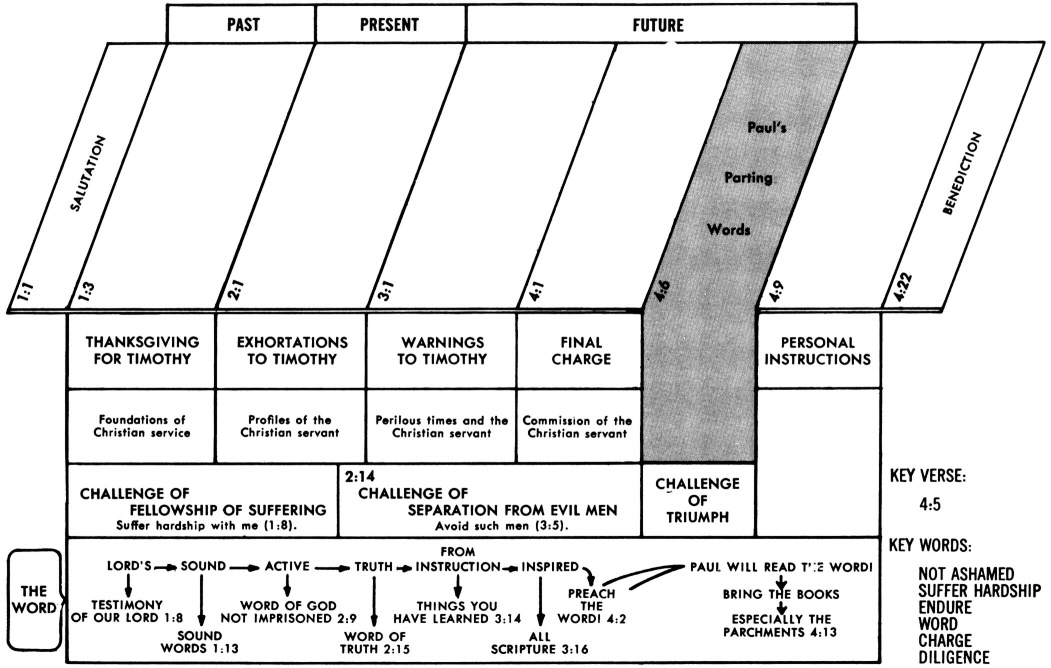
ENDURANCE AND SEPARATION IN THE MINISTRY
Click chart to enlarge
Charts from Jensen's Survey of the NT - used by permission
Second Timothy - Swindoll
| 2 TIMOTHY | |||
| 2 Timothy 1:1-18 | 2 Timothy 2:1-26 | 2 Timothy 3:1-17 | 2 Timothy 4:1-22 |
| Retain the Standard |
Rightly Divide the Word |
Difficult Times Will Come |
Preach the Word |
| PAST | PRESENT | FUTURE | |
| Foundation of Christian Service |
Pictures of Christian Servant |
Dangerous Times for Christian Servant |
Commission of Christian Servant |
| Unashamed as a Witness: Guard the Gospel |
Unashamed as a Workman: Suffer for the Gospel |
Adequate as a Workman: Continue in the Gospel |
Awarded as a Workman: Preach the Gospel |
| Power of the Gospel |
Perseverance of the Gospel Message | Protection of the Gospel |
Proclamation of the Gospel |
| Reminder | Requirements | Resistance | Requests |
| Encouragement in Ministry |
Examples in Ministry |
Exhortations in Ministry |
Exhortations to Fulfill Ministry |
| Commendation & Charge |
Commission to Fulfill |
Conflict to Face |
Course to Finish |
|
Compiled from Jensen's Survey of the NT and Wilkinson's Talk Thru the Bible |
|||
2 Timothy 2:16 But avoid (2SPMM) worldly and empty chatter, for it will lead (3PFAI) to further ungodliness,
Greek: tas de bebelous kenophonias periistaso; (2SPMM) epi pleion gar prokopsousin (3PFAI) asebeias,
Amplified: But avoid all empty (vain, useless, idle) talk, for it will lead people into more and more ungodliness.
Phillips: But steer clear of these unchristian babblings, which in practice lead further away from Christian living.
Wuest: But with reference to unhallowed and empty discussions, give them a wide berth, for they will progress to more impiety towards God
BUT AVOID: tas de periistaso (2SPMM)
- 2Ti 2:14-note; 1Ti 4:7- note; 1Ti 6:20; Titus 1:14-note; Titus 3:9-note
- 2 Timothy 2 Resources - Multiple Sermons and Commentaries
But (de) - Striking contrast between the "Word of Truth" (which sets men free from their old nature, cp Jn 8:31, 32, 34, 36) and worldly and empty chatter (which brings ungodliness).
Avoid (4026) (periistemi from peri = around + histemi = to stand) means literally to place around or stand around. The picture conveyed by this verb is to go around something so as to avoid it. Keep oneself away from being involved in some activity.
The idea is to shun this type of chatter by deliberately and habitually avoiding it. Timothy is to show his attitude toward these unholy errors by going around them. Phillips says "steer clear", while Wuest says "give them a wide berth".
The present imperative (command) indicates that this must be Timothy's lifestyle, continually avoiding, evading, eluding, and eschewing profane, godless talk.
The middle voice (reflexive action - subject initiates and participates in effect of the action) means to turn oneself about for purpose of avoiding. The idea is to place oneself at a distance from and so to stand aloof from.
Paul is commanding young Timothy to
turn yourself about so that you will avoid worldly, empty talk. Continually place yourself at a distance from it and stand aloof from it. It is unprofitable for the things of eternity and in fact actually leads to ungodliness!
WORLDLY [AND] EMPTY CHATTER: bebelous kenophonias:
- 2 Timothy 2 Resources - Multiple Sermons and Commentaries
Worldly (952) (bebelos from basis = a stepping or walking from baíno = to go + belos = threshold, particularly of a temple) refers properly to one who either was or ought to have been debarred from going over the threshold or entrance of the temple.
The picture is that which is trodden under foot and which thus describes that which is the antithesis of that which is holy or set apart. Bebelos thus describes that which is accessible to everyone and therefore devoid of real significance. Bebelos can thus describe that which is worldly as opposed to having an interest in transcendent (existing apart from and not subject to the limitations of the material universe) matters.
Cole observes that bebelos...
has the nuance of trafficking lightly in the things of God or of using God and the Bible for worldly gain. This sort of thing is rampant in American Christianity in our day. The “health and wealth” heresy is perhaps the most blatant form of it. Also, many “Christian” self-help books approach the Bible from the perspective of how to gain what you want in life, rather than reverently coming to it to learn how to please God (see note Colossians 1:10). It is using the Bible for worldly success.
Note two things:
First, such false teachers are always popular. Their talk will spread like gangrene. You don’t have to help gangrene to spread! Because they appeal to the flesh, these false teachers never lack a following. Some of the largest churches in America use the Bible to help people succeed in their worldly, selfish goals. But don’t judge a church by how big it is, but rather by how sound is the teaching in producing genuine godliness. People who buy into this kind of false teaching often testify of how much they’ve been helped, and often, outwardly, it seems true. But any time people are helped out of their troubles without learning to depend more on the living God and submit more fully to His lordship, it is false help.
Second, Christians are to avoid such teachers and their teaching (2 Ti 2:16). Steer clear of them. Don’t waste your time watching them on TV or reading their books. What Augustine wrote over 1,500 years ago (Nicene and Post-Nicene Fathers, vol. 4, ed. by Philip Schaff [Ages software], “Reply to Faustus the Manichaean,” Book 17, p. 432) applies here:
“For to believe what you please, and not to believe what you please, is to believe yourselves, and not the gospel.”
By appealing to the flesh and the lure of the world, these false teachers draw away after them people who are not fully submissive to the lordship of Christ and His gospel of the cross. To use the Bible for worldly ends is to misuse it. (2 Timothy 2:14-19 How To Use The Bible) (Bolding added)
Bebelos could be translated “unhallowed” and refers to any talk or teaching that contradicts the Word of Truth. The meaning of this adjective is nicely conveyed by our English word profane which describes that which disregards what is to be kept sacred or holy. The English word "profane" is derived from the Latin profanus which means "outside the temple, not sacred" and in turn is derived from pro- ‘before’ + fanum = ‘temple’.
Bebelos suggests that which is void of all connection with, or relation to, God. There is nothing sacred about their words.
Paul is not talking of idle chitchat or gossip, which can do considerable damage in a church. He is speaking of destructive heresy that perverts divine truth. That which is "worldly" is not initiated by God and therefore cannot be anointed by God. and in context is the language of a false teacher.
An example of "worldly chatter" would be arguing over whether God really meant literal "days" in the creation account in Genesis. God said "days" and the most logical interpretation is literal days. All else is speculative "worldly empty chatter".
Later in this same epistle, Paul uses hieros (sacred, holy, consecrated to God) the true antithesis (antonym) of bebelos, to describe
the sacred (hieros) writings which are able to give you the wisdom that leads to salvation through faith which is in Christ Jesus. (see note 2Timothy 3:15)
Empty chatter (2757) (Kenophonia from kenós = empty, fruitless, vain + phone = a voice) is literally empty, fruitless, sounds.
Kenophonia is talk that is without usefulness in building one up spiritually. It is devoid of any divine or spiritual character and is fruitless as far as the satisfaction of man’s need of salvation and the molding of Christian character.
Wuest adds that “vain babblings” are not merely empty words, but because empty, evil words, for as nature will not endure a vacuum, so empty words become filled with evil, and thus become words of evil content and purpose. Thayer defines kenophōnia as “empty discussion, discussion of vain and useless matters.” (Wuest's Word Studies from the Greek New Testament)
These "profane babblings" are unholy, empty discourses, having sound without substance, dealing with subjects that lack solid worth rather than those that are serious and weighty.
A modern example might be a humorous speaker in a Christian setting who makes you laugh but leaves you empty because your spiritual needs are not met. The only thing that satisfies our spiritual need is the Word of Truth. Paul does not encourage Timothy to answer these empty chatterers, for to do so would be to give them a greater importance than they deserve.
FOR IT WILL LEAD TO FURTHER UNGODLINESS: epi pleion gar prokopsousin (3PFAI) asebeias
- 2Ti 3:13-note, Hos 12:1, 1Cor 5:6, 1Cor 15:33, Heb 12:15-note Ezra 10:10;2 Thes 2:7,8; Titus 1:11-note; 2Pe 2:2-note; 2Pe 2:18-note Rev 13:3-note Rev 13:14-note
- 2 Timothy 2 Resources - Multiple Sermons and Commentaries
For (gar) (because) - Whenever you encounter this preposition at the beginning of a sentence stop and asked what the "for" is explaining (See discussion of the great value of interrogating terms of explanation). In this context the answer is straightforward - "for" introduces the explanation of why we are to avoid worldly and empty chatter.
Will lead (4298) (prokopto from pró = before or forward + kópto = cut) means literally to cut forward or cut down in front. The idea is to remove the obstacles from a road so that straight and uninterrupted progress is possible. The derivative noun is prokope (3x in NAS = Php 1:12 Php 1:25 1Ti 4:15) which refers to forward movement of something often of armies in spite of obstacles, dangers, and distractions. Of used of an army of pioneer wood cutters which preceded the regular army, cutting a road through an impenetrable forest, thus making possible the pioneer advance of the latter into regions where otherwise it could not have gone. Comparing prokopto to the verb auxano, with auxano the growth is caused by factors outside oneself or by the element of life placed there by God Himself, whereas with prokopto the advance is by one's conscious effort. Thus the noun form auxesis is growth or increase brought about by God, while prokope, is a conscious advancement through exertion.
Paul's use of prokopto in Gal 1:14+ is the figure of a runner in a race cutting ahead of others - before his conversion Paul was a Hebrew of Hebrews (Php 3:5-note) in front of all his fellow countrymen in regard to his religion. Does this not encourage us to believe that no Jewish person (in fact no person period! No as yet unsaved relative! No as yet unsaved friend!, et al) is beyond the reach of God's amazing grace and His supernatural Gospel!
Wuest writes that prokopto means “to lengthen out by hammering,” (as a smith forges metals) metaphorically, “to promote, further, forward.” The word speaks of progress made in some activity.
Vine - is used in a good sense in Luke 2:52, in an evil sense in 2 Timothy 2:16; 3:9, 13; in a neutral sense in Romans 13:12 and Galatians 1:14. (The derived noun prokope is always used in a good sense)
Thayer adds 1. to lengthen out by hammering (as a smith forges metals); metaphorically, to promote, forward, further; 2. to go forward, advance, proceed; of time: the night is advanced (AV is far spent) (day is at hand) (Ro 13:12)
BDAG...1. to move forward to a final stage, of time be advanced, be far gone 2. to move forward to an improved state, progress, advance in what is good or in what is bad
These false teachers are diligently "chopping forward", removing every obstacle in their relentless advance in ungodliness. Their behavior belies their message, for as Scripture and human experience testify, there is a close connection between doctrinal error and a lax, self-centered, godless lifestyle. So Paul says these senseless talkers progress further and further into the spiritual darkness and "miry clay" of ungodliness. Their progress is in spiritual reverse! The more they talk, the farther they move away from holiness and toward the worldly and profane.
THOUGHT - There is a powerful principle in this truth - the test of our talk is if at the end of the talking, we are closer to God, then all is well, but if we have erected barriers between one another and have moved further from God, then all is not well. The aim of all Christian discussion and action is to bring a man nearer to God and fellow believers. The Words and Works of men will reveal whether their heart is pure.
Prokopto - 6x in 6v - NAS renders it - advancing(1), almost gone(1), increasing(1), lead(1), make...progress(1), proceed(1). Not used in Septuagint.
Luke 2:52 And Jesus kept increasing in wisdom and stature, and in favor with God and men.
Romans 13:12-note The night is almost gone, and the day is near. Therefore let us lay aside the deeds of darkness and put on the armor of light.
Galatians 1:14 and I was advancing in Judaism beyond many of my contemporaries among my countrymen, being more extremely zealous for my ancestral traditions.
(Gal 1:14KJV reads "And profited in the Jews' religion above many my equals in mine own nation, being more exceedingly zealous of the traditions of my fathers.")
Comment by Wuest: The word profit (KJV translation) is from prokopto, which means “to blaze a way” through a forest, “to cut a pioneer path.” Paul means that he outstripped his Jewish contemporaries in distinctively Jewish culture, zeal, and activity. He pioneered in his studies, cutting new paths ahead of his fellow-students. He was a brilliant pupil of Gamaliel.
John MacArthur comments: Advancing is from prokopto, which literally means to chop ahead, as in blazing a trail through a forest. Saul kept on blazing his trail in Judaism, which meant cutting down anything in his path such as Jewish Christians, who in his mind were arch traitors to their ancestral traditions.
2 Timothy 2:16 But avoid worldly and empty chatter, for it will lead to further ungodliness,
2 Timothy 3:9-note But they will not make further progress; for their folly will be obvious to all, just as Jannes' and Jambres' folly was also.
2 Timothy 3:13-note But evil men and impostors will proceed from bad to worse, deceiving and being deceived.
Will lead to further ungodliness - Sound doctrine when heeded always leads to growth in godliness (cf 1Ti 4:6, 2Ti 4:3, 4-note, Titus 1:9-note). Unsound, profane doctrine has the opposite effect. If you want to see how healthy a given church, godliness is a good measure.
Paul reminds Titus of the integral association of truth (the Word of truth) and godliness "Paul, a bond-servant of God, and an apostle of Jesus Christ, for the faith of those chosen of God and the knowledge of the truth which is according to godliness (Titus 1:1-note) (NIV renders it "the knowledge of the truth that leads to a godly life", NLT has "the truth that shows them how to live godly lives")
Mark Dever in his interesting treatise on Nine Marks of a Healthy Church (2004) reminds us of the timeless truth that "A healthy church is a church that hears the Word of God and continues to hear the Word of God. And such a church is composed of individual Christians who hear the Word of God and continue to hear the Word of God, always being refashioned and reshaped by it, constantly being washed in the Word and sanctified by God’s truth. For our own health, individually as Christians and corporately as a church, we must continue to be shaped in new and deeper ways by God’s agenda in our lives, rather than by our own agendas. God makes us more like Himself through His Word, washing over us, refreshing us, reshaping us. — Nine Marks of a Healthy Church
Steven Cole gives us
three tests of sound doctrine that will keep you from being taken in by false teaching:
First, does it honor God and exalt Jesus Christ as Savior and Lord? Sound doctrine always lifts God up in His majesty and holiness. It exalts Jesus as fully God and fully man, who gave Himself for our sins and was raised bodily from the dead.
Second, does it humble proud, fallen sinners? Sound doctrine always brings sinners to the foot of the cross where they come to the end of their own pride and self-sufficiency.
Third, does it promote holiness? Sound teaching always results in obedience to the Word of God and progress in holy living. It leads to genuine love for God and love for others
The fact that in four out of six verses here Paul presents the negative should alarm us enough to examine ourselves. Using the Bible is not enough! You can use the Bible to your own destruction! Using the Bible for knowledge without obedience, to promote worldly goals, or to teach half-truths as the entire truth will lead to spiritual ruin. We need to be careful to use the Bible to grow to know God and to grow in submission to Him.
The Bible wasn’t given to satisfy our curiosity about the end times or to fill our heads with facts. It was given to help us grow in godliness. (Ibid) (Bolding added)
Ungodliness (763) (asebeia from a = without + sébomai = worship) means a want or lack of reverence toward God. It is a refusal to retain Him in knowledge and that habit of mind leads to open rebellion. The word does not refer to a person’s character as such, but to his attitude towards God. Ungodliness then is the attitude that results in living in a way that denies God's existence and right as Supreme Ruler. Ungodliness results in the rejection of all that has to do with God.
BDAG adds that in general asebeia "is understood vertically as a lack of reverence for deity and hallowed institutions as displayed in sacrilegious words and deeds: impiety; its corollary adikia refers horizontally to violation of human rights (Arndt, W., Danker, F. W., & Bauer, W. A Greek-English Lexicon of the New Testament and Other Early Christian Literature)
Hiebert adds that ungodliness is "suggestive of the whole inner and outer life of the one who lives without God and in opposition to His law.
To quote John MacArthur...
The legacy of false doctrine is to further ungodliness of false living.
ERROR...
Cannot restrain the flesh
Cannot halt the devil
Cannot protect from the worldFalse teaching provides no defense against iniquity and no strength for doing what is right and God-honoring. (MacArthur, J. 2 Timothy. Chicago: Moody Press)
2 Timothy 2:17 and their talk will spread (3SFAI) like gangrene. Among them are (3SFAI) Hymenaeus and Philetus, (NASB: Lockman)
Greek: kai o logos auton os gaggraina nomen exei; (3SFAI) on estin (3SFAI) Humenaios kai Philetos,
Amplified: And their teaching [will devour; it] will eat its way like cancer or spread like gangrene. So it is with Hymenaeus and Philetus (Amplified Bible - Lockman)
NLT: This kind of talk spreads like cancer. Hymenaeus and Philetus are examples of this. (NLT - Tyndale House)
Wuest: and their word will spread as does cancer, of whom are Hymenaeus and Philetus
Young's Literal: and their word as a gangrene will have pasture, of whom is Hymenaeus and Philetus,
AND THEIR TALK WILL SPREAD LIKE GANGRENE: kai o logos auton os gaggraina nomen hexei (3SFAI) os gaggraina:
- Na 3:15; Jas 5:3
- 1Ti 1:20
- 2 Timothy 2 Resources - Multiple Sermons and Commentaries
"GANGRENOUS
WORDS"
Talk (3056) (logos from légō = to speak with words; English = logic, logical) means something said and describes a communication whereby the mind finds expression in words. Although Lógos is most often translated word which Webster defines as "something that is said, a statement, an utterance", the Greek understanding of lógos is more complex (see word study)
Worldly and empty talk is still powerful and can have far reaching impact because they appeal to our fleshly nature, validating our sinful choices and making no condemning statements concerning the judgment to come. Ultimately they tickle the ears and corrupt the soul and spirit like the spread of spiritual cancer.
Spread is two words (2192) (echo) means to have and (3542) (nome) means pasturage, fodder, a grazing ("a grazing sore"). Literally this would read "Their words will have pasturage" and "so grow". Here it is used metaphorically for a feeding, eating, the spreading as gangrene. Even in modern warfare, gangrene is one of the worst dangers in battlefield injuries. If not treated promptly and carefully, it can quickly lead to amputation or death. False religion and satanic lies spread faster than the truth, because the sinful human heart is more receptive to them.
Wuest adds that this phrase "refers to the spread of something, for instance, nomē puros “a spreading of fire”; a sore is said nomē poieō, “to spread.” (Wuest's Word Studies from the Greek New Testament)
Like gangrene - This is a vivid term of comparison, specifically a simile. Figures of speech can give us great word pictures, but one has to be very careful not to be "imaginative" when interpreting figurative language. Even though it is a figure of speech, the Spirit intends to convey a literal meaning or literal sense.
Gangrene (cancer) (1044) (gaggraina from graô or grainô = to gnaw, to eat, an eating, spreading disease) describes the mortification of tissue which, unless properly treated, spreads from the place affected and eats away or consumes the neighboring parts of the body and at length destroys the whole body.
Vine - "an eating sore," spreading corruption and producing mortification, is used, in 2 Timothy 2:17 , of errorists in the church, who, pretending to give true spiritual food, produce spiritual gangrene (Gangrene - Vine's Expository Dictionary of NT Words)
Gangrene is a picture of dead cells "poisoning" the living cells around them, which in turn die and allow the gangrene to spread. So what are we to do? Paul instructs Timothy (and all believers) to get away from this poison because even the living things around will eventually be affected. Religious deceptions are so infectious, malicious, and insidious that they are to be handled only with protective mask and gloves, as it were. Using another figure, Jude says that those who are in grave spiritual danger should be snatched “out of the fire” (Jude 1:23-note) like a hot ember. It was in a similar figurative way that the high priest Joshua, who had become corrupted like the rest of the priesthood, was divinely retrieved and spared, like “a brand plucked from the fire” (Zec 3:2).
Related Resources:
- Holman Bible Dictionary Gangrene
- Hastings' Dictionary of the NT Gangrene
- Vines' Expository Dictionary Gangrene
- 1911 Encyclopedia Britannica Gangrene
- International Standard Bible Encyclopedia Gangrene
- The Nuttall Encyclopedia Gangrene
The Columbia Encyclopedia explains that "Dry gangrene, the most common form, follows a disturbance of the blood supply to the tissues, e.g., in diabetes, arteriosclerosis, thrombosis, or destruction of tissue by injury. A second type, moist gangrene, results from an invasion of toxin-producing bacteria that destroy tissue. Gangrene usually affects an arm or leg, but it may occur anywhere, e.g., pulmonary gangrene may follow an abscess of the lung. Treatment of gangrene includes rest and the administration of antibiotics if the gangrene is moist and bacterial invasion is present. Excision of the diseased portions of the body may be necessary and, in advanced involvement, amputation of the part. In gas gangrene, which results from the invasion of wounds by anaerobic bacteria, gas forms under the skin and a watery exudate is produced. Emergency treatment with penicillin and antitoxin is needed; without treatment, gas gangrene is invariably fatal. (The Columbia encyclopedia. New York)
ISBE writes that gangrene is "The name was used by the old Greek physicians for an eating ulcer which corrodes the soft parts and, according to Galen, often ends in mortification. Paul compares the corrupting influence of profane babbling or levity, in connection with subjects which ought to be treated with reverence to this disease (2Ti 2:17). The old English word “canker” is used by 16th-and 17th-century authors as the name of a caterpillar which eats into a bud. In this sense it occurs 18 times in Shakespeare (e.g. Midsummer Night’s Dream, II, ii, 3). The canker-worm mentioned 6 times by Joel and Nahum is probably the young stage of Acridium peregrinum, a species of locust. Cankered in Jas 5:3 the King James Version means “rusted” (Greek katiotai), and is so rendered in the Revised Version (British and American). In Susanna verse 52 Coverdale uses the phrase, “O thou old cankered carle,” in Daniel’s address to the elder, where English Versions of the Bible has “waxen old in wickedness.” The word is still used in the Scottish dialect and applied to persons who are cross-grained and disagreeable. (Orr, J: The International Standard Bible Encyclopedia)
Spurgeon comments that "ONE of the most serious calamities which can befall a church is to have her own ministers teaching heresy: yet this is no new thing, it has happened from the beginning. Paul and Peter and James and John in their epistles had to speak of seducers in the churches, even in those primitive days, and ever since then there have arisen in the very midst of the house of God those who have subverted the faith of many, and led them away from the fundamental truths into errors of their own inventing. The apostle compares this to a gangrene, which is one of the most dangerous and deadly mischiefs which can occur to the body. It is within the body, it eats into the flesh deeper and deeper, festering and putrefying, and if it be not stopped it will continue its ravages till life is extinguished by "black mortification." False doctrine and an unchristian spirit in the midst of the church itself must be regarded as such a gangrene, a silent wolf ravenously gnawing at the heart, the vulture of Prometheus devouring the vitals: no external opposition is one-half so much to he dreaded. (from 2 Timothy 2:20,21 The Great House and the Vessels)
AMONG THEM ARE HYMENAEUS [singing man] & PHILETUS [friendly man] : on estin (3SPAI) Humenaios kai Philetos:
- 2 Timothy 2 Resources - Multiple Sermons and Commentaries
Among them - implies there are several, not just these two singled out for notoriety by Paul.
It is often true that the most effective subverters of God's Word of truth are men who, outwardly, seem to be very smooth and charming (cf 2Co 11:13, 14, 15). Paul identifies one of the false teachers as Hymenaeus, who, because he was denounced in the previous letter, obviously had been a threat to the Ephesian church for some time. Although Paul had put him out of the church when he himself was still in Ephesus, having “delivered [him] over to Satan,” Hymenaeus obviously persisted in his efforts to mislead believers there, and Philetus had replaced Alexander as his co-conspirator (1Ti 1:20). As Jesus said of Judas (Mt 26:24), it would have been better if those men had not been born.