2 Timothy 2:2
2 Timothy 2:3
2 Timothy 2:4
2 Timothy 2:5
2 Timothy 2:6
2 Timothy 2:7
2 Timothy 2:8
2 Timothy 2:9
2 Timothy 2:10
2 Timothy 2:11
2 Timothy 2:12
2 Timothy 2:13
2 Timothy 2:14
2 Timothy 2:15
2 Timothy 2:16
2 Timothy 2:17
2 Timothy 2:18
2 Timothy 2:19
2 Timothy 2:20
2 Timothy 2:21
2 Timothy 2:22
2 Timothy 2:23
2 Timothy 2:24
2 Timothy 2:25
2 Timothy 2:26
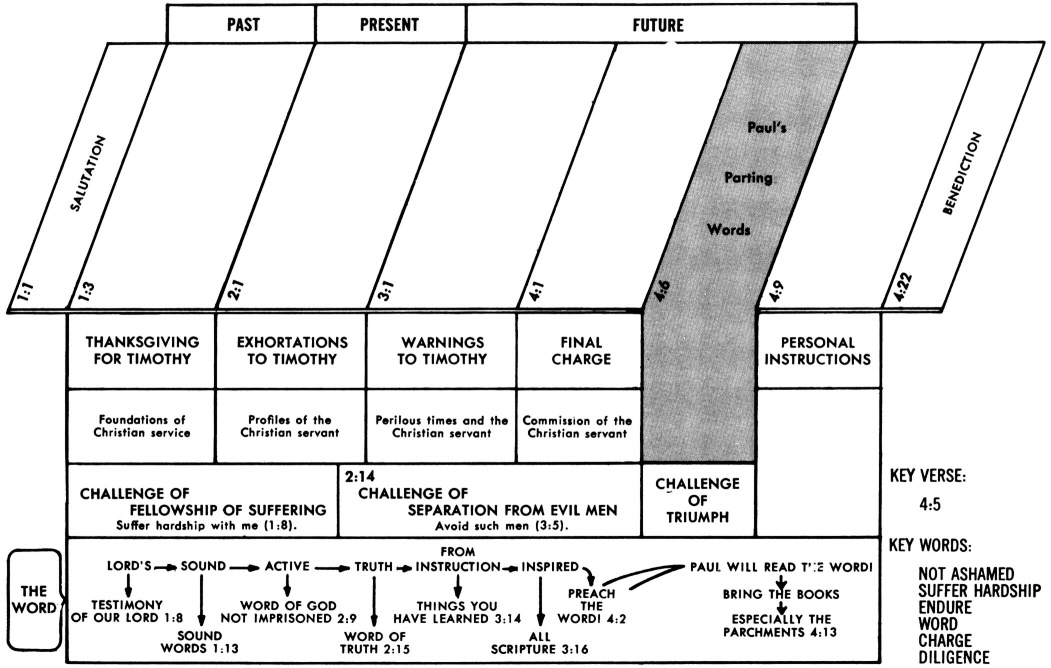
ENDURANCE AND SEPARATION IN THE MINISTRY
Click chart to enlarge
Charts from Jensen's Survey of the NT - used by permission
Second Timothy - Swindoll
| 2 TIMOTHY | |||
| 2 Timothy 1:1-18 | 2 Timothy 2:1-26 | 2 Timothy 3:1-17 | 2 Timothy 4:1-22 |
| Retain the Standard |
Rightly Divide the Word |
Difficult Times Will Come |
Preach the Word |
| PAST | PRESENT | FUTURE | |
| Foundation of Christian Service |
Pictures of Christian Servant |
Dangerous Times for Christian Servant |
Commission of Christian Servant |
| Unashamed as a Witness: Guard the Gospel |
Unashamed as a Workman: Suffer for the Gospel |
Adequate as a Workman: Continue in the Gospel |
Awarded as a Workman: Preach the Gospel |
| Power of the Gospel |
Perseverance of the Gospel Message | Protection of the Gospel |
Proclamation of the Gospel |
| Reminder | Requirements | Resistance | Requests |
| Encouragement in Ministry |
Examples in Ministry |
Exhortations in Ministry |
Exhortations to Fulfill Ministry |
| Commendation & Charge |
Commission to Fulfill |
Conflict to Face |
Course to Finish |
|
Compiled from Jensen's Survey of the NT and Wilkinson's Talk Thru the Bible |
|||
- 2 Timothy 2:19 Study of A Firm Foundation
- The Power of God's Word - A Simple Inductive Study
- Inductive Bible Study: Application
- 2 Timothy 3:16-17 Study of the Authority of God's Word
- 2 Timothy 3:16-17 Exposition
- 2 Timothy Overview Guard the Treasure
- 2 Timothy Handle Accurately the Word of Truth
- Life Hid and Not Hid by Alexander Maclaren
2 Timothy 2:18 men who have gone astray from the truth saying that the resurrection has already taken place, and they upset the faith of some. (NASB: Lockman)
Greek: hoitines peri ten aletheian estochsan, (3PAAI) legontes (PAPMPN) [ten] anastasin ede gegonenai, (RAN) kai anatrepousin (3PPAI) ten tinon pistin.
Amplified: Who have missed the mark and swerved from the truth by arguing that the resurrection has already taken place. They are undermining the faith of some. (Amplified Bible - Lockman)
GWT: They have abandoned the truth. They are destroying the faith of others by saying that people who have died have already come back to life. (GWT)
NLT: They have left the path of truth, preaching the lie that the resurrection of the dead has already occurred; and they have undermined the faith of some. (NLT - Tyndale House)
Phillips: and they are men who are palpable traitors to the truth, for they say that the resurrection has already occurred and, of course, badly upset some people's faith. (Phillips: Touchstone)
Wuest: the very ones who are of such a character as to have deviated from the truth, saying that the resurrection already has taken place, and are overthrowing the faith of certain ones.
Young's Literal: who concerning the truth did swerve, saying the rising again to have already been, and do overthrow the faith of some;
MEN WHO HAVE GONE ASTRAY FROM THE TRUTH: hoítines peri ten aletheian estochsan (3PAAI):
- Mt 22:29; 1Ti 1:19; 6:10,21; Heb 3:10; Jas 5:19
Men (3748) (hostis) is more literally "The very ones who" including (Hymenaeus and Philetus). Paul now explains the character of the unsound, unhealthy, gangrenous doctrine of these men and its disastrous effect on the faith of some who heard this false teaching.
Wuest notes that hostis and hoítines have "the two-fold function of pointing out and showing character. It refers back to Hymenaeus and Philetus, “the very ones who are of such a character as to.” The word, Expositors says, “implies that Hymenaeus and Philetus were only the more conspicuous members of a class of false teachers.” (Wuest, K. S. Wuest's Word Studies from the Greek New Testament: Eerdmans) (Bolding added)
Gone astray (795) (astocheo from ástochos = one who misses his aim <> in turn from stóchos = aim, target <> which is from a = negative particle + stoichos (an aim) or stochos - mark) means to miss the mark, deviate from truth: swerve. To err, deviate in a figurative and spiritual sense.
Literally Paul is saying these men "concerning the truth, missed the mark or deviated from the truth."
Astocheo does not mean to miss achieving the aim that one has set, but not to set the proper aim at which one ought to aim. It is not focusing on the right goal instead of not achieving one’s set aim. Naturally if one specializes in the proclamation of something that is not essential and central, he will inevitably neglect that which is central and important. The verb does not mean what is conceived by some as “to fall from grace.”
The false teachers and their followers had clearly demonstrated by their deviation from Apostolic truth that they had left the straight path of sound doctrine. They had deviated from "The Way" an early title for the church. They had deviated from "the Way, the Truth and the Life" (John 14:6) and the result was upheaval of faith for faith comes by hearing (truth) and hearing (truth) equates with the pure milk of the Word of God.
So Paul is saying here are some men who have embraced TRUTH for a while and then gone astray from that TRUTH. This emphasizes Paul's charge for us to be very "diligent...(to handle) accurately the Word of Truth" for clearly it can be mishandled with disastrous consequences.
Note that astocheo is used only by Paul in the NT, the other two uses being found in the first epistle to Timothy...
For some men, straying from these things (What things? verse 5 ''Instruction'' which is fruitful), have turned aside (astocheo) to fruitless (profitless for their talk produced no godliness. Shakespeare described such babble as “full of sound and fury, signifying nothing.” God said it was ''straw...(not) fire'' in Jer 23:28) discussion (It wasn't that they were missing what they had aimed at, for this verb indicates that their problem was they had not set the proper aim, i.e., instruction which yields spiritual fruit), 7 wanting to be teachers of the Law, even though they do not understand either what they are saying or the matters about which they make confident assertions. (1Timothy 1:7, 8)
O Timothy, guard (see word study on phulasso = aorist imperative) what has been entrusted (placed beside you as a deposit consigned to Timothy for faithful keeping and faith teaching to faithful men who would be able to teach others also) to you, avoiding worldly and empty chatter and the opposing arguments of what is falsely called "knowledge"--21 which some have professed (announced with certainty, asserted respecting themselves) and thus gone astray (astocheo) from "the faith (pistis). Grace be with you. (1Timothy 6:20, 21)
The Truth (225) (aletheia from a = indicates following word has the opposite meaning ~ without + lanthano = to be hidden or concealed, to escape notice, cp our English "latent" from Latin = to lie hidden) has the literal sense of that which contains nothing hidden. Aletheia is that which is not concealed. Aletheia is that which that is seen or expressed as it really is.
One of the attributes of God is Truth. God is the definition of truth; He is absolutely true, and all truth accords with God’s actions. God is all that He as God should be and that His word and revelation are completely reliable. He is absolutely dependable, without falseness of any kind. God’s plan, principles, and promises are completely reliable, accurate, real, and factual. God is real not imaginary, vain and empty like the idols of the pagans, who represent a so-called god of their own vain imagination. Truth can be depended upon and does not fail, change, or disappoint and so practically God's promises are all yea and amen in Christ Jesus and His word cannot fail or disappoint. The practical aspect of God's unchanging truthfulness is that we can stand on His promises with full assurance of faith no matter how we feel, no matter how dire our circumstances. We can trust and rest on this great attribute of God, forever and forever. Amen.
These false teachers had gone astray from the truth about the resurrection which is a major component of the Gospel (1Cor 15:4) and of every believer's Blessed Hope.
As an aside, we do well to remember that the spiritual war against our inveterate, mortal enemies (the world, the flesh and the devil) is not so much a power struggle but a battle over Truth and the "battlefield" is our mind and heart! Believe what God says and stand firm on that Truth!
SAYING THAT THE RESURRECTION HAS ALREADY TAKEN PLACE: legontes (PAPMPN) ten anastasin êdê gegonenai (RAN):
- 1Cor 15:12; Col 3:1
YOU'VE MISSED THE
RESURRECTION!
Saying that the resurrection has already taken place - It's bad enough to miss your connecting flight at the airport, but to miss the "flight" to Heaven is one flight no believer wants to miss! And that's the poison these false teachers were spreading which was "toxic" to the faith of some who bought the lie.
Saying (3004) (lego) means to speak or talk, with an apparent focus upon content of what is said. Present tense indicates that this wasn't a single event but something these men were continually saying.
Resurrection (386) (anastasis from anístemi = stand up <> ana = up, again + histemi = stand) means to come back to life after having once died and refers most naturally to bodily rising from dead. It is interesting that this is the only use of anastasis in Paul's pastoral letters.
Anastasis - 42x in 42v -Matt 22:23, 28, 30, 31; Mark 12:18, 23; Luke 2:34; 14:14; 20:27, 33, 35f; John 5:29; 11:24, 25; Acts 1:22; 2:31; 4:2, 33; 17:18, 32; 23:6, 8; 24:15, 21; 26:23; Ro 1:4; 6:5; 1 Cor 15:12f, 21, 42; Phil 3:10; 2 Tim 2:18; Heb 6:2; 11:35; 1 Pet 1:3; 3:21; Rev 20:5, 6.
Already (2235) (ede) means now, even now, and in reference to time marks an action as completed, in this case the resurrection.
Taken place (1096) (ginomai) caused to come into being or into existence. The means it had happened at a point in time and the effect or results persisted. It speaks of permanence of this occurrence (with the implication that it won't happen in the future!)
If the resurrection had already taken place, it would give the person who heard and believed this false teaching about the resurrection no hope . It was if they were saying "Forget about the rapture. Paul only meant it symbolically and it was not to be taken literally!".
But in fact Paul had assured the Thessalonian saints they could maintain a steadfast hope because of a literal bodily resurrection and subsequent rapture writing...
13 But we do not want you to be uninformed, brethren, about those who are asleep, that you may not grieve, as do the rest who have no hope. 14 For if we believe that Jesus died and (literal bodily) rose again, even so God will bring with Him those who have fallen asleep in Jesus. 15 For this we say to you by the word of the Lord, that we who are alive, and remain until the coming of the Lord, shall not precede those who have fallen asleep. 16 For the Lord Himself will descend from heaven with a shout, with the voice of the archangel, and with the trumpet of God; and the dead in Christ shall rise first (literal bodily resurrection) 17 Then we who are alive and remain shall be caught up together with them in the clouds to meet the Lord in the air, and thus we shall always be with the Lord. 18 Therefore comfort one another with these words. (1Th 4:13, 14; 1Th 4:15; 16; 1Th 4:17; 18)
The literal bodily resurrection is at the crux of Christian faith and so Paul had just instructed (present imperative = command) Timothy to be sure to continually...
Remember (present imperative see our need to depend on the Holy Spirit to obey) Jesus Christ risen from the dead (2Ti 2:8)
Jesus Himself testified that His resurrection was a bodily and not a spiritual resurrection...
33 And they (Cleopas and a second person on the road to Emmaus with the resurrected Jesus) arose that very hour and returned to Jerusalem, and found gathered together the eleven and those who were with them,
34 saying, "The Lord has really risen, and has appeared to Simon."
35 And they began to relate their experiences on the road and how He was recognized by them in the breaking of the bread.
36 And while they were telling these things, He Himself stood in their midst.
37 But they were startled and frightened and thought that they were seeing a spirit.
38 And He said to them, "Why are you troubled, and why do doubts arise in your hearts?
39 "See My hands and My feet, that it is I Myself; touch Me and see, for a spirit does not have flesh and bones as you see that I have."
40 <And when He had said this, He showed them His hands and His feet.>
41 And while they still could not believe it for joy and were marveling, He said to them, "Have you anything here to eat?"
42 And they gave Him a piece of a broiled fish;
43 and He took it and ate it before them. (Luke 24:33-43)
About 10 years prior to this second and last epistle to Timothy Paul had written to the Corinthian church explaining that...
12 if Christ is preached, that He has been raised (literally, bodily) from the dead, how do some among you say that there is no resurrection of the dead?
13 But if there is no (literal bodily) resurrection of the dead, not even Christ has been raised;
14 and if Christ has not been raised, then our preaching is vain, your faith also is vain (empty, fruitless = There is no true Christian faith without the literal, bodily resurrection, and thus no hope of forgiveness, salvation, or eternal life).
15 Moreover we are even found to be false witnesses of God, because we witnessed against God that He raised Christ, Whom He did not raise, if in fact the dead are not raised (we apostles would all be lying about God for we have said that God raised Christ from the grave, but that can't be true if there is no resurrection of the dead)
16 For if the dead are not raised, not even Christ has been raised;
17 and if Christ has not been raised, (literally, bodily) your faith is worthless; you are still in your sins.
18 Then those also who have fallen asleep in Christ have perished (all who have died believing in Christ have perished)
19 If we have hoped in Christ in this life only, we are of all men most to be pitied.
20 But now Christ has been raised from the dead, the first fruits of those who are asleep (the first of a great harvest of those who will be raised to life again.) (1Cor 15:12-20)
Hiebert explains that Hymenaeus and Philetus...
denied a future bodily resurrection and taught that the only resurrection there was had already occurred in the spiritual renewal of the believer in regeneration. They probably allegorized ("spiritualized") and thus misapplied Paul's teaching about the believer's spiritual union with Christ in death and resurrection
Romans 6:3 Or do you not know that all of us who have been baptized into Christ Jesus have been baptized into His death? 4 Therefore we have been buried with Him through baptism into death, in order that as Christ was raised from the dead through the glory of the Father, so we too might walk in newness of life. 5 For if we have become united with Him in the likeness of His death, certainly we shall be also in the likeness of His resurrection (See notes on Ro 6:1-3 , 6:4-5)
and insisted that the doctrine of the resurrection had only a spiritual meaning and application.
They allegorized (Ed note: An allegory is a form of literature in which a story points to a hidden or symbolic parallel meaning) away the doctrine, and turned all into figure and metaphor (Waterland, quoted in Ellicott).
Accepting the current philosophy that matter is evil, they argued that a physical resurrection was unthinkable. (2 Timothy by D. Edmond Hiebert) (Bolding added)
Nelson Study Bible comments that "This was probably an early form of Gnosticism that emphasized a spiritual resurrection over against the Christian belief in a future bodily resurrection. (BORROW Nelson Study Bible: NKJV)
KJV Bible Commentary agrees writing that "Resurrection is past. They probably spiritualized the resurrection of the future as the Gnostics of the day taught. (BORROW KJV Bible Commentary)
Jamieson - The beginnings of the subsequent Gnostic heresy already existed. They “wrested” (2Pe 3:16) Paul’s own words (Ro 6:4, Ep 2:6, Col 2:12) “to their own destruction,” as though the resurrection was merely the spiritual raising of souls from the death of sin. Compare 1Co 15:12, where he shows all our hopes of future glory rest on the literal reality of the resurrection. To believe it past (as the Seleucians or Hermians did, according to Augustine [Epistles, 119.55, To Januarius, 4]), is to deny it in its true sense. (A Commentary, Critical and Explanatory)
Hendriksen comments that Hymenaeus and Philetus..."resembled those present-day liberals who, while refusing to be caught saying, “There is no resurrection,” allegorize (Ed note: An allegory is a form of literature in which a story points to a hidden or symbolic parallel meaning [Contrast Literal Interpretation]) the concept. Now it must be admitted that Paul, too, believed in a spiritual resurrection, the act of God whereby he imparts the new life to those who are dead in sins and trespasses (Ro 6:3, 4, Ep 2:6, Php 3:11, Col 2:12, Col 3:1 and cf. Lk 15:24). But the apostle also most definitely taught the resurrection of the body (1Co 15; Php 3:21), just as Jesus had done (Jn 5:28). According to Paul’s teaching, denial of the bodily resurrection implies the complete overthrow of faith, for “if there is no resurrection of the dead, then Christ has not been raised either; and if Christ has not been raised, then our preaching is in vain, your faith is in vain, … and you are still in your sins” (1Co 15:13, 14, 17)." (Hendriksen, W., & Kistemaker, S. J. New Testament Commentary) (Bolding added)
Pastor Steven Cole has an interesting sermon on this section noting that...
it is possible to use the Bible to make progress in ungodliness (2Ti 2:14, 16, 17, 18).
Note the words Paul piles up to drive home this frightening point: “useless,” “ruin of the hearers” (2Ti 2:14); “further ungodliness” (2Ti 2:16); “spread like gangrene” (2Ti 2:17); “gone astray from the truth,” “upset the faith of some” (2Ti 2:18). The improper use of the Bible is not an innocent, harmless activity. It leaves a trail of carnage of ruined lives in its wake. That’s one reason James 3:1 warns, “Let not many of you become teachers, my brethren, knowing that as such we shall incur a stricter judgment.” That’s why Paul here warns Timothy to “solemnly charge them in the presence of God” (2Ti 2:14). The Bible is no harmless instrument. It’s a sharp sword and must be handled with proper care....
To use the Bible to teach half-truths as truth is to use it improperly (2Ti 2:18). These men were not totally wrong. They were teaching a half-truth as if it were the whole truth, which is often Satan’s method. They were teaching that the resurrection already had taken place. They had verses from Paul to back up their views. He wrote often of the fact that Christ is risen and that we are risen with Him. But he also taught that there is a future resurrection of the body, which these men denied. They argued that the resurrection was only spiritual and thus was an accomplished fact.
You may wonder, “What’s the big deal? Why is this even worth contending about?” Paul answers that question in 1 Corinthians 15:13-14 where he argues that if there is no future, literal, bodily resurrection, then Christ Himself is not even raised and our faith is worthless
Heresy always begins as truth out of balance!
There is always an element of truth in the teachings of the cults.Mark it well: Heresy always begins as truth out of balance! There is always an element of truth in the teachings of the cults. That’s how they get their hooks in people. They even have verses to back up their errors. So they prey on the untaught who are looking for “something more” in their faith. But they lead people away from dependence on the living God. If somebody handed you a three-dollar bill with a picture of Frank Sinatra on it, you wouldn’t be fooled. A counterfeit always looks genuine at first glance. That’s why we have to examine the popular worldly teachings cleverly cloaked with the Bible that are flooding the church in our day (cf Heb 5:14). They promote half-truths as if they were the truth of God. (2 Timothy 2:14-19 Using the Word Properly)
AND THUS THEY UPSET THE FAITH OF SOME: kai anatrepousin (3PPAI) ten tinon pistin:
- 2Ti 2:14; Mt 15:13; Lk 8:13; 22:31,32; Acts 5:39; 1Cor 11:19; 1Jn 2:19
UNSOUND DOCTRINE
"ROCKS THE BOAT"
To rock the boat means say or do something to disturb an existing situation, in this case the hearer's faith.
And thus they upset the faith of some - The rotten fruit of aberrant and/or overtly false doctrine is destabilization of one's faith. Upset (anatrepo) is in the present tense indicating that these false teachers are continually overthrowing the faith of certain ones. The corollary is that teaching sound doctrine generally produces sound faith in those who hear and heed the truth.
THOUGHT - Does your preacher preach sound doctrine or does he continually "salt" the sermon with assorted personal anecdotes and/or funny stories? If he is more like a comedian than a proclaimer of sanctifying truth (cf Jn 17:17), you might need to seek another church home.
Upset (396) (anatrepo from ana = again + trepho = turn) means to cause something to be completely overturned. Paul uses the verb figuratively here of the overturning, subverting or overthrowing of the faith of some by corrupting such vital truths (Ro 6:5, Col 3:1, Col 3:2, Col 3:3) in addition to denying the encouraging truth of God's promise of the future resurrection when His Son returns for His Bride, the Church (1Th 4:16,17, 18).
Anatrepo - 3x in 3v - Jn 2:15; 2Ti 2:18; Titus 1:11 and in 4 verses in the Septuagint - Ps 118:13; Pr 10:3; 21:14; Eccl 12:6.
In his letter to Titus Paul used this same verb describing "rebellious men, empty talkers and deceivers, especially those of the circumcision who must be silenced because they are upsetting (anatrepo) whole families, teaching things they should not teach, for the sake of sordid gain." (Titus 1:10, 11)
Faith (4102) (pistis) means a firm persuasion, conviction or belief in the truth. What Paul is saying is that one's faith can be "destabilized". And what is one way that occurs? Clearly by teaching doctrines of demons, doctrines that use Biblical language and hear even speak of a real Biblical event but which are perverted so that instead of strengthening the faith of the saints, the opposite effect ensues. So what would be the best "antidote" to such toxic teaching? Clearly the Word of Truth, the very entity Paul had just commanded Timothy to be diligent to handle rightly, for Paul knew their would be those who would creep into the body of Christ and subtly, slyly mishandle the Word of Truth.
Paul is referring to genuine saving faith which is not just mental assent but a firm conviction of the veracity of what is heard, a surrender to that truth and a conduct emanating from that surrender. In sum, faith shows itself genuine by a changed life. Stated another way "Don't tell me what you believe. Instead let me watch how you behave, and I'll tell you what you believe! If I watch you long enough, I can tell what you believe by what you do, not by what you say. You can say anything you like, but what you do tells the whole story. And you can watch me and sooner or later, you’ll know what I believe by what I do, regardless of what I say.
Related Resources:
- James 2:14-26 Faith that Works!
- Relationship of faith and obedience
- Fact! Faith! Feeling! - an excellent message from F B Meyer
Wayne Grudem adds that genuine soul saving faith...
is trust in Jesus Christ as a living person for forgiveness of sins and for eternal life with God. This definition emphasizes that saving faith is not just a belief in facts but personal trust in Jesus to save me... Because saving faith in Scripture involves this personal trust, the word “trust” is a better word to use in contemporary culture than the word “faith” or “belief.” The reason is that we can “believe” something to be true with no personal commitment or dependence involved in it. (See pdf Systematic Theology) (Bolding added) (Ed: I'm not sure the distinction is quite as clear as Dr Grudem intimates...see below).
Comment: Secular English dictionaries have the following definitons on trust and believe...
(1) Trust - A reliance or resting of the mind on the integrity, veracity, justice, friendship or other sound principle of another person. (1828 Webster). Assured reliance on the character, ability, strength, or truth of someone or something. Dependence on something future or contingent. The verb means to place one's confidence or to place in one's care or keeping. To rely on the truthfulness or accuracy of.
(2) Believe - to be persuaded of the truth of something upon the declaration of another, or upon evidence furnished by reasons, arguments, and deductions of the mind, or by other circumstances, than personal knowledge. When we believe upon the authority of another, we always put confidence in his veracity. When we believe upon the authority of reasoning, arguments, or a concurrence of facts and circumstances, we rest our conclusions upon their strength or probability, their agreement with our own experience, etc. (1828 Webster)
Wuest has an excellent discussion of pistis and the related (cognate) words (pisteuo and pistos) explains that...
When these words refer to the faith which a lost sinner must place in the Lord Jesus in order to be saved, they include the following ideas;
the act of considering the Lord Jesus worthy of trust as to His character and motives,
the act of placing confidence in His ability to do just what He says He will do,
the act of entrusting the salvation of his soul into the hands of the Lord Jesus,
the act of committing the work of saving his soul to the care of the Lord.
This means a definite taking of one’s self out of one’s own keeping and entrusting one’s self into the keeping of the Lord Jesus.(Wuest Word Studies - Eerdman Publishing Company Volume 1, Volume 2, Volume 3 - used by permission)
William Barclay (see critique) defines "faith" as follows "Faith begins with receptivity. It begins when a man is at least willing to listen to the message of the truth. It goes on to mental assent. A man first hears and then agrees that this is true. But mental assent need not issue in action. Many a man knows very well that something is true, but does not change his actions to meet that knowledge. The final stage is when this mental assent becomes total surrender. In full-fledged faith, a man hears the Christian message, agrees that it is true, and then casts himself upon it in a life of total yieldedness. (Barclay, W: The Daily Study Bible)
Faith means relying on what God has done rather than on one’s own efforts. In the Old Testament, faith is rarely mentioned. The word trust is used frequently, and verbs like believe and rely are used to express the right attitude to God. The classic example is Abraham, whose faith was reckoned as righteousness (Ge15:6). Jesus has always been the only "Door" (Jn 10:9) and faith the only "key" to open and enter that "Door," whether in the Old Testament or the New Testament.
J. B. Lightfoot discusses the concept of faith in his commentary on Galatians. He notes that in Hebrew, Greek, and Latin, the definition of the word for faith "hovers between two meanings: trustfulness, the frame of mind which relies on another; and trustworthiness, the frame of mind which can be relied upon. . . . The senses will at times be so blended together that they can only be separated by some arbitrary distinction. The loss in grammatical precision is often more than compensated by the gain in theological depth. . . . They who have faith in God are steadfast and immovable in the path of duty.
2 Timothy 2:19 Nevertheless, the firm foundation of God stands, having this seal, "The Lord knows those who are His" and "Everyone who names the name of the Lord is to abstain from wickedness." (NASB: Lockman)
Greek: ho mentoi stereos themelios tou theou esteken, (3SRAI) echon (PAPMSN) ten sphragida tauten; Egno (3SAAI) kurios tous ontas (PAPMPA) autou, kai, Aposteto (3SAMM) apo adikias pas o onomazon (PAPMSN) to onoma kuriou.
BGT ὁ μέντοι στερεὸς θεμέλιος τοῦ θεοῦ ἕστηκεν, ἔχων τὴν σφραγῖδα ταύτην· ἔγνω κύριος τοὺς ὄντας αὐτοῦ, καί· ἀποστήτω ἀπὸ ἀδικίας πᾶς ὁ ὀνομάζων τὸ ὄνομα κυρίου.
KJV Nevertheless the foundation of God standeth sure, having this seal, The Lord knoweth them that are his. And, Let every one that nameth the name of Christ depart from iniquity.
NET However, God's solid foundation remains standing, bearing this seal: "The Lord knows those who are his," and "Everyone who confesses the name of the Lord must turn away from evil."
CSB Nevertheless, God's solid foundation stands firm, having this inscription: The Lord knows those who are His, and Everyone who names the name of the Lord must turn away from unrighteousness.
ESV But God's firm foundation stands, bearing this seal: "The Lord knows those who are his," and, "Let everyone who names the name of the Lord depart from iniquity."
NRS But God's firm foundation stands, bearing this inscription: "The Lord knows those who are his," and, "Let everyone who calls on the name of the Lord turn away from wickedness."
NJB However, God's solid foundation-stone stands firm, and this is the seal on it: 'The Lord knows those who are his own' and 'All who call on the name of the Lord must avoid evil.'
NAB Nevertheless, God's solid foundation stands, bearing this inscription, "The Lord knows those who are his"; and, "Leteveryone who calls upon the name of the Lord avoid evil."
MIT Nevertheless, God's foundation has stood firmly in place, having this inscription, Yahveh knows those who are his; and, All who identify with Yahveh's name must have nothing to do with unrighteousness.
Amplified: But the firm foundation of (laid by) God stands, sure and unshaken, bearing this seal (inscription): The Lord knows those who are His, and, Let everyone who names [himself by] the name of the Lord give up all iniquity and stand aloof from it. (Amplified Bible - Lockman)
GWT: In spite of all that, God's <people> have a solid foundation. These words are engraved on it: "The Lord knows those who belong to him," and "Whoever worships the Lord must give up doing wrong." (GWT)
NIV: Nevertheless, God's solid foundation stands firm, sealed with this inscription: "The Lord knows those who are His," and, "Everyone who confesses the name of the Lord must turn away from wickedness."
NLT: But God's truth stands firm like a foundation stone with this inscription: "The Lord knows those who are his," and "Those who claim they belong to the Lord must turn away from all wickedness." (NIV - IBS)
Phillips: God's solid foundation still stands, however, with this double inscription: 'the Lord knows those who belong to him', and Let every true Christian have no dealing with evil. (Phillips: Touchstone)
Wuest: However, the immovable foundation of God has stood and at present stands, having this seal, The Lord knows those who are His, and, Let those who name the Name of the Lord depart from every wickedness.
Young's Literal: sure, nevertheless, hath the foundation of God stood, having this seal, 'The Lord hath known those who are His,' and 'Let him depart from unrighteousness -- every one who is naming the name of Christ.'
NEVERTHELESS THE FIRM FOUNDATION OF GOD STANDS: ho mentoi stereos themelios tou theou esteken (3SRAI):
- Pr 10:25 Isa 14:32; 28:16 Mt 7:25 Lk 6:48 1Cor 3:10,11 Eph 2:20 1Ti 6:19 Heb 11:10 Re 21:14) (Mt 24:24 Mk 13:22 Ro 8:31, 32, 33, 34, 35; 9:11 Heb 6:18,19 1Jn 2:19
- Ps 112:6, 125:1,2
FAITH'S FIRM
FOUNDATION
Remember that although it is not clearly stated in this pastoral epistle, when taken in context with his first letter to Timothy, it is a reasonably good assumption that Timothy was supervising the church at Ephesus. And so here Paul addresses a potentially disturbing situation of false teachers and false teaching with the reminder to Timothy that God was still in control.
THOUGHT: Are you standing the promises of God? Play Standing On The Promises Of God
Nevertheless (3305) (mentoi) in this context means yet, though, etc, and as such is an adversative (expressing antithesis, opposition, or adverse circumstance). Paul's point is that regardless of the false teachers whose words do not profit, but lead to ruin, ungodliness and upsetting of the faith of some, God is in control and His plans and purposes will not be thwarted! It's as if Paul is saying
Hymenaeus and Philetus may do their false teaching which may spread like cancer and it may even overthrow the faith of some but NEVERTHELESS (sounding a loud note of hope and encouragement)...the firm foundation of God stands
As Edwards phrases it "The conjunction nevertheless (mentoi) is one which expresses strong contrast. Thus the dismal scenery of man's perversion (2Ti 2:16 17 18 ) is now set in contrast with the majestic reality of God's protection and preservation.
Ray Pritchard (The Life God Blesses) has an interesting comment on "nevertheless" writing that...even in days of moral decline, the Lord says to us, “Nevertheless.”
Do false teachers seem to abound?
The Lord says, “Nevertheless.”
Are perilous times upon us?
The Lord says, “Nevertheless.”
Do we fear for the future?
The Lord says, “Nevertheless.”
Are we worried for our children’s safety?
The Lord says, “Nevertheless.”
Do we wonder how the church will survive?
The Lord says, “Nevertheless.”
Do we see some falling away from the faith?
The Lord says, “Nevertheless.”
Are we tempted to despair?
The Lord says, “Nevertheless.”
Could persecution come to us?
The Lord says, “Nevertheless.”
Do evildoers rise to power?
The Lord says, “Nevertheless.”
Firm (4731) (stereos) means that which is solid or firm in contrast with that which is soft or liquid. It means stable and immovable. Paul's point is that regardless of how one specifically interprets the phrase "firm foundation" deviation from sound doctrine, while serious, will not hamper God purposes.
Guthrie writes that "In the statement, God's solid foundation stands firm, the emphasis falls on the immovable character of God's foundation. It is never in doubt. It forms a vivid contrast to the defection which the false teachers represent. (Guthrie, D: 2 Timothy)
Bertram adds that "Over against Gnostics who change the hope of the resurrection by spiritualizing, 2Ti 2:19 refers to the “firm” (stereos) foundation of faith. This foundation lies in God, Who is stereós in Himself, Who is constant and Who makes constant, Who gives faithfulness to the community and its members, Who holds them fast to their crucified and risen Lord. (Hallelujah!) (BORROW Kittel's Theological Dictionary of the New Testament : abridged in one volume)
Foundation (2310) (themelios from théma = that which is laid down <> from títhemi = to place) something put down, a substructure (of a building) or that on which a structure is built.
Spurgeon says regarding the firm foundation that "There is no moving that. Whether ten thousand oppose it or promulgate it, the truth is still the same in every jot and tittle; even as the sun shineth evermore, as well when clouds conceal its brightness as when from a clear sky it pours abroad a flood of glory. The lovers of profane and vain babblings have not taken away from us, nor can they take from us, the eternal verities: the Lord liveth, though they have said, "There is no God." The precious blood of Jesus has not lost its efficacy, though divines have beclouded the atonement; the Spirit of God is not less mighty to quicken and to console though men have denied his personality; the resurrection is as sure as if Hymenaeus and Philetus had never said that it is passed already; and the eternal covenant of grace abides for ever unbroken though Pharisees and Sadducees unite to revile it. The foundation of God standeth sure. All that God has built upon the foundation which He Himself has laid keeps its place, not one living stone that he ever laid upon the foundation has been lifted from its resting place. Earthquakes of error may test the stability of the building and cause great searching of heart, but sooner shall the mountains which are round about Jerusalem start from their seats than the work or word of the Lord be frustrated. The things which cannot be shaken remain unaltered in the very worst times. (from 2 Timothy 2:20,21 The Great House and the Vessels)
Stands (2476) (histemi) means in this context that it is established. The perfect tense indicates the permanence of this foundation and more literally could be translated "has stood with the present result that it stands permanently." If we keep our focus where it should be, we will never have our faith overthrown!
Edwards comments that the perfect tense emphasizes "the continual state of standing sure. Though men have tried to dismantle and destroy the true church for 2,000 years, God has sovereignly upheld and even multiplied it ever since its inception. Not surprisingly this is in accord with Christ's promise and prophecy in Matthew 16:18 (Jesus speaking "And I also say to you that you are Peter, and upon this rock I will build My church; and the gates of Hades shall not overpower (prevail, vanquish, gain mastery over) it."). (2 Timothy - Call to Completion - scroll down page)
The firm foundation - To what does this refer? The two most frequently mentioned interpretations are (1) the church composed of genuine believers or (2) the Lord Jesus Christ, the Solid Rock upon which the church rests. To an extent these two possibilities are virtually impossible to separate for the church is composed of those who are members of His flesh and one flesh with Him. As Paul explained the "church...is His body, (and is) the fulness of Him who fills all in all." (Eph 1:22-23)
In his first letter to Timothy Paul described ""the household of God, which is the church of the living God, the pillar and support (prop, stay, support) of the truth." (1Ti 3:15)
The idea would then be that the church is the pillar, and as such, the prop or support of the truth, even in face of those whose empty chatter that might upset the faith of some.
Pritchard comments that "God is still in control because the “solid foundation” stands firm. God’s church is built on the solid Rock—Jesus Christ our Lord. He is the cornerstone of our faith. The church will not fail because it rests on the eternal promises of God Who cannot lie and will not be defeated. Fear not, child of God. Do not give in to despair. God is still on the throne. He knows His own and He will not let them utterly fall. Rough times may come, but God does not forget His children. They are safe in His hands even when the waves of turmoil and clouds of compromise seem to temporarily blot out the sun. The Lord is on the throne and He will not be moved. Those who trust in Him will be safe forever. (The Life God Blesses) (Bolding added)
Edwards commenting on the meaning of "firm foundation" writes that "This question has been much disputed, and several explanations have been proposed. Prominent among these are: Christ and the apostles (Ep2:20); the truth of the gospel; or, the church (1Ti 3:15). While not wanting to be dogmatic, my personal preference is for the church. In spite of the collapse of some members of the church (verse 18), the church itself remains firm.
Hiebert writes that "God demands separation from unrighteousness of His own, as Paul at once points out. The mention of the subversion of the faith of some (in the preceding verses) does not mean that God's true Church can be destroyed. "Howbeit [or nevertheless] the firm foundation of God standeth." The cause of truth rests upon God's "firm foundation" which continues to stand in spite of the attacks of error and unbelief. The foundation is described as "firm" or "solid" in its nature, hence permanent and stable. The significance of the foundation has been variously interpreted. The context points to the meaning of the foundation as the whole body of genuine believers, the true Church of God built upon the apostolic doctrine. (D. Edmond Hiebert: 2 Timothy) (Bolding added)
Wuest comments that "Paul has been speaking of the true Church, the Mystical Body of Christ made up of believers only. In this verse he is referring to the visible organized Church on earth, made up of saved and unsaved. Vincent says: “But the Church embraces a variety of characters. Unrighteous men steal into it. So in a great household establishment there are vessels fit only for base uses.” (Wuest's Word Studies from the Greek New Testament: Eerdmans) (Bolding added)
Jameison, Fausset and Brown also favor the "foundation here is “the Church”, which is “the ground” or basement support “of the truth” as in (1Ti 3:15), but he Christ Himself being the ultimate “foundation” (1Cor 3:11).
Steven Cole feels...
The foundation refers to the true people of God, the church. Those who truly belong to the Lord are not carried away by false teaching. The seal on the foundation, or cornerstone, has two statements that reflect two important aspects of our salvation. These two statements come from the story of Korah’s rebellion against Moses. Moses said (Num. 16:5), “the Lord will show who is His, and who is holy, and will bring him near to Himself; even the one whom He will choose….” He warned the congregation to de-part from the tents of these wicked men before God destroyed them (Nu 16:26)
Paul says that the first part of the seal is, “The Lord knows those who are His.” Salvation does not begin with man; it begins with God. He planned it and He executed it. “He chose us in [Christ] before the foundation of the world” (Eph 1:4). “In the exercise of His will He brought us forth by the word of truth” (James 1:18). We can’t know God’s truth until God has first laid hold of us and saved us from our sins by His grace alone.
The second statement is, “Everyone who names the name of the Lord is to abstain from wickedness.” As Eph 1:4 (note) continues, God chose us “that we would be holy and blameless before Him.” We can be assured that we belong to the Lord because we see Him progressively working His holiness into our daily lives. So the foundation for using the Bible properly is that God knows us as His own and that through our diligent, careful study and application of His Word of truth, we are growing in godliness. (2 Timothy 2:14-19 Using the Word Properly)
Through His prophet Isaiah, Jehovah declares "Behold, I am laying in Zion a stone, a tested stone, a costly cornerstone for the foundation, firmly placed. He who believes in it will not be disturbed." (Isa 28:16)
In a clear prophecy of the Messiah, God declares that He has established Messiah as the only One worthy of trust and that He Alone is a firm foundation. Those who rely on Him never need be fearful even though false teachers may upset the faith of some.
Although some stones might be removed, a foundation or cornerstone would remain secure. Unlike those who trust in a false teachers and false religions, those who are truly saved, who are God’s spiritual children and genuine disciples of Jesus Christ, are part of the firm foundation of God. Jesus promised that if a house (equated with one's religious life) was built upon the rock, it would not fall even though
the rain descended, and the floods came, and the winds blew, and burst against that house... for it had been founded upon the rock." (Mt 7:25)
This firm foundation could be a reference to Christ Jesus and His apostles for Paul writes that "the saints, and are of God’s household, having been built upon the foundation of the apostles and prophets, Christ Jesus Himself being the corner stone. (Eph 2:20).
In a parallel passage using this same metaphor Paul writes to the Corinthians that "According to the grace (the special endowment for my task) of God which was given to me, as a wise master builder (skillful architect) I laid a foundation, and another is building upon it. But let each man be careful how he builds upon it. For no man can lay a foundation other than the one which is laid, which is Jesus Christ. (1Cor 3:10-11)
All empty chatter, human philosophy, religious systems or ethical codes are doomed to failure and destruction, because they lack a firm foundation. There is only one foundation, and, no matter how one may try, no man can lay a foundation other than the one which has already been laid, which is Jesus Christ. God’s kingdom is built on Jesus Christ, and every individual life that pleases God must be carefully built on that foundation.
Vine writes that "No matter how great the apostasy from the faith, no matter how subversive the work of false teachers, God’s foundation stands in its impregnable character. (Vine, W. Collected writings of W. E. Vine. Nashville: Thomas Nelson)
Solomon records that "When the whirlwind passes, the wicked is no more, but the righteous has an everlasting foundation. (Hebrew = a base on which people build structures) (Pr 10:25). Symbolically, the Hebrew word for "foundation" refers to principles on which people build their lives, whether they be faulty or sound.
HAVING THIS SEAL: echon (PAPMSN) ten sphragida tauten:
- Hag 2:23; Zech 3:9; 4:7-9; Eph 4:30
A SEAL SURE
NOT SHAKY
Related Passage:
Ephesians 4:30 Do not grieve the Holy Spirit of God, by whom you were sealed for the day of redemption.
Having (2192) (echo) is in the present tense indicating that the foundation continually has this seal.
Seal (4973) (sphragis) (Click for an excellent article on "seal" in ISBE) is an engraved object used to make a mark denoting ownership, approval, or closure of something. It was normally done by pressing into heated wax and usually attached to a document or letter as a seal or signet. Thus sphragis often referred to the signet ring itself.
John MacArthur adds that "Kings or other officials would use such rings to stamp into wax on documents or other items, thereby affirming their authenticity and guaranteeing their security (cf. Ge 41:42; Esther 3:10; 8:2, 8; Da 6:17; Mt 27:66) A seal thus denoted ownership and protection (cf. Jn 6:27; 2Co 1:22; Ep 1:13; Ep 4:30). (See Revelation Commentary)
A seal therefore could indicate authority and would protect or at least warn against tampering with that which was sealed, which was one purpose that the tomb of Jesus was sealed (Mt 27:66). Seals were also used on documents or merchandise to validate that they had not been tampered with. A seal could authenticate a legal decree or other document, certifying and guaranteeing its genuine character.
A seal indicated the structure’s authenticity and integrity (cf. Ro 4:11; 1Cor 9:2) and in context of 2 Timothy chapter 2, assures the believer's ownership, authentication, protection, security and destination. In the metaphor of a building as in this passage, the seal would represent the inscription on the cornerstone as inscribed by the owner or builder of the building.
NIDNTT in a thorough discussion of seal (both the noun and verb) writes that...
The noun means both the tool that seals (e.g. a signet ring), the stone set in it (the gem) and the engraving on it (an image or name) as well as its imprint.
Seals were widely used very early (3rd millennium onwards), especially in Mesopotamia, where Hdt. observed that every man possessed not only a staff but also a seal (1, 195), and later in the whole Mediterranean area (on the different forms of seals-e.g. rolls, buttons, scaraboid-cf. BHHW III 1786 ff., 1812 f.). The real importance of the seal is a legal one: the owner puts his mark on his possessions, his beasts (cf. Virgil, Georgics 3, 157 ff.; BGU I, 87, 12 f.; P. Teb. 419), his slaves (cf. Pliny, Nat. Hist. 25, 13, 173; BGU I, 15, etc.) and thereby guards his property against theft. To that extent one can call it a protecting sign or a guarantee. When used with documents (wills, deeds of sale, etc.) the seal served as a signature to authorize what was written there (cf. TDNT VII 941). Things sealed were at the disposal of the possessor of the seal. This applied not only to private persons, but also particularly to the authorities of a city and to kings. The seal symbolized their authority.
Seals were also significant in religious life. For instance, a beast could be attested as ritually pure and thus suitable for a sacrificial victim (cf. Hdt. 2, 38; BGU, I, 250, 15 ff.; 356, 7). Men show themselves to be the possession of their deity by the imprint of their seal (Hdt., 2, 113; cf. 3 Macc. 2:29f.; also J. Ysebaert, Greek Baptismal Terminology, 1962, 200 f.). More tangibly one can seal houses, etc., to guarantee that they were preserved, or documents, to keep their contents a secret. Hence, one can also say that the mouth or words are sealed (cf. Diog. Laert., 1, 58; Theognis, 1, 178; Timotheus, Persians 148): what one has experienced must remain secret and in safe keeping. This applied particularly to keeping the secrets of the mysteries (Ysebaert, op. cit., 221-226).
A seal engraved by a maker of signets (Sir. 38:27) can leave its impress in clay (Job 38:14). It has a legal use: by means of a seal a document (e.g. a marriage contract, Tob. 7:14; or a deed of sale, Jer. 39:10f., 44 [32:10f., 44]) is made valid. All who affix their seals to a document are bound to abide by its contents (Neh. 10:1). To give one’s seal to another implies the transference of authority and power (Gen. 41:42; 1 Ki. 20:8 or LXX 1 Ki 21:8; Est. 3:10; 8:8, 10). Hence, one of the means by which the dying Antiochus Epiphanes appointed his friend Philip as regent over his kingdom was to hand over his seal to him (1 Macc. 6:15).
The LXX can also speak of a seal used as a fastening (for a purse, 2 Ki. 22:4; Tob. 9:5; a treasury, Deut. 32:34; the temple, Ad.Dan. 14:14, 16f.; a pit, Dan. 6:18; a fountain, Cant. 4:12). Thence the act of sealing comes to be equivalent to keeping something secret: that which is sealed is hidden from men (a book, Dan. 12:4; Isa. 29:11; cf. 1 Esd. 3:8). The seal is thus absolutely necessary in both private and public life. The seal of the state (Jerusalem, 2 Esd. 10:23) is carefully guarded (Tob. 1:22). Signet-rings are precious (Isa. 3:20; Sir. 35:5f. [32:5f.]) and are regarded as valuable spoil (Num. 31:50).
The figurative use of the concept is found especially with the sense of concluding or shutting up...A revelation that is sealed remains hidden (Dan. 12:9) and one can therefore learn as little of its contents as of those of a sealed book. In Job 24:16 skulking malefactors are said to have “sealed” themselves from daylight. (See page 496 of New International Dictionary of NT Theology)
Here are the 16 NT uses of sphragis...
Romans 4:11 (note) and he received the sign of circumcision, a seal of the righteousness of the faith which he had while uncircumcised, that he might be the father of all who believe without being circumcised, that righteousness might be reckoned to them,
1 Corinthians 9:2 If to others I am not an apostle, at least I am to you; for you are the seal of my apostleship in the Lord.
2 Timothy 2:19 (note) Nevertheless, the firm foundation of God stands, having this seal, "The Lord knows those who are His," and, "Let everyone who names the name of the Lord abstain from wickedness."
Revelation 5:1 (note) And I saw in the right hand of Him who sat on the throne a book written inside and on the back, sealed up with seven seals.
Revelation 5:2 (note) And I saw a strong angel proclaiming with a loud voice, "Who is worthy to open the book and to break its seals?"
Revelation 5:5 (note) and one of the elders said to me, "Stop weeping; behold, the Lion that is from the tribe of Judah, the Root of David, has overcome so as to open the book and its seven seals."
Revelation 5:9 (note) And they sang a new song, saying, "Worthy art Thou to take the book, and to break its seals; for Thou wast slain, and didst purchase for God with Thy blood men from every tribe and tongue and people and nation.
Revelation 6:1 (note) And I saw when the Lamb broke one of the seven seals, and I heard one of the four living creatures saying as with a voice of thunder, "Come."
Revelation 6:3 (note) And when He broke the second seal, I heard the second living creature saying, "Come."
Revelation 6:5 (note) And when He broke the third seal, I heard the third living creature saying, "Come." And I looked, and behold, a black horse; and he who sat on it had a pair of scales in his hand.
Revelation 6:7 (note) And when He broke the fourth seal, I heard the voice of the fourth living creature saying, "Come."
Revelation 6:9 (note) And when He broke the fifth seal, I saw underneath the altar the souls of those who had been slain because of the word of God, and because of the testimony which they had maintained;
Revelation 6:12 (note) And I looked when He broke the sixth seal, and there was a great earthquake; and the sun became black as sackcloth made of hair, and the whole moon became like blood;
Revelation 7:2 (note) And I saw another angel ascending from the rising of the sun, having the seal of the living God; and he cried out with a loud voice to the four angels to whom it was granted to harm the earth and the sea,
Revelation 8:1 (note) And when He broke the seventh seal, there was silence in heaven for about half an hour.
Revelation 9:4 (note) And they were told that they should not hurt the grass of the earth, nor any green thing, nor any tree, but only the men who do not have the seal of God on their foreheads.
Sphragis is used 10 times in the LXX (Ex 28:11, 21, 36; 35:22; 39:6, 14, 30; 1 Ki. 21:8; Song 8:6; Hag. 2:23)
The New Manners and Customs of Bible Times has the following note - The allusion here is to inscriptions that were placed on buildings. Besides writing on doors (see Deuteronomy 6:9 Doorposts Inscriptions), it was customary to inscribe on some of the foundation stones of large buildings words indicating the purpose for which the building was erected, or containing some striking maxim. (Freeman, J. M., & Chadwick, H. J. The New Manners & Customs of the Bible. Page 544)
Hiebert writes that
Paul pictures God's firm foundation as having a twofold "seal." The figure is not that of an "inscription" on a building, although many scholars advocate this picture. The seal was used to indicate ownership, security, and authenticity. Here the seal with its two legends speaks of ownership, security, and authenticity, certifying the genuineness of those thus sealed. The seal with which believers are sealed indicates divine ownership, proclaims their security, and guarantees their genuineness.
This seal has two complementary readings: "The Lord knoweth them that are his: and, Let every one that nameth the name of the Lord depart from unrighteousness." To be valid, the two legends on the seal cannot be separated. (Ed note: or otherwise the seal would not be viewed as "intact") The first emphasizes the objective fact of God's superintending knowledge of His own; the second stresses the need for man's holiness. The first is dated in eternity past; the second regulates the believer's present conduct. The first assures the security of the Church; the second requires its purity. The first is a truth to be believed; the second is a demand to be obeyed. (D. Edmond Hiebert: 2 Timothy) (Bolding added)
White agrees writing that "The one seal bears two inscriptions, two mutually complementary parts or aspects: (a) The objective fact of God's superintending knowledge of His chosen; (b) the recognition by the consciousness of each individual of the relation in which he stands to God, with its imperative call to holiness (As quoted in Expositor's Bible Commentary 6-Volume New Testament. Zondervan Publishing)) (Bolding added)
Hendriksen - The seal by which believers are sealed protects, indicates ownership, and certifies, all three in one! Cf. Rev 7:2–4. God the Father protects them, so that none are lost. He has known them as His own from all eternity (the context calls for this idea). God the Son owns them. They were given to Him. Moreover, He bought or redeemed them with His precious blood. This idea of ownership is clearly expressed here (“the Lord knows those who are his”). And God the Holy Spirit certifies that they are, indeed, the sons of God (Ro 8:16). This divine protection, ownership, and certification seals them! But how do believers experience the comfort of the seal? The answer is: by taking to heart what is written on the seal! (New Testament Commentary)
Barclay writes "the sphragis (seal) was the architect's mark. Always on a monument or a statue or a building the architect put his mark, to show that he was responsible for its design. The sphragis can also be the inscription which indicates the purpose for which a building has been built. (The Daily Study Bible)
Vincent puts the matter this way "There are two inscriptions on the foundation stone, the one guaranteeing the security, the other the purity... . The two go together. The purity... is indispensable to its security. (Vincent, M: Word studies in the New Testament Vol. 4, Page 303-304).
THE LORD KNOWS THOSE WHO ARE HIS: Egno (3SAAI) kurios tous ontas (PAPMPA) autou:
- Nu 16:5; Ps 1:6; 37:18,28; Na 1:7; Mt 7:23; Lk 13:27; Jn 10:14; Jn 10:27, 28, 29, 30; 13:18; Ro 8:28; 11:2; 1Cor 8:3; Gal 4:9; Rev 17:8)
Related Passages:
Numbers 16:5 (See discussion below) and he (Moses) spoke to Korah and all his company, saying, "Tomorrow morning the LORD will show who is His, and who is holy, and will bring him near to Himself; even the one whom He will choose, He will bring near to Himself. (Comment: And indeed Jehovah did show who was His, as the way of the ungodly perished!)
Psalms 1:6 For the LORD knows the way of the righteous, but (note the striking contrast) the way of the wicked will perish (Comment: the implication in this verse of Jehovah "knowing" men, is that those men will not perish, so the "knowing" speaks of a personal relationship, and ultimately from other passages is a relationship based on grace through faith)
Ps 37:18 The LORD knows the days of the blameless; and their inheritance will be forever...20 But (note the striking contrast) the wicked will perish; And the enemies of the LORD will be like the glory of the pastures, They vanish-- like smoke they vanish away. (The Psalmist encourages the godly and seeks to warn the ungodly)
Ps 37:28 For the LORD loves justice, And does not forsake His godly ones; They are preserved forever; but (vivid contrast) the descendants of the wicked will be cut off.
Nahum 1:7 (In the midst of a section describing God's judgment, Nahum records these marvelous words of compassion) The LORD is good, A stronghold in the day of trouble, And He knows (LXX = ginosko) those who take refuge in Him (from the above passages, only the blameless and righteous will take refuge in Him).
A GREAT TRUTH:
THE LORD KNOWS!
Lord (2962)(kurios from kuros = might or power) has the main sense of a supreme one, one who is sovereign and possesses absolute authority, absolute ownership and uncontested power. When one referred to someone as "Lord" they were not only acknowledging the position of authority, but they were also referring to someone who, in that position of authority had a concern and a passion for others who are under his authority.
Boice - Citizens of the empire were required to burn a pinch of incense to the reigning Caesar and utter the words Kyrios Kaisar (“Caesar is Lord!”). It is this that the early Christians refused to do and for which they were themselves thrown to the wild lions or crucified. It was not that Christians were forbidden to worship God. They were free to worship any god they chose so long as they also acknowledged Caesar. Romans were tolerant. But when Christians denied to Caesar the allegiance that they believed belonged to the true God only, they were executed. (Daniel: An Expositional Commentary)
Knows (1097) (ginosko; English derivatives - prognosis, gnostic, Gnosticism) means to acquire information through some modality, as through sense perception (hearing). However ginosko involves experiential knowledge, not merely the accumulation of known facts. Ginosko has the basic meaning of taking in knowledge in regard to something or someone, knowledge that goes beyond the merely factual (study the above passages for some insights into what God's knowing a man signifies!). By extension, the term frequently was used of a special relationship between the person who knows and the object of the knowledge. It was often used of the intimate relationship between husband and wife and between God and His people.
Notice that believers may not always know who in the church body (local and mystical) are genuine born again believers but God knows. Jesus explained in the parable of the wheat and tares (Mt 13:24, 25, 26, 27, 28, 29, 30, 36-43) that the kingdom of heaven on this present earth (He was referring to the world -- the field is the world-- not the church as is often taught, although the principle is of course applicable to the church) is composed of good seed (sons of the kingdom) and bad seed (sons of the evil one) and that although it may difficult for true believers to differentiate false "believers", the Son of Man knows who they are and will send His angels to gather them out of His kingdom and cast them into hell.
Although we cannot necessarily discern a "pseudo-believer", we can each be assured and certain of our salvation for as Paul explains the..
The Spirit Himself bears witness with (present tense) (this Greek verb is found in secular writing where the signature of each attesting witness is accompanied by the words "I bear witness with and "I seal with") our spirit that we are children of God (Ro 8:16)
Comment: How can a person who is unsure about his salvation gain true assurance (cp 1Jn 5:10 11 12 13 - Especially from 1Jn 5:13, what is the practical step one can take to assure their assurance? [Clue: What are "these things"? See 1Jn 2:29, 3:9, 14, 4:7, 5:4] cp Ro 10:17 If that passage is true [which it is], "listen" to the following Words... Heb 6:11 12, Sin damages assurance = Ps 32:3 ["The Spanish inquisition with all its tortures was nothing to the inquest which conscience holds within the heart." - Spurgeon] Assurance is a lifelong fight = 1Ti 6:12 Assurance is to be prayed for = Eph 1:18, 19; Assurance is God's will and gift to be received = Ro 8:16)? How can we know that we have entered through the narrow door (cp Jn 20:31, 2Co 5:17)?
Jesus affirmed "I am the good (worthy, choice, excellent) shepherd; and I know (ginosko - recognize) My own, and My own know (ginosko - recognize) Me (Jn 10:14).
Jesus goes on to add that "My sheep hear My voice, and I know (ginosko) them, and they follow Me and I give eternal life to them, and they shall never perish; and no one shall snatch them out of My hand. “My Father, Who has given them to Me, is greater than all; and no one is able to snatch them out of the Father’s hand. (Jn 10:27, 28, 29).
Comment: In John 10 Jesus speaks of the intimate, safe and secure ("sealed") relationship that exists between Himself and His sheep (disciples). They can never be lost!
On the other hand Jesus will declare to the wicked "I never (absolute, complete negation - in other words, they did not "lose" salvation {which the Bible does not teach} - they simply never had it) knew (ginosko) you, depart (aorist imperative of the verb apochoreo = move away from, with emphasis upon separation) from Me, you who practice (present tense = habitually or as your lifestyle, in contrast to occasion "slip ups" even believers make) lawlessness. (sin, iniquity, unrighteousness)" (Mt 7:23).
From a practical viewpoint, lawlessness...
...is living as though your own ideas are superior to God's.
...says, "God may demand it but I don't prefer it."
...says, "God may promise it but I don't want it."
...replaces God's law with my contrary desires. I become a law to myself.
...is rebellion against the right of God to make laws and govern His creatures.
In a parallel passage in Jesus answers the question concerning who would be saved by declaring
"Strive to enter by the narrow door; for many, I tell you, will seek to enter and will not be able." He goes on to explain that "Once the head of the house gets up and shuts the door, and you begin to stand outside and knock on the door, saying, ‘Lord, open up to us!’ then He will answer and say to you, ‘I do not know where you are from.’ “Then you will begin to say, ‘We ate and drank in Your presence, and You taught in our streets’; and He will say, ‘I tell you, I do not know where you are from; depart from Me, all you evildoers.’ “There will be weeping and gnashing of teeth there when you see Abraham and Isaac and Jacob and all the prophets in the kingdom of God, but yourselves being cast out." (Lk 13:24, 25, 26, 27, 28).
God knows who are His and this is a firm foundation. Sitting in church does not make you a Christian anymore than sitting in a garage does not make you a car! You might be reading these notes and thinking
I belong to the Lord. I know I am His. I am going to heaven. Who cares about this sin issue? After all I'm in because I have the best 'fire insurance' policy one can possess!
Dear friend, if you think this way, you have missed Paul's point that there is a seal that affixes inseparably two firm and foundational Biblical truths, and the second truth is that those who are His are to exhibit a lifestyle manifest by a desire to depart from iniquity. If you lack any desire to depart from iniquity then you must seriously examine the authenticity and validity of your "fire insurance policy"! (2Co 13:5) You may be deceiving yourself and this is a deception you don't want to wake up from after your last breath on earth and tragically discover yourself in hell rather than heaven. (Study 1Co 6:9, 10, 11 - make sure you "were washed...sanctified...justified", Gal 6:7, Gal 6:8, Ep 5:5, 6)
Those who are His - This speaks of an intimacy, as between a father and a son. A son of God who possesses the energizing power and presence of the Holy Spirit of God will desire to be pleasing to his Father and to give a proper impression of his Father by the way he lives before a watching world.
Ray Pritchard - It would be easy and perhaps even tempting to give in to despair. This verse reminds us that the church does not belong to us, it belongs to God, and even in the worst times, the Lord knows his own children. The inscription written at the base of the house of the Lord says, “The Lord knows those who are his.” They are his by the miracle of regeneration, they partake in his divine nature, and they show forth his family likeness. The Lord is not fooled one bit by the false teachers who claim to be part of his family but are not. As a true Father, He knows His children and He calls them by name. If you take my three sons and put them in a crowded auditorium, I can pick out Josh, Mark and Nick immediately. I know what they look like, I know their voices, and I probably even know what they are up to. I know them through and through. If I know my own sons, is it any surprise that the Lord knows His own children the same way? (The Life God Blesses)
D. Edmond Hiebert comments that "knows" is more literally translated "knew" because "the aorist tense takes us back into eternity when this seal was affixed once for all with present historical validity. By virtue of His sovereign grace, He foreknew them as His own. But the security of those thus known by God is not an arbitrary or mechanical matter. To those divinely sealed as known by God the second part of the seal also applies. To name "the name of the Lord" is to make a profession of belief in His claims, to acknowledge oneself as a believer. Of such God demands that they "depart from unrighteousness." The second legend is not merely an appended admonition or warning; it is an integral part of the seal. True trust in God for security must reveal itself in a life of effective separation from unrighteousness. This is God's demand upon and the characteristic of those who constitute the foundation of God. (D. Edmond Hiebert: 2 Timothy)
Barnes adds that this inscription "always stands there, no matter who apostatizes. It is at the same time a fearful inscription - showing that no one can deceive God; that he is intimately acquainted with all who enter that building; and that in the multitudes which enter there, the friends and the foes of God are intimately known. He can separate his own friends from all others, and his constant care will be extended to all who are truly his own, to keep them from falling." (Barnes Notes on the NT)
This verse appears to come from Numbers where Moses was confronted by Korah and his rebel band, and responded by saying "to Korah and all his company... “Tomorrow morning the Lord will show who is His, and who is holy, and will bring him near to Himself; even the one whom He will choose, He will bring near to Himself. (Nu 16:5)
The Septuagint (LXX, Greek of the Hebrew OT) reads "egno ho theos tous ontas autou", which is virtually identical to Paul's phrase in the Greek in 2Ti 2:19.
So just as God knew Aaron and Moses were His (leaders), He also knew that Korah and his rebel band were not His and as everyone knows the earth opened up and swallowed them alive, proving He did not "know" them! The point of this passages is that God differentiates between His faithful servants and those who are unfaithful.
AND LET EVERYONE WHO NAMES THE NAME OF THE LORD: pas o onomazon (PAPMSN) to onoma kuriou:
- Nu 6:27; Ps 97:10; Isa 63:19; 65:15; Mt 28:19; Acts 9:14; 11:26; 15:17; Ro 15:9,20; 1Cor 1:2; Eph 3:15; Rev 2:13; 3:8; 22:4
PROFESSION VERSUS
POSSESSION
Everyone who names the name of the Lord - This is "long hand" for those who profess Christ as Lord. Profession of Christ as Lord shows itself to be a genuine possession of Him as one's life by a changed life. Truth believed transforms (cp 2Co 5:17- note). In other words, I can tell what you believe by what you do, not by what you say. You can name the Name of "Jesus", but what you do speaks loudly what you really believe about that Name.
Names (3687) (onomazo from onoma = name) means to give a name, to assign an appellation, pronounce a name (as in exorcism - Acts 19:13) or make mention of (Eph 5:3), bear the name of (in this case of the Lord). Onomazo means to be known or to name in worship in Ro 15:20. The sense of onomazo in 2Ti 2:19 is to profess. To make mention of the name of Jehovah in praise, which is true of His worshippers (Is. 26:13; Am. 6:10).
Wuest says onomazo in 2Ti 2:19 means "to pronounce a name as having a special virtue, to utter a name as acknowledging and appropriating what the name involves, as a confession of faith and allegiance.
Marvin Vincent writes that onomazo "means to give a name to, to style, as Mk. 3:14; L. 6:14; 1 Cor. 5:11: to pronounce a name as having a special virtue, as in incantation, as Acts 19:13: to utter a name as acknowledging and appropriating what the name involves, as a confession of faith and allegiance. So here (2Ti 2:19).
Onomazo is in the present tense depicts these individuals as continually naming the name of the Lord Jesus Christ...some may name Him one day or for a season, only to fall away when persecution arises or they are choked by the worries, pleasures and riches of the world (Mk 4:19, Lk 8:14). A true follower of Christ will never (irrevocably) deny His Name. Stated another way, the one who names Christ continually is the one who does not deny Him.
Eugene Minor says that in 2Ti 2:19, onomazo is "part of an idiom ‘to name’ [BAGD, Herm, HNTC, Lns, NTC; KJV, NASB], ‘to profess’ [NAB], ‘to confess’ [NIV], ‘to call on’ [NJB, NRSV], ‘to take upon his lips’ [REB], ‘to speak’ [TNT]. The idiom ‘to name the name of the Lord’ is translated ‘to say that one belongs to the Lord’ [LN; TEV], ‘to worship the Lord’ [ICC], ‘to declare that one is a worshiper of the Lord’ [LN]....This defines who the Lord’s true people are, since they reveal that they belong to him by forsaking unrighteousness (An Exegetical Summary of 2 Timothy)
Bietenhard writes that "It is a common belief of antiquity that the name is not just a label but part of the personality of the one who bears it. (BORROW Kittel's Theological Dictionary of the New Testament : abridged in one volume)
Onomazo - 10x in the NAS and translated as - derives its name(1), name(1), named(5), names(1), so-called(1).
Mark 3:14 And He appointed twelve, so that they would be with Him and that He could send them out to preach,
Luke 6:13 And when day came, He called His disciples to Him and chose twelve of them, whom He also named as apostles: 14 Simon, whom He also named Peter, and Andrew his brother; and James and John; and Philip and Bartholomew;
Acts 19:13 But also some of the Jewish exorcists, who went from place to place, attempted to name over those who had the evil spirits the name of the Lord Jesus, saying, "I adjure you by Jesus whom Paul preaches."
Romans 15:20 And thus I aspired to preach the gospel, not where Christ was already named, so that I would not build on another man's foundation;
1 Corinthians 5:11 But actually, I wrote to you not to associate with any so-called (one who goes by the name of, who claims to be, who calls oneself) brother if he is an immoral person, or covetous, or an idolater, or a reviler, or a drunkard, or a swindler-- not even to eat with such a one.
MacArthur comments: It is the so–called [onomazo, “to bear the name of”] brother who is a threat to the spiritual welfare of a church and with whom we are not to associate. We cannot know who is and is not a true believer, but discipline is to be administered to any who professes to be a Christian. Since we cannot tell the difference, tares must be treated like wheat. Anyone who carries the name of Christ is subject to discipline. Paul makes it clear that excommunication is not limited only to cases of extreme sin such as that of the incestuous brother who was living with his stepmother. It should be applied to any professing believer who is an immoral person, or covetous, or an idolater, or a reviler, or a drunkard, or a swindler. (See 1 Corinthians Commentary)
Ephesians 1:21 far above all rule and authority and power and dominion, and every name that is named, not only in this age but also in the one to come.
Ephesians 3:15 from whom every family in heaven and on earth derives its name,
Ephesians 5:3 But immorality or any impurity or greed must not even be named (be mentioned, be spoken about, "there must not be even a hint among you" = NIV)(present imperative) among you, as is proper among saints
Comment - This verb denotes the speaking of something by mentioning the name of it. However, the text does not mean that one should not even use a term such as πλεονεξία ‘covetousness’, but that there should never be a reason to have to speak of greed, since no one in the congregation should be guilty of such a thing [LN]. (Graham, Glenn:; An Exegetical Summary of Ephesians)
2 Timothy 2:19 Nevertheless, the firm foundation of God stands, having this seal, "The Lord knows those who are His," and, "Everyone who names the name of the Lord is to abstain from wickedness."
Onomazo - 14x in the non-apocryphal Septuagint - Lev 24:16; Deut 2:20; Josh 23:7; 1 Chr 12:32; 2 Chr 31:19; ; Esther 9:4; Amos 6:10; Isa 19:17; 26:13; 62:2; Jer 3:16; 20:9; 23:36; 32:29;
Onomazo - 10x in the Apocrypha - 1 Esd 4:63 Tbs. 3:8; 1 Macc 3:9; 14:10; 3 Macc 7:17; Odes 5:13; Wis 2:13; 14:8; Sir 23:10; Bar 4:30;
Lord (2962) (kurios from kúros = might, power in turn from kuróo = give authority, confirm) describes One who has absolute ownership and indisputable power. Kurios signifies sovereign power and authority. In the NT, Jesus is referred to some ten times as Savior and some 700 times as Lord. When the two titles are mentioned together, Lord always precedes Savior. Clearly the Holy Spirit is saying that Jesus is Lord and that is an important truth.
THOUGHT - Is He your kurios? Is He the Master of your life? Are you His bondservant? Or do you just give His lordship lip service? Jesus made it very clear that we cannot have two masters declaring "“No one can serve two masters (kurios); for either he will hate the one and love the other, or he will be devoted to one and despise the other. You cannot serve God and wealth." (Mt 6:24)
In classical Greek, kurios was used of gods and was found on inscriptions applied to different gods such as Hermes, Zeus, etc. Secular Greek also used kurios to describe the head of the family, the one who is "lord" of wife and children (although that does not give him the right to "lord" it over them!).
Kurios was used by Philippian jailer when he said to Paul and Silas after a great earthquake rocked the prison, opening the doors to their prison cell "Sirs, (kurios) what must I do to be saved? (Acts 16:30)
Kurios was used in secular Greek as a title of honor addressed by subordinates to their superiors, or as a courteous name in the case of persons closely related. In a petition to a high Roman authority we have, “I became very weak, my lord” and in another example “I entreat you, sir, to hasten to me.” Sarah used it as a wifely courtesy to her husband, as a recognition of her willing submission to Abraham's authority over her.
Moses records Sarah's reaction to the prophecy that she would bear a son "And Sarah laughed to herself, saying, "After I have become old, shall I have pleasure, my lord (kurios in the LXX referring in this context to her husband Abraham) being old also?" (Ge 18:12)
In a similar used of kurios Ruth addressed Boaz saying "I have found favor in your sight, my lord (kurios in the LXX), for you have comforted me and indeed have spoken kindly to your maidservant, though I am not like one of your maidservants." (Ru 2:13)
ABSTAIN FROM WICKEDNESS: kai aposteto (3SAMM) apo adikias :
- Job 28:28; Ps 34:14; 37:27; Pr 3:7; Ro 12:9; 2Co 7:1; Ep 4:17, 18, 19, 20, 21 22; Ep 5:1-11; Col 3:5, 6, 7, 8; Titus 2:11, 12, 13, 14; 1Pe 1:13, 14, 15, 16, 17, 18, 19; 2Pe 1:4, 5, 6, 7, 8, 9, 10; 3:14; 1Jn 3:7, 8, 9, 10
WORKS PROVE ONE
IS GENUINELY SAVED
Or in the context of a seal, our supernatural works, fruit in keeping with repentance, prove that we have been sealed by the Holy Spirit (Eph 1:13, Eph 4:30) and are eternally secure.
The Holman Bible has an interesting translation "Everyone who names the name of the Lord must turn away from unrighteousness."
Peter gives a similar exhortation (although using a differing verb - apecho) "Beloved, I urge you as aliens and strangers to abstain (present tense - continually - just try to do this in your own flesh - see our need to depend on the Spirit below) from fleshly lusts which wage war (present tense - continually) against the soul." (1Pe 2:11)
Abstain from wickedness - This is not a soft suggestion from Paul! Abstain is aorist imperative which is an almost "military like" command calling for urgent action to depart from wickedness. Obedience to this command calls for dependence on the Holy Spirit to obey. And before you get too upset, Paul is not commanding perfection, for he knows this is not possible in this life. What is commanding instead of perfection is that abstinence be the general direction of our life. In this present context of being part of the seal of God's sure foundation of how to know your faith is genuine and sure and real and able to stand firm in the face of false teaching (cp 2Ti 2:18 - upset the faith of some) is to name God as your Lord (note kurios is used twice in one verse!), your Master, your Owner, the One Who has the right to exercise supreme authority in your life and to depart from, stand off from, forsake, withdraw from anything and everything that is unrighteous and wicked. God's command to depart from that which is sinful (cp 1Jn 5:17) always includes His power (the Holy Spirit) to carry out the command. The point is that if you are habitually drawn toward, continually loving, constantly seeking that which is offensive to His holy Name and yet you claim to name Him as "Lord", then you need to examine yourself carefully to make sure His holy Name truly abides within your heart (2Co 13:5, Ro 8:9, Col 1:27).
Notice the use of the middle voice, which calls for the reader to initiate this action and then they will participate in the results thereof. Frankly, the only way anyone can stand away from wickedness is by surrendering to the Spirit Who energizes us with the desire and the power to obey (see Php 2:13NLT). To attempt this in our own flesh is ultimately futile. We are constantly in need of His supernatural enablement (cf Gal 5:16 = continually walk by the Spirit!
Abstain (868) (aphistemi from apo = separation of one thing from another + histemi = stand and is the root of our English = apostasy) literally means to stand off from means to withdraw, to stand off, to forsake, to depart from or to remove oneself from. To apostatize or to fall away from. To withdraw from a place, an association or a relationship.
- See related study of aphistemi from Colin Brown's NIDNTT in the discussion of apostasia.
Thayer amplified by other notes...
Transitively (denoting a verb which requires a direct object), in present, imperfect, future, 1 aorist active -- to make stand off, cause to withdraw, cause someone to move from a point of reference, to remove; tropically, to cause or excite to revolt, to mislead, to alienate, refers to political defection (Ac 5:37, cp use in Lxx of Dt 7:4 "draw...away").
Intransitively (denoting a verb when it does not require a direct object), in perfect, pluperfect, 2 aorist active -- to stand off, stand aloof, with the genitive of person to go away, depart, from anyone (Lk 13:27) (from Ps 6:9; cf. Mt. 7:23); Acts 12:10; 19:9; to desert, to leave in a lurch, to withdraw from one, Acts 15:38; to cease to vex one, Lk. 4:13; Acts 5:38; 22:29; 2 Co. 12:8; to fall away, become faithless, to apostatize as in Heb. 3:12 which is the antithesis of the call to draw near in Hebrews 4:16 and thus it implies a refusal to listen to God’s voice.
to shun, flee from, keep away from (referring to moral/ethical behavior) = 2Ti 2:19.
Middle voice = to withdraw one’s self from: absolutely to fall away, to become apostate, Lk. 8:13; from "the faith" [not the ACT of believing but the body of truth BELIEVED] = 1Ti 4:1
To go away, to withdraw, to keep one’s self away from, absent one’s self from, Lk. 2:37 (she was in the temple every day); from any one’s society or fellowship, 1Ti 6:5
Uses in the non-apocryphal Septuagint (LXX): Jer 16:5 = "withdrawn My peace". 1Ki 21:24 = "remove the kings" (send them away); Ps 66:20 = blessed be God Who has not turned away from my prayer; Ge 31:49 = "then he proceeded from"; Nu 12:10 = "when the cloud had withdrawn from over the tent (referring to the Shekinah glory cloud)"; Ge 19:9 = "stand aside" - to keep far from, to abstain from; Ex 23:7 = "Keep far from"; to revolt = Ge 14:4 = "they rebelled"; to withdraw from Nu 8:25 = "they shall not retire from" , to reject Nu 14:31 = "the land which you have rejected" (referring to the promised land which was to be laid hold of by faith - genuine faith obeys but the rejection of these leaders [except for Joshua and Caleb] proved their faith was not genuine!).
TDNTA summarizes aphistemi - Transitive “to remove” either spatially or within a relationship, “to win over,” “to seduce,” middle “to remove oneself,” “to resign,” “desist,” “fall away.” Only the personal use is important theologically, and in the LXX the term becomes almost a technical one for religious apostasy (Dt 32:15; Jer 3:14; Is 30:1), usually from God or the Lord, and leading to idolatry and immorality. (BORROW Kittel's Theological Dictionary of the New Testament : abridged in one volume)
NIDNTT has this note regarding aphistemi in the classic Greek literature "aphistēmi (Homer), derived from histēmi, means trans. to put away, remove: (a) in a spatial sense; (b) from a condition or relationship; (c) from association with a person. It also means to turn someone (either privately or politically) against a person, to cause to revolt (Herodotus). Intrans. it means to remove oneself, go away; to stand aloof, withdraw from, cease, give up; recoil, separate oneself; to fall away. From it are derived the nouns apostasis, revolt (first found in classic Greek, from the time of Thuc, 1, 122); apostatēs, deserter, political rebel (e.g. “against the king”, “against the country”; a later term found in Polybius); apostasia, a late form of the classical apostasis, meaning, state of rebellion or apostasy (e.g. “from Nero”; “from the Romans”); and apostasion, a legal term for handing over at purchase, conveyance, and used of a bill of divorce (Deut. 24:1, 3; Matt. 5:31; 19:7; Mk. 10:4). (See page 606 in the NIDNTT)
Aphistemi - 14x in 14v - Luke 2:37; 4:13; 8:13; 13:27; Acts 5:37 38; 12:10; 15:38; 19:9; 22:29; 2 Cor 12:8; 1Ti 4:1; 2Ti 2:19; Heb 3:12 - NAS = abstain(1), depart(1), departed(1), deserted(1), drew away(1), fall away(2), falls away(1), leave(1), left(2), let go(1), stay away(1), withdrew(1).
Below are the 14 uses of aphistemi...
Luke 2:37 (Lk 2:26 = Anna the prophetess) and then as a widow to the age of eighty-four. She never left the temple, serving night and day with fastings and prayers.
Luke 4:13 When the devil had finished every temptation, he left Him until an opportune time.
Luke 8:13 "Those on the rocky soil are those who, when they hear, receive the word with joy; and these have no firm root; they believe for a while, and in time of temptation (peirasmos) fall away.
Luke 13:27 and He will say, 'I tell you, I do not know where you are from; DEPART (aorist imperative = Command to be obeyed immediately!) FROM ME, ALL YOU EVILDOERS.'
Comment: Compare two other similar occurrences of Jesus issuing a command to unbelievers to "Depart" in the NT = Mt 7:23 (depart = apochoreo) and Mt 25:41 (depart - poreuomai = to transport oneself from one place to another)
Acts 5:37 "After this man, Judas of Galilee rose up in the days of the census and drew away some people after him; he too perished, and all those who followed him were scattered. 38 "So in the present case, I say to you, stay away from (aorist imperative = Command calling for urgent attention!) these men and let them alone, for if this plan or action is of men, it will be overthrown;
Acts 12:10 When they had passed the first and second guard, they came to the iron gate that leads into the city, which opened for them by itself; and they went out and went along one street, and immediately the angel departed from him.
Acts 15:38 But Paul kept insisting that they should not take him along who had deserted them in Pamphylia and had not gone with them to the work.
Acts 19:9 But when some were becoming hardened and disobedient, speaking evil of the Way before the people, he (Paul) withdrew from them and took away the disciples, reasoning daily in the school of Tyrannus.
Acts 22:29 Therefore those who were about to examine him immediately let go of him; and the commander also was afraid when he found out that he was a Roman, and because he had put him in chains.
2 Corinthians 12:8 (2Co 12:9, 2Co 12:10) Concerning this I implored the Lord three times that it might leave me.
1 Timothy 4:1 But the Spirit explicitly says that in later times some will fall away from the faith (see note), paying attention to deceitful spirits and doctrines of demons
W E Vine on "some shall fall away from the faith": corresponding to this verb aphistemi, to depart, or fall away, is the noun apostasia, whence our English word “apostasy.” This is defined in Joshua 22:23 as a “turning away from following Jehovah,” and in Hebrews 3:12 as “falling away from the living God,” as Israel did in the wilderness, Acts 7:39 40 41. “The faith” is the sum, or body, of Christian doctrine. Departure from it had already begun in the apostle’s time, but the special errors here referred to arose shortly afterward and were prolific in their effects, leading to a general defection from the Scriptures of truth.
John MacArthur: Apostasy isn’t an unintentional departure or a personal struggle with doubt. It is deliberately abandoning truth for erroneous teaching. (The Master's plan for the Church)
Knight comments that here aphistemi: connotes the serious situation of becoming separated from the living God after a previous turning towards him, by falling away from the faith” (The Pastoral Epistles : A Commentary on the Greek text. W. B. Eerdmans; Paternoster Press)
Wuest comments on aphistemi in this verse: “to stand off from, to fall away.” Our word “apostatize” is the English spelling of a form of the Greek word. The definite article (Ed: "the" in the Greek text) before the word “faith” marks it out as speaking, not of faith as an act, but of the Faith, that body of doctrine which forms the basis of what we as Christians believe. (Wuest, K. S. Wuest's Word Studies from the Greek New Testament: Eerdmans)
2 Timothy 2:19 Nevertheless, the firm foundation of God stands, having this seal, "The Lord knows those who are His," and, "Everyone who names the name of the Lord is to abstain (aorist imperative = Command calling for urgent attention!) from wickedness."
Hebrews 3:12 Take care (present imperative = command calling for continual vigilance!) brethren, that there not be in any one of you an evil, unbelieving heart (Note: By definition this is an unbeliever - not a believer who loses his or her salvation) that falls away from the living God.
Wuest comments: Our word “apostasy” is derived from a form of this Greek word. Apostasy is defined as the act of someone who has previously subscribed to a certain belief, and who now renounces his former professed belief in favor of some other which is diametrically opposed to what he believed before. In other words, his new belief is not merely a new system of faith, but one which at every point negates his former belief. These Jews, should they renounce their professed faith in the New Testament system and go back to the First Testament sacrifices, would be embracing that which if brought in again would negate the New Testament. It was a question of the Levitical sacrifices or the crucified Messiah. In making a profession of Messiah as High Priest and then renouncing that professed faith to return to a dependence upon the sacrifices which God set aside at the Cross, the person would commit the sin called apostasy. (Wuest Word Studies - Eerdman Publishing Company Volume 1, Volume 2, Volume 3 - used by permission)
Aphistemi - 147x in the non-apocryphal Septuagint (LXX) -Ge 12:8; 14:4; 19:9; 30:36; 31:40, 49; Ex 23:7; Lev 13:58; Nu 8:25; 12:10; 14:9, 31; 16:27; 31:16; 32:9; Dt 1:28; 4:9; 7:4; 13:10, 13; 32:15; Josh 1:8; 3:16; 8:16; 22:18 19, 23, 29; Jdg 16:17, 19 20; 1Sa 6:3; 14:9; 16:14, 23; 18:13; 19:10; 28:15 16; 2Sa 2:22 23, 28; 7:15; 12:10; 22:23; 1Ki 11:29; 20:24; 2Ki 1:18; 3:3; 10:29, 31; 13:2, 6, 11; 14:24 25; 15:9, 18, 24, 28; 17:18, 22; 18:6, 22; 22:2; 23:19, 27; 24:3; 1Chr 17:13; 2Chr 13:6; 14:3, 5; 15:17; 21:8, 10; 25:27; 26:18; 28:19, 22, 24; 29:6; 30:7; 35:19; 36:5; Neh 9:26; Esth 6:1; Job 7:16; 14:6; 19:13; 21:14; 30:10; 31:22; Ps 6:8; 10:1; 18:22; 22:11; 35:22; 38:21; 39:10; 44:18; 66:20; 80:18; 81:6; 119:29, 118; Pr 23:18; Eccl 11:10; Isa 33:14; 40:27; 52:11; 57:8; 59:9, 11, 13 14; Jer 2:5; 3:14; 5:25; 6:8; 14:19; 16:5; 17:5, 13; 32:40; 33:8; Lam 3:11; 4:15; Ezek 17:15; 20:8, 38; 23:17 18, 22, 28; Dan 2:5, 8; 4:17; 6:18; 7:12; 9:5, 9, 11, 13, 26; 11:4, 31; 12:11.
NIDNTT notes that in the Septuagint aphistemi manifests
A meaning not found in classic Greek...in religious contexts: God departs from men (Jdg. 16:20; 2Ki. 17:18; 23:27; Ps 10:1; Ezek 23:18) and withdraws his gifts (Nu 14:9, protection; Jdg 16:17, 19, strength; 2Sa 7:15, steadfast love; Isa 59:11, 14, salvation and righteousness). The underlying cause is man’s own wilful departure from God (Dt 32:15; Jer 2:19; 3:14; 17:5, 13; Sir 10:12), and scorn of God’s gifts (Num. 14:31, the land; Neh 9:26, the law). This rebellion expresses itself in the cultic worship of other gods (Dt 7:4; 13:10, 13; Jos. 22; Jdg 2:19; 2Chr. 29:6; 1Macc. 2:19), and in ethical behaviour constituting disobedience towards God (Is 30:1; Ezek 33:8; Da 9:9-11; Sir 48:15; 2Macc 5:8). It is against this background that we should understand the exhortations to keep aloof from sin (Ex 23:7; Ps 119:29; Isa 52:11; Tob 4:21; Sir 7:2; 23:12; 35:3). (See page 606 in the NIDNTT)
Below are a few select uses of aphistemi in the Septuagint...
Genesis 14:4 Twelve years they had served Chedorlaomer, but the thirteenth year they rebelled (Hebrew = marad - to resist authority; Lxx = aphistemi similar to use in Acts 5:37, cp similar sense in Nu 14:9).
2 Chr 29:6 For our fathers have been unfaithful (Heb = maal = to act unfaithfully or with treachery; Lxx = aphistemi) and have done evil in the sight of the Lord our God, and have forsaken Him and turned their faces away from the dwelling place of the Lord, and have turned their backs.
Psalm 6:8 Depart (Hebrew verb = sur = command to turn aside from; Lxx = aphistemi in the aorist imperative) from me, all you who do iniquity, for the Lord has heard the voice of my weeping. (Compare "depart" in Ps 119:115 and Ps 139:19, where the Hebrew verb sur is translated with a different Greek verb ekklino = literally to bend away, turn aside)
Spurgeon comments: Depart from me, all ye workers of iniquity. The best remedy for us against an evil man is a long space between us both. "Get ye gone; I can have no fellowship with you." Repentance is a practical thing. It is not enough to bemoan the desecration of the temple of the heart, we must scourge out the buyers and sellers, and overturn the tables of the money changers. A pardoned sinner will hate the sins which cost the Saviour his blood. Grace and sin are quarrelsome neighbours, and one or the other must go to the wall.
Psalm 80:18 Then we shall not turn back from You; Revive us, and we will call upon Your name.
Spurgeon comments: So will not we go back from thee. Under the leadership of one whom God had chosen the nation would be kept faithful, grace would work gratitude, and so cement them to their allegiance. It is in Christ that we abide faithful; because he lives we live also. There is no hope of our perseverance apart from him.
Quicken us (revive us), and we will call upon thy name. If the Lord gives life out of death, his praise is sure to follow. The Lord Jesus is such a leader, that in him is life, and the life is the light of men. He is our life. When he visits our souls anew we shall be revived, and our praise shall ascend unto the name of the Triune God. Verse 18. (last clause). The need of quickening in order to acceptable worship
Matthew Henry comments: We will never desert a cause which we see that God espouses and is the patron of. Let God be our leader and we will follow him. Adding also this prayer, "Quicken us, put life into us, revive our dying interests, revive our drooping spirits, and then we will call upon thy name. We will continue to do so upon all occasions, having found it not in vain to do so." We cannot call upon God's name in a right manner unless he quicken us; but it is he that puts life into our souls, that puts liveliness into our prayers.
Psalm 119:118 You have rejected all those who wander from Your statutes, for their deceitfulness is useless.
Spurgeon comments: There is no holding up for them; they are thrown down and then trodden down, for they choose to go down into the wandering ways of sin. Sooner or later God will set his foot on those who turn their foot from his commands: it has always been so, and it always will be so to the end. If the salt has lost its savour, what is it fit for but to be trodden under foot? God puts away the wicked like dross, which is only fit to be cast out as road metal to be trodden down. (Note)
Isaiah 52:11 Depart, depart, (Twice = Hebrew verb sur = command to turn aside from; Lxx = aphistemi in the aorist imperative) go out from there, Touch nothing unclean; Go out of the midst of her, purify yourselves, You who carry the vessels of the Lord.
Jeremiah 2:5 Thus says the Lord, “What injustice did your fathers find in Me, that they went far from (Heb - rachaq = to become distant; Lxx = aphistemi) Me And walked after emptiness and became empty?"
Jeremiah 17:5 Thus says the LORD, "Cursed is the man who trusts in mankind and makes flesh his strength, and whose heart turns away from (Hebrew verb sur = to turn aside from; Lxx = aphistemi) the LORD.
Jeremiah 17:13 O LORD, the hope of Israel, all who forsake You will be put to shame. Those who turn away (Heb = sur = to turn aside from; Lxx = aphistemi) on earth will be written down (cp Rev 20:12), because they have forsaken the fountain of living water, even the LORD (Jer 2:13, 17).
Comment: In the context of 2Ti 2:19, Jeremiah describes the antithesis of departing from wickedness and clearly describes the fate of those who steadfastly refuse to obey the command to abstain from wickedness.
Jeremiah 32:40 (Jehovah speaking) “I will make an everlasting covenant (see New Covenant in the Old Testament) with them that I will not turn away from (Lxx = apostrepho) them, to do them good; and I will put the fear of Me in their hearts (Note how foundational is a God given fear of the LORD as a "force" or heart attitude which motivates one to abstain from wickedness - cp mention of fear in Job 1:1 and note what follows "fear" - Have you ever considered the truth that fear of the LORD is one of the glorious gifts of the New Covenant?) so that they will not turn away from (Lxx = aphistemi) Me.
Ezekiel 20:38 (Jehovah says) I shall purge from you the rebels (speaking of unbelieving Israel at the time of the Second Coming of Messiah - cp Zech 12:10 13:8,9, Mal 3:3 4:1, 2) and those who transgress (Heb = pasha = rebel; Lxx = aphistemi ~ those who depart from or revolt) against Me; I shall bring them out of the land where they sojourn, but they will not enter the land of Israel. Thus you will know that I am the LORD.
Dr Charles Ryrie has some interesting comments on aphistemi especially as this word relates to the concept of apostasy. Ryrie concludes that a study of the 14 uses of aphistemi...
reveal two basic meanings of the verb:
(1) a personal (or in most cases physical) departure. This is the meaning in all but three references. In most instances the record speaks of a physical departure of a person from one place to another. (e.g., Luke 2:37; Acts 22:29). Sometimes it means departure from a course of action (e.g., Acts 5:38; 2Ti 2:19).
(2) Apostasy or departure from the faith. This meaning occurs three times and in each instance the faith involved is true faith (Luke 8:13; 1Ti 4:1; Heb 3:12). In the first reference (Lk 8:13) the specific object from which people apostatize is the Word of God, the seed. In the second it is the true faith or Christian doctrine, and in the third it is the living God.
The instances. From the word study it is obvious that apostasy is a departure. To be specific this involves two questions: (1) Departure from what? and, (2) What was the nature of the previous relationship which is broken by the departure?
In no instance is the first question difficult to answer. In the five New Testament references where apostasy involves religion the thing or person from which the departure is made is quite clear in the text or context.
The second question is the difficult one and has a direct bearing on one’s definition of an apostate. Specifically, the question is this: Can an apostate have been a Christian believer? or, to put it another way, Can a Christian apostatize?
In the parable of Luke 8:13 it seems clear that those on the rock who receive the Word with joy but who have no root and who in time of temptation fall away (apostatize) are not genuine believers, since the test for true faith is the production of fruit which was lacking in their cases. They did "believe" (Luke 8:13) but this was
not a fruit-bearing faith
and therefore
not a saving faith.In the second instance, the false teachers of 1Timothy 4:1 are said to “depart from the faith.” Whether they ever possessed (in contrast to professed) the faith is not specifically revealed in that passage. However, the false teachers described by Jude (who were likely the first to fulfill the prophecy of Paul in 1 Timothy 4) are adjudged by Jude to be unsaved. He discerns them to be without the Holy Spirit (Jude 1:19), and “if any man have not the Spirit of Christ he is none of His” (Ro 8:9b). Those who are addressed in Hebrews 3:12 are not yet themselves apostates but are professing church members who are being warned against apostasy which stems from an evil heart of unbelief. The writer obviously believes that apostasy was a very real danger for some of these readers. This is most naturally understood in the light of the Lord’s parable of the sower of Luke 8:4-15.
In other words, there is always the possibility of a professing Christian renouncing that which he professed.
He receives the Word but since it does not bear fruit in his life his experience proves to be merely self-regeneration rather than Spirit regeneration (cf. Jas 2:26). The fact that these readers of Hebrews are addressed as "brethren" does not necessarily show that they were genuine believers, for how else could a writer address the people of the church(es) even though he recognized that there were unbelievers among them? Therefore, this warning concerning apostasy is to the professing element in this group(s).
The apostasy of Acts is not pertinent to this discussion since it was quite proper to apostatize from Moses to Christ. The reference in 2Thessalonians 2:3 shows that the departure will be from God and it will be by unbelievers (2Th 2:12).
The definition. Thus, apostasy is a departure from truth previously accepted and it involves the breaking of a professed relationship with God.
The characteristics. Several other characteristics of apostasy are evident in these passages.
There is an objective, well-understood, and previously believed standard of truth from which the apostates depart. This is evident in the three references where religious apostasy is involved.
The departure is willful. The very word implies it and the actions and life of apostates show it (particularly 1Ti 4:1). Thus apostasy involves both the mind and the will.
The distinctions. An apostate is distinguished from a professed believer who upon discovery of further truth accepts it. The apostate would reject it, rather than accept it. The volitional element of rejection is not present in the professed believer such as those of Acts 19:1-6.
An apostate is not the same as a New Testament heretic. The noun heretic is used only one time in the New Testament (Titus 3:10), but the adjective is used two times (1Cor. 11:19 and Gal 5:20). The word means a willful choosing for one’s self which results in a party division. Heresy belongs to the works of the flesh which can and often are performed by carnal Christians (Gal. 5:20). Sometimes this may be used for good so that those who are not involved in heresy will stand out in the churches (1Co 11:19). Toward a heretic the Scriptures really command a surprisingly lenient attitude—admonish twice, then ignore (Titus 3:11). Apparently, then, in New Testament times the heretic was a carnal Christian who espoused error which brought factions into the church. Thus he was distinguished from an apostate who is not a Christian and whose departure was from the complete body of Christian truth which put him outside the church, rather than leaving him part of a faction within the church. In today’s usage, probably heretic and apostate would be used interchangeably by most people.
An apostate, according to the definition, would be different from a carnal Christian in that the latter is “in Christ” (1Co 3:1) while the apostate is not.
The concept. Of course the concept of apostasy is not limited to the references in which the word is used. The word study serves as a guide in forming the concept which may then be used in discovering other instances where apostasy is described. For instance, it is quite obvious that Satan is an apostate. He knew the truth and deliberately departed from it (Isa 14:12–15). The Pharisees who repudiated the Lord, though not specifically called apostates, fit the characteristics (Matt 12:24). The man of sin is the climax of human apostasy. He must have known the truth in order to be able to set up his counterfeit religion as he will do in the tribulation days (2 Thess 2:4). Thus any discussion of apostasy should properly include not only the passages which use the words but other passages which fit the characteristics. Other examples of apostasy in the New Testament would be (1) the many disciples that went back (John 6:66), (2) Hymenaeus and Alexander (1 Tim 1:19–20), (3) Demas (2 Tim 4:10), (4) false teachers of the last days (2 Pet 2:20–21), and (5) the apostate religious system of the tribulation days (Rev 17).
The Present Apostasy in the Church
While each of the many manifestations of apostasy in both Testaments is worth-while studying, we will limit ourselves to a consideration of three forms of apostasy which are eschatological. These considerations are not the distinctive teaching of dispensationalism though undoubtedly a dispensational approach to the Scriptures sharpens the outlook toward them and gives a perception of current events which is not seen by many Christians. The first to be considered is the contemporary apostasy in the church.
Scriptural basis for this apostasy. Relevant Scriptures are 2 Thessalonians 2:3; 1 Timothy 4:1–3; 2 Timothy 3:1–7; 2 Peter 3:3–7; 1 John 3:18–23; Jude (esp. Jude 19).
The time of this apostasy. The apostasy in the church is said to occur in the last days. Several expressions are used in this connection. In commenting on husterois kairois, latter times, in 1 Timothy 4:1 Ellicott says: “This expression, used only in this place, is not perfectly synonymous … with eschatais hemerais, 2 Timothy 3:1; 2 Pet 3:3 (not Rev.), James 5:3 (comp. kairo eschato, 1 Pet 1:5, eschatos chronos, Jude 18); the latter expression … points more specifically to the period immediately preceding the completion of the kingdom of Christ; the former only to a period future to the speaker … In the apostasy of the present the inspired Apostle sees the commencement of the fuller apostasy of the future. In this and a few other passages in the NT kairos appears to be nearly synonymous with chronos …”4 Thus the apostasy in the church could have begun, and indeed did, when the church began, but it will increase in scope during the church age and will climax at the end. This is evident, for John wrote of antichrists in his own day (1 John 2:19) and Paul looked ahead to widespread religious and moral declension in a day future to his own (2 Tim 3:1–7).
The source of the doctrine of this apostasy. The source of apostate teaching is demonic. The doctrines which demons teach are those which the apostates teach in the church (1 Tim 4:1). From 1 John 4:3 it appears that the demonic spirits directly empower the antichrists as well as supply them with the source material for teaching. This is corroborated by the fact the future antichrist is given “his power, and his throne and great authority” by the dragon, Satan (Rev 13:2).
The substance of the doctrine of this apostasy. (1) Denial of the doctrine of the Trinity (1 John 2:22–23). “A common ‘Gnostic’ theory was that ‘the aeon Christ’ descended upon the man Jesus at His Baptism, and left Him before the Passion. Those who held such a doctrine denied that ‘Jesus was the Christ’; and in so denying, denied the union of the divine and human in one Person … The denial of the personal union of true manhood and true Godhead in Christ involves the denial of the essential relations of Fatherhood and Sonship in the Divine Nature.”5 (2) Denial of the truth of incarnation (1 John 2:22; 4:3; 2 John 7). The true union of God and man in Jesus Christ is a cardinal doctrine of the Christian faith and its denial is a characteristic of apostasy promoted by antichrists. (3) Denial of Christian liberty (1 Tim 4:3). This takes two forms—forbidding to marry and commanding to abstain from meats. (4) Denial of the doctrine of the return of Christ (2 Pet 3:4).
The apostasy is also characterized by a denial of the return of Christ. For instance, Fosdick said, “I do not believe in the physical return of Jesus.”6 In the last days, the reason for this denial is laid to belief in uniformitarianism—a principle in wide acceptance today.
The morality of this apostasy (2 Tim 3:2–5). (1) Love of self. God is replaced by self. (2) Love of money. This follows from the first, for if self is loved primarily then the object of life will become the gratification of selfish desires. (3) A spirit of pride. (4) Blasphemy. (5) Disobedience to parents. (6) Lack of thankfulness. (7) Lack of holiness. (8) Without natural affection. (9) Unceasing enmity so that man cannot be persuaded to enter into a covenant. (10) Slandering. (11) Lack of self-control. (12) Savagery (the word means untamed, wild, and fierce). (13) Opposition to goodness. (14) Traitors. (15) Headiness (rash, headstrong, recklessness). (16) Highmindedness (the word literally means to raise a smoke). (17) Love of pleasure. (18) Pretense of worship but lack of godliness.(For the full article see - Apostasy in the Church — Charles C. Ryrie Bibliotheca Sacra Volume 121: Page 50, 1964. Dallas TX: Dallas Theological Seminary) (See Ryrie's article on meaning of apostasy)
The Holman New Testament Commentary commenting on the somber significance of this passage adds that
Only God knows the inward working of the heart, but everyone who confesses the name of the Lord will evidence increasing godliness -- they must turn away from wickedness. Both inward and outward change are necessary components of a true believer in Jesus Christ. Timothy might have difficulty discerning the faithful from the faithless, but God cannot be fooled. He knows those who belong to Him.
Wickedness (93) (adikia from a = not + dike = right) means unrighteousness, a condition of not being right, whether with God, according to the standard of His holiness and righteousness or with man, according to the standard of what man knows to be right by his conscience. See more detailed discussion of adikia in NIDNTT, page 554.
|
ONE SEAL |
|
| THE FIRST | THE SECOND |
| Emphasizes God's Sovereignty (God's superintending knowledge of His own) |
Emphasizes Man's Responsibility (Need for man's holiness) |
| A Believer's Comfort | A Believer's Duty |
| Dated in eternity (grace given in Christ before beginning of time) |
Dated in time (believer's conduct in Christ in this present life) |
| Truth to be believed | Demand to be obeyed |
| Exalts God’s predestinating mercy | Emphasizes man’s inevitable duty |
| Assures the security of the church | Requires the purity of the church |
|
**Adapted and modified in tabular form from Hiebert's commentary on 2 Timothy and Hendriksen, W., & Kistemaker, S. J. Vol. 4: New Testament commentary : Exposition of the Pastoral Epistles. Page 268. Grand Rapids: Baker Book House |
|
There are many who profess they are ''Christian'' ("those who are His") but who live wicked lives (fail to "abstain from wickedness" cp 1Pe 2:11). So Paul is saying back up your "God talk" with a "holy walk". A "holy walk" won't save you, but it will demonstrate to yourself and others that you are genuinely saved.
If we claim to be the Lord’s, naming the name of Christ, we are to “abstain from wickedness” ...we can see who we are His by the quality of our lives, or in Jesus’ words, by the fruit that we bear...
"Either make the tree good, and its fruit good; or make the tree bad, and its fruit bad; for the tree is known by its fruit." (Mt 12:33)
Henry Morris writes that "In the church, built upon God's true foundation (Christ and His Word), the Lord identifies those who belong to Him as those who believe on the name of Christ and, therefore, depart from iniquity." (BORROW The Defender's Study Bible)
Disciple's Study Bible agrees that "Genuine confession will be accompanied by forsaking wickedness." (BORROW Disciple's Study Bible)
Matthew Henry writes that "If the name of Christ be called upon us, we must depart from iniquity, else he will not own us."
Ray Pritchard illustrates the importance of Paul's command to abstain from wickedness noting that "We live in days of enormous moral, spiritual and cultural confusion. Long-held tenets of proper moral behavior are increasingly doubted and even denied. And the trends in society have made their presence felt in the church. Just this morning I read where the Archbishop of Canterbury is wondering what God is saying to the Church of England after a homosexual minister who had been appointed as a bishop withdrew from the position. Well, let’s see. We know what God says about homosexuality. It’s condemned every time it is mentioned in the Bible. So God’s Word is perfectly clear. That’s not the problem. What could God be saying to the Anglican Church through this fiasco? How about this? ”Don’t appoint homosexual bishops,” and maybe even, “It’s time to take my Word seriously.” I don’t think that’s exactly what the Archbishop had in mind, however. The greater point is that the modern-day followers of Hymenaeus and Philetus seem to be everywhere in the world. They claim to be Christians, they claim to be following the Lord, they claim to be true to the faith, but by their words and by their deeds, they deny the very truth they claim to uphold. The second inscription reminds us that what God knows on the inside may be clearly seen on the outside: “Everyone who confesses the name of the Lord must turn away from wickedness.” Here is an infallible test to help you spot false teachers. If a so-called Christian minister promotes that which God calls wickedness, you may be sure that he is no true follower of the Lord. God’s children are called to moral purity. They are called to depart from the wickedness of the world. The Lord knows who truly belongs to Him, and we may see the same thing (though not as perfectly) by the moral choices of those who claim to be following Jesus. In the end, the children of God will never be comfortable living in sin. They are called to something higher and better, and deep inside, they truly want to please the Lord and they want to depart from wickedness. (The Life God Blesses) (Bolding added)
Middletown Bible addresses the question Can one have Security Without Purity?
Consider 2 Timothy 2:19— "Nevertheless the foundation of God standeth sure, having this seal, The Lord knoweth them that are his. And, Let every one that nameth the name of Christ depart from iniquity." Notice the two parts of this verse: (1) SECURITY—The Lord knoweth them that are His. (2) PURITY—Let every one that nameth the Name of Christ depart from iniquity. Security and purity belong together and what God hath joined together let no man put asunder. Hodges and Dillow teach that SECURITY can be divorced from PURITY (that you can have SECURITY without PURITY). That is, you can comfortably rest in the assurance that you are HIS and at the same time CONTINUE IN INIQUITY! (ED: THEY SEEM TO DISCOUNT JESUS' WORDS IN Mt 7:23 WHERE HE TELLS THOSE WHO THOUGHT THEY WERE SAVED TO DEPART FROM HIM! AND WHAT IS HIS GROUNDS FOR THIS SEEMINGLY HARSH JUDGMENT? HE EXPLAINS THAT THEY ARE THOSE "who practice [present tense - as their lifestyle, their habitual practice] lawlessness [and "sin is lawlessness" - 1Jn 3:4]!" JESUS COULD NOT HAVE BEEN CLEARER THAT OUR ACTIONS AUTHENTICATE OR NULLIFY OUR PROFESSION OF FAITH IN HIM! BELOVED, BEWARE OF THIS DANGEROUS TEACHING WHICH IS IN THE EVANGELICAL CHURCH!) Those who know they are saved also know that the God who saved them is HOLY and expects His children to walk worthy of the Lord unto all pleasing. (See Index to multiple articles on The Teachings of Zane Hodges, et al).
John Wesley adds that "Indeed, they only are his who depart from iniquity. To all others he will say, "I know you not." (Mt 7:23)."
ILLUSTRATION OF A FAMOUS PROFESSION WITH POSSESSION - John and Charles Wesley thought they were "holy" men but it was not until conversion over 10 years after forming their famous "Holy Club" that they truly became set apart by God & for God. The chronology of John's conversion is summarized:
1726 "Holy" Club began but despite their "holy" behavior they were not yet born again.
1735 John & Charles sailed to America to convert the Indians but John & Charles themselves were not converted!
1738 John describes his genuine conversion
In the evening, I went very unwillingly to a Society in Aldersgate-Street, where one was reading Luther’s preface to the Epistle to the Romans. About a quarter before nine, while he was describing the change which God works in the heart through faith in Christ, I felt my heart strangely warmed. I felt I did trust in Christ; Christ alone, for salvation; and an assurance was given me, that he had taken away my sins, even mine, and saved me from the law of sin and death.
C H Spurgeon in Morning and Evening has the following devotional on "The foundation of God standeth sure." 2 Timothy 2:19
The foundation upon which our faith rests is this, that "God was in Christ reconciling the world unto himself, not imputing their trespasses unto them." The great fact on which genuine faith relies is, that "the Word was made flesh and dwelt among us," and that "Christ also hath suffered for sin, the just for the unjust, that he might bring us to God"; "Who himself bare our sins in his own body on the tree"; "For the chastisement of our peace was upon him, and by his stripes we are healed."
In one word, the great pillar of the Christian's hope is substitution. The vicarious sacrifice of Christ for the guilty, Christ being made sin for us that we might be made the righteousness of God in him, Christ offering up a true and proper expiatory and substitutionary sacrifice in the room, place, and stead of as many as the Father gave him, who are known to God by name, and are recognized in their own hearts by their trusting in Jesus-this is the cardinal fact of the gospel. If this foundation were removed, what could we do? But it standeth firm as the throne of God. We know it; we rest on it; we rejoice in it; and our delight is to hold it, to meditate upon it, and to proclaim it, while we desire to be actuated and moved by gratitude for it in every part of our life and conversation. In these days a direct attack is made upon the doctrine of the atonement. Men cannot bear substitution. They gnash their teeth at the thought of the Lamb of God bearing the sin of man. But we, who know by experience the preciousness of this truth, will proclaim it in defiance of them confidently and unceasingly. We will neither dilute it nor change it, nor fritter it away in any shape or fashion. It shall still be Christ, a positive substitute, bearing human guilt and suffering in the stead of men. We cannot, dare not, give it up, for it is our life, and despite every controversy we feel that "Nevertheless the foundation of God standeth sure.
RELATED RESOURCES:
QUESTION - What is apostasy and how can I recognize it? SEE ACCOMPANYING VIDEO
ANSWER - Apostasy, from the Greek word apostasia, means “a defiance of an established system or authority; a rebellion; an abandonment or breach of faith.” In the first-century world, apostasy was a technical term for political revolt or defection. Just like in the first century, spiritual apostasy threatens the Body of Christ today.
The Bible warns about people like Arius (c. AD 250—336), a Christian priest from Alexandria, Egypt, who was trained at Antioch in the early fourth century. About AD 318, Arius accused Bishop Alexander of Alexandria of subscribing to Sabellianism, a false teaching that asserted that the Father, Son, and Holy Spirit were merely roles or modes assumed by God at various times. Arius was determined to emphasize the oneness of God; however, he went too far in his teaching of God’s nature. Arius denied the Trinity and introduced what appeared on the surface to be an inconsequential difference between the Father and Son.
Arius argued that Jesus was not homoousios (“of the same essence”) as the Father, but was rather homoiousios (“of similar essence”). Only one Greek letter—the iota (ι)—separated the two. Arius described his position in this manner: “The Father existed before the Son. There was a time when the Son did not exist. Therefore, the Son was created by the Father. Therefore, although the Son was the highest of all creatures, he was not of the essence of God.”
Arius was clever and did his best to get the people on his side, even going so far as to compose little songs that taught his theology, which he tried to teach to everyone who would listen. His winsome nature, asceticism, and revered position as a preacher also contributed to his cause.
With respect to apostasy, it is critical that all Christians understand two important things: (1) how to recognize apostasy and apostate teachers, and (2) why apostate teaching is so deadly.
The Forms of Apostasy
To fully identify and combat apostasy, Christians should understand its various forms and the traits that characterize its doctrines and teachers. As to the forms of apostasy, there are two main types: (1) a falling away from key and true doctrines of the Bible into heretical teachings that claim to be “the real” Christian doctrine, and (2) a complete renunciation of the Christian faith, which results in a full abandonment of Christ.
Arius represents the first form of apostasy—a denial of key Christian truths (such as the divinity of Christ) that begins a downhill slide into a full departure from the faith, which is the second form of apostasy. The second form almost always begins with the first. A heretical belief becomes a heretical teaching that splinters and grows until it pollutes all aspects of a person’s faith, and then the end goal of Satan is accomplished, which is a complete falling away from Christianity.
A 2010 study by Daniel Dennett and Linda LaScola called “Preachers Who Are Not Believers.” Dennett and LaScola’s work chronicles five different preachers who over time were presented with and accepted heretical teachings about Christianity and now have completely fallen away from the faith. These pastors are either pantheists or clandestine atheists. One of the most disturbing truths highlighted in the study is that these preachers maintain their position as pastors of Christian churches with their congregations being unaware of their leader’s true spiritual state.
The Characteristics of Apostasy and Apostates
Jude was the half brother of Jesus and a leader in the early church. In his New Testament letter, he outlines how to recognize apostasy and strongly urges those in the body of Christ to contend earnestly for the faith (Jude 1:3). The Greek word translated “contend earnestly” is a compound verb from which we get the word agonize. It is in the present infinitive form, which means that the struggle will be continuous. In other words, Jude says that there will be a constant fight against false teaching and that Christians should take it so seriously that we “agonize” over the fight in which we are engaged. Moreover, Jude makes it clear that every Christian is called to this fight, not just church leaders, so it is critical that all believers sharpen their discernment skills so that they can recognize and prevent apostasy in their midst.
After urging his readers to contend earnestly for the faith, Jude highlights the reason: “For certain persons have crept in unnoticed, those who were long beforehand marked out for this condemnation, ungodly persons who turn the grace of our God into licentiousness and deny our only Master and Lord, Jesus Christ” (Jude 1:4). In this one verse, Jude provides Christians with three traits of apostasy and apostate teachers:
“The worst forms of wickedness consist in perversions of the truth.”
First, Jude says that apostasy can be subtle. Apostates have “crept” into the church. In extra-biblical Greek, the term Jude uses describes the cunning craftiness of a lawyer who, through clever argumentation, infiltrates the minds of courtroom officials and corrupts their thinking. The word literally means “slip in sideways; come in stealthily; sneak in.” In other words, Jude says it is rare that apostasy begins in an overt and easily detectable manner. Instead, it looks a lot like Arius’s doctrine—only a single letter, the iota, differentiates the false teaching from the true. Describing this aspect of apostasy and its underlying danger, A. W. Tozer wrote, “So skilled is error at imitating truth, that the two are constantly being mistaken for each another. It takes a sharp eye these days to know which brother is Cain and which is Abel.” The apostle Paul also speaks to the outwardly pleasing behavior of apostates and their teaching: “For such men are false apostles, deceitful workers, disguising themselves as apostles of Christ. No wonder, for even Satan disguises himself as an angel of light” (2 Corinthians 11:13–14). In other words, do not look for apostates to appear bad on the outside or speak dramatic words of heresy at the outset of their teaching. Rather than denying truth outright, apostates will twist it to fit their own agenda, but, as pastor R. C. LenskI has noted, “The worst forms of wickedness consist in perversions of the truth.”
Second, Jude describes apostates as “ungodly” and as those who use God’s grace as a license to commit unrighteous acts. Beginning with “ungodly,” Jude describes eighteen unflattering traits of apostates: they are ungodly (Jude 1:4), morally perverted (verse 4), denying Christ (verse 4), ones who defile the flesh (verse 8), rebellious (verse 8), people who revile angels (verse 8), who are ignorant about God (verse 8), those who proclaim false visions (verse 10), self-destructive (verse 10), grumblers (verse 16), faultfinders (verse 16), self-satisfying (verse 16), people who use arrogant words and false flattery (verse 16), mockers of God (verse 18), those who cause divisions (verse 19), worldly minded (verse 19), and finally (and not surprisingly), devoid of the Spirit/unsaved (verse 19).
Third, Jude says apostates “deny our only Master and Lord, Jesus Christ.” How do apostates do this? Paul tells us in his letter to Titus, “To the pure, all things are pure; but to those who are defiled and unbelieving, nothing is pure, but both their mind and their conscience are defiled. They profess to know God, but by their deeds they deny Him, being detestable and disobedient and worthless for any good deed” (Titus 1:15–16). Through their unrighteous behavior, the apostates show their true selves. Unlike an apostate, a true believer is someone who has been delivered from sin to righteousness in Christ and who refuses to continue in sin (Romans 6:1–2).
Ultimately, the sign of an apostate is that he eventually falls away and departs from the truth of God’s Word and His righteousness. The apostle John signifies this is a mark of a false believer: “They went out from us, but they were not really of us; for if they had been of us, they would have remained with us; but they went out, so that it would be shown that they all are not of us” (1 John 2:19).
Ideas Have Consequences
Every New Testament book except Philemon contains warnings about false teaching. Why is this? Simply because ideas have consequences. Right thinking and its fruit produce goodness, whereas wrong thinking and its accompanying action result in undesired penalties. As an example, the Cambodian killing fields in the 1970s were the product of the nihilistic worldview of Jean Paul Sartre and his teaching. The Khmer Rouge’s leader, Pol Pot, lived out Sartre’s philosophy toward the people in a clear and frightening way, which was articulated in this manner: “To keep you is no benefit. To destroy you is no loss.”
Satan did not come to the first couple in the Garden with an external armament or visible weapon; instead, he came to them with an idea. And it was that idea, embraced by Adam and Eve, that condemned them and the rest of humankind, with the only remedy being the sacrificial death of God’s Son.
The great tragedy is that, knowingly or unknowingly, the apostate teacher dooms his unsuspecting followers. Speaking to His disciples about the religious leaders of His day, Jesus said, “Let them alone; they are blind guides of the blind. And if a blind man guides a blind man, both will fall into a pit” (Matthew 15:14, emphasis added). Alarmingly, it is not only false teachers who go to destruction, but their disciples follow them there. Christian philosopher Søren Kierkegaard put it this way:
“For it has never yet been known to fail that one fool, when he goes astray, takes several others with him.”
Conclusion
In AD 325, the Council of Nicea convened primarily to take up the issue of Arius and his teaching. Much to Arius’s dismay, the end result was his excommunication and a statement in the Nicene Creed that affirms Christ’s divinity: “We believe in one God, the Father Almighty, maker of all things visible and invisible; and in one Lord Jesus Christ, the Son of God, the only-begotten of his Father, of the substance of the Father, God of God, Light of Light, very God of very God, begotten not made, being of one substance with the Father.”
Arius may have died centuries ago, but his spiritual children are still with us to this day in the form of cults like the Jehovah’s Witnesses and others who deny Christ’s true essence and person. Sadly, until Christ returns and every last spiritual enemy has been removed, tares such as these will be present among the wheat (Matthew 13:24–30). In fact, Scripture says apostasy will only get worse as Christ’s return approaches. “At that time [the latter days] many will fall away and will betray one another and hate one another” (Matthew 24:10). Paul told the Thessalonians that a great falling away would precede Christ’s second coming (2 Thessalonians 2:3) and that the end times would be characterized by tribulation and hollow religious charlatans: “But realize this, that in the last days difficult times will come. For men will be . . . holding to a form of godliness, although they have denied its power; avoid such men as these” (2 Timothy 3:1–2, 5).
It is critical, now more than ever, that every believer pray for discernment, combat apostasy, and contend earnestly for the faith that was once and for all delivered to the saints.GotQuestions.org