2 Timothy 2:2
2 Timothy 2:3
2 Timothy 2:4
2 Timothy 2:5
2 Timothy 2:6
2 Timothy 2:7
2 Timothy 2:8
2 Timothy 2:9
2 Timothy 2:10
2 Timothy 2:11
2 Timothy 2:12
2 Timothy 2:13
2 Timothy 2:14
2 Timothy 2:15
2 Timothy 2:16
2 Timothy 2:17
2 Timothy 2:18
2 Timothy 2:19
2 Timothy 2:20
2 Timothy 2:21
2 Timothy 2:22
2 Timothy 2:23
2 Timothy 2:24
2 Timothy 2:25
2 Timothy 2:26
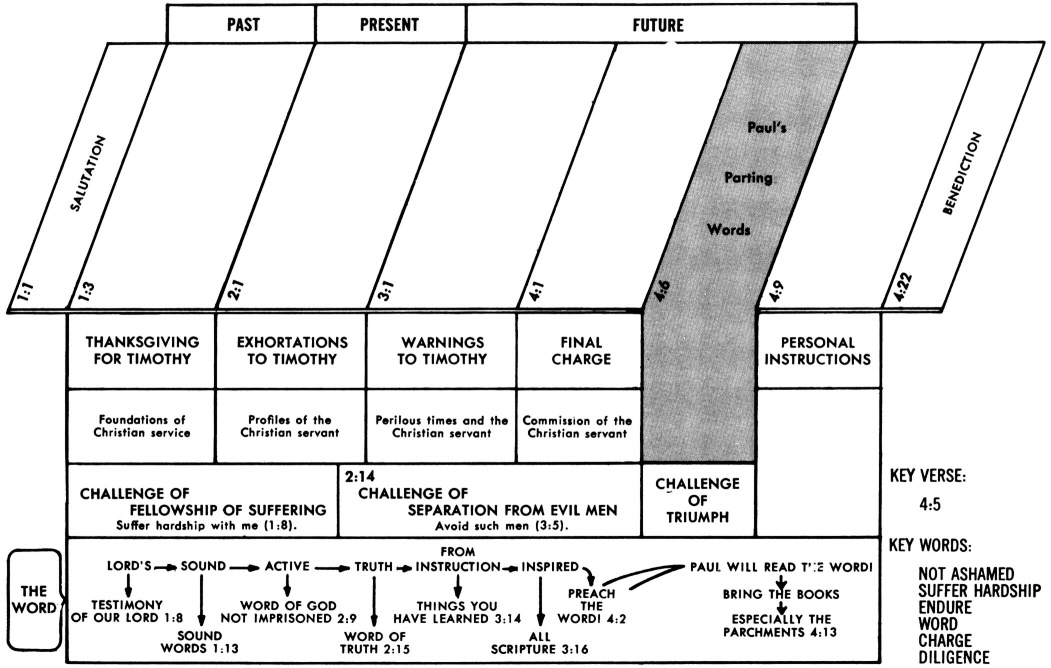
ENDURANCE AND SEPARATION IN THE MINISTRY
Click chart to enlarge
Charts from Jensen's Survey of the NT - used by permission
Second Timothy - Swindoll
| 2 TIMOTHY | |||
| 2 Timothy 1:1-18 | 2 Timothy 2:1-26 | 2 Timothy 3:1-17 | 2 Timothy 4:1-22 |
| Retain the Standard |
Rightly Divide the Word |
Difficult Times Will Come |
Preach the Word |
| PAST | PRESENT | FUTURE | |
| Foundation of Christian Service |
Pictures of Christian Servant |
Dangerous Times for Christian Servant |
Commission of Christian Servant |
| Unashamed as a Witness: Guard the Gospel |
Unashamed as a Workman: Suffer for the Gospel |
Adequate as a Workman: Continue in the Gospel |
Awarded as a Workman: Preach the Gospel |
| Power of the Gospel |
Perseverance of the Gospel Message | Protection of the Gospel |
Proclamation of the Gospel |
| Reminder | Requirements | Resistance | Requests |
| Encouragement in Ministry |
Examples in Ministry |
Exhortations in Ministry |
Exhortations to Fulfill Ministry |
| Commendation & Charge |
Commission to Fulfill |
Conflict to Face |
Course to Finish |
|
Compiled from Jensen's Survey of the NT and Wilkinson's Talk Thru the Bible |
|||
2 Timothy 2:22 Now flee (2SPAM) from youthful lusts and pursue (2SPAM) righteousness, faith, love and peace, with those who call on (PMPMPG) the Lord from a pure heart. (NASB: Lockman)
Greek: tas de neoterikas epithumias pheuge, ( 2SPAM ) dioke ( 2SPAM ) de dikaiosunen, pistin, agapen, eirenen meta ton epikaloumenon (PMPMPG) ton kurion ek katharas kardias.
BGT Τὰς δὲ νεωτερικὰς ἐπιθυμίας φεῦγε, δίωκε δὲ δικαιοσύνην πίστιν ἀγάπην εἰρήνην μετὰ τῶν ἐπικαλουμένων τὸν κύριον ἐκ καθαρᾶς καρδίας.
Amplified: Shun youthful lusts and flee from them, and aim at and pursue righteousness (all that is virtuous and good, right living, conformity to the will of God in thought, word, and deed); [and aim at and pursue] faith, love, [and] peace (harmony and concord with others) in fellowship with all [Christians], who call upon the Lord out of a pure heart. (Amplified Bible - Lockman)
ESV So flee youthful passions and pursue righteousness, faith, love, and peace, along with those who call on the Lord from a pure heart.
KJV: Flee also youthful lusts: but follow righteousness, faith, charity, peace, with them that call on the Lord out of a pure heart.
NET But keep away from youthful passions, and pursue righteousness, faithfulness, love, and peace, in company with others who call on the Lord from a pure heart.
NIV Flee the evil desires of youth, and pursue righteousness, faith, love and peace, along with those who call on the Lord out of a pure heart.
NLT: Run from anything that stimulates youthful lust. Follow anything that makes you want to do right. Pursue faith and love and peace, and enjoy the companionship of those who call on the Lord with pure hearts. (NLT - Tyndale House)
Phillips: Turn your back on the turbulent desires of youth and give your positive attention to goodness, faith, love and peace in company with all those who approach God in sincerity. (Phillips: Touchstone)
Wuest: The passions of youth be constantly fleeing from, but be pursuing as constantly righteousness, faithfulness, divine and self-sacrificial love, peace, in company with those who are calling upon the Lord out of a pure heart.
Young's Literal: and the youthful lusts flee thou, and pursue righteousness, faith, love, peace, with those calling upon the Lord out of a pure heart;
NOW FLEE YOUTHFUL LUSTS : tas de neoterikas epithumias pheuge (2SPAM) :
- Pr 6:5; 1Co 6:18; 10:14; 1Ti 6:11) (Ps 119:9; Ec 11:9,10; 1Peter 2:11
- 2 Timothy 2 Resources - Multiple Sermons and Commentaries
Related Passages:
Proverbs 6:5 — Deliver yourself like a gazelle from the hunter's hand, And like a bird from the hand of the fowler.
1 Corinthians 6:18 — Flee (present imperative = command to make it your habit to do so - need to depend on the Holy Spirit to obey). Every other sin that a man commits is outside the body, but the immoral man sins against his own body.
As Steven Cole says "Don’t flirt with it. Don’t stand there and pray about what to do. Don’t get near it. If it comes knocking, run for your life!" (The Person God Uses - see also the study of Joshua - Portrait of the Man God Uses)
1 Corinthians 10:14 — Therefore, my beloved, flee (present imperative = command to make it your habit to do so - need to depend on the Holy Spirit to obey) from idolatry
THOUGHT - SO YOU DON'T THINK YOU HAVE IDOLS? Coveting, greed = idolatry - Col 3:5b
Cole remarks "You may be thinking, “Well, at least that one isn’t a problem for me! I’m never tempted to set up an idol.” Really? You’re never tempted to set up anything in the place that rightfully belongs to God alone? You never allow watching TV or playing computer games to usurp the time that you should spend alone with God or serving Him? Run from anything that pulls you away from full devotion to God! (The Person God Uses - see also the study of Joshua - Portrait of the Man God Uses)
1 Timothy 6:11 — But flee (present imperative = command to make it your habit to do so) from these things, you man of God; and pursue (present imperative = make it your habit to do so) righteousness, godliness, faith, love, perseverance and gentleness.
Cole remarks that Paul in context issues a command to "to flee from the love of money. Are you tempted to gamble? Run! It’s the love of money that feeds gambling. Do you look at the rich and think, “I want to live that way”? Run! Are you tempted to steal or cheat on your taxes or be greedy rather than generous? Run! Cleansed people flee from sin. (The Person God Uses)
Ecclesiastes 11:10 — So, remove (command) vexation (anger) from your heart and put away (command) pain (evil) from your body, because childhood and the prime of life are fleeting.
1 Peter 2:11 — Beloved, I urge you as aliens and strangers to abstain (present tense = continually - while not a command, we still need to depend on the Holy Spirit to obey) from fleshly lusts, which wage war against the soul.
DO YOU DESIRE TO BE
USED BY GOD?
Now (1161) (de) is a marker frequently denoting transition or conversion, serving to introduce something else in this case with the implication of some contrast. As in this context now is used, especially to draw attention to a particular statement or point in a narrative.
THOUGHT- In English "now" means at the present time or moment. Paul is calling for a decision of our will. Don't procrastinate. Don't prevaricate. Don't put off! Now is the time to redeem the time so that you might experience the time of your life being used for eternal purposes by the Almighty Everlasting God Whose eyes "move to and fro throughout the earth that He may strongly support those whose heart is completely His." (2 Chr 16:9)
Flee (5343) (pheugo) means to move quickly from a point or area in order to avoid presumed danger or difficulty. To run away. To seek safety by flight. To run or move hastily from danger. Don’t entertain them, rationalize them, negotiate with them, try to challenge them or try and endure them. If you have the idea that you will just "test yourself" on this one to see if you can stand against it, beware for this approach has made many a man or a woman fall into sin.
Pheugo in Paul's writings - 1 Co. 6:18; 1 Co. 10:14; 1 Tim. 6:11; 2 Tim. 2:22
The present imperative is a command calling for this action to be our way of life, to be continual, to be our habitual practice. Now try to obey this in your own power! You may do "okay" for a while, but the truth is that in order to flee from bad, we must first flee to the good. That is to say we must first surrender or yield to the filling of the Spirit (Eph 5:18-note), so that we might be enabled to walk by the Spirit and then we will flee (not carry out the desires of the flesh - Gal 5:16). Now we "work out" what the Spirit "work in" (Php 2:12, Spirit gives you the "desire" and the "power" = Php 2:13NLT). We are still fully responsible for all of our moral choices, while at the same time being fully dependent on the enabling power of the Spirit to make God pleasing choices. Mysterious? Yes, but thoroughly Biblical. Notice we are not saying let go and let God, for that in effect lets us off the hook. Better stated it might be let go, let God and let's go, if that makes sense to you. (see Paradoxical Principle of 100% Dependent and 100% Responsible" 100/100)
Jerry Bridges alludes to this same idea in his book The Bookends of the Christian Life which I highly recommend (especially if you are "fuzzy" on the role of the Holy Spirit in your everyday Christian life). Bridges writes "At this point we need to understand in greater depth how the Holy Spirit works in the believer’s life. The Bible teaches that the Spirit applies his power to our lives in two different ways. The first we call his synergistic work, which refers to occasions that combine our effort with his enabling power. But this isn’t a pure synergism, as if we and the Spirit each contributed equal power to the task. Rather, we work as he enables us to work, so we use the expression qualified synergism. We’re 100 percent dependent on his power in order to participate in the work, as the psalmist illustrated: “Unless the Lord builds the house, those who build it labor in vain. Unless the Lord watches over the city, the watchman stays awake in vain” (Psalm 127:1). Two activities are mentioned: building a house and watching over a city. The Lord’s involvement isn’t one of helping but of building the house and watching over the city. At the same time, the builder builds and the watchman watches. The verse’s message is that the Lord doesn’t merely help the builder and the watchman; he’s totally involved with them in this qualified synergism. He supplies all the enabling power, and they do all the tangible work. There are many such examples in the New Testament. We’re to “put to death the deeds of the body” —the sin that remains in us—yet we do so “by the Spirit” (Romans 8:13-note). We’re to use the spiritual gifts we’ve received to serve God and other people, yet we do so “by the strength that God supplies” (1 Peter 4:10–11-note). Perhaps we see this qualified synergism most clearly in Philippians 2:12–13: “Work out (Ed: command to make this your lifestyle - only possible as you reject self reliance and rely on the Spirit's enablement!) your own salvation with fear and trembling, for it is God who works in you, both to will and to work for his good pleasure.” In this sentence, Paul refers to work three times. We are to work—to apply ourselves with utmost seriousness and vigilance. But we’re to do so with the recognition that God provides us with both the motivation (the will) and the power (the work) to obey (Ed: Read the paraphrase - Php 2:13NLT = God gives us both the desire and power). Toward the end of this letter, after describing how he’d learned to be content in any and every circumstance, Paul summed up the concept of qualified synergism with a sweeping, dramatic statement: “I can do all things through him who strengthens me” (Philippians 4:11–13-note). We’re fully and wholeheartedly engaged in the work as the Spirit’s enabling power works in us. (The Bookends of the Christian Life) (Read this review by popular Christian blogger Tim Challies - he says he has read it twice to great benefit - not to outdo him I have probably read it 5-10 times -- probably because I have greater need of this truth to be kept "fresh!")
The classic example of appropriate flight is Joseph scrambling from the presence of Potiphar’s wife and her sexual temptations, motivated not by legalism but by love for God and His glory
How then could I do this great evil, and sin against God? (Genesis 39:9b).
In fact, take note of Joseph's example in (Genesis 39) and contrast it with Samson's example below...
So [Potiphar] left everything he owned in Joseph's charge; and with him there he did not concern himself with anything except the food which he ate. Now Joseph was handsome in form and appearance...12 And [Potiphar's wife tried to seduce Joseph and] caught him by his garment, saying, "Lie with me!" And he left his garment in her hand and fled, and went outside.) (Note that the Hebrew word "flee" is translated in the Septuagint (LXX) by the Greek verb pheugo.) (Ge 39:11-12)
Dwight Edwards (2 Timothy - Call to Completion - scroll down page) reminds us "that as demonstrated by Joseph, we must not linger in the house of temptation but must make a hasty exit into the golden fields of uncompromising holiness. The danger of not fleeing so is well described by Alexander Pope in one of his poems:
Vice is a monster of such terrible mein
That to be hated, needs but to be seen.
Yet seen too often; familiar her face,
We first endure, then pity, then embrace.
Here is Samson's example - "Then Samson went down to Timnah and saw a woman in Timnah, one of the daughters of the Philistines. 2 So he came back and told his father and mother, "I saw a woman in Timnah, one of the daughters of the Philistines; now therefore, get her for me as a wife." 3 Then his father and his mother said to him, "Is there no woman among the daughters of your relatives, or among all our people, that you go to take a wife from the uncircumcised Philistines?" But Samson said to his father, "Get her for me, for she looks good to me." ) (Judges 14:1-3-note)
Brian Bell - Sins of the flesh are never to be reasoned with. It would be like reasoning with a tornado! Run from it...not see how close you can get to it. What would you think of the man who went as near as he could to burning down his house, just to test how much fire it would stand? Or one who cut himself w/a knife to see how deep he could go without mortally wounding himself? Or one who experimented as to how large a quantity of poison he could take? So is the man who tries to see how much sin he may indulge in & yet be saved. (The Winning Christian Life!)
Dwight Edwards comments that "Paul continues to describe the areas which the man of God must stay out of if he is to be a conqueror rather than a casualty in the fierce battle between good and evil. It is of no small significance that vs. 22 follows on the heels of vs. 21. If we read no further than vs. 21, we might easily get the impression that separating from dishonorable vessels insures that we will be "vessel for honor, sanctified, useful to the Master, prepared for every good work" Yet, all of us are keenly aware that it takes more than just avoiding wrong characters to attain the divine status described at the end of vs. 21. (2 Timothy - Call to Completion - scroll down page)
Not only must we flee...
UNGODLY COMPANIONS (v21)
but also
UNGODLY CHARACTER (v22a)
Youthful (3512) (neoterikos from néos = young) means pertaining to youth.
Steven Cole comments that...
We usually associate the term (lusts) with sexual temptations, but as one older seminary professor told us, “Men, they aren’t just youthful!” You don’t outgrow sexual temptations. Where do you think we got the term, “dirty old man”? The word translated “lusts” may refer to any desires, although it usually refers to sinful desires. So while sexual temptation may be included in “youthful lusts,” it’s probably not the primary focus.
Rather, Paul was probably referring to wrong desires that younger men are more prone to than older men are. Calvin under-stood it as the propensity of younger men to lose their tempers and rush forward into a heated argument with more confidence and rashness than men of a riper age do (Calvin's Commentaries [Baker], on 2Ti 2:22, p. 232).
In the same vein, Gordon Fee (New International Biblical Commentary [Hendrickson Publishers, 1988], p. 263) says that Paul is speaking of “headstrong passions of youth, who sometimes love novelties, foolish discussions, and arguments that all too often lead to quarrels.”
William Barclay related it to the faults of impatience, self-assertion, love of arguing, and love of novelty that stem from youthful idealism (Commentary)
So Paul was telling Timothy that while it is right to defend the faith against serious errors and to stand firm on the central doctrines of Scripture, there is a right and a wrong way to go about it. He will go on (2Ti 2:23, 24, 25, 26) to explain the right way. Here, he is warning against the wrong way, which is to be arrogant about how much you know, impatiently to blast those in error, and to be quarrelsome and self-assertive. The fruits of the Spirit include patience, kindness, and gentleness, along with self-control (Gal. 5:22, Gal 5:23). Youthful impetuosity is not on the list! Paul says to flee from these youthful temptations. (The Person God Uses - see also the study of Joshua - Portrait of the Man God Uses)
Lusts (1939) (epithumia from epi = upon or intensifier + thumos = passion) defines a great desire to do something, a strong longing, drive or passion directed at an object (epi = toward). MARK IT DOWN - LUSTS ARE STRONG AND ONLY HOLY SPIRIT CAN OVERCOME THEM AND PREVAIL - see Gal 5:16-17)! Although epithumia can describe "good" desires, more often in the NT it describes depraved cravings and inner vile unrestrained desires (out-of-control craving) that emanate from our fallen flesh or sin nature inherited from Adam. These cravings are not just for ice cream... but are for those things which would if pursued and taken hold of, would in turn take hold of us... for by what a man is overcome by that is he enslaved. (cf 2Pe 2:19) Youthful lusts are lurking reefs that could damage our ship of faith and constantly war against our redeemed soul [1Pe 2:11] So much of the negative baggage in people’s minds about holiness is a result of the harsh focus on “fleeing.” Holiness is not living in the world of “no” but leaving the world of “no” in order to enter the world of “yes!”
|
FLEE FROM |
|
(1). PLEASURE: the inordinate craving for the satisfaction of the physical appetites: the “lust” for food and drink, pleasure-madness, uncontrolled sexual desire |
|
(2). POWER: the ungoverned passion to shine or be dominant which results in envy, quarrelsomeness, etc. |
|
(3). POSSESSIONS: uncontrolled yearning for material possessions and for the glory that goes with them |
True Biblical separation is balanced:
Flee Sin
Follow Righteousness
If we are not balanced, then we will be isolated instead of separated. In fact, God’s man Paul commands us to fellowship w/ those who have pure hearts. After all, this is the purpose of the ministry of the Word ("But the goal of our instruction is love from a pure heart and a good conscience and a sincere faith." 1Ti1:5). It is sad when true believers are isolated because of a false view of separation .
Not only is Timothy to separate himself from bad men and bad doctrine, but he is to separate himself from the lusts of the flesh. Leaning on the Word and the Spirit, make it the habit of your life to run away from youthful lusts those things you did when you were a lost young man.[1Co 6:18 1Ti6:10,11] (foolish & harmful desires in 1Ti 6:9) They are still just as powerful at age 75 as they were when you were 25 (at 75 I speak from experience!)
Why must we CONTINUOUSLY flee? Because our flesh is CONTINUOUSLY wicked (our fallen flesh nature inherited from Adam although made ineffective in believers by the Cross still inhabits our mortal bodies and can spring into action if by the power of the Spirit we do not mortify it's desires), the devil is a roaring lion (1Pe 5:8), and the world system cries out to satisfy your desire (like the Nike commercial says "Just Do It!") with the passing pleasures of sin (cf Heb 11:25).
Peter knowing the clear and present danger that lurks in the mortal body of every blood bought believer exhorted his readers...
Beloved, I urge you as aliens and strangers to abstain from fleshly lusts (strong desires that originate from the old Adamic nature still latent in believers), which wage war (present tense = continually strategizes - it's not simply one battle but a lifelong war against the residual flesh nature) against the soul) (1Pe 2:11)
AND PURSUE RIGHTEOUSNESS: dioke (2SPAM) de dikaiosunen:
- Pursue righteousness - 1Ti 4:12; 6:11; Hebrews 12:14; 3Jn 1:11
- 2 Timothy 2 Resources - Multiple Sermons and Commentaries
Hebrews 12:14 — Pursue (present imperative = command to make it your habit to do this - see our need to depend on the Holy Spirit to obey) peace with all men, and the sanctification (holiness = hagiasmos) without which no one will see the Lord.
COMMENT - Note pursuing sanctification (holiness) does not save you. It shows you are saved, that you have the HOLY SOURCE of power within you - the Holy Spirit. So if one shows no evidence ever of pursuing holiness, then they likely do not have the Holy Spirit within and "do not belong to Him." (Ro 8:9, cf 2Co 13:5). Note that pursuit of holiness is not about perfection, but about direction. Holy people will fall, but enabled by the Spirit will arise again and press on toward Christlikeness (Php 3:14).
3Jn 1:11 — Beloved, do not imitate (present imperative + negative = stop doing this - see our need to depend on the Holy Spirit to obey) what is evil, but what is good. The one who does good is of God; the one who does evil has not seen God.
Pursue (1377) (dioko) means to follow or press hard after, pursue with earnestness and diligence in order to obtain, go after with the desire of obtaining. It is a picture of one who in a race runs swiftly to reach the goal. Its the same word Paul used for persecute (see note 2 Timothy 3:12) and thus the idea is go after these qualities that Paul lists with a vengeance. NOTE: (See comments above on "Flee" regarding our need to rely on the Holy Spirit)
Present imperative is a command calling for this action to be our way of life, to be continual, to be our habitual practice. It is not enough to continually run away from wrong for we must continually run after what is good. To do this is the only way to escape temptations to evil (cf. the principle found in Romans 12:21 "Do not be overcome by evil, but overcome evil with good"). Christianity does not consist merely of prohibitions, but of positive and powerful actions. See the comments above regarding the command to flee - the same thoughts apply to pursue! See discussion of the Need for the Holy Spirit to obey NT commands or "How to Keep All 1642 Commandments in the New Testament!"
Dwight Edwards wisely notes that "Scripture almost never gives us a negative command without also giving us a positive command to pursue. If we will concentrate on hotly pursuing the right things then fleeing the wrong things will take care of themselves. When David sinned with Bathsheba, his downfall was not primarily in his failure to flee fornication, but rather in not following his God-given responsibility. "Now it came to pass in the spring of the year, at the time when kings go out to battle...David remained in Jerusalem." (2Sa 11:1) How often we find ourselves overwhelmed by sin's allurements because we decide to stay in Jerusalem when God has called us to the battlefront. There is an Italian proverb which reads, "He that labors is tempted by one devil; he that is idle, by a thousand." And so it seems to be! (2 Timothy - Call to Completion - scroll down page)
Righteousness (1343) (dikaiosune from díke = right, just - see word study of dikaios = righteous) in simple terms is that which conforms to a standard or norm. In Christianity righteousness is that which is itself in keeping with what God is in His holy character.
- Righteousness is rightness of character before God and rightness of actions before men. Both of these qualities are based on truth, which is conformity to the Word and will of God.
- Righteousness is holy and upright living, in accordance with God’s standard.
- Righteousness means to live uprightly, doing good as empowered by God.
Nelson's Bible Dictionary adds that "The word “righteousness” comes from a root word that means “straightness.” It refers to a state that conforms to an authoritative standard. Righteousness is a moral concept. God’s character is the definition and source of all righteousness. Therefore, the righteousness of human beings is defined in terms of God’s. (Nelson's New Illustrated Bible Dictionary)
Not only is Timothy to flee, but he is also to follow. There is the negative and the positive. How? As if in a chase. Keep on running swiftly after righteousness in order to catch it. We must make it a habit to press on in the race of life...because...
Only one RACE twill soon be past,
Only what's done in Christ will last
As one has wisely written "The exciting of our graces will be the extinguishing of our corruptions; the more we follow that which is good the sooner and the further we shall flee from evil. Righteousness, and faith, and love, are excellent antidotes against youthful lusts. Holy love cures impure lust." Amen!
Preacher's Commentary sums up what we are to pursue as vessels of honor- “Righteousness” is right-ness. It is integrity, truthfulness, fairness, and justice. “Faith” is a constancy of trust in God rather than in our own carefully devised securities. “Love” is acting in the best interests of the other person. “Peace” is that harmony and unity with those who are brought together in a common commitment to the Lord. These are the things we are to pursue with a passion." (Preacher's Commentary)
Steven Cole writes that...
God’s Word is not vague about how you should live. It doesn’t offer helpful hints for happy living, if you feel like giving it a try. It gives us the commandments of God, which are for our good (Deut. 10:13; 1 John 5:3).
Years ago, an elder in my church in California told me that people like his wife, who grew up under austere, authoritarian religious fathers, could not relate to my preaching. When I asked why not, he said, “Because you preach obedience.” I replied that whenever I preached obedience (which seems to be mentioned rather often in the Bible!), I tried to emphasize God’s love and grace as the motivation to obey. But he insisted that people such as his wife, who grew up in these authoritarian homes, could not relate well to my emphasis on obedience. In fact, I’ve often been called “legalistic” because I teach that we must obey God.
But obedience to God’s Word is not legalism! Paul commands us, “Pursue righteousness!” Go after it with everything you’ve got! David exclaimed (Ps. 40:8), “I delight to do Your will, O my God; Your Law is within my heart.” Hebrews 10:7 puts those words in Jesus’ mouth. If you’re growing to be like Jesus, you’re growing in the delight of pursuing righteousness from the heart. (The Person God Uses - see also the study of Joshua - Portrait of the Man God Uses)
FAITH, LOVE PEACE, : pistin agaphe eirenen
- 1Co 14:1, Ro 14:17,19; 15:5,6; 1Co 1:10; Heb 12:14; 1Pe 3:11
- 2 Timothy 2 Resources - Multiple Sermons and Commentaries
Related Passages:
1 Corinthians 14:1 Pursue love, yet desire earnestly spiritual gifts, but especially that you may prophesy.
A GREAT GROUP
TO PURSUE
Faith (4102) (pistis) means a firm persuasion, conviction or belief in the truth. Genuine saving faith is not just mental assent but a firm conviction, surrender to that truth and conduct emanating from that surrender (this fruit shows the authenticity of the root). In sum, faith shows itself genuine by a changed life. If one says "I believe in Jesus" and it NEVER has ANY impact on how they BEHAVE, they need to test themselves to see if they are really in the faith. (2Cor 13:5). Faith rests on trust in God's revelation and character and produces a genuine relationship with God.
William Barclay defines "faith" as that which "begins with receptivity. It begins when a man is at least willing to listen to the message of the truth. It goes on to mental assent. A man first hears and then agrees that this is true. But mental assent need not issue in action. Many a man knows very well that something is true, but does not change his actions to meet that knowledge. The final stage is when this mental assent becomes total surrender. In full-fledged faith, a man hears the Christian message, agrees that it is true, and then casts himself upon it in a life of total yieldedness." (Daily Study Bible) (Bolding added)
Hiebert defines "faith" as “sincere and dynamic confidence in God.”
Faith equates with obedience as shown in Hebrews where we read "And to whom did He swear that they should not enter His rest, but to those who were disobedient? And so we see that they were not able to enter because of unbelief." (Hebrews 3:18-19) In these two verses unbelief clearly parallels disobedience. So conversely, belief should be manifest by obedience. Don't misunderstand - faith alone saves, but the faith that saves is not alone.
Steven Cole writes that...
The Greek word here may mean, “faithfulness.” We should be pursuing faithfulness, which is all too rare! It means that you are trustworthy or reliable. When someone gives you a job, you can be counted on to do it.
But the word also means “faith.” We are to pursue faith. Faith is related to your concept of God. Is He mighty? Does He hear the prayers of His people and act on their behalf? Do you trust Him to do far more than you are able to do in your strength?
Many years ago, there was a learned Hebrew professor at Princeton Seminary named Robert Dick Wilson. He could read, as I remember, more than 30 Semitic languages! One time about twelve years after Donald Grey Barnhouse had graduated, he went back to the seminary to preach to the students. Dr. Wilson sat down near the front. After the message, he went forward and shook Barnhouse’s hand. He said, “When my boys come back, I come to see if they are big-godders or little-godders, and then I know what their ministry will be.”
Barnhouse asked him to explain and he replied, “Well, some men have a little god and they are always in trouble with him. He can’t do any miracles. He can’t take care of the inspiration and transmission of the Scripture to us. He doesn’t intervene on behalf of His people. They have a little god and I call them little-godders. Then there are those who have a great God. He speaks and it is done. He commands and it stands fast. He knows how to show Himself strong on behalf of them that fear Him.” He went on to tell Barnhouse that he could see that he had a great God and that God would bless his ministry (Donald Grey Barnhouse, Let Me Illustrate [Revell, 1967], pp. 132-133). Pursue faith! (The Person God Uses - see also the study of Joshua - Portrait of the Man God Uses)
Love (26) (agape) (click for in depth study) is not the "love" typically used by those in the world but is defined as unconditional, sacrificial love, that love which God is. For believers this love is commanded by God, empowered by His Spirit, activated by personal choice of one's will and is independent of one's feelings (it is not emotional) toward the object on whom the love is bestowed. Furthermore, agape love is not just words but is manifest by by specific actions (see 1Co13:4-8) Agape gives & gives & gives. Agape takes slaps in the face and still gives even as Jesus did saying Father forgive them. Agape is not withheld.
Love consists of self-sacrifice, living for the good of others with caring actions and thus is the badge of discipleship, the landmark of heaven, for as Jesus declared "By this all will know that you are my disciples, if you have love (agape) one for another." (Jn 13:35).
Steven Cole - You say, “Well, I’m just a naturally loving person!” No, you’re naturally selfish! That’s why Paul commands, “Pursue love!” That requires getting your focus off of yourself and onto others, so that you can treat them as you would want to be treated. It means giving your time to listen to someone who is hurting. It means befriending someone who is lonely. Sometimes it means having the courage to talk to a brother (or sister) who is in sin with the aim of restoring him to the Lord. It means being patient, kind, consider-ate, and not easily provoked (see the complete list - 1Co 13:4, 5, 6, 7-see notes on 1Cor 13:4; 13:5; 13:6; 13:7). Pursuing love means investing constant effort to love others. (The Person God Uses)
Tertullian the early disciple wrote, "It is our care for the helpless, our practice of lovingkindness, that brands us in the eyes of many of our opponents. 'Look!' they say, 'How they love one another!' Look how they are prepared to die for one another."'
THOUGHT - Dearly beloved excellent Bible student, remember that people do not care how much you KNOW until they know how much you CARE!
William Barclay describes agape love as "Unconquerable benevolence... nothing the other person can do will make us seek anything but their highest good. Though he injure us and insult us, we will never feel anything but kindness towards him. That quite clearly means that this Christian love is not an emotional thing. Agape is not only not of the emotions, but it is of the will. It is the ability to retain unconquerable goodwill to the unlovely and the unlovable, towards those who do not love us, and even towards those whom we do not like. Agape is that quality of mind and heart which compels a Christian never to feel any bitterness, never to feel any desire for revenge, but always to seek the highest good of every man no matter what he may be." (Commentary)
Pursue...peace -
Romans 14:17 (note) (Context - Romans 14:16 Therefore do not let what is for you a good thing be spoken of as evil) for the kingdom of God is not eating and drinking, but righteousness and peace and joy in the Holy Spirit.
Romans 14:19 (note) So then let us pursue the things which make for peace and the building up of one another.
Romans 15:5 (note) Now may the God who gives perseverance and encouragement grant you to be of the same mind with one another according to Christ Jesus; 15:6 (note) that with one accord you may with one voice glorify the God and Father of our Lord Jesus Christ.
1Co 1:10 — Now I exhort you, brethren, by the name of our Lord Jesus Christ, that you all agree, and there be no divisions among you, but you be made complete in the same mind and in the same judgment.
1 Peter 3:11 (note) — "AND LET HIM TURN AWAY (aorist imperative = do it now!) FROM EVIL AND DO (aorist imperative = do it now!) GOOD; LET HIM SEEK PEACE AND PURSUE IT.
Peace (1515) (eirene) (Click detailed word study of eirene) is from the verb eiro which means to bind or join together what is broken or divided and peace conveys the idea of that which is set at one again. Peace is confident and unrestrained access after alienation. Grace is fountain of which peace is the stream. In classical Greek peace means to “bind together” and in NT terms reflects the operation of God’s grace in binding the believing sinner to God and His life again, this operation continued in bringing that believer in his experience more and more into harmony with God in his life and service
These are men who are continually calling upon the Lord, invoking His aid in their lives. They are not SELF dependent BUT SAVIOR- dependent for their every need! They are continually in prayer, seeking Him in worship...with a PURE HEART...their motives for calling out are CLEAN, PURE...they desire nothing more than to be pleasing to Him and that He be glorified in their lives.
WITH THOSE WHO CALL UPON THE LORD FROM A PURE HEART: meta ton epikaloumenon (PMPMPG) ton kurion ek katharas kardias:
- Call upon the Lord - 1Ch 29:17,18; Ps 17:1; 66:18,19; Pr 15:8; Acts 9:14; 1Co 1:2; 1Ti 2:8
- From a pure heart - 1Ti 1:5; 4:12
- 2 Timothy 2 Resources - Multiple Sermons and Commentaries
Related Passages:
Proverbs 27:17 Iron sharpens iron, So one man sharpens another.
Proverbs 22:11NLT Anyone who loves a pure heart and gracious speech is the king's friend.
Psalm 24:3-4 Who may ascend into the hill of the LORD? And who may stand in His holy place? 4 He who has clean hands and a pure heart, Who has not lifted up his soul to falsehood And has not sworn deceitfully.
Psalm 51:10NIV Create in me a pure heart, O God, and renew a steadfast spirit within me.
1 Timothy 1:5 But the goal of our instruction is love from a pure heart and a good conscience and a sincere faith.
1 Peter 1:22KJV - Seeing ye have purified your souls in obeying the truth through the Spirit unto unfeigned love of the brethren, see that ye love one another with a pure heart fervently:
THE IMPORTANCE
OF GODLY FELLOWSHIP
What qualities should we look for when we are seeking an accountability partner? You do have an accountability partner don't you? David did not and it cost him dearly (2Sa 11:1-5).
The key word Paul mentions is katharos which is used in Titus where it is contrasts two types of people, one we should associate and the other we should assiduously avoid.
To the pure (katharos) , all things are pure (katharos) ; but to those who are defiled and unbelieving, nothing is pure (katharos) , but both their mind and their conscience are defiled.(Titus 1:15)
Call upon (1941) (epikaleoma from epí = upon + kaléo = call) means to call upon someone to do something and normally implies an appeal for aid or help.
Pure (2513) (katharos) means free from corrupt desire, sin and guilt and from admixture of what is false (describes "clear" conscience in 2Ti 1:3) Katharos thus means sincere, genuine, blameless, innocent, unstained with the guilt, clean or pure. Jesus taught that the vine cleansed by pruning was fitted to bear fruit
"Every branch in Me that does not bear fruit, He takes away; and every branch that bears fruit, He prunes it, that it may bear more fruit. You are already clean (katharos) because of the word which I have spoken to you." (Jn 15:2,3)
Not only must we flee ungodly companions, we also must find godly companions. The servant of the Lord must find some "iron sharpening iron" relationships (Pr 27:17) if his life is to maintain a cutting edge for the kingdom. This means that we ought to be very careful who we chose as our most intimate friends.
Dwight Edwards gives the following "suggestions" to help us chose our "traveling companions" in our life journey - Is this person's goal in life holiness or just happiness? Are they living for the things that will count for eternity, or for the decaying delicacies of this fading world? How serious is this person's commitment to the cause of Christ? Many believers give mental assent to the goal of Christ-likeness, but relatively few pursue it with a burning passion. The purpose of true fellowship is to "stimulate (lit. "create a fever for") one another to love and good works" Heb. 10:24,25 (note); not to huddle around worldly topics with other believers, under the guise of "Christian fellowship." One of the most moving illustrations of godly companionship is found in the relationship cultivated between David and Jonathan. Perhaps the best summation of their relationship is found in 1Sa 23:16, "So Jonathan, Saul's son, arose and went to David in the woods, and strengthened his hand in God." Who do we have to help us "strengthen our hand in God"? To whom do we do the same? (2 Timothy - Call to Completion - scroll down page) (Bolding added)
Heart (2588) (kardia) is the seat and center (intellect, volition, and emotion) of human life , from which thoughts, emotions and affections flow. Figuratively (and this is only way kardia is used in the NT) heart commonly refers to the mind as the center of thinking and reason, but also includes the emotions , the will, and thus, the whole inner being. The heart is the depository of all wisdom and the source of whatever affects speech, sight, and conduct.
Solomon instructed us to
"Watch over (command, not a suggestion) your heart with all diligence, (WHY?) For from it flow the springs of life." (Pr 4:23)
The Psalmist similarly prayed for an undivided heart, writing "Teach me Thy way, O Lord. I will walk in Thy truth. Unite (verb meaning to join) my heart to fear Thy name." (Ps 86:11)
The Psalmist writes "How blessed are those who observe His testimonies, who seek Him with all their heart." (Ps 119:2)
A pure heart is one that exhibits single-hearted loyalty to our Lord and Master. Play and ponder Craig Smith's "oldie but goodie" entitled PURE HEART.
Steven Cole writes...
Peace usually doesn’t just happen. You have to pursue it deliberately, sometimes with much effort. It is debatable whether the comma should be inserted after “peace.” With the comma, the sentence means that you should join with other believers in the common pursuit of peace. Without the comma, the idea is that the peace that you should pursue should be with other believers, here described as those “who call on the Lord from a pure heart.”
“Pure” is related to the verb “cleanses” (2Ti 2:21), and thus refers to a heart that has been cleansed from sin. The implication of the command is that even though Christians all call upon the name of the Lord out of hearts that have been cleansed from sin, they still will have conflicts and misunderstandings with each other. Thus they need to pursue peace with one another.
The world’s way of dealing with misunderstandings or conflict is to nurse hurt feelings, to spread gossip, and to stand up for your rights. God’s way is to go directly to the one who offended and seek to be reconciled. Jesus said that this is so important that even if you are worshiping, leave your worship and first be reconciled to your brother (or sister; Mt 5:23, 24). Recognizing that it is difficult, Paul said (Ro 12:18), “If possible, so far as it depends on you, be at peace (present tense = as the habit of your life) with all men.” Pursue peace! (The Person God Uses) (Bolding added)
2 Timothy 2:23 But refuse foolish and ignorant speculations, knowing that they produce quarrels (NASB: Lockman)
Greek: tas de moras kai apaideutous zeteseis paraitou, ( 2SPMM) eidos (RAPMSN) hoti gennosin (3PPAI) machas
BGT τὰς δὲ μωρὰς καὶ ἀπαιδεύτους ζητήσεις παραιτοῦ, εἰδὼς ὅτι γεννῶσιν μάχας·
Amplified: But refuse (shut your mind against, have nothing to do with) trifling (ill-informed, unedifying, stupid) controversies over ignorant questionings, for you know that they foster strife and breed quarrels. (Amplified Bible - Lockman)
ESV Have nothing to do with foolish, ignorant controversies; you know that they breed quarrels.
KJV: But foolish and unlearned questions avoid, knowing that they do gender strifes.
NIV Don't have anything to do with foolish and stupid arguments, because you know they produce quarrels.
NET But reject foolish and ignorant controversies, because you know they breed infighting.
NLT: Again I say, don't get involved in foolish, ignorant arguments that only start fights. (NLT - Tyndale House)
Phillips: But have nothing to do with silly and ill-informed controversies which lead inevitably, as you know, to strife. (Phillips: Touchstone)
Wuest: But stupid questionings, and questionings that come from an uninstructed and undisciplined mind be refusing, knowing that they constantly beget contentions.
Young's Literal: and the foolish and uninstructed questions be avoiding, having known that they beget strife,
BUT REFUSE FOOLISH AND IGNORANT SPECULATIONS: tas de moras kai apaideutous zethseis paraitou (2SPMM):
- 2 Timothy 2 Resources - Multiple Sermons and Commentaries
Related Passages:
2 Timothy 2:14; 16 Remind them of these things, and solemnly charge them in the presence of God not to wrangle about words, which is useless and leads to the ruin of the hearers. (2:16) But avoid worldly and empty chatter, for it will lead to further ungodliness,
1 Timothy 1:4 nor to pay attention to myths and endless genealogies, which give rise to mere speculation rather than furthering the administration of God which is by faith.
1 Timothy 4:7 But have nothing to do with worldly fables fit only for old women. On the other hand, discipline yourself for the purpose of godliness;
1 Timothy 6:4-5 he is conceited and understands nothing; but he has a morbid interest in controversial questions and disputes about words, out of which arise envy, strife, abusive language, evil suspicions, 5 and constant friction between men of depraved mind and deprived of the truth, who suppose that godliness is a means of gain.
Titus 3:9 But avoid foolish controversies and genealogies and strife and disputes about the Law, for they are unprofitable and worthless.a
But refuse foolish and ignorant speculations - Note the "but" which in effect marks a "change of direction" in the narrative.
John Stott - The metaphor changes yet again. The vessel in the house becomes a slave in the household. The skeuos is transformed into a doulos (ED: In 2Ti 2:24). But before outlining the kind of behaviour fitting to the Lord’s servant, Paul sets the context in which he has to live and work. He reverts to the ‘wordy debates’ of 2Ti 2:14 and the ‘godless chatter’ of 2Ti 2:16. (The message of 2 Timothy )
But (de) is a term of contrast, which is an invitation to the reader to go back and review what is being contrasted. In prayerfully pausing to ponder the passage you will give the Spirit greater opportunity to illuminate the passage (and the application of the truth to your life).
In his first letter to Timothy Paul had written a parallel instruction regarding fruitless doctrinal discussions...
As I urged you upon my departure for Macedonia, remain on at Ephesus, in order that you may instruct certain men not to teach strange doctrines, 4 nor to pay attention to myths and endless genealogies, which give rise to mere speculation rather than furthering the administration of God which is by faith. 5 But the goal of our instruction is love from a pure heart and a good conscience and a sincere faith. 6 For some men, straying from these things, have turned aside to fruitless discussion, 7 wanting to be teachers of the Law, even though they do not understand either what they are saying or the matters about which they make confident assertions. (1Ti 3-7)
Refuse (3868) (paraiteomai from pará = aside + aitéo = ask) (Click word study on paraiteomai) means literally to ask along side. To seek to turn aside by asking. As in Mark 15:6, this verb can mean to beg or request (a prisoner to be freed on the occasion of the Passover). In Luke 14:18, it conveys the sense of to beg off or of wanting to be excused from a positive response, in this verse one excusing himself for not accepting a wedding invitation. Finally, in the pastoral epistles (1,2 Timothy, Titus = 1Ti 4:7, 5:11 2Ti 2:23, Titus 3:10), the meaning is to decline, refuse, to refuse to pay attention to, to shun, to avoid, to reject. In secular Greek a wrestler was declared the victor when his opponents refused to engage him upon seeing his unclothed physique. It is a strong word which means to refuse to pay attention, especially when the person being addressed may be reluctant to cease and desist.
Present imperative (see comments above under flee regarding our desperate need to jettison self-reliance and rely on the Holy Spirit) means to make it your habit to refuse to get drawn into ''which came first, the chicken or the egg'' type discussions, those things that are controversial and seriously disputed, having no certain basis in truth. The Lord's bondservant must graciously "beg off" many invitations to "war over words" with others. Certainly we can discuss differences of opinions; but our discussions must not degenerate into heated debates over irrelevant issues.
See also discussion of the Need for the Holy Spirit to obey NT commands or "How to Keep All 1642 Commandments in the New Testament!"
Foolish (3474) (moros) root meaning is mentally dull, silly or stupid (English = “moron”). Jesus used moros in Mt 5:22 to describe one who was called morally worthless. Moros is a more serious reproach than raca, which scorns a man by calling him stupid, whereas morós scorns him concerning his heart and character. In Mt. 5:13 and Lk 14:34, moros refers to salt that has lost its flavor and become tasteless. These other uses help give us a sense of the quality of speculations Paul is instructing Timothy to avoid.
Webster says foolish implies the character of being or seeming unable to use judgment, discretion, or good sense.
Ignorant (521) (apaideutos from a = without + paideuo = instruct, chastise, correct) untrained, undisciplined, unlearned, untaught, ignorant, nonsensical, inept, trifling, absurd disputations.
Vincent says that the idea of ignorant is in the sense of "undisciplined: questions of an untrained mind, carried away with novelties: questions which do not proceed from any trained habit of thinking." These speculations are the work and the mark of ignorant men. (Vincent, M. R. Word Studies in the New Testament. Vol. 4, Page 307)
Hendriksen - The person who has been properly educated in God’s redemptive truth is able to distinguish between the worth-while and the worthless, and does not conduct such worse than useless enquiries (into genealogical and other Jewish-tradition lore). (Hendriksen, W., & Kistemaker, S. J. NT Commentary Set. Baker Book)
Speculation (2214) (zetesis from zeteo = to seek) strictly speaking means "seeking." It was used by Greeks to describe philosophical inquiry (searching). The idea is to form ideas which are unrelated to reality, normally with a negative connotation or speculation (take to be true on the basis of insufficient evidence). These are worthless imaginings involving exchange of words rather than a true search. Paul is telling Timothy to avoid engaging in controversial discussions.
David Platt - Of course, pastor-teachers must not avoid all controversy. In fact, they cannot escape it if they are teaching the Bible since everything a faithful teacher presents is by its nature controversial! These controversies refer to things that do not deserve time and energy. Senseless arguments only breed division and quarreling. Faithful teachers must be devoted to preaching revelation, not debating man's speculations. (Exalting Jesus in 2 Timothy)
Zetesis - 7x in 7v - John 3:25; Acts 15:2, 7; 25:20; 1 Tim 6:4; 2 Tim 2:23; Titus 3:9. Translated: controversial questions(1), controversies(1), debate(2), discussion(1), how to investigate(1), speculations(1).
Pastor Brian Bell gives an example from his experience on the Radio -. KRTM call in Q & A show. See screen of callers. I scratched on my notebook & held up a note to the operator, “get rid of caller #10”. [explain who he was] {he never wanted an answer, he wanted a debate} How many times have you known it was one of those conversations…but continued anyway? (The Winning Christian Life!)
KNOWING THAT THEY PRODUCE QUARRELS: eidos (RAPMSN) hoti gennosin (3PPAI) machas:
- 2 Timothy 2 Resources - Multiple Sermons and Commentaries
WHY AVOID SPECIOUS
SPECULATION?
Specious means superficially plausible, but actually wrong. Misleading in appearance, especially misleadingly attractive.
Knowing (1492)(eido) means knowing intuitively, beyond a shadow of a doubt. This knowledge should make them easy to avoid.
Produce (1080) (gennao) means to beget (produce especially as an effect or outgrowth). Amplified phrases it "foster strife and breed quarrels". The present tense indicates that they continually generate or give birth to strife and fighting. Foolish and ignorant speculation always "give birth" to quarrels.
Quarrels (3163) (mache from máchomai = to war, to quarrel, dispute fight) fighting, battles or controversies. Severe clash The idea in this context is battles fought without actual weapons.
Thayer - from Homer down; a flight, combat; 1. of those in arms, a battle. 2. of persons at variance disputants, etc., strife, contention; a quarrel
Friberg - literally, physical combat or a contest fought with weapons battle, conflict, fight; in the NT figuratively and plural, as battles fought with words only disputes, quarrels, strifes (Analytical Lexicon)
TDNT - machomai, mache, amachos. This group is used for physical combat, especially of a military kind. The military use predominates in the LXX. In the NT, however, only Acts 7:26 relates for certain to physical conflict. Strife of words is the point in Jn. 6:52. Physical threats are perhaps involved in 2 Cor. 7:5, and James 4:1-2 is debatable. Strife is wrong for Christians (2 Tim. 2:23; Tit. 3:9: legal disputes). Bishops (1 Tim. 3:3), and indeed all Christians (Tit. 3:2), are not to be quarrelsome (amachos). Where there is strife, it is due to passions. Hence other words are used for the necessary spiritual warfare of believers, e.g., agonizesthai.
Mache - 4x in 4v - NAS Usage: conflicts(2), disputes(1), quarrels(1).
2 Corinthians 7:5 For even when we came into Macedonia our flesh had no rest, but we were afflicted on every side: conflicts without, fears within.
2 Timothy 2:23 But refuse foolish and ignorant speculations, knowing that they produce quarrels.
Titus 3:9 But avoid foolish controversies and genealogies and strife and disputes about the Law, for they are unprofitable and worthless.
James 4:1 What is the source of quarrels (polemos = "war" or armed conflict!) and conflicts among you? Is not the source your pleasures that wage war in your members?
In this Timothy passage, Paul makes clear that he is not speaking about responsible discussion of Scripture and theology, either with the unsaved or among believers. He rather forbids speculations, fruitless and unproductive debates that... produce quarrels. Such speculations not only are worthless but are ungodly. They question Scripture, distort the truth, create doubt, weaken faith, undermine confidence in the Lord, often lead to compromise of convictions, and produce quarrels.
William Barclay sums up the issue well: "Here then is the test. If at the end of our talk, we are closer to one another and God, then all is well; but if we have erected barriers between one another and have left God more distant, then all is not well. The aim of all Christian discussion and of all Christian action is to bring a man nearer to his fellows and to God. (Commentary)
Ray Pritchard - The word “foolish” comes from a Greek word that means “moronic.” Sometimes people will say things just to see if they can get us riled up. They will try to stir up trouble by pushing our hot buttons. Most of us know people (some of them very close to us) who seem to have the “gift” of getting under our skin. Paul’s advice is simple but not always easy to follow: Don’t let them do it. Don’t let them get you riled up so that you lose your cool, blow your top, say things you shouldn’t say, and end up in a bitter shouting match. We are not permitted to yell back at those who yell at us. We are not to curse at those who curse at us. We are not to intimidate those who try to intimidate us. In short, we are not to match the tactics of those who may oppose us and ridicule our faith. We must keep our cool all the time, at all costs. One reason for this is very practical: You can’t argue a person into the kingdom of God. You can’t insult them into becoming a Christian. You can’t intimidate them into accepting Christ as Savior. It is quite possible to argue them away from the kingdom, but you can’t argue them into it. Salvation is a miracle of God that takes place in the human heart. Only the Holy Spirit can convert the soul. It’s not our arguments that win the lost. Unless the Lord works on the heart, all our words will be of no avail. Therefore, we must be gentle under pressure and kind even when pushed to the limit. We must be patient toward those who oppose us and we must with meekness tell them the truth. If we lose our temper, we may win the verbal battle but we will surely lose the war for the soul. (The Life God Blesses - Keep Believing Ministries)
Steven Cole writes that...
Some doctrinal controversies are clearly important and worth defending vigorously. Paul went to Jerusalem to argue strongly against the Judaizers, who said that circumcision is necessary for salvation (Acts 15).
Paul contended against Peter, whose behavior compromised the gospel on this matter (Gal. 2:11-14).
Jude 1:3 appeals to us to contend earnestly for the faith. So Paul does not mean (in our text) that all doctrinal controversy is wrong.
Rather, he is talking about pointless issues that have no bearing on salvation or godly living.
Speculations infers that these were matters on which the Bible is silent. I might add that while we should not get into these kinds of foolish and ignorant debates, we may need to confront the argumentative spirit of those promoting them. Some people like to argue because it feeds their pride to prove their point and to put down others. But Paul’s point is that it is futile to argue over speculative matters where the Bible either is silent or unclear.
Here are some questions to ask to help determine if an issue is a foolish and ignorant speculation to be avoided or a matter requiring biblical correction:
*Is this person involved in clear disobedience to God's Word?
Maybe he is doing something that I don’t like, but there is no command in the Bible against it. Also, some things fall into a gray zone: they may be inadvisable, but they are not clear sin. Use discernment!
*Is a major doctrinal issue at stake?
Some doctrines are essential to the Christian faith. If you deny them, you have left the faith. Other issues may be very important for one’s view of God or man or how to live the Christian life, although they are not essential for salvation. Again, you must know Scripture and exercise discernment in light of how serious the matter is.
*What is your goal in this issue?
Do you just want to argue and prove that you’re right, or are you concerned about godliness and love? Quarreling or winning an argument does not lead anyone to Christ nor does it build up your brother in true godliness. If you must correct, your aim should be to help your brother grow in the Lord. Correction must be done wisely. (2 Timothy 2:23-26 The Gentle Art of Correction)