2 Timothy 2:2
2 Timothy 2:3
2 Timothy 2:4
2 Timothy 2:5
2 Timothy 2:6
2 Timothy 2:7
2 Timothy 2:8
2 Timothy 2:9
2 Timothy 2:10
2 Timothy 2:11
2 Timothy 2:12
2 Timothy 2:13
2 Timothy 2:14
2 Timothy 2:15
2 Timothy 2:16
2 Timothy 2:17
2 Timothy 2:18
2 Timothy 2:19
2 Timothy 2:20
2 Timothy 2:21
2 Timothy 2:22
2 Timothy 2:23
2 Timothy 2:24
2 Timothy 2:25
2 Timothy 2:26
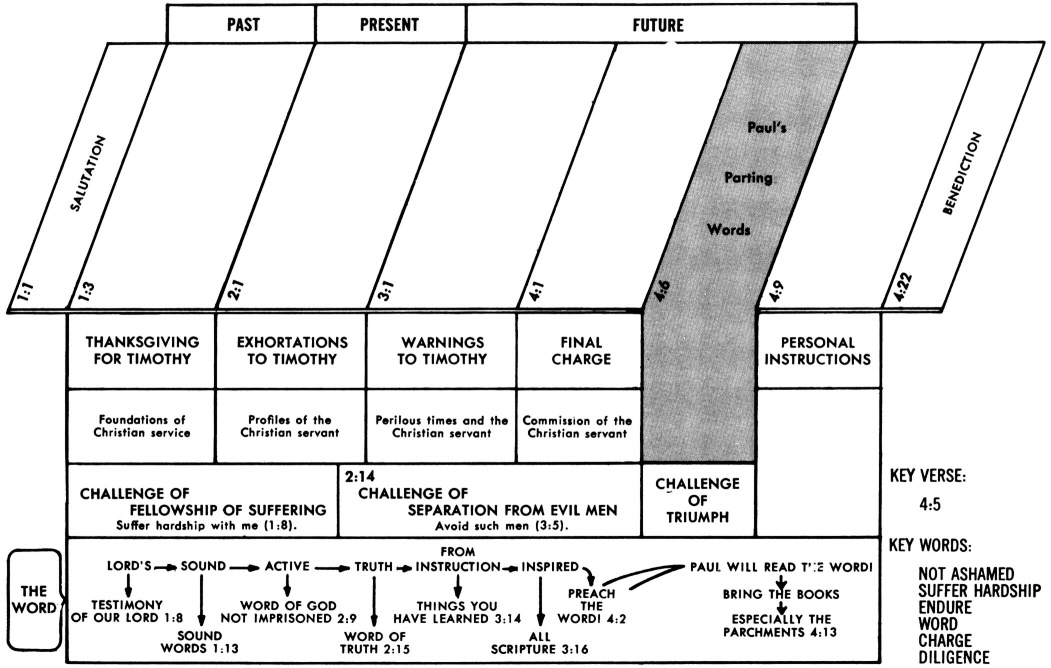
ENDURANCE AND SEPARATION IN THE MINISTRY
Click chart to enlarge
Charts from Jensen's Survey of the NT - used by permission
Second Timothy - Swindoll
| 2 TIMOTHY | |||
| 2 Timothy 1:1-18 | 2 Timothy 2:1-26 | 2 Timothy 3:1-17 | 2 Timothy 4:1-22 |
| Retain the Standard |
Rightly Divide the Word |
Difficult Times Will Come |
Preach the Word |
| PAST | PRESENT | FUTURE | |
| Foundation of Christian Service |
Pictures of Christian Servant |
Dangerous Times for Christian Servant |
Commission of Christian Servant |
| Unashamed as a Witness: Guard the Gospel |
Unashamed as a Workman: Suffer for the Gospel |
Adequate as a Workman: Continue in the Gospel |
Awarded as a Workman: Preach the Gospel |
| Power of the Gospel |
Perseverance of the Gospel Message | Protection of the Gospel |
Proclamation of the Gospel |
| Reminder | Requirements | Resistance | Requests |
| Encouragement in Ministry |
Examples in Ministry |
Exhortations in Ministry |
Exhortations to Fulfill Ministry |
| Commendation & Charge |
Commission to Fulfill |
Conflict to Face |
Course to Finish |
|
Compiled from Jensen's Survey of the NT and Wilkinson's Talk Thru the Bible |
|||
2Timothy 2:8 Remember (2SPAM) Jesus Christ, risen (RPPMSA) from the dead, descendant (seed) of David , according to my gospel, (NASB: Lockman)
Greek: Mnemoneue (2SPAM) Iesoun Christon egegermenon (RPPMSA) ek nekron, ek spermatos Dauid, kata to euaggelion mou;
KJV: Remember that Jesus Christ of the seed of David was raised from the dead according to my gospel
Wuest: Be remembering Jesus Christ raised out from among the dead, from the ancestry of David according to my gospel [good news]
Young's Literal: Remember Jesus Christ, raised out of the dead, of the seed of David, according to my good news, REMEMBER: Mnemoneue (2SPAM) : (He 12:2, 3-see notes Heb 12:2; 12:3)
Remember Jesus Christ: Mnemoneue (2SPAM) Iesoun Christon
JESUS CHRIST:
FULLY GOD, FULLY MAN
Remember (3421) (mnemoneuo - present imperative) means to cause to be mindful of, call to mind, recall information.
Related Resources on remember
Paul gives Timothy a command (imperative mood) to keep on remembering (present tense) that Jesus is alive speaking of His divinity (power over death) and Christ is the prophesied Messiah, the seed of David.
Wiersbe writes that ""Remember Jesus Christ!"... sounds almost like a war cry, like "Remember the Alamo!" or "Remember Pearl Harbor!" Jesus is the Captain of our salvation (see note Hebrews 2:10), and our purpose is to bring honor and glory to Him. What an encouragement Jesus Christ is to a suffering Christian soldier! For He died and rose again, proving that suffering leads to glory, and that seeming defeat leads to victory. Jesus was treated as an evildoer, and His soldiers will be treated the same way. (Wiersbe, W: Bible Exposition Commentary. 1989. Victor)
Barclay has an interesting thought on the meaning of the present tense writing that "The tense of the Greek does not imply one definite act in time, but a continued state which lasts for ever. Paul is not so much saying to Timothy: "Remember the actual resurrection of Jesus"; but rather: "Remember your risen and ever-present Lord." Here is the great Christian inspiration. We do not depend on a memory, however great. We enjoy the power of a presence. When a Christian is summoned to a great task that he cannot but feel is beyond him, he must go to it in the certainty that he does not go alone, but that there is with him for ever the presence and the power of his risen Lord. When fears threaten, when doubts assail, when inadequacy depresses, remember the presence of the risen Lord... So Paul kindles Timothy to heroism by calling upon him to remember Jesus Christ, to remember the continual presence of the risen Lord, to remember the sympathy which comes from the manhood of the Master, to remember the glory of the gospel for himself and for the world which has never heard it and is waiting for it. (2 Timothy 2 - William Barclay's Daily Study Bible)
Spurgeon - Within the compass of this verse several facts are recorded. First, there is here the great truth that Jesus, the Son of the Highest, was anointed by God. The apostle calls Him “Jesus Christ,” that is, the anointed one, the Messiah, the sent one of God. He calls Him also “Jesus,” which signifies a Savior. It is a grand truth that He who was born of Mary, He who was laid in the manger at Bethlehem, He who loved and lived and died for us, is the ordained and anointed Savior of men. We have not a moment’s doubt about the mission, office, and design of our Lord Jesus. In fact, we hang our soul’s salvation upon His being anointed by the Lord to be the Savior of men.
Harry Ironside - When pressed by the foe, even to the point where one despairs of life, let us remember Him who could not be overcome by death, but arose in triumph from the grave. It is He who beckons us on to ultimate victory. His promises never fail of189 fulfilment. Jesus Christ went down into death, bore the judgment our sins deserved in order that we might be saved, and then came up in triumph from death as the Captain of our salvation. (2 Timothy 2 - Ironside's Notes)
Adam Clarke writes that Paul "seems to say: Whatever tribulations or deaths may befall us, let us remember that Jesus Christ, who was slain by the Jews, rose again from the dead, and his resurrection is the proof and pledge of ours. We also shall rise again to a life of glory and blessedness.
Albert Barnes - Think of the Saviour, now raised up from the dead after all the sorrows of this life, and let this encourage you to bear your trials. There is nothing better fitted to enable Us to endure the labours and trials of this life, than to think of the Saviour.
Bible Background Commentary - Appealing to examples was one of the main hortatory methods of ancient parenesis (moral exhortation); Paul here appeals to the example of Jesus, who endured much but received eternal glory
Paul focuses our attention upon the one Object which deserves the preeminent place in the picture gallery of our mind. Paul's injunction is not just to remember facts about Christ, but to remember the Person Himself; the risen, living One who became man. The vivid remembrance of Him and all that He is and that He has done keeps our relationship with Him vital and effective in all the circumstances and vicissitudes of our life, motivating steadfastness in those times we may suffer for our Lord.
John MacArthur has said it well that we should continually remember that...
Jesus’ path to a crown glory was marked by pain before pleasure, sorrow before joy, humiliation before glorification, persecution before exaltation, death before resurrection, earthly hatred before heavenly worship. To remember those truths about our Lord’s earthly life will protect us from the foolish and ungodly promises of the so-called health and wealth gospel, which vitiates His command to take up our cross daily.
To remember those truths about our Lord’s earthly life will protect us from the foolish and ungodly promises of the so called health and wealth gospel, which vitiates (Ed: makes defective or ineffective) His command to take up our crosses as He took up His. If Jesus’ perfect and sinless obedience of His heavenly Father did not bring Him earthly prosperity and well-being, how much less can we expect to receive those things because of our imperfect service of Him? If our Lord Jesus Christ, “although He was [God’s] Son,… learned obedience from the things which He suffered” (He 5:8-note), how much more should we? (MacArthur, J. 2 Timothy. Chicago: Moody Press)
Hiebert has written that if we neglect this command "it is quite possible for us as Christian workers amid the very stress and noise of religious work to forget Jesus Christ until we lose vital contact with Him and our lives become powerless and ineffective.
The present tense which means that this is to be our practice or habit. And so as we go through our day we must discipline ourselves to bring back straying thoughts and head them in the direction of the Chief Shepherd, Jesus Christ. How easily we let our thoughts wander away from the greatest of all meditations, that of the Lord Jesus Christ. Paul is urging us to return to our first love. See Fix Your Eyes On Jesus, Ann Ortlund's wonderful devotional that relates to Paul's command of keep on remembering Jesus.
Turn Your Eyes upon Jesus
by Helen Lemmel
O soul, are you weary and troubled?
No light in the darkness you see?
There’s a light for a look at the Savior,
And life more abundant and free!
Refrain
Turn your eyes upon Jesus,
Look full in His wonderful face
And the things of earth will grow strangely dim,
In the light of His glory and grace.
Through death into life everlasting
He passed, and we follow Him there;
Over us sin no more hath dominion—
For more than conquerors we are!
Refrain
His Word shall not fail you—He promised;
Believe Him, and all will be well:
Then go to a world that is dying,
His perfect salvation to tell!
Refrain
Walter Hampel (Ashland Theological Journal 34, page 1, 2002) writes about this charge from Paul to remember Jesus noting that...
Memory serves us individually as well. It roots us to our community, family and even ourselves. It is not uncommon to find family photographs on our desks at work or stuffed inside a wallet. We do this not because we cannot remember these loved ones without such photographs. Rather, we do it because the photos serve as a periodic reminder during the day of those who love us and of our life beyond the confines of work.
Christians need memory too. Without it, we begin to forget the One who loves us and died for us. The world has a way of trying to force its attention and its priorities into our daily lives. David Wells likens the world’s influence on us to a constant pounding. He writes that such a pounding
is made up of the pressures, demands, and expectations of our modern culture that combine to deliver the message that we must belong to it, not simply in the sense that we must live in it, but rather that we must live by it. (Wells, D: Losing Our Virtue—Why the Church Must Recover Its Moral Vision Grand Rapids: Eerdmans, 1998) (Bolding added)
Barclay writes that "Falconer calls these words: "The heart of the Pauline gospel." Even if every other appeal to Timothy's gallantry should fail, surely the memory of Jesus Christ cannot. (The Daily Study Bible Series)
In a similar way Paul placed great emphasis upon remembering the death of Jesus in the celebration of the Lord's Supper. Paul used the word remembrance twice in his description of the last meal Jesus shared with His disciples before His death: once in connection with the bread, once in connection with the wine (1 Cor. 11). Here is a visual reminder of the unique sacrifice of Jesus.
23 For I received from the Lord that which I also delivered to you, that the Lord Jesus in the night in which He was betrayed took bread;
24 and when He had given thanks, He broke it, and said, "This is My body, which is for you; do this in remembrance of Me."
25 In the same way He took the cup also, after supper, saying, "This cup is the new covenant in My blood; do this, as often as you drink it, in remembrance of Me."
26 For as often as you eat this bread and drink the cup, you proclaim the Lord's death until He comes (see Table comparing Rapture vs Second Coming). (1 Cor 11:23-26)
Note that the verb proclaim is translated preach in other contexts and thus it appears Paul is saying that when we celebrate the Lord's Supper we are in effect acting out or preaching a sermon the message being one that looks back to the Lord's victory on Calvary which will be consummated when He returns as King of kings and Lord of lords. One application point of the "sermon" would be for all believers to live now in the power of the word of the cross (1 Cor 1:18) and in light of the imminent return of the Bridegroom for His Bride the Church, to celebrate the Marriage Supper of the Lamb. Living in the light of His return serves to motivate believers to be zealous to live God glorifying lives of holiness rather seeking passing worldly happiness!
At the Last Supper Jesus told His disciples "But I say to you, I will not drink of this fruit of the vine from now on until that day when I drink it new with you in My Father's kingdom (see the Millennium). (Mt 26:29)
Constable explains that "As the first Passover looked forward to deliverance and settlement in the Promised Land, so the Lord’s Supper looked forward to deliverance and settlement in the promised kingdom. Disciples are to observe the Lord’s Supper only until He returns (1 Cor. 11:26). Then we will enjoy the messianic banquet together (Isa. 25:6; cf. Matt. 8:11). Probably Jesus spoke these words after drinking the third cup of the Passover ritual. (Tom Constable's Expository Notes on the Bible) (Bolding added)
JESUS CHRIST RISEN FROM THE DEAD: Iesoun Christon egegermenon (RPPMSA): ek nekron:
- Mt 1:1; Acts 2:30; 13:23; Ro 1:3,4; Rev 5:5, 1Cor 15:1-4
- Lk 24:46; Acts 2:24; 1Co 15:1,4,11-20
THE RESURRECTION OF JESUS
HE IS ALIVE!
- Resurrection - Baker's Evangelical Dictionary of Biblical Theology
- Resurrection of Christ, the - Torrey's Topical Textbook
- Resurrection - Hastings' Dictionary of the Bible
- Resurrection - Hastings' Dictionary of the New Testament
- Resurrection of Christ - Hastings' Dictionary of the New Testament
- Resurrection of Christ (2) - Hastings' Dictionary of the New Testament
- Resurrection of Jesus Christ - Holman Bible Dictionary
Jesus Christ - Paul has given us a continuous command not just to remember the name but the Person of Jesus Christ. Because He is now our life (see note Colossians 3:4) we must constantly recall the Scriptural truths about Him, especially that He is not a dead Messiah but the resurrected, living Messiah, and because He is the resurrected Messiah He is our Source of everything needed for life and salvation.
This verse is the only time Paul uses the order "Jesus" before "Christ" which would seem to call attention to the fact that the Man Jesus, Who walked this earth and suffered opposition and death, was in His resurrection revealed to be the Christ, the fulfillment of Messianic prophecy.
Risen (1453) (egeiro) means to waken, rouse from sleep, from sitting or lying, from disease, from death, lift up, raise again or up arise again, stand, take up.
Literally egeiro means to rise from sleep, implying also the idea of rising up from posture of sleep and in context speaks of "waking" from the dead, of which "sleep" is often a metaphor (see Jesus' words "Lazarus has fallen asleep... going on to explain that Lazarus is dead." John 11:11-14). Egeiro is in the perfect tense which signifies Christ arose at a specific point in time over 2000 years ago and that He continues in His risen (glorified) state, still alive.
Vincent writes that "The perfect (tense) marks the permanent condition — raised and still living.
The risen, glorified Christ still has the marks of covenant on His hands, side and feet. John recorded that he was weeping because he could see no one who was worthy to open the sealed scroll and "one of the elders said to me, "Stop weeping; behold, the Lion that is from the tribe of Judah, the Root of David, has overcome so as to open the book and its seven seals." And I saw between the throne (with the four living creatures) and the elders a Lamb standing, as if slain (sphazo - put to death by violence; perfect tense), having seven horns and seven eyes, which are the seven Spirits of God, sent out into all the earth. (See notes Revelation 5:5; 5:6) (To quote Tony Garland's quote - It has been said, “the only man-made thing in heaven will be the scars of the Savior.”)
From (ek) means out of - “out from dead", out from among the dead people. When our Lord was raised from the dead, the rest of the dead stayed dead.
Dead (3498) (nekros) which is from nékus = a corpse and gives us our English words necropsy, necrophobia, etc).
As Hiebert emphasizes the crucial point in the gospel is "Not the vision of a crucified Jesus but the vision of a risen Lord is held up before Timothy.
Spurgeon - It is implied, too, in the text that Jesus died. He could not be raised from the dead if He had not first gone down among the dead and been one of them. Yes, Jesus died: the crucifixion was no delusion; the piercing of His side with a spear was most clear and evident proof that He was dead. His heart was pierced, and the blood and water flowed from it. As a dead man, He was taken down from the cross, carried by gentle hands, and laid in Joseph’s virgin tomb. No man in this world was ever more surely dead than He. “He made his grave with the wicked, and with the rich in his death” (Isa 53:9).
Then comes the grand truth that as soon as ever the third sun commenced his shining circuit Jesus rose again. His body had not decayed, for it was not possible for that holy thing to see corruption. But still it had been dead, and by the power of God—by His own power, by the Father’s power, by the power of the Spirit, for it is attributed to each of these in turn—before the sun had risen His dead body was quickened. He literally and truly, in a material body, came forth from the tomb to live among men till the hour of His ascension into heaven. This is the truth that is still to be taught, refine it who may, spiritualize it who dare. This is the historical fact that the apostles witnessed; this is the truth for which the confessors bled and died. This is the doctrine that is the keystone of the arch of Christianity, and those who do not hold it have cast aside the essential truth of God. How can they hope for salvation for their souls if they do not believe that “the Lord has really been raised” (Luke 24:34)?
Especially for those facing suffering and possible death, there is great encouragement in remembering that even the Lord Jesus Himself reached the glory of heaven by way of the cross and the grave. Because He lives the promises are carried into effect in Him and by Him. The servant of Christ is, then, entirely dependent upon Him for the effect of his labor, and if he would be a good soldier, a successful spiritual athlete, and a faithful farmer, he must remember the One in Whose service he is engaged.
Lk 24:46 — and He said to them, "Thus it is written, that the Christ should suffer and rise again from the dead the third day;
Acts 2:24 — "And God raised Him up again, putting an end to the agony of death, since it was impossible for Him to be held in its power.
DESCENDANT OF DAVID: ek spermatos Dauid:
Mt 1:1 — The book of the genealogy of Jesus Christ, the son of David, the son of Abraham.
Acts 2:30 — "And so, because he (the patriarch David) was a prophet, and knew that GOD HAD SWORN TO HIM WITH AN OATH TO SEAT one OF HIS DESCENDANTS UPON HIS THRONE,
Acts 13:23 — "From the offspring of this man ("David...a man after My heart"), according to promise, God has brought to Israel a Savior, Jesus,
Romans 1:3 (note) — concerning His Son, who was born of a descendant of David according to the flesh, 1:4 (note) who was declared the Son of God with power by the resurrection from the dead, according to the Spirit of holiness, Jesus Christ our Lord,
Revelation 5:5 (note) — and one of the elders said to me, "Stop weeping; behold, the Lion that is from the tribe of Judah, the Root of David, has overcome so as to open the book and its seven seals."
JESUS CHRIST:
FULLY MAN
Descendant (4690l) (sperma) refers literally to seed sown as containing the germ of new fruit. In secular Greek, sperma rarely signifies descendants collectively, but primarily refers to the individual offspring.
Spurgeon - This Jesus Christ was really and truly man, for Paul says he was “a descendant of David.” True, He was divine, and His birth was not after the ordinary manner of men, but still He was in all respects partaker of our human nature and came of the stock of David. This we believe. We are not among those who spiritualize the incarnation and suppose that God was here as a phantom, or that the whole story is but an instructive legend. No, in very flesh and blood did the Son of God abide among men; He was bone of our bone and flesh of our flesh in the days of His sojourn here below. We know and believe that Jesus Christ has come in the flesh. We love the incarnate God, and in Him we fix our trust.
As discussed above, this statement clearly alludes to the humanity (fully Man) of Christ (see notes Romans 1:3; Philippians 2:7). As the writer of Hebrews says because He although God became fully Man...
He Himself was tempted (peirazo) in that which He has suffered (perfect tense = emphasis the continuing effects), (and thus) He is able (present tense indicating that Jesus is continually able) to come to the aid (boetheo = literally pictures one who runs on hearing a cry of those in danger to give help and assistance) of those who are tempted. (see note Hebrews 2:18)
ACCORDING TO MY GOSPEL: kata to euaggelion mou:
- 2Th 2:14; 1Ti 1:11; 2:7
Paul goes on to emphasis the crucial importance of the truth of the resurrection to the gospel message writing that "if Christ has not been raised, then our preaching is vain, your faith also is vain. (1Cor 15:14)
Gospel (2098) (euaggelion from eú = good + aggéllo = proclaim, tell) is literally good news or glad tidings) (Click for word study of euaggelion)
A CONCISE DEFINITION OF
THE GOSPEL
1 Now I make known to you [since it seems to have escaped you], brethren, the gospel which I preached to you, which also you received, in which also you stand, 2 by which also you are saved, if you hold fast the word which I preached to you, unless you believed in vain (does not teach that true believers are in danger of losing their salvation, but it is a warning against non–saving faith -- could be translated "unless your faith is worthless" -- holding fast was the result and evidence of genuine salvation). 3 For I delivered to you as of first importance what I also received, that Christ died for our sins according to the Scriptures, 4 and that He was buried, and that He was raised on the third day according to the Scriptures, 5 and that He appeared to Cephas, then to the twelve. (See notes 1Corinthians 15:1; 15:2; 15:3; 15:4; 15:5; 15:6 ; 15:7 ;15:8)
Spurgeon's Sermons on Gospel...
- 1 Timothy 1:15 The Glorious Gospel
- Proverbs 25:25 Good News
- 2 Corinthians 5:20-21 The Heart Of The Gospel
- Lamentations 4:22 A Message From God For Thee
- Acts 20:21 Two Essential Things
- Psalm 51:7 The Wordless Book
Spurgeon - Let us consider the bearings of the resurrection upon the gospel, for Paul says, “Jesus Christ, raised from the dead … according to my gospel.” The resurrection of Christ is vital, because first it tells us that the gospel is the gospel of a living Savior. We do not have to send poor penitents to the crucifix, the dead image of a dead man. We do not say, “These are your gods, Israel!” (Exod 32:4) We do not have to send you to a little baby Christ nursed by a woman. Nothing of the sort. Behold the Lord that lives and was dead and is alive forevermore, and has the keys of hell and of death!
Notice next that we have a powerful Savior in connection with the gospel that we preach. He who had power to raise Himself from the dead has all power now that He is raised. He who in death vanquishes death can much more conquer by His life. He who being in the grave did, nevertheless, burst all its bonds, can assuredly deliver all His people. He who, coming under the power of the law, did nevertheless fulfill the law, and thus set His people free from bondage, must be mighty to save. You need a Savior strong and mighty, yet you do not need one stronger than He of whom it is written that He rose again from the dead. What a blessed gospel we have to preach—the gospel of a living Christ who has Himself returned from the dead, leading captivity captive (Eph 4:8).
And now notice, that we have the gospel of complete justification to preach. I do not come and say, “Jesus Christ by His death did something by which men may be saved if they have a mind to be and diligently carry out their good resolves.” No, no; I say Jesus Christ took the sin of His people upon Himself and bore the consequences of it in His own body on the tree. He died; and having died and so paid the penalty, He lives again. Now all for whom He died, all His people whose sins He bore, are free from the guilt of sin.
Once again, the connection of the resurrection and the gospel is that it proves the safety of the saints. If when Christ rose His people rose also, they rose to a life like that of their Lord, and therefore they can never die. It is written, “Christ, because he has been raised from the dead, is going to die no more, death no longer being master over him” (Rom 6:9), and it is so with the believer. If you have been dead with Christ and are risen with Christ, death has no more dominion over you. You shall never go back to the contemptible elements of sin; you shall never become what you were before your regeneration.
I cannot stop to show you how this resurrection touches the gospel at every point, but Paul is always full of it. More than 30 times Paul talks about the resurrection, and occasionally at great length, giving whole chapters to the glorious theme. The more I think of it the more I delight to preach Jesus and the resurrection. The glad tidings that Christ has risen is as truly the gospel as the doctrine that He came among men and for men presented His blood as a ransom. If angels sang glory to God in the highest when the Lord was born, I feel impelled to repeat the note now that He is risen from the dead.
This is the gospel that His Lord had entrusted to him and which he ceaselessly proclaimed. Paul uses this same phrase, my gospel, in (see notes Romans 2:16; Romans 16:25)
In secular Greek it originally referred to a reward for good news and later became the good news itself. The word euaggelion was commonly used in the first century as our words "good news" today. The idea then and now is something like this - “Have you any good news (euaggelion) for me today?” This was a common question in the ancient world.
Our English word Gospel is from the Old English or Saxon word gōdspell (gōd = good + spell = message) which is literally "good tale, message". When I was a young man Godspell was actually the name of a popular musical play (See description). I wonder if they really understood the meaning of this word which is the very foundation stone of Christianity.
In modern secular use gospel has an interesting meaning of something accepted as infallible truth or as a guiding principle (e.g., such and such is "the gospel truth"). This is not a bad Biblical definition either!
In ancient secular Greek as alluded to above, euaggelion described good news of any kind and prior to the writing of the New Testament, had no definite religious connotation in the ancient world until it was taken over by the "Cult of Caesar" which was the state religion and in which the emperor was worshipped as a god (see more discussion of this use below).
The writers of the New Testament adapted the term as God's message of salvation for lost sinners. Euaggelion is found in several combination phrases, each describing the gospel like a multifaceted jewel in various terms from a different viewpoint (from the NASB, 1977):
- the gospel of the kingdom (Mt 4:23, Mt 9:35, Mt 24:14)
- the gospel of Jesus Christ, the Son of God (Mk 1:1) because it centers in Christ
- the gospel of God (Mk 1:14, Ro 15:16, 2Co 11:7, 1Th 2:2, 1Th 2:8,9, 1Pe 4:17) because it originates with God and was not invented by man
- the gospel of the kingdom of God (Lu 16:16)
- the gospel of the grace of God (Acts 20:24, Ro 1:1),
- the gospel of His Son (Ro 1:9)
- the gospel of Christ (Ro 15:19, 1Co 1:9, 2Co 2:12, 2Co 9:13, 2Co 10:14, Gal 1:7, Phil 1:27, 1Th 3:2)
- the gospel of the glory of Christ (2Co 4:4)
- the gospel of your salvation (Eph 1:14)
- the gospel of peace (Eph 6:15)
- the gospel of our Lord Jesus (2Th 1:8)
- the glorious gospel of the blessed God (1Ti 1:11)
- In Ro 16:25, 26 Paul called it “my Gospel” indicating that the special emphasis he gave the gospel in his ministry.
For a rewarding study, study the preceding references in context making notation of the truth you observe about the gospel. If you would like a special blessing, take an afternoon to go through all 76 uses of euaggelion in context making a list of what you learn about the gospel. The Spirit of God will enlighten your heart and encourage your spirit in a very special way...and you'll want to share the "good news" with someone because of your "discoveries"!
Euaggelion - Matt. 4:23; Matt. 9:35; Matt. 24:14; Matt. 26:13; Mk. 1:1; Mk. 1:14; Mk. 1:15; Mk. 8:35; Mk. 10:29; Mk. 13:10; Mk. 14:9; Mk. 16:15; Acts 15:7; Acts 20:24; Rom. 1:1; Rom. 1:9; Rom. 1:16; Rom. 2:16; Rom. 10:16; Rom. 11:28; Rom. 15:16; Rom. 15:19; Rom. 16:25; 1 Co. 4:15; 1 Co. 9:12; 1 Co. 9:14; 1 Co. 9:18; 1 Co. 9:23; 1 Co. 15:1; 2 Co. 2:12; 2 Co. 4:3; 2 Co. 4:4; 2 Co. 8:18; 2 Co. 9:13; 2 Co. 10:14; 2 Co. 11:4; 2 Co. 11:7; Gal. 1:6; Gal. 1:7; Gal. 1:11; Gal. 2:2; Gal. 2:5; Gal. 2:7; Gal. 2:14; Eph. 1:13; Eph. 3:6; Eph. 6:15; Eph. 6:19; Phil. 1:5; Phil. 1:7; Phil. 1:12; Phil. 1:16; Phil. 1:27; Phil. 2:22; Phil. 4:3; Phil. 4:15; Col. 1:5; Col. 1:23; 1 Thess. 1:5; 1 Thess. 2:2; 1 Thess. 2:4; 1 Thess. 2:8; 1 Thess. 2:9; 1 Thess. 3:2; 2 Thess. 1:8; 2 Thess. 2:14; 1 Tim. 1:11; 2 Tim. 1:8; 2 Tim. 1:10; 2 Tim. 2:8; Phlm. 1:13; 1 Pet. 4:17; Rev. 14:6
2 Timothy 2:9 for which I suffer hardship (1SPAI) even to imprisonment as a criminal but the word of God is not imprisoned (3SRPI) . (NASB: Lockman)
Greek: en o kakopatho (1SPAI ) mechri desmon os kakourgos, alla o logos tou theou ou dedetai. (3SRPI)
KJV: Wherein I suffer trouble, as an evil doer, even unto bonds; but the word of God is not bound.
Wuest: in which sphere of action I am suffering hardship to the extent of bonds as a malefactor. But the word of God has not been bound, with the present result that it is not shackled.
Young's Literal: in which I suffer evil -- unto bonds, as an evil-doer, but the word of God hath not been bound;
FOR WHICH I (continually) SUFFER HARDSHIP EVEN TO IMPRISONMENT AS A CRIMINAL: en o kakopatho (1SPAI) mechri desmon os kakourgos::
- 2Ti 1:8,12,16; Acts 9:16
- Ephesians 6:19; 6:20; 1 Peter 2:12; 2:14; 1 Peter 2:20; 2:21; 1 Peter 3:16; 1 Peter 4:15-See notes Ep 6:19; 6:20; 1 Pe 2:12; 2:14; 1 Pe 2:20; 2:21; 1 Pe 3:16; 1 Peter 4:15, Php 1:12, 13, 14-see notes Philippians 1:12; 1:13; 1:14
- Acts 28:31 2Th 3:1
- Lk 23:32, 33, 39
SUFFERING FOR
THE GOSPEL
For which - Literally "in which" Paul explains that it was because of his preaching of the gospel that he suffered trouble.
Spurgeon - You will observe, if you read the verse that precedes, that the doctrine of the resurrection of our Lord Jesus Christ was the sheet anchor of Paul’s comfort, as it was the great substance of his preaching. Perhaps we do not give sufficient prominence to the doctrine of the resurrection of Jesus Christ from the dead. Possibly also for this reason we do not fully grasp the idea of “the power of his resurrection” (Phil 3:10). Our Lord’s death was not the close of His career; He still passed onward. From the cross to the sepulcher was still forward. See what our Lord Jesus has done! He has made a tunnel of it for all His redeemed to pass into the kingdom. We enter at the grave to emerge in the resurrection into eternal life. In this lies part of the power of His resurrection: that he has opened the kingdom of heaven to all believers.
In the strength of that truth, Paul, when he found himself in prison, expected to come out of it. When he saw great difficulties in the way to heaven, he expected to go through those difficulties and to come out with gain at the further end of them. This helped to cheer him in his darkest moments. His brave heart thus spoke within him and said, “If I should be even dead and buried, I shall rise again. And if the gospel should seem dead and buried, yet it will rise again. And if the particular cause that I am advocating in Rome should seem dead and buried, yet it must come to life again. I take courage from the great truth that the Lord Jesus Christ rose from the dead according to my gospel.”
Suffer hardship (2553) (kakopatheo from kakós = evil + páthos = passion) means to suffer physical pain, hardship and distress, misfortune, endure evil, be afflicted, endure afflictions (hardness). The present tense indicates this was Paul's lifestyle! (See 2Cor 11:23-33 for a summary)
Imprisonment (1199) (desmos from déō = to bind) in the singular refers to a band, bond or ligament and in the plural (as in the present use) it refers to bonds or imprisonment.
Criminal (2557) (kakourgos) from kakós = bad + érgo = work, root of érgon = work) is literally evil working and describes one who customarily engages in doing what is bad and in the present context speaks of a malefactor (one who commits an offense against the law).
The two thieves crucified with Jesus were malefactors. (Luke 23:32-33, 39) A synonym kakopoios, an evildoer, is used in Jn 18:30 and 1Pe 2:12-note.
When we are maliciously, ignorantly or carelessly misrepresented, it is hard to bear. And if it is because of faithful service to Christ such misrepresentations, though humanly speaking, are still difficult but beloved of God they are gloriously rewarding for Peter reminds us that "the Spirit of glory and of God rests upon us (see note 1 Peter 4:14) (So dear saint, "hang in there", enduring to the end for the sake of His Name!)
Paul was had learned the secret of suffering (sometimes falsely accused as a criminal!) writing to the saints at Philippi "Not that I speak from want; for I have learned to be content in whatever circumstances I am. I know how to get along with humble means, and I also know how to live in prosperity; in any and every circumstance I have learned the secret of being filled and going hungry, both of having abundance and suffering need. (Php 4:13 unfortunately is too often "yanked" out of context. Notice that the context is what gave Paul confidence to declare) I can do all things through Him who strengthens (endunamoo = to put power in; present tense = Christ is continually able to infuse the power we need for the need of the moment.) me. (see notes Philippians 4:11; 12; 13)
And thus Paul was "well content with weaknesses, with insults, with distresses, with persecutions, with difficulties, for Christ’s sake; for when I am weak,” he testified, “then I am strong” (2Cor 12:10-note)
Spurgeon on I suffer hardship - I like this self-forgetting sentence of the apostle, “I suffer misfortune to the point of imprisonment as a criminal, but the word of God is not bound.” He is shut up in the gloomy dungeon at Rome. No hideous dens could be worse than Roman dungeons usually were. No prison is a desirable place, but a Roman prison was a very vestibule of death. Paul is not only in prison, but in bonds; his right arm is chained to the left hand of a soldier. He cannot do anything except under the inspection of his enforced companion, who, kindly as he may be disposed, cannot be so closely bound to him without causing him much discomfort. One would not like to be chained to the best man that ever lived, and much less to a rough Roman soldier. Paul is in bonds. As he writes, his fetters clank. But he makes light of it and finds more than sufficient comfort.
BUT THE WORD OF GOD (gospel) IS NOT IMPRISONED: alla o logos tou theou ou dedetai (3SRPI):
- Eph 3:1; Phil 1:7; Col 4:3,18
- Heb 4:12 1 Pe 1:23
THE POWER
OF THE GOSPEL
But - Thank the Lord for this great term of contrast!
Word of God - This phrase is used 11 times in Acts (click here for these verses) as a synonym for the gospel, which is clearly its meaning in this passage.
Paul alludes to the inherent power of the Gospel in his opening words to the saints at Colossae...
We give thanks to God, the Father of our Lord Jesus Christ, praying always for you, 4 since we heard of your faith in Christ Jesus and the love which you have for all the saints; 5 because of the hope laid up for you in heaven, of which you previously heard in the word of truth, THE GOSPEL 6 which has come to you, just as in all the world also it (THE GOSPEL) is constantly bearing fruit and increasing, even as it (THE GOSPEL) has been doing in you also since the day you heard of it and understood the grace of God in truth; 7 just as you learned it from Epaphras, our beloved fellow bond-servant, who is a faithful servant of Christ on our behalf (Colossians 1:3-7-note)
Again in his letter to the Romans Paul reminds us that is not OUR POWER but the GOSPEL'S POWER (this takes the pressure off of us to make a so-called "perfect presentation" of the Gospel)...
For I am not ashamed of THE GOSPEL, for it (THE GOSPEL) is the power (dunamis = supernatural, inherent power to accomplish a purpose, in this case to save the lost) of God for salvation to everyone who believes, to the Jew first and also to the Greek.(Romans 1:16-note)
Word (3056) (lógos from légō = to speak with words; English = logic, logical) means something said and describes a communication whereby the mind finds expression in words. Although Lógos is most often translated word which Webster defines as "something that is said, a statement, an utterance", the Greek understanding of lógos is somewhat more complex. )
Not - Is the Greek particle ou indicating absolutely not.
Imprisoned (1210) (deo) means literally to tie objects together, to bind and here refers to confining to prison. The perfect tense conveys the sense that "the Word of God" (the gospel) has not been bound, with the present result that it is not shackled. It conveys the truth that the Gospel has never and can never be "confined in prison".
Paul emphasizes this effect of the gospel (in context = the "word of truth") writing to the Colossians that "in all the world also it (the gospel) is constantly bearing fruit and increasing, even as it has been doing in you also since the day you heard of it and understood the grace of God in truth;." (see note Colossians 1:6)
In a similar testimony to the insuppressible power of the gospel Luke records that "the word of the Lord (the gospel) continued to grow and to be multiplied. (Acts 12:24) (See uses of "word of God" = gospel in Acts)
John Bunyan (1628-1688 - see biography) wrote Pilgrim’s Progress, while imprisoned in Bedford, England for preaching the gospel. Yet for several centuries that book was second in sales only to the Bible. Bunyan’s cell window faced a high stone wall that surrounded the prison, making it impossible to see into or out of his cell. On many days, however, he would preach loudly enough for his voice to be heard on the outside of the wall, where hundreds of listeners, believers and unbelievers, eagerly awaited his proclamation of God’s Word, which was literally not imprisoned by stone walls or iron bars.
Spurgeon on the word of God is not imprisoned - In what sense is it true that “the word of God is not bound”? That the word is not bound is, at this time, true in many senses. First, it is not bound so that it cannot be preached. Paul could preach it even when in bonds, and he did preach it. The gospel was made known throughout Caesar’s palace, and there were saints in the imperial household. Many came to and fro into the Praetorian guardroom and heard the word from the mouth of the apostle. You may be quite sure that he never neglected to make known the message of the gospel to all that visited him in his prison, so that the word of God was not bound even with respect to himself. The word of God is not bound” so as to be no longer a living, working power among men. Sometimes the enemies of truth have thought that they had silenced the last witness. Then there has been an unexpected outburst, and the old faith has come to the front again. It is impossible that truth can die; it has about it the immortality of God. It is utterly impossible that the truth of the gospel shall die, since it is wrapped up in the work of the Lord Jesus Christ, who lives and reigns forever. “From the trouble of his life he will see” (Isa 53:11), and He must be satisfied for all the scoffs and agonies He has endured. Neither will He be content with less than a kingdom in which all others shall be merged. “The word of God is not bound”; it will still be preached despite the scoffing of philosophers and the roaring of devils. Therefore, do not at any time sit down in despair because of evil times. The times are always evil in one respect or another. Do not imagine that truth will become extinct and that the simple gospel will be forgotten. “Heaven and earth will pass away” (Matt 24:35; Mark 13:31; Luke 21:33), but God’s word shall never pass away. Another sense must be remembered: the word of God is not bound so that it cannot reach the heart. God has ways of reaching the hardest hearts and melting them, and He can do it at moments when such a work is least expected. He has ways of making His servants draw the bow at what to them is “at random,” but to Him is an absolute certainty, and “between the soldering of breastplate armor” the shaft of conviction finds its way (2 Chr 18:33). Do not give anybody up in despair; while God is almighty, have hope for the chief of sinners. Hope on, hope ever, even when your last argument seems to have failed and your last instruction has been refused. It is well that it should be so, that in the work of salvation God may have all the glory, and you may learn to love Him and trust Him all the better in years to come. “The word of God is not bound.”
Still further, it is not bound as to its power to comfort the soul. By-and-by that blessed word will break into the midnight darkness. Let us, therefore, continue to ply the afflicted with the word of God, searching out its most cheering assurances and giving them full and free scope. Perhaps we put too much of our own explanation with the Lord’s own word. Perhaps we have thought that clever illustrations were needful and so have overlaid the truth with our poor imagination. When we have come to the end of our explanations and our illustrations, it may be that the word that is not bound will come in and give liberty to the captives.
I have further to inquire into the reasons why the word of God is not bound. It is not bound because it is the voice of the Almighty. If the gospel is indeed the gospel of God, and these truths are a revelation of God, omnipotence is in them. It is not possible that the omnipotent word can be bound.
Moreover, the Holy Ghost puts forth His power in connection with the word of God, and as He is divine he is unconquerable. He comes as a rushing, mighty wind, and who can stay Him? He comes as fire, and who can stand before His flaming vehemence? The Holy Ghost’s being with the gospel is the reason of its great power. It is not that truth alone is mighty and will prevail, but that the Spirit of truth works mightily by it and causes it to subdue the minds of men.
I have one other thing to tell you. The word of God is not bound because, when once it gets into men’s hearts, it works such an enthusiasm in them that you cannot bind it. You cannot silence a lip that has been touched by a live coal from off the altar. The love of Christ is such that, when it once pours into a man’s heart, it must run out at his lips in loving testimony. Has he not put “rivers of living water” into the midst of those who once drink of the life-giving stream (John 7:38)? And they must speak of it, even till they die. (Full sermon - Not Bound Yet)
There is a well known (and true) saying that "the blood of the martyrs is the seed of the church."
There have always been people in the church, and never more than in our own day, who believe that the power of the gospel is restricted by social or political opposition. Consequently, they argue that risking public censure, not to mention arrest and imprisonment for boldly preaching sin, repentance, and the gospel, should be avoided. They counsel discretion and sometimes even compromise in order to make the message more acceptable and, supposedly, more effective. Many Christians are under the illusion that God’s Word has been influential in the Western world, especially in such democracies as the United States, primarily because of legal guarantees of freedom of religion, and that the fight to keep that freedom is therefore a fight to preserve the power of the gospel. In fact, some Christians who would never think of confronting society with the bold and demanding gospel and being censured for it will strongly fight for some social or political issue in ways that might get them arrested.
Religious freedom is certainly commendable, and Christians who enjoy it should be grateful for and take advantage of the opportunities it affords for worship, witness, and service. But the power of God’s Word has never been dependent on man’s protection or subject to man’s restriction. That is precisely Paul’s point. The word of God is not, and cannot be, imprisoned.
MacArthur - At one time there were some 600 miles of catacombs under the city of Rome, nearly all them dug and used by ten generations of Christians over a period of 300 years. In the early centuries of the church, the catacombs served as meeting and burial places for perhaps as many as four million Christians. A common inscription found on walls there is “The Word of God is not bound.” In his famous hymn “A Mighty Fortress Is Our God,” Martin Luther declared, “The body they may kill; God’s truth abideth still.” (MacArthur, J. 2 Timothy. Chicago: Moody Press)
Before the Communist conquest in the late 1940s and early 1950s, there were more than 700,000 Christians in China. During the subsequent “cultural revolution,” at least 30 million Chinese were slaughtered, including most of the Christians. Yet, after more than forty years of brutal oppression, imprisonment, and executions, the church of Jesus Christ in that vast country has a current membership of an estimated 30 million to 100 million. Although written copies of Scripture are still scarce, the truth of God’s Word endures in their hearts. Its power cannot be bound. The more it is assailed, the more it prevails.
Andrew Melville (1545-1622 - Biography) was the successor of John Knox in the Scottish Reformation. On one occasion, a certain official had him arrested and said, “There will never be quietness in this country till half a dozen of you be hanged or banished [from] the country.” With perfect composure, Melville fearlessly replied, “It is the same to me whether I rot in the air or in the ground. The earth is the Lord’s; my fatherland is wherever well doing is. I have been ready to give my life, when it was not half as well worn, at the pleasure of my God. I lived out of your country ten years as well as in it. Yet God be glorified, it will not lie in your power to hang nor exile His truth!”
ILLUSTRATION - When Patrick Hamilton was burned in Scotland, there was such an impetus given to the gospel through his burning that the adversaries of the gospel said, “Let us burn no more martyrs in public, for the smoke of Hamilton’s burning has made many eyes to smart until they were opened.” So, no doubt, it always was. Persecution is a red hand that scatters the white wheat far and wide. I need not remind you how the ashes of God’s martyred servant, cast into a brook, were borne onward to a river, and afterwards to the sea, and by the sea they were carried to every shore. The word of God is not bound by the binding of the preachers. It happens to the persecuted as to Israel in Egypt, “As he oppressed them, so they became many” (Exod 1:12). (Spurgeon Commentary: 2 Timothy. E. Ritzema, Ed.)
2Timothy 2:10 For this reason I endure (1SPAI) all things for the sake of those who are chosen (elect), so that they also may obtain (3PAAS) the salvation which is in Christ Jesus and with it eternal glory. (NASB: Lockman)
Greek: dia touto panta hupomeno (1SPAI) dia tous eklektous, hina kai autoi soterias tuchosin (3PAAS) tes en Christo Iesou meta doxes aioniou.
KJV: Therefore I endure all things for the elect's sakes, that they may also obtain the salvation which is in Christ Jesus with eternal glory.
Wuest: Because of this I am enduring all things for the sake of the selected-out ones [those sovereignly selected from mankind for salvation], in order that they themselves also may obtain salvation which is in Christ Jesus, together with everlasting glory.
Young's Literal: because of this all things do I endure, because of the choice ones, that they also salvation may obtain that is in Christ Jesus, with glory age-during.
FOR THIS REASON I (continually) ENDURE ALL THINGS: dia touto panta hupomeno (1SPAI) :
PAUL DOES HIS PART
FOR THE "ELECT"
For this reason (dia touto) means because of this, therefore. Remember to always pause and ponder these strategic terms of conclusion, and you will often be rewarded with rich insights by your Teacher the Holy Spirit! Paul's point is that “because I know that God is carrying on His work” it was possible for him to endure afflictions that resulted from his preaching of the gospel. The contrast with Paul’s original, natural sentiments could not be more stark, reflecting of course the life changing, transforming power of the gospel of Jesus Christ.
In Acts for example Paul testifies that
"I persecuted this Way to the death, binding and putting both men and women into prisons. (Acts 22:4)
Writing to Timothy Paul states that
"I was formerly a blasphemer and a persecutor and a violent aggressor. And yet I was shown mercy, because I acted ignorantly in unbelief and the grace of our Lord was more than abundant, with the faith and love which are found in Christ Jesus. 15 It is a trustworthy statement, deserving full acceptance, that Christ Jesus came into the world to save sinners, among whom I am foremost of all." (1Ti 1:13-15)
The greatest enemy of the saints became their greatest friend, all as a result of the gracious outpouring of Christ’s love into his heart.
The Preacher's Outline & Sermon Bible comments that "the gospel stirs one to endure all things. How? By results. God has promised to save people by the gospel. When we preach and teach salvation in Christ Jesus—salvation with eternal glory—God saves people. This is the only hope for people, and no greater hope could exist. Just imagine living forever in eternal glory! Such a life is beyond our imagination, yet it is exactly what the gospel is all about. Therefore, no matter what it costs—no matter how much suffering we have to bear—we must endure it all for the salvation of people. This is the point of Paul: the gospel—the glorious truth that people could actually be saved and receive eternal glory—stirred Paul to suffer all things. Paul longed for people to hear the gospel so that they could be saved. This, too, must be our purpose and objective in life. We, too, must proclaim the gospel—no matter the suffering and sacrifice. We must pay any price to see that people hear the gospel, for the gospel is the only way people can be saved and receive eternal glory. (The Preacher's Outline & Sermon Bible – 1 & 2 Thessalonians, 1 & 2 Timothy, Titus, Philemon)
J R Baker comments that "The matter of election and its relation to the preaching of the gospel has been a sad battleground down the centuries. This verse really brings both aspects into perfect harmony. There is no doubt that in the NT doctrine of election there is the eternal and sovereign choice of God. Eph 1:4; 1 Pet 1:2 and many other similar verses enable the believer to sing gladly:
"Chosen not for good in me,
Wakened up from wrath to flee,
Hidden in the Saviour's side,
By the Spirit sanctified.
Teach me Lord on earth to show
By my love how much I owe."
The knowledge of this great truth in no way lessened the zeal of the apostle, nor did it hinder his many activities in preaching and spreading the message of salvation. Paul did not know in this verse, or at any other time, who the elect were; he simply preached and through the preaching the work of electing grace was being accomplished. It can thus be seen that election does not ever dispense with the preaching of the gospel or with suffering for the preaching to take place. (What the Bible teaches – 1 Thessalonians through Titus)
Endure (5278) (hupomeno from hupó = under, as in under the rule of someone + méno = to abide or remain - see study of noun hupomone) means literally to remain under but not simply with resignation, but with a vibrant hope.
The idea of enduring is not just to "grin and bear it" but to remain under trials in a such a way that we glorify God as we learn the lessons the trials are meant to teach us, instead of seeking ways to get out from under (cf the prefix preposition "hupo" = under) the trials and be relieved of the pressure.
Wayne Detzler recounts an amazing true life example of Christian perseverance writing that
"True Christian perseverance is not tied to tenacity. It is rather the work of God the Holy Spirit in a believer's life. The starch in a saint's spine is shown by Scripture to be nothing less than the sanctifying work of the Holy Spirit. Only in this way can one explain the work of Gladys Aylward, a London parlor maid. Societies scorned her missionary application. She seemed too dull to master Chinese and fulfill her vision of serving in China. Realizing this, she scoured up her own fare to China and sailed in 1930. After slogging her way across Siberia she reached her field in remote Yangcheng. When the Japanese invaded in 1940 she led 100 children on an epic journey that caught the imagination of Hollywood (Ed: Watch the movie about her life - The Inn of the Sixth Happiness or DVD). In 1947 failing health forced her back to England where she crusaded for missions until her death in 1970. That was tenacity, not just British grit. It is God's persevering grace. (Detzler, Wayne E: New Testament Words in Today's Language. Victor. 1986)
Hupomeno has the following meanings depending on the context - (1) Stay behind, to tarry behind (beyond an expected time), to remain (as in Acts 17:14, Luke 2:43). (2) To stand fast, endure or remain in the sense of persevering so that under affliction, trouble, opposition or trial one holds fast to one's belief or faith (Mt 10:22, 24:13, Mark 13:13, James 5:11, et al). The idea is to be patient under, to persevere and to do so bear bravely and calmly (from Thayer).
Another great example of a Christian who endured (persevered) under trials in a God honoring way is William Wilberforce (biography in Wikipedia or short bio in Christian History) the 19th-century parliamentarian, who was moved by the Lord to oppose the lucrative but humanly degrading slave trade. In 1807 Wilberforce brought about the banning of the slave trade in England but it was not until 1833 was slavery as an institution abolished, this news reaching Wilberforce even as he lay on his deathbed. Talk about persevering!
Spurgeon said "By perseverance the snail reached the ark." And he added "Not that the sufferings of Paul had anything meritoriously to do with the salvation of the elect, but that by his earnest strivings and sufferings the word of the gospel was brought to their hearing. Faith then came by hearing, and so they were saved."
Perseverance is also illustrated in nature for "Today's mighty oak is just yesterday's little nut that held its ground."
Coleman Cox offered another example from nature noting that "Even the woodpecker owes his success to the fact that he uses his head and keeps pecking away until he finishes the job he starts."
Samuel Johnson claimed "Great works are performed not by strength but by perseverance."
William Secker put it well when he said that "Though Christians be not kept altogether from falling, yet they are kept from falling altogether.
Hupomeno was a military term used of an army’s holding a vital position at all costs. Every hardship and every suffering was to be endured in order to hold fast.
Endurance is a critical Christian virtue. Unless we have endurance , we can never learn many of the truths that God wants us to learn, truths that will lead us into a deeper life and a more fruitful ministry. Children are usually impatient; they cannot sit still long enough to get the things done that need to be done. “How long do we have to wait?” is the stock question of the child. Impatience is a mark of immaturity. Impatience is also a mark of unbelief.
Trench defined hupomeno (hupomone) as manifesting the "temper of spirit in which we accept God’s dealings with us as good, and therefore without disputing or resisting.
Hupomeno is in the present tense which marks Paul's perseverance as a lifestyle. Bearing up under was his habitual practice.
Here are the 17 uses of hupomeno in the NT...
Matthew 10:22 "And you will be hated by all on account of My name, but it is the one who has endured to the end who will be saved.
Matthew 24:13 "But the one who endures to the end, he shall be saved.
Mark 13:13 "And you will be hated by all on account of My name, but the one who endures to the end, he shall be saved.
Luke 2:43 and as they were returning, after spending the full number of days, the boy Jesus stayed behind in Jerusalem. And His parents were unaware of it,
Acts 17:14 And then immediately the brethren sent Paul out to go as far as the sea; and Silas and Timothy remained there.
Romans 12:12 (note) rejoicing in hope, persevering in tribulation, devoted to prayer, (Triumph is just umph added to try.)
1 Corinthians 13:7 (note) bears all things, believes all things, hopes all things, endures all things.
2 Timothy 2:10 (note) For this reason I endure all things for the sake of those who are chosen, that they also may obtain the salvation which is in Christ Jesus and with it eternal glory.
2 Timothy 2:12 (note) If we endure, we shall also reign with Him; If we deny Him, He also will deny us; (Wuest - Endure here = "persevere in and under trials and hold to one’s faith in Christ.")
Hebrews 10:32 (note) But remember the former days, when, after being enlightened, you endured a great conflict of sufferings,
Hebrews 12:2 (note) fixing our eyes on Jesus, the author and perfecter of faith, who for the joy set before Him endured the cross, despising the shame, and has sat down at the right hand of the throne of God.
Hebrews 12:3 (note) For consider Him who has endured such hostility by sinners against Himself, so that you may not grow weary and lose heart. (Comment: Jesus' example of enduring unspeakable suffering as a Man is truth that can motivate and encourage us to persevere under our trials in a God honoring way).
Hebrews 12:7 (note) It is for discipline that you endure; God deals with you as with sons; for what son is there whom his father does not discipline? (Wuest - "recipients of this letter are exhorted to remain under the chastening hand of God, for the purpose of this chastening is disciplinary.")
James 1:12 Blessed is a man who perseveres under trial; for once he has been approved, he will receive the crown of life, which the Lord has promised to those who love Him.
James 5:11 Behold, we count those blessed who endured. You have heard of the endurance of Job and have seen the outcome of the Lord's dealings, that the Lord is full of compassion and is merciful.
1 Peter 2:20 (note) For what credit is there if, when you sin and are harshly treated, you endure it with patience? But if when you do what is right and suffer for it you patiently endure it, this finds favor with God.
Hupomeno is used 51 times in the non-apocryphal Septuagint (LXX)
Num. 22:19; Jos. 19:47; Jdg. 3:25; 2 Ki. 6:33; Job 3:9; 6:11; 7:3; 8:15; 9:4; 14:14; 15:31; 17:13; 20:26; 22:21; 32:4, 16; 33:5; 41:11; Ps. 25:3, 5, 21; 27:14; 33:20; 37:9, 34; 40:1; 52:9; 56:6; 69:6, 20; 106:13; 119:95; 130:4; 142:7; Pr 20:9; Isa. 40:31; 51:5; 59:9; 60:9; 64:4; Jer. 14:19, 22; Lam. 3:21, 25f; Dan. 12:12; Mic. 7:7; Nah. 1:7; Hab. 2:3; Zeph. 3:8; Zech. 6:14; Mal. 3:2
Here are a few of the great uses of hupomeno in the LXX...
Job 14:14 "If a man dies, will he live again? All the days of my struggle I will wait (Hebrew = yachal = to wait expectantly; Lxx = hupomeno), Until my change comes.
Psalm 25:3 Indeed, none of those who wait for (Hebrew = qavah = wait for, look for, hope for; Lxx = hupomeno) Thee will be ashamed; Those who deal treacherously without cause will be ashamed. (Spurgeon's note)
Psalm 25:5 Lead me in Thy truth and teach me, For Thou art the God of my salvation; For Thee I wait (Hebrew = qavah = wait for, look for, hope for; Lxx = hupomeno) all the day.
Patience is the fair handmaid and daughter of faith; we cheerfully wait when we are certain that we shall not wait in vain. It is our duty and our privilege to wait upon the Lord in service, in worship, in expectancy, in trust all the days of our life. Our faith will be tried faith, and if it be of the true kind, it will bear continued trial without yielding. We shall not grow weary of waiting upon God if we remember how long and how graciously He once waited for us. (Spurgeon's note)
Psalm 27:14 Wait (a command) (Hebrew = qavah = wait for, look for, hope for; Lxx = hupomeno) for the LORD; Be strong, and let your heart take courage; Yes, wait for the LORD.
Wait at His door with prayer; wait at His foot with humility; wait at His table with service; wait at His window with expectancy. Suitors often win nothing but the cold shoulder from earthly patrons after long and obsequious waiting; he speeds best whose patron is in the skies. (Spurgeon's note)
Psalm 33:20 Our soul waits (Hebrew = chakah = wait; Lxx = hupomeno in the present tense = continually) for the LORD; He is our help and our shield.
Here the godly avow their reliance upon Him Whom the Psalm extols. To wait is a great lesson. To be quiet in expectation, patient in hope, single in confidence, is one of the bright attainments of a Christian. Our soul, our life, must hang upon God; we are not to trust Him with a few gewgaws, but with all we have and are. He is our help and our shield. Our help in labour, our shield in danger. The Lord answers all things to His people. He is their all in all. Note the three "ours" in the text. These holdfast words are precious. Personal possession makes the Christian man; all else is mere talk. (Spurgeon's note)
Psalm 37:9 For evildoers will be cut off, but those who wait for (Hebrew = qavah = wait for, look for, hope for; Lxx = hupomeno) the LORD, they will inherit the land.
But those that wait upon the Lord -- those who in patient faith expect their portion in another life -- they shall inherit the earth. Even in this life they have the most of real enjoyment, and in the ages to come theirs shall be the glory and the triumph. Passion, according to Bunyan's parable, has his good things first, and they are soon over; Patience has his good things last, and they last for ever. (Spurgeon's note)
Psalm 40:1 A Psalm of David. I Waited patiently (Hebrew = qavah = wait for, look for, hope for; Lxx = hupomeno) for the LORD; and He inclined to me, and heard my cry.
(Spurgeon interprets this psalm in its "Messianic light" writing) Patient waiting upon God was a special characteristic of our Lord Jesus. Impatience never lingered in his heart, much less escaped his lips. All through his agony in the garden, his trial of cruel mockings before Herod and Pilate, and his passion on the tree, he waited in omnipotence of patience. No glance of wrath, no word of murmuring, no deed of vengeance came from God's patient Lamb; he waited and waited on; was patient, and patient to perfection, far excelling all others who have according to their measure glorified God in the fires. Job on the dunghill does not equal Jesus on the cross. The Christ of God wears the imperial crown among the patient. Did the Only Begotten wait, and shall we be petulant and rebellious? (Spurgeon's note)
Psalm 106:13 They quickly forgot His works; They did not wait for (Hebrew = chakah = wait; Lxx = hupomeno) His counsel
They waited not for His counsel, neither waiting for the word of command or promise; eager to have their own way, and prone to trust in themselves. This is a common fault in the Lord's family to this day; we are long in learning to wait for the Lord, and upon the Lord. With Him is counsel and strength, but we are vain enough to look for these to ourselves, and therefore we grievously err. (Spurgeon's note)
Isaiah 40:31 (Remember although believers today can surely apply the truth of this beautiful passage in its original context it was addressed to Jews in captivity! In what captivity are you beloved of the Lord?) Yet those who wait for (Hebrew = qavah = wait for, look for, hope for; Lxx = hupomeno) the LORD will gain new strength; They will mount up with wings like eagles, They will run and not get tired, They will walk and not become weary.
Comment: Wait for the Lord "implies two things: complete dependence on God and a willingness to allow him to decide the terms" - Oswalt "This is the purpose of the strength the LORD gives us - strength to move forward and progress for Him. It isn't strength to show off, but strength to go forward in.- Guzik
Lamentations 3:25 The LORD is good to those who wait for (Hebrew = qavah = wait for, look for, hope for; Lxx = hupomeno) Him, to the person who seeks Him.
Micah 7:7 But as for me, I will watch expectantly for the LORD; I will wait (Hebrew = yachal = to wait expectantly; Lxx = hupomeno) for the God of my salvation. My God will hear me.
All things (pas) means "all" without exception!
FOR THE SAKE OF THOSE WHO ARE CHOSEN (the elect) : dia tous eklektous:
- Mt 24:22,24,31; Jn 11:52; 17:9; 1Co 9:22; 2Co 1:6; 4:15; Col 1:24
PAUL IS SUFFERING FOR
THE ELECT
Henry Morris writes that "The Scriptures, in a very natural way, combine the doctrines of divine election and human responsibility, apparently not concerned with the problem this would later seem to pose to generations of theologians. Paul was willing to suffer countless difficulties and persecutions so that the elect might hear, believe and receive the salvation for which they already had been chosen by God before the world began. The apparent paradox is only resolved in terms of the infinite mind and ability of the Creator. We may not be able to understand how both can be true, just as we cannot see both sides of a coin at the same time. However, both sides are real and both doctrines are true. We can believe and rejoice in both truths, even though we don't yet comprehend how each supports the other."
Chosen (1588) (eklektos from verb eklego which in middle voice [eklegomai] means select or pick out for one's self which is derived from ek =out + lego =call) means literally the "called out ones" or "chosen out ones". The idea of eklektos is the ones who have been chosen for one's self, selected out of a larger number. (Click word study of eklektos)
In regard to election as related to salvation, Wuest comments that "This election does not imply the rejection of the rest (those not chosen out), but is the outcome of the love of God lavished upon those chosen-out."
Webster's definition of elect is not bad -- to pick out; to select from among two or more, that which is preferred...in theology, to designate, choose or select as an object of (divine) mercy or favor.
The 1828 Webster's is even better writing that election means...In theology, divine choice; predetermination of God, by which persons are distinguished as objects of mercy, become subjects of grace, are sanctified and prepared for heaven. (Webster, N. Noah Webster's first edition of An American dictionary of the English language)
Someone else has written that "Election is God's eternal choice of persons unto everlasting life -- not because of foreseen merit in them, but of His mere mercy in Christ - in consequence of which choice they are called, justified, and glorified.
You may not realize it but you've sung about the "elect" if you've ever sung "The Church's One Foundation" for the second stanza begins "Elect from every nation...." Indeed, election is a doctrine worth singing about, worth studying and eminently worth preaching. Dear pastor, have you encouraged your sheep with the glorious truth that they have been chosen "in Him (Christ) before the foundation of the world, (and why did God chose us?) that (they) should be holy and blameless before Him? (see note Ephesians 1:4) (As R B Kuiper put it "When God chose certain persons unto eternal life he did not do so in order that they might be in Christ, but He viewed them from eternity as being in Christ.") (Oh, that the Bride would be diligent to keep her gown spotless, adorned in fine linen which is the righteous deeds of the saints [holy ones] - see notes Revelation 19:7; 19:8 )
The prince of preachers, C H Spurgeon was right when he said "There seems to be an inveterate prejudice in the human mind against this doctrine (of election) and although most other doctrines will be received by professing Christians, some with caution, others with pleasure, yet this one seems to be most frequently disregarded and discarded.
The doctrine of election is surely "solid food" and as such it is tempting as a pastor to avoid preaching this truth ,but remember that "solid food is for the mature, who because of practice have their senses trained to discern good and evil. (see note Hebrews 5:14)(As George Whitfield put it "Let a man go to the grammar school of faith and repentance before he goes to the university of election and predestination.")
Jeffrey writes that "Discussions of divine election, with its subheadings of predestination and divine foreknowledge, provide the millstones by which countless theological efforts in Western Christendom have been ground. Yet in its rudiments, election means simply the act of choice whereby God in love picks an individual or group out of a larger company for a purpose or destiny of his own appointment. (A Dictionary of Biblical Tradition in English literature. Grand Rapids, Mich. Eerdmans)
In short, God had "picked these out" for Himself, for His glory. Paul did not know who they were but he knew God knew and that was enough for him to be willing to endure hardship that they might hear the living and abiding seed of the Gospel by which they might be born again. Paul has set the bar high for us, but the rewards in eternity are simply unfathomable down here!
The Scriptures in a very natural way combine the doctrine of divine election and human responsibility. The apparent paradox is only resolved in terms of the infinite mind and ability of the Creator (click here)
Thou didst seek us when we sought thee not; didst seek us indeed that we might seek thee. - Augustine
As Christians we ought always to remember that the Lord called us to himself not because of our virtues, but in spite of our vices. - John Blanchard
What election means in simple terms is this: God chooses us before we choose him; God does not choose us because we deserve it; and God does not choose us to be his favourites but to be his servants. - A. M. Hunter
Amiable agnostics will talk cheerfully about man's search for God. For me, they might as well talk about the mouse's search for a cat... God closed in on me. - C. S. Lewis
The doctrine of election is not meant to confuse the Christian but to comfort him. - John Blanchard
As God did not at first choose you because you were high, so he will not forsake you because you are low. - John Flavel
Our spiritual estate standeth upon a sure bottom; the beginning is from God the Father, the dispensation from the Son and the application from the Holy Ghost... It is free in the Father, sure in the Son, ours in the Spirit. - Thomas Manton
If once God's electing love rises upon the soul, it never sets. - Thomas Watson
Who shall the Lord's elect condemn?
'Tis God that justifies their souls,
And mercy like a mighty stream
O'er all their sins divinely rolls.
--Isaac Watts
Related Resources on Election:
- Who are the elect of God?
- How can I know if I am one of the elect?
- What is conditional election?
- Unconditional election - is it biblical?
- What does Peter mean when he tells us to make our calling and election sure in 2 Peter 1:10?
- How are predestination and election connected with foreknowledge?
- Daniel Wallace - My Understanding of the Doctrine of Election
- List of Multiple Topics on Election, Including Quesitons
THAT THEY ALSO MAY OBTAIN THE SALVATION WHICH IS IN CHRIST JESUS WITH [IT] ETERNAL GLORY: hina kai autoi soterias tuchosin (3PAAS) tes en Christo Iesou meta doxes aioniou:
- Pr 8:35; Jn 17:24; 1Th 5:9; 1Ti 1:13,14; 1Pet 2:10) (Ro 2:7; 9:23; 2Cor 4:17; Col 1:27; 2Th 2:14; 1Pet 5:10
PAUL'S PURPOSE FOR SUFFERING
THE SALVATION OF THE ELECT
So that (hina) is a is term of purpose/result, which is more fully rendered in order that the unbelievers to whom he witnessed might obtain the salvation which is in Christ Jesus. Ultimately this is the purpose of the Gospel which is not imprisoned, but is the power of God for salvation to everyone who believes (Ro 1:16).
J R Baker writes that so that or in order that shows "that the enduring was with the object of the elect obtaining salvation. The sovereignty of God in salvation in harmony with the responsibility of the servant of God can be seen in practice in Acts 18:9-10. The Lord had revealed to Paul that he had much people in that city, i.e. not yet saved, but in the purpose of God to be saved. It was not revealed to Paul who these people were; the instruction to him was "be not afraid, but speak, and hold not thy peace". "Also" implies that the apostle is desirous that others might come into the enjoyment of what Paul already possessed. (What the Bible teaches – 1 Thessalonians through Titus)
May obtain (5177) (tugchano/tynchano) means to meet up with and thus to have happen (Heb 11:35, Acts 24:2), to hit or hit upon (to hit the mark), to attain, gain or receive. It means to something happen to someone. In another sense tugchano is used as a marker of a degree of probability. Tugchano was used of one throwing a javelin or arrow ("to hit the mark").
Obtain the salvation - This speaks of justification, past tense salvation, but clearly in the context of "with it eternal glory" speaks of the promised future (tense) blessing of salvation (glorification). See more on the Three Tenses of Salvation.
Salvation (4991) (soteria from soter = Savior in turn from sozo = save, rescue, deliver) in the NT context describes an individual's rescue or deliverance from danger, destruction, peril, as well as from enslavement to and consequences of their harsh "taskmaster", sin. Inherent in this rescue or deliverance is one's restoration to a state of safety, health and well being. Soteria also includes the idea of preservation from danger of destruction.
Note that the truth about election led Paul to evangelize, at great cost to himself, in order that the elect might be saved. A view of election which disobeys Mt 28:19 ("Go therefore and make disciples of all the nations, baptizing them in the name of the Father and the Son and the Holy Spirit") is sadly misguided and wrong. Disregarding other Scripture, some fatalistic interpreters use texts such as (Eph 1:4-5-Note on 1:4; Note on 1:5; Ro 8:29-note) to argue that evangelism not only is unnecessary but presumptuous, claiming that God will sovereignly save those whom He has predestined, regardless of whether or not they hear and believe the gospel (But read Ro 10:13-17-note). But God’s Word just as clearly teaches the necessity of faith for salvation as it does that salvation is by God’s free and sovereign grace. Jesus said, "No one can come to Me, unless it has been granted him from the Father." (Jn 6:65, 6:37,44,45). Mysterious? Absolutely!
John MacArthur writes "The fact that our finite minds cannot fully understand or reconcile such truths in no way affects their validity. God sovereignly calls every believer in His grace. He sovereignly demands their faith to make His gracious calling effective. And finally He sovereignly calls those who are saved to be His witnesses to those who are not." (Matthew Commentary)
John Wesley traveled by foot or horseback some 250,000 miles, preaching more than 40,000 sermons, and he wrote, translated, or edited more than 200 books. He lived simply and gave away most of whatever income he received. Yet he was continually ridiculed and pelted with stones by ungodly mobs and was ostracized by fellow clergymen in the Church of England. When maligned, he answered, “I leave my reputation where I left my soul, in the hands of God.” He never lost his joy of service or his love for the Lord and for men, both saved and unsaved. One biographer commented, “To Wesley was granted the task which even an archangel might have envied.” (from John MacArthur's Commentary on Matthew)
George Whitefield, a close friend and fellow worker with John and Charles Wesley during his early ministry, spent thirty four years preaching the gospel in the British Isles and in America. He made thirteen transatlantic voyages, which were still perilous in those days, and preached at least 18,000 sermons on the two continents. The noted poet and hymn writer William Cowper (who wrote “There Is a Fountain Filled with Blood”) penned the following tribute to Whitefield:
He loved the world that hated him.
The tear that dropped upon his Bible was sincere.
Assailed by scandal and the tongue of strife,
His only answer was a blameless life
(from John MacArthur's Commentary on Matthew)
That resolute man of God heeded Peter’s counsel to “keep a good conscience so that in the thing in which you are slandered, those who revile your good behavior in Christ may be put to shame. For it is better, if God should will it so, that you suffer for doing what is right rather than for doing what is wrong” (See notes 1 Peter 3:16; 3:17).
In Christ Jesus - IN HIM! He is the "Ark" so to speak (cp Ge 7:1, 5-6,10-13, 16 - "Jehovah closed it behind him") and sinners who fail to enter IN CHRIST JESUS are doomed to die eternally (See Eternal Punishment). On the other hand the good news of the Gospel is that to enter into Christ (into the New Covenant with Him) by grace through faith will result in salvation forever and deliverance from the wrath to come (cp 1Th 1:10-note, Mt 3:7 Heb 10:27-note). See a related discussion of the Pauline phrases in Christ and in Christ Jesus. As Peter says in Acts
“There is salvation IN no one else; for there is no other name under heaven that has been given among men by which we must be saved.”(Acts 4:12)
As Guy King correctly comments this Christocentric phrase offers up one of the most exciting doctrines in the NT. King goes on to say that in Christ Jesus...
is one of the outstanding emphases of the New Testament that everything that the believer possesses is in Him; over and over again does this phrase occur, and also the companion phrase in Christ. You find this thought very prominent in the Epistle to the Ephesians; indeed, I am going to be so rash, and so bold, as to suggest that the many commentators who say that the key thought of that Epistle is the phrase "in heavenly places [the heavenlies]" might be asked whether they are quite right. Their phrase is certainly the theme of one early section of the Epistle; but is not the sum and substance of the whole to be found in the words, in Him, in Christ, in the Lord?
All that we Christians need is in Him; but we are ourselves also in Him - so that in Him "our need and His great fulness meet". Imagine a bitterly cold evening, whereon a poor, hungry, ill-clad, shivering mortal is standing gazing into the dining room window of a great London house. The table is laden with good things in abundance (for this is not war-time) and the man realizes that, with what is there, and what is to come, all his appetite and need could be fully supplied - it is all in the House, stored up in there. Fairy stories may legitimately take unexpected turns; so, as the occupants of this house are kindly folk, and as they observe the necessitous man and his eager hungry looks, a footman is told to go to the door, and to invite him to come in. Now see what a change is wrought in his circumstances and condition. All that he needs is in the House; and, wonder of wonders, he also is in the House - his need and its great fulness meet. It is no fairy tale - for "we have not followed cunningly devised fables" (2Pe 1:16-note), but plain unvarnished truth, that a like blessed propinquity exists for all believers, seeing that supplies and suppliants are both alike in Him. But our passage goes further. From verse 8 we deduce that this all is not only in Him, but is He. The beautiful truth emerges that He not only gives the Gold, but is the Gold; not only provides the Gospel, but is the Gospel. Let the first reader of this Letter, and every subsequent reader, remember that fact - that he has to do, not merely with a thing, however grand; not merely with an experience, however glorious; but with a Person, infinitely wonderful, and blessedly adequate. (Guy King. 2 Timothy. Christian Literature Crusade).
Eternal glory - As Peter explains below (1Pe 5:10) this everlasting glory is "in Christ." When we first believed in Christ we were transported effectively from darkness to light (Col 1:13-14-note, Acts 26:18), from in Adam to in Christ (1Cor 15:22), into an immutable, eternal bond of union, the New Covenant in His blood (Lk 22:20, Mt 26:28), a covenant which brings us even in this present, passing life into oneness, identification and union with Christ. In eternity future, the full glory of this indescribably precious New Covenant attain it's full potential in Christ. Throughout eternity we will remain in Christ (see study), safe within the "Ark." Beloved, if you wrestle with eternal security or your assurance of salvation, then you might want to take a few weeks and study the incredible truths inherent in the doctrine of divine covenant.
Andrew Murray wrote "Blessed is the man who truly knows God as his God; who knows what the Covenant promises him; what unwavering confidence of expectation it secures, that all its [covenant's] terms will be fulfilled to him; what a claim and hold it gives him on the Covenant-keeping God Himself. To many a man, who has never thought much of the Covenant, a true and living faith in it would mean the transformation of his whole life. The full knowledge of what God wants to do for him; the assurance that it will be done by an Almighty Power; the being drawn to God Himself in personal surrender, and dependence, and waiting to have it done; all this would make the Covenant the very gate of heaven. May the Holy Spirit give us some vision of its glory." (Two Covenants)
- Covenant: As It Relates to Marriage
- Covenant: Why Study It?
- Covenant: Introduction
- Lesson 1 Covenant: Summary Table
- Lesson 2 Covenant: The Exchange of Robes
- Lesson 3 Covenant: The Exchange of Armor and Belts
- Lesson 4 Covenant: Solemn and Binding
- Lesson 5 Covenant: A Walk Into Death
- Lesson 6 Covenant: The Oneness of Covenant
- Covenant: Oneness Notes
- Lesson 7 Covenant: Withholding Nothing from God
- Lesson 8 Covenant: Abrahamic versus Mosaic
- Lesson 9 Covenant: New Covenant in the Old Testament
- Lesson 10 Covenant: Why the New is Better
- Lesson 11 Covenant: Abrahamic vs Old vs New
Peter used the same phrase eternal glory encouraging all suffering saints "And after you have suffered for a little while, the God of all grace, who called you to His eternal glory in Christ, will Himself perfect, confirm, strengthen and establish you." (1Pe 5:10-note)
Paul explains that "momentary, light affliction is producing for us an eternal weight of glory far beyond all comparison, while we look not at the things which are seen, but at the things which are not seen; for the things which are seen are temporal, but the things which are not seen are eternal." (2Cor 4:17-18-note)
Eternal (166)(aionios from aion) means existing at all times, perpetual, pertaining to an unlimited duration of time (Ro 1:20-note - God's power, Mt 18:8 - God's place of judgment, Ro 16:26 - God's attribute).
Glory (1391)(doxa from dokeo = to think) in simple terms means to give a proper opinion or estimate of something and thus the glory of God expresses all that He is in His Being and in His nature, character, power and acts. He is glorified when He is allowed to be seen as He really is. To be where God is will be glory. To be what God intended will be glory. To do what God purposed will be glory.
TNTC - This linking of glory with salvation is familiar in Paul’s writings (e.g. 2 Thess. 2:13-14; cf. Ro 5:1-2; 8:21-25), while the idea of suffering giving way to eternal glory is clearly brought out in 2 Corinthians 4:17. (Tyndale New Testament Commentaries – The Pastoral Epistles.)
Ryrie says that the glory of God "is the manifestation of any or all of His attributes. In other words, it is the displaying of God to the world. Thus, things which glorify God are things which show the characteristics of His being to the world." Beloved, as sons and daughters of the Most High God, we will manifest (in some way) glory that surely gives back to God a proper estimate of His greatness, majesty and glory. If you are suffering today dear weak saint, take heart for tomorrow in heaven you will display His glory! A greater affection such as this has a powerful ameliorating effect on passing affliction. "Therefore, prepare (gird) your minds for action, keep sober in spirit, fix your hope (aorist imperative = a command to do this now, do it effectively, don't delay! However, the truth is that we frail men and women cannot do it in our own strength but only as we surrender to the sweet Spirit of God Who alone can enable us to fully fulfill this command, especially if we are going through various trials and afflictions!) completely on the grace to be brought to you at the revelation of Jesus Christ.(1Pet 1:13-note)