2 Timothy 3:2
2 Timothy 3:3
2 Timothy 3:4
2 Timothy 3:5
2 Timothy 3:6
2 Timothy 3:7
2 Timothy 3:8
2 Timothy 3:9
2 Timothy 3:10
2 Timothy 3:11
2 Timothy 3:12
2 Timothy 3:13
2 Timothy 3:14
2 Timothy 3:15
2 Timothy 3:16
2 Timothy 3:17
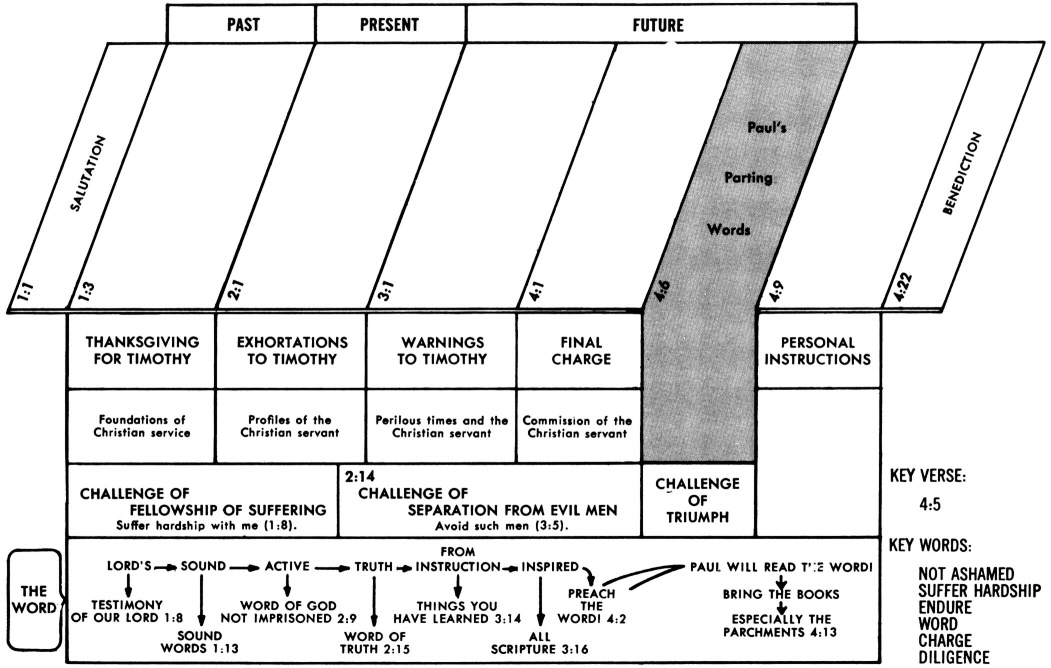
ENDURANCE AND SEPARATION IN THE MINISTRY
Click chart to enlarge
Charts from Jensen's Survey of the NT - used by permission
Second Timothy - Swindoll
| 2 TIMOTHY | |||
| 2 Timothy 1:1-18 | 2 Timothy 2:1-26 | 2 Timothy 3:1-17 | 2 Timothy 4:1-22 |
| Retain the Standard |
Rightly Divide the Word |
Difficult Times Will Come |
Preach the Word |
| PAST | PRESENT | FUTURE | |
| Foundation of Christian Service |
Pictures of Christian Servant |
Dangerous Times for Christian Servant |
Commission of Christian Servant |
| Unashamed as a Witness: Guard the Gospel |
Unashamed as a Workman: Suffer for the Gospel |
Adequate as a Workman: Continue in the Gospel |
Awarded as a Workman: Preach the Gospel |
| Power of the Gospel |
Perseverance of the Gospel Message | Protection of the Gospel |
Proclamation of the Gospel |
| Reminder | Requirements | Resistance | Requests |
| Encouragement in Ministry |
Examples in Ministry |
Exhortations in Ministry |
Exhortations to Fulfill Ministry |
| Commendation & Charge |
Commission to Fulfill |
Conflict to Face |
Course to Finish |
|
Compiled from Jensen's Survey of the NT and Wilkinson's Talk Thru the Bible |
|||
2 Timothy 3:1 But realize (2PPAM) this, that in the last days difficult times will come (3PFMI)
Greek: Touto de ginoske (2PPAM) hoti en eschatais hemerais enstesontai (3PFMI) kairoi chalepoi;
Amplified: BUT UNDERSTAND this, that in the last days will come (set in) perilous times of great stress and trouble [hard to deal with and hard to bear].
GWT: You must understand this: In the last days there will be violent periods of time.
KJV: This know also, that in the last days perilous times shall come.
NLT: You should also know this, Timothy, that in the last days there will be very difficult times.
Phillips: But you must realise that in the last days the times will be full of danger
Wuest: This be constantly knowing, that in the last days difficult times will set in
Young's Literal: And this know thou, that in the last days there shall come perilous times,
BUT REALIZE THIS: Touto de ginoske (2PPAM)
- 2 Timothy 3 Resources - Multiple Sermons and Commentaries
- 2 Timothy 3:1-9 The Danger of Empty Religion - Steven Cole
- 2 Timothy 3:1-2 Danger in the Church, Part 1 - John MacArthur
- 2 Timothy 3:2-4 Danger in the Church, Part 2 - John MacArthur
But (de) is a conjunction standing after a clause that frequently denotes transition and serves to introduce something else, whether opposed to what precedes or simply continuative or explanatory. Always pause and ponder this term of contrast, asking at least what is the author contrasting? Here the conjunction indicates a change of direction. Paul had just explained that some who opposed him might be won (come to their senses 2Ti 2:26) by not quarreling with them but being kind and correcting them gently (2Ti 2:24 25). Now he changes direction radically describing those who not only would oppose him but who were intractable. In 2Ti 3:5 these individuals "have denied" the power of godliness which is in the perfect tense indicating the fixed state of their unregenerate hearts and in 2Ti 3:9 they (a subgroup of these men) continually "oppose the truth", have a "depraved (rotten to the core) mind" and are "rejected (tested and found wanting) as regards the faith." They will never come to a knowledge of the truth (2Ti 2:25) so that instead of gently correcting them, Timothy is to turn way from them continually (2Ti 3:5). In sum, the primary contrast brought out by the but in 2Ti 3:1 is that of two groups, those who might still respond to the Gospel and those who will not ever respond. So Paul proceeds to give Timothy a long list of traits by which these individuals can be identified, lest he be contaminated by their evil deception.
Donald Hubbard has an interesting outline of this chapter dividing it into two sections…
Part I - Understanding the Ways of the World (1–9) so that…
Part II - We may undertake a witness to the world (10–17)
Comment: While this seems to be a reasonable way to describe this chapter, the first division is somewhat misleading. Why is that so? Observe 2Ti 3:5. What is this describing? Where would such men be masquerading as godly men? In the world or in the church? Remember the context -- Paul is speaking to Timothy who is most likely the pastor of the church at Ephesus and he is instructing him about how to guard the treasure and exhorting him to pass it on to faithful men. In short, the description in 2Ti 3:1-8 is not that of men outside the church but of those inside the church (cp Paul's warning to the Ephesian elders in Acts 20:28 29 30 31 32 - Note especially Paul's emphasis on the importance of the church leaders in Acts 20:32. If you are an elder or pastor, are you imbibing, eating, saturating yourself with and in the Word of His grace that you might recognize and counter wolves in sheep's clothing in your flock, men who have a form of godliness but lack the power thereof? see Titus 1:9 cp Mt 7:15 16-note Mt 7:17 18 19 20)
The NIV rendering gets your attention -- "but mark this… " Literally it reads "this but know" (touto de ginoske) which is phrased to get Timothy's attention. This truth is important to know. Forewarned is forearmed. Don’t be naïve and think that everything is going to be okay. It’s not all going to be okay. But forewarned is forearmed. If we know what is going to happen, we won’t be surprised when it does.
Realize (1097)(ginosko) is intelligent comprehension (knowledge obtained by experience) and is in the present imperative which calls for Timothy to make this his continual practice. The antonym of ginosko is agnoeo, to be ignorant of or fail to recognize the character of. In spiritual warfare ignorance of the character of these "last days" is not "bliss" but can lead to disaster and defeat (cp 2 Co 2:11).
Paul commands Timothy as a good soldier (and by application all saints in these last days) to continually know, to continually keep before him the realization of the intensity of the struggle for the truth. The description that follows is of individuals who increasingly put themselves and their own desires ahead of every other consideration. The Christian soldier's duty is to remain true to their Lord, not to deny Him or His truth and to endure hardship despite difficult times, boldly proclaiming the Gospel that brings "the salvation which is in Christ Jesus and with it eternal glory" (2Ti 2:10) despite deception and corruption within the church and persecution from without.
Ray Pritchard has a humorous intro to a not to funny chapter…
You’ve probably heard the old joke about the fellow who was told, “Cheer up. Things could be worse.” So he said, “I did as I was told. I cheered up, and sure enough, things got worse.” That in a nutshell is the message of II Timothy (especially chapter 3) (2 Timothy 3: Perilous Times)
THAT IN THE LAST DAYS: hoti en eschatais hemerais:
- 2 Ti 4:3; Ge 49:1; Is 2:2; Jer 48:47; 49:39; Ezek 38:16; Da 10:14; Ho 3:5; Mic 4:1;Acts 2:17 1Ti 4:1; Heb 1:2 2Pe3:3; Jas 5:3 1Jn 2:18; Jude 1:18
- 2 Timothy 3 Resources - Multiple Sermons and Commentaries
- 2 Timothy 3:1-9 The Danger of Empty Religion - Steven Cole
- 2 Timothy 3:1-2 Danger in the Church, Part 1 - John MacArthur
- 2 Timothy 3:2-4 Danger in the Church, Part 2 - John MacArthur
Rick Renner paraphrases it ""You emphatically must know what I am about to tell you! In the very last part of the last days, in the very end of the age, hurtful, harmful, dangerous, unpredictable, uncontrollable, high-risk periods of time will come."
Last (2078)(eschatos from ek = from, primarily as it relates to place) an adjective which means last in time or space/place (most remote) (Acts 1:8, Acts 13:47). Eschatos indicates the meaning “last” in the sense of a final stage in a process. For example, in Rev 15:1 the “last seven” plagues of judgment against the earth are declared to be the completion of God’s wrath against the wickedness of humankind. Eschatos can indicate the final element in a significant series.
We are living in the "Last days" (eschatos = last & gives us our English "eschatology" the theology of the final events of the world + hemera = day) a phrase that is not necessarily, as some exegetes state, only referring to the period immediately preceding the Second Coming of Christ. The writer of Hebrews says that God "in these last days has spoken to us in His Son" (Heb 1:2) which refers to His first coming.
Luke writes that "in the last days God says that "I will pour forth of My Spirit upon all mankind" (Acts 2:17) which is a prophecy from Joel which was partially fulfilled at Pentecost.
Comparing Scripture with Scripture, one can deduce that the "last days" is inaugurated by Messiah's First Coming, continues through Pentecost and comes to its culmination with the Second Coming of Christ, when "the Sun of Righteousness shall arise with healing in His wings" (Mal 4:2)
The "last days" included Timothy's day for Paul warned him in (2Ti 3:5) to "avoid such men as these" indicating that "last day's deceivers" were already present.
Peter also warned the saints about "difficult times" exhorting them to "Know this first of all, that in the last days mockers will come with their mocking, following after their own lusts and saying, "Where is the promise of His coming?" (2Pe3:3, 3:4)
For completeness, it should also be noted that the OT uses "last days" in a context which includes at least the setting up of Messiah's earthly (millennial) kingdom. E.g., the prophet Isaiah writes that "In the last days, the mountain of the house of the LORD will be established as the chief of the mountains, and will be raised above the hills and all the nations will stream to it."
Commenting on this prophecy John MacArthur writes that "Old Testament prophets, being without a clear word regarding the time between the Messiah’s two advents, linked the expression to the Messiah’s return to establish His earthly kingdom, i.e., the Millennial Kingdom kingdom spoken about in (Rev 20:1, 2, 3, 4, 5, 6, 7, 8, 9, 10) and that "the mountain of the Lord ’s house" is a "reference is to Mt. Zion, the location of the temple in Jerusalem." (Check the context of these other OT Scriptures referring to last days [Eze38:16, Ho3:5, Mic4:1] )
At any moment, Christ may return and bring all our activities and ambitions to a screeching halt. Since today could literally be the "last day" for any of us, we should "number our days, that we may present to (our Lord) a heart of wisdom." (Ps90:12) for Jesus said "Blessed is that slave whom his master finds so doing when he comes." (Lk12:43)
Vance Havner says that our day is one of "anarchy in the world, of apostasy in the church and of apathy in the individual believer".
Ray Pritchard comments on the phrase "the last days" noting that it "has at least three meanings. It can apply to the entire period between the first and second comings of Christ. Since Christ could have come at any time, the entire church age can be called the “last days.” It also applies to unique periods of spiritual testing that occur at different times in different places. Finally, it obviously applies to the last few weeks and months and years preceding our Lord’s return to the earth. I find it helpful to think in terms of labor pains. A pregnant woman knows when she is about to give birth by the frequency and severity of her labor pains. In the same way, the various things that Paul lists in the first few verses of II Timothy 3 will always be present in some form, but will increase dramatically near the end of the age. Are we in the “last days?” No matter how you define it, the answer is yes. And we may indeed be living in the final days before the return of Christ to the earth. (2 Timothy 3: Perilous Times)
WHAT/WHEN ARE
THESE LAST DAYS?
In these last days is rendered variously as - "at the end of these days" (DNT), "But now in these final days" (NLT), "at the end of the present age" (Phillips), "in the last of these days." (Wuest)
The meaning of Hebrews 1:2 is that at the very termination of the times in which God is speaking to man, He speaks, not through the prophets, but in His Son, Who is "the Word" (Jn 1:1-2). So the writer of Hebrews is referring to the incarnation of God's Son at His First Coming. It follows that this is when the last days began. Luke utilizes the same time phrase writing that "in the last days God says that "I will pour forth of My Spirit upon all mankind" (Acts 2:17), a prophecy from Joel 2:28 which was partially fulfilled at Pentecost, at the birth of the Church. Obviously Pentecost is related to the First Coming (and then the ascension) of Christ. We can therefore conclude that the last days were inaugurated by the First Coming of Christ.
Mounce agrees noting that eschatos can refer specifically to Jesus’ return on “the last day” or more generally to the period of time between His (Christ's) first and second coming."
In his Second Epistle Peter exhorted us to be aware "that in the last days mockers will come with their mocking, following after their own lusts and saying, "Where is the promise of His coming?" (2Pe 3:3,4). In this context the mockers are not referring to the first but the Second Coming of Christ. It follows that the last days began with Christ's first coming and will extend to His Second Coming.
In summary, the last days are the time period between the First and Second Comings of our Lord Jesus Christ. This time period overlaps with the so called "church age."
THE LAST DAYS
One of the more notable uses of eschatos is when it is coupled with hemera (day) to give us the well known phrase "last days." See preceding discussion for the "when" of the last days. As noted above eschatos means "last" in time, last in a series, the final stage in a drama. Eschatology then is the study of the "last things", especially the times preceding and culminating in the Second Coming of the King of kings (Rev 17:14, Rev 19:16). Indeed, the return of our Lord Jesus Christ is the final (eschatos) stage of the drama, the consummation of the history ("HIS-story") of the world! The phrase "LAST DAYS" (eschatos hemera) is found in both the NT & the OT (Specifically in the Septuagint, the Greek translation of the Hebrew OT.) See below for discussion of the prophetic significance of the 20 great OT passages that use "eschatos hemera", "last days".
As noted above, ESCHATOS describes the very DAYS in which we are living and which began at the First Coming of Christ, for "in these LAST DAYS (God) has spoken to us in His Son" (Heb 1:2), "in the LAST DAYS God says 'that I will pour forth My Spirit upon all mankind" (Acts 2:17), in the LAST DAYS difficult (dangerous, hard, troublesome) times will come (2 Timothy 3:1), "it is in the LAST DAYS that you have stored up your treasure" (James 5:3) and "in the LAST DAYS mockers will come with their mocking, following after their own lusts and saying 'Where is the promise of HIS COMING?'" (2 Peter 3:3-4). Indeed, HE IS COMING AGAIN, for He Himself promised that we "will see the Son of Man COMING ON THE CLOUDS OF THE SKY with power and great glory" (Mt 24:30), a promise which was repeated by John who declared "BEHOLD, HE IS COMING WITH THE CLOUDS and every eye will see Him, even those who pierced Him; and all the tribes of the earth will mourn over Him. Even so. Amen." (Rev 1:7). Father, hear our cry - "Maranatha" ("Our Lord Come!"). Amen (1 Corinthians 16:22)
- Maranatha - In Depth Word Study
- A Maranatha Mindset
- Thoughts on a Maranatha Mindset on preceptaustin blog
Eschatos is used to describe a number of entities in the New Testament - Money ("last cent" - Mt 5:26, Lk 12:59); the state of one's soul (Mt 12:45, Lk 11:26, 2Pe 2:20), a place "in line" so to speak (Mt 19:30, 20:16, Mk 10:31, Lk 13:30, cp Mt 20:8, 14), the day of resurrection of believers (Jn 6:39, 40, 44, 54, 11:24); judgment day of unbelievers (Jn 12:48); how to be "first" (Mk 9:35, Lk 14:10); Christ (the last Adam - 1Co 15:45); the last trumpet associated with our bodies being changed in the twinkling of an eye (1Co 15:52); the time of the Second Coming (1Pe 1:5); the last plagues which complete the outpouring of God's righteous wrath (Rev 15:1, Rev 21:9) and finally, eschatos describes death as the "last enemy" (1Cor 15:26) who will "at last" be destroyed forever (Hallelujah!)
Eschatos is used three times in a descriptive Name of Jesus (Rev 1:17, Rev 2:8, Rev 22:13).
The Greek word Eschatos "has a variety of meanings depending upon the larger frame of reference: farthest extent in space, final element of time, and last piece of money." (The Anchor Yale Bible Dictionary 2:576)
NIDNTT writes that
The adjective eschatos, attested from Homer onwards, is a superlative form derived from the prep. ek/ex, out of, away from, and originally designated the person or thing that was furthest outside (ex). Spatially it meant the place furthest away (e.g. Hesiod, Theog. 731, the utmost ends of the earth), temporally the last events of a series (e.g. Hdt., 7, 107), materially the extreme, rarely the highest (e.g. Libanius, Orationes 59, 88, greatest wisdom), mostly the lowest place in order of rank (e.g. Plato, Tht. 209b; Diod. Sic. 8, 18, 31, the most miserable of men)…
The Gk. language uses the term eschatos to designate the end-point of a continuously conceived succession of circumstances… In qualitative respects eschatos designates an extreme positive or negative intensification (Pindar, Ol. 1, 113, the highest reaches its peak with kings; Plato, Rep. 361a, greatest injustice; Gorgias 511d, extreme danger). (Brown, Colin, Editor. New International Dictionary of NT Theology. 1986. Zondervan)
What happens in the last days (observations derived solely from the passages which use "eschatos")?
There is a pouring forth of God's Spirit (Acts 2:17); there will be difficult, dangerous, perilous times (2Ti 3:1); mockers will come (2Pe 3:3, cp Jude 1:18), God has spoken (past tense) in His Son (Heb 1:2, cp "last times" 1Pe 1:20); treasure will rust (Jas 5:3). Compare to the phrase the last hour - antichrist coming (1Jn 2:18).
Eschatos - 52x in 47v - Eschatos is translated in NAS = end(1), last(46), last of all(1), last man(1), last men(1), late(1), remotest part(1).
Matthew 5:26 (For context see Mt 5:23-25) "Truly I say to you, you will not come out of there until you have paid up the last cent (a small Roman coin).
Comment: In the ancient world debtors were jailed till the debts were paid. Reconciliation should be made today. If there is any bitterness, anger, unforgiveness, hatred (or any other sin) that is separating you from someone, you need to "pay up the last cent" so to speak!
John MacArthur: The basic teaching is plain and unmistakable: we are to make every effort, with no delay, to make our relationship right with our brother before our relationship can be right with God and we can avoid chastening. (MacArthur, John. Matthew. Chicago: Moody Press)
Beloved, this verse begs the question, a serious, sobering question - Is that any other individual made in the image of God with to whom you "owe a debt?" Jesus thought this issue was so important to our spiritual life that He included it in the disciple's prayer "forgive us our debts as (just like, in the same manner) we forgive those who trespass against us." (Mt 6:12) And then of all the points in this great prayer, the one to which He gave extra attention was forgiveness (Read His "exposition" in Mt 6:14-15)
Matthew 12:45 "Then it goes and takes along with it seven other spirits more wicked than itself, and they go in and live there; and the last state of that man becomes worse than the first. That is the way it will also be with this evil generation."
Matthew 19:30 "But many who are first will be last; and the last, first.
Matthew 20:8 "When evening came, the owner of the vineyard said to his foreman, 'Call the laborers and pay them their wages, beginning with the last group to the first.'
Matthew 20:12 saying, 'These last men have worked only one hour, and you have made them equal to us who have borne the burden and the scorching heat of the day.'
Matthew 20:14 'Take what is yours and go, but I wish to give to this last man the same as to you.
Matthew 20:16 "So the last shall be first, and the first last."
Matthew 27:64 "Therefore, give orders for the grave to be made secure until the third day, otherwise His disciples may come and steal Him away and say to the people, 'He has risen from the dead,' and the last deception will be worse than the first."
Mark 9:35 Sitting down, He called the twelve and said to them, "If anyone wants to be first, he shall be last of all and servant of all."
Mark 10:31 "But many who are first will be last, and the last, first."
Mark 12:6 "He had one more to send, a beloved son; he sent him last of all to them, saying, 'They will respect my son.'
Mark 12:22 and so all seven left no children. Last of all the woman died also.
Luke 11:26 "Then it goes and takes along seven other spirits more evil than itself, and they go in and live there; and the last state of that man becomes worse than the first."
Luke 12:59 "I say to you, you will not get out of there until you have paid the very last cent."
Luke 13:30 "And behold, some are last who will be first and some are first who will be last."
Luke 14:9 and he who invited you both will come and say to you, 'Give your place to this man,' and then in disgrace you proceed to occupy the last place. 10 "But when you are invited, go and recline at the last place, so that when the one who has invited you comes, he may say to you, 'Friend, move up higher'; then you will have honor in the sight of all who are at the table with you.
John 6:39 "This is the will of Him who sent Me, that of all that He has given Me I lose nothing, but raise it up on the last day. 40 "For this is the will of My Father, that everyone who beholds the Son and believes in Him will have eternal life, and I Myself will raise him up on the last day."
John 6:44 "No one can come to Me unless the Father who sent Me draws him; and I will raise him up on the last day.
John 6:54 "He who eats My flesh and drinks My blood has eternal life, and I will raise him up on the last day.
Comment: In the previous four passages in which Jesus repeats the phrase "on the last day", clearly accentuates the eternal security of every believer's salvation. Glory!
John 7:37 Now on the last day, the great day of the feast, Jesus stood and cried out, saying, "If anyone is thirsty, let him come to Me and drink. (Context tells what believers are to "drink" - Jn 7:38, 39! Not water but the Spirit!)
Comment: At dawn during the Feast of Tabernacles the priests took water from the Pool of Siloam in a golden vessel and brought it to the temple. As they approached the Water Gate the trumpets sounded “a short blast, a long one, then another short one. At the morning offering the water along w. wine was poured on the altar from two silver bowls. Perhaps at this time Jesus stood and cried out w. a loud voice (Edersheim, The Temple, 281f).
John 11:24 Martha said to Him, "I know that he will rise again in the resurrection on the last day."
John 12:48 "He who rejects Me and does not receive My sayings, has one who judges him; the word I spoke is what will judge him at the last day.
Acts 1:8 but you will receive power when the Holy Spirit has come upon you; and you shall be My witnesses both in Jerusalem, and in all Judea and Samaria, and even to the remotest part of the earth."
Acts 2:17 'AND IT SHALL BE IN THE LAST DAYS,' God says, 'THAT I WILL POUR FORTH OF MY SPIRIT ON ALL MANKIND; AND YOUR SONS AND YOUR DAUGHTERS SHALL PROPHESY, AND YOUR YOUNG MEN SHALL SEE VISIONS, AND YOUR OLD MEN SHALL DREAM DREAMS;
Acts 13:47 "For so the Lord has commanded us, 'I HAVE PLACED YOU AS A LIGHT FOR THE GENTILES, THAT YOU MAY BRING SALVATION TO THE END OF THE EARTH.'"
1 Corinthians 4:9 For, I think, God has exhibited us apostles last of all, as men condemned to death; because we have become a spectacle to the world, both to angels and to men.
1 Corinthians 15:8 and last of all, as to one untimely born, He appeared to me also.
Comment: The last in a "series" - The apostles were brought out to make the grand finale
1 Corinthians 15:26 The last enemy that will be abolished is death.
Comment: "By separating it and drawing special attention to it, emphasis is placed on the fact that the reign of Christ is not complete until death is conquered; everything is still in process.” (1 Corinthians. Baker exegetical commentary on the New Testament).
In 1Cor 15:24 at the end of the Millennial Reign, Christ "delivers up the (Millennial) kingdom to the God and Father." Christ "must reign until He has put all His enemies under His feet" (1Cor 15:25) which is accomplished at the end of His Millennial reign which then is followed by the Great White Throne Judgment at which time "death and Hades" are thrown into Gehenna, the Lake of fire (Rev 20:14), so that then the last enemy death is abolished! Hallelujah to the King of kings!
1 Corinthians 15:45 So also it is written, "The first MAN, Adam, BECAME A LIVING SOUL." The last Adam became a life-giving spirit.
1 Corinthians 15:52 in a moment, in the twinkling of an eye, at the last trumpet; for the trumpet will sound, and the dead will be raised imperishable, and we will be changed.
2 Timothy 3:1 But realize this, that in the last days difficult (dangerous, hard, perilous - demon of Mt 8:28 was "dangerous") times will come (literally "will stand", will set in, will be at hand).
Hebrews 1:2 in these last days has spoken to us in His Son, whom He appointed heir of all things, through whom also He made the world.
James 5:3 Your gold and your silver have rusted; and their rust will be a witness against you and will consume your flesh like fire. It is in the last days that you have stored up your treasure!
Comment: Do not a suggestion of irony, for the treasure in mind is not their riches, but the misery that awaits them. What are you storing up for yourself? Treasure on earth or heaven? Where is your heart? (Mt 6:19-21, Mt 6:24)
1 Peter 1:5 who are protected by the power of God through faith for a salvation ready to be revealed in the last time.
Comment: The word "time" is kairos which signifies the fit or appointed time or moment. The idea is that this is the last in an order of time. In this context, this is the appointed time when our inheritance is fully completed by the last episode of redemptive history (Mt 25:34).
MacArthur writes: Christians possess some of the benefits of salvation in this life, but the great fullness of redemption is yet to come. God has promised unfathomable glories in the eternal perfection of heaven that will one day be the conscious experience of every believer. He is the source of the believer’s inheritance; it came because of His mercy and by the gracious means of the new birth; and it remains perfect and eternally secure, a reality all believers can fix their hope on. (MacArthur, J.. 1 Peter. Chicago: Moody Publishers)
1 Peter 1:20 For He was foreknown before the foundation of the world, but has appeared in these last times for the sake of you
Comment: Last times is a synonym for the last days, the time period between the first and second comings.
2 Peter 2:20 For if, after they have escaped the defilements of the world by the knowledge of the Lord and Savior Jesus Christ, they are again entangled in them and are overcome, the last state has become worse for them than the first.
2 Peter 3:3 Know this first of all, that in the last days mockers will come with their mocking, following after their own lusts,
Comment: Little wonder that they scoff! There denial of Jesus return facilitates as it were, their self gratification. As Paul summed it up "There is no fear of God before their eyes!" (Ro 3:18). See Jude's warning where "last time" is synonymous with last days. (Jude 1:18).
1 John 2:18 Children, it is the last hour; and just as you heard that antichrist is coming, even now many antichrists have appeared; from this we know that it is the last hour.
Comment: Last hour is a synonym of last days or latter days.
Jude 1:18 that they were saying to you, "In the last time there will be mockers, following after their own ungodly lusts."
Revelation 1:17 When I saw Him, I fell at His feet like a dead man. And He placed His right hand on me, saying, "Do not be afraid; I am the first and the last,
Revelation 2:8 "And to the angel of the church in Smyrna write: The first and the last, who was dead, and has come to life, says this:
Revelation 2:19 'I know your deeds, and your love and faith and service and perseverance, and that your deeds of late are greater than at first.
Revelation 15:1 Then I saw another sign in heaven, great and marvelous, seven angels who had seven plagues, which are the last, because in them the wrath of God is finished.
Revelation 21:9 Then one of the seven angels who had the seven bowls full of the seven last plagues came and spoke with me, saying, "Come here, I will show you the bride, the wife of the Lamb."
Revelation 22:13 "I am the Alpha and the Omega, the first and the last, the beginning and the end."
Eschatos - 64x in the non-apocryphal Septuagint (most in Jeremiah = 14x) -
Ge 33:2; 49:1; Ex 4:8; Lev 23:16; 27:18; Nu 2:31; 10:25; 24:14; 31:2; Dt 4:30; 8:16; 13:9; 17:7; 24:3; 28:49; 31:27, 29; 32:20; 34:2; Josh 1:4; 10:14; 24:27; Jdg 15:7; Ruth 3:10; 1Sa 29:2; 2Sa 2:26; 13:16; 19:11f; 23:1; 24:25; 1Kgs 9:26; 17:13; 1Chr 23:27; 2Chr 9:29; 12:15; 16:11; 20:34; 25:26; 26:22; 28:26; 35:27; Ezra 8:13; Neh 5:15; 8:18; Job 8:7, 13; 11:7; 18:20; 23:8; 42:12; Ps 73:17; 135:7; 139:4, 9; Pr 5:11; 19:20; 23:32; 25:8; 29:21; 31:25; Eccl 1:11; 4:16; 7:8; 10:13; Isa 2:2; 8:9; 37:24; 41:22, 23; 45:22; 46:10; 47:7; 48:20; 49:6; 62:11; Jer 6:22; 9:2; 10:13; 16:19; 17:11; 23:20; 25:32; 30:24; 31:8; 49:39; 50:12, 41; 51:16, 31; Lam 1:9; Ezek 35:5; 38:6, 8, 15, 16; 39:2; Da 2:28, 29, 45; 8:19, 23; 10:14; 11:20, 29; Hos 3:5; Joel 2:20; Jonah 2:5; Mic 4:1; Hag 2:9; Zech 14:8.
Eschatos is frequently in the Lxx in a phrase "first to last" which summarizes the deeds of kings- 2Chr 9:29 Solomon, 2Chr 12:15 Rehoboam, 2Chr 16:11 Asa, 2Chr 20:34 Jehoshaphat, first to last, 2Chr 25:26 Amaziah, 2Chr 26:22 Uzziah, 2Chr 28:26 (Ahaz) acts; 2Chr 35:27 (Josiah)
ESCHATOS IS THE ORIGIN
OF THE WORD ESCHATOLOGY
Eschatology (eschatos + logos - the "last word") refers to the last things or final events in God’s relationship with history and creation. In short, eschatology is teaching about the "end times" or more literally the doctrine of last things. A modern dictionary definition defines eschatology as "a branch of theology concerned with the final events in the history of the world or of mankind." Another secular dictionary says this term relates to "the end of the world" which is a somewhat "bleak" outlook! Nelson's New Illustrated Bible Dictionary states that eschatology is "the study of what will happen when all things are consummated at the end of history, particularly centering on the event known as the Second Coming of Christ." Unger says that eschatology is a "theological term employed to designate the doctrine of last things, particularly those dealing with the second coming of Christ and the events preceding and following this great event."
The Zondervan Encyclopedia gives us a good perspective regarding the significance of eschatology (or why believers should know prophecy) writing that…
It is hardly possible to overestimate the importance of eschatology to Christian faith: life without faith is empty, and faith without hope is impossible. If the “eschatology” of modern science—death for the individual, death for the species, death for the entire system of wheeling suns that we call the universe—is the only truth by which we can live, then indeed “let us eat, and drink, and be merry, for tomorrow we die.” The Christian, however, does not believe that death is the last word. For him the resurrection of Jesus Christ has robbed death of its victory and brought hope and immortality to light. It is the content of this hope that the Christian doctrine of eschatology sets forth. (Silva, M., & Tenney, M. C. The Zondervan Encyclopedia of the Bible, Volume 2, D-G. The Zondervan Corporation)
Dr John MacArthur observes that
The last days are days of fulfillment. In the Old Testament the Jew saw the last days as the time when all the promises would be fulfilled. In these days Messiah would come and the Kingdom would come and salvation would come and Israel would no longer be under bondage. In the last days promises would stop and fulfillments begin. That is exactly what Jesus came to do. He came to fulfill the promises. Even though the millennial, earthly aspect of the promised Kingdom is yet future, the age of kingdom fulfillment began when Jesus arrived, and it will not finally be completed until we enter into the eternal heavens. The Old Testament age of promise ended when Jesus arrived." (MacArthur, John: Hebrews. Moody Press or Logos)
ESCHATOS IN THE OT:
LAST DAYS IN THE SEPTUAGINT
The Septuagint (LXX) Greek translation of the Hebrew OT repeatedly uses virtually the same Greek words (eschatos = last + hemera = day) to describe the last days, a term that any Jewish reader should have been familiar with. In the OT the term last days most often foretold of the coming "Great Tribulation" (Mt 24:21) and/or the establishment of Messiah's earthly (millennial) kingdom. In all of the following Old Testament passages the Hebrew time phrase is translated by the Greek words eschatos (last) and hemera (day) (The actual Greek phrase = ep eschaton ton hemeron) which is literally "last days." Below is a summary of all the Old Testament passages that use eschatos in an eschatological sense.
Genesis 49:1 Then Jacob summoned his sons and said, "Assemble yourselves that I may tell you what will befall you in the days to come (Lxx = eschatos hemera = last days [ep eschaton ton hemeron]).
Comment: The days to come is more literally "the latter end of the days." While not everyone agrees with this interpretation, Jacob's phrase appears to be very compatible with what will happen to the 12 Tribes of Israel in the last days just before Messiah's Second Coming. Certainly the book of Revelation speaks of events which are related to the 12 Tribes (See Rev 7:4). John MacArthur agrees writing "Throughout the Pentateuch, “the latter days” refers to the time when Messiah will establish His kingdom (see Ge 49:1, 8–12; Nu 24:14–24; Dt 32:39–43)."
Numbers 24:14 "And now, behold, I am going to my people; come, and I will advise you what this people will do to your people in the days to come (Lxx = eschatos hemera [ep eschaton ton hemeron])."
Comment: The Jewish reader should have been familiar with Balaam's last and greatest prophecy regarding Israel and the Messiah as Balaam informed King Balak (Nu 24:14) "what (Israel would) do to (his) people in the days to come (= the last days)" going on to foretell of the Messiah, saying "I see Him, but not now; I behold Him, but not near. A Star shall come forth from Jacob, and a Scepter shall rise from Israel… One from Jacob shall have dominion… " (Nu 24:17, 24:19)
Deuteronomy 4:30 "When you are in distress and all these things have come upon you, in the latter days (Lxx = eschatos hemera [ep eschaton ton hemeron]) you will return to the LORD your God and listen to His voice.
Comment: In the Septuagint the last phrase of Dt 4:29 is "in your affliction" (Lxx = thlipsis = same word used by Jesus to describe the "Great Tribulation" in Mt 24:21) (See Daniel's seventieth week).
Bible Knowledge Commentary comments: “The later days (Dt 4:30) may refer to any time after the initial dispersions, but the ultimate reference is to the time when the Lord Jesus will return to earth to establish His 1,000-year kingdom (Rev. 20:4). At that time a repentant Israel will finally seek the Lord… look for Him with all her heart and… soul and will obey Him (Dt 4:29). (Bolding added)
Deuteronomy 8:16 "In the wilderness He fed you manna which your fathers did not know, that He might humble you and that He might test you, to do good for you in the end (Lxx = eschatos hemera [ep eschaton ton hemeron]).
Comment: The phrase "in the end" in English translation of the Septuagint is literally "in the last days." While it is conceivable that this passage could refer to Israel's future and the good that God will do to them at the termination of the Great Tribulation, it is difficult to be as certain about this passage as some of the others in this list.
J Vernon McGee comments: At the “latter end,” in the future Millennium, God promises to make Israel the leading nation with earthly blessings. God has not promised that to the church, my friend; so don’t appropriate that promise for yourself. The Lord Jesus said, "I go to prepare a place for you. And if I go and prepare a place for you, I will come again, and receive you unto myself; that where I am, there ye may be also” (John 14:2–3). The hope of the child of God today is that Christ is coming to take us out of this world. The hope of Israel is in this world. That distinction is of utmost importance. If you try to mix these promises, it will cause utter confusion. Too many so-called theologians use a blender. They put the whole Bible into a blender, and they really mix it up! If you let the Bible stand as it is, you will see that God is very specific when He makes promises. (McGee, J V: Thru the Bible Commentary: Thomas Nelson)
Deuteronomy 31:29 "For I know that after my death you will act corruptly and turn from the way which I have commanded you; and evil will befall you in the latter days (literally - "the end of days" Lxx = eschatos hemera [ep eschaton ton hemeron]), for you will do that which is evil in the sight of the LORD, provoking Him to anger with the work of your hands."
MacArthur comments: “The latter days” (lit. “at the end of the days”) referred to the far distant future. This was the time when the king would come from Judah (Ge 49:8–12) to defeat Israel’s enemies (Nu 24:17–19). Here it is revealed that it would also be a time when disaster would fall upon Israel because of evil done, thus bringing the Lord’s wrath. The description of God’s judgment on Israel and the nations in this song can’t be limited to the immediate future of the people as they entered the Land, but extends to issues which are eschatological in time and global in extent, as the song indicates (32:1–43). (Bolding added)
Deuteronomy 32:20 "Then He said, 'I will hide My face from them, I will see what their end shall be; For they are a perverse generation, Sons in whom is no faithfulness.
Comment: The Lxx uses eschatos to translate end so that the English rendering of the Lxx is "will show what shall happen to them (Israel) in the last days (days is not in the Greek text though)."
Isaiah 2:2 Now it will come about that In the last days The mountain of the house of the LORD Will be established as the chief of the mountains (referring to Jerusalem), And will be raised above the hills; And all the nations will stream to it.
Comment: Isaiah (and Micah = Mic 4:1 is virtually identical to Isa 2:2) foretell of Messiah's glorious millennial reign in Jerusalem.
Jeremiah 23:20 The anger of the LORD will not turn back until (expression of time - should always cause you to pause and ask "What time is it?") He has performed and carried out the purposes of His heart. In the last days (Lxx = eschatos hemera [ep eschaton ton hemeron]) you will clearly understand it. (Jer 23:20)
Comment: Jeremiah prophesied of the coming Great Tribulation (so named by Jesus), the "time of Jacob's distress" (Jer 30:7)
Jeremiah 30:24 The fierce anger of the LORD will not turn back, until He has performed, and until He has accomplished the intent of His heart; In the latter days (Lxx = eschatos hemera [ep eschaton ton hemeron]) you will understand this."
Jeremiah 49:39 'But it will come about in the last days (Lxx = eschatos hemera [ep eschaton ton hemeron]) that I will restore the fortunes of Elam,'" Declares the LORD.
Ezekiel 38:8 "After many days you will be summoned; in the latter years (Lxx = eschatos heton [ep eschaton heton]) you will come into the land that is restored from the sword, whose inhabitants have been gathered from many nations to the mountains of Israel which had been a continual waste; but its people were brought out from the nations, and they are living securely, all of them.
Comment: This passage is yet future.
Ezekiel 38:16 and you will come up against My people Israel like a cloud to cover the land. It will come about in the last days (Lxx = eschatos hemera [ep eschaton ton hemeron]) that I shall bring you against My land, in order that the nations may know Me when I shall be sanctified through you before their eyes, O Gog." (Ezekiel 38:16)
Comment: This passage is yet future.
Daniel 2:28 "However, there is a God in heaven who reveals mysteries, and He has made known to King Nebuchadnezzar what will take place in the latter days (Lxx = eschatos hemera [ep eschaton ton hemeron]). This was your dream and the visions in your mind while on your bed.
Comment: Daniel's comments here introduce his following description of King Nebuchadnezzar's dream followed by the interpretation. Note that the prophecy in Daniel 2:28-45 deals especially with what will happen to the major Gentile kingdoms of the world history (specifically the kingdoms that interacted with God's chosen people Israel). In Daniel 7, the eschatological writings deal in more detail with what will happen to Israel. Finally in Daniel 10-12 there is even greater detail of what will happen to the nation of Israel in the last days or the end times. Given the miraculous "rebirth" of Israel in May, 1948 after almost 2000 years of non-existence as a sovereign nation, it is hard to believe that some Christians make the absurd statement that God is finished with Israel and has transferred all His OT promises to the Church. Louis Berkhof was so convinced that God was finished with Israel that in 1947 in his famous book on Systematic Theology he flatly stated that Israel would never again become a nation state, (a belief that fit with his amillennial belief). Beloved, if God had been finished with Israel as a land and as a national entity, it is hardly conceivable that He would have gone to the "trouble" to rebirth the nation in a single day!
Daniel 2:29 "As for you, O king, while on your bed your thoughts turned to what would take place in the future (Lxx = eschatos hemera = last days = [ep eschaton ton hemeron]); and He who reveals mysteries has made known to you what will take place.
Comment: Note that future is rendered last days in the Septuagint, referring to the time preceding and including the Second Coming of Christ (the Stone in Da 2:28).
Daniel 2:45 (one version of Lxx, but not Theodoret) Daniel 2:45 "Inasmuch as you saw that a Stone (Messiah at His Second Coming) was cut out of the mountain without hands (supernatural) and that it crushed the iron, the bronze, the clay, the silver and the gold (Da 2:35-Note = "all at the same time… not a trace of them was found"!), the great God has made known to the king what will take place in the future (Lxx = eschatos hemera [ep eschaton ton hemeron] = "upon the last days"); so the dream is true and its interpretation is trustworthy."
Comment: Remember that 25% of God's Word was prophetic at the time it was intially penned. Therefore we dare not reduce our study of prophecy to that of a neglected "step child" lest we find ourselves unaware of the "signs of the times." Indeed, God "has made known" (Da 2:28, 29) to His children who have eyes to see and ears to hear "what the Spirit says to the churches" (cp Rev 2:7) regarding "what will take place upon the last days!"
Daniel 8:19 He said, "Behold, I am going to let you know what will occur at the final period of the indignation, for it pertains to the appointed time of the end.
Comment: "Final period of indignation" in Lxx is "ep eschaton tes orges" literally the "time of wrath." This is a difficult passage and it is best not to be dogmatic. Some see this as referring only to Antiochus Epiphanes, while some see this ancient foe to be a "type" of the future antichrist. Finally, some see a double fulfillment, partially fulfilled in Antiochus and finally fulfilled in the Antichrist. The difference between "type" and "double fulfillment" is minimal as both in some way see a prediction of the future Antichrist.
David Guzik comments: Some see this Antiochus and Antichrist connection, and some do not. Martin Luther wrote, "This chapter in Daniel refers both to Antiochus and Antichrist." John Calvin wrote, "Hence Luther, indulging his thoughts too freely, refers this passage to the masks of Antichrist."
Daniel 8:23 "In the latter period of their rule, When the transgressors have run their course, A king will arise, Insolent and skilled in intrigue.
Comment: See interpretation of preceding passage.
MacArthur's comment: The far fulfillment sees Antiochus in Da 8:23–25 as prophetically illustrating the final tribulation period and the Antichrist. In such a view, the king here is also the “little horn,” as in Da 7:7; 8:9 and the willful king in Da 11:36–45.
Daniel 10:14 (The archangel Michael was sent to Daniel to give him ) "Now I have come to give you an understanding of what will happen to your people (Jews = Israel) in the latter days (Lxx = eschatos hemera [ep eschaton ton hemeron]), for the vision pertains to the days yet future.
Comment: Careful observation reveals that the last three chapters of Daniel (Da 10-12) comprise a single "vision" and must be interpreted as a "unit" in order for one to arrive at the correct interpretation. This section unequivocally refers to the yet future time that immediately precedes the return of the Messiah Who will deliver Zion, remove ungodliness from Jacob (Israel) at which time "all Israel will be saved." (i.e., all of those who by grace place their faith in Christ.) (Ro 11:25).
Hosea 3:5 Afterward the sons of Israel will return and seek the LORD their God and David their king and they will come trembling to the LORD and to His goodness in the last days (Lxx = eschatos hemera [ep eschaton ton hemeron]). (Hos 3:5)
Comment: When will Israel come trembling to the LORD? Certainly this awaits a future fulfillment and the best "candidate" is at the end of the Great Tribulation and the inception of the Messianic Age. In a sense the last of Israel's "last days" will mark the beginning their "best days" as they prepare to enter the Messiah's earthly kingdom for 1000 years. David will be raised up to rule (Jer 30:9, Ezekiel 34:23-24, Ezekiel 37:24; cp indirect reference in Amos 9:11) under the greater David, the Son of David, the Messiah, Who will be King of kings (Viz, King over King David). While some theologians interpret the references to the resurrection and rule of David in the Old Testament as fulfilled in Christ, it is notable that Christ is never called "David." In fact Jeremiah prophecies that in days to come (future days, last days), God will raise up FOR David a Righteous Branch and He will reign as King (referring to Messiah Jer 23:5, 33:16 = note "a Righteous Branch OF David."). Furthermore, a normal reading of the plain text (Literal interpretation) is easily and most simply interpreted as literal (albeit resurrected) David! Can God do this? Certainly He can and He promises He will, whether we interpret the passages correctly or not!
Micah 4:1 (See comments above on Isaiah 2:2) And it will come about in the last days That the mountain of the house of the LORD Will be established as the chief of the mountains. It will be raised above the hills, And the peoples will stream to it.
NIDNTT summarizes the sense of eschatos as used in the Septuagint translation…
Yahweh will make it possible for his people to turn back (Hos. 3:5). He will destroy his enemies (Jer. 23:20; 30:24). The nations will come to Jerusalem and receive instruction from Israel (Isa. 2:2ff.; Micah 4:1ff.). Salvation will penetrate “to the end of the earth” (Isa. 48:20; 49:6). Here the local significance has a universal eschatological function. In all this Yahweh will reveal himself as holy (Ezek 38:16, 23). However much the individual pictures of salvation presented by the various prophets differ, the expectation of a comprehensive age of salvation “at the end of the days” brought in by Yahweh himself is common to them all. (Brown, Colin, Editor. New International Dictionary of NT Theology. 1986. Zondervan)
DIFFICULT TIMES TIMES WILL COME: ensthesontai (3PFMI) kairoi chalepoi:
-
Da 7:8; 7:20-25,11:36-45; 12:1,7,11; 2 Th 2:3-12; 1Ti 4:1-3
- 2 Timothy 3 Resources - Multiple Sermons and Commentaries
- 2 Timothy 3:1-9 The Danger of Empty Religion - Steven Cole
- 2 Timothy 3:1-2 Danger in the Church, Part 1 - John MacArthur
- 2 Timothy 3:2-4 Danger in the Church, Part 2 - John MacArthur
DANGEROUS, HURTFUL, VIOLENT
PERILOUS TIMES
Difficult (5467) (chalepos Thayer says is from chalepto = to oppress, annoy) when referring to times means difficult, hard to bear, troublesome, hard, perilous and when referring people means fierce, violent dangerous, savage. This second use (the only other NT use) by Luke describes two demon possessed men as violent ("fierce", "savage", "dangerous") (Mt 8:28)! In other words these two demon-possessed men were like wild, vicious, and uncontrollable animals, completely unpredictable and dangerous. Simply being in the region near these men placed one's life in jeopardy because these demonized men were chalepos—harsh and harmful, presenting a high risk to anyone in the region. That's a description of of the last of the last days!
Webster says "fierce" is violently hostile or aggressive in temperament, given to fighting or killing, extremely vexatious, furiously active or determined, wild or menacing appearance, and applies to humans and animals that inspire terror because of their wild and menacing aspect or fury in attack. This picture should give one a good sense of the character of the "times" and they will only go from bad to worse so don't be shocked!
Wiersbe offers the interesting thought that the use of chalepos to describe demons and last days "suggests that the violence of the last times will be energized by demons." (1 Ti 4:1)
Ancient secular writers used chalepos to describe an ill-fitting cuirass (piece of armor covering the body from neck to waist), the "severity" of the wind, and of "hardships" or "sufferings".
One ancient writer used chalepos to describe "life" saying "life is a hard thing"!
Other secular uses described individuals as hard to deal with, harsh, severe, stern or strict, or a a judge as severe or an animal as savage. Plutarch used chalepos to describe an ugly, infected, and dangerous wound! Timothy (and all saints) needed to know that the world would become increasingly violent, hard to bear, dangerous and even savage.
Vance Havner says that our day is one of anarchy in the world, of apostasy in the church and of apathy in the individual believer.
Vine says that "In the present passage it (chalepos) intimates the difficulty of keeping to the path of rectitude."
Hard, difficult to bear, distressing and grievous seasons are coming Timothy. To expect these times is to become not a pessimist but a realist.
Calvin reminds us that what Paul is describing is not so much bad times but bad people, writing that “We should note what the hardness or danger of this time is in Paul’s view to be, not war, not famine or diseases, nor any of the other calamities or ills that befall the body, but the wicked and depraved ways of men…
He goes on to say that "Paul, therefore informs (Timothy), that the Church will be subject to terrible diseases, which will require in the pastors uncommon fidelity, diligence, watchfulness, prudence, and unwearied constancy; as if he enjoined Timothy to prepare for arduous and deeply anxious contests which awaited him. And hence we learn, that, so far from giving way, or being terrified, on account of any difficulties whatsoever, we ought, on the contrary. to arouse our hearts for resistance.
In short, the “last days” will be fierce, violent, dangerous and frightening. The last days will be savage times when men cast off all moral restraint and society begins to disintegrate.
Will come (enistemi from en = in + hístemi = stand) means to set in, to be at hand, to happen, with the implication of there being a particular set of circumstances (“shall be imminent” “shall come unexpectedly”). The idea is that these difficult times will "settle in upon" Timothy and upon all saints in these "last days"..
Times (seasons, opportunity, epoch, proper time) (2540)(kairos) means a point of time or period of time, time, period, frequently with the implication of being especially fit for something and without emphasis on precise chronology. It means a moment or period as especially appropriate the right, proper, favorable time (at the right time). A season. A point of time. A moment. An opportunity. Something that lasts for a season and so is transient, temporary or enduring only for a specific period of time.
Times is not chronos (chronological referring to clock or calendar time) but kairos which refers to periods of time, to seasons, epochs, or eras (click for detailed discussion of kairos).
Trench defines kairos as “a critical, epoch-making period foreordained of God when all that has been slowly, and often without observation, ripening through long ages, is mature and comes to the birth in grand decisive events, which constitute at once the close of one period and the commencement of another.”
Within this period of “last days” there will be “times” (seasons) of different kinds. These perilous "seasons" will become more and more intense for "evil men and impostors will proceed from bad to worse" (2 Ti 3:13), whereas the intervening periods of relative tranquility will become less frequent and peaceful, as the return of Christ nears.
Paul uses this idea of "kairos" to motivate the saints at Rome writing "knowing the time that it is already the hour for you to awaken from sleep for now salvation (REFERRING TO FUTURE TENSE SALVATION = GLORIFICATION) is nearer to us than when we believed (WHEN WE WERE INITIALLY JUSTIFIED - PAST TENSE SALVATION). The night is almost gone, and the day is near. Therefore let us lay aside the deeds of darkness and put on the armor of light." (PRESENT TENSE SALVATION = SANCTIFICATION THE DESCRIPTION OF WHICH CONTINUES IN NEXT 2 VERSES) 13 Let us behave properly as in the day, not in carousing and drunkenness, not in sexual promiscuity and sensuality, not in strife and jealousy. 14 But put on the Lord Jesus Christ, and make no provision for the flesh in regard to its lusts. (Ro 13:11-14)
In difficult times, we must persevere with the Bible in our hands and the witness of the Spirit in our hearts.
Pritchard - In 1988 evangelical philosopher and theologian Carl Henry made a stunning prediction in his book, Twilight of a Great Civilization (Crossway Books). He said that as America progressively loses its Judeo-Christian heritage, paganism would grow bolder. What we saw in the last half of the 20th-century was a kind of benign humanism, but he predicted that by the start of the 21st-century, we would face a situation not unlike the first-century when the Christian faith confronted raw paganism—humanism with the pretty face ripped off, revealing the angry monster underneath. His words have come true, and are coming truer with every passing day. (2 Timothy 3: Perilous Times)
We should all manifest the mindset of "the sons of Issachar" who were men who "understood the temper of the times and knew the best course for Israel to take." (1 Chr 12:32NLT).
A Day's Journey - Jon Courson - Knowing his death was imminent, I believe Paul nonetheless thought the Rapture would happen either in his lifetime or shortly thereafter. So do I. I believe the Rapture will happen in my lifetime.
‘Well,’ you say, ‘if Paul thought the Rapture would happen in his lifetime, and it didn’t—and if men of God throughout the ages have felt as though they were living in the last days and the Rapture would happen in their lifetimes, and it didn’t—doesn’t it seem foolish to think the Rapture will happen in your lifetime?’
Not at all. Throughout the history of the Church, the greatest men and women of the faith have all lived their lives believing that the Lord’s coming was nigh. And even though the Lord didn’t come when they thought He would, looking for His return impacted their lives in such a way that they left their mark on history and will be rewarded greatly in eternity (II Timothy 4:8). Luther, Calvin, Spurgeon, Finney, Moody, Torrey all felt the Lord’s coming was close at hand. Put me in their company any day!
I choose to live my life looking for the Lord’s coming. And if I am wrong, even if He doesn’t come back for another 500 years, I would rather go through the days I have left looking for the sudden appearing of Jesus Christ because I know the effect it has upon the life of any man or woman who believes He could come today: one’s heart does not get troubled as easily; one is not prone to sin so readily.
If you want to live a zealous, exciting, fulfilling, pure Christian life, live it looking for the Lord’s coming (I John 3:3).
The Struggle
In the last days perilous times will come. —2 Timothy 3:1
Have you ever heard someone suggest that if you just trust Jesus, He’ll solve all your problems and you’ll float through life with riches and peace?
If that were the way God planned it for the people who serve Him, then what was Paul’s problem? After his conversion, he was as godly as they come, yet he had problems galore. He was one of the greatest missionaries of all time—and what did he get for his trouble? Beaten up. Arrested. Nearly drowned. Run out of town.
Look at Joseph, Abraham, Job, Jeremiah, Peter—godly men one and all. Yet they all faced dangers and trouble none of us would ever desire.
So, why the struggle? Why is it that tragedy strikes Christians with the same blunt force that it strikes the most antagonistic atheists? Why are we not exempt from natural disasters, serious illness, interpersonal squabbles, and mistreatment by others?
Somehow, in God’s way of making things work out, our troubles can advance His kingdom and purposes (Romans 8:28; Philippians 1:12). Our task is to glorify God, no matter what the circumstances. If we do, our struggle can direct others to the Savior as we make our way toward our ultimate goal of rest and reward in heaven.By Dave Branon
To make us good ambassadors
God sends us trials along the way,
But we become true conquerors
When in life’s struggles we obey.
—Hess
God allows trials in our lives not to impair us but to improve us.
2 Timothy 3:2 For men will be lovers of self, lovers of money, boastful, arrogant, revilers, disobedient to parents, ungrateful, unholy,
Greek: esontai (3PFMI) gar oi anthropoi philautoi, philarguroi, alazones, huperephanoi, blasphemoi, goneusin apeitheis, acharistoi, anosioi,
Amplified: For people will be lovers of self and [utterly] self-centered, lovers of money and aroused by an inordinate [greedy] desire for wealth, proud and arrogant and contemptuous boasters. They will be abusive (blasphemous, scoffing), disobedient to parents, ungrateful, unholy and profane.
Barclay: For men will live a life that is centred in self; they will be lovers of money, braggarts, arrogant, lovers of insult, disobedient to their parents, thankless, regardless even of the ultimate decencies of life
KJV: For men shall be lovers of their own selves, covetous, boasters, proud, blasphemers, disobedient to parents, unthankful, unholy,
GWT: People will be selfish and love money. They will brag, be arrogant, and use abusive language. They will curse their parents, show no gratitude, have no respect for what is holy,
NLT: For people will love only themselves and their money. They will be boastful and proud, scoffing at God, disobedient to their parents, and ungrateful. They will consider nothing sacred.
Phillips: Men will become utterly self-centred, greedy for money, full of big words. They will be proud and contemptuous, without any regard for what their parents taught them. They will be utterly lacking in gratitude, purity and normal human affections.
Wuest: for men shall be fond of themselves, fond of money, swaggerers, haughty, revilers, disobedient to parents, unthankful, unholy
Young's Literal: for men shall be lovers of themselves, lovers of money, boasters, proud, evil-speakers, to parents disobedient, unthankful, unkind,
FOR MEN WILL BE LOVERS OF SELF: esontai (3PFMI) gar oi anthropoi philautoi:
- Ro 15:1, 2, 3; 2 Co 5:15; Php 2:21; Jas 2:8
- 2 Timothy 3 Resources - Multiple Sermons and Commentaries
- 2 Timothy 3:1-9 The Danger of Empty Religion - Steven Cole
- 2 Timothy 3:1-2 Danger in the Church, Part 1 - John MacArthur
- 2 Timothy 3:2-4 Danger in the Church, Part 2 - John MacArthur
DEGENERATION OF CHARACTER:
BEGINNING WITH LOVERS OF SELF
For (gar) is a strategic term of explanation, always worth pausing to ponder and ask what the author is explaining.
The "difficult times" will be primarily because of "difficult people" ("bad people" more than "bad times"). The coming seasons will be hard to bear and grievous because of the "difficult" people living in them as attested by a list of traits picturing mankind totally concentrated on self and in clear opposition to God. From hearts corrupted and distorted by self love flow all the other heinous sins.
I like the way Phillips renders it as “utterly self-centered!"
This "vice list" contains eighteen or nineteen terms depending upon whether the final term of 2 Ti 3:4 is considered to be a single attribute or a pair.
New American Commentary – When the center of gravity in an individual shifts from God to self, a plethora of sins can spring up. Self-love leads to materialism (“greedy for money,” Phillips).
The Preacher's Outline & Sermon Bible says lovers of self "does not mean the normal and natural love of life and of oneself that we should all have. It means selfishness and self-centeredness...
- to focus upon oneself and one's own pleasure and flesh instead of upon God and other people.
- to put oneself before others: wife, husband, parent, child, friend, neighbor, God.
- to put one's own will before God's will.
- •to seek one's own desires without considering others.
- to go after what one wants even if it is unwise and hurts others.
- to feel that everyone and everything should revolve around oneself.
- to focus upon one's own pleasure and flesh and ignore the crying needs of the desperate and dying.
Self-love sets one up like a god and feels that nothing matters as much as the pleasure of oneself. In the last days people will love themselves more than they love anyone else. Selfishness will be one of the terrible marks of the last days.
Lovers of self (5367)(philautos from phileo = have great affection for or be friend to + autos = self) is an adjective which means literally loving oneself, selfish, intent on one's own interests or concerned solely with one’s own desires, needs, or interests. Only here in the NT and not in the Septuagint.
What the Bible teaches - "Lovers of self" occurs only here in the NT. Trench illustrates this Greek expression from the hedgehog rolling into a ball thus keeping the wool within for itself and the spikes outside for others. Paul had previously taught that "love seeketh not her own" (1 Cor 13:5).
A close OT parallel is seen in the decadent days of the Judges when "there was no king in Israel" and the result was that when their focus was off of their true king, the Lord, "everyone did what was right in his own eyes." (Jdg 21:25)
This trait appropriately heads the list since "self love" is the essence of all sin and the root from which all the other characteristics spring. The "center of gravity" of the natural man is self not Christ. We hear a lot today about how all people should love themselves no matter what their conduct is, with the hope that loving themselves will make their conduct better, but it never does. We don’t need to be encouraged to love self more but to love self less even to the point of a willingness to die to self.
Jesus was unmistakably clear on this vital point teaching that "If anyone wishes to come after Me, let him deny himself, and take up his cross, and follow Me. For whoever wishes to save his life shall lose it, but whoever loses his life for My sake and the gospel's shall save it. For what does it profit a man to gain the whole world, and forfeit his soul?" (Mk 8:34, 35, 36)
Paul echoes the words of Jesus writing that "He died for all, that they who live should no longer live for themselves, but for Him who died and rose again on their behalf." (2Co 5:15)
How tragic that many in the church are intoxicated with "love for self" rather than "death of self" turning God’s truth completely on its head. How preposterous that the source of evil (self) is now being lauded as the source of good. The fallacious false doctrine that one of the main problems that we have is that we don't think highly enough of ourselves has slithered into the church in the form of self-esteem, self-worth, self-fulfillment, positive self-image, positive thinking, etc. In the late 20th century one of the best selling secular books was blatantly titled Looking Out for Number One!.
Wayne Barber defining lovers of self adds that
phílos refers to cherished affection, an emotional type of love or relationship type of word, whereas agape is a commitment of the will. So Paul is describing a person who cherishes or is obsessed with himself. These "lovers of self" are most dangerous when they are inside the walls of the church (cf proliferation of books on "self-worth", "self-esteem", etc) Scripture to the contrary says that "that our old self was crucified with" Christ (Ro6:6)
Our new identity is now not found in our SELF but our identity is found in the Lord Jesus Christ and this is where our "self worth" is truly found. When we admit that we are "zero" apart from Jesus, there is something within our spirit that is set free, because it recognizes how much I depend on Him to infuse His life, character & power within us."
Quoting (Gal 2:20) "I have been crucified with Christ; and it is no longer I who live, but Christ lives in me…" Dr. Barber goes on to explain that "Our life is now to drawn totally from Christ's presence within us." He goes on to give an illustration of self living versus Christ living in and through us saying that "I'm going to wake up tomorrow morning and love my brother." By noon God's going to put a brother in your life you did not know existed and by 2 pm you're going to say "God I can't love this brother." And God will say "That's what I've been trying to tell you. Go back to the Cross and admit what "self" can do and then come to Me and let me love that brother through you." Christianity is not a set of rules we follow but is a Person living in us Who has moved in, taken over and set up new management. He is allowing me now to draw from Him and He is in me everything that I am not."
Barclay (critique) says that this list "is one of the most terrible pictures in the New Testament of what a godless world would be like, with the terrible qualities of godlessness set out in a ghastly series… It is no accident that the first of these qualities will be a life that is centred in self. The adjective used is philautos, which means self-loving. Love of self is the basic sin, from with all others flow. The moment a man makes his own will the centre of life, divine and human relationships are destroyed, obedience to God and charity to men both become impossible. The essence of Christianity is not the enthronement but the obliteration of self. (2 Timothy 3 Commentary)
MacArthur comments that "Under sacramentalism, the church replaced God; under rationalism, reason was god; under orthodoxism, god was sterile, impersonal orthodoxy; under politicism, god was the state; under ecumenism, god was uncritical fellowship and cooperation among nominal Christians; under experientialism, god became personal experience; and under subjectivism, which still reigns in much of Christendom, self has become god."
The18th century preacher Samuel Johnson said, “He that overvalues himself will undervalue others. And he that undervalues others will oppose them.”
Self-love alienates men from God and from each other. Self-love is the supreme enemy of godliness and of genuine friendship and fellowship with the Creator.
LOVERS OF MONEY: philarguroi:
- Lk 12:15; Ro 1:29; Col 3:5; 2Pe 2:3;14,15; Jude 1:11, 16 Rev 18:12,13
- 2 Timothy 3 Resources - Multiple Sermons and Commentaries
- 2 Timothy 3:1-9 The Danger of Empty Religion - Steven Cole
- 2 Timothy 3:1-2 Danger in the Church, Part 1 - John MacArthur
- 2 Timothy 3:2-4 Danger in the Church, Part 2 - John MacArthur
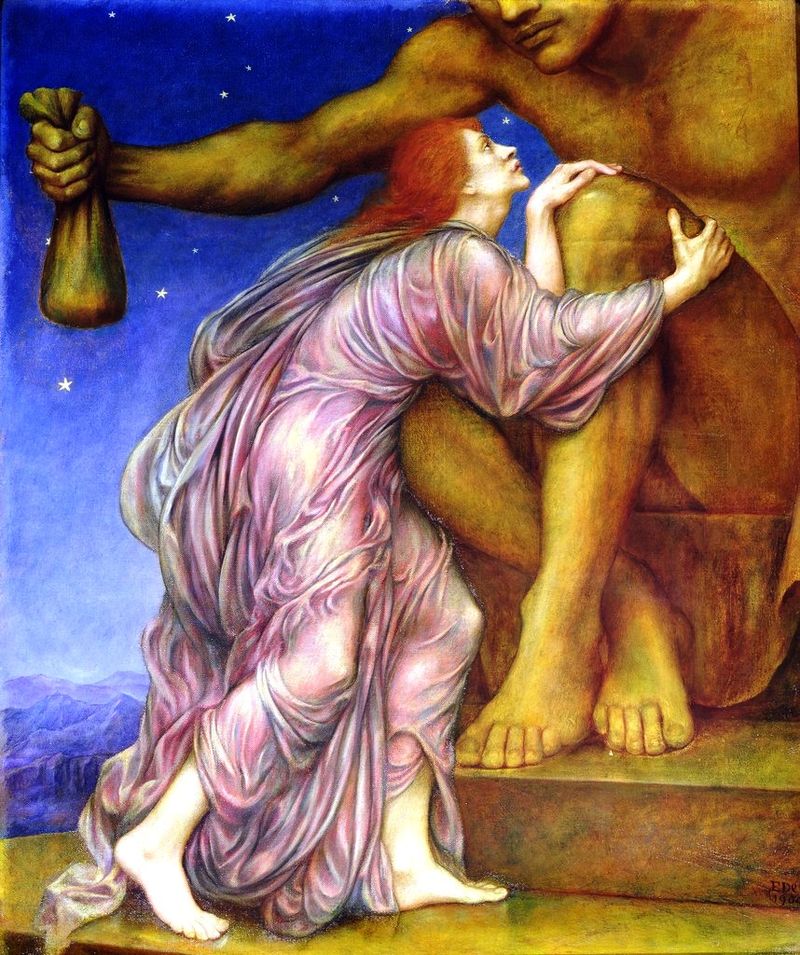
The Worship of Mammon
Evelyn De Morgan
LOVERS OF MONEY
Lovers of money (5366)(philarguros is from philos = loving or friend + arguros = silver, money) is a adjective meaning loving money or covetous. It describes a person obsessed with money, one who is "fond" of money, one who is avaricious (greedy of gain = excessively acquisitive especially in seeking to hoard riches) and implies obsessive acquisitiveness especially of money. This form of covetousness naturally flows out of a selfish heart and is “a root of all kinds of evil.” This trait would naturally follow "self love" as it indicates the means for the gratification of self.
The only other use in the NT describes the arrogant Pharisees as "lovers of money." (Lk 16:14) There are no uses in the non-apocryphal Septuagint.
The corresponding noun (philarguria) occurs in 1 Ti 6:10, where Paul explains that "the love of money is a root of all sorts of evil, and some by longing for it have wandered away from the faith and pierced themselves with many griefs. It is fitting to view the progress of decline here: after "lovers of self" is covetousness, the root or basis of all the evil which is to be described as the list unfolds. There is no doubt that one of the great evils of Christendom in America is materialism, aka the "god of mammon).
Wayne Barber defines "lovers of Money" as "prosperity seekers – they pursue and cherish money. A person working overtime to get wealthy qualifies as a lover of money. It doesn't matter if you are wealthy or not. The key is what is your motivation and how you got there. A lover of self will love money because money is what does for self what humanly speaking nothing else can do. Whereas Christianity seeks to put self on the Cross, money builds self up in the world's eyes. Application: How do you handle money? This will tell you where your heart is "for where your treasure is, there will your heart be also" (Mt6:21) And we can find this in the ministry – "Name it and Claim it", "Get right with God and get rich." This message works in America but try preaching it in Romania. This message is like poison which will start with the dead ones and move eventually into the living ones and paralyze the things that God is wanting to do."
A proper historical context helps understand this mention of "lovers of money", for Timothy's work lay in Ephesus, perhaps the greatest market in the ancient world. In those days trade tended to flow down river valleys and; Ephesus was at the mouth of the River Cayster commanding the trade of one of the richest hinterlands in all Asia Minor. At Ephesus some of the greatest roads in the world met including the great trade route from the Euphrates valley which came by way of Colosse and Laodicea and poured the wealth of the east into the lap of Ephesus. It is not surprising that Ephesus was called "The Treasure-house of the ancient world" the epitome of materialism and prosperity in the ancient world and thus the kind of town where a man could so easily lose his soul. And so Timothy is warned of "difficult" people who love money not God.
In this universe there is God, and there are people and things. We should worship God, love people, and use things (discriminately, wisely). But if we start worshiping ourselves, we will ignore God and start loving things and using people. And this is a sure fire formula for a miserable life, but it sadly characterizes most of America today & even many who call themselves "Christians". The worldwide craving for things is just one evidence that people’s hearts have turned away from God.
The Preacher's Outline & Sermon Bible – People will want more and more and bigger and bigger and better and better, and they will seldom be satisfied with what they have. In the last days people will focus upon...
• money, banking more and more.
• houses in the best neighborhoods, on the seashore, in the mountains, and by the rivers.
• furnishings and property.
• possessions—such as clothes, jewlery, antiques, art, and vehicles.
• travel, seeing more and more sights.
• property, stocks and bonds—owning more and more.
• power—controlling more and more.
Men will love money, what it buys and allows them to do, and they will covet more and more of it and the things it buys. Their eyes and hearts will be focused upon money instead of God. They will indulge and hoard instead of meeting the desperate needs of the poor and lost of the world.
BOASTFUL: alazones:
- Ps 10:3; 49:6; 52:1; Is 10:15; Acts 5:36; Ro 1:29-31; 11:18; 2 Th 2:4; Jas 4:16; 2 Pe 2:18; Jude 16
- 2 Timothy 3 Resources - Multiple Sermons and Commentaries
- 2 Timothy 3:1-9 The Danger of Empty Religion - Steven Cole
- 2 Timothy 3:1-2 Danger in the Church, Part 1 - John MacArthur
- 2 Timothy 3:2-4 Danger in the Church, Part 2 - John MacArthur
BOASTFUL
Boastful (“full of big words” Phillips) continues the theme of focus on SELF in the last days, with its gestures and words is linked to the external. In other words boastful is boastfulness in words, gestures, outward behavior and the next vice arrogant is boastfulness in thought and thus has to do with inward feelings. God hates them both (cf Pr 6:16-17).
Paul includes arrogant and boastful in another vice list in Ro 1:28-32
And just as they did not see fit to acknowledge God any longer, God gave them over to a depraved mind, to do those things which are not proper, 29 being filled with all unrighteousness, wickedness, greed, evil; full of envy, murder, strife, deceit, malice; they are gossips, 30 slanderers, haters of God, insolent, arrogant, boastful, inventors of evil, disobedient to parents, 31 without understanding, untrustworthy, unloving, unmerciful; 32 and although they know the ordinance of God, that those who practice such things are worthy of death, they not only do the same, but also give hearty approval to those who practice them.
Boastful (213)(alazon) describes an arrogant individual who exaggerates or is disposed to exaggerate their own worth or importance in an overbearing manner. In his boasting he overstates the limits of truth, stressing the fact to magnify himself in his attempt to impress others. Selfish people are naturally boastful. If you want to know whether somebody loves themselves, then just listen to who they talk about.
"Boastful" refers to verbally boastful and is the characteristic of a person with a depraved mind. If you have a "sound mind" (a "healed" mind) you don't think of self in the same light as you do when you have a depraved mind. A person who is boastful is always proud of self because he thinks he deserves it. Boastful persons brag about their accomplishments, overstating the truth to the degree that it has no basis in reality. They are know-it-alls who try to deceive people into thinking they are brilliant. They love to see their names in print and their faces on television. They exaggerate their abilities, accomplishments, talents, reputations, and value to society and to the church. They are always the heroes of their own stories. Completely lacking in humility, they speak to draw attention to themselves and in their thoughts see themselves at the center of the universe. The fallen world is the source of this boastful pride (1Jn 2:16), and God stands in opposition to it (Jas 4:6). Perhaps the difference between the false teacher and the struggling Christian here is only a matter of degree or of sensitivity to the sin of selfishness as there are elements of this pernicious monster lurking in all of us.
ARROGANT: huperephanoi:
- Pr 6:17; 1 Ti 6:4; Jas 4:6; 1 Pe 5:5
- 2 Timothy 3 Resources - Multiple Sermons and Commentaries
- 2 Timothy 3:1-9 The Danger of Empty Religion - Steven Cole
- 2 Timothy 3:1-2 Danger in the Church, Part 1 - John MacArthur
- 2 Timothy 3:2-4 Danger in the Church, Part 2 - John MacArthur
ARROGANT
Arrogant also continues the theme of focus on SELF in the last days which is associated with the feelings and the thought life. Arrogant means having or showing feelings of unwarranted importance out of overbearing pride. Arrogant is haughty and disdainful. It is to consider others beneath oneself; this may be socially, materially or in the realm of natural endowment. The apostle is thus speaking of those who have an exaggerated opinion of self and who look down on others.
Very simply stated, the proud person feels that he is better than others. Note that this is a feeling within the heart. The proud person may appear quiet and humble, but within his heart he secretly feels better than others. God resists the proud as James declares...
But He gives a greater grace. Therefore it says, “GOD IS OPPOSED (antitasso = literally God sets Himself in array against and in the present tense = continually - little wonder pride leads to destruction! Pr 16:18. Confess this sin quickly!) TO THE PROUD (huperephanos), BUT GIVES GRACE TO THE HUMBLE.” (James 4:6; reiterated by Peter in 1 Peter 5:5)
Arrogant (5244)(huperephanos from hupér = over, above, + phaíno =shine, show) literally means "to show one's self above", "to appear above." Used 5x in NT - Lk. 1:51; Ro 1:30; 2 Tim. 3:2; Jas. 4:6; 1 Pet. 5:5.
Barclay (critique) adds "It does not so much mean the man who is conspicuous and to whom others look up, as the man who stands on his own little self-created pedestal and looks down. The characteristic of the man who is huperephanos is that he looks down on everyone else, secure in his own arrogant self-conceit." Huperephanos literally means one who shows himself above other people. Even the Greeks hated this pride. Theophrastus described it as “a certain contempt for all other people.” Theophylact, the Christian writer, called it “the citadel and summit of all evils.” The real terror of this pride is that it is a thing of the heart. It certainly means haughtiness, but the man who suffers from it might well appear to be walking in downcast humility, while all the time there was in his heart a vast contempt for all his fellow-men. This pride shuts itself off from God for three reasons. (i) It does not know its own need… It walks in proud self-sufficiency. (ii) It cherishes its own independence. It will be beholden to no man; it will not even be beholden to God… (iii) It does not recognize its own sin… A pride like that cannot receive help, because it does not know that it needs help, and, therefore, it cannot ask. It loves, not God, but itself. (Daily Study Bible Online - scroll down)
These men regard with contempt others whom they consider beneath them, either socially, or materially, or in natural endowments. Jesus described in a "parable to certain ones who trusted in themselves that they were righteous, and viewed others with contempt." (Lk 18:9-14)
This person is proud but it is unseen. He can be praying and be arrogant and you won't know. He contrasts with the person who is boastful and who can't hide it. The arrogant person may fool you at first with humble tendencies but in the heart there is arrogance and Jehovah not only hates "haughty eyes" (Pr6:17) but is actively "opposed to the proud" (Jas 4:6, 1 Pe 5:5)
The difference between the boastful man and the one who is arrogant is that the boaster is a swaggering creature, who tries to bluster his way into power and eminence. No one can possibly mistake him. But the sin of the man who is arrogant is in his heart. He might even seem to be humble; but in his secret heart there is contempt for everyone else. He nourishes an all-consuming, all-pervading pride and in his heart there is a little altar where he bows down before himself.
REVILERS: blasphemoi:
- Ps 73:9 Da 7:25; 11:36; 1 Ti 1:20; 2 Pe 2:12; Jude 10; Rev 13:1;5;6; 16:9, 11, 21
- 2 Timothy 3 Resources - Multiple Sermons and Commentaries
- 2 Timothy 3:1-9 The Danger of Empty Religion - Steven Cole
- 2 Timothy 3:1-2 Danger in the Church, Part 1 - John MacArthur
- 2 Timothy 3:2-4 Danger in the Church, Part 2 - John MacArthur
REVILERS
These people hurl abuse at others, and speak evil.
POSB - Blasphemy is usually thought to be against God, and it is. But it is also a sin against men. Men can blaspheme men. Think of the cursing and insults thrown against God and men today. Practically everyone is cursing and reviling someone (Ed: We even see some American leaders in high places cursing without shame!): mothers, fathers, children, teachers, professionals, actors, comedians, politicians, even some professing religionists feel the need to occasionally curse in order to be acceptable.Why is there so much cursing today? Because there is a loss of respect for both self and others, for both position and authority. People rail, revile, insult, reproach, and curse when they are disturbed within—when they sense dissatisfaction, disapproval, unacceptance, bitterness, emptiness, loneliness, and reaction within their heart. A disturbed and dissatisfied heart causes people to blaspheme God and man, including themselves (blaming and cursing themselves when they fail and come ever so short).
Revilers (blasphemer) (989)(blasphemos from bláx = sluggish, slow, stupid + phémē = rumor, fame; see related blasphemeo) is an adjective which means speech that is insulting, slanderous, scurrilous, blasphemous, abusive, reproachful, defaming, denigrating, demeaning. As a noun in 1 Ti 1:13 = blasphemer. To revile means to spread negative information about someone.
Blasphemos describes those who rail and reproach with harsh, denigrating, demeaning insults directed against God and man alike. These men have no fear of God because they are lovers of self. They don't want God because God threatens everything that they are. And so they use insulting, pejorative terms that put God and others down. Their inner disdain will eventually find expression in outward slander "for from within, out of the heart of men, proceed the evil thoughts… all these evil things proceed from within and defile the man." (Mk 7:21,23). This sin describes those who hurl abuse at or speak abusively of others or make misrepresentations and false charges seeking to destroy the other's good name.
Barclay (online) adds that "the Jewish Rabbis ranked high in the list of sins what they called the sin of insult . The insult which comes from anger is bad but it is forgivable, for it is launched in the heat of the moment; but the cold insult which comes from arrogant pride is an ugly and an unforgivable thing."
Blasphemos - 4x in 4v - blasphemer(1), blasphemous(1), revilers(1), reviling(1). One use in the Lxx - Isa 66:3.
Acts 6:11 Then they secretly induced men to say, "We have heard him (Stephen) speak blasphemous words against Moses and against God."
1 Timothy 1:13 even though I was formerly a blasphemer and a persecutor and a violent aggressor. Yet I was shown mercy because I acted ignorantly in unbelief;
2 Timothy 3:2 For men will be lovers of self, lovers of money, boastful, arrogant, revilers, disobedient to parents, ungrateful, unholy,
2 Peter 2:11 whereas angels who are greater in might and power do not bring a reviling judgment against them before the Lord.
DISOBEDIENT TO PARENTS: goneusin apeitheis:
- Pr 30:17, Mt 15:6; Mk 7:11,12; Ro 1:30
- 2 Timothy 3 Resources - Multiple Sermons and Commentaries
- 2 Timothy 3:1-9 The Danger of Empty Religion - Steven Cole
- 2 Timothy 3:1-2 Danger in the Church, Part 1 - John MacArthur
- 2 Timothy 3:2-4 Danger in the Church, Part 2 - John MacArthur
DISOBEDIENT TO PARENTS
What the Bible teaches – Disobedience is a characteristic of the unregenerate (Titus 1:16; 3:3). Our Lord Jesus Christ was subject to His parents (Luke 2:51), and such is required of those who would please the Lord (Eph 6:1; Col 3:20).
New American Commentary – To be “disobedient to ... parents” suggests someone who lacks parental respect and will obviously violate the reprimands of 1 Tim 5:8. Such rebellious offspring will also be “ungrateful” (“no gratitude,” NEB) and “unholy” (“irreverent,” Williams). They lack all gratitude for benefits given by their parents, and they sullenly hold nothing as sacred.
It is worth noting that the final three terms of 2 Ti 3:2 (disobedient, ungrateful, unholy) and the first two in 2 Ti 3:3 (unloving = astorgos, irreconcilable = aspondos) all begin with the Greek a which negates the word (the privative "a" = without) that follows in the Greek. So it should not come as a surprise that atheist is composed of "a" negating "theos" which is God. When we "negate God" we in effect enthrone self and can make our own "commandments" of what we deem to be right and wrong.
POSB - If a child will not honor and respect his mother and father, who will he respect? If a child will mistreat his parents—those who are the closest to him—who else will he mistreat? If a child will not obey his parents, those who love and care for him most, who then will be obey? Parents are the ones who gave birth, loved and cared for the children of the world. If the children are not loyal to them, then the children will not be loyal to anyone. The home, society, and civilization will crumble.
Disobedient (545)(apeithes from a = without + peítho = persuade) literally means one who continually refuses to be persuaded (unpersuadable) and therefore continually refuses to obey. They refuse to be compliant or submissive. An infrequently used word that accurately described these individuals is contumacious or stubbornly disobedient. Those who will rebel against their parents will have no qualms about rebelling against anyone else.
Wayne Barber comments that disobedience to parents is "a "symptom" not the source. If a person is disobedient to parents follow this up the chain and you will find him disobedient to anyone who is in authority over him. Greeks had a severe penalty if a child was disobedient to parents and Roman law called it "murder" to strike a parent. In Jewish law a rebellious child was stoned! If they rebel against parents, they are in essence rebelling against God. PRINCIPLE: This symptom flows from a NON-SUBMISSIVE ATTITUDE and it begins with the attitude toward the parents and the more he grows the broader this disobedience becomes. This trait is the mark of a person who has the gangrene of ungodliness in their life and they are poison. Get away from them. When you get these folks in the church and they will not submit…look out! How are you going to lead and pastor these individuals? This person will submit to no one. The living will suffer because of their gangrene unless they get away from them."
Barclay adds that "the ancient world set duty to parents very high. The oldest Greek laws disfranchised the man who struck his parents; to strike a father was in Roman law as bad as murder; in the Jewish law honor for father and mother comes high in the list of the Ten Commandments. It is the sign of a supremely decadent civilization when youth loses all respect for age and fails to recognize the unpayable debt and the basic duty it owes to those who gave it life."
In Paul and Timothy’s day this sin set one off as fundamentally rebellious at heart, for the attitude toward parents was understood as a reflection of a deeper attitude toward God (Ex 20:12). They set themselves above the feelings of others and the authority of their parents — not only is this extremely selfish, but it is also destructive behavior. Have you observed these attitudes in the church?
Life Application New Testament Commentary - This behavior willfully breaks the fifth commandment to honor one’s father and mother (see Exodus 20:12). The commandment was given because God understood the importance of strong families. To “honor” parents means speaking well of them and politely to them. It also means acting in a way that shows them courtesy and respect. It means following their teaching and example of putting God first. Parents have a special place in God’s sight. Even children who find it difficult to get along with their parents are still commanded to honor them. When parents are not respected and honored, disobedience naturally results, and the breakdown of the family easily follows. Paul understood that when families fall apart, “very difficult times” (3:1) follow.
UNGRATEFUL: acharistoi:
- 2 Timothy 3 Resources - Multiple Sermons and Commentaries
- 2 Timothy 3:1-9 The Danger of Empty Religion - Steven Cole
- 2 Timothy 3:1-2 Danger in the Church, Part 1 - John MacArthur
- 2 Timothy 3:2-4 Danger in the Church, Part 2 - John MacArthur
UNGRATEFUL
Ungrateful describes the ingratitude that results from taking everything for granted. It's a "you owe it to me" attitude! They are unappreciative of anything done for their benefit! It is worth noting that In Romans 1:21, Paul noted that ingratitude was second only to dishonoring God ("they did not honor Him as God or give thanks") as a just cause for God’s judgment on humanity! Ingratitude is a serious attitude problem because it such a root issue reflecting one's selfish, self-centered heart.
POSB - Many persons feel that the world and society or business and government owe them the good things of life. They have little if any sense of debt to others. This is the reason many waste time on the job, do mediocre work, and feel little obligation to the world and society. They fail to see how privileged they are to be alive and to live in such a beautiful world and to have a job and friends and neighbors. They fail to see how good God has been to them, and how caring and responsible some people are. Therefore, they reach out to get more and more without sensing any need to express thanks and appreciation. They take and take and forget all about the thanksgiving—the debt and contribution—they owe to God and men.
Ungrateful (884)(acharistos from a = without + charizomai = to show favor or kindness - from charis - grace so these are those "without grace") describes men who are utterly destitute of any gratitude toward God or others. They refuse to recognize the debt they owe both to God and to men. The strange characteristic of ingratitude is that it is the most hurting of all sins because it is the blindest. Lear's words remain true: "How sharper than a serpent's tooth it is to have a thankless child!" God is amazing for "He Himself is (still) kind to ungrateful and evil men!" (Lk 6:35)
Only other NT use is Lk 6:35
“But love your enemies, and do good, and lend, expecting nothing in return; and your reward will be great, and you will be sons of the Most High; for He Himself is kind to ungrateful and evil men.
The only uses in the Lxx are in the non-canonical Apocrypha - 4 Ma. 9:10; Wis. 16:29; Sir. 29:16,25
Liddell-Scott - 1a ungracious, unpleasant, unpleasing, Ib.: without grace or charms, II. of persons, ungracious, unfavourable, 2. ungrateful, thankless, . III. Adv. with an ill-will
The very opposite attitude is seen in the Spirit controlled man (Ep 5:18, Ep 5:20) "always giving thanks for all things in the name of our Lord Jesus Christ to God, even the Father."
Wayne Barber comments on grateful versus ungrateful noting that the root word for acharistos is "grace" (charis). How can I give "grace" to God? The only ones who can be truly grateful are those who have experienced the grace of God and once you have experienced it, you are so awed and filled with it that you want to give it back to Him (cp 2Ti1:2 "I thank God" literally = I have grace to God). The person described here by Paul is UNGRATEFUL, never willing bow down and submit to the Lord Jesus. If they had been they would have received God's grace and been grateful. You don't have grateful people who are ungodly. Ungrateful people refuse God's grace - this is not that they couldn't (receive grace) but that they wouldn't! It's rebellion – they refuse to bow down in the presence of God. This person may buy the "cheapest fire insurance policy" they can and be willing to cry a few tears so that they can "get into heaven" but they are not willing to bow down to Jesus Christ… You can join the church and miss Jesus a mile." Ungrateful people are gangrene and poison.
MacArthur has an interesting comment "The person who elevates self above all others will feel he deserves everything good he receives and therefore feels no need of gratitude for it. Although he may not put it into words, the ungrateful person despises the very idea of grace, which denotes goodness received that is undeserved. This is a particularly noxious sin to God, whose wrath is revealed against sinners for being unthankful" (Ro1:21).
UNHOLY: anosioi:
- 2 Timothy 3 Resources - Multiple Sermons and Commentaries
- 2 Timothy 3:1-9 The Danger of Empty Religion - Steven Cole
- 2 Timothy 3:1-2 Danger in the Church, Part 1 - John MacArthur
- 2 Timothy 3:2-4 Danger in the Church, Part 2 - John MacArthur
UNHOLY
Life Application New Testament Commentary says that an ungrateful heart "leads them to consider nothing sacred. People who set aside God in order to live only to please themselves can only go one direction—toward wickedness. They instinctively resist anyone or any ideas that would force them to measure themselves by God’s standards."
Preacher's Outline and Sermon Bible - People will be unholy: profane, indecent, shameless, given over to the most base passions, being blind to modesty, decency, purity, and righteousness. The unholy person...
• is mastered by passion.
• seeks constant gratification of the flesh.
• senses little shame.
• is blind to decency.
• seeks his pleasure in the abnormal. (Just think of the abnormal sex that is flaunted today.)
Unholy (462)(anosios from a = without + hósios = consecrated, hallowed, holy, righteous, unpolluted with wickedness) pertains to that that which is in opposition to God or what is sacred. It means ungodly and without regard of duty toward God or toward man and carries the idea not so much of irreligion as of gross indecency. In other words this man not only breaks the laws of God and society, but even breaks the unwritten laws of common decency. To the Greek it was anosios to refuse to bury a corpse. It was anosios for a brother to commit incest by marrying a sister or a son a mother. The man who is anosios offends the fundamental decencies of life. The unholy person is driven by self-love to gratify his lusts and passions of whatever sort, as fully as possible with no thought to propriety, decency, or personal reputation.
W E Vine - there are two words rendered “holy” in the New Testament: hosiōs, which signifies free from unrighteousness or pollution and is commonly associated with righteousness; it is the word used, e.g., in 1 Timothy 2:8 and Titus 1:8; the other is hagios, which signifies separated from sin and consecrated to God, e.g., 1:14 and Titus 3:5. The word here is the negative of the former.
Of the two New Testament instances, both occur in “vice-lists” which catalog the wicked behavior and character of Paul’s opponents (cf. Romans 1:28ff.; 1 Corinthians 5:10f.; 2 Corinthians 12:20f.; Galatians 5:19-21).
TDNT - This word refers 1. to “impious” acts that transgress ancient laws and 2. to “impious” persons. It occurs twice in the NT for impious persons who impiously reject sacred obligations. “Ungodly” might fit the context of 1 Tim. 1:9, but “devoid of piety” is obviously meant in 2 Tim. 3:2 (cf. the sequence).
Used once in Septuagint - Ezek. 22:9. Used in the Lxx of the Apocrypha - 2 Ma. 7:34; 8:32; 3 Ma. 2:2; 5:8; 4 Ma. 12:11; Wis. 12:4
Only other NT uses is 1 Ti 1:9
realizing the fact that law is not made for a righteous person, but for those who are lawless and rebellious, for the ungodly and sinners, for the unholy and profane, for those who kill their fathers or mothers, for murderers
Barclay (online) has this note on anosios: "Men will refuse to recognize even the ultimate decencies of life… Anosios does not so much mean that men will break the written laws; it means that they will offend against the unwritten laws which are part and parcel of the essence of life."