2 Timothy 3:2
2 Timothy 3:3
2 Timothy 3:4
2 Timothy 3:5
2 Timothy 3:6
2 Timothy 3:7
2 Timothy 3:8
2 Timothy 3:9
2 Timothy 3:10
2 Timothy 3:11
2 Timothy 3:12
2 Timothy 3:13
2 Timothy 3:14
2 Timothy 3:15
2 Timothy 3:16
2 Timothy 3:17
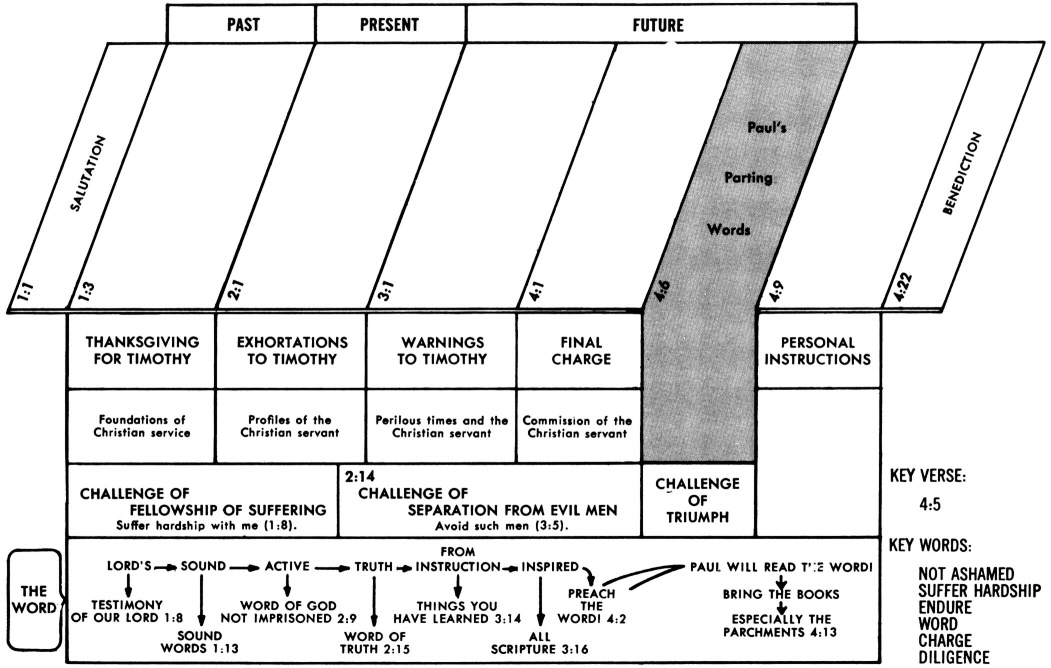
ENDURANCE AND SEPARATION IN THE MINISTRY
Click chart to enlarge
Charts from Jensen's Survey of the NT - used by permission
Second Timothy - Swindoll
| 2 TIMOTHY | |||
| 2 Timothy 1:1-18 | 2 Timothy 2:1-26 | 2 Timothy 3:1-17 | 2 Timothy 4:1-22 |
| Retain the Standard |
Rightly Divide the Word |
Difficult Times Will Come |
Preach the Word |
| PAST | PRESENT | FUTURE | |
| Foundation of Christian Service |
Pictures of Christian Servant |
Dangerous Times for Christian Servant |
Commission of Christian Servant |
| Unashamed as a Witness: Guard the Gospel |
Unashamed as a Workman: Suffer for the Gospel |
Adequate as a Workman: Continue in the Gospel |
Awarded as a Workman: Preach the Gospel |
| Power of the Gospel |
Perseverance of the Gospel Message | Protection of the Gospel |
Proclamation of the Gospel |
| Reminder | Requirements | Resistance | Requests |
| Encouragement in Ministry |
Examples in Ministry |
Exhortations in Ministry |
Exhortations to Fulfill Ministry |
| Commendation & Charge |
Commission to Fulfill |
Conflict to Face |
Course to Finish |
|
Compiled from Jensen's Survey of the NT and Wilkinson's Talk Thru the Bible |
|||
2 Timothy 3:10 But you followed my teaching, conduct, purpose, faith, patience, love, perseverance,
Greek: Su de parekolouthesas (3SAAI) mou te didaskalia, te agoge, te prothesei, te pistei, te makrothumia, te agape, te hupomone
Amplified: Now you have closely observed and diligently followed my teaching, conduct, purpose in life, faith, patience, love, steadfastness, (Amplified Bible - Lockman)
KJV: But thou hast fully known my doctrine, manner of life, purpose, faith, longsuffering, charity, patience,Phillips: But you, Timothy, have known intimately both what I have taught and how I lived. My purpose and my faith are no secrets to you. You saw my endurance and love and patience (Phillips: Touchstone)
Wuest: But as for you, you were attracted as a disciple to me because of my teaching, conduct, purpose, faith, longsuffering, divine and self-sacrificial love, patience
Young's Literal: And thou -- thou hast followed after my teaching, manner of life, purpose, faith, long-suffering, love, endurance,
BUT YOU FOLLOWED: Su de parekolouthesas (3SAAI):
But you know from watching me (TLB)
But as for you, you were attracted as a disciple to me because of my teaching (Wuest)
you have observed and diligently followed (Amp)
you carefully followed (NKJV)
you have intimately known (WNT)
But thou hast been thoroughly acquainted with (Darby)
- 2 Timothy 3 Resources - Multiple Sermons and Commentaries
- 2 Timothy 3:10-15 Spiritual Faithfulness - Steven Cole
- 2 Timothy 3:10-13 Standing Against Apostasy, Part 1 - John MacArthur
GOING
MAKE DISCIPLES
Mt 28:19-note
But you - Timothy a disciple presents a dramatic contrast with the deceivers of "but they" (2Ti 3:9)
Followed (3877) (parakoloutheo from para = near + akolouthéo to follow) means literally to follow closely or to accompany side by side. Parakoloutheo combines the idea of understanding with that of practicing perseveringly.
Parakoloutheo - 4x: Mk 16:17; Lk 1:3; 1Ti 4:6; 2Ti 3:10
Mark 16:17 “And these signs will accompany those who have believed: in My name they will cast out demons, they will speak with new tongues; (NOTE: Mark 6:9-20 DO NOT APPEAR IN THE BEST GREEK MANUSCRIPTS AND MANY CONSIDER THEM TO BE A LATER ADDITION BY SOMEONE OTHER THAN MARK).
Luke 1:3+ it seemed fitting for me as well, having investigated everything carefully from the beginning, to write it out for you in consecutive order, most excellent Theophilus;
Comment: Luke uses parakoloutheo to mean to follow closely in mind and so to investigate so as to attain knowledge. It indicates the mental tracing whereby one arrives at a knowledge of the matter. The perfect tense emphasizes the permanence of the state reached after the investigation. Applying this sense of parakoloutheo to 2Ti 3:10, in a sense Timothy was "investigating" Paul's teaching to see whether Paul's life matched his lips (cf Acts 17:11) and to observe how he endured persecutions and sufferings.
1 Timothy 4:6 In pointing out these things to the brethren, you will be a good servant of Christ Jesus, constantly nourished on the words of the faith and of the sound (kalos = inherently excellent! Intrinsically good!) doctrine which you have been following. ( perfect tense = Timothy began to follow at a time in the past and continuing to follow!)
Comment: Sound doctrine taken in, assimilated (spiritual nutrients incorporated or converted into spiritual protoplasm) by the Spirit and lived out leads to healthy disciples!
2 Timothy 3:10 But you followed my teaching, conduct, purpose, faith, patience, love, perseverance,
The verb parakoloutheo pictures Timothy always at Paul's side, attending Paul wherever he went. Thayer adds that the verb means to "conform one's self to" so that ultimately a disciple is to become like his mentor.
Parakoloutheo was actually a technical term used by philosophers to describe the relationship of a disciple to his teacher (studying with him in close quarters, carefully noting his life with a view to reproducing, etc). It includes the idea of following a teaching with concentrated attention so as to make the teaching part of one's being. Timothy conformed to Paul's belief and practice by paying special attention to his mentor. Paul is reminding Timothy "You were right by my side from the beginning."
Barclay adds that parakoloutheo "means to follow a person physically, to stick by him through thick and thin, to be by his side in fair weather and in foul. It means to follow a person mentally, to attend diligently to his teaching, and fully to understand the meaning and the significance of what he says. It means to follow a person spiritually, not only to understand what he says, but also to carry out his ideas, and to be the kind of person that he wishes us to be." (The Daily Study Bible Online)
Example is a living law, whose sway
Men more than all the written laws obey
The question for each of us to ask is who are we following closely? Every disciple of Jesus should be able to say that they have a Paul from whom there are learning and a Timothy to whom they are leading. Do you? All of us tend to emulate those we admire, so the charge is for us to be very careful about who we choose to follow. We need to make sure by their teaching and their conduct that they are on the "the ancient paths, where the good way is" (Jer 6:16).
Albert Barnes writes...
"Perilous times" were to come, and Timothy might be expected to be called to pass through trials similar to those which Paul himself had experienced. In those times the remembrance of his example would be invaluable. (Ed: In other words, if he weathered the persecutions and sufferings victoriously in Christ, so too can I. Do you have a Paul that you can remember when the days become perilous?)
Hall adds that
"since we are more easily led by precedents than by precepts, the apostle propounds his own example for our imitation, wherein we have the lively pattern and portraiture of a faithful pastor, whose office it is not only to preach sound doctrine, but also to practice what he preacheth in his own life, that so he may be able to speak from the heart to the hearts of his people, and may not bring his food as birds do to their young ones — in their beaks, not in their breasts...Great is the power of the example of superiors......God hath set them before us as our copy to write by, and our pattern to live by, and we must answer not only for sinning against the light of the word, but against the light of good example also. It will be one day said, "You had such and such to go before you in paths of piety, and yet you would not follow. The faithful are called witnesses (Heb12:1-note ). Now if we walk contrary to their light they will witness against us, as Noah and Lot did against the sinners of their age; but if we walk answerable to their light they will witness for us. Their practice may comfort and confirm us in God’s way; they declare the possibility of obtaining such a grace, and make it thereby the more easy, when we have seen it done before us. If a man have a torch to light him in a dark and dangerous path, how glad is he: the godly shine like lights in the midst of a crooked generation (Php 2:15-note, Php 2:16-note), their life is a commentary on the Scripture" Now since the nature of man is apter to be guided by example then precept, therefore God hath prepared abundance of glorious examples for our imitation, and thus the saints that are now at rest and triumphant in glory, their lives are to be our looking-glasses to dress ourselves by, our compass to sail by, and our pillar of a cloud to walk" (2 Timothy 3 Commentary)
THOUGHT - This comment begs at least two questions: "What commentary did I write with my conduct this past week?" "What saint am I following that I might imitate their godly example?"
A parallel idea is that the great truths of Scripture are as much "caught" as they are "taught", and this happens most readily as one follows a "man of God who is equipped for every good work" (2Ti 3:17-note)
Parenthetically I might add that an often untapped resource of "godly mentors" to emulate can be readily found in the many excellent Christian biographies both in print and on the web (eg be challenged by the life of men like Adoniram Judson) (Click "Christian Biography")
"A life once spent is irrevocable. It will remain to be contemplated through eternity...the same may be said of each day. When it is once past, it is gone forever. All the marks which we put upon it, it will exhibit forever...each day will not only be a witness of our conduct, but will affect our everlasting destiny....How shall we then wish to see each day marked with usefulness! It is too late to mend the days that are past. The future is in our power. Let us, then, each morning, resolve to send the day into eternity in such a garb as we shall wish it to wear forever. And at night let us reflect that one more day is irrevocably gone, indelibly marked." (Adoniram Judson)
Comment: It is notable that Adoniram Judson labored for six years in Burma before a single believer was identified! Was Judson a failures? By no means. God evaluates our faithfulness and He takes care of the fruitfulness. (John 15:4-5)
MacArthur notes that "In the Greek text, the definite article (Greek TE = English "THE") precedes each of the descriptive nouns in verses 10 and 11 , grammatically connecting each to the possessive pronoun my and thereby giving it repeated emphasis. The idea is, "But you followed my teaching, [my] conduct, [my] purpose, and so on."
Ray Pritchard discussing following godly leaders points out that...
This principle is based on the truth that we become like the people we associate with. If we follow the ungodly, we will become like the ungodly. If we follow the arrogant, we are likely to become arrogant. If we follow those who follow Jesus, we are more likely to become like Jesus ourselves. In this case, Paul uses himself as an example, and says in effect, “Follow me as I follow Christ.”
These are the marks of the godly people we should follow:
1. They have nothing to hide. “You know my way of life.”
2. They teach the truth. “You know my doctrine.”
3. They practice what they preach. “You know my faith, my love and my patience.”
4. They aren’t afraid of persecution. “You know my sufferings and my persecution.” (2 Timothy 3: Perilous Times)
MY TEACHING: mou te didaskalia:
- Lk 1:3; Php 2:22; 1Ti 4:6; 2Ti3:16,17; 4:3; Ac 2:42; Ro 16:17; Ep 4:14; 1Ti 1:3; 4:12; 13 Titus 2:7; He13:9; 2Jn 1:9, 10
- 2 Timothy 3:10-15 Spiritual Faithfulness - Steven Cole
- 2 Timothy 3:10-13 Standing Against Apostasy, Part 1 - John MacArthur
- 2 Timothy 3 Resources - Multiple Sermons and Commentaries
The last part of chapter 3 Paul suggests three very practical "growth/survival strategies" for these perilous, difficult, deceptive and dangerous "last days" in which we live...
Follow Godly Leaders 2Ti 3:10, 11,12, 13
Continue in What You Have Learned 2Ti 3:14, 15
Let the Word of God Make You Complete 2 Ti 3:16, 17
Teaching (1319) (didaskalia [word study] from didasko = teach to shape will of one being taught by content of what is taught) and as noted in the first 2 chapters would include "the standard of sound words which you have heard from me" (2Ti 1:13-note) as well as "the things which you have heard from me in the presence of many witnesses" (2Ti 2:2-note). Here we see Paul practicing his preaching which he seeks to "entrust to faithful men" (2Ti 2:2).
THOUGHTS - The Pauline school of doctrine and practice was not a building but a life, and the curriculum included real-time, "hands on" training in character and content, practice and precept! May his tribe increase. If you a reading these notes and you have walked with the Lord, say 10, 20 or 30+ years, may I ask you...are you giving your life away in fulfillment of Jesus' last great command to "go (present tense = continually going into the by ways and high ways) and make disciples (aorist imperative = Like a command from a general [our Captain of the hosts!] in wartime [we are in a continual spiritual war]! Do it now! Don't delay! This is urgent and imperative! See discussion of the Need for the Holy Spirit to obey this command to make learners!)" (Mt 28:19)? Yes, we are to "make learners" but specifically "learners" who are "doers" (James 1:22+) filled with the Word and filled with the empowering Spirit (Eph 5:18+). Where are the older men (the mature believers) in their 60's and older in our churches? What are they doing with their life? Are they serving on committees or are they making disciples? This is not a judgmental question but a sincere, serious call to action - "Don't waste your life!" Instead Redeem the Time! (Eph 5:16, Ep 5:16KJV, Ep 5:16NLT+)
MY...CONDUCT: te agoge:
- Acts 20:18; 26:4; Let them see the supernatural life, the Christ life in and through you as did Paul, Silvanus and Timothy = 1Th 1:5-note; Motivation for godly conduct = 2Pe3:11-note
- 2 Timothy 3 Resources - Multiple Sermons and Commentaries
- 2 Timothy 3:10-15 Spiritual Faithfulness - Steven Cole
- 2 Timothy 3:10-13 Standing Against Apostasy, Part 1 - John MacArthur
MY MANNER OF
BEHAVING
In English conduct is defined as the manner of acting or controlling yourself (I like that -- "controlling" yourself! It reminds me of a Spirit filled man bearing the fruit of the Spirit of self control - Gal 5:23+). Remember "self" cannot control "self," but must submit to the Spirit control for self-control!
My conduct - My way of life, my behavior, how I live. Paul says "you know from watching me that I am not that kind of person." (TLB)
THOUGHT - Is someone discipling you in the Word? (there is no other fruitful resource by which we can disciple - cp Jesus high priestly prayer - Jn 17:17 and Peter's clarion call/charge in 1Pe 2:2+ > No intake = No growth! Little wonder so many churches in America are spiritually "anemic" and sitting prey ["sitting ducks"] for the cults! Serious ["You mean I have to do homework?...memorize Scripture?, etc"] Bible studies are few and far between in many churches.) If you are being discipled by someone, you need to observe their life to make sure it matches their lips. That means you have to spend some time together. When you see a "one to one" correlation (See Integrity - A Few Thoughts), you can rest assured that God will use them to grow you in Christ-likeness, even as he used Paul to make Timothy into a man of God, a man who God would use mightily. He is still looking for Paul's and Timothy's.
Conduct (72) (agoge from ago = to lead, lead along, bring) (Only use in Scripture) means literally leading or guidance then refers to the method in which one is led, his manner of life or the way they lead their life.
THOUGHT - Timothy was so closely associated with Paul that he could not fail to know all aspects of his behavior and he knew that Paul was a man who practiced what he preached. Do your deeds back up your doctrine? Are you "preaching" with with life, so they will believe the proclamation of your lips? (Are you as convicted as I am right now?) Someone has written a poem that brings out the importance of this association:
I'd rather see a sermon than hear one any day,
I'd rather one should walk with me, than merely point the way.
And the best of all the preachers are the men who live their creeds,
For to see good put in action is what everybody needs.
Hall reminds us that "Moral virtues may be found with a false faith; let not those apples of Sodom deceive you, for as there may be good doctrine where the life is bad, so there may be false doctrine where the life is seemingly good. Look, therefore, in the first place to the doctrine, and in the second place to the virtues which seem to commend it." (The Biblical Illustrator)
Matthew Henry adds that Paul "did not pull down by his living what he built up by his preaching. Those ministers are likely to do good, and leave lasting fruits of their labors, whose manner of life agrees with their doctrine; as, on the contrary, those cannot expect to profit the people at all that preach well and live ill.
MY...PURPOSE: te prothesei:
- Acts 11:23; 2Co 1:17
- 2 Timothy 3 Resources - Multiple Sermons and Commentaries
- 2 Timothy 3:10-15 Spiritual Faithfulness - Steven Cole
- 2 Timothy 3:10-13 Standing Against Apostasy, Part 1 - John MacArthur
My purpose - my aims (NJB), my aim in life (ESV).
Purpose is (or should be) pivotal, primary, priority - Daniel "purposed in his heart" (Da 1:8KJV-note) that he would not defile himself with the king's choice food and this "purpose" set his spiritual sail/course for the remainder of his earthly life in which he proved to be a vessel of honor that God used mightily in "every good work" (2Ti 2:21-note).
THOUGHT - Don't miss the purpose for which you were created beloved (see Eph 2:10-note, Mt 5:16-note, Isa 43:7)! Corollary thought - If your "aim" is off you will miss the target in archery. If your aim is off in your spiritual life you will miss God's will which is good and acceptable and perfect (Ro 12:2-note), that will which is productive not just of spiritual life, but of life abundant (Jn 10:10).
Purpose (4286) (prothesis [word study] from protíthemi = set before oneself; purpose or plan) is literally placing before or setting before and so means the setting forth of a thing or placing of it in view, a putting forward openly -- a presentation, setting forth, plan, design, purpose, resolve, will.
Prothesis has a secular Greek use meaning setting forth of something in public and in a similar NT use refers to the name give to the shewbread ("loaves of presentation") in the Temple which is "exposed before God". The bread before the Presence of the Lord consisted of twelve loaves of wheat bread offered every Sabbath (12 = number of the tribes of Israel) and arranged in two rows on the table before the Holy of Holies and to remain there for seven days. (See topics: Vincent's note below, The Shewbread; shewbread; table of shewbread or showbread).
In the present context prothesis refers to the plans or designs of Paul's life, the guiding motive of his life and work, the driving passion of his heart. Having clear purpose in line with the Father's will is an indispensable requirement in Christ's school of discipleship for "If you aim at nothing, you will hit it every time."
Prothesis - 12x in 12v - Matt 12:4; Mark 2:26; Luke 6:4; Acts 11:23; 27:13; Rom 8:28; 9:11; Eph 1:11; 3:11; 2 Tim 1:9; 3:10; Heb 9:2. NAS = consecrated(3), purpose(7), resolute(1), sacred(1).
Prothesis - 11x in the non-apocryphal Septuagint - Ex 39:36; 40:4, 23; 1Sa 21:6; 1 Chr 9:32; 23:29; 28:16; 2 Chr 2:4; 4:19; 13:11; 29:18. Most often for "Shewbread" (showbread, bread of presence)
As we have seen though God
has saved us, and called us with a holy calling, not according to our works, but according to His own purpose (prothesis) and grace which was granted us in Christ Jesus from all eternity" (2Ti 1:9-note, cf Ro 8:28-note Eph 1:11-note,1Th 4:7-note, 1Ti 4:7-note)
Paul was consumed with a passion to fulfill God's "purpose" for saving him to proclaim Christ writing
I am under compulsion; for woe is me if I do not preach the gospel. (1Cor 9:16).
In a more detailed parting statement to the Ephesian elders
You yourselves know, from the first day that I set foot in Asia, how I was with you the whole time, serving the Lord with all humility and with tears and with trials which came upon me through the plots of the Jews how I did not shrink from declaring to you anything that was profitable, and teaching you publicly and from house to house, solemnly testifying to both Jews and Greeks of repentance toward God and faith in our Lord Jesus Christ...I did not shrink from declaring to you the whole purpose of God. (Acts 20:18, 19, 20, 21, 27)
Peter adds that believers
have been called for this purpose, (when you do what is right and suffer for it) since Christ also suffered for you, leaving you an example for you to follow in His steps (1Pe 2:21-note)
Matthew Henry comments that Paul is saying to Timothy "Thou hast known my purpose, what I drive at, how far it is from any worldly, carnal, secular design, and how sincerely I aim at the glory of God and the good of the souls of men.
MY...FAITH: te pistei:
- 2Ti 2:22; 2Co 6:4, 5, 6, 7, 8, 9, 10; 1Ti 4:12; 6:11; 2Pe 1:5, 6, 7
- 2 Timothy 3 Resources - Multiple Sermons and Commentaries
- 2 Timothy 3:10-15 Spiritual Faithfulness - Steven Cole
- 2 Timothy 3:10-13 Standing Against Apostasy, Part 1 - John MacArthur
Here Paul is not referring to saving faith but to the faithfulness and trustworthiness of those who are already saved. Paul uses faith similarly writing to the Thessalonians
that Timothy has come to us from you and has brought us good news of your faith and love. (1Th 3:6-note).
The idea is to faithfully live the truth that one professes.
Faith (4102) (pistis [word study]) is synonymous with trust or belief and is the conviction of the truth of anything, but in Scripture usually speaks of belief respecting man's relationship to God and divine things, generally with the included idea of trust and holy fervor born of faith and joined with it.
Maclaren (speaking primarily of faith that saves) writes that "Faith is the hand that grasps. It is the means of communication, it is the channel through which the grace which is the life, or, rather, I should say, the life which is the grace, comes to us. It is the open door by which the angel of God comes in with his gifts. It is like the petals of the flowers, opening when the sunshine kisses them, and, by opening, laying bare the depths of their calyxes to be illuminated and coloured, and made to grow by the sunshine which itself has opened them, and without the presence of which, within the cup, there would have been neither life nor beauty. So faith is the basis of everything; the first shoot from which all the others ascend...Faith works. It is the foundation of all true work; even in the lowest sense of the word we might almost say that. But in the Christian scheme it is eminently the underlying requisite for all work which God does not consider as busy idleness...(Sermon on 1 Thessalonians 1:3)
MY...PATIENCE: te makrothumia:
- 2 Timothy 3 Resources - Multiple Sermons and Commentaries
- 2 Timothy 3:10-15 Spiritual Faithfulness - Steven Cole
- 2 Timothy 3:10-13 Standing Against Apostasy, Part 1 - John MacArthur

PAUL HAD A
"LONG FUSE"
Patience pictures a person with a "long fuse" (so to speak). Ultimately patience pictures a person filled with the Spirit, for it is only by His supernatural power that a natural man or woman can be genuinely patient! Paul underscores this in describing "the fruit of the Spirit is love, joy, peace, patience (makrothumia), kindness, goodness, faithfulness." (Galatians 5:22+) In Colossians Paul adds (in a prayer we would all be wise to pray for one another frequently) that the saints at Colossae might be "strengthened with all power (dunamis), according to His glorious might, for the attaining of all steadfastness and patience (makrothumia)." (Col 1:11+ - goto Col 1:9-10+ for this prayer that includes power) For supernatural patience, we need supernatural power (dunamis).
Patience (makrothumia from makro = long + thumos = emotion) literally means having a "long fuse" and thus describes an individual who is opposed to haste, to passionate expressions and thoughts or to irritability. As pistis relates to God, it is the conviction that God exists and is the Creator and Ruler of all things well as the Provider and Bestower of eternal salvation through Christ. As faith relates to Christ it represents a strong and welcome conviction or belief that Jesus is the Messiah, through Whom we obtain eternal salvation and entrance into the Kingdom of Heaven. Stated another way, eternal salvation comes only through belief in Jesus Christ and no other way.
Makrothumia - 14x in 14v - always rendered "patience".
Ro 2:4; 9:22; 2 Cor 6:6; Gal 5:22; Eph 4:2; Col 1:11; 3:12; 1 Tim 1:16; 2 Tim 3:10; 4:2; Heb 6:12; Jas 5:10; 1 Pet 3:20; 2 Pet 3:15.
Makrothumia - Used 3x in the Septuagint - Pr 25:15; Isa 57:15; Jer 15:15
Makrothumia denotes the state of mind which can bear long when oppressed, provoked, falsely and maliciously accused or when one seeks to injure us. The man of God must have a long fuse lest he explode when he cannot afford to. Chrysostom defined "makrothumia" as that "spirit which could take revenge if it liked but utterly refuses to do so."
J Vernon McGee writes that makrothumia means “long-burning”—it burns a long time. We shouldn’t have a short fuse with our friends and Christian brethren. We shouldn’t make snap judgments." (McGee, J V: Thru the Bible Commentary: Thomas Nelson)
Evans writes that makrothumia "could be translated “large emotions,” signifying wells of endurance that will not dry up, no matter how much is drawn from them. The Christian with this patience will have refreshing water to sustain continual effectiveness even in the face of unrelenting pressures. Those with such patience and faith are those who receive or “inherit the promises.” (The Preacher's Commentary Series, Volume 33 : Hebrews. Page 138. Nashville, Tennessee: Thomas Nelson Inc)
Calvin said makrothumia refers to that quality of mind that disposes us “to take everything in good part and not to be easily offended.”
Larry Richards - The NT contains many exhortations to be patient. But just what is patience? The Greek word group (makrothumeo/makrothumia) focuses our attention on restraint: that capacity for self-control despite circumstances that might arouse the passions or cause agitation....This is not so much a trait as a way of life. We keep on loving or forgiving despite provocation, as illustrated in Jesus' pointed stories in Mt 18." (Richards, L O: Expository Dictionary of Bible Words: Regency)
Hall adds that patience "is ornament of great worth, not only in the sight of man, but also of God. Without it we are unfit for duty, as the troubled sea unfit for voyage. Without it we double and increase our burdens; like a wild bull in a net, or the untamed heifer, we may gall our necks, but never break the yoke....By our patience we please God, displease the devil, rejoice the angels, and many times melt and convert our enemies. By this means we heap coals of conversion or coals of confusion upon their heads (Ro12:20). This will keep us good in a bad condition, so that a man enjoys himself when he hath nothing else; and though he have nothing, yet is as one that possesses all things." (2 Timothy 3 Commentary)
MY...LOVE: te agape:
- 2 Timothy 3 Resources - Multiple Sermons and Commentaries
- 2 Timothy 3:10-15 Spiritual Faithfulness - Steven Cole
- 2 Timothy 3:10-13 Standing Against Apostasy, Part 1 - John MacArthur
SUPERNATURAL
GOD-LIKE LOVE
Again we see that the supernatural Source of this love is "the fruit of the Spirit is love, joy, peace, patience (makrothumia), kindness, goodness, faithfulness." (Galatians 5:22+)
Love (26) (agape) is unconditional, sacrificial love and a love that God is (1Jn 4:8, 16+), that God shows (Jn 3:16, 1Jn 4:9+) and that God is so as noted above it is not surprising that Greek literature throws little light on its distinctive NT meaning. Agape is God's selfless, sacrificial, supernatural love providing for the recipient's highest good and doing so whether appreciated or not.
Agape in the Greek classics spoke of a love called out of one’s heart by the preciousness of the object loved. This is the idea inherent in the Father's proclamation "This is My beloved Son..." Agape is the love that was shown at Calvary. Thus agape is God’s love, and is the love that God is. It is not human affection but is a divine love, commanded by God, produced as fruit in the heart of a surrendered saint by the Holy Spirit (God Who is at work in us to will and to work to His good pleasure) (Ro 5:5-note, Gal 5:22-note), self-sacrificial in nature seeking the benefit of the one who is loved, a love which means death to self and defeat for sin since the essence of sin is self-will and self-gratification, a love activated by personal choice of our will (working out our salvation in fear and trembling) not based on our feelings toward the object of our love and manifested by specific actions (1Co 13:4, 5, 6, 7, 8-see notes 1Co 13:4, 13:5; 13:6; 13:7; 13:8) is an excellent source definition of "love in action") not just to fellow believers but to all men everywhere.
Love is so crucial to the Christian life that “the one who does not love does not know God, for God is love” (1Jn 4:8+).
On the other hand,
the one who abides in love abides in God, and God abides in him” (1 Jn 4:16+).
Jesus’ final petition to the Father on our behalf was
that the love wherewith Thou didst love Me may be in them, and I in them” (Jn 17:26).
As Edwards has said love "is the badge of discipleship, the landmark of heaven." Jesus said that "By this all will know that you are my disciples, if you have love (agape) one for another. (Jn 13:35)
Tertullian wrote, "It is our care for the helpless, our practice of lovingkindness, that brands us in the eyes of many of our opponents. 'Look!' they say, 'How they love one another!' Look how they are prepared to die for one another."
People do not care how much we know
until they know how much we care.
PERSEVERANCE: te hupomone:
- 2 Timothy 3 Resources - Multiple Sermons and Commentaries
- 2 Timothy 3:10-15 Spiritual Faithfulness - Steven Cole
- 2 Timothy 3:10-13 Standing Against Apostasy, Part 1 - John MacArthur
My...Perseverance - "my steadfastness" (ESV), "my endurance" (GWT), "my quiet undergoing of trouble" (BBE), "resignation" (WNT).
Perseverance (hupomone from hupo = under + meno = abide) (Click for in depth study of hupomone) means to abide under a trial or difficult circumstance in a way that honors God. Perseverance describes the suffering of afflictions, pain, toil, calamity, provocation or other evil, with a calm, unruffled temper and is endurance without murmuring or fretfulness and springs from Christian submission to God's perfect will. The one so submitted to God's will exhibits a calm temper which bears evils without murmuring or discontent. It is a God-honoring endurance which undergoes life's fiery trials because of the glory that lies ahead.
C H Spurgeon quipped that "By perseverance the snail reached the ark."
Samuel Johnson claimed: "Great works are performed not by strength but by perseverance."
William Wilberforce, a 19th-century parliamentarian, was moved by the Lord to oppose the slave trade. In 1807 he brought about the banning of the slave trade in England. But not until 1833 was slavery as an institution abolished, and the news reached Wilberforce on his deathbed.
Eternity will reveal the reward of the redeemed who persevere under persecution ("If anyone is destined for captivity, to captivity he goes; if anyone kills with the sword, with the sword he must be killed. Here is the perseverance and the faith of the saints" Rev 13:10; "Here is the perseverance of the saints who keep the commandments of God and their faith in Jesus." Rev14:12). So there is no doubt that perseverance is a high priority in the plan of God for Christians, both individually and collectively.
Puritan Thomas Watson wrote that...
"God's decree is the very pillar and basis on which the saints' perseverance depends. That decree ties the knot of adoption so fast that neither sin, death, nor hell can break it asunder."
Perseverance is graphically described by William Barclay as a "lithe spirit which can bear thing, not simply with resignation, but with blazing hope; it is not the spirit which sits statically enduring in the one place, but the spirit which bears things because it knows that these things are leading to a goal of glory; it is not the patience which grimly waits for the end, but the patience which radiantly hopes for the dawn. It is the quality which keeps a man on his feet with his face to the wind. It is the virtue which can transmute the hardest trial into glory because beyond the pain it sees the goal." It is this character quality which will determine whether we finish our course or not for as the writer of Hebrews exhorted "let us run with endurance the race that is set before us" (Heb 12:1-note) and that all believers "have need of endurance, so that when you have done the will of God, you may receive what was promised." (Heb 10:36-note) (The Daily Study Bible Online)
Wayne A Detzler writes that "True Christian perseverance is not tied to tenacity. It is rather the work of God the Holy Spirit in a believer's life. The starch in a saint's spine is shown by Scripture to be nothing less than the sanctifying work of the Holy Spirit. Only in this way can one explain the work of Gladys Aylward, a London parlor maid (See her story). Societies scorned her missionary application. She seemed too dull to master Chinese and fulfill her vision of serving in China. Realizing this, she scoured up her own fare to China and sailed in 1930. After slogging her way across Siberia she reached her field in remote Yangcheng. When the Japanese invaded in 1940 she led 100 children on an epic journey that caught the imagination of Hollywood. In 1947 failing health forced her back to England where she crusaded for missions until her death in 1970. That was tenacity, not just British grit. It is God's persevering grace. (New Testament Words in Today's Language) (Bolding added)
2 Timothy 3:11 persecutions, and sufferings, such as happened to me at Antioch, at Iconium and at Lystra; what persecutions I endured, and out of them all the Lord delivered me!
Greek: tois diogmois, tois pathemasin, oia moi egeneto (3SAMI) en Antiocheia|, en Ikonio, en Lustrois, oious diogmous hupenegka; (1SAAI) kai ek panton me errhusato (3SAMI) o kurios.
Amplified: Persecutions, sufferings—such as occurred to me at Antioch, at Iconium, and at Lystra, persecutions I endured, but out of them all the Lord delivered me.
KJV: Persecutions, afflictions, which came unto me at Antioch, at Iconium, at Lystra; what persecutions I endured: but out of them all the Lord delivered me.
Phillips: as I met all those persecutions and difficulties at Antioch, Iconium and Lystra. And you know how the Lord brought me safely through them all.
Wuest: persecutions, afflictions such as came to me in Antioch, in Iconium, in Lystra, what manner of persecutions I endured; and out of them all the Lord delivered me.
Young's Literal: the persecutions, the afflictions, that befell me in Antioch, in Iconium, in Lystra; what persecutions I endured, and out of all the Lord did deliver me,
PERSECUTIONS SUFFERINGS: tois diogmois, tois pathemasin
- Ac 9:16; 20:19;20:23 20:24 Ro 8:35; 36, 37 1Co4:9, 10, 11; 2Co1:8, 9, 10; 4:8, 9, 10, 11; 2Co11:23, 24, 25, 26, 27, 28; He10:33, 34
- 2 Timothy 3 Resources - Multiple Sermons and Commentaries
- 2 Timothy 3:10-15 Spiritual Faithfulness - Steven Cole
- 2 Timothy 3:10-13 Standing Against Apostasy, Part 1 - John MacArthur
Persecutions (1375) (diogmos from dioko [word study] = to chase, to pursue) literally refers to a chase or pursuit and figuratively means to put to flight or to pursue with repeated acts of enmity.
See Related Resources on Persecution:
- Persecution Predicted by Jesus in the Sermon on the Mount
- Persecution - Synopsis of persecution of the church
- Persecution - Dictionary articles
- Phil 1:29 - See Discussion of Persecution/suffering
- 2Ti 3:12-See Discussion of Persecution
Persecute in English is from Latin persecutor, from persequi = to persecute, from Latin, to pursue, from per- = through + sequi = to follow. To persecute is to to harass in a manner designed to injure, vex, grieve, or afflict. Nero persecuted the Christians by crucifying some, burning others, and condemning others to worry by dogs (as dogs "worry" sheep, pun intended!).
Persecution describes the process which is meant to annoy with persistent or urgent approaches (as attacks, pleas, or importunities).
NIDNTT has the following summation of persecution (but obviously not all of the Scriptures use diogmos)...
(a) God’s messengers in particular meet persecution. This was already the experience of the prophets (Mt 5:12; Ac 7:52), and will equally be that of Jesus’ disciples (Mt 5:11f., Mt 5:44; 10:23), the more so as they are followers of the Lord, who had to suffer persecution himself (Jn. 5:16). This connection is clearly expressed in Jn. 15:20: “If they persecuted me, they will persecute you.” Paul, once the persecutor of the church (1Co 15:9; Gal 1:13, 23; Php 3:6; 1Ti 1:13), experienced persecution himself, once the glorified Lord had made him His messenger (Gal. 5:11; 2Ti 3:11). In 2Ti 3:12 he expresses the view that being a Christian will always be linked with persecution (Suffer).
(b) The message is persecuted in the Christian (Acts 22:4, the “way”, the course steered by faith), or Christ himself (Acts 9:4f.; 22:7f.; 26:14f.). According to Jn. 15:18ff., persecution is caused by the world’s hatred of God and his revelation in Christ (cf. also Mt 10:22; Mk. 13:13; Lk. 21:17; Rev. 12:13). Paul sees behind it the contrast between flesh and spirit; the hostility of the natural man against God and so also against the man led by God’s Spirit (Gal. 4:29).
(c) Hence persecution may be a sign that one is on God’s side. Thus Jesus calls those blessed “who are persecuted for righteous' sake” (Mt. 5:10ff.; Blessing).
(d) There is the danger of corrupting the message in order to avoid persecution (Gal 6:12). Christians are specially challenged to maintain their faith during persecution. They are to meet the hatred of their persecutors by a word of blessing (Ro 12:14; cf. especially Mt. 5:44).
(e) But it is especially in persecution that Christians experience the help, strength and saving power of Christ (2Co. 4:7ff.; 12:10; Ro. 8:35-39). In persecution Paul set an apostolic example by enduring it patiently (1Co 4:12). It is a special reason for giving God thanks, when persecution is endured with faith (2Th 1:3f.). (Brown, Colin, Editor. New International Dictionary of NT Theology. 1986. Zondervan)
BDAG writes that diogmos is a program or process designed to harass and oppress someone"
Webster's 1828 Dictionary has this entry for persecution - The act or practice of persecuting; the infliction of pain, punishment or death upon others unjustly, particularly for adhering to a religious creed or mode of worship, either by way of penalty or for compelling them to renounce their principles. Historians enumerate ten persecutions suffered by the Christians, beginning with that of Nero, A. D. 31, and ending with that of Diocletian, A. D. 303 to 313.
Because of their refusal to compromise or cease proclaiming the gospel, both Paul and Timothy often had been put to flight as fugitives from the persecutions of both Jews and pagans as when "the Jews...instigated a persecution (diogmos) against Paul and Barnabas and drove them out of their district." (Acts 13:50)
From the "get go" Jesus had warned Paul "I will show him how many things he must suffer for My Name's sake." (Acts 9:16).
Paul saw his persecutions from an eternal perspective for he had learned the secret (cp Php 4:11, 12-note, Php 4:13-note) that when he was weak (as when suffering persecution) then he was strong. (see 2Co 12:10-note)
It is interesting to note that Paul does not point out his successes, but his scars, for these are sure proof that Christ has had full sway in his life. Truly Paul could say
From now on let no one cause trouble for me, for I bear on my body the brand-marks (stigma from stizo = to make a puncture or mark > slaves and sometimes soldiers were branded - Paul was both in the spiritual sense! And so are we beloved!) of Jesus. (Gal 6:17).
Diogmos - 10x in 9v - Mt 13:21; Mk 4:17; Mk 10:30; Acts 8:1; 13:50; Rom 8:35; 2 Cor 12:10; 2 Thess 1:4; 2 Tim 3:11
Matthew 13:21 yet he has no firm root in himself, but is only temporary, and when affliction or persecution arises (Why?) because of the word, immediately he falls away.
Mark 4:17 and they have no firm root in themselves, but are only temporary; then, when affliction or persecution arises (Why?) because of the word, immediately they fall away.
Mark 10:30 (Context Mk 10:29) but that he will receive a hundred times as much now in the present age, houses and brothers and sisters and mothers and children and farms, along with persecutions; and in the age to come, eternal life.
Acts 8:1 Saul was in hearty agreement with putting him to death (Ac 7:59, 60). And on that day a great (megas) persecution began against the church in Jerusalem, and they were all scattered throughout the regions of Judea and Samaria, except the apostles.
Acts 13:50 But the Jews incited the devout women of prominence and the leading men of the city, and instigated a persecution against Paul and Barnabas, and drove them out of their district.
Romans 8:35-note Who will separate us from the love of Christ? Will tribulation, or distress, or persecution, or famine, or nakedness, or peril, or sword?
A knowledge of and confidence in the love of Christ is a powerful "antidote" or support when we are experiencing persecution.
2Corinthians 12:10-note Therefore I am well content with weaknesses, with insults, with distresses, with persecutions, with difficulties, for Christ's sake; for when I am weak, then I am strong.
The "power" of persecution - in our spiritual weakness, we experience His strength as we go through persecution.
2Thessalonians 1:4 therefore, we ourselves speak proudly of you among the churches of God for your perseverance and faith in the midst of all your persecutions and afflictions which you endure.
2Timothy 3:11-note persecutions, and sufferings, such as happened to me at Antioch, at Iconium and at Lystra; what persecutions I endured, and out of them all the Lord rescued me!
Diogmos - 2x in the non-apocryphal Septuagint - Pr 11:19; Lam 3:19
Proverbs 11:19 He who is steadfast in righteousness will attain to life, And he who pursues evil will bring about his own death.
Lam 3:19 (English of the Lxx version) I remembered by reason of my poverty, and because of persecution my bitterness and gall shall be remembered
The Gospels teach that "persecution (diogmos) arises because of the word" (Mk4:17, cf Mk10:30). Paul is reminding Timothy and all of us that persecutions and sufferings (note that both are plural!) are not electives (2Cor 1:6), but are part of the required curriculum in Christ's school of discipleship, for He Himself warned His disciples that
"If you were of the world, the world would love its own; but because you are not of the world, but I chose you out of the world, therefore the world hates you. Remember the word that I said to you, 'A slave is not greater than his master.' If they persecuted Me, they will also persecute you" (Jn 15:19, 20,15:20) "and you will be hated by all on account of My name." (Lk 21:17) and in this school even "A MAN'S ENEMIES WILL BE THE MEMBERS OF HIS HOUSEHOLD." (Mt 10:36).
Paul met his "old friends" persecutions and sufferings everywhere as described in (Acts 20:23) where "the Holy Spirit solemnly testifies to me in every city, saying that bonds and afflictions await me."
Holman Treasury of Key Bible Words notes that...
The persecution against Christians commenced almost as soon as the church began in AD30. Then it became intensified throughout the Roman world as people began to distinguish the “followers of Jesus” from “the Jews.” Nero was the first Roman emperor to instigate a vile and violent persecution against those who espoused to be Christians...During this period of the church, to be called a “Christian” (one belonging to Christ) was to ask for persecution and suffering. (Carpenter, E. E., & Comfort, P. W. Holman Treasury of Key Bible Words: Broadman & Holman Publishers)
The Roman historian Tacitus records Nero's persecution of Christians whom he falsely blamed for the fiery destruction of Rome in July, 64AD
But all human efforts, all the lavish gifts of the emperor, and the propitiations of the gods, did not banish the sinister belief that the conflagration was the result of an order. Consequently, to get rid of the report, Nero fastened the guilt and inflicted the most exquisite tortures on a class hated for their abominations, called 'Chrestians' by the populace.
Christus, from whom the name had its origin, suffered the extreme penalty during the reign of Tiberius at the hands of one of our procurators, Pontius Pilate, and a most mischievous superstition, thus checked for the moment, again broke out not only in Judaea, the first source of the evil, but even in Rome, where all things hideous and shameful from every part of the world find their center and become popular.
Accordingly, an arrest was first made of all who pleaded guilty; then, upon their information, an immense multitude was convicted, not so much of the crime of firing the city, as of hatred against mankind. Mockery of every sort was added to their deaths. Covered with the skins of beasts, they were torn by dogs and perished, or were nailed to crosses, or were doomed to the flames and burnt, to serve as a nightly illumination, when daylight had expired. (Tacitus on the Christians)
Wesley's diary entries...
Sunday, A.M., May 5 Preached in St. Anne's. Was asked not to come back anymore.
Sunday, P.M., May 5 Preached in St. John's. Deacons said "Get out and stay out."
Sunday, A.M., May 12 Preached in St. Jude's. Can't go back there, either.
Sunday, A.M., May 19 Preached in St. Somebody Else's. Deacons called special meeting and said I couldn't return.
Sunday, P.M., May 19 Preached on street. Kicked off street.
Sunday, A.M., May 26 Preached in meadow. Chased out of meadow as bull was turned loose during service.
Sunday, A.M., June 2 Preached out at the edge of town. Kicked off the highway.
Sunday, P.M., June 2 Afternoon, preached in a pasture. Ten thousand people came out to hear me.
John MacArthur adds that
Self-centered Christians who serve the Lord halfheartedly seldom have to pay a price for their faith. They are of little threat to Satan’s work because they are of little benefit to Christ’s.
Adam Clarke -So opposite to the spirit and practice of the world is the whole of Christianity, that he who gives himself entirely up to God, making the Holy Scriptures the rule of his words and actions, will be less or more reviled and persecuted.
“If you were arrested for being a Christian,
would there be enough evidence to convict you?”
The godly life is the evidence.
Some practical applications: Don't be surprised and in fact even expect persecution in view of the truth that this present world is held fast in the grip of "the evil one" (1Jn 5:19) and therefore despises and hates you as a follower of Christ. We should be prepared for persecution and not be surprised by it or shrink away from it to avoid it. Forewarned is forearmed. Persecution is one of the "badges" that marks a true believer. When one is treated as the Master, he or she must must remind themselves that they are in good company with the prophets, apostles, and martyrs who were all likewise persecuted. If we are persecuted, we should carefully inquire, before we avail ourselves of this consolation that our Master was also persecuted, whether we are persecuted because we “live godly in Christ Jesus,” (2Ti 3:12-note) or for some other reason. If we have never experienced persecution for the sake of righteousness, we have cause to examine ourselves as to whether we are truly His disciples or at the very least we should question the depth of our commitment (2Co 13:5).
As John Wesley said
Either the truth of scripture fails, or those that think they are religious, and are not persecuted, in some shape or other, on that very account, deceive themselves.
NAVE'S TOPIC
PERSECUTION
Of Jesus - Gen. 3:15; Psa. 2:1-5; Psa. 22:1, 2, 6-8, 11-21; Psa. 69:7-9, 20, 21, 26 vs. 1-21.; Psa. 109:25; Isa. 49:7; Isa. 50:6; Isa. 52:14; Isa. 53:2-5, 7-10; Mic. 5:1; Mt. 2:13; Mt. 12:14, Mt 12:24 Mark 3:22; Luke 6:11; 11:15. Mt 16:1 Mt 26:3, 4, 14-16 [Mark 14:1; 14:48.] Mt 26:59; Mt 27:25-30, 39-44 Mark 15:1ff; John 19:1ff. Mark 3:6, 21; Mark 15:34 Mark 16; 17. Luke 4:28, 29; Luke 7:34 Mt 11:19. Luke 11:53, 54; Luke 12:50 Mt 20:22. Luke 13:31; Luke 19:14, 47 Mark 11:18. Luke 20:20 Mt 22:15; Mark 12:13. Luke 22:2-5, 52, 53, 63-65 Mt 26:67; Mark 14:65. Luke 23:11, 23 Mark 15:14. John 5:16; John 7:1, 7, 19, 20, 30, 32; John 8:37, 40, 48, 52, 59 John 10:31. John 10:20, 39; John 11:57; John 14:30; John 15:18, 20, 21, 24, 25; John 18:22, 23, 29, 30; John 19:6, 15; Acts 2:23; Acts 3:13-15; Acts 4:27; Acts 7:52; Acts 13:27-29; Heb. 12:2, 3; 1 Pet. 4:1
Of the Righteous - Gen. 49:23; Job 1:9; Job 2:4, 5; Job 12:4, 5; Psa. 11:2; Psa. 37:32; Psa. 38:20; Psa. 42:3, 10; Psa. 44:15-18, 22; Psa. 56:5; Psa. 69:10-12; Psa. 74:7, 8; Psa. 94:5; Psa. 119:51, 61, 69, 78, 85-87,95,110,157,161Prov. 29:10, 27; Isa. 26:20; Isa. 29:20, 21; Isa. 51:12, 13; Isa. 59:15; Jer. 2:30; Jer. 11:19; Jer. 15:10; Jer. 18:18; Jer. 20:8 v. 7.; Jer. 26:11-14; Jer. 50:7; Amos 5:10; Hab. 1:13; Mt 5:10-12, 44 Luke 6:26, 27. Mt 10:16-18, 21-23, 28; Mt 20:22, 23; Mt 23:34, 35; Mt 24:8-10; Mark 8:35 Luke 17:33. Mark 9:42; Mark 13:9, 11-13; Luke 6:22, 23; Luke 21:12-19; John 12:42; John 15:18, 19; John 16:1, 2; John 17:14; Acts 4:16-20; Acts 5:29, 40-42; Acts 7:52; Acts 8:4; Acts 28:22; Rom. 8:17, 35-37; 1 Cor. 4:9-13; 1 Cor. 13:3; 2 Cor. 4:8-12; 2 Cor. 6:4, 5, 8-10; 2 Cor. 11:23-27; 2 Cor. 12:10; Gal. 4:29; Gal. 6:12, 17; Phil. 1:12-14, 28, 29; Col. 1:24; 1 Thess. 1:6; 1 Thess. 2:2, 14, 15; 2 Thess. 1:4; 2 Tim. 1:8, 12; 2 Tim. 2:9, 10, 12; 2 Tim. 3:2, 3, 12; 2 Tim. 4:16, 17; Heb. 10:32-34; Heb. 11:25-27, 33-38; Heb. 12:3, 4; Heb. 13:13; Jas. 2:6; Jas. 5:6, 10; 1 Pet. 3:14, 16, 17; 1 Pet. 4:3, 4, 12-14, 16, 19; 1 John 3:1, 13; Rev. 2:3, 10, 13; Rev. 6:9-11; Rev. 7:13-17; Rev. 12:11; Rev. 17:6; Rev. 20:4
- A mode of divine chastisement, Lam. 1:3.
- Diffuses the gospel, Acts 8:1, 4; 11:19-21; Phil. 1:12-14.
- Prayer for deliverance from, Ps. 70:1-4; 83; 140:1, 4; 142:6.
- Deliverance from, Ps. 124; 129:1, 2.
Instances of:
- Of Abel, Gen. 4:8; Mt 23:35; 1 John 3:12.
- Of Lot, Gen. 19:9.
- Of Moses, Ex. 2:15; 17:4.
- Of David, Psa. 31:13; 59:1, 2.
- Of prophets martyred by Jezebel, 1 Kin. 18:4.
- Of Gideon, Judg. 6:28-32.
- Of Elijah, 1 Kin. 18:10; 19; 2 Kin. 1:9; 2:23.
- Of Micaiah, 1 Kin. 22:26; 2 Chr. 18:26.
- Of Elisha, 2 Kin. 6:31.
- Of Hanani, 2 Chr. 16:10.
- Of Zachariah, 2 Chr. 24:21; Mt 23:35.
- Of Job, Job 13:4-13; 16:1-4; 17:2; 19:1-5; 30:1-10.
- Of Jeremiah, Jer. 15:10, 15; 17:15-18; 18:18-23; 26; 32:2; 33:1; 36:26; 37; 38:1-6.
- Of Urijah, Jer. 26:23.
- Of prophets, Mt 21:35, 36.
- Of the three Hebrew children of the captivity, Dan. 3:8-23.
- Of Daniel, Dan. 6.
- Of the Jews, Ezra 4; Neh. 4.
- Of John the Baptist, Mt 14:3-12.
- Of James, Acts 12:2.
- Of Simon, Mark 15:21.
- Of the disciples, John 9:22, 34; 20:19.
- Of Lazarus, John 12:10.
- Of the apostles, Acts 4:3-18; 5:18-42; 12:1-19; Rev. 1:9.
- Of Stephen, Acts 6:9-15; 7.
- Of the church, Acts 8:1; 9:1-14; Gal. 1:13.
- Of Timothy, Heb. 13:23.
- Of John, Rev. 1:9.
- Of Antipas, Rev. 2:13.
- Of the church of Smyrna, Rev. 2:8-10.
John Rutherford...has an excellent summary of persecution of believers especially following the birth of the Church..
PERSECUTION - Mt 13:21; Mk 4:17; 10:30; Acts 8:1; 13:50; Ro 8:35; 2Cor 12:10; 2Th 1:4; 2Ti 3:11:
The importance of this subject may be indicated by the fact of the frequency of its occurrence, both in the Old Testament and New Testament, where in the King James Version the words "persecute," "persecuted," "persecuting" are found no fewer than 53 times, "persecution" 14 times, and "persecutor" 9 times.
1. Persecution in Old Testament Times:
It must not be thought that persecution existed only in New Testament times. In the days of the Old Testament it existed too. In what Jesus said to the Pharisees, He specially referred to the innocent blood which had been shed in those times, and told them that they were showing themselves heirs--to use a legal phrase--to their fathers who had persecuted the righteous,
"from the blood of Abel the righteous unto the blood of Zachariah" (Mt 23:35).
2. Between the Testaments:
In the period between the close of the Old Testament and the coming of Christ, there was much and protracted suffering endured by the Jews, because of their refusal to embrace idolatry, and of their fidelity to the Mosaic Law and the worship of God. During that time there were many patriots who were true martyrs, and those heroes of faith, the Maccabees, were among those who "know their God .... and do exploits" (Dan 11:32).
`We have no need of human help,' said Jonathan the Jewish high priest, `having for our comfort the sacred Scriptures which are in our hands' (1 Macc 12:9).
In the Epistle to the Hebrews, persecution in the days of the Old Testament is summed up in these words:
"Others had trial of mockings and scourgings, yea, moreover of bonds and imprisonment: they were stoned, they were sawn asunder, they were tempted, they were slain with the sword: they went about in sheepskins, in goatskins; being destitute, afflicted, illtreated (of whom the world was not worthy)" (Heb 11:36, 37, 38).
3. Foretold by Christ:
Coming now to New Testament times, persecution was frequently foretold by Christ, as certain to come to those who were His true disciples and followers. He forewarned them again and again that it was inevitable. He said that He Himself must suffer it (Mt 16:21; 17:22,23; Mk 8:31).
4. A Test of Discipleship:
It would be a test of true discipleship. In the parable of the Sower, He mentions this as one of the causes of defection among those who are Christians in outward appearance only. When affliction or persecution ariseth for the word's sake, immediately the stony-ground hearers are offended (Mk 4:17).
5. A Means of Blessing:
It would be a sure means of gaining a blessing, whenever it came to His loyal followers when they were in the way of well-doing; and He thus speaks of it in two of the Beatitudes,
"Blessed are they that have been persecuted for righteousness' sake: for theirs is the kingdom of heaven";
"Blessed are ye when men shall reproach you, and persecute you .... for my sake" (Mt 5:10,11; 5:12-note).
6. Various Forms:
It would take different forms, ranging through every possible variety, from false accusation to the infliction of death, beyond which, He pointed out (Mt 10:28; Lk 12:4), persecutors are unable to go. The methods of persecution which were employed by the Jews, and also by the heathen against the followers of Christ, were such as these:
(1) Men would revile them and would say all manner of evil against them falsely, for Christ's sake (Mt 5:11-see discussion of persecution).
(2) Contempt and disparagement:
"Say we not well that thou art a Samaritan, and hast a demon?" (Jn 8:48);
"If they have called the master of the house Beelzebub, how much more them of his household!" (Mt 10:25).
(3) Being, solely on account of their loyalty to Christ, forcibly separated from the company and the society of others, and expelled from the synagogues or other assemblies for the worship of God:
"Blessed are ye, when men shall hate you, and when they shall separate you from their company, and reproach you, and cast out your name as evil, for the Son of man's sake" (Lk 6:22);
"They shall put you out of the synagogues" (Jn 16:2).
(4) Illegal arrest and spoliation of goods, and death itself.
All these various methods, used by the persecutor, were foretold, and all came to pass. It was the fear of apprehension and death that led the eleven disciples to forsake Jesus in Gethsemane and to flee for their lives. Jesus often forewarned them of the severity of the persecution which they would need to encounter if they were loyal to Him:
"The hour cometh, that whosoever killeth you shall think that he offereth service unto God" (Jn 16:2);
"I send unto you prophets .... some of them shall ye kill and crucify; and some of them shall ye scourge in your synagogues, and persecute from city to city" (Mt 23:34).
7. In the Case of Jesus:
In the case of Christ Himself, persecution took the form of attempts to entrap Him in His speech (Mt 22:15); the questioning of His authority (Mk 11:28); illegal arrest; the heaping of every insult upon Him as a prisoner; false accusation; and a violent and most cruel death.
8. Instigated by the Jews:
After our Lord's resurrection the first attacks against His disciples came from the high priest and his party. The high-priesthood was then in the hands of the Sadducees, and one reason which moved them to take action of this kind was their `sore trouble,' because the apostles
"proclaimed in Jesus the resurrection from the dead" (Acts 4:2; 5:17).
The gospel based upon the resurrection of Christ was evidence of the untruth of the chief doctrines held by the Sadducees, for they held that there is no resurrection. But instead of yielding to the evidence of the fact that the resurrection had taken place, they opposed and denied it, and persecuted His disciples. For a time the Pharisees were more moderate in their attitude toward the Christian faith, as is shown in the case of Gamaliel (Acts 5:34); and on one occasion they were willing even to defend the apostle Paul (Acts 23:9) on the doctrine of the resurrection. But gradually the whole of the Jewish people became bitter persecutors of the Christians. Thus, in the earliest of the Pauline Epistles, it is said,
"Ye also suffered the same things of your own countrymen, even as they (in Judea) did of the Jews; who both killed the Lord Jesus and the prophets, and drove out us, and please not God, and are contrary to all men" (1Th 2:14,15).
9. Stephen:
Serious persecution of the Christian church began with the case of Stephen (Acts 7:1-60); and his lawless execution was followed by "a great persecution" directed against the Christians in Jerusalem. This "great persecution" (Acts 8:1) scattered the members of the church, who fled in order to avoid bonds and imprisonment and death. At this time Saul signalized himself by his great activity, persecuting "this Way unto the death, binding and delivering into prisons both men and women" (Acts 22:4).
10. The Apostles, James and Peter:
By and by one of the apostles was put to death--the first to suffer of "the glorious company of the apostles"--James the brother of John, who was slain with the sword by Herod Agrippa (Acts 12:2). Peter also was imprisoned, and was delivered only by an angel (Acts 12:7, 8, 9, 10, 11).
11. Gentile Persecution:
During the period covered by the Acts there was not much purely Gentile persecution: at that time the persecution suffered by the Christian church was chiefly Jewish. There were, however, great dangers and risks encountered by the apostles and by all who proclaimed the gospel then. Thus, at Philippi, Paul and Silas were most cruelly persecuted (Acts 16:19-40); and, even before that time, Paul and Barnabas had suffered much at Iconium and at Lystra (Acts 14:5,19). On the whole the Roman authorities were not actively hostile during the greater part of Paul's lifetime. Gallio, for instance, the deputy of Achaia, declined to go into the charge brought by the Jews at Corinth against Paul (Acts 18:14,15,16). And when Paul had pleaded in his own defense before King Herod Agrippa and the Roman governor Festus, these two judges were agreed in the opinion,
"This man doeth nothing worthy of death or of bonds" (Acts 26:31).
Indeed it is evident (see Ramsay, Paul the Traveler and the Roman Citizen, 308) that the purpose of Paul's trial being recorded at length in the Acts is to establish the fact that the preaching of the gospel was not forbidden by the laws of the Roman empire, but that Christianity was a religio licita, a lawful religion.
Christianity at First Not a Forbidden Religion.
This legality of the Christian faith was illustrated and enforced by the fact that when Paul's case was heard and decided by the supreme court of appeal at Rome, he was set free and resumed his missionary labors, as these are recorded or referred to in the Pastoral Epistles
"One thing, however, is clear from a comparison of Philippians with 2 Timothy. There had been in the interval a complete change in the policy toward Christianity of the Roman government. This change was due to the great fire of Rome (July, 64). As part of the persecution which then broke out, orders were given for the imprisonment of the Christian leaders. Poppea, Tigellinus and their Jewish friends were not likely to forget the prisoner of two years before. At the time Paul was away from Rome, but steps were instantly taken for his arrest. The apostle was brought back to the city in the autumn or winter of 64. .... That he had a trial at all, instead of the summary punishment of his brethren. witnesses to the importance attached by the government to a show of legality in the persecution of the leader" (Workman, Persecution in the Early Church, 38).
See PASTORAL EPISTLES; PAUL, THE APOSTLE.
12. The Neronic Persecution:
The legal decisions which were favorable to the Christian faith were soon overturned on the occasion of the great fire in Rome, which occurred in July, 64. The public feeling of resentment broke out against the emperor to such a degree that, to avoid the stigma, just or unjust, of being himself guilty of setting the city on fire, he made the Christians the scapegoats which he thought he needed. Tacitus (Annals xv.44) relates all that occurred at that time, and what he says is most interesting, as being one of the very earliest notices found in any profane author, both of the Christian faith, and of Christ Himself.
(1) Testimony of Tacitus.
What Tacitus says is that nothing that Nero could do, either in the way of gifts to the populace or in that of sacrifice the Roman deities, could make the people believe that he was innocent of causing the great fire which had consumed their dwellings. Hence, to relieve himself of this infamy he falsely accused the Christians of being guilty of the crime of setting the city on fire. Tacitus uses the strange expression
"the persons commonly called Christians who were hated for their enormities."
This is an instance of the saying of all manner of evil against them falsely, for Christ's sake. The Christians, whose lives were pure and virtuous and beneficent, were spoken of as being the off scouring of the earth.
(2) Reference in 1 Peter.
The First Epistle of Peter is one of the parts of the New Testament which seem to make direct reference to the Neronic persecution, and he uses words (1 Pet 4:12 ff) which may be compared with the narrative of Tacitus:
"Beloved, think it not strange concerning the fiery trial among you, which cometh upon you to prove you, as though a strange thing happened unto you: but insomuch as ye are partakers of Christ's sufferings, rejoice. .... If ye are reproached for the name of Christ, blessed are ye; because the Spirit of glory and the Spirit of God resteth upon you. For let none of you suffer as a murderer, or a thief, or an evil-doer, or as a meddler in other men's matters: but if a man suffer as a Christian, let him not be ashamed; but let him glorify God in this name. For the time is come for judgment to begin at the house of God. .... Wherefore let them also that suffer according to the will of God commit their souls in well-doing unto a faithful Creator."
(3) Tacitus' Narrative.
How altogether apposite and suitable was this comforting exhortation to the case of those who suffered in the Neronic persecution. The description which Tacitus gives is as follows:
"Christus, the founder of that name, was put to death as a criminal by Pontius Pilate, procurator in the reign of Tiberius. But the pernicious superstition, repressed for a time, broke out again not only through Judea, where the mischief originated, but through the city of Rome also, whither all things horrible and disgraceful flow from all quarters as to a common sink, and where they are encouraged. Accordingly, first, those were seized who confessed they were Christians; next, on their information, a vast multitude were convicted, not so much on the charge of setting the city on fire, as of hating the human race. And in their deaths they were made the subject of sport, for they were covered with the skins of wild beasts and were worried to death by dogs, or nailed to crosses, or set fire to, and when day declined were burned to serve for nocturnal lights. Nero offered his own gardens for that spectacle, and exhibited circus games, indiscriminately mingling with the common people dressed as a charioteer, or else standing in his chariot. Whence a feeling of compassion arose toward the sufferers, though guilty and deserving to be made examples of by capital punishment, because they seemed not to be cut off for the public good, but to be victims to the ferocity of one man."
See Nero.
(4) New Testament References.
Three of the books of the New Testament bear the marks of that most cruel persecution under Nero, the Second Epistle to Timothy, the First Epistle of Peter--already referred to--and the Revelation of John. In 2 Timothy, Paul speaks of his impending condemnation to death, and the terror inspired by the persecution causes "all" to forsake him when he is brought to public trial (2Ti 4:16).
The "fiery trial" is spoken of in 1 Peter, and Christians are exhorted to maintain their faith with patience; they are pleaded with to have their "conversation honest" (1Pe 2:12KJV), so that all accusations directed against them may be seen to be untrue, and their sufferings shall then be, not for ill-doing, but only for the name of Christ (1 Pet 3:14,16).
"This important epistle proves a general persecution (1Pe 1:6; 4:12,16) in Asia Minor North of the Taurus (1Pe 1:1; note especially Bithynia) and elsewhere (1Pe 5:9). The Christians suffer `for the name,' but not the name alone (1Pet 4:14). They are the objects of vile slanders (1 Pet 2:12,15; 3:14, 15, 16; 4:4,15), as well as of considerable zeal on the part of officials (1Pe 5:8 (Greek 3:15). As regards the slanders, the Christians should be circumspect (1Pe 2:15,16; 3:16,17; 4:15). The persecution will be short, for the end of all things is at hand (1Pe 4:7,13; 1Pe 5:4)" (Workman, Persecution in the Early Church, 354).
13. Persecution in Asia:
In Rev the apostle John is in "Patmos for the word of God and the testimony of Jesus" (Rev 1:9-note).
Persecution has broken out among the Christians in the province of Asia.
At Smyrna, there is suffering, imprisonment and prolonged tribulation; but the sufferers are cheered when they are told that if they are faithful unto death, Christ will give them the crown of life (Rev 2:10-note).
At Pergamum, persecution has already resulted in Antipas, Christ's faithful martyr, being slain (Rev 2:13-note).
At Ephesus and at Thyatira the Christians are commended for their patience, evidently indicating that there had been persecution (Rev 2:2-note, Re 2:19-note).
At Philadelphia there has been the attempt made to cause the members of the church to deny Christ's name (Rev 3:8-note); their patience is also commended, and the hour of temptation is spoken of, which comes to try all the world, but from which Christ promised to keep the faithful Christians in Philadelphia. Strangely enough, there is no distinct mention of persecution having taken place in Sardis or in Laodicea.
14. Rome as Persecutor:
As the book proceeds, evidences of persecution are multiplied. In Rev 6:9, the apostle sees under the altar the souls of them that were slain for the word of God and for the testimony which they held; and those souls are bidden to rest yet for a little season
"until their fellow-servants also and their brethren, who should be killed even as they were, should have fulfilled their course" (Rev 6:11-note).
The meaning is that there is not yet to be an end of suffering for Christ's sake; persecution may continue to be as severe as ever. Compare Rev 20:4-note
"I saw the souls of them that had been beheaded for the testimony of Jesus, and for the word of God, and such as worshipped not the beast,"
for the persecution had raged against all classes indiscriminately, and Roman citizens who were true to Christ had suffered unto death. It is to these that reference is made in the words "had been beheaded," decapitation being reserved as the most honorable form of execution, for Roman citizens only. So terrible does the persecution of Christians by the imperial authorities become, that Rome is
"drunken with the blood of the saints, and with the blood of the martyrs of Jesus" (Rev 17:6; 16:6; see also Rev 18:24; 19:2).
Paul's martyrdom is implied in 2 Timothy, throughout the whole epistle, and especially in 2Ti 4:6,7,8-note. The martyrdom of Peter is also implied in Jn 21:18,19, and in 2Pe 1:14. The abiding. impression made by these times of persecution upon the mind of the apostle John is also seen in the defiance of the world found throughout his First Epistle (1Jn 2:17; 5:19), and in the rejoicing over the fall of Babylon, the great persecuting power, as that fall is described in such passages as Rev 14:8; 15:2,3; 17:14; 18:24.
Following immediately upon the close of the New Testament, there is another remarkable witness to the continuance of the Roman persecution against the Christian church. This is Pliny, proconsul of Bithynia.
15. Testimony of Pliny, 112 AD:
In 111 or 112 AD, he writes to the emperor Trajan a letter in which he describes the growth of the Christian faith. He goes on to say that "many of all ages and of all ranks and even of both sexes are being called into danger, and will continue to be so. In fact the contagion of this superstition is not confined to the cities only, but has spread to the villages and country districts." He proceeds to narrate how the heathen temples had been deserted and the religious rites had been abandoned for so long a time: even the sacrificial food--that is, the flesh of the sacrificial victims--could scarcely find a purchaser.
But Pliny had endeavored to stem the tide of the advancing Christian faith, and he tells the emperor how he had succeeded in bringing back to the heathen worship many professing Christians. That is to say, he had used persecuting measures, and had succeeded in forcing some of the Christians to abandon their faith. He tells the methods he had used. "The method I have observed toward those who have been brought before me as Christians is this. I asked them whether they were Christians. If they admitted it, I repeated the question a second and a third time, and threatened them with punishment. If they persisted I ordered them to be punished. For I did not doubt, whatever the nature of that which they confessed might be, that a contumacious and inflexible obstinacy ought to be punished. There were others also, possessed with the same infatuation, whom, because they were Roman citizens, I ordered to be sent to Rome. But this crime spreading, as is usually the case, while it was actually under legal prosecution, several cases occurred. An anonymous information was laid before me, containing the names of many persons. Those who denied that they were Christians, or that they had ever been so, repeated after me an invocation of the gods, and offered prayer, with wine and incense, to your statue, which I had ordered to be brought in for this very purpose, along with the statues of the gods, and they even reviled the name of Christ; whereas there is no forcing, it is said, those who are really Christians into any of these compliances: I thought it proper to discharge them. Others who were accused by a witness at first confessed themselves Christians, but afterward denied it. Some owned indeed that they had been Christians formerly, but had now, some for several years, and a few above 20 years ago, renounced it. They all worshipped your statue and the images of the gods. .... I forbade the meeting of any assemblies, and therefore I judged it to be so much the more necessary to endeavor to extort the real truth by putting to the torture two female slaves, who were called deaconesses, yet I found nothing but an absurd and extravagant superstition."
In Trajan's reply to Pliny he writes, "They (the Christians) ought not to be searched for. If they are brought before you and convicted, they should be punished, but this should be done in such a way, that he who denies that he is a Christian, and when his statement is proved by his invoking our deities, such a person, although suspected for past conduct, must nevertheless be forgiven, because of his repentance."
These letters of Pliny and Trajan treat state-persecution as the standing procedure--and this not a generation after the death of the apostle John. The sufferings and tribulation predicted in Rev 2:10, and in many other passages, had indeed come to pass. Some of the Christians had denied the name of Christ and had worshipped the images of the emperor and of the idols, but multitudes of them had been faithful unto death, and had received the martyr's crown of life.
16. 2nd and 3rd Centuries:
Speaking generally, persecution of greater or less severity was the normal method employed by the Roman empire against the Christian church during the 2nd and the 3rd centuries It may be said to have come to an end only about the end of the 3rd or the beginning of the 4th century, when the empire became nominally Christian. When the apostolic period is left, persecution becomes almost the normal state in which the church is found. And persecution, instead of abolishing the name of Christ, as the persecutors vainly imagined they had succeeded in doing, became the means of the growth of the Christian church and of its purity. Both of these important ends, and others too, were secured by the severity of the means employed by the persecuting power of the Roman empire.
Under Trajan's successor, the emperor Hadrian, the lot of the Christians was full of uncertainty: persecution might break out at any moment. At the best Hadrian's regime was only that of unauthorized toleration.
17. Best Emperors the Most Cruel Persecutors:
With the exception of such instances as those of Nero and Domitian, there is the surprising fact to notice, that it was not the worst emperors, but the best, who became the most violent persecutors. One reason probably was that the ability of those emperors led them to see that the religion of Christ is really a divisive factor in any kingdom in which civil government and pagan religion are indissolubly bound up together. The more that such a ruler was intent on preserving the unity of the empire, the more would be persecute the Christian faith. Hence, among the rulers who were persecutors, there are the names of Antoninus Pius. Marcus Aurelius the philosopher-emperor, and Septimius Severus (died at York, 211 Ad).
18. Causes of Persecution:
Persecution was no accident, which chanced to happen, but which might not have occurred at all. It was the necessary consequence of the principles embodied in the heathen Roman government, when these came into contact and into conflict with the essential principles of the Christian faith. The reasons for the persecution of the Christian church by the Roman empire were (1) political; (2) on account of the claim which the Christian faith makes, and which it cannot help making, to the exclusive allegiance of the heart and of the life. That loyalty to Christ which the martyrs displayed was believed by the authorities in the state to be incompatible with the duties of a Roman citizen. Patriotism demanded that every citizen should united in the worship of the emperor, but Christians refused to take pat in the worship on any terms, and so they continually lived under the shadow of a great hatred, which always slumbered, and might break out at any time. The claim which the Christian faith made to the absolute and exclusive loyalty of all who obeyed Christ was such that it admitted of no compromise with heathenism. To receive Christ into the pantheon as another divinity, as one of several--this was not the Christian faith. To every loyal follower of Christ compromise with other faiths was an impossibility. An accommodated Christianity would itself have been false to the only true God and Jesus Christ whom He had sent, and would never have conquered the world. To the heathen there were lords many and gods many, but to the Christians there was but one God the Father and one Lord Jesus Christ, the Saviour of the world (1 Cor 8:5,6). The essential absoluteness of the Christian faith was its strength, but this was also the cause of its being hated.
"By a correct instinct paganisms of all sorts discerned in the infant church their only rival. So, while the new Hercules was yet in the cradle, they sent their snakes to kill him. But Hercules lived to cleanse out the Augean stables" (Workman, op. cit., 88).
19. 200 Years of Persecution:
"For 200 years, to become a Christian meant the great renunciation, the joining a despised and persecuted sect, the swimming against the tide of popular prejudice, the coming under the ban of the Empire, the possibility at any moment of imprisonment and death under its most fearful forms. For 200 years he that would follow Christ must count the cost, and be prepared to pay the same with his liberty and life. For 200 years the mere profession of Christianity was itself a crime. Christianus sum was almost the one plea for which there was Persecution no forgiveness, in itself all that was necessary as a `title' on the back of the condemned. He who made it was allowed neither to present apology, nor call in the aid of a pleader. `Public hatred,' writes Tertullian, `asks but one thing, and that not investigation into the crimes charged, but simply the confession of the Christian name.' For the name itself in periods of stress, not a few, meant the rack, the blazing shirt of pitch, the lion, the panther, or in the case of maidens an infamy worse than death" (Workman, 103).
20. Persecution in the Army:
Service in the Roman army involved, for a Christian, increasing danger in the midst of an organized and aggressive heathenism. Hence, arose the persecution of the Christian soldier who refused compliance with the idolatrous ceremonies in which the army engaged, whether those ceremonies were concerned with the worship of the Roman deities or with that of Mithraism. "The invincible saviour," as Mithra was called, had become, at the time when Tertullian and Origen wrote, the special deity of soldiers. Shrines in honor of Mithra were erected through the entire breadth of the Roman empire, from Dacia and Pannonia to the Cheviot Hills in Britain. And woe to the soldier who refused compliance with the religious sacrifices to which the legions gave their adhesion! The Christians in the Roman legions formed no inconsiderable proportion of "the noble army of martyrs," it being easier for the persecuting authorities to detect a Christian in the ranks of the army than elsewhere.
21. Tertullian's Apology:
In the 2nd and 3rd centuries, Christians were to be found everywhere, for Tertullian, in an oftentimes quoted passage in his Apology, writes, "We live beside you in the world, making use of the same forum, market, bath, shop, inn, and all other places of trade. We sail with you, fight shoulder to shoulder, till the soil, and traffic with you"; yet the very existence of Christian faith, and its profession, continued to bring the greatest risks. "With the best will in the world, they remained a peculiar people, who must be prepared at any moment to meet the storm of hatred" (Workman, 189). For them it remained true that in one way or another, hatred on the part of the world inevitably fell to the lot of those who walked in the footsteps of the Master; "All that would live godly in Christ Jesus shall suffer persecution" (2 Tim 3:12).
22. "The Third Race":
The strange title, "the third race," probably invented by the heathen, but willingly accepted by the Christians without demur, showed with what a bitter spirit the heathen regarded the faith of Christ. "The first race" was indifferently called the Roman, Greek, or Gentile. "The second race" was the Jews; while "the third race" was the Christian. The cry in the circus of Carthage was Usque quo genus tertium? "How long must we endure this third race?"
23. Hatred against Christians:
But one of the most powerful causes of the hatred entertained by the heathen against the Christians was, that though there were no citizens so loyal as they, yet in every case in which the laws and customs of the empire came into conflict with the will of God, their supreme rule was loyalty to Christ, they must obey God rather than man. To worship Caesar, to offer even one grain of incense on the shrine of Diana, no Christian would ever consent, not even. when this minimum of compliance would save life itself.
The Roman empire claimed to be a kingdom of universal sway, not only over the bodies and the property of all its subjects, but over their consciences and their souls. It demanded absolute obedience to its supreme lord, that is, to Caesar. This obedience the Christian could not render, for unlimited obedience of body, soul and spirit is due to God alone, the only Lord of the conscience. Hence, it was that there arose the antagonism of the government to Christianity, with persecution as the inevitable result.
These results, hatred and persecution, were, in such circumstances, inevitable; they were "the outcome of the fundamental tenet of primitive Christianity, that the Christian ceased to be his own master, ceased to have his old environment, ceased to hold his old connections with the state; in everything he became the bond-servant of Jesus Christ, in everything owing supreme allegiance and fealty to the new empire and the Crucified Head. `We engage in these conflicts,' said Tertullian, `as men whose very lives are not our own. We have no master but God'" (Workman, 195).
24. The Decian Persecution:
The persecution inaugurated by the emperor Decius in 250 AD was particularly severe. There was hardly a province in the empire where there were no martyrs; but there were also many who abandoned their faith and rushed to the magistrates to obtain their libelli, or certificates that they had offered heathen sacrifice. When the days of persecution were over, these persons usually came with eagerness to seek readmission to the church. It was in the Decian persecution that the great theologian Origen, who was then in his 68th year, suffered the cruel torture of the rack; and from the effects of what he then suffered he died at Tyre in 254.
25. Libelli:
Many libelli have been discovered in recent excavations in Egypt. In the The Expository Times for January, 1909, p. 185, Dr. George Milligan gives an example, and prints the Greek text of one of these recently discovered Egyptian libelli. These libelli are most interesting, illustrating as they do the account which Cyprian gives of the way in which some faint-hearted Christians during the Decian persecution obtained certificates--some of these certificates being true to fact, and others false--to the effect that they had sacrificed in the heathen manner. The one which Dr. Milligan gives is as follows: "To those chosen to superintend the sacrifices at the village of Alexander Island, from Aurelius Diogenes, the son of Sarabus, of the village of Alexander Island, being about 72 years old, a scar on the right eyebrow. Not only have I always continued sacrificing to the gods, but now also in your presence, in accordance with the decrees, I have sacrificed and poured libations and tasted the offerings, and I request you to countersign my statement. May good fortune attend you. I, Aurelius Diogenes, have made this request."
(2nd Hand) "I, Aurelius Syrus, as a participant, have certified Diogenes as sacrificing along with us."
(1st Hand) "The first year of the Emperor Caesar Gaius Messius Quintus Trajan Decius Plus Felix Augustus, Epiph. 2" ( = June 25, 250 AD).
Under Valerian the persecution was again very severe, but his successor, Gallienus, issued an edict of toleration, in which he guaranteed freedom of worship to the Christians. Thus Christianity definitely became a religio licita, a lawful religion. This freedom from persecution continued until the reign of Diocletian.
26. The Edict of Milan:
The persecution of the Christian church by the empire of Rome came to an end in March, 313 AD, when Constantine issued the document known as the "Edict of Milan," which assured to each individual freedom of religious belief. This document marks an era of the utmost importance in the history of the world. Official Roman persecution had done its worst, and had failed; it was ended now; the Galilean had conquered.
27. Results of Persecution
(1) It raised up witnesses, true witnesses, for the Christian faith.
Men and women and even children were among the martyrs whom no cruelties, however refined and protracted, could terrify into denial of their Lord. It is to a large extent owing to persecution that the Christian church possesses the testimony of men like Quadratus and Tertullian and Origen and Cyprian and many others. While those who had adopted the Christian faith in an external and formal manner only generally went back from their profession, the true Christian, as even the Roman proconsul Pliny testifies, could not be made to do this. The same stroke which crushed the straw--such is a saying of Augustine's--separated the pure grain which the Lord had chosen.
(2) Persecution showed that the Christian faith is immortal even in this world.
Of Christ's kingdom there shall be no end.
"Hammer away, ye hostile bands,
your hammers break, God's altar stands."Pagan Rome, Babylon the Great, as it is called by the apostle John in the Apocalypse tried hard to destroy the church of Christ; Babylon was drunk with the blood of the saints. God allowed this tyranny to exist for 300 years, and the blood of His children was shed like water. Why was it necessary that the church should have so terrible and so prolonged an experience of suffering? It was in order to convince the world that though the kings of the earth gather themselves against the Lord and against His Christ, yet all that they can do is vain. God is in the midst of Zion; He shall help her, and that right early. The Christian church, as if suspended between heaven and earth, had no need of other help than that of the unseen but divine hand, which at every moment held it up and kept it from falling. Never was the church more free, never stronger, never more flourishing, never more extensive in its growth, than in the days of persecution.
And what became of the great persecuting power, the Roman empire? It fell before the barbarians. Rome is fallen in its ruins, and its idols are utterly abolished, while the barbarians who overwhelmed the empire have become the nominally Christian nations of modern Europe, and their descendants have carried the Christian faith to America and Australia and Africa and all over the world.
(3) Persecution became, to a large extent, an important means of preserving the true doctrines of the person and of the work of Christ.
It was in the ages of persecution that Gnosticism died, though it died slowly. It was in the ages of persecution that Arianism was overthrown. At the Council of Nicea in 325 AD, among those who were present and took part in the discussion and in the decision of the council, there were those who "bore in their bodies the branding-marks of Jesus," who had suffered pain and loss for Christ's sake.
Persecution was followed by these important results, for God in His wisdom had seen fit to permit these evils to happen, in order to change them into permanent good; and thus the wrath of man was overruled to praise God, and to effect more ultimate good, than if the persecutions had not taken place at all.
What, in a word, could be more divine than to curb and restrain and overrule evil itself and change it into good? God lets iniquity do what it pleases, according to its own designs; but in permitting it to move on one side, rather than on another, He overrules it and makes it enter into the order of His providence. So He lets this fury against the Christians be kindled in the hearts of persecutors, so that they afflict the saints of the Most High. But the church remains safe, for persecution can work nothing but ultimate good in the hand of God.
"The blood of the martyrs
is the seed of the church."So said Tertullian, and what he said is true.
Persecution has permanently enriched the history of the church.
It has given us the noble heritage of the testimony and the suffering of those whose lives would otherwise have been unrecorded. Their very names as well as their careers would have been unknown had not persecution "dragged them into fame and chased them up to heaven."
Persecution made Christ very near and very precious to those who suffered.
Many of the martyrs bore witness, even when in the midst of the most cruel torments, that they felt no pain, but that Christ was with them. Instances to this effect could be multiplied.
Persecution made them feel how true Christ's words were, that even as He was not of the world, so they also were not of it. If they had been of the world, the world would love its own, but because Christ had chosen them out of the world, therefore the world hated them. They were not greater than their Lord. If men had persecuted Jesus, they would also persecute His true disciples. But though they were persecuted, they were of good cheer, Christ had overcome the world; He was with them; He enabled them to be faithful unto death. He had promised them the crown of life.
Browning's beautiful lines describe what was a common experience of the martyrs, how Christ "in them" and "with them," "quenched the power of fire," and made them more than conquerors...
"I was some time in being burned,
But at the close a Hand came through
The fire above my head, and drew
My soul to Christ, Whom now I see.
Sergius, a brother, writes for me
This testimony on the wall--
For me, I have forgot it all."
John Rutherford - Persecution - International Standard Bible Encyclopedia
SUCH AS HAPPENED TO ME AT ANTIOCH AT ICONIUM AT LYSTRA WHAT PERSECUTIONS I ENDURED: oia moi egeneto (3SAMI) en Antiocheia, en Ikonio, en Lustrois oious diogmous hupenegka (1SAAI):
- Acts 13:45; 50, 51,14:2, 5, 6, 19, 20, 21, 22
- 2 Timothy 3 Resources - Multiple Sermons and Commentaries
- 2 Timothy 3:10-15 Spiritual Faithfulness - Steven Cole
- 2 Timothy 3:10-13 Standing Against Apostasy, Part 1 - John MacArthur
Antioch (in modern day Turkey) and nearby Iconium and Lystra were in Timothy’s home province of Galatia and were the first places during Paul’s missionary journeys where hostility broke out against him (Acts 13:45;50). Lystra in fact was Timothy’s hometown and it seems quiet likely that he saw or heard about Paul's healing a lame man crippled from birth and Paul's stoning by the hostile crowd. (Ac 14:8, 9, 10, 19).
Persecutions (1375) (diogmos from dioko = to pursue) means to put to flight or to pursue with repeated acts of enmity.
Endured (5297) (hupophero [word study] from hupo = under + phero = bear) is literally to bear up from underneath or carry or be under a heavy load placed on one's shoulders. The principle is that we are able to get under a heavy load and carry it. It is used figuratively of one who continues to bear up under and endure temptations, unjust suffering or persecutions for the sake of righteousness. It is undergoing hardship without giving in but instead continuing firm or resolute through the trials and difficulties.
Inherent in the meaning of hupophero is the picture of a plant which is crushed down and trampled upon, yet keeps rising back up again. This critical character quality is one of the primary factors which will determine whether or not we finish God's course for our lives (He 12:1-note, He 12:2-note). One man put it like this:
Who walks with God must take His way
Across far distances and gray
To goals that others do not see,
where others do not care to be
Who walks with God must have no fear
When danger and defeat appear
Nor stop when every hope seems gone
For God, our God, moves on
The verb hupophero is used only 3 times in the NT. Paul from his personal experience was able to write confidently that
No temptation has overtaken you but such as is common to man; and God is faithful, who will not allow you to be tempted beyond what you are able, but with the temptation will provide the way of escape also, that you may be able to endure it. (1Cor10:13-note)
Peter encouraged the his readers being tried as by fire that
this finds favor, if for the sake of conscience toward God a man bears up under sorrows when suffering unjustly. (1Pe 2:19-note)
The Septuagint (Greek translation of Hebrew OT) uses hupophero in Job's reply to his wife's advice to "curse God and die" (Job 2:9) to which Job answered
"Shall we indeed accept good from God and not accept (Sept = shall we not endure - hupophero) adversity?" (Job2:10)
Paul concludes this verse by pointing out two balancing truths concerning the proper response to persecution:
(1) PERSONAL RESPONSIBILITY - "which persecutions I endured" where "endured" as discussed above speaks of "bearing up under," especially in regard to a heavy load (here used figuratively). The man of God is willing to shoulder the weight of the cross in order to follow in Christ's footsteps (cp Mk 8:34, 35, 36, Lk 9:23, Jn 12:24).
(2) DIVINE PROTECTION - "And out of them all the Lord delivered me." The servant of God is indestructible until his work is done as indicated by (Re 11:5-note, Re 11:7-note)
And when they have finished their testimony, the beast that comes up out of the abyss will make war with them, and overcome them and kill them.
God sovereignly protected Paul from physical death until he had "completely fulfilled" his ministry.
No weapon formed against you shall prosper, and every tongue which rises against you in judgment You shall condemn. This is the heritage of the servants of the LORD, and their righteousness is from Me," Says the LORD." (Isa 54:17)
Thus we have seen the curriculum of Timothy's training program. It is interesting to note that only 1 out of 9 "courses" involved doctrine per se. Notice also that Timothy's discipleship training did not take place in a walled classroom, but in the real world, in the battlefield wherein a spiritual war is being waged for the souls of men. The training was not costly monetarily, but it cost a man everything in regards to his priorities and pursuits in life (cp "my...purpose"). And the proof of his success was not in receiving a graduation certificate or some letters after one's name, but in the "brand-marks of Jesus" on Paul's body (Gal 6:17, cp Gal 5:11, 2Co 1:5, 4:10, 11:23, 24, 25, Col 1:24-note). How often we veer from "the ancient paths" (Jer 6:16, 18:15), from Paul's template for making disciples as we give in too often to the persuasive temptation to jettison the more radical aspects of discipleship in favor of a more man centered, man-pleasing religion.
Amy Carmichael wrote this poignant poem (who wrote from personal experiences of her difficult life as a missionary to India - if you dare, consider reading her powerfully convicting life story - A Chance to Die- The Life and Legacy of Amy Carmichael)...
Hast thou no scar?
No hidden scar on foot, or side, or hand?
I hear thee sung as mighty in the land,
I hear them hail thy bright ascendant star:
Hast thou no scar?
Hast thou no wound?
Yet, I was wounded by the archers, spent.
Leaned me against the tree to die, and rent
By ravening beasts that compassed me, I swooned:
Hast thou no wound?
No wound? No scar?
Yes, as the master shall the servant be,
And pierced are the feet that follow Me;
But thine are whole. Can he have followed far
Who has no wound? No scar?
AND OUT OF THEM ALL THE LORD DELIVERED ME: kai ek panton me errhusato (3SAMI) o kurios:
- 2 Ti 4:7;17, 18 Ge 48:16; 2 Sa 22:1;22:49 Job 5:19-20 Ps 34:19; 37:40; 91:2-6;91:14 Is 41:10;41:14 43:2; Jer 1:19; Da 6:27; Acts 9:23-24 9:25 Acts 21:32;21:33 23:10;23:12-24 25:3;25:4 26:17;26:22 2 Co 1:10; 2Pe 2:9
- 2 Timothy 3:10-15 Spiritual Faithfulness - Steven Cole
- 2 Timothy 3:10-13 Standing Against Apostasy, Part 1 - John MacArthur
- 2 Timothy 3 Resources - Multiple Sermons and Commentaries
Out of them all the Lord - What a great truth. What a great Deliverer!
Sometimes He delivers us out, but other times He delivers us in and through the fiery trial.
Lord (master, owner)(2962) (kurios [word study]) from kuros = might or power) has a variety of meanings/uses in the NT and therefore one must carefully examine the context in order to discern which sense is intended by the NT author. For example, some passages use kurios only as a common form of polite address with no religious/spiritual meaning. The reader should also be aware that in view of the fact that kurios is used over 9000 times in the Septuagint (LXX) and over 700 times in the NT, this discussion of kurios at best only "skims the surface" of this prodigious, precious word.
JESUS IS OUR LORD
AND OUR DELIVERER
Kurios is used of the one to whom a person or thing belonged (Paul belonged to Jesus as does every believer and He is responsible to attend to His possessions), about which he has the power of deciding, the one who is the master or disposer of a thing (Mk 7:28)
At the outset should be noted that in the NT Jesus is referred to as Lord (Kurios) more frequently than by any other title. Therefore it behooves us to understand the truth concerning Jesus as Lord and not allow ourselves to become side tracked in debate over so-called "Lordship salvation". The indisputable Biblical facts are that faith in Jesus saves and Jesus is Lord. This confession of "Jesus is Lord" became a direct affront to the practice of emperor worship. Certain cities even built temples for Caesar-worship as was the case in Smyrna where the command was to honor the emperor by confessing "Caesar is Lord". To declare "Jesus is Lord" became a crime punishable by death, resulting in the martyrdom. I think the first century believers understood "Lordship" in a way modern believers would find it difficult to comprehend! (cp Jesus' "prophetic" warning in Mt 10:22, 23, 24, 25 where "master" is kurios)
Lord is not merely a name that composes a title, but signifies a call to action so that every saint should willingly, reverently bow down to Jesus Christ. If Christ is our Lord, we are to live under Him, consciously, continually submitting our wills to him as His loyal, loving bondservants ("love slaves"), always seeking first His Kingdom and His righteousness (Mt 6:33-note). According to this practical working "definition" beloved we all need to ask ourselves "Is Jesus Christ my Lord?". "Do I arise each day, acknowledges this is the day the Lord hath made?" (Ps 118:24-note) "Do I surrender my will to His will as I begin each day?" (cp Ro 12:1-note, Ro 12:2-note) Beloved, don't misunderstand. None of us have "arrived" in this area of Jesus as Lord of our lives. And it is precisely for that reason that Peter commands us to continually "grow (present imperative) in the grace (unmerited favor, power to live the supernatural, abundant life in Christ) and knowledge (not just intellectual but transformational) of our Lord and Savior Jesus Christ. To Him be the glory, both now and to the day of eternity. Amen." (2Pe 3:18-note) So do not be discouraged. Don't "throw in the towel" as they say. Keep on keeping on, pressing (continually = present tense) "on toward the goal for the prize of the upward call of God in Christ Jesus." (Php 3:14-note)
Boice adds that "Citizens of the empire were required to burn a pinch of incense to the reigning Caesar and utter the words Kyrios Kaisar (“Caesar is Lord!”). It is this that the early Christians refused to do and for which they were themselves thrown to the wild lions or crucified. It was not that Christians were forbidden to worship God. They were free to worship any god they chose so long as they also acknowledged Caesar. Romans were tolerant. But when Christians denied to Caesar the allegiance that they believed belonged to the true God only, they were executed. (Daniel: An Expositional Commentary)
The main sense of kurios is that of a supreme one, one who is sovereign and possesses absolute authority, absolute ownership and uncontested power.
Delivered (4506) (rhuomai [word study] is derived from rhúo = to draw, drag along the ground) means to draw or snatch to oneself and invariably from great peril, danger, evil or an enemy.
Rhuomai - 17x in 15v - deliver(3), delivered(1), Deliverer(1), rescue(3), rescued(7), rescues(1), set...free(1).
Matt 6:13; 27:43; Luke 1:74; Rom 7:24; 11:26; 15:31; 2 Cor 1:10; Col 1:13; 1 Thess 1:10; 2 Thess 3:2; 2 Tim 3:11; 4:17f; 2 Pet 2:7, 9.
Rhuomai means to draw or snatch to oneself and invariably refers to a snatching from danger, evil or an enemy. This basic idea of rescuing from danger is pictured by the use describing a soldier’s going to a wounded comrade on the battlefield and carrying him to safety (he runs to the cry of his comrade to rescue him from the hands of the enemy).
Rhuomai emphasizes greatness of peril from which deliverance is given by a mighty act of power
Rhuomai means to rescue, deliver, as when we first became believers and the Lord...
Delivered (rhuomai) us from the domain (exousia = the right and the might = executive power, jurisdiction) of darkness (skotos = spiritual darkness ruled by Satan), and transferred (methistemi = removed us from. one place to another, causing a change in someone's official position) us to the kingdom (denoting sovereignty, royal power, dominion) of His beloved Son" (See Col1:13-note)
Comment: Since rhuomai means to draw to oneself, here we see the great picture that God drew us out of Satan’s kingdom to Himself. That event was the new birth. We are not gradually, progressively delivered from Satan’s power. When we placed our faith in Christ, we were instantly delivered.
A great example is wading in a rushing river and suddenly being caught in the current utterly helpless. As you cry out someone hears you and holds out their hand as you go rushing by. As you lie their beside the river safe in the presence of the one who pulled you out, you still are in the presence of the dangerous rushing current...you can hear it...you can see it...but you've been DELIVERED FROM DANGER and you are now safe. How foolish to walk right back into that current and let it sweep you away!
Rhuomai emphasizes the greatness of the peril from which deliverance is given by a mighty act of power.
Paul described the saints at Thessalonica as those who were willing to expectantly
"wait for His Son from heaven, Whom He raised from the dead, that is Jesus, Who rescues (rhuomai) us from the wrath to come." (1Thes1:10-note)
In this verse in Timothy, rhuomai is in the middle voice which gives a beautiful picture of the personal involvement of the Lord as the One Who initiates the deliverance and then participates in the rescue operation. Having been delivered in the past, Paul could confidently say in chapter 4 that
"the Lord will deliver me from every evil deed and will bring me safely to His heavenly kingdom..." (2Ti 4:18-note)
Paul could proclaim as David did
“Many are the afflictions of the righteous; but the Lord delivers him out of them all” (Ps34:19-note).
Paul used this verb rhuomai three times in one verse writing to the Corinthians that God
"Who delivered us from so great a peril of death, and will deliver us, He on whom we have set our hope. And He will yet deliver us." (2Cor 1:10)
He could say with Shadrach, Meshach, and Abednego,
“Our God whom we serve is able to deliver us from the furnace of blazing fire; and He will deliver us...” (Da3:17, 18).
Timothy knew God had delivered Paul, and that knowledge should have reinforced his own courage to stand against the apostate teachers and persecutors.
IVP Commentary adds that
"Suffering for the faith is normal, but so is the Lord’s “rescue.” Paul, writing from prison, cannot have meant rescue from persecution, but rather rescue in the form of the power to endure, to carry on in spite of such pressures, and perhaps rescue from death. But, as 4:18 shows, death may be the result of suffering for the faith, and the promise of God’s rescue (to his eternal kingdom) is still good."
God does not promise us deliverance from persecution but deliverance through it.
Hendricksen notes:
“The Lord ever rescues his people, frequently from death, sometimes by means of death. Either way, nothing ever separates them from his love (Ro8:38–39).”
Matthew Henry adds that
"When we know the afflictions of good people but in part, they are a temptation to us to decline that cause which they suffer for; when we know only the hardships they undergo for Christ, we may be ready to say, “We will renounce that cause that is likely to cost us so dear in the owning of it;” but when we fully know the afflictions, not only how they suffer, but how they are supported and comforted under their sufferings, then, instead of being discouraged, we shall be animated by them"
G Campbell Morgan comments that...
The reference of the Apostle was to "things which befell" him, to "persecutions" he "endured"; for they were specific references, for he named the places —Antioch, Iconium, Lystra. What were his experiences then in these places? The story is told in the thirteenth and fourteenth chapters of the Book of the Acts. The men of Antioch "cast them out of their borders." From Iconium they "fled," knowing that there was an intention to "stone" them. At Lystra Paul was "stoned," and his enemies "dragged him out of the city supposing that he was dead." Such were the things that befell him; such the persecutions he endured. Now, looking back, Paul referred to them only to place on record his sense of the deliverances of the Lord. This is always the experience of the servants of the Master as they look back over the pathway. They do not forget the disappointment of being cast out, the bitterness of having to fly, the pain and exhaustion of the stoning; but they are more impressed with the fact of the governance of the Lord, and of how He has always delivered His own. His ways of deliverance are very varied. Sometimes He saves His servants from stoning by causing their enemies to cast them out. Sometimes He saves them from stoning by making known to them the intentions of their foes, and so enabling them to escape. Sometimes He does not deliver them from stoning, but delivers them beyond the stoning, and sends them on their way enriched with new visions, and a new sense of the sufficiency of His grace. Whether in this way, or in that, He never fails to deliver. (Morgan, G. C. Life Applications from Every Chapter of the Bible)