2 Timothy 3:2
2 Timothy 3:3
2 Timothy 3:4
2 Timothy 3:5
2 Timothy 3:6
2 Timothy 3:7
2 Timothy 3:8
2 Timothy 3:9
2 Timothy 3:10
2 Timothy 3:11
2 Timothy 3:12
2 Timothy 3:13
2 Timothy 3:14
2 Timothy 3:15
2 Timothy 3:16
2 Timothy 3:17
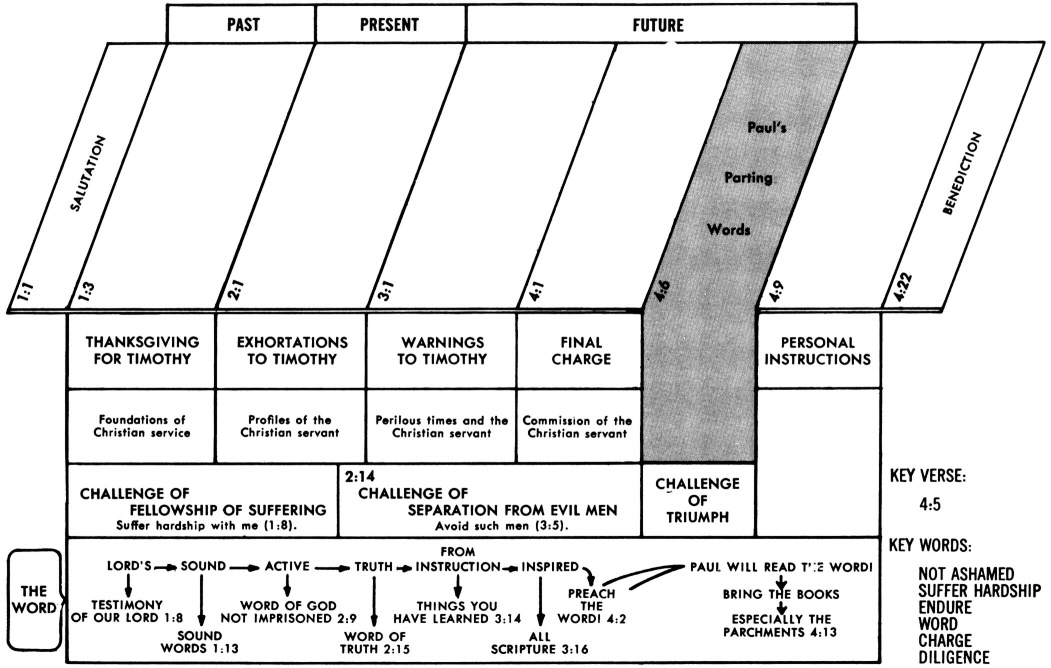
ENDURANCE AND SEPARATION IN THE MINISTRY
Click chart to enlarge
Charts from Jensen's Survey of the NT - used by permission
Second Timothy - Swindoll
| 2 TIMOTHY | |||
| 2 Timothy 1:1-18 | 2 Timothy 2:1-26 | 2 Timothy 3:1-17 | 2 Timothy 4:1-22 |
| Retain the Standard |
Rightly Divide the Word |
Difficult Times Will Come |
Preach the Word |
| PAST | PRESENT | FUTURE | |
| Foundation of Christian Service |
Pictures of Christian Servant |
Dangerous Times for Christian Servant |
Commission of Christian Servant |
| Unashamed as a Witness: Guard the Gospel |
Unashamed as a Workman: Suffer for the Gospel |
Adequate as a Workman: Continue in the Gospel |
Awarded as a Workman: Preach the Gospel |
| Power of the Gospel |
Perseverance of the Gospel Message | Protection of the Gospel |
Proclamation of the Gospel |
| Reminder | Requirements | Resistance | Requests |
| Encouragement in Ministry |
Examples in Ministry |
Exhortations in Ministry |
Exhortations to Fulfill Ministry |
| Commendation & Charge |
Commission to Fulfill |
Conflict to Face |
Course to Finish |
|
Compiled from Jensen's Survey of the NT and Wilkinson's Talk Thru the Bible |
|||
2 Timothy 3:12 Indeed, all who desire to live godly in Christ Jesus will be persecuted (NASB: Lockman)
Greek: kai pantes de oi thelontes (PAPMPN) eusebos zen (PAN) en Christo Iesou diocthesontai; (3PFPI)
Amplified: Indeed all who delight in piety and are determined to live a devoted and godly life in Christ Jesus will meet with persecution [will be made to suffer because of their religious stand]. (Amplified Bible - Lockman)
Barclay: And those who wish to live a godly life in Christ Jesus will be persecuted;
KJV: Yea, and all that will live godly in Christ Jesus shall suffer persecution.
NJB: But anybody who tries to live in devotion to Christ is certain to be persecuted. (NJB)
Rotherham: Yea and, all who are determined to live in a godly manner in Christ Jesus, will be persecuted." Are you determined to do what is right in the sight of God
Phillips: Persecution is inevitable for those who are determined to live really Christian lives, (Phillips: Touchstone)
Wuest: And all indeed who desire to be living a life of piety towards God in Christ Jesus shall be persecuted.
Young's Literal: and all also who will to live piously in Christ Jesus shall be persecuted,
AND INDEED ALL WHO DESIRE: kai pantes de oi thelontes (PAPMPN):
- 2 Timothy 3 Resources - Multiple Sermons and Commentaries
- 2 Timothy 3:10-15 Spiritual Faithfulness - Steven Cole
- 2 Timothy 3:10-13 Standing Against Apostasy, Part 1 - John MacArthur
All (pas) means everyone without exception -- with the caveat that they must fulfill certain qualifications in order to receive the "promise" of persecution! What are the conditions one must meet? There must first be the right attitude - a desire and this desire must have God-ward direction. And lastly, and most important, they must be the right "energy". Paul says a godly, Christlike life is only possible by abiding in Him, in Christ, in the Vine, the Ark of our salvation. See related discussion of the phrases in Christ and in Christ Jesus.
It follows that from a practical standpoint every saint desiring to live godly should not regard the resulting experience as peculiar, but only as part of the price of loyal service to Christ. Jesus made it very clear to His disciples that...
If the world hates (present tense = their continual reaction to) you, you know that it has hated Me before it hated you. If you were of the world (note He does not say "in" the world but "of" the world), the world would love its own; but because you are not of the world, but I chose you out of the world, therefore the world hates (present tense = their continual reaction to) you. Remember the word that I said to you, 'A slave is not greater than his master.' If they persecuted Me, they will also persecute you; if they kept My word, they will keep yours also. But all these things they will do to you for My name's sake, because they do not know the One who sent Me. (John 15:18-21)
In the sermon on the mount Jesus said there was a beatitude in store for those who suffered in His place...
Blessed (makarios - word study) are those who have been persecuted for the sake of righteousness, for theirs is the kingdom of heaven. Blessed are you when people insult you and persecute you, and falsely say all kinds of evil against you because of Me. "Rejoice (present imperative) and be glad (present imperative), for your reward in heaven is great; for in the same way they persecuted the prophets who were before you. (See notes Matthew 5:10, 11, 12)
Paul explained to the saints at Philippi that...
to you it has been granted (charizomai - from charis = grace -- a gift of grace!) for Christ's sake, not only to believe in Him, but also to suffer for His sake (Php 1:29-note)
Peter has a parallel warning exhortation...
Beloved, do not be surprised (present imperative + a negative = stop an action or reaction that is already in progress; i.e., they were being surprised by the trials!) at the fiery ordeal among you, which comes upon you for your testing (note carefully the trials God sends or allows are not without a high and holy purpose, cp Dt 8:2 Moses to Israel "testing you, to know what was in your heart"), as though some strange thing were happening to you but to the degree that you share the sufferings of Christ, keep on rejoicing; so that also at the revelation of His glory, you may rejoice with exultation (agalliao). If you are reviled for the name of Christ, you are blessed, because the Spirit of glory and of God rests upon you." (see notes 1Peter 4:12; 13; 14)
Paul encouraged the Thessalonians with words about the inevitability of their suffering reminding them that
we sent Timothy, our brother and God's fellow worker in the gospel of Christ, to strengthen and encourage you as to your faith, so that no man may be disturbed by these afflictions; for you yourselves know that we have been destined for this. (see notes 1Thessalonians 3:2; 3:3)
Desire (thelo) refers to a desire that comes from one’s emotions and indicates an active decision of the will, thus implying volition and purpose.
These men and women are continually (present tense) desiring to pursue godliness and it reflects an active decision (active voice) of their will.
Vine adds that thelo
expresses not simply a desire but a determined and constant exercise of the will.
Vincent translates this as all
Whose will is to live, or who are bent on living.
The present tense points to those whose who have an abiding determination to live a godly life. Notice that desire in the present tense indicates this is not an occasional desire to choose to live godly, but a persistent passion which manifests itself in their lifestyle. They recognize that they are not in a religious "100 meter dash" but a spiritual "marathon". And so Paul exhorted Timothy to...
discipline (present imperative = command to make this his lifestyle) yourself for the purpose of godliness; 8 for bodily discipline is only of little profit, but godliness is profitable for all things, since it holds promise for the present life and also for the life to come. 9 It is a trustworthy statement deserving full acceptance. 10 For it is for this we labor (kopiao = to the point of weariness and exhaustion) and strive (agonizomai = agonize), because we have fixed our hope on the living God, who is the Savior of all men, especially of believers. (See notes 1Ti 4:7; 4:8; 4:9; 4:10)
Yes, pursuit of godliness is costly now but eternity will show it to be worth the cost of commitment.
If anyone proposes to introduce into his life a loyalty which surpasses all earthly loyalties, there will be clashes with this "present evil age" (Gal 1:4) that loves self rather than the Savior. And that is precisely the loyalty that Christ demands of a disciple. (Matthew 6:24-note)
In sum, it is vital for every young "Timothy" to remember that persecution is an integral part of the godly life in Christ Jesus. Otherwise, when we encounter persecution, we might be tempted to think that he has failed the Lord or that the Lord is displeased.
As Steven Cole observes this "promise of persecution" means that...
spiritual faithfulness requires recognizing and following godly examples who follow the Scriptures. You can recognize them by their teaching, their character, and their godly demeanor under trials. But, once you recognize them, you need to follow them. (Spiritual Faithfulness)
William Hendricksen has written that...
Scars are the price which every believer pays for his loyalty to Christ.
TO (continually) LIVE GODLY IN CHRIST JESUS: eusebos zen (PAN) en Christo Iesou:
- 2Co1:12; 1Ti 2:2; 3:16; 6:3; Titus 1:1; 2:12; 2Pe 3:11
- 2 Timothy 3 Resources - Multiple Sermons and Commentaries
- 2 Timothy 3:10-15 Spiritual Faithfulness - Steven Cole
- 2 Timothy 3:10-13 Standing Against Apostasy, Part 1 - John MacArthur
in union with Christ Jesus (GWT)
united with the Messiah Yeshua (Jewish NT)
Godfearingly
The TEV paraphrases it
a godly life in union with Christ Jesus
Vance Havner said...
If you are under any illusions about the attitude of this world towards Jesus Christ, try really living for him for a week and you will find out!
Live (zao) can refer to living a natural physical life, to the general idea how one conducts themselves or behaves (as in this verse) and to the supernatural, spiritual life, resurrected eternal life which is available to believers now. The present tense depicts one who is making it a habit to daily determine to die to self (Mk 8:34), to present one's self as a living sacrifice (Romans 12:1-note), daily making the choice that Christ is Lord of every area of my life. And so we see a godly life is not native to the human heart but can only be lived "in Christ Jesus". The only way to live godly is in vital spiritual union with Christ Jesus (cf Galatians 2:20-note Ro 6:5-note Ro 7:4-note), abiding in the Vine (John 15:5) and living in obedience to Him in the grace He provides. He is the only source and sphere of a truly godly life. The believer experiences fellowship with Christ in suffering as a part of the mystical union with Him. On the other hand, it is possible to be persecuted for being obnoxious, rather than for being obedient. Disciples are not called to go looking for trouble but simply to obey Christ and when you do trouble is not far behind!
Paul writing to Titus explains that it is possible to live godly because "the grace of God has appeared...instructing ("child training" - in context what trains us?) us to deny ungodliness and worldly desires and to live sensibly, righteously and godly in the present age (continuously, earnestly, expectantly) looking for the blessed hope and the appearing of the glory of our great God and Savior, Christ Jesus (what should motivate us to "live godly"?). (Titus 2:11; 12; 13; 2:14-see notes Titus 2:11; 12; 13; 2:14)
Hugh Latimer has an interesting thought postulating that...
Wherever you see persecution, there is more than a probability that truth is on the persecuted side.
Godly (2153) (eusebos from eu = well + sebomai = reverence <> Sebomai is from root "seb" = sacred awe ) is an attitude of reverence exhibited in one's actions. In secular Greek use eusebos described practical piety towards one's parents. The Greek root was also commonly used in the Greco-Roman world of Paul to describe respect for the pagan gods. For example in one ancient text we read
Can there be any better or more reverent (godly) way to honor the gods than by doing what they command?
In summary, eusebos means reverence or awe that is well directed. It is not talking "godly" but living "godly". The godly person lives a life characterized by a "Godward" attitude leading to actions that are well-pleasing to Him.
Spurgeon "qualifies" the persecution Paul is referring to admonishing the disciple to...
Take care if the world does hate you that it hates you without cause.
Pope writes that...
godly indicates the Christian life on its ethical side in the life of conduct; the words 'in Christ' give the other aspect of the Christian life--its inner, mystic fellowship with Christ.
Hiebert writes that
There is an intimate connection between truth and godliness. A vital possession of truth is inconsistent with irreverence…. Real truth never deviates from the path of piety. A profession of the truth which allows an individual to live in ungodliness is a spurious profession
Noah Webster's 1828 dictionary defines "godly" as
"living in obedience to God's commands, from a principle of love to him and reverence of his character and precepts."
Vine emphasizes that godly...
is not sanctimoniousness ('hypocritical holiness", cf note 2 Timothy 3:5). It cannot be exercised except in communion with Christ; hence the phrase “in Christ Jesus; hence the phrase “in Christ Jesus.” The order of the titles points to the living person, Christ, who became man, Jesus, in order to be our Savior. Not the simple phrase “in Christ” is here used, expressing our position in Him, but the double title, indicating His power as the Lord and sustainer of our life in all its vicissitudes."
Edwards adds that
Paul is careful to point out that his persecution was not anything out of the ordinary. It is in fact, an absolute promise for any believer "who desires to live godly in Christ Jesus." Though there are not many believers standing in line to claim this promise, it is nevertheless a sure promise from God's word. The word for "desire" (thelo) can also be translated "wish" or "want'. The thought seems to be that any believer with the slightest inkling to break ranks with the world and walk in line behind Christ will feel the heat of this world's rage. If we find that we seldom, if ever, are being persecuted for our faith, then certainly we must question whether we genuinely are "living godly in Christ Jesus." (Call to Completion)
As H T Mahan said...
Persecution and opposition ought to encourage rather than discourage us, for we are faithfully warned by our Lord that the natural man and the religionist will not receive the gospel of the grace of God.
Milner phrased it similarly writing that...
Persecution often does in this life what the last great day will do completely—separate the wheat from the tares.
Bishop Ryle agrees writing that...
Persecution is like the goldsmith's hallmark on real silver and gold; it is one of the marks of a converted man.
Realize also that "suffering for Christ" is not only physical abuse but can include social ostracism and verbal insults:
Blessed are you when men hate you, and ostracize you, and cast insults at you, and spurn your name as evil, for the sake of the Son of Man. (Lk 6:22)
"A good man a good mark for the arrow: — The better the man, the sooner persecuted; the devil shoots his arrows at the whitest marks." Hall writes "It is a miracle of mercy to consider how the lily subsists in the midst of so many briars and thorns, how the Lord’s wheat grows in the midst of so many tares, how His doves live in the midst of so many birds of prey, and His lambs in the midst of so many roaring lions. Were not the Almighty her defence, those bands of ungodliness would soon destroy her...God is pleased to reserve the sweetest manifestations from the bitterest afflictions. The fountain runs most sweetly when the cistern is broken. When comforts are most needed they will be most prized. The traveler in summer, when the sun shines, casts off his cloak, but in winter, or when the wind blows hard, he wraps it closer to him. So when we bathe ourselves in creature comforts we value not the promises of God, but when we are stripped of all then we look after God. When the salt waters are dried up, then there are fresh springs in God." (The Biblical Illustrator)
WILL BE PERSECUTED: diocthesontai (3PFPI):
- Jos 17:14; Ps 37:12, 13;37:14, 37:15 Mt 5:10, 5:11, 5:12; 10:22;10:23, 24, 25, 16:24; 23:34; Mk 10:30; Lk 14:26; 27 Jn 15:19;20, 21, 16:2; 33; 17:14; Acts 14:22; Ro 8:17 1Co 15:19; 1Th 3:3; 4 Heb 11:32, 33; 34, 35, 36, 37, 38 1Pe 2:20; 21, 3:14; 4:12, 13, 14, 15, 16, 5:9; 10 Rev 1:9; 10, 7:14; 12:4, 7, 8, 9, 10
- 2 Timothy 3 Resources - Multiple Sermons and Commentaries
- 2 Timothy 3:10-15 Spiritual Faithfulness - Steven Cole
- 2 Timothy 3:10-13 Standing Against Apostasy, Part 1 - John MacArthur
A BIBLE PROMISE WE
SOMETIMES WISH WERE NOT ONE!
This verse is not usually listed in the books that compile God's promises in a book. While we don't relish persecution, persecution does have a way of separating the wheat from the chaff, so that the cream comes to the top. False professors are weeded out. True possessors of Christ's indwelling life and empowering Spirit are strengthened like moss attached to a tree, so that when the winds of adversity howl, the moss is is blown closer to the tree. Persecution fans the flames of the explosion of evangelism (Acts 8:1).
See sermon by the great revival preacher George Whitfield Persecution: Every Christian's Lot
Steven Cole (Spiritual Faithfulness) observes that "While the type and intensity of the persecution will vary from ridicule or rejection to physical violence or even death, every true Christian who lives a godly life in this evil world will experience persecution. If you are honest at work, your honesty will convict those who cheat, and they will try to get you. If you speak out about injustice or evil, you will be ridiculed and attacked. Calvin (Calvin's Commentaries [Baker], on 2 Ti 3:12, p. 244) put it plainly: they who wish to be exempt from persecutions must necessarily renounce Christ.
Barclay - If anyone proposes to accept a set of standards quite different from the world's, he is bound to encounter trouble. If anyone proposes to introduce into his life a loyalty which surpasses all earthly loyalties, there are bound to be clashes. And that is precisely what Christianity demands that a man should do. (2 Timothy 3 - William Barclay's Daily Study Bible)
Calvin - Persecutions are in a way seals of adoption to the children of God.
B E Fernando echoes the conclusion that...
Persecution is one of the surest signs of the genuineness of our Christianity.
Or as Billy Graham put it...
It is unnatural for Christianity to be popular.
Persecuted (1377) (dioko [word study]) means literally to be hunted, and then to be followed or pressed hard after, pursued with earnestness and diligence with repeated acts of enmity (See J C Ryle's sermon esp part III Formalism). The picture of the verb dioko is of a fox being chased and hunted by the bloodhounds. Samuel Rutherford in fact wrote that...
If you were not strangers here the hounds of the world would not bark at you.
Paul is reminding Timothy, as well as us, that persecutions and afflictions are required courses in Christ's school of discipleship, not electives!
William Barclay wrote that when...
Anyone proposes to introduce into his life a loyalty which surpasses all earthly loyalties, then there are bound to be clashes and collisions. (The Daily Study Bible Online)
Opposition will come when we attempt to bring the light of Christ into a world that loves darkness. Jesus described this same principle in His nighttime conversation with the Jewish teacher Nicodemus declaring that...
this is the judgment, that the light is come into the world, and men loved the darkness rather than the light; for their deeds were evil. For everyone who does evil hates the light, and does not come to the light, lest his deeds should be exposed. (John 3:19-20)
As Paul wrote to the Galatians he did not shrink back from proclaiming the truth because of fear of persecution:
But I, brethren, if I still preach circumcision, why am I still persecuted? Then the stumbling block of the cross has been abolished."
Or as stated in paraphrase:
Dear friends, if I were still preaching that you must be circumcised--as some say I do--why would the Jews persecute me? The fact that I am still being persecuted proves that I am still preaching salvation through the cross of Christ alone. (NLT) (Gal 5:11)
Vine adds that
This antagonism is something to be expected but not to be feared. Nay, rather it is the believer’s glory....Faithfulness to the Lord draws the hostility of the foe but makes the faithful one safe in His keeping.
Because of the abiding antagonism of the world to genuine godliness, persecution is the natural lot of the godly. Persecution and suffering for sake of Christ is a truth interwoven all through the NT in stark contrast to the paucity of preaching on persecution from pulpits in pampered American Christianity.
Jesus emphasized that His disciples would
be hated by all on account of My name ...a disciple is not above his teacher, nor a slave above his master (Mt 10:22,24)
In Acts Paul forewarned the new converts that God had a wonderful plan for their life and it included the truth that
Through many tribulations we must enter the kingdom of God. (Acts 14:22)
Hiebert adds that persecution
may vary in degree and take different forms in different countries and in different ages, but the basic hostility of the world to the godly man remains unchanged.
Indeed some persecution may be overt but some persecution is subtle coming in the form of rejection, including being ignored, being patronized, being mocked (by word or a look), condescension, etc. And we can be sure that whatever form it takes the persecution will hurt for as Augustine once said it will be painful...
even when no one molests or vexes their body; for they suffer this persecution, not in their bodies, but in their hearts.
When our will is dedicated to God, Satan's will is to demolish our resolve with persecution.
Webster says that persecution means to oppress or harass persistently implying a relentless and unremitting subjection to annoyance or suffering. Don't get a "persecution complex" when you're persecuted for the sake of Christ, for as the Puritan Thomas Watson wrote "The weight of glory makes persecution light."
The International Standard Bible Encyclopedia defines persecution as
"the suffering or pressure, mental, moral, or physical, which authorities, individuals, or crowds inflict on others, especially for opinions or beliefs, with a view to their subjection by recantation, silencing, or, as a last resort, execution."
Gill writes that persecution of the godly
"is the will of God, and the appointment of heaven; Christ has foretold it, that so it shall be; and He the head has suffered it Himself, and it is necessary that His members should, that they may be conformed unto Him; it is the way Christ Himself went to glory, and through many tribulations His people must enter the kingdom; and this is the common lot and certain case of all the saints, in one shape or another; for though all do not suffer confiscation of goods, beating, scourging, imprisonment, or a violent death yet all are more or less afflicted and distressed by wicked men, and are subject to their reproaches and reviling, which are a branch of persecution; and that for professing Christ, and living a godly life in Him and under His influence: and since such suffer as Christians, and not as evildoers; and this is the common condition of the people of God, in this world, it should not be thought strange, but be cheerfully endured; to encourage to which is the apostle's view in this passage."
Hast thou no scar?
by Amy Carmichael
Hast thou no scar?
No hidden scar on foot, or side, or hand?
I hear thee sung as mighty in the land,
I hear them hail thy bright ascendant star:
Hast thou no scar?
Hast thou no wound?
Yet, I was wounded by the archers, spent.
Leaned me against the tree to die, and rent
By ravening beasts that compassed me, I swooned:
Hast thou no wound?
No wound? No scar?
Yes, as the master shall the servant be,
And pierced are the feet that follow Me;
But thine are whole. Can he have followed far
Who has no wound? No scar?
So do you think you've been persecuted for the Lord's sake? Read a few sequential entries from the diary of John Wesley a "vessel for honor" used mightily by God for the "good work" of national spiritual revival (The First Great Awakening). Notice the school that he had to "graduate from" in preparation for his being used mightily! And then commit to...
be (present imperative = command to make continually be) steadfast, immovable, always abounding in the work of the Lord knowing that your toil is not in vain in the Lord. (1Cor 15:58)
Wesley's diary entries...
Sunday, A.M., May 5 Preached in St. Anne's. Was asked not to come back anymore.
Sunday, P.M., May 5 Preached in St. John's. Deacons said "Get out and stay out."
Sunday, A.M., May 12 Preached in St. Jude's. Can't go back there, either.
Sunday, A.M., May 19 Preached in St. Somebody Else's. Deacons called special meeting and said I couldn't return.
Sunday, P.M., May 19 Preached on street. Kicked off street.
Sunday, A.M., May 26 Preached in meadow. Chased out of meadow as bull was turned loose during service.
Sunday, A.M., June 2 Preached out at the edge of town. Kicked off the highway.
Sunday, P.M., June 2 Afternoon, preached in a pasture. Ten thousand people came out to hear me.
MacArthur adds that
Self-centered Christians who serve the Lord halfheartedly seldom have to pay a price for their faith. They are of little threat to Satan’s work because they are of little benefit to Christ’s.
Clarke (critique) says
So opposite to the spirit and practice of the world is the whole of Christianity, that he who gives himself entirely up to God, making the Holy Scriptures the rule of his words and actions, will be less or more reviled and persecuted.
“If you were arrested for being a Christian,
would there be enough evidence to convict you?”
The godly life is the evidence.
Some practical applications: Don't be surprised and in fact even expect it when the world held fast in the grip of "the evil one" (1Jn 5:19) despises and hates you. We should be prepared for persecution in one form or another and not be surprised by it or fearfully shrink from it to avoid it. Such forewarning allows the thoughtful Christian to be armed with commitment and ready for certain and incessant spiritual warfare. We should consider that persecution may be one evidence that one indeed has the spirit of Christ, and are His true friends. When one is treated as the Master was they must recall that they are in good company with the prophets, apostles, and martyrs who were all likewise persecuted. If we are persecuted, we should carefully inquire, before we avail ourselves of this consolation that our Master was also persecuted, whether we are persecuted because we “live godly in Christ Jesus,” or for some other reason. If we have never experienced persecution for the sake of righteousness, we have cause to examine whether we are truly His disciples or at the very least we should question the depth of our commitment.
As John Wesley said
Either the truth of scripture fails, or those that think they are religious, and are not persecuted, in some shape or other, on that very account, deceive themselves.
Peter also encourages us to live godly in Christ Jesus for
"even if you should suffer for the sake of righteousness, you are blessed. AND DO NOT FEAR THEIR INTIMIDATION, AND DO NOT BE TROUBLED." (see note 1 Peter 3:14)
2 Timothy 3:13 But evil men and impostors will proceed from bad to worse, deceiving and being deceived. (NASB: Lockman)
Greek: poneroi de anthropoi kai goetes prokopsousin (3PFAI) epi to cheiron, planontes (PAPMPN) kai planwmenoi. (PPPMPN)
Amplified: But wicked men and imposters will go on from bad to worse, deceiving and leading astray others and being deceived and led astray themselves. (Amplified Bible - Lockman)
Barclay: while evil men and impostors will go from bad to worse, deceived themselves and deceiving others.
KJV: But evil men and seducers shall wax worse and worse, deceiving, and being deceived.
Phillips: while wicked and deceitful men will go from bad to worse, deluding others and deluding themselves. (Phillips: Touchstone)
Wuest: But pernicious men and impostors shall go on from bad to worse, leading astray and being led astray.
Young's Literal: and evil men and impostors shall advance to the worse, leading astray and being led astray.
BUT EVIL MEN: poneroi de anthropoi:
- 2 Ti 3:8-note; 2Ti 2:16-note, 2Ti 2:17-note; 2Th 2:6;2:7, 2:8, 2:9, 2:10, 1Ti 4:1; 2Pe 2:20-note; 2Pe 3:3-note; Rev 12:9-note; Re 13:14-note; Re 18:23-note
- 2 Timothy 3 Resources - Multiple Sermons and Commentaries
- 2 Timothy 3:10-15 Spiritual Faithfulness - Steven Cole
- 2 Timothy 3:10-13 Standing Against Apostasy, Part 1 - John MacArthur
2 Ti 3:8-note — And just as Jannes and Jambres opposed Moses, so these men also oppose the truth, men of depraved mind, rejected as regards the faith.
2 Ti 2:16-note — But avoid worldly and empty chatter, for it will lead to further ungodliness,
2 Ti 2:17-note — and their talk will spread like gangrene. Among them are Hymenaeus and Philetus
But (1161) - Now Paul presents a striking contrast in character and consequences. Persecution for godliness is far better than deception for wickedness.
Evil (4190) (poneros from poneo = work or toil, Robertson says the idea is that labor is an annoyance, bad, evil; Noun poneria derived from poneros) means evil including evil, malignant character, pernicious (see Webster 1828 definition below), that which is morally or socially worthless, wicked, base, bad, degenerate. Poneros denotes determined, aggressive, and fervent evil that actively opposes what is good. Poneros is not just bad in character (like kakos - see below), but bad in effect (injurious)!
Poneros describes evil in active opposition to good. It means not only evil in its nature but viciously evil in its influence and actively harmful. Poneros used to describe Satan (ho poneros = "Evil one"), the god of this age, who is corrupting man and dragging him to destruction. This denotes someone who is not content in being corrupt themselves. They seek to corrupt others and draw them into the same destruction!
Webster on evil - morally reprehensible, sinful, arising from actual or imputed (Ed: We all have Adam's "bad character" imputed!) bad character or conduct (Ed: Bad character always precedes bad conduct, the latter being the most visible manifestation of the former), causing discomfort or repulsion, offensive, causing harm, pernicious, deficient in quality in a physical sense and thus worthless (Mt 7:17-18). Webster's 1828 Edition on evil = 1. Having bad qualities of a natural kind; mischievous; having qualities which tend to injury, or to produce mischief. Some evil beast hath devoured him. Gen. 37. 2. Having bad qualities of a moral kind; wicked; corrupt; perverse; wrong; as evil thoughts; evil deeds; evil speaking; an evil generation. Scripture. 3. Unfortunate; unhappy; producing sorrow, distress, injury or calamity; as evil tidings; evil arrows; evil days.
Webster's 1828 edition on pernicious = PERNI´´CIOUS, a. [L. perniciosus, from pernicies; perneco, to kill; per and nex, necis, death.] 1. Destructive; having the quality of killing, destroying or injuring; very injurious or mischievous. Food, drink or air may be pernicious to life or health. 2. Destructive; tending to injure or destroy. Evil examples are pernicious to morals. Intemperance is a pernicious vice.
There are two Greek words for evil - poneros and kakos, the latter describing that which is inherently evil. Poneros on the other hand refers to the one who (or the thing that) is not only evil but is not content unless it carries out active evil, evil is actively harmful, hurtful and corrupting. It is therefore not surprising that poneros is one of the synonyms for "Satan" himself. The Greek ho poneros means "the (specific) evil" (translated "the evil one") and is used of the Devil (diabolos) in Mt 13:19, 38, Eph 6:16, 2Th 3:3, 1Jn 2:13-14, 3:12, 5:18-19. Indeed, the Devil is called the evil one, not only because he is intrinsically evil, but also because he is an evil doer, out to deceive and harm his victims. Some would add he is described in Mt 6:13 where Jesus instructs us to pray "deliver us from evil (literally "tou ponerou" ~ "the evil")." The NET Note on Mt 6:13-note says "The term ponerou may be understood as specific and personified, referring to the devil, or possibly as a general reference to evil. It is most likely personified since it is articular (tou ponerou). Cf. also "the evildoer" in Mt 5:39, which is the same construction." Vine - "Kakos may simply mean what is evil in itself; poneros carries with it the idea of what is pernicious and acts detrimentally to others, not only evil (passively bad), but evilly disposed (actively harmful), whether in matters of false doctrine, or temptations in the moral sphere. The young men who are addressed have so far proved faithful, and have not yielded themselves to the corrupting influences around them."
Vine - akin to ponos, "labor, toil," denotes "evil that causes labor, pain, sorrow, malignant evil"; it is used (a) with the meaning bad, worthless, in the physical sense, Matthew 7:17,18 ; in the moral or ethical sense, "evil," wicked; of persons, e.g., Matthew 7:11 ; Luke 6:45 ; Acts 17:5 ; 2 Thessalonians 3:2 ; 2Timothy 3:13 ; of "evil" spirits, e.g., Matthew 12:45 ; Luke 7:21 ; Acts 19:12,13,15,16 ; of a generation, Matthew 12:39,45; 16:4 ; Luke 11:29 ; of things, e.g., Matthew 5:11; 6:23; 20:15 ; Mark 7:22; Luke 11:34 ; John 3:19; 7:7 ; Acts 18:14 ; Galatians 1:4 ; Colossians 1:21 ; 1 Timothy 6:4 ; 2 Timothy 4:18; Hebrews 3:12; 10:22 ; James 2:4; 4:16 ; 1John 3:12 ; 2John 1:11 ; 3John 1:10 ; (b) with the meaning toilsome, painful, Ephesians 5:16, 6:13 ; Revelation 16:2 . Cp. poneria, "iniquity, wickedness."...the adjective poneros is used as a noun, (a) of Satan as the "evil" one, Matthew 5:37; 6:13; 13:19,38 ; Luke 11:4 (in some texts); John 17:15 ; Ephesians 6:16 ; 2Thessalonians 3:3 ; 1John 2:13,14; 3:12; 5:18,19 ; (b) of human beings, Matthew 5:45 ; (probably ver. 39); Mt 13:49; 22:10; Luke 6:35; 1Corinthians 5:13 ; (c) neuter, "evil (things)," Matthew 9:4; 12:35; Mark 7:23; Luke 3:19 ; "that which is evil," Luke 6:45 ; Romans 12:9 ; Acts 28:21 , "harm." (Evil, Evil-Doer - Vine's Expository Dictionary of NT Words)
Liddell-Scott - toilsome, painful, grievous, Theogn., Ar. II. in bad case, in sorry plight, useless, good-for-nothing, Ar., Plat., etc.:-Adv., to be in bad case, Thuc. III. in moral sense, bad, worthless, knavish, Lat. pravus, improbus, Aesch., Eur.; rogue and son of rogues, Ar.; laboriously wicked, . 2. base, cowardly, Soph.
Poneros is an adjective that modifies a wide variety of subjects in the NT including (but not inclusive)...
- Some of the the scribes and Pharisees,
- evil demonic spirits,
- evil eye which fills the whole body with great darkness (it's an eye that actively works evil)
- evil treasure in the heart,
- bad fruit,
- evil and adulterous generation craving a sign,
- tares of the evil one,
- evil thoughts (out of heart),
- deliverance from this present evil age,
- days as evil,
- call to resist in the evil day,
- an evil conscience,
- evil motives,
- Cain as of the evil one.
Friberg - ; (1) adjectivally; (a) as what is physically disadvantageous = bad, harmful, evil, painful (Eph 5.16; Rev 16.2); (b) of persons and things, as of little worth to anyone = useless, unprofitable, unserviceable (Mt 7.18; 18.32; perhaps Mt 6.23 and Lk 11.34); (c) in a moral sense of persons and things characterized by ill will = evil, wicked, malicious (Mt 12.35; probably Mt 6.23 and Lk 11.34); (2) substantivally; (a) of persons = evildoer, wicked person, bad person (Mt 13.49); (b) as a term for the devil = the evil or wicked one (Mt 13.19)
Poneros - 78x in 72v - NAS = bad(5), crimes(1), envious(1), envy*(1), evil(50), evil one(5), evil things(1), malignant(1), more evil(1), more wicked(1), vicious(1), wicked(6), wicked man(1), wicked things(1), worthless(1).
Matthew 5:11-note "Blessed are you when people insult you and persecute you, and falsely say all kinds of evil against you because of Me.
37-note "But let your statement be, 'Yes, yes ' or 'No, no'; anything beyond these is of evil.
39-note "But I say to you, do not resist an evil person; but whoever slaps you on your right cheek, turn the other to him also.
45-note so that you may be sons of your Father who is in heaven; for He causes His sun to rise on the evil and the good, and sends rain on the righteous and the unrighteous.
Matthew 6:13-note (see Mt 6:12)'And do not lead us into temptation, but deliver us from evil. For Yours is the kingdom and the power and the glory forever. Amen.'
23-note "But if your eye is bad (eye evil), your whole body will be full of darkness. If then the light that is in you is darkness, how great is the darkness!
MacArthur - These verses expand on the previous three, and the eye becomes an illustration of the heart. The lamp, or lens, of the body is the eye, through which all light comes to us. It is the only channel of light we possess, and therefore our only means of vision. The heart is the eye of the soul, through which the illumination of every spiritual experience shines. It is through our hearts that God’s truth, love, peace, and every other spiritual blessing comes to us. When our hearts, our spiritual eyes, are clear, then our whole body will be full of light. Haplous (clear) can also mean single, as it is translated in the King James Version. An eye that is clear represents a heart that has single-minded devotion. Bishop John Charles Ryle said, “Singleness of purpose is one great secret of spiritual prosperity” (Expository Thoughts on the Gospels: St. Matthew [London: James Clarke, 1965], p. 56). Words that are closely related to haplous mean “liberality” (Ro 12:8; 2 Cor. 9:11) and “generously” (James 1:5). The implication in the present verse is that if our heart, represented by the eye, is generous (clear), our whole spiritual life will be flooded with spiritual understanding, or light. If our eye is bad, however, if it is diseased or damaged, no light can enter, and the whole body will be full of darkness. If our hearts are encumbered with material concerns they become “blind” and insensitive to spiritual concerns. The eye is like a window which, when clear, allows light to shine through, but, when dirty, or bad, prevents light from entering. Ponēros (bad) usually means evil, as it is translated here in the King James Version.
In the Septuagint (Lxx) (Greek Old Testament) poneros is often used in translating the Hebrew expression “evil eye," (Ed: See Mk 7:22 below where "envy" is literally "evil eye") a Jewish colloquialism that means grudging, or stingy (see Deut. 15:9, “hostile”; Pr. 23:6, “selfish”). “A man with an evil eye,” for example, is one who “hastens after wealth” (Pr. 28:22). The eye that is bad is the heart that is selfishly indulgent. The person who is materialistic and greedy is spiritually blind. Because he has no way of recognizing true light, he thinks he has light when he does not. What is thought to be light is therefore really darkness, and because of the self-deception, how great is the darkness! The principle is simple and sobering: the way we look at and use our money is a sure barometer of our spiritual condition. {MacArthur New Testament Commentary}
Matthew 7:11-note "If you then, being evil, know how to give good gifts to your children, how much more will your Father who is in heaven give what is good to those who ask Him!
17-note "So every good tree bears good fruit, but the bad tree bears bad fruit.
18-note "A good tree cannot produce bad fruit, nor can a bad tree produce good fruit.
Matthew 9:4 And Jesus knowing their thoughts said, "Why are you thinking evil in your hearts?
Matthew 12:34 "You brood of vipers, how can you, being evil, speak what is good? For the mouth speaks out of that which fills the heart.
35 "The good man brings out of his good treasure what is good; and the evil man brings out of his evil treasure what is evil.
39 But He answered and said to them, "An evil and adulterous generation craves for a sign; and yet no sign will be given to it but the sign of Jonah the prophet;
45 "Then it goes and takes along with it seven other spirits more wicked than itself, and they go in and live there; and the last state of that man becomes worse than the first. That is the way it will also be with this evil generation."
Matthew 13:19 "When anyone hears the word of the kingdom and does not understand it, the evil one comes and snatches away what has been sown in his heart. This is the one on whom seed was sown beside the road.
38 and the field is the world; and as for the good seed, these are the sons of the kingdom; and the tares are the sons of the evil one;
49 "So it will be at the end of the age; the angels will come forth and take out the wicked from among the righteous,
Matthew 15:19 "For out of the heart come evil thoughts, murders, adulteries, fornications, thefts, false witness, slanders.
Matthew 16:4 "An evil and adulterous generation seeks after a sign; and a sign will not be given it, except the sign of Jonah." And He left them and went away.
Matthew 18:32 "Then summoning him, his lord said to him, 'You wicked slave, I forgave you all that debt because you pleaded with me.
Matthew 20:15 'Is it not lawful for me to do what I wish with what is my own? Or is your eye envious (literally your "Eye evil") because I am generous?'
Matthew 22:10 "Those slaves went out into the streets and gathered together all they found, both evil and good; and the wedding hall was filled with dinner guests.
Matthew 25:26 "But his master answered and said to him, 'You wicked, lazy slave, you knew that I reap where I did not sow and gather where I scattered no seed.
Mark 7:22 deeds of coveting and wickedness, as well as deceit, sensuality, envy (literally "an Evil eye" a Hebrew idiom = ophthalmos poneros), slander, pride and foolishness. 23 "All these evil things proceed from within and defile the man."
Barclay - There follows evil deeds. In Greek there are two words for evil--kakos, which describes a thing which in itself is evil, and poneros, which describes a person or a thing which is actively evil. Poneria is the word used in Mk 7:22. The man who is poneros is the man in whose heart there is the desire to harm. He is, as Bengel said, "trained in every crime and completely equipped to inflict evil on any man." Jeremy Taylor defined this poneria as "aptness to do shrewd turns, to delight in mischiefs and tragedies; loving to trouble our neighbor, and to do him ill offices; crossness, perverseness and peevishness of action in our intercourse." Poneria not only corrupts the man who has it; it corrupts others too. Poneros--the Evil One--is the title of Satan. The worst of men, the man who is doing Satan's work, is the man who, being bad himself, makes others as bad as himself. (Mark 7-- William Barclay's Daily Study Bible)
Barclay on the derivative noun poneria in Ro 1:29 - Villainy ("wickedness" = poneria). In Greek this word means more than badness. There is a kind of badness which, in the main, hurts only the person concerned. It is not essentially an outgoing badness. When it hurts others, as all badness must, the hurt is not deliberate. It may be thoughtlessly cruel, but it is not callously cruel. But the Greeks defined poneria as the desire of doing harm. It is the active, deliberate will to corrupt and to inflict injury. When the Greeks described a woman as poneria they meant that she deliberately seduced the innocent from their innocence. In Greek one of the commonest titles of Satan is ho poneros, the evil one, the one who deliberately attacks and aims to destroy the goodness of men. Poneros describes the man who is not only bad but wants to make everyone as bad as himself. Poneria is destructive badness.
Luke 3:19 But when Herod the tetrarch was reprimanded by him because of Herodias, his brother's wife, and because of all the wicked things which Herod had done,
Luke 6:22 "Blessed are you when men hate you, and ostracize you, and insult you, and scorn your name as evil, for the sake of the Son of Man.
35 "But love your enemies, and do good, and lend, expecting nothing in return; and your reward will be great, and you will be sons of the Most High; for He Himself is kind to ungrateful and evil men.
45 "The good man out of the good treasure of his heart brings forth what is good; and the evil man out of the evil treasure brings forth what is evil; for his mouth speaks from that which fills his heart.
Luke 7:21 At that very time He cured many people of diseases and afflictions and evil spirits; and He gave sight to many who were blind.
Luke 8:2 and also some women who had been healed of evil spirits and sicknesses: Mary who was called Magdalene, from whom seven demons had gone out,
Luke 11:13 "If you then, being evil, know how to give good gifts to your children, how much more will your heavenly Father give the Holy Spirit to those who ask Him?"
26 "Then it goes and takes along seven other spirits more evil than itself, and they go in and live there; and the last state of that man becomes worse than the first."
29 As the crowds were increasing, He began to say, "This generation is a wicked generation; it seeks for a sign, and yet no sign will be given to it but the sign of Jonah.
34 "The eye is the lamp of your body; when your eye is clear, your whole body also is full of light; but when it is bad, your body also is full of darkness.
Luke 19:22 "He said to him, 'By your own words I will judge you, you worthless slave. Did you know that I am an exacting man, taking up what I did not lay down and reaping what I did not sow?
John 3:19 "This is the judgment, that the Light has come into the world, and men loved the darkness rather than the Light, for their deeds were evil.
John 7:7 "The world cannot hate you, but it hates Me because I testify of it, that its deeds are evil.
John 17:15 "I do not ask You to take them out of the world, but to keep them from the evil one.
Acts 17:5 But the Jews, becoming jealous and taking along some wicked men from the market place, formed a mob and set the city in an uproar; and attacking the house of Jason, they were seeking to bring them out to the people.
Acts 18:14 But when Paul was about to open his mouth, Gallio said to the Jews, "If it were a matter of wrong or of vicious crime, O Jews, it would be reasonable for me to put up with you;
Acts 19:12 so that handkerchiefs or aprons were even carried from his body to the sick, and the diseases left them and the evil spirits went out.
13 But also some of the Jewish exorcists, who went from place to place, attempted to name over those who had the evil spirits the name of the Lord Jesus, saying, "I adjure you by Jesus whom Paul preaches."
15 And the evil spirit answered and said to them, "I recognize Jesus, and I know about Paul, but who are you?"
16 And the man, in whom was the evil spirit, leaped on them and subdued all of them and overpowered them, so that they fled out of that house naked and wounded.
Acts 25:18 "When the accusers stood up, they began bringing charges against him not of such crimes as I was expecting,
Acts 28:21 They said to him, "We have neither received letters from Judea concerning you, nor have any of the brethren come here and reported or spoken anything bad about you.
Romans 12:9-note Let love be without hypocrisy. Abhor what is evil; cling to what is good.
1 Corinthians 5:13 But those who are outside, God judges. REMOVE THE WICKED MAN FROM AMONG YOURSELVES.
Galatians 1:4-note who gave Himself for our sins so that He might rescue us from this present evil age, according to the will of our God and Father,
Ephesians 5:16-note making the most of your time, because the days are evil.
Ephesians 6:13-note Therefore, take up the full armor of God, so that you will be able to resist in the evil day, and having done everything, to stand firm.
16-note in addition to all, taking up the shield of faith with which you will be able to extinguish all the flaming arrows of the evil one.
Colossians 1:21-note And although you were formerly alienated and hostile in mind, engaged in evil deeds,
1 Thessalonians 5:22-note abstain (present imperative calls for [1] continual dependence on the Holy Spirit's enabling power or dunamis; and [2] continual vigilance, because of James 1:14-15-note, 1Pet 5:8-note!!!) from every form of evil.
Vine - poneros, cp. v. 1Th 5:15, where the Greek word is kakos. These have much in common, the former occurs of thoughts in Matthew 15:19, the latter in Mark 7:21; and so of speech in Matthew 5:11, and 1 Peter 3:10; of actions in 2 Timothy 4:18, and v. 15 above; of men in Matthew 18:32 and Mt 24:48. They are not always interchangeable, however, for kakos (which is put first where the two occur together as in 1Cor. 5:8; Rev. 16:2) = “base,” bad in character, while ponēros = “malignant,” bad in influence and effect. Thus kakos is the word of wider, ponēros the word of stronger, meaning. Ponēros alone is used of Satan, Matthew 5:37, et al., and of demons, Luke 7:21, et al. The expression “form of evil” may be understood in three ways: a, of that which seems evil but is not really so; it would thus = “let not your good be evil spoken of,” Romans 14:16, cp. 2 Corinthians 8:21. But the evil-disposed will see evil in anything, Titus 1:15, as in the case of the Lord Jesus, e.g., see Luke 7:34, et al.; therefore this meaning may be dismissed: b, of that which seems evil because it is evil, the meaning intended by margin “appearance”; the saints were to shun evil in whatever form it showed itself. This interpretation gives an adequate sense to the words: c, of every sort or kind of evil, a meaning common in contemporary Greek writings (the papyri, e.g., see notes on 1:3 and 4:18), and intended in the text, cp. 2 Timothy 2:19. This gives the best sense. A contrast is apparently intended between the simplicity of that which is of God, “the good,” and the complexity of that which is of the world, the flesh, and the Devil, “every form of evil.” Sound teaching, Titus 1:13; 2:1, and holy living, 2 Peter 3:11, are intimately associated, as the apostle’s words “holding faith and a good conscience,” 1 Timothy 1:19, cp. 1Ti 3:9, suggest. To give heed to that which cannot be approved when tested by the Scriptures, the sole repository of apostolic teaching, Acts 2:42; 2 Timothy 3:15, 16, is to submit to influences that must ultimately lower the tone of spiritual life and affect for evil the conduct of the believer. {Collected writings of W. E. Vine},
2 Thessalonians 3:2 and that we will be rescued from perverse and evil men; for not all have faith. 3 But the Lord is faithful, and He will strengthen and protect you from the evil one.
1 Timothy 6:4 he is conceited and understands nothing; but he has a morbid interest in controversial questions and disputes about words, out of which arise envy, strife, abusive language, evil suspicions,
2 Timothy 3:13-note But evil men and impostors will proceed from bad to worse, deceiving and being deceived.
2 Timothy 4:18-note The Lord will rescue me from every evil deed, and will bring me safely to His heavenly kingdom; to Him be the glory forever and ever. Amen.
Hebrews 3:12-note Take care, (Present imperative - See note on 1Th 5:22 for it applies here!!!) brethren, that there not be in any one of you an evil, unbelieving heart that falls away from the living God.
Hebrews 10:22-note let us draw near with a sincere heart in full assurance of faith, having our hearts sprinkled clean from an evil conscience and our bodies washed with pure water.
James 2:4 have you not made distinctions among yourselves, and become judges with evil motives?
James 4:16 But as it is, you boast in your arrogance; all such boasting is evil.
1 John 2:13 I am writing to you, fathers, because you know Him who has been from the beginning. I am writing to you, young men, because you have overcome the evil one. I have written to you, children, because you know the Father.
13 I am writing to you, fathers, because you know Him who has been from the beginning. I am writing to you, young men, because you have overcome the evil one. I have written to you, children, because you know the Father.
MacArthur - Because the word of God abides in those at this stage, they are strong in doctrinal truth (Eph. 4:13–16; 1Ti 4:6; 2Ti 3:16–17; Titus 2:1; cf. Ps. 119:99). As a result, they have already overcome the evil one. After all, Satan’s primary emphasis is not on tempting individuals to sin (cf. James 1:14), but on working through manifold false religious systems to deceive the world and lead most to damnation (2 Cor. 10:3–5; 11:13–15; Eph. 6:11–12; cf. 1Tim. 4:1–2; 1John 4:1, 3). The spiritual young men at this stage of maturity, however, are equipped through their understanding of Scripture to stand firm against his deceptive schemes (Eph. 6:11). Armed with the sound doctrine they have been taught, they are able to refute error and guard the truth....From its earliest chapters, the Bible shows that the Evil One (cf. 2:13, 14) and all who function in his kingdom (Eph. 2:2–3; Col. 1:13) have constantly opposed God’s plan (e.g., the fall [Gen. 3]; the flood [Gen. 6:1–13]; the tower of Babel [Gen. 11:1–9] {MacArthur New Testament Commentary}
Vine - The Evil One is Satan, who is thus described five times in this epistle, here and in 1Jn 2:14; 3:12; 5:18, 19. The designation was evidently familiar to his readers. The word rendered “evil” is ponēros, and differs from the more frequent and general word, kakos, “bad,” in that, while kakos may simply mean what is evil in itself; ponēros carries with it the idea of what is pernicious and acts detrimentally to others, not only evil (passively bad), but evilly disposed (actively harmful), whether in matters of false doctrine, or temptations in the moral sphere. The young men who are addressed have so far proved faithful, and have not yielded themselves to the corrupting influences around them. {Collected writings of W. E. Vine}
1 John 3:12 (cf Ge 4:2-8) not as Cain, who was of the evil one and slew his brother. And for what reason did he slay him? Because his deeds were evil, and his brother's were righteous.
MacArthur - That Cain was of the evil one means he belonged to the kingdom of darkness, as did the unbelieving Jews who, like Cain, hated true righteousness and sought to kill Jesus. He said to them, “You are of your father the devil, and you want to do the desires of your father. He was a murderer from the beginning, and does not stand in the truth because there is no truth in him” (John 8:44a). The word translated evil one (poneros) denotes determined, aggressive, and fervent evil that actively opposes what is good (cf. Matt. 4:3–10; 2 Cor. 2:11; 1 Peter 5:8). Its meaning extends beyond basic evil or corruption (kakos) to include a type of malignant sinfulness that pulls others down into ruin (cf. Matt. 13:19, 38–39a; 2 Cor. 4:4). {MacArthur New Testament Commentary}
1 John 5:18 We know that no one who is born of God sins; but He who was born of God keeps him, and the evil one does not touch him.
19 We know that we are of God, and that the whole world lies in the power of the evil one.
2 John 1:11 for the one who gives him a greeting participates in his evil deeds.
3 John 1:10 For this reason, if I come, I will call attention to his deeds which he does, unjustly accusing us with wicked words; and not satisfied with this, he himself does not receive the brethren, either, and he forbids those who desire to do so and puts them out of the church.
Revelation 16:2-note So the first angel went and poured out his bowl on the earth; and it became a loathsome and malignant sore on the people who had the mark of the beast and who worshiped his image.
Poneros - 367v in non-apocryphal Septuagint (Lxx) -
Gen 2:9, 17; 3:5, 22; 6:5; 8:21; 12:17; 13:13; 28:8; 31:24, 29; 34:30; 35:22; 37:2, 20, 33; 38:7, 10; 39:9; 41:19; 44:4f; 47:9; 50:17, 20; Ex 33:4; Lev 26:6; 27:10, 12, 14, 33; Num 11:1, 10; 13:19; 14:27, 35ff; 20:5; 24:13; 32:13; Deut 4:25; 6:22; 7:15; 9:18; 13:5, 11; 15:21; 17:1f, 7, 12; 19:19f; 21:21; 22:14, 19, 21f, 24; 23:9; 24:7; 28:20, 35, 59f; 31:29; Josh 23:15; Jdg 2:11; 3:7, 12; 4:1; 6:1; 9:23; 10:6; 13:1; 1 Sam 3:21; 8:6; 15:19; 16:14ff, 23; 18:8; 19:9; 25:3, 21; 30:22; 2Sam 3:39; 4:11; 11:25, 27; 12:9; 13:22; 14:17; 1 Kgs 5:4; 11:6; 12:24; 14:22; 15:26, 34; 16:19, 25, 30; 21:20, 25; 22:52; 2 Kgs 1:18; 2:19; 3:2; 4:41; 8:18, 27; 13:2, 11; 14:24; 15:9, 18, 24, 28; 17:2, 13, 17; 21:2, 6, 9, 11, 15f, 20; 23:32, 37; 24:9, 19; 1Chr 2:3; 21:7; 2Chr 7:14; 12:14; 21:6, 15, 19; 22:4; 29:6; 33:2, 6, 9, 22; 36:2, 5, 9, 12; Ezra 4:12; 9:13; Neh 2:2f, 10; 4:1, 7; 6:13; 9:28, 35; 13:8, 17; Esther7:6; Job 1:1, 8; 2:7; 12:6; 21:30; 34:17; 35:12; 37:16; Ps 10:15; 34:21; 35:12; 37:19; 41:1; 49:5; 51:4; 64:5; 78:49; 94:13; 97:10; 101:3; 109:20; 112:7; 119:101; 140:1; 144:10; Pr 3:15; 7:5; 8:13; 11:15; 20:8; 22:3; 24:20; Eccl 1:13; 2:17; 4:3, 8; 5:14, 16; 6:2; 8:3, 5, 11f; 9:3, 12; 10:13; 11:2; 12:14; Isa 1:4; 3:9, 11; 5:20; 7:5, 15; 9:17; 14:20; 25:4; 28:19; 30:4; 31:2; 32:7; 35:9; 53:9; 56:11; 65:12; 66:4; Jer 2:13; 3:5, 17; 7:30; 11:19; 12:14; 15:21; 16:12; 17:17f; 18:10ff; 23:2, 10, 14, 22; 24:2f, 8; 25:5; 26:3; 32:30; 35:15; 36:3, 7; 38:4; 44:29; 49:23; Ezek 5:17; 11:2; 13:22; 14:15, 21; 18:23; 34:25; 36:31; 38:10; Hos 3:1; 7:15; 12:1; Amos 5:13ff; Jonah 3:8, 10; Mic 2:3, 9; 3:2; Nah 1:11; Hab 1:13; Zech 1:4; Mal 2:17.
Here is an OT use of poneros which effectively charted the course of Israel for almost 300 years -- we need to read and heed this truth about poneros!
Judges 2:11 Then the sons of Israel did evil (Lxx = poneros) in the sight of the LORD and served the Baals
Wayne Barber comments: They adopted for themselves an Independent lifestyle. It is very important in our understanding of covenant to realize that you can’t live independently any longer. Example of Wayne’s marriage covenant with his wife...he better live like he is in covenant with his wife. He had better act like he is in covenant with his wife. Wayne’s wife is very quiet but she carries a big stick. He has no right whatsoever now to live independently of his covenant relationship...Wayne and his wife live dependent on one another. As you study covenant, you will see this principle that there is no such thing as an independent lifestyle. (Eve wanted to live independent of God and God called it SIN! Anytime we live independent of God the result is SIN.) The problem with Israel was that they did evil in the sight of God=they stepped out of line. This fits with the whole theme of the book of Judges: ‘’Everyone did what was right in his own eyes.’’ (LIVING INDEPENDENT OF GOD) The result of this action God called ‘’EVIL’’.
Let’s look at some of the words: EVIL: bad in contrast to good. The Greek translation of the Hebrew Old Testament, referred to as the Septuagint, translates EVIL with the Greek word ''poneros.''
Poneros-has several shades of meaning:
1. The effort: toilsome (a lot of sweat goes into evil conduct!), grievous and painful.
2. The intrinsic value of this evil: useless, worthless, of no good whatsoever. So you work hard all day...if you’re working at evil it’s worth nothing.
3. The effect: it always means that which is injurious and harmful to others.
Judges 2:11 says the Israelites did evil...
1. they worked hard at it
2. it was useless, worthless and of no good
3. and it harmed everybody that was around them...it was an injurious lifestyle.
What a picture...the result of them doing what was ‘’right in their own eyes’’=>EVIL.
Remember that although we might say that their evil was, for example, lust, immorality, etc., EVIL is what God says is EVIL! There are many today who do not understand their relationship with God...they do not understand the covenant of grace (when we get to Hebrews 8:6 you will get excited...when you begin to understand that the NEW COVENANT is something totally different than the other covenants and you begin to realize the worthlessness of what we can do in the flesh and you begin to recognize the beauty and purity of what God can do in and through us you begin to see the significance of this NEW COVENANT relationship...there are many who do not truly understand what this entails with the result that they are still working in their own way in an attempt to somehow please God...they are not those who live and abide and walk in the Word...they’ve got religious works stacked ‘’bigger than Dallas’’ and God calls it EVIL!
You may be the sweetest person in the room...why you would never commit adultery...you would never murder anyone...but in your heart there might be an Attitude that will not allow God to be God in your life and you are not willing to walk in ONENESS with Him. So whatever you call ‘’good’’ in your life, God calls it ‘’evil’’!
(From notes on Wayne's Lectures on Covenant - Covenant Precept Upon Precept -- The best course you will ever take -- take it then teach it and yes, pastors [jettison pride, put on the clothing of humility - 1Pe 5:5-note], take it and then preach it -- I can guarantee individuals will be saved, marriages will be saved [It saved mine! All glory to Jehovah, the Covenant keeping God - see Covenant: As It Relates to Marriage], and there may well be a Spirit energized spark of revival in your congregation from this powerful teaching.) (See also Covenant: Why Study It? See the "Related Resources" Index at took of the page - follows along with the Precept Course if you cannot take it -- at least go through the notes!)
Poneros in Septuagint Lexicon - evil (of things) Ge 2:9; evil, wicked (of persons) Nu 14,27; evil, ferocious (of animals) Ge 37:20; bad 2Kgs 2:19; severe Ge 12:17; ta. ponera, wicked thoughts, evil deeds Ge 6:5; evil things, immorality Hab 1:13; the evil man Dt 13:6; bad name Sir 5,15;
Here are some representative OT uses of poneros, the first group being notable as they speak of the effect of poneros on the entire world, including every person of every age...
(Gen 2:9) Out of the ground the LORD God caused to grow every tree that is pleasing to the sight and good for food; the tree of life also in the midst of the garden, and the tree of the knowledge of good and evil.
(Gen 2:17) but from the tree of the knowledge of good and evil you shall not eat, for in the day that you eat from it you will surely die.”
(Gen 3:5) “For God knows that in the day you eat from it your eyes will be opened, and you will be like God, knowing good and evil.”
(Gen 3:22) Then the LORD God said, “Behold, the man has become like one of Us, knowing good and evil; and now, he might stretch out his hand, and take also from the tree of life, and eat, and live forever”–
(Gen 6:5) Then the LORD saw that the wickedness of man was great on the earth, and that every intent of the thoughts of his heart was only evil continually.
(Gen 8:21) The LORD smelled the soothing aroma; and the LORD said to Himself, “I will never again curse the ground on account of man, for the intent of man’s heart is evil from his youth (Ed: We are all born with this "evil" seed, the "evil" propensity is inherent in all from the moment of conception, for we have all inherited the "evil" virus from Adam - Ro 5:12-note); and I will never again destroy every living thing, as I have done.
Here is a most encouraging use (implying the antidote for the evil in us [Lk 11:13] is to fear the Lord, which by default will cause us to hate evil. The opposite of hate is love, which also seems to link fear of God with love of God, which would make sense)...
(Proverbs 8:13) "The fear of the LORD is to hate evil; Pride and arrogance and the evil way And the perverted mouth, I hate. (See William Arnot's thoughts in his great book - Laws from heaven for life on earth)
These evil men epitomize the adage "Like father, like son" and are the very ones Paul has described in the earlier, 2Ti 3:2, 3, 4, 5 (notes) describing specifically the character and conduct of evil men and 2Ti 3:6, 7, 8, 9 (notes) the character and conduct of the "imposters".
How does the truth of the worsening state of evil men and imposters relate to the prior verse? The connection is that Timothy was not to expect that he would be exempt from persecution by any change for the better in the evil men to who Paul referred. To the contrary Timothy must realize that not only are difficult days going to bring difficult people (cf 2Ti 3:1, 2, 3, 4, 5) but these days would grow more dangerous and more deceptive spiritually and the likelihood of his being persecuted for the sake of righteousness would certainly not decrease.
To reiterate Timothy (and all believers) should not expect any let up in the conflict and persecution he must face. Both men in general ("evil men," poneros) and religious counterfeits ("imposters," goes) will "grow worse and worse." Literally it reads, "they will cut forward to what is worse." This same imagery of "cutting forward" to greater ungodliness has been previously alluded to in 2Ti 2:16 (note). As they seek to lead others away from the truth ("deceiving"), they themselves fall prey to "being deceived" and thus become the blind leading the blind into greater and greater darkness. These are the kind of men who will seek to influence and intimidate Timothy as he presses on towards completely fulfilling his God-appointed ministry. We can also expect the same!
AND IMPOSTERS WILL PROCEED FROM BAD TO WORSE: kai goetes prokopsousin (3PFAI) epi to cheiron:
- 2 Ti 2:16
- 2 Timothy 3 Resources - Multiple Sermons and Commentaries
- 2 Timothy 3:10-15 Spiritual Faithfulness - Steven Cole
- 2 Timothy 3:10-13 Standing Against Apostasy, Part 1 - John MacArthur
Charlatans (NAB, NET)
false teachers (TLB)
phony preachers (GWT)
juggling imposters (Darby)
seducers (DRB).
Even Shakespeare recognized that...
The devil hath power to assume a pleasing shape.
Imposters (1114)(goes [góēs] from goao = to wail or howl) originally described one who tried to control the wind by wailing or howling. It later came to be used of jugglers, enchanters, sorcerers, wizards, magicians, because many of this group commonly used wailing or howling in their incantations. And so it evolved to mean one who misleads with chants and thus an imposter, a swindler or a cheat. It describes one who has the habitual practice of fooling others through pretense.
A swindler is one who cheats and defrauds others grossly or with deliberate artifice.
An imposter is one that assumes false identity or title for the purpose of deceiving or defrauding others.
All sorts of impostors are proliferating in the New Age movement as well as under the guise of "Christianity" (cf "form of godliness" see 2Timothy 3:5-note).
The word for imposters (goes) is found only here in the New Testament and describes men who will be out to deceive by whatever trick or sleight of hand it takes to "deceive the hearts of the simple."
In Greek writings the word góēs is found in combination with the Greek word pharmakeus (one who enchants with drugs) and also with the Greek term sophistes which refers to one who is a crafty pretender.
TDNT writes that goes...
This mostly has the strict sense of a “magician,” especially one who works with verbal formulae. Those who believe in demons take him quite seriously, though he is sometimes detested, especially by the educated... In Eur. Ba., 234 Dionysus is called a goes, obviously in the sense of one who entices to impious action by apparently pious words, and this is the meaning in 2Ti 3:13.
Lloyd-Jones once said that...
The devil can give you remarkable guidance... There are powers that can counterfeit almost anything in the Christian life.
ISBE has this note
The goes was a cheap, even a false and slick magician, a quack, who was regarded by the educated as despicable or ludicrous.
Watch out for those jugglers! In the first-century, jugglers were often traveling con men, like those fellows who run Three-Card Monty games or shell games on the sidewalks of big cities. They claim to be running honest games, but everything is rigged against you. The world is filled with religious charlatans who want more than your money, they want your soul. Let the buyer beware.
Stephen Slocum wrote that...
The use of a counterfeit is Satan's most natural method of resisting the purposes of God.
Proceed (4298)(prokopto [word study]) is same word translated "progress" in (2Ti 3:9-note) and means to blaze a path by beating or cutting forward as if with repeated strokes, and so to go forward and make progress. Literally they shall “Shall cut forward to the worse stage.”
The metaphor is of pioneers cutting a way before an army and so furthering its march or advance. What an ironic picture Paul paints - progressing only in inward moral and spiritual degeneracy and thus "advancing backwards" further and further from the Truth. The march of these soldiers of Satan was on a path from bad to worse which will reach the height of deception in the Great Tribulation when the false prophet
deceives those who dwell on the earth because of the signs which it was given him to perform in the presence of the beast, telling those who dwell on the earth to make an image to the beast who had the wound of the sword and has come to life. (Revelation 13:14-note)
When one begins by deceiving others, in so doing they lose their sense of distinction between truth and falsehood, and with their moral compass thus distorted, eventually end up by being deceived by the deceptions of others. Sin sown, reaps its own punishment. This is the general law of depravity - that if men are not converted, they are always growing worse, and sinking deeper into iniquity. The breach between light and darkness, so far from being healed, becomes ever widened.
Secular history tells us that when Tiberius became emperor of Rome, he was remarkable for his kindness, amiability, and moderation. But he became one of the most wicked and cruel of tyrants. Nero, too, was so affable and kind in early life, that he was quite popular at the beginning of his reign; but he afterwards caused his mother, his wife, his old tutor Seneca, with multitudes of Christians and others, to be put to death, many of them in excessively cruel ways; and he was guilty of such other enormities, that his people at length conspired against him, when, to escape their malice, he killed himself in the thirty-first year of his age. Robespierre, "the tyrant," and the leading spirit during "the reign of terror" in Paris, through whom thousands of both his friends and foes were slaughtered or subjected to the greatest cruelties, was, in private and early life, amiable and kind. He once, when young, resigned his situation as a member of a criminal court, because he had such an objection to the barbarity of capital punishment, which he characterized as "base assassination." The devil and his angels, Cain, Henry Wainwright, etc., show to what evil an immortal spirit may fall. Wherefore avoid bad company, give up evil or doubtful habits, get God’s restraining, converting, and preserving grace." (H. R. Burton.)
DECEIVING AND BEING DECEIVED: planontes (PAPMPN) kai planomenoi (PPPMPN):
- Job 12:16; Isa 44:20; Eze 14:9;14:10 2Thes 2:11
- 2 Timothy 3 Resources - Multiple Sermons and Commentaries
- 2 Timothy 3:10-15 Spiritual Faithfulness - Steven Cole
- 2 Timothy 3:10-13 Standing Against Apostasy, Part 1 - John MacArthur
deluding others and deluding themselves (Phillips)
leading astray and being led astray (Wuest)
mislead people & are themselves misled (GWT)
having been deceived by Satan (TLB).
Deceiving (4105)(planao [word study]) in the active voice (the first use in this verse) means to go astray, wander, roam about and can describe physical wandering (English word - planet) but is often used figuratively of leading others away from the truth and into error and thus to deceive them. It means to deliberately cause someone to regard as correct something that is really wrong.
Vincent says that the verb planao spoke primarily of those who wandered or roved, such as vagabonds, and then came to mean deceivers or seducers.
Webster's 1828 Dictionary says that the English word deceive (from Latin decipio - to take aside, to ensnare) means to mislead the mind; to cause to err; to cause to believe what is false, or disbelieve what is true; to impose on; to delude.
Robertson remarks that...
The tragedy of it all is that these seducers are able to deceive others as well as themselves.
Being deceived is in the passive voice which describes the subject (the imposters) as being led astray themselves and the present tense indicates this is a progressive or continuous deception. So on one hand the imposters actively lead others astray from the Truth (the Gospel of Jesus Christ) by either their conduct, speech, or writing but on the other hand their just reward is that in the very process of deceiving they are being led astray themselves!
As MacDonald says...
After having peddled their lies for so long, they would actually come to believe them personally. (MacDonald, W & Farstad, A. Believer's Bible Commentary: Thomas Nelson or Logos)
Error feeds on itself or as our Lord Jesus taught...
everyone who commits (present tense - as their habitual practice) sin is (present tense - continually) the slave of sin. (John 8:34)
Solomon wrote that...
His own iniquities will capture the wicked, and he will be held with the cords of his sin. (Proverbs 5:21-note)
Peter spoke of the entrapping effects of sin writing of false teachers who were...
promising them (their hearers) freedom while they themselves are slaves of corruption (phthora = disintegration, decay or rotting - like organic matter, pictures the "rotting" of morals with of loss of integrity as a result of a slow decay of their soul!); for by what a man is overcome (perfect tense = speaks of permanence of this state) , by this he is enslaved (perfect tense = speaks of permanence of their enslavement). (see note 2 Peter 2:19)
Bengel adds that
He who has once begun to deceive others, is the less easily able to recover himself from error, and the more easily embraces in turn the errors of others. Who or what is the power or influence leading them astray?
Matthew Poole comments they are...
deceiving others, and being left by the just judgment of God to deceive and ruin their own souls.
Expositors comments
Those who deceive others impair, in so doing, their sense of the distinction between truth and falsehood, and thus weaken their power of resistance to self-deceit and to imposition by others. (Nicoll, W Robertson, Editor: Expositors Greek Testament: 5 Volumes. Out of print. See Google Books)
Peter describes a similar spiritual dynamic in the last days mockers warning us to...
Know this first of all, that in the last days mockers will come with their mocking, following after their own lusts, (see note 2 Peter 3:3)
In the Revelation John adds that
the great dragon...the serpent of old who is called the devil and Satan... deceives (present tense; active voice) the whole world (see note Revelation 12:9)
However there is another power indwelling every man in Adam (which is every human every born - see Romans 5:12-note), and that power is his old self, the fallen sin nature for as the writer of Hebrews teaches, men can be
hardened by the deceitfulness of sin (He 3:13-note) (See Related Discussion: The Deceitfulness of Sin)
Matthew Henry adds that
As good men, by the grace of God, grow better, so bad men, through the craft of Satan, and the power of their own corruptions, grow worse. The way of sin is down–hill; such go on from bad to worse, deceiving and being deceived. Those who deceive others, deceive themselves, as they will find at last, to their cost." These men are living proof that "whatever a man sows (deception), this he will also reap. (Gal 6:7)
A man may tell a lie till he believes it to be the truth.
Vine has has an interesting note:
"The principle of divine retribution is here illustrated. Those who make a profit by the deception of others are themselves enticed through their own devices into grosser forms of evil. The deadly effects of the practice of spiritism, for instance, have been admitted by many of those who have indulged in it. Professing to lead people into touch with spirits in the other world, mediums have found themselves overmastered by the dark power to which they had actually yielded themselves, till they have become complete wrecks. The practice of deceiving involves self-deceit and so reacts disastrously."