2 Timothy 3:2
2 Timothy 3:3
2 Timothy 3:4
2 Timothy 3:5
2 Timothy 3:6
2 Timothy 3:7
2 Timothy 3:8
2 Timothy 3:9
2 Timothy 3:10
2 Timothy 3:11
2 Timothy 3:12
2 Timothy 3:13
2 Timothy 3:14
2 Timothy 3:15
2 Timothy 3:16
2 Timothy 3:17
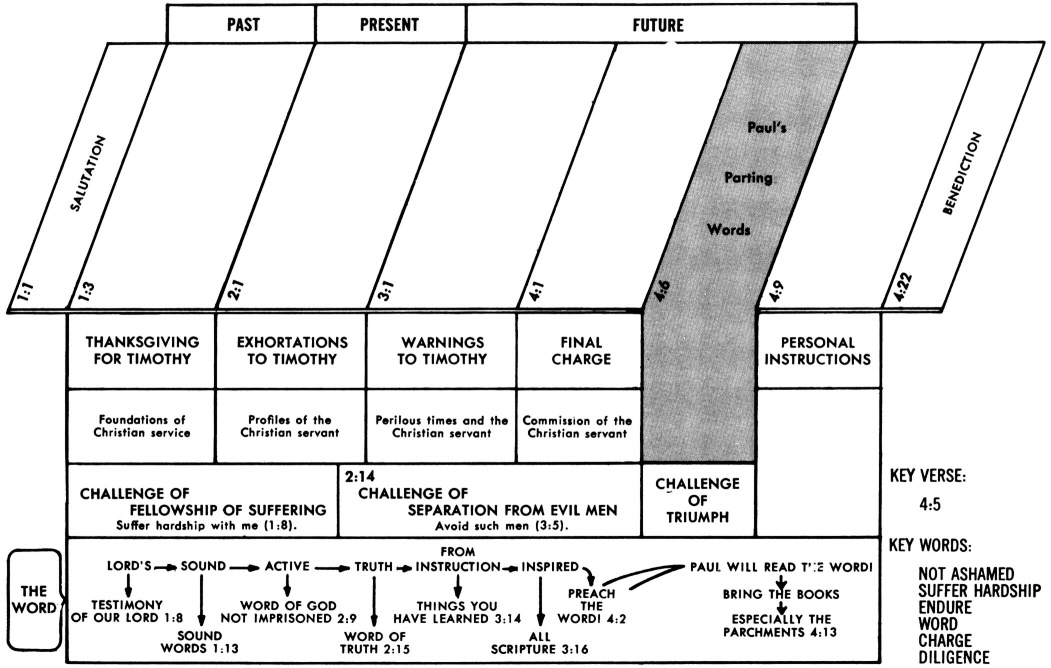
ENDURANCE AND SEPARATION IN THE MINISTRY
Click chart to enlarge
Charts from Jensen's Survey of the NT - used by permission
Second Timothy - Swindoll
| 2 TIMOTHY | |||
| 2 Timothy 1:1-18 | 2 Timothy 2:1-26 | 2 Timothy 3:1-17 | 2 Timothy 4:1-22 |
| Retain the Standard |
Rightly Divide the Word |
Difficult Times Will Come |
Preach the Word |
| PAST | PRESENT | FUTURE | |
| Foundation of Christian Service |
Pictures of Christian Servant |
Dangerous Times for Christian Servant |
Commission of Christian Servant |
| Unashamed as a Witness: Guard the Gospel |
Unashamed as a Workman: Suffer for the Gospel |
Adequate as a Workman: Continue in the Gospel |
Awarded as a Workman: Preach the Gospel |
| Power of the Gospel |
Perseverance of the Gospel Message | Protection of the Gospel |
Proclamation of the Gospel |
| Reminder | Requirements | Resistance | Requests |
| Encouragement in Ministry |
Examples in Ministry |
Exhortations in Ministry |
Exhortations to Fulfill Ministry |
| Commendation & Charge |
Commission to Fulfill |
Conflict to Face |
Course to Finish |
|
Compiled from Jensen's Survey of the NT and Wilkinson's Talk Thru the Bible |
|||
2Timothy 3:16 All Scripture is inspired by God and profitable for teaching, for reproof, for correction, for training in righteousness (NASB: Lockman)
Greek: pasa graphe theopneustos kai opheliomos pros didaskalian, pros elegmon, pros epanorthosin, pros paideian ten en dikaiosune,
Analyzed Literal: All Scripture [is] God-breathed and [is] beneficial for teaching [or, doctrine], for verification [or, reproof], for correcting faults, for instruction in righteousness [or, the behavior that God requires],
Amplified: Every Scripture is God-breathed (given by His inspiration) and profitable for instruction, for reproof and conviction of sin, for correction of error and discipline in obedience, [and] for training in righteousness (in holy living, in conformity to God’s will in thought, purpose, and action), (Amplified Bible - Lockman)
KJV: All scripture is given by inspiration of God, and is profitable for doctrine, for reproof, for correction, for instruction in righteousness:
Phillips: All scripture is inspired by God and is useful for teaching the faith and correcting error, for re-setting the direction of a man's life and training him in good living. (Phillips: Touchstone)
Wuest: Every scripture is God-breathed, and is profitable for teaching, for conviction, for improvement, for training with respect to righteousness
Young's Literal: every Writing is God-breathed, and profitable for teaching, for conviction, for setting aright, for instruction that is in righteousness,
ALL SCRIPTURE IS INSPIRED BY GOD : pasa graphe theopneustos :
- 2 Sa 23:2; Mt 21:42; 22:31, 32;22:43 Mt 26:54;26:56 Mk 12:24;12:36 Jn 10:35; Acts 1:16; 28:25; Ro 3:2; 15:4; Gal 3:8; Heb 3:7; 4:12; 2 Pet 1:19, 20, 21
- See Torrey's extensive topic "Scriptures"
- 2 Timothy 2 Resources - Multiple Sermons and Commentaries
ALL OF GOD'S WORD
IS GOD BREATHED
All (3956) (pas) is an important adjective in this verse as this word includes the idea of oneness, a totality or the whole, thus referring to every passage of Scripture and every word in every passage. No exceptions. Praise God that He has preserved His Word!
In the midst of that period of intellectual history called The Enlightenment, a philosophy known as deism was sweeping Europe. In the midst of this development, the famous skeptic, Voltaire, proclaimed that within 25 years, the Bible would be forgotten and Christianity would be a thing of the past. However, 40 years after Voltaire’s death in 1778, the Bible and other Christian literature were being printed in what had once been Voltaire’s own house! Here is Voltaire's actual quote "Another century and there will not be a Bible on earth."
In twenty-five years, the Bible will be a forgotten book. - Robert Ingersoll
The Net Bible renders the Greek with the phrase every Scripture and then notes that...
There is very little difference in sense between every scripture (emphasizing the individual portions) and “all scripture” (emphasizing the composite whole). The former option is preferred, because it fits the normal use of the word “all/every” in Greek (pas) as well as Paul’s normal sense for the word “scripture” in the singular without the article, as here. So every scripture means “every individual portion of scripture.” (The NET Bible. Biblical Studies Press)
Other translations - God-breathed (YLT) breathed out by God (ESV) divinely inspired (Darby) For the whole Scripture is given by inspiration of God (Geneva)
Click for Illustrations and Quotes Related to the Word of God.
Scripture (1124)(graphe from grapho = to write; English = graphite - the lead in a pencil!) means first a writing or thing written, a document. The majority of the NT uses refer to the Old Testament writings, in a general sense of the whole collection when the plural (= Scriptures - Matt. 21:42; 22:29; 26:54; Mk. 12:24; 14:49; Lk. 24:27, 32, 45; Jn. 5:39; Acts 17:2, 11; 18:24, 28; Rom. 15:4; 2Pe 3:16) is used and other times of a particular passage when the singular is used (= the Scripture - Mk. 12:10; 15:28; Lk. 4:21; Jn. 13:18; 19:24, 36f; Acts 1:16; 8:35; Ro 11:2; Jas. 2:8, 23) and is used in such a way that quoting Scripture is understood to be the same as quoting God!
NIDNTT notes that the root word of graphe is graph- which...
has the primary meaning of to scratch on, engrave, with reference to an ornament, reports, letters, lists, and instructions. From it are derived the English “graphic”, “graph” etc. The material can be various: stone, wood, metal, wax, or leather. The verb form grapho is found in its original sense in Homer, Il. 17, 599. In Herodotus., 4, 36 the word is used meaning to draw, of lines on maps; and scholars of the 3rd cent. B.C. used it of drawing of mathematical figures. In Homer grapho is already used in the sense of scratching signs on a tablet as a kind of letter (Il. 6, 169). From the time of Herodotus it is used generally in the normal sense of to write, and from the time of Pindar in the derived sense of to prescribe, to order. From the practice of handing in a written accusation, grapho came in judicial language to mean to accuse (Plato, Euthyphro 2b).
The noun graphe originally carried the abstract verbal sense of the act of writing, drawing or painting; then the concrete sense of writing, inscription, letter (generally from 4th cent. B.C. onwards), indictment; in papyri of the 3rd cent. a list; in Plato the written law (Leg. 11, 934c).
Gramma means: (a) the product of the action, especially where contrast with the spoken word is stressed; occasionally (b) the action itself; but then also (c) ability to write. It can mean the individual letters of the alphabet (Hdt., 5, 58 f.), but also papers, letters, documents. The plural grammata is used in the sense of elementary knowledge, then literature, learning. The concept of “holy writings” or “holy scriptures” becomes important in the Hellenistic period: temple records, magic books and hermetic literature; also imperial letters and decrees which are regarded as quasi-divine. The authority of the written word leads, even in the classical period, to the composition of explanatory commentaries, especially on the writings of Homer. (Brown, Colin, Editor. New International Dictionary of NT Theology. 1986. Zondervan)
Note that the 1901 Authorized Standard Version (ASV) as well as some other versions (e.g., the Bible in Basic English = BBE, Douay-Rheims = DRB) translate the Greek text as...
Every scripture inspired of God is also profitable
According to this rendering one might reasonably ask "Well, what about those Scriptures that are not inspired by God? Are they profitable also?" The more critical question is "Are they inspired by God?"
While this rendering is grammatically possible (since there is no verb "is" in the Greek), this translation to some degree leaves open the implication that there may be some Scripture not inspired by God, which of course is not true, for if any of the whole is not of God, then which part is it? Thus you can see how the integrity and unity of the whole Scripture is undermined. As an illustration take the human body, no part of which which is not useful in its place, and no part of which can be spared without notable loss of functionality of the entire body. So too all of Scripture is profitable for proper function of our spiritual body. Let me ask you - In your personal Bible study, do you focus all your attention on the NT? If you do you are missing a significant portion of the whole counsel of God's Word. How many conservative churches preach almost entirely out of the New Testament, to the virtual exclusion of the Old Testament? Remember that the Old is the New concealed and the New is the Old revealed. Our goal should be that both the Old and New Testaments would be "comfortably" at home in our heart and mind, for every Word of God is profitable (eg, see the Old Testament shadows of Messiah our Kinsman Redeemer in Ruth, and the shadow of Messiah as the Passover Lamb in Exodus, both fulfilled in the New - cp Col 2:17, Heb 10:1). As an aside, there are excellent Bible study programs dealing with the Old Testament, including Bible Study Fellowship (Genesis and the Life of Moses, both 9 month programs and Precept Ministries International with multiple OT studies (Click here for list of over 150 separate in depth inductive lessons covering a significant portion of the entire OT).
M F Unger wrote that...
Divine inspiration makes the Bible uniquely the Word of God and not merely a book containing the Word of God, and as such is different from any other book sacred or secular.
John MacArthur has a helpful note
"In addition to the many other specific biblical references to the inspiration and authority of Scripture...it is important to note that similar Greek constructions in other parts of the New Testament argue strongly from a grammatical perspective that all Scripture is inspired is the proper translation. Scripture is the revelation conveyed, inspiration is the means of that conveyance. In the words originally revealed and recorded, all Scripture is God’s inerrant Word."
Francis Schaeffer asks and then answers a pertinent question...
Does inerrancy make a difference? Overwhelmingly; the difference is that with the Bible being what it is, God’s Word and so absolute, God’s objective truth, we do not need to be, and we should not be, caught in the ever-changing fallen cultures which surround us.
Scripture (1124) (graphe from grapho = to write; English = graphite - the lead in a pencil!) means first a writing or thing written, a document. The majority of the NT uses refer to the Old Testament writings, in a general sense of the whole collection when the plural (= Scriptures - Matt. 21:42; 22:29; 26:54; Mk. 12:24; 14:49; Lk. 24:27, 32, 45; Jn. 5:39; Acts 17:2, 11; 18:24, 28; Ro 15:4; 2Pe 3:16) is used and other times of a particular passage when the singular is used (= the Scripture - Mk. 12:10; 15:28; Lk. 4:21; Jn. 13:18; 19:24, 36, 37; Acts 1:16; 8:35; Ro 11:2; Jas. 2:8, 23) and is used in such a way that quoting Scripture is understood to be the same as quoting God!
Graphe - 51v in NT -
Matt. 21:42; 22:29; 26:54, 56; Mk. 12:10, 24; 14:49; 15:28; Lk. 4:21; 24:27, 32, 45; Jn. 2:22; 5:39; 7:38, 42; 10:35; 13:18; 17:12; 19:24, 28, 36f; 20:9; Acts 1:16; 8:32, 35; 17:2, 11; 18:24, 28; Rom. 1:2; 4:3; 9:17; 10:11; 11:2; 15:4; 16:26; 1 Co. 15:3f; Gal. 3:8, 22; 4:30; 1 Tim. 5:18; 2 Tim. 3:16; Jas. 2:8, 23; 4:5; 1 Pet. 2:6; 2 Pet. 1:20; 3:16
It is worth noting that the majority of the OT passages quoted in the NT Scriptures are not from the original Hebrew but are from the Greek translation of the Hebrew, the Septuagint (LXX). The full title, the Holy Scriptures is found only in Ro 1:2 (see note).
Inspired by God (2315) (theopneustos from Theos = God + pneo = to breathe or blow) means divinely breathed or given by inspiration of God and it nicely sums up Peter's parallel teaching in 2Pe 1:21.
Related:
- What is verbal plenary inspiration?
- What are the different theories of biblical inspiration?
- How does the translation process impact the inspiration, inerrancy, and infallibility of the Bible?
- Is there proof for the inspiration of the Bible?
- What does it mean that the Bible is inspired?
- Who wrote the Bible?
- Multi-Part Course on the History and Authenticity of the Bible - David Hocking (excellent)
- The Word of God - Quotations and Illustrations
- Does the inerrancy of the Bible only apply to the original manuscripts?
- Textual criticism - what is it?
- Inspiration J C Ryle
- Principles the NT Writers Used When Quoting the Old Testament
- Divine Inspiration of the Scriptures A W Pink
- The Power of God's Word - A Simple Inductive Study
- Inductive Bible Study: Introduction
- Inductive Bible Study: Application
- 2 Timothy 3:16-17 Study of the Authority of God's Word
- 2 Timothy Overview Guard the Treasure
- 2 Timothy Handle Accurately the Word of Truth
- Life Hid and Not Hid by Alexander Maclaren
The Latin Vulgate renders it "divinitus inspirata".
Every single word of Scripture is God breathed. The rabbis taught that the Spirit of God rested on and in the prophets and spoke through them so that their words did not come from themselves, but from the very mouth of God which is in accord with Peter's declaration that...
"no (absolute negation = absolutely none - and placed first in the Greek for emphasis) prophecy was ever made by an act of human will (no prophet starts a prophecy by himself because he wanted to - the Scriptures are not the product of human effort), but (on the contrary which presents a strong antithesis to the idea that prophecy originated from the mind & will of men) men (the human instruments who "transcribed" as it were the the Words of God) moved by the Holy Spirit (were continually carried or borne along by the Spirit a beautiful figurative use of the verb Luke uses to describe a sailing vessel being carried along by the wind) spoke from God" (2Pe 1:21)
It is not surprising then that in the OT alone, the human writers refer to their writings as the words of God over 3800 times!
The early church was in entire agreement with this view. As discussed above the ASV rendering of 2Timothy 3:16 (“All Scripture inspired by God is...”) leaves open the possibility that some Scripture is not inspired by Him and ultimately would make the Bible worthless as a reliable guide to divine truth. Who would determine which part of it is inspired by God and which is not? And so we see that the doctrine of the inspiration of Scripture is not optional but is vitally important, and thus not surprisingly is a doctrine Satan has attacked from the beginning asking Eve...
“Indeed, has God said?” (Ge 3:1, 2, 3, 4, 5)
The Scriptures are the voice of God to the soul of man. It is inconceivable that God would give His people a book they could not trust. He is the God of truth (KJV Dt 32:4); Jesus is “the truth” (Jn 14:6); and the Holy Spirit is the “Spirit is truth” (1Jn 5:7). Jesus said of the Scriptures,
“Thy Word is truth” (Jn 17:17). “
The greater Presbyterian preacher Donald Grey Barnhouse explained inspiration this way...
Just as the Holy Spirit came upon the womb of Mary, so He came upon the brain of a Moses, a David, an Isaiah, a Paul, a John and the rest of the writers of the divine library. The power of the Highest overshadowed them, therefore that holy thing which was born of their minds is called the Holy Bible, the word of God. The writing of Luke will, of course, have the vocabulary of Luke and the work of Paul will bear the stamp of Paul’s mind. However, this is only in the same manner that the Lord Jesus might have had eyes like his mother’s or hair that was the same color and texture as hers. He did not inherit her sins because the Holy Spirit has come upon her. If we ask, how could this be, the answer is God says so. And the writings of men of the Book did not inherit the errors of their carnal minds because their writings were conceived by the Holy Spirit and born out of their personalities without partaking of their fallen nature. If we ask, how could this be, again the answer is God says so.
The Real "Three R's"
The Bible is relevant because it is revealed. It is always a return to reality.
David Hocking has an excellent a multi-part course.
- Introduction — Part One
- Introduction — Part Two
- Miracles
- Scripture Cannot Be Broken
- Dead Sea Scrolls & Aramaic Targums
- Greek Translations
- N.T. Manuscripts
- New Testament Languages and the Apocrypha
- The Apocrypha and the Catholic Church
- The Apocrypha and the Bible
- Inspiration — Part One
- Inspiration — Part Two
- Difficulties of Inspiration — Part One
- Difficulties of Inspiration — Part Two
- Review and Issues of Canonicity
- The Inerrancy of the Bible
- Manuscript Evidence
- Greek Translations
- English Versions
- Interpretation of the Bible — Part One
- Interpretation of the Bible — Part Two
- Interpretation of the Bible — Part Three
- Culture
- Symbolic Language
- Course Review
Richard DeHaan writes the following devotional that humorously illustrates "divine inspiration":
The story is told about a young boy named Timothy who was planning to give his grandmother a Bible for Christmas. He wanted to write something special on the flyleaf but wasn't sure what to say. So he decided to copy what he had seen in a book his father had received from a friend. Christmas morning came and Grandmother opened her gift. She was not only pleased to receive the Bible, but she was amused by the inscription Timothy had put in it. It read:
"To Grandma, with compliments of the author."
Even though that boy was unaware of it, he had suggested a unique fact about the Bible. It came to us from its Author -- God. Knowing who wrote a book often determines whether we'll pick it up and read it. The Bible, with its divine origin, not only ought to be read, but it demands our respect, our trust, and our obedience. It comes "with compliments of the Author." (R De Haan) (Our Daily Bread, Copyright RBC Ministries, Grand Rapids, MI. Reprinted by permission. All rights reserved)
Your thoughts are here, my God,
Expressed in words divine,
The utterance of heavenly lips
In every sacred line.--Bonar
The Bible is a gift from the Author -- God.
A T Robertson once quipped that "The greatest proof that the Bible is inspired is that it has stood so much bad preaching."
Augustine of Hippo said "Let us therefore yield ourselves and bow to the authority of the Holy Scriptures, which can neither err nor deceive."
In the writing of the Jewish historian Josephus (Contra Apion, i.7) we find a statement that parallels 2Ti 3:16: “The Scripture of the prophets who were taught according to the inspiration of God."
What the Bible says, God says. The Bible is the final authority, the veritable "Supreme Court" from which there is no appeal. It was on such a basis that Martin Luther took his historic stand. The moment of crisis came on April 18, 1521, at the Diet of Worms, when he was called on by Johann von Eck, Official General of the Archbishop of Trier to renounce his errors. Luther replied,
"Unless I am convinced by testimonies of Scripture or by evident reason-for I believe neither the Pope nor Councils alone, since it is established that they have often erred and contradicted themselves-I am the prisoner of the Scriptures cited by me, and my conscience has been taken captive by the Word of God. Here I stand. I can do no other. God help me. Amen." (Bolding added)
The Greek word for "inspired" describes ships sails filled, being carried along over the seas. Paul says every Scripture is the product of the Spirit’s work. He filled the writers and carried them along producing His Words. And even though God's Word bears the mark or style of the writer’s personality, every Word is the true and sure word of God Himself. Next time you read the Word, stop for a moment and contemplate that the eternal, all knowing and all loving God is speaking to your heart and mind and soul and spirit and be amazed as such condescending mercy and grace.
David affirms divine inspiration writing "The Spirit of the LORD spoke by me, and His word was on my tongue." (2Sa 23:2)
And Jesus Himself reaffirms that the Spirit spoke through David stating that "David himself said in the Holy Spirit, 'THE LORD SAID TO MY LORD, "SIT AT MY RIGHT HAND, UNTIL I PUT THINE ENEMIES BENEATH THY FEET." (Quoting from Psalm 110) (Mt 12:36)
The author of Hebrews directly attributes Scripture to the Spirit of God "Therefore, just as the Holy Spirit says, "TODAY IF YOU HEAR HIS VOICE." (Heb 3:7)
Clearly, the Spirit of God used men of God to write the Word of God. The Spirit did not erase the natural characteristics of the writers. In fact, God in His providence prepared the writers for the task of writing the Scriptures. Each writer has his own distinctive style and vocabulary. Each book of the Bible grew out of a special set of circumstances. In His preparation of men, in His guiding of history, and in His working through the Spirit, God brought about the miracle of the Scriptures.
The Westminster Confession states that...
The authority of the holy Scripture, for which it ought to be believed, and obeyed, dependeth not upon the testimony of any man, or church; but wholly upon God (who is truth itself) the author thereof: and therefore it is to be received, because it is the Word of God. (See all 33 points of the Westminster Confession)
Wiersbe has a cautionary explanation adding that...
"We must not think of “inspiration” the way the world thinks when it says, “Shakespeare was certainly an inspired writer.” What we mean by biblical inspiration is the supernatural influence of the Holy Spirit on the Bible’s writers, which guaranteed that what they wrote was accurate and trustworthy. Revelation means the communicating of truth to man by God; inspiration has to do with the recording of this communication in a way that is dependable. Whatever the Bible says about itself, man, God, life, death, history, science, and every other subject is true. This does not mean that every statement in the Bible is true, because the Bible records the lies of men and of Satan. But the record is true." (Bolding added)
Hiebert comments that
"inspiration is here not asserted of the authors of Scripture but of the writings themselves. But inspiration was not mechanical. The Holy Spirit did not destroy the personality and individual characteristics of the individual writers but rather so worked through the entire being of the writer that the very words used, although truly the words of the human author, were yet the very words the Spirit intended to be employed to express the divine truths being recorded."
“Men do not reject the Bible because it contradicts itself,
but because it contradicts them.”
The more you read the Bible, the more you love it; the more you love it, the more you read it. Read the Bible as if God were speaking to you. He is!
Scripture is profitable for teaching (what is right), for reproof (what is not right), for correction (how to get right), and for training in righteousness (how to stay right).
A common phrase used to describe "all Scripture" is that it is characterized by "VERBAL PLENARY INSPIRATION".
Inspiration means that the text of Holy Scripture was "breathed-out" by the Holy Spirit and written down by holy men using their own gifts, words and personal style.
Plenary means that inspiration extends to every part of the Bible. Webster defines "plenary" as "complete in every respect". In simple terms, this word conveys the idea that all the words of Scripture are God’s words.
Verbal means that inspiration extends to the very words of the text. When the Bible speaks, God speaks.
Regarding "verbal plenary inspiration", The Pocket Dictionary of Theological Terms states that...
God is the ultimate author of the Bible in its entirety. That is, God’s superintending work in inspiration extends to the whole Bible and to each part of the Bible. Plenary inspiration guarantees that all that the church has come to affirm as Scripture is both authoritative and helpful for Christian belief and practice. (Grenz, S., Guretzki, D., & Nordling, C. F. Pocket dictionary of theological terms. Page 91 . Downers Grove, Ill.: InterVarsity Press)
How important is a proper understanding
of the truth of this verse for you?
The question of the supreme authority of the Word of God is not just some ethereal debate but is the supreme issue. Until you've decided this issue and honestly answered this questions, you're going to be tossed to and fro. Nothing is "of equal value" with the Word of God. It stands supreme. It is the "Supreme Court" of the Christian faith. Tradition may be likened to a lower court, statements of faith to a higher court, councils to a court of appeal. But the Bible itself is the Supreme Court from which there is and can be no appeal.
AN ANCIENT CONFESSION: The Belgic Confession of Faith (1561):
Article 7: We believe that [the] Holy Scriptures fully contain the will of God, and that whatsoever man ought to believe unto salvation is sufficiently taught therein ... Neither do we consider of equal value any writings of men, however holy these men may have been, with those divine Scriptures nor ought we to consider custom or the great multitude, or antiquity, or succession of times and persons, or councils, decrees or statutes, as of equal value with the truth of God ... Therefore, we reject with all our hearts whatsoever doth not agree with this infallible rule which the apostles have taught us, saying, Try the spirits whether they are of God. Likewise, if there come any unto you, and bring not this doctrine, receive him not into your house. (Click full confession)
A MODERN CONFESSION: Chicago Statement on Biblical Inerrancy (1978)
Article 1: We affirm that the Holy Scriptures are to be received as the authoritative Word of God. We deny that the Scriptures receive their authority from the Church, tradition, or any other human source.
Article 2: We affirm that the Scriptures are the Supreme Written Norm by which God binds the conscience, and that the authority of the Church is subordinate to that of Scripture. We deny that Church Creeds, councils, or declarations have authority greater than or equal to the authority of the Bible.
Article 3: We affirm that the written Word in its entirety is revelation given by God. We deny that the Bible is merely a witness to revelation, or only becomes revelation in encounter, or depends on the responses of men for its validity.
Article 6: We affirm that the whole of Scripture and all its parts, down to the very words of the original, were given by divine inspiration. We deny that the inspiration of Scripture can rightly be affirmed of the whole without the parts, or of some parts but not the whole.
Article 7: We affirm that inspiration was the work in which God by His Spirit, through human writers, gave us His Word. The origin of Scripture is divine. The mode of divine inspiration remains largely a mystery to us. We deny that inspiration can be reduced to human insight, or to heightened states of consciousness of any kind.
Article 8: We affirm that God in His work of inspiration utilized the distinctive personalities and literary styles of the writers whom He had chosen and prepared. We deny that God, in causing these writers to use the very words that He chose, overrode their personalities.
(Click to read all 19 Articles of the Confession followed by an exposition of how the articles were derived: The subtopics include: A. Creation, Revelation and Inspiration B. Authority: Christ and the Bible C. Infallibility, Inerrancy, Interpretation D. Skepticism and Criticism E. Transmission and Translation F. Inerrancy and Authority- This is meaty reading but needful in these "PERILOUS" "LAST DAYS" when the fear of the LORD seems to be far removed from the thoughts of most of mankind including many in the "church".) This confession ends prayerfully with these wonderful words
"We affirm that what Scripture says, God says.
May He be glorified. Amen and Amen."
And all God's children cry "Amen!"
AND IS PROFITABLE: kai ophelimos:
- Ps 19:7, 8, 9, 10, 11, 119:97, 98, 99;119:100, 101, 102 Ps 119:103, 104, 119:130 Mic 2:7; Acts 20:20; 20:27 1Co 12:7; Ep 4:11, 12, 4:13, 4:14, 4:15, 4:16
SCRIPTURE IS NOT
"NON-PROFIT"
Profitable (beneficial, useful) 5624) (ophelimos) means useful, profitable, serviceable, helpful, beneficial and refers to that which yields advantageous returns or results. It provides something that one needs to attain a certain goal -- in context to be a "man of God". Every Scripture serves to meet the moral and spiritual needs of man. Unfortunately as Charles Colson says “The family Bible is more often used to adorn coffee tables or press flowers than it is to feed souls and discipline lives.”
Ophelimos is used 3 times in the NAS 1 Tim. 4:8; 2 Tim. 3:16; Titus 3:8. There are no uses in the Septuagint.
In his first epistle Paul uses ophelimos twice to emphasize the temporal and eternal value of godliness reminding Timothy that..
bodily discipline is only of little profit, but godliness is profitable for all things, since it holds promise for the present life and also for the life to come. (1Ti 4:8, cp 1Ti 4:7, 1Ti 4:9, 10)
Writing to Titus Paul tells that good deeds are profitable..
This is a trustworthy statement (that being justified by His grace we might be made heirs according to the hope of eternal life); and concerning these things I want you to speak confidently, so that those who have believed God may be careful to engage in good deeds. These things are good and profitable for men. (Titus 3:8)
Just as milk nourishes a baby in ways it does not understand, so God’s Word nourishes us in ways we often do not understand. No matter how deep our understanding of Scripture may be, we still should be able to affirm with the psalmist,
“As the deer pants for the water brooks, so my soul pants for Thee, O God” My soul thirsts for God, for the living God; When shall I come and appear before God? (Ps 42:1, Ps 42:2).
We should rejoice with Paul that “we all, with unveiled face beholding as in a mirror the glory of the Lord, are being transformed into the same image from glory to glory, just as from the Lord, the Spirit” (2 Cor 3:18)
The profit of Scripture attests to its divine inspiration. Although one might wonder about some of the genealogies or obscure passages, the Spirit-taught mind will realize that there is spiritual nourishment in every word that proceeds from the mouth of God.
John Calvin wrote that "We cannot rely on the doctrine of Scripture until we are absolutely convinced that God is its Author."
John Wesley on the "profitability" of "The Book": "I am a creature of a day, passing through life as an arrow through the air. I am a spirit, coming from God, and returning to God: just hovering over the great gulf; a few moments hence, I am no more seen; I drop into an unchangeable eternity! I want to know one thing — the way to heaven; how to land safe on that happy shore. God Himself has condescended to teach the way. He hath written it down in a book. Oh, give me that book! At any price, give me the book of God! I have it: here is knowledge enough for me. Let me be homo unius libri: “A man of one book.” Here, then, I am, far from the busy ways of men. I sit down alone; only God is here. In His presence I open, I read His book; for this end — to find the way to heaven." (John Wesley - The Biblical Illustrator)
Johannes Gutenberg (the inventor of the printing press) wrote "Yes, it is a press, certainly, but a press from which shall flow in inexhaustible streams with the most abundant and most marvelous drink [Scripture] that has ever flowed, relieving the thirst of men! Through it, God will spread His Word. A spring of truth shall flow from it [the printing press] – like a new star it shall scatter the darkness of ignorance and cause a light heretofore unknown to shine amongst men." (Let it be so Lord. Amen!)
- to inform the ignorant,
- to confute the erroneous,
- to reform the wicked, and
- to guide and direct, support and comfort--the godly.
Here a lamb may wade--and here an elephant may swim!
Here is milk for babes--and meat for strong men!
Here is . . .
- comfort for the afflicted, and
- support for the tempted, and
- ease for the troubled, and
- light for the clouded, and
- enlargement for the straitened, etc.
Oh,
- how full of light,
- how full of life,
- how full of love,
- how full of sweetness,
- how full of goodness,
- how full of righteousness,
- how full of holiness, etc.,
- is every chapter, and every verse in every chapter, yes, and every line in every verse!
No human writings are comparable to Scripture:
1. for antiquity;
2. for rarity;
3. for variety;
4. for brevity;
5. for plainness;
6. for harmony;
7. for verity.
All which should greatly encourage Christians, to a serious perusal of them.
"Oh, how I love your Law. I meditate on it all day long!" Ps 119:97
More people are troubled by what is plain in Scripture than by what is obscure. - Roy L Smith
To what greater inspiration and counsel can we turn than to the imperishable truth to be found in this treasure house, the Bible? Queen Elizabeth II
In this one book are the two most interesting personalities in the whole world—God and yourself. The Bible is the story of God and man, a love story in which you and I must write our own ending, our unfinished autobiography of the creature and the Creator. - Fulton Oursler
A man who loves his wife will love her letters and her photographs because they speak to him of her. So if we love the Lord Jesus, we shall love the Bible because it speaks to us of him. - John Stott
Once you and I are face to face with the Word of God. . . we can only accept or reject it. Jesus becomes the two-edged sword that cuts right down the middle, dividing us into believers and nonbelievers. - John Powell
God's Word is pure and sure, in spite of the devil, in spite of your fear, in spite of everything. - R. A. Torrey
Centuries of experience have tested the Bible. It has passed through critical fires no other volume has suffered, and its spiritual truth has endured the flames and come out without so much as the smell of burning. - W E Sangster
The Word is both a glass to show us the spots of our soul and a laver to wash them away. -- Puritan Thomas Watson
One proof of the inspiration of the Bible is that it has withstood so much poor preaching. - A. T. Robertson
God the Father is the giver of Holy Scripture; God the Son is the theme of Holy Scripture; and God the Spirit is the author, authenticator, and interpreter of Holy Scripture. - J I Packer
One of the many divine qualities of the Bible is this: that it does not yield its secrets to the irreverent and censorious. - J I Packer
The church no more created the canon than Newton created the law of gravity; recognition is not creation. - J. I. Packer
My own experience is that the Bible is dull when I am dull. When I am really alive, and set in upon the text with a tidal pressure of living affinities, it opens, it multiplies discoveries, and reveals depths even faster than I can note them. The worldly spirit shuts the Bible; the Spirit of God makes it a fire, flaming out all meanings and glorious truths. - Horace Bushnell
The Bible is my church. It is always open, and there is my High Priest ever waiting to receive me. There I have my confessional, my thanksgiving, my psalm of praise, a field of promises, and a congregation of whom the world is not worthy—prophets and apostles, and martyrs and confessors—in short, all I can want, there I find. - Charlotte Elliot
I never knew all there was in the Bible until I spent those years in jail. I was constantly finding new treasures. - John Bunyan
Make it the first morning business of your life to understand some part of the Bible clearly, and make it your daily business to obey it in all that you do understand. - John Ruskin
The Holy Bible is an abyss. It is impossible to explain how profound it is, impossible to explain how simple it is. - Ernest Hello
The authority of the Bible comes not from the calibre of its human authors but from the character of its divine Author. - John Blanchard
My deepest regret, on reaching threescore years and ten, is that I have not devoted more time to the study of the Bible. Still in less than nineteen years I have gone through the New Testament in Chinese fifty-five times. - Jonathan Goforth
God’s Book is packed full of overwhelming riches; they are unsearchable—the more we have the more there is to have. - Oswald Chambers
The Bible does not thrill, the Bible nourishes. Give time to the reading of the Bible, and the recreating effect is as real as that of fresh air physically. - Oswald Chambers
A partially inspired Bible is little better than no Bible at all. J. C. Ryle
I know the Bible is inspired because it finds me at a greater depth of my being than any other book. - Samuel Taylor Coleridge
The gospel is not merely a book—it is a living power—a book surpassing all others. I never omit to read it, and every day with the same pleasure. The gospel possesses a secret virtue, a mysterious efficacy, a warmth which penetrates and soothes the heart. One finds in meditating upon it that which one experiences in contemplating the heavens. The gospel is not a book; it is a living being, with an action, a power, which invades everything that opposes its extension. - Napoleon Bonaparte
Inspiration, in the full apostolic meaning of the word, ceased when the canon of Scripture was brought to completion. Without such apostolic inspiration there can be no infallible revelation. - Geoffrey B. Wilson
I never had any doubt about it being of divine origin. . . point out to me any similar collection of writings that has lasted for as many thousands of years and is still a best-seller, world-wide. It had to be of divine origin. - Ronald Reagan
A thorough knowledge of the Bible is worth more than a college education. - Theodore Roosevelt
All things desirable to men are contained in the Bible. - Abraham Lincoln
I am sorry for men who do not read the Bible every day. I wonder why they deprive themselves of the strength and the pleasure. - Woodrow Wilson
Give the Bible to the people, unadulterated, pure, unaltered, unexplained, uncheapened, and then see it work through the whole nature. It is very difficult indeed for a man or for a boy who knows the Scriptures ever to get away from it. It follows him like the memory of his mother. It haunts him like an old song. It reminds him like the word of an old and revered teacher. It forms a part of the warp and woof of his life. - Woodrow Wilson
It is impossible to practice godliness without a constant, consistent and balanced intake of the Word of God in our lives. -- Jerry Bridges
The Bible is none other than the voice of him that sitteth upon the throne. Every book of it, every chapter of it, every syllable of it, every letter of it, is the direct utterance of the Most High. -- John William Burgon
Apply yourself to the Scriptures and the Scriptures to yourself.
The Bible is alive, it speaks to me; it has feet, it runs after me; it has hands, it lays hold on me. - Martin Luther
Reading the Bible without meditating on it is like eating without chewing. (Ps 119:15, 23,27, 48, 78, 97, 99, 148)
God speaks through His Word--take time to listen.
The value of the Bible is not knowing it, but obeying it.
When you have read the Bible, you will know it is the Word of God, because you will have found it the key to your own heart, your own happiness and your own duty. -- Woodrow Wilson
It is not the Word hidden in the head but in the heart that keeps us from sin. - Vance Havner
God’s Word is its own best argument. - Vance Havner
The Word of God is either absolute or obsolete. - Vance Havner
A Bible in hand is worth two on the shelf.
A Red Letter Bible is fine, but one that is Read is far better!
Those who spiritualize tell spiritual lies, because they lack spiritual eyes.
When the Bible becomes a part of you, you'll be less likely to come apart.
The Bible is simple enough for a child to read and too deep for a scholar to master.
A Bible that has frayed edges usually has an owner that doesn't.
Trying to absorb the depths of the Bible is like trying to mop up the ocean floor with a sponge.
The best thing to do with the Bible is to know it in the head, stow it in the heart, sow it in the world, and show it in the life.
Devout meditation on the Word is more important to soul-health even than prayer. It is more needful for you to hear God's words than that God should hear yours, though the one will always lead to the other. -- F. B. Meyer
The Christian is bred by the Word and he must be fed by it. --William Gurnall
The best way for Christians to grow is to eat the Bread of Life.
The Word of God is the candle without which faith cannot see to do its work.
The true Christian church is the work of the Word communicated by every available means. -- Martin Luther
The Bible is like a compass—it always points the believer in the right direction.
The Bible is like the ocean. You can wade in it, feed from it, live on it--or drown in it. But those who take the time to learn its truths and practice them will be changed forever.
With God's Word as your map and His Spirit as your compass, you're sure to stay on course.
When you study the Bible "hit or miss," you MISS more than you HIT.
When the Word of God dwells in you, the love of Christ shines through you.
The Bible is a window in this prison-world through which we may look into eternity. - Timothy Dwight
Nobody ever outgrows Scripture; the book widens and deepens with our years. - C H Spurgeon
The Bible is a vein of pure gold, unalloyed by quartz or any earthly substance. This is a star without a speck; a sun without a blot; a light without darkness; a moon without its paleness; a glory without a dimness. O Bible! It cannot be said of any other book that it is perfect and pure; but of thee we can declare all wisdom is gathered up in thee, without a particle of folly. This is the judge that ends the strife, where wit and reason fail. This is the book untainted by any error; but is pure, unalloyed, perfect truth. - C H Spurgeon
Beware! Error often rides to its deadly work on the back of truth! --Spurgeon (2Cor 11:13,14, 15)
Spiritual growth requires the meat of God's Word. (see Hebrews 5:14, 1 Peter 2:2)
Be diligent in your study of the Word of God. Then, instead of falling into error, you will stand firmly on the truth.
Study the Bible to be wise; believe it to be safe; practise it to be holy.
The Word of the Lord is a light to guide you, a counsellor to counsel you, a comforter to comfort you, a staff to support you, a sword to defend you, and a physician to cure you. The Word is a mine to enrich you, a robe to clothe you, and a crown to crown you. - Thomas Brooks
Your life will run smoother if you go by "The Book."
If we want our life to run well, even through stormy situations and rough circumstances, we must take the time to study the "Owner's Manual."
Many people store the Bible on the shelf instead of in their heart.
Some people make the Bible say what they want to hear
To be a healthy Christian, don't treat the Bible as snack food.
A well-read Bible is the companion of a well-fed believer.
We must approach God's Word as if our lives depended on it--because they do.
If your life depended on knowing the Bible, how long would you last?
We must align ourselves with the Bible, never the Bible with ourselves.
Do you know a book that you are willing to put under your head for a pillow when you are dying? Very well; that is the book you want to study when you are living. There is only one such book in the world. - Joseph Cook
The Bible is literally God speaking to you. It is God's instrument in salvation (Romans 10:17; 1 Peter 1:25) and God's instrument for growing mature Christians (1 Peter 2:2). It is the blueprint for the Christian. - George Sweeting
Prayer is the "open sesame" to the Bible. Always begin your Bible reading with prayer for divine guidance. All of us in reading some current book have wished the author were present to answer and explain some things, but this is rarely possible. Amazing as it seems, this is possible when reading the Bible. - George Sweeting
The branches of growing trees not only reach higher, but their roots grow deeper. It's impossible for a strong tree to have high branches without having deep roots. It would become top-heavy and topple over in the wind." The same is true with Christians. It's impossible for us to grow in the Lord without entwining our roots around His Word and deepening our life in His commands." - Joni Eraeckson Tada
Bible study demands pondering deeply on a short passage, like a cow chewing her cud. It is better to read a little and ponder a lot than to read a lot and ponder a little.
Unless God's Word illumine the way, the whole life of men is wrapped in darkness and mist, so that they cannot but miserably stray. - John Calvin
Why do they put the Gideon Bibles only in the bedrooms, where its usually too late, and not in the barroom downstairs? - Christopher Morley
Hold fast to the Bible as the sheet-anchor of our liberties; write its precepts on your hearts and practise them in your lives. To the influence of this book we are indebted for the progress made in true civilization, and to this we must look for our guide in the future. Ulysses S. Grant
The Bible is like a telescope. If a man looks through his telescope, then he sees worlds beyond: but if he looks at his telescope, then he does not see anything but that. The Bible is a thing to be looked through, to see that which is beyond; but most people only look at it; and so they see only the dead letter.” - Phillips Brooks
The Bible shows how the world progresses. It begins with a garden, but ends with a holy city. - Phillips Brooks
The Bible was not written to satisfy your curiosity, but to make you conform to Christ’s image. Not to make you a smarter sinner, but to make you like the Savior. Not to fill your head with a collection of biblical facts, but to transform your life.” --Howard Hendricks in Living by the Book
No one ever graduates from Bible study until he meets its Author face to face. - Everett Harris
It has been said that the Bible is so deep that theologians cannot touch the bottom, yet so shallow that babes cannot drown.
J. I. Packer once said that "If I were the devil, one of my first aims would be to stop folk from digging into the Bible."
One controlling, guiding, unifying mind must have been operative through all the weary ages to produce out of such composite elements a result so wonderfully unique, uplifting, and unfathomable as the Bible; and that mind in the nature of things could not have been human. - William E Gladstone
FOR TEACHING: pros didaskalian:
"teach us what is true" (NLT).
DIVINELY DIDACTIC
DELIGHTFULLY DOGMATIC
Didactic (from didaktikos, apt at teaching from didaskein, to teach) means intended to instruct or intended to teach. God's Spirit desires to take the wholly inspired Holy Word and instruct us, renew our minds, clarify our wrong thinking, replace lies and half-truths with God's truth, in all of this transforming us more and more into the image of His Son (see 2 Cor 3:18).
Teaching (1319) (didaskalía from didasko from dáo = to know or teach) is either the act of teaching or the thing taught and in this use denotes doctrine or what is taught. Doctrine is from Latin doctrina in turn from doceo = to teach. It refers primarily to that which is taught, not the method of teaching, and doctrine.
Didaskalia - 13v in the NT (see below) and 2 in the non-apocryphal Septuagint (Pr 2:17, Isa 29:13).
The NAS translates didaskalia as doctrine(9), doctrines(3), instruction(1), teaching(7), teachings(1). Note the clear predominance of uses in the "Pastoral Epistles" (I wonder why?)...
Matthew 15:9 'But in vain do they worship Me, Teaching as doctrines the precepts of men.'"
Mark 7:7 'But in vain do they worship Me, Teaching as doctrines the precepts of men.'
Romans 12:7 if service, in his serving; or he who teaches, in his teaching;
Romans 15:4 For whatever was written in earlier times was written for our instruction, that through perseverance and the encouragement of the Scriptures we might have hope.
Ephesians 4:14 As a result, we are no longer to be children, tossed here and there by waves, and carried about by every wind of doctrine, by the trickery of men, by craftiness in deceitful scheming;
Colossians 2:22 (which all refer to things destined to perish with the using)-- in accordance with the commandments and teachings of men?
1 Timothy 1:10 and immoral men and homosexuals and kidnappers and liars and perjurers, and whatever else is contrary to sound teaching,
1 Timothy 4:1 But the Spirit explicitly says that in later times some will fall away from the faith, paying attention to deceitful spirits and doctrines of demons,
1 Timothy 4:6 In pointing out these things to the brethren, you will be a good servant of Christ Jesus, constantly nourished on the words of the faith and of the sound doctrine which you have been following.
1 Timothy 4:13 Until I come, give attention to the public reading of Scripture, to exhortation and teaching.
1 Timothy 4:16 Pay close attention to yourself and to your teaching; persevere in these things; for as you do this you will insure salvation both for yourself and for those who hear you.
1 Timothy 5:17 Let the elders who rule well be considered worthy of double honor, especially those who work hard at preaching and teaching.
1 Timothy 6:1 Let all who are under the yoke as slaves regard their own masters as worthy of all honor so that the name of God and our doctrine may not be spoken against.
1 Timothy 6:3 If anyone advocates a different doctrine, and does not agree with sound words, those of our Lord Jesus Christ, and with the doctrine conforming to godliness,
2 Timothy 3:10 But you followed my teaching, conduct, purpose, faith, patience, love, perseverance,
2 Timothy 3:16 All Scripture is inspired by God and profitable for teaching, for reproof, for correction, for training in righteousness;
2 Timothy 4:3 For the time will come when they will not endure sound doctrine; but wanting to have their ears tickled, they will accumulate for themselves teachers in accordance to their own desires;
Titus 1:9 holding fast the faithful word which is in accordance with the teaching, that he may be able both to exhort in sound doctrine and to refute those who contradict.
Titus 2:1 But as for you, speak the things which are fitting for sound doctrine.
Titus 2:7 in all things show yourself to be an example of good deeds, with purity in doctrine, dignified,
Titus 2:10 not pilfering, but showing all good faith that they may adorn the doctrine of God our Savior in every respect.
The term doctrine in Scripture "is broader than a simple reference to information passed on from one person to another or from one generation to the next. Christianity is a religion founded on a message of good news rooted in the significance of the life of Jesus Christ. In Scripture, then, doctrine refers to the entire body of essential theological truths that define and describe that message (1Ti 1:10; 4:16; 6:3; Titus 1:9). The message includes historical facts, such as those regarding the events of the life of Jesus Christ (1Cor 11:23). But it is deeper than biographical facts alone. As J. Gresham Machen pointed out years ago, Jesus’ death is an integral historical fact but it is not doctrine. Jesus’ death for sins (1Co 15:3) is doctrine. (Sound) Doctrine, then, is scriptural teaching on theological truths. (parenthesis added) (Elwell, W. A., & Elwell, W. A. The Evangelical Dictionary of Biblical Theology . Baker Book House)
Doctrine is emphasized in the Pastoral Epistles (19/21 occurrences of doctrine in the NT are found in Paul’s writings and 15/19 are in the Pastoral Epistles) Doctrine structures our thinking and so determines what and how we believe which in turn is reflected in how we behave. Too often new converts are throw immediately into some ''work'' instead of placing them in the firm footing of vital Biblical doctrine. Sound doctrine is mandatory in order to structure sound thinking and wise living. If you are not thinking correctly, you cannot be living correctly. The Bible is our source for knowledge concerning God's revelation in Christ.
J C Ryle - Let us receive nothing, believe nothing, follow nothing which is not in the Bible, nor can be proved by the Bible.
Puritan Thomas Watson wrote that "The Scripture is both the breeder and feeder of grace. How is the convert born, but by “the word of truth”? (James 1:18). How doth he grow, but by “the sincere milk of the Word”? (see note 1 Peter 2:2)
Warren Wiersbe - Far too many songs not only teach no doctrine, but many even teach false doctrines. A singer has no more right to sing a lie than a teacher has to teach a lie. (Wiersbe, W: Bible Exposition Commentary. 1989. Victor)
THOUGHT - Are the pulpit messages you preach (or hear) from the heart of God or are they geared to tickle the ears? Do the video series the church uses in Sunday School actually use Scripture as the foundational doctrine or do they only give token acquiescence to the Word of Truth? Is their emphasis on God's psychology and His Words of Life or is the emphasis on humanistic psychology?
Don't be judgmental (see Jesus' advice - Mt 7:1, 2, 3, 4, 5, - see notes Mt 7:1; 2, 3; 4; 5) but at least be willing to drop the plumbline of God's inspired Word and "measure" what is being sung, preached and taught in your church against the plumbline of Biblically sound doctrine. The vitally and integrity of the church of Jesus Christ depends on a continual "intravenous infusion" of sound doctrine.
Paul's dictum is applicable - Examine everything carefully; hold fast to that which is good abstain from every form of evil. (1Th 5:21, 22-see notes 1Th 5:21; 22)
Be a Berean using Scripture as your plumbline - Now these were more noble-minded than those in Thessalonica, for they received the word with great eagerness, examining the Scriptures daily, to see whether these things were so. (Acts 17:11, 12 -see notes)
FOR REPROOF: pros elegmon:
- 2Ti 4:2; Pr 6:23; 15:10;15:31 Jn 3:20; Ep 5:11-12; 5:13 Heb 11:1
- Torrey's Topic Reproof
refutation (NAB)
for convincing (Weymouth)
make us realize what is wrong in our lives (TLB),
refuting error (NJB),
reproof and conviction of sin (Amp),
to make us realize what is wrong (NLT),
pointing out errors (GWT),
rebuking error (TEV),
convicting of sin (JNT),
conviction of error (Barclay)
A DIVINE LIGHT ON OUR
AREAS OF "DARKNESS"
Reproof (1650)(elegchos from elegcho = bringing to light) describes the process or the action which brings something to the light, and so which scrutinizes or examines carefully, exposing and setting forth. In its purest form, reproof is an expression of strong disapproval. Elegchos refers to the reproof of sin that comes as the Holy Spirit operates through the presentation of Scripture.
Eye of God's Word! Where'er we turn
Ever upon us! Thy keen gaze
Can all the depths of sin discern,
Unravel every bosom's maze.
--Keble
The goal of elegchos is to convict or bring a person to the point of recognizing wrongdoing, to convince (and convict) them of their sins. It includes the idea of a rebuke which compels one to see their fault and to admit their error. Hiebert adds that the Scripture "detects and exposes all that is false. It convicts all that is unholy and all ungodly men, exposing and refuting every religious error and falsehood."
Elegchos is used only here in the NT, but has 12 uses in the non-apocryphal Septuagint -
Lev. 19:17; Nu 5:18, 19, 23, 24, 27; 2Ki. 19:3; Ps. 38:14; 39:11; 149:7; Isa. 37:3
In the Septuagint this term speaks of God’s punishment on Israel because of her rebellion against His will (2 Kings 19:3]; see also Leviticus 19:17; Numbers 5:18,19,23,24,27; Psalm 149:7.
Trench says that elegchos "implies not merely the charge, but the truth of the charge, and further the manifestation of the truth of the charge; nay, more than all this, very often also the acknowledgment, if not outward, yet inward, of its truth on the part of the accused; it being the glorious prerogative of the truth in its highest operation not merely to assert itself, and to silence the adversary, but to silence him by convincing him of his error.
Aristotle defined elegchos as "the proof that a thing cannot be otherwise than we say."
Bishop Trench said that the verb form (elegcho) means "to rebuke another with such effectual wielding of the victorious arms of the truth, as to bring him, if not always to a confession, yet at least to a conviction of his sin”.
The most vivid example of this kind of rebuke is the way in which God's prophet Nathan opened David's eyes to his horrible sin (All male readers - men are under attack especially with the internet, so consider taking a moment and reading slowly and prayerfully through this chapter [1Co 10:6, 11] remembering David is a man [Acts 13:22] after God's own heart > 2 Sa 12:1-14).
Reproof will tell you where you are out-of-bounds. It’s like an umpire who cries, “Out!” or “Safe!” It tells you what is sin. It tells you what God wants for your life. He provides standards. Reproof is the light that shines in the dark closets of your heart, but unlike the light in the closet, the light of God's Word enables one to CORRECT or set straight that which is broken. Reproof was especially important in Judaism, where it had to be done privately and gently first. Paul does not mean to say that the Scriptures are valuable for finding fault but instead means that Scripture is valuable for convincing a man of the error of his ways and for pointing him on the right path. A Christian who studies the Bible and applies what he learns will grow in holiness (Heb 5:14, 1Pe 2:2, 1Ti 4:7,8, Ps 119:11) and avoid many pitfalls in this world.
Although the following passages do not all use elegchos, they are speak to the subject of reproof (make a list of the advantages [if it is received with a teachable, tender heart] and disadvantages [if the reproof is refused]) - Job 20:3; Proverbs 1:23, 25, 30; 3:11; 5:12; 10:17; 12:1; 13:18; 15:5, 10, 31, 32; 29:1, 15; Ps 39:11, Hos. 4:4 How important is godly reproof? see Pr 6:23
Jesus taught the parallel truth about the Holy Spirit and as noted above He uses the Word that is read, taught or preached.
And He, when He comes, will convict (elegcho) the world concerning sin and righteousness and judgment (Jn 16:8)
So the effect of the Holy Word of God and the Holy Spirit of God is to “reprove” which in secular use meant to demonstrate by argument, to prove, to persuade anyone to do a thing by presenting reasons and hence to convince of anything, particularly to convince of crime. The Holy Spirit will convince or convict men in the world of sin by applying the truth of Scripture to their minds so as to convince them by fair and sufficient arguments that they are sinners, and cause them to feel the pangs and guilt of conviction.
The Puritan Thomas Watson asks
"How shall we know that we love the reproofs of the Word?"
Answer 1: When we desire to sit under a heart-searching ministry. Who cares for medicines that will not work? A godly man does not choose to sit under a ministry that will not work upon his conscience.
Answer 2: When we pray that the Word may meet with our sins. If there is any traitorous lust in our heart, we would have it found out and executed. We do not want sin covered, but cured. We can open our breast to the “sword” of the Word and say, “Lord, smite this sin.”
Donald Hubbard summed this verse up as follows...
1. Doctrine—Keeps us from Error
2. Reproof—Keeps us from Sin
3. Correction—Keeps us from Failure
4. Training in Righteousness—Keeps us from Foolishness
FOR CORRECTION: pros epanorthosin:
for setting aright (YLT),
correcting faults (TEV),
for improvement (Wuest),
for correction of error (Amp),
it straightens us out (TLB),
for guiding (BBE),
for guiding people's lives (NJB)
LIKE A RULER TO SHOW
THE STRAIGHT WAY
A ruler shows what is crooked (cf "reproof") but also gives the standard for what is straight (cf "correction").
Correction (1882) (epanorthosis from epi = upon + anorthoo = make straight again which in turn is from ana = again + orthoo = make straight) literally means a straightening up again and thus a restoration of something to its original and proper condition.
In secular Greek literature it was used of setting upright an object that had fallen down and of helping a person back on his feet after stumbling. It also referred to repairing a broken arm, thus making it straight again. After exposing and condemning false belief and sinful conduct, Scripture then sets straight and builds up through its divine correction...putting us back on our feet so to speak so that we can continue on the pilgrim path of growth in Christ likeness, holiness, sanctification.
Correction is Scripture’s positive provision for those who accept its negative reproof.
Therefore, putting aside all malice and all guile and hypocrisy and envy and all slander like newborn babes, long for the pure milk of the word, that by it you may grow in respect to salvation” (1Pe 2:1,2-see notes 1Pe 2:1, 2:2)
Paul emphasized the restorative power of God's Word in his parting words to the Ephesian elders
And now I commend you to God and to the word of His grace which is able to build you up and to give you the inheritance among all those who are sanctified (Acts 20:32)
Webster's 1828 dictionary defines correction as the act of "bringing back, from error or deviation, into conformity with a just standard...In scriptural language, whatever tends to correct the moral conduct, and bring back from error or sin.
And of course as Albert Barnes says "No reformation can be permanent which is not based on the principles of the word of God.
The Word of God restores the fallen sinner to an upright position and sets the erring one again on the right path.
FOR TRAINING (child rearing) IN RIGHTEOUSNESS: pros paideian ten en dikaiosune:
- 2Ti 2:25; Dt 4:36; Neh 9:20; Ps 119:9, 10;119:11 Mt 13:52; Acts 18:25; Ro 2:20
for instruction (KJV)
instruction in righteousness [or, the behavior that God requires] (Analyzed Literal)
giving instruction for right living (GNB)
training them for a life that has God's approval (GWT)
showing them how to live (CEV)
for education in righteousness (BBE)
discipline in obedience and for training in righteousness (in holy living, in conformity to God’s will in thought, purpose, and action) (Amp)
training in right living (JNT)
DIVINE DISCIPLINE
FOR EVERY CHILD OF GOD
Training (3809) (paideia from paideuo = instruct in turn from país = child) means to provide instruction, with the intent of forming proper habits of behavior, of providing guidance for responsible living, of rearing and guiding a child toward maturity. Paideia is a broad term, signifying whatever parents and teachers do to train, correct, cultivate, and educate children in order to help them develop and mature as they ought
Paideia has particular reference to child-training, carried out with both firmness and gentleness as needed in each particular case. Paideia later evolved to mean chastening (discipline) because all effectual instruction for the sinful children of men includes and implies chastening or discipline.
Discipline is any training that corrects, molds, or perfects the mental faculties or moral character. Thayer defines paideia as "the whole training and education of children which relates to the cultivation of mind and morals, and employs for this purpose, now commands and admonitions, now reproof and punishment; whatever in adults also cultivates the soul, especially by correcting mistakes and curbing passions, hence, instruction which aims at the increase of virtue; in biblical usage, chastisement, chastening”. It does not have a punitive connotation.
Training in context is the upbringing and handling of the "spiritual child" who is growing into maturity and who needs direction, teaching, instruction and a certain measure of compulsion in the form of discipline or chastisement. This upbringing refers to the whole training and education of children (which relates to the cultivation of mind and morals, and employs for this purpose commands and admonitions, reproof and punishment).
Teaching can be done is a classroom in an hour, but training takes years so that your senses respond correctly. Training involves repeatedly hearing and studying the Word so that eventually your 'spiritual 'reflexes'' begin to respond properly to what the Word teaches. Then you are not just TAUGHT but you've been TRAINED! Paul used the verb form (paideuo) in the preceding chapter exhorting the bondservant of the Lord when wronged to deal "with gentleness correcting (paideuo) those who are in opposition, if perhaps God may grant them repentance leading to the knowledge of the truth" (2Ti 2:25)
Detzler writes that paideia (and paideuo)...
moves from education to correction and finally embraces the concept of punishment. This idea is quite unpopular, because many Christians confuse salvation with sentimentality. God does not tolerate sin among Christians, but rather disciplines them as a good father would (Heb 12:5, 6, 7, 8, 9, 10, 11). In fact, if a Christian is comfortable and undisciplined, there is cause to doubt that he truly is a believer. (Detzler, Wayne E: New Testament Words in Today's Language. Victor. 1986)
TDNT - Paideia from pais a child. In classical usage, that which is applied to train and educate a child. So Plato: “Education (Paideia) is the constraining and directing of youth toward that right reason which the law affirms, and which the experience of the best of our elders has agreed to be truly right” (“Laws,” 659).(Kittel, G., Friedrich, G., & Bromiley, G. W. Theological Dictionary of the New Testament. Eerdmans)
Vincent - In scriptural usage another meaning has come into it and its kindred verb paideuein, which recognizes the necessity of correction or chastisement to thorough discipline. So Lev. 26:18; Ps. 6:1; Isa. 53:5; Heb. 12:5, 7, 7, 8. In Acts 7:22 paideuo occurs in the original classical sense: “Moses was instructed (epaideuthe) in all the wisdom,” etc. The term here covers all the agencies which contribute to moral and spiritual training. (Vincent, M. R. Word Studies in the New Testament 3:404).
John MacArthur has a helpful note on paideia writing that it refers to...
the systematic training of children. It includes the idea of correction for wrongdoing, as seen in the well–known proverb,
“He who spares his rod hates his son, but he who loves him disciplines him diligently” (Pr. 13:24).
In the several uses of the term in Hebrews 12:5, 6, 7, 8, 9, 10, 11, the translators of the Authorized Version rendered it “chastening,” which is clearly the emphasis of that context. Paul’s meaning here is expressed even more fully, however, in the proverb
Train up a child in the way he should go, even when he is old he will not depart from it (Pr 22:6).
Discipline has to do with the overall training of children, including punishment.
Susannah Wesley, the mother of John and Charles Wesley, raised seventeen children and had these words to say about raising children:
The parent who studies to subdue [self–will] in his child works together with God in the renewing and saving a soul. The parent who indulges it does the devil’s work, makes religion impracticable, salvation unattainable, and does all that in him lies to damn his child, soul and body forever (cited in The Journal of John Wesley [Chicago: Moody, n.d.], p. 106).
Righteousness (1343) (dikaiosune - see word study dikaios) is that which conforms to a standard or norm and in Scripture is that which is itself in keeping with what God is in His holy character. It's the behavior that God requires.
Righteousness is rightness of a man's character before God and rightness of actions before men. Both of these qualities are based on truth, which is conformity to the Word and will of God. The English word “righteousness” comes from a root word that means “straightness” and as noted above refers to a state that conforms to an authoritative standard, God of course being that standard. God is totally righteous because He is totally as He should be. The righteousness of God could be succinctly stated as that which is all that God is, all that He commands, all that He demands, all that He approves, all that He provides (thru Christ). Every believer like a child needs to be educated, trained and disciplined in righteousness, so that he may prosper in this sphere where righteousness is the norm of life.
Training in righteousness - "In" identifies this training as in the environment or atmosphere of righteousness (and certainly with the ultimate intent that the one so trained to be pressing on toward this same righteousness). This phrase in a sense therefore equates with progressive sanctification which Jesus also associated with the Word of God when He prayed to His Father for His disciples asking that God "Sanctify them in the truth; Thy Word is truth." (Jn 17:17)
It is interesting to compare the uses of the Bible with the order of the epistles:
Doctrine— Romans
Reproof— First and Second Corinthians
Correction— Galatians
Instruction in righteousness— Ephesians and Colossians
Taking the Word to Heart - "How can a young man keep his way pure? By living according to your word. I seek you with all my heart; do not let me stray from your commands. I have hidden your word in my heart that I might not sin against you."—(Psalm 119:9-11) Some years ago, the respected Christian leader D. J. De Pree of Zeeland, Michigan, addressed the annual Gideon convention in Washington, D.C. In his message he pointed out the top ten spiritual activities we must fully engage in order to fully realize the revitalizing power of the Word of God. They are:
Read it (1 Timothy 4:13);
Eat it—that is, take it into our very being (Job 23:12; Jeremiah 15:16);
Bathe in it for spiritual cleansing (John 15:3);
Look into it as a mirror to see our true self (James 1:23-25);
Meditate on it (Psalm 1:2; 1 Timothy 4:15);
Memorize it (Deuteronomy 11:18; Psalm 119:11);
Study it (2 Timothy 2:15; Hebrews 5:12-14);
Teach it to others (Deuteronomy 11:19; Colossians 3:16);
Talk about it (Joshua 1:8);
Sow its seeds of truth in the field of the world (Matthew 13:3-9; Luke 8:11).
(Peter Kennedy - From Generation to Generation)
F B Meyer (Our Daily Homily) commented that...
Literally the words stand, "All Scripture, God-breathed and profitable". It is a remarkable expression, reminding of the early record, “God breathed into his nostrils the breath of life, and he became a living soul.” The breath of God has entered these holy words, and they live.
This makes Scripture fragrant. — I write these words beneath the leafy shadow of an oak-tree, on a ridge of hill commanding the Weald of Kent. The summer breeze is hurrying past. Since it left the southern sea it has passed over miles of fragrant country, imbibing the sweet scents of flower gardens, orchards, and hop-gardens; lading it with perfume, which makes it an ecstasy to inhale. Ah, fragrant breeze, how thou remindest me of those holy thoughts which are wafted to me from the orchards of Paradise, whensoever I open the sacred Word!
This makes it refreshing. — On this hot summer day the heat would be overpowering but for this delightful breeze, which fans the cheek and cools the atmosphere. The current is always changing, hence the refreshment. And the Word of God is always fresh and interesting, because the Spirit of God is perpetually passing into and through it, bringing his own life to us, and through us to the world.
This makes it beautiful. — The effect of the wind, in the music of the leaves above, the swaying of the grasses at my feet, the rustling of yonder golden corn across the beaten foot-path, adds an element of incomparable delight. There is new meaning, movement, music, in it all. And it is only as the Divine breath breathes through apostles and prophets, that, like great organ-pipes, they become resonant with heavenly music." (Meyer, F. B. Our Daily Homily)
J C Philpot - Devotional - January 20 - 2 Timothy 3:16-17
On all subjects connected with our most holy faith, it is most desirable to have clear views. Every point of divine truth is laid down with the greatest clearness and precision in the word of God. The darkness, the ignorance, the confusion which prevent us from seeing it are all in us. But as we search the Scriptures, as we meditate upon them, as we by prayer and supplication draw light, life, and wisdom out of Him "in whom are hidden all the treasures of wisdom and knowledge;" and, above all, as we mix faith with what we read, there is often, if not usually, a gradual breaking-in of light; and as we follow up its heavenly rays, it shines more clearly and broadly, and the truth stands out more fully and prominently before our eyes. This is the only way in which we can be "filled with the knowledge of God's will in all wisdom and spiritual understanding," and thus be established in the faith, abounding therein with thanksgiving.
To understand the scripture, to see in it the mind of the Holy Spirit, to be deeply penetrated with, and inwardly possessed of the heavenly wisdom, holy instruction, and gracious revelation of the counsels and will of God unfolded therein, demands much and continual patient and prayerful study. As in business, diligence and industry lead on to prosperity and success, and sloth and idleness are the sure road to ruin; so in the greatest, most serious, and important of all business, the concerns of the soul, there is a holy diligence, a heavenly industry, whereby it thrives and grows, and there is a slothful indolence whereby it becomes clothed with rags (Proverbs 23:21).
2Timothy 3:17 so that the man of God may be adequate, equipped for every good work. (NASB: Lockman)
Greek: hina artios e (3SPAS) o tou theou anthropos, pros pan ergon agathon exertismenos. (RPPMSN)
Amplified: So that the man of God may be complete and proficient, well fitted and thoroughly equipped for every good work. (Amplified Bible - Lockman)
KJV: That the man of God may be perfect, thoroughly furnished unto all good works.
Phillips: The scriptures are the comprehensive equipment of the man of God and fit him fully for all branches of his work (Phillips: Touchstone)
Wuest: in order that the man of God may be complete, fitted out for every good work.
Young's Literal: that the man of God may be fitted -- for every good work having been completed.
SO THAT THE MAN OF GOD MAY BE ADEQUATE: hina artios e (3SPAS) ho tou theou anthropos:
- Ps 119:97, 98, 99, 119:100; 1 Ti 6:11
"SUPER-EQUIPPED"
BY THE SCRIPTURES
Why "super-equipped?" Because in verse 17 Paul has two closely related Greek words artios (adequate) and exartizo (equipped). In short the Scriptues "doubly" equip the man or woman for God's work! (Picture originally from R. Kent Hughes)
John Stott adds that "Scripture is the chief means which God employs to bring 'the man of God' to maturity" (Message).
Let us pray like John Wesley: "O give me that book! At any price, give me the book of God! I have it: Here is knowledge enough for me. Let me be homo unius libri (" a man of one book")."
Other translations - fully qualified (ALT), fitted (YLT), perfect (KJV), complete (Wuest), preparing us in every way (NLT), competent (NAB), fully qualified (TEV), capable (NET) complete and proficient (Amp) Note that many of the Bible versions use vocabulary that emphasizes the thoroughness or completeness of the equipping; thoroughly (NIV), fully (NJB), complete (ASV, RSV, NKJV, Wuest), perfect (KJV)
Click for Illustrations and Quotes Related to the Word of God.
So that (2443) (hina) is a preposition expressing purpose (see discussion of terms of purpose) when used with the subjunctive mood as in this verse. The fact that "all Scripture is profitable" is now shown by its effect to on the "man of God". Every time you encounter a "so that" (or sometimes simply a clause beginning with "that") ask yourself what the writer is explaining or what had to transpire for him to come to this conclusion (always practice interrogating the passage with the 5W'S & H)
Adequate (739) (artios from root ar- which indicates appropriateness, suitability, usefulness, aptitude) means to be fit, complete, qualified for a function, sufficient, completely qualified and thus proficient in the sense of being able to meet all demands and to perform some function. Artios has reference to special aptitude for given uses. The man of God who is taught, reproved, corrected and trained by the Word of God is capable of doing everything he (or she) is called to do (cf. notes on Colossians 2:10).
NIDNTT notes that...
artios and its derivatives come from the root ar- which indicates appropriateness, suitability, usefulness, aptitude (cf. artyo, to arrange, season; artyno, to put in order; Lat. aptare, adaptare, congruere). Artios accordingly means suitable, appropriate, fitting a situation or requirements; hence also respectively, normal, perfect, sound in physical, intellectual, moral and religious respects. In mathematics it is used to describe what is straight and to denote even numbers (as opposed to perissos, odd numbers).
Of particular importance are those passages in which artios and its derivatives are used in connexion with the preparation and equipment of the believer and the church, for the service of God and their fellow-men. The adj. artios occurs only at 2Ti 3:17, together with the perfect pass. participle exertismenos. In the OT scriptures the church of the New Testament has an indispensable, God-given guide to living, through which the man of God may achieve an appropriate state, viz. be equipped for every work of love: “so that the man who belongs to God may be efficient and equipped for good work of every kind” (NEB). Artios here does not imply perfection, as was originally thought, doubtless because of the variant reading teleios, perfect, in Codex D. Rather it refers to the state of being equipped for a delegated task... The terms artios and katartismos thus have not so much a qualitative meaning as a functional one. (Brown, Colin, Editor. New International Dictionary of NT Theology. 1986. Zondervan)
The TDNT adds that artios in secular Greek meant
Elsewhere it means a. “suitable” or “adapted” for something; b. “right,” “faultless,” “normal,” “meeting demands" c. “evenness” in mathematics"...At 2Ti 3:17 artios is used in sense b. to denote what is right or proper, and more particularly what is becoming to a Christian, obviously with a moral accent, as shown by what follows. At 2Ti 3:17 exartizo means to bring to a suitable state for Christian moral action. It is used in Acts 21:5 in the secular sense of “to end as prescribed. (Kittel, G., Friedrich, G., & Bromiley, G. W. Theological Dictionary of the New Testament. Eerdmans)
Vincent adds that artios speaks of
a mutual, symmetrical adjustment of all that goes to make a man: a harmonious combination of different qualities and powers
Artios properly signifies an integer or whole number in arithmetic, to which nothing needs to be added to make it complete. This word describes those persons who are complete, capable and proficient in everything they are called to be or do. When you're packing to go on a trip you have everything you need for the journey and you're ready to go! You are ready for the WORK of God once you have been trained by WORD of God!
Trench - If we ask ourselves under what special aspects completeness is contemplated in artios, it would be safe to answer that it is not as the presence only of all the parts which are necessary for that completeness, but involves further the adaptation and aptitude of these parts for the ends which they were designed to serve. The man of God, St. Paul would say (2Ti 3:17), should be furnished and accomplished with all which is necessary for the carrying out of the work to which he is appointed. (See Trench's discussion of 2 other synonyms in Synonyms of the New Testament)
Theological Lexicon of the New Testament...
The biblical hapax (single use) of artios, rather rare in the Koine Greek and unknown in the papyri, literally means “adapted” or “well equipped, in proportion, fitting together perfectly.” It is also used for intact faculties as well as for speech that is appropriate for a given situation. In medicine, artios is used for the newborn whose whole body is well put-together and for vertebrae that are well aligned. Ambidextrous athletes have equal force and aptitude to strike with each arm (Philostratus, Gym. 41). This adjective is also known to signify “even” (Epictetus 1.28.3); as Philo comments, “four is a number that is even, complete, full.” The ensemble of external goods, body, and soul constitutes “a good that is balanced and truly complete” (Philo, Worse Attacks Better 7; cf. Marcus Aurelius 1.16.31: artion kai aēttēton psychēn). So artios in 2Ti 3:17 means that the minister of the gospel has “all that is necessary,” an adequate equipping, after digesting the word of God—as the end of the verse makes clear. (Spicq, C., & Ernest, J. D. 1994. Theological lexicon of the New Testament Volume 2:18. Peabody, MA.: Hendrickson.)
Comment: Note that Spicq says the man of God is adequately equipped "after digesting the Word of God." Don't read over that statement too quickly! What is the verb Spicq uses? Is it "reads" the Word? No, it's digests the Word. What a great word picture for Webster says to digest means to " to convert (food) into absorbable form; to take into the mind or memory; especially : to assimilate mentally." Beloved, this begs the question applicable to all of us -- am I truly eating the Word or am I just snacking on it? Am I really "chewing" the Word (meditation) that I might be able to absorb (spiritually) the Word, so that the Holy Spirit might be enabled to use to to renew my mind, change my thinking, empower my decisions and choice, etc? Now take a moment and ponder Jesus' words in Mt 4:4.
How is it that the godly man or woman can be made full adequate and equipped? One answer is seen in 2Pe 1:3 - Do you really believe this statement by Peter? Even more practical -- does your life show it... in the time you devote to devouring the Word of Truth, the Word of Life?... in your Spirit controlled/empowered obedience to the Word?
EQUIPPED: exertismenos (RPPMSN):
- 2Ti 2:21; Neh 2:18; Acts 9:36; 2Cor 9:8; Ep 2:10; Titus 2:14; 3:1; Heb 10:24
Other translations - furnished completely (ASV), trained and made ready (BBE), fully fitted (Darby), completely prepared (GWT), thoroughly furnished (KJV), perfectly equipped (WNT), thoroughly equipped (ISV), well fitted and thoroughly equipped (Amp).
Equipped (1822) (exartizo from ek = out or used to intensive meaning + artios = fit, complete, capable from root ar- which indicates appropriateness, suitability, usefulness, aptitude) means to completely outfit, fully furnish, fully equip or supply.
Exartizo was used of a wagon or rescue boat which was completely outfitted or of a machine sold in good condition and capable of performing the service expected of it.
Exartizo was used in secular Greek writings to describe documents, a wagon or a rescue boat, all of which were completely outfitted and needing nothing. Exartizo in one secular Greek described a machine that was sold in good condition or in other words was capable of performing the service expected of it! Now think of the man or woman of God as that "machine", made capable of performing the work it was created to carry out (Ep 2:10) and which is the perfect fulfillment of Jesus' exhortation to...
Let your light shine (aorist imperative = Command to carry this out effectively. Do it now. Don't delay!) before men in such a way that they may see your good works (God works = supernatural works, Jn 15:5 works), and glorify (give a proper opinion of) your Father who is in heaven. (Mt 5:16)
Comment: How will His works in and through you give a proper opinion? Because His works are supernatural works which give testimony to the supernatural God. Remember lighthouses work better when they shine brightly than when they sound off loudly. How is your "lighthouse" shining lately?
The famous missionary Hudson Taylor who was equipped and used by God in His "good (God) work" of opening inland China to the gospel echoed Paul's words in his declaration...
Depend upon it.
God's work,
done in God's way,
will never lack God's supply.
The only other use of exartizo is in Acts 21:5 where it conveys the sense of accomplishing the days, finishing the time (the seven days) during which they had to remain for the cargo to be unloaded and for other business. Thus Luke writes...
And when it came about that our days there were ended, we departed and started on our journey, while they all, with wives and children, escorted us until we were out of the city. And after kneeling down on the beach and praying, we said farewell to one another.
Exartizo and its root, ártios, appears redundant but actually convey a subtle nuance. Paul states that inspired Scripture can make the man of God ártios, competent, proficient, adept or capable. This is followed by a subordinate clause containing the perfect passive participle of exartízo which is not simply an intensive form of ártios, as though Paul were saying, "that the man of God may be competent having been made very competent."
Rather exartízo means to equip, outfit, furnish. The sentence therefore can be read “that the man of God may be competent because he has been equipped [outfitted, furnished]”.
The perfect tense speaks of the abiding condition. There is to be no lack of proportion and balance in any area of the "man of God." The sanctifying work of the Holy Spirit taking His Holy Word and applying it to our hearts, transforming and renewing our minds will make us holy and wholly fit and furnished for this relatively brief sojourn in this present evil age.
Have you ever said, “I wish my life were more effective for Jesus Christ”? If so, what have you done to prepare yourself? Bible study is a primary means to becoming an effective servant of Jesus Christ. (1Pe 2:1, 2-see notes 1P 2:1; 2:2)
Matthew Henry - If we consult the Scripture, which was given by inspiration of God, and follow its directions, we shall be made men of God, perfect, and thoroughly furnished to every good work.
What does it mean to be adequate, equipped?...think of a painter going to job without tools, paint, ladder, etc. Or think of trying to put together a bicycle, a swing set, etc. without having all of the parts!
FOR EVERY GOOD WORK: pros pan ergon agathon:
- Titus 2:7; 3:8; Numbers 25:13; Acts 9:36; Ephesians 2:10; 1 Timothy 2:10; 6:18; Hebrews 10:24; 1 Peter 2:12
THE GOOD WORD
LEADS TO GOOD WORKS
Every good work - AKA "every God work"! See related study on good deeds - see also Scriptures on good deeds) Neh. 2:18; Jn. 10:33; Phil 1:6; Col. 1:10; 2Thess. 2:17; 1Ti 5:10; 2Ti 2:21; 3:17, Mt. 5:16; Jn 10:32; Ep 2:10; 1Ti 2:10; 5:10; 6:18, Neh. 6:19; Jn. 5:29; Titus 2:7, 14; 3:8, 14; He 10:24; 1Pe 2:12
Good (18) (agathos) is used to describe any quality, thing, or person that may be approved as useful, profitable or benefiting others. Think about a fruit tree -- It is not even conscious of the bearing process. Believers are to be like fruit trees, yielding to the Spirit, allowing Him to bear His supernatural fruit (eg, love, joy, etc - Ga 5:22, Ga 5:23) in the good works. This supernatural fruit bearing happens when we are obedient to His will (disclosed in His Word), walking in a manner worthy of our calling (see related topic - Ro 16:26= Obedience of Faith discussed in Romans 16:26).
Agathos refers to that which has the proper characteristics or performing the expected function in a fully satisfactory way. The only works that are acceptable by God as agathos works are those initiated by and energized by God Himself (Php 2:13NLT) in vessels of "honor, sanctified, useful to the Master, prepared for every good work." (2Ti 2:21) These works are built upon the foundation of Jesus Christ and so remain after testing their quality with fire, This man or woman of God "shall receive a reward" (1Co 3:11, 12, 13, 14, cf Jn 15:5, 1Co 4:5, 2Cor 5:10; Col 3:10, 11, 12, 13,1 4, 15, 16-notes on Col 3:10, 11, 12-16, Torrey's Topic Good Works ). In other words, the Word of God furnishes and equips a believer so that he can live a life that pleases God and do the work God wants him to do (Eph 2:10). The better we know the Word, the better we are able to live and work for God.
Vincent adds that "Any writing which can produce such profitable results ("good works") vindicates itself as inspired of God. It is to be noted that the test of the divine inspiration of Scripture is here placed in its practical usefulness. "
Lenski - The Scripture is thus absolutely incomparable; no other book, library, or anything else in the world is able to make a lost sinner wise for salvation; no other scripture, since it lacks inspiration of God, whatever profit it may otherwise afford, is profitable for these ends: teaching us the true saving facts—refuting the lies and the delusions that deny these facts —restoring the sinner or fallen Christian to an upright position—educating, training, disciplining one in genuine righteousness.
Matthew Henry exhorts all men and women of God - O that we may love our Bibles more, and keep closer to them than ever! and then shall we find the benefit and advantage designed thereby, and shall at last attain the happiness therein promised and assured to us.
John MacArthur has these wise words - One cannot help wondering why so many evangelical pastors of our day, like many Christians throughout history, have lost sight of that foundational truth. Every church, everywhere and in every time, should be totally committed to preaching, teaching, and implementing the Word, thereby pleasing and exalting the gracious and sovereign God who has revealed it. Through the convincing and convicting power of the Holy Spirit, Scripture is God’s own provision for every spiritual truth and moral principle that men need to be saved, to be equipped to live righteously in this present life and to hear one day in the life to come “Well done, good and faithful servant...enter into the joy of your Master?” (Mt 25:21)
Application of God's Word to our life takes place
as you are confronted with the truth and
you respond to that truth in obedience.
Ultimately, the goal of personal Bible study is a transformed life and a deep and abiding relationship with Jesus Christ. Once you know what the passage means, you are responsible to put it into practice in your own life. Application begins with belief which then results in being and doing. In fact if we say we "believe" and yet we never "do", this faith is dead faith (James 2:14, James 2:17)
The purpose of Bible study is not just to understand doctrines or to be able to defend the faith, as important as these things are. The ultimate purpose is the equipping of the believers who read it. It is the Word of God that equips God’s people to do the work of God.
TORREY'S TOPIC
GOOD WORKS
Christ, an example of -John 10:32; Acts 10:38
CALLED
- Good fruits -James 3:17
- Fruits meet for repentance -Matthew 3:8
- Fruits of righteousness -Philippians 1:11
- Works and labors of love -Hebrews 6:10
- Are by Jesus Christ to the glory and praise of God -Php 1:11
- They alone, who abide in Christ can perform -Jn 15:4,5
- Wrought by God in us -Isaiah 26:12; Philippians 2:13
- The Scripture designed to lead us to -2Ti 3:16,17; James 1:25
- To be performed in Christ’s name -Col 3:17
- Heavenly wisdom is full of -Jas 3:17
- Justification unattainable by -Romans 3:20; Galatians 2:16
- Salvation unattainable by -Ephesians 2:8,9; 2 Timothy 1:9; Titus 3:5
SAINTS
- Created in Christ to -Ephesians 2:10
- Exhorted to put on -Colossians 3:12, 13, 14
- Are full of -Acts 9:36
- Are zealous of -Titus 2:14
- Should be furnished to all -2Timothy 3:17
- Should be rich in -1 Timothy 6:18
- Should be careful to maintain -Titus 3:8,14
- Should be established in -2Thessalonians 2:17
- Should be fruitful in -Colossians 1:10
- Should be perfect in -Hebrews 13:21
- Should be prepared to all -2 Timothy 2:21
- Should abound to all -2 Corinthians 9:8
- Should be ready to all -Titus 3:1
- Should manifest, with meekness -James 3:13
- Should provoke each other -Hebrews 10:24
- Should avoid ostentation in -Matthew 6:1-18
- Bring to the light their -John 3:21
- Followed into rest by their -Revelation 14:13
- Holy women should manifest -1 Timothy 2:10; 5:10
- God remembers -Nehemiah 13:14; Hebrews 6:9,10
- Shall be brought into the judgment -Eccl 12:14; 2Corinthians 5:10
- In the judgment, will be an evidence of faith -Mt 25:34-40; Jas 2:14-20
MINISTERS SHOULD
- Be patterns of -Titus 2:7
- Exhort to -1 Timothy 6:17,18; Titus 3:1,8,14
- God is glorified by -John 15:8
- Designed to lead others to glorify God -Matthew 5:16; 1 Peter 2:12
- A blessing attends -James 1:25
- The wicked reprobate to -Titus 1:16
- Illustrated -John 15:5
ILLUSTRATIONS AND QUOTES
RELATED TO THE WORD
Warning: Inductive Bible study can be habit-forming. Putting the principles into practice can cause loss of anxiety, decreased appetite for lying, cheating, stealing, hating and "symptoms" of growing sensations of love, peace, joy, compassion.
Pictures of What the Word of God does
(1) Sword - Ep 6:17, He 4:12
(2) Critic, Judge - He 4:12
(3) Lamp, light - Isa 5:20, Isa 50:10, 11, Ps 36:9, Ps 119:105, 130, Pr 6:23
(4) Mirror - 2Cor 3:18, Jas 1:22, 23, 24, 25
(5) Rain, Snow, Water - Isa 55:10,11, Jer 17:5, 6, 7, 8, Ep 5:26
(6) Food, Bread - Job 23:12, Jer 15:16, Ezek 2:8, 3:1, 2, 3
(7) Gold and Silver - Ps 19:10, Ps 119:127, Pr 8:10, 11, 8:19
(8) Fire - Jer 23:29, 20:9
(9) Hammer - Jer 23:29, 2Co 10:3,4,5, Acts 20:32
(10) Seed - Mk 4:14, Mk 4:26, 27, 28, Col 1:5, 6,7
(11) Honey, Honeycomb - Ps 19:10, Ps 119:103, Ps 81:16, Pr 24:13, Ezek 3:1, 2, 3
(For detailed discussion of these pictures see The Word-Filled Life - Developing the Mind of Christ by Hampton Keathley III)
Leave not off reading the Bible till you find your hearts warmed. Let it not only inform you but inflame you. -- Thomas Watson
Inductive Bible study is meant not merely to inform but to transform. (see Romans 12:2)
Men do not reject the Bible because it contradicts itself, but because it contradicts them. - E. Paul Hovey
The old covenant is revealed in the New, and the New Covenant is veiled in the Old. - Augustine
The new is in the old contained, and the Old is in the New explained. - Graham Scroggie
The family Bible is more often used to adorn coffee tables or press flowers than it is to feed souls and discipline lives. - Charles Colson
The Old Testament altar points to the New Testament cross.
The Bible is meant to be bread for daily use, not cake for special occasions. (Deut 8:3, Mt 4:4)
The Bible is the best "TV guide". (Ps 101:3) (Spurgeon on Ps 101:3)
When you open your Bible, ask the Author to open your heart. (Ps 119:18, Luke 24:45, Eph 1:17; Eph 1:18)
If a Christian is careless in Bible reading, he will care less about Christian living.
To understand the Word of God, rely on the Spirit of God.
You can't enjoy the harmony of Scripture if you play just one note of truth. (Acts 20:27)
To hear God speak, read the Bible carefully and study it prayerfully.
Backsliders begin with dusty Bibles and end with filthy garments. - Spurgeon (See article on Backsliding)
We cannot bear fruit without the water of God's Word. (Luke 8:15)
The highest goal of learning is to know God. (John 17:3)
After captivating an audience at Yale University, the late novelist Ayn Rand was asked by a reporter, “Whats wrong with the modern world?” Without a moment’s hesitation she replied, “Never before has the world been so desperately asking for answers to crucial questions, and never before has the world been so frantically committed to the idea that no answers are possible. To paraphrase the Bible, the modern attitude is, ‘Father, forgive us, for we know not what we are doing—and please don’t tell us.’” That’s very perceptive for an acknowledged agnostic. (See interesting diagram of various views) Many of us want a word from God, but we don’t want the Word of God. We know enough to own a Bible but not enough for the Bible to own us. We pay the Bible lip service, but we fail to give it “life service.” In a world where the only absolute is that there are no absolutes, there is little room left for the authoritative Word of God as revealed in the Bible.

When we look into the mirror of God's Word, we see ourselves more clearly. (James 1:23,24, 25 )
A text taken out of context becomes a pretext.
Let God's Word fill your mind, rule your heart, and guide your tongue. (see Colossians 3:16, Eph 5:18; Eph 5:19;Eph 5:20)
The Bible: The more you read it, the more you love it; the more you love it, the more you read it.
The best protection against Satan's lies is to know God's truth. (see Ephesians 6:14)
Like a compass, the Bible always points you in the right direction. (Deut 28:13,14, Joshua 1:7-9)
Those who only sample the Bible never acquire a taste for it. (Jer 15:16, Job 23:12, Ps 19:10)
While other books inform, and some few reform, this one book transforms. -- A. T. Pierson
Other books were given for our information—the Bible was given for our transformation.
If you're too busy to read the Bible, you're too busy.
As A W Tozer put it "Whatever keeps me from my Bible is my enemy, however harmless it may appear to me."
God feeds the birds, but He doesn't throw the food into their nests.
We lose the joy of living in the present when we worry about the future. And we lose the joy of living for the future when we focus on the present.
Opening your Bible can be a real eye-opener.
A well-read Bible is a sign of a well-fed soul.
The Bible breaks hard hearts and heals broken hearts.
A Bible that's falling apart usually belongs to someone who isn't.
Sin will keep you from the Bible or the Bible will keep you from sin.
It's better to live one verse of the Bible than to recite an entire chapter.
The Bible: read it through, work it out, pass it on!
The jewel of the Word should not hang in our ears, but be locked up in a believing heart. -- William Jenkyn
The Word is both a glass to show us the spots of our soul and a laver to wash them away. -- Puritan Thomas Watson
One proof of the inspiration of the Bible is that it has withstood so much poor preaching. - A. T. Robertson
It is impossible to practice godliness without a constant, consistent and balanced intake of the Word of God in our lives. -- Jerry Bridges
The Bible is none other than the voice of him that sitteth upon the throne. Every book of it, every chapter of it, every syllable of it, every letter of it, is the direct utterance of the Most High. -- John William Burgon
Apply yourself to the Scriptures and the Scriptures to yourself.
The Bible is alive, it speaks to me; it has feet, it runs after me; it has hands, it lays hold on me. - Martin Luther
Reading the Bible without meditating on it is like eating without chewing. (Ps 119:15, 23,27, 48, 78, 97, 99, 148)
God speaks through His Word--take time to listen.
The value of the Bible is not knowing it, but obeying it.
When you have read the Bible, you will know it is the Word of God, because you will have found it the key to your own heart, your own happiness and your own duty. -- Woodrow Wilson
It is not the Word hidden in the head but in the heart that keeps us from sin. - Vance Havner
A Bible in hand is worth two on the shelf.
A Red Letter Bible is fine, but one that is Read is far better!
When the Bible becomes a part of you, you'll be less likely to come apart.
The Bible is simple enough for a child to read and too deep for a scholar to master.
A Bible that has frayed edges usually has an owner that doesn't.
The best thing to do with the Bible is to know it in the head, stow it in the heart, sow it in the world, and show it in the life.
Devout meditation on the Word is more important to soul-health even than prayer. It is more needful for you to hear God's words than that God should hear yours, though the one will always lead to the other. -- F. B. Meyer
The Christian is bred by the Word and he must be fed by it. --William Gurnall
The best way for Christians to grow is to eat the Bread of Life.
The Word of God is the candle without which faith cannot see to do its work.
The true Christian church is the work of the Word communicated by every available means. -- Martin Luther
The Bible is like a compass—it always points the believer in the right direction.
The Bible is like the ocean. You can wade in it, feed from it, live on it--or drown in it. But those who take the time to learn its truths and practice them will be changed forever.
With God's Word as your map and His Spirit as your compass, you're sure to stay on course.
When you study the Bible "hit or miss," you MISS more than you HIT.
When the Word of God dwells in you, the love of Christ shines through you.
Beware! Error often rides to its deadly work on the back of truth! --Spurgeon (2Cor 11:13,14, 15)
Spiritual growth requires the meat of God's Word. (see Hebrews 5:14-note, 1 Peter 2:2-note)
Be diligent in your study of the Word of God. Then, instead of falling into error, you will stand firmly on the truth.
Study the Bible to be wise; believe it to be safe; practise it to be holy.
The Word of the Lord is a light to guide you, a counsellor to counsel you, a comforter to comfort you, a staff to support you, a sword to defend you, and a physician to cure you. The Word is a mine to enrich you, a robe to clothe you, and a crown to crown you. - Thomas Brooks
Your life will run smoother if you go by "The Book."
If we want our life to run well, even through stormy situations and rough circumstances, we must take the time to study the "Owner's Manual."
Many people store the Bible on the shelf instead of in their heart.
Some people make the Bible say what they want to hear
To be a healthy Christian, don't treat the Bible as snack food.
A well-read Bible is the companion of a well-fed believer.
We must approach God's Word as if our lives depended on it--because they do.
If your life depended on knowing the Bible, how long would you last?
We must align ourselves with the Bible, never the Bible with ourselves.
The branches of growing trees not only reach higher, but their roots grow deeper. It's impossible for a strong tree to have high branches without having deep roots. It would become top-heavy and topple over in the wind." The same is true with Christians. It's impossible for us to grow in the Lord without entwining our roots around His Word and deepening our life in His commands." - Joni Eraeckson Tada
The roots of stability come from being grounded in God's Word.
Bible study demands pondering deeply on a short passage, like a cow chewing her cud. It is better to read a little and ponder a lot than to read a lot and ponder a little.
Unless God's Word illumine the way, the whole life of men is wrapped in darkness and mist, so that they cannot but miserably stray. -- John Calvin
Hold fast to the Bible as the sheet-anchor of our liberties; write its precepts on your hearts and practise them in your lives. To the influence of this book we are indebted for the progress made in true civilization, and to this we must look for our guide in the future. Ulysses S. Grant
D L Moody -
- The Scriptures were not given for our information, but for our transformation
- The Bible will keep you from sin, or sin will keep you from the Bible.
- I know the Bible is inspired because it inspires me.
- The study of God’s Word brings peace to the heart. In it, we find a light for every darkness, life in death, the promise of our Lord’s return, and the assurance of everlasting glory.
- There’s no better book with which to defend the Bible than the Bible itself.
- I never saw a useful Christian who was not a student of the Bible.
The Bible is like a telescope. If a man looks through his telescope, then he sees worlds beyond: but if he looks at his telescope, then he does not see anything but that. The Bible is a thing to be looked through, to see that which is beyond; but most people only look at it; and so they see only the dead letter.” Phillips Brooks
The Bible was not written to satisfy your curiosity, but to make you conform to Christ’s image. Not to make you a smarter sinner, but to make you like the Savior. Not to fill your head with a collection of biblical facts, but to transform your life.” --Howard Hendricks in Living by the Book
It has been said that the Bible is so deep that theologians cannot touch the bottom, yet so shallow that babes cannot drown.
J. I. Packer once said that "If I were the devil, one of my first aims would be to stop folk from digging into the Bible."
In the midst of that period of intellectual history called The Enlightenment, a philosophy known as deism was sweeping Europe. In the midst of this development, the famous skeptic, Voltaire, proclaimed that within 25 years, the Bible would be forgotten and Christianity would be a thing of the past. However, 40 years after Voltaire’s death in 1778, the Bible and other Christian literature were being printed in what had once been Voltaire’s own house!
My rule for Christian living is this: anything that dims my vision of Christ, or takes away my taste for Bible study, or cramps my prayer life, or makes Christian work difficult is wrong for me, and I must, as a Christian, turn away from it. - Dr. Wilbur Chapman
The Bible is God’s chart for you to steer by, to keep you from the bottom of the sea, and to show you where the harbor is, and how to reach it without running on rocks or bars. -Henry Ward Beecher
Sow a thought, and you reap an act;
Sow an act, and you reap a habit;
Sow a habit, and you reap a character;
Sow a character, and you reap a destiny.
- Samuel Smiles
Leave not off reading the Bible till you find your hearts warmed… Let it not only inform you, but inflame you. - Thomas Watson
Never let good books take the place of the Bible. Drink from the Well, not from the streams that flow from the Well . -- Amy Carmichael
Gipsy Smith told of a man who said he had received no inspiration from the Bible although he had “gone through it several times.”
“Let it go through you once,” replied Smith, “then you will tell a different story!”
Salad Bar Christianity - 2 Timothy 3:16 - When it's time to choose a place to eat, I like to dine at a buffet restaurant. This gives me the freedom to choose the kinds of foods that I enjoy and that are compatible with my physician's strict diet. Buffets allow me to eat as much as I like of one particular dish and stay away from those that are unhealthy. Buffets are also great places to take the family. Kids can load up on macaroni and cheese, while grownups can dig into their favorite salads and casseroles. While a buffet is a wonderful place to enjoy a meal, it is a terrible approach to faith. Yet, some Christians approach Christianity in this way. They treat the Bible like a smorgasbord, filling up on passages that appeal to their tastes, and staying clear of those that they don't particularly enjoy. One conservative commentator appropriately named this condition, "Salad-bar Christianity." When the Apostle Paul wrote his letter to young Timothy, he warned against this fickle faith. He said, "All scripture is given by inspiration of God, and is profitable for doctrine, for reproof, for correction, for instruction in righteousness." (2 Timothy 3:16) Picking and choosing your spiritual diet will stunt your growth because it makes feelings the guide to right and wrong rather than the truth of God's Word. And we all know how fickle our feelings can be. They are as unpredictable as the changing weather patterns. It is healthier to take in all of God's Word, even those parts that leave a bitter taste in our mouths. The mature Christian heeds all of God's counsel. The immature Christian heeds only that which suits his fancy. (James Scudder - Living Water)
The Bible is not in a class. It constitutes a class by itself. (Emile Cailliet).
What the brush is to the artist in painting a picture, what the hammer is to the carpenter in driving a nail, what water is to the laundress in washing clothes, so the Bible is to God in saving souls. (Donald Grey Barnhouse).
Why will people go astray when they have this blessed Book to guide them? (Michael Faraday).
The Bible—has had more written about it—than has been written about the twenty greatest classics of world literature combined. (Wilbur Smith).
I have known ninety-five of the world's great men in my time, and of these, eighty-seven were followers of the Bible. The Bible is stamped with a Specialty of Origin, and an immeasurable distance separates it from all competitors. (W. E. Gladstone)
The vigor of our spiritual life will be in exact proportion to the place held by the Bible in our life and thoughts. I solemnly state this from the experience of 54 years. The first 3 years after conversion I neglected the word of God. Since I began to search it diligently the blessing has been wonderful. Great has been the blessing from consecutive, diligent, daily study. I look upon it as a lost day when I have not had a good time over the word of God. (George Mueller)
Sorry and Glad - A man was out walking in the desert when a voice said to him, "Pick up some pebbles and put them in your pocket, and tomorrow you will be both sorry and glad." The man obeyed. He stooped down and picked up a handful of pebbles and put them in his pocket. The next morning he reached into his pocket and found diamonds and rubies and emeralds. And he was both glad and sorry. Glad that he had taken some—sorry that he hadn't taken more.
And so it is with God's word.
God's Miracle Book
The Bible is referred to in many different ways. We speak of it as God's Word, the Good Book, the Holy Scriptures, and the Sword of the Spirit. It is also known as the Book of books and the Living Word. Some call it simply THE Book, for nothing else seems necessary. It stands alone, towering above all other writings.
Of the many titles given to the Bible, however, the one that is the most appropriate is God's Miracle Book.
This is true for a number of reasons:
1. It is miraculous in its origin—coming to us by divine inspiration.
2. It is miraculous in its durability—outlasting the opposition of its critics and surviving the attempts of its enemies to exterminate it.
3. It is miraculous in its results—transforming the lives of those who read and believe it.
4. It is miraculous in its harmony—agreeing in all its parts, even though written over a period of 1600 years by about 40 different authors.
5. It is miraculous in its message—telling of many occasions when God supernaturally intervened in the affairs of men to accomplish his redemptive purposes.
6. It is miraculous in its preservation—maintaining its accuracy and reliability down through the centuries.
Yes, the Bible is God's Miracle Book!
Do You Read Scripture Like Mr. Holmes or like Dr. Watson?
Holmes: “You see, but you do not observe. The distinction is clear. For example, you have frequently seen the steps which lead up from the hall to this room.”
Watson: “Frequently.”
Holmes: “How often?”
Watson: “Well, some hundreds of times.”
Holmes: “Then how many are there?”
Watson: “How many? I don’t know.”
Holmes: “Quite so! You have not observed. And yet you have seen. That is just my point. Now, I know that there are seventeen steps, because I have both seen and observed” (“A Scandal in Bohemia” in The Complete Sherlock Holmes. New York: Doubleday, 1927)
Beloved, let us diligently seek to be "spiritual Sherlocks" (cp 2Ti 2:15 ) who not only read our Scriptures daily (as part of our devotional and/or read thru the Bible in a year programs), but also make time to truly observe the Scriptures in order that we might then be able to "do" them (proving ourselves "doers of the Word" Jas 1:22 ) empowered by God's Spirit and His always sufficient supply of amazing grace.
So let me ask you again: Do you read the Scriptures like Dr Watson or like Sherlock Holmes? Do you mechanically read a section in the morning as part of your routine devotional and walk away without having truly observed what the Author is saying? If this is often your experience, then inductive study is for you and will revolutionize your time in God's Word. As Howard Hendricks writes "Personal Bible study is the Christian's lifeline. It is never optional; always essential."
John Wycliffe - You and I have an English Bible in our possession largely because of a man named John Wycliffe. He was known not only as a builder, producing the first English text of the Bible, but also as a fighter. What a leader! When he died, his enemies burned him at the stake and took the ashes of his body and sprinkled them over the Thames River in London. "Forever, we're rid of Wycliffe!" his enemies must have thought. They were wrong. The product of his labors, the English Bible, is with us today because he did more than fight. He stayed at the task.
Recommendation - If you are largely ignorant of this great man John Wycliffe to whom every believer owes a great debt of gratitude, you might watch one of the videos (including full movies) that are available on the web. Click here for a listing. For example - The Morning Star of the Reformation (Well done 28 minute video); John Wycliffe Morning Star; Full Movie of his life;
The Dead Sea Scrolls - A recent archaeological report in the science magazine Discovery contained amazing findings about the Old Testament. Before the discovery of the Dead Sea Scrolls in 1947, the oldest Hebrew manuscripts dated about A.D. 900. The Dead Sea Scrolls, in startling agreement with the Masoretic text, dated to about 150 B.C. But now archaeologists have discovered a pair of tiny silver scrolls that date back to about 600 B.C.! While digging at the site of a 5th-century church in Jerusalem, researchers found a Roman legionnaires' cemetery. Exploring still deeper, they found a small burial cave containing the scrolls. Very carefully, less than a hundredth of an inch at a time, the scrolls were unrolled. On each of them appeared an excerpt from the book of Numbers that included the word Jehovah. And these scrolls date back to the days before the exile to Babylon, earlier than liberal scholars supposed that the Pentateuch had even been written
We've Lost Our Ability to Fend for Food - If you've ever been to Yellowstone National Park, you were probably given a piece of paper by a ranger at the park entrance. On it in big letters was the warning "Do Not Feed the Bears." You no sooner drive into the heart of the park, however, than you see people feeding the bears. When I first saw this I asked a ranger about it. "Sir," he answered, "you have only a small part of the picture." He described how the park service personnel in the fall and winter have to carry away the bodies of dead bears—bears who have lost their ability to fend for food. That's what's happening to us.
Dr. Howard Hendricks once asked a group of businessmen, "If you didn’t know any more about your business or profession than you know about Christianity after the same number of years of exposure, what would happen?" One man replied “They’d ship me!” He was right. The reason God can’t use you more than He wants to may well be that you are not prepared. Maybe you’ve attended church for years, but you’ve never really got into the Bible so that it could get into you. You were not yet a vessel for honor, sanctified, useful to the Master, prepared for every good work. (2Ti 2:21). You must not just be under the Word (sound Biblical preaching and teaching) but not in the Word that you can than be trained in righteousness.
Constant and Unchangeable - Yes, the Bible gives to man the guidance he needs because it is God's unchanging Word—good for every age and every generation. I once read about a musician who went to see his aged music teacher. During the visit, the elderly mentor struck a tuning fork and said. "That is 'A.'" Just then, from the floor above came the voice of a singer. "She sings sharp," said the old teacher. He paused for a moment, then lifted the tuning fork again. The second time he struck it he said, "But this 'A'—always has been, always will be—440 vibrations per second. It will be the same 5,000 years from now." And that's the way it is with the Word of God: it is constant and unchangeable.
Shake the Bible - Luther said he studied his Bible as he gathered apples. First he shook the whole tree, that the ripest might fall; then he shook each limb, and when he had shaken each limb, he shook each branch, and after each branch, every twig; and then he looked under every leaf. Search the Bible as a whole, shaking the whole tree. Read it rapidly, as you would any other book. Then shake every limb—study book after book. Then shake every branch, giving attention to the chapters when they do not break the sense. Then shake each twig, by a careful study of the paragraphs and sentences. And you will be rewarded if you will look under each leaf, by searching the meaning of the words.
They Love the Feel of the Leather - Louis L'Amour, famed writer of novels about the American West, wrote a short story that described a man who liked books. The man was noticed acting suspiciously as he perused the shelves in a library. He took down a leather-bound copy of Shakespeare's King Lear and ran his fingers gently over the cover. He opened the book and felt the pages. Suddenly he tucked it under his coat and bolted out the door. Someone who had been watching him ran after the thief and stopped him. The man willingly surrendered the book. Then he explained. All his life he had loved books, but he had never learned to read. So he would come to the library just to hold books. He loved the way they felt in his hands. That's why he had stolen Shakespeare. Some people are like that with their Bibles. They enjoy the feel of the leather as they carry them to church. They love the smell of the pages. But they never read them. What a shame!
Never Turn-off God's Saving Message - A former park ranger at Yellowstone National Park tells the story of a ranger leading a group of hikers to a fire lookout. The ranger was so intent on telling the hikers about the flowers and animals that he considered the messages on his two-way radio distracting, so he switched it off. Nearing the tower, the ranger was met by a nearly breathless lookout, who asked why he hadn't responded to the messages on his radio. A grizzly bear had been seen stalking the group, and the authorities were trying to warn them of the danger. Any time we tune out the messages God has sent us, we put at peril not only ourselves, but also those around us. How important it is that we never turn off God's saving communication!
I Can Read the Bible Using My Tongue - A man in Kansas City was severely injured in an explosion. Evangelist Robert L. Summer tells about him in his book The Wonder of the Word of God. The victim's face was badly disfigured, and he lost his eyesight as well as both hands. He was just a new Christian, and one of his greatest disappointments was that he could no longer read the Bible. Then he heard about a lady in England who read braille with her lips. Hoping to do the same, he sent for some books of the Bible in braille. Much to his dismay, however, he discovered that the nerve endings in his lips had been destroyed by the explosion. One day, as he brought one of the braille pages to his lips, his tongue happened to touch a few of the raised characters and he could feel them. Like a flash he thought, I can read the Bible using my tongue. At the time Robert Sumner wrote his book, the man had "read" through the entire Bible four times.
Did you know—
• That the longest verse in the Bible is Esther 8:9 (91 words)?
• That the shortest verse in the Bible is John 11:35 (2 words)?
• That the NIV has two "shortest" verses: John 11:35 and 1 Thessalonians 5:17 (2 words each)?
• That there are 1189 chapters in the Bible?
• That there are 31,102 verses in the Bible? 7957 of these are in the New Testament, and 23,145 are in the Old Testament.
• That the RSV has one more verse than the KJV? The extra verse is 3 John 1:15
• That the longest word in the Bible is Jonathelemrechokim? It occurs in the title of Psalm 56
• That there are 790,704 words in the Bible, but only 12,775 different words?
• That there are 180,392 words in the New Testament and 610,312 words in the Old Testament?
• That in the RSV, Exodus 22:4 is printed between Exodus 22:1 and Exodus 22:2?
(Unless otherwise noted, all facts relate to the King James Version)
John Bunyan on Reading God's Word - John Bunyan wrote his immortal allegory Pilgrim's Progress after mastering the Scriptures and sensing that God had spoken to him again and again through its pages. He said, "Although you may have no commentaries at hand, continue to read the Word and pray; for a little from God is better than a great deal received from a man. Too many are content to listen to what comes from men's mouths, without searching and kneeling before God to know the real truth. That which we receive directly from the Lord through the study of His Word is from the 'minting house' itself. Even old truths are new if they come to us with the smell of heaven upon them."
Profitable (2 Timothy 3:16-17) - All Scripture is profitable! Knowing this, we cheat ourselves when we do not access every book, every truth, every verse, and every page of our Bibles for the promises and commands God has for us. Because every verse of Scripture is inspired by God and gainful to us, we should not pick and choose which verses we will read and study. We should not claim verses we like and ignore those that convict us! If we are to become mature disciples of Jesus, we must allow every Scripture to speak to us and teach us what God desires us to learn. Scripture enables us to evaluate the soundness of doctrines that are being taught. Scripture ought to be the basis for any reproof or correction we bring to another. If you are not firmly grounded in God's Word, you will be bombarded with an assortment of doctrines, lifestyles, and behaviors, and you will have no means to evaluate whether or not they are of God. You cannot develop a righteous life apart from God's Word. Righteousness must be cultivated. As you fill your mind with the words of God, and as you obey His instructions, He will guide you in the ways of righteousness. Scripture will equip you for any good work God calls you to do. If you feel inadequate for a task God has given you, search the Scriptures, for within them you will find the wisdom you need to carry out His assignment. Allow the Word of God to permeate, guide, and enrich your life. (Henry Blackabye - Experiencing God Day by Day)
H. P. Barker has a graphic illustration emphasizing the importance of both knowing and doing the Bible’s truths...
As I looked out into the garden one day, I saw three things. First, I saw a butterfly. The butterfly was beautiful, and it would alight on a flower and then it would flutter to another flower and then to another, and only for a second or two it would sit and it would move on. It would touch as many lovely blossoms as it could, but derived absolutely no benefit from it.
Then I watched a little longer out my window and there came a botanist. And the botanist had a big notebook under his arm and a great big magnifying glass. The botanist would lean over a certain flower and he would look for a long time and then he would write notes in his notebook. He was there for hours writing notes, closed them, stuck them under his arm, tucked his magnifying glass in his pocket and walked away.
The third thing I noticed was a bee, just a little bee. But the bee would light on a flower and it would sink down deep into the flower and it would extract all the nectar and pollen that it could carry. It went in empty every time and came out full (A. Naismith, 1200 Notes, Quotes and Anecdotes [Chicago: Moody, 1962], p. 15.)
Comment: Don't be like the butterfly flitting from one Bible study [preacher, devotional, commentary, etc] to another, but failing to personally apply what you learn. Neither are you to be "Bible botanists" (even good inductive students), who laboriously observe the Biblical text and derive accurate interpretation but fail to apply these truths. Instead, we need to be Bible "bees", using inductive study to go deep into the Scriptures obtaining its divine nectar and then allowing God's "nectar" to change us. And when we do, like the bee, we will find that we never go away from God's Word empty.
With Compliments of the Author (2 Peter 1:21) - The story is told about a young boy named Timothy who was planning to give his grandmother a Bible for Christmas. He wanted to write something special on the flyleaf but wasn't sure what to say. So he decided to copy what he had seen in a book his father had received from a friend.
Christmas morning came and Grandmother opened her gift. She was not only pleased to receive the Bible, but she was amused by the inscription Timothy had put in it. It read: "To Grandma, with compliments of the author."
Even though that boy was unaware of it, he had suggested a unique fact about the Bible. It came to us from its Author -- God. The apostle Paul wrote, "All Scripture is given by inspiration of God" (2 Ti 3:16). And in today's Bible reading Peter said, "Holy men of God spoke as they were moved by the Holy Spirit" (2 Pet. 1:21). That makes the Bible the most valuable and desirable of all books.
Knowing who wrote a book often determines whether we'll pick it up and read it. The Bible, with its divine origin, not only ought to be read, but it demands our respect, our trust, and our obedience. It comes "with compliments of the Author." - R W De Haan
Your thoughts are here, my God,
Expressed in words divine,
The utterance of heavenly lips
In every sacred line.
--Bonar
The Bible is a gift from the Author -- God.
Study the Bible to be wise.
Believe it to be safe
Practice it to be holy.
The Staff of Life - The Bible isn’t just another great book. It is God’s Word, given by God to tell us about Himself. Peter declared, “We did not follow cunningly devised fables . . . for prophecy never came by the will of man, but holy men of God spoke as they were moved by the Holy Spirit” (2 Peter 1:16, 21). Paul stressed, “All Scripture is given by inspiration of God, and is profitable for doctrine, for reproof, for correction, for instruction in righteousness” (2 Timothy 3:16). I have known many outstanding leaders who made the Bible their guide. Businessman Herbert J. Taylor, former president of Rotary International, told me he began each day by reading the Sermon on the Mount aloud. Let the Bible be your firm foundation. Let it be the staff of life that nourishes your soul. Let it be the sword of the Spirit that cuts away sin. Many years ago I heard these words: “Sin will keep you from God’s Word—or God’s Word will keep you from sin!” - Billy Graham
William Tyndale's First English New Testament - William Tyndale's first English New Testament, finished in 1525, had to be printed outside of England and then smuggled back inside barrels of flour and bolts of cloth. Catholic bishop Tunstall of London bought up most of Tyndale's first edition in order to stamp out Tyndale's "heresy" but the proceeds financed new editions!
God's Word Is His Love Letter to Us - A childhood accident caused poet Elizabeth Barrett to lead a life of semi-invalidism before she married Robert Browning in 1846. There's more to the story. In her youth, Elizabeth had been watched over by her tyrannical father. When she and Robert were married, their wedding was held in secret because of her father's disapproval. After the wedding the Brownings sailed for Italy, where they lived for the rest of their lives. But even though her parents had disowned her, Elizabeth never gave up on the relationship. Almost weekly she wrote them letters. Not once did they reply. After 10 years, she received a large box in the mail. Inside, Elizabeth found all of her letters; not one had been opened! Today those letters are among the most beautiful in classical English literature. Had her parents only read a few of them, their relationship with Elizabeth might have been restored. In a very real sense, God's Word is his love letter to us. Nothing has the power to free us from destructive behavior and revitalize our relationship with him like his Word.
The Quarry of the Holy Scriptures in Inexhaustible - Charles Spurgeon is well known in modern church history for his many contributions to Christian preaching and literature. In his lifetime he produced 135 books, edited 28 others, and contributed many more shorter writings to the church. In spite of his thorough studies, however, he once said, "The quarry of the Holy Scriptures in inexhaustible. I seem hardly to have begun to labor in it; but the selection of the next block, and the consideration as to how to work it into form, are matters not so easy as some think."
Only God's Word Produces Spiritual Life - F.F. Bruce noted the following about the Bible: "The word of human beings however wise in substance or eloquent in expression cannot produce spiritual life; this is the prerogative of the Word of God."
The Gideons - Once upon a rainy night a couple of travelling salesmen—Sam Hill and John Nicholson—seeking a place to sleep in Boscobel, Wisconsin learned that there was but one room available in the only local hotel. So they agreed to share room number 19 that night. When one asked permission from the other to keep his light on so that he could read his Bible, a discussion ensued about the dearth of religious reading material available. Then and there was born the Gideons, the purpose of which was to place a Bible in every hotel room in the United States. That was ninety-two years ago, and today the Gideons supply Bibles in 60 languages to hotel rooms in 149 countries. The Boscobel Hotel is now 125 years old, been vacant for years, and it's for sale. But one thing more: In March of 1960 Senator John Kennedy was campaigning in Wisconsin. Passing through Boscobel, he asked for a place to rest and freshen up. Of course the town had only one hotel, so Senator Kennedy and his wife, Jacquelyn, were assigned to historic room 19. History records that their son John was born precisely nine months later.
The Transforming Power of the Word of God - Though accounts of the demise of Fletcher Christian vary, the outcome of the Bounty mutineers is well known. After nine mutineers, twelve Tahitian women and six Tahitian men put ashore on Pitcairn Island in 1790, jealousy, treachery, drunkenness and murder took over. Ten years later, only two white men survived, surrounded by native women and half-breed offspring. When one of them died in 1800, he was the first man on the island to die a natural death. When the sole remaining mutineer was discovered in 1808, it was found that he had at one point discovered a Bible. By reading it and teaching it to others, he had instituted a simple, pious little community with no jail, no whiskey, no crime, and no laziness. Such is the transforming power of the Word of God.
What Does It Really Mean ? - Your Word is a lamp to my feet and a light to my path. –Psalm 119:105
A father was telling his son the Bible story about Lot. He said, "God was going to destroy the city of Sodom, so He warned Lot to take his wife and flee. But when Lot's wife looked back, she turned into a pillar of salt." Puzzled, the boy asked, "What happened to the flea?" This humorous misunderstanding points out a deeper problem some of us have with the words of the Bible. Although we believe that every word of Scripture is inspired, this doesn't mean we should take every word literally regardless of its context. Some people seem to do this and thereby miss the true meaning of many Bible passages. The Bible is filled with images–word pictures we call similes and metaphors. The book of James gives us a classic example, calling the tongue "a fire" (James 3:6). We know it doesn't mean that we have a literal flame in our mouth. Jesus used figurative language too. He said, "If your right eye causes you to sin, pluck it out" (Mt. 5:29). What He meant, of course, is that we should take strong measures to keep ourselves from sin. We need to listen carefully to what God is saying in His Word so we can put it into practice. His Word is a "lamp" for our feet and a "light" for our path (Ps. 119:105). –D J De Haan
HOW TO STUDY THE BIBLE
Observation: What does the context say?
Interpretation: What does the text mean?
Application: What does it mean to your life?
A text taken out of context becomes a pretext.
Quote, Misquote - You have heard that it was said, "An eye for an eye and a tooth for a tooth." --Mt 5:38-note In the opening chapter of Tom Sawyer, Mark Twain presents an interesting conversation that reflects human nature. Tom tries to persuade his friend Huck to join him in his plans to form a band of robbers and to take captives much like pirates used to do. Huck asks Tom what pirates do with the captives they take, and Tom answers, "Ransom them." "Ransom? What's that?" asks Huck. "I don't know. But that's what they do. I seen it in books; and so of course that's what we got to do," explains Tom. "Do you want to go doing different from what's in the books, and get things all muddled up?" This dialog represents a way of thinking that's not much different from what Jesus encountered. The people were also quoting and repeating things they had found in a book--the Old Testament. But they were merely mouthing words. The ideas had been separated from the spirit of the original revelation. By misapplying Mosaic principles of conduct, the people were justifying their sinful attitudes and actions (Mt. 5:27-42-see notes). This should be a reminder to us. When we quote the Bible, let's be sure we understand its meaning and context. Then we won't get things "all muddled up." --M R De Haan II (Ibid)
When reading God's Word, take special care
To find the rich treasures hidden there;
Give thought to each line, each precept hear,
Then practice it well with godly fear. --Anon.
A text taken out of context can be a dangerous pretext.
The Bible Is of Vital Importance in Teaching Freedom - It was the late Lowell Thomas, well-known news commentator, who once said, "The Bible is of vital importance in teaching freedom; dictators fear the Bible and for good reason—it inspired the Magna Carta and the Declaration of Independence!" It was John Adams, a member of the original committee that drew up our Declaration of Independence, who wrote these words in a letter to Thomas Jefferson in 1813, "The general principles on which the fathers achieved independence were the general principles of Christianity!" It was our own Continental Congress that voted to spend $300,000 on September 11, 1777, to buy Bibles to be distributed throughout the 13 original colonies!
The Bible as a Decorative Badge of Christianity - History tells us that when Crowfoot, the chief of the Blackfoot nation in southern Alberta, gave the Canadian Pacific Railway permission to lay track from Medicine Hat to Calgary, he was given in exchange a lifetime railroad pass. Reportedly, Crowfoot put the pass in a leather pouch and wore it around his neck for the rest of his life—but he never once availed himself of the rights and privileges it spelled out. What a tragedy it is when Christians do the same thing with the Word of God, using it as a decorative badge of Christianity, but never availing themselves of the wealth of access to God's thoughts it affords.
Biblical Quotations? - Many people don't know what the Bible really says. It's good to check up on our knowledge. For example, which of the following are biblical quotations?
1. "Cleanliness is next to godliness."
2. "God helps those who help themselves."
3. "An honest confession is good for the soul."
4. "We are as prone to sin as sparks fly upward."
5. "Money is the root of all evil."
6. "Honesty is the best policy."
The answer? While some of these statements are truisms, none of them, as quoted, are found in the Bible! So before you quote the Bible, make sure it is in the Bible.
Finding God in the Bible - Her mother was startled to find seven-year-old Karen going through a new Bible storybook and circling the word God where ever it appeared on the page. Stifling her urge to reprimand the child for defacing the book, the mother quietly asked, "Why are you doing that?" Karen answered matter-of-factly, "So that I will know where to find God when I need Him." Actually, Karen may have the right idea. In times of need it would be helpful to know where to look in the Bible to find the Lord's help.
The Bible: an Inexaustibel Mine - Former president John Quincy Adams once said, ""I have for many years made it a practice to read through the Bible once a year. My custom is to read four or five chapters every morning immediately after rising from my bed. It employs about an hour of my time, and seems to me the most suitable manner of beginning the day. In what light soever we regard the Bible, whether with reference to revelation, to history, or to morality, it is an invaluable and inexhaustible mine of knowledge and virtue."
Dead Sea Squirrels - I home school my children and one day we talked about how the Bible used to be written on scrolls. When my husband came home, my 4-year-old daughter told him, "The Bible used to be written on squirrels!" —Linda S., Jacksonville, Florida, Christian Parenting Today, (September/October '99).
Blow Up, Dry Up, or Grow Up - If you have the Spirit without the Word, you blow up. If you have the Word without the Spirit, you dry up. If you have both the Word and the Spirit, you grow up. —Don Lyon, Leadership, Vol. 5, no. 1
Statistic: Bible and Values
• Percentage of Americans who believe the Bible is the inspired Word of God: 80
• Percentage who believe there is no one set of values that is right: 48
—U.S. News & World Report, 4/4/94. "To Verify," Leadership.
Word of God Corrects - Use the Right Standard - The best way to show a stick is crooked is not to argue about it or spend time denouncing it, but to lay a straight stick alongside it.
The Word of God - The Bible is chock-full of verses attesting to its inspiration, authority, infallibility, and usefulness. Perhaps the best New Testament texts on this subject are 2 Timothy 3:16 and 2 Peter 1:21. The latter says, in effect, that no passage in the Bible came about by a prophet’s own origination, but the writers of Scripture spoke as they were moved (borne along) by the Holy Spirit. The former verse tells us that all Scripture is inspired (breathed out) by God and therefore of immense usefulness in our lives.
Notice the chapter/verse location 2 Timothy 3:16. There’s a remarkable correspondence between John 3:16 and 2 Timothy 3:16. The two verses have more in common than their “street address” of 316.
• John 3:16 talks about the Savior, and 2 Timothy 3:16 talks about the Scriptures. These two entities comprise the two greatest gifts ever bestowed on humanity.
• Both are called “The Word.”
• One is the living Word, and the other is the written Word.
• Both are utterly unique. Jesus is like no other person the world has ever seen, and the Bible is like no other book the world has ever read.
• Jesus was both fully human and fully divine. He came down from heaven yet made His appearance through the instrumentality of a human being who was overshadowed by the Holy Spirit. The Scriptures are both fully human and fully divine. They came down from heaven yet were given through the instrumentality of human beings who were borne along by the Holy Spirit.
• Just as the Savior was without sin, the Scriptures are without error.
• Just as the Savior has a dual nature, the Scriptures have a double nature.
• The Savior is the God-Man, and the Scriptures are from both God and man.
• The Savior came to save us, and the Scriptures were given to tell us how to be saved.
• The Bible is Jesus in print, and Jesus is the personification and fulfillment of the Scriptures. And so these 3:16s are twin verses about the Savior and the Scriptures.
The Great “3:16s” of the New Testament
• Luke 3:16—The Baptism of the Holy Spirit
• 1 Corinthians 3:16—The Holy Spirit’s Indwelling
• Ephesians 3:16—The Holy Spirit’s Strengthening
• Colossians 3:16—The Imbedded Word
• 2 Thessalonians 3:16—The All-Encompassing Peace of God
• 1 Timothy 3:16—The Uniqueness of Christ
• 1 John 3:16—The Power of Love
• Revelation 3:16—The Danger of Lukewarm Love
Inspiration... is the determining influence exercised by the Holy Spirit on the writers of the Old and New Testament in order that they might proclaim and set down in an exact and authentic way the message as received from God. —René Pach (Rob Morgan - 100 Bible Verses Everyone Should Know By Heart - Recommended)
How precious is the Book divine,
By inspiration giv’n!
Bright as a lamp its doctrines shine,
To guide our souls to heav’n.
Its light, descending from above,
Our gloomy world to cheer,
Displays a Saviour’s boundless love,
And brings His glories near.
It shows to man his wand’ring ways,
And where his feet have trod;
And brings to view the matchless grace
Of a forgiving God.
This lamp thro’ all the dreary night
Of life shall guide our way,
Till we behold the clearer light
Of an eternal day.
—John Fawcett
God's Unchanging Word - Early in my life I had some doubts about whether or not the Bible was really God’s Word. But one night in 1949, I knelt before a stump in the woods of Forest Home, California, opened my Bible, and said, “O God, there are many things in this Book I do not understand. But by faith I accept it—from Genesis to Revelation—as Your Word.” By God’s grace that settled the issue for me once and for all. From that moment on, I have never had a single doubt that the Bible is God’s Word. When I quote Scripture, I know I am quoting the very Word of God. This confidence in God’s Word not only gives authority to one’s ministry; it provides a solid foundation for one’s life. We who trust in God’s Word aren’t living according to what someone says about the Bible or some human philosophy. We are basing our faith, our ministry, even our life itself on God’s unchanging truth as it is presented in His unchanging Word. Is God’s Word the foundation of your life? - Billy Graham
What Does God Say? - I knew a man from India who got hold of a New Testament, was converted and started to preach, but he had no background at all. That is, he started from scratch. He did not have a Greek Orthodox or Roman Catholic or Protestant background. He just started from the beginning. He didn’t know anything about churches. He testified, “What I did when I had a problem in the church was to go straight to the New Testament and settle it. I let the New Testament tell me what I was to do.” The result was that God greatly blessed him and his work in the land of India. This is what I would like to see in our church—the New Testament order of letting Scripture decide matters. When it comes to a question—any question—what does the Word of God say? All belief and practices should be tested by the Word; no copying unscriptural church methods. We should let the Word of God decide. - A W Tozer
The Importance of Studying ALL of the Scripture - Researchers studying eye movement during normal conversation have found that sustaining eye contact for any length of time is difficult, if not impossible. Special cameras reveal that what appears to be a steady gaze at someone is actually a series of rapid scans of the face. Eye movement is essential because the nerves in the eye need a constant change of stimulation if we are to see properly. Studies show that if we look at the same spot continuously, the rest of our visual field will go blank. We can experience a similar problem in our study of the Word of God. If we "stare" exclusively at certain biblical truths while excluding other important doctrines, our spiritual vision will begin to blur out. Some people, for instance, tend to look only at the love of God, or the wrath of God, or evangelism, or church growth, or the end times, or the devil, or sin. No matter what particular truth we are interested in, we need to be careful lest we lose our perspective. The Bible tells us that "all Scripture is given by inspiration of God" (2 Ti 3:16) and is profitable for our spiritual development. Only as we see the big picture—how the many biblical doctrines fit together—will we avoid staring at some truths and becoming blind to others. —M R De Haan (Our Daily Bread)
God's Word was given for our good
And we are to obey;
Not choose the parts that we like best,
Then live in our own way. —HessYou can't enjoy the harmony of Scripture
if you play just one note of truth.
Fully Equipped - All Scripture is given by inspiration of God . . . that the man of God may be complete, thoroughly equipped for every good work. —2 Timothy 3:16-17
Karl Elsener, a Swiss designer of surgical equipment in the 19th century, worked for years on perfecting a military knife. Today his Swiss Army Knife is associated with excellence in blades and a variety of utilities. One model includes knife blades, a saw, scissors, a magnifying glass, a can opener, a screwdriver, a ruler, a toothpick, a writing pen, and more—all in one knife! If you are out camping in the wild, this one item can certainly make you feel equipped for survival. We need something to equip us to survive spiritually in this sinful world. God has given us His Word, a kind of spiritual knife for the soul. Paul writes: “All Scripture is given by inspiration of God, and is profitable for doctrine, for reproof, for correction, for instruction in righteousness, that the man of God may be complete, thoroughly equipped for every good work” (2 Tim. 3:16-17). The word translated equipped means to “furnish or fit completely.” How does the Bible equip us for life’s journey? It provides spiritual truth in doctrine; reproof in showing our imperfections; correction by revealing our sinful failures; and instruction in living a righteous life. There’s not a more valuable tool than God’s Word to make us fully equipped for spiritual survival and personal growth.
Lord, thank You for equipping us with Your inspired Word. You’ve given us the tools we need to live for You. Help us to take time to read it and to follow what You tell us. Amen. - Dennis Fisher
The Bible contains the nutrients we need for a healthy soul.
The God-Breathed Book - All scripture is given by inspiration of God. (2 Timothy 3:16). We do not worship the Bible for that would be bibliolatry, but it is the only authorized textbook of our faith. Jesus said, "The words that I speak unto you, they are spirit, and they are life" and those words are recorded only in the Bible. The Book is God-breathed and when we explore that Book we feel, as Dr. J. B. Phillips puts it, like one wiring an old house where the power has not been cut off. Some get a charge, some a shock, for it is wired from heaven! - Vance Havner
Does the Bible Work? ( 2 Timothy 3:16-17) Dave Hunt, in his latest book, An Urgent Call to a Serious Faith, says that Christians have stopped looking to God's Word for the answers and are instead looking in other places. "We are plagued by 'yes, but' syndrome. Isn't the Bible God's inerrant Word? Yes, but... I've tried it and it doesn't work. Don't we have the leading of the Holy Spirit, and Christ indwelling to guide and empower us? Yes, but... and silence...." Hunt continues this thought, "Like Adam and Eve, mankind still flees the voice of God, clothes itself with the makeshift garments of new theories no better than fragile leaves, and hides behind the trees of its latest excuses for unbelief and rebellion." Dave Hunt's assessment is right on target. It seems that today we have tossed out the counsel of God's Word as irrelevant and are searching for solutions elsewhere. The same God that stopped the mouths of lions for Daniel, comforted Job in distress, delivered a son to Abraham, gave courage to Peter at Pentecost, and filled Paul with joy in prison is now being labeled as "out-dated" and "old-fashioned." I may be in the minority, but I believe the principles in the Bible apply to the Christian life in the 21st century. The problem is not with the Bible, but in the hearts of men and women who refuse to follow God for answers to life. (James Scudder - Living Water)
Those that claim the Bible doesn't work
have never actually tried to use it
Adrian Rogers - When we get this Book written over a period of 1,600 years, employing forty different authors from all walks of life writing in three different languages, it comes together to make one beautiful temple of God's truth. Nothing needs to be added or taken away or embellished. There it stands—one Book! We can't say that it just happened. No thinking person would honestly say it was an accident. No! The unity of the Bible is one of the most wonderful proofs of the inspiration of God's Word—that all Scripture is given by inspiration of God....In addition to the frontal attack against the Bible from those who deny it, and in addition to the rear attack by those who substitute their experience for the Word of God, there is an attack from the flank by people who want to replace it or prop it up with psychology, philosophy, and other things—as if the Bible is not good enough on its own. But, friend, the Bible is true. If you're looking for truth, you can be sure to find it there. As it says in 2 Timothy 3:16, the Bible is inspired—"God-breathed"—verifying its authority in the trustworthy name of God.
Our Daily Bread - One spring day, Jordan began asking questions about Jesus' resurrection as his mom was taking him to preschool. Realizing he thought Jesus was rising from the dead for the first time this Easter, she tried to correct him. She pulled the car over and told him all about Jesus' death and resurrection. She concluded, "Jesus rose from the dead a long time ago, and now He wants to live in our hearts." But Jordan still didn't understand.
Unsure how she could make it any clearer, she said, "How about if we stop by the bookstore? I saw some books about Easter when I was there last week. We'll get one and read through it together." With a wisdom beyond his years, Jordan responded, "Can't we just read the Bible?"
Jordan's idea was right. Commentaries and books about the Bible are helpful tools. But they should never be used as a substitute for God's revelation of Himself—His Word. No other book has been given to us "by inspiration of God" (2Timothy 3:16). As author Eugene Peterson says, "God's voice [is] speaking to us, inviting, promising, blessing, confronting, commanding, healing."
Let's follow Jordan's idea and go first to the ultimate source of truth—the Bible. —Anne Cetas (Our Daily Bread, Copyright RBC Ministries, Grand Rapids, MI. Reprinted by permission. All rights reserved)
Exhaustless store of treasured gems
Within this Book I hold;
And as I read, it comes alive,
New treasures to unfold.
—MortensonGo to the Bible for your
protection, correction, and direction.
Let's Read It - After 30 years as a pastor, a New Jersey minister concluded, “The Bible is the best-selling, least-read, and least-understood book.” In his view, “Biblical illiteracy is rampant.”
George Gallup, the foremost religion pollster in the US, agrees: “We revere the Bible,” he says, “but we don’t read it.” In a recent survey, 64 percent of those questioned said they were too busy to read the Bible. The average household has three Bibles but less than half the people in the US can name the first book in the Old Testament. One survey found that 12 percent of its Christian respondents identified Noah’s wife as Joan of Arc!
The solution? Read the Bible! Join me in a commitment to read the entire Bible through in the coming year. It will take about 15 minutes a day to follow the reading guide in this booklet. Are we too busy for that?
The goal is not information, but transformation. Someone summarized 2 Timothy 3:16 by saying: “God’s Word shows us which road to take (doctrine). It tells us when we get off track (reproof); how to get back on (correction); and how to stay on (instruction in righteousness).”
God’s Word is a precious gift. So let’s read it through this coming year. - David MacCasland
If you've never read the Bible through,
There's a special joy awaiting you:
You could start the new year out just right
Walking with the Lord and in His light.
—Hess
The Bible: The more you read it, the more you love it;
The more you love it, the more you read it.
A Map And A Compass- Read: 2 Timothy 3:10-17)
All Scripture is . . . profitable for doctrine, for reproof, for correction, for instruction in righteousness. —2 Timothy 3:16
I was driving on the outskirts of Orlando, searching for the little town of Zellwood. I had carefully located it on the map, but I discovered that I was on an unfamiliar road. A glance at the compass attached to my windshield, however, assured me that I was headed in the right direction and would eventually cross the highway leading to Zellwood.
The Bible and the work of God’s Holy Spirit are like a map and a compass. The Bible is our map. Paul assured Timothy that Scripture lays out the route of sound doctrine and righteousness (2 Tim. 3:16). But where is the compass in this passage?
The compass is the work of the Holy Spirit in Paul’s “manner of life, purpose, faith, longsuffering, love, perseverance” (vv.10,14). Because Timothy carefully followed Paul’s Spirit-led example, he didn’t lose his way.
Perhaps Bible reading, prayer, and Sunday worship were once part of your childhood, but you no longer practice them. Now you are wandering and don’t know what to believe. Look to the map and compass again! Read the Bible and recall the life of parents, ministers, or friends who walked with Christ. Follow their example and soon you’ll be back on the right course. - Dennis J. De Haan
With God's Word as your map and His Spirit as your compass,
you're sure to stay on course.
Eye Contact - Read: 2 Timothy 3:10-17
All Scripture is given by inspiration of God, and is profitable. —2 Timothy 3:16
Researchers studying eye movement during normal conversation have found that sustaining eye contact for any length of time is difficult, if not impossible. Special cameras reveal that what appears to be a steady gaze at someone is actually a series of rapid scans of the face. Eye movement is essential because the nerves in the eye need a constant change of stimulation if we are to see properly. Studies show that if we look at the same spot continuously, the rest of our visual field will go blank.
We can experience a similar problem in our study of the Word of God. If we “stare” exclusively at certain biblical truths while excluding other important doctrines, our spiritual vision will begin to blur out. Some people, for instance, tend to look only at the love of God, or the wrath of God, or evangelism, or church growth, or the endtimes, or the devil, or sin. No matter what particular truth we are interested in, we need to be careful lest we lose our perspective.
The Bible tells us that “all Scripture is given by inspiration of God” (2 Tim. 3:16) and is profitable for our spiritual development. Only as we see the big picture—how the many biblical doctrines fit together—will we avoid staring at some truths and becoming blind to others.- Mart DeHaan
God's Word was given for our good
And we are to obey;
Not choose the parts that we like best,
Then live in our own way.
—Hess
You can't enjoy the harmony of Scripture
If you play just one note of truth.
Hearing God - Read: 2 Peter 1:16-21
All Scripture is given by inspiration of God. —2 Timothy 3:16
The first morning I heard the mockingbird practicing his bagful of imitations outside my window, I was thrilled by the beauty of his songs. Gradually, however, I began to take this early morning songster for granted. One day as I awoke, it dawned on me that I no longer appreciated my regular visitor. It wasn’t the mockingbird’s fault. He was still there. His beautiful song hadn’t changed, but I was no longer listening for it.
As believers in Christ, we may have a similar experience hearing God speak to us in His Word. When we are first saved, the Scriptures, with their soul-stirring instruction and vital spiritual food, are deeply satisfying. As time goes on, however, we routinely read those same portions over and over in a manner that no longer speaks to us. Our spiritual senses grow dull and lethargic, and God’s exhilarating Word becomes commonplace to us. But then, what joy we feel when a passage reveals an exciting truth, and once again we “hear” the Lord!
Are you reading the Scriptures out of a tired sense of duty? Or do you still possess the fresh expectancy you had when you first believed? Today, when you read God’s Word, listen closely for His voice. - Richard DeHaan
I scanned the Scriptures thoughtlessly—
My haste had closed my ear;
Then prayerfully I read once more—
This time my heart could hear.
—Gustafson
Without a heart for God,
we cannot hear his word.
A Book For Every Need - Read: Psalm 119:137-144
All Scripture is given by inspiration of God. —2 Timothy 3:16
When a co-worker gave me a brochure he had received by mail, I looked at it and thought, This can’t be true. No book can do what this promises. The pamphlet was advertising a book containing 853 letters for “every conceivable personal and business need.”
Whether that book can deliver on its claims, I don’t know. I didn’t buy it. But the advertisement made me stop and think about another book that makes a similar promise.
Second Timothy 3:16-17 states, “All Scripture is given by inspiration of God, and is profitable for doctrine, for reproof, for correction, for instruction in righteousness, that the man of God may be complete, thoroughly equipped for every good work.” That’s quite an advertisement! The apostle Paul was saying that God gave us the Bible to teach us about Himself, to give us practical instructions on how to live, and to equip us completely with everything we need to know in order to live a godly life on this earth.
The Bible delivers on its promises. I know, because I bought it, I’ve been reading it, and I’m trying to live by it. It covers all aspects of life. Its pages contain essential truths, instructions, and teachings. It alone is the book for every need. Have you read it lately? - Dave Branon
The Bible gives us all we need
To live our lives for God each day;
But it won't help if we don't read
And follow what its pages say.
—Sper
The Bible: The more you read it, the more you love it;
The more you love it, the more you read it.
A Harmless Diversion? - Read: 2 Timothy 3:10-17
All Scripture is given by inspiration of God. —2 Timothy 3:16
Internationally acclaimed novelist Thomas Mann wrote a whole series of books on Joseph, the person who is the focus of Genesis 37 through 50. So we know that Mann had more than a superficial acquaintance with the Bible.
Yet his biographer records that on Christmas in 1940, Mann read aloud from the Bible for the “general amusement” of his family. At one point he said, “This book is a harmless diversion, exactly what I need.”
We may wonder why the family was amused and what Mann meant by calling God’s holy Word “a harmless diversion.” While the Bible does contain humor, its message speaks about matters that are deeply serious and of eternal importance.
Because it is the Word of God and therefore the Word of Truth, the Bible is to be read with reverence. Its timeless teachings should elicit a response of gratitude and obedience, but certainly not amusement.
How do you and I read Scripture? As a harmless diversion, like a piece of pulp fiction? Or do we read it as a priceless source of light and hope that daily demands our concentrated, prayerful attention? - Vernon C. Grounds
The Bible’s truth is exactly what we need.
Read the Bible as if God were speaking to you.
He is!
God's Tool Kit - Read: 2 Timothy 3:13-17
All Scripture is given by inspiration of God, . . . that the man of God may be complete, thoroughly equipped for every good work. —2 Timothy 3:16-17
A friend of mine is a gifted handyman, but for years he was unable to develop his gifts. The reason was simple: He lacked the right tools. So for his birthday I gave him a tool kit that opens like a large book, containing the basic tools a handyman needs. As he examined each tool, his eyes shone with anticipation. After completing his next job, my friend told me excitedly, “There’s nothing more satisfying than having the right tools for the job.” Then, applying that thought to his spiritual life, he added, “I know where I can find the right tool for every job—in the Bible!”
The apostle Paul, a tentmaker by trade and a “master builder” in God’s kingdom (1 Corinthians 3:10), knew he needed the right spiritual tools. He understood that the most practical tool kit for meeting spiritual needs is the Word of God. In 2 Timothy 3, he declared that all Scripture is God-inspired (v.16). It’s indispensable for teaching, rebuking, correcting, training, and equipping believers for every good work.
Open and use God’s “tool kit” every day. Experience the deep satisfaction of finding in it the right tool for each spiritual task you have to do. It’s the tool kit that has all you need. Just use it! - Joanie Yoder
You cannot be successful as a worker
Unless you have the tools to fit your trade;
And you cannot be effective as God's servant
Until God's holy Word you have surveyed. —Hess
The Bible has all we need to know,
so we can do all God wants us to do.
Melvin Worthington gives us a wonderful lesson entitled "The Wonderful Word" based on 2 Timothy 3:14, 15, 16, 17...
Introduction:
The Bible is an amazing book, a living book. It provides information which can be found in no other book.
1. The Nature of the Bible (2Ti 3:16; Ps 119:9, 10, 11; 1Pe 1:20, 21). The attributes which make the Bible a unique book include its author, authority, accuracy, adequacy, appeal, and agenda.
2. The Need for the Bible (1Pe 1:23, 24, 25; Jas 1:18; Jn 5:24). The Bible addresses all the needs of the human being. It is essential for life, likeness, liberty, light, and labor.
3. The Nourishment from the Bible (1Pe 2:2). The Bible reveals and regulates the development God planned, the diet God provided, the disposition God prescribed, and the diadem God promised.
4. The Neglect of the Bible (1Co 3:1, 2). Neglect of the Bible leads to dullness, drifting, disobedience, despising, denouncing, and departing from the Lord.
Conclusion:
Christians need to peruse, ponder, and pray over the Scriptures. This takes time, thought, toil, and tenacity. We need to pray—Father help me hear, heed, hold, honor, and herald the Word of God.
(adapted from a sermon by Dr. Ray Pritchard)
It was around the time of World War II.
A young man had gone down to Florida to study at a small Bible college. After graduating, he came up to Wheaton College.
He was in Wheaton during most of the World War II years. Everyone recognized his gifts as a preacher of the gospel. As his fame spread across the Midwest, thousands gathered to hear this dynamic young man speak. During those years the young man met Torrey Johnson, the founder of Youth for Christ. He and Torrey Johnson toured the United States in 1944 and 1945 speaking in great Youth for Christ rallies. He saw thousands and thousands of people come to Christ. In 1946 this young man left on a tour of Great Britain and Scotland preaching the gospel all over the United Kingdom. Hundreds and thousands of people came to Christ. He wasn't even 30 years old. Another year passed and another year passed. He formed an evangelistic team and it looked like his star was on the rise, and indeed it was.
Then came 1949.
In the early part of the year this young man was beset with inner doubts about the truth of the Bible.
He wrestled with questions he could not entirely answer. One of his close friends was a powerful speaker who began to drink deeply at the fountain of higher criticism and liberal unbelief. This friend went to a liberal seminary. There he had his faith in the Bible as the Word of God taken away from him. He came back and told the young man, "You need to give up this fundamentalist view of the Bible. This is the twentieth century. You can't preach the Bible that way anymore. If you keep preaching the Bible this way, your ministry is going to come to nothing."
That young man was torn in his heart and by his own testimony, the turning point came early in l949 when he and a group of men and women met at a place called Forest Home, a Christian conference center in southern California. He was there, deeply troubled over the raging battle in his soul: Is the Bible the word of God or is it not? Can I believe it or not? His friend was telling him, "Don't be a fool. If you follow that fundamentalist path your ministry will come to nothing and nobody will ever hear you."
Finally the night came when he knew he had to make a decision.
He skipped the evening meeting to pray by himself.
He talked to his friend J. Edwin Orr early that evening and laid out the great dilemma of his heart. Orr said, "You'd better go off and pray and get the matter settled." So off he went into the woods to settle the matter once and for all. Finally, he realized that he would never have all the answers. And so he knelt down and began to pray. These are his own words:
I dueled with my doubts, and my soul seemed to be caught in the crossfire. Finally, in desperation, I surrendered my will to the living God revealed in Scripture. I knelt before the open Bible, and said, "Lord, many things in this Book I do not understand. But Thou hast said, 'The just shall live by faith.' All I have received from Thee, I have taken by faith. Here and now, by faith, I accept the Bible as Thy Word. That which I cannot understand I will reserve judgment on until I receive more light. If this pleases Thee, give me authority as I proclaim Thy Word, and through that authority convict men of sin and turn sinners to the Savior."
That was the turning point for Billy Graham.
Six weeks later was the great crusade in downtown Los Angeles, a meeting which would change the course of American history.
The crusade was extended and extended and extended because so many thousands of people were coming to Christ. You remember the story of how William Randolph Hearst instructed all the newspapers in his chain to "Puff Graham." And the word about Billy Graham was spread from coast to coast. And his fame was assured. The rest is history. By his own admission, everything that has happened in Billy Graham's life goes back to that night at Forest Home when he put the Bible down and knelt before God and said, "Oh, God, I do not understand it all, but I am willing to believe it and willing to obey it." Billy Graham later wrote:
During that crusade I discovered the secret that changed my ministry. I stopped trying to prove that the Bible was true. I had settled in my own mind that it was, and this faith was conveyed to the audience. Over and over again I found myself saying, "The Bible says." I felt as though I were merely a voice through which the Holy Spirit was speaking … I found that the Bible became a flame in my hands. That flame melted away unbelief in the hearts of people and moved them to decide for Christ. The Word became like a hammer breaking up stony hearts and shaping them into the likeness of God …I found that I did not have to rely upon cleverness, oratory, psychological manipulation of crowds or apt illustrations or striking quotations from famous men. I began to rely more and more upon Scripture itself, and God blessed. (All quotes from "Give Me That Book" by Robert Coleman in The Alliance Witness, January 7, 1987)
Click brief overview of the following approaches to interpretation of God's Word - You must have some understanding of how your favorite commentator or tape series interprets Scripture!
I. Supernaturalistic
II. Naturalistic
III. Existential
IV. Dogmatic
- INTRODUCTION TO INDUCTIVE BIBLE STUDY
- OBSERVATION: What does it say?
- INTERPRETATION: What does it mean?
- APPLICATION: How do I respond?