2 Timothy 3:2
2 Timothy 3:3
2 Timothy 3:4
2 Timothy 3:5
2 Timothy 3:6
2 Timothy 3:7
2 Timothy 3:8
2 Timothy 3:9
2 Timothy 3:10
2 Timothy 3:11
2 Timothy 3:12
2 Timothy 3:13
2 Timothy 3:14
2 Timothy 3:15
2 Timothy 3:16
2 Timothy 3:17
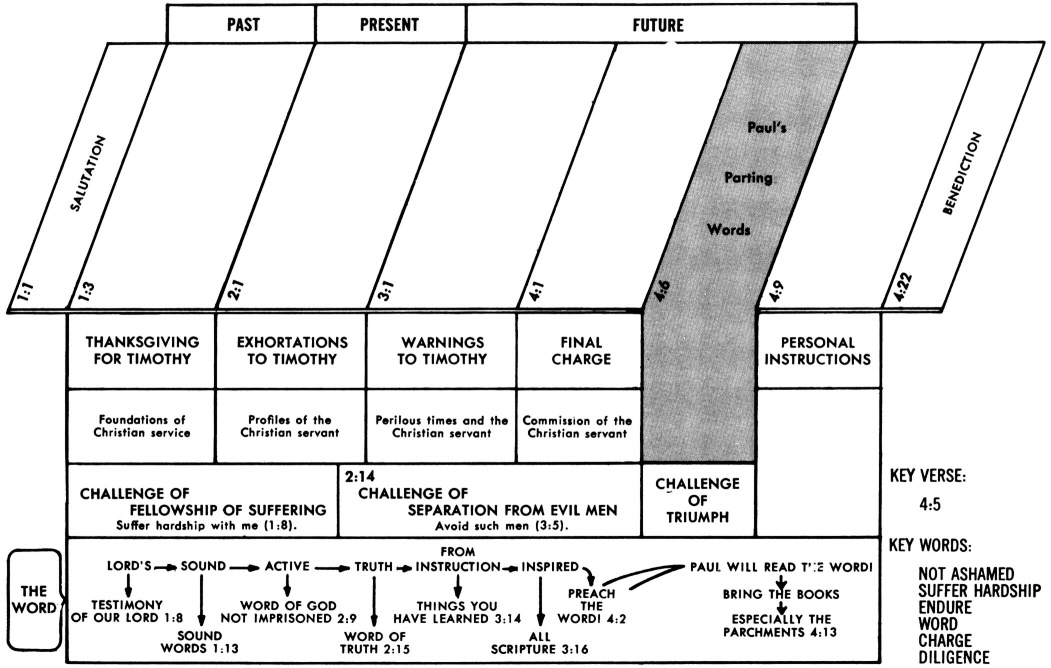
ENDURANCE AND SEPARATION IN THE MINISTRY
Click chart to enlarge
Charts from Jensen's Survey of the NT - used by permission
| 2 TIMOTHY | |||
| 2 Timothy 1:1-18 | 2 Timothy 2:1-26 | 2 Timothy 3:1-17 | 2 Timothy 4:1-22 |
| Retain the Standard |
Rightly Divide the Word |
Difficult Times Will Come |
Preach the Word |
| PAST | PRESENT | FUTURE | |
| Foundation of Christian Service |
Pictures of Christian Servant |
Dangerous Times for Christian Servant |
Commission of Christian Servant |
| Unashamed as a Witness: Guard the Gospel |
Unashamed as a Workman: Suffer for the Gospel |
Adequate as a Workman: Continue in the Gospel |
Awarded as a Workman: Preach the Gospel |
| Power of the Gospel |
Perseverance of the Gospel Message | Protection of the Gospel |
Proclamation of the Gospel |
| Reminder | Requirements | Resistance | Requests |
| Encouragement in Ministry |
Examples in Ministry |
Exhortations in Ministry |
Exhortations to Fulfill Ministry |
| Commendation & Charge |
Commission to Fulfill |
Conflict to Face |
Course to Finish |
|
Compiled from Jensen's Survey of the NT and Wilkinson's Talk Thru the Bible |
|||
2 Timothy 3:3 unloving, irreconcilable, malicious gossips, without self-control, brutal, haters of good, (NASB: Lockman)
Greek: astorgoi, aspondoi, diaboloi, akrateis, anemeroi, aphilagathoi
Amplified: [They will be] without natural [human] affection (callous and inhuman), relentless (admitting of no truce or appeasement); [they will be] slanderers (false accusers, troublemakers), intemperate and loose in morals and conduct, uncontrolled and fierce, haters of good.(Amplified Bible - Lockman)
Barclay: without human affection, implacable in hatred, reveling in slander, ungovernable in their passions, savage, not knowing what the love of good is (Westminster Press)
GWT: and lack normal affection for their families. They will refuse to make peace with anyone. They will be slanderous, lack self-control, be brutal, and have no love for what is good. (GWT)
KJV: Without natural affection, trucebreakers, false accusers, incontinent, fierce, despisers of those that are good
NLT: They will be unloving and unforgiving; they will slander others and have no self-control; they will be cruel and have no interest in what is good. (NLT - Tyndale House)
Phillips: utterly lacking in… normal human affections. They will be men of unscrupulous speech and have no control of themselves. They will be passionate and unprincipled (Phillips: Touchstone)
Wuest: without natural affection, implacable, slanderers, lacking self-control, savage, haters of that which is good (Eerdmans Publishing - used by permission)
Young's Literal: without natural affection, implacable, false accusers, incontinent, fierce, not lovers of those who are good,
UNLOVING: astorgoi:
without (destitute) natural affection (feeling)
lack normal affection for their families (GWT)
heartless
- Mt 10:21; Ro1:31
- 2 Timothy 3 Resources - Multiple Sermons and Commentaries
Related Passages:
Matthew 10:21+ “Brother will betray brother to death, and a father his child; and children will rise up against parents and cause them to be put to death.
Romans 1:31+ (BECAUSE GOD GIVES THEM OVER TO A REPROBATE MIND - Ro 1:28+ - THEY ARE) without understanding, untrustworthy, unloving, unmerciful;
ABSENCE OF AFFECTION
FOR ONE'S OWN FAMILY!
Unloving (794) (astorgos [word study] from a = without + storge = family love) literally is without family affection or without love for kindred and is frequently used of parent-child relationships. Storge love is instinctive, involves natural affection and is a conditional love. Although the Greek word storge is not used in the NT, it does form part of 3 derivative words - Ro 1:31, Ro 12:10; 2Ti 3:3-see notes Ro 1:31, Ro 12:10; 2Ti 3:3.
If there is no human affection, the family cannot long exist. In the terrible times men will be so set on self that even the closest natural ties will be nothing to them, even willing to "bite the hand that fed them" so to speak!. This is the sort of degradation in the human heart that allows mothers to have abortions or to leave their babies in trash cans. To be astorgos is to be heartless. It is not natural for people to love God or the things and people of God, but it is natural for them to love their own families.
Astorgos was used in secular Greek to describe women who had many love affairs and as a result did not have that nobler love for their husbands which they should have had.
Astorgos described animals who do not love their young. In these perilous times men will be so focused on self love that even the closest ties will mean nothing to them. The natural affection of storge is found even in people without Jesus but in the last days the love of self will override even this natural love of family members.
It is a terrible time when men and women are so focused on self gratification that even the closest ties mean nothing to them. Perhaps Dickens had this thought in mind in his classic epic "A Tale of Two Cities" when he wrote "It was the best of times, it was the worst of times". The "best of times" of course is only possible when depraved men & women living in the "worst of times" accept the gospel of Jesus Christ, and are forever transferred from the city of man to the city of God (cf note Revelation 21:2+).
Barclay notes that the age of the Roman Empire was "an age in which family love was dying. Never was the life of the child so precarious as at this time. Children were considered a misfortune. When a child was born, it was taken and laid at the father’s feet. If the father lifted it up that meant that he acknowledged it. If he turned away and left it, the child was literally thrown out. There was never a night when there were not thirty or forty abandoned children left in the Roman forum. Even Seneca, great soul as he was, could write: “We kill a mad dog; we slaughter a fierce ox; we plunge the knife into sickly cattle lest they taint the herb; children who are born weakly and deformed we drown.” The natural bonds of human affection had been destroyed." (The Daily Study Bible)
MacArthur explains that "astorgos, a negative adjective form of the verb storge, which commonly was used of family, social, and patriotic love. The noted theologian Benjamin Warfield described it as "that quiet and abiding feeling within us, which, resting on an object as near to us, recognizes that we are closely bound up with it and takes satisfaction in its recognition." It is not natural for people to love God or the things and people of God, but it is natural for them to love their own families. To be astorgos is therefore to be "without natural affection" (KJV). Just as the self-loving person is without common decency, he also is without common affection. He cares nothing for the welfare of those who should be dearest to him. His only interest in them is for what he believes they can do for him. To be unloving is to be heartless. Unloving behavior is reported daily in newspapers and broadcasts. Husbands and wives abusing one another, parents and children abusing one another - often to the point of murder - are so common that they make headlines only if they are particularly brutal or sensational. Tragically, the evangelical church has its share of the unloving and heartless (Ed note: "heartless" is how the NIV translates astorgos) (Bolding added). (See 2 Timothy MacArthur New Testament Commentary)
Wuest adds this note on astorgos - Benjamin B. Warfield, in his excellent article in The Princeton Theological Review of April 1918, The Terminology of Love in the New Testament , defines it as follows: It designates “that quiet and abiding feeling within us, which, resting on an object as near to us, recognizes that we are closely bound up with it and takes satisfaction in its recognition.” It is a love that is “a natural movement of the soul, something almost like gravitation or some other force of blind nature.” It is the love of parents for children, and children for parents, of husband for wife, and wife for husband. It is a love of obligatoriness, the term being used here, not in its moral sense, but in a natural sense. It is a necessity under the circumstances. This is the binding factor by which any natural or social unit is held together." (Eerdmans Publishing - used by permission)
IRRECONCILABLE: aspondoi:
trucebreakers
unwilling to be at peace with others
bitter haters (BBE)
unyielding
covenant breakers
implacable (not capable of being appeased)
unforgiving.
- 2Sa 21:1;21:2,3 Ps 15:4; Ezek 17:15;17:16, 17, 18, 19 Ro 1:31
- 2 Timothy 3 Resources - Multiple Sermons and Commentaries
UNWILLING TO
NEGOTIATE DIFFERENCES
Irreconcilable (786) (Aspondos from a = without + sponde = libation or drink offering, truce or an agreement) so literally not pouring out a libation (an act or instance of drinking often ceremoniously). This picture later came to mean “without a truce” because in the ancient world the making of treaties and agreements was accompanied by a pouring out a ceremonial libation. These men are unwilling to negotiate a solution to a problem involving a second party. Like the "Hatfield's and McCoy's", their feuds never end! The thought is not that these men break a truce but that they resist all efforts to reconciliation. They cannot be persuaded to enter into a covenant or agreement. This is the picture of the absolutely irreconcilable person who, being at war, refuses to lay aside their enmity or even to listen to terms of reconciliation. It means "hostility which refuses truce." It is hatred and unforgiveness "set in cement".
Irreconcilable describes a person who is implacably hostile or uncompromisingly opposed. It is one who is unwilling to negotiate a solution to a problem involving a second party.
Hendriksen writes that "Their feuds never end. In their camp no libation is ever poured out to signify that those who had been at variance with each other have consented to a truce"
The breaking of the marriage covenant (see related topic Covenant: As It Relates to Marriage) between husband and wife and the consequent skyrocketing divorce rate is one good example of this sin, because in it's "purest" form, divorce is a resolute refusal to forgive the other party, producing an unforgiveness "set in cement". Both parties refuse to change, no matter how desperate their own situation becomes, and are determined to have their own way regardless of the consequences, even to the point of knowingly destroying their own lives and the lives of their families. They do not forgive and do not want to be forgiven. They are beyond reasoning and inevitably self-destructive. As far as they are concerned, there is no compromise, no reconciliation, no court of appeal.
The only other NT use of aspondos is Ro 1:31+ where it occurs as one of a list of unrighteous traits characteristic of those who "did not see fit to acknowledge God any longer" and who God therefore "gave… over to a depraved mind, to do those things which are not proper" (Ro 1:28+), one of those things being to be "irreconcilable"
Trench adds that aspondos are not those who are only difficult to be reconciled with but are those who are absolutely irreconcilable; those who will not be atoned, or set at one, who being at war refuse to lay aside their enmity, or to listen to terms of accommodation… (in war aspondos is those who want) "no herald, no flag of truce, as we should now say, being allowed to pass between the parties, no terms of reconcilement listened to; such a war, for example, as that which the Carthaginians in the interval between the first and second Punic Wars waged with their revolted mercenaries. (Trench, R. C. Synonyms of the New Testament. Page 193)
Barclay - Aspondos can mean two things. It can mean that a man is so bitter in his hatred that he will never come to terms with the man with whom he has quarreled. Or it can mean that a man is so dishonorable that he breaks the terms of the agreement he has made. In either case the word describes a certain harshness of mind which separates a man from his fellow-men in unrelenting bitterness. It may be that, since we are only human, we cannot live entirely without differences with our fellow-men, but to perpetuate these differences is one of the worst—and also one of the commonest—of all sins. When we are tempted to do so, we should hear again the voice of our blessed Lord saying on the Cross: “Father, forgive them.” (The Daily Study Bible Online)
MALICIOUS GOSSIPS: diaboloi:
devils (literal)
false accusers
slanderous
men of unscrupulous speech.
- Mt 4:1; Jn 6:70; 1Ti 3:11; Titus 2:3
- 2 Timothy 3 Resources - Multiple Sermons and Commentaries
Malicious gossips (1228) (diabolos [word study] from dia = through or between and ballo = throw) literally means to "throw between". Thus the intent and the effect of "diabolos" is to falsely accuse and divide people without any reason. One might even say their speech is "diabolical". Whereas the irreconcilable person tends to disregard and neglect others, malicious gossips make a point of speaking slander so as to harm others. Whether to promote their own interests, to express jealousy or hatred, or simply to vent their anger, they take perverse pleasure in damaging reputations and destroying lives. Engulfed and blinded by self-love, malicious gossips do the very work of the Devil, the chief of all slanderers. Like father, like son.
Diabolos - 37x in 34v - NAS = devil(34), malicious gossips(3) Mt 4:1, 5, 8, 11; 13:39; 25:41; Lk 4:2f, 6, 13; 8:12; John 6:70; 8:44; 13:2; Acts 10:38; 13:10; Eph 4:27; 6:11; 1 Tim 3:6f, 11; 2 Tim 2:26; 3:3; Titus 2:3; Heb 2:14; Jas 4:7; 1 Pet 5:8; 1 John 3:8, 10; Jude 1:9; Rev 2:10; 12:9, 12; 20:2, 10. .
Someday (and it could be soon)
the salvation, and the power, and the kingdom of our God and the authority of His Christ (will) come, (and) the (Devil, the) accuser of our brethren (will be) thrown down, (the one) who accuses them before our God day and night. (Rev 12:9-10+).
Diabolos points out the fact that these individuals are like devils because they imitate the Devil in constantly inventing and throwing evil reports and accusations at others.
The devil's object is to come between and to break up relationships and then to keep this brokenness "alive". The reasons churches split are because of "old diabolos" who uses the envy, jealously and general ungodliness of other members (cp Mt 13:24-30, Jude 1:19, 1Co 1:10, 11:18, 19, 12:24, 25) to the point that they cannot reconcile with one another (See discussion of the importance of Forgiveness in notes on Eph 4:32). Gossip is never relating facts but is coloring the facts with falsehood, innuendo, supposition, etc. Gossip robs others of their name because it insinuates some attitude, motive, action, etc is present in their lives when it may or may not be (See Jesus' stern warning Mt 7:1, 2ff-note)
THOUGHT: What do you say to your brother about your other brother in the Lord? Ponder that one a moment.
There is a sense in which slander is the most cruel of all sins. If a man's goods are stolen, he can set to and build up his fortunes again; but if his good name is taken away, irreparable damage has been done. It is one thing to start an evil and untrue report on its malicious way; it is entirely another thing to stop it.
Shakespeare aptly described this diabolical trait:
“Good name in man and woman, dear my lord,
Is the immediate jewel of their souls:
Who steals my purse steals trash; ‘tis something, nothing;
“Twas mine, ‘tis his, and has been slave to thousands:
But he that filches from me my good name
Robs me of that which not enriches him
And makes me poor indeed.”
WITHOUT SELF CONTROL: akrateis:
Ungovernable in their passions
- 1Co 7:5;7:9 2Pe 2:14;2:19, 3:3; Jude 1:16, 18
- 2 Timothy 3 Resources - Multiple Sermons and Commentaries
KJV has "incontinent" (Webster defines it as lacking in control, one who fails to control sexual appetites)=
Without self control (193) (akrates from a = without + krátos = strength - Hapax legomenon) is literally without strength to resist the solicitations of one's passions and so describes a man who is powerless and/or unable to govern his fleshly appetites. They are void of that inner power of self-government which is the characteristic of the disciplined man. This man has jettisoned inhibitions and shame, does not care about what people think or what happens to them because of what he does. Like a driverless car, he careens haphazardly and crashes into whatever gets in his way. These men reach a stage when, so far from controlling his passions and desires, they are totally in bondage to that life sapping habit or desire which is their "master". The body which God gave them to use for His pleasure, has tragically become a vehicle for their selfish pleasure. Few things are more tragic than a man or woman who can no longer say "no" to self and who have become hopelessly enslaved to their own cravings.
These men are "without power over self" so that they are slaves to their own passions and lusts. The body which God gave them to use for His pleasure, has become a vehicle for their own pleasure. Few things are more tragic than a man or woman who can no longer say "no" to themselves and thus are hopelessly enslaved to their own cravings.
Paul is saying that in "the last days" anything goes. No rules, no moral absolutes, no restraints of any kind. Every man does that which is right in his own eyes, and woe to the person who dares to question his “lifestyle choices.”
Jesus excoriated the religious leaders who had a "form of godliness" but lacked the power:
"Woe to you, scribes and Pharisees, hypocrites! For you clean the outside of the cup and of the dish, but inside they are full of robbery and self-indulgence” (Greek here is the related noun akrasia derived from akrates) (Mt 23:25)
BRUTAL, HATERS OF GOOD: anemeroi aphilagaqoi
- Ge 49:7; Rev 13:15;13:17 16:6; 17:6
- Ps 22:6; Isa 53:3; 60:14; Lk 10:16; 16:14; 1Th 4:8; Jas 2:6
Brutal (savage, fierce, untamed, cruel) (434) (anemeros from a = without + hemeros = mild, lame) (found only in this verse in the NT) means literally not mild, not tame, savage, merciless, the very opposite of the gentle. These men have a character and conduct befitting a brute beast and are grossly ruthless or unfeeling. They are like animals in their nature, action and instincts. They are savage (lacking the restraints normal to civilized human beings), cruel, violent like that of wild beasts, who attack enemies and tear them in pieces. These men are not just given to violence now and then; they are in fact, ferocious "savages" who pounce on whoever gets in their way, and have no regard for the rights or feelings of anyone other than themselves. Even a dog may be sorry when he has hurt his master, but these men in their malevolent treatment of others have lost natural human sympathy and feeling. This trait is the opposite of gentleness called for in the manners of the bondservant of the Lord in (2:24).
Genuine godliness has power which produces gentleness and the want of this power makes men rough, harsh and cruel.
Haters of good (865) (aphilagathos from a = without and a combination of phílos = friend + agathos = good which is spiritually beneficial to another = literally loving and practicing what is good) (found only in this verse in the NT) describes men who are hostile to or despisers of all that is good and of good men. These men lack of generous interest in the public good. They have no love of virtue. In their love of self they have become haters of good, hating what should be loved and loving what should be hated! Listen to God's warning through Isaiah to given to faithless Israel but applicable to men such as these
"Woe to those who call evil good, and good evil; Who substitute darkness for light and light for darkness; Who substitute bitter for sweet, and sweet for bitter!" (Is 5:20).
Jesus said that despite the fact that
"the light is come into the world… men loved the darkness rather than the light… and everyone who does evil hates the light (Jn 3:19, 20+)
The direct contrast is found in the criteria of "overseers" who are to be "loving what is good" (philagathos) (see note Titus 1:8)
These haters of good don't even want to be in the presence of good things and good people because they have no love for anything spiritually beneficial and the most damaging place for these workers of iniquity is in the walls of the church.
Barclay - There can come a time in a man’s life when the company of good people and the presence of good things is simply an embarrassment. He who feeds his mind on cheap literature can in the end find nothing in the great masterpieces. His mental palate loses its taste. A man has sunk far when he finds even the presence of good people something which he would only wished to avoid. (The Daily Study Bible Online)
2 Timothy 3:4 treacherous, reckless, conceited (RPPN) lovers of pleasure rather than lovers of God (NASB: Lockman)
Greek: prodotai, propeteis, tetuphomenoi, (RPPN) philedonoi mallon e philotheoi,
Amplified: [They will be] treacherous [betrayers], rash, [and] inflated with self-conceit. [They will be] lovers of sensual pleasures and vain amusements more than and rather than lovers of God. (Amplified Bible - Lockman)
Barclay: treacherous, headlong in word and action, inflated with pride, lovers of pleasure rather than lovers of God. (Westminster Press)
GWT: They will be traitors. They will be reckless and conceited. They will love pleasure rather than God. (GWT)
KJV: Traitors, heady, high minded, lovers of pleasures more than lovers of God;
Phillips: treacherous, self-willed and conceited, loving all the time what gives them pleasure instead of loving God. (Phillips: Touchstone)
NLT: They will betray their friends, be reckless, be puffed up with pride, and love pleasure rather than God. (NLT - Tyndale House)
Wuest: betrayers, headstrong, besotted with pride, fond of pleasure rather than having an affection for God, having a mere outward semblance of piety toward God but denying the power of the same. And these be constantly shunning.
Young's Literal: traitors, heady, lofty, lovers of pleasure more than lovers of God,
TREACHEROUS: prodotai:
They will betray their friends (NLT)
Betrayers (Wuest)
those who turn against their friends (ICB)
false to their friends (BBE)
- 2Pe 2:10-22; Jude 1:8 ,9
- 2 Timothy 3 Resources - Multiple Sermons and Commentaries
Treacherous (4273) (prodotes from prodídomi = to give away, to betray which in turn is from pró = before or forth + dídomi = give) describes men who who betray another’s trust and confidence or are false to an obligation or duty. This is the man who delivers without justification a person into the control of someone else (in the sense of giving forward into another’s hands). It describes one untrue to what should command one’s fidelity or allegiance and even implies readiness to betray trust or confidence. These men betray confidence and trust put in them.
Luke describes the prototypical traitor…
Judas the son of James, and Judas Iscariot, who became a traitor. (prodotes) (Lk 6:16+)
Stephen boldly accused the Jews
Which one of the prophets did your fathers not persecute? And they killed those who had previously announced the coming of the Righteous One, Whose betrayers (prodotes) and murderers you have now become. (Acts 7:52+).
Treachery comes naturally to a person who possesses the other "qualities" already listed.
Jesus warned the 12 that
“brother will deliver up brother to death, and a father his child; and children will rise up against parents, and cause them to be put to death. And you will be hated by all on account of My name… " (Mt 10:21, 22+)
This was written in the times of persecution and if that gangrene gets into the church, your best friend may betray you. Whenever the church has suffered persecution, true believers have been betrayed into the hands of the oppressors, often by members of their own families who value safety and prosperity above devotion. Feigned love and friendship become means of treachery. That is also the time when genuine loyalty proves itself, often at a high price. At this particular time in the ordinary matters of politics one of the curses of Rome was the existence of informers (delatores = one who brings a charge against). Times were so perilous that Tacitus could say: "He who had no foe was betrayed by his friend." There were those who would revenge themselves on an enemy by informing against him.
Barclay - What Paul is thinking of here is more than faithlessness in friendship—although that in all truth is wounding enough—he is thinking of those who to pay back an old score would inform against the Christian to the Roman government. (The Daily Study Bible Online)
Barclay goes on to quote Lenin, clearly not a believer, as representative of an attitude of treacher -- Treaties are only for getting breath for a new effort. They exist to be broken as soon as expedient. Peace propaganda is to camouflage war preparations. (The Daily Study Bible Online)
RECKLESS: propeteis:
- 2 Timothy 3 Resources - Multiple Sermons and Commentaries\
Reckless - headstrong, heady, rash, such as fall forward, self willed, those who do foolish things without thinking.
The reckless wreck more!
Reckless (4312) (propetes from propípto = fall forward in turn from pró = forward + pípto = fall) is literally falling forward or headlong. It was used to describe one slipping down in bed. Figuratively as used here, it gives a vivid picture of these men marked by or proceeding from undue haste or lack of deliberation or caution. They plunge ahead without forethought in their impetuous deeds. Their behavior is rash, reckless, headlong (without due deliberation, out of control), impetuous, thoughtless and precipitous. Nothing stops them. Rashly they plunge ahead in their wickedness, being reckless or precipitate in their wicked deeds.
They act impetuously without thought for others or care for possible consequences. These men are swept on by passion and impulse to such an extent that they are totally unable to think sensibly. Such people act foolishly and carelessly, completely unconcerned about the consequences for themselves or others. The word headstrong includes their determination to have their own way, regardless of advice to the contrary.
The only other use is by Luke describing a riot in Ephesus and the town clerk's declaration that…
Since then these are undeniable facts, you ought to keep calm and to do nothing rash. (marked by or proceeding from undue haste or lack of deliberation or caution) (Acts 19:36+)
Vincent writes that propetes means…Precipitate, reckless, headstrong in the pursuit of a bad end under the influence of passion. Only here and Acts 19:36. In Septuagint (LXX) , slack, loose, hence foolish, Pr 10:14, and dividing or parting asunder, as the lips; of one who opens his lips and speaks hastily or thoughtlessly, Pr 13:3. (Vincent, M. R. Word studies in the New Testament. Vol. 4, Page 311)
Rienecker adds this note describing these men as "ready to precipitate matters by hasty speech or action. It indicates lack of control or quickness, whether good or bad and with respect to action it refers to those who are impulsive, who get carried away (hotheads!) like a bolting horse,; people who make themselves known by their violence, who wreck everything, who take wild chances. (Borrow The New Linguistic and Exegetical Key to the Greek New Testament)
CONCEITED: tetuphomenoi (RPPMPN):
Be puffed up (NLT)
swollen with conceit (NRSV)
high minded (KJV)
swell headed
having been swollen up with pride
- Ro11:20; 1Ti 6:17
- 2 Timothy 3 Resources - Multiple Sermons and Commentaries
Conceited (5187) (tuphoo [typhoo] from tuphos [typhos] = smoke) means literally to literally wrap in smoke or mist and so to becloud. Figuratively it means to be puffed up or conceited. Some secular Greek sources actually use tuphoo to describe one as mentally ill.
Tuphoo is used 4 times in the NT. Jesus uses tuphoo literally to describe a "smoldering (smoking) wick" (Mt 12:20) Paul uses tuphoo twice in first Timothy…
"not a new convert, lest he become conceited and fall into the condemnation incurred by the devil." (1Ti 3:6+)
"If anyone advocates a different doctrine, and does not agree with sound words, those of our Lord Jesus Christ, and with the doctrine conforming to godliness, he is conceited and understands nothing; but he has a morbid interest in controversial questions and disputes about words, out of which arise envy, strife, abusive language, evil suspicions" (1 Ti 6:3, 4+)
The verb tuphoo means wrapped or enveloped by smoke, so that what is outside one’s circumscribed world of self cannot be seen.
The man who is "swollen with conceit" is really just "filled with smoke" for all his accomplishments will be reduced to nothing more than smoke and ashes one day. (2Pe 3:10+)
The perfect tense pictures a person who in the past has come to a state of such pride, and is so puffed up, that his mind as a permanent result is beclouded and besotted with pride and conceit. No one can tell them anything, for they know it all.
Gill says these men are "puffed and swelled up with a vain conceit of themselves, and speaking great swelling words of vanity"
They have a much higher view of themselves than is justified. The Greek word properly means to wrap in smoke & was then used metaphorically for conceit, to picture a badly mistaken view of one’s own importance. The perfect tense pictures their puffed up opinion of themselves as their permanent condition. The idea of conceit differs from the “lovers of self” for the latter trait can be concealed, while the very nature of conceit involves being noticed by others.
Hendricksen comments that…No one can tell them anything, for they “know it all,” so blinded with conceit (see on 1Ti 3:6; 6:4) are they. This blindness, moreover, has a moral, spiritual cause. Its root is in the heart and in the will, for these people are utterly selfish (note how the description in reaching a climax returns to its starting-point: “self-loving”). (Borrow - Hendriksen, W., & Kistemaker, S. J. Vol. 4: New Testament commentary: Exposition of the Pastoral Epistles. Grand Rapids: Baker Book House)
John Lennon, the former Beatle, exemplified this attitude as shown by the following brash (stupid) statement "Christianity will go. It will vanish and shrink. I needn't argue about that; I'm right and I will be proved right. We're (BEATLES) more popular than Jesus now. (WOE!)" (Lennon was shot and now knows who is more popular!)
All that John Lennon ever accomplished will be turned into wisps of smoke, but Christianity will continue to flourish until
the earth shall be filled with the knowledge of the glory of the Lord, as the waters cover the seas. Hab 2:14. (See also Nu 14:21 Ps 72:19+ Isa 6:3, 11:9)
LOVERS OF PLEASURE: philedonoi:
loving all the time what gives them pleasure instead of loving God. (Phillips)
- 2 Timothy 3 Resources - Multiple Sermons and Commentaries
Lovers of pleasure (5369) (philedonos from phílos = friend or loving + hedone = pleasure from hedos = delight, enjoyment and the related verb hedomai = to have sensual pleasure). Hedone gives us our English word hedonism which is the doctrine that pleasure or happiness is the sole or chief good in life. Philedonos is used in a bad sense of what is against God and spiritually destructive to oneself. These men are intent on pleasure, abandoned to (sensual) pleasure and pleasure-loving. This word describes well the self-absorbed, self-gratifying orbit of the ungodly. Pascal once wrote that in every man's heart is a "God-shaped vacuum," yet men will continue to fill this vacuum with the god called "pleasure."
Christ Himself said of these days, "Because lawlessness (or iniquity) will abound, the love of many will grow cold." Mt 24:12+.
Americans spend $600.00 on luxuries for every $1.00 they give to missions. More money is spent on tobacco each year than both the U.S. and Canada have spent on missions since the discovery of America!
"Is it time for you yourselves to dwell in your paneled houses, and this temple to lie in ruins?" (Haggai 1:4).
The list ends, as it began, with those whose love has become so misdirected that they can only think of their own desires. They love their own pleasures, are wholly controlled by them and are unwilling to make any sacrifice for temporal pleasures.
They put devotion to self-satisfaction above devotion to God. Love for God is not a controlling motive in their lives. The series began with their love of self and ends with a lack of love from God. Their love of self with all its attendant evils shuts out any genuine love for God. (Hiebert)
Related Resources:
- Lovers of pleasure - Edward Payson
- This pleasure-loving, pleasure-seeking,and pleasure-inventing age - John Angell James - Excerpt: A taste for worldly amusements will inevitably prove,wherever it is indulged--a powerful obstacle to growth in grace.
- Is God opposed to pleasure?
- What does the Bible say about self-gratification / self-pleasure?
- Is God a cosmic killjoy?
- Live in Luxury And Pleasure - Trench's Synonyms of the NT
- What is Christian hedonism?
- What is Christian hedonism? - John Piper (Another Article)
- Charles Buck Dictionary Pleasure
- Hastings' Dictionary of the NT Pleasure
- 1911 Encyclopedia Britannica Pleasure
- International Standard Bible Encyclopedia Pleasure
- McClintock and Strong's Bible Encyclopedia Pleasure
- King James Dictionary Pleasure - The gratification of the senses or of the mind agreeable sensations or emotions the excitement, relish or happiness produced by enjoyment or the expectation of good opposed to pain. We receive pleasure from the indulgence of appetite from the view of a beautiful landscape from the harmony of sounds from agreeable society from the expectation of seeing an absent friend from the prospect of gain or success of any kind. Pleasure, bodily and mental, carnal and spiritual, constitutes the whole of positive happiness, as pain constitutes the whole of misery. Pleasure is properly positive excitement of the passions or the mind but we give the name also to the absence of excitement, when that excitement is painful as when we cease to labor, or repose after fatigue, or when the mind is tranquilized after anxiety or agitation. Pleasure is susceptible of increase to any degree but the word when unqualified, expresses less excitement or happiness than delight or joy.
- Vines' Expository Dictionary Pleasure
- Webster's 1829 Dictionary - Pleasure
(1):(n.) Amusement; sport; diversion; self-indulgence; frivolous or dissipating enjoyment; hence, sensual gratification; - opposed to labor, service, duty, self-denial, etc.
(2):(n.) What the will dictates or prefers as gratifying or satisfying; hence, will; choice; wish; purpose.
(3):(n.) That which pleases; a favor; a gratification.
(4):(v. t.) To give or afford pleasure to; to please; to gratify.
(5):(v. i.) To take pleasure; to seek pursue pleasure; as, to go pleasuring.
(6):(n.) The gratification of the senses or of the mind; agreeable sensations or emotions; the excitement, relish, or happiness produced by the expectation or the enjoyment of something good, delightful, or satisfying; - opposed to pain, sorrow, etc.
INSTEAD OF LOVERS OF GOD: para mallon e philotheoi:
- Ro 16:18; Php 3:18;3:19 1Ti 5:6; 2Pe 2:13;2:15 Jude 4 Jude 19
- 2 Timothy 3 Resources - Multiple Sermons and Commentaries
THE ANTIDOTE FOR
LOVING PLEASURE
Antidote refers to a remedy for counteracting a poison or disease. A remedy or other agent used to neutralize or counteract the effects of a poison. An agent that relieves or counteracts. Beloved, the sure antidote for the poison of the love of pleasure is the love of God! This idea is closely related to the principle of an expulsive power of a new affection. MARK IT DOWN - When God is our all in all (Col 3:11+, 1 Cor 15:28), we are much less likely to be ensnared by the "by and by," "the here and now," the passing lusts of the world (1 Jn 2:17+).
YOU ARE MY ALL IN ALL
You are my strength when I am weak
You are the treasure that I seek
You are my all in all
Seeking You as a precious jewel
Lord, to give up I'd be a fool
You are my all in all
Taking my sin, my cross, my shame
Rising again I bless Your name
You are my all in all
When I fall down You pick me up
When I am dry You fill my cup
You are my all in all
Jesus, Lamb of God
Worthy is Your name
Jesus, Lamb of God
Worthy is Your name
You are my strength when I am weak
You are the treasure that I seek
You are my all in all
Seeking You as a precious jewel
Lord, to give up I'd be a fool
You are my all in all
Jesus, Lamb of God
Worthy is Your name
Jesus, Lamb of God
Worthy is Your name
Jesus, Lamb of God
Worthy is Your name
Jesus, Lamb of God
Worthy is Your name
Jesus, Lamb of God
Worthy is Your name
Jesus, Lamb of God
Worthy is Your name
Worthy is Your name
Lovers of God (5377) (philotheos from phílos = friend or loving + Theós = God) In other words, the true God has no place at all in the thinking and living of a false teacher or of anyone who is self-centered. They ignore the claims of God and live their life in pursuit of selfish aims that gratify the flesh.
Hiebert says that "They love their own pleasures and are wholly controlled by them. They are willing to make any sacrifice for temporal pleasures but are unwilling to give up anything because of their love for God. They put devotion to self-satisfaction above devotion to God. Love for God is not a controlling motive in their lives. The series began with their love of self and ends with their lack of love for God. Their love of self with all its attendant evils shuts out any genuine love for God." ( 2 Timothy Commentary)
Jesus told Nicodemus “And this is the judgment, that the light is come into the world (cf Jn 8:12), and men loved the darkness rather than the light; for their deeds were evil” (Jn 3:19+)
Vance Havner - Paul names another class of idolaters, numerous in these last days, "lovers of pleasures more than lovers of God" (II Tim. 3:4). Too many, even among our professing Christians, can play but cannot pray, know the names of the movie stars but cannot name the books of the Bible, can find Amos and Andy on the radio but would have trouble locating Amos and Andrew in the Bible. They know the baseball scores but not what the score is in God's Word. They yell like Comanche Indians at football games and sit like wooden Indians in church. They can weep over the glycerin tears of Hollywood divorcees and sit dry-eyed while missionaries plead for lost millions without God and without hope in this world.
Rick Renner - Signs of the Last Days—Lovers of Pleasure More Than Lovers of God (see video)
… lovers of pleasure more than lovers of God.…—2 Timothy 3:4
It can seem a little heavy when we’re reading Paul’s list of characteristics of society in the last days, especially when the Greek words he used in that text are expounded on and looked at more deeply, as we are doing in these series of Sparkling Gems. But one thing is sure: The Holy Spirit did not inform us of these details so we would be worried or afraid and hide from the world. He forewarned us of these things in advance so we could spiritually reinforce ourselves to live victoriously and free until Jesus returns!
The Holy Spirit considers it important for us to know these things in advance, or He wouldn’t have dedicated so much time and space to this subject. That’s why we must give heed to His words and study them out fully so we can grasp their meanings to the greatest extent possible.
As Paul continued to bring illumination regarding events that will occur in society in the last days, he next wrote that people will become “lovers of pleasure more than lovers of God.” Let’s delve deeply into these words and phrases today to see what gems of truth we can extract from the Greek that will broaden our understanding.
The words “lovers of pleasure” are a translation of the Greek word philodonos, which is a compound of two words, phileo and hedonos. The first word, phileo, is a well-known word that conveys the ideas of affection and love. It can denote an affection so deep that it even embraces the idea of romance and is from the same root word that means to kiss.
Frequently in the Greek language, the word phileo is compounded with other words to form new meanings, as it is with the word philodonos. The following are examples:
• Philadelphos: You may recognize this word because it is where we get the name of the great city of Philadelphia on the east coast of the United States. It is actually a New Testament word that is a compound of the words phileo and adelphos. The word phileo means to deeply, profoundly, and affectionately love, while the word adelphosis the Greek word for a brother When compounded, they form the word philadelphos, which means brotherly love.
• Philosophia: The word philosophia is a compound of the word phileo and sophos. As noted, the word phileo means to love or to have a deep, profound affection. The word sophos is the word for wisdom. When these two words are compounded, they form the word philosophia. This is where we get the word philosophy, which describes a deep and profound love of wisdom.
• Philoxenos: The word philoxenos is a compound of the words phileo and xenos. The second part of this word is xenos, which is the ancient Greek word for a stranger or foreigner. When the words phileo and xenos are compounded, they form the word philoxenia, a word that expresses the idea of a person who has a special love for strangers or love for foreigners.
• Philostorgos: The second part of this word is storgos—the Greek word for a commitment or devotion to one’s family. When the words phileo and storgos are compounded, the new word depicts a person who has a deep affection and sense of commitment for his family.
• Philanthropia: In this word, the word phileo is compounded with the word anthropos, the word for mankind or humankind. The word anthropos is where we get the word anthropology or an anthropologist. But when the Greek word phileo is compounded with the word anthropos, it depicts a love for humanity. From this, we get the word philanthropist, which describes a wealthy person who generously gives his resources or money for the betterment of humanity.
• Philarguria: Here we see the word phileo compounded with the word arguria. The word arguria is the old word for silver or money. When arguria is compounded with phileo, the new word philarguria depicts a love of silver or an affection and love of money.
In Second Timothy 3:4, Paul compounded the word hedonos with the word phileo to tell us people in the last days will become “lovers of pleasure.” Because the word phileo means to have a deep, profound love and can convey the notion of a romantic preoccupation, this emphatically forecasts that people in the last days will be preoccupied with and in love with the pleasure and the pursuit of happiness. But let’s look deeper at the word hedonos to get the full picture!
The word hedonos is only used five times in the New Testament, and each time, it conjures up the picture of people completely preoccupied with pleasure and who live for the gratification of their flesh and their own personal happiness. The English Dictionary says “hedonism” is the doctrine that pleasure or happiness is the highest good; addiction to and obsession for pleasure as a way of life. Paul used the Greek word philodonos to say that society in the last days will become “lovers of pleasure” or that they will become preoccupied and obsessed with the pursuit of their own comfort, pleasure, and happiness.
The truth is, there has never been a generation in history with more material goods or comfort than this present generation. Yet despite this glut of goods and pursuit of pleasure, the worldwide happiness index is the lowest on record, especially in the industrialized world where material goods abound.
It is very clear that self-centered living does not produce happiness. In fact, the highest rating on the happiness index is in developing Third World nations where goods are scarcer, but where commitment to “one’s personal faith” is higher.
There is no doubt about it! Because Paul used the word philodonos—which means “lovers of pleasure”—he was emphatically declaring that people in the last days will be obsessed with pleasure.
It is unfortunate that even Christians are often obsessed with comfort and pleasure to such an extent that they don’t want to be asked to do anything that would inconvenience them. But this should not be the case.
Here’s the bottom line: God is more concerned about your obedience than He is about your happiness. Happiness is fleeting, but obedience to God and His Word produces a long-term joy that is unaffected and unwavering.
A doctrine has permeated the Church in recent years that says God wants them to be happy above all else. Such teaching ignores the fact that the Gospel frequently calls for us to die to ourselves, to deny ourselves, and to even pick up our cross and carry it (see Luke 9:23). Obeying this call of God to pick up our cross and carry it means that we will often be required to take the road of sacrifice—to humble ourselves and even lay down our “rights” for the sake of others.
This errant doctrine that we are entitled to be “happy” erroneously leads people to avoid any decision or take any action that inconveniences their schedule, plans, or comfort. This is ultimately a doctrine of selfishness that justifies self-focus and non-service. Yet if we obey the demands put forth by the Gospel, these demands will make our flesh suffer—for in order for us to walk in the Spirit and not fulfill the lusts of the flesh, it will necessitate that we mortify the deeds and demands of the flesh.
But according to Paul’s words in Second Timothy 3:4, the pursuit of “happiness” will become the chief goal of people at the end of this age. Of course, God wants us to be satisfied in life, but that which Paul wrote about in this verse is far beyond that. It was a prophetic declaration that people in the last days will become completely consumed with themselves and that their own happiness will drive them to unequaled selfishness.
Second Timothy 3:4 says this love of pleasure will even supersede love for God. No one would ever claim to love pleasure more than God, but as my mother told me when I was growing up, a person’s actions speak louder than his words. A person’s actions always reveal the truth about what he or she loves most. This verse tells us that love of pleasure will become so widespread that people will be more devoted to their own pleasure and pursuit of happiness than they are in love with God.
Paul wrote that people will be lovers of pleasure “more than” lovers of God. The words “more than” are a translation of the Greek word mallon, which draws a drastic comparison between two points, denoting something that is extremely different in comparison to something else.
In context, this means people will be excessive lovers of pleasure—much, much more than they are lovers of God. In fact, their desire for their own pleasure will be so great that it will far surpass their devotion, respect, and service to God. In the last days, people’s thinking will not be ruled by what is morally right or morally wrong or what is pleasing or displeasing to God, but by the question: How will this decision or action affect my own personal comfort, pleasure, or happiness?
God is not against our being blessed or enjoying nice possessions, as long as we hold them in our hands and don’t allow them into our hearts. But when the acquisition of possessions becomes an obsession and takes first place in our lives, thereby affecting our obedience to God and His Word, it is wrong. In fact, it has become a form of idolatry. We have crossed a line that is a serious violation in the eyes of God.
The words “lovers of God” in Greek is the word philotheoi. The first part of this word is phileo, and as noted earlier, it means to love or to be deeply affectionate. The second part of the word is word theos, the Greek word for God. But when these two words are compounded, as Paul does in this verse, the new word pictures people who are deeply and profoundly in love with God.
Jesus said that at the end of the age, people would be preoccupied with buying, selling, etc. This will be the condition of the unbelievers in the last days, but it does not have to be our condition. Especially as we draw near to the coming of Jesus, we must do everything we can to guard our hearts and keep them free from selfishness and greed. We must focus on Jesus and keep our priorities aligned with His Word.
Soon everything in this world will pass away, and only those things that were done for Jesus will remain. In light of this awesome truth, it is imperative that we examine our hearts to determine our real spiritual condition. If we find areas that need improvement, the Holy Spirit will help us correct those areas that are out of sync with Him!
MY PRAYER FOR TODAY
Father, it is very clear that self-centered living does not produce happiness. As believers in Jesus Christ, we have been commanded to live according to the law of love—and love does not seek its own. Father, I repent right now for each time I have been more focused on doing what resulted in convenience for me rather than doing what produced obedience to You. Today I make a fresh commitment to deny myself, to pick up my cross, and to follow Jesus Christ as my Lord and example in all things. Holy Spirit, I ask You to open the eyes of my understanding and teach me to how to truly seek first Your Kingdom and not my comfort, to pursue Your holy ways instead of temporal pleasures.
I pray this in Jesus’ Name!
2 Timothy 3:5 holding (continually) (PAPMPN) to a form of godliness, although they have denied (RMPMPN) its power; Avoid (shun continually) (2SPMM) such men as these. (NASB: Lockman)
Greek: echontes (PAPMPN) morphosin eusebeias ten de dunamin autes ernemenoi; (RMPMPN) kai toutous apotrepou. (2SPMM)
Amplified: For [although] they hold a form of piety (true religion), they deny and reject and are strangers to the power of it [their conduct belies the genuineness of their profession]. Avoid [all] such people [turn away from them]. (Amplified Bible - Lockman)
Barclay: They will maintain the outward form of religion, but they will deny its power. Avoid such people (Westminster Press)
GWT: They will appear to have a godly life, but they will not let its power change them. Stay away from such people. (GWT)
KJV: Having a form of godliness, but denying the power thereof: from such turn away.
NJB: They will keep up the outward appearance of religion but will have rejected the inner power of it. Keep away from people like that.
NLT: They will act as if they are religious, but they will reject the power that could make them godly. You must stay away from people like that. (NLT - Tyndale House)
Phillips: They will maintain a facade of "religion", but their conduct will deny its validity. You must keep clear of people like this. (Phillips: Touchstone)
Wuest: having a mere outward semblance of piety toward God but denying the power of the same. And these be constantly shunning.
Young's Literal: having a form of piety, and its power having denied; and from these be turning away,
HOLDING TO A FORM (outward appearance): echontes (PAPMPN) morphosin:
- Isa 29:13; 48:1,2; 58:1, 2 ,3; Eze 33:30;33:31, 32 Mt 7:15; 23:27; 28 Ro 2:20, 21, 22, 23, 24; 1Ti 5:8; Titus 1:16
- 2 Timothy 3 Resources - Multiple Sermons and Commentaries
THE HYPOCRISY OF HOLDING
TO A FORM OF GODLINESS
See 2 excellent sermons on this topic Formalism by Ryle, Form of Godliness w/o the Power by Spurgeon )
They will maintain a facade of religion (Phillips)
They will appear to have a godly life (GWT)
They will keep up a make-believe of piety and yet exclude its power (Weymouth)
Though they keep up a form of religion, they will have nothing to do with it as a force (Moffatt)
It is important to see here that the flesh can put on a show of godliness while in fact being utterly devoid of true spirituality! This is a frightening thought! Mark it well that these men are not self-acknowledged pagans but rather professed adherents of Christianity. Their form of godliness is a shell which looks at first glance as if it corresponds to the essence, but there is a lack of genuine substance. Jude describes men like this as "mockers, following after their own ungodly lusts...ones who cause divisions, worldly-minded, devoid of the Spirit." (Jude 1:18, 19+)
Holding (2192) (echo) means to have, hold, possess and in the present tense means this is their lifestyle, their habitual practice. The present tense describes this "spiritual masquerade" as their lifestyle! They are "spiritual counterfeits," "Christian charlatans!"
Form (3446) (morphosis) refers to outward shape and appearance, such as that of a silhouette, which is an outline or shadow of something. Morphosis as used in this verse refers to the mere outward resemblance, as distinguished from the essential reality. Like the unbelieving scribes and Pharisees, lovers of self are concerned only about the outward form, about
“the outside of the cup and of the dish,” while “inside they are full of robbery and self-indulgence” (Mt 23:25)
Isaiah's OT description of faithless Israel fits these charlatans who "draw near with their words and honor (God) with their lip service, but they remove their hearts far from (Him) and their reverence for (Him) consists of tradition learned by rote." (Isa 29:13)
These men are like those Jesus warned about
who come… in sheep's clothing, but inwardly are ravenous wolves." (see note Matthew 7:15), who (like the Pharisees) "are like whitewashed tombs which on the outside appear beautiful, but inside they are full of dead men's bones and all uncleanness" (Mt 23:27) and "outwardly appear righteous to men, but inwardly you are full of hypocrisy and lawlessness." (Mt 23:28)
These men go through all the correct movements and maintain all the external forms of religion; but they know nothing of the dynamic power of the Spirit-filled, supernaturally energized Christ life which transforms sinners into saints. (Related - Progressive Sanctification)
These men "disguise themselves as servants of righteousness" (2 Cor 11:15) and teachers of His Word, but they are really servants of Satan, who is "is a liar, and the father of lies" and they as his children are purveyors of lies - like father, like son! (Jn 8:44) Satan’s most dangerous attacks against God’s people come not from without but from within the church by means of false teachers who pretend to speak for God. Beware of those who preach godliness without actually practicing it.
Acts 20:28+ “Be on guard (present imperative = command to be continually watching out! Only possible as one depends on the Holy Spirit to obey) for yourselves (NOTICE - LOOK IN THE MIRROR FIRST BEFORE YOU LOOK OUT FOR OTHERS! - heed the instruction in Acts 20:32+) and for all the flock, among which the Holy Spirit has made you overseers, to shepherd the church of God which He purchased with His own blood. 29 “I know that after my departure savage wolves will come in among you (A PROPHECY SURE TO COME TO PASS!), not sparing the flock; 30 and from among your own selves men will arise (NOTE THIS IS AN "INSIDE" JOB - cf the "creepers" in Jude 1:4+), speaking perverse things, to draw away the disciples after them. 31 “Therefore be on the alert (present imperative = command to be continually on high alert! Only possible as one depends on the Holy Spirit to obey), remembering that night and day for a period of three years I did not cease to admonish each one with tears."
Moody - I was walking one day in Westminster Abbey. As I paused to survey the monuments of the illustrious departed that are gathered there, my attention was arrested by the appearance of the pavement near to where I stood. A beautiful many-colored light rested upon it, and gave it an aspect that I could not but linger to behold. The cause was apparent. A painted window above me explained the reason. And the pavement, beautiful as it appeared, had no color in itself: it was the window above that gave it the beauteous hue. How many are like that pavement! they appear beautiful, and we are apt to mistake it for “the beauty of holiness”; but it is in a borrowed light,—contact with the wise and good it may be: remove that, and their true color appears.
A W Tozer - FAILURE OF RELIGION
Having a form of godliness, but denying the power thereof. 2 Timothy 3:5
Millions of men and women refuse to face up to the fact that religion, in and of itself, is not enough for the sinner’s need.
It is amazing how many things religious people want to do to you. They can start with infant baptism and end up with the last rites when you are 108 years old—and all of that time they will manipulate you, maul you and sweet massage your soul. When it is all done, you are just what you were. You are just a decorated and massaged sinner—a sinner who did not eat meat, or on the other hand, a sinner who did eat fish!
When religion has done all it can, you are still a sinner who either went to church or did not go to church. Religion can put us on the roll and educate us and train us and instruct us. But after all that, there is still something within our beings that cries, “Eternity is in my heart and I have not found anything to satisfy it!”
Only our Lord Jesus Christ is enough to satisfy the eternal longing in our souls.
A W Tozer - What’s Happened to Morality?
Having a form of godliness, but denying the power thereof: from such turn away. —2 Timothy 3:5
The question being discussed by many these days—why religion is increasing and morality slipping, all at the same time—finds its answer in … the error of religious intellectualism. Men have a form of godliness but deny the power thereof.
The text alone will not elevate the moral life. To become morally effective, the truth must be accompanied by a mystic element, the very element supplied by the Spirit of truth. The Holy Spirit will not be banished to a footnote without taking terrible vengeance against His banishers.…
The mysterious presence of the Spirit is vitally necessary if we are to avoid the pitfalls of religion. As the fiery pillar led Israel through the wilderness, so the Spirit of truth must lead us all our journey through. One text alone could improve things mightily for us if we would but obey it: “Trust in the LORD with all thine heart; and lean not unto thine own understanding” (Proverbs 3:5).
Evangelical obedience expresses not merely the form, but the power of godliness.… God neither requires nor will accept obedience which does not spontaneously flow from supreme love to Himself.
Jack Hayford - Seek True Godliness 2 Timothy 3:5
“Having a form of godliness, but denying the power thereof.”…
Let me point you to the discipline which may avert this evil. First and foremost, I would say let us cherish a clear and continual recognition of the reality of the danger. Forewarned is forearmed. He that will take counsel of his own weakness, and be taught by God’s Word how unreliable he himself is, and how strong the forces are which tend to throw his religion all to the surface, will thereby be, if not insured against the danger, at least made a greater deal more competent to deal with it.…
Rigid, habitual self–inspection, in the light of God’s Word, is an all–important help to prevent this sliding of our Christian life into superficiality.… “Watch! for we know not what may be going on underground unless we have a continual carefulness of inspection.”…
And then, lastly, and as that without which all else is vain, let us make continual and earnest and contrite efforts day by day to renew and deepen our personal communion with Jesus Christ. He is the source of the power which godliness operates in our lives, and the closer we keep to Him the more it will flood our hearts and make us real, out–and–out Christians, and not shallow and self–deceived pretenders. (EHS)
J C Philpot -A religion that satisfies thousands.
"Having a form of godliness but denying its power." 2 Tim. 3:5
Much that passes for religion, is not true religion at all.
Much that goes for hopes of salvation, is nothing but lying refuges.
Much is palmed off for the teaching of the Spirit,which is nothing but delusion.
Vital godliness is very rare.
There are very few people spiritually taught of God.
There are very few ministers who really preach the truth.
Satan is thus daily deceiving thousands, and tens of thousands.
A living soul, however weak and feeble in himself, cannot take up with a religion in the flesh.
He cannot rest on the opinions of men, nor be deceived by Satan's delusions. He has a secret gnawing of conscience, which makes him dissatisfied
with a religion that satisfies thousands.
J C Philpot -Destitute of vital godliness
"Having a form of godliness, but denying the power." 2 Timothy 3:5
There is nothing so deceitful as having "a form of godliness," while the "power" of it is denied—nothing so delusive as having a "name to live," while the soul is dead before God. If there is one hypocritical character more than another, whom the man of God should point out—it is he who, with a profession, is destitute of vital godliness—he who has the 'form of doctrinal truth in the judgment,' but who never has experienced 'the power of that truth in his soul'—humbling him in the dust, and raising him up to a spiritual knowledge of Jesus Christ.
J C Philpot - The influence of worldly professors
"Having a form of godliness, but denying the power thereof: from such turn away." 2 Timothy 3:5
Nothing is more dangerous than a profession of the truth without an experience of its power—for nothing more hardens the heart and sears the conscience, than a wanton handling of sacred things. Let us dread the influence of worldly professors. The more we are in their company the more they rob us of every tender, humble, gracious, and spiritual feeling.
Dying men & women in a dying world
We are all poor dying men and women in a dying world, and in a few years at best, the praise or censure of men will be no more to us, than the sun which shines upon our tomb, or the storm that sweeps over our grave!
They must exert a daily & visible influence
Many hold to the inspiration of the Bible—more from tradition than any experience of its power. The mere fact of its inspiration may be held—and still be in the heart as a stone lies in a field. The Bible is widely read—but the veil remains over the heart of thousands of its readers. Religion was never more talked about—but was never less known as an inward spiritual reality. Profession was never greater—and practice never less. Bible knowledge was never more spread—and faith, and hope, and love less manifested.
But when Jesus comes with power into a sinner's heart, He cannot be hidden. His superabounding grace, His constraining love, His matchless beauty and blessedness, His heavenly glory—when experimentally seen and known—must be made manifest in the believing lip and life. When merely seen in the Word of God—when merely held as a creed—the most blessed truths are powerless and fruitless—as unhappily there are continual instances everywhere before our eyes. But as experimentally known and felt, they must exert a daily and visible influence.
Oswald Chambers - Having a form of godliness, but denying the power thereof: from such turn away.—2 Timothy 3:5
MATERIALISM WILL CEASE TO BE a power in our world. Spiritualism will be the characteristic force at the end of this age. All of mankind’s endeavors will revolve around the “unseen.” The dominant feature of this movement will be a certain form of godliness, which will bear many beneficial works.
In fact, so much so will this be the case that even the very elect may be deceived.
As the end of the age approaches, we shall see a higher type of morality than there has ever been. Better forms of government, higher forces of civilization, greater intellectual understanding, better physical development will be seen at the end of this age.
Suddenly, though, everything will be shattered to pieces by the second coming of Jesus!
OF GODLINESS: eusebeias:
- 2 Timothy 3 Resources - Multiple Sermons and Commentaries
THE POWER
OF GODLINESS
Godliness (2150) (eusebeia [word study] from eú = well + sébomai = worship. Sebomai is in turn derived from "seb" which refers to sacred awe or reverence exhibited especially in actions) is literally "well worship" which reflects an attitude to live with a sense of God's presence and a desire motivated by love (~obedience Jn 14:15) to be pleasing to Him in all things we say, do and think ultimately to the glory of God. Eusebeia describes reverence or awe that is well directed.
Eusebeia - 15x in 15v - Acts 3:12; 1 Tim 2:2; 3:16; 4:7f; 6:3, 5f, 11; 2 Tim 3:5; Titus 1:1; 2 Pet 1:3, 6f; 3:11. godliness(14), piety(1).
Eusébeia is that piety which is characterized by a Godward attitude and does that which is well–pleasing to Him. Eusebeia is “true religion” or “true worship” and describes the person who gives God His rightful place by worshiping Him properly. Genuine worship is more than relevant programs or catchy choruses — it reflects right reverence for God (godliness). Eusébeia does not imply an inward, inherent holiness but is more accurately an externalized piety.
Wuest adds that eusebeia is "a holy reverence or respect for God, piety towards God. The word does not refer to a person’s character as such, but to his attitude towards God." (Eerdmans Publishing - used by permission)
There is no effective spiritual ministry apart from personal godliness,
since ministry is the overflow of a godly life.
There is no effective spiritual ministry apart from personal godliness, since ministry is the overflow of a godly life. True godliness is seen in action. If our faith in Christ is not producing a corresponding visible renovation of lifestyle, we are not experiencing genuine godliness.
Calvin comments on these religious fakes - "such is the amazing audacity and wickedness of hypocrites, that, even in excusing the grossest crimes, they are excessively impudent, after having once learned falsely to shelter themselves under the name of God. In ancient times, how many crimes abounded in the life of the Pharisees? And yet, as if they had been pure from every stain, they enjoyed a reputation of eminent holiness."
James Smith - "Godliness has been represented as devotion. But devotion is but a part of godliness — and a very small part of it too. Godliness embraces God's work in the man, and the man's work for God. It is God-likeness. The godly man has the image of God impressed on his heart. He is new-created, that he may bear the likeness of Jesus. He is renewed in knowledge, after the image of him that created him. The moral perfections of God are stamped on his. Justice, truth, holiness, mercy, and love, are his characteristics: and in proportion to the depth and power of the work of the Holy Spirit in his heart — do these things appear in his life. To be perfectly like God, in his moral excellencies, is the abiding desire of his soul. For this he labors. For this he prays. At this he aims. And looking forward to his future destination, he says, "I shall be satisfied, when I awake with your likeness." He loves holiness above all things else, and so far as he is godly — he has no sympathy with sin. In Godliness there is power. Viewed as the work of the Holy Spirit in a man, (ED: DON'T MISS THIS - THE SPIRIT IS THE POWER FOR TRUE GODLINESS!) it is a powerful work." (see full discussion below The Power of Godliness)
FORM WITHOUT FRAGRANCE. An antholite is a flower turned into stone, still showing the form, but the fragrance is gone. Are there no antholite Christians among us who used to be fragrant for Christ, but who are now as stiff and as dead as a stone. Petrified lives, "having the form of godliness without the power" (2 Tim. 3:5).
C H Spurgeon writes that a form of godliness…
is, first of all, attention to the ordinances of religion. These, so far as they are Scriptural, are few and simple. There is baptism, wherein, in figure, the believer is buried with Christ, that he may rise into newness of life; and there is the Lord’s Supper, wherein, in type and emblem, he feeds upon Christ, and sustains the life which came to him by fellowship with Christ’s death. Those who have obeyed the Lord in these two ordinances have exhibited in their own persons the form of godliness. That form is every way instructive to others, and impressive to the man himself. Every baptized person, and every communicant at the Lord’s table, should be godly and gracious; but neither baptism nor the communion will secure this. Where there is not the life of God in the soul, neither holiness nor godliness follows upon the ordinances; and thus we may have around us baptized worldlings, and men who go from the table of the Lord to drink the cup of devils. It is sad that it should be so. Such persons are guilty of presumption, falsehood, sacrilege, and blasphemy. Ah me! We sit beside such every Sabbath-day!
The form of godliness involves attendance with the assemblies of God’s people. Those who have professed Christ are accustomed to come together at certain times for worship, and, in their assemblies, they join in common prayer and common praise. They listen to the testimony of God by his servants whom he calls to preach his Word with power. They also associate together in church fellowship for purposes of mutual help and discipline. This is a very proper form, full of blessing both to the church and to the world, when it does not die down into mere form. A man may go to heaven alone, but he will do better if he travels thither with Mr. Greatheart, and Father Honest, and Christiana, and the children. Christ’s people are called sheep for one reason, that they love to go in flocks. Dogs do very well separately, but sheep do best in company. The sheep of Christ love to be together in the same pasture, and to follow in a flock the footsteps of the good Shepherd. Those who constantly associate in worship, unite in church-fellowship, and work together for sacred purposes, have the form of godliness, and a very useful and proper form it is. Alas! it is of no value without the power.
Some go further than public worship, for they use a great deal of religious talk. They freely speak of the things of God in Christian company. They can defend the doctrines of Scripture, they can plead for its precepts, and they can narrate the experience of a believer. They are fondest of talking of what is doing in the church: the tattle of the streets of Jerusalem is very pleasant to them. They flavour their speech with godly phrases when they are in company that will relish it. I do not censure them; on the contrary, I wish there were more of holy talk among professors. I wish we could revive the old habit, “They that feared the Lord spake often one to another.” Holy conversation causes the heart to glow, and gives to us a foretaste of the fellowship of the glorified. But there may be a savor of religion about a man’s conversation, and yet it may be a borrowed flavour, like hot sauces used to disguise the staleness of ancient meat. That religion which comes from the lips outward, but does not well up from the deep fountains of the heart, is not that living water which will spring up unto eternal life. Tongue-godliness is an abomination if the heart be destitute of grace. (Click to read Spurgeon's entire sermon devoted to "A Form of Godliness")
A mere form of godliness joined to an unholy heart is of no value to God.
The swan, although its feathers are as white as snow, yet its skin is black.
God will not accept that 'external morality' which conceals 'internal impurity'. There must be a pure heart as well as a clean life.
The power of godliness must work within, or else God will not accept our offering.
There is no value to man or to God in a religion which is a dead form.
Sad is that man's plight who wears the name of Christian but has never been quickened by the Holy Spirit.
There is no use in a mere formal religion. If your religion is without spiritual life, what is the use of it? Could you ride home on a dead horse? Would you hunt with dead dogs?
Is false religion any better?
In the depth of winter, can you warm yourself before a 'painted fire'?
Could you dine off the 'picture of a feast' when you are hungry?
There must be vitality and substantiality, or else the form is utterly worthless; and worse than worthless, for it may flatter you into deadly self conceit.
How shameful will such a fruitless, lifeless professor be in eternity, when the secrets of all hearts shall be revealed! What shame and everlasting contempt will await him when his falsehood shall be detected, and his baseness shall fill all holy minds with horror!
What will be the hell of the false professor! "Having a form of godliness but denying its power."
Related Resources:
- What does it mean that godliness with contentment is great gain (1 Timothy 6:6)? | GotQuestions.org
- Is cleanliness next to godliness? | GotQuestions.org
- What are some Bible verses about godliness? | GotQuestions.org
- What does the Bible say about being a godly woman? | GotQuestions.org
- Practical Godliness - A W Pink
- The Exercise and Profit of Godliness - J C Philpot
- The Godly Man's Picture (or book) - Thomas Watson
- The Great Gain of Godliness - Thomas Watson
- American Tract Society Godly
- Baker Evangelical Dictionary Godly, Godliness
- Charles Buck Dictionary Godliness
- Easton's Bible Dictionary Godliness
- Holman Bible Dictionary Godliness
- Hastings' Dictionary of the NT Godliness
- Morrish Bible Dictionary Godliness
- Vines' Expository Dictionary Godliness, Godly
- Watson's Theological Dictionary Godliness
- International Standard Bible Encyclopedia Godliness; Godly
- McClintock and Strong's Bible Encyclopedia Godliness
- The Jewish Encyclopedia Godliness
- King James Dictionary Godly Godliness
GODLINESS, n. from godly. Piety belief in God, and reverence for His character and laws. A religious life a careful observance of the laws of God and performance of religious duties (ENABLED BY THE HOLY SPIRIT), proceeding from love (Gal 5:22+) and reverence for the divine character and commands. Christian obedience. Godliness is profitable unto all things. 1 Timothy 4:8+ .
Robert Neighbour - Satan's Fourfold Success — A Form of Godliness
"Having a form of Godliness, but denying the power thereof" (II Tim. 3:5).
Nobody would for a moment suggest that the church has lost its form of Godliness.
The fact is that it was never more formal. The people come to a Sunday morning service; then go through a formal worship; they manifest every outward mark of real piety; they worship God with their lips; they even bring their offerings and place them upon His altar — but the old-time power is gone.
Satan has so gripped the churches of today that it seems almost impossible to have a Pentecostal revival.
Illustration: A pastor on one occasion, in the groanings of his soul, asked me, "Why can't we have a revival in our church?" He was a good man. He preached the true Message. He believed in the Holy Ghost. He knew the power of the Blood. But he could not have a revival. We answered his question by reminding him that, in his church, the deacons who took up the collection were worldly money-makers. Some of them were making money by renting their stores and dwellings for illegal purposes. One of them owned the leading drug store in the city, and his store was the headquarters for the theaters and even Monte Carlo was advertised under his patronage.
Teachers in the Sunday School of that church were regular in their attendance at the dances, and some of them went so far as to give dances to their own Sunday School scholars.
The church took no definite stand for discipline or for separation. For the most part, its members, if saved at all, were carnal and living after the flesh.
No wonder then that the minister could not have a revival. Our God is not dead; the Holy Ghost has not lost His power; but the church has lost its position among those who stand by.
Satan has engulfed the church in a fellowing with the world which has compelled God to hide His face and to restrain His blessing
2 Timothy 3:5
Read: 2 Timothy 3:1-9
Love the Lord your God with all your heart and with all your soul and with all your mind . . . Love your neighbor as yourself. - Matthew 22:37, 39
TODAY IN THE WORD
In Matthew 22, the Herodians and Sadducees had failed to trick Jesus. Then the Pharisees—the most devout adherents to the Law—decided to test Jesus with the perfect question: they would demand that He choose among all the commandments of God and pick one above the others. It was foolproof—no matter what He chose, they could argue that He was neglecting another of the 613 commands that they followed scrupulously.
Jesus was not tricked. Rather than engage in a discussion of the particulars in the law, He went right to the essence of God's truth: Do we love God first and most? If we do, we will naturally obey the second greatest command, to love our neighbors as ourselves (Matt. 22:34-40).
Today's passage diagnoses a spiritual cancer that happens when our love for God and our love for others become corrupted by a love for self and for pleasure. When “what feels good” takes precedence over our loyalty to God and His commands, we spiral spiritually. We start to love money more than God. We begin to cherish our opinions more than God's. We're soon following the moment rather than the good.While our spiritual devotion decays, the outward forms of religion are still intact (v. 5). We may scarcely notice how far from our first love we've really wandered.This affects our relationships. They are quickly strained and even ruined by our self-centered ways and our arrogant attitudes. Our family relationships and friendships crumble under the demands of the all-important “me.”
This was the terribly sad state of some of the teaching elders in Ephesus. They had opposed the true message of the gospel, taught what was false, and misled many, including some particularly vulnerable women in the congregations. Timothy's one hope was that their false teaching and foolishness wouldn't slip under the radar for much longer (v. 9).
TODAY ALONG THE WAY Loving God might be simple, but it's far from easy. We're confronted daily with desires which compete for God's place in our hearts. Loving God begins first with grace (cf. 1 John 4:19). If your passion for God has cooled, ask Him to fan into flame a zealous affection for Christ. While we can't necessarily make ourselves love God, we can certainly do that which enhances love for God: disciplines like corporate worship, private Scripture reading and prayer, as well as service.
Counterfeit Reality
2 Timothy 3:1-5,12-17
Evil men and impostors will grow worse and worse, deceiving and being deceived. —2 Timothy 3:13
When people see a photograph or video today, they often ask, “Is it real?” A home computer can manipulate images to create a picture of an event that never happened. Images can be inserted into or removed from photographs. A video can be doctored to make it appear that a person was caught committing a crime or performing an act of heroism. The camera may not lie, but the computer can.
Centuries before such modern technology, the apostle Paul warned Timothy about counterfeit reality in the church. He said that in the last days people would be self-absorbed, “having a form of godliness but denying its power” (2 Timothy 3:5). He repeatedly emphasized the need to live a godly life, warning that “evil men and impostors will grow worse and worse, deceiving and being deceived” (2Ti 3:13).
Paul charged Timothy to “continue in the things which you have learned and been assured of” (2Ti 3:14). True godliness honors and obeys God while its counterfeit seeks pleasure and personal gain. One pleases the Lord; the other gratifies natural desire. Both are identified by their actions.
When people hear us say we are Christians, they may wonder if our faith is real. Our lives will answer the question by reflecting the reality of Christ. David C. McCasland (Reprinted by permission from Our Daily Bread Ministries. Please do not repost the full devotional without their permission.)
Dear Heavenly Father, Help me, I pray, to honor You with all that I do today. By Your Holy Spirit's power, may my words and actions cause others to glorify Your Name. Amen.
A good tree cannot bear bad fruit, nor can a bad tree bear good fruit.
—Matthew 7:18
Spray-On Mud
A British company has developed a product called "Spray-On Mud" so city dwellers can give their expensive 4x4 vehicles the appearance of having been off-road for a day of hunting or fishing without ever leaving town. The mud is even filtered to remove stones and debris that might scratch the paint. According to the company, sales are going well.
There is something within each of us that values how we look on the outside more than who we are on the inside. It causes some people to pad their résumés or embellish their memoirs. But it has no place in our lives as followers of Jesus.
Paul warned Timothy about people in the church who had a form of godliness but denied its power. "They will maintain a façade of ‘religion,’ but their conduct will deny its validity. You must keep clear of people like this" (2 Tim. 3:5, Phillips). The inward reality of Christ is what counts, because it will produce the outward signs of faith.
Paul’s authority to instruct the church about spiritual authenticity came through his suffering, not by "spraying on mud." "I bear in my body the marks of the Lord Jesus," said the apostle (Gal. 6:17).
God calls us to authentic living today. —David C. McCasland (Reprinted by permission from Our Daily Bread Ministries. Please do not repost the full devotional without their permission.)
We fuss over form and we put on a face,
All the while showing God disrespect,
Not seeing how pride is eclipsing God’s grace
That the light of Christ’s life should reflect.
-Gustafson
If you are true to God, you won’t be false to others
RELIGION OR RELATIONSHIP?
I also count all things loss for the excellence of the knowledge of Christ Jesus my Lord. --Philippians 3:8
The 19th-century Danish theologian Soren Kierkegaard identified two kinds of religion -- Religion A and Religion B. The first is"faith" in name only (2 Tim. 3:5). It's the practice of attending church without genuine faith in the living Lord.
Religion B, on the other hand, is a life-transforming, destiny-changing experience It's a definite commitment to the crucified and risen Savior, which establishes an ongoing personal relationship between a forgiven sinner and a gracious God.
This difference explains why for many years British author C.S. Lewis had such great difficulty in becoming a Christian.
Religion A had blinded him to Religion B. According to his brother Warren, his conversion was "no sudden plunge into a new life, but rather a slow, steady convalescence from a deep-seated spiritual illness--an illness that had its origins in our childhood, in the dry husks of religion offered by the semi-political churchgoing of Ulster, and the similar dull emptiness of compulsory church during our school days."
We all face two pivotal questions: First, are we bogged down in the empty ceremonialism of Religion A? If so, we must receive Jesus as our Savior. Second, is our relationship with Christ growing more deep and vital?Author: Vernon C. Grounds (Reprinted by permission from Our Daily Bread Ministries. Please do not repost the full devotional without their permission.)
You only are true life--
To know You is to live
The more abundant life
That earth can never give.
--Clarkson
You can have tons of religion without one ounce of salvation.
James Scudder -Empty Faith
Having a form of godliness, but denying the power thereof: from such turn away. 2 Timothy 3:5
Today, it seems that God's Word is available to us in more ways than ever before. Software programs offer not only multiple versions of Scripture, but also an assortment of commentaries, concordances, dictionaries, maps, and much more. The Internet has a vast array of materials to help the serious Bible student. Even Palm Pilots and other gadgets have the ability to put the Bible literally at your fingertips.
With all the biblical knowledge available, it would seem that Christians would be more spiritual than ever before. You would think that good churches would be overflowing with people. Yet, sadly, that is not the case.
In fact, according to recent surveys and polls, Christians may be less spiritual than ever before. More Christians file for divorce. More are involved in pornography. And our standards for entertainment have dropped significantly. How can this be?
The answer is simple. People are filled with knowledge about God, but are exhibiting little wisdom. As a society, we know what the Scripture says, but we are having trouble applying it specifically to our lives.
I'm not against technology, but the Church must realize that our hope doesn't lie in how much we know about God, but in what we do for Him. We may have a library of Christian books, but they serve no purpose if we fail to reach our neighbor with the Gospel.
We must use the technological age of the Church to our advantage, not just to soak up knowledge. Instead, it should equip us to do something—to live boldly for Christ. (Living Water)
There is no fool so great a fool as a knowing fool. But to know how to use knowledge is to have wisdom. -- Charles H. Spurgeon
ALTHOUGH THEY HAVE DENIED ITS POWER: ten de dunamin autes ernemenoi (RMPMPN):
- 2 Timothy 3 Resources - Multiple Sermons and Commentaries
Reject the power (NRSV)
Repudiated its power (NET)
Denied (720) (arneomai [word study]) means they have refused to have anything to do with godliness. The word always involves more than an act of the mind. It means putting into practice. Paul chooses a strong word here which implies that they know and yet decisively reject the truth.
The perfect tense indicates they are in a permanent state of denial - simply stated they are not believing, born again "spiritual" men! At some point in the past they denied the power of a godly life and still continue to do so by the way they live. Their ungodly thinking and teaching is manifest in ungodly living (and lying). They are like those deceivers in Crete who Paul said "profess (continually) to know God, but by their deeds they deny Him, being detestable and disobedient, and worthless for any good deed." (Titus 1:16+)
A true relationship with God is not a matter of knowledge and profession alone, but of knowledge and practice (obedience) of what is known.
Denied its power - The corollary statement can therefore be made that a godly life is a powerful ("power filled") life - in word, in way, in witness. It is powerful not because of anything intrinsic to the individual's flesh but because of the indwelling Spirit (cp Jn 6:63, 15:5, Ro 8:9-note, Ro 8:13-note)
Power (1411) (dunamis [word study] - words derived from the stem duna— all have the basic meaning of “being able,” of “capacity” in virtue of an ability & is root for our English "dynamic") is a key word in the NT being found some 121 times in the NASB most often in the Gospels and especially by Dr. Luke and in the Revelation.
Dunamis refers to power residing in something because of its nature and referring to that which overcomes resistance. For example, Paul uses "dunamis" in (Ro 1:16+) to describe the power (dunamis) of God in His gospel which produces in salvation (Note: DON'T MISS THE FACT THAT this truth "takes the pressure off" of us to "convert" others! Conversion [circumcision of one's heart] can only be by the supernatural Gospel and the omnipotent Spirit. We do however have the privileged charge to speak forth the Gospel to a world dead in trespasses and sins - Eph 2:1!). Only the Holy Spirit makes profession of faith a reality and faith without the works and fruit of the Spirit is dead (Jas 2:17+). These men lack this saving and sanctifying power and thus fail to "bring forth (aorist imperative see our need to depend on the Holy Spirit to obey) fruit in keeping with repentance" (Mt 3:8+).
How can you discern these men? (See Spurgeon's pithy discussion of this somewhat "taboo" topic!) Just watch their life (but remember you are not their judge but you are called to discern good from evil) and ask those who know them best what they are really like. These men have denied the transforming power of God's grace and the enabling "power" (2Ti 1:7-note) of the Spirit of holiness…
Who is at work in (genuine believers), both to will and to work for His good pleasure." (Php 2:13-note).
These men are dangerous, deceptive teachers who have a ''pseudo-godliness'' and present a persuasive (Col 2:4-note) , but empty (Col 2:8-note), worthless, deceptive and damning message that fails to free their listeners from bondage to Sin, Self & Satan and unto the liberty and freedom found only in Christ (Acts 26:18, Jas 1:22-note, Jas 1:25-note, La 2:14)
All believers wrestle with the challenge of getting knowledge in our heads down that tortuous path to the place where performance occurs. True godliness is seen in action. If our belief in Christ is not producing a corresponding visible renovation of lifestyle, we are not experiencing genuine godliness.
The KJV Bible Commentary has this stinging rebuke for the modern church - Church attendance is at an all-time high, but powerless. No longer are God and His teaching considered in matters of divorce, sex, or abortion. Most Christians and churches are powerless in the community. They only appear to be godly. Inwardly they are impotent because of sin. (Borrow - See page 2810 Dobson, E G, Charles Feinberg, E Hindson, Woodrow Kroll, H L. Wilmington: KJV Bible Commentary: Nelson)
Hendricksen comments that "These people lack spiritual dynamite (dunamis or dynamis). They have no love for God, nor for his revelation in Jesus Christ, nor for his people. Hence, since they are not Spirit-filled men (Eph 5:18+), it is not surprising that they lack power. (Borrow - see page 285 Hendriksen, W., & Kistemaker, S. J. Vol. 4: New Testament commentary: Exposition of the Pastoral Epistles. Grand Rapids: Baker Book House)
Paul explains that the source of a believer's power for godliness is
the word of the cross (which) is to those who are perishing foolishness, but to us who are being saved (see Present Tense Salvation) it is the power (dunamis) of God. (1Cor 1:18+).
Why is the word of the Cross "power"? When you let the Cross have its effect upon you then you will experience the power of God released in your life and it will be manifest as godliness. When one denies the word of the Cross the result is a "form" without substance, a "Christianity" without Christ, a godliness without God and a spirituality without the Spirit. The word of the Cross puts the natural life (in the flesh) to death because it calls for us to deny self. This process was described by Jesus as the primary requirement for true discipleship:
"If anyone wishes to come after Me, let him deny himself, and take up his cross daily, and follow Me." (Lk 9:23+, cf Mt 16:24+, Mk 8:34+).
John the Baptist explained the correct order
He (Christ) must (continually) increase, but I must (continually) decrease. (Jn 3:30+)
So until one is willing to say "Yes" to Jesus and then to say "No" to what the cross calls us to deny, we cannot enter into that quality and quantity of eternal life that is available to us now in the power of God. We must say "No" to all the risings of the flesh within us in order that we might lay hold of the supply of power and life and vitality which enables us to walk with God in righteousness, truth and godliness.
Ray Pritchard writes that…In the last days, as men turn away from God, paradoxically, they will become more religious, not less. Religion will become more popular as we approach the end times because people will seek some refuge in a world that increasingly has lost its way. They will ask the right questions, but will follow the wrong answers. It will be religion for religion’s sake, not religion for the sake of knowing Christ. They will join the church (or some other religious organization), they will be baptized, attend the services, sing and pray and give and go through the motions, but their hearts will not be in it. They will deny the very power they profess to believe. In particular, they will embrace a kind of postmodern religion that allows them to do anything, believe anything, endorse anything, live any way they choose as long as it makes them happy. They will say things like, “We don’t need to be bound by the outdated rules of the Bible. Those were written 2,000 years ago and don’t apply to us today.” That’s not far-fetched. You can say things like that today and be elected a bishop in some denominations. (2 Timothy 3: Perilous Times)
ILLUSTRATION - Their denial of the power of a godly lifestyle is like a factory without power. George Sweeting illustrates this principle in the following story…Imagine, if you will, a brand-new factory filled with the finest modern equipment—everything that is needed to manufacture quality products. Then suppose a visitor enters the factory and comments on the beauty of the machines but wonders why the machines are not running. No one is sure, he is told, "Why not oil the machines?" the man suggests. They do. But still nothing happens. A little later another visitor comes in and comments on the splendid layout of the facilities. But there is no action. "I think you need some drapes and a few pictures on the wall," he says. So these are added. The place looks better, but still none of the equipment moves. Other suggestions follow one by one—stained glass windows, an organ, even a steeple, but nothing works. The machinery still remains idle. Finally, someone asks, "Did anyone turn on the power?" Turn on the power? Of course, that's it! Sure enough, when the master control panels are switched on, the machines begin to roll. Soon the materials are fashioned and processed and the factory begins to produce. "How simple," you say. You are absolutely right. But what the power was to that factory, the Holy Spirit is in the life of each believer. Just as the factory must have power to produce, so we need the Holy Spirit and the power He gives to live successfully in the Christian life. (Great Quotes & Illustrations)
In short, these men lack the power source because they are not genuine believers.
AND (continually) AVOID SUCH MEN AS THESE: kai toutous apotrepou (2SPMM):
- 2Ti 2:16;2:23 Ro 16:17; 18 Eph 4:14; 2Th 3:6; 14 Titus 3:10; 2Jn 1:10, 11, 1:12
- 2 Timothy 3 Resources - Multiple Sermons and Commentaries
Have nothing to do with them (NIV)
be constantly shunning (Wuest)
keep clear of people like this (Phillips)
from these be turning away (Young's Literal)
Avoid (665) (apotrepo from apo = separation + trépo + turn - only NT use) means to purposely avoid or turn away from so as to produce separation or distance between. These men must be (it is a command) shunned (deliberately, habitually avoided) even with horror!
Timothy is commanded (imperative mood) to continually (present tense) turn himself (middle voice is reflexive) from these men. See our need to depend on the Holy Spirit to obey this command. This does not mean you are not to (agape) love them but it does mean you don't live with them or associate with them (like Lot did in Sodom - see Ge 19:1-38+) because the more you associate with them, the more you will become like them (note that even when Lot was rescued from Sodom he did not want to go to a cave but to Zoar - what one might call a "little Sodom!" Ge 19:18-23+, cf 2Co 6:14-18+). Regardless of how convincing a false idea may appear or how sincere a false teacher may seem to be, we are to take ourselves by the scruff of the neck, as it were, and make ourselves avoid such men as these. These are hypocrites who can mislead weaker brethren. They are wolves amongst the flock.
Earlier Paul had commanded Timothy to..
Avoid (present imperative see our need to depend on the Holy Spirit to obey) worldly and empty chatter, (WHY?) for (TERM OF EXPLANATION) it will lead to further ungodliness (see notes on 2Ti 2:16, 17) and to "refuse (present imperative see our need to depend on the Holy Spirit to obey) foolish and ignorant speculations, (WHY?) knowing that they produce quarrels. (2Ti 2:23+)
Paul gave a similar warning to the saints at Rome warning…
Now I urge you, brethren, keep your eye on those who cause dissensions and hindrances contrary to the teaching which you learned, and turn away from them. For such men are slaves, not of our Lord Christ but of their own appetites; and by their smooth and flattering speech they deceive the hearts of the unsuspecting. (Ro 16:17, 18+)
To the Ephesians Paul stated that…
we are no longer (implies that it was actual and frequent among the Christians of Paul’s day) to be children (nepios = that which does not talk = infant, little child, the opposite of mature), tossed here and there by waves (kludonizomai), and carried about (periphero) by every wind of doctrine (didaskalia), by the trickery (kubeia = skill in manipulating the dice ~ those who by ingenious arguments) of men, by craftiness (panourgia) in deceitful scheming (methodeia) (Eph 4:14+)
Paul instructed Titus to…
Reject (paraiteomai = Present imperative means to make it your habit to refuse association with) a factious (hairetikos) man after a first and second warning (Titus 3:10+)
John writes that
"If anyone comes to you and does not bring this teaching, do not receive him into your house, and do not give him a greeting for the one who gives him a greeting participates in his evil deeds. (2Jn1:10, 11)
Thus we can see that we are to have no part to do with men such as these.
Ray Pritchard explains it this way - “Have nothing to do with them” (2Ti 3:5). That’s clear, isn’t it? It’s also judgmental, narrow-minded, rude, unkind, unfair (in the eyes of many people), and a host of other things that are not Politically Correct today. But the word of the Lord remains. We are to have nothing to do with religious people who do not believe the Bible and do not accept its authority over every area of life, including sexual morality. Such people are religious but lost.(2 Timothy 3: Perilous Times)
John MacArthur has some helpful guidelines to enable us to identify these men that we might turn ourselves away from them (the following are paraphrased)
(1). Creed: Is the whole of Scripture, the basis for everything he believes and does, or does he use certain "favorite" Bible passages selectively?
(2). Conduct (lifestyle): Godly belief always produces godly living. (v10 where teaching precedes but is followed by conduct)
(3). Converts/Disciples: If his devotees are weak, confused, or unconcerned about doctrine, & if their living does not reflect biblical standards, the leader himself almost certainly is not godly, because godly leaders will not be satisfied with ungodly converts. And ungodly men will not long dwell in the presence of a teacher who does "not shrink from declaring… the whole purpose of God" [Acts 20:27]. (See The MacArthur New Testament Commentary)
Christ-honoring, Scripture-loving, God-glorifying teachers will produce spiritual "offspring" in the same mold.
John Wesley: THE ALMOST CHRISTIAN (Excerpt from sermon): "I did go thus for many years, as many of this place can testify; using diligence to eschew all evil, and to have a conscience void of offence; redeeming the time; buying up every opportunity of doing all good to all men; constantly and carefully using all the public and all the private means of grace; endeavoring, after a steady seriousness of behavior, at all times, and in all places: and God is my record, before whom I stand, doing all this in sincerity; having a real design to serve God; a hearty desire to do his will in all things; to please him who had called me to “fight the good fight,” and to “lay hold on eternal life.” Yet my own conscience beareth me witness, in the Holy Ghost, that all this time I was but almost a Christian.''
Matthew Henry comments that "Timothy must not think it strange if there were in the church bad men; for the net of the gospel was to enclose both good fish and bad, [Mt 13:47, 48] Jesus Christ had foretold [Mt 24:14]) that there would come seducers, and therefore we must not be offended at it, nor think the worse of religion or the church for it. Even in gold ore there will be dross, and a great deal of chaff among the wheat when it lies on the floor… Sin makes the times perilous. When there is a general corruption of manners, and of the tempers of men, this makes the times dangerous to live in; for it is hard to keep our integrity in the midst of general corruption. The coming of perilous times is an evidence of the truth of scripture-predictions; if the event in this respect did not answer to the prophecy, we might be tempted to question the divinity of the Bible. We are all concerned to know this, to believe and consider it, that we may not be surprised when we see the times perilous"
QUESTION - What does it mean to have a form of godliness but deny its power in 2 Timothy 3:5?
ANSWER - In 2 Timothy 3, the apostle Paul describes the nature of people in the last days. In his description, he warns of people who are characterized as “having a form of godliness but denying its power” (verse 5). Paul then issues this command: “Have nothing to do with such people.”
Paul often uses contrast to emphasize an attribute he wishes to highlight. In 2 Timothy 3:1–4, he gives Timothy a long list of sinful behaviors and attitudes that are contrary to God’s will. In verse 5 he tells Timothy to avoid those who state they are Christians with their mouths—they have a “form” of godliness—but who act as unbelievers—they deny the power of godliness.
Those who have a form of godliness are those who make an outward display of religion. They present themselves as godly, but it is all for show. There is no power behind their religion, as evidenced in the fact that their lives are unchanged. They speak of God and live in sin, and they are fine with that arrangement. As commentator Charles Ellicott wrote, “These, by claiming the title of Christians, wearing before men the uniform of Christ, but by their lives dishonouring His name, did the gravest injury to the holy Christian cause” (Ellicott’s Bible Commentary for English Readers, entry for 2 Timothy 3:5).
These false Christians are destructive. Paul warns that they will “creep into households and make captives of gullible women loaded down with sins, led away by various lusts” and that they are “always learning and never able to come to the knowledge of the truth” (2 Timothy 3:6–7, NKJV). He compares them to the wicked magicians who opposed Moses and warns that their folly and corrupt minds will be revealed to all eventually (2Ti 3:8–9).
The power of God, which should accompany the form of godliness, is shown through the Holy Spirit and results in the transformation of our lives. The Holy Spirit indwells the believer (1 Corinthians 6:19) and enables him to bear certain fruit: love, joy, peace, patience, kindness, goodness, faithfulness, gentleness, and self-control (Galatians 5:22–23). These are the attributes of a true Christian, as opposed to Paul’s list of sins in 2 Timothy 3:1–4.
Paul’s exhortation to Timothy falls in line with James’ explanation how to identify a true faith (James 2:14–26). True faith will be evidenced by good works, which will occur naturally. If a person says he is a Christian but shows no evidence in his life by bearing the fruit of the Spirit, we have to make a judgment about him and avoid that person. He may have a form of godliness, but he is denying God’s power by not letting himself be controlled by the Spirit. In fact, if his faith is not genuine, he cannot be controlled by God’s power, because the Holy Spirit does not dwell in him.
“The natural person does not accept the things of the Spirit of God, for they are folly to him, and he is not able to understand them because they are spiritually discerned” (1 Corinthians 2:14). The natural person may have a form of godliness, but he denies God’s power in the way he lives. Only faith in Jesus Christ can bring justification and the transformation he so desperately needs (Colossians 1:21–22; Romans 5:1–2). GotQuestions.org
Godliness has been represented as devotion. But devotion is but a part of godliness — and a very small part of it too. Godliness embraces God's work in the man, and the man's work for God. It is God-likeness. The godly man has the image of God impressed on his heart. He is new-created, that he may bear the likeness of Jesus. He is renewed in knowledge, after the image of him that created him. The moral perfections of God are stamped on his. Justice, truth, holiness, mercy, and love, are his characteristics: and in proportion to the depth and power of the work of the Holy Spirit in his heart — do these things appear in his life. To be perfectly like God, in his moral excellencies, is the abiding desire of his soul. For this he labors. For this he prays. At this he aims. And looking forward to his future destination, he says, "I shall be satisfied, when I awake with your likeness." He loves holiness above all things else, and so far as he is godly — he has no sympathy with sin.
In Godliness there is power. Viewed as the work of the Holy Spirit in a man, it is a powerful work. For that which gives life to the dead, sight to the blind, hearing to the deaf, and turns the whole current of the soul into a new, and upward direction — must be powerful. Viewed as man striving, struggling, and laboring to be like God, it must be powerful. For to crucify the flesh, with its affections and lusts — to put off the old man, and put on the new — to overcome the world — to conquer Satan — to live and walk, as Jesus lived and walked — requires power.
Just so, if we view godliness, as making an impression on others, it must be powerful. True godliness has silenced many a gainsayer, convinced many a skeptic, and called forth the admiration of many an opponent of gospel doctrines. Nothing is so powerful, as the testimony of the daily life. When therefore, a man lives righteously, soberly, and godly — when a man fairly represents God's moral attributes — when a man brings forth anew the life of the Lord Jesus — a powerful impression is made.
And what is godliness — but this, having the work of the Spirit of God in the heart, the example of the Son of God before the eye, and the exhibition of God's moral excellencies in the life? Or, the being godlike in our nature, in our spirit, and in our conduct? And wherever this is the case, a power is exerted. It may he silent — but it is beneficial. It may be unperceived at first — but it is certain in its results. It is winning, convincing, and converts ultimately to itself. It always gains a verdict from conscience, if it does not produce a radical change in the life. It sometimes excites enmity, and calls forth opposition; but it more generally wins approbation, even where it does not produce imitation. A power it does exert, will exert, must exert; and this is just the power we wish to see exerted by every member of Christ's church, in the present day.
A godly man is always an honest, upright man.
A godly man is always a merciful and benevolent man.
A godly man is always a kind-hearted and loving man.
A godly man is always a just and holy man.
And everywhere, and always honesty and uprightness, mercy and benevolence, kindness and love, justice and holiness — will exercise a power and produce an impression.
The root of godliness, is grace.
The pattern of godliness, is the Lord Jesus.
The author of godliness, is the Holy Spirit.
The design of godliness, is the Divine glory.
The effect of godliness, is to convince and silence others.
But there is always a power in it, which will produce an effect.
Now comes the question: are we godly? Has the Holy Spirit regenerated, renewed, or new created us? Is sin the object of our detestation and abhorrence? Is holiness, in our estimation, the beauty of the Divine nature, and the ruling desire of our souls? Do we desire, pray, and daily strive, to be as like God as possible, as a God of truth, justice, mercy, holiness, and love? Do we produce an impression upon all with whom we have any dealings, that we are God's people? That is to say, that God has our hearts, our talents, our all, to use for his glory and praise. O for more godliness! Lord help us as your apostle exhorts, to "follow after righteousness, godliness, faith, love, patience, and meekness." Amen.
John Butler - Sermon Starters - FORM BUT NO POWER 2 Timothy 3:5
The Apostle Paul is describing the church and Christians of the last days of the church age, an age we sometimes call ‘the age of grace.’ He describes a very sad condition that exists all over today in the professing church.
FIRST—THE SHOW OF CHRISTIANITY
“Having a form of godliness.” Many religious programs and people have form, lots of form. That is, they look like the real thing. They say all the right words and support all the right causes. They have excellent form and those who see the hypocrisy of it all are condemned for criticizing those who have nothing but form. It is not easy to have a form of godliness today. Christianity is under attack and anything that looks godly will be attacked. So those who have a from of godliness are often subject to attack as though they had the real thing. Sometimes this attack causes people to be exposed as only having form in their profession of faith and not having power/the real thing.
SECOND—THE SHAM OF CHRISTIANITY
“But denying the power thereof.” This says that many who have a form of godliness and who look Christian are often as phony as a three dollar bill. They are nothing but talk, there is no walk in their Christianity (That’s why they do not like preachers to preach against sin, especially hypocrisy). They are nothing but sham. They may recite the creeds with the right accent but they do not mean it. Judas Iscariot was this way. He certainly had form. Even the disciples were fooled and they were men you did not fool easily. They were so fooled by Judas’ form that they made him the treasurer of the group. When Christ announced that one would betray Him, the disciples did not suspect Judas but all thought they themselves might be the guilty one. (John 13:21, 22; Matthew 26:22). Yet Judas was without the real thing. He only had form. He had no power. He was like a wooden gun model that looked very real, but couldn’t fire a shell. His Christianity denied the power, the realness of it and he ended up betraying Christ.
THIRD—THE SEPARATION IN CHRISTIANITY
“From such turn away.” This is pretty strong language but it is needed language for hypocrisy is very catching. We are to turn away from those who have proven they are not real and we are to turn away from such a profession and make sure we have walk with our talk. Form without power is useless, it does not convert anyone, it does not change anything for the better. It does not satisfy the hypocrite. It leads to conduct that is injurious to many, including the hypocrite himself. And the worst injury is the betraying of Christ. Hell will be hot for those who only have form but no power. God does not tolerate phonies in His church. He wants the real thing. Hence, separate, in both practice and philosophy, from those who are show and no power