2 Timothy 3:2
2 Timothy 3:3
2 Timothy 3:4
2 Timothy 3:5
2 Timothy 3:6
2 Timothy 3:7
2 Timothy 3:8
2 Timothy 3:9
2 Timothy 3:10
2 Timothy 3:11
2 Timothy 3:12
2 Timothy 3:13
2 Timothy 3:14
2 Timothy 3:15
2 Timothy 3:16
2 Timothy 3:17
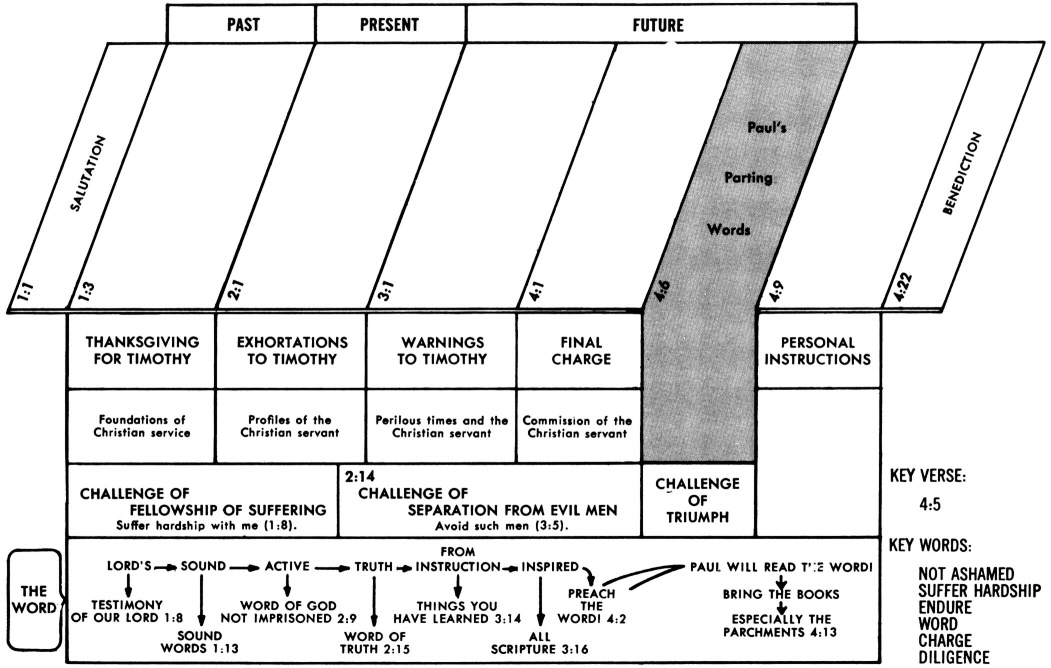
ENDURANCE AND SEPARATION IN THE MINISTRY
Click chart to enlarge
Charts from Jensen's Survey of the NT - used by permission
Second Timothy - Swindoll
| 2 TIMOTHY | |||
| 2 Timothy 1:1-18 | 2 Timothy 2:1-26 | 2 Timothy 3:1-17 | 2 Timothy 4:1-22 |
| Retain the Standard |
Rightly Divide the Word |
Difficult Times Will Come |
Preach the Word |
| PAST | PRESENT | FUTURE | |
| Foundation of Christian Service |
Pictures of Christian Servant |
Dangerous Times for Christian Servant |
Commission of Christian Servant |
| Unashamed as a Witness: Guard the Gospel |
Unashamed as a Workman: Suffer for the Gospel |
Adequate as a Workman: Continue in the Gospel |
Awarded as a Workman: Preach the Gospel |
| Power of the Gospel |
Perseverance of the Gospel Message | Protection of the Gospel |
Proclamation of the Gospel |
| Reminder | Requirements | Resistance | Requests |
| Encouragement in Ministry |
Examples in Ministry |
Exhortations in Ministry |
Exhortations to Fulfill Ministry |
| Commendation & Charge |
Commission to Fulfill |
Conflict to Face |
Course to Finish |
|
Compiled from Jensen's Survey of the NT and Wilkinson's Talk Thru the Bible |
|||
2 Timothy 3:6 For among them are those who enter into households and captivate weak women weighed down with sins, led on by various impulses,
Greek: ek touton gar eisin (3PPAI) oi endunontes (PAPMPN) eis tas oikias kai aichmalotizontes (PAPMPN) gunaikaria sesoreumena (RPPNPA) hamartiais, agomena (PPPNPA) epithumiais poikilais,
Amplified: For among them are those who worm their way into homes and captivate silly and weak-natured and spiritually dwarfed women, loaded down with [the burden of their] sins [and easily] swayed and led away by various evil desires and seductive impulses.
KJV: For of this sort are they which creep into houses, and lead captive silly women laden with sins, led away with divers lusts,
NKJV: For of this sort are those who creep into households and make captives of gullible women loaded down with sins, led away by various lusts,
NJB: Of the same kind, too, are those men who insinuate themselves into families in order to get influence over silly women who are obsessed with their sins and follow one craze after another,
NIV: They are the kind who worm their way into homes and gain control over weak-willed women, who are loaded down with sins and are swayed by all kinds of evil desires
Phillips: From their number come those creatures who worm their way into people's houses, and find easy prey in silly women with an exaggerated sense of sin and morbid cravings
Wuest: For of these are those who by means of insinuation slink into houses and take captive the minds of silly women who have been in times past heavily laden with sins, and who are at present heavily loaded down with them, who are under the impelling urge of variegated, passionate desires,
Young's Literal: for of these there are those coming into the houses and leading captive the silly women, laden with sins, led away with desires manifold
FOR AMONG THEM ARE THOSE ( masculine pronoun) WHO ENTER INTO HOUSEHOLDS: ek touton gar eisin (3PPAI) oi endunontes (PAPMPN) eis tas oikias :
- Titus 1:11; Jude 1:4
- 2 Timothy 3 Resources - multiple sermons and commentaries
Other translations - creep (ESV), craftily sneak (TLB), work their way into (NLT), worm (Amp, NIV, Darby), go secretly (BBE), slip into homes (NAB), by means of insinuate (NET).
Among them - Literally out of these, i.e., those described as a group in verses 2-5 out of which will arise certain creepers and captivators.
Those - This is the masculine pronoun.
Enter (enduno from en = in, into + dúno = sink) means to slip in, insinuate oneself into, enter secretly (with insidious methods and ulterior motives), worm one's way in. Enduno conveys the idea that these men were sneaking in stealthily and undetected.
Enduno comes from a root word which was used to describe "the setting of the sun" which is so slow as to be almost imperceptible, and yet it is most certainly actually taking place. In a similar manner, these heretics don't come knocking loudly on the front door, but sneak quietly in the back door (so to speak) while no one is watching or even if they are watching, the movement is so "slow" as to be imperceptible. They are very good at being bad. They are continually stealthily sneaking (present participle) into households, creeping in undetected, disguising "themselves as servants of righteousness" (2Cor 11:15).
They are like those described by Jude who “crept in unnoticed,… who were long beforehand marked out for this condemnation, ungodly persons who turn the grace of our God into licentiousness and deny our only Master and Lord, Jesus Christ” (Jude 4).
Peter also warned the saints about the clever nature of "false teachers among you (coming from within the body just like the men Paul is warning Timothy about) who will secretly introduce (secretly & craftily bring in error alongside of the truth) destructive heresies, even denying the Master who bought them, bringing swift destruction upon themselves (cf "they will not make further progress… ") (2 Peter 2:1-2)
AND THEY CAPTIVATE: kai aichmalotizontes (PAPMPN):
- 2 Timothy 3 Resources - multiple sermons and commentaries
Other translations - carry off as their prisoners (Weymouth), making prisoners of (BBE), take captive the minds (Wuest), to get control of (ICB), gain control over (GNT, NIV), get influence over (NJB).
Captivate (aichmaloteuo from aichme = spear + halotós = be taken, conquered; see aichmalotizo) means literally to take captive at spear point which is a clear picture of one gaining complete control over another . And thus by either force or deception these serpentine shysters cause these women to become prisoners of a very real spiritual war for the hearts and souls of men.
The present tense indicates this their continual practice.
Peter has a parallel thought, ending his second epistle with the warning to the "beloved" to
"be on your guard lest, being carried away by the error of unprincipled men, you fall from your own steadfastness." (2Pe 3:17)
Paul warned the saints at Colossae to
"See to it that no one takes you captive through philosophy and empty deception, according to the tradition of men, according to the elementary principles of the world, rather than according to Christ." (Col 2:8)
Jesus surely had these hypocritical hucksters in mind when he warned the listeners to
"Beware of the false prophets, who come to you in sheep's clothing, but inwardly are ravenous wolves. You will know them by their fruits… " (Mt 7:15, 16)
Because these "silly women" are deep into sins and ungodly impulses that have weighed them down emotionally and spiritually, they are especially vulnerable to being religiously seduced by false teachers. They are weak in truth and feel the heavy weight of their sin and the guilt it brings, making them open and vulnerable to being
"tossed here and there by waves, and carried about by every wind of doctrine, by the trickery of men, by craftiness in deceitful scheming". (Eph4:14)
And just as wrong doctrine leads to wrong living, so can their wrong living easily lead to embracing wrong doctrine. False teachers prey on the gullible and vulnerable, lurking in the shadows to pick off spiritual stragglers.
WEAK WOMEN WEIGHED DOWN WITH SINS : gunaikaria sesoreumena (RPPNPA0 hamartiais:
- Ps 38:4; Is 1:4; Mt 11:28
- 2 Timothy 3 Resources - multiple sermons and commentaries
IN NEED OF A "SPIRITUAL
WEIGHT LOSS DIET"
Other translations - silly women (YLT, Wuest, Phillips, KJV, Darby), weak minded women (GWT), gullible women (NRSV), vulnerable women (NLT), silly and weak-natured and spiritually women (Amp)
Weak women (1133) (gunaikarion the diminutive - small size - of gune = woman, wife) is used contemptuously here to describe a foolish or frivolous woman and so speaks of the contemptible state into which these weak minded, gullible women have fallen. The Greek can also be translated as something like “silly” or “unstable” women. While this term is not meant to describe all women, in context it does describe a certain class of women who are unusually gullible. They carry a load of guilt for their sins, and they let their sinful desires (perhaps a reference to sexual immorality) get them into all sorts of bad situations. The principle applies generally to all those who are easily led and easily confused.
Weighed down (4987) (soreuo from sorós = heap) is variously translated "loaded down" (NIV, NKJV), "weighted down" (BBE), "overwhelmed" (NLT, NRSV), "heavily laden" (Wuest) and means to heap up or pile up with something, here picturing "sins" as a heavy burden which overwhelms and weighs these women down.
The perfect tense further pictures this burdened state as an abiding or permanent one with continuing effect. They have been weighed down by sins at some time in the past and continue in the same state - they are overburdened and vulnerable. Their conscience is weighted down with many sins of a "multi-colored" nature. Uneasy about the consequences of their sins, they are receptive to the false teachers worming their way in with their attractive panaceas. Unconfessed sin forms a barrier in our relationship with God, and it renders the decision-making faculty (the conscience) ineffective. Those who have not broken free from the bondage to sin are most susceptible to false teaching and they will believe anything they are told. Just as Eve was the first target, as the weaker sex (Peter 3:7), so Satan continues to target women as his initial captives. Cults not only are often spawned by women, but women are the most numerous and devout adherents.
LED ON BY VARIOUS IMPULSES: agomena (PPPNPA) epithumiais poikilais:
- 1Co 12:2; 2Pe 3:17 Mk 4:19; 1Ti 6:9; Titus 3:3; 2Pe 2:18; Jude 1:16, 18
- 2 Timothy 3 Resources - multiple sermons and commentaries
LED BY A HARSH
TASKMASTER!
Other translations - Swayed by (ISV), obsessed with (NJB), driven (TEV), controlled by many desires (NLT), who are under the impelling urge of variegated, passionate desires (Wuest), led by ever changing caprice (Weymouth), lead away (NKJV), follow one craze after another (NJB)
Led on (ago) is in the passive voice indicating the effect of the leading is being exerted by another force, in this case their "impulses" and cravings which are personified as their "motley leader" or "master" which governs their conduct. Paul reminded Titus "we also once were foolish ourselves, disobedient, deceived, enslaved to various lusts and pleasures" again picturing "lusts" as our master. (Titus 3:3)
Various (4164) (poikilos) means motley, various in character, different kinds, diversified, manifold, variegated, many–colored. Poikilos was used to describe the skin of a leopard, the different-colored veining of marble or an embroidered robe and thence passes into the meaning of changeful, diversified, applied to the changing months or the variations of a strain of music.
POIKILOS - 10V - Matt. 4:24; Mk. 1:34; Lk. 4:40; 2 Tim. 3:6; Tit. 3:3; Heb. 2:4; Heb. 13:9; Jas. 1:2; 1 Pet. 1:6; 1 Pet. 4:10
Paul characterizes their fleshly cravings as "multi-colored" and of great variety but provide specific details. Note the use of the passive voice signifying action exerted by external power or force, in this case the strong desires resident in the old flesh [study] nature which are "many colored", motley, diversified.
Various impulses - "various evil desires & seductive impulses" (Amp), "desires manifold" (YLT), "various passions" (ESV), "morbid cravings" (Phillips)
Impulses (1939) (epithumia from epi = upon, motion toward + thumos = passion) literally pictures one's drive or passion directed toward an object and although it can be toward something good, is usually (as in this verse) a description of depraved cravings and the unrestrained desires that emanate from our fallen flesh nature inherited from Adam. These depraved cravings and inner evil desires drive these women to open excesses.
EPITHUMIA - 37V - Mk. 4:19; Lk. 22:15; Jn. 8:44; Rom. 1:24; Rom. 6:12; Rom. 7:7; Rom. 7:8; Rom. 13:14; Gal. 5:16; Gal. 5:24; Eph. 2:3; Eph. 4:22; Phil. 1:23; Col. 3:5; 1 Thess. 2:17; 1 Thess. 4:5; 1 Tim. 6:9; 2 Tim. 2:22; 2 Tim. 3:6; 2 Tim. 4:3; Tit. 2:12; Tit. 3:3; Jas. 1:14; Jas. 1:15; 1 Pet. 1:14; 1 Pet. 2:11; 1 Pet. 4:2; 1 Pet. 4:3; 2 Pet. 1:4; 2 Pet. 2:10; 2 Pet. 2:18; 2 Pet. 3:3; 1 Jn. 2:16; 1 Jn. 2:17; Jude 1:16; Jude 1:18; Rev. 18:14
William Barclay-The Christian emancipation of women inevitably brought its problems. We have already seen how secluded the life of the respectable Greek woman was, how she was brought up under the strictest supervision, how she was not allowed "to see anything, to hear anything, or to ask any questions," how she never appeared, even on a shopping expedition, alone on the streets, how she was never allowed even to appear at a public meeting. Christianity changed all that and a new set of problems arose. It was only to be expected that certain women would not know how to use their new liberty. There were false teachers who were quick to take advantage of that.
Irenaeus draws a vivid picture of the methods of just such a teacher in his day. True, he is telling of something which happened later than this, but the wretched story would be the same (Irenaeus: Against Heresies, 1, 13, 3). There was a certain heretic called Marcus who dealt in magic. "He devotes himself specially to women, and those such as are well-bred, and elegantly attired, and of great wealth." He tells such women that by his spells and incantations he can enable them to prophesy. The woman protests that she has never done so and cannot do so. He says: "Open thy mouth, speak whatsoever occurs to thee, and thou shalt prophesy." The woman, thrilled to the heart, does so and is deluded into thinking that she can prophesy. "She then makes the effort to reward Marcus, not only by the gift of her possessions (in which way he has collected a very large fortune), but also by yielding up to him her person, desiring in every way to be united to him, that she may become altogether one with him." The technique would be the same in the days of Timothy as it was in the later days of Irenaeus.
There would be two ways in which these heretics in the days of Timothy could exert an evil influence. We must remember that they were Gnostics and that the basic principle of Gnosticism was that spirit was altogether good and matter altogether evil. We have already seen that that teaching issued in one of two things. The Gnostic heretics taught, either that, since matter is altogether evil, a rigid asceticism must be practiced and all the things of the body as far as possible eliminated, or that it does not matter what we do with the body and its desires can be indulged in to the limit because they do not matter. The Gnostic insinuators would teach these doctrines to impressionable women. The result would often be either that the woman broke off married relationships with her husband in order to live the ascetic life, or that she gave the lower instincts full play and abandoned herself to promiscuous relationships. In either case home and family life were destroyed.
It is still possible for a teacher to gain an undue and unhealthy influence over others, especially when they are impressionable.
It is Paul's charge that such people are "willing to learn from anyone, and yet never able to come to a knowledge of the truth." E. F. Brown has pointed out the danger of what he calls "intellectual curiosity without moral earnestness." There is a type of person who is eager to discuss every new theory, who is always to be found deeply involved in the latest fashionable religious movement, but who is quite unwilling to accept the day-to-day discipline--even drudgery--of living the Christian life. No amount of intellectual curiosity can ever take the place of moral earnestness. We are not meant to titillate our minds with the latest intellectual crazes; we are meant to purify and strengthen ourselves in the moral battle to live the Christian life (2 Timothy 3 - William Barclay's Daily Study Bible)
2 Timothy 3:7 always learning and never able to come to the knowledge of the truth
Greek: pantote manthanonta (PAPNPA) kai medepote eis epignosin aletheias elthein (AAN) dunamena. (PPPNPA)
Amplified: [These weak women will listen to anybody who will teach them]; they are forever inquiring and getting information, but are never able to arrive at a recognition and knowledge of the Truth.
Phillips: who are always learning and yet never able to grasp the truth.
Wuest: ever learning and never able to come to a precise and experiential knowledge of the truth.
Young's Literal: always learning, and never to a knowledge of truth able to come,
KJV: Ever learning, and never able to come to the knowledge of the truth.
ALWAYS LEARNING AND NEVER ABLE TO COME TO THE KNOWLEDGE OF THE TRUTH: pantote manthanonta (PAPNPA) kai medepote eie epignosin aletheias elthein (AAN) dunamena (PPPNPA):
- 2Ti 4:3;4:4 Dt 29:4; Pr14:6; Is 30:10;30:11 Eze 14:4, 5, 6, 7, 8, 9, 10; Mt 13:11; Jn 3:20;3:21 5:44; 12:42; 43
- 1Ti 2:4
- 2 Timothy 3 Resources - multiple sermons and commentaries
A SAD COMMENTARY
ON THEIR "COMMENTARIES"
Other translations - Always seeking instruction (NET), forever inquiring and getting information (Amp), ever learning (KJV), always learning something new (Weymouth), forever following new teachings (NLT).
Learning (3129) (manthano) means to gain knowledge or understanding of or skill in by study, instruction, or experience. At every opportunity these women are eager to receive instruction. Note the present tense emphasizes that this "learning" was their continual pursuit, "professional learners" as it were! Most of us know some folks like this.
Manthano - 25x in 24v - Matt 9:13; 11:29; 24:32; Mark 13:28; John 6:45; 7:15; Acts 23:27; Rom 16:17; 1 Cor 4:6; 14:31, 35; Gal 3:2; Eph 4:20; Phil 4:9, 11; Col 1:7; 1 Tim 2:11; 5:4, 13; 2 Tim 3:7, 14; Titus 3:14; Heb 5:8; Rev 14:3. NAS = educated(1), find(1), learn(12), learned(9), learning(1), receive instruction(1).
MacArthur explains their learning…Sin and lack of discernment neutralized their ability to apprehend God’s truth. If they have been reared in the church, they are especially susceptible to ideas that purport to be Christian. But their ignorance of Scripture and their sinful living make them utterly undiscerning and defenseless against unbiblical and ungodly precepts. They are continually learning about everything except the knowledge of the truth. Because legalism deals only in outward performance, it is very attractive. Many such women, and men as well, are glad to find a way that promises to make them right with God simply by adhering to certain outward forms and conforming to certain behavioral standards. (SEE The MacArthur Commentary)
Other translations - can never arrive at (NRSV), never able to arrive at (ESV)
Never (medepote = medé = not even + poté = at any time, ever) means literally not even ever and thus suggests an abiding inability on the part of these weak willed, gullible women to come to a " precise and experiential knowledge of the truth" (Wuest) of the Gospel, which alone proclaims "release to the captives… recovery of sight to the blind" and freedom to "those who are downtrodden", the very truth these heavily burdened women needed to hear and receive. (Lk 4:18).
Able (1410)(dunamai) conveys the basic meaning of that which has the inherent ability to do something or accomplish some end. Thus dunamai means to be able to, to be capable of, to be strong enough to do or to have power to do something. It is usually translated able (50x), can (61x and cannot 58x) or could.
TDNT writes that…Words of this stem all have the basic sense of ability or capability. Dunamai means a. “to be able” in a general sense, b. “to be able” with reference to the attitude that makes one able, hence sometimes “to will,” and c. (of things) “to be equivalent to,” “to count as,” “to signify.”
BDAG says that dunamai means…to possess capability (whether because of personal or external factors) for experiencing or doing something.
The truth - This specific phrase is used by Paul 33x out of 76x in Scripture -Ro 1:18, 25; 2:8, 20; 3:7; 9:1; 15:8; 1Co 13:6; 2Co 7:14; 11:10; 12:6; 13:8; Gal 2:5, 14; 4:16; 5:7; Ep 4:15, 24; 2Th 2:10, 12, 13; 1Ti 2:4, 7; 3:15; 4:3; 6:5; 2Ti 2:18, 25; 3:7, 8; 4:4; Titus 1:1, 14
The knowledge of the truth - This is an important phrase used only by Paul (with one exception, [Heb10:26]) and all four uses are in the pastoral epistles.
God our Savior… desires all men to be saved and to come to the knowledge of the truth. (1Ti 2:4)
God is the One Who grants
repentance leading to the knowledge of the truth" women and men "from the snare of the devil. (2Ti 2:25)
Finally, writing to Titus Paul opened that epistle with the reminder that
the knowledge of the truth (leads to) godliness (Titus 1:1)
Knowledge (1922)(epignosis from verb epiginosko from epí = upon + ginosko = to know) is a strengthened or intensified form of "gnosis" and conveys the thought of a knowledge which is fuller, larger and more thorough. It also conveys the idea of a more intimate and personal relationship than the simple term gnosis.
W E Vine says the verb form epiginosko suggests generally a directive, a more special, recognition of the object known than ginosko.
Truth (225)(aletheia rom a = indicates following word has the opposite meaning ~ without + lanthano = to be hidden or concealed, to escape notice, cp our English "latent" from Latin = to lie hidden) has the literal sense of that which contains nothing hidden. Aletheia is that which is not concealed. Aletheia is that which that is seen or expressed as it really is.
For completeness, Hebrews warns that
if we go on sinning willfully after receiving the knowledge of the truth, there no longer remains a sacrifice for sins (Heb 10:26)
I realize this last verse can be the cause of some consternation but see Matthew Henry's helpful analysis - This text (Heb 10:26, 27) has been the occasion of great distress to some gracious souls; they have been ready to conclude that every willful sin, after conviction and against knowledge, is the unpardonable sin: but this has been their infirmity and error. The sin here mentioned is a total and final apostasy, when men with a full and fixed will and resolution despise and reject Christ, the only Saviour, -- despise and resist the Spirit, the only Sanctifier, -- and despise and renounce the gospel, the only way of salvation, and the words of eternal life; and all this after they have known, owned, and professed, the Christian religion, and continue to do so obstinately and maliciously.
The Truth About Truth - When Harvard University was founded, its motto was
Veritas Christo et Ecclesiae—
“Truth for Christ and the Church.”
Its crest showed three books, one face down to symbolize the limitation of human knowledge. But in recent decades that book has been turned face up to represent the unlimited capacity of the human mind. And the motto has been changed to Veritas—“Truth.”
The pursuit of knowledge is praiseworthy, yet learning can quickly lead to pride and a refusal to acknowledge any limits on our mental abilities. When that happens, biblical truth is ignored.
What, then, is the truth about truth? A wise king wrote centuries ago, “The fear of the Lord is the beginning of knowledge” (Pr 1:7). We must recognize the relationship between God and truth. Without the help of God’s Spirit and the instruction of God’s Word, man will be ever “learning and never able to come to the knowledge of the truth” (2Ti 3:7). When we acknowledge and obey His truth, however, we will be set free from spiritual ignorance and error (Jn 8:32; 17:17). That’s why we must be diligent in studying the Bible (2Ti 2:15). It is the only book that tells us the truth about truth.— Vernon C. Grounds (Our Daily Bread, Copyright RBC Ministries, Grand Rapids, MI. Reprinted by permission. All rights reserved)
Holy Bible, Book divine,
Precious treasure, thou art mine;
Mine to tell me whence I came,
Mine to teach me what I am.
—BurtonTo know Christ the Living Word,
study the written Word.
2 Timothy 3:8 Just as Jannes and Jambres opposed Moses, so these men also oppose the truth, men of depraved mind, rejected in regard to the faith.
Greek: on tropon de Iannes kai Iambres antesthsan (3PAAI) Mousei, houtos kai houtoi anthistantai (3PPMI) te alethia, anthropoi kateptharmenoi (RPPMPN) ton noun, adokimoi peri ten pistin;
Amplified:Now just as Jannes and Jambres were hostile to and resisted Moses, so these men also are hostile to and oppose the Truth. They have depraved and distorted minds, and are reprobate and counterfeit and to be rejected as far as the faith is concerned. [Exod. 7:11.]
Phillips: These men are as much enemies to the truth as Jannes and Jambres were to Moses. Their minds are distorted, and they are traitors to the faith.
Wuest: Now, in the same manner as Jannes and Jambres set themselves against Moses, so also these set themselves against the truth, men corrupted in mind; after having been put to the test, disapproved concerning the Faith.
Young's Literal: and, even as Jannes and Jambres stood against Moses, so also these do stand against the truth, men corrupted in mind, disapproved concerning the faith;
AND JUST AS JANNES AND JAMBRES OPPOSED MOSES: on tropon de Iannes kai Iambres antesthesan (3PAAI) Mousei:
- Ex 7:11;7:22, 8:7,18
- 2 Timothy 3 Resources - multiple sermons and commentaries
Other translations - resisted (NKJV), defied (NJB), withstood (KJV), stand against (YLT), set themselves against (Wuest), fought against (NLT), these teachers fight truth (TLB).
Just as - Observe that this introduces a term of comparison ("just as" ~ simile). Remember that figures of speech are always intended to convey a literal meaning. So when you see these terms remember that it is not a license to let your mind run wild allegorizing or spiritualizing the text.
Jannes and Jambres - Not mentioned in Exodus but Jewish tradition identified them as those who opposed Moses in Exodus 7:11. See Jannes and Jambres - Wikipedia,\
Opposed (436) (anthistemi [word study] from anti = against, opposite + histemi = stand) means they set themselves in array against the truth. The picture is of two enemy forces setting themselves in array against one another in battle lines, the truth on one side arrayed against lies, deception, error and falsehood on the other side. This verb suggests vigorously opposing, with the idea of standing face-to-face against an adversary so as to stand one's ground.
Anthistemi - NAS - cope(1), oppose(1), has opposed(1), opposed(4), opposing(1), resist(5), resists(2).
Mt 5:39; Lk 21:15; Acts 6:10; 13:8; Ro 9:19; 13:2; Gal 2:11; Ep 6:13; 2Ti 3:8; 4:15; Jas 4:7; 1Pe 5:9.
Paul dramatically illustrates the idea of the verb anthistemi when Cephas (Peter) began to withdraw from eating with the Gentiles for fear of Jewish criticism, saying
I (Paul) opposed (anthistemi) him (Peter) to his face. (Ga 2:11)
Paul also used this "battle word" anthistemi to exhort the saints at Ephesus (and us) to
take up the full armor of God, that you may be able to resist (anthistemi) in the evil day, and having done everything, to stand firm. (Ep 6:13)
Most expositors accept Jannes and Jambres as the Egyptian court magicians in Exodus (Ex 7:11; 22 8:7, 18) but since they are not named in the OT account, this area is rife with fruitless speculation. The point in the comparison that is quite clear is their opposition to the truth of God. As Jannes and Jambres in Egypt set themselves against the truth of God by means of their counterfeit miracles, so these self-seeking, fraudulent men now oppose the truth of the glorious Gospel. With this comparison, Paul does leave open the possibility that these men likewise will avail themselves of occult supernatural powers and practices. One would not be surprised if this were the case for Jesus warned that in the end times (actually referring in context to "the great tribulation", the last 3.5 year period preceding Christ's return)
false Christs and false prophets will arise and will show great signs and wonders, so as to mislead, if possible, even the elect. (Mt 24:24)
QUESTION - Who were Jannes and Jambres? | GotQuestions.org
ANSWER - The Bible does not give us much information on Jannes and Jambres. In fact, the names of these two men appear only once in the entire Bible, in 2 Timothy 3:8. In a passage describing the wickedness of the last days, Paul says, “Just as Jannes and Jambres opposed Moses, so also these men oppose the truth—men of depraved minds, who, as far as the faith is concerned, are rejected. But they will not get very far because, as in the case of those men, their folly will be clear to everyone” (verses 8-9).
Long-standing Jewish tradition says that Jannes and Jambres were the two chief magicians who withstood Moses and Aaron in Exodus 7. “Aaron threw his staff down in front of Pharaoh and his officials, and it became a snake. Pharaoh then summoned wise men and sorcerers, and the Egyptian magicians also did the same things by their secret arts: Each one threw down his staff and it became a snake. But Aaron’s staff swallowed up their staffs” (verses 10-12). Later, these same sorcerers duplicated the changing of water into blood (Exodus 7:22) and the production of frogs (8:7). However, the sorcerers were powerless to duplicate the other plagues (8:19).
The names “Jannes” and “Jambres” appear in the Talmud as well. According to one midrash, the two magicians left Egypt with the Israelites after the first Passover (see Exodus 12:38) and were later instrumental in promoting the worship of the golden calf that Aaron made (Exodus 32). Another midrash identifies the “two servants” of Balaam as Jannes and Jambres (Numbers 22:22). According to the midrashim and other sources, Jannes and Jambres continued to exert a wicked influence on Israel until the time of Phinehas (Numbers 25). These stories are interesting, but they should not be taken as equivalent to inspired Scripture.
Paul confirms the traditional names of the sorcerers who challenged Moses without lending credence to the legends found in apocryphal works. His intention was to use the wickedness of Jannes and Jambres, as presented in the Talmud, as an illustration of a widespread, active rejection of the truth in the last days.
SO THESE MEN ALSO OPPOSE THE TRUTH: houtos kai houtoi anthistantai (3PPMI) te aletheia:
- 2Ti 4:15; 1Ki 22:22; 23, 24; Jer 28:1-17; Acts 13:8; 9, 10, 11, 15:24; Ga 1:7; 8, 9, 2:4; 5; Ep 4:14; 2Th 2:9; 10, 2Th 2:11 Titus 1:10; 2Pe 2:1; 2, 3; 1Jn 2:18; 4:1; Re 2:6, 14, 15, 20
- 2 Timothy 3 Resources - multiple sermons and commentaries
TAKING A STAND
AGAINST THE TRUTH
Oppose (anthistemi [word study] from anti = against + histemi = stand) or literally stand against and resist the truth by either their words or their deeds, effectively setting themselves against the truth. Their opposition can span the range from mere objection to bitter hostility or even open warfare (albeit all their opposition is a form of spiritual warfare). Note use of middle voice indicates their personal involvement in initiating the opposition and then actively participating in the opposition. In other words they are fully cognizant that they are standing against God and not simply happenchance, innocent bystanders.
They were men like
"Elymas the magician" who "was opposing (anthistemi) them (Barnabas and Saul), seeking to turn the proconsul away from the faith." (Acts 13:8).
They were like Alexander the coppersmith who "vigorously opposed (Paul's) teaching." (2Ti 4:15)
The point is clear that when you stand for the truth, you will be opposed by the lie. So all you young "Timothys" and "Timotheas",
"gird your minds for action, keep sober in spirit, fix your hope completely on the grace to be brought to you at the revelation of Jesus Christ" (1Pe 1:13) so that strengthened by this truth, you may be enabled to "fight the good fight of faith (and) take hold of the eternal life to which you were called (1Ti 6:12).
In 2Timothy 1:16 Phygelus and Hermogenes were ashamed of the truth, in 2Ti 2:17, 18 Hymenaeus and Philetus went astray from the truth and in 2Ti 3:8 men like Jannes and Jambres were against the truth.
| THE BATTLE FOR SPIRITUAL TRUTH |
||
|
2Ti 1:16 |
Phygelus |
Ashamed of |
|
2Ti 2:17, 18 |
Hymenaeus |
Astray from |
|
2Ti 3:8 |
Jannes |
Against |
MEN OF DEPRAVED MIND: anthropoi katephtharmenoi (RPPMPN) ton noun:
- Ac 8:21;8:22 Ro 1:28; 16:18; 2Co 11:13;11:14,15 1Ti 1:19; 4:2; 6:5; Titus 1:16; 2Pe 2:14; Jude 18, 19
- 2 Timothy 3 Resources - multiple sermons and commentaries
CORRUPT
MINDS
Their minds are variously described as: distorted (Amp), warped (NET), debased intellectuals (Weymouth), warped & twisted (TLB), sick (CEV), corrupt (NJB, NRSV), whose minds do not function (TEV)
Depraved (2704) (kataphtheiro from katá = intensifies the meaning + phtheiro = corrupt, destroy) means to corrupt, to destroy (passive - to be destroyed, to perish - used in Greek Textus Receptus of 2Pe 2:12). Here kataphtheiro is used figuratively to describe a human mind that has become corrupted, decadent, entirely spoiled and in a sense "lain waste." There is an especially picturesque use of kataphtheiro in the Lxx of Lev 26:39
So those of you who may be left will rot away (kataphtheiro) because of their iniquity in the lands of your enemies; and also because of the iniquities of their forefathers they will rot away with them.
The perfect tense pictures the unalterable, permanently corrupted condition of their minds which in turn explains their utter moral depravity (as described in 2T 3:2, 3, 4, 5). They are like those Paul warns about in (1Ti 4:2) who are "seared in their own conscience as with a branding iron" and whom Jude described as "worldly-minded, devoid of the Spirit" (Jude 1:19).
The only other NT use is in 2Peter 2:12 but that is found only in the Greek Textus Receptus version and not in the Nestle-Aland (used for the NAS translation).
Kataphtheiro - 27v in the Lxx - Gen 6:12, 13, 17; 9:11; Ex 18:18; Lev 26:39; Jdg 6:4; 2 Chr 12:7; 24:23; 25:16; 26:16; 27:2; 35:21; Isa 10:27; 13:5; 24:1; 32:7; Da 4:14, 27
It is interesting that the first 4 uses of this vivid verb are in the context of God's judgment of mankind by a worldwide flood…
(Gen 6:12) God looked on the earth, and behold, it was corrupt; for all flesh had corrupted their way upon the earth.
(Gen 6:13) Then God said to Noah, “The end of all flesh has come before Me; for the earth is filled with violence because of them; and behold, I am about to destroy them with the earth.
(Gen 6:17) “Behold, I, even I am bringing the flood of water upon the earth, to destroy all flesh in which is the breath of life, from under heaven; everything that is on the earth shall perish.
(Gen 9:11) “I establish My covenant with you; and all flesh shall never again be cut off by the water of the flood, neither shall there again be a flood to destroy the earth.”
Mind (3563) (nous) refers to a basic meaning direct one's inner sense to an object. Nous refers to human intellectual perception and moral judgment. It is the God given faculty of perceiving and understanding and is the channel through which truth reaches the heart. Nous describes everything in the realm of the intellect, including one's will, emotions, ability to think, reason and decide.
Related Resources:
- Mind by Phillip Towner
- Mind - International Standard Bible Encyclopedia
- Hastings' Dictionary of the Bible Mind
- Hastings' Dictionary of the NT Mind (2) Mind
- Mind - Holman
New Linguistic & Exegetical Key to the Greek New TestamenT (BORROW) on Nous- A comprehensive name for the thoughts existing in the conscience; understanding, the reasoning faculty, man’s power of judgment; thinking, understanding; it is the constellation of thoughts and assumptions which make up the consciousness of the person and acts as the agent of rational discernment and communication; the thinking power, reason in its moral quality and activity; reasoning capacity, especially as concerns moral action; the intellect in its judging faculty
Carpenter - Old Testament writers understood the mind as the inner being of a person—much like a person’s heart. When the Gospels speak of a person’s mind, it is mostly in connection with a person’s heart as well (“in the thoughts of their heart”; see Luke 1:51). The only other significant occurrence of the word mind comes in Jesus’ statement of the great commandment: “You shall love the Lord your God with all your heart, and with all your soul, and with all your strength, and with all your mind (dianoia)” (Mt. 22:37; Mk 12:30; Lk 10:27). The Gospel writers are unanimous in their agreement that Jesus quoted Dt 6:5 and added “with all your mind” to the quote. In the writings of Paul, we enter the Greek world’s understanding of the mind. Paul used two words for the mind: dianoia, meaning “understanding” or “mind,” and nous, meaning “mind” or “intellect.” Paul understood the mind as distinct from the spirit and the heart of a person. The mind possesses the ability to understand and to reason (1Cor 14:14–19); it is the seat of intelligence. In other places, Paul used the Greek word for mind to refer to the entire mental and moral being of a human. A person’s actions flow from the inclinations of his or her mind; whether a person is good or evil depends on the state of that person’s mind. Paul makes it clear that a person’s condition depends upon how that person controls his or her mind. Ro 8:6-7 speaks of a person’s mind being controlled either by the flesh or by the Spirit. The person whose mind is controlled by the flesh is evil and the mind controlled by the Spirit leads to good. Other passages refer to the inclination of a person’s mind being controlled by the god of this world (2Cor 4:4). People whose minds are controlled by the god of this world will have their minds darkened and will not be able to understand the world as it really is (2Cor 3:14). It is like a veil over one’s understanding; but it is the Lord who can open peoples’ minds. When we are born again, we can experience God’s renewing of our minds (Ro 12:2; Ep 4:23). It is our responsibility to renew our minds by regularly reading God’s Word; but only the Holy Spirit can make us spiritually-minded (1Cor 2:15–16). (Holman Treasury of Key Bible Words)
The nous is a very "dynamic" organ - A mind (nous) can be…
- depraved (Ro 1:28=adokimos, 1Ti 6:5=diaphtheiro, 2Ti 3:8=kataphtheiro),
- defiled (miaino) (Titus 1:15),
- futile (mataiotes) (Eph 4:17),
- fleshly (sarx) (Col 2:18),
- for praying, for singing, speaking (1Cor 14:14-15, 19)
- of Christ (1Cor 2:16),
- renewed (anakainosis) (Ro 12:2, Eph 4:23),
- opened to spiritual truth (Lk 24:45),
- in "synch" with others, speaking of unity among believers (1Cor 1:10), = "In essentials unity; in non-essentials, liberty; in all things charity.
- guarded by the peace of God (Php 4:7).
Thayer summarized
1. the mind, comprising alike the faculties of perceiving and understanding and those of feeling, judging, determining; hence, specifically,
a. the intellective faculty, the understanding: Luke 24:45 (on which see dianoi,gw, 2); Phil 4:7; Rev 13:18; 17:9; opposed to to the spirit intensely roused and completely absorbed with divine things, but destitute of clear ideas of them, 1Cor. 14:14f,19; to be furnished with the understanding of Christ, 1Cor 2:16b.
b. reason in the narrower sense, as the capacity for spiritual truth, the higher powers of the soul, the faculty of perceiving divine things, of recognizing goodness and of hating evil: Ro 1:28; 7:23; Eph. 4:17; 1Ti 6:5; 2Ti 3:8 Titus 1:15; opposed to the flesh Ro 7:25; to be so changed that the spirit which governs the mind is renewed, Eph 4:23; (cf. Ro12:2).
c. the power of considering and judging soberly, calmly and impartially: 2Th 2:2.
2. a particular mode of thinking and judging: Ro 14:5; 1 Cor. 1:10; equivalent to thoughts, feelings, purposes: (from Isa. 40:13), Rom. 11:34; 1 Cor. 2:16a
The mind of the men in 2Ti 3:8 has become so thoroughly corrupted that the truth of the Gospel cannot penetrate and be perceived. This state naturally leads to them being reprobate and disqualified regarding the Christian faith.
Friberg - basic meaning direct one's inner sense to an object; (1) as the faculty of intelligence understanding, mind, intellect (1Cor 14.15); (2) as the faculty of moral perception (practical) reason, insight, awareness (Ro 7.25); (3) as the total inner orientation or moral attitude way of thinking, mind (set), disposition (Ro 1.28); (4) as the result of mental activity thought, judgment, resolve, opinion (Ro 14.5)
Vine- "mind," denotes, speaking generally, the seat of reflective consciousness, comprising the faculties of perception and understanding, and those of feeling, judging and determining. Its use in the NT may be analyzed as follows: it denotes (a) the faculty of knowing, the seat of the understanding, Luke 24:45 ; Romans 1:28 ; 14:5 ; 1 Corinthians 14:15,19 ; Ephesians 4:17 ; Philippians 4:7 ; Colossians 2:18 ; 1 Timothy 6:5 ; 2 Timothy 3:8 ; Titus 1:15 ; Revelation 13:18 ; 17:9 ; (b) counsels, purpose, Romans 11:34 (of the "mind" of God); 12:2; 1 Corinthians 1:10 ; 2:16 , twice (1) of the thoughts and counsels of God, (2) of Christ, a testimony to His Godhood; Ephesians 4:23 ; (c) the new nature, which belongs to the believer by reason of the new birth, Romans 7:23,25 , where it is contrasted with "the flesh," the principle of evil which dominates fallen man. Under (b) may come 2 Thessalonians 2:2 , where it stands for the determination to be steadfast amidst afflictions, through the confident expectation of the day of rest and recompense mentioned in the first chapter. (Mind - Vine's Expository Dictionary of NT Words)
Wayne Detzler - Nous describes "the ability to think, the understanding, the moral capabilities of human beings. Early Greek writers were lavish in their praise of human reason. Plato called it the most excellent part of a human being, because it gave him the edge over lesser beings. Aristotle described reason as the power of thought. The Stoics believed that the whole world was ruled by a divine mind, a cosmic reason. The other word for “mind” in the New Testament is phronesis. It comes from the verb phroneo, which means to “think,” “judge,” “set one’s mind on something,” or “have insight.” This word is used to describe the activities of the nous. One sees it in such a phrase as “being tough-minded.” The ancient Greek writers often wrote about this word. Both Plato and Aristotle used it to describe discernment, insight, and judicious reasoning. In the Septuagint Greek Old Testament it was used to describe wisdom and intellectual cunning. In short, the nous seems to be the ability to reason and think, while the phronesis appears to be the process of reasoning or thinking… Nous is seen to be the disposition of man, or his moral attitude. This is found in unsaved as well as saved people. When people do not accept God’s enlightenment, their minds become depraved and darkened (Ro. 1:28). This is also called the understanding of man (Eph 4:18) or a “fleshly mind” (Col. 2:18). Paul warned Timothy against people with depraved minds (1Ti 6:5). Such minds are darkened by sin and need God’s enlightening. When one is converted his mind is worked on by the Holy Spirit. It responds to the truth of God’s Word and longs to obey Him (Ro 7:22–23, 25). In a born-again person this mind becomes an instrument for understanding God’s Word (Lk 24:45; Rev. 13:18; 17:9). Because of the presence of the Lord in our lives, our minds are kept at peace (Phil 4:7). Thus, nous refers to the ability to think, understand, or comprehend.
Nous - 24x in 22v - Usage: composure(1), comprehension(1), mind(20), minds(1), understanding(1).
Luke 24:45 Then He opened their minds to understand the Scriptures,
Romans 1:28 And just as they did not see fit to acknowledge God any longer, God gave them over to a depraved mind, to do those things which are not proper,
Wuest - Virtually, they pronounced the true God adokimos (disapproved), and would have none of Him, and He in turn gave them up to a nous adokimos (a disapproved mind), a mind which is no mind and cannot discharge the functions of one, a mind in which the divine distinctions of right and wrong are confused and lost, so that God’s condemnation cannot but fall on it at last. Nous is not only reason, but conscience; when this is perverted, as in the people of whom Paul speaks, or in the Canaanites, who did their abominations unto their gods, the last deep of evil has been reached.”
Romans 7:23 but I see a different law in the members of my body, waging war against the law of my mind and making me a prisoner of the law of sin which is in my members.
25 Thanks be to God through Jesus Christ our Lord! So then, on the one hand I myself with my mind am serving the law of God, but on the other, with my flesh the law of sin.
Romans 11:34 For WHO HAS KNOWN THE MIND OF THE LORD, OR WHO BECAME HIS COUNSELOR?
Romans 12:2 And do not be conformed to this world, but be transformed by the renewing of your mind, so that you may prove what the will of God is, that which is good and acceptable and perfect.
Romans 14:5 One person regards one day above another, another regards every day alike. Each person must be fully convinced in his own mind.
1 Corinthians 1:10 Now I exhort you, brethren, by the name of our Lord Jesus Christ, that you all agree and that there be no divisions among you, but that you be made complete in the same mind and in the same judgment.
1 Corinthians 2:16 For WHO HAS KNOWN THE MIND OF THE LORD, THAT HE WILL INSTRUCT HIM? But we have the mind of Christ.
1 Corinthians 14:14 For if I pray in a tongue, my spirit prays, but my mind is unfruitful. 15 What is the outcome then? I will pray with the spirit and I will pray with the mind also; I will sing with the spirit and I will sing with the mind also.
1 Corinthians 14:19 however, in the church I desire to speak five words with my mind so that I may instruct others also, rather than ten thousand words in a tongue.
Ephesians 4:17 So this I say, and affirm together with the Lord, that you walk no longer just as the Gentiles also walk, in the futility of their mind,
Wuest - “Mind” is nous, not merely the intellectual faculty or understanding, but also the faculty for recognizing moral good and spiritual truth. Expositors says: “It is a description of the walk of the heathen world generally—a walk moving within the limits of intellectual and moral resultlessness, given over to things devoid of worth or reality.”
Ephesians 4:23 and that you be renewed in the spirit of your mind,
Philippians 4:7 And the peace of God, which surpasses all comprehension, will guard your hearts and your minds in Christ Jesus.
Colossians 2:18 Let no one keep defrauding you of your prize by delighting in self-abasement and the worship of the angels, taking his stand on visions he has seen, inflated without cause by his fleshly mind,
2 Thessalonians 2:2 that you not be quickly shaken from your composure or be disturbed either by a spirit or a message or a letter as if from us, to the effect that the day of the Lord has come.
1 Timothy 6:5 and constant friction between men of depraved mind and deprived of the truth, who suppose that godliness is a means of gain.
2 Timothy 3:8 Just as Jannes and Jambres opposed Moses, so these men also oppose the truth, men of depraved mind, rejected in regard to the faith.
Titus 1:15 To the pure, all things are pure; but to those who are defiled and unbelieving, nothing is pure, but both their mind and their conscience are defiled.
Revelation 13:18 Here is wisdom. Let him who has understanding calculate the number of the beast, for the number is that of a man; and his number is six hundred and sixty-six.
Revelation 17:9 "Here is the mind which has wisdom. The seven heads are seven mountains on which the woman sits
Nous -12v in Non-apocryphal Septuagint - Ex 7:23; Josh 14:7; Job 7:17, 20; 33:16; 36:19; Pr 29:7; 31:3; Isa 10:7, 12; 40:13; 41:22;
REJECTED AS REGARDS THE FAITH: adokimoi peri ten pistin:
- 2Co 13:5-note
- 2 Timothy 3 Resources - multiple sermons and commentaries
Other translations - disqualified (NET, ESV), reprobate and counterfeit and to be rejected (Amp), their faith spurious (NJB), of no real worth (Weymouth), put to the test but disapproved (Wuest), failures in the faith (TEV), who cannot pass the test (Jewish NT)
Rejected (96) (adokimos from a = without + dokimos = that which after testing has stood the test and been proven authentic, reliable, acceptable) refers to those who do not stand the test, and so are worthless, unapproved, and rejected after God's searching test. They failed to pass His test of purity and were "discarded", even as metals that do not pass the purity test of purity are discarded.
Adokimos - 8x in 8v - Ro 1:28; 1Cor 9:27; 2 Cor 13:5, 6, 7; 2Ti 3:8; Titus 1:16; Heb 6:8
These men have been tested in regard to ""the faith" (Christian teaching and the gospel) and like counterfeit coins they have been found wanting and hence are discarded as worthless!
As Hiebert notes
the truth which they claim to bring in their teaching, upon examination, is found to be counterfeit gold.
Adokimos was used in secular Greek writings to describe (1) a counterfeit coin below standard weight, (2) a cowardly soldier who fails in the testing hour of battle, (3) a rejected candidate for office whom citizens regarded as useless, (4) a stone which the builders rejected. If a stone had a flaw it was marked with a capital "A" for Adokimos and left aside, as unfit to have any place in the building.
The ultimate test of life is usefulness, of doing the "good and acceptable and perfect" will of the Lord (Ro12:1). These men are like the stones marked with the letter "A" who are of no value in building the Kingdom of God or building up the body of Christ. In fact in context, instead of helping God's work, these men actively (albeit often surreptitiously) oppose it and stand against it. Furthermore, the fact that the men were rejected as regards the faith makes it very clear that Paul was speaking of individuals within the church who professed to be Christians but were not.
The men Paul describes are like those in Romans who arrogantly…
did not see fit (dokimazo) to acknowledge God any longer (so) God gave them over to a depraved (adokimos) mind (KJV = reprobate), to do those things which are not proper. (Ro1:28)
Paul exhorted (actually commanded) the Corinthians to
"Test yourselves to see if you are in the faith; examine (dokimazo = test something to prove it worthy) yourselves! Or do you not recognize this about yourselves, that Jesus Christ is in you-- unless indeed you fail the test (adokimos)?(2Co 13:5-note)
The faith (4102) (pistis) is a specific phrase (definite article "the" plus "faith" - Click study of the phrase the faith) found some 38x in the NASB, some instances referring to saving faith in Christ exercised by an individual and necessary for salvation. Approximately one-half of the 38 occurrences of the specific phrase the faith refer not to the ACT of believing but rather to WHAT is believed (The Gospel), the latter being the usage that the present context would seem to favor - they were rejected. They did not pass the test. They were not genuine believers. They were in the church, the body of Christ, but the Spirit of Christ was not in them!
The faith -
Acts 3:16; 6:7; 13:8; 14:22; 16:5; Ro 4:11f, 16; 14:22; 1Co 16:13; 2Co 13:5; Gal 1:23; 3:23; 6:10; Eph 1:15; 4:13; Phil 1:25, 27; Col 1:23; 1Ti 1:2, 14; 3:9, 13; 4:1, 6; 5:8; 6:10, 21; 2Ti 1:13; 2:18; 3:8; 4:7; Titus 1:1, 13; 3:15; Philemon 1:5; Jude 1:3; Rev 13:10
2 Timothy 3:9 But they will not make further * progress; for their folly will be obvious to all, just as Jannes's and Jambres's folly was also.
Greek: all' ou prokopsousin (2PFAI) epi pleion, e gar anoia auton ekdelos estai (3SFMI) pasin, os kai e ekeinon egeneto. (3SAMI)
Amplified: But they will not get very far, for their rash folly will become obvious to everybody, as was that of those [magicians mentioned].
KJV: But they shall proceed no further: for their folly shall be manifest unto all men, as theirs also was.
Phillips: But in the long run they won't get far. Their folly will become as obvious to everybody as did that of Moses' opponents.
Wuest: But they shall make no further progress, for their insane folly shall become evident to all, as also their folly [namely, that of Jannes and Jambres] became evident.
Young's Literal: but they shall not advance any further, for their folly shall be manifest to all, as theirs also did become.
BUT THEY WILL NOT MAKE FURTHER PROGRESS: all ou prokopsousin (2PFAI) epi pleion
- 2 Timothy 3 Resources - multiple sermons and commentaries
FULL STOP
But (alla) expresses contrast and here the contrast is between the false teacher's present "success" with silly women and opposition to the truth and their final future fate. In order that Timothy may be the more encouraged to fight, Paul makes it clear that the truth of the Gospel of God will prevail and that these men's "end shall be according to their deeds." (2Cor 11:15)
The NLT says "they won’t get away with this for long." NIV has "they will not get very far".
Not (ou) signifies absolute negation. Absolutely no way will they make progress.
Progress (4298) (prokopto [word study] from pró = before or forward + kópto =cut, strike) means literally to "cut down in front" and was used to describe the removal of obstacles from a road so that straight and uninterrupted progress was possible.
FOR THEIR FOLLY WILL BE OBVIOUS TO ALL AS ALSO THAT OF THOSE CAME TO BE: e gar anoia auton ekdelos estai (3SFMI) pasin os kai e ekeinon egeneto (3SAMI):
- Ex 7:12; 8:18;8:19, 9:11;1Ki 22:25; Ps 76:10;Jer 28:15; 28:16, 17; 29:21, 22, 23,31,32;29:22, 29:23, 31, 32, 37:19; Acts 13:11;19:15, 16, 17
- 2 Timothy 3 Resources - multiple sermons and commentaries
Other translations - foolishness (NET), rash folly (Amp), their stupidity (ISV), insane folly (Wuest), what fools they are (NLT), foolish behavior (BBE), madness (Geneva).
Folly (454)(anoia from ánous = mad, foolish in turn from a = without + noús = mind) means "without one's mind" and describes the senselessness of these men who lacked understanding and good sense. This is what one would expect in "men of depraved mind" who "in the long run they won't get far." (Phillips) Their plunge into the depth of sin and error, which deceives them and other ungodly men, ceases to deceive the people of God, who see the folly of their error clearly.
Hiebert adds that "absurdity and fraud eventually overstep their bounds and thus expose their folly."
There is only one other NT use of anoia by Luke…
Luke 6:11 But they themselves were filled with rage (anoia), and discussed together what they might do to Jesus.
NET Note: The term anoia denotes a kind of insane or mindless fury; the opponents were beside themselves with rage. They could not rejoice in the healing (For Context read Lk 6:6-10), but could only react against Jesus.
Will be obvious - Other translations - Will be plain (ISV), will be clearly manifest (Weymouth), shall become evident (Wuest), will be clear (NIV).
Obvious (ekdelos from ek = intensifies meaning + delos = manifest) means very evident, clearly manifest, quite plain, conspicuous (obvious to the eye and mind), easily known. These men will be brought forth from concealment into open day just like Jannes and Jambres who came to realize that the source of the plagues was something other than human or demonic power as Moses explained --
the magicians tried with their secret arts to bring forth gnats, but they could not; so there were gnats on man and beast. Then the magicians said to Pharaoh, "This is the finger of God." (Ex 8:18; 19)