2 Timothy 4:2
2 Timothy 4:3
2 Timothy 4:4
2 Timothy 4:5
2 Timothy 4:6
2 Timothy 4:7
2 Timothy 4:8
2 Timothy 4:9
2 Timothy 4:10
2 Timothy 4:11
2 Timothy 4:12
2 Timothy 4:13
2 Timothy 4:14
2 Timothy 4:15
2 Timothy 4:16
2 Timothy 4:17
2 Timothy 4:18
2 Timothy 4:19
2 Timothy 4:20
2 Timothy 4:21
2 Timothy 4:22
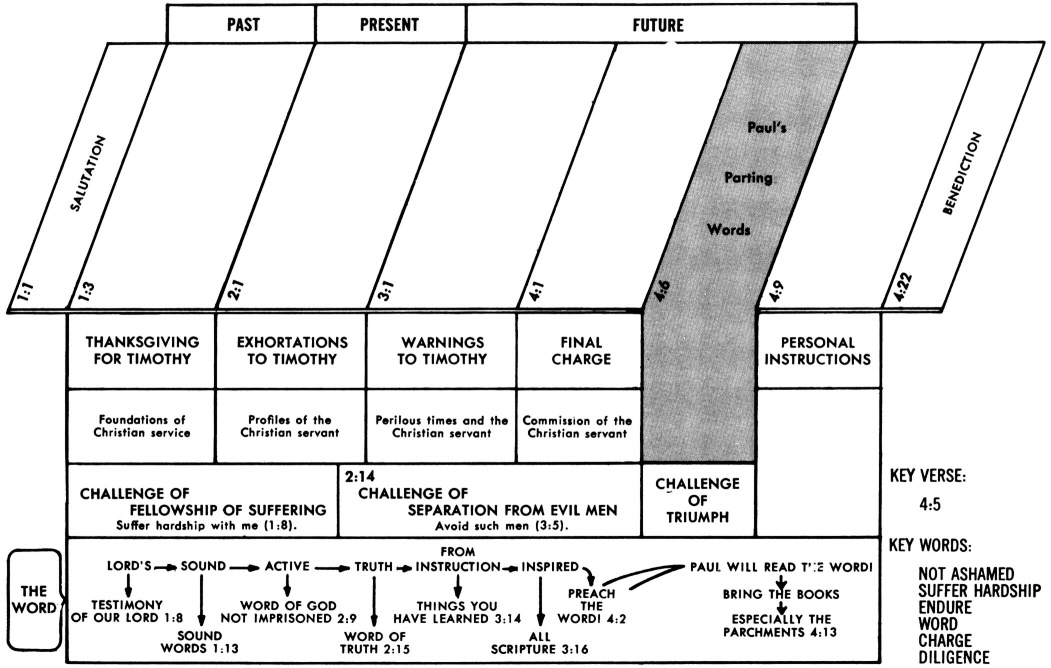
ENDURANCE AND SEPARATION IN THE MINISTRY
Click chart to enlarge
Charts from Jensen's Survey of the NT - used by permission
Second Timothy - Swindoll
| 2 TIMOTHY | |||
| 2 Timothy 1:1-18 | 2 Timothy 2:1-26 | 2 Timothy 3:1-17 | 2 Timothy 4:1-22 |
| Retain the Standard |
Rightly Divide the Word |
Difficult Times Will Come |
Preach the Word |
| PAST | PRESENT | FUTURE | |
| Foundation of Christian Service |
Pictures of Christian Servant |
Dangerous Times for Christian Servant |
Commission of Christian Servant |
| Unashamed as a Witness: Guard the Gospel |
Unashamed as a Workman: Suffer for the Gospel |
Adequate as a Workman: Continue in the Gospel |
Awarded as a Workman: Preach the Gospel |
| Power of the Gospel |
Perseverance of the Gospel Message | Protection of the Gospel |
Proclamation of the Gospel |
| Reminder | Requirements | Resistance | Requests |
| Encouragement in Ministry |
Examples in Ministry |
Exhortations in Ministry |
Exhortations to Fulfill Ministry |
| Commendation & Charge |
Commission to Fulfill |
Conflict to Face |
Course to Finish |
|
Compiled from Jensen's Survey of the NT and Wilkinson's Talk Thru the Bible |
|||
2 Timothy 4:2 preach (2SAAM) the word; be ready (2SAAM) in season and out of season; reprove (2SAAM), rebuke (2SAAM), exhort (2SAAM), with great patience and instruction. (NASB: Lockman)
Greek: keruxon (2SAAM) ton logon, epistethi (2SAAM) eukairos akairos, elegxon (2SAAM), epitimeson, (2SAAM) parakaleson, (2SAAM) en pase makrothumia kai didache.
Amp: Herald and preach the Word! Keep your sense of urgency [stand by, be at hand and ready], whether the opportunity seems to be favorable or unfavorable. [Whether it is convenient or inconvenient, whether it is welcome or unwelcome, you as preacher of the Word are to show people in what way their lives are wrong.] And convince them, rebuking and correcting, warning and urging and encouraging them, being unflagging and inexhaustible in patience and teaching. (Amplified Bible - Lockman)
BBE: Be preaching the word at all times, in every place; make protests, say sharp words, give comfort, with long waiting and teaching
GWT: Be ready to spread the word whether or not the time is right. Point out errors, warn people, and encourage them. Be very patient when you teach. (GWT)
ICB: Preach the Good News. Be ready at all times. Tell people what they need to do, tell them when they are wrong, and encourage them. Do these things with great patience and careful teaching. (ICB: Nelson)
KJV: Preach the word; be instant in season, out of season; reprove, rebuke, exhort with all longsuffering and doctrine.
Phillips: to preach the Word of God. Never lose your sense of urgency, in season or out of season. Prove, correct, and encourage, using the utmost patience in your teaching. (Phillips: Touchstone)
TEV: to preach the message, to insist upon proclaiming it (whether the time is right or not), to convince, reproach, and encourage, as you teach with all patience.
Wuest: make a public proclamation of the Word with such formality, gravity, and authority as must be heeded. Hold yourself in readiness for this proclamation when opportunity presents itself and when it does not; reprove so as to bring forth conviction and confession of guilt; rebuke sharply, severely, and with a suggestion of impending penalty. Pleadingly exhort, doing all this with that utmost self-restraint which does not hastily retaliate a wrong, and accompany this exhortation with the most painstaking instruction
Young's Literal: preach the word; be earnest in season, out of season, convict, rebuke, exhort, in all long-suffering and teaching,
PREACH THE WORD: keruxon (2SAAM) ton logon:
- Preach - Ps 40:9;Is 61:1, 61:2 ; Jonah 3:2; Lk 4:18;19, 9:60; Ro 10:15; 1 Co 1:21-23. 2 Co 5:19, 20 Col 1:25, 28
- 2 Timothy Resources - Multiple sermons and commentaries
- If you are a preacher, you need to listen to Steven Lawson's challenging, convicting message - Expository Preachers (61 min)
PREACH "THE" WORD
NOT A WORD!
PREACH the WORD...
- of God (Acts 13:44+)...
- of Christ (Ro 10:17-note, Col 3:16-note)...
- of Truth (2Cor 6:7, Col 1:5-note, 2Ti 2:15-note, Jas 1:18-note)...
- of Life (1Jn 1:1, Php 2:16-note)...
- of the Cross (1Co 1:18)...
- of the Lord (Acts 13:48+)...
- of the Gospel (Acts 15:7+)...
- of His Grace (Acts 14:3+, Acts 20:32+)...
- of Reconciliation (2Co 5:19+)...
- of Promise (Ro 9:9-note, cp 2Ti 1:1-note)...
- of Righteousness (Heb 5:13-note, Ps 119:123-note)...
- of His Power (Heb 1:3-note)...
- of Exhortation (Heb 13:22-note)...
- of My Perseverance (Rev 3:10-note)...
- of God's Message (1Th 2:13-note)...
- of all the Good Words (Joshua 23:14)...
- of Thy Lips (Ps 17:4-note)...
- of this Salvation (Acts 13:26+)...
- of Faith (Ro 10:8-note)...
- of the Oath (Heb 7:28-note)
The godly Scottish preacher Robert Murray McCheyne warned "here is the main thing—preach the word. The pulpit is, as George Herbert says, “our joy and throne.” This is our watch-tower. Here we must warn the people. The silver trumpet is put into our hand. Woe be unto us if we preach not the gospel. The Matter—The Word.—It is in vain we preach, if we preach not the word,—the truth as it is in Jesus. 1st. Not other matters.—Ye are my witnesses.” “The same came to bear witness of that light.” We are to speak of nothing but what we have seen and heard from God. It is not the work of the minister to open up schemes of human wisdom and learning, not to bring his own fancies, but to tell the facts and glories of the Gospel. We must speak of what is within the Word of God. (Ordination Sermon - 2Ti 4:1-2)
David Guzik writes "Paul’s emphasis on the word of God has been constant. There are some 36 references to the true gospel in this letter and some 17 references to false teachings."
Steven Cole - Paul could not have emphasized the essential nature of preaching any more strongly: “I solemnly charge you in the presence of God and of Christ Jesus, Who is to judge the living and the dead, and by His appearing and His kingdom: Preach the word....” (2Ti 4:1,2a). It follows, of course, that if preaching the Word is so important, then hearing the Word preached is also top priority, because a man does not preach to himself. In 4:1-2, Paul talks about the priority of preaching that must be established; in 4:3-4, he mentions the problem with hearing the Word preached that must be avoided; and, in 4:5 he emphasizes the perseverance in preaching to be pursued, even when people don't want to listen. (2 Timothy 4:1-5 Preaching & Hearing God's Word)
J I Packer observes in his book a Quest for Godliness John Bunyan in Pilgrim's Progress gives a clear picture of the ideal preacher in his description of Interpreter...
Then said the Interpreter, Come in, I will shew thee that which will be profitable to thee … he had him into a private Room, and bid his Man open a Door: the which when he had done, Christian saw the Picture of a very grave Person hang up against the wall, and this was the fashion of it. It had eyes lift up to Heaven, the best of Books in his hand, the Law of Truth was written upon his lips, the World was behind his back; it stood as if it pleaded with Men, and a Crown of Gold did hang over his head.
Then said Christian, What means this?
Interpreter. The Man whose Picture this is, is one of a thousand; he can beget Children, travel [travail] in birth with Children, and nurse them himself when they are born. And whereas thou sees him with his eyes lifted up to Heaven, the best of Books in his hand, and the Law of Truth writ on his lips: it is to shew thee, that his work is to know and unfold dark things to sinners; even as also thou sees him stand as if he pleaded with Men: And whereas thou sees the World as cast behind him, and that a crown hangs over his head; that is, to shew thee that slighting and despising the things that are present, for the love that he hath to his Master’s service, he is sure in the world that comes next to have Glory for his Reward. Now, said the Interpreter, I have shown thee this picture first, because the Man whose Picture this is, is the only Man, whom the Lord of the Place whither thou art going, hath authorized to be thy Guide in all difficult places thou mayest meet in the way. (Pilgrim's Progress - The Second Stage) (Or see this nice 1845 illustrated version)
The Directory for the Publick Worship of God - Preaching of the Word, being the power of God unto salvation, and one of the greatest and most excellent works belonging to the ministry of the gospel, should be so performed, that the workman may not be ashamed, but may save himself and those who hear him.…
The servant of Christ is to perform his whole ministry:
1. Painfully [Ed: laboring, taking pains], not doing the work of the Lord negligently.
2. Plainly, that the meanest may understand; delivering the truth not in the enticing words of man’s wisdom, but in demonstration of the Spirit and of power, lest the cross of Christ should be made of none effect; abstaining also from an unprofitable use of unknown tongues, strange phrases, and cadences of sounds and words; sparingly citing sentences of ecclesiastical or other human writers, ancient or modern, be they never so elegant.
3. Faithfully, looking at the honour of Christ, the conversion, edification, and salvation of the people, not at his own gain or glory; keeping nothing back which may promote these holy ends, giving to every one his own portion, and bearing indifferent [equal] respect to all, without neglecting the meanest, or sparing the greatest, in their sins.
4. Wisely, framing all his doctrines, exhortations, and especially his reproofs, in such a manner as may be most likely to prevail; showing all due respect to each man’s person and place, and not mixing his own passion or bitterness.
5. Gravely, as becomes the Word of God, shunning all such gesture, voice, and expression, as may occasion the corruptions of men to despise him and his ministry.
6. With loving affection, that the people may see all coming from his godly zeal, and hearty desire to do them good.
7. As taught by God, and persuaded in his own heart, that all he teacheth is the truth of Christ, and walking before his flock, as an example to them in it; earnestly, both in private and publick, recommending his labours to the blessing of God, and watchfully looking to himself, and the flock whereof the Lord hath made him overseer.
So shall the doctrine of truth be preserved uncorrupt, many souls converted and built up, and himself receive manifold comforts of his labours even in this life, and afterward the crown of glory laid up for him in the world to come. ( Directory for the Publick Worship of God)
WARNING
PAUL'S COMMAND IS
NOT JUST TO PREACH!
Note that Paul does not simply say "Preach" but specifically commands us to "Preach the Word". Pastor Michael Andrus speaks to importance of this in his excellent message Biblical Theology: — The Queen of the Sciences Must Recover Her Crown.
Notice that Paul gives 5 commands in almost staccato like fashion reminiscent of military commands anticipating imminent conflict. Each verb is in the aorist imperative, conveying a sense of urgency as brought by the following paraphrases...
"This matter needs your full attention Timothy".
"Do this now!"
"Don't delay."
It is interesting that Paul's very choice of verbs (reprove, rebuke, exhort) reveals how resistant people will become to the pure milk of God’s Word. The world is bombarded with message after message offering hope after hope. But above all the messages and above all the hopes that bombard the world, there is one that is more needed by man than all the others — one that is so important that it supersedes all the others combined. That message is the Word of God. The Word of God offers the only lasting hope for man. For this reason the Word of God must be preached. The minister of God must commit himself to the awesome charge to preach the Word of God and to minister as never before. He is to be obsessed with a burning, consuming passion to preach the unsearchable riches of Christ.
DRY AND
WINDY!
William Arp writes that "A minister was rushed to the hospital and an inexperienced nurse was assigned to him. She put a barometer in his mouth instead of a thermometer and it read, “Dry and windy.” This may be an apt description of much of the preaching occurring in churches today. In 2Ti 4:1–5 Paul is addressing Timothy, who is living in problem times, and he commands him to preach the Word. It is necessary to pay close attention to the words of the passage in order to understand their significance to preachers and preaching in our times. This article will examine the meaning of Paul’s words to Timothy and their significance to preachers today in terms of their context, content, and contextualization. (The Priority of Preaching in Problem Times -- By William E. Arp - Journal of Ministry and Theology - Spring, 1997)(See Arp's related - Preaching the Epistles - scroll down to page 57)
Sinclair Ferguson - Preaching God’s word is the central gift of the Spirit given by Christ to the church.
As one man has well said "Nothing takes the place of preaching except better preaching!"
Preach (2784) (kerusso or kerysso from kerux/keryx = a herald - one who acts as the medium of the authority of one who proclamation he makes; kerugma = the thing preached or the message) means to proclaim (publicly) or to herald or a public crier - the town official who would make a proclamation in a public gathering. The herald may not even have liked the message he was to proclaim or the people may not have wanted to hear it and thus the temptation for the herald may have been to change the message, to soften the blow, to spin the text, all of which would have resulted in the herald losing his head! Do you see how critical it is that the preach herald the King's message without spin and not using it as a springboard to a personal agenda. The King's message and the King's agenda is to be paramount. Period!
Swindoll on kerux - An official representative of the king would announce the king's message to the realm or to a specific person. The herald, keryx enjoyed the protection of the king as he carried out his duty. To harm a herald was to invite the wrath of the court. Paul called himself a keryx (2 Ti 1:11), and now he passes that role to Timothy.
As noted above the tense is aorist imperative which conveys a sense of urgency to carry out this task! It calls for prompt action in prayerful dependence on the enabling power of the Holy Spirit (cp Acts 1:8-note). It presents the picture of a commanding office charging his troops to follow these orders, lest victory in the battle be compromised! Note also that the command to preach precedes the next three commands because these other commands are dependent on and intimately linked to the proclamation of God's Word.
Related Resources:
- See discussion of the Need for the Holy Spirit to obey NT commands (or "How to Keep All 1642 Commandments in the New Testament!")
- Filled with His Spirit/Richly Indwelt with His Word - Chart Comparing
W Donald Hiebert notes that kerusso "stands first as the very heart and center of his work. This is man’s supreme need and it is his highest and primary task. But the verb “preach” does not necessarily imply an ordained minister preaching from a stately church pulpit. The original verb has in it the picture of a herald making a public proclamation as ordered by another....The King of Heaven has committed His message to His messengers and it is their duty faithfully and with proper dignity to proclaim that message to men without alteration or falsification. (Hiebert, D. E. Second Timothy. Chicago, IL: Moody Press)
Alan Carr writes that to preach meant "To herald” which "refers to a king’s messenger to the people. He was to sound out the king’s word with a voice that was loud and clear. The message was to be heard and heeded. The messenger was to be respected and unhindered. He was not an ambassador with whom one might negotiate. He was a messenger that must be heard! (A Clear Message to a Called Man)
Kerusso - 61x in 60v - NAS = made proclamation(1), preach(16), preached(10), preacher(1), preaches(2), preaching(11), proclaim(8), proclaimed(6), proclaiming(6).
Mt 3:1; 4:17, 23; 9:35; 10:7, 27; 11:1; 24:14; 26:13; Mark 1:4, 7, 14, 38f, 45; 3:14; 5:20; 6:12; 7:36; 13:10; 14:9; 16:15, 20; Luke 3:3; 4:18f, 44; 8:1, 39; 9:2; 12:3; 24:47; Acts 8:5; 9:20; 10:37, 42; 15:21; 19:13; 20:25; 28:31; Rom 2:21; 10:8, 14f; 1 Cor 1:23; 9:27; 15:11f; 2 Cor 1:19; 4:5; 11:4; Gal 2:2; 5:11; Phil 1:15; Col 1:23; 1 Thess 2:9; 1 Tim 3:16; 2 Tim 4:2; 1 Pet 3:19; Rev 5:2.
Kerusso means to proclaim a message as a herald did in the ancient days before radio and television. The Imperial Herald would enter a town in behalf of the Emperor or the King, and make a public proclamation of the message which his Sovereign ordered him to give, doing so with such formality, gravity, and authority as must be heeded. He gave the people exactly what the Emperor bade him give, nothing more, nothing less and certainly not only what the people wanted to hear! The ancient herald's who proclaimed the emperor's message without alteration or addition lest they lose their life (!), should be the fearful example and pattern for all present day preachers of the Gospel. The Gospel is not given to be watered down or adulterated but to be preached with the power and unction and authority of the King of kings! (See warnings against "tampering" with the Word of God - Pr 30:6, Dt 4:2, Dt12:32 Rev 22:18-note, Rev 22:19-note) -
The Pulpit Commentary on Pr 30:6 reminds us that "The truth of God is too sacred for man to be permitted to tamper with it. This is a great warning that men have rarely heeded. We may think and utter our thoughts. But the fatal mistake is when we put forth our speculations as though they were a part of God’s revelation. This is a common sin of authoritative theology. Men’s opinions — harmless enough in themselves, perhaps — have been added to the Scripture truths, and set before the world as unquestionable and Divine. The interpretation of Scripture has been made as sacred as the text. Church dogma has claimed Divine authority. This is adding to God’s words, and the danger of it is (1) Divine disapproval — “lest he reprove thee;” and (2) human disloyalty to truth — “and thou be found a liar.” (Another note on Pr 30:6) (Another note on Pr 30:6 - see quote by Tertullian beginning on bottom of page 771) (John Gill) (Bridges on Pr 30:5-6)
The original meaning of the root word kerux was a "herald at the royal court." Homer used kerusso and kerux in this connection. They not only announced the coming of the prince, but they also carried his commands to the uttermost corners of his realm. As the government of Greece became more republican, these heralds came to serve the state rather than the court. Certain qualities were required of heralds. They must have powerful voices, so voice auditions were often held. The herald was to make his announcements in a loud, clear voice so everyone could hear. This brings to mind the picture of the herald crying loudly and clearly "Hear ye, hear ye".
Also they had to be capable of calming down an unruly mob, in order to faithfully communicate the command. An honest disposition was also required, as a protection against the exaggeration of a royal decree. Furthermore, they could make no additions or subtractions from the received message. Later these heralds were also used to declare the message of a Greek deity or a religious oracle.
Kerusso describes the official activity of a herald which is to announce or publicly proclaim. It was used of the official whose duty it was to proclaim loudly and extensively the coming of the king.
Kerusso does not carry within it the content or nature of the message which is proclaimed. The context usually indicates what is being preached or qualifying phrase must be used for that purpose. In the New Testament, the word is used either with a qualifying phrase such as “the gospel” (Mark 16:15), or the contents of the proclamation are given as in Revelation 5:2, or it is used alone without the contents of the message being given as in Romans 10:15.
Hughes observes that "By placing the command to “preach the Word” first, and then enlarging it in the following imperatives, Paul makes it the signature of Christian ministry... If God has called you to preach, that must be the signature of your soul and life. (Recommended reading -Hughes, R. K., & Chapell, B.. 1 & 2 Timothy and Titus : To guard the deposit. Preaching the Word)
John Piper explains that...
Preaching (kerussõn) is different from teaching. In 2Ti 1:10 11, Paul says, “[Christ] abolished death, and brought life and immortality to light through the gospel, 11 for which I was appointed a preacher and an apostle and a teacher.” That is, I was appointed for three tasks: heralding or announcing the Truth as a preacher; composing, preserving, and transmitting the authoritative pattern of Truth as an apostle; and explaining and applying the Truth as a teacher. So preaching is not just explaining or teaching. Preaching is heralding. Preaching is what a town crier does when there is a message from the king.
Preaching Is Heralding and Exulting - He gathers a group of people and says, “Here ye, hear ye, be it known to you today that by royal order of his highness, the king, there will henceforth be granted to this town an imperial watch of one hundred soldiers to protect you from the rebel bands who plunder the king’s subjects.” And a cheer goes up among the people. (Those are the amen’s of the congregation.) And he continues, “Furthermore be it known to you that the cost for this protection shall be born not by taxation but by the beneficence of the king from his royal treasury!” Again cheers! (Amen!) “Moreover, the king would have you know that he loves you, his loyal subjects, and will use all his royal counsel and power to defend you and supply your wants.” Again cheers. (Amen! Amen!) “And lastly he sends through me his royal blessing. Blessed be the people whose trust is in the king!” Cheers. (Amen!)
Preaching is more than teaching. It is, exultation in the Word. “Preach the Word,” means “exult in the Word.” That is, announce it and revel in it. Speak it as amazing news. Speak it from a heart that is moved by it.
Two Reasons Why This Kind of Speaking Is So Crucial - There are two reasons why this kind of speaking in the church is so crucial. One is that the subject matter is infinitely important. There is no other organization on earth that deals in matters of eternal life and eternal death—matters about God and his Son and his Spirit, matters about salvation and judgment, matters about the life that pleases God or displeases him. In other words, no other group of people, besides the church, gathers regularly to deal in such tremendously important realities. This means that there is a form of speech that is fitting as part of that gathering that fits the greatness of that truth—namely, preaching. So the first reason for preaching is that the nature of the truth calls for something more than mere explanation or discussion or conversation.
The other reason why preaching is so crucial is that our hearts yearn for the truth to come to us in ways that highlight the worth of the truth. In other words, not only does the magnificence of the truth call for a heartfelt heralding and passionate exultation, but our hearts call for this too. Our hearts will not be drawn out to worship if someone just dissects and analyzes the worth and glory of God but does not exult in it before us. Our hearts long for true preaching. Some of us don’t even know that is what we are missing. Like children who grew up in homes where mom and dad never exulted in anything. They never rejoiced or praised or verbally admired and treasured anything. They were always flat and unenthused (except when they got angry). You couldn’t tell if anything really moved them deeply and positively. So the kids grow up not knowing what they are missing. That is what many people in the church are like who have never tasted true preaching.
Preaching Must Be Expository Exultation - God exists to be worshiped—to be admired and treasured and desired and praised. Therefore, the Word of God is written primarily to produce worship. This means that if that Word is handled like a hot-dish recipe or a repair manual, it is mishandled. And the people will suffer. The Truth of God begs to be handled with exultation. And our hearts yearn for this and need it. Something in us starts to die when precious and infinitely valuable realities are handled without feelings and words of wonder and exultation. That is, a church starts to die, without preaching.
But, of course, this assumes something massive. To treasure the Truth, and to love the Truth, and be impassioned about the Truth, and to exult in the Truth, you have to know the Truth. So it’s not enough to say that preaching is exultation. We must also say it is “expository exultation.” It is exultation in the Truth of God’s Word. And the exultation is in proportion to the Truth delivered.
In 2 Timothy 2:15 Paul tells Timothy, “Be diligent to present yourself approved to God as a workman who does not need to be ashamed, handling accurately the word of truth.” This too is part of preaching. Preaching is handling accurately the Word of truth. In other words you can never twist or exploit the Word in order to increase the emotional response of the people. Preaching is not exultation without exposition of the Word. Nor is preaching exposition of the Word without exultation. One error cuts off the head. The other rips out the heart. In both cases the victim dies. No heart. Or, no head. You’re dead. And so is preaching. And not too long after, the church.
Preach the Word - So the command of the Lord is, Preach the Word. Keep your head on (exposition) and keep your heart alive (exultation). Handle the precious living Word of God accurately. And come to this pulpit week after week and do expository exultation. Don’t out-exult the Word. And don’t under-exult the Word. There is enough glory in the Word that you need add nothing artificial. Just eat it until your heart is deeply and truly satisfied and then serve the same banquet for your people.
Martin Luther was one of the great preachers of all time. He explained the need for preaching like this:
Because heresies threatened the living apostolic message, it had to be recorded in a book to protect it from falsification. Preaching reverses this process of conservation again, allowing the Scriptures of the past to become the tidings of the present … The Gospel has been committed to lifeless paper; fresh words can transform it into glad tidings again.
Scripture turned into glad tidings—that is what happens in expository exultation. [Pastor], if the Lord wills, there are many years in front of you and many trials. You will be tempted in many ways to give up preaching. Satan will lie to you that it is not a great thing. Or that you could devote yourself to something more significant. But when that happens, go back to 2 Timothy 4:1–2 and listen to the apostle. “I solemnly charge you in the presence of God and of Christ Jesus, who is to judge the living and the dead, and by His appearing and His kingdom: preach the word.” Then you will rise up and say with Martin Luther, “If I could today become king or emperor, I would not give up my office as preacher.” (Advice to Pastors Preach the Word Installation Sermon)
Dr Piper's book - Brothers, We Are NOT Professionals
J I Packer wrote that "Certainty about the great issues of the Christian faith and conduct is lacking all along the line. The outside observer sees us staggering on from gimmick to gimmick and stunt to stunt like so many drunks in a fog, not knowing at all where we are or which way we should be going. - Preaching is hazy; heads are muddled; hearts fret; doubts drain strength; uncertainty paralyzes action....Unlike the first Christians who in three centuries won the Roman world, and those later Christians who pioneered the Reformation, and the Puritan awakening and the Evangelical revival, and the great missionary movement of the last century, we lack certainty. Why is this? We blame the external pressures of modern secularism, but this is like Eve blaming the serpent. The real truth is that we have grieved the Spirit...we stand under divine judgment. For two generations our churches have suffered from a famine of hearing the words of the Lord.
A W Tozer - I heard of one graduate of a theological school who determined to follow his old professor’s advice and preach the Word only. His crowds were average. Then one day a cyclone hit the little town and he yielded to the temptation to preach on the topic “Why God Sent the Cyclone to Centerville.” The church was packed. This shook the young preacher and he went back to ask his professor for further advice in the light of what had happened. Should he continue to preach the Word to smaller crowds or try to fill his church by preaching sermons a bit more sensational? The old man did not change his mind. “If you preach the Word,” he told the inquirer, “you will always have a text. But if you wait for cyclones you will not have enough to go around.” (Tozer, A. W. . Tozer on Christian leadership : A 366-day devotional - May 28. Camp Hill, PA.: WingSpread)
Barclay - The Christian teacher is to be urgent. The message he brings is literally a matter of life and death. The teachers who really get their message across are those who have the note of earnestness in their voice....Any man with the note of urgency in his voice demands, and will receive, a hearing from other men. The Christian teacher is to be persistent. He is to urge the claims of Christ "in season and out of season." As someone has put it: "Take or make your opportunity." (2 Timothy 4 - William Barclay's Daily Study Bible)
R. C. H. Lenski -The point to be noted is that to preach is not to argue, reason, dispute, or convince by intellectual proof, against all of which a keen intellect may bring counterargument. We simply state in public or testify to all men the truth which God bids us state. No argument can assail the truth presented in this announcement or testimony. Men either believe the truth, as all sane men should, or refuse to believe it, as only fools venture to do” (The Interpretation of St. Matthew’s Gospel [Minneapolis: Augsburg, 1964], p. 168). (2 Timothy 4 Commentary )
Kerusso means to make a formal or an official announcement and thus to announce by means of a herald or one who functions as a herald
And I saw a strong angel proclaiming with a loud voice, "Who is worthy to open the book and to break its seals?" (Rev 5:2-note).
Wuest has an excellent paraphrase of 2 Timothy 4:2 rendering it "make a public proclamation of the Word with such formality, gravity, and authority as must be heeded. Hold yourself in readiness for this proclamation when opportunity presents itself and when it does not; reprove so as to bring forth conviction and confession of guilt; rebuke sharply, severely, and with a suggestion of impending penalty. Pleadingly exhort, doing all this with that utmost self-restraint which does not hastily retaliate a wrong, and accompany this exhortation with the most painstaking instruction.
In summary, the herald's official duties in those days included proclamation of war, challenging to battle, proclamation of peace and bearing of messages from the commander of an army. More specifically a herald tells what the one in authority has told him to declare and so he is sent with a message that he must not change in any way, the message always having a suggestion of formality, gravity and an authority which must be listened to and obeyed -- the listener needs to hear and heed.
Not to heed the ruler’s messenger was serious and to abuse the messenger was even worse. The practical application is that the King of Heaven has committed His gospel message to every believer (cf Mt 28:18, 19, 20), His bearers of the good news and it is our duty to faithfully and with proper dignity proclaim this message of life to the "living dead" (Eph 2:1-note) without shrinking back in shame (Acts 20:20, 27) and without altering or falsifying the message (2Ti 2:15-note).
Dear believer in Christ, note that Kerusso does not necessarily imply an ordained, seminary trained minister preaching from a stately church pulpit (John Wesley was thrown out of many formal church pulpits and had to resort to preaching in open fields).
Wuest adds that kerusso "at once...called to (Timothy's) mind the Imperial Herald, spokesman of the Emperor, proclaiming in a formal, grave, and authoritative manner which must be listened to, the message which the Emperor gave him to announce. It brought before him the picture of the town official who would make a proclamation in a public gathering. The word is in a construction (Ed note: Aorist imperative) which makes it a summary command to be obeyed at once. It is a sharp command as in military language. This should be the pattern for the preacher today. His preaching should be characterized by that dignity which comes from the consciousness of the fact that he is an official herald of the King of kings. It should be accompanied by that note of authority which will command the respect, careful attention, and proper reaction of the listeners. There is no place for clowning in the pulpit of Jesus Christ."
I would add that when a city received word of the imminent appearance of the great Roman Emperor, thorough preparations were made -- buildings and streets were scrubbed as the towns people worked hard to prepare themselves and their city for their coming king. They were excited about his coming and focused their full attention and energy upon his coming. In a similar manner, this is what the man and woman of God must do, heralding His Word, keeping in mind the imminent return of the Lord Jesus Christ. We must be prepared for His return, and one way we are "prepared" is by preaching the Word. The conquering King of kings is returning. If we fail to preach the Word, we will stand before Him unprepared — embarrassed and ashamed. (1Jn 2:28, Mt 24:44, Lk 19:13)
The first use of kerusso in the NT is illustrative describing John the Baptist who came, preaching (kerusso) in the wilderness of Judea, saying, "Repent, for the kingdom of heaven is at hand. (Mt 3:1 3:2).
What was his season like? Herod "wanted to put him to death" because John had reproved him (Lk 3:19) saying ""It is not lawful" for Herod to marry his brother's wife. Herod eventually did command John's beheading so that "his head was brought on a platter" to the daughter of Herodias (Josephus says her name was Salome) (Mt 14:1-11)
To man's eye one might say John should have held his tongue and not "preach the Word", so he could continue to be useful to God. But God reminds us that "My thoughts are not your thoughts. Neither are your ways My ways." (Isa 55:8) and that no man can touch God's man until his time of service is completed even as was that of the "two witnesses" in the Revelation, John writing that
when they have finished their testimony (and NOT before), the beast that comes up out of the abyss will make war with them, and overcome them and kill them. (Rev 11:7-note)
J. I. Packer - We shall never perform a more important task than preaching. If we are not willing to give time to sermon preparation, we are not fit to preach, and have no business in the ministry at all...the well-being of the church today depends in large measure on a revival of preaching in the Puritan vein...to the Puritan, faithful preaching was the basic ingredient in faithful pastoring (Ed: note how close "pastoring" is to "pasturing"...Interesting!) (A Quest for Godliness The Puritan Vision of the Christian Life J. I. Packer)
Ray Pritchard writes...
- In a world of itching ears, Preach the Word!
- To a generation gone astray, Preach the Word!
- In a time of moral crisis, Preach the Word!
- When people don’t want to hear you, Preach the Word!
- When false teachers abound, Preach the Word!
- In good times and in bad times, Preach the Word!
- When people listen and when they don’t listen, Preach the Word! (2 Timothy 4:1-5: Preach the Word!)
Puritan Richard Baxter in his classic work THE REFORMED PASTOR...
How few ministers do preach with all their might, or speak about everlasting joys and everlasting torments in such a manner as may make man believe that they are in good earnest! Alas, we speak so drowsily or gently, that sleepy sinners cannot hear. The blow falls so light that hard-hearted sinners cannot feel. The most of ministers will not so much as exert their voice, and stir up themselves to an earnest utterance. But if they do speak loud and earnestly, how few do answer it with weight and earnestness of matter! And yet without this, the voice does little good; the people will esteem it but mere bawling, when the matter doth not correspond. It would grieve one to the heart to hear what excellent doctrine some ministers have in hand, while yet they let it die in their hands for want of close and lively application.…
O sirs, how plainly, how closely, how earnestly, should we deliver a message of such moment as ours.… In the name of God, brethren, labour to awaken your own hearts, before you go to the pulpit, that you may be fit to awaken the hearts of sinners. Remember they must be awakened or damned, and … a sleepy preacher will hardly awaken drowsy sinners. Though you give the holy things of God the highest praise in words, yet, if you do it coldly, you will seem by your manner to unsay what you said in the matter.… It is only here and there, even among good ministers, that we find one who has an earnest, persuasive, powerful way of speaking, that the people can feel him preach when they hear him.…
Though I move you not to constant loudness in your delivery (for that will make your fervency contemptible), yet see that you have a constant seriousness; and when the matter requireth it (as it should do, in the application at least), then lift up your voice, and spare not your spirits. Speak to your people as to men that must be awakened, either here or in hell. Look around upon them with the eye of faith, and with compassion, and think in what a state of joy or torment they must all be for ever; and then, methinks, it will make you earnest, and melt your heart to a sense of their condition. Oh, speak not one cold or careless word about so great a business as heaven or hell.
I confess I must speak it by lamentable experience, that I publish to my flock the distempers of my own soul. When I let my heart go cold, my preaching is cold; … and so I can oft observe also in the best of my hearers that when I have grown cold in preaching, they have grown cold too; and the next prayers which I have heard from them have been too like my preaching.… O brethren, watch therefore over your own hearts: keep out lusts and passions, and worldly inclinations; keep up the life of faith, and love, and zeal: be much at home, and much with God … a minister should take some special pains with his heart, before he is to go to the congregation: if it be then cold, how is he likely to warm the hearts of his hearers? Therefore, go then specially to God for life.… (THE REFORMED PASTOR in Section 1- The Use of Humiliation - by Richard Baxter)
The famous 19th century preacher Bishop J C Ryle wrote...
In short, I believe St. Paul would have us understand that, however various the works for which the Christian minister is set apart, his first, foremost and principal work is to be the preacher and proclaimer of God’s Word.
It (preaching the Word) is the principal means God has always chosen to use to convert and edify souls. The brightest days of the church have been those when preaching has been honored; the darkest days of the church have been those when it has been treated as something unimportant. Let us honor the sacraments and public prayers of the church, and reverently use them; but let us beware that we do not place them above preaching.
(Commenting on the parable of the soils) Like the sower, the preacher must be diligent. He must spare no pains; he must use every possible means to make his work prosper; he must patiently sow by every stream (Isaiah 32:20), and sow in hope. He must “be prepared in season and out of season” (2Ti 4:2), undeterred by difficulties and discouragements; “whoever watches the wind will not plant” (Ecclesiastes 11:4). No doubt his success does not entirely depend on his labor and diligence, but without labor and diligence success will not be obtained. Like the sower, the preacher cannot give life. He can scatter the seed committed to his charge, but he cannot command it to grow: he may offer the word of truth to a people, but he cannot make them receive it and bear fruit. To give life is God’s solemn prerogative: “The Spirit gives life” (John 6:63). God alone can “make things grow” (1Corinthians 3:7).Let these things sink down into our hearts. It is no light thing to be a real minister of God’s Word. To be an idle, formal workman in the church is easy; to be a faithful sower is very hard. Preachers ought to be specially remembered in our prayers.
A W Pink - Now, the most effective way to oppose error is to preach the Truth, as the way to dispel darkness from a room is to let in or turn on the light....
The business of Christ’s ministers is to sow, and continue sowing the good Seed, and not to root up tares! Their work is to be a positive and constructive one, and not merely a negative and destructive thing. Their task is to “preach the Word” (2 Tim. 4:2), faithfully and diligently, in dependency upon the Spirit, looking to God for His blessing upon the same. And what is so urgently needed today is that they proclaim with earnest conviction, “All Scripture is given by inspiration of God” (2 Tim. 3:16).
John Stott was asked if preaching of the word was indispensable, to which he retorted - To the contrary! I still believe that preaching is the key to the renewal of the church. I am an impenitent believer in the power of preaching. I know all the arguments against it—that the television age has rendered preaching useless, that we are a spectator generation, that people are bored with the spoken word, disenchanted with any communication by spoken words alone. All these things are said these days. Nevertheless, when a man of God stands before the people of God with the Word of God in his hand and the Spirit of God in his heart, you have a unique opportunity for communication. I fully agree with Martyn Lloyd-Jones that the decadent periods in the history of the church have always been those periods marked by preaching in decline. That is a negative statement. The positive counterpart is that
Churches grow to maturity
when the Word of God
is faithfully and sensitively expounded to them.
If it is true that a human being cannot live by bread only, but by every word which proceeds out of the mouth of God, then it is also true of churches. Churches live, grow, and thrive in response to the Word of God. I have seen congregations come alive by the faithful and systematic unfolding of the Word of God. (Creating the Bridge in Communicate with Power: Insights from America’s Top Communicators)
Lyman Beecher of Boston Church was once asked how he was able to accomplish so much in his church. He replied: “Oh, I preach Sundays, and our hundred of my church members preach every day.”
Stephen Olford - Someone has said that there is only one thing that will ever take the place of great preaching, and that is greater preaching. Preaching is primary, and expository, preaching paramount. And without any question, the crying need of the hour is to return to the apostolic injunction to “preach the Word” (2 Timothy 4:2). For the sake of clarity, let me define what I mean by expository preaching. It is “the presentation of biblical truth, derived from and transmitted through a historical, grammatical and Spirit-guided study of a passage in its context, which the Holy Spirit applies first to the life of the preacher and then through him to his congregation.” It is the preaching of this caliber and content that we need in the pulpits of our land today. (Olford, S. F. Vol. 1: Institutes of Biblical preaching: Volume one. Memphis: Olford Ministries International)
Gregory Brown - Expository preaching is simply preaching verse by verse through the Bible while explaining its meaning in the ancient context and applying it to the contemporary context. This type of preaching is important because it makes the preacher preach every verse of Scripture and not simply favorite doctrines or favorite texts. It doesn’t allow the preacher to skip unpopular texts
In his book Anointed Expository Preaching Olford adds...
The question then arises as to how this kind of preaching can become a practical reality in our busy ministries. The answer involves hard work and we mean hard work! Our experience, whether we are dealing with a single text, a whole paragraph, or a complete book, is that expository preaching demands “blood, sweat, and tears.” To help us understand the art in simple terms, let us first set forth our approach to expository preaching....
So strong is Walter C. Kaiser’s aversion to topical messages that he has advised his students “for some years now to preach a topical sermon only once every five years—and then immediately to repent and ask God’s forgiveness!” To soften those words, Dr. Kaiser acknowledges a measure of hyperbole in the statement, but quickly adds, “The serious note that lies behind this playfulness is a loud call for preaching that is totally biblical in that it is guided by God’s Word in its origins, production, and proclamation.” That’s expository preaching!
John Piper - Preaching is not the totality of the church. And if all you have is preaching, you don’t have the church. A church is a body of people who minister to each other. Part of what preaching does is equip us for that. God has created the church, so that she flourishes through preaching. That’s why Paul gave young pastor Timothy one of the most serious, exalted charges in all the Bible in 2 Timothy 4:1–2: “I charge you in the presence of God and of Christ Jesus, who is to judge the living and the dead, and by his appearing and his kingdom: preach the word.” If you are used to a twenty-minute, immediately practical, relaxed talk, the understanding of preaching that I just described doesn’t lead there. I won’t preach twenty minutes but twice that long; I do not aim to be immediately practical but eternally helpful; and the condition of my soul is not relaxed but standing vigilantly on the precipice of eternity speaking to people any of whom this week could go over the edge.....
[Pastor], my message to you is very simple and very precarious. It is 2 Timothy 4:2, “Preach the Word.” I call it precarious, because there is a constant temptation to do other things in the place of this. There ARE other things to do in the ministry, as these letters to Timothy show. And we must do them to be found faithful. But none of them is treated as solemnly and forcefully as this one simple exhortation from the apostle: “Preach the Word.”...
So the answer to our question is that the Word is the writings of the Old Testament and the writings of the New Testament. God’s word to you this afternoon is to “Preach the Word.” That is, preach the Scriptures of the Old and New Testament. Know this book. Make this book the main dwelling place of your mind. On every question, ask, what does the Bible say? Meditate on this book day and night. Take the word given to Joshua (1:8) for yourself. (Recommended reading - Anointed Expository Preaching - Broadman & Holman Publishers [hardcover])
Steven Cole - The preacher’s message should come out of the text and be governed by the text. “Preach” means “to herald.” The herald was the king’s messenger who relayed the king’s message to the people. He wasn’t free to make up his own message. He wasn’t a politician or diplomat or a spin doctor. His job was to proclaim faithfully the king’s message so that the people understood it. There is a sad lack of that kind of biblical preaching in the pulpits of America. I once heard some tapes titled, “The best of ...” a well-known preacher. He took his theme loosely from a biblical text, but then he’d jump off from there and tell a lot of uplifting stories. But when he was done, he had not explained or applied the words of the text in its context. Others give positive, upbeat, self-help messages with a few verses sprinkled in for good measure. But you could remove all the verses and the result could appear in Reader's Digest, not much altered by the absence of the Scriptures. (Preaching and Hearing God's Word - 2Timothy 4:1-5) (Listen to Mp3) (Bolding added)
J Vernon McGee - A faithful pastor shows his love by preaching the Word of God as it is rather than “buttering up” the congregation.
The Word (3056) (logos) in context refers to the Word of God and specifically to the good news, the Gospel (euaggelion), which is the supreme need of unregenerate man and is therefore to be Timothy's highest priority and his primary objective. Paul’s emphasis on the word of God has been constant with some 36 references to the gospel in this letter, and some 17 references to false teachings.
Robert Murray McCheyne warned preachers to be sure to "preach THE WORD"...
1st, Not other matters.—“Ye are my witnesses.” “The same came to bear witness of that light.” We are to speak of nothing but what we have seen and heard from God. It is not the work of the minister to open up schemes of human wisdom or learning, not to bring his own fancies, but to tell the facts and glories of the gospel. We must speak of what is within the word of God.
2d, Preach the word—the most essential parts especially. If you were with a dying man, and knew he had but half an hour to live, what would you tell him? Would you open up some of the curiosities of the word, or enforce some of the moral commands of the word? Would you not tell him his undone condition by nature and by wicked works? Would you not tell him of the love and dying of the Lord Jesus? Would you not tell him of the power of the Holy Spirit? These are the essential things which a man must receive or perish. These are the great subject-matters of preaching. Should we not preach as Jesus did when He went to Emmaus, when He began at Moses and all the prophets, and expounded to them the things concerning himself? Let there be much of Christ in your ministry, says the excellent Eliot. Rowland Hill used to say, See there be no sermon without three R’s in it: Ruin by the fall, Righteousness by Christ, and Regeneration by the Spirit. Preach Christ for awakening, Christ for comforting, Christ for sanctifying. “God forbid that I should glory, save in the cross of our Lord Jesus Christ.”
3d, Preach as the word.—I would humbly suggest for the consideration of all ministers, whether we should not preach more in the manner of God’s word. Is not the word the sword of the Spirit? Should not our great work be to take it from its scabbard, to cleanse it from all rust, and then to apply its sharp edge to the consciences of man? It is certain the fathers used to preach in this manner. Brown of Haddington used to preach as if he had read no other book than the Bible. It is the truth of God in its naked simplicity that the Spirit will most honour and bless. “Sanctify them through thy truth: thy word is truth.” (Ordination Sermon - 2Ti 4:1-2)
Paul writes...
I did not shrink (Greek = hupostello = metaphor for lowering a sail and so slackening the course, hence of being remiss in holding to and forth the truth! Paul was a man not filled with wind but filled with the Spirit!) from declaring to you the whole purpose (the set purpose and determined will) of God. (Acts 20:27+)
Comment on "whole" - Paul’s Old Testament was not like the Bible of so many preachers today—dog-eared in the Psalms and clean in Leviticus and Numbers! The whole counsel of God was the subject of his ministry and is to be ours (cp "The Jesus Way" = Lk 24:27+).
Hughes comments that "we must not gloss over the obvious, as so many preachers do today. It is the Word that is to be preached! As the imminent theologian and patristic scholar Tom Oden says "There is no hint here that preaching is thought of primarily as self-expression of subjective experience or feeling-disclosure or autobiography or “telling one’s story” so as to neglect Scripture (Ed: Beloved there is a drift in many pulpits today toward "personal stories" in lieu of "powerful Scripture" - testimonies of the power of the Good News to save and sanctify while laudable should NEVER replace the powerful proclamation of the perfect Good News! cp Pr 30:5).… The whole counsel of God is to be preached, without fanciful, idiosyncratic amendment or individualistic addition. (Amen!) Son, don’t preach yourself (cf. 2 Corinthians 4:5+). Like Paul, preach the whole counsel of God (cf. Acts 20:27+, NASB). Let the Word do the work. (Hughes, R. K., & Chapell, B.. 1 & 2 Timothy and Titus: To guard the deposit. Preaching the Word)
This verse reminds us of the little chorus in Sunday School called The B-I-B-L-E (Play the song...but better "preach the song!")
The B-I-B-L-E,
Yes, that’s the book for me.
I stand alone on the Word of God,
The B-I-B-L-E.
A good chorus for every church to sing!
During the days of the Protestant Reformation, someone asked Martin Luther to explain the amazing success of his message of justification by faith alone. It was a good question because his message spread like wildfire across Europe even though Luther himself spent time in prison. How could one man have changed the course of history? In one of his more famous comments, he replied something like this
“While I slept or drank beer in Wittenberg with my friends … the Word did the work.” Then he added: “I did nothing. The Word did it all.”
The word to be preached is not a man's own ideas nor the ideas of other men - be it human philosophy, psychology, sociology, or education.
The word is not the message of self-image, self-esteem or personal development.
The Word is the very Word of God, the glorious gospel of our salvation (1Cor 1:18,21, Acts 5:20). This is the Word that we are to preach, and we are to proclaim it from the housetops boldly and courageously (Mt 10:27) irregardless of the tempestuousness of the trials we are called to endure or the viciousness of the threats the truth inflames.
As Paul wrote in an earlier letter
For if I preach the gospel, I have nothing to boast of, for I am under compulsion; for woe is me if I do not preach the gospel. (1Cor 9:16)
Or as Jeremiah declared
if I say "I will not remember Him or speak anymore in His name," then in my heart it becomes like a burning fire shut up in my bone and I am weary of holding it in, and I cannot endure it. (Jer 20:9)
Matthew Henry adds that
It is not their own notions and fancies that they are to preach, but the pure plain Word of God; and they must not corrupt it
John MacArthur, one of the finest expositors America has produced gives us the key to his success and impact:
When I was a young boy, I told my father that I believed God had called me to preach. He gave me a Bible and wrote these words inside it: "Dear Johnny, Preach the Word! 2Timothy 4:2. " It was a simple statement, but it became the compelling charge of my heart. Ever since that day, his biblical advice has remained with me."
Hugh Thomson Kerr said this in regard to the gospel message...
We are not to preach sociology, but salvation; not economics, but evangelism; not reform, but redemption; not culture, but conversion; not progress, but pardon; not a new social order, but a new birth; not revolution, but regeneration; not renovation, but revival; not resuscitation, but resurrection; not a new organization, but a new creation; not democracy, but the Gospel; not civilization, but Christ; we are ambassadors, not diplomats.
As the great Bible expositor G. Campbell Morgan said:
Our first business is to impart knowledge, and then our purpose must be to lead those whom we teach to obedience. (Ed: Knowledge without Spirit enabled obedience = Pharisee)
Morgan also said,
Preaching is not the proclamation of a theory, or the discussion of a doubt...Preaching is the proclamation of the Word, the truth as the truth has been revealed.
God's Word is the only message you are to proclaim. Look up the following verses to see what they say about God's Word. Meditate on the truths they teach and ask the Lord to give you a deeper appreciation for His Word. (Jer 15:16 Ps 119:9 Isa 40:8 Ps 12:6, 19:8, Jer 23:29; Jn 15:3 Pr 6:23) (He 4:12-note; 2Pe 1:19-note; 1Pe 2:23, 24, 25- notes 1Pe 2:23; 24 25; 1Pe 2:2-note)
Why only God's Word? In First Thessalonians Paul writes...
we also constantly thank God that when you (Thessalonians) received from us the word of God's message, you accepted it not as the word of men, but for what it really is, the word of God, which also performs its work (energeo ~ energizes, the indwelling Spirit takes the living Word and does a supernatural work in believers!) in you who believe (pisteuo - present tense - belief is continual as demonstrated by their Godward lifestyle - not perfection, but general direction!). (1Th 2:13-note)
John Butler writes...
Preachers are to preach the Word in order to nurture the faith of their listeners (Ro 10:17-note). Few preachers preach to nurture faith. Many preach to nurture their own fame or fortune but not faith. So they do not preach the Word of God well but use the Word in clever ways to simply entertain their audiences. In order for faith to occur in a person he must listen to the preacher and the preacher must preach the Word. (Butler, John. Analytical Bible Expositor: Romans)
Charles Simeon makes a sobering statement that should startle any preacher who is beginning to drift from speaking Scripture to the saints substituting self focused stories, etc (2Cor 4:5-note)...
God himself speaks to us by the preacher—Ministers are ambassadors for God, and speak in Christ’s stead. If they preach what is founded on the Scriptures, their word, as far as it is agreeable to the mind of God, is to be considered as God’s. This is asserted by our Lord and his Apostles. We ought therefore to receive the preacher’s word as the word of God himself. With what humility then ought we to attend to it! What judgments may we not expect, if we slight it. Surely therefore on this account also we need the caution in the text. (Simeon, Charles. 1832-63. Horae Homileticae Vol. 12: Mark-Luke Page 376. London)
In Romans Paul explains that..
I am not ashamed of the Gospel (2Ti 1:8-note, 2Ti 1:12-note, 2Ti 2:10-note), for (term of explanation - always stop and ask "What is it explaining?") it is the power (dunamis - intrinsic power - cp 2Ti 3:15-note) of God for salvation to everyone who believes, to the Jew first and also to the Greek. (Ro 1:16-note)
Writing to the church at Colossae Paul teaches a similar truth about the power of God's Word...
(The Gospel - cp synonyms in Acts 10:36 13:26) which has come to you, just as in all the world also it is constantly bearing fruit and increasing (What is bearing fruit? The Gospel of God which is utilized by the Spirit of God), even as it has been doing in you also since the day you heard of it (the Gospel) and understood the grace of God in truth (Col 1:6-note)
Purnell Bailey tells the following story that illustrates the truth in 2 Timothy 4:2...
We had a country parson who told the story about a young minister just out of seminary. The first Sunday in his mountain church he preached against smoking and discovered the anger of many tobacco farmers. The second Sunday the young cleric spoke out against the evils of drinking and caught the ire of those who were making a living with their whiskey stills. The third Sunday the preacher condemned with conviction the evils of gambling and found that those he had not angered already were at his heels because they raised horses for the race tracks. The next Sunday he did his best. Waving his arms with authority, he expounded on the evils of deep-sea fishing outside the boundaries of international waters. Men-pleasers have a hard time preaching the gospel.
The Westminster Directory (1645) defines expository preaching as preaching that calls...
the preacher (to) become a mouthpiece for his text, opening it up and applying it as a word from God to his hearers…in order that the text may speak…and be heard, making each point from his text in such a manner ‘that [the hearer] may discern [the voice of God].
The story is told about an old American Indian who attended a church service one Sunday morning. The preacher's message lacked real spiritual food, so he did a lot of shouting and pulpit pounding to cover up his lack of preparation. In fact, as it is sometimes said, he "preached up quite a storm." After the service, someone asked the Indian, who was a Christian, what he thought of the minister's message. Thinking for a moment, he summed up his opinion in six words: "High wind. Big thunder. No rain."
The ministry of the Word: — Preaching is God’s great ordinance now, as it has been in the past. Its source and substance is the Word. The truth you are to preach is a Divine revelation, a written system of truth. Your teaching is not the tradition of men on the one hand, or their mysterious speculations on the other, but the revealed Word of the living God. You are not the inspirer or discoverer of truth, you are only its interpreter. It is no light matter to represent with freshness and force the truth when reached. Much work goes to that, not to elaborate but to simplify. The test of clear thinking is clear expression. Let the teaching of Christ be your pattern — words clear and simple as the light of heaven — thoughts deep as eternity. Have faith therefore in hard work. But labour is not enough. The mere interpreter can see but a little way into religious truth. The heart sees best. The rays of truth, that shine down into the closet, are the brightest and the best. Have faith in prayer as well as in toil. But while preaching the Word in its fulness, preach it also in its unity — that is, preach Christ. A Bible without Christ, a pulpit without Christ, would be a world without God. Give Christ the place in preaching that He holds in the Word: Christ’s death — the sinner’s only hope; Christ’s life — the believer’s only pattern; the righteousness of Christ — the ground of pardon; the grace of Christ — the riches of believers; the love of Christ —the power of new obedience. It is only from the height of the Cross that we can get a full view of the Word. Not that you are always to be preaching on the central doctrine of the Cross, just as you are not always looking right up to the sun; but as you view all things on earth in the light that streams from the sun, so should you see all truth in the light that streams from the Cross. That is no narrow theme, or soon exhausted. Christ can enter into everything, into all doctrine, all duties, all experience. Christian doctrine is just Christ’s portrait, drawn at full length. Christian morality is just Christ’s portrait, embodied in the life. Christian experience is Christ realised in the heart. Christian usefulness is Christ’s glory, carried out into all the details of life. And, last of all, preach the Word, for it is the “power of God unto salvation to every one that believeth.” Preach it for salvation; not only for instruction, that you may save yourself and them that hear you. All its truths are revealed for this end. (J. Riddell.) (The Biblical illustrator)
Introduction: the world is bombarded with message after message offering hope after hope. But above all the messages and above all the hopes that bombard the world, there is one that is more needed by man than all the others—one that is so important that it supersedes all the others combined. What is that message? It is the message of the Word of God. The Word of God offers the only lasting hope for man. For this reason the Word of God must be preached. The minister of God must commit himself to the awesome charge to preach the Word of God and to minister as never before. (POSB)
1. Preach the Word—for the eyes of God & Christ watch you
- Christ will judge
- Christ will appear
- Christ will set up His kingdom
2. Preach the Word—the Word of God is to be preached
3. Preach the Word—for the great apostasy is coming
- People will reject sound doctrine
- People will turn away from the truth
4. Preach the Word—for you must complete & fulfill your ministry
- Watch & endure hardship
- Fulfill your ministry
Spurgeon on Preaching the Word: — Preach the Word, not skeptical objections: — The habit of perpetually mentioning the theories of unbelievers when preaching the gospel, gives a man the appearance of great learning, but it also proves his want of common sense. In order to show the value of wholesome food it is not needful to proffer your guest a dose of poison, nor would he think the better of your hospitality if you did so. Certain sermons are more calculated to weaken faith than to render men believers; they resemble the process through which a poor unhappy dog is frequently passed at the Grotto del Cane at Naples. He is thrown into the gas which reaches up to the spectators’ knees, not with the view of killing him, but merely as an exhibition. Lifted out of his vapory bath, he is thrown into a pool of water, and revives in time for another operation. Such a dog is not likely to be a very efficient watch-dog or pursuer of game; and when hearers Sun day after Sunday are plunged into a bath of skeptical thought, they may survive the experiment, but they will never become spiritually strong or practically useful. It is never worth while to make rents in a garment for the sake of mending them, nor to create doubts in order to show how cleverly we can quiet them. Should a man set fire to his house because he has a patent extincteur which would put it out in no time he would stand a chance of one day creating a conflagration which all the patents under heaven could not easily extinguish. Thousands of unbelievers have been born into the family of skepticism by professed preachers of the gospel, who supposed that they were helping them to faith: the fire fed upon the heaps of leaves which the foolish well-intentioned speaker cast upon it in the hope of smothering it. Young men in many instances have obtained their first notions of infidelity from their ministers; they have sucked in the poison, but refused the antidote. (The Biblical illustrator)
Note the following metaphors for God's word and the effect of each -- little wonder unsaved men turn away
FIRE
Behold, I will make My words in your mouth fire and this people wood and it shall devour them." (Jer 5:14) "Is not My word like a fire? (Jer 23:29)
HAMMER
Is not My word like...a hammer that breaks the rock in pieces? (Jer 23:29)
SWORD
For the word of God is living and powerful and sharper than any two-edged sword" (He 4:12-note) "take...the sword of the Spirit, which is the word of God." (Eph 6:17-note)
David Holwick...
Words on a deathbed are important. Dying people don’t waste words but tend to get right to the point. Probably the greatest last word in a movie, from Citizen Kane - “Rosebud!” Today’s passage is really Paul’s last words. In the sight of God and the Lord Jesus, he gives Timothy this solemn charge: “Preach the Word.”
Our lives are insignificant specks in human history (give examples). When we think of Judgment Day and eternity, we come out to even less. Only one thing will matter – how we responded to God’s Word (or truth),
Response has two points:
• Accept it - Believe in the gospel and live it. Gospel is good news.
• Pass it on - Gospel is meant for everyone - It’s not just for those who are open to it.
When you are called before God’s throne, what will you have to show him? Millions will say they accepted Jesus and it helped them, but only a few will be able to say they led someone else to Jesus. Why? Generally it is cowardice...
In the Soviet Union, Christians have many restrictions. They are not allowed to preach outside or go house to house. They have discovered one occasion where many non-Christians are present and it is acceptable to preach – funerals! As everyone gathers around the open grave the Russian pastor delivers a stirring salvation message, even calling for decisions. We would think it is inappropriate. They would say anytime is good to be saved!
A friend of mine has a great knack at witnessing to people “out of season”. His name is Jimmy Hull and he operates a small evangelistic mission in Ippwich, Massachusetts. Before he became a Christian, he was a drug dealer, so his conversion means something to him. He makes it his business to tell others.
Once we were eating with Jimmy at a local diner. He asked the person next to him if he would please pass the salt. When the guy did, Jimmy thanked him and said, “Do you know Christians are the salt of the earth?” From that point on Jimmy had him hooked. It turned out the guy was already a Christian so they each shared their testimonies of how they came to the Lord. This isn’t my style – but I admire those who can do it. It’s what Paul means when he says, “Be instant in season and out of season.”
Paul goes on to describe the effects our witnessing should have. He says it should correct, rebuke, and encourage. Correcting means to point out their sins. People need to realize they have failed to meet God’s standards. An example in the Bible is John the Baptist’s correction of King Herod (Mark 6:17, 18 and Luke 3:19). (Our Charge 2Timothy 4:1-5)
ARE YOU A PREACHER? - When challenged to speak to others about Christ, some believers excuse their silence by saying, "Well, I am not a preacher." But every follower of Jesus is (or at least should be) a preacher. We don't need a pulpit. It can be done in friendly conversation, by handing out a tract or portion of Scripture, by writing a letter, or by singing a song.
I received the following letter: "Several months ago, on a bus in Detroit, I picked up a copy of Our Daily Bread, which someone had left on the seat. I began reading it and became so interested I wrote to you asking for the current booklet. Through this I began listening to your radio program and was wonderfully saved. I am eager to get to heaven and find out who left that booklet on the seat in the bus!"
A dying woman testified that she was saved by reading a piece of wrapping paper in a package from Australia. The crumpled pages contained a sermon by British pastor Charles H. Spurgeon. The sermon, first preached in England, printed in America, shipped to Australia, and then sent back to England as wrapping paper, was the means of converting a precious soul in London where the sermon was first preached! That is the power of the Word! —M. R. De Haan, M.D. (founder of RBC Ministries) (Our Daily Bread, Copyright RBC Ministries, Grand Rapids, MI. Reprinted by permission. All rights reserved)
We do not need a pulpit
From which to speak God's Word;
It only takes our willingness
To share what we have heard. —Sper
Jesus said, "Go into all the world" (Mk. 16:15).
The world begins where your front yard ends.
BE READY: epistethi (2SAAM):
- Acts 13:5; Ro 12:12; 1Ti 4:15, 16
- 2 Timothy Resources - Multiple sermons and commentaries
STAND ON
GUARD!
Other translations - Be urgent (ASV); Be persistent (NLT), preach the word of God urgently (TLB), be prepared (NIV); Keep your sense of urgency [stand by, be at hand and ready], (Amp); insist on it (NJB); be on hand with it (JNT); be zealous (WNT); be earnest (YLT)
Be Urgent is the KJV (Authorized Version) translation which conveys the idea of pressing on with necessity. Urgent is describes something that calls for immediate, compelling, speedy action or attention. It is something pressing with necessity. Synonyms of urgent include compelling, critical, crucial, exigent, immediate, imperative, important, insistent, instant, not to be delayed, now or never, pressing, top-priority.
Robert Murray McCheyne comments on the preacher's "passion" of the proclamation of the Word writing that it is to be...
With urgency.—If a neighbour’s house were on fire, would we not cry aloud and use every exertion? If a friend were drowning, would we be ashamed to strain every nerve to save him? But alas! the souls of our neighbours are even now on their way to everlasting burnings,—they are ready to be drowned in the depths of perdition. Oh! shall we be less earnest to save their never-dying souls, than we would be to save their bodies? How anxious was the Lord Jesus in this! When He came near and beheld the city, He wept over it. How earnest was Paul! “Remember that by the space of three years I ceased not to warn every one night and day with tears.” Such was George Whitfield; that great man scarcely ever preached without being melted into tears. Brethren, there is need of the same urgency now. Hell is as deep and as burning as ever. Unconverted souls are as surely rushing to it. Christ is as free—pardon as sweet as ever! Ah! how we shall be amazed at our coldness when we do get to heaven! (Ordination Sermon - 2Ti 4:1-2)
Be ready (2186) (ephistemi from epi = upon, by, near + histemi = stand) means literally to stand by, upon or over and conveys the sense of to be at hand, be present. It is generally used of any sudden unexpected appearance for example of a person coming suddenly upon another (Luke 2:9; 24:4; Acts 4:1; 12:7, confront - Lk 20:1). The coming eschatological day (presumably Second Coming in Lk 21:34+) and when "destruction will come upon them suddenly" (1Th 5:3). In Acts 17:5+ it is used in coming to attack. Of rain "setting in" in Acts 28:2. Figuratively in 2 Timothy 4:6 Paul saying the "time of my departure has come." In the Septuagint ephistemi is used several times in the phrase when God says "I will set My face against" (Lev. 20:3, 5; 6; 26:17). In Pr 23:5 "When you set your eyes on (wealth) it is gone."
Swindoll on be ready - The literal translation of the imperative verb is "stand over." A guard stands over the city, a treasure (cf 2 Ti 1:14), or a person to protect his charge against attack. Often translated "appear" or "confront," the verb carries the ideas of urgency and vigilance. (Swindoll's Living Insights New Testament Commentary – 1 & 2 Timothy, Titus)
Friberg - only with an intransitive sense in the NT; (1) present and aorist; (a) of persons stand near, approach, appear (suddenly) (Lk 2.9); stand ready, be always alert to (2 Ti 4.2); (b) of events come on (suddenly), happen without previous warning (1 Thes 5.3); (2) perfect; (a) of persons stand by, be present ( Acts 22.20); (b) of events be at hand, be imminent (2Ti 4.6); because the rain had set in, it had begun to rain ( Acts 28.2)
2Ti 4:2KJV translates ephistemi as be instant which emphasizes the ideas of urgent, importunate (pressing or urging in request or demand) and persevering.
Here in 2 Ti 4:2 the idea is be at your work, attend to it always, in and out of season, letting nothing stop you (cp laying aside every encumbrance and running with endurance - Heb 12:1-note ). Be always ready and always at hand. Like a good soldier of Christ Jesus (2Ti 2:3, 4-note). Like a good soldier, Timothy (and us) was to always be at his post, alert to embrace every opportunity of making known the gospel (not just the gospel that saves the first time [justification], but the gospel as it pertains to present tense salvation or sanctification). In 2 Ti 4:2 the aorist imperative of ephistemi conveys the ideas of urgency (do this now, do not delay!), preparedness, and readiness, as of a soldier ready to go into battle on a moment’s notice or a guard who stands continually on alert for threat of enemy infiltration or attack. In broadcasting terms the idea would be "Stand by -- You're on the Air." Paul is commanding Timothy to "take a stand, to stand upon it or up to it, to carry on, to stick to it", proclaiming the truth regardless of whether the circumstances are difficult or easy.
Gilbrant - In classical Greek ephistēmi can mean “to stand by or near.” In the Third Century B.C. it was used in ancient papyri to indicate “delaying” or “holding up” (cf. Moulton-Milligan). Many times it is used of someone or something coming suddenly upon an individual or a thing. It can also mean “to be in authority over” or “to be in charge of” something. Septuagint Usage - In the Septuagint ephistēmi is used in several ways. Many times it means “to stand by or beside” (Ge 24:43; Nu 23:6,17; 1 Sa 22:17; 2 Sa 1:10; Amos 9:1), “to stand before” (Jdg 3:19), or “to stand among” (Zech 1:10,11). On a number of occasions ephistēmi means “to appoint” (Lev 26:16; Nu 1:50; Isa 1:26), “to set someone in authority over others” (Ex 1:11; Isa 3:4), or “to stand over another in authority” (1 Sa 17:51). Ephistēmi can also mean “to give attention to” or “to pay attention” (Ex 7:23; Neh 8:13; Isa 41:22), and it is sometimes used to express opposition (Lev 17:10; 19:16; 20:3,5,6; 26:17). The setting in place of gates (Josh 6:26; 1 Ki 16:34; Neh 6:1), stones (Josh 7:26; 8:29), monuments (1 Chr 18:3), and even a snare (Jer 5:27) are described by the use of ephistēmi. In the New Testament ephistēmi occurs primarily in the writings of Luke. It can denote the arrival of supernatural messengers (Luke 2:9; 24:4; Acts 12:7) or a less spectacular arrival (Luke 10:40; Acts 11:11). It is used to describe a sudden arrival, many times involving hostility (Luke 4:39; 20:1; Acts 4:1; 6:12; 17:5; 23:27), or an imminent departure (2 Timothy 4:6). Ephistēmi can also mean “to stand before or by someone or something” (Acts 10:17; 22:13,20; 23:11). The coming of sudden destruction or judgment is prophesied by the use of ephistēmi (Luke 21:34; 1 Thessalonians 5:3). And 2 Timothy 4:2 admonishes the believer to always be prepared to preach the Word. (Complete Biblical Library Greek-English Dictionary)
Ephistemi - 21x in 21v NAS translates it as appeared(3), attacking(1), came(5), come(3), confronted(1), ready(1), set(1), standing(2), standing near(1), stood(1), stood before(1), stood near(1).
Luke 2:9-note And an angel of the Lord suddenly stood before them, and the glory of the Lord shone around them; and they were terribly frightened.
Luke 2:38-note At that very moment she came up and began giving thanks to God, and continued to speak of Him to all those who were looking for the redemption of Jerusalem.
Luke 4:39-note And standing over her, He rebuked the fever, and it left her; and she immediately got up and waited on them.
Luke 10:40-note But Martha was distracted with all her preparations; and she came up to Him and said, "Lord, do You not care that my sister has left me to do all the serving alone? Then tell her to help me."
Luke 20:1 On one of the days while He was teaching the people in the temple and preaching the gospel, the chief priests and the scribes with the elders confronted Him,
Luke 21:34 "Be on guard, so that your hearts will not be weighted down with dissipation and drunkenness and the worries of life, and that day will not come on you suddenly like a trap;
Luke 24:4-note While they were perplexed about this, behold, two men suddenly stood near them in dazzling clothing;
Acts 4:1 As they were speaking to the people, the priests and the captain of the temple guard and the Sadducees came up to them,
Acts 6:12 And they stirred up the people, the elders and the scribes, and they came up to him and dragged him away and brought him before the Council.
Acts 10:17 Now while Peter was greatly perplexed in mind as to what the vision which he had seen might be, behold, the men who had been sent by Cornelius, having asked directions for Simon's house, appeared at the gate;
Acts 11:11 "And behold, at that moment three men appeared at the house in which we were staying, having been sent to me from Caesarea.
Acts 12:7 And behold, an angel of the Lord suddenly appeared and a light shone in the cell; and he struck Peter's side and woke him up, saying, "Get up quickly." And his chains fell off his hands.
Acts 17:5 But the Jews, becoming jealous and taking along some wicked men from the market place, formed a mob and set the city in an uproar; and attacking the house of Jason, they were seeking to bring them out to the people.
Acts 22:13 came to me, and standing near said to me, 'Brother Saul, receive your sight!' And at that very time I looked up at him.
Acts 22:20 'And when the blood of Your witness Stephen was being shed, I also was standing by approving, and watching out for the coats of those who were slaying him.'
Acts 23:11 But on the night immediately following, the Lord stood at his side and said, "Take courage; for as you have solemnly witnessed to My cause at Jerusalem, so you must witness at Rome also."
Acts 23:27 "When this man was arrested by the Jews and was about to be slain by them, I came up to them with the troops and rescued him, having learned that he was a Roman.
Acts 28:2 The natives showed us extraordinary kindness; for because of the rain that had set in and because of the cold, they kindled a fire and received us all.
1 Thessalonians 5:3-note While they are saying, "Peace and safety!" then destruction will come upon them suddenly like labor pains upon a woman with child, and they will not escape.
Comment: In 1 Th 5:3 ephistemi conveys the idea that the unbelieving world will be oblivious to the coming of the God's righteous judgment. As MacArthur says " the Day of the Lord will come suddenly and unexpectedly on unbelievers. They will fail to heed the many precursors that should have warned them of its imminent arrival."
2 Timothy 4:2 preach the word; be ready in season and out of season; reprove, rebuke, exhort, with great patience and instruction.
2 Timothy 4:6-note For I am already being poured out as a drink offering, and the time of my departure has come.
Ephistemi - 59x in 58v -
Ge 24:43; Ex. 1:11; Ex. 7:23; Lev. 17:10; Lev. 20:3; Lev. 20:5; Lev. 20:6; Lev. 26:17; Num. 1:50; Num. 14:14; Num. 23:6; Num. 23:17; Jos. 6:26; Jos. 7:26; Jos. 8:29; Jdg. 3:19; Ruth 2:5; Ruth 2:6; 1 Sam. 17:51; 1 Sam. 22:17; 2 Sam. 1:10; 2 Sam. 8:3; 1 Ki. 4:20; 1 Ki. 16:34; 2 Ki. 4:38; 1 Chr. 18:3; Neh. 6:1; Neh. 8:13; Job 7:20; Job 14:20; Job 34:2; Prov. 9:18; Prov. 22:17; Prov. 23:5; Prov. 27:23; Isa. 1:26; Isa. 3:4; Isa. 21:4; Isa. 41:22; Isa. 63:5; Jer. 5:27; Jer. 21:2; Jer. 29:10; Jer. 44:11; Jer. 46:14; Jer. 49:19; Jer. 50:44; Jer. 51:12; Jer. 51:27; Ezek. 24:3; Ezek. 28:19; Ezek. 31:15; Ezek. 44:24; Amos 9:1; Obad. 1:14; Hag. 2:5; Zech. 1:10; Zech. 1:11
Every "Timothy" and "Timothea" must "Take pains (present imperative = command to make this a continual attitude/practice - can only be obeyed by one filled with the supernatural power of the Spirit! Same is true of the next two commands!) with these things; be (present imperative) absorbed in them...Pay close attention (present imperative) to yourself and to your teaching; persevere (present imperative) in these things; for as you do this you will insure salvation both for yourself and for those who hear you." (1 Ti 4:15, 16)
Soldiers of the cross are never ''on furlough'' because our unseen foe ever seeks to bring us low. Above all let us as men and women of the Book live IN His holy Word and we will always have a word from God to speak forth. Are you memorizing His Words of Life? (Mt 4:4, Lk 4:4-note)
Related Resources
Spurgeon wrote "What in a Christian minister is the most essential quality for securing success in winning souls for Christ?… earnestness... Success is proportionate to the preacher’s earnestness (Lectures to My Students)
“Be ready in season and out of season.” The idea here is that a preacher is not just to play at preaching. Rather, it must be a life consuming passion. He is never off duty. All his life and his walk with God go into the preaching of the Word, because biblical preaching is God’s truth imparted through a man who walks with God. “Be ready” imparts a further sense of urgency. Picture a paramedic unit on call, ready to save someone’s life. Souls are perishing without Christ. Christians are straying from the fold. Proclaim God’s Word whenever and wherever you can!
The 18th century evangelical preacher John Berridge (1716-1793) (If you've never heard of him, you must take a moment and be convicted and challenged by C H Spurgeon's assessment of Berridge) was called in by the Anglican bishop and reproved for preaching at all hours of the day and on every day of the week.
“My lord,” he replied, “I preach only at two times.”
The bishop pressed him, “And which are they, Mr. Berridge?”
He quickly responded, “In season and out of season, my lord”
(The Inextinguishable Blaze, A. Skevington Wood [Eerdmans], p. 212).(Preaching and Hearing God's Word - 2Timothy 4:1-5) (Listen to Pastor Cole's Mp3) (Bolding added)
Spurgeon on
John Berridge
(Link to full bio)"The revival which resulted from his efforts was remarkable for depth and continuance, and for the personal persecution which it brought upon the good man. The clergy and gentry made common cause with the lowest mob against him. "The old devil" was the only name by which he was distinguished for between twenty and thirty years,: but none of these things moved him. Crowds waited upon him wherever he journeyed, and his own church was crammed, we had almost said up to the ceiling, for we have heard of men clambering up and sitting upon the cross-beams of the roof, while the windows were filled within and without, and even the outside of the pulpit, to the very top, so that Mr. Berridge seemed almost stifled. There is no wonder that the people thronged him, for his style was so intensely earnest, homely, and simple, that every ploughman was glad to hear the gospel preached in a tongue which he could understand, and with an earnestness which he could not resist." (John Berridge) (Second Short bio on John Berridge by J C Philpot)
Excerpts from a third short biography on John Berridge - The course of events which led John Berridge to become known as "the pedlar of the Gospel" was in itself a testimony to God's faithfulness in granting enabling power to those He called to preach His Word....
From that time on onwards Berridge's ministry was anointed with great power and with a new authority and within a few months there were frequent conversions in the large congregations which gathered to hear him preach. By 1758 Berridge was travelling throughout the whole of Bedfordshire and the surrounding counties, preaching up to twelve sermons a week in villages and farms and the open-air. As with Whitefield and Wesley he went wherever people could be found whether in large numbers or small family groups. Behind all his works for the Gospel lay the unwavering confidence that,
"God has promised a reformation when His word is truly preached," (cf Ps 119:25)
and consequently his methods were plain and direct as can be gauged from the guidance he gave to younger men preparing for the ministry. To Rowland Hill he wrote,
Look simply to Jesus for preaching food: what is wanted will be given and what is given blessed. Your mouth will be a flowing stream or a fountain sealed according as your heart is. Preach nothing down but the devil and nothing up but Jesus Christ.
While he advised Charles Simeon,
When you open your commission.....speak of the evil of sin in its nature, its rebellion against God.....declare man's utter helplessness to change his nature or to make his peace. Pardon and holiness must come from the Saviour.
The number of conversions amongst the people of Everton increased so steadily that it could be justly claimed that a revival of considerable proportions was taking place. Even those who went to the services with the intention of disrupting them often found themselves convicted by the preaching of the word and remained behind afterwards to ask Berridge about the way of salvation. Not all his hearers were so graciously dealt with, since Berridge often had to endure rowdy interruptions and insults, but he was never discouraged because he knew that the preaching of the Cross would always cause offence because the doctrines of grace "batter all human pride, undermine all human merit, lay the human worm in the dust and give the glory of salvation wholly unto God."
Although Berridge did not become as well known as leaders such as Whitefield and Wesley, he was a chosen instrument who was vitally involved in the real revival of the eighteenth century, as his contemporaries all recognised. Henry Venn who accompanied Berridge on preaching tours, stated in 1776 that he had "the largest congregations that were ever known .... and greatly was his word owned of the Lord." John Wesley had earlier noted that people "came now twelve or fourteen miles to hear him, and very few came in vain," while George Whitfield described Berridge as "a burning and shining light" and gladly invited him to preach at his chapel in London. Berridge however took as little notice of praise as he did of criticism, as can be seen from a letter he wrote shortly before he died, stating,
"If you ask my real name, it is Pride, and such an odd mysterious evil is it, I can even be proud of loathing my pride."
Even when he died Berridge sought to leave behind a testimony to be a witness to those who came after him by composing this epitaph to be inscribed on his tombstone:-
Here lie the remains of John Berridge late vicar of Everton and an itinerant servant of Jesus Christ. Who loved his Master and his work and after running on His 'Errands' many years was called up to wait on Him above.
Reader art thou born again?
No salvation without new birth.
I was born in sin February 1716.
Remained ignorant of my fallen state till 1730.
Lived proudly on faith and works for salvation till 1754.
Admitted to Everton vicarage 1755.
Fled to Jesus alone for refuge 1756.
Fell asleep in Christ 22 January 1793.Here are some of the words John Berridge wrote for singing...
No help in self I find,
And Yet have sought it well;
The native treasure of my mind
Is sin, and death, and hell.
To Christ for help I fly,
The Friend of sinners lost,
A refuge sweet, and sure and nigh,
And there is all my trust.
All other refuge fails,
And leaves my heart distrest;
But this eternally prevails,
To give a sinner rest.
Lord, grant me free access
Unto Thy pierced side;
For there I seek my dwelling-place,
And there my guilt would hide.
Here is one of Berridge's hymns that has been put to music...
Jesus Cast A Look On Me
by John Berridge
Demo Mp3 by Michael Perryman Jones1. Jesus cast a look on me,
Give me sweet simplicity
Make me poor and keep me low,
Seeking only Thee to know2. All that feeds my busy pride,
Cast it evermore aside
Bid my will to Thine submit,
Lay me humbly at Thy feet3. Make me like a little child,
Of my strength and wisdom spoiled
Seeing only in Thy light,
Walking only in Thy might4. Leaning on Thy loving breast,
Where a weary soul can rest
Feeling well the peace of God,
Flowing from His precious blood5. In this posture let me live,
And hosannas daily give
In this temper let me die,
And hosannas ever cry!
Related Resources on this little known but great preacher of God's Word:
IN SEASON [AND] OUT OF SEASON: eukairos akairos:
- Jn 4:6, 7, 8, 9, 10,32, 33, 34; Acts 16:13;14, 31, 32, 33, 20:7; 18, 19, 20
- Even when chained to a guard! Acts 28:16, 30,31
- 2 Timothy Resources - Multiple sermons and commentaries
THE TIMING OF THE PREACHING
AT ALL TIMES!
Other translations - even if it isn't the popular thing to do (CEV), whether the opportunity seems to be favorable or unfavorable. [Whether it is convenient or inconvenient, whether it is welcome or unwelcome (Amp), whether it is convenient or inconvenient (NAB), welcome or unwelcome (NJB), whether the time is favorable or not (NLT), favorable or unfavorable (NRSV), “Be at your work, attend to it, always…let nothing stop you; be always ready, always at hand” (Olford)
Expositor's Greek - So few καιροί (opportunities) remain available (see next verse), that you must use them all. Do not ask yourself, “Is this a suitable occasion for preaching?” Ask rather, “Why should not this be a suitable occasion?” “Have not any limited season; let it always be thy season, not only in peace and security and when sitting in the Church” (Chrys.). (2 Timothy 4 - The Expositor's Greek Testament)
Swindoll - A pastor must stand ready at all times and in every circumstance. When it's convenient, when it's not convenient. When it's early, or when it's late. When the crowds are large, or when there are only a few. When affirmed and loved, or when being criticized. He is to be on the job, no matter what (Swindoll's Living Insights New Testament Commentary – 1 & 2 Timothy, Titus)
Robert Murray McCheyne comments on the "timing" of the proclamation of the Word writing that it is to be...
At all times.—Our Lord went about continually doing good; He made it his meat and drink. “Daily in the temple.” So should we. Satan is busy at all times; he does not stand upon ceremony; he does not keep himself to Sabbath-days, or canonical hours. Death is busy. Men are dying while we are sleeping. About fifty die every minute; nearly one every second entering into an unchangeable world! The Spirit of God is busy. Blessed be God, He hath cast our lot in times when there is the moving of the great Spirit among the dry bones. Shall ministers then be idle, or stand upon ceremony? Oh that God would baptize us this day with the Holy Ghost and with fire, that we might be all changed as into a flame of fire, preaching and building up Christ’s church till our latest, our dying hour! (Ordination Sermon - 2Ti 4:1-2)
Johann Bengel...
This is the meaning of the apostle: Be instant at ordinary and proper times, and beyond these, whether it be convenient for thyself and thy hearers or not, night and day; Acts 20:31. (The critical English Testament)
Therefore be on the alert (present imperative), remembering that night and day for a period of three years I did not cease to admonish each one with tears. (Acts 20:31)
Chrysostom breaks down this opening exhortation into two imperatives:take opportunities and make opportunities to preach the Word.
PREACH THE WORD
CONTINUOUSLY!
In season (2122) (eukairos from eu = good + kairos = season, opportune time, "window of opportunity") is an adverb modifying "preach" and means opportunely (the "right time") or conveniently. In short regarding preaching, some opportunities will be "In season" or opportune and some "opportunities" will be out of season!
Chrysostom says eukairos in this context means...
Having no defined season, letting all time be the season, not only in peace; not only in security; nor yet when sitting in the church only; even if thou be in perils, even if in prison (cp 2Ti 2:9), even if bound with a chain (cp 2Ti 1:16), even if being led out to die, at every such opportunity, convict and shrink not from rebuking: then then it is that rebuke is in season, when the conviction goes forward and the fact is demonstrated....
But if men continue in the same courses even after our exhortation, not even then must we abstain from counseling them. For fountains flow, even if no one draw from them: and rivers run, though no one drinks. So too the preacher ought, even if no one attend to him, to fulfill all his own duty; for our rule, who have taken in hand the ministry of the Word, is laid down by God the Lover of men, that His part is never to slacken, nor to be silent, whether men bear (with the Word preached) or pass by.
The only other NT use is in Mark in a negative sense where we read of Judas Iscariot (Mk 14:10) willingness to betray Jesus presented himself to the Jewish religious leaders who...
were glad when they heard this, and promised to give him money. And he began seeking how to betray Him at an opportune time. (Mark 14:11)
There is one use in the apocryphal writings...
Let nothing prevent your discharging a vow in good time, and do not wait till death to set matters right. (Sirach 18:22)
The challenge of faithfully preaching the Word brings the believer into conflict with others. Some seasons will be immediately satisfying but others will not be so satisfying. In some seasons the fruit is evident, and in others the fruit seems invisible. Some seasons from a human perspective seem suitable for profitable proclamation but others seem not to be so well suited. It matters not what the preacher's perception is...the command remains to preach regardless of the response.
Writing to the saints at Ephesus, Paul saying that they (and by default "we") should "make the most (exagorazo) of every opportunity (kairos), (Why?) because the days are evil. (Ep 5:16-note)
To help understand Paul's use of eukairos it is important to understand that the main root word kairos refers to a fixed and definite time, a period possessed of certain characteristics (e.g., in context Paul has alluded to the characteristics of the "last days" - cp 2 Ti 3:1, 2ff-note. Kairos does not emphasize a point of time but rather a "time space", a segment of time, filled with all kinds of possibilities/opportunities.

An ancient Greek statue depicted a man with wings on his feet, a large lock of hair on the front of his head, and no hair at all on the back. Beneath was the inscription:
- Who made thee? Lysippus made me.
- What is thy name? My name is Opportunity.
- Why hast thou wings on thy feet? That I may fly away swiftly.
- Why hast thou a great forelock? That men may seize me when I come.
- Why art thou bald in back? That when I am gone by, none can lay hold of me.
Shakespeare although not using the specific Greek word, alludes to the idea inherent in the word kairos...
There is a tide in the affairs of men, which, taken at the flood, leads on to fortune. Omitted, all the voyage of their life Is bound in shallows and in miseries. (Julius Caesar, 4.3.217)
Napoleon said, "There is in the midst of every great battle a ten to fifteen minute period that is the crucial point. (cf "Kairos") Take that period and you win the battle; lose it and you will be defeated."
See Related Resource:
And - Note that "and" is added by the translators but is not present in the Greek. More literally the text should read "Be ready in season, out of season." Stephen Olford explains the importance noting that...
In season suggests the traditional and prearranged opportunities that come along in the normal program of the church. A preacher can be so conformed to and bound by the great machinery of Christendom that he can lose his inspiration and vision, his sense of freedom and anointing. The minister is to save himself from that. He is not only to take the opportunities given him, but also to make opportunities. (Recommended reading - Anointed Expository Preaching - Broadman & Holman Publishers)
Out of season (171) (akairos from a = without + kairos = opportune time) which as an adverb (modifies "preach") means inopportunely, unfavorably, unseasonably, inconveniently, untimely. This is the only use of akairos in Scripture.
In season and out recalls to mind the advice of "the Preacher" writing
Sow your seed in the morning, and do not be idle in the evening, for you do not know whether morning or evening sowing will succeed, or whether both of them alike will be good. (Ec 11:6)
Wuest adds that "The preacher is to proclaim the Word when the time is auspicious, favorable, opportune, and also when the circumstances seem unfavorable. So few times are still available for preaching that the preacher must take every chance he has to preach the Word. There is no closed season for preaching (Wuest, K. S. Wuest's Word Studies from the Greek New Testament: Eerdmans) (Bolding added)
Illustration (alluded to earlier in the discussion of John Berridge) - There was once a Church of England clergyman who was gloriously saved. When Jesus Christ transformed his life, he started preaching the Gospel to his whole parish, and they were all gloriously saved. Then he started preaching in neighboring parishes, and the clergymen of those parishes became offended. They asked the bishop who had authority over the parishes to make the man cease preaching in their parishes. When the bishop confronted him, he said “I hear you are always preaching, you don’t seem to be doing anything else.” The transformed man replied, “Well bishop, I only preach during two seasons of the year.” The bishop said, “I’m glad to know that; what seasons are they?” He replied, “In season and out of season!”
So whether the time is favorable or not (as in the "latter days" Paul warned about in 2Ti 3:1-note when there will be difficult people in the church not outside of the church) we have our orders as good soldiers (cp 2Ti 2:3,4-note). One proof that we are in a right relationship with our Lord and Master is that we do our best whether we feel inspired or not and whether the Word is welcomed or not. It is easy to make excuses when we ought to be making the most of the opportunity (Col 4:5, 6-note).
IVP Bible Background Commentary adds that...
Greco-Roman moralists often discussed the “appropriate” time for speech, especially frank speech; Paul says that Timothy should announce his message whether or not people are willing to listen (IVP Bible Background Commentary)
The dictates of popular culture, tradition, reputation, acceptance, or esteem in the community (or in the church) must never alter the true preacher’s commitment to proclaim God’s Word. Paul addressing the Ephesian elders reminded them that he practiced what he preached -
You yourselves know, from the first day that I set foot in Asia, how I was with you the whole time, serving the Lord with all humility and with tears and with trials which came upon me through the plots of the Jews, how I did not shrink from declaring to you anything that was profitable, and teaching you publicly and from house to house, solemnly testifying to both Jews and Greeks of repentance toward God and faith in our Lord Jesus Christ. (Acts 20:18 19 20 21)
Lock adds that this phrase (in season and out of season) refers to
Both whether or not the moment seems to fit your hearers, welcome or not welcome, and whether or not it is convenient to you, on duty or off duty (a soldier in active service is never really "off duty" cf 2Ti 2:3,4-note), in the pulpit or out of it
William Barclay adds
As someone has put it: "Take or make your opportunity." As Theodore of Mospeustia put it: ‘The Christian must count every time an opportunity to speak for Christ.’ It was said of George Morrison of Wellington Church in Glasgow that with him wherever the conversation started, it went straight across country to Christ. (Daily Study Bible Series)
Adam Clarke has a well worded note
Be urgent whether the times be prosperous or adverse, whenever there is an opportunity; and when there is none, strive to make one. The Judge is at the door (Jas 5:9), and to every man eternity is at hand! Wherever thou meetest a sinner, speak to him the word of reconciliation (cf Ro 5:11-note, 2Co 5:18, 19). Do not be contented with stated times and accustomed places merely; all time and place belong to God, and are proper for His work. Wherever it can be done, there it should be done. Satan will omit neither time nor place where he can destroy. Omit thou none where thou mayest be the instrument of salvation to any.
Jamieson encourages us that
It will be "in season" to the willing, `out of season" to the unwilling. `As the fountains, though none draw from them, still flow on, and the rivers, though none drink of them, still run, so must we do all on our part in speaking, though none give heed to us
I like Dwight Edward's exhortation:
Often times we fall into a sort of "time clock" mentality in regards to serving Christ. For certain periods of the day we are "on the job" for the kingdom, but then at other times we mentally "punch out" for the day. Here we are being commanded to throw away our punch cards and be ready for any and every opportunity afforded us.
Therefore (because of the truth of the resurrection and Christ's victory over sin and death, we are motivated to be steadfast and to "keep on keeping on" in the face of overwhelming and/or difficult circumstances), my beloved brethren, be (present imperative = command to continually be) steadfast ("refers to their firm establishment in the faith" - Vincent; "Let the skeptics howl and rage. Paul has given rational grounds for faith and hope in Christ the Risen Lord and Saviour." - Robertson), immovable (refers to "that establishment as related to assault from temptation or persecution" - Vincent), always abounding in the work of the Lord (a primary aspect of that "work" being continual pursuit of holiness), knowing that your labor is not in vain in the Lord ("in the Lord" is emphatic in the Greek emphasizing the importance of our labor being "in the Lord" - reminds us of Jesus' words in Jn 15:5 - This is the answer to Solomon's refrain in Ecclesiastes 1:2 that "all is vanity" - not so for all toil that is "in the Lord"!)." (1Cor 15:58-note)
This is not to say that we never take time to rest and relax. But we must be willing to "go on duty" whenever God should call." (2 Timothy Call to Completion)
ILLUSTRATIONS:
Tony Merida has a great illustration - I remember being in a southern Nigerian leper colony a few years ago. This was my first time in a leper colony. It took me about 30 minutes to calm down. I was heartbroken by the poverty in this village, the physical effects of leprosy, the unbelievable conditions in which they were living, what the people were cooking, and most of all, by the people's desire for company and conversation. After our team of 12 guys visited with them for about an hour, our host announced, "Now Pastor Tony will preach. Everyone form a circle." I remember thinking, "I'm preaching? I wish I had known this beforehand! I don't even have a Bible, not to mention notes!" I immediately thought of these words: "Be ready in season and out of season." By God's grace I just began preaching Romans 8, talking about suffering and glory, about how we are all dying and need the Savior. The longer I preached, the bolder and more passionate I became. I still have a picture of a lady, who lost her fingers to leprosy, standing behind me with both arms raised in the air in praise to God. It was truly amazing. God's Word is powerful to change the hearts of people in all places at all times. Preach it consistently! (Christ Centered Commentary)
Steven Cole...
Once after the famous French preacher, Jean Baptiste Massillon had preached, one of his hearers exclaimed, “What an eloquent sermon! How gloriously he preached!” When the comment was reported to Massillon he replied, “Then he did not understand me. Another sermon has been thrown away!”
The point is not eloquent sermons, but a message from God’s Word that the Holy Spirit anoints and applies to our lives (Ed: As someone once said sermons should comfort the afflicted and afflict the comfortable!). After I’m done preaching, my aim is that you can look at your Bible and understand what it is saying and how it applies to your life. Very shortly, the time of your departure and mine will come. We all will stand before the Sovereign Lord Jesus Christ, Judge of the living and the dead (2Ti 4:1-note). In view of that solemn day, it is essential that as your pastor, I preach God’s Word. It is essential that you listen to the preaching of God’s Word with a view to obedience. Then on that great day when we stand before Christ, we all will hear, “Well done, good and faithful servant!” (Mt 25:21, 23, Lk 19:17) Preaching the Word and hearing the Word are of utmost importance in view of eternity. (Sermon)
Spurgeon - Never out of season: — Not that the Word is ever out of season in itself, for it is the bread of life; all other meats have their times and seasons, but bread is the staff of nature, and is never out of season. There is no season unseasonable for so seasonable, for so necessary a duty in the opinion of a natural man, and in the eye of carnal reason it seems sometimes to be out of season, as when it is preached on the week-day, when pastor and people have profits and pleasures and worldly employments to draw them off. Now a sermon seems like snow in harvest to such earthly souls, it is out of season with them, yet even these seasons which the world judgeth unseasonable must a minister redeem for preaching. (Biblical Illustrator)
This Is What We Want - In April, 1985, I visited in a couple’s home who told me how they had been fans of Dr. Gene Scott from Southern California, and what a great preacher he was. They hadn’t been at church for a while, so I went to visit them. When I arrived, Dr. Scott was on TV—they’d purchased a satellite dish in order to stay current with his teaching. After some chit-chat, the husband turned to me and said, “You’re probably wondering why you haven’t seen us at church lately. Right then, Dr. Scott held up a book about the lost city of Atlantis and the pyramids, and the husband looked at me and said, “This is what we want in Bible teaching, and we haven’t ever heard this taught in any of the churches we’ve been in!” John Underhill, Spokane, WA (2 Timothy 4-1-4 - Bible.org)
Urgency of the ministerial office: — In a visit which I once made, when a young clergyman, to the churches of Belgium, so remarkable for the grandeur and elaborate carving of their pulpits, my attention was especially attracted by one well suited to enforce a solemn lesson on every one who might occupy it. There arose from the back of it a gigantic figure of death, stretching its gaunt skeleton form over the head of the preacher, and holding in one hand a scythe, and with the other presenting a scroll on which was inscribed “Hasten thou to gather in thy harvest, for I must soon reap mine.” Yes! it is the brevity of the opportunity and the inestimable interests at stake which render the ministerial office of such urgency that no season may be missed, no effort spared, in order that it may accomplish its work. (Bishop Baring.) (Biblical Illustrator)
Who has not reproached himself for suffering opportunities of usefulness to pass unimproved seasons when “a word fitly spoken” might have turned a sinner from the error of his way to the wisdom of the just? Why are we so reluctant to fill this department of usefulness? Who can tell the power of a word? Is it not often more effectual than a sermon? I once spent an afternoon in a family where a young woman had been employed for the day. I ought to have learned her spiritual state, but did not. At the tea-table she remarked that she had done her work. I replied, “If your work is done for time, you must work for eternity.” She sat a moment speech less; then, bursting into tears, she hastened from the room. Surprised and startled at such an effect from a word, I sought to learn from her the cause of this sudden distress. Her heart was over laden with the burden of sin. She had struggled to conceal her sorrow from the family. The cup was full. One drop made it run over, and led to a discovery of her deep conviction. This season of usefulness would have been lost by a few moments’ delay, and that anguish of spirit have been to me unknown. (American Messenger.)
Instant In Season - Many of us suffer from the morbid tendency to be instant "out of season." The season does not refer to time, but to us - 'Be instant in season, out of season," whether we feel like it or not. If we do only what we feel inclined to do, some of us would do nothing for ever and ever. There are unemployables in the spiritual domain, spiritually decrepit people, who refuse to do anything unless they are supernaturally inspired. The proof that we are rightly related to God is that we do our best whether we feel inspired or not.
One of the great snares of the Christian worker is to make a fetish of his rare moments. When the Spirit of God gives you a time of inspiration and insight, you say - "Now I will always be like this for God." No, you will not, God will take care you are not. Those times are the gift of God entirely. You cannot give them to yourself when you choose. If you say you will only be at your best, you become an intolerable drag on God; you will never do anything unless God keeps you consciously inspired. If you make a god of your best moments, you will find that God will fade out of your life and never come back until you do the duty that lies nearest, and have learned not to make a fetish of your rare moments. (Oswald Chambers)
Spurgeon - Be instant in season, out of season - The Greek word means, “Stand up to it;” as when a man id determined to finish his work, he stands right up to it. Stand over your work, putting your whole strength into it up-standing over it. “In season, out of season,” because the Gospel is a fruit which is in season all the year round. Sometimes these “out of season” sermons, preached at night or at some unusual time, have been of more service than the regular ordinances of God’s house. Mr. Grimshaw used to ride on horseback from village to village throughout the more desolate parts of Yorkshire, and wherever he met with ten or a dozen people, he would preach on horseback to them, preaching sometimes as many as four and twenty sermons in a week. That was being instant “out of season” as well as “in season.” So should God’s Timothys be, and, indeed, all of us.
M R DeHaan writes that...
When challenged to speak to others about Christ, some believers excuse their silence by saying, "Well, I am not a preacher." But every follower of Jesus is (or at least should be) a preacher. We don't need a pulpit. It can be done in friendly conversation, by handing out a tract or portion of Scripture, by writing a letter, or by singing a song.
I received the following letter: "Several months ago, on a bus in Detroit, I picked up a copy of Our Daily Bread, which someone had left on the seat. I began reading it and became so interested I wrote to you asking for the current booklet. Through this I began listening to your radio program and was wonderfully saved. I am eager to get to heaven and find out who left that booklet on the seat in the bus!"
A dying woman testified that she was saved by reading a piece of wrapping paper in a package from Australia. The crumpled pages contained a sermon by British pastor Charles H. Spurgeon. The sermon, first preached in England, printed in America, shipped to Australia, and then sent back to England as wrapping paper, was the means of converting a precious soul in London where the sermon was first preached! That is the power of the Word! --M. R. De Haan, M.D. (founder of RBC Ministries)
We do not need a pulpit
From which to speak God's Word;
It only takes our willingness
To share what we have heard.
-Sper
Jesus said, "Go into all the world" (Mk. 16:15).
The world begins where your front yard ends.
How Can I Break The Silence?
How Can I Share My Faith Without An Argument?
REPROVE: elegxon (2SAAM):
- Mt 18:15 Lk 3:19, Col 1:28;29 1Th 2:11;12, 5:14;20; Titus 1:13, 2:15 Heb 13:22; Rev 3:19
- Torrey's Topic Reproof
- 2 Timothy Resources - Multiple sermons and commentaries
Reprove, rebuke, exhort with great patient and instruction - As Timothy preaches, he is to (1) convince his hearers of their sins, (2) warn them to stop sinning, and (3) urge them to do it and to do so “with all long-suffering and teaching."
Study the instructive uses of reprove/reproof in Proverbs - Pr 1:23, 1:25, 1:30, 3:11, 3:12, 5:12, 9:7, 9:8, 10:17, 12:1, 13:18, 15:5, 15:10, 15:12, 15:31, 15:32, 19:25, 25:12, 29:1, 29:15, 30:6
Reprove (other translations) = Point out errors (GWT), refute falsehood (NJB), convict (DNT), convince (WNT), correct (TLB), make protests (BBE), show people in what way their lives are wrong. and convince them (Amp).
Robert Murray McCheyne commenting on reprove writes that...
The first work of the Spirit on the natural heart is to reprove the world of sin (Jn 16:8, 9). Although He is the Spirit of love,—although a dove is His emblem,—although He be compared to the soft wind and gentle dew,—still His first work is to convince of sin.
If ministers are filled with the same Spirit,
they will begin in the same way.It is God’s usual method to awaken them, and bring them to despair of salvation by their own righteousness (Jn 16:8, 10), before He reveals Christ to them. So it was with the jailor. So it was with Paul; be was blind three days (Acts 9:11, 12, 15 16 17). A faithful minister must lay himself out for this. Plough up the fallow ground, and sow not among thorns (Hosea 10:12). Men must be brought down by law work to see their guilt and misery, or all our preaching is beating the air. Oh! brethren, is this our ministry? Let us do this plainly. The most, I fear, in all our congregations, are sailing easily down the stream into an undone eternity, unconverted and unawakened. Brethren, they will not thank us in eternity for speaking smooth things,—for sewing pillows to their arm-holes, and crying, Peace, peace, when there is no peace (Ed: Read and weep over Jer 6:14 15 16 8:11 12 - Preachers are to be "watchmen"! Je 6:17). No, they may praise us now, but they will curse our flattery in eternity. Oh for the bowels (The seat of pity or kindness; hence, tenderness, compassion) of Jesus Christ in every minister, that we might long after them all! (Ordination Sermon - 2Ti 4:1-2)
Reprove (1651) (elegcho [word study] is [also spelled elencho] related to elegchos = bringing to light) (aorist imperative) means to bring to the light (to reveal hidden things) with the implication that there is adequate proof of wrongdoing. The idea is to point out something to someone. It includes the idea of to shame or disgrace and thus to rebuke in such a way that they are compelled to see and to admit the error of their ways (to confess their sin). To show someone that they have done something wrong (according to God's holy and perfect standard) and summon them to repent (to have a change of heart resulting in a change of behavior - ultimately a gift from God - Ro 2:4-note). Elegcho means to refute or convict of error generally with a suggestion of shaming of the one convicted (cf Mt 18:15).
What a powerful truth regarding preaching of the Word - Spirit endued (supplied with the quality for, furnished, endowed, "clothed") proclamation of the Word of Truth and Life exposes the "dark areas" of our heart (those so called "secret sins", secret maybe to men but not to the holy, omniscient God, cp Nu 32:23), not to discourage us but to cause us to desire to confess (1Jn 1:9) and repent (Ezek 14:6, 18:30) that we might then walk in the light as He Himself is in the light and might have fellowship with one another, as the blood of Jesus His Son cleanses us from all sin. (1Jn 1:7) Hallelujah!
Elegcho - 17x in 17v in NAS - Mt 18:15; Lk 3:19; Jn 3:20; 8:46; 16:8; 1Co 14:24; Ep 5:11-note, Ep 5:13-note; 1Ti 5:20; 2Ti 4:2; Titus 1:9-note, Titus 1:13-note; Titus 2:15-note; Heb 12:5-note; Jas 2:9; Jude 1:15; Rev 3:19-note. NAS = convict(2), convicted(2), convicts(1), expose(1), exposed(2), rebuke(1), refute(1), reprimanded(1), reprove(4), reproved(1), show...fault(1).
Steven Cole...
a preacher must make an appeal to the reason of the hearers: “Reprove.” The word is a legal term that means to present your case in such a manner as to convince your opponent of his wrong. A preacher must not simply give an emotional harangue. He must present his case in a logically convincing manner from the Word so that his hearers are persuaded that what it is saying is right even when their behavior is wrong. The Holy Spirit’s task is to reprove (= convict) the world concerning sin, righteousness, and judgment (Jn 16:8). He does this largely through Spirit-filled biblical preaching. (Sermon)
Elegcho means:
1) To scrutinize or examine carefully, bring to light, expose. Jesus said that
everyone who does evil hates the light, and does not come to the light, lest his deeds should be exposed (elegcho). (Jn 3:20) (This use gives a great picture of the intended effect of reproof )
And do not participate in the unfruitful deeds of darkness, but instead even expose (elegcho) them 12 for it is disgraceful even to speak of the things which are done by them in secret. 13 But all things become visible when they are exposed (elegcho) by the light, for everything that becomes visible is light. (Ep 5:11, 12, 13-see notes Ep 5:11; 12; 13)
2) To convict, to show to be wrong. Jesus for example said
Which one of you convicts (elegcho) Me of sin? If I speak truth, why do you not believe Me? (Jn 8:46)
Elegcho was used in the Greek law courts not merely of a reply to an opposing attorney, but of a refutation of his argument. No one could prove any charges of sin against our Lord. No one could bring charges against Him in such a way as to convince Him that He was guilty. (because of course He wasn't)
Jesus describing the role of the Holy Spirit says that
He, when He comes, will convict (elegcho) the world concerning sin and righteousness and judgment (Jn 16:8). (Comment: Thus the Holy Word proclaimed works in concert with the Holy Spirit cf Pr 1:23)
The Spirit’s coming would result in heightened conviction among unbelievers concerning sin, righteousness, and judgment. Before the Spirit's coming that conviction had come mainly from the Old Testament, John the Baptist, Jesus and the disciples’ influence. Here the purpose of the Holy Spirit is not condemnation but conviction of the need for the Savior. The Spirit would not just accuse people of sin, but would bring an inescapable sense of guilt before God upon them.
Wuest adds that here "elegcho refers to those of the unsaved who are brought by the Holy Spirit into the place of salvation. The reproof spoken of is an effectual one. The rest of the unsaved hate the light and do not come to the light, lest their deeds be (exposed) proven to be evil and they be put under obligation to confess their guilt (Jn 3:20). (Wuest, K. S. Wuest's Word Studies from the Greek New Testament: Eerdmans)
3) To convince someone of error. To refute (prove wrong by argument or evidence
4) show to be false or erroneous). To confute (to overwhelm in argument = refute conclusively). Elihu for example said
there was no one who refuted (Lxx = elegcho) Job (Job 32:12).
5) To reprove, admonish in the sense of setting right. For example Jesus said
if your brother sins, go and reprove (elegcho) him in private; if he listens to you, you have won your brother. (Mt 18:15).
6) To rebuke, reprove by chastisement. For example, the writer of Hebrews tells his readers
you have forgotten the exhortation which is addressed to you as sons, “My son, do not regard lightly the discipline of the Lord, nor faint when you are reproved (elegcho) by Him. (Hebrews 12:5-note)
Job says "Behold, how happy is the man whom God reproves (Lxx = elegcho)" (Job 5:17)
The person who has spiritual understanding will respond to a rebuke from God by acknowledging his guilt and confessing
The idea behind refute is that one present evidence so that the arguments of the opponents are beaten down and shown to have no merit. Apollos "powerfully refuted (elegcho) the Jews in public, demonstrating by the Scriptures that Jesus was the Christ. (Acts 18:28)
Barclay - Demosthenes said that (elegcho) describes the situation in which a man unanswerably demonstrates the truth of the things that he has said. Aristotle said that (elegcho) means to prove that things cannot be otherwise than as we have stated them. Christian rebuke means far more than flinging angry and condemning words at a man. It means speaking in such a way that he sees the error of his ways and accepts the truth. (Barclay, W: The Daily Study Bible Series, Rev. ed. Philadelphia: The Westminster Press)
Vincent has a lengthy discussion of the meaning of elegcho explaining that it
has several phases of meaning. In earlier classical Greek it signifies to disgrace or put to shame. Thus Ulysses, having succeeded in the trial of the bow, says to Telemachus, “the stranger who sits in thy halls disgraces (elegchei) thee not” (“Odyssey, xxi., 424). Then, to cross-examine or question, for the purpose of convincing, convicting, or refuting; to censure, accuse. So Herodotus: “In his reply Alexander became confused, and diverged from the truth, whereon the slaves interposed, confuted his statements (elegchon, cross-questioned and caught him in falsehood), and told the whole history of the crime” (1:115). The messenger in the “Antigone” of Sophocles, describing the consternation of the watchmen at finding Polynices’ body buried, says: “Evil words were bandied among them, guard accusing (elegchon) guard” (260). Of arguments, to bring to the proof; prove; prove by a chain of reasoning. It occurs in Pindar in the general sense of to conquer or surpass. “Having descended into the naked race they surpassed (elegzan) the Grecian band in speed (“Pythia,” xi., 75). (Bolding added) (Vincent, M. R. Word Studies in the New Testament. Vol. 2, Page 1-102)
Vincent goes on to add that in the New Testament elegcho is found in the sense of
(1) reprove ("But when Herod the tetrarch was reproved by him on account of Herodias, his brother’s wife, and on account of all the wicked things which Herod had done" Lk 3:19-note;
"Those who continue in sin, rebuke in the presence of all, so that the rest also may be fearful of sinning." 1Ti 5:20,
"And if your brother sins, go and reprove him in private; if he listens to you, you have won your brother." Mt 18:15 etc.).
(2) Convince of crime or fault ("But if all prophesy, and an unbeliever or an ungifted man enters, he is convicted by all, he is called to account by all" 1Cor 14:24;
"But if you show partiality, you are committing sin and are convicted by the law as transgressors." James 2:9).
(3) To bring to light or expose by conviction (Jas 3:20; Eph. 5:11, Eph. 5:13; Jn 8:46). So of the exposure of false teachers, and their refutation (Titus 1:9, 13; 2:15).
(4) To test and expose with a view to correction, and so, nearly equivalent to chasten (Heb 12:5).
The different meanings unite in the word convict. Conviction is the result of examination, testing, argument. The test exposes and demonstrates the error, and refutes it, thus convincing, convicting, and rebuking the subject of it. This conviction issues in chastening, by which the error is corrected and the erring one purified. If the conviction is rejected, it carries with it condemnation and punishment. The man is thus convicted of sin, of right, and of judgment ("And He (the Holy Spirit), when He comes, will convict (elegcho) the world concerning sin, and righteousness, and judgment" Jn16:8). In this passage the evil-doer is represented as avoiding the light which tests, that light which is the offspring of love and the consequent exposure of his error. Compare Ep 5:13; Jn1:9 10 11." (Vincent, M. R. Word Studies in the New Testament. Vol. 2, Page 1-102) (Bolding added)
To reprove is to correct the errant one's behavior or false doctrine by using careful biblical argument to help the deceived and disobedient one understand the error of their thinking and their actions.
Reproof like salt, must be both sharp and savory (cf Col 4:6-note), something that when lacking leaves to corruption and decay in the moral/spiritual realm, as so dramatically illustrated by the wayward ways of Israel and her insipid prophets (referring to the false ones of course). Thus Jeremiah records God's lament...
How shall I admonish you? To what shall I compare you, O daughter of Jerusalem? To what shall I liken you as I comfort you, O virgin daughter of Zion? For your ruin is as vast as the sea; Who can heal you? Your prophets have seen for you false and foolish visions; and they have not exposed (Hebrew = uncovered, brought to stark exposure, denuded or "made naked"!) your iniquity so as to restore you from captivity (cp Ps 107:19-note, Ps 107:20-read Charles Haddon Spurgeon's note), but they have seen for you false and misleading ("ear tickling") oracles (cf "entertaining stories"). (Lam 2:13, 14)
Comment: Could Jeremiah have stated the problem and the solution any clearer or more emphatically? I think not. And sadly we are seeing a repeat of this soul sapping placid, pabulum-like preaching in our day and then we wonder why so many of the saints are acting like "aint's"!
By proclaiming the Word of Truth instead of the powerless words of men the faithful herald will not only "not participate in the unfruitful deeds of darkness, but instead even expose (elegcho) them" (Ep 5:11-note) for "all things become visible when they are exposed (elegcho) by the light" (Ep 5:13-note) of God's proclaimed, powerful and penetrating Word. Amen.
In his first epistle Paul instructed Timothy
Those who continue in sin, rebuke (actually "reprove" elegchos) in the presence of all, so that (why reprove?) the rest also may be fearful of sinning. (1Ti 5:20)
Paul instructed Titus that the secret of powerful reproving proclamation was to be found in
holding fast the faithful word which is in accordance with the teaching, that he may be able both to exhort in sound doctrine and to refute (elegcho) those who contradict." (Titus 1:9-note)
He went on to exhort Titus even to
reprove them severely that (why reprove?) they may be sound in the faith." (Titus 1:13-note)
The sinner must be made to feel disgusted with his sin by bringing the fault "home" to the offender.
Trench has this note on the noun form (elegchos as in 2Ti3:16) of this verb
so to rebuke another, with such effectual wielding of the victorious arm of the truth, as to bring him, if not always to a confession, yet at least to a conviction, of his sin.
Preaching should afflict the comfortable and comfort the afflicted. If there is conviction but no remedy, we add to people’s burdens. And if we encourage those who ought to be rebuked, we are assisting them to sin. Biblical preaching must be balanced.
Barnes explains reprove as
to use such arguments as would “convince” men of the truth of religion, and of their own need of it." In the final analysis a loving preacher who faithfully and with great patience reproves his sheep is simply emulating the Great Shepherd Who said "'Those whom I love, I reprove (elegcho) and discipline; be zealous therefore, and repent." (Re 3:19-note, He 12:5-note)
Solomon records that...
Reproofs for discipline are the way of life (Pr 6:23)
Stephen Olford emphasizes that an essential element of preaching is that it has...
the convictive word. “Preach the word! …Convince [or ‘convict’].” The word convict is the same one which was employed by our Savior when He spoke of the ministry of the Holy Spirit. He announced that
when He has come, He will convict the world of sin and of righteousness and of judgment (Jn 16:8).
Sin must be brought home to the consciousness of the saint, as well as the sinner, in order that he may repent. It is quite well known how the congregation was deeply moved as Jonathan Edwards preached his sermon “Sinners in the Hands of an Angry God.” He had the manuscript held up so close to his eyes that they could not see his face. He went on and on until the people in that crowded church were moved almost beyond control. One man sprang up, rushed down the aisle, and cried, “Mr. Edwards, have mercy!” Others caught hold of the backs of pews lest they should slip into the pit. Most thought that the day of judgment had dawned on them.
The power of that sermon is still felt in the United States today. However, the secret of that sermon’s power is known to few Christians. Some believers in that vicinity of Enfield, Massachusetts, had become alarmed that, while God was blessing other places, He should in anger pass them by. And so they met on the evening before the sermon—and spent that whole night in agonizing prayer. The rest is history. Is it any wonder that conviction of sin followed by repentance and revival swept New England? (Anointed Expository Preaching - Broadman & Holman Publishers)
Edwards comments on reprove writing that "The ministry of the word should bring men face to face with the shortcomings of their character and conduct. Whenever the word is properly communicated it should confront its hearers with a moral crisis, so that they are compelled to choose for or against the path of righteousness. Alcibiades, the brilliant but spoiled philosopher of Athens once remarked to Socrates, "Socrates, I hate you, because every time I meet you, you make me see what I am." In the same way, God's word should make us see what we really are if it is proclaimed properly. (2 Timothy- Call to Completion)
Matthew Henry - Call upon those under thy charge to take heed of sin, to do their duty: call upon them to repent, and believe, and live a holy life, and this both in season and out of season. Convince wicked people of the evil and danger of their wicked courses. Endeavor, by dealing plainly with them, to bring them to repentance."
Spurgeon - That is, do not exhort with mere declamation, but put some argument into your exhortation. Some men think it quite enough to appear to be in earnest, though they have nothing to say. Let such exhorters remember that they are to exhort with doctrine, with solid teaching. I am sometimes accused of saying sharp things. The charge does not come home to my con-science with very great power. If anybody said I spoke smooth things, I think it would oppress me a great deal more. As long as there are evils in this world, God's ministers are bound to protest against them. Little is that ministry worth which never chides you. If God never used his minister as a rod, depend on it, he will never use him as a pot of manna, for the rod of Aaron and the pot of manna always go together (Heb. 9:4), and he who is God's true servant will be both to your soul.
No harpoons on board: — A sailor just off a whaling expedition asked where he would hear good preaching. On his return from church his friend said to him, “You do not seem to have liked the sermon?” “Not much; it was like a ship leaving for the whale fishing — everything ship-shape, anchors, cordage, sails all right — but there were no harpoons on board.”
REBUKE: epitimeson (2SAAM):
- 2 Timothy Resources - Multiple sermons and commentaries
Other translations - Warn (GWT), correct error (NJB), say sharp words (BBE), censure (NJB), reprimand (NAB), rebuking and correcting (Amp)
Olford refers to this second essential of Biblical preaching as "the corrective word" because it conveys a sharper "edge" than "reprove" adding that...
It is the aspect of preaching which reprimands the sinner (or saint) and seeks to correct his ways. When necessary, the preacher must chide or censure the backsliders or impenitent people in his congregation. (Ibid)
G Campbell Morgan alluded to the corrective aspect of preaching when he said that the task of the preacher was
never to catch, but....correct the spirit of the age.
Comment: This reminds one of Jesus' words that we are to salt and light. What happens to salt that has lost its flavor? (Mt 5:13-note) What about preaching that no longer has salt? Just a thought to ponder!
Rebuke (command in aorist imperative)(2008) (epitimao from epi = upon + timao = to honor) means literally to put honor upon and then to mete out due measure and so then to find fault with, to censure severely, to rebuke, to express strong disapproval of, or to denounce (cp the incredible example in Mt 16:22). Note that one may rebuke another without producing conviction of guilt, either because, as in Mt 16:22 (Jesus rebuked by Peter, cp similar uses in Mt 19:13; Mk 8:32; 10:13; Lk 18:15; 19:39) the one rebuked is not guilty of any fault or the rebuke may be insufficient to produce acknowledgement of fault by the offender (cf the repentant thief's rebuke of the non-repentant thief on the cross = Lk 23:40)..
Epitimao also conveys the sense of to command or warning which includes an implied threat (Lk 8:24; Mt 16:20)
Wuest notes that epitimao "In classical Greek its predominating sense is that of severe, strenuous reproach for unworthy deeds or acts. In this sense, the word carries at bottom, a suggestion of a charge under penalty."
Rebuke does not necessarily bring the one rebuked to a conviction of any fault on his part, which stands in contrast to the preceding verb reprove (elegcho) which usually results in a conviction of sin and sometimes a confession of sin on the offender’s part.
Therefore, epitimao is merely the rebuke without necessarily producing any result in the person who is being rebuked as when one crucified contrite thief addressed without affect the other unrepentant criminal "rebuking (epitimao) him saying "Do you not even fear God, since you are under the same sentence of condemnation?" (Lk 23:40)
Thayer notes other meanings of epitimao in classic Greek writings include (1) to show honor to someone, (2) to "raise the price of" and (3) to "adjudge, award" (from time in the sense of “merited penalty”) (Greek-English Lexicon)
Friberg says epitimao means to "strictly appraise someone, assess a penalty, charge someone as being blamable; hence rebuke, reprove (Jude 1:9); warn, strongly admonish, threaten (Mk 3:12, 8:30)."
Gilbrant - Epitimaō is used for rebuking people (e.g., Mark 8:32,33; 10:13,48; Luke 9:55; 19:39; 23:40) and for rebuking demons in order to silence them and to effect their exorcism (e.g., Mark 1:25; 9:25). Jesus cured a fever by rebuking it (Luke 4:39) and stilled a storm by rebuking it (Mark 4:39). The noun cognate epitimia (1993) occurs in 2 Corinthians 2:6 where Paul called for “censure” or “punishment” to be applied to wayward members of the congregation. (The Complete Biblical Library Greek-English Dictionary)
Epitimao is stronger than the word reprove (elegcho) implying more authority and less argument, thus conveying the idea of censure, including a sharp, severe reprimand with possibly a suggestion in some cases, of impending penalty. It also is used of speaking seriously or warning in order to prevent an action or bring one to an end. To rebuke in English means to criticize sharply (reprove sternly) while reprove means to scold or correct more gently or with kind intent.
BDAG says epitimao means "to speak seriously, warn in order to prevent an action or bring one to an end."
Vincent on epitimao writes that "The word implies a sharp, severe rebuke, with, possibly, a suggestion in some cases of impending penalty (time); charge on pain of....To charge on pain of penalty for disobedience implies a menace, in this case of future judgment."
NIDNTT notes that epitimao...
is found frequently in all three Synoptic Gospels, implying disapproval, but not exaction of a concrete penalty. The sense “censure”, “rebuke,” will suit all instances, but more precise definition is possible.
(1) People rebuke one another as a sign of disapproval...(Mk. 10:13, 48, 8:32) and the Pharisees asking Jesus to rebuke the disciples (Lk. 19:39). In each instance Jesus disapproves of the rebuke, but he himself is free to deliver a rebuke (to Peter, Mk. 8:33; to the Sons of Thunder, Lk. 9:55)....
(2) Sometimes Jesus rebukes in order to repress, when he casts out demons (Mk. 1:25; 9:25...), dispels a fever (Lk. 4:39), or stills a storm (Mk. 4:39)....
(3) At Mk. 3:12; 8:30 and parallels, Jesus does not censure what is happening or has happened, but He rebukes in the sense of forbidding what might happen, when the disciples or cured demoniacs were likely to publish his deeds as Lord of all. ...Otherwise, the verb appears in 2Ti 4:2, where rebuking is a function of the authoritative Christian teacher alongside preaching, convincing and exhorting in “the teaching”; also at Jude 1:9 (cp Zech 3:2). (Brown, Colin, Editor. New International Dictionary of NT Theology. 1986. Zondervan or Computer version)
Bishop Trench echoes some of the previous thoughts writing that...
One may ‘rebuke’ another without bringing the rebuked to a conviction of any fault on his part; and this, either because there was no fault, and the rebuke was therefore unneeded or unjust; or else because, though there was such fault, the rebuke was ineffectual to bring the offender to own it; and in this possibility of ‘rebuking’ for sin, without ‘convincing’ of sin, lies the distinction between these two words. In epitimao lies simply the notion of rebuking; which word can therefore be used of one unjustly checking or blaming another; in this sense Peter ‘began to rebuke’ his Lord (Mt 16:22; cf. Mt 19:13; Lk 18:39):—or ineffectually, and without any profit to the person rebuked, who is not thereby brought to see his sin; as when the penitent robber ‘rebuked’ (epitimao) his fellow malefactor (Lk 23:40; cf. Mk 9:25). But elegcho [word study] is a much more pregnant word; it is so to rebuke another, with such effectual wielding of the victorious arms of the truth, as to bring him, if not always to a confession, yet at least to a conviction, of his sin (Job 5:17; Pr 19:25), just as in juristic Greek, elegcho [word study] is not merely to reply to, but to refute, an opponent.
Steven Cole...
a preacher must make an appeal to the conscience of the hearers: “Rebuke.” This moral aspect of preaching says, “You are wrong; you need to repent!” We tend not to like that sort of thing, but it is desperately needed in our day of watered-down, feel good Christianity. William Barclay was right when he wrote (The Daily Study Bible [Westminster Press], p. 207): “Any teacher ... whose teaching tends to make men think less of sin is a menace to Christianity and to mankind.” (2 Timothy 4:1-5 Preaching & Hearing God's Word)
Epitimao - 29x in 29v - NAS = rebuke(6), rebuked(13), rebuking(3), sternly telling(2), sternly told(1), warned(5)
If you have time ponder the following uses of epitimao - note especially what or who Jesus rebuked!
Matthew 8:26 He said to them, "Why are you afraid, you men of little faith?" Then He got up and rebuked the winds and the sea, and it became perfectly calm.
Matthew 12:16 and warned them not to tell who He was.
Matthew 16:22 Peter took Him aside and began to rebuke Him, saying, "God forbid it, Lord! This shall never happen to You."
Matthew 17:18 And Jesus rebuked him, and the demon came out of him, and the boy was cured at once.
Matthew 19:13 Then some children were brought to Him so that He might lay His hands on them and pray; and the disciples rebuked them.
Matthew 20:31 The crowd sternly told them to be quiet, but they cried out all the more, "Lord, Son of David, have mercy on us!"
Mark 1:25 And Jesus rebuked him, saying, "Be quiet, and come out of him!"
Mark 3:12 And He earnestly warned them not to tell who He was.
Mark 4:39 And He got up and rebuked the wind and said to the sea, "Hush, be still." And the wind died down and it became perfectly calm.
Mark 8:30 And He warned them to tell no one about Him...32 And He was stating the matter plainly. And Peter took Him aside and began to rebuke Him. 33 But turning around and seeing His disciples, He rebuked Peter and said, "Get behind Me, Satan; for you are not setting your mind on God's interests, but man's."
Mark 9:25 When Jesus saw that a crowd was rapidly gathering, He rebuked the unclean spirit, saying to it, "You deaf and mute spirit, I command you, come out of him and do not enter him again."
Wuest has a great comment: “Rebuke” is epitimao, which refers to a rebuke that is ineffectual, and which does not bring the person to see his sin and confess it. The word elegcho which means “to rebuke a person, which rebuke is followed by that individual’s confession or at least conviction,” is not used here. Observe, if you will, the meticulous accuracy with which the Holy Spirit leads the Bible writers in their choice of synonyms. Demons are incorrigible. They will never repent.
Mark 10:13 And they were bringing children to Him so that He might touch them; but the disciples rebuked them.
Mark 10:48 Many were sternly telling (imperfect tense = over and over) him to be quiet, but he kept crying out all the more, "Son of David, have mercy on me!"
Luke 4:35 But Jesus rebuked him, saying, "Be quiet and come out of him!" And when the demon had thrown him down in the midst of the people, he came out of him without doing him any harm...39 And standing over her, He rebuked the fever, and it left her; and she immediately got up and waited on them...41 Demons also were coming out of many, shouting, "You are the Son of God!" But rebuking them, He would not allow them to speak, because they knew Him to be the Christ.
Luke 8:24 They came to Jesus and woke Him up, saying, "Master, Master, we are perishing!" And He got up and rebuked the wind and the surging waves, and they stopped, and it became calm.
Luke 9:21 But He warned them and instructed them not to tell this to anyone,..42 While he was still approaching, the demon slammed him to the ground and threw him into a convulsion. But Jesus rebuked the unclean spirit, and healed the boy and gave him back to his father....55 But He turned and rebuked them, and said, "You do not know what kind of spirit you are of;
Luke 17:3 "Be on your guard! If your brother sins, rebuke him; and if he repents, forgive him.
Luke 18:15 And they were bringing even their babies to Him so that He would touch them, but when the disciples saw it, they began rebuking them...39 Those who led the way were sternly telling him to be quiet; but he kept crying out all the more, "Son of David, have mercy on me!"
Luke 19:39 Some of the Pharisees in the crowd said to Him, "Teacher, rebuke Your disciples."
Luke 23:40 But the other answered, and rebuking him said, "Do you not even fear God, since you are under the same sentence of condemnation?
2Timothy 4:2 preach the word; be ready in season and out of season; reprove, rebuke, exhort, with great patience and instruction.
Jude 1:9 But Michael the archangel, when he disputed with the devil and argued about the body of Moses, did not dare pronounce against him a railing judgment, but said, "The Lord rebuke you!"
Epitimao - 7x in the non-apocryphal Septuagint (LXX) -
Ge 37:10; Ru 2:16-note; Ps 9:5; 68:30; 106:9; 119:21; Zech 3:2 (see Jude 1:9). Below is a use that gives us a godly man's example of how to "treat a woman"!
Ru 2:16-note (Boaz to his laborers) Also you shall purposely pull out for her some grain from the bundles and leave it that she may glean, and do not rebuke her.
Epitimao expresses strong disapproval of someone! It also mean to speak seriously or to warn in order to prevent an action or bring one to an end.
Epitimao is used of one believer rebuking another who has sinned against him (Lk 17:3). Paul's point is that Timothy (and all those would be a "vessel of honor") must as someone has said "care enough to confront", in so doing being willing to risk a relationship in order to promote godliness. Proverbs records...
Open rebuke is better than love carefully concealed. Faithful are the wounds of a friend but the kisses of an enemy are deceitful (Pr 27:5,6)
The related noun epitimia is used only in 2Corinthians...
Sufficient for such a one is this punishment (epitimia) which was inflicted by the majority so that on the contrary you should rather forgive and comfort him, lest somehow such a one be overwhelmed by excessive sorrow. (2Cor 2:6, 7)
Comment: Here the noun is a technical term in congregational discipline for the church's “punishment” or “censure.” This use helps one see the force behind the verb epitimao
The preacher must reprimand the sinner and not be tempted to "tone down" his sin.
When rebuked (epitimao) by Peter, Jesus turned around and
rebuked (epitimao) Peter, and said, "Get behind Me, Satan for you are not setting your mind on God's interests, but man's. (Mk 8:32, 33)
Jesus also rebuked the wind, demons, and fever in the gospels.
Rebuke with gravity and authority, in Christ's name, that men may take this displeasure against them as indicative of God's displeasure.
The man of God must care enough to confront and be willing to risk a relationship in order to expose the deceitfulness of sin (See Related Discussion: The Deceitfulness of Sin) in another person.
Better is open rebuke than love that is concealed. Faithful are the wounds of a friend but deceitful are the kisses of an enemy (Pr27:5 27:6 )
Barnes explains rebuke as implying
authority or superiority, and means merely that we may say that a thing is wrong, and administer a rebuke for it, as if there were no doubt that it was wrong...The idea is, that the minister is not merely to reason about sin, and convince men that it is wrong, but he may solemnly admonish them not to do it, and warn them of the consequences.
Gill says the ready preacher is to "chide for sin; some privately, others more publicly, according to the nature and circumstances of the offence; some more gently, others more roughly, as is needful."
Spurgeon once said...
I am sometimes accused of saying sharp things. The charge does not come home to my conscience with very great power. If anybody said I spoke smooth things, I think it would oppress me a great deal more. As long as there are evils in this world, God's ministers are bound to protest against them.
Little is that ministry worth which never chides you. If God never used his minister as a rod, depend on it, he will never use him as a pot of manna, for the rod of Aaron and the pot of manna always go together (Heb 9:4), and he who is God's true servant will be both to your soul.
Fruitful rebukes: — The Rev. John Spurgeon was going to preach at his chapel in Tollesbury, Essex. It was the Sabbath morning, and as he passed a cottage garden he saw a man digging potatoes. He stopped and said, “Am I mistaken, or are you? I have come nine miles to preach to-day, thinking it was the Sabbath-day, As I see you are at work, I suppose I must be wrong, and had better go home.” The man colored, and driving his spade into the ground, he said, “No, sir, you are not wrong, but I am: and I will have no more of it. I will be round this afternoon to hear you preach. Nobody has ever spoken to me before, and you’ve only done your duty.” He was at the chapel, and his wife with him. His wife became a member of the church, and he remained a regular attendant upon the means of grace. (C. H. Spurgeon)
Personal rebuke best: — Men need to be reminded of their own sins much more than they do of Adam’s sin. The soldier has a deeper sense of danger when the rifle ball rings close by his ears, than by the general roar of the battle; and so a sinner will have a much deeper sense of God’s displeasure, when his own sin is brought home to him, than by listening to general remarks on the sinfulness of the race. (M. Miller.)
David Holwick...
Rebuke means sin is not only pointed out, it is condemned. The church really doesn’t do this much anymore. We may have the reputation of being condemning, but we rarely do it. Most churches are more concerned about pleasing people and having a good reputation. The early church took sin seriously – no matter who committed it.
Ambrose of Milan was a famous bishop in the fourth century. He never wanted to be a bishop, but the people of Milan forced him into it. Because of his position, Ambrose became close friends with Emperor Theodosius. Theodosius was a Christian but had a horrible temper. Ambrose never compromised with the emperor. He would tell him, “If a priest doesn’t tell you the truth, who will?”
Theodosius had appointed one of his friends as governor of Thessalonica. This governor made a fatal mistake. He threw a famous charioteer into jail for cheating. Chariot racing was the Super Bowl of the 4th century, so the city rioted and killed the governor.
Emperor Theodosius became enraged. Ambrose begged him to cool down, but the Emperor refused. He ordered the whole city to be massacred. Later he tried to change the order, but it was too late. The population had been crammed into the amphitheater and soldiers spent three hours hacking up men, women and children.
News of the massacre reached Milan. The next Sunday, when the Emperor came to church, Ambrose wouldn’t let him in. Theodosius pleaded for forgiveness (after all, he had changed the order). Ambrose told him to go away. Eight months later the emperor returned to the church. Again Ambrose wouldn’t let him enter. In the end, the Emperor of Rome had to lie face down in the dirt before he was allowed to worship with the church again. Sin was taken that seriously.
What would happen today? Chuck Colson used to work closely with President Nixon. He said, “Of all the groups who were easiest to influence, Christians took the prize.” (Our Charge 2Timothy 4:1-5)
EXHORT: parakaleson (2SAAM):
- 2 Timothy Resources - Multiple sermons and commentaries
Similar to Paul's command to Timothy in the first epistle...
Until I come, give attention (prosecho in the present imperative = command to keep on remaining on course, taking heed) to the public (added by translators) reading of Scripture (added by translators), to exhortation (paraklesis) and teaching (didaskalia). (1Ti 4:13)
Other translations: give comfort (BBE); encourage (DNT); give encouragement (NJB); warning and urging and encouraging them (Amp); But also cheer
Robert Murray McCheyne commenting on exhort writes that...
The original word means to comfort,—to speak as the Comforter does (Jn 14:26KJV). This is the second part of the Spirit’s work, to lead to Christ, to speak good news to the soul. This is the most difficult part of the Christian ministry. Thus did John: “Behold the Lamb of God.” (Jn 1:29) Thus did Isaiah: “Comfort ye, comfort ye.” (Isa 40:1KJV) Thus did our Lord command: “Go, preach the gospel to every creature.” (Mk16:15KJV) It is true this makes the feet of the gospel messenger beautiful on the mountains (Ro 10:14 15-note). He has to tell of a full, free, Divine Saviour. And here I would observe what appears to me a fault in the preaching of our beloved Scotland. Most ministers are accustomed to set Christ before the people. They lay down the Gospel clearly and beautifully, but they do not urge men to enter in. Now God says, Exhort,—beseech men,—persuade men; not only point to the open door (cp Jn 10:9, 14:6 Mt 7:13, 14-note, Lk 13:24-note), but compel them to come in. Oh to be more merciful to souls, that we would lay hands on men and draw them in to the Lord Jesus! (Ordination Sermon - 2Ti 4:1-2)
Exhort (3870) (parakaleo [word study] from para = side of, alongside, beside + kaleo [ word study] = call) (aorist imperative - Do this now! Don't delay! It's urgent!) conveys the basic idea of calling one alongside to help or give aid. Sometimes the word means convey the idea of comfort, sometimes of exhortation but always at the root there is the idea of enabling a person to meet some difficult situation with confidence and with gallantry. Parakaleo can include the idea of giving help or aid but the primary sense in the NT is to urge someone to take some action, especially some ethical course of action.
In the context admonish may be nearest the original meaning in this passage. The patience preacher must give tender, sympathetic admonition and encouragement to the fainthearted and the discouraged.
Stephen Olford refers to this third essential of preaching (1- reprove, 2-rebuke, 3-exhort) as...
the constructive word. “Preach the word! …exhort, with all longsuffering and teaching” (2Ti 4:2). Having brought his hearers to the place of correction, the servant of God is to build them up. The word exhort conveys the thought of encouragement, edification and instruction. While a constructive ministry will be exercised with all gentleness and patience, there must ever be present the solid content of biblical truth. (Recommended reading - Anointed Expository Preaching - Broadman & Holman Publishers)
Kent Hughes illustrates the root idea of parakaleo "to come alongside and encourage" with the following example
I see this exemplified every time my church has a roller skating party, and the parents put their little ones on skates for the first time. Mom and Dad skate with their child, holding on to his or her hands, sometimes with the child’s feet on the ground and sometimes in the air. But all the time the parents are alongside encouraging....[exhortation] is a wonderful gift, and we are to place it at Christ’s feet and be willing to be worn out in its use.
Steven Cole...
a preacher must make an appeal to the will and emotions of the hearers: “Exhort.” The word has the nuance of encouraging someone to right behavior. Some people need rebuke and some need encouragement. If you encourage those who need rebuking, you assist them to go on sinning. But if you rebuke those who need encouragement, you'll discourage them. Someone has said that the preacher’s job is to comfort the disturbed and disturb the comfortable. Only the Holy Spirit can take the Word and apply it individually to a congregation made up of all sorts of needs. (2 Timothy 4:1-5 Preaching & Hearing God's Word) (Bolding added)
Robert Murray McCheyne says that...
Most ministers are accustomed to set Christ before the people. They lay down the gospel clearly and beautifully, but they do not urge men to enter in. Now God says, exhort; not only point to the open door, but compel them to come in.
MacArthur adds that
after having reproved and rebuked disobedient believers under his care, the faithful preacher is then to come alongside them in love and encourage them to spiritual change.
Clarke adds that the preacher is to
Comfort the feeble-minded, the diffident (distrustful; wanting confidence; doubting of another's power, disposition, sincerity or intention) and the tempted.
FIRST GREAT AWAKENING
RESULT OF PREACHING THE WORD!
In 1662 the clergy in New England were faced with declining attendance, and so they agreed to lower the prevailing standards for church membership. "Credible evidence of a new birth" was replaced by mere mental assent to the doctrinal statement of the church and the result as one might expect was widespread spiritual barrenness. This trend was reversed when men like Jonathan Edwards and George Whitfield began to boldly "preach the word", especially the crucial doctrines that "a man is justified by faith apart from works of the Law" (Ro 3:28-note, Gal 2:16), that "unless one is born again, he cannot see the kingdom of God" (Jn 3:3), the gravity of "the penalty of eternal destruction, away from the presence of the Lord and from the glory of His power" (2Th 1:9) and the fact that intake of Biblical "truth...leads to godliness" (see Titus 1:1-note, cf 1Ti 6:3).
The result of proclaiming the word was a sweeping revival in which thousands of "church members" were born again! How tragic then that many "evangelical" churches in America have left "the ancient paths where the good way is" (Jer 6:16) and begun to focus on methods and techniques for making the Gospel more palatable, relevant or seeker friendly. The result is that the requirement for membership in many evangelical churches is little more than intellectual assent in place of "credible evidence of a new birth" (cf Titus 1:16-note) Thus it comes as no surprise that many seemingly thriving (because of their large numbers) "Bible centered" churches today appear to include many unconverted members. If you receive this statement as unloving and judgmental then you need to read Paul's warning in the next verse.
Obedience to Paul's command to "preach the word" and nothing but the word is the desperate of the hour in American pulpits.
ILLUSTRATION: The story is told of a great English actor who was asked by a great English preacher "I wish you would explain something to me." "What is it?" the actor answered. "I don't know it I can explain anything to a preacher." To which the preacher responded "What is the reason for the difference between you and me? You are appearing before crowds night after night with fiction, and the crowds come wherever you go. I am preaching the essential and unchangeable truth and I am not getting any crowd at all." To which the famous actor answered "That is quite simple. I can tell you the difference between us. I present the fiction as though it were fact; you present the fact as though it were fiction." Let us preach the Word as the Living Word and not as if it were an embalmed Word.
Zealous exhortation: — The following incident is known only to a few, but is deserving of a wider publicity. “I shall always remember Mr. Moody,” said a gentleman, “for he was the means of leading me to Christ. I was in a railway train one day, when a stout, cheery-looking stranger came in, and sat down in the seat beside me. We were passing through a beautiful country, to which he called my attention, saying, “Did you ever think what a good Heavenly Father we have, to give us such a pleasant world to live in? “I made some indifferent answer, upon which he earnestly inquired, “Are you a Christian? “I answered, “No.” “Then,” said he, “you ought to be one at once. I am to get off at the next station, but if you will kneel down, right here, I will pray to the Lord to make you a Christian.” Scarcely knowing what I did, I knelt down beside him there, in the car, filled with passengers, and he prayed for me with all his heart. Just then the train drew up at the station, and he had only time to get off before it started again. Suddenly coming to myself out of what seemed more like a dream than a reality, I rushed out on to the car platform, and shouted after him, “Tell me who you are.” He replied, “My name is Moody.” I never could shake off the conviction which then took hold upon me, until the prayer of that strange man was answered, and I had become a Christian. (A Faithful Pastor.)
WITH GREAT PATIENCE AND INSTRUCTION: en pase makrothumia kai didache:
- 2Ti 2:24, 25 3:10
- 2 Timothy Resources - Multiple sermons and commentaries

With a "Long Fuse!"
With great patience and instruction (other translations) = with unfailing patience (JNT), Be very patient when you teach (GWT), with utmost patience and in teaching (NRSV), being unflagging and inexhaustible in patience and teaching (Amp)
With - Literally this reads "in" (Greek = en). So what? The idea of "in" is in the "atmosphere" or the "environment" or milieu of all patience and teaching.
Henry Alford explains that "in" instead of "with" signifies that these attitudes are
not the accompaniment of the actions (reprove, etc), but the element, the temper in which they (reprove, etc) are to be performed. (The New Testament for English Readers)
Earlier Paul had given similar instructions explaining to Timothy that...
the Lord's bond-servant must not be quarrelsome, but be kind to all, able to teach, patient when wronged, with gentleness correcting those who are in opposition, if perhaps God may grant them repentance leading to the knowledge of the truth, and they may come to their senses and escape from the snare of the devil, having been held captive by him to do his will. (2Ti 2:14, 15, 16-see notes 2Ti 2:24; 25; 26, cp Paul's example in 2Ti 3:10-note where the same word makrothumia is used.)
With great patience and instruction - Literally this reads "in all longsuffering and instruction." This added prepositional phrase modifies the three preceding commands (reprove, rebuke, exhort) so that each is to be characterized by an attitude of longsuffering and self-restraint, so that the preacher resists every temptation to become impatient (even angry) at the resistance or stubbornness of those addressed. The addendum of "with great...instruction" indicates that for the proclamation is to be of any supernatural profit, it must be the unadulterated, pure, sound (whole [whole counsel of God's Word], health giving [to the soul]) doctrine of the Word of Truth. And remember that in this charge to Timothy, Paul combines instruction with long-suffering because they go together and neither stands without the other.
Robert Murray McCheyne comments on the "manner" of the proclamation of the Word writing that it is to be...
With long-suffering.—There is no grace more needed in the Christian ministry than this. This is the heart of God the Father towards sinners: “He is long-suffering to us-ward, not willing that any should perish.” (2Pe 3:9KJV-note) This is the heart of the Lord Jesus. How tenderly does He cry, “Oh! Jerusalem, Jerusalem...how often would I,” etc. (Mt 23:37KJV, Lk 13:34KJV). This is the mind of the Holy Spirit in striving with men. He will not always strive, but oh how long He does strive with men! (Ge 6:3) Dear believers, had He not striven long with us, we would this day have been like Lot’s life, monuments of grace resisted (Lk 17:32, Ge 19:17,26). Now, such ought ministers to be. Above all men we need “love that suffers long and is kind.” (1Co 13:4-note) Sometimes, when sinners are obstinate and hard-hearted, we are tempted to give up in despair, or to lose temper and scold them,—like the disciples calling down fire from heaven (Lk 9:54). But, brethren, we must be of another spirit. The wrath of man worketh not the righteousness of God (Jas 1:20KJV-note). Only be filled with the Spirit of Christ (Eph 5:18-note = command to be continually filled with, controlled by the Spirit), and it will make us patient toward all. It will make us cry, “How often would I,” etc. (Ordination Sermon - 2Ti 4:1-2)
Steven Cole - The preacher becomes the channel (Ed: cp 2Ti 2:21-note when the cleansed man serves as God's vessel of honor and note also Paul's description of himself in 2Ti 4:17 = "through me the proclamation might be fully accomplished" indicating he functions as a "conduit" of the Gospel! cp Acts 9:15) for the Spirit’s working when he wraps his preaching with great patience and instruction. People require time to change. They don't always get it the first time around. So the preacher of the Word must say it over and over again as he teaches the Word of God (Ed: Note even as he states it over and over, he is not changing the message to satisfy seekers but holding fast to the faithful word to save sinners). Patience does not mean tolerating open sin, but rather, bearing with people’s weaknesses. But the preacher doesn't just leave the people in their weakness. He gives them careful instruction so that they can grow in Christ (Ed: cp 1Pe 2:2-note). Thus Paul is saying that the priority of preaching the Word must be established. But even great preaching that falls on closed ears and hardened hearts is not effective. (2 Timothy 4:1-5 Preaching & Hearing God's Word) (Bolding added)
In sum, the man of God who proclaims the word of God must be characterized by compassion ("patience") and conviction ("teaching"), imitating our Lord Jesus Who was and is "full of grace and truth" (Jn 1:14).
COMPASSION
AND
CONVICTION
As we proclaim truth to others (And beloved, you may not be a "formal preacher", but your life is a living epistle [2Co 3:3-note] that is sounding forth the Gospel to a lost world [1Th 1:8-note], so never, ever underestimate the worth of your role in God's kingdom work!), we are to be gentle in our spirit, even while we are grounded in the Scriptures. If we have conviction and lack compassion are like a fanged deadly reptile -- people will respect us but they won't want to get close to us. We will have the message, but not the audience. Compassion without conviction will draw others, but provides no cutting sword of the word to benefit. These will have an audience but no health giving message. Conviction coupled with compassion empowers the man of God to "speak the truth (reprove, rebuke, exhort) in love" (see note Ephesians 4:15) which is the most effective proclamation of the Word.
Great (3956) (pas)- This is literally "all" = "no exceptions!" - Thus Paul is saying "all" patience and "all" instruction. The implication is that the task of preaching will text Timothy's patience and tempt him to alter the message!
With great patience - Not becoming irritated (ever = "all patience" = all circumstances, all the time - only possible for a pastor filled with the Spirit and His fruit! Dear pastors, please don't try to accomplish this in your own strength!). It includes the idea of a spirit (and an attitude) that never grows annoyed and never grows weary and never seeks to "get 'em back!" Difficult people will demand your dependence on His divine power!
This is the third time Paul has alluded to the necessity for the minister to have patience - 2Ti 2:25-note, 2Ti 3:10-note.
Patience (3115) (makrothumia [word study] from makros = long, distant, far off, large + thumos = temper, passion, emotion or thumoomai = to be furious or burn with intense anger) is literally long-temper (as opposed to "short tempered), a long holding out of the mind before it gives room to action or passion. It describes a state of emotional calm or quietness in the face of provocation, misfortune or unfavorable circumstances. (See depiction of "A Long Fuse" above).
Makrothumia - 14x in 14v - Rom 2:4; 9:22; 2 Cor 6:6; Gal 5:22; Eph 4:2; Col 1:11; 3:12; 1 Tim 1:16; 2 Tim 3:10; 4:2; Heb 6:12; Jas 5:10; 1 Pet 3:20; 2 Pet 3:15. NAS = patience (14)
Makrothumia is the capacity to be wronged and not retaliate. It is the ability to hold one's feeling in restraint or bear up under the oversights and wrongs afflicted by others without retaliating. It is manifest by the quality of forbearance under provocation. It is used of God's patience toward sinful men (Ro 2:4-note) and of the attitude which Christians are to display.
Patience is the spirit which never gives up for it endures to the end even in times of adversity, exhibiting self-restraint such that it does not hastily retaliate a wrong.
Vine says makrothumia is the opposite of anger. It follows that a lack of patience often leads to wrath or revenge.
Makrothumia is often used in the OT to translate the Hebrew phrase ('erekh 'appayim) which is literally “long of nose” (or “breathing”), and, as anger was indicated by rapid, violent breathing through the nostrils, “long of anger,” or “slow to anger.” This Hebrew phrase ('erekh 'appayim) and the LXX translation as makrothumia (and the cognates makrothumos, makrothumeo) is included in the catalog of His attributes that runs through the OT like a refrain, a God "slow to anger" (Ex 34:6; Num 14:18; Neh 9:17; Ps 86:15; 103:8; 145:8; Prov 14:29; 15:18; 16:32; 19:11; Joel 2:13; Jonah 4:2; Nah 1:3; Jas 1:19 = occurrences of phrase slow to anger in the OT).
The short-tempered person speaks and acts impulsively and lacks self-control. The longsuffering preacher can put up with provoking people or circumstances ("out of season" times) without retaliating.
The preacher of the word is to exhibit emotional calm in face of provocation, injustice or unpleasant circumstances without complaint or irritation. Such an attitude is possible only one allows "the Word of Christ to richly dwell within" (Col 3:16-note), which makes us "adequate equipped for every good work" (2Ti 3:17-note) and brings forth "the fruit of the Spirit" which includes "patience" (makrothumia) (Gal 5:22-note). Just as God exhibits great patience to His enemies and those who hate Him (cf Ro 2:4-note), those who proclaim His word are to do so with similar Spirit empowered long-suffering. They are to suffer a long, long time without resentment or anger and never give up, knowing the power of Christ to change lives.
J Vernon McGee writes that makrothumia "means “long-burning”—it burns a long time. We shouldn’t have a short fuse with our friends and Christian brethren. We shouldn’t make snap judgments. (McGee, J V: Thru the Bible Commentary: Thomas Nelson)
Evans writes that makrothumia "could be translated “large emotions,” signifying wells of endurance that will not dry up, no matter how much is drawn from them. The Christian with this patience will have refreshing water to sustain continual effectiveness even in the face of unrelenting pressures. Those with such patience and faith are those who receive or “inherit the promises. (Briscoe, D. S., & Ogilvie, L. J. The Preacher's Commentary Series, New Testament. 2003; Thomas Nelson)
Calvin said makrothumia refers to that quality of mind that disposes us "to take everything in good part and not to be easily offended."
Larry Richards - The NT contains many exhortations to be patient. But just what is patience? The Greek word group (makrothumeo/makrothumia) focuses our attention on restraint: that capacity for self-control despite circumstances that might arouse the passions or cause agitation....This is not so much a trait as a way of life. We keep on loving or forgiving despite provocation, as illustrated in Jesus' pointed stories in Mt 18." (Richards, L O: Expository Dictionary of Bible Words: Regency)
James uses the related verb commanding us to "Be patient (verb makrothumeo) therefore, brethren, until the coming of the Lord. Behold, the farmer waits for the precious produce of the soil, being patient about it, until it gets the early and late rains. (Js 5:7)
Barclay adds that these men are to have a "spirit which never loses its patience with its fellowmen. Their foolishness and their unteachability never drive it to cynicism or despair; their insults and their ill-treatment never drive it to bitterness or wrath". Every way of strengthening and establishing souls in the fear and love of God is to be tried. If you do not see the effect of your labor immediately, do not become discouraged and give up the cause, for "the wind blows where it wishes and you hear the sound of it, but do not know where it comes from and where it is going; so is everyone who is born of the Spirit." (Jn 3:8)
Vincent - Longsuffering is to be maintained against the temptations to anger presented by the obstinacy and perverseness of certain hearers; and such are to be met, not merely with rebuke, but also with sound and reasonable instruction in the truth." and quoting Calvin, Vincent adds that "Those who are strong only in fervor and sharpness, but are not fortified with solid doctrine, weary themselves in their vigorous efforts, make a great noise, rave,... make no headway because they build without foundation.” Men will not be won to the truth by scolding.
Barnes - Our business...is calmly to show them what the truth is. If they are angry, we are not to be. If they oppose the truth, we are still calmly to state it to them. If they are slow to see it, we are not to become weary or impatient. Nor, if they do not embrace it at all, are we to become angry with them, and denounce them. We may pity them, but we need not use hard words."
Olford - Some preachers say, “I will preach the Bible, but I will not bother about doctrine.” That is absolutely contrary to Paul’s exhortation. He commanded, “Preach the word! Be ready in season and out of season. Convince, rebuke, exhort, with all longsuffering and teaching [doctrine]” (2Ti 4:2). Every sermon must have theological content. (Anointed Expository Preaching. Page 74).
And instruction - And doctrine!
Robert Murray McCheyne comments on the "manner" of the proclamation of the Word writing that it is to be "With doctrine.—Some good men cry, Flee, flee, without showing the sinner what he is to flee from; and again, they cry, Come, come, without showing plainly the way of pardon and peace. These men act as one would do who should run through the streets crying, Fire, fire, without telling where. In the preaching of the apostles you will observe the clear and simple statement of the truth preceding the warm and pathetic exhortation. This has always been followed by the most judicious and successful divines. It behoves ministers to unite the Cherub and the Seraphim (fiery ones) in their ministry, i.e., the angel of knowledge and the angel of burning zeal. If we would win souls, we must point clearly the way to heaven, while we cry, Flee from the wrath to come (Mt 3:7, Lk 3:7). I believe we cannot lay down the guilt of man—his total depravity (Fall of Man)—and the glorious Gospel of Christ too clearly; that we cannot urge men to embrace and flee too warmly. Oh for a pastor who unites the deep knowledge of Edwards, the vast statements of Owen, and the vehement appeals of Richard Baxter! (Ordination Sermon - 2Ti 4:1-2)
Instruction (doctrine = KJV) (1322) (didache [word study] from didasko = to give instruction in a formal or informal setting with the highest possible development of the pupil as the goal; English = didactic = intended to teach, particularly in having moral instruction as an ulterior motive) is a noun which describes the activity of teaching (instruction). Didache means instruction by mouth with intent to influence the understanding and thereby to shape their will.
Didache - 30x in 29v - Matt 7:28; 16:12; 22:33; Mark 1:22, 27; 4:2; 11:18; 12:38; Luke 4:32; John 7:16f; 18:19; Acts 2:42; 5:28; 13:12; 17:19; Rom 6:17; 16:17; 1 Cor 14:6, 26; 2 Tim 4:2; Titus 1:9; Heb 6:2; 13:9; 2 John 1:9f; Rev 2:14f, 24. NAS = Matt 7:28; 16:12; 22:33; Mark 1:22, 27; 4:2; 11:18; 12:38; Luke 4:32; John 7:16f; 18:19; Acts 2:42; 5:28; 13:12; 17:19; Rom 6:17; 16:17; 1 Cor 14:6, 26; 2 Tim 4:2; Titus 1:9; Heb 6:2; 13:9; 2 John 1:9f; Rev 2:14f, 24. NAS = instruction(2), teaching(27), teachings(1).
Great (all)...instruction is to be the aim of our teaching, the whole counsel of God's word and especially the pure Gospel, not just a few bits of doctrine here and there. All proclamation must include sound doctrinal teaching for without it there is no conviction of sin and no repentance. By applying human reason, logic, and wisdom, gifted orators can move audiences by the power of their persuasive speech. But no man can be a faithful preacher without preaching the Word.
John Calvin reminds us that sound doctrine is crucial to effective preaching
for reproofs either fall through their own violence, or vanish into smoke, if they do not rest on doctrine. Both exhortations and reproofs are merely aids to doctrine, and, therefore, have little weight without it. We see instances of this in those who have merely a large measure of zeal and bitterness, and are not furnished with solid doctrine. Such men toil very hard, utter loud cries, make a great noise, and all to no purpose, because they build without a foundation.
The minister’s personal feelings are not the ground for reproof. Doctrine alone is that ground.
Donald Guthrie observes:
Christian reproof without the grace of long-suffering has often led to a harsh, censorious attitude intensely harmful to the cause of Christ. … To rebuke without instruction is to leave the root cause of error untouched.
John MacArthur declared that...
It is not by a preacher’s personal authority or persuasiveness—no matter how well he knows Scripture or how highly he is gifted—but solely by the authority and power of Scripture itself, illuminated and applied by the Holy Spirit, that any ministry or Christian service can be spiritually effective and pleasing to the Lord.
An illustration of the sufficiency of Scripture is found in Isaiah...
For as the rain comes down...so shall My word be which goes forth from My mouth. It shall not return to Me empty, without accomplishing what I desire, and without succeeding in the matter for which I sent it." (Isa 55:10, 11)
RELATED RESOURCES:
ILLUSTRATION: How powerful is the Preached Word of God? On October 7, 1857, C. H. Spurgeon preached to his largest audience ever, some 23, 654 assembled in the mammoth Crystal Palace for a national day of fasting and prayer. A few days before the event Spurgeon had gone to the huge hall to test the acoustics. Stepping into the pulpit, he lifted up his voice like a silver trumpet and proclaimed
Behold the lamb of God
Who takes away the sin of the world.
Satisfied with the acoustics, he left and went his way. Unknown to him, there were two men working in the rafters of that large auditorium, neither one Christians. One of the men was pricked in his conscience by the verse Spurgeon quoted and became a believer later that day! Such is the penetrating power of God's eternal word! Little wonder that Paul is so insistent on our "preaching of the Word."
Pastor Steven Cole (from his sermon preached on Jan 21, 2007)...
If you were here on May 31, 1992, the first Sunday that I preached here as your pastor, I thank you for hanging in with me over these years. You personify Paul’s exhortation in our text to “endure sound doctrine”! On that Sunday you heard me preach from this text, when I explained my major task and yours. I said that my major task would be to preach God’s Word. Your task would be to hear it receptively.
I repeated the same basic sermon on March 15, 1998. If you have already heard it twice, I apologize for making you hear it a third time. But, if the Lord tarries and if He allows me to continue as your pastor over the next few years, you may hear it yet again, because the subject is of utmost importance. We live in a time when many churches have abandoned the preaching of the Word, so it is of critical importance that we understand Paul’s words here and make certain that this church never veers from them. If for whatever reason you ever need to search for another pastor, I hope that the main benchmark would be that he faithfully, systematically preaches God’s Word of truth.
In recent years, the seeker church movement has minimized and softened biblical preaching so as to attract “seekers” to the services. If the potential “customers” want upbeat, pragmatic 20-minute messages, the customer is king! Give them what they want so that they will keep coming! If they prefer drama and touching stories above doctrine, give them drama and stories.
Now, the emergent church has moved away from the seeker church, tailoring the message for a postmodern culture that does not accept the idea of absolute truth. The emphasis is more on having a self-satisfying spiritual experience in a completely non-judgmental atmosphere. Last summer, a cover story in the Phoenix New Times [June 22-28, 2006] told about a radical emergent church there. One of the pastors, who is also a student at Phoenix Seminary, is quoted,
“A lot of us are just sick of churches that make you follow these certain requirements, or you’re just not welcome. What kind of load of [unrepeatable expletive] is that?”
Evidently Paul’s command here to “reprove, rebuke, and exhort” does not fit their agenda!
The preacher’s message should come out of the text and be governed by the text. “Preach” means “to herald.” The herald was the king’s messenger who relayed the king’s message to the people. He wasn’t free to make up his own stuff. He wasn’t a politician or diplomat or a spin doctor. His job was to proclaim faithfully the king’s message so that the people understood it. There is a sad lack of that kind of biblical preaching in the pulpits of America. I once heard some tapes titled, “The best of ...” a well-known preacher. He took his theme loosely from a biblical text, but then he’d jump off from there and tell a lot of uplifting stories. But when he was done, he had not explained or applied the words of the text in its context. Others give positive, upbeat, self-help messages with a few verses sprinkled in for good measure. But you could remove all the verses and the result could appear in Reader?s Digest, not much altered by the absence of the Scriptures. (Preaching and Hearing God's Word - 2Timothy 4:1-5) (Listen to Mp3)
This morning I have what is probably the toughest topic of my current series Marks of a Healthy Church. I believe in 'truth in advertising,' so I'm going to tell you in advance that some of you may not want to hear what I have to say, but I think you need to hear it. What I'm about to share is not heresy; it's not even edgy. It's actually very conservative, so much so that a few may even think it reactionary, and that's where I'm likely to get push-back.
You see, those pushing 60, as I am, are sometimes viewed as having a hard time adjusting to the 21st century. We just don't seem to get it that the church needs to be culturally relevant, contemporary, seeker focused, and appealing to postmoderns. However, in the important and necessary quest to be relevant to our generation, I personally believe there is a great temptation for the church today to go too far, with too much accommodation to the culture, too much of a focus on the audience, too much appeal to postmodern ways of thinking.
My dilemma is this: how can I, as a person identified with the older generation and with more traditional ways of doing church, grab the attention of the younger generation regarding the absolute importance of anchoring all we do to the Rock'the living Word and the written Word of God? Well, I thought I should enlist a little help. I'm going to appeal to a much younger man, a really cool dude, one who has a Ph.D. from a leading university and yet is an expert on what is going on in the church today. I'm talking about a good friend of many of you, Dr. Brad Harper, who served with me here in St. Louis for 13 years.
I'm going to do something this morning that I haven't done in 29 years of pastoral ministry --'I'm going to preach someone else's sermon,' Brad's (by permission, of course). I won't preach it word-for-word, but I will lean heavily on it, particularly in the first part of this message. Brad preached this sermon, Why Every Christian Should Be a Theologian here at First Free almost ten years ago, on May 1, 1994, as the first in a series we did together on our church's Statement of Faith. He doesn't claim to be a prophet, but I think his sermon was very prophetic. And, if anything, it is more relevant today than when he first preached it.
There was a time when theology was viewed as the Queen of the Sciences. No longer; in fact, it's not even viewed that way in most seminaries. More future pastors major in counseling than in theology. More electives are taken in leadership, conflict management, and worship styles than in theology. On the secular campus, of course, it's hard to find any course in theology. The Queen of the Sciences in most universities is definitely not theology, but rather sociology or psychology or philosophy or even technology. Theology is viewed in the same category as psychic phenomena and religious mythology. I would like to share why I believe the Queen should have her crown restored.
By the way, those of you who have had some seminary training will know that the term 'biblical theology' is sometimes used as a technical term for an approach to theology that differs from systematic theology, but I am not using it in that technical sense this morning. By 'biblical theology' I simply mean theology that is rooted and grounded in the Bible.
Let's begin with the following proposition: Every Christian is a theologian.
I state it that way because all of us really are theologians. We may not be very good ones; we may not always be biblical; but we are theologians, whether we like it or not. Theology is simply the articulation of knowledge about God. So a theologian is one who has a viewpoint and a perspective on God, His creation, His salvation, His church, and the future. And clearly we all do. Some of us are theologians by training and vocation. But all Christians are responsible to be good theologians in practice. Brad asked, 'To whom does theology belong? Is it solely the property of academicians and seminary professors? Maybe it makes more sense to ask this question: To whom does the knowledge of God belong? Obviously, it belongs to the entire church.'
Well, what makes the difference between a good theologian and a bad one? You might think it has to do with the years he has studied or the graduate degrees he possesses or the books he has read or his ability to communicate. Not necessarily. A good theologian is one who bases his views on truth. As He stood bound before Pontius Pilate, being questioned about his identity, Jesus said, "All who are on the side of truth listen to me." Pilate, in a haughty display of philosophical cynicism, asked Jesus, "What is truth?" (John 18:37, 38).
Here is a man so confused by the pluralism of the Greek and Roman philosophical and religious traditions that he wonders if there even is such a thing as truth. And in his very next act we see what truth really means for Pilate. Having declared Jesus innocent of any crime, he nevertheless turns Him over to the Jewish religious authorities for execution. Truth for Pilate is a matter of whatever works for him.
Such a self-centered and pragmatic view of truth is widely reflected in our culture today and, sadly, sometimes even in the church. If people don't know where to find truth (or even whether there is such a thing), their theology is inevitably going to be confused. They will be forced to build their theology, i.e. their view of God, His character and His works, from such sources as reason, tradition, dogma, intuition, culture, experience, or speculation. All of those sources make for inadequate theology, if not out-and-out heresy. The only adequate source is God's Word, the Bible.
I said a moment ago that every Christian is a theologian. Let me give you three reasons why we must strive to be good theologians, basing our views on truth, or the Bible:
(1) We must be good theologians that we might believe and confess what is true.
No one wants to live a lie; no one wants to build a foundation on sand. But a great many do inadvertently. I submit to you that the reason virtually every mainline denomination is in serious decline today is ultimately found in the fact that decades ago they abandoned the truth of God's Word as the foundation for theology and in its place began to elevate sources like reason, intuition, consensus, and culture. Now if you belong to a mainline denomination, please don't take offense at that. I'm not taking potshots but rather simply sharing what the leaders of those denominations freely admit. If you ask any professor at Eden Seminary here in St. Louis if the church can fully trust the Bible for its theology, he would undoubtedly say, 'No.' Thankfully, there are still pastors and individual congregations in most of those denominations which still believe the Bible to be a reliable source of truth, but the seminaries and the national leaders have long since rejected biblical authority for their theology.
And every year, as their attendance declines further, they renew their efforts to stop the hemorrhage, not by returning to the Scriptures, but by adapting even more to the culture and by adopting newer techniques of leadership, communication, and church growth'none of which works because they are treating symptoms, not the disease. They just don't get it'that people are hungry for a Word from the Lord. The church will die without good theology, and good theology is always based on the truth of God's Word.
Listen to the introduction to the first letter of the Apostle John as he tells us what his foundation is: That which was from the beginning, which we have heard, which we have seen with our eyes, which we have looked at and our hands have touched'this we proclaim concerning the Word of life. The life appeared; we have seen it and testify to it, and we proclaim to you the eternal life, which was with the Father and has appeared to us. We proclaim to you what we have seen and heard, so that you also may have fellowship with us. And our fellowship is with the Father and with his Son, Jesus Christ. (1 John 1:1-3)
John calls upon virtually all of his human senses and faculties to state in the strongest possible way that "The story you are about to hear is true." In his Gospel, John uses some form of the word "truth" nearly fifty times. He and the other Gospel writers were consumed with the conviction that their message about Jesus was objectively true. And in one of His most well-known statements, Jesus calls Himself the truth, stating in John 14:6, "I am the way, the truth, and the life; no man comes to the Father but through Me."
And what kind of truth is Jesus? Is He the truth merely for His day, the first century? Is He the truth merely for His cultural community? No! He is the absolute, eternal, and universal truth to which every person must submit. There is no other way by which one may come to God. The Apostle Peter boldly proclaimed before the Jewish religious leaders: 'Salvation is found in no one else, for there is no other name under heaven given to men by which we must be saved' (Acts 4:12).
Our modern culture scoffs at such an idea, for they reject the very notion that truth can ever be absolute. In fact, they are absolutely sure there is no absolute truth. They hold that truth is established by each person's perception and preference. But the apostle Paul would argue vehemently with the notion that truth is relative. Though living in a culture of great religious and philosophical diversity, he charges his young pastor friend Timothy with these words: Preach the Word; be prepared in season and out of season; correct, rebuke and encourage'with great patience and careful instruction. For the time will come when men will not put up with sound doctrine. Instead, to suit their own desires, they will gather around them a great number of teachers to say what their itching ears want to hear. They will turn their ears away from the truth and turn aside to myths (2 Tim 4:2-4).
Timothy's greatest responsibility is to preach the Scripture, the message of truth entrusted to believers. It is what Paul calls "well-grounded teaching," which is the literal translation of the phrase "sound doctrine." But Timothy must also realize that many do not want to be well grounded. They prefer a kind of truth which is flexible to meet their individual needs. They want plenty of wiggle-room.
When faced with strong a passage like this, we Christians are likely to respond, "Well, what do you expect? Of course the world is opposed to God and so refuses to accept the teaching of the Bible." The problem is that Paul is not talking about the world here, but about the church. So perhaps we then respond, "Well, of course, the liberal wing of the church has abandoned the unchanging truth of God's Word."
Friends, what I am concerned about today is neither the world nor the liberal church, but we evangelicals.
Brad writes, and I quote verbatim a lengthy portion of his sermon:
I am concerned that we in America who call ourselves evangelicals (and by that I mean conservative Christians who hold to the theological positions of historic orthodox Christianity) have begun to lose our grip on the well grounded truths about God
Dr. David Wells, professor at Gordon-Conwell Seminary, has stated in his recent book, No Place For Truth, 'I have watched with growing disbelief as the evangelical Church has cheerfully plunged into astounding theological illiteracy. . . . The effects of this great change in the evangelical soul are evident in every incoming class in the seminaries, in most publications, in the great majority of churches, and in most of their pastors.'
Evangelicals have stopped caring about theology. Oh, it is not that evangelicals have stopped receiving religious input, for the airwaves and Christian bookstores are crammed with religious material being consumed in ever greater quantities. It is the focus and content of much of this material which concerns me. It is through a subtle means that the church is being stripped naked of its protective theological clothing. Let me give you some examples to ponder.
First, there has been a troubling shift in emphasis over the past couple of decades from what is true to what works. The recent significant increase in the study of the methods of church growth has been a mixed blessing. For all it has taught us about how to reach people, it has all too often shifted the focus from theology to methodology. The church seems very concerned about how it is growing, but less concerned about what its people are growing on.
Search committees are more concerned about finding a pastor who has a vision and method for church expansion than about finding a pastor who has a comprehensive understanding of God's truth and a passion for teaching it. Seminary graduates and young pastors I encounter increasingly have as their model of success the corporate CEO, the person who can deftly manage people rather than the teacher who can communicate sound doctrine.
This shift to methodology has turned evangelical Christianity into the "how to" religion, a mindset which is often accompanied by another troubling and unbiblical thought process, the focus upon self. Nowhere is this self-serving attitude more obvious than in Christian marketing and advertising. One would think that what Christians want to know most is how to be happy, how to be financially prosperous, and how to lose weight while being filled with the Holy Spirit. And the material that evangelicals read today is no less self-focused.
A 1983 study by James Davidson Hunter revealed that of the books published by the eight most prolific evangelical presses, 87.8 percent of the titles dealt with subjects related to the self, its discovery and nurture, and the resolution of its problems and tensions. Titles abound at Christian bookstores like God's Key to Health and Happiness, Do I Have to Be Me?, You Can Prevent a Nervous Breakdown, Feeling Good About Feeling Bad, and How to Become Your Own Best Self.
Brad spoke these words ten years ago, and the book titles are different today, but do you think they are any less focused on the self? Check the Christian best-seller list, and you will quickly discover that the problem is still with us. I continue with Brad's words:
Is there a positive side to the church following cultural trends? Sure. Some churches who have sought to speak the gospel in more culturally relevant and efficient forms have seen many come to Christ. But too much of Christianity, including some of these "seeker churches," has gone too far. When the church structures its message according to the felt needs of its audience it creates a Christianity centered on self. And the ultimate consequence of Christianity centered on self is that theology becomes therapy, the search for righteousness is replaced by the search for happiness, holiness by wholeness, truth by feeling, and God's sovereignty is diminished to whatever it takes to have a good day.
Biblical Christianity is about truth, friends. God has described Himself and we are to hear, learn. believe, and confess the unchanging truths He has given us. It is not our job to accommodate His truth to individual human experience'apply it, yes; accommodate, no. It is not our job to make sure lost people aren't offended by the truth. Oh, we need to make sure we are not needlessly offending them with our human traditions or our pettiness or our legalism or our lack of communication skill, but the truth itself is inherently offensive.
(2) We must be good theologians that we might share the truth accurately with a lost culture.
In his first epistle, Peter urged his readers, 'Always be prepared to give an answer to everyone who asks you to give the reason for the hope that you have' (1 Peter 3:15). I think this presupposes a solid foundation of truth behind our witness to unbelievers'we are to offer reasons, not feelings or intuitions or speculations. In a letter to Titus, who was pastoring a brand new church on Crete, Paul writes concerning how a church leader should operate: 'He must hold firmly to the trustworthy message as it has been taught, so that he can encourage others by sound doctrine and refute those who oppose it' (Titus 1:9).
Church leaders and, logically, those who follow them are to hold on for dear life to what? Their Christian experience? Their feeling that God loves them? No, at least not as of first importance. These other things may be valuable, but they are to hold on tight to the trustworthy message, the objective truths about God, which have been revealed in his Word and carefully communicated to them by faithful teachers. And frankly, I think sharing solid biblical truth is the most effective way ultimately to win the lost. There is, of course, a valuable place for sharing stories of our personal experience with God. One of the great strengths of evangelicalism is its insistence that being a Christian is not mere mental assent to a doctrinal statement, but a personal relationship with the living Christ. The downside is that a lot of believers seem to have come to the conclusion that their wonderful experience of God renders theology of little practical value. 'Let's not nit-pick about doctrine' is the attitude of many in the evangelical church.
We all agree, I think, that the early church father, Chrysostom, was right when he said, 'In essentials, unity; in non-essentials liberty; in all things charity.' The problem is that the church seems bent on reducing the essentials to the point that some have only one: believing in Jesus. Does someone confess Jesus? If so, then he's my brother; nothing else matters. That is terribly naive. Brad asks:
If all we can say in sharing Christ with others is, "You should be a Christian; look what Christ has done for me," we are in real trouble. What do we do when the response comes back, "Yeah, I grew up in the church, but now I have found that what really gives me peace is daily meditation on the higher power which emanates from the egg plant."?
I recently heard an evangelical preacher, whom virtually all of you would know, give an invitation that was so theologically light that it would have been impossible for anyone responding to Chrysostom really understand the plan of salvation. He essentially said, 'Open your life to God, draw near to Him, let Him be your friend,' and I swear that was the extent of the invitation. Is that heretical? No, but it is warm, fuzzy, and totally inadequate. For people to be truly born again they need to know that they've missed the mark of God's standards (i.e. they've sinned); that Jesus paid the penalty for their sin by dying on the cross; that He rose from the dead to demonstrate God's acceptance of His sacrifice; that repentance is required; that Jesus must be received as Savior by an act of the will. We must be good theologians so that we can give people a clear understanding about salvation and then a solid foundation to grow on.
(3) We must be good theologians that we might live according to what is true.
In John chapter eight, Jesus tells a group of religious leaders that if they knew the truth, the truth would set them free. Free for what? Free to live right. He accuses them of being slaves to sin, even ready to kill the Son of God. Why? Because they don't know the truth. In 1 Timothy 4:16, Paul gives this encouragement to his young friend: "Watch your life and doctrine closely. Persevere in them, because if you do, you will save both yourself and your hearers." What Paul is trying to explain to Timothy is that good theology and godly living are inextricably bound together. Both are intimidating responsibilities, but Christians must persevere in attaining to both.
Oh, it's possible for people to live moral lives in the absence of good theology; they simply don't have a very good reason for doing so, and therefore in a pinch they will generally abandon morality in favor of other interests. Unfortunately it is also true that people can know theology and still live like the devil; how else do you explain the number of pastors and priests who have gone down the tubes morally? But in God's economy, right living is to be the result of a constantly growing understanding of the truth about Him, and only if we are growing in knowledge and obedience are we going to be spiritually healthy.
Let me go back to Brad:
I want to tell you about two encounters I had over the past couple of weeks. They illustrate the connection between good theology and godly living. I went to see my father last week in a hospital in California. He is a bitter and angry man, and he is dying. It may be a month; it may be a year. But he knows that the illness he has will take him soon. I went to see him, not because I like being with him, but to honor him as his son and to share with him one more time the message of God's grace.
It was a difficult moment as I held him and wept while whispering God's truth in his ear. He assured me that he believed in a higher power that would make all things work out right in the end. A vague confession of mental assent to a nondescript God. His response broke my heart as it has been broken many times before. But the worst part was that the words he spoke for the next three days to his wife, my sister, and me revealed that my father feels no sense of moral accountability to this higher power. For my father, his confession of a false concept of God has left him in a state of moral bankruptcy.
A couple of weeks ago I encountered another person. She has recently gone through a rough divorce. She has been trying to understand from Scripture if she is free to remarry based on her divorce situation. In an age when long-time Christians are making devastating decisions about divorce based on how they feel about their spouses, here was this new Christian who committed herself to the study of God's Word on this very difficult subject that she might understand the truth and live by it, knowing that the truth she found might be agonizing.
If we are going to call ourselves Christians we must decide that the blueprint for how we live our lives will be the unchanging and absolute truths revealed to us by God. To do that we must not only learn those truths, but we must also rehearse them again and again that they might become part of us and shape the way we live. No one said it better than King David who wrote, "Your Word have I hid in my heart that I might not sin against you."
I want to share one more proposition with you very briefly.
God's Word trumps all theological systems.
If you're a card player you know that even a low trump takes the highest card in any other suit. What I want you to hear this morning is that God's Word is trump. It supercedes any traditions, any notions, any ideas, any speculations, any hopes, any dreams, anything.
I've talked this morning about the tendency of many in the church to minimize good theology. But there are those who exhibit the opposite problem. They give so much attention to theology and consistency of doctrine that they in effect turn it into an idol. Their theological systems become more important to them than Scripture. By theological systems I am referring to efforts to systematize the truths of Scripture into a coherent whole. Some of the systems you may have heard about are Calvinism, Arminianism, Wesleyanism, Dispensationalism, Covenant theology, Pentecostalism, etc.
The point I wish to make here is that when a system of theology conflicts with Scripture, we must go with Scripture. And they do conflict, all of them, because all systems of theology are human constructs. We have a terrible tendency to massage the Bible to fit it into our beloved systems, rather than massaging our system to fit it into the Bible. If I had time this morning I could give you some startling examples of that from every theological system, but I don't.
Conclusion:
Brad Harper said, 'We study theology because the church would die without it.' Let me briefly share two practical ways this morning that you can persevere in good theology.
First, if your spiritual involvement is limited to a worship service on Sunday morning, you need more. Go to an adult Bible class here at church or join a community group where the focus is on Bible study, not just sharing life's problems or reading the latest faddish book put out by one of the latest Christian gurus. Or start attending Bible Study Fellowship or Community Bible Studies or Precept Upon Precept.
Second, look at the bookshelf in your home. Find the Christian book section. If you have one, it probably contains books like Winning Your Wife Back Before It's Too Late, This Present Darkness, The Left Behind Series, a smattering of books by Max Lucado, John Eldredge, and George Barna, and at least seven Bodie Thoene novels.
Now, make room for a different kind of book. I recommend Foundations of the Christian Faith by James Montgomery Boice, Introducing Christian Doctrine by Millard Erickson, Basic Theology by Charles Ryrie, and Knowing God by J. I. Packer. In addition, almost anything by John Piper (The Pleasures of God, Desiring God, Future Grace, etc.) or John Stott or John MacArthur is theologically sound. Colin Smith, the pastor of Arlington Heights Evangelical Free Church, has recently published a four-volume set entitled Unlocking the Bible Story; I heartily recommend it. These books are not written for theologians but for you. I'm not telling you not to read the other books'just don't build your theology on them.
Years ago, the great 20th century theologian, Tammy Faye Baker, made this astounding remark: "The Christian life is so wonderful, I would believe it even if it weren't true." Unfortunately, thousands of American evangelicals have effectively looked to Tammy Faye as their model of a theologian. What an embarrassment! Such Christianity can never stand the test of time and adversity. God calls us not to syrupy religious experience, but to truth and to perseverance in sound theology. Are you persevering it?
Let's pray. Lord, there are so many things distracting our attention from the firm foundation of your Word and the great truths it conveys about You, Your character, and Your works. We're distracted by human ideas, by eloquent speakers, by media messages that are attractive and exciting, by books that scratch our itching ears. Lord, help Your Church to return to the foundation of biblical theology that we might believe the truth, share the truth so the lost can be saved, and live the truth so that You will be glorified in our lives.