2 Timothy 4:2
2 Timothy 4:3
2 Timothy 4:4
2 Timothy 4:5
2 Timothy 4:6
2 Timothy 4:7
2 Timothy 4:8
2 Timothy 4:9
2 Timothy 4:10
2 Timothy 4:11
2 Timothy 4:12
2 Timothy 4:13
2 Timothy 4:14
2 Timothy 4:15
2 Timothy 4:16
2 Timothy 4:17
2 Timothy 4:18
2 Timothy 4:19
2 Timothy 4:20
2 Timothy 4:21
2 Timothy 4:22
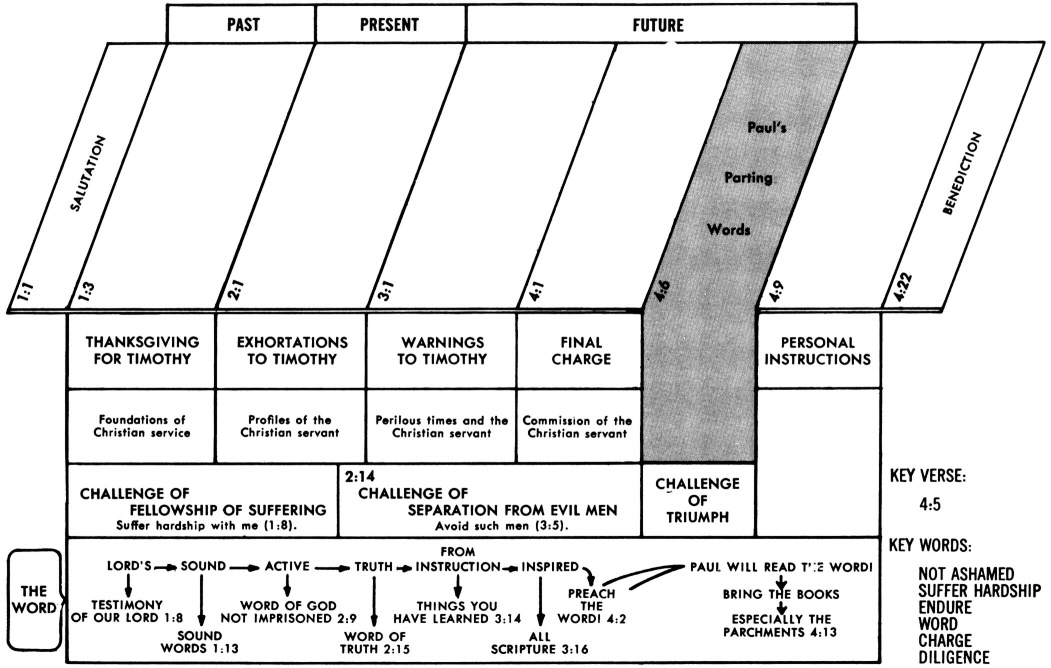
ENDURANCE AND SEPARATION IN THE MINISTRY
Click chart to enlarge
Charts from Jensen's Survey of the NT - used by permission
Second Timothy - Swindoll
| 2 TIMOTHY | |||
| 2 Timothy 1:1-18 | 2 Timothy 2:1-26 | 2 Timothy 3:1-17 | 2 Timothy 4:1-22 |
| Retain the Standard |
Rightly Divide the Word |
Difficult Times Will Come |
Preach the Word |
| PAST | PRESENT | FUTURE | |
| Foundation of Christian Service |
Pictures of Christian Servant |
Dangerous Times for Christian Servant |
Commission of Christian Servant |
| Unashamed as a Witness: Guard the Gospel |
Unashamed as a Workman: Suffer for the Gospel |
Adequate as a Workman: Continue in the Gospel |
Awarded as a Workman: Preach the Gospel |
| Power of the Gospel |
Perseverance of the Gospel Message | Protection of the Gospel |
Proclamation of the Gospel |
| Reminder | Requirements | Resistance | Requests |
| Encouragement in Ministry |
Examples in Ministry |
Exhortations in Ministry |
Exhortations to Fulfill Ministry |
| Commendation & Charge |
Commission to Fulfill |
Conflict to Face |
Course to Finish |
|
Compiled from Jensen's Survey of the NT and Wilkinson's Talk Thru the Bible |
|||
2 Timothy 4:3 For the time will come (3SFMI) when they will not endure (3PFMI) sound (PAPFSG) doctrine ; but wanting to have their ears tickled (PPPMPN), they will accumulate (3PFAI) for themselves teachers in accordance to their own desires, (NASB: Lockman)
Greek: estai (3SFMI) gar kairos hote tes hugiainouses (PAPFSG) didaskalias ouk anexontai (3PFMI), alla kata tas idias epithumias heautois episoreusousin (3PFAI) didaskalous knethomenoi (PPPMPN) ten akoen,
Amplified: For the time is coming when [people] will not tolerate (endure) sound and wholesome instruction, but, having ears itching [for something pleasing and gratifying], they will gather to themselves one teacher after another to a considerable number, chosen to satisfy their own liking and to foster the errors they hold, (Amplified Bible - Lockman)
BBE: For the time will come when they will not take the true teaching; but, moved by their desires, they will get for themselves a great number of teachers for the pleasure of hearing them; 4 And shutting their ears to what is true, will be turned away to belief in foolish stories
Barclay: For there will come a time when men will refuse to listen to sound teaching, but, because they have ears which have to be continually titillated with novelties, they will bury themselves under a mound of teachers, whose teaching suits their own lusts after forbidden things. (Westminster Press)
Berkley: For the time is coming when they will not tolerate wholesome instruction; instead they will, to satisfy their own desires, gather up teachers that will tickle their ears.
GWT: A time will come when people will not listen to accurate teachings. Instead, they will follow their own desires and surround themselves with teachers who tell them what they want to hear.
ICB: The time will come when people will not listen to the true teaching. They will find more and more teachers who are pleasing to them, teachers who say the things they want to hear. (ICB: Nelson)
KJV: For the time will come when they will not endure sound doctrine; but after their own lusts shall they heap to themselves teachers, having itching ears;
NIV: For the time will come when men will not put up with sound doctrine. Instead, to suit their own desires, they will gather around them a great number of teachers to say what their itching ears want to hear.
NLT: For a time is coming when people will no longer listen to right teaching. They will follow their own desires and will look for teachers who will tell them whatever they want to hear. (NLT - Tyndale House)
Phillips: For the time is coming when men will not tolerate wholesome teaching. They will want something to tickle their own fancies, and they will collect teachers who will pander to their own desires. (Phillips: Touchstone)
Wuest: for the time will come when they will not endure our wholesome doctrine in that they will hold themselves firmly against it, but, dominated by their own personal cravings, they, having ears that desire merely to be gratified, shall gather to themselves an accumulation of teachers.
Young's Literal: for there shall be a season when the sound teaching they will not suffer, but according to their own desires to themselves they shall heap up teachers -- itching in the hearing,
FOR THE TIME WILL COME WHEN : estai (3SFMI) gar kairos hote :
- 2Ti 3:1, 2, 3, 4, 5, 6; 1Ti 4:1, 4:2 4:3
- 2 Timothy 4 Resources - Multiple sermons and commentaries
A DREADFUL PROPHECY
CALLS FOR
A DIRECTED URGENCY
For (gar) - Whenever you encounter a term of explanation stop and ask what is being explained, a simple discipline that will (1) slow you down so you don't "speed read" the precious Word of God (2) assure that your mind is actively engaged with the Word (and the Author of the Word) and (3) facilitate meditation on the Word, the blessings of which are simply incalculable! (See some of the blessings - Ps 1:1-note, Ps 1:2-note, Ps 1:3-note, Joshua 1:8-note). In the present context, the term of explanation explains the reason for Paul's "super" solemn charge (2Ti 4:1-note) and his urgent almost "staccato" commands (2Ti 4:2-note) especially in light of Paul's imminent departure (2Ti 4:6-note).
The time will come - This verse is clearly a prophetic warning which amplifies Paul's previous prophecy in 2Timothy 3:1-note ("last days" = "difficult" days, cp 1Ti 4:1,2), calls for Timothy (and all preachers of the Word) to hear and immediately heed Paul's commands calculated to correct the course of the Church away from sound doctrine and into unsound "doctrine" which cannot produce spiritual birth or spiritual health for those who are born again.
Time (2540) (kairos [word study]) is not merely a succession of minutes as in the word chronos G5550 (chronological referring to clock or calendar time), but instead refers to a season, a decisive epoch, an era or a fixed, definitive period of time when events are brought to a crisis. Kairos refers to those strategic times in the calendar of God during which events come to a culmination and ripen to usher in a new age. Therefore kairos can refer to a period of opportunity and when the period of time passes so does the opportunity.
Kairos is the root word for "in season… out of season" (2Ti 4:2-note) and "(difficult) times" (2Ti 3:1-note).
Using Trench's definition of kairos Paul's prophecy is of a coming "critical, epoch-making period foreordained of God when all that has been slowly, and often without observation, ripening" the fruit being ears deafened and hearts insensitive to the proclamation of sound doctrine.
So there will come a "season" or specific period of time which is characterized by those inside (not outside) the professing "church" who will not tolerate wholesome, life giving teaching. Throughout church history there have been seasons when people did not want to hear God's Word. Just turn on your television and you'll see "the time" is being fulfilled before your very eyes but be ready to be appalled and saddened by the prosperity (false) preachers!
Jeremiah saw a similar season writing
An appalling and horrible thing Has happened in the land: The prophets prophesy falsely, and the priests rule on their own authority; and My people love it so! But what will you do at the end of it? (Jer 5:30; 31)
Since there is no good English equivalent to kairos, the essence of it's meaning can be somewhat difficult to grasp. Study the following verses and see if you can discern the "window of opportunity" aspect in each verse to help give you a "feel" for the meaning of kairos (Mt 13:30, 21:34, Mk11:13,13:33, Lk 4:13,19:44, Lk 21:24, Ac 1:7, 17:26, 2Co 6:2, Ga 6:9-note, Eph 2:12-note, 2Th 2:6, Rev 1:3-note). (Click for Vine's discussion of kairos)
These men and women are "professing" believers who are like "professing Israel" whom Isaiah described as
a rebellious people, false sons, sons who refuse to listen to the instruction of the LORD" and who say "Let us hear no more about the Holy One of Israel. (Isa 33:9; 11)
THEY WILL NOT ENDURE SOUND DOCTRINE: ouk anexontai: (3PFMI) tes hugiainouses (PAPFSG) didaskalias:
- 1Ki 22:8;18 2Chr 16:9;10 24:20;21 22 25:15;16 Isa 28:12; 33:9;10 11 Jer 6:16;17 18:18; Am 7:10-17; Lk 20:19; Jn 8:45; Gal 4:16 contrast Heb 13:22, cf God's warning to Isaiah Isa 6:8 6:9 6:10, Septuagint of Job 6:26
- 2 Timothy 4 Resources - Multiple sermons and commentaries
Other translations: will not put up with (NIV); will not listen to accurate teachings (GWT); they will not endure our wholesome doctrine in that they will hold themselves firmly against it (Wuest); will no longer listen to right teaching (NLT); will not tolerate wholesome instruction (Berkley), men will not tolerate wholesome teaching (Phillips)
They - In context who might they be referring to or describing (Always practice pausing to interrogate the text with the 5W/H questions)? While there is a chapter division (such divisions are arbitrary and not inspired and can sometimes cause us to segregate similar teaching even in adjacent chapters!) separating this description from the description in 2Ti 3:1, 2ff-note, the same or certainly a similar group in the church is encompassed by the pronoun "they" in this present passage. They would also include the false teachers Paul described in the previous section as those who are
holding to a form (morphosis) of godliness (eusebeia), although they have denied (arneomai in the perfect tense = their permanent state of denial = not believing, born again "spiritual" men!) its power (dunamis) (2Ti 3:5-note ; cp Titus 1:16-note).
In a similar prophecy Paul wrote that
the Spirit explicitly says that in later times some will fall away from the faith, paying attention to deceitful spirits and doctrines of demons" (1Ti 4:1)
Comment: Doctrines of demons clearly include the "unsound" doctrine and ear tickling myths that the people favor so that they may gratify the fallen flesh.
Van Oosterzee describes them as…
All who cannot endure this (ouk anexontai), manifest thereby an inward disinclination, which results from the secret collision of their own sentiment with the substance and claims of sound doctrine. The natural sequence of this antipathy is stated immediately after: But after … Shall they heap. (Lange, J. P., Schaff, P., van Oosterzee, J. J., Washburn, E. A., & Harwood, E.. A Commentary on the Holy Scriptures: 1 & 2 Timothy. Page 112.)
Stephen Olford notes that…
Christian history is replete with examples of “the deliberate refusal” of men and women “to hear” the Word of the Lord expounded. But this must not deter us. The imperative “Preach the word!” must be obeyed. (Recommended reading - Anointed Expository Preaching - Broadman & Holman Publishers [hardcover])
Endure (tolerate, bear) (430) (anechomai from aná = in, up + echomai, the middle voice of echo = to have, to hold) means literally to hold one’s self up, erect, upright and by extension firm against a person or thing. Thus anechomai means to put up with, to bear with (equanimity or evenness of mind especially under stress), to tolerate, to forbear, to be patient with.
The figurative idea is to endure discomfort or to hold out in spite of persecution, threats, injury, indifference, or complaints and not to retaliate (esp 1Cor 4:12). It conveys the sense of putting up with others, exercising self-restraint (for believers only possible empowered by the Spirit) and tolerance.
Endure (Webster) = to treat with indulgence, liberality, or forbearance. 2 to permit. 3 to be able to bear; put up with; to permit or tolerate; to regard with acceptance or tolerance; Endure means to exist over a period of time and adds an implication of resisting destructive forces or agencies 〈in spite of everything, her faith endured); to continue in the same state; to remain firm under suffering or misfortune without yielding. To bear; to brook; to suffer without resistance, or without yielding.
Tolerate (Webster) = To suffer to be or to be done without prohibition or hindrance; to allow or permit negatively, by not preventing; not to restrain; as, to tolerate opinions or practices.
Bear (Webster) = to put up with especially without giving way 〈couldn’t bear the pain); To suffer without resentment, or interference to prevent; to have patience; as, to bear neglect or indignities.
Eadie writes that anechomai indicates giving patience to someone till the provocation is past. To undergo something onerous or troublesome without giving in.
Anechomai was used of listening patiently while others are allowed to speak. That is exactly what these "last days" individuals will NOT (the Greek word ouk in this verse describes absolute negation) do to those who try to preach and teach the word of sound doctrine. The result is that because they sow abhorrence of healthy doctrine, they reap the unwelcome result - spiritually unhealthy lives (which will be manifest in their personal relationships such as between husband and wife, parent and child, etc).
Vine - (Strong's #430 — Verb — anechomai — an-ekh'-om-ahee ) signifies "to hold up against a thing and so to bear with" (ana, "up," and echomai, the Middle Voice of echo, "to have, to hold"), e.g., Matthew 17:7; 1 Corinthians 4:12; 2 Corinthians 11:1,4,19,20; Hebrews 13:22 , etc. anechomai is used in the Middle Voice in the NT, signifying "to bear with, endure;" it is rendered "forbearing (one another)" in Ephesians 4:2; Colossians 3:13
The writer of Hebrews uses anechomai to encourage listening ears and receptive hearts in spite of "hard" preaching…
Hebrews 13:22 (note) But I urge you, brethren, bear (listen patiently - present imperative = command to make this their habitual practice) with this word of exhortation, for I have written to you briefly.
Comment: The writer Hebrews knew he had written some difficult to accept sound doctrine (some of the most difficult warning passages in the NT) and so he closed his letter with this positive exhortation regarding exhortations. The KJV is interesting in translating it as "Suffer the word of exhortation"!
Anechomai refers to holding up under adversity, and can be translated tolerate. It means to hold up or back from falling. In secular Greek use, the related noun form (anoche) was used of a holding back or stopping of hostilities (truce).
Anechomai is the equivalent of our modern phrase "putting up with" so the NIV nicely paraphrases it that "they will not put up with". It is not the herald (of the gospel) that is at fault, but the hearing of the fickle men who make up the audience!
Anechomai -15x in the NT - NAS translates: bear, 3; bearing, 2; endure, 3; put, 4; showing tolerance, 1; tolerate, 2.
Matthew 17:17 And Jesus answered and said, "O unbelieving and perverted generation, how long shall I be with you? How long shall I put up with (anechomai) you? Bring him here to Me."
Comment: Here we see Jesus use anechomai rebuke His disciples and their weak faith.
Mark 9:19 And He answered them and said, "O unbelieving generation, how long shall I be with you? How long shall I put up with you? Bring him to Me!"
Luke 9:41+ And Jesus answered and said, "O unbelieving and perverted generation, how long shall I be with you, and put up with you? Bring your son here."
Acts 18:14+ But when Paul was about to open his mouth, Gallio said to the Jews, "If it were a matter of wrong or of vicious crime, O Jews, it would be reasonable for me to put up with you;
1 Corinthians 4:12 and we toil, working with our own hands; when we are reviled, we bless; when we are persecuted, we endure;
2 Corinthians 11:1 I wish that you would bear with me in a little foolishness; but indeed you are bearing with me. 11:4 For if one comes and preaches another Jesus whom we have not preached, or you receive a different spirit which you have not received, or a different gospel which you have not accepted, you bear this beautifully.
Comment: Here Paul uses anechomai ironically. In other words Paul is saying that "you gladly endure these false teachers, why do you not endure me?" Paul is not endorsing their acceptance of heresy, but chiding them for their gullibility and lack of discernment.
2 Corinthians 11:19 For you, being so wise, bear with the foolish gladly. 20 For you bear with anyone if he enslaves you, if he devours you, if he takes advantage of you, if he exalts himself, if he hits you in the face.
Ephesians 4:2 (note) (context = Eph 4:1-note) with all humility and gentleness, with patience, showing forbearance to one another in love (Amplified has "making allowances because you love one another"),
Comment: Paul exhorts the saints at Ephesus to make allowance (tolerate, bear, endure) for the faults and failures of others, or differing personalities, abilities, and temperaments. Forbearance is not a question of maintaining a façade of courtesy while inwardly seething with resentment but is a Spirit empowered positive love to those who irritate, disturb, or embarrass. How are you bearing up with the idiosyncrasies of your brethren at church, your spouse, your children, your co-workers, your fellow students, etc? You can't, beloved but He can and He lives in you to transform your temperament and attitude toward those who irritate you. Did what I just wrote irritate you?
Colossians 3:13 (note) bearing with (present tense = this is to be our continual practice [only possible enabled by God's Spirit!]) one another, and forgiving each other, whoever has a complaint against anyone; just as the Lord forgave you, so also should you.
Comment: Bearing with one another is a behavior that is to characterize those who "have been chosen of God, holy and beloved". This begs the applicational question -- Who is there in the body of Christ you are not "putting up" with?
MacDonald adds that in Col 3:13 anechomai describes: the patience we should have with the failings and odd ways of our brethren. In living with others, it is inevitable that we will find out their failures. It often takes the grace of God for us to put up with the idiosyncrasies of others, as it must for them to put up with ours. But we must bear with one another. (MacDonald, W & Farstad, A. Believer's Bible Commentary: Thomas Nelson or Logos)
2 Thessalonians 1:4 therefore, we ourselves speak proudly of you among the churches of God for your perseverance and faith in the midst of all your persecutions and afflictions which you endure.
2 Timothy 4:3 (note) For the time will come when they will not endure sound doctrine; but wanting to have their ears tickled, they will accumulate for themselves teachers in accordance to their own desires;
Anechomai - 11x in the non-apocryphal Septuagint (LXX) -
Ge 45:1; 1Ki. 12:24; Job 6:11, 26; Isa. 1:13 ( I cannot endure iniquity and the solemn assembly); Isa 42:14; 46:4; 63:15; 64:12; Amos 4:7; Hag. 1:10.
God says to faithless Israel "Bring your worthless offerings no longer. Incense is an abomination to Me. New moon and Sabbath, the calling of assemblies— I cannot endure (Lxx = anechomai) iniquity and the solemn assembly. (Isa 1:13-note)
Comment: How we all need to hear and heed God's warning regarding external (fleshly) religion which too often serves as a cloak to cover our sin and is a trap even into which even true believers can fall! And as Paul wrote in first Timothy the conscience may become so seared (kauteriazo from kauterion = red-hot iron = "cauterized") that a person can practice "religion" while still living in sin (1Ti 4:2).
MacArthur notes that "Professing Christians, nominal believers in the church follow their own desires and flock to preachers who offer them God’s blessings apart from His forgiveness, and His salvation apart from their repentance. They have an itch to be entertained by teachings that will produce pleasant sensations and leave them with good feelings about themselves. Their goal is that men preach “according to their own desires.” Under those conditions, people will dictate what men preach, rather than God dictating it by His Word." He goes on to add (ref) that "Within the large framework of professing Christendom a small remnant of true believers eagerly hear sound teaching. But some of the lost in the professing church support such things as homosexual and feminist causes. There is even a so-called Bible that has removed masculine references to God to avoid offending feminist beliefs. The lost, whether outside or inside the professing church, refuse to hear God's teaching about controversial issues such as the woman's role, homosexuality, or abortion. They won't tolerate strong biblical teaching because it confronts and refutes their errors and calls for their obedience. By adopting the ways of the world, much of the professing church has become corrupt and perverse. Apart from a dramatic change, the pressure will continue to intensify against those who speak the truth. (MacArthur, J. 2 Timothy. Chicago: Moody Press) (Bolding added)
This problem is not new as we see in Proverbs "They would not accept My counsel. They spurned all My reproof." (Pr 1:30+ - The context Pr 1:29 states the root problem is failure to choose the fear of Jehovah, a failure which would bring forth rotten fruit in keeping with unrighteousness - Pr 1:31, 32! cp Gal 6:7-note, Gal 6:8-note) (See William Arnot's related discussion - Proverbs 1:24-28 Sowing Disobedience, Reaping Judgment)
The weeping prophet Jeremiah knew the painful reality of those claimed to be God's people and yet who would not tolerate God's sound doctrine (~ "the ancient paths") "Thus says the LORD, "Stand (red = command) by the ways and see and ask for the ancient (Hebrew = everlasting!) paths, Where the good way is, and walk in it; and you shall find rest for your souls. (Note the process and the promise. Process = stand, see, ask, walk or obey. Promise = find rest. Are you restless beloved? If so, one area of your life you might want to examine is whether you are refusing to put up with sound doctrine found in the ancient paths! Cp Mt 11:28, 11:29, 11:30) But they said, 'We will not walk in it.' And I set watchmen over you, saying, 'Listen to the sound of the trumpet!' But they said, 'We will not listen." (Jer 6:16, 6:17 - See sermon by Alan Carr = Jeremiah 6:16 Ask For the Old Paths)
THE DOCTRINE WHICH ALONE
PROMOTES SPIRITUAL HEALTH
Sound doctrine - This description is concentrated in the Pastoral Epistles and is God's prescription for spiritually healthy saints. What is the clear message for anyone who is a pastor or a teacher of the Word of Truth (even if we are opposed, which will likely occur)?
1 Timothy 1:10 (Law is made for the following groups) and immoral men and homosexuals and kidnappers and liars and perjurers, and whatever else is contrary to sound teaching (didaskalia),
1 Timothy 6:3 If anyone advocates a different doctrine and does not agree with sound words (logos), those of our Lord Jesus Christ, and with the doctrine conforming to godliness,
2 Timothy 1:13-note Retain (present imperative = continually) the standard of sound words (logos) which you have heard from me, in the faith and love which are in Christ Jesus.
Titus 1:9-note (Elders are to be continually = present tense) holding fast the faithful word which is in accordance with the teaching, so that he will be able both to exhort in sound doctrine (didaskalia) and to refute those who contradict.
Titus 2:1-note But as for you, speak the things which are fitting for sound doctrine (didaskalia).
Sound doctrine is teaching which continually (because the verb hugiano is present tense indicating continuous action) protects and preserves the spiritual life of the one who partakes thereof and which alone is the sustenance which makes the whole man healthy, and equipped for every good work (2Ti 3:16, 3:17-note). The definite article, "the", in Greek modifies sound doctrine which identifies this doctrine as not just any teaching but as the specific body of teaching, in context the Holy Scriptures and the Gospel.
You will experience real "holistic health" if you eat the right ''soul food"! Why would these individuals not desire a healthy word ("seed") which yields such a desirable fruit. It is because they do not want their sin to be exposed. Sound doctrine is a stinging rebuke (censure) to ungodly living and thus is unacceptable and intolerable to those who desire to persist in their sin rather than please the Savior. In short, those who live contrary to sound doctrine resent and resist such doctrine. Compare Paul's description in this verse with the reaction of unbelievers to "the light" in Jn 3:18, 19, 20, 21. (See related descriptions in Lam 2:14, Is 58:1, Ezek 22:26, 44:23)
Sound (5198) (hugiaino [word study] from hugies = healthy) is used literally of physical and mental health (both being sound) and then figuratively as used by Paul to refer to doctrinal teaching which is "healthy" and good "soul food" because it is free from error and adulterants. There is a modern movement toward "organic foods" as they are surmised to be healthier than non-organic. How we pray that the Spirit would spur the modern church to exhibit a similar movement back toward sound, healthy, "organic" doctrine of the "pure milk of His Word" knowing that it is only by this diet that the body of Christ will grow in maturity in respect to salvation (cp 1Pe 2:2-note)
Our derivative words in English include hygiene or hygienic which define the conditions or practices conducive to good health… ponder that fact in the context of Paul's use in this verse.
Doctrine (1319) (didaskalia [word study]) is the content of that which is taught not so much the method of teaching. Inherent in the definition of didaskalia is the effect in shaping the will of the one who receives the instruction.
Hiebert adds that they will not put up with doctrine that is
healthful, useful, practical teaching" which gives "health and soundness to the spiritual man. They will find the truth so intolerable because its demands are contrary to their own desires. The Word is the touchstone that reveals the their true character. (Hiebert)
Is this principle not true in your life? When we are making provision for sin (Ro13:14-note) or willfully sinning the last thing we want is for our unholy thinking and behavior to be exposed by the light of God's Holy Word.
So why don't they endure sound doctrine? They do not want to hear the truth that (if we are honest) none of us really "enjoys" hearing. We do not enjoy hearing that we are sinful, depraved, dirty, unclean, selfish, immoral, unjust, unworthy, ever failing and always coming up short (cp Paul's description of our moral condition before Christ came into our life - Titus 3:3-note). How do you feel right now having just read that sentence?! No one enjoys hearing that we can do nothing whatsoever to become acceptable to God. And as anyone who has ever shared the gospel knows all too well, most people do not like hearing that Jesus Christ is the only Savior (Acts 4:12), the only Mediator (1Ti 2:5, He 8:6-note, He 9:15-note, He 12:24-note), the only way a person can be saved (see Jn 14:6 where "no one" meaning absolutely no one! which equates with "one way", a truth that the lost world literally despises) and made acceptable to God (cp 1Pe 2:5-note) These things are painful to unregenerate ears and hearts and so naturally professing unbelievers (cp Titus 1:16) refuse to tolerate the sin exposing, liberating good news of the Gospel (Ro 1:16-note. See the "Romans Road" which is a bit "rough" on the ears and ego at the outset! = Ro 3:9-note, Ro 3:10-note, Ro 3:18-note, Ro 3:23-note, Ro 5:8-note, Ro 6:23-note, Ro 10:9,10-note, Ro 12:1-note, Ro 12:2-note). And it is so ironic that these helpless (Ro 5:6-note) God haters (Ro 1:30-note, cp Ro 5:10-note, Col 1:21-note) cry "foul", claiming that the message of the Gospel of the grace of God (Acts 20:24) is narrow minded and they persist in their intolerance of the beliefs of others!
BUT WANTING TO HAVE THEIR EARS TICKLED: alla kata tas idias epithumias heautois knethomenoi (PPPMPN) ten akoen:
- Acts 17:19, 17:20, 17:21, 17:22, 23, 1Cor 2:1, 2:4 Gal 4:16 Ezek 33:31, 32, 33
- 2 Timothy 4 Resources - Multiple sermons and commentaries
Other translations - itching in the hearing (YLT); to say what their itching ears want to hear (NIV); who will tell them whatever they want to hear (NLT); teachers who say the things they want to hear. (ICB); they have ears which have to be continually titillated with novelties (Barclay) They will want something to tickle their own fancies (Phillips)
For there will come a time when men will refuse to listen to sound teaching, but, because they have ears which have to be continually titillated with novelties, they will bury themselves under a mound of teachers, whose teaching suits their own lusts after forbidden things. They will avert their ears from the truth, and they will turn to extravagant tales. As for you, be steady in all things; accept the suffering which will come upon you; do the work of an evangelist; leave no act of your service unfulfilled.
Tickled (2833) (knetho from knao = to scrape) in the active voice means to tickle but in the passive voice (as in this verse) means to be tickled which describes an itching as if someone where tickling you. In 2Ti 4:3 knetho is an idiom that means "to itch with respect to hearing" (English expression "itching ears") Lucian has a secular use writing "he does not even have enough time to scratch his ear".
Knetho is in the present tense which indicates that was happening continually. They continually sought to be "titillated" (to be excited pleasurably or aroused by stimulation). The were continually looking for new information an itch that the false teachers were only to glad to scratch with their empty, deceptive, unsound words!
Vine - (Strong's #2833 — Verb — knetho — knay'-tho ) "to scratch, tickle," is used in the Passive Voice, metaphorically, of an eagerness to hear, in 2 Timothy 4:3 , lit., "itched (as to the hearing)," of those who, not enduring sound doctrine, heap to themselves teachers.
And so we see they have a desire to hear not what they need to hear but what they want to hear. They are more interested in something different, something sensational, rather than something sobering (truth)! Does this ring any "modern bells"?
These false "believers" are looking for curiosities and interesting and juicy bits of information which temporarily relieves their itching ears. They hear for mere gratification and because the flesh is never satisfied they run from one teacher to another, unsettled and restless, like the "weak women weighed down with sins, led on by various impulses (epithumia - lusts, sinful cravings & desires), always learning and never able to come to the knowledge of the truth. (2Ti 3:6, 7-note)
Wuest explains that knetho "describes that person who desires to hear for mere gratification, like the Greeks at Athens who spent their time in nothing else but either to tell or to hear, not some new thing, but some newer thing (Acts 17:21+). The comparative form of the adjective is used here, not the positive. Ernest Gordon, commenting on this verse says: “Hardly has the latest novelty been toyed with, than it is cast aside as stale and frayed, and a newer is sought. One has here the volatile spirit of the Greek city, so in contrast with the gravity and poise of the Christian spirit, engaged with eternal things.” Such is the spirit of Modernism with its teachings of the divinity of mankind, and the relativity of truth, its rejection of the doctrine of total depravity, the sacrificial atonement, the resurrection, and the need of the new birth, catering to the desires of a fallen race. It gratifies man’s pride. It soothes his troubled conscience. The desire for the gratification of one’s cravings is insatiable, and is increased or aggravated by having that desire satisfied. Hence the heaping ("accumulate for") to themselves of teachers. (Wuest's Word Studies from the Greek New Testament: Eerdmans)
Clement of Alexandria describes certain teachers as "scratching and tickling, in no human way, the ears of those who eagerly desire to be scratched."
As the pagan Roman Stoic philosopher and tutor to Nero Seneca (3BC-65AD) wrote: "Some come to hear, not to learn, just as we go to the theatre, for pleasure, to delight our ears with the speaking or the voice or the plays."
Variety delights itching ears.
Bengel was correct when he said "He who despises sound teaching leaves sound teachers; they seek instructors like themselves."
Someone has said the modern pulpit is a sounding board that is merely saying back to the people what they want to hear. They prefer religious entertainment and sermons that will tickle their ears instead of truths from Scripture that will pierce their hearts like Peter's sermon did at Pentecost! (Acts 2:37+)
Itching Ears - The apostle Paul warned Timothy that he would encounter people with an ailment he called "itching ears" (2Ti 4:3). Those who have this condition reject "sound doctrine" and look for teaching that suits "their own desires."
For example, if they're offended by Christ's declaration, "No one comes to the Father except through Me" (Jn. 14:6), they flock to a pastor who says there are many ways to God.
Or some people reject the biblical teaching that those who engage in sexual relationships outside of marriage are "fornicators and adulterers" whom "God will judge" (He 13:4-note). So they look for a teacher who says that the sexual standards in the Bible are not binding in today's world.
I deplore what these people do, but I'm afraid that I too have "itching ears." I love to hear strong affirmations of biblical standards and sound doctrine. But I don't like to be confronted with Scripture about prideful, self-righteous attitudes or lack of love for others.
Undoubtedly, all of us have this malady. We need to ask the Lord to search our hearts and forgive us. He can change us so that we will listen to what His Word says and obey it. That's the only antidote for "itching ears." — Herbert Vander Lugt (Our Daily Bread, Copyright RBC Ministries, Grand Rapids, MI. Reprinted by permission. All rights reserved)
Master, speak, and make me ready,
When Thy voice is truly heard,
With obedience glad and steady,
Still to follow every word. --Havergal
Obeying the truth is the remedy for itching ears.
Yeah, But . . . - Grading university papers is full of surprises. Sometimes, one of my students will successfully handle a subject and display good writing style, and I feel as if my instruction was worthwhile.
Other surprises aren’t so pleasant. Like the paper in which a student wrote, “The Bible says, ‘Thou shalt not ____.’?” He filled in the blank with the activity he was writing about—even though Scripture does not contain such a verse. I thought his biggest problem was not knowing Scripture, until he concluded, “Although the Bible says this is wrong, I don’t see why, so I think it’s okay.”
It’s dangerous and the worst kind of arrogance to think we know more about an issue than God does. Scripture predicted this kind of thinking. Paul said in 2 Timothy 4: “They will not endure sound doctrine, but according to their own desires … they will heap up for themselves teachers; and they will turn their ears away from the truth” (vv.3-4). This points to people who set aside the inspired Word of God (3:16) in order to accept teaching they think is “okay.”
When the Bible clearly spells out a principle, we honor
God by obeying Him. For believers, there’s no room for “Yeah, but … ” responses to Scripture. --Dave Branon (Our Daily Bread, Copyright RBC Ministries, Grand Rapids, MI. Reprinted by permission. All rights reserved)
God who formed worlds by the power of His Word
Speaks through the Scriptures His truth to be heard;
And if we read with the will to obey,
He by His Spirit will show us His way. —D. De Haan
The Bible: Read it, believe it, obey it!
THEY WILL ACCUMULATE FOR THEMSELVES TEACHERS: episoreusousin (3PFAI) didaskalous:
- 2Ti 3:6 1Ki 18:22; 2Chr 18:4;18:5 Jer 5:31; 23:16;17, 27:9; 29:8; Mic 2:11; Lk 6:26; Jn 3:19, 3:20, 3:21; 2Pet 2:1,2:2 2:3
- 2 Timothy 4 Resources - Multiple sermons and commentaries
Other translations - they shall heap up teachers (YLT); they will bury themselves under a mound of teachers (Barclay); gather around them a great number of teachers (NIV); they will collect teachers who will pander to their own desires (Phillips); they will gather to themselves one teacher after another to a considerable number (Amp), “To load themselves with” (Luther)
The will accumulate - A prophecy which has become all too true in 21st century American churches. They pile up preachers of (false) sermonettes for (professing) "Christianettes"! These false teachers like to tell jokes, talk about self using "religious" terms (2Ti 3:2-note), and emphasize the emotional and sensationalistic, etc. (cf 2Ti 3:5-note, 2Ti 3:13-note)
As Hosea wrote "like people, like priest" or as the International Children's Bible accurately paraphrases it
The priests are as wrong as the people. (Hos 4:9)
Accumulate (2002) (episoreuo from epi = upon + soreuo = heap, pile = heap one thing on another like coals on one's head - Ro 12:20-note) means to accumulate in piles and figuratively means to increase greatly or significantly increase the number of something.
Episoreuo pictures the apostates (this English word is derived from the Greek verb used in the next verse for "turn away") as piling up teachers one upon another as if the sheer number of false teachers will make them right. These teachers give the people what they want, but tragically not what they desperately need for life and godliness (found only through a true knowledge of Him who called us by His own glory and excellence. - 2Pe 1:3-note).
Vine - "to heap upon" or "together" (epi, "upon," and No. 1), is used metaphorically in 2 Timothy 4:3 of appropriating a number of teachers to suit the liking of those who do so. The reference may be to those who, like the Athenians, run about to hear and follow those who proclaim new ideas of their own invention. (Vine's Expository Dictionary of NT Words)
Marvin Vincent remarks that episoreuo is a "vigorous and graphic statement. Episoreuo = to heap up… The word is ironical; shall invite teachers en masse In periods of unsettled faith, skepticism, and mere curious speculation in matters of religion, teachers of all kinds swarm like the flies in Egypt. The demand creates the supply. The hearers invite and shape their own preachers. If the people desire a calf to worship, a ministerial calf-maker is readily found. (cf Ex 32:4) “The master of superstition is the people, and in all superstition wise men follow fools” (Bacon, Ess. xvii)." (Bolding Added) (Vincent, M. R. Word Studies in the New Testament Vol. 4, Page 320-321)
Van Oosterzee writes that "Although the idea of a load, which they thus burden themselves with, is not expressed precisely, yet the contemptible and objectionable trait of their whole striving and working is here plainly enough signified. (Lange, J. P., Schaff, P., van Oosterzee, J. J., Washburn, E. A., & Harwood, E.. A Commentary on the Holy Scriptures: 1 & 2 Timothy. Page 112.)
Accumulate or episoreuo gives us a picture of multiplication so that there is a plethora of these people pleasing preachers! The professing believers will go through one teacher after another in their search to satisfy their lusts and curiosity with only one primary goal, to gratify and pander to "self". Beloved, do not be deceived… the fact that a preacher has a large congregation is not always a sign that he is preaching the Word of truth. And as Guzik astutely quips "When you have hearers with itching ears, you will have preachers with itching palms - wanting to be scratched by money, and satisfy the “market” of itching ears."
Vine observes that "It is a sad feature of the trend of things in the past centuries of the history of Christendom, that certain congregations have adopted the plan of choosing their own ministers. How paradoxical, that sheep should choose their own shepherds!"
Teachers (1320) (didaskalos from didasko = teach to shape will of one being taught by content of what is taught <> cp didaskalía) is one who provides instruction or systematically imparts truth.
The teacher teaches in such a way as to shape will of one being taught by content of what is taught.
Someone has said that "The great teacher is the one who turns our ears into eyes so that we can see the truth." Henry Brooks added that "A (Bible) teacher affects eternity; he can never tell where his influence stops."
Didaskalos refers to Jesus (the Master Teacher) in 41 of 58 NT uses. Twice Jesus calls Himself Teacher (Mt 26:18, Jn 13:13-14+). He is referred to as Teacher by His disciples (Mk 4:38+; Mk 9:38+; Mk 13:1+; Lk 7:40+; Lk 21:7+), by the Pharisees (Mt 8:19, 12:38), by Pharisees and Herodians (Mt 22:16); Sadducees (Mk 12:19+), a teacher of the law (Mk 12:32+), Jewish deceivers (Lk 20:21+); the rich young ruler (Lk 18:18+), tax collectors (Lk 3:12+) and His friend Martha (Jn 11:28+). As an aside someone has said our great Teacher writes many of His best lessons on the blackboard of affliction
Richards writes that "Jesus’ teaching focused on shaping the hearers’ perception of God and God’s kingdom, and thus it dealt with the implications of a personal relationship with God. In John’s Gospel, much of Jesus’ public instruction focused on himself and his own place as Son of God."
Mounce makes the point that when the Jewish leaders called Jesus "Teacher", they may not have been sincere "For instance, in Lk 10:25+ an expert in the law comes to test Jesus and calls him didaskalos. However, attempts to expose him as a pretender to the title of teacher are unsuccessful and therefore serve to endorse his status as rabbi (Mt 22:46; Mk 12:34+; Lk 20:39+). (Mounce's Complete Expository Dictionary of Old & New Testament Words)
And although Jesus was frequently called Teacher, C S Lewis makes the point that He was far more that just a Teacher ""I'm ready to accept Jesus as a great moral teacher, but I don't accept his claim to be God." That is the one thing we must not say. A man who was merely a man and said the sort of things Jesus said would not be a great moral teacher. He would either be a lunatic—on a level with the man who says he is a poached egg—or else he would be the Devil of Hell. You must make your choice. Either this man was, and is, the Son of God (Mk 1:1+); or else a madman or something worse. You can shut him up for a fool, you can spit at him and kill him as a demon, or you can fall at his feet and call him Lord and God. But let us not come with any patronizing nonsense about his being a great human teacher. He has not left that open to us. He did not intend to. (C. S. LEWIS, Mere Christianity - online without restrictions or here
Didaskalos is the usual translation of the Hebrew word Rabbi (see Jn 1:38, cp the Aramaic word for teacher = Rabboni in Jn 20:16), a term which in Jesus' day described those who were acknowledged as authorities on the Old Testament and were teachers of divine truth.
Didaskalos also was used in Acts and the Pauline epistles as a reference to teachers in the church. John MacArthur commenting on 1Cor 12:28 writes…
The third office is that of teacher, which may be the same as that of pastor–teacher (see Eph. 4:11; Acts 13:1). I am inclined, however, to consider them as being separate. The teacher not only has the gift of teaching but God’s calling to teach. He is called and gifted for the ministry of studying and interpreting the Word of God to the church. All who have the office of teaching also have the gift of teaching, but not everyone with the gift has the office.
False teachers (pseudodidaskalos from pseudes = false, lying, untrue, erroneous, deceitful + didaskalos) (2Peter 2:1 , cp 1Ti 1:3, 6:3) are the antithesis of true teachers. Chapter 2 of Second Peter provides one of the best "descriptive definitions" of false teachers in all Scripture and should be carefully studied by all Christ followers as we see these charlatans proliferating in our age.
Word Study NT writes that "Acts 13:1 refers to didáskaloi, teachers, with prophetai (4396), prophets. From this it is concluded that in the Christian church the didáskaloi, teachers, appear as having a special function (Acts 13:1; 1Cor. 12:28, 29; Eph. 4:11; James 3:1). These didáskaloi answer to the Jewish grammateís (pl.) (1122), scribes, and are to be viewed as in a special sense acquainted with and interpreters of God’s salvation (Matt. 13:52; Luke 2:46). To them fell the duty of giving progressive instruction of God’s redeeming purpose, a function which, according to Eph. 4:11, (Zodhiates)
TDNT discusses didaskalos noting that "The word calls attention to two aspects, being applied on the one side to the insight of the one who is to be instructed and on the other to the knowledge presupposed in the teacher. In relation to the second aspect, especially when it is a question of practical arts and crafts, the example of the teacher forms a bridge to the knowledge and ability of the pupil.
Roy Zuck summarizes didaskalos "A didaskalos was one who publicly instructed others concerning the things of God. This word is used of Jesus (it corresponds to the Hebrew rabbi), of John the Baptist (Luke 3:12), of Jewish learned men (didaskaloi is rendered “doctors” in Luke 2:46), of Paul (1 Tim 2:7; 2 Tim 1:11) of leaders in the church, including Barnabas, Lucius, and Manaen (Acts 13:1), and of other gifted men in the body of Christ (1Cor 12:28; Eph 4:11). (Greek Words for Teach - article by Roy Zuck in Bibliotheca Sacra Volume 122)
Teacher (Webster) - An instructor; a preceptor; a tutor; one whose business or occupation is to instruct others. A person who imparts knowledge in how to do something (E.g., how to live the Christian life!), especially in a school or as part of a recognized program (E.g., The "School of Christ").
George MacDonald wrote that "No teacher should strive to make men think as he thinks, but to lead them to the living Truth, to the Master himself, of whom alone they can learn anything."
William Barclay - There are two kinds of education—one teaches us how to make a living and the other teaches us how to live.
In the OT we see that God is the Teacher - "I am the Lord your God who teaches you to profit (Isa. 48:17); Who is a teacher like God? (Job 36:22); Your Teacher will no longer hide himself (Isa. 30:20).
David Turner adds that "The variety and extent of this biblical vocabulary make it clear that teaching is at the heart of God's plan for redemptive history. God as the ultimate Teacher has mandated in Scripture that teaching occur in two primary contexts, both of which arise from His creative and redemptive acts. God delegates teaching to the family and the redeemed community. Both institutions explain his gracious initiative in redemption and urge a loving, obedient response. God's gracious initiative places his people in covenant relationship with him in which parents teach their children and spiritually gifted leaders of the people of God teach its members. Thus, the following discussion will focus on teaching in the nuclear family and in the extended family, the people of God. (Baker's Evangelical Dictionary of Biblical Theology)
Who do teachers teach? (How are they described in the NT?) "Learners" which is the meaning of the Greek word for disciples (mathetes). Beloved, learners are not some class of "super" believers, but are descriptive of all believers contrary to some modern evangelical teaching. The first evangelical church of Jerusalem set the pattern by referring to believers as "disciples" more than by any other name (Acts 6:1, 2, 7; 9:1, 10, 19, 25, 26 38; 11:26, 29; 13:52; 14:20, 22, 28; 15:10; 16:1; 18:23, 27; 19:1, 9, 30; 20:1, 30; 21:4, 16 - note especially Acts 11:26). It costs to follow Jesus Christ, but it costs more not to, and so we do well to not deviate from the pattern of the early church which was a disciple making church (cp Mt 28:19, 20).
And as Juan Ortiz reminds us "Discipleship is more than getting to know what the teacher knows. It is getting to be what he is."
What do teachers teach? The Word of Truth. As Chrysostom said "Only one means and one way of cure has been given us and that is the teaching of the Word. Without it nothing else will avail."
As Richard Glover put it "As seed is made for soil and soil for seed, so the heart is made for God's truth and God's truth for the heart."
Spurgeon adds that "If you wish to know God you must know his Word."
The great Puritan writer Thomas Watson said that "The Scripture is both the breeder and feeder of grace."
And so it follows that the Biblical didaskalos is to teach the Word and nothing but the Word, so help him God. And indeed God does provide His help to the teacher as well as to the learner. Jesus made it clear to His disciples that their (and our) Teacher is ultimately the Holy Spirit (Jn 14:26, 16:13, 14,15, 1Jn 2:20, 27).
Here are some well known saints statements regarding your best Teacher, the Holy Spirit (From John Blanchard's Complete Gathered Gold: A Treasury of Quotations for Christians - Highly recommended - by far the best quotation collection!)
God does not bestow the Spirit on his people in order to set aside the use of his Word, but rather to render it fruitful. - John Calvin
The Word is the chariot of the Spirit, the Spirit the guider of the Word. - Stephen Charnock
Unless God imparts the spiritual ability to hear his voice, one hears nothing but meaningless words. -Ronald Dunn
Revelation is the act of communicating divine knowledge by the Spirit to the mind. Inspiration is the act of the same Spirit, controlling those who make the truth known. - Charles Hodge
If God does not open and explain Holy Writ, no one can understand it; it will remain a closed book, enveloped in darkness.- Martin Luther
Proper understanding of the Scriptures comes only through the Holy Spirit. - Martin Luther
The Holy Ghost must be the only master to teach us, and let youth and scholar not be ashamed to learn of this tutor. - Martin Luther
He who has the Holy Spirit in his heart and the Scriptures in his hands has all he needs. - Alexander Maclaren
God's mind is revealed in Scripture, but we can see nothing without the spectacles of the Holy Ghost. - Thomas Mantona
If the Holy Spirit guides us at all, he will do it according to the Scriptures, and never contrary to them. - George Muller
(The Holy Spirit) has not promised to reveal new truths, but to enable us to understand what we read in the Bible; and if we venture beyond the pale of Scripture we are upon enchanted ground and exposed all the illusions of imagination and enthusiasm. - John Newton
If you want to understand the Bible, get on your knees… You will learn more in one hour of prayerful communion with the Spirit than in a thousand years in all the schools of human culture. - A. T. Pierson
The Bible is a supernatural book and can be understood only by supernatural aid. - A. W. Tozer
The Holy Spirit who inspired the Scriptures will expect obedience to the Scriptures, and if we do not give that obedience we will quench him. - A. W. Tozer
Oswald Chambers has some words for all teachers " If a teacher fascinates with his doctrine, his teaching never came from God. The teacher sent from God is the one who clears the way to Jesus and keeps it clear; souls forget altogether about him because the vision of Jesus is the only abiding result. When people are attracted to Jesus Christ through you, see always that you stay on God all the time, and their hearts and affections will never stop at you."
Didaskalos - 59x in 58v in the NAS - Translated as - eacher(41), teacher(10), teachers(8). In Septuagint it is found only in Esther 6:1 (in apocrypha - 2Macc 1:10)
Matthew 8:19 Then a scribe came and said to Him, "Teacher, I will follow You wherever You go."
Matthew 9:11 When the Pharisees saw this, they said to His disciples, "Why is your Teacher eating with the tax collectors and sinners?"
Matthew 10:24 "A disciple is not above his teacher, nor a slave above his master.25 "It is enough for the disciple that he become like his teacher, and the slave like his master. If they have called the head of the house Beelzebul, how much more will they malign the members of his household!
Henry Morris: Christ is our "master" (or "teacher"); we are His disciples (or students). Also, He is our "lord" ("ruler"); we are His servants (actually slaves). The disciple must believe what his master teaches, and the servant must do what his Lord commands. It is interesting to note that Christians are called disciples only in the four gospels and the book of Acts, never in the epistles. They are called His servants, however, throughout eternity (Revelation 22:3).
Matthew 12:38 Then some of the scribes and Pharisees said to Him, "Teacher, we want to see a sign from You."
Matthew 17:24 When they came to Capernaum, those who collected the two-drachma tax came to Peter and said, "Does your teacher not pay the two-drachma tax?"
Matthew 19:16 And someone came to Him and said, "Teacher, what good thing shall I do that I may obtain eternal life?"
Matthew 22:16 And they sent their disciples to Him, along with the Herodians, saying, "Teacher, we know that You are truthful and teach the way of God in truth, and defer to no one; for You are not partial to any.
Matthew 22:24 asking, "Teacher, Moses said, 'IF A MAN DIES HAVING NO CHILDREN, HIS BROTHER AS NEXT OF KIN SHALL MARRY HIS WIFE, AND RAISE UP CHILDREN FOR HIS BROTHER.'
Matthew 22:36 "Teacher, which is the great commandment in the Law?"
Matthew 23:8 "But do not be called Rabbi; for One is your Teacher, and you are all brothers.
Comment: In Jesus’ day the term Rabbi was not a formal title (as in our time in which it identifies an ordained spiritual leader of the synagogue). Instead, it was a term of dignity given by the Jews to their distinguished teachers. The Pharisees loved to be called “Rabbi,” but in this passage Jesus countered that teaching explaining that One was their Teacher, the Christ Himself.
Matthew 26:18 And He said, "Go into the city to a certain man, and say to him, 'The Teacher says, "My time is near; I am to keep the Passover at your house with My disciples."'"
Mark 4:38 Jesus Himself was in the stern, asleep on the cushion; and they woke Him and said to Him, "Teacher, do You not care that we are perishing?"
Mark 5:35 While He was still speaking, they came from the house of the synagogue official, saying, "Your daughter has died; why trouble the Teacher anymore?"
Mark 9:17 And one of the crowd answered Him, "Teacher, I brought You my son, possessed with a spirit which makes him mute;
Mark 9:38 John said to Him, "Teacher, we saw someone casting out demons in Your name, and we tried to prevent him because he was not following us."
Mark 10:17 As He was setting out on a journey, a man ran up to Him and knelt before Him, and asked Him, "Good Teacher, what shall I do to inherit eternal life?"
Mark 10:20 And he said to Him, "Teacher, I have kept all these things from my youth up."
Mark 10:35 James and John, the two sons of Zebedee, came up to Jesus, saying, "Teacher, we want You to do for us whatever we ask of You."
Mark 12:14 They came and said to Him, "Teacher, we know that You are truthful and defer to no one; for You are not partial to any, but teach the way of God in truth. Is it lawful to pay a poll-tax to Caesar, or not?
Mark 12:19 "Teacher, Moses wrote for us that IF A MAN'S BROTHER DIES and leaves behind a wife AND LEAVES NO CHILD, HIS BROTHER SHOULD MARRY THE WIFE AND RAISE UP CHILDREN TO HIS BROTHER.
Mark 12:32 The scribe said to Him, "Right, Teacher; You have truly stated that HE IS ONE, AND THERE IS NO ONE ELSE BESIDES HIM;
Mark 13:1 As He was going out of the temple, one of His disciples said to Him, "Teacher, behold what wonderful stones and what wonderful buildings!"
Mark 14:14 and wherever he enters, say to the owner of the house, 'The Teacher says, "Where is My guest room in which I may eat the Passover with My disciples?"'
Luke 2:46 Then, after three days they found Him in the temple, sitting in the midst of the teachers, both listening to them and asking them questions.
Comment: Is this not evidence of Jesus incredible sense of humility.
Luke 3:12 And some tax collectors also came to be baptized, and they said to him, "Teacher, what shall we do?"
Comment: Here refers to John the Baptist as teacher.
Luke 6:40 "A pupil is not above his teacher; but everyone, after he has been fully trained, will be like his teacher.
Luke 7:40 And Jesus answered him, "Simon, I have something to say to you." And he replied, "Say it, Teacher."
Luke 8:49 While He was still speaking, someone came from the house of the synagogue official, saying, "Your daughter has died; do not trouble the Teacher anymore."
Luke 9:38 And a man from the crowd shouted, saying, "Teacher, I beg You to look at my son, for he is my only boy,
Luke 10:25 And a lawyer stood up and put Him to the test, saying, "Teacher, what shall I do to inherit eternal life?"
Luke 11:45 One of the lawyers said to Him in reply, "Teacher, when You say this, You insult us too."
Luke 12:13 Someone in the crowd said to Him, "Teacher, tell my brother to divide the family inheritance with me."
Luke 18:18 A ruler questioned Him, saying, "Good Teacher, what shall I do to inherit eternal life?"
Luke 19:39 Some of the Pharisees in the crowd said to Him, "Teacher, rebuke Your disciples."
Luke 20:21 They questioned Him, saying, "Teacher, we know that You speak and teach correctly, and You are not partial to any, but teach the way of God in truth.
Luke 20:28 and they questioned Him, saying, "Teacher, Moses wrote for us that IF A MAN'S BROTHER DIES, having a wife, AND HE IS CHILDLESS, HIS BROTHER SHOULD MARRY THE WIFE AND RAISE UP CHILDREN TO HIS BROTHER.
Luke 20:39 Some of the scribes answered and said, "Teacher, You have spoken well."
Luke 21:7 They questioned Him, saying, "Teacher, when therefore will these things happen? And what will be the sign when these things are about to take place?"
Luke 22:11 "And you shall say to the owner of the house, 'The Teacher says to you, "Where is the guest room in which I may eat the Passover with My disciples?"'
John 1:38 And Jesus turned and saw them following, and said to them, "What do you seek?" They said to Him, "Rabbi (which translated means Teacher), where are You staying?"
Comment: Rabbi is from a Semitic root word meaning “great” or “head” and is only used in the Gospels and then usually of Jesus. In John 3:26, the disciples of John the Baptist also addressed him as rabbi.
John 3:2 this man came to Jesus by night and said to Him, "Rabbi, we know that You have come from God as a teacher; for no one can do these signs that You do unless God is with him."
John 3:10 Jesus answered and said to him (Nicodemus), "Are you the teacher of Israel and do not understand these things?
Comment: Nicodemus is not just "a" teacher but in the Greek the definite article (the) is present which identifies Nicodemus as "the specific teacher." This suggests that Nicodemus was the preeminent Bible scholar among the Jewish leaders. As such, he should have been able to discern these truths from the prophetic Scriptures of the OT (Isa 44:3; Ezekiel 11:19, 20, 36:26, 27 Jer 31:31-34, 32:39,40, Dt 30:6, Zech 12:10). Nicodemus obviously did not understand what Ezekiel was referring to for example in (Ezekiel 36:26) and thus he was unable to comprehend Jesus' reference to new birth, even though Ezekiel's language was very similar to that of Jesus. Note well that one may possess much knowledge of Scripture and yet still lack the God given spiritual insight necessary to see (Jn 3:3 "cannot see") spiritual truth in God's Word. Beware: The externals of religion may have a deadening effect on one’s spiritual perception.
Nicodemus did not understand because it was outside of his groove (Rote, Rut, Rot are the three terrible R's of the traditions of men). Nicodemus came “by night,” and he was still in the dark! He could not understand the new birth even after Jesus had explained it to him. Alas, “the teacher of the Jews” knew the facts recorded in the Scriptures, but he could not understand the truths.
John 8:4 they said to Him, "Teacher, this woman has been caught in adultery, in the very act.
John 11:28 When she had said this, she went away and called Mary her sister, saying secretly, "The Teacher is here and is calling for you."
John 13:13 "You call Me Teacher and Lord; and you are right, for so I am. 14 "If I then, the Lord and the Teacher, washed your feet, you also ought to wash one another's feet.
John 20:16 Jesus said to her, "Mary!" She turned and said to Him in Hebrew, "Rabboni!" (which means, Teacher).
Acts 13:1 Now there were at Antioch, in the church that was there, prophets and teachers: Barnabas, and Simeon who was called Niger, and Lucius of Cyrene, and Manaen who had been brought up with Herod the tetrarch, and Saul.
Romans 2:20 a corrector of the foolish, a teacher of the immature, having in the Law the embodiment of knowledge and of the truth,
1 Corinthians 12:28 And God has appointed in the church, first apostles, second prophets, third teachers, then miracles, then gifts of healings, helps, administrations, various kinds of tongues. 29 All are not apostles, are they? All are not prophets, are they? All are not teachers, are they? All are not workers of miracles, are they?
Comment: Clearly every church needs teachers who are exercising their gift in the unctino and power of the supreme Teacher, the Holy Spirit. Dear reader, do you have the spiritual gift of teaching and yet you are not teaching? You will be accountable at the Bema Seat of Christ (2Cor 5:10-note, Ro 14:10, 11, 12-note). As God's workmanship (masterpiece) created in Christ Jesus, make the choice to "walk" in the good works which God has prepared beforehand (Eph 2:10-note). Don't miss your "once in a lifetime" opportunity (See kairos)! Will it cost you? Sure it will cost, but real ministry always costs (cp Paul's laboring to the point of exhaustion but note who is bearing the yoke with Him in this the last section of verse 29 - see Col 1:28-note, Col 1:29-note). Paul's pattern begs the question - Are you teaching in your "strength" or "His strength"? You'll get burned out if the answer is the former! You need to "learn Paul's secret" (Phil 4:11, 12-note) so that you will be enabled by the Spirit to do all things for His glory (Phil 4:13-note).
Ephesians 4:11 And He gave some as apostles, and some as prophets, and some as evangelists, and some as pastors and teachers,
MacArthur comments: Though teaching can be identified as a ministry on its own (1 Cor. 12:28), pastors and teachers are best understood as one office of leadership in the church.
1 Timothy 2:7 For this I was appointed a preacher and an apostle (I am telling the truth, I am not lying) as a teacher of the Gentiles in faith and truth.
2 Timothy 1:11 for which I was appointed a preacher and an apostle and a teacher.
Comment: Note that Paul did not earn or seek these offices. They were given to him by divine appointment.
MacArthur says that didaskalos "emphasizes his interpreting the message he authoritatively proclaimed."
2 Timothy 4:3 For the time will come when they will not endure sound doctrine; but wanting to have their ears tickled, they will accumulate for themselves teachers in accordance to their own desires,
Hebrews 5:12 For though by this time you ought to be teachers, you have need again for someone to teach you the elementary principles of the oracles of God, and you have come to need milk and not solid food.
James 3:1 Let not many of you become teachers, my brethren, knowing that as such we will incur a stricter judgment.
Kent Hughes: Henrietta Mears is undoubtedly the greatest Christian education genius of our time. As Christian ed director of Hollywood Presbyterian Church during the 1940s and 1950s she built the Sunday school to the then unheard of proportions of 4,000. At the end of her life Teacher, as she was affectionately called, could count no less than 400 young people who went into Christian service under her direct influence. Thumbing through her biography I noted photographs of seminarians who came through her college department, including such later notables as Richard Halverson, chaplain of the United States Senate, and several prominent pastors and theologians. She took young Billy Graham under her wing, and also Bill Bright, who would go on to found Campus Crusade for Christ. She was a woman of immense personal influence. Henrietta Mears’s vast influence extended far beyond the walls of her church. She was a prime mover in the founding of the National Sunday School Association. Gospel Light Publications, today a major publishing house, was formed by her to provide quality Sunday school materials. She was also the visionary and tireless force behind the founding of Forest Home, the great conference center where thousands upon thousands of people have come to Christ. When Teacher died in the early sixties, officials at Forest Lawn Memorial Park said it was the largest graveside crowd in twenty years—an astounding fact, considering that many of Hollywood’s most famous celebrities are buried there. Henrietta Mears’s life is an eloquent testimony to the positive influence of a gifted teacher who was totally committed to Christ.
Hughes goes on to relate the following story of an elderly teacher: Howard Hendricks, who has taught Christian education at Dallas Theological Seminary for over forty years, has told about an experience he had at a Sunday school convention: A number of us who were speaking there went across the street at noon to get a bite to eat at a hamburger stand. The place was crowded and people were standing in line. An elderly lady was in front of me. I guessed she was about 65—she was 83, I learned later. She wore a convention badge, so I knew she was a conferee. There was a table for four open, so two friends and I invited her to join us. I asked her the obvious question: “Do you teach a Sunday School class?” “Oh, I certainly do,” she said. I visualized a class of senior citizens, but asked her: “What age group do you teach?” “I teach a class of junior high boys.” “Junior high boys! How many boys do you have?” “Thirteen,” she said sweetly. “Tremendous! I suppose you come from a rather large church.” “No, sir, it’s very small,” she said. “We have about fifty-five in Sunday School.” Hardly daring to go on, I said, “What brings you to this Sunday School convention?” “I’m on a pension—my husband died a number of years ago,” she replied, “and, frankly, this is the first time a convention has come close enough to my home so I could afford to attend. I bought a Greyhound ticket and rode all last night to get here this morning and attend two workshops. I want to learn something that will make me a better teacher.” Hendricks went on to add, “I heard a sequel to this story some time later. A doctor told me there are eighty-four young men in or moving toward the Christian ministry as a result of this woman’s influence.” As Howard Hendricks would say, “May her tribe increase!” (Hughes, R. K. James : Faith that works. Preaching the Word. Crossway)
FOR DISCOURAGED TEACHERS - Dear faithful teacher of God's Word, are you discouraged by results that seem far from fruitful? Then take a moment and read the following anonymous poem written shortly after the American Civil War
The Noisy Seven
I wonder if he remembers, that teacher, blest in Heaven,
The class in the old red schoolhouse, known as the 'Noisy Seven'?
I wonder if he remembers how restless we used to be,
Or thinks we forgot the lessons of Christ and Gethsemane?
I wish I could tell the story as he used to tell it then;
For surely with Heaven's blessing I could reach the hearts of men.
That voice so touchingly tender comes down to me through the years,
With pathos which seems to mingle his own with the Savior's tears.
I often wish I could tell him, though we caused him so much pain,
By our thoughtless, boyish frolic, the lessons were not in vain!
I'd like to tell him how Harry, the merriest one of all,
From the bloody fields of Shiloh went Home at his Master's call.
I'd like, yes, I'd like to tell him what his lessons did for me,
And how I am trying to follow that Christ of Gethsemane.
Perhaps he knows it already, for Harry has told him, may be,
That we are coming — coming, through the Christ of Calvary!
How many besides, I know not, will gather at last in Heaven —
The fruit of his faithful sowing — but the sheaves are surely seven!"
Don't be discouraged —
keep plowing, planting, and praying!
Cast thy bread upon the waters;
Why wilt thou still doubting stand?
Bounteous shall God send the harvest,
If thou sow'st with liberal hand.
—J. Hanaford
Teaching Mules - There is a story about a man who wanted to train his mule. The first thing he did was to pick up a big stick and hit the mule a resounding wallop between the ears. As the mule staggered about, someone said to him, “What is the matter? Why did you do that?” The man said, “To teach a mule, you must first get his attention.” That observation may or may not be true of mules, but there is a good deal of truth in it when applied to humans. Interest must be awakened before learning can occur. (Michael Green)
Old teachers never die, they just grade away.
Spurgeon - The best of teachers are those who have laboured to be understood by the dullest capacities. Preachers who all along have aimed to suit the educated never become so simple or efficient as those who have made a point of explaining even the elements of faith to the ignorant. (Feathers for Arrows) John Brown, of Haddington, said to a young minister, who complained of the smallness of his congregation, "It is as large a one as you will want to give account for in the day of judgment." The admonition is appropriate; not to ministers alone, but to all teachers. (Feathers for Arrows)
The ISBE has the following note on "Teacher"…
1. Jesus as the Teacher: In the New Testament we find that Jesus is pre-eminently the teacher, though He was also preacher and healer (Mt 4:23). His Sermon on the Mount was matchless teaching. He opened His mouth and "taught" (Mt 5:2). The titles "teacher," "master," "rabbi" all indicate the most prominent function of His active ministry. Even at the age of 12 years He revealed His wisdom and affinity in the midst of the rabbis or Jewish teachers of the Law in the temple (Lk 2:41 f). In the power of the Spirit He taught so that all recognized His authority (Lk 4:14,15; Mt 7:29). He explained to the disciples in private what He taught the people in public (Mt 13:36). His principles and methods of teaching constitute the standard by which all true pedagogy is measured, and the ideal toward which all subsequent teachers have toiled with only partial success (Mt 7:28,29; Jn 1:49; 3:2; 6:46). In the Commission as recorded in Mt 28:18,19,20 we have the work of Christianity presented in educational terms. We find the supreme authority (Mt 28:18), the comprehensive content--the evangelistic, the ceremonial, the educational, the practical (Mt 28:19, 20a), and the inspiring promise (Mt 28:20b).
2. Apostolic Labors: The emphasis laid upon teaching in the Apostolic age is a natural consequence of the need of the people and the commands of Jesus. The practice of the apostles is quite uniform. They preached or proclaimed, but they also expounded. In Jerusalem the converts continued in the apostles' teaching (Acts 2:42); and daily in the temple and in the homes of the people the teaching was correlated with preaching (Acts 5:42). In Antioch, the center of foreign missionary operations, Paul, Silas, Barnabas and many others taught the word of the Lord (Acts 15:35). In Thessalonica, Paul and Silas for three weeks reasoned with the people out of the Scriptures, opening up the sacred secrets and proving to all candid minds that Jesus was the Messiah (Acts 17:1-3). In Berea, instruction in the synagogue was followed by private study, and as a result many believed in the Lord (Acts 17:10-15). In Athens, Paul discussed and explained the things of the kingdom of God, both in the synagogue 3 times a week and in the market daily (Acts 17:16 f). In Corinth, Paul having been denied the use of the synagogue taught the word of the Lord for a year and a half in the house of Justus, and thus laid the foundation for a great church (Acts 18:1-11). In Ephesus, Paul taught for 2 years in the school of Tyrannus, disputing and persuading the people concerning the kingdom of God (Acts 19:8-10). In Rome, Paul expounded the word, testified to its truth, and persuaded men to accept the gospel (Acts 28:23). His method of work in Rome under trying limitations is described as cordially receiving the people and preaching the kingdom of God, and "teaching the things concerning the Lord Jesus Christ" (Acts 28:30,31).
3. General Considerations: The office of teacher is fundamentally related to the creation of a missionary atmosphere (Acts 13:1). Religious teaching is necessary to the development of Christian character and the highest efficiency in service (1 Cor 12:4-11,28,29; Eph 4:11,12). The qualification of the pastor is vitally connected with the teaching function of the church. He is to hold the truth, or to be orthodox (Tit 1:9), to apply the truth, or to be practical (Tit 1:9), to study the truth, or to be informed (1 Tim 4:13,15), to teach the truth, or to be equipped or able and tactful (2 Tim 2:2; 1 Tim 3:2), to live the truth, or to be faithful in all things (2 Tim 2:2; 1 Tim 4:16). The teaching function of Christianity in the 2nd century became strictly official, thereby losing much of its elasticity. A popular manual for the guidance of religious teachers was styled the "Teaching of the Twelve" '(see DIDACHE). The writings of the Apostolic Fathers give valuable information in regard to the exercise of the gifts of teaching in the early centuries (Didache xiii.2; xv. 1, 2; Barnabas 18; Ignatius to the Ephesians 31). (Teaching)
Wuest comments that "Such is the spirit of Modernism with its teachings of the divinity of mankind, and the relativity of truth, its rejection of the doctrine of total depravity, the sacrificial atonement, the resurrection, and the need of the new birth, catering to the desires of a fallen race. It gratifies man’s pride. It soothes his troubled conscience. The desire for the gratification of one’s cravings is insatiable, and is increased or aggravated by having that desire satisfied. Hence the heaping to themselves of teachers.
Wiersbe describes these church members as those who "want religious entertainment from Christian performers who will tickle their ears. We have a love for novelty in the churches today: emotional movies, pageants, foot-tapping music, colored lights, etc. The man who simply opens the Bible is rejected while the shallow religious entertainer becomes a celebrity. And verse 4 indicates that itching ears soon will become deaf ears as people turn away from the truth and believe man-made fables. (Wiersbe, W. W. Wiersbe's Expository Outlines on the New Testament. Wheaton, Ill.: Victor Books)
God exposed the nature and worthlessness of the words of ear ticklers in Jeremiah's time which is little different from the time prophesied by Paul -- "What does straw have in common with grain?" declares the LORD. Is not My word like fire?" declares the LORD, "and like a hammer which shatters a rock? Behold, I am against those who have prophesied false dreams," declares the LORD, "and related them, and led My people astray by their falsehoods and reckless boasting; yet I did not send them or command them, nor do they furnish this people the slightest benefit," declares the LORD. (Jer 23:28, 29, 32)
And in Lamentations God describes the "ancestors" of these modern false preachers "Your prophets have seen for you false and foolish visions and they have not exposed your iniquity so as to restore you from captivity, but they have seen for you false and misleading oracles. (La 2:14)"
IN ACCORDANCE WITH THEIR OWN DESIRES: alla kata tas idias epithumias heautois:
- 2 Timothy 4 Resources - Multiple sermons and commentaries
Other translations - dominated by their own personal cravings (Wuest); to suit their own desires (NIV); moved by their desires (BBE); according to their own tastes (NJB); whose teaching suits their own lusts after forbidden things (Barclay); to satisfy their own desires, (Berkley); who will pander to their own desires (Phillips)
Isaiah records a similar "unwilling to accept God's truth" mindset in OT Israel describing them as
a rebellious (Lxx = apeithes = not persuadable, disobedient), people, false (Lxx = pseudes = false, lying) sons, sons who refuse to listen (Greek has "absolutely not willing to hear and to obey") to the instruction of the Lord 10 Who say to the seers, “You must not see visions”; And to the prophets, “You must not prophesy to us (Lxx = command "must not report") what is right. Speak to (Lxx = command to continually report to) us pleasant words (Lxx actually reads = another kind of deception or error!). Prophesy illusions. 11 Get out of the way, turn aside from the path. Let us hear no more about the Holy One of Israel. (Isa 30:9,10)
Here is the reading of this passage in Brenton's translation of the Septuagint (Lxx)
For the people is disobedient, false children, who would not hear the law of God: who say to the prophets, Report not to us; and to them that see visions, Speak them not to us, but speak and report to us another error; and turn us aside from this way; remove from us this path, and remove from us the oracle of Israel.
Do you see what the Israelites were asking for?! Here in Timothy we see an amazing parallel. In other words tell what we want to hear, not what we need to hear. Note the tragic reversal of God's intended plan, so that instead of choosing teachers who will exhort them to control their sinful desires, they choose teachers who allow and even encourage them to fulfill their ungodly lusts (cp 2Ti 2:16-note)! In that same vein, it is notable that someone has said "Some people go to church to close their eyes and others to eye the clothes!"
Their own desires - Own (idias) is emphatic. Their very own desires.
Van Oosterzee comments that "Their own lusts (emphatic), which direct them in this, stand in direct opposition to the demands of the word of God to which they were bound to submit. It is less, in itself considered, the large number of teachers chosen in this way, than the ceaseless change which pleases these men, and for which they crave. The innermost motive is expressed in the words: Having itching ears, strictly, while they are tickled in hearing (knetho. passive); i.e., while they wish to hear what pleasantly tickles the ear. We find a striking parallel to the description of these men in the portraiture of the contemporaries of Ezekiel (Ezek. 33:30 31 32 33). Paul brings to the notice of Timothy as well the reason why they heap up their own teachers, as also the standard which they apply in the choice of them. (Lange, J. P., Schaff, P., van Oosterzee, J. J., Washburn, E. A., & Harwood, E.. A Commentary on the Holy Scriptures: 1 & 2 Timothy. Page 112.)
Desires (1939) (epithumia from epi = upon + thumos = passion, desire) literally pictures these "professors" as having fixed their sinful desire upon self ("their own"), which corresponds to Paul's earlier warning that men would be "lovers of self… haters of good… lovers of pleasure rather than lovers of God" (2Ti 3:2-note, 2Ti 3:3, 3:4-note)
People will want teachers who will allow them to live like they desire (lust) This truth emphasizes that one’s doctrine cannot be separated from one's behavior. Man, with his depraved natural instinct, does not want God’s revelation but would rather hear what he wants to hear. The attitude of the lost is, "Make me feel good about myself. Tell me something sensational, entertaining, or that builds up my ego."
The preachers they heap up are like the philosophers in ancient Athens who spent their time "in nothing other than telling or hearing something new (Acts17:21).
Guzik writes that "This also shows that if we do want to hear God’s word, God is doing something wonderful in us. Left to ourselves, we would rather do it our way, but God changes our heart in wonderful ways, giving us a desire for His word.
2 Timothy 4:4 and will turn away (3PFAI) their ears from the truth and will turn aside (3PFPI) to myths.
Greek: kai apo men tes aletheias ten akoen apostrepsousin, (3PFAI) epi de tous mythous ektrapesontai. (3PFPI)
Barclay: They will avert their ears from the truth, and they will turn to extravagant tales.
BBE: And shutting their ears to what is true, will be turned away to belief in foolish stories
GWT: People will refuse to listen to the truth and turn to myths.
KJV: And they shall turn away their ears from the truth, and shall be turned unto fables.
Phillips: They will no longer listen to the truth, but will wander off after man-made fictions. For yourself, stand fast in all that you are doing, meeting whatever suffering this may involve.
TLB: They won’t listen to what the Bible says but will blithely follow their own misguided ideas.
Wuest: In fact, from the truth they shall also avert the ear, and [as a result] they shall receive a moral twist which will cause them to believe that which is fictitious.
Young's Literal: and indeed, from the truth the hearing they shall turn away, and to the fables they shall be turned aside.
AND WILL TURN AWAY THEIR EARS FROM THE TRUTH: kai apo men tes aletheias ten akoen apostrepsousin (3PFAI) kai apo men tes aletheias ten akoen apostrepsousin (3PFAI)::
- 2Ti 1:15 Pr 1:32 Jer 2:13, 2:19 Zec 7:11; Acts 7:57)
- 2 Timothy 4 Resources - Multiple sermons and commentaries
Other translations - will shut their ears to the truth (cp Acts 7:57) (NJB); will turn aside from hearing the truth and wander off into myths and man-made fictions (Amp)
As explained below this verse can be literally rendered,
“And will cause themselves (active voice) to turn away their ears from the truth, and will be caused (passive voice) to turn aside to myths.”
When Stephen preached the word it was out of season and his Jewish listeners
stopped their ears and rushed at Stephen… stoning him (Acts 7:57,58)
Will turn away (654) (apostrepho from apo = away from, a marker of dissociation, implying a rupture from a former association and indicates separation, departure, cessation, reversal + strepho = turn quite around, twist, reverse, turn oneself about) means literally to turn back or away. To cause to turn away (active voice) or to be turned away from (passive voice).
To turn away’, viz. from allegiance or obedience (to their sovereign), hence ‘to mislead’, ‘to cause to revolt’, ‘to subvert’. (Lk 23:14)
Classic use of apostrepho - turn, turn to, turn oneself, turn round. Describes a largely intentional turning of the body, or thoughts, to a person or thing.
Friberg (Summarized) 1) transitively; (a) as turning someone away from correct behavior or belief mislead, cause to go astray (Lk 23.14); with one's attention as the object (combined with ear in 2Ti 4:4 = literally turn away the ear, i.e. stop listening; (b) as causing someone to change from incorrect to correct behavior cause to turn away from, stop (Ro 11.26; possibly Acts 3.26); (c) put back, return something (Mt 26.52; 27.3); (2) intransitively turn away from, stop (possibly Acts 3.26); (3) middle and second aorist passive turn away from, refuse help, reject (2Ti 1.15; Acts 7.39)
BDAG summary - (1) to turn something away from something (Lxx of Ps 51:9 "Hide [apostrepho] Your face from my sins") (2) to cause change in belief or behavior, fig. extension. of 1. (a) positive = turn, turn away (Ro 11:26); (b) Negative = mislead (Lk 23:14, Acts 20:30). (3) Turn away from by rejecting (4). to return something to its customary place (Mt 27:3, Mt 26:52) (5) Turn back
TDNT - Secular Greek. This verb means "to turn aside or away from," "to turn back," "to twist words," and, in the middle, "to reject."
In the active sense (active voice) means to cause one to change one's belief (Acts 3:26). To mislead from proper belief. To cause someone to turn away from a previous belief. To turn away from allegiance. (turning away from right behavior in Luke 23:14) In the passive voice, apostrepho is used reflexively and means to turn oneself away from.
Apostrepho is used 9 times (or 10 if one includes Mt 27:3) in the NT in the NASB and is translated = incites… to rebellion, 1; put… back, 1; remove, 1; turn away, 4; turned away, 1; turning, 1.
Matthew 5:42 (note) Give to him who asks of you, and do not turn away from him who wants to borrow from you.
Matthew 26:52 Then Jesus said to him, "Put your sword back (return something to its customary place) into its place; for all those who take up the sword shall perish by the sword.
Matthew 27:3 Then when Judas, who had betrayed Him, saw that He had been condemned, he felt remorse and returned (Textus Receptus = apostrepho; Nestle-Aland = strepho) the thirty pieces of silver to the chief priests and elders,
Luke 23:14 and said to them, "You brought this man to me as one who incites (turns away to rebellion) the people to rebellion (mislead, cause to go astray from allegiance, to tempt to defection), and behold, having examined Him before you, I have found no guilt in this man regarding the charges which you make against Him.
Acts 3:26 "For you first, God raised up His Servant, and sent Him to bless you by turning (turn back or return) every one of you from your wicked ways."
Comment: Peter uses apostrepho in a positive sense declaring to the Jews at Pentecost that "God raised up His Servant, and sent Him to bless you by turning every one of you from (apostrepho) your wicked ways. (Acts 3:26) In this context "turning… from" is virtually synonymous with repentance.
Romans 11:26 (note) and thus all Israel will be saved; just as it is written, "The Deliverer will come from Zion, He will remove (cause to turn away from) ungodliness from Jacob."
2 Timothy 1:15 (note) You are aware of the fact that all who are in Asia turned away (reject, refuse to help, in sense of deserting) from me, among whom are Phygelus and Hermogenes.
2 Timothy 4:4 (note) and will turn away their ears from the truth, and will turn aside to myths.
Titus 1:14 (note) (Paul instructs Titus to warn the saints on Crete to not be) paying attention to Jewish myths and commandments of men who turn away from the truth.
Comment: These false teachers in the Cretan churches clearly had been exposed to the truth (otherwise they could not have turned away from it), only to later reject the truth in favor of man made myths, precepts, and traditions.
Hebrews 12:25 (note) See to it that you do not refuse Him who is speaking. For if those did not escape when they refused him who warned them on earth, much less shall we escape who turn away from Him who warns from heaven.
Apostrepho - 374 verses in the Septuagint (LXX). (First use in Ge 3:19 - "return to the ground." Ge 15:16 = "in the fourth generation they will return" speaking of God's promise to Abraham that Israel would return to the promised land; Ge 18:22 = "Then the men turned away from there and went toward Sodom")
Ge 3:19; 14:16; 15:16; 16:9; 18:22, 33; 22:19; 24:5f, 8; 27:44; 28:15, 21; 31:3, 55; 33:16; 38:22; 42:24; 43:12, 18, 21; 44:8; 48:21; 50:14; Ex 3:6; 4:18, 21; 10:8; 13:17; 14:2; 23:4, 25; 32:15; Num 13:25; 14:3f, 43, 45; 22:34; 23:6, 16f, 20; 24:1, 25; 25:4; 32:15, 18, 22; Deut 5:30; 9:3; 13:17; 16:7; 17:16; 20:5ff; 22:1; 23:14; 28:68; 31:17f; 32:20; Josh 2:16; 8:24; 10:21, 38; 11:10; 22:4, 16, 18, 29, 32; 23:12; Jdg 2:19; 5:29; Ruth 1:6, 8, 16 ("Do not urge me to leave you or turn back from following you"), Ru 1:21; 2:6; 1 Sam 5:10; 6:21; 15:11, 27, 29; 25:12, 39; 29:4; 30:22; 31:9; 2 Sam 1:22; 5:23; 11:4, 15; 14:24; 15:25, 29; 18:16; 20:12, 22; 1 Kgs 2:16f, 20, 30, 32, 41; 8:14, 34f, 57; 9:6; 10:13; 11:21; 22:26, 33; 2 Kgs 9:15; 14:14; 15:20; 17:13; 18:14, 24; 19:7, 28, 33, 36; 20:2; 23:26; 1 Chr 4:22; 12:23; 13:13; 14:14; 2 Chr 6:25, 42; 7:14, 19f; 9:12; 10:2; 11:4; 12:12; 13:13f; 18:25, 31f; 19:1; 21:17; 25:13; 28:11; 29:6, 10; 30:8f; 32:21; 34:7; 35:19, 22; Ezra 10:14; Neh 9:35; Esth 8:5; Job 9:12f; 10:9; 15:22; 33:17; 39:22; Ps 6:10; 9:3, 17; 10:11; 13:1; 18:37; 22:24; 27:9; 30:7; 35:4, 13; 40:14; 44:10, 24; 51:9; 54:5; 69:17; 70:2f; 74:11, 21; 78:38, 57; 85:1, 3f; 88:14; 89:43, 46; 90:2; 102:2; 104:29; 106:23; 119:37; 129:5; 132:10; 143:7; Prov 4:27; 10:32; 14:35; 20:3; 22:14; 24:18; 27:11; 28:27; 29:8; 30:30; Song 2:17; 6:5; Isa 1:15; 5:25; 7:6; 8:17; 9:12f, 17, 21; 10:4; 12:1; 13:14; 14:27; 22:9; 30:11, 15; 35:10; 36:9; 37:7ff, 29, 34, 37; 38:2, 8; 42:17; 43:13; 44:25; 45:23; 50:6; 51:11; 53:3; 54:8; 55:10f; 57:9, 17; 58:13; 59:2, 20; 64:7; Jer 2:25, 35; 3:19 (You shall call Me, My Father, And not turn away from following Me.'); Jer 4:8, 28; 8:4f; 14:3; 15:6; 18:11, 20; 22:27; 23:14, 20, 22; 25:5; 26:3; 28:3; 29:10; 30:3, 18, 21, 24; 31:8, 21ff; 32:40, 44; 33:5, 11; 35:15; 36:3, 7; 37:7, 20; 38:22, 26; 41:10, 16; 43:5; 44:5; 46:21; 49:24, 39; 50:16; Lam 1:8, 13; 2:3, 8; Ezek 3:18ff; 7:22, 24; 12:23; 13:22; 14:6; 16:41, 53; 18:8, 17, 21, 23f, 26ff, 30; 21:5, 30; 23:27, 34, 48; 29:14; 33:9, 11f, 14, 18f; 34:6, 10; 38:8; 39:23ff, 27, 29; Dan 4:1; 9:13, 16; 10:16; 11:26; Hos 2:11; 7:16; 8:3, 13; 14:4; Amos 1:3, 6, 9, 11, 13; 2:1, 4, 6; Jonah 3:8ff; Mic 2:4; 3:4; Nah 2:2; Zeph 2:7; Zech 1:4; 10:6;
TDNT note on the uses of apostrepho in The Septuagint. = The word occurs some 500 times in the OT. Most of the instances are spatial (returning, going home, also repaying). The return from exile has some theological significance, as does turning to Egypt. God can threaten to return Israel to Egypt as a penalty (Dt. 28:68). This will mean apostasy to other gods (Nu 32:15). God's turning aside and the people's falling away coincide (Dt 31:17). The demand to turn aside from sin initiates renewal (1Ki. 8:35). Prayer is made to God not to turn away nor to let the people turn away, but he is also asked to turn aside from his people's sins or to turn aside other peoples. Often his wrath either turns or does not turn to people, and he turns back deeds upon themselves. The verb may also denote inner conversion, especially in Jeremiah (cf. Jer 30:21). In Ezek. 18:21,24 it is used for both apostasy and conversion in close proximity.
As Calvin said "Christ does not do away with the sins of the faithful so that they are free to sin; he makes them new people.
Adam Clarke agrees adding that "The salvation promised in the covenant is a salvation from sin, not from the Romans; and no man can have his sin blotted out who does not turn away from it.
In a parallel passage Paul explains that when Messiah returns "all Israel will be saved (all those who place their faith in Messiah) just as it is written "The Deliverer will come from Zion. He will remove ungodliness from (apostrepho) Jacob. (Ro 11:26-note)
TDNT says that in secular Greek apostrepho " means “to turn aside or away from,” “to turn back,” “to twist words,” and, in the middle, “to reject. (Kittel, G., Friedrich, G., & Bromiley, G. W. Theological Dictionary of the New Testament. Eerdmans)
Paul warns that these people will turn away to the point of rejecting and even repudiating (implies a casting off or disowning as untrue, unauthorized, or unworthy of acceptance) "the truth" of the gospel, the only message that is able to set fallen mankind free from bondage to sin, self and Satan (cf Jn 8:31, 32, 33, 34).
Note that apostrepho is in the active voice indicating that these "professors" are not turning away because of ignorance but are making a deliberate, volitional choice to reject the truth of the gospel. They are not being (passive) turned away but are choosing to turn away (active).
Wuest adds that apostrepho conveys "the idea of “averting.” (Webster = avert: to turn away or aside as the eyes or ears in avoidance") That is, those who follow these heretics, not only turn away their ears from the truth, but see to it that their ears are always in such a position that they will never come in contact with the truth, like a country windmill whose owner has turned its vanes so that they will not catch the wind. Notice the active voice of the verb “turn away,” and the passive voice of the verb “shall be turned.” The first named action is performed by the people themselves, while in the case of the second one, they are acted upon by an outside force." Wuest goes on to draw the frightful analogy that these individuals "are in much the same condition as those under the reign of the Beast who, because they refuse to receive the love of the truth, are the victims of a strong delusion"(2Th 2:11, 12). (Wuest, K. S. Wuest's Word Studies from the Greek New Testament: Eerdmans)
Van Oosterzee comments that "It is the eternal punishment of him who departs from the apostolic witnesses, that he loses himself in the whirlpool of manifold errors. Whosoever will not listen to what is true, but only to what is pleasant, will, at last, wholly abandon himself to silly fantastic chimeras.—Shall be turned unto fables. The familiar muthoi of the false teachers (see upon 1Ti 4:7-note). In general opposition to the aletheia, we are to understand not only fables in the peculiar sense of the term, but all those expressions of their own wisdom, without the light of heavenly truth, which we have learned to recognize as without ground historically, untenable doctrinally, and without aim or uses practically. (Lange, J. P., Schaff, P., van Oosterzee, J. J., Washburn, E. A., & Harwood, E.. A Commentary on the Holy Scriptures: 1 & 2 Timothy)
Truth (225) (aletheia [word study] from a = indicates following word has the opposite meaning ~ without + lanthano = to be hidden or concealed, to escape notice, cp our English "latent" from Latin = to lie hidden) has the literal sense of that which contains nothing hidden. Aletheia is that which is not concealed. Aletheia is that which that is seen or expressed as it really is.
The basic understanding of aletheia is that it is the manifestation of a hidden reality (eg, click discussion of Jesus as "the Truth"). For example, when you are a witness in a trial, the court attendant says "Raise your right hand. Do you swear that you will tell the truth and nothing but the truth so help you God?" And you say, "I do" and you sit down. The question the court attendant is asking is "Are you willing to come into this courtroom and manifest something that is hidden to us that only you know so that you will bear evidence to that?" Therefore when you speak the truth, you are manifesting a "hidden reality". Does that make sense? An parallel example in Scripture is the case of the woman in the crowd who had touched Jesus (Read context = Mk 5:24-25, 26-27, 28-29, 30, 31-32), but when she became "aware of what had happened to her, came and fell down before Him, and told Him the whole truth " (Mk 5:33) and nothing but the truth. She did not lie. She spoke no falsehoods.
Truth then is the correspondence between a reality and a declaration which professes to set forth or describe the reality. To say it another way, words spoken or written are true when they correspond with objective reality. Persons and things are true when they correspond with their profession (which we describe with words like integrity, sincerity, non-hypocritical, etc). In other words, "what you see is what you get". Hence a truth is a declaration which has corresponding reality, or a reality which is correctly set forth. Since God is Himself the great reality, that which correctly sets forth His nature is pre-eminently the Truth of Creation (Natural Revelation) and the Truth of Scripture (Special Revelation). Thus it is not surprising that rebellious, sinful men actively hold down or suppress the Truth of Creation (and the glorious Creator) (Ro 1:18) and even exchange this clearly manifested (and objective) reality (Creation) for a lie (Ro 1:25).
As C S Lewis said "It is Christ himself, not the Bible, that is the true Word of God. The Bible, read in the right spirit and with the guidance of good teachers, will bring us to him.
"TRUTH or CONSEQUENCES"
THE BATTLE:
TRUTH vs UNTRUTH
Charles Spurgeon once said that "The spotless purity of truth must always be at war with the blackness of heresy and lies.
God deals in truth, but Satan traffics in untruth (lies) (Jn 8:44). As a corollary God deals in faith, Satan traffics in fear (see Fear, How to Handle It). It follows that spiritual warfare is not a power struggle as much as it is a truth struggle and the battlefield is our mind. The only way to defeat the lie of the devil is with the truth of God and His Word. It therefore behooves all believers to make it their continual practice to take in the Word of Truth that we might be able to wage war with the deceiving Devil. Jesus is our model in this spiritual war with unseen forces of darkness, fending off the enemies fiery missiles of temptation and lies with the Word of truth in Deuteronomy (Mt 4:3-4 quoting Dt 8:3, Mt 4:5,6, 7 quoting Dt 6:16, Mt 4:8-9, 10 quoting Dt 6:13, 10:20). Beloved, if Jesus memorized the truth of Scripture to counter to lies of Satan, how can we do less? (See Memorizing His Word and Memory Verses by Topic) The only antidote for the poison of Satan's lies is the Truth of God's Word.
Beloved, if you need some motivation to be a good soldier of Christ Jesus in this war (2Ti 2:3,4) take a moment and let this grand old hymn stir the passions in your heart…
Mine eyes have seen the glory of the coming of the Lord;
He is trampling out the vintage where the grapes of wrath are stored;
He hath loosed the fateful lightning of His terrible swift sword;
His truth is marching on.
Glory! Glory! Hallelujah! Glory! Glory! Hallelujah!
Glory! Glory! Hallelujah! His truth is marching on.
In the beauty of the lilies Christ was born across the sea,
With a glory in His bosom that transfigures you and me:
As He died to make men holy, let us live to make men free;
While God is marching on.
Glory! Glory! Hallelujah! Glory! Glory! Hallelujah!
Glory! Glory! Hallelujah! His truth is marching on.
(Play - Battle Hymn of the Republic)
And if that doesn't make your pulse quicken listen to Martin Luther's great hymn…
And though this world, with devils filled, should threaten to undo us,
We will not fear, for God hath willed His truth to triumph through us:
The Prince of Darkness grim, we tremble not for him;
His rage we can endure, for lo, his doom is sure,
One little (truth) word shall fell him.
That word (truth) above all earthly powers, no thanks to them, abideth;
The Spirit and the gifts are ours through Him who with us sideth:
Let goods and kindred go, this mortal life also;
The body they may kill: God’s truth abideth still,
His kingdom is forever.
(Play - A Mighty Fortress Is Our God)
Truth is like a "bluegill" fish in our continual "war of terror"
San Francisco and New York City are using bluegill fish to check for the presence of toxins in their water supply, which could be a possible target for a terrorist attack. A small number of bluegills are kept in a tank at the bottom of some water treatment plants because the fish are sensitive to chemical imbalances in their environment. When a disturbance is present in the water, the bluegills react against it.
Like these bluegills, Paul wanted the Galatians to beware of and react against any toxic disturbance in the “true gospel” that was being preached. The toxin was defined as the false principle that God grants acceptance to people and considers them righteous on the basis of their obedience to a set of rules (especially circumcision and dietary laws). In short, obedience to the law was needed, apart from faith in Jesus. This false teaching was a toxic disturbance of the truth and the Galatians were told to react strongly against it. Paul said that anyone preaching a gospel that is not based on grace through faith in Christ alone should be accursed (Gal. 1:8, 9).
Let’s faithfully study the Scriptures so we can detect the toxins of false teaching and proclaim the truth of God’s wonderful salvation through faith in Jesus. (Our Daily Bread, Copyright RBC Ministries, Grand Rapids, MI. Reprinted by permission. All rights reserved)
Lord, teach us from Your holy Word
All error to discern,
And by Your Spirit’s light help us
From Satan’s snares to turn. —Bosch
If you know the truth,
you can discern what’s false.
Why are the individuals so opposed to "the truth"? Those who love sin hate the light of God's Word, because "the light" exposes the darkness in their sinful hearts.
The Bible does not need to be rewritten—
it needs to be reread!
As Jesus explained to Nicodemus…
this is the judgment, that the light is come into the world, and men loved the darkness rather than the light; for their deeds were evil. For everyone who does evil hates the light, and does not come to the light, lest his deeds should be exposed. But he who practices the truth comes to the light, that his deeds may be manifested as having been wrought in God (Jn 3:19, 20)
The best way to reveal the crookedness of one stick is to place a straight stick beside it. The "Light" of God's Word exposes the worthlessness and vanity of the lives of unregenerate men and women. It shows that they have no meaning in their life, no worthy goal, and no hope for the future. These individuals know that coming to the light would convict them. They are like vile rodents and roaches that hide themselves in dark places and who are frightened and repulsed when exposed by the light. So they choose the darkness and deadness of ear tickling over soul saving.
As Clarke aptly explains
The truth strips them of their vices, sacrifices their idols, darts its lightnings against their easily besetting sins, and absolutely requires a conformity to a crucified Christ; therefore they turn their ears away from it
THEY THINK THEIR
COMPASS IS CORRECT!
A Wrong Reading - William Scoresby was a British seafaring explorer in the 19th century who responded to God’s call to the ministry. An interest in the workings of navigational compasses stayed with him during his work as a clergyman. His research led to the discovery that all newly built iron ships had their own magnetic influence on compasses. This influence would change at sea for various reasons—leading crews to read the compass incorrectly. Often this led to disaster.
There is a striking parallel between the misread compass and false biblical teaching. In 1 Timothy 1, Paul warned against “fables and endless genealogies” (1Ti 1:4, cp 2Ti 4:4)—-man-made changes in the doctrines of God’s Word. People who teach false doctrines “have suffered shipwreck,” Paul concludes (1Ti 1:19). Two people who opposed the Word of God by placing false teaching in its place, and who thus faced spiritual shipwreck, were Alexander and Hymenaeus (1Ti 1:20).
Biblical truth is being questioned and in some cases even replaced in the church today. Our opinions must never replace the truth of God’s Word. The Bible, not man’s erroneous opinions about it, is the ultimate guide for our conscience in navigating life’s changing seas. Beware of wrong readings.
God’s words of pure, eternal truth
Shall yet unshaken stay,
When all that man has thought or planned,
Like chaff has passed away. —Anon.The first point of wisdom is to know the truth;
the second, to discern what is false.
AND WILL TURN ASIDE TO MYTHS: epi de tous mythous ektrapesontai (3PFPI) muthos:
- 2Ti 3:13, 2:15, 1Ti 1:4, 4:7 Titus 1:14, 2Pet 2:16
- 2 Timothy 4 Resources - Multiple sermons and commentaries
TURNERS AWAY WILL THEMSELVES
BE TURNED ASIDE
Other translations - to the fables they shall be turned aside (YLT), and will wander off to hear myths (Berkley), will be diverted to myths (NAB), wander off into myths and man-made fictions (Amp), will be turned away to belief in foolish stories (BBE), and give their attention to legends (TEV).
Will turn aside (1624) (ektrepo from ek = out + trope = a turning) means literally to turn out (of the course) and so to turn aside (so as to avoid being involved). To turn away from, to swerve, to shun, to avoid meeting or associating with one. To turn a person off the road. It can literally mean to twist out (Hebrews 12:13-note). In secular Greek medical literature described a dislocated joint, one that is sprained or wrenched! This meaning gives one a picture of the minds and hearts of those who reject God’s Truth as ending up spiritually "dislocated", knocked out of joint, a far worse state than a physical dislocation!
The KJV is accurate in picking up the passive sense in 2Ti 4:4 -- "shall be turned unto fables" (KJV) In essence men will turn away from sound doctrine to satanic doctrine! When a man rejects God’s truth, it isn’t that he believes in nothing. In fact then he will believe in anything! Woe! The human mind naturally craves for something to feed upon and, in abandoning the truth, is ready to receive any and every false notion that may be advanced.
The only use of ektrepo in the Septuagint is in Amos 5:8 where the phrase "changes deep darkness into morning" where it is used to translate "changes". It is interesting that while God turns darkness to light, professing Christians in a sense choose to turn light into darkness!
Gilbrant - In classical Greek ektrepō, “to turn off,” denotes a variety of things. When used transitively it can denote “to turn (someone else) aside, off the road” or “to prevent.” When used intransitively it refers to the act of “turning (oneself) off the course, turn away from, avoid, get out of another’s way, turn and flee, turn (itself) inside out.” It is also a medical term which indicates “to be put out of joint.” In the Septuagint ektrepō is used only in Amos 5:8, “to turn darkness into morning.” Ektrepō is used five times in the New Testament. The two primary meanings are “to turn aside,” i.e., out of the right way or to something else (1 Timothy 1:6; 5:15; 2 Timothy 4:4), and “to turn away from” in the sense of avoiding (1 Timothy 6:20). The word occurs in one difficult passage, Hebrews 12:13, where it may mean either “be put out of joint, dislocated,” “turn aside from the way,” or “be avoided.” (Complete Biblical Library)
Ektrepo -5x in 5v in the NT - avoiding, 1; put out of joint, 1; turn aside, 1; turned aside, 2. - 1Ti 1:6; 5:15; 6:20; 2Ti 4:4; Heb 12:13.
1 Timothy 1:6 For some men, straying from these things, have turned aside (passive voice = been turned) to fruitless discussion,
1 Timothy 5:15 for some have already turned aside (passive voice = been turned) to follow Satan.
1 Timothy 6:20 O Timothy, guard what has been entrusted to you, avoiding () worldly and empty chatter and the opposing arguments of what is falsely called "knowledge "
2 Timothy 4:4 and will turn away their ears from the truth, and will turn aside (passive voice = more literally be turned aside) to myths.
Hebrews 12:13 (note) and make straight paths for your feet, so that the limb which is lame may not be put out of joint, but rather be healed.
A T Robertson sees the verb as in the passive voice which indicates that these individuals as the subject will be acted upon by an outside force, the effect of which is to turn them to myths.
Hiebert sees the verb ektrepho as in the middle voice and comments that in light of the medical reference to a dislocated joint these people "will twist themselves out of their normal position in order to have their itching ears gratified with 'fables' fictitious inventions as opposed to fact."
Clarke adds that "Those who reject the truth are abandoned by the just judgment of God to credit the most degrading nonsense.
Paul used ektrepho in (1Ti 1:6+) warning Timothy that "some men, straying from these things (instruction in sound doctrine), have turned aside (ektrepho) to fruitless discussion". Paul is referring here to a significant doctrinal "dislocation" from the true position. This was no slight misinterpretation of the Word, but a serious change of position doctrinally. Later Paul describes some ("younger women" - widows) who "have already turned aside (ektrepho) to follow Satan." (1Ti 5:5) Both of these uses clearly illustrate that one does not blithely turn away from spiritual truth and enter a spiritually neutral dimension but in fact clearly enter into the kingdom of darkness whose master is Satan himself. Just retribution (recompense or pay back) dictates that when men turn away from God's truth, they are turned over to the lies they desire and the consequences associated with those lies.
Jeremiah's warning to Israel illustrates the principle -- Your own wickedness will correct you and your apostasies will reprove you. Know therefore and see that it is evil and bitter for you to forsake the LORD your God, and the dread of Me is not in you," declares the Lord GOD of Sabaoth. (Jer 2:19)
In Romans Paul taught that when individuals "exchanged the truth of God for a (the) lie and worshiped and served the creature rather than the Creator", the consequence of "turning away "their ears from the truth" was that "God gave them over to degrading passions… " and when "they did not see fit to acknowledge God (Who is the essence of Truth) any longer, God gave them over to a depraved mind, to do those things which are not proper (Ro 1:28-note)
Myths (3454) (muthos from mueo = to initiate into the mysteries from muô = close eyes or mouth. mu- = to close, keep secret, be dumb. English = myth, mythic, mythology) refers to a story or account. Every NT use of muthos is in a negative sense and refers to legend, fable, fiction.
Thayer notes that "the fictions of the Jewish theosophists and Gnostics, especially concerning the emanations and orders of the aeons, are called mythoi (muthos)."
Muthos is used 5 times in the NT in the NASB (1 Tim 1:4; 4:7; 2 Tim 4:4; Titus 1:14; 2 Pet 1:16) and is translated: fables, 1; myths, 3; tales, 1. In the LXX muthos is found only in the apocryphal passage Sirach 20:19.
1 Timothy 1:4 nor to pay attention to myths (muthos) and endless genealogies, which give rise to mere speculation rather than furthering the administration of God which is by faith.
1 Timothy 4:7 (note) But have nothing to do with worldly fables (muthos) fit only for old women. On the other hand, discipline yourself for the purpose of godliness;
Titus 1:14 not paying attention to Jewish myths (an amalgamation of pagan myths and Jewish extra-Biblical traditions, superimposed on the Old Testament Scriptures) and commandments of men who turn away from the truth. (Even some of the Jews had abandoned their sacred Scriptures and accepted man-made substitutes - see discussion)
2 Peter 1:16 For we did not follow cleverly devised tales (muthos) when we made known to you the power and coming of our Lord Jesus Christ, but we were eyewitnesses of His majesty. (The gospel narratives are not fictional tales, but actual eyewitness reports. Peter testified that he and the other apostles, James and John, witnessed the transfiguration - see discussion)
Muthos refers to tales (a tale is a usually imaginative narrative of an event that often contains imagined or exaggerated elements) or fables (a fable can refer to a short fictitious story which teaches a moral lesson but in the NT fable is used only in a negative sense as something to be avoided because it is false and unreal) fabricated by the mind in contrast to reality. Muthos therefore refers to fictional tales in contrast to true accounts and represents manufactured stories that have no basis in fact. The Greek and Roman world abounded in stories about so-called "gods" which were nothing more than human speculations that in vain (and in error) tried to explain the world's origin and life's purpose and end!
J C Ryle wrote that "Ignorance of the Scriptures is the root of all error."
What is not clear is whether any of the references in Paul's and Peter's epistles have in mind the ancient legends of the gods that we commonly think of in reference to the term “myth.” One fact that seems incontrovertible is that the Scriptural uses of muthos focus chiefly on the contrast of God's Truth and the world's error/falsehood/lies. It follows that in the NT muthos always conveys an unfavorable or negative connotation. As noted in the passages above each of the NT uses of muthos describe something that is contrary to the truth, whether that truth be the doctrines relating to Christian behavior or the accounts of Christ’s life, death, and resurrection.
The Pocket Dictionary of Biblical Studies defines myth as "A story, usually relating the actions of supernatural beings, that serves to explain why the world is as it is and to establish the rationale for the rules by which people live in a given society. In classical Greek, myths were simply stories or plots, whether true or false; in modern popular usage, myths are fanciful at best and generally understood as false. Myth has become a prominent term for scholars, but it is used in a variety of ways, so care should be taken to understand what sense is being advocated (myths can be, among other things, literary archetypes, widely held fallacies or even realistic, though imagined worlds)… Myth may or may not be a derogatory term when used by scholars, but one should be alert to the meaning a particular scholar gives to the term." (Patzia, A. G., & Petrotta, A. J. Pocket Dictionary of Biblical Studies. Page 82. Downers Grove, Ill.: InterVarsity Press)
Trench - Logos (Strong's #3056) Word, Discourse; mythos (Strong's #3454) Account, Fable.
Logos means sermo (discourse) as much as verbum (a connected discourse in a single word), and there has been much discussion concerning which of these words best translates the highest application of logos (John 1:1). We will not dwell on this exceptional and purely theological employment of logos. In the New Testament logos frequently is used to refer to that word which eminently deserves the name "the word of God" (Acts 4:13) and "the word of the truth" (2 Timothy 2:15; cf. Luke 1:2; Acts 6:4; James 1:22). In this regard, we may discuss the similarities and dissimilarities between logos and mythos. Once there was only a slight difference between these two words, but the meaning of mythos grew so that eventually a great gulf separated it from logos. Mythos passed through three distinct stages of meaning, though it never completely lost its first meaning. Initially, mythos did not refer at all to fables and still less to that which is false. During this period of its use, mythos stood on equal footing with rhema (Strong's #4487), epos (Strong's #2031), and logos. The relationship between mythos and myo, myeo (Strong's #3453), and myzo shows that mythos originally must have signified the word within the mind or the word muttered on the lips, though there are no actual examples of such a usage. Already in Homer, mythos was used to refer to the spoken word. The tragic poets and others who were dependent on Homer continued to use mythos in this way, even at a time in Attic prose when mythos almost had exchanged this meaning for another. In the second stage of the development of mythos's meaning, it was used in antithesis to logos, though in a respectful and often honorable sense. Mythos was used to refer to that which is conceived by the mind as contrasted with that which actually is true. It did not refer to a literal fact but to something that was "truer," to something that involves a higher teaching, to "an unreal account [logos] symbolizing the truth," as Suidas said. According to Plutarch: "Mythos is an image and likeness of logou." There is "an account [logos] in myth [mytho]" that may have infinitely more value than many actual facts. According to Schiller, it frequently is true that "a deeper import lurks in the legend told our infant years than lies upon the truth we live to learn." By the time of Herodotus and Pindar, mythos was being used in this sense. As we have observed, in Attic prose mythos rarely has any other meaning. But in a world like ours, a fable easily degenerates into a falsehood. "Tradition, time's suspected register that wears out truth's best stories into tales," always works to bring about such a result. Story, tale, and many other words attest to this fact. In the third stage of the development of mythos's meaning, it came to refer to a fable in the more modern sense of that word, to a fable that is not the vehicle for some lofty truth. During this stage of its development, mythos refers to a lying fable with all its falsehood and pretenses. Thus Eustathius wrote: "Mythos in Homer is the simple account [logos], but in later writers it is unreal and fabricated, having an appearance of truth." This is the only sense of mythos in the New Testament. Thus we have "profane and old wives' fables" (1 Timothy 4:7), "Jewish fables" (Titus 1:14), and "cunningly devised fables." The other two occasions of the word's use (1 Timothy 1:4; 2 Timothy 4:4) are just as contemptuous. Initially, legend was an honorable word that referred to that which is worthy to be read, but it came to designate "a heap of frivolous and scandalous vanities" (Hooker). Legend has had much the same history as mythos, since similar influences were at work to degrade both. J. H. H. Schmidt said: Mythos came to denote a fictitious story because the naive faith in the ancient traditions, which had retained their transmitted titles, was gradually lost. Thus mythos like logos implies antithesis to reality, however in such a way as simultaneously pointing out the silly and improbable character of fiction. Although logos and mythos began their journey together, they gradually parted company. The antagonism between these words grew stronger and stronger until they finally stood in open opposition. This is true of words as well as of people, when one comes to belong to the kingdom of light and truth and the other to the kingdom of darkness and lies.
Joseph Campbell's popular book and PBS documentary in the late 1980's entitled "The Power of Myth" was an unapologetic apologetic seeking to convince the spiritually seeking listener to believe that life could be expressed only in terms of myth. Yet no matter how intriguing and enticing myths may appear on the surface, the Christian is not to "pay attention to myths and endless genealogies, which give rise to mere speculation rather than furthering the administration of God which is by faith. (1Timothy 1:4).
The Greek word muthos gives us our English “mythology” which the 1828 Webster defines as "A system of fables or fabulous opinions and doctrines respecting the deities which heathen nations have supposed to preside over the world or to influence the affairs of it."
Here in second Timothy we see that there will be those who are not content with the truth of God, and consequently will turn to lies and fiction which is embellished for easier swallowing.
When one begins to loathe God's gift of manna (cf Dt 8:3 Mt 4:4), he will soon find himself desiring "the leeks and the onions and the garlic" of "Egypt" (Nu 11:5; 11:6).
Mark it down: When individuals tire of the God's truth, this is an ominous, sure sign that they are ripe prey for deception and introduction of deadly error. Our greatest protection against error is always the truth of God's Word. To jettison truth is to invite error!
Geoffrey Wilson reminds us that false teachers will reap what they sow "Anyone who burdens the church with false teaching shall not escape being burdened with a crushing judgment."
As Warren Wiersbe astutely observes "It is not likely that man-made fables will convict them of sin or make them want to repent! The result is a congregation of comfortable, professing Christians, listening to a comfortable, religious talk that contains no Bible doctrine. These people become the prey of every false cult because their lives lack a foundation in the Word of God. It is a recognized fact that most cultists were formerly members of churches. (Wiersbe, W: Bible Exposition Commentary - Old Testament. Victor)
Take for example the "myths" propagated by Joseph Smith the founder of Mormonism who taught that our destiny when we die is to traverse a series of heavens and afterlifes, eventually attaining to the status of a god and ruler over one's own planet even as Elohim is "god" over earth, living on a planet named Kolob. Then as god over our own planet, we spend eternity having celestial relations with a harem of goddess wives, producing spirit babies to populate the planet we are god over! Remember when you refuse to stand for something true, you are wide open to fall for anything false. And as ridiculous as this fable is, the tragedy is that one of the major "sources" of new Mormon converts are individuals who formerly were members of Baptist churches! Such is the price for actively shutting one's ears to the truth. Other "myths" are less sensational and far more subtle.
Do you know someone who has fallen into one of the modern myths like "I can pray a prayer to be saved from hell and exhibit no change in my behavior and have no hunger for God's holy word and for a life of godliness?"
If you have believed these "myths" you are deceived and you don't even know it and you are destined to spend eternity away from the presence of God because you have never truly been born again (hold your pointer over the following references to see Jesus' stern but loving warning against this lie = Mt7:21-note Mt 7:22, 23-note).
The following excerpt is taken from the Baptist Standard and is a sad example of those who "turn aside to myths" - "Most teenagers today who make professions of faith in Christ still do not believe that Christianity is the one true religion, according to an international Christian apologist and youth ministry expert. "75% of all kids coming to Christ today are not coming to Jesus because He is the way, the truth and the life," said Josh McDowell. "They are "coming to Christ" because He is the best thing that’s come along so far, that they’ve filtered through their experience. And as soon as something that seems better to them comes along, they’re gone." Citing a 1999 survey showing that 65% of evangelical teenagers believe there is no way to determine which religion is true, McDowell said the prevailing cultural mindset defines truth according to "personal perspective" and "personal experience." McDowell described a cultural viewpoint in vogue today that "truth is not there to be discovered, truth is there to be created… " Eg, McDowell said, many evangelical teenagers today say the Bible is true and historically accurate because they believe it–but this belief system is based on their personal opinion, not the concept that there is an objective standard of truth outside of one’s self. Today’s generation, he asserted, has replaced Jn3:16 as the most-quoted Bible verse with Mt 7:1 a verse, that actually teaches one to judge according to God’s standard as evidenced by His character and nature. He said a 1999 survey which showed that 52% of "evangelical church kids say the only intellectual way to live is to make the best decisions you can based on your feelings at the moment,"
John MacArthur summarizes modern application of this section "Many churches today are filled to overflowing with those who want their ears tickled with the myths of easy believism and the many variations of selfism and so called positive thinking. They come to have their egos fed and their sins approved, not to have their hearts cleansed and their souls saved. They want only to feel good, not to be made good. Tragically, such myths serve to religiously insulate people from the true gospel and drive them still further from the Lord. (MacArthur, J. 2 Timothy. Chicago: Moody Press)