2 Timothy 4:2
2 Timothy 4:3
2 Timothy 4:4
2 Timothy 4:5
2 Timothy 4:6
2 Timothy 4:7
2 Timothy 4:8
2 Timothy 4:9
2 Timothy 4:10
2 Timothy 4:11
2 Timothy 4:12
2 Timothy 4:13
2 Timothy 4:14
2 Timothy 4:15
2 Timothy 4:16
2 Timothy 4:17
2 Timothy 4:18
2 Timothy 4:19
2 Timothy 4:20
2 Timothy 4:21
2 Timothy 4:22
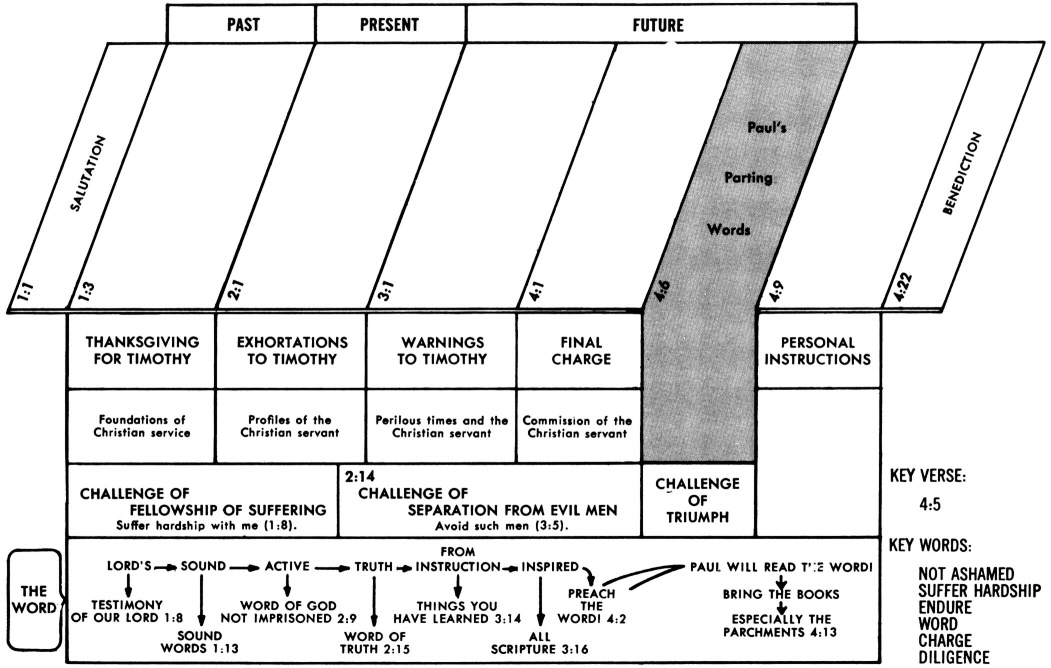
ENDURANCE AND SEPARATION IN THE MINISTRY
Click chart to enlarge
Charts from Jensen's Survey of the NT - used by permission
Second Timothy - Swindoll
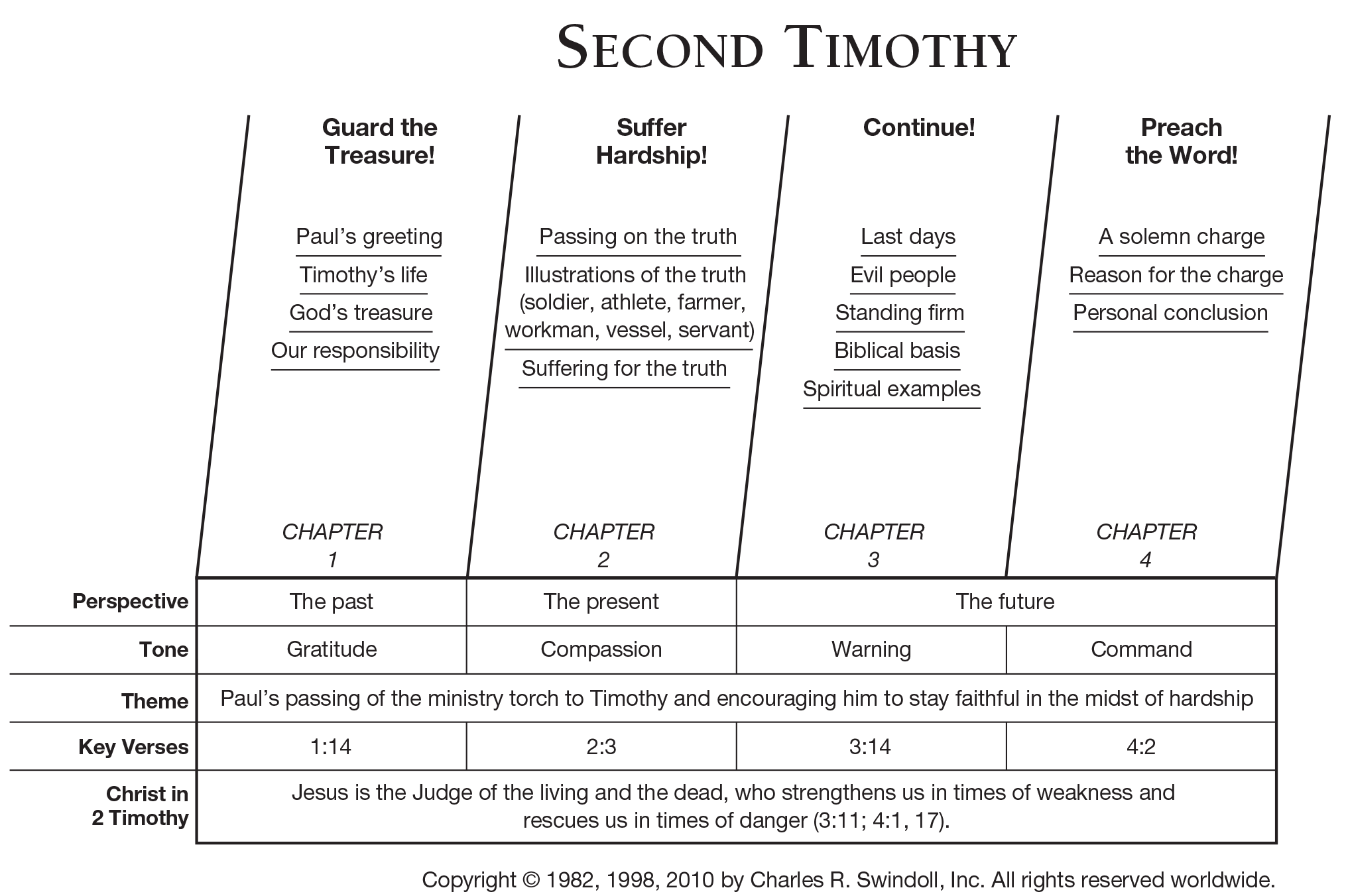
| 2 TIMOTHY | |||
| 2 Timothy 1:1-18 | 2 Timothy 2:1-26 | 2 Timothy 3:1-17 | 2 Timothy 4:1-22 |
| Retain the Standard |
Rightly Divide the Word |
Difficult Times Will Come |
Preach the Word |
| PAST | PRESENT | FUTURE | |
| Foundation of Christian Service |
Pictures of Christian Servant |
Dangerous Times for Christian Servant |
Commission of Christian Servant |
| Unashamed as a Witness: Guard the Gospel |
Unashamed as a Workman: Suffer for the Gospel |
Adequate as a Workman: Continue in the Gospel |
Awarded as a Workman: Preach the Gospel |
| Power of the Gospel |
Perseverance of the Gospel Message | Protection of the Gospel |
Proclamation of the Gospel |
| Reminder | Requirements | Resistance | Requests |
| Encouragement in Ministry |
Examples in Ministry |
Exhortations in Ministry |
Exhortations to Fulfill Ministry |
| Commendation & Charge |
Commission to Fulfill |
Conflict to Face |
Course to Finish |
|
Compiled from Jensen's Survey of the NT and Wilkinson's Talk Thru the Bible |
|||
2Timothy 4:7 I have fought (1SRMI) the good fight, I have finished (1SRAI) the course, I have kept (1SRAI) the faith (NASB: Lockman)
Greek: ton kalon agona egonismai, (1SRMI) ton dromon teteleka, (1SRAI) ten pistin tetereka; (1SRAI)
Amplified: 7 I have fought the good (worthy, honorable, and noble) fight, I have finished the race, I have kept (firmly held) the faith. (Amplified Bible - Lockman)
BBE: I have made a good fight, I have come to the end of my journey, I have kept the faith
GWT: I have fought the good fight. I have completed the race. I have kept the faith. (GWT)
KJV: I have fought a good fight, I have finished my course, I have kept the faith:
NLT: I have fought long and hard for my Lord, and through it all I have kept true to him. And now the time has come for me to stop fighting and rest. (NLT - Tyndale House)
Phillips: The glorious fight that God gave me I have fought. The course that I was set I have finished, and I have kept the faith. (Phillips: Touchstone)
Wuest: The desperate, straining, agonizing contest marked by its beauty of technique, I like a wrestler have fought to the finish, and at present am resting in its victory. My race, I like a runner have finished, and at present am resting at the goal. The Faith committed to my care, I like a soldier have kept safely through everlasting vigilance, and have delivered it again to my Captain.(Eerdmans Publishing - used by permission)
Young's Literal: the good strife I have striven, the course I have finished, the faith I have kept
I HAVE FOUGHT THE GOOD FIGHT: ton kalon agona egonismai (1SRMI) ton kalon agona:
- 1 Ti 6:12; Php 1:27, 30
- 2 Timothy 4 Resources - Multiple Sermons and Commentaries
- 2 Timothy 4:6-8 Finishing Well - Steven Cole
- 2 Timothy 4:6-8 The Epitaph of a Faithful Preacher - John MacArthur
- 2 Timothy 4:6: The Triumphant Epitaph of Paul 1 - John MacArthur
- 2 Timothy 4:7: The Triumphant Epitaph of Paul 2 - John MacArthur
- 2 Timothy 4:8: The Triumphant Epitaph of Paul 3 - John MacArthur
THE AGONY
OF VICTORY
I have fought the good fight, I have finished the course, I have kept the faith- Other translations: the good strife I have striven (Young's Literal); The desperate, straining, agonizing contest marked by its beauty of technique, I like a wrestler have fought to the finish, and at present am resting in its victory (Wuest); I have fought long and hard for my Lord (TLB); I have combated the good combat (Darby); the glorious fight that God gave me I have fought (Phillips); I have fought the good (worthy, honorable, and noble) fight (Amp); I have striven the good strife; I have wrestled that good wrestling
MacArthur notes that in this verse Paul is giving us a summary "flashback" of his life in Christ as emphasized in two ways by the Greek text: First, the object of the sentence comes before the verb: "The good fight I have fought, the course I have finished, the faith I have kept. " Second, the perfect tense of the verbs speak of actions completed in the past with results continuing into the present. Paul looked back on his life without any sense of regret, sadness, or unfulfillment. Let's learn from his triumphant epitaph that we might do the same!" (MacArthur)
Fought (75) (agonizomai from agon = conflict or the place of assembly for the athletic contests and then a reference to the contests which were held there) literally was used in the public games to describe one engaging in a contest or contending for a prize, and was especially descriptive of the exhausting struggles and sufferings of the athletes and gladiators (this latter group fighting even to their death at times - can we apply this figuratively to our Christian life as soldiers of the cross?). Indeed, Paul used this meaning of agonizomai as a term of comparison to explain the lifestyle called for in a believer's life (1Co 9.25). Figuratively, agonizomai was used of any heroic effort and so meant to strive earnestly, make every effort, try very hard (Col 1.29). Agonizomai was used of fighting with weapons, describing a literal fight or struggle (Jn 18.36). Figuratively, agonizomai was used to describe great nonphysical effort and struggle and so to strive earnestly or do one's very best (Col 4.12) The literal sense of to contend with adversaries, is carried over into the spiritual realm where we are to contend for truth (exerting strenuous, even painful effort) and struggle with difficulties and dangers antagonistic to the gospel. And so agonizomai is the picturesque verb Paul choose to describe Epaphras wrestling in his prayers for the saints at Colossae. Have you ever prayed for others in this way, even to the point of agonizing in great agony (both English words derived from the root word "agon")?
Wuest - Agonizomai was a term used in Greek athletics. It meant “to contend for victory in the public athletic games, to wrestle as in a prize contest, straining every nerve to the uttermost towards the goal.” Agon is the noun which speaks of the conflict or contest itself. Agon was used in pagan Greece to refer to the place of a contest, the lists, race course, the assembly at the national games, a struggle, battle. The first-century Roman world was acquainted with these Greek athletic terms, for the Greek stadium was a familiar sight, and the Greek athletic games were well known in the large cities of the Empire. The Bible writers seized upon these terms, and used them to illustrate in a most vivid manner, the intensity of purpose and activity that should characterize both Christian living and Christian service (ED: AND NOTE THAT CHRISTIAN SERVICE IS INEXTRICABLY LINKED TO LIVING!). The present day football game is a fair example of the terrific struggle for supremacy in the Greek athletic games that was commonly seen by the first-century stadium crowds. The point is that if we Christians would live our Christian lives and serve the Lord Jesus with the intensity of purpose and effort that is put forth in a football contest, what God-glorifying lives we would live. (Wuest Word Studies - Eerdman Publishing Company Volume 1, Volume 2, Volume 3 - used by permission)
Agonizomai was a familiar term in writings of both military and athletic endeavors and was used to emphasize the concentration, discipline, conviction, and effort needed to win in both arenas. It pictures a runner straining every nerve to the uttermost towards the goal. Agonizomai was used in secular Greek meaning to contend for the prize on the stage, both of the poet, etc., and of the actor. Agonizomai was used in secular Greek in the context of public speaking meaning to contend against, as law-term, to fight a cause to the last and to fight against a charge of murder.
Agonizomai means to exert oneself, to fight, to labor fervently, to strive (devote serious effort or energy = implies great exertion against great difficulty and suggests persistent effort), to struggle, to contend with an adversary - all of these actions picturing an intense struggle for victory. When we find that the gloves of the Greek boxer were fur lined on the inside, but made on the outside of ox-hide with lead and iron sewed into it, and that the loser in a wrestling match had his eyes gouged out, we come to some appreciation of what a Greek athletic contest consisted of and of the effort such a contest would motivate!
Agonizomai here in second Timothy 4 is in the perfect tense which indicates a past completed action with ongoing effect and thus pictures the contest as having begun with intensity (the moment Paul was saved the "bell rang" beginning "round one"!) and which persisted to the end of his life. The use of this verb implies hindrances in the development of the Christian life. Paul is reminding us that faithful Christian ministry is not easy. It takes courage and expenditure of great effort to run the Christian race successfully, albeit that effort ultimately being in the power God supplies (Php 2:12, 13, 4:11, 12, 13-see notes Ph 2:12; 13; 4:11; 12; 13; He 13:21-note; Zech 4:6).
Paul's entire life had been given fully to the struggle even as Olympic athletes give their body, mind and spirit full to their specific sport. Paul thus engaged in a ceaseless, strenuous conflict, wrestling with Satan and his minions, with evil men (2Ti 2:17, 18, 3:5, 13, 4:14-See notes 2Ti 2:17; 18; 3:5; 13; 4:14), with "the spiritual forces of wickedness in the heavenly places" (Ep 6:12-note) and even his own flesh writing that "I buffet my body and make it my slave" (1Co 9:27+)
Should Timothy do any less?
Should we, dearly beloved of God?
Wuest's translation conveys the sense of the perfect tense - I like a wrestler have fought to the finish and at present am resting in its victory" (Comment: This was no small accomplishment, for Paul had encountered and overcome many obstacles along the way as described in 2Cor 11:23-28+).
Agonizomai is used only 8 times in NT (see below) and is translated: competes in the games, 1; fight, 1; fighting, 1; fought, 1; laboring earnestly, 1; strive, 2; striving, 1.
Luke 13:24+ Strive (present imperative see our need to depend on the Holy Spirit to obey) to enter by the narrow door; for many, I tell you, will seek to enter and will not be able.
Hughes: The Lord’s call to “make every effort to enter” (Lk 19:24) or “strive to enter” (rsv) is the Greek word agonizomai, from which we get our word agonize. This is the kind of moral effort necessary to enter the kingdom. “We are not saved by effort, but we shall not believe without effort.” In light of what is at stake (Heaven or Hell) and in light of the finality of eternity, we cannot strive too much to get through the narrow door. It must be sought with all that we are. The Word must be mined. Prayer ought to be perpetual. ( Luke : That you may know the truth. Preaching the Word).
John 18:36 Jesus answered, "My kingdom is not of this world. If My kingdom were of this world, then My servants would be fighting, that I might not be delivered up to the Jews; but as it is, My kingdom is not of this realm."
Comment: Agonizomai was used in secular Greek in reference to literal fighting with weapons. Jesus alludes to the military meaning in His answer to Pilate's question about what had Jesus done, Jesus answered, “My kingdom is not of this world. If My kingdom were of this world, then My servants would be fighting, (agonizomai) that I might not be delivered up to the Jews; but as it is, My kingdom is not of this realm. (Jn 18:36) If His kingdom were from the world, by now His followers would have assembled an army and fought to release Him. Note that Jesus did not say that He had no kingdom in this world, or that He would never rule on earth. He does have a kingdom in this world, for wherever there are people who have trusted Him and yielded to His sovereignty He is King and one day He shall return as "King of kings and Lord of lords" (Rev 19:16) to establish a righteous kingdom on earth (Da 7:13-28)
1 Corinthians 9:25+ And everyone who competes in the games exercises self-control in all things. They then do it to receive a perishable wreath, but we an imperishable.
Comment: Agonizomai means to contend for a prize in the public games. Thus Paul reminded the Olympic minded Corinthians "everyone who competes (agonizomai) in the games exercises self-control in all things. They then do it to receive a perishable wreath, but we an imperishable." Holding tightly to liberties and rights that belong to the unregenerate nature is a sure way to ineffectively compete in the race of soul–winning. Agonizomai was used in reference to the athletes who took part in the 26 mile marathon, willing to undergo the most self-denying, "agonizing" discipline to be at their fittest, thereby hoping to win an earthly crown.
Colossians 1:29+ And for this purpose also I labor, striving according to His power, which mightily works within me. (Click for more notes on agonizomai in this verse)
Comment: Don't miss the pattern which is all through the Scriptures - God's sovereignty (His power) and man's responsibility (I labor, striving) which I like to summarize as the "Paradoxical Principle of 100% Dependent and 100% Responsible" (100/100). It is not the aberrantional teaching "Let go, let God," (that passivity), but "Let God, let's go!" His part, my part! That's the supernatural life we are to live. The conflict could be either outward or inward, fightings without or fears within. Here it is the inward struggle, the wrestling in prayer for the Colossian saints (Lightfoot).
Colossians 4:12+ Epaphras (Paul's "beloved fellow bond-servant" - see note on Epaphras in Col 1:7), who is one of your number, a bondslave (doulos) of Jesus Christ, sends you his greetings, always (HOW OFTEN? = pantote) laboring earnestly (present tense = continually - just try that in your own power - it calls us our need to depend on the Holy Spirit) for (huper - on your behalf) you in his prayers, that (TERM OF PURPOSE OR RESULT) you may stand perfect and fully assured in all the will of God.
Comment: What a great prayer for intercessors to pray for others in their sphere of influence. And remember God will answer it according to John's words in 1 John 5:14-15+ "This is the confidence which we have before Him, that, if we ask anything according to His will, He hears us. And if we know that He hears us in whatever we ask, we know that we have the requests which we have asked from Him."
1 Timothy 4:10 For it is for this we labor and strive, because we have fixed our hope on the living God, who is the Savior of all men, especially of believers.
1 Timothy 6:12+ Fight (present imperative) the good fight of faith; take hold of the eternal life to which you were called, and you made the good confession in the presence of many witnesses.
Comment: Figuratively, agonizomai speaks of applying one's faith in perseverance amid the continual fight against temptations and spiritual opposition. Agonizomai is in the present tense, imperative mood which commands a continuous effort (NB: Not "self-effort" but Spirit enabled effort). Paul is telling Timothy he must keep agonizing like an athlete or soldier, straining and giving his all to win the prize or win the battle. It is also worth keeping in mind that the gloves of the Greek boxer were fur lined on the inside, but made on the outside of ox-hide with lead and iron sewed into it, and that the loser in a wrestling match had his eyes gouged out. This secular truth helps give us some appreciation of the intensity of Greek athletic contests. Thus, the word “fight” (agonizomai) had a very definite meaning for Timothy. The fact that Paul issued it to Timothy as a continuous command would have shown Timothy the necessity for the continuous nature of the Christian’s warfare against evil, and of his desperate dependence on the Spirit to live a life pleasing to God. Beloved, this same truth applies to our daily "fighting" a good fight of faith!
2 Timothy 4:7 I have fought (perfect tense) the good fight, I have finished the course, I have kept the faith
Wuest: the perfect tense, speaking of an action completed in past time with present results. Paul fought his fight with sin to a finish, and was resting in a complete victory. What a happy ending to a strenuous, active, heroic life. He says in his colorful Greek, “The beautiful contest I, like a wrestler, have fought to the finish, and at present am resting in a complete victory.”. (Wuest Word Studies - Eerdman Publishing Company Volume 1, Volume 2, Volume 3 - used by permission)
This word group is the source of our English words agony and agonize which means to experience pain so extreme as to cause writhing or contortions of the body, similar to those made in the athletic contests in Greece. To agonize also means to strain, to toil, to suffer extreme pain of body or mind or to suffer violent anguish. We begin to get a picture of what Paul meant when he said he had fought. Agonizomai emphasizes Paul’s tireless labor and his struggles against all manner of setbacks and opposition.
Speaking again in the context of prayer, Paul uses a related word exhorting the Romans
"to strive together (sunagonizomai = sun/syn = intimately with + agonizomai) with me in your prayers to God for (huper - on my behalf) me that (hina = expresses purpose of their "agonizing prayers!") I may be rescued (delivered - rhuomai) from those who are disobedient in Judea, and that my service for Jerusalem may prove acceptable to the saints;" (Ro 15:30-31-note)
Comment - Sunagonizomai (only NT use of this compound verb is Ro 15:30) was used in classical Greek describing the concerted action of a team of athletes in the Greek games and meant to contend along with or to share in a contest. What a "model" for a powerful prayer meeting! Paul asks the Roman saints to wrestle, fight and contend with him in prayer against the opposition of the hosts of wickedness, contending with him as athletes would, with intensity of purpose and in perfect cooperation, with their eyes focused on the prize they would win. What a picture of prayer! So much of our praying is calm and comfortable, and yet Paul is making allusion to the "pray-er" exerting his or her "spiritual muscles" the way a Greek runners would exert themselves to win the prize in the Olympic Games. This does not mean that our prayers are more effective if we exert all kinds of fleshly energy. Nor does it mean that we must “wrestle with God” and wear Him out before He will meet our needs. Although there is a place for persistent prayer (Mt 7:7-8+ where the verbs ask...seek...knock are all present imperatives). By using the picturesque verb agonizomai, Paul is teaching that our praying must not be a casual experience that has no heart or earnestness. We should put as much fervor into our praying as a wrestler does into his wrestling! As someone has well said "If church members today put as much concern and enthusiasm into their praying as they did into their football games, we would have revival!" (See related topic Praying in the Spirit)
The most dramatic picture of the meaning of agonizomai in the context of prayer, is found in Jesus' agony in Gethsemane where the related word agonia (from agon = context, but giving prominence to the pain and labor of the conflict) is used by Luke who describes Jesus as "being in agony (agonia) He was praying very fervently and His sweat became like drops of blood, falling down upon the ground. (Lk 22:44+)
THOUGHT - Are you beginning to get a picture of the meaning of agonizomai and especially how it relates to the practice of intercessory prayer?
Agonizomai also means to take pains, to wrestle as in an award contest, straining every nerve to the uttermost towards the goal. Jesus for example when asked to give His thoughts on the question of how many would be saved, made the matter personal, addressing not "how many" will be saved but whether or not "you" will be saved! He went on to instruct them to "Strive (agonize) (present imperative) to enter through the narrow door (Amplified adds "force yourselves through it"); for many, I tell you, will seek to enter and will not be able. (Lk 13:24+)
Agonizomai in this context signifies a great struggle against conflict. Don't be confused because Christ was not suggesting that we should or could work hard enough to merit heaven by striving for it. Scripture clearly teaches that salvation is solely by grace, not by works (Ep 2:8, 9-note).
Agonizing to enter the narrow door is a statement which reflects the costliness in terms of human pride, the sinner’s natural love for sin, and the world system and Satan’s opposition to the truth of the gospel which alone saves.
The good fight - Not "a" good fight, but the one which had been foreordained for him (cp Eph 2:10-note). It is "good" with "o" knocked out (so to speak) because the only thing that makes our fight good is God the Spirit, initiating and energizing our fight!
Good (2570) (kalos) (Click word study on kalos compared to agathos another word for good) does not refer to that which is superficial or cosmetic but to what is genuinely and inherently good, organically healthy, fit, useful, serviceable. Another Greek word, agathos is used generally for what is good and useful, especially moral goodness in relation to God who is perfect. Although kalos can be used as a synonym with agathos, kalos tends to stress more the aesthetic aspect, and stands for beautiful, fine, free from defects.
Kalos speaks of the intrinsically good, beautiful, noble and grand struggle Paul has waged for a prize of inestimable value (Php 4:8-note, Php 3:14-note) There are some struggles not worth engaging in, but here Paul says this was a worthwhile, noble fight.
When applied to acts, kalos means noble, praiseworthy. In secular Greek writings a suitable kalos was used to refer to a suitable harbour (Homer); a healthy body (Plato); pure, genuine gold (Theognis) and an unblemished sacrifice (Xenophon). Kalos came to mean that which was aesthetically beautiful. Finally the meaning of kalos broadened to include the sense of morally good.
NIDNTT adds that "in the course of the history of Greek thought, the concept kalos achieved an inclusive meaning, linked with taxis (order) and symmetria (symmetry). In this context kalos came to mean “the total state of soundness, health, wholeness and order, whether in external appearance or internal disposition. For the Greek., then, the term applies particularly to the world of the divine” (W. Grundmann, kalos TDNT III 537)." (Brown, Colin, editor: New International Dictionary of NT Theology)
J. C. Ryle, explains why the fight is good: Let us settle it in our minds that the Christian fight is a good fight--really good, truly good, emphatically good. We see only part of it yet. We see the struggle, but not the end; we see the campaign, but not the reward; we see the cross, but not the crown. We see a few humble, broken-spirited, penitent, praying people, enduring hardships and despised by the world; but we see not the hand of God over them, the face of God smiling on them, the kingdom of glory prepared for them. These things are yet to be revealed. Let us not judge by appearances. There are more good things about the Christian warfare than we see (Holiness [Evangelical Press, 1989]).
Fight (73)(agon = root of English agony, agonize) is the noun form of the verb (agonizomai) discussed above and speaks of the conflict or contest for victory in the Olympic and Pythian games. It refers to strife (bitter sometimes violent conflict. Exertion or contention for superiority. Struggle for victory), contention (a violent effort to obtain something; to strive or vie in contest or rivalry or against difficulties), a competition, a contest, a race, a struggle against opposition.
Agon - 5x in 5v - Phil 1:30; Col 2:1; 1 Thess 2:2; 1 Tim 6:12; 2 Tim 4:7; Heb 12:1. NAS = conflict(1), fight(2), opposition(1), race(1), struggle(1).
In secular Greek agon was used generally, any struggle, trial, or danger, as for example a "struggle for life and death." Other secular meanings include "a battle" and "an action at law, trial" (Liddell, H. Abridged from Liddell and Scott's Greek-English lexicon)
Agon is used 6 times in the NT (see below). It should be noted that the English words used to translate agon (and agonizomai) give us only a faint idea of the intensity of purpose and effort that is implied by the original Greek words. Here are the six uses of agon...
Philippians 1:30+ experiencing the same conflict which you saw in me, and now hear to be in me.
Colossians 2:1+ For I want you to know how great a struggle I have on your behalf, and for those who are at Laodicea, and for all those who have not personally seen my face,
1Thessalonians 2:2+ but after we had already suffered and been mistreated in Philippi, as you know, we had the boldness in our God to speak to you the gospel of God amid much opposition.
1 Timothy 6:12+ Fight the good fight of faith; take hold of the eternal life to which you were called, and you made the good confession in the presence of many witnesses.
2 Timothy 4:7+ I have fought the good fight, I have finished the course, I have kept the faith;
Hebrews 12:1+ Therefore, since we have so great a cloud of witnesses surrounding us, let us also lay aside every encumbrance, and the sin which so easily entangles us, and let us run with endurance the race that is set before us
Vine adds that agon can also describe "the inward conflict of the soul, this inward conflict often the result of or the accompaniment of outward conflict... and implying a contest against spiritual foes, as well as human adversaries. (Collected writings of W. E. Vine)
Agon also described a number of people brought together, a gathering or an assembly and thus was used to refer to actual place where the contest took place. The first-century Roman world was acquainted with these Greek athletic terms, for the Greek stadium was a familiar sight, and the Greek athletic games were well known in the large cities of the Empire. Paul seized upon the terms agon and agonizomai using them to vividly illustrate the intensity of purpose and activity that should characterize Christian living and service. Football and soccer matches are a good modern day picture of the terrific struggle for supremacy in the Greek athletic games that was commonly seen by the first-century stadium crowds.
Paul used agon to remind the saints at Philippi that they were not just spectators of this "good fight" but that they had "been granted for Christ's sake, not only to believe in Him, but also to suffer for His sake, experiencing the same conflict (agon) which you saw in me, and now hear to be in me." (Php 1:29, 30-note) The enemy wanted them to think they were alone in the agonizing struggle but Paul reminds them of the hostile opposition he and Silas had faced when they were imprisoned in Philippi (see Acts16:16-40) and then reminds them that although he is in Rome, he is going through the same difficulties as they are. A change in geography seldom solves spiritual struggles, because human nature is the same wherever we go, and the adversary is everywhere. However, knowing that our fellow believers are also sharing in the conflict should be an encouragement for us to keep fighting the good fight.
Paul wrote to the saints of Thessalonica that
after we had already suffered and been mistreated in Philippi, as you know, we had the boldness in our God to speak to you the gospel of God amid much opposition (agon) (1Th 2:2-note)
By using agon Paul is referring to the agonizing life and death spiritual struggle. Beloved, when we were transferred by God's Spirit from the kingdom of darkness to the kingdom of light and of God's beloved Son, we entered into the agon, the stadium, to engage the powers of darkness in spiritual warfare. Paul fought the good fight, and so can we.
In sum, from these many examples one can see that Paul had indeed "fought the good fight" and could look back on his life with a sense of fulfillment. Motivated by Paul's example every believer should engage in this spiritual race with resolute commitment and maximum effort, fully convinced that eternity will prove that it was worth the extreme effort.
John Piper comments "I don’t think we should view fighting the fight and finishing the race as different from keeping the faith. They are simply pictures that Paul used to describe what is involved in keeping the faith. The reason I think this is that when Paul commanded Timothy in 1 Timothy 6:12 to fight the good fight, he called it the fight of faith: “Fight the good fight of faith; take hold on eternal life to which you were called when you made the good confession.” So when Paul uses the very same phrase of his own experience in 2 Timothy 4:7, followed by the phrase, “I have kept the faith,” we have good reason to believe he meant: I have fought the good fight of faith. The two pictures of a fight and a race illustrate what is involved in keeping the faith." (I Have Kept the Faith)
Talmadge - In early times in America when writing for a minister to go out west the message was “Send us one who can swim.” The question was asked what was meant by such a request as that. The reply came, “The last man we had, in order to keep an appointment, had to cross a fierce, rushing stream, and he was drowned in the attempt. Send us a man who can swim.”
D L Moody - ROME never had such a conqueror as Paul within her walls. Rome never had such a mighty man as Paul within her boundaries. Although the world looked down upon him, and perhaps he looked very small and contemptible, yet in the sight of heaven he was the mightiest man who ever trod the streets of Rome. Probably there will never be another one like him travelling those streets. The Son of God walked with him, and the form of the fourth was with him.
Bob Gass in A Fresh Word for Today...
When you get what you want in your struggle for self
And the world makes you king for a day,
Just go to the mirror and look at yourself
And see what that man has to say.
For it isn’t your father or mother or wife
Whose judgment upon you must pass,
The fellow whose verdict counts most in your life
Is the one staring back from the glass.
He’s the fellow to please; never mind all the rest,
For he’s with you clear to the end,
And you’ve passed your most dangerous, difficult test
If the man in the glass is your friend.
You may fool the whole world down the pathway of years
And get pats on the back as you pass,
But your final reward will be heartache and tears
If you’ve cheated the man in the glass.
NOW THERE’S SOMETHING TO THINK ABOUT!
QUESTION -What did Paul mean when he said he had fought the good fight?
ANSWER - In 2 Timothy 4:7, Paul says, “I have fought the good fight, I have finished the race, I have kept the faith.” This well-known and oft-quoted passage is quite significant in that this epistle was Paul’s last before his martyrdom in A.D. 67. It is a deeply moving affirmation of his unwavering faith and unyielding love for the gospel of Jesus Christ (Galatians 1:4; Galatians 2:20; Philippians 1:21).
“I have fought the good fight” is also significant for believers today because it serves as a stark reminder that the Christian life is a struggle against evil—within ourselves and in the world (John 15:9; Romans 8:7; James 4:4). Earlier in this same epistle, Paul reminded Timothy to “endure hardship as a good soldier of Jesus Christ” (2 Timothy 2:3).
The Greek word agonizomai, translated “fought,” means literally “to engage in conflict.” The word was used in the context of competing in athletic games or engaging in military conflict. Considering that Paul was chained to a Roman soldier when he wrote this epistle, it would have been easy for him to make such an analogy. In fact, he had known many Roman soldiers and during his imprisonment had won a number of them to Christ, some of them members of the Praetorian Guard (Philippians 1:13).
Our battle is not with flesh and blood “but against principalities, against powers, against the rulers of the darkness of this age, against spiritual hosts of wickedness in the heavenly places” (Ephesians 6:12). The Christian life is a fight in that Christians face a never-ending struggle against evil—not an earthly military campaign, but a spiritual battle against Satan. This is why we must “take up the whole armor of God, that you may be able to withstand in the evil day” (see Ephesians 6:13-18).
Without question, the apostle Paul was the consummate warrior, never quitting, never flagging in his zeal for the Lord (Philippians 3:14-15). He knew where lay the source of his strength (Philippians 4:13; 2 Corinthians 12:9). His campaign to spread the gospel of Christ began on the Damascus Road (Acts 9:3) and eventually took him across the ancient world on four missionary journeys. He had witnessed of Christ before Felix and Agrippa, the legates and officials of Rome (Acts 23:26; Acts 26:1). He contended with false teachers and false brethren within the church (2 Corinthians 11:13; Galatians 1:7; Galatians 2:4).
Paul’s “good fight” included an astonishing series of dangers and indignities (2 Corinthians 11:23-33). Even in these he proclaimed his victory in Christ: “Yet in all these things we are more than conquerors through Him who loved us” (Romans 8:37).
Paul’s life and ministry provide for us a powerful example for modeling Christ today. Not only did he “fight the good fight,” but he also “finished the race” and “kept the faith” (2 Timothy 4:7). Paul knew that his death was near (verse 6) but had no regrets. After Jesus took control of his life (Acts 9:15-16), Paul had lived life to the fullest, fulfilling all that Jesus had charged and empowered him to do (Ephesians 3:6; 2 Timothy 4:17). He had a remarkable sense of fulfillment and contentment with his life (Philippians 4:11-13; 1 Timothy 6:6-8).
As believers today, we can have no greater sense of fulfillment than to know, as Paul did, that we have fully accomplished all that the Lord has called us to do (Matthew 25:21). May we “fight the good fight” and “be watchful in all things, endure afflictions, do the work of an evangelist, fulfill [our] ministry” (2 Timothy 4:5). GotQuestions.org
I HAVE FINISHED THE COURSE: ton dromon teteleka (1SRAI) ton dromon:
- Finished the course - Jn 4:34; Acts 13:25; 20:24; Acts 9:24-27 Php 3:13, 14 Heb 12:1, 2
- 2 Timothy 4 Resources - Multiple Sermons and Commentaries
- 2 Timothy 4:6-8 Finishing Well - Steven Cole
- 2 Timothy 4:6-8 The Epitaph of a Faithful Preacher - John MacArthur
- 2 Timothy 4:6: The Triumphant Epitaph of Paul 1 - John MacArthur
- 2 Timothy 4:7: The Triumphant Epitaph of Paul 2 - John MacArthur
- 2 Timothy 4:8: The Triumphant Epitaph of Paul 3 - John MacArthur
Related Passages:
John 4:34+ Jesus *said to them, “My food is to do the will of Him who sent Me and to accomplish His work.
John 17:4 “I glorified You on the earth, having accomplished the work which You have given Me to do.
Acts 20:24+ “But I do not consider my life of any account as dear to myself, so that I may finish my course and the ministry which I received from the Lord Jesus, to testify solemnly of the gospel of the grace of God.
Philippians 3:13-14+ Brethren, I do not regard myself as having laid hold of it yet; but one thing I do: forgetting what lies behind and reaching forward to what lies ahead, 14 I press on toward the goal for the prize of the upward call of God in Christ Jesus.
CROSSING THE
FINISH LINE!
Other translations - I have come to the end of my journey (BBE), My race, I like a runner have finished, and at present am resting at the goal (Wuest), I have run the full distance (TEV), I have run the race to the finish (NJB), The course that I was set I have finished (Phillips)
Finished (5055) (teleo from telos = goal, consummation, the end or final purpose to which all the parts tend and in which they terminate) means to make an end of, to accomplish or to complete something. Teleo is in the perfect tense emphasizing the permanence of the finish. The finish line has been crossed and the results would last forever. Paul (and you and I) could finish his race because Jesus had finished His race, John using the same verb teleo in the same tense (perfect tense) in the cry of victory by Jesus "Therefore when Jesus had received the sour wine, He said, “It is finished! ( tetelestai = perfect tense of teleo)” And He bowed His head and gave up His spirit." (John 19:30+)
Teleo - 28 uses in NT - Matt. 7:28; 10:23; 11:1; 13:53; 17:24; 19:1; 26:1; Lk. 2:39; 12:50; 18:31; 22:37; Jn. 19:28, 30; Acts 13:29; Rom. 2:27; 13:6; 2Co. 12:9; Gal. 5:16; 2 Tim. 4:7; Jas. 2:8; Rev. 10:7; 11:7; 15:1, 8; 17:17; 20:3, 5, 7
The idea Paul is conveying to Timothy and to all saints is not for us to merely end our life, but to bring our life (in Christ) to it's destined goal, bringing to completion the individually unique and specific "course" that God has laid for each of His children to run.
FINISH WELL - In 1981 Bill Broadhurst entered the Pepsi Challenge 10,000-meter road race in Omaha, Nebraska. Ten years earlier, surgery for a brain aneurysm left him paralyzed on his left side. But on a misty July morning, he stood with 1,200 lithe-looking men and women at the starting line. The gun cracked. The crowd surged ahead. Bill threw his stiff left leg forward and pivoted on it as his right foot hit the ground. His slow plop-plop-plop rhythm seemed to mock him as the pack disappeared into the distance. Sweat rolled down his face, pain pierced his ankle, but he kept going. Six miles, two hours, and twenty-nine minutes later, Bill reached the finish line. A man approached from a small group of bystanders. Bill recognized him from pictures in the newspaper. "Here," the man said. "You've worked harder for this than I have." With those words, Bill Rodgers, the famous marathon runner, put his newly won medal around Broadhurst's neck, proclaiming him a winner.
The sight of Jesus hanging "helpless" on a cross looked like a tragic defeat. But three little words from His lips amounted to a victory shout: "It is finished!" Three days later the truth of His words would be known. The empty tomb confirmed His claim. He had finished His work by defeating death and atoning for sin.
The Christian life is not a race to see who comes in first, but an endurance run to see who finishes faithfully. Remaining faithful to the finish makes us true winners. —D J De Haan (Our Daily Bread, Copyright RBC Ministries, Grand Rapids, MI. Reprinted by permission. All rights reserved)
We are judged by what we finish,
not by what we start.
Finishing The Race - Haddon W. Robinson writes the following devotional on finishing well - It's easy to live a long life, at least in America. Look at the statistics: Out of every 100,000 persons, 88,361 reach 50 years of age, more than 70,000 people make it to 70, and almost 17,000 get to 85 or more. Staying around a long time, however, should not be our primary goal. Rather, we should be concerned with giving significance and value to all our years and not letting them end in shame and disgrace.
How we finish the race depends to a great extent on the pace we set along the way. Joseph Wittig remarked that when we write people's biographies we should start with their death, not their birth. After all, we have nothing to do with the way our life began, but we have a lot to do with the way it ends.
When Paul wrote 2 Timothy, he was in a Roman dungeon awaiting execution. He said, "I am already being poured out as a drink offering, and the time of my departure is at hand" (4:6). At that moment he could testify, "I have fought the good fight, I have finished the race, I have kept the faith" (v. 7).
We too can end the Christian race well, even if we began late, started slow, or faltered along the way. The secret is to stay true to Christ to the last moment. (Our Daily Bread, Copyright RBC Ministries, Grand Rapids, MI. Reprinted by permission. All rights reserved)
Just live your life before your Lord,
Rise to that higher, nobler plane--
With single eye His glory seek,
And you shall His approval gain.
He who puts God first will have happiness that lasts.
Dennis DeHaan writes - In 1981 Bill Broadhurst entered the Pepsi Challenge 10,000-meter road race in Omaha, Nebraska. Ten years earlier, surgery for a brain aneurysm left him paralyzed on his left side. But on a misty July morning, he stood with 1,200 lithe-looking men and women at the starting line. The gun cracked. The crowd surged ahead. Bill threw his stiff left leg forward and pivoted on it as his right foot hit the ground. His slow plop-plop-plop rhythm seemed to mock him as the pack disappeared into the distance. Sweat rolled down his face, pain pierced his ankle, but he kept going. Six miles, two hours, and twenty-nine minutes later, Bill reached the finish line. A man approached from a small group of bystanders. Bill recognized him from pictures in the newspaper. "Here," the man said. "You've worked harder for this than I have." With those words, Bill Rodgers, the famous marathon runner, put his newly won medal around Broadhurst's neck, proclaiming him a winner.
The sight of Jesus hanging "helpless" on a cross looked like a tragic defeat. But three little words from His lips amounted to a victory shout: "It is finished!" Three days later the truth of His words would be known. The empty tomb confirmed His claim. He had finished His work by defeating death and atoning for sin.
The Christian life is not a race to see who comes in first, but an endurance run to see who finishes faithfully. Remaining faithful to the finish makes us true winners. —D. J. De Haan (Our Daily Bread, Copyright RBC Ministries, Grand Rapids, MI. Reprinted by permission. All rights reserved)
We are judged by what we finish, not by what we start.
The course (race)(1408) (dromos from dramein, the aorist infinitive form of trecho = to run) refers to the course that one follows in a race, the racecourse or the place of running and figuratively refers to one's purpose in life and obligations in relation to it.
Dromos is used only two other times, the first describing John the Baptist -- "while John was completing his course...(here figuratively speaking of his life's purpose... which ultimately resulted in his beheading!)" (Acts 13:25+).
The other use of dromos is found in Paul's affirmation of his determination to finish his course, declaring to the Ephesian elders "I do not consider my life of any account as dear to myself, so that I may finish (verb teleioo = complete, accomplish or bring to an end, to the intended goal) my course (dromos) and the ministry which I received from the Lord Jesus, to testify solemnly of the gospel of the grace of God." (Acts 20:24+)
What had been Paul's determined resolve in Acts 20:24+ was now a definite reality - he had finished his course.
Our lives are represented as a course, or race that is to be run. The question we all need to ask ourselves is
Am I running well?
"Have I laid "aside every encumbrance (unnecessary weight or baggage = anything that impedes disciplining myself for godliness 1Ti 4:7,8+), and the sin which so easily entangles" me so that I might be able to "run with endurance the race that is set before" me? (He 12:1+)
Related Resource:
Many believers start out on the right course, but with time are diverted from the track God originally set them on. When we are born into God's kingdom our race begins and our course is set and one day when we enter God's presence our race ends. The interval of our brief sojourn on earth is the time we each have to complete our set spiritual course. If we stray from our course we lose valuable time. The only way to complete our course within the allotted time is to stay on course! Don't be like the Galatians of whom Paul said "You were running well; who hindered (NIV "cut in on") you from obeying the truth? (Gal 5:7+)
Since Christ is the perfect example of One who stayed on course, we are to fix "our eyes on Jesus, the Author and Perfecter of faith" (He 12:2+).
We need to heed the words of the track coach who said "If you have anything left ten yards past the finish line, you didn't give your all.
Each of our lives are "like flowering grass" and will soon "pass away" (Jas 1:10+) which should motivate us like Paul to give no less than our best to the Lord.
Vance Havner wrote that "It was said of the great racehorse Man o' War: "Some horses led him at the first turn, some led him at the backstretch, a few led him at the far turn, but no horse ever led him in the homestretch." Some Christians run nobly at the start of the race, some do well halfway, but blessed is the man who makes a good finish. Paul's batting average was good to the end of the season: "I have finished my course" (2 Ti 4:7+).
Our Daily Bread draws an illustration from the famous Tour de France writing that - One of the most grueling of all bicycle races is the Tour De France. A contestant in that event, Gilbert Duclos-Lassalle, describes it in a National Geographic article titled, “An Annual Madness.” The race covers about 2000 miles, including some of France’s most difficult, mountainous terrain. Eating and drinking is done on the run. And there are extremes of heat and cold. To train for the event, Lassalle rides his bicycle 22,000 miles a year. What kind of prize makes people endure so much hardship and pain! $10,000? $100,000? No. It’s just a special winner’s jersey. What then motivates the contestants? Lassalle sums it up: “Why, to sweep through the Arc de Triomphe on the last day. To be able to say you finished the Tour de France.” What a tragedy to see this same motive lead to doping scandals in so many of the top tour riders (cf the Tour 2007 when the yellow jersey leader was actually removed from the race because of suspicious behavior. So beloved, don't bring about a scandal but instead finish well like Paul! Your reward is will far surpass -- in degree and in time -- the satisfaction and transient glory these top athletes receive for finishing a grueling bicycle race in Paris! No you won't sweep through the Arc de Triomphe on the last day, but you will stand at the bema or Judgment Seat of Christ and be appropriately recompensed for what you have done during your earthly race, whether it is good or "bad" [bad is phaulos which means useless or worthless and does not refer to sin which some falsely teach - see 2 Cor 5:10 ]) (Our Daily Bread, Copyright RBC Ministries, Grand Rapids, MI. Reprinted by permission. All rights reserved)
A Worthy Effort - Have you heard about the "lawn-chair astronaut"? A 31-year-old truckdriver attached 40 large, helium-filled balloons to a lawn chair. Then, with a CB radio, an altimeter, a parachute, and a life jacket, he began his ascent into the "wild blue yonder." He also took a pellet gun so that he could shoot as many of the balloons as necessary when he was ready to come back to earth.
When he reached an altitude of 3 miles, he decided it was time to come down, so he started popping balloons with his gun. As he tried to land, he got caught in a power line. He later said, "My family used to think I was crazy. Now they want me to write a book, and my sister wants me to get an agent."
Well, I certainly would never encourage anyone to attempt a dangerous stunt like that. I can think of a number of other activities that will do more than simply get your name in the news. As a Christian, you must set out to do things that are worthy of the effort and risks. Your goal should be to fight the good fight, to finish the race, and to keep the faith (2 Timothy 4:7).
Striving to attain spiritual goals brings personal satisfaction, imparts blessing to others, and offers an eternal reward (v.8). That's a worthy effort! — Richard De Haan
O Thou who died on Calvary
To save my soul and make me free,
I'll consecrate my life to Thee,
My Savior and my God! —Hudson
Is what you're living for worth dying for?
Your Biography - When D. L. Moody was moving into old age, he was asked to grant permission for his biography. Moody refused, saying, “A man’s life should never be written while he is living. What is important is how a man ends, not how he begins.”
For better or worse, I have failed to follow that dictum. My biography has been published. Yet I agree with Moody that the way our lives end is the crucial test of authentic discipleship. Only if we remain in a steadfast relationship with the Savior can we be confident not merely of entering heaven, but of obtaining the victor’s crown (1Co 9:25 - note).
Paul was concerned about the possibility of being disapproved by his Lord (1Co 9:27). He was a redeemed believer who was serving the Lord, yet he feared that his service might prove to be wood, hay, and straw rather than gold, silver, and precious stones (1Co 3:12,13).
What will be the Lord’s appraisal of our lives? Will someone evaluating us be able to say honestly that we continued to bear fruit in old age? (Psalm 92:14 - see Spurgeon's note). Whatever vocation we pursue, with the help of the Holy Spirit we may be “steadfast, immovable, always abounding in the work of the Lord” (1Corinthians 15:58). —Vernon C Grounds (Our Daily Bread, Copyright RBC Ministries, Grand Rapids, MI. Reprinted by permission. All rights reserved)
Oh, may all who come behind us find us faithful,
May the fire of our devotion light their way;
May the footprints that we leave lead them to believe,
And the lives we live inspire them to obey. —Mohr
© 1987 by Jonathan Mark Music and Birdwing Music (ASCAP)
For the ignorant, old age is as winter;
for the learned, it is a harvest. —Jewish proverb
Living For Eternity - In a letter to his brother, agnostic Robert G. Ingersoll reflected on his life. He wrote, "I feel that we have passed the crown of the hill, and that the milestones are getting nearer and nearer each other, and now and then I catch glimpses of the great wall where the road ends. A little while ago, I pressed forward; now I hold back. In youth we woo the future and clasp her like a bride; in age we denounce her as a fair and beautiful liar and wonder at the ease with which we were duped. Pursuing that which eludes, gazing at that which fades, hoping for the impossible, regretting that which is, fearing that which must be, and with [nothing] worth having save the bliss of love. And in the red heart of this white flower there is this pang: 'It cannot last.'"
Compare those depressing words with the statement of Paul, who looked to the close of life with confidence because he knew Christ: "I have fought the good fight, I have finished the race, I have kept the faith. Finally, there is laid up for me the crown of righteousness, which the Lord, the righteous Judge, will give to me on that Day" (2Tim. 4:7,8).
Do you know Jesus as your Savior? Are you living for Him? Then you can anticipate a glorious future! — Richard De Haan
God leads us in the path of righteousness
For His name's sake, and as we walk that way
We know it leads at last to heaven above,
To which our souls will rise one glorious day. --Hess
What we go after here
determines where we go hereafter.
Dwight Edwards offers these wise words of counsel to all disciples
"It is important to note that in both these metaphors THEY GET HARDER THE FARTHER ONE GOES. The farther one goes into the competition, the harder it is to keep competing wholeheartedly. So it seems to be for the disciple. Yet how much better it is to "burn out" than to "rust out." We must be wise enough to take time out for refreshing and renewal, but then continue to "work the works of Him Who sent us while it is day." Henry Martyn served in India for seven years before dying at the age of thirty-one. During this time, he translated the New Testament into three Indian dialects. Before he died, he wrote: (2 Timothy - Call to Completion - scroll down page)
And when I am dying how glad I shall be,
That the lamp of my life has been blazed out for Thee.
I shall not care in whatever I gave,
Of labor or money one sinner to save.I shall not care that the way has been rough,
That Thy dear feet led the way is enough.
And when I am dying, how glad I shall be
That the lamp of my life has been blazed out for Thee.
QUESTION - What did Paul mean when he said he had finished the race?
ANSWER - “I have finished the race” is the second clause of three within a passage written by the apostle Paul to Timothy: “I have fought the good fight, I have finished the race, I have kept the faith” (2 Timothy 4:7). The apostle wrote these words near the end of his life. These three statements reflect Paul’s struggles in preaching the gospel of Christ and his victory over those struggles.
In the 1st century, the Romans celebrated both the Olympic Games and the Isthmian Games. Competitors would spend up to ten months in arduous physical training. Because the Corinthians were very familiar with these events, Paul used the games as an analogy for a believer’s life of faithfulness. He wrote the church in Corinth saying, “Do you not know that in a race all the runners run, but only one gets the prize? Run in such a way as to get the prize. Everyone who competes in the games goes into strict training. They do it to get a crown that will not last; but we do it to get a crown that will last forever” (1 Corinthians 9:24-25). Paul’s exhortation is that believers should be as focused and dedicated as those ancient runners in the games. Our motivation in serving Christ is much higher; we “run” not for a temporary crown, but for an eternal one.
In his letter to Timothy, Paul is not commending himself for having “run the full distance” (TEV); rather, he is simply describing what the grace of God had enabled him to do. In the book of Acts, Paul says these powerful words: “I consider my life worth nothing to me, if only I may finish the race and complete the task the Lord Jesus has given me—the task of testifying to the gospel of God’s grace” (Acts 20:24).
So, by declaring “I have finished the race,” Paul is telling Timothy that he had put every effort into the work of proclaiming to all the gospel of salvation. He had completed the course set before him; he had left nothing undone. He was ready to cross the finish line into heaven.
In a race, only one runner wins. However, in the Christian “race,” everyone who pays the price of vigilant training for the cause of Christ can win. We are not competing against one other, as in athletic games, but against the struggles, physical and spiritual, that stand in the way of our reaching the prize (Philippians 3:14).
Every believer runs his own race (1 Corinthians 9:24). Each of us is enabled to be a winner. Paul exhorts us to “run in such a way as to get the prize,” and to do this we must set aside anything that might hinder us from living and teaching the gospel of Christ. The writer of Hebrews echoes the words of Paul: “Lay aside every weight, and the sin which so easily ensnares us, and let us run with endurance the race that is set before us, looking unto Jesus, the author and finisher of our faith” (Hebrews 12:1-2).
May we be diligent in our “race,” may we keep our eyes on the goal, and may we, like Paul, finish strong.GotQuestions.org
I HAVE KEPT THE FAITH: ten pistin tetereka (1SRAI) :
- 2Ti 1:14; Pr 23:23; Lk 8:15; 11:28; Jn 17:6; 1Ti 6:20; Rev 3:8, 3:10
- 2 Timothy 4 Resources - Multiple Sermons and Commentaries
- 2 Timothy 4:6-8 Finishing Well - Steven Cole
- 2 Timothy 4:6-8 The Epitaph of a Faithful Preacher - John MacArthur
- 2 Timothy 4:6: The Triumphant Epitaph of Paul 1 - John MacArthur
- 2 Timothy 4:7: The Triumphant Epitaph of Paul 2 - John MacArthur
- 2 Timothy 4:8: The Triumphant Epitaph of Paul 3 - John MacArthur
GUARDING
THE FAITH
Other translations - The Faith committed to my care, I like a soldier have kept safely through everlasting vigilance, and have delivered it again to my Captain (Wuest), I have kept (firmly held) the faith (Amp), I have guarded the faith (Weymouth).
Kept (5083) (tereo) describes the action of keeping one's eye upon something or someone so as to watch it and conveys the idea of protecting it as the result of guarding. One gets a sense of the meaning of tereo in (Acts 12:5) where "Peter was kept (tereo) in the prison".
The perfect tense emphasizes that from the very inception of his new life in Christ he had guarded the treasure entrusted to him and that this attitude had persisted his entire life.
Jesus told His disciples to "keep (tereo) my commandments" (Jn 14:15) preserving them unbroken by careful watching.
In like manner, Paul kept his eye upon "the faith" (see explanation below), carefully watching for those who would add to or subtract from the Gospel, the message of salvation, especially Judaizers (cf Gal 2:4 2:5), empty deceptive philosophical arguments (Col 2:8, 9, 10-see notes Col 2:8; 2:9; 10), mystical experiences (Col 2:18-note), asceticism (Col 2:23-note), etc. Paul contended earnestly for the integrity of "the faith" (Jude 1:3, 1:4).
John Stott comments that kept the faith...may conceivably mean ‘I have kept faith with my Master’. But in the context of this letter, which emphasizes so strongly the importance of guarding the deposit of revealed truth, it is more likely that Paul is affirming his faithfulness in this respect. ‘I have safely preserved, as a guardian or steward, the gospel treasure committed to my trust.’ (Stott, J. R. W. Borrow The message of 2 Timothy : guard the Gospel)
The faith (4102) (pistis) is a specific phrase (definite article "the" plus "faith") found some 38x in the NASB, some instances referring to saving faith in Christ exercised by an individual and necessary for salvation.
The faith -Acts 3:16; 6:7; 13:8; 14:22; 16:5; Ro 4:11f, 16; 14:22; 1Co 16:13; 2Co 13:5; Gal 1:23; 3:23; 6:10; Eph 1:15; 4:13; Phil 1:25, 27; Col 1:23; 1Ti 1:2, 14; 3:9, 13; 4:1, 6; 5:8; 6:10, 21; 2Ti 1:13; 2:18; 3:8; 4:7; Titus 1:1, 13; 3:15; Philemon 1:5; Jude 1:3; Rev 13:10
Approximately one-half of the 38 occurrences of the specific phrase the faith refer not to the ACT of believing but rather to WHAT is believed, the latter being the usage that the present context would seem to favor (cp retain the standard of sound words, 2Ti 1:13, guard...the treasure 2Ti 1:14, handling accurately the Word of truth 2Ti 2:15). It follows that the specific meaning of this phrase is dependent on the context (the text that goes with the text in question).
The first use of "the faith" referring to the body of truth believed is recorded by Luke who writes that
the word of God kept on spreading; and the number of the disciples continued to increase greatly in Jerusalem, and a great many of the priests were becoming obedient to the faith." (Acts 6:7)
Robertson remarks that here "the faith" means
the gospel, the faith system as in Gal 1:23; Jude 1:3, etc. Here the (phrase "the faith") means more than individual trust in Christ." (Word Pictures in the New Testament)
In a similar use we read of
Elymas the magician (for thus his name is translated) was opposing them, seeking to turn the proconsul away from the faith. (Acts 13:8+)
Paul and Barnabas
returned to Lystra and to Iconium and to Antioch, strengthening the souls of the disciples, encouraging them to continue in the faith, (not in "their faith" but in the body of truth they had placed their faith in) and saying, "Through many tribulations we must enter the kingdom of God." (Acts 14:21,22+)
Similarly we read that
the churches were being strengthened in the faith, (in the doctrinal truths concerning the gospel) and were increasing in number daily." (Acts 16:5+)
The believers in Jerusalem only knew Paul by reputation and "they kept hearing, “He who once persecuted us is now preaching the faith which he once tried to destroy.” (Gal 1:23+) This is another clear example of "the faith" referring to the objective body of truth that composed the gospel message which Paul preached ceaselessly (1Cor 1:17+, 1Co 2:1, 2:2+).
Here is an illustration of a faithful man writing that "At the height of WWII, Protestant theologian Dietrich Bonhoeffer was imprisoned for taking a stand against Hitler. Yet he continued to urge fellow believers to resist Nazi tyranny. A group of Christians, believing that Hitler was the Antichrist, asked Bonhoeffer, “Why do you expose yourself to all this danger? Jesus will return any day, and all your work and suffering will be for nothing.” Bonhoeffer replied, “If Jesus returns tomorrow, then tomorrow I’ll rest from my labor. But today I have work to do. I must continue the struggle until it’s finished."
Paul exhorts the Corinthians to
be on the alert, stand firm in the faith, (sound doctrine they had believed) act like men, be strong. (1Cor 16:13+) (All 4 verbs are in the present imperative and all 4 need to depend on the Holy Spirit to obey)
The faith is used in a similar way in Paul's first letter to Timothy (1Ti 3:9, 1Ti 4:1, 1Ti 5:8, 1Ti 6:10).
Jude writes that we are to "contend earnestly for the faith which was once for all delivered to the saints" which is clearly not a reference to the believers' faith but to the whole body of revealed salvation truth contained in the Scriptures, the objective truths which were to be believed, and the very truths which Jude warns were in danger of being distorted." (Jude 1:3+).
And so here in second Timothy 4, the faith Paul had guarded refers in general to the revealed truth in the Word of God and more specifically to the unchangeable message of the gospel which brings salvation.
Even in his final hours Paul is reminding Timothy that the faith or the gospel which saved Paul was the faith that he had faithfully, carefully watched over so as to protect its integrity. This was Paul's clear charge to his young disciple:
Guard what has been entrusted to you..." (1Ti 6:20).
Retain the standard of sound words" (2Ti 1:13-note).
Guard through the Holy Spirit Who indwells us the treasure which has been entrusted to you" (2Ti 1:14-note).
THOUGHT - Dearly beloved, we too as disciples of Christ, have been charged to guard the faith, the glorious treasure of the gospel in the midst of hostile opposition because it is the only message that begets salvation of sinners.
Vine succinctly summarizes Paul's epitaph and draws out an important application for every saint to ponder "There is no expression of regret about the past, no sighing for what might have been, no “longing, lingering, look behind.” As a warrior his warfare had been well waged; as a racer his course had been completed; as a guardian of the faith he had kept his treasure to the end. How goodly an example he set us! (Collected writings of W. E. Vine)
Edwards adds that "It was Paul's past faithfulness to his divine task which made his present home going that much more attractive and satisfying. He knew that he had made the best possible use of his life and that he could appear before his King as "a workman who does not need to be ashamed." The end of the race can be fully savored only by the athlete who has fully strived. Only the disciple who has "fought the good fight" and "finished the course" can enter into the keen anticipation of stepping into the victor's circle, free from the sad regret of having run halfheartedly the greatest of all races." (2 Timothy - Call to Completion - scroll down page)
Live as you will wish to have lived after you are dead or as Adoniram Judson the great missionary to Burma said
The motto of every missionary, whether preacher, printer, or schoolmaster, ought to be 'Devoted for life.'
We too can end the Christian race well, even if we began late, started slow, or faltered along the way. The secret is to stay true to Christ to the last moment.
S S Lappin - Sermon Outline - KEEPING THE FAITH
“I have fought the good fight, I have finished the course, I have kept the faith.”—2 Tim. 4:7.
INTRODUCTION.—This passage was sent to a young preacher by Paul at the close of his life. What did it mean that he could say, “I have kept the faith”?
I. To have kept the faith, Paul must first have “obtained” the faith. He must have heard and considered the word of God. Rom. 10:17.
II. To have kept the faith, he must have squared his life to its facts, for faith without works is dead. Jas. 2:17.
III. To have kept the faith, he must have been a persistent servant of God. Rev. 2:10.
QUESTION - What did Paul mean when he said he had kept the faith?
ANSWER - “I have fought the good fight, I have finished the race, I have kept the faith” (2 Timothy 4:7). This is one of the better-known and most-quoted passages of the apostle Paul. These words written just before Paul’s death are a powerful affirmation of his unyielding love and undying faith in Jesus and the gospel message (Galatians 1:4; 2:20; Philippians 1:21).
The word translated “kept” means “to keep by guarding, to watch over.” The Greek word for “faith” is pistis, which has to do with a conviction based on hearing (cf. Romans 10:17). Paul’s trust in Jesus never wavered. His faith was as solid on the day of his death as it had been the moment he first believed on the Damascus road (Acts 9:3). He was firm in his faith in the midst of the mob’s violence (Acts 16:22; 2 Corinthians 11:25; 1 Thessalonians 2:2). He stood uncompromising before the dignitaries Felix (Acts 22:10, 22), Festus (Acts 25:9), and Agrippa (Acts 25:26). He boldly confronted Peter when that apostle showed signs of compromising the teachings of Christ (Galatians 2:11-16).
The expression “I have kept the faith” has two possible meanings. One is that Paul had faithfully declared the gospel and guarded its truth, keeping its message unadulterated. Elsewhere, Paul called this the “pattern of sound teaching” and encouraged Timothy to “keep” it as well (2 Timothy 1:13; cf. 1 Timothy 6:20).
The other possible meaning of “I have kept the faith” is that Paul had fulfilled his divine appointment in this world, viz., that he would be Jesus’ messenger to the Gentiles (Acts 9:15; 22:21). When Jesus commissioned Paul, He was clear that the appointment would mean much suffering (Acts 9:16). But Paul gladly accepted the summons and never wavered in his commitment, trusting that he would soon experience “an eternal glory” (2 Corinthians 4:17).
Keeping the faith is never easy. Without question, Satan sought to derail Paul’s work by opposing him far and wide. There were Galatian legalists, Colossian Gnostics, and Judaizers at every turn. There were forged letters (2 Thessalonians 2:2). There were slanderous attacks on his integrity, his personal appearance, and his unpolished speech (2 Corinthians 10:10; 2 Corinthians 1:6). Not to mention the physical beatings he took (2 Corinthians 11:23-27). He was truly “hard pressed on every side” (2 Corinthians 4:8). Paul’s faith was the victory: “I know whom I have believed, and am persuaded that He is able to keep that which I have committed unto Him against that day” (2 Timothy 1:12). What God had committed to Paul, Paul committed back to God. And through it all, Paul looked forward to the moment when he would hear the Lord say, “Well done, good and faithful servant!” (Matthew 25:21).
As believers in Christ, we, too, should “keep the faith.” What has God called you to do? Do it with all your might (Colossians 3:23). Just as Paul “longed for His appearing” and anticipated receiving the “crown of righteousness” (2 Timothy 4:8), so should we serve the Lord and faithfully fulfill His plan for our lives.GotQuestions.org
QUESTION - How can I keep the faith?
ANSWER - First Timothy 4:16 exhorts us to keep the faith: “Watch your life and doctrine closely. Persevere in them.” When Paul visited the recently established churches in Asia Minor, his goal was “strengthening the disciples and encouraging them to remain true to the faith” (Acts 14:22). Other passages calling us to keep the faith are Hebrews 12:1 and Ephesians 6:13. The Bible also gives us advice for how to do it.
Keeping the faith requires remembering what brought us to faith in the first place. We need to be intentional about remembering God’s grace in our lives. Hebrews 12:1b–3 says, “Let us run with perseverance the race marked out for us, fixing our eyes on Jesus, the pioneer and perfecter of faith. For the joy set before him he endured the cross, scorning its shame, and sat down at the right hand of the throne of God. Consider him who endured such opposition from sinners, so that you will not grow weary and lose heart.” Practically, this means remembering the wonderful gift of God’s salvation and following the example of our Savior, who “endured” the trials of this life. We must “fix our eyes” on Jesus. Many people find prayer and journaling helpful in this regard. The Old Testament saints often demonstrated the importance of remembering. The Israelites were instructed to set up memorials, and many of the Jewish feasts were designed to remember and celebrate God’s deliverance. Deuteronomy 4:9 says, “Be careful, and watch yourselves closely so that you do not forget the things your eyes have seen or let them fade from your heart as long as you live. Teach them to your children and to their children after them.” Psalm 103:2 says, “Praise the LORD, my soul, and forget not all his benefits.” When we praise God, we remember His past goodness, and that makes it easier to keep trusting Him now.
Keeping the faith requires a love of truth and a commitment to the Word of God. First Timothy 4:1 says that, in the latter days, those who abandon the faith “follow deceiving spirits and things taught by demons.” To accept “another gospel” (Galatians 1:6–7) is to fall into error. Paul exhorted Timothy to “fight the battle well, holding on to faith and a good conscience”; those who ignore this command “have suffered shipwreck with regard to the faith” (1 Timothy 1:18–19). We must “test the spirits to see whether they are from God” (1 John 4:1). The Spirit of truth will never lead us into untruth (John 16:13).
Keeping the faith also involves growth in Christ. Jesus is the author of our faith (the one who initiated the relationship), and He is the perfecter of our faith (the one who will see it through to the end). From beginning to end, Jesus is the source of our faith. We remember what He has done, and we look forward to what He will do. Practically, this involves having an active prayer life, studying God’s Word, and digging in to His truth.
Keeping the faith is also about community. The Christian life is not lived exclusively between God and the individual; it is lived in community with other Christians. Hebrews 10:23–25 says, “Let us hold unswervingly to the hope we profess, for he who promised is faithful. And let us consider how we may spur one another on toward love and good deeds, not giving up meeting together, as some are in the habit of doing, but encouraging one another—and all the more as you see the Day approaching.” Fellow believers can encourage us to keep the faith. They can exhort us when we are going astray. They can join in our gladness and in our sorrow (Romans 12:15).
We will face trials and temptations in life (John 16:33; James 1:2–4). Our faith will be challenged. But it is not only in the difficult times that we dig in our heels and fight for our faith. No, we contend for our faith always. What we do today prepares us for what is in store tomorrow. God is always at work in our lives. Our faith should be ever-growing. Second Peter 1:3–11 says, “His divine power has given us everything we need for a godly life through our knowledge of him who called us by his own glory and goodness. . . . For this very reason, make every effort to add to your faith goodness; and to goodness, knowledge; and to knowledge, self-control; and to self-control, perseverance; and to perseverance, godliness; and to godliness, mutual affection; and to mutual affection, love. For if you possess these qualities in increasing measure, they will keep you from being ineffective and unproductive in your knowledge of our Lord Jesus Christ. . . . My brothers and sisters, make every effort to confirm your calling and election. For if you do these things, you will never stumble, and you will receive a rich welcome into the eternal kingdom of our Lord and Savior Jesus Christ.” We keep the faith by remembering God’s faithfulness and continuing to grow in relationship with Him. GotQuestions.org
QUESTION - In what ways is the Christian life like the Olympics? See accompanying video.
ANSWER - The Olympics represent the pinnacle of athleticism, training, and competitiveness, going all the way back to ancient times. The apostle Paul used illustrations from the world of athletics in several of his letters. In three Epistles, he used the image of all-out racing to urge vigorous and lawful pursuit of spiritual growth and service. Four times Paul spoke of his own growth and service in terms of his own such race. To the gifted but immature believers in Corinth, Paul wrote, “Do you not know that in a race all the runners run, but only one gets the prize? Run in such a way as to get the prize” (1 Corinthians 9:24). Here, Paul compares the disciplined effort necessary for spiritual growth to an Olympic athlete’s effort to win the prize that awaits only the winner of a race. Growing Christlikeness does not just happen on its own. God certainly “works in you to will and to act in order to fulfill his good purpose” (Philippians 2:13), but the believer must cooperate with God by exerting responsible and serious effort to follow what the Holy Spirit teaches. “Anyone who competes as an athlete does not receive the victor’s crown except by competing according to the rules” (2 Timothy 2:5). For the disciplined believer, the prize is the “upward call of God in Christ Jesus” (Philippians 3:14, ESV). To what does God call the believer? It is to become like Jesus Christ in heart and lifestyle (Romans 8:28–30).
The true believer demonstrates the reality of God’s work in his heart by enduring all sorts of tests in the development of Christlikeness. The believer is in training, much as an Olympic athlete must train for a race. No pain, no gain. That is why the writer of Hebrews exhorted, “Let us throw off everything that hinders and the sin that so easily entangles. And let us run with perseverance the race marked out for us, fixing our eyes on Jesus, the pioneer and perfecter of faith. For the joy set before him he endured the cross, scorning its shame, and sat down at the right hand of the throne of God. Consider him who endured such opposition from sinners, so that you will not grow weary and lose heart” (Hebrews 12:1–3). Jesus is portrayed as the finest runner, the One who set the pace, our model and hero in life’s race. Just as a runner in the Olympics must dispense with anything that would hinder his running, we must disentangle ourselves from sin. As a runner in the games must keep his eyes on the finish line, so we must keep our eyes on Christ and His joyful reward.
Some believers in Galatia had lost faith in God’s grace and were returning to a legalistic, performance-based religion. Paul wrote strong words to them: “You were running a good race. Who cut in on you to keep you from obeying the truth? That kind of persuasion does not come from the one who calls you” (Galatians 5:7–8). The true Christian life can be lived only by faith—faith in the pure Word of God and faith in the finished work of Jesus Christ on the cross. To follow Satan’s deceitful advice to try to earn God’s grace and free gift of salvation is to stumble in our race. Trusting our own works only insults God and does us no good.
Paul wrote with similar urgency to believers in Philippi, “Do everything without grumbling or arguing, so that you may become blameless and pure, ‘children of God without fault in a warped and crooked generation.’ Then . . . I will be able to boast on the day of Christ that I did not run or labor in vain” (Philippians 2:14–16). Paul encouraged the Philippians’ pure faith and likened his own labor on their behalf to running a race. He had invested hard work and deep suffering in teaching them God’s story, and he wanted his exertion to pay off—much like an Olympic athlete deeply desires his sacrifices to result in victory.
Another passage in which Paul uses the metaphor of a race is Galatians 2:1–2. There Paul tells how he had visited Christian leaders in Jerusalem in order to check with them the gospel he preached to the Gentiles. What was his reason for taking such care? “For fear that I was running or had run my race in vain” (NAS). It was vital to Paul that he knew, believed, and taught God’s truth. This was the way that he “ran his race.”
It was in peaceful confidence that Paul approached the end of his life. Anticipating his impending martyrdom in Rome, he wrote to his young protégé, Timothy, “The time for my departure is near. I have fought the good fight, I have finished the race, I have kept the faith. Now there is in store for me the crown of righteousness, which the Lord, the righteous Judge, will award to me on that day—and not only to me, but also to all who have longed for his appearing” (2 Timothy 4:6–8).
We don’t know if Paul had been an athlete in his younger years. In these references to the Olympic races, he certainly showed deep interest in and understanding of competitive running. He used that understanding of the Olympic races to illustrate the basics of the Christian life.
A runner must train for his race, know the rules, and commit to winning. A believer must endure hardship, exercise absolute and enduring faith in the Word of God, and keep his eyes on the goal. In the power of the cross, the believer grows more and more like the Savior. Despite obstacles, challenges, temptations, and even the threat of death, the Christian continues to run the race Christ has marked out for him. GotQuestions.org
J W Jowett has the following devotional thoughts on this closing section of Paul's last known written communication...
HERE is a most valiant pilgrim nearing home! By the mercy of Christ he can look back upon a brave day, and there’s a fine hopeful light in the evening sky.
He has fought well! “I have fought a good fight.” And his has been a hard field. The enemy has ever regarded him as a leader in the army of the Lord and against him has the fiercest fight been waged. But he has never lost or stained his flag.
And he has run well! “I have finished my course.” There was no melancholy turning back when the feverish start had cooled. There was no shrinking when the biting wind of malice and persecution swept across his track. On and on he ran, with increasing speed and ardour, until he reached the goal.
And well had he guarded his treasure! “I have kept the faith.” He was the custodian of “unsearchable riches,” and he watched, day and night, lest any infernal burglar should despoil him of his wealth. He guarded his gospel, his liberty, his hope, as the sentinels guard the crown jewels in the Tower.
And now the hard day is nearly over. “Henceforth there is laid up for me a crown of righteousness which the Lord will give me at that day.” (My Daily Meditation for the Circling Year)
Our Daily Bread has a wonderful illustration of the fruit of preaching the word and keeping the faith - A deacon rebuked an elderly preacher one Sunday morning before the service.
"Pastor," said the man, "something must be wrong with your preaching and your work. There's been only one person added to the church in a whole year, and he's just a boy."
The minister listened, his eyes moistening and his thin hand trembling.
"I feel it all," he replied, "but God knows I've tried to do my duty."
On that day the minister's heart was heavy as he stood before his flock. As he finished the message, he felt a strong inclination to resign. After everyone else had left, that one new boy came to him and asked,
"Do you think if I worked hard for an education, I could become a preacher—perhaps a missionary?"
Again tears welled up in the minister's eyes.
"Ah, this heals the ache I feel," he said.
"Robert, I see the Divine hand now. May God bless you, my boy. Yes, I think you will become a preacher."
Many years later an aged missionary returned to London from Africa. People spoke his name with reverence. Nobles invited him to their homes. He had added many souls to the church of Jesus Christ, reaching even some of Africa's most savage chiefs. His name was Robert Moffat,. the same Robert who years before had spoken to the pastor on that Sunday morning in the old Scottish church.
Our service for Christ may sometimes seem fruitless. We wonder if anything significant is happening. But if we are faithful, God will give the increase. —D. J. De Haan (Our Daily Bread, Copyright RBC Ministries, Grand Rapids, MI. Reprinted by permission. All rights reserved)
Faithfulness is God's requirement,
Fruitfulness is His reward.
C H Spurgeon writes that...
It is my desire that death will perfect my entire career, that death will be the capstone on the building, so that nothing is needed to complete my life’s work. Is it this way with you? Suppose you were to die at this moment, would your life be complete? Or would it be a broken column snapped off in the center?
May our death not be one that needs flurry and hot haste to make us ready. Some die in that fashion, but they have so little grace as to be only “saved, yet so as through fire” (1Co 3:15). True Christians stand ready for death; they know the Bridegroom is coming soon and they keep their lamps well trimmed (Mt. 25:4). This is the way to live, and this is the way to die. Our home-going will be a simple matter if the Holy Spirit puts us in such a condition that the death angel may not catch us by surprise.
It must be sad to be taken unwillingly, plucked like an unripe fruit from the tree. The unripe apple holds fast to its place, and many hold hard to their riches. They cling so fondly to earthly things that it takes a sharp pull to separate them from the world. Ripe fruit, however, adheres only lightly. When a gentle hand comes to take it, it yields freely, as if willing to be gathered.
God made you unworldly. May He forbid you to cling so resolutely to things below, that your departure be not violent and full of terror.
James Butler - Sermon Starters - A GREAT EPITAPH 2 Timothy 4:7
“I have fought a good fight, I have finished my course, I have kept the faith” (2 Timothy 3:16).
The Apostle Paul is near the end of his life when he wrote these words of our text. He is in prison with the sentence of death upon him for preaching Christ. Soon he will be beheaded at the order of Nero the wicked Roman emperor. As Paul nears the end of his life, he makes a statement regarding his devotion to Christ. It is a great statement and can serve as his epitaph of his life. It can be divided into three parts.
FIRST—THE FIGHT
“I have fought a good fight.” This does not mean that Paul was pugnacious nor that he was a prize fighter. Rather it means, that in his ministry, he gave the devil a good fight. For one thing, Paul fought sin. Most people defend sin and make peace with it. But Paul fought evil, and like few others, he could say he fought a good fight. Not many in our society are fighting evil like Paul fought it. We are so busy tolerating evil and justifying it and making laws to permit it that we do not have time nor desire to fight sin. That is why sin abounds in our society and even in our churches. Paul fought a good fight against sin but not many are fighting a good fight against sin.
SECOND—THE FINISH
“I have finished my course.” This is the language of a runner. Many start well but do not finish. Starting is exciting but to finish requires more than most people are willing to give. The church is plagued with quitters which is another way of saying the church is plagued by unfaithfulness. People simply do not stick to the job until it is done. “Finished” reminds us that Christ was also able to say, “It is finished” (John 19:30). He completed His work. Do not be a quitter. Stick with your task until you finish the work. There is no satisfaction in unfinished tasks. It is good to start but it is better to finish.
THIRD—THE FAITH
“I have kept the faith.” The word “kept” means to guard. Paul had been faithful to the faith. He had kept his message from error. He did not depart from the truth when the going got tough and persecution resulted. So many of our churches and schools are slipping away from the faith today. They have buildings and finances, but they have not been careful to maintain the faith. They are constantly trying to tell us that they have not departed from the faith, but when an individual or organization spends time telling you they have not departed from the faith, they have. If they had not departed from the faith they would not have to tell people. It would show, especially in this day and age of unbelief. Our faith is not popular and people are persecuted for it, but the alternatives are not satisfactory. Guard your faith from error and keep your faith from being infiltrated by the corruption of the day. You will not be esteemed in protecting the faith, but you will be praised by God, the author of your faith.