2 CORINTHIANS - PAUL'S MINISTRY IN THE LIGHT OF THE INDESCRIBABLE GIFT
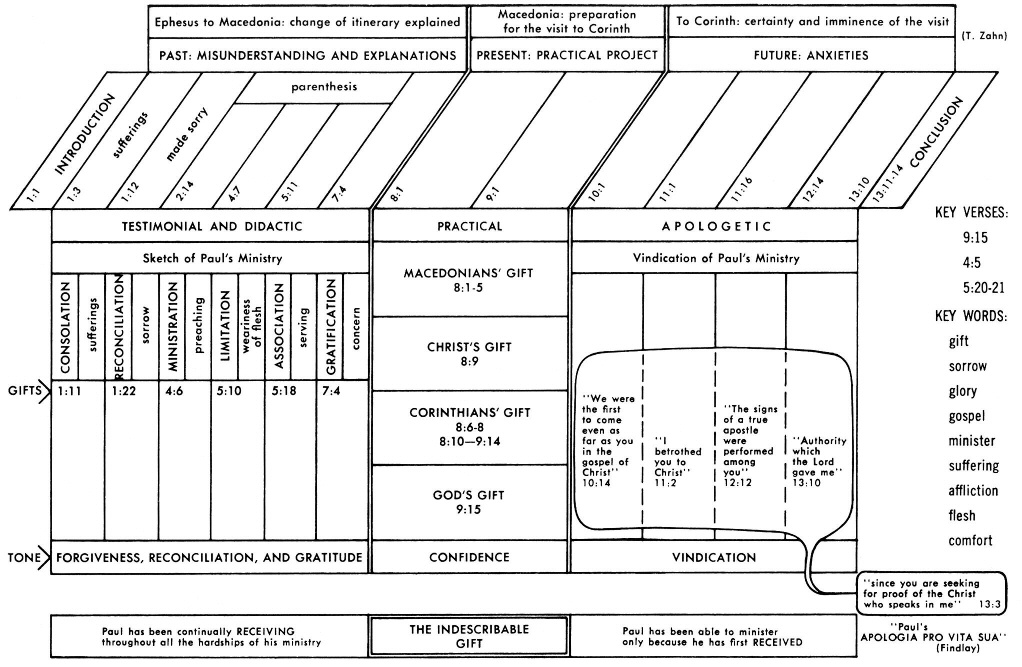
Click chart to enlarge
Charts from Jensen's Survey of the NT - used by permission
Another Overview Chart on right side
Overview of
|
||
| 2Co 1:1-7:16 Character of Paul |
2Co 8:1-9:15 Collection for the Saints |
2Co 10:1-12:21 Credentials of Paul |
| Testimonial & Didactic | Practical | Apologetic |
| Past: Misunderstanding & Explanation |
Present: Practical Project |
Future: Anxieties |
| Apostle's Conciliation, Ministry & Exhortations | Apostle's Solicitation for Judean Saints | Apostle's Vindication of Himself |
| Forgiveness, Reconciliation Gratitude |
Confidence | Vindication |
|
Ephesus to Macedonia: |
Macedonia: Preparation for Visit to Corinth |
To Corinth: |
|
2Co 1:1-7:16 |
2Co 8:1-9:15 |
2Co 10:1-12:21 |
|
2Corinthians written ~ 56-57AD - see Chronological Table of Paul's Life and Ministry |
||
|
Adapted & modified from Jensen's Survey of the New Testament (Highly Recommended Resource) & Wilkinson's Talk Thru the Bible |
||
2 Corinthians 3:18 But we all, with unveiled face, beholding as in a mirror the glory of the Lord, are being transformed into the same image from glory to glory, just as from the Lord, the Spirit. (NASB: Lockman)
Greek: hemeis de pantes anakekalummeno (RPPNSD) prosopo ten doxan kuriou katoptrizomenoi (PMPMPN) ten auten eikona metamorphoumetha (1PPPI) apo doxes eis doxan, kathaper apo kuriou pneumatos.
Amplified: And all of us, as with unveiled face, [because we] continued to behold [in the Word of God] as in a mirror the glory of the Lord, are constantly being transfigured into His very own image in ever increasing splendor and from one degree of glory to another; [for this comes] from the Lord [Who is] the Spirit. (Lockman)
ASV: But we all, with unveiled face beholding as in a mirror the glory of the Lord, are transformed into the same image from glory to glory, even as from the Lord the Spirit.
Barclay: And we all, with no veil upon our faces, see as in a mirror the glory of the Lord, and we go on changing this image from glory to glory, even as it comes from the Lord who is the Spirit. (Westminster Press)
Darby: But we all, looking on the glory of the Lord, with unveiled face, are transformed according to the same image from glory to glory, even as by the Lord the Spirit.
ESV: And we all, with unveiled face, beholding the glory of the Lord, are being transformed into the same image from one degree of glory to another. For this comes from the Lord who is the Spirit. (ESV)
GWT: As all of us reflect the Lord’s glory with faces that are not covered with veils, we are being changed into his image with ever-increasing glory. This comes from the Lord, who is the Spirit.
KJV: But we all, with open face beholding as in a glass the glory of the Lord, are changed into the same image from glory to glory, even as by the Spirit of the Lord.
MIT We all, barefaced, and gazing as in a mirror at the Lord's glory, are changed into his same image incrementally from one degree of glory to another. We are transformed by the Lord, Who is spirit.
NAB: All of us, gazing with unveiled face on the glory of the Lord, are being transformed into the same image from glory to glory, as from the Lord who is the Spirit.
NET: And we all, with unveiled faces reflecting the glory of the Lord, are being transformed into the same image from one degree of glory to another, which is from the Lord, who is the Spirit. (NET Bible)
NIV: And we, who with unveiled faces all reflect the Lord’s glory, are being transformed into his likeness with ever-increasing glory, which comes from the Lord, who is the Spirit. (NIV - IBS)
NJB: since what we aim for is not visible but invisible. Visible things are transitory, but invisible things eternal.
NKJV: But we all, with unveiled face, beholding as in a mirror the glory of the Lord, are being transformed into the same image from glory to glory, just as by the Spirit of the Lord.
NLT: So all of us who have had that veil removed can see and reflect the glory of the Lord. And the Lord—who is the Spirit—makes us more and more like him as we are changed into his glorious image. (NLT - Tyndale House)
NRSV: And all of us, with unveiled faces, seeing the glory of the Lord as though reflected in a mirror, are being transformed into the same image from one degree of glory to another; for this comes from the Lord, the Spirit.
Phillips: But all of us who are Christians have no veils on our faces, but reflect like mirrors the glory of the Lord. We are transfigured by the Spirit of the Lord in ever-increasing splendour into his own image. (Phillips: Touchstone)
TLB: But we Christians have no veil over our faces; we can be mirrors that brightly reflect the glory of the Lord. And as the Spirit of the Lord works within us, we become more and more like him.
Weymouth: And all of us, with unveiled faces, reflecting like bright mirrors the glory of the Lord, are being transformed into the same likeness, from one degree of radiant holiness to another, even as derived from the Lord the Spirit.
Wuest: Now, as for us, we all, with uncovered face, reflecting as in a mirror the glory of the Lord, are having our outward expressions changed into the same image from one degree of glory to another according as this change of expression proceeds from the Lord, the Spirit, this outward expression coming from and being truly representative of our Lord. (Eerdmans)
Young's Literal: and we all, with unveiled face, the glory of the Lord beholding in a mirror, to the same image are being transformed, from glory to glory, even as by the Spirit of the Lord.
- 2Co 3:13
- 1Co 13:12 Jas 1:23
- 2Co 4:4, 2Co 4:6 Jn 1:14 Jn 12:41 1Ti 1:11
- 2 Corinthians 3 Resources - Multiple Sermons and Commentaries
David Hocking on his alliteration of chapter 3…
- The COMMENDATION of God’s servant – 2Co 3:1-11
- The CHANGE of the Spirit – 2Co 3:12-18
- The CHANGE that He produces – 2Co 3:18
- The Requirement - “with unveiled face beholding as in a glass the glory of the Lord”
- The Result is a process -“are changed into the same image”
- The Recognition of that change - “from glory to glory”
- The Realization of our need of the Person and work of the Holy Spirit - “even as by the Spirit of the Lord”
AN EXCITING TRUTH
HAVE YOU MISSED IT?
But we all, with unveiled face (prosopon), beholding (katoptrizomai in present tense continually beholding) as in a mirror the glory of the Lord - But (de) is not the most accurate rendering for there is really not a contrast with the previous passage. But (de) is better translated with the word "and" because it links this passage with the liberty just described in 2Cor 3:17+ (as in ESV, NIV, NLT, NET). We all is in essence an "invitation" that flings open the gates of liberty not just to a few select, privileged souls, but to all saints, all saved souls! That should evoke a "Hallelujah" dearly beloved! Unveiled face is another way of describing one who has been born again by grace through faith (Eph 2:8-9+). Stated another way, every genuine follower of Jesus has an unveiled face! (Another "Hallelujah!") Unveiled is in the perfect tense which pictures a past completed action (our day of salvation = past tense salvation [see Three Tenses of Salvation] = justification [see justified] - described in 2Co 3:16 = "whenever a person turns to the Lord" and Col 1:13+ = "past tense deliverance") with lasting effect. In other words the veil was taken off the day that the Spirit of the Living God "invaded" and indwelt our spiritually dead bodies, making these wrecks His worship center, His temple, and opening the eyes of our heart to see Jesus as our Lord and Savior (Acts 26:18+ 16:14+) enabling us to continually behold (and understand something of) the glory of the Lord in Word of the Lord (1Jn 2:20, 27+) And don't miss the word face (prosopon) --- now that the veil is removed in (belief in) Christ, we have unfettered freedom (entrée) to approach God as our Everlasting Father seated in His throne room (see Ro 5:2+). We can daily have a "face to face" encounter with the God of the universe! (cf the privilege of Moses - Dt 34:10+).
Warren Wiersbe comments that "This verse is the climax of the chapter, and it presents a truth so exciting that I marvel so many believers have missed it—or ignored it. You and I can share the image of Jesus Christ (ED: NOW! NOT JUST IN 1Jn 3:2+) and go “from glory to glory” through the ministry of the Spirit of God! (Bible Exposition Commentary r)
Comment: To make sure you do not "miss" or "ignore" the grand truth of 2Co 3:18, I encourage you to memorize this verse perfectly so that you might be enabled to meditate on it frequently and experience spiritual prosperity (Josh 1:8+) and fruitfulness (Ps 1:2, 3+) that derives from this great passage.
I love Robert Morgan's (ref) title for this section, a title which pictures our privileged purpose as believers in this present evil age (Gal 1:4+, Mt 5:16+, Php 2:15+)…GLOW-IN-THE-DARK CHRISTIANS
Robert M McCheyne described "glow in the dark" believers when he said that "The Christian is a person who makes it easy for others to believe in God."
The supernatural transformation that is promised to those who behold as in a mirror the glory of the Lord in the Word of the Lord recalls the description of the face of Moses in Exodus...
And it came about, whenever Moses went out to the tent, that all the people would arise and stand, each at the entrance of his tent, and gaze after Moses until he entered the tent. 9 Whenever Moses entered the tent, the pillar of cloud would descend and stand at the entrance of the tent; and the LORD would speak with Moses. 10 When all the people saw the pillar of cloud standing at the entrance of the tent, all the people would arise and worship, each at the entrance of his tent. 11 Thus the LORD used to speak to Moses face to face, just as a man speaks to his friend. When Moses returned to the camp, his servant Joshua, the son of Nun, a young man, would not depart from the tent....Exodus 34:34 But whenever Moses went in before the LORD to speak with Him, he would take off the veil until he came out; and whenever he came out and spoke to the sons of Israel what he had been commanded, 35 the sons of Israel would see the face of Moses, that the skin of Moses’ face shone. So Moses would replace the veil over his face until he went in to speak with Him. (Exodus 33:8-11+....Ex 34:34-35+)
But whenever Moses went in before the LORD to speak with Him (FACE TO FACE), he would take off the veil until he came out; and whenever he came out and spoke to the sons of Israel what he had been commanded, 35 the sons of Israel would see the face of Moses, that the skin of Moses’ face shone. So Moses would replace the veil over his face until he went in to speak with Him. ()
THOUGHT - Notice that both the Israelites and Moses had "close encounters" with Jehovah, but the difference was that Moses' encounter was a "face to face" encounter and the people's encounter (with the pillar of cloud) was at a distance. And yet even though their encounter was distant, it was sufficiently impressive that they responded with worship. But here is the question -- whose face was changed? Only the face of Moses, the one who had a "face to face" encounter with the Living Lord (cf Ex 34:34,35+)!
Can you see the application? If Christians today desire to grow in grace and Christ-likeness, the only way is by a "face to face" encounter with Jehovah. It follows that we need to be (1) daily looking into the "mirror" of God's Word and (2) we need to do more than just "gaze" at it like the Israelites did. We need to sit at Jesus' feet and soak in the Word -- we need to be like Mary instead of Martha! (Lk 10:38-42+)! We we do our part (including and especially in obeying what we read - cf Jn 7:17), the Spirit will take the glorious Word and transform us from glory to glory making us more and more like Christ! And not only that but our glory is even better than that Moses experienced, for in contrast to Moses, our transforming glory is increasing, not decreasing (see 2 Cor 3:13+)!
Father by Your Spirit stir our hearts to desire "face to face" encounters with the Living Lord and not just a passing gaze or glance, so that Your Spirit might conform you progressively into the image of Your Son for Your glory. In Jesus' Name. Amen.
John Stott wrote the following (convicting) poem…
Not merely in the words you say,
Not only in your deeds confessed.
But in the most unconscious way
Is Christ expressed.Is it a beatific smile?
A holy light upon your brow?
Oh no! I felt His presence
When you laughed just now.To me, ’twas not the truth you taught,
To you so clear, to me still dim.
But when you came you brought
A sense of Him.And from your eyes He beckons me,
And from your heart His love is shed,
Till I lose sight of you and see
The Christ instead.
But (de) - Charles Hodge reiterates the point made earlier that "This simple particle of transition links this verse to the previous one. The natural consequence of the freedom mentioned in 2Co 3:17 is what is stated here." (2 Corinthians 3 Commentary)
If you want to shine in the ever darkening night,
Keep your eye on Christ our eternally bright Light.
ILLUSTRATION - Have you read the instruction manual on how to keep your "light bright"? A man returning from a journey brought his wife a matchbox that would glow in the dark. After he gave it to her, she turned out the light, but it could not be seen. Both thought they had been cheated. Then the wife noticed some French words on the box and asked a friend to translate them. The inscription said: “If you want me to shine in the night, keep me in the light.” So it is with us! We must expose ourselves to Jesus, delight in His Word, and spend time in prayer soaking up His rays. (Hughes, R. K. The Sermon on the Mount: Preaching the Word. Wheaton, Ill.: Crossway Books)
They looked to Him and were radiant,
And their faces will never be ashamed.
(Psalm 34:5)
Fixing our eyes on Jesus,
the Author and Perfecter of faith,
(Hebrews 12:2)
For my eyes are toward You, O God, the Lord;
In You I take refuge; do not leave me defenseless.
(Psalm 141:8)
We all (Greek = pas = all without exception) - This is Paul's way of describing all believers in the New Covenant, not just formal ministers but all who as believers are now priests of and to God (1Pe 2:9+, Re 1:6+, Re 5:10+), "all whom the indwelling of the Spirit of the Lord has made free… delivered from the bondage of the law, the veil has been removed from their heart." (Hodge) Under the Old Covenant only Moses (and the Levitical high priest once per year on the Day of Atonement [or more succinct explanation here]) who has direct access to Jehovah, but all who have entered the New Covenant by grace through faith now and forever (see description of perfect tense of anakalupto) have access to God.
Guzik adds that "Paul invites every Christian to a special, glorious intimacy with God. This is a relationship and transforming power that is not the property of just a few privileged Christians. It can belong to all, to everyone who has an unveiled face. (2 Corinthians 3)
The writer of Hebrews vividly describes the New Covenant saint's present (and everlasting) access to God exhort his readers (and us)…
Let us therefore draw near with confidence (parrhesia = literally all speech ~ bold speech, all freedom to speak) to the throne of grace (charis = receiving what we do not deserve!), that we may receive mercy (eleos = not receiving what we deserve!) and may find grace to help (boetheia = picture of one who upon hearing a cry for help, runs to give aid to assist or to succor!) in time of need (at the right time, "the nick of time"!). (Hebrews 4:16-note)
Since therefore, brethren, we have confidence (parrhesia) to enter the holy place (this refers to the Holy of holies, the throne room of God, the presence of Jehovah) by the blood of Jesus, 20 by a new and living way which He inaugurated for us through the veil (katapetasma), that is, His flesh, 21 and since we have a great priest over the house of God, 22 let us draw near with a sincere heart in full assurance of faith (pistis), having our hearts sprinkled clean from an evil conscience (suneidesis) and our bodies washed with pure water. (Hebrews 10:19, 20, 21-note, He 10:22-note)
Comment: When Jesus was crucified on the Cross, the thick veil in the Temple separating the Holy Place from the Holy of holies was rent from top to bottom. God made a way through the rent flesh of His Son, the sacrificial Passover Lamb, so that sinful men who believed in the Messiah now might have bold access to the Holy of holies, the throne room of God. Amazing grace indeed! (See Mt 27:50,51 Mk 15:38 Lk 23:45).
Unveiled (343) (anakalupto from ana = back again + kalúpto = hide, conceal, cover, veil) to to uncover by drawing back the veil. The root verb kalupto meaning to conceal or hide has several fascinating uses in the Septuagint (LXX) - of cloud covered Sinai = Ex 24:15; of darkness covering the earth Is 60:2; of iniquity David did not hide = Ps 32:5, cp Ps 31:5; of God covering or concealing the iniquity of His people Israel. Theological Lexicon of the NT records these ancient Greek uses of anakalupto - It was agreed that once seated, “the conspirators (disguised as women) would strike immediately, throwing off their veils”; “unveil the sacred robe” (anakalypson ton hieron peplon, Pap.Graec.Mag. 57, 17). TDNT says that anakalupto means - To unveil… to undo a package… (healing vision of a woman at Epidauros)… to reveal something to someone… to disclose the character of someone, Philochorus Fragmenta, 20… with inner object: to remove (a veil).
In context anakalupto is clearly a reference to description of New Covenant believers (Jew and Gentile) who…
are not like Moses, who used to put a veil over his face so that the sons of Israel would not look intently at the end of what was fading away. 14 But their minds were hardened; for until this very day at the reading of the old covenant the same veil remains unlifted (anakalupto - the only other NT use - see Isa 29:10, Ro 11:8), because it is removed in Christ. 15 But to this day whenever Moses is read, a veil lies over their heart; 16 but whenever a person turns to the Lord, the veil is taken away. (2 Co 3:13, 14, 15, 16)
Comment: Paul is referring to the events in Ex 34:33, 34, 35 where it is recorded that Moses put a veil over his face, because the Israelites feared the divine radiance which came from it (Ex 34:30; cp Nu 4:15, 20). Paul uses this OT example of Moses putting the veil on so that the Israelites might not see the end of the temporary radiance, to illustrate the passing glory (doxa) of the Old Covenant in contrast to the eternal glory of the new (2Co 3:11). In 2Co 3:14 Paul explains that a "spiritual veil" lies over the minds of the Jews who cannot comprehend the true meaning of the Old Covenant which as he explains in Gal 3 was to have been a tutor to lead them to their Messiah. The "spiritual veil" hinders seeing, and in the present context figuratively describes the understanding that the temporary Old Covenant is now obsolete. And just as Moses removed the veil when he went into the presence of God (Ex 34:34), so too would the veil be (spiritually) removed from any person in Israel who received Messiah as Savior. Whereas Moses only reflected the glory of God, the transformed believer radiates the glory of God! How blessed are we to live on this side of Calvary!
THOUGHT - May God enable us to live in the light (and as lights) of our incredible privilege and potential in Christ. Amen
In 2Cor 3:16 Paul explains the "unveiling" declaring that "whenever a man turns to the Lord, the veil is taken away." Then in 2Co 4:6 Paul what the unveiled face is enabled to see writing that it was "God Who said, “Light shall shine out of darkness,” (and) is the One Who has shone in our hearts to give the Light of the knowledge of the glory of God in the face of Christ. (2 Co 4:6+)
While there is only one other use of anakalupto in the NT, there are 19 uses in the non-apocryphal Septuagint (LXX) - Job 12:22; 20:27; 28:11; 33:16; Ps 18:15; Isa 20:4; 22:8f, 14; 24:1; 26:21; 47:2f; 49:9; Jer 13:22; 49:10; Dan 2:22, 28, 29. Read over a selection of the OT Lxx uses to help illustrate the meaning of the verb anakalupto… (What is revealed? Who reveals or opens?, etc)
Job 12:22 "He reveals (Lxx = anakalupto) mysteries from the darkness And brings the deep darkness into light.
Job 20:27 "The heavens will reveal (Lxx = anakalupto) his iniquity, And the earth will rise up against him.
Job 33:16 Then He opens (Lxx = anakalupto) the ears of men, and seals their instruction,
Psalm 18:15 Then the channels of water appeared, And the foundations of the world were laid bare (Lxx = anakalupto) At Your rebuke, O LORD, At the blast of the breath of Your nostrils.
Isaiah 22:14 But the LORD of hosts revealed (Lxx = anakalupto) Himself to me, "Surely this iniquity shall not be forgiven you Until you die," says the Lord GOD of hosts.
Daniel 2:22 "It is He who reveals (Lxx = anakalupto) the profound and hidden things; He knows what is in the darkness, And the light dwells with Him. 28 "However, there is a God in heaven who reveals (Lxx = anakalupto) mysteries, and He has made known to King Nebuchadnezzar what will take place in the latter days. This was your dream and the visions in your mind while on your bed. 29 "As for you, O king, while on your bed your thoughts turned to what would take place in the future; and He who reveals (Lxx = anakalupto) mysteries has made known to you what will take place.
Face (4383)(prosopon from prós = toward + ops = the eye or face) is literally the eye toward, the front part of one's head, the countenance (Latin ~ con = with + teneo = to hold, literally the contents of a body and then the outline which constitutes the whole figure, the face as expressing a person's character or mood) NIDNTT has this note on prosopon- Originally it probably meant that which struck the eye (pros = towards, and ops = eye), that which one looks at. In secular Greek it meant face, death-mask, actor’s mask, then (figuratively) the part played by the actor. When used of things it meant surface, either the top one, or the one facing the observer. It is occasionally used for the face of the gods. When used as a part representing the whole, it meant the figure. The meaning person (not found before Polybius) is a borrowing from Latin usage. (Brown, Colin, Editor. New International Dictionary of NT Theology. 1986. Zondervan)
One of the most notable uses of prosopon is found in the Septuagint translation of Numbers 6 in the famous Aaronic blessing…
The Lord make His face (Lxx = prosopon) shine on you, and be gracious to you (Nu 6:25).
Dwight L Moody commenting on the Aaronic Blessing said: "Here is a benediction that can go all the world over, and can give all the time without being impoverished. Every heart may utter it: it is the speech of God: every letter may conclude with it; every day may begin with it; every night may be sanctified by it. Here is blessing—keeping—shining—the uplifting upon our poor life of all heaven’s glad morning. It is the Lord Himself Who brings this bar of music from heaven’s infinite anthems."
Indeed when Jehovah-Jesus makes His face to shine upon us as we meditate on His glory and beauty in His living and active Word, we are benefactors of His grace and experience a change in our face… from one degree of glory to another!
William MacDonald has a thought worth pondering that although our faces are unveiled positionally because of our entrance into the New Covenant (at the time of our new birth), we need to daily keep them unveiled as we conduct ourselves worthy of the Gospel (Php 1:27+) (practicing our position so to speak). He writes that "We can keep our face unveiled by confessing and forsaking sin, by being completely honest with God and ourselves (1Jn 1:7, 9). As a veteran missionary to India once said, we must “drop the veils of sin, of make-believe, all play-acting, all putting up of unreal fronts, all attempts at compromises, all halfway measures, all Yes and No.” (Believer's Bible Commentary)
Adam Clarke - The Jews were not able to look on the face of Moses, the mediator of the old covenant, and therefore he was obliged to veil it; but all we Christians, with face uncovered, behold, as clearly as we can see our own natural face in a mirror, the glorious promises and privileges of the Gospel of Christ; and while we contemplate, we anticipate them by desire and hope, and apprehend them by faith, and are changed from the glory there represented to the enjoyment of the thing which is represented, even the glorious image-righteousness and true holiness-of the God of glory. (2 Corinthians 3)
BEHOLDING MEANS
GAZING NOT GLANCING!
Beholding (katoptrizomai in present tense continually beholding) the glory of the Lord. The middle voice signifies a reflexive sense (yourself) and could be rendered "you yourself look in the mirror".) as in a mirror the glory of the Lord - Beholding (katoptrizomai) has been translated with two different meanings, one to behold God's glory and the other to reflect God's glory. Consider the immediate context where Paul describes Moses' face becoming radiant after his "up close and personal" encounters with Jehovah and then reflecting that glory to the children of Israel. This would seem to justify both translations, for as was true with Moses, how can a New Covenant believer reflect God's glory if he has not been in the presence of God's glory? The English translations reflect both renderings, either beholding or reflecting God's glory. Below are representative translations of each view…
And all of us, as with unveiled face, [because we] continued to behold [in the Word of God] as in a mirror the glory of the Lord… (Amplified Version, cp also ESV, NAS, KJV)
Now, as for us, we all, with uncovered face, reflecting as in a mirror the glory of the Lord (Wuest's Translation, cp also NIV)
The New Living Translation seeks to avoid any argument by incorporating both interpretations…
So all of us who have had that veil removed can see and reflect the glory of the Lord.
The reader needs to be aware of this subtle difference for it will be reflected in the commentaries (including the one you are reading) and devotionals. For example here is Oswald Chambers' devotional interpretation…
The outstanding characteristic of a Christian is this unveiled frankness before God so that the life becomes a mirror for other lives. (Ed: Notice how he incorporates both meanings - to behold and to reflect!) By being filled with the Spirit we are transformed, and by beholding we become mirrors. You always know when a man has been beholding the glory of the Lord, you feel in your inner spirit that he is the mirror of the Lord's own character. Beware of anything which would sully that mirror in you; it is nearly always a good thing, the good that is not the best.
The golden rule for your life and mine
is this concentrated keeping of the life
open towards God.
Let everything else - work, clothes, food, everything on earth - go by the board, saving that one thing. The rush of other things always tends to obscure this concentration on God. We have to maintain ourselves in the place of beholding, keeping the life absolutely spiritual all through. Let other things come and go as they may, let other people criticize as they will, but never allow anything to obscure the life that is hid with Christ in God (Col 3:3).
Never be hurried out of the relationship
of abiding in Him.
It is the one thing that is apt to fluctuate but it ought not to. The severest discipline of a Christian's life is to learn how to keep "beholding as in a glass the glory of the Lord." (My Utmost for His Highest) (Bolding added)
John Piper - We are changed by seeing the glory of God in the Word of God. (Wonderful Things from Your Word)
Beholding as in a mirror (2734) (katoptrizomai from kata = down, intensifier + optanomai = see, perceive w eyes, look at) means to look in a mirror (cp Katoptron = the most common term in secular Greek writings for mirror, looking glass). To see indirectly or by reflection as in a mirror. In middle voice as discussed below means to look at as in a mirror or to contemplate. In the active voice it conveys the idea of to produce a reflection.
The present tense pictures this action or effect as continual - either beholding or reflecting the glory of the Lord. The middle voice signifies a reflexive sense (yourself) and could be rendered "you yourself look in the mirror". The Pulpit Commentary in fact feels the middle voice favors the interpretation of beholding as in a mirror rather than reflecting as a mirror writing "No other instance occurs in which the verb in the middle voice has the meaning of “reflecting,” and the words, “with unveiled face,” imply the image of “beholding.” (2 Corinthians 3)
Marvin Vincent comments that "beholding expresses the fact from which the process of change into God’s image proceeds. When Moses beheld Jehovah’s glory, his own face reflected that glory. The mirror is the Gospel, which is called the Gospel of the glory of Christ, 2Co 4:4+.
Charles Hodge explains that "The Greek verb means, in the active voice, “to show in a mirror” and in the middle voice (the form used here) generally “to see oneself in a mirror.” This is always the way it is used in the classics. But in Philo it is used to express the idea of seeing by means of a mirror. - see also Hodges four arguments that lead him to favor beholding rather than reflecting as the best interpretation of katoptrizomai), where he concludes "We are transformed into the Lord’s likeness by seeing it, not by reflecting it.") (2 Corinthians)
Related Resource:
- Fix Your Eyes on Jesus - Ann Ortlund's devotional
A T Robertson - In Philo (Legis Alleg. iii. 33) the word katoptrizomai means beholding as in a mirror and that idea suits also the figure in 1Co 13:12+. There is an inscription of third century BC with egkatoptrisasthai eis to hudōr, to look at one’s reflection in the water. Plutarch uses the active sense for mirroring or reflecting and Chrysostom takes it so here. Either makes good sense. The point that Paul is making is that we shall not lose the glory as Moses did. (2 Corinthians 3)
New American Bible note ("All of us, gazing with unveiled face on the glory of the Lord, are being transformed into the same image from glory to glory, as from the Lord who is the Spirit.") - Gazing: the verb may also be translated "contemplating as in a mirror"; 2Cor 4:6+ would suggest that the mirror is Christ Himself (ED: NOTE THAT CHRIST IS ALSO THE WORD! Jn 1:1,14+, WORD OF LIFE - 1Jn 1:1+).
John MacArthur distinguishes between the glory of God in the creation (general revelation as in Ps 19:1,2) and the glory of God in the Creator, the Lord Jesus Christ (special revelation - see discussion of general vs special revelation)…
While the creation reveals certain truths about God (Ro 1:20-note), those truths are insufficient to save. A saving knowledge of God comes only through Jesus Christ (cf. Jn 14:6; Acts 4:12+; Ro 1:16-note). Unlike old covenant believers, every new covenant believer can gaze into the face of Christ with an unveiled face…
All three aspects of salvation—justification, sanctification, and glorification—involve looking to Jesus. Believers’ new life in Christ begins when they look into His face and embrace Him as Lord and Savior. But just as they look to Him for justification, so also must they look to Him for sanctification, which involves “fixing our eyes on Jesus, the author and perfecter of faith” (He 12:2+) and discerning the mind of Christ from Scripture (1Co 2:16+), because “the one who says he abides in Him ought himself to walk in the same manner as He walked” (1Jn 2:6+). Ultimately, at glorification Christ “will transform the body of our humble state into conformity with the body of His glory, by the exertion of the power that He has even to subject all things to Himself” (Php 3:21-+). (2Corinthians. Chicago: Moody Press)
Henry Morris comments that "We, like Moses when he entered the tabernacle to speak with God (Ex 34:34+), also come into His presence with open (that is, unveiled) faces when we read His Word, which both reveals us for what we are, like a mirror (compare Jas 1:23, 24+, Jas 1:25+), and also reveals to us the glory of the Lord Jesus Christ. In so doing, we (like Moses) can begin to reflect His own image in our lives and even our countenances, from one degree of glory to another. And just as we are changed "from glory to glory," we also receive "grace upon grace" (Jn 1:16+). Thus, we are gradually being restored to the full image of God in which we were created (Ge 1:26,27), being "renewed in knowledge after the image of him that created him" (Col 3:10+), for we indeed are predestined "to be conformed to the image of his Son" (Ro 8:29+). (Defender's Study Bible)
Warren Wiersbe notes that "When the people of God look into the Word of God and see the glory of God, the Spirit of God transforms them to be like the Son of God (Expository Outlines on the New Testament)
Hughes writes "How much we allow the knowledge of Christ to fill our being will determine how much of the old dead things will fall away and how much new life will spring forth. We must know Jesus for that expulsive force to work within us. We must look long and intently at Jesus. (John: That you May Believe. Preaching the Words)
Guzik adds that "Everyone wants to know, “How can I change?” Or, everyone wants to know, “How can they change?” The best and most enduring change comes into our life when we are transformed by time spent with the Lord. There are other ways to change, such as guilt, willpower, or coercion, but none of these methods bring change that is as deep and lasts as long as the transformation that comes by the Spirit of God as we spend time in the presence of the Lord.ii. Yet, it requires something: beholding. The word means more than a casual look; it means to make a careful study. We all have something to behold, something to study. We can be transformed by the glory of the Lord, but only if we will carefully study it. As we look into “God’s mirror,” we are changed into the same image of the Lord. When we spend time beholding the glory of the God of love, grace, peace, and righteousness, we will see a transforming growth in love, grace, peace, and righteousness. Of course, this is how you can know someone is really spending time with the Lord: They are being transformed into the same image. However, much depends on what we “see” when we look into “God’s mirror.” In this analogy, “God’s mirror” is not a mirror that shows us what we are as much as it shows us what we will become, and what we will become is based on our picture of who God is. If we have a false picture of God, we will see that false picture in God’s “mirror” and will be transformed into that same image—much to our harm, both for now and eternity.. Not everyone sees the truth when they look into the mirror. Thirty year-old David gets up every morning, and his morning routine only gets as far as the bedroom mirror, where he sees a horribly distorted face—a crooked, swollen nose covered with scars and a bulging eye. The pain from his deformities made him quit college and move in with his parents ten years ago. Since then, he rarely leaves his room, afraid to let anyone see him. His four cosmetic surgeries have done nothing to help his condition because the problems with David’s appearance are only in his mind. Experts call it body dysmorphic disorder, or BDD. It causes people to imagine themselves as deformed, ugly people when they really have a normal appearance. Psychiatrists call it a hidden epidemic, and one psychiatrist said, “Patients are virtually coming out of the woodwork. I’m meeting with one new patient each week.” Most BDD sufferers are convinced the problem is with their face. Those afflicted live with such an overwhelming sense of shame that they can barely function. One young teacher in Boston tried to continue her job but often ran out in the middle of class, afraid that her imagined hideous appearance showed through her thick makeup. A Denver businessman called his mother from the office 15 times a day for reassurance that he did not look grotesque and spent hours in the bathroom stall with a pocket mirror trying to figure out a way to improve his appearance. Some try to cope with harmful rituals, such as cutting themselves to “bleed” the damaged area. BDD sufferers are usually convinced that the problem is with their body, not their mind. They don’t want to see anyone but plastic surgeons and dermatologists for their problem.i. Thankfully, we don’t have to be in bondage to a false image of ourselves or of God. When we behold the picture of God as He is in truth, we will be transformed into His image. This is God’s great design in our salvation, for whom He foreknew, He also predestined to be conformed to the image of His Son (Romans 8:29). Calvin speaks to this great design of God: “That the image of God, which has been defaced by sin, may be repaired within us … the progress of this restoration is continuous through the whole of life, because it is little by little that God causes His glory to shine forth in us.” The work of transformation is a continual progression. It works from glory to glory. It doesn’t have to work from backsliding to glory to backsliding to glory. God’s work in our lives can be a continual progression, from glory to glory. (2 Corinthians 3)
Samuel Davies - Not that a mere speculative knowledge of Christ will suffice; no, it must not be a look of curiosity and speculation—but you must be affected with the object. Your eye must affect your heart; and by beholding the glory of the Lord in the looking-glass of the gospel—you must be changed into the same image, or conformed to him in holiness. 2Co 3:18. A drowning man is not a mere curious spectator of his deliverer; but he views him with the tenderest passions. So you must look upon Christ. (Looking unto Christ)
Beholding is a way of becoming.
-- Sam Storms
Sam Storms - But where exactly do we "see" or "behold" that glory? Paul saw the glory of God on the road to Damascus (cf. Acts 22:11+ ["the glory of that light"]; Acts 26:13). In 2 Cor 4:3-6 he suggests that God shines the glory of that light "in our hearts" through "the gospel." Thus as Barnett explains, "paradoxically, therefore, Paul's readers see the glory of Christ as they hear the gospel, which in turn gives the knowledge of God" (206). Beholding is a way of becoming. That is to say, you become like that which you behold! We will take on the characteristics, values, and qualities of that which we most cherish and to which we devote our hearts and minds. (2 Corinthians 3 Sermon Notes)
Robert Morgan asks "What does it mean to behold as in a mirror the glory of the Lord? I think it means that we turn our eyes upon Jesus and look full in His wonderful face. We keep our eyes on Him and contemplate Him and meditate on Him (ED: HOW? IF HE IS THE WORD, WE BEHOLD HIM CONTINUALLY IN THE WORD - Jn 1:1,14+), because Jesus is the mirror image of God. Years ago I read of a cathedral somewhere in Europe that had a high and lofty and beautiful ceiling. But the room was so narrow and the ceiling was so exalted that it was difficult to gaze upon. So the rectors placed a large mirror on the floor, tilted at the proper angle, and by gazing into the mirror they could see the ceiling. And that’s what Christ is. Our God is so holy and infinite and awesome and invisible and high and exalted and lifted up that we can’t very well take in His glory. But Jesus is the image of the invisible God. (2 Corinthians 3:7-18 Glow-in-the-Dark Christians)
Calvin on beholding as in a mirror - it is true, katoptrizomai has a double meaning among the Greeks, for it sometimes means to hold out a mirror to be looked into, and at other times to look into a mirror when presented. (2 Corinthians 3)
Our Source of power is in the risen Christ, and we stay connected to Him
by beholding Him in His word and depending on Him in prayer.
-- Jerry Bridges
Jerry Bridges in "The Practice of Godliness" (a book I highly recommend) lists principles related to taking on God's character and alludes to 2Cor 3:18 in his discussion of the second principle of godly character - the power for a godly life comes from the risen Christ…
Beholding the Lord’s glory in His word is more than observing His humanity in the gospels. It is observing His character, His attributes, and His will in every page of Scripture. And as we observe Him, as we maintain this relationship with Him through His Word, we are transformed more and more into His likeness; we are enabled by the Holy Spirit to progressively manifest the graces of godly character. So it is this relationship with Christ, expressed by beholding Him in His word and depending upon Him in prayer, that enables us to draw from Him the power essential for a godly life. The Christian is not like an automobile with a self-contained power source; rather, he is like an electric motor that must be constantly connected to an outside current for its power. Our source of power is in the risen Christ, and we stay connected to Him by beholding Him in His word and depending (ON HIS SPIRIT AND) on Him in prayer. (The Practice of Godliness. Page 61 - One reviewer wrote "I meant to read this book for several years before I actually got around to it. I can't believe I waited--it's one of the best Christian books I have read. ")
THE SECRET
OF HOLINESS
William MacDonald comments that "The mirror is the word of God. As we go to the Bible, we see the Lord Jesus revealed in all His splendor. We do not yet see Him face to face, but only as mirrored in the Word. And note that it is the glory of the Lord that we behold. Here Paul is not thinking so much of the moral beauty of Jesus as a Man here on earth, but rather of His present glory, exalted at the right hand of God. The glory of Christ, as Denney points out, is that "He shares the Father’s throne, that He is the Head of the Church, possessor and bestower of all the fulness of divine grace, the coming Judge of the world, conqueror of every hostile power, intercessor for His own, and, in short, bearer of all the majesty which belongs to His kingly office." As we are occupied with the glory of the risen, ascended, exalted Lord Jesus Christ, we are being transformed into the same image. Here, in a word, is the secret of Christian holiness—occupation with Christ. Not by occupation with self; that brings only defeat. Not by occupation with others; that brings disappointment. But by occupation with the glory of the Lord, we become more and more like Him. (Believer's Bible Commentary)
Glory (1391)(doxa from dokeo = to think) in simple terms means to give a proper opinion or estimate of something and thus the glory of God expresses all that He is in His Being and in His nature, character, power and acts. He is glorified when He is allowed to be seen as He really is. To be where God is will be glory. To be what God intended will be glory. To do what God purposed will be glory.
HIS GLORY
The saints in the Old Testament saw His glory…
These things Isaiah said because he saw His glory, and he spoke of Him. (John 12:41)
The disciples in the New Testament saw His glory…
And the Word became flesh, and dwelt among us, and we saw His glory, glory as of the only begotten from the Father, full of grace and truth. (John 1:14+)
Disciples today can see His glory…
For God, Who said, “Light shall shine out of darkness,” is the One who has shone in our hearts to give the Light of the knowledge of the glory of God in the face of Christ. (2Co 4:6+, contrast 2Co 4:4+)
BEHOLD YOUR GOD
Isaiah 40:9KJV
Jonathan Edwards exhorts us to look at "the light of the Gospel of the glory of Christ, Who is the image of God" that we might see and receive "the light of the knowledge of the glory of God in the face of Christ"…
All may hence be exhorted earnestly to seek this spiritual light. To influence and move to it, the following things may be considered.
1. This is the most excellent and divine wisdom that any creature is capable of. It is more excellent than any human learning; it is far more excellent than all the knowledge of the greatest philosophers or statesmen. Yea, the least glimpse of the glory of God in the face of Christ doth more exalt and ennoble the soul, than all the knowledge of those that have the greatest speculative understanding in divinity without grace. This knowledge has the most noble object that is or can be, viz., the divine glory or excellency of God and Christ. The knowledge of these objects is that wherein consists the most excellent knowledge of the angels, yea, of God himself.
2. This knowledge is that which is above all others sweet and joyful. Men have a great deal of pleasure in human knowledge, in studies of natural things; but this is nothing to that joy which arises from this divine light shining into the soul. This light gives a view of those things that are immensely the most exquisitely beautiful, and capable of delighting the eye of the understanding. This spiritual light is the dawning of the light of glory in the heart. There is nothing so powerful as this to support persons in affliction, and to give the mind peace and brightness in this stormy and dark world.
3. This light is such as effectually influences the inclination, and changes the nature of the soul. It assimilates the nature to the divine nature, and changes the soul into an image of the same glory that is beheld. 2 Cor. 3:18, "But we all with open face, beholding as in a glass the glory of the Lord, are changed into the same image, from glory to glory, even as by the Spirit of the Lord." This knowledge will wean from the world, and raise the inclination to heavenly things. It will turn the heart to God as the fountain of good, and to choose him for the only portion. This light, and this only, will bring the soul to a saving close with Christ. It conforms the heart to the gospel, mortifies its enmity and opposition against the scheme of salvation therein revealed: it causes the heart to embrace the joyful tidings, and entirely to adhere to, and acquiesce in the revelation of Christ as our Saviour: it causes the whole soul to accord and symphonize with it, admitting it with entire credit and respect cleaving to it with full inclination and affection; and it effectually disposes the soul to give up itself entirely to Christ.
4. This light, and this only, has its fruit in a universal holiness of life. No merely notional or speculative understanding of the doctrines of religion will ever bring to this. But this light, as it reaches the bottom of the heart, and changes the nature, so it will effectually dispose to a universal obedience. It shows God's worthiness to be obeyed and served. It draws forth the heart in a sincere love to God, which is the only principle of a true, gracious, and universal obedience; and it convinces of the reality of those glorious rewards that God has promised to them that obey him. (I strongly encourage to read Jonathan Edwards' entire message entitled A Divine and Supernatural Light)
And while we can behold His glory in the face of Christ today, the best is yet to come…
For now we see in a mirror dimly, but then face to face; now I know in part, but then I will know fully just as I also have been fully known. (1Corinthians 13:12)
Hodge comments on the glory of the Lord - That is (as the context evidently demands), Christ’s glory. The glory of Christ is his divine excellence. The believer is enabled to see that Jesus is the Son of God—God manifested in the flesh. This is conversion. “If anyone acknowledges that Jesus is the Son of God, God lives in him and he in God” (1Jn 4:15). The turning to the Lord mentioned in the previous verse involves recognizing Christ as Jehovah. This is not only conversion, it is the highest state of the human soul. It is eternal life (John 17:3). Hence our Lord prays that his disciples may see his glory, as the consummation of their blessedness (Jn 17:24). And the apostle John says of all who received Christ that they saw “his glory, the glory of the one and only Son” (Jn 1:14). The idea presented here is unfolded more fully at the beginning of the next chapter. (2 Corinthians)
Lord (2962) (kurios from kuros = might or power) has a variety of meanings/uses in the NT and therefore one must carefully examine the context in order to discern which sense is intended by the NT author. For example, some passages use kurios only as a common form of polite address with no religious/spiritual meaning. Kurios is used over 9000 times in the Septuagint (LXX) and over 700 times in the NT.
Guzik explains that "We can see the glory of the Lord, but we cannot see His glory perfectly. A mirror in the ancient world did not give nearly as good a reflection as our mirrors do today. Ancient mirrors were made of polished metal, and gave a clouded, fuzzy, somewhat distorted image. Paul is saying “We can see the glory of the Lord, but we can’t see it perfectly yet.” There may be another thought here also: “Now as mirrors, among the Jews, Greeks, and Romans, were made of highly polished metal, it would often happen, especially in strong light, that the face would be greatly illuminated by this strongly reflected light; and to this circumstance the apostle seems here to allude.” (Clarke) (2 Corinthians 3)
The Pulpit Commentary comments on The glory of the Lord - Namely, Him Who is “the Effulgence of God’s glory” (He 1:2+), the true Shechinah (see Shekinah glory cloud), “the Image of the invisible God” (Col 1:15+). (2 Corinthians 3 Commentary)
A W Pink comments that "as faith beholds in the mirror of the Word, the "glory of the Lord," the soul itself is "changed into the same image from glory to glory, even as by the Spirit of the Lord" (2Corinthians 3:18). The world gains the victory over the unregenerate by captivating their affections and capturing their wills; but the Christian overcomes the world, because his affections are set upon Christ and his will yielded to Him. (Faith as an Overcomer)
J R Miller - Where do we find the truest, noblest life? There is no smallest fragment of our humanity, which retains the absolute perfection and beauty that were in human life as it came first from the Creator's hand. If we would see life in its wholeness, unmarred, undebased—the highest, purest, truest life—we must look at Jesus. We are to become like Christ. We should never, therefore, lose sight of him. Keeping the ideal always before our eyes will, unconsciously yet powerfully, draw us toward it. "Let us fix our eyes on Jesus!" Hebrews 12:2+.
Oswald Chambers exhorts each of us to…
Allow nothing to keep you from looking God sternly in the face about yourself and about your doctrine, and every time you preach see that you look God in the face about things first, then the glory will remain all through.
A Christian worker is one who perpetually looks in the face of God and then goes forth to talk to people. The characteristic of the ministry of Christ is that of unconscious glory that abides.
"Moses wist not (did not know) that the skin of his face shone while he talked with Him." (Ex 34:29KJV+) We are never called on to parade our doubts or to express the hidden ecstasies of our life with God. The secret of the worker's life is that he keeps in tune with God all the time. (Excerpt from My Utmost for His Highest)
Thomas Vincent on beholding the glory of the Lord…
Christ is the glory of the Lord, the brightness of His Father's glory. Would you have much love to Him? Be often looking, viewing, and beholding Him in the looking-glass of the Scriptures! By much beholding of Him, you may be transformed more and more into the likeness of His holiness, and into the likeness of His love—which is glory begun.
The Scriptures have the image of Christ engraved upon them; the image of the Father is upon the Son, and the image of the Son is upon the Scriptures. There you may see the picture of Christ, the beauty of Christ; at least some lineaments are there drawn by the hand of God, although not fully, and to life. I mean, such you will see in Him when you come to behold Him face to face in heaven; yet His beauty is drawn is such proportions, and with such shadows, as you are now capable of beholding.
Would you have much love unto Christ, whom you have never seen? Look much upon His picture and image in the Scriptures. The Scriptures are Christ's love-letters. (Love to the Unseen Christ)
J Vernon McGee explains that…
the Word of God is the mirror that we are to look at, and we are beholding Him—just looking at Christ. That is the reason we need to stay in the Word of God and behold the Lord Jesus. As you behold Him, you are transformed. In other words, the Word of God does more than regenerate you (we are regenerated by the Spirit of God using the Word of God). “Being born again, not of corruptible seed, but of incorruptible, by the word of God, which liveth and abideth for ever” (1Pe 1:23). Also the Word of God transforms us. Oh, this is so important! I wish I had spent more time looking in the mirror, beholding Him more. My friend, in the Word of God we see Him. He is not a super star; He is not just a man. In the Word of God we see the unveiled Christ. Oh, how wonderful He is!
Dr. H. A. Ironside told the story about an old Scot who lay suffering and, actually, dying. The physician told him he didn’t have very long to live. A friend came to spend a little time with him and said to him, “They tell me you’ll not be with us long.” That’s a nice thing to say to a man who is dying. Then he continued, “I hope you get a wee glimpse of the Savior’s blessed face as you are going through the valley of the shadow.” The dying man looked up when he gathered a little strength and answered, “Away with the glimpse, mon; it’s a full view of His blessed face I’ve had these forty years, and I’ll not be satisfied with any of your wee glimpses now.” How wonderful to behold Him today.
ILLUSTRATION - Perhaps some of you remember Nathaniel Hawthorne’s story about the great stone face. A little lad lived in a village where there was a mountain with a rock formation which they called the great stone face. The people had a legend that someday someone would come to the village who would look like the great stone face. He would do wonderful things for the village and be a means of great blessing. That story really took hold of the lad. During his lifetime he would gaze at the great stone face at every opportunity that he had, and he would dream of the time someone looking like the great stone face would come to the village. Years passed and as time went by, he became a young man, then an old man. He was tottering down the street one day when someone looked up and saw him coming and shouted, “He has come. The one who looks like the great stone face is here.” This man had looked at the great stone face for so long that now he bore its image.
Listen to me. Do you want to be Christlike? Then spend time looking at Jesus. I recall that Dr. Lewis Sperry Chafer at the Dallas Theological Seminary used to stop us when we would sing the song, “Take time to be holy, speak oft with thy Lord” by William D. Longstaff. He would say, “Change that first line. Let us sing ‘Take time to behold Him.’” Do you want to be holy? Then behold Him.
Turn your eyes upon Jesus;
Look full in His wonderful face;
And the things of earth will grow strangely dim
In the light of His glory and grace.
I need this. I hope you, too, sense a need of seeing Jesus Christ on the pages of the Word of God so that you might grow more like Him. (2 Corinthians 3:18 Mp3)
MAN IN THE MIRROR - Years ago, Walter A. Maier, an eloquent radio preacher, told about an African tribal chief who was presented with a mirror by a visitor. He peered curiously into the glass and commented on the ugliness of the person he saw. When he realized he was looking at himself, he became enraged and smashed the mirror on a rock.
The apostle James described God's Word as a mirror in which we can see ourselves reflected (Jas 1:23, 24). It shows us that although we were created to reflect God's character, in our fallen condition we are spiritually ugly and marred by sin.
But when we put our faith in Jesus Christ, we are spiritually reborn (Jn 3:3, 8). Then, as we look into God's Word, we see ourselves as God sees us—our ugliness has been transformed into the beauty of Christ's likeness. And we grow in His likeness from that point on (2Co 3:18). —V C Grounds
The Word of God is the only mirror
that can transform our appearance.
Hughes says that "Seeing God in life is the highest good—the summum bonum—because all those who see him become like him." (2 Corinthians - Power in Weakness)
ARE BEING TRANSFORMED INTO THE SAME IMAGE FROM GLORY TO GLORY: ten auten eikona metamorphoumetha (1PPPI) apo doxes eis doxan
- 2Co 5:17 Ro 8:29 12:2 13:14 1Co 15:49 Ga 6:15 Eph 4:22, 23, 24 Col 3:10 Titus 3:5 2Pe 1:5, 6, 7, 8, 9
- 2 Corinthians 3 Resources - Multiple Sermons and Commentaries
Related Passage:
Romans 8:29+ For those whom He foreknew, He also predestined to become conformed (summorphos) to the image of His Son, so that He would be the firstborn among many brethren;
2 Peter 1:4+ For by these He has granted to us His precious and magnificent promises, so that by them you may become partakers of the divine nature (progressively sanctified), having escaped the corruption that is in the world by lust.

METAMORPHOSIS = CHANGE OF FORM
THE GOAL: CHRIST-LIKENESS
A LIFELONG PROCESS
Unlike metamorphosis of an ugly caterpillar becoming a beautiful butterfly overnight, followers of Christ are "works in progress" and the consummation of our salvation (future tense salvation) will not take place until our moment of glorification (cf twinkling of an eye - 1Cor 15:52+).
Are being transformed - As discussed in more detail below this phrase is synonymous with progressive sanctification (see dictionary defintion) = growth in holiness = growth in Christ likeness = present tense salvation (see Three Tenses of Salvation). Progressive sanctification is a frequent (important) theme in Paul's writings, e.g.,
And do not be conformed (suschematizo - present imperative with a negative see our need to depend on the Holy Spirit to obey) to this world, but be transformed (metamorphoo = command in present imperative = calls for a continual process, lifelong dependence on the Word and the Holy Spirit to obey ~ progressive sanctification) by the renewing of your mind, so that you may prove what the will of God is, that which is good and acceptable and perfect . (Ro 12:2+)
and have put on the new self who is being renewed (present tense = a continual process ~ progressive sanctification) to a true knowledge according to the image of the One who created him (Col 3:10+).
My children, with whom I am again in labor (present tense = a continual process) until Christ is formed (morphoo = shaping of outward expression proceeding from and being truly representative of one’s inward character and nature ~ Col 1:27+) in you (Ga 4:19+).
Transformed (3339)(metamorphoo from metá = denotes change of place or condition + morphoo = to shape the outward to be a true representation of the inward nature <> morphe = form, shape referring to the essential form of a thing) has the basic meaning of changing into another form and is the term from which we get metamorphosis, which in biology denotes the amazing change of a lowly worm into a beautiful butterfly. So the change in view here is not a superficial fluctuation of fashion or conduct but a vital change revealing a new life. Metamorphoo - 4x in NT - Mt 17:12, Mk 9:2, Ro 12:2, 2Co 3:18. Translated twice as transfigured and twice as transformed. Metamorphoo describes the process by which that on the inside shows forth to the outside such that that everyone can see. In Romans 12:2+ it describes an inward renewal of our mind through which our inner spirit is changed into the likeness of Christ.
Metamorphoo describes Jesus' transfiguration in which His glory shined through His garments so that what Jesus really was on the inside was made manifest on the outside to Peter, John and James.
And He was transfigured (metamorphoo) before them; and His face shone like the sun, and His garments became as white as light. (Matthew 17:2)
Six days later, Jesus *took with Him Peter and James and John, and *brought them up on a high mountain by themselves. And He was transfigured (metamorphoo) before them; (Mk 9:2+)
The verb morphoo does not refer to what is outward and transient, but to what is inward and real and thus that which produces an outward expression which proceeds from and is truly representative of one’s inward character and nature. Hence on the Mount of Transfiguration the glory which was Jesus' essential and eternal inner divine nature, shone outward, for a brief time and to a limited degree. In a similar way, the believer's inner redeemed (divine - 2Pe 1:4+) nature is to continually be manifest outwardly in our daily thoughts, words and deeds.
In this passage metamorphoo is in the present tense which indicates that this transformation is an ongoing process which will not be complete until we see Jesus. In addition, the passive voice indicates that the power that produces this transformation is external Source, the Holy Spirit of God. We cannot transform ourselves any more than we could save (justify) ourselves. Just as we began this race by faith, we must continue to run by faith, trusting in the Spirit's power to transform us. Is this just "let go and let God?" I think not, for we do have a responsibility continually "behold God's glory", which is most clearly revealed in His Word of Truth (Php 2:16+, cf 1Jn 1:1+, Mt 4:4+, 1Pe 2:2+). As we take in His Word and live out His Word (obeying in the power of His Spirit), we proceed from glory to glory, growing "in the grace and knowledge of our Lord and Savior Jesus Christ." (2Pe 3:18+).
As Wiersbe puts it "Each day, you can have your own personal transfiguration as you worship the Lord and yield to the Spirit."
David Guzik encourages us that "It doesn’t have to work from backsliding (see related quotes) to glory to backsliding to glory. God’s work in our lives can be a continual progression, from glory to glory. (2 Corinthians 3)
CHANGED FROM THE INSIDE OUT
To be transformed describes a change on the outside that comes from the inside (an "inside job" so to speak). Paul is calling for an outward change in the character and conduct of the believer, which is to correspond with his or her inward spiritual condition. As someone has well said God loves us too much to let us stay as we are.
Sadhu Sundar Singh (the great Christian evangelist of India) once knocked on the door of a village home, and a little girl answered, running back to call her mother. Her mother asked, “Who is it?” The girl replied, “I don’t know, but he has such a lovely face, I think it must be Jesus.” (John: That you May Believe. Preaching the Words)
John Piper - Being changed into the likeness of Jesus happens by seeing the beauty and worth and excellence of God and his Son and their words and ways. In 2 Corinthians 3:18 Paul says, “But we all, with unveiled face, beholding as in a mirror the glory of the Lord, are being transformed into the same image from glory to glory, just as from the Lord, the Spirit.” Beholding is becoming. This is the only Christian way to change behavior so that it honors God. We change because we have seen a superior beauty and worth and excellence. If you look into the face of Christ and then look into Sports Illustrated or Glamour and are not moved by the superior beauty and worth and excellence and desirability of Christ, then you are still hard and blind and futile in your thinking. You need to cry out, “Open my eyes to see wonderful things out of your Word!” (Ps 119:18) And your life will show it. Where your treasure is—your desire, your delight, your beauty—there will your heart be also (Mt 6:21)—and your evenings and your Saturdays and your money. We are changed by seeing the glory of God in the Word of God. If God is not more glorious to you and more compelling to you than the luster and glory of the world, you haven’t seen him. 3 John 1:11 says, “The one who does evil has not seen God” (see also 1 John 3:6). So all this is important because all true life-change that honors God and has a spiritual worth to it comes from seeing the glory of God, not from making religious lists of behaviors and trying to copy them. (Wonderful Things from Your Word)
Robert Morgan - This doesn’t mean that we will become omnipotent, omniscient, or omnipresent. It means that His character and attitudes should increasingly be reflected by our lives, the way a mirror reflects the image of a king or as the moon reflects the light of the sun. Someone put it this way: “God doesn’t want us to become a god; He wants us to become godly.” (God’s Guarantee: Worry Into Reassurance Romans 8:28) (See also his excellent message on The Evidence of Changed Lives - The Case Against Human Nature)
Tony Evans rightly says that…
If you ever catch hold of this principle of the glory of the Lord, you will be transformed. Do you want to transform yourself? Do you have things in your life that need to be changed? Catch hold of the glory of God. Do you want to change your mate? Don’t nag him or her. Point the person to the glory of God… When Jesus Christ saved you, He put a new covering on you so that when you’re exposed to the light of the glory of God, it will put a glow in your life. But when you remove yourself from God’s glory, your glow begins to diminish. When you find that happening, you need to wrap yourself around the light of God’s glory. Then the transforming work of God can begin to glow in you again.
David said that when he made the Lord the priority of his life, he had great gladness and joy (Psalm 16:8, 9). The way he got joy was not by looking for it. He exposed himself to the glory of God. If you get exposed to His glory, the light begins to shine; change begins to take place; you have power you didn’t have before; you have victory you didn’t have before. Why? Not because of you, but because of the glory cloud. It begins to transform you from within.
So what’s the bottom line? “Whether, then, you eat or drink or whatever you do, do all to the glory of God” (1Co 10:31). God says, “If you would just remember to thank Me every time you do anything, you will begin to shine and the glory cloud will transform your life.” If you want to be transformed, submit to God’s glory. Stop trying to share His glory, let Him be God, and let the light of the glory of God transform you. (Our God is awesome. Chicago: Moody Press)
Harry Ironside - The secret of Christian holiness is heart-occupation with Christ Himself. As we gaze upon Him we become like Him. Do you want to be holy? Spend much time in His presence. Let the loveliness of the risen Lord so fill the vision of your soul that all else is shut out. Then the things of the flesh will shrivel up and disappear and the things of the Spirit will become supreme in your life. We do not become holy by looking into our own hearts. There we only find corruption. Instead we must look away from ourselves and “unto Jesus,” contemplating His holiness, purity, love, compassion, and devotion to the Father’s will. Then we shall be transformed, imperceptibly to ourselves perhaps but none the less surely into His blessed image. There is no other way whereby we may become practically holy, and be delivered from the power of the flesh and the principles of the world. (The Continual Burnt Offering: Daily Meditations on the Word of God.)
If you want to be a radiant believer,
fix your eyes upon the brilliance of Christ.
John MacArthur reminds of the deception of legalism and ritualism writing that "Ceremonial, sacramental religion offers nothing to new covenant believers. It does not provide justification, has no power to sanctify, and will not lead to glorification. The Christian life does not consist in rituals but in a relationship to Jesus Christ; not in ceremonies but in “the simplicity and purity of devotion to Christ” (2 Cor. 11:3+). As believers single-mindedly focus on the Scriptures, they will see God’s glory reflected in the face of Jesus and be transformed into His image by the powerful internal work of the Lord, the Spirit (cf. Eph. 3:16+) (MacArthur, J: 2Corinthians. Chicago: Moody Press)
David Guzik has an interesting discussion of this transformation…
When we spend time beholding the glory of the God of love, grace, peace, and righteousness, we will see a transforming growth in love, grace, peace, and righteousness. Of course, this is how you can know someone is really spending time with the Lord: they are being transformed into the same image. But much depends on what we “see” when we look into “God’s mirror.” In this analogy, “God’s mirror” is not a mirror that shows us what we are as much as it shows us what we will become, and what we will become is based on our picture of Who God is. If we have a false picture of God, we will see that false picture in God’s “mirror” and will be transformed into that image - much to our harm, both for now and eternity.
Not everyone sees the truth when they look into the mirror. Thirty year old David gets up every morning, and his morning routine only gets as far as the bedroom mirror, where he sees a horribly distorted face - a crooked, swollen nose covered with scars and a bulging eye. The pain from his deformities caused him to quit college and move in with his parents ten years ago. Since then, he has rarely left his room, afraid to let anyone see him. He has had cosmetic surgery four times, but with no progress. That’s because the problems with David’s appearance are only in his mind. Experts call it Body Dysmorphic Disorder (article from Mayo Clinic) or BDD. It causes people to imagine themselves as deformed, ugly people. Psychiatrists call it a hidden epidemic. One psychiatrist says "Patients are virtually coming out of the woodwork. I’m meeting with one new patient each week." Most BDD suffers are convinced the problem is with their face. Those afflicted live with such an overwhelming sense of shame that they can barely function. One young teacher in Boston tried to continue her job but would run out in the middle of class, afraid that her imagined hideous appearance was showing through her thick makeup. A Denver businessman called his mother from the office 15 times a day for reassurance that he did not look grotesque and spent hours in the bathroom stall with a pocket mirror trying to figure out a way to improve his appearance. Some try to cope with harmful rituals, and cut themselves to “bleed” the damaged area. BDD sufferers are usually convinced that the problem is with their body, not their mind. They don’t want to see anybody but plastic surgeons and dermatologists for their problem.
But when we behold the picture of God as He is in truth, we will be transformed into His image. This is God’s great design in our salvation, for whom He foreknew, He also predestined to be conformed to the image of His Son (Ro 8:29+). Calvin speaks to this great design of God: “that the image of God, which has been defaced by sin, may be repaired within us … the progress of this restoration is continuous through the whole of life, because it is little by little that God causes His glory to shine forth in us.” (2 Corinthians 3 Commentary)
William Plumer - There is a great mystery in sanctification. It is a mystery for the love it displays, for the power it manifests, for the method it employs, and for the work it accomplishes. When Moses looked upon that bright effulgence in the mount, he gradually caught some of the same glory, so that his face shone. When we behold the image of the invisible God, as it is presented in the person and character of Christ, we too are made like it, not indeed by a mere natural effect, but "by the Spirit of the Lord." Likeness to God alone is holiness. Growth in this likeness is growth in grace. It is all by Jesus Christ. (The Mystery of Sanctification)
R Kent Hughes…
The culminating effect of Paul’s ministry is transformation. “And we all, with unveiled face, beholding the glory of the Lord, are being transformed into the same image from one degree of glory to another. For this comes from the Lord who is the Spirit” (2Cor 3:18). When Moses removed his veil in the Tent of Meeting and spoke with the Lord face to face, he experienced a physical transformation when his face became luminous. At the same time he underwent a sanctifying moral transformation as, being exposed to God’s presence and revelation, his character and will became so marked with God’s image that he lived in profound obedience to God’s glorious revelation and in fact delivered the Ten Commandments to his people.
Moses’ temporary exposure to the glory of the Lord worked a mighty transformation in and upon him. But the new-covenant ministry of Paul is even more transforming because our exposure is constant and continuous (there is no veil). And more, it works in the reverse order of Moses’ experience, first by effecting a moral transformation into God’s image as all “are being transformed into the same image from one degree of glory to another” (2Co 3:18). We express the image of God by living according to the commandments, which express his nature. The change is progressive, so that willing exposure to the sunlight of God’s presence will burn his image ever deeper into our character and will. And ultimately, at Christ’s appearance, we will undergo a physical transformation in glory. This is what Paul’s ministry offered, and this is the grand and great difference between his and Moses’ ministry. The old covenant had no such power. (2 Corinthians - Power in Weakness)
Sam Storms sees this "being transformed" as another way to describe the believer's sanctification process "Sanctification comes as/because we behold the glory of God; the more we know him and behold him (cf. Ps. 27:4) in the splendor of his glory, the more we are changed into the very image of Jesus himself, in whose face God's glory has shined or is reflected (2Co 4:4-note, Co 4:6-note). Sanctification consists of inner transformation (the verb "transformed" used of the "transfigured" Christ in Mark 9:2; Mt. 17:2 = transformation of the inner, essential person; thus it consists of more than merely the doing of deeds; see Ro 12:2-note) Sanctification is progressive (from one stage of glory [first "seen" in the gospel when we turn to Christ] to another [that final glory of the glorified Jesus, whose glory we will see on the final day]) Sanctification is by grace (we "are being transformed", the agent of which is the Spirit of Christ)
The Homily - The great change.
What this change is. Into the Divine likeness. This, which was lost through the Fall, is recovered in the gospel. Believers become like Christ, who is the Brightness of the Father’s glory, and the express Image of his person (Heb 1:3-note). The change is not merely of opinion, or feeling, or even conduct, but a change of being. It is not something connected with ourselves, but our very selves which are changed, and changed so as to be like Christ. 1. A marvellous change. For before men believe, they are singularly unlike Christ. By nature like Satan; by grace like Christ. 2. An all-desirable change. For ennoblement, peace, joy, usefulness…
Progressive—“from glory to glory.” The change is often gradual. There is a great fundamental change at conversion. A condition of “glory” is reached, but there is a glory beyond this. We “grow in grace.” At first we are “babes in Christ,” but we develop into the stature of perfect men in him (Ep 4:13-note). Conversion is but the first stage. Many seem to think that it is the final one. Justification is enough for them; sanctification is not in their thoughts. But this is not the salvation of Christ. We are saved for holiness, for usefulness, for the service of God, and as continuously we gaze upon Christ in faith, and as his power falls upon us, we pass into a further “glory.” (2 Corinthians 3:18 Homily - The Great Change)
Thomas Brooks…
The naturalists observe that the pearl, by the often beating of the sunbeams upon it, becomes radiant. Just so, the often beating and shining of the Sun of righteousness, with His divine beams, upon the saints, causes them to glisten and shine in … holiness, righteousness, heavenly-mindedness, humbleness, etc. Divine light casts a general beauty and glory upon the soul; it transforms a man more and more into the glorious image of Christ!
Look! as the child receives his features from his parents; just so, the beams of divine light and knowledge shining into the soul, stamp the living image of Christ upon the soul.
Mere notional knowledge may make a man excellent at praising the glorious and worthy acts and virtues of Christ; but that transforming knowledge which accompanies salvation, will work a man divinely to imitate the glorious acts and virtues of Christ.
When a beam of divine light shined from heaven upon Paul, ah, how did it change and metamorphose him! How did it alter and transform him! It made his rebellious soul, obedient: "Lord, what will You have me to do?" Acts 9:6. Divine light lays upon a man a happy necessity of obeying God. Divine light makes … this lion--into a lamb, this persecutor--into a preacher, this destroyer of the saints--into a strengthener of the saints, this tormenter--into a comforter, this monster--into an angel, this notorious blasphemer--into a very great admirer of God, and the actings of His free grace.
Just so, when a spark of this heavenly fire fell upon the heart of Mary Magdalene, oh what a change, what a transformation does it make in her! Now she loves much, and believes much, and repents much, and weeps much. Oh what a change did divine light make in Zacchaeus, and in the jailor!
Truly, if your light, your Biblical knowledge does not better you, if it does not change and transform you; if, under all your light and knowledge you remain as vile and base as ever; your light, your knowledge, your notions, your speculations, will undo you. That knowledge which is not a transforming knowledge--will torment a man at last more than all the devils in hell; it will be … a sword to cut him, a rod to lash him, a serpent to bite him, a scorpion to sting him, and a vulture, a worm eternally gnawing him!
God at last will own no knowledge, but that which leaves the stamp of Christ, the print of Christ, the image of Christ upon the heart; but that which changes and transforms the soul, which makes a man a new man, another man than what he was before divine light shined upon him. (A vulture, a worm eternally gnawing him!)
J R Miller…
The character of every true believer is being transformed. If Christ dwells in you, He will produce in you the same kind of life which He himself lived when He was on the earth. This change does not come in its completeness, or instantaneously the moment one believes in Christ. But it does begin then.
Life is large. Life's lessons are many and hard to learn! Paul was an old man when he said, "I have learned, in whatever state I am, therein to be content." (Php 4:11 12-note cp Php 4:13-note) It had taken him many years to learn this lesson of contentment.
Likewise, it takes us years to get life's lessons learned. But nothing is clearer, than that a believer's life-mission —is to be transformed into the likeness of Christ. There is to be a transformation of character. Holiness must become the every-day dress of the Christian. We are called to be saints, even in this sinful world. (Life's Byways and Waysides)
While His servants look upon the brightness of their Master's face—its beauty is imprinted upon them. That is what the beloved disciple says in one of his epistles, "We shall be like Him—for we shall see Him even as He is." Looking upon Christ—makes us like Him.
Paul teaches the same remarkable truth in 2Corinthians 3:18. This transformation is not a heavenly matter alone—it will be completed there, when, all veils removed—we shall look directly into the face of Christ; but it is something for our earthly life too. It begins here, and it goes on, the likeness coming out ever more and more fully and clearly—as we know more and more about Christ.
Companionship with Him, communion with Him, looking into His face—prints upon us His likeness! Every day, if we live as we should—some new line of His beauty comes out on our faces!
One day we shall slip away from these scenes of earth. Our eyes shall be closed on all familiar things. Next moment—O rapture! they will be opened on the unveiled face of Jesus Christ! That is what 'death' will be to you—if you are God's child. You may now dread death—but it is only going to look at your Redeemer's face! (Our New Edens)
The privileged purpose of the believer's life is to let others see what God is like as they watch and experience His love through us. What a profound privilege it is to reflect the glory of Christ and His love, mercy, grace, justice, and righteousness to a world whose heart is “veiled” to the truth of the Gospel! (cp 2Co 4:3, 4). If we are going from glory to glory, it follows that our purpose on earth is to show others less of us and more of Him. Are you living on purpose with this purpose!
So Let Our Lips and Lives Express
The holy gospel we profess,
So let our words and virtues shine
To prove the doctrine all divine.
Thus shall we best proclaim abroad
The honors of our Savior God,
When the salvation reigns within,
And grace subdues the power of sin.
Our flesh and sense must be denied,
Passion and envy, lust and pride;
While justice, temperance, truth, and love,
Our inward piety approve.
Religion bears our spirits up,
While we expect that blessèd hope,
The bright appearance of the Lord,
And faith stands leaning on His Word.
—Isaac Watts
Image (1504)(eikon [word study]) expresses two ideas, first a likeness, as in the image on a coin or the reflection in a mirror and secondly, manifestation, as used in the sense that God is fully revealed in Jesus.
Robertson comments that believers are being transformed "into the likeness of God in Christ" a process that will be consummated in the future as alluded to in several glorious (pun intended) NT Scriptures…
Beloved, now we are children of God, and it has not appeared as yet what we will be. We know that when He appears, we will be like Him, because we will see Him just as He is. (1 Jn 3:2).
When Christ our life, is revealed, then you also will be revealed with Him in glory. (Col 3:4).
As is the earthy, so also are those who are earthy; and as is the heavenly, so also are those who are heavenly. 49 Just as we have borne the image of the earthy, we will also bear the image of the heavenly. 50 Now I say this, brethren, that flesh and blood cannot inherit the kingdom of God; nor does the perishable inherit the imperishable. 51 Behold, I tell you a mystery; we will not all sleep, but we will all be changed, 52 in a moment, in the twinkling of an eye, at the last trumpet; for the trumpet will sound, and the dead will be raised imperishable, and we will be changed. 53 For this perishable must put on the imperishable, and this mortal must put on immortality. (1Co 15:48-53)
and if children, heirs also, heirs of God and fellow heirs with Christ, if indeed we suffer with Him so that we may also be glorified with Him. (Ro 8:17).
For those whom He foreknew, He also predestined to become conformed to the image of His Son, so that He would be the firstborn among many brethren (Ro 8:29).
CHRISTLIKENESS:
A PROCESS
NOT A CRISIS!
From glory to glory - In other words the change is from one degree of glory to another, the bondservant gradually becoming more and more like the Master (another translation of kurios), Christ Jesus. Looking at Him (today in His Word) we become like Him! Amazing, miraculous grace! This is a gradual, progressive process and is not an instant change. Beloved, there is no experience in the believer's life that will reproduce the image of the glory of Christ in a moment. The Christian life is often likened to a race, not a short dash but a lifelong "marathon", calling for daily discipline and persistent perseverance. Do not be discouraged by your "bad days". Confess, repent, seek His face in His Word and by prayer and move forward, forgetting what lies behind and pressing on toward the goal for the prize of the upward call of God in Christ Jesus (Php 3:13-note, Php 3:14-note). It is too soon to quit dear believer! Remember that Christlikeness is a process, not a crisis. It takes a lifetime but it is oh so worth it for the resultant glory bestowed by our Lord will last forever! In short, the fading glory under the Old Covenant (2Co 3:13), dramatically contrasts the saint's ever-increasing glory in the New Covenant.
I like Alfred Plummer's comment on glory to glory…
There is no fading away, as in the case of Moses, for it is no superficial glory. It penetrates to the spiritual nature of the inner man and makes that, like the Lord from Whom it comes, a source of light (cp Col 1:27). Yet it is no sudden change, completed, as if by magic, in an instant; that might end in stagnation. It is a continual and gradual progress, ‘from strength to strength’ (Ps 84:7), ‘shining more and more unto the perfect day’ (Pr 4:18).
It passes on from this world to the next,
from what is temporal to what is eternal.
(2 Corinthians 3:18 Commentary - The Critical & Exegetical Commentary)
As Matthew Henry said we are being transformed…
from one degree of glorious grace unto another, till grace here be consummated in glory for ever. How much therefore should Christians prize and improve these privileges! We should not rest contented without an experimental knowledge of the transforming power of the gospel, by the operation of the Spirit, bringing us into a conformity to the temper and tendency of the glorious gospel of our Lord and Saviour Jesus Christ.
The more time you spend with Christ,
the more you will be like Christ.
Glory (1391)(doxa from dokeo = to think) in simple terms means to give a proper opinion or estimate of something and thus the glory of God expresses all that He is in His Being and in His nature, character, power and acts. He is glorified when He is allowed to be seen as He really is. To be where God is will be glory. To be what God intended will be glory. To do what God purposed will be glory.
Believers today have the holy privilege of living in such a (supernatural, inexplicable to natural thinking) way, that others (believers and unbelievers alike) see this supernatural life which gives a proper opinion of the unseen, supernatural Father in heaven (Mt 5:16-note where the verb doxazo is used). As someone has well said a concern for the glory of God is the ultimate motive for Christian living. J Gresham Machen has a similar thought remarking that "The ultimate end of all things that come to pass, including the ultimate end of the great drama of redemption, is found in the glory of the eternal God." The very fact that the chief aim of God is to glorify Himself, makes it all the more incredible that He would choose to use redeemed sinners to be His lights as windows of His glory in the midst of a crooked and perverse generation (Php 2:15)!
Doxa is used repeatedly in the Greek Septuagint (LXX) to describe the (Shekinah) glory of God. For example at Mt Sinai "the appearance of the glory (LXX = doxa) of Jehovah was like a consuming fire on the mountain top." (Ex 24:17)
The Pulpit Commentary comments that…
Our spiritual assimilation to Christ comes from his glory and issues in a glory like his (1Co 15:51; comp. “from strength to strength,” Ps 84:7). (For the thought, compare 1Jn 3:2.)…
Christ-like glory. “But we all, with open face, beholding as in a glass the glory of the Lord,” etc.
1. The glory of Christ was the glory of moral excellence. He was the “brightness of his Father’s glory.”
2. The glory of Christ is communicable. It comes to man through transformation “changed into the same image.”
3. The glory of Christ which comes to man is progressive: “from glory to glory.” The gospel alone can make men glorious.(2 Corinthians 3 Commentary)
Homily - Glory to Glory -
We are changed “from glory to glory.” “The righteousness of God is revealed from faith to faith,” so that we realize more and more clearly the consistency of the Divine righteousness in our justification, and the righteousness formed in our souls by the Spirit. We know why we are pardoned and by whom renewed, and, as we advance into new stages of experience, the past work of grace is rendered more and more intelligible. Current experiences leave much unexplained. Infancy, childhood, youth, in religious life are not fully comprehended till the interpretative light of manhood is thrown back upon them.
“From glory to glory” -- this is true of every Christian virtue. At first we are timid in confessing Christ before the world; the cross is heavy; self-denial is often very painful; the remains of the carnal mind are yet strong enough to resist when some onerous task is put upon us; but in time we gain strength, and in time are able to run and not weary, to walk and not faint. It is “from strength to strength,” as the psalmist sang long ago. Take the virtue of patience; what years are needed to acquire it in any large degree! St. Peter says, “Add to your faith, virtue,” (2Pe 1:5-note) etc.; keep up the supply, and exercise all diligence in building up one virtue by means of another. Again, “Grow in grace” (2Pe 3:18-note) if growth stops, grace stops.
“From glory to glory” -- Temptations that had to be fought against, and sometimes ineffectually, twenty years ago, trouble us no longer. Infirmities are less infirm. Mysteries that used to perplex have ceased to disturb. People whose presence was an annoyance can be borne with. Irritations, recurring daily, have lost their power to ruffle the temper. Many a crooked way has been made straight, many a rough place smooth, many a darkened spot bright, to our steps.
“From glory to glory” -- Grace has worked its way down into our instincts and begun their fuller development. Thence comes the white light so grateful to sight and so helpful. It is reflected upon the intellect, the sense-organs, the outward world, and dissipates the occasional gloom that falls upon us when Satan’s “It is written” obscures our perceptions, or when the logic of the sense-intellect gathers its mists about our pathway. Blessed hours of illumination are those which attend the later stages of grace penetrating the depths of instinct. Doubts are over; for we know whom we have believed.
“From glory to glory” -- Gradually our hearts are detached from the world, and, while its beauty and love and tenderness are none the less, they are seen as parts of a higher life and a remoter sphere. Afflictions, once “grievous,” yield “the peaceable fruit of righteousness;” for the “afterward” has come, and what an “afterward”! To be reconciled to the cross of pain; to glory in the cross of the Divine Sufferer; to die to self as we die when the Man of sorrows becomes the Christ of our instincts; to say, “Thy will be done” with no half-way utterance, but from the heart, and submit not only willingly but gladly to whatever it may please Providence to ordain;—this indeed is proof that we have advanced “from glory to glory.”—L .(2 Corinthians 3 Commentary)
Homily - The Glorious Transformation.
An exulting joy seems to have moved the soul of the apostle, when he meditated upon the present immunities and honours, and upon the prospects of future blessedness and glory which, through Christ, belong to all true believers and followers of the Lord. A kind of spiritual exhilaration pervades and exalts his spirit, and adds eloquence and poetry to his enraptured language.
I. Uninterrupted vision. The figure of the veil continues to haunt the mind of the inspired writer, even after it has answered the purpose of its first introduction. Associating his brethren in the faith with himself, he affirms, concerning Christians, that the veil was in their case removed, so that for them was actually realized a wonderful approach to the unseen Saviour. Before their enlightenment by the Spirit of God, the scales were upon their eyes and the veil was before their countenance. Now, in Heaven’s light they see light. The sin, the prejudice, the unbelief, which hid the Saviour from their view, have been removed, and nothing comes between the soul and its Saviour.
II. Spiritual reflection. Instead of the countenance being concealed by a veil, it is, in the case of true Christians, converted into a mirror, which receives and then reflects the rays of light. Thus the glory of the Lord, which is ever manifested in nature, and which shone in the face of our incarnate Redeemer, is gathered up and given forth by the renewed and purified character of the Christian. This is a moral process. A spiritual nature alone is capable of attracting and receiving such light, alone is capable of giving it forth in uncontaminated, though reflected, rays. Thus the disciple mirrors the Teacher and the servant mirrors the Lord. We are living representatives of the Divine Head.
III. Glorious transformation. Faith in Christ and fellowship with Christ are the forces which produce assimilation to Christ. The image which is beheld seems to infix itself upon the mirror-like soul that receives it. The life of faith thus serves to carry on a gradual process of spiritual assimilation. The progression is denoted by the phrase, “from glory to glory,” by which we understand, not earthly splendour, but spiritual excellence and perfection. And the agency is indicated by the expression here used, “as by the Lord the Spirit.” Because he is the Spirit, the Lord has access to the heart, and renews, hallows, and glorifies the nature to which he makes himself graciously and divinely known. And there seems to be no limit to this most blessed process. In fact, the future state appears to offer the most amazing scope for its continuation: “We shall be like Christ; for we shall see him as he is.”—T. (2 Corinthians 3 Commentary)
Excerpt from Homily - The Christian Transfiguration…
III. The transforming power of such contemplation. “Changed into the same image.”
A moral metamorphosis is wrought, not magically as by a spell or charm, but in the manner proper to a moral nature, by the moulding influence of a new habit of thought and affection. This proceeds on the well-known principle that,
Whatever we look upon with frequency and with congenial feeling,
stamps itself on our minds and characters.
He who looks upon evil becomes evil. He who occupies himself with trifles grows trivial. He who associates with the wise grows wise. He who admires the good himself becomes good.
So likewise he who beholds the pure and gracious image of God in the face of Jesus Christ is changed insensibly into that image, learns to think the thoughts of God and to exhibit the mind of Christ. Two important features of this great change are indicated in the text.
1. It is a progressive one. “From glory to glory.” No doubt, if we could abide continually under the radiance of Christ, his glory would transform us more rapidly and completely than is the experience of average Christians. And we must not dwell on the idea of gradualness so as to excuse a low level of Christian attainment. But the truth lies here, that, as we receive out of Christ’s fulness grace for grace, so are we transformed into his likeness from glory to glory, the light of the Lord gaining upon us and dispelling all the darkness until we are “light in the Lord.”
2. While this change follows a law of moral influence, it is produced by the active operation or a Divine power—“as by the Lord the Spirit.” The reference is to the Lord Jesus as “a quickening Spirit,” who is here brought into contrast with Moses, the minister of the killing “letter.” At the same time, we know from other Scriptures that the Lord pervades his Church on earth and renews men in His own image by the gracious presence and work of the Holy Ghost. Without this doctrine of spiritual operation, both direct and indirect, we fail to apprehend the transforming power of a pure Christianity. (2 Corinthians 3 Commentary)
A FACE LIKE
AN ANGEL
J N Darby describes the change in Stephen (Acts 6:15+) as he beheld the glorified Lord Jesus…
We see it in Stephen when he is stoned, and he looks up and sees the glory of God and Jesus (Acts 7:55, 56+). Christ had said, “Father, forgive them; for they know not what they do”; and the view of Jesus in the glory of God draws from Stephen the prayer, “Lord, lay not this sin to their charge.” (Acts 7:60+) And again on the cross, Christ says, “Father, into Thy hands I commend my spirit”; and Stephen says, “Lord Jesus, receive my spirit.” (Acts 7:59+) He is changed into Christ’s image.
Kenneth Chafin in his notes on 2Cor 3:18 writes that "There is always the danger of legalism for each of us. We are tempted to love the Bible and not the God to whom it witnesses. We can join the church, whatever the process, without entering into a personal relationship with Jesus Christ. Often an individual will conform to what is called a “Christian lifestyle” and never have his or her heart changed. Consequently, there is always the danger that one would have all the trappings of religion and not know the love and joy and freedom that is in Christ. (Chafin, K. L., & Ogilvie, L. J. . Vol. 30: The Preacher's Commentary Series, Volume 30 : 1, 2 Corinthians)
(1) ADONIRAM JUDSON (SHORT BIOGRAPHY) - was "The sweet aroma of the knowledge of Him (Jesus) in every place." (2Cor 2:14) Many years ago when the great missionary Adoniram Judson was home on furlough, he passed through the city of Stonington, Connecticut. A young boy playing about the wharves at the time of Judson’s arrival was struck by the man’s appearance. Never before had he seen such a light on any human face. He ran up the street to a minister to ask if he knew who the stranger was. The minister hurried back with him, but became so absorbed in conversation with Judson that he forgot all about the impatient youngster standing near him. Many years afterward that boy—who could never get away from the influence of that wonderful face—became the famous preacher Henry Clay Trumbull (Read The life story of Henry Clay Trumbull, missionary, army chaplain, editor, author - 1905) (See also his fascinating book The Blood Covenant). In a book of memoirs he penned a chapter entitled: "What a Boy Saw in the Face of Adoniram Judson." That lighted countenance had changed his life. Even as flowers thrive when they bend to the light, so shining, radiant faces come to those who constantly turn toward Christ! (Read the original story in context of H C Trumbull's life story)
(2) Here is a modern example of the impact of 2Cor 3:18 in a man being transformed from glory to glory. You must listen to this testimony by Joyhn MacArthur before a group of College students - If nothing else listen to the first 15 minutes. You will not regret it!
(3) John MacArthur wrote this note about a man transformed from glory to glory - It is said of Robert Murray McCheyne, a godly Scottish minister of the last century, that his face carried such a hallowed expression that people were known to fall on their knees and accept Jesus Christ as Savior when they looked at him. Others were so attracted by the self-giving beauty and holiness of his life that they found his Master irresistible. It was also said of the French pietist Francois Fenelon that his communion with God was such that his face shined with divine radiance. A religious skeptic who was compelled to spend the night in an inn with Fenelon, hurried away the next morning, saying, “If I spend another night with that man I’ll be a Christian in spite of myself."
(4) Dr W H Houghton, pastored the Calvary Baptist Church in NYC and later served as president of Moody Bible Institute. When Dr. Houghton became pastor of the Baptist Tabernacle in Atlanta, a man in that city hired a private detective to follow Dr. Houghton and report on his conduct. After a few weeks, the detective was able to report to the man that Dr. Houghton’s life matched his preaching. As a result of Houghton's faithful life as God's "Poiema - Workmanship", that man became a Christian.
Making a Face - In her book about the history of plastic surgery, Holly Brubach writes: “I myself subscribe to the notion that by the time you’re 50, you have the face you deserve… After 5 decades of repetitive scowling or laughter or worry, one’s attitude toward life is etched on one’s face.” That’s a vivid reminder that every day we are making a face that tells the world a great deal about us.
Although the Bible doesn’t mention cosmetic surgery, it does present the startling concept that if we know Christ and spend time with Him in prayer and in His Word, it can affect our appearance.
When Moses came down from Mount Sinai after meeting with God, his face shone so brightly that the children of Israel could not look steadily at him (Exodus 34:29-30; 2 Corinthians 3:7). Paul compared that glory with the even greater glory that is experienced by those who have a personal relationship with Christ. He said that we are being transformed by the Holy Spirit, who lives within us, and we are becoming more like our Lord Jesus (2 Corinthians 3:18).
While fellowship with Christ won’t give us a perfect face, it can replace the cause of frowns and furrowed brows with an inner peace that shows Christ’s beauty through us. —D C McCasland (Our Daily Bread, Copyright RBC Ministries, Grand Rapids, MI. Reprinted by permission. All rights reserved)
Let the beauty of Jesus be seen in me,
All His wonderful passion and purity;
Oh, Thou Spirit divine, all my nature refine
Till the beauty of Jesus be seen in me.
—Orsborn
No cosmetic for the face
can compare with God's transforming grace.
Mirror Image - Years ago, an elderly businessman asked me, “What is your biggest problem?”
I pondered this for a while before replying: “When I look in the mirror every morning, I see my biggest problem staring at me.”
Today’s Scripture reading teaches me that Christians are to be like mirrors. Paul said that our faces are not to be veiled. This is logical. No one installs a mirror and then places a curtain over it. A covered mirror will not fulfill the purpose of reflecting the objects before it.
In 2 Corinthians 3:18, we are described as “beholding as in a mirror the glory of the Lord.” When we behold His glory, we will be “transformed into the same image”—that is, the likeness of Christ.
We may wonder why we are still so far from being like Christ in our thinking and behavior. Perhaps this question will help: “Whose life do we mirror?”
God’s people must reflect God’s glory. To do that we must make it our habit to behold His glory. We must read and meditate on His Word. We must pray and trust God’s Holy Spirit to work in our hearts. Only then can we obey His commands and depend on His promises.
Whose glory are you reflecting today? — by Albert Lee (Our Daily Bread, Copyright RBC Ministries, Grand Rapids, MI. Reprinted by permission. All rights reserved)
Lord, may our walk and service be
An image bright of things above,
As we reflect the unity
Of Father, Son, and Spirit's love.
—Anon
The face is a mirror of the heart—
do people see Jesus in yours?
A Vision That Transforms -- In one version of the mythical tale of King Arthur, the young king is hiding in a tree, nervously awaiting his betrothed. After falling, he felt he had to explain himself to the princess. So he recounted how he mysteriously was able to pull a sword out of a stone, entitling him to be king.
“That’s how I became king,” Arthur told her. “I never wanted to be. And since I am, I have been ill at ease in my crown—until I dropped from the tree and my eye beheld you. Then suddenly, for the first time, I felt I was king. I was glad to be king. And most astonishing of all, I wanted to be the wisest, most heroic, most splendid king who ever sat on any throne.” Simply gazing at his beloved brought about a change in character and purpose.
As we reflect on our beloved, the Lord Jesus, we too experience a transformation. Paul wrote, “We all, with unveiled face, beholding as in a mirror the glory of the Lord, are being transformed into the same image from glory to glory, just as by the Spirit of the Lord” (2Co 3:18).
By gazing at our Lord in the pages of Scripture, and by yielding to the Holy Spirit, we become different people. We will want to become more like Him. And our highest desire will be to please Him. — by Dennis Fisher (Our Daily Bread, Copyright RBC Ministries, Grand Rapids, MI. Reprinted by permission. All rights reserved)
Every day more like my Savior,
Every day my will resign,
Till at last Christ reigns supremely
In this grateful heart of mine.
—Brandt
Only Jesus can transform your life.
Restoring God's Image -- As a young boy, theologian Alister McGrath enjoyed experimenting with chemicals in his school’s laboratory. He liked to drop a tarnished coin into a beaker of diluted nitric acid. He often used an old British penny bearing the image of Queen Victoria. Because of the accumulated grime, Her Majesty’s image couldn’t be seen clearly. But the acid cleansed away the grime and the Queen’s image reappeared in shining glory.
We know, to be sure, that we were created in the image of God (Ge 1:26), but that image has been defaced by our sin. We are still His image-bearers, however.
Once we invite Jesus to enter our lives as Savior, He goes to work to restore the original image. He transforms us to make us like Himself (2Corinthians 3:18). This process is described as putting off some behaviors and putting on others. For example, we are to “put off all these: anger, wrath, malice, blasphemy, filthy language” (Col 3:8) and to “put on love” (Col 3:14).
Unless and until our sin-tarnished souls are cleansed by Jesus’ forgiveness, God’s image is obscured in our lives. But when we trust Jesus’ sacrifice on the cross, we are forgiven and the restoration begins. — by Vernon C. Grounds (Our Daily Bread, Copyright RBC Ministries, Grand Rapids, MI. Reprinted by permission. All rights reserved)
Restore in me Your image, Lord,
So tarnished by my sin and shame;
And cleanse whatever may conceal
The shining glory of Your name. —D. De Haan
Growing close to Christ
produces a growing Christlikeness.
Getting in Shape - A woman went to a diet center to lose weight. The director took her to a full-length mirror. On it he outlined a figure and told her, “This is what I want you to look like at the end of the program.”
Days of intense dieting and exercise followed, and every week the woman would stand in front of the mirror, discouraged because her bulging outline didn’t fit the director’s ideal. But she kept at it, and finally one day she conformed to the image she longed for.
Putting ourselves next to Christ’s perfect character reveals how “out of shape” we are. To be transformed into His image does not mean we attain sinless perfection; it means that we become complete and mature.
God often works through suffering to bring this about (James 1:2-4). Sometimes He uses the painful results of our sins. At other times, our difficulties may not be caused by a specific sin, yet we undergo the painful process of learning to obey our Father’s will.
Are you hurting? Perhaps a shaping-up process is in progress. Jesus was perfect, yet He had to learn obedience through the things He suffered (Hebrews 5:8).
If you keep on trusting Jesus, you’ll increasingly take on the image of His loveliness. — by Dennis J. De Haan (Our Daily Bread, Copyright RBC Ministries, Grand Rapids, MI. Reprinted by permission. All rights reserved)
God has a purpose in our heartache,
The Savior always knows what's best;
We learn so many precious lessons
In each sorrow, trial, and test. -Jarvis
The difficulties of life are to make us better-not bitter.
The Heart of the Gospel - When E. Stanley Jones, well-known missionary to India, had the opportunity to meet with Mahatma Gandhi, he asked a searching question of India’s revered leader: “How can Christianity make a stronger impact on your country?” Gandhi very thoughtfully replied that three things would be required.
First, Christians must begin to live more like Jesus. Second, the Christian faith should be presented without any adulteration. Third, Christians should emphasize love, which is at the heart of the gospel.
These insightful suggestions are the key to effective evangelism around the world. As messengers of God’s love, we are to be human mirrors who reflect without distortion a growing likeness to our Lord; we are not to walk in “craftiness” (2Co 4:2). If our lives reflect an image that is spiritually blurred, the truth of saving grace may not be clearly communicated (2Co 4:3, 4, 5). We are also to share the biblical essentials of our faith clearly. We must not handle the Word of God “deceitfully” (2Co 4:2). And our lives are to be marked by love for God and others (1Jn 5:1, 2).
Let’s be sure that we reflect a clear image of Jesus’ likeness, the truth of God, and love. — by Vernon C. Grounds (Our Daily Bread, Copyright RBC Ministries, Grand Rapids, MI. Reprinted by permission. All rights reserved)
Called to be salt and light in this world,
Called to preserve and to shine,
Called to reflect the glory of God—
Oh, what a calling is mine! —Fitzhugh
The primary reason for living in this world
is to reflect the likeness of Christ.
Rosebud Potential - My wife and I adore miniature roses. Recently, we planted several bushes, but one did not survive. We returned it to the nursery and asked for an exchange. It was midsummer and the mini roses section was limited.
I looked at one that had a picture showing its potential when in full bloom. But the rose plant itself looked rather plain. My wife offered some good advice. “Don’t look at the full blossoms. Look at how many healthy new rosebuds are starting to form.”
Following her advice, we selected, brought home, planted, and tended the plant with the most rosebuds. In only a week, it had blossomed beautifully!
When our Lord chose His apostles, He selected imperfect men (Mark 3:13-19). One had a history of shady business practices, others had violent tempers. Yet Jesus looked not at their imperfections but at their potential.
Jesus uses the same approach with us. He loves us so much that He chose us despite our imperfections (2Th 2:13). Through the Holy Spirit’s work in our lives, He nurtures and transforms us into His glorious image (2Co 3:18). Next time you are with family, friends, and co-workers, don’t focus on imperfections. Instead, look for rosebud potential.— by Dennis Fisher (Our Daily Bread, Copyright RBC Ministries, Grand Rapids, MI. Reprinted by permission. All rights reserved)
God, help us see in those we meet
The likeness of Christ’s image there,
And may those traits that are like His
Grow stronger from our love and care. —D. De Haan
The Spirit develops in us the clear image of Christ.
Champion Marksman - Matt Emmons, Olympic gold medalist in rifle shooting in 2004, was set to win another event at Athens. He had a commanding lead and hoped to make a direct bull’s-eye on his last shot. But something went wrong—he hit the target, but he was aiming at the wrong one! That wrong focus dropped him to eighth place and cost him a medal.
In Paul’s letter to the Philippians, he expressed the importance of focusing on the right target in our Christian life. “I press toward the goal for the prize of the upward call of God in Christ Jesus,” he said (Php 3:14-note).
Paul used the term “goal” in an illustration of an athlete running a race. Interestingly, the same word was also used of a target for shooting arrows. In both cases, the prospect of winning depends on being focused. For the believer that focus should be a lifetime pursuit of becoming more like our Savior Jesus Christ (Ro 8:28, 29; Gal. 5:22-note, Gal 5:23-note).
What is your focus today? Are you preoccupied with getting ahead and making life more comfortable? If you’re a believer, the right target to shoot for is to become more like the Son of God (2Co 3:18). Today make sure you are aiming at the right target!— by Dennis Fisher (Our Daily Bread, Copyright RBC Ministries, Grand Rapids, MI. Reprinted by permission. All rights reserved)
I have one deep supreme desire,
That I may be like Jesus.
To this I fervently aspire,
That I may be like Jesus.
—Chisholm
To make the most of your life,
make God’s goals your goals.
Is That Jesus? - As I walked into church one Sunday morning, a little boy looked at me and said to his mother, “Mom, is that Jesus?” Needless to say, I was curious to hear her response. “No,” she said, “that’s our pastor.”
I knew she would say no, of course, but I still wished she could have added something like, “No, that’s our pastor, but he reminds us a lot of Jesus.”
Being like Jesus is the purpose of life for those of us who are called to follow Him. In fact, as John Stott notes, it is the all-consuming goal of our past, our present, and our future. Romans 8:29 tells us that in the past we were “predestined to be conformed to the image of His Son.” In the present, we “are being transformed into the same image” (the likeness of Christ), as we grow from “glory to glory” (2Co 3:18). And, in the future, “we shall be like Him, for we shall see Him as He is” (1Jn 3:2).
Being like Jesus is not about keeping the rules, going to church, and tithing. It’s about knowing His forgiveness, and committing acts of grace and mercy on a consistent basis. It’s about living a life that values all people. And it’s about having a heart of full surrender to the will of our Father.
Be like Jesus. You were saved for it! — by Joe Stowell (Our Daily Bread, Copyright RBC Ministries, Grand Rapids, MI. Reprinted by permission. All rights reserved)
Be like Jesus—this my song—
In the home and in the throng;
Be like Jesus all day long!
I would be like Jesus.
—Rowe
Live in such a way that others see Jesus in you.
F B Meyer - Our Daily Homily - Moses veiled his face, and the veiled lawgiver was characteristic of the dispensation he inaugurated. It was a partial revelation, gleaming through a veil, expressing truths in rites and types and symbols. But Christ has torn away the vail, removed the fences of the mount of vision, and revealed to babes the deepest secrets of God’s heart. The apostle’s phrase is characteristic of Christianity, “Behold, I show you (i.e., unveil) a mystery.”
The object of visions. — “The glory of the Lord.” Concerning which we may accept the statement of a trustworthy commentator, that the reference is not to the incomprehensible, incommunicable luster of the absolute Divine perfectness; but to that glory which, as John says, tabernacled in the Lord Jesus Christ, full of grace and truth — the glory of loving, pitying words and lovely deeds; the glory of faultless and complete manhood; the glory of God in the face of Jesus Christ.
The nature of the vision. — “We behold.” It is true that we cannot see. “Whom, not having seen, ye love.” But it is also true that the heart has eyes, by which it looks away unto Jesus. “Seeing is believing” is a familiar proverb among men; but “believing is seeing” is a true aphorism of the spirit which clings to the Lord by its faith and love.
The effect of the vision. — First, we reflect. The beauty of his face glancing on ours will be mirrored, as a man’s eye will contain a tiny miniature picture of what he is beholding. Then we shall be changed. If you try to represent Jesus in your character and behaviour, you will become transfigured into his likeness. Love makes like. Imitation produces assimilation. Reflect and resemble.
F B Meyer - COMMUNION AND TRANSFORMATION - Ex 34:29. 2Co 3:18.
MOSES, AS he returned from the mountain of vision, where he had beheld as much of God's glory as seems possible to man, caught some gleam of the Light which he beheld. There was a strange radiance on his face, unknown to himself, but visible to all. He remained long enough in the presence of God to become saturated with the light and glory of the Lord. What wonder that he sparkled with it and was compelled to cover his face with a veil!
St. Paul refers to this incident, and show that the light which shone upon the face of Moses is the symbol of the lustre of character which shines from those who behold or reflect the glory of the Lord. As we behold the glory shining in the face of Jesus Christ, we are changed into His likeness.
There are two laws for Christian living: keep looking at Jesus until you become like Him, and beholding are changed into the same image; then reflect Him to others, and as you endeavour to reflect Him, the work of transformation goes on. "Tell me the company a man keeps, and I will tell you his character"; so runs the old proverb. We might go further and say, tell us what are the subjects of his habitual consideration--art, literature, theology, law, commerce, Philanthropy--and we shall be able to anticipate the expression that will come upon his face.
If we desire to be pure and good, Christ-like and God like, we must live in fellowship with Christ; beholding and reflecting His glory, even the lowliest and most sinful may become changed into His image. How different to Moses is the unveiled glory of Christ. Let us beware of anything that might bring a veil between Him and us, and nothing will so soon do this as sin, and inconsistency. Moses wist not that his face shone, and Samson wist not that the Lord had departed from him (Judges 16:20). There is a tragic as well as a blessed unconsciousness. Let us see to it that we watch and pray, that we may not be taken unawares, and deprived of our purity and strength whilst wrapt in unconsciousness.
PRAYER - We long to be holy as Thou art holy; to love as Christ also loved us; to be patient and unmurmuring as He was, and so to resemble Him that men may love Him for what they see of His likeness in us. AMEN
F B Meyer - TRANSFIGURED LIVES -- Ro 12:2, 2Co 3:18. -
IN OUR texts the word rendered transformed, or changed, is the same as is used in Mt17:2; and this must have been in the mind of the Apostle when he said, "Be ye transfigured," and "we are transfigured into the same image." How can this transformation be effected? First, from within, by the renewing of the mind; and second, by beholding the glory of the Lord.
The renewing of the mind. This is no matter for emotion or ecstasy, but of bringing our minds into close and constant contact with the truth as contained in the Holy Scripture. You have not to study yourself in the mirror, to see whether you are becoming transfigured; but as day by day you steep your mind in God's Word, without your realising it, you will become transfigured. Moses wist not that his face shone. It was for the crowd that waited for him at the mountain-foot to see it, not for him.
Our Lord said: "Abide in Me and I in you." This is somewhat mystical and profound; but He said again: "If ye abide in Me, and My words abide in you"--that is surely within our reach. "It is not too high, not too deep, not too inward, not too mystical," said Dr. Whyte on one occasion; "and when the Master asks that His words shall abide in me, He can mean nothing else than that I shall often recall and recollect His words, and shall repeat them to myself at all times."
As a man thinketh in his heart so is he; and if we think those thoughts of self-giving, which characterised our Lord's forecast and determination on the Mount of Transfiguration--if we are animated by the resolve to present ourselves as living sacrifices, holy and acceptable to God; as we steep our minds in His mind--the transfiguring glory of that high resolve will insensibly pass into our faces, thus irradiating our meanest actions, our simplest speech.
Beholding and reflecting the Glory of the Lord. The mirror again is Holy Scripture. We find there the reflection of our Lord's highest glory, which is patent, not in His Creative but in His Redemptive work. As we gaze on Him who, for our salvation hid not His Face from shame and spitting, but became a willing Sacrifice on our behalf, we shall be changed.
PRAYER - O Lord Jesus Christ, grant me such communion with Thyself that my soul may continually be athirst for that time when I shall behold Thee in Thy glory. In the meanwhile, may I behold Thy glory in the mirror of Thy Word, and be changed into the same image. AMEN.
A W Tozer on (2 Corinthians 3:18)…
God wants us to recognize that human nature is in a formative state and that it is being changed into the image of the thing it loves. Men and women are being molded by their affinities, shaped by their affections and powerfully transformed by the artistry of their loves. In the unregenerate world of Adam this produces day by day tragedies of cosmic proportions! For His own children, our heavenly Father has provided right moral objects for admiration and love. They are not God but they are nearest to God; we cannot love Him without loving them. I speak of His righteousness; and the heart drawn to righteousness will be repulsed in the same degree by iniquity. I speak of wisdom, and we admire the Hebrew prophets, who refused to divorce wisdom from righteousness. I speak also of truth as another object of our Christian love. Our Lord Jesus Christ said, “I am the truth” and in so saying He joined truth to the Deity in inseparable union. Thus, to love God is to love the truth!
JUST AS FROM THE LORD, THE SPIRIT: kathaper apo kuriou pneumatos:
- Ro 8:4,7
- 2 Corinthians 3 Resources - Multiple Sermons and Commentaries
TRANSFORMATION
BY THE SPIRIT
David Guzik writes that Paul uses the phrase from the Lord the Spirit to emphasize two ideas - First, this access to God and His transforming presence is ours by the New Covenant, because it is through the New Covenant we are given the Spirit of the Lord. Secondly, this work of transformation really is God’s work in us. It happens by the Spirit of the Lord, not by the will or effort of man. We don’t achieve or earn spiritual transformation by beholding as in a mirror the glory of the Lord. We simply put ourselves in a place where we can be transformed by the Spirit of the Lord. (ED: This begs the question "Are you putting yourself in the place where the Spirit can transform you?" And the best way of course is be in the Word of Truth, yielding to it, so that it is truly in you. Many are "in the book" but not letting the book "in them," by failing to obey what they read. cf John 7:17) (2 Corinthians 3)
Lord (2962) (kurios from kuros = might or power) has a variety of meanings/uses in the NT and therefore one must carefully examine the context in order to discern which sense is intended by the NT author. For example, some passages use kurios only as a common form of polite address with no religious/spiritual meaning. Kurios is used over 9000 times in the Septuagint (LXX) and over 700 times in the NT.
Paul had just described the Holy Spirit writing "Now the Lord is the Spirit; and where the Spirit of the Lord is, there is liberty. (2Co 3:17)
NAB note - "the life-giving Spirit, the distinctive gift of the new covenant, is already present in the community (cf 2Cor 1:22, the "first installment"), and the process of transformation has already begun. Into the same image: into the image of God, which is Christ (2Cor 4:4-note).
Spirit (4151)(pneuma from pneo = to blow, to breathe) in context (cp use 2Co 3:17+) is most consistent with the Holy Spirit, the third Person of the Trinity.
Craig Blomberg writes that "The Spirit is God's agent for bringing people to himself and helping them to mature spiritually. Only through his power can individuals first receive God's Word as divine (1Th1:5, 6). Those who convert are "saved … through the washing of rebirth and renewal by the Holy Spirit" (Titus 3:5). The Spirit "justifies" them, acquitting them of sin (1Co 6:11). He then initiates the lifelong process of sanctification (Ro 15:16; 2Th 2:13), producing attributes such as love, righteousness, peace, joy, and hope. These are well-epitomized as the "fruit of the Spirit" (Gal 5:22, 23). In sharp contrast stand the works of the flesh (Gal 519, 20, 21), reflecting a characteristic Pauline opposition between a Spirit-controlled life and attempts to live under one's own power, variously attributed to the flesh, body, sin, or law (Ro 2:29; 7:6; 8:1-14; 2Col 3:1-18; Gal 3:1, 2, 3, 4, 5; 5:16-26). In short, Paul is closing the door on a past reliance on one's own accomplishments (and, arguably, for Jews, on their national identity) which is incompatible with the new covenant and the endowment of the Spirit. But believers should want to "walk by the Spirit" (Gal 5:25), in this new sphere of existence, because he alone provides true freedom, glory (2Co 3:17, 18), and mastery over sin (Ro 6:1-14). The distinctive and characteristic form of ministry for each believer is then described in terms of the diverse "gifts" of the Spirit (Ro 12:1-8; 1Cor 12:1-14:40; Ep 4:7-14). (see lengthy article on the Holy Spirit in Baker's Evangelical Dictionary of Biblical Theology)
Garland - Many Christians have lost or never learned a sound doctrine of regeneration. They believe that the only thing that matters is their standing with God or with the church. They assume that a past decision for Christ or a decision to affiliate with a congregation determines their standing with God. Having made that decision, they make no effort to allow the Spirit to renew them. The Spirit is not imposed upon us, and Christians must engage in spiritual disciplines that make the Spirit’s work possible in changing our lives at the fundamental level. God’s Spirit empowers us to do what we want to do and makes what we want to do to be what is right so that Christlikeness flows from us naturally. (NAC-2Cor)
Calvin - When he adds, — as by the Spirit of the Lord, he again reminds of what he had said — that the whole excellence of the gospel depends on this, that it is made life-giving to us by the grace of the Holy Spirit. For the particle of comparison — as, is not employed to convey the idea of something not strictly applicable, but to point out the manner. Observe, that the design of the gospel is this — that the image of God, which had been effaced by sin, may be stamped anew upon us, and that the advancement of this restoration may be continually going forward in us during our whole life, because God makes his glory shine forth in us by little and little. (2 Corinthians 3)
David Guzik on the Spirit of the Lord - With these last words, Paul emphasizes two things. First, this access to God and His transforming presence is ours by the new covenant, because it is through the new covenant we are given the Spirit of the Lord. Secondly, this work of transformation really is God’s work in us. It happens by the Spirit of the Lord, not by the will or effort of man. We don’t achieve or earn spiritual transformation by beholding as in a mirror the glory of the Lord. We simply put ourselves in a place where the Spirit of the Lord can transform us. (2 Corinthians 3)
Sam Storms - The final phrase has been variously translated, the last option being the most likely:
· "even as by the Spirit of the Lord"
· "even as from the Spirit which is the Lord"
· "even as from sovereign spirit"
· "even as from the Lord who is spirit"
· "even as from the Lord of the spirit"
· "even as from the Lord (who is) the Spirit" (2 Corinthians 3:1-18)
William MacDonald summarizes chapter 3 - Consider then the transcendent glory of the New Covenant. Whereas only one man had the glory on his face in the Old Covenant, today it is the blood-bought privilege of every child of God. Also, instead of merely reflecting the glory of God in our faces, we all in the New Covenant are actually being transformed (lit., metamorphosed) into the same image from glory to glory, just as by the Spirit of the Lord. Whereas Moses’ face reflected glory, our faces radiate glory from inside. Thus Paul brings to a close his rather mystical and deeply spiritual exposition of the New Covenant and of how it compares with the Old. (Believer's Bible Commentary)
James Smith…
THE SPIRIT TRANSFORMING US - 2 Corinthians 3:18 - The gospel is the mirror that reflects the likeness of Christ—and Jesus is the mirror that reflects the likeness and glory of the Father. He stands before us—not as Moses did before the Jews, with a veil on his face—but unveiled; and in his unveiled face we behold the glory of God.
The Holy Spirit enlightens the mind, directs the eye to Jesus, points out the excellences of Jesus, and keeps the eye fixed on Jesus. And as the face of Moses caught and reflected some rays of the glory of God on the Mount, so we are changed into the likeness of God in Christ. We are changed into the image of his holiness, love, truthfulness, mercy, justice, and compassion. We become spiritual and God-like, and all who observe us perceive that there is a great and growing change in us. Our humility deepens, our patience strengthens, and our benevolence becomes more pure and expansive.
Every man is more or less assimilated to the likeness of his god; and the Christian, the more he has to do with God, the more communion he holds with God, the more the eye of his mind is fixed on God—the more he resembles God. Man by nature is altogether unlike God; man by grace is being gradually conformed to the image of God; but man in glory will exactly resemble God. We shall then be like him, for we shall see him as he is. The sight of Christ makes us like him.
O Holy Spirit, fix my eye on God in Jesus; daily may I behold his glory; and may all who know me bear witness about me—that I am changed into the image of God! O change me from glory to glory, until I am all glorious within and without, for Jesus' sake!
"And just as we have borne the likeness of the earthly man, so shall we bear the likeness of the man from heaven." 1 Corinthians 15:49 (Our Comforter)
J C Philpot devotionals on 2Cor 3:18…
A view of Christ's glory, and a foretaste of the bliss and blessedness it communicates, has a transforming effect upon the soul. We are naturally proud, covetous, and worldly, often led aside by, and grievously entangled in various lusts and passions, prone to evil, averse to good, easily elated by prosperity, soon dejected by adversity, peevish under trials, rebellious under heavy strokes, unthankful for daily mercies of food and clothing, and in other ways ever manifesting our vile origin. To be brought from under the power of these abounding evils, and be made "fit for the inheritance of the saints in light," we need to be "transformed by the renewing of our mind," and conformed to the image of Christ.
Now this can only be by beholding his glory by faith, as the Apostle speaks, "But we all, with open face beholding as in a glass the glory of the Lord, are changed into the same image from glory to glory, even as by the Spirit of the Lord." It is this believing view of the glory of Christ which supports under heavy TRIALS, producing meekness and resignation to the will of God. We are, therefore, bidden to "consider him who endured such contradiction of sinners against himself, lest we be wearied and faint in our minds;" and to "run with patience the race that is set before us, looking unto Jesus."
SICKNESSES, also, sometimes befall us, when we need special support; the sands of our time are fast running out, and there is no turning the glass; our "days are passing away as the swift ships, as the eagle that hastens to the prey;" and death and eternity are fast hastening on. When the body sinks under a load of pain and disease, and all sources of happiness and enjoyment from health and strength are cut off; when flesh and heart fail, and the eye-strings are breaking in death, what can support the soul or bear it safe through Jordan's swelling flood, but those discoveries of the glory of Christ, that shall make it sick of earth, sin and self, and willing to lay the poor body in the grave, that it may be forever ravished with his glory and his love?
Thus we see how the glory of Christ is not only in heaven the unspeakable delight of the saints, whose glorified souls and bodies will then bear "an exceeding and eternal weight of glory;" but here on earth, in their days of tribulation and sorrow, this same glory, as revealed to their hearts, supports and upholds their steps, draws them out of the world, delivers them from the power of sin, gives them union and communion with Christ, conforms them to his image, comforts them in death, and lands them in glory.
We thus see Christ, like the sun, not only illuminating all heaven with his glory, the delight of the Father, the joy of the spirits of just men made perfect, and the adoration of all the angelic host, but irradiating also the path of the just on earth, casting his blessed beams on all their troubles and sorrows, and lighting up the way wherein they follow their Lord from the suffering cross to the triumphant crown. (April 7 Devotionals)
When our desires and affections ascend to where the Lord Jesus Christ now is, when raised out of all the smoke and fog, din and strife, noise and bustle, cares and anxieties, pursuits and pleasures, sins and sorrows of this earthly scene, we can in faith and hope, in love and affection, live above and beyond all things here below, and beholding with unveiled face the glory of the Lord, "are changed into the same image from glory to glory, even as by the Spirit of the Lord"--this is being made to sit together in heavenly places in Christ Jesus.
When the Lord Jesus went up on high he entered into his glory. As then we behold him in his glory in faith and love, there is the reflection of his glory, and saints thus favored enter into heaven when still upon earth, and have the foretaste of the glory which is to be revealed at the Lord's coming before they are forever clothed with it. There are indeed comparatively few who are so highly favored, and even they only at rare intervals, and for short moments; but that does not affect the truth and certainty of the fact. It is a most blessed truth that if we are members of the mystical body of Christ, the deficiency of our experience, though it deprives us of much of the enjoyment, does not deprive us of our interest in, or union with, our great covenant Head, and of the fruits which spring out of it. (October 3 Devotional)
Have you ever been criticized? Hurt by the words of another? I don’t know if you remember last year when a CNN reporter was covering President Bush as he made a speech, and during his speech she slipped into the bathroom and, while there, ran into a friend and chatted a few minutes. She didn’t realize that her microphone was on and her words were coming across the air and being beamed into millions of homes. In what she thought was a private conversation, she made some remarks that were critical of her sister-in-law, and everyone heard them including, presumably, that sister-in-law. I think a lot of us wondered how the next family gathering went.
Nobody likes it when criticism comes or when we hear something that someone else has said about us; but I’ve found that if you stand really still for must a few moments, the criticism will go in one ear and out the other. It’s often not a very good idea to try to defend yourself or answer your critics. It’s amazing how much we can shrug off when we want to.
In the early 1970s, I was working with the Billy Graham team in Norfolk, and I was amazed at how critical some of the clergymen were towards Dr. Graham. In fact, there was one group of very conservative, fundamentalist preachers who took out full-page ads in the newspaper, and I still remember the banner at the top of the page: “The Bible or Billy.”
I was alarmed about this, but when I went to the crusade office and discussed it with Dr. Graham’s men, they just smiled and shrugged it off. They told me, “Dr. Graham has always had a policy of not responding to criticism. He says that if you wrestle with a skunk, even if you win, you lose.”
As a rule, I’ve found that’s good advice. Too often we get our feelings hurt, we let ourselves get upset, we take offense too easily, and we’re too sensitive. We need to just shrug things off and go on without letting them affect us. I often think of Jesus, when he was criticized and rejected in Nazareth and they took Him to the brow of the hill to push Him off. But the Bible laconically says simply that passing through the midst of them, He went His way.
But occasionally there are times when you need to explain yourself to those who are criticizing you, and that’s what 2 Corinthians is all about. Paul was extremely distressed by some of the things being said about him in the city of Corinth, because he was afraid the criticism would affect the way people felt about the Gospel and about Christ Himself. They weren’t just criticising him, but his message, his motives, and his methods. And so the book of 2 Corinthians is a very personal and autobiographical work in which Paul seeks to explain himself in the face of certain criticisms.
I said last week that Paul’s great theme was: “Thank God for pressure.” Well, today we’re talking about the pressure of criticism. And one of the criticisms is that he was too assertive, too authoritative, and too bold. In the passage we’re coming to today, Paul explains his boldness, why he is so open and honest and assertive in presenting the Gospel of Jesus Christ. And in so doing, he tells us all how to be phosphorescent, glow-in-the-dark Christians. This is a rather difficult but a very wonderful passage, so I’d like to look at it as carefully and exegetically and biblically as we can in the limited time we have, so would you begin by reading with me 2 Corinthians 3:7-18
Now if the ministry that brought death, which was engraved in letters of stone, came with glory, so that the Israelites could not look steadily at the face of Moses because of its glory, fading though it was, will not the ministry of the Spirit be even more glorious? If the ministry that condemns men is glorious, how much more glorious is the ministry that brings righteousness? For what was glorious has no glory now in comparison with the surpassing glory. And if what was fading away came with glory, how much greater is the glory of that which lasts!
Therefore, since we have such a hope, we are very bold. We are not like Moses, who would put a veil over his face to keep the Israelites from gazing at it while the radiance was fading away. But their minds were made dull, for to this day the same veil remains when the old covenant is read. It has not been removed, because only in Christ is it taken away. Even to this day when Moses is read, a veil covers their hearts. But whenever anyone turns to the Lord, the veil is taken away. Now the Lord is the Spirit, and where the Spirit of the Lord is, there is freedom. And we, who with unveiled faces all reflect the Lord’s glory, are being transformed into His likeness with ever-increasing glory, which comes from the Lord, who is the Spirit.
This is not an easy passage to figure out, and I’ve struggled with it quite a bit; but I think we can make it relatively simple; and when you get to the basic truth running through it, it’s well worth the effort.
Paul’s basic point here is that his message and his Savior is so glorious that he cannot help being bold. Being a Christian, he claims, is glorious! It is a glorious thing! It’s a wonderful thing! It’s the most glorious thing in the world. It’s so glorious that our faces should be shining all the time, and our lives should be under continuous transformation from one degree of glory to another. The whole world may be veiled in darkness, but the Christian walks in the light of the glory of God and is being transformed from glory to glory by the Lord, the Holy Spirit. Our very lives glow in the dark, and because we have such hope we are very bold. That’s his basic point as I understand it. He gets there in four stages of thought.
Our Message is Super-Glorious (2 Cor 3:7-11)
Stage one is: Our message is super-glorious. The Old Covenant (the Old Testament, the Mosaic Law) was glorious, but the New Covenant (the Gospel) is super-glorious.
As he wrote this, the apostle Paul had on his mind the story of Moses in Exodus 34. As you may recall, in that chapter Moses ascended onto Mount Sinai into the very presence of the Lord to receive instructions for the newly-liberated Hebrews slaves who had just escaped the tyranny of Egypt and were on their way to the Promised Land. Moses ascended into the very glory-clouds of God’s splendor, and when he came down from the mountain his face glowed. It was as though someone had turned on a powerful light bulb just under his skin, and the original languages even indicate that beams were shooting out of his face. The Israelites were so distracted and alarmed by this that Moses covered his face with a veil until the phosphorescence faded.
Now, here is what the apostle Paul is saying. Moses received the Law, which was given to show us the character and the standards of God’s holiness. The Ten Commandments summarized the righteous requirements that flow out of God’s pure character. In so doing, the Law defines sin. What is sin? It is the violating of God’s Law; and all of us are sinners and so all of us are dying. The Law defines sins and sin results in death. That’s the Old Covenant.
Jesus Christ, however, came to fulfill the Law and to shed His blood to forgive lawbreakers like us. The Holy Spirit takes the sacrifice of Christ and sets us free. That’s the New Covenant.
Now, if the Old Covenant was so glorious that it caused Moses’ face to shine, how much more glorious is the New Covenant. If the Law of God is wonderful in that it summarizes God’s holy character and His expectations, how much more wonderful is it that Jesus Christ came to fulfill the Law and to pardon our sins and to give us life.
You see, that’s Paul’s clearly point in 2 Cor 3:7-11:
Now if the ministry that brought death, which was engraved in letters of stone, came with glory, so that the Israelites could not look steadily at the face of Moses because of its glory, fading though it was, will not the ministry of the Spirit be even more glorious? If the ministry that condemns men is glorious, how much more glorious is the ministry that brings righteousness? For what was glorious has no glory now in comparison with the surpassing glory. And if what was fading away came with glory, how much greater is the glory of that which lasts!
Our Message Makes Us Bold ( 2 Cor 3:12-13)
Now, in 2 Cor 3:12, Paul gets to his next point: Moses veiled his face, but we are very bold. The verse says: Therefore, since we have such a hope, we are very bold.
In this passage, he is saying, in effect: “Yes, when it comes to the Gospel of Jesus Christ, I am assertive and I am bold, and here’s the reason why. I have a message that radiates with a glory that far surpasses the glory of the old message. My message of grace is greater than Moses’ message of the Law. Moses had his message and it made his face glow, but he hid the radiance behind a veil. But I’m not hiding my message behind a veil. Since I have such a hope, I am very bold.”
Look at 2 Cor 3:12ff. again: Therefore, since we have such a hope, we are very bold. We are not like Moses, who would put a veil over his face to keep the Israelites from gazing at it while the radiance was fading away.
This Message is Veiled to Some (2 Cor 3:14-17)
But now, there’s a third stage to Paul’s argument. He admits that this message which so thrills him with its super-glorious nature, is indeed veiled to those who do not believe. Look at verses 14ff. Referring to the Israelites, he said:
But their minds were made dull, for to this day the same veil remains when the old covenant is read. It has not been removed, because only in Christ is it taken away. Even to this day when Moses is read, a veil covers their hearts. But whenever anyone turns to the Lord, the veil is taken away. Now the Lord is the Spirit, and where the Spirit of the Lord is, there is freedom.
So Paul is saying that Moses had the message of the Law and it was glorious, but He veiled His face. Paul has the message of the Gospel, and it is more glorious, and he is bold in presenting it. But even as he presents it, some people, as it were, still have hearts and minds that are veiled and they cannot see the glory of the Gospel of Christ. Only the Holy Spirit can remove the veil and give them spiritual freedom and liberty. If you’ll look down at the next chapter, 2 Cor 4:3, you see that he explains this a bit more:
And even if our Gospel is veiled, it is veiled to those who are perishing. The god of this age has blinded the minds of the unbelievers, so that they cannot see the light of the gospel of the glory of Christ, who is in the image of God. For we do not preach ourselves, but Jesus Christ as Lord, and ourselves as your servants for Jesus’ sake. For God who said, “Let light shine out of darkness,” made His light shine in our hearts to give us the light of the knowledge of the glory of God in the face of Christ.
Our Message is Perpetually Transforming ( 2 Cor 3:18)
But now he comes to the fourth stage of his argument. When we receive the message of the Gospel, the veil is lifted and we behold, absorb, and reflect God’s glory in ever-increasing measure. Our message and our Master are perpetually transforming. The super-glory of the Gospel soaks into our lives and makes us phosphorescent, glow-in-the-dark people. This is verse 18, one of the richest and most wonderful verses in the entire Bible. This is a verse to memorize.
And we, who with unveiled faces, all reflect the Lord’s glory, are being transformed into His likeness with ever-increasing glory, which comes from the Lord, who is the Spirit.
Now I want to correct one word in this verse from the NIV rendering, and that’s the word reflect. This is a difficult verse to translate, and if you go from one translation to another you find that some versions say that we reflect the Lord’s glory and others say that we behold the Lord’s glory. For example, the New King James Version says:
But we all, with unveiled face, beholding as in a mirror the glory of the Lord, are being transformed into the same image from glory to glory, just as by the Spirit of the Lord.
What does it mean to behold as in a mirror the glory of the Lord? I think it means that we turn our eyes upon Jesus and look full in His wonderful face. We keep our eyes on Him and contemplate Him and meditate on Him, because Jesus is the mirror image of God.
Years ago I read of a cathedral somewhere in Europe that had a high and lofty and beautiful ceiling. But the room was so narrow and the ceiling was so exalted that it was difficult to gaze upon. So the rectors placed a large mirror on the floor, tilted at the proper angle, and by gazing into the mirror they could see the ceiling.
And that’s what Christ is. Our God is so holy and infinite and awesome and invisible and high and exalted and lifted up that we can’t very well take in His glory. But Jesus is the image of the invisible God. Look down again at chapter 4, verse 4: The god of this age has blinded the minds of unbelievers, so that they cannot see the light of the gospel of the glory of Christ, who is the image of God.
Christ is the perfect reflection of God Himself, but positioned so that we can gaze upon Him.
John 1:18 says: No one has ever seen God, but God the One and Only, who is at the Father’s side, has made Him known.
Colossians 1:15 says: He is the image of the invisible God.
Hebrews 1:3 says: The Son is the radiance of God’s glory and the exact representation of His being.
So we are to behold Jesus, and as we do so the Holy Spirit performs in our hearts a perpetual work of sanctification, making us more and more like Christ, transforming us from glory to glory. When we get to heaven, we’ll be perfectly glorified; but until then we are works in progress. This verse is the essence of what we call sanctification, Christian growth and maturity. We increasingly absorb and reflect the glory of God, and it should show up even on our faces.
But we all, with unveiled face, beholding as in a mirror the glory of the Lord, are being transformed into the same image from glory to glory, just as by the Spirit of the Lord.
How do we behold the face of Christ?
(1) First, we receive Him as our Lord and Savior.
This is a good moment for me to remind you of the basic tenets of the Gospel. I read just this week about a man in Huntsville, Alabama who was imprisoned as a member of the Mexican Mafia. His name is Mauricio Cardenas, and he was co-founder of the Texas chapter of the Mexican Mafia. One day in his prison cell a newspaper arrived, and on the front page somehow there was a quotation from the Bible, from Mark 5:26, about the story of the woman whom Jesus healed. Somehow that verse grabbed his heart and mind, and by the end of the day he had prayed to receive Jesus as His Lord and Savior. But he feared letting his fellow gang members know about his conversion, because there was a policy that no one ever left the mafia except by death. It was a policy known as “Blood in, Blood out.” So he kept his conversion secret, but finally he couldn’t keep quiet anymore. He went to the recreation yard where there were about forty members of the gang and he told them in plain simple Spanish, “I accepted Jesus Christ as my Savior, and I am backing out of the Eme (Mafia). I’ve thought it over long and hard and know the consequences of this action. You guys do what you have to do. It was an honor to have served as your leader. Now, it is an honor to serve Christ.”
No one said a thing, but as the months passed no one hurt him. In fact others joined him, sparking a prison revival that so far has yielded 97 professions of faith and 10 baptisms. (“Former Mexican Mafia General Baptized in Texas Prison,” by John Hall in Texas Baptist Communications, at http://www.baptiststandard.com/postnuke/index.php? module=htmlpages&func=display&pid=5615, accessed on December 5, 2006.)
There’s nothing that changes our lives like having an encounter with the Lord Jesus Christ. The Bible teaches that He offered Himself as a sacrifice for sin, that through Him we might be forgiven and reconciled to God. We come to Him in repentance and faith, and that makes all the difference in our lives. Perhaps that’s your greatest need today.
(2) Second, we read about Him in His Word and we read thoughtfully and slowly and with contemplation. This is a very important spiritual discipline which has become a lost art today. In the Latin church in times past this was called lectio divina (pronouncedlex’-ee-o / dih-vee-nah), or reading divine, or sacred reading. It was the idea that we take a portion of Scripture or some wonderfully deep devotional book and we read it slowly, thinking about each word, mulling it over, and letting it soak into our hearts, letting it speak to us.
(3) Third, we trust Him and when the difficult moments in life come, we visualize His face and keep our eyes focused on Him, trusting Him and rejoicing in Him in all circumstances.
(4) Fourth, we pray and come into His presence frequently.
(5) Fifth, we memorize verses like 2 Corinthians 3:18 so we can carry these truths with us all the time.
(6) Sixth, we ask the Holy Spirit to take these spiritual disciplines and use them to transform us into the very image of Christ so that we become reflectors of His glory, and then we make up our minds to bear His image day by day.
I’d like to end with a story I came across years ago, but I’ve not told it for a long time. It has to do with a dashing knight who longed to rescue his princess, imprisoned by a cruel enemy in the palace tower. He devised a plan and recruited two small friends to send her a message. First there was Claude Caterpillar who was a hard-working fellow, but crusty and sour. He started inching his way up the wall toward the distant window, but it was hard work. He grumbled that the sun was hot, causing him to sweat. Then the sun withdrew behind a cloud, it started to rain, and he complained even louder about the raindrops. Finally he heaved himself onto the window ledge, looked at the fair maiden, and said, "Hey you, come over here. Are you the lady in distress?" She nodded. Claude gave her the once-over and said, "You're kidding. You mean I climbed all this way up here for the likes of you? Well, anyway the knight says to get ready, he's coming for you at 5 p.m. sharp. Think you can remember that, or should I repeat it?" And off he went.
Next the knight sent Barney Butterfly. Barney, too, battled the rain and the contrary winds. He almost made it to the window when a bird came by and nearly ate him alive. But finally, he fluttered in, landing softly on the lady's finger. "Lovely and favored maiden," he said, "the white knight loves you dearly, and tonight he is coming to rescue you. He asks only that you be ready at 5 p.m."
The princess smiled and replied, "Thank you very much, Mr. Butterfly. You are very sweet and I will be ready tonight when he comes. Claude Caterpillar already brought me the message, but tell me, why was he so disagreeable? He brought me the same news, but after he left, I felt worse than before he came."
The butterfly replied, "Oh, you mean Claude? Well, don't mind Claude. That's just the way he is. I used to be that way, too, until I was transformed.”
Have you been transformed? Are you being perpetually transformed by the interior work of the Holy Spirit as you behold as in a mirror the very image of God in the face of Jesus Christ? Are you a glow-in-the-dark Christian? Spiritually phosphorescent?
But we all, with unveiled face, beholding as in a mirror the glory of the Lord, are being transformed into the same image from glory to glory, just as by the Spirit of the Lord
Today I’m beginning a series of messages on one of the greatest promises in all the Scripture—Romans 8:28, which says, And we know that all things work together for good to those who love God, to those who are the called according to His purpose(NKJV). I don’t remember when I first memorized this verse, but it was a long time ago, and I have leaned on this verse many times since. It is especially relevant today, in the face of the natural and personal disasters that have befallen our world. Every day we are hearing remarkable and terrifying reports of the terrible earthquake and tsunami that struck in Asia on the day after Christmas. More than 150,000 people are dead. I read one news account that described the loss of an entire church in Sri Lanka. The church was in the middle of their regular Sunday morning worship service when the tsunami hit. The church, its pastor, and its members were all swept away to sea.
Closer to home, one of my dearest friends and his wife lost their little week-old son this week in Oklahoma City, and my heart has been grieving with them. And another friend of ours was killed this week in a terrible car accident in the same city.
We live in a world of catastrophes and calamities, and none of us knows what problems or perplexities we’ll have to face from day to day, but there is a wonderful “one-size-fits-all” promise in the Bible that covers our every contingency—Romans 8:28.
Before I begin this series, I’d like to pose two preliminary questions.
First: What if Romans 8:28 really worked? I mean, what if you know for certain that it worked, and that it always worked, and that it always worked perfectly, and that it would always work perfectly for you? What if you knew for certain that every event in life, no matter how large or how small, would work out for your good? What if there were no problems beyond its reach? Would that make a difference to you? If you really believed that, would it shore up your spirits? Brace up your heart? Gird up your strength? Beef up your attitude?
Well, Romans 8:28 is true and it does work, and it always works. It is all inclusive, all powerful, and always available. It is as omnipotent as the God who signed and sealed it. It’s as loving as the Savior who died to unleash it. It can do anything God can do. It can touch any hurt and redeem any problem. It isn’t a mere platitude, but a divine promise. It isn’t a goal, but a guarantee. It isn’t wishful thinking, but a shaft of almighty providence that lands squarely on our pathway each day and every moment. The Lord moves heaven and earth to keep this promise. He puts His eye to the microscope of Providential Oversight and scans the smallest details of our days, working them into a tapestry of blessing, making sure goodness and mercy follow us all our lives. He turns problems inside out, transforming bad things to blessings and converting trials into triumphs. He alone knows how to bring Easters out of Good Fridays.
Here’s the second question: What if you could only use this promise one time during the course of your days? What if God gave you a coupon good for the redemption of one tragedy in life? What if it were like a voucher issued by the God of heaven, good for one occasion during the course of life? What if it were a coupon good for only one admittance? We’d put it in the lockbox and save it for the greatest tragedy of life.
But Romans 8:28 isn’t limited to one application or to a few situations in life. It’s constantly available and covers every contingency. Furthermore, just to make sure we don’t “wear it out,” our Lord has given it to us in several places in Scripture. If we just look a little bit, we find Romans 8:28 re-worded, repeated, reiterated, and recapitulated in several other passages. In other words, God has “dittoed” Romans 8:28 in the books of Genesis, Esther, Nehemiah, Isaiah, Philippians, Ephesians—and, really, in every other book of the Bible. It’s apparently one of His favorite promises, as though He wrapped it up in nesting boxes which we can open, one after another. And that’s what we’ll do during this series of sermons. Today and next Sunday, we’ll look at the classic presentation of it here in Romans 8, and then in the subsequent Sundays we’ll look at some of the other versions of it found elsewhere in Scripture.
So for today, I’d like to ask you to turn with me to the eighth chapter of the book of Romans. Let’s read Romans 8:26-30:
Likewise the Spirit also helps in our weaknesses. For we do not know what we should pray for as we ought, but the Spirit Himself makes intercession for us with groanings which cannot be uttered. Now He who searches the hearts knows what the mind of the Spirit is, because He makes intercession for the saints according to the will of God. And we know that all things work together for good to those who love God, to those who are the called according to His purpose. For whom He foreknew, He also predestined to be conformed to the image of His Son, that He might be the firstborn among many brethren. Moreover whom He predestined, these He also called; whom He called, these He also justified; and whom He justified, these He also glorified.
Next week we’ll look at the broader context, but for today I’d like to just turn over every word and look behind every concept of the one verse, Romans 8:28.
And… It begins with the word And. This implies that the writer, Paul, wasn’t initiating a new thought but continuing a thread that ties together the entire book of Romans. We can’t understand this verse without some awareness of the contents of the whole letter. Fortunately, I preached a series of sermons from Romans last year, and so we don’t have to spend too much time here. I’ll just say that Romans is the greatest theological treatise ever written, and its theme is that Jesus Christ has provided a way for us to be in an abiding, eternal relationship with Himself. On our own, we can never get to heaven. By our own merits, we can never gain God’s forgiveness or His favor. But Jesus Christ has provided Himself as a sacrifice of atonement that we might be redeemed and reconciled with God. Romans 8 tells us of the victory that this brings into our lives, and Romans 8:28 is therefore connected to the cross of Jesus Christ.
Romans 8:28, then, isn’t an isolated promise or a miscellaneous verse. It comes package-and-parcel with our justification and sanctification. It’s included in the limitless cornucopia of His grace. When Jesus Christ suffered bloodshed on the cross, He was providing an atoning sacrifice for all those who will trust in Him. By faith in His blood we are justified. He took our sins upon Himself, and we become heirs of His righteousness. As heirs of God and co-heirs with Christ, we are redeemed. Our souls are redeemed. Our sins are redeemed. Even our mistakes and misfortunes are redeemed. Romans 8:28 assures us that the cross of Jesus Christ not only saves our souls from hell, it saves our lives from despair. It envelops every detail of life with redeeming grace. And that’s the significance of that little opening word—And…
And we know… We sometimes forget the first four words of Romans 8:28: “And we know that all things work together for good.” We don’t hope, hypothesize, or hallucinate. We don’t postulate, speculate, or fabricate. We just know. We know God, therefore we know His power, therefore we know His providence, therefore we can trust His provision. It’s certain. For sure. Positive. Failsafe. Inevitable. This is the attitude of Scripture. The word “know” occurs 1098 times from Genesis to Revelation, and the Christian is instructed to approach life with utter confidence in the realities of Christ. Listen to the assurance that peals out with clarion clarity from the writings of Scripture:
Ø I know that my Redeemer lives, and that in the end He will stand upon the earth—Job 19:25NIV
Ø I write these things to you who believe in the name of the Son of God so that you may know that you have eternal life—1 John 5:13NIV
Ø Know that the Lord is God. It is He who made us, and we are His—Psalm 100:3NIV
Ø We believe and know that You are the Holy One of God—John 6:69NIV
Ø You know that He appeared to take away sins—1 John 3:5NIV
Ø You know the grace of our Lord Jesus Christ, that though He was rich, yet for your sakes He became poor—2 Corinthians 8:9NKJV
Ø Now we know that if the earthly tent we live in is destroyed, we have a building from God, an eternal house in heaven, not built by human hands—2 Corinthians 5:1NIV
Ø We know that we are children of God, and that the whole world is under the control of the evil one. We know also that the Son of God has come and has given us understanding, so that we may know Him who is true—1 John 5:19-20NIV
Living by faith isn’t a matter of sticking our heads in the sand and hoping for the best. It is confronting the realities of life from the perspective of God’s immutable, unbreakable, unfailing Word. Those who live by faith don’t have a “hope-so” optimism. They live in the society of the certain.
Dr. Bernard Gilpin had this attitude. Romans 8:28 was his favorite verse, and he thought of it frequently, often quoting it to others. Gilpin was born in 1517, the same year Martin Luther sparked the Protestant Reformation. He grew up as evangelical Christianity was trying to get established in England, and he became a great evangelist in the British Isles. Gilpin was especially concerned for the remote areas of Great Britain, and he was dubbed the “Apostle to the North.” One day during his travels, he suffered an accident and broke his leg. Someone, remembering his reliance on Romans 8:28, mockingly asked if his broken leg would turn out for his good. “Yes,” Gilpin replied, “all things.”
And so it did. His broken leg delayed his trip to London where Queen (“Bloody”) Mary had determined to place him on trial because of his preaching. By the time he was able to resume his journey, the news came that Mary had died. Gilpin was saved from almost certain martyrdom, and he lived to serve the Lord until his death a quarter century later.[1] Gilpin wasn’t surprised; though he didn’t know the details of God’s plan, he had no doubt as to the certainty of God’s promise.
And we know that all things… All is the biggest word in this verse. Not some things, a few things, a lot of things, select things, good things, bad things, sad things, or funny things—but all things. There is no asterisk on the word “all.” There are no exceptions or exemptions. It’s neither hyperbole nor exaggeration. If it were not all-encompassing it wouldn’t be worth the paper it’s printed on. All means all. It’s a word that occurs several times in this chapter:
Ø He who did not spare His own Son, but gave Him up for us all—how will He not also, along with Him, graciously give us ALL things?—Ro 8:32
Ø No, in ALL these things we are more than conquerors through Him who loved us—Ro 8:37
Ø For I am convinced that neither death nor life, neither angels nor demons, neither the present nor the future, nor any powers, neither height nor depth, nor anything else in ALL creation, will be able to separate us from the love of God that is in Christ Jesus our Lord—Ro 8:38-39
Since ALL things work together for good and since God graciously gives us ALL things, we are more than conquerors in ALL things, and nothing in ALL creation can separate us from His love.
Let me give you an example: Geneva Walker, 71, was a cautious driver. She was proud of her virtually unblemished record—no wrecks, no tickets, no problems. But on this particular Wednesday as she made her usual left turn on her way to work, another car spurted from nowhere and plowed into the right side of her vehicle.
On the way to the hospital, Geneva prayed, asking God to show her why He had allowed this to happen. She didn’t believe in accidents; that is, she doesn’t believe that things happen in our lives by chance. So why, Geneva wondered, had this happened? She was alert, young-spirited, hale and hearty. Just two days before, during her annual check-up, the doctor had given her a clean bill of health. “What are You trying to show me, Lord?” she prayed. Within three hours she had an answer. Though Geneva didn’t seem badly injured, doctors in the emergency room ordered a set of X-Rays to make sure there were no internal injuries. The technician noticed a disturbing image on the film. There was a tumor on her kidney. Further tests showed it was malignant, and surgery was scheduled. The cancerous kidney was successfully removed, with no further treatments required. Had it not been for her accident, the cancer would not have been detected until too late. “God allowed that ‘accident,’” she said, “for my good. It literally saved my life.”
It only took Geneva Walker three hours to find out the purpose behind her accident. It took the disciples three days to discover the good that came from Good Friday. With the problem you’re facing right now—whatever it is—it might take three hours, three days, three months, three years, or three decades. We might never have a full answer on this earth. But we can rest in the assurance of Romans 8:28 and say, “I know that this thing, sooner or later, will work out for God because God has promised it to be so.”
And we know that all things work together for good… Dr. R. C. Sproul wrote, “While the popular adage declares that ‘the devil is in the details,’ it is more accurate to avow that God is in the details. The doctrine of providence declares that God’s providential rule extends to all things great and small, from the huge to the minute, the infinite to the infinitesimal.” Someone has called providence the hidden hand of God. It is God’s hidden hand behind the curtain of life, aligning the circumstances, bringing victory from the jaws of defeat, turning tables on the devil’s schemes, and ensuring that all things work together for good for His children.
I’ve made it a practice for many years to read as many Christian biographies as possible, and this pattern emerges like a constantly reoccurring refrain. Take hymnist Fanny Crosby for example. She was blinded when she was six weeks old through the malpractice of a doctor. Her mother anguished for years about this, and understandably so. But she also consoled Fanny as the child grew up, telling her that sometimes the Lord permits one of His children to go without the sense of sight or hearing in order for the child to develop his other senses more fully and so fulfill God’s purpose for him in life. So Fanny developed a phenomenal memory, learning much of the Bible by heart. Out of this treasury came a torrent of hymns and Gospel songs unequalled in Christian history.
Writing about this in 1903, Fanny said: “The poor doctor who had spoiled my eyes soon disappeared from the neighborhood and we never heard any more about him. He is probably dead, before this time; but if I could ever meet him, I would tell him that unwittingly he did me the greatest favor in the world.
“I have heard that this physician never ceased expressing his regret at the occurrence; and that it was one of the sorrows of his life. But if I could meet him now, I would say, ‘Thank you, thank you’—over and over again—for making me blind, if it was through your agency that it came about! Why would I not have that doctor’s mistake—if a mistake it was—remedied? Well, there are many reasons: and I will tell you some of them.
“One is that I know, although it may have been a blunder on the physician’s part, it was no mistake of God’s. I verily believe it was His intention that I should live my days in physical darkness, so as to be better prepared to sing His praises and incite others so to do. I could not have written thousands of hymns—many of which, if you will pardon me for repeating it, are sung all over the world—if I had been hindered by the distractions of seeing all the interesting and beautiful objects what would have been presented to my notice.”[2] It’s no wonder that it was Fanny Crosby who wrote the wonderful words of one of my favorite hymns:
All the way my Savior leads me;
What have I to ask beside?
Can I doubt His tender mercy,
Who through life has been my guide?
Heavenly peace, divinest comfort,
Here by faith in Him to dwell!
For I know whate’er befall me,
Jesus doeth all things well.
Today I would like for you to take some problem in your life—big one, little one, anything from a minor inconvenience to a major disaster—and throw it into the hopper of this one incredible promise. Trust God with it. Cast your care on Him. Trust Him to use it for your good and for His glory in His own timing.
Ill that God blesses is our good,
And unblest good is ill;
And all is right that seems most wrong,
If it be His sweet will.
And we know that all things work together for good to those who love God… Now we come to the fine print. God’s guarantee isn’t a platitude to be slapped on just anyone’s bumper sticker. It is for—and only for—those who love Him. In fact, the Bible exclusively reserves God’s best promises for those who dearly and deliberately love God.
Ø Know therefore that the Lord your God is God; He is the faithful God, keeping His covenant of love to a thousand generations of those who love Him and keep His commandments—Deuteronomy 7:9NIV
Ø Look upon me and be merciful to me, as Your custom is toward those who love Your name—Psalm 119:132NKJV
Ø The Lord preserves all who love Him—Psalm 145:20NKJV
Ø If anyone loves Me, he will keep My word; and My father will love him, and We will come to him and make Our home with him—John 14:23NKJV
Ø Eye has not seen, nor ear heard, nor have entered into the heart of man the things which God has prepared for those who love Him—1 Corinthians 2:9NKJV
Ø The man who loves God is known by God—1 Corinthians 8:3 (NIV)
Ø Grace to all who love our Lord Jesus Christ with an undying love—Ephesians 6:24NIV
Ø ...the crown of life that God has promised to those who love him—James 1:12NIV
Ø …the kingdom He promised those who love Him—James 2:5NIV
Jude 21 warns us to keep ourselves in the love of God, and the book of Revelation warns us of the dangers of leaving our first love. This is our supreme obligation in life. Jesus said the greatest commandment was to love God with all our heart, all our mind, all our soul, and all our strength. It’s the summarization of the Ten Commandments and the encapsulation of all the Law. Our devotion to Christ isn’t measured by our work for Him, our successes in life, our activities at church, or the pious nature of our image before others. It simply resides in a warm, all-encompassing, all-absorbing love for Him whom we have not seen.
And we know that all things work together for good to those who love God, to those who are called according to His purpose. This is the most difficult phrase to in Romans 8:28 to interpret. It is best understood in its context in verse 29: …who are called according to His purpose. For whom He foreknew, He also predestined to be conformed to the image of His Son….
We’ll look more closely at verse 29 later God’s call on our lives is for the purpose of conforming us into the image of Christ, and He uses all the events of life—the “all things” of verse 28—as tools to accomplish His plan.
There’s an old word for this, coined by past generations of Christians but now nearly forgotten: Christlikeness. That word represents the ultimate purpose of God for you and me. Paul wrote that just as we have borne the image of the man of dust (Adam), so we should bear the image of the heavenly Man—Christ (1 Corinthians 15:49). We’re to be transformed into His image from glory to glory (2 Corinthians 3:18). This doesn’t mean that we will become omnipotent, omniscient, or omnipresent. It means that His character and attitudes should increasingly be reflected by our lives, the way a mirror reflects the image of a king or as the moon reflects the light of the sun. Someone put it this way: “God doesn’t want us to become a god; He wants us to become godly.” That’s His purpose.
Toward that end, He takes the tragedies and trials of life and uses them to conform us into the image of the Son He loves.
The flip side of this truth is seldom discussed. We also know that all things work together for evil to those who don’t know the Lord and who aren’t called according to His purpose. Suppose a person has great success. Suppose he or she strikes it rich, arrives at pinnacles of power, amasses great fortunes, lives gilded lives. It all ultimately conspires against them without Christ. It becomes an addictive morphine that eventually wears off, fades away, falls aside, and leaves them harbored in hell. As the old Puritan, Thomas Watson, put it: “To them that are godly, evil things work for good; to them that are evil, good things work for hurt.”[3]
To the unredeemed, good things always work to their disadvantage; but for Christians, bad things always work to our advantage. We may not be able to see it at the time, but even when we can’t understand it, we can trust God’s promise and His providence.
Dr. Handley Moule, a brilliant British Bible teacher and author, was called to the scene of a terrible accident at a British coal mine. Many friends and relatives of the victims of the cave-in gathered, and it was Dr. Moule’s responsibility to address them.
“It is very difficult,” he said, “for us to understand why God should let an awful disaster happen, but we know Him and trust Him, and all will be right. I have at home an old bookmarker given me by my mother. It is worked in silk, and when I examine the wrong side of it, I see nothing but a tangle of threads. It looks like a big mistake. One would think that someone had done it who did not know what she was doing. But when I turn it over and look at the right side, I see there, beautifully embroidered, the letters, ‘God is love!’ We are looking at all this today from the wrong side. Some day we shall see it from another standpoint and we shall understand.”[4]
Sometimes in the face of tragedy and disappointment, we can only hide ourselves in the promises of God until the storm passes by. We have to reassure our heart with the facts of God when we can’t calculate the sums of life. We have to tell ourselves the truth, regardless of appearances to the contrary: Not some things, but ALL things work together for good to those who know God and who are called according to His purpose.
________________________________
[1] G. M. Alexander, Changes for the Better (Sheffield, S. Yorks, England: Zoar Publications, u.d.), pp. 11-12.
2 John Loveland, Blessed Assurance: The Life and Hymns of Fanny J. Crosby (Nashville: Broadman Press, 1978), pp. 14-15, 21-22.
3 Thomas Watson, A Divine Cordial (Lafayette, IN: Sovereign Grace Publisher, 2001 / reprint of a 1663 edition), p. 43.
4 Walter B. Knight, Knight’s Master Book of New Illustrations (Grand Rapids: Wm. B. Eerdmans Publishing Company, 1973), pp. 584-585.
In our study of Christian evidences, tonight I’d like to present the case for Christianity in very practical terms. In other words, there is a pragmatic test. There is a great question: Does it work? If Christianity is true, don’t you think it ought to make a difference in the lives of those who profess it? Don’t you think it should make bad people good, and good people better? The great apologist, Bernard Ramm, said: Christianity “must not only provide us with the materials of a great philosophy, a great theology. It must have a relevancy or tangency to human experience.”
This is the presentation of the Gospel that most influences people. They may not engage us in philosophical debates or theological discussions. But Peter said that they’ll see our joy, and when they see the hope within us, they’ll ask a reason. And we should always be ready to give a reason for the hope that is within us. It’s one of our greatest weapons, one of the greatest apologetics.
I heard one man put it like this: If your car broke down late at night in a rough neighborhood and you saw a dozen rough and rugged men approaching you, would it make any difference to you if there were just coming out of a Bible study?
I’d like to discuss this in three phases.
The Justification Change
First, there is a change that takes place at justification, when we turn our lives over to Jesus Christ. “If any man be in Christ,” says 2 Corinthians 5:17, “he is a new creation; the old has gone, the new has come.”
Several years ago, I was speaking in San Francisco. My host took me out for lunch from the airport, and he pulled out an old photo. “Do you know this man?” he asked. The man in the photo was an old, ragged, dirty, flea-bitten man. “No,” I said. “He doesn’t look familiar to me.” “That’s me,” said the man, smiling. “That’s my ‘before’ picture. That’s what I was like before I met Christ.”
Have you noticed that whenever the apostle Paul wanted to demonstrate the power of God as exercised through the Gospel, he simply gave his own testimony? He told what he had done for him. He was the first century’s greatest opponent of the Christian faith. Saul of Tarsus spearheaded the persecution against the early church, determined to extinguish the flame of Christ before it could spread. He later told King Agrippa his story:
The Jews all know the way I have lived ever since I was a child, from the beginning of my life in my own country, and also in Jerusalem. They had known me for a long time and can testify, if they are willing, that according to the strictest sect of our religion, I lived as Pharisee. I too was convinced that I ought to do all that was possible to oppose the name of Jesus of Nazareth. And that is just what I did in Jerusalem. On the authority of the chief priests I put many of the saints in prison, and when they were put to death, I cast my vote against them. Many a time I went from one synagogue to another to have them punished, and I tried to force them to blaspheme. In my obsession against them, I even went to foreign cities to persecute them. On one of these journeys I was going to Damascus with the authority and commission of the chief priests. About noon, O king, as I was on the road, I saw a light from heaven, brighter than the sun, blazing around me and my companions. We all fell to the ground, and I heard a voice saying to me in Aramaic, “Saul, Saul, what do you persecute me? It is hard for you to kick against the goads.... Now get up and stand on your feet. I have appeared to you to appoint you as a servant and as a witness of what you have seen of me and what I will show you. I will rescue you from your own people and from the Gentiles. I am sending you to open their eyes and turn them from darkness to light, and from the power of Satan to God, so that they may receive forgiveness of sins and a place among those who are sanctified by faith in me” (Acts 26:4-18).
How can you explain the fact that the greatest destroyer of Christianity became its greatest defender? How can you explain his metamorphosis, as he gladly endured a lifetime of shame, suffering, and the executioner’s sword to spread the faith he had once labored to despoil?
The mind of Saul of Tarsus was brilliant. His training was superb. His passion was unquenchable. His background and heritage flowed with the Jewish blood of a hundred generations. Yet in one moment he was transformed from the greatest enemy the early church ever faced into the greatest missionary the world has ever known.
What power could so change a life? The Gospel! And the Gospel’s chain of witnesses from the days of Saul of Tarsus to our own is unbroken, and it grows stronger still. We could tell stories from every generation of the Christian era. But I would like to skip from Paul’s day to our own times, looking at stories of people whose lives have been transformed by the sheer force of Jesus Christ through nothing more than their eyes falling upon the powerful pages of Scripture. Perhaps the purest testimonies are of those who are changed—not by persuasive personalities or spell-binding oratory or magnetic appeals—but by merely reading the Word of God itself, finding in it the voltage and veracity necessary to meet the deepest needs of their lives.
Some time ago, I read a remarkable story about a man named is Gary Fossen.
Gary grew up with an outwardly happy childhood, playing Little League ball, camping, fishing with his family. They lived in the suburbs and had everything money could buy. But under Gary’s skin, the blood ran dark and devious. During his college years, he took a shotgun and killed the only three people who had ever loved him: his parents and sister.
He was arrested, convicted, and sent to prison. He felt no remorse and described himself as an animal. One day a clergyman came to his prison and started talking about Jesus Christ. Gary cursed him and told him that if he got any closer to the bars that separated them, he would kill him. To his surprise, the preacher kept returning. But Gary only cursed him at every opportunity. One day the minister gave Gary a small Gideon New Testament. Gary took the book, spat on it, threw it on the floor, and kicked it across the room and under his bunk.
Sometime later, Gary Fossen grew unbelievably lonely and decided to kill himself. A former paramedic in a nearby cell told him how to cut himself with razor blades so that he would bleed freely and die quickly. They smuggled in a razor, and Gary waited for the lights to go out. He thought about writing a suicide note, but he realized no one would be interested. He had no one to mourn his death.
Then he remembered the little book under his bunk. He thought perhaps he should at least read a verse of Scripture before killing himself. He turned to Romans and started reading chapter 6. He went on to Romans 7 and 8. He said, “I had never read the Bible before and the words started burning inside of me.” He knelt by his bunk and began trying to pray. He asked God to show him how to be sorry because he still had no remorse. “That night, I saw a slow-motion movie of my life,” he later said. “I saw every wicked thing I had ever done and I began to write them all down. The list went on for page and page and I wept over each one. I had not cried at all after the murders, but here I was in my cell crying.”
That night forever changed Gary Fossen. “I was still in prison, but it didn’t matter. That was the end of the pain and loneliness. I would never be alone again. I am still in prison, but I thank God for His Word that is so powerful that it cut into the deep calluses of my heart and seared through all the layers of hate.”
Now, ask yourself—can Shakespeare have such an effect? Can Homer or Milton? Or, for that matter, can the writings of Darwin? No. Charles Darwin once wrote a letter to a Christian minister named J. W. Fegan who had conducted a preaching crusade in a village in England. As a result of Fegan’s campaign, the alcoholics were converted and the bars closed down. Darwin wrote to Fegan saying, “We (the evolutionists) have never been able to reclaim a drunkard, but through your services I do not know that there is a drunkard left in the village.”
The Sanctification Change
Now there is a second kind of change I’d like to mention, and that’s the change brought about by sanctification, or by Christian growth. When we come to Christ our lives are changed. There’s no doubt about that. But we are by no means perfect. And so here we come to church, and we’re all forgiven but imperfect sinners. And so we become a forgiven but imperfect church.
One of the greatest excuses people use for not coming to church is that it’s full of hypocrites. When someone says that to me, I say, “Yes, absolutely it is. Do you think Christians are perfect people? Don’t you realize that in every congregation there are those of varying levels of maturity. We have some very mature Christians in our church, and we have some immature ones. We have some weak ones, and we have some strong ones. And all of us are—to some degree—hypocritical, because we don’t always do what we know we should do. Every member of my church occasionally fails. And I’m the biggest hypocrite of all. I’ve studied the Bible all my life and I still fall short. Sometimes I’m selfish; sometimes I lose my temper; sometimes I think a wrong thought; sometimes I say an unkind word; sometimes I’m proud and difficult. I serve a perfect God and study a perfect Book, but I’m not a perfect person. There are areas in which I know to do better than I do. I’m a hypocrite. And if you’re letting that excuse keep you out of church, then you’d just as well die and got to hell right now, because the church in this world is always going to be full of imperfect people.”
But Christ is perfecting us. He is growing us. 2 Corinthians 3:18 says,
“And we, who with unveiled faces all reflect the Lord’s glory, are being transformed into his likeness with ever-increasing glory, which comes from the Lord, who is the Spirit.
We had a man working for us at our house this week, and presently he said how he and his wife had prayed about something. I said, “So are you a Christian?”
He replied, “Oh, yes. I’ve been a Christian for a long time, but I had a lot of baggage I hadn’t dealt with from high school. I’d held some things against some people and I had developed a hatred for some of my old buddies. I was a Christian, but I was a very bitter man. Then I went to the Billy Graham Crusade here in Nashville in 2000. I was even a counselor. But when the invitation was given, I realized that I needed to get serious about my own Christian life before I could help someone else. And I realized I had to forgive some people and deal with some bitterness, and I rededicated myself to Christ. And that has made all the difference.”
The Glorification Difference
Finally there is the glorification difference. One day we will be perfect. Look at 2 Corinthians 5:
“Now we know that if the earthly tent we live in is destroyed, we have a building from God, an eternal house in heaven not built by human hands. Meanwhile we groan, longing to be clothed with our heavenly dwelling, because when we are clothed, we will not be found naked. For while we are in this tent, we groan and are burdened, because we do not wish to be unclothed but to be clothed with our heavenly dwelling, so that what is mortal may be swallowed up by life. Now it is God who has made us for this very purpose and has given us the Spirit as a deposit, guaranteeing what is to come.” (2 Cor 5:1-5)
This isn’t an apologetic, of course. We can’t use this as a defense of the faith, because it’s something reserved for heaven; but it’s part of the picture. When we are justified, we are saved from the penalty of sin. As we are being sanctified, we’re being saved from the power of sin. When we are glorified, we will be saved from the very presence of sin. And this three-fold salvation makes us into different people, and that difference is a very powerful presentation of the Gospel.
There once was a powerful British preacher named Hugh Price Hughes. One day, the infidel and notorious freethinker, Charles Bradlaugh, challenged Hughes to a debate. Hughes accepted with a counterchallenge: “I’ll bring one hundred whose lives have been changed by the Gospel; you bring one hundred whose lives have been changed through your testimony. Bradlaugh never showed up, and Hughes turned the occasion into a great testimony meeting.
Let me end with one question. When people look at your life, do they see the evidence of the transforming power of Christ? There’s an old poem that says:
You are writing a gospel, a chapter each day,
By the deeds that you do, by the words that you say;
Men read what you write, whether faithless or true.
Say—what is the gospel according to you?
TRANSFORMED BY BEHOLDING - Great Texts of the Bible
But we all, with unveiled face reflecting as a mirror (A.V. beholding as in a glass) the glory of the Lord, are transformed into the same image from glory to glory, even as from the Lord the Spirit (A.V. even as by the Spirit of the Lord).—2 Cor. 3:18.
IT is certain that there is nothing but character that we can carry out of life with us, and that our prospect of good in any future life will undoubtedly vary with the resemblance of our character to that of Jesus Christ, which is to rule the whole future. We all admit that; but almost every one of us offers to himself some apology for not being like Christ, and has scarcely any clear reality of aim of becoming like Him. Why, we say to ourselves, or we say in our practice, it is really impossible in a world such as ours to become perfectly holy. One or two men in a century may have become great saints; given a certain natural disposition, and given exceptionally favouring circumstances, men may become saintly; but surely the ordinary run of men, men such as we know ourselves to be, with secular disposition and with many strong, vigorous passions—surely we can really not be expected to become like Christ, or, if it is expected of us, we know that it is impossible. On the contrary, St. Paul says, “We all.” Every Christian has that for a destiny—to be changed into the image of his Lord. And he not only says so, but in this one verse he reveals to us the mode of becoming like Christ, and a mode, as we shall find, so simple and so infallible in its working that a man cannot understand it without renewing his hope that even he may one day become like Christ.
In order to understand this simplest mode of sanctification let us look at an incident in the Book of Exodus (34:29–35). St. Paul had been reading how, when Moses came down from the mount, where he had been speaking with God, his face shone so as to dazzle and alarm those who were near him. They at once recognized that that was the glory of God reflected from him; and just as it is almost as difficult for us to look at the sun reflected from a mirror as to look directly at the sun, so these men felt it almost as difficult to look straight at the face of Moses as to look straight at the face of God. But Moses was a wise man, and he showed his wisdom in this instance as well as elsewhere. He knew that this glory was only on the skin of his face, and that of course it would pass away. It was a superficial shining. And accordingly he put a veil over his face, that the children of Israel might not see it dying out from minute to minute and from hour to hour; for he knew these Israelites thoroughly, and he knew that when they saw the glory dying out they would say, “God has forsaken Moses. We need not attend to him any more. His authority is gone and the glory of God’s presence has passed from him.” So Moses wore the veil that they might not see the glory dying out. But whenever he was called back to the presence of God he took off the veil and received a new access of glory on his face, and thus went “from glory to glory.”
That, says St. Paul, is precisely the process through which we Christian men become like Christ. We go back to the presence of Christ with unveiled face; and as often as we stand in His presence, as often as we deal in our spirit with the living Christ, so often do we take on a little of His glory. The glory of Christ is His character; and as often as we stand before Christ, and think of Him, and realize what He was, our heart goes out and reflects some of His character. And that reflection, that glory, is not any longer merely on the skin of the face; as St. Paul wishes us to recognize, it is a spiritual glory, it is wrought by the Spirit of Christ upon our spirit, and it is we ourselves that are changed from glory to glory into the very image of the Lord.
¶ There are different ways of looking at Jesus, degrees in looking. Our experiences with Jesus affect the eyes of the heart. When John as an old man was writing that first epistle, he seems to recall his experience in looking that first day. He says, “that which we have seen with our eyes, that which we beheld.” From seeing with the eyes he has gone to earnest, thoughtful gazing, caught with the vision of what he saw. That was John’s own experience. It is everybody’s experience that gets a look at Jesus. When the first looking sees something that catches fire within, then does the inner fire affect the eye, and more is seen. Looking at Jesus changes us. Paul’s famous words in the second Corinthian letter have a wondrous tingle of gladness in them. “We all, with open face beholding as in a mirror the glory of the Lord, are changed from glory to glory.” The change comes through our looking. The changing power comes in through the eyes. It is the glory of the Lord that is seen. The glorious Jesus looking in through our looking eyes changes us. It is gradual. It is ever more, and yet more, till by and by His own image comes out fully in our faces.
That sentence of Paul’s had also this meaning. “We all with open face reflecting as in a mirror the glory of the Lord are changed.” We stand between Him and those who do not know Him. We are the mirror catching the rays of His face and sending them down to those around. And not only do those around see the light—His light—in us, but we are being changed all the while. For others’ sake as well as our own the mirror should be kept clean, and well polished so that the reflection will be distinct and true.
¶ I once had a very impressive and a very memorable drive with the late Dr. Parker. Part of the journey lay through a somewhat narrow defile, and as twilight was falling we moved through the gathering gloom, and here and there the encompassing hills were broken and the valley was illumined, and we passed through areas of sunlit brightness. But at length the straitened defile ended, and we emerged before a western sky of amazing breadth, and of unspeakable grandeur and glory, and I remember that, as we issued from the pass and came face to face with the glory, Dr. Parker raised his hand in great wonder and just said, “Light, Light.” I cannot tell you why or how it is, but that little incident has during the last two weeks returned again and again to my mind as I have been meditating upon the words in this text. It seems to have offered itself again and again as a symbolism to express the journeyings of the Apostle’s mind, for in the early part of this letter, when the Apostle’s thought moves through a somewhat narrow defile, needfully touching upon gloomy themes, broken here and there by radiant patches, and at last emerging face to face with ineffable light and splendour, it is just at the point of emergence that we catch the Apostle in my text. The gloom is behind, the grandeur is before. The Apostle is held in awed amazement. He has come out of the narrow defile, and “we all, with unveiled faces reflecting as a mirror the glory of the Lord, are transformed into the same image from glory to glory.”
I THE BEHOLDING
“We all, with open face beholding as in a glass.” In the Revised Version of this verse there are four changes, three of which are clear gains: “unveiled” instead of “open,” “mirror” instead of “glass,” and “transformed” instead of “changed.” But “reflecting” for “beholding” is of doubtful advantage; Chrysostom, followed by Theodoret, expounds the word as meaning “reflect like a mirror.” But it is not found in this sense in any independent passage. This meaning was suggested to Chrysostom probably only by this verse. The verb in question is never predicated of the reflecting mirror; but always in the active voice of him who causes the reflection, and in the middle voice of him who sees reflected in a mirror either himself or some object beneficial (or hurtful) to himself. Of these two meanings of the middle voice, the latter is in the passage before us suggested at once by the accusative, “the glory” governed by the verb. And that this is the sense designed by the Apostle is made clear by the context. For, if the unveiled ones are already reflecting the glory of Christ, it is needless and meaningless to say, as the Revisers make St. Paul say, that they “are being transformed into the same image”: for the change would be already effected, especially as the word “image” suggests outward form, not inward essence. The other rendering, now pushed into the margin, states appropriately the means of the change, viz. contemplation of the reflected glory; and thus supplies the link connecting the unveiled face with the progressive transformation into the same image. It also keeps up the contrast, suggested by “we all,” of the unveiled Christians and the veiled Jews; while the word “transformed” reminds us of Moses returning unveiled into the presence of God, and thus rekindling his faded brightness.
The analogy is taken from the effect of a mirror—not of glass as ours are, but of burnished metal. The effect described is that of sunshine thrown back from polished metal. You may stand before a mere painting of light and colours, but there is no transmission of the light to you. On the other hand, stand before a mirror whence the sun is reflected, and you too are bathed in light and dazzled with the glory.
1. We all behold. Notice the emphasis on the universality of this prerogative: “We all.” This vision does not belong to any select handful: the spiritual aristocracy of God’s Church is not the distinction of the lawgiver, the priest, or the prophet; it does not depend upon special powers or gifts, which in the nature of things can belong only to a few. There is none of us so weak, so low, so ignorant, so compassed about with sin, but that upon our happy faces that light may rest, and into our darkened hearts that sunshine may steal.
In that Old Dispensation, the light that broke through clouds was but that of the rising morning. It touched the mountain tops of the loftiest spirits—a Moses, a David, an Elijah caught by the early gleams, while all the valleys slept in the pale shadow, and the mist clung in white folds to the plains. But noon has come, and, from its steadfast throne in the very zenith, the sun which never sets pours down its rays into the deep recesses of the narrowest gorge, and every little daisy and hidden flower catches its brightness, and “there is nothing hid from the heat thereof.” We have no privileged class or caste now; no fences to keep out the mob from the place of vision, while lawgiver and priest gaze upon God. Christ reveals Himself to all His servants in the measure of their desire after Him. Whatsoever special gifts may belong to a few in His Church, the greatest gift belongs to all. The servants and the handmaidens have the Spirit, the children prophesy, the youths see visions, the old men dream dreams. “The mob,” “the masses,” “the plebs,” or whatever other contemptuous name the heathen aristocratic spirit has for the bulk of men, makes good its standing within the Church as possessor of Christ’s chiefest gifts. Redeemed by Him, it can behold His face and be glorified into His likeness. Not as Judaism with its ignorant mass, and its enlightened and inspired few; we all behold the glory of the Lord.
2. We behold with unveiled face. The words refer to the immediate and clear view which we obtain in the New Testament of the character and work of Christ. Under the Jewish dispensation Christ was exhibited, but it was as it were through a veil. In the infancy of the Church it was instructed by the Law as a schoolmaster, after the manner in which the teacher is accustomed to instruct his younger pupils, by means of vivid representations, by signs and by symbols. But, just because the teaching was by means of shadows, there was a mystery attached to it. The people could not worship except through a priesthood and sacrifice. From their holy temple the light of day was excluded, and the only light was that supplied by the seven-branched golden candlestick. Into the holiest of all, representing the Divine presence, the high priest alone entered, and this only once a year, and not without blood. In the service of the synagogue, the worshippers sat with their heads veiled in deepest reverence when the Law was read. But now, when Christ came, the mystery which had been hid for ages was revealed. At the hour when Jesus said, “It is finished,” the veil, which hid the holiest of all and the innermost secrets of the covenant, was rent in twain from top to bottom.
(1) Among the veils that need to be removed is that of ignorance. We do not mean the ignorance of the deeper things of God. Do you remember how the Apostle speaks of the need of the eyes of our understanding being enlightened, that we may know? There is a veil of ignorance that has to be lifted.
(2) There is also a veil of prejudice. We remember Nathanael. “Can any good thing come out of Nazareth?” Philip’s answer to him was the only wise answer, “Come and see!” To the man who looks through yellow glasses, all the world is yellow. Nothing can be done until they are laid aside. If we want God’s blessing, there must be the removal of the veil.
(3) And there is the veil of heart-sin. The condition of the vision of God is heart purification. “Blessed are the pure in heart, for they shall see God.” How often we have seen some gross form of sin, some guilty passion, completely shut out from the life all care for spiritual things. We recognize it then; but it is equally true in the secret recess of the soul. When the sin is hidden there, there also must the cleansing be. And mark that the purification of the heart is by faith, not by effort. “Purifying their hearts by faith.” There is an immediate work of God that can remove the veil.
(4) One thing more—the thickest, heaviest veil of all—has yet to be mentioned. It is the veil of unbelief. “Said I not unto thee, that, if thou wouldest believe, thou shouldest see the glory of God?”—the very thing you want to see. We must have faith for it, the vision of faith. We must venture to contradict our past experience, and live for a deeper and a better experience, than we have ever had, if our life is to be transformed.
¶ Throw a napkin over a mirror, and it reflects nothing. Perfect beauty may stand before it, but the mirror gives no sign. And this is why in a dispensation like ours, the Christian dispensation, with everything contrived to reflect Christ, to exhibit Christ, the whole thing set agoing for this purpose of exhibiting Christ, we so little see Him. How is it that two men can sit at a Communion table together, and the one be lifted to the seventh heaven and see the King in His beauty, while the other only envies his neighbour his vision? Why is it that in the same household two persons will pass through identically the same domestic circumstances, the same events, from year to year, and the one see Christ everywhere, while the other grows sullen, sour, indifferent? Why is it? Because the one wears a veil that prevents him from seeing Christ; the other lives with unveiled face. How was it that the Psalmist, in the changes of the seasons even, in the mountain, in the sea, in everything that he had to do, found God? How was it that he knew that even though he made his bed in hell he would find God? Because he had an unveiled face; he was prepared to find God. How is it that many of us can come into church and be much more taken up with the presence of some friend than with the presence of Christ? The same reason still: we wear a veil; we do not come with unveiled face prepared to see Him.
3. We behold in a mirror. What is the mirror? Here are two mirrors.
(1) One is His Word, the Gospel-story which tells—
How He walked here, the shadow of Him Love,
The speech of Him soft Music, and His step
A Benediction.
This is the precious service which the Evangelists rendered to succeeding ages: they preserved the image of Jesus, painting His sacred form in imperishable colours as He appeared to the men who dwelt beside Him and saw His blessed face and heard His gracious voice. There are no Scriptures comparable to the holy Gospels. They are the shrine of the Incarnate Son of God, and we should be ever searching them, ever returning to them with fresh wonder and expectation, ever breathing their atmosphere and catching their spirit. They are the mirror of the Saviour’s face. The other Scriptures speak of Him; these reflect Him.
(2) And there is another mirror which reflects Him no less truly and, in a manner, more effectively, forasmuch as it is constantly before our eyes and we cannot help looking into it—the mirror of redeemed lives that wear His likeness and have been fashioned by the Holy Spirit after His image.
¶ We have heard of a little child who had been thinking about the unseen Christ to whom she prayed. She was trying to picture to herself what He might be like. By and by she came to her mother with the question, “Is Jesus like anybody I know?” The question was not an unreasonable one, and it was one to which the child should have received the answer “Yes.” Every true disciple of Christ ought to be an answer, in some sense at least, to that child’s inquiry.
¶ The Rev. Robert Paterson, who knew Mr. Morison as intimately as most of his friends, often observed a wonderful light in his face when he spoke of Jesus and His saving power. He says: “Speaking of light reminds me that the light, which never was on sea or land, in Morison’s face at times, was to me the grandest revelation of the invisible glory I have ever had. I have seen it more or less in the faces of all spiritually minded men and women, especially the intellectually great as well, but never in any face (except at the dying bed of a young man) at all approaching the appearance of it in that of Morison.”
¶ Behind the message, there was the man, so cleansed from self and sin, so enamoured of Christ. “He was the meekest, calmest, and holiest believer that ever I saw,” one who knew him wrote to his mother. From Morar, a Highland laird, who was Roman Catholic in faith, Aeneas Ronald Macdonell, bore the same testimony in an ingenious accent of his own. “I only once, and that but for a very short time, enjoyed the company of your dear departed Robert, yet I can honestly declare that I never was so much prepossessed in favour of any one. And when I heard his fervent eloquence in the pulpit, the candour and sincerity of his discourses so plainly spoke of the piety of his heart that I could not help saying to myself, ‘That man is booked for Heaven!’ ” “Assuredly”—it is Dr. Candlish’s tribute—“he had more of the mind of his Master than almost any one I ever knew, and realized to me more of the likeness of the beloved disciple.”
Dr. MacDonald of Leith bears similar testimony. “Mr. M‘Cheyne’s holiness,” he says, “was noticeable even before he spoke a word; his appearance spoke for him. There was a minister in the north of Scotland with whom he spent a night. He was so marvellously struck by this about him that, when Mr. M‘Cheyne left the room he burst into tears, and said, ‘O, that is the most Jesus-like man I ever saw.’ Robert M‘Cheyne would sometimes say but one word, or quote a text; but it was blessed. I never got even a note from him that I could burn. There was always something in it worth keeping; God seemed to bless all he wrote.”
4. Now in order to behold in a mirror we have to observe two simple conditions.
(1) We must stand squarely in front of it.—We know that if a man looks into a mirror obliquely, if a mirror is not set square with him he does not see himself, but what is at the opposite angle, something that is pleasant or something that is disagreeable to us; it matters not—he does not see himself. And unless we as mirrors set ourselves perfectly square with Christ, we do not reflect Him, but perhaps things that are in His sight monstrous. And, in point of fact, that is what happens with most of us, because it is here that we are chiefly tried. All persons brought up within the Christian Church pay some attention to Christ. We understand too well His excellence and we understand too well the advantages of being Christian men not to pay some attention to Christ. But that will not make us conform to His image. In order to be conformed to the image of Christ we must be wholly His.
¶ The most important part of the training of the Twelve was one which was perhaps at the time little noticed, though it was producing splendid results—the silent and-constant influence of His character on them. It was this that made them the men they became. For this, more than all else, the generations of those who love Him look back to them with envy. We admire and adore at a distance the qualities of His character; but what must it have been to see them in the unity of life, and for years to feel their moulding pressure? God was about Him like the atmosphere He breathed, or the sunlight in which He walked.
¶ It is not worth while being religious unless we are altogether religious. It won’t do to be merely playing at religion, or having religion on us as a bit of veneer. It must saturate us. Some seek first the Kingdom of God, and second the Kingdom of God, and third the Kingdom of God. I don’t think a man makes anything of it if he seeks the second time. For then prayer-meetings are dull, and fellowship gatherings are uninteresting. But the moment a man begins to seek first the Kingdom of God and His righteousness, all things are right.
(2) We must stand steadily and long.—What does a photographer say? “Quite still, please.” Some of us are half losing our souls because we are not taking time enough alone with God. “The secret of religion is religion in secret.” In this hurrying, restless age, there is no message, however simple it be, that needs to be reiterated more constantly and pressed more frequently upon every Christian conscience than this—we must, if we want to live a Christian life, be alone with God.
¶ A missionary who had returned home after living many years in a heathen land said that what impressed him most when he came back to America was not the stately buildings, the mechanical improvements on every hand, or the handsome girls, but the beautiful old ladies. Heathen women grow ugly as they grow old. This he attributed not so much to hard work as to a vacant mind and unimproved heart. The reverse is often seen in our country. Not that certain charms which belong to youth can be retained with advancing years, but other and better ones replace them.
II THE GLORY OF THE LORD
1. This is the object of the beholding. What is it? “The heavens declare the glory of God; and the firmament sheweth his handywork.” But we look in vain, in creation, for the glory of which we are in search. What is this glory? It is not the essential glory of God. We cannot see that. “No man can see my face and live.” It is the moral glory that we have to behold and reflect; and creation is not a sufficient guide to that glory. It does exhibit His glory; but there are mysteries all around us in nature which baffle us when we seek to read in them the character of God. We remember the words of the beloved Apostle: “The Word was made flesh, and dwelt among us; and we beheld his glory, the glory as of the only begotten of the Father, full of grace and truth.” It is in Christ that the glory of God is seen—in the face of Jesus Christ.
The meaning of the phrase, “the glory of the Lord,” is made plainer in the next paragraph of the Epistle, when the Apostle affirms that, while “the light of the gospel of the glory of Christ, who is the image of God” is veiled from those who do not believe, Christ in the eternal brightness of His Person and work has dawned upon his own soul, and thereby given “the light of the knowledge of the glory of God.” This, then, is the all-blessed vision which is stamping upon him the image of itself and assimilating his whole character into its own likeness.
¶ As the glory of bright light, when it falls on a prism, splinters into its component rays, so the glory of God revealed in Jesus Christ divides into its essential and wondrous qualities—mercy and truth, righteousness and peace—as it strikes the Cross of Christ; and there we learn how God can be just, and the Justifier of him that believeth in Jesus. It is in Christ. Yes, it is in His life, in His lowliness. Have you ever meditated upon Matt. 11:28—the one place in Scripture in which Christ speaks of His heart? “I am meek and lowly in heart.” Half the difficulties in the way of accepting the revelation of God to-day would disappear if men, like their Saviour, were lowly in heart. Remember there is only one way of being lowly. It is by the indwelling of the Lowly One. Ponder the lowliness and the loyalty. He steadfastly set His face to go to Jerusalem until, as His disciples followed Him, they were afraid. Something about Him awed them. Yet they followed Him. They were drawn after Him by the irresistible force of love.
¶ The whole nature follows love. Whithersoever it goes, all the faculties troop after it. It is the magnet of human nature. Where the heart is, there are all the treasures of mind and will and moral nature. Let this love be planted in Christ—won and fixed by our ever deepening sense of truth and goodness and all moral beauty—and we begin to go over to Him upon it as upon a bridge. Using this love as it were some broad stream, the truth, the strength, the humility, the sympathy, the very righteousness of Christ float down into us and become our own.
I beheld
From eye to eye thro’ all their order flash
A momentary likeness of the King.
2. Or we may say it is the glory of Christ in all the events of His life.
(1) St. Paul is contemplating the glory of the coming of Jesus. He marvels at the manner of His coming, for, mark you, there is a glory to be found in the possession of glory. There is a greater glory to be found in laying a glory by. You may lay aside a crown, and by the very surrender you may ascend a loftier throne. Queen Victoria was clothed in one glory when she wore her crown and the regalia of regal splendour at some brilliant function of State; she wore another glory, deeper, richer, when, laying aside the crown, she wore the weeds of common sorrow and went into a peasant’s cottage in the Highlands, carrying to the sick and to the broken the balm of human comfort and the consolations of Divine grace. There is a glory that comes from surrender of glory; there is a glory that exalteth.
(2) The Apostle contemplated the glory of the living of Jesus, the glorious manner of His life, and when the Apostle Paul looked at the manner of the life of Jesus, what was he more especially gazing at? With what was he concerned? If we look through the eyes of St. Paul at Jesus at work in His ministry among men, what do we see? What is there glorious to look upon? Well, there is the Master, not playing with trifles on the outskirts of experience, but gloriously ministering to earth’s sternest realities in the very centre of human need. What is He doing that Paul calls glorious? We see Him dealing with human guilt and overwhelming it by the energies and the grace of firmness. We see Him dealing with human sin and making weaklings invincible by the impartation of the strength of His own soul. We see Him dealing with human fears, driving them away, just as night birds are driven away by the coming of the dawn. We see Him dealing with human death, speaking to death as nobody else has ever addressed it, speaking to death as its Master; commanding it, calling upon it to loose its hold upon its victim, and to let its captive free. As we look through the eyes of the Apostle Paul we see Jesus dealing with guilt and sin and fear and sorrow and death—and Paul said, “Glory, the glory of the Lord.”
(3) Not merely the glory of the manner of His coming, and the glory and the manner of His doing and living, but the glory of His dying, the gloriousness of the manner of His death. To St. Paul the death of Jesus was not merely awful; it was altogether unique. He had seen Stephen die, and die gloriously, and he scarcely referred to it again. The Saviour’s death he could not get away from. It was never out of his sight, never out of his mind, for in that dark pit St. Paul found his sun rise. “Out of the strong came forth sweetness; out of the eater came forth meat.” Stephen’s death was a martyrdom, and a glorious martyrdom, too. Jesus’ death was more than a martyrdom, and therefore surpassing in glory.
(4) But even that contemplation would be very imperfect, if to the Apostle’s conception of Jesus Christ as glorious we did not add the Apostle’s conception of Jesus Christ as glorified. In the Apostle’s conception of Jesus Christ, Jesus not merely walked into death, He walked out again. The glorious Jesus emerged as the glorified Lord. As St. Paul says, “Wherefore God also hath highly exalted him, and given him a name which is above every name; that at the name of Jesus every knee should bow.” And again, he speaks of “his mighty power which he wrought in Christ, when he raised him from the dead, and set him at his own right hand in the heavenly places, far above all principality, and power, and might, and dominion, and every name that is named, not only in this world, but also in that which is to come.”
It will not be questioned, by those who are at home in St. Paul’s thoughts, that “the Lord” means the exalted Saviour, and that the glory must be something which belongs to Him. Indeed, if we remember that in the First Epistle, chap. 2:8, He is characteristically described by the Apostle as “the Lord of glory,” we shall not feel it too much to say that the glory is everything that belongs to Him. There is not any aspect of the exalted Christ, there is not any representation of Him in the Gospels, there is not any function which He exercises, that does not come under this head. “In his temple everything saith, Glory!” There is a glory even in the mode of His existence: St. Paul’s conception of Him is dominated always by that appearance on the way to Damascus, when he saw the Christ through a light above the brightness of the sun. It is His glory that He shares the Father’s throne, that He is head of the Church, possessor and bestower of all the fulness of Divine grace, the coming Judge of the world, conqueror of every hostile power, intercessor for His own, and, in short, bearer of all the majesty which belongs to His kingly office. The essential thing in all this—essential to the understanding of the Apostle, and to the existence of the apostolic “gospel of the glory of Christ” (chap. 4:4)—is that the glory in question is the glory of a living Person. When St. Paul thinks of it, he does not look back, he looks up; he does not remember, he beholds in a glass; the glory of the Lord has no meaning for him apart from the present exaltation of the Risen Christ. “The Lord reigneth; he is apparelled with majesty”—that is the anthem of his praise.
¶ Once, years ago in Normandy after a day of flooding rain, I beheld the clouds roll up and depart and the auspicious sky reappear. Once in crossing the Splügen I beheld that moving of the mists which gives back to sight a vanished world. Those veils of heaven and earth removed, beauty came to light. What will it be to see this same visible heaven itself removed and unimaginable beauty brought to light in glory!
III THE TRANSFORMATION
This is the effect of beholding the glory of the Lord: “We are transformed into the same image from glory to glory.” When any man, learned or unlearned, high or low, in sincerity and simplicity, turns his mind and heart to the glory of Jesus, he is transformed, he receives the impress of the glory. There is nothing unreasonable about it. In some respects it comes within the plane of common experience. All life that is simple and sincere is plastic. You can mould it. You can shape it. And all life that presents itself to the Lord Jesus as simple and sincere is plastic, and the glorified Jesus is impressive, and like a seal on wax He conveys His glory to the mind and heart of those submitted to Him. And we are to be not merely transfigured but transformed, a very much deeper word. It is not that the Lord Jesus just sheds a lovely light on us. It is not merely that when we contemplate the glory a brilliant glow falls upon us like sunlight upon the waste. The glorified Lord does not regild us; He refashions us. We change into the same image, and that word image means stuff of His stuff; quality of His quality; partakers of the Divine nature; new creations in Christ Jesus.
Once let us learn to know ourselves and we cry with Seneca, “I would I were not so much bettered as transformed.” Like Job, who had heard of God “with the hearing of the ear,” and then beheld Him with open eyes, we “abhor” ourselves and “repent in dust and ashes.” Nothing but a change that will remake us, and restore the beauty which has been defaced by sin, will satisfy a conscience which confesses with Isaiah, “Woe is me! for I am undone; because I am a man of unclean lips, and I dwell in the midst of a people of unclean lips.” It is not enough that character should be patched up into a pitiable semblance of what it ought to be; it is not enough that we should be, as it were, made up to act in the drama of life, carrying the while a corrupt soul within. The springs of evil are in our very natures, welling up from the depths of thought and will. The stream must be cleansed at the fountain, if it is to become pure; the heart smitten with disease must be healed, if the life is to be made whole. Transformation is the only reasonable—nay, the only possible—way to attain to the holiness which must be ours if we are ever to live and walk in fellowship with God. This thought is constantly coming to the surface in St. Paul’s Epistles. “Be ye transformed,” he says, “by the renewing of your mind.” “If any man be in Christ, he is a new creature; old things are passed away; behold, they are become new.” “In Christ Jesus neither circumcision availeth any thing, nor uncircumcision, but a new creature.” The same idea of a complete transformation of character is present in the mind of St. John when, looking forward to the final perfecting of the saints in light, he says, “We shall be like him, for we shall see him as he is.” With St. Paul there is a gradual change taking place in the experience of life; his verb is in the present tense, “We are being transformed.” With St. John the process has reached its climax in the open vision of Heaven.
¶ In every eye that beholds the flame of the lamp there is a little lamp-flame mirrored and manifested. And just as what we see makes its image on the seeing organ of the body, so the Christ beheld is a Christ embodied in us; and we, gazing upon Him, are “changed into the same image from glory to glory, even as by the Lord the Spirit.”
¶ It is a truism that we grow, slowly but surely, into the likeness of the people we admire and deliberately associate with. Even physical nearness seems to have the effect of making two people look alike, but those who are living in close spiritual fellowship cannot fail to grow in similarity of soul. And of course the stronger nature draws the weaker into ever closer touch with it. That is the reason why it is very important to be particular in one’s choice of friends. As Moberley says, we gain unspeakably from friendship with those who are “exceptionally and conspicuously beautiful.” One who lives continually in the sunshine of God’s presence cannot fail to reflect as a mirror the glory of the Lord. To choose Christ as one’s dearest Friend is to mould the whole life—not only consciously but unconsciously—into His image. The transformation is slow but sure; working, as every life does, from within outwards. No one can deliberately and consciously lean back on God for years, without being transformed by His Spirit. He pours love, joy and peace into a soul that is careful to keep the avenues of communication open. One who keeps in touch with God can go out into the world and inspire his fellows, for the very Life of God is pouring through him into them. No one can walk with God, eagerly and persistently, without helping others to see His face more clearly.
We do not always know it when we have
The privilege to be God’s messengers,
Nor who shall be His messengers to us.
Those who always see the King in His beauty of holiness cannot fail to gain some of His radiance, even as Moses came down with shining face from his long communion with God in the Mount.
1. We are transformed into the same image. Same as what? Possibly the same as we behold; but more probably the phrase, especially “image” in the singular, is employed to convey the thought of the blessed likeness of all who become perfectly like Him. As if he had said, “Various as we are in disposition and character, unlike in the histories of our lives, and all the influences that these have had upon us, differing in everything but the common relation to Jesus Christ, we are all growing like the same image, and we shall come to be perfectly like it, and yet each retain his own distinct individuality.” “We being many are one, for we are all partakers of one.” Perhaps, too, we may connect with this another idea which occurs more than once in St. Paul’s Epistles. In the Epistle to the Ephesians, for instance, he says that the Christian ministry is to continue, till a certain point of progress has been reached, which he describes as our all coming to “a perfect man.” The whole of us together make a perfect man: the whole make one image. That is to say, the Apostle’s idea perhaps is that it takes the aggregated perfectness of the whole Catholic Church, one throughout all ages, and containing a multitude that no man can number, to set forth worthily anything like a complete image of the fulness of Christ. No one man, even though he be raised to the highest pitch of perfection and his nature be widened out to perfect development, can be the full image of that definite sum of all beauty; but the whole of us taken together, with all the diversities of natural character retained and consecrated, being collectively His body which He vitalizes, may, on the whole, be not a quite inadequate representation of our perfect Lord.
Just as we set round a central light sparkling prisms, each of which catches the glow at its own angle, and flashes it back of its own colour, while the sovereign completeness of the perfect white radiance comes from the blending of all their separate rays, so they who stand round about the starry throne receive each the light in his own measure and manner, and give forth each a true and perfect, and altogether a complete, image of Him that enlightens them all, and is above them all.
¶ “When I was a little boy,” says Pastor Chu, “I saw a funny little insect like a piece of stick. My mother told me this was a mingling (a kind of caterpillar), and that it never had young ones. When I asked my father how this could be, he told me that when it wanted a young one, it stood opposite a piece of stick and spoke to it saying, ‘You’re like me, you’re like me,’ until finally little buds appeared and shaped themselves to arms and legs, and by-and-by the living insect stood before it. Of course, we know that this is a fable, made up by some one who saw a chrysalis or a mantis, but I will use it as an illustration. Here are we in the world, and Satan comes and stands opposite to us. ‘You’re like me, you’re like me’ he says to us, until—oh the shame and sorrow of it—we do grow like him by listening to him, and evil tempers bud forth and evil words and deeds, till we are very children of the devil. But, thank God, that is not all; for One comes down and stands opposite to us and He says ‘Be like me, be like me,’ until, thanks be to God, the evil tempers will fall away and holy tempers take their place; and by looking at Him we do grow like Him, changed from glory to glory into the same image.”
Madest Thou man in Thine own image, Lord?
How then has man defaced that work of Thine,
Until on that which Thy hand made so fair,
Thou lookest vainly for the marks divine?
Selfish and wayward, we have turned from Thee,
Albeit for Thyself Thou madest us—
Have fixed our thoughts and hopes on things below,
And lost the likeness to our Maker thus.
Yet Thou hast loved us with a love so strong—
Thou hast desired us, though we left Thy side,
That—changed, and marred, and sin-stained, as we are—
Apart from us Thou art not satisfied.
And Thou hast brought us to Thy feet again:
O now, at last, fulfil in us Thy plan!
Undone, and helpless, at Thy feet we pray,
Remake us, by our perfect fellow-Man!
2. The transformation is “from glory to glory.” It is progressive. Holiness that is meant for such changing of the redeemed into the likeness of their Redeemer must be progressive rather than instantaneous.
It is as the leaven silently and gradually leavens the whole lump that the continual sight of a Saviour affects the entire character. Sanctification is a gradual work: it is going on all through life: it is not done, at least ordinarily, by great leaps;—as it is insensibly that the character deteriorates in bad company; as it is by imperceptible degrees that the strength is diminished in a relaxing climate or increased in a bracing one; so it is by a process insensible but sure that always looking at our Saviour makes us grow like Him.
It is just the things which make the greatest change on us that work most imperceptibly. What a difference between the frail old man on the verge of the grave and the rosy little boy he used to be! And yet, though advancing hours made the difference, who could trace the change each hour made? And the influences which affect our character most are those which sink in, not those which come with a sudden shock.
¶ The Associate Presbytery, in the middle of the eighteenth century, appointed the Rev. Ebenezer and Ralph Erskine, and James Fisher to draw up a commentary on the Westminster Shorter Catechism, the explanations being in the form of questions and answers. A few of these may be quoted:—
“Why are the saints said to be built up in holiness?—Because the work of sanctification, like a building, is gradually carried on towards perfection at death.
“How doth the Spirit make the reading and preaching of the word an effectual means of building up the saints in holiness?—By giving them in the glass of the word such clear and repeated discoveries of the glory of Christ, as thereby they are more and more transformed into the same image with Him.
“How doth He by means of these ordinances build them up in comfort?—By conveying with power unto their souls the great and precious promises which contain all the grounds of real and lasting comfort.
“Through what instrument is it that the Spirit makes these means effectual for building up the saints in holiness and comfort?—It is through faith.
“What instrumentality has faith, in the hands of the Spirit, for building up the saints in holiness and comfort?—It rests upon God’s faithful word for the promoting of both—‘The Lord will perfect that which concerneth me.’ ”
3. The transformation is not accomplished by beholding, but while we behold; it does not depend on the vividness with which we can imagine the past, but on the present power of Christ working in us. We are transformed “even as from (or by) the Lord the Spirit.” The result is such as befits the operation of such a power. We are changed into the image of Him from whom it proceeds.
Left to ourselves, we might look at Christ for ever, yet never come to resemble Him at all. And we might even sincerely admire His character as a matter of sentiment without being drawn to imitate it. If we want to find perhaps the most eloquent panegyric that ever was spoken by uninspired lips upon the moral loveliness of our Saviour’s character, we may find it in the writings of an avowed infidel, who utterly rejected Him. The sight of Christ draws all its efficacy to affect the character from the working of the Holy Ghost. He is the Sanctifier; the means of grace and holiness are nothing without Him. Where His presence was wanting, men have listened week by week to the faithful preaching of the Word; have read the Bible till every word of it was familiar; have seen, as far as the natural man can see, the glory of God made manifest in the Saviour; and the natural tear has sometimes started at the thought of Him who is fairer than the sons of men, and altogether lovely; but in a little time the impression wore away, and left the heart less likely to be impressed again. And it will be just so with us, unless we pray daily and earnestly for the presence in our hearts of the great Sanctifier, Enlightener, and Comforter.
Set even the life of Christ Himself in all its beauty before you as a monument of perfection erected in a distant past, and, while it may touch you with a moral suasion which is all its own, it will leave you still unlike it, battling with a weary sense of inability to do more than struggle to conform to what it was. But once realize that the “image” of Jesus is a personal life which may permeate your being with its present power, and the Spirit of Jesus will “quicken your mortal body,” that you also may “walk in newness of life.” John Smith, the Cambridge Platonist, has given memorable expression to this truth in these words: “God has provided the truth of Divine revelation. But besides this outward revelation, there is also an inward impression of it, which is in a more special manner attributed to God. God alone can so shine upon our glossy understandings as to beget in them a picture of Himself, and turn the soul like wax or clay to the seal of His own light and love. He that made our souls in His own image and likeness can easily find a way into them. The Word that God speaks, having found a way into the soul, imprints itself there as with the point of a diamond.” “God alone”; yes, God in His personal action upon our very selves, God in Christ dwelling “in the heart by faith,” God by His Spirit strengthening us “with might in the inner man.”
¶ William Denny was not a heretic, but neither was he orthodox. He attached little importance to dogma, and was accustomed to judge all things by moral tests. The spirit of Christ, not His metaphysical relation to Deity, was what he valued. The spirit of self-sacrifice was what he saw in the Cross, Christ teaching us to bear others’ burdens. That spirit he believed to be Divine, and endeavoured to put in practice. Tested by the measure in which he made that spirit the law of his life, he was, I make bold to aver, one of the most Christlike men of this age.
Too long have I, methought, with tearful eye,
Pored o’er this tangled work of mine, and mused
Above each stitch awry, and thread confused;
Now will I think on what in years gone by
I heard of them that weave rare tapestry
At royal looms, and how they constant use
To work on the rough side, and still peruse
The picture pattern set above them high:
So will I set my copy high above,
And gaze, and gaze till on my spirit flows
Its gracious impress, till some line of love
Transferred upon my canvas, faintly flows;
Nor look too much on warp or woof, provide
He whom I work for sees their fairer side!