
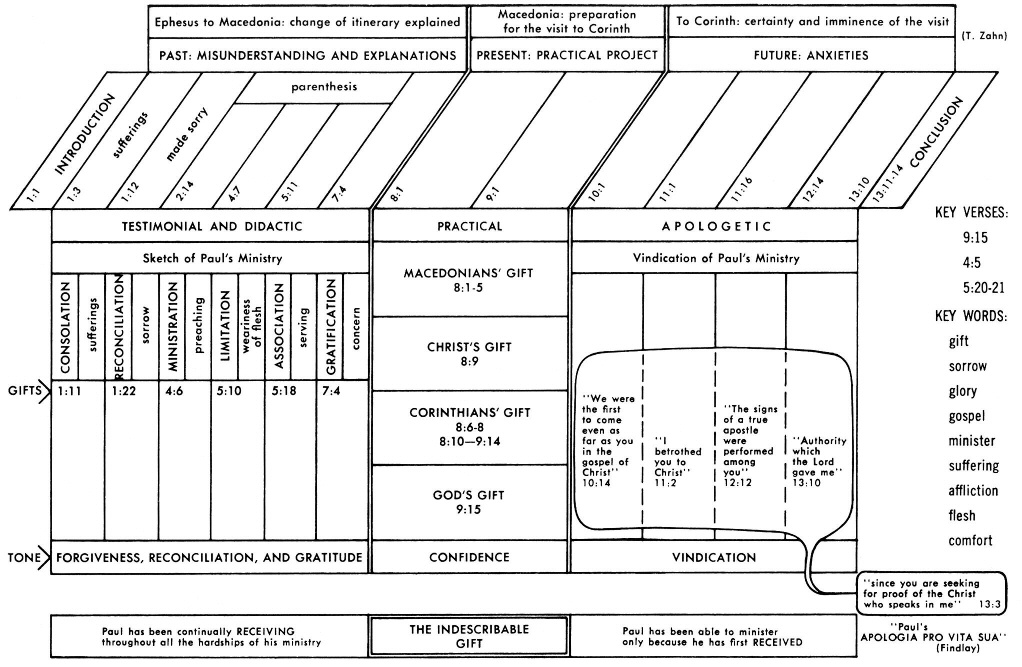
2 CORINTHIANS - PAUL'S MINISTRY IN THE LIGHT OF THE INDESCRIBABLE GIFT
Click chart to enlarge
Charts from Jensen's Survey of the NT - used by permission
Another Overview Chart on right side
Overview of
|
||
| 2Co 1:1-7:16 Character of Paul |
2Co 8:1-9:15 Collection for the Saints |
2Co 10:1-12:21 Credentials of Paul |
| Testimonial & Didactic | Practical | Apologetic |
| Past: Misunderstanding & Explanation |
Present: Practical Project |
Future: Anxieties |
| Apostle's Conciliation, Ministry & Exhortations | Apostle's Solicitation for Judean Saints | Apostle's Vindication of Himself |
| Forgiveness, Reconciliation Gratitude |
Confidence | Vindication |
|
Ephesus to Macedonia: |
Macedonia: Preparation for Visit to Corinth |
To Corinth: |
|
2Co 1:1-7:16 |
2Co 8:1-9:15 |
2Co 10:1-12:21 |
|
2Corinthians written ~ 56-57AD - see Chronological Table of Paul's Life and Ministry |
||
|
Adapted & modified from Jensen's Survey of the New Testament (Highly Recommended Resource) & Wilkinson's Talk Thru the Bible |
||
2 Corinthians 4:5 For we do not preach ourselves but Christ Jesus as Lord, and ourselves as your bond-servants for Jesus' sake..(NASB: Lockman)
Greek: ou gar heautous kerussomen (1PPAI) alla Iesoun Christon kurion, heautous de doulous umon dia Iesoun.
Amplified: For what we preach is not ourselves but Jesus Christ as Lord, and ourselves [merely] as your servants (slaves) for Jesus’ sake. (Lockman)
Barclay: It is not ourselves that we proclaim, but Christ Jesus as Lord, and ourselves your servants for Jesus’ sake. (Westminster Press)
God's Word: Our message is not about ourselves. It is about Jesus Christ as the Lord. We are your servants for his sake. (GWT)
Easy English: We do not preach about ourselves but about Christ Jesus as Lord. We are your servants because we love Jesus.
ESV: For what we proclaim is not ourselves, but Jesus Christ as Lord, with ourselves as your servants for Jesus' sake. (ESV)
KJV: For we preach not ourselves, but Christ Jesus the Lord; and ourselves your servants for Jesus' sake.
NET: For we do not proclaim ourselves, but Jesus Christ as Lord, and ourselves as your slaves for Jesus' sake. (NET Bible)
NIV: For we do not preach ourselves, but Jesus Christ as Lord, and ourselves as your servants for Jesus’ sake. (NIV - IBS)
NLT: You see, we don’t go around preaching about ourselves. We preach that Jesus Christ is Lord, and we ourselves are your servants for Jesus’ sake. (NLT - Tyndale House)
Phillips: For it is Christ Jesus the Lord whom we preach, not ourselves; we are your servants for his sake (Phillips: Touchstone)
Weymouth: (For we do not proclaim ourselves, but we proclaim Christ Jesus as Lord, and ourselves as your bondservants for the sake of Jesus.)
Wuest: for we do not proclaim ourselves but Christ Jesus as Lord; but we proclaim ourselves as your slaves for the sake of Jesus, (Eerdmans Publishing - used by permission)
Young's Literal: for not ourselves do we preach, but Christ Jesus -- Lord, and ourselves your servants because of Jesus;
- we: Mt 3:11 Jn 1:21-23 3:27-31 7:18 Ac 3:12,13 8:9,10 10:25,26 Ac 14:11-15 Ro 15:17,18 1Co 1:13-15,23 3:5,6 10:33 Php 1:15 1Th 2:5,6 Tit 1:11 1Pe 5:2-5 2Pe 2:3
- Christ: 2Co 1:19 Mt 23:8 Ac 2:36 5:31 10:36 Ro 14:8,9 1Co 1:23 2:2 8:6 1Co 12:3 15:47 Php 2:11
- and: 2Co 1:24 5:14,15 Mt 20:25-27 Lk 22:25,26 Jn 13:14,15 Ro 15:1,2 1Co 9:19-23 Ga 5:13 2Ti 2:10
- 2 Corinthians 4 Resources - Multiple Sermons and Commentaries
IT IS NOT ABOUT US
BUT ABOUT HIM!
For we do not preach (kerusso) ourselves but Christ Jesus as Lord, and ourselves as your bond-servants for Jesus' sake - Not is Greek "ou" signifying absolute negation. We...ourselves continues Paul's use of plural pronouns to minimize drawing attention to himself (eg, his oratorical ability, etc) and away from Christ Jesus. Paul did not preach a personal, private program but a Person, the primary Person of all eternity, Christ Jesus our Lord. Not (ou) signifies absolute negation. Paul continues his staunch defense of the authenticity of his ministry adamantly denying that he is preaching self when in fact his sole focus is the Savior. It's all about Him, not us! We are not capable of saving anyone; we are not looking for praise and attention. If that is your goal or desire go to Hollywood and become a star in the movies!
The focus in ministry should never be on ourselves!
Are you as convicted as I am?
Given the fact that we are not capable of saving anyone, should not be seeking the praise or attention of men but should be "moonlight ministers" always reflecting the light of the Son!
Paul's practice (preaching Savior, not self) was diametrically opposed to that of the false teachers at Corinth about whom he wrote somewhat satirically...
Not that we [have the audacity to] venture to class or [even to] compare ourselves with some who exalt and furnish testimonials for themselves! However, when they measure themselves with themselves and compare themselves with one another, they are without understanding and behave unwisely. (2Co 10:12+, Amplified, read the context 2Co 10:13-18).
Comment: Paul, a man of great humility (2Co 1:9+), went to great lengths to avoid self-promotion (Not commending himself - 2Co 3:1-3+). From this verse we see Paul's adversaries thought quite a lot of themselves! However, these false teachers did not compare themselves with the divine standard exemplified by Christ, but artificially set their own standards, mere human standards. As John MacArthur says "Paul’s disclaimer was both a denial of the false apostles’ charge and an indictment of them." (2Corinthians)
Alfred Plummer notes that "God blinded (Paul's) bodily eyes for three days as a means towards healing his spiritual blindness. How could a man who had had these experiences preach himself? (2 Corinthians 4)
Paul would have liked the salty saint Vance Havner who once said "It is not the business of the preacher to fill the house. It is his business to fill the pulpit. (Ed: Amen or Oh my! - And to fill his hearer's hearts and souls with the Word of Truth, the bread of life, Christ Jesus, the Incarnate Word! - Mt 4:4 Lk 4:4 Jn 6:35, 41 48 50 51 58 cp Jn 6:63)
Kent Hughes has a wonderful comment “Paul was a minister, not a master; a servant, not a lord” (Hughes). Truly, no man can fancy himself great and at the same time declare that God is great. The proclamation that “Jesus Christ is Lord” is the province of the humble alone. (Ed: Amen!) Paul’s proverbial declaration stands as a rebuke to any minister of the Gospel who aspires to greatness or fame. Any preacher who fails to preach “Jesus Christ as Lord” or fails to be a servant “for Jesus’ sake” has forsaken the apostolic ministry of the new covenant. (2 Corinthians: Power in Weakness. Preaching the Word)
James Denney makes an interesting observation on this text noting that "This is probably the simplest and most complete directory ("collection of directions") for preaching the Gospel. The preacher is to make the truth (cp Jn 14:6) manifest. It is implied in what has just been said, that one great hindrance to its manifestation may easily be its treatment by the preacher himself (Ed: I am primarily a teacher and this struck a convicting cord in my heart for I love to use lots of "power point" slides!). If he wishes to do anything else at the same time, the manifestation will not take effect. If he wishes, in the very act of preaching, to conciliate a class, or an interest; to create an opinion in favor of his own learning, ability, or eloquence; to enlist sympathy for a cause or an institution which is only accidentally connected with the Gospel,--the truth will not be seen, and it will not tell. (The Expositor's Bible)
NOT SELF
BUT SAVIOR!
Guzik comments that "Not everyone who opens a Bible and starts talking is preaching Christ Jesus the Lord. Many well-intentioned preachers are actually preaching themselves instead of Jesus. If the focus is on the funny stories or the touching life experiences of the preacher, he may be preaching himself. (2 Corinthians 4)
THOUGHT: How long are your introductory remarks before you begin to exposit the Word of God? If you are spending a significant portion of your time [beloved, every pulpit minute is like "gold" when viewed in the light of eternity!] telling the saints stories about yourself [I listened to a sermon this morning where the pastor took the opening 10 minutes [out of 40 minutes total] to talk about himself, not once mentioning a specific Scripture!], you are short-changing both God and the saints! Shorten your intro so you don't short change God and God's people! It is no accident that 3 times Jesus told Peter "Feed [each time using present imperative = command to make this his continual practice] My lambs/sheep!" [Jn 21:15KJV, Jn 21:16KJV Jn 21:17KJV, Peter apparently got the message in turn commanding pastors in 1Pe 5:2-+ {aorist imperative = Do this effectively, even with a sense of urgency} to "shepherd" {poimaino = graze, guide and guard]}. Pastor Rob Salvato adds a touch of satire to the preceding comment...
Jesus said to Peter if you love me feed my sheep – Note he didn’t say if you love me COUNT my sheep! IF you love me ENTERTAIN my sheep! If you love me DRAMA my sheep! (These things are) not the priority. The goal, the message (today, "the old, old story") is the same as it was 2,000 yrs ago when Jesus commissioned Peter – if you love me – FEED MY SHEEP [Sermon Notes on 2Corinthians 4:1-6 "We Preach Jesus"])
Guzik continues Often, people love it when the preacher preaches himself. It is revealing, it seems intimate, and it is often entertaining. It is also tempting for the preacher, because he sees how people respond when he focuses the message on himself. But the bottom line is that the preacher himself can’t bring you to God and save your eternal soul; only Jesus can. So preach Jesus!
Is it wrong for a preacher to tell a joke? To use a story from his own life? Of course not. But it is all a matter of proportion. It’s like asking, “is it all right to put salt in the soup?” Of course, but don’t put in too much. And if, week after week, too much of the preacher is in the sermon, it is wrong. A. T. Robertson said the preaching of one’s self was “Surely as poor and disgusting a topic as a preacher can find.”
Don’t we have a greater message
than ourselves?It wasn’t only that Paul did not preach himself. He also did not preach a gospel of moral reform, or a list of rules you must follow to be right with God. He preached Jesus! Paul’s goal in preaching was to bring men to Jesus, not to make moral changes in men. . (2 Corinthians 4)
Charles Hodge adds that "To preach one's self is to make self the end of preaching; i.e., preaching with the design to attract to ourselves the admiration, the confidence or homage of men. The Paul declares he did not do, but he preached Christ Jesus the Lord.
His object in preaching was to bring men to recognize Jesus, the son of Mary, as Christ; i.e., as Him Whom Moses and the prophets designated as, and consequently that this Jesus was, had done, is doing, and would hereafter do all that had been asserted or predicted of the Messiah; and further that He is Lord in the sense in which every tongue in heaven and on earth and under the earth shall confess that he is Lord.
The great end of Paul’s preaching, therefore, was to bring people to receive and acknowledge Jesus of Nazareth as the Messiah and as the supreme Lord, the Maker of heaven and earth. This is the only proper end of preaching. It is the only way by which people can be made either virtuous or religious. It is the only way in which either the true interests of society or the salvation of souls can be secured.
To make the end of preaching the inculcation of virtue, to render men honest, sober, benevolent and faithful, is part and parcel of that wisdom of the world that is foolishness with God. It is attempting to raise fruit without trees. When a man is brought to recognize Jesus Christ as Lord, and to love and worship him as such, then he becomes like Christ. What more can the moralist want?”
Paul cared little for the clamor of the Greeks that he should preach wisdom and virtue. He knew that by preaching Christ he was adopting the only means by which people can be made wise and virtuous here and blessed hereafter. (2 Corinthians Commentary)
Matthew Henry comments that here Paul presents more proof of the integrity of his ministry (recall that in Corinth there Satan's emissaries ["secret agents"], false teachers, enemies of the Gospel of Christ [2Co11:12 13 14 15], who were attempting to disparage, denigrate and destroy Christ's Gospel messenger, the apostle Paul - perhaps you can identify with Paul dear pastor!) emphasizing that "We preach not ourselves. Self was not the matter nor the end of the apostles' preaching: they did not give their own notions and private opinions nor their passions and prejudices for the word and will of God; nor did they seek themselves, to advance their own secular interest or glory. (Ed: An excellent ministry motif - Ps 115:1-+)" (2 Corinthians 4)
Preach - This verb kerusso (see more discussion below) is essentially a synonym for euaggelizo/euangelizo (What word do you see in this latter verb? "evangelize") which is used most often in the NT as a reference to preaching the gospel. The verb kerusso emphasizing to proclaim as a herald and euaggelizo placing emphasis on the announcement of message of good news or good tidings. Euaggelizo stresses the content while kerusso emphasizes the manner of the proclamation but both convey a sense of urgency calling on the hearers to obey the message of the Good News.
For example, the writer of Hebrews repeatedly exhorts his wavering Jewish hearers to heed the Gospel call writing...
Therefore, let us fear lest ("Us" = the writer includes himself as not above hearing what follows), while a promise remains of entering His rest (What a beautiful description of the Gospel! cp Ep 3:6-+), any one of you (the writer does not say "us" here, because he himself has entered God's Gospel rest, a rest from empty works of the flesh [Is 64:6] and rituals calculated to garner God's favor [Col 2:23-+]) should seem to have come short of it. For indeed we have had good news preached (euaggelizo/euangelizo ~ "Gospelled") to us, just as they also (referring to Israel in the OT who had good news preached to them, cp the message their physical "father" Abraham heard [Gal 3:8], but who unlike Abraham [Ge 15:6] refused to believe [He 3:18, 19-+]); but the word (~the Gospel) they heard did not profit them, because it was not united by faith (pistis) in those who heard (Beloved, hearing the Gospel is not enough - in fact it can be self deluding that one is spiritually safe" [Jas 1:22-+]. One must respond to the Gospel in repentance and faith [Mk 1:14,15] in order to enter the spiritual rest in Christ [cp Mt 11:28, 29, 30]) (He 4:1, 2-+). (Are you spiritually exhausted? In need of rest? Perhaps you might want to take a moment and study the - wonderful concept of "Rest" in the Bible)
Hunter commenting on preaching says that "In the New Testament the verb (Kerusso) does not mean ‘to give an informative or hortatory or edifying discourse expressed in beautifully arranged words with a melodious voice; it means to proclaim an event (Ed: Beloved, I would add that even more, in the NT context, kerusso most often means to proclaim the Person of Christ. Some of Paul's last words were "Preach the Word" {~"Preach Christ Jesus as Lord"!}. [2Ti 4:2-+] for Who is the "Word" we are to proclaim but the Incarnate Word, Christ Jesus our Lord!)
Preach (proclaim) (2784) (kerusso or kerysso from kerux/keryx = a herald - one who acts as the medium of the authority of one who proclamation he makes; kerugma = the thing preached or the message) means to proclaim (publicly) or to herald or act as a public crier - the town official who would make a proclamation in a public gathering. Kerusso was used of the official whose duty it was to proclaim loudly and extensively the coming of an earthly king, even as our Gospel in a sense is a clear proclamation that the King of kings is returning (Re 19:16-+) and that every knee should bow to Him now in saving faith before He appears "a second time for salvation without reference to sin, to those who eagerly await Him." (He 9:28-+). In other words when He appears a second time it will not be to bring salvation but "to judge the living and the dead" (2Ti 4:1-+ Jn 5:22, 27 - in light of this all do well to heed His words in Jn 5:24, 8:24)
The Imperial Herald would enter a town in behalf of the Emperor, and make a public proclamation of the message which his Sovereign ordered him to give, doing so with such formality, gravity, and authority as to emphasize that the message must be heeded! (Think about this in regard to the Gospel of God instead of the decree of a man! cf 1Th 2:13-+). He gave the people exactly what the Emperor bade him give, nothing more, nothing less. He dare not add to the message or take away from it. Should this not be the example and pattern every preacher and teacher of the holy gospel of God seeks and strives to emulate, yea, even doing so with fear and trembling..."not as pleasing men but God, who examines our hearts"?! (1Th 2:4 -+)
The original meaning of the root word kerux was a "herald at the royal court." Homer used kerusso and kerux in this connection. They not only announced the coming of the prince, but they also carried his commands to the uttermost corners of his realm. As the government of Greece became more republican, these heralds came to serve the state rather than the court. Certain qualities were required of heralds. They must have powerful voices, so voice auditions were often held. Also they had to be capable of calming down an unruly mob, in order to faithfully communicate the command. An honest disposition was also required, as a protection against the exaggeration of a royal decree. Furthermore, they could make no additions or subtractions from the received message. Later these heralds were also used to declare the message of a Greek deity or a religious oracle.
Kerusso does not carry within it the content or nature of the message which is proclaimed. The context usually indicates what is being preached or qualifying phrase must be used for that purpose. In the New Testament, the word is used either with a qualifying phrase such as “the gospel” (Mark 16:15), or the contents of the proclamation are given as in Revelation 5:2, or it is used alone without the contents of the message being given as in Romans 10:15.
R. C. H. Lenski - The point to be noted is that to preach is not to argue, reason, dispute, or convince by intellectual proof, against all of which a keen intellect may bring counterargument. We simply state in public or testify to all men the truth which God bids us state. No argument can assail the truth presented in this announcement or testimony. Men either believe the truth, as all sane men should, or refuse to believe it, as only fools venture to do” (The Interpretation of St. Matthew’s Gospel [Minneapolis: Augsburg, 1964], p. 168).
Dwight L. Moody well said that "The best way to revive a church is to build a fire in the pulpit (Ed: And I would add a fire in the preacher's heart! Dear pastor if you are feeling a bit "un-revived" you might enjoy revivalist Sammy Tippit's book entitled Fire in Your Heart)
John Ruskin had some sage words on preaching the Word "Preaching is 30 minutes in which to raise the dead."
But - Paul draws a sharp contrast ("But" ~ "changes direction") - Not ourselves but Him. The only Gospel of any worth is that which preaches Jesus Christ as Lord. How sad to see the evangelical world arguing over the Lordship of Christ.
QUESTION - What is lordship salvation? | GotQuestions.org - (Excerpt) - The doctrine of lordship salvation teaches that submitting to Christ as Lord goes hand-in-hand with trusting in Christ as Savior. Lordship salvation is the opposite of what is sometimes called easy-believism or the teaching that salvation comes through an acknowledgement of a certain set of facts.
Christ Jesus as Lord - The NAS surprisingly follows the Greek of the Textus Receptus (used for the KJV) which has Christ before Jesus. The more modern Greek texts have Jesus preceding Christ. (as rendered in the ESV, NIV, Amplified, NET, NLT) In any event, Hughes rightly notes that Christ Jesus as Lord is "shorthand for the Gospel." Paul is saying that this is the heartbeat of his ministry and it should be ours, preaching Christ Jesus AS Lord because Christ Jesus IS Lord! This truth is crucial to the Gospel and is reiterated by Paul in other letters...
Romans 10:9-10+ that if you confess with your mouth Jesus as Lord, and believe in your heart that God raised Him from the dead, you will be saved; for with the heart a person believes, resulting in righteousness, and with the mouth he confesses, resulting in salvation.
1 Corinthians 12:3+ Therefore I make known to you that no one speaking by the Spirit of God says, “Jesus is accursed”; and no one can say, “Jesus is Lord,” except by the Holy Spirit.
Homer Kent minces no words in his comment that "One should beware of drawing categorical distinctions between accepting Christ as Savior and accepting Him as Lord. Both are clearly involved in any true commitment to Christ." (A Heart Opened Wide - Studies in 2 Corinthians; see also 2 Corinthians 2:14-4:18 The Glory of Christian Ministry - An Analysis)
As Paul Apple rightly asks "What type of false gospel is it that presents Christ as less than Lord?" The Focus Must Always Be On the Lordship of Christ.
The Name Christ (Messiah, Anointed One) speaks of His fulfillment of OT prophecies (Messianic Prophecies). The Name Jesus speaks of His humanity, His incarnation, and literally means "Jehovah saves" (see Mt 1:21, cp Simeon's description when he beheld the infant Jesus in Lk 2:29, 30). Lord (more below) speaks of His exaltation by the Father following His "humiliation" (His crucifixion) (Php 2:8, 9, 10, 11-+). (More in depth discussion = The Name and Titles of Jesus Christ)
Give Me Jesus
Vocal by Fernando Ortega
In the Morning when I rise
In the Morning when I rise
In the Morning when I rise
Give me Jesus.
Refrain...
Give me Jesus,
Give me Jesus,
You can have all this World
But give me Jesus
And when I am alone
Oh, and when I am alone
And when I am alone
Give me Jesus
And when I come to die
Oh, and when I come to die
And when I come to die.
Give me Jesus.
John MacArthur notes that "The heart of New Covenant preaching is communicating the truth about Jesus Christ, since “faith comes from hearing, and hearing by the word of [lit., “about,” or “concerning”] Christ” (Ro 10:17-+). True preaching about Christ includes the truth that He is both Savior and Lord. Its goal is to get people to understand Who Jesus is, why He came, and what He accomplished. God, in His sovereign grace, then uses that truth to bring salvation to the human heart. (2Corinthians. Chicago: Moody Press)
Warren Wiersbe - What happens when you share Jesus Christ with lost sinners? The light begins to shine! (In 2Co 4:6) Paul compared conversion to Creation as described in Genesis 1:3. Like the earth of Genesis 1:2, the lost sinner is formless and empty; but when he trusts Christ, he becomes a new creation (2Co 5:17-+). God then begins to form and fill the life of the person who trusts Christ, and he begins to be fruitful for the Lord. God’s, “Let there be light!” makes everything new. (Bible Exposition Commentary)
Paul's passion was proclamation of a Person as he explained to the saints at Colossae. He knew that every false teacher and every cult seeks in some way (often quite subtle) to deny, denigrate or pervert the truth about Christ and so he said...
We proclaim (kataggello not kerusso - present tense = continually) Him (Christ - Col 1:27-+) admonishing (noutheteo = warning - present tense = continually - we continually need this!) every man (note repetition of Greek "pas" 4x in v28 = all, every = no exceptions!) and teaching (again present tense) every man (no favorites - we all have the same need...Jesus!) with all (OT and NT) wisdom, that we may present every man (Note: Paul is not being chauvinistic - This does not apply just to the male gender but to all believers! cp Col 3:11-+ Ga 3:28) complete (teleios = reaching the goal = spiritually mature = Christ-likeness) in Christ. 29 And for this purpose also I labor (kopiao continually, to the point of exhaustion), striving (agonizomai - continually) (How is it possible for Paul to accomplish this task?) according to His power (dunamis), which mightily works (energeo in present tense = continually) within me (Don't miss this axiomatic spiritual dynamic - We work, He works in and through us as we work - it is not just "let go, let God", it's more like "let's go and let God"). (Col 1:28-+, Col 1:29-+)
As Lord - We don't "make" Jesus Lord. He is Lord of all, period. His Lordship deserves our total obedience (enabled by His Spirit Php 2:13NLT-+). When someone receives Him as Savior, they receive "all" of Him and that includes the fact that He is Lord (cp Ro 10:9, 10-+). And remember that it is not by accident (but by inspiration) that the NT writers refer to Jesus as Lord more frequently than by any other title! Case closed!
Paul gives a dramatic contrast using two antithetical terms Lord and bond-servants.
MacDonald: "In this one verse we have both the poorest theme for a preacher, and the best theme. The poorest theme is ourselves, while the best theme is Christ Jesus the Lord." Apparently the Judaizers had a great habit of preaching about themselves. Paul separates himself from such a company. He would not waste the people’s time by preaching on such an unworthy subject. His theme was Christ Jesus the Lord. He sought to bring men and women to the place where they were willing to bow the knee to Jesus Christ and to pay their homage to Him as Lord of their lives. The apostle introduced his team as your bondservants for Jesus’ sake. In so doing, he effectively hid himself and his co-workers in the background. They were only slaves, ready to help in any way that would bring men to the Lord Jesus. (Believer's Bible Commentary)
And ourselves as your bond-servants for Jesus' sake - Message = "All we are is messengers, errand runners from Jesus for you." Paul presents himself to the saints at Corinth as their bond-servants. Paul (first and foremost a bondservant of Christ Jesus Ro 1:1-+) is saying I am not trying to be your master (some of his detractors may have made that accusation or sought that title for themselves) but just the opposite -- your servant. This is another evidence of Paul's humility and passion to imitate his Lord and Master Jesus Who also came not be "be served but to serve" (Mk 10:45+). TLB renders for Jesus' sake as "because of what Jesus has done for us." Paul has no thought of "pay back" but of privilege. Paul's attitude reminds me of the story of the businessman who once asked his Bible study group, “How can you tell if you have a servant attitude?” “By the way you react when you are treated like one,” was the reply. (Amen!)
The old Maranatha chorus Servant of All says it well "If you want to be great in God's Kingdom, learn to be the servant of all!"
Robertson on bond-servants for Jesus' sake - This is the sufficient reason for any preacher’s sacrifice, “for Jesus’ sake.”
Ray Stedman - If you want to know where we fit in, here it is: we are your servants for Jesus' sake. We are not your masters; we do not own you; we are not your bosses; we do not come to tell you everything to do and give you orders and be a little pope in every church we come into. No, we are your servants. We have come to help you. We have come to minister to you, to labor among you, to teach and instruct you, but we are not here to boss you." The apostle is careful to make that plain.
Tasker - All the service Paul (and every true Christian missionary and pastor) renders to his converts is not done primarily for their sakes. He has a more compelling love and a more overriding loyalty. He is their servant, because first and foremost he is the servant of Jesus Christ, by whose love he is constrained, and the promotion of whose glory is his passionate desire.
Lord (master, owner)(2962)(kurios from kuros = might or power) describes one who is supreme (highest in rank, order and authority), who is sovereign (in absolute control) and who possesses absolute authority, absolute ownership and absolute power. Is this not an excellent description of Christ Jesus?
Broomall - The supreme Lordship of Christ was central in apostolic preaching (cf. the same construction as here in the ASV translation of Rom 10:9; Phil 2:11). (Wycliffe Bible Commentary - 2 Corinthians 4)
Kurios also describes one to whom a person or thing belongs and over which he has the power of deciding to men or property. Thus Kurios includes the following ideas...
as the owner of the vineyard (Mt 20:8; 21:40; Mk 12:9; Lk 20:13, 15)
as the Lord of the harvest (Mt. 9:38; Lk 10:2)
as the master of the house (Mk 13:35, cp Lxx - Jdg 19:12)
as Lord of the Sabbath (Mt 12:8; Mk 2:28; Lk 6:5) - as having the power to determine what is suitable to the Sabbath and of releasing Himself and others from its obligation.
In Biblical terms Christ Jesus is every believer's Lord for as Paul wrote in the first letter...
Or do you not know that your body is a temple of the Holy Spirit Who is in you, Whom you have from God, and that you are not (absolute negation) your own. (And went on to explain why believers are no longer their "own") For you have been bought with a price (His precious blood [1Pe 1:18, 19-+] has redeemed us from enslavement to Sin [Ro 6:11-+, Ro 6:18-+], the Law [Ro 6:14-+, Ro 7:4-+, Ro 7:6-+], the Devil [He 2:14, 15-+] and the evil world system [Gal 6:14-+], setting us free [Jn 8:32, 36] to be His own permanent possession - Titus 2:14-+): therefore (Since we are not our own but His what are we to do?) glorify [aorist imperative = Do this now! Do it effectively! Just do it!] God in your body (His Temple! cp Ro 12:1-+). (1Co 6:19-+ , 1Co 6:20-+)
Wayne Barber offers this note of encouragement regarding Jesus as Lord - When you refer to Jesus as Lord, you’re not just referring to the position He holds, but you’re referring to the compassion He feels for the people whom He oversees. Whatever He does in the authoritative position that God has put Him in is for our good.
Tony Garland (in his comment on Re 1:18-+) writes that "Designating someone as “Lord,” especially in John’s day, could have serious implications. It was a title which Christians did not use lightly. (Quoting from Harold Foos "Christology in the Book of the Revelation" Garland adds that) “Lord (kurios) means that the bearer was worthy of divine recognition and honor. The apostolic writers and early believers were well aware of this meaning. Polycarp, for example, died as a martyr rather than call Caesar "kurios."
Broomall - Paul repeatedly calls himself a “slave” (doulos; cf. Rom 1:1; Gal 1:10; Phil 1:1; Tit 1:1). Here he uses the term to describe his relationship to his converts at Corinth.(Wycliffe Bible Commentary - 2 Corinthians 4)
In his first epistle Paul had explained the spiritual significance of becoming a bondservant to the saints at Corinth, writing...
For though I am free (eleutheros) from all men, I have made myself a slave (douloo) to all, (Why?) so that I may win more. (1Co 9:19, See context = 1Co 9:18-23)
Comment: Balance Paul's making himself a bondservant with the truth of Galatians 1:10 (cp 2Ti 2:4-+, 2Co 5:9-+,1Th 2:4-+). His desire even as their bondservant was ultimately to do only those things that would please His Lord and Master Christ Jesus. This is a good example to emulate!
MacDonald emphasizes Paul's "balance": In one sense he was free from all men. No one could exercise jurisdiction or compulsion over him. Yet he brought himself under bondage to all people in order that he might win the more. If he could make a concession without sacrificing divine truth he would do it in order to win souls to Christ. (MacDonald, W & Farstad, A. Believer's Bible Commentary: Thomas Nelson) (Bolding added for emphasis)
David Lowery Comments: Though he was free (eleutheros; cf. 1Co 8:9; 9:1) he voluntarily became a slave (cp His Master's example - Php 2:6, 7-+, 1Pe 2:21-+ 1Co 11:1) for the good of others (1Co 10:33) whom he wanted to win (1Co 9:22) (Bible Knowledge Commentary)
Thomas Constable has a good word: Serving people rather than commanding them is the way to win them (cf. Mark 10:45). (2 Corinthians Expository Notes)
African Bible Commentary: His self-denying love, which led him to surrender even privileges he was entitled to, contrasts with the Corinthians’ knowledge, which they boasted about and clung to even if it might harm others (see 1Co 8:1, 2, 3).
McGee: He had the freedom to make himself a servant! (McGee, J V: Thru the Bible Commentary: Thomas Nelson)
Warren Wiersbe: What a paradox: free from all men, yet the servant of all men! “Ourselves your servants for Jesus’ sake” (2Co 4:5). Because he was free, Paul was able to serve others and to set aside his own rights for their sake. It is unfortunate that the phrase “all things to all men” (1Co 9:22) has been used and abused by the world and made to mean what Paul did not intend for it to mean.Paul was not a "chameleon " who changed his message and methods with each new situation.Nor was Paul a compromiser who adjusted his message to please his audience. He was an ambassador, not a politician! (Bible Exposition Commentary)
Joseph Beet - As a servant or slave toils not for his own profit, except indirectly, but for his master’s, so Paul puts forth all his powers, forgetful of himself, to advance the highest interests of his readers. (2 Corinthians 4 Commentary)
Matthew Henry comments that Paul preached Christ Jesus as Lord and as Christ's bondservant..."His business was to make his Master known to the world as the Messiah, or the Christ of God, and as Jesus, the only Saviour of men, and as the rightful Lord, and to advance His honour and glory. (2 Corinthians 4)
Bondservants (1401)(doulos from deo = to bind) describes one who is bound to another in servitude (a condition in which one lacks liberty especially to determine one’s course of action or way of life). Doulos also conveys the idea of the slave's close tie to his master, belonging to him, obligated to him and desiring to do his will. In sum, the will of the doulos was in a very real sense consumed or better subsumed (which means absorbed in something else, specifically...) in the will of his master. Doulos was the most abject, servile term of the 6 Gk words for a "slave" This abject, servile attitude on the part of a pagan slave finds its expression in true Christian humility on the part of the Christian who regards himself as a slave of Jesus Christ.
Paul repeatedly referred to himself as the Lord's bondservant (cp Ro 1:1-+) having surrendered himself wholly to the Lord's will to Whom he was devoted even to the point of disregard for his own personal interest (He recognized he was not his own!). In one sense Paul had no will of his own and no time of his own but acted in obedience to and dependence upon Christ Jesus his Lord. While this definition is true, it is not the entire picture as they say, for included in this idea of being a slave of Christ, is the paradoxical truth of genuine liberty, a quality of freedom about which the world knows nothing. The unregenerate (lost, unsaved) person falsely thinks that Christianity is restrictive (a list of do's and don'ts - unfortunately some true believers have fallen back into the "trap" of living under the law) and constricts one's freedoms, but the truth is that freedom in its most glorious perspective is not the right to do as we please (World's way) but the power to do as we should (God's way)! That's the freedom that Paul experienced and which he proclaimed in the Gospel of His Lord Jesus Christ.
Matthew Henry adds that "The highest honour of the greatest apostle, and most eminent ministers, is to be the servants of Jesus Christ; not the masters of the churches, but the servants of Christ. (2 Corinthians 4)
Kenneth Wuest adds that a doulos as "the most abject, servile term used by the Greeks to denote a slave. The word designated one who was born as a slave, one who was bound to his master in chords so strong that only death could break them, one who served his master to the disregard of his own interests, one whose will was swallowed up in the will of his master. Paul was born a slave of sin at his physical birth, and a bondslave of his Lord through regeneration. (+: There was another word, andrapodon which described a person taken prisoner in war and sold into slavery) The cords that bound him to his old master Satan, had been rent asunder in his identification with Christ in the latter’s death (Ro 6:6-+ Gal 2:20-+). The cords that bind him to his new Master will never be broken since the new Master will never die again, this One who is now his life (Php 1:21-+,Col 3:3,4-+). He has changed masters because he has a new nature (2Co 5:17-+, 2Pe 1:3,4-+), the divine, and the evil nature which compelled him to serve the Devil has had its power over him broken (Col 1:13-+, Heb 2:14, 15-+). Paul’s will, at one time swallowed up in the will of Satan, now is swallowed up in the sweet will of God. The reader will observe how wonderfully God has watched over the development of the Greek language so that at the time it was needed as the medium through which He would give His New Testament revelation to the human race, its words were fit receptacles and efficient instruments for the conveyance of His message to man. Paul calls himself a bondslave of Christ Jesus...The apostle is proud of the fact that he is a slave belonging to his Lord. There were certain individuals in the Roman empire designated “Slaves of the Emperor.” This was a position of honor. One finds a reflection of this in Paul’s act of designating himself as a slave of the King of kings. He puts this ahead of his apostleship.(Wuest Word Studies - Eerdman Publishing Company Volume 1, Volume 2, Volume 3 - used by permission)
To summarize the doulos...
- Was owned by and totally possessed by his master.
- Existed for his master and no other reason.
- Had no personal rights.
- Was at the master’s disposal "24/7".
- Had no will of his own but was completely subservient to the master.
A Tale Of Two Cities - It was the largest of congregations; it was the smallest of congregations. That’s the best way to describe two services I attended within 24 hours. The first was an evangelistic outreach in Washington, DC, attended by nearly 20,000 people. A man preached, and hundreds of people responded to the invitation to put their faith in Christ.
The next night I was in a small country church service attended by about 50 people. A man preached, and at the end of the sermon no one responded openly to the invitation.
Both men were called of God and doing what He equipped them to do. Was one more successful or valuable to God than the other? I think not.
What I saw in those 2 days was the beauty of God’s direction. He called both men to specific ministries in specific places. His hand was on each. Neither could take pride in results or be disappointed by the lack of them, because only God gives the increase (1Co 3:6, 7).
Are you discouraged in the ministry God has called you to? Are you intimidated by the more obvious results of some Christian “superstars”? It’s time to turn your eyes away from numbers and people and redirect them toward Jesus (2Co 4:5). Stay close to Him. Keep seeking His will. His smile of approval is all you need. — by Dave Branon
The Lord gives each of us a task
He wants us to fulfill;
To love and serve Him faithfully
Accomplishes His will.
—Sper
Man crowns success;
God crowns faithfulness!
Service And Witness - While serving as a maid in London, England, in the early part of the 20th century, Gladys Aylward had other dreams. Her goal was to be a missionary to China. Having been rejected by a Christian missionary organization as “unqualified,” Gladys decided to go there on her own. At the age of 28, she used her life savings to purchase a one-way ticket to Yangcheng, a remote village in China. There she established an inn for trade caravans where she shared Bible stories. Gladys served in other villages as well and became known as Ai-weh-deh, Chinese for “virtuous one.”
The apostle Paul also spread the gospel to distant regions of the world. He extended himself as a servant to meet the needs of others (2 Cor. 11:16-29). He wrote this about serving: “We do not preach ourselves, but Christ Jesus the Lord, and ourselves your bondservants for Jesus’ sake” (4:5).
Not all of us are called to endure hardship to spread the gospel in distant lands. But each of us is responsible as a servant of God to share Christ with people in our sphere of influence. It’s our privilege to help our neighbors, friends, and relatives. Ask God for openings to serve and to talk about Jesus who gave Himself for us.— by Dennis Fisher
My life is a painting created by God,
And as such I’ve nothing to boast;
Reflecting the image of Christ to the world
Is what I desire the most. —Sper
We serve God by sharing His Word with others.
To Tell The Truth - When you think of the term evangelism, what picture flashes onto the wall of your mind? A large stadium filled with people? A small booklet with a set of diagrams? A Christian wearing a pin with the symbol of a fish? A zealous believer playing intellectual chess with a pagan opponent? A salesman convincing a reluctant person to “try Jesus”?
Evangelism is a 10-letter dirty word to some of us. While we think it’s a dandy idea for others, we’re sure it isn’t for us. We’re not cut out to sell, nor shrewd enough to play intellectual games with non-Christians.
Evangelism, though, isn’t about being a huckster who cons people into buying what they don’t need. It has nothing to do with grabbing people by the lapels and shoving on them a faith that goes no deeper than the shirt pocket. What a grim indictment resides in the remark, “You could identify the people she had witnessed to by their haggard look.”
Evangelism is simply sharing with others what we know about Jesus. “We do not preach ourselves, but Christ Jesus the Lord” (2 Corinthians 4:5). No tricks. No deception. Speak the truth, the whole truth, nothing but the truth—in love. Then leave the results with God.— by Haddon W. Robinson
It's not our task to force God's truth
On those who may the truth detest,
But we are asked to share Christ's love
And let God's Spirit do the rest. —D. De Haan
We who know the joy of salvation should not keep it to ourselves.
2 Corinthians 4:6 For God, Who said, "Light shall shine out of darkness," is the One who has shone in our hearts to give the Light of the knowledge of the glory of God in the face of Christ. (NASB: Lockman)
Greek : hoti o theos o eipon, (AAPMSN) Ek skotous phos lampsei, (3SFAI) os elampsen (3SAAI) en tais kardiais hemon pros photismon tes gnoseos tes doxes tou theou en prosopo [Iesou] Christou.
Amplified: For God Who said, Let light shine out of darkness, has shone in our hearts so as [to beam forth] the Light for the illumination of the knowledge of the majesty and glory of God [as it is manifest in the Person and is revealed] in the face of Jesus Christ (the Messiah). [Gen. 1:3.] (Lockman)
Barclay: This we must do because it is the God who said, “Out of darkness light shall shine.” who has shined in our hearts to illumine us with the knowledge of the glory of God in the face of Jesus Christ. (Westminster Press)
God's Word: We are his servants because the same God who said that light should shine out of darkness has given us light. For that reason we bring to light the knowledge about God's glory which shines from Christ's face. (GWT)
Easy English: God said, ‘Let light shine out of darkness.’ He has made his light shine in our minds. This light gives us the knowledge of God’s *glory. And God’s glory shines in the face of Jesus Christ.
ESV: For God, who said, "Let light shine out of darkness," has shone in our hearts to give the light of the knowledge of the glory of God in the face of Jesus Christ. (ESV)
KJV: For God, who commanded the light to shine out of darkness, hath shined in our hearts, to give the light of the knowledge of the glory of God in the face of Jesus Christ.
NET: For God, who said "Let light shine out of darkness," is the one who shined in our hearts to give us the light of the glorious knowledge of God in the face of Christ. (NET Bible)
NIV: For God, who said, “Let light shine out of darkness,” made his light shine in our hearts to give us the light of the knowledge of the glory of God in the face of Christ. (NIV - IBS)
NLT: For God, who said, “Let there be light in the darkness,” has made this light shine in our hearts so we could know the glory of God that is seen in the face of Jesus Christ. (NLT - Tyndale House)
Phillips: God, who first ordered 'light to shine in darkness', has flooded our hearts with his light. We now can enlighten men only because we can give them knowledge of the glory of God, as we see it in the face of Jesus Christ. (Phillips: Touchstone)
Weymouth: For God who said, “Out of darkness let light shine,” is He who has shone in our hearts to give us the light of the knowledge of God’s glory, which is radiant on the face of Christ.
Wuest: because the God who said, Out of darkness light shall shine, shined in our hearts, resulting in an illumination being given of the knowledge of the glory of God in the face of Christ. (Eerdmans Publishing - used by permission)
Young's Literal: because it is God who said, Out of darkness light is to shine, who did shine in our hearts, for the enlightening of the knowledge of the glory of God in the face of Jesus Christ.
- Who said "Light": Ge 1:3,14,15 Ps 74:16 136:7, 8, 9 Is 45:7
- Has shone: Eph 1:17 5:8 2Pe 1:19
- 2 Corinthians 4 Resources - Multiple Sermons and Commentaries
Related Passages:
Genesis 1:3, 14, 15 Then God said, “Let there be light”; and there was light....14 Then God said, “Let there be lights in the expanse of the heavens to separate the day from the night, and let them be for signs and for seasons and for days and years...15 and let them be for lights in the expanse of the heavens to give light on the earth”; and it was so
Isaiah 9:2+ The people who walk in darkness Will see a great light; Those who live in a dark land, The light will shine on them.
2 Peter 1:19+ So we have the prophetic word made more sure, to which you do well to pay attention as to a lamp shining in a dark place, until the day dawns and the morning star arises in your hearts.
THE CREATOR BRINGS
LIGHT OUT OF DARKNESS
For God - Paul explains why he does not preach himself (ourselves) but Christ as Lord and why he is their servant. God is the only One Who is able to shine light into spiritually dark hearts.
For - Notice the little preposition "for" (there are over 7000 "for's" in Scripture) and if the context indicates, as it does in this passage, that the "for" is a term of explanation, pause and ask yourself what is the Spirit seeking to explain? In fact, stop reading right now and observe 2Cor 4:6 and see if you can determine what Paul is explaining. Notice how pausing to ponder will always force you to examine the context. You can (and should) practice this simple discipline every time you encounter a for, and while not every instance is a term of explanation, a "for" at the beginning of a verse is almost always is used with that grammatical sense. I guarantee that if you begin to "pause and ponder," you will radically rejuvenate your "Read Through the Bible in a Year" program! You might even get a small journal and begin to keep notes on what the Spirit illuminates (see 1Cor 2:10-13) and how this truth can be applied to your daily life. As you practice interrogating the text (for, therefore, but, so that, etc) with 5W/H questions such as "What's the for explaining?", you will begin to learn to (1) Read the Bible inductively (power point overview) and to (2) Meditate (see also Primer on Biblical Meditation) on the Scripture. Meditation or "chewing the cud" (pondering the passage) of the Scripture (cf Mt 4:4, Job 23:12-+, Jer 15:16) so to speak is a vanishing discipline in our fast paced, hi tech, low touch society, but a spiritual discipline which God promises to greatly bless (See Ps 1:1-+, Ps 1:2-+, Ps 1:3-+, Joshua 1:8-+, cf Ps 4:4, 19:14, 27:4, 49:4, 63:6, Ps 77:6, 77:12, Ps 104:34, Ps 119:15, 119:23, 119:27, Ps 119:48, 119:78, Ps 119:97, 119:99, Ps 119:148, 143:5, Ps 145:5) From the preceding passages which "organ" of our being is most often involved/engaged in meditation? What are the subjects or the focus of meditation? Reading the Bible without meditating on it is like eating without chewing. We must read...
Scripture every day
And meditate on what God said
To fight temptation from the world
And live a life that's Spirit led
(see note) --Sper
God Who said - The first record of God actually speaking are found in the Creation account. In Genesis 1:3 God spoke and Light shone forth in that very instant (cp Heb 11:3-+). Notice that this light is distinct from the light of the sun and moon which were created later (Ge 1:14,15). God commanded light and the "creation" obeyed bringing forth light (How much less should we obey His clear commands in our life?)
Beet: Out of the bosom of darkness, light sprang at the bidding of God: graphic picture. (2 Corinthians 4 Commentary)
Henry Morris (Institute of Creation Research) explains: On the first day, God had said: "Let there be light" (Hebrew or). (In Ge 1:14,15) He says: "Let there be lights" (ma-or). Light energy was activated first, but now great masses of material (part of the "earth" elements created on the first day) were gathered together in one of the firmaments, or spaces, of the cosmos--the space beyond the waters above the space adjacent to the earth. These great bodies were set burning in complex chemical and nuclear reactions, to serve henceforth as light-givers for the earth. The existence of visible light prior to the establishment of the sun, moon and stars (Genesis 1:16) emphasizes the fact that light (energy) is more fundamental than light givers. (out of darkness Institute for Creation Research - Defender's Study Bible notes - an excellent conservative resource)
In the first creation God commanded the light to shine, but in the re-creation, God Himself shines into our hearts! (cp Col 1:13-+) God is the "Initiator" in both. The chaos of the physical and spiritual darkness (Ge 1:2; Jer 4:23) is changed by God's light (cp Jn 1:5, 8:12).
"Light shall shine out of darkness," is the One who has shone in our hearts to give the Light of the knowledge of the glory of God in the face of Christ - The Creator of light (Christ) is the same Creator Who some 20 years prior had shone in Paul's heart on the Damascus Road and created a new heart and spirit and the Spirit (Ezek 36:26-27+ = the new covenant fulfilled in a Jewish man) so that Paul now loved Jesus and His Gospel. Saul's (Paul's) conversion was so significant that Luke mentions it three times in the book of Acts (read these stirring, supernatural accounts and the comments designated by a "+" sign - Acts 9:1–9+; Acts 22:5–11+; Acts 26:12–18+). This declaration by Paul also underscores the truth that IF God did it with such an avid archenemy of God as Paul (Saul), God is fully capable of performing this same sovereign work of gracious enlightenment in the hearts of any unbelieving man or woman. In fact note Paul's use of the plural "our hearts" which strongly implies that the same miraculous act of God's act of shining in "hearts" applies to the spiritual experience of every believer.
THOUGHT - Dear reader has the light of the knowledge of the glory of God in the face of Christ shone in your heart?
J Vernon McGee - Just as the Spirit of God brooded over the waters, so the Spirit of God broods over a soul. He moves in to bring conviction to our hearts. Then He regenerates us. And the light of the glorious gospel of Christ, who is the image of God, shines in. Here we are back looking at Him. As someone has said, “The look saves, but the gaze sanctifies.” We need to spend a lot of time looking at Him. But even doing this, we are weak vessels.
John MacArthur relates the truth of physical creation to spiritual redemption in 2 Corinthians 4:6+. -- Paul says "is the One who has shone in our hearts” is the same God of creation who turned on the light physically (Genesis 1:2+) and here turns on the light spiritually. Redemption is as much a divine operation as was creation and it’s as much a creative operation. Spiritual darkness covers the minds of men until God shines in their hearts. John MacArthur explains the point Paul is "making is creation and redemption are each works of God. God commanded the light to shine out of darkness at the creation. And the light which shined in a creative way has now begun to shine in a redemptive way. The light of creation has become the light of salvation. The light placed in the heavens has now become a light placed in the heart. The light which was material has become moral. The physical light of the sun, s-u-n, has become the spiritual light of the Son, s-o-n. The universal light has become the personal light. A sovereign God shines the gospel light into the human heart when the truth is preached and God designs to save....What is the light? It is to know who Christ is, that He is God incarnate, that He is the clearest revelation of God. He is the illumination of the truth about God revealed in Christ. (Looking at the Face of Jesus, Part 5)
MacDonald - Paul here compares the conversion of a sinner to the entrance of light at the dawn of creation...This is very beautiful. In the first creation God commanded the light to shine. But in the new creation, God Himself shines into our hearts. How much more personal this is! The events in the early part of Genesis 1 are a picture of what takes place in the new creation. God originally created man as an innocent being. But sin came in, and with it came gross darkness. As the gospel is preached, the Spirit of God moves on the heart of a person, just as He moved on the face of the deep after the original creation. Then God shines into the heart of this person, showing him that he is a guilty sinner and needs a Savior. “The material creation in Genesis began with light and so also does the spiritual creation. God ‘shines in our hearts’ by the Holy Ghost, and then spiritual life begins” (Selected). (Believer's Bible Commentary)
Homer Kent - At creation, light resulted from a command of God. At regeneration God Himself shines as the illumination. (A Heart Opened Wide - Studies in 2 Corinthians; see also 2 Corinthians 2:14-4:18 The Glory of Christian Ministry - An Analysis)
Alfred Plummer observes that "The Apostle reminds his converts of the first creative word that is recorded (Ge 1:3). The God Who is Light (see 1Jn 1:5), the nature of Whom is to communicate Himself and expel darkness, and Who is ‘the Father of lights’ (Jas 1:17-+), and therefore the Source of all intellectual and spiritual illumination, is the God who illuminated the Apostles, and in a special manner Paul. God did not allow darkness to reign over the material universe. With the first utterance attributed to Him He dispersed it. Magnum opus, as Bengel remarks. It is not likely that He would allow darkness to prevail throughout the spiritual world. From the first He provided means for dispersing that also (cp the Proto-evangelium in Ge 3:15). The old lamps, however, were going out (Ed: Plummer is referring to the Old Covenant); but better ones (Ed: The New Covenant, a better covenant, He 8:6-+) have taken their place, and some of them (Ed: Light bearers such as Paul who proclaimed nothing but Jesus, the Light of the World, Jn 8:12) have been sent to Corinth. (2 Corinthians 4)
Broomall - Paul goes back to creation (Ge 1:3) for a prototype of his own conversion (cf. Acts 9:3ff+). The God who created the physical light illuminates our minds in our re-creation when we savingly behold the face of Jesus Christ. .(Wycliffe Bible Commentary - 2 Corinthians 4)
Paul Apple makes an excellent point stating that "Some Christians argue that it is no big deal whether you believe in evolution or creationism; well it is a big deal to God. He has based many important doctrines on the foundation of His role in creation."
Brian Bell makes the point that "Only God can cause light to shine out of darkness, both in the creation of the world and in the creation of a believer’s (new) heart (Ezek 11:19 18:31 36:26 27). He gets all the credit! – “We may carry the lamp that shows Christ to others, but the flame is from the Lord!” (cp Acts 1:8 4:8 4:31 32 33 9:17 13:9 52) (2 Corinthians 4 Sermon Notes)
Light (5457)(phos from phao = to shine) has both literal and figurative meanings in Scripture. Literally light is the the natural agent that stimulates sight and makes things visible and thus serves as a source of illumination. In this passage Paul is quoting Genesis 1:3 ( cp Ge 1:14, 15 see preceding discussion).
Darkness (4655) (skotos from skia = shadow thrown by an object. Skia it can assume the meaning of skotos and indicate the sphere of darkness) is literally that sphere in which light is absent. Skotos can refer to literal darkness as on the day of Jesus' crucifixion (Mt 27:45) or darkness as opposed to light in the creation (2Cor 4:6).
Hearts (2588) (kardia) refers to the the "control center" of a person, that which controls the intellect, emotions and will. The heart is the source of a person's spiritual life. Vine says our heart is the site of all of our "mental and moral activities...the hidden springs of the personal life." The great Puritan writer John Flavel wrote that "THE heart of man is his worst part before it is regenerated, and the best afterward; it is the seat of principles, and the fountain of actions. The eye of God is, and the eye of the Christian ought to be, principally fixed upon it. The greatest difficulty in conversion, is to win the heart to God; and the greatest difficulty after conversion, is to keep the heart with God. Here lies the very force and stress of religion; here is that which makes the way to life a narrow way, and the gate of heaven a strait gate. (from Proverbs 4:23 Keeping The Heart which has been called "one of greatest Christian books of all time" - Recommended Reading!) (See also Utley's Special Topic - Heart).
Shine (2989) (lampo) literally means to give light and so to shine or to emit rays of light. Jesus describes light emitted by a lamp (Mt 5:15-+). He uses lampo to describe the a lightning which shines to the other part of the sky (Lk 17:24) as a description of His Second Coming. Josephus mentions shining of precious stones and of a "gleaming sword". Light was emitted in Peter's jail by presence of an angel of the Lord (Ac 12:7). The transfigured face of Jesus shone like the sun (displaying His glory) (Mt 17:2). Friberg has the following entry on lampo...Intransitively in the NT; (1) literally give light, shine, be bright, with the sense varying according to the source of light: of a lamp shine, give light; of lightning flash; of light gleam, shine; (2) metaphorically, of spiritual light from God, Christ, and Spirit-filled human beings shine forth, illuminate; i.e. show things as they really are (Mt 5:16, 2Co 4:6)
Lampo - 11x in 10v in the NAS - Mt 5:15, 16; 17:2; Le 17:24; Ac 12:7; 2Co4:6. Lampo is used 3x in the non-apocryphal Septuagint (LXX)- Pr 4:18; Isa 9:2 Lam 4:7
Matthew 5:15-+ (Context = Mt 5:14-+) nor does anyone light a lamp and put it under a basket, but on the lampstand, and it gives light to all who are in the house.
THE CREATOR COMMANDS
US TO BE LIGHTS IN THE WORLDMatthew 5:16-+ "Let your light shine (aorist imperative - command to do it effectively - can convey idea of urgency) before men in such a way (Crucially important qualifying remark) that they may see your good works (That is although they see your good works, those works are supernatural/God works which point beyond you to the invisible Father in heaven - Do men see the Father through your good works or are they just that - your works and not truly His works in and through you?!), and glorify (give a proper opinion of) your Father Who is in heaven.
Comment: When others see evidences in a believer's life which only be explained by the supernatural work of God's Spirit, these "divine reflections" will cause some (not all) in the world to give glory to our Father in heaven.
Spurgeon: I would not give much for your religion unless it can be seen. Lamps do not talk, but they do shine.
Alistair Begg: If you can't shine, at least twinkle!
Oswald J. Smith: The light that shines the farthest will shine the brightest at home.
D. L. Moody: A Christian is the world's Bible — and some of them need revising. It is a great deal better to live a holy life than to talk about it. We are told to let our light shine, and if it does we won't need to tell anybody it does. The light will be its own witness. Lighthouses don't ring bells and fire cannons to call attention to their shining--they just shine. (Ed: A great word picture for Lighthouses do keep vessels from crashing into the rocks and being completely destroyed!)
Spurgeon: The sermons most needed today are sermons in shoes.
G. Campbell Morgan said that the church did the most for the world when the church was the least like the world. Today, many churches have the idea they must imitate the world in order to reach the world. Beloved, our great nation ("One Nation Under God") will not decay and collapse because of the evil peddlers of pornography or life destroying drugs, but because of Christians who are no longer as salt (Mt 5:13) and light. Sinners will always act like sinners because that is all they can do! But when saints begin acting like sinners, their compromise hurts not only themselves and their families and churches, and ultimately contributes to the decay of the entire nation. Are you as convicted as I am?
LET YOUR LIGHT SHINE OUT
Fanny Crosby
O let your light, tho’ little, shine out,
Our Lord’s command fulfilling,
To live for Him wherever we go,
And seek His will to do.
Refrain
Shine on, little light, shine on,
Shine on so bright and clear;
Shine on, little light, and bring
A smile for ev’ry tear.
Matthew 17:2 And He was transfigured before them; and His face shone like the sun, and His garments became as white as light.
Luke 17:24 "For just like the lightning, when it flashes out of one part of the sky, shines to the other part of the sky, so will the Son of Man be in His day.
Acts 12:7 And behold, an angel of the Lord suddenly appeared and a light shone in the cell; and he struck Peter's side and woke him up, saying, "Get up quickly." And his chains fell off his hands.
I love the use of lampo in Pr 4:18, an OT parallel to Jesus' description of believers in Mt 5:16...
Pr 4:18 But the path of the righteous is like the light of dawn, that shines brighter and brighter until the full day.
The Septuagint of Pr 4:18 translated into English is rendered...
But the ways of the righteous shine (Lxx = lampo in the present tense = Believers are continually lighting up the darkness of this lost world!) like light; they go on and shine, until the day be fully come.
Here are the other two uses of lampo in the OT...
Isaiah 9:2 The people who walk in darkness will see a great light; Those who live in a dark land, The light will shine (Lxx = lampo) on them. (Quoted in Mt 4:16, Lk 1:78, 79)
MacArthur: The coming of the Messiah is synonymous with the coming of light to remove the darkness of captivity (Is 42:16; 49:6; 58:8; 60:1,19,20).
Lamentations 4:7 Her consecrated ones were purer than snow, they were whiter than milk; They were more ruddy in body than corals, Their polishing was like lapis lazuli.
Comment: Lam 4:8 says these who were the most consecrated, the purest became "dirty", "shriveled" and "withered" - this is what sin can do to the best people in the nation when that nation turns away from God. God save America! Send revival soon Lord!
So in this introduction Paul references God's omnipotence in Creation, and specifically His ability to bring forth physical light out of darkness. This literal, historical event serves as a perfect entree to Paul's description of God's ability to spiritually "re-create" (2Co 5:17ESV) by bringing Light to spiritually darkened and dead hearts (Ro 5:12-+, Ep 2:1-+ cp to Ge 2:17 = God's truth, Ge 3:4 = Satan's age old lie [a "half-truth" - they did not immediately die physically but did die spiritually]).
DO NOT LOSE HOPE
FOR LOST LOVED ONES
If God can physically create the universe out of nothingness with nothing but His Word (Heb 11:3-+), He can just as surely, spiritually "re-create" empty souls with nothing but His Incarnate Word (Jn 1:3, 14).
Nothing is impossible for God (meditate on Ge 18:14, Jer 32:17 32:27) as Jesus taught His oft doubting disciples (Mt 6:30 8:26 14:30 31 16:8 9 10 11 - cp Mk 9:20 21 22 23 24 25 26 27)...
"And again I say to you, it is easier for a camel to go through the eye of a needle, than for a rich man to enter the kingdom of God." And when the disciples heard this, they were very astonished and said, "Then who can be saved?" And looking upon them Jesus said to them, "With men this is impossible, but with God all things are possible." (Mt 19:24, 25, 26 cp Mk 10:25, 26, 27)
Kent Hughes expository comment on this passage encourages all of us who have loved ones who are still lost ones, which sometimes tempts us to lose hope that they are too lost..."There is no one beyond the creative and re-creative power of God. He who spoke the worlds into existence and with a word birthed light and plants and birds and sea creatures and animals and us—this God can illumine us and transform us from glory to glory with a word. No one is beyond his love. No one is beyond his grace. And no one is beyond his creational power. ( 2 Corinthians: Power in Weakness. Preaching the Word
THE CREATOR SHINES INTO OUR HEARTS
MAKING US NEW CREATIONS
The One Who has shone - He Himself as Bengel says is "Not only the Author, but the Source of Light: the Sun itself". (Commentary) John describes God's essence writing that "God is light and in Him there is (absolutely) no darkness at all." (1Jn 1:5). In Creation God brought light out of darkness, but in making us new creations (2Co 5:17), He brought Light into darkness! Hallelujah!
Shone in our heart - (see preceding discussion of lampo) Here Paul describes God's supernatural Gospel light penetrating the darkness of the most stubborn, rebellious heart, even a hard, dark heart like that of the apostle Paul (as discerned by his use of the phrase our heart) Beloved - this really applies to all of us who have come to recognize that the Light of the World is Jesus (Jn 8:12) for we were living our life in utter darkness with absolutely no desire to seek God (Ro 3:11-+) and no fear of Him before our eyes. (Ro 3:18-+) So who is it in your sphere of influence whose heart you think is too dark for His omnipotent Gospel light to penetrate? If you think that person is "impenetrable" to the light of the knowledge of the glory of God in the face of Christ then read Jesus' words (camel going thru the eye of a needle) again. His word is true and the writer of these very words you are reading is living proof of the truth and the power (dunamis = inherent power to accomplish God's purpose) of the Gospel to save those who believe (Ro 1:16-+) (Refer to My Personal Testimony)
A T Robertson - Like a lamp in the heart (cf. Mt. 5:15). Miners carry a lamp on the forehead, Christians carry one in their hearts lit by the Spirit of God (2 Corinthians 4)
Alfred Plummer - Is He who shone in our hearts,’ illuminating our whole moral and spiritual being. He who over the primeval chaos said, ‘Let there be light,’ and provided sun, moon, and stars to preserve and spread it, has shed light into the chaos of our souls, and has thus provided instruments for the perpetual "manifestation of the truth" (2Co 3:2-+). The details of this process in the case of Paul himself are told us to some extent in Gal 1:15, 16 (2 Corinthians 4)
James Denney - The Apostle finds the only adequate parallel to his own conversion in the grand creative act in which God brought light, by a word, out of the darkness of chaos. It is not forcing the figure unduly, nor losing its poetic virtue, to think of gloom and disorder as the condition of the soul on which the Sun of Righteousness has not risen (Mal 4:2). Neither is it putting any strain upon it to make it suggest that only the creative word of God can dispel the darkness, and give the beauty of life and order to what was waste and void. There is one point, indeed, in which the miracle of grace is more wonderful than that of creation. God only commanded the light to shine out of darkness when time began; but He shone Himself in the apostle's heart. He shone "to give the light of the knowledge of the glory of God in the face of Jesus Christ." In that light which God flashed into his heart, he saw the face of Jesus Christ, and knew that the glory which shone there was the glory of God....In the face of Jesus Christ, the Lord of Glory (1Co 2:8), Paul saw God's Redeeming Love upon the throne of the universe; it had descended deeper than sin and death; it was exalted now above all heavens; it filled all things. That sight he carried with him everywhere; it was his salvation and his Gospel, the inspiration of his inmost life, and the motive of all his labors. One who owed all this to Christ was not likely to make Christ's service the theater of his own ambitions; he could not do anything but take the servant's place, and proclaim Jesus Christ as Lord. (The Expositor's Bible)
John Piper wrote the following hymn (The Worshiping Church- A Hymnal - Hope Publishing Company) that relates to our text...
“Let there be light!”
thus spoke the Lord;
thus we were made
and thus restored.Christ’s conquering Word
created all;
our shining hope:
his sovereign call.
A Lantern Lit By Christ - I am the light of the world. He who follows Me shall not walk in darkness. —John 8:12 - In Benjamin Franklin’s day the streets of Philadelphia were dark after sunset. Nighttime pedestrians had to walk cautiously to avoid rocks and holes.
Franklin decided to set a good example for his fellow citizens by placing a lantern outside his home. As people stumbled down his street at night, they would come to that oasis of light and realize what a blessing it was. Soon other Philadelphians were putting up their own lanterns. After sunset the whole village became a place of illuminated safety.
The world around us is dark with spiritual ignorance. For multitudes of people, the aimlessness of their existence leads to unspoken despair.
We can’t single-handedly drive back the darkness everywhere, but we can do something significant. We can let our redeemed, Christ-ignited lives serve as lanterns of light. Our Savior commands us, “Let your light so shine before men, that they may see your good works and glorify your Father in heaven” (Mt. 5:16+).
Instead of bemoaning the darkness, we can show the way to those around us. As Christ shines through us, lost souls stumbling in spiritual darkness will be attracted to Him who is the Light of the world.— by Vernon C. Grounds (Our Daily Bread, Copyright RBC Ministries, Grand Rapids, MI. — Reprinted by permission. All rights reserved)
We've a Savior to show to the nations,
Who the path of sorrow has trod,
That all of the world's great peoples
Might come to the truth of God. —Nichol
The smallest light still shines in the darkest night.
TO GIVE (for) THE LIGHT OF THE KNOWLEDGE OF THE GLORY OF GOD IN THE FACE OF CHRIST: pros photismon tes gnoseos tes doxes tou theou en prosopo [Iesou] Christou:
- To give light: 2Co 4:4 3:18 Ex 33:18, 19, 20, 21, 22, 23 34:5, 6, 7 Ps 63:2 90:16 Is 6:1, 2, 3 35:2 40:5 Is 60:2 Jn 11:40 Ac 7:55,56 1Pe 2:9
- in the: Lk 10:22 Jn 1:14 12:41 14:9,10 Php 2:6 Col 1:15 Heb 1:3 1Pe 1:12
- 2 Corinthians 4 Resources - Multiple Sermons and Commentaries
THE FACE OF CHRIST
REVEALS THE GLORY OF GOD
"Behold Your God"
Isaiah 40:9KJV
Matthew Henry writes that "the light of this Sun of righteousness (Mal 4:2) is more glorious than that light which God commanded to shine out of darkness. It is a pleasant thing for the eye to behold the sun in the firmament; but it is more pleasant and profitable when the Gospel shines in the heart. Note, As light was the first-born of the first creation (Ge 1:3), so it is in the new creation: the illumination (giving light, enlightening the understanding) of the Spirit is His first work upon the soul. The grace of God created such a light in the soul that those who were sometimes darkness (+: Not "were formerly IN darkness" but "WERE formerly darkness"! What a description of the character of the unregenerate man - it is the very essence of darkness! Amazing grace indeed Who saved a dark wretch like me!) are made light in the Lord, Ep 5:8-+. (2 Corinthians 4)
To give - This verb is not in the Greek text. The preposition "pros" conveys the idea of "with a view to" ("With a view to illumining men with the knowledge of the glory of God")
The light of the knowledge of the glory of Christ - This phrase serves essentially as a beautiful description of the Gospel of Jesus Christ (Mk 1:1+, cp Ro 15:19-+ 1Co 9:12 2Co 2:12 2Co 4:4-+ 2Co 9:13+ 2Co 10:14+ Gal 1:7+ Php 1:27-+ 1Th 3:2-+ 2Th 1:8+), the Good News of the glorious New Covenant in His blood.
John MacArthur comments that "The same God who created physical light in the universe is the same God who must create supernatural light in the soul and usher believers from the kingdom of darkness to His kingdom of light (Col 1:13-+). The light is expressed as “the knowledge of the glory of God.” That means to know that Christ is God incarnate. To be saved, one must understand that the glory of God shone in Jesus Christ. That is the theme of John’s gospel (Jn 1:4+). (2Corinthians)
The light (5462) (photismos from photizo from phos = light <> from phao = to shine) the giving of light, illumination in the physical sense. Figuratively, as used here photismos describes an moral/ethical enlightenment in spiritually darkened hearts so that the truth about Jesus is made fully known and clearly revealed -- the spiritual illumination in the Gospel.
Knowledge (1108) (gnosis root word gnos - see below) in simple terms is the possession of information of what is known. Gnosis describes the comprehension or intellectual grasp of something. Gnosis refers to knowledge gained by experience in contrast to intuitive knowledge. Gnosis is an “experiential knowledge,” and not a mere passing acquaintance.
The English dictionary definition states that knowledge is the fact or condition of knowing something with familiarity gained through experience or association. It describes an acquaintance with or understanding of something (the NT uses of gnosis most often referring to spiritual/divine knowledge). Knowledge is the clear and certain perception of that which exists. Knowledge describes information and/or skills acquired through experience. Knowledge is that which is or can be known and applies to facts or ideas acquired by study, investigation, observation, or experience.
Gnosis can also stand for the content of what is known or what one knows (as in Ro 2:20, Ro 15:14, 1Co 1:5, 8:1, 7, 10, 11, 2Co 11:6). Some say that gnosis is "fragmentary knowledge" as contrasted with epignosis [word study] (which reflects a fuller participation of the learner in acquiring and "experiencing" the knowledge or gnosis).
The Greek root word is reflected in the basic English word "know" (which is an English form of the root word, gnos). More clearly this root gnos is seen in such words as "ignorance" (of knowing), "agnostic" (one who claims that God is unknowable), and the word Gnosticism which Webster defines as "the the thought and practice especially of various cults of late pre-Christian and early Christian centuries distinguished by the conviction that matter is evil and that emancipation comes through gnosis." The current "New Age Movement" manifests many of the characteristics of ancient Gnosticism.
The difference between knowledge and wisdom is said to be that knowledge is the understanding of truth, whereas wisdom is the ability to apply what truth has been learned.
| 2Co 4:4 | 2Co 4:6 |
| Satan blinds to | God creates |
| the light | the light |
| of the Gospel | of the knowledge |
| of the glory | of the glory |
| of Christ | of God |
| Who is the image of God | In the face of Christ |
Glory (1391)(doxa from dokeo = to think) in simple terms means to give a proper opinion or estimate of something and thus the glory of God expresses all that He is in His Being and in His nature, character, power and acts. He is glorified when He is allowed to be seen as He really is. To be where God is will be glory. To be what God intended will be glory. To do what God purposed will be glory.
Piper writes that "The Gospel is the light of the glory of Christ Who is the image of God. It is the light of the glory of God in the face of Christ. This is what makes the Gospel good news. If the glory of God in Christ were not given to us in the Gospel for our everlasting seeing and savoring, the Gospel would not be good news. The emphasis could not be clearer in these verses. In wakening our souls to see and savor the glory of the gospel, Paul emphasizes above all things in these verses that the Gospel gives the glory of God for us to see and enjoy forever. And let us not fail to see the Sun at broad day. We are talking about glory—radiance, effulgence, brightness. Glory is the outshining of whatever is glorious. The glory of God is the beautiful brightness of God. There is no greater brightness. Nothing in the universe, nor in the imagination of any man or angel, is brighter than the brightness of God. This makes the blindness of 2 Corinthians 4:4 (notes) shocking in its effect. Calvin says it with the kind of amazement it deserves: “They do not see the midday sun.” That is how plain the glory of God is in the Gospel. When God declares the omnipotent word of creation and “[shines] in our hearts to give the light of the knowledge of the glory of God in the face of Jesus Christ,” the curtains are pulled back in the window of our Alpine chalet, and the morning sun, reflected off the Alps of Christ, fills the room with glory. (I highly recommend that you take time to read chapter 4 of Dr Piper's online book God Is the Gospel- go to page 54 in the Pdf to begin Chapter 4) (Bolding added for emphasis)
Charles Ryrie says that the glory of God "is the manifestation of any or all of His attributes. In other words, it is the displaying of God to the world. Thus, things which glorify God are things which show the characteristics of His being to the world. (Ed: And in the context of 2Co 4:6, that which displays God to the world is the face of Christ.)
Brian Bell writes "I see the glory of God when I look into the face of Jesus..."
- As a BABY (in poverty);
- As a 12 YEAR OLD (sharing with wisdom);
- As “THE CARPENTER” in His divine leisureliness, content to await God’s time
- In His MINISTRY…MEETING needs (feeding 5000)
- In His AUTHORITY over Satan (wilderness);
- Showing MERCY (forgiving sin)
- On CALVARY (where He laid down His life…for me);
- When He ROSE triumphant (over the grave, death, evil);
- ASCENDING into heaven
- SEATED at the Right hand of His Father as Beloved Son and Exalted Lord
- RETURNING in triumphant glory as Conquering King of kings
- REIGNING sovereignly in His Millennial Kingdom
In the face of Christ - Recall that in chapter 3 Paul had described the glory in the face of Moses, albeit it was a fading glory picturing the temporary nature of the Old Covenant. Whereas the children of Israel could not even look intently at Moses' face (2Co 3:7-+, 2Co 3:13-+), in the New Covenant we look in the face of Christ because in His face we encounter God (cp 2Co 4:4-+ - "the light of the gospel of the glory of Christ, Who is the image of God"), and His Spirit shines in our heart, making us New Creations in Christ (2Co 5:17-+) (Past tense salvation = Justification). Whereas Moses only temporarily reflected the glory of God, Christ continually emanates the glory of God (even as light emanates from the "Sun") for He is the God of glory (Col 1:15-+, Heb 1:3-+). Now as New Creations in Christ the veil of understanding has been removed from our heart and mind and we are able to behold "as in a mirror the glory of the Lord (Christ)", and as we do so, the Spirit, in a mystical way that we cannot fully comprehend, progressively transforms us from glory to glory into the likeness of the image of Christ. GLORY! HALLELUJAH! (2Co 3:18-+) (Present Tense Salvation = Progressive Sanctification - see Three Tenses of Salvation)
A T Robertson - In the face of Christ The Christian who looks on the face of Jesus Christ as Moses looked upon the glory of God will be able to give the illumination of the knowledge of the glory of God. (2 Corinthians 4)
Utley - in the face of Christ” This is the continuing comparison between the veil of Moses (cf. 2Cor 3:13) and the perfect reflection of Jesus Christ (cf. Heb. 1:3). Believers have seen the glory of Christ in the gospel (cf. 2Co 3:18).
Vincent on the face of Christ - Containing the thought of ch. 3:18. The knowledge of the divine glory becomes clear revelation to men in the face of Christ as it appears in the Gospel: “So that in this seen countenance that clear-shining knowledge has the source of its light, as it were, its focus” (Meyer). (2 Corinthians 4)
J A Beet commenting on in the face of Christ notes that from His glorious face "shines forth the light which reveals the glory of God. While we gaze upon that face as reflected in the Gospel mirror, i.e. while we contemplate His character as portrayed in the Gospel, we behold in the face of Christ the greatness of God. That the light which filled Paul’s heart was an outshining of God in creative power, and that it had shone forth in him that men might know and wonder at the grandeur of God, moved him to devote himself to the service of men by proclaiming this glorious Gospel. (2 Corinthians 4 Commentary)
In Jesus Christ we see what God is like!
He who has seen Me has seen the Father
John 14:9
Face (4383)(prosopon from prós = toward + ops = the eye or face) is literally the eye toward, the front part of one's head, the countenance (Latin ~ con = with + teneo = to hold, literally the contents of a body and then the outline which constitutes the whole figure, the face as expressing a person's character or mood).
Prosopon is used in the Septuagint (LXX) translation of Numbers 6 in the famous "Aaronic blessing"...
The Lord make His face (Hebrew = panim = face; Lxx = prosopon) shine (Hebrew = or = to become light; Lxx = epiphaino [Eng = epiphany] = be manifest, literally "shine upon") on you, and be gracious to you (Nu 6:25, cp Nu 6:23, 24).
Comment: Indeed when Jehovah-Jesus makes His face to shine upon us as we are enabled to see the light of the knowledge of the glory of God.
Dwight L Moody commenting on the Aaronic Blessing said: Here is a benediction that can go all the world over, and can give all the time without being impoverished. Every heart may utter it: it is the speech of God: every letter may conclude with it; every day may begin with it; every night may be sanctified by it. Here is blessing—keeping—shining—the uplifting upon our poor life of all heaven’s glad morning. It is the Lord Himself Who brings this bar of music from heaven’s infinite anthems
Christ (5547) (Christos from chrio = to anoint, rub with oil, consecrate to an office) is the Anointed One, the Messiah, Christos being the Greek equivalent of the transliterated Hebrew word Messiah.
O Love That Will Not Let Me Go
by George Matheson
O love that will not let me go -Indelible Grace
More Classic Version
O Love that will not let me go,
I rest my weary soul in thee;
I give thee back the life I owe,
That in thine ocean depths its flow
May richer, fuller be.
O light that followest all my way,
I yield my flickering torch to thee;
My heart restores its borrowed ray,
That in thy sunshine’s blaze its day
May brighter, fairer be.
O Joy that seekest me through pain,
I cannot close my heart to thee;
I trace the rainbow through the rain,
And feel the promise is not vain,
That morn shall tearless be.
O Cross that liftest up my head,
I dare not ask to fly from thee;
I lay in dust life’s glory dead,
And from the ground there blosso
A Lantern Lit By Christ - In Benjamin Franklin’s day the streets of Philadelphia were dark after sunset. Nighttime pedestrians had to walk cautiously to avoid rocks and holes.
Franklin decided to set a good example for his fellow citizens by placing a lantern outside his home. As people stumbled down his street at night, they would come to that oasis of light and realize what a blessing it was. Soon other Philadelphians were putting up their own lanterns. After sunset the whole village became a place of illuminated safety.
The world around us is dark with spiritual ignorance. For multitudes of people, the aimlessness of their existence leads to unspoken despair.
We can’t single-handedly drive back the darkness everywhere, but we can do something significant. We can let our redeemed, Christ-ignited lives serve as lanterns of light. Our Savior commands us, “Let your light so shine before men, that they may see your good works and glorify your Father in heaven” (Mt. 5:16).
Instead of bemoaning the darkness, we can show the way to those around us. As Christ shines through us, lost souls stumbling in spiritual darkness will be attracted to Him who is the Light of the world. — by Vernon C. Grounds (Our Daily Bread, Copyright RBC Ministries, Grand Rapids, MI. — Reprinted by permission. All rights reserved)
We've a Savior to show to the nations,
Who the path of sorrow has trod,
That all of the world's great peoples
Might come to the truth of God.
—Nichol
The smallest light still shines
in the darkest night.
Lamb-Chop Witness - Have you ever heard of witnessing with a lamb chop? W. H. Lax, a Methodist minister in London for 38 years, did just that.
An old man was gravely ill, and Pastor Lax called on him. The man had no time for ministers, and as soon as he saw Lax’s clerical collar he turned away and refused to speak.
Lax suspected that the man’s food supply had run low. So when he left the house, the minister stopped at a local butcher shop and had two lamb chops sent over. He called again in a few days and the old fellow was a bit friendlier. On his way home, Lax left another order with the butcher. By his third visit there was a noticeable change. The man was congenial and outgoing; he even allowed the minister to witness to him.
While Lax was away on a preaching mission, the old man died. Apparently he had put his trust in Christ, for just before he died he said, “Tell the minister that it’s all right now. I’m going to God. But be sure to tell him it wasn’t his talking that changed me. It was those lamb chops!”
Meeting someone’s need can provide a great opportunity to share the gospel. It can melt the most hardened heart and open doors that have been locked for a lifetime. Do you know someone who needs a “lamb chop” today?— by Haddon W. Robinson (Our Daily Bread, Copyright RBC Ministries, Grand Rapids, MI. — Reprinted by permission. All rights reserved)
Putting It Into Practice
Are there people in your neighborhood or workplace who are resisting the gospel?
How can you show your love and concern by meeting their needs?
Sometimes the best witness is kindness.