2 CORINTHIANS - PAUL'S MINISTRY IN THE LIGHT OF THE INDESCRIBABLE GIFT
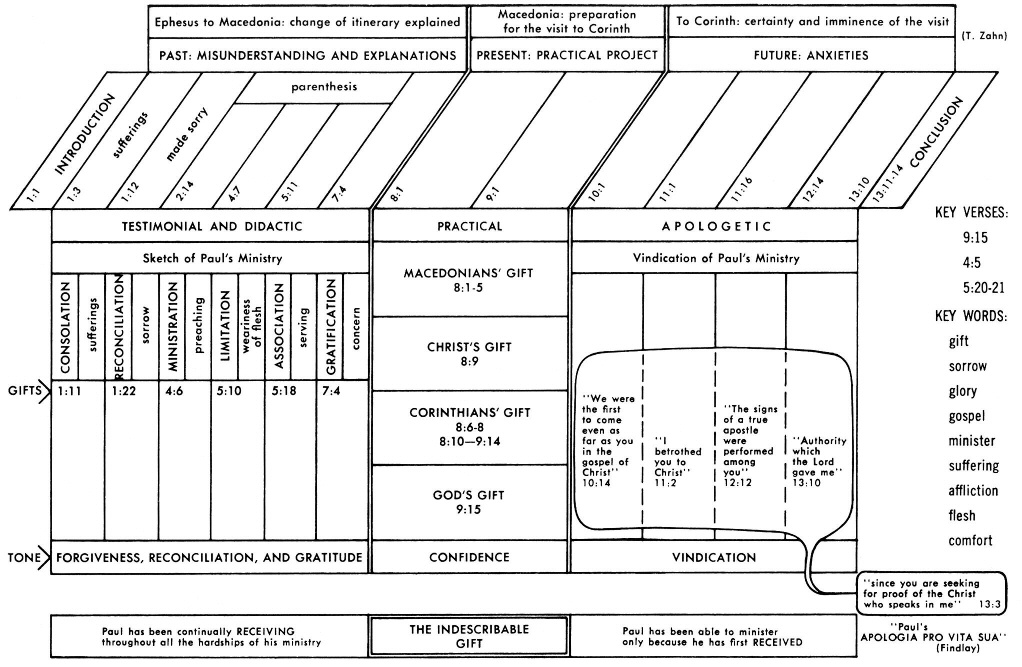
Click chart to enlarge
Charts from Jensen's Survey of the NT - used by permission
Another Overview Chart on right side
Overview of
|
||
| 2Co 1:1-7:16 Character of Paul |
2Co 8:1-9:15 Collection for the Saints |
2Co 10:1-12:21 Credentials of Paul |
| Testimonial & Didactic | Practical | Apologetic |
| Past: Misunderstanding & Explanation |
Present: Practical Project |
Future: Anxieties |
| Apostle's Conciliation, Ministry & Exhortations | Apostle's Solicitation for Judean Saints | Apostle's Vindication of Himself |
| Forgiveness, Reconciliation Gratitude |
Confidence | Vindication |
|
Ephesus to Macedonia: |
Macedonia: Preparation for Visit to Corinth |
To Corinth: |
|
2Co 1:1-7:16 |
2Co 8:1-9:15 |
2Co 10:1-12:21 |
|
2Corinthians written ~ 56-57AD - see Chronological Table of Paul's Life and Ministry |
||
|
Adapted & modified from Jensen's Survey of the New Testament (Highly Recommended Resource) & Wilkinson's Talk Thru the Bible |
||
2 Corinthians 4:7 But we have this treasure in earthen vessels, so that the surpassing greatness of the power will be of God and not from ourselves (NASB: Lockman)
Greek: Echomen (1PPAI) de ton thesauron touton en ostrakinois skeuesin, hina e huperbole tes dunameos e (3SPAS) tou theou kai me ek hemon
Amplified: However, we possess this precious treasure [the divine Light of the Gospel] in [frail, human] vessels of earth, that the grandeur and exceeding greatness of the power may be shown to be from God and not from ourselves. (Lockman)
Barclay: But we have this treasure in earthen vessels, so that the power which surpasses all things may be seen to be of God and not of us. (Westminster Press)
God's Word: Our bodies are made of clay, yet we have the treasure of the Good News in them. This shows that the superior power of this treasure belongs to God and doesn't come from us. (GWT)
Easy English: It is as if we have *treasure in *clay pots. So this great power comes from God. It does not come from us.
ESV: But we have this treasure in jars of clay, to show that the surpassing power belongs to God and not to us. (ESV)
KJV: But we have this treasure in earthen vessels, that the excellency of the power may be of God, and not of us.
NET: But we have this treasure in clay jars, so that the extraordinary power belongs to God and does not come from us. (NET Bible)
NIV: But we have this treasure in jars of clay to show that this all-surpassing power is from God and not from us. (NIV - IBS)
NLT: We now have this light shining in our hearts, but we ourselves are like fragile clay jars containing this great treasure. This makes it clear that our great power is from God, not from ourselves. (NLT - Tyndale House)
Phillips: This priceless treasure we hold, so to speak, in a common earthenware jar - to show that the splendid power of it belongs to God and not to us. (Phillips: Touchstone)
Weymouth: But we have this treasure in a fragile vase of clay, in order that the surpassing greatness of the power may be seen to belong to God, and not to originate in us.
Wuest: But we have this treasure [the reflection of the light of the knowledge of the glory of God in the face of Christ] in earthenware containers, in order that the super-excellence of the power might be from God as a source and not from us. (Eerdmans Publishing - used by permission)
Young's Literal: And we have this treasure in earthen vessels, that the excellency of the power may be of God, and not of us;
- this: 2Co 4:1 6:10 Mt 13:44,52 Eph 3:8 Col 1:27 2:3
- in: 2Co 5:1 10:10 Judges 7:13-14, Jdg16-20 La 4:2 1Co 1:28 1Co 4:9-13 Ga 4:13,14 2Ti 2:20
- So that: 2Co 3:5,6 12:7-9 2Co 13:4 1Co 2:3-5 Eph 1:19,20 2:5,8,9 Col 2:12 1Th 1:5
- 2 Corinthians 4 Resources - Multiple Sermons and Commentaries
Related Passages:
Ephesians 3:8 To me, the very least of all saints, this grace was given, to preach to the Gentiles the unfathomable riches of Christ,
Matthew 13:44 (THIS TREASURE) “The kingdom of heaven is like a treasure hidden in the field, which a man found and hid again; and from joy over it he goes and sells all that he has and buys that field.
Matthew 13:52 (THIS TREASURE) And Jesus said to them, “Therefore every scribe who has become a disciple of the kingdom of heaven is like a head of a household, who brings out of his treasure things new and old.”
Judges 7:2 (ILLUSTRATION OF GIDEON) The LORD said to Gideon, “The people who are with you are too many for Me to give Midian into their hands, for Israel would become boastful, saying, ‘My own power has delivered me.’...Jdg 7:7 The LORD said to Gideon, “I will deliver you with the 300 men who lapped and will give the Midianites into your hands; so let all the other people go, each man to his home.”
Gromacki: Gideon learned this lesson when his army, reduced to three hundred, besieged the Midianites with weapons of trumpets and burning lamps within clay pots (Jdg. 7:16). Just as the pots had to be broken to let the lamps shine, so believers must be broken to manifest the light of God through them.
Acts 9:15 (EARTHEN VESSELS) But the Lord said to him, “Go, for he is a chosen instrument of Mine, to bear My name before the Gentiles and kings and the sons of Israel;
2 Timothy 2:21 (VESSELS) Therefore, if anyone cleanses himself from these things, he will be a vessel for honor, sanctified, useful to the Master, prepared for every good work.
1 Corinthians 2:3-5 I was with you in weakness and in fear and in much trembling, 4 and my message and my preaching were not in persuasive words of wisdom, but in demonstration of the Spirit and of power, 5so that your faith would not rest on the wisdom of men, but on the power of God.
PRECIOUS PARADOX
TREASURE IN JARS OF CLAY!

A Christian is like a tea bag—
not much good until it has gone through hot water!
Murray J Harris introduces these next 7 verses with the interesting comment that "No person was ever more aware of the paradoxical nature of Christianity than Paul. And perhaps none of his Epistles contains more paradoxes than 2 Corinthians. With their numerous paradoxes, then, 2Co 4:7-12 are typical of this Epistle and of Paul’s style. 2Co 4:7 is the first paradox—the difference between the indescribable value of the gospel treasure and the apparent worthlessness of the gospel’s ministers (Expositor's Bible Commentary)
Plummer - “The power is limitless, but it is stored in very unlikely receptacles.”
But we have this treasure in earthen vessels - We have (echo) means to have or to possess and the present tense pictures this as their continual possession. What treasure? Answer - "Light of the knowledge of the glory of God in the face of Christ." (2Co 4:6)(aka, the Gospel). Earthen vessels clearly is a figurative description of our bodies, emphasizing our weakness and frailty. In a word the treasure is the creational, transforming power of the Gospel placed into followers of Christ pictured as lowly, even contemptible (as judged by what the world values) "jars of clay". (See Piper = The Glory of Christ, the Image of God on page 54 in pdf) As discussed more below, this paradoxical association of human weakness with divine power, makes it abundantly clear from Whom the power originates and Who is to receive the glory for the display of that power! As the psalmist aptly stated centuries prior…
Not to us, O LORD, not to us,
but to Thy Name give glory
because of Thy lovingkindness,
because of Thy truth.
(Psalm 115:1-)
“Let him who boasts (glories),
boast (glory) in the Lord.”
(1 Co 1:31)
Alfred Plummer has an interesting observation on Paul's repeated use of echo (to have, to possess) "The Apostle again and again dwells upon the goodly possessions of the Christian, and especially of the Christian minister; confidence we have (2Co 3:4), having such hope (2Co 3:12), we have this ministry (2Co 4:1), we have this treasure (2Co 4:7), having the same spirit of faith (2Co 4:13), we have a building from God (2Co 5:1), possessing (having) all things (2Co 6:10), having these promises (2Co 7:1); and he often builds an argument upon these goodly possessions. (Ed: Every use of echo is in the present tense picturing the continuance, persistence and permanence of these possessions). (2 Corinthians 4 Commentary)
A T Robertson - We are but earthen jars used of God for his purposes (Rom. 9:20ff.) and so fragile.
McGee - That is how we are pictured here—weak clay vessels, pottery that can be broken. What is the treasure? That is the glorious gospel. We carry this glorious gospel in our little, old earthen vessels.
Wick Broomall - By this treasure Paul reminds us that the Gospel is a valuable jewel (cf. Mt 13:44, 52) committed to him (cf. Eph 3:1, 2, 7, 8). (Wycliffe Bible Commentary - 2 Corinthians 4)
Guzik notes that "Earthenware vessels were common in every home in the ancient world. They were not very durable (compared to metal), and they were useless if broken (glass could be melted down again). “They were thus cheap and of little intrinsic value.” (Kruse) God chose to put His light and glory in the everyday dishes, not in the fine china! We almost always are drawn to the thing that has the best packaging. But the best gifts often have the most unlikely packaging. God did not see a need to “package” Jesus when He came as a man to this earth. Jesus was not embarrassed to live as an earthen vessel. God is not embarrassed to use clay pots like us! (2 Corinthians 4)
MacArthur adds that "The vessels Paul describes here were just common pots: cheap, breakable, easily replaceable, and virtually valueless. Occasionally they were used to hide valuables, such as gold, silver, and jewelry. The pots containing such valuable items would often be buried in the ground. In fact, the man in Jesus’ parable who found the treasure hidden in a field (Mt. 13:44) might have discovered it when his plow broke a buried pot. Clay pots were also used to store valuable documents; the Dead Sea Scrolls were discovered stored in clay pots in a cave near Qumran." (2Corinthians. Chicago: Moody Press)
Adam Clarke has an interesting note regarding earthen vessels "The original, ostrakinos skeuosin , signifies, more literally, vessels made of shells, which are very brittle; and as the shell is the outward part of a fish, it is very fit, as Dr. Hammond observes, to resemble our bodies in which our souls dwell. (2 Corinthians 4)
Wick Broomall - Human nature in its weakness and frailty is pictured in the phrase earthen vessels (cf. Acts 9:15). (Wycliffe Bible Commentary - 2 Corinthians 4)
Charles Swindoll has a convicting comment on earthen vessels - Paul likens authentic gospel ministers to ordinary earthen vessels—fragile clay pots that nevertheless contain the priceless treasure of the gospel. God could have displayed His light through angelic beings, direct visions and dreams, or even through personal divine revelations to each individual. He could have, because God is bound by nothing but His own plans and promises. Yet God, for His own purposes, has decided to reveal the treasure through us. Us! Some days I wake up and wonder, “Why, God? Why us? Why me?” Considering our frailties, fallenness, and outright folly, it’s a fair question. Let’s face it: When Paul likens us to “earthen vessels,” in some ways he is being optimistic! Some days we are just unshaped and unattractive lumps of clay (Rom. 9:21), or wispy clouds of dust (Gen. 3:19), or stony hearts (Prov. 28:14), or withering grass (1 Pet. 1:24). We should be honored and humbled in the extreme to be included in God’s plan to preserve and proclaim His priceless message. Yet somehow in the process we often forget the “clay pot” reality. Even in our churches, we work hard to impress each other, especially visitors. We try to handle the Scriptures with ease and finesse. We polish our performances to perfection. We downplay our flaws and patch up the cracks in our finish. We place our most treasured pots on display for all to see, failing to actually reveal the invaluable treasure inside. Yes, we’re motivated to minister with excellence, to offer service to God with our whole heart. God is not pleased with a “just wing it” attitude or a hapless, shoot-from-the-hip approach to ministry. That kind of attitude does not honor the treasure. God delights in thoroughness, hard work, and excellence (Col. 3:23). But a noble offering to God can easily cross the line into shameless showmanship. Though we must do and give our best in service to our Savior, we must never shine the spotlight on ourselves. Rather, we are to let His light shine through us, just as 2 Corinthians 4:7 concludes: “that the surpassing greatness of the power will be of God and not from ourselves.” (Insights from 1&2 Corinthians)
Treasure (2344)(thesauros from títhemi = put, set) refers to the place where goods and precious things are stored for safekeeping (Think about the glorious Gospel you possess!) and thus a repository (place, room, or container where something is deposited or stored), a treasure chest, a storehouse, a treasury. The second sense of thesauros refers to that which is stored up in the treasury or repository (Mt 2:11 Mt 6:19 20 21 Lk 12:33). Figuratively thesauros can refer to the heart, as the repository of thoughts, feelings, purposes, etc (Lk 6:45, Mt 12:35). Here in 2Co 4:7 thesauros clearly refers to the priceless Gospel with which all believers have been entrusted. Remember that when Jesus entrusted the stewards with valuables, He expected them to use them wisely, which is so convicting, for how infrequently I give out this priceless treasure to those who are spiritually destitute! English definitions of treasure - Derived from Latin "thesaurus" = anything hoarded, treasure, storehouse, collection. Something of great worth or value. Gives us our English word "thesaurus" (a treasury of words). A great quantity of any thing collected for future use. Something or someone very much valued or highly prized. Wealth and riches, usually hoarded, esp. in the form of money, precious metals, or gems. Mounce - The most common use in the NT is in reference to material riches (Mt 6:19, 21; 13:44, 52; Lk 6:45; 12:34, 35; 2Cor. 4:7; Col 2:3; He 11:26), such as what someone may find hidden in a field (Mt 13:44). A person’s treasure is a clear indicator of the state of his heart (Lk 12:34). True disciples store up their treasures in heaven (Mt 6:20; 19:21; Mk 10:21; Lk 12:33; 18:22), where they will have access to them. Treasures become stored up in heaven when disciples use God’s wealth to advance His purposes. They may not be able to take the riches with them when they die, but they can send them on ahead. (Mounce's Complete Expository Dictionary of Old & New Testament Words. Grand Rapids, MI: Zondervan) L M Petersen writes that "Treasure in the Holy Scriptures consisted in money or any possession—jewels, gold, silver, vessels, ointments, spices, arms, grain and food, instruments of war—considered wealth or valuable, and which a king, a government, or an individual stored in a safe, guarded place to keep from thieves and robbers. (The Zondervan Encyclopedia of the Bible, Volume 5)
Thesauros - 17x in 16v in the NAS - Matt 2:11; 6:19, 20 21; 12:35; 13:44, 52; 19:21; Mark 10:21; Luke 6:45; 12:33 34; 18:22; 2 Cor 4:7; Col 2:3; Heb 11:26 Always translated treasure(s). Be sure to observe Who spoke the most about treasure! What general principle does that teach us about treasures?
Matthew 2:11 After coming into the house they saw the Child with Mary His mother; and they fell to the ground and worshiped Him. Then, opening their treasures, they presented to Him gifts of gold, frankincense, and myrrh.
Matthew 6:19- "Do not store up ( with a negative = a command to stop doing this!) for yourselves treasures on earth, where moth and rust destroy, and where thieves break in and steal. 20 "But store up ( = Jesus commands us to make this the goal of our life every day of our life until we see Jesus face to face!) for yourselves treasures (literally the Greek reads = "treasure for yourselves treasures") in heaven, where neither moth nor rust destroys, and where thieves do not break in or steal; 21 for where your treasure is, there your heart will be also.
Comment: Where is your heart today as you read this note? You can tell by in what or where or in whom you place value. Observe that the heart follows the treasure, not vice versa! Where is your treasure beloved? (See Solomon's wise advice Pr 4:23-) As an aside, note that "time" is finite and priceless and therefore how you use the time allotted to you in this short life clearly reflects what you treasure and thus where your heart is -- Which motivated Paul to exhort all saints to daily, moment by moment, redeem the precious, passing time (Eph 5:16KJV-)! Remember Jesus' warning in the context of Mt 6:19-21 that
(Absolutely) No one can (dunamai) serve (douloo) two masters; for either he will hate the one and love the other, or he will hold to one and despise the other. You (absolutely) cannot serve (douloo) God and mammon (wealth, property). (Mt 6:24-) (If you try to achieve a divided allegiance, all you will accomplish is anxiety - which is what Jesus goes on to exposit in the next 10 verses [Mt 6:25-34-]! It follows that if I am anxious, I might do well to get a "heart check up" using God's "EKG" of Mt 6:24. This may not explain or alleviate all my anxiety but it is at least a starting point.)
Richards: The saying “Where your treasure is, there your heart will be also” (Mt 6:21; Lk 12:34) focuses attention on values. That which is deemed valuable will be the focus of thoughts and efforts and will undoubtedly shape the choices that one makes in life. (Richards, L O: Expository Dictionary of Bible Words: Regency or Computer Version - New International Encyclopedia of Bible Words)
Matthew 12:35 (Context = Mt 12:34) "The good man brings out of his good treasure what is good; and the evil man brings out of his evil treasure what is evil.
Comment: Good (as God defines good, cp Jn 15:5, 8) can only come from a "good heart" (cp Lk 8:15).
MacArthur: A person’s heart is the treasury of his thoughts, ambitions, desires, loves, attitudes, and loyalties. It is the reservoir from which the mouth draws its expressions. It is axiomatic that a good treasure brings forth what is good and an evil treasure brings forth what is evil. “Does a fountain send out from the same opening both fresh and bitter water?” James asked (Jas 3:11). A common expression in the computer world is GIGO, which stands for “Garbage in, garbage out.” In other words, the quality of data entered determines the quality of the results produced from that data. In exactly the same way, the quality of what is in a person’s heart determines the quality of speech his mouth produces. (Matthew 8-15, Matthew 16-23, Matthew 24-28 or Logos or Wordsearch)
Matthew 13:44 "The kingdom of heaven is like a treasure hidden in the field, which a man found and hid again; and from joy over it he goes and sells all that he has and buys that field.
Matthew 13:52 And Jesus said to them, "Therefore every scribe who has become a disciple of the kingdom of heaven is like a head of a household, who brings out of his treasure things new and old."
MacArthur explains: The disciples were not to spurn the old for the sake of the new. Rather the new insights they gleaned from Jesus’ parables were to be understood in light of the old truths, and vice versa.
Matthew 19:21 Jesus said to him, "If you wish to be complete, go and sell your possessions and give to the poor, and you will have treasure in heaven; and come, follow Me."
Mark 10:21 Looking at him, Jesus felt a love for him and said to him, "One thing you lack: go and sell all you possess and give to the poor, and you will have treasure in heaven; and come, follow Me."
Luke 6:45 "The good man out of the good treasure of his heart brings forth what is good; and the evil man out of the evil treasure brings forth what is evil; for his mouth speaks from that which fills his heart.
Luke 12:33 "Sell your possessions and give to charity; make yourselves money belts which do not wear out, an unfailing treasure in heaven, where no thief comes near nor moth destroys. 34 "For where your treasure is, there your heart will be also.
Luke 18:22 When Jesus heard this, He said to him, "One thing you still lack; sell all that you possess and distribute it to the poor, and you shall have treasure in heaven; and come, follow Me."
2 Corinthians 4:7 But we have this treasure in earthen vessels, so that the surpassing greatness of the power will be of God and not from ourselves;
Colossians 2:3- in Whom (Christ) are hidden all the treasures of wisdom and knowledge. (Why does Paul tell us this? Col 2:4-)
Comment: Observe the clear contrast (calling for a clear choice) between the treasures in Colossians 2:3 and the treasures in Hebrews 11:26! Can they even be compared when viewed in the light of eternity? I think not! So why do we (I) weary ourselves (myself) with accumulation of the passing pleasures of temporally gratifying "tinkling trinkets and trifles" (trinket & trifle = both something of little value/significance) to the neglect of "accumulation" of that which satisfies and endures eternally! Veritable "spiritual insanity" methinks!
Hebrews 11:26- (Context = Heb 11:25-) considering the reproach of Christ greater riches (~"treasure") than the treasures of Egypt; for he was looking to the reward (~the "treasure" that remains!)
Thesauros - 77x in 69v in the non-apocryphal Septuagint (LXX) - Ge 43:23; Dt 28:12; 32:34; Josh 6:19, 24; Jdg 18:7; 1 Kgs 7:37; 14:26; 15:18; 2 Kgs 12:19; 14:14; 16:8; 18:15; 20:13, 15; 24:13; 1 Chr 9:26; 26:20, 22, 24, 26; 27:25, 27f; 2 Chr 5:1; 8:15; 12:9; 16:2; 25:24; 32:27; 36:18; Ezra 2:69; 5:14; Neh 7:70f; 10:40; 12:44; 13:12; Ps 32:7; 134:7; Pr 2:4; 3:14; 8:21; 10:2; 15:16; 21:20; Job 3:21; 38:22; Amos 8:5; Mic 6:10; Joel 1:17; Mal 3:10; Isa 2:7; 33:6; 39:2, 4; 45:3; Jer 10:13; 15:13; 20:5; 27:25, 37; 28:13, 16; 30:20; 48:8; Ezek 27:24; 28:4, 13
THE GOSPEL IS GOLD
WE ARE BUT JARS OF CLAY
JONI EARECKSON TADA - God is a Master Artist. And there are aspects of your life and character—good, quality things—he wants others to notice. So without using blatant tricks or obvious gimmicks, God brings the cool, dark contrast of suffering into your life. That contrast, laid up against the golden character of Christ within you, will draw attention … to him. Light against darkness. Beauty against affliction. Joy against sorrow. A sweet, patient spirit against pain and disappointment—major contrasts that have a way of attracting notice. You are the canvas on which he paints glorious truths, sharing beauty, and inspiring others. So that people might see him.
Doug Goins - In 1989, I helped lead a number of our college and university students on a 3-week study tour of Egypt and Israel. There was one event that at the time seemed relatively insignificant, yet it came back to me while working on this sermon. Our tour guide, a Christian Armenian man named Diko, and I were walking together around the base of the wall of the old city. While we were talking and walking, he kept watching the ground. We got down around the low point of the wall, near an excavation. Diko kept watching the ground and then ran up a little hill and grabbed something to bring back down to me. It was a small handle for a rough earthen clay cup. Diko, an amateur archeologist, told me that there are a lot of those around, probably from the first or second century. He said this one looked like it was Roman, probably from a Roman soldiers' camp. I was thrilled and still have the artifact. The fact that these kinds of pottery shards are everywhere is absolutely true. In virtually every archeological dig in the Middle East, there are innumerable pieces of clay pottery from the earliest civilizations. Clay pottery was the material of the common people. It was used to make everything from pitchers and oil jars and bowls, to griddles and washbasins and pots. Items of value like money or jewelry were often hidden in them. Clay jars were used to store liquids because the clay didn't let the liquid evaporate and it tended to stay cool. Broken pieces of pottery or shards were used for writing material for notes or receipts… Earthen vessels are a very good description of basic humanity. God is the potter, and we are the clay. He shapes us and molds us into any kind of utensil or implement that he desires. The noun, "vessel," refers to a container serving a very specific purpose like a jug, cup, pot or pan. And again, when it's used of people in the Bible, there is always a sense that we are an implement that God can use; an instrument to live out a lifestyle of ministry, loving people. Before we continue on, don't miss the marvel of Paul's definition of our humanity. As people of a new covenant lifestyle, as vessels that are created for God's use, all of us are made from the same basic stuff. We are made of earthen, common, run of the mill clay, fragile and easily broken. No matter how sophisticated, how physically healthy and robust, how financially secure we are, underneath we are all just ordinary people. (EXERCISING THE POWER OF GOD)
John Piper writes "The third reason you should use your gift (Click to read other reasons) for the good of others and the glory of God is that your ordinariness is no reason not to. Too many people say, "I'm so ordinary, so average and undistinguished. I can't do anything significant." 2Corinthians 4:7 shows that this argument is wrong and why. It says, "We have this treasure in earthen vessels (or clay pots!) to show us that the transcendent power belongs to God and not to us." God's concept of ministry is so different from the world's concept. The world stresses the classy container, not the glory of God in human weakness. If there is one thing that we are coming to learn together in this church, it is that God's purpose to get the glory in all things determines how we do all things. Here God's purpose is to make sure that we see that the surpassing power belongs to Him and not to us. How does He do it? He puts the treasure of His gifts and His gospel in clay pots like you and me. Your ordinariness is not a liability; it is an asset, if you really want God to get the glory. No one is too common, too weak, too shy, too inarticulate, too disabled to do what God wants you to do with your gift. (Calling All Clay Pots)
Jars of clay (such jars could be easily purchased in Corinth and cheaply replaced if broken) was a well known ancient figure of speech descriptive of human weakness. The weakness of Christ's bondservants serves to magnify His power. The fragile nature of the clay pots which God chooses to use as His instruments also introduces the following passages that recount Paul's sufferings in the power of Christ. The more common, mundane and humble the vessel, the more glorious the precious treasure appears!
Hudson Taylor said "All God's giants have been weak men who did great things for God because they reckoned on Him being with them."
Wiersbe: The important thing about a vessel is that it be clean, empty, and available for service. Each of us must seek to become "a vessel unto honor, sanctified [set apart], and meet for the master's use, and prepared unto every good work" (2Ti 2:21). We are vessels so that God might use us. We are earthen vessels so that we might depend on God's power and not our own. (Bible Exposition Commentary)
Kent Hughes has an excellent description of jars of clay in ancient times writing that they "were the throwaway containers of the ancient world, so that their life spans were generally a few years at the most. They were used to store and transport water and olive oil and wine and grain and even family treasures. Earthenware jars were an anonymous part of everyday living as they were used for cooking and eating and drinking and storing leftovers. Every domestic archaeological excavation site contains their remains, called ostraca, from the Greek word for pottery. No one took note of clay jars any more than we would of a fast-food container. They were simply there for convenience. It was no great tragedy when such vessels were broken. They were cheap and easy to replace. As such, jars of clay provided Paul with a penetrating metaphor for his and his followers’ humanity. Indeed Adam was formed out of the dust of the ground, and to dust he returned (cf. Genesis 2:7; 3:19). As clay jars we are all frail, weak, transitory mortals. ( 2 Corinthians: Power in Weakness. Preaching the Wordy)
JARS OF CLAY
GIVE GOD THE GLORY
Why does God often choose the weak or those who are cognizant of their weakness and who cry out in their hearts “Who is sufficient for these things?” Part of the answer is given in 1 Corinthians 1:26–31.
For consider your calling, brethren, that there were not many wise according to the flesh, not many mighty, not many noble; 27 but God has chosen the foolish things of the world to shame the wise, and God has chosen the weak things of the world to shame the things which are strong, 28 and the base things of the world and the despised, God has chosen, the things that are not, that He might nullify the things that are, 29 that no man should boast before God.
In short, God chooses the weak (in the eyes of men) so that “no flesh should glory in His presence” (1Co 1:29KJV). God will not share His glory with another. As Jehovah says through His prophet Isaiah…
I am the LORD, that is My name; I will not give My glory to another, Nor My praise to graven images. (Isaiah 42:8, cp Is 48:11, Ex 34:14)
The great Puritan pastor and author Richard Baxter (1615-1691) understood the Paul's concept of frail "jars of clay". As he lay on his deathbed, someone encouraged him with a reminder of the good so many had received from his preaching and writings to which Baxter replied "I was but a pen in God’s hand, and what praise is due to a pen?"
Thomas Watson wrote that "Ministers are earthen pitchers. 2Cor 4:7. But these pitchers have lamps within them, to light souls in the dark."
Read Charles Haddon Spurgeon's Personal Testimony about how God used a simple man, a nameless "jay of clay" (nameless on earth and in time but renowned in heaven and for eternity) to preach a simple message on Isaiah 45:22 which the Spirit used to save the man who would go on to be heralded as the "prince of preachers". How awesome are the "paradoxes" of God, Whose "foolishness… is wiser than men, and (Whose) weakness… is stronger than men." (1Co 1:25)
Jamieson - God often allows the vessel to be chipped and broken, that the excellency of the treasure contained, and of the power which that treasure has, may be all His (2Co 4:10, 11; Jn 3:30).
Jim Elliot martyred at age 29 clearly understood Paul's description of precious treasure in mere jars of clay when he described himself and his co-workers as a "bunch of nobodies trying to exalt Somebody."
Homer Kent - Valuables were stored in such jars. The Dead Sea Scrolls were found in pottery jars after being hidden for nineteen centuries....Paul wants no one to mistake the true nature of the Christian message in comparison to the significance of the minister. The human instrument is weak and expendable; the message is vital and of inestimable value. By utilizing frail human ministers, God demonstrates that the “surpassing greatness of the power” that transforms men’s lives is from God and not from any preacher. (A Heart Opened Wide - Studies in 2 Corinthians; see also 2 Corinthians 2:14-4:18 The Glory of Christian Ministry - An Analysis)
Francis of Assisi when asked how he was able to accomplish so much answered that "This may be why: The Lord looked down from heaven and said, ‘Where can I find the weakest, littlest man on earth?’ Then he saw me and said, ‘I’ve found him, and he won’t be proud of it. He’ll see that I am only using him because of his insignificance.’
John Piper in his book "Brothers, We Are Not Professionals- A Plea to Pastors for Radical Ministry" asks a convicting question "wonder of wonders, we were given the gospel treasure to carry in clay pots to show that the transcendent power belongs to God (2 Cor. 4:7). Is there a way to be a professional clay pot? We are afflicted in every way but not crushed, perplexed but not driven to despair, persecuted but not destroyed, always carrying in the body the death of Jesus (professionally?) so that the life of Jesus may also be manifested (professionally?) in our bodies (2Co 4:9–11).
Robert Morgan writes that "in Bible times, when they didn’t have banks or safe repositories, they would bury their precious possessions in the earth or hide them in caves. They would often use clay jars for doing this. Have you ever read about the Dead Sea Scrolls? These priceless manuscripts date back 2000 years and were discovered in caves near the ruins of the village of Qumran, in the desert South of Jerusalem. They were stored in clay jars. Of course, clay jars break easily. They are fragile. They are easily damaged. In fact, that’s the way the scrolls were found. An Arab goat herder threw a rock toward the cliffs, trying to scare his goat back down the hill. The rock sailed through the opening of a cave, and the boy heard the sound of a jar breaking. The Dead Sea Scrolls were stored in jars of clay, but jars of clay are fragile. They break easily. And Paul is using that as an illustration of you and me. We are God’s depositories for His treasure, yet we are fragile and breakable and easily damaged. Every one of us can identify with that. I don’t need to spend much time on this point. No matter how strong we think we are or how stoic we try to be, we are fragile people and we break and are easily damaged. That’s true of us physically and it’s true of us emotionally. Some of you right now feel like a jar of clay that’s been chipped or cracked or broken. Someone has thrown a rock, and it’s shattered something inside of you. Well, the benefit is that it keeps us humble. In fact, the rest of the verse makes this quite plain and that brings us to the third word—power. (Read the entire sermon below - Jars of Clay)
Wiersbe rightly reminds us that "We must focus on the treasure and not on the vessel. Paul was not afraid of suffering or trial, because he knew that God would guard the vessel so long as Paul was guarding the treasure (see 1Ti 1:11; 6:20). God permits trials, God controls trials, and God uses trials for His own glory. God is glorified through weak vessels. The missionary who opened inland China to the Gospel, J. Hudson Taylor, used to say, “All God’s giants have been weak men who did great things for God because they reckoned on Him being with them.” (Bible Exposition Commentary - New Testament)
Earthen (3749) (ostrakinos from óstrakon = baked clay - English "oyster") is an adjective which literally means made of baked clay and thus describes pottery or earthenware (2Ti 2:20). Such earthenware was the least valuable in the ancient Greece household and when broken would not be repaired but cast out. The plural noun ostraca has been taken directly over into English for potsherds or broken pieces of pottery that are found in archaeological excavations.
Ostrakinos is used figuratively in 2Co 4:7 to describe that which is fragile or lowly.
Colin Brown comments that "There is little evidence of a metaphorical use of ostrakinos in antiquity until the second century A.D. when Artemidorus describes the body of a man as an earthenware vessel....The striking contrast between the splendour of the treasure and the commonness of the vessel in which it is stored directs attention away from the preachers to the glory of the message they proclaim. It was not unusual in the ancient world to conceal valuable treasures in earthenware urns.In this context ostrakinos refers to the whole man who is entrusted with the gospel. This description finds a parallel in rabbinic accounts of men as clay vessels containing the Torah or wisdom which God has bestowed, e.g. Sifre Deut. 48 (84a on Deut. 11:22): as it is not possible for wine to be stored in golden or silver vessels, but only in one which is least among the vessels, an earthenware one, so also the words of Torah can be kept only with one who is humble in his own eyes; cf. b. Taanith 7a, where “glorious wisdom in a repulsive earthen vessel” describes R. Jehoshua ben Chanaiah, whose appearance was unattractive. Paul’s detractors had described his bodily appearance as weak and dismissed his words as inconsequential (2Co 10:10; cf. 2Co 10:1; 11:6). His self-description as ostrakinos attests that human weakness presents no barrier to the accomplishment of the divine intention when it is undergirded by the transcendent power of God (cf. 2Cor. 3:5; 4:7; 12:9, 10; 13:3, 4).(New International Dictionary of NT Theology)
The only other NT use of ostrakinos is in Second Timothy "Now in a large house there are not only gold and silver vessels, but also vessels of wood and of earthenware, and some to honor and some to dishonor. (2 Ti 2:20-).
Comment: The idea here is that these vessels were used for dishonorable tasks. These clay pots had no value in themselves but only had value in regard to what they contained or the service they performed. The vessels must be clean and emptied of self.
W L Lane explains that this use of: Ostrakinos occurs in a context, where Paul urges Timothy to separate himself from false teachers like Philetus and Hymenaeus, who have subverted the faith of some Christians at Ephesus (2Ti. 2:14-19, 22-26). The appearance of false teachers poses the question as to why there are disloyal persons in the congregation. Paul responds by comparing the church to a large house in which it is normal to find vessels of differing material, which serve different, indeed opposite, functions (2Ti 2:20). Even as the presence of vessels of wood and earthenware (ostrakinos) devoted to disreputable use in such a house occasions no surprise, so the evidence of base leadership in the church can be anticipated. But 2Ti 2:21 makes the point that, whether a vessel is made of gold, silver, or earthenware, it may be clean in order to be ready for honorable service to the owner. By separating himself from the false teachers and cleansing himself from their disreputable actions, Timothy will be prepared for any task to which his Master is calling him.
Comment: Picking up on the vessel imagery, believers are ordained of God to bear the water of life to a thirsting world (2Ti 2:21; 2 Cor 4:7)
Ostrakinos -15x in the non-apocryphal Septuagint (LXX) - Lv 6:21; 11:33; 14:5, 50; 15:12; Nu 5:17; Is 30:14; Jer 19:1, 11; 39:14; La 4:2; Ezek 4:9; Da 2:33 34, 42. It is to note that in rendering the Aramaic portion of Daniel the translators chose ostrakinos to describe the great image seen by Nebuchadnezzar in a dream, whose feet were partly of iron and partly of clay (Da 2:33, 34, 42- - Da 2:41 uses the related word ostrakon = earthen vessel, also describes the hard shell of certain animals - snails, mussels, tortoises). Below is an example of a figurative use in the Septuagint.
The precious sons of Zion, weighed against fine gold, how they are regarded as earthen jars, the work of a potter’s hands! (La 4:2).
Comment: The humiliated sons of Zion, who are “weighed against fine gold” are now considered to be of no more value than common earthenware by their captors.
Marvin Vincent notes that "The adjective ostrakinos occurs only here and 2Ti 2:20-. Herodotus says of the king of Persia. The great king stores away the tribute which he receives after this fashion: he melts it down, and, while it is in a liquid state, runs it into earthen vessels, which are afterward removed, leaving the metal in a solid mass” (3:96).Stanley cites the story of a Rabbi who was taunted with his mean appearance by the emperor’s daughter, and who replied by referring to the earthen vessels in which her father kept his wines. At her request the wine was shifted to silver vessels, whereupon it turned sour. Then the Rabbi observed that the humblest vessels contained the highest wisdom. The idea of light in earthen vessels is, however, best illustrated in the story of the lamps and pitchers of Gideon, Jdg 7:16. In the very breaking of the vessel the light is revealed. (Vincent, M. R. Word studies in the New Testament 3:312)
Figuratively skeuos is used of the human body as formed of clay (cp Ge 2:7 3:19) and thus is frail and feeble.
Vessels (4632) (skeuos) refers to a hollow vessel or container of any material used for a specific purpose, with the meaning varying depending on the context - utensil, jar, dish, gear (e.g., "sea anchor" in Ac 27:17).
Figuratively skeuos refers to human beings who exercise or carry out some function - one's own body = 1Th 4:4-, one's wife = 1Pe 3:7-, recipients of God's wrath = Ro 9:21, 22- (contrasted with Ro 9:23- = believers); of believers as "vessels of honor" = 2Ti 2:21-.
Luke uses skeuos to refer to Paul as vessel or instrument in Acts 9…
But the Lord said to him (Ananias), "Go, for he is a chosen instrument (vessel - Ac9:15KJV) of Mine, to bear My name before the Gentiles and kings and the sons of Israel for I will show him how much he must suffer for My name's sake." (Acts 9:15,16)
Comment: Here skeuos describes Paul as like a vessel who chosen for specific divine service, one of unimpressive stature, chosen to carry and communicate the treasure of the glorious light of the Gospel, shining in his (and our) hearts, the light of the knowledge of the glory of God in the face of Christ. What an astonishing contrast - Paul like a cheap clay pot containing the indescribably, inexplicably precious treasure—the treasure of the divine reality of the gospel. Baked dust carrying about the most precious treasure God has even given mankind!
Johann Sebastian Bach was one of the greatest musicians of all time and his skills on the organ were without equal. Once when an acquaintance praised Back’s rendition of a particular work, he replied like this. “There is nothing very wonderful about it,” he said. “You have only to hit the right notes at the right moment and the instrument does all the rest.” (Patrick Kavanaugh, The Spiritual Lives of Great Composers. Nashville: Sparrow Press, 1992, p. 13.)
Martin Luther said: “I simply taught, preached, wrote God’s Word… otherwise I did nothing… The Word did it all.”
Skeuos - 23x in 22v - Mt 12:29; Mk 3:27; 11:16; Lk 8:16; 17:31; Jn 19:29; Acts 9:15; 10:11, 16; 11:5; 27:17; Ro 9:21, 22, 23 2Co 4:7; 1Th 4:4; 2Ti 2:20, 21; He 9:21; 1Pe 3:7; Re 2:27; 18:12 NAS = article(2), container(1), goods(1), instrument(1), jar(1), merchandise(1), object(3), property(2), sea anchor(1), someone(1), vessel(3), vessels(6).
Baker - Jars (skeuos) or “containers” in the ancient world just as today could be made from a wide variety of materials, wood, glass, stone, brass, gold, silver, or clay. Generally, the more valuable the object to be stored, the nicer the container. Sometimes, how-ever, to throw off potential robbers, one might hide valuable objects, rings, jewels, spices, maybe even gold coins, in plain, unassuming containers. The latter idea, although the less expected, seems to come more in line with Paul’s thinking here…Connecting the imagery of clay jars to human beings is not much of a stretch from a biblical point of view. Not only is man viewed as being created from dust (Ge 2:7), God is pictured as a potter (Isa 29:16; 45:9; 64:8), who can if he chooses, destroy his bad pots (Isa 30:14; Jer 18:1–22; 19:1–13). Paul draws further on this imagery in Rom 9:19–29 to highlight God’s sovereignty over man’s salvation. (Baker, W. R. 2Corinthians. The College Press NIV commentary. Joplin, MO: College Press Pub)
So that (2443) (hina) is used to express purpose (see terms of purpose or result). In this case Paul says that the reason God has deposited the treasure of the Gospel in frail men is that when others see weak, frail sinful men and women set free from sin solely by means of proclamation of the life giving Gospel, it will be abundantly clear that the power that produced that effect was supernatural and not natural.
A T Robertson - This is God’s purpose (hina—ēi]). God, not man, is the dynamo (dunamis). It comes from God (tou theou, ablative) and does not originate with us
The surpassing greatness (huperbole) of the power (dunamis) will be of God and not from ourselves - Note the paradox of frail, weak ordinary men carrying the the surpassing greatness of the power of God, the Gospel! Paul wants to make it crystal clear that the power is in the message, not the messenger (minister). Not from ourselves is Paul's refusal to take any credit for the supernatural effects produced by the Gospel. Here Paul uses huperbole to describe the surpassing greatness of the power (of God) and in 2 Cor 4:17 describes the saint's "eternal weight of glory (which is) far beyond all comparison (huperbole)."
Surpassing power, surpassing glory,
All power from God and all glory to God.
Amen
In other words, the "power" of common clay pots stands in dramatic contrast to the power of God's Gospel. In fact one cannot even quantify the difference. They are not on the same scale! The power of the Gospel of God overcomes and transcends all our weaknesses.
Pitifully paltry vessels
possessing a priceless proclamation.
Hodge - The apostle means to present the utter disproportion between the visible means (jars of clay) and the effects produced (changed lives), as proof that the real power is not in man, but in God. (2 Corinthians Commentary)
David Lowery rightly points out that "A deepening sense of his own unworthiness, compared with the grandeur of his message, characterized Paul's life (cf. Eph. 3:7-9). God intended this sharp contrast so that no one would question the source of the gospel and its all-surpassing power. (Bible Knowledge Commentary)
To substantiate Lowery's point note the "progression" of Paul's self-image over his ministry years -
- 1Co 15:9 in ~ 55 AD = "I am the least of the apostles"
- In Ep 3:8 in ~ 61 AD = "the very least of all saints"
- In 1Ti 1:15 in ~ 63-66 AD = "sinners, among whom I am foremost of all"
Vance Havner described saints as jars of clay noting that "Our weaknesses and God’s strength form an unbeatable combination!" (Amen!) (cp 2 Cor 12:9-, 2 Cor 12:10-)
William MacDonald - Having spoken of the obligation to make the message plain, the Apostle Paul now thinks of the human instrument to which the wonderful gospel treasure had been committed. The treasure is the glorious message of the gospel. The earthen vessel, on the other hand, is the frail human body. The contrast between the two is tremendous. The gospel is like a precious diamond that scintillates brilliantly every way in which it is turned. To think that such a precious diamond has been entrusted to such a frail, fragile earthenware vessel! (Believer's Bible Commentary)
Oswald Chambers put it well - God can achieve His purpose either through the absence of human power and resources, or the abandonment of reliance on them. All through history God has chosen and used nobodies, because their unusual dependence on Him made possible the unique display of His power and grace. He chose and used somebodies only when they renounced dependence on their natural abilities and resources.
Matthew Henry - Why they should not preach themselves: because they were but earthen vessels, things of little or no worth or value. Here seems to be an allusion to the lamps which Gideon's soldiers carried in earthen pitchers, Jdg 7:16.The treasure of Gospel light and grace is put into earthen vessels. The ministers of the Gospel are weak and frail creatures, and subject to like passions and infirmities as other men; they are mortal, and soon broken in pieces. And God has so ordered it that the weaker the vessels are the stronger His power may appear to be, that the treasure itself should be valued the more. Note, There is an excellency of power in the Gospel of Christ, to enlighten the mind, to convince the conscience, to convert the soul, and to rejoice the heart; but all this power is from God the Author, and not from men, who are but instruments, so that God in all things must be glorified. (Amen)
Human weakness (jars of clay) and God's power while paradoxical (and incomprehensible) to the natural man (1Co 2:14), are the perfect match in God's design. Paul again paints the picture of this paradox between man's weakness and God's infinite power in 2Corinthians 12…
And He has said to me, "My grace is sufficient for you, for power (dunamis) is perfected in weakness." Most gladly, therefore, I will rather boast about my weaknesses, that the power (dunamis) of Christ may dwell in me. Therefore I am well content with weaknesses, with insults, with distresses, with persecutions, with difficulties, for Christ's sake; for when I am weak, then I am strong. (2Co 12:9-, 2Co 12:10-)
W. Griffith Thomas once said "In all Christian work, there are three elements absolutely indispensable: the Spirit of God as the power (cp Acts 1:8), the Word of God as the message (cp 1Co 1:18), and the man of God as the instrument (Acts 9:15, 16 ~ clay pots). The Spirit of God uses the message by means of the man."
Comment: You have likely heard it said that God is not so much interested in our "ability" as in our availability. F.A.T. - Faithful. Available. Teachable. God desires humble, inconspicuous, weak, frail clay pots who are willing to continually be emptied of self so that they might continually be filled with His Spirit empowered to give out the treasure of "the light of the Gospel of the glory of Christ Who is the image of God" (2Co 4:4), "the light of the knowledge of the glory of God in the face of Christ." (2Co 4:6)
William MacDonald - Why has God ordained that this treasure should be in earthen vessels? The answer is so that the excellence of the power may be of God and not of us. God does not want men to be occupied with the human instrument, but rather with His own power and greatness. And so He deliberately commits the gospel message to weak, often uncomely human beings. All the praise and glory must go to the Creator and not the creature. As Paul penned verse 7, it is almost certain he was thinking of an incident in Judges 7. There it is recorded that Gideon equipped his army with trumpets, empty pitchers, and lamps within the pitchers. At the appointed signal, his men were to blow their trumpets and break the pitchers. When the pitchers were broken, the lamps shone out in brilliance. This terrified the enemy. They thought there was a vast host after them, instead of just three hundred men. The lesson is that, just as in Gideon’s case the light only shone forth when the pitchers were broken, so it is in connection with the gospel. Only when human instruments are broken and yielded to the Lord can the gospel shine forth through us in all its magnificence. (Believer's Bible Commentary)
It is a secret joy to find
The task assigned beyond our powers;
For thus, if ought of good be wrought,
Clearly the praise is His, not ours.
—Houghton
Jowett says: There is something wrong when the vessel robs the treasure of its glory, when the casket attracts more attention than the jewel which it bears. There is a very perverse emphasis when the picture takes second place to the frame, and when the ware which is used at the feast becomes a substitute for the meal. There is something deadly in Christian service when “the excellency of the power” is of us and not of God. Such excellency is of a very fleeting kind, and it will speedily wither as the green herb and pass into oblivion.
Power will be of God - The extraordinary power demonstrated in the Gospel is from God as the Source and not from men (who are frail jars of clay).
Jamieson notes that the English "will be of God" in the original Greek reads "“may be (present tense = continually) God’s (may be seen and be thankfully [2Co 4:15] acknowledged to belong to God), and not (to come) from us.” The power not merely comes from God, but belongs to Him continually, and is to be ascribed to Him.
Adam Clarke - God keeps us continually dependent upon Himself; we have nothing but what we have received, and we receive every necessary supply just when it is necessary; and have nothing at our own command. The good therefore that is done is so evidently from the power of God, that none can pretend to share the glory with Him. (2 Corinthians 4)
Hodge writes that "Although what the apostle says here is true of all ministers, doubtless he was referring especially to himself and his own particular circumstances. He had spoken most highly of his mission, but he himself was a poor, weak, persecuted, downtrodden man. This, he says, only makes the power of God the more conspicuous, not only in the success of the apostle’s ministry, but in his preservation in the midst of dangers and sufferings that it seemed impossible anyone could either escape or bear. In order to show, on the one hand, how weak he is, how truly a mere jar of clay, and, on the other, how great and manifest God’s power is, the apostle contrasts his trials and his deliverances in the following verses. (2Co 4:8, 9) (2 Corinthians Commentary)
Surpassing greatness (5236)(huperbole from huperballo = a throwing beyond the usual mark from huper = above + ballo = cast) is literally a "throwing beyond" (contrast Paul's following use of kataballo) and thus refers to a degree which exceeds extraordinarily a point on an implied or overt scale of extent. It means excess, extraordinary quality or character, far more, much greater, to a far greater degree, surpassing, beyond measure, utterly. This word is used only by Paul in the NT. Huperbole - 7v - Rom. 7:13; 1 Co. 12:31; 2 Co. 1:8; 2 Co. 4:7; 2 Co. 4:17; 2 Co. 12:7; Gal. 1:13
Power (1411)(dunamis from dunamai = to be able, to have power) power especially achieving power. It refers to intrinsic power or inherent ability, the power or ability to carry out some function, the potential for functioning in some way (power, might, strength, ability, capability), the power residing in a thing by virtue of its nature. Dunamis conveys the idea of effective, productive energy, rather than that which is raw and unbridled. It is power which overcomes resistance or effects a change.
It is no accident that Paul used dunamis more in the letters to the Corinthians than in any other writing - 26x in 22v -1Co 1:18, 24; 2:4 5; 4:19f; 5:4; 6:14; 12:10, 28 29; 14:11; 15:24, 43, 56; 2Co 1:8; 4:7; 6:7; 8:3; 12:9, 12; 13:4 (usually translated "power" but sometimes "miracles"). For example…
For (explaining why the Cross of Christ should not be made void - 1Co 1:17) the word of the Cross is to those who are perishing foolishness, but to us who are being saved (present tense = saved every day = present tense salvation = sanctification) it is the power of God. (1Co 1:18)
but (contrast with we preach Christ - 1Co 1:23) to those who are the called, both Jews and Greeks, Christ the power of God and the wisdom of God. (1Co 1:24)
And my message and my preaching were not in persuasive words of wisdom, but in demonstration of the Spirit and of power, (A picture of what a "clay pot" looks like in Christian ministry. Does this describe you [me] beloved?) 5 that your faith should not rest on the wisdom of men, but on the power of God. (1Co 2:4, 5) (Which is exactly what he is saying here in 2Co 4:7)
For (explaining how Paul will assess those were teaching the Corinthians - did they have God's power?) the kingdom of God does not consist in words, but in power. (1Co 4:20)
Now God has not only raised the Lord, but will also raise us up through His power. (1Co 6:14) (Resurrection Power fill me this hour!)
For indeed He was crucified because of weakness, yet He lives because of the power of God (Who raised Him - 1Co 6:14). For we also are weak (cp "clay pots") in Him (Note the paradox: us = weak <> in Him = power), yet we shall live with Him because of the power of God directed toward you. (2Co 13:4) (Notice this reiteration of the divine axiom that it is out of a weak "clay pot" that the power of God is dispensed to thirsty souls! Why do we so often [and vainly] seek to be strong in ourselves!)
The treasure that Paul is describing in this verse is the Gospel about which he writes in Romans..
I am not ashamed of the Gospel, for it is the power (dunamis) of God for salvation to everyone who believes, to the Jew first and also to the Greek. (Ro 1:16-)
Comment: Remembering that dunamis depicts inherent power residing in a thing by virtue of its nature, Paul is saying that the Gospel in and of itself has the inherent, omnipotent power of God working supernaturally to bring about the salvation of a lost soul who receives the Gospel (See similar dynamic taught in Col 1:5-, Col 1:6- - Observe the "fruit" not of the clay pot messengers but of the surpassingly greatness of the power of the Gospel). Our English word dynamite is derived from dunamis and some have suggested that the Gospel is "God’s dynamite". This is misapplication of this English derivative in an attempt to try to picture the life saving power of the gospel. Dunamis does not refer to explosive power, as if the Gospel will blow men to bits but to intrinsic power able to save men.
Kenneth Wuest: The concept of the Gospel as a force pervades the epistles to the Corinthians; its proof, so to speak, is dynamical, not logical. It is demonstrated, not by argument, but by what it does; and looking to what it can do, Paul is proud to preach it anywhere.(Wuest Word Studies - Eerdman Publishing Company Volume 1, Volume 2, Volume 3 - used by permission)
John Piper sums up this powerful section "God uses weak, afflicted clay pots to carry “the surpassing power” of “the light of the gospel of the glory of Christ.” (2Co 4:4-) What happens when these clay pots preach the gospel and offer themselves as servants? 2Co 4:6 () gives the answer: “God, who said, ‘Let light shine out of darkness,’ has shone in our hearts to give the light of the knowledge of the glory of God in the face of Jesus Christ.” This means that in the dark and troubled heart of unbelief, God does what He did in the dark and unformed creation at the beginning of our world. He said, “Let there be light,” and there was light. So He says to the blind and dark heart, “Let there be light,” and there is light in the heart of the sinner. In this light we see the glory of God in the face of Christ. (God Is the Gospel- go to page 54 in the Pdf to begin Chapter 4)
F B Meyer - It is power. It is His power. It is great power; nothing less would suffice. It is exceeding great power, beyond the furthest cast of thought.
The Gospels even use dunamis as a proper name of God = "Power" (Mt 26:64 , Mk 14:62)!
Alan Thompson summarizes this verse…
Why this ironic divine action of placing so precious and glorious a treasure in so common and frail a container? So that there would never be any mistaking the container for the contents: “in order to show that the all-surpassing power is from God and not from us” (v. 7). Contrary to the opinion of some in the church who have inflated egos, or those who would elevate pastor or deacon to the level of demigod, none of us are the treasure. We are fragile and imperfect vessels, one and all.
Years ago when Mohammed Ali was in his prime, he was about to take off on an airplane flight. Following standard procedure, the stewardess asked all passengers to fasten their seat belts. Noticing that he hadn’t fastened his, the stewardess gently reminded him to buckle up. In his usual brash style, Ali retorted, “Superman don’t need no seat belt!” Quickly but gently the stewardess reminded him, “Superman don’t need no airplane either.” And Ali reportedly fastened his belt.
It’s a humbling reality, but we need the reminder. We are weak, frail human beings. There are no “super-Christians,” and even though we have “super power” (hē huperbolē tēs dunameōs) within us, it is not our doing but the work of God.
Anyone who studies the church’s 2000 year history would have to be blind to miss this truth at work. There are heresies, conflicts and schisms, violence, arrogance and ignorance, failures and follies. Yet, in spite of it all, the church has continued and prospered. How could it be? It is because the all-surpassing, extraordinary, abundant, and preeminent power that has been at work across the ages came not from imperfect Christians, but from our perfect indwelling treasure, (the Gospel of) Jesus Christ. (Review and Expositor Volume 94. 1997. Louisville, KY: Review and Expositor)
Earthen vessels, marred, unsightly,
Bearing Wealth no thought can know;
Heav’nly Treasure, gleaming brightly—
Christ revealed in saints below!
Vessels, broken, frail, yet bearing
Through the hungry ages on,
Riches giv’n with hand unsparing,
God’s great Gift, His precious Son!
O to be but emptier, lowlier,
Mean, unnoticed and unknown,
And to God a vessel holier,
Filled with Christ, and Christ alone!
Naught of earth to cloud the Glory!
Naught of self the light to dim!
Telling forth Christ’s wondrous story,
Broken, empty—filled with Him!
—Tr. Frances Bevan
Paul's Clay Pot metaphor reminds me of Max Lucado's charge to us as believers to be "moons" for Jesus, so to speak. In his book "It's Not About Me," points out something true about the moon that should be true of all believers--it reflects the light of something greater. He says: "What does the moon do? She generates no light. Contrary to the lyrics of the song, this harvest moon cannot shine on. Apart from the sun, the moon is nothing more than a pitch-black, pockmarked rock. But properly positioned, the moon beams. Let her do what she was made to do, and a clod of dirt becomes a source of inspiration, yea, verily, romance. The moon reflects the greater light." "Such a shift comes so stubbornly, however. We've been demanding our way and stamping our feet since infancy. Aren't we all born with a default drive set on selfishness? I want a spouse who makes me happy and coworkers who always ask my opinion. I want weather that suits me and traffic that helps me and a government that serves me. It is all about me." Just as John the Baptist lived to testify to Christ (the light), so to should we (John 1.8-9-).
Earthen Vessels - Ruthe Frens had spent most of her life as a missionary in Japan. When I was asked to speak at her funeral, the apostle Paul’s words in 2 Corinthians 4 came to mind. Ruthe’s conversion as a child had not been like Paul’s. It was not accompanied by a blinding light from heaven and an audible message from Jesus (Acts 9). Yet, over the years it was obvious to all who knew her that she had seen the light—she had come to know God personally through faith in Jesus Christ (2Co 4:6-). And her face revealed the joy of her relationship with the Lord.
Ruthe could also identify with Paul’s description of the human body as “an earthen vessel” (v.7), which is fragile and only temporary. An illness that almost took her life in 1953 left her physically weakened. But through the years she grew spiritually strong.
I was with her family when the doctor informed her that she didn’t have long to live. At that time, everyone could see the peace on her face. After her death, scores of letters and e-mail messages from friends in Japan had this common theme: Ruthe’s smile radiated the presence of Jesus in her life.
Does your life reveal to others that you know Jesus? Can they see that your heart has been transformed?— by Herbert Vander Lugt (Our Daily Bread)
Although my outward shell decays,
I'm inwardly renewed each day
Because the life and power of Christ
Indwells this fragile jar of clay.
—Sper
A Christian's life is the window
through which others can see Jesus.
Joseph Philpot - January 15 - Daily Portions - January 15 - 2 Corinthians 4:7
Be not surprised if you feel that in yourself you are but an earthen vessel; if you are made deeply and daily sensible unto what a frail body God has communicated light and life. Be not surprised if your clay house is often tottering; if sickness sometimes assails your mortal tabernacle; if in your flesh there dwells no good thing; if your soul often cleaves to the dust; and if you are unable to retain a sweet sense of God's goodness and love. Be not surprised nor startled at the corruptions of your depraved nature; at the depth of sin in your carnal mind; at the vile abominations which lurk and work in your deceitful and desperately wicked heart. Bear in mind that it is the will of God that this heavenly treasure which makes you rich for eternity should be lodged in an earthen vessel.
We are to carry about a daily sense of our base original to hide pride from our eyes. We are to be despised by others; and by none so much as by our own selves. We have ever to feel our native weakness, and that without Christ we can do nothing; that we may be clothed with humility, and feel ourselves the chief of sinners, and less than the least of all saints. We thus learn to prize the heights, breadths, lengths, and depths of the love of Christ, who stooped so low to raise us up so high.
OYSTER SHELLS FOR GOD
BEARING THE PEARL OF THE GOSPEL
Spurgeon's Exposition of 2Co 4:7 -
The original might very fairly be rendered,
“We have this treasure in oyster shells,”
for, just as pearls are found in the shells of oysters (Ed: see note below), so God gives to those who preach the Word the treasure of the gospel, yet they are themselves nothing but the oyster shells, nothing but the earthen vessel in which God pleases to place His priceless treasures. If you have done anything in the service of God, my brother, remember that you are nothing but the oyster shell, it is God’s truth that is the pearl in you; so while you are thankful for the honor that He puts upon you, mind that you give Him all the glory (Ps 115:1 1Co 1:31KJV). It is well to take the right view of our own imperfections and infirmities, as Paul did when he wrote, “Most gladly therefore will I rather glory in my infirmities, that the power of Christ may rest upon me.” (2Co 12:9-) The infirmity of the creature leaves the more room for the display of the greatness of the Creator; for, if God can work such wondrous results by using such poor tools as we are, how great must be his power and skill!
+: Oyster is derived from Ostrakon which is related to the word for "clay" (ostrakinos) so Spurgeon's word picture is not far fetched.
The most earnest and faithful minister of the gospel must ever remember that humbling truth. He has this precious treasure of the gospel entrusted to his charge; he knows he has it, and he means to keep it safely, but, still, he is nothing but an earthen vessel, easily broken, soon marred,-a poor depository for such priceless truth. Yet God has a good reason for putting this treasure into earthen vessels,- That the excellency of the power may be of God, and not of us.
If angels had been commissioned to preach the gospel, we might have attributed some of its power to their superior intelligence, and if only those had been called to preach the gospel who were men of great intellect and of profound learning, we might have considered that the talent of man was the essential qualification for a preacher. But when God selects-as He often does, nay, as He always does;-earthen vessels, and some that seem more manifestly earthen than others, then the excellency of the power is unquestionably seen to be of God, and not of us.
F B Meyer references 2Co 4:7 in his devotional commentary on Judges 7 in which God reduced the size of Gideon's…
This is one of the most searching chapters in the Old Testament. It is full of teaching to those among us who are full of their own plans and strength, and who can count on many great alliances to assist them. God will not give His glory to another, and He cannot give the Midianites into our hand so long as there is a likelihood of our laying claim to the results. Success in spiritual work must be denied us if it would tend to our vaunting ourselves. Hence it is that so many of God's most successful workers have had to pass through periods of humiliation at the river's brink.
Judges 7:3, 4, 5, 6, 7, 7:8 The test. -- Two methods were employed for thinning the army. First, the usual proclamation was made (Deut. 20:8). Then the way in which the soldiers drank was carefully observed. Those that threw themselves at full length were evidently apt to prefer their own comfort and refreshment to their soldierly self-denial, which prefers duty to pleasure; these were, therefore, dismissed. And the little body which remained was specially equipped; taking no more victuals than they could easily carry, because the campaign would be short in spite of the numbers of the foe.
A good equipment for the Christian, -- a light to shine, a trumpet to proclaim the victory of Jehovah; though at the best we are but earthen vessels (2 Cor. 4:6-7).
"God counts hearts, not heads" (Rev. J. M'Neill).
The Treasure And The Pots - It has been said that the Roman Empire ran on olive oil. It was used in cooking, bathing, medicine, ceremonies, lamps, and cosmetics. For decades, olive oil from southern Spain was shipped to Rome in large clay jugs called amphorae. Those jugs, not worth sending back, were discarded in a growing heap of broken shards known as Monte Testaccio. The fragments of an estimated 25 million amphorae created that man-made hill, which stands today on the bank of the Tiber River in Rome. In the ancient world, the value of those pots was not their beauty but their contents.
Because of this, the first-century followers of Christ would have clearly understood Paul’s illustration of the life of Jesus in every believer. “But we have this treasure in earthen vessels, that the excellence of the power may be of God and not of us” (2 Cor. 4:7).
Our bodies, like amphorae, are temporary, fragile, and expendable. In our modern world that highly values outward beauty, we would be wise to remember that our greatest treasure is the life of Jesus within us. By God’s grace and power, may we live so that others can see Christ in us.— by David C. McCasland (Our Daily Bread)
We are just the clay pots. Jesus is the true treasure within us.
Although my outward shell decays,
I’m inwardly renewed each day,
Because the life and power of Christ
Indwells this fragile jar of clay. —Sper
Christ is seen most clearly
when we remain in the background.
- God is not blind. He knows about you and your problems. He knows of those who are suffering . . .and His love for His children will never leave in times of trouble.
- Nowhere does the Bible teach that Christians are to be exempt from the tribulations and natural disasters that come upon the world. It does teach that the Christian can face tribulation, crisis, calamity, and personal suffering with a supernatural power that is not available to the person outside of Christ.
- Some of the happiest Christians I have met have been life-long sufferers. They have had every reason to sigh and complain, being denied so many privileges and pleasures that they see others enjoy, yet they have found greater cause for gratitude and joy than many who are prosperous, vigorous, and strong.
- When suffering comes, learn to trust each day into God’s hands . . .let your lips be filled with prayer and praise.
- The most remarkable thing about suffering is that God can use it for our good.
- Our sufferings may be hard to bear, but they teach us lessons which,in turn, equip and enable us to help others.
- Tens of thousands of God’s saints and sufferers through the ages have found their dark nights lightened and tortured souls strengthened because they found help from the Spirit in the Word of God.A suffering person does not need a lecture—he needs a listener.
- In my years of global travels, I have seen a world in pain . . .Without God’s guidance, our response to suffering is a futile attempt to find solutions to conditions that cannot be solved.
- We can react with bitterness and hate God, as some do, or we can accept suffering as a natural part of life and a condition that comes with living in this world. We cannot avoid suffering, but we can determine our response to it.
- In His thirty-three years on earth, Jesus suffered with man; on the cross He suffered for man.
- We enjoy the sense of God’s presence in the midst of suffering here and now. I have talked to people who are experiencing deep pain or severe difficulties, and they have said, “I feel God is so close to me.”
- Jesus suffered more than any other person in human history.
- The book of Job does not set out to answer the problem of suffering, but to proclaim a God so great that no answer is needed.
- I believe one reason that God allows poverty and suffering is so that His followers may demonstrate Christ’s love, mercy, and comfort to [others].
- Being a Christian does not exempt us from tough training, which may mean suffering. If the training were easy, we would not be prepared for the tough days ahead.
- To suffer for the faith is not a penalty; it is a privilege.
- The beginning of all pain and suffering in the world started with one act of disobedience. Christian and non-Christian alike have inherited the consequences from our common ancestors, Adam and Eve—our polluted environment and flawed human nature.
- May we store up the truths of God’s Word in our hearts as much as possible, so that we are prepared for whatever suffering we are called upon to endure.
- [The Lord] does go with us through our sufferings, and He awaits us as we emerge on the other side of the tunnel of testing—into the light of His glorious presence to live with Him forever!
- True faith and suffering frequently go hand-in-hand . . .Living for Christ, walking in His way, will not be an easy path.
- The Bible and the history of the church both demonstrate that God’s way for the suffering of His people has not always been the way of escape, but the way of endurance.
- We don’t deliberately look for trouble in life. It comes. Suffering is a universal fact; no one can escape its claws.
- God has prescribed the remedy for the spiritual sickness of the human race. The solution is personal faith and commitment to Jesus Christ . . .if we deliberately refuse it, we must suffer the horrible consequences.
- No one is exempt from the touch of tragedy: neither the Christian nor the non-Christian; neither the rich nor the poor; neither the leader or the commoner. Crossing all racial, social, political, and economic barriers, suffering reaches out to unite mankind.
- Suffering in life can uncover untold depths of character and unknown strength for service. People who go through life unscathed by sorrow and untouched by pain tend to be shallow in their perspectives on life. Suffering, on the other hand, tends to plow up the surface of our lives to uncover the depths that provide greater strength of purpose and accomplishment. Only deeply plowed earth can yield bountiful harvests.
- Ours may be the heritage of the withheld promises. We have been blessed through the endurance and faithfulness of those who have suffered in the past; the people around us, or those who will succeed us, may be blessed through our trials and suffering and how we react to them.
- Suffering can give us opportunities to witness. The world is a gigantic hospital; nowhere is there a greater chance to see the peace and joy of the Lord than when the journey through the valley is the darkest.
- The Bible teaches that we are to be patient in suffering. Tears become telescopes to heaven, bringing eternity a little closer. (from "Billy Graham in Quotes")
- God sometimes has to put us on our backs in order to make us look up. Anon.
- The face of Jesus must be very near our own when the thorns from his crown of suffering are pressing our brow and hurting us. Anon.
- We can sometimes see more through a tear than through a telescope. Anon.
- There is as much difference between the sufferings of the saints and those of the ungodly as there is between the cords with which an executioner pinions a condemned malefactor and the bandages wherewith a tender surgeon binds his patient. John Arrowsmith
- God had one Son on earth without sin, but never one without suffering. AUGUSTINE
- Suffering so unbolts the door of the heart that the Word hath easier entrance. Richard Baxter
- Weakness and pain helped me to study how to die; that set me on studying how to live. Richard Baxter
- Tears are often the telescope by which men see far into heaven. Henry Ward Beecher
- God would sooner we had holy pain than unholy pleasure. John Blanchard
- Pain and suffering are not necessarily signs of God's anger; they may be exactly the opposite. John Blanchard
- Strictly speaking, the atheist has no questions to ask about suffering; neither does he have any answers. John Blanchard
- Those who sing loudest in the kingdom will be those who on earth had the greatest bodily suffering. We pity them now, but then we shall almost envy them. Andrew Bonar
- Suffering… is the badge of the true Christian. Dietrich Bonhoeffer
- In suffering one learns to pray best of all. Harold A. Bosley
- Suffering times are teaching times. William Bridge
- God understands our suffering because he has experienced it. Francis Bridger
- To ask God to step in constantly to prevent human or natural causes of suffering would be to ask for a puppet-master, nothing less. Francis Bridger
- Suffering times are a Christian's harvest times. Thomas Brooks
- We must suffer patiently, because impatience is rebellion against the justice of God. John Calvin
- The sovereign and utterly good God created a good universe. We human beings rebelled; rebellion is now so much a part of our make-up that we are all enmeshed in it. Every scrap of suffering we face turns on this fact. D. A. Carson
- The staying power of our faith is neither demonstrated nor developed until it is tested by suffering. D. A. Carson
- There is a certain kind of maturity that can be attained only through the discipline of suffering. D. A. Carson
- Because Jesus drank so deeply of bitter suffering, he is able to steady our hand as we drink what for us is a bitter draught but is, by comparison with his, a diluted cup. Herbert Carson
- Suffering is God's furnace in which he tests the quality of our faith. Herbert Carson
- To be human is to face the issue of suffering. Herbert Carson
- We must not assume that because someone is suffering deeply it is a sign of God's judgement on him individually. Herbert Carson
- Out of suffering have emerged the strongest souls; the most massive characters are seared with scars. E. H. Chapin
- The soul would have no rainbow had the eye no tears. John Vance Cheney
- Sufferings are but as little chips of the cross. Joseph Church
- God sometimes washes the eyes of his children with tears in order that they may read aright his providence and his commandments. T. L. Cuyler
- Tears are part of existence on this earth. They have flowed from Eden right down through history to the present day. Wayne Detzler
- I am convinced that the Christian answer to the question of suffering is positive and hopeful. Brian Edwards
- There is no authentic Christian service that does not have suffering written into it. Donald English
- Without a doubt, what helps us most in accepting and dealing with suffering is an adequate view of God—learning who he is and knowing he is in control. Joni Eareckson Tada
- Scripture teaches that not all suffering builds character. Unbelievers suffer and often learn no lessons from it. John M. Frame
- To a lesser or greater degree, we all contribute to the suffering in the world. Stephen Gaukroger
- A Christian never moves so swiftly to heaven as when he is under a sanctified cross. Andrew Gray
- Suffering often awakens a consciousness of sin in the sufferer. D. Edmond Hiebert
- Many parts of religion relate entirely to suffering, and every part receives a lustre from it. William Jay
- There is a sanctity in suffering when meekly borne. D. Jerrold
- Accept suffering graciously. When you have reached such a point, all misery will seem sweet and you will relish it for Christ’s sake and think that you have discovered paradise on earth. As long as you object to suffering you will be ill at ease. Accept it, and you will find peace. THOMAS À KEMPIS
- I have never thought that Christians would be free of suffering. For our Lord suffered. And I have come to believe that He suffered, not to save us from suffering, but to teach us how to bear suffering. For He knew that there is no life without suffering. —Alan Paton
- The kingdom of suffering is a democracy, and we all stand in it or alongside it with nothing but our naked humanity. —Philip Yancey
- Suffering can never ultimately be meaningless, because God himself has shared it. —Philip Yancey
- We must be made perfect by sufferings. If we do not meet them in our younger days, we shall certainly have them in the decline of life.—George Whitefield
- It is good to learn early enough that suffering and God are not a contradiction but rather a unity, for the idea that God himself is suffering is one that has always been one of the most convincing teachings of Christianity. I think God is nearer to suffering than to happiness, and to find God in this way gives peace and rest and a strong and courageous heart. —Dietrich Bonhoeffer
- Suffering prepares us for glory. David Kingdon
- God whispers to us in health and prosperity, but, being hard of hearing, we fail to hear God's voice in both. Whereupon God turns up the amplifier by means of suffering. Then his voice booms. C. S. Lewis
- The real problem is not why some pious, humble, believing people suffer, but why some do not. C. S. Lewis
- Suffering is a choice instrument for shaping character, and without its touch the most delicate chasing on the vessel would be impossible. Ian Maclaren
- There is a great want about all Christians who have not suffered. Some flowers must be broken or bruised before they emit any fragrance. Robert Murray M’Cheyne
- There is nothing the body suffers that the soul may not profit by. George Meredith
- It is and should be the care of a Christian not to suffer for sin, nor sin in suffering. Vavasor Powell
- Saints should fear every sin, but no sufferings. Vavasor Powell
- Probably one of the hardest aspects of suffering to endure is the fact that our suffering is not explained. It would be much easier if we knew why. Frank Retief
- We must do away once and for all with the great myth that suffering is never part of God's will. Frank Retief
- If God had told me some time ago that he was about to make me happy as I could be in this world, and then had told me that he should begin by crippling me in arm or limb, and removing me from all my usual sources of enjoyment, I should have thought it a very strange mode of accomplishing his purpose. And yet, how is his wisdom manifest even in this! For if you should see a man shut up in a closed room, idolizing a set of lamps and rejoicing in their light, and you wished to make him truly happy, you would begin by blowing out all his lamps, and then throwing open the shutter to let in the light of heaven Samuel Rutherford
- There are no gains without pains. J. C. Ryle
- Outward weaknesses are oft a means to restrain men from inward evils. God usually sanctifies the pains and griefs of his servants to make them better. Richard Sibbes
- We must shed tears if we would hereafter have them wiped away. Richard Sibbes
- It was only when I lay there on rotting prison straw that I sensed within myself the first stirrings of good. Gradually, it was disclosed to me that the line separating good and evil passes, not through states, nor between classes, nor between political parties either, but right through human hearts. So, bless you, prison, for having been in my life. ALEKSANDR SOLZHENITSYN
- All the suffering I could possibly endure could not earn me a place in heaven. R. C. Sproul
- I owe more to the fire and the hammer and the file than to anything else in my Lord’s workshop. I sometimes question whether I have ever learned anything except through the rod. When my schoolroom is darkened, I see most. CHARLES HADDON SPURGEON
- God does not witness to the world by taking his people out of suffering, but rather by demonstrating his grace through them in the midst of pain. C. Samuel Storms
- I would… suggest that some form of suffering is virtually indispensable to holiness. John R. W. Stott
- A man is not known by his effervescence but by the amount of real suffering he can stand. C. T. Studd
- If God made a world without suffering, it would be a world in which humans had little responsibility for each other and for other creatures. Richard Swinburne
- God is a specialist when the anguish is deep. His ability to heal the soul is profound … but only those who rely on his wounded Son will experience relief… God’s wisest saints are often people who endure pain rather than escape it. CHARLES R. SWINDOLL
- The best of saints have borne the worst of sufferings. George Swinnock
- THERE IS NO PIT SO DEEP but He is not deeper still. Corrie Ten Boom,
The Bible has a great deal to say about suffering and most of it is encouraging. A. W. Tozer
Be still, my soul: the Lord is on thy side;
Bear patiently the cross of grief or pain;
Leave to thy God to order and provide;
In every change he faithful will remain.
KATHARINA VON SCHLEGEL
Perhaps you might need to pause a moment to play and ponder a sung by Selah. As you listen may the Spirit sweep your soul into the presence of the Almighty that you might sense His presence in your pain. (Another version) Here is another song by Don Moen entitled "Still Be Still My Soul".
J.C. Penney, the great merchant, was once asked, "What were the two greatest motivators in his life?" Without hesitation he said, "I can tell you in four words: Jesus Christ and adversity." He went on to explain that adversity taught him never to give up, always start over again, keep his faith strong, and realize that adversity makes a person strong.
Calvary is God's great proof that suffering in the will of God always leads to glory. Warren Wiersbe
Suffering Produces Endurance —Bryant Kirkland, the senior minister of this church for 25 years, from 1962 to 1987, glorious years for Fifth Avenue. But now Dr. Kirkland's beloved wife has Alzheimer's and is unable to respond. I mean, you talk about suffering. Some of you know what that's like when love is one way, don't you, when you love and the person cannot love you back. But Dr. Kirkland doesn't complain about it. He loves his beloved wife one way. He loves her and loves her and loves her. And you know what's happened as he's hung in there? His suffering has produced endurance, and his endurance has produced character. He is a man of integrity. He is one of the great religious leaders of this time in history at the age of 80 because he has character. His sermons ring true with authenticity and fire because we know he's been there, and he's been steadfast. But that doesn't come in a week. —Thomas Tewell, "The Tenacity of a Bulldog," Preaching Today,
Prosperity has often been fatal to Christianity, but persecution never. —An Amish bishop
In America, Christians pray for the burden of suffering to be lifted from their backs. In the rest of the world Christians pray for stronger backs so they can bear their suffering. It's why we look away from the bag lady on the street and to the displays in store windows. Why we prefer going to the movies instead of to hospitals and nursing homes.—Dave Dravecky in When You Can't Come Back.
E.W. Wilcox included "Gethsemane" in his Poems of Power:
All those who journey, soon or late,
Must pass within the garden's gate;
Must kneel alone in darkness there.
And battle with some fierce despair.
God pity those who cannot say,
'not mine but thing' who only pray,
'Let this cup pass,' and cannot see,
The purpose in Gethsemane.
Bristlecone Pine - Some time ago a fascinating article appeared in the Reader's Digest telling about a most unusual tree called the "Bristlecone Pine." Growing in the western mountain regions, sometimes as high as two or more miles above sea level, these evergreens may live for thousands of years. The older specimens often have only one thin layer of bark on their trunks. Considering the habitat of these trees, such as rocky areas where the soil is poor and precipitation is slight, it seems almost incredible that they should live so long or even survive at all. The environmental "adversities," however, actually contribute to their longevity. Cells that are produced as a result of these perverse conditions are densely arranged, and many resin canals are formed within the plant. Wood that is so structured continues to live for an extremely long period of time. The author Darwin Lambert says in his article, "Bristlecone Pines in richer conditions grow faster, but die earlier and soon decay." The harshness of their surroundings, then, is a vital factor in making them strong and sturdy. How similar this is to the experience of the Christian who graciously accepts the hardships God allows to come into his life. In Hebrews 12:11 we read that such chastening produces "the peaceable fruit of righteousness." Are you in a difficult place today because the winds of trial are sweeping over your life? Instead of complaining, thank God for the assurance that "after ye have suffered awhile," He will "establish, strengthen, and settle you." Rejoice in the added power and grace that comes through adversity!
Adoniram Judson, the renowned missionary to Burma, endured untold hardships trying to reach the lost for Christ. For 7 heartbreaking years he suffered hunger and privation. During this time he was thrown into Ava Prison, and for 17 months was subjected to almost incredible mistreatment. As a result, for the rest of his life he carried the ugly marks made by the chains and iron shackles which had cruelly bound him. Undaunted, upon his release he asked for permission to enter another province where he might resume preaching the Gospel. The godless ruler indignantly denied his request, saying "My people are not fools enough to listen to anything a missionary might SAY, but I fear they might be impressed by your SCARS and turn to your religion!"
Suffering for Christ
• Suffering for righteousness’ sake 1 Peter 3:14
• Suffering for Godly living 2 Tim. 2:12
• Suffering for the kingdom of God 2 Thess. 1:5
• Suffering as a Christian 1 Peter 4:16
• Suffering for Christ’s sake Phil. 1:29
• Suffering and glory 1 Peter 5:1
From the Book of 750 Bible and Gospel Studies, 1909, George W. Noble, Chicago
(Sources: Draper's Quotations, Complete Gathered Gold - John Blanchard, Today's Best Illustrations - Elisha Holdge, 6000 Plus Illustrations - Jeff Carroll)
2 Corinthians 4:8 we are afflicted in every way, but not crushed; perplexed, but not despairing (NASB: Lockman)
Greek: en panti thlibomenoi (PPPMPN) all' ou stenochoroumenoi, (PPPMPN) aporoumenoi (PMPMPN) all' ouk exaporoumenoi, PMPMPN
Amplified: We are hedged in (pressed) on every side [troubled and oppressed in every way], but not cramped or crushed; we suffer embarrassments and are perplexed and unable to find a way out, but not driven to despair; (Lockman)
Barclay: We are sore pressed at every point, but not hemmed in. We are at our wit’s end, but never at our hope’s end. (Westminster Press)
God's Word: In every way we're troubled, but we aren't crushed by our troubles. We're frustrated, but we don't give up. (GWT)
Easy English: We often have great trouble but nothing has destroyed us. We do not understand everything but we do not lose hope.
ESV: We are afflicted in every way, but not crushed; perplexed, but not driven to despair; (ESV)
KJV: We are troubled on every side, yet not distressed; we are perplexed, but not in despair;
NEB
Hard-pressed on every side, we are never hemmed in; bewildered, we are never at our wits’ end; New Bible Commentary paraphrase: “Hemmed in, but not hamstrung; not knowing what to do, but never bereft of all hope;
NET: We are experiencing trouble on every side, but are not crushed; we are perplexed, but not driven to despair; (NET Bible)
NIV: We are hard pressed on every side, but not crushed; perplexed, but not in despair; 9 persecuted, but not abandoned; struck down, but not destroyed. (NIV - IBS)
NLT: We are pressed on every side by troubles, but we are not crushed. We are perplexed, but not driven to despair. (NLT - Tyndale House)
Phillips: We are handicapped on all sides, but we are never frustrated; we are puzzled, but never in despair. (Phillips: Touchstone)
Weymouth: We are hard pressed, yet never in absolute distress; perplexed, yet never utterly baffled;
Wuest: We are being hard pressed from every side, but we are not hemmed in. We are bewildered, not knowing which way to turn, but not utterly destitute of possible measures or resources. (Eerdmans Publishing - used by permission)
Young's Literal: on every side being in tribulation, but not straitened; perplexed, but not in despair;
- Afflicted: 2Co 1:8-10 2Co 6:4 2Co 7:5 2Co 11:23-30
- But: 2Co 4:16,17 12:10 1Sa 28:15 30:6 Ps 56:2,3 Pr 14:26 18:10 Ro 5:3-5 Ro 8:35-37 Jas 1:2-4 1Pe 1:6,7 4:12-14
- Not despairing: or, not altogether without help, or means, 1Sa 31:4 Job 2:9,10 Ps 37:33 Jn 14:18 1Co 10:13
- 2 Corinthians 4 Resources - Multiple Sermons and Commentaries
Related Passages:
2 Corinthians 1:8-10 For we do not want you to be unaware, brethren, of our affliction which came to us in Asia, that we were burdened excessively, beyond our strength, so that we despaired even of life; 9 indeed, we had the sentence of death within ourselves so that we would not trust in ourselves, but in God who raises the dead; 10 who delivered us from so great a peril of death, and will deliver us, He on whom we have set our hope. And He will yet deliver us,
2 Corinthians 6:4 but in everything commending ourselves as servants of God, in much endurance, in afflictions (thlipsis), in hardships, in distresses (stenochoria)
David Hocking summarizes 2Cor 4:8-9…
- Conflicts will not defeat us
- Confusion will not discourage us
- Criticism will not deter us
- Casting down will not destroy us
THREE GENERAL OBSERVATIONS
ON NEXT TWO PASSAGES
Paul now presents four contrasting parallels, describing what he and other ministers of the Gospel were continually experiencing (and what you too will experience dear minister of the Gospel!) Paraphrase of the 4 couplets - We are "Hemmed in but not hamstrung, not knowing what to do but never bereft of all hope, hunted by men but never abandoned by God, often felled but never finished."
(1) Note that all of the verbs in 2Co 4:8 and 2Co 4:9 are in the present tense picturing continuous action. In other words Paul was continuously afflicted, perplexed, persecuted and struck down. Four contrasts each of which demonstrates the weakness of the clay pot (Paul) on one hand and the power of God on the other hand, each of which contributed to the argument that Paul was a true servant of God and strongly rebutted his adversary's' false charges.
(2) Note the great word "but" which draws a strong contrast (a change of direction - always pause and ponder "but" and ask what is being contrasted, why, etc - see terms of contrast). And + also that the second verb of each "couplet" (antithetical set) is preceded by the English word "not" which is the Greek particle "ou" signifying absolute negation -- the idea is "by no means" or "absolutely not". Paul is emphatically denying that these actions or attitudes are his continued state.
(3) Note that each of these "effects" should not be divorced from their "cause" - In other words, Paul is "squeezed but not squashed" not because he "gutted it out" but because he relied on the surpassing greatness of the power (dunamis) of God to sustain him through the fiery trials. The transcending power of God transforms every tribulation that the sovereignty of God allows us to experience. "The first clause in each member of the series of contrasted participles, implies the earthiness of the vessels; the second clause, the excellency of the power." (Jamieson)
Wick Broomall has a similar note on 2Co 4:8-10 - These verses may be summarized thus: (1) All the verbs in 8-10a are present participles and are grammatically related to “we” in 2Co 4:7. They explain or illustrate Paul’s secret of power in “earthen vessels.” (2) These participles seem to go in ascensive order—like a swelling crescendo. (3) They are paradoxical and antithetical—contrasting nature with grace. (4) Moreover, although based on 2Co 2:14ff., they step up higher on the ladder that will lead us through 2Co 6:4-10 up to the climax in 2Co 11:16-23 (2 Corinthians 4)
A T Robertson - Series of present passive participles here through verse 9 that vividly picture Paul’s ministerial career.
Utley - The first eight PARTICIPLES are in contrasting pairs. The first describes Paul’s ministry experience and the second limits the consequences. Examples of this word play are: (1) “at loss but not utter loss” and (2) “knocked down but not knocked out.” This section can be compared to 2 Cor. 1:6; 6:4–10; 11:23–28.
|
Astheneia |
Dunamis |
| Afflicted | Crushed |
| Perplexed | Not despairing |
| Persecuted | Not forsaken |
| Struck down | Not destroyed |
The first element of each pair characterizes frailty of humanity, especially in man's service to God. These two passages are the first of four lists of Paul's sufferings in 2 Corinthians (2Co 4:8, 9; 2Co 6:4, 5, 8, 9, 10; 2Co 11:23, 24, 25, 26, 27, 28; 2Co 12:10).
Paul Apple - In what ways are you physically challenged? Paul experienced such severe suffering that he could say that he was “constantly being delivered over to death.” Showcasing Jesus instead of ourselves requires dying so others may live.
Plummer adds that "The ruling idea throughout is that God manifests His power in His servants’ weakness. Whatever hostile agents, whether human or diabolical, may do, the earthen vessels are able to bear the shock and continue to render service. (2 Corinthians 4 Commentary)
“The test of a true ministry is not stars, but scars!” (cp Gal. 6:17)
-- Warren Wiersbe
Guzik notes that "In the story of Gideon, it was the breaking of vessels that made the light shine forth and bring victory to God’s people (Judges 7:20). In the rest of the chapter, Paul will show how God “breaks” His clay pots so the excellence of the power may be of God and not of us… Paul knew the power and victory of Jesus in his life because he was continually in situations where only the power and victory of Jesus could meet his need! (2 Corinthians 4)
As Wil Pounds reminds us "Most of the time these old pots have to be broken before they emit the sweet fragrance of His grace. God does it through the pressures that come in our lives. In the midst of cracking the pot the believer is sustained by God's power and the prospect of future blessings in glory. These present sufferings lead on to eternal glory. We have confidence in view of the sure promise of eternal glory. Because God has placed His treasure in earthen vessels, our personal insufficiency and sufferings only serve to demonstrate more clearly that this treasure is not from us, but is the power of God. The life of Christ is revealed in affliction. We are nothing. The whole power is of God. We stewards of the treasure of God are to have none of the glory of the work. Our one supreme passion should be that God alone gets ALL the glory. It is His work, not ours. It is not our task to dream up great things to do for God and then ask Him to bless it. It is our job to find out where He is at work and join Him in what He is doing. The results are eternally different. God fulfills the ministry by using weak, afflicted, persecuted, and decaying vessels. These vessels that contain His fragrance are worn out in His work. (Sweet Fragrance in Old Clay Pots)
A. W. Tozer said "It is doubtful God can bless any man greatly until He has hurt him deeply." (Ouch!!!)
I like Robert Morgan's illustration "One day a farmer’s donkey fell down into a well. The animal brayed and cried miserably for hours as the farmer tried to figure out what to do. There seemed no way to get the donkey out, and especially because the donkey was old and feeble anyway. So the farmer decided the best think to do would be to cover the old animal with dirt and just bury him. The man invited his neighbors to come and help, and they all grabbed shovels and began to pitching dirt into the well. When the poor donkey realized what was happening, he squealed in fear; but shortly, to everyone’s amazement, he quieted down. After awhile, the farmer peered down the well and was astonished at what he saw. With every shovel of dirt that hit his back, the donkey shook himself, the dirt fell to the ground, and the donkey took a step up. Pretty soon, to the amazement of all, the donkey stepped up over the edge of the well and trotted off! Sometimes we feel like we’re being "buried alive". The world, the flesh and the devil shovel dirt on us, and sometimes other people, even believers, do the same. The "trick" is learning to "shake it off" and to take a step up. In this way, our problems become stepping-stones. However, this is where the story breaks down somewhat, for while we are called to "step up", we can do this only because we are being energized by nothing less than God’s all-surpassing power (2Co 4:7) (Ed: the dunamis of His Spirit in us - cp Acts 1:8). And as we submit to the Refiner's fire, depending on His power, He will use us to impact the lives of others, whether we realize it or not. (Read full sermon - Jars of Clay)
In 2Co 4:8,9 Paul gives four sets of contrasts each of which illustrates Paul’s experience as a clay pot, specifically describing his weaknesses that called for continual reliance on God's strength. Paul has another list of contrasts in the first epistle to the Corinthians…
We are fools for Christ’s sake, but you are prudent in Christ; we are weak, but you are strong; you are distinguished, but we are without honor. 11 To this present hour we are both hungry and thirsty, and are poorly clothed, and are roughly treated, and are homeless; 12 and we toil, working with our own hands; when we are reviled, we bless; when we are persecuted, we endure; 13 when we are slandered, we try to conciliate; we have become as the scum of the world, the dregs of all things, even until now. (1Co 4:10-13).
Comment: Other apostolic weakness lists in the Corinthians - 2Co. 6:3-10; 2Cor. 11:23-29
In this list (2Cor 4:7-9) the emphasis is on God’s grace which delivers him. He is afflicted, perplexed, persecuted, and struck down, but never crushed, never utterly left to despair, never abandoned, never down and out. Some interpreters compare this to the Stoic emphasis on apatheia, or inner detachment, the ability to face all adversity with a noble indifference. This is not Paul’s orientation. Not his own inner reserve but God’s power pulls him through, for he had learned the secret
Not that I speak from want; for I have learned to be content in whatever circumstances I am. I know how to get along with humble means, and I also know how to live in prosperity; in any and every circumstance I have learned the secret of being filled and going hungry, both of having abundance and suffering need. I can do all things through Him who strengthens me. (Php. 4:11 12 13).
Baker writes that "Paul’s approach to hardships stands out in contrast to the widely known Stoic perspective of his day. He does not view hardships “stoically” as inconsequential, bouncing off him as if nothing. Rather, they are real, and they hurt. Neither does Paul treat the physical and emotional abuse he endures as cause for celebration and happiness. They can and do discourage him from a personal point of view. He is not a masochist for Christ, nor should any Christian portray himself as one who takes delight in the pain. Rather, the theological understanding that Paul will relay allows him to endure with superhuman confidence and tenacity. (Baker, W. R.. 2 Corinthians. The College Press NIV commentary. Joplin, MO: College Press Pub)
SQUEEZED BUT NOT
SQUASHED!
Afflicted - grievously affected or troubled (as by a disease) : mentally or physically impaired
-
Etymology for afflict - Middle English afflihten "to excite, become distressed," probably verbal derivative of affliht, aflyght "disturbed, upset," borrowed from Latin afflīctus, past participle of afflīgere "to knock or strike down, ruin, distress severely," from ad- AD- + flīgere "to strike down"
-
agonize, rack, torment, torture These verbs mean to bring great harm or suffering to someone
Crushed - subdued or brought low in condition or status; feeling overwhelmingly disappointed or embarrassed. Pressed or squeezed with a force that destroys or deforms. Pounded into small fragments or particles.
We are (present tense - continually) afflicted (thlibo) in every way but not (present tense - continually) crushed (stenochoreo) - Amplified = "
MacDonald - The apostle now goes on to explain that because the treasure has been committed to earthen vessels, there is seeming defeat on the one hand, yet perpetual victory on the other. There is weakness to all outward appearance, but in reality incomparable strength. We are hard pressed on every side, yet not crushed, he means that he is constantly pressed by adversaries and difficulties, yet not completely hindered from uttering the message freely. (Believer's Bible Commentary)
Homer Kent on afflicted...not crushed - The idea is that in spite of pressures that would thwart their effectiveness, these ministers were never completely crushed so that their ministry totally failed. In Paul’s ministry such experiences were multiplied. At Philippi, for example, he was arrested and imprisoned, yet the gospel was not stopped, for the jailer and his household were converted (Acts 16). At Corinth he had been arrested and accused before the provincial governor, but dismissal of the case gave new opportunities for the gospel. (A Heart Opened Wide - Studies in 2 Corinthians; see also 2 Corinthians 2:14-4:18 The Glory of Christian Ministry - An Analysis)
Affliction or tribulation to the early Christians meant not so much ill health, poverty or loss of friends, but the sacrifices they had to make and the perils they had to meet because of their proclamation and/or profession (more accurately "confession") of Christ. Like toothpaste, crushing allowed by God always brings out what is on the inside (~character) and is divinely designed to make us more like Christ and to store up for us an eternal weight of glory far beyond all comparison (2Co 4:17-, 2Co 4:18-)!
THOUGHT - Beloved, if you are suffering for His Name, count it all joy (Jas 1:2, Jas 1:3 4), rejoice, for great is your reward in heaven throughout eternity (Mt 5:10-12). God does great things through suffering. Witness the incredible sufferings of the true church in China (and in 2021 reports coming from Iran and Iraq), sufferings which have not only purified the church (false believers [an oxymoron] would not dare want to take the risk of incarceration or execution for the cause of Christ) but have also multiplied the effect of the Gospel through the bold testimonies of countless suffering saints, "worthless" jars of clay in the world's eyes! Do not let Satan's lies discourage you from taking up your Cross and following the path your Lord trod (Mk 8:34-38, 1Pe 2:21). When the flames of affliction are fanned, then purpose in your heart (like Daniel in Da 1:8KJV) to recall the eternal truth that when God allows jars of clay to be fired even hotter in the kiln (oven), His loving, gracious goal is not to break us or embitter us but but to make us "better jars", really to make us more like His Son, as He takes us from glory to glory by His Spirit (2Co 3:18)! Set your face like flint (imitating Jesus - Lk 9:51, cf 1Jn 2:6) and make ever increasing Christlikeness your one aim in this short life (Jas 4:14), dear jar of clay. Throughout eternity future, you will not regret your decision to follow hard after Christ Jesus your Lord! (cf "discipline yourself for godliness" - 1Ti 4:7-8)
"At every point difficulties press upon them: but they are not without way of escape (cp 1Cor 10:13)." (Beet - 2 Corinthians 4 Commentary)
Earlier in his letter to the Corinthians Paul had written…
For (explaining how the saints were sharers of his suffering and comfort 2Co 1:7) we do not want you to be unaware, brethren, of our affliction (thlipsis = related to thlibo) which came to us in Asia, that we were burdened excessively, beyond our strength, so that we despaired (exaporeomai) even of life indeed, we had the sentence of death within ourselves in order that (Paul explains God's purpose for allowing suffering in our lives) we should not trust in ourselves, but in God Who raises the dead (2Co 1:8)
THOUGHT - Don't miss this - Paul had learned the secret of being able to do all things not through his intrinsic, human strength but through that of Christ Jesus Who continually strengthened him. [Php 4:11,12- Php 4:13-] This is oft times a hard lesson for us to learn, but in this brief life there can be few lessons that yield more spiritual fruit in this life and the life to come! Be encouraged dear suffering saint!
In short, the clay jar of Paul was continually crushed by pressing circumstances and yet he was continually sustained by a powerful Christ.
Spurgeon's exposition - “We are troubled on every side.” There seems to be an allusion here to the Greek wrestling games. Sometimes, in wrestling, a man would be gripped by his adversary so that he could scarcely move hand or foot; yet bravely says the apostle, “We are not distressed,” or, as the original seems to suggest, “We still have a plan of overcoming our adversaries; though they seem to have got us entirely in their power, there is still something that we can do to obtain our release.” And he goes even further than that, for he says, “We are perplexed,” — it seemed as if there was nothing that he could do, yet he added, “but not in despair,” — “not altogether without help,” as the marginal reading renders it,-for, when he could do nothing, God could do everything. The death of creature-strength is the birth of omnipotent might....We are troubled on every side, yet not distressed;- He is not so far gone as that. He sees the stormy billows raging around outside the ship everywhere, and the ship is tossed hither and thither upon the waves yet she does not leak, there is no water in the hold, and the waves will not sink the ship as long as she can keep them outside; and trouble will not distress us as long as we can obey our Lord’s injunction, “Let not your heart be troubled.” (Jn 14:27)
Hodge paraphrases it "Pressed for room, but still having room.” and adds that "The figure is that of a combatant sore pressed by his antagonist, but still finding room to turn himself." (2 Corinthians Commentary)
Afflicted (2346) (thlibo from thláo = crush, squash; see related word study - thlipsis) means literally to press hard upon, crowd close against, squeeze or crush. To distress, to treat with hostility, to oppress, to harass, to treat with hostility.
English definition of afflict (from Latin affligo, afflicto = to strike, cast down) = To give to the body or mind pain which is continued or of some permanence; to grieve, or distress; as, one is afflicted with the gout, or with melancholy, or with losses and misfortunes. To inflict upon one something hard to endure. To trouble; to harass; to distress. Synonyms = beset, burden, distress, grieve, harass, hurt, oppress, pain, plague, rack, smite, torment, trouble, try, wound.
The opposite of to afflict is to comfort. Jesus referring to the Holy Spirit promised His disciples "another Comforter (KJV)" Who would "be with (them) forever" (Jn 14:16).
Thlibo means to to suffer affliction, to be troubled, with reference to sufferings due to the pressure of circumstances, or the antagonism of adversaries.
Thlibo describes the pressing of grapes to extract juice. Here are other uses in secular Greek literature - tight quarters; the city jammed full with a multitude; small living quarters; a tight place and full of bad snakes (I don't know of any "good" snakes - they are my great phobia); distressed by someone’s scheming; distressed soul. Thlibo can referred to both internal (with stress and/or anxiety) and external afflictions (eg, as occurred to slaves or aliens who were oppressed) or by troubles such as illness, desert wandering, and shipwreck.
Crushed (4729) (stenochoreo from stenos = narrow + chora = space, territory [choros = a space]) means literally to restrict or to confine to a narrow or tight space, to be pressed for room (Josh 17:15 = "too narrow", Is 49:19 = "too cramped"). To be cooped up. To be cramped. Figuratively stenochoreo means to experience circumstances that seem to offer no way of escape (we've all had this feeling from time to time!) To feel "crushed" with difficulties. To oppress. To be in straits (strait is an archaic word which pictures one who is placed in difficulty or distress). Stenochoreo - 4x in the non-apocryphal Septuagint - Josh 17:15; Jdg 16:16; Isa 28:20; 49:19 -- Jdg 16:16 "It came about when she (Delilah) pressed (Lxx = stenochoria - NLT "nagging") him (Samson) daily with her words and urged him, that his soul was annoyed to death." In 2Co 6:12 (the only other NT use) the idea is to be "cramped" in one's feelings toward another, to be cool or formal toward another or to be reserved or restrained in words and actions) toward another. Comment on 2 Cor 6:12 - Paul says he had nothing to hinder his relationship with the Corinthians, whereas they were restrained toward him, in essence (playing on the literal meaning of stenochoreo) having "squeezed" him out of their lives, even closing their hearts to him! Why? Apparently they had bought into the lies perpetrated by the false teachers who sought to paint Paul's character and ministry in a negative light. This is a sad testimony that they believed liars instead of the truth spoken by Paul and that this would have been especially painful to Paul is a feeling we can all identify with for we have all be falsely accused. Paul may have been hurt but he was still a Spirit filled man and practiced the truth he penned that love "bears all things…endures all things." (1Co 13:7) Have you ever taught (or prepared to teach) a Biblical truth, only to have God bring you into a situation that gives you a chance to "live it out"? Related word - stenochoria used in 2Co 6:10, 2Co 12:10.
BEWILDERED BUT NOT
BEFUDDLED!
Perplexed - completely baffled; very puzzled. confused, because something is difficult to understand or solve:
Despairing - the complete loss or absence of hope; a feeling of complete hopelessness
(present tense - continually) Perplexed (aporeomai), but (absolutely) not (present tense - continually) despairing (exaporeomai) - "in despondency yet not in despair" (Plummer) Amplified = "we suffer embarrassments and are perplexed and unable to
Roberson - A very effective play on words here, lost, but not lost out.
MacDonald - Perplexed, but not in despair. From the human standpoint, Paul often did not know there could possibly be a solution to his difficulties, and yet the Lord never allowed him to reach the place of despair. He was never brought into a narrow place from which there was no escape. (Believer's Bible Commentary)
Marvin Vincent on despairing - The word expresses an advance of thought on perplexed, yet on the same line. We are perplexed, but not utterly perplexed. The play between the Greek words cannot be rendered.
Homer Kent - Perplexed, but not despairing” is a play on words that is not easily preserved in English (Greek: aporoumenoi all’ ouk exaporoumenoi.). One commentator (Lenski) has rendered it “being at a loss, but not having lost out.” These contrasting phrases emphasize human inability offset by divine enablement. (A Heart Opened Wide - Studies in 2 Corinthians; see also 2 Corinthians 2:14-4:18 The Glory of Christian Ministry - An Analysis)
MacArthur - He was at his wit’s end, but there was still a way out; he was at the brink of defeat but not defeated. (2Corinthians)
Stedman on Perplexities: This refers to all the pressing calls for decisions, when we don't know what to decide. We are at a loss, we can't see the end, we don't know how it is going to turn out. We are afflicted with fears, anxieties, worries, and uncertainties, all gathered up in this word "perplexities." (2 Corinthians 4:7-15 Your Pot--His Power)
Spurgeon's exposition - We are perplexed, but not in despair;- We scarcely know what to do, but we have not given way to despair. We are perplexed, but hope has not gone from us. Dum spiro spero, was the old Latin proverb,-”While I live I hope;” but the Christian proverb is a still better one, Dum expiro spero,- “Even while I die I still have hope,” for “the righteous hath hope in his death.”
Hodge - Constantly doubtful what way to take, and yet always finding some way open. The root of the Greek word translated perplexed means, “to be at a loss as to what to say or do”; the intensive used here (exaporeomai) means to be absolutely shut up so as to have no way or means available. (2 Corinthians Commentary)
Robert Morgan has the following humorous illustration to encourage us to emulate Paul and "never despair" - I read about a man whose route to work every day took him through a particular park in the city, and every day he saw an old fellow sitting on the park bench. This fellow was an illegal bookie, but the businessman didn’t know that. The old fellow always looked forlorn, and the businessman thought he was homeless. One day en route to work, the businessman felt a surge of compassion for the fellow and as he passed by he handed him an envelope containing ten dollars and a note saying “Never Despair.” The next as he passed by the old man handed the businessman an envelope containing sixty dollars. The old codger explained: “Never Despair was in the money paying six to one in the second race.” Well, we always win when we make up our minds to Never Despair. That was Paul’s attitude. He rode that horse in every race, and it never failed him. And it’s a message that we still need in life and in our labor for the Lord. (Read full sermon below - Jars of Clay)
Perplexed (639)(aporeo/aporeomai always in the middle voice) means literally to be without a way or path (Vine - "a" = negative + "poros" = a way, a transit, a ford, revenue, resource). Thus not to know which way to turn, to be at a loss, to be uncertain, to be "dazed and confused", to be in doubt, to be disturbed. To be without resources, to be embarrassed, to be in perplexity.Vine says aporeomai is literally “to be without a way in which to go,” and so to be puzzled, to be at a loss as to what to think or what to do as Jacob was about his brother Esau (Genesis 32:7 = Lxx use of aporeomai which renders "distressed") The noun aporia is used once in the NT in the context of perplexity of the signs in the sky in the days preceding the return of the Messiah (Lk 21:25).
Aporeo - 6x in 6v in the NAS - am perplexed(1), being at a loss(1), loss(1), perplexed(3). 8x in the non-apocryphal Septuagint - Ge 32:7; Lev 25:47; Pr 31:11; Isa 9:1; 24:19; 51:20; Jer 8:18; Hos 13:8
Mark 6:20for Herod was afraid of John, knowing that he was a righteous and holy man, and he kept him safe. And when he heard him, he was very perplexed; but he used to enjoy listening to him.
Comment: Herod’s interaction with John left him in great internal conflict because he had a moral struggle between his strong (evil) desire for Herodias and the pricking of his guilty conscience.
Luke 24:4 While they were perplexed about this (absence of Jesus' body from the tomb - Lk 24:1-3), behold, two men (angelic beings) suddenly stood near them in dazzling clothing;
John 13:22 (Context = Jn 13:21 when Jesus predicts His betrayal) The disciples began looking at one another, at a loss to know of which one He was speaking.
Acts 25:20 (Festus - this narrative begins in Acts 25:1-19) Being at a loss how to investigate such matters, I asked whether he was willing to go to Jerusalem and there stand trial on these matters.
Comment: Festus was a pagan Roman ruler and was new in Judea, explaining why he was "at a loss" to understand the differences between Judaism and Christianity>
2 Corinthians 4:8 we are afflicted in every way, but not crushed; perplexed, but not despairing;
Galatians 4:20 but I could wish to be present with you now and to change my tone, for I am perplexed (at wits end) about you.
Vine comments: Apostle though he was, Paul was not exempt from the trials that attend the servants of Christ, and this was equally true of external experiences, persecutions and the like, and of experiences of the mind and heart, perplexities included; see 2Co 11:28. Paul was perplexed because he felt their spiritual development was being arrested. He had a deep desire to be with them so that he could speak with them personally (and with a gentler tone) regarding his concerns over their spiritual well being.
John MacArthur: This verb (aporeomai) means to be at one’s wits’ end. He could not understand how they could have been taught the gospel so well, believed it so genuinely, and then appeared to have forsaken it so quickly (cf. Gal 1:6). Every Christian worker experiences times when he comes to an impasse and finds his own resources are completely exhausted. After saying and doing everything he knows to say and do, those he is trying to help-sometimes unbelievers, sometimes believers-remain completely out of reach and even turn against him. (Galatians. Chicago: Moody Press)
Wuest has an additional thought: The verb is in the middle voice, which fact speaks of the inward distress of a mind tossed to and fro by conflicting doubts and fears. The Greek has it, “I am perplexed in you.” Paul’s perplexity is conceived as being in the Galatians. He says in effect, “I am puzzled how to deal with you, how to find an entrance into your hearts.”(Wuest Word Studies - Eerdman Publishing Company Volume 1, Volume 2, Volume 3 - used by permission)
Despairing (1820) (exaporeomai from ek = normally means "out of" but here serves as a strong intensifier of the simple verb + aporéo = to be at a loss) means to be utterly at a loss (cp at a loss - meaning of the "milder" verb aporeo above) to be in great doubt, in utmost despair, greatly perplexed. As alluded to, perplexed and despairing have the same derivation and indicate that yes, admits to being at a loss (aporeo) but never to the point that he felt he was at a total loss (exaporeomai) or had reached a state of utter hopelessness. Thayer = To be utterly destitute of measures or resources, to renounce all hope The English definition of despair - to lose or give up hope. Synonyms include - despond, give up, lose heart, lose all hope or confidence.
Paul was at times at loss to explain circumstances but never to the point of causing him to lose hope. Why? Because the God of hope was his hope
Now may the God of hope fill you with all joy and peace (God's sovereign provision) in believing (our Spirit energized responsibility - to trust and obey, there's no other way to be happy in Jesus, then to trust and obey), that (expresses purpose) you may abound in hope by the power (dunamis) of the Holy Spirit. (Ro 15:13)
The only other NT use of exaporeomai is…
2 Corinthians 1:8 For we do not want you to be unaware, brethren, of our affliction which came to us in Asia, that we were burdened excessively, beyond our strength, so that we despaired even of life;
There is one use in the Septuagint…
Psalm 88:15 I was afflicted and about to die from my youth on; I suffer Your terrors; I am overcome (Lxx = exaporeomai). (The English translation of the Septuagint reads "having been lifted up, I was brought low and into despair.")
Choosing The Hard Thing - On September 12, 1962, President John F. Kennedy delivered a speech at Rice University in Houston, Texas, about the difficult challenges facing the nation. He also shared his passion for the United States to place a man on the moon.
In balancing the needs of his people with the desire to conquer space, Kennedy said, “We choose to go to the moon in this decade. We choose to go to the moon and do the other things, not because they are easy but because they are hard.” The nation responded. Seven years later, Neil Armstrong took a “giant leap for mankind” in July of 1969, by walking on the moon.
Today’s world is filled with energy-saving devices that make life easier, but there is something to be said for embracing life’s challenges. The apostle Paul found serving Christ hard, but he didn’t see it as a cause for discouragement. He continued to focus on Christ, and wrote, “We are hard-pressed on every side, yet not crushed; we are perplexed, but not in despair” (2 Cor. 4:8). Paul knew that “He who raised up the Lord Jesus will also raise us up with Jesus, and will present us with you” (v.14). The goal was worth the pain.
By the grace of God, may we commit to serving Jesus—not just when it’s easy, but when it’s hard. — Bill Crowder (Our Daily Bread, Copyright RBC Ministries, Grand Rapids, MI. — Reprinted by permission. All rights reserved)
For Further Study - Learn more about dealing with difficulties in life. Read Joseph: Overcoming Life’s Challenges
Jesus gave His all to save us—
Are we giving our all to serve Him?
(Motivated by love not legalism!)
Dying Daily— We are hard-pressed on every side, … always carrying about in the body the dying of the Lord Jesus. —2 Corinthians 4:8,10. Are you in a situation where you are often misunderstood for your faith in Christ? Are you surrounded by people with a carping, critical spirit? Do you get little or no credit for the work you do in your church or for your family?
The proper response is a willingness to have a humble and submissive spirit—to die as Jesus did throughout His life. Yes, our Lord died once on the cross; but in another sense He also died every day. The cross was the culmination of an entire lifetime of dying. He was willing to be misunderstood and maligned, to give up home and comforts, to take the role of a servant. That was His “death.” We must be willing to die in that way as well.
When we die with Him, God’s gift to us is “the life of Jesus” (2Corinthians 4:10), the most attractive life ever lived. His beauty will gradually grow in us and become our beauty as well.
Remember this saying: “A picture is worth a thousand words.” The portrait you draw of Jesus with your humble, tranquil presence in the face of grievous wrong is worth many words on the subject. Some may see the life of Jesus revealed in you and long to enter into that life. That’s how dying daily can help bring life to another. - David H. Roper (Our Daily Bread, Copyright RBC Ministries, Grand Rapids, MI. — Reprinted by permission. All rights reserved)
Dear Jesus, take my heart and hand,
And grant me this, I pray:
That I through Your sweet love may grow
More like You day by day.
—Garrison
Living daily for Christ requires dying daily to self.
2 Corinthians 4:7-18
"I have been crucified with Christ; it is no longer I who live, but Christ lives in me" (Galatians 2:20).
The frigid waters around Greenland contain countless icebergs, some little and some gigantic. Sometimes the small ice floes move in one direction while their massive counterparts flow in another. The explanation is simple. Surface winds drive the little ones, whereas deep ocean currents carry the huge masses.
When we face trials and tragedies, our lives are subject to two forces—"surface winds" and "ocean currents." The winds represent everything changeable, unpredictable, and distressing. But operating simultaneously with these gusts and gales is another force that's even more powerful. It is the sure movement of God's wise and sovereign purposes, the deep flow of His unchanging love. The secret of victory is to be certain that we are in touch with that unseen current. (Ed: The power of God via the Spirit of Christ in us, mere frail clay pots). Asaph, buffeted by thoughts of the prosperity of the wicked, went into the sanctuary to be alone with God. Only then did he gain the divine perspective (Psalm 73:17). Job faced his calamities by affirming, "Though He slay me, yet will I trust Him" (Job 13:15). And the apostle Paul, realizing that he had been "crucified with Christ," was convinced that the Lord Jesus was living in him. He could therefore say, "We are hard pressed on every side, yet not crushed" (2Cor. 4:8).
Although the surface winds of trial become severe, we need not be alarmed. If we trust the Lord, the deep currents of His love and wisdom (ED: AND POWER) will carry us peacefully along. —D. J. De Haan (Our Daily Bread, Copyright RBC Ministries, Grand Rapids, MI. — Reprinted by permission. All rights reserved)
Better the storm with Christ
than smooth waters without Him.
THESE bodies of ours truly are "earthen vessels" (2 Corinthians 4:7). They are fragile and weak and susceptible to injury and disease. But physical limitations need not limit the spirit (because of His Spirit). Many believers have learned that to be "struck down" does not mean "destroyed." Leon Wood exemplified this truth during the closing years of his life. While this brilliant Old Testament scholar was in his prime as an author and as the dean of a seminary, he contracted amyotrophic lateral sclerosis—Lou Gehrig's disease. Bit by bit, it struck down Wood's body. When he could no longer run, he had to give up tennis. Walking became difficult as he grew weaker and weaker. Finally he was confined to his bed. But as his body weakened, his faith and resolve strengthened. He continued to study, to teach, and to write. Some of his most significant books were written in the latter stages of his illness. The last seminary class he taught met at his bedside. His spirit remained strong to the end. He was not destroyed. When we are struck down by disease or stopped by some serious setback, we need not allow it to destroy us. We can choose instead to hold fast to God's Goodness (see this attribute of God). As we trust and obey (Trust and Obey) Him through difficulty, we demonstrate the power of God and we encourage others. In so doing, we strengthen the very thing Satan is trying to destroy.—D C Egner (Our Daily Bread, Copyright RBC Ministries, Grand Rapids, MI. — Reprinted by permission. All rights reserved)
Warren Wiersbe - Romans 8:17 says that "we share in his sufferings in order that we may also share in his glory." We do everything we can to shield babies from suffering. If a baby starts to suffer, we drop everything to make that baby comfortable. But God allows His children to suffer because we aren't babies. He is treating us as adults. We need suffering because it builds character. We need suffering because it builds spiritual muscles. Suffering teaches us much about the grace of God, and suffering prepares us for future glory. "We share in his sufferings in order that we may also share in his glory" (Ro 8:17). God gives us the privilege of suffering because He wants us to grow up. The ultimate privilege of life is to be entrusted with God's glory. God puts us through suffering that He might be able to share His glory with us. That is an amazing thing! Are you living up to your privileges? If you are a Christian, you have been adopted, you have an adult standing in the family of God. With this standing comes responsibility. We don't run away from suffering. We don't waste our inheritance. We are sure that we are born again, and we share this with others. We have the privilege of speaking to and for God and the freedom of walking with God. What privileges we have!
Vance Havner - I love the old folk melody that says: "You must walk that lonesome valley, you must walk it by yourself; nobody else can walk it for you, you must walk it by yourself." But it begins by saying that Jesus walked His Lonesome Valley and it comes to a victorious finish by affirming that He is walking by our side. Not even He can walk that valley for us, but He can walk it with us. He assured us, "Lo, I am with you alway, even unto the end of the world." No one, not even the Lord, can assume our responsibility to walk our valley, but sometimes precious human companionship helps make it less lonely and our Lord will never leave us nor forsake us. Lonesome Valley! He doesn't walk it for us, but He does walk it with us!… The wealthiest man is he who has suffered most for Christ. Today many wear medals, but few wear scars. If you have no wounds to show, you probably have not been in many battles, only to dress parades on Sunday!
Suffering can do several things in the life of a believer. First, it can “burn out the dross,” or purify us and lead us to greater holiness of life. But it can also “burn in the promises,” or lead us to a closer dependence on God and his faithful promises to us. Burn it will—but look also at what the burning is for.
You may explain to a child all the medical reasons why he must have a shot in the arm, but when the nurse gets ready to plunge that needle into his arm, he runs to Mommy. Comfort comes not in always knowing the reason why, but in knowing the Comforter.
There are many benefits in knowing a foreign language. One of the chief benefits lies in the increased ability to understand and be understood. If a person knows only one language, he is tempted to think that everything he communicates is understood. However, if forced to translate an idea into another language, he must consider various possible words to use and their shades of meaning as well as all of the other elements of the language. This effort opens up a door, allowing him to communicate with many new people. Suffering is like knowing a foreign language, since things that one usually takes for granted in a normal flow of life must be thought through in new ways in a time of suffering. For those who have lived with suffering, a door of ministry is opened wide to a world of hurting people.
Spurgeon - Mark then, Christian, Jesus did not suffer so as to exclude your suffering. He bore a cross, not that you may escape it, but that you may endure it. Christ exempts you from sin, but not from sorrow. Remember that, and expect to suffer.
The Weaver
My life is but a weaving between my Lord and me,
I cannot choose the colors He worketh steadily.
Oft times He weaveth sorrow and I in foolish pride
Forget He sees the upper and I the underside.
The dark threads are as needful in the weaver’s skillful hand
As the threads of gold and silver in the pattern He has planned.
Not till the loom is silent and the shuttle cease to fly
Shall God unroll the canvas and explain the reason why.
2 Corinthians 4:9 persecuted but not forsaken; struck down, but not destroyed (NASB: Lockman)
Greek : diokomenoi (PPPMPN ) all' ouk egkataleipomenoi (PPPMPN) kataballomenoi (PPPMPN) all' ouk apollumenoi, (PMPMPN)
Amplified: We are pursued (persecuted and hard driven), but not deserted [to stand alone]; we are struck down to the ground, but never struck out and destroyed; (Lockman)
Barclay: We are persecuted by men, but never abandoned by God. We are knocked down, but not knocked out. (Westminster Press)
God's Word: We're persecuted, but we're not abandoned. We're captured, but we're not killed. (GWT)
Easy English: We suffer in a cruel way for what we believe. However, God does not leave us on our own. Things knock us down, but they do not kill us.
ESV: persecuted, but not forsaken; struck down, but not destroyed; (ESV)
KJV: Persecuted, but not forsaken; cast down, but not destroyed;
NET: we are persecuted, but not abandoned; we are knocked down, but not destroyed, (NET Bible)
New Bible Commentary paraphrase: hunted by men, but never abandoned by God; often felled, but never finished.”
NIV: persecuted, but not abandoned; struck down, but not destroyed. (NIV - IBS)
NLT: We are hunted down, but never abandoned by God. We get knocked down, but we are not destroyed. (NLT - Tyndale House)
Phillips: We are persecuted, but we never have to stand it alone: we may be knocked down but we are never knocked out! (Phillips: Touchstone)
Weymouth: pursued, yet never left unsuccoured; struck to the ground, yet never slain;
Wuest: We are being persecuted, but not left in the lurch, not abandoned, not let down. We are being knocked down, but not destroyed, (Eerdmans Publishing - used by permission)
Young's Literal: persecuted, but not forsaken; cast down, but not destroyed;
- but: Ps 9:10 22:1 37:25,28 Isa 62:4 Heb 13:5
- Struck down: 2Co 7:6 Job 5:17-19 22:29 Ps 37:24 42:5,11 Isa 43:2
- 2 Corinthians 4 Resources - Multiple Sermons and Commentaries
Related Passages:
Hebrews 13:5 Make sure that your character is free from the love of money, being content with what you have; for He Himself has said, “I WILL NEVER DESERT YOU, NOR WILL I EVER FORSAKE YOU,”
Micah 7:8 Rejoice not over me, O my enemy; when I fall, I shall rise; when I sit in darkness, the Lord will be a light to me.
Psalm 37:24, 25 The steps of a man are established by the Lord, when he delights in his way; though he fall, he shall not be cast headlong, for the Lord upholds his hand.
CHASED AFTER
BUT NEVER CUT OFF!
(Present tense - continually) Persecuted (dioko) but not forsaken (egkataleipo) - Amplified - "We are pursued (persecuted and hard driven), but not deserted [to stand alone];" Paul's adversaries continually hunted him down like a wild animal! But not is a strong contrast, with "not" being the Greek (ou) signifying ABSOLUTELY NOT! "He is tired and weary from persecution, but God has not left him to be devoured by the wolves who dog him relentlessly." (Baker)
Homer Kent - At different times one group or another persecuted Paul; he was frequently a hunted man (Acts 9:23–24, 28–29; 13:50; 14:5–6, 19–20; et al.). Yet never did Paul and his coworkers conclude that God had forsaken them, and for this reason they continued their ministry. From time to time adversaries might succeed in casting them down, but this would never result in their destruction before their mission was accomplished. God’s enablement was still in operation, even though His messengers faced great obstacles. (A Heart Opened Wide - Studies in 2 Corinthians; see also 2 Corinthians 2:14-4:18 The Glory of Christian Ministry - An Analysis)
Murray Harris - He was hounded by the foe, but not left to his mercy. He was knocked to the ground, but not permanently "grounded." (Expositor's Bible Commentary)
Jamieson comments that Paul was "not forsaken—by God and man. Jesus was forsaken by both; so much do His sufferings exceed those of His people (Mk 15:34)." I would add that the very reason Paul (and we) was NEVER FORSAKEN by God is because God forsook His Son the Lamb of God that He might complete the perfect sacrifice for us! Does this not show the Father's infinite love for us sinners that He would desert His only begotten Son, our Savior, in His hour of greatest need when He was made sin for us (2Co 5:21)? That is of course a rhetorical question!
Spurgeon's exposition - “Persecuted, but not forsaken; “-having no man’s face to smile upon him, but still rejoicing in the light of God’s countenance. For there is One Who, when we are persecuted, is persecuted with us, and persecuted in us, Who has promised that we shall not be left desolate. He lath said, “I will never leave you, nor forsake you.” (Heb 13:5)
“Should persecution rage and flame,
Still truth in thy Redeemer’s name;
In fiery trials thou shalt see
That, ’as thy day, thy strength shall be,’“
Warren Wiersbe writes that persecuted (dioko) "it carries the idea of intense endeavor. The Greeks used it to describe a hunter eagerly pursuing his prey. A man does not become a winning athlete by listening to lectures, watching movies, reading books, or cheering at the games. He becomes a winning athlete by getting into the game and determining to win! The same zeal that Paul employed when he persecuted the church (Phil. 3:6), he displayed in serving Christ. Come to think of it, wouldn't it be wonderful if Christians put as much determination into their spiritual life as they do their golfing, fishing, or bowling?
In some of his last words to Timothy Paul described his desertion by men but not by God writing
At my first defense no one supported me, but all deserted (egkataleipo) me; may it not be counted against them. 17 But the Lord stood with me and strengthened me, so that through me the proclamation might be fully accomplished, and that all the Gentiles might hear; and I was rescued out of the lion’s mouth. 18 The Lord will rescue me from every evil deed, and will bring me safely to His heavenly kingdom; to Him be the glory forever and ever. Amen. (2Ti 4:16-18)
Ray Stedman commenting on 2Ti 4:16 writes that this is "rather a sad note. When the apostle was brought up for his hearing -- we would call it the arraignment of the charges against him -- no one stood up for him; all forsook him. This was a very dangerous time in Rome. The Emperor Nero was noted for his vindictiveness. If anybody even appeared to be against him, Nero's assassins were all throughout the city, ready to take the man's life. Evidently no Christian was ready to risk his life by standing up for Paul, so he had to face this preliminary hearing all alone. But notice again Paul's lack of vindictiveness. "May it not be charged against them," he says; and he prays for those who forsook him in the hour of danger. (2 Timothy 4)
THOUGHT - Have you ever felt like you were being chased or hunted down because of your ministry or having taken a stand for Christ? Paul is saying yes, they have chased after me, but I have never been abandoned or left behind (forsaken). When you stand for Christ, everything that stands against Him will come against (persecute) you! And yet in Him, in His grace and power, you can stand. (Play Kristian Stanfill - The Stand)
Persecuted (1377) (dioko from dío = to pursue, prosecute, persecute) means to follow or press hard after, literally to pursue as one does a fleeing enemy - to chase, harass, vex and pressure. It was used to describe chasing down criminals. Dioko speaks of an intensity of effort leading the pursuer to pursue with earnestness and diligence with the desire of obtaining. It gives us the picture of hounds on a hunt aggressively pursuing after the fox (Cp related verb katadioko = pursued closely, tracked down - used in Lxx of 1Sa 26:20 "as one hunts a partridge"). Persecute - 30/45 NT uses convey the sense of the intention of doing harm. To hunt down like an animal. To run swiftly after something. To in any way whatever, to harass, trouble, molest. To carry out physical persecution, to harass, to abuse, to treat unjustly. The Scripture repeatedly uses dioko in the life and ministry of Paul....
Acts 9:4 and he fell to the ground and heard a voice saying to him, "Saul, Saul, why are you persecuting Me?" 5 And he said, "Who are You, Lord?" And He said, "I am Jesus whom you are persecuting,
Comment: Paul's persecution of believers was equivalent (in God's eyes) to persecution of Jesus because He was in covenant with them and thus identified fully with them. When they were persecuted, He was persecuted. Note how this fact is repeated in the passages below from Acts. Clearly this is a truth God wants believers to be know and believe, especially when they are being persecuted for His sake!
Acts 22:4 "I persecuted this Way (Acts 9:2, 18:25, 26, 19:9, 23, 24:14, 22) to the death, binding and putting both men and women into prisons,
Acts 22:7 and I fell to the ground and heard a voice saying to me, 'Saul, Saul, why are you persecuting Me?' 8 "And I answered, 'Who are You, Lord?' And He said to me, 'I am Jesus the Nazarene, whom you are persecuting.'
Acts 26:11 "And as I punished them often in all the synagogues, I tried to force them to blaspheme; and being furiously enraged at them, I kept pursuing them even to foreign cities.
Acts 26:14 "And when we had all fallen to the ground, I heard a voice saying to me in the Hebrew dialect, 'Saul, Saul, why are you persecuting Me? It is hard for you to kick against the goads.' 15 "And I said, 'Who are You, Lord?' And the Lord said, 'I am Jesus whom you are persecuting.
Galatians 1:13 For you have heard of my former manner of life in Judaism, how I used to persecute the church of God beyond measure and tried to destroy it;
Galatians 1:23 but only, they kept hearing, "He who once persecuted us is now preaching the faith which he once tried to destroy."
Galatians 5:11 But I, brethren, if I still preach circumcision, why am I still persecuted? Then the stumbling block of the cross has been abolished.
Philippians 3:6 as to zeal, a persecutor of the church; as to the righteousness which is in the Law, found blameless.
1 Corinthians 4:12 and we toil, working with our own hands; when we are reviled, we bless; when we are persecuted, we endure;
1 Corinthians 14:1 Pursue (present imperative - the direction of your life. Chase after Christ-like agape love with intensity) love, yet desire earnestly spiritual gifts, but especially that you may prophesy.
1 Corinthians 15:9 For I am the least of the apostles, and not fit to be called an apostle, because I persecuted the church of God.
Forsaken (1459) (egkataleipo from en = in + kataleipo = forsake, desert) means literally to leave down in. It conveys the sense of deserting someone in a set of circumstances that are against him. The idea is to let one down, to desert, abandon, leave in the lurch, leave one helpless. In Romans 9:39 the verb means to cause to remain or to exist after a point in time. The meaning of the word is that of forsaking someone in a state of defeat or helplessness in the midst of hostile circumstances. In some of the last words of Paul he wrote "2 Timothy 4:16 At my first defense no one supported me, but all deserted me; may it not be counted against them."Paul knew as the Lord's chosen instrument, he would never be abandoned by God. He was clearly a student of the Old Testament and would have been aware of the numerous OT declarations by God that He would not forsake or abandon His people - Ge 28:15; Deut. 31:6, 8; 1Chr 28:20; Ps 16:10; 37:25, 28. Hebrews 13:5; Deuteronomy 4:31
KNOCKED DOWN
BUT NOT KNOCKED OUT!
(Present tense - continually) Struck down (kataballo), but not destroyed (apollumi) - Amplified - "we
Robertson asks "Was Paul referring to Lystra when the Jews stoned him and thought him dead? (Acts 14:19-20)" (2 Corinthians 4)
David Lowery is surely correct in noting that "Without God's intervention these troubles would have broken Paul (cf. 2Co 1:8-10). (Bible Knowledge Commentary)
Spurgeon's exposition on struck down, but not destroyed (apollumi) - Cast down, but not destroyed;- Even if the adversary is able to cast us down, he is not able to destroy us, for “underneath are the everlasting arms.” “Cast down, but not destroyed;” “Cast down,” — as if his antagonist had thrown him, and he had fallen heavily upon the ground; yet he says, as he springs up again, “Cast down, but not destroyed.” Many a time the Christian wrestler is thrown by his foe, but he never has a final fall. As Paul, when he was stoned at Lystra, and left for dead, rose up again, and soon went on with his work, so the Christian, when ho has been cast down by trouble, often seems to gain new life and vigor, and to go on to serve his Master even better than he did before.
Charles Hodge - The allusion is still to combat. Paul was not only persecuted or pursued by his enemies, but actually overtaken by them and cast to the ground—but not killed. When they seemed to have him in their power, God delivered him. This occurred so often and in cases so extreme as to make it manifest that the power of God was exerted on his behalf. No man from his own resources could have endured or escaped so much. There is in these verses an evident climax, which reaches its culmination in the next sentence. He compares himself to a combatant, first hard pressed, then hemmed in, then pursued, then actually thrown down. This was not an occasional experience, but his life was like that of Christ, an uninterrupted succession of indignities and suffering. (2 Corinthians Commentary)
George Whitfield put it well when he said "We are immortal until our work is done." (Amen)
MacDonald - We may wonder why the Lord allowed His servant to go through such testings and trials. We would think that he could have served the Lord more efficiently if He had allowed his pathway to be free from troubles. But this Scripture teaches the very opposite. God, in His marvelous wisdom, sees fit to allow His servants to be touched by sickness, sorrow, affliction, persecution, difficulties, and distresses. All are designed to break the earthen pitchers so that the light of the gospel might shine out more clearly. (Believer's Bible Commentary)
David Hocking's example of a man who had been "struck down" but he was "not destroyed" because he had come to understand experientially the grace and power of God -
"Folks, I have never seen a more thrilling or powerful testimony to the power of God in the midst of suffering than what we saw on our Caribbean cruise. We had a couple who wanted to renew their marriage vows. This was a couple who had come to know Christ and they listened to our broadcast. And the man had contracted Lou Gehrig's disease and he was dying. Already he had lost the ability to use his hands and he fell over a couple of times on the trip. People were alarmed by it because he was losing all ability to control himself. His wife and he, after I talked to them personally, they granted me permission to have them literally go in front of everybody and tell the story of what was happening to them. He had a little over a year to live and he was dying. Our hearts were broken and people were crying all over the place listening to this man. And in private what he told me and he also expressed it publicly, he said, "David, I finally learned what the power of God is." He said, "the power of God is inside when you know you are dying." He said, "I thought I knew what it was. I didn't know it at all."" (David Hocking)
This brings to mind one "knock down" blow that many thought had finished Paul's career as an apostle of Christ Jesus, Luke recording Paul's miraculous recovery…
But Jews came from Antioch and Iconium, and having won over the multitudes, they stoned Paul and dragged him out of the city, supposing him to be dead. But while the disciples stood around him, he arose and entered the city. And the next day he went away with Barnabas to Derbe. (Acts 14:19, 20)
Comment: The world says you "can't keep a good man down." In this passage we see that you can't keep God's man down (until he has finished his course - cp the 3.5 year ministry of God's two witnesses in the end times - "when they had finished their testimony" then God allowed the Antichrist to deliver a knock out punch, but not before their work was fully accomplished. Rev 11:7-)
Kent Hughes nicely sums up 2Cor 4:7-9 - You can catch the intensity of Paul’s paradoxes by stacking the sufferings he endured in the earthen vessel of his body (using Tenney’s rendering): “squeezed … bewildered … pursued … knocked down.” What abject weakness! But we have God’s surpassing power: “not squashed … not befuddled … not abandoned … not knocked out.” What astonishing power! Again, “we have this treasure in jars of clay, to show that the surpassing power belongs to God and not to us” (2Co 4:7). It wasn’t that Paul in each case reached down into his soul, sucked it up, and became the man. It was never his strength. It was God’s. Paul’s weakness was the occasion for God’s power. Paul remained an earthen pot, and a cracked pot at that, as his crumbling flesh allowed the power of God to shine so brightly. (2 Corinthians: Power in Weakness. Preaching the Word)
Struck down (2598)(kataballo from katá = down + ballo = throw cast) means literally to cast down (Rev 12:10KJV) or strike down (as being struck with enough force to knock one to the ground) as when one is hit with a weapon. Thayer says the picture "is taken from an athlete or combatant." Wresting or boxing may have been the background for Paul's use of this word, for the Corinthians would have been quite familiar with a participant in the Isthmian (like our modern Olympics) Games being pummeled to or thrown down to the ground. Indeed, kataballo was the verb used to describe a either a knockdown in boxing or a throw down in wrestling.
The other NT use (see third in Textus Receptus below) is in Hebrews "Therefore leaving the elementary teaching about the Christ, let us press on to maturity, not laying again a foundation of repentance from dead works and of faith toward God (Hebrews 6:1) The Textus Receptus has a third use in Rev 12:10 not found in the modern Greek manuscripts in which John describes the future event when Satan will be thrown down out from his access to heaven (which he still possesses), an event which is associated with the middle of the Seventieth Week of Daniel.
Kataballo is used of “throwing down” seed in the ground (sowing), of “throwing down” seed in a female (conception), or of the notion of giving birth to a new idea (person’s thought). It is used of stones being thrown down for the foundation or the starting point of a building.
Noun form katabole used of foundation of the world (eg Eph 1:4).
Kataballo - 33x in 32v in the non-apocryphal Septuagint (LXX) =2 Sam 20:15; 2 Kgs 3:19, 25; 6:5; 19:7; 2 Chr 32:21; Job 12:14; 16:9, 14; Ps 37:14; 73:18; 106:26f; 140:10; Pr 7:26; 18:8; 25:28; Isa 16:9; 26:5; Jer 19:7; Ezek 6:4; 23:25; 26:4, 9, 12; 29:5; 30:22; 31:12; 32:12; 39:3; Dan 11:12; 2 Cor 4:9; Heb 6:1
Destroyed (622) (apollumi from apo = away from or wholly + olethros = state of utter ruin <> ollumi = to destroy <> root of Apollyon [Re 9:11-] = destroyer) is a verb meaning to cause to experience utter destruction or ruin and often refers to eternal damnation (Mt 10:28; Lk 13:3; Jn 3:16; Ro 2:12) which is not Paul's intended meaning here. Note that apollumi when used to refer to eternal destruction does not refer to the loss of being, but the loss of well-being. It is interesting that apollumi like kataballo (see above) conjured up secular athletic metaphors (see metaphor), for this verb was used to refer to losing a match, as when one is knocked out in boxing or pinned in wrestling. In some contexts apollumi means to fail to obtain what one expects or anticipates and thus to lose out on or lose, especially referring to eternal rewards (Mt 10:42, Mk 9:41, 2Jn 1:8). Detzler adds that "In early Greek writings the word apollumi spoke of eternal loss or annihilation, which reflected the Greek concept of the afterlife. Later the word came to mean "violent injury" or "destruction." ( New Testament Words in Today's Language)
M. R. DeHaan - ILLUSTRATION - A LITTLE PIECE OF WOOD once complained bitterly because its owner kept whittling away at it, cutting it, and filling it with holes, but the one who was cutting it so remorselessly paid no attention to its complaining. He was making a flute out of that piece of ebony, and he was too wise to desist from doing so, even though the wood complained bitterly. He seemed to say, “Little piece of wood, without these holes, and all this cutting, you would be a black stick forever—just a useless piece of ebony. What I am doing now may make you think that I am destroying you, but, instead, I will change you into a flute, and your sweet music will charm the souls of men and comfort many a sorrowing heart. My cutting you is the making of you, for only thus can you be a blessing in the world.”
Illustration - A boy and his father were in the toys section of a department store. The little boy began to play with the inflated rubber man which was weighted in the base so it stood upright. The boy hit it from every direction. Yet no matter how hard or from which direction he hit the rubber man, it still came back to its original position. The boy exclaimed, "Someone must be living inside him." As Christians we are like this rubber man. We have Christ inside us so that though we are pressed from every side, we are not crushed; though we are perplexed, we are not in despair; though we are persecuted, we are not abandoned; though we are struck down, we are not destroyed because Jesus is in us and we are to able to get back up.
Explorer Samuel Hearne and his party had just set out on a rigorous expedition in northern Canada to find the mouth of the Coppermine River. A few days after they left, thieves stole most of their supplies. Hearne's response to the apparent misfortune can inspire us all, for he wrote,
"The weight of our baggage being lightened, our next day's journey was more swift and pleasant."
Paul too knew what it was to face all sorts of perilous circumstances (2Cor. 11:26). And time and time again he turned to Lord for His deliverance and provision.
How about you? How did you respond the last time you learned that the refrigerator needed to be replaced or the car engine had to be rebuilt? When things go wrong, ask God for strength and wisdom. Then thank Him for working to perfect your faith. —D. C. Egner (Our Daily Bread, Copyright RBC Ministries, Grand Rapids, MI. — Reprinted by permission. All rights reserved)
UNDER THE CIRCUMSTANCES?
LEARN TO LIVE ABOVE THEM!
(Relying on the grace and power of the Spirit of Christ)
THE POUNDER ROOM - THE Steinway piano has been preferred by keyboard masters such as Rachmaninoff, Horowitz, Cliburn, and Liszt— and for good reason. It is a skillfully crafted instrument that produces phenomenal sound. Steinway pianos are built today the same way they were 140 years ago when Henry Steinway started his business. Two hundred craftsmen and 12,000 parts are required to produce one of these magnificent instruments. Most crucial is the rim-bending process in which eighteen layers of maple are bent around an iron press to create the shape of a Steinway grand. Five coats of lacquer are applied and hand rubbed to give the piano its outer glow. The instrument then goes to the Pounder Room, where each key is tested 10,000 times to ensure quality and durability. (Ed: PAUL'S DESCRIPTION IN 2COR 4:7-9 IS IN A SENSE A DESCRIPTION OF "GOD'S POUNDER ROOM" FOR CHRIST FOLLOWERS!) Followers of Christ are also being "handcrafted." We are pressed and formed and shaped to make us more like Him. We are polished, sometimes in the rubbing of affliction, until we "glow." We are tested in the laboratory of everyday human experience. The process is not always pleasant, but we can persevere with hope, knowing that our lives will increasingly reflect the beauty of holiness to the eternal praise of God.—D C Egner (Our Daily Bread, Copyright RBC Ministries, Grand Rapids, MI. — Reprinted by permission. All rights reserved)
But we have this treasure in jars of clay to show that this all-surpassing power is from God and not from us (2 Corinthians 4:7, NIV).
I read about a man whose route to work every day took him through a particular park in the city, and every day he saw an old fellow sitting on the park bench. This fellow was an illegal bookie, but the businessman didn’t know that. The old fellow always looked forlorn, and the businessman thought he was homeless. One day en route to work, the businessman felt a surge of compassion for the fellow and as he passed by he handed him an envelope containing ten dollars and a note saying “Never Despair.” The next as he passed by the old man handed the businessman an envelope containing sixty dollars. The old codger explained: “Never Despair was in the money paying six to one in the second race.”
Well, we always win when we make up our minds to Never Despair. That was Paul’s attitude. He rode that horse in every race, and it never failed him. And it’s a message that we still need in life and in our labor for the Lord.
We’ve been noticing recently how much despair certain celebrities have. It’s really very sad. We’ve followed the tragic sagas of Anna Nicole Smith and Britney Spears. This week Rosie O’Donnell announced that she’s battling depression. This week the rock star Van Halen checked himself in rehab to deal his demons. This week, a star of the television program “Prison Break” has been arrested for manslaughter because of a fatal car wreck that was alcohol related.
I think we should all just thank the Lord we’re not celebrities. But even us ordinary mortals face a lot of problems and pressures in life. That’s one of the reasons the Lord gave us the book of 2 Corinthians. This is, in essence, a 13-chapter memoir on living with stress and pressure from a Christian point of view. It’s the most autobiographical of Paul’s writings. And throughout this book are wonderful insights on dealing with a stressful life. One of the richest chapters in 2 Corinthians is this chapter 4, and the heart of the chapter is verse 7, and I want us to see this powerful little verse and to study it in its context:
But we have this treasure in jars of clay to show that this all-surpassing power is from God and not from us.
There are three words in this verse that I’d like for you to circle, and three attitudes that I’d like for you to jot down along side of them. I’d like to give you the outline up front, so that we’ll have a framework for filling in the details.
Ø The first word is treasure, and therefore we should be happy.
Ø The second word is clay, and therefore we should be humble.
Ø The third word is power, and therefore we should be hopeful.
Treasure: We Should Be Happy
Let’s start with that first word, treasure. This verse begins: But we have this treasure…. Let’s condense that down: We have this treasure…. We can condense it a little more: We have treasure.
Now underline that! We have treasure. We possess something very valuable. We are wealthy people. The Greek word that Paul used here for treasure is θησαυρός. We get our English word thesaurus from this word as a direct transliteration. A thesaurus is a treasury of words. Well, the actual Greek term originally meant a place for storing valuables, and it came to refer to the valuables themselves. In the New Testament, Matthew uses this word more than anyone else. After all, Matthew was a tax collector, and he seems to have looked at things through the grid of a treasury.
For example, turn to Matthew 13, which we call the Parables of the Kingdom. In this chapter, Jesus gave a series of analogies regarding the Kingdom of Heaven. And in Matthew 13:44, He said, “The kingdom of heaven is like a θησαυρός , a treasure that a man found in a field. When the man found it, he hid it again, and then in his joy went and sold all he had and bought that field.”
In biblical times when there were no banks, people would often bury their treasures. Sometimes they would forget where they buried them, perhaps because of old age or dementia, or they would die and no one would know about them.
Fred Prouty, our TDF member, on the staff of the Tennessee Historical Commission, and told me about a man just south of Murfreesboro during the Civil War who had a large amount of money—most of it in gold coins. It was the family fortune. When the Union forces drove into the area in 1862, he was afraid they would take his money. Of course, the banks were not good. But the man’s property was located on a main road between Murfreesboro and Shelbyville along a ridge and surrounded by large fields. So this man decided to bury his family fortune in a field across the road from his farm house, and he made careful mental notes as to the exact location of the buried treasure, using existing trees and creating some type of rock formation that he would easily recognize when he returned. This man was a staunch Confederate sympathizer and he fled the region for his own safety, and he wasn’t able to return home for a long time. Meanwhile, the Federal Army camped on this ridge and in this field, and the soldiers cut down the trees for firewood. They gathered up the rocks to form crude chimney bases for their barracks and for campfire pits.
Finally the troops moved off, the war ended, and the man returned; but much time had passed and everything was different and he was unable to locate the spot where he had buried his family fortune. He supposedly spent the remainder of his life trying to locate the lost coins.
Interestingly, there were newspaper reports in 1985 about a number of men with metal detectors finding gold coins, and it became a court case in which the judge ruled, in simple terms, “finders keepers.”
Well, this is the kind of story Jesus is telling here. A man plowing his field unearthed a box full of treasure, and he was incredibly excited. The word Jesus used to describe it was joy.
In fact, the textual experts tell us that the emphasis of the whole sentence is on the concept of joy. One commentary said that the words In his joy are placed in emphatic position in the Greek text, and many translations put it first in the clause in order to underline its importance in the verse…. “In his joy can be rendered as ‘He became very, very happy and went ...’ or ‘Because he was so happy, he went and sold ....’” (Newman, B. M., & Stine, P. C. (1992). A Handbook on the Gospel of Matthew. Originally published: A translator's handbook on the Gospel of Matthew, c1988. UBS helps for translators; UBS handbook series (435). New York: United Bible Societies.)
This is a picture of our lives when we discover Jesus Christ. When we discover Christ, we find great treasure, and we are excited with a joy that will never fade and an exuberance that will endure forever. That’s the idea here in Matthew 13, and we can take these same themes back to 2 Corinthians 4 because Paul is using the same set of ideas.
When Paul uses the word treasure here in 2 Corinthians, he’s talking about the treasure of knowing Christ and making Him known. When I was a college student, my school—Columbia International University—had as its slogan the words: “To Know Him and to Make Him Known.” That’s the essence of the Christian life. There is joy in knowing Jesus and joy in making Him known; and I think both ideas are interwoven into the context of this 2 Corinthians 4. Look at the way the chapter begins:
Therefore, since through God’s mercy we have this ministry…
That’s the theme of this passage. Through God’s mercy we not only have a Christian life, we have a Christian ministry. God in His mercy has given us a purpose to fulfill and a job to do.
Therefore, since through God’s mercy we have this ministry we do not lose heart. The implication Paul is making is this: “I may be tempted to lose heart; there might be times when I feel like giving up. But because God in His mercy has given me the treasure of knowing Christ and working for Him, I absolutely will not lose my morale or my enthusiasm or my commitment. I’m going to be upbeat, and I’m also going to be upright.” Look at the next verse:
Rather, we have renounced secret and shameful ways. We do not use deception nor do we distort the word of God. On the contrary, by setting forth the truth plainly, we commend ourselves to every man’s conscience in the sight of God. And even if our Gospel is veiled, it is veiled to those who are perishing. The god of this age has blinded the minds of unbelievers, so that they cannot see the light of the gospel of the glory of Christ, who is the image of God. For we do not preach ourselves, but Jesus Christ as Lord, and ourselves as your servants for Jesus sake.
The subject of this paragraph has to do with working for the Lord and sharing Christ. Paul is referring here not only to the treasure of knowing Christ, but to the privilege of making Him known. He continues in the next verse:
For God, who said, “Let light shine out of darkness,” made His light shine in our hearts to give us the light of the glory of God in the face of Christ.
So 2Cor 4:1-6 says, in summary, “We have preached and evangelized as plainly and honestly as we can. We have shared Christ. If anyone hasn’t received our message, it’s because the god of this age has blinded them, but God Himself is able to make the light shine and to give us the light of the glory of God in the face of Christ. This light has illumined my own life, and it’s the greatest treasure I possess.”
Think of it this way: Suppose you found yourself in a very large store in the middle of a very large city, and it was a lighting gallery, a store full of lights and lamps, everything from small nightlights plugged into the wall to fabulous crystal chandeliers hanging from the ceiling. There were floor lamps and table lamps and reading lamps and accent lights and searchlights. Imagine you found yourself alone in this room at night, and it was pitch black. Groping from lamp to lamp, you feel for the switches and turn one lamp on after another, but none of them work. Some of them aren’t plugged in. Some of them don’t have bulbs. Some of them have bulbs that are burned out. But then you come to one, and as soon as you click the switch, the light flashes and illumines the room. By and by you come to another one. By and by another one. Here and there among the lamps are some that really work, that do what they were meant to do and burn brightly in a darkened room.
That’s a picture of the Christian life and ministry. Christians are walking lights in a darkened world in which there are many lamps that are darkened by sin. Some of them have beautiful lampshades and some are gilded in gold and some are enormously expensive. But what good are they if they don’t work? Most of humanity is walking around as midnight; but when Christ comes into our lives, the light comes on. Missionary E. Stanley Jones. He said, “When I met Christ, I felt that I had swallowed sunshine.”
In this passage Paul uses this extended description of the Gospel. It is the light of the knowledge of the glory of God in the face of Christ. And he says it is a treasure. Read it again and see how it comes together:
For God, who said, “Let light shine out of darkness,” made His light shine in our hearts to give us the light of the knowledge of the glory of God in the face of Christ…. We have this treasure.
We know Christ and we have the privilege of making Him known—we have experienced the light of the glory of the Gospel of Christ, and we are reflecting that light to others—oh, the joy of it. There’s no joy in all the world like it. We have treasure!
Clay: We Should be Humble
But now, the apostle adds a further point: But we have this treasure in jars of clay. Circle that word clay. I said earlier that in Bible times, when they didn’t have banks or safe repositories, they would bury their precious possessions in the earth or hide them in caves. They would often use clay jars for doing this. Have you ever read about the Dead Sea Scrolls? These priceless manuscripts date back 2000 years and were discovered in caves near the ruins of the village of Qumran, in the desert South of Jerusalem. They were stored in clay jars. Of course, clay jars break easily. They are fragile. They are easily damaged. In fact, that’s the way the scrolls were found. An Arab goat herder threw a rock toward the cliffs, trying to scare his goat back down the hill. The rock sailed through the opening of a cave, and the boy heard the sound of a jar breaking. The Dead Sea Scrolls were stored in jars of clay, but jars of clay are fragile. They break easily.
And Paul is using that as an illustration of you and me. We are God’s depositories for His treasure, yet we are fragile and breakable and easily damaged.
Every one of us can identify with that. I don’t need to spend much time on this point. No matter how strong we think we are or how stoic we try to be, we are fragile people and we break and are easily damaged. That’s true of us physically and it’s true of us emotionally.
Some of you right now feel like a jar of clay that’s been chipped or cracked or broken. Someone has thrown a rock, and it’s shattered something inside of you. Well, the benefit is that it keeps us humble. In fact, the rest of the verse makes this quite plain and that brings us to the third word—power.
Power: We Should Be Hopeful
The Lord could have made us vaults of steel or treasure chests of titanium, but He made us earthen vessels, and He did so for one reason: We have this treasure in jars of clay to show that this all-surpassing power is from God.
The word all-surpassing is the Greek word the term from which we get our English term hyperbole. It means throwing beyond, excess, extraordinary amount, to an extreme degree.
The word power is that old classic term δύναμις, from which we get our English word dynamite. This word occurs over 100 times in the New Testament. Paul used this word many times in 1 and 2 Corinthians, for example:
Ø 1 Corinthians 1:18 – For the message of the cross is foolishness to those who are perishing, but to us who are being saved, it is the power of God.
Ø 1 Corinthians 1:24 – But to those whom God has called, both Jews and Greeks, Christ the power of God and the wisdom of God.
Ø 1 Corinthians 2:4 – My message and my preaching were not with wise and persuasive words, but with a demonstration of the Spirit’s power, so that your faith might not rest on men’s wisdom, but on God’s power.
But in this verse he says that that since the all-surpassing power that fuels our lives is from an external source—from God Himself—we can be resilient in the face of discouragement. Look at what he goes on to say:
We are hard-pressed on every side, but not crushed; perplexed, but not in despair; persecuted, but not abandoned; struck down, but not destroyed. We always carry around in our body the death of Jesus, so that the life of Jesus may also be revealed in our body. For we who are alive are always being given over to death for Jesus’ sake, so that His life may be revealed in our mortal body.
It’s God’s power that keeps us going, and therefore nothing short of God can shut us down. If you’re trying to live a Christian life and do a Christian work, there’s no place for discouragement. We may be jars of clay, but we contain the treasure of Christ and His ministry, and His surpassing power is flowing through us.
Let me close with this old story. One day a farmer’s donkey fell down into a well. The animal brayed and cried miserably for hours as the farmer tried to figure out what to do. There seemed no way to get the donkey out, and especially because the donkey was old and feeble anyway. So the farmer decided the best think to do would be to cover the old animal with dirt and just bury him.
The man invited his neighbors to come and help, and they all grabbed shovels and began to pitching dirt into the well. When the poor donkey realized what was happening, he squealed in fear; but shortly, to everyone’s amazement, he quieted down. After awhile, the farmer peered down the well and was astonished at what he saw. With every shovel of dirt that hit his back, the donkey shook himself, the dirt fell to the ground, and the donkey took a step up. Pretty soon, to the amazement of all, the donkey stepped up over the edge of the well and trotted off!
Sometimes we feel like we’re being buried alive. The devil shovels dirt on us, and this life does the same, and sometimes other people do the same. The trick is learning to shake it off and to take a step up. In this way, our problems become stepping-stones. We can do this because we aren’t energized by anything less than God’s all-surpassing power. And in the process, He will use us to change the lives of other people, whether we realize it or not.
We just do the work and trust Him with the results.
Johann Sebastian Bach was one of the greatest musicians of all time and his skills on the organ were without equal. Once when an acquaintance praised Back’s rendition of a particular work, he replied like this. “There is nothing very wonderful about it,” he said. “You have only to hit the right notes at the right moment and the instrument does all the rest.” (Patrick Kavanaugh, The Spiritual Lives of Great Composers (Nashville: Sparrow Press, 1992), p. 13.)
That reminds me of something Martin Luther once said: “I simply taught, preached, wrote God’s Word… otherwise I did nothing…. The Word did it all.” (David L. Larson, The Company of Preachers (Grand Rapids: Kregel, 1998), p. 155.)
Let’s live for Christ and do what we can do for Him in every way. For God, who said, “Let light shine out of darkness,” has made His light shine in our hearts to give us the light of the knowledge of the glory of God in the face of Christ. But we have this treasure in jars of clay to show that this all-surpassing power is from God and not from us….
Therefore we do not lose heart!