
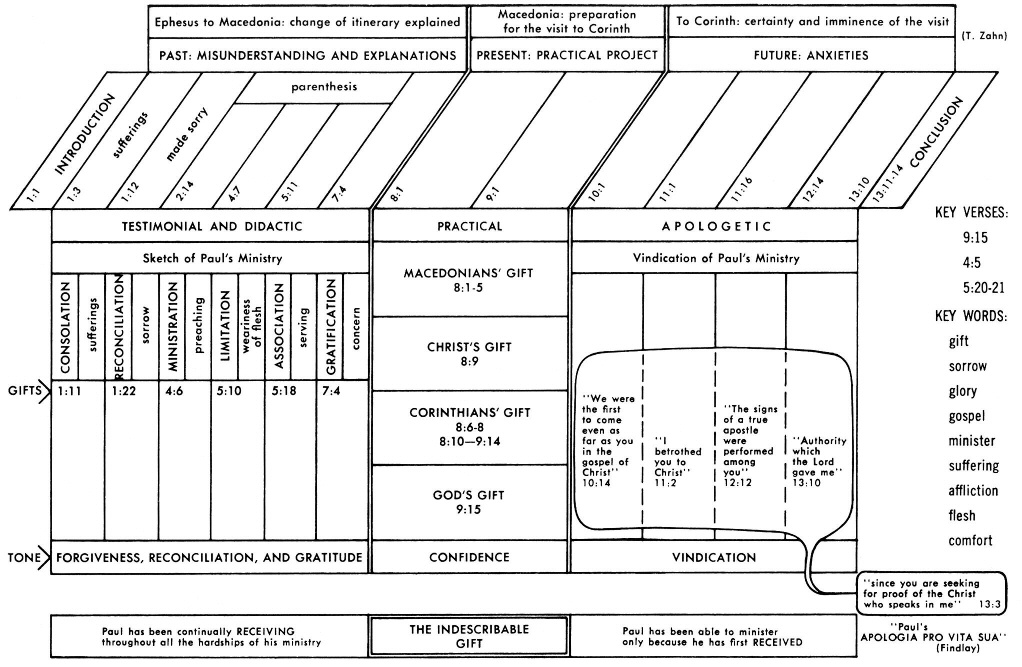
2 CORINTHIANS - PAUL'S MINISTRY IN THE LIGHT OF THE INDESCRIBABLE GIFT
Click chart to enlarge
Charts from Jensen's Survey of the NT - used by permission
Another Overview Chart on right side
| Overview of Second Corinthians |
||
| 2Co 1:1-7:16 Character of Paul |
2Co 8:1-9:15 Collection for the Saints |
2Co 10:1-12:21 Credentials of Paul |
| Testimonial & Didactic | Practical | Apologetic |
| Past: Misunderstanding & Explanation |
Present: Practical Project |
Future: Anxieties |
| Apostle's Conciliation, Ministry & Exhortations | Apostle's Solicitation for Judean Saints | Apostle's Vindication of Himself |
| Forgiveness, Reconciliation Gratitude |
Confidence | Vindication |
|
Ephesus to Macedonia: |
Macedonia: Preparation for Visit to Corinth |
To Corinth: |
|
2Co 1:1-7:16 |
2Co 8:1-9:15 |
2Co 10:1-12:21 |
|
2Corinthians written ~ 56-57AD - see Chronological Table of Paul's Life and Ministry |
||
|
Adapted & modified from Jensen's Survey of the New Testament (Highly Recommended Resource) & Wilkinson's Talk Thru the Bible |
||

2 Corinthians 5:10 For we must all appear before the judgment seat of Christ, so that each one may be recompensed for his deeds in the body, according to what he has done, whether good or bad. (NASB: Lockman)
Greek: tous gar pantas hemas phanerothenai (APN) dei (3SPAI) emprosthen tou bematos tou Christou, hina komisetai (3SAMS) hekastos ta dia tou somatos pros a epraxen (3SAAI), eite agathon eite phaulon.
Amplified: For we must all appear and be revealed as we are before the judgment seat of Christ, so that each one may receive [his pay] according to what he has done in the body, whether good or evil [considering what his purpose and motive have been, and what he has achieved, been busy with, and given himself and his attention to accomplishing]. (Lockman)
Barclay: For we must all appear before the judgment seat of Christ, so that each one of us may receive the consequences of the thing we did while we were in the body, consequences which will correspond to what each one of us has done, be it good or bad. (Westminster Press)
ESV: For we must all appear before the judgment seat of Christ, so that each one may receive what is due for what he has done in the body, whether good or evil (ESV)
KJV: For we must all appear before the judgment seat of Christ; that every one may receive the things done in his body, according to that he hath done, whether it be good or bad.
Macent: for we must all appear before the tribunal of Christ; that every one may receive the retribution, according as his actions in the body were either good or evil.
MLB (Berkley): for we must all appear before the tribunal of Christ, so that each may receive as his due what he practiced while in the body, whether good or bad.
Moffatt: for we have all to appear without disguise before the tribunal of Christ, each to be requited for what he has done with his body, well or ill.
Montgomery: For we must all be made manifest, in our true characters, before the Judgment-seat of Christ; so that each one may receive according to that which he has done in his body, whether good or evil.
NET: For we must all appear before the judgment seat of Christ, so that each one may be paid back according to what he has done while in the body, whether good or evil. (NET Bible)
NJB: For at the judgment seat of Christ we are all to be seen for what we are, so that each of us may receive what he has deserved in the body, matched to whatever he has done, good or bad.
NLT: For we must all stand before Christ to be judged. We will each receive whatever we deserve for the good or evil we have done in this earthly body. (NLT - Tyndale House)
Phillips: For every one of us will have to stand without pretence before Christ our judge, and we shall be rewarded for what we did when we lived in our bodies, whether it was good or bad. (Phillips: Touchstone)
TLB: For we must all stand before Christ to be judged and have our lives laid bare—before him. Each of us will receive whatever he deserves for the good or bad things he has done in his earthly body
Way’s translation: For we have all to stand, stripped of all disguise, before Messiah’s bar, that each may receive the recompense for deeds whereof the body was the instrument, Yea, even according to that which he hath done, Be it good, be it evil. (I don't agree however with his translating it as "evil" which is what the Textus Receptus has [kakos]. The Nestle Aland has "phaulos" which means useless or of no effect).
Weymouth: For we must all of us appear before Christ's judgment-seat in our true characters, in order that each may then receive an award for his actions in this life, in accordance with what he has done, whether it be good or whether it be worthless.
Wuest: for it is necessary in the nature of the case for all of us to be openly shown as to our true character before the judgment seat of Christ, in order that each one may receive the things which were practiced through the agency of our body, whether they were good or bad.
Young's Literal: for all of us it behoveth to be manifested before the tribunal of the Christ, that each one may receive the things done through the body, in reference to the things that he did, whether good or evil;
FOR WE MUST ALL APPEAR BEFORE THE JUDGMENT SEAT OF CHRIST: tous gar pantas hemas phanerothenai (APN) dei (3SPAI) emprosthen tou bematos tou Christou:
- Genesis 18:25; 1Samuel 2:3,10; Psalms 7:6, 7, 8; 9:7,8; 50:3, 4, 5, 6; 96:10, 11, 12, 13; 98:9; Eccl 11:9; 12:14; Ezekiel 18:30; Matthew 25:31-46; Acts 10:42; 17:31; Romans 14:10, 11, 12; 1Peter 4:5; Jude 1:14,15; Revelation 20:11, 12, 14, 15, 15
- Tested by fire - book that be borrowed - by Kroll, Woodrow Michael - (1991) 130 pages. This is a study of the Christian's Heavenly rewards. You do not want to be ignorant of this truth! Chapter titles - (1) It's Too Late Now, (2) Salvation versus Rewards, (3) The Courtroom, (4) The Evaluation, (5) The Criteria, (6) The Rewards, (7) The Loss of Reward, (8) Diversion: A Devilish Device.
- Borrow The treasure principle by Alcorn, Randy
- See also "shorter version" of commentary on 2 Corinthians 5:10
- 2 Corinthians 5 Resources - Multiple Sermons and Commentaries
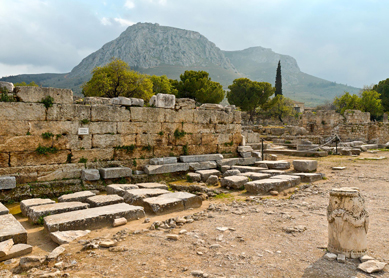
Bema Seat Ruins in Corinth
THOUGHT - The certainty of the Bema Seat of Christ occurring at a specific point in time in eternity in the life of each individual believer, should serve as a strong motivator, causing us to forget what lies behind (Php 3:13+) and like the runner determined to win the race and receive the coveted prize, to press on toward the goal (Php 3:14+), laying aside every encumbrance and the sin which so easily entangles us (Heb 12:1+), lunging toward and fixing our eyes on the One Who has crossed "the finish line" (Heb 12:2+), coming out from the world, not even touching what is unclean (2 Cor 6:17+), abstaining from things that even have the "form" of evil (1 Th 5:22+), living in holy conduct and godliness (2 Pe 3:11+), and all the more as we see the day drawing near (Heb 10:25+).
MOTIVATION FOR
A GOD PLEASING LIFE:
A FEW PRELIMINARY THOUGHTS
Context (2Co 5:1, 2, 3+, 2Co 5:4, 5+, 2Co 5:6, 7, 8+, 2Co 5:9+) - Paul had been building up the saints' hope in the Lord by affirming the fact that they would one day in the future go to be with the Lord and receive a glorious resurrection bodies. Now Paul reminds them of the sobering reality that one day they and every believer will have to stand before the Judgment Seat of Christ and give an account for all of their thoughts, words and deeds after they became believers --- exciting, sobering and motivating truth!
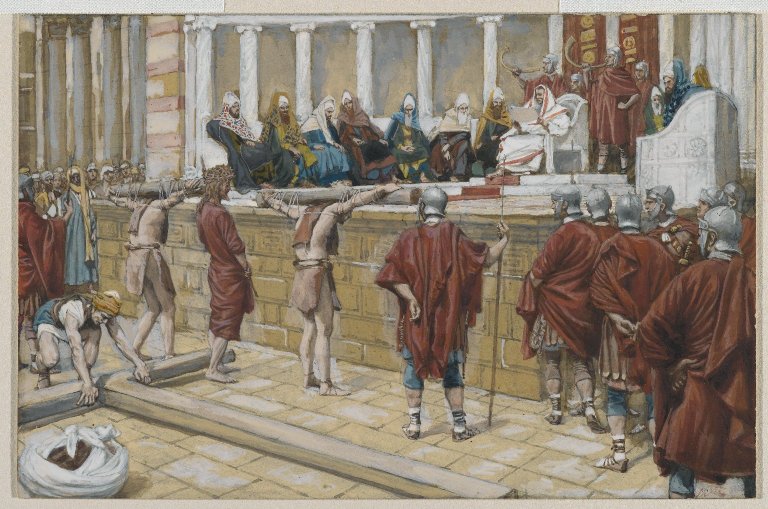
The Judgment on the Gabbatha by James Tissot, c. 1890
THE BEMA SEAT
OF CHRIST
The painting above by James Tissot shows Jesus before Pilate as described in John 19:13 (cf Mt 27:19) "Therefore when Pilate heard these words, he brought Jesus out, and sat down on the judgment seat at a place called The Pavement, but in Hebrew, Gabbatha." Wikipedia has this note on Gabbatha - "The name "Gabbatha" is an Aramaic word, the language spoken commonly at the time in Judea. It is not a mere translation of Lithostrotos, which properly means the tessellated or mosaic pavement where the judgment-seat stood, but which was extended to the place itself in front of Pilate's praetorium, where that pavement was laid. This was proved by the practice of St. John, who elsewhere gives Aramaic names as distinctly belonging to places, not as mere translations of the Greek. This is proved also because "Gabbatha" is derived from a root (meaning 'back', or 'elevation') which refers not to the kind of pavement, but to the elevation of the place in question."
Daniel Webster had a healthy outlook ("uplook") as shown by his answer to the question as to what was the greatest thought to ever enter his mind…
The greatest thought that has ever entered my mind is that one day I will have to stand before a holy God and give an account of my life. (Ro 14:12+)
Jonathan Edwards, at the tender age of twenty, wrote the following words in his diary, words that surely reflect his understanding of the certainty and solemnity of his appearance one day in eternity future before the Lord Jesus Christ at His Judgment Seat.
Being sensible that I am unable to do anything without God’s help, I do humbly entreat Him, by His grace, to enable me to keep these Resolutions, so far as they are agreeable to His will.
1 - Resolved, that I will do whatsoever I think to be most to the glory of God, and my own good, profit, and pleasure… To do whatever I think to be my duty… for the good and advantage of mankind in general.
4 - Resolved, Never to do any manner of thing, whether in soul or body less or more, but what tends to the glory of God…
5 - Resolved, Never to lose one moment of time, but to improve it in the most profitable way I possibly can.
6 - Resolved, To live with all my might, while I do live.
7 - Resolved, Never to do anything, which I should be afraid to do if it were the last hour of my life.
28 - Resolved, To study the Scriptures so steadily, constantly, and frequently, as that I may find, and plainly perceive, myself to grow in the knowledge of the same.
43 - Resolved, Never, henceforward, till I die, to act as if I were any way my own, but entirely and altogether God’s.
46 - Resolved, Never to allow the least measure of any fretting or uneasiness at my father or mother.
70 - Resolved, That there be something of benevolence in all I speak.
(Edwards resolved to read these resolutions over once a week!).
Lord, may his "tribe" increase
for the fame of Your Name
and the glory of Your Son, Christ Jesus. Amen!
Eddie Rasnake unfortunately is probably correct when he posits ("postulates") that…
Many Christians operate from an erroneous idea that the only thing that really matters about heaven is if you get to go there or not. In reality, we will not all hold an equal station in heaven. Some will go to heaven empty handed, while others will enter into eternity with reward that has accumulated from their days on earth. We don’t want to simply squeak in the gate, but we ought to want to hear our Lord say, “Well done, good and faithful servant, enter … into the joy of thy lord” (Mt 25:23). (Following God- Using Your Spiritual Gifts)
David Jeremiah reminds us that…
At the Bema Seat of Christ, earthly wreaths and trophies and newspaper clippings and Super Bowl rings will be long forgotten. They’ll be no more important than brushing your teeth or buying a newspaper at the corner store. But what we do (now) for eternity—even the smallest of deeds—will count forever. (The Things that Matter: Living a Life of Purpose Until Christ Comes)
As Warren Wiersbe writes…
Not every believer is ambitious for the Lord (2Cor 5:9+), but every believer is going to appear before the Lord; and now is the time to prepare. The Judgment Seat of Christ is that future event when God's people will stand before the Saviour as their works are judged and rewarded (see Ro 14:8, 9, 10). Paul was ambitious for the Lord because he wanted to meet Him with confidence and not shame (1Jn 2:28).
Ray Pritchard explains that…
Most Christians don’t know very much about heavenly rewards even though the New Testament has much to say on this subject. If I could summarize the biblical teaching in a few words it would go like this. Salvation is always by grace through faith in the Lord Jesus Christ (Ep 2:8,9+). Heaven is a free gift (Ro 3:24+, Ro 5:15, 16+, Ro 6:23+, Ro 8:32+) that cannot be earned or deserved. But when we get to heaven, we will be judged on the basis of the life we live after coming to Christ. In that day, some people will see all that they have lived for go up in smoke (1Co 3:15 - see Dr. J Vernon McGee's pithy quip). Others will receive great rewards, which are called crowns in the New Testament (Ed note: I think some are called "crowns" but not all rewards will be "crowns" as discussed below). I believe there will be many crowns given, some for faithfulness, others for humble service, still others for those who were martyred for Christ. I’m not sure of all the details about our rewards but this much is clear to me. No one who lives for Christ will ever feel cheated when they finally get to heaven. No one will ever say, “I should have spent more time building an empire on the earth.”… Some years ago I heard Dr. Vernon Grounds say that whenever we are faced with a major decision, we ought to ask ourselves,
“What difference
will this make in 10,000 years?”
Most of the things we worry so much about won’t matter in 3 weeks, let alone 3 months or 3 years. We focus on the trivial and forget to pursue the eternal. But 10,000 times 10,000 years from now, you’ll still be glad you invested your life for Jesus Christ… Several years ago the Mercedes Benz automobile company ran some ads describing a brand-new brake technology they had developed and patented. Although they owned the rights to the technology, they freely shared it with other car companies in the interest of promoting safety. The tag line of the ad contained these sobering words:
Some things in life
are too important not to share.
As Christians, we have been given the best news (The Gospel) in all the world. It’s too important not to share with others.
May God help us to invest our lives in the things that will last forever. (Amen) (Heavenly Rewards)
Howard Hendricks gives great advice regarding rewards - Only two things this world are eternal—the Word of God and people. It only makes sense to build your life around those things that will last forever.
Application: Are you spending serious, focused time in God's Word like Job (Job 23:12+)? Are you looking for opportunities to share the Gospel with those who are spiritually dead in their trespasses and sins (Gal 6:7+, Gal 6:8+, Gal 6:9, 10+)? Are you encouraging your brethren in Christ day by day as long as it is still called today, so that none are hardened by the the deceitfulness of sin (Heb 3:13+)? If not, why not? What is more important in time and eternity than redeeming the time now and storing up for yourself treasure in heaven (Eph 5:15, 16+, Mt 6:20, 21+)
Jon Courson reminds us that rewards
will determine your capacity to enjoy eternity. They will determine what you do in the next zillion years. While I know that just being in heaven will be glory beyond words, I also know that when Paul came back from being caught up into heaven, his purpose in life was to win the prize (Php 3:13+, Php 3:14+). Having seen the reality of heaven, he knew nothing else mattered (2Co 12:2,3,4,5). Jesus said the same thing when He said, “Seek first the kingdom” (Mt 6:33+). “Take my word for it,” Paul would say to you and me today: “Your house, your car, your hobbies, trinkets and toys will all burn. They will not matter ultimately. What does matter is the bema seat, the judgment seat—where you will stand before Jesus and be rewarded.”
Here’s the added bonus, folks: If you live for this life, you’ll always be miserable because nothing will ever be quite right. It will always be “one more piece of furniture to buy,” “one more flower to plant,” “one more promotion to get,” “one more person to date”—but it will never be quite enough.
If you live for heaven, on the other hand,
this world is just a bonus.
Therefore, you can relax, knowing you will find joy unspeakable in heaven. (Jon Courson's Application Commentary New Testament)
Warren Wiersbe says that "Many believers have such a comfortable situation here on earth that they rarely think about going to heaven and meeting the Lord. They forget that they must one day stand at the Judgment Seat of Christ. It helps to hold us up and build us up when we recall that Jesus is coming again… Is the desire for reward a proper motive for service? The fact that God does promise rewards is proof that the motive is not a sinful one, even though it may not be the highest motive. Just as parents are happy when their children achieve recognition, so our Lord is pleased when His people are worthy of recognition and reward. The important thing is not the reward itself, but the joy of pleasing Christ and honoring Him. (Bible Exposition Commentary) (Bolding added)
F B Meyer prays a great "Bema Seat" prayer…
Give us grace, O Lord, to work while it is day (imitating our Lord = Jn 9:4), fulfilling diligently and patiently whatever duty Thou appointest us (Ep 2:10+, Titus 2:14+); doing small things in the day of small things (Zech 4:10), and great labours if Thou summon us to any; rising and working, sitting still and suffering, according to Thy Word. AMEN.
LORD, GIVE US…
A BEMA SEAT MINDSET
Beloved let me offer a "Biblical grid" through which you can (should) filter every thought, word and deed in your life for the rest of your life in light of your future personal appointed appearance at the Bema Seat of Christ…
Whether, then, you eat or drink
or whatever you do,
do all to the glory of God.
1 Corinthians 10:31+
For (gar) is a term of explanation which explains why Paul was so "ambitious" to please God. He knew that one day he would stand before Jesus Christ as His Judge to be rewarded for his deeds in the body. See also Commentary on 2 Corinthians 5:9 to help understand this "for"
Paul Barnett summarizes this term of explanation ("for") writing that "This notable verse, while serving as a climax to the sequence of verses begun at 2Co 4:16, beyond that also echoes the "we all" of 2Co 3:18+.[Greek tous… pantas hemas here means "the sum total of us all." Cf. hemeis… pantas 2Co 3:18]. More immediately, however, it is connected with the previous verse, to which it is joined by "for" (gar); it supplies the reason why believers aim "to please the Lord" (2Co 5:9+). This is because "we all" must be revealed before [euprosthen, a synonym for katenanti see 2Co 2:17; 12:19]. the Messiah's tribunal. The second part of the verse (B), introduced by "that,"[hina]. gives the reason for the first part (A). It is that "each" may receive (back) from the Lord whatever is appropriate, according to the good or evil (Ed: worthless, not speaking of sin, which was paid for in full at Calvary = Jn 19:30+) practiced during one's lifetime. (Borrow NICNT- Paul's Second Epistle to the Corinthians)
We (hemas) is the first person plural pronoun indicating that Paul is participating with his readers in the truths he now explains. In short, the truth about rewards to be dispensed at the judgment seat of Christ is only for believers. This is "family truth" as someone might say.
All (pas) means all without except. All believers must make an appearance at the Bema Seat of Christ. No believer, not Paul, not Peter, not you, not me, "receives a pass" from this compulsory appearance!
Must (1163) (dei [word study] from deo = to bind or tie objects together, put in prison and also root of doulos, bond-servant) refers to that which is not optional but needful (binding) out of intrinsic necessity or inevitability. Dei describes the believer's appearance at the Bema Seat as an event which by necessity must take place, and that this divine "appointment" is inevitable. It is a "Divine necessity" and our appearance is mandatory. Not every believer is ambitious for the Lord as was Paul in 2Cor 5:9, but every believer is going to appear before the Lord and so it follows that now is the time to prepare for that sure and solemn day.
Barnett adds that "the word "must" is regularly used for actions decreed by God (cp 1Co 15:25, 53, "A divine decree cannot be evaded" - Plummer), powerfully strengthening the divinely ordained and unavoidable character of the occasion. (Borrow NICNT- Paul's Second Epistle to the Corinthians)
Thus this appearance is not an elective, but is required of every believer. In a sense it will be akin to a "graduation ceremony" which most of us have either participated in or attended. Do you remember the joy and excitement you felt the day they called your name in front of the hundreds or thousands who were in attendance? And if you were diligent in your tenure as a student, you undoubtedly received some additional accolades, as the announcer said "Mr (Miss) John Doe is graduating with honors", etc. The Bema Seat is where believers will be recompensed for their labors in Christ during their short time on earth.
As Adam Clarke says "We labour (Ed: Note how we are to labor - Col 1:29+, He 13:20, 21+ - His supernatural provision and power, not our fleshly power!) to walk so as to please him, because we know that we shall have to give a solemn account of ourselves before the judgment seat of Christ; where he, whose religion we profess, will judge us according to its precepts, and according to the light and grace which it affords. (2 Corinthians Commentary)
Appear - Literally "Be manifested". It follows that we each will appear before our Lord Jesus Christ, the Judge, but the "when" or time frame of this appearance is less certain.
THE JUDGMENT SEAT
A PLACE OF REVELATION
Appear (5319) (phaneroo from phanerós = manifest, visible, conspicuous in turn from phaino = give light; become visible in turn from phos = light) is literally "to bring to light" and primarily means "to make visible", to cause to become visible, to be make known, to be clearly reveal, to be manifested or caused to be seen. And so it won't be just our exterior (our "good looks"), but our interior, especially our character (our "good works") which will be exposed to full view of our Righteous, Just Judge (Jn 5:22, 1Co 4:5, 2Ti 4:1+)!
If this truth does not put a holy fear of the Lord in you beloved (cp 1Pe 1:17+, 2Co 7:1+), I don't know what will! Jesus (Whose eyes are like a flame of fire! Rev 1:14+) will be our "Fruit Inspector", looking beyond the quantity of our works to the quality of our works… Gulp!
Arthur Way’s translation brings out this day of "full disclosure"…
For we have all to stand, stripped of all disguise, before Messiah’s bar, that each may receive the recompense for deeds whereof the body was the instrument, Yea, even according to that which he hath done, Be it good, be it evil. (I don't agree however with his translating it as "evil" which is what the Textus Receptus has [kakos]. The Nestle Aland has "phaulos" which means useless or of no effect).
Vine explains that phaneroo…
in the passive voice (as in 2Co 5:10) means, “to be (in English "be" conveys the passive sense) manifested”… (Ed: In other words) A person may “appear” in a false guise or without a disclosure of what he truly is (but) to be manifested is to be revealed in one’s true character. (Online - Vine's Expository Dictionary of Old Testament and New Testament Words) (Bolding added) (Note: Hypocrites beware! cp Mt 6:2+, Mt 6:5+, See word study on hypocrisy = hupokrisis)
MacDonald comments…
Actually it is not just a matter of appearing there, but of being made manifest. The New English Bible correctly says, “We must all have our lives laid open before the tribunal of Christ.” It is one thing to appear in a doctor’s office and quite another thing to be X-rayed by him there. (Borrow Believer's Bible Commentary )
Comment: Since our lives will indeed be "laid open before" the Lord Jesus Christ one day in the future, it behooves us now in the spirit of the teaching of Hebrews 4:12+, He 4:13+, to allow His incisive Word to pierce our innermost being and judge our worthless thoughts and intentions while today is still called "Today" (He 3:13+) so that we might purge (by prayerful Spirit wrought searching [Ps 139:23, 24note v23, note v24 ], confession [Pr 28:13] and repentance) those worthless thoughts, words and deeds. (See Jesus' warning in Mt 12:36 where "careless" is the Greek word argos [from "a" = without + ergon = work] literally meaning not working, idle, inactive, ineffective, and thus worthless!) Please do not misunderstand - ALL of our sins have been atoned for (Jn 19:30 = "Paid in Full"!see explanation) but our sins today will affect the quality of our work for (in) Him today and our reward from Him in the future (cp Gal 6:7, 8 = present imperative + negative = "Stop being deceived!" see our need to depend on the Holy Spirit to obey).
The Judgment Seat of Christ - Believers can stand at the Bema because Christ stood at Gabbatha (raised place, height, ridge) IN OUR PLACE (cp Substitutionary Atonement)! John records Pilate's passage of judgment on our Lord…
When Pilate therefore heard these words, he brought Jesus out, and sat down on the judgment seat (bema) at a place called The Pavement, but in Hebrew, Gabbatha (A term for what in Greek was called lithostrotos = “paved with stones” and was a vernacular term for Roman tribunal = a court of "justice"!, cp 1Pe 2:24+, Isa 53:5, 6, 2Co 5:21). 14 Now it was the day of preparation for the Passover; it was about the sixth hour. And he said to the Jews, "Behold, your King!" 15 They therefore cried out, "Away with Him, away with Him, crucify Him!" Pilate said to them, "Shall I crucify your King?" The chief priests answered, "We have no king but Caesar." 16 So he then delivered Him to them to be crucified. (Jn 19:13, 14, 15, 16)
Comment: Gabbatha was the Aramaic word describing the covered pavement where the judgment seat (bema) was set and on which Pilate sat in order to judge the Judge of all men (Jn 5:22, 27, 2Ti 4:1+) condemning Him to an undeserved, painful, shameful death! Because He stood fearlessly in our place on the Bema to be condemned by men, we can stand at His Bema without fear of condemnation by God (Ro 8:1+)!
WHEN DOES
THE BEMA JUDGMENT
TAKE PLACE?
The question of when the Bema Judgment take place is difficult to answer with any degree of "dogmatism". The majority of evangelical scholars favor this event taking place after the Rapture but before the return of Jesus to set up His Millennial Kingdom. The highly respected scholar Dwight Pentecost has the following explanation on the timing of of bema…
The time of the bema of Christ. The event herein described takes place immediately following the translation of the church out of this earth's sphere. There are several considerations that support this.
(1) In the first place, according to Lk 14:14, reward is associated with the resurrection. Since, according to 1Th 4:13-17, the resurrection is an integral part of the translation, reward must be a part of that program.
(2) When the Lord returns to the earth with His bride to reign, the bride is seen to be already rewarded. This is observed in Rev 19:7, where it must be observed that the "righteousness of the saints" is plural and cannot refer to the imparted righteousness of Christ, which is the believer's portion, but the righteousnesses which have survived examination and have become the basis of reward.
(3) In 1Cor 4:5; 2Ti 4:8; and Rev 22:12 the reward is associated with "that day," that is, the day in which He comes for His own. Thus it must be observed that the rewarding of the church must take place between the rapture and the revelation of Christ to the earth.' (From Things to Come - Borrow, 1958 - See page 220)
One other Scripture that points to the Bema occurring during the Tribulation period is Revelation 11:18 (see commentary notes) where John writes…
And the nations were enraged, and Thy wrath came, and the time came for the dead to be judged (this is the Great White Throne Judgment - see comments beginning at Rev 20:11), and the time to give their reward to Thy bond-servants the prophets and to the saints and to those who fear Thy name, the small and the great (this could refer to the Judgment Seat of Christ), and to destroy those who destroy the earth.
If one reads the Revelation literally (which results in a chronological order for the successive unfolding of the seven sealed scroll, the seven trumpets and the seven bowl judgments), Revelation 11:18 seems to coincide with the events of the middle to the seven year period known as the Tribulation.
To reiterate, most conservative evangelical scholars (especially pre-trib, pre-millennial) believe that this judgment will take place after the church is raptured and before the Second Coming of Christ at which time He inaugurates His 1000 year reign on earth from His throne in Jerusalem. For example Master's Seminary (John MacArthur) takes this view regarding the timing of the Bema Seat in their "Statement of Faith"…
The Rapture of the Church - We teach the personal, bodily return of our Lord Jesus Christ before the seven-year tribulation (1Th 4:16; Titus 2:13) to translate His church from this earth (Jn 14:1-3; 1 Corinthians 15:51-53; 1Th 4:15-5:11) and, between this event and His glorious return with His saints, to reward believers according to their works (1Co 3:11-15; 2Co 5:10).
The Tribulation Period - We teach that immediately following the removal of the church from the earth (Jn 14:1-3; 1Th 4:13-18) the righteous judgments of God will be poured out upon an unbelieving world (Jeremiah 30:7; Daniel 9:27; 12:1; 2Th 2:7-12; Re 16:1ff), and that these judgments will be climaxed by the return of Christ in glory to the earth (Mt 24:27-31; 25:31 46; 2Th 2:7-12). At that time the Old Testament and tribulation saints will be raised and the living will be judged (Da 12:2-3; Re 20:4-6). This period includes the seventieth week of Daniel's prophecy (Daniel 9:24-27; Mt 24:15-31; 25:31-46).
The Judgment of the Lost - We teach that following the release of Satan after the thousand year reign of Christ (Re 20:7), Satan will deceive the nations of the earth and gather them to battle against the saints and the beloved city, at which time Satan and his army will be devoured by fire from heaven (Re 20:9). Following this, Satan will be thrown into the lake of fire and brimstone (Mt 25:41; Re 20:10) whereupon Christ, who is the Judge of all men (Jn 5:22, 27), will resurrect and judge the great and small at the Great White Throne judgment (Re 20:11ff+). We teach that this resurrection of the unsaved dead to judgment will be a physical resurrection, whereupon receiving their judgment (Jn 5:28,29), they will be committed to an eternal conscious punishment in the lake of fire (Mt 25:41; Re 20:11-15). (TMS - TMS Statement of Faith - Eschatology)
Warren Wiersbe commenting on Rev 11:18 writes…
“And the time of the dead, that they should be judged” takes us to the very end of God’s prophetic program. In one sense, every day is a “day of the Lord” because God is always judging righteously (Ro 1:18). God is long-suffering toward lost sinners and often postpones judgment, but there will be a final judgment of sinners and none will escape. This judgment is described in Revelation 20:11-15.
There will also be a judgment of God’s children, known as “the Judgment Seat of Christ” (Ro. 14:10-13+; 1Co 3:8-15+; 2Co 5:9-11). God will reward His faithful servants (Mt 25:21) and the sufferings they experienced on earth will be forgotten in the glory of His presence. Though God’s children will not be judged for their sins (that judgment took place on the cross), they will be judged for their works and rewarded generously by the Master.
The Judgment Seat of Christ will take place in heaven after Christ has called His people home. When He returns to earth to establish His kingdom, the saints will be ready to reign with Him, with every blemish of the church removed (Ep 5:25, 26, 27+; Rev 19:7+, Rev 19:8+). Today, we groan as we serve God, because we know only too well our handicaps and blemishes; but one day, we shall serve Him perfectly! (Bible Exposition Commentary - Old Testament)
I should emphasize that not everyone agrees with this interpretation of the timing of the Bema Seat (some even place it at the time of the Great White Throne Judgment), so please be a Berean (Acts 17:11+). Why might someone place it contemporaneous with the Great White Throne? One answer is that if an individual does not accept a literal 1000 years, than they see the two judgments together, whereas premillennialist see them as separated by 1000 years. Irregardless of the specific time of this momentous event, God's sure word of prophecy states that the Bema absolutely will take place! God's children need to live in light of this truth and daily maintain a "Bema Seat Mentality" (see also Vertical Vision), for what you are looking for, will determine what you are living for! And what we are living for today, will determine in some way, how we live throughout eternity.
Judgment seat (968) (bema) (see also Judgment by the Saints) originally referred to a raised place mounted by steps, and so a platform that requires steps to ascend. Hence the word bema signifies the official seat where a judge (Mt. 27:19; Jn 19:13; Ac 18:12, etc.) or an official is seated when rendering judgment in certain legal cases or athletic events.
Depending on the setting, the bema could be a tribunal from which the judge or magistrate would address an assembly from a chair placed on the structure (the bema). Thus the judge would sit elevated above those he was addressing and rendering judgment upon.
Smith notes that "the bema seat (is) equivalent to the judge’s seat in the Olympic Games. After each game, the winners came before the judge’s seat to receive crowns for first, second and third places. Likewise, the Christian’s works will be tested by fire, and he’ll be rewarded for those which remain… The judgment seat of Christ is only concerned with a Christian’s rewards and position in the kingdom, not with his salvation.
McComiskey writes that "In secular Greek bema is used in the sense of step or stride, as in walking (Pindar, Aeschylus). It has also the associative connotation of a pace as a unit of measure. The word is also used as a platform for a public speaker and, in legal contexts, it denotes the place where litigants stood for trial (Demosthenes, Aeschines)." (Brown, Colin, editor. New International Dictionary of NT Theology)
John Walvoord notes that 2Cor 5:10 "is the central passage in the Bible on the Judgment Seat of Christ, and Paul alluded to it a number of times in his epistles (Ro 14:10, 11, 12; 1Co 3:11, 12, 13, 14, 15; 9:24, 25, 26, 27). This was reinforced by the statement of Jesus, “Moreover, the Father judges no one, but has entrusted all judgment to the Son, that all may honor the Son as they honor the Father” (John 5:22, 23).
The Bema “judgment seat” in (Romans 14:10 and 2 Corinthians 5:10) and the Great White Throne (Re 20:11ff+) at which time Christ will judge the wicked unsaved of all ages (Revelation 20:11-15+) are separate judgments.
|
TWO JUDGMENTS |
|
|
2 Corinthians 5:9,10 |
Revelation 20:11-15+ |
|
Judgment Seat of Christ |
Great White Throne Judgment |
|
Only believers |
Only unbelievers |
|
After the Rapture |
After the 1000 year reign of Messiah |
|
Deeds determine |
Deeds determine |
Christians are in view at the Bema Seat of Christ and everything hidden will be revealed. The Bema Seat will be an exhaustive evaluation of our lives after we became believers. 1 Corinthians 4:5+ says the Lord will come and
bring to light the hidden things of darkness and reveal the counsels of the hearts. Then each one's praise will come from God.
Note that last phrase! Be encouraged. EVERY MAN will receive praise from God!
There are several future or "end time" judgments involving saved and unsaved individuals, Jews and Gentiles and Satan and the fallen angels. As the writer of Hebrews reminds all of us (saved and unsaved)…
it is appointed for men to die once (no reincarnation!) and after this comes judgment (He 9:27)
If we have believed in Christ for our salvation, this judgment is for the purpose of rewards (or loss of rewards) but not a judgment for sins. If one has not received Christ personally as Savior, this judgment is for one's sins and the wages ("rewards") are eternal death and separation from the presence of the Lord and from the glory of His power, (Ro 6:23, 2Th 1:8,9,10). Below is an overview of Biblical judgments which is intended only to give one a perspective of where the Judgment Seat of Christ "fits" into the picture.
PAST JUDGMENT
There was the judgment for sin which Jesus Christ bore on the Cross and because He bore our sins and the judgment for us He could say,
Truly, truly, I say to you, he who hears My word, and believes Him (God the Father) who sent Me, has eternal life, and does not come into judgment (of the unsaved at the Great White Throne-Re 20:11ff+), but has passed out of death (the second death, the Lake of fire, eternal separation away from the presence of God) into (eternal) life. (John 5:24).
Comment: God will not judge the sins of believers, because they have already been judged on the Cross. However as discussed on this page, Christ will judge our works and our ministry. If we have been faithful in serving and glorifying Him, we will receive a reward. On the other hand, if we have been unfaithful, we will lose our reward but not our salvation because we have "passed out of death into life". Praise God!
THE WAY TO FACE CHRIST AS JUDGE
IS TO KNOW HIM AS SAVIOR.
There is (or should be) self judgment in our present life (particularly in the context of celebration of the Lord's Supper) for we are told in 1Corinthians 11:31 that "if we judged ourselves rightly, we should not be judged." This judgment may be in the form of discipline (see below) which can include sickness (see 1Co 11:30) or even death (cp Acts 5:1, 2, 3, 4, 5, 1Jn 5:16). The Lord's purpose of course is that we have a "healthy fear" of sin and these truths would drive us back to righteous behavior. However even this "judgment" proves we are truly His sons (see verses below)
Although one might not consider discipline (chastening) of believers as judgment, most would agree that divine discipline is in some sense a present judgment (remembering that one root idea of the Greek word for judgment is separation or distinguishing between right and wrong). Because all believers are imperfect and need discipline and spiritual training, all true children of God are chastened at one time or another, in one way or another. (see Heb 12:5, 6+, He 12:7, 8, 9, 10+, He 12:11+).
We as believers in Jesus Christ are warned not to needlessly, unfairly or critically judge others (Mt 7:1, 2+, Mt 7:3, 4, 5+) and yet are also charged not to refrain from calling sin sin, all the while doing so in a spirit of gentleness and recognition that that we ourselves are sinners (Gal 6:1)
1) During the Seventieth Week of Daniel (commonly referred to as "The Tribulation") the earth and "earth dwellers" will be impacted by a series of "judgments" that flow sequentially from the seal, trumpet and bowl judgments described in detail in Revelation 6-19. For an excellent, conservative (literal) verse by verse analysis of this time when God's wrath is poured out, I highly recommend Tony Garland's commentary on the Revelation entitled Tony Garland's commentary on the Revelation entitled "A Testimony of Jesus Christ".
2) The Judgment of the Nations (synonymous with "Gentiles") (Mt 25:31-46)
The Sheep (saved Gentiles) and the Goats (unsaved Gentiles) will be separated. The Gentiles who come out of the time of the Great Tribulation are saved by grace through faith, but in Matthew 25 Jesus teaches that they will be identified on the basis of whether they befriended the Jews during the Great Tribulation in which anti-Semitism will reach its historical zenith. The fact that these Gentiles befriend Jews does not earn their salvation but demonstrates that they are saved. The saved Gentiles will have the wonderful privilege of entering into the Millennial Reign of Christ in their natural bodies.
3) The Judgment of Israel (Zech 13:8, 9+. Ezekiel 20:33, 34, 35, 36, 37, 38).
Paul taught in Romans "they are not all Israel who are descended from Israel" (Ro 9:6) and after the Great Tribulation there will be a time in which God specifically judges Israel to determine who is the "true Israel" and it is these born again Jews who will enter into the Millennial reign of Christ.
4) The Judgment of Satan and his fallen angelic cohorts
These judgments are described in (Jude 1:6+, Re 20:1+, Re 20:2+, Re 20:3+, Re 20:7+, Re 20:8+, Re 20:9+, Re 20:10+)
5) The Judgment of the Unbelieving Dead
This judgment is most commonly referred to as the "Great White Throne" Judgment (Re 20:11+, Re 20:12+, Re 20:13+, Re 20:14+, Re 20:15+) and follows (1) the 1000 year binding of Satan, subsequent release and utter defeat and (2) the 1000 year reign of the saints with Christ on earth (Re 20:4+, Re 20:5+, Re 20:6+). Compare 2Th 1:6, 7, 8, 9 which describes the tragedy of hell, which is eternal separation from the Living God. May this immutable, awesome truth drive us to pray fervently and urgently for the lost in our sphere and influence and to witness to the liberating truth of the Gospel of Jesus Christ.
Related Resources:
- What are the different judgments in the Bible? - summary of past, present and future judgments
- Christ as Judge
- What is the Great White Throne Judgment?
- What is the Judgment Seat of Christ / Bema Seat of Christ?
- What happens at the final judgment?
LET US PONDER OFTEN AND SOBERLY…
THE BREVITY OF OUR DAYS &
THE LENGTH OF ETERNITY!
Yet you do not know what your life will be like tomorrow. You are just a vapor that appears for a little while and then vanishes away. (Jas 4:14+)
Let us each consider taking some some time to slowly read through the following passages asking the Spirit of God to open the eyes of our heart to the truths therein and then for Him to will and work in us (Php 2:13+) so that we might redeem our remaining time (Eph 5:16, Ps 90:12), conducting ourselves daily with a "Bema Seat" Mindset, doing all to the praise of the glory of His grace in Christ. Amen
Shortness of our life: Job 7:6, 7 9:25, 26 14:1, 2 Ps 37:2+ 39:5, 6+ Ps 90:4, 5, 6, 9, 10+ Ps 102:3+, Ps 102:11+, Ps 103:15+, Ps 103:16+ Ps 144:4+ Isa 38:12,13 40:6,7 Mt 6:30+ Jas 1:10, 11+ Jas 4:14 1Pe 1:24+ 2Ki 19:26
Related Resources:
- Devotional/motivational article - Redeem the Time - over 100 pages of notes, quotes, devotionals, etc
- Watch Redeem the Time video, article on Redeem the Time
- Related discussion in Romans 14:10+
- Life As a Vapor - John Piper - first 3 chapters only - about 27 pages of a total of 180 pages
Erwin Lutzer is an excellent writer on a number of subjects but he made some statements about the Bema Seat in his book Your Eternal Reward about which as a Berean I have some serious reservations. Here is what Lutzer wrote in his explanation under the subtopic of losing rewards...
To possess eternal life you simply need faith in Christ; to truly inherit it, you need faith and obedience. (Joseph C. Dillow, The Reign of the Servant Kings - be wary of Dillow's teaching - see gotquestions.org) If we keep in mind that to “inherit eternal life,” or to “inherit” the kingdom, is an extra reward for faithful service, we will read many passages of Scripture differently.
Lutzer is referring to Ephesians 5:5 which says "For this you know with certainty, that no immoral or impure person or covetous man, who is an idolater, has an inheritance in the kingdom of Christ and God." Lutzer believes that this passage describes true believers who practice the sins mentioned, and because of such practice they will "inherit eternal life" but will not "inherit the kingdom." This is a misinterpretation of Paul and makes no sense for John in describing all believers in Rev 5:10 says Christ has made us to "a kingdom and priests to our God; and they will reign upon the earth.” That certainly sounds like all believers will be kings which of course implies a kingdom. Jesus said "Blessed are the poor in spirit, for theirs is the kingdom of heaven." (Mt 5:3) The poor in spirit are believers. And to the overcomer Jesus promises a similar reward declaring " I will grant to him to sit down with Me on My throne, as I also overcame and sat down with My Father on His throne." (Rev 3:21) In Rev 2:26 Jesus promises the overcomer "to him I will give authority over the nations." That sounds like the overcomers inherit a kingdom. And recall that overcomers are not some elite class of believers but a description of every individual that "believes that Jesus is the Son of God." (1Jn 5:4-5) And finally, in Rev 20:6 John writes "Blessed and holy is the one who has a part in the first resurrection (ALL BELIEVERS); over these the second death has no power, but they will be priests of God and of Christ and will reign with Him for a thousand years." Lutzer's interpretation that there will be "haves" and "have nots" in Heaven because some believers will not inherit the kingdom is Scripturally indefensible and in my opinion should be disregarded! Lutzer even compounds his error by using Paul's long list of sins in Galatians 5:19-21 to say Paul is speaking "of those who will forfeit certain kingdom privileges because of their sinful lifestyle." Beloved, that is absolutely false and is twisting the meaning of Paul's words! Paul in fact is warning those "who practice (habitually, as their lifestyle, continually) such things" that they "shall not inherit the kingdom of God." Paul is clearly stating that those who continually practice this long list of sins are not born again, not genuine believers.
Let me give you a few comments from other men on the true interpretation of Ephesians 5:5 (and the same could be done for Gal 5:19-21):
Harold Hoehner - Paul sternly warned believers that the reason they are to abstain from evil deeds (specifically, immorality, impurity, and greed; cf. vv. 3 and 5) is that those who practice them are not a part of God's kingdom. (Dr Harold Hoehner, Director of Th.D. Studies - The Bible Knowledge Commentary: An Exposition of the Scriptures by Dallas Seminary Faculty)
Warren Wiersbe - When we trusted Christ, we entered into the kingdom of God (John 3:3); but we are also awaiting the full revelation of His kingdom when He returns (2 Tim. 4:1). Paul makes it clear that people who deliberately and persistently live in sin will not share in God's kingdom. "They which practice (prasso in present tense) such things shall not inherit the kingdom of God" (Gal. 5:21, literal translation).
John MacArthur- God never tolerates sin, which has no place at all in His kingdom, nor will any person whose life pattern is one of habitual immorality, impurity, and greed (see v. 3) be in His kingdom, because no such person is saved. (The MacArthur Study Bible)
Charles Ryrie (comment on the parallel passage Galatians 5:21) - those who practice. The tense indicates habitually practicing these sins, exhibiting a lifestyle that shows an unsaved condition. (Ryrie Study Bible)
Moody Bible Commentary - The unique phrase the kingdom of Christ and God is probably trans-temporal: the habitual sinner is not part of Christ's present kingdom (Col 1:13) and, without repentance, will not partake in God's coming kingdom (cf. 1Co 15:24). The one attempting to deceive the Ephesians with worthless arguments (empty words, Eph 5:6) is probably an outsider who blindly fails to see that such sins bring wrath (cf. Ro 1:18; Col 3:6). (The Moody Bible Commentary)
I could list many other similar comments that disagree with and discount Lutzer's interpretations of Ephesians 5:5 and Galatians 5:19-21. Not only is this an inappropriate application of these somber warning texts to the rewards at the Bema Seat of Christ, but it is a dangerous interpretation, as it gives those who profess to believe in Christ license to continue a lifestyle of continually practicing "immorality, impurity, sensuality, idolatry, sorcery," etc. (Gal 5:19-21)! All of us as believers are guilty from time to time in committing some of these sins, but because of the convicting ministry of the Spirit within us, we humbly confess and repent of these sins, instead of continuing an unbroken, unrepentant practice of them as do unregenerate professors. Such individuals will receive the shock of their lives when Jesus commands them "‘I never knew you; DEPART FROM ME, YOU WHO PRACTICE (present tense - habitually, continually) LAWLESSNESS (cf 1Jn 3:4 - "sin is lawlessness.")" (Mt 7:23+)
SPEND YOUR TIME WISELY - Years ago, a young boy wandered from case to case in a candy store, trying to decide what to buy. His mother, tired of waiting, called, "Hurry up and spend your money! We must be going." this he replied, "But Mom, I only have one penny, so I've got to spend carefully"
So too, we have only one life to live, so we must "spend it carefully". In underscoring the brevity of life, the Bible uses many illustrations, among them that of a flower. A flower is a thing of loveliness. But what strikes me most about a flower is that its beauty is so brief.
Because our days on earth are few, we should make the most of "flowering time." The nectar of the love of God in our heart should attract people to the Savior. Your life is brief—make it lovely!—H. G. Bosch (Our Daily Bread, Copyright RBC Ministries, Grand Rapids, MI. Reprinted by permission. All rights reserved)
Using your few days wisely
can make an eternal difference.
As A W Tozer rightly said "Before the judgment seat of Christ my service will not be judged by how much I have done but by how much of me there is in it." (Woe!) (cp Jn 15:5)
Spurgeon illustrates this same idea with a story…
You remember the old legend, which contains a great truth. There was a brother who preached very mightily, and who had won many souls to Christ, and it was revealed to him one night in a dream, that in heaven he would have no reward for all he had done. He asked to whom the reward would go, and the angel told him it would go to an old man who used to sit on the pulpit stairs and pray for him. Well, it may be so, but both would most likely share their Master's praise. We shall not be rewarded, however, simply according to our apparent success. — Barbed Arrows from the Quiver of C. H. Spurgeon
Occasionally a benevolent action wrought in faith brings with it an instantaneous recompense in kind; therein Providence is seen as smiling upon the deed. The late John Andrew Jones, a poor Baptist minister, whilst walking in Cheapside, was appealed to by some one he knew for help. He had but a shilling in the world, and poised it in his mind, to give or not to give? The greater distress of his acquaintance prevailed, and he gave his all, walking away with a sweet remembrance of the promise, "He that hath pity upon the poor, lendeth unto the Lord, and that which he hath given, will he pay him again." He had not gone a hundred yards further before he met a gentleman who said, "Ah, Mr. Jones, I am glad to see you. I have had this sovereign in my waistcoat pocket this week past for some poor minister, and you may as well have it." Mr. Jones was wont to add, when telling the story, "If I had not stopped to give relief I should have missed the gentleman and the sovereign too." — Spurgeon - Feathers for Arrows
A W Tozer writes that…
Our motives in the Christian life should be both right and genuine (cp 1Co 4:5). God is the Faithful One. We are to love Him and serve Him because He is God—not because of the gracious things He does for us or for the rewards He promises us!
However, it should be said that God does not expect us to forget or ignore the gracious future promises He has made to us. It is a glorious truth that if we believe God and honor His Word, if we walk by faith in love and obedience, there will be eternal rewards for each of us in that great coming day. The rewards will differ. Wisdom and knowledge and love reside in Him who is our God. He will make the right judgments for His people.
I for one will not be surprised if some of God's faithful people serving Him today should rise as high and shine as brightly as the heroes of faith listed in the book of Hebrews.
I say that in all truthfulness because I do not think that all of the heroes of faith are dead and gone!
Deeds done in the Spirit, in obedience to Christ and with the purpose of bringing honor to the Triune God, are seeds of endless blessedness.
The first gift of life is not by works, but by faith in the work of a sufficient Redeemer; but after the miracle of the new birth has been accomplished, the Christian to a large extent carries his future in his hands. If he denies himself and takes up his cross in meek obedience, his deeds will become seeds of life and everlasting glory.
He may forget his deeds of love or think them small and useless, but God is not unmindful. He never forgets (cp He 6:10) The sweet harvest of a life well lived will be there to meet the sower after the toil is ended and the heat of the day is past
Spurgeon has several thoughts regarding a Christian's rewards…
The service of God is a remunerative service; He gives wages in the work, and an abundant reward, according to His grace, when the work is done…
Your reward is not what you get at present, but it lies in the glorious future. When the Lord Jesus comes He will reward all His stewards and servants. No truth is more plain in the four Gospels than this fact, that when Jesus returns to this earth He will distribute recompense in proportion to work done…
He will certainly come in His own person to reward His saints; and ere He comes He sees what you are doing. If this does not nerve you to tireless diligence in holy service, what can?…
If the action is not done in the Lord's service, but with a view to our own honour, we cannot expect a reward from above.
Short is life;
fleeting is time;
quick is death;
sure is judgment;
long is eternity.Therefore…
What thou desirest to do, do it quickly.
Thou wilt deeds of love repay;
Grace shall gen'rous hearts reward
Here on earth, and in the day
When they meet their reigning Lord.
He can labor without present reward who looks for a reward in the world to come…
God is both the rewarder and the reward of his people… He that wills to serve God for nought, will find that he does not serve God for nought. Our motive must be free from selfishness, but in the end the Lord will reward all the faithful.
Mind your work, and God will find your wages. If not today, nor tomorrow, yet very certainly and abundantly, according to his grace, he will reward every good work.
No pain, no palm. We must endure the toil and the suffering, or we may not expect the reward. The winner must first be a runner.
Soldiers of the Lord below,
Strong in faith resist the foe:
Boundless is the pledged reward
Unto them who serve the Lord.'Tis no palm of fading leaves,
Which the conqueror's hand receives;
Joys are his serene and pure,
Light that ever shall endure.For the souls that overcome
Waits the beauteous heavenly Home,
Where the blessed evermore
Tread, on high, the starry floor.
John Flavel - Those who give to God only the shadow of duty can never expect from him a real reward.
William Childs Robinson - The judgment seat of Christ lends a seriousness to all life. (Ed: Beloved is this statement true of you?)
John Blanchard - The fact that the Christian can face the day of judgment secure in the knowledge that he will not be rejected does not mean that he is to think of it in terms of a glorified prize-giving… We shall stand before the judgment seat of Christ on the basis of our performance, not our profession… We will go past the judgment seat of Christ in single file. (Complete Gathered Gold: A Treasury of Quotations for Christians)
John MacArthur helps us understand the effect that sin now has on our future rewards...
At the same time, while we won't be condemned for our sins, our present lives do affect what will happen at the Judgment Seat of Christ. Here's how:
Sin and indifference in this life rob us of our present desire for serving the Lord. That in turn means a loss of rewards, because we will not have used our time to His glory. That is why Paul exhorts us to "be careful how [we] walk, not as unwise men, but as wise, making the most of [our] time, because the days are evil" (Eph 5:15, 16notes).
Sin and indifference result in a loss of power in our lives because sin grieves the Holy Spirit.
Sin and indifference cause us to pass up opportunities for service, which we would otherwise perform and be rewarded for.
The greatest consequence of unfaithfulness here on earth is that it disappoints Christ. 1Jn 2:28 says, "And now, little children, abide in Him, that when He appears, we may have confidence and not be ashamed before Him at His coming." That is a sobering thought—we could be ashamed as we stand before the Lord. At the same time, it should encourage us with the prospect of receiving His lavish rewards if we serve Him faithfully during our time here on earth. (from What is the purpose of the Judgment Seat of Christ?; see also Believer’s Rewards)
Bill Vaughn in his thesis submitted to Master's Seminary reaches the following conclusion…
When Paul’s teaching on the judgment seat of Christ is stripped of the unbiblical teaching of punishment for sin at the judgment seat of Christ, what is left is the biblical picture of a future date before Jesus Christ that all Christians should anticipate. The nature of the judgment at the judgment seat of Christ is not to judge sin (ED: READ THAT AGAIN). No biblical basis for that position exists. The nature of the judgment at the judgment seat of Christ is to judge each Christian’s service for possible rewards. Jesus has let us see this future event so that we can use it as a motivation to serve Him now, in our bodies, in a manner that will please Him and, ultimately, merit rewards for us. Paul’s greatest ambition was to please his Lord, desiring that, when the deeds done in his body were tested by fire, most of them would remain as gold, silver, or precious stones to be rewarded by Jesus. Given the proper understanding of the judgment seat of Christ, Christians should follow Paul’s example and let the judgment seat of Christ be the reason for their ambition to please the Lord Jesus Christ in all of their service. (The Judgment Seat of Christ - A Judgment For Sins or Service? - 21 pages)
There was a rabbinic saying…
Let not thine imagination assure thee that the grave is an asylum; for perforce thou wast framed, and perforce thou wast born. and perforce thou livest, and perforce thou diest, and perforce thou art about to give account and reckoning before the King of kings, the Holy One, blessed is he.
As a dedicated Christian worker once said…
The pay may not be that good but you can't beat His retirement plan.
Warren Wiersbe commenting on Daniel 12:3 remarks that…
How we have lived and served will determine the rewards the Lord will give us at the judgment seat of Christ (Ro 14:9, 10, 11, 12; 2Co 5:6-10). Every cup will be full in heaven, but some cups will be larger than others. We will share in the glory of Christ, and those who have sought to win others to Christ will shine like the stars in the heavens. There is a special application here to those who have faithfully witnessed during the Tribulation period, when it will be a costly thing to identify with Christ and His people (Mt 24:14; Re 7:9-17).
Our Lord emphasized the truth that faithfulness to Him today will lead to reward and ministry in the future kingdom (Mt 13:43; 19:27, 28; 25:14-30; Lk 19:12-27; Rev 2:26, 27; 5:9, 10). During His reign on earth, we will share in whatever work He has for us to do, according to how we have lived for Him and served Him here on earth. Believers who have suffered in their service for Christ will be more than compensated as they share in His glory (Ro 8:18; 2Co 4:7, 8, 9, 10, 11, 12, 13, 14, 15, 16, 17, 18). (Bible Exposition Commentary - Old Testament)
Canadian Missionary J. Goforth (brief biography) gives a beautiful illustration of what every believer wants to hear someday
When he was fifteen years of age his father put him in charge of their second farm, which was twenty miles from the home farm. "Work hard," said his father. "At harvest I'll return and inspect." In later years Goforth stirred many an audience as he told of his arduous labors that summer, of his father's return in the fall and of how his heart thrilled when his father, after inspecting the fields of beautiful waving grain, turned to him and smiled. "That smile," he would say, "was all the reward I wanted. I knew my father was pleased. So will it be, dear Christians, if we are faithful to the trust our Heavenly Father has given us. His smile of approval will be our blessed reward."
I like Ray Stedman's prayer on the passage in Ro 14:10, 11, 12 that parallels the Bema Seat Judgment…
Thank you, our Father, for these searching words which make us all feel a bit guilty. We have all been guilty of this, whether strong or weak. We have judged our brother, and condemned him. Forgive us for that, Lord. Help us to see that we have been usurping Your place, Lord Jesus, in doing so. Help us to stop that, and to begin to answer only for ourselves before Your throne, and upholding and praying for our brother or sister if we feel they need it. Grant to us, Lord, that illuminating understanding of truth that sets us free. We ask it in Jesus' name, Amen.
Who does God's work will get God's pay,
However long may seem the day,
However weary be the way;
Though powers and princes thunder "Nay,"
Who does God's work will get God's pay.
He does not pay as others pay,
In gold or land or raiment gay;
In goods that vanish and decay;
But God in wisdom knows a way,
And that is sure, let come what may,
Who does God's work will get God's pay.
— Encyclopedia of 15,000 Illustrations
Pulpit Commentary - Every one shall receive a reward for every deed. “That every one may receive the things done in his body.” No lost labour. With this consciousness we may well be courageous amidst all the dangers here and in view of the great hereafter. Dread of death is a disgrace to the Christian. “If,” says Cicero, “I were now disengaged from my cumbrous body, and on my way to Elysium; and some superior being should meet me in my flight and make me the offer of returning and remaining in my body, I should, without hesitation, reject the offer; so much should I prefer going into Elysium to be with Socrates and Plato and all the ancient worthies, and to spend my time in converse with them.” How much more should the Christian desire to be “absent from the body, and present with the Lord”!
Hampton Keathley III -
For a summary of three major views, let me quote Samuel L. Hoyt from Bibliotheca Sacra.
Some Bible teachers view the judgment seat as a place of intense sorrow, a place of terror, and a place where Christ display all the believer’s sins (or at least those unconfessed) before the entire resurrected and raptured church. Some go even further by stating that Christians must experience some sort of suffering for their sins at the time of this examination.
At the other end of the spectrum another group, which holds to the same eschatological chronology, views this event as an awards ceremony. Awards are handed out to every Christian. The result of this judgment will be that each Christian will be grateful for the reward which he receives, and he will have little or no shame.
Other Bible teachers espouse a mediating position. They maintain the seriousness of the examination and yet emphasize the commendation aspect of the judgment seat. They emphasize the importance and necessity of faithful living today but reject any thought of forensic punishment at the Bema. Emphasis is placed on the fact that each Christian must give an account of his life before the omniscient and holy Christ. All that was done through the energy of the flesh will be regarded as worthless for reward, while all that was done in the power of the Holy Spirit will be graciously rewarded. Those who hold this view believe that the Christian will stand glorified before Christ without his old sin nature. He will, likewise, be without guilt because he has been declared righteous. There will be no need for forensic punishment, for Christ has forever borne all of God’s wrath toward the believer’s sins.5
This last view I believe to be the one that is in accord with Scripture. Reasons for this will be set forth and developed as we study the nature, purpose, and basis for the Bema. But for now, lest we draw some wrong conclusions, we need to be ever mindful that God’s Word clearly teaches there are specific and very serious consequences, both temporal and eternal, for sin or disobedience. Though we will not be judged in the sense of punished for sin at the Bema since the Lord has born that for us, we must never take sin lightly because there are many consequences. (The Doctrine of Rewards The Judgment Seat (Bema) of Christ - Bible.org)
James Denney…
It is Christians only who are in view (at the Bema Seat). All that we have hidden shall be revealed. The things we have done in the body will come back to us, whether good or bad. Every pious thought, and every thought of sin; every secret prayer, and every secret curse; every unknown deed of charity, and every hidden deed of selfishness; we will see them all again, and though we have not remembered them for years, and perhaps have forgotten them altogether, we shall have to acknowledge that they are our own. Is not that a solemn thing to stand at the end of life?
Judgment Seat - Bema (judgment seat) in secular usage had four meanings:
1. One’s stride, or manner of walking (which reveals character).
2. A platform for a public official (cf. Acts 25:6, 10, 17).
3. A “rewards platform” in sporting contests. Because of this meaning, some claim the “bema” is only a place for rewards—not judgment. But in secular legal contexts it also denotes
4. The place where litigants stood for trial. Paul repeatedly stressed this meaning; Acts 25:10, Romans 14:12. - Walk Thru the Bible
Emery Nester writes…
a. Results of the Bema: We will receive distinction which we will carry with us for all eternity. These are called crowns elsewhere.
b. The Time of the Bema: The Bema will take place immediately upon the return of Christ when we are caught up in the air to meet the Lord. (Eschatology The Doctrine of Last Things - Session 59)
What Would He Say?
If He should come today
And find my hands so full
Of future plans, however fair,
In which my Saviour has no share,
What would He say'
If He should come today
And find my love so cold,
My faith so very weak and dim
I had not even looked for Him.
What would He say'
If He should come today
And find that I had not told
One soul about my Heavenly Friend
Whose blessings all my way attend,
What would He say'
If He should come today
Would I be glad, quite glad'
Remembering that He died for all
And none through me had heard His call,
What would He say?
Source unknown
Borrow Tales of the Neverending by Mark R Littleton, Page 223
When I Stand at the Judgment Seat
When I stand at the judgment seat of Christ
And He shows me His plan for me;
The plan of my life as it might have been
Had He had His way, and I see
How I blocked Him here and I checked Him there
And I would not yield my will,
Shall I see grief in my Savior’s eyes;
Grief though He loves me still'
Oh, He’d have me rich, and I stand there poor,
Stripped of all but His grace,
While my memory runs like a hunted thing
Down the paths I can’t retrace.
Then my desolate heart will well-nigh break
With tears that I cannot shed.
I’ll cover my face with my empty hands
And bow my uncrowned head.
No. Lord of the years that are left to me
I yield them to Thy hand.
Take me, make me, mold me
To the pattern Thou hast planned.
--Source Unknown
F B Meyer in his book Five Musts of the Christian Life describes the 4th "must" as THE "MUST" OF SERVICE -
"And He must needs go through Samaria" (John 4:4). GOD is prepared to undertake the direction of every human life which is placed at His disposal. The question of guidance is therefore of imperative importance for each living soul, as it passes out into this mortal life. Since God says, "All souls are mine," (Ezek 18:4) He must have, therefore, a distinct purpose for each, and sends each out with resources within reach sufficient to supply all its need (1Pe 4:10, 11+), according to His riches in Christ Jesus (Php 4:19+). It may even be that before the soul joins the body, it stands before its Maker to receive its directory or charge. Our Lord at least said: "To this end have I been born, and to this end am I come into the world" (Jn 18:37). At the close of our earth-life we shall again stand before the judgment seat of Christ to give an account of the things done in the body, whether good or bad (2Co 5:10).
The Greek word in Ephesians 2:10+, translated workmanship, might be transferred bodily into our language as poem. We might therefore read the verse thus,
We are His poem, created in Christ Jesus unto good works, which God hath before prepared that we should walk in them.
Nothing can give us more confidence as we look out on our life than that God is not only prepared to unfold His program for us, but is also prepared "to make all grace abound towards us, that we, having all sufficiency in all things, may abound to every good work" (2Co 9:8). He will not only supply seed to the sower, but will also be responsible for his food! Thus our lives will become enriched to all liberality, which shall elicit from many hearts, thanksgiving to God.
One Saturday afternoon, Dr. Gunsaulus of Chicago was preparing for his sermon on the following day. While thus engaged, his nephew, a flippant, careless fellow, rather lightly asked him the topic on which he was preparing to preach. He learned that it was on those words of our Lord:
'To this end was I born, and for this cause came I into the world.'
Rather jauntily he said: "What do you think I was born for?"
His uncle replied: "I don't know," and his nephew answered, "Neither do I."
As he went along the street, he came to a theatre which had caught fire, while crowded with people, and many were being crushed and trampled to death by the mad rush for the door. The young fellow at once threw off his coat, and began dragging out body after body of these people, some dead and others dying, till he was stricken by a burning timber, knocked almost senseless, and carried to the nearest hospital.
Dr. Gunsaulus reached his bedside just in time to hear him say: "Uncle, for this cause I was born, and for this I was sent into the world, that I might save those ten people." (Ed: I cannot help but think of Jude's command [present imperative see our need to depend on the Holy Spirit to obey] to continually be about the business of saving others, snatching them out of the fire! [Jude 1:23])
There was a tragedy there, that none of us ever wish to meet. But, what a comfort it will be at last, to feel that we have glorified Christ's name and have finished the work which He gave us to do. (F. B. Meyer. Five Musts of the Christian Life)
Here are 10 principles that for wise spiritual investing in light of eternity…
1. Invest in the lives of those who minister the word. (Gal 6:6, 7)
2. Minister to those in need. (Lk 10:42)
3. Sacrifice to follow Christ. (Lk 19:27, 28, 29)
4. Give without fanfare. (Mt 6:1, 3, 4)
5. Be willing to suffer for the sake of Christ. (Mt 5:11, 12)
6. Pray in Secret (Mt 6:5, 6)
7. Engage in spiritual activity without fanfare. (Mt 6:16, 17, 18)
8. Love your enemies by being willing to help them. (Lk 6:35)
9. Give service to the Lord and not just to please men. (Col 3:23, 24)
10. Entertain those who cannot repay you. (Lk 14:12, 13, 14)
(Borrow Going for the gold - Joe, L Wall)
SO THAT EACH ONE MAY BE RECOMPENSED FOR HIS DEEDS IN THE BODY, ACCORDING TO WHAT HE HAS DONE WHETHER GOOD OR BAD: hina komisetai (3SAMS) hekastos ta dia tou somatos pros a epraxen (3SAAI), eite agathon eite phaulon:
- 2 Co 7:3; 1Ki 8:32,39; Job 34:11; Ps 62:12; Isa 3:10,11; Mt 16:27; Ro 2:5, 6, 7, 8, 9, 10; 1Co 4:5; Gal 6:7,8; Ep 6:8; Col 3:24,25; Rev 2:23; 20:12; Rev 20:13; 22:12
- Ro 6:12,13,19; 12:1,2; 1Co 6:12, 13, 14, 15, 16, 17, 18, 19, 20)
- 1 Thessalonians 2:17-20 Heavenly Rewards - Ray Pritchard
PAY DAY SOME DAY!
(Classic Sermon by R G Lee)
'Tis God's all-animating voice
That calls thee from on high,
'Tis His own hand presents the prize
To Thine aspiring eye.
That prize with peerless glories bright,
Which shall new luster boast,
When victor's wreaths and monarch's gems
Shall blend in common dust.
Blest Savior, introduced by Thee
Have I my race begun;
And crowned with victory at Thy feet
I'll lay my honors down.
- Philip Doddridge
So that (hina) is a term of purpose. What is the purpose for all believers appearing before the Bema Seat of Christ? The purpose is to receive our compensation from Christ.
Earth for work, heaven for wages
This life for the battle, another for the crown
Time for employment, eternity for enjoyment.
- Thomas Guthrie
Each one (1538) (hekastos from hékas = separate) means every single one. Not a single saint will be exempted. We will all give an account for our thoughts, words and deeds, not to men but to the Omniscient, Holy, Righteous God!
C H Spurgeon was once addressed by a young preacher who complained to Spurgeon that he did not have as big a church as he deserved. Spurgeon's replied with a question "How many do you preach to?" to which the young preacher replied "Oh, about a hundred". And what did Spurgeon say to him? Solemnly Spurgeon said "That will be enough to give account for on the day of judgment!"
Birth starts each person's life and rebirth our new life in Christ while death ends our earthly life and everything in between our rebirth and physical death (or the rapture) determines the recompense in our future life. Use your one life wisely! While you did nothing to prepare for your birth, you can do much to affect what happens after you die. Are you preparing for your future life? (See Redeem the Time or Watch Redeem the Time video, article on Redeem the Time)
Tis' only one life,
Will soon be past.
Only what's done in Christ
Will last!
You may have noticed I changed "Only what's done for Christ" to "in Christ." While service for Him is certainly Biblical, the only service that yields eternal fruit is service that is "in Christ," that is, initiated and empowered by the Spirit of Christ, for the glory of God.
Some say it not appropriate to even mention rewards but Scripture clearly disagrees. Even OT saints pressed on toward the goal for the prize, the writer of Hebrews recording that…
By faith (cp 2Co 5:7, 2Co 4:18, He 11:1, He 11:6) Moses, when he had grown up, refused to be called the son of Pharaoh's daughter; 25 choosing rather to endure ill-treatment with the people of God, than to enjoy the passing pleasures of sin; 26 considering the reproach of Christ greater riches than the treasures of Egypt; for he was looking (looking away from all else to his recompense or retribution) to the reward. 27 By faith he left Egypt, not fearing the wrath of the king; for he endured, as seeing Him who is unseen. (Heb 11:24, 25, 26, 27+)
Barclay writes that "some day we shall await the verdict of God. When we remember that, life becomes a tremendous and a thrilling thing (ED: OR A FRIGHTENING THOUGHT IF WE DON'T KNOW JESUS AS OUR SAVIOR AND LORD!), for in it we are making or marring a destiny, winning or losing a crown. Time becomes the testing ground of eternity."
THE JUDGMENT SEAT:
A PLACE OF RECKONING!
May we "reckon" now so that we might have a glorious "reckoning" then!
The question WE (yours truly is definitely included!) MUST all ask ourselves (under grace, not law) is simple...
AM I MAKING OR MARRING A DESTINY?
An addendum
"Am I living for time or for eternity?"
Am I living for Jesus and His glory or myself and my gratification?
May we resolve enabled by the Spirit to emulate Jonathan Edwards...
- Where will all of our worldly enjoyments be, when we are laid in the silent grave?
- Resolved, to live as I shall wish I had done, when I come to die.
- Resolved, to live as I shall wish I had done, ten thousand ages hence.
- O God, stamp eternity on my eyeballs!
While we look not at the things which are seen, but at the things which are not seen; for the things which are seen are temporal, but the things which are not seen are eternal. (2 Corinthians 4:18+)
In the last chapter of the last book of the Bible, Jesus alludes one last time to the fact that REWARDS are linked with His RETURN…
Behold (An aorist imperative - a command - see idou), I am coming quickly, and My reward is with Me, to render to every man according to what he has done. (Revelation 22:12+)
May be recompensed (2865) (komizo from komeo = tend, take care of) means to bring bear or carry (used this way only in Lk 7:37) and in the middle voice to receive back (in sense of requital, recompense or reward) or to get what is promised (as in 1Pe 5:4 [note], He 10:36 [note]) or to get back something that is one's own or is owed to one (as in Mt 25:27)
Vincent says that "Paul uses (komizo) of receiving the awards of judgment (Ed: Three times - 2Co 5:10, Ep 6:8, Col 3:24 - see below).
In his exhortation given primarily to "slaves" but applicable to all believers Paul writes…
With good will render service, as to the Lord, and not to men (God pleasers, not man pleasers - cp 2Co 5:9), knowing that whatever good thing each one does, this he will receive back (komizo) from the Lord, whether slave or free. (Ephesians 6:7, 8 +)
One's lot in this life, whether high or low, is merely a preparation for eternity.
This truth should make us all ask ourselves "What will eternity look like for me?"
In a parallel passage applicable to all believers Paul writes…
Whatever you do, do your work heartily (psuche - with "soul")(cp the "motive check" in 1Co 4:5+), as for the Lord rather than for men (Our motive is 2Co 5:9+ = to be pleasing to Him, not to impress men!), knowing that from the Lord you will receive the reward (not simply "a" reward but literally "the reward"! see related verb antapodidomi) of the inheritance (kleronomia). It is the Lord Christ Whom you serve (douleuo) (When we perform an act or service, we do it for Jesus not for men, knowing that we will receive our reward from Jesus then, not from men now!). (Colossians 3:23, 24+)
Writing to the saints at Thessalonica Paul alluded to his motives for ministry…
For we (Paul, Silas, Timothy, 1Th 1:1+) speak as messengers who have been approved by God to be entrusted with the Good News. Our purpose is to please God, not people. He is the one who examines the motives of our hearts. (1Th 2:4NLT+)
Komizo conveys the thought of getting something for oneself and carrying it off as wages or a prize. The verb implies, not mere obtaining, but receiving and carrying away for use and enjoyment which is interesting in the context of heaven and eternity! Each believer will receive his or her due and his or her just recompense will not only be related to the quantity of service, but the quality including even our motives.
Adam Clarke - That each may receive to himself (Ed: komizo is middle voice which is gives this reflective sense, the sense of initiating the act and participating in the fruit of it), into his own hand, his own reward and his own wages.
Vine - the saints will receive rewards for their faithfulness to the Lord, and will there see the effects of the service rendered to Him in accordance with the will of God as revealed in His Word. See 1Th 2:19; 1Pe 5:4; 1Jn 2:28. For all that has been contrary to His will they will suffer loss; they will themselves be saved, “yet so as through fire” (1Co 3:15).
The Dictionary of Biblical Imagery notes that "The motif of reward is deeply rooted in the faith of the Bible, which nowhere treats the godly life as a life devoid of reward. From God’s assurance to Abraham that “your reward shall be very great” (Ge15:1NRSV) to Christ’s statement in the last chapter of the Bible that “I am coming soon; my reward is with me” (Rev 22:12NRSV+), the Bible assumes that God rewards the righteous. This is not to say that reward is based on human merit; it is based on divine grace… The Hebrew and Greek words used in the Bible for reward are rooted in the idea of payment, hire or wages. A correspondence is presupposed between work done or not done and the payment given to a person. Only once-in Jesus' parable of the workers in the vineyard who receive a payment that disregards the duration of their effort (Mt 20:1-16)—is this link severed, for the purpose of stressing that in the kingdom of God new values dominate, based on divine grace rather than human merit. The idea of reward is richly evoked throughout Scripture as the fruit, consequence and award for goodness or righteousness in living—living that reveals faithfulness to God’s commands. (In the NT) the focus of the rewards in the motivational section of each beatitude (“for… ”) is solidly otherworldly and even eschatological (Ed: Future focused). The rewards are now such things as possessing the kingdom of heaven, receiving God’s comfort and mercy, seeing God and being called children of God. And even when the imagery looks earthly (inheriting the earth) the reference probably is to a coming millennium or new creation. (Online - Dictionary of Biblical Imagery)
J Vernon McGee commenting on the phrase "their deeds follow with them" (Rev 14:13+) writes that
God does not save anyone for his works, but He does reward us for our works. Our works are like tin cans tied to a dog’s tail; we cannot get away from them. They will follow us to the bema seat of Christ.
In the next chapter of First Corinthians Paul explained that Christ will judge even the motives for our work…
Therefore do not go on passing judgment (present imperative + negative = stop doing this implying the Corinthians were judging and manifesting a critical spirit, a very negative influence of a church! In context leave the judgment to Christ, the only Righteous Judge, the only Judge who can even judge the motives of the heart! see our need to depend on the Holy Spirit to obey) before the time, but wait until the Lord comes who will both bring to light (With His eyes like a flame of fire - Rev 1:14, 2:18, cp 1Co 3:13 "each man's work will become evident [phaneros = clearly and easily able to be known]") the things hidden in the darkness and disclose the motives of men's hearts; and then each man's praise will come to him from God. (1Co 4:5+, cp Heb 4:13NLT+)
Comment: In context Paul is referring to himself and others as "servants of Christ… stewards of the mysteries of God" (1Co 4:1) but the principle applies to every believer. In Paul's day stewards were the managers or administrators of large estates and so naturally it was "required of stewards that one be found trustworthy (reliable, faithful see study of pistos)" (1Co 4:2) And so when the Master of the "estate" ("the mysteries of God") returns, He will examine our lives as His servants and stewards as to whether or not we were faithful to fulfill His will in our works. In so doing, not only will our "external" works be scrutinized, but our "internal" motives will also be weighed. The great news which should prompt every believer to look forward to the day of the Judgment Seat of Christ is that every believer ("each man's praise") will receive praise from God. This sure word of prophecy should encourage us to forget what lies behind, to redeem the days God has allotted each of us (Ep 5:16+) and henceforth to press on toward the goal for the prize of the upward call of God in Christ Jesus! (Php 3:13+, Php 3:14+, cp Ps 90:12+)
Adoniram Judson said it this way (Read short biography of his incredible life lived as a sacrifice to God in the line of Romans 12:1+)...
A life once spent is irrevocable. It will remain to be contemplated through eternity. The same may be said of each day. When it is once past, it is gone forever. All the marks which we put upon it, it will exhibit forever. Each day will not only be a witness of our conduct, but will affect our everlasting destiny. How shall we then wish to see each day marked with usefulness?! It is too late to mend the days that are past. The future is in our power. Let us, then, each morning, resolve to send the day into eternity in such a garb as we shall wish it to wear forever. And at night let us reflect that one more day is irrevocably gone, indelibly marked. (E. Judson, The Life of Adoniram Judson (Anson, Randolph & Company, 1883, pp. 13-15)
What will be taken into account in the assessment of a believer's eternal rewards? (Adapted from the booklet Just Before Heaven: The Judgment Seat of Christ)
(1) Our testimony for Christ (Php 2:16+)
(2) Our suffering for Christ (1Pe 4:13+, Mt 5:10, 11, 12+, Lk 6:22, 23)
(3) Our faithfulness to Christ (Lk 12:42, 43, Rev 2:10+, Rev 3:11+)
(4) Our service for Christ (1Co 3:8, He 6:10+),
(5) Our generosity for Christ (2Co 9:6, 1Ti 6:17, 18, 19, Mt 6:19, 20, 21+, Lk 6:38)
7) Our exercise of spiritual gifts (Mt 25:14-28, 1Pe 4:10+)
8) Our self-discipline for Christ (1Co 9:24, 25+)
9) Our leading souls to Christ (1Th 2:19+)
10) Our love for the appearing of Christ (2Ti 4:8+)
Comment: Love for His appearing will cause us to live for His appearing!
11) Our measure of judgment (Mt 7:2+, cp Jas 5:9) (see related note re Bema Seat in Ro 14)
12) Our sowing - whether to the flesh or Spirit (Gal 6:7, 8, 9, 10)
Another list of factors that will affect the believer's reward (some overlap with previous list):
(1) We will judged for our thoughts (He 4:12+, He 4:13+, Lk 12:2, 3), words ("every idle ["non-working"] word" Mt 12:36, 37), deeds (Mt 16:27, Rev 22:12+, Ro 2:6, 7, 2Co 5:10), and even our motives (1Cor 4:2, 3, 4, 5).
(2) Persevering faith will be rewarded (Heb 11:6+)
(3) Only that which is done by abiding in Jesus our "Vine" is of any eternal value (Jn 15:5 - Such works are initiated by His Spirit, empowered by His Spirit and bring glory to Him. Apart from Him they amount to nothing - "Nothing means nothing—like a zero with the rim knocked off!")
(4) Obedience to God's Word will be greatly rewarded. Psalm 19:11 says
Moreover, by them (God's Words - see Ps 19:7, 8, 9, 10notes) Thy servant is warned. In keeping them there is great reward.
In a similar truth Paul alludes to the great gain of a godly life, a life of Spirit enabled obedience…
bodily discipline is only of little profit, but godliness is profitable for all things, since it holds promise for the present life and also for the life to come. (1Ti 4:8+)
(5) Closely related to (4) is the truth that God will reward our lives based on the purity of our walk as indicated by passages like 1Cor 9:25, 2Ti 2:21+, 1Jn 2:28, 3:3+, et al.
(6) Believers will be rewarded for supporting the work of other ministries and missionaries as implied by Mt 10:40, 41, 42.
(7) How we judge others will affect how Jesus judges us (Mt 7:1, 2+, Jas 2:13, Mt 5:7+; see note below on why Bema is discussed in Romans 14.). May God grant us the necessary grace and power to demonstrate mercy instead of judgmental spirit. Amen
(8) Our ministry in the lives of other saints will be rewarded (1Th 2:19, 20+). Clearly sowing seed and/or reaping the harvest of a soul (or souls) will be rewarded. In other words there will be a reward not just for the evangelist who harvests" souls, but for those who sow seed (Ps 126:6+) and those who "water" the seed, for all are equally dependent on God (cp Ps 127:1+) Who alone can bring forth fruit (1Co 3:6, 7, 8, cp 2Ti 2:6+) The upshot is that those who sow, or water, or reap may have a part, but the praise belongs only to God.
(9) Teachers of God's Word will be judged more stringently (Woe is me!)! Little wonder that James warned…
Jas 3:1 Let not many of you become (issued as a command!) teachers, my brethren, knowing that as such we shall incur a stricter judgment. (This verse is so self-evident, especially to teachers, that it needs no comment, but just needs to be solemnly pondered!)
Below are other passages related to the "doctrine of rewards"…
Mt 5:46+ (Context Mt 5:44, 45 = command to love our enemies! Not naturally possible! A call for dependence on Spirit wrought supernatural grace.) "For if you love those who love you, what reward have you? Do not even the tax-gatherers do the same?
Mt 6:1+ "Beware (present imperative = command emphasizing need to continually guard against see our need to depend on the Holy Spirit to obey) of practicing your righteousness before men to be noticed by them; otherwise you have no reward with your Father who is in heaven. 2 So when you give to the poor, do not sound a trumpet before you, as the hypocrites do in the synagogues and in the streets, so that they may be honored by men. Truly I say to you, they have their reward in full.
Mt 6:5+ "When you pray, you are not to be like the hypocrites; for they love to stand and pray in the synagogues and on the street corners so that they may be seen by men. Truly I say to you, they have their reward in full.
Mt 6:16+ "Whenever you fast, do not put on a gloomy face as the hypocrites do, for they neglect their appearance so that they will be noticed by men when they are fasting. Truly I say to you, they have their reward in full.
Mt 6:19+ "Do not lay up (thesaurizo in the present imperative with a negative = stop something you are already doing! see our need to depend on the Holy Spirit to obey) for yourselves treasures upon earth, where moth and rust destroy, and where thieves break in and steal. 20 "But lay up (present imperative = make this the practice of your life for the rest of your life in Christ see our need to depend on the Holy Spirit to obey) for yourselves treasures in heaven, where neither moth nor rust destroys, and where thieves do not break in or steal; 21 for (term of conclusion and/or term of explanation) where your treasure is, there will your heart be also. (See John Piper's meditation on this passage = Life As a Vapor - goto page 23) (Ed: This passage begs the question "Where is your treasure today? Stock market, gold bars, etc or above, cp Col 3:2+?)
Mt 10:41 "He who receives a prophet (one who speaks for God, not necessarily a "fore" teller but a "forth" teller) in the name of a prophet shall receive a prophet's reward (share in the reward God gives the prophet); and he who receives a righteous man in the name of a righteous man shall receive a righteous man's reward. 42 "And whoever in the name of a disciple gives to one of these little ones (including those of little standing in the eyes of most) even a cup of cold water to drink, truly I say to you he shall not lose his reward."
Mt 24:46 "Blessed is that slave whom his master finds so doing (speaks of faithfulness which issues in immediate, Spirit empowered obedience) when he comes. 47 "Truly I say to you, that he will put him in charge of all his possessions.
Comment: Faithfulness is linked to fruitfulness. Compare also Parable of the Talents Mt 25:14-30 which emphasizes the rewards of faithful obedience and the tragedy of wasted opportunity. Note that Note that Mt 25:21 and Mt 25:23 are identical. The two servants receive the same reward, even though one had earned five talents, the other only two. The principle is that rewards are based on quality of work, not quantity, of work. The same commendation reflects the fact that both were equally faithful with what they had been entrusted.
Mark 9:41 "For whoever gives you a cup of water to drink (God notices the smallest of good deeds - not one will be missed or overlooked by our omniscient God!) because of your name as followers of Christ, truly I say to you, he shall not lose his reward.
Comment: Henry Morris notes that "Anything sincerely done in the name of Christ (thereby indicating faith in all His name implies), even if not done with the structure of an approved church or other organization, merits the approval of Christ." (Morris, Henry: Defenders Study Bible. World Publishing)
Luke 6:22 "Blessed are you when men hate you, and ostracize you, and insult you, and scorn your name as evil, for the sake of the Son of Man (Be sure you observe this important "qualifying" condition - this has nothing to do with suffering as a result of our own sins but for the Name of Christ). 23 "Be glad (aorist imperative) in that day and leap (aorist imperative) for joy, for behold, your reward is great in heaven. For in the same way their fathers used to treat the prophets.
Luke 6:35 (For context read Lk 6:32, 33, 34) "But love (present imperative = command emphasizing continual need for Spirit enabled agape love of see our need to depend on the Holy Spirit to obey) your enemies, and do good, and lend, expecting nothing in return; and your reward will be great, and you will be sons of the Most High; for He Himself is kind to ungrateful and evil men.
Luke 19:17 (For context read Lk 19:12, 13, 14, 15, 16) "And he said to him, 'Well done, good slave, because you have been faithful in a very little thing, be in authority over ten cities.' 18 "And the second came, saying, 'Your mina, master, has made five minas.' 19 "And he said to him also, 'And you are to be over five cities.'
MacArthur comments: Those with relatively small gifts and opportunities are just as responsible to use them faithfully as those who are given much more. (MacArthur, J.: The MacArthur Study Bible Nashville: Word)
John 4:36 Already he who reaps is receiving wages (literally misthos = payment due for labor = rewards, compensation), and is gathering fruit for life eternal; that he who sows and he who reaps may rejoice together (fruit that brings eternal joy).
MacDonald comments: The Lord Jesus was now instructing the disciples concerning the work to which they were called. He had chosen them to be reapers. They would not only earn wages in this life, but they would gather fruit for eternity as well. Service for Christ has many rewards at the present time. But in a coming day, reapers will have the additional joy of seeing souls in heaven because of their faithfulness in proclaiming the gospel message. (MacDonald, W & Farstad, A. Believer's Bible Commentary: Thomas Nelson) (Bolding added)
Ro 2:6+ Who (Ro 2:5+) WILL RENDER TO EVERY MAN ACCORDING TO HIS DEEDS (Ed: "Payday someday" for every person ever born! Hallelujah or woe!)
1Cor 3:8 Now he who plants and he who waters are one (Ed: I.e., "one" in Christ thus there should be no jealousy, no division for we are all one Body of whom Christ is the Head and thus all glory is His alone not ours! cp Ps 115:1); but each will receive his own reward (On what is the reward based?) according to his own labor (Ed: While the glory is all God's, nevertheless [and reflective of His amazing grace and magnanimous character] God will bestow to each and every believer the exact reward that his labors on earth [enabled by the Spirit, not the flesh] deserve at the Judgment Seat of Christ). 9 For (Ed: term of explanation = explains the oneness just mentioned which serves to counter divisiveness) we are God's fellow workers; you are God's field, God's building. 10 According to (Ed: Note this preposition kata signifies not a miserly portion of His grace but proportionate to His boundless, infinite riches in Christ [cp 2Co 8:9] which is the necessary supernatural power for constructing any "building" that will be able endure testing by the divine fire) the grace of God which was given to me, as a wise master builder I laid a foundation, and another is building upon it. But let each man be careful how he builds upon it. 11 For no man can lay a foundation other than the one which is laid, which is Jesus Christ. 12 Now if any man builds upon the foundation with gold, silver, precious stones, wood, hay, straw, 13 each man's work will become evident (Quality, not quantity, of works is the basis of judgment); for the day will show it, because it is to be revealed with fire; and the fire itself will test the quality of each man's work. 14 If any man's work which he has built on it remains, he will receive a reward (Note that there are no details of the reward). 15 If any man's work is burned up (This "negative incentive" of the positive incentive that we will get rewards for works that endure the fire), he shall suffer loss (E. W. Rogers notes that “Loss does not imply the forfeiture of something once possessed.”); but he himself shall be saved, yet so as through fire. (1Co 3:8-15)
Comment: First notice that the believer is not on trial but his WORKS are on trial so to speak. His fruit will be inspected so to speak (cp Jn 15:5, 8). A good analogy of what transpires at the Bema Seat is what happens at most US airports who employ fruit inspectors who will not allow "bad fruit" into the country! At LAX (Los Angeles airport) they provide trashcans with a sign "Dump Bad Fruit Here."
Is Paul's teaching in this section encouraging or frightening to you? While 1Corinthians 3 in context is primarily addressed to teachers it certainly has application to the life of every believer.
What are you doing with your life ---- wasting it or using it for the glory of God? Even better, what is the Spirit of the living God, doing in and through your life that is impacting eternity for your good and His glory? Do not be deceived -- how you live today, will definitely affect how you live in eternity. For example, study 1Ti 4:7,8-+ and notice that godliness is profitable not only for this life but for the life to come! This truth should cause us all to be careful how we walk, not as those who are unwise, but as those who are wise and who are making choices that make the most of our short time on earth and maximize our impact on eternity (Eph 5:15, 16-+)
J Vernon McGee comments on the testing of our works by fire (1Co 3:13): " I like to put it like this: there are going to be some people in heaven who will be there because their foundation is Christ but who will smell as if they had been bought at a fire sale! Everything they ever did will have gone up in smoke. They will not receive a reward for their works." (McGee, J V: Thru the Bible Commentary: Thomas Nelson)
Lehman Strauss: Many Christians who have labored humbly and prayerfully in the Spirit will be rewarded, but that which was done in the energy of the flesh and which is merely called “Christian work” will be consumed by the fire of purging.
The story was told of a great fire in a city apartment house. The tenants had all been led to safety with the exception of one family on one of the upper floors. The mother, driven to frenzy by the terror that accompanied the flaming and smoke-filled room, leaped to safety into a fireman’s net. But it was discovered that, in her befogged and delirious mind, she completely forgot her children who perished in the flames. She was saved as by fire (1Co 3:15KJV), but she suffered great loss. (Future Judgment of the Believer)
Eddie Rasnake uses his childhood experience of salvaging copper and brass from demolished buildings to illustrate the sifting of our deeds at the Bema seat to determine which are of eternal value. Rasnake writes: "We could pull out the electrical wires, and after burning the insulation off, we could sell the copper by the pound at the local scrap yard. They would also buy brass valves we reclaimed from the water pipes. The key to getting our money, though, was to remove all the steel and iron, because it wasn’t nearly as valuable as the copper and brass. When we brought our scrap metal to the buyer, he would dump out our pieces of metal and then run a magnet over the batch to make sure the copper was solid and not just copper plated steel. He tested the quality of our metal before we were given our reward. The Bible teaches us that this is the same thing that Jesus will do with a believer’s works. Knowing this ought to motivate us to be sure ours is the right kind of service." (Following God- Using Your Spiritual Gifts)
John Calvin adds: Those are fools who depend on man’s estimation, so as to reckon it enough to be approved by men, for (at the Judgment Seat of Christ - Jn 5:22) the only work that will have praise and recompense (is that which) has stood the test of that day.
1Cor 4:4+ For I am conscious of nothing against myself, yet I am not by this acquitted; but the one who examines me is the Lord. 5 Therefore do not go on passing judgment before the time (What time? - In context a reference to the Bema Seat of Christ), but wait until the Lord comes who will both bring to light the things hidden in the darkness and disclose the motives of men's hearts; and then each man's praise will come to him from God.
1Cor 9:24+ Do you not know that those who run in a race all run, but only one receives the prize? Run in such a way that you may win. 25 And everyone who competes in the games exercises self-control in all things. They then do it to receive a perishable wreath, but we an imperishable. 26 Therefore I run in such a way, as not without aim; I box in such a way, as not beating the air; 27 but I buffet my body and make it my slave, lest possibly, after I have preached to others, I myself should be disqualified. (See more in depth commentary = 1Co 9:24+, 1Co 9:25+, 1Co 9:26+, 1Co 9:27+)
Comment: MacDonald writes " Paul is not speaking here of salvation at all but of service. He is not suggesting that he might ever be lost, but that he might not stand the test as far as his service was concerned and might be rejected for the prize. This interpretation exactly fits the meaning of the word disqualified and the athletic context. Paul recognizes the awful possibility that, having preached to others, he himself might be put on the shelf by the Lord as no longer usable by Him. In any event, the passage is an extremely serious one and should cause deep heart-searching on the part of everyone who seeks to serve the Lord Christ. Each one should determine that by the grace of God he will never have to learn the meaning of the word by experience. (MacDonald, W & Farstad, A. Believer's Bible Commentary: Thomas Nelson)
Gal 6:7 Do not be deceived (present imperative + negative = Stop being deceived implying it was already occurring see our need to depend on the Holy Spirit to obey), God is not mocked; for whatever a man sows, this he will also reap. 8 For the one who sows to his own flesh shall from the flesh reap corruption, but the one who sows to the Spirit shall from the Spirit reap eternal life. 9 And let us not lose heart in doing good, for in due time we shall reap if we do not grow weary (Ed: Paul's reminds weary, defeated workers for Christ of their payday someday. It's too soon to quit [Ec 9:10]. You don't harvest a field of wheat immediately after sowing the seed! So let the sure word of prophecy regarding the Bema Seat be a motivating truth, not a fearful truth!). 10 So then (concluding remarks = term of conclusion), while (Ed: a very important time phrase in context - while today is still called today, while we still have our senses about us, while we are still physically able, etc) we have opportunity (Beloved, read that phrase again! "while we have opportunity" where opportunity is kairos [word study], ultimately a divinely ordained segment or season of time, when once it passes, it is gone forever, which is why in another passage, Paul exhorts believers to redeem [present tense = continually strive to redeem] the precious moments we have been given - Eph 5:15, 16+, cp Ps 90:12), let us do good to all men (Ed: sow to the Spirit, reap at the Bema Seat), and especially to those who are of the household of the faith. (See more in depth commentary = Gal 6:7+, Gal 6:8+, Gal 6:9+, Gal 6:10+) (Watch Redeem the Time video, article on Redeem the Time).
John Wesley had a good perspective on the time and opportunities God has allotted to each believer to redeem, writing
Do all the good you can,
in all the ways you can,
to all the people you can,
as long as ever you can.
Beloved, if you are struggling with God's will for your life, struggling with what to do with your time, struggling with how you should live in these last days, struggling with whether you are really looking forward to that moment in eternity when you will stand fully revealed before your Lord, then you can't afford not to watch the following video entitled Don't Waste Your Life by John Piper
Will Houghton spoke these words almost as a prayer upon hearing of the martyrdom of missionaries John (bio) and Betty Stamm in China in 1934…
So this is life. This world with its pleasures, struggles, and tears, a smile, a frown, a sigh, friendship so true and love of kin and neighbor? Sometimes it is hard to live—always to die! The world moves on so rapidly for the living; the forms of those who disappear are replaced, and each one dreams that he will be enduring. How soon that one becomes the missing face!
Help me to know the value of these hours. Help me to see the folly of all wasted opportunities. Help me to trust the Christ who bore my sorrows and to yield to Him.
DON'T WASTE
YOUR LIFE!
Only one life
Twill soon pass
Only what's done in Christ
Will last!
Three things are for sure in this life:
[1] Birth starts our life! (true both physically & spiritually)
“You’re not ready to live until you’re ready to die. And you’re not ready to die until you’ve been Born Again.”
You couldn’t do anything to prepare for your birth but you have everything to do w/preparing to die! Are you prepared?
[2] Death ends our earthly life!
Are you ready to die? Ready to meet your Maker? Have you made your reservations? No one can book the flight for you! Illustration: E-Tickets now! - No paper tickets necessary now. No lines. Just a confirmation number is needed.
[3] Everything in between those 2 dates determines our future life! (Brian Bell)
Eph 6:7+ With good will render service, as to the Lord, and not to men, 8 knowing that whatever good thing each one does, this he will receive back from the Lord, whether slave or free.
Comment: Morris writes that "One's lot in this life, whether high or low, is merely a preparation for eternity. "Neither is there respect of persons" with God (Eph 6:9), and our position then is determined by faithfulness now, not eminence." (Borrow The Defender's Study Bible)
Php 4:1+ Therefore, my beloved brethren whom I long to see, my joy and crown, so stand firm in the Lord, my beloved.
Comment: Paul is speaking of his converts who bring joy now (and in the future) and who will be his crown in the future at the Bema Seat and throughout eternity (just as in 1Th 2:19)
Col 3:23+ Whatever you do, do your work heartily, (and here is the key to fruit that will stand the test of Christ's Bema Seat judgment) as for the Lord rather than for men; 24 knowing that from the Lord you will receive the reward of the inheritance. It is the Lord Christ whom you serve.
Ps 62:12+ And lovingkindness is Thine, O Lord, For Thou dost recompense a man according to his work.
Ps 103:2+ Bless the LORD, O my soul, and forget none of His benefits (rewards);
Isa 3:10 Say to the righteous that it will go well with them, For they will eat the fruit of their actions.11 Woe to the wicked! It will go badly with him, For what he deserves will be done to him.
Daniel 12:3+ "And those who have insight will shine brightly like the brightness of the expanse of heaven, and those who lead the many to righteousness, like the stars forever and ever. (cp Pr 3:35, 11:30, Jude 1:22, 23)
Hebrews 6:10+ For God is not unjust so as to forget your work and the love which you have shown toward His name, in having ministered and in still ministering to the saints.
Hebrews 10:35+ Therefore (see their "good deeds" in Heb 10:32, 33, 34), do not throw away (don't throw away as worthless) your confidence, which has a great reward. 36 For you have need of endurance (Patient endurance is the key response needed in the face of persecution), so that when you have done the will of God, you may receive what was promised.
Comment: In the context of Hebrews the writer presents this true as a deterrent to apostasy by Jews who were wavering. God will reward their endurance, but the reward cannot come without their perseverance. Some interpret the "great reward" as salvation which is reasonable, but in context of their "good deeds" in the preceding verses, others (Vine, Morris) interpret it as applying to rewards at the Bema Seat. Barton [Life Application Bible Commentary] combines these two ideas writing that persevering faith "will bring great reward—joy today and heavenly possessions in the future—the greatest of which is eternal life." Nelson Study Bible - "For the recipients of Hebrews to return to the safety of Judaism would mean a loss of eternal reward at the judgment seat of Christ." Steven Cole - "The “great reward” of He 10:35 is synonymous with “the promise” of He 10:36. Both refer to God’s promise of eternal life.")
Hebrews 11:6+ And without faith it is impossible to please Him, for he who comes to God must believe that He is, and that He is a rewarder of those who seek Him.
Comment: Do you really believe God will reward the saints at the Bema Seat?
Hebrews 11:24+ By faith Moses, when he had grown up, refused to be called the son of Pharaoh’s daughter, 25 choosing rather to endure ill-treatment with the people of God than to enjoy the passing pleasures of sin, 26 considering the reproach of Christ greater riches than the treasures of Egypt; for he was looking to the reward.
Comment: Ultimately our greatest "Reward" is the present and perfect union with Christ Himself, but additional "rewards" are not excluded. Radmacher writes that "The possibility of reward is the most frequently mentioned motivation for enduring in the faith (Mt. 5:10, 11, 12; 16:24, 25, 26, 27; 1Cor. 3:12, 13, 14, 15; 2Co 4:16, 17, 18; 2Ti 2:11, 12, 13; 1Jn 2:28; Re 22:12)
1Peter 1:17+ And if you address as Father (a believer) the One who impartially judges (present tense indicates there is a sense in which we are already being judged. Indeed each day that we live is an opportunity to either make or mar our eternal destiny) according to each man's work, conduct yourselves in fear during the time of your stay upon earth.
Comment: This is a “family judgment,” the Father dealing with His beloved children not for salvation but for dispensing rewards. The Greek word translated judges carries the meaning “to judge in order to find something good.” God will search into the motives for our ministry, examining our hearts (1Co 4:5), and reward accordingly. During the time of your stay emphasizes the finiteness of our the time we have to "redeem" and use as wise stewards.
2John 1:8 Watch (present imperative = command emphasizing need to continually be on guard see our need to depend on the Holy Spirit to obey) yourselves (Emphasize "yourself" - as the cartoon character Pogo said ''We have met the enemy… and he is us.''), that you might not lose what we have accomplished (cp 1Co 3:15), but that you may receive a full reward.
Ryrie reminds us: All believers will receive praise at the judgment seat of Christ (1 Cor. 4:5), but some will receive more rewards than others (1Co 3:11, 12, 13, 14, 15).
THE "REWARDS" OUR LORD
PROMISES TO ALL OVERCOMERS
Rev 2:7+ (Church @ Ephesus) 'He who has an ear, let him hear what the Spirit says to the churches. To him who overcomes, I will grant to eat of the tree of life, which is in the Paradise of God.'
Comment: Each of these "rewards" in the letters to the Seven Churches is a promise to overcomers, which is the same Greek verb nikao which means to get the victory, to conquer, to subdue. Furthermore, in each description of the Seven Churches, nikao is in the present tense which describes their continual or habitual practice was to live as overcomers and the active voice indicates that their lifestyle of overcoming (the world, the flesh and the devil) continually involved a volitional choice or a choice of their will. John explains that "overcomers" is not a description of "super saints" but a description of every believer (1Jn 5:4, 5 - in both verse "overcomes" = nikao). And Jesus makes it clear that believers overcome their enemies not in their own strength but in the strength of His indwelling Spirit and grace (cp Stephen Acts 6:3, 5, 8, 10, 15 [Spirit filling affects one's face!] Acts 7:55), because He has overcome (nikao in the perfect tense = speaks of the permanence of Christ's victory) the world (Jn 16:33, Gal 6:14+), the flesh (Ro 6:6+, Ro 8:9+) and the devil (Heb 2:14, 15+).
Rev 2:11+ (Church @ Smyrna) 'He who has an ear, let him hear what the Spirit says to the churches. He who overcomes shall not be hurt by the second death.'
Rev 2:17+ (Church @ Pergamum) 'He who has an ear, let him hear what the Spirit says to the churches. To him who overcomes, to him I will give some of the hidden manna, and I will give him a white stone, and a new name written on the stone which no one knows but he who receives it.'
Rev 2:26+ (Church @ Thyatira) 'And he who overcomes, and he who keeps My deeds until the end, TO HIM I WILL GIVE AUTHORITY OVER THE NATIONS; 27 AND HE SHALL RULE THEM WITH A ROD OF IRON, AS THE VESSELS OF THE POTTER ARE BROKEN TO PIECES, as I also have received authority from My Father; 28 and I will give him the morning star.
Rev 3:5+ (Church @ Sardis) 'He who overcomes shall thus be clothed in white garments; and I will not erase his name from the book of life, and I will confess his name before My Father, and before His angels.
Rev 3:12+ (Church @ Philadelphia) 'He who overcomes, I will make him a pillar in the temple of My God, and he will not go out from it anymore; and I will write upon him the name of My God, and the name of the city of My God, the new Jerusalem, which comes down out of heaven from My God, and My new name.
Rev 3:21+ (Church @ Laodicea) 'He who overcomes, I will grant to him to sit down with Me on My throne, as I also overcame and sat down with My Father on His throne.
Rev 11:18+ "And the nations were enraged, and Thy wrath came, and the time came for the dead to be judged, and the time to give their reward to Thy bond-servants the prophets and to the saints and to those who fear Thy name, the small and the great, and to destroy those who destroy the earth."
Comment: I think this could well be referring to the Judgment Seat of Christ, and might give a clue as to the specific timing. If this chapter is chronological as a careful observation of the context of Revelation suggests that it is, then it is possible that this verse is suggesting that the Bema of Christ is at the Mid-Point of the 70th Week of Daniel, before the Great Tribulation. But why would it occur then and not at the beginning of the 70th Week or even at the end for that matter? Is it not enough to know simply that it will occur and that it is associated with rewards… to the utter praise of the glory of His grace, abounding generosity and eternal forgiveness… not only to save us but to reward us!
Rev 22:12+ "Behold, I am coming quickly, and My reward is with Me, to render to every man according to what he has done.
Comment: There is a "positive" reward but also a "negative" reward as with Alexander the Coppersmith!( 2Ti 4:14+).
CROWNS AWARDED
PRESUMABLY
AT THE BEMA SEAT
The crowns associated with the reward of the believer are always stephanos.
(1) INCORRUPTIBLE CROWN
1Co 9:25 (+) And everyone who competes in the games exercises self-control in all things. They then do it to receive a perishable wreath (crown), but we an imperishable (non-fading crown).
(2) CROWN OF RIGHTEOUSNESS
2Ti 4:8+ in the future there is laid up for me the crown of righteousness, which the Lord, the righteous Judge, will award to me on that day; and not only to me, but also to all who have loved His appearing.
(3) CROWN OF LIFE
Jas 1:12+ Blessed is a man who perseveres under trial; for once he has been approved, he will receive the crown of life, which the Lord has promised to those who love Him.
Rev 2:10+ 'Do not fear what you are about to suffer. Behold, the devil is about to cast some of you into prison, that you may be tested, and you will have tribulation ten days. Be faithful until death, and I will give you the crown of life.
(4) CROWN OF GLORY
1Pe 5:4+ And when the Chief Shepherd appears, you will receive the unfading crown of glory.
OTHER ALLUSIONS
TO CROWNS
Re 3:11+ 'I am coming quickly; hold fast what you have, in order that no one take your crown.
1Th 2:19+ For who is our hope or joy or crown of exultation? Is it not even you, in the presence of our Lord Jesus at His coming?
C I Scofield's note on "Rewards" …
God, in the NT Scriptures, offers to the lost, salvation; and for the faithful service of the saved, He offers rewards. The passages are easily distinguished by remembering that salvation is invariably spoken of as a free gift (e.g. Jn 4:10; Ro 6:23; Ep 2:8, 9), whereas rewards are earned by works (Ed Note: Not fleshly works but Spirit energized works = Abiding in Vine type works - Jn 15:5) (Mt 10:42; Lk 19:17; 1Co 9:24, 25; 2Ti 4:7, 8; Re 2:10; 22:12). A further distinction is that salvation is a present possession (Lk 7:50; Jn 3:36; 5:24; 6:47), whereas rewards are a future attainment, to be given at the rapture (2Ti 4:8; Rev 22:12).
Andrew Bonar has some wise words regarding our works which we all need to ponder…
The best part of all Christian work is that part which only God sees!
In the last verses in Ecclesiastes, Solomon wrote…
The conclusion, when all has been heard, is: fear God (Ec 3:14, 5:7) and keep His commandments (if we fear God we will turn away from evil - Job 1:1), because this applies to every person. For (the motive for fearing and obeying God is that) God will bring every act to judgment (cp Ec 11:9), everything which is hidden, whether it is good or evil.
Ray Pritchard…
The result of diligent labor is to be a reciprocal reward (cp 2Ti 2:5+, 2Ti 2:6+, 2Ti 2:15+). The Lord is going to give the Christian workman exactly what he labored for, no more and no less-regardless of his or her profession, wealth, position or even poverty. A person may be honest or dishonest, a good or poor workman, a white collar or blue collar worker, a professional or laborer, average or gifted, it does not matter. Everyone is going to receive from God exactly what he or she has put into their life of work. (cp 2Cor 5:10). (1 Thessalonians 2:17-20 Heavenly Rewards)
PARABLE PRINCIPLES
REGARDING REWARDS
Joe Wall explains the principles of the rewards associated with the Parable of the Talents (Mt 25:14-30) and the similar Parable of the Minas (Lk 19:11-27)
Both parables contain similar messages concerning the relationship of stewardship to subsequent rewards and position in eternity. Obviously, Jesus is represented by both the wealthy man and the nobleman. Each leaves for a time, picturing Jesus' absence between his first and second comings. The talents and minas symbolize all that Jesus has given us to be used wisely in His absence: our physical capabilities, our natural talents, our spiritual gifts, our training, our family ties, our wealth, our time, and our energy. In the mina parable, the citizens evidently represent the unbelieving Jews. One can easily draw from the two stories important principles that apply to Jesus' judgment in the future and to our stewardship as Christians:
1. According to the talent parable, not all of us are given the same gifts from God. So He holds us responsible, not for what we do not have, but for what we do have to invest. Some people can sing, others have a superior intellect, and still others are gifted in leadership. Some can make money easily; others are sensitive and easily show mercy to those in need. Whatever God has given to us is what He demands we use for Him—and use wisely and faithfully.
2. The mina parable indicates that rewards and future responsibilities are not determined by how big a ministry we have but by how well we have used what God has given us and how large a percentage of return He gets on our investment.
3. Both parables teach that our stewardship now will affect the kind of responsibilities, honor, and authority we will have in the messianic kingdom.
4. Four traits of rewardable stewardship are mentioned:
Goodness: Has the steward acted kindly and ethically?
Faithfulness: Has the steward been loyal and responded to the master's desires?
Wisdom: Has the steward chosen investment opportunities that produce the greatest amount of fruit of eternal value?
Industry: Has the steward been lazy or hard at work in things that matter?
A friend of mine told me of a time when his entire business was destroyed in a flood on the Platte River in Denver. That night he went home to his wife, totally exhausted, and seemingly left with nothing. "You know, Honey" he said, "the only thing we have left is what we have given away" He understood what a wise investment is. (Borrow Going for the gold)
You have probably heard the humorous but true saying…
Work for the Lord. The pay isn't much, but the retirement benefit is out of this world.
Vance Havner had an interesting comment related to future words for present works declaring that…
God called us to play the game, not keep the score.
Charles Hodge
The Scriptures teach that the happiness or blessedness of believers in a future life will be greater or less in proportion to the service of Christ in this life. Those who love little, do little; and those who do little, enjoy less.
Tony Garland summarizes the rewards of saints…
The rewards include the many promises found throughout Scripture (Da 7:18; Mt 5:12; 10:41; 16:27; 25:34; Lk 14:14; Ro 2:7; 1Co 2:9; 2Ti 4:8; He 4:9; 11:10; 2Jn. 1:8) including those related to the inheritance of the believer (Acts 20:32; 26:18; Ro 8:17; Ep 1:11, 12, 13, 14; 5:5; Col 1:12; 3:24; He 9:15; 1Pe 1:4). This includes all the promises made to the overcomer (Re 2:7, 11, 17, 26; 3:5, 12, 21; 21:7) and the blessings which attend the Millennial Kingdom and the eternal state (Rev. 21, 22). (A Testimony of Jesus Christ)
Another passage that we don't normally associate with rewards is Paul's exhortation…
Therefore we do not lose heart, but though our outer man is decaying, yet our inner man is being renewed day by day. For momentary, light (a weightless trifle) affliction (thlipsis) speaks of intense pressure) is producing for us an eternal weight (a heavy mass) of glory far beyond all comparison, while we look not at the things which are seen, but at the things which are not seen; for the things which are seen are temporal, but the things which are not seen are eternal. (2Co 4:16+, 2Co 4:17+, 2Co 4:18+)
Comment: God is able to weave the thorns of our life into a crown of glory. Paul understood that the greater the suffering, the greater would be his eternal glory (cp 1Pe 4:13+)
Gary Inrig illustrating "momentary light affliction" in light of future glory - In the 1976 Olympics in Montreal, a Japanese gymnast, Shun Fujimoto, was competing in the team competition. Somehow, during the floor exercises, he broke his right knee. It was obvious to all reasonable observers that he would be forced to withdraw. But they reckoned without the determination of a true competitor. On the following day, Fujimoto competed in his strongest event, the rings. His routine was excellent, but the critical point lay ahead—the dismount. Without hesitation, Fujimoto ended with a twisting, triple somersault. There was a moment of intense quiet as he landed with tremendous impact on his wounded knee. Then came thundering applause as he stood his ground. Later, reporters asked about that moment and he replied, “The pain shot through me like a knife. It brought tears to my eyes. But now I have a gold medal and the pain in gone.” (borrow A call to Excellence)
One little hour to suffer scorn and losses,
Eternal years beyond earth's cruel frowns;
One little hour to carry heavy crosses,
Eternal years to wear unfading crowns.
–Anon.
PRESENT FAITHFULNESS
DETERMINES
FUTURE BLESSEDNESS
The godly pastor Alexander Maclaren had the correct assessment of the Bema Seat writing that it…
is meant for us professing (Ed: He means "possessing" new life in Christ) Christians, real and imperfect Christians; and it tells us that there are degrees in that future blessedness proportioned to present faithfulness.
In the body - More literally this is "through the body", the body being the medium through which the good work is accomplished. By using the word "body" Paul is emphasizing that he is referring to that time while we were alive in the physical body on earth. Today is the day we are to redeem the time, for once it is gone, it can never be reclaimed.
Adam Clarke… explains in the body as…
while he was in this lower state; for in this sense the term body is taken often in this epistle. We may observe also that the soul is the grand agent, the body is but its instrument. And it shall receive according to what it has done in the body. (Commentary)
Dabney writes that…
The gospel teaches us that while believers are not rewarded on account of their works, they are rewarded according to their works.
Has done (4238) (prasso) means to bring about or accomplish something through activity, of pressing through on an action, and thus to accomplish or perform.
Prasso - 39x in 37v - Luke 3:13; 19:23; 22:23; 23:15, 41; John 3:20; 5:29; Acts 3:17; 5:35; 15:29; 16:28; 17:7; 19:19, 36; 25:11, 25; 26:9, 20, 26, 31; Rom 1:32; 2:1ff, 25; 7:15, 19; 9:11; 13:4; 1 Cor 5:2; 9:17; 2 Cor 5:10; 12:21; Gal 5:21; Eph 6:21; Phil 4:9; 1 Thess 4:11. NAS = act(1), acted(1), attend(1), collect(1), collected(1), committed(3), deeds*(1), do(7), does(1), doing(2), done(6), performing(1), practice(9), practiced(2), practices(1), practicing(1).
Charles Simeon in his opening words of a sermon on 2Cor 5:10,11 says…
TIME is generally thought to be of little use, except as it may be employed in amusements or in the prosecution of worldly business; but its value, as it stands connected with eternity, exceeds all calculation. The manner in which every hour is spent is recorded in heaven; every moment, as it were, increases our eternal happiness or misery. This consideration made the Apostle solicitous to redeem time himself, and to improve it for the good of others: “We knowing therefore,” (2Co 5:11) etc.
WHAT HE HAS DONE…
GOOD
Good (18) (agathos [word study]) means intrinsically good, inherently good in quality with the idea of good which is also profitable, useful, benefiting others. Jesus asked the young ruler "Why do you call Me good (agathos)? No one is good (agathos) except God alone." (Lk 18:19) And so ultimately only God is intrinsically good, so that "agathos deeds" must not be self initiated, self energized, self exalting but God initiated, Spirit empowered, Christ exalting and God glorifying (Mt 5:16). Good deeds are not deeds that are performed to draw attention to us but obediently, humbly carried out to bring glory to God. Good deeds are borne as we die (Jn 12:24) and as we learn to abide in the Vine (Jn 15:5).
WHAT ARE "GOOD DEEDS"?
The simple answer is that they are deeds that the Spirit of Christ brings about in our life as we learn to yield to Him and rely on His grace and enabling power. They are deeds which believers bear as if they were branches, even as the only way a branch can bear fruit is by remaining attached to the vine. Jesus describes it this way…
"I am the vine, you are the branches; he who abides in Me, and I in him, he bears much fruit; for apart from Me you can do (absolutely) nothing (of eternal value or deserving of divine recompense)." (John 15:5)
Someone has well said "If the love of God sets us to work, the God of love will find us the wages!"
Although Jesus does not use the word agathos, He does make allusion to the type of deeds (or fruit) that will pass His final inspection declaring to His disciples…
You did not choose Me, but I chose you, and appointed ("ordained") you, that you should go and bear fruit (karpophoreo in the present tense = the disciple's lifestyle should be one of continual fruit bearing!), and that your fruit should remain, that whatever you ask of the Father in My name, He may give to you. (Jn 15:16)
God's will for believers is continual fruit bearing that brings glory to Him (causes others to have a proper opinion of God), for as Jesus taught…
My Father is glorified by this, that you bear (present tense = the disciple's lifestyle) much fruit, and so prove to be My disciples. (Jn 15:8)
Agathos describes the believer's deeds that remain and are able to withstand being tested by holy fire at the Judgment Seat of Christ (1Co 3:12, 13).
In another discussion on rewards in the parable of the talents Jesus declared…
"His master said to him (the servant who gained 5 talents), 'Well done, good (agathos) and faithful slave. You were faithful with a few things, I will put you in charge of many things; enter into the joy of your master.' (Mt 25:21, cp Mt 25:23) (So here we see that faithfulness with what one is given contributes to the "good" work that Jesus is looking to reward, cp Lk 19:17)
Good deeds that will be rewarded are deeds done by saints who depend on the grace of God for their produce…
And God is able to make all grace abound to you, so that always having all sufficiency in everything, you may have an abundance for every good (agathos) deed (2Co 9:8)
Good deeds are a fruit of intercessory prayer and a Spirit filled worthy walk, Paul writing to the saints at Colossae that…
We have not ceased to pray for you and to ask that you may be filled with the knowledge of His will in all spiritual wisdom and understanding, so that you will walk in a manner worthy of the Lord, to please Him in all respects, bearing fruit in every good (agathos) work and increasing in the knowledge of God (Colossians 1:9, 10) (We see the role of intercessory prayer in good deeds of those we pray for in 2Th 2:16, 17).
Good deeds are the end for which we have been born again and are borne as we learn to walk in union with Christ…
For we are His workmanship, created in Christ Jesus for good works, which God prepared beforehand so that we would walk in them. (Ephesians 2:10+)
Good deeds should be the natural result of being born again. John Calvin wrote,
It is faith alone that justifies, but faith that justifies can never be alone.
Good deeds can be spoken words…
Let no unwholesome word proceed from your mouth, but only such a word as is good for edification according to the need of the moment, so that it will give grace to those who hear. (Ephesians 4:29+)
Believers prepare themselves for good deeds by separation from spiritually unhealthy influences…
Therefore, if anyone cleanses himself from these things, he will be a vessel for honor, sanctified, useful to the Master, prepared for every good work. (2Ti 2:21) (Compare Peter's exhortation to turn away from evil in order to do good works - 1Pe 3:11)
Intake of the inspired Word of God prepares us for good deeds…
so that the man of God may be adequate, equipped for every good work. (2Ti 3:17 )
Good deeds are related to prayer and the supernatural equipping by God…
Now the God of peace, who brought up from the dead the great Shepherd of the sheep through the blood of the eternal covenant, even Jesus our Lord, equip (God's part) you in every good thing to do His will (our responsibility), working in us (God's Spirit in us) that which is pleasing in His sight ("Good works" that will stand the test of the Refiner's Fire at the Bema Seat), through Jesus Christ, to Whom be the glory forever and ever. Amen. (He 13:20, 21)
Many believers minimize the place of good works in the Christian life reasoning that because we are not saved by good works, then good works are something to be shunned. But our Lord reminds us that our incredible privilege is to
Let your light shine before men in such a way that they may see your good works, and glorify your Father Who is in heaven. (Mt 5:16+)
It is not only by words that we give testimony to the greatness of God, but also by our works… works that point to a Divine Source, and such works will be rewarded at the Bema Seat. As an aside, our good works pave the way for witness with good words. If our walk contradicts our words, we lose our testimony. Our “walk” and our “talk” must agree. Good works and good words must come from the same yielded heart. Too many believers today emphasize guarding the truth, but downplay living the truth. One of the best ways to "guard" the truth is to put it into practice. It is good to be defenders of the faith, but we must not forget to be demonstrators of the faith by letting them see our good works! It is these works which will be rewarded!
You are writing a Gospel,
A chapter each day,
By the deeds that you do
And the words that you say.
Men read what you write,
Whether faithful or true:
Just what is the Gospel
According to you?
-Author unknown
The writer of Hebrews exhorts believers "do not neglect doing good and sharing; for with such sacrifices God is pleased" (Heb 13:16 - +) so that good works are actually “spiritual sacrifices” that we offer to God!
Do not misunderstand. Believers do not manufacture good works but these works are the fruit of God's Spirit working in our heart for as Paul reminds us in Php 2:13 (+)
it is God Who is at work in you, both to will and to work for His good pleasure.
Paul acknowledged what all believers must come to understand and depend upon, that the key to good works is the grace of God for as he wrote…
by the grace of God I am what I am, and His grace toward me did not prove vain; but I labored (our responsibility) even more than all of them, yet not I (humility is the soil that receives the refreshing rains of God's grace), but the grace of God (God's provision of sufficient power) with me." (1Cor 15:10).
Peter writes
Keep your behavior excellent among the Gentiles, so that in the thing in which they slander you as evildoers, they may on account of your good deeds, as they observe them, glorify God in the day of visitation." (1Pe 2:12+).
Thus good works can serve as testimonies to the lost and even win us the right to be heard, as well as the reward "Well done" at the Bema Seat.
In sum, all of these truths about good works indicate that God has a plan for each of our lives and that we should be motivated to walk in His will and fulfill His plan, for which we will one day be rewarded! O, the amazing, undeserved grace of God!
“We are making or marring a destiny,
winning or losing a crown”
In a passage which parallels 2Cor 5:10 Paul warns believers who are judging each other…
But you, why do you judge your brother? Or you again, why do you regard your brother with contempt? For we will all stand before the judgment seat of God. For it is written, "As I live , says the Lord , every knee shall bow to Me, And every tongue shall give praise to God." So then each one of us will give an account of himself to God. Therefore let us not judge one another anymore, but rather determine this—not to put an obstacle or a stumbling block in a brother's way. (Ro 14:10-13)
Comment: "We" indicates Paul is speaking of believers. The Bema seat "of God" is the same as the Bema seat of Christ in 2Co 5:10, for the Father judges through His Son (Jn 5:22, 27). We will all give an account of ourselves, not of our brothers. Paul is saying that for believers the only "judgment" that matters is God's judgment. His point is that if we live with the Judgment Seat of Christ in view, we will be motivated to live lives that honor God and (in context) not seek to judge each other!
WHAT HE HAS DONE…
BAD
Bad (5337) (phaulos) means worthless, corrupt, good–for–nothing, depraved, mediocre, unimportant, of no account, vile, evil, wicked, foul, depraved. Worthlessness is the central notion (see Trench below). The word indicates the impossibility of any true gain ever coming forth. Phaulos pertains to being low-grade or morally substandard and thus base. It means being relatively inferior in quality.
Vincent says phaulos means "worthlessness, good-for-nothingness. In classical Greek it has the meanings slight, trivial, paltry, which run into bad. In the New Testament it appears in this latest stage, and is set over against good.
Vine adds that phaulos refers "primarily denotes slight, trivial, blown about by every wind; then, mean, common, bad, in the sense of being worthless, paltry or contemptible, belonging to a low order of things. (Online Vine's Expository Dictionary of Old Testament and New Testament Words)
Trench explains that "there are words in most languages, and phaulos is one of them, which contemplate evil under another aspect, not so much that either of active or passive malignity, but that rather of its good-for-nothingness, the impossibility of any true gain ever coming forth from it… This notion of worthlessness is the central notion of phaulos… which in Greek runs successively through the following meanings,—light, unstable, blown about by every wind… , small, slight, mediocre, of no account, worthless, bad; but still bad predominantly in the sense of worthless" Trench goes on to mention some secular uses that illustrate the intent of phaulos: "phaule auletris (Plato, Conv. 215 c), a bad flute-player; phaulos zographos (Plutarch, De Adul. et Am. 6), a bad painter." (Bolding added) (Trench, R. C. Synonyms of the New Testament.)
The idea is not that God will reward us for the good things we did and punish us for the bad things we did, for Romans 8:1 clearly teaches us that Christ has paid for our sins and they can never be held against us. Rather He will reward us for the worthwhile things we did (see discussion of good works above) and not reward us for the worthless things we did. To reiterate, the believer’s sins will not be brought into review for judgment at this solemn time. That judgment took place some 2000 years ago, when the Lord Jesus bore our sins in His body on the tree, paying the price in full (Jn 19:30 "It is finished" means "Paid in full"). In summary, in 2Cor 5:10 phaulos describes deeds that have no possibility of procuring eternal gain and thus are designated as worthless.
Phaulos - 6x -Jn 3:20; 5:29; Ro 9:11; 2Co 5:10; Titus 2:8; Jas 3:16. NAS = bad, 3; evil, 3.
John Calvin helps us understand "bad" works writing "The service of the Lord does not only include implicit obedience, but also a willingness to put aside our sinful desires, and to surrender completely to the leadership of the Holy Spirit.
Warren Wiersbe writes that "1Cor 3:10, 11, 12, 13, 14, 15+ gives another picture of the Judgment Seat of Christ. Paul compared our ministries with the building of a temple. If we build with cheap materials, the fire will burn them up. If we use precious, lasting materials, our works will last. If our works pass the test, we receive a reward. If they are burned up, we lose the reward, but we are still saved “yet so as by fire.” How does the Christian prepare for the Judgment Seat of Christ? By making Jesus Lord of his life and faithfully obeying Him. Instead of judging other Christians, we had better judge our own lives and make sure we are ready to meet Christ at the bema (see note below) (see Lk 12:41-48; He 13:17; and 1Jn 2:28) The fact that our sins will never be brought up against us should not encourage us to disobey God. Sin in our lives keeps us from serving Christ as we should, and this means loss of reward. Lot is a good example of this truth (Ge 18-19). Lot was not walking with the Lord as was his uncle, Abraham, and as a result, he lost his testimony even with his own family. When the judgment finally came, Lot was spared the fire and brimstone, but everything he lived for was burned up. He was saved “yet so as by fire.” (Bolding added) (Bible Exposition Commentary)
F B Meyer in his book on the Apostles' Creed has a chapter entitled "FROM THENCE HE SHALL COME AGAIN TO JUDGE" which alludes in part to the Judgment Seat of Christ…
IT is important to distinguish between "the judgment-seat of Christ" and "the Great White Throne." (Re 20:11ff+) They are essentially different.
It seems as though some Christians supposed that the question of their final acceptance with God could not be ascertained until the verdict of the end of the world. Nothing could be further from the truth. Apart from scores of arguments against such an hypothesis, the words of Christ' are conclusive,
"Verily, verily, I say unto you, he that hears My word, and believes Him Who sent me, has (verb = present tense = not future but now and continually!) Eternal life, and comes not into judgment" (Jn 5:24).
Of course not, because the sins of such have been confessed, judged, and forgiven.
Directly the soul identifies itself with Christ, it is reckoned as having passed through His Cross, Grave, and Resurrection, and it would be inconceivable that it should be treated as though its position were in suspense. It is accepted in the Beloved, adopted into the Family of God, its sins and iniquities are as though they had never been committed, it is called into fellowship with the Son of God, to assist in His Divine Work of putting down all rebellious rule, authority, and power. The Apostle even informs us that we shall act as Christ's co-assessors, and shall judge angels (1Co 6:3).
It is likely enough also that the Divine verdict and sentence on other lives than those of His children will be issued long before the final awards of the Great Last Day. Each soul will know long before that time, and perhaps on awakening in Eternity, what the unimpeachable award has been.
Though, therefore, Christian believers need not await the Great White Throne (Re 20:11ff+) with any amount of alarm, there is for each of them a judgment-seat, "the judgment-seat of Christ," before which they must all stand to be judged. The Apostle knew that even he could not claim exemption from that enquiry to be held by his Lord. "We must all," he says, "be made manifest before the judgment-seat of Christ; that each may receive the things done in the body, according to what he hath done, whether it be good or bad, therefore we make it our aim that we may be accepted of Him " (2Co 5:9, 10).
This clear statement is, of course, in harmony with the Master's own words. The Lord comes to reckon with His servants, and to apportion them rewards, according to their employment of the talents He had entrusted to them. In the evening hour the Master of the vineyard comes to pay the husbandmen (Mt 20:1-16). It is not now a question of salvation or destruction, but of the adjustment of reward; and the reward is adjusted on the principle of Faithfulness to Trust. Where the two talents have been faithfully turned into four, there is the same generous meed (a fitting recompense) of approbation (an act of approving formally or officially), "Well done, good and faithful servant," (Mt 25:21, 23) as in the case of those who have turned five into ten (see Mt 25:13-30).
It seems as though these considerations do not enter into the hearts of the majority of God's people. A professedly Christian man says: "Is it likely that God will send me to hell because I like a little gay (lively, spirited) society, or enjoy a quiet game of Bridge, or allow myself occasionally to visit music-halls and theatres?" Certainly God is not likely to send people to hell for such things. But this is the more important question, "What is your Master Christ, who redeemed you at such cost (cp Titus 2:14+), going to say about a frivolous, vain, and empty life, which was destitute of noble purpose and strenuous endeavour, and felt it irksome to be always 'on duty'?"
What we should fear most, the Apostle Paul called it "the terror of the Lord" (2Co 5:11KJV), is lest at the end of a so-called Christian life, He should shut the door in our face, the door, not of Heaven, but of entrance into those higher festivities and sacred employments which await us yonder (Ed: Meyer is a bit speculative here [specifically "higher festivities"], so read this as a good Berean, Acts 17:11). There is a suggestion of this in Luke 12:46, in which the Master allots a portion with the unbelievers to the servant whom He had honoured with great opportunities, of which he had proved himself unworthy. (F. B. Meyer. The Creed of Creeds)
F B Meyer in his exposition of 1Peter entitled "Tried by Fire" has the following section on 1Pe 1:17 (see note) which relates to the Bema Seat of Christ…
God's children are to be judged, not at the Great White Throne (Re 20:11ff+), but at the judgment seat of Christ (2Co 5:10). That judgment will not decide our eternal destiny, because that has been settled before; but it will settle the rewards of our faithfulness or otherwise (Mt 25:19; 1Co 3:14).
There is a sense in which that judgment is already in process, and we are ever standing before the judgment bar. "The Father who judges." The Divine verdict is being pronounced perpetually on our actions, and hourly is manifesting itself in light or shadow.
But it is a Father's judgment.
We call on Him as Father. (1Pe 1:17+) Notice this reciprocity of calling. He called us; we call Him; His address to us as children begets our address to Him as Father. We need not dread his scrutiny--it is tender. He pities us as a father pities his children, knowing our frame, allowing for our weaknesses, and bearing with us with an infinite patience.
But for all that it is impartial.
"Without respect of persons." (1Pe 1:17+) Many years before, this had been revealed to the Apostle from heaven in a memorable vision, which affected his whole after-ministry (Ac 10:35). Not according to profession, or appearance, or any self-constituted importance, but according to what we do, are we being judged.
The holy soul realizes this; and a great awe falls upon it and overshadows it--an awe not born of the fear which hath torment, but of love. It passes the time of its sojourning in fear (1Pe 1:17+). Not the fear of evil consequences to itself, but the fear of grieving the Father; of bringing a shadow over his face; of missing any manifestation of his love and nearness to Himself, which may be granted to the obedient child. Love casts out fear (1Jn 4:18); but it also begets it. There is nothing craven, or fretful, or depressing; but a tenderness of conscience which dreads the tiniest cloud on the inner sky, such as might overshadow for a single moment the clear shining of the Father's face. So the brief days of sojourning pass quickly on [Jas 1:10, 11, Jas 4:14, Job 14:2 Ps 37:2 Ps 90:4, 5, 6, 12 Ps102:11 Ps103:15 Isa 40:6, 7 Mt 6:30 1Pe 1:24], and the vision of the Homeland beckons to us, and bids us mend our pace. (F. B. Meyer. Tried By Fire) (Bolding added)
John MacDuff devotional on 2Corinthians 5:10…
THE JUDGMENT OF GOD - 2Cor 5:10 - "ALL!" There is no eluding that searching scrutiny- "Every eye shall see Him." Believer, if safe in the covenant, there is to you no terror in that coming reckoning. The judicial dealing between yourself and your God is already past. You are already acquitted. The moment you cast yourself at the cross of your dear Lord, the sentence of "Not Guilty" was pronounced upon you; and if "it is God who justifies; who is he that condemns?" But this sentence will be ratified and openly proclaimed before an assembled world. On that great day of disclosures God will avenge His own elect. All the calumnies and aspersions heaped on their character will be wiped away. In presence of devils, and angels, and men, the approving sentence will go forth from the lips of the Omniscient One, "Enter into the joy of your Lord!"
And WHO is to be your Judge? Who is to be enthroned on that tribunal of unerring rectitude, before whom every knee is to bow and every heart is to be laid open? "For he has set a day when he will judge the world with justice by THAT MAN he has appointed." "That Man!" Oh, it is no stranger! It is Him who died for you! who is now interceding for you! who will then stand on that latter day on the earth, to espouse your cause, vindicate your integrity, and utter the challenge to every reclaiming adversary- "Who shall lay anything to the charge of God's elect?"
Reader, seek to know this God-Man Mediator on a throne of grace, before you meet Him on a throne of judgment. Seek to have your name now enrolled in this Book of Life, that you may hear it then confessed before His "Father and the holy angels." What an incentive to increased aspirations after holiness and higher spiritual attainments, to remember that the awards of that day and of eternity, will be determined by the transactions of time! It is a grand Bible principle, that though justified by faith, we shall be judged by works. No more, while from first to last, Jesus, and Jesus alone, is the meritorious cause of salvation, yet the works flowing from faith in Him and love to Him, will regulate the degree of future bliss; whether we shall be among the "greatest" or" the least in the kingdom;" whether we shall occupy the outskirts of glory, or revolve in orbits around the throne in the blaze of God's immediate presence!
Were that trumpet-blast now to break on your ear, would you be prepared with the welcome response, " Even so, come." Seek to be living in this habitual state of holy preparedness, that even the midnight cry would not take you by surprise; that the summons which will prove so startling to a slumbering world, would be to you the herald of glory "He comes, He comes to judge the earth!"
Never again your loins untie,
Nor lot your torches waste and die,
Until, when the shadows thickest fall,
You hear your Master's midnight call!
Oh the blessedness of being able, in sweet confidence in the Savior's second coming, to compose myself to rest night after night, and say, "Even though the trumpet of judgment should break upon my ears, I will lie down and sleep in peace, for you alone, O Lord, make me dwell in safety."
"I lie awake thinking of you, meditating on you through the night watches." –Psalm 63:6
ILLUSTRATION - God will not forget your service for the glory of His Name - On December 16, 1944, 18 members of a reconnaissance platoon held off a battalion of crack German storm troopers in the Belgian hamlet of Lanzerath. Few history books note that their gallant stand gave Allied forces time to begin mounting the defense that eventually won the famous Battle of the Bulge. One of the platoon members was Will James, who after the war slipped into oblivion for nearly 4 decades. During that time he underwent numerous painful surgeries as a result of his war wounds. Not until 1981, through the efforts of U.S. House Speaker Thomas P. O’Neill and columnist Jack Anderson, was he awarded, posthumously, the Distinguished Service Cross for extraordinary heroism.
James Smith - REWARDS
What manner of love is this? that God should so love us as to give up His Son to die for us, and then reward us for every little thing done for Him. Oh, the grace of God—it is grace upon grace. Look at—
I. THE REWARDER.—Rewards are usually given according to the dignity of the rewarder.
1. THINK OF HIS GREATNESS (Col. 3:24). The Lord Himself is the rewarder. The world was made by Him and for Him. He inhabiteth eternity. He speaks and it is done.
2. THINK OF HIS RICHES (Gen. 15:1). Is it earthly blessing? The earth is the Lord's and the fulness thereof. Is it spiritual gifts? The fulness of the Godhead dwelleth in Him. He who was rich became poor, that we, through His poverty, might be made rich.
3. THINK OF HIS GOODNESS (Matt. 6:4). How sweet are these words: "Thy Father Himself." The Father who gave His Son, how will He not, with Him, freely give us all things. O how great is Thy goodness!
4. THINK OF HIS FAITHFULNESS (Phil 2:8-10). The One who, for God, became a worm and no man, is exalted by God with a name above every name. We see Him enduring the cross, and we see Him crowned with glory and honour (Heb. 2:9). Having been faithful to His only Son, He will be faithful to His every son.
II. THE REWARDED.—Not everyone will have their works rewarded. The wood, hay, and stubble will be burned. If any man's work abide, he shall receive a reward (1 Cor. 3:12-15). Rewards are given to—
1. THE EARNEST SEEKER (Heb. 11:6). Not those who seek rewards merely, but Him—"My soul thirsteth for the living God."
2. THE CAREFUL WORKER (1 Cor. 3:13-14). Take heed how and what ye build. Remember the testing fire. Be diligent in this business; be fervent in spirit—red hot.
3. THE CHEERFUL GIVER (Matt. 10:42). The Lord loveth a cheerful giver. Whatsoever ye do, do it heartily. The least thing done in Christ's Name will be rewarded.
4. THE RIGHTEOUS SOWER (Prov. 11, 18). Jesus Christ was the righteous Sower. What a reward He has received! (Heb. 2:9). Let us follow His example (Ps. 126:6).
5. THE UPRIGHT DEALER (2 Sam. 22:21). The Christian ought to do his business as in the sight of God, with an equal balance and with clean hands.
6. THE HUMBLE WALKER (Prov. 22:4). The reward of humility is riches and honour. Christ humbled Himself, wherefore God highly exalted Him (v. 29).
7. THE STEADFAST BELIEVER (Heb. 10:25). Whatever hinders your confidence in God is robbing you of a great recompense of reward. Listen not to the tempting devil. This is the victory—even our faith.
8. THE GODLY SUFFERER (Matt. 5:11-12). Jesus Himself, as our Captain, was consecrated through suffering. We suffer with Him that we may be also glorified together.
9. THE FAITHFUL WARRIOR (2 Tim. 4:8). On God's side the battle is the Lord's; on our side it is the fight of faith. Be faithful unto death and gain the crown of life.
III. THE REWARDS —
1. THEY ARE GREAT (Gen. 15:1). Will be according to the greatness of the Giver. To have Himself is to have an exceeding great reward. "If He is mine, then all is mine."
2. THEY ARE SURE (Col. 3:24). Because they are of the Lord. He is faithful that hath promised.
3. THEY ARE VARIED. Every man shall receive according to his own labour (1 Cor. 3:8). In this case it will not be "every man his penny." The penitent thief cannot expect the reward of the laborious Paul.
4. THEY ARE SUFFICIENT (Matt. 25:21). Doubtless everyone will be abundantly satisfied with their own reward. His "well done" will be enough for this. But what is meant by "the joy of the Lord?"
5. THEY ARE ETERNAL (2 Cor. 4:17). These are laurels which never wither; blessings which perish not with the using. Who can count the value of "an eternal weight of glory?"
6. THEY ARE TO BE COVETED (2 John 8). Men will beguile us of our reward if they succeed in beguiling us away from lovingly serving the Lord. Press on toward the mark for the prize.
IV. THE REWARDING.—
1. WILL BE ACCORDING TO OUR WORKS (1 Cor. 3:13). He shall reward every man according to his works (Matt. 16:27), not according to his profession.
2. WILL BE OPENLY (Matt. 6:4). Secret acts for Christ are not to be only secretly rewarded, although the faithful worker gets many a secret reward.
3. WILL BE IN THIS PRESENT TIME (Luke 18:29-30). The rewards are not all reserved for us in heaven. Daniel's self-denial was rewarded with heavenly wisdom (chap. 1).
4. WILL BE IN THE LIFE TO COME (Rev. 22:12). When clothed upon with our house which is from heaven, we will be the more able to receive and enjoy heavenly blessings.
5. WILL BE WHEN HE COMES (Matt. 16:27) The great rewards are bestowed when the Rewarder Himself appears. When He comes for His saints they shall receive the new body—the eternal fitness. When He comes with His saints they shall be rewarded with honours.
6. WILL BE DURING HIS REIGN (Rev. 20:4). Know ye not that the saints shall judge the world?
7. WILL BE THROUGH ALL ETERNITY (2 Cor. 4:17). Where I am there shall ye be also—" For ever with the Lord." Hallelujah
The sobering fact that we will give an accounting of our life to the Lord and stand before Him in judgment is a huge catalyst for us to live our life with one eye on eternity. Paul addresses our appointment with the Lord in this verse. The Christian faces several types of judgements in his life.
1. We are to judge our own selves frequently.
1 Corinthians 11:31—For if we would judge ourselves, we should not be judged.
2 Corinthians 13:5—Examine yourselves, whether ye be in the faith; prove your own selves. Know ye not your own selves, how that Jesus Christ is in you, except ye be reprobates?2. We are chastened by the Lord. We are taken to God's woodshed when we are disobedient or wayward.
Hebrews 12:6—For whom the Lord loveth he chasteneth, and scourgeth every son whom he receiveth.
3. Our works will be judged at the Judgment Seat of Christ for the purpose of rewards, not salvation.
The Judgment Seat of Christ might be compared to a commencement ceremony. At graduation there is some measure of disappointment and remorse that one did not do better and work harder. However, at such an event the overwhelming emotion is joy, not remorse. The graduates do not leave the auditorium weeping because they did not earn better grades. Rather, they are thankful that they have graduated, and they are grateful for what they did achieve. To over-do the sorrow aspect of the judgment seat of Christ is to make Heaven like Hell. To under-do the sorrow aspect is to make faithfulness inconsequential.
It is one thing to appear in a doctor's office and quite another thing to be X-rayed by him there. The judgment seat of Christ will reveal our lives of service for Christ exactly as they have been. Not only the amount of our service, but also its quality, and even the very motives that prompted it will be brought into review. Let's look at this verse and squeeze the goodies out of it.
A. "For We Must All Appear"
It is an appointment we must keep. There is no getting out of this judgment or delaying it. We will be face to face with Christ. There will be no concealment or hiding; no pretending or excuses; no spin or attorneys. The look in His eyes will say it all. This word "appear" means "made manifest, turned inside out." We will be under the scrutiny of Jesus Christ. He will see us as we really are and deal with issues that need to be dealt with in our lives.
B. "Before the Judgment Seat of Christ"
The word "seat" is the word bema. Every three years the Corinthians had contests in the stadium outside Corinth known as the Isthmian Games. They lasted for weeks. The contestants were professional athletes. Upon entry, they had to certify they had been in training twelve months and had followed rigid rules and guidelines. The contestants were under the supervision of many judges.
If a person appeared to be the victor in an event, he was not declared victorious until the judges met and agreed that no rules had been broken. If they agreed, the judge led the athlete to the middle of the city square of Corinth. In the center of the square was a stone platform that was 40 feet long, 20 feet wide, and about 8 feet above the ground. This stone was called the "Bema." Athletes were awarded with laurel wreaths called the "victor's crown." The Bema did not conjure up ideas of guilt and punishment, but insisted on victory, reward, and honor.
C. "That Everyone May Receive the Things Done in His Body, according to what He hath done, whether it be Good or Bad"
The terms "good or bad" do not mean righteous or sinful. Our sins were dealt with at the cross and are under the blood. "Good or bad" means "acceptable or worthless" (unacceptable). Chapter five, verse nine says, "Wherefore we labor, that, whether present or absent, we may be accepted of him."
Our goal is that our service for Christ is acceptable to Him. Every one of us has the opportunity for the "Well Done" of Jesus Christ. Christ will examine our motive of service and our faithfulness. That which is done with the wrong motives such as glorifying self instead of Christ, unfaithfulness, neglect of duty or opportunities, will be considered unacceptable, worthless, labor and un-rewardable.
The loss of reward, the loss of His "Well Done," the loss of crowns and opportunities to rule in His kingdom will be a painful reprimand to us that will last for eternity. The sting from our lack of an answer will be very painful if the Lord should ask, "Why did you not serve me?" Little rewards or a lack of any rewards will be a shameful rebuke to how we lived our life. Having nothing to show for how we lived our lives will reveal our character and the quality of our faithfulness. Could we feel shame and sadness at the Judgment Seat of Christ? Yes! Many will feel shame because they wasted their lives on themselves. There will be tears at this judgement, but the Lord will wipe them away.
1 John 2:28—And now, little children, abide in him; that, when he shall appear, we may have confidence, and not be ashamed before him at his coming.
Revelation 21:4—And God shall wipe away all tears from their eyes; and there shall be no more death, neither sorrow, nor crying, neither shall there be any more pain: for the former things are passed away.
The rewards, or lack of them, will tell all about our lives, our service, our faithfulness or unfaithfulness. They will honor us or rebuke us.
1 Corinthians 4:5—Therefore judge nothing before the time, until the Lord come, who both will bring to light the hidden things of darkness, and will make manifest the counsels of the hearts: and then shall every man have praise of God.
If there have been any false accusations brought against us, they will be brought to light. All wrongs and injustices against us will be made right. Misunderstandings will be cleared up. If we need vindication, the Lord will take care of it.
Romans 12:19—Dearly beloved, avenge not yourselves, but rather give place unto wrath: for it is written, Vengeance is mine; I will repay, saith the Lord.
Earl Radmacher said, "The person I am becoming today is preparing me for the person I shall be for all eternity."
The person you are today will determine the rewards and responsibilities of tomorrow. Your life now will impact your responsibilities in eternity. I have had a number of Christians tell me, "I don't care about eternal rewards." That is a bunch of hog wash! Those same people are killing themselves trying to accumulate great rewards now! They profess they will be content with a shack in Heaven, but want a big home here on earth. If reward, recognition, or position is important now, it will be in eternity too, but it will be too late. Your chance to serve the King of kings is now! The Judgement Seat of Christ will help us to live with one eye on eternity.
What is the Lord looking for at this judgment? What is God going to scrutinize and reward? The Bible provides some answers.
Checklist for
the Judgment Seat of Christ
1. Joyful acceptance of injustice. Bearing the insults of the world for the sake of Christ will be rewarded. Being harassed for taking a stand for what is right or refusing dishonesty will be rewarded. God is looking for this joyful acceptance.
Matthew 5:11, 12—Blessed are ye, when men shall revile you, and persecute you, and shall say all manner of evil against you falsely, for my sake. Rejoice, and be exceeding glad: for great is your reward in heaven: for so persecuted they the prophets which were before you.
2. Your financial generosity will be examined. God will look at what you do with what you have.
Matthew 6:3, 4—But when thou doest alms, let not thy left hand know what thy right hand doeth: That thine alms may be in secret: and thy Father which seeth in secret himself shall reward thee openly.
Matthew 6:19-21—... Lay not up for yourselves treasures upon earth, where moth and rust doth corrupt, and where thieves break through and steal: [20] But lay up for yourselves treasures in heaven, where neither moth nor rust doth corrupt, and where thieves do not break through nor steal: [21] For where your treasure is, there will your heart be also.
3. Your hospitality to others will be examined. Do you welcome people into your life or shut them out.
Matthew 10:40, 41—He that receiveth you receiveth me, and he that receiveth me receiveth him that sent me. He that receiveth a prophet in the name of a prophet shall receive a prophet's reward; and he that receiveth a righteous man in the name of a righteous man shall receive a righteous man's reward.
4. Secret prayer will be looked at by the Lord.
Matthew 6:6—But thou, when thou prayest, enter into thy closet, and when thou hast shut thy door, pray to thy Father which is in secret; and thy Father which seeth in secret shall reward thee openly.
5. He will inspect our faithfulness in our vocation.
Colossians 3:23-24—... And whatsoever ye do, do it heartily, as to the Lord, and not unto men; [24] Knowing that of the Lord ye shall receive the reward of the inheritance: for ye serve the Lord Christ.
6. Loving the unlovable will be rewarded.
Luke 6:27, 28, 35—But I say unto you which hear, Love your enemies, do good to them which hate you, Bless them that curse you, and pray for them which despitefully use you. But love ye your enemies, and do good, and lend, hoping for nothing again; and your reward shall be great, and ye shall be the children of the Highest: for he is kind unto the unthankful and to the evil.
7. Investing our lives into people with the gifts and the abilities that God has given us will be examined.
1 Corinthians 3:6-8—... I have planted, Apollos watered; but God gave the increase. [7] So then neither is he that planteth any thing, neither he that watereth; but God that giveth the increase. [8] Now he that planteth and he that watereth are one: and every man shall receive his own reward according to his own labour.
8. Watching for Christ's return will be rewarded.
2 Timothy 4:7-8—... I have fought a good fight, I have finished my course, I have kept the faith: [8] Henceforth there is laid up for me a crown of righteousness, which the Lord, the righteous judge, shall give me at that day: and not to me only, but unto all them also that love his appearing.
9. Our acceptance of suffering and trials will be rewarded.
1 Peter 1:7—That the trial of your faith, being much more precious than of gold that perisheth, though it be tried with fire, might be found unto praise and honour and glory at the appearing of Jesus Christ:
10. Obeying God's Word will be rewarded.
Psalm 19:9-11—... The fear of the Lord is clean, enduring for ever: the judgments of the Lord are true and righteous altogether. [10] More to be desired are they than gold, yea, than much fine gold: sweeter also than honey and the honeycomb. [11] Moreover by them is thy servant warned: and in keeping of them there is great reward.
Proverbs 13:13—Whoso despiseth the word shall be destroyed: but he that feareth the commandment shall be rewarded.
11. Preaching the Gospel willingly will yield God's approval.
1 Corinthians 9:16-17—... For though I preach the gospel, I have nothing to glory of: for necessity is laid upon me; yea, woe is unto me, if I preach not the gospel! [17] For if I do this thing willingly, I have a reward: but if against my will, a dispensation of the gospel is committed unto me.
12. Our words will be judged.
Matthew 12:36—But I say unto you, That every idle word that men shall speak, they shall give account thereof in the day of judgment.
13. Our motives will be scrutinized.1 Corinthians 4:5—Therefore judge nothing before the time, until the Lord come, who both will bring to light the hidden things of darkness, and will make manifest the counsels of the hearts: and then shall every man have praise of God.
What are the rewards for believers at the Judgment Seat of Christ? The Bible tells us that God will reward His children with crowns.
The Crowns for Believers
A. A Crown for Self-control
1 Corinthians 9:25—And every man that striveth for the mastery is temperate in all things. Now they do it to obtain a corruptible crown; but we an incorruptible.
B. A Crown for Soul-winning
1 Thessalonians 2:19-20—... For what is our hope, or joy, or crown of rejoicing? Are not even ye in the presence of our Lord Jesus Christ at his coming? [20] For ye are our glory and joy.
C. A Crown for loving the Second Coming
2 Timothy 4:8—Henceforth there is laid up for me a crown of righteousness, which the Lord, the righteous judge, shall give me at that day: and not to me only, but unto all them also that love his appearing.
D. A Crown for Serving the Lord as Shepherds or Pastors
1 Peter 5:2-4—... Feed the flock of God which is among you, taking the oversight thereof not by constraint, but willingly; not for filthy lucre, but of a ready mind; [3] Neither as being lords over God's heritage, but being ensamples to the flock. [4] And when the chief Shepherd shall appear, ye shall receive a crown of glory that fadeth not away.
E. A Crown for Suffering Persecution or being Martyred for Christ
James 1:12—Blessed is the man that endureth temptation: for when he is tried, he shall receive the crown of life, which the Lord hath promised to them that love him.
Will you have any crowns when you stand before the Lord? Will you be ashamed after realizing what you might have done for God if only you had been obedient to His will? Will you stand before Him empty handed?
When I stand at the judgment seat of Christ
And He shows me His plan for me.
The plan of my life as it might have been
Had He had His way, and I see.
How I blocked Him here, and I checked Him there,
And I would not yield my will --
Will there be grief in my Savior's eyes,
Grief, though He loves me still?
He would have me rich, and I stand there poor,
Stripped of all but His grace,
While memory runs like a hunted thing
Down the paths I cannot retrace.
Then my desolate heart will well-nigh break
With the tears that I cannot shed;
I shall cover my face with my empty hands,
I shall bow my uncrowned head...
Lord of the years that are left to me,
I give them to Thy hand;
Take me and break me, mold me to
The pattern Thou hast planned!
Author Unknown
Beloved, may we all live our lives with one eye on eternity and make each day count for Christ. May we be faithful so that we will look forward to His return and not be ashamed at His coming.
Wayne Barber explains why Paul brings up the Bema Seat in Romans 14. Why does he seem to interject this topic in a chapter that has to do with discussion of relationships? Wayne's explanation, although a bit lengthy, will help you understand one aspect of the Bema Seat judgment, an aspect that we can put into practice immediately in our Christian walks… before that awesome day when we must stand before Jesus our Righteous Judge and give an accounting!
Ro 14:10 says, "But you, why do you judge your brother? Or you again, why do you regard your brother with contempt? For we shall all stand before the judgment seat of God."
The present tense is used (you are continually judging). This is spiritual pride. Some of the saints have understood the message of grace and they are hammering the people who don’t understand, making them look stupid, scorning them, shunning them. Paul is saying, "You had better stop doing that." As a matter of fact, the emphasis here is like, "Who are you to judge anybody? There is a Judge and you are going to stand before Him one day, but you are not Him. What do you mean judging?"
The word for "judge" is krino and we have seen it in Ro 14:3, 4, 5 and it means to come to a decision that you execute upon someone based on what you see and what you know and probably in front of their peers. Now, to apply that to Ro 14:10, you have judged that your brother in Christ is wrong and is hung up in legalism. But rather than choosing love him by gently instructing, exhorting and praying for him, you make him look bad in front of his peers. Isn’t it kind of fun to do that sometimes? Have you ever had a bad day and done that? Some of you have had those days in which you just won’t repent and just sort of feel the luxury of ripping your brother and tearing him down and saying things because you have picked up a weakness in that brother and you just enjoy talking about it. By your talking about his weakness, you are making yourself look better. All of us have done that, haven’t we? The Apostle Paul is saying, "Folks, you don’t seem to understand." We are going to be held accountable for the things that we say and the way we treat the weaker brother or in any other relationship of our life. We will stand before a Holy God one day.
"Who are you," he says, "to judge your brother?"
He goes on and asks the second question. He says, "Who are you to regard your brother with contempt?" The word "contempt" means to treat him as if he is nothing, to despise him. Again it’s the same attitude. The principle or the reason he says this is found in the last part of the verse. He says, "For we shall all stand before the judgment seat of God." That is a sobering statement. If we stopped right there, every one of us would just have to start repenting. We are all going to stand. There is going to be a reckoning. There is going to be an accountability that God is going to hold us to one day in the future. And there are many Christians who treat this thing lightly. Their families are split apart. They go through life with bitter relationships. They don’t really care what they say about people. They always are somehow building themselves up without understanding they are going to answer before a Holy God one day for what they have said and how they have treated their brother. We shall all stand before the judgment seat of God.
That is in the future tense. There is an event coming. There is an appointment you and I have to keep. We are going to stand before God one day and we are going to give an account of how we live. He says, "We shall all stand before the judgment seat of God." "Stand before" is the word paristemi. It means to be made to stand before the presence of an authority who has the power to judge.
I think Paul is trying to say, "Folks, do you really believe this?" I personally believe that most people don’t believe this. If they did, they would live differently. They wouldn’t say some of the things they say. They wouldn’t do some of the things they do. We have an appointment. The Judge is coming. He has given us the freedom and He has given us the privilege and He is coming to hold us accountable for what He has given to us. That is what he is saying. We shall all stand before the judgment seat of God.
The term "judgment seat of God" is interesting. The Nestle’s text says "God" but the Textus Receptus says "Christ". Now you say, "Well, isn’t Christ God?" Yes, He is and there possibly isn’t any real distinction, but I am going to make one.
In the Textus Receptus it says the Bema Seat or the Judgment Seat of Christ. Now the term "judgment seat" is the term Bema. You have heard of the Bema Seat of Christ. What is the Bema? Well, Bema is the word that refers to a throne that was set up above the people to give the position of authority. It was a throne of judgment. It was on a platform. As a matter of fact, it was used for many things, not just judgment. Sometimes oracles were made there and sometimes debates were held. It was a place with a high rostrum. It was always given that place of distinction.
In Acts 12:21 we see Herod in Caesarea taking his place on a throne that was elevated above the people. It says, "And on an appointed day Herod, having put on his royal apparel, took his seat on the rostrum." The term "rostrum" or Bema and commonly meant a tribunal and was where a judge would sit to make judgments and give out sentences… I had the privilege of going to Greece several years ago… The ruins of Philippi were just marvelous. When I got there I got to stand on the Bema Seat, the place where the throne was set up where the public debates were held, where the judge would sit up and make his judgments and cast sentence. So the Bema was a well known to Paul's audience because every city had an elevated place where the judge would sit and judgments was rendered and sentences given out.
We are all going to stand before the judgment seat of Christ. We know that all men will stand before God, but who is going to stand here at the Judgment Seat of Christ? The context is believers. Christ is going to make judgments about how we have lived on earth. So the first thing. is that all believers have an appointment with Him. (And so Paul's point in the context of Romans 14 is… ) Who are we to judge somebody else? Who am I to try to be lord over somebody else’s life? Who am I to demean somebody and scorn somebody because they don’t understand the faith? I am nobody. I am not to do it, and I am going to be judged if I do it.
Second, "What are we going to be judged for? I thought my sin was judged at the cross." Thank God, it was and we are not going to stand in that judgment. This judgment will be an accountability for how we lived life on earth. Now I am telling you, folks, people don’t want to hear this. They don’t want to deal with their relationships. They don’t want to make things right. They would rather sweep it under the rug than put it under the blood. They don’t realize they are going to stand before God one day, the Lord Jesus on that throne, and they are going to give an account for how they dealt in their relationships down here on earth. It concerns the evaluation of our life on earth and its character and its works.
The context in both Romans 14 and 2 Corinthians 5 is all believers and that is what we have got to see. In 2 Corinthians 5:10 it says,
For we must all [that includes Paul, me, you and everybody] appear before the judgment seat of Christ, that each one may be recompensed for his deeds in the body.
Do you know what the word "recompense" is? It means to pay back in full. In other words, if I owe you $5, I pay you $5, not $4 and not $6. Not more and not less, exactly what I owe. In other words, what we do here is going to be recompensed when we stand before Him. This should be a thrilling thing, but for most of us it is not. It is a real eye opener, a sobering thing.
The common misunderstanding is that when a person dies, their life as a believer on this earth is forgotten. They step over into a state of bliss, everything in the past is over and in that day it is all the same for everybody --"pie in the sky by and by." Oh, Lord, give me a little house over there in glory land. That is the thinking of most people. I hate to tell you this, folks, that is just not the way it is. You see, once you get saved, and are given everything for life and godliness (2Pe 1:3) and we will be held accountable for that "gift" one day. Part of our accountability has to do with our relationships and how we treat each other…
Now folks, you have got to get that in your mind. The way you live here now as a Christian has everything to do with the way you are going to enjoy where you are headed. You see, many people don’t believe that. I am afraid that you are going to misunderstand it. It has nothing to do with the glorified body. It has nothing to do with your eternal standing with God. That is not what he is talking about. But what Paul is talking about is there is going to be some kind of identity when we get to heaven in the presence of God that is going to depict how we lived down here. It is not a put down in any way. As a matter of fact, I think that is the garment which we will stand in when we stand before the Bema Seat of Christ. We will have no argument when the rewards are passed out. We will know immediately why we receive what we received. This is a motivation for the believer to know that one day when he or she stands before God they want to stand not ashamed of the way they lived down here. The context (in Romans 14 particularly) is all relates to relationships. I have said many times that if the devil has a place in your life, if he can get in there at all, it is on your tongue. That is where it is. How you talk about and deal with people is the key. The building and clothing are in accordance with our works of faith on this earth, whether good or bad.
If you are going to be paid back for something in 2Co 5:10, what is it you are going to be paid back? How are you going to be rewarded? According to the deeds done in the body, whether good—inherently good, that which only the Holy Spirit can do—or evil or bad…
There are responsibilities in the Christian life, folks. This puts integrity right back where it ought to be. People who say you can live like you want to live, do what you want to do, are people who do not understand the Word of God. Jesus is coming and when He comes, we shall all stand. Thank God, it is a wonderful thing and is for rewards and that He is not out to get us. He already has us. But now He want to reward us! Paul is saying is, we have an appointment one day to stand before God and the way we treat each other will directly impact our "rewards ceremony". Folks, you need to think about that before you say or do anything to demean or scorn a brother because God loves them and gave Himself for them. He died for us when we were ungodly sinners and enemies of God. He is going to judge us one day for how we treated brothers in the family of God.
So how should we live in light of this truth? This is the main reason Paul brought up a discussion of the Bema seat here in Romans 14. How shall we live? We are not to cause each other to stumble. Look in Romans 14:11. He reminds them of a truth found in the Old Testament.
For it is written, ‘As I live, says the Lord, every knee shall bow to Me, and every tongue shall give praise to God.' (Quoting Isaiah 45:23)
Paul is saying there has never been a time during man’s existence on earth when God has not specifically warned that there was going to be a day of reckoning or accountability. God was faithful to declare this truth from the Old Testament and the New Testament. Why we think that simply because we as NT believers are now under grace that we are not going to be accountable for what God has given us is baffling. We need to remember that the way we live directly relates to what is going to happen on this awesome day when we stand before Jesus at His Bema Seat judgment! (Reference)
A. Described as:
- Sure - Pr 11:18
- Full - Ruth 2:12
- Remembered - 2Chr. 15:7
- Great - Mt 5:12
- Open - Mt 6:4, 6, 18
B. Obtained by:
- Keeping God’s commandments - Ps 19:11
- Sowing righteousness - Pr 11:18, Gal 6:8
- Fearing God’s commandments - Pr 13:13
- Feeding an enemy - Pr 25:21, 22
- Simple service - Mt 6:1
- Grace through faith - Ro 4:4, 5, 16
- Faithful service - Col 3:23, 24
- Seeking God diligently - He 11:6
C. At Christ’s return:
- After the resurrection - Re 11:18
- Tested by fire - 1Co 3:8, 9, 10, 11, 12, 13, 14
- According to works - Re 22:12
1. Is from God. Ro 2:7; Col 3:24; Heb 11:6.
2. Is of grace, through faith alone. Ro 4:4,5,16; 11:6.
3. Is of God’s good pleasure. Mt 20:14,15; Lk 12:32.
4. Prepared by God. Heb 11:16.
5. Prepared by Christ. Jn 14:2.
6. As servants of Christ. Col 3:24.
7. Not on account of their merits. Ro 4:4,5.
8. Described as
a. Being with Christ. Jn 12:26; 14:3; Php 1:23; 1Th 4:17.
b. Beholding the face of God. Ps 17:15; Mt 5:8; Re 22:4.
c. Beholding the glory of Christ. Jn 17:24.
d. Being glorified with Christ. Ro 8:17,18; Col 3:4; Php 3:21; 1Jo 3:2.
e. Sitting in judgment with Christ. Da 7:22; Mt 19:28; Lk 22:30; 1Co 6:2.
f. Reigning with Christ. 2Ti 2:12; Re 3:21; 5:10; 20:4.
g. Reigning for ever and ever. Re 22:5.
h. A crown of righteousness. 2Ti 4:8.
i. A crown of glory. 1Pe 5:4.
j. A crown of life. Jas 1:12; Re 2:10.
k. An incorruptible crown. 1Co 9:25.
l. Joint heirs with Christ. Ro 8:17.
m. Inheritance of all things. Re 21:7.
n. Inheritance with saints in light. Ac 20:32; 26:18; Col 1:12.
o. Inheritance eternal. Heb 9:15.
p. Inheritance incorruptible. 1Pe 1:4.
q. A kingdom. Mt 25:34; Lk 22:29.
r. A kingdom immovable. Heb 12:28.
s. Shining as the stars. Da 12:3.
t. Everlasting light. Isa 60:19.
u. Everlasting life. Lk 18:30; Jn 6:40; 17:2,3; Ro 2:7; 6:23; 1Jn 5:11.
v. An enduring substance. Heb 10:34.
w. A house eternal in the heavens. 2Co 5:1.
x. A city which had foundation. Heb 11:10.
y. Entering into the joy of the Lord. Mt 25:21; Heb 12:2.
z. Rest. Heb 4:9; Re 14:13.
Further described as…
A. Fulness of joy. Ps 16:11.
B. The prize of the high calling of God in Christ. Php 3:14.
C. Treasure in heaven. Mt 19:21; Lk 12:33.
D. An eternal weight of glory. 2Co 4:17.
9. Is great. Mt 5:12; Lk 6:35; Heb 10:35.
10. Is full. 2Jn 1:8.
11. Is sure. Pr 11:18.
12. Is satisfying. Ps 17:15.
13. Is inestimable. Isa 64:4; 1Co 2:9.
14. Saints may feel confident of. Ps 73:24; Isa 25:8,9; 2Co 5:1; 2Ti 4:8.
15. Hope of, a cause of rejoicing. Ro 5:2.
16. Be careful not to lose. 2Jn 1:8.
17. The prospect of, should lead to
a. Diligence. 2Jn 1:8.
b. Pressing forward. Php 3:14.
c. Enduring suffering for Christ. 2Co 4:16, 17, 18; Heb 11:26.
d. Faithfulness to death. Re 2:10.
18. Present afflictions not to be compared with. Ro 8:18; 2Co 5:17.
19. Shall be given at the second coming of Christ. Mt 16:27; Re 22:12.