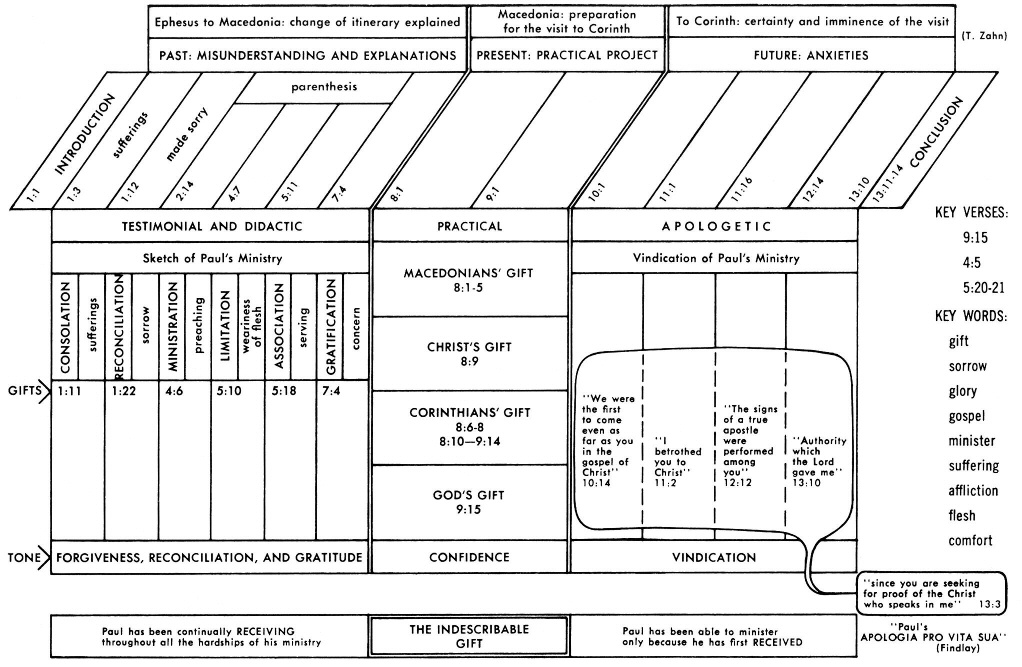
2 CORINTHIANS - PAUL'S MINISTRY IN THE LIGHT OF THE INDESCRIBABLE GIFT
Click chart to enlarge
Charts from Jensen's Survey of the NT - used by permission
Another Chart from Charles Swindoll
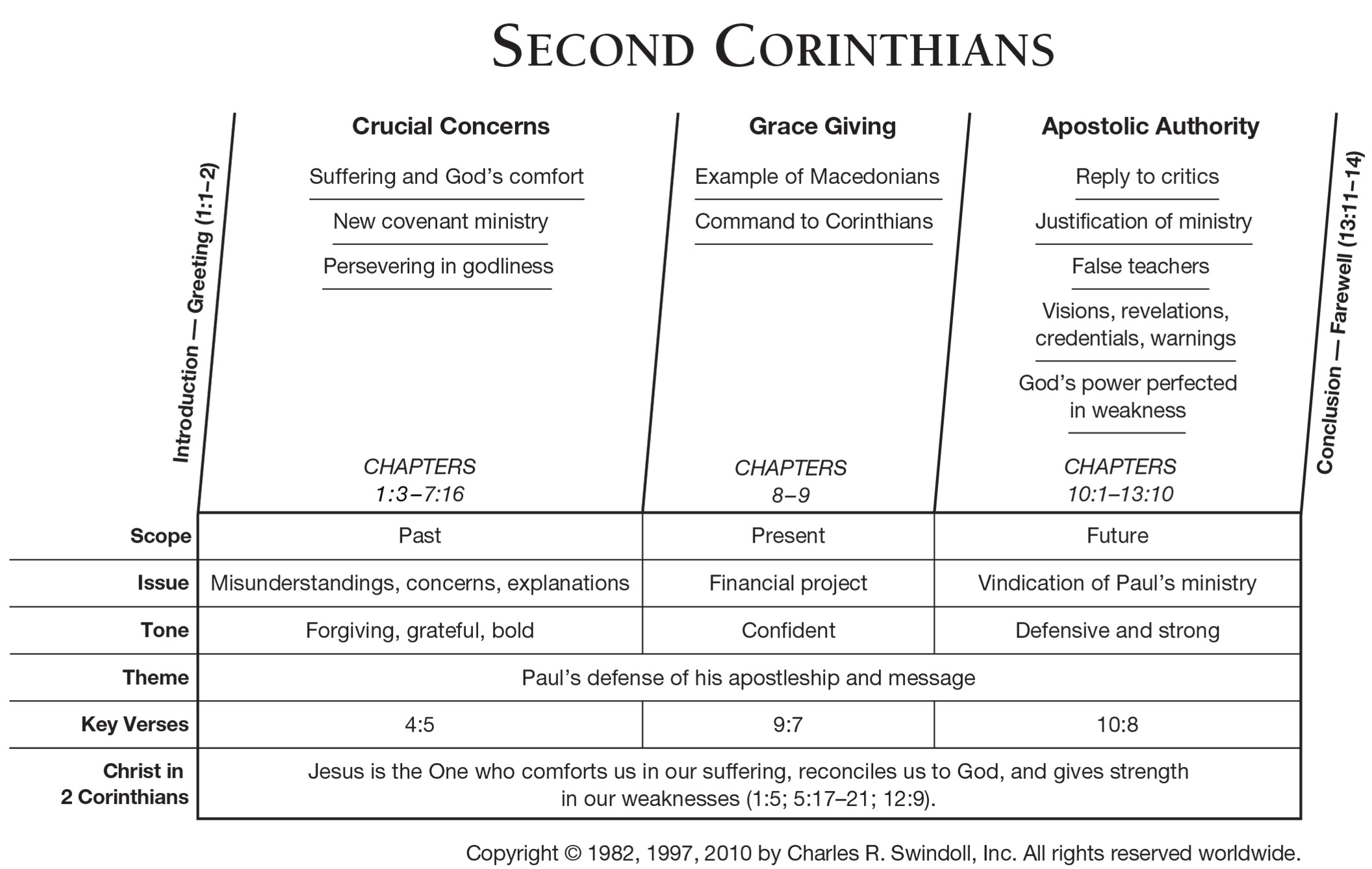
Click to Enlarge
Click to enlarge
Overview of
|
||
| 2Co 1:1-7:16 Character of Paul |
2Co 8:1-9:15 Collection for the Saints |
2Co 10:1-12:21 Credentials of Paul |
| Testimonial & Didactic | Practical | Apologetic |
| Past: Misunderstanding & Explanation |
Present: Practical Project |
Future: Anxieties |
| Apostle's Conciliation, Ministry & Exhortations | Apostle's Solicitation for Judean Saints | Apostle's Vindication of Himself |
| Forgiveness, Reconciliation Gratitude |
Confidence | Vindication |
|
Ephesus to Macedonia: |
Macedonia: Preparation for Visit to Corinth |
To Corinth: |
|
2Co 1:1-7:16 |
2Co 8:1-9:15 |
2Co 10:1-12:21 |
|
2Corinthians written ~ 56-57AD - see Chronological Table of Paul's Life and Ministry |
||
|
Adapted & modified from Jensen's Survey of the New Testament (Highly Recommended Resource) & Wilkinson's Talk Thru the Bible |
||
2 Corinthians 5:6 Therefore, being always of good courage, and knowing that while we are at home in the body we are absent from the Lord (NASB: Lockman)
Greek: Tharrountes (PAPMPN) oun pantote kai eidotes (RAPMPN) hoti endemountes (PAPMPN) en to somati ekdemoumen (1PPAI) apo tou kuriou
Amplified: So then, we are always full of good and hopeful and confident courage; we know that while we are at home in the body, we are abroad from the home with the Lord [that is promised us]. (Lockman)
Barclay: So then we are always in good heart, although we know that, while we sojourn here in the body, we are absent from the Lord— (Westminster Press)
ESV: So we are always of good courage. We know that while we are at home in the body we are away from the Lord, (ESV)
HCSB: Therefore, though we are always confident and know that while we are at home in the body we are away from the Lord— (Holman Christian Standard Bible - Study notes available online free)
KJV: Therefore we are always confident, knowing that, whilst we are at home in the body, we are absent from the Lord:
NEB: Therefore we never cease to be confident. We know that so long as we are at home in the body we are exiles from the Lord; (New English Bible - Oxford Press)
NET: Therefore we are always full of courage, and we know that as long as we are alive here on earth we are absent from the Lord – (NET Bible)
MH: For this reason we never cease being confident in every circumstance; however, because we realize that as long as we are resident in this present body, we are absent from our home with the Lord — (Murray Harris' expanded paraphrase of 2Corinthians).
NLT: So we are always confident, even though we know that as long as we live in these bodies we are not at home with the Lord. (NLT - Tyndale House)
Phillips: This makes us confident, whatever happens. We realize that being "at home" in the body means that to some extent we are "away" from the Lord, (Phillips: Touchstone)
Weymouth: We have therefore a cheerful confidence. We know that while we are at home in the body we are banished from the Lord;
Wuest: Being therefore always confident, and knowing that while we are in our natural home [for this earthly existence] in our body, we are living abroad, absent from [that home in heaven] the Lord,
Young's Literal: having courage, then, at all times, and knowing that being at home in the body, we are away from home from the Lord,--
THEREFORE, BEING ALWAYS OF GOOD COURAGE, AND KNOWING THAT WHILE WE ARE AT HOME IN THE BODY WE ARE ABSENT FROM THE LORD: Tharrountes (PAPMPN) oun pantote kai eidotes (RAPMPN) hoti endemountes (PAPMPN) en to somati ekdemoumen (1PPAI) apo tou kuriou:
- we are: 2Co 5:8 Ps 27:3,4 Pr 14:26 Isa 30:15 36:4 Heb 10:35 1Pe 5:1 Rev 1:9
- while: 2Co 5:1 1Ch 29:15 Ps 39:12 119:19 Php 3:20,21 Heb 11:13 13:14)
- 2 Corinthians 4:13-5:10 Is Your Earth Suit Wearing Out? - Mike Andrus
- 2 Corinthians 5:1 Facing Death Confidently, Part 1 - John MacArthur
- 2 Corinthians 5:2-8 Facing Death Confidently, Part 2 - John MacArthur
- 2 Corinthians 5 Resources - Multiple Sermons and Commentaries
- See also "shorter version" of commentary on 2 Corinthians 5:6
CONFIDENCE IN THE FUTURE
STRENGTHENS US FOR
TRIALS IN THE PRESENT
In this section Paul gives us insights into his thoughts on facing death with confidence and even expectancy and in so doing provides an excellent example for all followers of Christ to seek to emulate by grace through faith (1Cor 4:16, 11:1, Php 3:17-+). Paul faced death daily, but always did so with courage and boldness for he knew where death would take him. He understood that death was not the end but in truth the beginning of everlasting life in the presence of his Lord. In short, death was a friend to Paul and not an enemy to be feared (1Co 15:55, 56, 57 truths which call for obedience to 1Co 15:58-+).
Spurgeon - Note the ground of the apostle’s confidence. He is quite sure that, inasmuch as Christ rose from the dead, so all his followers must; and though they die in the Lord’s service, yet shall they not be losers thereby, but they shall the more speedily ascend to their reward. “We are always confident,”… That is a blessed experience, “always confident.”
Ray Stedman introduces his comments on this section with the following remark = Lest we become so enraptured with this splendid future that we lose all interest in the present, the apostle wisely reminds us that the key to this future is in our present experience. (Authentic Christianity -- Chapter 9 Time and Eternity)
Alfred Plummer's translation of 2Co 5:6-8 = Confident, therefore, at all times, and knowing that while we are at home in the body we are in exile from the Lord,—for we walk by means of faith and not by means of what we can see,—we are confident, I say, and are well pleased to go into exile from the body and to go home unto the Lord… Paul does not mean that while we are in the body we are absent from the Lord; our union with Him both in life and in death is one of his leading doctrines (2Co 4:10, 11-+; 1Th 5:10-+). He is speaking relatively. The life of faith is less close and intimate than the life of sight and converse. The passage assumes that the dead are conscious, conscious of the Lord (Php 1:20-+, Php 1:21-+, Php 1:22, 23-+; Lk. 23:43; Acts 7:59); otherwise departure from the body would be a worse condition, with regard to Him, than being in the body. (Critical and Exegetical Commentary on the Second Epistle of St. Paul to the Corinthians. 1915)
Jonathan Edwards introduces his sermon on 2Co 5:8 with these comments…
The apostle in this place is giving a reason why he went on with so much boldness and immovable steadfastness, through such labors, sufferings, and dangers of his life, in the service of his Lord; for which his enemies, the false teachers among the Corinthians, sometimes reproached him as being beside himself, and driven on by a kind of madness. In the latter part of the preceding chapter, the apostle informs the Christian Corinthians, that the reason why he did thus, was, that he firmly believed the promises that Christ had made to his faithful servants of a glorious future eternal reward, and knew that these present afflictions were light, and but for a moment, in comparison of that far more exceeding and eternal weight of glory (2Co 4:17-+). The same discourse is continued in 2Corinthians 5, in which the apostle further insists on the reason he had given of his constancy in suffering, and exposing himself to death in the work of the ministry, even the more happy state he expected after death. And this is the subject of the text; wherein may be observed,
1. The great future privilege, which the apostle hoped for; that of being present with Christ. The words, in the original, properly signify dwelling with Christ, as in the same country or city, or making a home with Christ.
2. When the apostle looked for this privilege, viz., when he should be absent from the body. Not to wait for it till the resurrection, when soul and body should be united again. He signifies the same thing in his epistle to the Philippians 1:22, 23-+.
3. The value the apostle set on this privilege. It was such, that for the sake of it, he chose to be absent from the body. He was willing rather, or (as the word properly signifies) it was more pleasing to him, to part with the present life, and all its enjoyments, and be possessed of this great benefit, than to continue here.
4. The present benefit, which the apostle had by his faith and hope of this future privilege, and of his great value for it, viz., that hence he received courage, assurance, and constancy of mind, agreeable to the proper import of the word that is rendered, we are confident. The apostle is now giving a reason of that fortitude and immovable stability of mind, with which he went through those extreme labors, hardships and dangers, which he mentions in this discourse; so that, in the midst of all, he did not faint, was not discouraged, but had constant light, and inward support, strength, and comfort in the midst of all: agreeable to 2Co 4:16-+, "For which cause, we faint not; but though our outward man perish, yet the inward man is renewed day by day." And the same is expressed more particularly in 2Co 4:8, 9, 10-+: "We are troubled on every side, yet not distressed; we are perplexed, but not in despair; persecuted, but not forsaken; cast down, but not destroyed; always bearing about in the body, the dying of the Lord Jesus, that the life also of Jesus might be made manifest in our mortal flesh." And in the next chapter, 2Co 6:4-10 (True Saints, when Absent from the Body, Are Present with the Lord -- Preached on the day of the funeral of the Rev. Mr. David Brainerd)
Therefore (3767) (oun) is a term of conclusion so we need to ask what is Paul bringing to conclusion (always pause and interrogate with the 5W/H'S)? In view of the truths just expounded in the previous 5 passages, especially the truths that our mortal bodies will be swallowed up by life (i.e., believers will receive resurrection bodies 2Co 5:4-+) and God's gift of the Holy Spirit (2Co 5:5-+) together assure the consummation or fulfillment of God's promise (of the resurrection body), and thus we can be confident and courageous in this present life. It strikes me that this truth is in a sense a prophecy for it speaks of the future hope (not "hope so" but absolute certainty of future good!) for all believers, a hope that will be fulfilled when we see our Blessed Hope (Titus 2:13-+) at His return (Table comparing Rapture versus the Second Coming). This is the believer's firm foundation and solid rock on which we can stand come what may…
Truth received and believed stabilizes confidence and courage.
Beet takes Paul's thought all the way back to 2Cor 4:14+ and feels that 2Co 4:16-5:5 is used to develop the idea that "He Who raised the Lord Jesus will raise us also with Jesus".
Stedman explains the therefore this way…
Twice in this passage (2Co 5:6, 2Co 5:8) Paul says that a clear view of the coming glory should mean that our present life is marked with good courage. Surely that means more than keeping a stiff upper lip. Rather, it means to be full of encouragement, to be joyful, expectant, confident. There are two reasons given for this. First, in preparing us for the glory to come God has given us the Holy Spirit as his guarantee. We do not need to doubt that the resurrection of our body is ahead, for the presence within us of the Spirit of resurrection makes it sure.
Remember that in 2 Corinthians 4 the apostle says, "because we know that the one who raised the Lord Jesus from the dead will also raise us with Jesus" (2Co 4:14+). The Spirit knows how to resurrect dead bodies, for He has already done it once. Also, the Spirit has not only effected the resurrection of the body of Jesus but he has also been resurrecting our spirits every day since we became Christians. "Though outwardly we are wasting away, yet inwardly we are being renewed day by day." (2Co 4:16+) How many times has the Spirit brought you back from a sense of death and darkness to renewed life, interest, and vitality? That power to renew is our guarantee that God will bring us to glory. (Authentic Christianity -- Chapter 9 Time and Eternity) (Bolding and color added for emphasis)
Henry Alford feels that Paul "returns to the confidence expressed in 2Cor 5:1-+ that however this may be, whether this wish is to be fulfilled or not, he is prepared to accept the alternative of being denuded of the body, seeing that it will bring with it a translation to the presence of the Lord. (The New Testament for English Readers)
Hodge - This verse is introduced as a consequence of what precedes. “Having the deposit of the Spirit, therefore we are confident.” This confidence is not a mere temporary feeling due to some transient excitement, but a permanent state of mind.
Guzik - We can be always confident, even in hard times, if we keep Colossians 3:2: Set your mind on things above, not on things on the earth. (ED: "Vertical Vision" will energize horizontal living).
Spurgeon - “What, then, is the way to maintain peace when there are changes in the soul; when we are sometimes taken up to heaven and are anon cast down? Why, the only way is never to unduly elated by prosperity without or within, and never to be unduly depressed by adversity or by doubts and fears, because you have learned to live neither upon the things without nor upon things within, but upon things above, which are the true food for a new-born spirit.”
Barrett explains that "Paul now proceeds to draw practical inferences from what he has said. The earthenware vessel in which the Gospel is contained is indeed fragile (2Co 4:7); it may or may not survive until the parousia, but will certainly not last beyond it. But so great is the glory of its contents, and so sure the divine promise of which a foretaste is given in the Spirit, that there is no room for despondency. On the contrary: We are always confident (Black’s New Testament Commentary: The Second Epistle to the Corinthians)
Always (3842)(pantote from pás = all, every + tóte = when, then) an adverb which literally is "every when" means always, at all times, ever (more), on all occasions. In English always is defined - invariably, forever, perpetually, on every occasion, throughout all time, without variation. Continually, regularly, repeatedly or constantly during a certain period, or regularly at stated intervals (eg Mephibosheth - 2Sa 9:10KJV [+] = "alway"); At all convenient times. Without exception. Every time. The adverb always pantote is found in all of Paul’s epistles. It is applied to such things as prayer (Rom 1:9), thanksgiving (I Cor 1:4), work (I Cor 15:58), and obedience (Phil 2:12). Cf. also II Cor 2:14; 4:10; 9:8. Pantote is used 4x in 2Corinthians - 2Co 2:14; 2Co 4:10; 2Co 5:6; 2Co 9:8
Richards writes that "“Always” in the Bible does not link time with eternity. It is a word that focuses attention on experience within the world of time and space. “Always” may direct our attention to that which is stable over a period of time or to that which is to be experienced continually. When the issue is God’s relationship with us, “always” reminds us powerfully that God is present at every moment in time and thus is with us constantly. When the issue is our relationship with God, “always” calls us to continual commitment and to consistent holiness. (Richards, L O: Expository Dictionary of Bible Words: Regency)
Beet - Always; corresponds with "in everything … always … every" in 2Co 4:8, 10, 11.
Remember that believers can face death with boldness and confidence because our face is set toward heaven and the consummation of our union with our Savior and our reunion with the saints who have passed on before us. We can believe this "always" because God says it in His Word and He is the "non-lying" God (Titus 1:2-+, 1Sa 15:29, Heb 6:18-+)
What a day that will be,
When my Jesus I will see
When I look upon His face,
The One who saved me by His grace.
When He takes me by the hand,
And leads me through the Promised Land,
What a day, glorious day, that will be.
--Jim Hill
Plummer says that always "means that ‘in every event,’ whether we die soon or live till the Lord returns, we have this confidence. (Critical and Exegetical Commentary on the Second Epistle of St. Paul to the Corinthians. 1915)
Hodge comments that always means "on all occasions and under all circumstances, even in the midst of dangers and discouragements that, were it not for divine support, would produce despair. The ground of the boldness and confidence is not anything in the believer; it is not his natural courage, nor the strength of his convictions, but a state of mind produced by the indwelling of the Spirit, the natural consequence of his presence.
Robert Morgan calls our attention in chapter 5 to "these three verses: 2Co 5:1: "Now we know"…2Co 5:6: "Therefore we are always confident"…2Co 5:8: "We are confident, I say…" Here is a man who has been rejected, ridiculed, beaten down, battered, criticized and vilified. But his opponents were totally stymied when it came to shaking his confidence. He said, “I know, I am confident, I am always confident.”… 1. Confident People Think a Great Deal about Heaven (2Co 4:17-5:4)… 2. Confident People Draw On Inner Resources (2Co 5:5)… 3. Confident People Want to Please Christ (2Co 5:6-10) (Tackling Life with Confidence)
Paul's confidence (good courage) is independent of his circumstances and is constant (always).
THE BELIEVER'S LOT…
FACING DEATH WITH
GOOD COURAGE
Being of good courage (2292) (tharrheo from thársos = boldness) means to display or have courage, an attitude of confidence or firmness of purpose in face of danger or testing. be courageous, have courage, be bold, be of good cheer. "To have certainty in a matter." (BDAG).
The present tense describes Paul's attitude as one of continuous courageous confidence because of God's express purpose and promise to bring Paul (and all believers) to glory and because of the Spirit Who indwelt him (2Co 5:5+) and strengthened him to continually fight the good fight of faith. Courage was not a passing emotion for Paul but a continual state of mind. Paul's Spirit empowered courageous mindset enabled him to face death not with fear but with great confidence.
Courage (from Latin = cor = the heart!) in Webster = mental or moral strength to resist opposition, danger, or hardship and implies firmness of mind and will in the face of extreme difficulty. The 1828 Webster's adds that courage = Bravery; intrepidity; that quality of mind which enables men to encounter danger and difficulties with firmness, or without fear or depression of spirits; valor; boldness; resolution. It is a constituent part of fortitude; but fortitude implies patience to bear continued suffering. (I highly recommend you consider bookmarking the 1828 Webster's as definitions are very "bibliocentric" = American Dictionary of the English Language -1828)
Hodge agrees noting that "This confidence is not a mere temporary feeling due to some transient excitement; but a permanent state of mind…The ground of the boldness and confidence expressed by the word tharrheo is not any thing in the believer; it is not his natural courage, not the strength of his convictions; but it is a state of mind produced by the indwelling of the Spirit, and the natural consequence of his presence. Being confident and knowing; both these particles are grammatically constructed with the verb we are willing, eudokoumen (eudokeo), in 2Co 5:8-+, and together express the ground of the apostle’s desire to be absent from the body.
Tharrheo - 6x in 6v in NAS - 2Co5:6 5:8 7:16 10:1 10:2 Heb13:6. NAS = bold(2), confidently(1), good courage(2), have confidence(1). In OT found in 4Macc 13:11, 4Macc 17:4, Da 6:17.
2 Corinthians 5:6 Therefore, being always of good courage, and knowing that while we are at home in the body we are absent from the Lord--8 we are of good courage, I say, and prefer rather to be absent from the body and to be at home with the Lord.
2 Corinthians 7:16 I rejoice that in everything I have confidence in you.
2 Corinthians 10:1 Now I, Paul, myself urge you by the meekness and gentleness of Christ-- I who am meek when face to face with you, but bold toward you when absent! 2 I ask that when I am present I need not be bold with the confidence with which I propose to be courageous (tolmao) against some, who regard us as if we walked according to the flesh.
Hebrews 13:6-+ so that we confidently say, "THE LORD IS MY HELPER, I WILL NOT BE AFRAID. WHAT WILL MAN DO TO ME?"
R Kent Hughes says "Paul faced reality with cheerful optimism…Paul knew that Christ was always with him and that he was in perpetual communion with Him. Nevertheless, Paul’s residence in his present body meant that in one sense he was away from the Lord and the ultimate fellowship of intimacy. So Paul lived by faith in the promises of God’s Word (2Co 5:7). (2 Corinthians: Power in Weakness. Preaching the Word)
Alan Carr makes an interesting observation related to Paul's being of good courage…"Look at the language Paul uses, “we know,” 2Co 5:1+; “we have,” 2Co 5:1+; “we are always confident,” 2Co 5:6+; “we are confident,” 2Co 5:8+. Paul is not talking about a hope that is a “maybe so thing,” but he is talking about a hope that is a “know so thing.” (I Feel Like Traveling On)
David expresses a similar combination of courage and confidence in present trying circumstances coupled with a desire to be at home with the LORD declaring…
Though a host encamp against me, my heart will not fear. Though war arise against me, in spite of this I shall be confident. One thing I have asked from the LORD, that I shall seek: That I may dwell in the house of the LORD all the days of my life, to behold the beauty of the LORD, and to meditate in His temple. (Ps 27:3,4)
Spurgeon comments: Before the actual conflict, while as yet the battle is untried, the warrior’s heart, being held in suspense, is very liable to become fluttered. The encamping host often inspires greater dread than the same host in actual affray. Young tells us of some—“Who feel a thousand deaths in fearing one.” Doubtless the shadow of anticipated trouble is, to timorous minds, a more prolific source of sorrow than the trouble itself, but faith puts a strengthening plaster to the back of courage, and throws out of the window the dregs of the cup of trembling.
“Though war should rise against me,
in this will I be confident.”
When it actually comes to push of pike (sharp point on tip of a spear), faith’s shield will ward off the blow (Ep 6:16-+); and if the first brush should be but the beginning of a war, yet faith’s banners will wave in spite of the foe. Though battle should succeed battle, and one campaign should be followed by another, the believer will not be dismayed at the length of the conflict. Reader, this third verse is the comfortable and logical inference from the second (Ps 27:2-+), confidence is the child of experience. Have you been delivered out of great perils? Then set up your ensign (flag or banner flown to give notice), wait at your watch-fire, and let the enemy do his worst.
“One thing.” Divided aims tend to distraction, weakness, disappointment. The man of one book is eminent, the man of one pursuit is successful (cp Mary's "one thing" a good example for all to emulate - Lk 10:38, 39, 40, 41, 42). Let all our affection be bound up in one affection, and that affection set upon heavenly things. “Have I desired” (Col 3:1-+, Col 3:2-+, Mt 6:21-+)—
What we cannot at once attain,
it is well to desire.
God judges us very much by the desire of our hearts (Ps 73:25-+). He who rides a lame horse is not blamed by his master for want of speed, if he makes all the haste he can, and would make more if he could; God takes the will for the deed with his children.
“Of the Lord.” This is the right target for desires, this is the well into which to dip our buckets, this is the door to knock at, the bank to draw upon; desire of men, and lie on the dunghill with Lazarus: desire of the Lord, and be carried of angels into Abraham’s bosom. Our desires of the Lord should be sanctified, humble, constant, submissive, fervent, and it is well if, as with the Psalmist, they are all molten into one mass. Under David’s painful circumstances we might have expected him to desire repose, safety, and a thousand other good things, but no, he has set his heart on the pearl, and leaves the rest.
“That will I seek after.” Holy desires must lead to resolute action (Mt 6:33-+). The old proverb says, “Wishers and woulders are never good housekeepers,” and “wishing never fills a sack.” Desires are seeds which must be sown in the good soil of activity for they will yield no harvest. We shall find our desires to be like clouds without rain, unless followed up by practical endeavors.
“That I may dwell in the house of the Lord all the days of my life.” For the sake of communion with the King, David longed to dwell always in the palace; so far from being wearied with the services of the Tabernacle, he longed to be constantly engaged in them, as his lifelong pleasure. He desired above all things to be one of the household of God, a home-born child, living at home with his Father. This is our dearest wish, only we extend it to those days of our immortal life which have not yet dawned.
We pine for our Father’s house above, the home of our souls; if we may but dwell there for ever, we care but little for the goods or ills of this poor life.
“Jerusalem the golden” is the one and only goal of our heart’s longings.
“To behold the beauty of the LORD.” An exercise both for earthly and heavenly worshippers. We must not enter the assemblies of the saints in order to see and be seen, or merely to hear the minister; we must repair to the gatherings of the righteous, intent upon the gracious object of learning more of the loving Father, more of the glorified Jesus, more of the mysterious Spirit, in order that we may the more lovingly admire, and the more reverently adore our glorious God. What a word is that, “the beauty of the Lord!” Think of it, dear reader! Better far—
Behold it by faith!
What a sight will that be when every faithful follower of Jesus shall behold “the King in His beauty!” Oh, for that infinitely blessed vision!
“And to enquire in his temple.” We should make our visits to the Lord’s house enquirers’ meetings. Not seeking sinners alone, but assured saints should be enquirers. We must enquire as to the will of God and how we may do it; as to our interest in the heavenly city, and how we may be more assured of it. We shall not need to make enquiries in heaven, for there we shall know even as we are known; but meanwhile we should sit at Jesus’ feet, and awaken all our faculties to learn of Him.
William Seeker: Those who are willing to be combatants for God, shall also be more than conquerors through God. None are so truly courageous as those who are truly religious. If a Christian live, he knows by whose might he stands; and if he die, he knows for whose sake he falls.
Where there is no confidence in God,
there will be no continuance with God.
When the wind of faith ceases to fill the sails, the ship of obedience ceases to plough the seas. The taunts of Ishmael shall never make an Isaac disesteem his inheritance.
Jeremy Taylor: One thing,” etc. A heavenly mind gathers itself up into one wish and no more. “One thing have I desired of the Lord, which I will require.” Grant me thyself, O Lord, and I will ask no more. The new creature asks nothing of God, but to enjoy God: give me this, O Lord, and for the rest, let Ziba take all. I will part with all to buy that one pearl, the riches of heavenly grace.
Alexander Pope on "one thing"…
One master passion in the breast.
Like Aaron’s serpent, swallows up the rest.
Know (1492)(eido-only in perfect tense = oida) means in general to know by perception. Literally eido/oida refers to perception by sight (perceive, see) as in Mt 2:2 "Where is He who has been born King of the Jews? For we saw (eido) His star in the east, and have come to worship Him." Eido/oida is distinguished from ginosko (epiginosko, epignosis - the other major NT word group for knowing) because ginosko generally refers to knowledge obtained by experience or "experiential knowledge". On the other hand, eido/oida often refers more to an intuitive knowledge, although this distinction is not always clear cut. Eido/oida is not so much that which is known by experience as an intuitive insight that is drilled into one's heart. Eido/oida is a perception, a being aware of, an understanding, an intuitive knowledge which in the case of believers can only be given by the Holy Spirit. And so eido/oida suggests fullness of knowledge, absolute knowledge (that which is without a doubt), rather than a progress in knowledge (cp ginosko)
In context, Paul's "beyond a shadow of a doubt" knowledge (in part a result of the previous passages) motivates and sustains ongoing courage. But notice that the truths in the previous passages are spiritual truth and Paul could not have grasped them and truly come to know them beyond a shadow of a doubt unless the Holy Spirit had opened the eyes of his heart. And the same caveat applies to each of us beloved -- we cannot hope to read and truly understand the spiritual truths of Scripture without a continual dependence on and yielding to our Teacher, the Spirit (cp 1Jn 2:27, 20, 1Co 2:13, Eph 4:21, Jn 14:26, 16:13)
Here is an example of a use of eido that illustrates the meaning…
But in order that you may know (eido) that the Son of Man has authority on earth to forgive sins-- He said to the paralytic--I say to you, rise, take up your pallet and go home. (Mark 2:10,11)
Comment: Here they would see and they would know beyond a shadow of a doubt about Jesus' authority.
Here is another use of eido, John writing that…
These things I have written to you who believe in the name of the Son of God, in order that you may know (eido) that you have eternal life. (1John 5:13)
Comment: A T Robertson writes that it means "to know with settled intuitive knowledge. He wishes them to have eternal life in Christ [John 20:31] and to know that they have it… ")
The point is that when the Holy Spirit opens the spiritual eyes of one's heart, they will be able to perceive and to know spiritual truths intuitively with a positive knowledge beyond a chance of a doubt.
While we are at home in the body - Paul is referring living in the mortal, physical body. He uses the same metaphor (home) in 2Co 5:8 to describe being present with the Lord. In this present life we are at home in our physical body, but it is a home which is not our true home, for it is but a frail lodging to accommodate us until we reach our true home. It is a home much like a soldier has a "home" at his base camp.
As Spurgeon says for most of us the body
is a house for which we have no little affection and we are loathe to quit it. (Too true I fear!) We complain of the infirmities of our bodies, but we are in no hurry to leave them.
This pleasing, anxious being e'er resigned,
Left the warm precincts of this house of clay,
Nor cast one longing, lingering look behind.
But yet this body is not a fitting home for us.
(a) We often discover by experience how inconvenient it is. In the course of years it has become soiled and creased, and worn like the tents of Kedar. We have suffered many inconveniences; often the spirit has been willing, but the flesh has been weak.
(b) According to the Greek, ours is a home in a foreign country. A numerous band of our brothers and sisters are with us, even as the Jews found company of their own race in Babylon; but this is exile to us, we have no inheritance here.
(c) It is a home, too, which keeps us from our true home. To-day we are at school, like children whose great holiday joy is to go home. We are laborers, and this is the work field: when we have done our day's work we shall go home.
(d) Home is the place where one feels secure; we find no such home spiritually in this world, for this is the place of conflict and watchfulness. In heaven there will be no foes to watch against, nor men of our own household to be our worst enemies.
(e) Home, too, is the place of the closest and sweetest familiarities. Here, alas, our spirits cannot take their fill of heavenly familiarities, for distance comes between; but up there what indulgence shall be accorded to us!
These are the inconveniences, but Paul, despite all, was confident.
(a) He had a hope of the immortality to be revealed. He knew that when he shook off this body his soul would be with Christ.
(b) His confidence came from God's work in his soul. "He that has wrought us to the self-same thing is God." (2Co 5:5KJV-+)
When the statuary takes the block of stone, and begins to carve it into a statue, we get the promise of that which is to be. But he may turn aside, or die, and therefore there may be no statue. But God never undertakes what He does not finish; and so if to-day I be the quarried block of marble, if He has begun to make the first chippings in me of genuine repentance and simple faith towards God, I have the sure prophecy that He will work me up into the perfect image of Christ.
(c) Another ground of confidence was "the earnest of the Spirit." (2Co 5:5-+)
Paul was equally confident about the next state, viz., the condition of a disembodied spirit (2Cor 5:8).
(1) It was not because Paul thought it would be better to be without a body that he thus spoke. He has told us already "not for that we would be unclothed." Our great Creator does not mean us to be maimed creatures for ever.
(2) But if Paul preferred the disembodied state to this, then the spirits of dead saints are not annihilated. Paul could not have counted destruction better than a life of holy confidence. Neither are they unconscious, for who would prefer torpor to active confidence? Neither are they in purgatory. Paul would not have been willing rather to be tormented than to live here and serve his Lord.
(3) He was willing to depart into the disembodied state because he knew he would be at home with the Lord in it.
(4) In that condition to which we are speeding
(a) We shall be beyond all doubt as to the truth of our holy faith. There will be no more mistrust of our Lord or of His promises, and no more shall we doubt the power of His blood or our share in His atoning sacrifice.
(b) We shall communicate with Christ more sensibly than we do now. Here we do speak with Him, but it is by faith through the Spirit of God; in the glory land we hear His voice while He personally speaks to us.
(c) We shall have greater capacity for taking in the glory of our Lord.
THE BELIEVER HAS REASONS FOR AN ABSORBING AMBITION (2Co 5:9-+), From henceforth the one great thing we have to care about is to please our Lord. (Spurgeon - 2Corinthians 5:6-8 The Believer in the Body & Out)
Are at home - Literally "among our people."
Are at home (1736) (endemeo from en = in + demos = group of people bound together by laws, cp a "democracy" = where people rule) means to be present in a place or with a person. Used only in this section of the Bible (2Co 5:6, 8, 9).
Lowry - To be at home in the body means to dwell in “the earthly tent” (2Co 5:1), to be outwardly “wasting away” (2Co 4:16), to be in a state of mortality away from the immediate presence of the Lord (cf. 1Co 13:12). What sustained Paul was the realization that this was a temporary and transitory state (2Co 4:18). He focused not on present but on future conditions, not on the seen but the unseen. To live this way is to live by faith, not by sight.
Body (4983)(soma) is an organized whole made up of parts and members and specifically referring in this context to the physical or mortal body.
J Vernon McGee comments on at home in the body - We are . I like this body of mine. I still have a scar on the side of my temple where I fell against the bed when I was learning to walk. Down through the years I have gotten used to this body of mine, and I feel at home in it. However, as long as I am at home in this body, I am absent from the Lord.
Warren Wiersbe writes that "The people of God can be found in one of two places: either in heaven or on earth (Eph. 3:15). None of them is in the grave, in hell, or in any “intermediate place” between earth and heaven. Believers on earth are “at home in the body,” while believers who have died are “absent from the body.” Believers on earth are “absent from the Lord,” while believers in heaven are “present with the Lord.” Because he had this kind of confidence, Paul was not afraid of suffering and trials, or even of dangers. This is not to suggest that he tempted the Lord by taking unnecessary risks, but it does mean that he was willing to “lose his life” for the sake of Christ and the ministry of the Gospel. He walked by faith and not by sight. He looked at the eternal unseen, not the temporal seen (2 Cor. 4:18). Heaven was not simply a destination for Paul: it was a motivation. Like the heroes of faith in Hebrews 11, he looked for the heavenly city and governed his life by eternal values. (Bible Exposition Commentary)
AT HOME IN THE BODY
FROM HOME AS TO THE LORD
There are only two "addresses" for every NT believer. Scripture promises that the moment you leave this life you go to heaven. There is no "in between." There is no purgatory. There is no waiting place. Believers are either in the body and not in the personal presence of the Lord (of course, always under His watchful eye; always in His mighty hand, and always with the indwelling Spirit of Christ), or absent from the body and present with the Lord—not yet with the resurrection body, but as far as the conscious part of man, he is “present with the Lord” in conscious bliss waiting the grand resurrection day when we receive our incorruptible bodies (1 Cor 15:51-52)!
In First Thessalonians Paul writes that
"God has not destined us for wrath, but for obtaining salvation through our Lord Jesus Christ Who died for us, so that whether we are awake or asleep, we will live together with Him." (1 Th 5:9-10-+)
And again Paul alludes to our wonderful future in his letter to the Philippians
For to me, to live is Christ and to die is gain (HE EXPLAINS WHY IN Php 1:23). (Php 1:21-+)
But I am hard-pressed from both directions, having the desire to depart and be with Christ, for that is very much better (Phil. 1:23-+).
The more of heaven we cherish,
the less of earth we covert.
Gotquestions - To be “absent” from one’s body simply means to die because, at death, the spirit is separated from the body and moves into its eternal abode—either heaven with the Lord or hell, separated from God for eternity. In the same way, Christians are always confident, knowing that while we are at home in the body we are absent from the presence of God. For we walk by faith, not by sight. We are confident, yes, well pleased rather to be absent from the body and to be present with the Lord. When a born-again believer dies, his soul goes immediately into the presence of the Lord. There, the soul consciously awaits the resurrection of the body. (What does it mean to be absent from the body?)
Vance Havner - And there is but a step between me and heaven. As one grows old and the dearest of earth, the other half of one's life, goes on to the next world, things here lose their charm and we can hardly wait to see what lies beyond. To remain in the flesh is needful as long as God leaves us here, but we desire to depart and be with Christ which is far better—absent from the body—present with the Lord. A strange sense of being in two worlds at once possesses us. If we could break the barrier, we would have done it long before now! But until then we live next door to heaven.
As Spurgeon says "The exile longs to return, the child pines for his father’s house, and so do we pant for our own dear country beyond the river, and sigh for the bosom of Jesus."
Horatius Bonar - How soon shall the present night be forgotten in the brightness of endless day! How quickly shall the curse give place to the blessing, barrenness be exchanged for fruitfulness, and all pollution be swept clean away!
Martin Luther - I would not give one moment of heaven for all the joys and riches of the world, even if it lasted for thousands and thousands of years.
Beyond this vale of tears
There is a life above;
Unmeasured by the flight of years,
And all that life is love.
- James Montgomery
Are Absent (1553) (ekdemeo from ek = from or out of + demos = people, populace, crowd, popular assembly) literally means to be away from people. Leave one’s country, emigrate, take a long journey, to travel. Parepidemois meaning a sojourner is a derivative of demos/
From the Lord - Plummer comments this is "Literally "separate from the Lord"; cf. Ro 9:3-+. This is true, in spite of His constant presence (Mt 28:20) and of our union with Him (1Co 6:15, 12:27). (Critical and Exegetical Commentary on the Second Epistle of St. Paul to the Corinthians. 1915) Comment: For more on our real, present, vital, inseparable union with Christ see discussion of the phrase in Christ.
Lord (2962)(kurios) signifies the one who rightly possesses sovereign power and absolute authority. He has absolute ownership and uncontested power. In Acts, Jesus is twice referred to as Savior but 92x as Lord. In the entire NT, He is referred to some ten times as Savior and some seven hundred times as Lord. When the two titles are mentioned together, Lord always precedes Savior. And even if, as some erroneously contend, Lord were simply a synonym for God, the very term God by definition includes the idea of sovereign authority or lordship.
John MacArthur - Believers communicate with the Lord through prayer and study of the Word and have communion with Him through the indwelling Holy Spirit. Yet there is still a sense in which they are separated from God and long for that separation to end. Ps 42:1, 2+ expresses that desire: “As the deer pants for the water brooks, so my soul pants for You, O God. My soul thirsts for God, for the living God; when shall I come and appear before God?” “Whom have I in heaven but You?” the psalmist asked rhetorically. “And besides You, I desire nothing on earth” (Ps 73:25+). Paul longed for the day when he would “always be with the Lord” (1Th 4:17+). That sense of separation caused Abraham to look for “the city … whose architect and builder is God” (Heb 11:10+) and the Old Testament saints to acknowledge “that they were strangers and exiles on the earth” (Heb 11:13+). It is only in heaven that believers will have intimate, unbroken fellowship with God (cf. Rev 21:3, 4+, Rev 21:22, 23+; Rev 22:3, 4+). (2 Corinthians)
Related Resources:
- What does it mean to be absent from the body?
- What does the Bible say about Purgatory?
- What is the repose of the soul?
- What does the Bible say about Limbo?
- Where did Old Testament believers go when they died?
- How can I overcome the fear of death? How can I stop being scared of dying?
- Who are the dead in Christ in 1 Thessalonians 4:16?
- What is the intermediate state?
- How can it be said that we have everlasting life when we still die?
Puritan Thomas Manton has the following summary regarding the Christian's home
I. A CHRISTIAN IS NOT IN HIS OWN PROPER HOME WHILE HE SOJOURNS IN THE BODY. Instances: Abraham (Heb 11:9-+). David (Ps 39:12-+). Christ (Jn 17:16). He that was Lord of all had neither house nor home. Reasons --
1. Our birth and parentage is from heaven. Everything tends to the place of its original; men love their native soil; a stone will fall to the ground, though broken in pieces by the fall. There is a double reason why the new creature cannot be satisfied here.
(1) Here is not enough dispensed to answer God's love in the covenant. "I will be your God," notes the gift of some better thing than this world can afford unto us (Heb 11:16-+; Mt 22:32).
(2) Here is not enough to satisfy the desire and expectation of the renewed heart -- perfect enjoyment of God, and perfect conformity to God.
2. There lies our treasure and inheritance (Eph 1:3-+). Christ hath blessed us with spiritual blessings in earthly places; here He hath adopted, justified, and sanctified us in part, but the full accomplishment is reserved for the world to come.
3. There are all our kindred. There is our home and country, where our Father is, and our Lord Jesus, and all the holy ones of God.
4. There we abide longest. An inn cannot be called our home; here we abide but for a night, but there for ever with the Lord.
5. The necessary graces that belong to a Christian show that a Christian is not yet in his proper place.
(1) Faith hath another world in prospect and view; and our great aim is to come at it.
(2) Hope was made for things to come, especially for our full and final happiness.
(3) Love (1Pe 1:8-+).
6. Let us therefore give in our names among them that profess themselves to be strangers and sojourners here in the world.
(1) Let us be drawing home as fast as we can. A traveler would be passing over his journey as soon as may be.
(2) Make serious provision for the other world (Mt 6:33-+).
(3) Mortify carnal desires (1Pe 2:11-+).
(4) Patiently endure the inconveniences of our pilgrimage. Strangers will meet with hard usage (Jn 15:19).
(5) Beg direction from God, that we may go the shortest way home (Ps 119:19-+).
(6) Get as much of home as we can in our pilgrimage, in the earnest and first fruits of the Spirit (Ro 8:23-+).
II. THE MAIN REASON WHY A CHRISTIAN IS NOT AT HOME, IS, BECAUSE HE IS ABSENT FROM THE LORD, WHILE HE IS IN THE BODY. I shall here inquire --
1. How are believers absent from the Lord, when He dwells in them, as in His temple, and there is a close union between Him and them? I answer, Christ is with us indeed, but our communion with Christ is --
(1) Not immediate.
(2) Nor full.
(3) Often interrupted.
2. Why, God's children count themselves not at home till they are admitted into this perpetual society with Christ.
(1) Because this is the blessedness which is promised to them. And therefore they expect it, and thirst after it (Jn 12:26).
(2) This is that which is highly prized by them, to be where Christ is. Why?
(a) Out of thankfulness to Christ's delighting in our presence (Pr 8:31).
(b) Out of love to Christ (Ps 73:25-+).
(c) Taste. Communion begun makes us long for communion perfected (Ps 63:1,2-+).
(d) Their complete happiness depends upon it (1Jn 3:2-+; Jn 17:24). (The Biblical illustrator)
Ray Pritchard - A thing is not lost if you know where it is. Several weeks ago John died at the age of 91. When I heard the news, I remembered his prayer. My only response was to say, “Thank God.” And then, “The battle is over, the victory won.” “Precious in the sight of the Lord is the death of his saints”(Psalm 116:15). So the Bible says and so we believe. To be absent from the body is to be present with the Lord. Sometimes when people die, we say, “I lost so-and-so.” But a thing is not lost if you know where it is. Jesus said to the repentant thief, “Today you will be with me in paradise” (Luke 23:43). We like to debate the meaning of certain words, and we want to know what “paradise” is like. We could speculate but our guesses would be only that. Just guesses. The most important part of that phrase is in the two little words–"with me.” Today you will be “with me,” Jesus said. Going to heaven is not simply going to a place, like going to Chicago or St. Louis. Going to heaven is going to a person. Heaven is where Jesus is. Everything else is just details.
2 Corinthians 5:7 for we walk by faith, not by sight-- (NASB: Lockman)
Greek: dia pisteos gar peripatoumen (1PPAI) ou dia eidous
Amplified: For we walk by faith [we regulate our lives and conduct ourselves by our conviction or belief respecting man’s relationship to God and divine things, with trust and holy fervor; thus we walk] not by sight or appearance. (Lockman)
Barclay: for it is by faith we walk and not by sight— (Westminster Press)
ESV: for we walk by faith, not by sight. (ESV)
HCSB: for we walk by faith, not by sight (Holman Christian Standard Bible - Study notes available online free)
KJV: (For we walk by faith, not by sight:)
NEB: faith is our guide, we do not see him. (New English Bible - Oxford Press)
NET: for we live by faith, not by sight. (NET Bible)
MH: for we do indeed conduct our lives in the realm of faith, not yet in the realm of sight. (Murray Harris' expanded paraphrase of 2Corinthians).
NLT: For we live by believing and not by seeing. (NLT - Tyndale House)
Phillips: for we have to live by trusting him without seeing him. (Phillips: Touchstone)
Weymouth: for we are living a life of faith, and not one of sight.
Wuest: for through faith we are ordering our manner of life, not by something seen.
Young's Literal: for through faith we walk, not through sight--
FOR WE WALK BY FAITH, NOT BY SIGHT: dia pisteos gar peripatoumen (1PPAI) ou dia eidous:
- 2Co 1:24 4:18 Dt 12:9 Ro 8:24,25 1Co 13:12 Gal 2:20 Heb 10:38 Heb 11:1-26,27 1Pe 1:8 5:9
- 2 Corinthians 5:6–7 What does it mean to walk by faith not by sight? - Gotquestions
- 2 Corinthians 5:8 What does the Bible say about death? - Gotquestions
- 2 Corinthians 5:1 Facing Death Confidently, Part 1 - John MacArthur
- 2 Corinthians 5:2-8 Facing Death Confidently, Part 2 - John MacArthur
- 2 Corinthians 5 Resources - Multiple Sermons and Commentaries
- See also "shorter version" of commentary on 2 Corinthians 5:7
MEANTIME LIVING…
BY FAITH IN GOD'S PROMISES
For (gar) is a term of explanation (always stop and question with the 5W/H's) and here explains Paul's statement that we are absent from the Lord. This verse instructs us “how to live in the meantime”.
Hodge explains that 2Co 5:7 is "a passing, parenthetical remark, intended as a confirmation of the preceding declaration. ’We are absent from the Lord, for we now, in this life, walk by faith.’
Plummer comments "The Apostle seems to feel that separate from the Lord may cause perplexity, and he hastens to explain in what sense such an expression is true. ‘It is through a world of faith that we walk here, not through a world of visible form’. In this life we have to walk under conditions of faith, not under conditions of what is seen. Belief, however strong, cannot be the same as sight; and from a Christ whom we cannot see we are to that extent separated, just as a blind man is cut off from the world to which he nevertheless belongs. (Critical and Exegetical Commentary on the Second Epistle of St. Paul to the Corinthians. 1915)
The Amplified Version can be helpful for it often serves as a mini-commentary and in this passage expands the phrase walk by faith as "we regulate our lives and conduct ourselves by our conviction or belief respecting man’s relationship to God and divine things, with trust and holy fervor; thus we walk
Faith does not walk by focusing on the natural circumstances but by focusing on the supernatural Word of God, in this case the sure promise of future glory with Christ. In context remember that Paul is explaining how he can be courageous and confident in his physical, mortal, decaying body (cp 2Co 4:11, 2Co 4:16). The answer is that he is walking not by what he sees (primarily referring in context to his mortal body) but by what he does not see but knows will come to pass (reception of the future glorified body). That is Paul believes God's promise that He will swallow up our mortal bodies "by life" (referring to our glorified bodies).
Spurgeon…
Those who walk by sight walk alone. Walking by sight is just this—"I believe in myself," whereas walking by faith is, "I believe in God." (Ed: I would add and walking by faith also says "I depend on You God." "I need You God." "I rely on You alone God.")
><>><>><>
I Think the apostle is here explaining how it was he could say, that whilst ’he was at home in the body, he was absent from the Lord; and through what means he felt that this was not the state in which he wished ever to be. Having been possessed, and actuated, and moved by the principle of faith, he was not content to tabernacle in a body which could only be dwelt in satisfactorily through the influence of the faculty of sight. The apostle, however, mentions here a great general principle-” We walk by faith, not by sight;” and, in talking upon this text this evening, we shall-without pretending to go into it fully-speak, first of all, upon the posture mentioned; then upon the two principles contrasted; and then upon a certain caution which is here implied. (2 Corinthians 5:7 Faith versus Sight)
Stedman offers an interesting comment on walk by faith, first explaining that…
The second reason for confidence (good courage) in the present hour is that though the resurrection life will be mind-blowing beyond description, it is nevertheless true that we are learning how to handle the resurrection body by the way we handle our present body now. Though resurrection will be something new, it will not be entirely new; even though it will be strange, it won't be that strange. Somewhere C. S. Lewis has said that these present bodies are given to us much as ponies are given to English schoolboys--to learn to ride "the ponies" in order to be ready for the glorious stallions that are even now arching their necks and pawing the floor in the heavenly stables.
What is it we are learning now that will be so necessary then? It is to walk by faith and not by sight! That is the operative principle of eternity, and we must learn it here. Certain hymns have reflected the idea that when we get to heaven we will no longer need to walk by faith but can then walk by sight. It is true that we will then "see" the Lord, but that in no way will eliminate our need to respond to him. In fact, it will increase it!
Faith is the human response
to a divine offer.
As we live by means of Christ now--by faith in Him--so we will need to live by means of Christ then, by responding to his life and love. (Authentic Christianity -- Ch 9 Time and Eternity) (Bolding and color added for emphasis).
Paul set the example of walking by faith when he declared…
I have been crucified with Christ; and it is no longer I who live, but Christ lives in me; and the life which I now live in the flesh I live by faith in the Son of God, Who loved me, and delivered Himself up for me. (Gal 2:20-+)
Walk (4043)(peripateo [word study] from peri = about, around + pateo = walk, tread) means literally to walk around, to go here and there in walking, to tread all around as used in the Gospels. Paul uses peripateo here (and in all his uses) only in the metaphorical sense (32 times in his Epistles) meaning to conduct one's life, to order one's behavior, to behave, to make one's way, to make due use of opportunities, to live or pass one’s life (with a connotation of spending some time in a place).
WALK BY FAITH…
WALK BY THE SPIRIT
Peripateo in the present tense speaks of walking by faith as one's general behavior or habitual practice. Note that this walk is supernatural and not natural (that is walking by sight). How can believers continually walk by faith when the world seems to be catapulting toward the last of the last days? We need to continually recall our Source of enablement which Paul alluded to in 2Co 5:5-+. We have the indwelling Holy Spirit. He is our Source of divine energy for this supernatural walk (cp Php 2:13-+) of faith. May God grant us daily (yea, even moment by moment) His transforming grace that we might be motivated and enabled to continually walk by His Spirit (Gal 5:16-+), for then we shall be walking by faith.
Spurgeon explains that the believer's walk can be described as…
1. The possession of life. You can make a dead man sit or even stand in a certain position, but to walk necessitates life. In the sense in which the term is here used, the ungodly man does not walk at all.
2. Activity. It is a blessed thing to sit "with Mary at the Master's feet"; but we walk as well as sit. Many can affirm -- "We talk; we think; we experience; we feel"; but true Christians can say, "We walk."
3. Progress. A man does not walk unless he make some headway. God does not say to us, "This is the way," and then stop; but He says, "This is the way, walk ye in it." We are always to be making advances, from faith in its beginnings to faith in its perfections.
4. Perseverance. When a man goes along a step or two and then stops, or returns, we do not call that walking.
5. That in the ordinary actions of life we are actuated by faith. Walking is that kind of progress in which a man continues hour after hour. We often read of men who, by faith, did great exploits, and some Christians are always fixing their eyes upon exploits of faith. But Paul does not speak about running or jumping or fighting, but about walking, and he means to tell you that the ordinary life of a Christian is different from the life of another man; that he has learned to introduce faith into everything he does. (2 Corinthians 5:7 Faith versus Sight)
See also More of Spurgeon's comments on what it means to walk
Young writes that the metaphor of walking signifies…
that the Christian's life in this world is a toilsome and uneasy life. The luxury of modern times has contrived various methods of accomplishing journeys without walking. It is not in this manner, Christian, that you are to perform your journey. You must travel through the wilderness on foot. (2 Corinthians 5:7 Influence of Faith on the Christian's Walk)
Wiersbe approaches the walk of faith from another direction asking "How do you walk by faith? By claiming the promises of God and obeying the Word of God, in spite of what you see, how you feel, or what may happen. It means committing yourself to the Lord and relying wholly on Him to meet the need. When we live by faith, it glorifies God, witnesses to a lost world, and builds Christian character into our lives. God has ordained that “the righteous will live by his faith” (Hab 2:4; Ro 1:17-+; Gal. 3:11; Heb 10:38-+; 2Cor. 5:7); and when we refuse to trust Him, we are calling God a liar and dishonoring Him. (Be Committed. An Old Testament Study. Ruth and Esther. Wheaton, Ill.: Victor Books)
J Vernon McGee adds the practical comment that "Walking is not a balloon ascension. A great many people think the Christian life is some great, overwhelming experience and you take off like a rocket going out into space. That’s not where you live the Christian life. Rather, it is in your home, in your office, in the schoolroom, on the street. The way you get around in this life is to walk. You are to walk in Christ. God grant that you and I might be joined to Him in our daily walk. (McGee, J V: Thru the Bible Commentary: Thomas Nelson)
Ray Stedman comments on walk writing "I like that figure because a walk, of course, merely consists of two simple steps, repeated over and over again. It is not a complicated thing. In the same way, the Christian life is a matter of taking two steps, one step after another. Then you are beginning to walk. Those two steps follow in this passage. Paul describes them as, "Put off the old man" (Col 3:5, 6, 7, 8, 9, 10 see +) and "put on the new." (see specific attitudes and actions in Col 3:12-4:6) Then repeat them. That is all. Keep walking through every day like that. That is how Scripture exhorts us to live." (Click for the full message on True Human Potential)
Those who are prepared to die
are most prepared to live.
By faith - Literally this is through (dia) faith. We cannot see God now and we have not yet received our resurrection bodies and thus the truth of both is a matter of faith, of "seeing Him Who is unseen." (Heb 11:27).
As the writer of Hebrews states…
Now faith is the assurance of things hoped for (our resurrection bodies), the conviction of things not seen (that we will be present with Him forever). (Heb 11:1-+)
(Paul adds) For in hope we have been saved, but hope that is seen is not hope; for why does one also hope for what he sees? But if we hope for what we do not see, with perseverance we wait eagerly for it. (Ro 8:24, 25-+)
Hodge adds that the believer's "presence with the Lord is now a matter of faith, not of fruition. The condition of our present state of being is that of believing. The faith that is the evidence of things not seen and the substance (or assurance) of things hoped for is the element in which we live so long as we are not present with those things.
J Vernon McGee - How could Paul be so sure that when we leave this body we will be present with the Lord? Paul says that we walk by faith. We take God at His Word. I would rather take His Word than anyone else’s word. Faith is taking God at His Word.
Guzik - To walk by faith, not by sight is one of the great - and difficult - principles of Christian living. It must amaze the angels that we life for, and serve, and are willing to die for a God we have never seen. Yet we love Him, and live for Him, living by faith, not by sight. To walk by faith means to make faith part of every daily activity. Walking is nothing remarkable in itself; it is one of the more mundane aspects of life. But God wants us to walk by faith. “That man has not yet learned the true spirit of Christianity who is always saying, ‘I can preach a sermon by faith.’ Yes, sir, but can you make a coat by faith? ‘I can distribute tracts, and visit the district by faith.’ Can you cook a dinner by faith? I mean, can you perform the common actions of the household, and the daily duties which fall to your lot, in the spirit of faith?” (Spurgeon)
Walking by faith in context is also associated with Paul being of good courage even though he was still in his mortal body, separated from the Lord he loves, suffering hardship, experiencing his outer man decaying and not possessing his immortal body. For all of these reasons it was necessary to walk by faith in future grace and glory. Notice that his faith was not ephemeral or ethereal but was real and focused on the things above and not on the things of this earth (Col 3:2-+). The truth about the future enabled him to walk by faith in the present. And it is the same for us beloved. Therefore it is imperative that we eat the Word daily (cp Mt 4:4, Lk 4:4 Job 23:12-study the "secret" of Job's "walk of faith") so that we might grow in grace (cp 2Pe 3:18-+) that strengthens us for the supernatural walk, the walk of faith.
Matthew Henry adds that "True Christians, if they duly considered the prospect faith gives them of another world, and the good reasons of their hope of blessedness after death, would be comforted under the troubles of life, and supported in the hour of death: they should take courage, when they are encountering the last enemy, and be willing rather to die than live, when it is the will of God that they should put off this tabernacle.
Faith (4102)(pistis) means trust or conviction of the truth of anything, but in Scripture usually speaks of belief respecting God and His truth, in context His truth that followers of Christ will receive a resurrection body in the future and will be present with the Lord in the last twinkling of their eye (when they fall asleep in the Lord).
Maclaren writes that "Faith is the hand that grasps. It is the means of communication, it is the channel through which the grace which is the life, or, rather, I should say, the life which is the grace, comes to us. It is the open door by which the angel of God comes in with his gifts. It is like the petals of the flowers, opening when the sunshine kisses them, and, by opening, laying bare the depths of their calyxes to be illuminated and coloured, and made to grow by the sunshine which itself has opened them, and without the presence of which, within the cup, there would have been neither life nor beauty. So faith is the basis of everything; the first shoot from which all the others ascend… Faith works. It is the foundation of all true work; even in the lowest sense of the word we might almost say that. But in the Christian scheme it is eminently the underlying requisite for all work which God does not consider as busy idleness. (Sermon)
Wayne Grudem defines faith that saves one's soul "Saving faith is trust in Jesus Christ as a living person for forgiveness of sins and for eternal life with God. This definition emphasizes that saving faith is not just a belief in facts but personal trust in Jesus to save me… The definition emphasizes personal trust in Christ, not just belief in facts about Christ. Because saving faith in Scripture involves this personal trust, the word "trust" is a better word to use in contemporary culture than the word "faith" or "belief." The reason is that we can "believe" something to be true with no personal commitment or dependence involved in it. (Grudem, W. A. Systematic Theology: An Introduction to Biblical Doctrine Zondervan) (Bolding added)
Harry Ironside writes that "We take His (God's) word for it—faith is taking God at His word. (Addresses on the Second epistle to the Corinthians)
Warren Wiersbe - God’s Word gives us the truth about death and beyond, and God’s Spirit guarantees that God’s children will go to heaven. We claim this by faith and walk with confidence, and what peace it gives!
Young has the following summary of faith…
From what has been said, we may see the excellence of the grace of faith, and its usefulness to them that possess it.
(1) It attains the knowledge of things that surpass all created knowledge.
(2) It believes things that, upon the principles of unenlightened reason, are incredible.
(3) Faith can bear things that, in all human appearance, are intolerable.
(4) It sees things invisible. In a word --
(5) Faith performs things impossible.
(2 Corinthians 5:7 Influence of Faith on the Christian's Walk)
A W Tozer…
True faith is not the intellectual ability to visualize unseen things to the satisfaction of our imperfect minds; it is rather the moral power to trust Christ. To be contented and unafraid when going on a journey with his father the child need not be able to imagine events; he need but know the father. Our earthly lives are one shining web of golden mystery which we experience without understanding, how much more our life in the Spirit. Jesus Christ is our all in all. We need but trust Him and He will take care of the rest…God has not failed me in this world; I can trust Him for the world to come.
The apostle Paul calls faith a shield. The man of faith can walk at ease, protected by his simple confidence in God. God loves to be trusted, and He puts all heaven at the disposal of the trusting soul.
True faith rests upon the character of God and asks no further proof than the moral perfections of the One who cannot lie. It is enough that God said it, and if the statement should contradict every one of the five senses and all the conclusions of logic as well, still the believer continues to believe. “Let God be true, but every man a liar” is the language of true faith. Heaven approves such faith because it rises above mere proofs and rests in the bosom of God…
Faith as the Bible knows it is confidence in God and His Son Jesus Christ; it is the response of the soul to the divine character as revealed in the Scriptures; and even this response is impossible apart from the prior in working of the Holy Spirit. Faith is a gift of God to a penitent soul and has nothing whatsoever to do with the senses or the data they afford. Faith is a miracle; it is the ability God gives to trust His Son, and anything that does not result in action in accord with the will of God is not faith but something else short of it.
Oswald Chambers - Faith, Not Emotion - For a while, we are fully aware of God’s concern for us. But then, when God begins to use us in His work, we begin to take on a pitiful look and talk only of our trials and difficulties. And all the while God is trying to make us do our work as hidden people who are not in the spotlight. None of us would be hidden spiritually if we could help it. Can we do our work when it seems that God has sealed up heaven? Some of us always want to be brightly illuminated saints with golden halos and with the continual glow of inspiration, and to have other saints of God dealing with us all the time. A self-assured saint is of no value to God. He is abnormal, unfit for daily life, and completely unlike God. We are here, not as immature angels, but as men and women, to do the work of this world. And we are to do it with an infinitely greater power to withstand the struggle because we have been born from above. If we continually try to bring back those exceptional moments of inspiration, it is a sign that it is not God we want. We are becoming obsessed with the moments when God did come and speak with us, and we are insisting that He do it again. But what God wants us to do is to “walk by faith.” How many of us have set ourselves aside as if to say, “I cannot do anything else until God appears to me”? He will never do it. We will have to get up on our own, without any inspiration and without any sudden touch from God. Then comes our surprise and we find ourselves exclaiming, “Why, He was there all the time, and I never knew it!” Never live for those exceptional moments— they are surprises. God will give us His touches of inspiration only when He sees that we are not in danger of being led away by them. We must never consider our moments of inspiration as the standard way of life— our work is our standard. (My Utmost for His Hightest)
LIVE WITH
ONE EYE ON ETERNITY!
Not by sight - Live looking for the things which are not seen, the things which are eternal (2Cor 4:18-+).
THOUGHT - May God grant each of us 20/20 eternal vision so that we see the temporal through the lens of the eternal, such supernatural vision made possible only as the eyes of our heart are enlightened by the Spirit of Christ. Amen
Sight (1491) (eidos from eído = see) literally means that which is seen or what is visible and then the external appearance (shape and structure) of something as it appears to someone. Eidos does not mean the sense of sight, but the thing seen, the form, the appearance or that which is the object of sight.
Eidos - 5x in 5v- Translated - appearance(1), form(3), sight(1).
Luke 3:22 and the Holy Spirit descended upon Him in bodily form like a dove, and a voice came out of heaven, "You are My beloved Son, in You I am well-pleased."
Luke 9:29 And while He was praying, the appearance of His face became different, and His clothing became white and gleaming.
John 5:37 "And the Father who sent Me, He has testified of Me. You have neither heard His voice at any time nor seen His form.
2Corinthians 5:7 for we walk by faith, not by sight--
1Thessalonians 5:22-+ abstain (apechomai in the present imperative = command to continually abstain) from every form of evil.
Comment: It is interesting to note that a word derived from eidos is eídolon the Greek word for an idol!
John Piper sums up this section noting that…
Paul renews his inner man by looking to unseen things (2Co 4:18-+). He looks at three possibilities and prefers them in descending order:
First, he prefers that Christ would come and clothe his mortal body with immortality so that he would not have to die and be an incomplete, disembodied soul.
(Second) But if God does not will that, Paul prefers to be absent from the body (2Co 5:8), rather than to live on here, because he loves Christ more than he loves anything else, and to be absent from the body will mean to be at home with the Lord. Death will bring a deeper intimacy and greater at-homeness with the Lord than anything we can know in this life.
(Third) Finally, if God wills that it is not time for the Second Coming, or time for death, then Paul will continue to walk by faith in future grace, and not by sight.
And in that faith he will be of good courage; and, even though his body is decaying, his inner man will be renewed day by day through this faith in the unseen future grace called “the weight of glory” (2Cor 4:17-+). Here we must test ourselves. Do we share Paul’s priorities and values in life? Do we long mainly for the Second Coming of Christ and the glory of being swallowed up in life with Jesus? Or, short of that, do we long to be at home with Christ even if it costs us the surrender of our bodies? Or, short of that, are we committed to live by faith in future grace until he comes or until he calls? (Future Grace The Purifying Power of Living by Faith in Future Grace. Page 362)
Butler writes that "Faith will give us the perspective about life after death that the flesh can never do. The world walks by sight and so death to them is fearful and terrorizing. (Analytical Bible Expositor: I & II Corinthians)
Joseph Parker writes that not by sight is "Literally, we do not walk according to the appearance. "Sight" does not here mean the act of seeing; sight means the thing that is seen, the appearance, the shape; so that the godly man who is under the inspiration of the Holy Ghost says, That is a lie: That is a sophism: or, That is a snare: or, That is a temptation: the real meaning of things is behind them: take care that words do not muzzle your thoughts; let your words rather endeavor to express your thoughts. There is a way that seems good to a man, and even right, and the end thereof is death. Paul says: We do not walk according to appearances, according to "phenomena," according to things that can be seen with the eyes and handled with the hands: we have had enough of these lies: all such walking ends in darkness, if there be not another light and another faculty. (The People's Bible)
CARVING OUT DOWN HERE FOR UP THERE! - (Illustration of walking by faith) One day, a preacher who had lost his family in a tragic fire was walking through town. His mind was troubled by questions related to faith. In fact, because of his tragedy, he was seriously thinking about quitting on the Lord. He wondered how a God, Whom he had thought was so good, could allow something so terrible to happen to him and his family.
As he walked, he passed a construction site where a huge cathedral was being built. As he watched the men work, he noticed one man carving a small triangle out of granite with a chisel and a hammer. The preacher called out to the stone mason and asked him what he was making. The workman stopped and pointed to a place near the top of that great cathedral. He said, “Do you see that tiny, open triangle near the top of the roof?” The preacher answered, “Yes.” “Well, said the workman, “I am carving this out down here so that it will fit in up there.” Then the preacher understood what God was doing. The Lord was merely carving him out down here so that he would fit in up there. Friend, our trials were not sent to destroy us, but to shape us for His glory (2Co 4:17-+, Ro 8:18-+, 1Pe 1:6, 7-+, 1Pe 4:12, 13-+).
WATER BUG WORLD - A colony of small water-bugs living in a pond noticed that every once in a while one of their fellow bugs would climb up a lily stem and never be seen again. They agreed that if this should ever happen to one of them, they would return to tell the others about their journey Sure enough, the day came when one of the bugs found himself going up the stalk and crawling onto the lily pad at the top. He fell asleep in the warm sunshine, and when he awakened he stretched himself, only to hear a crackling sound as his old outer coat fell off. He sensed that somehow he was larger, cleaner, and freer than ever before. Spreading his wings, he flew into the air as a beautiful green dragonfly. Suddenly he remembered his promise. But then he realized why none of the others had ever returned. He couldn't go back and tell his friends what to expect because he was no longer a part of their world. Besides, one day they too would experience the wonderful freedom he now enjoyed.
We naturally shrink from the mysterious thought of dying. But we need not fear. Nor do we need a message from a departed loved one. God has told us all we need to know. So let's "walk by faith" and wait in hope. —H. V Lugt (Our Daily Bread, Copyright RBC Ministries, Grand Rapids, MI. Reprinted by permission. All rights reserved)
SEEING AROUND CORNERS - We often wish we could see what lies around the corner in life. Then we could prepare for it, control it, or avoid it. A wise person has said, "Though we can't see around corners, God can!" How much better and more reassuring that is!
Recently my 10-year-old granddaughter Emily and I were boiling eggs for breakfast. As we stared into the boiling water and wondered how long it would take to get the eggs just right, Emily said, "Pity we can't open them up to see how they're doing." I agreed! But that would have spoiled them, so we had to rely on guesswork, with no guarantee of results.
We began talking about other things we would like to see but can't--like tomorrow. Too bad we can't crack tomorrow open, we said, to see if it's the way we would like it. But meddling with tomorrow before its time, like opening a partly cooked egg, would spoil both today and tomorrow.
Because Jesus has promised to care for us every day--and that includes tomorrow--we can live by faith one day at a time (Mt. 6:33, 34).
Emily and I decided to leave tomorrow safely in God's hands. Have you? --J E Yoder (Our Daily Bread, Copyright RBC Ministries, Grand Rapids, MI. Reprinted by permission. All rights reserved)
Though I know not what awaits me,
What the future has in store,
Yet I know the Lord is faithful,
For I've proved Him oft before.
--Anon.
You're only cooking up trouble
when you stew about tomorrow.
Spurgeon contrasts walking by faith and walking by sight…
TWO PRINCIPLES CONTRASTED. All men naturally walk by sight. They have a proverb that "Seeing is believing," and no further. Their maxim is -- "Know things for yourself; look after the main chance; take care of Number One." Now the Christian is the very opposite of this. He says: "I do not care about looking after the things that are seen and are temporal; the things that are not seen influence me, because they are eternal." Now, since the world thinks itself wise and the Christian a fool for acting contrary to the world's proverb that "A bird in the hand is worth two in the bush," let us just see wherein the wisdom of this matter is, and wherein it is not.
1. Walking by sight is a very childish thing. Any child can walk by sight, and so can any fool too. You give him a number of coins; they are all spurious, but he is so pleased with them that he does not care about having real sovereigns. The child says that the sun rises in the morning and sets in the evening, but men know that it does not move, only the earth. But it is a very manly thing to believe something which you cannot see. What a man was Columbus compared with his contemporaries because he walked by faith! So the Christian is a man, while the worldling says, "This is all the world; 'let us eat and drink, for to-morrow we die,'" he says, "there must be another half; I will leave this world to you children, and will seek another and more heavenly one."
2. The one is groveling while the other is noble. A man earning his bread all day long -- what is he better than the donkey at Carisbrook Castle, pumping up water and always going round? The children go to the seaside with their little wooden spades and build up a pier of sand, but the tide comes and washes it away, and this is just what men do. They build with heavier stuff, which gives them more care and not half so much merriment, but the end is just the same, only the children live to build again, while these big children, these grovelers, are washed out to sea with all their works and perish everlastingly. If there be not another world to live for, I must say that this life is not worthy of a man. But to believe what God tells me, that I am God's son, that I shall one day see His face and sing His praise for ever, why, there is something here. The man who believes this expands into something worthy of a man who is made in the image of the Most High.
3. There is something exceedingly ignorant about believing only what I can see. Nine out of ten things in the world that are the most wonderful and potent cannot be seen, at least not by the eyes. A man who will not believe in electricity -- well, what can you make of him in these days? And this is the case with regard to spiritual things. If you only walk by sight, and only believe what you see, what do you believe? You believe that while you are living here it is a good thing to make the best you can of it, and that then you will die and be buried, and there will be an end of you! What a poor, miserable, ignorant belief this is! But when you believe in what God reveals, and come to walk by faith, how your information expands!
4. Walking by sight is deceptive. The eye does not see anything; it is the mind that sees through the eye. The eye needs to be educated before it tells the truth, and even then there are a thousand things about which it does not always speak truly. Now the man who has a God to believe in, is never deceived. The promise to him always stands fast; the person of Christ is always his sure refuge, and God Himself is his perpetual inheritance.
5. The principle of sight is a very changeable one. It is well enough to talk of walking by sight in the light, but what will you do when the darkness comes on? It is very well to talk about living on the present while you are here, but when you go and lie on your dying bed, what about the principle of living for the present then? But the principle of faith does best in the dark. He who walks by faith can walk in the sunlight as well as you can, but he can walk in the dark as you cannot, for his light is still shining upon him.
6. That those who walk by sight walk alone. Walking by sight is just this -- "I believe in myself," whereas walking by faith is "I believe in God." If I walk by sight I walk by myself; if I walk by faith then there are two of us, and the second one -- ah! how great, how glorious, how mighty is He! Sight goes a warfare at its own charges, and is defeated. Faith goes a warfare at the charges of the King's Exchequer, and there is no fear that Faith's bank shall ever be broken.
THE CAUTION IMPLIED. The apostle says positively, "We walk by faith," and then he adds negatively, "not by sight." The caution, then, is -- never mix the two principles. You may go a journey by land, or you may go by water, but to try to swim and walk at the same time would be rather singular. A drunken man tries to walk on both sides of the street at once, and there is a sort of intoxication that sometimes seizes upon Christians, which makes them also try to walk by two principles.
1. You say, "I believe God loves me; I have prospered in business ever since I have been a Christian." The first part of that is faith; but the second part of it is sight.. Suppose you had not prospered in business, what then? Will you deny that God loves you because you have not prospered in business?
2. Another says, "I have believed in Christ, but I am afraid I am not saved, for I feel to-night so depressed." "Oh," says another, "I am sure I am saved, because I feel so happy." Now you are both wrong, for you are both walking by sight. Faith is not meant for sweet frames and feelings only, it is meant for dark frames and horrible feelings. Conclusion -- Take heed to one thing. You must mind if you do walk by faith, that you walk by the right faith -- viz., faith in Christ. If you put faith in your dreams, or in anything you thought you saw, or in a voice you thought you heard, or in texts of Scripture coming to your mind -- if you put faith in anything else but Christ -- I do not care how good it may be or how bad it may be -- you must mind, for such a faith as that will give way. You may have a very strong faith in everything else but Christ, and yet perish. Rest thou in the Lord Jehovah.
2 Corinthians 5:8 we are of good courage, I say, and prefer rather to be absent from the body and to be at home with the Lord. (NASB: Lockman)
Greek: tharroumen (1PPAI) de kai eudokoumen (1PPAI) mallon ekdemesai (AAN) ek tou somatos kai endemesai (AAN) pros ton kurion.
Amplified: [Yes] we have confident and hopeful courage and are pleased rather to be away from home out of the body and be at home with the Lord. (Lockman)
Barclay: but we are in good heart and we are willing rather to depart from the body and to stay with the Lord. (Westminster Press)
ESV: Yes, we are of good courage, and we would rather be away from the body and at home with the Lord. (ESV)
HCSB: yet we are confident and satisfied to be out of the body and at home with the Lord. Holman Christian Standard Bible - Study notes available online free)
KJV: We are confident, I say, and willing rather to be absent from the body, and to be present with the Lord.
NEB: We are confident, I repeat, and would rather leave our home in the body and go to live with the Lord. (New English Bible - Oxford Press)
NET: Thus we are full of courage and would prefer to be away from the body and at home with the Lord.. (NET Bible)
MH: We are always confident, I repeat, and it is our settled preference to leave our present home in this body and to take up our final residence in the immediate presence of the Lord. (Murray Harris' expanded paraphrase of 2Corinthians).
NLT: Yes, we are fully confident, and we would rather be away from these earthly bodies, for then we will be at home with the Lord. (NLT - Tyndale House)
Phillips: We are so sure of this that we would really rather be "away" from the body (in death) and be "at home" with the Lord.(Phillips: Touchstone)
Weymouth: So we have a cheerful confidence, and we anticipate with greater delight being banished from the body and going home to the Lord.
Wuest: Now, we are of good courage and well pleased rather to be away from our body as our home, and at home face to face with the Lord
Young's Literal: we have courage, and are well pleased rather to be away from the home of the body, and to be at home with the Lord.
WE ARE OF GOOD COURAGE, I SAY, AND PREFER RATHER TO BE ABSENT FROM THE BODY AND TO BE AT HOME WITH THE LORD: tharroumen (1PPAI) de kai eudokoumen (1PPAI) mallon ekdemesai (AAN) ek tou somatos kai endemesai (AAN) pros ton kurion:
- Prefer rather: 2Co 5:6 12:2,3 Lk 2:29 Ac 21:13 Php 1:20 21 22 23 24 2Ti 4:7,8 2Pe 1:14,15 2Pe 3:11,12
- present: 2Co 5:9 Ps 16:11 17:15 73:23-26 Mt 25:21,23 Jn 14:3 17:24 1Th 4:17,18 1Jn 3:2 Rev 7:14-17 22:3
- 2 Corinthians 5:1 Facing Death Confidently, Part 1 - John MacArthur
- 2 Corinthians 5:2-8 Facing Death Confidently, Part 2 - John MacArthur
- 2 Corinthians 5 Resources - Multiple Sermons and Commentaries
- See also "shorter version" of commentary on 2 Corinthians 5:8
Some commentators feel that this completes Paul's statement in 2Co 5:6 and that 2Co 5:7 was a parenthetical statement (parenthetical = an amplifying or explanatory sentence inserted in a passage with which it is not grammatically connected, and marked off by brackets, dashes as some of the translations have done - see 2Co 5:7)
We are of good courage (see tharrheo in 2Co 5:6 again in the present tense).This is Paul's continual state of mind - cheerfully confident and courageous.
Plummer comments that "Even the possibility of being left naked (ED: NOT EVERYONE AGREES THAT WE WILL BE SPIRITS WITHOUT BODY IN THIS INTERMEDIATE TIME - SEE TABLE) for a time loses its terrors, when it is remembered that getting away from the temporary shelter furnished by the body means getting home to closer converse with the Lord. (Critical and Exegetical Commentary on the Second Epistle of St. Paul to the Corinthians. 1915)
The Revelation of Jesus Christ gives us good reason to be of good courage when facing death as a follower of Christ "And I heard a voice from heaven, saying, “Write, ‘Blessed are the dead who die in the Lord from now on!’ ” “Yes,” says the Spirit, “so that they may rest (anapauo) from their labors (kopos), for their deeds follow with them.” (Re 14:13+)
Prefer (2106)(eudokeo from eu = well, good + dokeo = to think) means literally to think well of and so to be well pleased, to take pleasure or delight in. The idea is to find satisfaction in something or someone or to view with approval.
Believers take delight, pleasure, satisfaction in the truth that when they are absent from the body they will be present with the Lord.
If you prefer heaven, you’ll make it on earth.
But if you prefer earth, you’ll have a misperception of heaven.
--Tony Evans
Tony Evans applies Paul's words writing that "If you prefer heaven, you’ll make it on earth. But if you prefer earth, you’ll have a misperception of heaven. In other words, be heavenly. Colossians 3:2 says, “Set your mind on the things above, not on the things that are on earth.” Your life should have such a heavenly dynamism about it that earth shrinks in significance. The reason some of us aren’t making it here on earth is because this life is too big. We’ve made the world too big, Satan too big, and people too big. They are ruining our day. (The Best is Yet to Come: Bible Prophecies through the Ages)
Thayer adds "as in secular authors, followed by an infinitive, it seems good to one, is one's good pleasure; to think it good, choose, determine, decide"
Zodhiates adds that eudokeo "means to think well of something by understanding not only what is right and good, as in dokeo, but stressing the willingness and freedom of an intention or resolve regarding what is good (Lk 12:32; Ro 15:26, 27; 1Co 1:21; Gal 1:15; Col 1:19; 1Th 2:8)
Spurgeon - The exile longs to return, the child pines for his father’s house, and so do we pant for our own dear country beyond the river, and sigh for the bosom of Jesus.
Stedman adds that Paul is "looking on to the future and summing up what we saw in the first five verses of this chapter, the great weight of glory that is awaiting us for which our present circumstances and trials are preparing us. He is looking ahead. This is always characteristic of Christians who understand the message of Christianity. They are like children who are looking ahead to Christmas. They are not looking back to Halloween, or Thanksgiving even, but ahead to Christmas. That is what lies ahead of us now, and the joys of it awaken anticipation and a sense of hopeful excitement. That is what Paul says nerves us in our endeavors today. It has an effect upon us now. As he put it in Romans 8, "So, therefore, we wait for it with patience," (Ro 8:25-+). We are looking forward to being at home with the Lord.
Ron Mattoon relates the following illustration of the believer's preference of being with the Lord…
Edith Schaeffer, the wife of Francis Schaeffer, chose to have her husband brought home from the hospital for the final days of his life. She said, "I believe when my husband leaves his body, he will be with the Lord. I don't want him to leave me until he's with the Lord. Therefore, I am sure he would want to go to the house he asked me to buy and be there for the time he has left."
The doctors agreed with her and told her they wished more people would do things the same way. Francis Schaeffer was taken home, and Edith surrounded his bed with the things he loved, and had music playing in his room. She said, "One after another, we played his favorite records: Beethoven, Bach, Schubert, and Handel. Ten days later, on May 15, 1984, with the music of Handel's Messiah still in the air, Francis Schaeffer breathed his last breath and entered the gates of Heaven."
The Spirit of God and the Word of God gave Edith Schaeffer confidence, calm, and comfort of the destiny of her husband. He does the same for us too. Our preference for wanting to be with the Lord motivates us to live with one eye on eternity. This involves several principles. We have examined five of them.
It involves the promise of a new body.
It involves pining for our new body.
It involves the pledge of the Holy Spirit.
It involves the pace or plodding by faith.
It involves the presence for being with the Lord.
Next, it involves the purpose of pleasing the Lord. (2 Corinthians - Treasures from 2 Corinthians 1-7 - 312 pages)
To be absent (1553) (ekdemeo from ek = from or out of + demos = originally a “divided portion,” the division of a people or territory, the people as inhabitants of a land or city) literally means to be away from people. Ekdemeo originally described movement from a geographic location and was used in Greek with the meaning of to leave one's country or take a long journey. The Jewish historian Josephus writes that "Elisha the prophet, at that time, was gone out of his own country to Damascus". To leave. To be in exile. To be absent from a place where one normally belongs. To emigrate. To travel.
Parepidemois meaning a sojourner is a derivative of demos.
Moulton and Milligan - Greek secular uses - “but if we change our residence, or go abroad, we shall give notice,” “that no time be lost in his departure”
Louw and Nida - ekdemeo ek to somatos = an idiom, literally ‘to leave home from the body’.
Vine writes that ekdemeo "came to mean either (a) “to go abroad, depart”; the apostle Paul uses it to speak of departing from the body as the earthly abode of the spirit, 2Co 5:8; or (b) “to be away”; in the same passage, of being here in the body and absent from the Lord (2Co 5:6), or being absent from the body and present with the Lord (2Cor 5:8). Its other occurrence is in 2Cor 5:9."
NIDNTT has this note on ekdemeo and endemeo - Paul longs for the fulfillment of Christ’s work and his parousia (2 Cor. 4:18; 5:10), when according to 1Co 15:43f., 48–53 he will receive a new → body. Now he contrasts here two realms of existence, or kinds of life, with one another: the this-worldly, present, earthly life, and the other-worldly, future, heavenly. In the present time he, like all men, has an earthly body: “we are at home in the body.” That means, however, at the same time that he is not living with Christ, in the other-worldly, heavenly sphere of existence. He is thus “away from the Lord”; he is as it were abroad, not among his own dēmos (people) to which he belongs. The clear and visible evidence of this is the earthly body in which he lives. Only in faith, which is a gift of God, a guarantee (2Co 5:5) of the world to come, can the gap between this world and that—or the present and the future—be bridged, and even then not visibly (2Co 5:7). For this reason there grows out of faith the desire and longing to be with Christ and to enjoy full fellowship with Him. This is possible only when one leaves this body, when one goes away from the body and comes to Christ, to be at home with the Lord (2Co 5:8). Then the Christian will live in full fellowship with the Lord. The present is therefore marked by the combination of “not yet” and “but already”: the Christian is not yet perfect, not yet with Christ, but (already) he lives by faith in the certain hope that the consummation will come, when he will be united with Christ. Always, however, whether in the future when at home with the Lord or in the present earthly life, away from home, Paul strives to be pleasing to Christ (2Co 5:9). From a stylistic point of view it is interesting to note how Paul plays throughout this passage on the verbs. ōendēme and ōekdēme and their reference to the present and future. (New International Dictionary of NT Theology. 1986. Zondervan)
To be absent from the body - In context this means to die. Paul made a similar statement in his letter to the saints at Philippi…
For to me, to live is Christ and to die is gain. But if I am to live on in the flesh, this will mean fruitful labor for me; and I do not know which to choose. But I am hard-pressed from both directions, having the desire to depart (to die) and be with Christ, for that is very much better, yet to remain on in the flesh (to remain alive) is more necessary for your sake. (Php 1:21 22 23, 24)
Comment: Note that Paul says that to depart and be with Christ is very much better, which would rule out non-Biblical teaching such as purgatory (associated with torture). That hypothetical state could hardly be described by Paul as very much better! Using the same reasoning, a prolonged state of "soul sleep" as some falsely teach occurs after death is in no way very much better!
Matthew Henry expressed this same confidence that to die is gain in words he hoped would be read after his death by anyone who might unduly mourn his passing writing "Would you like to know where I am? I am at home in my Father’s house, in the mansions prepared for me here. I am where I want to be—no longer on the stormy sea, but in God’s safe, quiet harbor. My sowing time is done and I am reaping; my joy is as the joy of harvest. Would you like to know what I am doing? I see God, not as through a glass darkly, but face to face. I am engaged in the sweet enjoyment of my precious Redeemer. I am singing hallelujahs to Him who sits upon the throne, and I am constantly praising Him. Would you know what blessed company I keep? It is better than the best on earth. Here are the holy angels and the spirits of just men made perfect. I am with many of my old acquaintances with whom I worked and prayed, and who have come here before me. Lastly, would you know how long this will continue? It is a dawn that never fades! After millions and millions of ages, it will be as fresh as it is now. Therefore, weep not for me!”
Body (4983)(soma) is literally the living body of man or animals (Mt 5:29, 30, 6:22, 23 25, Jn 2:21 Ro 1:24 Ro 8:10 = "dead because of sin", Jas 3:3 1Co 6:18), sometimes to a dead body (corpse) (Mt 14:12, 27:59 Mk 15:43, 45 Lk 17:37 He 13:11), sometimes to sun, moon, stars (1Co 15:40), sometimes as the center of all mortal life which can experience immortality in the resurrection body (1Co 15:44), sometimes the "material" part of man distinct from the soul or spirit (1Th 5:23), sometimes referring to reproductive power (Ro 4:19, 1Co 6:13), sometimes in a figurative sense to describe that which is "real" versus that which is shadow (Col 2:17) and finally sometimes describing the "body" of Christ, the Church (Ep 1:23, Ep 4:12, Ep 4:16, Ep 5:23, Ep 5:30, Col 1:18, Col 1:24, Col 2:19, Ro 12:5 1Co 12:27, cp 1Co 10:17, 12:13, Ep 2:16, Ep 4:4, Col 3:15).
Clearly in the present context Paul is referring to the physical body.
Thomas Constable explains that "We are either in our mortal bodies and absent from the Lord or we are with the Lord and absent from our mortal bodies. This is a strong guarantee that when we leave our mortal bodies we will go immediately into the Lord’s presence. Being “at home with the Lord” implies a closer fellowship with Christ than we experience now as well as closer proximity to Him (cf. 1Th 4:17; Php 1:23).
Hughes writes that "there is no question of the Apostle courting death in a spirit of rashness. The wonder and sacredness of the ministry with which he had been entrusted never faded. It was a source of joy and encouragement to him (2Co 4:1-+); and he clearly saw himself as a runner with an earthly course to finish, not to abandon (2Co 10:13ff. and cf. 2Ti 4:7-+), and a steward with a ministry to accomplish which he had received from the Lord Jesus, "to testify the gospel of the grace of God" (Acts 20:24; 1Co 9:23, 24, 25 , 26, 27-+). His outlook is nowhere more aptly and tersely summed up than in the words which he wrote to the Christians at Philippi (Php 1:21, 22, 23-+). We believe with Denney that "it would be an incalculable gain if we could recover the primitive hope in something like its primitive strength. It would not make us false to our duties in the world, but it would give us the victory over the world" (cp Gal 6:14). (Paul's Second Epistle to the Corinthians)
J Vernon McGee "Remember that the soul does not die. The soul never dies; the soul goes to be with Christ. It is the body that is put to sleep. It is the body that must be changed. Remember that there will be a generation that will not go through death, but their bodies will still need to be changed. “Behold, I show you a mystery; We shall not all sleep, but we shall all be changed…. For this corruptible must put on incorruption, and this mortal must put on immortality” (1Co 15:51, 53). It is the body that goes to sleep and it is the body that is raised. Resurrection does not refer to the soul or the spirit. The English word resurrection is the Greek word anastasis, which means “a standing up.” It is the body which will stand up. Knowing these things, we walk by faith."
Comment: The Word of God (cp McGee's comment - "knowing these things") invigorates and energizes our faith as Paul taught in Ro 10:17-+. When we set our focus on the world, why are we surprised that our faith is not strong and vibrant and bold as a lion?! Let us focus on the Word of Truth, the Word of Life and walk in that truth and we will grow in the grace and knowledge of our Lord and Savior Jesus Christ and will desire more and more to be with him just as did the apostle Paul.
Jonathan Edwards gives a lengthy exposition of the meaning of departed souls of saints going to be with Christ "(1) They go to dwell in the same blessed abode with the glorified human nature of Christ… (2) The souls of true saints, when they leave their bodies at death, go to be with Christ, as they go to dwell in the immediate, full and constant sight or view of him… (3) The souls of true saints, when absent from the body go to be with Jesus Christ, as they are brought into a most perfect conformity to and union with him… (4) Departed souls of saints are with Christ, as they enjoy a glorious and immediate intercourse and converse with him… (5) The souls of the saints, when they leave their bodies at death, go to be with Christ, as they are received to a glorious fellowship with Christ in his blessedness. (Note for a lengthy exposition of each of these points read Edward's full sermon = True Saints, when Absent from the Body, Are Present with the Lord -- Preached on the day of the funeral of the Rev. Mr. David Brainerd)
Absent from the body… at home with the Lord - John MacArthur writes that…
When a believer leaves this world, he goes immediately to be in the presence of Christ. There is no “soul sleep” or intermediate waiting place, nor does the Bible teach that there is any place called purgatory. Notice the apostle Paul’s desire was “to depart and be with Christ” (Php 1:23-+, emphasis added)… When we are absent from the body, which sleeps until the resurrection (ED: HE IS NOT REFERRING TO SOUL SLEEP HOWEVER!), our spirits are present with the Lord. Paul also told the Thessalonians that Christ “died for us, that whether we wake or sleep, we should live together with Him” (1Th 5:10-+). Paul’s point is that whether we are physically awake (alive) or physically asleep (dead), as believers we are with Christ. We are in His presence in a spiritual sense now and in a literal sense when our bodies are dead. You can rejoice in the fact that there is no time in your life as a believer when you will ever be out of the conscious presence of Jesus Christ. (Truth for Today A Daily Touch of God's Grace- December 30).
Tony Evans writes that "if you are a Christian, you are never going to die. That’s not a contradiction to what I just said, because Paul tells us to be “absent from the body” (physical death) is to be “at home with the Lord” (2Co 5:8). Less than one second after you die, you will open your eyes in the presence of God. That’s why Paul asks, “O death, where is your victory? O death, where is your sting?” (1Co 15:55). Jesus Christ has taken the sting out of death. It’s like the two brothers who were playing in the yard when a bee stung one of them. He began to cry and hold his arm where he had been stung. The bee then began circling the other brother, who cried out, “Help! Help!” But the boy who had been stung said through his tears of pain, “Stop hollering! That bee’s not going to hurt you. All it can do is make a lot of noise. It only has one stinger, and it’s already stung me. I’ve taken the stinger.” Jesus Christ took the “stinger” of death for those who trust Him, so that all death can do is make a lot of noise. It can’t hurt you once you know Jesus Christ. That’s why for the Christian, physical death is going to sleep and waking up “at home with the Lord.” But those who don’t know Christ must pay the awful price of eternal separation from God. (Our God is Awesome: Encountering the Greatness of God).
Henry Thiessen addresses what happens to the soul after death, but before the resurrection noting that "the Bible does not give a great deal of information, it does give sufficient material to draw certain conclusions. In the first place, the believer is with Christ. Paul said that he would “prefer rather to be absent from the body and to be at home with the Lord” (2Co 5:8; cf. v6). Further, Paul had the “desire to depart and be with Christ” (Php 1:23-+). This was the encouragement which Jesus gave to the penitent man on the cross next to him, “Truly I say to you, today you shall be with Me in Paradise” (Lk 23:43). That paradise was heaven is clear from 2Co 12:3, 4. Not only is the believer with the Lord and in heaven, but he is in fellowship with other believers. Hebrews speaks of the “general assembly and church of the first-born who are enrolled in heaven” (He 12:23). Believers are alive, conscious, and happy (Lk 16:19-31; Rev 14:13-+). This state between death and the resurrection is a condition to be preferred above the present state. Paul calls it “very much better” (Php 1:23-+). He asserted that he would “prefer rather to be absent from the body and to be at home with the Lord” (2Cor 5:8). A careful study of 2Co 5:1-9 suggests that the believer prefers to be raptured and translated rather than to die and enter into the intermediate state. He would rather be clothed with the resurrection body than to be unclothed. But the unclothed state is to be preferred over the present physical state, for even if unclothed, the believer is present with the Lord. In the story of Lazarus and the rich man, Lazarus was in Abraham’s bosom, comforted; the rich man was in agony (Luke 16:19-31). From this we gather that the unsaved individual is also in a temporary state undergoing conscious torment, while awaiting the great white throne judgment (Rev 20:11, 12, 13, 14, 15-+). (Lectures in Systematic Theology)
At home (1736) (endemeo from en = in + demos = people > endemos = “one who is in his own place or land”) literally means to be among one’s people. The verb endemeo then simply means to be present in any state or with any person, specifically the Person of Christ in the present context.
Vine adds that endemeo is "used metaphorically of the life on earth of believers, 2Co 5:6, “at home (in the body)”; in 2Co 5:8 of the life in Heaven of the spirits of believers, after their decease, “at home (with the Lord),” rv (kjv, “present”); in 2Co 5:9, “at home” (kjv, “present”) refers again to the life on earth. In each verse the verb is contrasted with ekdemeo, “to be away from home, to be absent”; in 2Co 5:6, “we are absent,” i.e., away from “home” (from the Lord); in 2Cor 5:8, “to be absent” (i.e., away from the “home” of the body); so in 2Cor 5:9, “absent.” The implication in being “at home with the Lord” after death is a testimony against the doctrine of the unconsciousness of the spirit, when freed from the natural body. (Vine's Expository Dictionary Online)
Grundman has an excellent comment on the two verbs ekdemeo and endemeo writing that neither is "used in the Septuagint (LXX), they occur in the NT in 2Co 5:6, 8, 9. to express the thoughts (1) that bodily existence is absence from the Lord, and (2) that full fellowship with the Lord is possible only apart from this existence. We and the Lord are in separate spheres. Faith overcomes the separation (2Cor 5:7) but is not the final reality. We thus desire ("prefer") to be out of the present sphere and at home with the Lord so as to enjoy the full fellowship of sight. Nevertheless, even in the present sphere the desire to please the Lord gives direction to life (2Co 5:9). (Theological Dictionary of the New Testament. Eerdmans)
Guzik - As it is true that to be absent from the body means we will be present with the Lord, it proves two false doctrines to be false. It refutes the false doctrine of “soul sleep,” (saying that the believing dead are held in some sort of suspended animation until the resurrection occurs) and the false doctrine of “purgatory” (saying that the believing dead must be “cleaned up” through their own suffering before coming into the presence of God).
Stedman notes that…
Paul uses the term "at home" to describe both our present experience in an earthly body and the coming experience when we are "with the Lord." We are now "at home" in the body, though away from the Lord. Then we shall be away from the body, but "at home" with the Lord. In either case, we are "at home."
All our tenderest associations gather around the word "home." It is where we feel relaxed, at ease, natural. And when we step into the stunning glory awaiting us, we will feel the same way--at home, relaxed, at ease, because we have not changed our basic method of operation. At home, here in the body, we are learning to walk by faith in a way that feels natural and comfortable. At home with the Lord, it will be the same.
This was Paul's own experience in that strange episode he recounts for us in 2 Corinthians 12 (2Co 12:1-7). There he says he was caught up in the third heaven, the very Paradise of God. But twice he says he did not know whether he was in the body or out of it. Though the experience was beyond description and he heard and saw things he could not utter, yet it was not unnatural. Paul was simply not aware of his body. He was too much at home to notice. (Authentic Christianity -- Chapter 9 Time and Eternity)
(In another sermon Stedman adds… ) I love that phrasing. Notice how it is put here. The word is used both for our life in the body and our coming presence with the Lord. They are both said to be an experience of being "at home." What does that mean? Well, you feel "at home" in your body, don't you, right now? You do not feel strange in it. You do not feel unnatural. You feel relaxed. You would feel very strained and unnatural if you did not have your body. You feel at home in it. That is what it means. Now, using the same language, the apostle says when you leave this earthly body and are given the body of glory that is awaiting you, you will be at home there too. It will be an experience not of strain or difference, but natural. In fact, later on in this letter, in Chapter 12, he speaks of being caught up into the third heaven into the very presence of God. He says, "I didn't know whether I was in the body or out of it. I couldn't tell. I felt so much at home it didn't make any difference," (2 Corinthians 12:3).
That is an encouragement to us that what we are headed toward is not something dreadful or so terribly different that we need to be afraid. We will be at home with the Lord, in His very presence, seeing Him no longer only with the Spirit within, but face to face.
If it is true, as Peter puts it, that "Without having seen Him you love Him" (1Peter 1:8+), how much more will that be true when we see him face to face? So we are nerved to go through the difficulty of these days and to be of good courage because we are heading into light instead of darkness. (What's There to Live For 2Corinthians 5:6-17) (Bolding and color added for emphasis).
Lord (2962)(kurios) in this context is Jesus Who alone possesses sovereign power and absolute authority, which makes this verse all the more incredible that we have the privilege to spend eternity in His holy presence!
Hodge comments that "The Lord is, of course, Christ, the supreme Lord, who in virtue of the fullness of the Godhead is the rightful sovereign and possessor of the universe, and who is in virtue of his dying for the redemption of his people in a special way the sovereign and possessor of believers. The Christian’s heaven is to be with Christ, for we shall be like him when we see him as he is. Into his presence the believer passes as soon as he is absent from the body. At death the soul is immediately transformed into his likeness; and the work of redemption is consummated at the resurrection, when the body is made like his glorious body. Awaiting this consummation, it is an inestimable blessing to be assured that believers, as soon as they are absent from the body, are present with the Lord."
Rev. Carl Burnham, beloved pastor of the Chapel on Fir Hill in Akron, Ohio, wrote in 1962, just prior to his Homegoing, “When I die, if my family wishes to inscribe anything on my gravestone, I would like it to be the promise of Jesus Christ in Hebrews 13:5, “I will never leave thee, nor forsake thee.” For in due season the springtime will arrive… Then, when the resurrection sings itself in the robin’s glad song, and bursting buds defy the death grip of winter, and you walk upon the yielding earth near my grave—remember that my soul is not there, but rather it is absent from the body, present with the Lord. And somewhere, the atoms that make up my brain, my heart—my body—will be sending out resurrection radiations of a frequency too high for any earthly Geiger counter to record. But if you place the meter of God’s Word alongside that cemetery plot and adjust the settings to Hebrews 13:5, you will receive this reading: “He hath said, I will never leave thee, nor forsake thee.”
TRIUMPH IN DEATH - recall that there was a good man of God by the name of Samuel Rutherford, whose witness shone like a star in dark England in days gone by. He was a poet, an author, and a great preacher—a man who loved Jesus probably better than any man of his times. His convictions were unpopular and he was in trouble because he refused to conform his preaching to the dictates of the state church. When he was an old man, the officials decided to try him as a criminal because he would not submit to the rules of the state church. The date of his trial was set, and he was notified by Parliament that he must appear for trial.
Rutherford knew that he was on his deathbed and so he wrote a letter in reply. He said, “Gentlemen, I have received your summons, but before I got yours, I received one from a higher source. Before the day of my trial, I will be over there where very few kings and great men ever come. Farewell!” That was Samuel Rutherford, witnessing to all of England that an entire new chapter awaits the Christian when our Lord says, “Welcome home!”
MORE BEYOND - Alan Carr concludes his sermon with this illustration - Years ago, men used to sail around the Mediterranean and within the Mediterranean, that great sea. It is called the Mediterranean because the word literally means "the middle of the earth." Well every now and then they would go to the Straits of Gibraltar, and they would venture out a little way into the open sea, and then they would come back into the Straits of Gibraltar and back into the Mediterranean. That great Rock of Gibraltar, rising up out of the sea, had some caves, and the mariners would go into the caves and rest for awhile. They chiseled on the rocks of Gibraltar these words in Latin: "Ne plus ultra” which means "there is nothing beyond." As far as they knew, that was the stepping off place that was the end of the world. As far as they knew, their world ended with the Rock of Gibraltar.
Then one day a man by the name of Christopher Columbus set sail. Columbus sailed west, came to a brand new world, discovered the Americas, came back and told people what he had seen. Well some mariners went back up to the top of the Rock of Gibraltar and they chiseled off the "Ne" and simply left the words "plus ultra." The inscription which before had read, “no more beyond," now simply said, "more beyond."
I want to tell you, for everyone who has received the Lord Jesus, when you come to the end of the journey, there is more beyond, more than you could ever dream, more than you could ever imagine. "But as it is written, Eye hath not seen, nor ear heard, neither have entered into the heart of man, the things which God hath prepared for them that love him." (1Co 2:9, 10)
(Carr adds that Our Future Home is a perfect place, a permanent place and a precious place - for exposition see full sermon) (I Feel Like Traveling On)
EAGER FOR HEAVEN? (Philippians 1:21)After preaching about Heaven one night, a certain minister put this question to his congregation, "How many want to go to Heaven? If you do, stand right where you are." Without any hesitation, everyone in the auditorium jumped to his feet. The preacher then said, "And how many of you want to go right now?" Stunned by the thought of such an immediate departure, they all quickly settled back into their seats. Evidently they were not quite as anxious for Heaven as they thought.
Are not many Christians just like that? They sing the hymn "Jesus May Come Today" with great enthusiasm, but would really prefer that His return were delayed long enough to allow the completion of some cherished plan. They talk about the wondrous and appealing beauty of their "Heavenly Home," while laboring for the things of this world as though they were going to be here forever. They claim to be eager to meet the Savior face to face, but they tremble at the thought of being ushered into His presence empty-handed, with unfinished business, unconfessed sins, and broken fellowship with other believers.
Do you want to go to Heaven? Today? May we so live that with joy we can daily anticipate that moment when the summons will come, and we shall be transported from time to eternity and into the realms of Glory. If we are truly eager for Heaven, we can with sincerity join the great apostle in saying, "We are … willing rather to be absent from the body, and to be present with the Lord" (2 Cor. 5:8). (Our Daily Bread, Copyright RBC Ministries, Grand Rapids, MI. Reprinted by permission. All rights reserved)
Father, perfect our trust,
O give us faith to see
That death is now the door to life,
And shall but set us free!
—G. W.It is impossible to have real joy in the hope of Heaven
and still be deeply engrossed in the pleasures of earth.
The eighteenth-century English pastor Rowland Hill lived to a ripe old age. In fact, he outlived most of his friends. Missing them very much and anxious to join them on the other side, he grew more homesick for heaven with each passing day. It seemed so long since some of them had gone to glory that he would often jokingly say with a wink, "Do you think they'll remember me?" It was not unusual for him to go to some other believer well along in years with this request: "If you should go before I do, give my love to everyone. Be sure to tell them that old Rowley, although staying behind a little while, is coming on as fast as he can."
For the Christian, death holds some wonderful blessings. It's a release from the pains, the heartaches, and the testings of this present life. It's the doorway to incomprehensible glory. And at the moment a Christian takes his last breath, faith is turned to sight as he enters the presence of the Savior Himself, for to be absent from the body is to be present with the Lord (2Co 5:8). That's the greatest death benefit of all! —R. W DeHaan (Our Daily Bread, Copyright RBC Ministries, Grand Rapids, MI. Reprinted by permission. All rights reserved)
For the Christian,
death is not gloom but glory.
A FAREWELL SYMPHONY - The young musicians hired to play for the Duke of Austria's summer festivities were ready to go home. Summer was over and they were tired, but the Duke kept them there.
The brilliant classical composer Franz Joseph Haydn was sympathetic and offered to help them. So he composed a unique symphony that began with full orchestra. As the symphony progressed, fewer instruments were included in the score. One by one, as their parts were finished, the musicians took their instruments and walked off the stage.
By the end of the composition, only two musicians remained—the first and second violinists playing a beautiful duet. The Duke got the point. Shortly afterward, he sent the grateful musicians home. To this day Haydn's Symphony No. 45 is known as Farewell Symphony (Play this beautiful piece and ponder that soon coming day when you will say "Farewell" and go into the eternal presence of your Lord)
God's people are part of another farewell symphony. One by one, God is calling His people home. And one day the trumpet of God will sound for all who believe on Him (cp 1Th 4:16-+). What a day of rejoicing that will be!—D C Egner (Our Daily Bread, Copyright RBC Ministries, Grand Rapids, MI. Reprinted by permission. All rights reserved)
At death, God's children
don't say "Goodbye" but "See you soon"!
Spurgeon - WELL PLEASED 2 Corinthians 5:8
The time is coming when we will die unless the Lord descends from heaven with a shout (1 Th. 4:16). “Yea though I walk through the valley of the shadow of death, I will fear no evil; for You are with me; Your rod and your staff, they comfort me” (Ps. 23:4). Death is delicious to God’s people because Jesus is near. Through death we escape death. It is not death to die. When Jesus meets His saints, the iron gate is passed through, for in a moment the believers close their eyes on earth and open them in glory. Beloved, you should not fear death. Christ is with His people on their bed of weakness and even in their descent to the grave. This has been a great joy to many departing saints. Attended by a believing physician, a dying saint was whispering, so the physician placed his ear against the dying man’s lips and heard these words again and again, “Present with the Lord, present with the Lord, present with the Lord” (2 Cor. 5:8). When heart and flesh were failing, the departing one knew that God was the strength of his life and portion. So he chose for his soft, low, dying song, “Present with the Lord.” “We are confident, yes, well pleased rather to be absent from the body and to be present with the Lord” (2 Cor. 5:8):
Absent from Body, Present with the Lord
Through the veil of death, so dark and cold,
A greater light than eyes can behold.
The shadow fades, the soul takes flight,
Into the arms of eternal Light.
No fear resides where Christ is near,
His perfect love dissolves all fear.
Absent from the body, free at last,
The pain of life a distant past.
The darkness of death, a fleeting gloom,
Gives way to the glory beyond the tomb.
A radiance pure, no night can mar,
The light of Christ, our guiding star.
Where sorrow ends and joy begins,
A place untouched by earthly sins.
The light of His face, so wondrous and bright,
Dispels the shadows with heavenly light.
Oh, what a hope, this promise we claim,
To live is Christ, to die is gain.
For absent here, yet present there,
We dwell forever in His care.
So let us run, our race complete,
Until we kneel at the Savior's feet.
Darkness of death cannot destroy,
The everlasting light of glory and joy.
TAPS FOLLOWED BY REVEILLE! - Winston Churchill (1874-1965), former British prime minister, made specific requests regarding his funeral service. He asked that it begin with the playing of "Taps" the traditional military signal played at the end of the day or the end of life. But when Churchill's funeral service was over, those in attendance were startled to hear trumpets play the familiar strains of "Reveille" the stirring call that awakens the troops at the beginning of a new day.
The end of life is in some ways like the end of a day. Life's journey is long. We get tired. We long for our labors to be finished and the suffering to be over. Ahead lies the night of death. But thank God, morning is coming! A wonderful life lies just ahead for the weary Christian traveler. To be absent from the body is to be present with the Lord forever. —D. C. Egner (Our Daily Bread, Copyright RBC Ministries, Grand Rapids, MI. Reprinted by permission. All rights reserved)
The end of the Christian's life
is the beginning of a far better one!
PLUCKED BY THE MASTER - Jesus is the joy and glory of Heaven; therefore we long to reach that blissful abode only in proportion to our deep, heartfelt love for Him. Paul, who had been caught up to the paradise of God for special revelations (2Cor 12:1-7), knew the joy and rapture of that happy place. Therefore, he speaks with eagerness of his longing to depart and to be with Christ, "which is far better." Oh, that we might grow in grace so that our earnest desires, too, would coincide with that of the apostle. If we but understood a little of the wonderful "pleasures" of the Father's right hand (Ps 16:11-+), we would more readily rejoice through our tears at the passing of our saved loved ones.
A certain nobleman had a spacious garden which he left to the care of a faithful servant, whose delight it was to water the seeds, support the stalks of tender plants, and to do everything he could to make the estate a veritable paradise of flowers. One morning the gardener rose expecting to find his favorite blooms increased in loveliness. To his surprise and grief, he discovered that one of his choicest beauties had been rent from its stem. Looking around he missed from every bed the most beautiful of his flowers. Full of anxiety and anger, he hurried to his fellow servants and demanded who had thus robbed him of his treasures. He found no solace from his grief until someone told him, "The lord of the manor was walking in his garden this morning, and I saw him pluck them, and carry them away with a smile of joy." He realized then that he had no cause for sorrow. It was well that his master had been pleased to take "his own."
Has the Savior plucked some favorite "rosebud" or lovely `bloom" from your "garden" and transported it to His Home above? Rejoice that your dear one is now so radiantly happy. The Master has but taken His own which in grace He lent to you for a few fleeting hours.
Faith looks beyond the darkness of earth
to the brightness of heaven when the Master plucks a rose.
Death to the Christian is "gain" (Php 1:21-+)
because it means Heaven, holiness, happiness, and Him
— Hallelujah!
—Hertel