I am certain you are aware of some of the activities of the dissidents at Stanford last year. At the height of the disorder there was a sit-in at the Applied Electronics Laboratory building on campus John Walkup Jim Barnum Milt Pope and I went into the Lab to talk to students. We discovered that they had made a Red Guard bookstore out of John Walkup's office. When we walked in we found a number of students in the bookstore. We had an opportunity to look through the literature they had on the tables and to share the gospel with some of them. There was a girl in the room who became quite involved in the discussion. At one point in our conversation she jumped to her feet and shouted "Don't you realize that one-third of the world's population is starving today." I said "Yes I do realize that and it grieves me. But what is more important it grieves the heart of God." She interrupted me with a stream of profanity and then she said "If God loves them why doesn't he feed them" and she began to cry. I really did not know what to say. I knew the Lord had something to say. I prayed for an answer He brought to mind a verse that we studied in our Intern studies the week before John 6:27 where Jesus said
Do not labor for the food which perishes but for the food which endures to eternal life which the Son of man will give to you; for on this has God the Father set his seal
They had been quoting out of their little Red Book all afternoon so I took out my little New Testament and I read those words. It always strikes me with what power and authority the words of Jesus come. I read those words to her and pointed out that God's concern is with the total man. But he places priority on spiritual need and while he is concerned about the physical the first order of importance to him is the inner man. It is on this that God the Father has set his seal; i.e., the Father endorses this principle. This is his plan Ho wants to change people by rebuilding the inner man. I asked her "Do you have a plan to rebuild lives." It became very clear after we had talked awhile that she had no plan -- that none of the students there had a plan. They were there to destroy; not to build. I am not being critical of these young people because we do love them. They are sensitive, concerned young people. But it is very clear to me that they have no constructive program. I'm glad we have a plan. Of course it's really not our plan; it is God's plan -- the gospel of Jesus is the only program that I know that can rebuild man.
In the four weeks that we have together I would like to talk about that plan. I want us to study together a book that affirms the absolute needs of declaring and utilizing the plan that God has laid out for us. I would like to have you turn with me to 2 Timothy. I taught this book last year to a group of students and it struck me that this is such a contemporary book. The events that concerned the Apostle Paul and the recipient of this letter (Timothy) are the same events and circumstances that we face today. It has the message for us today
This was a letter that the Apostle Paul penned. It bears his signature. He wrote it during his final imprisonment in Rome. During his first imprisonment they allowed him the comparative luxury of a house arrest but for this second and last imprisonment they that confined him in the Mamertine Prison (picture of one of the dungeons - talk about claustrophobia!) in Rome from which as far as we know; he escaped only by death. In the last chapter there is a very touching description of the circumstances in which Paul found himself In 2Ti 4:9 he writes to Timothy
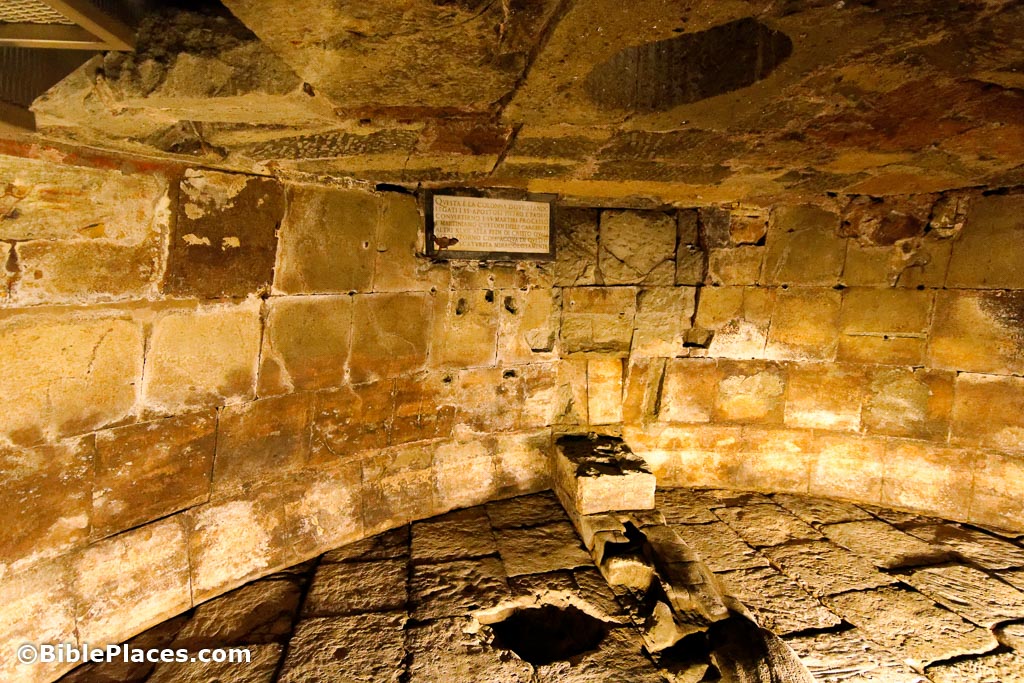
Do your best to come to me soon For Demas in love with this present world has deserted me and gone to Thessalonica he dropped out -- perhaps he had a pagan girl friend in Thessalonica ; Crescens has gone to Galatia Titus to Dalmatia Luke alone is with me Get Mark and bring him with you; for he is very useful in serving me Tychicus I have sent to Ephesus to take Timothy's place there When you come bring the cloak that I left with Carpus at Troas also the books and above all the parchments
The Apostle makes three requests that indicate something of his needs at this time He sent for his cloak; winter was approaching and they confined him in a cold damp dungeon He dreaded another winter without a wrap and he writes to Timothy to bring a cloak when he comes from Ephesus And then the books the secular reading matter that the Apostle Paul enjoyed so much He was bereft of his friends and he had nothing with which to occupy his time I'm sure you can identity with him if you love books as I do When I was a boy my parents had a book plate made up for me that I placed in the fronts of all my books It had a little bookworm eating its way through the cover of a book with the caption at the bottom As for me give me a book That is sort of my philosophy of life as well so I can understand something of Paul's need But most of all; he says bring the parchments the Old Testament scrolls; these copies of scripture that Paul had carried with him through his journeys in Asia Minor as he had preached the gospel before Jewish and Gentile audiences They were perhaps filled with notations and cross-references these familiar copies of the scriptures that he loved so much
He had an acute physical emotional and spiritual need He was afflicted in body soul and spirit You would think that he would be discouraged He had invested the greatest part of his life in a ministry in Asia Minor and Europe and now he is experiencing a reversal Many people were defecting from the faith The church was under persecution by Roman government and the Jewish religious authorities
It was a grim time for the Apostle and could have been very discouraging But throughout the book there is no note of discouragement; rather there is solid encouragement enthusiasm and excitement about the gospel that has been committed to him and words of confidence to his young associate Timothy
Timothy was a young man that Paul had encountered on his first missionary journey through Asia Minor He had accompanied the Apostle Paul on his second missionary journey and then was dispatched by the Apostle to Ephesus to shepherd the church there Timothy evidently had three problems which you can detect as you read between the lines of these two personal letters first and second Timothy The first was his youth Paul writes in I Timothy Let no man despise your youth but set the believers an example He was awed by the responsibility of ministering to a group much older than he I think that many of us can identify with that problem Secondly he was prone to sickness He must have been very frail for Paul refers to his frequent ailments We all know how discouraging that can be when we are weak in body Third he was very timid and shy It was difficult for him to speak out in the face of the opposition that he was experiencing in the city of Ephesus It was an enormous responsibility that God had placed into his hands He was the leader of the only Christian assembly in the city of Ephesus He was under fire separated from Paul by hundreds of miles and I'm sure he was discouraged not knowing where to turn But Paul writes those words of encouragement which are directed to us as well because I sense that we have all felt the same pressures that Timothy experienced
It is always interesting to read someone else's mail and this will be our experience in the next four weeks However Paul gives us this right because in the last verse of the book Paul says
The Lord be with your spirit Grace be with you 2 Timothy 4 22 This is the only occurrence in the book where this personal pronoun is in a plural form The indication is that he wanted Timothy to read this letter to the church in Ephesus so that it might be an encouragement to them and they in turn might be an encouragement to Timothy And so we have the right to read this letter because it is written to us as well
Let us look first at the introduction verses 1 and 2 Paul begins with his customary introduction
Paul an apostle of Christ Jesus by the will of God according to the promise of the life which is
in Christ Jesus
Paul never once repudiated his authority as an apostle There were many believers particularly the Jewish believers who never accepted his authority They felt he was a bit irregular and wasn't one of the original twelve He was constantly under suspicion But Paul knew that he spoke as a divine spokesman He had that authority When he wrote his first letter to the church at Thessalonica he said
And we also thank God constantly for this that when you received the word of God which you heard from us you accepted it not as the word of men but as what really is the word of God which is at work in you
That word likewise applies to this letter This is not merely a recommendation from the Apostle; it is a divine revelation to which we must give heed We cannot treat this word lightly Verse 2
To Timothy my beloved child Grace mercy and peace from God the Father and Christ Jesus our Lord
This beloved child is a wonderful term of endearment Timothy was not of course his son in the flesh but his spiritual son These are words coming from a rugged old veteran who bore in his own body the marks of his conflict a conflict from which Timothy was inclined to shrink Yet Paul does not rebuke him but encourages and supports him We'll observe this as we study the book He closes his introduction with the familiar triad Grace mercy and peace from God the Father and Christ Jesus our Lord Grace is for the worthless; mercy is for the helpless; peace is for the restless
The first chapter of this book is the first major section of the letter and I have entitled it A Call to Loyalty to The Gospel The first aspect of that loyalty is found in verses 3 to 5 -- belief in the gospel That is where we must begin We cannot be loyal to the gospel unless we have first believed it as Timothy did Paul writes
I thank God whom I serve with a clear conscience as did my fathers when I remember you constantly in my prayers As I remember your tears I long night and day to see you that I may be filled with joy I am reminded of your sincere faith a faith what dwelt a word that means literally to dwell down deep inside first in your grandmother Lois and your mother Eunice and now I am sure dwells deep down in you
Paul observed in Timothy a sincere faith an unfaked faith He was not playing a role He uses a word that literally means he is not one who speaks out from under a mask It was a word taken up from the theater where actors would stand behind a mask and play the role associated with the mask They were called hypocrites because they spoke out from under a mask Paul said When I saw you Timothy I saw that your faith was real you were not playing a role And this kind of genuine faith constitutes the foundation of loyalty that makes possible a continuation of loyalty
I am certain our tendency to wander away from the truth grows out of the fact that we really do not believe it We have not wholeheartedly and unreservably committed ourselves to it We have strings attached we have reservations and therefore it is easy to drift away from it John speaks of some whom he says went out from us i e the body of believers of disciples because they were not of us They were never really committed to the Lord They did not endure because they could not endure They had never allowed the Lord Jesus to grasp them firmly I think we can illustrate this from a human love affair When you men first asked your wives to marry you you would have been a bit shocked if she said Yes I love you and I'd like to marry you but I reserve the right to go out with Charley on Friday nights You would not like that because you cannot build any kind of relationship on that basis You see; the foundation of continuance and loyalty to one another in human relationships grows out of this wholehearted commitment to one another without reservation And Paul says That is what I see in you Timothy That is the mark of one who can continue in the gospel because the foundation is laid firmly There is a faith that dwells deep down And this is the foundation of loyalty this genuine faith
Now a word about the expression of that loyalty found in verses 6 through 14 four ideas based on four imperatives the first found in verse 6 rekindle the gift The second in verse 8 do not be ashamed but take your share of suffering The third verse 13 Follow the pattern of the sound words and the fourth verse 14 guard the truth that has been entrusted to you Rekindle the gift i e proclaim the gospel Take your share of suffering suffer for the gospel Follow the pattern obey the gospel Guard the truth defend the gospel These Paul says are four expressions of that loyalty The first proclaim the gospel in verses 6 and 7
Hence I remind you to rekindle the gift of God that is within you through the laying on of my hands; for God did not give up a spirit of timidity but a spirit of power and love and self-control
Timothy is said to have received a divine endowment a gift from God that was received through the apostolic hands Scripture does not tell us specifically what that gift was and therefore we can't dogmatize According to I Timothy 4 it was a gift that was granted to Timothy at the time of his ordination when he was set apart to the Christian ministry Some therefore think that the gift is the ministry itself This is possible but I am inclined to think what Paul refers to here is the spiritual gift which elsewhere in the scripture is called the gift of teaching As a pastor teacher he had the responsibility of instructing the body of believers at Ephesus Paul says rekindle that gift Or as J B Phillips says Keep stirring up that fire that is within you
We can understand something of Timothy's feelings There was a wholesale defection from the faith The champion of faith the Apostle Paul was in prison for declaring that faith There was intense persecution and I'm sure that Timothy being the timid soul that he was was inclined to shrink from proclaiming the gospel But Paul says don't shrink from your assignment keep fanning the fire that is within you Keep it aglow keep it alive
Now the reason for that command is given in 2Ti 1:7
For God did not give us a spirit of timidity but a spirit of power and love and self-control
You see it would be futile to say to a man like Timothy Now Timothy be strong Just give it everything you have Stand before those people and teach Timothy would shrink from that The thing that made it work was a realization that the Holy Spirit that God had granted to him and who indwelt him was not a spirit of timidity but a spirit of power and love and of a discip1ined mind It would never do to admonish Timothy without the assurance of the power of the indwelling Spirit His strength lay in another life a life resident within him the life of a mighty Lord That spirit he says is not a spirit of fear but of power i e it has the capacity to influence others Timothy would say But I'm weak in personality I'm not strong I'm not a leader Paul would say That's all right It is not your power that will influence others; it's the power of the Holy Spirit It is a spirit of love i e it was not a spirit of self assertion but a spirit of service to others It is a spirit of self-control a spirit that does not give way to panic under pressure or passion And will you notice the verb tenses in this verse Paul says that he did not give you That is past tense It is a present possession The Holy Spirit was indwelling him already available to him And therefore a spirit of fear was absolutely forbidden to him He had a spirit of power and love and of a sound mind in the indwelling Spirit of Christ This is the first
expression of loyalty Proclaim the gospel
Second suffer for the gospel 2Ti 1:8-12
Do not be ashamed then of testifying to our Lord nor of me his prisoner but take your share of suffering for the gospel in the power of God who saved us and called us with a holy calling not in virtue of our works but in virtue of his own purpose and the grace which he gave us in Christ Jesus ages ago and now has manifested through the appearing of our Savior Christ Jesus who abolished death and brought life and immortality to light through the gospel For this gospel I was appointed a preacher and apostle and teacher and therefore I suffer as I do But I am not ashamed for I know whom I have believed and I am sure that he is able to guard until that Day what has been entrusted to me
Paul says don't be ashamed of our Lord to whom you belong and don't be ashamed of me because you belong to me too The Apostle was in prison abandoned by his friends because he was a constant embarrassment to them He stubbornly refused to be quiet even in the face of an imperial edict He was always sounding off in public He always embarrassed his friends who were trying to get along with the Roman authorities They were trying to make the church a bit more respectable and here was this scruffy unwashed jailbird who refused to shut his mouth they were embarrassed by him What a poignant plea Don't be ashamed of me Timothy I could not help but think of some Christians I know who embarrass me They don't have my background my style of life; they bother me But we're in the family together I belong to them you see and I must not shut myself off from them I can't be ashamed of them
Paul writes Don't be ashamed of the Lord or of me but take your share of suffering for the gospel Suffering seems to be the normal consequence of believing and proclaiming the gospel It was the experience of the Apostle Paul as he tells us in verse 11 and it will be our experience Why is it that whenever we proclaim the gospel people will invariably persecute us It is because there is something inherent in the gospel itself The message makes men mad The massage is that God saves men by grace and not by merit that man is inescapably indebted to God He cannot get away from that obligation Man can't make it on his own And man cannot simply stomach his own helplessness We sing the hymn Nothing in my hands I bring Simply to Thy cross I cling and that makes people mad because they want to bring something anything But the gospel says we can bring nothing; Jesus Christ has done it all The scriptures say that if we proclaim man's merit or some form of humanism we will escape persecution But if we believe the gospel and proclaim the fact that man is a sinner we will suffer for it It is inevitable Jo will be ostracized we will be excluded from the best circles; we will be hated and opposed That's the name of the game Jesus said that would be our lot That is what he experienced and how can we expect to experience anything less than that Peter says Don t be surprised at the fiery trial that is to try you as though some strange thing has happened to you We can expect opposition Therefore we must not succumb to the temptation to mute the gospel no matter what the pressures may be It is the only thing that has the power ultimately to heal men What are you going to have to proclaim it in the face of hatred and hostility
In verses 9 through 12 we find a parenthetical section which supplies the reason why we should not be ashamed of the gospel It is the same argument Paul uses in Romans 1 when he points out that he is not ashamed of the gospel because it is the power of God unto salvation to those who believe it His argument here is the gospel is the power of Sod; and therefore we must not be ashamed of it It is a power in the sense that it is the only force that has the capacity to heal lives and therefore we can be bold in our declaration of it This section falls basically into three headings ' the character of the gospel; the origin of the gospel; and the basis of the gospel
The character of the gospel or what it is It is a gospel that has saved us and called us with a holy calling It is more than forgiveness I hope we are clear on that It is a calling to holiness It involves the total program of Cod by which he has determined to justify you to declare you righteous - to sanctify you - to set you apart to your intended purpose so you can be what God intends you to be and to glorify you, i.e. to conform you to the image of Jesus Christ himself. That is the character of the gospel the total program of God by which he rebuilds a life and makes it again what man was intended to be.
Its origin Paul says literally is before eternal times or before time began verse 9 the grace which he gave us in Christ Jesus ages ago He gave us something before time began Salvation therefore is not based on our works It was accomplished before we ever had an opportunity to do any work It was given before we were born It was given before time began That ought to engender humility in us We have no claim upon God we have no right to come before him we have as John R W Stott says no innate eligibility We stand before God stripped of any merit tie are there only by to grace of God
The final word is the basis of the gospel It rests on the historical work of Christ That is the unique thing about the Christian faith; it is rooted in time It occurred in time and space It was planned in eternity but it was manifested in time And what did he do He abolished death and brought life and immortality to light through the gospel There is something very striking about that statement he abolished death because I can see the apostle Paul sitting in his cell awaiting death But to the Apostle death was only a trivial episode in his life He was going from one degree of relationship with Jesus Christ to another The cross had drawn the sting of death Paul was not concerned because Jesus had abolished death I think we may also say that Jesus has abolished the living death in which the world finds itself today Francis Schaeffer in his book Death Of The City refers to the fact that people have given up the ghost in the city They have nothing to live for no purpose God is not at horns in the world life is meaningless and absurd But Jesus Christ has abolished that death
Now that is our salvation what Hebrews calls so great a salvation Its purpose man's transformation into the image of God Its origin God's eternal plan Its basis Jesus' historical appearance to abolish death And that is why Paul says the gospel is powerful And that is why we must not be ashamed of it or apologize for it We are to proclaim it and if necessary to suffer for it
And then we are to obey it In 2Ti 1:13 Paul says
Follow the pattern of the sound words which you have heard from me in the faith and love which are in Christ Jesus
Follow the pattern of healthy words of whole words Be a whole man Let your life be a model of the gospel you believe and proclaim This is an inherent part of our message People will look at us They must see the truth incarnate in our lives This is where our authority lies As Jesus said to men who were opposing him If I do not the things that I tell you then do not believe me Part of our proclamation is the truth embodied in our life People are justifiably resentful at being told that we have the solution to life when we are exhibiting all the problems of life Our obedience will be demonstrated by faith and in lover the kind of love that was in Christ Jesus the kind of love that transcends human love the kind of love that characterized our Lord himself who always had time for people who was never in a hurry who was always sensitive to the needs of others who poured out his life in ministry to them If we are going to be loyal to the gospel of Jesus Christ it must issue in a personal obedience to the gospel in our lives
Finally 2Ti 1:14 we must guard the gospel
Guard the truth that has been entrusted to you by the Holy Spirit who dwells within you
This is a military term It means to place a garrison about to defend stoutly against loss or damage We can see something of the circumstances behind this statement Paul is nearing the end of his life The twelve Apostles at this time either are dead or scattered throughout the Roman empire The infant church is surrounded by evil forces People are defecting from the faith Paul is concerned about the condition of the church after his hand is removed It is in this setting that Paul appeals to Timothy to guard the truth defend the body of doctrine that was delivered by the Apostles Of course the application today is so obvious with all of the theological confusion the growth and proliferation of cults the attacks on the scripture the desire on the part of men in high places to lay aside the word of God and to depend upon the mind of men low important it is therefore to defend the truth against all attacks to hold diligently to the gospel handed down by the Apostles and delineated in the Scriptures
Just a final word This last paragraph 2Ti 1:15-18 is a touching illustration of loyalty -- There is much we could learn from the life of Onesiphorus
You are aware that all who are in Asia turned away from me and among them Phygelus and Hermogenes May the Lord grant mercy to the household of Onesiphorus for he often refreshed me; he was not ashamed of my chains but when he arrived in Rome he searched for me eagerly and found me -- may the Lord grant him to find mercy from the Lord on that Day -- and you will know all the service he rendered at Ephesus
What a touching tribute to this faithful man. There is every indication that Onesiphorus lost his life to Rome serving Paul. He was willing to lay aside his own life to minister to the needs of this Apostle. I wish we had more time to look at Onesiphorus for he is a wonderful illustration of that loyalty to the gospel of which Paul speaks.
This is Paul's call to loyalty. The foundation of loyalty -- believe it; the expression of loyalty--proclaim it suffer for it obey it and defend it. I suspect this is more than we can handle I know it is more than I can handle. But you see I left out the one verse that makes it all possible. It is 2Ti 1:12 It is the key verse in this section.
and therefore I suffer as I do But I am not ashamed for I know whom I have believed and I am sure that he is able to guard until that Day what has been entrusted to me
There is a bit of a problem with this translation, I memorized this verse in the King James' translation
for I know whom I have believed and am persuaded that he is able to keep that which I have committed unto him against that day
The RSV appears to consider what God has committed to Paul and would refer to the gospel. The King James translation would seem to refer to a life that has been deposited in Christ's hands. The Greek is ambiguous. It just says my deposit and it is difficult to determine whether it is something that God has deposited with Paul or whether it is something Paul deposited in the Lord's hands. I am inclined to think it is both and that this is a deliberate ambiguity, the point being that it is God's responsibility to guard both the proclaiming of the Gospel and the application of that gospel to our lives. He is able to live through us to inspire in us the faith that is the foundation of loyalty and to speak through us as we proclaim the gospel and to suffer with us as we suffer and to be our strength as we exercise our wills to obey it and to defend it. He will never never allow the light of the gospel to go out. God himself is the final Guarantor
Father what strength there is in this passage and what an overwhelming responsibility. We thank you for your faithfulness that you are able. We know of our inability but we thank you that you are the One who is able to do exceeding abundantly above all that we could ever ask or think. That is our confidence and we rest on that fact. We rest in the name of our loving Lord. Amen.
As you remember from last week Paul is imprisoned in the infamous Mamertine dungeon in Rome awaiting his second and last trial. He indicates in chapter one that he has had one encounter with what he calls the lions in Rome. It is difficult to know what he is referring to specifically whether he is speaking metaphorically of Satan or of Caesar or whether he had actually had some occasion to meet the lions in the Colosseum. But in any case his life had been spared and now he is writing to Timothy writing in the face of wide-scaled defection from the truth as he indicates in 2Ti 1:15.
"All who are in Asia turned away from me".
Early converts in Asia Minor who had responded to the call to come to Christ were turning away because of persecution by the Roman government and Paul was experiencing personally the force of this rejection. He writes to Timothy who is in the city of Ephesus pastoring a church that the Apostle Paul established in Asia Minor. And of course since Timothy was in Asia he also was observing this defection from the faith to which Paul alludes. Timothy was weak in spirit frail in body timid in disposition and being a young man he needed these words of encouragement from the Apostle Paul.
In view then of this almost universal declension Paul writes these words in chapter 2 that I have entitled A Call to Endurance. There are three commands in the first paragraph that comprise the call to endurance. These commands are amplified by three metaphors and then further explained by the means of three illustrations. The first command is found in the first verse.
You Timothy my son be strong in the grace that is in Christ Jesus
Be strong in grace -- You Timothy -- in contrast to those in Asia who are turning away from the faith be strong. No matter what others may think of you no matter what you may think of yourself no matter how weak how inept how inadequate how ill-equipped you may consider your self to be you Timothy be strong. Now as we indicated last week this is not a call to be strong in himself; it is a call to be strengthened. The verb is passive and in the present tense. You Timothy keep on being strengthened by the grace that is in Christ Jesus. It would be absurd indeed to ask Timothy to be strong in himself to clench his fist to set his jaw to marshall his own resources and be the man Paul wanted him to be in Ephesus. He simply did not have it within himself to be strong. You might as well ask Ray Stedman to sing grand opera or Dave Roper to grow hair as to ask Timothy to be strong. One of my boys asked me the other day Dad why don't you let it grow out on top. I said Son there is no way I don't have the means I can't do it. To ask Timothy to strong without this qualifying phrase in the grace that is in Christ's would have been ridiculous indeed. He was to find his resource not in his own nature but in Jesus Christ.
This is not a call to be stoical but is a call to be dependent upon an indwelling Spirit. I had an illustration of this principle recently when we took a group of young people to Lytton Plaza. If you have driven down Ditiversity Avenue recently then you've noticed that is where the action is located. Many hippies and radicals gather there in the evening. We took a group of about twenty students into the Plaza to witness to our relationship to Christ. It was a terrifying experience. As we gathered I noticed one young man from our group standing with a Bible in his hands I had asked them not to bring their Bibles into the Plaza so I walked over to talk to him about it. I noticed he was reading and he showed me the passage It was a promise from Joshua 1:9 where the Lord says to Joshua "Be strong and of good courage; be not frightened neither be dismayed; for the Lord your God is with you wherever you go." He said That's it isn't it .And I said That's it. He put his Bible down and as he walked away I distinctly heard one knee say to the other "Let's shake." But he moved into the crowd. He went in fear; emotionally he was shaken. But he went in the Lord's strength; he did not have it within himself to be strong but he went in the race that is in Christ Jesus. What a wonderful statement. What a privilege it is to walk in that strength. No matter how timid how lacking in resources you can be strong in the grace that is in Christ Jesus. Someone has described grace about an acrostic based on the letters G-R-A-C-E -- God's Resources At Christ's Expense. All that God is, is available to us to give strength to our weakness (cp 2Co 12:9)
The second command is found in verse 2
and what you have heard from me before many witnesses entrust to faithful men who will be able to teach others also
The command is to entrust the truth to others He had been told earlier in this letter to guard the deposit that had been entrusted to him And now Paul says Timothy pass that deposit onto other men The process is described Paul first entrusted the truth to Timothy We know from the book of Acts that Timothy was the constant companion of Apostle Paul He selected this young man to accompany him on his second missionary journey through Asia Minor Thus Timothy had an opportunity to associate with the Apostle and to observe his life and teaching In this way Paul passed the truth onto Timothy Timothy then was to pass the truth onto other men faithful men teachable men men who would respond to the truth and who in turn would instruct others Four generations are envisaged here Paul teaching Timothy Timothy teaching faithful men and these faithful men teaching others
The process began in the Apostolic era and it is still going on today It is still our responsibility to pass the truth on like an Olympic torch from one generation to the next
This was the pattern that the Lord himself employed At the outset of his ministry he chose twelve men It was to this small band that Jesus committed the future of the church As the Lord's ministry drew to a close he spent more and more of his time with this inner circle who constituted his group of
Timothys The transfer of truth to the next generation was dependent on his face to face instruction of these men You see it in the ministry of Paul to his associates He did not look primarily to his ministry to the multitudes as the means of discipling men He spent much of his time--perhaps his prime time--in individual personalized ministry to men
We also must teach others We must discover those that are teachable who will take the truth that we impart to them and share it with others This is not just the responsibility of apostles or pastors the professionals but all members of the church have this opportunity
May I make an observation in passing Eugene Nida in one of his books indicates that there are basically four types of individuals There are initiators--creative individuals who originate ideas There are purveyors -- those who will channel information to others There are people who are receptors -- who listen but do not respond The fourth type he calls censors -- those who oppose the truth I think all four classes of individuals are found in the church today May God give us wisdom to discover those purveyors and innovators of truth who will respond and invest their lives in others equipping them to do the work of the ministry
I spoke to a young man this past week who has a ministry of discipling others He was telling me of a young man that he led to Christ three years ago They began to meet weekly to study the scriptures and pray together Within a few weeks this young Christian led his wife to Christ and then his sister His sister led her husband to Christ Now they are meeting together in a Bible study with two other couples who subsequently found Christ and the process is still going on This is a ministry of multiplication And it is the most exciting ministry I know
There is a third command found in verse 3
Take your share of suffering as a good soldier of Christ Jesus
Literally endure suffering with me Paul is suffering in Rome for the gospel People are turning away from him Paul implores Timothy to be identified with him in his suffering He is to take his share of suffering as a good soldier Soldiers expect to suffer It is part and parcel of their calling A soldier does not expect to live a life of ease When he is on duty any type of austerity is justified It is a part of his life Paul says you Timothy must endure as a good soldier of Jesus Christ Then he uses three metaphors to expand on the need for endurance He uses the example of a soldier in verse 4; an athlete in verse 5; and a farmer in verse 6 In each case there is a requirement and a reward In verse 4 Paul writes
No soldier on service gets entangled in civilian pursuits since his aim is to satisfy the one who enlisted him
The requirement is that a soldier be unencumbered and single-minded There is nothing wrong with civilian pursuits; it is just that a dutiful soldier must not become entangled in civilian pursuits because they drain his time and energy He is to concentrate Paul says on pleasing his Commander-in-Chief A good soldier pours out his life to please his Commander-in-Chief and cuts himself off from anything that would encumber him So a good soldier of Christ considers as first priority the requirement to please his commander He is a good soldier because he is dedicated And the reward is that he receives the approval of his commanding officer Without dedication there can be no approval
The second metaphor is that of an athlete in verse 5
An athlete is not crowned unless he competes according to the rules
The requirement is that he observe the rules There must be no random display of skill He is to be disciplined He is to place himself under the rules of the game Any game has rules and in order to play the game correctly the participants must comply with those rules An athlete must be law-abiding The freedom an athlete enjoys is the freedom to follow the rules No rules no wreath
The third metaphor is that of a farmer in verse 6
It is the hard-working farmer who ought to have the first share of the crops
The requirement here is that the farmer work hard Toil is indispensable to a farmer In an undeveloped country such as Palestine there is no such thing as a good person farmer Farmers work hard No matter how inclement the weather no matter how disinclined the farmer to toil in the field he must work And the reward is the harvest The harvest does not appear if the farmer does not log the time in the field The figure of farming is so appropriate to the Christian life The farmer works the field He sows the seed and he labors to cultivate the crop He labors but the harvest ultimately is produced by God The principle of life that is inherent in the seed the rain and the sunshine the factors that cause the harvest to come to fruition come from God alone This is the mystery of divine-human cooperation that makes possible the harvest He gives the increase but we must plant and water and toil
There are of course two types of harvest in Christian experience There is the harvest of Christian character Paul speaks of the fruit of the Spirit as love joy peace longsuffering gentleness faithfulness meekness self control These are characteristics of a life that is sown to the Spirit This harvest can be produced only if we are diligent in our pursuit of holiness We must turn away from sin and from self and yield to the life of Jesus Christ It is the Lord that produces the fruit but our wills must be engaged in the struggle We cannot be lethargic The second type of harvest is the harvest of individuals brought into relationship with Christ And again the requirement from our standpoint is that of toil The fruit will not drop into our hands without effort on our part It will involve our time and energy and our willingness to give yourself in sacrificial friendships ultimately it is God who will produce the harvest1 but it is our responsibility to be a hard-working farmer There will be no harvest without toil
Now the theme of all of these metaphors is that progress in our Christian life will cost us dearly There is no gain without pain We must expect to labor if we hope to achieve We cannot live desultory lives and expect God to pour everything in
In verse 7 Paul says
Think over what I say for the Lord will grant you understanding in everything
There are a couple of comments I would like to make on this verse in passing First it is a pointed statement of the authority of the Apostle He informs Timothy that he cannot fully understand these simple metaphors without God's help He needs God to understand what the Apostle is saying What arrogance -- unless he is indeed God's spokesperson
The second thing that occurs to me is that this is the biblical method of Bible study We have to apply ourselves to the truth we have to think and then God will grant us understanding
Now in the remaining verses 8 through 13 Paul gives us three illustrations to reinforce his argument He refers to the experience of Christ in verse B; to the experience of the Apostle Paul himself verses 9 and 10; and to the experience of all believers in verses 11-13
Remember Jesus Christ risen from the dead descended from David as preached in my gospel Why should he remember Christ Perhaps because Jesus risen from the dead is the heart of the gospel However I believe he is pointing to Christ as one who demonstrated the principle that life can only come through death; glory can only come through suffering; achievement ultimately comes only through endurance Jesus died in order to be raised to the right hand of the father For him there was no crown apart from the cross The book of Hebrews says of Jesus that for the joy that was set before him he endured the cross despising the shame and is seated at the right hand of the throne of God He could never have received the glory apart from the cross
There is an encouraging note tucked away in this verse Paul reminds Timothy that Jesus was descended from David He highlights his humanity He is saying Timothy remember that it was in his humanity not his deity that Jesus suffered It is no encouragement that God suffered But to discover that Jesus as a man dependent upon the Father suffered and endured -- that puts starch in our spine He held fast in the fact of death endured the cross and received the glory Whenever then we are tempted to give way under pressure we must remember Jesus Christ who suffered as we suffer who shared our experience totally as a man who fully understands This same Jesus is available to us today to supply the strength that we need He is a risen Lord who strengthens in the time of need Timothy when you are inclined to shrink from suffering remember Jesus Christ There is no crown without a cross
Then in verses 9 and 10 he refers to his own experiences
the gospel for which I am suffering and wearing fetters like a criminal But the word of God is not fettered Therefore I endure everything for the sake of the elect that they also may obtain the salvation which in Christ Jesus goes with eternal glory
Paul links his own suffering with glory He says I am suffering but the result of my suffering will be glory for those elect of God who have not yet responded to the gospel He speaks of the humiliation of wearing chains and yet he says The gospel is not fettered I think he is doing more than merely setting up a contrast I am fettered the gospel is not He is saying Because I suffer others will hear the gospel and be saved Paul's suffering of course is in no way redemptive Only the death of Christ can redeem men This is Paul's conviction there is only one thing that will ultimately gather the elect and that is the proclamation of the gospel Therefore I must preach the gospel But Paul knows that in preaching the gospel he will suffer He is presently suffering for it and he will continue to suffer for it And so he says Therefore on behalf of God's elect I must suffer There is no other way If they are to be saved I must suffer Does not this truth apply to us In our homes in our neighborhoods in our offices on our campuses there are people who do not yet know Jesus Christ Therefore we must expose them to the gospel But if we proclaim the gospel we will suffer It is an inherent part of the proclamation of the gospe We will be ostracized we will be misunderstood we will be excluded from certain circles we will be hated and opposed and ridiculed But we have no alternative If they are to be saved we must declare the truth and suffer for it There is no salvation Paul says apart from suffering No crown without a cross no wreath without rules no glory apart from suffering Then finally in verses 11 through 13 he refers to the experience of all believers
The saying is sure
If we have died with him we shall also live with him;
if we endure we shall also reign with him;
if we deny him he also will deny up;
if we are faithless he remains faithful--
for he cannot deny himself
This appears to be a portion of an early Christian hymn I'm sure this hymn must have been sung by the church in the catacombs during periods of persecution There are four things Paul says in this hymn that are the common experience of all believers First if we have died with him we shall also live with him Life comes through death There is no other way The cross is the symbol of that cutting off of the old life in order that Christ's life may appear in us There can be no life apart from this death We must act upon the principle of the cross in our life There is no real life without death Second if we endure we shall also reign with him We cannot reign with Christ unless we endure James says Blessed is the man who endures trials for when he is tried he will receive the crown of life The crown of life is a symbol of the authority that we have to reign in life Trials teach us the utter folly of self dependence and the absolute necessity of confidence in Christ We draw upon him and his strength and thus discover how to reign in life You will receive a crown of life when we have discovered through suffering that Jesus Christ is our life We cannot reign unless we endure suffering Third if we deny him Paul says he will also deny us It is the witness of scripture and experience that some will deny him They deny him because their commitment to him is superficial and self-centered and ultimately they turn away Therefore he will turn his back on them And finally if we are faithless he remains faithful This is a word of encouragement to those who are weak in faith Though we flag in faith he remains faithful because he cannot deny himself in us This hymn then summarizes Christian experience in two words dying and enduring But this is the route to living and reigning
If there is one lesson in these verses I believe it is this blessing comes through toil; life comes through death glory comes through suffering Christian life and service will never come easy It will cost us in terms of time and toil and energy and in terms of sacrificial friendships But the promise is that this is the path to glory The cross will lead to a crown. It will mean salvation for many Toil will inevitably result in a harvest
Our Father we thank you for the promise of life that there is in Christ Jesus We know that suffering is standard operating procedure Teach us to be strong in the grace that is in Christ Jesus Amen
You will remember in the opening paragraph of chapter 2 there are three metaphors that the Apostle
Paul uses to describe the faithful man of God He is first of all to be like a dedicated soldier who pours out his life in service to his commanding officer He endures hardship and thus gains the approval of his commander Second he is to be like a law abiding athlete who observes the rules of the game in order to secure the prize Third he is to be like a hard-working farmer who must toil in order to participate in the harvest There is a common denominator among these three metaphors --
endurance The faithful man of God will persist despite opposition adversity and fatigue Then Paul applies these metaphors to Timothy who is weak timid flagging in faith waning in enthusiasm for the Christian ministry in order to encourage him onto continuance There is no approval Paul says without diligent effort There is no crown without discipline There is no harvest without labor Timothy is to be strong but not in himself because Timothy did not have what was necessary to be strong in himself He is to be strong in the grace that is in Christ Jesus Now in the remaining section of this chapter starting with verse 14 Paul adds to his description of the faithful man of God by using three additional figures an unashamed workman verse 15 ; an undefiled vessel verse 21 ; and third; an inoffensive servant verse 24
First the unashamed workman in verses 14 to 19
Remind them of this and charge them before the Lord to avoid disputing about words which does no good but only ruins the hearers Do your best to present yourself to God as one approved a workman who has no need to be ashamed rightly handling the word of truth Avoid such godless chatter for it will lead people into more and more ungodliness and their talk will eat its way like gangrene Among them are Hymenasus and Philetus who have swerved from the truth by holding that the resurrection is past already They are upsetting the faith of some But God's firm foundation stands bearing this seal 'The Lord knows those who are his ' and 'Let everyone who names the name of the Lord depart from iniquity '
There are two types of workmen envisaged in this paragraph There is the workman whom God has
approved and therefore has no reason to be ashamed and there is the workman who is disapproved and who ought to be ashamed The difference between the two workmen is crystal clear and is summed up in two verses 15 and 18 The good workman and he is good because he is approved by God is one who rightly handles the word of truth The bad workman who has forfeited God's approval is one who has swerved from the truth and therefore has every reason to be ashamed Let us look at this in detail A good workman is one who rightly handles the word of truth This is translated in various ways in different versions If you have a King James translation it reads one who rightly divides the truth J B Phillips translates one who uses the word of God to the best advantage Ken Taylor in Living Letters one who knows what the Bible says and means The Greek verb literally means one who cuts straight It is used in other Greek literature of stone cutters who cut a straight line through a stone or of wood cutters in a forest who cut a straight path through the forest It is used at farmers who plow a straight furrow A good workman then is one who cuts a straight path He is one who has a goal in mind and who heads straight for that goal He is not side tracked and he is not detoured There is a translation of the Old Testament that Jesus used called The Septuagint which was a Greek translation of the Hebrew Old Testament scriptures In that translation in the familiar verses Proverbs 3 5-6 this verb is used
Trust in the Lord with all your heart and lean not on your own understanding In all your ways
acknowledge him and he will cut your path straight
He will direct you straight to the goal One who handles the word of God aright therefore is one who directs men straight to the goal Now what is the goal of which the scriptures speak There is no question about this In the scriptures the goal is Godlikeness God wants to produce in our lives his likeness And the scriptures are the tool given to produce that quality of life in us So a good workman will use the word of God to point people toward that goal the goal of Godlikeness
There is a great call for Godlikeness today Young people today see so much hypocrisy among believers Oh that they might see in our lives the character of Jesus Christ himself There is a story young people tell these days It is funny but it cuts deeply It has to do with a truck driver who stopped at Cloud 9 Restaurant on Highway 17 for a bite to eat He ordered a steak sandwich a cup of coffee and a piece of pie Just as the order arrived two Hells Angels drove up on their motorcycles and parked them outside the door The counter was crowded and the only seats available were on either side of the truck driver They sat down and annoyed because he did not move over one reached over and took the truck driver's steak sandwich and began to eat it The truck driver looked at him but did not say a word Then the other one took his pie and began to eat that Still no comment He smiled at the two men rose from his seat paid his bill got in his truck and drove off One Angel said to the other That's a remarkable man He must be a Christian That's the way Christians act The other one said Well if he's a Christian he's certainly a good one About that time the first Angel turned around and looked out the window and saw the man driving his truck away He said He may be a good Christian but he's a terrible truck driver He just ran over our motorcycles
Now it is that sort of behavior inconsistent with Christian truth that offends the world But the word of God is given to point us to true godlike character Paul writes in Philippians 3 13 This one thing I do forgetting what lies behind and straining forward to what lies ahead I press on toward the goal for the prize of the upward call of God in Christ Jesus In the context that goal is Christlikeness Note verse 10 that I may know him and the fellow ship of his sufferings being made conformable unto his death So then the goal of all personal Bible study and Bible exposition is that we may be Godlike The scriptures are the means to that end
In chapter 3 verse 15 which we will look at next Sunday Paul says to Timothy
and how from childhood you have been acquainted with the sacred writings which are able to instruct you for salvation through faith in Christ Jesus All scripture is inspired by God and profitable for teaching for reproof for correction and for training in righteousness that the man of God may be complete equipped for every good work
The word of God is the means by which the man of God may be comprehensively equipped for theservice of Jesus Christ The Bible is not intended to be an object for speculation and it is not to feedour intellectual curiosity; it is to bring us into a relationship with God and nurture and sustain that relationship So when we engage in personal Bible study or when we expound the scriptures to that end we are good workmen We have no reason to be ashamed On the other hand Paul says that the disapproved workman is one who swerves from the truth and verse 18 cites two examples of teachers in the assembly who have literally missed the mark like a bowman who draws an arrow at the target and shoots wide of the mark because he aims wide Disapproved workmen miss the mark because they do not put the scriptures to their intended purpose They use them as a basis for speculation and they dispute about words They engage in godless chatter They argue and debate about the meaning of scripture but they never place themselves under its authority They have no intention of obeying it and so consequently they miss the mark They are like basketball players who pass the ball around but never take a shot at the basket They are constantly engaged in interpretation but they never apply the truth Therefore Paul says they are disapproved workmen who ought to be ashamed
There was a school of thought that was troubling the church at the time Paul wrote this letter called Gnosticism It was a system of philosophy producing a lot of unpronounceably long words and fantastic theories that evidently found its way into the early church It attempted to make the Christian life a complex philosophical theory rather than an adventure of faith and thus it was robbing the Christian faith of its simplicity I think perhaps this is what Paul is concerned about as he addresses these words to Timothy Timothy don't mishandle the word of truth don't make it an object of speculation but use it as an instrument to instruct and correct and encourage men to Godliness
Timothy was facing the same problem that Jesus himself faced in his conflict with the Pharisees These were men who were students of the scriptures They scrutinized them minutely That was their problem They became preoccupied with minutia They counted all the letters in the Old Testament They found the middle letter of the scripture They knew where every word could be found and the number of occurrences of those words but they never applied the truth to themselves And so they missed the whole point of the Old Testament which was to lead people to faith in Messiah Jesus said to them You search the scriptures because you think that in them you find eternal life; and it is they which testify to me; yet you refuse to come to me that you may have life They were not good workmen because they missed the mark
Now the mark of a good workman is that he handles the word of truth honorable His personal study will draw him closer to the Lord because he is confident of its authority He does not quibble about it; he believes it he obeys it he responds to it And his teaching of others is clear and decisive He does not hesitate to proclaim his authority and he attempts to make its truth understandable to all who hear it He keeps his exposition simple so that it is readily understood and obeyed On the other hand a disapproved workman will leave men befogged and confused about God Paul says They will ruin their hearers and they will lead people into more and more Ungodliness This is progress in reverse the more they teach the less people know The result of their teaching is utter contusion I heard a story recently about Professor Paul Tillich formerly of the University of Chicago The story concerns the appearance of certain men before the gates of heaven The archangel was standing before the gates The first person to appear was the Apostle Peter The angel asked him Peter who do you say that Jesus is Peter said He is the Christ the Son of the living God To which the archangel responded Enter into his rest A bit later Professor Tillich comes down the path The angel asks him Paul Tillich who do you say Jesus is His response is Theologically he is the Ground of all Being; eschatologically he's the Ground of all Hope; and existentially he is the Ground of the Divine-Human Encounter To which the angel said huh Confusion you see is the result of his teaching He does not cut straight toward the goal in his understanding and exposition of the word of God He is not concise in his teaching and the result of his instruction is not a more godly person but a more confused one
The Christian faith was never intended to be a system that boggles the mind The scriptures are designed to lead us into a relationship with God and his plan is clear explicit and intelligible I am not saying that the scriptures are without subtlety because as you know the greatest minds of the past 2000 years have wrestled with their ideas But the way is clear There is no question about the basic plan for man's salvation; it is understandable And therefore a good workman will accept the validity of that plan and make it plain to others
This then is the test that we have to apply to ourselves If at the end of our own study of the scriptures and our exposition of scripture to others we are closer to God and are closer to one another and our lives are manifesting the character and the fragrance of Jesus Christ then we have no need to be ashamed On the other hand if at the end of our study we are farther away from God if we have erected barriers between him and others1 then we are disapproved workmen and we have every reason to be ashamed
Now verse 19 is a word of encouragement to Timothy
But God's firm foundation stands bearing this seal The Lord knows those who are his and let everyone who names the name of the Lord depart from iniquity
Timothy he says the faith of some is being upset But the foundation itself will never be upset God himself will never be overthrown and the work that he is doing in lives will never be overthrown Despite what may appear to be God is at work His foundation is firm and it stands We use the word foundation in two different ways We speak of one type of foundation as a base for a building Another use is that of an association founded by someone like the Ford Foundation I think it is this latter use that is in view here Paul is saying that what God has founded is firm and secure And of course what he has founded is the church the body of Jesus Christ And as Jesus said the gates of hell will never prevail against that church the authentic church of Jesus Christ There are as Paul indicates two identifying marks of the church a twofold seal one invisible the other visible -- l the Lord knows those who are his and -- 2 let everyone who names the name of the Lord depart from iniquity These are the marks As we proclaim the truth of the word of God we will see God draw men to himself And as men are drawn into a relationship with him their lives will change and they will begin to depart from iniquity So this is the twofold seal God is at work invisibly in the lives of men; and men are responding to his call a response manifested by departure from iniquity This was an encouragement I am sure to Timothy and is to us as well Many were departing from the faith as we indicated before They were disregarding Timothy's message I am sure that Timothy was tempted to mute his message to tone it down and try to accommodate himself to the climate of that day Paul says No You proclaim the gospel It is inevitable that some will depart but the foundation is secure God will continue to work in his mysterious way to draw men unto himself and to change their lives But this will come only as we are fearless in our declaration of the truth We must not swerve from the truth
I was talking to Mark Petterson this past week about our student ministries We were reflecting on the fact that so many students start well but fade after a time The word doesn't seem to take root and the adversary can preoccupy us with the drop outs But when we look at our ministries realistically we can see young men and women here and there in the dorms and fraternities and homes who demonstrate that the foundation is firm God is at work and is drawing men unto himself and people's lives are being changed And that is our confidence If you are involved in a ministry and you are discouraged because people are not responding as you think they ought remember God's firm foundation st4nds As Paul says in the book of Galatians we are not to be weary in well doing for in due season we will reap if we do not faint We are to continue to declare the word despite opposition hostility and lack of response And by so doing we demonstrate that we are good workmen who have no reason to be ashamed because we are handling aright the word of truth
There is a second figure the Apostle uses in verses 20 through 22
In a great house there are not only vessels of gold and silver but also of wood and earthenware and some for noble use some for ignoble If anyone purifies himself from what is ignoble then he will be a vessel for noble use consecrated and useful to the master of the house ready for any good work So shun youthful passions and aim at righteousness faith love and peace along with those who call upon the Lord from a pure heart
The second figure is that of a clean or an undefiled vessel The picture is very clear I think In an affluent household there are various types of utensils There are some that are reserved for display or
for entertainment i e the gold and silver vessels There are others that are designated far more menial use -- the wood and earthenware Paul says the measure of the worth of those vessels is the degree to which they are kept clean None of you ladies would serve the evening meal on a plate that still had breakfast eggs on it That would never be acceptable Likewise Paul says that if you want to be acceptable and useful to God then you must be a clean vessel If you purify yourself from the things that defile you Paul says you will be a vessel for noble use consecrated and useful to the master What a statement -- useful to the master That is our hunger to be useful to him to be put to his service And the qualification is that we be clean Then he applies this metaphor to Timothy and commands him to shun youthful passions and aim at righteousness He is not advising him to cut himself off from other people He is to deal with evil within himself He is only to cut himself off from people insofar as they corrupt him and cause the evil within to be manifest He sets the two verbs in contrast He says to shun youthful passions and to aim at righteousness The word shun means to flee to take flight from danger It suggests that sin is an enemy of our soul which will destroy us There are times when we will have to flee physically or mentally from temptation if we are to continue to be an instrument of service to God; just as Joseph had to flee physically from Potiphar's wife and leave her with an empty toga I can't help contrasting that story with the modern day story of The Graduate But Paul says to shun these things flee from them And in establishing your cleanliness God will give you a place of service
Now there are certain sins from which Timothy was to flee They are called youthful lusts There are certain sins that uniquely characterize young people in addition to sexual sins There are the sins of impatience of self-assertiveness of love of discussion without commitment to truth a contempt of tradition an unwillingness to listen to others an unteachable spirit These are the sins essentially of idealism Idealism can be a constructive trait Young people therefore ought not to be rebuked but to be channeled into constructive idealism Paul thus encourages Timothy to turn from these things and aim positively at righteousness i e a right relationship with God and man; faithfulness-- dependability and trust worthiness; love the determination to seek nothing less than the very best for others and to put away bitterness revenge and violence; and finally peace that quiet assurance of fellowship with God and the quiet confidence that God is at work in the world The result is a life that is peaceful and one that makes peace Now all of these things Paul says are attributes that are sought in the company of those who call upon the Lord from a pure heart i e a purified heart Just two brief comments here One this is a heart that Jesus Christ has purified And it is only as our hearts are brought into submission to him that he can purify us Secondly this is done only in the company of other believers This is another of these passages of scripture that speak of our need for other believers We cannot declare our independence from one another and expect to keep our hearts purified
There is a third figure in verses 23 through 26
Have nothing to do with stupid senseless controversies; you know that they breed quarrels And the Lord's servant must not be quarrelsome but kindly to everyone an apt teacher forbearing correcting his opponents with gentleness God may perhaps grant that they will repent and come to know the truth and they may escape from the snare of the devil after being captured by him to do his will
This final figure is that of an unselfish or an inoffensive servant The vessel in the house becomes the servant in the household Now Paul is not prohibiting controversy for there were times that Paul himself had to enter into controversy in order to declare the truth What he is prohibiting is a lot of controversy a quarrelsome spirit This he says is forbidden We are not to engage in stupid senseless quarrels or arguments for argument's sake; but we are to be gentle You see it is not just what we say that is important
How we say what we say is just as important We are to be kind gracious forbearing We do not get resentful when people resist the truth or when we face opposition or hostility We do not get touchy and our feelings do not get hurt when we are rejected We are gentle and never arrogant or brash We melt the coldest heart with love We do not batter people into submission; we love them into submission to Jesus Christ And Paul says if we adorn the Christian message with love God may grant that they will be released This is an interesting look I think behind the scenes of a Christian evangelistic ministry Men are only the puppets on a stage; the real action takes place behind the stage There is a battle going on between God and Satan Certain men have been ensnared by the devil to accomplish his will God will grant release to them and set them free to do His will but it seems to hinge upon our attitude They will only repent if we are gentle
These then are the figures that describe a faithful man of God He is like a hard-working soldier or athlete or farmer who endures hardship He is like a skillful craftsman who has learned to use his tools and therefore has no reason to be ashamed of his work He is like a household utensil scrubbed clean available to the master for his service And he is like an unselfish servant who serves with gentleness and mercy without resentment without personal pique; he gives himself in service to others These figures describe the faithful man of God Or if you like alteration we must be committed in our labor; confident in our tools; clean in our living; and courteous in our demeanor
Lord our prayer this morning is that we may be men and women who are faithful We ask that we may learn as good work men to use the word of God aright; and that in our person al lives we may be obedient to the truth and thus be clean vessels that you can use; and that as your servants we may be selfless and inoffensive This is our desire We realize that it is only as we are strong in the grace that is in Christ Jesus that we can exhibit these characteristics Thank you for these truths In Christ's name Amen
I am sure you know that these are Paul's last words -- the last, at least, to survive. They were written weeks or perhaps days before his martyrdom. Tradition tells us that he was beheaded in approximately 67 A.D., on the Ostian Way. For thirty years without intermissions he had been a faithful itinerant ambassador of Jesus Christ. He says in chapter 4 that he had fought the good fight against the enemies of the gospel, he had finished the race, i.e., he had completed the apostolic mission that the Lord had given to him, and he had kept the faith -- he had guarded the deposit. And now he is looking forward to the crown of righteousness which the Lord would grant to him and to all those who love His appearing. So this word from this book is his legacy to the church, his last will and testament and as someone has said, "Last words are always lasting words."
There is something I think very stirring about this final scene. The Apostle is imprisoned in his tiny cell. There is no window in the cell -- just a tiny hole in the ceiling for light and ventilation. And yet as we study this book, we can sense that the Apostle himself does not feel that he is imprisoned. As John R. W. Stott says, "His spirit soared through the tiny hole in the ceiling of his prison. His vision encompasses the whole world and embraces twenty centuries." It is true that the gospel has been borne around the world by the church on the strength of these principles Paul outlines in this little book.
We will start reading at chapter 3. Paul writes,
"But understand this, that in the last days there will come times of stress. For men will be lovers of self, lovers of money, proud, arrogant, abusive, disobedient to their parents, ungrateful, unholy, inhuman, implacable, slanderers, profligates, fierce, haters of good, treacherous, reckless, swollen with conceit, lovers of pleasure rather than lovers of God [as contemporary as our morning newspapers--a very apt portrayal, I think, of what we call today "the permissive society"], holding the form of religion but denying the power of it. Avoid such people. For among them are those who make their way into households and capture weak women, burdened with sins and swayed by various impulses, who will listen to anybody and can never arrive at a knowledge of the truth. As Jannes and Jambres opposed Moses, so these men also oppose the truth, men of corrupt mind and counterfeit faith; but they will not get very far, for their folly will be plain to all, as was that of those two men."
He begins by unfolding the characteristics of the age in which Timothy is to minister. There are several things that Paul wants Timothy to understand. The first is that these seasons of stress take place during a period which he designates as the last days. I think it is natural to apply these days to a future era, but the way in which the writers of the New Testament use this expression forbids this. When they talk about the last days, they are talking primarily about the inter-advent period between the first and second comings of Jesus Christ in which you and I are called to minister. The last days began with the first coming of Christ, and they will continue until he comes again. Perhaps the most conclusive statement in this regard is found in Hebrews 1:1, where the writer says,
"In many and various ways God spoke of old to our fathers by the prophets; but in these last days he has spoken to us by a Son… "
So when Paul refers to the last days, he is not referring to a future time but rather to the present period, the period in which Timothy was called upon to minister, and the period in which you and I are called upon to minister.
Secondly, these last days are called times of stress. The Greek word here translated "stress" literally means "hard" times, times that are difficult to bear, times that are hard to deal with, menacing times. This word is used in the eighth chapter of Matthew in the story of the demon-possessed man whom, Matthew said, no one could control. He was so "fierce" that no one could pass that way. This is the word, "fierce" times. And this will be the characteristic of the days in which we are called upon to minister. It is, I think, an apt description of the times in which we live.
Third, these are called times of stress because of the character of men. Notice verse 2. It will be men who will be lovers of self, etc. Men will be responsible for these menacing times -- fallen, evil, self-centered men who are hostile to God.
These then are the three things that set the context for the chapter. First, we are living in an era designated as the last days: Christ ushered them in. Two, we ought to realize that these are perilous days, days of stress, and therefore we should not be surprised when we become distressed. And third, these days are perilous because there is something remarkably wrong with men. Man is not the solution to the problem; he himself is the problem. The world is the way it is today because men are the way they are. In the immortal words of Pogo, "We have met the enemy and he is us." Therefore we ought to know these things and we should not be surprised because the world is going stark, raving mad. These are the days in which we are called to minister, and it is an apt characterization of them.
This first paragraph which we have just read is essentially a description of the men who are responsible for the times of terror. Verses 2 through 4 describe their moral conduct. Verse 5 is a word about their religious beliefs -- because evil men are often religious. Verses 6 and 7 give their method of propagating their beliefs. Verse 8 is a comparison between these false prophets and two Old Testament false prophets, Jannes and Jambres. Verse 9 is their ultimate disposition.
First, their moral conduct, verses 2 through 4. Paul gives this rather lengthy catalog of eighteen characteristics. We will not have time this morning to analyze them separately but it is important to notice the first and last characteristics because they bracket the list. Paul says that men will be lovers of self rather than lovers of God. This defines the problem: they are guilty of a misdirected love. They love self rather than God. The rest of this list is simply a description of the breakdown of the relationships between men because of this misdirected love. When men love self, money, pleasure, instead of God, relationships with other humans are always disrupted. As someone has said, "We are called upon to love God first, neighbors second, and self last. And when we reverse this order and love our selves first, it is our neighbor who always suffers." Therefore, Paul says, all antisocial behavior -- the absence of gentleness and mercy and concern for other individuals -- is a consequence of godless self-centeredness. There is simply no other explanation for the state of the world today.
Let us look at this list of characteristics again. I am not concerned so much that you get the details -- just the overall impression. Paul says that men will be lovers of money, proud, arrogant, abusive, (all seem to be an enlargement on the idea of self love) disobedient to parents (minor children are supposed to be obedient to parents and honor them but here is a class of individuals who have no regard whatever for their parents), ungrateful (they are unthankful), unholy (devoid of respect for human rights), inhuman (lacking in the normal human affections, heartless), implacable (they are irreconcilable, they will not negotiate, they rebuff every attempt at reconciliation).
I was talking last week with a Campus Crusade staff man from Portland State. He told me that the SDS Chapter on that campus has declared it will close the campus down before it opens this year. They have issued eight demands, four of which are against the Oregon State laws. There is simply nothing the administration can do. These students will not negotiate. They are implacable, irreconcilable. They are bent on destroying that campus. We are seeing it across the country today.
They are slanderers (i.e., the sin of stabbing people in the back), profligates (utterly without self-control), fierce (savage, brutal, hostile, violent), haters of good, reckless in word and deed, swollen with conceit, lovers of pleasure rather than lovers of God. And that is the primary teaching of this passage. Men are the way they are because they love self rather than God. When men turn their back on God we can expect a decline in obedience and gratitude and respect and reasonableness, and there will be, as Paul predicts, perilous times. We are experiencing them.
That is why the gospel is so important, because it is only the gospel that effects a solution. It is only the gospel that can change men and make new creatures of them. If God is in their life, then they love the world as he loves it, and will want to serve, not exploit, their neighbor. But if they love self rather than God, then the result is always the disruption of human relationships, and the world begins to decay.
Now in verse 5 Paul says a word about their religion. They hold a form of religion but deny the power of it. They lack common decency yet they are religious men. This should not surprise us because it has been this way from the very beginning. whenever men deny the power of true religion, they are incapable of change, of changing themselves or of changing others. As Paul says, the power of true religion is the gospel of Jesus Christ. That is why Paul says, "I am not ashamed of the gospel of Christ, for it is the power of God unto salvation." It is the only thing that can ultimately change lives. Apart from the gospel religious people have no power to change and become moral; they only become stuffy, hypocritical, hung-up religious phonies.
In verse 6 and 7 he gives us a description of their methods. They not only practice a denial of the gospel but they propagate it. Paul says they make their way into houses. The Greek word literally means, "to creep into houses." They are religious creeps who prey on a certain class of women. He is not saying that all women are like this. But some women are intellectually weak and naive, mentally unstable and gullible, and burdened by sins. These men choose a time when their husbands are away at work and they prey on these women, a method that is as old as the Fall itself. They were making their way into the church in Timothy's time. And they are making their way into the church today, preying on those who do not have a foundation, who do not know the word of God and have not learned of the freedom and the cleansing that is in Christ.
In verse 8 he compares the tactics of these false teachers with those of the two magicians who opposed Moses. The names of the two court magicians, Jannes and Jambres, are not recorded in the Old Testament scriptures, but Jewish tradition gives them these names. He says, "Just as Jannes and Jambres opposed the truth, so these men also oppose the truth of the gospel. And just as Jannes and Jambres' folly became apparent, so will theirs. They will not get far." This is the promise that though, as he said earlier, their teaching will spread like gangrene for a while, the acceptance and success of their ministry is temporary. They will not get far.
This is a great word of encouragement, I think, for today. We get distressed about false teachers in the church. They appear to be making great inroads. Men are responding, and we get distressed about their sly methods. But we have no reason to be fearful. Paul says there is something obviously erroneous about false teachers; religious error simply does not have the ring of truth, and they will not get very far. Their folly will be plain to all. I think this is essentially a restatement of verse 19 of chapter 2, where Paul says that false teachers are upsetting the faith of some, but Timothy must remember that God's firm foundation stands, bearing this seal: "The Lord knows those who are his," and, "Let everyone who names the name of the Lord depart from iniquity." Those that are called into a relationship with God will recognize religious error and they will turn from it.
This is the character of these men and their ultimate end, and Paul utterly rejects them. They are men of corrupt mind and counterfeit faith, and he charges Timothy to avoid them. Not to avoid them because they are sinners, because we are never to avoid sinners. Jesus was the friend of sinners, and they are to be our friends as well. But we are to avoid religious phonies, those who propagate false teaching and thus corrupt the morals of others. Paul says, "avoid them!"
This then is a portrayal of the last days. They are characterized by religious apostasy, moral defection, and deviation from all Christian standards of truth. Now how should we as believers react in an age like this? Paul tells us in the verses from chapter 3, verse 10, on through to chapter 4, verse 5.
"Now you have observed my teaching, my conduct, my aim in life, my faith, my patience, my love, my steadfastness, my persecutions, my sufferings, what befell me at Antioch, at Iconium, and at Lystra, what persecutions I endured; yet from them all the Lord rescued me. Indeed all who desire to live a godly life in Christ Jesus will be persecuted, while evil men and impostors will go on from bad to worse, deceivers and deceived [they will not only deceive others, they will believe their own lies]. But as for you, continue in what you have learned and have firmly believed, knowing from whom you learned it and how from childhood you have been acquainted with the sacred writings which are able to instruct you for salvation through faith in Christ Jesus. All scripture is inspired by God and profitable for teaching, for reproof, for correction, and for training in righteousness, that the man of God may be complete, equipped for every good work.
"I charge you in the presence of God and of Christ Jesus who is to judge the living and the dead, and by his appearing and his kingdom: preach the word, be urgent in season and out of season, convince, rebuke, and exhort, be unfailing in patience and in teaching. For the time is coming when people will not endure sound teaching, but having itching ears they will accumulate for themselves teachers to suit their own likings, and will turn away from listening to the truth and wander into myths. As for you, always be steady, endure suffering, do the work of an evangelist, fulfill your ministry.
Now let us get the argument straight in our minds. Paul says to Timothy that he is called upon to minister in perilous times, as we are. Men will grow increasingly evil both outside and within the church. The world will go to the dogs. But you, Timothy, you are to stand fast. You are to be different. Notice the personal pronouns. First in verse 10 of chapter 3, in contrast to Jannes and Jambres, "you have observed my teaching." In verse 14, "but as for you, continue in what you have learned," in contrast to those evil men and impostors who will go from bad to worse. And in chapter 4, verse 1, "I charge you in the presence of God." And in verse 5, "As for you," in contrast to those who are turning away from listening to the truth and wandering into myths. You Timothy, in contrast to the rest of the world, if need be, you are to resist the current. You are to stand fast. You are to stand apart and you are to stand firm. You are not to catch the infection that is sweeping the world; you are to be different.
I think this is the message of this entire chapter. Christians are called upon to be different. We are not to be washed away by the flood of evil; we are to be nonconformists. We are not shy animals who have to adopt protective covering in order to blend into the landscape. We do not have to conform, or hibernate. There is an alternative to conformity and withdrawal: we are to stand fast. There are two verbs that carry out the substance of this charge. The first is found in verse 14 of chapter 3, "But as for you, continue in what you have learned … " It is the same word that Jesus uses in John 15 when he talks about his relationship with the branches. The branch is to abide (or continue) in the vine. We are to abide, to continue, we are to stand fast in what we have learned. That is the first thing we are to do. The second is found in verse 2 of chapter 4, we are to preach the word, we are to declare it.
Now let us look at the elements of the charge in some detail. First, we are to abide in what we have learned. Paul reminds Timothy of his twofold source of knowledge. The first is the Apostle Paul himself. He reminds him of his acquaintance with the Apostle. In verses 10 and 11 he gives a brief listing of his own characteristics in contrast to these men who are characterized by a corrupt mind and counterfeit faith. He says you have observed my life. He offers two concrete examples: the life he lived and the suffering that he endured.
I think these are basic tests of truth and sincerity. Does what a man teach have any effect on his life? Is he obedient to the truth that he himself espouses? Paul says he was and Timothy observed it in contrast to these false teachers whose lives were morally depraved. And secondly, is a man willing to suffer for what he believes? Paul was, and Timothy observed it. "You saw what happened to me at Lystra, and Iconium … " Lystra was Timothy's hometown and it was at Lystra that Paul was stoned and left for dead. Timothy saw him lying in the gutter. And he saw Paul rise to his feet and go back into the very town in which he was stoned, and proclaim the gospel. Paul says you know from your association with me as an apostle that I have lived what I have taught, and I have suffered for what I believed. You saw it. Now follow me, Be a good disciple.
Secondly, he reminds him of his knowledge or his acquaintance with the scriptures. From childhood Timothy had been taught the holy scriptures "which were able to make him wise unto salvation." Because his father was a Gentile unbeliever, Timothy had never been circumcised. Therefore he was unable to attend the services in the Jewish synagogue to hear the Old Testament expounded. But he had been taught by his godly mother and grandmother at home and he knew from personal experience that "all scripture is inspired by God and therefore is profitable for teaching, for reproof, for correction, and for training in righteousness, that the man of God may be complete, equipped for every good work." Timothy knew that because of his knowledge of the word, he was comprehensively equipped for the work of the ministry.
Now that is the first aspect of Paul's charge to Timothy. He is to continue in what he has learned from Paul and from the Old Testament scriptures. He is not to be swept along with the tide, he is not to wallow in self-indulgence as these false teachers were; he is to abide in what he has learned. He is to stand fast.
Secondly, Timothy is to preach the word. He not only is to hold fast to the word of truth, he is to hold it forth. I cannot think of a better motto than, "Preach the word." We are responsible for proclaiming the gospel like a herald without fear or favoritism, because it is the word of God. Then Paul tells Timothy a bit about the mechanics of proclaiming it.
First, he says, "Timothy, be urgent." Or as J. B. Phillips says, "Never lose your sense of urgency." John Stott in one of his writings refers to a book on the pastorate by Richard Baxter and quotes a section:
"Whatever you do let men see that you are in good earnest. You cannot break men's hearts by jesting with them or telling them a smooth tale or patching up a good oration. Men will not cast away their dearest pleasures upon a drowsy request of one that seemeth not to mean as he speaks or to care much that his request be granted. Let us therefore rouse up ourselves unto the work of the Lord, and speak to our people as to their lives and save them as by violence, pulling them out of the fire."
He is to be urgent, and he is to preach it in season and out of season. He is to press it home on all occasions, when it is convenient, and when it is inconvenient; when he feels like it, and when he doesn't.
He is to use it to convince and to rebuke and exhort. The word of God speaks to men in different conditions, and can be applied in different ways. Some are full of doubt -- we are to convince them. Some are living in willful sin -- we are to rebuke them. Some are weak and fearful and need encouragement, and so we are to exhort them, i.e., encourage them and support them through the word. The word does all of this and more.
And finally, Paul says, be unfailing in patience and in teaching. I bracket those two together -- be unfailing in patient teaching." Although our proclamation is urgent and we must declare it with a sense of urgency, we must be patient and wait for the response. We are not to contrive decisions, but wait for God to work in lives and, Paul says, while you are waiting, keep on teaching. Declare the very great truths of the word of God that set men free. As Lewis Sperry Chafer used to say, "Keep giving people something to believe." What do you do when people won t hear you, when they stop their ears, and the world goes mad? You just keep teaching the word of God.
In verse 3 he adds just a note as to why Timothy must continue to keep on teaching. It is because the time will come when people won't listen to him anymore. They'll have a strange pathological problem. They will have itching ears and will be looking for someone to scratch them, just like my old dog. The world will be filled with people who will scratch their ears and make them feel good. They will listen to people who will teach them what they want to hear.
But you, Timothy, are not to pander to their tastes; you are to be different. You are to preach the word. You are not to preach the opinions of men, but the word of God. Therefore in verse 5 he says again, "As for you, always be steady, endure suffering, do the work of an evangelist, fulfill your ministry." Because they are unstable, you are to be stable. Because they won't endure sound teaching, you must endure suffering. Because they are ignorant of the gospel, you must declare it. And because they will gather about themselves teachers who suit their own tastes, you must fulfill your ministry as a teacher; you must keep on teaching.
Paul says the time is coming when people will no longer want to hear the gospel. I believe that time has arrived. It is becoming difficult to gain a hearing for the gospel of Jesus Christ today, and I think it will become increasingly difficult. What then must be our response? We are first to abide in what we have learned. We are to be like a rock in a current -- unmovable, unshakeable, continuing in what we know is true. If the world goes mad, we are to stand fast. Secondly, we are to preach the word to friends, to neighbors, to employers and employees, to students and professors, and to anyone we encounter who will listen to the word. The harder the times, the deafer the people, the itchier their ears, the louder and the clearer must be our proclamation. This is our response to the times of terror.
Prayer:
Our Father, we thank you for this clarion call to stand firm, and be strong in the grace that is in Christ Jesus. You know we are tempted to give way. We ask that you will give us new backbone, new stamina and strength to stand firm. Give us that stability to continue in what we know is true and to preach the word to our needy generation. We ask these things in Jesus' name, Amen.
--------------------------------------------------------------------------------
Copyright (C) 1995 Discovery Publishing, a ministry of Peninsula Bible Church. This data file is the sole property of Discovery Publishing, a ministry of Peninsula Bible Church. It may be copied only in its entirety for circulation freely without charge. All copies of this data file must contain the above copyright notice. This data file may not be copied in part, edited, revised, copied for resale or incorporated in any commercial publications, recordings, broadcasts, performances, displays or other products offered for sale, without the written permission of Discovery Publishing. Requests for permission should be made in writing and addressed to Discovery Publishing, 3505 Middlefield Road, Palo Alto, CA. 94306-3695.