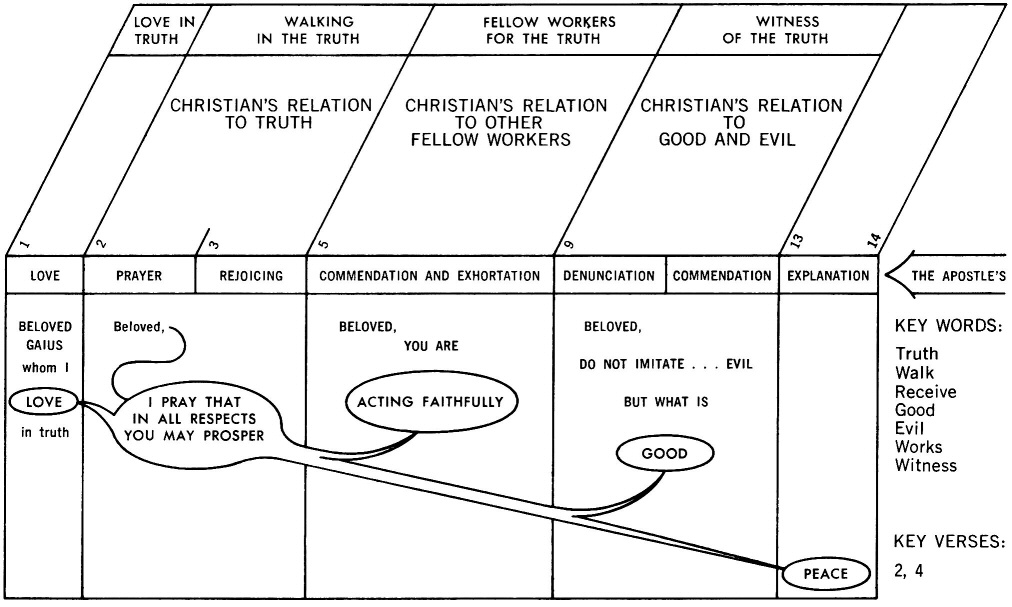
SPIRITUAL HEALTH AND PROSPERITY
Click chart to enlarge
Charts from Jensen's Survey of the NT - used by permission
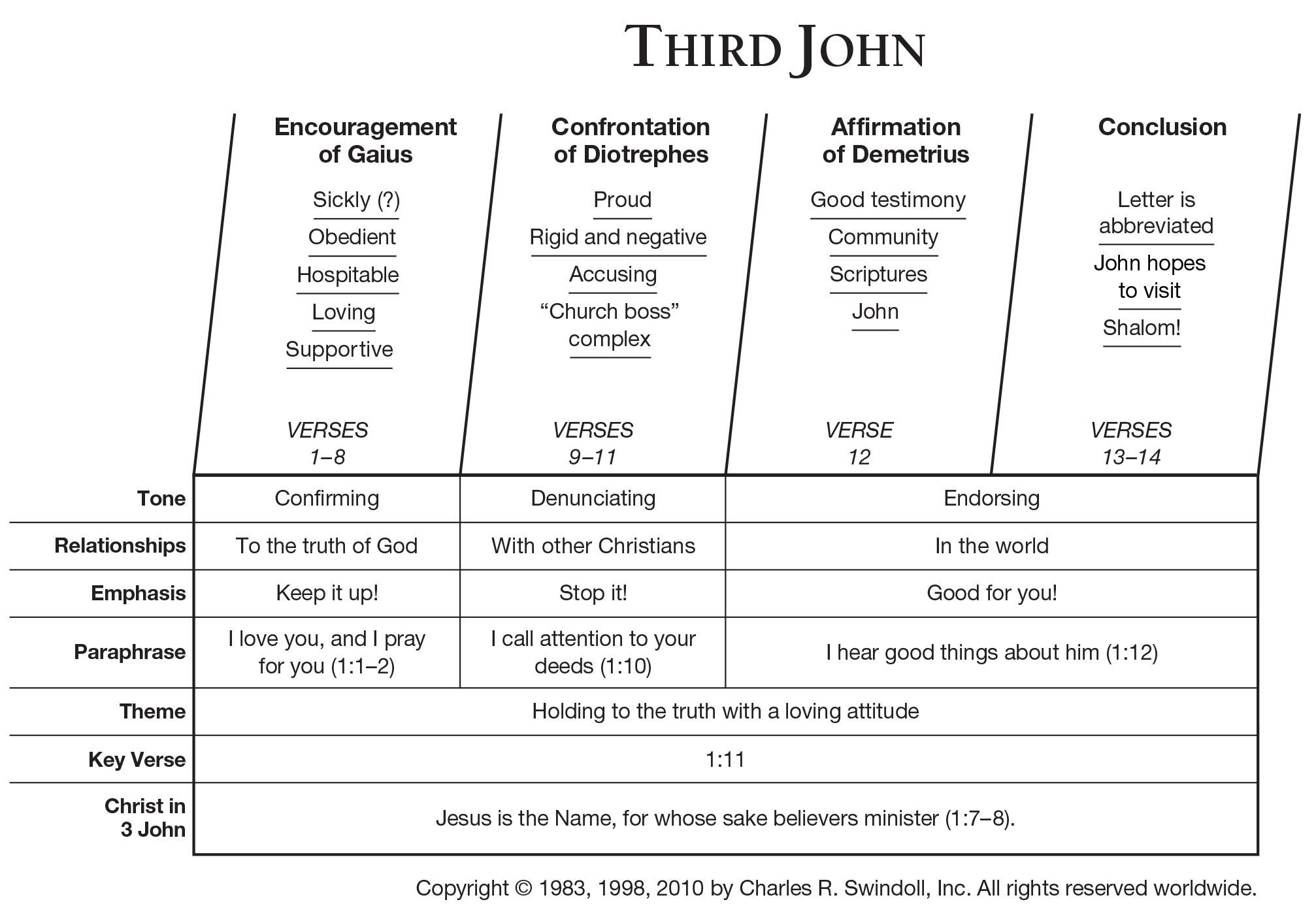
Another Overview Chart - 3 John - Charles Swindoll
OVERVIEWS AND INTRODUCTIONS:
- 3 John: A Tale of Three Men - Ray Stedman - "The Bible without the Spirit leads to a dead, institutional Christianity. The Spirit without the Bible leads to groundless fanaticism. We need both the Spirit and the Word to effectively Adventure through the Bible."
- 3 John: Introduction - John MacArthur
- 3 John: Introduction, Argument, and Outline - Daniel Wallace
- Key to III John - William Orr
- The Epistles of John - Myer Pearlman
- Third John - Charles Swindoll
- 3 John Introduction and Oultine - J Vernon McGee- includes brief verse by verse comments
- Synthetic Bible Study - 2 and 3 John - James Gray
- John Epistles Introduction - Wil Pounds
- 3 John Introduction - NIV Study Bible
- 3 John Overview - James Van Dine
DICTIONARY ARTICLES:
- Bridgeway Bible Dictionary John, letters of
- Holman Bible Dictionary John, the Letters of
- Easton's Bible Dictionary Third Epistle of
- Fausset Bible Dictionary John, the Epistles of
- Hastings' Dictionary of the Bible John, Epistles of
- Morrish Bible Dictionary John, Third Epistle of
- Smith Bible Dictionary John, the Second and Third Epistles of
- International Standard Bible Encyclopedia John, the Epistles of
- McClintock and Strong's Bible Encyclopedia John, Second and Third Epistles Of.
- The Nuttall Encyclopedia John, Epistles of
- Baker Evangelical Dictionary John, Theology of
- Hastings' Dictionary of the Bible John, Theology of
- American Tract Society Diotrephes
- Easton's Bible Dictionary Diotrephes
- Fausset Bible Dictionary Diotrephes
- Holman Bible Dictionary Diotrephes
- Hitchcock Bible Names Diotrephes
- Hastings' Dictionary of the Bible Diotrephes
- Hastings' Dictionary of the NT Diotrephes
- Morrish Bible Dictionary Diotrephes
- People's Dictionary of the Bible Diotrephes
- International Standard Bible Encyclopedia Diotrephes
- Kitto Biblical Cyclopedia Diotrephes
- McClintock and Strong's Bible Encyclopedia Diotrephes
Key Words -- See importance of key words - learn how to mark key words and the associated discipline of how to interrogate them with 5W/H questions. Practice "interrogating" key words as well as term of conclusion (therefore), term of explanation (for), terms of purpose or result (so that, in order that, that, as a result), terms of contrast (but, yet), expressions of time (including then; until, after) and terms of comparison (like, as). You will be amazed at how your Teacher, the Holy Spirit, will illuminate your understanding, a spiritual blessing that will grow the more you practice! Be diligent! Consider the "5P's" - Pause to Ponder the Passage then Practice it in the Power of the Spirit. See also inductive Bible study - observation (Observe With a Purpose), Interpretation (Keep Context King, Read Literally, Compare Scripture with Scripture, Consult Conservative Commentaries), and then be a doer of the Word with Application. Do not overlook "doing the word" for if you do you are deluding yourself, and are just a "smarter sinner," but not more like the Savior! As Jesus said "blessed are those who hear the word of God, and observe it." (Lk 11:28+, cf James 1:22+),
- Truth (6x in 5v) - 3 John 1:1, 3 John 1:3, 3 John 1:4, 3 John 1:8, 3 John 1:12
- Testimony (3x in 1v) - 3 John 1:12
- Evil (2x in 1v) - 3 John 1:11
- Good (4x in 3v) - 3 John 1:2, 3 John 1:11, 3 John 1:12 (added by translators)
- Receive - 3 John 1:10, 3 John 1:12
An Outline of 3 John from D. Edmond Hiebert
I The Salutation, 3 John 1:1-4
A The writer, 3 John 1:la
B The reader, 3 John 1:1b
C The wish, 3 John 1:2-4
1. The statement of the wish, 3 John 1:2
2. The reason for the wish, 3 John 1:3-4
II The Message, 3 John 1:5-12
A The obligation to support the missionaries, 3 John 1:5-8
1. The commendation of Gaius for his service to the missionaries, 3 John 1:5-6a
2. The suggestion of his further service to the missionaries, 3 John 1:6b
3. The explanation concerning the missionary obligation, 3 John 1:7-8
B The temporary triumph of ambitious evil, 3 John 1:9-10
1. The letter of John to the church, 3 John 1:9a
2. The refusal by Diotrephes to receive them, 3 John 1:9b
3. The action of John at his coming, 3 John 1:10a
4. The account of the activity of Diotrephes, 3 John 1:10b
C The personal lesson from the circumstances, 3 John 1:11
D The commendation of Demetrius, 3 John 1:12
III The Conclusion, 3 John 1:13-14
A The explanation about the brevity of the letter, v3 John 1:13-14a
B The benediction, 3 John 1:14b
C The greetings, 3 John 1:14c
Sidlow Baxter - 3 John - TRUTH AND LOVE VERSUS PRIDE AND STRIFE. HOSPITALITY - A FAITHFUL WORK" (verse 5, R.V.).
Address - verse 1
GAIUS - SERVICE IN-TRUTH AND LOVE (3Jn 1:2-8)."Brethren... witness to thy truth" (3Jn 1:3, R.V.)."Brethren... witness to thy love" (verse 6, R.V.).
DIOTREPHES - EVIL BY PRIDE AND STRIFE (3Jn 1:9-11)."Who loveth to have the pre-eminence" (3Jn 1:9)."And casteth them out of the church" (3Jn 1:10).Commendation of one, Demetrius - (3 Jn 1:12).
Parting words - 3 Jn 1:13,14.
This third epistle of John is addressed to "Gaius." As this name was just about as common in the Roman world as the name John Smith is in the British Isles today, it would be rather rash without any further data to infer that the Gaius whom John here addresses is the same as others of that name who are mentioned elsewhere in the New Testament (Ac 19:29,20:4; Ro 16:23; 1 Co 1:14).
Let all who open their homes and give hospitality to our Lord's ministering servants see from this letter to the hospitable Gaius how the Lord Himself regards their kindliness. They are "fellow-helpers of the truth" (verse 8). The providing of such hospitality can sometimes be very tiring. Had Gaius been generously overdoing it? Had he overtaxed himself, giving cause for John's solicitous concern as to his health (verse 2)?
Alas, over against the unselfish Gaius was the selfish Diotrephes, who cuts a sorry contrast. His is tongue and temper are deplored in verse 10. Dr. Campbell Morgan well says: "The whole truth about this man is seen in one of those illuminative sentences in which the character of a man is so often revealed in the Scriptures. 'Diotrephes, who loveth to have the pre-eminence.' That is the essential violation of love, for 'love... seeketh not her own.' This is an instance of heterodoxy of spirit or temper, rather than of intellect. There is no evidence that this man was teaching false doctrine, but he was not submissive to authority. As is always the case, the unsubmissive one becomes the greatest tyrant, and thus by disobedience he manifests his lack of love."
Glance, again at verse 7: "They went forth for the sake of THE NAME." It is arresting. To Christian hearts it is thrilling. Just as "the Name" to a Jew always meant Jehovah, so now to the Christian-whether Jew or Gentile - "the Name" means the One which is dear and glorious above all others. Ignatius, later writing to the Ephesians, says: "I am in bonds for the Name's sake"; and, "Some are wont of malicious guile to hawk about the Name." In Ac 5:41 the whipped apostles left the council chambers, not chafed and humiliated, but "rejoicing that they were counted worthy to suffer dishonour for THE NAME"!
Oh, for a like humility, loyalty and love!
Oh, let my love be such to Thee,
That I may ever grateful be
To suffer stigma, brand or shame,
And count it honour for Thy Name
Who didst so much for me!
Henrietta Mears - UNDERSTANDING THIRD JOHN
Do you remember what Christ said of Himself in John 14:6? “I am the way, the truth, and the life.” We find Jesus portrayed in 1, 2 and 3 John as those three:
- Jesus the Life—1 John
- Jesus the Truth—2 John
- Jesus the Way—3 John
Third John was written to John’s generous and warmhearted friend Gaius. This man was the model of a true Christian layman who had dedicated his wealth and talents to the Lord. His purse strings were loose and his latchstring was out. All he had belonged to Christ. He was the picture of the man who had found Christ to be “the Way,” and in his everyday life, he tried to show that gracious Way to others. Such people, scattered here and there, have through the years kept not only the Church alive in an unfriendly world, but also Christ’s love burning brightly for God’s people when all around seemed dark.
Gaius was noted for his hospitality, a manifestation of Christian love. John urges him to continue entertaining the traveling preachers in spite of the bitter opposition of an autocratic and blustering church official named Diotrephes.
You can be either a Gaius, helping in the Kingdom, or a Diotrephes, hindering the cause.
What a splendid thing to be rich and powerful and to choose to lay all of your gifts and talents at Jesus’ feet, like Gaius and Demetrius!
Bruce Wilkinson - In First John the apostle discusses fellowship with God; in Second John he forbids fellowship with false teachers; and in Third John he encourages fellowship with Christian brothers. Following his expression of love for Gaius, John voices his joy that Gaius is persistently walking in the truth and showing hospitality to the messengers of the gospel. But John cannot commend certain others in the assembly. Diotrephes, for example, has allowed pride to replace love in his life, even rejecting the disciplining words of John. Everything that Gaius is, Diotrephes is not! John uses this negative example as an opportunity to encourage Gaius. Godly character and loyalty to the truth are never easy, but they bring God’s richest commendation—and John’s as well! (Talk Thru the Bible)
Introduction by John MacArthur - Excerpt (Click for full introduction) - Third John is perhaps the most personal of John’s 3 epistles. While 1 John appears to be a general letter addressed to congregations scattered throughout Asia Minor, and 2 John was sent to a lady and her family (2 John 1), in 3 John the apostle clearly names the sole recipient as “the beloved Gaius” (3 John 1:1). This makes the epistle one of a few letters in the NT addressed strictly to an individual (cf. Philemon). The name “Gaius” was very common in the first century (e.g., Acts 19:29; 20:4; Rom. 16:23; 1 Cor. 1:14), but nothing is known of this individual beyond John’s salutation, from which it is inferred that he was a member of one of the churches under John’s spiritual oversight.
As with 2 John, 3 John focuses on the basic issue of hospitality but from a different perspective. While 2 John warns against showing hospitality to false teachers (2 John 7–11), 3 John condemns the lack of hospitality shown to faithful ministers of the Word (vv. 9,10). Reports came back to the apostle that itinerant teachers known and approved by him (3 John 1:5–8) had traveled to a certain congregation where they were refused hospitality (e.g., lodging and provision) by an individual named Diotrephes who domineered the assembly (3 John 1:10). Diotrephes went even further, for he also verbally slandered the Apostle John with malicious accusations and excluded anyone from the assembly who dared challenge him (3 John 1:10).
In contrast, Gaius, a beloved friend of the apostle and faithful adherent to the truth (3 John 1:1–4), extended the correct standard of Christian hospitality to itinerant ministers. John wrote to commend the type of hospitality exhibited by Gaius to worthy representatives of the gospel (3 John 1:6–8) and to condemn the high-handed actions of Diotrephes (3 John 1:10). The apostle promised to correct the situation personally and sent this letter through an individual named Demetrius, whom he commended for his good testimony among the brethren (3 John 1:10–12).
May, 2024
3 John 1:1
3 John 1:2
3 John 1:3
3 John 1:4
3 John 1:5
3 John 1:6
3 John 1:7
3 John 1:8
3 John 1:9
3 John 1:10
3 John 1:11
3 John 1:12
3 John 1:13
3 John 1:14
3 John 1:15
Explanation - The following list includes not only commentaries but other Christian works by well known evangelical writers. Most of the resources below are newer works (written after 1970) which previously were available only for purchase in book form or in a Bible computer program. The resources are made freely available by archive.org but have several caveats - (1) they do not allow copy and paste, (2) they can only be checked out for one hour (but can be checked out immediately when your hour expires giving you time to read or take notes on a lengthy section) and (3) they require creating an account which allows you to check out the books free of charge. To set up an account click archive.org and then click the picture of the person in right upper corner and enter email and a password. That's all you have to do. Then you can read these more modern resources free of charge! I have read or used many of these resources but not all of them so ultimately you will need to be a Berean (Acts 17:11+) as you use them. I have also selected works that are conservative and Biblically sound. If you find one that you think does not meet those criteria please send an email at https://www.preceptaustin.org/
Note: Not in any particular order.
The Preacher's Outline & Sermon Bible : New Testament, King James Version 1 Thessalonians, 2 Thessalonians, 1 Timothy, 2 Timothy, Titus, Philemon, Hebrews, James, 1 Peter, 2 Peter, 1 John, 2 John, 3 John, Jude, Revelation. - Helpful notes.
The Letters of John : an Introduction and Commentary (Tyndale New Testament Commentaries) by Stott, John R. W (1988) 244 pages. 89 ratings
Tim Challies - John Stott is always an able commentator and his volume in the TNTC is no exception. Carson praises it as “one of the most useful conservative commentaries on these epistles, so far as the preacher is concerned” and says “it is packed with both exegetical comments and thoughtful application.” The TNTC is targeted squarely at a general audience, so both pastors and interesting general readers will find it tremendously beneficial. If you are looking for a commentary to guide you as you read John’s epistles devotionally, this is probably the one you want.
James Rosscup - Here is a recent lucid, stimulating work by a gifted writer who has served as rector of the All Souls (Anglican) Church, Langham Place, London. Several New Testament scholars have hailed it as an outstanding commentary from the standpoint of exegesis, exposition and warm application. It was listed among 22 “Choice Evangelical Books of 1964” in Christianity Today (February 12, 1965, p. 16). Stott displays a vast breadth of reading in the best conservative works on the Johannine epistles. This 1988 version updates the 1964 original.
Epistles of John & Jude : a self-study guide by Jensen, Irving
The Johannine Epistles : based on the Revised Standard version by Grayston, Kenneth
Cyril Barber - New Century Bible Commentary. Grand Rapids: Wm. B. Eerdmans Publishing Co., 1984. Following a brief but adequate introduction, Grayson reappraises Johannine scholarship, and though some of his views differ from those of others who have written on these epistles, readers are nevertheless treated to a discussion that is spiritually stimulating and culturally apropos.
The Expositor's Bible Commentary - 1994 edition - Abridged - New Testament
1-3 John by Thompson, Marianne Meye -- see below
James Rosscup - A lucid 168-pp., crisp exposition with some application in a flow for popular, general use. In a number of verses the book helps, at others it frustrates due to passing by views and reasons, or lacks sufficient comments. Much generalizing leaves an impression that in order to be seen as saved one must live an ideally perfect life (cf. 43), yet at other points one reads that Christians sin (45). The work has a healthy clarity that real grace, distinct from cheap so-called (but not genuine) grace (51) elicits confession of sin and seeking obedience to God. Such a life with God helps one’s assurance to be a properly experienced reality, as in 2:3 (51), even this by grace. Some statements are quite helpful, as “righteous conduct does not make us God’s children. Rather, such conduct is the consequence or expression of a relationship that already exists” after rebirth (87). Many issues are left in a blur, for instance “God’s seed remains” (3:9).
The Epistles of John by Hobbs, Herschel H
The Bible Exposition Commentary - Ephesians through Revelation - Warren Wiersbe
Rosscup - One of America’s most appreciated staunchly evangelical Bible conference teachers gives diligent, refreshing expositions. These are all of his 23 separate, earlier books in the “Be” series on the New Testament. He strikes a particular appeal with lay people as he crystallizes sections, deals with some of the verses, handles certain problems and backgrounds and applies principles. He is premillennial.
The letters of John the Apostle : an in-depth commentary by Burdick, Donald W
James Rosscup - This is far more detailed in getting at issues than his Everyman’s Commentary effort of 1970. It is a diligent conservative product on Greek syntax, word meaning and theology, and follows the line of thought through the epistles well. The introduction (pp. 3–92) takes up the background, authorship, date, place, recipients, occasion, purpose, character and content of I John. Later, he also has introductions to II and III John. He believes that I John gives grounds for assurance, tests of practice that can provide valid assurance (cf. pp. 81–82). Though copious in aspects of grammar that open up the books, Burdick is more lucid than Westcott’s helpful exegetical work of the past, and certainly one of the best now on the Greek. At some points one ought to go to longer discussions of views and issues in Brown, and also consult Brooke, Marshall, Plummer, Smalley, and Strecker etc. on technical matters, Marshall and Smalley also for more on studies of recent years.
Cyril Barber - Written for laypeople. This work is designed to lay bare the meaning of John's letters for his own time and ours as well. Clear and cogent.
The Epistles of John by Burdick, Donald W
James Rosscup - A part of the Everyman’s Bible Commentary series, this work by a careful evangelical New Testament scholar from Denver Seminary is quite perceptive on problems and good as a brief commentary.
1, 2, 3 John : Bible study commentary by Vaughan, Curtis
The Epistles of John by Marshall, I. Howard, author
James Rosscup - Like Ryrie and Stott, Marshall has keen ability to follow the thought of a book and articulate it with clarity. He often is helpful on stating views gleaned from the literature and is up-to-date. His use of the Greek, good footnotes, and detail on many of the problem verses make this a very good evangelical commentary by one of the best New Testament scholars in the British Isles (ca. 2001 he retired from being head of the New Testament Department at King’s College, University of Aberdeen, Scotland).
1, 2, 3 John - Morris, Leon. “New Bible Commentary Revised, ed. D. Guthrie et al. Grand Rapids: Eerdmans, 1970.
Cyril Barber - An extensive introduction that adequately surveys the historical and textual background of these letters is followed by a careful exposition of John's epistles in the order in which they were written. Provides interested readers with a complete and satisfying treatment. 2
1, 2, and 3 John by Johnson, Thomas Floyd - New International Biblical Commentary
James Rosscup - Johnson identifies the writer of the Gospel of John as “The disciple whom Jesus loved” (20:20, 24), but sees these epistles as by an “elder,” a different man (2). The concise verse comments are usually clear and well-reasoned, showing the idea of the Greek with Greek words transliterated, and with explanations of word meaning and grammar. Sections of added notes in smaller print take up some details. Some problems receive discussion, some are bypassed, in the latter category limited or unlimited atonement in I John 2:2, or interpretations of 2:12–14, or 5:16 (where much is not explained or not explained well). True, the commentary quite often is helpful, but uneven, and not one of the better all-around works one can more consistently count on.
The message of John's letters : living in the love of God by Jackman, David
Cyril Barber - Relates the message of these letters to the moral issues and theological climate of John's day. Builds upon Stott's cyclical (or spiral) theme of the content of the first letter, and treats the other letters as emphasizing truth and love. A noteworthy contribution.
1, 2, 3 John by Smalley, Stephen S - Word Biblical Commentary
James Rosscup - This ranks high with Brown, Burdick and Marshall in recent years. Smalley is excellent in helping the reader be up on views and arguments from recent years, drawn from massive research, and is second only to Brown in this regard. He is usually quite full in discussing issues so that he offers much help on verses, and does so with clarity, directness and confidence. He delves into changes in tense, many of the syntactical aspects, and doctrine. He sees the author of II and III John as John the presbyter, a Christian in the Johannine circle, and this same man may also have written I John, all in the A. D. 90’s. Smalley often makes good choices on views, and tends to give definite reasons for them. He sees charisma (2:20, 27) as both the Spirit and the Word; 3:4–10 relates to a potential state without sin, but in practice Christians do sin (1:8–2:2). Sin in 5:16–17 is apostasy, willful disobedience, etc. He is not clear on whether the saved can lose salvation.
Cyril Barber - This is a scholarly work that is well deserving of careful reading. Following a thorough introduction (pp. xvii-xxxiv), Smalley treats his readers to a word-byword or phrase-by-phrase exposition. His comments are judicious as well as insightful. This volume, for all its merit, shares the limitations of the series. It is well researched and exegetically helpful but manifests a weakness in treating the theme of these letters and fails to complete what has been begun by applying the teaching of the passage to the life of the reader
Exploring 1, 2, 3 John by Vines, Jerry
Cyril Barber - This work will be warmly received by Bible students of all persuasions. Vines deals admirably with the theme of each of John's letters. The way in which he has outlined, illustrated, and expounded each section makes his application of the truth to life easy to grasp. Recommended.
The Epistles of John by Brown, Raymond Edward
James Rosscup - Many rate this as the best work on these epistles in view of its extensive discussion of issues and the skill in which the famous Roman Catholic scholar handles so many aspects. He is highly-informed exegetically, full in consideration of views and lines of reasoning, and has a tone of respect for the truthfulness and relevance of the message. If the expositor, teacher or lay person wants a commentary that looks at just about every side of a matter in a readable manner and with authoritative grasp of the literature, he will consult this work. The same is true of Brown’s detailed commentary on the Gospel of John. Brown, however, will not always agree with a reader’s convictions, as when he favors John the Presbyter as the author. The sheer length will not please some, but the diligent and serious will find the source very useful.
Cyril Barber - †Meticulous in detail, exhaustive in analysis, persuasive in argument, this study provides the best answers available to questions and controversies that have troubled scholars and nonscholars alike ever since these epistles first saw the light of day. In addition to the superb analysis, Brown also brings to life those to whom these letters were sent, reminding us that the epistles were written by a person for real people of the first century A.D. A model of biblical study
life at its best 1 John by roy l. laurin
Cyril Barber - First published in 1957, this work provides lay readers with a commendable application of the text to the needs of Christians today. Practical.
open letter to evangelicals by r.e.o. white
James Rosscup - A Baptist minister presents both a commentary with occasional deep insight and some penetrating applications to spiritual life, ethics, and other particulars. It is a verse-by-verse devotional and homiletical exposition which sometimes deals with problems including the difficult passage in 3:4–10.
Note: The first 4 resources have no time restriction and allow copy and paste function:
(1) KJV Bible Commentary - Hindson, Edward E; Kroll, Woodrow Michael. Over 3000 pages of the entire OT/NT. Well done conservative commentary that interprets Scripture from a literal perspective. Pre-millennial. User reviews - it generally gets 4/5 stars from users. - 372 ratings
Very well done conservative commentary that interprets Scripture from a literal perspective user reviews
The King James Version Bible Commentary is a complete verse-by-verse commentary. It is comprehensive in scope, reliable in scholarship, and easy to use. Its authors are leading evangelical theologians who provide practical truths and biblical principles. Any Bible student will gain new insights through this one-volume commentary based on the timeless King James Version of the Bible.
(2) The King James Study Bible Second Edition 2240 pages (2013) (Thomas Nelson) General Editor - Edward Hindson with multiple contributing editors. . 3,194 ratings. Pre-millennial. See introduction on How to Use this Study Bible.
(3) NKJV Study Bible: New King James Version Study Bible (formerly "The Nelson Study Bible - NKJV") by Earl D Radmacher; Ronald Barclay Allen; Wayne H House. 2345 pages. (1997, 2007). Very helpful notes. Conservative. Pre-millennial. 917 ratings
(4) The Wycliffe Bible Commentary - only the New Testament (for OT see below to borrow) - 1126 pages. (1971) Everett F Harrison - Editor of New Testament. Uses the KJV. Strictly speaking not a study Bible, but short notes are similar. KJV text in left column, commentary notes in right column. The comments are generally verse by verse, short, conservative and to the point. Pre-millennial.
Zondervan NIV Study Bible - (2011) 2570 pages - Use this one if available as it has more notes than edition below. One hour limit
NIV Study Bible by Barker, Kenneth L; Burdick, Donald W (1995) 2250 pages. This is the first edition. This resource has been fully revised in 2020. One hour limit
Believer's Bible Commentary - OT and NT - MacDonald, William (1995) 2480 pages. Conservative. Literal. Often has very insightful comments. John MacArthur, says "Concise yet comprehensive - the most complete single-volume commentary I have seen." Warren Wiersbe adds "For the student who is serious about seeing Christ in the Word." One hour limit.
Rosscup - This work, originally issued in 1983, is conservative and premillennial, written to help teachers, preachers and people in every walk of life with different views, explanation and application. The 2-column format runs verse by verse for the most part, usually in a helpfully knowledgeable manner, and there are several special sections such as “Prayer” in Acts and “Legalism” in Galatians. The premillennial view is evident on Acts 1:6, 3:20, Romans 11:26, Galatians 6:16, Revelation 20, etc.
HCSB Study Bible : Holman Christian Standard Bible - General Editor Jeremy Royal Howard (2010) 2360 pages. Conservative. Good notes. Include Holmans excellent maps. One hour limit
Life Application Study Bible: Old Testament and New Testament: New Living Translation. Has some very helpful notes especially with application of texts. 4,445 ratings One hour limit
The MacArthur Study Bible - John MacArthur. Brief but well done notes for conservative, literal perspective. 1,275 ratings
ESV study Bible - Excellent resource but not always literal in eschatology and the nation of Israel 6,004 ratings
The David Jeremiah Study Bible - (2013) 2208 pages. 2,272 ratings Logos.com - "Drawing on more than 40 years of study, Dr. David Jeremiah has compiled a legacy resource that will make an eternal impact on generations to come. 8,000 study notes. Hundreds of enriching word studies"50+ Essentials of the Christian Faith" articles."
Wycliffe Bible Commentary - Charles Pfeiffer - 1560 pages (1962). 214 ratings Less detailed than the KJV Bible Commentary. Conservative. Notes are generally verse by verse but brief.
Rosscup - Conservative and premillennial scholars here have been experts in their fields. The work contains brief introductions and attempts to give a verse-by-verse exposition, though it does skip over some verses. The treatments vary with the authors, but as a whole it is a fine one-volume commentary for pastors and students to use or give to a layman. Outstanding sections include, for example: Whitcomb on Ezra-Nehemiah-Esther; Culver on Daniel; Ladd on Acts; Harrison on Galatians; Johnson on I Corinthians; and Ryrie on the Johannine Epistles.
The Defender's Study Bible : King James Version by Morris, Henry M. Excellent notes by well known creationist. 45 ratings
New Bible Commentary - (1994) See user reviews
Compact Bible commentary by Radmacher, Earl D; Allen, Ronald Barclay; House, H Wayne, et al - 954 pages. 424 ratings Multiple contributors to the comments which are often verse by verse. The comments are brief but meaty and can really help your study through a given book. A sleeper in my opinion.
The Experiencing God Study Bible: the Bible for knowing and doing the will of God - Blackaby, Henry (1996) 1968 pages - CHECK THIS ONE! Each chapter begins with several questions under the title "PREPARE TO MEET GOD." Then you will interesting symbols before many of the passages. The chapter ends with a "DID YOU NOTICE?" question. This might make a "dry chapter" jump off the page! Read some of the 48 ratings
Disciple's study Bible: New international version 54 ratings Not that helpful for verse by verse study. Focuses on application of Christian doctrines. 10,000 annotations; doctrinal summaries, "Life Helps" section relate doctrine to everyday discipleship.
The Living Insights Study Bible : New International Version - Charles Swindoll. Notes are good but somewhat sparse and not verse by verse.
The Apologetics Study Bible Understand Why You Believe by Norman Geisler
NIV archaeological study Bible (2005) 2360 pages 950 ratings (See also Archaeology and the Bible - OT and NT)
NIV Cultural Backgrounds Study Bible. Bringing to Life the Ancient World of Scripture Keener, Craig and Walton, John. Editors (2017)
The Holman illustrated study Bible 120 ratings Includes the excellent Holman maps but otherwise of little help in serious study.
Zondervan King James Version commentary - New Testament
NIV Celebrate Recovery Study Bible
Daily Study Bible for Women : New Living Translation
The Woman's Study Bible : the New King James Version
The Study Bible for Women : Holman Christian Standard Bible
Daily Study Bible for Men : New Living Translation
NIV Topical Study Bible : New International Version
The Ryrie Study Bible - Charles Ryrie (1978) 2142 pages. Conservative. 216 ratings
The Hebrew-Greek key study Bible : New American standard study by Strong, James, 1822-1894; Zodhiates, Spiros
The New Inductive Study Bible : updated New American Standard Bible - Introductions of each book give suggestions how to perform an inductive study on that specific book. Not strictly speaking a "study Bible" with notes but a Bible to help you study inductively. Has wide margins for making notes. This is one that works best in "paper," not digitally.
With the Word - Devotional Commentary - Warren Wiersbe - 428 ratings
Evangelical Commentary on the Bible - Judges by Andrew Boling (20 pages); editor Walter Elwell (1989) 1239 pages. User reviews. (See also Boling's 380 page commentary on Judges the Anchor Bible Series)
Halley's Bible Handbook Henry H. Halley - (2000) 2720 pages (much larger than original edition in 1965 and no time limit on use). (Halley's Bible handbook : an abbreviated Bible commentary - one hour limit 1965 872 pages)
Rosscup - A much-used older evangelical handbook bringing together a brief commentary on Bible books, some key archaeological findings, historical background, maps, quotes, etc. It is helpful to a lay Bible teacher, Sunday School leader, or pastor looking for quick, pertinent information on a Bible book. This is the 72nd printing somewhat revised. Halley packed in much information. Unger’s is better overall, but that is not to say that Halley’s will not provide much help on basic information.
The Shaw Pocket Bible Handbook - Editor - Walter Elwell (1984) 408 pages.
"This hardback is small in size but packed full of content: Brief summaries of every book of the bible, cultural, archaeological and historical info, word definitions, pictures, maps and charts." Worth checking!
The Lion handbook to the Bible - (1999) 822 pages. This resource is absolutely loaded with very nice color pictures and charts.
Wiersbe's Expository Outlines on the New Testament by Wiersbe, Warren W
Cyril Barber - This is a book of exceptional merit. Pastors, missionaries, and Christian workers will profit from its use. Wiersbe introduces each book of the NT, provides an outline, and then furnishes his readers with a chapter-by-chapter discussion of the contents. The homiletic style is a “plus.” Recommended.
Harper study Bible : the Holy Bible, Revised Standard Version
The Jewish Study Bible - Only OT - Interesting Jewish perspective.
The Student Bible : New International Version
Hebrew-Greek key word study Bible : New international version
Key word commentary : thoughts on every chapter of the Bible by Water, Mark
Eerdmans' Family Encyclopedia of the Bible (1978) 344 pages
Eerdmans' Handbook to the Bible (1983) 688 pages
Tyndale Handbook of Bible charts & maps by Wilson, Neil
Bible Handbook and A-Z bible encyclopedia
International Children's Bible field guide : answering kids' questions from Genesis to Revelation by Richards, Larry
The illustrated guide to Bible customs & curiosities by Knight, George W. (George William),
Today's handbook of Bible times & customs by Coleman, William L
The new Unger's Bible dictionary by Unger, Merrill Frederick, 1909-
Nelson's illustrated encyclopedia of Bible facts by Packer, J. I. (James Innell); Tenney, Merrill C.
Survey of the Bible : introductory insights, background studies, book-by- book survey by Unger, Merrill Frederick
The parallel New Testament and Unger's Bible handbook : produced for Moody monthly by Unger, Merrill (1975) 744 pages 4 ratings
The Hodder Bible handbook by Unger, Merrill
Kregel Bible handbook : a full-color guide to every book of the Bible by Kerr, William 3 ratings
The new encyclopedia of Christian quotations by Water, Mark
New Testament words - William Barclay - very interesting resource - covers about 70 NT Greek words in Barclay's unique style
Zondervan handbook to the Bible
Dictionary of the later New Testament & its developments 71 ratings IVP Series
The third of IVP's critically acclaimed series of dictionaries of the New Testament provides focused study on the often-neglected portions of the New Testament: Acts, Hebrews, the General Epistles, and Revelation. Furthermore, its scope goes beyond the life of the New Testament church to include the work of the apostolic fathers and early Christianity up through the middle of the second century.
Dictionary of New Testament background 79 ratings IVP Series
In a time when our knowledge of the ancient Mediterranean world has grown by leaps and bounds, this volume sets out for readers the wealth of Jewish and Greco-Roman background that should inform our reading and understanding of the New Testament and early Christianity. The Dictionary of New Testament Background takes full advantage of the flourishing study of the Dead Sea Scrolls and offers individual articles focused on the most important scrolls. In addition, the Dictionary encompasses the fullness of second-temple Jewish writings, whether pseudepigraphic, rabbinic, parables, proverbs, histories or inscriptions. Articles abound on aspects of Jewish life and thought, including family, purity, liturgy and messianism. The full scope of Greco-Roman culture is displayed in articles ranging across language and rhetoric, literacy and book culture, religion and cults, honor and shame, patronage and benefactors, travel and trade, intellectual movements and ideas, and ancient geographical perspectives. No other reference work presents so much in one place for students of the New Testament. Here an entire library of scholarship is made available in summary form.
Dictionary of deities and demons in the Bible (DDD) - 950 pages (1995) Read some of the 65 ratings (4.8/5 Stars). A definitive in depth resource on this subject. Very expensive to purchase.
NOTE - All of these resources can be borrowed from archive.org. This list also includes resources to help study the Bible.
See also the list of Word Study Resources
The Complete Word Study Dictionary: New Testament by Zodhiates, Spiros - This is my "go to" resource for Greek word studies. One on the best lexicons for laymen. Highly Recommended for Greek Word Studies to aid your interpretation of a passage.
Analytical Lexicon of the Greek New Testament by Friberg, Timothy. Shorter definitions than Zodhiates but does an excellent job in summarizing the various nuances of a specific Greek word. One of my favorites.
Shorter Lexicon of the Greek New Testament by Gingrich, F. Wilbur. Similar to Friberg but shorter definitions. Gingrich however gives more Scriptures for each nuance, whereas Friberg generally gives only one representative Scripture.
The New Linguistic and Exegetical Key to the Greek New Testament by Rogers, Cleon - This book is a gold mine of little gems on individual Greek words in any NT passage you are studying. If you have time it is always worth checking out! I use it in my Greek word studies all the time.
New Testament Words - William Barclay - 59 ratings very interesting resource - covers about 70 NT Greek words in Barclay's unique style. On page 289 there is a helpful index of English words with the corresponding Greek word, in turn followed by the places Barclay described them in New Testament Words and in his Daily Study Bible series (see list of DSB commentaries here). E.g., take the Greek word for "Covetousness" which is pleonexia and is found in New Testament Words on page 61 and pp 233-235 and is also described in the Daily Study Bible entries for : Mark 7:14-23; Ro 1:28-32; Eph. 4:17-24; Col. 3:5. So you can click the DSB commentary on Mark 7 and scroll down to Mark 7:14 to see Barclay's entry for pleonexia which concludes "Pleonexia ( G4124) is that lust for having which is in the heart of the man who sees happiness in things instead of in God." Interesting!
Greek-English lexicon of the New Testament : based on semantic domains - Louw Nida. Brief but nice definitions. Not easy to use - you need to know some Greek. Classifies Greek words into 93 "semantic domains" (see list on page XXV) and if you can categorize the word you are looking for in one of the domains, it can help find the specific word you are interested in.
Kittel's Theological Dictionary of the New Testament : abridged in one volume (TDNT) - Classic ("Little Kittel") work summarizing the 10 volume set by Kittel. For most of us the abridged definition is "more than enough!"
A Greek-English lexicon of the New Testament, and other early Christian literature; by Bauer, Walter, More detailed definitions but need to know Greek. Zodhiates and Friberg much easier to use.
Liddell and Scott's Greek-English lexicon, abridged : the little Liddell by Liddell, Henry George. The abridged version. You need to know Greek to use.
Exegetical dictionary of the New Testament (Volume 1 - A thru E); Exegetical dictionary of the New Testament (Volume 3- P thru ...) Volume 2 not available. I do not find this adds much to the easier to use resources like Zodhiates and Friberg.
A pocket lexicon to the Greek New Testament by Souter, Alexander. Brief definitions. Need to know some Greek. Not that helpful.
Vine's Expository Dictionary of Old Testament and New Testament Words - pdf. The old standby. You can also borrow Vine's complete expository dictionary of Old and New Testament words
Theological wordbook of the Old Testament by Harris, R. Laird - 229 ratings (5/5 Stars) One of the best OT lexicons for laymen.
Here is another link to the TWOT which has no time limit on use and does allow copy and paste. Can be downloaded as PDF.
Hebrew honey : a simple and deep word study of the Old Testament by Novak, Alfons, (332 pages) Indexed by English words. No Strong's numbers to help you determine if you are researching the correct Hebrew word. Here is a "work around" - go to page 289 and see if there is an annotation of the Scripture you are studying. E.g., say you want to see if there is anything for "heart" in Ezek 11:19. In the Scripture list find an entry for Ezek 11:19 with the English word "Heart." Now go look up "Heart" (on page 123). It does take some effort, but you might glean an insight not described in other Hebrew lexicons.
Nelson's Expository Dictionary of the Old Testament by Unger, Merrill. Indexed by English word and then any related Hebrew nouns or verbs. Definitions are solid and geared to the lay person.
Zondervan NASB exhaustive concordance - 1589 pages
Pocket dictionary for the study of New Testament Greek by DeMoss, Matthew S. If you want to dig a little deeper into Greek. 66 ratings
Analytical concordance to the Holy Bible : containing about 311,000 references, subdivided under the Hebrew and Greek original with the literal meaning and pronunciation of each by Young, Robert,
The Englishman's Greek concordance of the New Testament by Wigram, George
Synonyms of the New Testament by Trench, Richard Chenevix - or click here for list of 108 entries.
Girdlestone's Synonyms of the Old Testament - click for list of 127 entries
The Holman guide to interpreting the Bible by Dockery, David S
Foundations for biblical interpretation : a complete library of tools and resources
Expository Dictionary of Bible Words by Richards, Larry, 33 ratings It is does not go into great depth on the Greek or Hebrew words but does have some excellent insights.
Basic Bible Interpretation : a Practical Guide to Discovering Biblical Truth by Roy Zuck. Recommended.
How to Study Your Bible by Arthur, Kay (CLICK HERE for many other resources from Kay Arthur). The basics of inductive Bible study succinctly described. Recommended. This is the original edition not the new edition.
Living by the Book by Howard G. Hendricks - A classic. An entertaining and informative read that is guaranteed to invigorate your Bible study. Recommended.
Teaching to Change Lives by Howard Hendricks, Howard 561 ratings
The Christian Educator's Handbook on Teaching by Kenneth Gangel and Howard Hendricks 21 ratings
How can I understand the Bible? by DeHaan, Mart (52 page booklet)
The New How to Study Your Bible Workbook (2010) by Arthur, Kay, - Note that this workbook is the companion to the New How to Study Your Bible book (not the same as the one linked above).
Jensen's Survey of Bible (online) by Jensen, Irving 140 ratings (NT) 133 ratings (OT) This is a classic and in conjunction with the following three resources should give you an excellent background to the Bible book you are studying. Jensen has some of the best Book charts available and includes "key words." He also gives you some guidelines as to how to begin your inductive study of each book.
Discover the Bible for Yourself by Arthur, Kay 93 ratings - Proven methods to read, mark, and study God's Word. Introductions to set the stage for each book of the Bible. Maps and charts to add historic and geographic dimension. Word studies for NASB and NIV translations. Definitions and explanations to simplify interpretation. "Things to Think About" for personal application. This resource will inspire and guide anyone interested in creating a personal study of God's Word.
What the Bible is all about by Mears, Henrietta. This is a classic and is filled with "pearls" from this godly teacher of God's Word.
Talk thru the bible by Wilkinson, Bruce The Wilkinson & Boa Bible handbook : the ultimate guide to help you get more out of the Bible
How to profit from Bible reading by Jensen, Irving 2 ratings
Simply understanding the Bible by Jensen, Irving 8 ratings
Enjoy your Bible by Jensen, Irving 5 ratings
Independent Bible study by Jensen, Irving 14 ratings
MacArthur Study Bible - Topic "How to Study the Bible" - John MacArthur
MacArthur's Introductions to all 66 Books - includes a helpful discussion of "Interpretative Challenges"
Swindoll's introductions to all 66 Books - Answers the following questions - Who wrote the book? Where are we? Why is this book so important? What's the big idea? How do I apply this? He also includes a helpful Book Overview chart (right upper corner of page).
How to Get the Most from God's Word by John MacArthur 16 ratings
Journey of the Bible : the remarkable story of how the Bible came from God to you by Jensen, Irving
- 1, 2, 3 John – 1 John 1:1
- SEBTS: What Will Our Reputation Be? – 3 John
- Four Men and Their Reputations – 3 John 1-14
- Creeds, Deeds, and the Great Commission Insights from 3rd John – 3 John 1-14
- Does Your Life Bring Praise to the Name of Jesus? (John’s Letters Series) – 3 John 1-14
- CBMW Message: The Evangelistic Power of a Christian Family – 3 John 1-14
Read his fascinating brief biography - Henry Alford and Phil Johnson's related comments
James Rosscup writes that Alford's series on the New Testament "contains much that is valuable in the Greek New Testament… though all of the Greek New Testament words have been changed to English throughout." (Commentaries for Biblical Expositors: An Annotated Bibliography of Selected Works)
Charles Haddon Spurgeon (see his comments in following entry on Alford).
Editorial Note: If you are not proficient in Greek, you will find this work considerably more useful than the following work by Alford, because in this volume he translates the Greek and Latin into English. While the "The Greek New Testament" (see next entry below) is longer (e.g., English version of 1John = 66 pages compared to Greek version = 94 pages in part because the latter includes comments of more technical nature), the substance of the commentary is otherwise similar to that found in the "NT for English Readers".
Charles Haddon Spurgeon writes that this text "is an invaluable aid to the critical study of the text of the New Testament. You will find in it the ripened results of a matured scholarship, the harvesting of a judgment, generally highly impartial, always worthy of respect, which has gleaned from the most important fields of Biblical research, both modern and ancient, at home and abroad. You will not look here for any spirituality of thought or tenderness of feeling; you will find the learned Dean does not forget to do full justice to his own views, and is quite able to express himself vigorously against his opponents; but for what it professes to be, it is an exceedingly able and successful work. The later issues are by far the most desirable, as the author has considerably revised the work in the fourth edition. What I have said of his Greek Testament applies equally to Alford’s New Testament for English Readers,* which is also a standard work." (Spurgeon, C. H. Lectures to my Students, Vol. 4: Commenting and Commentaries; Lectures Addressed to the students of the Pastors' College, Metropolitan Tabernacle)
D Edmond Hiebert - Prints the author's own translation. A series of popular studies whose strong point is word study. Contains good illustrative material. Part of the author's interpretation follows a liberal position. Barclay holds that Christ's descent into Hades gave those who there heard Him a second chance.
Comment: I appreciate Barclay's unique insights on Greek words, but clearly his teaching about a "second chance" is NOT sound doctrine! Be an Acts 17:11 Berean with Barclay. See discussion of his orthodoxy especially the article "The Enigmatic William Barclay".
James Rosscup writes that Barnes "includes 16 volumes on the Old Testament, 11 on the New Testament. The New Testament part of this old work was first published in 1832–1851. Various authors contributed. It is evangelical and amillennial… Often the explanations of verses are very worthwhile." (Commentaries for Biblical Expositors: An Annotated Bibliography of Selected Works)
C H Spurgeon "Albert Barnes is a learned and able divine, but his productions are unequal in value, the gospels are of comparatively little worth, but his other comments are extremely useful for Sunday-school teachers and persons with a narrow range of reading, endowed with enough good sense to discriminate between good and evil… Placed by the side of the great masters, Barnes is a lesser light, but taking his work for what it is and professes to be, no minister can afford to be without it, and this is no small praise for works which were only intended for Sunday-school teachers." (Spurgeon, C. H. Lectures to my Students, Vol. 4: Commenting and Commentaries; Lectures Addressed to the students of the Pastors' College, Metropolitan Tabernacle)
Good illustrations
- III John 1-14 3 Men & a Church
James Rosscup writes "This work (Gnomon), originally issued in 1742, has considerable comment on the Greek, flavoring the effort with judicious details about the spiritual life. It has much that helps, but has been surpassed by many other commentaries since its day." (Commentaries for Biblical Expositors: An Annotated Bibliography of Selected Works)
Represents Combination of Bengel's Gnomon (above) and Comments by more modern expositors (in brackets) to make this more usable for those who do not read Greek.
Spurgeon comments on the goal to make Bengel's Gnomon (listed above) more accessible -- "Such is the professed aim of this commentary, and the compilers have very fairly carried out their intentions. The whole of Bengel’s Gnomon is bodily transferred into the work, and as 120 years have elapsed since the first issue of that book, it may be supposed that much has since been added to the wealth of Scripture exposition; the substance of this has been incorporated in brackets, so as to bring it down to the present advanced state of knowledge. We strongly advise the purchase of this book, as it… will well repay an attentive perusal. Tischendorf and Alford have contributed largely… to make this one of the most lucid and concise commentaries on the text and teachings of the New Testament" (Spurgeon, C. H. Lectures to my Students, Vol. 4: Commenting and Commentaries; Lectures Addressed to the students of the Pastors' College, Metropolitan Tabernacle)
International Critical Commentary Critical and Exegetical Commentary - 1912
James Rosscup: This ICC work rates with Westcott as one of the top two detailed older commentaries of a technical nature based on the Greek text. (Commentaries for Biblical Expositors: An annotated bibliography of selected works).
John Cereghin - (Comments on 1 John but important to help understand Brooke's perspective) He thinks in I John, Christ is "separated from us by sinlessness rather than by Divinity" (xvi); will not suggest who the author is (xviii); discusses the meaning of “propitiation” (23-27); argues from the meaning of the Greek tense; refers to the antichrist legend (59,69-79); holds that John clearly identified Jesus the man who lived a human life with the Son of God (121-122); has extended comments on the text of the “heavenly witnesses” (154-165). (He paraphrases Cyril Barber's comment in which Barber says Brooke) Deprecates the deity of Christ, rejects as "legend" the teaching regarding the Antichrist and minimizes the efficacy of Christ's death on the cross. Exegetically valuable; theological unreliable.
- 3 John 1 - Notes on following verses
- 3 John 1:2
- 3 John 1:3
- 3 John 1:4
- 3 John 1:5,6
- 3 John 1:7,8
- 3 John 1:9-11
- 3 John 1:11
- 3 John 1:12
- 3 John 1:13-14
Hiebert - definite value for the interpretation of these epistles
- 3 John 1 Commentary - Cambridge Greek Testament for Schools and Colleges
- 3 John 1 Commentary - Cambridge Bible for Schools and Colleges
James Rosscup - This old, conservative Wesleyan Methodist work is good devotionally and aggressive for righteous living. Laypeople can find it still valuable today. It is Arminian in viewpoint and thus helpful, for example, in showing the reader how this approach deals with texts involving the eternal security question. The work contains much background material from many sources on all books of the Bible.
Spurgeon - Adam Clarke is the great annotator of our Wesleyan friends; and they have no reason to be ashamed of him, for he takes rank among the chief of expositors. His mind was evidently fascinated by the singularities of learning, and hence his commentary is rather too much of an old curiosity shop, but it is filled with valuable rarities, such as none but a great man could have collected....If you have a copy of Adam Clarke, and exercise discretion in reading it, you will derive immense advantage from it, for frequently by a sort of side-light he brings out the meaning of the text in an astonishingly novel manner. I do not wonder that Adam Clarke still stands, notwithstanding his peculiarities, a prince among commentators. I do not find him so helpful as Gill, but still, from his side of the question, with which I have personally no sympathy, he is an important writer, and deserves to be studied by every reader of the Scriptures.
James Rosscup - Though often scanty, the work edited by a brilliant scholar is sometimes very helpful. Ellicott was an Anglican bishop. The New Testament part is more valuable. The work dates back to 1897 and is verse by verse, consisting of 2,292 pp. Ellicott was an outstanding Anglican conservative scholar of the 19th century in England. He also wrote critical commentaries on Galatians, Ephesians, Philippians, Colossians, Thessalonians and Philemon. Different scholars here contributed on different scripture books, Famous names included are George Rawlinson (Exodus), H. D. M. Spence (I Samuel), E. H. Plumptre (Isaiah, Jeremiah, Lamentations, Acts, 2 Corinthians), W. Sanday (Romans, Galatians), Alfred Plummer (2 Peter, Jude), etc. A one-volume condensation edited by John Bowdle is available (Zondervan, 1971, 1,242 pages).
What the Bible Teaches – Each page of this commentary has the AV text at the top and a commentary on some of the words and phrases underneath. Now over a century old, it is still very helpful.
Hiebert - Greek text. Important for linguistic study of the epistles. Defends Johannine authorship. The viewpoint is essentially conservative.
Rosscup - This is a thorough exegesis of the Greek text. It is considered to be one of the standard tools for exegetical study.
James Rosscup - Gill (1697–1771), a pastor of England, wrote these which are two-column pages, ca. 900–1,000 pages per volume, Originally they were 9 volumes, folio. He also wrote Body of Divinity, 3 volumes, and several other volumes. His commentary is evangelical, wrestles with texts, is often wordy and not to the point but with worthy things for the patient who follow the ponderous detail and fish out slowly what his interpretation of a text is. He feels the thousand years in Revelation 20 cannot begin until after the conversion of the Jews and the bringing in of the fullness of the Gentiles and destruction of all antiChristian powers (volume 6, p. 1063) but in an amillennial sense of new heavens and new earth coming right after Christ’s second advent (1064–65), and the literal thousand years of binding at the same time. He feels the group that gathers against the holy city at the end of the thousand years is the resurrected wicked dead from the four quarters of the earth (i.e. from all the earth, etc. (1067).
Spurgeon - Beyond all controversy, Gill was one of the most able Hebraists of his day, and in other matters no mean proficient...His ultraism is discarded, but his learning is respected: the world and the church take leave to question his dogmatism, but they both bow before his erudition. Probably no man since Gill’s days has at all equalled him in the matter of Rabbinical learning.
More modern commentary. Conservative. Brief comments.
Spurgeon - A Christian man wishing for the cream of expository writers could not make a better purchase. Ministers, as a rule, should not buy condensations, but get the works themselves.
James Rosscup - This evangelical work, devotional in character, has been in constant demand for about 280 years. Its insight into human problems is great, but it often does not deal adequately with problems in the text. The one-volume form eliminates the Biblical text and is thus less bulky. It has sold very well. The late Wilbur M. Smith, internationally noted Bible teacher, seminary professor and lover of books, tabbed this “The greatest devotional commentary ever written”. Henry was born in a Welch farmhouse, studied law, and became a Presbyterian minister near London. He wrote this commentary in the last 13 years before he died at 52 in 1714. The first of six volumes was published in 1708. He completed through Acts, and the rest of the New Testament was done by 14 clergymen.
Annual $50 fee or $5 monthly [click] required to view the entire article but will give you access to literally thousands of conservative articles (recommended).
Anything written by D Edmond Hiebert is worth your time in consulting!
John Walvoord - While our generation has produced many notable scholars, few have achieved excellence in writing biblical commentaries from the standpoint of evangelical theology. The tendency has been in religious literature to discuss the views of men rather than the inspired Word of God. Dr. D. Edmond Hiebert has manifested extraordinary gifts as a leading scholar in the field of biblical exegesis. In his writings he has shown thorough research, a comprehensive review of pertinent literature, and, more importantly, a penetrating discernment of the precise meaning of the scriptural text. He has combined depth in scholarship with practical application and has manifested an ability to communicate the results of his study in an understandable way. His works have benefited both the scholar and the lay reader and have served to provide a solid basis for interpreting Scripture for a generation which has deviated more from biblical truth than any generation in the past. God has raised up men such as Dr. Hiebert to provide a sure word in an age that is groping for eternal truth. (For more see Tributes to D Edmond Hiebert)
- Studies in 3 John — Part 1: An Exposition of 3 John 1-4
- Studies in 3 John — Part 2: An Exposition of 3 John 5-10
- Studies in 3 John — Part 3: An Exposition of 3 John 11-14
Marianne Meye Thompson is the George Eldon Ladd Professor of New Testament at Fuller Theological Seminary. While specializing in the Gospels and particularly the Gospel of John, she has written on Colossians, the epistles of John, and various theological topics such as God as father in the Scriptures. She is an ordained teaching elder in the PCUSA.
- 3 John 1
- 3 John 1:1-2 Living in Truth
- 3 John 1:3-8 Working Together with the Truth
- 3 John 1:9-12 Imitating Truth
- 3 John 1:13-14 Closing Greetings
James Rosscup - He is staunchly evangelical, showing good broad surveys based on diligent study, practical turns, even choice illustrations. In prophecy he is premillennial dispensational....Many preachers have found that Ironside works, read along with heavier books on details of exegesis, help them see the sweep of the message and prime their spirits for practical relevance.
James Rosscup - This is a helpful old set of 1863 for laypeople and pastors to have because it usually comments at least to some degree on problems. Though terse, it provides something good on almost any passage, phrase by phrase and is to some degree critical in nature. It is evangelical....Especially in its multi-volume form this is one of the old evangelical works that offers fairly solid though brief help on many verses. Spurgeon said, “It contains so great a variety of information that if a man had no other exposition he would find himself at no great loss if he possessed this and used it diligently” (Commenting and Commentaries, p. 3). Things have changed greatly since this assessment! It is primarily of help to pastors and lay people looking for quick, though usually somewhat knowledgeable treatments on verses.
Spurgeon - A really standard work. We consult it continually, and with growing interest. Mr. Fausset’s portion strikes us as being of the highest order.
My Comment - This is one of the best older (Pre-1800) works on interpretation of prophecy as it tends to interpret the text literally and not allegorically.
- 3 John Commentary
- 3 John Commentary - unabridged
James Rosscup - The treatments of books within this evangelical set vary in importance. Generally, one finds a wealth of detailed commentary, background, and some critical and exegetical notes. Often, however, there is much excess verbiage that does not help particularly. On the other hand, it usually has something to assist the expositor on problems and is a good general set for pastors and serious lay people though it is old.
Recommended Resource - The two sermons together are about 34 pages of material.
- 3 John 1–8 Friends and Foes in the Church, Part 1
- 3 John 9–14 Friends and Foes in the Church, Part 2
James Rosscup - This evangelical work is both homiletical and expository and is often very good homiletically but weaker otherwise. Helpful in discussing Bible characters, it is weak in prophecy at times because of allegorization. It is not really as valuable today as many other sets for the serious Bible student. The expositions are in the form of sermons.
- 3 John 1:2 Prosperous Soul
- 3 John 1:7 For the Sake of the Name
- 3 John 1:8 Fellow-Workers with the Truth
- 3 John 1:12 The Christian's Witnesses to Character
Mp3's that correspond to his Thru the Bible study.
PAUL APPLE
COMPILATION OF COMMENTARIES
Explanation - Click link below and retrieve comments from 36 separate commentaries on ONE PAGE on this one verse. Most of these are older commentaries like Matthew Henry, etc. but are generally conservative. To go to the next verse simply click "3 John 1:2" in the upper right corner. If you want to go to a specific verse here is the URL - https://www.studylight.org/commentary/3-john/1-1.html. E.g., if you want to go to 3 John 3, simply change the URL (this is in the address box at top of the page) and you change "1-1" to "1-3" (https://www.studylight.org/commentary/3-john/1-3.html)
BIBLE GATEWAY
- Devotionals related to 3 John - you will need to go through the search list - use discernment
JOHN CEREGHIN
OSWALD CHAMBERS
STEVEN COLE - SERMON
J R DUMMELOW
EASY ENGLISH COMMENTARY
SINCLAIR FERGUSON
GENE GETZ
- 3 John; Principle #1; 3 Jn. 1-4; Wealth and Health: Though we are to pray for one another that our heavenly Father will meet our physical needs, we must not use this text to promote prosperity theology. Video
- 3 John; Principle #2; 3 Jn. 5-12; Hospitality and Generosity: Those qualified believers who devote large amounts of time to ministry and have personal financial needs should be cared for by the church body. Video
GOTQUESTIONS
GREEK WORD STUDY RESOURCES
F B HOLE
IVP COMMENTARY Marianne Meye Thompson
- 3 John
- Living in Truth (vv. 1-2)
- Working Together with the Truth (vv. 3-8)
- Imitating Truth (vv. 9-12)
- Closing Greetings (vv. 13-14)
WILLIAM KELLY
Hiebert - Prints author's new translation. Twenty wordy lectures by a noted Plymouth Brethren scholar of the past century. Provides an important study of the text with numerous comments and illustrations of the religious scene from a perspective of intense loyalty to the Scriptures.
F B MEYER
MONERGISM - Audio messages
G CAMPBELL MORGAN
Rosscup - Morgan was an evangelical master at surveying a book and giving its message within a brief compass. He introduces each book with a chart giving an analysis and synthesis.....Morgan deals with the Bible chapter by chapter, with nearly 300 words on each. He devotes 400 pages to the Old Testament, 150 to the New Testament. It is a stimulating broad evangelical coverage of Scripture, if the reader is looking for synthesis rather than detail. Morgan was a master expositor in the early part of this century. Some of the effort is so general it is of little help except to those looking for sketchy treatment. It is evangelical and premillennial. Morgan is better in such works as The Crises of the Christ.
HENRY MORRIS - DEFENDER'S STUDY BIBLE - NOTES
- Introduction
- 3 John 1:1 elder wellbeloved
- 3 John 1:2 in health
- 3 John 1:3 walkest in the truth
- 3 John 1:4 walk in truth
- 3 John 1:7 taking nothing
- 3 John 1:8 receive such
- 3 John 1:9 church Diotrephes
- 3 John 1:11 doeth good
- 3 John 1:12 Demetrius
JOSEPH PARKER
Rosscup - This work, later called Preaching Through the Bible (Baker Book House), is rich in its applications and exhortations, though often not particularly helpful for the reader who is looking for exposition that stays right with the text. Treatment of the texts is sermonic.
WIL POUNDS
REFORMATION STUDY BIBLE - NOTES
- 3 John 1:1–2
- 3 John 1:3–4
- 3 John 1:5–8
- 3 John 1:7
- 3 John 1:9–10
- 3 John 1:9
- 3 John 1:10
- 3 John 1:11
- 3 John 1:12
- 3 John 1:13–14
GRANT RICHISON - verse by verse comments
Disclaimer: I do not agree with a number of Richison's comments. An example of one on 2Ti 2:12 in his First John Notes "A Christian is still a Christian even though he disowns the Lord." Read Jesus' words in Mt 10:33 and John's in 1 Jn 2:23+. Many of Richison's comments and applications are excellent, but just be sure you read them with a Berean mindset Acts 17:11+!
- 3 John 1:1
- 3 John 1:2
- 3 John 1:3
- 3 John 1:4
- 3 John 1:5
- 3 John 1:6
- 3 John 1:7
- 3 John 1:8
- 3 John 1:9
- 3 John 1:10
- 3 John 1:10b
- 3 John 1:11
- 3 John 1:11b
- 3 John 1:12
- 3 John 1:12b
- 3 John 1:12c
- 3 John 1:13-14
JOHN SCHULTZ
CHARLES SIMEON - SERMON
HAMILTON SMITH
R C SPROUL - DEVOTIONALS
RAY STEDMAN
THIRD MILLENNIUM STUDY BIBLE NOTES
- The elder" (3 John 1:1)
- Continued Faithfulness" (3 John 1:11-12)
- The Salutation" (3 John 1:1-2)
- Final Greetings" (3 John 1:13-14)
- Good health ... all may go well" (3 John 1:2)
- Tell about your faithfulness" (3 John 1:3)
- Faithfulness to the Truth" (3 John 1:3-10)
- Walking in Truth" (3 John 1:3-8)
- My children" (3 John 1:4)
- Doing for the brothers ... show hospitality" (3 John 1:5-8)
- Not Walking in Truth" (3 John 1:9-10)
AUGUS VAN RYN - Plymouth Brethren
- Preface & Introduction
- Introduction: The First Epistle Of John
- The First Epistle of John: Chapters 1-2
- The First Epistle of John: Chapters 3-5
- The Second Epistle Of John
- The Third Epistle Of John
MULTIPLE OTHER COMMENTARIES ON 3 JOHN
- Benson's Commentary
- Bible Study New Testament
- Bullinger's Companion Bible Notes - "Bullinger was an ultra-dispensationalist, but his system does not usually shine through noticeably in the work. The C.B. is not especially helpful today because so many other works are better." (Rosscup)
- Coffman Commentaries
- Church Pulpit Commentary
- Coke's Commentary
- John Dummelow's Commentary
- Everett's Study Notes
- Family Bible New Testament
- Godbey's NT Commentary
- Gaebelein's Annotated - This dispensationally oriented work is not verse-by-verse, but deals with the exposition on a broader scale, treating blocks of thought within the chapters. Cf. also Arno C. Gaebelein, Gaebelein’s Concise Commentary on the Whole Bible (I Volume, Neptune, NJ: Loizeaux, 1985), the Annotated Bible revised. The author was a popular evangelical Bible teacher of the first part of the century, much like H. A. Ironside in his diligent but broad, practical expositions of Bible books. Gaebelein was premillennial and dispensational, and editor for many years of Our Hope Magazine. (James Rosscup)
- Geneva Study Bible
- Gray's Commentary
- Gary Hampton Commentary
- Hawker's Poor Man's Commentary
- Haydock's Catholic Commentary
- ICC NT Commentary - "Usually work...The technical nature of the work renders it quite helpful to the trained expositor, especially in detailed problems. In quality it varies. " (James Rosscup)
- Kretzmann's Popular Commentary of the Bible
- Mahan's Commentary
- Meyer's Commentary
- Peake's Bible Commentary
- Pett's Bible Commentary
- People's New Testament
- Poole's Annotations
- Schaff's New Testament Commentary
- Sermon Bible Commentary
- Chuck Smith Commentary
- Sutcliffe's Commentary
- Trapp's Commentary
- Treasury of Knowledge
- Wesley's Notes - " Wesley drew a lot of help from works of his day such as Matthew Henry, Matthew Poole, and John Bengel (New Testament). Wesley adds much from his pastoral concern." (Rosscup)
- Whedon's Commentary
- Zerr's N.T. Commentary
Updated May, 2024
- 3 John Climate Control
- 3 John South Pole
- 3 John Imitate The Good
- 3 John - My Dear Friend
- 3 John 1:1-8 No Greater Joy
- 3 John 1:2 The Answers
- 3 John 1:4 The Value of God's truth
- 3 John 1:4 Letter to a Child
- 3 John 1:4 The "Pistol" And The Lord
- 3 John 1:5 Faithful Gaius
- 3 John 1:9 Diotrephes
- 3 John Exposition
- 3 John 1:1-4 Homiletic
- 3 John 1:2 Suggestive Notes and Sermon Sketches
- 3 John 1:5-14 Homiletic
- 3 John 1:7 Suggestive Notes and Sermon Sketches
- 3 John 1:9,10 Suggestive Notes and Sermon Sketches
- 3 John 1:12 Suggestive Notes and Sermon Sketches
James Rosscup - Many authors contributed to this work that had the aim of giving preachers material on introduction, verse by verse exposition, a section on homiletics, and a section of collected homilies (outlines, etc.) by various preachers, which can stimulate thought. It moves through one small section of Bible verses after another.
- 3 John Expositional Commentary
- Homiletics below
- 3 John 1-14 An Apostolic Pastoral to a Christian Man
- 3 John 1-14 The Aged Presbyter's Letter to a Private Church-Member
- 3 John 1:2 Ideal Prosperity
- 3 John 1:3-4 Spiritual Prosperity
- 3 John 1:5-6 Hospitality
- 3 John 1:7-8 Missionary Workers and Helpers
- 3 John 1:9, 10 Diotrephes: A Beacon
- 3 John 1:11, 12 Imitating the Good
- 3 John 1:13, 14 Valediction
This is another sample of the Apostle John's private correspondence. This letter was written to a generous and warm-hearted friend called Gaius, noted for loving hospitality, urging him to continue entertaining the traveling preachers, in spite of the bitter opposition of an autocratic and blustering Church official called Diotrephes.
INTERESTING QUESTIONS. 3 John 1:2, 4, 5, 11
1. Was Gaius ill? (2).
2. Was Gaius one of Paul's converts? Note: "My children" (4).
3. Did Paul love Gaius very ardently? The word "Beloved" is repeated in this short letter, indicating ardent affection (1, 2, 5, 11).
4. Was Gaius prospering spiritually in the things of God? (2).
VARIOUS ASPECTS OF TRUTH. 3 John 1:1, 3, 4,8
As in his previous writings, John has much to say about Truth. Note the various aspects of Truth.
I. An Indwelling. Truth is first regarded as being in the man. "The truth that is in you" (3).
II. A Road. Truth is then viewed as a road on which, and within whose limits, the man walks. "Even as you walk in the truth" (3).
III. An Atmosphere. Truth is now considered as an atmosphere in which the man moves. "Walk in truth" (4).
IV. A Soil, in which love is rooted (1). "I love in the truth."
V. A Weapon (8). "Fellow-workers with truth" (R.V.). Suggesting truth as their powerful weapon in Christian Service.
VI. A Companion. "Fellow-helpers to the truth" (8), suggesting that in our pilgrimage we should make truth our companion.
VII. Referee. Giving testimony in favor of these who walk in truth. "Demetrius has good report of all men, and of the truth itself."
- 3 John 1:2 - Sermon Notes - Soul Health
- 3 John 1:3 The Vital Importance of Truth
- 3 John 1:4 The Parent's and Pastor's Joy
- 3 John 1:9 Unity and the Spirit of Diotrephes
- 3 John 4 No Greater Joy
IT'S one of the few places on earth where the air is as fresh and clean as it must have been millennia ago. Constant winds keep out pollution and germs, and the climate discourages the growth of native viruses. It sounds like the healthiest place on earth. So why doesn't anyone want to live there? Because it's also the coldest place on earth. With temperatures that drop to minus 100 degrees Fahrenheit, the South Pole is too frigid even for germs.
Some churches bear a striking resemblance to that sterile atmosphere. The truth of God is preached, Scriptures are meticulously quoted, and error has no chance to survive. But neither does life. The spiritual temperature is subzero, as evidenced by the cold shoulder given to the poor and needy (James 2:2-6). Those weak in the faith engage in icy arguments (Romans 14:1). Those who threaten to invade their comfortable cliques are left out in the cold (3 John 5-10). Unloved and unwelcomed, many people leave.
The church is to function as the body of Christ. As such, it should be warm, compassionate, and inviting. Our goal is not to keep out germs; it's to create an atmosphere where the spiritually sick can find healing. —M R De Haan II (Our Daily Bread, Copyright RBC Ministries, Grand Rapids, MI. Reprinted by permission. All rights reserved)
Read: 3 John
The elder, to my dear friend Gaius, whom I love in the truth. 3 John 1
What the apostle John did for his friend Gaius in the first century is a dying art in the twenty-first century. John wrote him a letter.
One writer for the New York Times, Catherine Field, said, “Letter-writing is among our most ancient of arts. Think of letters and the mind falls on Paul of Tarsus,” for example. And we can add the apostle John.
In his letter to Gaius, John included hopes for good health of body and soul, an encouraging word about Gaius’s faithfulness, and a note about his love for the church. John also spoke of a problem in the church, which he promised to address individually later. And he wrote of the value of doing good things for God’s glory. All in all, it was an encouraging and challenging letter to his friend.
Digital communication may mean letter-writing on paper is fading away, but this shouldn’t stop us from encouraging others. Paul wrote letters of encouragement on parchment; we can encourage others in a variety of ways. The key is not the way we encourage others, but that we take a moment to let others know we care for them in Jesus’s name!
Think of the encouragement Gaius experienced when he opened John’s letter. Could we similarly shine God’s love on our friends with a thoughtful note or an uplifting call?
Lord, help us know how to encourage others who need a spiritual boost from us.
Encouraging words bring hope to the human spirit.
By Dave Branon (Our Daily Bread, Copyright RBC Ministries, Grand Rapids, MI. Reprinted by permission. All rights reserved)
Beloved, do not imitate what is evil, but what is good. He who does good is of God, but he who does evil has not seen God. —3 John 1:11
Most people would agree that life is a painful mixture of good and bad. It’s true in marriage, friendship, family, work, and church. Yet we are surprised and disappointed when self-centeredness takes the stage within a fellowship of those who seek to worship and serve Christ together.
When the apostle John wrote to his friend Gaius, he commended the truthful living and generous hospitality of those in his church (3 John 1:3-8). In the same fellowship, however, Diotrephes, “who wants to be head of everything” (v.9 Phillips), had created an atmosphere of hostility.
John promised to deal personally with Diotrephes on his next visit to the church. In the meantime, he urged the congregation: “Beloved, do not imitate what is evil, but what is good. He who does good is of God, but he who does evil has not seen God” (v.11). John’s words echo the instruction of Paul to the Christians in Rome: “Do not be overcome by evil, but overcome evil with good” (Rom. 12:21).
In a heated conflict, we may be tempted to “fight fire with fire.” Yet John urges us to turn away from what is bad and follow what is good. This is the pathway that honors our Savior.
For Further Study
Be patient and humble in conflicts (Rom. 12:12-21; Gal. 6:1).
Follow the guidelines in Matthew 18:15-18
with the desire to restore erring fellow Christians.
As light overcomes darkness, goodness can overcome evil.
By David C. McCasland
No Greater Joy
Read: 3 John 1:1-8
I have no greater joy than to hear that my children are walking in the truth. 3 John 1:4
Bob and Evon Potter were a fun-loving couple with three young sons when their life took a wonderful new direction. In 1956 they attended a Billy Graham Crusade in Oklahoma City and gave their lives to Christ. Before long, they wanted to reach out to others to share their faith and the truth about Christ, so they opened their home every Saturday night to high school and college students who had a desire to study the Bible. A friend invited me and I became a regular at the Potters’ house.
This was a serious Bible study that included lesson preparation and memorizing Scripture. Surrounded by an atmosphere of friendship, joy, and laughter, we challenged each other and the Lord changed our lives during those days.
Be a voice of encouragement to someone today.
I stayed in touch with the Potters over the years and received many cards and letters from Bob who always signed them with these words: “I have no greater joy than to hear that my children are walking in the truth” (3 John 1:4). Like John writing to his “dear friend Gaius” (v. 1), Bob encouraged everyone who crossed his path to keep walking with the Lord.
A few years ago I attended Bob’s memorial service. It was a joyful occasion filled with people still walking the road of faith—all because of a young couple who opened their home and their hearts to help others find the Lord.
Thank You, Lord, for the people who have encouraged me to keep walking in Your truth. May I honor them by helping someone along that road today.
Be a voice of encouragement to someone today.
By David C. McCasland
INSIGHT Today’s reading is taken from the apostle John’s final letter, written near the end of his life. John is the only one of the twelve apostles who was not martyred for his faith. However, according to tradition John was tortured and later exiled on the Island of Patmos. John kept in touch with those congregations he had nurtured earlier in his ministry. He wisely understood that health can be experienced in mind, body, and soul and so includes this in his prayer (v. 2). His word choice is kind and relational. He writes that his highest joy in ministry is to hear how those he has ministered to are moving on in their faith in Christ (v. 3). (Our Daily Bread, Copyright RBC Ministries, Grand Rapids, MI. Reprinted by permission. All rights reserved)
It's one of the few places on earth where the air is as fresh and clean as it must have been millennia ago. Constant winds keep out pollution and germs, and the climate discourages the growth of native viruses.
It sounds like the healthiest place on earth. So why doesn't anyone want to live there? Because it's just too cold. With temperatures that drop to -100¡ Fahrenheit, the South Pole is too frigid even for germs.
Some churches bear a striking resemblance to that sterile atmosphere. The truth of God is preached, Scriptures are meticulously quoted, and error has no chance to survive. But there is no corresponding obedience or love, and the spiritual temperature is sub-zero. The poor are given the cold shoulder (James 2:2-6). Those weak in the faith engage in icy arguments (Rom. 14:1). Brothers in Christ are left out in the cold because they pose a threat to comfortable cliques (3 John 5-10). Unloved and untouched, many people leave.
The church was formed by the redeeming love of Christ and is designed to be a warm and inviting fellowship! Our desire must not be merely to "keep out the germs," but to let the Lord create a climate where brothers and sisters can open their hearts to His soul-healing love. --M R De Haan II (Our Daily Bread, Copyright RBC Ministries, Grand Rapids, MI. Reprinted by permission. All rights reserved)
The house of God should be a place
For praise and fervent prayer;
How sad when folks let small things break
Their sweet communion there!
--H G Bosch
The church should always be a warm shelter in a cold world.
3 John 1:4 The "Pistol" And The Lord
I have no greater joy than to hear that my children walk in truth. . --3 John 4
When it's my turn to pack school lunches, I write my kids' names on the bags. But on two of the lunches, I've been instructed to write "Pistol Pete." That's because Julie and Steven have become enamored with the memory of Pete Maravich, one of the greatest basketball players of all time. And I'm responsible for this because I've told them about the Pistol since they were little. They've watched his instructional videos, read his biography, and viewed his life story. So they both are Pistol Pete "wannabes."
That's okay with me. Children need good role models and examples. And Maravich was a Christian. But I would be disappointed if my children didn't see Jesus Christ modeled in my life also and want to be like Him. That's why when Stevie tells me that Jesus is his best friend, I'm a happy dad.
As parents, we must tell our children about Jesus and be role models who live for Christ. That was the case with Paul, who counted Timothy as his son in the Spirit (1Ti 1:18), and with John, who rejoiced over those whom he called his children (3Jn. 4).
Like them, let's live, talk, and love in a way that points everyone--especially our children--to Jesus. --J D Branon (Our Daily Bread, Copyright RBC Ministries, Grand Rapids, MI. Reprinted by permission. All rights reserved)
Whatever you write on the heart of a child
Is written indelibly there;
Each action and word makes an impact, you know,
Like a kindness or beautiful prayer.
--HGB
The greatest gift a parent can give is a worthy example.
3 John 1:4 The value of God's truth
The truth of God is a wonderful asset to a Christian. Joni Tada likened the value of God's truth to an experience in her childhood. She wrote,
"At four, I was too young to have my own horse, and I'm not sure a horse fit for a four-year-old could have kept up with my father and sisters. So when we went horseback riding, I sat behind my father on his big horse. With my tiny hands, I'd hang on to the back of his belt and away we'd go. I'd bounce up and down in the saddle, sliding this way and that, but as long as I had a strong hold on that belt, I knew I was safe."
God's truth is like that belt. It's strong and reassuring, and we can hold on to it amid the turns and bumps of life. He is our all-loving, all-powerful God, and He does not change. He will give us all the help we need. —D. C. Egner (Our Daily Bread, Copyright RBC Ministries, Grand Rapids, MI. Reprinted by permission. All rights reserved)
IF WE HOLD ON TO GOD'S TRUTH,
WE WON'T BE TRAPPED BY SATAN'S LIES.
Pastor H. A. Ironside had a man in his church who always tried to run the board meetings. If Ironside agreed with him, all went well. But when he disagreed, he would receive a harsh letter from the man, who sarcastically addressed him as “Dear Diotrephes.” Actually, the board member deserved the title, not Ironside, who was known for his graciousness.
In John’s third letter we read about Diotrephes, who wanted to be a boss in the early church. Overly ambitious and domineering, he opposed the apostle John and set himself up as a dictator over those in his spiritual care. Anyone who took exception to him was dismissed from the congregation.
The problem of bossy church leaders was not limited to the first century. A. T. Robertson wrote a magazine article in which he rebuked leaders who follow in the footsteps of Diotrephes. After it was published, he received letters from at least 25 different church leaders, demanding that their subscriptions to the magazine be canceled. Although Robertson had never met any of them, they all said in effect, “You have personally attacked me!”
A lust for power springs from pride and selfishness. In contrast, Jesus served in humility and obedience to His Father (Phil. 2:8). He must be our pattern.
3 John 3 The Vital Importance of Truth
“For I rejoiced greatly, when the brethren came and testified of the truth that is in thee, even as thou walkest in the truth.” (C H Spurgeon)
The truth was in Gaius, and Gaius walked in the truth. If the first had not been the case, the second could never have occurred; and if the second could not be said of him the first would have been a mere pretence. Truth must enter into the soul, penetrate and saturate it, or else it is of no value. Doctrines held as a matter of creed are like bread in the hand, which ministers no nourishment to the frame; but doctrine accepted by the heart, is as food digested, which, by assimilation, sustains and builds up the body. In us truth must be a living force, an active energy, an indwelling reality, a part of the woof and warp of our being. If it be in us, we cannot henceforth part with it. A man may lose his garments or his limbs, but his inward parts are vital, and cannot be torn away without absolute loss of life. A Christian can die, but he cannot deny the truth. Now it is a rule of nature that the inward affects the outward, as light shines from the centre of the lantern through the glass: when, therefore, the truth is kindled within, its brightness soon beams forth in the outward life and conversation. It is said that the food of certain worms colours the cocoons of silk which they spin: and just so the nutriment upon which a man’s inward nature lives gives a tinge to every word and deed proceeding from him. To walk in the truth, imports a life of integrity, holiness, faithfulness, and simplicity—the natural product of those principles of truth which the gospel teaches, and which the Spirit of God enables us to receive. We may judge of the secrets of the soul by their manifestation in the man’s conversation. Be it ours to-day, O gracious Spirit, to be ruled and governed by thy divine authority, so that nothing false or sinful may reign in our hearts, lest it extend its malignant influence to our daily walk among men. (Spurgeon, C. H. Morning and Evening)
3 John 4 - Spurgeon - “I have no greater joy than this: to hear that my children are walking in truth.” It is grievous to see how some professing Christian parents are satisfied as long as their children display cleverness in learning or sharpness in business, although they show no signs of a renewed nature. If they pass their exams with credit and promise to be well fitted for the world’s battle, their parents forget that a superior is calling, involving a higher crown, for which the child will need to be fitted by divine grace and armed with the whole armor of God. If our children lose the crown of life, it will be but a small consolation that they have won the laurels of literature or art. Many who ought to know better think themselves superlatively blessed if their children become rich, marry well, strike out into profitable enterprises, or attain eminence in their profession. These parents will go to bed rejoicing and wake satisfied—though their boys are on the road to hell—if they are also making money. They have no greater joy than that their children are having their portion in this life and laying up treasure where rust corrupts it. Though neither their sons nor their daughters show any signs of the new birth, give no evidence of being rich toward God, manifest no traces of electing love, redeeming grace, or the regenerating power of the Holy Spirit, yet the parents are content with their condition.
I hope no parent will allow their children to grow up and leave their roof without knowing the doctrines of the gospel, the life of Christ, and the great precepts of Scripture—without having as clear an understanding as possible of the great principles and plan of salvation. It should be the holy ambition of every parent that his entire family should be renewed by the Holy Spirit. Happy as a marriage day is that day when a parent sees his child surrendered to the people of God, having first given his heart to Christ. The joy of the text is that the children “walk in the truth”—the actual demonstration of the power of the gospel in their lives. This proves that the teaching was well received, the feeling was not mere excitement, and the profession was not a falsehood but was done in truth.
If in his second letter John dealt specially with the subject of those to whom no hospitality should be extended, in this he commends hospitality, and shows what its nature should be. There were those who "for the sake of the Name went forth, taking nothing of the Gentiles." These were to be received and welcomed, and "set forward on their journey worthily of God." Two interpretations have been given of this phrase. One is that these men were to be treated as the very messengers of God, and so worthily of that fact. The other is that those who tendered them hospitality were to do it as God would do it, "worthily of God." Most probably both views are correct, both ideas being involved. In harmony with the whole spirit of the letter the second is the more patent. What a pattern and test is here of hospitality! What kind of a host is God? How does He treat His guests? When we have answered those questions, we shall have discovered the nature of the hospitality we ought to extend to all those who go forth for the sake of the Name. To those who receive the hospitality of God, He gives of His best, He gives lavishly, He gives of pure delight. His concern is ever for the highest wellbeing of His guests. He opens His home to them; He spreads His table before them; He admits them to familiar converse with Himself; He places at their disposal all His knowledge, and all the riches of His grace. If we are to entertain "worthily of God" these are the lines upon which our hospitality must proceed. It is one of the things which constantly cheer and help those who go forth for the sake of the Name. (Morgan, G. Campbell)
3 John 7 - For the sake of the Name they went forth. (F B Meyer)
The beloved elder is anxious about some travelling evangelists, who had gone forth to visit the churches; and is commending them to the care of Gaius. He was to set them forward in a manner that should be worthy of God. This is a high standard for our entertainment of brethren and strangers withal. It would save us from niggardliness and stint, for God is never miserly or meager. It would equally save us from ostentation, since in God there is perfect simplicity. It would pervade our behaviour with the most perfect grace. But notice, in respect of these evangelists: —
Their motive. — “For the sake of the Name.” It is not needful to say whose Name. There is one Name above every name, in which whatever we do is to be done. To teach the meaning hidden in that Name; to unfold its sweetness and power; to exert its spell over souls that had never felt its magnetism; to glorify it and make it honored and beloved — this was their one thought and aim. Oh that we were animated by the same gracious motive!
Their delicacy. — They would take nothing of the Gentiles. It seemed to them incongruous to go for alms and maintenance to those who do not love their Lord. Besides, could not He maintain his own servants? They certainly would not have sanctioned the means that modern Christians adopt of getting money from the ungodly.
Their welcome. — We ought to welcome all such and in doing so we may be fellow-helpers with them and with the truth. It is a very beautiful act to link ourselves with God’s honored servants by prayer and sympathy, that we may be counted their fellow-helpers and companions. (Meyer, F B: Our Daily Homily)
3 John 7 The key to the missionary devotion (Oswald Chambers)
For His name’s sake they went forth. 3 John 7.
Our Lord has told us how love to Him is to manifest itself. “Lovest thou Me?” “Feed My sheep”—identify yourself with My interests in other people, not, identify Me with your interests in other people. 1 Corinthians 13:4-8 gives the character of this love, it is the love of God expressing itself. The test of my love for Jesus is the practical one, all the rest is sentimental jargon.
Loyalty to Jesus Christ is the supernatural work of Redemption wrought in me by the Holy Ghost Who sheds abroad the love of God in my heart, and that love works efficaciously through me in contact with everyone I meet. I remain loyal to His name although every commonsense fact gives the lie to Him, and declares that He has no more power than a morning mist.
The key to missionary devotion means being attached to nothing and no one saving Our Lord Himself, not being detached from things externally. Our Lord was amazingly in and out among ordinary things; His detachment was on the inside towards God. External detachment is often an indication of a secret vital attachment to the things we keep away from externally. The loyalty of a missionary is to keep his soul concentratedly open to the nature of the Lord Jesus Christ. The men and women Our Lord sends out on His enterprises are the ordinary human stuff, plus dominating devotion to Himself wrought by the Holy Ghost. (Chambers, O. My Utmost for His Highest)
3 John 9 Unity and the Spirit of Diotrephes (C H Spurgeon)Now that we know that there is a unity of the Spirit worthy to be kept, I want to point out that it needs to be kept. It is a very difficult thing to maintain, for several reasons. First of all, our sins would, very naturally, break it. If we were all angels, we would keep the unity of the Spirit and not even need the exhortation to do so. But, alas, we are proud, and pride is the mother of division. Diotrephes, who loves to have preeminence (3 John 1:9), is very sure to head a faction. How envy, too, has separated good friends! When I cannot be satisfied with anything that is not hammered on my workbench, when another man’s candle grieves me because it gives more light than mine, and when another man troubles me because he has more grace than I have—oh, there is no unity in this case. Anger—what a deadly foe that is to unity! When we cannot overlook the smallest disrespect, when the slightest thing turns our faces red, when we speak unadvisedly with our lips—surely then there is no unity. But, I do not need to read the long list of sins that spoil the unity of the Spirit, for it is lengthy. Oh, may God cast them out of us, for only then can we keep the unity of the Spirit. (Power in the Blood)
3 John 9 Three D's (Vance Havner)
In the New Testament family album three men whose names begin with the same letter stand out as typical of three kinds of Christians today. The Scripture account of them all is very brief, but a little window lets in much light and from the meager record we immediately recognize that their kind has not yet disappeared from the earth.
1. There was Demas, who forsook Paul, having loved this present world (2 Tim. 4:10). Doubtless he had started out in dead earnest, maybe with plenty of fire, but the pull of the old life and the charm of the world were too much for him.
2. Then, there was Diotrephes, who loved the preeminence (3 John 9)… His sort is still with us in the minister who bosses instead of shepherds his flock; in ecclesiastical overlords who reject all visiting brethren who do not measure up to their private yardstick; in any and all who want to rule instead of serve.
3. How refreshing it is to move from these two troublesome souls to Demetrius, who loved the truth (3 John 12). Whether or not he was the Ephesian silversmith, now converted, he had good report of all and of the truth and of John; and his sort is altogether too rare today. He was no celebrity, but we could profitably exchange some of our striking personalities for more of his kind. What would the church do today without his quiet, faithful, steadying testimony?
God help us in such a time to choose the Demetrius way of good report and not the Diotrephes way of loud report! (Vance Havner)
3 John 1:9-15
The third epistle of John addresses the problem of overly ambitious and domineering church leaders. But this problem was certainly not limited to the first century. Bible scholar A. T. Robertson wrote a magazine article that rebuked leaders who follow in the footsteps of Diotrephes (3 John 9). After it was published, he got numerous letters from church leaders, demanding that their subscriptions be canceled. Although Robertson had never met any of them and had not used any names, they all felt that he had attacked them personally! (Today in the Word)
Soul-health - C H Spurgeon Sermon Notes
Beloved, I wish above all things that thou mayest prosper and be in health, even as thy soul prospereth. 3 John 2
THE gospel made a marvelous change in John. Once he could call fire from heaven on opposers; now, having received the Holy Ghost, he is full of love and kind desires.
The gospel makes the morose cheerful, the gay serious, the revengeful loving. Coming to such a one as John, it made him the mirror of love. A man's private letters often let you into the secrets of his heart.
Instance Rutherford, Kirke White, Cowper, and John Newton.
In this letter, John gratefully wishes Gaius every blessing, and above all things better health.
Health is an invaluable mercy; it is never properly valued till lost.
But John puts soul-prosperity side by side with it. Man has two parts; the one corporeal and earthy, the other immaterial and spiritual. How foolish is the man who thinks of his body and forgets his soul, neglects the tenant and repairs the house, prizes the earthen vessel and yet despises the treasure!
I. WE WILL EXAMINE THE WORDS OF THE TEXT.
1. "I wish"; more correctly, as in the margin, "I pray." Prayer is a wish sanctified. Turn your wishes into prayers.
2. "That thou mayest prosper." We may ask for prosperity for our friends, especially if, like Gaius, they serve God and his cause with their substance.
3. "And be in health." This is necessary to the enjoyment of prosperity. What would all else be without it?
4. "Even as thy soul prospereth." We are startled at this wish; the spiritual health of Gaius is made the standard of his outward prosperity! Dare we pray thus for many of our friends?
Dare we pray thus for ourselves? What would be the result if such a prayer were answered? Picture our bodies made like our souls.
Some would have fever, others paralysis, others ague, etc.
Let us bless God that the body is not the invariable index of the soul.
Few would care to have their spiritual condition expressed in their external condition.
II. WE WILL MENTION THE SYMPTOMS OF ILL-HEALTH.
1. A low temperature.
Lukewarmness is an ill sign. In business, such a man will make but little way; in religion, none at all.
This is terrible in the case of a minister.
This is dangerous in the case of a hearer.
2. A contracted heart.
While some are latitudinarian, others are intolerant, and cut off all who do not utter their Shibboleth.
If we do not love the brethren, there is something wrong with us.
3. A failing appetite as to spiritual food.
4. A difficulty in breathing.
When prayer is an irksome duty, everything is wrong with us.
5. A general lethargy: unwillingness for holy service, want of heart, etc.
6. An ungovernable craving for unhealthy things. Some poor creatures will eat dirt, ashes, etc. Some professors are ill in a like way, for they seek groveling amusements and pursuits.III. WE WILL SUGGEST MEANS Of RECOVERY.
We will not here dwell upon the means God uses, though he is the great Physician; but we will think of the regimen we must use for ourselves.
1. Seek good food. Hear a gospel preacher. Study the Word.
2. Breathe freely. Do not restrain prayer.
3. Exercise yourself unto godliness. Labor for God.
4. Return to your native air; breathe the atmosphere of Calvary.
5. Live by the sea. Dwell near to God's all-sufficiency.
6. If these things fail, here is an old prescription: "Carnis et Sanguinis Christi." This taken several times a day, in a draught of the tears of repentance, is a sure cure.God help you to practice the rules of the heavenly Physician!IV. WE WILL CONCLUDE WITH AN EXHORTATION.Brother Christian, is it a small matter to be weak and feeble? Thou needest all thy vigor. Go to Calvary, and recruit thyself.
Sinner, thou art dead, but life and health are in Christi
Nota Medica
An ancient Roman wished that he had a window in his breast that all might see his heart, but a sage suggested that in such a case he would have urgent need of shutters, and would keep them closed. We could not afford to wear the signs of our spiritual condition where all could see. We should then need all our blood for blushing. C. H. S.
Sin is called in Scripture by the names of diseases. It is called the plague of the heart: I Kings 8:38. There are as many diseases of the soul as there are of the body. Drunkenness is a spiritual dropsy; security is a spiritual lethargy; envy is a spiritual canker; lust is a spiritual fever (Hosea 7:4). Apostasy or backsliding is the spiritual falling sickness; hardness of heart is the spiritual stone; seared-ness of conscience is a spiritual apoplexy; unsettledness of judgment is a spiritual palsy; pride a spiritual tumor; vainglory a spiritual itch. There is not any sickness of the body but there is some distemper of the soul that might be paralleled with it, and bear the name of it. — Ralph Robinson
The fact of the Scriptures furnishing nutriment and upbuilding to the soul is the most real experience of which we have knowledge. None of us, "by taking thought, can add one cubit unto his stature:" But how many, by taking in God's great thoughts, feeding on them, and inwardly digesting them, have added vastly to their spiritual stature! — A. J. Gordon, D.D.
If a portrait were taken of a person in strong, vigorous health, and another was taken of the same man after a severe illness, or when he had been almost starved to death, or weakened by confinement, we should scarcely recognize them as the likeness of the same man, the dear old friend we loved! Still greater would be the change could we draw the spiritual portrait of many a once hearty, vigorous saint of God, whose soul has been starved for want of the proper spiritual nourishment, or by feeding upon "ashes" instead of bread. — G. S. Bowes
Oh, that our friends were well in soul! We are not sufficiently concerned bout this best of health! When they are well in soul we are grieved to see them ailing in body; and yet this is often the case. The soul is healed, and the body is still suffering! Well, it is by far the smaller evil of the two! If I must be sick, Lord, let the mischief light on my coarser nature, and not on my higher and diviner part! C.H.S.
Charles Haddon Spurgeon