RELATED RESOURCES
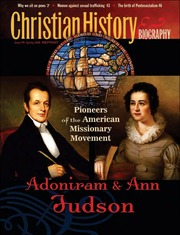
- Christian History Magazine #90 - Adoniram and Ann Judson - 48 pages with many pictures and excellent articles on his life and also his dear wife Ann. RECOMMENDED
- Adoniram Judson: How Few There Are Who Die So Hard! (Dr John Piper's transcript) Suffering and Success in the Life of Adoniram Judson: The Cost of Bringing Christ to Burma. For even a greater impact (and material not in the transcript) download the Mp3 Audio (at top of page) RECOMMENDED
- Adoniram Judson: A Biography by his son Edward Judson (or here)
- The Earnest Man A Memoir of Adoniram Judson by Hannah C Conant
- A memoir of the life and labors of the Rev. Adoniram Judson - Volume 1 by Francis Wayland
- A memoir of the life and labors of the Rev. Adoniram Judson - Volume 2 by Francis Wayland
- Adoniram Judson Baptist missionary to Burma - multiple links at Wholesome Words the best Christian biography site on the Web.
- Don't Waste Your Life by Dr John Piper - In this Pdf download see Chapter 9 (The Majesty of Christ in Missions and Mercy - A Plea to This Generation) for Piper's discussion of how God like the "Hound of Heaven" chased after and caught Adoniram Judson so that he would not waste his life (See Judson's related quote on A Life Once Spent… ).
- Adoniram Judson - youtube video - 15 minutes that may well change your life
- Sermon on Adoniram Judson's Life - youtube
Adoniram Judson's "Life Verse" --
That Christ may dwell in your hearts by faith; that ye, being rooted and grounded in love, may be able to comprehend with all saints what is the breadth, and length, and depth, and height; and to know the love of Christ Christ which surpasses knowledge, that you may be filled up to all the fulness of God. (Ep 3:17-note, Ep 3:18, 19-note)
Little wonder that Judson while serving time in a Burmese jail could still affirm with glowing confidence…
The future is as bright as the promises of God.
(And all God's people said "Amen")
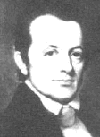
ADONIRAM JUDSON…
A LIFE WELL SPENT
In a day when the cause of world evangelism is so sadly languishing, it will be a humbling and inspiring experience for the Christians of America to turn aside and expose their souls afresh to the story of one who was magnificently captivated by the love of Christ. The love of Christ was his hope, his incentive, and his consolation. The love of Christ sang and sobbed and shouted its way through all the changing scenes, manifold trials and monumental accomplishments of the great epochs of his life.
CORAM DEO
LIVING
A life once spent is irrevocable. It will remain to be contemplated through eternity… If it has been a useless life, it can never be improved. Such will stand forever and ever. The same may be said of each day. When it is once past, it is gone forever. All the marks which we put upon it, it will exhibit forever… Each day will not only be a witness of our conduct, but will affect our everlasting destiny (Note: Not in loss of salvation but of rewards - cp 1Co 3:11-15+, Jn 15:5, 2Co 5:10+, cp 1Ti 4:7, 8+). No day will lose its share of influence in determining where shall be our seat in heaven. How shall we then wish to see each day marked with usefulness! It will then be too late to mend its appearance. It is too late to mend the days that are past. The future is in our power. Let us, then, each morning, resolve to send the day into eternity in such a garb as we shall wish it to wear forever. And at night let us reflect that one more day is irrevocably gone, indelibly marked. (See page 33-34 of A memoir of the life and labors of the Rev. Adoniram Judson)
This is "Coram Deo" living before the face of God, "Carpe Diem" seizing the day, because "Tempus Fugit", time flies and so our daily prayer should be "So teach us to number our days, that we may present to Thee a heart of wisdom." (Ps 90:12- see note below)
Adoniram Judson, the famed missionary to Burma, spent long, tiresome years translating the Bible for that people group. He was eventually put into prison because of his work, and while there his wife died. After being released, he contracted a serious disease that sapped what little energy he had left. Nevertheless he prayed,
"Lord, let me finish my work. Spare me long enough to put the saving Word into the hands of the people….The motto of every missionary, whether preacher, printer, or schoolmaster, ought to be "Devoted for life."
Adoniram Judson (1788–1850) had been a cynical actor who rejected the faith of his father. His wife Ann Hasseltine, had been the town belle, indulged by her parents. They were hardly likely candidates for the rigors of the early 19th-century mission field—but now Ann Hasseltine Judson, nicknamed Nancy, and her husband, Adoniram Judson, are assured of their place in history and even more assured of hearing those glorious words every saint should long to hear from their Lord and King "Well done My good and faithful servant" (Mt 25:21). Adoniram helped pave the road into the spiritual darkness of the "10-40 Window (see map)" of the Far East so that faithful men and women could be imitators of him and and carry forth the glorious Gospel of Jesus Christ, making disciples of all the nations (Mt 28:18, 19, 20)
Adoniram Judson was born in 1788, the son of a devout Congregationalist minister who cherished the fond hope that his son would follow in his footsteps. From early in his life he excelled in everything he touched. Judson was precocious and at the early age of three learned to read under the tutelage of his mother while his father was absent on a journey. How great was the father's astonishment and delight upon his return, to hear his young son read to him a chapter from the Bible. As he grew, Adoniram to his father's disappointment became enamored with his own brilliance and could not think of wasting his superb talents in so dull a calling as the ministry. Having vanquished all rivals in intellectual contests, he enrolled in Providence College (modern day Brown University) at the precocious age of 16 and graduated at age 19 as valedictorian. He entertained the most extravagant ambitions and his imagination ran wild as he contemplated his future fame. He pictured himself as an orator, greater than Demosthenes, swaying the multitudes with his eloquence or as a second Homer, writing immortal poems or even as a second Alexander the Great, weeping because there were no more worlds to conquer.
Judson was not just inordinately ambitious but was openly atheistic. It was during the early years of the nineteenth century, while Judson was in college, that French infidelity swept over the country. With only three or four exceptions, all the students of Yale were avowed infidels and preferred to call each other by the names of leading infidels such as Tom Paine or Voltaire, instead of their own names. And Providence College did not escape the contamination of this vile flood of skepticism. In the class one year above that of Judson there was a young man by the name of Ernest [other sources identify this individual as "Jacob Eames"], who was exceptionally gifted, witty and clever, and an outspoken atheist. An intimate friendship developed between these two brilliant young men, with the result that Judson also became a bold exponent of infidelity, to the extreme mortification of his father and mother. When his father sought to argue with him, he quickly demonstrated his intellectual superiority, but he had no answer to his mother's tears and solemn warnings. So by the age of 20, the minister's son had completely denounced Christ and his upbringing.
"Like the prodigal son he left home in quest of an exciting life. He wanted to escape parental restraints." (Lk 15:11-32)
But God Who possesses amazing grace deeper than our darkest sin (Ro 5:20-note), is able to save even an abject infidel like Adoniram Judson from the "guttermost" to the uttermost (He 7:25-note)! One day Adoniram set out on horseback on a tour of adventure through several states. He joined a band of strolling players and lived, as he himself related later, "a wild, reckless life." Leaving the troupe after a few weeks, he continued his trip on horseback, stopping on a certain historic night at a country inn. Apologetically, the landlord explained that, only one room being vacant, he would be obliged to put him next door to a young man who was extremely ill; in fact, probably dying. Adoniram said that was no problem.
"I'll take the room," said Judson.
"Death has no terrors for me. You see, I'm an atheist."
Through the night he heard the agonizing cries and pleas of a dying man who obviously did not know God. As the man's cries grew weaker in the early hours of morning, Judson wondered what the destiny was that awaited such a man or for that matter himself. At sunrise, he inquired of the innkeeper what the condition of the sick man was.
"Oh, he died in the night," was the curt reply.
"Do you know who he was?" asked Judson.
"Yes," the innkeeper answered, "he was a graduate of Providence College, a young fellow named Ernest", in the providence of God, the man who had "mentored" Judson in his unbelief and atheism.
Shaken by the event of his friend's death, a different Adoniram Judson returned home and sought admission to Andover Theological Seminary. Once enrolled, the writing of the Puritan, Thomas Boston (1676-1732) led Judson to full faith in Christ and salvation. When Adoniram Judson graduated from seminary he received a call from a fashionable church in Boston to become its assistant pastor. Everyone congratulated him. His mother and sister rejoiced that he could live at home with them and do his life work, but Judson shook his head.
"My work is not here," he said. "God is calling me beyond the seas. To stay here, even to serve God in His ministry, I feel would be only partial obedience, and I could not be happy in that."
Although it cost him a great struggle he left mother and sister to follow the heavenly call. The fashionable church in Boston still stands to this day, rich and strong, but Judson's influence on the churches in Burma resulted in thousands of converts from darkness to light, and the influence of his consecrated life ripples around the world even to the present day! O, for an ear to be attentive to the Master's voice and a heart so submitted to His command, however difficult that call might seem to be.
So one who had once been a raving atheist had been transformed into a young man who felt God calling him into missions. There was one great problem facing Judson concerning missions; in early 1800 America, there were no foreign missionaries. In about 1811 Judson wrote the following in a magazine article:
"How do Christians discharge this trust committed to them? They let three fourths of the world sleep the sleep of death, ignorant of the simple truth that a Savior died for them. Content if they can be useful in the little circle of their acquaintances, they quietly sit and see whole nations perish for lack of knowledge."
Through meeting and prayer with other concerned Congregationalists, Judson helped to formulate plans to form a mission society dedicated to sending missionaries to India. The budding missionary however also found something else during that time, his future wife. At the home of a deacon where the mission society met Judson fell in love with a godly young woman by the name of Ann. Nancy had previously experienced the glorious transaction of passing, as Nancy put it, "from death into life." But just put yourself in the place of Ann's father when he received the following note from Adoniram Judson:
I have not to ask, whether you can consent to part with your daughter early next Spring, to see her no more in this world; whether you can consent to her departure, and her subjection to the hardships and sufferings of missionary life; whether you can consent to her exposure to the dangers of the ocean; to the fatal influence of the climate of India; to every kind of want and distress; to degradation, insult, persecution, and perhaps a violent death. Can you consent to all this, for the sake of Him who left His heavenly home and died for her and for you; for the sake of perishing immortal souls, for the sake of Zion, and the glory of God? (Read and hear and heed the call of the Master Who solemnly invites all who have ears to hear what the Spirit is saying to the church in these last days to follow Him, the Source of real life in a world that is nothing but real death and decay = Mk 10:45, 8:34, 35, 36, 10:21, Lk 9:23, 24, 14:26, 27, 33 Mt 10:37, 38, 39, 16:24, 25, 26, 27)
Editorial comment: Adoniram Judson was a man dead to self, one who truly understood and lived out Gal 6:14-note
But may it never be that I should boast, except in the cross of our Lord Jesus Christ, through which the world has been crucified to me, and I to the world.
And so with her eyes wide open to the impending dangers of missionary life, Anne consented to marriage and she and Judson were wed in February of 1812.
And so only 13 days after they wed, in 1812, they set sail for India while their good friend Luther Rice prepared to come on a later ship. As they settled in for the four-month journey to India, Adoniram and Ann also settled in to an intense study of Scripture. They knew that when they arrived in India they would be ministering alongside the famous Baptist missionaries of Serampore Mission led by none other than William Carey (book or short biography). How would they work together with their differences concerning baptism? Adoniram was also seeking to reconcile some questions he had about his own Covenant Theology. All of their first converts would be adults. He wondered if they should also baptize the children of these new believers in a pagan land. Had the Judsons known that the Baptist missionaries of India had a policy to avoid such controversies, they may never have embarked on this study. Regardless, they became convinced over the weeks of study and prayer that believer's baptism was the New Testament mandate and determined to be baptized by immersion when they arrived in India.
And so Ann and Adoniram left America as Congregationalist but arrived in India as Baptists. They knew this decision would severely affect their relationship with their friends and family back in America. Ann wrote to one of her closest friends;
"My dear Nancy, we are confirmed Baptists, not because we wished to be, but because truth compelled us to be … We anticipate the loss of reputation, and of the affection and esteem of many of our American friends." When they landed in Calcutta, Judson wrote to William Carey, "… feeling that we are in an unbaptized state, we wish to profess our faith in Christ by being baptized in obedience to his sacred commands."
The parting of the Judsons with the Congregationalist was on friendly terms and was used to further the kingdom of God just as did the parting of Paul and Barnabas. The Judsons were baptized by William Carey’s colleague William Ward. The new Baptists found that their greatest enemy was not paganism but the British East India Company. Greed caused the British government to distrust missionaries and the changes that took place in their converts. People freed from sin have a bad habit of bowing down to God rather than man and the British knew that. Refused permanent status in India, Ann and Adoniram set sail and went first to Mauritius and thence to Burma—a closed land, ruled by a tyrannical regime, horribly hot and disease-ridden. No place could have more fulfilled Adoniram's prophecy in his letter of proposal to Ann's father than Burma. Burma was a land of superstition, governmental corruption and dedicated Buddhism. William Carey's son Felix wrote of Burma:
"The houses of Rangoon were miserably built, the streets were filthy with vermin, the rents wickedly oppressive, the taxes absurdly high, and the punishments barbarous…"
Burma was all that and more. Torture and mass executions were common occurrences. Any foreign religion was dealt with swiftly and unmercifully. The country's rulers were proud men who vainly believed their nation was superior to all others and invincible. This is the place, which Adoniram had brought his fair Ann to minister for the Lord Jesus Christ & they found the place "dark, cheerless, and unpromising."
There was plenty to do upon arriving in Rangoon. The Burmese language was difficult beyond belief; a seemingly endless string of words with no punctuation or recognizable sentence structure of any kind. Translating was Judson's sole work for over six years. Then (after 6 years) in 1819, the first Burman, Moung Nau, gave his life to Christ and was baptized. Soon several more were baptized and a new missionary, Dr. Pierce joined them. Things were looking up as they often do just before the storm hits.
For I consider (logizomai) that the sufferings (pathema) of this present time are not worthy (axios) to be compared with the glory (doxa) that is to be revealed (apokalupto) to us. (Ro 8:18-note) (Torrey's Topic "Afflictions" or in NTB)
Judson and Pierce slowly had gained the Burmese king's approval only to have that destroyed by the announcement that 5000 British troops had attacked and taken Rangoon in 1824. Even though the missionaries were not British, they were white foreigners and were soon imprisoned in the most horrid conditions one could imagine.
So at age 36, Judson (and Pierce) were imprisoned along with 100 other men in a single room. He was bound with three pairs of chains and his feet were fastened in stocks which at times were elevated, so that only his shoulders touched the ground. The room into which he and many other prisoners were crowded, was without a window and felt like a fiery furnace under the merciless glare of the tropical sun. The stench of the place was terrible, vermin crawled everywhere and the jailer, Mr. Spotted Face, was a brute in human form. Every afternoon the gong would sound at exactly 3PM and in would walk "Mr. Spotted Face" who would come in and often select one of the prisoners for execution that afternoon. And, as Judson saw other prisoners dragged out to execution, he lived in terrifying suspense that he might be chosen at the next sounding of the gong and he was able to say with Paul, "I die daily." (Read 1Cor 15:31, 2Cor 4:7, 8, 9, 10, 11, 12. Acts 20:23, Ro 8:36-note)
In Adoniram Judson's biography (by his son) we read the following excerpt (Page 226 - Adoniram Judson a Biography)…
It is no wonder that Mr. Judson in the midst of these horrors took refuge in the quietism of Madame Guyon, and used often to murmur her beautiful lines…
No place I see, but to fulfill
In life and death Thy lovely will.
No succor in my woes I want,
Except what Thou art pleased to grant.
Our days are numbered – let us spare
Our anxious hearts a needless care;
’Tis Thine to number out our days,
And ours to give them to Thy praise.
Not only was there the torture of confinement, while Adoniram was in prison Burmese ruffians were plundering every white man's house. What was to be done to preserve Adoniram's precious manuscripts of Scripture he had been laboring over for so long that the Burmese might have the living word of God in their own language? What seemed to be a clever plan occurred to Ann -- She would hide the manuscripts in a pillow! Having done this, she brought the pillow to the prison and no one dreamed that the white man's head rested at night on the most precious of treasures -- the Word of God. Then came a crushing misfortune. Taking a fancy to the pillow, the jailer grabbed it and kept it as his own. Judson's spirit groaned within him. What an irreparable loss! But Ann's ingenuity was not yet exhausted. Having made a prettier, nicer pillow, she brought it to the prison and Judson said to the jailer, "How would you like to exchange the old, soiled pillow for this bright new one?" Mr. Spotted Face readily agreed, wondering at the odd taste of the white man. Thus the precious manuscripts were recovered. Many times, smitten down with disease and at death's door, he breathed out the prayer,
Lord, let me finish my work. Spare me long enough to put Thy saving Word into the hands of a perishing people.
What a day of rejoicing in God's goodness when the Word of God finally rolled off the press with its merciful invitation in Burmese,
Whosoever will, let him take the Water of Life freely. (Rev 22:17-note,cp Jn 4:10, 11, 12, 13, 14, Jn 7:37, 38)
Surely Adoniram would have fallen and perished under the weight of his cross, except for the tender, persistent, beautiful ministrations of Ann. As often as possible she bribed the jailer and then, under cover of darkness, crept to the door of Judson's den, bringing food and whispering words of hope and consolation. Finally for three long weeks she did not appear; but, upon her return, she bore in her arms a newborn baby to explain her absence. An epidemic of smallpox was raging unchecked through the city and little Maria was smitten with the dread disease. Due to the double strain of concern for her imprisoned husband and the suffering baby, Ann found herself unable to nurse the little one. Tormented by its pitiful cries, Ann took her baby up and down the streets of the city, pleading for mercy and for milk: "You women who have babies, have mercy on my baby and nurse her!"
As the British won battle after battle it became apparent Burma was lost. Seeing the inevitable, the Burmese realized that the missionaries could help them in translation and negotiations. They were finally set free after 21 months of suffering seemingly intolerable confinement and deprivation.
One of the most pathetic pages in the history of Christian missions is that which describes the scene when Judson was finally released and returned to the mission house seeking Ann, who again had failed to visit him for some weeks. As he ambled down the street as fast as his maimed ankles would permit, the tormenting question kept repeating itself, "Is Ann still alive?" Upon reaching the house, the first object to attract his attention was a fat, half-naked Burmese woman squatting in the ashes beside a pan of coals and holding on her knees an emaciated baby, so begrimed with dirt that it did not occur to him that it could be his own. Across the foot of the bed, as though she had fallen there, lay a human object that, at the first glance, was no more recognizable than his child. The face was of a ghastly paleness and the body shrunken to the last degree of emaciation. The glossy black curls had all been shorn from the finely-shaped head. There lay the faithful and devoted wife who had followed him so unwearily from prison to prison, ever alleviating his distresses and consoling him in his trials. Presently Ann felt warm tears falling upon her face and, rousing from her stupor, saw Judson by her side.
Ann had indeed "counted the cost" and within only a few months after Adoniram had been freed, his dear Ann wife died on October 24th, 1826 to be followed by their daughter Maria in 1827. Yet Ann left an eternally indelible legacy. Ann was the first missionary to learn Siamese and to translate a portion of Scripture, the Gospel of Matthew, into that tongue. She also strove to improve the lot of Burmese women, who were considered little more than chattel. She missed her family but could affirm that "I am happy in thinking that I gave up this source of pleasure … [and] I am happy [to] labor for the promotion of the kingdom of heaven." The call of missions had cost the Judson family dearly. While these losses were great, in God's sovereign plan, there was yet more tragedy and suffering in store for Adoniram.
After Ann's death Adoniram sank into a deep depression. He renounced all outward acceptability, returning an honorary doctorate he had earned from Brown University. Finally he removed himself to the heart of a tiger infested jungle to live alone in a hut. Judson spent forty days in the jungle contemplating his call and on occasion even contemplating suicide. The local natives considered his survival through those days as nothing short of the way that God spared Daniel in the lion's den. "The love that never fails" (1Cor 13:8-note) sustained Adoniram who wrote that if he had not possessed
an assured conviction (cp Heb 11:1-note) that every additional trial was ordered by infinite love and mercy, I must have sunk under my accumulated sufferings. (Ed: Is this not a practical "paraphrase" of Ro 8:28-note?) (See page 253 in Adoniram Judson a biography)
Judson joined with Paul in declaring:
The love of Christ constraineth me … Therefore I will glory in reproaches, in persecution and in distresses for Christ's sake." (cp 2Corinthians 5:14)
In addition to his passion to translate the Bible into Burmese, Judson had a another passion and prayer, namely, to lead individuals to know Christ in His transforming power and to live to see one hundred converts. With great tact and consuming zeal, he preached by the road side and dealt with inquirers. Years went by without a single convert, but he refused to be discouraged. When a member of the Mission Board in America wrote, deploring the lack of results, and inquired concerning the prospects, this intrepid ambassador of Christ replied,
"The prospects are as bright as the promise of God." (See page 92 in Adoniram Judson a biography)
There were many disappointments, but as noted above after six long years of unwearied effort and fervent supplication Adoniram was finally rewarded. His Journal, of June 27, 1819, gives the thrilling record.
"We proceeded," he says, "to a large pond, the bank of which is graced with an enormous image of Buddha, and there administered baptism to Maung Nau, the first Burman convert. Oh, may it prove the beginning of a series of baptisms in the Burman empire, which shall continue in uninterrupted succession to the end of time!"
With a judicious admixture of gentle entreaty and stern warning, he sought one day to point out to a native woman the momentous alternatives that lay before her. Making two divergent marks on the ground, he said,
"This leads to eternal life, while this leads to eternal destruction. Will you leave this straight and narrow path drawn by the Saviour's finger for that which leads to everlasting despair? Will you? Will you?"
Many years later this woman, now an earnest and active Christian, said,
"Even now I can hear that terribly earnest 'Will you?' coming from the teacher's lips as though it was the voice of God."
Yes, the voice of God! Many listened wistfully to the foreigner's preaching, for even their depraved hearts discerned in his message the tender and imperious accents of the voice of God.
God indeed causes all things to work together for good to those who love Him as the following story from Adoniram's life so beautifully illustrates. As a result of Adoniram's 21 months in the squalid Burmese prison, for the rest of his life he carried the ugly marks made by the chains and iron shackles which had cruelly bound him (cp Paul's "brand marks" in Gal 6:17). Undaunted, he asked for permission to enter another province where he might resume preaching the Gospel. The godless ruler indignantly denied his request, saying,
"My people are not fools enough to listen to anything a missionary might SAY, but I fear they might be impressed by your SCARS and turn to your religion!"
Judson so fervently pursued his passion of evangelizing the Burmese that by 1839 recorded 47 baptisms. During 1832 there were 217 who came to Christ and 1144 baptisms in 1836.
Eight years after the death of Ann, Adoniram married the widow of a fellow missionary, Sarah Hall Boardman. None of Ann's children survived but Adoniram and Sarah would have six children who survived. God had restored much to Judson and in 1840 He allowed him to finish his great translation of the Burmese Bible. Nearly eight more years passed with great victories and great love between Sarah and Adoniram. Again, tragedy visited Judson, as Sarah grew ill. In 1845 at age 57, he determined to go with her to America, Judson left Burma with his wife. The trip was too much and Sarah was laid to rest in St. Helena.
Arriving in America, now missing his second wife, Judson was unprepared for the reception he received. It had been 38 years since he last set foot on American soil. Luther Rice a contemporary missionary to the Far East had returned to America years before and had tirelessly furthered the cause of supporting foreign missions. And thus people knew of this great man of God, Adoniram Judson so that everywhere he went, people wanted him to speak and tell of the work of God in Burma. While in America, Judson married for a third time to a woman named Emily Chubbuck. (See also The Three Mrs. Judsons - Helpmeets to the Missionary to Burma) Emily proved a faithful companion and sister in Christ in the remaining years of Judson's life when they returned to Burma.
Judson became critically ill in the spring of 1850 and it was believed that his only hope of recovery lay in taking a long sea voyage. A French barque (small ship), the Aristide Marie, was scheduled to sail from Moulmein on the 3rd of April. The stricken missionary was carried on board by his weeping converts. When the ship, after certain delays, sailed several days later, he was accompanied only by Mr. Thomas Ranney, a fellow missionary. On April 12, 1850, Adoniram Judson breathed his last and on the same day his body was buried at sea. Some of Adoniram's children never saw him after childhood. But when he died in 1850, he left behind 7,000 more "children"—members of the Burmese Christian church he and Ann had begun along with 63 churches and 123 missionaries and pastors. Judson's greatest legacy was his undying love for Christ. While in America someone complained that Judson didn't tell more thrilling stories of adventure and intrigue. In reply to that Judson said,
"I glad they have it to say (that I) had nothing better
to tell than the wondrous story of Jesus' dying love."
Shortly before his death Judson said
I am not tired of my work, neither am I tired of the world; yet, when Christ calls me home, I shall go with gladness.
In spite of sorrow, loss, and pain,
Our course be onward still;
We sow on Burma’s barren plain,
We reap on Zion’s hill.
-Adoniram Judson
(Gal 6:7-note, Gal 6:8-note, Gal 6:9-note, Gal 6:10-note)
In Malden, Massachusetts, an unimpressive marble tablet reviews the story of Judson's life:
In Memoriam
Rev Adoniram Judson
Born August 9, 1788
Died April 12, 1850
Malden his birthplace,
The ocean his sepulcher,
Converted Burmans and
The Burman Bible
His monument.
His record is on High
(Amen - Rev 22:12-note)
The following excerpt is taken from Foxe’s Book of Martyrs by John Foxe, Chapter 22…
Adoniram Judson understood experientially the great truths that Paul wrote concerning persecutions and sufferings…
2Timothy 3:12 - And indeed, all (no exceptions) who desire (present tense = our lifestyle something only possible as God's Spirit works that desire out in our life - Php 2:13-note - this calls for a conscious choice, a willingness to daily die to self and to daily present one's body - whole being - to God as a living sacrifice for His service as He chooses - Ro 12:1-note) to live godly in (Speaks of the sphere of influence and invigoration. Remember the "Vine/Branches" principle of Jn 15:5 = to live godly in our old strength in impossible, but Paul encourages us with the truth that it is Him-possible! It is not us trying to life a supernatural life, but Christ Who lives in us, so that now we live by faith which works itself out in Spirit powered obedience - See Gal 2:20-note; Obedience of faith) Christ Jesus (see discussion of the vital, supernatural union every believer has in Christ) will be persecuted (dioko). (2Ti 3:12-note)
Note that although you may never have thought of it this way, this passages is one of the great "Promises" of God! Part of why we don't relish "claiming" this promise is that we can't see the fruit of affliction, which albeit absolutely certain, may not come to full bloom until we are in glory! cp 2Cor 4:17, 18! An important corollary to ponder - If we find that we seldom, if ever, are being persecuted for our faith, then certainly we must question whether we genuinely are "living godly in Christ Jesus" or even more deceptively dangerous not even IN Christ Jesus! (See 2Cor 13:5-note)
J C Ryle in his sermon Formalism says - If you take up heart-religion I cannot promise you the praise of man. Pardon, peace, hope, guidance, comfort, consolation, grace according to your need, strength according to your day, joy which the world can neither give nor take away--all this I can boldly promise to the man who comes to Christ, and serves Him with his heart. But I cannot promise him that his religion will be popular with man. I would rather warn him to expect mockery and ridicule, slander and unkindness, opposition and persecution. There is a cross belonging to heart-religion, and we must be content to carry it. "We must go through many hardships to enter the kingdom of God,"--"Everyone who wants to live a godly life in Christ Jesus will be persecuted" (Acts 14:22; 2Timothy 3:12). But if the world hates you, God will love you. If the world forsakes you, Christ has promised that He will never forsake and never fail. Whatever you may lose by heart-religion, be sure that the praise of God will make up for it.)
"Give me the Love that leads the way
The Faith that nothing can dismay
The Hope no disappointments tire
The Passion that'll burn like fire
Let me not sink to be a clod
Make me Thy fuel, Flame of God"
--Amy CarmichaelHast thou no scar?
No hidden scar on foot, or side, or hand?
I hear thee sung as mighty in the land,
I hear them hail thy bright ascendant star:
Hast thou no scar?Hast thou no wound?
Yet, I was wounded by the archers, spent.
Leaned me against the tree to die, and rent
By ravening beasts that compassed me, I swooned:
Hast thou no wound?
--Amy Carmichael
Philippians 1:29 - For to you (the saints at Philippi and by application all saints of all ages) it has been granted (charizomai = note that this verb is from charis = grace and thus is a "gift of grace"! Not exactly how most of us view suffering) for Christ's sake (Note the early disciples' testimony regarding their privilege of suffering for their Savior and Lord - Acts 5:41, 1Pe 4:13), not only to believe in Him, but also to suffer for His sake. (Php 1:29-note)
After laboring for some time in Hindustan (India) Dr. and Mrs. Judson finally established themselves at Rangoon in the Burman Empire, in 1813. In 1824 war broke out between the British East India Company and the emperor of Burma. Dr. and Mrs. Judson and Dr. Price, who were at Ava, the capital of the Burman Empire, when the war commenced, were immediately arrested and confined for several months. The account of the sufferings of the missionaries was written by Mrs. Judson, and is given in her own words.
“Rangoon, May 26, 1826.
“My beloved Brother, “I commence this letter with the intention of giving you the particulars of our captivity and sufferings at Ava. How long my patience will allow my reviewing scenes of disgust and horror, the conclusion of this letter will determine. I had kept a journal of everything that had transpired from our arrival at Ava, but destroyed it at the c ommencement of our difficulties.
“The first certain intelligence we received of the declaration of war by the Burmese, was on our arrival at Tsenpyoo-kywon, about a hundred miles this side of Ava, where part of the troops, under the command of the celebrated Bandoola, had encamped. As we proceeded on our journey, we met Bandoola himself, with the remainder of his troops, gaily equipped, seated on his golden barge, and surrounded by a fleet of gold war boats, one of which was instantly despatched the other side of the river to hail us, and make all necessary inquiries. We were allowed to proceed quietly on, when he had informed the messenger that we were Americans, not English, and were going to Ava in obedience to the command of his Majesty.
“On our arrival at the capital, we found that Dr. Price was out of favor at court, and that suspicion rested on most of the foreigners then at Ava. Your brother visited at the palace two or three times, but found the king’s manner toward him very different from what it formerly had been; and the queen, who had hitherto expressed wishes for my speedy arrival, now made no inquiries after me, nor intimated a wish to see me. Consequently, I made no effort to visit at the palace, though almost daily invited to visit some of the branches of the royal family, who were living in their own houses, out of the palace enclosure. Under these circumstances, we thought our most prudent course lay in prosecuting our original intention of building a house, and commencing missionary operations as occasion offered, thus endeavoring to convince the government that we had really nothing to do with the present war.
“In two or three weeks after our arrival, the king, queen, all the members of the royal family, and most of the officers of government, returned to Amarapora, in order to come and take possession of the new palace in the customary style.
“I dare not attempt a description of that splendid day, when majesty with all its attendant glory entered the gates of the golden city, and amid the acclamations of millions, I may say, took possession of the palace. The saupwars of the provinces bordering on China, all the viceroys and high officers of the kingdom were assembled on the occasion, dressed in their robes of state, and ornamented with the insignia of their office. The white elephant, richly adorned with gold and jewels, was one of the most beautiful objects in the procession. The king and queen alone were unadorned, dressed in the simple garb of the country; they, hand in hand, entered the garden in which we had taken our seats, and where a banquet was prepared for their refreshment. All the riches and glory of the empire were on this day exhibited to view. The number and immense size of the elephants, the numerous horses, and great variety of vehicles of all descriptions, far surpassed anything I have ever seen or imagined. Soon after his majesty had taken possession of the new palace, an order was issued that no foreigner should be allowed to enter, excepting Lansago. We were a little alarmed at this, but concluded it was from political motives, and would not, perhaps, essentially affect us.
“For several weeks nothing took place to alarm us, and we wnt on with our school. Mr. J. preached every Sabbath, all the materials for building a brick house were procured, and the masons had made considerable progress in raising the building.
“On the twenty-third of May, 1824, just as we had concluded worship at the Doctor’s house, the other side of the river, a messenger came to inform us that Rangoon was taken by the English. The intelligence produced a shock, in which was a mixture of fear and joy. Mr. Gouger, a young merchant residing at Ava, was then with us, and had much more reason to fear than the rest of us. We all, however, immediately returned to our house, and began to consider what was to be done. Mr. G. went to Prince Thar-yar-wadee, the king’s most influential brother, who informed him he need not give himself any uneasiness, as he had mentioned the subject to his majesty, who had replied, that ‘the few foreigners residing at Ava had nothing to do with the war, and should not be molested.’
“The government were now all in motion. An army of ten or twelve thousand men, under the command of the Kyee-woon-gyee, were sent off in three or four days, and were to be joined by the Sakyer-woon-gyee, who had previously been appointed viceroy of Rangoon, and who was on his way thither, when the news of its attack reached him. No doubt was entertained of the defeat of the English; the only fear of the king was that the foreigners hearing of the advance of the Burmese troops, would be so alarmed as to flee on board their ships and depart, before there would be time to secure them as slaves. ‘Bring for me,’ said a wild young buck of the palace, ‘six kala pyoo, (white strangers,) to row my boat;’ and ‘to me,’ said the lady of Woon-gyee, ‘send four white strangers to manage the affairs of my house, as I understand they are trusty servants.’ The war boats, in high glee, passed our house, the soldiers singing and dancing, and exhibiting gestures of the most joyful kind. Poor fellows! said we, you will probably never dance again. And so it proved, for few if any ever saw again their native home.
“At length Mr. Judson and Dr. Price were summoned to a court of examination, where strict inquiry was made relative to all they knew. The great point seemed to be whether they had been in the habit of making communications to foreigners, of the state of the country, etc. They answered that they had always written to their friends in America, but had no correspondence with English officers, or the Bengal government. After their examination, they were not put in confinement as the Englishmen had been, but were allowed to return to their houses. In examining the accounts of Mr. G it was found that Mr. J. and Dr. Price had taken money of him to a considerable amount. Ignorant, as were the Burmese, of our mode of receiving money, by orders on Bengal, this circumstance, to their suspicious minds, was a sufficient evidence that the missionaries were in the pay of the English, and very probably spies. It was thus represented to the king, who, in an angry tone, ordered the immediate arrest of the ‘two teachers.’
“On the eighth of June, just as we were prearing for dinner, in rushed an officer, holding a black book, with a dozen Burmans, accompanied by one, whom, from his spotted face, we knew to be an executioner, and a ‘son of the prison.’ ‘Where is the teacher?’ was the first inquiry. Mr. Judson presented himself. ‘You are called by the king,’ said the officer; a form of speech always used when about to arrest a criminal. The spotted man instantly seized Mr. Judson, threw him on the floor, and produced the small cord, the instrument of torture. I caught hold of his arm;
‘Stay, (said I,) I will give you money.’ ‘Take her too,’ said the officer; ‘she also is a foreigner.’ Mr. Judson, with an imploring look, begged they would let me remain until further orders. The scene was now shocking beyond description.
“The whole neighborhood had collected-the masons at work on the brick house threw down their tools, and ran-the little Burman children were screaming and crying-the Bengalee servants stood in amazement at the indignities offered their master-and the hardened executioner, with a hellish joy, drew tight the cords, bound Mr. Judson fast, and dragged him off, I knew not whither. In vain I begged and entreated the spotted face to take the silver, and loosen the ropes, but he spurned my offers, and immediately departed. I gave the money, however, to Moung Ing to follow after, to make some further attempt to mitigate the torture of Mr. Judson; but instead of succeeding, when a few rods from the house, the unfeeling wretches again threw their prisoner on the ground, and drew the cords still tighter, so as almost to prevent respiration.
“The officer and his gang proceeded on to the courthouse, where the governor of the city and the officers were collected, one of whom read the order of the king, to commit Mr. Judson to the death prison, into which he was soon hurled, the door closed-and Moung Ing saw no more. What a night was now before me! I retired into my room, and endeavored to obtain consolation from committing my case to God, and imploring fortitude and strength to suffer whatever awaited me. But the consolation of retirement was not long allowed me, for the magistrate of the place had come into the veranda, and continually called me to come out, and submit to his examination. But previously to going out, I destroyed all my letters, journals, and writings of every kind, lest they should disclose the fact that we had correspondents in England, and had minuted down every occurrence since our arrival in the country. When this work of destruction was finished, I went out and submitted to the examination of the magistrate, who inquired very minutely of everything I knew; then ordered the gates of the compound to be shut, no person be allowed to go in or out, placed a guard of ten ruffians, to whom he gave a strict charge to keep me safe, and departed.
“It was now dark. I retired to an inner room with my four little Burman girls, and barred the doors. The guard instantly ordered me to unbar the doors and come out, or they would break the house down. I obstinately refused to obey, and endeavored to intimidate them by threatening to complain of their conduct to higher authorities on the morrow. Finding me resolved in disregarding their orders, they took the two Bengalee servants, and confined them in the stocks in a very painful position. I could not endure this; but called the head man to the window, and promised to make them all a present in the morning, if they would release the servants. After much debate, and many severe threatenings, they consented, but seemed resolved to annoy me as much as possible. My unprotected, desolate state, my entire uncertainty of the fate of Mr. Judson, and the dreadful carousings and almost diabolical language of the guard, all conspired to make it by far the most distressing night I had ever passed. You may well imagine, my dear brother, that sleep was a stranger to my eyes, and peace and composure to my mind.
“The next morning, I sent Moung Ing to ascertain the situation of your brother, and give him food, if still living. He soon returned, with the intelligence that Mr. Judson, and all the white foreigners, were confined in the death prison, with three pairs of iron fetters each, and fastened to a long pole, to prevent their moving! The point of my anguish now was that I was a prisoner myself, and could make no efforts for the release of the missionaries. I begged and entreated the magistrate to allow me to go to some member of government to state my case; but he said he did not dare to consent, for fear I should make my escape. I next wrote a note to one of the king’s sisters, with whom I had been intimate, requesting her to use her influence for the release of the teachers. The note was returned with this message-She ‘did not understand it’-which was a polite refusal to interfere; though I afterwards ascertained that she had an anxious desire to assist us, but dared not on account of the queen. The day dragged heavily away, and another dreadful night was before me. I endeavored to soften the feelings of the guard by giving them tea and cigars for the night; so that they allowed me to remain inside of my room, without threatening as they did the night before. But the idea of your brother being stretched on the bare floor in irons and confinement, haunted my mind like a spectre, and prevented my obtaining any quiet sleep, though nature was almost exhausted.
“On the third day, I sent a message to the governor of the city, who has the entire direction of prison affairs, to allow me to visit him with a present. This had the desired effect; and he immediately sent orders to the guards, to permit my going into town. The governor received me pleasantly, and asked me what I wanted. I stated to him the situation of the foreigners, and particularly that of the teachers, who were Americans, and had nothing to do with the war. He told me it was not in his power to release them from prison or irons, but that he could make their situation more comfortable; there was his head officer, with whom I must consult, relative to the means. The officer, who proved to be one of the city writers, and whose countenance at the first glance presented the most perfect assemblage of all the evil passions attached to human nature, took me aside, and endeavored to convince me, that myself, as well as the prisoners, was entirely at his disposal-that our future comfort must depend on my liberality in regard to presents-and that these must be made in a private way and unknown to any officer in the government! ‘What must I do,’ said I, ‘to obtain a mitigation of the present sufferings of the two teachers?’ ‘Pay to me,’ said he, ‘two hundred tickals, (about a hundred dollars,) two pieces of fine cloth, and two pieces of handkerchiefs.’ I had taken money with me in the morning, our house being two miles from the prison-I could not easily return. This I offered to the writer, and begged he would not insist on the other articles, as they were not in my possession. He hesitated for some time, but fearing to lose the sight of so much money, he concluded to take it, promising to relieve the teachers from their most painful situation.
“I then procured an order from the governor, for my admittance into prison; but the sensations, produced by meeting your brother in that wretched, horrid situation-and the affecting scene which ensued, I will not attempt to describe. Mr. Judson crawled to the door of the prison-for I was never allowed to enter-gave me some directions relative to his release; but before we could make any arrangement, I was ordered to depart, by those iron-hearted jailers, who could not endure to see us enjoy the poor consolation of meeting in that miserable place. In vain I pleaded the order of the governor for my admittance; they again, harshly repeated, ‘Depart, or we will pull you out.’ The same evening, the missionaries, together with the other foreigners, who had paid an equal sum, were taken out of the common prison, and confined in an open shed in the prison inclosure. Here I was allowed to send them food, and mats to sleep on; but was not permitted to enter again for several days.
“My next object was to get a petition presented to the queen; but no person being admitted into the palace, who was in disgrace with his majesty, I sought to present it through the medium of her brother’s wife. I had visited her in better days, and received particular marks of her favor. But now times were altered: Mr. Judson was in prison, and I in distress, which was a sufficient reason for giving me a cold reception. I took a present of considerable value. She was lolling on her carpet as I entered, with her attendants around her. I waited not for the usual question to a suppliant, ‘What do you want?’ but in a bold, earnest, yet respectful manner, stated our distresses and our wrongs, and begged her assistance. She partly raised her head, opened the present I had brought, and coolly replied, ‘Your case is not singular; all the foreigners are treated alike.’ ‘But it is singular,’ said I, ‘the teachers are Americans; they are ministers of religion, have nothing to do with war or politics, and came to Ava in obedience to the king’s command. They have never done any thing to deserve such treatment; and is it right they should be treated thus?’ ‘The king does as he pleases,’ said she; ‘I am not the king, what can I do?’ ‘You can state their case to the queen, and obtain their release,’ replied I. ‘Place yourself in my situation-were you in America, your husband, innocent of crime, thrown into prison, in irons, and you a solitary, unprotected female-what would you do?’ With a slight degree of feeling, she said, ‘I will present your petition, come again to-morrow.’ I returned to the house, with considerable hope, that the speedy release of the missionaries was at hand. But the next day Mr. Gouger’s property, to the amount of fifty thousand dollars, was taken and carried to the palace. The officers, on their return, politely informed me, they should visit our house on the morrow. I felt obliged for this information, and accordingly made preparations to receive them, by secreting as many little articles as possible; together with considerable silver, as I knew, if the war should be protracted, we should be in a state of starvation without it. But my mind in a dreadful state of agitation, lest it should be discovered, and cause my being thrown into prison. And had it been possible to procure money from any other quarter, I should not have ventured on such a step.
“The following morning, the royal treasurer, Prince Tharyawadees, Chief Woon, and Koung-tone Myoo-tsa, who was in future our steady friend, attended by forty or fifty followers, came to take possession of all we had. I treated them civilly, gave them chairs to sit on, tea and sweetmeats for their refreshment; and justice obliges me to say that they conducted the business of confiscation with more regard to my feelings than I should have thought it possible for Burmese officers to exhibit. The three officers, with one of the royal secretaries, alone entered the house; their attendants were ordered to remain outside. They saw I was deeply affected, and apologized for what they were about to do, by saying that it was painful for them to take possession of property not their own, but they were compelled thus to do by order of the king.
“‘Where is your silver, gold, and jewels?’ said the royal treasurer. ‘I have no gold or jewels; but here is the key of a trunk which contains the silver-do with it as you please.’ The trunk was produced, and the silver weighed. ‘This money,’ said I, ‘was collected in America, by the disciples of Christ, and sent here for the purpose of building a kyoung, (the name of a priest’s dwelling) and for our support while teaching the religion of Christ. Is it suitable that you should take it? (The Burmans are averse to taking what is offered in a religious point of view, which was the cause of my making the inquiry.) ‘We will state this circumstance to the king,’ said one of them, ‘and perhaps he will restore it. But this is all the silver you have?’ I could not tell a falsehood: ‘The house is in your possession,’ I replied, ‘search for yourselves.’ ‘Have you not deposited silver with some person of your acquaintaince?’ ‘My acquaintances are all in prison, with whom should I deposit silver?’
“They next ordered my trunk and drawers to be examined. The secretary only was allowed to accompany me in this search. Everything nice or curious, which met hjis view, was presented to the officers, for their decision, whether it should be taken or retained. I begged they would not take our wearing apparel, as it would be disgraceful to take clothes partly worn into the possession of his majesty, and to us they were of unspeakable value. They assented, and took a list only, and did the same with the books, medicines, etc. My little work table and rocking chair, presents from my beloved brother, I rescued from their grasp, partly by artifice, and partly through their ignorance. They left also many articles, which were of inestimable value, during our long imprisonment.
“As soon as they had finished their search and departed, I hastened to the queen’s brother, to hear what had been the fate of my petition; when, alas! all my hopes were dashed, by his wife’s coolly saying, ‘I stated your case to the queen; but her majesty replied, The teachers will not die: let them remain as they are.’ My expectations had been so much excited that this sentence was like a thunderbolt to my feelings. For the truth at one glance assured me that if the queen refused assistance, who would dare to intercede for me? With a heavy heart I departed, and on my way home, attempted to enter the prison gate, to communicate the sad tidings to your brother, but was harshly refused admittance; and for the ten days following notwithstanding my daily efforts, I was not allowed to enter. We attempted to communicate by writing, and after being successful for a few days, it was discovered; the poor fellow who carried the communications was beaten and put in the stocks; and the circumstance cost me about ten dollars, besides two or three days of agony, for fear of the consequences.
“The officers who had taken possession of our property, presented it to his majesty, saying, ‘Judson is a true teacher; we found nothing in his house, but what belongs to priests. In addition to this money, there are an immense number of books, medicines, trunks of wearing apparel, of which we have only taken a list. Shall we take them, or let them remain?’ ‘Let them remain,’ said the king, ‘and put this property by itself, for it shall be restored to him again, if he is found innocent.’ This was an allusion to the idea of his being a spy.
“For two or three months following, I was subject to continual harassments, partly through my ignorance of police management and partly through the insatiable desire of every petty officer to enrich himself through our misfortunes.
“You, my dear brother, who know my strong attachment to my friends, and how much pleasure I have hitherto experienced from retrospect, can judge from the above circumstances, how intense were my sufferings. But the point, the acme of my distresses, consisted in the awful uncertainty of our final fate. My prevailing opinion was that my husband would suffer violent death; and that I should, of course, become a slave, and languish out a miserable though short existence, in the tyrannic hands of some unfeeling monster. But the consolations of religion, in these trying circumstances, were neither ‘few nor small.’ It taught me to look beyond this world, to that rest, that peaceful, happy rest, where Jesus reigns, and oppression never enters.
“Some months after your brother’s imprisonment, I was permitted to make a little bamboo room in the prison inclosures, where he could be much by himself, and where I was sometimes allowed to spend two or three hours. It so happened that the two months he occupied this place, was the coldest part of the year, when he would have suffered much in the open shed he had previously occupied. After the birth of your little niece, I was unable to visit the prison and the governor as before, and found I had lost ocnsiderable influence, previously gained; for he was not so forward to hear my petitions when any difficulty occurred, as he formerly had been. When Maria was nearly two months old, her father one morning sent me word that he and all the white prisoners were put into the inner prison, in five pairs of fetters each, that his little room had been torn down, and his mat, pillow, etc., been taken by the jailers. This was to me a dreadful shock, as I thought at once it was only a prelude to greater evils.
“The situation of the prisoners was now distressing beyond description. It was at the commencement of the hot season. There were above a hundred prisoners shut up in one room, without a breath of air excepting from the cracks in the boards. I sometimes obtained permission to go to the door for five minutes, when my heart sickened at the wretchedness exhibited. The white prisoners, from incessant perspiration and loss of appetite, looked more like the dead than the living. I made daily applications to the governor, offering him money, which he refused; but all that I gained was permission for the foreigners to eat their food outside, and this continued but a short time.
“After continuing in the inner prison for more than a month, your brother was taken with a fever. I felt assured he would not live long, unless removed from that noisome place. To effect this, and in order to be near the prison, I removed from our house and put up a small bamboo room in the governor’s enclosure, which was nearly opposite the prison gate. Here I incessantly begged the governor to give me an order to take Mr. J. out of the large prison, and place him in a more comfortable situation; and the old man, being worn out with my entreaties at length gave me the order in an official form; and also gave orders to the head jailer, to allow me to go in and out, all times of the day, to administer medicines. I now felt happy, indeed, and had Mr. J. instantly removed into a little bamboo hovel, so low, that neither of us could stand upright-but a palace in comparison with the place he had left.
- from a man "Devoted for life"
Judson and The Jews - As Adoniram Judson lay dying, news came to him that some Jews in Turkey had been converted through reading the account of his sufferings in Burma.
This awes me. This is good news. When I was a young man, I prayed for the Lord to send me to the Jews in Jerusalem as a missionary. But He sent me to Burma to preach and to suffer the tortures of imprisonment. Now, because of my sufferings, God had brought some Jews in Turkey to repentance!
Oh, the depth of the riches of the wisdom and knowledge of God! (Ro 11:33-note)
><>><>><>
Let me beg you, not to rest contented with the commonplace religion that is now so prevalent.
O slow of heart to believe and trust in the constant presence and overruling agency of our almighty Saviour!
Thanks be to God, not--only for 'rivers of endless joys above, but for 'rills of comfort here below.'
If God gave light and wisdom, the religion of Jesus was soon learned; but without God, a man might study all his life long, and make no proficiency.
Do not the successes which have crowned some missionary exertions seem like the dawn of morning on the east? O! that this region of Egyptian darkness may ere long participate in the vivifying beams of light.
Nothing is impossible,' said one of the seven sages of Greece, 'to industry.' Let us change the word, 'industry,' to 'persevering prayer,' and the motto will be more Christian and more worthy of universal adoption.
God loves importunate prayer so much that He will not give us much blessing without it.
God answers all true prayer, either in kind or in kindness.
Our prayers run along one road and God's answers by another, and by and by they meet.
It is true that we may desire much more. But let us use what we have, and God will give us more.
Note: The following excerpt is from page 322-23 of Francis Wayland's online book A memoir of the life and labors of the Rev. Adoniram Judson - published 1853
Rules adopted on Sunday, April 4, 1819, the era of commencing public ministrations among the Burmans; revised and re-adopted on Saturday, December 9, 1820, and on Wednesday, April 25, 1821.
1. Be diligent in secret prayer, every morning and evening.
2. Never spend a moment in mere idleness.
3. Restrain natural appetites within the bounds of temperance and purity. "Keep thyself pure."
4. Suppress every emotion of anger and ill will.
5. Undertake nothing from motives of ambition, or love of fame.
6. Never do that which, at the moment, appears to be displeasing to God.
7. Seek opportunities of making some sacrifice for the good of others, especially of believers, provided the sacrifice is not inconsistent with some duty.
8. Endeavor to rejoice in every loss and suffering incurred for Christ's sake and the gospel's, remembering that though, like death, they are not to be wilfully incurred, yet, like death, they are great gain.
Re-adopted the above rules, particularly the 4th, on Sunday, August 31, 1823.
Re-adopted the above rules, particularly the 1st, on Sunday, October 29, 1826, and adopted the following minor rules:
1. Rise with the sun.
2. Read a certain portion of Burman every day, Sundays excepted.
3. Have the Scriptures and some devotional book in constant reading.
4. Read no book in English that has not a devotional tendency.
5. Suppress every unclean thought and look.
Revised and re-adopted all the above rules, particularly the second of the first class, on Sunday, March 11, 1827.
God grant me grace to keep the above rules, and ever live to His glory, for Jesus Christ's sake.
A. JUDSON (Reference).
Adoniram Judson's prayer for missions and missionaries…
O God of mercy… have mercy on the churches in the United States; hold back the curse of Meroz (Jdg 5:23-note); continue and perpetuate the heavenly revivals of religion which they have begun to enjoy; and may the time soon come when no church shall dare to sit under Sabbath and sanctuary privileges without having one of their number to represent them on heathen ground.
Have mercy on the theological seminaries, and hasten the time when one half of all who yearly enter the ministry shall be taken by thine Holy Spirit, and driven into the wilderness, feeling a sweet necessity laid on them, and the precious love of Christ and of souls constraining them (2Co 5:14KJV).
Hear, O Lord, all the prayers which are this day presented in all the monthly concerts throughout the habitable globe, and hasten the millennial glory, for which we are all longing, and praying, and laboring. Adorn Thy beloved in her bridal vestments, that she may shine forth in immaculate beauty and celestial splendour! Come, O our Bridegroom; come, Lord Jesus, come quickly! (Mt 9:15, 25:1, 6 Rev 22:20-note) (Online Source: Page 294 The Earnest Man A Memoir of Adoniram Judson)
Judson's Life: An Aroma of Christ was "The sweet aroma of the knowledge of Him (Jesus) in every place." (2Cor 2:14) Many years ago when the great missionary Adoniram Judson was home on furlough, he passed through the city of Stonington, Connecticut. A young boy playing about the wharves at the time of Judson’s arrival was struck by the man’s appearance. Never before had he seen such a light on any human face. He ran up the street to a minister to ask if he knew who the stranger was. The minister hurried back with him, but became so absorbed in conversation with Judson that he forgot all about the impatient youngster standing near him. Many years afterward that boy—who could never get away from the influence of that wonderful face—became the famous preacher Henry Clay Trumbull (Read The life story of Henry Clay Trumbull, missionary, army chaplain, editor, author - 1905) (See also his fascinating book The Blood Covenant). In a book of memoirs he penned a chapter entitled: "What a Boy Saw in the Face of Adoniram Judson." That lighted countenance had changed his life. Even as flowers thrive when they bend to the light, so shining, radiant faces come to those who constantly turn toward Christ! (Read the original story in context of H C Trumbull's life story)
Over 3000 years ago Moses prayed a prayer that is reflected in the life of Adoniram Judson and would be an appropriate prayer of every saint who loves "His appearing" (2Ti 4:8-note) (Spurgeon devotional)…
So teach us to number our days,
that we may present to Thee a heart of wisdom
(Psalm 90:12)
Spurgeon's Comment: So teach us to number our days. Instruct us to set store by time, mourning for that time past wherein we have wrought the will of the flesh, using diligently the time present, which is the accepted hour and the day of salvation, and reckoning the time which lieth in the future to be too uncertain to allow us safely to delay any gracious work or prayer. Numeration is a child's exercise in arithmetic, but in order to number their days aright the best of men need the Lord's teaching. We are more anxious to count the stars than our days, and yet the latter is by far more practical.
Improve Time in time, while the Time doth last.
For all Time is no time, when the Time is past.
--Richard Pigot
That we may apply our hearts unto wisdom. Men are led by reflections upon the brevity of time to give their earnest attention to eternal things; they become humble as they look into the grave which is so soon to be their bed, their passions cool in the presence of mortality, and they yield themselves up to the dictates of unerring wisdom; but this is only the case when the Lord himself is the teacher; he alone can teach to real and lasting profit. Thus Moses prayed that the dispensations of justice might be sanctified in mercy. "The law is our school master to bring us to Christ", when the Lord himself speaks by the law. It is most meet that the heart which will so soon cease to beat should while it moves be regulated by wisdom's hand. A short life should be wisely spent. We have not enough time at our disposal to justify us in misspending a single quarter of an hour. Neither are we sure of enough life to justify us in procrastinating for a moment. If we were wise in heart we should see this, but mere head wisdom will not guide us aright. (Spurgeon's note)
Samuel Johnson: He that hopes to look back hereafter with satisfaction upon past years, must learn to know the present value of single minutes, and endeavour to let no particle of time fall useless to the ground. An Italian philosopher expressed in his motto that time was his estate; an estate, indeed, that will produce nothing without cultivation, but will always abundantly repay the labours of industry, and satisfy the most extensive desires, if no part of it be suffered to lie waste by negligence, to be overrun by noxious plants, or laid out for show rather than for use.
Plain Commentary: Number we our days by our daily prayers -- number we them by our daily obedience and daily acts of love -- number we them by the memories that they bring of holy men who have entered into their Saviour's peace, and by the hopes which are woven with them of glory and of grace won for us!
Charles Bradbury: Sir Thomas Smith, secretary to Queen Elizabeth, some months before his death said, That it was a great pity men know not to what end they were born into this world, until they were ready to go out of it.
William Secker: Apply our hearts unto wisdom. St. Austin says, "We can never do that, except we number every day as our last day." Many put far the evil day. They refuse to leave the earth, when the earth is about to take its leave of them. ("Amen" or "Oh my!)
Henry Smith: So teach us to number our days, etc. Five things I note in these words: first, that death is the haven of every man; whether he sit on the throne, or keep in a cottage, at last he must knock at death's door, as all his fathers have done before him. Secondly, that man's time is set, and his bounds appointed, which he cannot pass, no more than the Egyptians could pass the sea; and therefore Moses saith, "Teach us to number our days", as though there were a number of our days. Thirdly, that our days are few, as though we were sent into this world but to see it; and therefore Moses, speaking of our life, speaks of days, not of years, nor of months, nor of weeks; but "Teach us to number our days", shewing that it is an easy thing even for a man to number his days, they be so few. Fourthly, the aptness of man to forget death rather than anything else; and therefore Moses prayeth the Lord to teach him to number his days, as though they were still slipping out of his mind. Lastly, that to remember how short a time we have to live, will make us apply our hearts to that which is good.
William Brown Keer: Our hearts. In both the Scriptures of the Old and New Testament, the term "heart" is applied alike to the mind that thinks, to the spirit that feels, and the will that acts. And it here stands for the whole mental and moral nature of man, and implies that the whole soul and spirit, with all their might, are to be applied in the service of wisdom. --William Brown Keer, 1863. (Related topics: Pr 4:23-commentary; Definition of Heart - Greek word kardia )
Given the great example of Adoniram Judson who rejected the passing pleasures of this passing world (Heb 11:25-note, 1Jn 2:17-note) for a supernatural life lived in the light of eternity, we should seek to imitate his example (Heb 6:11, 12-note) and by God's grace and indwelling Spirit, strive to be continually…
Redeeming the time,
because the days are evil.
(Eph 5:16-note)
Redeem the Time