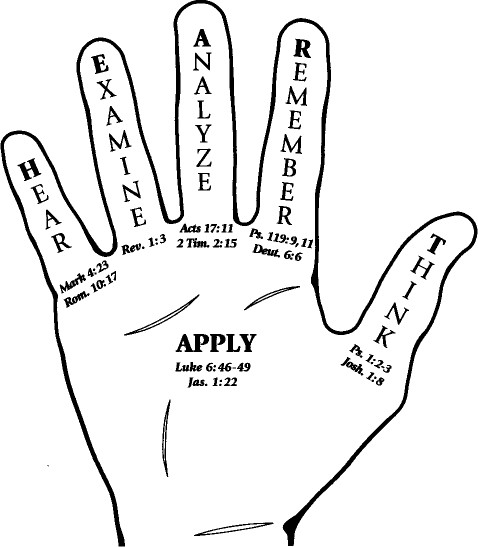
Source: Master Life - Avery Willis
SUMMARY - In the diagram above different aspects of engaging with the Word are depicted. The little finger designated HEAR describes the critical intake of the Word (Ro 10:17+, Mk 4:23+). But to begin to get a "grip" on the Bible in your hand, you need to engage the thumb and THINK. As you practice thinking on the Word, you are in effect meditating on the Word (Ps 1:2-3+, Joshua 1:8+). The other fingers designate practices which will strengthen your grip on the Living and Active Word, which in turn (and most importantly) will allow the Word to strengthen it's grip on your H.E.A.R.T. (note the first letter of each of the 5 fingers). The index finger is very important in strengthening your grip because in this endeavor you actively REMEMBER the Word, or memorize the Word, committing the passage, paragraph, chapter or book to memory by repetition and use ("use it or lose it"). EXAMINE the word refers to reading the Word, regularly and systematically (Rev 1:3+, Mt 4:4+). ANALYZE is digging deeper, a discipline that is aided greatly by learning to dig INDUCTIVELY. (Acts 17:11+, 2Ti 2:15+). Once you have the Word firmly in grip, firmly in your H.E.A.R.T, you must put the Word into practice, lest you become a modern day Pharisee, steeped in the Word, but lacking in Spirit enabled obedience (Lk 6:46-49+, James 1:22+). There you have it "handed" off to you. Take this "baton" and pass it on to other men and women who will be able to teach others also (2Ti 2:2+). In so doing, you are actively obeying the Lord Jesus' last command to MAKE DISCIPLES in Mt 28:19+, which is the critical cog in the wheel of any church that seeks to be strong in the Lord and bring Him glory.
Take a moment and do a simple, but enlightening study on Biblical meditation and notice that as you carry out this exercise, you are actually learning to practice the art and discipline of meditation on the Scriptures! You will be surprised at the completeness of your definition of Biblical meditation. And you will experience the joy of self discovery. Then you are better prepared to go to a Bible Dictionary and read someone else's definition of meditation (Also avoid going to the notes associated with each psalm until you have made your own observations).
Practice It - Observe and interrogate each occurrence of meditate in the following passages using 5W/H questions (see a few suggested questions below). Record your answers to each question (be sure to record chapter and verse of each observation). And remember to check the context (the verses before and after) to be sure your interpretation is accurate.
- What is the "object" of meditation?
- How long should one meditate?
- What should we meditate on?
- What results can we expect if we practice Biblical meditation?
- When should we meditate?
- Who should meditate?
- Where should we meditate?
- Why should we be motivated to meditate?
Hagah translated as meditate in the NAS -
Joshua 1:8-note, Ps 1:2-note, Ps 63:6-note, Ps 77:12-note, Ps 143:5-note, Isa 33:18.
Siyah translated as meditate in the NAS
Job 15:4, Ps 77:6-note, Ps 77:12-note, Ps 119:15-note, Ps 119:23-note, Ps 119:27-note Ps 119:48-note Ps 119:78-note Ps 119:148-note Ps 143:5-note (meditate = hagah, muse = siyah), Ps 145:5-note
Feminine noun siyah
Other occurrences of meditate in Scripture (in NAS)…
Genesis 24:63 (Heb = suach), Psalm 4:4-note (Heb = 'amar), Psalm 19:14-note (Heb = higgayown), Psalm 27:4-note (Heb = baqar), Psalm 49:3-note (Heb = haguth),
Now that you have seen what God Himself says about meditation, you are better prepared to assess the quality of the Bible dictionary definition of meditation (Meditation)
Webster says that meditate means to focus one’s thoughts on, to reflect on, to muse, to mull over or to ponder over and calls for a definite focusing of one’s thoughts on something so as to understand it deeply. It means to to engage in contemplation or reflection, focusing one's thoughts on some truth, reflecting and pondering that truth.
Eastern meditation calls for the subject to "empty" the mind, whereas Biblical meditation calls for the filling of one's mind with God's Word of truth and life.
Meditation is the picture of a cow masticating or ruminating – bringing up previously digested food for renewed grinding and preparation for assimilation.
Nelson's New Christian Dictionary has a picturesque definition of meditation as
Quiet time spent in contemplating the Word of God and in fumigating (Ed: fumigate = to apply smoke, vapor, or gas to especially for the purpose of disinfecting or of destroying pests) the mind of the toxic thoughts and ideas that infiltrate it every day. (Nelson's New Christian Dictionary)
Unger says that meditation is
A private devotional act, consisting in deliberate reflection upon some spiritual truth or mystery, accompanied by mental prayer and by acts of the affection and of the will, especially formation of resolutions as to future conduct… Meditation is a duty that ought to be attended to by all who wish well to their spiritual interests. It should be deliberate, close, and continuous. (Unger, M. F., Harrison, R. K., Vos, H. F., Barber, C. J., & Unger, M. F. The New Unger's Bible Dictionary. Chicago: Moody Press)
Nelson's New Illustrated Bible Dictionary says meditation is concept found primarily in the Old Testament and is "
the practice of reflection or contemplation. The word “meditation” or its verb form, “to meditate,” is found mainly in the Old Testament. The Hebrew words behind this concept mean “to murmur,” “a murmuring,” “sighing,” or “moaning"… Meditation is a lost art for many Christians, but the practice needs to be cultivated again." (Youngblood, R. F., Bruce, F. F., Harrison, R. K., & Thomas Nelson Publishers. Nelson's New Illustrated Bible Dictionary)
From the above definitions you can deduce that meditation is closely related to remembering… observe the same relationship in the following Psalms…
Psalm 63:6 When I remember Thee on my bed, I meditate on Thee in the night watches,
Spurgeon comments (Note): When I remember thee upon my bed. Lying awake, the good man betook himself to meditation, and then began to sing. He had a feast in the night, and a song in the night. He turned his bedchamber into an oratory, he consecrated his pillow, his praise anticipated the place of which it is written, "There is no night there." Perhaps the wilderness helped to keep him awake, and if so, all the ages are debtors to it for this delightful hymn. If day's cares tempt us to forget God, it is well that night's quiet should lead us to remember him. We see best in the dark if we there see God best.
And meditate on thee in the night watches. Keeping up sacred worship in my heart as the priests and Levites celebrated it in the sanctuary. Perhaps David had formerly united with those "who by night stand in the house of the Lord," and now as he could not be with them in person, he remembers the hours as they pass, and unites with the choristers in spirit, blessing Jehovah as they did. It may be, moreover, that the king heard the voices of the sentries as they relieved guard, and each time he returned with renewed solemnity to his meditations upon his God. Night is congenial, in its silence and darkness, to a soul which would forget the world, and rise into a higher sphere. Absorption in the most hallowed of all themes makes watches, which else would be weary, glide away all too rapidly; it causes the lonely and hard couch to yield the most delightful repose -- repose more restful than even sleep itself. We read of beds of ivory, but beds of piety are better far. Some revel in the night, but they are not a tithe so happy as those who meditate in God
Psalm 77:6 I will remember my song in the night. I will meditate with my heart; And my spirit ponders.
Spurgeon comments (Note): I call to remembrance my song in the night. At other times his spirit had a song for the darkest hour, but now he could only recall the strain as a departed memory. Where is the harp which once thrilled sympathetically to the touch of those joyful fingers? My tongue, hast thou forgotten to praise? Hast thou no skill except in mournful ditties? Ah me, how sadly fallen am I! How lamentable that I, who like the nightingale could charm the night, am now fit comrade for the hooting owl.
I commune with mine own heart. He did not cease from introspection, for he was resolved to find the bottom of his sorrow, and trace it to its fountain head. He made sure work of it by talking not with his mind only, but with his inmost heart; it was heart work with him. He was no idler, no melancholy trifler; he was up and at it, resolutely resolved that he would not tamely die of despair, but would fight for his hope to the last moment of life.
And my spirit made diligent search. He ransacked his experience, his memory, his intellect, his whole nature, his entire self, either to find comfort or to discover the reason why it was denied him. That man will not die by the hand of the enemy who has enough force of soul remaining to struggle in this fashion
Psalm 143:5 I remember the days of old; I meditate on all Thy doings; I muse** on the work of Thy hands.
Spurgeon comments (Note): I remember the days of old. When we see nothing new which can cheer us, let us think upon old things. We once had merry days, days of deliverance, and joy and thanksgiving; why not again? Jehovah rescued his people in the ages which lie back, centuries ago; wily should he not do the like again? We ourselves have a rich past to look back upon; we have sunny memories, sacred memories, satisfactory memories, and these are as flowers for the bees of faith to visit, from whence they may make honey for present use. I meditate on all thy works. When my own works reproach me, thy works refresh me. If at the first view the deeds of the Lord do not encourage us, let us think them over again, ruminating and considering the histories of divine providence. We ought to take a wide and large view of all God's works; for as a whole they work together for good, and in each part they are worthy of reverent study. I muse on the work of thy hands. This he had done in former days, even in his most trying hours. Creation had been the book in which he read of the wisdom and goodness of the Lord. He repeats his perusal of the page of nature, and counts it a balm for his wounds, a cordial for his cares, to see what the Lord has made by his skilful hands. When the work of our own hand grieves us, let us look to the work of God's hands.
Memory, meditation, and musing are here set together as the three graces, ministering grace to a mind depressed and likely to be diseased. As David with his harp played away the evil spirit from Saul, so does he hero chase away gloom from his own soul by holy communion with God.
William Gurnall adds - Meditation is prayer's handmaid to wait on it, both before and after the performance of supplication. It is as the plough before the sower, to prepare the heart for the duty of prayer; and as the harrow after the sower, to cover the seed when 'tis sown. As the hopper feeds the mill with grist, so does meditation supply the heart with matter for prayer.
David's method.
He gathered materials; facts and evidence concerning God: "I remember."
He thought out his subject and arranged his matter: "I meditate."
He discoursed thereon, and was brought nearer to God: "I muse" -- discourse.
Let us close by viewing all this as an example for preachers and others. -- W. B. H.
**"Muse" (Heb: siyah) is closely related to "meditate" (Heb: hagah) and conveys the basic meaning of to rehearse or go over a matter in one's mind. It can even mean to speak aloud with oneself! (See Spurgeon's Sermon entitled Quiet Musing)
Meditation is the act of focusing one’s thoughts, of pondering, of reflecting, and of reviewing various thoughts by mulling them over in the mind and heart. The picture is one of "chewing" upon a thought, deliberately and thoroughly, providing a vital link between theory and action. Meditation consists of reflective thinking, rumination or contemplation, usually on a specific subject with the purpose of discerning its meaning or significance or a plan of action. What metabolism is to the physical body of the cow, meditation is to a saint's mental and spiritual life.
Through meditation we internalize
that we may personalize.
THOUGHT - You may be saying "I don't know how to meditate." To which I would say "Yes, you do." You know how to worry don't you? If you can worry, you can meditate because the essence of both is repetitively turning thoughts over in our mind. Like a cow ruminating, we all tend to bring up those thoughts or issues that about which we are anxious.
In meditation we allow our mind to think upon what is true, honorable, right, pure, lovely, etc (Php 4:8+), "ruminating" (chewing the cud) on God's Truth at various times throughout the day. The more we chew, the better we "digest" with the result that our minds are continually being renewed and we are being transformed from glory to glory. Meditation is then to the soul what digestion is to the body. In this day of "fast food", such meditation is rare and even more needed. Remember too that meditation is difficult to impossible without Memorizing God's Word. As we become more comfortable interrogating the Scripture with the 5W'S & H questions, we will become more adept at meditation.
To reiterate the points described above, the hand illustration is a good demonstration of how to grab hold of the Word (and let it grab hold of you!). Pick up your Bible and try to hold it with one finger, two fingers, etc. The fact is that your grip on the Word is not firm until you have all four fingers and the thumb grasping it. Now think about each finger as representing intake of the Word of God by hearing, reading, studying, and memorizing. Now, let the thumb represent meditation. When we "grasp" the Word with the four fingers and the thumb, our grip is firm. By analogy, when we begin to meditate on the Scriptures as part of the other four activities, we begin to discover the transforming power of God's Word at work in our innermost spirit (2Co 3:18+, Ro 12:2+). The point of this illustration is that to be diligent to study the Scriptures inductively and yet to forgo or forget to meditate is to miss out on the life changing power of meditation (Ps 1:2-3+, Joshua 1:8+).
Dawson Trotman illustrated Biblical meditation by comparing the way cows get the cud on which they chew…
A cow eats grass as it grazes early in the morning. When the sun gets hot (Ed: When we are tempted, when we experience unexpected trials, etc), it will lie in the shade of a tree, and through the use of a unique elevator system it will bring up the grass from one stomach (Ed: The verses we have memorized. The passages we read that morning. The Scriptures in the sermon we heard on Sunday which we jotted down in our notes [NB: "use it or lose it"], etc.) and thoroughly masticate it (Ed: We "chew the cud" of the Scriptures the Spirit brings to our mind). When this is finished, it will put it into another stomach, having gotten from it everything possible in the way of nutrients.
As a practical exercise click here and meditate on the Scriptural uses of the Hebrew words which are translated meditate (remember to read the context). Make a list of what you learn about meditating on meditation and be blessed!
Although not meditation per se, the Hebrew word Selah is used in the Psalms and three times in Habakkuk 3 and calls for the reader to pause which is a good time to ponder or meditate.
Selah (05542) selah invites the reader/singer to stop and think about that thought. This expression is thought to be equivalent to a musical rest in which the reader or singer was instructed to stop and think about what he just sang or read. It affords an opportunity for pause and reflection upon what has been said. Someone has suggested that when we read it, we probably should not vocalize it anymore than a singer would vocalize the rests of a musical composition. Whatever its meaning, an obvious break was intended in the middle of Hab 3:3. For some reason, the ESV choose to place Selah at the end of verse. The NJB translates it as "Pause."
Gilbrant - Selāh is evidently some type of liturgical direction for those participating in performing a Psalm. Despite much discussion, a considerable amount of uncertainty remains about the word. Selāh appears in a variety of settings in the Psalms. It sometimes appears at the end of a section of thought (Ps. 3:2, 4) or the end of a Psalm (3:8). It may appear at the end of material that was originally a quotation (perhaps Ps. 44:8). At other times, it is difficult to discern why it was used at a particular point (Ps. 68:7).
The word has a clear connection to musical performance. It almost always occurs in Psalms that bear titles, most often by David or one of the Levitical worship leaders. In fact, three-fourths of the Psalms in which selāh occur mention a choir director.
Various theories have been suggested for its meaning: (1) The Septuagint translates it with the Greek word diaspalma, which is usually understood as a "musical interlude." (or break) (2) Strong and others have suggested that it be explained as a "pause," claiming that it comes from the verb sālāh in the sense of "to weigh," so that it means "suspension"; thus, a "pause." (3) A Palestinian Jewish tradition adopted by Jerome translated it as "forever," though the basis for this rendering is slim. It was seen as a direction to insert a benediction or chorus at that point. (4) Most commentators believe it is derived from the verb sālal, which means "to lift up," "to exalt." If so, there is still room for discussion as to whether it means to raise one's voice and sing loudly or to lift up the volume of the instrumental accompaniment. (Complete Biblical Library)
Selah - Ps. 3:2; Ps. 3:4; Ps. 3:8; Ps. 4:2; Ps. 4:4; Ps. 7:5; Ps. 9:16; Ps. 9:20; Ps. 20:3; Ps. 21:2; Ps. 24:6; Ps. 24:10; Ps. 32:4; Ps. 32:5; Ps. 32:7; Ps. 39:5; Ps. 39:11; Ps. 44:8; Ps. 46:3; Ps. 46:7; Ps. 46:11; Ps. 47:4; Ps. 48:8; Ps. 49:13; Ps. 49:15; Ps. 50:6; Ps. 52:3; Ps. 52:5; Ps. 54:3; Ps. 55:7; Ps. 55:19; Ps. 57:3; Ps. 57:6; Ps. 59:5; Ps. 59:13; Ps. 60:4; Ps. 61:4; Ps. 62:4; Ps. 62:8; Ps. 66:4; Ps. 66:7; Ps. 66:15; Ps. 67:1; Ps. 67:4; Ps. 68:7; Ps. 68:19; Ps. 68:32; Ps. 75:3; Ps. 76:3; Ps. 76:9; Ps. 77:3; Ps. 77:9; Ps. 77:15; Ps. 81:7; Ps. 82:2; Ps. 83:8; Ps. 84:4; Ps. 84:8; Ps. 85:2; Ps. 87:3; Ps. 87:6; Ps. 88:7; Ps. 88:10; Ps. 89:4; Ps. 89:37; Ps. 89:45; Ps. 89:48; Ps. 140:3; Ps. 140:5; Ps. 140:8; Ps. 143:6; Hab. 3:3; Hab. 3:9; Hab. 3:13
QUESTION -What does selah mean in the Bible? Watch the accompanying video.
ANSWER - The word selah is found in two books of the Bible, but is most prevalent in the Psalms, where it appears 71 times. It also appears three times in the third chapter of the minor prophet Habakkuk.
There is a great deal of uncertainty about the meaning of selah. Most versions of the Bible do not attempt to translate selah but simply transliterate the word straight from the Hebrew. The Septuagint translated the word as “daplasma” (“a division”). Well-meaning Bible scholars disagree on the definition of selah and on its root word, but since God has ordained that it be included in His Word, we should make an effort to find out, as best we can, the meaning.
One possible Hebrew word related to selah is calah, which means “to hang” or “to measure or weigh in the balances.” Referring to wisdom, Job says, “The topaz of Ethiopia shall not equal it, neither shall it be valued with pure gold” (Job 28:19). The word translated “valued” in this verse is the Hebrew calah. Here Job is saying that wisdom is beyond comparing against even jewels, and when weighed in the balance against wisdom, the finest jewels cannot equal its value.
Selah is also thought to be rendered from two Hebrew words: s_lah, “to praise”; and s_lal, “to lift up.” Another commentator believes it comes from salah, “to pause.” From salah comes the belief that selah is a musical notation signifying a rest to the singers and/or instrumentalists who performed the psalms. If this is true, then each time selah appears in a psalm, the musicians paused, perhaps to take a breath, to sing a cappella, or to let the instruments play alone. Perhaps they were pausing to praise the One about whom the song was speaking, perhaps even lifting their hands in worship. This theory would encompass all these meanings—“praise,” “lift up,” and “pause.” When we consider the three verses in Habakkuk, we also see how selah could mean “to pause and praise.” Habakkuk’s prayer in chapter 3 inspires the reader to pause and praise God for His mercy, power, sustaining grace, and sufficiency.
Perhaps the best way to think of selah is a combination of all these meanings. The Amplified Bible adds “pause and calmly think about that” to each verse where selah appears. When we see the word selah in a psalm or in Habakkuk 3, we should pause to carefully weigh the meaning of what we have just read or heard, lifting up our hearts in praise to God for His great truths. “All the earth bows down to you; they sing praise to you, they sing the praises of your name. Selah!” (Psalm 66:4). GotQuestions.org
Reading the Bible without meditating on it is like eating without chewing. (Click here and read more in depth discussion in A Primer on Meditation)
We must read Scripture every day
And meditate on what God said
To fight temptation from the world
And live a life that's Spirit led. --Sper
Dr. Denis Burkitt achieved fame for discovering the cause and cure of a disease named after him-- Burkitt's lymphoma. He also received widespread acclaim for demonstrating the benefits of a fiber-rich diet, which earned him the amusing nickname "Fiber Man."
What many people don't know, however, is that Dr. Burkitt was not merely a great medical pioneer; he was a dedicated servant of God who daily spent much time in prayer and meditation on God's Word. He observed,
I am convinced that a downgrading in priority of… prayer and biblical meditation is a major cause of weakness in many Christian communities… Bible study demands pondering deeply on a short passage, like a cow chewing her cud. It is better to read a little and ponder a lot than to read a lot and ponder a little.
Dr. Burkitt didn't leave just a great legacy of healing; he left an example of personal holiness and closeness with the Lord. The secret was his lifelong habit of setting aside a specific time for prayer and reflection on God's Word. Few of us will ever enjoy accomplishments like his, but by following the prescription of Psalm 1:2-note we can attain the same spiritual health that he did.
In the stillness of the morning,
Before a busy day of care,
How sweet to be alone with God
Through His holy Word and prayer! --Anderson
God speaks to those who take the time to listen.
Prayer is talking with God.
Meditation is listening to God.
If you have an hour set aside to read the Scriptures, try reading the first half hour and then using the second half hour to reflect or meditate on what you read. Applying the guidelines for careful observation and interpretation can objectively aid your efforts to meditate on the Word. Watch the difference it makes. You’re reading too much if you have no time to genuinely meditate on what you read. If you keep a devotional notebook, jot down your thoughts inspired by observing, interpreting and meditating on the passage.
Meditation on the Person and works of God can bring refreshment and invigoration to any believer (cp "rest for your souls" - Mt 11:28, 29, 30).
Meditation on God fills a basic need in the heart of every person, as basic a need as food and drink (Mt 4:4). It not only satisfies the believer but overflows in praise making him or her a blessing to others.
Meditate (01897) (hagah) conveys the basic meaning of a low sound and so as used in the OT means to groan, to sigh or to mutter. Figuratively hagah refers to inward utterance, the words a man speaks to himself. And so hagah means to meditate (give serious thought and consideration to selected information implying a definite focusing of one’s thoughts on something so as to understand it deeply), to ponder (to carefully weigh in the mind, to appraise), to ruminate (literally to chew repeatedly for an extended period and figuratively to go over in the mind repeatedly and often casually or slowly). Hagah can also refer to giving and open and loud expression to one's thoughts. When hagah is used in the sense of “to mourn,” (Jer 48:31) it apparently emphasizes the sorrowful sounds of mourning.
Vine comments that hagah "seems to be an onomatopoetic term, reflecting the sighing and low sounds one may make while musing, at least as the ancients practiced it." He adds that "The idea that mental exercise, planning, often is accompanied by low talking seems to be reflected by Pr 24:1, 2 (see below) (Online Vine's Expository Dictionary of Old Testament and New Testament Words)
Be not envious of evil men, And desire not to be with them. For destruction doth their heart meditate (hagah), and perverseness do their lips speak." (Proverbs 24:1-2 Young's Literal)
Hagah can refer to the mutterings of mediums and wizards (Isa 8:19), the moans of grief (Isa 16:7), the growl of a lion (Isa 31:4) or the coos of a dove (Isa 38:14).
In the biblical world hagah conveys a somewhat different picture than does the English word “meditation,” which conveys the idea of a silent mental exercise only. In contrast, in Hebrew thought, to meditate upon the Scriptures was not necessarily a silent practice but meant to quietly repeat them in a soft, droning sound, while utterly abandoning outside distractions. From this tradition comes a specialized type of Jewish prayer called “davening,” that is, reciting texts, praying intense prayers, or getting lost in communion with God while bowing or rocking back and forth. Evidently this dynamic form of meditation-prayer goes back to David’s time.
Baker - A verb meaning to growl, to groan, to sigh, to mutter, to speak; used figuratively: to meditate, to ponder. The Lord told Joshua to meditate on the Law day and night (Josh. 1:8), and the Psalms proclaimed people blessed if they meditate on the Law (Ps. 1:2). Job promised not to speak wickedness (Job 27:4). The Hebrew verb can also refer to the mutterings of mediums and wizards (Isa. 8:19); the moans of grief (Isa. 16:7); the growl of a lion (Isa. 31:4); the coos of a dove (Isa. 38:14). (Complete Word Study Dictionary: Old Testament )
Gilbrant - The primary meaning of this noun appears to be "to utter incoherent sounds." It is used in Isaiah to describe the roar of a lion (31:4) and the chirping of a bird (38:14; 59:11). The verb appears in the Hiphil parallel to "chirp" (HED #7128), in a description of what a person does when consulting mediums concerning the dead (8:19).
It is used to describe a wide variety of other types of speech. Idols do not posses the power of speech (Ps. 115:7). It is used in the context of lamentation (Jer. 48:31; Isa. 16:7; Ezek. 2:10) and in praise (Ps. 35:28). It is used to denote one who speaks of doing injustice or wickedness (Job 27:4; Ps. 19:14; 49:3; Isa. 59:3; Lam. 3:62), and one who speaks of doing righteousness (Ps. 37:30; 38:12; 71:24).
It is used in the sense of "to plot," or "to meditate" upon evil (Ps. 2:1, 38:12; Prov. 24:2). One also employs this verb to meditate upon Yahweh (Ps. 63:6), his works (Ps. 77:12, 143:5), and upon his written Law (Josh. 1:8; Ps. 1:2, 119:97). This meditation is not removed from speaking, as Joshua commands "this book of the law shall not depart out of your mouth, but you shall meditate on it day and night, that you may be careful to do all that is written in it." To do so involved "muttering" or "reading in an undertone." Regardless of any particular nuance to employing this verb in this context might employ (e.g., one reading aloud, etc.) the main thrust is certainly clear that the Israelites was to be consumed by the study of the Law.(Complete Biblical Library)
Hagah - 24 times in NAS - declare, 1; devise, 2; devising, 1; growls, 1; make a sound, 1; meditate, 5; meditates, 1; moan, 3; moan sadly, 1; mutter, 2; mutters, 1; ponders, 1; utter, 2; uttering, 1; utters, 1.- Jos. 1:8; Job 27:4; Ps. 1:2; Ps. 2:1; Ps. 35:28; Ps. 37:30; Ps. 38:12; Ps. 63:6; Ps. 71:24; Ps. 77:12; Ps. 115:7; Ps. 143:5; Prov. 8:7; Prov. 15:28; Prov. 24:2; Isa. 8:19; Isa. 16:7; Isa. 31:4; Isa. 33:18; Isa. 38:14; Isa. 59:3; Isa. 59:11; Isa. 59:13; Jer. 48:31
Below are uses of Hagah which are translated meditate in the NAS…
1) Joshua 1:8-note “This book of the law shall not depart from your mouth, but you shall meditate (hagah) on it day and night, so that you may be careful to do according to all that is written in it; for then you will make your way prosperous, and then you will have success."
2) Psalm 1:2-in depth note But (what should you always do when you see a contrast word? click here) his delight is in the law of the Lord, and in His law he meditates (hagah) day and night. (Click for separate exercise on practicing observation using Psalm 1)
C H Spurgeon: The godly man's delight is the the law of the Lord. He is not under the law as a curse and condemnation, but he is in it, and he delights to be in it as his rule of life; he delights, moreover, to meditate in it, to read it by day and think upon it by night. He takes a text and carries it with him all day long; and in the night-watches, when sleep forsakes his eyelids, he muses upon the Word of God. In the day of his prosperity he sings psalms out of the Word of God, and in the night of his affliction he comforts himself with promises out of the same book. The law of the Lord is the daily bread of the true believer. And yet, in David’s day, how small was the volume of inspiration, for they had scarcely anything save the first five books of Moses! How much more, then, should we prize the whole written Word which it is our privilege to have in all our houses! But, alas, what ill-treatment is given to this angel from heaven! We are not all Berean searchers of the Scriptures. How few among us can lay claim to the benediction of the text! Perhaps some of you can claim a sort of negative purity, because you do not walk in the way of the ungodly; but let me ask you—Is your delight in the law of God? Do you study God’s Word? Do you make it the man of your right hand—your best companion and hourly guide? If not, this blessing does not belong to you. (Treasury of David)
3) Psalm 63:6 When I remember Thee on my bed, I meditate (hagah) on Thee in the night watches.
In David's time the night was divided into three watch periods and his use of the plural ("night watches") suggests that in his intense devotion, he meditated upon Jehovah all through the night. If we (under grace not law) were to practice this discipline, what might it do to communion with the Almighty! In the next verse David explains why he remembers and meditates ("for" or "because" introduces an explanation) writing "for Thou hast been my Help… " where "Help" is the Hebrew 'ezra (one who assists, supplies or serves another with what is needed)
John Courson presents an interesting picture of meditating "in the night watches" writing that: Just as a radio picks up dozens of extra stations at night, so my heart is sometimes extra-sensitive to Him when the sky is black, the air still, and the house quiet at last. (Jon Courson's Application Commentary. Nashville, TN: Thomas Nelson)
J Vernon McGee in his inimitable style writes that: David thought about God—meditated upon Him—during the night when he couldn’t sleep. My friend, meditating upon God’s goodness is a lot better than counting sheep!" (McGee, J V: Thru the Bible Commentary: Thomas Nelson or Logos)
C H Spurgeon writes that: Night is congenial, in its silence and darkness, to a soul which would forget the world, and rise into a higher sphere. Absorption into the most hallowed of all themes makes watches which else would be weary glide away all too rapidly; it causes the lonely and hard couch to yield repose more restful than even sleep itself. (Treasury of David) (See a
See Spurgeon's Sermon on the practice and advantages of Biblical Meditation = Quiet Musing
4) Psalm 77:12 I will meditate on all Thy work, and muse (siyah 07878 = see below) on Thy deeds.
5) Psalm 143:5 I remember the days of old; I meditate on all Thy doings; I muse on the work of Thy hands.
QUESTION - How can I meditate on God’s Word?
ANSWER - The spiritual practice of meditation is not unique to Christianity. Many non-Christian religions and secular groups practice meditation. However, when the Bible speaks of meditation, as it often does, it is not the kind of meditation that seeks to disengage, silence, or empty the mind, as in Transcendental or Buddhist forms of meditation. The Scriptures teach meditation that actively engages the mind for the purpose of understanding God’s Word and putting it into practice. How can we meditate on God’s Word so that it produces in us fruitful and holy lives before God?
In the ancient Hebrew world, meditation always involved exercising and engaging the mind. Thomas Watson, a seventeenth-century Puritan minister, devoted much of his life to biblical meditation, both practicing it and teaching about it. He aptly defined the discipline in his book Heaven Taken by Storm as “an holy exercise of the mind, whereby we bring the truths of God to remembrance, and do seriously ponder upon them, and apply them to our selves.”
By Watson’s definition, we can meditate on God’s Word by bringing to memory His truths. Remembering requires active, cognitive recall of what we know about God from His Word: “On my bed I remember you; I think of you through the watches of the night” (Psalm 63:6). According to Psalm 1:2, a blessed, fruitful, and righteous person delights in the Word of the Lord “and meditates on his law day and night.” This meditation is constant (“day and night”) and focused on God’s Word (“his law”). We meditate on God’s Word by filling our minds with it day and night.
God called Joshua to vigorous and continual meditation: “Keep this Book of the Law always on your lips; meditate on it day and night, so that you may be careful to do everything written in it. Then you will be prosperous and successful” (Joshua 1:8). Here, biblical meditation expands from merely thinking to speaking (“on your lips”). The passage also states the purpose of meditation, that is, obedience to God’s Word, which produces prosperity and success before God.
Watson’s description of meditation includes serious contemplation or pondering of God’s truth. Psalm 119:15 says, “I will study your commandments and reflect on your ways” (NLT). So biblical meditation involves deep reflection and study of God’s Word. When we read the Bible, are we reading it slowly and intentionally? Are we thinking about the significance of the words and how they relate to our lives and the lives of others? If so, we are meditating on God’s Word.
Meditation requires time and effort. It can’t be rushed. It involves withdrawing from the distractions of this life so that we can fix our thoughts on God and His Word. By shutting out the noise of this world, we are better able to focus our attention on God and understand His ways: “I have more insight than all my teachers, for I meditate on your statutes” (Psalm 119:99).
Finally, as Watson touched on, biblical meditation seeks to apply God’s Word to our lives. Psalm 19:14 illustrates this truth: “May these words of my mouth and this meditation of my heart be pleasing in your sight, LORD, my Rock and my Redeemer.” Meditating on God’s Word becomes pleasing in God’s sight because it results in the transformation of our lives. As we read and speak God’s truth and actively ponder it, the Holy Spirit enables us to put that truth into practice. In Philippians 4:8–9, the apostle Paul gives us this beautiful and complete picture of biblical meditation: “Finally, brothers and sisters, whatever is true, whatever is noble, whatever is right, whatever is pure, whatever is lovely, whatever is admirable—if anything is excellent or praiseworthy—think about such things. Whatever you have learned or received or heard from me, or seen in me—put it into practice. And the God of peace will be with you.”
Meditation is a way of internalizing God’s Word—taking it deep into our hearts—so that the Holy Spirit can work through it to guide, teach, purify, and transform us from within. We can listen to the Bible, read it, and memorize Scripture to get it into our minds, but then we must also ponder it continually in our hearts so that we gain a deeper understanding of it and how it applies to our lives.
Here are four practical tips for meditating on God’s Word:
1. Carve out a specific time and place each day when you are least likely to be interrupted or distracted to get alone and meditate on God’s Word.
2. Start with prayer and ask God to help you with your meditation. You can ask the Lord to draw you closer to Him, open your eyes to His truth, help you apply that truth in your life, and transform you as you meditate on God’s Word.
3. Choose a small section of Scripture. Think about what the passage means. Study it in depth so that you can understand it in context. Take notes. Ask questions. Memorize the passage. Ask God what He wants to say to you through the text.
4. Consider how you can apply the passage to your life in practical ways, and ask God to help you follow through in obedience to what He shows you. GotQuestions.org
QUESTION - What is Christian meditation?
ANSWER - Psalm 19:14 states, “May the words of my mouth and the meditation of my heart be pleasing in your sight, O Lord, my Rock and my Redeemer.” What, then, is Christian meditation, and how should Christians meditate? Unfortunately, the word “meditation” can carry the connotation of something mystical. For some, meditation is clearing the mind while sitting in an unusual position. For others, meditation is communing with the spirit world around us. Concepts such as these most definitely do not characterize Christian meditation.
Christian meditation has nothing to do with practices that have Eastern mysticism as their foundation. Such practices include lectio divina, transcendental meditation, and many forms of what is called contemplative prayer. These have at their core a dangerous premise that we need to “hear God’s voice,” not through His Word, but through personal revelation through meditation. Some churches are filled with people who think they are hearing a “word from the Lord,” often contradicting one another and therefore causing endless divisions within the body of Christ. Christians are not to abandon God’s Word, which is “God-breathed and is useful for teaching, rebuking, correcting and training in righteousness, so that the man of God may be thoroughly equipped for every good work” (2 Timothy 3:16-17). If the Bible is able to thoroughly equip us for every good work, how could we think we need to seek a mystical experience instead of or in addition to it?
Christian meditation is to be solely on the Word of God and what it reveals about Him and His works (Psalm 77:10–12; 143:5). David found this to be so, and he describes the man who is “blessed” as one whose “delight is in the law of the LORD, and on his law he meditates day and night” (Psalm 1:2). True Christian meditation is an active thought process whereby we give ourselves to the study of the Word, praying over it and asking God to give us understanding by the Spirit, who has promised to lead us “into all truth” (John 16:13). Then we put this truth into practice, committing ourselves to the Scriptures as the rule for life and practice as we go about our daily activities. This causes spiritual growth and maturing in the things of God as we are taught by His Holy Spirit. GotQuestions.org
QUESTION - What are some biblical examples of meditation?
ANSWER - Meditation is the act of focusing one’s mental energies on a specific topic in an effort to achieve resolution or peace of mind. Biblical meditation narrows that definition to a spiritual exercise focused on Scripture. In biblical meditation, a person deliberately quiets the heart and contemplates certain verses, asking, “What is this saying to me about my life and situation?” or “What is this saying about God?” Biblical meditation can include prayer, Bible memory, and reading. Meditation was common in Bible times, and Joshua 1:8 commands it, promising reward for meditating on and obeying Scripture: “Keep this Book of the Law always on your lips; meditate on it day and night, so that you may be careful to do everything written in it. Then you will be prosperous and successful.”
The Psalms are filled with exhortations to meditate on all the qualities of God. Bible verses about meditation showcase the differences between it and yoga or other forms of non-biblical meditation. Meditating correctly lifts our hearts up in communion with God. Our focus is on Him, not ourselves. We are personalizing truths found in His Word, not seeking to find truth within ourselves. Psalm 119:15–16 notes the object of our meditation: “I meditate on your precepts and consider your ways. I delight in your decrees; I will not neglect your word.” Psalm 77:12 says, “I will consider all your works and meditate on all your mighty deeds.” This verse well summarizes godly meditation and should be the daily prayer of every Christian: “May the words of my mouth and the meditation of my heart be pleasing to you, O LORD, my rock and my redeemer” (Psalm 19:14NLT).
The first biblical example of meditation is found in Genesis 24:63, when Isaac went into the fields in the evening to meditate. While there, he saw his father’s servant returning from Aram Naharaim with Rebekah, who was soon to be Isaac’s bride. The way the Bible records this event hints that meditation was part of Isaac’s regular routine. We don’t know the exact nature of his meditation that day, but he knew that his father had sent for a wife for him. It is likely that Isaac’s daily meditations involved prayer for his future bride, concerns about becoming a husband, and gratefulness to God that he would no longer be lonely after the death of his mother (see Genesis 24:67).
King David gives us another example of meditation. In 2 Samuel 7:1-29, Nathan the prophet relays the message that the Lord did not want David to build a house for Him. Instead, God would raise up David’s son (Solomon) who would have that honor. In response to this news, “David went in and sat before the Lord” (verse 18). The rest of the chapter records David’s prayer to God as part of his meditation. “Sitting before the Lord” is a good description of times when we quiet our hearts to commune with God. We remove distractions, enter into a spirit of worship, pray, and allow the Holy Spirit to search our hearts and reveal what needs to be changed (Psalm 139:23). In that quietness, God often brings to mind passages of Scripture we have previously learned and applies them to our current situation.
For example, a teacher may wrestle with a request from a particularly annoying student to chauffer him somewhere. He does not want to do this. He has prayed, “Lord, I would do it for you, but I don’t want to do it for him. I’ve helped him enough.” But he does not stop with a prayer. He takes time to meditate on the Lord and His glory, and as he does, a verse comes to mind: “Truly I tell you, whatever you did for one of the least of these brothers and sisters of mine, you did for me” (Matthew 25:40). The teacher now has direction. Not only do we learn more of God when we meditate, but He can speak to us when our minds are focused on Him.
Psalm 1:1–2 promotes meditation: “Blessed is the one . . . whose delight is in the law of the Lord, and who meditates on his law day and night.” To be blessed is to be spiritually prosperous and favored by God. But how is it possible to meditate on God’s law “day and night”? That happens when meditation becomes habitual, part of one’s lifestyle. A person who is filled with the Spirit (Galatians 5:16, 25) lives in a state of ongoing meditation, even while going about a daily routine. God is never far from his or her mind, and every sight, sound, and event is another opportunity to share with the Lord. “The traffic is scary today, Lord. Thank you for your protection.” “That redbud tree is gorgeous, Lord. It reminds me of your beauty and creativity. Your Word says that all your works praise you (Psalm 145:10), and that tree certainly does!” When our hearts are in tune with God, meditation comes naturally and is a good way to keep ourselves from evil (Psalm 34:14–15). GotQuestions.org
1) Siyah (verb) (07878) the basic meaning is idea of reflection (a thought, idea, or opinion formed or a remark made as a result of meditation), of rehearsing something or going over a matter in one’s mind, or of thoughtfully contemplating something. It means to meditate, muse on, consider, think on, ponder and so give serious consideration to information, or a situation. This meditation or contemplation may be done either inwardly or outwardly.
Baker - A verb meaning to ponder, to converse, to utter, to complain, to meditate, to pray, to speak. Its primary use is to complain. In Job, the word denotes the action that Job took against the bitterness in his soul, that is, his complaints (Job 7:11). God’s people were instructed to sing praises to Him (1 Chr. 16:9; Ps. 105:2). This singing tells of all His wondrous acts. The word is used in Job to denote speaking to the earth (Job 12:8); while Isaiah used it to depict Christ’s dying without children, that is, descendants (Isa. 53:8). Isaiah’s rhetorical question denoted that an absence of descendants was normally a shameful thing in the culture. (Complete Word Study Dictionary: Old Testament )
Gilbrant- Meaning “to ponder” or “to consider,” the basic sense of sîach seems to be “to rehearse,” “to repent” or “to go over in one’s mind.” The action can be done either inwardly as meditation or outwardly as talking. In reference to outward manifestations, sîach can connote joyful praise (Judg. 5:10), sometimes expressed through singing (1 Chr. 16:9; Ps. 105:2), and also lamentation, on account of the miserable conditions of a person’s life (Job 7:11; Pss. 55:17; 77:3, 6). Both this loud praising and complaining are typically directed toward God. The verb can refer also to derisive talk about another individual. For example, the psalmist complained that the leaders who sat at the city gate “gossiped” against him (69:12, NRSV). Elsewhere, sîach designates the verbal teaching of one’s mother and the admonition not to forsake it (Prov. 6:22). In Psalms, God is the primary object of quiet reflection, whether it be upon his majesty (Ps. 145:5) or his commands and statutes (119:15, 23, 27, 48, 78, 148). (Complete Biblical Library)
Siyah (07878) 20 times - complain, 2; considered, 1; meditate, 7; meditates, 1; muse, 2; sigh, 1; sing, 1; speak, 3; talk, 2. The KJV translates siyah once as "commune". Jdg 5:10; 1Chr 16:9; Job 7:11; 12:8; Ps 55:17; 69:12; 77:3, 6, 12; 105:2; 119:15, 23, 27, 48, 78, 148; 143:5; 145:5; Pr 6:22; Isa 53:8.
2) Siyah (masculine noun) (07879) As the translations suggest, the primary meaning of the word is complaint but it is used once for meditation.
Baker - A masculine noun meaning contemplation, meditation, prayer, talk, utterance, babbling. The primary meaning of the word is a complaint. In Job’s narrative, he stated that even his couch would not ease his complaint (Job 7:13); that even if he were to forget his complaint, he would still dread all of his sufferings (Job 9:27); and because he loathed his very life, he would give free reign to his complaint (Job 10:1). Elijah mocked the prophets of Baal, telling them to cry louder because their god might be deep in thought (1 Kgs. 18:27). The word is also used to denote Hannah’s prayer containing words of great anguish (1 Sam. 1:16). The psalmist used the word to depict meditation that he hoped would be pleasing to the Lord (Ps. 104:34). (Complete Word Study Dictionary: Old Testament )
Siyah (07879) -13 times in the NAS - complaining, 1; complaint, 8; concern, 1; meditation, 1; occupied, 1; talk, 1. 1Sa 1:16; 1Ki 18:27; 2 Kgs 9:11; Job 7:13; 9:27; 10:1; 21:4; 23:2; Ps 55:2; 64:1; 104:34; 142:2; Pr 23:29
3) Siyah (feminine noun) (07881) Baker - שִׂיחָה śiyḥāh: A feminine noun meaning meditation, reflection, concern of one’s thoughts, musing, reflection. The word is primarily used to indicate meditation. The psalmist indicated the proper procedure for an individual’s response to God’s Law. Because of his love for God’s Law, the psalmist was prompted to meditate on it all day long. Due to his practice of meditation, the psalmist received more understanding than his elders (Ps. 119:97, 99). As Job expressed his feelings and frustrations, Eliphaz responded condemningly, stating that what Job was feeling and saying was hindering devotion to God (Job 15:4). Eliphaz’s response was that of an ignorant man who did not realize the true nature of devotion to God (Complete Word Study Dictionary: Old Testament )
Siyah (07881) - 3 times in the NAS (Job 15:4; Ps 119:97, Ps 119:99)
Study uses of siyah (77878) translated meditate carefully observing what the Bible says about meditation before you read the accompanying notes.
1) 1Chronicles 16:9 Sing ye to Him, sing psalms to Him. Meditate on all His wonders.
This was David's exclamation of praise when the ark of God was brought into Jerusalem and placed inside the tent which he had pitched for it, and after the priests had offered burnt offerings and peace offerings before God. Note the focus of the meditation was on all (no exceptions) of God's wonderful, marvelous, amazing acts… thus providing all believers a good template for our times of meditation.
2) Psalm 55:17 "Evening, and morning, and noon, I meditate (siyah, NAS translates it as "complain"), and make a noise, and He heareth my voice (Young's Literal)
Spurgeon writes that
Some cry aloud who never say a word. It is the bell of the heart that rings loudest in heaven. Some read it, “I will muse and murmur”; deep heart-thoughts should be attended with inarticulate but vehement utterances of grief. A father’s heart reads a child’s heart." (Treasury of David).
J Vernon McGee adds
What a picture that gives of David’s distress—“Evening, and morning, and at noon, will I pray, and cry aloud.” My friend, one good thing your enemy will do for you is to cause you to pray more than you have ever prayed before!" (McGee, J V: Thru the Bible Commentary: Thomas Nelson)
3) Psalm 77:6 I will remember my song in the night; I will meditate with my heart; And my spirit ponders.
To receive the full impact and blessing of this (and the following) verse from Asaph's psalm, you must read the entire psalm for the context. What was Asaph's state of mind in the first part of the psalm? What role does meditation play in producing a changed mindset in this godly man? Draw your own conclusions before you read the comments below.
4) Psalm 77:12 I will meditate (hagah) on all Thy work, and muse (siyah 07878) on Thy deeds.
After introspection had plunged him into the depths of despondency, Asaph turns his eyes heavenward and determines to reflect on God’s past interventions for His people when they were in tight spots. This leads him at once to the acknowledgment that God is holy, that everything He does is perfect, righteous, and good. He makes no mistakes. (BORROW Believer's Bible Commentary)
C H Spurgeon adds that it is
Sweet work to enter into Jehovah’s work of grace, and there to lie down and ruminate, every thought being absorbed in the one precious object. And talk of Thy doings. It is well that the overflow of the mouth should indicate the good matter which fills the heart. Meditation makes rich talking; it is to be lamented that so much of the conversation of believers is utterly barren, because they take no time for contemplation. Meditative people should be talkers, otherwise they are mental misers, mill which grind corn only for the miller. The subject of our meditation should be choice, and then our talk will be edifying; if we meditate on folly and pretend to speak wisdom, our double mindedness will soon be known to everyone. Holy talk following upon meditation has a consoling power in it for ourselves as well as for those who listen. (Treasury of David).
Warren Wiersbe commenting on this psalm writes that
Joyless days of trouble and sleepless nights of despair plagued the psalmist. Why? Not because of unbelief but because of faith. Because he believed in the Lord, he wrestled with himself and with God. He could not understand why the Lord did not keep His promises and deliver His people from bondage. What do you do in a situation like that? Of course, you pray (v. 1) and tell God just how you feel. Reach out to Him in the night seasons (v. 2), but do not refuse the comfort that He sends. He will remind you of His past works and wonders, and the more you meditate on them, the better you will feel. Asaph meditated on Israel’s exodus from Egypt and recalled that God kept the people waiting by the Red Sea, that it was night, and that deliverance came just in the nick of time. The people were afraid and certain that God had forgotten them, but He showed His power and humiliated the enemy. (BORROW With the Word)
5) Psalm 119:15 I will meditate on Thy precepts, and regard Thy ways.
Note once again the object of Biblical meditation.
MacDonald notes that
God’s Word provides endless resource material for the most satisfying meditation, but this should never be divorced from the determination to be doers of the Word. (MacDonald, W & Farstad, A. Believer's Bible Commentary: Thomas Nelson or Logos)
C H Spurgeon commenting on this verse adds that…
He who has an inward delight in anything will not long withdraw his mind from it. No spiritual exercise is more profitable to the soul than that of devout meditation; why are many of us so exceeding slack in it? The preceptory part of God’s Word was David’s special subject of meditation, and this was the more natural because the question was still upon his mind as to how a young man should cleanse his way. Practical godliness is vital godliness." (Treasury of David)
6) Psalm 119:23 Even though princes sit and talk against me, Thy servant meditates on Thy statutes.
7) Psalm 119:27 Make me understand the way of Thy precepts, so I will meditate on Thy wonders.
This is a prayer for understanding God's Word but with the added objective that the insights gleaned might stimulate meditation on God's wonders. What a wonderful prayer to pray as we study His Word.
C H Spurgeon commenting on this verse writes
Give me a deep insight into the practical meaning of thy Word; let me get a clear idea of the tone and tenor of thy law. Blind obedience has but small beauty; God would have us follow him with our eyes open. To obey the letter of the Word is all that the ignorant can hope for; if we wish to keep God’s precepts in their spirit we must come to an understanding of them, and that can be gained nowhere but at the Lord’s hands. The psalmist is not anxious to understand the prophecies, but the precepts, and he is not concerned about the subtleties of the law, but the commonplaces and everyday rules of it." (Treasury of David)
8) Psalm 119:48 And I shall lift up my hands to Thy commandments, which I love and I will meditate on Thy statutes.
9) Psalm 119:78 May the arrogant be ashamed, for they subvert me with a lie, but I shall meditate on Thy precepts.
10) Psalm 119:148 My eyes anticipate the night watches, that I may meditate on Thy word.
Spurgeon writes that meditation…
had become meat and drink to him. Meditation was the food of his hope, and the solace of his sorrow: the one theme upon which his thoughts ran was that blessed Word which he continually mentions, and in which his heart rejoices. He preferred study to slumber; and he learned to forego his necessary sleep for much more necessary devotion. It is instructive to find meditation so constantly connected with fervent prayer: it is the fuel which sustains the flame. How rare an article is it in these days. (Treasury of David)
11) Psalm 145:5 On the glorious splendor of Thy majesty, and on Thy wonderful works, I will meditate.
12) Psalm 64:1 Hear my voice, O God, in my meditation. Preserve my life from fear of the enemy. (NKJV)
13) Psalm 104:34 Let my meditation be pleasing (sweet, pleasant, satisfying) to Him. As for me, I shall be glad in the Lord.
The psalmist used the word to depict meditation that he hoped would be pleasing to the Lord. The last words ever written by Henry Martyn, dying among Mohammedans in Persia, was: I sat in the orchard and thought with sweet comfort and peace of my God, in solitude my company, my Friend and Comforter.
C H Spurgeon commenting on this verse writes that such meditation is…
Sweet both to Him and to me. I shall be delighted thus to survey His works and think of His person, and He will graciously accept my notes of praise. Meditation is the soul of religion. We ought, therefore, both for our own food and for the Lord’s honor to be much occupied with meditation, and that meditation should chiefly dwell upon the Lord himself: it should be meditation of Him. For want of it much communion is lost and much happiness is missed. To the meditative mind every thought of God is full of joy. Each one of the divine attributes is a well-spring of delight now that in Christ Jesus we are reconciled to God." (Treasury of David)
The Hebrew feminine noun siyah (07881) means meditation, reflection, concern of one’s thoughts, musing, reflection.
14) Job 15:4 "Indeed, you do away with reverence (yirah = fear usually referring to fear of God), and hinder meditation before God.
Eliphaz although falsely accusing Job of lack of fear of God, does make the point that irreverence of God does restrain, lessen or diminish one's desire to meditate upon Him, His works and His Word.
15) Psalm 119:97 O how love Your law! It is my meditation all the day.
He meditated on God’s Word because he loved it, and then loved it the more because he meditated in it. In his worldly business he still kept his mind saturated with the law of the Lord. Familiarity with the Word of God breeds affection, and affection seeks yet greater familiarity. When thy law and my meditation are together all the day, the day grows holy, devout, and happy, and the heart lives with God." (Spurgeon, C H: Treasury of David)
16) Psalm 119:99 I have more insight than all my teachers, for Your testimonies are my meditation.
This is the best mode of acquiring understanding. We may hear the wisest teachers and remain fools, but if we meditate upon the sacred Word we must become wise. (Spurgeon, C H: Treasury of David)
ON MEDITATION John Owen (1615–1683) from Sin and Temptation
"Some godly duties… are particularly important in weakening and subduing the power of indwelling sin in the believers. These are first prayer, and then meditation. They have much in common, differing only in the manner of their exercise. By meditation, I mean meditating upon what respect and relevance there is between the Word and our own heart, so that they stay close together in conformity to each other. As we ponder on the truth as it is in Jesus, we see how it is reflected in our own hearts. Thus meditation has the same intent as prayer, which is to bring our mind into a disposition that answers in all things to the mind and will of God.
Of the two, people are less familiar with—and therefore more confused about—meditation. So let us set two or three rules to help us in this matter.
1. Meditate about God with God. When we think about God and His excellencies, glory, majesty, love, and goodness, let it be done in such a way that we are speaking directly to God, in a spirit of deep humility and dependence before Him. This will fix the mind, and draw out one thing after the other which gives glory to God in a fitting manner. This will affect the soul to exercise a holy admiration of God and a delight in Him which is acceptable to God. Meditate as you would pray or give praise, speaking with God.
2. Meditate on the Word in the Word of God. When reading the Scriptures, consider the particular sense of each passage. Look to God to find help, guidance, and direction in the discovery of His mind and will within the Scriptures. Then labor to have your heart affected by it.
3. Endeavor to meditate frequently. When we come short of prolonged sustained concentration in meditation, let us make up by frequency in meditation. Some become discouraged because their minds do not provide them with a regular supply of thought to carry on their meditations. They are weak or imperfect in their reflections. Compensate for weakness here by frequently returning to the subject proposed for meditation. Thus new aspects will be discerned."
Related Resource:
- John Owen's famous treatise - Temptation and the Mortification of Sin in Believers - online
If you know how to worry,
then you know how to meditate.
Worry is when you take a negative idea and continue to think on it over and over, and it will usually start to affect you negatively. When you take a Truth from Scripture and think on it over and over, we call that meditation. There is nothing mystical or magical about meditation. Meditation just means you focus your attention over and over on the Word of God. When one continually mutters God’s Word to himself, he is constantly thinking about it. The benefits will be a blessing. God promises in (Ps 1:1, 2, 3, 4, 5, 6-see notes) that all who delight in and meditate on God’s Law will prosper like a flourishing fruit tree and their fruit will appear at the proper time, not necessarily immediately, and their general spiritual health, represented by the leaves, will be good. Generally the fruit God said He would produce in the lives of most Old Testament believers was mainly physical prosperity, whereas the fruit a Christian bears is primarily a transformed character and godly conduct (Gal 5:22-note, Gal 5:23-note)
Bible study demands pondering deeply on a short passage, like a cow chewing her cud. It is better to read a little and ponder a lot than to read a lot and ponder a little.
It is probably no accident that the great Christian statesman William Wilberforce marked the passing of his bill to abolish the slave trade in England by meditating on verse one of Ps 115:1
Not to us, O Lord, not to us, but to Thy name give glory, because of Thy lovingkindness, because of Thy truth. (Ps 115:1-note)
John Piper gives an interesting word picture of meditation writing
that if you want to be filled with the Spirit of passion and exultation over the great things of God, you must fill your mind day and night with the Word of God. Pour over it. Memorize it. Chew it. Put it like a lozenge under the tongue of your soul and let it flavor your affections day and night. (Trinity Journal Volume 16. Page 44)
Keil and Delitzsch write that meditation
does not mean theoretical speculation about the law, such as the Pharisees indulged in, but a practical study of the law, for the purpose of observing it (cf Observation) in thought and action, or carrying it out (cf Application) with the heart, the mouth, and the hand. Such a mode of employing it would be sure to be followed by blessings." (Commentary on the Old Testament, page 30)
Martin Luther (1483–1546) wrote that
Prayer, meditation, and temptation make a minister.
In another writing Luther says that
the inner desires of the flesh are not overcome with the abstinence of meat and drink. So he offers as a solution: “desires of the flesh are overcome…only by the earnest meditation of the Word of God and invocation of Christ.
George Mueller, a great man of prayer, wrote that he would often spend up to a half hour suffering from wandering thoughts before he really began to pray. Then he made a simple discovery significantly decreased the distractions during prayer writing that…
I saw that the most important thing was to give myself to the reading of God’s Word, and to meditation on it … Now prayer, in order to be continued for any length of time in any other than a formal manner, requires, generally speaking, a measure of strength or godly desire, and the season therefore when this exercise of the soul can be most effectually performed is after the inner man has been nourished by meditation on the Word of God, where we find our Father speaking to us, to encourage us, to comfort us, to instruct us, to humble us, to reprove us … Thus there is far less to be feared from wandering of mind than if we give ourselves to prayer without having had time previously for meditation."
"To meditate in God’s word is to discourse concerning the great things contained in it, with a close application of mind, a fixedness of thought, till we be suitably affected with those things and experience the savour and power of them in our hearts."
"Meditation is the best preparative for prayer, so prayer is the best issue of meditation"
"If we willingly banish holy meditations in our solitary hours, Satan will soon occupy our minds with sinful imaginations"
"Meditation and prayer are blessed means of strengthening faith and hope"
"Meditation. God’s words must be laid up in our hearts, that our thoughts may be daily employed about them" …
"In retirement and in meditation the Christian character is formed and perfected"
"To meditate in God’s word, is to discourse with ourselves concerning the great things contained in it, with close application of mind and fixedness of thought. We must have constant regard to the word of God, as the rule of our actions, and the spring of our comforts; and have it in our thoughts night and day. For this purpose no time is amiss."
"Those who would have clear views of heaven, must get as near to heaven as they can, on the mount of meditation and faith"
"We do not meditate on God’s precepts to good purpose, unless our good thoughts produce good works."
Commenting on Genesis 24:63 "And Isaac went out to meditate in the field toward evening; and he lifted up his eyes and looked, and behold, camels were coming" Isaac "went out to take the advantage of a silent evening and a solitary place, for meditation and prayer; those divine exercises by which we converse with God and our own hearts."
J. Vernon McGee had the following sage advice regarding Biblical meditation writing
"Meditate is a very figurative word. It pictures a cow chewing her cud. I’m told that the cow has several compartments in her tummy. She can go out in the morning, graze on the grass when the dew is on it in the cool of the day. Then when it gets hot in the middle of the day, she lies down under a tree and begins to chew the cud. She moves the grass she had in the morning back up and now she masticates it, she goes over it again. That is what we do when we meditate. We go over what we have read. Way back in 1688 Bartholomew Ashwood said, “Meditation chews the cud.” My, how that is needed today in the lives of believers. Remember that James spoke of the man who beholds his natural face in a mirror, then “… immediately forgotten what kind of person he was.” (Jas 1:24-note). We are to meditate on the Word of God (which is God’s mirror that shows us what we really are). We are to allow the Word to shape our lives. My friend, God has no plan or program by which you are to grow and develop as a believer apart from His Word. You can become as busy as a termite in your church (and possibly with the same effect as a termite), but you won’t grow by means of activity. You will grow by meditating upon the Word of God—that is, by going over it again and again in your thinking until it becomes a part of your life. This is the practice of the happy (blessed) man (Psalm 1:1-2)."
C H Spurgeon had much to say about Biblical meditation. Below are just a few of his thoughts on this invaluable spiritual discipline…
"Do we not miss very much of the sweetness and efficacy of prayer by lack of careful meditation before it and of hopeful expectation after it? We too often rush into the presence of God without forethought or humility. We should be careful to keep the stream of meditation always running, for this is the water to drive the mill of prayer"…
"Words are mockery if the heart does not meditate; but both together are useless unless accepted; and even if accepted by man, it is all vanity if not acceptable in the sight of God" .
Commenting on "Selah" (which means "Pause") Spurgeon writes
"Yes, pause, faithful singers. Here is abundant room for holy meditation"… "We are usually in too much of a hurry: a little more holy meditation would make our words more suitable and our emotions more fervent" .
"Hurried reading is of little benefit; to sit down awhile and meditate is very profitable" (cp Mary in Lk 10:39, 42).
"Meditation is the soul of religion. We ought, therefore, both for our own food and for the Lord’s honor to be much occupied with meditation, and that meditation should chiefly dwell upon the Lord himself: It should be meditation of Him. For want of it much communion is lost and much happiness is missed"
"No spiritual exercise is more profitable to the soul than that of devout meditation; why are many of us so exceeding slack in it?"
"It is instructive to find meditation so constantly connected with fervent prayer: it is the fuel which sustains the flame. How rare an article is it in these days"
"Our Master’s field is full and rich. The precious promises lie in front of you. Gather them. Make them your own. Grasp these sweet promises. Thresh them by meditation. Feed on them with joy"
"Look for themes on which to meditate profitably. Get an anchor-hold on some great and clearly ascertained truth, a truth in which you can have no possible doubt. Then you may begin to be comforted"
"These busy days leave little time for meditation, yet there is no exercise more nourishing to faith, love, and grace. A transient thought of God may greatly bless, just as a touch of the Savior’s garment healed a woman (Mt 9:21, 22). When we meditate, we lean on His embrace and enjoy the full fellowship of His love. David said, “I remember You on my bed, I meditate on You in the night watches” (Ps 63:6). Oh for more meditation! It would mean more grace and more joy. May you and I find pleasure in our sleepless hours and enter into close fellowship with Him through heavenly meditation. Private meditation and devotion should be a dialogue between your soul and God. The Lord speaks to us through Scripture, and by prayer we speak to Him. When prayer is not urgent, read your Bible and hear His voice; then you will usually find it in your heart to pray. Speak to Him as you would speak to a friend. When you have expressed all your thoughts, let the Lord speak again, and realize His presence."
"Ah, there is nothing that can so console your spirits and relieve all your distresses and troubles as the feeling that now you can meditate on the person of Jesus Christ"
"Meditation and contemplation are often like windows of agate (fine-grained variegated chalcedony, a translucent quartz, having its colors arranged in stripes) and gates of carbuncle (any of several red precious stones) through which we behold the Redeemer. Meditation puts the telescope to the eye and enables us to see Jesus better than we could have seen Him if we had lived in the days of His flesh. Would that we were more taken up with the person, the work, and the beauty of our incarnate Lord"
"To have sweet sleep we must have sweet lives, sweet tempers, sweet meditations, and sweet love"
"Meditation chews the cud and extracts the real nutriment from the mental food gathered elsewhere. When Jesus is the theme, meditation is sweet indeed."
"Meditate upon what you read: stop not at the surface; dive into the depths. Be not as the swallow which toucheth the brook with her wing, but as the fish which penetrates the lowest wave. Abide with your Lord: let him not be to you as a wayfaring man, that tarrieth for a night, but constrain him, saying, “Abide with us, for the day is far spent.” Hold him, and do not let him go."
"As friend met friend upon the city wall, so meet thou thy God in the way of holy prayer and meditation"
"Christian, meditate much on heaven, it will help thee to press on, and to forget the toil of the way. This vale of tears is but the pathway to the better country: this world of woe is but the stepping-stone to a world of bliss"
"Grasp these sweet promises, thresh them out by meditation and feed on them with joy" …
(See full sermon Quiet Musing) The man who reads but one book, and that book his Bible, and then muses much upon it, will be a better scholar in Christ’s school than he who merely reads hundreds of books, and muses not at all… Truth is something like the cluster of the vine: if you would have wine from it, you must bruise it; you must press and squeeze it many times. The bruisers’ feet must come down joyfully upon the bunches, or else the juice will not flow; and they must leap, and leap, and leap again, and well tread the grapes, or else much of the precious liquid will be wasted. You must, by the feet of meditation, tread the clusters of truth, would you get the wine of consolation there from.
… Our bodies are not supported by merely taking food into the mouth, but the process which really supplies the muscle, and the nerve, and the sinew, and the bone, is the process of digestion. It is by digestion that the outward food becomes assimilated with inner life. And so is it with our souls; they are not nourished merely by what we hear by going hither, and thither, and listening awhile to this, and then to that, and then to the other. Hearing, leading, marking, and learning, all require inwardly digesting; and the inward digesting of the truth lies in the meditating upon it. Ruminating creatures chew the cud, and these have always been considered clean animals; and so it is a mark of a true child of God that he understandeth how to chew the cud of meditation…
… I commend meditation to you, then, for fetching the nutriment out of truth… meditation will supply you, as it were, with a hundred hands, by every one of which you may grasp the truth… If we would have the truth photographed upon our hearts, we must keep it long before the spiritual lens, or else it never will fix itself there…
… For getting the nourishment out of truth, and moreover, for preserving, for salting down the truth for future use, employ much meditation. Meditation clippeth the wings of thoughts, which otherwise would fly away at the first clapping of the world’s hands. Thou shalt thus keep thy prey, as it were, surrounded and entangled in a net, else it might escape thee; thy meditation shall hold it fast until thou needest it. "
… Truth is sometimes like a flint, which, when it is smitten the first time yieldeth not, and you may even strike it yet again, and still it yieldeth not; but at last one happy blow of the hammer shall make it fly to shivers.
… Scripture is often like a bone, but meditation is the hammer which cracks it, and then the soul gets the marrow and the fatness. The beauties of Christ are not to be seen by the passer-by who merely glances at him; there is something to arrest attention at a glance, it is true, but he who would see the beauties of Jesus, must look, and look, and look again, until his whole soul is enamoured of the Savior; and as he looks, and is transformed into the Savior’s image, he shall have such enjoyment, that this side of heaven there is none other like it. Communion comes after musing… Sitting down is the posture of waiting, in which we ungird the loins of the mind, and indulge the repose of meditation; let us sit down then beneath his shadow, and we shall have great delight in musing upon Christ." (Click Spurgeon's sermon Quiet Musing)
Guide Me, O Thou Great Jehovah
(Play hymn and sing it to Jehovah as a prayer)
Musing on my habitation,
Musing on my heav’nly home,
Fills my soul with holy longings:
Come, my Jesus, quickly come;
Vanity is all I see;
Lord, I long to be with Thee!
Lord, I long to be with Thee!
Dear alien and stranger,
when was the last time you "mused" on
your everlasting heavenly habitation?
Let the truth of your glorious eternal future totally imbue
your thinking during this short earthly existence.
- From Spurgeon's Morning and Evening
"There are times when solitude is better than society, and silence is wiser than speech. We should be better Christians if we were more alone, waiting upon God, and gathering through meditation on his Word spiritual strength for labour in his service. We ought to muse (to consider or examine attentively or deliberately by becoming absorbed in thought; especially turning something over in one's mind meditatively) upon the things of God, because we thus get the real nutriment out of them.
Truth is something like the cluster of the vine: if we would have wine from it, we must bruise it; we must press and squeeze it many times. The bruiser’s feet must come down joyfully upon the bunches, or else the juice will not flow; and they must well tread the grapes, or else much of the precious liquid will be wasted.
So we must, by meditation, tread the clusters of truth, if we would get the wine of consolation there from. Our bodies are not supported by merely taking food into the mouth, but the process which really supplies the muscle, and the nerve, and the sinew, and the bone, is the process of digestion. It is by digestion that the outward food becomes assimilated with the inner life.
Our souls are not nourished merely by listening awhile to this, and then to that, and then to the other part of divine truth. Hearing, reading, marking, and learning, all require inwardly digesting to complete their usefulness, and the inward digesting of the truth lies for the most part in meditating upon it.
Why is it that some Christians, although they hear many sermons, make but slow advances in the divine life? Because they neglect their closets, and do not thoughtfully meditate on God’s Word. They love the wheat, but they do not grind it; they would have the corn, but they will not go forth into the fields to gather it; the fruit hangs upon the tree, but they will not pluck it; the water flows at their feet, but they will not stoop to drink it.
From such folly deliver us, O Lord, and be this our resolve this morning,
“I will meditate in Thy precepts.”
RELATED RESOURCES
- Inductive Bible Study - Observation
- Inductive Bible Study - Interpretation
- Inductive Bible Study - Application
- Primer on Biblical Meditation - another study
- Simple Study on the Power of God's Word
- Authority of God's Word - study on 2Timothy 3:16-17
- A Primer on the Lost Art of Biblical Meditation
- Memorizing God's Word - Why? How? Resource links…
- Navigator's Topical Memory System (TMS)
- How to Perform A Greek Word Study on the Web
- Greek Tense, Voice, Mood Reference Guide
- Greek Word Studies - in depth
- Typology - Study of Types - Is this a Valid Technique?
- Bible Interpretation - Figures of speech
- Is Your Interpretation Supernaturalistic, Naturalistic, Existentialistic, Dogmatic?
- Biblical Meditation - Excellent Article by Thomas Watson
THE THREE COMPONENTS OF INDUCTIVE BIBLE STUDY
- INTRODUCTION TO INDUCTIVE BIBLE STUDY
- OBSERVATION: What does it say?
- INTERPRETATION: What does it mean?
- APPLICATION: How do I respond?
- BIBLE VERSIONS How Literal is your translation?