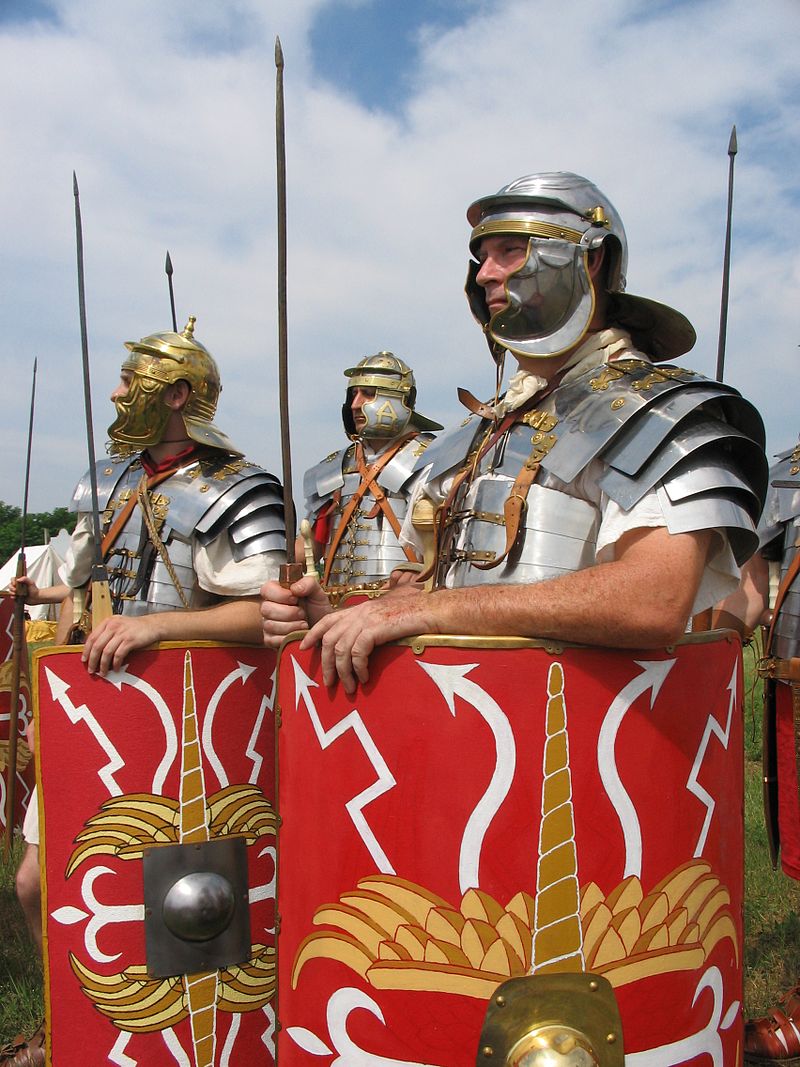
2 Timothy 2:3+ - Suffer hardship (aorist imperative = Command to "Just do it!" This is urgent!) with me as a good soldier of Christ Jesus.
Comment: Beware! Do not attempt to obey Paul's command in your own natural strength for you will experience futility, frustration and failure. What you need to remember is that all of God's commandments include His enablements, or more accurately "His Enabler," the indwelling Holy Spirit Who does not just "help us" (help implies we just need a little push so to speak - flesh will always be flesh and can do no good thing - Ro 7:18+, cf Jn 6:63+, 2 Cor 3:5-6+) but enables us! In short the "Helper" does more than "help" us! He enables us. In English enable means to provide someone with adequate power, means, opportunity, or authority to do something and so to make possible. Obedience to divine commands requires a supernatural Source of power. In short, obedience to the divine commandments is IM-possible, but is HIM-possible! For more see discussion of our continual need for the Holy Spirit to obey the NT commands or "How to Keep All 1642 Commandments in the New Testament!"
Index to Topics on this page:
- Three Kinds of Soldiers - Ten Principles of Warfare
- The Roman Soldier by Edward Gibbon (from Decline & Fall of the Roman Empire)
- The Roman Soldier - Description from Josephus
- A Few Soldier Stories & Sermons
- Good Soldier Hymns
- Good Soldier Devotionals
- Good Soldier - from the writings of C H Spurgeon
- More Sermons on Good Soldiers
- A Good Soldier of Jesus Christ - C H Spurgeon
Related Resources:
- 2 Timothy 2:3-4 Notes on "A Good Soldier"
- New Testament military metaphors - Wikipedia
- Soldier's, Athletes, and Farmers - Ray Stedman.
- Fight Like a Soldier! - Rick Renner
- 2 Timothy 2:3-4 Five Qualities Of A Good Soldier - Alan Carr
- 2 Timothy 2:1-7 A Good Soldier Of Jesus - W A Criswell
- The Soldier - J Mike Minnix
- Am I a Soldier of the Cross? - David E Owen
- Am I A Soldier of the Cross (different) - David E Owen
- 2 Timothy 2:1-4 Being A Good Soldier Of Jesus Christ - Don Robinson
- 2 Timothy 2:3-4 We Need More Soldiers - Don Robinson
- 2 Timothy 2:1-7 Soldiers, Athletes & Farmers - Rob Salvato
- 2 Timothy 2:3-4 A Good Soldier Of Jesus Christ - Rob Salvato
- What did Paul mean when he said he had fought the good fight?
Suggestion - It would be easy and probably relatively painless to read through these discussions of what constitutes a Good Soldier of Christ Jesus and agree in principle, but fail to apply in practice! In one ear and out the other as they say! So as you read the thoughts from various divines over the centuries, ask the Spirit to nudge you in those areas you may in need of exhortation. In other words read through this material with a prayerful, open, meditative mindset which desires above all things to hear ‘Well done, good and faithful slave. You were faithful with a few things, I will put you in charge of many things; enter into the joy of your master.’ (Mt 25:23, cf Lk 19:17+)
1. The young soldier has the will to fight; however, experience in fighting is lacking -- zeal without knowledge.
2. The old soldier has experience in fighting; however, the will to fight is missing -- knowledge without zeal.
3. The good soldier has both the will to fight and the experience in fighting -- the right combination of zeal and knowledge.
PRINCIPLES
1. The Objective is the goal toward which all are striving.
a. The objective must always be clearly defined.
b. There is always an ultimate objective and other immediate objectives.
c. All immediate objectives must contribute to the ultimate objective.
2. The Offensive is to take the initiative by attacking and imposing your will on the enemy.
a. This involves attitude even when it cannot involve action.
b. It allows the commander to set the pace of the battle.
c. It allows the commander to exploit the weaknesses of the enemy.
d. Defensive action is only adopted for a limited period of time as a secondary measure to allow the opportunity to take offensive actions.
3. Concentration is to mass one's forces at a critical time and place for decisive action.
a. Superiority results from the proper combination of the elements of combat power.
b. Through concentration, numerically inferior forces can obtain combat superiority by striking at crucial points in the enemy's line.
4. Economy of force is skillful and prudent use of forces.
It involved measured allocation of available combat power to primary and secondary tasks.
5. Mobility is the ability to move with all speed and ease of movement.
6. Cooperation is collective action and coordinated efforts of all forces toward a common goal.
a. Allies are not at war with one another.
b. Allies come under one commander.
c. Cooperation with an enemy is not cooperation! It is treason!
d. Failure to cooperate with an ally is a gross error.
7. Security is measures taken to prevent surprise, preserve freedom of action, and deny the enemy
access to vital information.
a. It involves accurate intelligence of the enemy.
b. It involves continuous protection from the enemy.
8. Surprise is striking an enemy at a time, in a place, and in a manner for which he is not prepared. It does not always mean to take unawares. It means, also, to take in such a way that when the enemy does find out about it that it is too late to do anything.
9. Communication is a system for the sending and receiving of messages, intelligence, and supplies.
a. Lines must be kept open.
b. Lines must not be overextended.
10. Pursuit is an active following after an enemy with a view to his total destruction.
Victory must be pursued to the point where the beaten enemy will never rise again. "Only active pursuit of the beaten enemy will yield the total fruit of victory," General Clauswitz.
(See Gibbon's description of The Legions under the Emperors, Arms, Cavalry, Auxiliaries, Artillery, Encampment, March)
1. The military establishment of the Roman Empire assured its tranquility and success.
2. In the purer ages of the Roman Empire, the use of military arms was reserved only for citizens who
a. had a country to love,
b. had property to defend,
c. had a share in enacting laws which were to their interest and duty to maintain.
3. The patriotism of the Romans made them almost undefeatable.
4. Upon entering the army, soldiers took a solemn oath
a. never to desert their standard, (The standard was a golden eagle, an object of fondest devotion.)
b. submit his own will to the commands of the leaders,
c. sacrifice his life for the safety of the Emperor and the Empire.
5. Soldiers were inspired by pay which was excellent.
6. The soldiers were also inspired by fear.
a. It was impossible for cowardice or disobedience to escape the severest punishment.
b. Centurions were authorized to chastise soldiers with blows.
c. Generals were authorized to chastise with death.
7. It was an inflexible maxim that the soldiers should dread their officers more than the enemy. This dread produced
a. firmness
b. docility. They were easily managed, obedient, easily taught, and willing to learn; thus, a valor was produced that outdid the barbarians who were impetuous and of irregular passions.
8. Valor alone was not enough. Military exercises were vital and continuous.
a. These were held morning and evening.
b. Even if a soldier was older, he still did his exercises daily.
c. Sheds were erected in the winter for exercises.
d. Arms used in the exercises were double the weight of those used in actual warfare.
e. The only difference in activity or circumstances during peace and war was the presence of blood on the battlefields.
f. They cultivated the science of tactics.
g. They could advance 20 miles in 6hrs, and they carried their baggage until they met the enemy.
9. The best generals and emperors encouraged the soldiers by the following:
a. their presence,
b. their example,
c. their personal instruction, and
d. challenging their personal strength.
Now, you can understand why Paul referred to the military life when he exhorted, instructed, warned, charged, and prepared Timothy to guard the gospel. Paul was well-acquainted with the Roman army. Why? When Claudius Lysias ordered Paul to go to Caesarea for a government trial, two hundred soldiers, two hundred spearmen, and seventy horsemen from the Roman army formed his personal escort! He was also chained to a Roman soldier night and day for two whole years. Yes, Paul knew the life of a soldier. Do you? Will you? Or are you too entangled in civilian affairs?
Now here one cannot but admire at the precaution of the Romans, in providing themselves of such household servants, as might not only serve at other times for the common offices of life, but might also be of advantage to them in their wars; and indeed, if any one does but attend to the other parts of their military discipline, he will be forced to confess that their obtaining so large a dominion, hath been the acquisition of their valor, and not the bare gift of fortune; for they do not begin to use their weapons first in time of war, nor do they then put their hands first into motion, while they avoided so to do in times of peace; but, as if their weapons did always cling to them…
CHRISTIAN SOLDIERS MUST EXERCISE THEMSELVES SHARPENING THE SWORD OF THE SPIRIT, BECOMING FACILE IN WIELDING SUCH SWORD BEFORE THE BATTLE BEGINS.. FOR ONCE THE BATTLE HAS BEGUN IS TOO LATE TO PRACTICE THE TECHNIQUES OF FIGHTING THE ENEMY
- … they have never any truce from warlike exercises; nor do they stay till times of war admonish them to use them; for their military exercises differ not at all from the real use of their arms,
- … but every soldier is every day exercised,
- … and that with great diligence,
- … as if it were in time of war which is
- … the reason why they bear the fatigue of battles so easily; for neither can any disorder remove them from their usual regularity, nor can fear affright them out of it, nor can labor tire them; which firmness of conduct makes them always to overcome those that have not the same firmness; nor would he be mistaken that should call those their exercises unbloody battles, and their battles bloody exercises.
MINDS GIRDED FOR ACTION - 1Pe 1:13
WATCHING & PRAYING - Mt 26:41
SOBER IN SPIRIT - 1Pe 1:13, 2Ti 4:5
BE ON ALERT - 1 Co 16:13, Ep 6:18, Col 4:2, 1Th 5:6, 1Pe 5:8
- … Nor can their enemies easily surprise them with the suddenness of their incursions; for as soon as they have marched into an enemy's land,
PUT ON THE FULL ARMOR OF CHRIST Ep 6:11, Ro 13:12, 14, 1Th 5:8, Col 3:10, 12, 14
- … they do not begin to fight till they have walled their camp about;
- nor is the fence they raise rashly made, or uneven;
- nor do they all abide in it,
- nor do those that are in it take their places at random;
- but if it happens that the ground is uneven, it is first leveled:
- their camp is also foursquare by measure,
- and carpenters are ready, in great numbers, with their tools, to erect their buildings for them.
1. (70) Now here one cannot but admire at the precaution of the Romans, in providing themselves of such household servants, as might not only serve at other times for the common offices of life, but might also be of advantage to them in their wars; (71) and indeed, if any one does but attend to the other parts of their military discipline, he will be forced to confess that their obtaining so large a dominion, hath been the acquisition of their valor, and not the bare gift of fortune; (72) for they do not begin to use their weapons first in time of war, nor do they then put their hands first into motion, while they avoided so to do in times of peace; but, as if their weapons did always cling to them, they have never any truce from warlike exercises; nor do they stay till times of war admonish them to use them; (73) for their military exercises differ not at all from the real use of their arms, but every soldier is every day exercised, and that with great diligence, as if it were in time of war which is the reason why they bear the fatigue of battles so easily; (74) for neither can any disorder remove them from their usual regularity, nor can fear affright them out of it, nor can labor tire them; which firmness of conduct makes them always to overcome those that have not the same firmness; (75) nor would he be mistaken that should call those their exercises unbloody battles, and their battles bloody exercises. (76) Nor can their enemies easily surprise them with the suddenness of their incursions; for as soon as they have marched into an enemy’s land, they do not begin to fight till they have walled their camp about; (77) nor is the fence they raise rashly made, or uneven; nor do they all abide in it, nor do those that are in it take their places at random; but if it happens that the ground is uneven, it is first leveled: their camp is also foursquare by measure, (78) and carpenters are ready, in great numbers, with their tools, to erect their buildings for them.
2. (79) As for what is within the camp, it is set apart for tents, but the outward circumference hath the resemblance of a wall, and is adorned with towers at equal distances, (80) where between the towers stand the engines for throwing arrows and darts, and for slinging stones, and where they lay all other engines that can annoy the enemy, all ready for their several operations. (81) They also erect four gates, one at every side of the circumference, and those large enough for the entrance of the beasts, and wide enough for making excursions, if occasion should require. (82) They divide the camp within into streets, very conveniently, and place the tents of the commanders in the middle; but in the very midst of all is the general’s own tent, in the nature of a temple, (83) insomuch that it appears to be a city built on the sudden, with its marketplace, and place for handicraft trades, and with seats for the officers, superior and inferior; where, if any differences arise, their causes are heard and determined. (84) The camp, and all that is in it, is encompassed with a wall round about, and that sooner than one would imagine, and this by the multitude and the skill of the laborers; and, if occasion require, a trench is drawn round the whole, whose depth is four cubits, and its breadth equal.
3. (85) When they have thus secured themselves, they live together by companies, with quietness and decency, as are all their other affairs managed with good order and security. Each company hath also their wood, and their corn, and their water brought them, when they stand in need of them; (86) for they neither sup nor dine as they please themselves singly, but all together. Their times also for sleeping, and watching, and rising, are notified beforehand by the sound of trumpets, nor is anything done without such a signal; (87) and in the morning the soldiery go every one to their centurions, and these centurions to their tribunes, to salute them; with whom all the superior officers go to the general of the whole army, (88) who then gives them of course the watchword and other orders, to be by them carried to all that are under their command; which is also observed when they go to fight, and thereby they turn themselves about on the sudden, when there is occasion for making sallies, as they come back when they are recalled, in crowds also.
4. (89) When they are to go out of their camp, the trumpet gives a sound, at which time nobody lies still, but at the first imtimation they take down their tents, and all is made ready for their going out; (90) then do the trumpets sound again, to order them to get ready for the march; then do they lay their baggage suddenly upon their mules and other beasts of burden, and stand, at the place for starting, ready to march; when also they set fire to their camp, and this they do because it will be easy for them to erect another camp, and that it may not ever be of use to their enemies. (91) Then do the trumpets give a sound the third time, that they are to go out in order to excite those that on any account are a little tardy, that so no one may be out of his rank when the army marches. (92) Then does the crier stand at the general’s right hand, and asks them thrice, in their own tongue, whether they be now ready to go out to war or not. To which they reply as often, with a loud and cheerful voice, saying, “We are ready.” And this they do almost before the question is asked them; they do this as filled with a kind of martial fury, and at the time that they so cry out, they lift up their right hands also.
5. (93) When, after this, they are gone out of their camp, they all march without noise, and in a decent manner, and every one keeps his own rank, as if they were going to war. The footmen are armed with breastplates and headpieces, and have swords on each side; (94) but the sword which is upon their left side is much longer than the other; for that on the right side is not longer than a span. (95) Those footmen also that are chosen out from amongst the rest to be about the general himself, have a lance and a buckler; but the rest of the foot soldiers have a spear and a long buckler, besides a saw and a basket, a pickaxe and an ax, a thong of leather, and a hook, with provisions for three days; so that a footman hath no great need of a mule to carry his burdens. (96) The horsemen have a long sword on their right sides, and a long pole in their hand: a shield also lies by them obliquely on one side of their horses, with three or more darts that are borne in their quiver, having broad points, and no smaller than spears. They have also headpieces and breastplates, in like manner as have all the footmen. (97) And for those that are chosen to be about the general, their armor no way differs from that of the horsemen belonging to other troops; and he always leads the legions forth, to whom the lot assigns that employment.
6. (98) This is the manner of the marching and resting of the Romans, as also these are the several sorts of weapons they use. But when they are to fight, they leave nothing without forecast, nor to be done offhand, but counsel is ever first taken before any work is begun, and what hath been there resolved upon is put in execution presently; (99) for which reason they seldom commit any errors; and if they have been mistaken at any time they easily correct those mistakes. (100) They also esteem any errors they commit upon taking counsel beforehand, to be better than such rash success as is owing to fortune only; because such fortuitous advantage tempts them to be inconsiderate, while consultation, though it may sometimes fail of success, hath this good in it, that it makes men more careful hereafter; (101) but for the advantages that arise from chance, they are not owing to him that gains them; and as to what melancholy accidents happen unexpectedly, there is this comfort in them that they have however taken the best consultations they could to prevent them.
7. (102) Now they so manage their preparatory exercises of their weapons, that not the bodies of the soldiers only but their souls, may also become stronger: they are moreover hardened for war by fear; (103) for their laws inflict capital punishments, not only for soldiers running away from their ranks, but for slothfulness and inactivity, though it be but in a lesser degree; as are their generals more severe than their laws, for they prevent any imputation of cruelty toward those under condemnation, by the great rewards they bestow on the valiant soldiers; (104) and the readiness of obeying their commanders is so great, that it is very ornamental in peace; but when they come to a battle, the whole army is but one body, (105) so well coupled together are their ranks, so sudden are their turnings about, so sharp their hearing as to what orders are given them, so quick their sight of the ensigns, and so nimble are their hands when they set to work; (106) whereby it comes to pass, that what they do is done quickly, and what the suffer they bear with the greatest patience. Nor can we find any examples where they have been conquered in battle, when they came to a close fight, either by the multitude of the enemies, or by their stratagems, or by the difficulties in the places they were in; no, nor by fortune neither, for their victories have been surer to them than fortune could have granted them. (107) In a case, therefore, where counsel still goes before action, and where, after taking the best advice, that advice is followed by so active an army, what wonder is it that Euphrates on the east, the ocean on the west, the most fertile regions of Libya on the south, and the Danube and the Rhine on the north, are the limits of this empire. One might well say, that the Roman possessions are not inferior to the Romans themselves.
Albert Barnes: Roman soldiers were not allowed … to engage in any husbandry or trade; and they were forbidden to act as tutors to any person, or curators to any man’s estate, or proctor in the cause of other men. The general principle was, that they were excluded from those relations, agencies, and engagements, which it was thought would divert their minds from that which was to be the sole object of pursuit. (The Biblical Illustrator)
Richard Newton, D. D.: We must FOLLOW THE EXAMPLE OF JESUS. When Alexander the Great was leading his army over some mountains once, they found their way all stopped up with ice and snow. His soldiers were tired out with hard marching, and so disheartened with the difficulties before them, that they halted. It seemed as if they would rather lie down and die than try to go on any farther. When Alexander saw this, he did not begin to scold the men, and storm at them. Instead of this, he got down from his horse, laid aside his cloak, took up a pickaxe, and, without saying a word to any one, went quietly to work, digging away at the ice. As soon as the officers saw this, they did the same. The men looked on in surprise for a few moments, and then, forgetting how tired they were, they went to work with a will, and pretty soon they got through all their difficulties. Those were good soldiers, because they followed the example of their leader. (The Biblical Illustrator)
Illustration - From history’s pages we learn of a cowardly young soldier in the army of Alexander the Great. Whenever the battle grew fierce, the young soldier would yield. The general’s pride was cut because this timid soldier also bore the name Alexander. One day Alexander the Great sternly addressed him and said, “Stop being a coward or drop that good name.”The call to all Christians is the same today. May we faithfully live up to all the name Christian implies. “Lord, what will You have me to do?” (George Sweeting)
Many men, many minds. In reference to what a Christian is there have been very many and diverse opinions. Paul’s description of a Christian in the text is that of a soldier, and that means something very far different either from a religious fop, whose best delight is music and millinery, or a theological critic who makes a man an offender for a word, or a spiritual glutton who cares for nothing but a lifelong enjoyment of the fat things full of marrow, or an ecclesiastical slumberer who longs only for peace for himself. The Christian is a self-sacrificing man as the soldier must be. A soldier is a serving man. A soldier is full often a suffering man. Once again, the true soldier is an ambitious being. Paul does not exhort Timothy to be a common, or ordinary soldier, but to be a "good soldier of Jesus Christ"; for all soldiers, and all true soldiers, may not be good soldiers. David had many soldiers, and good soldiers too, but you remember it was said of many, "These attained not unto the first three." Now Paul, if I read him rightly, would have Timothy try to be of the first three, to be a good soldier.
I. We shall endeavor to DESCRIBE A GOOD SOLDIER OF JESUS CHRIST.
1. We must begin with this fundamental — he must be loyal to his King.
2. He is obedient to his Captain’s commands.
3. To conquer wilt be his ruling passion.
Wellington sent word to his troops one night, "Ciudad Rodrigo must be taken tonight." And what do you think was the commentary of the British soldiers appointed for the attack? "Then," said they all, "we will do it." So when our great Captain sends round, as he doth to us, the word of command, "Go ye into all the world and preach the gospel to every creature," if we were all good soldiers of the cross, we should say at once, "We will do it." The passion for victory with the soldier often makes him forget everything else. Before the battle of Waterloo, Picton had had two of his ribs smashed in at Quatre Bras, but he concealed this serious injury, and, though suffering intensest agony, he rode at the head of his troop, and led one of the greatest charges which decided the fortunes of the day. He never left his post, but rode on till a ball crushed in his skull and penetrated to the brains. Then in the hot fight the hero fell. In that same battle one of our lieutenants, in the early part of the day, had his left forearm broken by a shot; he could not, therefore, hold the reins in his hand, but he seized them with his mouth, and fought on till another shot broke the upper part of the arm to splinters, and it had to be amputated; but within two days there he was, with his arm still bleeding, and the wound all raw, riding at the head of his division. Brave things have been done amongst the soldiers of our country — Oh, that such brave things were common among the armed men of the Church militant!
4. A good soldier is very brave at a charge.
5. A good soldier is like a rock under attack.
6. He derives his strength from on high.
This has been true even of some common soldiers, for religious men when they have sought strength from God have been all the braver in the day of conflict. I like the story of Frederick the Great; when he overheard his favorite general engaged in prayer, and was about to utter a sneering remark, the fine old man, who never feared a foe, and did not even fear his majesty’s jest, said, "Your Majesty, I have just been asking aid from your Majesty’s great ally." He had been waiting upon God.
In the battle of Salamanca, when Wellington bade one of his officers advance with his troops, and occupy a gap, which the Duke perceived in the lines of the French, the general rode up to him, and said, "My lord, I will do the work, but first give me a grasp of that conquering right hand of yours." He received a hearty grip, and away he rode to the deadly encounter. Often has my soul said to her Captain, "My Lord, I will do that work if Thou wilt give me a grip of Thy conquering right hand." Oh, what power it puts into a man when he gets a grip of Christ, and Christ gets a grip of him!
II. Thus I have described a good soldier of Jesus Christ. Give me a few minutes while I EXHORT YOU TO BE SUCH.
1. I exhort you who are soldiers of Christ to be good soldiers, because many of you have been so. Dishonour not your past, fall not from your high standing. "Forward" be your motto.
2. Be good soldiers, for much depends upon it.
3. Good soldiers we ought to be, for it is a grand old cause that is at stake.
4. I implore you to be good soldiers of Jesus, when you consider the fame that has preceded you.
A soldier when he receives his colors finds certain words embroidered on them, to remind him of the former victories of the regiment in which he serves. Look at the eleventh chapter of Hebrews, and see the long list of the triumphs of the faithful. Remember how prophets and apostles served God; recollect how martyrs joyfully laid down their lives; look at the long line of the reformers and the confessors; remember your martyred sires and covenanting fathers, and by the grace of God I beseech you walk not unworthy of your noble lineage.
5. Be good soldiers because of the victory which awaits you.
6. Besides, and lastly,
If I want another argument to make you good soldiers, remember your Captain, the Captain whose wounded hands and pierced feet are tokens of his love to you. Redeemed from going down to the pit, what can you do sufficiently to show your gratitude? Assured of eternal glory by-and-by, how can you sufficiently prove that you feel your indebtedness. (The Biblical Illustrator)
"A good soldier of Jesus Christ." 2 Timothy 2:3
This is quite additional to the preceding titles. A servant, a disciple, a friend, may become a soldier. But it is a new relationship. It requires peculiar qualities. It imposes peculiar duties. To be a soldier, implies exposure, contest, difficulty. To be a good soldier, implies also courage, fidelity, and success. Let me consider some of the attributes of a good soldier of Jesus Christ. He is one of the great army of the living God. He is engaged in a most important warfare. He has set up his standard toward Zion. He must press on through all opposers, to his glorious end. He will be made a conqueror through the Lord Jesus Christ, who gives him the victory. Am I such a soldier of Christ?
1. A good soldier has made a final CHOICE of the service in which he is engaged.
He has enlisted for a warfare. It is his own choice. He is not ashamed of his uniform, of his duty, of his officers, or of his cause. He glories in the stand which he has taken. He participates in every triumph. He rejoices over all its success. Thus have I enlisted for Christ. He is the great Captain of my salvation. He has a warfare on the earth, which he is carrying on to final victory. I have united with him in it. I bear his name. I am enrolled among his followers. I would not be ashamed of his cause, or of my service and duty for him. My enlistment is for actual duty. It is cheerfully made by the action of my own heart, under the guidance of his Spirit. It is recorded in his own book of remembrance. I am engaged to build up his kingdom, to gather his chosen, to bring in the vessels dedicated to his service, to maintain his authority, and to exalt the glory of his name. This is my final, faithful choice. Let me never shrink from it, or turn back in weariness from the duties which it imposes.
2. A good soldier must have true COURAGE.
Ah, how important is this for me! I have many enemies to meet. My enemies are the enemies of Christ. I must continually contend if I would conquer at last. These enemies are temptations around, that would lead me away, or drive me back from my Savior. Evil propensities and habits of thought within, that would entangle and harass me. Evil men who surround me, and oppress me with their hostility to my Lord. The more faithful I am, the more my enemies will multiply, and the more earnestly they will oppose. If I am indolent and careless in my life, they will not trouble me. If they can make me a traitor, or induce me to desert my Master's cause, they will have accomplished their end. But if I strive to do my Master's will, and to follow him truly and fully, then my enemies seem more hostile, and more bitter, and more multiplied. When I would do good, evil is present with me. But what then? Why, I ought to be the more bold and the more decided as a soldier. I must fight on. There is no other path. I see my great Leader before me, and I must follow after him. Soon the contest will be over, and then the victory will be mine. I am resolved rather to displease and to forsake all others, than to forsake or deny my glorious Lord.
3. A good soldier must ENDURE HARDNESS.
It is a hard life. The soldier has much to bear--sometimes very much. He must endure suffering without murmuring. His power of endurance is often the very means of his victory. The warfare in which I am engaged, may require me to bear much. It may be long and very trying. But my mind must be fixed and strengthened to bear even to the end. My great Leader, the Captain of my salvation, goes before me. He has endured the cross and despised the shame. Let me follow him to the end. I would make no terms with him for my obedience. I would go with him through all. Patiently abide his will. Resist even unto blood, striving against sin. And allow nothing to separate me from the service or love of my glorious Master and Lord. Other soldiers have freely laid down their lives upon the field. I desire to be willing to do so, if my Lord requires and appoints. Come what will come, by his strength, I am resolved to abide by him.
4. A good soldier has a confident HOPE OF TRIUMPH.
He never desponds. He fights not as uncertainly. He is saved and strengthened by hope. In all human contests there is great uncertainty. But in our warfare there is none. Our Captain has already triumphed. We follow him to the fruits of his own victory. We are sure of success by his power. This hope is an anchor to the soul. The warfare may now be very dark and discouraging. Circumstances and probabilities may be all against me. But God gives me the victory. The crown is certain. The kingdom is sure. And he appoints the darkest as well as the brightest periods of the battle. We cannot be overcome, if we stand our ground. Oh let me never flee, nor be discouraged. I would be found faithful, earnest, engaged, devoted. I have one voice to hear, and one Master to follow. I may lose all beside. It is of little consequence. Whatever can live with Christ, I shall get again in that great day. Oh let me never lose my interest in Christ himself.
5. I am a soldier of Christ.
And thus I have enlisted myself for life. And with courage, endurance, and hope, I will press forward. I may not have to fight long. But I will fight faithfully. Let me rest upon his power. Let me give myself up to his care. Let me prize him even as chief among ten thousand. In his favor is life, and his loving-kindness is better than life. He will be my strength and my salvation.
We're soldiers fighting for our God,
Let trembling cowards fly–
We'll stand unshaken, firm, and fixed,
With Christ to live and die.
Let devils rage, and hell assail,
We'll fight our passage through;
Let foes unite, and friends desert,
We'll seize the crown in view.
- “To live,” said Seneca, “is to be a soldier”
- “The life of every man,” said Epictetus, “is a kind of campaign, and a campaign which is long and varied”…
(i) The soldier’s service must be a concentrated service .
Once a man has enlisted on a campaign he can no longer involve himself in the ordinary daily business of life and living; he must concentrate on his service as a soldier. The Roman code of Theodosius said: “We forbid men engaged on military service to engage in civilian occupations.” A soldier is a soldier and nothing else; the Christian must concentrate on his Christianity. That does not mean that he must engage on no worldly task or business. He must still live in this world, and he must still make a living; but it does mean that he must use whatever task he is engaged upon to demonstrate his Christianity.
(ii) The soldier is conditioned to obedience .
The early training of a soldier is designed to make him unquestioningly obey the word of command. There may come a time when such instinctive obedience will save his life and the lives of others. There is a sense in which it is no part of the soldier’s duty “to know the reason why.” Involved as he is in the midst of the battle, he cannot see the over-all picture. The decisions he must leave to the commander who sees the whole field. The first Christian duty is obedience to the voice of God, and acceptance even of that which he cannot understand.
(iii) The soldier is conditioned to sacrifice .
A. J. Gossip tells how, as a chaplain in the 1914–18 war, he was going up the line for the first time. War and blood, and wounds and death were new to him. On his way he saw by the roadside, left behind after the battle, the body of a young kilted Highlander. Oddly, perhaps, there flashed into his mind the words of Christ: “This is my body broken for you.” The Christian must ever be ready to sacrifice himself, his wishes and his fortune, for God and for his fellow-men.
(iv) The soldier is conditioned to loyalty .
When the Roman soldier joined the army he took the sacramentum , the oath of loyalty to his emperor. Someone records a conversation between Marshal Foch and an officer in the 1914–18 war. “You must not retire,” said Foch, “you must hold on at all costs.” “Then,” said the officer aghast, “that means we must all die.” And Foch answered: “Precisely!” The soldier’s supreme virtue is that he is faithful unto death. The Christian too must be loyal to Jesus Christ, through all the chances and the changes of life, down even to the gates of death. (William Barclay - 2 Timothy 2)
I. A SOLDIER MUST BE ENLISTED.
II. THE SOLDIER AFTER HAVING BEEN ENLISTED HAS TO BE DRILLED — that is to say, he has to learn his business. A good soldier is not to be made in a day; there must be time and pains spent upon him; he must be trained and taught, and that very carefully, before he is fit to fight against the enemies of his country. And it is just the same with Christian soldiers. They have to learn to act together, so as to support and help one another in the conflict with evil. And then they have to learn the use of their weapons — of one more especially, which is called the "sword of the Spirit."
III. WE HAVE ENEMIES TO FIGHT WITH — real enemies, not imaginary ones: "the world, the flesh, and the devil." In order to enable you to understand what is meant by fighting against the "flesh" and "the devil," I will tell you a story, or rather, two stories, both of them true. Some years ago there lived a good and holy man, who was a most useful minister of the gospel. This good man’s Christian name was William. Now when he was a little boy, about four or five years old, he one day was left in the dining-room alone, and on the table was a plate of sweet cakes, of which he was particularly fond, but which he had been forbidden to touch. Somebody coming quietly into the room found the boy looking at the cakes, his little hands tightly clasped together behind his back, and saying to himself over and over again, as if he were saying a lesson, "Willie mustn’t take them, ‘cause they are not Willie’s own." Now this was a victory over the "flesh." The flesh said, "These cakes are very nice, Willie; just smell them. No one will see you, Willie, if you do take one. Mamma will not miss the cakes, Willie, there are so many of them." But little Willie would not do wrong, although he was sorely tempted to it. He fought with the "flesh," and came off conqueror. But there was one sad occasion on which Willie, now grown up to be a tall, handsome lad of seventeen, was beaten by the enemy. There was a servant in the family who was a wicked man; and wicked men, whether they know it or not, are agents for the devil, and do his work. This servant, annoyed at his young master’s goodness, said once, in a sneering sort of way, and in William’s hearing, "Oh! as for Master William, he’s not man enough to swear." The taunt — it was just like a fiery arrow shot from Satan’s bow — stung the young lad beyond endurance; and for the only time in his life, I believe, he took God’s holy name in vain, and swore a terrible oath. Whenever William spoke of the matter — years, long years, after — it was with expressions of the bitterest regret, though he felt in his heart that God had forgiven him. Well, that was a fight with the devil in which the devil was the victor. The Christian soldier was beaten, for the moment. Satan, through the mouth of one of his servants, triumphed over him.
IV. THE APOSTLE TELLS US THAT WE ARE TO BE GOOD SOLDIERS OF JESUS CHRIST.
A "good" soldier obeys orders strictly; does not get tired of his duty, but sticks to it; and never dreams of turning his back and running away when the enemy is coming.
V. AND NOW LET ME TELL YOU BY WHAT MEANS WE ARE TO BECOME GOOD SOLDIERS.
A good general makes good soldiers. He infuses his own spirit into them, and leads them to victory. And we have a good general, the Lord Jesus Christ. Put yourselves, then, into His hands, and He will make you what you ought to be. I wish you especially to notice that you cannot be a true Christian warrior without possessing that loyal devotion to Christ which springs from love. (The Biblical Illustrator)
Much as war is at variance with the spirit of Christianity, there are few things to which the Scriptures more frequently allude when treating of the spiritual life. There is reason for this; for, notwithstanding all that is objectionable in the soldier’s occupation, there are many things in the personal qualities of the man which pertain to the very noblest type of character. That which makes him a good soldier would also, if combined with other elements, make him a higher style of man.
I. THE FIRST THING REQUIRED OF A GOOD SOLDIER IS HEARTY SERVICE.
"One volunteer is worth many pressed men." The adage was singularly verified during the war between Austria and Prussia. The Austrian soldiers fought well, but not with the enthusiasm of men who cordially approve of the object for which they fight. Drawn from various nationalities — believing, some of them, that the war was hostile to the dearest interests of their country — they were not so much free agents as machines forced into the strife; and this fact, perhaps, more than bad generalship or insufficient equipment, accounted for their signal defeat. Whereas the Prussians, although not enlisted voluntarily in the first instance, nevertheless entered voluntarily into the conflict. With an appreciation of the purposes of the war which few gave them credit, believing that it was to promote the much-coveted unity of the Fatherland, they fought with an enthusiasm which is the surest pledge of victory; and to this, quite as much as to the superiority of their arms and their leaders, did they owe their splendid triumphs. And so to be good soldiers of Jesus Christ, we must freely and enthusiastically engage in His service.
II. The second thing required of a good soldier is IMPLICIT OBEDIENCE TO HIS COMMANDER’S ORDERS.
Much has been said of the drill and discipline of the Prussian soldiers as accounting for that marvelous succession of victories which, culminating in Sadowa, changed the map of Europe. The far-seeing men who contemplated and conducted the war, with a keen appreciation of the means by which their end was to be gained, had been drilling most severely for years, until the soldier had become a kind of living machine. And that is really what is required in order to good soldiership.
III. A third quality essential to the good soldier is FAITH IN HIS LEADER.
In the war to which we have referred, the Austrian soldiers, after two or three defeats attributable to mismanagement, lost all faith in the capacity of their general, and not only ceased to fight with spirit, but were forthwith changed into a panic-stricken rabble. Even the brave Italians, with all their enthusiasm, recovered slowly from their defeat at Custozza, because of the manifest bungling which brought about the disaster. Whereas the Prussians, having in their leaders men whose clearness of vision and capacity for command were equal to their own fighting efficiency and power of endurance, do not seem ever to have faltered in their victorious career. Such confidence is manifestly indispensable. The private soldier knows little or nothing of the plan of the battle in which he is an actor, knows not why he is led into this position or that, or how he is to be led out of it, knows not why he is required to do this or that; but his general knows, and unless he has full confidence in the men who are directing the movements of the troops he will fight with very little courage, and prove himself but a poor soldier. And in our warfare we are equally required to have faith in our King.
IV. A fourth quality is CAREFUL TRAINING.
In the war referred to, the best trained and most intelligent men proved the best fighters. Intelligence consists with, and is conducive to, the highest state of discipline; and of the human machine, which the soldier must needs become, the thinking is by far the most efficient specimen. So in our warfare the best soldier, other things being equal, is the man whose mind is most thoroughly trained. The servants of Christ should seek to understand the requirements of their time, and prepare to meet them. The conditions of warfare and the works required of the Christian soldier now are not what they were once; and unless men have understanding of the times, they may, though with the best intentions, render very bungling service. The worthier the master, the more efficient should his servants be.
V. HEROIC EFFORT AND PATIENT ENDURANCE ARE NECESSARY.
We cannot understand in what sense they are soldiers of Christ who enter His service simply with a view to their own comfort. Their notion is that they are to have a nice pleasant time, plenty of sweet experiences, and no trials, with temporal comforts to match the unruffled smoothness of their spiritual course. So much has been said of making the best of both worlds, that the highest conception which many form of Christianity is that it is a system which rewards men in the next world for seeking to be comfortable in this. Young men should under stand that a soldier’s life is one of warfare and endurance. In order to your being good soldiers of Jesus Christ, there must be —
VI. CONCERTED ACTION.
Union is strength, insomuch that one small band of men, acting together for one purpose and under one head, will scatter thousands who have neither leader nor organisation. (The Biblical Illustrator)
Let no one say that he has no taste for warfare. Each one of us is pledged to fight. Each one of us bears the sign of the Cross, which binds him to be Christ’s soldier till his life’s end. Once, in the old wars, an English drummer-boy was taken prisoner by the French. They amused themselves by making the lad play on his instrument, and presently one asked him to sound the retreat. The drummer answered proudly that he had never learnt how to do that! So in our warfare there is no retreating.
It was the boast of Napoleon’s soldiers — the guard dies, but never yields! We Christians are bidden to be faithful unto death, and Jesus promises us a crown of life.
When Maximian became Emperor of the West he did his utmost to destroy Christianity. There was in the Roman army a famous legion of ten thousand men, called the Thebian Legion. It was formed entirely of Christians. Once, just before going into battle with the enemy, the Emperor commanded the Thebian Legion to sacrifice to idols. Their leader, in the name of his ten thousand soldiers, refused. The Emperor then ordered them to be decimated — that is, every tenth man to be killed. Still they were firm, and again, the second time, the cruel order was given for every tenth man to be slain. Fully armed, with their glittering eagles flashing on their helmets, the Christian soldiers stood in the perfect discipline of Rome, ready to die, but not to yield. Again they were ordered to sacrifice, and the brave answer was returned, "No; we were Christ’s soldiers before we were Maximian’s." Then the furious Emperor gave the order to kill them all! Calmly the remaining soldiers laid down their arms, and knelt whilst the other troops put them to the sword. So died the Thebian Legion, faithful unto death!
Each one of us is in one sense a martyr, a witness for the Lord Jesus Christ. Those of us who bear hard
words, and cruel judgments, and harsh treatment, patiently, rendering not evil for evil, are martyrs for Jesus. Again, as fellow soldiers, let us remember the NAME under which we serve. To a Roman soldier of old the name of Caesar was a watchword, which made him ready to do or die. In the wars of the middle ages, when our countrymen went into battle the cry was, "St. George for Merry England," and every soldier was ready to answer with his sword.
They tell us that the name of the great Duke of Wellington was alone enough to restore courage and spirit to the flagging troops. Once when a regiment was wavering in the fight, the message was passed along the ranks, "The Duke is coming," and in an instant the men stood firm, whilst one old soldier exclaimed, "The Duke — God bless him! I had rather see him than a whole battalion."
The name of our Leader is one indeed to inspire perfect faith, courage, and hope. In all ages certain regiments have had their distinguishing names. Among the Romans of old time there was one famous band of warriors known as the Thundering Legion. In later times there have been regiments known as the "Invincibles," the "Die-hards." One famous corps has for its motto a Latin sentence meaning "By Land and Sea," and another has one word for its badge, meaning "Everywhere."
These mottoes remind the soldier that the regiment to which he belongs has fought and conquered, served and suffered, all over the world. The proud badge of the county of Kent is "Invicta"— unconquered; that of Exeter is "The Ever-faithful City." All these titles belong of right to our army, the Church of Jesus Christ.
It is said that in New Zealand, some years ago, many of our troops were mortally wounded by concealed natives, who hid them selves in holes in the earth, and thence darted their deadly spears upward against the unsuspecting soldier. So our spiritual enemy, Satan, hides himself in a thousand different places, and wounds us with some sudden temptation when we are least aware. (The Biblical Illustrator)
I. WHAT IS IMPLIED IN BEING A SOLDIER?
1. A soldier is a person wire has enlisted in an army. Had looked at the reasons for and against entering the army, and at last he enlisted.
2. He is the property of the king. Gives up his free agency. Gives up his very name. Known and called by the number he bears.
3. He is provided for by the king. Must take off his own clothes, whether of best broadcloth or corduroy. Must be clothed, and fed, and armed by the king.
4. He must always wear his regimentals. A soldier can always be recognised as such.
5. He is prepared for trial and conflict. Soldiers are the result of war, and if there were no war, there would be no soldiers. He enlisted to fight. For this purpose he is armed, and trained, and drilled.
II. WHAT IS IMPLIED IN BEING A SOLDIER OF CHRIST?
It is implied that Christ is a King, that He has enemies, that He has an army, and that the person spoken of belongs to this army. I have to glance at the ground we have already passed — You have enlisted, etc.
III. WHAT IS IMPLIED IN BEING A GOOD SOLDIER OF CHRIST?
There are soldiers and soldiers. There are some who are idle and dissipated: a disgrace to the profession to which they belong. Others only swell the numbers and fill up the ranks, they look very well at reviews, but don’t count for much in the battle-field. Others are so true and faithful that they cover the army to which they belong with glory.
1. A good soldier is thoroughly loyal. Not a mercenary, fighting for pay. Proud of his uniform, his name, his king.
2. Patriotic. Loves his country. Every soldier is his comrade. The defeat of the army is his sorrow; its success his joy.
3. Obedient. He may be at home in the midst of his family — a telegram comes; by the next train he leaves to join the army, perhaps to cross the seas and perish in a distant land.
4. Earnest.
5. Brave.
6. Patient. Not enlisted for a day, but for life. Often put where there is nothing to excite or gratify ambition. There will be the long wearisome march, or the still more wearisome halt. While his comrades are assaulting cities and winning victories, he has to stand and watch, or lie and suffer.
7. Self-denying.
8. Modest. His motto, Deeds not words. It is said that the word "glory" is not found in the despatches of the Duke of Wellington. He merely states what the army had done. So with the Christian. What are you? A rebel? Your defeat is certain. A deserter? Return. A penitent, longing to be enlisted in Christ’s army? Come. A soldier? Be "a good soldier." (The Biblical Illustrator)
This is one of several related topics - click link for James Smith's related topics on Good Solder
- "Endure hardship with us like a good soldier of Christ Jesus!" 2 Timothy 2:3
- "You have known my purpose." 2 Timothy 3:10
Saul of Tarsus was a rebel in arms against the King of kings. He hated his person, despised his government, and denied his claims. He mustered and headed a troop, with a determination if possible to dethrone him. He arrested, imprisoned, and obtained the death warrant of every faithful subject that came within his reach. He was exceedingly mad against all the adherents to the cause of the Prince of peace. He said, "I will not have him to reign over me!" Not only so — but he made up his mind that he should reign over no one else, if he could prevent it. He persecuted all his followers in Judea, and obtained a commission to carry the war against them into Damascus. He mustered his forces, headed his troop, and set out for Damascus, breathing out threatenings and slaughter against them. His purpose now was to slay utterly both old and young, and to blot out the name and cause of Jesus from under Heaven!
But as he was on his journey, just as he was drawing near to Damascus, a bright light from Heaven suddenly shone upon him, and the Lord Jesus appeared unto him. The manifestation of Christ instantly changed his mind and altered his purpose, and he at once enlisted in the army of Immanuel. He arose from the ground, to which he had fallen, went into Damascus, and was blind for three days. At the end of that time he was restored to sight, and immediately put on the regimentals of the once hated Nazarene.
He soon learned his exercise, and appeared very prominent in the ranks of God's elect. From the day he enlisted, his purpose was formed, through his whole life it was carried out; and therefore to every one who knew him intimately, he could say "You have fully known my purpose." The fixed, settled, solemn purpose of Paul, embraced four principal points:
(1) First, to secure his own salvation. His heart was set upon this. He was determined to "win Christ." To make his "calling and election sure." He therefore gave himself to prayer. He lived by faith in the Son of God. He crucified the flesh with its affections and lusts. He put off the old man with his deeds, and put on the new man. He labored that whether present in the body, or absent from it — he might be accepted of the Lord. He kept his body under control, and brought into subjection; lest after having preached to others, he himself should be castaway. He did not rest satisfied with a single evidence, or an uncertain hope — but he aimed at certainty and obtained it. Hear how confidently bespeaks, "I am crucified with Christ, nevertheless I live; yet not I, but Christ lives in me; and the life which I now live in the flesh live by the faith of the Son of God who loved me, and gave himself for me." Galatians 2:20. Again, "To me to live is Christ, and to die is gain." Philippians 1:21.
Every one of us also should make it our first, our grand object — to secure our own salvation. To obtain the knowledge of salvation by the forgiveness of our sins. To have Christ formed in our hearts "the hope of glory." To know, "that we have passed from death unto life," by our sincere love to the brethren. To commit our souls to Jesus, to be washed in his blood, to be clothed in his righteousness, to be sanctified by his Spirit, and to be preserved by his providence and power — so that we may say with Paul, "I know whom I have believed, and am persuaded that he is able to keep that which I have committed unto him against that day." And thus live "in hope of eternal life, which God who cannot lie, promised before the world began."
(2) Paul's purpose was, Secondly, To bring as many sinners to the Savior as he possibly could. No sooner was Paul enlisted and sworn in — than he became a recruiting sergeant. He endeavored to enlist every person that he could In order to this, he was constantly speaking of Jesus to all with whom he came in contact. In public he preached Jesus, and in private he talked of Jesus. He was always telling those about him, of the glories of his person, the nature of his sacrifice, the perfection of his work, the kindness of his heart, the happiness that was found in his service, the equity of the war which he had proclaimed, and the glorious crowns which he had promised.
He assured every rebel of pardon, the very moment he laid down his arms, and embraced the terms of reconciliation. He often appealed to: his own bad character and detestable conduct, the reception he met with, the pardon he received, and the honor that was conferred upon him — to prevent the vilest from doubting, and to encourage all that believe. He traveled thousands of miles, suffered the most agonizing pains, endured the greatest hardships, and accommodated himself to all classes of people, and to all possible circumstances, to enlist sinners into the army of the Savior. Hear his own words, "Though I am free from all men — yet have I made myself servant unto all, that I might gain the more. And unto the Jews I became as a Jew, that I might gain the Jews; to those who are under the law, as under the law, that I might gain them that are under the law; to those who are without the law, as without law, .(being not without law to God — but under the law to Christ,) that I might gain them that are without law. To the weak became I as weak, that I might gain the weak. I am made all things to all men, that I might by all means save some." 1 Corinthians 9:19-22.
Christian soldier, here is your example, You should try to bring all your comrades to Christ. Never yield to discouragement — but putting your trust in the Lord, praying for the power of the Holy Spirit to accompany your feeble efforts — try, try, try. God works by feeble means. He honors the well-meant endeavor. Speak of Jesus to all who will hear you — for you know not who God may dispose to listen to you, until you try. Speak to all of Christ, many people will listen to a soldier speaking of Jesus, who would not listen to a regular minister. Let Paul's purpose be yours, to enlist as many for Christ as you can. You may assure them of a welcome reception, large bounty, good pay, excellent quarters, kind officers, and high honors when the campaign is ended.
(3) Paul's purpose was, Thirdly, To honor Christ as highly as possible. He never wearied of speaking of him. He never thought that he could speak too highly of Christ. Indeed he considered no subject worthy of a thought, in comparison with Christ. Christ was the center toward which he constantly tended, the circle within which he moved. He preferred the weakness of Christ, to the strength of men; the shame of Christ, to the honor of men; and even suffering for Christ, to living at ease with sinners. Christ was enthroned in Paul's affections, and he endeavored to obtain a throne for him in every human breast.
- If he preached — he preached Christ.
- If he wrote — he wrote of Christ.
- If he gave an example for imitation — it was Christ.
- If he furnished a powerful motive — it was fetched from Christ.
- Christ was his Alpha and Omega, his first and last, his all in all.
He believed him to be God, and he taught others to believe it. He knew him to be the only Savior, and he preached him as such. He rejoiced in his humiliation, and he triumphed in his exaltation. The cross inspired him with hope — but to see his Savior on the throne, filled him with joy unspeakable and full of glory! He lost everything for Christ, and gloried in the fact that he had anything to lose tor him. Christ filled his thoughts, his ministry, and his anticipations. He looked back at what Jesus was originally, at what he became for us, and then at what he is now, and exclaimed, "Who, being in very nature God, did not consider equality with God something to be grasped, but made himself nothing, taking the very nature of a servant, being made in human likeness. And being found in appearance as a man, he humbled himself and became obedient to death — even death on a cross! Therefore God exalted him to the highest place and gave him the name that is above every name, that at the name of Jesus every knee should bow, in Heaven and on earth and under the earth, and every tongue confess that Jesus Christ is Lord, to the glory of God the Father!" Philippians 2:6-11.
Glorious Savior! Let us endeavor to imitate the good soldier Paul, and show forth the honors of his name, making his praise glorious. Let us exalt him as highly as we can, and endeavor to bring others to exalt him too. Let us labor in his cause, walk by his precepts, suffer for his name, and copy his bright, his blessed example — for he is worthy, for whom we shall do this.
(4) Paul's purpose included, Fourthly, To glorify God both by doing and suffering. He looked upon himself as purchased property. As bought out of the most degrading and debasing slavery, on purpose that he might glorify God. And he looked upon all the soldiers of the cross in the same light, therefore writing to the regiment which was quartered at Corinth, he said, "You are not your own, for you are bought with a price; therefore glorify God in your body, and in your spirit, which are God's." 1 Corinthians 6:19, 20.
And lest they should not understand that he meant that this principle should be carried out in all the common, and everyday affairs of life, he says again in the same letter, "Whether therefore you eat, or drink, or whatever you do — do all to the glory of God." 1 Corinthians 10:31.
And writing to the battalion which was quartered at Philippi, among whom some refractory spirits were found, and were trying to do mischief; and referring to his own practice and hope, he says, "According to my earnest expectation and my hope, that in nothing I shall be ashamed — but that with all boldness, as always, so now also Christ shall be magnified in my body, whether it be by life, or by death." Philippians 1:20.
Brother soldier, let this be our object too. In every plan we form, in every engagement we undertake, in everything we do — let us aim at the glory of our good and gracious God. Every morning let us ask, "How can I glorify my God today?" In every undertaking let us examine, how we may glorify God in fulfilling it. God is glorified by us, when we trust in his promises — when we walk by his precepts — when we worship at his throne — when we praise him for his mercies — when we spread his truth — when we assist his cause — when we try to benefit his people — when we enlist souls into his army, and when we put on the whole suit of armor he has provided; and with bold and courageous front, resist and repel his foes!
Let us then endeavor so to plan, to purpose, and to act, that every clear-sighted observer, may see inscribed on every plan, purpose, or performance of ours, "To the praise and glory of God." If we glorify God on earth — he will glorify us in Heaven. If we honor Christ where we now are — we shall walk with Christ in white robes where he is; and along with all that have gotten the victory over Satan, the world, the beast, and his image — we shall stand on the sea of glass, and sing "the song of Moses, the servant of God, and the song of the Lamb, siying, Great and marvelous are your works, Lord God Almighty; just and true are your ways, O King of saints!" Rev. 15:2, 3.
A GOOD SOLDIER. 2 Timothy 2:3, 4. - James Smith in Handfuls of Purpose
The metaphor is very appropriate. Christ is our Captain, and we as soldiers have a real and standing engagement with the forces of evil without and within (Eph. 6:11-13). The qualifications of a good soldier of Jesus Christ are here indicated. He must be—
I. Accepted. "Chosen." Not every one is fit for a soldier, bodily defects may hinder; so moral and spiritual defects hinder from being a good soldier of Jesus Christ. It is His to choose. "Chosen of God." He hath chosen the weak things, etc.
II. Separated. "No entangling of himself with other affairs." It is said that when an officer who had been ordered to the Cape asked leave to stay at home, Wellington said, "Sail or sell." Everything that would hinder in the service of God must be forsaken. "Seek first the kingdom."
III. Consecrated. "That he may please Him." One is your Master. Present yourselves unto God (Rom. 12:1, 2).
IV. Persevering. "Endure hardness." "They persecuted Me, they will also persecute you," says the Captain. But be not discouraged because of the way.
V. Self-emptied. "Put on the armour of God," having no confidence in the flesh. Then victory is certain (1 Cor. 15:57, 58). The walls of every Jericho will fall before faith.
"Fight the good fight of faith." (1 Tim. 6:12).
It is a curious fact that there is no subject about which most people feel such deep interest as fighting. Young men and maidens, old men and little children, high and low, rich and poor, learned and unlearned, all feel a deep interest in wars, battles and fighting.
A simple inscrutable fact presents itself to us, we are excited when we hear stories of war. Some would consider an Englishman rather boring if he cared nothing about the story of Waterloo or Inkerman or Balaclava or Lucknow. Many consider the heart cold and stupid which is not moved and thrilled by the struggles at Sedan and Strasburg and Metz and Paris during the war between France and Germany. But there is another warfare of far greater importance than any war that was ever waged by man. It is a warfare which concerns not two or three nations only, but every Christian man and woman born into the world. The warfare I speak of is the spiritual warfare. It is the fight which everyone who would be saved must fight about his soul.
This warfare, I am aware, is a thing of which many know nothing. Talk to them about it, and they are ready to set you down as a madman, an enthusiast or a fool. And yet it is as real and true as any war the world has ever seen. It has its hand–to–hand conflicts and its wounds. It has its watchings and fatigues. It has its sieges and assaults. It has its victories and its defeats. Above all, it has consequences which are awful, tremendous and most peculiar. In earthly warfare the consequences to nations are often temporary and remediable. In the spiritual warfare it is very different. Of that warfare, the consequences, when the fight is over, are unchangeable and eternal.
It is of this warfare that St. Paul spoke to Timothy, when he wrote those burning words, "Fight the good fight of faith; lay hold on eternal life." It is of this warfare that I propose to speak in this message. I hold the subject to be closely connected with that of sanctification and holiness. He who would understand the nature of true holiness must know that the Christian is "a man of war." If we would be holy, we must fight.
1. True Christianity is a fight
True Christianity! Let us mind that word "true." There is a vast quantity of religion current in the world which is not true, genuine Christianity. It passes muster, it satisfies sleepy consciences; but it is not good money. It is not the authentic reality that called itself Christianity in the beginning. There are thousands of men and women who go to churches and chapels every Sunday and call themselves Christians. They make a "profession" of faith in Christ. Their names are in the baptismal register. They are reckoned Christians while they live. They are married with a Christian marriage service. They mean to be buried as Christians when they die. But you never see any "fight" about their religion! Of spiritual strife and exertion and conflict and self–denial and watching and warring they know literally nothing at all. Such Christianity may satisfy man, and those who say anything against it may be thought very hard and uncharitable; but it certainly is not the Christianity of the Bible. It is not the religion which the Lord Jesus founded and His apostles preached. It is not the religion which produces real holiness. True Christianity is "a fight."
The true Christian is called to be a soldier and must behave as such from the day of his conversion to the day of his death. He is not meant to live a life of religious ease, indolence and security. He must never imagine for a moment that he can sleep and doze along the way to heaven, like one traveling in an easy carriage. If he takes his standard of Christianity from the children of this world, he may be content with such notions, but he will find no countenance for them in the Word of God. If the Bible is the rule of his faith and practice, he will find his course laid down very plainly in this matter. He must "fight."
With whom is the Christian soldier meant to fight? Not with other Christians. Wretched indeed is that man’s idea of religion who fancies that it consists in perpetual controversy! He who is never satisfied unless he is engaged in some strife between church and church, chapel and chapel, sect and sect, faction and faction, party and party, knows nothing yet as he ought to know. No doubt it may be absolutely needful sometimes to appeal to law courts in order to ascertain the right interpretation of a church’s articles and rubrics and formularies. But, as a general rule, the cause of sin is never so much helped as when Christians waste their strength in quarreling with one another and spend their time in petty squabbles.
No, indeed! The principal fight of the Christian is with the world, the flesh and the devil. These are his never–dying foes. These are the three chief enemies against whom he must wage war. Unless he gets the victory over these three, all other victories are useless and vain. If he had a nature like an angel, and were not a fallen creature, the warfare would not be so essential. But with a corrupt heart, a busy devil and an ensnaring world, he must either "fight" or be lost.
He must fight the flesh. Even after conversion he carries within him a nature prone to evil and a heart weak and unstable as water. That heart will never be free from imperfection in this world, and it is a miserable delusion to expect it. To keep that heart from going astray, the Lord Jesus bids us, "Watch and pray." The spirit may be ready, but the flesh is weak. There is need of a daily struggle and a daily wrestling in prayer. "I keep under my body," cries St. Paul, "and bring it into subjection." "I see another law in my members, warring against the law of my mind, and bringing me into captivity." "O wretched man that I am, who shall deliver me from the body of this death?" "Those who are Christ’s have crucified the flesh with the affections and lusts." "Mortify . . . your members which are upon the earth" (Mark 14:38; 1 Cor. 9:27; Rom. 7:23, 24; Gal. 5:24; Col. 3:5).
He must fight the world. The subtle influence of that mighty enemy must be daily resisted, and without a daily battle can never be overcome. The love of the world’s good things, the fear of the world’s laughter or blame, the secret desire to keep in with the world, the secret wish to do as others in the world do, and not to run into extremes—all these are spiritual foes which beset the Christian continually on his way to heaven and must be conquered. "The friendship of the world is enmity with God. Whoever therefore will be a friend of the world is the enemy of God." "If any man love the world, the love of the Father is not in him." "The world is crucified to me, and I unto the world." "Whatever is born of God overcomes the world." "Be not conformed to this world" (James 4:4; 1 John 2:15; Gal. 6:14; 1 John 5:4; Rom. 12:2).
He must fight the devil. That old enemy of mankind is not dead. Ever since the Fall of Adam and Eve he has been "going to and fro in the earth, and walking up and down in it," and striving to compass one great end—the ruin of man’s soul. Never slumbering and never sleeping, he is always going about as a lion seeking whom he may devour. An unseen enemy, he is always near us, about our path and about our bed, and spying out all our ways. A murderer and a liar from the beginning, he labors night and day to cast us down to hell. Sometimes by leading into superstition, sometimes by suggesting infidelity, sometimes by one kind of tactics and sometimes by another, he is always carrying on a campaign against our souls. "Satan has desired to have you, that he may sift you as wheat." This mighty adversary must be daily resisted if we wish to be saved. But "this kind goes not out" but by watching and praying and fighting and putting on the whole armor of God. The strong man armed will never be kept out of our hearts without a daily battle (Job 1:7; 1 Pet. 5:8; John 8:44; Luke 22:31; Eph. 6:11).
Some men may think these statements too strong. You fancy that I am going too far and laying on the colors too thickly. You are secretly saying to yourself that men and women may surely get to heaven without all this trouble and warfare and fighting. Listen to me for a few minutes, and I will show you that I have something to say on God’s behalf. Remember the maxim of the wisest general that ever lived in England: "In time of war it is the worst mistake to underrate your enemy, and try to make a little war." This Christian warfare is no light matter. What says the Scripture? "Fight the good fight of faith, lay hold on eternal life." "Endure hardness, as a good soldier of Jesus Christ." "Put on the whole armor of God, that you may be able to stand against the wiles of the devil. For we wrestle not against flesh and blood, but against principalities, against powers, against the rulers of the darkness of this world, against spiritual wickedness in high places. Wherefore take unto you the whole armor of God, that you may be able to withstand in the evil day, and having done all to stand." "Strive to enter in at the strait gate." "Labor . . . for [the] meat that endures unto everlasting life." "Do not think that I am come to send peace on earth: I came not to send peace but a sword." "He who has no sword, let him sell his garment and buy one." "Watch you, stand fast in the faith, quit you like men, be strong." "War a good warfare; holding faith, and a good conscience" (1 Tim. 6:12; 2 Tim. 2:3; Eph. 6:11–13; Luke 13:24; John 6:27; Matt. 10:34; Luke 22:36; 1 Cor. 16:13; 1 Tim. 1:18, 19). Words such as these appear to me clear, plain and unmistakable. They all teach one and the same great lesson, if we are willing to receive it. That lesson is, that true Christianity is a struggle, a fight and a warfare. He who pretends to condemn "fighting" and teaches that we ought to sit still and "yield ourselves to God," appears to me to misunderstand his Bible, and to make a great mistake.
What says the baptismal service of the Church of England? No doubt that service is uninspired and, like every uninspired composition, it has its defects; but to the millions of people all over the globe who profess and call themselves English churchmen, its voice ought to speak with some weight. And what does it say? It tells us that over every new member who is admitted into the Church of England the following words are used: "I baptize you in the name of the Father, the Son and the Holy Spirit." "I sign this child with the sign of the cross, in token that hereafter he shall not be ashamed to confess the faith of Christ crucified, and manfully to fight under His banner against sin, the world and the devil, and to continue Christ’s faithful soldier and servant unto his life’s end." Of course we all know that in myriads of cases baptism is a mere form and that parents bring their children to the font without faith or prayer or thought and consequently receive no blessing. The man who supposes that baptism in such cases acts mechanically, like a medicine, and that godly and ungodly, praying and prayerless parents, all alike get the same benefit for their children must be in a strange state of mind. But one thing, at any rate, is very certain. Every baptized churchman is by his profession a "soldier of Jesus Christ," and is pledged "to fight under His banner against sin, the world and the devil." He that doubts it had better take up his Prayer Book and read, mark and learn its contents. The worst thing about many very zealous churchmen is their total ignorance of what their own Prayer Book contains.
Whether we are churchmen or not, one thing is certain—this Christian warfare is a great reality and a subject of vast importance. It is not a matter like church government and ceremonial, about which men may differ, and yet reach heaven at last. Necessity is laid upon us. We must fight. There are no promises in the Lord Jesus Christ’s epistles to the seven churches, except to those who "overcome." Where there is grace there will be conflict. The believer is a soldier. There is no holiness without a warfare. Saved souls will always be found to have fought a fight.
It is a fight of absolute necessity. Let us not think that in this war we can remain neutral and sit still. Such a line of action may be possible in the strife of nations, but it is utterly impossible in that conflict which concerns the soul. The boasted policy of non–interference, the "masterly inactivity" which pleases so many statesmen, the plan of keeping quiet and letting things alone—all this will never do in the Christian warfare. Here at any rate no one can escape serving under the plea that he is "a man of peace." To be at peace with the world, the flesh and the devil, is to be at enmity with God and in the broad way that leads to destruction. We have no choice or option. We must either fight or be lost.
It is a fight of universal necessity. No rank or class or age can plead exemption, or escape the battle. Ministers and people, preachers and hearers, old and young, high and low, rich and poor, gentle and simple, kings and subjects, landlords and tenants, learned and unlearned—all alike must carry arms and go to war. All have by nature a heart full of pride, unbelief, sloth, worldliness and sin. All are living in a world beset with snares, traps and pitfalls for the soul. All have near them a busy, restless, malicious devil. All, from the queen in her palace down to the pauper in the workhouse, all must fight, if they would be saved.
It is a fight of perpetual necessity. It admits of no breathing time, no armistice, no truce. On weekdays as well as on Sundays, in private as well as in public, at home by the family fireside as well as abroad, in little things, like management of tongue and temper, as well as in great ones, like the government of kingdoms, the Christian’s warfare must unceasingly go on. The foe we have to do with keeps no holidays, never slumbers and never sleeps. So long as we have breath in our bodies, we must keep on our armor and remember we are on an enemy’s ground. "Even on the brink of Jordan," said a dying saint, "I find Satan nibbling at my heels." We must fight until we die.
Let us consider well these propositions. Let us take care that our own personal religion is real, genuine and true. The saddest symptom about many so–called Christians is the utter absence of anything like conflict and fight in their Christianity. They eat, they drink, they dress, they work, they amuse themselves, they get money, they spend money, they go through a scanty round of formal religious services once or twice every week. But of the great spiritual warfare—its watchings and strugglings, its agonies and anxieties, its battles and contests—of all this they appear to know nothing at all. Let us take care that this case is not our own. The worst state of soul is when the strong man armed keeps the house, and his goods are at peace, when he leads men and women captive at his will, and they make no resistance. The worst chains are those which are neither felt nor seen by the prisoner (Luke 11:21; 2 Tim. 2:26).
We may take comfort about our souls if we know anything of an inward fight and conflict. It is the invariable companion of genuine Christian holiness. It is not everything, I am well aware, but it is something. Do we find in our heart of hearts a spiritual struggle? Do we feel anything of the flesh lusting against the spirit and the spirit against the flesh, so that we cannot do the things we would? (Gal. 5:17.) Are we conscious of two principles within us, contending for the mastery? Do we feel anything of war in our inward man? Well, let us thank God for it! It is a good sign. It is strongly probable evidence of the great work of sanctification. All true saints are soldiers. Anything is better than apathy, stagnation, deadness and indifference. We are in a better state than many. The most part of so–called Christians have no feeling at all. We are evidently no friends of Satan. Like the kings of this world, he wars not against his own subjects. The very fact that he assaults us should fill our minds with hope. I say again, let us take comfort. The child of God has two great marks about him, and of these two we have one. He may be known by his inward warfare, as well as by his inward peace.
2. True Christianity is the fight of faith
Unlike the battles of the world, true Christianity fights in a realm that does not depend upon physical strength, the strong arm, the quick eye or the swift foot. Conventional weaponry does not come into play. Rather, its weapons are spiritual, and faith is the axis upon which the battle turns.
A general faith in the truth of God’s written Word is the primary foundation of the Christian soldier’s character. He is what he is, does what he does, thinks as he thinks, acts as he acts, hopes as he hopes, behaves as he behaves, for one simple reason—he believes certain propositions revealed and laid down in Holy Scripture. "He who comes to God must believe that He is, and that He is a Rewarder of them that diligently seek Him" (Heb. 11:6).
A religion without doctrine or dogma is a thing which many are fond of talking of in the present day. It sounds very fine at first. It looks very pretty at a distance. But the moment we sit down to examine and consider it, we shall find it a simple impossibility. We might as well talk of a body without bones and sinews. No man will ever be anything or do anything in religion unless he believes something. Even those who profess to hold the miserable and uncomfortable views of the deists are obliged to confess that they believe something. With all their bitter sneers against dogmatic theology and Christian credulity, as they call it, they themselves have a kind of faith.
As for true Christians, faith is the very backbone of their spiritual existence. No one ever fights earnestly against the world, the flesh and the devil, unless he has engraved on his heart certain great principles which he believes. What they are he may hardly know and may certainly not be able to define or write down. But there they are and, consciously or unconsciously, they form the roots of his religion. Wherever you see a man, whether rich or poor, learned or unlearned, wrestling manfully with sin and trying to overcome it, you may be sure there are certain great principles which that man believes. The poet who wrote the famous lines
"For modes of faith let graceless zealots fight,
He can’t be wrong whose life is in the right,"
was a clever man, but a poor divine. There is no such thing as right living without faith and believing.
A special faith in our Lord Jesus Christ’s person, work and office is the life, heart and mainspring of the Christian soldier’s character.
He sees by faith an unseen Savior, who loved him, gave Himself for him, paid his debts for him, bore his sins, carried his transgressions, rose again for him, and appears in heaven for him as his Advocate at the right hand of God. He sees Jesus and clings to Him. Seeing this Savior and trusting in Him, he feels peace and hope and willingly does battle against the foes of his soul.
He sees his own many sins, his weak heart, a tempting world, a busy devil; and if he looked only at them, he might well despair. But he sees also a mighty Savior, an interceding Savior, a sympathizing Savior—His blood, His righteousness, His everlasting priesthood—and he believes that all this is his own. He sees Jesus and casts his whole weight on Him. Seeing Him, he cheerfully fights on, with a full confidence that he will prove more than conqueror through Him that loved him (Rom. 8:37).
Habitual lively faith in Christ’s presence and readiness to help is the secret of the Christian soldier fighting successfully.
It must never be forgotten that faith admits of degrees. All men do not believe alike, and even the same person has his ebbs and flows of faith and believes more heartily at one time than another. According to the degree of his faith, the Christian fights well or ill, wins victories or suffers occasional repulses, comes off triumphant or loses a battle. He who has the most faith will always be the happiest and most comfortable soldier. Nothing makes the anxieties of warfare sit so lightly on a man as the assurance of Christ’s love and continual protection. Nothing enables him to bear the fatigue of watching, struggling and wrestling against sin like the indwelling confidence that Christ is on his side and success is sure. It is the "shield of faith" which quenches all the fiery darts of the wicked one. It is the man who can say, "I know whom I have believed," who can say in time of suffering, "I am not ashamed." He who wrote those glowing words: "We faint not"; "Our light affliction which is but for a moment, works for us a far more exceeding and eternal weight of glory," was the man who wrote with the same pen, "We look not at the things which are seen, but at the things which are not seen; for the things which are seen are temporal, but the things which are not seen are eternal." It is the man who said, "I live by the faith of the Son of God," who said, in the same Epistle, "the world is crucified unto me, and I unto the world." It is the man who said, "To me to live is Christ," who said, in the same Epistle, "I have learned, in whatever state I am, therewith to be content." "I can do all things through Christ." The more faith, the more victory! The more faith, the more inward peace! (Eph. 6:16; 2 Tim. 1:12; 2 Cor. 4:16,17; Gal. 2:20; 6:14; Phil. 1:21; 4:11, 13).
I think it impossible to overrate the value and importance of faith. Well may the apostle Peter call it "precious" (2 Pet. 1:1). Time would fail me if I tried to recount a hundredth part of the victories which by faith Christian soldiers have obtained.
Let us take down our Bibles and read with attention the eleventh chapter of the Epistle to the Hebrews. Let us mark the long list of worthies whose names are thus recorded, from Abel down to Moses, even before Christ was born of the Virgin Mary and brought life and immortality into full light by the gospel. Let us note well what battles they won against the world, the flesh and the devil. And then let us remember that believing did it all. These men looked forward to the promised Messiah. They saw Him that is invisible. "By faith the elders obtained a good report" (Heb. 11:2–27).
Let us turn to the pages of early church history. Let us see how the primitive Christians held fast their religion even unto death and were not shaken by the fiercest persecutions of heathen emperors. For centuries there were never wanting men like Polycarp and Ignatius, who were ready to die rather than deny Christ. Fines and prisons and torture and fire and sword were unable to crush the spirit of the noble army of martyrs. The whole power of imperial Rome, the mistress of the world, proved unable to stamp out the religion which began with a few fishermen and publicans in Palestine! And then let us remember that believing in an unseen Jesus was the church’s strength. They won their victory by faith.
Let us examine the story of the Protestant Reformation. Let us study the lives of its leading champions, Wycliffe and Huss and Luther and Ridley and Latimer and Hooper. Let us mark how these gallant soldiers of Christ stood firm against a host of adversaries and were ready to die for their principles. What battles they fought! What controversies they maintained! What contradiction they endured! What tenacity of purpose they exhibited against a world in arms! And then let us remember that believing in an unseen Jesus was the secret of their strength. They overcame by faith.
Let us consider the men who have made the greatest marks in church history in the last hundred years. Let us observe how men like Wesley and Whitefield and Venn and Romaine stood alone in their day and generation and revived English religion in the face of opposition from men high in office and in the face of slander, ridicule and persecution from nine–tenths of professing Christians in our land. Let us observe how men like William Wilberforce and Havelock and Hedley Vicars have witnessed for Christ in the most difficult positions and displayed a banner for Christ even at the regimental mess–table or on the floor of the House of Commons. Let us mark how these noble witnesses never flinched to the end, and won the respect even of their worst adversaries. And then let us remember that believing in an unseen Christ is the key to all their characters. By faith they lived and walked and stood and overcame.
Would anyone live the life of a Christian soldier? Let him pray for faith. It is the gift of God and a gift which those who ask shall never ask for in vain. You must believe before you do. If men do nothing in religion, it is because they do not believe. Faith is the first step towards heaven.
Would anyone fight the fight of a Christian soldier successfully and prosperously? Let him pray for a continual increase of faith. Let him abide in Christ, get closer to Christ, tighten his hold on Christ every day that he lives. Let his daily prayer be that of the disciples: "Lord, increase my faith" (Luke 17:5). Watch jealously over your faith, if you have any. It is the citadel of the Christian character, on which the safety of the whole fortress depends. It is the point which Satan loves to assail. All lies at his mercy if faith is overthrown. Here, if we love life, we must especially stand on our guard.
3. True Christianity is a good fight
"Good" is a curious word to apply to any warfare. All worldly war is more or less evil. No doubt it is an absolute necessity in many cases—to procure the liberty of nations, to prevent the weak from being trampled down by the strong—but still it is an evil. It entails a dreadful amount of bloodshed and suffering. It hurries into eternity myriads who are completely unprepared for their change. It calls forth the worst passions of man. It causes enormous waste and destruction of property. It fills peaceful homes with mourning widows and orphans. It spreads far and wide poverty, taxation and national distress. It disarranges all the order of society. It interrupts the work of the gospel and the growth of Christian missions. In short, war is an immense and incalculable evil, and every praying man should cry night and day, "Give peace in our times." And yet there is one warfare which is emphatically "good" and one fight in which there is no evil. That warfare is the Christian warfare. That fight is the fight of the soul.
Now what are the reasons why the Christian fight is a "good fight"? What are the points in which his warfare is superior to the warfare of this world. I want my readers to know that there is abundant encouragement, if they will only begin the battle. The Scripture does not call the Christian fight "a good fight" without reason and cause. Let me try to show what I mean.
a. The Christian’s fight is good because fought under the best of generals.
The Leader and Commander of all believers is our divine Savior, the Lord Jesus Christ—a Savior of perfect wisdom, infinite love and almighty power. The Captain of our salvation never fails to lead His soldiers to victory. He never makes any useless movements, never errs in judgment, never commits any mistake. His eye is on all His followers, from the greatest of them even to the least. The humblest servant in His army is not forgotten. The weakest and most sickly is cared for, remembered and kept unto salvation. The souls whom He has purchased and redeemed with His own blood are far too precious to be wasted and thrown away. Surely this is good!
b. The Christian’s fight is good because fought with the best of helps.
Weak as each believer is in himself, the Holy Spirit dwells in him, and his body is a temple of the Holy Spirit. Chosen by God the Father, washed in the blood of the Son, renewed by the Spirit, he does not go to warfare at his own charges and is never alone. God the Holy Spirit daily teaches, leads, guides and directs him. God the Father guards him by His almighty power. God the Son intercedes for him every moment, like Moses on the mount, while he is fighting in the valley below. A threefold cord like this can never be broken! His daily provisions and supplies never fail. His commissariat is never defective. His bread and his water are sure. Weak as he seems in himself, like a worm, he is strong in the Lord to do great exploits. Surely this is good!
c. The Christian fight is a good fight because fought with the best of promises.
To every believer belong exceeding great and precious promises, all "yes" and "amen" in Christ, promises sure to be fulfilled because made by One who cannot lie and who has power as well as will to keep His word. "Sin shall not have dominion over you." "The God of peace shall bruise Satan under your feet shortly." "He which has begun a good work . . . will perform it until the day of Jesus Christ." "When you pass through the waters, I will be with you, and through the rivers, they shall not overflow you." "My sheep . . . shall never perish, neither shall any man pluck them out of My hand." "Him that comes to Me I will in no wise cast out." "I will never leave you, nor forsake you." "I am persuaded that neither death, nor life . . . nor things present, nor things to come . . . shall be able to separate us from the love of God, which is in Christ Jesus" (Rom. 6:14; 16:20; Phil. 1:6; Isa. 43:2; John 10:28; 6:37; Heb. 13:5; Rom. 8:38, 39). Words like these are worth their weight in gold! Who does not know that promises of coming aid have cheered the defenders of besieged cities, like Lucknow, and raised them above their natural strength? Have we never heard that the promise of "help before night" had much to say to the mighty victory of Waterloo? Yet all such promises are as nothing compared to the rich treasure of believers, the eternal promises of God. Surely this is good!
d. The Christian’s fight is a good fight because fought with the best of issues and results.
No doubt it is a war in which there are tremendous struggles, agonizing conflicts, wounds, bruises, watchings, fastings and fatigue. But still every believer, without exception, is "more than conqueror through Him that loved [him] " (Rom. 8:37). No soldiers of Christ are ever lost, missing or left dead on the battlefield. No mourning will ever need to be put on, and no tears to be shed, for either private or officer in the army of Christ. The muster roll, when the last evening comes, will be found precisely the same that it was in the morning. The English Guards marched out of London to the Crimean campaign a magnificent body of men, but many of the gallant fellows laid their bones in a foreign grave and never saw London again. Far different shall be the arrival of the Christian army in the "city which has foundations, whose builder and maker is God" (Heb. 11:10). Not one shall be found lacking. The words of our great Captain shall be found true: "Of those who You gave Me have I lost none" (John 18:9). Surely this is good!
e. The Christian’s fight is good because it does good to the soul of him that fights it.
All other wars have a bad, lowering and demoralizing tendency. They call forth the worst passions of the human mind. They harden the conscience and sap the foundations of religion and morality. The Christian warfare alone tends to call forth the best things that are left in man. It promotes humility and charity, it lessens selfishness and worldliness, it induces men to set their affections on things above. The old, the sick, the dying, are never known to repent of fighting Christ’s battles against sin, the world and the devil. Their only regret is that they did not begin to serve Christ long before. The experience of that eminent saint, Philip Henry, does not stand alone. In his last days he said to his family, "I take you all to record that a life spent in the service of Christ is the happiest life that a man can spend upon earth." Surely this is good!
f. The Christian’s fight is a good fight because it does good to the world.
All other wars have a devastating, ravaging and injurious effect. The march of an army through a land is a dreadful scourge to the inhabitants. Wherever it goes it impoverishes, wastes and does harm. Injury to persons, property, feelings and morals invariably accompanies it. Far different are the effects produced by Christian soldiers. Wherever they live, they are a blessing, They raise the standard of religion and morality. They invariably check the progress of drunkenness, Sabbath–breaking, profligacy and dishonesty. Even their enemies are obliged to respect them. Go where you please, you will rarely find that barracks and garrisons do good to the neighborhood. But go where you please, you will find that the presence of a few true Christians is a blessing. Surely this is good!
g. Finally, the Christian’s fight is good because it ends in a glorious reward for all who fight it.
Who can tell the wages that Christ will pay to all His faithful people? Who can estimate the good things that our divine Captain has laid up for those who confess Him before men? A grateful country can give to her successful warriors medals, Victoria crosses, pensions, peerages, honors and titles. But it can give nothing that will last and endure forever, nothing that can be carried beyond the grave. Palaces like Blenheim and Strathfieldsay can only be enjoyed for a few years. The bravest generals and soldiers must go down one day before the king of terrors. Better, far better, is the position of him who fights under Christ’s banner, against sin, the world and the devil. He may get little praise of man while he lives and go down to the grave with little honor; but he will have that which is far better, because far more enduring. He will have "a crown of glory that fades not away" (1 Pet. 5:4). Surely this is good!
Let us settle it in our minds that the Christian fight is a good fight—really good, truly good, emphatically good. We see only part of it yet. We see the struggle, but not the end; we see the campaign, but not the reward; we see the cross, but not the crown. We see a few humble, broken–spirited, penitent, praying people, enduring hardships and despised by the world; but we see not the hand of God over them, the face of God smiling on them, the kingdom of glory prepared for them. These things are yet to be revealed. Let us not judge by appearances. There are more good things about the Christian warfare than we see.
And now let me conclude my whole subject with a few words of practical application. Our lot is cast in times when the world seems thinking of little else but battles and fighting. The iron is entering into the soul of more than one nation, and the mirth of many a fair district is clean gone. Surely in times like these a minister may fairly call on men to remember their spiritual warfare. Let me say a few parting words about the great fight of the soul.
1. It may be you are struggling hard for the rewards of this world.
Perhaps you are straining every nerve to obtain money or place or power or pleasure. If that be your case, take care. You are sowing a crop of bitter disappointment. Unless you mind what you are about, your latter end will be to lie down in sorrow.
Thousands have trodden the path you are pursuing and have awoke too late to find it end in misery and eternal ruin. They have fought hard for wealth and honor and office and promotion and turned their backs on God and Christ and heaven and the world to come. And what has their end been? Often, far too often, they have found out that their whole life has been a grand mistake. They have tasted by bitter experience the feelings of the dying statesman who cried aloud in his last hours, "The battle is fought; the battle is fought; but the victory is not won."
For your own happiness’ sake resolve this day to join the Lord’s side. Shake off your past carelessness and unbelief. Come out from the ways of a thoughtless, unreasoning world. Take up the cross and become a good soldier of Christ. "Fight the good fight of faith" that you may be happy as well as safe.
Think what the children of this world will often do for liberty, without any religious principle. Remember how Greeks and Romans and Swiss and Tyrolese have endured the loss of all things, and even life itself, rather than bend their necks to a foreign yoke. Let their example provoke you to emulation. If men can do so much for a corruptible crown, how much more should you do for one which is incorruptible! Awake to a sense of the misery of being a slave. For life and happiness and liberty, arise and fight.
Fear not to begin and enlist under Christ’s banner. The great Captain of your salvation rejects none that come to Him. Like David in the cave of Adullam, He is ready to receive all who apply to Him, however unworthy they may feel themselves. None who repent and believe are too bad to be enrolled in the ranks of Christ’s army. All who come to Him by faith are admitted, clothed, armed, trained and finally led on to complete victory. Fear not to begin this very day. There is yet room for you.
Fear not to go on fighting, if you once enlist. The more thorough and whole–hearted you are as a soldier, the more comfortable will you find your warfare. No doubt you will often meet with trouble, fatigue and hard fighting, before your warfare is accomplished. But let none of these things move you. Greater is He who is for you than all they who are against you. Everlasting liberty or everlasting captivity are the alternatives before you. Choose liberty, and fight to the last.
2. It may be you know something of the Christian warfare and are a tried and proved soldier already.
f that be your case, accept a parting word of advice and encouragement from a fellow soldier. Let me speak to myself as well as to you. Let us stir up our minds by way of remembrance. There are some things which we cannot remember too well.
Let us remember that if we would fight successfully, we must put on the whole armor of God and never lay it aside until we die. Not a single piece of the armor can be dispensed with. The belt of truth, the breastplate of righteousness, the shield of faith, the sword of the Spirit, the helmet of hope—each and all are needful. Not a single day can we dispense with any part of this armor. Well says an old veteran in Christ’s army, who died two hundred years ago, "In heaven we shall appear, not in armor, but in robes of glory. But here our arms are to be worn night and day. We must walk, work, sleep in them, or else we are not true soldiers of Christ." *
Let us remember the solemn words of an inspired warrior, who went to his rest eighteen hundred years ago: "No man that wars entangles himself with the affairs of this life; that he may please him who has chosen him to be a soldier" (2 Tim. 2:4). May we never forget that saying!
Let us remember that some have seemed good soldiers for a little season and talked loudly of what they would do and yet turned back disgracefully in the day of battle.
Let us never forget Balaam and Judas and Demas and Lot’s wife. Whatever we are, and however weak, let us be real, genuine, true and sincere.
Let us remember that the eye of our loving Savior is upon us morning, noon and night. He will never suffer us to be tempted above what we are able to bear. He can be touched with the feeling of our infirmities, for He suffered Himself, being tempted. He knows what battles and conflicts are, for He Himself was assaulted by the prince of this world. Having such a High Priest, Jesus the Son of God, let us hold fast our profession (Heb. 4:14).
Let us remember that thousands of soldiers before us have fought the same battle that we are fighting and come off more than conquerors through Him that loved them. They overcame by the blood of the Lamb, and so also may we. Christ’s arm is quite as strong as ever, and Christ’s heart is just as loving as ever. He who saved men and women before us is One who never changes. He is "able to save to the uttermost" all who "come unto God by Him." Then let us cast doubts and fears away. Let us follow "them who through faith and patience inherit the promises" and are waiting for us to join them (Heb. 7:25; 6:12).
Finally, let us remember that the time is short, and the coming of the Lord draws near. A few more battles and the last trumpet shall sound, and the Prince of Peace shall come to reign on a renewed earth. A few more struggles and conflicts, and then we shall bid an eternal goodbye to warfare and to sin, to sorrow and to death. Then let us fight on to the last and never surrender. Thus says the Captain of our salvation: "He who overcomes shall inherit all things; and I will be his God, and he shall be My son" (Rev. 21:7).
Let me conclude all with the words of John Bunyan in one of the most beautiful parts of Pilgrim’s Progress. He is describing the end of one of his best and holiest pilgrims: "After this it was noised abroad that Mr. Valiant–for–Truth was sent for by a summons, by the same party as the others. And he had this word for a token that the summons was true: ‘The pitcher was broken at the fountain’ (Eccl. 12:6). When he understood it, he called for his friends, and told them of it. Then said he, ‘I am going to my Father’s house; and though with great difficulty I have got here, yet now I do not repent me of all the troubles I have been at to arrive where I am. My sword I give to him that shall succeed me in my pilgrimage, and my courage and skill to him that can get it. My marks and scars I carry with me, to be a witness for me that I have fought His battles, who will now be my Rewarder.’ When the day that he must go home was come, many accompanied him to the riverside, into which, as he went down, he said, ‘O death, where is your sting?’ And as he went down deeper, he cried, ‘O grave, where is your victory?’ So he passed over, and all the trumpets sounded for him on the other side."
May our end be like this! May we never forget that without fighting there can be no holiness while we live, and no crown of glory when we die!
An old picture represents the Christian in three attitudes. He is represented as a . . .
1. little child, and upon his lips are the words "I learn."
2. laborer, with spade in hand, and upon his lips are the words "I work."
3. soldier, clad in armor, and his motto is, "I fight."
Such a life is to be that of each follower of Christ. Sitting at the feet of Jesus, he must seek Divine instruction in Holy Scripture. With all diligence he must work the works of Him that sent him. In His Church none may be idlers: "Son, go work today in my vineyard," is the call addressed to each.
He must likewise be a soldier, and fight a good warfare. It is written, "Fight the good fight of faith, lay hold on eternal life." "You therefore endure hardness, as a good soldier of Jesus Christ," (1 Timothy 6.12; 2 Timothy 2.3.)
In these words we have a valiant soldier of the Cross, whose time of service was nearly expired, calling on another to carry on manfully the same warfare. The Apostle of the Gentiles was about to lay aside the sword, and receive the crown. Hear his words, "I have fought the good fight, I have finished the race, I have kept the faith. Now there is in store for me the crown of righteousness, which the Lord, the righteous Judge, will award to me on that day — and not only to me, but also to all who have longed for his appearing!" 2 Timothy 4:7-8. Urged by such a plea as this, with what additional power would the appeal of Paul come home to the heart of Timothy.
Let us inquire what is needed in this warfare, and how we may approve ourselves good and faithful soldiers.
(1) A hearty decided choice is the first requisite. It is an individual matter between God and our own souls, which none other can decide for us.
It must be a choice well considered. Our King has no such lack of soldiers, that He will receive recruits decoyed in an unthinking moment, or persuaded by promises that cannot be fulfilled. A solemn deliberate choice is essential. And what must be the motive for it? When young men enlist into our English army, they are swayed by various considerations. One is tired of home life, another dislikes work on the land, a third longs for more society, a fourth desires the bounty offered, or seeks to gain distinction in the battlefield.
But with every true soldier of Christ the chief motive is the same. One word expresses it — LOVE. The Spirit reveals to a man his great need; he beholds in Christ that need fully met; he finds here mercy, and grace, and life; he ponders the love which brought Jesus from His throne, and the price laid down for his salvation; then he cannot but feel a desire to show forth his gratitude. In his heart he says, "Christ has loved me, and given Himself for me — henceforth I will serve Him, and Him alone!"
Upon a soldier's tomb was the following epitaph. It sets before us the right motive for service.
"In early days, I freely shed my blood,
Both for my Queen and for my country's good:
In later days, I soldier came to be
To Him who freely shed His blood for me."
Reader, would you be a good soldier of the Cross? Begin with receiving the great salvation. Fall low at Christ's mercy-seat; own there your sin, and take hold of the free promise of life. Then, under a joyful sense of acceptance, cheerfully enrol yourself among His followers.
(2) Another requisite for a good soldier is separation to Christ's service.
"Endure hardship with us like a good soldier of Christ Jesus. No one serving as a soldier gets involved in civilian affairs — he wants to please his commanding officer." 2 Timothy 2:3-4
In our English army, when once a soldier has enlisted, he gives himself up to this one pursuit. No longer is he, like others, his own master. His choice is made, and he must abide by it. Though not at all times engaged in active warfare — yet he is ever in training for it. Beside this, he is a marked man. Wherever he goes, through a village or through the streets of a city, his bearing and his uniform alike give unmistakable evidence of his profession.
Even so must it be in the army of Christ. Each soldier is to be separate from the world around. He is peculiar in the privileges he enjoys, he must be peculiar also in the character he bears. It is written,
""Therefore come out from them and be separate, says the Lord. Touch no unclean thing, and I will receive you. I will be a Father to you, and you will be my sons and daughters, says the Lord Almighty." 2 Corinthians 6:17-18
A Christian ought to be recognized wherever he may go, not by a loud profession — but by a clear one — by a life of marked holiness, by watchfulness against sin, and by abstinence from all questionable amusements. A willingness to bear reproach for Christ, is frequently one of the greatest acts of heroism.
In a cathedral city, where a large battalion of our army was stationed, a public ball was held, attended by nearly all the officers, and many of the gentry, in the town and neighborhood. The same evening a meeting was held, to promote the circulation of the Word of God. The best speech of the evening was that of a gallant young officer, who thus boldly came out from his associates, and bore a noble testimony for the Master. Here was separation unto Christian service.
(3) It is likewise needful daily to put on the whole armor of God.
What can a soldier on the battle field do without sword, or rifle, or bayonet? "Put on the full armor of God so that you can take your stand against the devil's schemes. For our struggle is not against flesh and blood, but against the rulers, against the authorities, against the powers of this dark world and against the spiritual forces of evil in the heavenly realms."
What can the Christian soldier do in the conflict which he has to wage, unless he girds on the armor provided for him? Great and formidable are the foes with whom he has to battle:
- an enemy without — and an enemy within,
- the destroyer of souls — and a treacherous heart,
- deceitful lusts — and an ensnaring world.
But clad in heaven-proof armor, he can resist and overcome them. Mighty is the strength imparted by the weapons of our spiritual warfare. See the description given in Ephesians 6.10-18.
"Stand therefore, having your loins girt about with truth." Let genuine truthfulness, let thorough hearty sincerity of purpose and character be your belt.
"And having on the breastplate of righteousness." By this it would seem we are to understand a holy, loving life. The Spirit of God enabling us, we must ever maintain a good conscience, and live godly, righteously, and soberly, in an evil world.
"And your feet shod with the preparation of the Gospel of peace." Shoes were needed, that the warrior might stand firm and not be moved, while contending hand to hand with his adversary. If in your Christian warfare you would be steadfast and immoveable, let your foot be set firmly upon the sure promises and hopes of the everlasting Gospel. Wherever you go, let them accompany you. Let them evermore be the rejoicing of your own heart, and the theme upon which you love to dwell.
"Above all, taking the shield of faith, with which you shall be able to quench all the fiery darts of the wicked."
In the fabled siege of Troy, great was the protection afforded to Achilles by the shield wrought for him by Vulcan. The sharp point of many a spear was turned by the shield. Thus powerful, is a strong reliance on the mighty aid of Jehovah. "Trust in the Lord forever, for in the Lord Jehovah is everlasting strength."
"And take the helmet of salvation." Be joyful, knowing that all earthly loss is heavenly gain, and that within your Father's house shall you find a mansion prepared for you.
"And the sword of the Spirit, which is the Word of God." Of the sword of Goliath David said, "There is none like it." So say we of this sword — the Holy Bible.
At the coronation of young King Edward, when two swords were presented to him, he bade them bring a third — the Word of God; which he declared that he valued far more than those emblems of royalty.
"Praying always, with all prayer and supplication, in the Spirit."
The weapon of "all prayer" gives efficacy to the rest. It brings success to all efforts. The soldier about to fire his rifle, goes upon his knee. The Christian fights praying. "When I cry unto You, then shall my enemies turn back; this I know, for God is for me."
Restraining prayer, we cease to fight,
Prayer makes the Christian's armor bright.
And Satan trembles when he sees
The weakest saint upon his knees.
Oh, Christian brother or sister, would you be strong, would you avoid bitter hours of vain regret, would you shrink from bringing reproach on the name of Him you love — then with all carefulness gird on this Heavenly Armor, and wear it at all seasons. Never lay it aside for a single waking hour, until your toil is over and your victory won!
(4) Immediate, implicit obedience is another mark of a good soldier.
The duty of a soldier is, not to reason — but to obey. Into what hopeless disorder would an army be thrown, if each one in the ranks were to question, before he obeyed, the orders of his superior officer. A ready ear for the word of command is essential to good discipline, and consequently to success.
Our part, likewise, is promptly, readily to obey the word of our Captain. Our inquiry must be, "Lord, what will You have me to do?" And when this is clear, we have simply to carry it out. The hardest and the easiest precepts have the same authority — and must have the same regard and obedience. It may be that the path marked out for you may bring with it great loss or inconvenience — yet swerve not from it. The rough road of thorough obedience is far better in the end — than the smooth, flowery path of self-pleasing.
Abraham found it so, when first he left his home, and afterwards, at God's bidding, was willing to sacrifice his beloved Isaac.
The three Hebrew young men found it so, when, rather than bow down to the golden image, they braved the burning fiery furnace.
A young Brahmin, in Travancore, who was sorely tried when he embraced Christianity, found it so also. Among other trials, he had a young wife, whom he dearly loved, and who endeavored to dissuade him from it. Taking hold of his arm, he said, "I love her better than this flesh." Yet she, with her mother, threatened never to touch food again, if he became a Christian. Still he determined to obey God, and leave all consequences to Him. As he feared that he never should see her again, he bade her a last farewell, and was baptized. The result was, that within two or three months, both his wife and her mother followed in his footsteps, and gave themselves up to Christ.
Take heed not to excuse yourself from the performance of difficult or unpleasant duties. A still small voice within may remind some reader of such a duty. The dying charge of a relative or friend may have been neglected; the soul of a child or parent may not have been cared for as it ought; restitution may never yet have been made for some injury done to another; some evil thing may be cherished, which ought to be abandoned; whatever the matter be, search it out, and delay not. For the honor of Christ, for your own peace, it is well to do so.
Let the Christian, also, mark the least intimation of Christ's will. A little boy may sometimes be noticed on the Thames' steamers, looking out for orders from the captain. The motion of the hand is observed, the signal is understood, and at once obeyed. Thus let us mark what the will of the Lord is.
(5) A cheerful readiness for active warfare, and unflinching courage in the field, is also necessary.
A good soldier is not content with an idle life at home. It is not his wish to remain long in the barracks; he prefers actual service. Rather would he be with his comrades in the battle, taking part in their struggles, and sharing the honors they may win.
Sufficient work may ever be found to try the courage of Christ's soldiers. There is ever work to be done in fighting against sin.
A story is told of an old man, who lived long ago; forcible was the way in which he spoke of the struggles he had to carry on. A friend asked him the cause of his struggles, since in the evening he so often had great weariness and pain. "Alas," answered he, "I have every day so much to do; I have . . .
- two falcons to tame,
- two hares to keep from running away,
- two hawks to manage,
- a serpent to confine,
- a lion to chain, and
- a sick man to tend and wait upon."
"Why, this is only folly," said the friend, "no man has all these things to do at once."
"Yet indeed," he answered, "it is with me as I have said.
The two falcons are my two eyes, which I must diligently guard, lest something should please them which may be hurtful to my salvation.
The two hares are my feet, which I must hold back, lest they should run after evil objects, and walk in the ways of sin.
The two hawks are my two hands, which I must train and keep to work, in order that I may be able to provide for myself and for my brethren who are in need.
The serpent is my tongue, which I must always keep in with a bridle, lest it should speak anything unseemly.
The lion is my heart, with which I have to maintain a continual fight, in order that vanity and pride may not fill it, but that the grace of God may dwell and work there.
The sick man is my own body, which is ever needing my watchfulness and care. All this daily wears out my strength."
The friend listened with wonder, and then said, "Dear brother, if all men labored and struggled after this manner, the times would be better, and more according to the will of God."
There is ever work to be done also in the struggle which is being carried on for setting up the kingdom of Christ on earth. Be valiant for the truth. Contend earnestly for the faith once delivered to the saints. Do not trim your sails to the wind, and turn aside from the great verities of the Christian faith, because they happen to be unpopular.
That all Scripture is given by inspiration of God;
the death of Christ a true atonement for the believer's sins;
a free justification by faith alone;
regeneration and renewal by the Holy Spirit;
the everlasting condemnation of such as die in their sins
— these necessary truths must ever be held fast, and boldly proclaimed, by every faithful watchman in Zion.
(6) Be valiant in winning souls.
Every soul saved by our means will hereafter be a source of endless rejoicing. Even now it brings a great reward.
A Christian lad, in America, who himself had discovered the truth by the study of the New Testament, had an elder brother, who was still a Roman Catholic. After a while he brought him to the Pastor whom he loved. "We have had a hard fight in our house," he said, "but Jesus has won the day." Henceforth, like Andrew and Peter, the two brothers followed Christ.
(7) Be not cast down if the work seems unpromising.
Volunteer for the forlorn hope, if anything can be called such when Christ is on our side. Though the class in the school may he inattentive or refractory, though the one you pray for may yet be as far off as possible from the kingdom — yet remember that nothing is too hard for the Lord. Go to the scoffer, go to the aged sinner, go to the thoughtless child of vanity, speak a word in faith and prayer, and be assured, for your consolation, that no effort thus made can wholly fail, and that the greatest blessing has often been granted in the most unlikely cases.
(8) Cultivate steadfast patience in waiting.
In a soldier, no qualification is more valuable than this. To most men, far easier is it to go forth courageously in the excitement of the battle — than to endure patiently where the danger may be less. The long weary march beneath the hot sun, the cold dark night passed while watching in the trenches — work like this is apt to wear out the bravest spirit.
The Christian soldier finds that similar trials are to be met in his course. The lengthening out of some season of deep anxiety, the gloomy imprisonment of the sick chamber, the petition so often presented, and yet the answer apparently as distant as ever — a cross like this is one of the very hardest to bear.
Yet put your shoulder beneath it, and carry it while it is laid upon you. Yield not to the suggestions of the Tempter. Distrust not Him who does all things well. Hurry not to and fro, hither and thither — to escape the dreariness of your waiting season. Under the smile of Jesus, tarry the Lord's leisure, and you shall see in the end "that He is very pitiful, and of tender mercy."
Do you ask, "When does His hour come?" When it shall be best for you!
Trust His faithfulness and power,
Trust in Him and quietly rest.
Suffer on, and hope, and wait,
Jesus never comes too late"
There is need also of each Christian patiently abiding in the position which the providence of God has allotted to him, until it be manifestly the Lord's will that he should leave it.
An excellent illustration has been given of this. It is taken from the history of the Peninsular War. The Captain of a division was placed by Wellington at a point, remote from the field where a battle was about to be fought. He was expressly ordered to remain there, and on no account to leave his post. When the battle was raging fiercely, the Captain could no longer endure the inaction of his position, and so left it and joined in the fight. The enemy were driven from the field, and fled in the very direction that Wellington had anticipated, and where the Captain with his men had been posted. The General felt confident that their flight would be cut off; but great was his anger, when he found that his orders had been disobeyed, and the post vacated. It is said that he never again employed the Captain in any important affair, and that the latter died of a broken heart, through the loss of his reputation as an officer.
Let us take heed lest we act in the same spirit. We may not run, before we are sent. We may not leave a quieter sphere, for a more exciting one, until the Lord calls us. Never are we so safe and happy, as when, like little children, we leave ourselves wholly at the disposal of our loving Father in Heaven.
(9) Lastly, the soldier of Christ must exercise unlimited dependence upon his great commander.
A soldier can never fight bravely, unless he has full confidence in the plans of those who conduct the campaign. What perfect reliance may we place in the Captain of our Salvation! His plans are all wisely laid and successfully carried out. Nothing can defeat His gracious purposes. However dark the sky may seem to us, however depressing the aspect of affairs with reference to His Church — yet He can in a moment, if He desires, turn the scale, and make His people rejoice in the marvels of His power and grace.
In the story of the Iliad, again and again is it told, how that when one of their deities — Jove, or Pallas, or Apollo — mingled in the fray, the tide of victory was turned, and those just before driven out of the field turned again and won the day.
The fiction has a truth beneath it. There is One, and One only, to whom all power has been committed in Heaven and in earth. When He puts forth His mighty arm, then His people go forth and conquer, and their enemies turn and flee!
Nor does the great Helper forget to aid each one of His redeemed people. His eye is fixed on each one who fights in His cause, and He never fails to support them as they require.
The grand old poem I have referred to may remind us also of this. When the chief heroes of the story were called forth into the conflict, frequently was it by the secret direction of some favoring god; and, beneath the same guardianship and care, were they fortified with fresh courage, shielded from imminent peril, or conveyed away in safety from the field.
Is there not a parable here also, for those fighting beneath the banner of Christ? Does He not call them forth by a still small voice, unheard by others? Does He not strengthen them with inner might? Does He not keep them in the hour of danger? Does He not shelter them where none can harm?
Strong in the Lord of Hosts,
And in His mighty power;
Who in the strength of Jesus trusts
Is more than conqueror.
Christian soldier, commit yourself wholly to the care of Christ. He will ever be near you. When you have been cast down, He will lift you up. Trusting in Him you may exclaim, "Rejoice not against me, O my enemy! When I fall — I shall arise; when I sit in darkness — the Lord shall be a light unto me." Through every conflict, even the last, will He safely bring you, and then upon your head will He place the crown of victory. "Be faithful unto death, and I will give you a crown of life."
"A good soldier of Jesus Christ." 2 Timothy 2:3
- Author Unknown
This is quite additional to the preceding titles. A servant, a disciple, a friend, may become a soldier. But it is a new relationship. It requires peculiar qualities. It imposes peculiar duties. To be a soldier, implies exposure, contest, difficulty. To be a good soldier, implies also courage, fidelity, and success. Let me consider some of the attributes of a good soldier of Jesus Christ. He is one of the great army of the living God. He is engaged in a most important warfare. He has set up his standard toward Zion. He must press on through all opposers, to his glorious end. He will be made a conqueror through the Lord Jesus Christ, who gives him the victory. Am I such a soldier of Christ?
1. A good soldier has made a final CHOICE of the service in which he is engaged. He has enlisted for a warfare. It is his own choice. He is not ashamed of his uniform, of his duty, of his officers, or of his cause. He glories in the stand which he has taken. He participates in every triumph. He rejoices over all its success. Thus have I enlisted for Christ. He is the great Captain of my salvation. He has a warfare on the earth, which he is carrying on to final victory. I have united with him in it. I bear his name. I am enrolled among his followers. I would not be ashamed of his cause, or of my service and duty for him. My enlistment is for actual duty. It is cheerfully made by the action of my own heart, under the guidance of his Spirit. It is recorded in his own book of remembrance. I am engaged to build up his kingdom, to gather his chosen, to bring in the vessels dedicated to his service, to maintain his authority, and to exalt the glory of his name. This is my final, faithful choice. Let me never shrink from it, or turn back in weariness from the duties which it imposes.
2. A good soldier must have true COURAGE. Ah, how important is this for me! I have many enemies to meet. My enemies are the enemies of Christ. I must continually contend if I would conquer at last. These enemies are temptations around, that would lead me away, or drive me back from my Savior. Evil propensities and habits of thought within, that would entangle and harass me. Evil men who surround me, and oppress me with their hostility to my Lord. The more faithful I am, the more my enemies will multiply, and the more earnestly they will oppose. If I am indolent and careless in my life, they will not trouble me. If they can make me a traitor, or induce me to desert my Master's cause, they will have accomplished their end. But if I strive to do my Master's will, and to follow him truly and fully, then my enemies seem more hostile, and more bitter, and more multiplied. When I would do good, evil is present with me. But what then? Why, I ought to be the more bold and the more decided as a soldier. I must fight on. There is no other path. I see my great Leader before me, and I must follow after him. Soon the contest will be over, and then the victory will be mine. I am resolved rather to displease and to forsake all others, than to forsake or deny my glorious Lord.
3. A good soldier must ENDURE HARDNESS. It is a hard life. The soldier has much to bear--sometimes very much. He must endure suffering without murmuring. His power of endurance is often the very means of his victory. The warfare in which I am engaged, may require me to bear much. It may be long and very trying. But my mind must be fixed and strengthened to bear even to the end. My great Leader, the Captain of my salvation, goes before me. He has endured the cross and despised the shame. Let me follow him to the end. I would make no terms with him for my obedience. I would go with him through all. Patiently abide his will. Resist even unto blood, striving against sin. And allow nothing to separate me from the service or love of my glorious Master and Lord. Other soldiers have freely laid down their lives upon the field. I desire to be willing to do so, if my Lord requires and appoints. Come what will come, by his strength, I am resolved to abide by him.
4. A good soldier has a confident HOPE OF TRIUMPH. He never desponds. He fights not as uncertainly. He is saved and strengthened by hope. In all human contests there is great uncertainty. But in our warfare there is none. Our Captain has already triumphed. We follow him to the fruits of his own victory. We are sure of success by his power. This hope is an anchor to the soul. The warfare may now be very dark and discouraging. Circumstances and probabilities may be all against me. But God gives me the victory. The crown is certain. The kingdom is sure. And he appoints the darkest as well as the brightest periods of the battle. We cannot be overcome, if we stand our ground. Oh let me never flee, nor be discouraged. I would be found faithful, earnest, engaged, devoted. I have one voice to hear, and one Master to follow. I may lose all beside. It is of little consequence. Whatever can live with Christ, I shall get again in that great day. Oh let me never lose my interest in Christ himself.
5. I am a soldier of Christ. And thus I have enlisted myself for life. And with courage, endurance, and hope, I will press forward. I may not have to fight long. But I will fight faithfully. Let me rest upon his power. Let me give myself up to his care. Let me prize him even as chief among ten thousand. In his favor is life, and his loving-kindness is better than life. He will be my strength and my salvation.
We're soldiers fighting for our God,
Let trembling cowards fly–
We'll stand unshaken, firm, and fixed,
With Christ to live and die.
Let devils rage, and hell assail,
We'll fight our passage through;
Let foes unite, and friends desert,
We'll seize the crown in view.
C. Garrett: "Some of God’s people seem to forget this. They think they are soldiers on pay days and at reviews: but as soon as the fiery darts begin to fall around them, and the road gets rough and rugged, they fancy they are deserters. A strange mistake this. You are never so much a soldier as when you are marching or fighting. I fear the fault of this mistake lies very much with some of us who may be called recruiting sergeants. In persuading men to enlist we speak much more of the ribbons, the bounty money, and the rewards, than we do of the battle-field and the march. Hence, perhaps, the error. But if we are to blame in this respect our great King is not. The whole of His teaching is in the other direction. He puts all the difficulties fairly before us, and we are exhorted to count the cost, so that we may not be covered with shame at last." (The Biblical Illustrator)
H. O. Mackey: The personal magnetism of General McLellan over his soldiers in the Civil War was a constant experience. Once when the tide of success seemed to go against the Union forces, and dismay was gradually deepening into despair, his arrival in the camp at night worked a revolution among the troops. The news "General McLellan is here" was caught up and echoed from man to man. Whoever was awake roused his neighbour, eyes were rubbed, and the poor tired fellows sent up such a hurrah as the army of the Potomac never heard before. Shout upon shout went out into the stillness of the night, was taken up along the road, repeated by regiment, brigade, division, and corps, until the roar died in the distance. The effect of this man’s coming upon the army — in sunshine or in rain, darkness or day, victory or defeat — was ever electrical, defying all attempts to account for it. (The Biblical Illustrator)
A young Christian officer said, "Our heavenly Captain wants no feather-bed soldiers. He wants those who are not afraid of camp bed and marching orders, who don’t mind "roughing it a little by the way, because they know that perfect rest awaits them when their home-call sounds, and their race here is ended." (The Biblical Illustrator)
The Believer Is a Soldier - Robert Neighbour
"Thou therefore endure hardness as a good soldier of Jesus Christ" (vs. 4).
1. Read II Corinthians 6:3-10 and II Corinthians 11:23-27 and note some of the things Paul himself endured as a good soldier of Jesus Christ.
2. Read Ephesians 6:13-17 and speak of the armor that is given to panoply Christian soldiers for their fight against Satan and his hosts.
3. Read Philippians 1:29 and tell how all of us are called upon to suffer for Christ: that is to endure hardness as good soldiers.
4. Read Romans 8:18 and show how the glory, when the battle and its sufferings are past, will by far outweigh the anguish of the conflict.
Audie Murphy was an unlikely hero. Weighing in at only 112 pounds and with the face of a child, Audie was 18 years old when he went overseas during World War II. Nothing about him suggested a hero in the making. Yet when called upon by his commanding officers to do the duty of a soldier, Murphy held nothing back. By war’s end, the quiet boy from Texas had fought with extraordinary bravery and saved the lives of countless fellow soldiers. He returned home to an adoring public, was awarded the Congressional Medal of Honor, and received at least 36 other medals—more than anyone else in U.S. history, all because nothing meant more to him as a soldier than the will of his commanding officer. (Today in the Word, Moody Bible Institute)
What Comes Naturally?
2 Timothy 2:1-15
The story is told about an elderly man who retired after many years in the British Army. One day a man who knew about his long and distinguished military career decided to play a prank on him. As the old soldier walked down the street with his arms full of packages, the jokester sneaked up behind him and shouted, “Attention!” Without hesitation, the military man dropped his arms to his side, and every package went tumbling to the sidewalk. Without a conscious thought, the veteran was doing what comes naturally for a soldier.
Similarly, as believers in Christ, we should respond in a manner that corresponds with our new life. Our behavior is to be more and more in line with the example of Jesus’ life. We still must deal with sinful desires, so we need to discipline ourselves to be the kind of person God wants us to be. Like a soldier or athlete in training (2 Timothy 2:3-5), we need to practice repeatedly until doing what’s right comes naturally.
Through faith in Christ we are children of the heavenly Father. By the power of the indwelling Spirit, therefore, let us develop the habit of submitting to God’s Word. Then, in every situation of life we will increasingly find that obeying Him is “doing what comes naturally.” Richard De Haan (Our Daily Bread, Copyright RBC Ministries, Grand Rapids, MI. — Reprinted by permission. All rights reserved)
Lord, may our lips and lives express
The blessed gospel we profess;
So let our works and virtues shine
And speak of Him who is divine.
—Anon.
When we walk with Christ, we become more like Him.
Is Faith An Escape?
Read: Hebrews 11:32-40
Endure hardship as a good soldier of Jesus Christ. —2 Timothy 2:3
Travel to the moon is no longer a fantasy. Human beings have walked on its surface. But years ago when the Hayden Planetarium in New York advertised (merely in jest) that it would take reservations for that lunar trip of 240,000 miles, 18,000 people applied within a few days.
A psychologist who studied their letters concluded that most of them were eager to escape from their responsibilities and problems. One woman wrote, “It would be heaven to get away from this busy earth . . . and just go somewhere that’s nice and peaceful, good, safe, and secure.”
Many who don’t believe in Christ think of Christians as emotionally weak people who are looking for an escape from real life now and pie-in-the-sky later. But biblical faith is not an opiate that induces drug-like passivity. In Hebrews 11:32-38 we read about men and women who chose to endure torture rather than renounce their spiritual convictions. And today, bold missionaries throughout the world illustrate that following Christ is difficult.
As modern-day believers, we may not experience great persecution for our faith, but we do face hardships and trials. Our faith in Christ is not an escape; it gives us the strength to endure.Vernon Grounds (Our Daily Bread, Copyright RBC Ministries, Grand Rapids, MI. — Reprinted by permission. All rights reserved)
Against the foe in vales below
Let all our strength be hurled;
Faith is the victory, we know,
That overcomes the world.
—Yates
Great faith is often built during great trials.
FISHING IN A TUB
Thou, therefore, endure hardness, as a good soldier of Jesus Christ. 2 Timothy 2:3
The other day I read about a man who decided that his weekly fishing excursion was costing him too much money and causing him too much work. Therefore he purchased a large washtub, filled it with water, placed it under a shade tree in his backyard, pulled up a comfortable lawn chair and started his fishing. It seemed like a great idea. He thought of the money he was saving, and of the fact that he was no longer weary from hooking and unhooking his boat and loading and unloading his motor. He was also avoiding the bother of toting a gasoline can, tackle box, and supply of bait. Often he caught as many fish out of the tub as he did when he worked so hard on the lake or stream! (Exactly nothing!) However, this business of fishing in a tub gradually lost its appeal. He never felt the tingle of excitement that comes when the bobber disappears and a sudden tug is felt on the line. He also missed the fact that he no longer could tell stories to his friends about the large fish he caught, or the larger one that got away. Finally, he decided that although fishing in a tub is cheaper and easier, it is not nearly as rewarding as going to a lake or stream.
Christians who are primarily concerned with relaxation and ease will soon find that life without discipleship and zealous service is not very rewarding. It's like fishing in a tub! Paul knew this, so he exhorted Timothy to endure hardness like a good soldier, to strive to excel like a determined athlete, and to toil patiently like a faithful farmer. This is the kind of Christian life that pays dividends and produces inner joy and satisfaction. Only thus can one know the thrill of being a true "fisher of men" and of bringing a needy soul to Jesus Christ! (Our Daily Bread, Copyright RBC Ministries, Grand Rapids, MI. — Reprinted by permission. All rights reserved)
Fishers would you be of men?
Cut loose every shoreline then;
Listen to the Master speak:
"Launch out! Launch out into the deep!"
— J. Oatman, Jr.
If you are not "FISHING," you are not properly FOLLOWING the Lord!
Supreme Motive
. . . walk worthy of the Lord, fully pleasing Him, being fruitful in every good work. —Colossians 1:10
Today's Scripture: 2 Timothy 2:1-13
A first-grader beamed with satisfaction as he handed me a spelling test on which his teacher had written a large “100%—Good work!” The boy said, “I showed this to Mom and Dad because I knew it would please them.” I could just see him riding home on the bus, hardly able to wait for the moment when his parents would express their excitement with how well he had done. His desire to make Mom and Dad happy was obviously a very important motivating factor in his life.
In 2 Timothy 2:3, Paul used the image of a soldier who serves with single-minded devotion to please his commanding officer. (PLAY CRAIG JAMES' "SINGLE HEART") He wanted Timothy to know the supreme reason for serving God, even when the going gets tough. Wholehearted devotion, marked by hard work and careful attention to God’s rules, brings the greatest glory to the Lord when it comes from a yielded and loving heart.
In His humanity, our Savior desired that the prospect of a cruel death and of becoming the sin-offering for mankind would pass from Him. Nevertheless He prayed, “Not My will, but Yours, be done” (Luke 22:42). Jesus’ supreme motive was a desire to please His Father. That should be our incentive too. By: Herbert Vander Lugt (Our Daily Bread, Copyright RBC Ministries, Grand Rapids, MI. — Reprinted by permission. All rights reserved)
In all I think and say and do,
I long, O God, to honor You;
But may my highest motive be
To love the Christ who died for me.
—D. De Haan
Others see what we do, but God sees why we do it.
Major Smith: "I remember a story of a French grenadier, who, in a war with the Austrians, was in charge of a small fort commanding a narrow gorge, up which only two of the enemy could climb at a time. When the defenders of the fort heard that the enemy were near, being few in number, they deserted, and left the brave grenadier alone. But he felt he could not give up the place without a struggle, so he barred the doors, raised the drawbridge, and loaded all the muskets left behind by his comrades. Early in the morning, with great labour, the enemy brought up a gun from the valley, and laid it on the fort. But the grenadier made such good use of his loaded muskets that the men in charge of the gun could not hold their position, and were compelled to retire; and he kept them thus at bay all day long. At evening the herald came again to demand the surrender of the fort, or the garrison should be starved out. The grenadier asked for a night for consideration, and in the morning expressed the willingness of the garrison to surrender if they might "go out with all the honours of war." This, after some demur, was agreed to, and presently the Austrian army below saw a single soldier descending the height with a whole sheaf of muskets on his shoulder, with which he marched through their lines and then threw them down. "Where is the garrison?" asked the Austrian commander, astonished. "I am the garrison," replied the brave man, and they were so delighted with his plucky resistance that the whole army saluted him, and he was afterwards entitled the "First Grenadier of France." (The Biblical Illustrator)
- At Our Post
- Christ’s Little Soldiers
- Comrades of the Cross
- Dare to Show Your Colors
- God Helping Me, I’ll Stand
- Keep in the Line
- Like an Army We Are Marching
- Little Soldiers (Neubert)
- Little Soldiers (Rowe)
- Little Soldiers (Shuss)
- Little Soldiers (Thompson)
- Little Soldiers of the King
- Marching On!
- Marching On to Victory (Dungan)
- Rally for the Right
- Rally, Soldiers, One and All
- Sleep Not, Soldier
- Soldier of the Cross, A
- Soldiers of Christ, March On
- Soldiers of King Jesus
- Soldiers of the King (Mason)
- Stand Firm
- Sunday School Soldiers
- To the Music of the Bells
- We Are Soldiers
A good Soldier of Jesus Christ
1 OFT in sorrow, oft in woe,
Onward, Christians, onward go;
Fight the fight, maintain the strife,
Strengthen’d with the bread of life.
2 Let your drooping hearts be glad;
March in heavenly armour clad:
Fight, nor think the battle long,
Soon shall victory tune your song.
3 Let not sorrow dim your eye,
Soon shall every tear be dry;
Let not fears your course impede,
Great your strength if great your need.
4 Onward, then, to glory move,
More than conquerors ye shall prove;
Though opposed by many a foe,
Christian soldiers, onward go.
Stand Up For Jesus (another version)
STAND up! Stand up for Jesus!
Ye soldiers of the cross!
Lift high His royal banner;
It must not suffer loss:
From victory unto victory
His army shall He lead,
Till every foe is vanquish’d,
And Christ is Lord indeed.
2 Stand up! Stand up for Jesus!
The trumpet-call obey;
Forth to the mighty conflict,
In this His glorious day;
Ye that are men, now serve Him,
Against unnumber’d foes;
Your courage rise with danger,
And strength to strength oppose.
3 Stand up! Stand up for Jesus!
Stand in His strength alone:
The arm of flesh will fail you;
Ye dare not trust your own:
Put on the gospel armour,
And watching unto prayer,
Where duty calls, or danger,
Be never wanting there.
4 Stand up! Stand up for Jesus!
The strife will not be long;
This day the noise of battle,
The next the victor’s song.
To Him that overcometh
A crown of life shall be;
He with the King of Glory
Shall reign eternally.
Sleep not, soldier of the cross,
Foes are lurking all around;
Look not here to find repose;
This is but thy battleground.
Refrain
Sleep not, soldier of the cross,
Foes are lurking all around;
Look not here to find repose;
This is but thy battleground.
Up! and take thy shield and sword!
Up! it is the call of Heav’n;
Shrink not faithless from thy Lord;
Nobly strive, as He hath striven.
Refrain
Break thro’ all the force of ill;
Tread the might of passion down;
Struggling onward, onward still,
To thy conquering Savior’s crown.
Refrain
Thro’ the midst of toil and pain,
Let this thought ne’er leave thy breast;
Every triumph thou dost gain
Makes more sweet thy coming rest.
Refrain
We’re soldiers in the army of the Lord, our king;
Let us gladly sing, let our voices ring!
We’re marching on to victory with our banner bright,
On the side of right, and the Lord’s our light!
At the call of duty we will forward go,
With our master, Jesus, ’gainst the bravest foe;
With Him as our commander, this we surely know,
That we’ll conquer in His name.
Refrain
Then march, march forward with the Lord, our king;
Then march, march forward, let us gladly sing;
Our watchword Forward!
let our voices ring!
All faith in Jesus Christ our king.
Then march, march forward with the Lord, our king;
Then march, march forward, let us gladly sing;
Our watchword Forward!
let our voices ring!
All faith in Jesus Christ our king.
We’re marching with our banner floating in the air;
See! ’tis pure and fair, Jesus’ name is there!
And while we’re pressing onward with our courage strong,
If the way is long, cheer it with a song.
If we strive to do our master’s bidding here,
We will win the battle, trust Him, never fear!
Then sing in loud hosannas to that name so dear,
Glorify our Lord and king!
Refrain
Marching On to Victory (Dungan)
In joyful bands we’re marching on,
True, faithful soldiers let us be;
A better day begins to dawn;
We’re marching on to victory!
Refrain
We’re marching on, we’re marching on,
We’re marching on to victory;
A better day begins to dawn;
We are marching on to victory!
Thy kingdom come, O Lord, we pray,
The world from Satan’s bondage free;
May truth and right soon win the day;
We’re marching on to victory!
Refrain
The Gospel banner soon shall wave
O’er every land, on every sea;
So onward press, ye true and brave;
We’re marching on to victory!
Refrain
Come, let us join the glad refrain,
That glorious day the world shall see;
Hosanna! swell the joyful strain;
We’re marching on to victory!
Refrain
And when the day at last is won,
We’ll join the general jubilee;
All glory give to God’s dear Son;
We’re marching on to victory!
Refrain
Rally, soldiers, one and all,
Haste to answer duty’s call;
Where our leader bids us follow
We will go without delay.
Refrain
Up the mountain’s rugged steep,
O’er the ocean vast and deep,
Where our leader bids us follow
We will go without delay.
Rally, soldiers, one and all,
Hear the Gospel trumpet call;
Bravely, nobly fight the battles
Of our Lord and Savior-King.
Refrain
Rally, soldiers, one and all,
We must neither faint nor fall;
If we hope to wear triumphant
Crowns of glory in the sky.
Refrain
Stand firm when the enemy charges
Your ranks in all his might,
When sore, indeed, is the danger,
Which lies in the hot, fierce fight;
Cower not in that hour of conflict
When the test comes unto you;
But in that hour of hours
To God, and yourself be true!
Refrain
We are soldiers, soldiers,
Soldiers of a heav’nly king,
We are soldiers, soldiers,
And we’ll make His praises ring,
We’ll make His praises ring forever.
Stand firm, and not for an instant
Let the coward’s thought be yours,
Or the heart that’s weak and trembling,
Nor the heart that not endures;
But steel your breast to the conflict,
With courage your soul endue,
And in that hour of hours
To God, and yourself be true!
Refrain
Stand firm, and so shall falter
The enemy at last,
Grow weak, and yield the conquest,
And the trial will be past;
And so shall glorious vict’ry
O’er sin come unto you,
Since you, in that hour of hours
To God, and yourself be true!
Refrain
We are soldiers of King Jesus,
Clad in armor bright;
And we follow where He leads us,
Fighting for the right.
Refrain
Marching, marching ever onward,
’Neath His banner so bright,
We are soldiers of King Jesus,
Fighting for the right.
We are soldiers of King Jesus,
He’s our captain true,
And whatever He shall bid us,
We will gladly do.
Refrain
We are soldiers of King Jesus,
We’re a loyal band;
We are bold, and brave, and fearless,
True to His command.
Refrain
We are soldiers of King Jesus;
Tho’ the fight be long,
We shall share the victor’s triumph,
Sing the victor’s song.
Refrain
Battle Hymn of the Republic
(Vocal Vesion - Awesome and heart stirring - focus on the words!)
Mine eyes have seen the glory
Of the coming of the Lord;
He is trampling out the vintage
Where the grapes of wrath are stored;
He hath loosed the fateful lightning
Of His terrible swift sword;
His truth is marching on.
Glory! Glory! Hallelujah!
Glory! Glory! Hallelujah!
Glory! Glory! Hallelujah!
His truth is marching on.
I have seen Him in the watch fires
Of a hundred circling camps
They have builded Him an altar
In the evening dews and damps;
I can read His righteous sentence
By the dim and flaring lamps;
His day is marching on.
Glory! Glory! Hallelujah!
Glory! Glory! Hallelujah!
Glory! Glory! Hallelujah!
His day is marching on.
I have read a fiery Gospel
Writ in burnished rows of steel;
As ye deal with My contemners,
;
So with you My grace shall deal
Let the Hero, born of woman,
Crush the serpent with His heel,
Since God is marching on.
Glory! Glory! Hallelujah!
Glory! Glory! Hallelujah!
Glory! Glory! Hallelujah!
Since God is marching on.
He has sounded forth the trumpet
That shall never call retreat;
He is sifting out the hearts of men
Before His judgment seat;
Oh, be swift, my soul, to answer Him!
Be jubilant, my feet;
Our God is marching on.
Glory! Glory! Hallelujah!
Glory! Glory! Hallelujah!
Glory! Glory! Hallelujah!
Our God is marching on.
In the beauty of the lilies
Christ was born across the sea,
With a glory in His bosom
That transfigures you and me:
As He died to make men holy,
Let us live to make men free;
[originally …let us die to make men free]
While God is marching on.
Glory! Glory! Hallelujah!
Glory! Glory! Hallelujah!
Glory! Glory! Hallelujah!
While God is marching on.
He is coming like the glory
Of the morning on the wave,
He is wisdom to the mighty,
He is honor to the brave;
So the world shall be His footstool,
And the soul of wrong His slave,
Our God is marching on.
Glory! Glory! Hallelujah!
Glory! Glory! Hallelujah!
Glory! Glory! Hallelujah!
Our God is marching on.
Onward Christian Soldiers (Sung by Choir)
Onward, Christian soldiers,
Marching as to war,
With the cross of Jesus
Ggoing on before.
Christ, the royal Master,
Leads against the foe;
Forward into battle
See His banners go!
Refrain
Onward, Christian soldiers,
Marching as to war,
With the Cross of Jesus
Going on before.
At the sign of triumph,
Satan’s host doth flee;
On then, Christian soldiers,
On to victory!
Hell’s foundations quiver
At the shout of praise;
Brothers, lift your voices,
Loud your anthems raise.
Refrain
Like a mighty army
Moves the Church of God;
Brothers, we are treading
Where the saints have trod.
We are not divided,
All one body we,
One in hope, in doctrine,
One in charity.
Refrain
What the saints established
That I hold for true.
What the saints believèd,
That I believe too.
Long as earth endureth,
Men the faith will hold—
Kingdoms, nations, empires,
In destruction rolled.
Refrain
Crowns and thrones may perish,
Kingdoms rise and wane,
But the Church of Jesus
Constant will remain.
Gates of hell can never
’Gainst that church prevail;
We have Christ’s own promise,
And that cannot fail.
Refrain
Onward then, ye people,
Join our happy throng,
Blend with ours your voices
In the triumph song.
Glory, laud and honor
Unto Christ the King,
This through countless ages
Men and angels sing.
Refrain
From Amazing grace : 366 inspiring hymn stories for daily devotions (borrow this book)
by Osbeck, Kenneth W
ONWARD, CHRISTIAN SOLDIERS Sabine Baring-Gould, 1834–1924
Thou therefore endure hardness, as a good soldier of Jesus Christ. (2 Timothy 2:3KJV)
The Christian life is often compared in Scripture to a warfare—the struggle of sin against righteousness and of the flesh versus the spirit. Each follower of Christ is called to be a “good” soldier. This involves motivation, training, discipline, good equipment, and endurance.
This hymn text reminds us that the church universal, the “called out” body of believers from every age, race, and culture, is to be an aggressive, unified body. It must always be moving forward in its mission. We cannot allow ourselves to become stagnant and contented with the status quo.
The author of this text, Sabine Baring-Gould, a Church of England minister, has left this account regarding the writing of this hymn:
It was written in a very simple fashion, without thought of publication. Whitmonday is a great day for school festivals in Yorkshire, and one Whitmonday it was arranged that our school should join forces with that of a neighboring village. I wanted the children to sing while marching from one village to the other, but couldn’t think of anything quite suitable, so I sat up at night resolved to write something myself. “Onward, Christian Soldiers” was the result. It was written in great haste, likely in less than 15 minutes.
Yet these words that were written hurriedly for marching children became the text for a hymn that God ordained to inspire lives around the world, challenging Christians with their responsibility to be aggressive in advancing His cause both individually and with other members of the “Church of God.”
We Are Little Soldiers
We are little soldiers,
Fighting for our king;
Don’t you love to hear us,
As we so gladly sing?
Refrain
Tramp, tramp, tramp,
We are coming, coming, coming!
Tramp, tramp, tramp,
Coming with an army strong;
Tramp, tramp, tramp,
We are coming, coming, coming, coming,
Fighting everything that’s wrong.
Satan will entrap us,
If we don’t look out;
When we see him coming,
We raise our army shout.
Refrain
We are little soldiers,
But we know the right;
When the foe is near us,
We pray, and sing with might.
Refrain
Soldiers of Christ, march on,
March on in armor clad,
With shield and buckler girded strong,
With battle cry most glad.
Refrain
March on, march on, march on, march on,
With banner and with song, with song,
And as we march we sing His praise,
To whom all praise belongs, belongs.
Not steel, thy buckler strong,
Thy helmet and thy shield,
But righteousness and faith in God
A mightier power can wield.
Refrain
Then, soldiers brave, march on,
March on to victory;
Sin overthrown, right triumphing,
With patience we shall see.
Refrain
Dare to live for Jesus!
Dare to bravely stand,
Ready when He calls you,
Waiting His command.
Refrain
Dare to show your colors!
Dare to own your king!
Dare to be a Christian!
Dare to serve and sing!
Dare to speak for Jesus!
Dare to show the way
From this land of shadows
To the land of day.
Refrain
Dare to work for Jesus!
He has work for you,
Something for His service,
Something you can do.
Refrain
Holy Fortitude
1 AM I a soldier of the cross,
A follower of the Lamb?
And shall I fear to own His cause,
Or blush to speak His name?
2 Must I be carried to the skies
On flowery beds of ease;
While others fought to win the prize,
And sail’d through bloody seas?
3 Are there no foes for me to face?
Must I not stem the flood?
Is this vile world a friend to grace,
To help me on to God?
4 Sure I must fight if I would reign;
Increase my courage, Lord!
I’ll bear the toil, endure the pain,
Supported by Thy word.
Isaac Watts, 1721.
The Christian Warrior exhorted to Perseverance
1 SOLDIERS of Christ, arise,
And put your armour on,
Strong in the strength which God supplies
Through His eternal Son:
2 Strong in the Lord of Hosts,
And in His mighty power;
Who in the strength of Jesus trusts,
Is more than conqueror.
3 Stand, then, in His great might,
With all His strength endued;
But take, to arm you for the fight,
The panoply of God.
4 To keep your armour bright,
Attend with constant care,
Still walking in your Captain’s sight,
And watching unto prayer.
5 In fellowship alone,
To God with faith draw near;
Approach His courts, besiege His throne
With all the power of prayer:
6 From strength to strength go on,
Wrestle, and fight, and pray,
Tread all the powers of darkness down,
And win the well-fought day.
Learning how to fight
Keeping Christ in sight, (GOOD PRACTICE = Heb 12:2)
We are singing, joy-bells ringing,
Marching in the light.
Refrain
Training, learning,
God’s dear will to do;
Singing, clinging,
Little soldiers true.
Jesus is our Guide,
He is at our side;
He defends us, courage lends us,
True we shall abide.
Refrain
If we conquer sin,
Keeping pure within,
Winning glory with His story,
Life-crown we shall win.
Refrain
In a happy place,
With the saved by grace,
Carols raising, Jesus praising,
We shall see His face. (1Jn 3:2+)
Refrain
Soldiers for Jesus, rise and away,
Hark! ’Tis the war cry sounding today;
Lo! our commander calls from the skies;
Forward to conquest, lose not the prize!
Refrain
Now like an army marching along,
Fearless and faithful, valiant and strong,
Up with our banners, brightly they shine;
March on together, keep in the line.
Soldiers for Jesus, happy are we;
He our protector, near us will be,
Trust in His mercy, changeless, divine;
March on with firmness, keep in the line.
Refrain
Soldiers for Jesus, gladly we go,
Smiling at danger, braving the foe;
Bright are our landmarks, brightly they shine;
March on rejoicing, keep in the line.
Refrain
Soldiers for Jesus, victory is nigh,
Work till we gain it, rest by and by;
O, let our courage never decline;
March on with boldness, keep in the line.
Refrain
We are soldiers of the Lord,
’Neath His flag we’re called to fight;
Sin and evil are our foes,
We are battling for the right.
Refrain
Come and join our little band,
Come and join our little band,
We are sure to win the day;
We have naught to dread or fear,
We have naught to dread or fear,
For our Savior, blessèd Savior leads the way.
Strong and subtle is our foe,
But our Lord is stronger still;
He will guide us as we go,
He’ll defend us from all ill.
Refrain
Though we falter on the road,
He will never chide or frown,
For He knew how weak we were
When He chose us for His own.
Refrain
All He asks is loyal love,
Earnest effort for the right;
For the battle is His own,
We shall win it by His might.
Refrain
Like an Army We Are Marching
Like an army we are marching,
In the service of the Lord;
Marching onward to the vict’ry
He has promised in His Word.
Refrain
Marching, marching,
Marching brave and strong;
Like an army we are marching,
While we sing our happy song.
Like an army we are marching,
With our banners, day by day;
Looking ever unto Jesus,
Trusting Him to guide our way.
Refrain
Like an army we are marching,
Many trials tho’ we meet;
We shall count them naught but blessings,
When we rest at Jesus’ feet.
Refrain
Marching on! marching on!
Glad as birds on the wing,
Come the bright ranks of soldiers
From near and from far;
Happy hearts, full of song, ’neath
Our banners we bring;
We are soldiers of Zion
Prepared for the war.
Refrain
Marching on! marching on!
Sound the battle cry!
Sound the battle cry!
Marching on! marching on!
Shout the victory,
The victory, the victory!
Pressing on! pressing on!
To the din of the fray,
With the firm tread of faith to
The battle we go;
’Mid the cheering of angels,
Our ranks march away,
With our flags pointing ever
Right on tow’rds the foe.
Refrain
Fighting on! fighting on!
In the midst of the strife,
At the call of our captain,
We draw every sword;
We are battling for God,
We are struggling for life,
Let us strike every rebel
That fights ’gainst the Lord.
Refrain
Singing on! singing on!
From the battle we come,
Every flag bears a wreath,
Every soldier renown;
Heav’nly angels are waiting
To welcome us home,
And the Savior will give us
A robe and a crown.
Refrain
Little soldiers in the field,
Fighting for the Lord;
Christ, our captain and our shield,
Guards us with His word.
Refrain
Little friends, come along,
Join our youthful band;
We are marching, marching on
T’ward the happy land.
See the glorious banner wave,
Love, our motto true;
All our soldiers, good and brave,
Keep it full in view.
Refrain
Whosoever will may come
And go with us now;
Christ, our captain, shelters all
In the narrow way.
Refrain
Soon we’ll reach the shining land,
See our Savior’s face;
For each one of our great band
He’s prepared a place.
Refrain
I’ve enlisted in the army of the Lord today,
Fighting ever for the truth and right;
Safely guided by Jehovah in the King’s highway,
He will lead His army day and night.
Refrain
Am I a soldier of the cross,
A follower of the Lamb,
And shall I fear to own His cause,
Or blush to speak His name?
Refrain
In the name of Christ the King,
Who hath purchased life for me,
Thro’ grace I’ll win the promised crown,
Whate’er my cross may be.
Must I be carried to the skies
On flowery beds of ease,
While others fought to win the prize,
And sailed through bloody seas?
Refrain
Are there no foes for me to face?
Must I not stem the flood?
Is this vile world a friend to grace,
To help me on to God?
Refrain
Since I must fight if I would reign;
Increase my courage, Lord.
I’ll bear the toil, endure the pain,
Supported by Thy Word.
Refrain
I've Enlisted
I’ve enlisted in the army
I am pressing onward day by day,
I’ve enlisted in the army,
And I’m walking in the King’s highway.
I’ve enlisted as a soldier for Immanuel,
And I’m going forth to press the fray,
Fighting ’neath the Gospel banner ev’ry foe will quell,
And I’ll gain the vict’ry day by day.
Refrain
I’ve enlisted in the army of the heav’nly King,
Tho’ the battle may be fierce and long;
Some day I shall come rejoicing and my trophies bring,
Then I’ll sing and shout the victor’s song.
Refrain
Rallying around the banner of the Savior,
Soldiers, fall in line, and make ready for the fight;
’Gainst the host of sin, tho’ fierce may be the conflict,
Bravely take your stand for the blessèd Lord and right.
Refrain
Rally, for the cause of right;
Rally, till we win the fight;
Victory in His name we’ll sing,
When the battle’s won for our blessèd king.
Following His footsteps, ever marching onward,
Fearless tho’ you see that the enemy’s in sight;
Pressing to the front ranks in this mighty army,
Be a valiant soldier for Jesus and the right.
Refrain
Christians, be not idle, you are greatly needed,
To advance the cause of the precious Lord of light;
Many are the lost ones, wandering now and dying,
Rally for the right, won’t you rally for the right?
Refrain
C. H. Spurgeon: "As the young Hannibal was brought by his father to the altar of his country, and there sworn to life-long hatred of Rome, so should we be, from the hour of our spiritual birth, the sworn enemies of sin, the enlisted warriors of the Cross; to fight on for Jesus till life’s latest hour, when all shall be "more than conquerors through Him that hath loved us." The Spartan mother, as soon as her child was born, looked upon the babe as having in it the possibilities of share; and the whole training of the Lacedemonians aimed solely at producing good soldiers, who would honour the race from which they sprung. So should we look upon every young convert as a recruit; not merely as one who has been himself saved, but as having within his new-born mature the possibilities of a good soldier of Jesus Christ." (The Biblical Illustrator)
C H Spurgeon - If thou desirest delicacy, join not the army. A soldier’s calling is not to be linked with softnesses, and if thou desirest ease and comfort, join not the army of Christ, for a Christian’s profession and these go not together.
The man who has given himself wholly to the service of Christ must not undertake any other business that would prevent his giving his whole strength to his Master’s work.
He is a poor Christian who has no power of endurance, a true Christian must “endure hardness as a good soldier of Jesus Christ.”
“...the best way to make a Christian happy is to make him useful, plowing the fields which God has watered, and gathering the fruits which He has ripened. A Christian Church never enjoys so much concord, love, and happiness as when every member is kept hard at work for God, every soul upon the stretch of anxiety to do good and communicate, every disciple a good soldier of the Cross, fighting the common enemy.”
You cannot make an experienced Christian without trouble. You cannot make an old sailor on shore, nor make a good soldier without fighting. Here is that window of hope again, standing at the back of our experience, we look out of the window, and what God has done for us is a token of what God will do for us.
C H Spurgeon - Our own looking within seldom yields solid comfort. Actual trial is far more satisfactory; but you must not try yourself. The effectual proof is by trials of God’s sending. The way of trying whether you are a good soldier is to go down to the battle: the way to try whether a ship is well built is, not merely to order the surveyor to examine her, but to send her to sea: a storm will be the best test of her staunchness. They have built a new lighthouse upon the Eddystone: how do we know that it will stand? We judge by certain laws and principles, and feel tolerably safe about the structure; but, after all, we shall know best in after-years when a thousand tempests have beaten upon the lighthouse in vain. We need trials as a test as much as we need divine truth as our food. Admire the ancient types placed in the ark of the covenant of old: two things were laid close together,—the pot of manna and the rod. See how heavenly food and heavenly rule go together: how our sustenance and our chastening are equally provided for! A Christian cannot live without the manna nor without the rod. The two must go together. It is as great a mercy to have your salvation proved to you under trial as it is to have it sustained in you by the consolations of the Spirit of God. Sanctified tribulations work the proof of our faith, and this is ‘more precious than’ that ‘of gold that perisheth, though it be tried with fire’. Now, when we are able to bear it without starting aside, the trial proves our sincerity.
C H Spurgeon - I said the other evening to an esteemed member of this church who lies dying, “Dear brother, you have been a good soldier of Jesus Christ.” He replied, “You say so, but I think nothing of what I have done. I am looking to Christ alone.”
Just so. That is the ground of salvation.
C H Spurgeon - ‘A good soldier of Jesus Christ.’ 2 Timothy 2:3
The Christian is a self-sacrificing man as the soldier must be. To protect his own country the soldier must expose his own self; to serve his king he must be ready to lay down his life. Surely he is no Christian who never felt the spirit of self-sacrifice. If I live unto myself, I am living unto the flesh, and of the flesh I shall reap corruption. Only he who lives to his God, to Christ, to the truth, to the church and to the good old cause, only he is the man who can reckon himself at all to be a soldier of Jesus Christ. A soldier is a serving man. He does not follow his own pleasure; he is under law and rule; each hour of the day has its prescribed duty; he must be obedient to the word of another and not to his own will and whim. Such is the Christian. We serve the Lord Jesus Christ. Though no longer the slaves of man so as to dread his frown, we are servants of Christ who has loosed our bonds. The soldier is often a suffering man. There are wounds, toils and frequent lyings in the hospitals; there may be ghastly cuts which let the soul out with the blood. Such the Christian soldier must be, ready to suffer, enduring hardness, not looking for pleasure of a worldly kind in this life, but counting it his pleasure to renounce his pleasure for Christ’s sake. Once again, the true soldier is an ambitious man. He pants for honour and seeks for glory. On the field of strife he gathers his laurels, and amidst a thousand dangers he reaps renown. The Christian is fired by higher ambitions than earthly warriors ever knew. He sees a crown that can never fade; he loves a King who best of all is worthy to be served; he has a motive within him which moves him to the noblest deeds, a divine spirit impelling him to the most self-sacrificing actions. Thus you see that the Christian is a soldier, and it is one of the main things in the Christian life to ‘earnestly contend for the faith’ and to fight with valour against sin.
C H Spurgeon - TWO things are wanted in a good soldier, steadiness under fire, and enthusiasm during a charge. The first is the more essential in most battles, for victory often depends upon the power of endurance which makes a battalion of men into a wall of brass. We want the dashing courage which can carry a position by storm—that will be used up in the second characteristic—“Always abounding in the work of the Lord.”
C. H. Spurgeon: The Commons of England being very importunate (troublesomely urgent -overly persistent in request or demand) with Edward to make war with France, he consented to satisfy their importunity, though willing rather to enjoy the fruits of his wars and toils, and spend the rest of his days in peace. When he took the field he ordered to accompany him a dozen of fat, capon-eating burgesses (representatives in British parliament), who had been most zealous for that expedition. These he employed in all military services, to lie in the open fields, stand whole nights upon the guard, and caused their quarters to be beaten up with frequent alarms, which was so intolerable to those fat gentry accustomed to lie on soft down, and that could hardly sit on a session’s (session = a meeting of the legislature) bench without nodding, that a treaty being desired by King Louis, none were so forward to press the acceptance of his offers, or to excuse so little done by the king with so great preparations. (The Biblical Illustrator)
Spurgeon: God often sends us trials that our graces may be discovered, and that we may be certified of their existence. Besides, it is not merely discovery, real growth in grace is the result of sanctified trials. God often takes away our comforts and our privileges in order to make us better Christians. He trains his soldiers, not in tents of ease and luxury, but by turning them out and using them to forced marches and hard service. He makes them ford through streams, and swim through rivers, and climb mountains, and walk many a long mile with heavy knapsacks of sorrow on their backs."
The soldier follows his captain, the servant obeys his master, much more must we follow our Redeemer, to whom we are a purchased possession. (Morning and Evening)
Spurgeon - Paul does not exhort Timothy to be a common or ordinary soldier, but to be a “good soldier of Jesus Christ.” All soldiers, and all true soldiers, may not be good soldiers. There are men who are just soldiers and nothing more; they only need sufficient temptation and they readily become cowardly, idle, useless and worthless. But he is the good soldier who is bravest of the brave, courageous at all times, who is zealous, does his duty with heart and earnestness. He is the good soldier of Jesus Christ who, through grace, aims to make himself as able to serve his Lord as shall be possible, who tries to grow in grace and to be perfected in every good word and work, that he may be in his Master’s battles fit for the roughest and sternest service and ready to bear the very brunt of the fray. David had many soldiers, and good soldiers too, but you remember it was said of many, “He did not come up to the three” (2 Sam 23:19). Now Paul, if I read him rightly, would have Timothy try to be of the first three, to be a good soldier.
A truly good soldier of Jesus Christ knows nothing about difficulties except as things to be surmounted. If his Master bids him perform exploits too hard for him, he draws upon the resources of omnipotence, and achieves impossibilities. Wellington sent word to his troops one night, “Ciudad Rodrigo must be taken tonight.” And what do you think was the commentary of the British soldiers appointed for the attack? “Then,” they all said, “we will do it.” So when our great Captain sends, as He does to us, the word of command, “Go into all the world and preach the gospel to all creation” (Mark 16:15), if we were all good soldiers of the cross, we should say at once, “We will do it.”
So Timothy, as a Christian minister, is to act as the Roman soldier did. It was a law in Rome that no soldier was to plead in court for another as a lawyer, or to act in business for another as a bailiff, or to have anything to do, while a soldier, with either husbandry or merchandise. And so should it be with the men of God who have to preach the Word—and every Christian, indeed! Though he meddles with common things, he is to take care that he is not entangled by them, not to be caught, as it were, as game is entangled in a net. There is a way, you know, of making the actions of common life subservient to the purposes of divine grace. This is the Christian’s business; let him take care that he is not entangled with the cares of this life.
In the Battle of Salamanca, when Wellington told one of his officers to advance with his troops and occupy a gap that the Duke perceived in the lines of the French, the general rode up to him and said, “My lord, I will do the work, but first give me a grasp of that conquering right hand of yours.” He received a hearty grip, and away he rode to the deadly encounter.
Often my soul has said to her Captain, “My Lord, I will do that work if you will give me a grip of your conquering right hand.” What power it puts into a man when he gets a grip on Christ and Christ gets a grip on him! Fellowship with Christ is the fountain of the church’s strength.
A Good Soldier of Jesus Christ - Henry Morris
"Thou therefore endure hardness, as a good soldier of Jesus Christ. No man that warreth entangleth himself with the affairs of this life; that he may please him who hath chosen him to be a soldier" (2 Tim. 2:3-4).
One of the familiar biblical figures for the Christian life is that we are like soldiers in an army. The weapons and armor are spiritual, but the demands and the discipline are very real. Like military soldiers, we cannot let ourselves get tangled up with the affairs of civilian life. Our obedience must be directed solely to our commanding officer, "the captain of [our] salvation" (Heb. 2:10), the Lord Jesus Christ.
Furthermore, we must be willing to "endure hardness." This is one word in the Greek, used almost exclusively in the New Testament here in this final letter from the apostle Paul before his own martyrdom. He referred to his own situation with the same word, indicating it aided the gospel. "Wherein I suffer trouble [same word], as an evil doer, even unto bonds" (2 Tim. 2:9). Paul had been taken a prisoner of war, being sentenced to die as one fighting the state, simply because he was preaching the truth. He even had identified himself as "His prisoner," bound by "my chain... ready to be offered" and to give his life for Christ (2 Tim. 1:8, 16-4:6).
What he was willing to do, he urged young Timothy also to be willing to do. "Watch thou in all things, endure afflictions [same word], do the work of an evangelist, make full proof of thy ministry" (2 Tim. 4:5). Paul would urge us today, as he urged Timothy, to be willing to endure such things for Christ, who suffered for us and has chosen us to be with Him. The motivation for such willing endurance of hardship is not the prospect of conquest or reward (though these will indeed become realities one day), but simply that we "may please him who hath chosen" us. For those who truly love Him, that is more than enough!
Jon Courson - 2 Timothy 2:3-4- Knowing they would be mowed down by Nazi machine guns, the first soldiers off the landing craft at Omaha Beach charged valiantly. Those who miraculously made it to shore safely began to climb the cliffs, knowing they were most likely climbing to their deaths.
What would cause a man to hit the beach or to climb a cliff knowing he would be gunned down in the process? Subsequent studies have shown that the heroes of D-Day did so out of respect and appreciation for their commanding officer and fellow soldiers.
The concept of fighting for one’s country is sometimes too big, too abstract. But risking one’s life for one’s commander or for the soldiers right beside him makes the goal worthwhile.
Paul didn’t give Timothy ten theological reasons why he should serve the Lord. Rather, he gave him only one: to please the Commanding Officer and fellow Soldier who had laid down His life for him.
A good soldier is one who stays in touch with his commander, who follows orders, and who knows that he is part of a unit. He supports others and allows others to support him.
Wiersbe - The training manual for the Christian soldier is the Word of God. “And the things that thou hast heard of me among many witnesses, the same commit thou to faithful men, who shall be able to teach others also” (2 Tim. 2:2).
During the Cuban missile crisis of October 1962, President Kennedy and his staff were doing their utmost to prevent a war with Russia. In the dramatization, “The Missiles of October,” Secretary of Defense Robert McNamara asks a naval officer if anybody on the U.S. ships could speak Russian, just in case one of their ships had to be boarded. The officer is very upset that anyone would question the navy’s ability to handle a problem at sea. He reminds McNamara that the navy has a manual to guide them and tell them exactly what to do in every emergency.
McNamara’s reply is, “I don’t care what John Paul Jones would do! I want to know what you plan to do!”
Military training manuals may become outdated, but not the Word of God.
“For ever, O Lord, thy word is settled in heaven” (Ps. 119:89). We need new translations of the Word of God because language changes, but we do not need a new Word of God. God has spoken and that settles it (Heb. 1:1–2).
The better you know your Bible, the better you will know the enemy and what his strategy is as he seeks to defeat you.
(See Schemes of the Devil)
From Genesis 3 to Revelation 20, Satan’s character and subtle devices are clearly explained, so that no Christian soldier need be confused. The enemy has done nothing new since he tempted Eve; all he does is present the same old thing in a new disguise.
The better you know your Bible, the better you will know yourself and what God wants to do for you.
Also, the better you will know your Savior and what he can do to help make you a conqueror.
Your Bible is God’s gift to you (John 17:14) and, next to the gift of eternal life, it is the greatest gift you possess.
“O how love I thy law! it is my meditation all the day. Thou through thy commandments hast made me wiser than mine enemies: for they are ever with me” (Ps. 119:97–98+). (Borrow Be what you are by Wiersbe, Warren - 12 Intriguing Pictures of the Christian from the NT - interesting approach)
Robert Morgan - Endure Hardship
Third, the Bible says endure hardship. Verse 3 says: Endure hardship with us like a good soldier of Christ Jesus. No one serving as a soldier gets involved in civilian affairs—he wants to please his commanding officer.
The book of 2 Timothy was written in about the year A.D. 67. The first documented case of state-sponsored imperial persecution of Christians in the Roman Empire took place during the reign of Emperor Nero, which lasted from AD 64 to AD 68. It started when Nero blamed Christians for the great fire that destroyed much of Rome. According to the historian Tacitus, Christians were rounded up and tortured. They were covered with the skins of beasts and torn apart by ferocious dogs. They were dipped in tar and set on fire to illumine Nero’s gardens.
You know, for years I’ve read and studied Christian history, and I have read the accounts of many, many believers throughout the centuries of the church. I’m amazed at how they have suffered for the sake of Christ. Several years ago, I read the accounts of the Scottish Worthies, as they were called, who were tracked down like dogs, tied to posts in the city centers, and burned alive at the stake. I’ve been to Edinburgh and visited the graveyard where large pits were dug as mass graves and the bodies of Christians were tossed in like animal carcasses.
One of the most gripping little books along these lines—and somehow millions of copies of it are in circulation, and I’m sure some of you have read it—is entitled Tortured for Christ, by Richard Wurmbrand. As a young man, he was an atheist and attracted toward Communism in Romania during the years before World War II. He and his wife were both converted to Christ through the witness of a simple Romanian carpenter, and after the War, he worked to spread the message of Christ throughout communistRussia and Romania. He was arrested and tortured, and in his books he describes many things that were done to Christians.
He said that one day in the prison cell, a brother was preaching to the other prisoners. Suddenly the guards burst in and interrupted him in the middle of a sentence. They dragged him down the hallway to the beating room where they gave him a very long and brutal beating. Then they dragged him back to the cell and tossed him in—bloody and bruised. Slowly he picked up his battered body, stood up as best he could, painfully straightened his clothing, and said, “Now, brethren, where did I leave off when I was interrupted?” And he continued his sermon.
We’re used to a nice air-conditioned, comfortable, non-threatening and non-threatened Christianity. But this world is not our home; we’re just a passing through. And we need to be strong, teach others, and endure hardship as a good soldier of Jesus Christ.
Wiersbe -I UNDERSTAND that evangelist D. L. Moody didn’t want his soloist Ira Sankey to use the popular song “Onward Christian Soldiers” in their campaigns because Moody felt the church was a poor excuse for an army. He was probably right. If being a good soldier involves obedience, discipline, and sacrifice, then many professed Christians have either never been enlisted or have gone AWOL.
However, the Apostle Paul often used military imagery in his letters; and, thanks to the ever-present Roman legions, those images were very meaningful to the recipients of his epistles. No doubt today there are believers in totalitarian nations who understand some of these references better than do the believers living in free countries. Mr. Moody had a Quaker background, and Quakers are traditionally nonmilitant. But even Moody would have to admit that there is definitely a military side to what the Bible teaches about God and the Christian life. “The Lord is a man of war!” sang Moses and his people after they had crossed the Red Sea (Exod. 15:3). “The Lord strong and mighty,” sang David, “the Lord mighty in battle”(Ps 24:8). Even our Savior is pictured as a conqueror riding a white horse (Ps. 45:3–7; Rev. 19:11–21).
Warren Wiersbe - Being a soldier of Jesus Christ is a serious thing, for we are fighting the battles of the Lord. It is also an exciting thing, for we never know what will happen next. But one thing is sure: as long as we obey Jesus Christ, victory is certain. Bernard of Clairvaux is remembered as a devoted mystical man who wrote, among other things, “Jesus, the Very Thought of Thee.” But Bernard of Clairvaux knew what it was to battle the enemy, and this is what he wrote: “If Christ is with us, who is against us? You can fight with confidence where you are sure of victory. With Christ and for Christ, victory is certain.”
The Christian life is not easy. There are many battles and our enemy is extremely powerful and subtle. Sometimes the dedicated Christian soldier feels like he or she is standing alone. What kind of encouragement do we have from the Lord? The greatest encouragement is that Jesus Christ has already won the fight and we need only follow him by faith. We are not fighting for victory but from victory. “But thanks be to God, who always leads us in triumphal procession in Christ and through us spreads everywhere the fragrance of the knowledge of him” (2 Cor. 2:14, NIV).
The Soldier’s Entanglement
“No one serving as a soldier gets involved in civilian affairs—he wants to please his commanding officer” (2 Tim. 2:4, NIV). I read about a Civil War soldier who had been a watchmaker in civilian life and set himself up in business in his camp, repairing watches and earning extra money. One day the bugle blew and his company was ordered to be ready to move within the hour.
“I can’t do it!” the watchmaker lamented. “I have too much work to do and I’ll lose my customers!”
Before we criticize him, let’s examine our own lives and find out what kind of situation we would be in if the trumpet were to blow and God’s soldiers were called up.
Larry Richards - “Endure hardship with us like a good soldier” 2 Tim. 2:3–4. Paul now gives us three images of Christian ministry. This ministry he wrote of is not just for the full-time Christian worker. These images fit the ministries of each of us—to family, to friends, to neighbors.
The first image is military, and emphasizes disciplined commitment. We try to please our commanding officer. An easy life, distractions from our goal, these are all to be rejected. We’re to pick up our packs, and march through life as men and women on a mission.
Walk Thru the Bible - The Soldier’s Life
Share in suffering as a good soldier of Christ Jesus. (2 Tim. 2:3)
The Call to Hardship
Fortunately, conditions for soldiers have improved greatly since the time of the Civil War. Still it is no easy life. Today thousands of young men and women are putting themselves at risk on behalf of the country they love.
People aren’t drafted or conscripted to serve in the United States armed services anymore, but every Christian man is called by God to live the soldier’s life. He may never don an army or navy uniform, but he must accept the commission to give his life sacrificially for those he is called to love and serve.
A Countercultural Message
Paul reminded the young preacher Timothy that he was in a battle. Living out the faith in a hostile culture is a war against the flesh, war against the world system, war against an unseen but fierce enemy, Satan. So Timothy shouldn’t have seen difficulty as something unexpected. It’s what he signed up for as a follower of Christ. As a soldier he was always ready to engage in battle.
How do we apply this to the noise and confusion of daily life? By viewing each difficulty as one more skirmish in a long war. We need to keep in mind that we will take fire along the way, but we’re fighting on the winning side and equipped for battle by the Holy Spirit. We can’t avoid the war, but it’s a fight worth fighting and one we’re ultimately going to win.
Bottom Line - Christian men are called to the soldier’s life of hardship, sacrifice, and honor.
You therefore must endure hardship as a good soldier of Jesus Christ. 2 TIMOTHY 2:3
The knights in King Arthur's court had to be men of valor. Any soldier returning from battle without a wound heard this stem order: "Go get your scar!" The monarch expected his men to be so committed to him and his cause that they would willingly throw themselves into the thick of the conflict—risking injury or death. Only the brave met with his approval.
Jesus said, "If anyone desires to come after Me, let him deny himself, and take up his cross, and follow Me" (Matt. 16:24). This means we willingly obey Christ, disregarding our own desires and comforts. It means accepting ridicule, rejection, and even physical persecution. But Jesus takes note of it all. Peter said, "But rejoice to the extent that you partake of Christ's sufferings, that when His glory is revealed, you may also be glad with exceeding joy" (1 Pet. 4:13).
We will not have physical scars when we stand before Jesus someday But everyone who has suffered in serving Him will be richly rewarded. —R. W D.
No SACRIFICE WE MAKE IS TOO GREAT FOR THE ONE WHO SACRIFICED HIS ALL.
Joseph Stowell - 2 Timothy 2:3 - I am frequently brought face to face with the everyday struggles of missionaries who serve as soldiers for Christ. It takes many of them years just to get to the front lines because the funds they need are not available. Others feel forgotten and neglected during their stint on the field. When they finally come home, they feel that they somehow don’t fit.
I also have the privilege of talking heart to heart with pastors who labor here in the homeland. While some feel loved and supported, others speak of the difficulty they face in trying to focus their church’s attention on the advance of the gospel. They tell of bickering and petty agendas that turn the congregation inward and end up dividing and sapping its strength. How tragic that our personal preferences and prejudices should drain support and hinder the eternal cause of Jesus Christ!
Those not called to “ministry” also need support. Slugging it out at work and in our homes can be a daunting challenge.
Soldiers of faith desperately need support troops. An unbridled, enthusiastic show of support for one another would be a great source of encouragement.
Let’s put away what is petty and temporal and concentrate on what will advance the cause of Christ. If we pledge to pray consistently and specifically for those involved on the front lines, we will provide vital support. If we put our money where we say our hearts are, we will keep the battle lines well supplied, the troops well fed, and the equipment well maintained.
We are all enlisted as soldiers and called to unashamedly advance the gospel of Christ. At the end of life we should be able to say, with Paul, “I have fought the good fight, I have finished the race, I have kept the faith” (2 Timothy 4:7).
Is there a fellow soldier you can encourage today?
FISHING IN A TUB
Thou, therefore, endure hardness, as a good soldier of Jesus Christ. 2 Timothy 2:3
The other day I read about a man who decided that his weekly fishing excursion was costing him too much money and causing him too much work. Therefore he purchased a large washtub, filled it with water, placed it under a shade tree in his backyard, pulled up a comfortable lawn chair and started his fishing. It seemed like a great idea. He thought of the money he was saving, and of the fact that he was no longer weary from hooking and unhooking his boat and loading and unloading his motor. He was also avoiding the bother of toting a gasoline can, tackle box, and supply of bait. Often he caught as many fish out of the tub as he did when he worked so hard on the lake or stream! (Exactly nothing!) However, this business of fishing in a tub gradually lost its appeal. He never felt the tingle of excitement that comes when the bobber disappears and a sudden tug is felt on the line. He also missed the fact that he no longer could tell stories to his friends about the large fish he caught, or the larger one that got away. Finally, he decided that although fishing in a tub is cheaper and easier, it is not nearly as rewarding as going to a lake or stream.
Christians who are primarily concerned with relaxation and ease will soon find that life without discipleship and zealous service is not very rewarding. It's like fishing in a tub! Paul knew this, so he exhorted Timothy to endure hardness like a good soldier, to strive to excel like a determined athlete, and to toil patiently like a faithful farmer. This is the kind of Christian life that pays dividends and produces inner joy and satisfaction. Only thus can one know the thrill of being a true "fisher of men" and of bringing a needy soul to Jesus Christ! (Our Daily Bread, Copyright RBC Ministries, Grand Rapids, MI. — Reprinted by permission. All rights reserved)
Fishers would you be of men?
Cut loose every shoreline then;
Listen to the Master speak:
"Launch out! Launch out into the deep!"
— J. Oatman, Jr.
If you are not "FISHING," you are not properly FOLLOWING the Lord!
J C PHILPOT - October 20
"Endure hardship with us like a good soldier of Christ Jesus." 2 Tim. 2:3
"You therefore endure hardness, as a good soldier of Jesus Christ." 2 Timothy 2:3
How is the Christian soldier made? By going to chapel, by reading the Bible, by singing hymns, by talking about religion? Just as much as the veteran warrior is made by merely living the barracks. He must go into the battle and fight hand to hand with Satan and the flesh; he must endure cruel wounds given by both outward and inward foes; he must lie upon the cold ground of desolation and desertion; he must rush up the breach when called to storm the castles of sin and evil, and never "yield or abandon the field," but press on determined to win the day, or die. In these battles of the Lord, in due time he learns how to handle his weapons, how to call upon God in supplication and prayer, to trust in Jesus Christ with all his heart, to beat back Satan, to crucify self, and live a life of faith in the Son of God.
Religion is not a matter of theory or of doctrine--it is to be in the thick of the battle, fighting with the enemy hand to hand, foot to foot, shoulder to shoulder. This actual, not sham, warfare makes the Christian soldier hardy, strengthens the muscles of his arm, gives him skill to wield his weapons, and power sometimes to put his enemies to flight. Thus it "works endurance," makes him a veteran, so that he is no longer a raw recruit, but one able to fight the Lord's battles and "to endure hardness, as a good soldier of Jesus Christ." What then have been your best friends? Your trials. Where have you learned your best lessons? In the school of temptation. What has made you look to Jesus? A sense of your sin and misery. Why have you hung upon the word of promise? Because you had nothing else to hang upon.
Thus, could you look at the results, you would see this, that trials and temptations produced upon your spirit these two effects; that they tried your faith, and that sometimes to the uttermost, so that in the trial it seemed as if all your faith were gone; and yet they have wrought patience, they have made you endure. Why have you not long ago given up all religion? Have your trials made you disposed to give it up? They have made you hold all the faster by it. Have your temptations induced you to let it go as a matter of little consequence? Why, you never had more real religion than when you were tried whether you had any; and never held faith with a tighter grasp than when Satan was pulling it all away. The strongest believers are not the men of doctrine, but the men of experience; not the boasters, but the fighters; not the parade officers in all the millinery of spotless regimentals, but the tattered, soiled, wounded, half-dead soldiers that give and take no quarter from sin or Satan.
A GOOD SOLDIER - John MacArthur
You therefore must endure hardship as a good soldier of Jesus Christ. 2 TIMOTHY 2:3
Courage, conviction, and integrity are respectable qualities from a secular viewpoint, yet it is essential that they be manifested in the life of every Christian. That’s because the name “Christian” identifies us with Christ, who never compromised or deviated from the truth. He is the perfect example of courageous integrity.
It stands to reason, then, that we are called to be stable and steadfast like Christ and not waver (James 1:6). Injunctions to stand firm (Eph. 6:11, 13–14) and be strong (1 Cor. 16:13; 2 Tim. 2:1) affirm that we are to be bold and uncompromising in living for Jesus Christ.
Most of us earnestly desire to stand firm and not stumble in our Christian walk. None of us wants to be crushed under the weight of life’s trials or be defeated by the onslaught from the world, the flesh, and the devil. But we must realize that standing firm and being strong isn’t easy because we are engaged in spiritual warfare (2 Tim. 2:3–4). We have to be prepared to “endure hardship” along the way—as a “good soldier” of faith.
HEART OF SUBMISSION - Lenya Hetzig
You're in the army now! God has enlisted you "as a good soldier of Jesus Christ" (2 Timothy 2:3). The army, like the body of Christ, has a chain of command. Each member under the chain of command is equal in quality but differs in position. Generals are not better people than privates; generals just have a star instead of a stripe on their shoulders.
General Eisenhower once rebuked an officer for calling a soldier "just a private." Eisenhower thought the army could operate better without its generals than without its foot soldiers. "If this war is won," he said, "it will be won by privates." In the same way, simple Spirit-filled saints are the core of the church. Gifted evangelists run crusades; pastors lead large and small congregations; and parachurch ministries are headed up by charismatic leaders. But, if God's work is to be accomplished, if the great commission is to be fulfilled, it will be the "ordinary" Christians who will do it.
There are no "ordinary" Christians in God's army. He has developed an extraordinary chain of command in which we all submit to one another. The difference between human armies and the Lord's armies is that God, not the president, is the Commander in Chief. Soldiers surrender their will, serving their president out of compulsion. Christians surrender their hearts, serving their God out of love. Where do you fit in God's army? Have you gotten your marching orders from your Commander in Chief?
Preparation - Father, I'm ready to hear Your orders. Help me to be a good soldier who answers "Yes, sir!" when You call me to serve. Amen.
HEART OF SUBMISSION - All of you, serve each other in humility, for "God sets himself against the proud, but he shows favor to the humble." 1 Peter 5:5NLT
P G Matthew - Purveyors of a “seeker-friendly” gospel give their listeners the impression that Jesus Christ wants to relieve us of all our struggles and troubles and replace them with uninterrupted pleasures. The apostle Paul taught otherwise. Here he insists that his young lieutenant, Timothy, fight the good fight of faith. The Greek word means to agonize—to engage in an intense, protracted struggle against very strong enemies. Fight! Struggle! Agonize! Take hold! There is a real, lifelong battle to be fought by you and me.
Our first enemy is the flesh—the sin that still dwells in us even though we are redeemed Christians. We must personally wage war with the help of the mighty Holy Spirit against the sin that is inside us. We receive great encouragement from the promise, “If by the Spirit you put to death the misdeeds of the body, you will live” (Rom. 8:13). With the Spirit’s help, we can say “No” to sin and make it stick.
Our second enemy is the world around us. The unbelieving world is under the dominion of Satan. We are called to vigorously oppose the wicked culture in which we live—its immorality, atheism, materialism, and rationalism. When the church is revived, she influences the culture; when we are lukewarm, the world begins to corrupt us. There can be no compromise; friendship with the world is hatred towards God.
Finally, we have a supernatural enemy, a created spirit being of very great ability, the devil. The moment we become Christians we become targets of Satan. Defeated at the cross, he still prowls around like a roaring lion. He is more powerful than we are, but the Holy Spirit, who is in us, is greater than all. With the Spirit’s help, we can wrestle against the spiritual forces of evil in the heavenly realms—and win.
Onward, then, Christians soldiers! Paul later exhorted Timothy, “Endure hardship with us like a good soldier of Jesus Christ” (2 Tim. 2:3). We too must live to please our commanding officer. Do not relax. Rather, be vigilant, alert, and sober. Look into the Book, be filled with the Spirit, and pray zealously. As we fight the good fight, we will be bolstered by the knowledge that Jesus has already won the war at the cross.
2 Timothy 2:3 Is Faith An Escape?
By Vernon C. Grounds
Read: Hebrews 11:32-40
Endure hardship as a good soldier of Jesus Christ. —2 Timothy 2:3
Travel to the moon is no longer a fantasy. Human beings have walked on its surface. But years ago when the Hayden Planetarium in New York advertised (merely in jest) that it would take reservations for that lunar trip of 240,000 miles, 18,000 people applied within a few days.
A psychologist who studied their letters concluded that most of them were eager to escape from their responsibilities and problems. One woman wrote, “It would be heaven to get away from this busy earth . . . and just go somewhere that’s nice and peaceful, good, safe, and secure.”
Many who don’t believe in Christ think of Christians as emotionally weak people who are looking for an escape from real life now and pie-in-the-sky later. But biblical faith is not an opiate that induces drug-like passivity. In Hebrews 11:32-38 we read about men and women who chose to endure torture rather than renounce their spiritual convictions. And today, bold missionaries throughout the world illustrate that following Christ is difficult.
As modern-day believers, we may not experience great persecution for our faith, but we do face hardships and trials. Our faith in Christ is not an escape; it gives us the strength to endure.
Against the foe in vales below
Let all our strength be hurled;
Faith is the victory, we know,
That overcomes the world. —Yates
Great faith is often built during great trials.
BOOT CAMP - Vance Havner
Thou therefore endure hardness as a good soldier of Jesus Christ. 2 Timothy 2:3.
This world is not our home and we lament its sin-wrecked condition, riddled with disease and death and distress. But for the growing of Christian character, it is a proper training ground. If we had no choice of good or evil, we would be robots or manikins, and, if we were in an ideal environment without storm and stress, we would have no foes to face, no trials to endure. You cannot sharpen an axe on a cake of butter. This grindstone we call earth will either dull or sharpen us, either take away or give us an edge. It is a great boot camp for soldiers of the cross and is well equipped to fit us for service above.
BITTER AND SWEET - When you take the Bible for your guide, you may have to renounce something you hold most dear. You may have to undertake something you do not want to do. Your whole pattern of life may be upset. You have not been called to march in a dress parade, but to endure hardness as a good soldier of Jesus Christ. The Bible is sweet to a Christian, but a diet of sweets is not good for anybody. In this day of sugar-coated Christianity, we need to learn the bitterness of repentance, persecution, and hardship. We follow a rejected Lord and we belong with Him outside the gate, bearing His reproach. We cannot enjoy some things we once enjoyed. We cannot go where we used to go, or do what we used to do. We have been called to deny self, take up a cross, and follow a crucified Saviour. Bible promises are sweet, but sometimes the commandments are bitter. "Having therefore these promises..." we must "cleanse ourselves from all filthiness of the flesh and spirit..." (2 Corinthians 7:1), and that may mean giving up evil habits, and getting right with people—restitution and reconciliation. Some receive the Word with joy but are soon offended; they cannot take the bitter with the sweet. The will of God is sometimes a bitter cup, as when our Lord told Peter by what death he should glorify God. Even our Lord prayed that His cup might pass, but for the joy set before Him—the sweet—endured the cross—the bitter. Even so we must take the shadow of the cross for our abiding place as the old song says, seeking no other sunshine than the sunshine of His face. Shadow and sunshine, bitter and sweet! - Vance Havner
THREE DS FOR ALL TIMOTHYS - Vance Havner
- Take heed... unto the doctrine.... 1 Timothy 4:16.
- Endure hardness as a good soldier of Jesus Christ. 2 Timothy 2:3.
- Stir up the gift of God.... 2 Timothy 1:6.
Paul would have young Timothy well-grounded in what he believed. We have been entrusted with a sacred deposit, revealed truth, the Word of God. If a preacher is not doctrinally ready to preach, he is not ready. Then, he must be discipled, disciplined, trained in obedience. Only if we continue in the Word—the doctrine—are we disciples indeed. We must stir up the gift of God within us, that we may be burning and shining lights. But it is the dynamic of the Spirit, not human enthusiasm—old Adam worked up to a high pitch. Stir carries the idea of kindling the flame—doctrine that we may believe, discipline that we may behave, dynamic that we may burn! That is the true New Testament Timothy, believing, behaving, burning!
"Endure afflictions," is Paul's word to Timothy. - Vance Havner
He was to endure hardness as a good soldier of Jesus Christ. Paul knew from experience. He had suffered the loss of all things, had endured hardship and suffering. It costs us nothing to be saved. Eternal life is the gift of God. It cost God aplenty. It cost our Saviour His life, but it is free to us. But if we are to be soldiers of the cross and followers of the Lamb, it will cost us everything we have and we shall be in for plenty of trouble.
"Fine, General!" - Vance Havner
Down in Florida, last winter, I met an old army general who had fought in World War II with George Patton in France. He related that one day during the battle of Normandy he was standing with the general when along came about thirty soldiers who were all shot up, most of whom would not live. He said Patton went over to them and asked, "How are you, boys?" Everyone who could salute did so and all said loudly, "Fine, General!" He related that, as he and Patton walked away, the great general was very quiet. "Finally," said my friend, "I looked at him out of the corner of my eye and saw the tears were coursing down his face." They called him Old Blood and Guts but that sight got to him.
I wondered if the present crop of boys would say, "Fine, General"? If the next war is atomic, we won't have time to find out! I wonder if we are growing Christians in that way. Long ago an old veteran wrote to a young recruit, "Thou therefore endure hardness, as a good soldier of Jesus Christ" (2 Timothy 2:3). He had been in many a battle and was all shot up; five times beaten with thirty-nine stripes; three times beaten with rods; once stoned; three times shipwrecked; a night and a day adrift in the deep; amid perils of robbers, of waters; by his own countrymen, by the heathen—perils of the city, of the wilderness; in watchings often, in hunger, in thirst, in fastings, in cold, and in nakedness. Now he sat, not in a cottage on the Riviera writing his memoirs but in a Roman jail awaiting execution, with stocks on his feet and bonds around his wrists. But if God had asked from heaven, "How are you doing, Paul?" he could have answered, "I have been faithful to the faith, to the fight and to the finish." (See 2 Timothy 4:7.)
The test of this business is not whether we are good on parade when the bands are playing, the bugles blowing, and the flags waving. The test is whether when the fighting is hottest, our comrades are killed around us, and we battle with the stub of a sword, shell-shocked, wounded, and deserted, we still can say, "Fine, General!"
The strife will not be long;
This day the noise of battle,
The next, the victor's song.
We do have a General. A chaplain on Corregidor with Douglas MacArthur once complimented the general for faithful attendance at the services. The general said, "Chaplain, thank God you are not serving an ordinary four-star general of shortlived power and authority. You are serving that General described in the Book of Revelation who has seven stars, who is alive forevermore, and whose kingdom endures forever. Never forget that, Chaplain!"
We had better remember it! Our Waterloo is behind us, the victory is already won, and we are only engaged in mopping up exercises. But it is still a fight and sometimes we feel like we've had it. But
Ne'er think the victory won,
Nor lay thine armor down;
The fight of faith will not be done
Till thou obtain thy crown.
"Everything is fine, General!" It may not look like it, and we may not feel like it, but we are on the winning side. We may seem to lose our little skirmish but we can't lose the battle!
Stub Of A Sword - Vance Havner
The famous evangelist, Billy Sunday, preached in his heyday to great multitudes all over America. Before the age of microphones and amplifiers, he shouted at the thousands in his big tabernacles. Then he grew old and times changed. His crowds were smaller. The multitudes went after other attractions. But Billy Sunday was faithful to his charge to the very last. In his cracked voice he preached the same old gospel until his last sermon in Mishawaka, Indiana. Gone was the vigor of his prime. Gone were the crowds. Billy's weapons were worn and broken but he finished the fight with "the stub of a sword," as it were. Like Paul, he was faithful to the faith, to the fight and to the finish.
Battling with the stub of a sword is the test of God's soldier. It is not too difficult to battle well when the freshness of the cause thrills us and the exhilarations of life are full and strong. When we are at the peak of our usefulness, appreciated and seeing the fruit of our labors, our armor unbroken, our weapons keen, we tingle with the zest of combat and are anxious for the fray. But age and disease and changing times may take their toll and we may finish with only the stub of a sword. How to make that last chapter the best in the book, how to finish the course with joy, how to defeat the enemy with broken weapons is life's last and perhaps finest lesson.
Paul in a Roman prison is the outstanding New Testament example of such glorious achievement. The old warrior has had a great ministry. He has planted the gospel in great world centers. Now, old and frail, instead of resting in pensioned retirement he languishes in a damp old prison. His friends have left him. He asks for his cloak and parchments. One would have expected the greatest preacher of his time to have a more comfortable sunset hour. He is reduced to the stub of a sword but with that stub he writes epistles that are God-breathed and that bless us to this day.
Indeed, the preaching, the music, the literature of the church through the centuries would be sadly impoverished if we left out the warriors with broken weapons. You will be surprised if you check on how much of the Lord's battle is being fought today by soldiers with the stub of a sword. It is not the healthy, vigorous, well-equipped, or the be-medaled generals who are winning all the victories. Right in your church and community some of the noblest exploits in spiritual warfare are wrought by crippled and handicapped souls through whose weakness God's strength is being made perfect.
If this little message finds you with a broken weapon, take heart. You are in illustrious company. The battle is the Lord's and He asks only that you be faithful "when all the challenge leaves the hours and naught is left but jaded powers." Now is the time to prove your mettle and endure hardness as a good soldier. What matters most is not the condition of your equipment but the state of your heart. Amy Carmichael spent her last years in suffering but out of it came some of her best books. She loved to quote some lines that sum up what we have been trying to say:
What though I stand with the winners,
Or perish with those that fall?
Only the cowards are sinners,
Fighting the fight is all.
Strong is my foe, who advances,
Snapped is my blade, O Lord;
See their proud banners and lances...
BUT SPARE ME THE STUB OF A SWORD.
Dropouts - Judging by the statistics on military ""dropouts,"" something happens to a good number of soldiers between the recruiter's office and a healthy dose of army life. Official estimates indicate that out of the new recruits who enlisted in the army in 1997, fifteen percent will leave during the first six months. Thirty months after enlistment, the number of dropouts reaches twenty-two percent. And well over one-third of the recruits will not make it through three years of military service. (Today in the Word)
Faithful Service
Read: 2 Timothy 2:1-10
You therefore must endure hardship as a good soldier of Jesus Christ. —2 Timothy 2:3
Having served in World War I, C. S. Lewis was no stranger to the stresses of military service. In a public address during the Second World War, he eloquently described the hardships a soldier has to face: “All that we fear from all the kinds of adversity . . . is collected together in the life of the soldier on active service. Like sickness, it threatens pain and death. Like poverty, it threatens ill lodging, cold, heat, thirst, and hunger. Like slavery, it threatens toil, humiliation, injustice, and arbitrary rule. Like exile, it separates you from all you love.”
The apostle Paul used the analogy of a soldier suffering hardship to describe the trials a believer may experience in service to Christ. Paul—now at the end of his life—had faithfully endured suffering for the sake of the gospel. He encourages Timothy to do the same: “You therefore must endure hardship as a good soldier of Jesus Christ” (2 Tim. 2:3).
Serving Christ requires perseverance. We may encounter obstacles of poor health, troubled relationships, or difficult circumstances. But as a good soldier we press on—with God’s strength—because we serve the King of Kings and Lord of Lords who sacrificed Himself for us!
Dear Father, help me to be faithful in my service to You. Thank You for the strength You provide to help me persevere through suffering.By Dennis Fisher (Our Daily Bread, Copyright RBC Ministries, Grand Rapids, MI. — Reprinted by permission. All rights reserved)
God’s love does not keep us from trials, but sees us through them.
A Good Soldier of Jesus Christ
"Endure hardship with us like a good soldier of Christ Jesus. No one serving as a soldier gets involved in civilian affairs—he wants to please his commanding officer."—2 Timothy 2:3-4
In 1771 Francis Asbury set sail from England for America in response to John Wesley's call for volunteer evangelists to the colonies. When the American Revolution broke out five years later many missionaries returned to England, but not Asbury.
Once the war was over the passion to evangelize America caused Asbury to travel countless miles. In his diary he wrote that he often felt "strangely outdone for want of sleep, having greatly been deprived of it in my journey through the wilderness; which is like being at sea, in some respects, and in others worse. Our way is over mountains, steep hills, deep rivers, and muddy creeks; a thick growth of reeds for miles together; and no inhabitants but wild beasts and savage men... we ate no regular meal; our bread grew short, and I was much spent."
For over forty years Asbury preached an average of two sermons a day and traveled more than a quarter million miles planting the seed of the gospel. When Francis Asbury started his ministry there were no more than a thousand Christians in the Methodist Church in America. When he died more than 200,000 had been brought under the sway of his ministry.
When our heart is set on serving Christ, His love and grace overcome any hardship. Today spend some time to thank Christ for His love toward you. Ask Him to strengthen and sharpen your view of Him.
"Men fail through lack of purpose rather than through lack of talent."—Billy Sunday
Is Faith An Escape?
Read: Hebrews 11:32-40
Endure hardship as a good soldier of Jesus Christ. —2 Timothy 2:3
Travel to the moon is no longer a fantasy. Human beings have walked on its surface. But years ago when the Hayden Planetarium in New York advertised (merely in jest) that it would take reservations for that lunar trip of 240,000 miles, 18,000 people applied within a few days.
A psychologist who studied their letters concluded that most of them were eager to escape from their responsibilities and problems. One woman wrote, “It would be heaven to get away from this busy earth . . . and just go somewhere that’s nice and peaceful, good, safe, and secure.”
Many who don’t believe in Christ think of Christians as emotionally weak people who are looking for an escape from real life now and pie-in-the-sky later. But biblical faith is not an opiate that induces drug-like passivity. In Hebrews 11:32-38 we read about men and women who chose to endure torture rather than renounce their spiritual convictions. And today, bold missionaries throughout the world illustrate that following Christ is difficult.
As modern-day believers, we may not experience great persecution for our faith, but we do face hardships and trials. Our faith in Christ is not an escape; it gives us the strength to endure.
Against the foe in vales below
Let all our strength be hurled;
Faith is the victory, we know,
That overcomes the world. —Yates
Great faith is often built during great trials.
By Vernon Grounds (Our Daily Bread, Copyright RBC Ministries, Grand Rapids, MI. — Reprinted by permission. All rights reserved)
Day Of Days
Read: 2 Timothy 2:1-4
You therefore must endure hardship as a good soldier of Jesus Christ. —2 Timothy 2:3
In the television miniseries Band of Brothers, the 101st Airborne is flown over their drop zone during D-Day, the major offensive to liberate Europe from Nazi control. As the main character, Lt. Richard Winters, parachutes from the plane, the crack of antiaircraft and machine-gun fire fills the air.
Winters later reflected on his first day in combat: “That night, I took time to thank God for seeing me through that day of days . . . . And if somehow I manage to get home again, I promise God and myself that I would find a quiet piece of land someplace, and spend the rest of my life in peace.” Winters knew he must endure until that day came.
The Bible tells us that believers are caught in a conflict initiated by Satan’s rebellion against God. Because of this, we are challenged to “endure hardship as a good soldier of Jesus Christ” (2 Tim. 2:3). In Paul’s day, the Roman legionnaires suffered in service for the emperor. As followers of Jesus, we may be called upon to do the same for the King of kings.
In heaven, we will no longer experience such difficulties but will enjoy lasting peace with the Savior. For now, we are to persevere by faith.
Lord, the trials we face at times seem too much to bear. We’re grateful, though, for the reminders in Your Word that You will stay by our side and help us endure till You call us Home. Amen.
Victory is sure for those who endure.
By Dennis Fisher (Our Daily Bread, Copyright RBC Ministries, Grand Rapids, MI. — Reprinted by permission. All rights reserved)
A Knightly Soldier
Read: 2 Timothy 2:1-4,24-25
Be gentle . . . , in humility correcting those who are in opposition. —2 Timothy 2:24-25
Before he enlisted in the Union Army to fight during the US Civil War, Joshua Chamberlain was a quiet and unassuming college professor. In the crucible of military combat he distinguished himself for his heroism in holding the line on Little Round Top during the Battle of Gettysburg. He was later awarded the Congressional Medal of Honor.
To recognize Chamberlain’s contribution to the Union victory, General Ulysses S. Grant designated him to receive the first flag of surrender at Appomattox Courthouse. The defeated troops of the South expected to be ridiculed and humiliated. Instead, Chamberlain showed them kindness and respect. For this, the Confederate commanding officer wrote in his memoirs that Chamberlain was “one of the knightliest soldiers of the Federal Army.”
As a committed Christian, Chamberlain reflected the grace of Christ. We too need to stand for what we believe but also to be kind to those with whom we disagree. Paul exhorted Timothy, “as a good soldier of Jesus Christ . . . be gentle to all, able to teach, patient, in humility correcting those who are in opposition” (2 Tim. 2:3,24-25). In conflict and in reconciliation, our response should reflect the gracious heart of a knightly soldier of Christ. By Dennis Fisher (Our Daily Bread, Copyright RBC Ministries, Grand Rapids, MI. — Reprinted by permission. All rights reserved)
Oh, to be like Him, tender and kind,
Gentle in spirit, lowly in mind;
More like Jesus, day after day,
Filled with His Spirit now and alway. —Ellsworth
There is nothing so kingly as kindness; there is nothing so royal as truth.
Note: Some repetition of preceding notes.