DAILY DELIGHT IN
THE WORD OF GOD
When you truly delight (take great pleasure in or experience a high degree of satisfaction) in the Word, you will have a desire (a craving, a longing , a "hunger or thirst") to spend time in it and to meditate on it. Beloved, we do not naturally delight in the Holy Word for we are by nature unholy. Therefore when any man or woman begins to delight in the Word, they can know for certain that they are experiencing God's amazing grace (cp Php 2:13-note wherein we see that the Holy Spirit gives us the ability to delight and the dynamic to understand God's Holy Word! cp 1Cor 2:11-13. In expectant humility, always ask Him to illuminate His supernatural Word which is otherwise unintelligible to the natural mind!)
May the Father daily grant us His grace sufficient to prompt us to desire to delight in Him and to devour His Word for the sake of His Name, through Christ Jesus, the Living Word of God. Amen. (Compare [meditate upon] the prayer for literal food "Give us this day our daily bread" Mt 6:11-note with the words of Jesus in Mt 4:4 quoting Dt 8:3 - read the context Dt 8:1-3 - Notice what God's powerful purpose was in these passages! Does He have you in a humbling circumstance today? Don't try to wiggle out! Instead yield yourself like a lump of clay and allow the Potter to mold you into the image of His Son. This calls for daily death to self and daily taking up of the Cross [which also bespeaks of death!] If your Christian life is dry, dull, distant… then may I suggest that you stop dutifully "trying" and start daily "dying" so that His Spirit might live through you more fully and practically. Meditate on Deut 8:1-3.)
In the following verses from Psalm 119, observe the association between delight and meditation.
15 I will meditate on Thy precepts, and regard Thy ways. (note)
16 I shall delight in Thy statutes; I shall not forget Thy word. (note)
23 Even though princes sit and talk against me, Thy servant meditates on Thy statutes. (note)
24 Thy testimonies also are my delight; They are my counselors. (note)
47 And I shall delight in Thy commandments, which I love (which is why he delights!). (note)
48 And I shall lift up my hands to Thy commandments, which I love; and I will meditate on Thy statutes. (note) (Apply: Do I love His Word like the psalmist?)
70 Their heart is covered with fat, But I delight (Hebrew = shaa; Lxx = meletao = to gve careful thought to) in Your law.
77 May Thy compassion come to me that I may live, for Thy law is my delight. (note)
78 May the arrogant be ashamed, for they subvert me with a lie; but I shall meditate on Thy precepts. (note)
PRAYER
If God's Word is not the desire and delight of your heart, plead with Him until He grants your request (1Th 5:17+) so that your soul might cultivate an appetite for the pure milk of His Word (1Pe 2:2+). If you pray this with clean hands and a pure heart (Ps 24:4+), you can be assured God will answer it affirmatively for it is in accordance with His good and perfect will (1Jn 5:14, 15+, cp Mt 7:7+). Will you dare to pray this prayer? Will you dare not pray this prayer!
Meditation is not giving free rein to your imagination,
nor is it reading your Bible for beautiful thoughts.
Meditation is a discipline.
-J. I. Packer
Meditation is the bellows of the affections.
-Thomas Watson
(Bellows = An instrument, utensil or machine for blowing fire.
Bellows are used to make the refiner’s fires burn fiercely - cp Jer 6:29)
What made Charles Haddon Spurgeon such a powerful, Spirit anointed preacher of the Word? There are probably many answers to this question, but the following quote from Spurgeon suggests one of his "secrets"…
“I quarry out the Truth when I read, but I smelt the ore and get the pure gold out of it when I meditate!… For lack of meditation the Truth of God runs by us and we miss and lose it. Our treacherous memory is like a sieve—and what we hear and what we read runs through it and leaves but little behind—and that little is often unprofitable to us by reason of our lack of diligence to get thoroughly at it. I often find it very profitable to get a text as a sweet morsel under my tongue in the morning and to keep the flavor of it, if I can, in my mouth all day!”—How to Read the Bible - #3318
“It is an admirable plan to fix your thoughts upon some text of Scripture before you leave your bedroom in the morning—it will sweeten your meditation all the day.”—Loving the Law of the Lord - #3090 on Ps 119:97-100
“The inward meditation [of God’s Word] is the thing that makes the soul rich towards God. This is the godly man’s occupation. Put the spice into the mortar by reading, beat it with the pestle of meditation—so shall the sweet perfume be exhaled.”—The Truly Blessed Man - #3270
Read the Bible carefully,
and then meditate and meditate and meditate.
- C H Spurgeon
So we must, by meditation, tread the clusters of truth,
if we would get the wine of consolation there from.
- C H Spurgeon
M. A. Rosanoff, long associated with Thomas Edison, had worked futilely for over a year to soften the wax of phonograph cylinders by altering their chemical constitution. The results were negative. Rosanoff relates how he mused night after night trying to "mentally cough up" every theoretical and practical solution.
"Then it came like a flash of lightning. I could not shut waxes out of my mind, even in my sleep. Suddenly, through headache and daze. I saw the solution."
"The first thing the next morning, I was at my desk and half an hour later I had a record in the softened wax cylinder… this was the solution! I learned to think waxes… waxes… waxes, and the solution came without effort although months of thought had gone into the mental mill."
Rosanoff learned to think waxes. It was like unrolling a ball of string out of the unknown and night after night pulling it toward his mind, not knowing what might be attached to the other end of every thought or concept. Meditation is the art of hauling in that ball of mental thread.
This is a generation of hustle and bustle. "Time out" for anything except sleep and medical checkups is considered idling your motor when you ought to be in high gear. Reflection and deep thought in a quiet place is a thing of the past. This idea of taking time to be holy is more often a song we sing than an accomplishment. It takes time to be holy. It takes lots of time to be truly effective for God. Each of us needs time to think waxes -- this was Rosanoff's secret. He daily gave his problem a second thought. It is a mistaken idea that meditation is only for those who have time for it -- daydreamers, scientists, novelists, ascetics and cloistered saints of religion. Giving life a second thought is the need of every man.
"Meditation is the skeleton key that unlocks the greatest storeroom in the house of God's provisions for the Christian."
The men who carry this key upon the chain of their daily life come into a knowledge and relationship that the "activist" and the restless ones have never known. With the solitude of the meditation room, there is produced a quality of life that must be standard equipment for all the Master's men.
"Now come along to some quiet place by yourself and rest for a little while" (Mk 6:31 Phillips Translation).
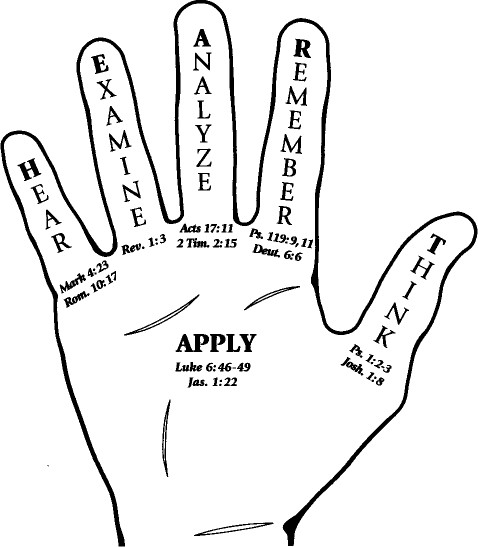
Source: Master Life - Avery Willis
SUMMARY - In the diagram above different aspects of engaging with the Word are depicted. The little finger designated HEAR describes the critical intake of the Word (Ro 10:17+, Mk 4:23+). But to begin to get a "grip" on the Bible in your hand, you need to engage the thumb and THINK. As you practice thinking on the Word, you are in effect meditating on the Word (Ps 1:2-3+, Joshua 1:8+). The other fingers designate practices which will strengthen your grip on the Living and Active Word, which in turn (and most importantly) will allow the Word to strengthen it's grip on your H.E.A.R.T. (note the first letter of each of the 5 fingers). The index finger is very important in strengthening your grip because in this endeavor you actively REMEMBER the Word, or memorize the Word, committing the passage, paragraph, chapter or book to memory by repetition and use ("use it or lose it"). EXAMINE the word refers to reading the Word, regularly and systematically (Rev 1:3+, Mt 4:4+). ANALYZE is digging deeper, a discipline that is aided greatly by learning to dig INDUCTIVELY. (Acts 17:11+, 2Ti 2:15+). Once you have the Word firmly in grip, firmly in your H.E.A.R.T, you must put the Word into practice, lest you become a modern day Pharisee, steeped in the Word, but lacking in Spirit enabled obedience (Lk 6:46-49+, James 1:22+). There you have it "handed" off to you. Take this "baton" and pass it on to other men and women who will be able to teach others also (2Ti 2:2+). In so doing, you are actively obeying the Lord Jesus' last command to MAKE DISCIPLES in Mt 28:19+, which is the critical cog in the wheel of any church that seeks to be strong in the Lord and bring Him glory.
A. T. Pierson - "Meditation is simply thought prolonged and directed to a single object. Your mystic chambers where thoughts abide are the secret workshop of an unseen Sculptor chiseling living forms for a deathless future. Personality and influence are modeled here. Hence, the biblical injunction: 'Keep thy heart with all diligence, for out of it are the issues of life'"
When you read your Bible, never put down your Bible
unless you have something that you can take with you the rest of the day!
The more you are in the Word of God
The more you will delight in the Word of God!
J. I. Packer says that meditation is the practice of turning each truth we learn about God into matter for reflection before God, leading to prayer and praise to God.
“Meditation is the activity of calling to mind, and thinking over, and dwelling on, and applying to oneself, the various things that one knows about the works and ways and purposes and promises of God… It is an activity of holy thought, consciously performed in the presence of God, under the eye of God, by the help of God, as a means of communion with God.” (BORROW Knowing God)
Saturation with the Scriptures
is the
Secret to Satisfaction of our Souls
The Puritan writer Thomas Brooks offers an excellent description of Biblical meditation…
Remember that it is not hasty reading—but serious meditation on holy and heavenly truths, which makes them prove sweet and profitable to the soul. It is not the mere touching of the flower by the bee which gathers honey (cp Ps 19:10-note; Ps 119:103-note)—but her abiding for a time on the flower which draws out the sweet. It is not he who reads most, but he who meditates most—who will prove to be the choicest, sweetest, wisest and strongest Christian."
Meditation is CHEWING. Meditation is aptly depicted by the cow's process of mastication (chewing). God has so constructed bovines to bring up previously digested food for additional grinding to enable optimal assimilation of the "cud." Meditation is pondering and reviewing various thoughts (specifically the thoughts/words of God) by mulling them over in one's mind and heart (our "control center" so to speak - see Pr 4:23+). Meditation is the processing of God's food for our soul (real "soul food!) One might call it "divine thought digestion." "Chewing" upon a divine thought, deliberately and diligently, a process which (enabled by the Spirit our "Sanctifier" and Teacher) provides the vital link between theory and action, between God's Word on paper and God's Word in our life. What mastication is to the physical life of the cow, meditation is to the spiritual life of those created in the image of God. C H Spurgeon asks a good question…
“Have you a spiritual taste, dear hearer? It is one thing to hear the Word. It is another thing to taste it. Hearing the Word is often blessed, but tasting it is a more inward and spiritual thing—it is the enjoyment of the Truth in the innermost parts of our being! Oh, that we were all as fond of the Word as were the old mystics who chewed the cud of meditation till they were fattened upon the Word of the Lord and their souls grew strong in the Divine Love! I am sure of this—the more you know of God’s Word, the more you will love it!”—The True Sayings of God - #3144
Meditation is ANALYZING. Literally analyzing describes the art of taking an intentional, lengthy look at a given object as the jeweler does when he puts his eyepiece on to examine the character and qualities of a flawless diamond. Indeed, "The words of the LORD are pure words; As silver tried in a furnace on the earth, refined seven times." (Ps 12:6+) Meditation on the living and active (energetic) Word (Heb 4:12+) is like gazing at a prism, which breaks a single beam of sunlight into many component colors. As we take time to steadily focus on the "diamond" of God's Word, the Spirit illumines the Son's light in His many and variegated "colors and hues."
Open thou mine eyes, that I may behold wondrous things out of Thy law (Psalm 119:18). (Spurgeon's comment)
Meditation is ACTION. Someone has described it: "Making words into thoughts and thoughts into actions." It is mental planning ahead with definite action in mind for accomplishing a job. Andrew Murray describes it: "Holding the Word of God in your heart until it has affected every phase of your life… this is meditation."
Now tie these three thoughts together: chewing, analyzing and action. Reflect on each of them now before reading any further. Give God time for divine polishing in His secret place in order to more effectually reproduce His glory and beauty in public.
"Muse" was the name given to an ancient Greek god who spent much time in solitude and thinking. The statue of "The Thinker" is the artistic concept of deep concentration and absorption. Add an "a" to the beginning of "muse" and you have: "amuse" -- sports, games, television and a score of other tools used by the enemy to keep God's men from concentrating on man's God.
Dawson Trotman illustrated Biblical meditation by comparing the way cows get the cud on which they chew…
A cow eats grass as it grazes early in the morning. When the sun gets hot, it will lie in the shade of a tree, and through the use of a unique elevator system it will bring up the grass from one stomach and thoroughly masticate it. When this is finished, it will put it into another stomach, having gotten from it everything possible in the way of nutrients.
Beware of getting alone with your own thoughts. Get alone with God's thoughts. There is danger in rummaging through waste and barren desert-thoughts that can be labeled -- daydreaming or worse. Don't meditate upon yourself but dwell upon Him -- seek God in your inner thought life. There is always danger in meditating upon problems. Develop the habit of reflection upon the Word of God and therein find the answers to your problems.
My soul shall be satisfied as with marrow and fatness, and my mouth shall praise Thee with joyful lips: When I remember Thee upon my bed, and meditate on Thee in the night watches" (Psalm 63:5-6).
Regarding Psalm 63, Spurgeon wrote that…
Lying awake, the good man betook himself to meditation, and then began to sing. He had a feast in the night, and a song in the night. He turned his bedchamber into an oratory, he consecrated his pillow, his praise anticipated the place of which it is written, "There is no night there." Perhaps the wilderness helped to keep him awake, and if so, all the ages are debtors to it for this delightful hymn. If day's cares tempt us to forget God, it is well that night's quiet should lead us to remember him. We see best in the dark if we there see God best.
And meditate on thee in the night watches. Keeping up sacred worship in my heart as the priests and Levites celebrated it in the sanctuary. Perhaps David had formerly united with those "who by night stand in the house of the Lord," and now as he could not be with them in person, he remembers the hours as they pass, and unites with the choristers in spirit, blessing Jehovah as they did. It may be, moreover, that the king heard the voices of the sentries as they relieved guard, and each time he returned with renewed solemnity to his meditations upon his God. Night is congenial, in its silence and darkness, to a soul which would forget the world, and rise into a higher sphere. Absorption in the most hallowed of all themes makes watches, which else would be weary, glide away all too rapidly; it causes the lonely and hard couch to yield the most delightful repose -- repose more restful than even sleep itself. We read of beds of ivory, but beds of piety are better far. Some revel in the night, but they are not a tithe so happy as those who meditate in God.
- Related Resource: See Watson's Treatise on Meditation for much greater detail
Let's get started. Since we want to make this a built-in habit of daily living, start with a moment of prayer. Ask God's help in concentration, alertness of mind and that inward sense of His abiding Presence. As a means of getting under way, here are five suggestions that will make the following Bible verse extremely practical:
"Hitherto have ye asked nothing in My Name; ask, and ye shall receive, that your joy may be full." (Jn 16:24)
(1). Emphasize:
One of the most helpful approaches in meditation is to emphasize different words within the verse. As you throw them out vocally, the Holy Spirit will echo them back to your heart through your ears and mind. Read the first phrase aloud several times with striking emphasis upon the word in caps:
HITHERTO have ye asked nothing in My Name.
Hitherto have YE asked nothing in My Name.
Hitherto have ye asked NOTHING in My Name.
Hitherto have ye asked nothing in MY NAME.
(2). Paraphrase:
Put this verse from the King James Version into your own words. Say it over and over, silently and aloud, until you can communicate it back to yourself in language that has meaning. Reflect slowly. Don't be in a hurry to reword it -- rearrange the words and use your dictionary to look up words you don't understand. Perhaps you will end up with something like this:
"Up to this moment you have not been asking anything in God's authority; go ahead and ask, see if God doesn't love to answer. This is because He wants you to be full of cheerfulness."
(3). Ask Questions:
Now that you have taken it apart and have paraphrased it so it is your very own, start asking questions. Use the ones the newspaper reporter starts with: who? what? where? when? why? and how? (See discussion of this interrogative mindset under Inductive Study) Here's how it works on John 16:24.
- Who is Jesus talking to?
- What is He saying? What does He say I should do?
- Where should I pray? Where have I failed in my praying?
- When should I ask? When is my joy full and complete?
- Why does God say I should pray?
- How should I go about asking?
Every question is not equally productive, but by asking such questions, your mind will be focused on the Word of God -- this is the beginning of meditation. When you start asking questions, you start to dissect. Not questions that just bring up facts and doctrine but also heart-feeding application. Questions and answers to the above put the Scriptures into the bloodstream of your soul.
(4). Application:
Apply Jn 16:24 immediately. 2Ti 3:16, 17 (see notes) says that all Scripture is profitable in a four-fold function: it is useful in teaching the faith, for correcting error, for resetting the direction of man's life and for training him in good living. Tackle John 16:24 once again from these four angles: (Click here for Application in Inductive Bible Study)
a. Is there some truth I should know from this verse?
b. Is there something I should stop doing in light of this verse?
c. Is there a practice in my life I should change?
d. Is there a habit I ought to begin?
(5). Persistence:
A "verse a day" can be selected during your quiet time in the morning. To begin with, it can be done within ten minutes. Try analyzing, dissecting and chewing over such a verse during odd moments of your day -- walking to work, riding the train or bus, waiting for meals or "killing time" for that appointment. Apply it that very day. Perhaps you will have the opportunity to share it with someone else. [A workable plan for busy people desiring a daily morning time with God has been written in a little brochure - for this booklet click Seven Minutes With God. As a practical exercise click and meditate on all 23 uses of "meditate" in OT. Make a list of what you learn about meditating on meditation! Then "Selah" which indicates a pause, which also implies meditation. See the 74 uses of "Selah" in the Psalms.)
TRANSFORMATION
( Ro 12:2-+)
The crown fruit of meditation is the changed life. Without the transformed life, meditation is of little eternal value. This was the problem Jesus had with the Pharisees of His day. They knew the facts and were experts in doctrine. They were conscientious, sincere and dedicated. But the Lord called them sons of Satan -- "Ye are of your father the devil." Why this stinging indictment? Because for all their study of the Old Testament, there was no change in their lives. As D L Moody said "Every Bible should be bound in shoe leather," alluding to the importance of applying the truth we learn to our lives. These religious hypocrites continued to oppress the poor, defraud the widows and pursue doubtful business practices! In a word no repentance which signified they had no regeneration.
Beware of meditation that ends in pious words without pious practices (cf Jas 1:22-note). True meditation fuels God honoring moral actions. A changed attitude toward God and fellow man should be the result, including things like a changed work habit, a changed relationship to one's spouse or family, in short -- a changed life! Anything less means your "meditation" is little more than "pious platitudes" as they say.
"O how I love Thy law: it is my meditation all the day" (Ps 119:97+)
Comment: This verse is very practical and very convicting for we all understand that if you truly love someone, you will want to spend time with them! And this thought in turn reminds us of Colossian 3:16-note where Paul instructs the saints at Colossae to let the Word of Christ richly dwell within them. The key word is dwell (enoikeo) which means to take up residence or make one's home, giving us a great word picture of believers being at home with the Word of Christ, living in it! Does that describe you beloved disciple of Christ?
Spurgeon's Comment regarding the phrase it is my meditation all the day "This was both the effect of his love and the cause of it. He meditated in God's word because he loved it, and then loved it the more because he meditated in it. He could not have enough of it, so ardently did he love it: all the day was not too long for his converse with it. His main prayer, his noonday thought, his evensong were all out of Holy Writ; yea, in his worldly business he still kept his mind saturated with the law of the Lord. It is said of some men that the more you know them the less you admire them; but the reverse is true of God's word. Familiarity with the word of God breeds affection, and affection seeks yet greater familiarity. When "thy law," and "my meditation" are together all the day, the day grows holy, devout, and happy, and the heart lives with God."
Bring the fruit of your meditation and offer it to the Lord for His blessing. Ask the Holy Spirit to apply the Word to your heart and enable you to live today in conformity to it.
Let the words of my mouth,
And the meditation of my heart,
Be acceptable in Thy sight, O Lord,
My strength, and my Redeemer
Psalm 19:14+
Spurgeon commenting on Psalm 19:14 said that this verse is
"A sweet prayer, and so spiritual that it is almost as commonly used in Christian worship as the apostolic benediction. Words of the mouth are mockery if the heart does not meditate; the shell is nothing without the kernel; but both together are useless unless accepted; and even if accepted by man, it is all vanity if not acceptable in the sight of God. We must in prayer view Jehovah as our strength enabling, and our Redeemer saving, or we shall not pray aright, and it is well to feel our personal interest so as to use the word my, or our prayers will be hindered. Our near Kinsman's name, our Goel or Redeemer, makes a blessed ending to the Psalm; it began with the heavens, but it ends with him whose glory fills heaven and earth. Blessed Kinsman, give us now to meditate acceptably upon thy most sweet love and tenderness."
ILLUSTRATION - The porcupine's eating habits remind us to feed on heavenly food, meditating on God's Word day and night. He feeds on the bark of the tree beginning at the top of the tree. This is called girding. He eats just enough bark where he will not kill the tree. This actually sweetens the tree. In the following year, sugar has built up over the section that he girded and he feeds on the sugar. This section is 300 times sweeter than the amount of food found below. One porcupine was observed to return to the same tree eleven years in a row. Beloved, God's Word is also sweet. Like the porcupine, we should be feeding on its richness.
Psalm 19:10—More to be desired are they than gold, yea, than much fine gold: sweeter also than honey and the honeycomb.
Beloved, you will find that the old promises of God's Word get sweeter through the years. As you return to familiar passages in your reading and study, you may find new, sweeter insights in Scripture that you never saw before just as the porcupine finds sweetness in old feeding grounds. Spending time in God's Word and finding your strength and joy in Him will help you to guard against greed or covetousness in your life. (Rod Mattoon)
QUESTION - How can I meditate on God’s Word?
ANSWER - The spiritual practice of meditation is not unique to Christianity. Many non-Christian religions and secular groups practice meditation. However, when the Bible speaks of meditation, as it often does, it is not the kind of meditation that seeks to disengage, silence, or empty the mind, as in Transcendental or Buddhist forms of meditation. The Scriptures teach meditation that actively engages the mind for the purpose of understanding God’s Word and putting it into practice. How can we meditate on God’s Word so that it produces in us fruitful and holy lives before God?
In the ancient Hebrew world, meditation always involved exercising and engaging the mind. Thomas Watson, a seventeenth-century Puritan minister, devoted much of his life to biblical meditation, both practicing it and teaching about it. He aptly defined the discipline in his book Heaven Taken by Storm as “an holy exercise of the mind, whereby we bring the truths of God to remembrance, and do seriously ponder upon them, and apply them to our selves.”
By Watson’s definition, we can meditate on God’s Word by bringing to memory His truths. Remembering requires active, cognitive recall of what we know about God from His Word: “On my bed I remember you; I think of you through the watches of the night” (Psalm 63:6). According to Psalm 1:2, a blessed, fruitful, and righteous person delights in the Word of the Lord “and meditates on his law day and night.” This meditation is constant (“day and night”) and focused on God’s Word (“his law”). We meditate on God’s Word by filling our minds with it day and night.
God called Joshua to vigorous and continual meditation: “Keep this Book of the Law always on your lips; meditate on it day and night, so that you may be careful to do everything written in it. Then you will be prosperous and successful” (Joshua 1:8). Here, biblical meditation expands from merely thinking to speaking (“on your lips”). The passage also states the purpose of meditation, that is, obedience to God’s Word, which produces prosperity and success before God.
Watson’s description of meditation includes serious contemplation or pondering of God’s truth. Psalm 119:15 says, “I will study your commandments and reflect on your ways” (NLT). So biblical meditation involves deep reflection and study of God’s Word. When we read the Bible, are we reading it slowly and intentionally? Are we thinking about the significance of the words and how they relate to our lives and the lives of others? If so, we are meditating on God’s Word.
Meditation requires time and effort. It can’t be rushed. It involves withdrawing from the distractions of this life so that we can fix our thoughts on God and His Word. By shutting out the noise of this world, we are better able to focus our attention on God and understand His ways: “I have more insight than all my teachers, for I meditate on your statutes” (Psalm 119:99).
Finally, as Watson touched on, biblical meditation seeks to apply God’s Word to our lives. Psalm 19:14 illustrates this truth: “May these words of my mouth and this meditation of my heart be pleasing in your sight, LORD, my Rock and my Redeemer.” Meditating on God’s Word becomes pleasing in God’s sight because it results in the transformation of our lives. As we read and speak God’s truth and actively ponder it, the Holy Spirit enables us to put that truth into practice. In Philippians 4:8–9, the apostle Paul gives us this beautiful and complete picture of biblical meditation: “Finally, brothers and sisters, whatever is true, whatever is noble, whatever is right, whatever is pure, whatever is lovely, whatever is admirable—if anything is excellent or praiseworthy—think about such things. Whatever you have learned or received or heard from me, or seen in me—put it into practice. And the God of peace will be with you.”
Meditation is a way of internalizing God’s Word—taking it deep into our hearts—so that the Holy Spirit can work through it to guide, teach, purify, and transform us from within. We can listen to the Bible, read it, and memorize Scripture to get it into our minds, but then we must also ponder it continually in our hearts so that we gain a deeper understanding of it and how it applies to our lives.
Here are four practical tips for meditating on God’s Word:
1. Carve out a specific time and place each day when you are least likely to be interrupted or distracted to get alone and meditate on God’s Word.
2. Start with prayer and ask God to help you with your meditation. You can ask the Lord to draw you closer to Him, open your eyes to His truth, help you apply that truth in your life, and transform you as you meditate on God’s Word.
3. Choose a small section of Scripture. Think about what the passage means. Study it in depth so that you can understand it in context. Take notes. Ask questions. Memorize the passage. Ask God what He wants to say to you through the text.
4. Consider how you can apply the passage to your life in practical ways, and ask God to help you follow through in obedience to what He shows you. GotQuestions.org
QUESTION - What is Christian meditation?
ANSWER - Psalm 19:14 states, “May the words of my mouth and the meditation of my heart be pleasing in your sight, O Lord, my Rock and my Redeemer.” What, then, is Christian meditation, and how should Christians meditate? Unfortunately, the word “meditation” can carry the connotation of something mystical. For some, meditation is clearing the mind while sitting in an unusual position. For others, meditation is communing with the spirit world around us. Concepts such as these most definitely do not characterize Christian meditation.
Christian meditation has nothing to do with practices that have Eastern mysticism as their foundation. Such practices include lectio divina, transcendental meditation, and many forms of what is called contemplative prayer. These have at their core a dangerous premise that we need to “hear God’s voice,” not through His Word, but through personal revelation through meditation. Some churches are filled with people who think they are hearing a “word from the Lord,” often contradicting one another and therefore causing endless divisions within the body of Christ. Christians are not to abandon God’s Word, which is “God-breathed and is useful for teaching, rebuking, correcting and training in righteousness, so that the man of God may be thoroughly equipped for every good work” (2 Timothy 3:16-17). If the Bible is able to thoroughly equip us for every good work, how could we think we need to seek a mystical experience instead of or in addition to it?
Christian meditation is to be solely on the Word of God and what it reveals about Him and His works (Psalm 77:10–12; 143:5). David found this to be so, and he describes the man who is “blessed” as one whose “delight is in the law of the LORD, and on his law he meditates day and night” (Psalm 1:2). True Christian meditation is an active thought process whereby we give ourselves to the study of the Word, praying over it and asking God to give us understanding by the Spirit, who has promised to lead us “into all truth” (John 16:13). Then we put this truth into practice, committing ourselves to the Scriptures as the rule for life and practice as we go about our daily activities. This causes spiritual growth and maturing in the things of God as we are taught by His Holy Spirit. GotQuestions.org
QUESTION - What are some biblical examples of meditation?
ANSWER - Meditation is the act of focusing one’s mental energies on a specific topic in an effort to achieve resolution or peace of mind. Biblical meditation narrows that definition to a spiritual exercise focused on Scripture. In biblical meditation, a person deliberately quiets the heart and contemplates certain verses, asking, “What is this saying to me about my life and situation?” or “What is this saying about God?” Biblical meditation can include prayer, Bible memory, and reading. Meditation was common in Bible times, and Joshua 1:8 commands it, promising reward for meditating on and obeying Scripture: “Keep this Book of the Law always on your lips; meditate on it day and night, so that you may be careful to do everything written in it. Then you will be prosperous and successful.”
The Psalms are filled with exhortations to meditate on all the qualities of God. Bible verses about meditation showcase the differences between it and yoga or other forms of non-biblical meditation. Meditating correctly lifts our hearts up in communion with God. Our focus is on Him, not ourselves. We are personalizing truths found in His Word, not seeking to find truth within ourselves. Psalm 119:15–16 notes the object of our meditation: “I meditate on your precepts and consider your ways. I delight in your decrees; I will not neglect your word.” Psalm 77:12 says, “I will consider all your works and meditate on all your mighty deeds.” This verse well summarizes godly meditation and should be the daily prayer of every Christian: “May the words of my mouth and the meditation of my heart be pleasing to you, O LORD, my rock and my redeemer” (Psalm 19:14NLT).
The first biblical example of meditation is found in Genesis 24:63, when Isaac went into the fields in the evening to meditate. While there, he saw his father’s servant returning from Aram Naharaim with Rebekah, who was soon to be Isaac’s bride. The way the Bible records this event hints that meditation was part of Isaac’s regular routine. We don’t know the exact nature of his meditation that day, but he knew that his father had sent for a wife for him. It is likely that Isaac’s daily meditations involved prayer for his future bride, concerns about becoming a husband, and gratefulness to God that he would no longer be lonely after the death of his mother (see Genesis 24:67).
King David gives us another example of meditation. In 2 Samuel 7:1-29, Nathan the prophet relays the message that the Lord did not want David to build a house for Him. Instead, God would raise up David’s son (Solomon) who would have that honor. In response to this news, “David went in and sat before the Lord” (verse 18). The rest of the chapter records David’s prayer to God as part of his meditation. “Sitting before the Lord” is a good description of times when we quiet our hearts to commune with God. We remove distractions, enter into a spirit of worship, pray, and allow the Holy Spirit to search our hearts and reveal what needs to be changed (Psalm 139:23). In that quietness, God often brings to mind passages of Scripture we have previously learned and applies them to our current situation.
For example, a teacher may wrestle with a request from a particularly annoying student to chauffer him somewhere. He does not want to do this. He has prayed, “Lord, I would do it for you, but I don’t want to do it for him. I’ve helped him enough.” But he does not stop with a prayer. He takes time to meditate on the Lord and His glory, and as he does, a verse comes to mind: “Truly I tell you, whatever you did for one of the least of these brothers and sisters of mine, you did for me” (Matthew 25:40). The teacher now has direction. Not only do we learn more of God when we meditate, but He can speak to us when our minds are focused on Him.
Psalm 1:1–2 promotes meditation: “Blessed is the one . . . whose delight is in the law of the Lord, and who meditates on his law day and night.” To be blessed is to be spiritually prosperous and favored by God. But how is it possible to meditate on God’s law “day and night”? That happens when meditation becomes habitual, part of one’s lifestyle. A person who is filled with the Spirit (Galatians 5:16, 25) lives in a state of ongoing meditation, even while going about a daily routine. God is never far from his or her mind, and every sight, sound, and event is another opportunity to share with the Lord. “The traffic is scary today, Lord. Thank you for your protection.” “That redbud tree is gorgeous, Lord. It reminds me of your beauty and creativity. Your Word says that all your works praise you (Psalm 145:10), and that tree certainly does!” When our hearts are in tune with God, meditation comes naturally and is a good way to keep ourselves from evil (Psalm 34:14–15). GotQuestions.org
(From "Lessons for the Christian's Daily Walk" 1859)
"So I applied my mind to understand, to investigate and to search out wisdom and the scheme of things." Ecclesiastes 7:25
We live in stirring days, when deeds are everything--when closet work is often neglected for active business, and little time is given to meditation. Yet, with more thought and prayer--wholesome activity would be greater in the end, and all our actions more successful. Time is not lost, which is spent in meditation--in searching wisdom's ways, and seeking out profound realities. There is one who often meditates--and yet accomplishes much. There is another who hastens--and yet does little.
None works so heartily, nor reaps so fully--
as he whose wits are sharpened by prayer and meditation.
Reading either Scripture or Christian books, apart from meditation, does little good. It is much the same as not digesting what you eat--this only starves the soul. How many read the Bible thus!
The art of meditation may be learned by dint of effort.
You say, "I am quite unused to meditate. How shall I begin?" Deal gently with yourself at first. Select your subject--some passage from the Word. Then fix the time you choose to give; say, five minutes at a time. Begin, and think aloud. This makes it easier, and saves the mind from distracted thoughts, the hardest task of all. The sound even of your own voice will help you; it is like speaking to a friend. And what is meditation, but communing with self (Ed: And with God through His Word)--that self may be a constant hearer.
But, more than all, make it a time of prayer--of communing with God. This helps the matter greatly. Take the words of Scripture--and ask Jesus what they mean. In doing this, the mind is exercised. A glow of thought attends the effort. You honor Jesus; and He will honor you, by pouring out a largeness of capacity--a quicker mind. The interchange of thought between you and Jesus goes on apace, and you are surprised to find how long the exercise has lasted.
Thus meditation grows, the more it is exercised. It …
- feeds the soul,
- expands the mind,
- increases thought, and,
- best of all, it brings you into fellowship with Jesus.
- This is the very life and soul of meditation.
Below you will find the 23 Scriptures in NASB that are translated with the word "meditate" or "meditation". Read through these passages and observe for answers to the questions "who, what, when, where, why or how?" (see discussion of 5W'S & H type questions - Related Resource: Inductive Bible Study) For the most accurate interpretation, you will want to click each respective link to check the corresponding context. Where are most of the references found? What is one to meditate upon in each of these uses? As you discipline yourself for godliness (1Ti 4:7, 8-note) and learn the art of interrogating the Biblical text (remember you are conversing with the Living God in and through His living Word - don't ever lose the sense of awe at this priceless, precious privilege!) for as you interact (actively, rather than how so many read the Scriptures - passively) you will be in a sense "meditating"… in this case you are meditating on what the Bible teaches about meditation! Make your observations into a list or a short paragraph with a Biblical description of meditation. Finally, pray some of these passages to our Father Who delights to see His children "chewing the cud" of His Word.
Gen 24:63 And Isaac went out to meditate in the field toward evening; and he lifted up his eyes and looked, and behold, camels were coming. (Who? When? Where?)
Joshua 1:8 (note) "This book of the law shall not depart from your mouth, but you shall meditate on it day and night, so that you may be careful to do according to all that is written in it; for then you will make your way prosperous, and then you will have success. (Who? Who speaking? To whom? Why? What is the context? When?, etc)
Job 15:4 "Indeed, you do away with reverence, and hinder meditation before God.
Psalm 1:2 But his delight is in the law of the LORD, and in His law he meditates day and night. (Spurgeon's note)
Psalm 4:4 Tremble, and do not sin; Meditate in your heart upon your bed, and be still. Selah. (Spurgeon's note)
Psalm 19:14 Let the words of my mouth and the meditation of my heart Be acceptable in Thy sight, O LORD, my rock and my Redeemer. (Spurgeon's note)
Psalm 27:4 One thing I have asked from the LORD, that I shall seek: That I may dwell in the house of the LORD all the days of my life, to behold the beauty of the LORD, and to meditate in His temple. (Spurgeon's note)
Psalm 49:3 My mouth will speak wisdom; and the meditation of my heart will be understanding. (Spurgeon's note)
Psalm 63:6 When I remember Thee on my bed, I meditate on Thee in the night watches, (Spurgeon's note)
Psalm 77:6 I will remember my song in the night; I will meditate with my heart; and my spirit ponders. (Spurgeon's note)
Psalm 77:12 I will meditate on all Thy work, and muse on Thy deeds. (Spurgeon's note)
Psalm 104:34 Let my meditation be pleasing to Him; As for me, I shall be glad in the LORD. (Spurgeon's note)
Psalm 119:15 I will meditate on Thy precepts, And regard Thy ways. (Spurgeon's note)
Psalm 119:23 Even though princes sit and talk against me, Thy servant meditates on Thy statutes. (Spurgeon's note)
Psalm 119:27 Make me understand the way of Thy precepts, so I will meditate on Thy wonders. (Spurgeon's note)
Psalm 119:48 And I shall lift up my hands to Thy commandments, Which I love; and I will meditate on Thy statutes. (Spurgeon's note)
Psalm 119:78 May the arrogant be ashamed, for they subvert me with a lie; but I shall meditate on Thy precepts. (Spurgeon's note)
Psalm 119:97 O how I love Thy law! It is my meditation all the day. (Spurgeon's note)
Psalm 119:99 I have more insight than all my teachers, for Thy testimonies are my meditation. (Spurgeon's note)
Psalm 119:148 My eyes anticipate the night watches, that I may meditate on Thy word. (Spurgeon's note)
Comment: Think about what the psalmist is saying! In ancient days one could not reach over for their Bible on Iphone and read the Scripture on which one sought to meditate! No, the only way one could meditate on the Scriptures in the night watches is by having it memorized and available for ready recall.
Psalm 143:5 I remember the days of old; I meditate on all Thy doings; I muse on the work of Thy hands. (Spurgeon's note)
Psalm 145:5 On the glorious splendor of Thy majesty, And on Thy wonderful works, I will meditate. (Spurgeon's note)
Isaiah 33:18 Your heart will meditate on terror: "Where is he who counts? Where is he who weighs? Where is he who counts the towers?"
BIBLICAL MEDITATION: Hampton Keathley, III in his excellent summary from Bible.org writes that "Meditation means “the act of focusing one’s thoughts: to ponder, think on, muse.” Meditation consists of reflective thinking or contemplation, usually on a specific subject to discern its meaning or significance or a plan of action. " (click for entire article - highly recommended)
QUIET TIME: SEVEN MINUTES WITH GOD:
A good place to begin if your quiet time has become too "quiet" or your schedule has become too busy for time alone with God (a place we all have been from time to time).
MEMORIZING HIS WORD: Illustrations, helps, devotionals, testimonials, etc on the value of memorizing God's Word
BORN TO REPRODUCE: A short biography on the abundant life of Dawson Trotman founder of The Navigators. If you are not familiar with how God supernaturally used this man, you NEED TO READ his encouraging, motivating biography (click), because every saint is exhorted to "remember those who led you, who spoke the word of God to you and considering the result of their conduct, imitate their faith" (Heb 13:8-note) But we cannot imitate one whom we do not know. But perhaps you would like to know who is Dawson Trotman - click for a good summary of his life and legacy.
The Navigators is an international, interdenominational Christian organization. Jesus Christ gave His followers a Great Commission in Matthew 28.19. "Go therefore and make disciples of all nations… " The primary aim of the Navigators is to help fulfill Christ's Great Commission by making disciples and developing disciple makers in every nation. Edited into digital media from a print media booklet not naming author, bearing no date, claiming no copyright, published by The Navigators. This electronic text edition, although slightly different on format, is also issued freely into the public domain.
MEDITATE ON THE WORD DAY & NIGHT: PSALM 1 (Ps 1) by John Piper who explains that meditation on the Word is difficult if one does not first memorize it and that "the depth and solidity and certainty of your walk with God and your communion with God will rise and fall with whether God's own written Word is the warp and woof of the fabric of your fellowship." (entire sermon)
John Piper on meditation - Here I speak not of sermon preparation but of what I call "going out to pasture"—resting and ruminating on the word of God. It is savoring for the sake of life, not seeking for tomorrow's text. (Avoiding Sexual Sin - Desiring God)
- Warm Yourself at the Fires of Meditation - Desiring God
- Prayer, Meditation, and Fasting, Part 1 - Desiring God
- Prayer, Meditation, and Fasting, Part 2b - Desiring God
- Meditate on the Word of the Lord Day and Night - Desiring God
- Psalm 1- When Delight Overcomes Distraction - Desiring God
Our lives are unbelievably distracted. We are experts at multi-tasking, surfing, and skimming, but it is harder than ever to meditate. Therefore, it is imperative to intentionally cultivate meditation on God’s Word. But how? If possible, find a consistent time, place, and plan. Then read slowly and carefully. Reread and reread. Read out loud (which is implied in the Hebrew word for meditation in Psalm 1:2). Read prayerfully. Read with a pen in hand. Memorize texts that you read. Read with other people and talk about what you see. Study a book of the Bible with a good commentary. Pray about a plan for Bible meditation this year, and talk about your plan with a Christian friend.
IN DEPTH EXPOSITION OF PSALM 1:1-3 - by Bruce Hurt,MD - See on site notes Psalm 1:1; Psalm 1:2; 1Psalm 1:3
How blessed is the man who does not walk in the counsel of the wicked, Nor stand in the path of sinners, Nor sit in the seat of scoffers! But his delight is in the law of the LORD, And in His law he meditates day and night. And he will be like a tree firmly planted by streams of water, Which yields its fruit in its season, And its leaf does not wither; And in whatever he does, he prospers.
BRIAN HEDGES ON MEDITATION - What do you think about in the still of the night? Ps 63:6, 7 give the setting for David’s satisfaction in Ps 63:3, 4, 5: David’s thoughts were consumed with God, even in the still of the night, and what we think often about is closest to our hearts. A mind full of God is a good indicator of a “fit” spirituality. Like the blessed man of Psalm 1 (Ps 1:1, 2, 3 - see notes Ps 1:1; 1:2; 1:3), our delight should be the law of the Lord, and on His law we should meditate day and night. Meditation could be compared to both a thermostat and a thermometer. While a thermostat controls the temperature in a room, a thermometer measures the temperature. Meditation on Scripture does both—it measures our spiritual temperature, and it controls and changes it. To discover how strong you are spiritually, take an inventory of your thought life. Are your thoughts centered on God, His glories, His grace, His Son, and His Word? If so, you will be transformed. (From Brian Hedges: A Picture of Spiritual Health - Life Action Revival Ministries) (See also Brian Hedges' article - Our Greatest Treasure)
We all know that we should be growing in Christ, but sometimes we forget that God holds us responsible to use the tools He has provided for our growth. Christians of another generation described these tools as “means of grace.” They include reading and meditating on Scripture, praying, fasting, attending corporate worship, and celebrating the Lord’s Table. (Brian Hedges - Habits of Holiness)
Someone once said that 1 in 100 Christians read Scripture regularly; 1 in 1000 memorize Scripture; but only 1 in 10,000 meditate! Leonard Ravenhill was once asked for advice by an aspiring young preacher. His answer? “Meditate. Meditate. Meditate.” (Brian Hedges - Staying in the Battle)
NAVE'S TOPIC: Meditation - Joshua 1:8; Ps 1:2; 4:4; 19:14; 39:3; 49:3; 63:5,6; 73:12, 13, 14, 15, 16, 17, 18, 19, 20, 21, 22, 77:10, 11, 12; 104:34; 119:11,15,16,23,48,55,59,78,97, 98, 99,148; 139:17,18; 143:5; 1 Timothy 4:13, 14, 15 Isaac IN Genesis 24:63
Prepared to seek God 2 Chronicles 19:3; Ezra 7:10; Psalm 10:17
Fixed on God Psalm 57:7; 112:7
Joyful in God 1 Samuel 2:1; Zechariah 10:7
Perfect with God 1 Kings 8:61; Psalm 101:2
Upright Psalm 97:11; 125:4
Clean Psalm 73:1
Pure Psalm 24:4; Matthew 5:8
Tender 1 Samuel 24:5; 2 Kings 22:19
Single and sincere Acts 2:46; Hebrews 10:22
Honest and good Luke 8:15
Broken, contrite Psalm 34:18; 51:17
Obedient Psalm 119:112; Romans 6:17
Filled with the law of God Psalm 40:8; 119:11
Awed by the word of God Psalm 119:161
Filled with the fear of God Jeremiah 32:40
Meditative Psalm 4:4; 77:6
Circumcised Deuteronomy 30:6; Romans 2:29
Void of fear Psalm 27:3
Desirous of God Psalm 84:2
Enlarged Psalm 119:32; 2 Corinthians 6:11
Faithful to God Nehemiah 9:8
Confident in God Psalm 112:7
Sympathising Jeremiah 4:19; Lamentations 3:51
Prayerful 1 Samuel 1:13; Psalm 27:8
Inclined to obedience Psalm 119:112
Wholly devoted to God Psalm 9:1; 119:10,69,145
Zealous 2 Chronicles 17:6; Jeremiah 20:9
Wise Proverbs 10:8; 14:33; 23:15
A treasury of good Matthew 12:35
- Meditate upon these things; give thyself wholly to them, that thy profiting may appear to all. 1Ti 4:15
The chief of the Federal Bureau of Investigation has often stressed the importance of family Bible reading. Some years ago in a letter to the American Bible Society he said, "Inspiration has been the keynote of America's phenomenal growth … and the backbone of its greatness… This inspiration has been from faith in God … and in the belief that the Holy Bible is His inspired Word. Reading the Scriptures within the family circle is more important today than ever before. As a small boy I sat at my mother's knee while she read the Word to me and explained its meanings with stories as we went along. It served to make the bond of faith between us much stronger. Then there were those wonderful nights when my father would gather all the children around him and read aloud verses from the Bible. This led to family discussions which were interesting, lively, and informative. Those wonderful sessions left me with an imprint of the power of faith and … prayer which has sustained me in trying moments throughout my life."
Regrettably, family altars are fast disappearing from the American scene. People are too busy. The family is seldom together long enough to enjoy such sweet moments of fellowship — and the world is much the poorer for it! The Word of God constantly admonishes us to meditate upon its contents, for only as we absorb its teachings, believe its promises, and hide its precepts in our hearts can we prosper spiritually and live the "more abundant life."
Take a cue from the letter of J. Edgar Hoover; and if you have not yet established a definite time for Bible study in your home, start now — even if you can devote only five minutes a day to this necessary task. Man cannot live by bread alone. He must find sustenance for his spirit by appropriating the truths of God through the avenue of prayer and careful meditation.
How precious is the Book divine,
By inspiration given!
Bright as a lamp its precepts shine,
To guide our souls to Heaven.
— J. Fawcett
A Bible that is falling apart
usually belongs to a person who is not!
No Fast Food In The Bible
Read: Ps 119:9, 10, 11, 12, 13, 14, 15, 16, 17, 18, 19, 20, 21, 22, 23, 24
I will meditate on Your precepts,
and contemplate Your ways.
--Psalm 119:15
Psalm 119:105-136 Meditate on These Things
Some Christians get a little skeptical when you start talking about meditation—not seeing the huge distinction between biblical meditation and some types of mystical meditation. In mystical meditation, according to one explanation, "the rational mind is shifted into neutral .. . so that the psyche can take over." The focus is inward, and the aim is to "become one with God."
In contrast, biblical meditation focuses on the things of the Lord, and its purpose is to renew our minds (Rom 12:2) so that we think and act more like Christ. Its objective is to reflect on what God has said and done (Ps 77:12; 119:15-16, 97) and on what He is like (Ps 48:9-14).
In Psalm 19:14, David wrote, "May the words of my mouth and the meditation of my heart be pleasing to you, 0 LORD, my rock and my redeemer." Other psalms reflect on God's love (Ps 48:9), His mighty works (Ps 77:12), His instructions (Ps 119:97), and His laws (Ps 119:99).
Fill your mind with Scripture and focus on the Lord's commands and promises and goodness. And remember this: Whatever is true, noble, just, pure, lovely, and of good report, meditate on these things (Phil 4:8). —CHK
Lord lead me to meditate on your Word so that I may know you better, become more like your Son, and please you in all I do and say.
To become more like Christ, meditate on Who He is.
Allen Ross - Ps 63:6 “Meditation”
The Bible has many references to the spiritual discipline of meditation, most of which come from the Book of Psalms. The psalmist can say, “On my bed I remember you, I think of you through the watches of the night” (Ps 63:6).
Meditation in the Bible differs dramatically from other forms of meditation. In some of the popular methods today, people meditate, not on the word, but on “a word,” or “nothing at all.” And while I suppose there is value to the process of calming one’s mind and spirit through this process, it really does not bring the spiritual benefits that meditating on the Word of the LORD does. When we meditate on the Word, we not only find rest for our souls, but strength and encouragement and guidance for the way.
What is involved in the process of meditation? The psalmist used the word “remember,” and that is a good starting point. The Hebrew word “to remember” can also be translated “keep in the memory, remind, ponder” and “meditate.” It is a deliberate mental activity that leads to a definite course of action. But that goes hand in hand with the meaning of the word “remember” (zakar) as well, for the word “remember” often carries with it the idea of the action that results from the process of remembering—our prayers for the Lord to remember us are clearly prayers for more than remembrance.
There are four steps in spiritual meditation in Holy Scripture. First, we should study the passage of Scripture in great detail so that we understand it fully. This may take time, for the Bible is full and complex. We can begin carefully and prayerfully with the portions that are the most meaningful and beneficial to us, using any tools that may help, such as commentaries, concordances, and other reference materials.
Second, if we have not already done this in the process, we should memorize the passage. That way we can call it to mind, or remember it, while driving, walking, or reclining in a bed. And what we remember will be properly understood.
Third, we need to turn the passage into a matter of prayer—talk to God about what He has said in His Word.
And fourth, we must exhort ourselves to act on the basis of what was pondered.
This is what we see in many passages. Psalms 42 and 43 (originally united) have a meditative refrain: “Why are you cast down, O my soul? Why so disturbed within me? Put your hope in God, for I will yet praise Him, my Savior and my God” (Ps 42:5).
Too often we spend our time reading books about the Bible, or attending seminars and conferences where others tell us the meanings and prescribe the actions. We all need to get to the point where we can handle the Word of God ourselves.
Psalm 1:1-3 “Meditation in the Word” - Allen Ross
The first psalm provides a fitting opening for the Book of Psalms as instruction in the life of devotion. It focuses our attention on the necessity and the value of meditation in the word. The second verse speaks of the spiritual person’s “delight” in being in the Law of the LORD, and of that person’s meditation in it day and night. The word “delight” is a figure of speech (a metonymy) in which the feeling of delight that inspires and accompanies the meditation is stated in place of the meditation. Saying “his delight is in the Law” means that he takes pleasure or delights to be in the Law in his studies. And the parallel line tells us that this meditation, this careful reading and reflecting of God’s word, is constant, it is a regular part of his whole daily course of life.
This verse is a contrast to the descriptions set forth in the first verse. That initial verse describes the heavenly bliss of the person who lives an untarnished life in this world, not forming life’s decisions by the counsel of the ungodly, not considering the way of life of sinners as an option, and certainly not joining with those who scorn the faith and the values of life. So where does the righteous person get advice and instruction for living?--from the Bible. It is always good to ask ourselves regularly what is influencing our most important opinions and views of the moral and ethical issues of life. Is the answer the evening news, or worse, the talk shows with the opinions of experts and the fantasies of fools displayed from coast to coast? Or are they all based solidly on the high standard of God’s word?
If they are based on a considered study and application of God’s word, then the result will be spiritual success. The psalmist says that this blessed person will be like a tree planted by water. If the simile compares him to a tree, then it implies the word is like water for the tree. It is the source of life. And the result is life--the tree flourishes, has leaves, and bears its fruit regularly. For the believer, there will be immediate signs of spiritual life produced by the word, and regularly there will be fruit, meaning righteousness. The final statement summarizes the meaning of the picture of the tree: everything he does shall prosper. Of course, this “everything” will be circumscribed by the word, so the things that the word directs the believer to do will be successful. God’s blessing will be on the person who takes guidance from the word to do the will of God.
So the message is clear: spend more time in the word, and from your study of God’s word form all your moral, spiritual and ethical decisions that will inform the many basic choices of life. When you do this, you will know within that you are right with God, and your life will be blessed by God, now and in the world to come.
If you do not “delight” in doing this, it may simply be that you do not kn ow how to read or study the Bible, where to start, what to use to help you, or how to apply the material. There are plenty of helpful books and instructions to get you started, so that there is no reason to be put off by parts you do not understand or do not see how they could be relevant. - Christian Leadership Center
Puritan John Flavel - Meditate
The works of the Lord are great, sought out of all them that have pleasure therein. Psalm 111:2
Let your meditation be as intensively full as may be. Do not let your thoughts swim like feathers upon the surface of the waters, but sink like lead to the bottom. Not that I think it feasible to sound the depth of providence by our short line: “Thy way is in the sea, and thy path in the great waters, and thy footsteps are not known” (Ps. 77:19), but it is our duty to dive as far as we can; and to admire the depth, when we cannot touch the bottom. It is in our viewing providences as it was with Elijah’s servant, when he looked out for rain (1 Kings 18:44); he went out once and viewed the heavens, and saw nothing, but the prophet bids him go again and again, and look upon the face of heaven seven times; and when he had done so, what now, says the prophet? “O now,” says he: “I see a cloud rising like a man’s hand”; and then, keeping his eye intently upon it, he sees the whole face of heaven covered with clouds. So you may look upon some providences once and again, and see little or nothing in them; but look “seven times’, that is, meditate often upon them, and you will see their increasing glory, like that increasing cloud. (The Puritan Daily Readings - Randall Pederson)
Thomas Watson - Meditation is a Duty
But his delight is in the law of the Lord; and in his law doth he meditate day and night. Psalm 1:2
Meditation is a duty lying upon every Christian and there is no disputing our duty. It is not arbitrary. The same God who has bid us believe, has bid us meditate: “This book of the law shall not depart out of your mouth—but you shall meditate therein day and night” (Josh. 1:8). These words, though spoken to the person of Joshua, yet they concern everyone; as the promise made to Joshua concerned all believers (Josh. 1:5 compared with Heb. 13:5). So this precept made to the person of Joshua—you shall meditate in this book of the law—takes in all Christians. As God’s Word does direct, so His will must enforce obedience. But meditation is much opposed. We may conclude it is a good duty because it is against the stream of corrupt nature. As one said, “you may know that religion is right—which Nero persecutes”; so you may know that is a good duty—which the heart opposes. We shall find naturally a strange averseness from meditation. We are swift to hear—but slow to meditate. To think of the world, if it were all day long, is delightful. But as for holy meditation, how does the heart wrangle and quarrel with this duty; it is like doing of penance. Now truly, there needs no other reason to prove a duty to be good, than the reluctance of a carnal heart. To instance in the duty of “Let a man deny himself” (Matt. 16:24), self-denial is as necessary as heaven—but what disputes are raised in the heart against it? What! to deny my reason, and become a fool that I may be wise; nay, not only to deny my reason—but my righteousness? What, to cast it overboard, and swim to heaven upon the plank of Christ’s merits?...so it is with this duty of meditation. (The Puritan Daily Readings - Randall Pederson)
Thomas Watson - A Meditating Christian
Give ear to my words, O Lord, consider my meditation. Psalm 5:1
Grace breeds delight in God,
and delight breeds meditation.
Meditation is a duty wherein consists the essentials of religion, and which nourishes the very life-blood of it. That the Psalmist may show how much the godly man is habituated to this blessed work of meditation, he subjoins, “In his law does he meditate day and night” (Ps. 1:2); not but that there may be sometimes intermission: God allows time for our calling, He grants some relaxation; but when it is said, the godly man meditates day and night, the meaning is, frequently—he is much conversant in the duty. It is a command of God to pray without ceasing (1 Thess. 5:17). The meaning is—not that we should be always praying—but that we should every day set some time apart for prayer. We read in the Old law it was called the continual sacrifice (Num. 28:24), not that the people of Israel did nothing else but sacrifice—but because they had their stated hours, every morning and evening they offered, therefore it was called the continual sacrifice. Thus the godly man is said to meditate day and night, that is, he is often at this work, he is no stranger to meditation. Thus, the doctrine that results from this is that a godly Christian is a meditating Christian. Meditation is the chewing upon the truths we have heard…Meditation is like the watering of the seed, it makes the fruits of grace to flourish. (The Puritan Daily Readings - Randall Pederson)
- Found in the introduction to Watson's A Treatise Concerning Meditation.
Thomas Watson - The Wing of the Soul
I will meditate also of all thy work, and talk of thy doings. Psalm 77:12
Meditation is the soul’s retiring of itself. A Christian, when he goes to meditate, must lock up himself from the world. The world spoils meditation; Christ went by Himself into the mountainside to pray (Matt. 14:23), so, go into a solitary place when you are to meditate. “Isaac went out to meditate in the field” (Gen. 24:63); he sequestered and retired himself that he might take a walk with God by meditation. Zacchaeus had a mind to see Christ, and he got out of the crowd, “He ran before, and climbed up into a sycamore tree to see him” (Luke 19:3, 4). So, when we would see God, we must get out of the crowd of worldly business; we must climb up into the tree by retiredness of meditation, and there we shall have the best prospect of heaven. The world’s music will either play us asleep, or distract us in our meditations. When a mote has gotten into the eye—it hinders the sight. Just so, when worldly thoughts, as motes, are gotten into the mind, which is the eye of the soul—it cannot look up so steadfastly to heaven by contemplation. Therefore, as when Abraham went to sacrifice, “he left his servant and the donkey at the bottom of the hill” (Gen. 22:5) so, when a Christian is going up the hill of meditation, he should leave all secular cares at the bottom of the hill, that he may be alone, and take a turn in heaven. If the wings of the bird are full of slime, she cannot fly. Meditation is the wing of the soul; when a Christian is beslimed with earth, he cannot fly to God upon this wing. (The Puritan Daily Readings - Randall Pederson)
Thomas Watson - To Converse with God
And Isaac went out to meditate in the field at the eventide… Genesis 24:63
Bernard of Clairvaux, when he came to the church-door, used to say, “Stay here all my worldly thoughts, that I may converse with God in the temple.” So say to yourself, “I am going now to meditate, O all you vain thoughts stay behind, come not near!” When you are going up the mount of meditation, take heed that the world does not follow you, and throw you down from the top of this pinnacle. Thus, the soul must retire itself, it must bolt the door against the world. But you must also seriously and solemnly think upon God. Indeed, the Hebrew word to “meditate” signifies with intenseness to recollect and gather together the thoughts. Meditation is not a cursory work, to have a few transient thoughts of religion; like the dogs of Nilus that lap and then run away; but there must be in meditation a fixing the heart upon the object, a steeping the thoughts. Carnal professors have their thoughts roving up and down, and will not fix on God; like the bird that hops from one branch to another, and stays in no one place. David was a man fit to meditate: “O God, my heart is fixed” (Ps. 108:1). In meditation there must be a staying of the thoughts upon the object; a man who rides quickly through a town or village—he minds nothing. But an artist who is looking on a curious piece, views the whole portraiture of it, he observes the symmetry and proportion, he minds every shadow and color. A carnal, flitting professor, is like the traveler, his thoughts ride hastily—he minds nothing of God. A wise Christian is like the artist, he views with seriousness, and ponders the things of religion. (The Puritan Daily Readings - Randall Pederson)
Thomas Watson - The Promise of Sanctification
Who is like unto thee, O Lord, among the gods? Who is like thee, glorious in holiness, fearful in praises, doing wonders? Exodus 15:11
Meditate upon the promise of sanctification. The earth is not so apt to be overgrown with weeds and thorns, as the heart is to be overgrown with lusts! Now, God has made many promises of healing (Hosea 14:4), and purging (Jer. 33:8). Promises of sending His Spirit (Isa. 44:3), which, for its sanctifying nature, is compared sometimes to water which cleanses the vessel; sometimes to wind, which is the fan to winnow and purify the air; sometimes to fire, which refines the metals. Meditate often on that promise: “Though your sins be as scarlet, they shall be as white as snow!” (Isa. 1:18). Scarlet is so deep a dye, that all the art of man cannot take it out; but behold here a promise—God will whiten the soul; He will make a scarlet sinner into a snow-white saint! By virtue of this refining and consecrating work, a Christian is made partaker of the divine nature (2 Peter 1:4); he has a suitability and fitness to have communion with God forever. Meditate much on this promise and meditate also upon the promise of remuneration or “the haven of rest” (Heb. 4:9) or the beatifical sight of God (Matt. 5:8), or the glorious mansions (John 14:2). Meditation on these promises will be as choice cordials to keep us from fainting under our sins and sorrows. (The Puritan Daily Readings - Randall Pederson)
Thomas Watson - The Love of Christ
Who shall separate us from the love of Christ? shall tribulation, or distress, or persecution, or famine, or nakedness, or peril, or sword? Romans 8:35
Meditate now upon the love of Christ. Christ is full of love, as He is of merit. What was it but love—that He should save us—and not the fallen angels? Among the rarities of the loadstone, this is not the least—that leaving the gold and pearl, it should draw iron to it—which is a baser kind of metal. Just so, that Christ should leave the angels, those more noble spirits, the gold and pearl—and draw mankind to Him—how does this proclaim His love? Love was the wing on which He flew into the virgin’s womb! How transcendent is Christ’s love to the saints! The apostle calls it a love “which passes knowledge” (Eph. 3:19). It is such a
love as God the Father bears to Christ; the same for quality, though not equality: “As the Father has loved me—so have I loved you” (John 15:9). A believer’s heart is the garden where Christ has planted this sweet flower of His love. It is the channel through which the golden stream of His affection runs. How sovereign is Christ’s love! “Brothers, think of what you were when you were called. Not many of you were wise by human standards; not many were influential; not many were of noble birth” (1 Cor. 1:26). In the old law God passed by the noble lion and the eagle—and took the dove for sacrifice. That God should pass by so many of noble birth and abilities, and that the lot of free grace should fall upon me—O the depth of divine grace! (The Puritan Daily Readings - Randall Pederson)
Thomas Watson - The Love of Christ (2)
And to know the love of Christ, which passeth knowledge, that ye might be filled with all the fulness of God. Ephesians 3:19
There is yet more on Christ’s love. Think of how invincible it is! “It is strong as death” (Song 8:6). Death might take away Christ’s life—but not His love! Neither can our sin wholly quench that divine flame of love; the church had her infirmities, her sleepy fits (Song 5:2), but though blacked and sullied, yet she is still a dove; Christ could see the faith, and wink at the failing. He who painted Alexander, drew him with his finger over the scar on his face. Just so, Christ puts the finger of mercy upon the scars of the saints! He will not throw away His pearls for every speck of dirt! That which makes this love of Christ the more stupendous, is that there was nothing in us to excite or draw forth His love! He did not love us because we were worthy—but by loving us He made us worthy! How immutable is Christ’s love! “Having loved his own, he loved them to the end” (John 13:1). The saints are like letters of gold engraved upon Christ’s heart, which cannot be erased out. Meditate much upon the love of Christ. Serious meditation on the love of Christ will make us love Him in return. “Can one go upon hot coals, and his feet not be burnt?” (Prov. 6:28). Who can tread by meditation upon these hot coals of Christ’s love, and his heart not burn in love to Him? (The Puritan Daily Readings - Randall Pederson)
Thomas Watson - Sin
Blessed is he whose transgression is forgiven, whose sin is covered. Psalm 32:1
Meditate on the guilt of sin. We are in Adam as in a common head, or root—and he sinning, we become guilty: “Wherefore, just as sin entered the world through one man, and death through sin, and in this way death came to all men, because all sinned” (Rom. 5:12). By his treason—our blood is tainted. This guilt brings shame with it, as its twin! (Rom. 6:21). Meditate upon the filth of sin. Not only is the guilt of Adam’s sin imputed, but the poison of his nature is disseminated to us! Our virgin nature is defiled! If the heart is spotted—how then can the actions be pure? If the water in the well is foul—it cannot be clean in the bucket! “We are all as an unclean thing” (Isa. 64:6). We are like a patient under the physician’s care—who has no sound part in him, his head is bruised, his liver is swelled, his lungs are gasping, his blood is infected, his feet are gangrened. Thus is it with us before saving grace comes! In the mind there is darkness! In the memory there is slipperiness! In the heart there is hardness! In the will there is stubborness! “You are sick from head to foot—covered with bruises, welts, and infected wounds—without any ointments or bandages!” (Isa. 1:6). A sinner befilthied with sin, is no better than a devil in man’s shape! And which is sadly to be laid to heart—is the adherence of this sin. Sin is natural to us. The apostle calls it, “the sin that so easily ensnares us” (Heb. 12:1). Sin is not easily cast off. A man may as well shake off the skin of his body—as the sin of his soul! There is no shaking off this viper until death! (The Puritan Daily Readings - Randall Pederson)
Thomas Watson - Sin (2)
For I will declare mine iniquity; I will be sorry for my sin. Psalm 38:18
O, often meditate on this contagion of sin. How strong is that poison—a drop whereof is able to poison a whole sea? How venomous and malignant was that apple—a taste of which poisoned all mankind! Meditate sadly on this. Meditation on sin will make the plumes of pride fall off! If our knowledge makes us proud—that is sin enough to make us humble. The best saint alive who is taken out of the grave of sin—yet has the smell of the grave-clothes still upon him! Meditate upon the curse of sin. “Cursed is everyone who does not continue to do everything written in the Book of the Law” (Gal. 3:10). This curse is like a deadly canker upon fruit, which keeps it from thriving. Sin is not only a defiling thing—but a damning thing! It is not only a spot in the face—but a stab at the heart! Sin betrays us into the devil’s hands—who writes all his laws in blood. Sin binds us over to the wrath of God! What then, are all our earthly enjoyments—with the sword of divine vengeance hanging over our head! Sin brings forth the “scroll written with curses” against a sinner (Zech. 5:3), and it is a “flying scroll"—it comes swiftly—if mercy does not stop it. “You are cursed with a curse!” (Mal. 3:9). Thus it is until Christ cuts off the head of this curse. O meditate upon this curse due to sin. Meditation on this curse will make us afraid of retaining sin … It will make us afraid of entertaining sin. We will not willingly entertain one in our house who had a deadly plague! (The Puritan Daily Readings - Randall Pederson)
Selwyn Hughes - Spiritual Digestion
How I love Your instruction! It is my meditation all day long.... I have more insight than all my teachers because Your decrees are my meditation.—Ps 119:97, 99
One of the highest priorities in order to stay spiritually fresh is to cultivate the art of Scripture meditation.
For some reason, Bible meditation has become a lost art in our day. A survey conducted among Christians in the United States showed that only one in ten thousand knew how to meditate on the Scriptures.
What, then, is the art of Scripture meditation? Is it reading parts of the Bible as slowly as possible so that every word sinks in? No. Is it studying a passage with the aid of a commentary so that one understands exactly what the Scripture is saying? No. Is it memorizing certain texts and recalling them to mind whenever one has a spare moment? No. You can do all of these things and still not know how to meditate.
Andrew Murray describes it as "holding the word of God in your heart and mind until it has affected every area of your life." My own definition is this: meditation is the process by which we place the Word of God into the digestive system of the soul, where it is transformed into faith and spiritual energy.
Psalm 1:2-3 paints a picture of amazing freshness and vitality: "His delight is in the Lord's instruction, and he meditates on it day and night. He is like a tree planted beside streams of water that bears its fruit in season and whose leaf does not wither." What is the secret of this amazing freshness? It is simple—meditation. To draw from Scripture the inspiration and power we need to stay spiritually fresh, we must do more than read it, study it, or even memorize it—we must meditate on it.
Prayer
O Father, I want so much to learn the art of meditation. Quicken my desire to hide Your Word in my heart so that it becomes the hidden springs of action and determines my character and my conduct. In Jesus' name. Amen. (Every Day With Jesus)
Selwyn Hughes - Why Fear to Meditate?
Stop your fighting—AND KNOW THAT I AM GOD.—PSALM 46:10
In our age of increasing uncertainty, one sure way of staying on top is by the continuous activity of Scripture meditation. Many Christians, however, are afraid of the word "meditation." They view it as something to be practiced by gurus, mystics, or the devotees of Eastern religions. They look scornfully at those who advocate its usefulness and power in the Christian life.
Scripture meditation in the Christian's life, however, is as different from that practiced in Eastern religions as chalk is from cheese. Those who practice these other faiths advocate emptying the mind, while the Bible advocates filling it—with the truths of God's holy Word.
David Ray, an American author and pastor of a large church, says: "I, for one, looked with suspicion on any Christian who advocated the practice of meditation. I thought to myself: 'They are out of touch with reality. Give me action and work, lots of work. Let somebody else waste his time by staring at the end of his nose.'" Then somebody introduced him to the principles of Scripture meditation. He was shown how to place a verse of Scripture on the tip of his spiritual tongue and slowly suck from it the refreshment it contained.
The verse he chose as the focus of his meditation was the one before us today: "Stop your fighting—and know that I am God." Take this text now and begin to focus on it. Place it on the tip of your spiritual tongue and draw from it hour by hour the spiritual refreshment that it contains. In your spare moments, pull it to the center of your mind and begin to experience the joy of drawing from God's Word the power He has placed within it.
Prayer Father, I sense that here I am at the crux of the matter of spiritual freshness. Help me not to miss out on any of the lessons You are trying to teach me at this moment in my life. In Jesus' name. Amen. (Every Day With Jesus)
I love the sight of cows lying in the field, chewing their cud. But what is cud? And why do they spend so much time chewing it?
Cows first fill their stomachs with grass and other food. Then they settle down for a good, long chew. They bring the food back up from their stomachs and rework what they've already eaten, assimilating its goodness and transforming it into rich milk. Time-consuming? Yes. A waste of time? Not if they want to give good milk.
The phrase "chewing the cud" is used to describe the process of meditation. The writer of Psalm 119 obviously did a lot of mental chewing as he read God's Word. No fast food for him! If we follow his example of careful and prayerful Scripture reading, we will:
- Be strengthened against sin (Psalm 119:11).
- Find delight in learning more about God (Psalm 119:15, 16).
- Discover wonderful spiritual truths (Psalm 119:18).
- Find wise counsel for daily living (Psalm 119:24). (See Spurgeon's notes on Ps 119)
Meditation is more than reading the Bible and believing it. It's applying Scripture to everyday life.
God's Word is not meant to be fast food. Take time for a good long chew. --J E Yoder (Our Daily Bread, Copyright RBC Ministries, Grand Rapids, MI. Reprinted by permission. All rights reserved)
Break Thou the bread of life, dear Lord to me,
As Thou didst break the loaves beside the sea;
Beyond the sacred page I seek Thee Lord;
My spirit pants for Thee, O living Word.
--Lathbury
To be a healthy Christian,
don't treat the Bible as snack food.
There When You Need It
I have hidden Your Word in my heart
that I might not sin against You. (Psalm 119:11+).
Dawson Trotman illustrated Biblical meditation by comparing the way cows retrieve the cud on which they chew - A cow eats grass as it grazes early in the morning. When the sun gets hot (Ed: When we are tempted, when we experience unexpected trials, etc), it will lie in the shade of a tree, and through the use of a unique elevator system it will bring up the grass from one stomach (Ed: The verses we have memorized. The passages we read that morning. The Scriptures in the sermon we heard on Sunday, etc.) and thoroughly masticate it (Ed: We "chew the cud" of the Scriptures the Spirit brings to our mind). When this is finished, it will put it into another stomach, having gotten from it everything possible in the way of nutrients.
One thing about students: They know how to memorize! Let's face it-you have to if you want to survive. Whether it's the symbols of all the elements in chemistry, the names of all the bones in the human body, or the chronological sequence of Shakespeare's 23 plays, you can learn huge amounts of information to pass your exams.
It's a good thing God gave us such large-capacity brains. We not only store the info we study, but we also keep it all in order and can recall it when we need it. A magazine called THINK reports that our brains can store enough information to fill several million books! Think about that the next time you feel like complaining when your science instructor says to memorize the distance of each of the nine planets from the sun.
Classroom work, though, may not be the best use of memory. As good as that is, a better use is to "hide" God's Word in your heart. Then the Holy Spirit can help you recall it when you need it.
Remember Chet Bitterman, the Wycliffe missionary? He was kidnapped by Colombian terrorists and held captive 7 weeks before being killed. Before his capture, Chet had memorized 1 Peter, a book written to first-century believers who were suffering for their faith in Jesus Christ. During Bitterman's captivity, he wrote his wife a letter in which he quoted 1Peter 3:15, 16-notes. He said he was using those verses to strengthen and guide him in his response to his captors. Months earlier, when he was memorizing 1 Peter, he had no way of knowing how he would be needing it.
So, in addition to memorizing the names of all the parts of speech, why not memorize some of God's Word. Hide it in your heart. No telling when you'll need it. —D Egner (Our Daily Bread, Copyright RBC Ministries, Grand Rapids, MI. Reprinted by permission. All rights reserved)
REFLECTION
- Why is it so easy for me to remember the bad things in life and hard to remember the good things?
- What Bible passages should I be memorizing? How about Psalm 1- notes, Ps 23, 100; Isaiah 53; John 14:1, 2, 3, 4, 5, 6; Philippians 2:5-8-notes?
- What methods can I use to improve memorization? 3x5 cards? Work with a friend?
Carry your Bible in your heart.
The Book With God's Signature
Read: Psalm (Psalm 119:121, 122, 123, 124, 125, 126, 127, 128)
(See Spurgeon on Ps 119)
I love Your commandments more than gold, yes, than fine gold! . (Psalm 119:127)
"The Second Thought"
My son, pay attention to my words; listen closely to my sayings. Don't lose sight of them; keep them within your heart.—PROVERBS 4:20-21
"To get the best out of life," said Pascal, "great matters have to be given a second thought." Meditation is just that—giving biblical truths a second thought. If you have been thinking that the way to get the best out of the Bible is by reading it, studying it, or memorizing it, then I urge you to think again. I have found that the way to get the best out of the Bible is by meditating on it.
Reading, studying, and memorizing the Bible are, in the main, intellectual exercises which bring spiritual results. Meditation is not primarily an intellectual exercise but a devotional exercise, a way by which the Word of God is carried into the spiritual digestive system so that it can be translated into spiritual nourishment and energy.
Be careful that you do not misunderstand me here. I am not saying that reading, studying, and memorizing the Bible are not important spiritual exercises. I strongly advocate them. But, it is possible to do all these things and yet fail to draw from the Scriptures the spiritual nourishment that God has put within them. This comes largely from meditation.
To ensure that this matter is crystal clear, let's go over it again: meditation is the process by which we take a text, thought, or phrase from the Word of God and roll it around in our mind, passing it backward and forward, letting it go out of conscious thought, bringing it back again into consciousness, prodding it, absorbing it, admiring it over and over again until its inherent power pervades our whole personality. God has gone into His Word, and God has to come out of it. Meditation is the way.
Prayer
O Father, if great matters need a second thought, then help me to slow down and take time to meditate on the truths that are contained in Your precious Word. For Jesus' sake. Amen. (Selwyn Hughes - Everyday with Jesus)
London music student Richard Steel prized the old violin that had once been his grandfather's. One day Richard tried to help a bus driver who couldn't get close to the curb because of a barrier. Putting aside his old violin, he removed the obstacle. But then the driver, unable to see the books and the violin, drove over them.
The crushed books could be replaced. And the old violin, though valued for sentimental reasons, could be replaced too--or could it?
As Richard examined his splintered instrument, inside he found the signature of Stradivarius, the greatest of all violin makers. The old violin was a priceless and irreplaceable masterpiece. The Sotheby auction firm estimated that it had been worth more than $700,000.
Many families pass treasured Bibles from one generation to the next as spiritual heirlooms. But these treasures are often treated as mere antiques while their pages go unread and their promises remain unclaimed. The message of salvation goes unheeded. Its true value is never realized.
The Bible is more than just a record of long-ago events and ancient wisdom. It is the Book that bears God's signature. It is His message of truth and grace to us. Let's not neglect it. Let's read it, believe it, and obey it. --V C Grounds (Our Daily Bread, Copyright RBC Ministries, Grand Rapids, MI. Reprinted by permission. All rights reserved)
Thy Word is like a deep, deep mine,
And jewels rich and rare
Are hidden in its mighty depths
For every searcher there. --Hodder
Many people store the Bible on the shelf
instead of in their heart.
Ongoing Meditation
Read: (Psalm 119:97, 98, 99, 100, 101, 102, 103, 104)
(See Spurgeon on Ps 119)
Your law… is my meditation all the day. --(Psalm 119:97)
Meditation on God's Word doesn't have to end when your devotional time is over. You can continue the blessing by taking Scripture with you throughout the day.
Some people memorize a passage or write it on a card so they can have it available to read when they get a few moments. An engineer uses his coffee breaks to continue his reflection on God's Word. Homemakers attach verses to the refrigerator or bathroom mirror. Truckers put portions of the Bible on their dashboard.
Leslie B. Flynn tells of a brilliant college student who volunteered to work at a church camp and ended up as the designated potato peeler. A friend who admired her intelligence said,"It's too bad you had to end up peeling potatoes."
She replied,"I don't have to think about potatoes while I'm peeling them. So I think about my Bible verse for the day."
The psalmist indicated that he didn't read God's Word and then forget it. He meditated on it all day (Psalm 119:97). Likewise, the "blessed man" of Psalm 1 reflected on God's Word "day and night" (Psalm 1:2). And when the Word of God is in our minds from morning to night, we'll be more likely to obey it and far less likely to violate it. That's the value of ongoing meditation. --D C Egner (Our Daily Bread, Copyright RBC Ministries, Grand Rapids, MI. Reprinted by permission. All rights reserved)
We must read Scripture every day
And meditate on what God said
To fight temptation from the world
And live a life that's Spirit led. --Sper
Quotations are good
but the actual practice of meditation is better!
- Reading the Bible without meditating on it is like eating without chewing.
- Continual meditation on the Word is not ineffectual … God, by one and another promise, establishes our faith. --John Calvin
- Remember that memorization is a first step to meditation. You cannot chew what you have placed in your mouth!
- We should always be chewing and sucking out the sweetness of this cud. -- Thomas Manton
- What we take in by the Word we digest by meditation and let out by prayer. - Thomas Manton
- Meditate on the Word in the Word. - John Owen
- Read it to get the facts, study it to get the meaning, meditate on it to get the benefit. - David Shepherd
- Prayer is the wing wherewith the soul flies to heaven and meditation the eye wherewith we see God. Ambrose
- Meditation fits a man for supplication. Anon.
- "Prayer, meditation, and temptation make a minister" (1483–1546) - Martin Luther
- Meditation has a digesting power and turns special truth into nourishment. Anon.
- The hearer of God's Word ought to be like those animals that chew the cud; he ought not only to feed upon it, but to ruminate upon it. Augustine
- The vessels are fullest of grace which are nearest its spring. The more Christ's glory is beheld, the more men are changed. William Bagshawe
- Meditation is the acting of all the powers of the soul. Richard Baxter
- “Holding the Word of God in your heart until it has affected every phase of your life… This is meditation.” Andrew Murray
- Memorization is the first step to meditation. - Jerry Bridges (see Memorizing His Word)
- As meditation on this word, 'eternity', has been so beneficial to my own soul, I would advise others to make the same experiment. - Thomas Jones
- When we pray, we are talking to God. When we meditate on God’s Word, God is talking to us. - Ray Pritchard
- It is to our shame that we have imbibed too much of this world’s materialism and unbelief. What do we need more than to meditate on the precious covenant promises of Holy Scripture until our souls have drunk deeply into the spirit of a biblical supernaturalism? What could be more profitable than to eat and drink of heaven’s biblical nourishment till our souls become vibrant with the age-old prayer for revival, and till we find grace to plead our suit acceptably at the throne of grace? -- Maurice Roberts in The Prayer for Revival (Psalm 89)
- We ought to apply our minds to meditation upon a future life, so that this world may become cheap to us. - John Calvin (I would add Spurgeon said "A little faith gets our souls into heaven. A great gets heaven [and our great future] into our souls!")
- Meditate on our making, that we may fall in love with our Maker. - David Dickson (E.g., Meditate on Ps 8:1-9 THEN read Spurgeon's meditation) (Cp Job 7:17-18, Ps 144:4)
- Meditation is the life of most other duties. Richard Baxter
- A man may think on God every day and meditate on God no day. William Bridge
- Continual meditation on the Word is not ineffectual;… God, by one and another promise, establishes our faith. John Calvin
- Nothing leads to self-repudiation so much as spiritual meditation on the corruption and wickedness of your heart. Walter J. Chantry
- Merely having an open mind is nothing. The object of opening the mind, as of opening the mouth, is to shut it again on something solid. (cp Ep 1:18, 19-note) G. K. Chesterton
- Meditate on our making, that we may fall in love with our Maker. David Dickson
- There is no place like the feet of Jesus for resolving the problems that perplex our hearts. G. B. Duncan (cp Luke 10:38, 39, 40, 41, 42).
- Meditation is the soul's chewing. William Grimshaw
- Speed-reading may be a good thing, but it was never meant for the Bible. It takes calm, thoughtful, prayerful meditation on the Word to extract its deepest nourishment. Vance Havner
- "And Isaac went out to meditate in the field at the eventide . . ." (Gen. 24:63). Isaac would definitely be out of style today. When have you seen anybody walking alone in quiet meditation? Such a stroller would be viewed with suspicion by his hustling, car-borne contemporaries. Vance Havner
- When we are too busy to sharpen the axe, we are too busy. Vance Havner
- It is next to impossible to find a quiet place for meditation these days. If you do not carry a calm spot in your soul, it will not help much to find one on the outside. Vance Havner
- I would say to today's young minister, "Be not afraid to give much time to solitary walks and meditation." Vance Havner
- Meditation is the best help to memory. Matthew Henry
- It is easier to go six miles to hear a sermon, than to spend one quarter of an hour in meditating on it when I come home. Philip Henry
- Meditation keeps out Satan. It increases knowledge, it inflames love, it works patience, it promotes prayer, it evidences sincerity. Philip Henry
- The mind grows by what it feeds on. Josiah Holland (Amen! Or in "computerese" - "G.I.G.O." - Garbage In, Garbage Out!)
- Meditation is a serious intention of the mind whereby we come to search out the truth and settle it effectively upon the heart. Thomas Hooker
- "To get the best out of life," said Pascal, "great matters have to be given a second thought." Meditation is just that—giving biblical truths a second thought. - Selwyn Lewis
- There is such a thing as sacred idleness. George MacDonald
- If it is the will of the Holy Ghost that we attend to the soul, certainly it is not his will that we neglect the mind. Charles Malik
- Truths are concocted and ripened by meditation. Thomas Manton
- True contemplation is not a psychological trick but a theological grace. Thomas Merton
- Meditation is a scriptural duty… as binding as Bible reading and prayer. John J. Murray
- If I have observed anything by experience it is this: a man may take the measure of his growth and decay in grace according to his thoughts and meditations upon the person of Christ, and the glory of Christ's kingdom, and of his love. John Owen
- Meditate on the Word in the Word. John Owen
- In meditation, the whole man is engaged in deep and prayerful thought on the true meaning and bearing of a particular biblical passage. J. I. Packer
- Meditation is not giving free rein to your imagination, nor is it reading your Bible for beautiful thoughts. Meditation is a discipline. J. I. Packer
- Meditation is the activity of calling to mind, and thinking over, and dwelling on, and applying to oneself, the various things that one knows about the works and ways and purposes and promises of God. J. I. Packer
- Sustained imaginative reflection is, if I am not mistaken, so rare today that few of us understand its power to motivate, and are not ourselves motivated by it. J. I. Packer
- The minister who is to preach biblically can only do so as a result of much meditation. J. I. Packer
- Contemplation is a perspective glass to see our Saviour in; but examination is a looking-glass to see ourselves in. William Secker
- Meditation is the grand means of our growth in grace; without it, prayer itself is an empty service. Charles Simeon
- Our design in meditation must be rather to cleanse our hearts than to clear our minds. George Swinnock (cp Pr 4:23-see notes)
- Whatever engages my attention when I should be meditating on God and things external does injury to my soul. A. W. Tozer
- Meditation is the bellows of the affections. Thomas Watson
- Reading and conversation may furnish us with many ideas of men and things, yet it is our own meditation that must form our judgement. Isaac Watts
- The heart is heated by meditation and cold truth is melted into passionate action. Donald S. Whitney
Many of the quotes above are from John Blanchard's The Complete Gathered Gold - it is without doubt the best compilation of quotations available and every Bible teacher and preacher should secure a personal copy of his excellent work,
Matthew Henry has many comments regarding meditation including the following…
"To meditate in God’s word is to discourse concerning the great things contained in it, with a close application of mind, a fixedness of thought, till we be suitably affected with those things and experience the savour and power of them in our hearts."…
"meditation is the best preparative for prayer, so prayer is the best issue of meditation"…
"If we willingly banish holy meditations in our solitary hours, Satan will soon occupy our minds with sinful imaginations" …
"Meditation and prayer are blessed means of strengthening faith and hope"…
"Meditation. God’s words must be laid up in our hearts, that our thoughts may be daily employed about them" …
"In retirement and in meditation the Christian character is formed and perfected" …
"To meditate in God’s word, is to discourse with ourselves concerning the great things contained in it, with close application of mind and fixedness of thought. We must have constant regard to the word of God, as the rule of our actions, and the spring of our comforts; and have it in our thoughts night and day. For this purpose no time is amiss."…
"Those who would have clear views of heaven, must get as near to heaven as they can, on the mount of meditation and faith" …
"we do not meditate on God’s precepts to good purpose, unless our good thoughts produce good works" …
Isaac "went out to take the advantage of a silent evening and a solitary place, for meditation and prayer; those divine exercises by which we converse with God and our own hearts" …
How are we to do this? How can we turn our knowledge about God into knowledge of God? The rule for doing this is simple but demanding. It is that we turn each truth that we learn about God into matter for meditation before God, leading to prayer and praise to God.
We have some idea, perhaps, what prayer is, but what is meditation? Well may we ask, for meditation is a lost art today, and Christian people suffer grievously from their ignorance of the practice.
Meditation is the activity of calling to mind, and thinking over, and dwelling on, and applying to oneself, the various things that one knows about the works and ways and purposes and promises of God. It is an activity of holy thought, consciously performed in the presence of God, under the eye of God, by the help of God, as a means of communion with God.
Its purpose is to clear one’s mental and spiritual vision of God, and to let his truth make its full and proper impact on one’s mind and heart. It is a matter of talking to oneself about God and oneself; it is, indeed, often a matter of arguing with oneself, reasoning oneself out of moods of doubt and unbelief into a clear apprehension of God’s power and grace.
Its effect is ever to humble us, as we contemplate God’s greatness and glory and our own littleness and sinfulness, and to encourage and reassure us—“comfort” us, in the old, strong, Bible sense of the word—as we contemplate the unsearchable riches of divine mercy displayed in the Lord Jesus Christ. These were the points stressed by Spurgeon in the passage which we quoted at the beginning, and they are true. And it is as we enter more and more deeply into this experience of being humbled and exalted that our knowledge of God increases, and with it our peace, our strength and our joy. God help us, then, to put our knowledge about God to this use, that we all may in truth “know the Lord.” (From Knowing God - Chapter 1)
Devout meditation on the Word is more important to soul-health even than prayer. It is more needful for you to hear God's words than that God should hear yours, though the one will always lead to the other. - F B Meyer
F B Meyer (Our Daily Homily)
Psalm 1:3 (note;) Whose leaf also doth not Wither. (r.v.)
“If a man abide not in Me,” said our Lord, “he is cast forth as a branch, and is withered.” The same thought is here. Thrust down your rootlets to the oozy river bed, and there is no doubt about your continuing earnest, patient, God filled. The sun of temptation may strike you with sword-like beams, but you will have a source of supply which they cannot exhaust. The secret of an unwithering beauty is in the Word of God, delighted in and meditated upon day and night. And what is the Word of God, but the life of God translated into human speech?
Wean yourself from all beside, and learn to feed on God. Withdraw your rootlets from men and things, and let them travel to the river of God, which is full of water. Close other doors, and open those that lead out on to the terrace, whence you may behold the far-spread landscape of what He is, and says, and is willing to be to us all.
Note that word meditate. The root must lie in contact with the stream, and the soul most steep itself in the Word of God. We must give the truth time to enter and pervade our souls. We must have retreats, shut away from the rush of life, up and down the glades of which we may tread. These retreats are oftener found within the soul; than without. Just as the temple of old, there was Solomon’s porch, where Jesus walked, so in the temple within there are closes and cloisters, where we may commune with our heart, and be still.
F B Meyer (Our Daily Homily)
Leviticus 11:3 Whatsoever parteth the hoof and cheweth the cud. (r.v.)
The animals, in which these two characteristics met, were reckoned clean, and therefore fit for food. It is certain that the minute particularity of these words has some further reference than to the diet of Israel, important though that was, or to accentuate with every meal the necessity of their being a separate people. We, at least, may gather this lesson, that in our daily experience we must combine meditation and separation.
Meditation. — The cattle do not simply browse on the pastures, but they lie down to chew the cud. It is not enough to peruse our allotted Scripture portion; we must ruminate upon it, comparing spiritual things with spiritual, and scripture with scripture. The Holy Ghost will take of the things of Christ and show them unto us, and He will bring all things to our remembrance.
Separation. — “Whosoever doeth not righteousness is not of God.” “The Word of God is quick, and powerful, and sharper than any two-edged sword, piercing even to the dividing asunder of soul and spirit, and of the joints and marrow, and is a discerner of the thoughts and intents of the heart.” We have not meditated to good purpose unless we have felt its keen edge. Detachment from the world must follow on true attachment to Christ. Love to Naomi will draw Ruth from Moab across the Jordan.
The two must be combined. — The swine divideth the hoof, but cheweth not the cud, and was therefore unclean. A man may profess to love his Bible, but the supreme test is his daily separation from evil. On the other hand, our daily life ought to emanate, not from without, which is Pharisaism, but from within, where we chew the cud of holy meditation. (Our Daily Homily)
F B Meyer writes…
The habit of meditating on God's Word helps to induce the quiet heart and devout spirit which realizes the Lord's presence. The Bible is like the garden in which the Lord God walked in the cool of the day; read it much and prayerfully, and you will meet Him in its glades. ( March 27, Our Daily Walk)
The Blessed, or Happy, man is also described positively (Ps 1:2-notes). This delight comes as naturally as appetite for food, when the soul is in a healthy condition. Under the inspiration of that delight, we shall meditate on God's Word continually, storing it in the heart, and reciting it when travelling, or in darkness. (May 11, Our Daily Walk)
Out of faith comes faithfulness. Faith is your trust in another; faithfulness is your worthiness to be trusted. A faithful soul, one that can be absolutely relied upon, is of great price. Nothing so quickens our faith as to meditate on God's absolute trustworthiness. "Blessed is the man that trusteth in Him." (November 12, Our Daily Walk)
The name of God is good, a wholesome theme for meditation, because it includes his nature. To meditate on it is soul-quieting and elevating. O troubled one, get away to some quiet spot and wait on God! (Our Daily Homily, Psalm 52:8)
Meditate on these three attributes. He is the God of your mercy, the Fountain from which pure mercy flows, and nothing but mercy; He is your High Tower, Whom you may put between yourself and Saul’s hate; He is your Strength, not that you receive strength from Him, but that you appropriate Him as your strength. Stay thus musing and resting, until in that very house, pent in and besieged, you shall break into song, singing of God’s strength, singing aloud of His mercy in the morning. (Our Daily Homily, Psalm 59:9)
F B Meyer (Our Daily Homily)
Leviticus 11:3 Whatsoever parteth the hoof and cheweth the cud. (r.v.)
The animals, in which these two characteristics met, were reckoned clean, and therefore fit for food. It is certain that the minute particularity of these words has some further reference than to the diet of Israel, important though that was, or to accentuate with every meal the necessity of their being a separate people. We, at least, may gather this lesson, that in our daily experience we must combine meditation and separation.
Meditation. — The cattle do not simply browse on the pastures, but they lie down to chew the cud. It is not enough to peruse our allotted Scripture portion; we must ruminate upon it, comparing spiritual things with spiritual, and scripture with scripture. The Holy Ghost will take of the things of Christ and show them unto us, and He will bring all things to our remembrance.
Separation. — “Whosoever doeth not righteousness is not of God.” “The Word of God is quick, and powerful, and sharper than any two-edged sword, piercing even to the dividing asunder of soul and spirit, and of the joints and marrow, and is a discerner of the thoughts and intents of the heart.” We have not meditated to good purpose unless we have felt its keen edge. Detachment from the world must follow on true attachment to Christ. Love to Naomi will draw Ruth from Moab across the Jordan.
The two must be combined. — The swine divideth the hoof, but cheweth not the cud, and was therefore unclean. A man may profess to love his Bible, but the supreme test is his daily separation from evil. On the other hand, our daily life ought to emanate, not from without, which is Pharisaism, but from within, where we chew the cud of holy meditation. (Our Daily Homily)
F B Meyer writes…
The habit of meditating on God's Word helps to induce the quiet heart and devout spirit which realizes the Lord's presence. The Bible is like the garden in which the Lord God walked in the cool of the day; read it much and prayerfully, and you will meet Him in its glades. ( March 27, Our Daily Walk)
The Blessed, or Happy, man is also described positively (Ps 1:2-notes). This delight comes as naturally as appetite for food, when the soul is in a healthy condition. Under the inspiration of that delight, we shall meditate on God's Word continually, storing it in the heart, and reciting it when travelling, or in darkness. (May 11, Our Daily Walk)
Out of faith comes faithfulness. Faith is your trust in another; faithfulness is your worthiness to be trusted. A faithful soul, one that can be absolutely relied upon, is of great price. Nothing so quickens our faith as to meditate on God's absolute trustworthiness. "Blessed is the man that trusteth in Him." (November 12, Our Daily Walk)
The name of God is good, a wholesome theme for meditation, because it includes his nature. To meditate on it is soul-quieting and elevating. O troubled one, get away to some quiet spot and wait on God! (Our Daily Homily, Psalm 52:8)
Meditate on these three attributes. He is the God of your mercy, the Fountain from which pure mercy flows, and nothing but mercy; He is your High Tower, Whom you may put between yourself and Saul’s hate; He is your Strength, not that you receive strength from Him, but that you appropriate Him as your strength. Stay thus musing and resting, until in that very house, pent in and besieged, you shall break into song, singing of God’s strength, singing aloud of His mercy in the morning. (Our Daily Homily, Psalm 59:9)
Vance Havner commenting on "And Isaac went out to meditate in the field at the eventide" (Ge 24:63) says
Isaac would definitely be out of style today. When have you seen anybody walking alone in quiet meditation? Such a stroller would be viewed with suspicion by his hustling, car‑borne contemporaries.
I have sought to emphasize certain themes‑revival, discipleship, the Lordship of Christ, the filling of the Spirit, the Lord's return. I have endeavored to call preachers to more meditation and reflection and solitude in this harassed and ear‑splitting day.
I have tried to call on Christians, and especially preachers, to fine time for quiet meditation and reflection; to be still and know God. If we spent more time like our Lord, by the sea or on the mountain in meditation and prayer, we would not be so easily addled by every little theological and sociological fad that comes by. I would say to preachers: "Get alone in the woods with your Bible, away from 'the madding crowd's ignoble strife/ telephones, and committee meetings… Read and pray until the fire bums in your bones."
Radical Surgery Necessary - We Have to Perform Open Heart Surgery On Ourselves Using the Scalpel of Scripture With a Firm Conviction that Meditation is the Best Medication For the Soul.
There’s no pillow like a promise.
No blanket like the Bible.
No mattress like meditation.
Meditation and the "Fogs" of Life - In 1952 there was a young swimmer named Florence Chadwick who determined to swim all the way from Catalina Island to the shore of mainland California. The waters of the Pacific were cold and choppy, but she sat out. She was a world-class champion swimmer who had already swam across the English Channel. The weather that day was so foggy that she could barely see the boats that accompanied her, and after swimming for fifteen hours in the cold and dark waters, she lost heart. Her mother, who was in one of the boats, told her that she was near the coast, and so she gave it a little more effort, but finally she just quit swimming and had to be pulled from the water. She discovered that the shore was less than a half-mile away, and she told reporters the next day, “All I could see was the fog.... I think if I could have seen the shore, I would have made it.”
In the fogs of life, we have to turn to the Bible and meditate on the future and see the shore. It gives us the strength and confidence to make it.
Meditation and Temptation - “Temptation always tests whether you love God more than the temptation. Let me give you a tip about temptation. When you’re tempted, don’t resist it. Because as you’re resisting it, guess what you’re doing? You’re just thinking about the temptation! You’re getting into a spiritual tug-of-war with Satan, and he always wins. You don’t resist it, you just drop the rope and walk a different direction and you think about something different. This is a verse that I’ve used literally hundreds and hundreds of times in my life [Philippians 4:8: “Whatever things are true, whatever things are noble, whatever things are just, whatever things are pure, whatever things are lovely, whatever things are of good report, if there is any virtue and if there is anything praiseworthy—meditate on these things.”] When I’m tempted it’s my favorite verse to use to turn my thoughts from what’s wrong to what’s right, so I’ve memorized it very well, because I have been tempted a lot. If you’ll take a verse like this and let it turn your mind from what’s wrong to what’s right, you’ll find the temptation starts to drop away.” (Quoted in his sermon 'CREATED TO BECOME LIKE CHRIST')
Meditation - Spending time in quietness and usually alone, drawing close to God and listening to him, pondering on his word, his creation, his mighty works or other aspects of his self-revelation.
The importance of meditation
- Ps 1:1-3 See also 1Sa 12:24; Job 37:14; Ps 19:14; 48:9; 77:11-12; 104:34; 107:43; Php 4:8; 2Ti 2:7
Meditation on the person of God
- Ps 16:8; 63:6 See also Ps 104:34
Meditation on God’s word
- Ps 119:15-16 See also Jos 1:8; Ps 1:1-3; 119:23,48,78,95,97,99
Meditation on the works of God
- Ps 77:12 See also Ps 111:2; 143:5; 145:5
Meditation on the creation
- Ps 8:1-9 See also Ps 104:1-34; Pr 6:6; Mt 6:26-30 pp Lk 12:24-27
Meditation at night
- Ps 119:148 See also Ps 16:7; 42:8; 63:6
Examples of people meditating
- Jos 1:8; Ps 19:14 See also Job 22:22 Eliphaz’ advice to Job; Ps 39:3; 119:78,148; Lk 2:19 Mary; Ac 8:27-35 the Ethiopian eunuch
The results of meditation
- Obedience Ps 119:11 See also Jos 1:8; Ps 119:55
- Understanding and wisdom Ps 119:97-98 See also Ps 119:27
- Praise and worship Ps 48:9-10; 63:5-6; 104:33-35; 119:97
- Prosperity and success Jos 1:8
- Delight in the LORD Ps 1:2 See also Ps 119:15-16,23-24,77-78
- Confidence and faith Ps 16:8
(Manser, M - Dictionary of Bible Themes)
Meditation and Spiritual Growth - Scripture memory and meditation is the primary way to accelerate spiritual growth in your life. It speeds up the transformation process and leads to holier habits. After all, spiritual maturity is simply thinking more as God thinks; so as we implant His thoughts into our IQs, using Scripture memory, and as we utilize the process of meditation to convert those verses into regular thought patterns, we’re developing the mind of Christ (Philippians 2:5), yielding mature thoughts, pure habits, and holier lives. The Psalmist said, “Your word I have hidden in my heart, that I might not sin against You.” (from "Seven Immediate Benefits of Scriptural Memory")
Illustration of the Power of Biblical Meditation - The biography of Geoffery Bull, the British missionary to Tibet who was captured and imprisoned by Chinese Communists, tells of how his captors took Bull’s possessions from him, threw him in a series of prisons, robbed him of his Bible, made him suffer terribly at their hands for three years. In addition to extreme temperatures and miserable physical conditions, coupled with bodily abuse and near starvation, Bull was subjected to such mental and psychological torture that he feared he would go insane. He had no Bible now, but he had studied the Bible all his life. So he began to systematically go over the Scriptures in his mind. He found it took him about six months to go all the way through the Bible mentally. He started at Genesis, and recalled each incident and story as best he could, first concentrating on the content and then musing on certain points, seeking light in prayer. He continued through the Old Testament, reconstructing the books and chapters as best he could, then into the New Testament and on to Revelation. Then he started over again. He later wrote, “The strength received through this meditation was, I believe, a vital factor in bringing me through, kept by the faith to the very end.” (Geoffrey T. Bull, When Iron Gates Yield (Chicago: Moody Press, n.d.), passim.)
So many people have IPod’s now, and I want to encourage you to find biblical lectures and sermons and download them. Instead of listening to some of the music or talk radio that usually blares from the car radio, listen to scripture and sermons and Bible lectures. (Check out the podcasts on our www.donelson.org website.) Feed your mind. (from his sermon "2 Corinthians 10:5 Every Thought Captive")
Meditation and God's Peace - How, then, do we enter more earnestly and successfully into God’s peace? Here are four suggestions.
First, make Jesus Christ the Lord of all your difficulties. Give your problems to Him. Let go and let God. Place them on the altar. Cast all your cares of Him for He cares for you. Do this consciously and deliberately.
Second, memorize the great verses in the Bible about God’s peace, some of which I’ve quoted in this message.
Third, meditate on those verses. This is the missing ingredient in Bible study. We have too much noise, too many technical contraptions around us all the time. We need quiet walks, quiet bicycle rides, quiet car trips, and quiet moments to think. When we study and memorize Scripture, it’s like swallowing a jewelry box whole. Meditation is the key that unlocks that internalized box and allows us to start bedecking our lives with the jewels.
Fourth, master your emotions. In the power of the Holy Spirit and using the tools of the Scripture you’ve memorized and meditation on, cast our discouragement and fear, anger and anxiety. Cast these things out like Jesus casting out demons. Make up your mind that you aren’t going to let these emotions and moods master your heart. Take yourself in hand and choose to live in God’s peace. Sometimes it’s a matter of sheer, sanctified, Spirit-empowered will-power. (from his sermon "WHAT A FELLOWSHIP! WHAT A JOY DIVINE!")
Meditation and Godly Wisdom - When I was in college in the 1970s, a man named Bill Gothard was conducting popular week-long seminars across the country, and a bunch of us students took our Spring break to go to Philadelphia and attend his conference. I still have the notes, and many of Gothard’s insights had a big impact on me. The thing I remember most clearly was his definition of wisdom. Wisdom, Gothard said, was seeing life from God’s point of view. And then he went on to emphasize the importance of Scripture memory and meditation. Gothard said that meditation is the practice of memorizing, visualizing, and personalizing Scripture. And as we faithfully memorize and meditate on Scripture, the Holy Spirit will gradually remold our minds until we see things and evaluate life increasingly from God’s point of view—and that’s the very essence of wisdom. (from his sermon "PORTABLE WISDOM")
Meditation and Renewal of our Minds - Romans 12 tells us that we should be transformed by the renewing of our minds, and that happens as we meditate on God’s Word. So my own practice is this. I always try to be working on a passage to memorize. I may jot it down on a notecard and take it with me into the day. When I’m in the shower or when I’m in the car or when I’m taking a walk, I deliberately try to meditate on it. I ask myself: What does this verse mean? If I could visualize it, what would it look like? What does each word mean in turn? What does it mean to me? How would I explain it to another person? Many times when I’m stressed or weary or anxious, I’ll stretch out in the recliner and close my eyes and quote Scripture to myself. It’s the way I stay sane. It might be the twenty-third Psalm; it might be the Lord’s Prayer; it might be Psalm 1; it might be Philippians 4; it might be a collection of verses. But these are the most powerful words in the world and they are worthy of my meditation.
Meditation and Overcoming Worry - Paul’s final technique for overcoming worry is to meditate on what is excellent and praiseworthy. Phil 4:8-9 say: "Finally, brothers, whatever is true, whatever is noble, whatever is right, whatever is pure, whatever is lovely, whatever is admirable—if anything is excellent or praiseworthy—think about such things. Whatever you have learned or received or heard from me or seen in me—put it into practice. And the God of peace will be with you." Since worry and anxiety are conditions of the mind, one of the best remedies is to push them aside with healthier thoughts. Romans 12 says that we are transformed by the renewing of our minds. Isaiah said, "Thou will keep him in perfect peace whose mind is stayed on thee." Learn to memorize and meditate on Scripture. (From sermon "God's Alternative to Worry")
Meditation and Spiritual Success - (From his sermon on Joshua 1:8) Success Depends on Meditating on God’s Unchanging Word (Joshua 1:8-9) And that brings us to the third pattern for handling change. We can deal with changes in our lives so much better if we learn to meditate on God’s Unchanging Word. Verse 8 is our specific memory verse for today, and it’s one of my favorite verses in the Bible. So let’s take a moment to dissect it. The first phrase is a little awkward when it’s translated into English: Do not let this Book of the Law depart from your mouth. Now, I believe this is referring to what our Jewish friends call the Torah—the first five books of Moses, the first five books of the Bible. There were still 61 books to go—Joshua himself would write one of them that bears his name. But the foundation of the Bible was in his hands. The first phrase...means keep speaking it, keep reading it, keep repeating it, keep hearing it. But don’t stop there. As you read and hear it, think about it constantly. Meditate on it. The Hebrew word for “meditate” is from the same Hebrew verb that literally means to mutter, to read in a low voice. It’s the idea of muttering it to yourself.
I had two experiences during my college years that made an impression on me. The first was during my freshman year at KingCollege in Bristol, Tennessee. It was announced with great excitement that the Maharishi Mahesh Yogi was going to visit our campus and lecture about meditation—specifically Transcendental Meditation. (I think I’m recalling this correctly, but it could have been one of the Maharishi’s associates). At any rate, I went to the lecture. The premise was, as I understood it at the time, that I as the practitioner should use some specific word or sound that had no meaning, a mantra. And I should find a comfortable place to sit and then repeat that mantra over and over again, until basically all my other thoughts had drained away and I was left with this sound which, in itself, had no thought content either. And then my near-empty mind could transcend itself and get in touch with the transcendent being, whoever or whatever that might be to me. That, as I understood it at the time, was Transcendental Meditation. Well, some of the students really liked these ideas and they followed the Maharishi Mahesh Yogi, but I confess that I wasn’t one of them. At that point in my life, I was empty-minded enough to begin with, and the last thing I needed was to empty my mind further than it already was.
The next year, 1971, I transferred to another college and I came in contact with another group call the Navigators. These were Christian young people, and I started studying the Bible in this group. Someone gave me a little booklet published by the Navigators and it was entitled “A Primer of Meditation.” But as I read this book, it took exactly the opposite approach to the Maharishi. Instead of meditating to empty our minds, it said, we should meditate to fill our minds—and to fill our minds with God’s Word. This little booklet said:
Meditation is the skeleton key that unlocks the greatest storeroom in the house of God’s provision for the Christian…. (It is) holding the Word of God in your heart until it has affected every phase of your life…. Beware of getting alone with your own thoughts. Get alone with God’s thoughts. There is danger in rummaging through waste and barren desert-thoughts that can be labeled daydreaming or worse. Don’t meditate upon yourself but dwell upon God…. Make this a built-in habit of daily living…(“A Primer on Meditation” is a 9-page booklet that published by the Navigators, no author is given and no date is cited. The quotes are from pages 2, 4, and 5.)
Well, this made a good deal more sense to me, and I began to discover a very powerful technique that really makes the Scriptures come alive. If I take a verse or a passage and I study it very carefully at my desk, then I come to understand something of its meaning. But if I memorize it or internalize it as best I can and then think about it while I’m driving down the road or taking a shower or going to sleep at night, I begin to develop fresh and exciting insights about that verse or passage. And I learned that it’s virtually impossible to teach or preach on a passage if you bypass the process of meditation. It is by meditation that the Word of God is broken down, digested, and assimilated in our minds and souls and spirits.
One day shortly afterward, while I was in college, I studied the first chapter of the prophet Jeremiah. I was impressed with this chapter and wanted to prepare a sermon, but I could not figure out how to develop the outline. I read the passage over and over and over. I can’t say that I had it memorized exactly, but I became very familiar with it. But I could not come up with a way to present it in a lesson or sermon. I thought about it day and night. One day I went for a walk in the woods, and suddenly while I was walking a perfect outline formed in my mind. I ran back to my dormitory room and wrote it down, and to this day if I’m in a real pinch I pull out this old outline and preach from it.
There is in the natural world, in the world of zoology, a perfect metaphor for meditation. I’ve shared this before, but I just can’t think of a better analogy, and it’s the picture of a sheep chewing her cud. We had a small flock of sheep that were our pets when the children were younger. One day I went down into the field and our daughter Hannah was sitting there beside the sheep just laughing and laughing. I asked what she was laughing at, and she was laughing at the sheep. The old sheep (it might have been Lucy) was laying there on the grass chewing and chewing, just as if she had a wad of bubblegum in her mouth. And then she would swallow it all. But in just a moment she would kind of burp and she’d start chewing again.
I explained to Hannah that Lucy had two sections in their stomach. She would graze in the field all morning and swallow all that grass more-or-less whole and it went down into one section of her stomach. And then she would find a shady spot during the afternoon, and she would regurgitate it one mouthful at a time and chew it up. And this time when she swallowed it, it would go into another part of her stomach and be digested and assimilated to all parts of her body.
When we read and study the Bible, we’re putting information into one part of our brain. We store the information there. But later we recall it, we chew on it, we roll it around in our brain, we meditate on it, and it becomes digested and assimilated to every part of our body and soul.
And that leads to obedience: Do not let this Book of the Law depart from your mouth; meditate on it day and night, so that you may be careful to do everything written in it. When we learn to meditate on God’s Word, our minds are improved. They are God-conditioned. They are Jesus-conditioned. They are transformed by the renewing of our thoughts. And we become more obedient people. And that leads to success in life. Do not let this Book of the Law depart from your mouth; meditate on it day and night, so that you may be careful to do everything written in it. Then you will be prosperous and successful. This means succeeding in life’s most important endeavors, in life’s proper pursuits, in those things that God Himself calls you to do. And God will bless us even during the change-chapters of life. If you are facing a transition in your life, remember: The future belongs to God, you must trust Him fully and obey Him completely, and success depends on meditating on the wonders of God’s Word. Do not let this Book of the Law depart from your mouth; meditate on it day and night, so that you may be careful to do everything written in it. Then you will be prosperous and successful.
The Principle of Meditation - Now here's the final principle and that's the principle of meditation—maintain a constant communion with the Lord. Look now in verse 15 if you will, "I will meditate in Thy precepts, and have respect unto Thy ways. I will delight myself in Thy statutes: I will not forget Thy word." Meditation is a powerful, powerful force to keep your mind pure. There are three elements in meditation—time, quietness and concentration. If you will spend some time concentrating on the Word of God and thinking about it, it will do something wonderful for your thought life. The word "meditate" has two thoughts. One, as I've told you before, it has the thought of a cow chewing the cud. I'm not a farm boy. Don't know here a lot about farming. Dr. Vincent's here. Dr. Vinson, Barbara, they've got the cows. I think what I'm saying is correct, doctor. If I'm wrong, you stand up to correct me. No, don't. See me later. When a cow would go out there in the pasture and get that clover and that alfalfa and that grass. And he digests it and he has, I think, four stomachs, and he just somehow places it there. And then he'll go out to meditate. That is, he'll go out and lie down in the pasture somewhere and his brain sends a message to his stomach and says, "Alfalfa, please." Up comes the alfalfa and he or she will chew it, swallow it down. And maybe, clover, please. And chew that for a while and get the juice out of it. Send it back down again. The Word of God is like that. You know, you get it in, you ingest it. Then you digest it. You chew on it over and over and over and over again. I find myself going to bed thinking the Word of God, waking up the first thought in the morning thinking the Word of God. It's also like a tune. You can't get out of your mind. Have you ever had a little tune you can't get out of your mind? You deserve a break today? A little thing, it just gets in your mind. Whatever it is, it gets there. Well, get the Word of God in your mind so you meditate on it day after day. Let me just give you a few verses in this same Psalm. Psalm 119:15, "Will meditate in Thy precepts, and have respect unto Thy ways." Psalm 119:23, "Princes also did sit and speak against me, but Thy servant did meditate in Thy statutes." Psalm 119:48, "My hands also will I lift up unto Thy commandments, which I have loved; and I will meditate in Thy statutes." Psalm 119:97, "O how I love Thy law! It is my meditation all the day." (From his sermon "Guard Your Heart")
A Pattern to Imitate - (Rogers says) I tell you in my own heart now and I thank God for it, but over and over and over and over again in my life the Word of God is going—over and over again. Just meditating on the Word of God. And it seems like I hardly go anywhere, or even sit in a conversation. I may be talking to you and thinking about the Word of God, as it's just turning over and over. (Ed: Little wonder that Adrian Rogers was so mightily used by God! He ate, drank, lived and breathed "Bible!" May God increase his tribe.Amen).
What does it mean to meditate on the Word of God? Not meditate like transcendental meditation and all that—that's a corruption; that's a falsehood. That kind of meditation looks inward. Bible meditation looks upward. That kind of meditation is not under control. Bible meditation is controlled by the Word of God: "In his law doth he meditate day and night" (Psalm 1:2). Transcendental meditation will get you into all kinds of trouble—it is kind of like going to bed at night and leaving all the doors and windows open to see what might come in. No—you meditate on the Word of God. The idea is this: that the Bible ought to be like a tune that you can't get out of your mind. Ever have a tune like that? Just keep humming it all day long? That's the Word of God. It is there. It is in your mind. It is in your heart. And, incidentally, that's one of the reasons for learning to sing the Scripture—so that the music and the words get in there and they stay there, and so you meditate day and night in the Word of God. Have any of you ever driven a car with a stick shift? Some of you kids don't, but when you get your first car, you have to think: This is first, second, and so forth, and you go through those gears. But, if you've driven it long enough, then you get to where you never even think about it. You push in the clutch and so forth. That's second nature, isn't it? Because, it is so much a part of you that you just do those things by second nature. When you are learning how to drive, you think about everything, but after awhile, you just turn the turn signal and this thing and that thing—it's all second nature. Friend, you get the Word of God in you that way and you begin to live a second- nature life. What I mean by that is that God's Word is just in your life, and you do those things almost automatically, without even thinking about them, because the Word of God has so permeated your life that you live on that principle.
Meditation and Asking Questions - And then meditate on it. Meditate on it! Think about it. And I don't mean oriental meditation. I don't mean mystical meditation. The difference between oriental mystical Buddhism and all that kind of meditation is that those people assume that the answer is within them. But the answer is not. You focus on the Word of God and you meditate on the Word of God and let the Word of God permeate you. Just think about it, meditate on it.
Now, I've given you many times these questions to ask as you meditate on the Word of God. And if you're a teacher or a preacher or anybody else and you're trying to get up a sermon or you just simply, or a lesson or you want a blessing out of the Word of God, you can ask these questions with a clean heart and the Bible will burst aflame. Here they are. Jot them down. Joyce says, when you give lists, you always give them too fast. So we will slow down.
Number one, is there a command to obey? Number two, is there a promise to claim? Number three, is there a sin to avoid? Four, is there a lesson to learn? Five, is there a new truth to carry with me? Now, just simply take those questions. There may be others.
I used to have those questions recorded in the flyleaf of a Bible. And I would refer to them often. It's amazing. Let me give them to you again in case you did not get them all. Is there a command to obey, a promise to claim, a sin to avoid, a lesson the learn, a new truth to carry with me?
So, prepare your heart, get into the Word of God. Meditate on the Word of God and then record what God has given you. This is where the Prayer Journal comes in. Write it down. It doesn't have to be flowery. You're not writing it for publication. You're not writing it to impress other people. Make it intensely personal, but once you do this, you'll find yourself sharing it with other people. I mean, you will, when you do this and you leave it, you will be wanting to share the nuggets that God has given you. And that will make you a blessing to be around. You'll have a wealth of material for lessons and devotions, though that's not even your purpose in doing it.
At the same time, take that notepad and write down the things that you need to do. Action points. This is the one that may be just for the day—obligations and goals and decisions that come out of that time.
Now you're ready to pray. Pray it in and when you pray pour out your soul. Be natural. Don't try to use flowery language when you pray. Jesus said don't use vain repetition. You're not hurt for your much speaking. Be honest with God. Tell Him how you feel, He already knows. Tell Him. Be honest.
The word meditation has the idea of like a tune. It's like the Word of God, as you think it over and over again.
Meditation -Now, here's the last of these seven things, and this is the sum total of all of them. Meditation—meditation. Look again in verse 15: "I will meditate in thy precepts." Verse 16: "I will delight myself in thy statutes: I will not forget thy word." You maintain a constant communion with the Lord. Now, I said all of these things are found in verses 9-16, but just take a little journey with me.
Look in verse 15: "I will meditate. Look, if you will, now in verse 23: "Princes also did sit and speak against me: but thy servant did meditate in thy statutes." Look, if you will, in verse 48: "My hands also will I lift up unto thy commandments, which I have loved; and I will meditate in thy statutes." Look, if you will, in verse 79: "Let those that fear thee turn unto me, and those that have known, thy testimonies." Excuse me. "Let thy tender mercies come unto me, that I may live: for thy law is my delight." That's 77. I'll get to 97. Just hang with me. All right. But that was a good one, wasn't it? "O how I love thy law! It is my meditation all the day."
Look, if you will, at 99: "I have more understanding than all my teachers: for thy testimonies are my meditation."
Look in Psalm 119, look in verse 148 of this same psalm: "Mine eyes prevent the night watches, that I might meditate in thy word."
Meditate. Meditate. Meditate. Why is this? Because there'll be a vacuum. They asked a little boy in school, "Can you spell vacuum?" He said, "Well, I can't spell it, but I've got it in my head." There'll be a vacuum. And if you don't keep your mind full of something, the devil is going to fill that vacuum. And so, you just, you just meditate. You load up on the Word of God.
Do you know what the word meditate literally means? It has the idea of chewing the cud. Now, I'm not a farm boy. I wasn't raised on a farm, but I've done a little reading. I saw three cows one day. A cow will go out in the field and load up on alfalfa and clover, and grass. And the cow has four stomachs, and he just stores that stuff down there somewhere, she does. And, when, Bossy gets ready, goes and lies down under a shade tree and, Bossy will say, "Alfalfa, please," and up comes alfalfa. Bossy will chew that alfalfa and swallow it down, and say, 'Clover, please," and up comes clover. And she just chews the cud, just a wad of grass, getting all the sweet juice out of that grass, chews it over and over again.
Meditation is also kind of like a, like a song. Have you ever had a song that you just can't get out of your mind? And all day long... The Word of God ought to be like that.
I've used this illustration before. You become... When the Word of God is like that in your heart and in your mind, you're meditating, you become a second-nature Christian. I believe three or four weeks ago, I used this illustration.
I bought a little Volkswagen automobile one time back in the 60s. And you, you shift gears in that automobile. I loved it. It was a fun little car to drive. And, you know, going around the corners, you shift down when you slow down, and so forth. When you get that car, all you're thinking about is shifting those gears. You know, dah, dah, dah, dah. You're just thinking about it. But after you've had it about a year, you never think about it. You're just shifting those gears up and down, up, never even think about it. That's second nature, just second nature.
I'm telling you, folks, when you get the Word of God in your heart and in your mind, you load up on Jesus, you'll become a second-nature Christian. What I mean—you just live that way, you just live that way. You are meditating on the Word of God.
Ps 5:1. Give ear to my words, O LORD, consider my meditation. -- Sometimes we pray right off, as David did when he cried to the Lord, “Hear me when I call.” At other times, we sit down to meditate, and think over what we want to say to the Lord in prayer, as David did when he said, “ ‘O Lord, consider my meditation.’ What I have considered do thou consider.” A well-considered prayer is very likely to succeed with God.
Ps 18:3. I will call upon the LORD, who is worthy to be praised: -- David first said, “I will love,” now he says, “I will call.” The “I wills” of the Psalms have furnished various writers with an admirable subject; and they may supply you with a profitable line of meditation: “I will call upon the Lord, who is worthy to be praised.” “I will mix praise with my prayer. There is no praying like that; if you have prayer in one hand, have praise in the other. The mixture of these two perfumes will make an exceedingly sweet incense to present unto the Lord. To praise and pray, to pray and praise, is an admirable way of living. Have I not often told you that it resembles our breathing? By prayer we breathe in, and by praise we breathe out.
Psa 23:2. He maketh me to lie down in green pastures: -- Here is blessed rest, and here is also gracious provision for the needs of the sheep. The pasture is sweet and tender, and there is so much of the green grass that it cannot all be eaten, and the superabundance makes a soft bed for the tired sheep: “He maketh me to lie down in green pastures.” Repose, O believer, in the abundant provision of God’s grace! A sheep needs sometimes to lie down. It is as necessary for its health that it should have time to digest its food as that it should have proper and sufficient food to eat. May the Lord graciously give to each of you the sweet rest of meditation and contemplation, — that blessed rest, to which faith attains when it grows into firm confidence and full assurance, so that you may be able to say with David, “He maketh me to lie down in green pastures.”
Ps 63:6. When I remember thee upon my bed, and meditate on thee in the night watches. -- When one is living near to God, he is not afraid of sleeplessness. He would be glad of the rest that sleep brings, but if he cannot sleep, he finds a sweeter rest in God. I remarked, one day, to one who lives very near to God, that it was a weary and sad thing to lie sleepless, and he said to me something that stuck by me. “I do not think so,” said he, “for, when I wake in the night, my Heavenly Father talks so sweetly to me that I do not want to go to sleep, and when he does not want to speak to me, I speak to him in prayer, and so the hours glide away most happily.”
Ps 77:12. I will meditate also of all thy work, and talk of thy doings. -- Those who talk ought to meditate; otherwise they grind wind. Those who meditate will talk; otherwise the miller grinds only for himself.
Ps 77:11-12. I will remember the works of the LORD: surely I will remember thy wonders of old. I will meditate also of all thy work, — “I will not have any more of my works; I will meditate on thy work. I will get to thee, my God, and think of what thou hast done; especially of thy works of grace, how brightly they shine! I will meditate also of all thy work,”
Ps 81:7. I answered thee in the secret place of thunder: I proved thee at the waters of Meribah. Selah. -- A very humbling sentence this! God has often proved us, and he has often disproved us. When he has tried us, we have not endured the test as we ought to have done. We have murmured and complained, and the waters, which ought to have been waters of joy and of happy patience, have been waters of strife. “Selah “That is, “Pause,” screw up the harp-strings, lift up the heart. Such a Psalm as this is to be read by installments, with little halts on the road, for us to meditate and think upon the truth brought before us. We may well pause here when we hear the Lord reminding us of our faults and of his great mercy to us: “I delivered thee; I answered thee; I proved thee at the waters of Meribah. Selah.”
Ps 119:15. I will meditate in thy precepts, and have respect unto thy ways. -- Blessed meditation! The lack of meditation is one of the faults of the days in which we live, we are so very busy that we have not time to study God’s Word; but the psalmist said, “I will meditate in thy precepts:” that is the secret strength; “and have respect unto thy ways:” that is the public result.
If we meditated more,
we should live better.
God help us so to do!
Ps 119:147-148. I prevented the dawning of the morning, and cried: I hoped in thy word. Mine eyes prevent the night watches, that I might meditate in thy word. - It was not now and then that David was in a devotional frame of mind. He continued so. He began early, but he continued late. The prayer of the down was followed by the watch of the midnight.
Ps 119:148 - “My eyes prevent the night watches, that I might meditate in Your Word. As he [David] was up before the sun, so he was praying before they set the guards for the night watch. And when they were changing guards and he heard the cry of the hour from the watchman, he was still crying to God! And at the same time he was meditating—‘that I might meditate in Your Word.’ Ah, that is the way to cry! Meditation is very much neglected nowadays. We read, perhaps, too much. We meditate, for certain, too little. And meditation is to reading like digestion after eating. The cows in the pasture eat the grass and then they lie down and chew the cud and get all the good they can out of what they have eaten. Reading snips off the grass, but meditation chews the cud! Therefore, ‘read, mark, learn and inwardly digest.’”—1896, Sermon #2464
Ps 119:148. Mine eyes prevent the night watches, that I might meditate in thy word. -- Before the watchman can cry the hour of night, mine eyes are upon the Word of God, and I am studying that. Oh! it is well when we prove our love to the Word of God by our meditation upon it, our constant, searching into it.
Lam 3:27-28. It is good for a man that he bear the yoke in his youth. He sitteth alone and keepeth silence, because he hath borne it upon him. -- When it makes a man get alone, to contemplate and meditate, affliction is already doing him good.
Lk 23:25. And he released unto them him that for sedition and murder was cast into prison, whom they had desired; but he delivered Jesus to their will. -- Sad scene. May our hearts be broken, and made tender, end sanctified by meditation upon it.
Jn 17:23. And that the world may know that thou hast sent me, and hast loved them, as thou hast loved me -- This is a great deep, the words are very simple and clear, but their meaning is unfathomable. Is it really true that the Father has loved his chosen ones as he has loved his only-begotten Son? It is such a wondrous thing that one might be willing to lie awake at night to meditate upon the amazing truth here revealed in our Savior’s words: “Thou hast sent me, and hast loved them, as thou hast loved me.”
Jn 20:20. And when he had so said, he showed unto them his hands and his side. -- These were the marks to help their recognition of him. These were the memorials to excite their gratitude. These, too, were the tokens of his condescension; for a man does not show his wounds to any but to those whom he loves; “He showed unto them his hands and his side.” You cannot see that sight, brethren, but you can meditate upon it. Think how he gave those blessed hands to the nails, and that precious side to the soldier’s spear; and, as you think of them, let your love flow forth unto him who suffered thus for you.
Gal 1:17. Neither went I up to Jerusalem to them which were apostles before me, but went into Arabia, —What he did there, we do not know; but probably he had a time of quiet meditation and prayer, all alone:
Heb 3:1. Wherefore, holy brethren, partakers of the heavenly calling, consider the Apostle and High Priest of our profession, Christ Jesus: — Oh, that He had more consideration at our hands! Consider Him; you cannot know all His excellence, all His value to you, except He is the subject of your constant meditation. Consider Him; think of His nature, His offices, His work, His promises, His relation to you: “Consider the Apostle and High Priest of our profession, Christ Jesus;”
Heb 12:1-3. Look to him, look at him, study him, know all you can about him-, meditate upon him,
“‘My meditation of Him shall be sweet.’ ‘Of Him’—that is, of the Well-Beloved of the Father, of the Well-Beloved of the Church, of the Well-Beloved of my own soul—of Him who loved me, in whose blood I have washed my robes and made them white. It is meditation ‘of Him’ that is sweet—not merely of doctrine about Him, but of Him, of Himself—‘my meditation of Him.’ Not merely of His offices, and His work, and all that concerns Him, but of His own dear Self! There lies the sweetness and the closer we come to His blessed Person, the more truly have we approached the very center of bliss!” From Sermon #2403
“The old fable speaks of the Augean stable, foul enough to have poisoned a nation, which Hercules cleansed, but our sins were fouler than that! Dunghills are sweet compared with these abominations! What a degrading task it seems for Christ to undertake—the purging of our sins! The sweepers of the streets, the dishwashers of the kitchen, the cleansers of the sewers have honorable work compared with this of purging sin! Yet the holy Christ, incapable of sin, stooped to purge our sins! I want you to meditate upon that wondrous work and to remember that He did it before He went back to Heaven. Is it not a wonderful thing that Christ purged our sins even before we had committed them? There they stood, before the sight of God, as already existent in all their hideousness—but Christ came, and purged them. This, surely, ought to make us sing the song of songs! Before I sinned, He purged my sins away—amazing and strange as it is, yet it is so! ”—1899, Sermon #2635
‘Prayer, meditation, and affliction,’ says Melanchthon, ‘are the three things that make the minister of God.’ There must be prayer. There must be meditation and there must be affliction. You cannot pronounce the promise correctly in the ears of the afflicted unless you, yourself, have known its preciousness in your own hour of trial. It is God’s will that the Holy Spirit, the Comforter, should often work by men according to that ancient word of His, ‘Comfort you, comfort you My people, says your God. Speak you comfortably to Jerusalem.’ These comforting men are to be made—they are not born so—and they have to be made by passing through the furnace themselves. They cannot comfort others unless they have had trouble and have been comforted in it.”— 1899, Sermon #2640
“Meditation and prayer are twin sisters and both of them appear to me equally necessary to Christian life. I think meditation must exist where there is prayer, and prayer is sure to exist where there is meditation.”—1900, Sermon #2690
“If you were to get quite alone, as our Savior was in the wilderness, with nothing but the wild beasts round about you, you could not shut out the devil even then! Forty days He had for meditation, prayer and fasting, yet there was the devil waiting to assail Him again and again! So I repeat that not even solitude, if the lonely hours were spent in prayer, fasting and watching, could secure us immunity from temptation—it must and will attack us.”—1900, Sermon #2694
Meditation on
the love of Christ
“If I ever try to secure a quiet half-hour’s meditation upon His love to me, somebody is pretty sure to come and knock at the door. But if I can keep the door-knocker still, and get alone with my Lord and only think about His love to me—not trying to elaborate any theories, or to understand any doctrines, but just sitting down with the view of loving Him who gave Himself for me—I tell you, Sirs, that this thought is positively inebriating to the soul!”—Volume 52, Sermon #2986
“It used to be more common than it is now for godly men and women to spend hour after hour in solemn meditation upon the agonies of Christ upon the Cross. I tried, one day when I was alone, to get a vivid realization of that awful tragedy—and I succeeded to the breaking of my own heart—but I cannot describe the scene to you. That is a matter for private meditation rather than for public speech.”—Volume 57, Sermon #3276
“If I were to say, ‘Hands up, everyone who has a Bible,’ everybody’s hands here would go up. I suppose that nobody here is without a Bible. But if I were to ask, ‘How many here, constantly, as a habit and a delight, meditate upon the Scriptures?’—I wonder what answers I would receive? Well, I will not ask you that question, but let everybody ask it for himself and judge himself concerning it in the sight of God.”—Volume 54, Sermon #3090
“All things considered, I know of no meditation that is likely to be more profitable than a frequent consideration of the rest which remains for the people of God.”—Volume 62, Sermon #3499
MEDITATION—to be Practiced. -- Those who would be in health do not sit still in their houses to breathe such air as may come to them, but they walk abroad and seek out rural and elevated spots that they may inhale the invigorating breezes; and thus those godly souls who would be in a vigorous spiritual state, do not merely think upon such holy doctrines as may come into their minds in the ordinary course of thought, but they give time to meditation, they walk abroad in the fields of truth, and endeavour to climb the heights of gospel promises. It is said that Enoch walked with God: here is not an idle but an active communion. The road to bodily health is said to be a footpath, and the way to spiritual health is to exercise one's self in holy contemplation.
Beloved Christian reader, in matters of grace you need a daily supply. You have no store of strength. Day by day must you seek help from above. It is a very sweet assurance that a daily portion is provided for you. In the word, through the ministry, by meditation, in prayer, and waiting upon God you shall receive renewed strength. In Jesus all needful things are laid up for you. Then enjoy your continual allowance. Never go hungry while the daily bread of grace is on the table of mercy.
Genesis 24:63 “Isaac went out to meditate in the field at the eventide.” -- Very admirable was his occupation. If those who spend so many hours in idle company, light reading, and useless pastimes, could learn wisdom, they would find more profitable society and more interesting engagements in meditation than in the vanities which now have such charms for them. We should all know more, live nearer to God, and grow in grace, if we were more alone. Meditation chews the cud and extracts the real nutriment from the mental food gathered elsewhere. When Jesus is the theme, meditation is sweet indeed. Isaac found Rebecca while engaged in private musings; many others have found their best beloved there. (Morning and evening: Aug 15)
2 Peter 1:4 -- If you would know experimentally the preciousness of the promises, and enjoy them in your own heart, meditate much upon them. There are promises which are like grapes in the wine-press; if you will tread them the juice will flow. Thinking over the hallowed words will often be the prelude to their fulfilment. While you are musing upon them, the boon which you are seeking will insensibly come to you. Many a Christian who has thirsted for the promise has found the favour which it ensured gently distilling into his soul even while he has been considering the divine record; and he has rejoiced that ever he was led to lay the promise near his heart. But besides meditating upon the promises, seek in thy soul to receive them as being the very words of God. Speak to thy soul thus, “If I were dealing with a man’s promise, I should carefully consider the ability and the character of the man who had covenanted with me. So with the promise of God; my eye must not be so much fixed upon the greatness of the mercy—that may stagger me; as upon the greatness of the promiser—that will cheer me. My soul, it is God, even thy God, God that cannot lie, who speaks to thee. This word of his which thou art now considering is as true as his own existence. He is a God unchangeable. He has not altered the thing which has gone out of his mouth, nor called back one single consolatory sentence. Nor doth he lack any power; it is the God that made the heavens and the earth who has spoken thus. Nor can he fail in wisdom as to the time when he will bestow the favours, for he knoweth when it is best to give and when better to withhold. Therefore, seeing that it is the word of a God so true, so immutable, so powerful, so wise, I will and must believe the promise.” If we thus meditate upon the promises, and consider the Promiser, we shall experience their sweetness, and obtain their fulfilment.
How marvelous has been our experience of God’s gentleness! How gentle have been his corrections! How gentle his forbearance! How gentle his teachings! How gentle his drawings! Meditate upon this theme, O believer. Let gratitude be awakened; let humility be deepened; let love be quickened ere thou fallest asleep to-night.
Ruth 2:17 - Let me learn from Ruth, the gleaner. As she went out to gather the ears of corn, so must I go forth into the fields of prayer, meditation, the ordinances, and hearing the word to gather spiritual food. The gleaner gathers her portion ear by ear; her gains are little by little: so must I be content to search for single truths, if there be no greater plenty of them. Every ear helps to make a bundle, and every gospel lesson assists in making us wise unto salvation. (Morning and Evening - Aug 2)
Morning, October 12 “I will meditate in thy precepts.” — Psalm 119:15 -- There are times when solitude is better than society, and silence is wiser than speech. We should be better Christians if we were more alone, waiting upon God, and gathering through meditation on his Word spiritual strength for labour in his service. We ought to muse upon the things of God, because we thus get the real nutriment out of them. Truth is something like the cluster of the vine: if we would have wine from it, we must bruise it; we must press and squeeze it many times. The bruiser’s feet must come down joyfully upon the bunches, or else the juice will not flow; and they must well tread the grapes, or else much of the precious liquid will be wasted. So we must, by meditation, tread the clusters of truth, if we would get the wine of consolation therefrom. Our bodies are not supported by merely taking food into the mouth, but the process which really supplies the muscle, and the nerve, and the sinew, and the bone, is the process of digestion. It is by digestion that the outward food becomes assimilated with the inner life. Our souls are not nourished merely by listening awhile to this, and then to that, and then to the other part of divine truth. Hearing, reading, marking, and learning, all require inwardly digesting to complete their usefulness, and the inward digesting of the truth lies for the most part in meditating upon it. Why is it that some Christians, although they hear many sermons, make but slow advances in the divine life? Because they neglect their closets, and do not thoughtfully meditate on God’s Word. They love the wheat, but they do not grind it; they would have the corn, but they will not go forth into the fields to gather it; the fruit hangs upon the tree, but they will not pluck it; the water flows at their feet, but they will not stoop to drink it. From such folly deliver us, O Lord, and be this our resolve this morning, “I will meditate in thy precepts.”
Phil 3:8 - Spiritual knowledge of Christ will be a personal knowledge. I cannot know Jesus through another person’s acquaintance with him. No, I must know him myself; I must know him on my own account. It will be an intelligent knowledge—I must know him, not as the visionary dreams of him, but as the Word reveals him. I must know his natures, divine and human. I must know his offices—his attributes—his works—his shame—his glory. I must meditate upon him until I “comprehend with all saints what is the breadth, and length, and depth, and height; and know the love of Christ, which passeth knowledge.” (Morning and evening: Daily readings- Oct 14)
“Though your sins be as scarlet, they shall be as white as snow; though they be red like crimson, they shall be as wool.” Or this, “The Spirit and the Bride say, Come, and let him that is athirst come, and whosoever will let him take the water of life freely.” Our Master’s field is very rich; behold the handfuls. See, there they lie before thee, poor timid believer! Gather them up, make them thine own, for Jesus bids thee take them. Be not afraid, only believe! Grasp these sweet promises, thresh them out by meditation and feed on them with joy.
From Morning and Evening (Feb 7) - Christian, meditate much on heaven, it will help thee to press on, and to forget the toil of the way. This vale of tears is but the pathway to the better country: this world of woe is but the stepping-stone to a world of bliss.
“Prepare us, Lord, by grace divine,
For thy bright courts on high;
Then bid our spirits rise, and join
The chorus of the sky.”
Commenting on Lk 24:47 - This unrivalled tutor (Jesus) used as his class-book the best of books. Although able to reveal fresh truth, he preferred to expound the old. He knew by his omniscience what was the most instructive way of teaching, and by turning at once to Moses and the prophets, he showed us that the surest road to wisdom is not speculation, reasoning, or reading human books, but meditation upon the Word of God. The readiest way to be spiritually rich in heavenly knowledge is to dig in this mine of diamonds, to gather pearls from this heavenly sea. When Jesus himself sought to enrich others, he wrought in the quarry of Holy Scripture. (From Evening Reading, January 18)
"Do we not miss very much of the sweetness and efficacy of prayer by lack of careful meditation before it and of hopeful expectation after it? We too often rush into the presence of God without forethought or humility. We should be careful to keep the stream of meditation always running, for this is the water to drive the mill of prayer"…
"Words are mockery if the heart does not meditate; but both together are useless unless accepted; and even if accepted by man, it is all vanity if not acceptable in the sight of God" …
Commenting on "Selah" he writes… "Yes, pause, faithful singers. Here is abundant room for holy meditation"…
"We are usually in too much of a hurry: a little more holy meditation would make our words more suitable and our emotions more fervent" … commenting on meditating on God's word "Sweet work to enter into Jehovah’s work of grace, and there to lie down and ruminate, every thought being absorbed in the one precious object…
It is well that the overflow of the mouth should indicate the good matter which fills the heart. Meditation makes rich talking; it is to be lamented that so much of the conversation of believers is utterly barren, because they take no time for contemplation. Meditative people should be talkers, otherwise they are mental misers, mill which grind corn only for the miller. The subject of our meditation should be choice, and then our talk will be edifying; if we meditate on folly and pretend to speak wisdom, our double mindedness will soon be known to everyone. Holy talk following upon meditation has a consoling power in it for ourselves as well as for those who listen"…
"Hurried reading is of little benefit; to sit down awhile and meditate is very profitable" …
"Meditation is the soul of religion. We ought, therefore, both for our own food and for the Lord’s honor to be much occupied with meditation, and that meditation should chiefly dwell upon the Lord himself: it should be meditation of him. For want of it much communion is lost and much happiness is missed" …
"No spiritual exercise is more profitable to the soul than that of devout meditation; why are many of us so exceeding slack in it?" …
"It is instructive to find meditation so constantly connected with fervent prayer: it is the fuel which sustains the flame. How rare an article is it in these days"…
"Our Master’s field is full and rich. The precious promises lie in front of you. Gather them. Make them your own. Grasp these sweet promises. Thresh them by meditation. Feed on them with joy" …
"Look for themes on which to meditate profitably. Get an anchor-hold on some great and clearly ascertained truth, a truth in which you can have no possible doubt. Then you may begin to be comforted"… "These busy days leave little time for meditation, yet there is no exercise more nourishing to faith, love, and grace. A transient thought of God may greatly bless, just as a touch of the Savior’s garment healed a woman (Mt 9:21–22). When we meditate, we lean on His embrace and enjoy the full fellowship of His love. David said, “I remember You on my bed, I meditate on You in the night watches” (Ps 63:6).
Prayer, meditation, devotion, communion, are like a windlass to wind us up aloft; it is not lost time which we spend in such sacred exercises, for we are thus accumulating force, so that when we come down to our actual labour for God, we shall descend with an energy unknown to those to whom communion is unknown.
Oh for more meditation! It would mean more grace and more joy. May you and I find pleasure in our sleepless hours and enter into close fellowship with Him through heavenly meditation. Private meditation and devotion should be a dialogue between your soul and God. The Lord speaks to us through Scripture, and by prayer we speak to Him. When prayer is not urgent, read your Bible and hear His voice; then you will usually find it in your heart to pray. Speak to Him as you would speak to a friend. When you have expressed all your thoughts, let the Lord speak again, and realize His presence."…
"Ah, there is nothing that can so console your spirits and relieve all your distresses and troubles as the feeling that now you can meditate on the person of Jesus Christ" …
"Meditation and contemplation are often like windows of agate and gates of carbuncle through which we behold the Redeemer. Meditation puts the telescope to the eye and enables us to see Jesus better than we could have seen Him if we had lived in the days of His flesh. Would that we were more taken up with the person, the work, and the beauty of our incarnate Lord" …
"To have sweet sleep we must have sweet lives, sweet tempers, sweet meditations, and sweet love"…
"Meditation chews the cud and extracts the real nutriment from the mental food gathered elsewhere. When Jesus is the theme, meditation is sweet indeed." …
"Meditate upon what you read: stop not at the surface; dive into the depths. Be not as the swallow which toucheth the brook with her wing, but as the fish which penetrates the lowest wave. Abide with your Lord: let him not be to you as a wayfaring man, that tarrieth for a night, but constrain him, saying, “Abide with us, for the day is far spent.” Hold him, and do not let him go." …
"As friend met friend upon the city wall, so meet thou thy God in the way of holy prayer and meditation" …
"Christian, meditate much on heaven, it will help thee to press on, and to forget the toil of the way. This vale of tears is but the pathway to the better country: this world of woe is but the stepping-stone to a world of bliss" …
"Grasp these sweet promises, thresh them out by meditation and feed on them with joy"
"I Will Meditate on Thy Precepts" (from Spurgeon's Morning and Evening) - "There are times when solitude is better than society, and silence is wiser than speech. We should be better Christians if we were more alone, waiting upon God, and gathering through meditation on his Word spiritual strength for labour in his service. We ought to muse upon the things of God, because we thus get the real nutriment out of them. Truth is something like the cluster of the vine: if we would have wine from it, we must bruise it; we must press and squeeze it many times. The bruiser’s feet must come down joyfully upon the bunches, or else the juice will not flow; and they must well tread the grapes, or else much of the precious liquid will be wasted.
So we must, by meditation, tread the clusters of truth,
if we would get the wine of consolation there from.
Our bodies are not supported by merely taking food into the mouth, but the process which really supplies the muscle, and the nerve, and the sinew, and the bone, is the process of digestion. It is by digestion that the outward food becomes assimilated with the inner life. Our souls are not nourished merely by listening awhile to this, and then to that, and then to the other part of divine truth. Hearing, reading, marking, and learning, all require inwardly digesting to complete their usefulness, and the inward digesting of the truth lies for the most part in meditating upon it. Why is it that some Christians, although they hear many sermons, make but slow advances in the divine life? Because they neglect their closets, and do not thoughtfully meditate on God’s Word. They love the wheat, but they do not grind it; they would have the corn, but they will not go forth into the fields to gather it; the fruit hangs upon the tree, but they will not pluck it; the water flows at their feet, but they will not stoop to drink it. From such folly deliver us, O Lord, and be this our resolve this morning, “I will meditate in thy precepts.”
Click to read the Spurgeon's stirring sermon Quiet Musing
"Meditate is a very figurative word. It pictures a cow chewing her cud. I’m told that the cow has several compartments in her tummy. She can go out in the morning, graze on the grass when the dew is on it in the cool of the day. Then when it gets hot in the middle of the day, she lies down under a tree and begins to chew the cud. She moves the grass she had in the morning back up and now she masticates it, she goes over it again. That is what we do when we meditate. We go over what we have read. Way back in 1688 Bartholomew Ashwood said, “Meditation chews the cud.” My, how that is needed today in the lives of believers. Remember that James spoke of the man who beholds his natural face in a mirror, then “… immediately forgotten what kind of person he was.” (Jas 1:24-note).
We are to meditate on the Word of God (which is God’s mirror that shows us what we really are). We are to allow the Word to shape our lives. My friend, God has no plan or program by which you are to grow and develop as a believer apart from His Word. You can become as busy as a termite in your church (and possibly with the same effect as a termite), but you won’t grow by means of activity. You will grow by meditating upon the Word of God—that is, by going over it again and again in your thinking until it becomes a part of your life. This is the practice of the happy (blessed) man (Psalm 1:1,2- see notes Psalm 1:1; 1:2)." (McGee, J V: Thru the Bible Commentary: Nashville: Thomas Nelson)
Commenting on "wait" in (Isa 40:31) he writes "If we trust ourselves, we will faint and fall; but if we wait on the Lord by faith, we will receive strength for the journey. The word “wait” does not suggest that we sit around and do nothing. It means “to hope,” to look to God for all that we need (Isa. 26:3; 30:15). This involves meditating on His character and His promises, praying, and seeking to glorify Him."
"As we meditate on the Word of God and apply it to our lives, the Spirit of God uses the Word to cleanse us and make us more like Christ (2 Cor 3:18)." (Be Holy)
"Abraham was a man of faith who believed God’s word and knew how to apply it to specific situations and decisions. He sought to obey God’s word because true faith always results in obedience. The more you meditate on God’s Word, the more truth you will see in it and the more direction you will get from it. This applies to decisions about marriage, vocation, ministry, or any other area in life. Unless we trust God’s Word and obey it, He will not direct us (Pr 3:5–6)." (Be obedient).
"The Word of God is like a deep mine, filled with precious treasures; but the believer must put forth effort to discover its riches. It takes careful reading and study, prayer, meditation, and obedience to mine the treasures of the Word of God; and the Holy Spirit of God is willing to assist us. Why are we so negligent when this great wealth lies so near at hand?" (Be Patient)
"When we cultivate the inner person through prayer, meditation on the Word, and submission to the Lord, then we can experience the joys of a disciplined and diligent life." (from Be Skillful)
"Keep in mind that, apart from kings, prophets, and priests, the average Jewish adult didn’t own copies of their sacred books and had to depend on memory to be able to meditate on God’s truth and discuss it (Dt 6:1–9)." (Be Skillful)
"Victorious Christians are people who know the promises of God, because they spend time meditating on God’s Word (Josh 1:8); they believe the promises of God, because the Word of God generates faith in their hearts (Ro 10:17); and they reckon on these promises and obey what God tells them to do. To “reckon” means to count as true in your life what God says about you in His Word." (Be Strong)
"As we read the Bible and meditate on it, we discover God’s will and God’s strategy for his people in this world." (Be What You Are)
"How does the Spirit teach the believer? He compares “spiritual things with spiritual.” He reminds us of what He has taught us (John 14:26), relates that truth to something new, and then leads us into new truth and new applications of old truth. What a joy it is to sit before the pages of the Bible and let the Spirit reveal God’s truth. The trouble is, many Christians are too busy for this kind of quiet meditation. What enrichment they are missing!" ("Be Series" 1 Cor)
"What digestion is to the body, meditation is to the soul. It is not enough merely to hear the Word or read the Word. We must inwardly “digest it” and make it part of our inner persons (see 1 Thes. 2:13)." ("Be Series" 3 John)
"Right thinking is the result of daily meditation on the Word of God." ("Be Series" Philippians)
"Those who delight in God’s Word, meditate on it, and seek to obey it will experience God’s direction and blessing in their lives (Ps 1:1–3). The Word reveals God’s mind, so we should learn it; God’s heart, so we should love it; God’s will, so we should live it. Our whole being—mind, will, and heart—should be controlled by the Word of God." ("Be Series" 1 Peter)
"Unless a Christian spends time daily in meditating on the Word of God, his inner man will lack power." (Commenting on Mt 4:4 from Be Series)
"Luther said that prayer, meditation, and suffering make a preacher, and he was right. The stars shine the brightest when the night is the darkest, and God is able to give us songs in the night." ("The Elements of Preaching")
"We must meditate on God’s Word. Meditation is to the inner man what digestion is to the outer man. If you did not digest your food, you would sicken and die." ("The Strategy of Satan)
"Meditation is to the soul what “digestion” is to the body. It means understanding the Word, “chewing on it,” and applying it to our lives, making it a part of the inner person. See Jer. 15:16, Ezek. 3:3, and Rev. 10:9." (Wiersbe's Expository Outlines on the New Testament)
"The next step is to reach for your Bible and present your mind to God for spiritual renewal. It is the Word of God that renews the mind and transforms it. If you do not have a system for reading the Bible, get one. Personally, I like to read straight through the Bible regularly, but I do not give myself a time limit. I start in Genesis 1, Psalm 1, and Matthew 1, and I keep reading. There are some days when I read and meditate on only a few verses; on other days, I may read all three chapters. I am not in a hurry; I am not trying to set any records. My purpose is to meditate on the Word of God so that the Spirit of God will be able to transform my mind and make it more spiritual." ("The Strategy of Satan)
"Meditation on the Word of God will always bring peace (Ps. 119:165 "Those who love Thy law have great peace, and nothing causes them to stumble.")." (Wiersbe's Expository Outlines on the New Testament)
(Commenting on Ps 19:14) "The meditation of the heart controls the words of the mouth (Mk 7:14–23). The word “meditation” here has the image of a musician plucking the strings of a harp. Who controls the music of your heart, God or Satan? Meditation is to the heart what digestion is to the body; it is the taking in of the Word of God and making it a part of the inner being. As the heart and mind think on the Word all day long, the Spirit guides the life. This is what it means to walk in the Spirit (Gal. 5:16) and to have the spiritual mind (Ro 8:1-8)." (Wiersbe's Expository Outlines on the New Testament)
"When you truly delight in the Word, you will have a desire to meditate on it and make it a part of your life. In Psalm 119, the writer connects “delight” and “meditation” (Ps 119:15–16, 23–24, 47–48, 77–78). Cultivate an appetite for the Word of God." ("With the Word Bible Commentary")
"You “feed” on Jesus Christ when you meditate on His Word and make its truths a part of your inner person." ("With the Word Bible Commentary")
Warren Wiersbe References:
- Bible Exposition Commentary. Victor
- With the Word: Chapter-by-Chapter Bible Handbook. Nelson
- Wiersbe's Expository Outlines on the New Testament. Victor
- Strategy of Satan Tyndale House
A man was asked one time "When you can’t sleep, do you count sheep?" He said "No. I talk to the Shepherd." That’s what God wants His people to do, talk to the Shepherd—meditate.
Psalm 1:1-2 says Blessed is the man who walks not in the counsel of the ungodly, nor stands in the way of sinners, nor sits in the seat of the scornful. But his delight is in the law of the Lord; and in his law doth he meditate day and night.
Like the cow chewing its cud, just going over it and over it and over it, so too should we meditate on the Word, going over it and over it and over it." (from How to Study the Bible )
"As we focus on the Word of God, the power it will have in our lives is incredible. As we meditate on it, it empowers us. It’s like the old computer saying, “G.I.G.O., garbage in—garbage out.” Whatever we pump into our computers is just what’s going to come regurgitating out in our lives. As we feed on the Word of God, it’s going to come right back out in our lives. It’s our source of energy." (from How to Study the Bible )
"It is not enough just to study the Bible. We must meditate upon it. In a very real sense we are giving our brain a bath; we are washing it in the purifying solution of God’s Word." (MacArthur, J. J. The MacArthur Study Bible. Nashville: Word Pub)
"Delighting in the Lord and meditating on His Word are a great antidote to anxiety (Ps 1:2)." (MacArthur, J. J. The MacArthur Study Bible. Nashville: Word Pub)
Scripture is wonderful, if you meditate on it. Our problem is we read without meditation. Your life will never be anchored like a tree without meditation (cp Ps 1:2-3). Some say, "I’ve read through the Bible at least once every year." Well, that’s wonderful, but your life will not be anchored by a river of living water until you stop and meditate on God’s Word. It’s the one who meditates on God’s Word day and night who becomes like a tree planted by the rivers of water. So, you really need to know what meditating is. Now, in our generation, we talk about transcendental meditation. On television we can see the stereotypical meditator, eyes closed, mumbling the same phrase over and over. That’s not biblical meditation at all. Let me tell you my own definition of meditation. Meditation is that moment when God confronts you with the truth about Himself. It is that moment when you go into the presence of God and let God discuss it with you until you know exactly how to respond to Him, however long it takes."
Changed through Meditation (Psalm 1:2) Meditation means “to think deeply and continuously about something.” For a Christian, this means remaining in the presence of God and pondering each truth He reveals about Himself until it becomes real and personal in your life. This takes time. In His Sermon on the Mount, Jesus accused certain would-be followers of calling Him “Lord” and yet never doing what He told them (Luke 6:46). They had the correct truth in their heads, but it had never translated into obedience. When you meditate on Scriptures, the truth moves from your head to your heart and results in obedience. As the Psalmist said: “Your word have I hidden in my heart, / That I might not sin against You” (Ps. 119:11).When you know God's Word in your mind but not in your heart, it means that you have learned the principles and concepts and doctrines of God, but you have not come to know Jesus personally. You can reject a doctrine, or ignore a concept, or challenge a principle, but it is much more difficult to ignore a Person. You can have Scripture in your mind and still sin against God. There are those who can recite long passages of Scripture and yet live ungodly lives. However, you cannot have Scripture fill your heart and continue to sin against God. When God's truth is allowed to touch the deepest corner of your soul, the Holy Spirit will transform you into the image of Jesus Christ. Don't just read your Bible, meditate on God's Word and ask Him to change your heart.
How do I meditate on God's Word? Christians in the Western world can be uncomfortable with meditation, associating the practice with Eastern mysticism. But meditation is a biblical practice that can lead to life-changing encounters with God. Through meditation we can go deeper with God and gain profound insights from him. Meditation can occupy a brief period or an extended time span. At times, circumstances may compel us to quickly focus on God's Word. Psalm 46:1 says that God is a “helper who is always found in times of trouble.” In moments of need, we can experience the reality of God's presence immediately. Likewise, through the psalmist, God instructs us to be still “and know that I am God” (Ps. 46:10). In the calm, quiet moments of our lives, or in the middle of a hectic day, we can become keenly aware that God is with us. We can pause at any hour to contemplate what God has promised us through his Word. It is also wise to devote extended periods of time to hearing from God. Jesus often made time in his schedule for prolonged prayer sessions with his Father. He would go to a mountain to pray throughout the night (Mark 6:46; Luke 6:12). He would rise early to enable solitary, uninterrupted communion with his Father (Mark 1:35). These encounters were Jesus' lifeline as he constantly sought to align himself with his Father's will.
To clearly hear from God on weighty issues, it is not prudent to launch a hurried prayer on the way to the boardroom or staff meeting. Some matters are so vital, they demand that we do whatever is necessary to hear from God. This may require sacrifice on our part, as Jesus demonstrated, but obtaining God's divine wisdom is well worth going without sleep or food.
Meditation sometimes involves sustained concentration, focusing on God for several days, weeks, or even months. Twice, Moses spent forty days and nights on Mount Sinai receiving God's message (Deut. 9:9, 25). Jesus, too, spent forty days and nights in the wilderness as he prepared to commence his public ministry (Matt. 4:1-2; Luke 4:1-2). The apostle Paul spent three years in Arabia allowing God to prepare his heart and mind for God's great work through his life (Gal. 1:15-18).
Even if you cannot retreat to be alone, you can maintain an elevated level of spiritual concentration and watchfulness. A time of extended focus on God is crucial when you are facing a major decision or undergoing difficult circumstances. At such times, you need God to walk particularly closely with you. Throughout the days and weeks, God may use a variety of means to communicate his heart. He will build upon what he said earlier until, over time, you gain a full understanding of what he is teaching you.
Here are several truths to consider regarding meditation:
1. To meditate is to remain in God's presence until you clearly hear from him. Christians rush in and out of God's presence, yet they expect to gain understanding of profound, divine realities. Meditation is a discipline wherein you focus long enough for God to lead you into a deep encounter with him (2 Cor. 3:18), allowing the time for God to teach you scriptural truths at a deeper level than usual. Eastern mysticism uses meditation to empty the mind; biblical meditation is focused concentration on what God says about a specific subject. It helps you comprehend the magnitude of Christ's suffering on the cross or more fully grasp the multifaceted reality of God's character. Meditation leads to a deeper understanding of God's truth—the truth that sets you free (John 8:32).
2. Some religions encourage you to repeat the same phrases over and over while you meditate. Biblical meditation is not a practice of speaking but of hearing from God. The Spirit of truth is prepared to guide you, but you must remain silent before him and listen to him (John 16:13).
3. Meditation is God-centered, not self-centered. The primary focus of meditation is to know God more fully and intimately (Jer. 9:23-24). Christ can present himself so simply that a child can enjoy a sweet relationship with him. He can also offer glimpses of his character that are so phenomenal, they baffle the sharpest human mind. When you meditate, you take time to concentrate on God so he reveals new insights into his nature. Regardless of how much time you spend in this pursuit, there will always be more to learn because God is infinite.
4. The secondary purpose of meditation is to better understand ourselves and our circumstances. Pondering our spiritual condition can prevent sin from gaining a foothold in our heart. The automatic by-product of an encounter with God is seeing ourselves as we are (Job 42:1-6; Isa. 6:5). The downfall of many leaders occurs because they don't take time to understand their own weaknesses and God's corresponding strength.
5. Meditation can be enhanced through fasting. Fasting takes the emphasis off your physical appetites so you can satisfy your spiritual need. Every distraction that can be removed while you meditate will channel your concentration and receptivity to hear more clearly from God.
Meditation can enable you to experience profound insights into God's Word. It can forever change your life. Set aside time for meditation so you can begin to go deeper with God.
Questions for Reflection
1. How often do you meditate on the Lord and his Word?
2. What are some issues that call for extra wisdom wherein you could benefit from meditation?
3. What truths or Scriptures do you feel would greatly enrich you if you were to meditate on them?
4. What steps can you take to facilitate meditation?
Additional Resources - Psalms 1:1-6; 24:3-6; 46:10; 119:15; 119:27; 119:97; 119:148 Proverbs 3:5-8 Jeremiah 9:23-24 Luke 2:40, 52
James 4:8
T. W. Hunt, The Mind of Christ: The Transforming Power of Thinking His Thoughts (Nashville: Broadman & Holman, 1995).
Andrew Murray, Like Christ (Springdale, PA: Whitaker House, 1981).
Meditating on God’s Word Brings Blessings - When God talks about the importance of meditating on His Word, don’t necessarily assume that to do this you have to sit down in a quiet room trying to focus your mind on Scripture. That’s not a bad idea, and most of us do far too little of that. But meditating on the Word can be done wherever you are—just as you can think about a person or an object that brings you great pleasure wherever you are.
To meditate means to chew on the Word, to keep bringing it up and rolling it over in our minds. When you meditate, you are fantasizing over Scripture and what it can do in your life, just as a boy standing out in his backyard with a baseball bat and a ball fantasizes about winning the World Series with a home run and feels the exhilaration of being a hero. Meditation is musing on Scripture until its truth and application to our lives has been clarified by the Holy Spirit. Anyone who knows how to worry knows how to meditate.
Perhaps the best illustration of meditation is the cow you see in the countryside, slowly chewing and even drooling as she chews her cud. Without getting too graphic in detail, a cow keeps regurgitating a wad of grass and chewing it because a cow has six stomachs to work with, not one. The cow chews that cud until it has finally become palatable to her system, at which point the cud has been thoroughly processed and is ready to go down inside the cow and produce something good, which is the milk we drink.
If we as believers mentally and spiritually processed the Bible as thoroughly as a cow does her cud, there would be a lot of good things coming from our lives. And we can’t excuse ourselves by saying we’re not very good at this meditation thing. We do it all the time. The problem is that most of us spend most of our time meditating on the wrong things.
For instance, did you know that persistent worry is a negative form of meditation? When you are worried about something, you can’t get it out of your mind no matter what you are doing. A lot of people spend a lot of time “meditating” on their financial situation. Some people meditate on their favorite television program or sports team. How do I know that? Because what we meditate on, what we think about the most and what consumes our affections, comes out in what we talk about the most.
So let’s not use the “I don’t know how to meditate” excuse as a reason for not focusing our minds on God and His Word. I will grant you that letting God’s Word get such a grip on you that you can’t stop thinking about it takes a little work at first, especially if this is a new concept to you. The first time we hear or read the Word, it may not connect. But instead of just putting it out of our minds and going on, we need to work that thing like a cow working her cud. We need to think about how our lives would look if we systematically and seriously applied the Scripture we are dealing with.
Too often, though, we settle for a Bible verse a day to keep the devil away, because somehow we have the idea that the Word is too hard to understand. Or we’re content just to hear someone else talk about it.
Unfortunately, many Christians are spiritual bulimics. A bulimic is a person with a craving for food who does not want to be affected by that food. So a bulimic will eat and then go to the bathroom and throw up so the food doesn’t have time to have any effect. Many Christians go to church on Sunday or Wednesday to enjoy a good meal from God’s Word, but they go out the doors and toss that food out of their spiritual systems—with the result that they begin to waste away from lack of nourishment.
One way to avoid this syndrome is to meditate on the Word—to roll it over and over in your mind and ask, “God, how does Your Word affect what I’m facing right now? What does it say about my response to what I’m facing? How can Your Word change what I’m thinking and feeling right now if my attitude is not right? How does Your Word equip me to deal with the things I am facing?”
Meditation connects God’s Word to life’s realities. The difference between hearing God’s Word and being blessed by it is called meditation.
Why does God want us to meditate on His Word? There are many reasons, including the need to avoid sin (see Psalm 119:11). The subject of this chapter suggests another reason. The Bible is the repository of our spiritual blessings. It is the means by which we bring heaven down to earth, which is a good description of what it means to be blessed.
I love the story of the little boy who had just taken his first ride in an elevator and was trying to explain it. “I went into this little room,” he said excitedly, “and the upstairs came down!” Blessing is when heaven comes down and the glory of God fills your soul. He gives you the capacity to enjoy Him and His goodness, regardless of what is happening around you.
Fixing your heart and mind on God is called meditation. Meditation is a fixation on one subject for an extended period of time. The problem with Eastern religions is not that the people meditate. They have the wrong object of meditation, the wrong god. As they sit and hum by the hour, they are trying to get to the spiritual man. They try to get beyond the physical to the spiritual. They meditate to get inside of themselves, which is doing the right thing with the wrong subject. Eastern religious practitioners meditate, but not on the Father of the Lord Jesus Christ. So in your devotion time, if all you do is read a passage of Scripture and rattle off a few prayer items, you do not worship. Worship includes yieldedness to the Holy Spirit and a fixation on God. That means you cannot worship and watch television at the same time. It would be better to delay your devotions for another time, because the goal of worship is total fixation on God.
By Thomas Watson
AND IN HIS LAW DOTH HE MEDITATE DAY AND NIGHT. Psalm 1:2.
Having led you through the chamber of delight, I will now bring you into the withdrawing room of meditation. “In his law doth he meditate day and night.”
CHAPTER I.—The opening of the Words, and the Proposition asserted
Grace produces delight in God, and delight produces meditation. A duty wherein consists the essentials of religion, and which nourishes the very life-blood of it; and that the psalmist may show how much the godly man is habituated and inured to this blessed work of meditation, he subjoins, “In his law doth he meditate day and night.” Not but that there may be sometimes intermission: God allows time for our calling, he grants some relaxation; but when it is said, the godly man meditates day and night, the meaning is, frequently, he is much conver sant in the duty. It is a command of God to pray without ceasing, 1 Thess. 5:17. The meaning is, not that we should be always praying, as the Euchites held, but that we should every day set some time apart for prayer; so Drusius and others interpret it. We read in the old law of the continual sacrifice, Numb. 28:24. not that the people of Israel did nothing else but sacrifice, but because they had their stated hours; every morning and evening they offered, therefore it was called the continual sacrifice, thus the godly man is said to meditate day and night, that is, he is often at this work, he is no stranger to meditation.
Doctrine. The proposition that results out of the text is this, that a good christian is a meditating christian. “I will meditate in thy precepts,” Ps. 119:15. “Meditate upon these things,” 1 Tim. 4:15. Meditation is the chewing upon the truths we have heard: the beasts in the old law that did not chew the cud, were unclean; the christian that doth not by meditation chew the cud, is to be accounted unclean. Meditation is like the watering of the seed, it makes the fruits of grace flourish.
For the illustration of the point, there are several things to be discussed.
1. I shall show you what meditation is.
2. That meditation is a duty.
3. The difference between meditation and memory.
4. The difference between meditation and study.
5. The subject of meditation.
6. The necessity of meditation
CH. II.—Showing the Nature of Meditation
If it be inquired what meditation is, I answer, meditation is the soul’s retiring by itself, that by a serious and solemn thinking upon God, the heart may be raised up to heavenly affections. This description hath three branches.
1. Meditation is the soul’s retiring by itself; a christian, when he goes to meditate, must lock up himself from the world. The world spoils meditation; “Christ went apart into the mount to pray,” Matt. 14:23. so, go apart when you are to meditate; “Isaac went out to meditate in the field,” Gen 24:63. he sequestered and retired himself that he might take a walk with God by meditation. Zaccheus had a mind to see Christ, and he got out of the crowd. “He ran before, and climbed up into a sycamore-tree to see him,” Luke 19:3, 4. so, when we would see God, we must get out of the crowd of worldly business; we must climb up into the tree by retiredness of meditation, and there we shall have the best prospect of heaven. The world’s music will either play us asleep, or distract us in our meditations. When a mote is got into the eye, it hinders the sight; when worldly thoughts, as motes, are got into the mind, which is the eye of the soul, it cannot look up so steadfastly to heaven by contemplation. Therefore, as when Abraham went to sacrifice “he left his servant and the ass at the bottom of the hill,” Gen. 22:5. so, when a christian is going up the hill of meditation, he should leave all secular cares at the bottom of the hill, that he may be alone, and take a turn in heaven. If the wings of the bird are full of lime, she cannot fly: meditation is the wing of the soul; when a christian is belimed with earth, he cannot fly to God upon this wing. St. Bernard when he came to the church-door, used to say, Stay here all my worldly thoughts, that I may converse with God in the temple; so say to thyself, I am going now to meditate, O all ye vain thoughts stay behind, come not near! When thou art going up the mount of meditation, take heed the world doth not follow thee, and throw thee down from the top of this pinnacle. This is the first thing, the soul’s retiring by itself; lock and bolt the door against the world.
2. The next thing in meditation, is, a serious and solemn thinking upon God. The Hebrew word to meditate, signifies with intenseness to recollect and gather together the thoughts. Meditation is not a cursory work, to have a few transient thoughts of religion; like the dogs of Nilus that lap and away; but there must be in meditation a fixing the heart upon the object, a steeping the thoughts. Carnal christians are like quicksilver which cannot be made to fix; their thoughts are roving up and down, and will not fix; like the bird that hops from one bough to another, and stays nowhere. David was a man fit to meditate, “O God, my heart is fixed,” Psal. 108:1. In meditation there must be a staying of the thoughts upon the object; a man that rides post through a town or village, minds nothing; but an artist or limner that is looking on a curious piece, views the whole draught and portraiture of it, he observes the symmetry and proportion, he minds every shadow and colour. A carnal, flitting christian is like the traveller, his thoughts ride post, he minds nothing of God; a wise christian is like the artist, he views with seriousness, and ponders the things of religion; “But Mary kept all these things, and pondered them in her heart.” Luke 2:19.
3. The next thing in meditation, is, the raising of the heart to holy affections. A christian enters into meditation, as a man enters into the bath, that he may be healed. Meditation heals the soul of its deadness and earthliness; but more of this afterwards.
CH. III.—Proving Meditation to be a Duty
Meditation is the duty of every christian, and there is no disputing our duty. Meditation is a duty,
1. Imposed. 2. Opposed.
1. Meditation is a duty imposed; it is not arbitrary. The same God who hath bid us believe, hath bid us meditate; “This book of the law shall not depart out of thy mouth, but thou shalt meditate therein day and night,” Josh. 1:8. These words, though spoken to the person of Joshua, yet they concern every one; as the promise made to Joshua concerned all believers, Josh. 1:5. compared with Heb. 13:5. so this precept made to the person of Joshua, thou shalt meditate in this book of the law, takes in all christians.
It is the part of a hypocrite to enlarge the promise, and to straiten the precept; thou shalt meditate in this book of the law; the word thou is indefinite, and reaches every christian; as God’s word directs, so his will must enforce obedience.
2. Meditation is a duty opposed. We may conclude it is a good duty, because it is against the stream of corrupt nature; as was said, “You may know that religion is right which Nero persecutes;” so you may know that is a good duty which the heart opposes We shall find naturally a strange averseness from meditation. We are swift to hear, but slow to meditate. To think of the world, if it were all day long, is delightful; but as for holy meditation, how doth the heart wrangle and quarrel with this duty; it is doing of penance; now truly, there needs no other reason to prove a duty to be good, than the reluctance of a carnal heart. To instance in the duty of self-denial; “Let a man deny himself,” Matt. 16:24. Self-denial is as necessary as heaven, but what disputes are raised in the heart against it! What! to deny my reason, and become a fool that I may be wise; nay, not only to deny my reason, but my righteousness! What! to cast it overboard, and swim to heaven upon the plank of Christ’s merits! This is such a duty that the heart doth naturally oppose, and enter its dissent against. This is an argument to prove the duty of self-denial good; just so it is with this duty of meditation; the secret antipathy the heart hath against it, shows it to be good; and this is reason enough to enforce meditation.
CH. IV.—Showing how Meditation differs from Memory
The memory, a glorious faculty, which Aristotle calls the soul’s scribe, sits and pens all things that are done. Whatsoever we read or hear, the memory registers; therefore, God doth all his works of wonder that they may be had in remembrance. There seems to be some analogy and resemblance between meditation and memory. But I conceive there is a double difference.
1. The meditation of a thing hath more sweetness in it than the bare remembrance. The memory is the chest or cupboard to lock up a truth, meditation is the palate to feed on it; the memory is like the ark in which the manna was laid up, meditation is like Israel’s eating of manna. When David began to meditate on God, it was “sweet to him as marrow,” Psal. 63:5, 6. There is as much difference between a truth remembered, and a truth meditated on, as between a cordial in a glass, and a cordial drunk down.
2. The remembrance of a truth without the serious meditation of it will but create matter of sorrow another day. What comfort can it be to a man when he comes to die, to think that he remembered many excellent notions about Christ, but never had the grace so to meditate on them, as to be transformed into them? A sermon remembered, but not meditated on, will only serve to increase our condemnation.
CH. V.—Showing how Meditation differs from Study
The student’s life looks like meditation, but doth vary from it. Meditation and study differ three ways.
1. They differ in their nature. Study is a work of the brain, meditation of the heart; study sets the invention on work, meditation sets the affection on work.
2. They differ in their design. The design of study is notion, the design of meditation is piety: the design of study is the finding out of a truth; the design of meditation is the spiritual improvement of a truth; the one searcheth for the vein of gold, the other digs out the gold.
3. They differ in the issue and result. Study leaves a man never a whit the better; it is like a winter sun that hath little warmth and influence: meditation leaves one in a more holy frame; it melts the heart when it is frozen, and makes it drop into tears of love.
CH. VI.—Showing the Subject of Meditation
The fourth particular to be discussed is the subject matter of meditation; what a christian should meditate upon. I am now entered on a large field, but I shall only glance at things; I shall but do as the disciples, pluck some ears of corn as I pass along.
Some may say, Alas, I am so barren I know not what to meditate upon. To help christians therefore in this blessed work, I shall show you some choice select matter for meditation. There are fifteen things in the law of God which we should principally meditate upon.
First. Meditate on God’s attributes. The attributes of God are the several beams by which the divine nature shines forth to us; and there are six special attributes which we should fix our meditations upon.
I. Meditate upon God’s Omniscience. His eye is continually upon us; he hath a window opens into the conscience; our thoughts are unveiled before him. He can tell the words we speak “in our bedchamber,” 2 Kings 6:12. He is described with seven eyes, to show his Omniscience, Rev. 5:6. “Thou numberest my steps,” Job 14:16. The Hebrew word signifies to take an exact account. God is said to number our steps, when he makes a curious and critical observation of our actions. God sets down every passage of our lives, and keeps as it were a day book of all we do, and enters it down into the book. Meditate much on this Omniscience.
The meditation of God’s Omniscience would have these effects.
1. It would be as a curb to check and restrain us from sin. Will the thief steal when the judge looks on?
2. The meditation of God’s omniscience would be a good means to make the heart sincere. God hath set a window at every man’s breast: “doth not he see all my ways?” Job 31:4. If I harbour proud malicious thoughts, if I look at my own interest more than Christ’s, if I dissemble in my repentance, the God of heaven takes notice. The meditation of this omniscience would make a christian sincere, both in his actions and aims. One cannot be a hypocrite, but he must be a fool.
II. Meditate on the holiness of God. Holiness is the embroidered robe God wears; it is the glory of the Godhead, “Glorious in holiness,” Exod. 15:11. it is the most orient pearl of the crown of heaven. God is the exemplar and pattern of holiness. It is primarily and originally in God as light in the sun; you may as well separate weight from lead, or heat from fire, as holiness from the divine nature. God’s holiness is that whereby his heart riseth against any sin, as being most diametrically opposite to his essence: “Thou art of purer eyes than to behold iniquity,” Hab. 1:13. Meditate much on this attribute.
The meditation of God’s holiness would have this effect; it would be a means to transform us into the similitude and likeness of God. God never loves us till we are like him. While, by meditation, we are looking upon the beams of holiness, which are gloriously transparent in God, we shall grow like him, and be holy as he is holy. Holiness is a beautiful thing, Psal. 110:3. It puts a kind of angelical brightness upon us; it is the only coin that will pass current in heaven. By frequent meditation on this attribute, we are changed into God’s image.
III. Meditate on the wisdom of God. He is called “the only wise God,” 1 Tim. 1:17. His wisdom shines forth in the works of providence; he sits at the helm, guiding all things regularly and harmoniously; he brings light out of darkness; he can strike a straight stroke with a crooked stick; he can make use of the injustice of men to do that which is just; he is infinitely wise; he breaks us by afflictions, and upon these broken pieces of the ship, brings us safe to shore. Meditate on the wisdom of God.
The meditation of God’s wisdom would sweetly calm our hearts. 1. When we see things go cross in public, the wise God holds the reins of government in his hand; and let who will rule, God overrules; he knows how to turn all to good; his work will be beautiful in its season. 2. When things go ill with us in our private concerns, the meditation of God’s wisdom would rock our hearts quiet. The wise God hath set me in this condition, and whether health or sickness, wisdom will order it for the best. God will make a medicine of poison; all things shall be useful to me; either the Lord will expel some sin, or exercise some grace. The meditation of this would silence murmuring.
IV. Meditate on the power of God. This power is visible in the creation. “He hangs the earth upon nothing,” Job 26:7. What cannot that God do who can create; nothing can stand before a creating power; he needs no pre-existent matter to work upon; he needs no instruments to work with, he can work without tools; he it is before whom the angels veil their faces, and the kings of the earth cast their crowns. He it is that “removes the earth out of her place,” Job 9:6. An earthquake makes the earth tremble upon her pillars; but God can shake it out of its place. God can with a word unpin the wheels, and break the axletree of the creation. He can suspend natural agents, stop the lion’s mouth, cause the sun to stand still, make the fire not burn. Xerxes, the Persian monarch, threw fetters into the sea, as if he would have chained up the unruly waters; but when God commands, “the winds and sea obey him,” Matt. 8:27. If he speak the word, an army of stars appears, Judg. 5:20. If he stamp with his foot, a host of angels are presently in battle array; if he lift up an ensign, and doth but hiss, his very enemies shall be up in arms to revenge his quarrel. Isa. 5:26. Who would provoke this God! “It is a fearful thing to fall into the hands of the living God,” Heb. 10:31. as a lion “he tears in pieces the adversaries,” Psal. 50:22. O meditate on this power of God!
The meditation of God’s power would be a great stay to faith. A christian’s faith may anchor safely upon the rock of God’s power. It was Samson’s riddle, “Out of the strong came forth sweetness,” Judg. 14:14. While we are meditating on the power of God, out of this strong comes forth sweetness. Is the church of God low? he can “create Jerusalem a praise,” Isa. 65:18. Is thy corruption strong? God can break the head of this leviathan. Is the heart hard, is there a stone there? God can dissolve it. “The Almighty makes my heart soft,” Job 23:16. faith triumphs in the power of God: out of this strong comes forth sweetness. Abraham meditating on God’s power, did not stagger through unbelief, Rom. 4:20. He knew God could perform his promise, even contrary to the usual course of nature.
V. Meditate upon the mercy of God. Mercy is an innate disposition in God to do good, as the sun hath an innate property to shine: “Thou Lord art good, and ready to forgive, and plenteous in mercy to all them that call upon thee,” Psal. 86:5. God’s mercy is so sweet, that it makes all his other attributes sweet. Holiness without mercy, and justice without mercy, were dreadful. Though the children of God are under some clouds of affliction, yet the sun of mercy is never quite out of sight. God’s justice reaches to the clouds; his mercy reaches above the clouds. How slow is God to anger! He was longer in destroying Jericho, than in making the world: he made the world in six days; but he was seven days in demolishing the walls of Jericho. How many warning pieces did God shoot against Jerusalem, before he shot off his destroying piece! Justice goes a footpace, Gen. 18:21. mercy hath wings, Psal. 57:1. the sword of justice often lies a long time in the scabbard, and rusts, till sin draws it out and whets it against a nation. God’s justice is like the widow’s oil, which ran a while, and ceased, 2 Kings 4:6. God’s mercy is like Aaron’s oil, which rested not on his head, but ran down to the skirts of his garment, Psal. 133:2. So the golden oil of God’s mercy doth not rest upon the head of a good parent, but is poured on his children, and so runs down, “to the third and fourth generation,” even the borders of a religious seed. Often meditate upon the mercy of God.
The meditation of mercy would be a powerful loadstone to draw sinners to God by repentance, Rom. 2:4. It would be as a cork to the net to keep the heart from sinking in despair. Behold a city of refuge to fly to; “God is the Father of mercies,” 2 Cor. 1:3. mercy doth as naturally issue from him, as the child from the parent. God “delights in mercy,” Micah 7:18. Mercy finds out the worst sinner; mercy comes not only with salvation in its hand, but with healing under its wings.
The meditation of God’s mercy would melt a sinner into tears. A prisoner reading a pardon sent him from the king, fell a weeping, and burst out into these words: “A pardon hath done that which death could not do; it hath made my heart relent.”
VI. Meditate upon the truth of God. Mercy makes the promise, and truth performs it: “I will not suffer my faithfulness to fail,” Psal. 89:33. God can as well deny himself as his word. He is “abundant in truth,” Exod. 34:6. What is that? If God hath made a promise of mercy to his people, he will be so far from coming short of his word, that he will be better than his word. God often doth more than he hath said, never less; he often shoots beyond the mark of the promise he hath set, never short of it. He is abundant in truth. God may sometimes delay a promise, he will not deny it. The promise may lie a long time as seed hid under ground; but it is all the while ripening. The promise of Israel’s deliverance lay four hundred and thirty years hid under ground; but when the time was come, the promise did not go a day beyond its reckoning, Exod. 12:41. “The strength of Israel will not lie,” 1 Sam. 15:29. Meditate on the truth of God.
The meditation of God’s truth would, 1. Be a pillar of support for faith. The world hangs upon God’s power, and faith hangs upon his truth. 2. The meditation of God’s truth would make us ambitious to imitate him. We should be true in our words, true in our dealings. Pythagoras being asked, “What did make men like God?” answered, “When they speak truth.”
Second. Meditate upon the promises of God. The promises are flowers growing in the paradise of scripture; meditation, like the bee, sucks out the sweetness of them. The promises are of no use or comfort to us, till they are meditated upon. For as the roses hanging in the garden may give a fragrant perfume, yet their sweet water is distilled only by the fire; so the promises are sweet in reading over, but the water of these roses, the spirit and quintessence of the promises, are distilled into the soul only by meditation. The incense, when it is pounded and beaten, smells sweetest. Meditating on a promise, like the beating of the incense, makes it most odoriferous and pleasant. The promises may be compared to a golden mine, which then only enricheth when the gold is dug out: by holy meditation we dig out that spiritual gold which lies hid in the mine of the promise, and so we come to be enriched. Cardan saith, there is no precious stone but hath some hidden virtue in it. They are called precious promises, 2 Pet. 1:4. When they are applied by meditation, then their virtue appears, and they become precious indeed. There are three sorts of promises, which we should chiefly meditate upon.
I. Promises of remission: “I, even I, am He that blotteth out thy transgressions for mine own sake, and will not remember thy sins,” Isaiah 43:25. Whereas the poor sinner may say, Alas! I am deep in arrears with God; I fear I have not filled his bottle with my tears, but I have filled his book with my debts. Well, but meditate on his promise, “I am he that blotteth out,” &c. The word there in the original to blot out, is a metaphor alluding to a merchant, who, when his debtor hath paid him, blots out the debt, and gives him an acquittance. So saith God, I will blot out your sin, I will cross the debt-book. Ah, but may the poor soul say, it may be a great while first; I may be a long time under the convulsions of conscience; I may even pine away, and “my life draw nigh to the grave,” Psal. 88:9. No, in the Hebrew it is, “I am blotting out thy transgressions.” I have taken my pen, and am crossing out thy score. Oh, but may the sinner say, there is no reason God should do this for me. Well, but acts of grace do not go by reason: I will blot out thy sins “for my name’s sake.” Oh, but saith the sinner, Will not the Lord call my sins again to remembrance? No, he promiseth an act of oblivion; I will not upbraid thee with thy sins, or sue thee with a bond that is cancelled, “I will remember thy sins no more.” Here is a sweet promise to meditate upon; it is a hive full of the honey of the gospel.
II. Meditate upon promises of sanctification. The earth is not so apt to be overgrown with weeds and thorns, as the heart is to be overgrown with lusts: now, God hath made many promises of healing, Hos. 14:4. and purging, Jer. 33:8. promises of sending his Spirit, Isa. 44:3. which, for its sanctifying nature, is compared sometimes to water which cleanseth the vessel; sometimes to wind, which is the fan to winnow and purify the air; sometimes to fire, which doth refine the metals. Meditate often on that promise, “Though your sins be as scarlet, they shall be white as snow,” Isa. 1:18. Scarlet is so deep a dye, that all the art of man cannot take it out: but behold here a promise, God will lay the soul a whitening; he will make of a scarlet sinner a milk white saint. By virtue of this refining and consecrating work, a christian is made partaker of the divine nature, 2 Pet. 1:4. he hath a fitness to have communion with God for ever Meditate much on this promise.
III. Meditate upon promises of remuneration: “The haven of rest,” Heb. 4:9. “The beatifical sight of God,” Matt. 5:8. The glorious mansions, John 14:2. Meditation on these promises will keep us from fainting under our sins and sorrows.
Third. Meditate upon the love of Christ. Christ is full of love, as he is of merit. What was it but love, that he should save us, and not the angels? Among the rarities of the loadstone, this is not the least, that leaving the gold and pearl, it should draw iron to it, which is a baser kind of metal; thus that Christ should leave the angels, those more noble spirits, the gold and pearl, and draw mankind to him, how doth this proclaim his love! Love was the wing on which he fled to take our nature on him. 1. How transcendent is Christ’s love to the saints! The apostle calls it a love “that passeth knowledge,” Eph. 3:19. It is such a love as God the Father bears to Christ; the same for quality, though not equality: “As the Father hath loved me, so have I loved you,” John 15:9. A believer’s heart is the garden where Christ hath planted this sweet flower of his love. It is the channel through which the golden stream of his affection runs. 2. How distinguishing is Christ s love. “Not many wise, not many noble are called,” 1 Cor. 1:26. In the old law, God passed by the lion and the eagle, and took the dove for sacrifice: that God should pass by so many of birth and parts, and that the lot of free grace should fall upon thee, oh the depth of divine love! 3. How invincible is the love of Christ! “It is strong as death,” Cant. 8:6 Death might take away his life, not his love; and as death could not wholly quench that divine flame of love, so neither could sin. The church had her infirmities, her sleepy fits, Cant. 5:2. but though blacked and sullied, yet still a dove. Christ could see the faith, and overlook the failing. He who drew Alexander while there was a scar upon his face, drew him with his finger upon the scar: Christ puts the finger of mercy upon the scars of the saints; he will not throw away his pearls for every speck of dirt. And, what makes this love of Christ the more stupendous, there was nothing in us to excite or draw forth his love. He did not love us because we were worthy; but, by loving us, he made us worthy. 4. How immutable is Christ’s love! “Having loved his own, he loved them to the end,” John 13:1. The saints are like letters of gold engraven upon Christ’s heart, which cannot be razed out. Meditate much upon the love of Christ.
The serious meditation of the love of Christ,
I. Would make us love him again. “Can one go upon hot coals, and his feet not be burnt?” Prov. 6:28. Who can tread, by meditation, upon these hot coals of Christ’s love, and his heart not burn in love to him!
II. The meditation of Christ’s love would cause our eyes to flow with tears for our gospel unkindnesses. Oh that we should sin against so sweet a Saviour! Had we none to abuse but our friend? had we nothing to kick against but love? did not Christ suffer enough upon the cross, but must we needs make him suffer more? do we give him more gall and vinegar to drink? Oh if any thing can dissolve the heart into mourning, it is ingratitude and unkindness offered to Christ! When Peter thought of Christ’s love to him, Christ could deny Peter nothing; yet that he should deny Christ, this made his eyes water: “Peter went out and wept bitterly,” Matt. 26:75.
III. The meditation of Christ’s love would make us love our enemies. Jesus Christ showed love to his enemies. We read of “the fire licking up the water,” 1 Kings 18:38. It is usual for water to quench the fire, but for fire to dry up and consume the water, which was not capable of burning, this was miraculous! Such a miracle did Christ show; his love did burn where there was no fit matter to work upon; nothing but sin and enmity; he loved his enemies; the fire of his love did consume and lick up the water of their sins. He prayed for his enemies, “Father forgive them.” He shed tears for those who shed his blood. Those who gave him gall and vinegar to drink, to them he gave his blood to drink. The meditation of this love would melt our hearts in love to our enemies. Austin saith, Christ made a pulpit of the cross, and the great lesson he taught christians was, to love their enemies.
IV. The meditation of Christ’s love would be a means to support us, in case of his absence. Sometimes he is pleased to withdraw himself, Cant. 5:6. yet, when we consider how entire and immutable his love is, John 13:1. it will make us wait with patience till he sweetly manifests himself to us. He is love, 1 John 4:16. and he cannot forsake his people over long. He may take his leave, not his last farewell, Micah 7:19. The sun may be gone awhile from us, but in due time it returns. The meditation of Christ’s love, may make us wait for the return of this Sun of righteousness. “For yet a little while, and he that shall come will come,” Heb. 10:37. He is truth, therefore he shall come; he is love, therefore he will come.
Fourth. Meditate upon sin.
I. Meditate on the guilt of sin. We are in Adam as in a common head, or root; and he sinning, we become guilty; “in whom all have sinned,” Rom. 5:12. by his treason our blood is tainted, and this guilt bringeth shame with it, Rom. 6:21.
II. Meditate upon the defiling nature of sin: not only is the guilt of Adam’s sin imputed; but the poison of his nature is disseminated to us. Our virgin nature is defiled, the heart is spotted, 1 Kings 8:38. how then can the actions be pure? If the water be foul in the well, it cannot be clean in the bucket.
‘We are all as an unclean thing,” Isa. 64:6. We are like a patient under the physician’s hand, who hath no sound part in him, his head bruised, his liver swelled, his lungs perished, his blood inflamed, his feet gangrened. Thus it is with us before grace comes: in the mind darkness; in the memory slipperiness; in the heart hardness; in the will stubbornness; “from the sole of the foot, to the crown of the head, there is no soundness; but wounds and bruises, and putrifying sores,” Isa. 1:6. A sinner befilthied with sin, is no better than a devil in man’s shape. Also what is sadly to be laid to heart, is the adherency of this sin. Sin is naturalized to us; the apostle calls it an encompassing sin, Heb. 12:1. a sin that will not easily be cast off. A man may as well shake off the skin of his body, as the sin of his soul; it sticks fast as the ivy to the wall. There is no shaking off this viper till death. O often meditate on this contagion of sin. How strong is that poison, a drop whereof is able to poison a whole sea! how venomous and malignant was that apple, a taste whereof poisoned all mankind! Meditate seriously on this The meditation of sin would make the plumes of pride fall; if our knowledge makes us proud, we have sin enough to make us humble. The best saint alive who is taken out of the grave of sin, yet hath the smell of the grave-clothes still upon him.
III. Meditate upon the curse of sin. “Cursed be every one that continues not in all things written in the book of the law,” Gal. 3:10. This curse is like a blast upon fruit, which keeps it from thriving; sin is not only a defiling, but a damning thing. It is not only a spot in the face, but a stab at the heart. Sin betrays us into the devil’s hands, who, like Draco, writes all his laws in blood. Sin binds us over to the wrath of God, and then what are all our earthly enjoyments but like Damaris’s banquets, with a sword hanging over the head? Sin brings forth the “roll written with curses” against the sinner, Zech. 5 and it is a “flying roll,” ver. 2. it comes swiftly, if mercy doth not stop it. “Ye are cursed with a curse,” Mal. 3:9. Thus it is till the entail of this curse be cut off by Christ. O meditate upon this curse due to sin.
The meditation of this curse would make us afraid, 1. Of retaining sin. When Micah had stolen his mother’s money, and heard her curse him, he durst not keep it any longer, but restores it, Judg. 17:2. He was afraid of his mother’s curse; what then is God’s curse! 2. The meditation of this curse would make us afraid of entertaining sin. We would not willingly entertain one in our house, who had the plague. Sin brings a curse along with it, which is the plague of God that cleaves to a sinner. Sin is like the water of jealousy, which made “the belly to swell, and the thigh to rot,” Numb. 5:22. The meditation of this would make us fly from sin. While we sit under the shadow of this bramble, fire will come out of the bramble eternally to devour us, Judg. 9:15.
Fifth. Meditate upon the vanity of the creature. When you have sifted out the finest flour that the creature doth afford, you will find something either to dissatisfy, or nauseate. The best wine hath its froth, the sweetest rose its prickles, and the purest comforts their dregs; the creature cannot be said to be full, unless of vanity; as a bladder may be filled with wind. “In the fulness of his sufficiency he shall be in straits,” Job. 20:22. They who think to find happiness here, are sure to be deceived. Meditate on this vanity. The world is like a looking-glass which represents that face which is not really in it.
I. The meditation of this vanity would be like the digging about the roots of a tree, to loosen it from the earth; it would much loosen our hearts from the world, and be an excellent preservative against a surfeit. Let a christian think thus with himself, Why am I so serious about vanity? if the whole earth were changed into a globe of gold, it could not fill my heart.
II. The meditation of the creature’s vanity would make us look after more solid comforts; the favour of God, the blood of Christ, the influences of the Spirit. When I see the life which I fetch from the cistern is vain, I will go the more to the spring head: in Christ there is an inexhaustible treasury. When a man finds the bough begin to break, he lets go the bough, and catches hold on the main tree; so when we find the creature to be but a rotten bough, then by faith we shall catch hold on Christ the tree of life, Rev. 2:7. The creature is but a reed; God is the rock of ages.
Sixth. Meditate upon the excellency of grace. Grace is, 1. Precious in itself, 2 Pet. 1:1. precious faith. Grace is precious in its original; it comes from above, James 3:17. and in its nature; it is the seed of God, 1 John 3:9. Grace is the spiritual enamel and embroidery of the soul; it is the very signature and engraving of the Holy Ghost. Grace doth not lose its colour: it is such a commodity, that the longer we keep it, the better it is, it changeth into glory. 2 As grace is precious in itself, so it makes us precious to God, as a rich diamond adorns them that wear it: “Since thou wert precious in my sight, thou hast been honourable,” Isa. 43:4. The saints who are invested with grace are God’s jewels, Mal. 3:17. though sullied with reproach, though besmeared with blood, yet jewels; all the world besides is but lumber. These are the jewels, and heaven is the golden cabinet where they shall be locked up safe. A gracious man is the glory of the age he lives in, like Melancthon, who was called the phœnix of Germany. So illustrious in God’s eye is a soul bespangled with grace, that he doth not think the world worthy of him: “Of whom the world was not worthy,” Heb. 11:38. Therefore God calls for his people home so fast, because they are too good to live in the world: “The righteous is more excellent than his neighbour,” Prov. 12:26.
Grace is the best blessing; it hath a transcendency above all things else; there are two things sparkle much in our eyes; but grace infinitely outshines both; 1. Gold. The sun doth not shine so bright in our eyes as gold; it is the mirror of beauty; “money answers all things,” Eccl. 10:19. but grace weighs heavier than gold, gold draws the heart from God; grace draws the heart to God. Gold doth but enrich the mortal part; grace the angelical. Gold perisheth, 1 Pet. 1:7. grace perseveres. The rose, the fuller it is blown, the sooner it sheds; an emblem of all things besides grace. 2. Gifts. These are nature’s pride. Gifts and parts, like Rachel, are fair to look upon, but grace excels. I had rather be holy than eloquent. A heart full of grace is better than a head full of notions. Gifts commend no man to God. It is not the paring of the apple we esteem, though of a vermilion colour, but the fruit. We judge not the better of a horse for his trappings and ornaments, unless he have good mettle. What are the most glorious parts, if there be not the metal of grace in the heart? Gifts may be bestowed upon one for the good of others; but grace is bestowed for a man’s own eternal advantage. God may send away reprobates with gifts, as Abraham did the sons of the concubines, Gen. 25:6. but he entails the inheritance only upon grace. Oh often meditate upon the excellency of grace!
The musing on the beauty of grace would,
1. Make us fall in love with it. He that meditates on the worth of a diamond, grows in love with it. Damascen calls the graces of the spirit the very characters and impressions of the divine nature. Grace is that flower of delight, which, like the vine in the parable, “cheers the heart of God and man,” Judg. 9:13.
2. The meditation of the excellency of grace would make us earnest in the pursuit after it. We dig for gold in the mine, we labour for it in the furnace: did we meditate on the worth of grace, we would dig in the mine of ordinances for it; what labour and wrestling in prayer! we should put on a modest boldness, and not take a denial. “What wilt thou give me? saith Abraham, “seeing I go childless?” Gen. 15:2. So would the soul say, Lord, what wilt thou give me, seeing I go graceless; who will give me to drink of the “water of the well of life!”
III. The meditation of the excellency of grace would make us endeavour to be instrumental to convey grace to others. Is grace so transcendently precious, and have I a child who wants grace? O that I might be a means to convey this treasure into his soul! I have read of a rich Florentine, who being about to die, called all his sons together, and used these words to them, “It much rejoiceth me, now upon my death-bed, that I shall leave you all wealthy;” but a parent’s ambition should be rather to convey sanctity, that he may say, O my children, it rejoiceth me that I shall leave you gracious; it comforts me that, before I die, I shall see Jesus Christ live in you.
Seventh. Meditate upon thy spiritual estate. Enter into a serious meditation on the state of your souls; while you are meditating on other things, do not forget yourselves: the great work lies at home. It was Solomon’s advice, “know the state of thy flock,” Prov. 27:23. much more know the state of thy soul: for want of this meditation, men are like travellers, skilled in other countries, but ignorant of their own: so they know other things, but know not how it goes with their souls, whether they are in a good or bad state. There are few who, by holy meditation, enter within themselves. There are two reasons why so few meditate upon the state of their souls.
I. Self-guiltiness. Men are loth to look into their hearts by meditation, lest they should find that which would trouble them. The cup is in their sack. Most are herein like tradesmen, who being ready to sink in their estates, are loth to look into their books of account, lest they should find their estate low; but hadst thou not better enter into thy heart by meditation, than God should in a sad manner enter into judgment with thee?
II. Presumption. Men hope all is well; men will not take their land upon trust, but will have it surveyed; yet they will take their spiritual estate upon trust, without any surveying. They are confident their case is good, Prov. 14:16. It is a thing not to be disputed of, and this confidence is but conceit. The foolish virgins, though they had no oil in their lamps, yet how confident were they! “They came knocking;” it was a peremptory knock, they doubted not of admittance: so many are not sure of their salvation, but secure; they presume all is well, never seriously meditating whether they have oil or not. O Christian, meditate about thy soul: see how the case stands between God and thee. Do as merchants: cast up thy estate, that thou mayest see what thou art worth; see if thou art rich towards God, Luke 12:21. Meditate about three things. 1. About thy debts: see if thy debts be paid or not; that is, thy sins pardoned: see if there be no arrears, no sin in thy soul unrepented of. 2. Meditate about thy will: see if thy will be made yet. Hast thou resigned up all the interest in thyself? Hast thou given up thy love to God? Hast thou given up thy will? This is to make thy will: meditate about the will; make thy spiritual will in the time of health. If thou puttest off the making of thy will till death, it may be invalid; perhaps God will not accept of thy soul then. 3. Meditate about thy evidences. These evidences are the graces of the Spirit; see whether thou hast any evidences. What desires hast thou after Christ? what faith? see whether there be no flaw in thy evidences, are thy desires true? dost thou as well desire heavenly principles, as heavenly privileges? O meditate seriously upon your evidences!
To sift our hearts thus by meditation, is very necessary. If we find our estate is not sound, the mistake is discovered, and the danger prevented: if it be sound, we shall have the comfort of it. What gladness was it to Hezekiah, when he could say, “Remember now, O Lord, how I have walked before thee in truth, and with a perfect heart, and have done that which is good in thy sight,” Isaiah 38:3. So, what unspeakable comfort will it be, when a Christian, upon a serious meditation and review of his spiritual condition, can say, I have something to show for heaven; “I know I am passed from death to life,” 1 John 3:14. and, as a holy man once said, “I am Christ’s, and the devil hath nothing to do with me.”
Eighth. Meditate upon the small number of them that shall be saved. “But few are chosen,” Matt. 20:16. among the millions in Rome, there are but few senators; and among the swarms of people in the world, there are but few believers. We read of four sorts of ground in the parable, and but one good ground, Matt. 13. How few in the world know Christ! how few believe in him! Who hath believed our report? Isa. 53:1. How few strike sail to Christ’s sceptre! Luke 19:14. The heathen idolaters and Mahometans possess almost all Asia and Africa; in many parts of the world the devil is worshipped; Satan takes up most climates and hearts. How many formalists are there in the world! “having a form of godliness,” 2 Tim. 3:5 like wool that receives a slight tincture, not a deep dye, whose religion is a paint, which a storm of persecution will wash off, not an engraving. These look like Christ’s doves, but are the serpent’s brood. They hate God’s image, like the panther, that hates the picture of a man.
O often meditate on the small number of them that shall be saved. The meditation of this, would, I Keep us from marching along with the multitude. “Thou shalt not follow a multitude,” Exod. 23:2. The multitude usually goes wrong: most men walk “after the course of the world,” Eph. 2:2. that is, the lusts of their hearts, and the fashions of the times. They march after the prince of the air. The meditation of this would make us turn out of the common road.
2. Meditation on the fewness of them that shall be saved, would make us walk tremblingly. Few find the way; and when they have found it, few walk in the way. The thoughts of this would work holy fear, Heb. 4:1. not a despairing fear, but a jealous and cautious fear. This fear the eminent saints of God have had. Austin saith of himself, he knocked at heaven’s gate with a trembling hand. This fear is joined with hope. “The Lord takes pleasure in them that fear him, in those that hope in his mercy,” Psal. 147:11. A child of God fears, because the gate is strait; but hopes, because the gate is open.
3. Meditation on the small number of them that shall be saved, would be a whetstone to industry. It would put us upon working out our salvation; if there are so few that shall be crowned, it would make us the swifter in the race. This meditation would be an alarm to sleepy christians.
Ninth. Meditate upon final apostacy. Think what a sad thing it is to begin in religion to build, and not be able to finish, Luke 14:30. Joash was good while his uncle Jehoiada lived; but after he died, Joash grew wicked, and all his religion was buried in his uncle’s grave. We live in the fall of the leaf, how many are fallen to damnable heresies! 2 Pet. 2:1. Meditate seriously on that scripture, “It is impossible for those who were once enlightened, and have tasted of the heavenly gift, and were made partakers of the Holy Ghost, and have tasted the good word of God, and the powers of the world to come, if they shall fall away, to renew them again unto repentance,” Heb. 6:4, 5, 6. A man may be enlightened, and that from a double lamp—the word and Spirit; but these beams, though they are irradiating, yet are not penetrating. It is possible he may have a taste of the heavenly gift; he may taste but not concoct; as one saith, a cook may taste the meat he dresseth, but not be nourished by it. This taste may not only illuminate, but refresh; it may carry some sweetness in it, there may be a kind of delight in spiritual things: thus far a man may go and yet fall away finally. Now this will be very sad, it being such a God-affronting, and Christ-reproaching sin; “Know therefore it is an evil and bitter thing that thou hast forsaken the Lord,” Jer. 2:19. Meditate upon final relapses.
Meditation upon apostacy would make us earnest in prayer to God. 1. For soundness of heart, “Make my heart sound in thy statutes,” Psal. 119:80. Lord, let me not be an alchemy christian; work a thorough work of grace upon me; though I am not washed perfectly, let me be washed thoroughly, Psal. 51:2. That which begins in hypocrisy, ends in apostacy. 2. Meditation upon the final falling away of hypocrites would make us earnest in prayer for perseverance. “Hold up my goings in thy paths that my footsteps slip not,” Psal. 17:5. Lord, hold me up that I may hold out. Thou hast set the crown at the end of the race, let me run the race, that I may wear the crown; it was Beza’s prayer, and let it be ours, Lord perfect what thou hast begun in me, that I may not suffer shipwreck when I am almost at the haven.
Tenth. Meditate upon death. We say we must all die, but who is he that meditates seriously upon it? Meditate, 1. On the certainty of death; “it is appointed for all once to die,” Heb. 9:27. There is a statute out. 2. Meditate upon the proximity of death, it is near to us.—We are almost setting our feet upon the dark entry of death. The poets painted time with wings; it not only rides post, but flies, and carries us upon its wings. The race is short between the cradle and the grave: the sentence of death is already passed; “to dust thou shalt return,” Gen. 3:19 so that our life is but a short reprieval from death which is granted to a condemned man; “Mine age is as nothing,” Psal. 39:5. nay, if it were possible to take something out of nothing, our life is less than nothing, reckoned with eternity. 3. Meditate upon the uncertainty of the time. We have no lease, but may be turned out the next hour; there are so many casualties, that it is a wonder if life be not cut off by untimely death. How soon may God seal us a lease of ejectment! Our grave may be digged before night. To-day we may lie upon a pillow of down, to-morrow we may be laid upon a pillow of dust. To-day the sermon bell goes, to-morrow our passing bell may go. 4. Think seriously, that to die is to be but once done, and after death there is nothing to be done. If thou diest in thine impenitency there is no repenting in the grave. If thou leavest thy work at death half done, there is no finishing it in the grave. “There is no work, nor device, nor wisdom in the grave whither thou goest,” Eccl. 9:10. If a garrison surrender at the first summons, there is mercy, but if it stay till the red flag be hung out, and the garrison is stormed, there is no mercy then. Now it is a day of grace, and God holds forth the white flag of mercy to the penitent; if we stay till God hold forth the red flag, and storm us by death! then there is no mercy. There is nothing to be done for our souls after death. O meditate on death! It is reported of Zeleucus, that the first piece of household stuff he brought to Babylon, was a tombstone: think often of your tombstone. The meditation on death would work these admirable effects.
1. Meditation upon death would pull down the plumes of pride. Thou art but dust animated; shall dust and ashes be proud? Thou hast a grassy body, Isa. 40:6. and shall shortly be mowed down; “I have said ye are gods,” Psal. 82:6. but lest they should grow proud, he adds a corrective, “ye shall die like men,” ver 7. ye are dying gods.
2. Meditation upon death would be a means to give a death’s wound to sin. There is no stronger antidote against sin, saith Austin, than frequent meditation upon death; am I now sinning, and to-morrow may be dying; what if death should take me doing the devil’s work, would it not send me to him to receive double pay? carry the thoughts of death as a table-book always about thee, and when sin tempts, pull out this table-book, and read in it, and you shall see sin will vanish. We should look upon sin in two glasses, the glass of Christ’s blood, and the glass of death.
3. Meditation upon death would be a bridle for intemperance; shall I pamper that body which must lie down in the house of rottenness? Our Saviour at a feast breaks forth into mention of his burial, Matt. 26:12. Feeding upon the thoughts of death would be an excellent preservative against a surfeit.
4. Meditation upon death would make us husband time better, and crowd up much work in a little room. Many meet in taverns to drive away time; the apostle bids us redeem it; “Redeeming the time,” Eph. 5:16. Our life should be like jewels; though little in bulk, yet great in worth. Some die young, yet with gray hairs upon them; we must be like grass of the field, useful; not like grass of the house-top, which withers before it be grown up, Psal. 129:6. To live and not be serviceable, is not life but time.
5. Meditation upon death would make us lay in provision against such a time. It would spur us on in the pursuit after holiness. Death is the great plunderer, it will shortly plunder us of all our outward comforts; our feathers of beauty and honour must be laid in the dust, but death cannot plunder us of our graces. The commonwealth of Venice, in their armoury have this inscription, “Happy is he that in time of peace thinks of war.” He that often meditates on death, will make preparation against its coming.
Eleventh. Meditate on the day of judgment. “God hath appointed a day in which he will judge the world.” Acts 17:31. Meditate, 1. Upon the solemnity of this trial. The trumpet shall sound to summon all the world before the judge, 1 Thess. 4:16. and Jesus Christ shall “come in the glory of his Father, with all his holy angels,” Matt. 16:27. 2. Meditate upon the universality of this trial; “We must all appear before the judgment seat of Christ,” 2 Cor. 5:10. Kings and nobles, all must come to the bar, there is no exemption. I have read of a wicked king, who on his death-bed fell a weeping; his brother asked him why he wept? “To think,” saith he, “that I, who have judged others, am now going to be judged myself.” 3. Meditate on the impartiality of the trial; Christ will do justice; “He will judge the world in righteousness,” Acts 17:31. There are no bribes taken in this court; no relations take place here. The Thebans pictured their judges blind, and without hands; blind, that they might not respect persons; without hands, that they might take no bribes. Christ’s sceptre is a “sceptre of righteousness,” Heb. 1:8. it is not nearness of blood avails; nor will he be bribed with a tear. 4. Meditate upon the exactness of the trial; it will be very critical; “He will thoroughly purge his floor,” Matt. 3:12. not a grace, or a sin, but Christ’s fan will discover it; he will judge the heart as well as the fact. 5. Meditate upon the issue and consequence of this trial. There will be a discrimination made. He will separate the good from the bad, Matt. 25:32. The wheat and chaff may both grow together, but they shall not lie together.
Meditate often upon this court of judicature, from whence is no appeal. Feathers swim upon the water, but gold sinks in it; light feathery christians float in vanity, they mind not the day of judgment, but serious spirits sink deep into the meditation of it. Most men put far away from them the evil day, Amos 6:3. They report of the Italians, that in a great thunder-storm they used to ring their bells, and shoot off their cannons, that the sound of their bells and the roaring of their cannons might drown the noise of the thunder; so the devil delights men with the music of the world, that the noise of this should drown the noise of the day of judgment, and make them forget the sound of the last trump. Most men are guilty, therefore they do not love to hear of the assizes. When Paul preached of judgment, Felix trembled, Acts 24:25. he had a bad conscience: Josephus tells us of Felix, that he was a wicked man: the woman that lived with him (Drusilla by name) he had enticed away from her husband, and when he heard of judgment, he fell a trembling. O, I beseech you, meditate upon this last and solemn day! While others are thinking how they may get riches, let us bethink ourselves how we may abide the day of Christ’s coming.
Meditation on the day of judgment, 1. Would make us scan all our actions; Christ will come with his fan and his sieve: will this action of mine abide the test at that great day?
2. Meditation on the last day would make us labour to approve our hearts to God, the great judge and umpire of the world. It is no matter what men think of us, but what is our Judge’s opinion of us? to him we must stand or fall. The meditation of the day of judgment would make us endeavour to be like Moses, who was fair to God, as the original hath it, Acts 7:20. The galaxy, or milky way, as the astronomers call it, is a bright circle in the heavens containing many stars, but they are so small that they have no name, nor are they taken cognizance of by the astronomers. Give me leave to apply it; possibly others may take no notice of us; we are so small as to have no name in the world, yet if we are true stars, and can approve our hearts to God, we shall hold up our heads with boldness, when we come to stand before our Judge.
3. Meditation on the day of judgment would make us labour after an interest in Christ. There is no standing before Christ, but by being in Christ. If Christ be thine, then all is well; no matter what is charged, if all be discharged, Rom. 8:33, 34. There is no way in the world to stand in the day of judgment, but by making a party; make Christ thy friend, and then thy Judge will be thy advocate, 1 John 2:1.
4. Meditation on the day of judgment would make christians less censorious; they would not reprobate others so fast; who art thou that judgest another? dost thou take Christ’s sceptre into thy hand? darest thou sit in judgment upon thy brother? perhaps when the critical day comes, he may be found gold, and thou chaff. It is true, we may judge men’s way, but not their persons, Rom. 14:10. but why dost thou judge thy brother? we shall all stand before the judgment seat of Christ.
5. Meditation on the day of judgment would yield much comfort to a christian, and that in two cases.
(1.) In case of weakness of grace; a poor christian when he sees his grace so defective, is ready to be discouraged, but at the day of judgment if Christ find but a drachm of sincerity, it shall be accepted; if thine be true gold, though it may be light, Christ will put his merits into the scales, and make it pass current. If thou hast no sin of allowance, thou shalt have grains of allowance. I may allude to that passage in Amos 9:9. “Yet shall not the least grain fall to the earth.” He that hath but a grain of grace, not the least grain shall fall to hell.
(2.) In case of censures and slanders. The saints go here through strange reports, 2 Cor. 6:8. There is no walking in the world now a days, let us tread never so warily, without catching some specks of dirt. John Baptist’s head in a charger is a common dish in this age, it is ordinary to bring in a saint beheaded of his good name; but at the day of judgment, Christ will unload his people of all their calumnies and reproaches, he will at that day wash his spouse so white, that she shall not only be guiltless but spotless, her black spots of reproach shall be taken away, “he will present his church glorious, not having spot or wrinkle,” Ephes. 5:27.
Twelfth. Meditate upon hell.
I. Meditate upon the pain of loss; “and the door was shut,” Matt. 25:10. To have Christ’s face veiled over, and a perpetual eclipse and midnight in the soul; to be cast out of God’s presence, in whose presence is fulness of joy, this doth aggravate and embitter the condition of the damned; it is like mingling gall with wormwood.
II. Meditate upon the pain of sense; the Photinians hold there is no hell, but they speak in a dream; “The wicked shall be turned into hell,” Psal. 9:7. And here meditate on two things,
1. The place of hell. 2. The company.
1. Meditate on the place of hell. It is called “a place of torment,” Luke 16:28. There are two things especially in hell to torment.
(1.) Fire, Rev. 20:15. It is called a lake of burning fire. Austin, Peter Lombard, Gregory the Great, say, this fire of hell is a material fire, though they say it is infinitely hotter than any culinary fire; that is but painted fire to this. I wish none of us may know what kind of fire it is; but I rather think the fire of hell is partly material, and partly spiritual; the material fire is to work upon the body, the spiritual to torture the soul. This is the wrath of God, which is both fire and bellows; “Who knoweth the power of thine anger?” Psal. 90:11.
But it may be objected. If there be any material fire in hell, it will consume the bodies there. I answer, It shall burn without consuming, as Moses’ bush did, Exod. 3:2. The power of God silenceth all disputes. If God, by his infinite power, could make the fire of the three children not to consume, cannot he make the fire of hell burn and not consume? Austin tells of a strange salt in Sicily, which, if it be put in the fire, swims: that God who can make salt, contrary to its nature, swim in the fire, can make the bodies of the damned not consume in the fire.
(2.) The worm, Mark 9:48. “Where the worm never dies.” Homer, in his Odyssey, feigns, that Titius’s liver was gnawn by two vultures in hell. This never-dying worm which Christ speaks of, is the gnawing of a guilty conscience. Melancthon calls it a hellish fury; they that will not hear conscience preaching, shall feel conscience gnawing; and so great is the extremity of these two, the fire which burns, and the worm which bites, that there will follow “gnashing of teeth,” Matt. 8:12. the damned will gnash their teeth for horror and anguish. That must needs be sad cheer, as Latimer saith, where weeping is served in for the first course, and gnashing of teeth for the second; to endure this will be intolerable, to avoid it will be impossible.
2. Meditate of the company in hell, the devil and his angels, Matt. 25:41. Job complains he was a companion to owls, chap. 30:29. What will it be to be a companion to devils! Consider, 1. Their ghastly deformity; they make hell look blacker. 2. Their deadly antipathy; they are fired with rage against mankind; first they become tempters, then tor mentors.
Meditate much on hell. Let us go into hell by contemplation, that we may not go into hell by condemnation. How restless is the condition of the damned! The ancients feign of Endymion, that he got leave of Jupiter always to sleep. What would the damned in hell give for such a license! in their pains is neither intermission nor mitigation.
Serious meditation on hell, would make us,
1. Fear sin as hell. Sin is hell’s fuel. Sin, like Samson’s foxes, Judg. 15:5. carries devouring fire in the tail of it.
2. Meditation on hell would cause rejoicing in a child of God. The saint’s fea of hell is like the two Marys’ fear, “They departed from the sepulchre with fear and great joy,” Matt. 28:8. A believer may fear to think of the place of torment, but rejoice to think he shall not come into this place. When a man stands upon a high rock, he trembles to look down into the sea, yet he rejoiceth that he is not there struggling with the waves. A child of God, when he thinks of hell, rejoiceth with trembling. A prison is not made for the king’s sons to be put in. A great naturalist observes, that nothing will so soon quench fire as salt and blood. Whether it be so or not, sure I am, the salt brinish tears of repentance, and the blood of Christ, will quench the fire of hell to a believer. Christ himself hath felt the pains of hell for you. The Lamb of God being roasted in the fire of God’s wrath, by this burnt-offering the Lord is now appeased towards his people. Oh how may the godly rejoice! “There is no condemnation to them that are in Christ,” Rom. 8:1. When the Son of God was in the furnace, Dan. 3:25. the fire did the three children no hurt; so Christ being for a time in the fiery furnace of God’s wrath, that fire can do a believer no hurt. The saints have the garment of Christ’s righteousness upon them, and the fire of hell can never singe this garment.
Thirteenth. Meditate upon heaven. From the mount of meditation, as from mount Nebo, we may take a view and prospect of the land of promise. Christ hath taken possession of heaven in the name of all believers; “Whither the forerunner is for us entered, even Jesus,” Heb. 6:20. Heaven must needs be a glorious city, which hath God both for its builder and inhabitant. Heaven is the extract and quintessence of all blessedness. There the saints shall have their wish. Austin wished that he might have seen three things before he died, Rome in its glory Paul in the pulpit, and Christ in the flesh. But the saints shall see a better sight; they shall see, not Rome, but heaven in its glory; they shall see Paul, not in the pulpit, but on the throne, and shall sit with him; they shall see Christ’s flesh, not veiled over with infirmities and disgraces, but in its spiritual embroidery; not a crucified, but a glorified body. They shall “behold the King in his beauty,” Isa. 33:17. What a glorious place will this be! In heaven “God will be all in all,” 1 Cor. 15:28. Beauty to the eye, music to the ears, joy to the heart; and this he will be to the poorest saint, as well as the richest O christian, who art now at thy hard labour, perhaps following the plough, thou shalt sit on the throne of glory, Rev. 3:21. Quintus Curtius writes of one who was digging in his garden, and on a sudden was made king, and a purple garment, richly embroidered with gold, put upon him: so shall it be done to the poorest believer; he shall be taken from his labouring work, and set at the right hand of God, having the crown of righteousness upon his head.
Meditate often on this Jerusalem above.
Meditation on heaven would,
1. Excite and quicken obedience. It would put spurs to our sluggish hearts, and make us “abound in the work of God, knowing that our labour is not in vain in the Lord,” 1 Cor. 15:58. The weight of glory would not hinder us in our race, but cause us to run the faster: this weight would add wings to duty.
2. Meditation on heaven would make us strive after heart purity; because only the “pure in heart shall see God,” Matt. 5:8. It is only a clear eye that can look upon a bright transparent object.
3. Meditation on heaven would be a pillar of support under our sufferings; heaven will make amends for all. One hour’s abode in heaven will make us forget all our sorrows. The sun dries up the water; one beam of God’s glorious face will dry up all our tears.
Fourteenth. Meditate on eternity. Some of the ancients have compared eternity to an intellectual sphere, whose centre is every where, and circumference no where. Eternity to the godly is a day which hath no sun-setting, and to the wicked a night which hath no sun-rising. Eternity is a gulf which may swallow up all our thoughts. Meditate on that scripture, Matt. 25:46. “And these shall go away into everlasting punishment, but the righteous into life eternal.”
I. Meditate upon eternal punishment. The bitter cup out of which the damned drink, shall never pass away from them. The sinner and the furnace shall never be parted. God’s vial of wrath will be always dropping upon a wicked man. When you have reckoned up so many myriads and millions of years, nay, ages, as have passed the bounds of all arithmetic, eternity is not yet begun. This word ever breaks the heart: if the tree fall hell-ward, so it lies to all eternity. Now is the time of God’s long-suffering, 2 Pet. 3:9. after death will be the time of the sinner’s suffering long, when he shall “suffer the vengeance of eternal fire,” Jude
II. Meditate upon life eternal. The soul that is once landed on the heavenly shore, is past all storms. The glorified soul shall be for ever bathing itself in the rivers of pleasure, Psal. 16:11 This is that which makes heaven to be heaven, “We shall be ever with the Lord,” 1 Thess. 4:17. Austin saith, “Lord, I am content to suffer any pains and torments in this world, if I might see thy face one day;” but alas! were it only for a day, then to be ejected heaven, it would rather be an aggravation of misery; but this word, ever with the Lord, is very accumulative, and makes up the garland of glory; a state of eternity is a state of security.
Meditation on eternity would, 1. Make us very serious in what we do. Zeuxes being asked, why he was so long about a picture, answered, I paint for eternity. The thoughts of an irreversible condition after this life, would make us pray and hear as for eternity.
2. Meditation on eternity, would make us overlook present things, as flitting and fading. What is the world to him that hath eternity in his eye? it is but the smallest part of a point, which, as the mathematicians say, is just nothing. He that thinks of eternity will despise “the pleasures of sin for a season.”
3. Meditation on eternity would be a means to keep us from envying the prosperity of the wicked. Here they ruffle it in their silks, but what is this to eternity? As long as there is such a thing as eternity, God hath time enough to reckon with all his enemies.
Fifteenth. Meditate upon your experiences. The last subject of meditation is your experiences. Look over your receipts.
I. Hath not God provided liberally for you, and vouchsafed you those mercies which he hath denied to others, who are better than you? Here is an experience, “The God who hath fed me all my days,” Gen. 48:15. Thou never feedest, but mercy carves for thee; thou never goest to bed, but mercy draws the curtain, and sets a guard of angels about thee. Whatever thou hast is out of the exchequer of free grace. Here is an experience to meditate upon.
II. Hath not God prevented many dangers, hath he not kept watch and ward about you? 1. What temporal dangers hath God screened off! thy neighbour’s house on fire, and it hath not kindled in thy dwelling Another infected, thou art free; behold the golden feathers of protection covering thee. 2. What spiritual dangers hath God prevented! when others have been poisoned with error, thou hast been preserved. God hath sounded a retreat to thee; thou hast heard “a voice behind thee saying, This is the way, walk in it,” Isa. 30:21. When thou hast enlisted thyself, and taken pay on the devil’s side, that God should “pluck thee as a brand out of the fire,” that he should turn thy heart, and now thou espousest Christ’s quarrel against sin. Behold preventing grace? Here is an experience to meditate upon.
III. Hath not God spared you a long time? whence is it that others are struck dead in the act of sin, as Ananias and Sapphira, Acts 5:5, 10. and you are preserved as a monument of patience? Here is an experience God hath done more for you than for the angels; he never waited for their repentance, but he hath waited for you year after year, Isa. 30:18. Therefore “will the Lord wait that he may be gracious.” He hath not only knocked at your heart in the ministry of the word, but he hath waited at the door. How long hath his Spirit striven with you! like an importunate suitor, that hath many denials, yet will not give over the suit. Methinks I see justice with a sword in its hand ready to strike, and mercy steps in for the sinner, “Lord, have patience with him a while longer.” Methinks I hear the angels say to God, as the king of Israel once said to the prophet Elisha, “Shall I smite them? shall I smite them?” 2 Kings 6:21. So methinks I hear the angels say, Shall we take off the head of such a drunkard, swearer, blasphemer? and mercy seems to answer as the vinedresser, “Let him alone this year,” Luke 13:8. See if he will repent. Is not here an experience worth meditating upon? Mercy turns justice into a rainbow; the rainbow is a bow indeed, but hath no arrow in it; that justice hath been like the rainbow without an arrow, that it hath not shot thee to death. Here is a receipt of patience to read over and meditate upon.
IV. Hath not God often come in with assisting grace? When he hath bid thee mortify such a lust, and thou hast said as Jehoshaphat “I have no might against this great army,” 2 Chron. 20:12. then God hath come in with auxiliary forces; “his grace hath been sufficient.” When God hath bid thee pray for such a mercy, and thou hast found thyself very unfit; thy heart was at first dead and flat, all on a sudden thou art carried above thine own strength; thy tears drop, thy love flames; God hath come in with assisting grace. If the heart burn in prayer, God hath struck fire. The Spirit hath been tuning thy soul, and now thou makest sweet melody in prayer. Here is an experience to meditate upon.
V. Hath not God vanquished Satan for you? When the devil hath tempted to infidelity, to self-murder, when he would make you believe either that your graces were but a fiction, or God’s promise but a counterfeit bond; now that you have not been foiled by the tempter, it is God who hath kept the garrison of your heart, else his fiery darts would have entered. Here is an experience to meditate upon.
VI. Have you not had many signal deliverances? When you have been even at the gates of death, God hath miraculously restored you, and renewed your strength as the eagle; may not you write that writing which Hezekiah did? “The writing of Hezekiah king of Judah, when he had been sick and was recovered of his sickness,” Isa. 38:9. You thought the sun of your life was quite setting; but God made this sun return back many degrees. Here is an experience for meditation to feed upon. When you have been imprisoned, your foot taken in the snare, and the Lord hath broken the snare, nay, hath made those to break it who were the instruments of laying it: behold an experience; O let us often revolve in mind our experiences! If a man had medicinal receipts by him, he would be often looking over them. You that have rare receipts of mercy by you, be often, by meditation, looking over your receipts.
Meditation on our experiences would,
1. Raise us to thankfulness. Considering that God hath set a hedge of providence about us, he hath strewed our way with roses, this would make us take the harp and viol, and praise the Lord, and not only praise, but record, 1 Chron. 16:4. The meditating christian keeps a register or chronicle of God’s mercies, that the memory of them doth not decay. God would have the manna kept in the ark many hundred years, that the remembrance of that miracle might be preserved; a meditating soul takes care that the spiritual manna of an experience be kept safe.
2. Meditation on our experiences would engage our hearts to God in obedience. Mercy would be a needle to sew us to him. We would cry our as Bernard, “I have, Lord, two mites, a soul and a body, and I give them both to thee.”
3. Meditation on our experiences would serve to convince us that God is no hard master; we might bring in our experiences as a sufficient confutation of that slander. When we have been falling, hath not God taken us by the hand? “When I said my foot slippeth, thy goodness, O Lord, held me up.” Psal. 94:18. How often hath God held our head and heart when we have been fainting! and is he a hard master? Is there any master besides God who will wait upon his servants? Christians, summon in your experiences. What vails* have you had! Psal. 19:11. what inward serenity and peace, which neither the world can give, nor death take away! A christian’s own experiences may plead for God against such as desire rather to censure his ways, than to try them, and to cavil at them, than to walk in them.
4. Meditation on our experiences would make us communicative to others. We should be willing to tell our children and acquaintance “what God hath done for our souls,” Psal. 44:1. At such a time we were brought low, and God raised us; at such a time in desertion, and God brought a promise to remembrance which dropt in comfort. Meditation on God’s gracious dealing with us would make us transmit and propagate our experience to others, that the mercies of God shown to us may bear a plentiful crop of praise, when we are dead and gone.
CH. VII.—Showing the necessity of Meditation
It is not enough to carry the book of God’s law about us, but we must meditate in it. The necessity of meditation will appear in three particulars.
I. The end why God hath given us his word written and preached, is not only to know it, but that we should meditate in it. The word is a letter of the great God written to us; now we must not run it over in haste, but meditate upon God’s wisdom in inditing, and his love in sending it to us. Why doth the physician give his patient a receipt; is it that he should only read it over and know the receipt, or that he should apply it? the end why God communicates his gospel receipts to us is, that we should apply them by fruitful meditation. Would God, think we, ever have been at the pains of writing his law with his own finger, only that we should have the theory and notion of it? is it not that we should meditate in it? Would he ever have been at the cost to send abroad his ministers into the world, to furnish them with gifts, Eph. 4:11, 12. and must they for the work of Christ be nigh unto death, Phil. 2:30. that christians should only have an empty knowledge of the truths published? Is it only speculation, or meditation that God aims at?
II. The necessity of meditation appears in this, because without it we can never be good christians; a christian without meditation is like a soldier without arms, or a workman without tools.
1. Without meditation the truths of God will not stay with us; the heart is hard, and the memory slippery, and without meditation all is lost; meditation imprints and fastens a truth in the mind, it is like the selvedge which keeps the cloth from raveling. Serious meditation is like the engraving of letters in gold or marble, which endure without this all our preaching to you is but like writing in sand, like pouring water into a sieve, like throwing a bur upon a crystal, which glides off and doth not stay Reading and hearing without meditation is like weak physic which will not work; want of meditation hath made so many sermons in this age to miscarry.
2. Without meditation the truths which we know will never affect our hearts; “These words which I command thee this day shall le in thine heart.” Deut. 6:6. How can the word be in the heart, unless it be wrought in by meditation? as a hammer drives a nail to the head, so meditation drives a truth to the heart. It is not the taking in of food, but the stomach’s concocting it, which makes it turn to blood and spirits; so it is not the taking in of a truth at the ear, but the meditating on it, which is the concoction of it in the mind, makes it nourish. Without meditation the word preached may increase notion, not affection. There is as much difference between the knowledge of a truth and the meditation on a truth, as there is between the light of a torch, and the light of the sun. Set up a lamp or torch in the garden, and it hath no influence: the sun hath a sweet influence, it makes the plants grow, and the herbs flourish: so knowledge is but like a torch lighted in the understanding, which hath little or no influence, it makes not a man the better; but meditation is like the shining of the sun, it operates upon the affections, it warms the heart and makes it more holy. Meditation gives life to a truth. There are many truths that lie, as it were, in the heart dead, which when we meditate upon, they begin to have life and heat in them. Meditation on a truth is like rubbing a man in a swoon; it fetcheth life. It is meditation makes a christian.
III. Without meditation we make ourselves guilty of slighting God and his word. If a man lets a thing lie by, and never minds it, it is a sign he slights it: God’s word is the book of life; not to meditate in it, is to undervalue it. If a king puts forth an edict or proclamation, and the subjects never mind it, it is a slighting of the king’s authority. God puts forth his law as a royal edict; if we do not meditate in it, it is a slighting his authority, and what doth this amount to less than a contempt done to the Divine majesty.
CH. VIII.—Showing the reason why there are so few good Christians
Use 1. Information. It gives us a true account why there are so few good christians in the world; namely, because there are so few meditating christians: we have many that have bible ears, they are swift to hear, but slow to meditate. This duty is grown almost out of fashion: people are so much in the shop, that they are seldom on the mount with God. Where is the meditating christian? Diogenes, in a full market, was seeking up and down, and being asked what he sought for, saith, I seek for a man, that was to say, a wise man, a philosopher: among the crowd of professors, I might search for a christian, namely, a meditating christian. Where is he that meditates on sin, hell, eternity, the recompense of reward; that takes a prospect of heaven every day? where is the meditating christian? It is to be lamented in our times, that so many who go under the name of professors, have banished good discourse from their tables, and meditation from their closets. Surely the hand of Joab is in this!
The devil is an enemy to meditation; he cares not how much people read and hear, nor how little they meditate; he knows that meditation is a means to compose the heart, and bring it into a gracious frame: now the devil is against that. Satan is content that you should be hearing and praying christians, so that ye be not meditating christians; he can stand your small shot, provided you do not put in this bullet.
CH. IX.—A Reproof to such as do not meditate in God’s law
Use 2. Of reproof. It serves to reprove those who meditate indeed, but not in the law of God: they turn all their meditations the wrong way; like a man that lets forth the water of his mill, which should grind his corn, into the highway, where it doth no good: so there are many who let out their meditations upon other fruitless things which are no way beneficial to their souls.
1. The farmer meditates on his acres of land, not upon his soul: his meditation is how he may improve a barren piece of ground, not how he may improve a barren mind: he will not let his ground lie fallow, but he lets his heart lie fallow: there is no spiritual culture, not one seed of grace sown there.
2. The physician meditates upon his receipts, but seldom on those receipts which the gospel prescribes for his salvation,—faith and repentance. Commonly the devil is physician to the physician, having given him such stupifying physic, that for the most part he dies of a lethargy.
3. The lawyer meditates upon the common law, but as for God’s law he seldom meditates in it either day or night. The lawyer while he is meditating on his client’s evidences, often forgets his own. Most of this robe have their spiritual evidences to seek, when they should have them to show.
4. The tradesman is for the most part meditating upon his wares and drugs: his study is how he may increase his estate, and make the ten talents a hundred. He is “cumbered about many things;” he doth not meditate in the book of God’s law, but in his account-book day and night. At the long run you will see these were fruitless meditations; you will find that you are but golden beggars, and have got but the fool’s purchase when you die, Luke 12:20.
5. There is another sort that meditate only upon mischief, “who devise iniquity,” Mic. 2:1. they meditate how to defame and to defraud; “they make the ephah small, and the shekel great,” Amos 8:5. The ephah was a measure used in buying, the shekel a weight used in selling; they know how to collude and sophisticate. Christians who should support, too often supplant one another. And how many meditate revenge! it is sweet to them as dropping honey, as Homer speaks, “Their hearts shall meditate terror,” Isa. 33:18. The sinner is a felon to himself, and God will make him a terror to himself, Jer. 20:4.
CH. X.—A holy persuasive to Meditation
Use 3. Of exhortation. I am in the next place to exhort christians to this so necessary duty of meditation. If ever there be a duty I would press upon you with more earnestness and zeal, it should be this, because so much of the vitals and spirit of religion lies in it. The plant may as well bear fruit without watering, the meat may as well nourish without digesting as we can fructify in holiness without meditation. God provides the meat, ministers can but cook and dress it for you. Meditation must make the concoction: for want of this you may cry out with the prophet, “My leanness, my leanness, wo unto me!” Isa. 24:16. O let me persuade such as fear God, seriously to set about this duty. If you have formerly neglected it, bewail your neglect, and now begin to make conscience of it. Lock up yourselves with God, at least once a day, by holy meditation. Ascend this hill, and when you are arrived at the top of it, you shall see a fair prospect, Christ and heaven before you. Let me put you in mind of that sweet saying of Bernard, “O saint, knowest thou not that thy husband Christ is bashful, and will not be familiar in company, retire thyself by meditation into the closet, or the field, and there thou shalt have Christ’s embraces.” “Come, my beloved, let us go forth into the field, there will I give thee my loves,” Cant. 7:11, 12. O that I could persuade christians to this rare duty! Why is it that you do not meditate in God’s law? let me expostulate the case with you; what is the reason? Methinks I hear some say, We are indeed convinced of the necessity of the duty, but alas there are many things that hinder. There are two great objections that lie in the way: I shall remove them, and then hope the better to persuade to this duty.
CH. XI.—The Answering of Objections
Obj. 1. I have so much business in the world that I have no time to meditate.
Answer. The world indeed is a great enemy to meditation. It is easy to lose one’s purse in a crowd; and in a crowd of worldly employments, it is easy to lose all the thoughts of God. So long as the heart is an exchange, I do not expect that it should be a temple: but, to answer the objection, hast thou so much business that thou hast no time for meditation? as if religion were but, by the by, a thing fit only for idle hours. What! no time to meditate! What is the business of thy life but meditation? God never sent us into the world to get riches. I speak not against labour in a calling; but I say this is not the end of our coming hither. The errand God sent us into the world about, is salvation; and that we may attain the end, we must use the means, namely, holy meditation. Now, hast thou no time to meditate? just as if a husbandman should say, truly he hath so much business that he hath no time to plough or sow! Why, what is his occupation but ploughing and sowing? What a madness is it to hear christians say they have no time to meditate! What is the business of their lives but meditation? O take heed, lest by growing rich you grow worth nothing at last. Take heed that God doth not sue out the statute of bankrupt against you, and you be disgraced before men and angels. No time for meditation! you shall observe that others in former ages have had as much business as you, and public affairs to look after, yet they were called upon to meditate; “Thou shalt meditate in this book of the law,” Josh. 1:8. Joshua might have pleaded an excuse; he was a soldier, a commander, and the care of marshalling his army lay chiefly upon him, yet this must not take him off from religion; Joshua must meditate in the book of God’s law. God never intended that the great business of religion should give way to a shop or farm; or that a particular calling should jostle out the general.
Obj 2. But this duty of meditation is hard. To set time apart every day to get the heart into a meditating frame is very difficult. Gerson reports of himself, that he was sometimes three or four hours before he could work his heart into a spiritual frame.
Ans. Doth this hinder? To this I shall give a threefold reply.
1. The price that God hath set heaven at is labour; our salvation cost Christ blood, it may well cost us labour. “The kingdom of heaven suffers violence,” Matt. 11:12. It is as a garrison that holds out, and the duties of religion are the taking it by storm. A good christian must offer violence to himself; though not to self natural, yet to self sinful. Self is nothing but the flesh, Gal. 5:17. as Basil, Jerome, Theophylact, and Chrysostom, do all expound it. The flesh cries out for ease, it is a libertine; it is loth to take pains, loth to pray, to repent, loth to put its neck under Christ’s yoke. Now a christian must hate himself; no man ever yet hated his own flesh, Eph. 5:29. yes, in his sense he must hate his own flesh, “the lusts of the flesh,” Rom. 8:13. He must offer violence to himself by mortification and meditation. Say not it is hard to meditate, is it not harder to lie in hell?
2. We do not argue so in other things. Riches are hard to come by, therefore I will sit still and be without them: no, difficulty is the whetstone of industry. How will men venture for gold! and shall we not spend and be spent for that which is more precious than the gold of Ophir? by meditation we suck out the quintessence of a promise.
3. Though while we are first entering upon meditation it may seem hard, yet, when once we are entered, it is sweet and pleasant. Christ’s yoke at the first putting on may seem heavy; but when once it is in it becomes easy; it is not a yoke, but a crown. Lord, saith Austin, the more I meditate on thee, the sweeter thou art to me. According to that of holy David, “My meditation of thee shall be sweet,” Psal. 104:34. The poets say, the top of Olympus was always quiet and serene: it is hard climbing up the rocky hill of meditation, but when we are got up to the top, there is a pleasant prospect, and we shall sometimes think ourselves even in heaven. By holy meditation the soul doth, as it were, breakfast with God every morning; and to be sure his breakfast is better than his dinner. When a christian is upon the mount of meditation, he is like Peter on the mount when Christ was transfigured, Matt. 17:4. he cries out, “Lord, it is good to be here:” he is loth to go down the mount again. If you come to him, and tell him of a purchase, he thinks you bid him to his loss: what hidden manna doth the soul taste now! how sweet are the visits of God’s Spirit! When Christ was alone in the wilderness, then the angel came to comfort him; when the soul is alone in holy meditations and ejaculations, then not an angel, but God’s own Spirit doth come to comfort him. A christian that meets with God in the mount, would not exchange his hours of meditation for the most orient pearls or sparkling beauties that the world can afford. No wonder David spent the whole day in meditation, Psal 119:97. Nay, as if the day had been too little, he borrows a part of the night too; “When I remember thee upon my bed, and meditate on thee in the night watches,” Psal. 63:6. When others were sleeping, David was meditating. He who is given much to meditation, shall, with Samson, find a honeycomb in this duty: therefore let not the difficulty discourage. The pleasantness will infinitely countervail the pains.
Having removed these two objections out of the way, let me again revive the exhortation to “meditate in God’s law day and night.” And there are two sorts of meditation which I would persuade to.
CH. XII.—Concerning occasional Meditations
1. Occasional, and 2. Deliberate.
1. Occasional meditations; such as are taken up on any sudden occasion. There is hardly any thing doth occur, but we may presently raise some meditation upon: as a good herbalist doth extract the spirits and quintessence out of every herb, so a christian may from every emergence and occurrence extract matter of meditation. A gracious heart, like fire, turns all objects into fuel for meditation. I shall give you some instances. When you look up to the heavens, and see them richly embroidered with light, you may raise this meditation: If the footstool be so glorious, what is the throne where God himself sits? When you see the firmament bespangled with stars, think what is Christ the bright Morning Star! Rev. 22:16. Monica, Austin’s mother, standing one day, and seeing the sun shine, raised this meditation: Oh! if the sun be so bright, what is the light of God’s presence! When you hear music that delights the senses, presently raise this meditation: What music like a good conscience; this is the bird of paradise within, whose chirping melody doth enchant and ravish the soul with joy; he that hath this music all day, may take David’s pillow at night, and say with that sweet singer, “I will lay me down in peace and sleep,” Psal. 4:8. How blessed is he who can find heaven in his own bosom! When you are dressing yourselves in the morning, awaken your meditation, think thus, But have I been dressing the hidden man of the heart? 1 Pet. 3:4. have I looked at my face in the glass of God’s word? I have put on my clothes, but have I put on Christ? It is reported of Pambo, that seeing a gentlewoman dressing herself all the morning by her glass, he fell a weeping: Oh, saith he, this woman hath spent the morning in dressing her body, and I sometimes spend scarce an hour in dressing my soul! When you sit down to dinner, let your meditation feed upon this first course, How blessed are they who shall eat bread in the kingdom of God! What a royal feast will that be which hath God for the founder! What a love-feast where none shall be admitted but friends!
When you go to bed at night, imagine thus: Shortly I shall put off the earthly clothes of my body, and make my bed in the grave. When you see the judge going to the assizes, and hear the trumpet blow, think with yourselves, as Jerome did, that you are hearing that shrill trumpet sounding in your ears, “Arise ye dead, and come to judgment” When you see a poor man going in the streets, raise this meditation: Here is a walking picture of Christ, “He had no place where to lay his head,” Matt. 8:20. My Saviour became poor, that I through his poverty might be made rich. When you go to church, think thus: I am now going to hear God speak, let me not stop my ear; if I refuse to hear him speaking in his word, I shall next hear him speaking in his wrath, Psal. 2:5. When you walk abroad in your orchard, and see the plants bearing, and the herbs flourishing, think how pleasing a sight it is to God to see a thriving christian; how beautiful are the trees of righteousness when they are hung full of fruit, Phil. 1:11. when they abound in faith, humility, knowledge! When you pluck a rosebud in your garden, raise this contemplation: How lovely are the early puttings forth of grace! God prizeth a christian in the bud, he likes the bloomings of youth rather than the sheddings of old age. When you eat a grape from the tree, think of Christ the true vine; how precious is the blood of that grape! such rare clusters grow there, that the angels themselves delight to taste of them. It is said of Austin, that he was much in these extempore meditations. A gracious heart, like the philosopher’s stone, turns all into gold. It is stillingtime all the year with a Christian; he stilleth out heavenly meditations from earthly occurrences. As the curious alchymist, when several metals are mingled together, can by his skill extract the gold and silver from the baser metals; so a christian, by a divine alchymy, can extract golden meditations from the various objects he beholds. Indeed it argues a spiritual heart, to turn every thing to a spiritual use; and we have Christ’s own example for these occasional meditations, John 4:7, 10, 13, 14. While he sat on Jacob’s well, he presently meditates on that, and breaks forth into a most excellent discourse concerning the water of life. So much for occasional meditations.
2. Be exhorted to deliberate meditations, which are the chief. Set some time apart every day, that you may, in a serious and solemn manner, converse with God in the mount. A godly man is a man set apart, Psal. 4:3. as God sets him apart by election, so he sets himself apart by meditation.
CH. XIII.—For the right timing of Meditation
Quest. 1. What is the fittest time for meditation?
Ans. For the timing of it, it is hard to prescribe because of men’s various callings and employments. But, if I may freely speak my thoughts, the morning is the fittest time for meditation. The best time to converse with God is, when we may be most private; that is, before worldly occasions stand knocking as so many suitors at the door to be let in: the morning is, as it were, the cream of the day; let the cream be taken off, and let God have it. In the distilling of strong water, the first water that is drawn from the still is more full of spirits, the second drawing is weaker; so the first meditations that are stilled from the mind in a morning are the best, and we shall find them to be most full of life and spirits. The morning is the golden hour. God loved the first-fruits; “The first of the first-fruits thou shalt bring into the house of the Lord,” Exod. 23:19. Let God have the first-fruits of the day; the first of our thoughts must be set upon heaven. The student takes the morning for his study. The usurer gets up in the morning and looks over his books of account. A christian must begin with God in the morning. David was with God before break of day; “I prevented the dawning of the morning,” Psal. 119:147.
Quest. 2. But why the morning for meditation?
Ans. 1. Because in the morning the mind is fittest for holy duties; a christian is most himself then. What weary devotion will there be at night when a man is quite tired out with the business of the day! he will be fitter to sleep than to meditate. The morning is the queen of the day; then the fancy is quickest, the memory strongest, the spirits freshest, the organ of the body most disposed, having been recruited by sleep. It is a sure rule, then is the best time to serve God, when we find ourselves most in tune. In the morning the heart is like a viol strung and put in tune, and then it makes the sweetest melody.
2. The morning thoughts stay longest with us the day after; the wool takes the first dye best, and it is not easily worn out. When the mind receives the impression of good thoughts in the morning, it holds this sacred dye the better; and, like a colour in grain, it will not easily be lost. The heart keeps the relish of morning meditations, as a vessel that receives a tincture and savour of the wine that is first put into it; or as a chest of sweet linen, that keeps the scent a great while after. Perfume thy mind with heavenly thoughts in the morning, and it will not lose its spiritual fragrancy. Wind up thy heart towards heaven in the beginning of the day, and it will go the better all the day after. It is with receiving thoughts into the mind, as it is with receiving guests into an inn: the first guests that come fill the best rooms in the house; if others come after, worse rooms will serve them: so, when the mind entertains holy meditations for its morning-guests, if afterwards earthly thoughts come, they are put into some of the worst rooms, they lodge lowest in the affections. The best rooms are taken up in the morning for Christ. He that loseth his heart in the morning in the world, will hardly find it again all the day after.
3. It is a part of that solemn respect and honour we give to God, to let him have the first thoughts of the day: we give persons of quality the precedency, we let them take the first place. If we honour God, whose name is reverend and holy, we shall let the thoughts of God take place of all other. When the world hath the first of our thoughts, it is a sign the world lies uppermost, we love it most. The first thing a covetous man meditates on in the morning, is his money; a sign his gold lies nearest to his heart. O christians, let God have your morning meditations! It displeases God to have the world served before him. Suppose a king and a yeoman were to dine in the same room, and to sit at two tables; if the yeoman should have his meat brought up, and be served first, the king might well be displeased, and look upon it as a contempt done to his person. When the world shall be served first, all our morning thoughts attending it, and the Lord shall be put off with the dregs of the day, when our thoughts begin to run low, is not this a contempt done to the God of glory.
4. Equity requires it. God deserves the first of our thoughts. We had a being in his thoughts before we had a being; he thought upon us “before the foundations of the world,” Eph. 1:4. Before we fell, he was thinking how to raise us. We had the morning of his thoughts. Oh! what thoughts of free grace, what thoughts of peace hath he had towards us! we have taken up his thoughts from eternity: if we have had some of God’s first thoughts, well may he have our first thoughts
5. This is to imitate the pattern of the saints. Job rose early in the morning, and offered, Job 1:5. David when he awaked was with God, Psal. 139:18. and indeed this is the way to have a morning blessing. “In the morning the dew fell,” Exod. 16:13. The dew of a blessing falls early; now we are likeliest to have God’s company. If you would meet with a friend, you go betimes in the morning before he be gone out. We read that the Holy Ghost came down upon the apostles, Acts 2:3, 4. and it was in the morning, as may be gathered from Peter’s sermon, ver. 15 it was but “the third hour of the day.” The morning is the time for fruitfulness, “In the morning shalt thou make thy seed to flourish,” Isa. 17:11. By morning meditation, we make the seed of grace to flourish.
I would not by this wholly exclude evening meditation. Isaac went out to meditate in the even-tide, Gen. 24:63. When business is over, and every thing calm, it is good to take a turn with God in the evening. God had his evening sacrifice, as well as, his morning, Ex. 29:39. As the cream at the top is sweet, so likewise the sugar at the bottom. In two cases, the evening meditation doth well.
1. In case such hath been the urgency of business, that thou hast time only for reading and prayer then recompense the want of the morning with evening meditation.
2. In case thou findest thyself more inclined to good thoughts in the evening; for sometimes there is a greater impetus* upon the heart, a greater aptitude and tuneableness of mind; dare not neglect meditation at such a time. Who knows but it may be a quenching the Spirit! Do not drive this blessed dove from the ark of thy soul. In these cases evening meditation is seasonable. But I say, if I may cast in my verdict, the morning is to be preferred. As the flower of the sun opens in the morning to take in the sweet beams of the sun, so open thy soul in the morning to take in the sweet thoughts of God. And so much for the timing of meditation.
CH. XIV.—How long Christians should be conversant with this Duty
Quest. 2. But how long should I meditate?
Ans. If we consider how much of our time is given to the world, it is hard if we cannot give God at least one half hour every day. I shall only say this for a general rule. Meditate till thou findest thy heart grow warm in this duty.
If, when a man is cold, you ask how long he should stand by the fire? Surely, till he be thoroughly warm, and made fit for his work. So, christian, thy heart is cold; never a day, no, not the hottest day in summer, but it freezeth there. Now stand at the file of meditation till thou findest thy affections warmed, and thou art made more fit for spiritual service. David mused till his heart waxed hot within him, Psal. 39:3. I will conclude this with that excellent saying of Bernard, “Lord, I will never come away from thee without thee.” Let this be a christian’s resolution not to leave off his meditations of God till he find something of God in him: some ardent desires after God, Cant. 5:4. some “flamings of love,” Cant. 5:8.
CH. XV.—Concerning the usefulness of Meditation
Having answered these questions, I shall next show the benefit and usefulness of meditation.
I know not any duty that brings in greater income and revenue than this. It is reported of Thales, that he left the affairs of state to become a contemplating philosopher. O! did we know the advantage which is gained by this duty, we would often retire from the noise and hurry of the world, that we might give ourselves to meditation.
The benefit of meditation appears in seven particulars.
I. Meditation is an excellent means to profit by the word. Reading may bring a truth into the head; meditation brings it into the heart. Better meditate on one sermon than hear five. I observe many put up their bills in our congregations, and complain that they cannot profit; may not this be the chief reason, because they chew not the cud, they do not meditate on what they have heard. If an angel should come from heaven, and preach to men, nay, if Jesus Christ himself were their preacher, they would never profit without meditation. It is the settling of the milk that makes it turn to cream; and it is the settling of a truth in the mind, that makes it turn to spiritual aliment. The bee sucks the flower, and then works it in the hive, and makes honey of it: the hearing of a truth preached is the sucking of a flower; there must be a working it in the hive of the heart by meditation, before it will turn to honey. There is a disease in children called the rickets, when they have great heads, but their lower parts are small and thrive not. I wish many of the professors in London have not the spiritual rickets, they have great heads, much knowledge, but yet they thrive not in godliness, their heart is faint, their feet feeble, they walk not vigorously in the ways of God; and the cause of this disease is, the want of meditation. Illumination without meditation makes us no better than devils. Satan is an angel of light, yet black enough.
II. Meditation doth make the heart serious, and then it is ever best. Meditation doth ballast the heart: when the ship is ballasted, it is not so soon overturned by the wind; and when the heart is ballasted with meditation, it is not so soon overturned with vanity. Some christians have light hearts, “his prophets are light.” Zeph. 3:4. A light christian will be blown into any opinion or vice; you may blow a feather any way: there are many feathery christians; the devil no sooner comes with a temptation, but they are ready to take fire. Now meditation makes the heart serious, and God saith of a serious christian, as David of Goliath’s sword, “there is none like that, give it me.” Meditation consolidates a christian. Solid gold is best; the solid christian is the only metal that will pass current with God. The more serious the heart grows, the more spiritual; and the more spiritual, the more it sesembles the Father of spirits. When a man is serious, he is fittest for employment. The serious christian is fittest for service, and it is meditation brings the heart into this blessed frame.
III. Meditation is the bellows of the affections. Meditation hatcheth good affections, as the hen her young ones, by sitting on them. We light affection at this fire of meditation; “While I was musing the fire burned,” Psal. 39:3. David was meditating on mortality, and see how his heart was affected with it, ver. 4. “Lord, make me to know mine end and the measure of my days, what it is, that I may know how frail I am.” The reason our affections are so chill and cold in spiritual things, is, because we do not warm ourselves more at the fire of meditation. Illumination makes us shining lamps; meditation makes us burning lamps. What is it to know Christ by speculation, and not by affection! It is the proper work of meditation to excite and blow up holy passions. What sparklings of love in such a soul! When David had meditated on God’s law, he could not fail to love it, “Oh how love I thy law! it is my meditation all the day,” Psal 119:97. When the spouse had by meditation viewed those singular beauties in her beloved, white and ruddy, Cant. 5 she grew sick of love, ver. 8 Galeatius Caraccialus, that famous marquis of Vico, who had been engaged much in the contemplation of Christ, breaks out into a holy pathos, Let their money perish with them, who esteem all the gold in the world worth one hour’s communion with Jesus Christ!
IV. Meditation fits for holy duties. The musician first puts his instrument in tune, and then he plays a lesson; meditation tunes the heart, and then it is fit for any holy service. As the sails to the ship, so is meditation to duty, it carries on the soul more swiftly.
1. Meditation fits for hearing. When the ground is softened by meditation, then it is fit for the plough and the seed; when the heart is softened by meditation, then is a fit time for the seed of the word to be sown.
2. Meditation fits for prayer. Prayer is the spiritual pulse of the soul, by which it beats strongly after God. There is no living without prayer. A man cannot live, unless he takes breath; no more can the soul, unless it breathes out its desires to God. Prayer ushers in mercy, and prayer sanctifies mercy, 1 Tim. 4:5. it makes mercy to be mercy. Prayer hath power over God, Hos. 12:4. Prayer comes with letters of mandamus to heaven, Isa. 45:11. Prayer is the spiritual leech, that sucks the poison of sin out of the soul. What a blessed (shall I say duty or) privilege is prayer! Now meditation is a help to prayer; Gerson calls it the nurse of prayer. Meditation is like oil to the lamp; the lamp of prayer will soon go out, unless meditation cherish and support it. Meditation and prayer are like two turtles; if you separate one, the other dies. A cunning angler observes the time and season when the fish bite best, and then he throws in his angle: when the heart is warmed by meditation, then is the best season to throw in the angle of prayer, and fish for mercy. After Isaac had been in the field meditating, he was fit for prayer when he came home. When the gun is full of powder, it is fittest to discharge. So when the mind is full of good thoughts, a christian is fittest by prayer to discharge; then he sends up whole vollies of sighs and groans to heaven. Meditation hath a double benefit in it, it pours in, and pours out: first it pours good thoughts into the mind, and then it pours out those thoughts again in prayer. Meditation first furnishes with matter to pray, and then it furnishes with a heart to pray, Psal. 39:3. “I was musing,” saith David, and the very next words are a prayer, “Lord make me to Know my end;” and, “I muse on the works of thy hands, I stretch forth my hands to thee;” Psal. 143:5, 6. the musing of his head made way for the stretching forth of his hands in prayer. When Christ was upon the mount, then he prayed: so when the soul is upon the mount of meditation, then it is in tune for prayer. Prayer is the child of meditation: meditation leads the van, and prayer brings up the rear.
3. Meditation fits for humiliation. When David had been contemplating the works of creation, their splendour, harmony, motion, influence, he lets the plumes of pride fall, and begins to have self-abasing thoughts, “When I consider the heavens, the work of thy fingers, the moon and stars which thou hast ordained, What is man that thou art mindful of him!” Psal. 8:3, 4.
V. Meditation is a strong antidote against sin. Most sin is committed for want of meditation: men sin through thoughtlessness and passion. Would they be so brutishly sensual as they are, if they did seriously meditate what sin is? Would they take this viper in their hand, if they did but consider before of the sting? Sin puts a worm into conscience, a sting into death, a fire into hell. Did men meditate on this, that after all their dainty dishes, death will bring in the reckoning, and that they must pay the reckoning in hell, they would say as David, in another sense, “Let me not eat of their dainties,” Psal. 141:4. The devil’s apple hath a bitter core in it. Did men think of this, surely it would put them into a cold sweat, and be as the angel’s drawn sword to affright them. Meditation is a golden shield to beat back sin. When Joseph’s mistress tempted him to wickedness, meditation preserved him, “How shall I do this great wickedness, and sin against God?” Meditation makes the heart like wet tinder, it will not take the devil’s fire.
VI. Meditation is a cure of covetousness. The covetous man is called an idolater, Col. 3:5. Though he will not bow down to an idol, yet he worships graven images in his coin. Now meditation is an excellent means to lessen our esteem of the world. Great things seem little to him who stands high: if he could live among the stars, the earth would seem as nothing. A christian who stands high upon the pinnacle of meditation, how do all wordly things disappear, and seem as nothing to him! He sees not that in them which men of the world do. He is got into his tower, and heaven is his prospect. What is said of God, I may allude to with reverence: “He dwelleth on high, he humbleth himself to behold the things done on the earth,” Psal. 113:5, 6. The christian that dwelleth on high by meditation, accounts it a humbling and abasing of himself to look down upon the earth, and behold the things done in this lower region. Saint Paul, whose meditations were sublime and seraphical, looked at things which were not seen, 2 Cor. 4:18. How did he trample upon the world! how did he scorn it! “I am crucified to the world,” Gal. 6:14. as if he had said, it is too much below me to mind it. He who is catching at a crown, will not fish for gudgeons, as Cleopatra once said to Mark Antony. A christian who is elevated by holy meditation, will not set his heart where his feet should be, upon the earth.
VII. Holy meditation banishes vain and sinful thoughts; it purifies the fancy; “How long shall vain thoughts lodge within thee,” Jer. 4:14. The mind is the shop or workhouse where sin is first framed. Sin begins at the thoughts. The thoughts are the first plotters and contrivers of evil. The mind and fancy is a stage where sin is first acted; the malicious man acts over sin in his thoughts, he contemplates revenge. The impure person acts over concupiscence in his thoughts, he contemplates lust. The Lord humbles us for our contemplative wickedness, “If thou hast thought evil, lay thy hand upon thy mouth,” Prov. 30:32. How much sin do men commit in the chamber of their imagination! Now meditating in God’s law would be a good means to banish these sinful thoughts. If David had carried the book of the law about him, and meditated in it, he had not looked on Bathsheba with a lascivious eye, 2 Sam. 11:2. Holy meditation would have quenched that wild-fire of lust. The word of God is pure, Psal. 119:140. not only subjective, but effective. It is not only pure in itself, but it makes them pure that meditate in it. Christ whipped the buyers and sellers out of the temple, John 2:15. Holy meditation would whip out idle and vagrant thoughts, and not suffer them to lodge in the mind. What is the reason the angels in heaven have not a vain thought? They have a sight of God, their eye is never off him. If the eye of the soul were fixed on God by meditation, how would vain impure thoughts vanish! As when that woman, Judg. 9:53. was in the tower, and Abimelech came near to the tower to enter it, she threw a mill-stone out of the tower upon him, and killed him: so when we are entered into the high tower of meditation, and sinful thoughts would come near to enter, we may from this tower throw a mill-stone upon them, and destroy them. And thus you have seen the benefit of meditation.
CH. XVI.—Setting forth the Excellency of Meditation
Aristotle places felicity in the contemplation of the mind. Meditation is highly commended by Austin, Chrysostom, Cyprian, as the nursery of piety. Jerome calls it his paradise; with what words shall I set it forth? Other duties have done excellently; but “thou excellest them all.” Meditation is a friend to the graces; it helps to water the plantation. I may call it, in Basil’s expression, the treasury where all the graces are locked up; and, with Theophylact, the very gate and portal by which we enter into glory. By meditation the spirits are raised and heightened to a kind of angelical frame. Meditation doth sweetly anticipate happiness, it puts us in heaven before our time. Meditation brings God and the soul together, 1 John 3:2.
Meditation is the saints’ perspective glass, by which they see things invisible. It is the golden ladder by which they ascend paradise; it is the spy they send abroad to search the land of promise, and it brings a bunch of grapes with it; it is the dove they send out, and it brings an olive branch of peace in its mouth; but who can tell how sweet honey is, save they that taste it? The excellency of meditation I leave to experienced christians, who will say the comfort of it may be better felt than expressed.
To excite all to this pancreston,* to this so useful, excellent, I had almost said angelical, duty, let me lay down some divine motives to meditation; and how glad should I be if I could revive this duty among christians.
CH. XVII.—Containing divine motives to Meditation
Motive 1. Meditation doth discriminate and characterize a man; by this he may take a measure of his heart, whether it be good or bad; let me allude to that; “For as he thinketh in his heart, so is he,” Prov. 23:7. as the meditation is, such is the man. Meditation is the touchstone of a christian; it shows what metal he is made of. It is a spiritual index; the index shows what is in the book, so meditation shows what is in the heart. If all a man’s meditations are how he may get power against sin, how he may grow in grace, how he may have more communion with God, this shows what is in his heart; the frame of his heart is spiritual; by the beating of this pulse, judge of the health of thy soul. It is the character of a godly man; he fears God, “and thinks of his name,” Mal. 3:16. Whereas if the thoughts are taken up with pride and lust, as are the thoughts, such is the heart; “their thoughts are thoughts of iniquity,” Isa. 59:7. When vain sinful thoughts come, men make much of them, they make room for them, they shall diet and lodge with them; if a good thought chance to come into their mind, it is soon turned out of doors, as an unwelcome guest. What need we further witness? this argues much unsoundness of heart; let this provoke to holy meditation.
Motive 2. The thoughts of God, as they bring delight with them, so they leave peace behind: those are the best hours which are spent with God. Conscience, as the bee, gives honey; it will not grieve us when we come to die, that we have spent our time in holy soliloquies and ejaculations. But what honour will the sinner have, when he shall ask conscience the question, as Joram did Jehu. 2 Kings 9:22. Is it peace, conscience, is it peace? and conscience shall say, as Jehu, “What peace, so long as the whoredoms of thy mother Jezebel, and her witchcrafts are so many?” Oh how sad will it be with a man at such a time! Christians, as you tender your peace, “meditate in God’s law day and night.”
This duty of meditation being neglected, the heart will run wild, it will not be a vineyard, but a wilderness.
Motive 3. Meditation keeps the heart in a good decorum. It plucks up the weeds of sin, it prunes the luxuriant branches, it waters the flowers of grace, it sweeps all the walks in the heart, that Christ may walk there with delight. For want of holy meditation the heart lies like the sluggard’s field, Prov. 24:31. all overgrown with thorns and briers, unclean earthly thoughts. It is rather the devil’s hogstye, than Christ’s garden. It is like a house fallen to ruin, fit only for unclean spirits to inhabit.
Motive 4. The fruitlessness of all other meditations. One man lays out his thoughts about laying up; his meditations are how to raise himself in the world, and when he hath arrived at an estate, often God blows upon it, Hag. 1:9. His care is for his child, and perhaps God takes it away; or if it lives, it proves a cross. Another meditates how to satisfy his ambition. “Honour me before the people,” 1 Sam. 15:30. Alas, what is honour but a meteor in the air; a torch lighted by the breath of people, with the least puff blown out! how many live to see their names buried before them! When this sun is in the meridian, it doth soon set in a cloud.
Thus fruitless are those meditations which do not centre upon God. It is but to carry dust against the wind. But especially at death; then a man sees all those thoughts which were not spent upon God to be fruitless, “In that very day his thoughts perish,” Psal. 146:4. I may allude to it in this sense; all worldly, vain thoughts in that day of death perish, and come to nothing: what good will the whole globe of the world do at such a time? Those who have revelled out their thoughts in impertinencies will but be the more disquieted; it will cut them to the heart to think how they have spun a fool’s thread. A Scythian captain having, for a draught of water, yielded up the city, cried out, What have I lost? what have I betrayed? So will it be with that man when he comes to die, who hath spent all his meditations upon the world; he will say, What have I lost? what have I betrayed? I have lost heaven, I have betrayed my soul. And should not the consideration of this fix our minds upon the thoughts of God and glory? All other meditations are fruitless; like a piece of ground which hath much cost laid out upon it, but it yields no crop.
Motive 5. Holy meditation is not lost. God hath a pen to write down all our good thoughts, “A book of remembrance was written for them that thought upon his name,” Mal. 3:16. As God hath all our members, so all our meditations, written in his book. God pens our closet devotion.
Motive 6. The sixth motive is in the text, namely, the blessedness affixed to the meditating christian, “Blessed is the man,” &c. ver. 1. Say not it is hard to meditate. What think you of blessedness? Lycurgus could draw the Lacedemonians to any thing by rewards. If men can meditate with delight on that which will make them cursed, shall not we meditate on that which will make us blessed? nay, in the Hebrew it is in the plural, blessednesses; we shall have one blessedness upon another.
Motive 7. Lastly, delightful meditation in God’s law is the best way for a man to prosper in his estate. “This book of the law shall not depart out of thy mouth, but thou shalt meditate therein; for then thou shalt make thy way prosperous,” Josh. 1:8. I leave this to their consideration who are desirous to thrive in the world; and let this serve for a motive to meditation.
The next thing remaining, is, to lay down some rules about meditation.
CH. XVIII.—Prescribing Rules about Meditation
Rule 1. When thou goest to meditate be very serious in the work. Let there be a deep impression upon thy soul; and that thou mayest be serious in meditation, do these two things: 1. Get thyself into a posture of holy reverence. Overawe thy heart with the thoughts of God, and the incomprehensibleness of his majesty. When thou art at the work of meditation, remember thou art now to deal with God. If an angel from heaven did appoint to meet thee at such an hour, wouldst thou not address thyself with all seriousness and solemnity to meet him? Behold a greater than an angel is here; the God of glory is present: he hath an eye upon thee, he sees the carriage of thy heart when thou art alone. Think with thyself, O christian! when thou art going to meditate, that thou art now to deal with him in private whom the angels adore, and before whom the devils tremble. Think with thyself, that thou art now in his presence before whom thou must shortly stand, and all the world with thee, to receive their doom. Thou must be removed, and how soon thou knowest not, from the closet to the tribunal.
2. That thy heart may be serious in meditation, labour to possess thy thoughts with the solemnity and greatness of the work thou art now going about. As David said concerning his building a house for God, “the work is great,” 1 Chron. 29:1. so it may be said of meditation, the work is great, and we had need gather and rally together all the powers of the soul to the work. If thou wert to set about a business wherein thy life were concerned, how serious wouldst thou be in the thoughts of it! In the business of meditation thy soul is concerned; eternity depends upon it; if thou neglect, or art slight in it, thou runnest a hazard of thy salvation. If Archimedes was so serious in drawing his mathematical line, that he minded not the sacking of the city, oh how serious should a christian be when he is drawing a line for eternity! When thou art going to meditate, thou art going about the greatest work in the world.
Rule 2. Read before you meditate. “This book of the law shall not depart out of thy mouth, but thou shalt meditate in it,” Josh. 1:8. The law must be in Joshua’s mouth; he was first to read and then meditate; “Give attendance to reading,” 1 Tim. 4:13. Then it follows, “meditate on these things,” ver. 15. Reading doth furnish with matter; it is the oil that feeds the lamp of meditation. Reading helps to rectify meditation. Austin saith well, that meditation without reading will be erroneous. Naturally the mind is defiled as well as the conscience, Tit 1:15. the mind will be minting* thoughts, and how many untruths doth it mint! therefore first read in the book of the law, and then meditate: be sure your meditations be grounded upon scripture. There is a strange Utopia in the fancies of some men; they take those for true principles which are false; and if they mistake their principles, they must needs be wrong in their meditations. He that is of the sadducees’ opinion, that there is no resurrection, mistakes a principle; now while he is meditating on this, he is at last carried to direct atheism. He that is of the antinomians’ opinion, that there is no law to a justified person, mistakes a principle, and while he is meditating on this, he at last falls into scandal. Thus the mind having laid in wrong principles, and taking that for a truth which is not, the meditation must needs be erroneous, and a man at last goes to hell upon a mistake; therefore be sure you read before you meditate, that you may say, it is written. Meditate on nothing but what you believe to be a truth; believe nothing to be a truth, but what can show its letters of credence from the word. Observe this rule, let reading usher in meditation: reading without meditation is unfruitful; meditation without reading is dangerous.
Rule 3. Do not multiply the subjects of meditation; that is, meditate not on too many things at once; like the bird that hops from one bough to another, and stays no where: single out rather some one head at a time, which you will meditate upon. Too much variety distracts. One truth driven home by meditation will most kindly affect the heart. A man that is to shoot, sets up one mark that he aims at to hit: when thou art to shoot thy mind above the world by meditation, set one thing before thee to hit. If thou art to meditate on the passion of Christ, let that take up all thy thoughts; if upon death, confine thy thoughts to that: one subject at a time is enough. Martha while she was cumbered about many things, neglected the one thing; so while our meditations are taken up about many things, we lose that one thing which should affect our hearts, and do us more good. Drive but one wedge of meditation at a time, but be sure you drive it home to the heart. Those who aim at a whole flock of birds hit none. When several medicines are applied together, the one hinders the virtue of the other; whereas a single medicine might do good.
Rule. 4. To meditation join examination. When you have been meditating on any spiritual subject, put a query to thy soul, and though it be short, let it be serious. O my soul! is it thus with thee or not? When thou hast been meditating about the fear of God, that is the “beginning of wisdom,” Prov. 1:7. put a query, O my soul! is this fear planted in thy heart? thou art almost come to the end of thy days, art thou yet come to the beginning of wisdom? When thou hast been meditating on Christ, his virtues, his privileges, put a query, O my soul! dost thou love Him who is so lovely, Cant. 5:16. and art thou engrafted into him? art thou a living branch of this living vine? When thou hast been meditating upon the graces of the Spirit, put a query, O my soul! art thou adorned as the bride of Christ with this chain of pearl? hast thou thy certificate for heaven ready? will not thy graces be to seek when thou shouldst have them to show? Thus should a christian, in his retirements, parley often with his heart.
For want of this examination, meditation doth evaporate and come to nothing. For want of examination joined with meditation, many are strangers to their own hearts; though they live known to others, they die unknown to themselves. Meditation is like a perspective glass by which we contemplate heavenly objects; but self-examination is like a looking-glass by which we see into our own souls, and can judge how it is with us. Meditation joined with examination, is like the sun on the dial, which shows how the day goes; it shows us how our hearts stand affected to spiritual things.
Rule 5. Shut up meditation with prayer; pray over your meditations. Prayer sanctifies every thing; without prayer they are but unhallowed meditations; prayer fastens meditation upon the soul; prayer is a tying a knot at the end of meditation, that it doth not slip; pray that God will keep those holy meditations in your mind for ever, that the savour of them may abide upon your hearts; “O Lord God of Abraham, Isaac, and of Israel our fathers, keep this for ever in the imagination of the thoughts of the heart of thy people,” 1 Chron. 29:18. So let us pray, that when we have been musing on heavenly things, and our hearts have waxed hot within us, we may not cool into a sinful tepidness and lukewarmness, but that our affections may be as the lamp of the sanctuary, always burning.
Rule 6. The last rule is, let meditation be reduced to practice; live over your meditation. “Thou shalt meditate in this book, that thou mayest observe to do according to all that is written therein,” Josh. 1:8. Meditation and practice, like two sisters, must go hand in hand. Cassian saith, that the contemplative life cannot be perfected without the practice. We read that the angels had wings, and hands under their wings, Ezek. 1:8. it may be an hieroglyphical emblem of this truth; christians must not only fly upon the wing of meditation, but they must be active in obedience; they must have hands under their wings. The end of meditation is action. We must not only meditate in God’s law but walk in his law, Deut. 28:9. Without this we are like those gnostics, of whom Epithanius complains, they had much knowledge, but were in their lives licentious. Christians must be like the sun, which doth not only send forth heat, but goes its circuit round the world. It is not enough that the affections be heated by meditation, but we must go our circuit too; that is, move regularly in the sphere of obedience. After warming at the fire of meditation, we must be fitter for work. Meditation is the life of religion, and practice is the life of meditation. It is said to the honour of Nazianzen, that he lived over his own sermons. So a good christian must live over his own meditations.
For instance: 1. When you have been meditating on sin, which, for its bitterness, is compared to grapes of gall, for its damnableness, to poison of asps, and you begin to burn in a holy indignation against sin, now put your meditations in practice, give sin a bill of divorce; “If iniquity be in thy hand, put it far away, and let not wickedness dwell in thy tabernacles,” Job. 11:14.
2. When you have been meditating on the graces of the Spirit, let the verdure and lustre of these graces be seen in you; live these graces; meditate, “that you may observe and do.” It was St. Paul’s counsel to Timothy, “Exercise thyself unto godliness,” 1 Tim. 4:7. Meditation and practice are like a pair of compasses; the one part of the compass fixeth upon the centre, and the other part goes round the circumference: a christian by meditation fixeth upon God as the centre, and by practice goes round the circumference of the commandments. A man who hath let his thoughts run out upon riches, will not only have them in the notion, but will endeavour to get riches. Let your meditations be practical: when you have been meditating upon a promise, live upon a promise; when you have been meditating on a good conscience, never leave till you can say as Paul, “Herein I exercise myself, to have a good conscience,” Acts 24:16. Beloved, here lies the very essence of religion.
That this rule may be well observed, consider, 1. It is only the practical part of religion will make a man blessed. Meditation is a beautiful flower, but, as Rachel said to her husband, “Give me children, or I die,” Gen. 30:1. So, if meditation be barren, and doth not bring forth the child of obedience, it will die and come to nothing.
2. If when you have meditated in God’s law, you do not obey his law, you will come short of them who have come short of heaven. It is said of Herod, “He did many things,” Mark 6:20. he was in many things a practiser of John’s ministry. They who meditate in God’s law, and observe not to do, are not so good as Herod; nay, they are no better than the devil; he knows much, but still he is a devil.
3. Meditation without practice will increase a man’s condemnation. If a father write a letter to his son, and the son shall read over this letter, and study it, yet not observe to do as his father writes, this would be an aggravation of his fault, and would but provoke his father so much the more against him. Thus, when we have meditated upon the evil of sin, and the beauty of holiness, yet if we do not eschew the one, nor espouse the other, it will but incense the Divine Majesty so much the more against us, and we shall “be beaten with many stripes.”
APPENDIX TO THE FORMER DISCOURSE A CHRISTIAN ON EARTH STILL IN HEAVEN
WHEN I AWAKE I AM STILL WITH THEE PSALM 139:18.
The scripture is a spiritual paradise: the book of Psalms is placed as the tree of life in the midst of this paradise. The Psalms are not only for delight, but usefulness; they are like the pomegranate tree which is not only for savour, but fruit; or like those trees of the sanctuary, Ezek. 47:12. both for food and medicine. The Psalms are enriched with variety, and suited to every christian’s estate and condition. They are a spiritual panoply and storehouse; if he find his heart dead, here he may fetch fire; if he be weak in grace, here he may fetch armour; if he be ready to faint, here are cordials lying by. There is no condition you can name but there is a psalm suited to that condition.
1. In case of sickness. “Thou wilt make all his bed in his sickness,” Psal. 41:3. and sure that bed must needs be soft which God will make; and there is a parallel psalm to this, “My flesh fails,” Psal. 73:26. my health is declining, “but the Lord is the strength of my heart;” or, as the Septuagint renders it, “He is the God of my heart.”
2. In case of reproach. “I was a reproach among my enemies,” Psal. 31:11. “But I trusted in thee O Lord, I said, thou art my God,” ver. 14. “Blessed be the Lord, for he hath shown me his marvellous loving-kindness in a strong city,” ver. 21. Here was some sunshine breaking forth out of those black clouds.
3. In case of unkind treatment from friends. “For it was not an enemy, then I could have borne it, but it was thou, mine equal, my guide, and my acquaintance; we took sweet counsel together,” Psal. 55:12, 13. here was the malady; “Cast thy burden upon the Lord,” ver. 22. there was the cure. The Chaldee reads it, Cast thy hope; the Septuagint, Cast thy care. God is power, therefore he is able help; he is mercy, therefore he is willing. “He shall sustain thee,” here is God’s promise, which is his bond to secure us.
4. In case we are close begirt with enemies. There is a psalm suited to this condition; “Lord, how are they increased that trouble me? many are they that rise up against me,” Psal. 3:1. “I laid me down and slept,” ver. 5. David, when beset around with enemies, could lie down and sleep upon the soft pillow of a good conscience; and, Psal. 27:3. “Though an host should encamp against me, my heart shall not fear. He shall hide me in his pavilion, in the secret of his tabernacle shall he hide me,” ver. 5. He shall hide me so safe as if I were in the holy place of the sanctuary, where none but the priest was to enter.
5. In case of poverty. If a christian’s state be brought so low, that like the widow, 1 Kings 17:12. he hath nothing but a handful of meal, and a little oil in the cruise left, there is a psalm of consolation, “I am poor and needy, yet the Lord thinketh upon me,” Psal. 40:17. “I will bless her provision, I will satisfy her poor with bread,” Psal. 132:15. Here is the dew of a blessing distilled; “Thou art my portion, O Lord,” Psal. 119:57. Behold riches in poverty; what though the water in the bottle be spent, if this well be at hand?
6. If sin, through the power of temptation, prevail against a child of God, there is a psalm consolatory; “Iniquities prevail against me; as for our transgressions, thou shalt purge them away,” Psal. 65:3. In the Hebrew it is, thou shalt hide them. It alludes to the mercy-seat which was covered with the wings of the cherubims; so are the sins of the godly, when repented of, covered with the wings of mercy and favour.
7. In case of prayer, and no speedy return. “I am weary of my crying, my eyes fail while I wait for my God,” Psal. 69:3. But in the same psalm he yet obtained comfort; “The Lord heareth the poor, and despiseth not his prisoners,” ver. 33. Would we have fruit before it is ripe? when the mercy is ripe, we shall have it; and besides, there is nothing lost by waiting; we send out the golden fleet of prayer to heaven, the longer this fleet stays out, the greater return it will bring with it. David found it so; therefore he pulls off his sackcloth, and puts on the garments of praise; “I will praise the name of God with a song,” ver. 30.
8. In case of desertion. This is the poisoned arrow that wounds to the heart, but still there is a psalm to turn to; “The Lord will not cast off his people, neither will he forsake his inheritance,” Psal. 94:14. This is like a star in a dark night, or like the plank and broken pieces of the ship on which Paul and the rest came safe to shore, Acts 27:44. God may conceal his love from his children, not take it away, 2 Sam. 7:15. He may change his providence towards them, not alter his purpose.
9. In case of death, there is a psalm which revives; “Though I walk through the valley of the shadow of death, I will fear no evil,” Psal. 23:4. The sting and poison of this serpent is taken away. Thou art with me; with thy power to support, with thy grace to sanctify, with thy love to sweeten. “Thy rod and thy staff comfort me.” I have the staff of thy promise in the hand of my faith, and with this I can walk through the dark entry of death.
Thus in every condition David’s psalms, like David’s harp, may serve to drive away the evil spirit of sadness and uncheerfulness from a christian. So much concerning the psalms in general.
I come now to the words of the text, “When I awake, I am still with thee.”
Here you have the very effigies and portraiture of a godly man drawn out: he is one that is still with God. It was David’s happiness that he lived above the common rate of men, not only as he was higher in power and dignity, being a king, but higher in sublimeness of affection, having his heart and hope raised above the world, “I am still with thee.” Divines give many reasons why David was called a man after God’s heart, but surely this is not the least, because the frame of his heart was so heavenly, this being most agreeable to God’s nature and will. David was a man who, as Ambrose speaks, lived in the world above the world. As soon as he awoke, he stept into heaven. David was a seraphical saint, a mortal angel; like a true bird of paradise, he did seldom touch with his feet upon the earth. He was least alone when he was most alone. When he awoke he was with God.
Nor was this only when the fit was upon him, a thought of God and away, but it was a fixed temper of heart. I am still with thee. The pulse of his soul was still beating after God. The hypocrite may have a blush of godliness which is quickly over, Job 27:10. but the constitution of David’s soul was heavenly, “I am still with thee.”
Caution. Not but that David had some diversions of mind. To have the eye always fixed upon God, will be the state of the blessed in heaven; but, David was still with God. 1. Because the bias and bent of his spirit was towards God. His heart, like the needle in the compass, pointed heavenward. 2. Because he was more with God than he was any where else; as we use to say a man lives at his house, not but that urgency of occasions draws him abroad sometimes, but he is said to live there, because he is most resident there.
The words hold forth this proposition.
Doct. That it is the sweet temper of a gracious heart to be still with God, “I am still with thee.” David awoke in heaven. He was ever above. We read in the old law, that those creatures which crept upon all four, were to be had in abomination; but they which had wings to fly, and legs to leap withall, were accounted clean, Lev 11:20, 21. Those are among the unclean, and are abominable to God, whose souls creep upon the earth; but they who have the legs and wings of grace to mount up with, who are still with God, these are pure and precious in God’s eyes. For the illustration of this point there are three things to be explained and amplified.
I. What it is to be still with God
II. In what sense the soul is still with God.
III. Why a gracious heart is still with God.
I. What it is to be still with God. In general, it is to have a sweet intercourse and communion with God; “Our fellowship is with the Father, and with his Son Jesus,” 1 John 1:3. In prayer we speak to God; in the sacrament he kisseth us with the kisses of his lips, he giveth us a privy seal of his love.
II. In what sense the soul is said to be still with God. I answer, the soul is still with God in five manner of ways.
1. By contemplation. So Ainsworth understands the text. I am still with thee, that is, by divine contemplation. David’s thoughts were ever and anon running upon God. So ver. 17. “How precious are thy thoughts unto me, O God!” David’s mind was a spiritual mint, he coined most gold, most of his thoughts were heavenly. Thoughts are as travellers and passengers in the soul; David’s thoughts were still travelling towards the Jerusalem above. In David’s dangers God was still with him; in David’s contemplations he was still with God. Anaxagoras said, he was born to contemplate heaven. Thus a christian is still with God: he is viewing glory, his thoughts are all packed up and gone.
2. The soul is still with God by desire. His anchor is cast in heaven, Heb. 6:19. and he is carried thither with the sails of desire. David did shoot his heart into heaven by desire; he had strong pantings after God; “Whom have I in heaven but thee, and there is none upon earth I desire besides thee?” Psal. 73:25. He saith not, he had nothing upon earth, he had his crown and sceptre; but nothing he desired like God; “As the hart panteth after the water brooks, so panteth my soul after thee, O God,” Psal. 42:1. The hart, as historians observe, is a dry, thirsty creature, especially when chased by the hunter: then nature is on fire, and must have water to quench it; thus the pious soul pants after the refreshing streams of Christ’s blood. And these desires of a christian are rightly terminated; he desires as well conformity to Christ in grace, as communion with him in glory; he desires the Sun of righteousness, not only for its refreshing beams, but also for his healing wings; he desires not only Christ’s presence, but also his image. Lord give me thyself, that I may be more holy; what should I do in heaven with this unholy heart; what converse could I have with God or angels? thus the soul is still with God by desire, and he desires not only mercy, but grace.
3. The soul is still with God by love. Where a man’s love is, there he is; what an egress and expansion of heart is there to that which we love. Bonaventưre calls love the wing of the soul; on this wing did David fly to heaven. “I am still with thee.” Love hath this property, it unites at a distance; it fixes the heart upon the object. Thus the love-sick spouse when she could not see Christ, yet she embraced him in her affections; when her eye was not upon him, yet her love was; “Saw ye him whom my soul loveth?” Cant. 3:3. Christ, my love, is crucified, said Ignatius. As Christ was fastened to the cross, so he is to a christian’s heart. A true saint is like the tribe of Manasseh, half of the tribe was on this side Jordan, and half on the other side in the holy land, Josh. 1:14. so it is with a saint; half of him is on this side, and half in the holy land; his flesh is on earth, his heart in heaven. As it was said by Paul, “Whether in the body I cannot tell, or whether out of the body I cannot tell,” 2 Cor. 12:2. so it may be said of a good christian, it is hard to tell whether he be in the body or out of the body; his love is in heaven, he is lodged in the tree of life. The fire of love boils the heart as high as heaven.
4. The soul is still with God by faith; unbelief is called “a drawing back from God,” Heb. 10:39. and faith “drawing near to God,” Heb. 10:22. By an eye of faith, through the perspective glass of a promise, we look into heaven. The people of Israel stood in the outer court of the temple, but the high priest “entered within the veil,” into the holy of holies: thus the senses stand in the outer court of the body, but faith enters within the veil; it sees Christ clothed with the robe of our human nature, and sitting down in glory above the angels; faith embraces Christ. Austin moves the question, how shall I put out a long arm to reach Christ in heaven? believe, saith he, and thou hast laid hold on him. Faith is the golden clasp that knits us to Christ. By faith we put on Christ as a garment, Rom. 13:14. By faith we receive and concoct him as food, Col. 2:6. By faith we are ingrafted into him as the scions into the stock, John 15:5. Indeed a believer’s life is out of himself; he lives more in Christ than he lives in himself; as the beam lives in the sun, as the branch in the root, Col. 3:3. even as Judah said concerning Jacob, “his life is bound up in the lad’s life,” Gen. 44:30. so is a believer’s life bound up in Christ. And thus is the gracious soul ever with God, by faith.
5. A christian is still with God in the whole course and tenour of his life. Not only his heart is in heaven, but his conversation too, Phil. 3:20. Our deportment and carriage is in heaven; we walk as burgesses of that city. It is said of Christ, “his face was as though he would go to Jerusalem,” Luke 9:53. A good christian should be known by his face; his outward carriage and demeanour should show that he is going to the Jerusalem above. Socrates being asked of what country he was, answered he was a citizen of the world: a true saint is a citizen of heaven; it is known what place he belongs to by his speech, habit, gesture. There is a kind of angelical brightness on him; he shines in holiness, as Moses’ face shone when he had been with God in the mount. He is still doing angels’ work; his life is a very heaven upon earth. “Noah walked with God,” Gen. 6:9. And in this sense the pious soul is still with God, he walks unweariedly with God; though he meets with some rubs and difficulties in the way, yet still he keeps his walk: and thus we have seen in what sense a gracious soul is still with God. The eagle may sometimes sit upon a low bough, but her nest is built high, Job 39:27. A christian walks upon the surface of the earth, but his nest is built upon the Rock Christ. The moon is seen in the water, yet it is seated in the firmament. So a christian is seen here below, but he is above, “he is still with God.”
III. Why a gracious heart is still with God. There are five reasons why it is so.
1. From the nature of grace. Grace carries the soul up towards God. Grace is like fire. It is the nature of fire to ascend. You that lie grovelling on the earth, feeding like the serpent on dust, or like eels wrapping yourselves in the mud and slime of the world, had you that new and holy principle of grace infused, your souls would sparkle upwards, you would “mount up to heaven as eagles,” Isa. 40:31. Had you the sharp eye of faith to see Christ, you would soon have the swift wing of desire to fly to him.
2. From the magnetical power of God’s Spirit. The Spirit hath not only a soul purifying, but a soul elevating power. As the sun exhales and draws up the vapours from the earth, so the Spirit draws up the heart to God; “The Spirit lifted me up,” Ezek. 3:14. Though there be grace in the heart which would be still mounting upward, yet there is much corruption to pull us down. A christian in this life is both checked and spurred; grace spurs him forward in his way to heaven, and then corruption checks him. Now here the Spirit comes in and draws up the heart to God; which is as mighty a power, as if you should see a millstone drawn up into the sun
3. A gracious heart is still with God, because he is the centre of the soul; and where should it ever be but in its centre? while the heart is on the earth it shakes and trembles, like the needle in the compass, till it turns to God. God is the proper orb where the soul doth fix. A christian rests in God, as the bee in the hive, as the bird in the nest; “Return to thy rest, O my soul,” Psal. 116:7. Noah’s dove was never well till it was in the ark. The ark was a type of Christ.
4. The soul is still with God, because of those dear relations it hath to God. There are all the terms of consanguinity. God is our Father, John 20:17. and where should the child be but with its father? He is our husband, Isa. 54:5. and where should the wife be but with her husband? He is our friend, John 15:15. now friends desire to be still together. God is our rock, 2 Sam. 22:2. where should Christ’s doves be but in the clefts of this blessed rock? God is the saint’s treasure, and “where the treasure is, there will their hearts be also.”
5. The gracious soul is still with God, because of those rare excellencies which are in God.
(1.) Fulness. Every one desires to be at a full fountain. “For it pleased the Father that in him should all fulness dwell,” Col. 1. 19. Observe, Christ is not only said to be full in the concrete, but fulness in the abstract, nay, in him is all fulness. A vessel may be full of water, but that is not all fulness, it is not full of wine; a chest may be full of silver, but that is not all fulness, it is not full of pearl: but in Christ is all fulness. He is bread to strengthen, John 6:48. Wine to comfort, John 15:1. Gold to enrich, Rev. 3:18. He is all, and in all, Col. 3:11.
Thus there is a variety of fulness in the Lord Jesus. O christian, what is it thou needest? Dost thou want quickening grace? Christ is the prince of life, Acts 3:15. Dost thou want healing grace? Christ hath made a medicine of his own body to cure thee, Isa. 53:5. Dost thou want cleansing grace? there is the bath of his blood to wash thee. “The blood of Jesus cleanseth us from all our sin,” 1 John 1:7. Let not the poets tell us of their Aonia and Kastalia, fountains in which they supposed their nymphs to have washed: these waters distilled out of Christ’s side are infinitely more pure. Pliny saith, that the watercourses of Rome are the world’s wonder. Oh had he known these sacred water-courses in Christ’s blood, how would he have been stricken with admiration! And do you wonder that the soul is still with Christ, when there is all fulness in him?
Nay, but that all is not all: the apostle goes further; it pleased the Father that in him should all fulness dwell. To note the duration of this fulness; it is not transient but immanent. This fulness is not in Christ, as the water in the pipe or spout: the spout may be full of water, but it continues not there; water doth not dwell in the spout, but this fulness is in Christ, as light in the sun; it dwells there. Christ’s fulness is a never-failing fulness: what can be said more? Nay, but the apostle carries it yet higher. In him dwells all the fulness of the Godhead; if Christ had all the fulness of the creation, the treasures of the earth, the holiness of the angels, yet this could not satisfy the soul. In him there is the fulness of the Godhead, the riches of the Deity are in him; and the communication of this blessed fulness, Eph. 3:19. so far as there is a capacity to receive, is that which satisfies the soul, and fills it brim full; and, if there be such a plenitude and fulness in God, no wonder a gracious heart desires to be still with God.
(2.) Sweetness. God is love, 1 John 4:8. Every one desires to be with them from whom they receive most love. The Lord doth often make himself known to the soul in an ordinance, as he did to the disciples in breaking of bread, Luke 24:35. He manifests himself in the comforts of his Spirit, which are so sweet and ravishing, that they pass all understanding, Gal. 5:22. and do you wonder the soul is so strongly carried out after God? Truly if it be still with God, to speak with reverence, it is owing to God. He gives those jewels and bracelets, those love-tokens, that the soul cannot but desire to be still with God.
Use 1. It shows us an art how to be in heaven before our time; namely, by being still with God. A good christian begins his heaven here; grace translates him into the paradise of God. Elijah left his mantle behind, but he was taken up in a fiery chariot; so it is with a saint, the mantle of the flesh is left behind, but his soul is carried up in a fiery chariot of love.
Use 2. Is of reproof; and it consists of two branches.
1. It reproves them that are never with God; they live without God in the world, Eph. 2:12. It is the characteristic note of a wicked man, God is not in all his thoughts, Psal. 10:4. He never thinks of God, unless with horror and amazement, as the prisoner thinks of the judge and the assizes; and here two sorts of sinners are indicted.
(1.) Such as are still with their sins. A child of God, though sin be with him, yet he is not with sin, his will is against sin; “That which I do I allow not,” Rom. 7:15. he would fain shake this viper into the fire; he forsakes sin, but sin will not forsake him; so that though sin be with him, yet he is not with sin. But a wicked man and sin are together, as two lovers mutually solacing and embracing. A wicked man is “a worker of iniquity,” Luke 13:27. like a workman that follows his trade in his shop.
(2.) Such as are still with the world. It is counted almost a miracle to find a diamond in a vein of gold; and it is as great a miracle to find Christ, that precious stone, in an earthly heart. The world is men’s Diana; “they mind earthly things,” Phil. 3:19. Like the ostrich, though she hath wings, yet, by reason of the weightiness of her body, cannot fly high, most men are so weighed down with thick clay, Hab. 2:6. that they cannot soar aloft; they are like Saul, hid among the stuff, 1 Sam. 10:22. like Sisera, who had his head nailed to the earth, Judg. 4:21. so their hearts are nailed to the earth. Absalom’s beauty stole away the hearts of Israel from their king, 2 Sam. 15:6. the world’s bewitching beauty steals away men’s hearts from God. It is sad when the husband sends his wife a jewel, and she so falls in love with the jewel that she forgets her husband: an estate should be a load-stone to draw men nearer to God, but it is often a mill-stone to sink them to hell.
There is a moderate use of these things, but there is a danger in the exercise. The bee may suck a little honey from the leaf, but put it in a barrel of honey, and it dies.
Christians must stave off the world, that it get not into their hearts, Psal. 62:10. for, as the water is useful to the ship, and helps it to sail the better to the haven, (but let the water get into the ship, if it be not pumped out at the leak, it drowns the ship,) so riches are useful and convenient for our passage. We sail more comfortably with them through the troubles of this world: but if the water get into the ship, if the love of riches get into the heart, then we are drowned with them, 1 Tim. 6:9.
2. It reproves them that are seldom with God. They are sometimes with God, but not still with God. The shell-fish, as naturalists observe, hath so little life in it, and moves so slow, that it is hard to determine whether it lives a vegetative or a sensitive life: so it may be said of many christians, their motion heaven-ward is so slow and inconstant, that we can hardly know whether the life of grace be in them or not; they are seldom with God; “Thou hast left thy first love,” Rev. 2:4. Many professors have almost lost their acquaintance with God. Time was when they could weep at a sermon; but now these wells are stopped. Time was when they were tender of sin; the least hair would make the eye weep, the least sin would make conscience smite; now they can digest this poison. Time was when they trembled at the threatenings of the word; now, with the leviathan, they can “laugh at the shaking of a spear,” Job 41:29. Time was when they “called the sabbath a delight,” Isa. 58:13. the queen of days; how did they wait with joy for the rising of the Sun of Righteousness on that day! what pantings of soul after God! what mounting up of affections! but now the case is altered, “What a weariness is it to serve the Lord!” Mal. 1:13. Time was when they delighted in the word, (indeed it is a glass that mends the eyes of those that look on it,) now they have laid it aside; seldom do they look in this glass. Time was when they could send forth strong cries in prayer, Heb. 5:7. but now the wings of prayer are clipt; they come like cold suitors to God, their petitions do even cool between their lips; as if they would teach God to deny. Oh why have you left off your communion with God! “What iniquity have your fathers found in me, that they are gone far from me?” Jer. 2:5. Let christians lay this sadly to heart: “Remember from whence you are fallen, and repent, and do your first works,” Rev. 2:5. You are in a spiritual lethargy: O never leave till your hearts are screwed up to such a heavenly frame as here David’s was, “When I awake I am still with thee.” And that brings me to the next.
Use 3. The third use is of exhortation. To persuade all those who profess themselves christians, to imitate this blessed pattern in the text, “be still with God.” You shall never go to heaven when you die, unless you begin heaven here. The church in the Revelation hath a crown of stars on her head, and the moon under her feet, Rev. 12:1. Christ is not to be found in the furrows, but upon the pinnacle; now that you may get your hearts loosened from these things below, and be still with God, I shall only propound two arguments.
(1.) Consider how unworthy it is for a christian to have his heart set upon the world. 1. It is unworthy of his soul. The soul is dignified with honour, it is a noble coin that hath a divine impress stamped upon it; it is capable of communion with God and angels: now it is too far below a man to spend the affections and operations of this heaven-born soul upon drossy things. It is as if one should embroider sackcloth with gold, or set a diamond in clay.
(2.) It is unworthy of his profession. “Seekest thou great things for thyself?” Jer. 45:5. What! thou Baruch! thou who art a godly man! a Levite! Oh how sordid is it for him who hath his hope in heaven, to have his heart upon the earth! It is just as if a king should leave his throne, and follow the plough; or as if a man should leave a golden mine, to dig in a gravel-pit. The lapwing hath a crown on her head, and yet feeds on dung; a fit emblem of those who have a crown of profession shining on their head, yet feed with eagerness on these things below. Christians should deny themselves, but not undervalue themselves; they should be humble, but not base. If Alexander would not exercise at the Olympics, it being too far below him, (kings do not use to run races,) shall they then who are the holy seed, the heirs of glory, disparage themselves by a pursuit too eager after these contemptible things.
The second argument to persuade us to be still with God, is, to consider what a rare and excellent life this is; which will appear in four particulars.
[1.] To be still with God is the most noble life. It is as much above the life of reason, as reason is above the life of a plant; the true christian is like a star in the highest orb, he looks no lower than a crown; grace puts high thoughts, princely affections, a kind of heavenly ambition into the soul. Grace raiseth a christian above himself; it makes him as Caleb, a man of another spirit; he lives in the altitudes, his thoughts are lodged among angels, and the “spirits of just men made perfect:” and is not this the most noble life to be still with God? The academics compare the soul of man to a fowl mounting up with her wings in the air: thus with the wings of grace, the soul flies aloft, and takes a prospect of heaven
[2.] To be still with God is the most satisfying life, nothing else will be so. “All the rivers run into the sea, yet the sea is not full,” Eccl. 1:7. Let all the golden streams of worldly delights run into the heart of man, yet the heart is it not full. Strain out the quintessence of the creature, it turns to froth, “Vanity of vanities,” Eccl. 1:2. but in God is sweet satisfaction and contentment. My soul shall be satisfied as with marrow and fatness, Psal. 63:5. Here is a hive of sweetness, a mirror of beauty, a magazine of riches; here is the river of pleasure, where the soul bathes with infinite delight, Psal. 36:8. and this river hath a fountain at the bottom, “For with thee is the fountain of life,” ver. 9. and is not this most satisfactory? It is a wise observation of Picus Mirandula, that in the creation of the world, God gave the water to the fish, the earth to the beasts, the air to the fowls, and afterward, made man in his own image, that man might say, “Lord, there is nothing upon earth to be desired besides Thee;” what can satisfy my soul, but to be still with thee?
[3.] To be still with God is the most comfortable life. What sweet harmony and music is in such a soul! The bird, the higher it takes its flight, the sweeter it sings: so the higher the soul is raised above the world, the sweeter joy it hath. How is the heart inflamed in prayer! How is it ravished in holy meditation! What joy and peace in believing! Rom. 15:13 and these joys are those honey-streams which flow out of the rock Christ: tell me, is it not comfortable to be in heaven? He who is still with God, carrier heaven about him: he hath those prelibations and tastes of God’s love, which are the beginnings of heaven, Rom. 8:23. So sweet is this kind of life, that it can drop sweetness into the troubles and disquiets of the world, that we shall be scarce sensible of them. It can turn the prison into a paradise; the furnace into a festival; it can sweeten death. A soul elevated by grace, can rejoice to think of dying: death will but cut the string, and the soul, that bird of paradise, shall fly away and be at rest.
[4.] To be still with God is the most durable life. The life of sense will fail; we must shortly bid farewell to all our outward comforts; these blossoms will drop off. We read of a “sea of glass mingled with fire,” Rev. 15:2. Bullinger, and other learned expositors, understand by that sea of glass, the world. Indeed it is a fit emblem of it; the world is a sea, and it is seldom calm; and it is a sea of glass, slippery; and this glass is mingled with fire, to show that it is of a perishable and consuming nature. Riches take wings and relations take wings: but to you, who by the wings of grace are still soaring aloft, this life shall never have an end; it is the beginning of an eternal life; happiness is but the cream of holiness: you that are still with God, shall be ever with the Lord, 1 Thess. 4:17. You shall see God in all his embroidered robes of majesty, “We shall see him as he is,” 1 John 3:2. and this sight will be ravishing, and full of glory. O then, is not this the best kind of life? He who when he awakes is still with God, when he goes to sleep at death, shall be ever with the Lord.
Quest. But how shall I arrive at this blessed frame of heart, to be still with God?
Ans. 1. Get a right judgment. It is a great matter to have the judgment set right. Get a right judgment of sin, and you will be never with it; get a right judgment of God, and you will be still with him. In God are all combined excellences: how sweet is his love! how satisfying is his presence! But as the painter drew a veil over Agamemnon’s face, because the greatness of his grief for his daughter Iphigenia could not be expressed, so when I speak of the glorious perfections in God, I must draw a veil; neither pen nor pencil can set them forth in their orient lustre; the angels here must be silent.
Ans. 2. If you would be still with God, watch over your hearts every day; lock up your hearts with God every morning, and give him the key. The heart will be stealing out to vanity. Lord, saith Bernard, there is nothing more flitting than my heart. Keep watch and ward there; especially, christians, look to your hearts after an ordinance; when you have been with God in duty, then expect a temptation. Physicians say, the body must be more carefully looked to when it comes out of a hot bath, for the pores being open, it is in more danger of catching cold: after your spiritual bathing in an ordinance, when you have been at a sermon or sacrament, then take heed that you do not catch cold.
Ans. 3. Beware of remissness in duty. When you begin to slacken the reins, and abate your former heat and vigour in religion, there steals insensibly a deadness upon the heart, and by degrees there ariseth a sad estrangement between God and the soul. And, brethren, how hard a work will you find it to get your hearts up again, when they are once down! a weighty stone that hath been rolled up to the top of a steep hill, and then falls down to the bottom, how hard is it to get it up again!
O take heed of a dull, lazy temper in God’s service: we are bid to be “fervent in spirit,” Rom. 12:11. The Athenians inquiring at the oracle of Apollo, why their plagues continued so long, the oracle answered them, they must double their sacrifices: those who would hold constant communion with God, must double their devotion; they must be much in prayer, and mighty in prayer. We read that the coals were to be put to the incense, Lev. 16:13. Incense was type of prayer, and the coals put to the incense was so show, that the heart of a christian ought to be indamed in holy services. Nothing more dangerous chan a plodding formality.
Ans. 4. If you would be still with God, be much in the communion of saints. Many christians live as if this article were blotted out of their creed. How doth one saint whet and sharpen another! As vain company cools good affections, so by being in the communion of saints we are warmed and quickened. Be often among the spices, and you will smell of them. These directions observed, we shall be able to keep our acquaintance with God, and may arrive at this blessed frame, as here David had, “When I awake I am still with thee.”
George Müller (1805-1898) is famous for establishing orphanages in England and for joyfully depending on God for all his needs. How did he kindle this joy and faith? In 1841 he made a life-changing discovery. The testimony of this from his autobiography has proved to be of tremendous value in my life, and I pray that it will also bear fruit in yours:
While I was staying at Nailsworth, it pleased the Lord to teach me a truth, irrespective of human instrumentality, as far as I know, the benefit of which I have not lost, though now… more than forty years have since passed away.
The point is this: I saw more clearly than ever, that the first great and primary business to which I ought to attend every day was, to have my soul happy in the Lord. The first thing to be concerned about was not, how much I might serve the Lord, how I might glorify the Lord; but how I might get my soul into a happy state, and how my inner man might be nourished. For I might seek to set the truth before the unconverted, I might seek to benefit believers, I might seek to relieve the distressed, I might in other ways seek to behave myself as it becomes a child of God in this world; and yet, not being happy in the Lord, and not being nourished and strengthened in my inner man day by day, all this might not be attended to in a right spirit.
Before this time my practice had been, at least for ten years previously, as an habitual thing, to give myself to prayer, after having dressed in the morning. Now I saw, that the most important thing I had to do was to give myself to the reading of the Word of God and to meditation on it, that thus my heart might be comforted, encouraged, warned, reproved, instructed; and that thus, whilst meditating, my heart might be brought into experimental, communion with the Lord. I began therefore, to meditate on the New Testament, from the beginning, early in the morning.
The first thing I did, after having asked in a few words the Lord's blessing upon His precious Word, was to begin to meditate on the Word of God; searching, as it were, into every verse, to get blessing out of it; not for the sake of the public ministry of the Word; not for the sake or preaching on what I had meditated upon; but for the sake of obtaining food for my own soul.
The result I have found to be almost invariably this, that after a very few minutes my soul has been led to confession, or to thanksgiving, or to intercession, or to supplication; so156 that though I did not, as it were, give myself to prayer, but to meditation, yet it turned almost immediately more or less into prayer.
When thus I have been for awhile making confession, or intercession, or supplication, or have given thanks, I go on to the next words or verse, turning all, as I go on, into prayer for myself or others, as the Word may lead to it; but still continually keeping before me, that food for my own soul is the object of my meditation. The result of this is, that there is always a good deal of confession, thanksgiving, supplication, or intercession mingled with my meditation, and that my inner man almost invariably is even sensibly nourished and strengthened and that by breakfast time, with rare exceptions, I am in a peaceful if not happy state of heart. Thus also the Lord is pleased to communicate unto me that which, very soon after, I have found to become food for other believers, though it was not for the sake of the public ministry of the Word that I gave myself to meditation, but for the profit of my own inner man.
The difference between my former practice and my present one is this. Formerly, when I rose, I began to pray as soon as possible, and generally spent all my time till breakfast in prayer, or almost all the time. At all events I almost invariably began with prayer… But what was the result? I often spent a quarter of an hour, or half an hour, or even an hour on my knees, before being conscious to myself of having derived comfort, encouragement, humbling of soul, etc.; and often after having suffered much from wandering of mind for the first ten minutes, or a quarter of an hour, or even half an hour, I only then began really to pray.
I scarcely ever suffer now in this way. For my heart being nourished by the truth, being brought into experimental fellowship with God, I speak to my Father, and to my Friend (vile though I am, and unworthy of it!) about the things that He has brought before me in His precious Word.
It often now astonished me that I did not sooner see this. In no book did I ever read about it. No public ministry ever brought the matter before me. No private intercourse with a brother stirred me up to this matter. And yet now, since God has taught me this point, it is as plain to me as anything, that the first thing the child of God has to do morning by morning is to obtain food for his inner man.
As the outward man is not fit for work for any length of time, except we take food, and as this is one of the first things we do in the morning, so it should be with the inner man. We should take food for that, as every one must allow. Now what is the food for the inner man: not prayer, but the Word of God: and here again not the simple reading of the Word of God, so that it only passes through our minds, just as water runs through a pipe, but considering what we read, pondering over it, and applying it to our hearts…
I dwell so particularly on this point because of the immense spiritual profit and refreshment I am conscious of having derived from it myself, and I affectionately and solemnly beseech all my fellow-believers to ponder this matter. By the blessing of God I ascribe to this mode the help and strength which I have had from God to pass in peace through deeper trials in various ways than I had ever had before; and after having now above forty years tried this way, I can most fully, in the fear of God, commend it. How different when the soul is refreshed and made happy early in the morning, from what is when, without spiritual preparation, the service, the trials and the temptations of the day come upon one![6] Autobiography of George Müller, comp. Fred Bergen (London: J. Nisbet, 1906), 152-4.
RELATED RESOURCES:
- Memorizing God's Word
- Inductive Bible Study - Observation
- Inductive Bible Study - Interpretation
- Inductive Bible Study - Application
- Primer on Biblical Meditation - another study
- Quiet Musing (Meditating) - Sermon by C H Spurgeon
- Application - Meditate on the Word
- Simple Study on the Power of God's Word
- Authority of God's Word - study on 2Timothy 3:16-17
- Memorizing God's Word - Why? How? Resource links…
- Navigator's Topical Memory System (TMS)
- How to Perform A Greek Word Study on the Web
- Greek Tense, Voice, Mood Reference Guide
- Greek Word Studies - in depth
- Typology - Study of Types - Is this a Valid Technique?
- Bible Interpretation - Figures of speech
- Is Your Interpretation Supernaturalistic, Naturalistic, Existentialistic, Dogmatic?
- Biblical Meditation - Excellent Article by Thomas Watson