Colossians 1:2
Colossians 1:3
Colossians 1:4
Colossians 1:5
Colossians 1:6
Colossians 1:7
Colossians 1:8
Colossians 1:9
Colossians 1:10
Colossians 1:11
Colossians 1:12
Colossians 1:13
Colossians 1:14
Colossians 1:15
Colossians 1:16
Colossians 1:17
Colossians 1:18
Colossians 1:19
Colossians 1:20
Colossians 1:21
Colossians 1:22
Colossians 1:23
Colossians 1:24
Colossians 1:25
Colossians 1:26
Colossians 1:27
Colossians 1:28
Colossians 1:29
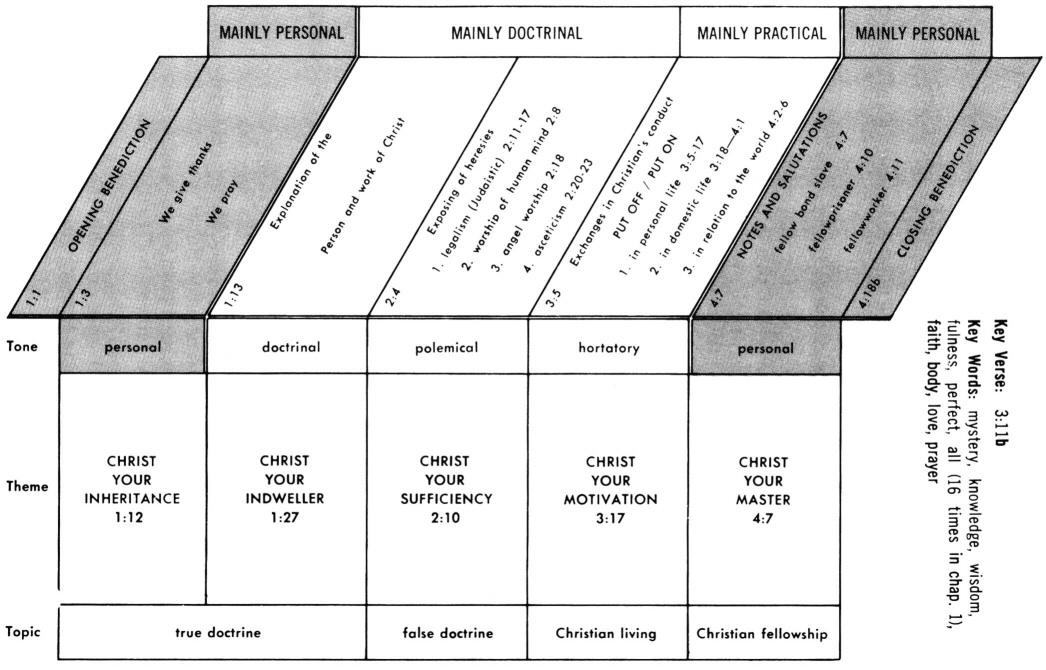
CHRIST IS ALL IN ALL
Click chart to enlarge
Charts from Jensen's Survey of the NT - used by permission
Colossians Overview - Click Chart on right side
| Christ Preeminent in All Things Supreme Lord - Sufficient Savior |
|||
| Colossians 1 | Colossians 2 | Colossians 3 | Colossians 4 |
| Supremacy of Christ |
Submission to Christ |
||
| Doctrinal and Corrective |
Practical and Reassuring |
||
| What Christ Did For Us |
What Christ Does Through Us |
||
| Christ Our Lord |
Christ Our Life |
Christ our Love |
|
| Christ the Head of the Body |
Christ the Lord of the Universe |
Christ the Head of the Home |
|
| Instruction | Warnings | Exhortations | Reminders |
| Reconciliation | Creation | Submission | Conversation |
| His Person and Word |
His Peace and Presence |
||
Colossians 1:10 so that you will walk (AAN) in a manner worthy of the Lord to please Him in all respects bearing fruit (PAPMPN) in every good work and increasing (PPPMPN) in the knowledge of God; (NASB: Lockman)
Greek: peripatesai (AAN) axios tou kuriou eispasan areskeian, en panti ergo agatho karpophorountes kai auxanomenoi ( "growing") (PPPMPN) te epignosei tou Theou,
Amplified: That you may walk (live and conduct yourselves) in a manner worthy of the Lord, fully pleasing to Him and desiring to please Him in all things, bearing fruit in every good work and steadily growing and increasing in and by the knowledge of God [with fuller, deeper, and clearer insight, acquaintance, and recognition]. (Amplified Bible - Lockman)
Barclay - so that you may conduct yourselves worthily of the Lord, and in such a way as to be altogether pleasing to him, bearing fruit in every good work, and increasing in the fuller knowledge of God.
NLT: Then the way you live will always honor and please the Lord, and you will continually do good, kind things for others. All the while, you will learn to know God better and better. (NLT - Tyndale House)
Phillips: We also pray that your outward lives, which men see, may bring credit to your master's name, and that you may bring joy to his heart by bearing genuine Christian fruit, and that your knowledge of God may grow yet deeper. (Phillips: Touchstone)
Wuest: so that you may order your behavior worthily of the Lord with a view to pleasing Him in everything, in every work which is good constantly bearing fruit and increasing by means of the advanced and perfect experiential knowledge of God,
Young's Literal: to your walking worthily of the Lord to all pleasing, in every good work being fruitful, and increasing to the knowledge of God
BGT Colossians 1:10 περιπατῆσαι ἀξίως τοῦ κυρίου εἰς πᾶσαν ἀρεσκείαν, ἐν παντὶ ἔργῳ ἀγαθῷ καρποφοροῦντες καὶ αὐξανόμενοι τῇ ἐπιγνώσει τοῦ θεοῦ,
NET Colossians 1:10 so that you may live worthily of the Lord and please him in all respects– bearing fruit in every good deed, growing in the knowledge of God,
GNT Colossians 1:10 περιπατῆσαι ἀξίως τοῦ κυρίου εἰς πᾶσαν ἀρεσκείαν, ἐν παντὶ ἔργῳ ἀγαθῷ καρποφοροῦντες καὶ αὐξανόμενοι τῇ ἐπιγνώσει τοῦ θεοῦ,
KJV Colossians 1:10 That ye might walk worthy of the Lord unto all pleasing, being fruitful in every good work, and increasing in the knowledge of God;
ESV Colossians 1:10 so as to walk in a manner worthy of the Lord, fully pleasing to him, bearing fruit in every good work and increasing in the knowledge of God.
CSB Colossians 1:10 so that you may walk worthy of the Lord, fully pleasing to Him, bearing fruit in every good work and growing in the knowledge of God.
NIV Colossians 1:10 And we pray this in order that you may live a life worthy of the Lord and may please him in every way: bearing fruit in every good work, growing in the knowledge of God,
NKJ Colossians 1:10 that you may walk worthy of the Lord, fully pleasing Him, being fruitful in every good work and increasing in the knowledge of God;
NRS Colossians 1:10 so that you may lead lives worthy of the Lord, fully pleasing to him, as you bear fruit in every good work and as you grow in the knowledge of God.
SO THAT YOU WILL WALK: peripatesai (AAN):
- Walk - Col 2:6, 4:5, Mic 4:5 Ro 4:12, 6:4 Eph 4:1, 5:2,15, Php 1:27, 1Th 2:12
- Colossians 1 Resources - Multiple Sermons and Commentaries
RIGHT THINKING LEADS TO
RIGHT CONDUCT
So that - Not in Greek, but in context clearly the implied purpose of the prayer for the saints to be filled with spiritual knowledge. Paul was not interested in pedantry (a "show" of one's knowledge; an ostentatious and inappropriate display of learning) but in pragmatism (practice, conduct concordant with the the Truth)
The ultimate aim of right knowledge (epignosis in Col 1:9+) is (or should be) a right (righteous) walk!
As Lightfoot once said "The end of all knowledge is conduct."
Vance Havner adds that "What you live is what you really believe; everything else is so much religious talk."
At the outset remember that to carry out this spiritual walk, we must be aware of our continual need for the Holy Spirit to enable us in this supernatural (God pleasing, fruit bearing) walk. If we attempt to carry out this "walk" depending solely on our own natural (fleshly) power, we will fail and experience frustration and futility in our Christian walk (cf Jn 15:5, Jn 6:63). We must learn to walk as Jesus walked. And how did Jesus walk on earth? He continually walked empowered by and in dependence on the Holy Spirit. You may never have heard that principle taught or preached but it is clearly Biblical and it is the key for achieving what Jesus desires for every child of God - life abundant (Jn 10:10). Peter summarized Jesus' walk with these words...
You yourselves know the thing which took place throughout all Judea, starting from Galilee, after the baptism which John proclaimed. 38“You know of Jesus of Nazareth, how God anointed ( chrio cf your experience 1 Jn 2:20+, 1 Jn 2:27+, 2 Cor 1:21) Him with the Holy Spirit (read Lk 3:21-22+, Lk 3:24+ = "When He began His ministry" Lk 4:18+) and with power (dunamis), and how He went about doing good and healing all who were oppressed by the devil, for (hoti - term of explanation - telling us how Jesus was enabled to do what He did!) God was with Him. (Acts 10:37-38+)
And so, if you have never heard this life-changing truth before, I pray that you take a few moments and ponder the truth about The Holy Spirit-Walking Like Jesus Walked! You will never "walk" the same again!
Adrian Rogers was preaching a sermon entitled The Man of God and speaking of Elisha's desire to have power like his mentor Elijah (read 2 Ki 2:1-10, especially 2 Ki 2:9 = “Please, let a double portion of your spirit be upon me.”), Pastor Rogers said the following which relates to every believer today and our Christian walk...
I wonder, are you really determined to have the power of God upon you life? Are you really? I honestly believe, and I'm checking my statement mentally, and it is not a glib statement, I honestly believe, I would rather die than to preach without power. I really believe that. And I guess if I could sum everything that I want, more than anything else, I want the power of God upon my life. I want it. I need that. And you need it. But you see, so many people do not have a determination. They do not say, this one thing I do (Php 3:13+, cf Lk 10:42+). They have a take it or leave it attitude towards spiritual power. They think it would be nice if they were divinely anointed, but not necessarily. And in a prayer meeting they may give a request for more power, easily uttered and soon forgotten, as soon as they get back home and turn on the television. They do not have a burning, blistering, thirst that will not take "no" for and answer. I don't know how much of the power of God you have but I am persuaded that you have all, you want. And if you don't have more power, it is because you do not want more power. It is not God's fault that you don't have any power in you life, it is your own fault. Sometimes we act like God is the tyrant, and we are the heroes. "Mean old God," if we could only persuade God and tell God how desperately we need to be anointed with power, perhaps we could talk Him into doing what we need. Here was man who was determined, determined he was, he had, dear friend, a sheer determination (TO BE FILLED WITH SPIRITUAL POWER).
A S Peake - This lofty wisdom and insight is not an end in itself. It must issue in right practice. Doctrine and ethics are for Paul inseparable. Right conduct must be founded on right thinking, but right thinking must also lead to right conduct. The infinitive expresses result “so as to walk”. (Colossians 1 - The Expositor's Greek Testament)
Moule on walk - The word denotes life in its action and intercourse.—The spiritual knowledge which he asks for them is thus sought for the most sacredly practical of purposes—in order to their closer conformity to the will of God in real life. (Colossians 1 Cambridge Bible for Schools and Colleges)
Hoehner - 'Walking,” is a Semitic idiom for lifestyle (e.g., Ex 18:20; Ps 86:11). (Cornerstone biblical commentary)
Alexander Maclaren - "By "walk" is of course meant the whole active life; so that the principle is brought out here, very distinctly, that the last result of knowledge of the Divine will is an outward life regulated by that will." (Colossians 1 - The Expositor's Bible Commentary)
J Vernon McGee adds the practical comment that "Walking is not a balloon ascension. A great many people think the Christian life is some great, overwhelming experience and you take off like a rocket going out into space. That’s not where you live the Christian life. Rather, it is in your home, in your office, in the schoolroom, on the street. The way you get around in this life is to walk. You are to walk in Christ. God grant that you and I might be joined to Him in our daily walk. (McGee, J V: Thru the Bible Commentary: Nashville: Thomas Nelson)
Ray Stedman comments on walk writing "I like that figure because a walk, of course, merely consists of two simple steps, repeated over and over again. It is not a complicated thing. In the same way, the Christian life is a matter of taking two steps, one step after another. Then you are beginning to walk. Those two steps follow in this passage. Paul describes them as, "Put off the old man" (Col 3:5, 6, 7, 8, 9, 10 see note) and "put on the new." (see specific attitudes and actions in Col 3:12-4:6) Then repeat them. That is all. Keep walking through every day like that. That is how Scripture exhorts us to live." (See Dr Stedman's message on True Human Potential)
In several letters Paul commanded and encouraged the saints to walk worthy but here he prays to God that they would be enabled to walk worthy. As already noted, the purpose of all knowledge is conduct. A Christian’s walk is a Christian’s life. Our walk and our talk should be twins going along on the same trail. Christian service is result of Christ devotion. The work that we do is the outflow of the life that we live abiding in Christ (Jn 15:1, 2, 3, 4, 5, 6, 7, 8). God must make the worker before He can do the work.
Warren Wiersbe reminds us that "Practical obedience means pleasing God, serving Him, and getting to know Him better. Any doctrine that isolates the believer from the needs of the world around him is not spiritual doctrine.
Evangelist D. L. Moody often said, " Every Bible should be bound in shoe-leather."
Spurgeon preaching on Paul's prayer calls us to observe...
The Practical Result Of Spiritual Knowledge. Paul prays for his friends “that ye might be filled with the knowledge of His will in all wisdom and spiritual understanding; that ye might walk worthy of the Lord unto all pleasing.”
See, see the drift of his prayer- “that ye may walk.” Not that ye might talk, not that ye might sit down and meditate, and enjoy yourselves, but “that ye might walk.” He aims at practical results.
He desires that the saints may be instructed so that they may walk according to the best model. By walking worthy of the Lord Jesus we do not understand in any sense that he expected them to possess such worthiness as to deserve to walk with the Lord; but he would have them live in a manner that should be in accordance with their communion with Christ. You would not have a man walk with Christ through the streets to-day clothed in motley garments, or loathsome with filth: would you? No, if a man be a leper, Christ will heal him before he will walk with him. Let not a disciple walk so as to bring disgrace upon his Lord!
When you walk with a king, you should be yourself royal in gait; when you commune with a prince you should not act the clown. Dear friends, may you know so much of Jesus that your lives shall become Christ-like, fit to be put side by side with the character of Jesus, worthy of your perfect Lord.
This is a high standard, is it not? It is always better to have a high standard than a low one, for you will never go beyond that which you set up as your model. If you get a low standard you will fall below even that. It is an old proverb,
“He that aims at the moon will shoot higher than he that aims at a bush.”
It is well to have no lower standard than the desire to live over again the life of the Lord Jesus-a life of tenderness, a life of self-sacrifice, a life of generosity, a life of love, a life of honesty, a life of holy service, a life of close communion with God. Mix all virtues in due proportion, and that is the life of Jesus towards which you must press forward with all your heart (See the full sermon - Spiritual Knowledge: It's Practical Results)
Walk (4043) (peripateo from peri = about, around + pateo = walk, tread) means literally to walk around (walk around in a complete circuit or full circle), to go here and there walking, to tread all around. The 39 uses in the Gospels always refer to literal, physical walking. Seven of the 8 uses in Acts are also in the literal sense (except Acts 21:21+). (See Spurgeon's comments on what it means to walk)
Paul uses peripateo only in the metaphorical sense (32 times in his Epistles - see all the NT uses below) meaning to conduct one's life, to order one's behavior, to behave, to make one's way, to make due use of opportunities, to live or pass one’s life (with a connotation of spending some time in a place), to walk with God in the complete circuit (course) of faith. Stated another way, to "walk around a circuit" begins with faith and ends with faith works (cf James 2:14-26), initiated and enabled by the Spirit. The believer "walks out" with the Lord, what He first works in, doing so by obedience of faith leading to good (God) works (see Eph 2:10). Given this picture of one coming full circle, one might say that faith without works is walking "half circle" which ends up going no where!
Some lexicons state that Paul used peripateo in the Hebraic sense of living, regulating one's life or conducting one's self.
NIDNTT writes that "peripateo (Aristophanes onwards) is found in classic Greek only with the literal meaning of strolling, stopping, (e.g. while one walks here and there in the market, Dem., Orationes 54, 7); the figurative meaning of walking, with reference to conduct, is lacking. Only in Philodemus (1st cent. B.C.) does one find the meaning to live (De Libertate 23, 3)... In the LXX peripateo is found in only 33 passages, of which more than half come from Wisdom literature... Only occasionally does peripateo denote in the figurative sense way of life (2Ki. 20:3; Eccl 11:9). (Brown, Colin, Editor. New International Dictionary of NT Theology. 1986. Zondervan)
How the Colossians (and saints today) "walked" was obviously important to Paul as he used peripateo in each chapter of Colossians -- In chapter 2 Paul charged the Colossians -
As you therefore have received Christ Jesus the Lord, so walk in Him (regulate your lives and conduct yourselves) in union with and conformity to Him.) (see note Colossians 2:6)
To walk in Christ is to live a life patterned after His and empowered by His Spirit.
In Colossians 3 Paul described how they walked before Christ transformed their heart and mind --
In (the sphere of immorality, etc, all things that on account of the wrath of God will come) you also once walked, when you were living in them. (see note Colossians 3:7)
In other words before they were saved, the Colossians ordered their behavior and regulated their lives within the sphere of trespasses and sins. Not a ray of light from God, nothing of God's righteousness or goodness, and not a single good thing in the sight of God penetrated that circle of conduct. All their previous thoughts, words, and deeds were ensphered in an atmosphere of sin. Not one of their acts ever got outside the circle of sin -- their previous manner of walking is a description of what is often termed total depravity.
In Colossians 4, in Paul's last use of peripateo in this epistle, he charges the saints to
Conduct (present imperative = command to make this their lifestyle) yourselves with wisdom (living prudently and with discretion) toward outsiders (non-Christians), making the most of the opportunity (continually seizing, redeeming or buying up the opportunity). (see note Colossians 4:5) (Comment: Weymouth catches the thought well paraphrasing it "Behave wisely in relation to the outside world.")
Conduct refers to our behavior in our daily life, and it is a conduct that the unsaved are watching with critical eyes, so there must be nothing in our daily walk that jeopardizes our witness.
Related Resource: Discussion of topic
Peripateo is found 4 times in Colossians (Col. 1:10; 2:6; 3:7; 4:5) and 95 times in the NT
GOSPELS: Matt. 4:18; 9:5; 11:5; 14:25, 26, 29; 15:31; Mk. 2:9; 5:42; 6:48, 49; 7:5; 8:24; 11:27; 12:38; 16:12; Lk. 5:23; 7:22; 11:44; 20:46; 24:17; Jn 1:36; 5:8, 9, 11,12; 6:19, 66; 7:1; 8:12; 10:23; 11:9, 10, 54; 12:35; 21:18;
ACTS: Acts 3:6, 8, 9, 12; 14:8, 10; 21:21;
PAULINE USES: Rom. 6:4; 8:4; 13:13; 14:15; 1 Co. 3:3; 7:17; 2 Co. 4:2; 5:7; 10:2, 3; 12:18; Gal. 5:16; Eph. 2:2, 10; 4:1, 17; 5:2, 8, 15; Phil. 3:17, 18; Col. 1:10; 2:6; 3:7; 4:5; 1Th 2:12; 4:1, 12; 2Thess. 3:6, 11
GENERAL: Heb. 13:9; 1Pet. 5:8;
JOHN: 1 Jn. 1:6, 7; 2:6, 11; 2Jn. 1:4, 6; 3Jn. 1:3, 4; Rev. 2:1; 3:4; 9:20; 16:15; 21:24
There are 25 uses of peripateo in the non-apocryphal Septuagint (LXX)
Ge 3:8, 10; Ex 21:19; Judges 21:24; 1Sam 17:39; 2Sam 11:2; 2Ki 20:3; Esther 2:11; Job 9:8; 20:25; 38:16; Ps 12:8; 104:3; 115:7; 135:17; Pr 6:22, 28; 8:20; 23:31; Eccl 4:15; 11:9; Isaiah 8:7; 59:9; Da 3:25; 4:29, 33
Here are two of the uncommon figurative uses of peripateo in the LXX...
2 Kings 20:3 "Remember now, O LORD, I beseech Thee, how I have walked (Lxx = peripateo) before Thee in truth and with a whole heart, and have done what is good in Thy sight." And Hezekiah wept bitterly.
Ecclesiastes 11:9 Rejoice, young man, during your childhood, and let your heart be pleasant during the days of young manhood. And follow the impulses of your heart (Lxx translates it as a command to "walk [peripateo in present imperative] in the ways of thy heart blameless") and the desires of your eyes. Yet know that God will bring you to judgment for all these things.
In the KJV peripateo is translated walk in all but three places in the NT uses. In these it is rendered go about (Mark 12:38), walk about (1Pet 5:8-note), and be occupied (Heb 13:9-note).
In the NAS peripateo is translated by a number of words: behave(2), conduct ourselves (1), conduct yourselves (1), leading a life(1), leads a life (1), prowls about(1), walk(50), walk about(1), walk around(2), walked(7), walking(21), walking about(1),walks(5), were thus occupied (1).
In the figurative sense, peripateo refers to one's manner of life, to one's habitual way or bent of life, to one's life-style. For example, Luke describes Zacharias and Elizabeth, the parents of John the Baptist, as being
righteous in the sight of God, walking blamelessly in all the commandments and requirements of the Lord (Luke 1:6).
In contrast, Paul counseled the Ephesian believers to
walk no longer just as the Gentiles (in context a description of all the unsaved) also walk, in the futility of their mind” (See note Ephesians 4:17).
In Romans Paul explains how it is possible to no long walk as the Gentiles writing (speaking of our spiritual baptism into Christ)
we have been buried with Him through baptism into death, in order that as Christ was raised from the dead through the glory of the Father, so we too might walk (peripateo - Paul's first use in the NT canon) in newness (a brand new kind of life never possible before) of life. (See note Romans 6:4)
(God condemned sin in the flesh of His Son) in order that the requirement of the Law might be fulfilled in us, who do not walk (peripateo) according to the flesh, but according to the Spirit. (See note Romans 8:4)
Let us behave (peripateo) properly (fitting or becoming in a manner of behavior) as in the day, not in carousing and drunkenness, not in sexual promiscuity and sensuality, not in strife and jealousy. (See note Romans 13:13)
For if because of food your brother is hurt, you are no longer walking according to love. Do not destroy with your food him for whom Christ died. (See note Romans 14:15)
Some uses of peripateo in Corinthians...
For (explaining why they still need milk and cannot take solid food) you (babes in Christ) are still fleshly. For since there is jealousy and strife among you, are you not fleshly, and are you not walking like mere men? (1Cor 3:3)
for we walk by faith, not by sight (2Cor 5:7-note)
For though we walk in the flesh, we do not war according to the flesh (2 Cor 10:3)
I urged Titus to go, and sent the brother with him. Titus did not take any advantage of you, did he? Did we not conduct ourselves in the same spirit and walk in the same steps? (2 Cor 12:18)
In one of the most important verses in the Bible (especially as it relates to our daily sanctification) Paul charges believers to...
walk (present imperative = command to make this one's lifestyle, something we can only do as we are continually filled with, controlled by the Spirit [Eph 5:18-note] - so filled with Him, we walk by His enabling power, i.e,) by the Spirit, and you will not (absolute negation) carry out the desire of the flesh. (Gal 5:16-Memorize and then meditate on this important passage) (Caveat - Do not "invert" or "reverse" this verse! It will NOT work! That is do not first seek to not carry out the desires of the flesh, mistakenly thinking that this will enable you to walk by the Spirit. You will fail every time! First surrender to the Spirit and let Him supernaturally enable you to walk -- our need for His enabling power is continual! It is never an arrival in this life!)
Paul's classic description of unbelievers in Ephesians...
And you were dead in your trespasses and sins, 2 in which you formerly walked according to the course of this world, according to the prince of the power of the air, of the spirit that is now working in the sons of disobedience. (See notes Ephesians 2:1; 2:2)
Paul's contrasting description of believers...
For we are His workmanship, created in Christ Jesus for good works, which God prepared beforehand, that we should walk in them. (See note Ephesians 2:10) (See also POIEMA – GREEK WORD STUDY)
After describing the wealth (in Christ Jesus, in the heavenly places) of believers in the first three chapters of Ephesians, Paul proceeds to exhort us to walk accordingly (note the concentration of peripateo in the second half of Ephesians)...
I, therefore, the prisoner of the Lord, entreat you to walk in a manner worthy of the calling with which you have been called, (See note Ephesians 4:1)
and walk in love, just as Christ also loved you, and gave Himself up for us, an offering and a sacrifice to God as a fragrant aroma. (See note Ephesians 5:2)
for you were formerly darkness, but now you are light in the Lord; walk (present imperative = command to make this one's lifestyle) as children of light (See note Ephesians 5:8)
Therefore be careful how you walk, not as unwise men, but as wise, 16 making the most of (redeeming, buying up every second) your time, because the days are evil. (See notes Ephesians 5:15; Ephesians 5:16)
Here are a few of Paul's uses of peripateo in other epistles
Brethren, join (present imperative = command to make this one's lifestyle) in following my example, and observe (present imperative = command to make this one's lifestyle pay attention to, implying mental concentration regarding) those who walk according to the pattern you have in us. (See note Philippians 3:17) 18 For many walk, of whom I often told you, and now tell you even weeping, that they are enemies of the cross of Christ, (See note Philippians 3:18)
Finally then, brethren, we request and exhort you in the Lord Jesus, that, as you received from us instruction as to how you ought to walk and please God (just as you actually do walk), that you may excel still more. (See note 1Thessalonians 4:1)
John uses peripateo in the figurative sense affirming that, "if we walk (present tense = continually - speaks of direction, not perfection!) in the light as [God] Himself is in the light, we have fellowship with one another, and the blood of Jesus His Son cleanses us from all sin (1Jn 1:7)
WALK, WALKING - Dictionary of Biblical Imagery page 3096
In biblical times walking was the most common way of going somewhere, even over long distances. It is not surprising, then, that references to walking in the Bible number well over two hundred (and in some versions nearly three hundred). A survey of references to the physical act of walking reveal that Jesus is the most persistent pedestrian in the Bible. Beyond the literal mechanics of movement by foot, walking at a more figurative level becomes a prime metaphor for two (often related) motifs-interaction with someone else (a companion on a metaphoric walk) or a person’s lifestyle (with the image of walking suggesting continuing progress in time and in a chosen direction).
Walking with God. The first occurrence of walking in the Bible is the picture of God’s “walking” in the Garden of Eden in the cool of the day (Gen 3:8). After the exodus, God promises the nation of Israel, “I will walk among you and be your God” (Lev 26:12 NIV; quoted in 2 Cor 6:16). God also visits and walks around the camp of the Israelites (Deut 23:14). These examples of God’s “walking” on the earth picture the active divine presence among the people God has created and called.
The counterpart of God’s walking with his people is their walking “with” him or “before” him. Enoch and Noah “walked with God” (Gen 5:22, 24; 6:9). In Malachi 2:6 God pictures the original priesthood as walking with him in peace and uprightness, and in Revelation 3:4 Christ promises that the remnant in Sardis who remain pure “will walk with me, dressed in white, for they are worthy” (NIV). To walk “before” God has the same meaning as walking “with” him: God commanded Abraham to “walk before me and be blameless” (Gen 17:1 NIV) and promised David and his successors favor if they walked before him (1 Kings 8:25; 9:4; 2 Chron 6:16; 7:17; see also 2 Kings 20:3; Is 38:3).
A NT fulfillment of the motif of walking with God is the life Jesus’ disciples led with him. They literally and spiritually walked with Jesus. The most memorable picture is perhaps Jesus walking with the two men to Emmaus, disclosing to them his own mission and identity (Lk 24:13–35).
The Virtuous Life. In the OT, walking is frequently paired with the image of the path or way to picture the lifestyle and choices people should make, as well as the ones they should avoid. The blessed person “does not walk in the counsel of the wicked” (Psalm 1:1 NIV), and the wise person avoids walking “in the way of evil men” (Prov 4:14 NIV). Nebuchadnezzar learned that God will humble “those who walk in pride” (Dan 4:37 NIV). Positively, people should walk humbly with God (Mic 6:8). In practice this means living in conformity with God’s paths (Is 2:3) or law (Ps 119:2–3). To obey God’s law is to “walk about in freedom” (Ps 119:45 NIV), and “the man of integrity walks securely” (Prov 10:9 NIV). Similarly, “those who walk uprightly enter into peace” (Is 57:2 NIV). Passages such as these use the metaphor of walking to identify a person’s conduct of life and the results that flow from it.
References to how people walk yield a composite picture of how the godly person lives. The model person walks in all of God’s ways (Deut 8:6 and dozens of additional passages), in the fear of God (Neh 5:9), in God’s truth (Ps 86:11) and in the light of God’s presence (Ps 89:15), in the ways of good people (Prov 2:20), in the way of righteousness (Prov 8:20) and understanding (Prov 9:6) and wisdom (Prov 28:26). The ideal person is one “whose walk is blameless” (Ps 15:2 NIV; 84:11). Such a person is also known by the human companions with whom he or she walks—with “the throng at the house of God” (Ps 55:14 NIV) and “with the wise” (Prov 13:20 NIV).
The formula of a king’s “walking in the ways” of a previous king appears repeatedly in the books of Kings and Chronicles. These references either commend a virtuous course of ruling or denigrate a bad one, in both cases by linking it to a predecessor’s course. This cluster of images reveals the continuity ancient people experienced in kingly practices in a political system where kingship was hereditary.
Followers of the Way. NT references to walking build on OT motifs. Walking now becomes a metaphor for how Christians are expected to live. John alone among the Gospels portrays Jesus as encouraging his people to walk in the light rather than in darkness (Jn 8:12; 11:9). This expression also occurs in John’s letters, which are small classics in the literature of how Christians are to live. Believers are not to walk in darkness (1 Jn 1:1–6; 2 Jn 11) but in the light (1 Jn 1:7); they “must walk as Jesus did” (1 Jn 2:6 NIV), in the truth (2 Jn 4; 3 Jn 3–4), in obedience to God’s commands and in love (2 Jn 6).
In Paul’s letters the figurative use of walking is primarily drawn from Paul’s extensive practice of it. In keeping with his tendency toward heightened contrasts, Paul portrays the Christian life in terms of contrasting walks: Christians are to walk in newness of life rather than death (Rom 6:4), in good works rather than trespasses and sins (Eph 2:1–2, 10), as children of light instead of darkness (Eph 5:8), with moral self-control rather than in sensuality (Rom 13:13), by faith rather than sight (2 Cor 5:7).
Summary. Walking is one of the Bible’s vivid metaphors for how godly people should live, both positively in terms of what to follow and negatively in warnings about what to avoid. Unfortunately, some recent translations tend to replace the concrete vigor of the original with prosaic words like live, conduct or behave. The result is to diminish a reader’s capacity to allow concrete, everyday activities to become windows on divine realities.
F B Meyer (Our Daily Walk) - WALKING WITH JESUS (Col. 2:6-note)
THE DAILY walk of the Christian soul is so absolutely important because it is our witness to the world. Our character, as exemplified in our behavior, is the world's only Bible and sermon (2Cor. 3:2, 3). Let us learn to walk so as to please God, and to bless mankind. To walk is at first a matter of considering every little step, but afterwards it becomes the habit of the soul (Col 1:10).
We received Jesus into our hearts by faith. He entered through the open door and became our Lord and Master. In the same manner we must five always and everywhere, receiving from Him, by faith, grace upon grace, and allowing what He works in to work out in all manner of godliness, tenderness, and Christlikeness. This practice of looking to Jesus for grace in every circumstance of life tends to become more and more habitual--and this is what the Apostle means when he says, "Rooted and built up in Him, and established in the faith."
But such a walk is only possible when we have learned to "crucify the flesh with the affections and lusts" (Gal. 5:24-note). The flesh is the assertion of our self-life, whether in lesser or grosser forms, but whenever self intrudes it exercises a baleful influence on our behavior and Conversation. Just as the iron of the steamer will deflect the needle of the compass, so the intrusion of our self-life will act as a drag upon our character and walk.
How can we crucify the flesh? Only by allowing the Holy Spirit to have supreme control. He makes the Cross every day dearer and more effective. He will conquer evil habits in us and for us, while we stand by as more than conquerors through His grace. If we will be led by Him, there will not only be deliverance from the self-life, but He will produce in us the fruit of holy living which will please God and refresh men.
PRAYER - Let Thy Holy Spirit be continually with us, and may we feel the powerful effects of Thy Divine Grace constantly directing and supporting our steps. AMEN.
Medal Of Honor: Colossians 1:9-14
[We pray] that you may walk worthy of the Lord, fully pleasing Him, being fruitful in every good work. —Colossians 1:10
They meet every year, a group of ordinary and unassuming veterans who have one thing in common—their nation’s highest military award for bravery.
Almost all of them agree that the Congressional Medal of Honor has transformed and redefined their lives. For many, it has thrust them into the public eye. One recipient, assessing its effect on his thought and behavior, said, “You’re representing everybody and everything the medal represents.”
As Christians, we share a distinguishing mark more defining than any medal—the name of Christ. We profess to be followers of Jesus, servants of the Lord. For that reason, the apostle Paul prayed for his fellow believers to “walk worthy of the Lord, fully pleasing Him” (Col. 1:10). He urged Christians to be “fruitful” in good works and to be characterized by such qualities as patience, joy, and thankfulness (vv.11-12).
Our conduct should not be guided by expectations that come from ourselves or the people around us. They must come from the Lord, who has redeemed us, called us, and given us His name. Rather than feeling trapped by a set of external standards, we can celebrate the honor of bearing Christ’s name and the freedom of pleasing only Him.
Lord, may I live that all may see
The love of Christ revealed in me;
And help me flee all sin and shame,
Lest others scoff at Your dear name. —DJD
You honor God's name when you call Him your Father and live like His Son.
By David C. McCasland
God’s Presence At Church by Joe Stowell
"Walk worthy of the Lord." Colossians 1:10
I love reading church slogans. You know, the ones you see on the marquee in front of churches. Recently I noticed a slogan that said, “Come in and experience the presence of God.” That one caught my attention, primarily because it’s an important promise to make and sometimes a hard promise to keep. Hard, because if we’re not careful our churches might reflect the presence of its people more than the presence of our God.
So what would a church have to do to display the presence of God? Its people would have to live like Him! Dynamics like hospitality, the loving acceptance of all kinds of people, a quickness to serve, a tangible love for one another that makes people feel safe and included regardless of color or class, and a patient tolerance of one another’s weaknesses would all be a great way to start. Paul said we should walk in a manner “worthy of the Lord” (Col. 1:10). And he also said that being worthy means that we will be humble, gentle, bearing with one another in love, eagerly maintaining the unity of the Spirit in the bond of peace (Eph. 4:2-3).
Let’s live in such a way that others will experience the presence of the God who lives in us—wherever we are, but especially at church.
The world gets a glimpse of God
When those who claim to be
The followers of Jesus Christ
Are living righteously. —Sper
Those who walk with Christ bring the presence of God to everyone around them.
IN A MANNER WORTHY OF THE LORD: axios tou kuriou:
- Colossians 1 Resources - Multiple Sermons and Commentaries
A WORTHY
WALK
In a manner worthy (516) (axíōs from adjective áxios 514 [see word study] - 514 from ágō = to weigh) is the adverb form which means in a manner worthy of or fitting of, in a manner suitable to, in a manner proper of, worthily, suitably, properly. The literal picture is of a set of scales that are balanced. (see below). Axios strictly speaking means one side of the scales weighing as much as the other and thus means of like or equal value or worth as much. It means having the weight of another thing and so being of like value or worth as much. In other words, axios has the root meaning of balancing the scales—what is on one side of the scale should be equal in weight to what is on the other side. By extension, axios came to be applied to anything that was expected to correspond to something else. A person worthy of his pay was one whose day’s work corresponded to his day’s wages.
Wuest - When this word axíōs is used with the genitive case as it is here, it means, “having the weight of (weighing as much as) another thing.” It means, “of like value, worth as much.” The saints are to see to it that their manner of life, their conduct, weighs as much as the character of their Lord. That is, He is to be their example in life, and the copy must be like the example. Peter says: “Christ also suffered on your behalf, leaving behind for you a model to imitate, in order that by close application you might follow in His footprints” (1Pet. 2:21). Expositors says: “This lofty wisdom and insight is not an end in itself. It must issue in right practice. Doctrines and ethics are for Paul inseparable. Right conduct must be founded on right thinking, but right thinking must also lead to right conduct.” (Wuest's word studies from the Greek New Testament)
Mounce - In classical Greek axios had to do with tipping or balancing the scales. When two entities are compared and found of equal weight, they are “fitting.” Since fitness implies worth, axios came to mean “worthy, deserving.”
Axíōs (516) the adverb - 6x in 6v -
Romans 16:2+ that you receive her in the Lord in a manner worthy of the saints, and that you help her in whatever matter she may have need of you; for she herself has also been a helper of many, and of myself as well.
Wuest's Comment: axios “weighing, having weight,” with the genitive case, “having the weight of another thing, of like value, worth as much.” Paul uses it in Philippians 1:27 when he urges the saints in that church to see to it that their manner of life as citizens of heaven weighs as much as the gospel they preach, that is, be worthy of the gospel. Here Paul exhorts the Roman saints to welcome Phoebe into their spiritual company in a manner worthy of a saint. Their welcome should weigh as much as the position they hold in the family of God. It should be fitting to their position as saints. They should act worthy of a saint. (Ibid)
Ephesians 4:1+ Therefore (term of conclusion - What is Paul concluding?) I, the prisoner of the Lord, implore you to walk (peripateo) in a manner worthy of the calling with which you have been called
Comment: This verse is like a "hinge" on a door. It swings open the practical exhortations of chapters 4-6, exhortations which cannot be carried out without reliance of the foundational truths Paul taught on the "other side of the door." In other words chapters 1-3 are primarily doctrine while chapters 4-6 call believers to duties based on sound doctrine. Belief should always show forth in behavior "in keeping with" ("worthy of") the truth that one believes. Be careful though -- do not try to carry out the exhortations and commands of chapters 4-6 in your strength! You will put yourself under the law and you will surely fail! Take the yoke of Jesus, the yoke of enabling grace, surrendering to the Spirit of Christ. Then, and only then, you will be empowered to walk in a manner worthy of the calling!
Wuest: Paul exhorts the Ephesian saints to see to it that their Christian experience, the Christian life they live, should weigh as much as the profession of Christianity which they make. In other words, they are to see to it that they practice what they preach, that their experience measures up to their standing in grace. (Ibid)
Philippians 1:27+ Only conduct yourselves (present imperative = a command to do this as one's lifestyle, which of course can only be obeyed as the believer surrenders to the Spirit, is filled by Him [Eph 5:18-note] and walks by Him [Gal 5:16-note]) in a manner worthy of the Gospel of Christ, so that (term of conclusion - What is Paul concluding?) whether I come and see you or remain absent, I will hear of you that you are standing firm in one spirit, with one mind striving together for the faith (the objective truth) of the Gospel;
Comment: Paul is exhorting them to live their lives like they are citizens of heaven (because they are! Php 3:20-note), so their conduct in a sense "weighs as much as" (axios) the gospel they preach and the faith they profess. In other words, they are to see to it that they practice what they preach, that their experience measures up to their new standing as children of the King. We do not behave (or conduct ourselves in a certain way) in order to go to heaven, as though we could be saved by our good works, but we conduct ourselves because our names are already written in heaven, and our citizenship is in heaven.
Colossians 1:10 so that (term of conclusion - What is Paul concluding?) you will walk in a manner worthy of the Lord, to please Him in all respects, bearing fruit in every good work and increasing in the knowledge of God
1 Thessalonians 2:12+ so that (term of conclusion - What is Paul concluding?) you would walk (peripateo) in a manner worthy of the God (How? cp 1 Cor 11:1 - Thus walking like Jesus, enabled to do so by the same Spirit on Whom He depended! See Lk 4:1, 14 - See discussion of The Holy Spirit) Who calls you into His Own kingdom and glory.
3 John 1:6+ and they have testified to your love before the church. You will do well to send them on their way in a manner worthy of God.
A good picture of axios is a set of scales that are perfectly balanced. How is that achieved? Obviously the same weight is on one side of the scale as on the other side of the scale.
MY WALK CHRIST IN ME
So how does a set of scales apply to the life of a follower of Jesus Christ? Well, let's reason this through -- If Jesus is in me, which He is if I am truly born again, then His Spirit indwells me (Col 1:27b+, Ro 8:9+, 1Cor 6:19+). Then, as I study His Word taught by the Spirit and grow in grace, I begin to learn to submit or yield to the leading of the Spirit (Ro 8:14+, Gal 5:18+), rejecting self-reliance and learning to lean on Him, depending continually on His ever sufficient grace. As this pattern becomes a reality in my life, I will be enabled by the Spirit to live a lifestyle that will "Measure up" to ("weigh the same as") the Name of the One Who is in me, and my words and actions will give a proper opinion to others of the One Who is in me, the otherwise invisible God (Mt 5:16+). When that happens, we are walking worthy of the Lord, of His Gospel, of God's calling, and of our great name "saints" (set apart ones)! Now that's abundant life! (cp Jn 10:10b+)
COMMENT - Let's look at it another way - to walk worthy of the Lord practically speaking means to walk like our Lord Jesus walked when He walked on earth. You may be thinking "But He was God." Yes, that is true, but He was also fully Man and was "tempted in all things as we are, yet without sin." (Heb 4:15+) Recall that He "emptied Himself, taking the form of a bond-servant, and being made in the likeness of men." (Php 2:7+). And He lived His life as a Man to show us how we can live our lives as men and women by imitating His perfect life. This is what Paul meant when he commanded us to "Imitate me just as I imitate Christ." (1 Cor 11:1+, see also 1 Pe 2:21+, 1 Jn 2:6+) When we imitate Paul's walk and walk like Jesus walked, we are walking in a manner which is worthy of the Lord Jesus, walking a walk which has the "same weight," so to speak, as our Lord Jesus. Will we ever walk perfectly as He did? Of course not. Nevertheless, Jesus is our Model. He is our Template. He is our example. He is the One we are to follow. And as we behold Him in His Word and grow in grace and the knowledge of our Lord and Savior Jesus Christ (2 Pe 3:18+), we will be transformed from glory to glory into His image by His Spirit (2 Cor 3:18+, cf 1 Pe 2:2b+) with the result that we will be walking more and more like Jesus walked. We will be walking more and more "worthy." Recall Paul's words "Therefore as you have received Christ Jesus the Lord, so walk in Him." (Col 2:6+) Paul gives us a command to walk in Him, a walk that is only possible as we daily confess and repent, jettisoning self-dependence and depending wholly on the Holy Spirit of Christ, Who Alone can supernaturally enable us to walk like Jesus walked, and when we walk this way we will not fulfill the desires of our fallen flesh (Gal 5:16+). In short we will be walking worthy of the Lord. So let's ask it one more time -- How did Jesus "walk?" He walked in dependence on the filling (Lk 4:1, 14, 18+) and the power (dunamis) of the Holy Spirit (Acts 10:38+), so that He might give us who have the same Spirit a perfect pattern of how to walk worthy of the Lord. For more on this vital, practical truth regarding our daily (continual) need for dependence on the Holy Spirit see the study of The Holy Spirit-Walking Like Jesus Walked!. One other point -- remember that Paul is praying for the saints at Colossae to walk in a manner worthy of the Lord, so a worthy walk is the fruit of the Spirit and the Word and prayer. Pray Colossians 1:9-12 regularly for your spouse, your children, your accountability partner, your church, your pastor, etc. GOD WILL ANSWER AFFIRMATIVELY, ALL WILL BE BLESSED AND GOD WILL BE GLORIFIED! (see 1 Jn 5:14-15+, Mt 5:16+)
A worthy walk also brings "forth fruit in keeping (axios - adjective) with repentance." (Mt 3:8+ - see also discussion below beneath the scales) Keep in mind that the root idea of axios is having equal weight or worth, and therefore of being appropriate, suitable or fitting. The upshot is that true repentance (in contrast to worldly sorrow - 2Cor 7:10) will have have works which "weigh" as much as the repentance. True repentance brings forth good fruit. False repentance brings forth rotten fruit, which will not "balance the scales." Those who claim to know Christ, who claim to be born again, will demonstrate a new way of living that corresponds to ("has a weight that equates to" or is worthy of) the new birth they profess.
As an aside, do not be surprised that when we are walking worthy of our calling (in humility rather than pride, in unity rather than divisiveness, in the new self rather than the old, in love rather than lust, in light rather than darkness, in wisdom rather than foolishness, in the fullness of the Spirit rather than the drunkenness of wine, and in mutual submission rather than self–serving independence), that we will experience opposition and conflict from the world, the flesh and the devil.
"Deissmann shows from various inscriptions that the phrase “worthily of the god” was very popular at Pergamum." (Vine)

Worthy (514)(áxios) strictly speaking means bringing up the other beam of the scales. Having the weight of another thing of like value, worth as much. Counterbalancing - weighing as much (of like value, worth as much). The believer who walks in a manner worthy (áxios) of the calling with which he or she has been called is one whose daily living corresponds to his/her high position as a child of God and fellow heir with Jesus Christ. His/her practical living matches his/her privileged position. (see note above) and it does this because he or she is walking in the supernatural power of the Holy Spirit.
The Bible defines a worthy walk as consisting of the following
A worthy walk is a walk in...
- the Holy Spirit (Ro 8:4-+, cp Gal 5:16-+, Gal 5:25-+)
- humility (Ep 4:2+)
- purity (Ro 13:13+; Ep 5:3+)
- contentment (1Co 7:17)
- faith (2Co 5:7+)
- righteousness (Ep 2:10+)
- unity (Ep 4:3+; Php 1:2+)
- gentleness (Ep 4:2+)
- patience (Col 1:11+)
- love (Ep 5:2+)
- joy (Col 1:11+)
- thankfulness (Col 1:12+)
- light (Ep 5:8+, Ep 5:9+)
- knowledge (Col 1:10+)
- wisdom (Ep 5:15+)
- truth (3Jn 3, 4)
- fruitfulness (Col 1:12+)
In short, “The one who says he abides in Him ought himself to walk in the same manner as He walked” (1 John 2:6+), because that pleases God (1 Thes 4:1+).
Axios (514) is an adjective was used to describe the Roman emperor when he marched in a triumphal procession. He was "worthy" (adjective). John tells us however that the One Who is truly "worthy" (adjective) is the Lamb, recording that he heard all creation rightly declare "worthy is the Lamb that was slain to receive power and riches and wisdom and might and honor and glory and blessing. (Rev 5:12+) The Lamb slain (the resurrected and glorified Lord Jesus Christ) is the only One Who is "worthy to open the book and to break its seals." (Rev 5:2+) Christ our Redeemer Alone had the right to consummate the full redemption of His creation, the "final act" of which will begin when He breaks the seven sealed scroll, which many futuristic commentators identify as the "title deed to the earth" (Click discussion).
Axios - 41x in 39v and in the NAS is translated appropriate(1), deserve(2), deserving(4), fitting(2), keeping(2), unworthy*(1), worthy(29). - Mt 3:8; 10:10f, 13, 37, 38; 22:8; Lk 3:8; 7:4; 10:7; 12:48; 15:19, 21; 23:15, 41; Jn 1:27; Acts 13:25, 46; 23:29; 25:11, 25; 26:20, 31; Ro 1:32; 8:18; 1Co 16:4; 2Th 1:3; 1Ti 1:15; 4:9; 5:18; 6:1; Heb 11:38; Rev 3:4; 4:11; 5:2, 4, 9, 12; 16:6
Jesus addressing the church at Sardis said "But you have a few people in Sardis who have not soiled their garments; and they will walk with Me in white; for they are worthy (axios = adjective) . (Re 3:4-note)
Keep in mind that axios was originally used of drawing down a scale and hence it had to do with weight and so of that which is of equal value. For example when Paul says in Ro 8:18-note "that the sufferings of this present time are not worthy (axios = adjective) to be compared with the glory that is to be revealed to us" the picture he is painting is that present sufferings are of no weight in comparison with future glory and are not even to be balanced on the scale with the "heavy" glory that endures forever.
How do we walk worthy? In a word...
You honor God's name
When you call Him your Father
And live like His Son
THOUGHT: “Am I conducting myself in a manner worthy of the Gospel?” is a good question for us to ask ourselves regularly.
To reiterate this important point -- Right thinking should always lead to right conduct. Knowledge and obedience go together. One cannot separate learning from living. The idea of "worthy" is that the conduct of the saints weigh as much as the character of Christ. Why? Because when we are surrendered to His will, He is living His life through us via His indwelling Spirit. Ultimately His conduct is the only conduct which is truly worthy, for no other conduct would balance God's perfect scales. Christ alone pleases the Father completely and as we allow Christ to rule and reign in our lives, our lives become pleasing to the Father.
ILLUSTRATION - COLOSSIANS 1:10 For nearly 5 years my trusty, rusty 1978 Mustang took me back and forth to work. It looked like a refugee from a junkyard, but it ran. I shared the road with some drivers who were "getting there" a bit more fashionably They rode in brand-new showroom beauties with all the options. They were getting there in style. I was just getting there. When it comes to how we live on the way to heaven, we all have an opportunity to travel "in style." When we realize all that God has given us in Christ, we shouldn't be content to bump along life's highway like drivers of beat-up old jalopies.
Paul prayed that the believers in Colossae would be "filled with the knowledge of His will in all wisdom and spiritual understanding" (Col 1:9+). He wanted them to realize how spiritually rich they were (Col 1:12, 13, 14+). God doesn't want us just to get to heaven. He wants us to enjoy the journey and get there in style. J D Branon
KEEP ETERNITY'S GOAL IN SIGHT
BY WALKING DAILY IN THE LIGHT.
TO PLEASE HIM IN ALL RESPECTS: eis pasan areskeian en panti:
- To please Him - Col 3:20, Pr 16:7, 1Th 4:1, 2Ti 2:4, Heb 13:16, 1Jn 3:22
- Colossians 1 Resources - Multiple Sermons and Commentaries
OUR CHIEF AIM:
TO PLEASE GOD
Moule on to please Him - The word rendered “pleasing” is most instructive. In classical Greek it denotes a cringing and subservient habit, ready to do or say anything to please a patron; not only to meet but to anticipate his most trivial wishes. But when transferred to the spiritual region, and the believer’s relations to his Lord, the word at once rises by its association. To do anything to meet, to anticipate, His wishes, is not only the most beneficial but the most absolutely right thing we can do. It is His eternal and sacred due; it is at the same time the surest path to our own highest development and gain. (Colossians 1 Cambridge Bible for Schools and Colleges)
Alexander Maclaren on pleasing to the Lord - (Pleasing to the Lord) sets forth the great aim as being to please Christ in everything. That is a strange purpose to propose to men, as the supreme end to be ever kept in view, to satisfy Jesus Christ by their conduct. To make the good opinion of men our aim is to be slaves; but to please this Man ennobles us and exalts life. Who or what is He, whose judgment of us is thus all-important, whose approbation is praise indeed, and to win whose smile is a worthy object for which to use life, or even to lose it? We should ask ourselves, Do we make it our ever-present object to satisfy Jesus Christ? We are not to mind about other people’s approbation (praise, commendation). We can do without that. We are not to hunt after the good word of our fellows. Every life into which that craving for man’s praise and good opinion enters is tarnished by it. It is a canker, a creeping leprosy, which eats sincerity and nobleness and strength out of a man. Let us not care to trim our sails to catch the shifting winds of this or that man’s favor and eulogium (eulogy - high praise), but look higher and say, "With me it is a very small matter to be judged of man’s judgment." "I appeal unto Caesar." (Paul in Acts 25:11+) He, the true Commander and Emperor, holds our fate in His hands; we have to please Him and Him only. There is no thought which will so reduce the importance of the babble around us, and teach us such brave and wholesome contempt for popular applause, and all the strife of tongues, as the constant habit of trying to act as ever in our great Taskmaster’s eye. What does it matter who praise, if He frowns? or who blame, if His face lights with a smile? No thought will so spur us to diligence, and make all life solemn and grand as the thought that "we labor, that whether present or absent, we may be well pleasing to Him." (Ed: 2Cor 5:9-note - Notice what follows in 2Cor 5:10-note!) Nothing will so string the muscles for the fight, and free us from being entangled with the things of this life, as the ambition to "please Him who has called us to be soldiers." (2Ti 2:4-note) Men have willingly flung away their lives for a couple of lines of praise in a dispatch (an important official message, a message sent with speed), or for a smile from some great commander. Let us try to live and die so as to get "honourable mention" from our captain. Praise from His lips is praise indeed. We shall not know how much it is worth, till the smile lights His face, and the love comes into His eyes, as He looks at us, and says, "Well done! good and faithful servant." (Mt 25:21) (Colossians 1 - The Expositor's Bible Commentary)
To please (Only use in NT) (699) (areskeia from aresko = to please) means a desire or willingness to please, an endeavor to please, complaisance (disposition to please or comply), obsequiousness (marked by or exhibiting a fawning attentiveness). Areskeia is the desire to do something that produces satisfaction. Areskeia was used especially in public documents, descriptive of exceptional public service or expression of devotion.
Interestingly, the root word areskos is combined with the Greek word for man (anthropos) to describe a "man pleaser".
THOUGHT - How would you describe yourself: "Man pleaser" or "God pleaser"?
One of the chief aims of our life should be to seek to please God and to do so because we love Him Who first loved us (1Jn 4:19), for true love obeys. Everybody lives to please somebody. So the question is - Who are you seeking to please? Pleasing God ought to be the major motive of the Christian life. Children should live to please their father, and even more so should spiritual children seek to please their Father Who is in heaven. The Holy Spirit “is at work in you, both to will and to work for His good pleasure.” (Php 2:13-note).
In Genesis 5:22, 24+ we see the beautiful example of Enoch walking in a manner worthy of the Lord to please Him in all respects...
Then Enoch walked with God three hundred years after he became the father of Methuselah, and he had other sons and daughters....(24) And Enoch walked with God; and he was not, for God took him.
Comment: The Hebrew verb "walked" in both Ge 5:22, 24 is translated with Greek verb euaresteo (from eu = well + aresko = to please) in the Septuagint which in English is rendered as "Enoch was well pleasing to God." The writer of Hebrews describes Enoch's walk = "By faith Enoch was taken up so that he would not see death; AND HE WAS NOT FOUND BECAUSE GOD TOOK HIM UP; for he obtained the witness that before his being taken up he was pleasing to God." (Hebrews 11:5+) What a testimony! May his tribe increase!
Our Lord Jesus, the One we are to imitate (1Pe 2:21, 1Jn 2:6, cp 1Co 11:1, Jn 13:15) and Who now indwells us in Spirit, while on earth as Man said "I always do the things that are pleasing (arestos from aresko) to Him." (John 8:29+).
Pleasing God means much more than simply doing God’s will. The half hearted prophet Jonah illustrates that it is possible to obey God and yet not please Him, for Jonah did what he was commanded, but his heart was not in it. (see Jonah 4:1ff) God blessed His Word but He could not bless His servant, Jonah. So Jonah sat outside the city of Nineveh angry with everybody, including the Lord! Our obedience should "not (be) by way of eye service, as men-pleasers, but as slaves of Christ, doing the will of God from the heart. (Eph 6:6+)
A brief survey of the uses of the related (cognate) word euarestos, gives us some added insight of walking in a manner that pleases the Lord -- It is well-pleasing to God when we present our bodies to Him as living sacrifices (Ro 12:1+, where acceptable = euarestos) and when we live so as to help others and avoid causing them to stumble (Ro 14:18+, where acceptable = euarestos). God is pleased when His children separate themselves from the evil around them (Eph 5:10+, pleasing = euarestos) as well as when they bring their offerings to Him (Php 4:18+, where acceptable = euarestos). He is pleased with children who submit to their parents (Colossians 3:20+, where well pleasing = euarestos) as well as with saints who permit Jesus Christ to work out His perfect will in their lives (Hebrews 13:20+; Heb 13:21+, where pleasing = euarestos) Paul summarized what the goal should be for every saint "Therefore also we have as our ambition, whether at home or absent, to be pleasing to Him. (2Co 5:9+, where pleasing = euarestos)
Micah sums it up beautifully in the OT writing
He has told you, O man, what is good and what does the Lord require of you but to do justice, to love kindness, and to walk humbly with your God?" (Micah 6:8)
One of the tragic paradoxes in many modern evangelical circles is the emphasis on “spiritual knowledge” and “Christian service” without connecting these matters to purity of personal character (eg, holiness, godliness). God builds character before He calls to service. He must work in us before He can work through us. Knowledge, conduct, service, and character must always go together. We know God’s will that we might obey it; and, in obeying it, we serve Him and grow in Christian character. While none of us is perfectly balanced in these four factors, we should to strive for that balance (cf Php 2:12+).
Spurgeon calls us to observe that "Next, the apostle would have us get knowledge in order that we may so live as to be pleasing to our best friend- “worthy of the Lord unto all pleasing.” Is not that beautiful? To live so as to please God in all respects! Some live to please themselves, and some to please their neighbors, and some to please their wives, and some to please their children, and some live as if they wished to please the devil; but our business is to please Him in all things Whose servants we are. Without faith it is impossible to please Him; so away with unbelief! Without holiness no man shall see Him, much less please Him; therefore let us follow after holiness, and may the Lord work it in us. “Unto all pleasing”-so that we may please God from the moment we rise in the morning to the time when we lie down, ay, and please Him even when we are asleep: that we may eat and drink so as to please Him; that we may speak and think so as to please Him; that we may go or stay so as to please Him; that we may rejoice or suffer so as to please Him- “walking worthy of the Lord unto all pleasing.” Oh, blessed man, whose life is pleasing to God in all respects! The apostle Paul desires that we may be filled with knowledge to this very end. If I do not know the will of God how can I do the will of God? At least, how can there be anything pleasing to God which is ignorantly done without an intent to do His will? I fear that many children of God grieve their heavenly Father much through sins of ignorance-an ignorance in which they ought not to remain a single day. Be it clearly understood that sins of ignorance are truly sins. They have not about them the venom and the aggravation which are found in sins against light and knowledge, but still they are sins; for the measure of our duty is not our light, but the law of God itself. If a man pleads that he follows his conscience, yet this will ’not excuse his wrongdoing if his conscience is an unenlightened conscience, and he is content to keep it in the dark. You are to obey the will of the Lord: that will is the standard of the sanctuary. Our conscience is often like a deficient weight, and deceives us; be it ours to gather a clear knowledge of the word, that we may prove what is that perfect and acceptable will of God. The law makes no allowance for errors committed through false weights; when a man says, “I thought my weights find measures were all right,” he is not thereby excused. The law-deals with facts, not with men’s imaginations; the weights must actually be correct, or the penalty is exacted; so is it with conscience, it ought to be instructed in the knowledge of the divine will, and if it is not so, its faultiness affords no justification for evil. Hence the absolute necessity of knowledge in order to true holiness. God grant us grace to know His will, and then to obey it “unto all pleasing.” (See the full sermon - Spiritual Knowledge: It's Practical Results)
What God Owes Us - Walk worthy of the Lord, fully pleasing Him. —Colossians 1:10 A story is told about a vendor who sold bagels for 50 cents each at a street corner food stand. A jogger ran past and threw a couple of quarters into the bucket but didn’t take a bagel. He did the same thing every day for months. One day, as the jogger was passing by, the vendor stopped him. The jogger asked, “You probably want to know why I always put money in but never take a bagel, don’t you?” “No,” said the vendor. “I just wanted to tell you that the bagels have gone up to 60 cents.” Too often, as believers, we treat God with that same kind of attitude. Not only are we ungrateful for what He’s given us—but we want more. Somehow we feel that God owes us good health, a comfortable life, material blessings. Of course, God doesn’t owe us anything, yet He gives us everything. G. K. Chesterton wrote, “Here dies another day, during which I have had eyes, ears, hands, and the great world round me. And with tomorrow begins another. Why am I allowed two?” The psalmist said, “This is the day the Lord has made; we will rejoice and be glad in it” (Ps. 118:24). Each day, whether good or bad, is one more gift from our God. Our grateful response should be to live to please Him. By Cindy Hess Kasper
Living for Jesus a life that is true,
Striving to please Him in all that I do;
Yielding allegiance, glad-hearted and free,
This is the pathway of blessing for me.
—Chisholm
Life is a gift from God to be lived for God.
Click to go to the full devotional including a related picture and a link at the bottom of the page to one of their excellent devotional booklets. Reprinted by permission from Our Daily Bread Ministries. Please do not repost the full devotional without their permission.)
Supreme Motive: 2 Timothy 2:1-13
. . . walk worthy of the Lord, fully pleasing Him, being fruitful in every good work. —Colossians 1:10
A first-grader beamed with satisfaction as he handed me a spelling test on which his teacher had written a large “100%—Good work!” The boy said, “I showed this to Mom and Dad because I knew it would please them.” I could just see him riding home on the bus, hardly able to wait for the moment when his parents would express their excitement with how well he had done. His desire to make Mom and Dad happy was obviously a very important motivating factor in his life.
In 2 Timothy 2:3, Paul used the image of a soldier who serves with single-minded devotion to please his commanding officer. He wanted Timothy to know the supreme reason for serving God, even when the going gets tough. Wholehearted devotion, marked by hard work and careful attention to God’s rules, brings the greatest glory to the Lord when it comes from a yielded and loving heart.
In His humanity, our Savior desired that the prospect of a cruel death and of becoming the sin-offering for mankind would pass from Him. Nevertheless He prayed, “Not My will, but Yours, be done” (Luke 22:42). Jesus’ supreme motive was a desire to please His Father. That should be our incentive too. By Herbert Vander Lugt (Our Daily Bread, Copyright RBC Ministries, Grand Rapids, MI. — Reprinted by permission. All rights reserved)
In all I think and say and do,
I long, O God, to honor You;
But may my highest motive be
To love the Christ who died for me.
—D. De Haan
Others see what we do, but God sees why we do it.
Click to go to the full devotional including a related picture and a link at the bottom of the page to one of their excellent devotional booklets. Reprinted by permission from Our Daily Bread Ministries. Please do not repost the full devotional without their permission.)
BEARING FRUIT IN EVERY GOOD WORK: ergo agatho karpophorountes (PAPMPN):
- Bearing fruit - John 15:4-5, 15:8,16 Ro 7:4; 7:5;15:26, 27, 28 Gal 5:22,23 Eph 2:10; Php 1:11; Titus 3:1,14; Heb 12:11; 13:21; James 3:17 2Pe 1:8
- Colossians 1 Resources - Multiple Sermons and Commentaries
PRAYER FOR
FRUIT BEARING
BELIEVERS
How do we please Him? Bear fruit! Going and growing. Good walk leading to good works (Eph 2:10+). This in turn is a "worthy walk."
And as Jesus reminds us to bear fruit, we must abide in Him - "Abide (aorist imperative = Do this now! Don't delay! This is vital, urgent) in Me, and I in you. As the branch cannot bear fruit of itself, unless it abides in the vine, so neither [can] you, unless you abide in Me. I am the vine, you are the branches; he who abides in Me, and I in him, he bears much fruit; for apart from Me you can do (absolutely) nothing....You did not choose Me, but I chose you, and appointed you, that you should go and bear fruit, and [that] your fruit should remain, that whatever you ask of the Father in My name, He may give to you." (John 15:4, 5, 16)
Fruit bearing requires union with Christ (see Jn 15 above), wisdom (James 3:17) and diligent (Spirit enabled) effort (read 2Pe 1:5-8+). See a depiction of a believer as a fruit bearing tree - 2Peter 1:5
MacArthur - Fruitfulness also results from knowledge. Fruit is the byproduct of righteousness. It is the mark of every redeemed individual. Jesus said in John 15:8, “By this is My Father glorified, that you bear much fruit, and so prove to be My disciples” (cf. Jn 15:2, 5-6)....The Bible defines fruit in various ways. Here Paul speaks of bearing fruit in every good work. Converts are referred to as fruit. Paul spoke of the household of Stephanas as the “first fruits of Achaia” (1Cor. 16:15+). He also desired some fruit among the Romans (Ro 1:13+). Hebrews 13:15+ defines praise as fruit: “Through Him then, let us continually offer up a sacrifice of praise to God, that is, the fruit of lips that give thanks to His name.” Giving money can also be fruit (Ro 15:26–28+). Godly living is fruit, as indicated when the writer of Hebrews tells us that God’s discipline produces in us “the peaceful fruit of righteousness” (Heb. 12:11+). Finally, the holy attitudes mentioned in Galatians 5:22-23+ are referred to as “the fruit of the Spirit.” (Colossians and Philemon MacArthur New Testament Commentary)
Wuest - One of the activities of the saint in the sphere of a behavior which is worthy of the Lord, is fruit bearing. This fruit bearing and increasing is to be, not in the knowledge of God, since the latter is the motivating energy which produces the former, but by means of the knowledge of God. It is the instrumental case here, not the locative. Lightfoot and Expositors concur in this. (Wuest Word Studies - Eerdman Publishing Company Volume 1, Volume 2, Volume 3 - used by permission)
Bearing fruit (2592) (karpophoreo from karpos = fruit, produce + phero = bear, bring) literally means to bring forth fruit, to be fertile, productive. It is used figuratively to refer to bringing forth deeds or works (fruit), which depending on the context can be good fruit or bad fruit (see verses below, especially notes on Ro 7:4, 5+)
As noted above, Jesus promises that those who abide in the Vine, will bring forth "much fruit" ("good works"). In this verse Paul says that they will continually (present tense) bear fruit in (every good work) every kind of activity undertaken for the name of Christ and in the operating power of the indwelling Holy Spirit, upon Whom the believer is entirely dependent. Indeed, Good works could be aptly termed "God works!"
Karpophoreo is used 8 times in the NT = Mt 13:23; Mark 4:20, 28; Lk 8:15; Ro 7:4, 5; Col 1:6, 10
Matthew 13:23 "And the one on whom seed (The Gospel) was sown on the good soil, this is the man who hears the word and understands it; who indeed bears fruit (present tense = as their lifestyle) and brings forth, some a hundredfold, some sixty, and some thirty."
Mark 4:20 "And those are the ones on whom seed was sown on the good soil; and they hear the word and accept it (The Gospel) and bear fruit, thirty, sixty, and a hundredfold."
Mark 4:28 "The soil produces crops by itself; first the blade, then the head, then the mature grain in the head.
Luke 8:15+ "But the seed in the good soil, these are the ones who have heard the word (The Gospel) in an honest and good heart, and hold it fast, and bear fruit with perseverance.
Comment: These hearers of the word (seed) not only received the word but allowed it to fashion their lives. They were teachable and obedient, and developed true Christ-like character and produced fruit that glorified their Father in heaven. They bore genuine spiritual fruit which evidenced that they possessed genuine spiritual life. As J Vernon McGee says these fruit bearers "are the hearers who are genuinely converted by the Word of God."-(Thru the Bible Commentary)
Romans 7:4-note Therefore, my brethren, you also were made to die to the Law through the body of Christ, so that you might be joined to another, to Him Who was raised from the dead, in order that we might bear fruit for God. 5 For while we were in the flesh, the sinful passions, which were aroused by the Law, were at work in the members of our body to bear fruit for death.
Comment: Regenerate and unregenerate men are contrasted, in the unregenerate “the passions of sins,” or the sinful impulses bearing fruit unto death, as these activities arise out of a state of alienation from God. In the regenerate man the power of the indwelling Spirit Who unites the soul with the risen Lord bears fruit unto God = good fruit or Good Deeds
Colossians 1:6-note which has come to you, just as in all the world also it (The Gospel) is constantly bearing fruit and increasing, even as it has been doing in you also since the day you heard of it and understood the grace of God in truth;
Colossians 1:10 so that you will walk in a manner worthy of the Lord, to please Him in all respects, bearing fruit in every good work and increasing in the knowledge of God;
There is one use of Karpophoreo in the Septuagint (LXX) in Habakkuk 3:17...
Though the fig tree should not blossom (bear no fruit - karpophoreo), And there be no fruit on the vines, Though the yield of the olive should fail, And the fields produce no food, Though the flock should be cut off from the fold, And there be no cattle in the stalls...
Lord, on our souls Thy Spirit pour;
The moral waste within restore;
O let Thy love our springtide be,
And make us all bear fruit to Thee
--Henry Lyte
Precious Jesus, I beseech Thee,
May Thy words take root in me;
May this gift from heav’n enrich me
So that I bear fruit for Thee!
Almighty Father, bless the Word,
Which through Thy grace we now have heard.
O may the precious seed take root,
Spring up, and bear abundant fruit.
For more discussion of what spiritual fruit looks like see word study on karpos.
Other resources related to fruit:
- What is the key to bearing fruit as a Christian?
- What does it mean to be a fruitful Christian?
- What does it mean that good works are the result of salvation?
- What is the fruit of the Holy Spirit?
- The Fruit of the Holy Spirit – What is love?
- The Fruit of the Holy Spirit – What is joy?
- The Fruit of the Holy Spirit – What is peace?
- The Fruit of the Holy Spirit – What is patience?
- The Fruit of the Holy Spirit – What is goodness?
- The Fruit of the Holy Spirit – What is gentleness?
- The Fruit of the Holy Spirit – What is faithfulness?
- The Fruit of the Holy Spirit – What is kindness?
- The Fruit of the Holy Spirit – What is self-control?
- Fruit - Baker's Evangelical Dictionary of Biblical Theology
- Bearing Fruit - The Topical Concordance
- Fruit - Easton's Bible Dictionary
- Fruit - Holman Bible Dictionary
- Fruit - Hastings' Dictionary of the Bible
- Fruit (2) - Hastings' Dictionary of the New Testament
- Fruit - Hastings' Dictionary of the New Testament
- Fruit - International Standard Bible Encyclopedia
ILLUSTRATION - FRUITLESS KNOWLEDGE (Sam Storms) - George Barna recently described 77 million church-going Americans as "born again." In my review of his book, Revolution, I took issue with this. I didn't do so because I regard myself as the infallible judge of human hearts! It's simply because the Scriptures tell me in no uncertain terms that genuine, saving knowledge of the Lord Jesus is transforming and life-changing and sin-killing and Christ-exalting in its effects. I fear countless people are living a religious charade, having been assured by no doubt well-meaning ministers that their "decision" for Jesus was unto eternal life in spite of the fact that there is little if any spiritual fruit in their experience. (Ed Comment: Sadly I would agree with Storms' impression - ultimately only God knows.) The language of v. 10 is clear and inescapable. We know God and his will for this reason: to equip, enable, and encourage us to walk in holiness of life. Knowledge for knowledge's sake is fatal. To learn simply for the sake of learning expands the mind but does not necessarily transform the heart. Elsewhere Paul declares that "the grace of God has appeared" in the person of Jesus Christ to train us to "renounce ungodliness and worldly passions, and to live self-controlled, upright, and godly lives in the present age" (Titus 2:11-12). Indeed, the very reason Jesus gave himself for us was "to redeem us from all lawlessness and to purify for himself a people for his own possession who are zealous for good works" (Titus 2:14). All this to say that the knowledge of God and his will is eminently practical in nature and purpose. Paul's aim in praying for the Colossians to be filled with spiritual wisdom and insight is so they might be energized in the daily mortification of sin and cultivation of spiritual fruit and good works. Had Epaphras informed Paul that the Colossians were loudly proclaiming their love for God and knowledge of his ways all the while they lived unrepentantly in sin and disobedience, I suspect Paul would have replied: "I beg your pardon!" Well, he probably would have said a lot more than that, but I trust you get my point.It's interesting to note that what Paul said in 1:6 about the gospel he now says in 1:10 about the Colossians themselves: "it (the gospel) is bearing fruit and growing" (v. 6) and you are "bearing fruit . . . and increasing" (v. 10; the Greek word translated "increasing" in v. 10 is the same as that translated "growing" in v. 6; the ESV translates them differently for stylistic reasons). The point seems to be that the way in which the gospel is bearing fruit and increasing (v. 6) is by producing Christ-like and holy lives, through the Spirit, in those who have received it in faith (v. 10).
Spurgeon calls us to observe that...
“That ye might walk worthy of the Lord unto all pleasing, being fruitful” Paul would have us producing the best fruit. Without knowledge we cannot be fruitful; at least in the points whereof we are ignorant we must fail to bring forth fruit. Therefore would he have us to be right well taught, that we may abundantly produce fruit unto God’s glory.
He says, “fruitful in every good work”; and this means much. He desires us to be as full of good works as we can hold. Some are hindered in this because they do not know how to set about holy service. How can a man be fruitful as a preacher if he does not know what to preach? True, he may preach the elementary doctrine of the cross, but even that he will be apt to set forth in a blundering manner. For certain, a man cannot teach what he does not know. The zealous, but untaught man, would be much more fruitful if he had a clearer understanding of divine things. In daily life, if in knowledge you are ignorant as to the things of God, you will be ready to become the prey of any false teacher who may chance to pick you up. In hundreds of ways ignorance will make you run risks, lose opportunities of usefulness, and fall into dangerous mistakes. Knowledge is food to the true heart, and strengthens it for the Lord’s work. Oh, to have knowledge placed like good soil around the roots of the soul, to fertilize the mind, that thus the clusters of usefulness may be as large as those of Eshcol: beautiful, plentiful, sweet, and fall. May our Lord, the King of Israel, to Whom the vineyard belongs, receive an abundant reward for all His labor for the vines which He has planted.
There is another note in this verse, which I beg you to notice. Paul would have them cultivate a comprehensive variety of the best things. He says-
“Fruitful in every good work.”
Here is room and range enough- “in every good work.” Have you the ability to preach the gospel? Preach it! Does a little child need comforting? Comfort it! Can you stand up and vindicate a glorious truth before thousands? Do it! Does a poor saint need a bit of dinner from your table? Send it to her. Let works of obedience, testimony, zeal, charity, piety, and philanthropy all be found in your life. Do not select big things as your specialty, but glorify the Lord also in the littles- “fruitful in every good work.”
You never saw in nature a tree which yielded all sorts of fruit, and you never will. I have seen a tree so grafted that it produced four kinds of fruit at one time, but I remarked that it was a poor business in reference to two of the varieties; for one of the grafts, more natural than the others to the parent stem, drew off the most of the sap, and flourished well, but robbed the other branches. The second sort of fruit managed to live pretty fairly, but not so well as it would have done on its own stem. As for the third and fourth, they were mere attempts at fruit of the smallest size. This tree was shown to me as a great curiosity; it is not likely that practical gardeners will be encouraged by the experiment. But what would you think of a tree upon which you saw grapes, and figs, and olives, and apples, and all other good fruits growing at one time? This is the emblem of what instructed believers will become: they will produce all sorts of goodness and graciousness to the honor of their heavenly Father.
I have no doubt that you will naturally abound most in certain good works for which you have the largest capacity, but still nothing ought to come amiss to you. In the great house of the church we want servants who will not be simply cooks or housemaids, but general servants, maids of all work, prepared to do anything and everything. I have known persons in household employment in England who would not do a turn beyond their special work to save their masters’ lives: these are a sort of servants of whom the fewer the better. In India this is carried to a ridiculous extreme. The Hindoo water-bearer will not sweep the house, nor light a fire, nor brush your clothes-he will fetch water, and nothing else: you must, therefore, have a servant for each separate thing, and then each man will do his own little bit, but he will not go an inch beyond. When we enter into Christ’s church we should come prepared to wash the saints’ feet, or bear their burdens, or bind up their wounds, or fight their foes, or act as steward, or shepherd, or nurse. It has been well said that if two angels in heaven were summoned to serve the Lord, and there were two works to be done, an empire to be ruled, or a crossing to be swept, neither angel would have a choice as to which should be appointed him, but would gladly abide the will of the Lord. Let us be equally prepared for anything, for everything by which fruit can be produced for the Well-beloved.
Why is it that some are not fruitful in this comprehensive way?
Because they are not filled with knowledge in all wisdom. When a man says,
“You ask me to do the lowest work! Don’t you know that I am a man of remarkable ability who should have higher work to do?”
I venture to assert that he is an ignorant man. Self-assertion is ignorance on horseback. You have probably read of a certain renowned corporal in the American service a century ago. A general, as he rode along, saw a body of men endeavoring to lift timber. They were shorthanded, and the work lagged, but their famous corporal stood by ordering them about at a magnificent rate. The general passed and said,
“Why don’t you lend them help and put your shoulder to it?
“Why, sir,” said the great little officer, “how can you think of such a thing? Do you know who I am? I am a corporal!”
The general got off his horse, pulled off his coat, and helped to move the timber, and by his judicious help the soldiers achieved their task. Then he turned to the high and mighty gentleman and said,
“Mr. Corporal, next time you want a man to do such work as this you can send for me: I am General Washington.”
Just so the Lord Jesus Christ if He were here would gladly do a thousand things which His poor little servants are too great to touch. I know you, dear brother, you are too experienced, too old, too learned to help the Sunday school! I know you are too respectable to give away a tract! Pray get out of such ignorant ways of thinking, and ask to be useful in all possible ways. If you have done a little, do much; if you have done much, do more; and when you have more, ask for grace to proceed to the highest possible degree of usefulness for your Lord. (See the full sermon - Spiritual Knowledge: It's Practical Results)
In every Good work - Not just "some" but "every" work that is "good". Any work that glorifies the Father is a good work! (Mt 5:16) See study on Good Deeds
Good (18) (agathos) (click discussion of good deeds) means intrinsically good, inherently good in quality but with the idea of good which is also profitable, useful, benefiting others, benevolent (marked by or disposed to doing good). Agathos is one whose goodness and works of goodness are transferred to others. Good and doing good is the idea. Agathos describes that which is beneficial in addition to being good. Agathos is that which is good in its character, beneficial in its effects and/or useful in its action. Agathos is used in the New Testament primarily of spiritual and moral excellence. Paul uses agathos to describe the gospel as the “glad tidings of good things” (Ro 10:15-note). The writer of Hebrews uses it in the same way, of “the good things to come” of which “Christ appeared as a high priest” (Heb 9:11-note) and of which the law was “only a shadow” (Heb 10:1-note). The precise meaning of agathos can be difficult to appreciate and distinguish from kalos (2570) an adjective that is also translated good. An attempt is made in the following discussion to bring out the difference, but in some verses where both are used, this distinction can be difficult to appreciate.
Agathos is used 102 times in 91v the NT and is translated generous, 1; good, 81; good man, 2; good thing, 6; good things, 6; goodness, 1; goods, 2; kind, 1; kindly, 1; kindness, 1
Mt 5:45; 7:11, 17f; 12:34f; 19:16f; 20:15; 22:10; 25:21, 23; Mark 3:4; 10:17f; Luke 1:53; 6:45; 8:8, 15; 10:42; 11:13; 12:18f; 16:25; 18:18f; 19:17; 23:50; John 1:46; 5:29; 7:12; Acts 9:36; 11:24; 23:1; Rom 2:7, 10; 3:8; 5:7; 7:12f, 18f; 8:28; 9:11; 10:15; 12:2, 9, 21; 13:3f; 14:16; 15:2; 16:19; 2 Cor 5:10; 9:8; Gal 6:6, 10; Eph 2:10; 4:28f; 6:8; Phil 1:6; Col 1:10; 1Th 3:6; 5:15; 2Th 2:16, 17; 1 Tim 1:5, 19; 2:10; 5:10; 2 Tim 2:21; 3:17; Titus 1:16; 2:5, 10; 3:1; Philemon 1:6, 14; Heb 9:11; 10:1; 13:21; Jas 1:17; 3:17; 1 Pet 2:18; 3:10f, 13, 16, 21; 3 John 1:11)
Good (2570) (kalos) describes that which is inherently excellent or intrinsically good, providing some special or superior benefit. Kalos is good with emphasis (as discussed below) on that which is beautiful, handsome, excellent, surpassing, precious, commendable, admirable.
In classical Greek kalos was originally used to describe that which outwardly beautiful. Other secular uses of kalos referred to the usefulness of something such as a fair haven, a fair wind or that which was auspicious such as sacrifices. Kalos referred to that which was "morally beautiful" or noble and hence virtue was called "the good" (to kalon). The New Testament uses of kalos are similar to the secular Greek -- outwardly fair, as the stones of the temple (Lk 21:5); well adapted to its purpose, as salt ("salt is good" Mk 9:50); competent for an office, as deacons ("good servant of Christ Jesus" 1 Ti 4:6); a steward ("serving one another, as good stewards of the manifold grace of God", 1 Pe 4:10-note); a good soldier (2Ti 2:3-note); expedient, wholesome ("it is better for you to enter life crippled" Mk 9:43, 45, 47); morally good, noble, as works ("Let your light shine before men in such a way that they may see your good works" Mt 5:16-note); conscience ("we are sure that we have a good conscience", see note Hebrews 13:18). The phrase it is good, i.e., a good or proper thing ("It is good not to eat meat or to drink wine", Ro 14:21-note). In the Septuagint (LXX) kalos is the most commonly used word for good as opposed to evil (e.g., see Ge 2:17; 24:50; Isaiah 5:20).
Kalos is used 102 times in 91v the NT translated beautiful, 1; better, 2; commendable manner, 1; excellent, 1; fair, 1; fine, 2; good, 79; high, 1; honest, 1; honorable, 1; right thing, 1; sound, 1; treasure, 1; what is right, 2.
Matt 3:10; 5:16; 7:17, 18, 19; 12:33; 13:8, 23f, 27, 37f, 45, 48; 15:26; 17:4; 18:8f; 26:10, 24; Mark 4:8, 20; 7:27; 9:5, 42f, 45, 47, 50; 14:6, 21; Luke 3:9; 6:38, 43; 8:15; 9:33; 14:34; 21:5; John 2:10; 10:11, 14, 32f; Acts 25:10; 27:8; Rom 7:16, 18, 21; 12:17; 14:21; 1 Cor 5:6; 7:1, 8, 26; 9:15; 2 Cor 8:21; 13:7; Gal 4:18; 6:9; 1Thess 5:21; 1 Tim 1:8, 18; 2:3; 3:1, 7, 13; 4:4, 6; 5:10, 25; 6:12f, 18f; 2 Tim 1:14; 2:3; 4:7; Titus 2:7, 14; 3:8, 14; Heb 5:14; 6:5; 10:24; 13:9, 18; Jas 2:7; 3:13; 4:17; 1 Pet 2:12; 4:10) and is
Agathos describes that which is perfect, producing pleasure, satisfaction, and a sense of well-being, for example describing a good conscience in (1Ti 1:5).
But the goal of our instruction is love from a pure heart and a good (agathos) conscience and a sincere faith.
A good (agathos) conscience is that which has been cleansed from guilt, through the blood of Christ, and as a result of this, responds to the claims of the Lord to exercise love, as being the aim of the charge Paul gives to Timothy in this verse.
Agathos describes the believer's deeds that remain withstand being tested by fire at the Judgment Seat of Christ (1Cor 3:12, 13)
The words of saints are to be agathos (good for edification) (see note Ephesians 4:29)
Paul uses agathos in his prayer in second Thessalonians writing "Now may our Lord Jesus Christ Himself and God our Father, Who has loved us and given us eternal comfort and good (agathos) hope by grace, comfort and strengthen your hearts in every good work and word. (2Thes 2:16-17) (Comment: Here the hope is classified as intrinsically good because of its cheering and sustaining effect on the believer who cherishes it.)
In reference to God (as in Mt 19:16) agathos conveys the sense of perfect.
Agathos is distinguished from kalos in that while agathos is inherently, morally, or practically good, kalos takes that a step further and adds the idea of aesthetically good, beautiful, fair and appealing to the eye. Thus kalos is used to describe a qualification of an elder as "one who manages his own household well (kalos not agathos)" (1Ti 3:4).
In other words an elder must be one whose leadership in the home is not only intrinsically good (which it should be = agathos), but also visibly good (kalos = because he as leader will be watched closely by the sheep under him and by the pagan outside the flock). Agathos is good in the sense of useful, kalos good in the sense of beautiful, although the distinction is subtle.
This distinction between agathos and kalos is brought out to a degree in Romans 12:17 (note) where Paul instructs believers to "Never pay back evil for evil to anyone. Respect what is right (kalos) in the sight of all men. (Comment: Agathos refers to intrinsic goodness, and kalos here, to exterior goodness, or goodness that is seen on the exterior of a person, the outward expression of an inward goodness. When this outward expression conforms to the inward goodness, then that expression which a Christian gives of himself is an honest one, one conforming to the inner facts. The word could be translated in a connection like this by the word “seemly,” seemly in that the expression is fitting. But if the Christian assumes an outward expression which is patterned after this age, that expression not representing what he is, a child of God, but giving the beholder the impression that he is a person of the world, that expression is a dishonest one. - from Wuest - Reference )
Agathos refers to intrinsic goodness, but in Romans 12:17 Paul uses kalos to describe exterior goodness, or goodness that is seen on the exterior of a person, the outward expression of an inward goodness. Such exterior goodness (which is beautiful, fair, virtuous) is necessary because what we do as Christians is observed by those around us, and it is important that our conduct, which is open to “the eyes of everybody,” brings honor to our God and corresponds to our profession.
Vine notes that "The word kalos, “good,” signifies the absolute worth of a thing, agathos denotes what is beneficial...kalos...describes that which is intrinsically good, that which is well adapted to the purpose intended; in 1Timothy 5:10, 25, 6:18 it describes that which is ethically good, right, noble, honorable; it is to be distinguished from agathos, good in character or constitution and beneficial in effect, as in 1Timothy 1:5, 19; 2:10; 5:10. (Collected writings of W. E. Vine)
And so we encounter both kalos and agathos in 1Timothy 5:10 "(widows) having a reputation for good (kalos) works; and if she has brought up children, if she has shown hospitality to strangers, if she has washed the saints' feet, if she has assisted those in distress, and if she has devoted herself to every good (agathos) work."
Vine commenting on the use of both kalos and agathos in 1Timothy 5:10 writes that "Some would regard these adjectives as merely interchangeable in this connection. Kalos, however, directs attention to that which is fair, noble, honorable or beautiful, outwardly and visibly, agathos to that which, being good in character or constitution, is beneficial in effect. The distinctive meanings are well exemplified here: in the first case the word lays stress upon that which, being noble and honorable, bears a favorable report (not that it is not at the same time beneficial); in the second case the stress is on the beneficial character of the work. (Ibid )
In 1Timothy 6:18 good occurs twice, once as agathos and once as kalos "Instruct them to do good, (agathoergeo - from agathos) to be rich in good (kalos) works, to be generous and ready to share. (Comment: Here Paul teaches that the liberal use of one’s means, while beneficent in effect (agathos), is intrinsically honorable, fair, beautiful (kalos).
In Romans 7:18 (note) Paul uses both agathos and kalos writing "For I know that nothing good (agathos - here referring to nothing capable of accomplishing good. It is incapable of acting in a beneficial way) dwells in me, that is, in my flesh; for the wishing is present in me, but the doing of the good (kalos - that which is wholly admirable, fair) is not. " Comment: Denney says that kalos suggests the moral beauty of the law, agathos its beneficial purpose.
As Vine emphasizes that "while the difference between the words (agathos, kalos) may be thus generally stated, they are not always readily distinguishable (Vine, W. Collected writings of W. E. Vine. Nashville: Thomas Nelson)
Barclay - There are two Greek words for good. Agathos simply describes a thing as good. Kalos means that a thing is not only good but looks good; it has a winsome attractiveness about it. Real Christianity is a lovely thing. There are so many people who are good but with their goodness possess a streak of unlovely hardness. (Acts 2 - William Barclay's Daily Study Bible)...Now in Greek, there are two words for good. There is agathos which simply describes the moral quality of a thing; there is kalos which means that in the goodness there is a quality of winsomeness which makes it lovely. When Jesus is described as the good shepherd, the word is kalos. In him there is more than efficiency and more than fidelity; there is loveliness. Sometimes in a village or town people speak about the good doctor. They are not thinking only of the doctor’s efficiency and skill as a physician; they are thinking of the sympathy and the kindness and the graciousness which he brought with him and which made him the friend of all. In the picture of Jesus as the Good Shepherd there is loveliness as well as strength and power. (note on John 10:16)... In Greek there are two words for good. There is agathos which describes a thing which is morally good; and there is kalos which describes a thing which is not only good but lovely. A thing might be agathos, and yet be hard, stern, austere, unattractive. But a thing which is kalos is winsome and lovely, with a certain bloom of charm upon it. (note on Mark 14:10)
Richards writes that...
There are two basic words for "good" found in the NT: agathos and kalos. Agathos indicates the good as useful and came to have a strong ethical and religious emphasis. On the other hand, the other word meaning "good," kalos, stresses the aesthetic. The person or thing that is kalos is beautiful, fine, noble, and praiseworthy. As a thing of beauty, such a person or object is pleasing to God and to his people and is a source of joy. This happy tone in kalos is captured in Jesus' words about the woman called Mary who washed his feet and anointed him just before he was betrayed: "She has done a beautiful thing to me," he said (Mt 26:10; Mark 14:6).
Because of their link with the good, kalos and agathos are often used synonymously and usually both are translated "good." Thus the aspect of beauty found in goodness and revealed in the Greek language is often lost in our English translations.
Agathos views the good as useful or profitable and is the word chosen when moral goodness is being considered. Kalos tends to stress the aesthetic aspect of good. Good is not only beneficial but also beautiful. (Richards, L O: Expository Dictionary of Bible Words: Regency)
MacArthur commenting on the fruit of the Spirit which includes goodness writes that the word is agathos which "has to do with moral and spiritual excellence that is known by its sweetness and active kindness. Paul helped define this virtue when he observed that “one will hardly die for a righteous man; though perhaps for the good man someone would dare even to die” (Ro 5:7-note). A Christian can be morally upright but still not manifest the grace of goodness. He may be admired and respected for his high moral standards and might even have a friend who would risk his life for him. But the upright person who also has goodness is much more likely to have serf-sacrificing friends...(Agathos) is the internal goodness produced by the Spirit in the hearts of obedient believers, which then finds expression in external goodness spoken by his mouth and performed by his hands. It is also good that is unqualified and unrestricted, to be shown all men, including unbelievers (see Gal 6:10-note) (MacArthur, J. Galatians. Chicago: Moody Press )
In Mark 10:17 (also Luke 18:18 describing a certain ruler) we read of the man who came to Jesus - "And as He was setting out on a journey, a man ran up to Him and knelt before Him, and began asking Him, "Good Teacher, what shall I do to inherit eternal life?"
Mark and Luke both use agathos for good, which implies that the questioner saw the Lord as good in nature and in essence. The writers would have used the word kalos if the questioner's intent was to denote strictly external goodness or good form. In saying “good teacher” the questioner was not just calling Jesus a capable teacher but was affirming belief in the Lord’s essential (agathos) goodness.
Wuest adds that "agathos which speaks of intrinsic goodness, and kalos which speaks of goodness as it is seen from without. The word kalos has also the idea of “beautiful.” It was used by the Greeks of anything so distinguished in form, excellence, goodness, usefulness, as to be pleasing. Hence, it can refer to anything which is handsome, useful, excellent, suitable, commendable, excellent in its nature and characteristics, and therefore well adapted to its ends...Kalos (is) a goodness seen on the outside as it strikes the eye, a beautiful, pleasing goodness. It was a work that as Swete says, possessed true moral beauty....Agathos always includes a corresponding beneficent relation of the subject of it to another subject...Kalos speaks of goodness as seen from the outside by a spectator. (Wuest Word Studies - Eerdman Publishing Company Volume 1, Volume 2, Volume 3 - used by permission)
Saints are made adequate and equipped for good (agathos) works by God's Word "All Scripture is inspired by God and profitable for teaching, for reproof, for correction, for training in righteousness that the man of God may be adequate, equipped for every good (agathos) work." (2Ti 3:16-17-note).
Consider the fruit tree. It is not "conscious" of the bearing process. We are to be like the fruit tree for it is God Who is causing fruit be borne in good works which blossom and ripen as we are walk obedient to His revealed will.
Vine comments that every good work "signifies every kind of activity undertaken for the name of Christ; everything so undertaken is a means of fruitfulness, and the operating power is the indwelling Holy Spirit, upon whom the believer is entirely dependent." (Vine, W. Collected writings of W. E. Vine. Nashville: Thomas Nelson )
One way to think of this is as a process, so that in salvation God does work for us, in sanctification He does work in us and in service He does work through us and bears fruit that remains. God builds character before He calls to service. He must work in us before He can work through us. God spent 25 years working in Abraham before He gave him the promised son Isaac. Remember too that although we are not saved by good works, we are saved unto good works.
John Calvin - “It is faith alone that justifies, but faith that justifies can never be alone.”
Maclaren - One plain principle implied here is that the only true fruit is goodness (Ed: I would qualify this as anything which is initiated and empowered by the Holy Spirit). We may be busy, as many a man in our great commercial cities is busy, from Monday morning till Saturday night for a long lifetime, and may have had to build bigger barns for our "fruits and our goods," and yet, in the high and solemn meaning of the word here, our life may be utterly empty and fruitless. Much of our work and of its results is no more fruit than the galls on the oak leaves are. They are a swelling from a puncture made by an insect, a sign of disease, not of life. The only sort of work which can be called fruit, in the highest meaning of the word, is that which corresponds to a man’s whole nature and relations; and the only work which does so correspond is a life of loving service of God, which cultivates all things lovely and of good report. Goodness, therefore, alone deserves to be called fruit-as for all the rest of our busy lives, they and their toils are like the rootless, lifeless chaff that is whirled out of the threshing floor by every gust. A life which has not in it holiness and loving obedience, however richly productive it may be in lower respects, is in inmost reality blighted and barren, and is "nigh unto burning." Goodness is fruit; all else is nothing but leaves. (Colossians 1 - The Expositor's Bible Commentary)
We are not saved by faith plus good works, but by a faith that works. Any declaration of faith that does not result in a changed life and good works is a false declaration. There are a number of voices in evangelical world who decry good works. Some of these voices (e.g., Zane Hodges) even falsely claim that if a person says they have accepted Jesus into their heart and live the rest of their life in sin, they are still saved! (Woe to them! Even Jesus' herald John the Baptist advocated "good works" - Mt 3:8, Lk 3:8) True saving faith can never be by itself for it always brings life, and life produces good works. The person with dead faith has only an intellectual experience. In his mind, he knows the doctrines of salvation, but he has never submitted himself to God and trusted Christ for salvation. He knows the right words, but he does not back up his words with his works. Faith in Christ brings eternal life right now (John 3:16), and where there is life there must be growth and fruit. (cf James 2:17+)
Are you bearing fruit in every good work? Dearly beloved, be encouraged for Paul wrote that "we are (God's) workmanship, created in Christ Jesus for good works, which God prepared beforehand, that we should walk in them." (see note Ephesians 2:10)
Many believers minimize the place of good works in the Christian life reasoning that because we are not saved by good works, then good works are something to be shunned. But our Lord reminds us that our incredible privilege is to "Let your light shine (Aorist imperative - Don't delay! Do this now!)before men in such a way that they may see your good works, and glorify your Father Who is in heaven.” (see note Matthew 5:16)
It is not only by words that we give testimony to the greatness of God, but also by our works. Our good works in fact pave the way for witness with good words. If our walk contradicts our words, we lose our testimony. Our “walk” and our “talk” must agree. Good works and good words must come from the same yielded heart. Too many believers today emphasize guarding the truth, but downplay living the truth. One of the best ways to guard the truth is to put it into practice. It is good to be defenders of the faith, but we must not forget to be demonstrators of the faith by letting them see our good works!
You are writing a Gospel,
A chapter each day,
By the deeds that you do
And the words that you say.
Men read what you write,
Whether faithful or true:
Just what is the Gospel
According to you?
-Author unknown
When doing good works, also remember that the following question is irrelevant "Does this person deserve my good works?" We are to "abound to every good work" (NIV, 2Cor 9:8+).
Paul reminded Titus (and us) that Jesus "gave Himself for us, that He might redeem us from every lawless deed and purify for Himself a people for His own possession, zealous (afire, ardent, fervent, eager, enthusiastic) for good deeds." (Titus 2:14+)
The writer of Hebrews exhorts believers "do not neglect doing good and sharing; for with such sacrifices God is pleased" (Heb 13:16+) so that good works are actually “spiritual sacrifices” that we offer to God!
Please do not misunderstand. Believers do not manufacture these good works but instead they are the fruit of God's Spirit working in our heart for as Paul reminds us "it is God Who is at work in you, both to will and to work for His good pleasure." (Php 2:13NLT+)
Paul acknowledges that the key to his good works was the grace of God which made him adding that God's "grace toward me did not prove vain; but I labored even more than all of them, yet not I, but the grace of God with me." (1Cor 15:10-note). Peter writes "Keep your behavior excellent among the Gentiles, so that in the thing in which they slander you as evildoers, they may on account of your good deeds, as they observe them, glorify God in the day of visitation." (1Pe 2:12+). Thus our good works serve as testimonies to the lost and even win us the right to be heard.
In sum, all of these truths about good works indicate that God has a plan for our lives and that we should walk in His will and fulfill His plan. If you'd like some additional study on the topic of "good works (deeds)" click the following links for all of the 24 passages on (good works, good deeds).
INCREASING IN THE KNOWLEDGE OF GOD: kai auxanomenoi (PPPMPN) te epignosei tou theou:
- Increasing in the knowledge - 1Pe 2:2, 2Pet 3:18, Col 2:19; Isaiah 53:11; Da 12:4; Hab 2:14; Jn 17:3; 2Cor 2:14; 4:6; 9:8; Eph 1:17; 4:13; 2Pet 1:2,3; 1Jn 5:20
- Colossians 1 Resources - Multiple Sermons and Commentaries
Related Passages:
John 7:17+ “If anyone is willing to do His will, he will know of the teaching, whether it is of God or whether I speak from Myself.
1 Peter 2:2+ like newborn babies, long for (aorist imperative see our need to depend on the Holy Spirit to obey) the pure milk of the word, so that by it you may grow in respect to salvation,
2 Peter 3:18+ but grow (present imperative see our need to depend on the Holy Spirit to obey) in the grace and knowledge of our Lord and Savior Jesus Christ. To Him be the glory, both now and to the day of eternity. Amen.
CONTINUAL
SPIRITUAL GROWTH
The Amplified version emphasizes that the growth is in (the sphere of) and by (the instrumentality of) the full and true knowledge of God (in contrast to the knowledge of the false philosophies which "stunt" growth and even lead to "death" if persisted therein).
Increasing in the knowledge of God - not smarter sinners but more like the Savior. The Pharisees were increasing in knowledge but did not even know the Savior! Knowledge for knowledge sake puffs up our pride (1 Cor 8:1KJV+).
MacArthur - (in the knowledge) is an instrumental dative case. It indicates the means by which our increasing, or growth, takes place. The knowledge of God revealed in His Word is crucial to spiritual growth. Peter wrote, “Like newborn babes, long for the pure milk of the word, that by it you may grow in respect to salvation” (1Pet 2:2+). As always, the Holy Spirit infuses our own efforts with God’s enabling grace (2Pet. 3:18+), without which we could not grow. (Colossians and Philemon MacArthur New Testament Commentary)
INTRODUCTION
INCREASE
INTIMACY
Guy King - The acquaintance with people generally proceeds in orderly sequence. (a) First, there is Introduction - and this came to us when first we came to CHRIST. How interesting is the story of Peter's introduction to Him, John 1:40-42+. Have we, then, been introduced? (b) Then, there is to be Increase - the theme of our present meditation. We see it developing in Peter from the time when the Master came to him subsequently, and called him to "Follow Me", Matthew 4:19+. (c) All which can lead up to Intimacy - so beautifully demonstrated in Peter's case, along with his two fellow-apostles, James and John, in Jairus' house, on the Transfiguration Mount, and in the Gethsemane garden. Let us make no mistake, the Lord has no favorites, but He has intimates, who are prepared to pay the cost in absolute devotion, and complete consecration. You will recall that, in Philippians 3:10+, the apostle tells us that in his pursuance of knowledge, his chief ambition was, "that I may know Him". Such close fellowship and understanding embodies "all wisdom", indeed! (Colossians 1:3-11 His Courteous Address)
Spurgeon writes...
“Fruitful in every good work”-what then? “increasing in the knowledge of God.” Look at that. It seems, then, that holiness is the road to knowledge. God has made it so. If any man will do his will he shall know of the doctrine. If you read and study, and cannot make out the meaning of Scripture, get up and do something, and it may be, in the doing of it, you shall discover the secret.
Holiness of heart
shall increase the illumination of your mind.
Will you kindly observe that this knowledge rises in tone? for Paul first prayed that they “might be filled with the knowledge of God’s will”; but now he implores for them an increase in the knowledge of God Himself. Oh, blessed growth, first to know the law, and then to know the Lawgiver! first to know the precept, and then to know the mouth from which it comes! This is the height of knowledge, to see Christ and know the Father, and learn how to say from the heart, “Truly our fellowship is with the Father, and with his Son Jesus Christ.” I would call your willing attention to another thought. The apostle, if he is to be judged according to his outward language, often utters impossible things, and yet his every sentence is not only full of deep meaning, but is strictly correct. Notice his language here: in the ninth verse he says, “that ye might be filled with the knowledge of his will.” Can anything go beyond this? The vessel is filled right up to the brim, what can it have more? Yet the apostle says, “increasing in the knowledge of God.”
What can that mean? If the mind is full to the brim, how can it receive more? If the man is full of knowledge, how can his knowledge increase? Can there be any increase after that? I propose to you the riddle. Here is the answer of it: Make the vessel larger, and then there can be an increase. This solution of the difficulty requires no great wit to discover it. So that Paul plainly teaches us here that, if we have so increased in knowledge as to be full, he would have us increased in capacity to know yet more; he would have our manhood enlarged, our powers of reception increased, that we might grow from being children to be young men, and from young men to be fathers, and so may be filled--filled, always filled with all the fullness of God!
The Lord grant unto us to perceive with humility, that if we are already full of knowledge, we can still advance, for we “have not yet attained.” Let no man think that he can go no further. “There is,” says Augustine, “a certain perfection according to the measure of this life, and it belongs to that perfection that such a perfect man should know that he is not yet perfect.” To that I heartily subscribe. There is a certain fullness to be found in this life according to the measure of a man, and it belongs to that fullness that the man should know that he can yet increase in knowledge. Holy Bernard says “he is not good at all who doth not desire to be better.” I also subscribe to that saying. Some might become good if they were not puffed up with the fancy of their own perfection. Others are somewhat commendable, but will never grow because they judge themselves to be full-grown already. I would have you filled, and yet have room for more: filled with all knowledge, filled with all holiness, filled with the indwelling Spirit, filled with God, and yet increasing in knowledge, in holiness, in likeness to God, and in all good things evermore to His glory. The Lord add His blessing for Jesus’ sake. Amen. (Colossians 1:9-10 Spiritual Knowledge: It's Practical Results)
Increasing (837)(auxano) means to cause to grow or cause to become greater in extent, size, state, or quality and in the current verse pictures the believer's continual (present tense) spiritual growth (note passive voice = saint is acted upon by God's Spirit using God's Word to effect truth growth in Christ-likeness - cf 2 Cor 3:18+) "in (the sphere of, circumscribed by, encircled by, surrounded by - the "air" a believer "breaths" in and is enabled to live and grow spiritually is called "grace" and "knowledge") the grace and knowledge of our Lord and Savior Jesus Christ" (2Pe 3:18+) as we obey (Jn 7:17) and as we walk worthy (cf Php 1:27+).
See discussion in New International Dictionary of New Testament Theology (NIDNTT) - Topics covered include αὔξω and αὐξάνω (auxō, auxano), grow, cause to grow, increase; αὔξησις (auxēsis), growth, increase; ὑπεραυξάνω (hyperauxanō), grow abundantly; προκοπή (prokopē), progress, advancement, furtherance; προκόπτω (prokoptō), go forward, advance, make progress, prosper
Auxano and pleonazo (See NIDNTT discussion) both denote increase in quantity or quality. auxanō is a word to do with plant-life and originally denoted the natural process of growth into fruition. It is only used in a positive sense in the NT. pleonazō is a quantitative word which originally meant to overflow, and thus to exceed. In figurative NT usage the differences are still clearly discernible.
Auxano - 23x times in 23v = causes the growth(1), causing the growth(1), full grown(1), grew(1), grow(8), growing(2), grows(2), increase(2), increased(2), increasing(2), spreading(1). Matt. 6:28; 13:32; Mk. 4:8; Lk. 1:80; 2:40; 12:27; 13:19; Jn. 3:30; Acts 6:7; 7:17; 12:24; 19:20; 1 Co. 3:6f; 2 Co. 9:10; 10:15; Eph. 2:21; 4:15; Col. 1:6, 10; 2:19; 1 Pet. 2:2; 2 Pet. 3:18.
Auxano - 34x in the Septuagint (LXX) - Gen 1:22, 28; 8:17; 9:1, 7; 17:6, 20; 21:8, 20; 25:27; 26:22; 28:3; 30:30; 35:11; 41:52; 47:27; 48:4; 49:22; Ex 1:7; 23:30; Lev 26:9; Num 24:7; Josh 4:14; Jdg 5:11; 1 Chr 14:2; 17:10; 23:17; 2 Chr 11:23; Job 42:10; Ps 105:24; Isa 61:11; Jer 3:16; 22:30; 23:3
Note especially the vitally inherent in the Word of God - Acts 6:7; 12:24; 19:20 - So what? Preach the Word in season and out if you want to see your congregation grow in grace and the knowledge of our Lord and Savior Jesus Christ. There are no shortcuts.
Paul used auxano in this same chapter of spiritual growth, describing the gospel which had come to and transformed the lives of the Colossians "just as in all the world also it (the gospel) is constantly bearing fruit and increasing, even as it has been doing in you also since the day you heard of it and understood the grace of God in truth." (Col 1:6+)
Paul later warned the Colossian saints to beware of defrauders who were "not holding fast to the head, from whom the entire body, being supplied and held together by the joints and ligaments, grows (auxano) with a growth (auxesis) which is from God." (Col 2:19+).
There is no spiritual growth for the body (the church) apart from union with the Head, Christ. Using auxano with a similar meaning, Paul wrote to the Corinthian church:
"I planted, Apollos watered, but God was causing the growth. So then neither the one who plants nor the one who waters is anything, but God who causes the growth." (1Cor 3:6-7+)
Increasing or growth predicates an object having the element of life within itself and being acted upon by an outside power or force to produce either natural growth (eg, "lilies of the field grow" - Mt 6:28+) or, in the metaphorical sense, spiritual growth, as used by John the Baptist in his reference to Jesus, declaring "He must continually increase (auxano) and I must continually decrease." (Jn 3:30+) In (2Cor 10:15) Paul writes to the Corinthians expressing his hope that their "faith grows" (literally - is continually being grown)
Another picture of spiritual growth is found in Luke's three descriptions of the Gospel as "the word of God ( which) kept on spreading (increasing, growing) and the number of the disciples continued to increase greatly in Jerusalem, and a great many of the priests were becoming obedient to the faith." (Acts 6:7+), "the Word of the Lord continued to grow and to be multiplied." (Acts 12:24+), and "the Word of the Lord was growing mightily and prevailing." (Acts 19:20+).
How important for pulpits everywhere to ensure and facilitate conditions which maximize the "growth" of the Word of the Lord in the "garden" of the local body of Christ, "in Whom the whole building, being fitted together is (continually) growing (auxano) into a holy temple in the Lord." (Ep 2:21+)
Paul exhorts believers at Ephesus " Enfolded in love, let us grow up (auxano) in every way and in all things into Him Who is the Head, [even] Christ (the Messiah, the Anointed One)." (Eph 4:15+, Amplified)
And in one of the most foundational truths in the New Testament regarding spiritual growth, Peter says that after
"putting aside all malice and all guile and hypocrisy and envy and all slander, like newborn babes, long for (aorist imperative see our need to depend on the Holy Spirit to obey) (IF YOU DON'T LONG FOR THE WORD, LOOK AT THE LIST IN VERSE 1 AND PRAY Ps 139:23,24+) the pure (unadulterated, no additives, no artificial substitutes) milk of the Word, that (purpose clause) by it you may grow (auxano) in respect to salvation (into conformity to the image of Christ). (see notes 1 Peter 2:1; 2:2)
Warren Wiersbe - "It is sad when Christians have no appetite for God’s Word, but must be ‘fed’ religious entertainment instead. As we grow, we discover that the Word is milk for babes, but also strong meat for the mature (He 5:11, 12, 13, 14-see notes Heb 5:11-12; 13-14). It is also bread (Mt. 4:4) and honey (Ps 119:103+)." (Wiersbe, W: Bible Exposition Commentary. 1989. Victor)
The point is that their is no spiritual growth in a believer who does not personally imbibe the milk of the living and active Word of God.
Dear child of God, these truths about auxano beg the question "Beloved, tell me how does your garden grow?" (modified from the familiar nursery rhyme)
Knowledge of God - Not just becoming smarter sinners (smug and sacrosanct), but becoming more like the Savior (submissive and serving).
Knowledge (1922) (epignosis from gnosis = knowledge gained by experience + epi = here used to intensify the meaning) full, perfect, precise knowledge thus signifying a more complete, more thorough, larger knowledge than that found in gnosis. Epignosis as used by Paul stresses a true knowledge of God and His will. It was also, generally, the appropriate term for personal rather than intellectual knowledge. Epignosis thus implies a more intimate and personal relationship than gnosis. The learner exhibits a more thorough participation in the acquiring of knowledge.
Epignosis - 20v in NT - Rom. 1:28; Rom. 3:20; Rom. 10:2; Eph. 1:17; Eph. 4:13; Phil. 1:9; Col. 1:9; Col. 1:10; Col. 2:2; Col. 3:10; 1 Tim. 2:4; 2 Tim. 2:25; 2 Tim. 3:7; Tit. 1:1; Phlm. 1:6; Heb. 10:26; 2 Pet. 1:2; 2 Pet. 1:3; 2 Pet. 1:8; 2 Pet. 2:20
God’s Presence At Church
Walk worthy of the Lord. —Colossians 1:10
Today's Scripture: Colossians 1:9-14
I love reading church slogans. You know, the ones you see on the marquee in front of churches. Recently I noticed a slogan that said, “Come in and experience the presence of God.” That one caught my attention, primarily because it’s an important promise to make and sometimes a hard promise to keep. Hard, because if we’re not careful our churches might reflect the presence of its people more than the presence of our God.
So what would a church have to do to display the presence of God? Its people would have to live like Him! Dynamics like hospitality, the loving acceptance of all kinds of people, a quickness to serve, a tangible love for one another that makes people feel safe and included regardless of color or class, and a patient tolerance of one another’s weaknesses would all be a great way to start. Paul said we should walk in a manner “worthy of the Lord” (Col. 1:10). And he also said that being worthy means that we will be humble, gentle, bearing with one another in love, eagerly maintaining the unity of the Spirit in the bond of peace (Eph. 4:2-3).
Let’s live in such a way that others will experience the presence of the God who lives in us—wherever we are, but especially at church. By: Joe Stowell (Our Daily Bread, Copyright RBC Ministries, Grand Rapids, MI. — Reprinted by permission. All rights reserved)
The world gets a glimpse of God
When those who claim to be
The followers of Jesus Christ
Are living righteously.
—Sper
Those who walk with Christ bring the presence of God to everyone around them.
Medal Of Honor
[We pray] that you may walk worthy of the Lord, fully pleasing Him, being fruitful in every good work. —Colossians 1:10
Today's Scripture: Colossians 1:9-14
They meet every year, a group of ordinary and unassuming veterans who have one thing in common—their nation’s highest military award for bravery.
Almost all of them agree that the Congressional Medal of Honor has transformed and redefined their lives. For many, it has thrust them into the public eye. One recipient, assessing its effect on his thought and behavior, said, “You’re representing everybody and everything the medal represents.”
As Christians, we share a distinguishing mark more defining than any medal—the name of Christ. We profess to be followers of Jesus, servants of the Lord. For that reason, the apostle Paul prayed for his fellow believers to “walk worthy of the Lord, fully pleasing Him” (Col. 1:10). He urged Christians to be “fruitful” in good works and to be characterized by such qualities as patience, joy, and thankfulness (vv.11-12).
Our conduct should not be guided by expectations that come from ourselves or the people around us. They must come from the Lord, who has redeemed us, called us, and given us His name. Rather than feeling trapped by a set of external standards, we can celebrate the honor of bearing Christ’s name and the freedom of pleasing only Him. By: David C. McCasland (Our Daily Bread, Copyright RBC Ministries, Grand Rapids, MI. — Reprinted by permission. All rights reserved)
Lord, may I live that all may see
The love of Christ revealed in me;
And help me flee all sin and shame,
Lest others scoff at Your dear name.
—DJD
You honor God's name when you call Him your Father and live like His Son.
What God Owes Us
Walk worthy of the Lord, fully pleasing Him. — Colossians 1:10
Today's Scripture: Colossians 1:9-14
A story is told about a vendor who sold bagels for 50 cents each at a street corner food stand. A jogger ran past and threw a couple of quarters into the bucket but didn’t take a bagel. He did the same thing every day for months. One day, as the jogger was passing by, the vendor stopped him. The jogger asked, “You probably want to know why I always put money in but never take a bagel, don’t you?” “No,” said the vendor. “I just wanted to tell you that the bagels have gone up to 60 cents.”
Too often, as believers, we treat God with that same kind of attitude. Not only are we ungrateful for what He’s given us—but we want more. Somehow we feel that God owes us good health, a comfortable life, material blessings. Of course, God doesn’t owe us anything, yet He gives us everything.
G.K. Chesterton wrote, “Here dies another day, during which I have had eyes, ears, hands, and the great world round me. And with tomorrow begins another. Why am I allowed two?” The psalmist said, “This is the day the Lord has made; we will rejoice and be glad in it” (Ps. 118:24).
Each day, whether good or bad, is one more gift from our God. Our grateful response should be to live to please Him. By: Cindy Hess Kasper (Our Daily Bread, Copyright RBC Ministries, Grand Rapids, MI. — Reprinted by permission. All rights reserved)
Living for Jesus a life that is true,
Striving to please Him in all that I do;
Yielding allegiance, glad-hearted and free,
This is the pathway of blessing for me.
—Chisholm
Life is a gift from God to be lived for God.