Colossians 1:2
Colossians 1:3
Colossians 1:4
Colossians 1:5
Colossians 1:6
Colossians 1:7
Colossians 1:8
Colossians 1:9
Colossians 1:10
Colossians 1:11
Colossians 1:12
Colossians 1:13
Colossians 1:14
Colossians 1:15
Colossians 1:16
Colossians 1:17
Colossians 1:18
Colossians 1:19
Colossians 1:20
Colossians 1:21
Colossians 1:22
Colossians 1:23
Colossians 1:24
Colossians 1:25
Colossians 1:26
Colossians 1:27
Colossians 1:28
Colossians 1:29
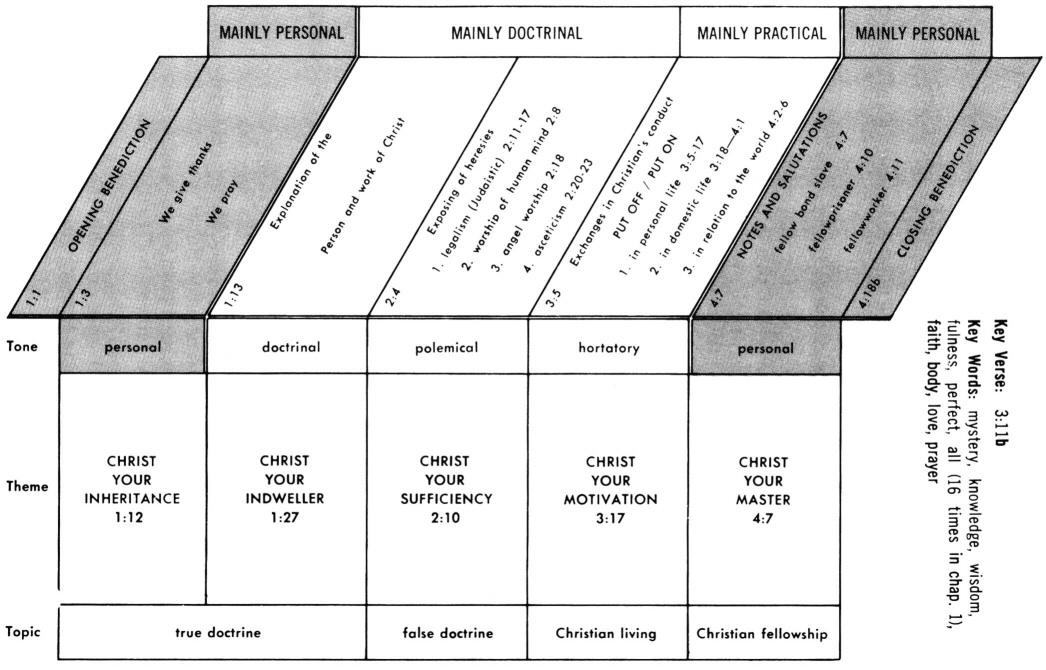
CHRIST IS ALL IN ALL
Click chart to enlarge
Charts from Jensen's Survey of the NT - used by permission
Colossians Overview - Click Chart on right side
| Christ Preeminent in All Things Supreme Lord - Sufficient Savior |
|||
| Colossians 1 | Colossians 2 | Colossians 3 | Colossians 4 |
| Supremacy of Christ |
Submission to Christ |
||
| Doctrinal and Corrective |
Practical and Reassuring |
||
| What Christ Did For Us |
What Christ Does Through Us |
||
| Christ Our Lord |
Christ Our Life |
Christ our Love |
|
| Christ the Head of the Body |
Christ the Lord of the Universe |
Christ the Head of the Home |
|
| Instruction | Warnings | Exhortations | Reminders |
| Reconciliation | Creation | Submission | Conversation |
| His Person and Word |
His Peace and Presence |
||
Colossians 1:14 in Whom we have (1PPAI) redemption the forgiveness of sins. (NASB: Lockman)
Greek: en o echomen (1PPAI) ten apolutrosin, ten aphesin ton hamartion;
Amplified: In Whom we have our redemption through His blood, [which means] the forgiveness of our sins. (Amplified Bible - Lockman)
KJV: In whom we have redemption through his blood, even the forgiveness of sins (Textus Receptus has "dia tou haimatos autou" not found in most modern manuscripts)
Lightfoot: even the same who paid our ransom and thus procured our redemption from captivity—our redemption, which (be assured) is nothing else than the remission of our sins
Phillips: For it is by his Son alone that we have been redeemed and have had our sins forgiven. (Phillips: Touchstone)
Wuest: in whom we are having our liberation, procured by the payment of ransom, the putting away of our sins; (Eerdmans)
Young's Literal: in whom we have the redemption through his blood, the forgiveness of the sins
IN WHOM WE HAVE REDEMPTION : en hôi echomen (1PPAI) ten apolutrosin:
- Mt 20:28 Mk 10:45 Lk 21:28 Acts 20:28 Ro 3:24,25 Ro 8:23 1Co 1:30 Gal 3:13 Eph 1:7, 14, 4:30, 5:2 1Ti 2:6 Titus 2:14 Heb 9:12,22, Heb 10:12, 13, 14 1Pe 1:18, 19, 20, 1Pe 3:18 1Jn 2:2 Rev 1:5, Rev 5:9, Rev 14:4
- Click for more on redemption in this website's discussion on how to use free internet tools to do a Greek word study
FOREVER POSSESSING
THE REDEMPTION
In Whom - In Christ we are once and for all time (forever and ever) liberated (note that "we have" is in the present tense indicating that Christ's redemption is our present and continuous possession! Don't let anyone tell you otherwise!) because He has paid the redemption price in full (see Commentary on "It is Finished" in John 19:30) with His infinitely, inestimably precious blood (1Pe 1:18, 19+). Beloved, in light of this great doctrine, we need to learn to daily walk in His glorious gift of freedom, not under a burden of legalism (cp 1Jn 5:3) but motivated by an attitude of gratitude and love which generates the obedience of faith (Ro 1:5+, Ro 16:25+)! Walk forth by faith, walking forth, fully assured of the certainty and completeness of Christ's victory over the the world, the flesh and the devil, which He obtained by His death, burial and resurrection on our behalf. And when we walk this way, we begin to experience what has been rightly called the "victorious Christian life".
Redemption (629)(apolutrosis from apolutróo <> apo = marker of dissociation or separation + lutron/lytron = ransom from luo = loosen what is bound, loose any person tied or fastened) means to let one go free upon payment of a ransom price. Those who are not redeemed are powerless to liberate themselves.
Redemption was used in secular Greek as a technical term for money paid to buy back and set free prisoners of war or to emancipate slaves (liberate them from subjection or domination) from their masters. Believers have been ransomed, bought back, like the redemption of a bondservant by a kinsman-redeemer (Lev 25:49). Before redemption we were held captive by the devil (cf "dominion [exousia] of Satan" in Acts 26:18) to do his will and were enslaved to our old sin nature (see Sin = Principle) inherited from Adam (Ro 5:12+). A Roman or Grecian slave could be freed with the payment of money, but no amount of money can set an enslaved sinner free. Only the blood of Jesus Christ can redeem us. Christ paid the ransom price (see lutron/lytron used only twice in NT = Mt 20:28+, Mk 10:45+) with His blood (1Pe 1:18-19+, 1Pe 1:20+; 1Cor 6:20+; Rev 5:9+), freeing us from the curse of the law (Gal 3:13+; Gal 4:5+) and releasing us from bondage of sin into the freedom of grace (cp Ro 6:14+).
Note that the KJV (based on the Textus Receptus) adds "through his blood" which is not found in the Nestle-Aland text. The phrase, “through His blood,” reminds us of the cost of our salvation. Moses and the Israelites only had to shed the blood of a lamb to be delivered from slavery Egypt. But Jesus had to shed His blood to deliver us from slavery to sin (Jn 8:34, 36+). Note that this does not suggest (AS SOME FALSELY TEACH) that Jesus paid a ransom to Satan in order to rescue us from the kingdom of darkness. By His death, Jesus' blood met the holy demands of God’s Law and the resurrection was the Father's "Amen" indicating His acceptance of the Perfect Sacrificial Lamb (Jn 1:29+). The result of this redemption is that we have been set free by Jesus to do the will of the Father as we are enabled by the Spirit!
His Blood Availed for Me
by Albert S Reitz
There’s a crimson tide from the Savior’s side,
And it purgeth all who plunge therein;
O its healing stream doth the soul redeem,
And it cleanseth from all sin.
There’s a boundless sea flowing full and free,
From the cross where Jesus bled and died;
O its precious flow washes white as snow,
And its mercies e’er abide.
Refrain
Hallelujah! Hallelujah!
It cleansed my heart and made me free;
Hallelujah! Hallelujah!
His blood availed for me.
Regarding Christ's blood as the payment price for man's redemption Tony Garland writes that "A bloodless gospel is no gospel. Without the shedding of blood there is no remission of sin. The redeemed of this age are “the church of God which He purchased with His own blood” [emphasis added] (Acts 20:28+). Redemption provides for the forgiveness of sin—that which separates man from God—and was made possible “through His blood” [emphasis added] (Col. 1:14). This is the reason why Christ’s blood is said to be “precious” (1Pe 1:19+).19 See also his interesting discussion on the phrase "in His own blood" in Re 1:5+." (The Testimony of Jesus Christ)
As Paul explained sinners are "justified (declared righteous, in right standing before God) as a gift by His grace through the redemption which is in Christ Jesus Whom God displayed publicly as a propitiation in His blood through faith. (Ro 3:24, 25+)
Paul spoke of the relationship of redemption to forgiveness here in Colossians and also in his letter to the Ephesians writing that in Christ "we have redemption (apolutrosis) through His blood, the forgiveness of our trespasses, according to the riches of His grace" (Eph 1:7+).
Redemption and forgiveness thus go together. Forgiveness (see below) means “to send away” or “to cancel a debt” and thus Christ has not only redeemed us, setting us free and transferring us to a new kingdom, but He has also canceled every debt so that we cannot be enslaved again. Our Adversary, the Accuser of our soul, cannot find anything in the record that will indict us!
Paul explains that in regard to our salvation we can never boast about anything but the Lord for "by His doing you are in Christ Jesus, Who became to us wisdom from God, and righteousness and sanctification, and redemption (apolutrosis)" (1Cor 1:30)
Paul explains that the Holy Spirit ""is given as a pledge of our inheritance, with a view to the redemption (apolutrosis) of God's own possession, to the praise of His glory." (Eph 1:14+) (Comment: referring to our "future" redemption)
Later in the same letter he makes another reference to our future redemption (receipt of our glorified bodies) admonishing the saints not to "grieve (command in present tense = stop grieving) the Holy Spirit of God, by whom you were sealed for the day of redemption (apolutrosis) ." (Eph 4:30+)
In Romans he again refers to our future redemption writing "we ourselves, having the first fruits of the Spirit (like a "down payment", a seal), even we ourselves groan within ourselves, waiting eagerly for our adoption as sons, the redemption (apolutrosis) of our body." (Ro 8:23+)
"Future" redemption is that day when we receive our resurrected glorified body.
To the Jews "redeemed" would bring to mind the picture of God's deliverance from Egyptian bondage (Ex 6:6+, Ex 15:13+). Years later the return of the Jewish exiles from Babylon was depicted in similar terms (Isa 52:3) Jehovah declaring that "You were sold for nothing and you will be redeemed (Hebrew = Ga'al = act as kinsman redeemer; Lxx = Lutroo) without money."
In the Old Testament, redemption involves deliverance from bondage based on the payment of a price by a kinsman redeemer, a concept beautifully pictured by Boaz's redemption of Ruth which prefigured the Messiah as Kinsman-Redeemer (see Goel = Kinsman Redeemer) of all who would receive His free gift by faith. (See study on Ruth on this website).
|
Redemption |
| lutroo: verb form - to redeem Lk 24:21, Titus 2:14, 1Pe 1:18 |
| lutron/lytron: price paid to redeem Mt 20:28, Mk 10:45 |
| lutrosis: ransoming or setting free Lk 1:68, 2:38, Heb 9:12 |
| apolutrosis: release effected by paying ransom Lk 21:28 Ro 3:24, 8:23, 1Co 1:30, Eph 1:7, 14, 4:30, Col 1:14, Heb 9:15, 11:35 |
This truth about redemption is also practical. Thus believers are exhorted to remember the “price” of their redemption as a motivation to personal holiness. For example Paul wrote to the Corinthians asking them "do you not know that your body is a temple of the Holy Spirit who is in you, whom you have from God, and that you are not your own? For you have been bought with a price (different Greek word but equivalent to redemption price): therefore glorify (give a proper opinion of Who is in you by how you conduct yourself) God in your body." (1Cor 6:19-20+)
Similarly, Peter writing in the context of a call to personal holiness (1Pe 1:13, 14, 15, 16-notes 1Pe 1:13; 1:14; 1:15; 1:16) says "if you address as Father the One who impartially judges according to each man's work, conduct yourselves in fear during the time of your stay upon earth knowing that you were not redeemed (lutroo) with perishable things like silver or gold from your futile way of life (Christ saved us from a life of emptiness) inherited from your forefathers, but with precious blood, as of a lamb unblemished and spotless, the blood of Christ." (see + 1Pe 1:17; 1:18; 1:19)
So here in First Peter, he calls us to live holy lives motivated by a reverential awe (fear) of the fact that we will be impartially judged and also motivated by the costliness of the redemption price, the blood of Christ.
The writer of Hebrews reminds us of the incalculable value of Christ's redemptive work, writing that it was effected "not through the blood of goats and calves, but through His own blood, He entered the holy place once for all, having obtained eternal redemption." (He 9:12+) so that "...those who have been called may receive the promise of the eternal inheritance." (He 9:15+) Our redemption in Christ is final and permanent.
How could the Colossian saints (and we) fail to give thanks after having been freed from the oppressive bondage of slavery to sin (Jn 8:34, Ro 6:18 [note]), the law (Gal 4:3, 4, 5; 5:1), and the fear of death (He 2:14,1 5+)? As our blessed Redeemer Himself said "If therefore the Son shall make you free, you shall be free indeed.” (Jn 8:36) Remember that Christ shed His precious blood for us that we might live through Him (1Jn 4:9), for Him (2Cor 5:15), and with Him (1Th 5:10+).
Nor Silver Nor Gold
by James Gray
Nor silver nor gold hath obtained my redemption,
Nor riches of earth could have saved my poor soul;
The blood of the cross is my only foundation,
The death of my Savior now maketh me whole.
Refrain
I am redeemed, but not with silver,
I am bought, but not with gold;
Bought with a price, the blood of Jesus,
Precious price of love untold.
Nor silver nor gold hath obtained my redemption,
The guilt on my conscience too heavy had grown;
The blood of the cross is my only foundation,
The death of my Savior could only atone
THE FORGIVENESS OF SINS: tên aphesin tôn hamartiôn:
- Col 2:13, Ps 32:1, 2, Ro 4:6, 7,4:8 Ps 130:4, , Mk 1:4 Lk 1:77,4:18, Lk 5:20, Lk 7:47, 48,49, 50 Acts 5:31 Acts 10:43, 13:38,39, Acts 26:18, Heb 9:22 1Jn 1:9, 2:12)
Forgiveness (859) (aphesis from aphiemi = action which causes separation and is in turn derived from apo = from + hiemi = put in motion, send) literally means to send away or to put apart, a letting go, a leaving behind, a removal. Aphesis refers to a remission as when one remits (pardons, cancels) a debt, or releases then from an obligation. To release from captivity.
Remission (see definition of English word) of sins means once and for all taking them away, removing the guilt, punishment and power of sin. And so to release one’s sins, is not just release from the ("legal" or forensic) charge and the just penalty of sin but also release from the power and dominion of sin (and in Heaven the release from the presence of sin and the pleasure of sin). And so we see that Wuest translates Col 1:14 as "the putting away of our sins" (Wuest)
The OT gives us a beautiful picture of the meaning of aphesis in the celebration of the Year of Jubilee. In fact there are 11 uses of aphesis in the Septuagint translation of Leviticus 25 (Lev 25:10-13, 28, 30-31, 33, 40, 41, 50, 52, 54) where aphesis is frequently substituted for the Hebrew word Jubilee, so that instead of the phrase Year of Jubilee the Lxx translated into English reads "Year of the Release" in Lev 25:13 (or "Jubilee of Release in Lev 25:11). One aspect of the Year of Jubilee involved the setting free of indebted servants or slaves (cf Lev 25:10). It is interesting that the OT release from debts was associated with a time of celebration. How much more should we as NT saints daily celebrate and revel in the truth that we have been released from our sin debt! I fear I do not ponder this profound truth often enough and begin to take it for granted and become complacent and even indifferent which makes me vulnerable to committing sin! We need to remember that the Year of Jubilee was an OT picture which pointed to and was fulfilled in the crucifixion of the Messiah Whose fully atoning, substitutionary death made release from sin, Satan and death possible for all who receive this truth by grace through faith. Here is an example from Leviticus 25...
Leviticus 25:10 You shall thus consecrate the fiftieth year and proclaim a release (Hebrew = deror = a flowing, liberty; Lxx = aphesis) through the land to all its inhabitants. It shall be a jubilee for you, and each of you shall return to his own property, and each of you shall return to his family.
Leviticus 25:12 'For it is a jubilee (Hebrew - yobel = ram's horn; Lxx = aphesis + onmasia = shouting, a day for blowing the trumpets - The beginning of this year was marked by the blast of the Shofar [Jewish Encyclopedia] or ram's horn); it shall be holy to you. You shall eat its crops out of the field.
Mounce writes that aphesis "almost always refers to divine forgiveness, and its meaning is usually clarified by adding “of sins.” In Eph 1:7; Col 1:14, Paul defines redemption as specifically related to “the forgiveness of sins.” The forgiveness of sins is a central feature of the Christian message and witness, standing at the heart of the gospel. Also, the divine initiative in the forgiveness of sins creates a forgiving spirit in the life of the Christian. As Christ forgave us, so should we forgive others (Mt 5:38–48; Ro 12:19–21).(Mounce’s Complete Expository Dictionary of Old & New Testament Words.)
Aphesis is followed by sin (hamartia) 11/17 uses in the NT (Mt 26:28, Mk 1:4, Lk 1:77, 3:3, 24:47, Acts 2:38, 5:31, 10:43, 13:38, 26:18, Col 1:14), where Sin is depicted as a "master" that has bound and enslaved all mankind (cf "slave of sin" Ro 6:20+). Paul writes "thanks be to God that though you were slaves of sin Sin (see discussion of Sin personified as a "Slavemaster"), you became obedient from the heart to that form of teaching to which you were committed, and having been freed from sin, you became slaves of righteousness. (Ro 6:17-18+) Aphesis releases (so to speak) a man from the cords of Sin, the power of Sin. Jesus declared that one of the goals of His ministry was to "release [aphesis] the captives" (Lk 4:18+). Here the word captives is aichmalotos which refers to prisoners of war, and in context refers to all men as in a state of captivity to Sin as a result of having inherited Adam's sin nature (Ro 5:12+).
The root meaning of forgiveness is to put away an offense. In secular Greek literature, the related word aphiemi was used to indicate the sending away of an object or a person and came to include the release of someone from the obligation of marriage, or debt, or even a religious vow. In its final form this word group came to embrace the principle of release from punishment for some wrongdoing.
Aphesis is used in medical language of the relaxation (remission) of disease. Both Luke and John use the kindred verb aphiemi, in the same sense. See Luke 4:39+ (Fever left her); John 4:52+ (the fever left him).
Remission (Webster's definition) = discharge or relinquishment of a claim or right; as the remission of a tax or duty; pardon - giving up of the punishment due to a crime, the act of sending back). The cancellation of a debt, charge, or penalty. Release from sin. Youngblood adds that "The active nature of the word for “remission” in the Greek language indicates that forgiveness is more than a passive act on God’s part. Through the death of His Son, God has taken the initiative to break the grip of sin and set people free for a new way of life in God’s Spirit." (Nelson’s new illustrated Bible dictionary)
Forgiveness (Webster's definition) = the giving up o resentment or claim to requital, the granting of relief from payment (forgive a debt). The pardon or remission of an offense or crime. The act of excusing or pardoning others in spite of their slights, shortcomings, and errors. "Giving up resentment or claim to requital on account of an offense. The offense may be a deprivation of a person’s property, rights, or honor; or it may be a violation of moral law." (New International Bible Dictionary)
Aphesis has be transliterated as a word in the field of Linguistics where it describes the gradual disappearance or loss of an unstressed vowel at the beginning of a word (e.g. of e from esquire to form squire).
Thayer's summary - 1) release from bondage or imprisonment 2) forgiveness or pardon, of sins (letting them go as if they had never been committed), remission of the penalty
Friberg's summary - (1) of captivity release, liberation, deliverance (Lk 4.18); (2) of an obligation or debt cancellation, pardon; (3) predominately in relation to sins forgiveness, cancellation of guilt (Mt 26.28); in the New Covenant, a;. involves not a passing over of sins as in the Old Covenant (cf. paresis = passing over, overlooking in Ro 3.25), but their removal from the mind of God, taking away (Heb 10.18; cf. Heb 10.3)
BDAG summarized - (1). the act of freeing and liberating from something that confines, release from captivity (2). the act of freeing from an obligation, guilt, or punishment, pardon, cancellation - forgiveness of sins i.e. cancellation of the guilt of sin
Liddell-Scott - 1. a letting go, dismissal:-a quittance or discharge from a bond.: exemption from service, a divorce 2. a letting go (Lat. missio) of horses from the starting-post, and then the starting-post itself, having made the winning post one with the starting-post, i.e. having come back to the starting-post.
The Theological Lexicon of the NT - (Aphesis) has multiple shades of meaning, some of them quite everyday, like the sending out of ships (Demosthenes, Corona 18.77–78); but there are also technical applications, for example in architecture, and in sports, where it refers to the starting line for the athletes in the diaulos; in astrology, it refers to the point of departure, the beginning. In Aristotle, it refers to the emission or expulsion of fish roe (bees release their excrement; 6.22.576a25: a mare remains standing at the moment of delivery, and in Hippocrates it becomes a medical term, the emission of gas being a symptom of illness. Aphesis can also mean “exhaustion, prostration”: “forgetfulness and prostration, loss of voice…signs of illness” (Epid. 3.6). Aphesis is used especially for persons, usually as a legal term for a layoff, for the release of slaves or prisoners (Polybius 1.79.12; Plato, Plt. 273c), the repudiation of a spouse (“Pompey sent his wife a bill of divorce”), an exemption from military service (Plutarch, Ages. 24.3), a dispensation from an obligation: “A councilor who does not come to the meeting chamber at the appointed time shall pay one drachma for each day’s absence unless the council grants him a dispensation” (ean mē heuriskomenos aphesin tēs boulēs apē, Aristotle, Ath. Pol. 30.6). In Demosthenes, aphesis is usually a “discharge” in the technical sense of freeing someone from an obligation (“There was a settling of accounts and a release relative to the bank lease”; C. Naus. 28.5), but also a “settlement” (“My father was able to recover the debt after the settlement,” C. Naus. 38.14) and a “remission” (“This remission of interest did not wrong the creditors”). On rare occasions (Ed: In contrast to Biblical use) it refers to the forgiveness of an offense: “What we have said concerning forgiveness of a parricide by a father shall be valid for similar cases” (Plato, Leg. 9.869 d). The term does not seem to have been used by the moralists, however. In the papyri, aphesis refers especially to the draining of water from pools and especially to sluice gates (“the sluice gates at Phoboou" or the conduits from which water flows out into the fields. (BORROW - Spicq, C Theological Lexicon of the New Testament Peabody, MA.: Hendrickson)
Resources on Forgiveness..
- Forgiveness - Baker's Evangelical Dictionary
- Forgiveness - ISBE
- Forgiveness - Hastings' Dictionary of the Bible
- Forgiveness - Hastings' Dictionary of the New Testament
- Forgiveness (2) - Hastings' Dictionary of the New Testament
- Forgiveness - The 1901 Jewish Encyclopedia - Bible Encyclopedia
- Forgiveness - Cyclopedia of Biblical, Theological and Ecclesiastical Literature
- Forgiveness - Holman Bible Dictionary
- Forgiveness - Bridgeway Bible Dictionary
- Forgiveness - Charles Buck Theological Dictionary
- Forgiveness - Nave's Topical Bible
- Forgiveness of Injuries - Torrey's Topical Textbook
- Forgiveness - The Topical Concordance
- Forgiveness - Thompson Chain Reference
Aphesis is used 17x in 16v the NAS (see below). NAS Usage = forgiveness, 15; free, 1; release, 1.
KJV Usage = remission 9, forgiveness 6, deliverance 1, liberty 1; 17
Some people say repentance is not part of being born again. However in the NT uses below there is a clear association of repentance with forgiveness. (Mk 1:4, Lk 3:3, Luke 24:47, Acts 2:38, Acts 5:31 Acts 26:18 = "turn from" ~ repent). How tragic that in many modern presentations of the good news, the Biblical doctrine of repentance is not considered relevant and so is never even mentioned! We must return to the ancient paths (cp Jer 6:16) and not water down or dilute the gospel (cp Jer 18:15). Beloved, you can mark it down, if you say you believe in Jesus and yet there is never a "change in direction" in your life, you need to be very careful for you may be among the many Jesus warned would face Him in Mt 7:21-23+!
Matthew 26:28+ for this is My blood of the covenant, which is poured out for many for forgiveness of sins.
Mark 1:4+ John the Baptist appeared in the wilderness preaching a baptism of repentance for the forgiveness of sins.
Compare the emphasis on repentance in the ministries of Jesus, Peter, Paul - Jesus began His ministry proclaiming "Repent for the kingdom of heaven is at hand" Mt 4:17, Jesus' proclaimed in Mark 1:15 "The time is fulfilled, and the kingdom of God is at hand; repent and believe in the gospel." Study also Mark 6:11, Luke 5:32, 10:13, 11:32, 13:3, 13:5, 15:7, 15:10, 16:30, 24:47, Peter in Acts 3:19, 5:31, 11:18, Paul in Acts 17:30, 20:21, 26:20
Mark 3:29+ but whoever blasphemes against the Holy Spirit never has forgiveness, but is guilty of an eternal sin "--
Luke 1:77+ To give to His people the knowledge of salvation By the forgiveness of their sins,
Luke 3:3+ And he came into all the district around the Jordan, preaching a baptism of repentance for the forgiveness of sins; (Luke 3:8 "bring forth fruits in keeping with repentance")
Luke 4:18+ "The Spirit of the Lord is upon Me, because He anointed Me to preach the gospel to the poor. He has sent Me to proclaim release (aphesis) to the captives, and recovery of sight to the blind, to set free those who are oppressed (broken in pieces, shattered, smitten - perfect tense = permanent state unless they are set free)
Comment: Jesus is quoting from the Septuagint of Isaiah 61:1 which in the NAS is rendered
The Spirit of the Lord GOD is upon Me, because the LORD (Jehovah) has anointed Me to bring good news [euaggelizo] to the afflicted; He has sent me to bind up the brokenhearted, to proclaim liberty (Heb = deror [01865] = emancipation, freedom, liberty; LXX = aphesis = a canceling of debt) to captives and freedom to prisoners
Many commentators consider Jesus' references to liberty and freedom as clear allusions to the Year of Jubilee ("the favorable year of the Lord" Lk 4:19, quoting first half of Isaiah 61:2a. See in depth discussion of Jubilee in notes on Lev 25:8) which in the Septuagint is translated the "year of release" (aphesis). Click here for another discussion on the year of Jubilee and how it is a "shadow" of the Messiah. The Jubilee is the crowning point of all the sabbatical institutions during which all debts and obligations were canceled (see use of aphesis in Leviticus 25:10 below). (Dictionary articles - Jubilee Year; Year of Jubilee; Jubilee) (Play Michael Card's great song "Jubilee" - Hallelujah!)
MacArthur - Aphesis (release) means “forgiveness” (it is so translated in 1:77; 3:3; 24:47; Matt. 26:28; Mark 1:4; Acts 2:38; 5:31; 10:43; 13:38; 26:18; Eph. 1:7; Col. 1:14; Heb. 9:22; 10:18). Messiah will set the prisoners free by paying the penalty for their violation of God’s law. Through His sacrificial death God has “canceled out the certificate of debt consisting of decrees against us, which was hostile to us; and He has taken it out of the way, having nailed it to the cross” (Col. 2:14). As Charles Wesley expressed it in his magnificent hymn “O For a Thousand Tongues, ”He breaks the power of cancelled sin, He sets the prisoner free." (MacArthur New Testament Commentary, Luke)
Luke 24:47+ and that repentance for forgiveness of sins should be proclaimed in His name to all the nations, beginning from Jerusalem.
Acts 2:38+ And Peter said to them, "Repent, (aorist imperative see our need to depend on the Holy Spirit in order to genuiniely repent!) and let each of you be baptized in the name of Jesus Christ for the forgiveness of your sins; and you shall receive the gift of the Holy Spirit.
Acts 5:31+ "He is the one whom God exalted to His right hand as a Prince and a Savior, to grant repentance to Israel, and forgiveness of sins.
Acts 10:43+ "Of Him all the prophets bear witness that through His name everyone who believes in Him receives forgiveness of sins."
Acts 13:38+ "Therefore let it be known to you, brethren, that through Him forgiveness of sins is proclaimed to you,
Acts 26:18+ to open their eyes so that they may turn from darkness to light and from the dominion of Satan to God, in order that they may receive forgiveness of sins and an inheritance among those who have been sanctified by faith in Me.'
Ephesians 1:7+ In Him we have redemption through His blood, the forgiveness of our trespasses, according to the riches of His grace,
Wuest - The word “forgiveness” is aphesis from aphiemi, “to send from one’s self, to send away, to bid go away or depart.” The noun aphesis, used in relation to “sins,” means “a release, the letting them go as if they had not been committed, thus, forgiveness, a remission of their penalty” (Thayer). Trench says that the image under lying the verb is that of releasing a prisoner (Isaiah 61:1), or letting go, as of a debt (Deut. 15:3). One is reminded of the one goat who was offered as a sin-offering on the Day of Atonement, and of the other goat upon which was placed the sins of the people (symbolically) and which was let go in the wilderness, never to be seen again by Israel, the latter goat typifying that aspect of redemption in which the sins of the human race were put away, never to be charged against the individual again. All of which means that sinners are lost today, not because they sin, but because they have not availed themselves of the salvation which is in Christ Jesus. God’s forgiveness of sin refers therefore to His act of putting sin away on a judicial basis, to His remitting the guilt and penalty. It is for the sinner to avail himself of salvation by appropriating the Lord Jesus as his Saviour by faith in what He has done for him on the Cross.
Colossians 1:14+ in whom we have redemption, the forgiveness of sins.
He breaks the power
of canceled sin.
Believers Church Bible Commentary - Forgiveness, particularly when coupled with redemption as it is here, includes more than canceling the guilt of sins. Thinking of forgiveness only in a narrow judicial sense (of removing penalty) blocks an appreciation for its more comprehensive meaning. Forgiveness includes breaking the hold and power of sin (cf. Col 2:13–15). In John 8:11, Jesus’ words to the woman, “Go your way, and from now on do not sin again,” imply that she could do just that because she was forgiven. A line in a Charles Wesley hymn captures this fuller meaning of forgiveness, “He breaks the power of canceled sin.”
Hebrews 9:22+ And according to the Law, one may almost say, all things are cleansed with blood, and without shedding of blood there is no forgiveness.
Hebrews 10:18+ Now where there is forgiveness of these things, there is no longer any offering for sin.
The OT sacrifices were merely an offering, a divinely appointed temporary means to bring man to God. Christ redemptive work of remission was the perfect completion of atonement.
Aphesis - 39x times in Septuagint (LXX) - Ex. 18:2; 23:11; Lev 16:26; 25:10, 11, 12, 13, 28, 30, 31, 33, 40, 41, 50, 52, 54; 27:17, 18, 21, 23, 24; Nu 36:4; Dt 15:1, 2, 3 , 9; 31:10; 2Sa. 22:16; Est. 2:18; Is 58:6; 61:1; Je 34:8, 15, 17; Lam 3:48; Ezek. 46:17; 47:3; Da 12:7; Joel 1:20; 3:18.
Exodus 18:2 Moses' father-in-law, took Moses' wife Zipporah, after he had sent her away (Lxx = aphesis) (Here aphesis is used with its literal meaning).
Deuteronomy 15:1 At the end of every seven years you shall grant a remission (LXX = aphesis) of debts. (Comment: Aphesis is used here in the Septuagint to describe the releasing of a prisoner or remitting of a debt, as indicated by Jehovah's instructions to Israel.)
Leviticus 16:26 "The one who released (Heb = shalach = to send away; Lxx uses two words to translate the one Hebrew word = the verb exapostello = send away + aphesis = let go = " he that sends forth the goat that has been set apart to be let go") the goat as the scapegoat shall wash his clothes and bathe his body with water; then afterward he shall come into the camp. (Comment: All men are born captives of sin and Satan and in need of release. The truth alone can release and set men free. The Messiah, our eternal "Scapegoat" (cf the OT teaching on the scapegoat on the day of atonement described in Lev 16:1-34) carried away our sin debt forever, having paid the price in full [Jn 19:30]! Are you still captive to sin? Come to the fountain of blood that flows from Immanuel's veins and be set free so that you might be free indeed.)
Related resources:
- List of links related to forgiveness/unforgiveness
- Multiple illustrations and quotes related to forgiveness/unforgiveness
- Exposition of "Forgiveness" in Ephesians 4:32
- Exposition of "Forgiveness" in Colossians 3:13
- Exposition of "Forgiveness" in Matthew 6:12 and Matthew 6:14-15
- Sermon on Forgiveness - Acts 13:38-39
In fifteen occurrences aphesis expresses forgiveness (often "remission" in KJV) of sins and is rendered "free" and "release" in its other two occurrences (in Luke 4:18). The preaching of the early church always linked forgiveness with Jesus. He alone is able "to grant repentance to Israel, and forgiveness of sins." (Acts 5:31). The death and resurrection of Jesus put the promises of the OT prophets in perspective, for "all the prophets testify about him that everyone who believes in him receives forgiveness of sins through his name" (Acts 10:43).
Aphiemi means to send away or carry away and brings to mind the ritual on the Jewish Day of Atonement when the high priest sent the scapegoat into the wilderness (Lev 16). The high priest would first kill one of the two goats and sprinkle its blood before God on the mercy seat. Then he would confess Israel’s sins over the live goat, and would have this goat taken into the wilderness to be lost. Christ died to carry away our sins so they might never again be seen. (Ps 103:12; Mic 7:18, 19).
David had personally experienced the depth of God's forgiveness and wrote
"How blessed is he whose transgression is forgiven (verb cognate = aphiemi), whose sin is covered!" (Ps 32:1)
John the Baptist recognized the Lamb Who was to be the "scapegoat" crying out as "he saw Jesus coming to him...
"Behold, the Lamb of God who takes away (a different verb airo) the sin of the world!" (Jn 1:29)
No written accusation stands against us because our sins have been taken away! (Col 2:13-14) Sin made us poor, but grace makes us rich.
Forgiveness pictures the act of freeing and liberating one from something that confines.
ILLUSTRATION - When missionaries in northern Alaska were translating the Bible into the language of the Eskimos, they discovered there was no word in that language for forgiveness. After much patient listening, however, they discovered a word that means, “not being able to think about it anymore.” That word was used throughout the translation to represent forgiveness, because God’s promise to repentant sinners is, “I will forgive their iniquity, and their sin I will remember no more” (Jer. 31:34).
Aphesis was used in secular Greek as a legal term that meant to repay or cancel a debt or to grant a pardon. Through the shedding of His blood, Jesus Christ actually took the sins of the world upon His own head, as it were, and carried them an infinite distance away from where they could never return. That is the extent of the forgiveness of our trespasses in the New Covenant. Every time we celebrate the Lord's supper we should recall Jesus' words "this is My blood of the covenant, which is poured out for many for forgiveness (aphesis) of sins." (Mt 26:28)
Peter reminds us of the litmus test that "Of (Messiah) all the prophets bear witness that through His name everyone who believes in Him receives forgiveness (aphesis) of sins" (Acts 10:43)
Regarding aphesis W E Vine adds that it "primarily denotes a dismissal or release....Eleven times it is followed by “of sins,” once by “of trespasses.” Both this and the corresponding verb aphiemi, to send away, signify, firstly, the remission of the punishment due to sins and the deliverance of the sinner from the penalty divinely, and therefore righteously, imposed; secondly, the complete removal of the cause of offense or the ground of the vicarious and propitiatory sacrifice of Christ. Here the forgiveness defines the redemption."
Easton's Bible Dictionary gives a nice synopsis on forgiveness of sins describing it as "one of the constituent parts of justification (being declared righteous). In pardoning sin, God absolves the sinner from the condemnation of the law, and that on account of the work of Christ, i.e., he removes the guilt of sin, or the sinner's actual liability to eternal wrath on account of it. All sins are forgiven freely (Acts 5:31; Acts 13:38; 1Jn 1:6, 7, 8, 9). The sinner is by this act of grace for ever freed from the guilt and penalty of his sins. This is the peculiar prerogative of God (Ps 130:4; Mark 2:5). It is offered to all in the gospel."
MY REDEEMER
by Phillip Bliss
I will sing of my Redeemer,
And His wondrous love to me;
On the cruel cross He suffered,
From the curse to set me free (refrain)
I will tell the wondrous story,
How my lost estate to save,
In His boundless love and mercy,
He the ransom freely gave. (refrain)
I will praise my dear Redeemer,
His triumphant power I’ll tell,
How the victory He giveth
Over sin, and death, and hell. (refrain)
I will sing of my Redeemer,
And His heav’nly love to me;
He from death to life hath brought me,
Son of God with Him to be. (refrain)
Refrain
Sing, oh sing, of my Redeemer,
With His blood, He purchased me.
On the cross, He sealed my pardon,
Paid the debt, and made me free..
THIS IS A GREAT MODERN SONG
MY REDEEMER LIVES - NICOLE C MULLEN
God forgave us of our sins when we were saved, but now Christ consistently becomes the means of our being forgiven every day of our life. If you want to find a person who will praise God? Find someone who has understands God has forgiven him and who understands that He has freed him to be what GOD wants him to be. When you start living in the victory that God has for you, that is when you become very thankful to God all that He's done for us.
Forgiveness is not an excuse for sin, but to the contrary should be an encouragement for obedience. And, because we have been forgiven, we can forgive others (Col 3:13+). The Parable of the Unforgiving Servant makes it clear that an unforgiving spirit always leads to bondage (Mt 18:21-35).
FORGIVENESS - One day when Stan Mooneyham was walking along a trail in East Africa with some friends, he became aware of a delightful odor that filled the air. He looked up in the trees and around at the bushes in an effort to discover where it was coming from. Then his friends told him to look down at the small blue flower growing along the path. Each time they crushed the tiny blossoms under their feet, more of its sweet perfume was released into the air. Then his friends said, "We call it the forgiveness flower." This forgiveness flower does not wait until we ask forgiveness for crushing it. It does not release its fragrance in measured doses or hold us to a reciprocal arrangement. It does not ask for an apology; it merely lives up to its name and forgives-freely, fully, richly. What a touching example of outrageous forgiveness!
Henry Ward Beecher (1813-87), famous Congregational clergyman, said: " 'I can forgive, but I can't forget,' is just another way of saying, 'I will not forgive.' "
In other words, genuine forgiveness entails forgetting.
According to Alice Cary (1820-71), a hymn-writer: "Nothing in this lost world bears the impress of the Son of God so surely as forgiveness."
C. S. Lewis (1898-1963) had an interesting viewpoint reminding us that "Everyone says forgiveness is a lovely idea," he said, "until they have something to forgive."
Oswald Chambers (1874-1917) said: "Never build your preaching of forgiveness on the fact that God is our Father and He will forgive because He loves us. . . . It is shallow nonsense to say that God forgives us because He is love. The only ground on which God can forgive me is through the Cross of my Lord."
Billy Graham put it even more directly: "If His conditions are met, God is bound by His Word to forgive any man or woman of any sin because of Christ.
Someone has expressed forgiveness this way
"We are most like beasts when we kill.
We are most like men when we judge.
We are most like God when we forgive."
Erwin Lutzer wrote that "Forgiveness is always free. But that doesn’t mean that confession is always easy. Sometimes it is hard. Incredibly hard. It is painful (sometimes literally) to admit our sins and entrust ourselves to God’s care.
D L Moody wrote "The voice of sin is loud, but the voice of forgiveness is louder."
William Cowper expresses the spirit of forgiveness "Alas! if my best Friend, who laid down his life for me, were to remember all the instances in which I have neglected him, and to plead them against me in judgment, where should I hide my guilty head in the day of recompense? I will pray, therefore, for blessings on my friends, even though they cease to be so, and upon my enemies, though they continue such.
Puritan Thomas Adams said that "Sins are remitted, as if they had never been committed.
John Bunyan added that "No child of God sins to that degree as to make himself incapable of forgiveness.
Christians aren’t perfect—just forgiven.
William Cowper wrote the following in Olney Hymns...
Sin enslaved my many years,
And led me bound and blind;
Till at length a thousand fears
Came swarming o’er my mind.
“Where,” said I, in deep distress,
“Will these sinful pleasures end?
How shall I secure my peace,
And make the Lord my friend?”
Friends and ministers said much
The gospel to enforce;
But my blindness still was such,
I chose a legal course:
Much I fasted, watch’d and strove,
Scarce would shew my face abroad,
Fear’d almost to speak or move,
A stranger still to God.
Thus afraid to trust His grace,
Long time did I rebel;
Till despairing of my case,"
Down at His feet I fell:
Then my stubborn heart He broke,
And subdued me to His sway;
By a simple word He spoke,
“Thy sins are done away.”
Today in the Word - Japanese Symphony - For 32 years, the NHK Symphony, considered by many to be Japan’s best orchestra, and Seiji Ozawa, by far its most renowned conductor, played not a single note together. The feud took place so long ago that Ozawa himself doesn't recall all the details. What he remembers is the humiliation of showing up at a concert hall for a scheduled performance, baton in hand, to find no musicians and no audience. Because of a dispute between Ozawa and the NHK Symphony, the orchestra decided to boycott Ozawa’s concert without telling him. On a Monday night last winter, Ozawa let bygones be bygones and led the NHK Symphony in a charity concert for disabled musicians in Sutory Hall in Tokyo.
Forgiveness is difficult,
but it results in beautiful music.
According to Greek mythology, King Augeus owned a stable with 3,000 oxen. Their stalls had not been cleaned out for 30 years—hence our English word Augean, which refers to something exceedingly filthy from long neglect. Hercules, the mythical strong man, was commanded to clean the Augean stable in a single day.
When Hercules first saw the stable, he was dismayed by its size, filthiness, and stench. Then he noticed that it was located between two great rivers, the Alpheus and the Peneus. He put his great strength to work and diverted the rivers so they flowed through the building. Within a short time the stable was rinsed clean.
The story is a myth, of course, but myths by their very nature preserve the yearnings of the cultures that embrace and perpetuate them. The story reflects, I believe, our own longing for someone to wash from our lives the accumulated waste and filth of the years.
There is a powerful river of forgiveness that flows from the cross of Christ. No defilement, even though Augean, can withstand its cleansing flow. When we humbly confess our sins, all of our unrighteousness is washed away (1John 1:9). We can be sure that our "sins, which are many, are forgiven" (Luke 7:47).— David H. Roper (Our Daily Bread, Copyright RBC Ministries, Grand Rapids, MI. Reprinted by permission. All rights reserved)
Lord, give me courage to confess,
To bare my sinful heart to Thee;
Forgiving love You long to show
And from my sin to set me free.
—D. De Haan
Confession to God always brings cleansing from God.
J C Philpot - February 12 - "In whom we have redemption through his blood, even the forgiveness of sins." –Colossians 1:14
Of all spiritual blessings made known to the soul by the power of God "a knowledge of salvation by the remission of sins" is the hardest to be obtained, and most prized when acquired. How many poor tried, exercised, distressed souls are at this very moment sighing and crying for the manifestation of this one blessing. These well know, and some of them by the painful experience of many years' hard bondage and travail, how hard it is to get forgiveness sealed on their heart. Not that it is really hard on the part of God now to forgive, that is, in experimental manifestation; for it is already done to and for all the elect of God--"And you, being dead in your sins and the uncircumcision of your flesh, has he quickened together with him, having forgiven you all trespasses" (Colossians 2:13); and again, "In whom we have" (not "shall have," but "have," that is, now have) "redemption through his blood, the forgiveness of sins." Though he may not be able to lay hold of it for himself, appropriate it as a personal blessing, and feel sweetly and blessedly assured, in his own heart and conscience, of the forgiveness of all his sins; yet every quickened soul is really forgiven all his trespasses, past, present, and to come. It is one of the spiritual blessings with which he has been blessed, already blessed, in heavenly places in Christ Jesus.
Our Daily Bread - BEGINNING AGAIN - It was New Year's Day 1929. The University of California at Berkeley was playing Georgia Tech in college football's Rose Bowl. Roy Riegels, a California defender, recovered a Georgia Tech fumble, then turned and scampered 65 yards in the wrong direction! One of Riegels' own teammates tackled him just before he reached the wrong goal line. On the next play, Georgia Tech scored and went on to win.
From that day on, Riegels was saddled with the nickname "Wrong-way Riegels." For years afterward, whenever he was introduced, people would exclaim, "I know who you are! You're the guy who ran the wrong way in the Rose Bowl!"
Our failures may not be as conspicuous, but we've all gone the wrong way, and we have memories that haunt us. Recollections of sin and failure rise up to taunt us at 3:00 in the morning. If only we could forget! If only we could begin again!
We can. When we confess our sins and repent before God, He forgives our past and puts it away. In Christ, "we have redemption through His blood, the forgiveness of sins"—all our sins (Colossians 1:14+; Col 2:13+).
It's never too late to begin again. —David H. Roper (Our Daily Bread, Copyright RBC Ministries, Grand Rapids, MI. Reprinted by permission. All rights reserved)
THINKING IT OVER
What past sins are you carrying today?
To learn more about the forgiveness
that only God can offer, read The Forgiveness Of God.
God's forgiveness is the door to a new beginning.
Our Daily Bread - A Unique Offer - Several years ago a group of Christian missionaries met in Delhi, India, with representatives of other religions to discuss their beliefs. In the course of their talks, a member of a major non-Christian religion said to a missionary, "Tell me one thing your religion can offer the Indians that mine can't." The missionary thought for a moment and replied, "Forgiveness! Forgiveness!" Unlike the followers of all other world religions, those who put their hope in Christ have full assurance that their sins are forgiven.
British Bible teacher and lecturer David Pawson says, "I have talked to the most devout Muslims who pray five times a day, have journeyed to Mecca, have fasted during Ramadan, and are more devout than many Christians. But when I ask, 'Do you know if your sins are forgiven?' they've said, 'We don't. We just have to hope for the best.'"
In Colossians 1, Paul gave us the basis on which forgiveness rests--the redemption Christ secured through His death on the cross. But Christ is not merely the founder of a major religion. He is the "image of the invisible God" by whom all things were created (Col 1:15,16). The forgiveness He offers, therefore, is an offer from God Himself. - D J DeHaan (Our Daily Bread, Copyright RBC Ministries, Grand Rapids, MI. Reprinted by permission. All rights reserved)
Have you accepted the gift of forgiveness? (see + Romans 6:23).
What family member, neighbor, or co-worker
needs to hear from you about God's offer of forgiveness?
The search for forgiveness ends when you find Christ
Having trusted Christ as our Savior, we should never cease to glory in His sacrifice for us on the cross. The reality of being identified with Christ in His death, burial, and resurrection should fill us with gratitude in the morning, give us refuge throughout the day, and be a pillow at night upon which to rest.
A small detachment of British troops, surprised by an overwhelming enemy force, fell back under heavy fire. Their wounded lay in a perilous position, facing certain death. They all realized they had to come immediately under the protection of a Red Cross flag if they wanted to survive. All they had was a piece of white cloth, but no red paint. So they used the blood from their wounds to make a large cross on that white cloth. Their attackers respected that grim flag as it was held aloft, and the British wounded were brought to safety (Sir Arthur Conan Doyle, The Great Boer War).
Our enemy not only must respect the blood of Christ shed on Calvary's cross, he also is helpless against it. Christ's blood represents the sacrifice of One whose death removed the guilt and condemnation of our sin and broke its hold over us. It is absolute protection against the accusation of Satan, the defeating remembrances of past sins, and the downpull of our Adamic nature. No wonder we glory in the cross.—D. J. De Haan. (Our Daily Bread, Copyright RBC Ministries, Grand Rapids, MI. Reprinted by permission. All rights reserved)
Calvary stands for Satan's fall.
Octavius Winslow Devotional - NOVEMBER 19.
"In whom we have redemption through his blood, even the forgiveness of sins." Colossians 1:14
The blood of Jesus is the life of our pardon and acceptance: "Whom God has set forth to be a propitiation through faith in His blood, to declare His righteousness for the remission of sins that are past through the forbearance of God—that is, the transgressions of the Old Testament saints; the life-giving blood of Jesus extending its pardoning efficacy back to the remotest period of time, and to the greatest sinner upon earth; even to him "by whom sin entered into the world, and death by sin—such is the vitality of the atoning blood of God's dear Son. And if the pardoning blood thus bore an antecedent virtue, has it less a present one? No! listen to the life-inspiring words! "In whom we have redemption through His blood, the forgiveness of sins, according the riches of His grace." Once more, "The blood of Jesus Christ His Son cleanses us from all sin. It has a present life, an immediate efficacy. The life of our pardon! Yes! the believing though trembling penitent sees all his sins cancelled, all his transgressions pardoned, through the precious blood of Jesus. Nothing but the life-blood of the incarnate God could possibly effect it. And when, after repeated backslidings, he returns again, with sincere and holy contrition, and bathes in it afresh, lo! the sense of pardon is renewed; and while he goes away to loathe himself, and abhor his sin, he yet can rejoice that the living blood of the Redeemer has put it entirely and forever away.
And what is the life of our acceptance but the blood of Immanuel? "Justified by His blood!" The robe that covers us is the righteousness of Him who is "the Lord our Righteousness;" who, when He had, had, by one act of perfect obedience to the law, woven the robe of our justification, bathed it in His own lifeblood, and folded it around His church, presenting her to His Father a "glorious church, not having spot, or any such thing." Not only is it the ground of our present acceptance, but the saints in heaven, "the spirits of just men made perfect," take their stand upon it. "Who are these," it is asked, "which are arrayed in white robes? and where came they?" The answer is, "These are they who came out of great tribulation, and have washed their robes, and made them white in the blood of the Lamb. Therefore are they before the throne of God." Thus now, pleading the justifying blood of Jesus, the believing though distressed and trembling soul may stand before God, "accepted in the Beloved." Wondrous declaration! Blessed state! Rest not, reader, until you have attained it. No, you cannot rest, until you have received by faith the righteousness of Christ.
From where, too, flows the life of spiritual joy, but from the life-giving blood of Immanuel? There can be no real joy, but in the experience of pardoned sin. The joy of the unpardoned soul is the joy of the condemned on his way to death—a mockery and a delusion. With all his sins upon him, with all his iniquities yet unforgiven, every step brings him nearer to the horrors of the second death; what, then, can he know of true joy? But when the blood of Jesus is sprinkled upon the heart, and the sense of sin forgiven is sealed upon the conscience, then there is joy indeed, "joy unspeakable, and full of glory." From where, also, flows peace—sweet, holy, divine peace—but from the heart's blood of the Prince of Peace? There can be no true peace from God, where there does not exist perfect reconciliation with God. That is a false peace which springs not from a view of God pacified in Christ, God one with us in the atonement of His Son, "speaking peace by Jesus Christ." "The blood of sprinkling speaks better things than that of Abel," because it speaks peace.
Ransom (3083)(lutron/lytron from luo = to loose) is a neuter noun which literally refers to the ransom price which is necessary to free a slave, loosing them from their bonds and setting them at liberty. It is the price paid for release of a slave from slavery, a prisoner from captivity (such as a prisoner of war) or forfeited piece of land or other possession. The suffix "-tron" highlights the instrument or means of the releasing, that is, the ransom or the actual payment itself.
Remember that the basic idea of ransom is the payment which sets something or someone free from some kind of bondage, slavery, captivity, or obligation.
In classic Greek lutron "always means a payment which releases a man from an obligation which otherwise he was bound to fulfill....In the contemporary Greek of the NT times lutron has two main uses. (a) It is regularly used of `the price which is paid to redeem something which is in pledge or in pawn' (b) It is regularly used of 'the purchase price paid or received for the liberation of a slave'. So a papyrus reads, 'I have given Helene her liberty and I have received (huper lutron autes) as the purchase price for her,' and then follows the actual sum of money received." (Barclay)
In the NT lutron refers to the blood of Christ which paid the price to set the captives free into liberty, freeing them from slavery to the harsh master Sin (See Sin = Principle). This ransom-debt (price) was completely paid by Christ's substitutionary sacrifice at Calvary (Jn 19:30-+; See word study Tetelestai-Paid in Full).
John MacArthur commenting on lutron in Mt 20:28 - The unbeliever is a slave to sin, the flesh, Satan, and death, and it was to redeem men from those slaveries that Jesus gave His life a ransom in exchange for sinners. “There is therefore now no condemnation for those who are in Christ Jesus,” Paul explained to believers in Rome. “For the law of the Spirit of life in Christ Jesus has set you free from the law of sin and of death. For what the Law could not do, weak as it was through the flesh, God did: sending His own Son in the likeness of sinful flesh and as an offering for sin, He condemned sin in the flesh” (Rom. 8:1–3). “Having been freed from sin,” the apostle had told them earlier, “you became slaves of righteousness” (6:18). Christ’s sacrifice bought us back from the slavery of sin....Jesus’ ransom was paid to God to satisfy His holy justice, and it was more than sufficient to cover the sins of everyone who has ever lived and ever will live. His death was sufficient for “the whole world,” says John (1 John 2:2)....Although His ransom is sufficient for every person, it is valid only for those who believe in Him. It is in that sense that His redemption is for many, rather than for all. The Lord was not teaching limited atonement, the idea that He died only for the sins of a select few. Paul makes it dear that Christ died for the whole world: “The man Christ Jesus … gave Himself as a ransom for all” (1Ti 2:5-6). (Matthew 16-23- The MacArthur New Testament Commentary)
Background on redemption - One of the major themes describing our salvation in Christ is that of redemption. There are three different Greek verbs that denote the act of redemption. The first of these is exagorazo, which in classical Greek means "buy back," "buy from," "buy up," or "buy out of." It literally means to "buy out of the market." The second word, agorazo, is the basis of the first one, and its meaning is "to buy in the market." This word is especially common in deeds of sale, such as in the purchase of houses; however, its most noted use is to refer to the purchase of slaves. This use is cited by Deissmann in a will dated around 133 B.C. He expresses the opinion that Paul used the very formula found in these records in the New Testament. The third word is lutroo. This means "to redeem by paying a price." It is commonly used in connection with redeeming articles that had been pawned, such as a cloak (Moulton and Milligan). It is also used in pagan religion to express the idea "freeing a soul from death." A different, but related use is to pay someone's expenses. Lutroo is also used by both Demosthenes (19.170) and Josephus (Antiquities 14.371) to refer to the freeing of prisoners by the paying of a ransom. (Gerald Cowen, Salvation Word Studies)
Ransom (Webster 1828) -
1. The money or price paid for the redemption of a prisoner or slave, or for goods captured by an enemy; that which procures the release of a prisoner or captive, or of captured property, and restores the one to liberty and the other to the original owner. By his captivity in Austria, and the heavy ransom he paid for his liberty, Richard was hindered from pursuing the conquest of Ireland. Davies.
2. Release from captivity, bondage or the possession of an enemy. They were unable to procure the ransom of the prisoners.
3. In law, a sum paid for the pardon of some; great offense and the discharge of the offender; or a fine paid in lieu of corporal punishment. Encyc. Blackstone.
4. In Scripture, the price paid for a forfeited life, or for delivery or release from capital punishment.
Then he shall give for the ransom of his life, whatever is laid upon him. Ex. 21.
5. The price paid for procuring the pardon of sins and the redemption of the sinner from punishment.
Deliver him from going down to the pit; I have found a ransom. Job 33.
The Son of man came—to give his life a ransom for many. Matt. 20. Mark 10.
Easton's Dictionary - Ransom -The price or payment made for our redemption, as when it is said that the Son of man "gave his life a ransom for many" (Matthew 20:28; Compare Acts 20:28; Romans 3:23,24; 1 Corinthians 6:19,20; Galatians 3:13; 4:4,5 : Ephesians 1:7; Colossians 1:14; 1 Timothy 2:6; Titus 2:14; 1 Peter 1:18,19 . In all these passages the same idea is expressed). This word is derived from the Fr. rancon; Lat. redemptio. The debt is represented not as cancelled but as fully paid. The slave or captive is not liberated by a mere gratuitous favour, but a ransom price has been paid, in consideration of which he is set free. The original owner receives back his alienated and lost possession because he has bought it back "with a price." This price or ransom (Gr. lutron) is always said to be Christ, his blood, his death. He secures our redemption by the payment of a ransom
Fausset's Bible Dictionary - Greek lutron, antilutron (1Ti 2:6). "A price paid for freeing a captive". Anti implies vicarious, equivalent substitution, "a ransom for many" (Mt 20:28; Eph 1:7; 1Pe 1:18-19 ). Man was the slave of Satan, sold under SIN. He was unable to ransom himself, because absolute obedience is due to God; therefore no act of ours can satisfy for the least offense. Leviticus 25:48 allowed one who had been sold into captivity (slavery, bondage) to be redeemed by one of his brethren (Ed: This was a foreshadowing of what our Greater Brother Christ would do for all who receive Him, to whom "He gave the right to become children of God." Jn 1:12, cp Ro 8:17). The Son of God therefore became man in order that as our elder brother He should redeem us (Heb 2:14-15 ).
Barclay - In classical Greek the word lutron occurs mostly in the plural (lutra) and its basic meaning is `the price of release'. The title of the 24th book of the Iliad is Lutra Hektoros, `the ransoming of Hector', and it tells the story of the ransoming of the dead body of Hector, the Trojan champion, after it had been captured by the Greeks. So in classical Greek there are a whole series of phrases—labein lutra tinos, to receive a ransom for someone, lutra didonai tinos, to give a ransom for someone, aneu lutron aphienai, to let go without a ransom, and the phrase Kuper lutron describes a sum paid 'as a ransom'. Nearly always in classical Greek the word is quite literal; it. means the price paid to effect someone's deliverance. The late Greek lexicon Suidas defines lutron quite simply as misthos, which means `pay' or 'price', and goes on to amplify it by saying that it means 'Those things which are offered for freedom in order to ransom a man from barbarian slavery'. Very rarely in classical Greek it has a semi-metaphorical sense. Once it occurs in Aeschylus, the tragic poet, 'What lutron can there be for blood which has fallen upon the ground?' (Choephoroi 48). There it means, "What release can there be for the guilty from the wrath and the defilement which follow upon shed blood?" (ii) Now to any NT writer this word would have two backgrounds. It would have a background from OT thought and usage. In the Septuagint the word occurs about eighteen times. If a man was the owner of an ox which was known to be dangerous and the ox gored and killed someone, because it had not been properly confined, the man's own life was forfeit unless he paid a lutron, 'blood money', to ransom himself (Ex. 21.30). If a man deliberately murdered another there could be no lutron for him, he must be executed (Num. 35.31, 32). If an Israelite in his poverty sold himself to a wealthy sojourner a wealthier relative could buy him out, and the price was a lutron (Lev. 25.51). A jealous man set on vengeance will accept no lutron in place of revenge (Prov. 6.35). Lutron is the ransom of captives taken in war (Isa. 45.13). But in the OT the word has one specially interesting use. According to the Jewish law the first-born of man and every creature was sacred to God. Num. 3.13 traces this back to God's sparing of the first-born sons of the Jews on the night of the first Passover in Egypt. If all the first-born sons were dedicated to the special service of God it would disrupt life altogether and so there was a ceremony called 'The Redemption of the First-born', by which the parents could buy back their son by a payment of five shekels to the priests (Num. 18.16). Now that payment is regularly called a lutron (Num. 3.12, 46, 48, 49, 51; 18.15). It may be laid down, as a general rule, that in the Greek OT the word lutron never has anything other than a literal meaning. It always means a payment which releases a man from an obligation which otherwise he was bound to fulfill. In the OT the lutron may be paid by the man himself, or it may be paid by someone for him; but always it is a price and a payment which releases him from a debt and a liability which otherwise he would have been bound to satisfy. We now turn to the background which lutron had in Greek thought and practice. In the contemporary Greek of the NT times it has two main uses. (a) It is regularly used of `the price which is paid to redeem something which is in pledge or in pawn' (b) It is regularly used of 'the purchase price paid or received for the liberation of a slave'. So a papyrus reads, 'I have given Helene her liberty and I have received huper lutron autes, as the purchase price for her,' and then follows the actual sum of money received. Now here we have to take account of another Greek custom in NT times which gives to NT language one of its most vivid pictures. There are two other NT words that we must bring in here—agorazo or exagorazo, which means 'to buy', and time, which means 'price'. In 1Cor 6:19-20-+ , Paul says, 'Know ye not...that ye are not your own? For ye are bought (agorazo) with a price (time)?' In 1Cor. 7.23 he writes, 'Ye are bought (agorazo) with a price (time); be not ye the servants of men?' In Gal. 3.13 he says that 'Christ has redeemed (exagorazo) us from the curse of the law'. in Gal. 4.4-5 he says that God sent his Son 'to redeem (exagorazo) them that were under the law'. In Gal. 5.1 he says, as it should be translated, 'For freedom (eleutheria) did Christ set us free.' And in Gal. 5.13 he says, 'Ye were called for freedom (eleutheria).' There are a great many Greek inscriptions which speak about a person being sold to a god, e.g., to Athene, to Asclepius, to Apollo. There was one special way in which a Greek slave could obtain his freedom. He could scrape and save, perhaps for years, such little sums as he was able to earn; and, as he saved the money, he deposited it little by little in the temple of some god. When he had laboriously amassed his complete purchase price, he took his master to the temple where the money was deposited. There the priest paid over to the master the purchase price of freedom, and the man who had been a slave became the property of the god and therefore 'free of all men'. There is an inscription on the wall of the temple of Apollo at Delphi like this : 'Apollo the Pythian, bought from Sosibus of Amphissa, for freedom (eleutheria) a female slave, whose name is Nicaea, with a price (time) of three minae of silver and a half-mina. Former seller according to the law : Eumnastus of Amphissa. The price (time) he hath received. The purchase, however, Nicaea has committed to Apollo, for freedom (eleutheria).' The purchase price was paid and Nicaea was the property of Apollo and free of all men. It is precisely this to which Paul indirectly refers when repeatedly he calls himself and others (doulos Christou), 'the slave of Christ'. He has been bought by Christ and has become His property. It is very significant how Paul uses the very phrase eleutheria, 'for freedom', which occurs again and again in these inscriptions. The purchase price is paid and the Christian belongs to Christ and is therefore free from all the powers which held him. (New Testament Words)
Thayer on Lutron - the price for redeeming, ransom (paid for slaves, Lev. 19:20; for captives, Isa. 45:13; for the ransom of a life, Ex. 21:30; Nu 35:31f): to liberate many from the misery and penalty of their sins, Mt. 20:28; Mk 10:45.
Vine on Lutron - "a means of loosing" (from luo, "to loose"), occurs frequently in the Septuagint (Lxx) (see uses below), where it is always used to signify "equivalence." Thus it is used of the "ransom" for a life, e.g., Exodus 21:30 , of the redemption price of a slave, e.g., Leviticus 19:20 , of land, Leviticus 25:24 , of the price of a captive, Isaiah 45:13 . In the NT it occurs in Matthew 20:28; Mark 10:45 , where it is used of Christ's gift of Himself as "a ransom for many." Some interpreters have regarded the "ransom" price as being paid to Satan; others, to an impersonal power such as death, or evil, or "that ultimate necessity which has made the whole course of things what it has been." Such ideas are largely conjectural, the result of an attempt to press the details of certain Old Testament illustrations beyond the actual statements of New Testament doctrines. That Christ gave up His life in expiatory sacrifice under God's judgment upon sin and thus provided a "ransom" whereby those who receive Him on this ground obtain deliverance from the penalty due to sin, is what Scripture teaches. What the Lord states in the two passages mentioned involves this essential character of His death. In these passages the preposition is anti, which has a vicarious significance, indicating that the "ransom" holds good for those who, accepting it as such, no longer remain in death since Christ suffered death in their stead. The change of preposition in 1 Timothy 2:6 , where the word antilutron, a substitutionary "ransom," is used, is significant. There the preposition is huper, "on behalf of," and the statement is made that He "gave Himself a ransom for all," indicating that the "ransom" was provisionally universal, while being of a vicarious character. Thus the three passages consistently show that while the provision was universal, for Christ died for all men, yet it is actual for those only who accept God's conditions, and who are described in the Gospel statements as "the many." The giving of His life was the giving of His entire person, and while His death under Divine judgment was alone expiatory, it cannot be dissociated from the character of His life which, being sinless, gave virtue to His death and was a testimony to the fact that His death must be of a vicarious nature. (Ransom - Vine's Expository Dictionary of NT Words)
Albert Barnes (comment on Mt 20:28) - "The word ransom (lutron) means, literally, a price paid for the redemption of captives. In war, when prisoners are taken by an enemy, the money demanded for their release is called a ransom. That is, it is the means by which they are set at liberty. So anything that releases any one from a state of punishment, or suffering, or sin, is called a ransom. Men are by nature captives to sin. They are sold under it. They are under condemnation, Eph 2:3; Ro 3:9-20,231Jn 5:19. They are under a curse, Gal 3:10. They are in love with sin. They are under its withering dominion, and are exposed to death eternal, Ezek 18:4; Ps 9:17; Ps 11:6; 68:2; 139:19; Mt 25:46; Ro 2:6-9. They must have perished unless there had been some way by which they could be rescued. This was done by the death of Jesus; by giving his life a ransom. The meaning is, that he died in the place of sinners, and that God was willing to accept the pains of his death in the place of the eternal suffering of the redeemed. The reasons why such a ransom was necessary are, (1) that God had declared that the sinner should die--that is, that he would punish, or show his hatred to all sin. (2) That all men had sinned; and if justice was to take its regular course, all must perish. (3) That man could make no atonement for his own sins. All that he could do, were he holy would be only to do his duty, and would make no amends for the past. Repentance and future obedience would not blot away one sin. (4) No man was pure, and no angel could make atonement. God was pleased, therefore, to appoint his only-begotten Son to make such a ransom. See John 16:10; 1Jo 4:10; 1Pe 1:18,19; Re 13:8; John 1:29; Eph 5:2; Heb 7:27; Isa 53:1-12. This is commonly called the atonement. (Matthew 20 - Albert Barnes' Notes on the Whole Bible)
Lutron - 2x in the NT
Matthew 20:28 just as the Son of Man did not come to be served, but to serve, and to give His life a ransom for (anti) many."
Comment: Anti gives the resultant meaning of “ransom for, instead of” which brings out the vicarious nature of Christ’s sacrifice most clearly: He came “to give his life a ransom for many” (Mark 10:45).
John MacArthur: The basic idea behind anti (for) is that of being set over against something else, and the word was often used to denote an exchange or substitution. In becoming a ransom for many, Jesus exchanged His life for the lives of the many who would believe in Him. It became His death for the deaths of those many, His undeserved punishment for the punishment they deserved. As Isaiah had predicted 700 years earlier, “Surely our griefs He Himself bore, and our sorrows He carried;…He was pierced through for our transgressions, He was crushed for our iniquities; the chastening for our well-being fell upon Him, and by His scourging we are healed” (Isa. 53:4–5). Christ, then, is the pattern for all to follow in being servant leaders. By giving His life He gained the eternal glory and esteem of God and men. That is the path to greatness. (Matthew 16-23- The MacArthur New Testament Commentary)
Mark 10:45 "For even the Son of Man did not come to be served, but to serve, and to give His life a ransom for (anti) many."
Wuest - The word “for” is anti, the predominant meaning in the koine being “instead of.” It is the preposition of substitution. Our Lord paid the ransom money for slaves of sin who could not pay it themselves, namely, His own precious blood. The blood of Christ paid for the sins of the human slaves of sin in the sense that it satisfied the just demands of God’s holy law which decreed that “the wages of sin is death”; and outpoured blood means death.
Lutron - 19x in the non-apocryphal Septuagint - The Septuagint reads the singular “ransom” (lutron) only three times; in every other case it has the plural. Lutron is used for these Hebrew words - gā’al = Redeem (Lev 27:31). ge’ullāh = Redemption (Lev 25:24,51f.). kōpher = Ransom (Ex 21:30, Nu 35:31, Prov 13:8). māhîr = Price (Isa 45:13). pādhâh = Qal: redeem (Nu 18:15); hophal: be redeemed (Lev 19:20). dhûyim = Ransom (Nu 3:51). pidhyōn = Redemption (Ex 21:30). The redemption price might be an offering (Exodus 13:13-15; 34:20) or a sum of money (Exodus 30:13-16; Numbers 3:46-51; 18:15f.). In the Septuagint lutron often implies a sense of value. It may speak of a ransom for someone’s life (Exodus 21:30), the redemption price of a slave (Leviticus 19:20), the purchase price of a field (Leviticus 25:24), or the payment demanded for the release of prisoners of war (Isaiah 45:13). (Complete Biblical Library Greek-English Dictionary)
Exodus 21:30 "If a ransom is demanded of him, then he shall give for the redemption of his life whatever is demanded of him.
Exodus 30:12 "When you take a census of the sons of Israel to number them, then each one of them shall give a ransom for himself to the LORD, when you number them, so that there will be no plague among them when you number them.
Leviticus 19:20 'Now if a man lies carnally with a woman who is a slave acquired for another man, but who has in no way been redeemed nor given her freedom, there shall be punishment; they shall not, however, be put to death, because she was not free.
Leviticus 25:24 'Thus for every piece of your property, you are to provide for the redemption of the land.
26 'Or in case a man has no kinsman, but so recovers his means as to find sufficient for its redemption,
51 'If there are still many years, he shall refund part of his purchase price in proportion to them for his own redemption;
52 and if few years remain until the year of jubilee, he shall so calculate with him. In proportion to his years he is to refund the amount for his redemption.
Leviticus 27:31 'If, therefore, a man wishes to redeem part of his tithe, he shall add to it one-fifth of it.
Numbers 3:12 "Now, behold, I have taken the Levites from among the sons of Israel instead of every firstborn, the first issue of the womb among the sons of Israel (Lxx = they shall be their ransom). So the Levites shall be Mine.
46 "For the ransom of the 273 of the firstborn of the sons of Israel who are in excess beyond the Levites,
48 and give the money, the ransom of those who are in excess among them, to Aaron and to his sons."
49 So Moses took the ransom money from those who were in excess, beyond those ransomed by the Levites;
51 Then Moses gave the ransom money to Aaron and to his sons, at the command of the LORD, just as the LORD had commanded Moses.
Numbers 18:15 "Every first issue of the womb of all flesh, whether man or animal, which they offer to the LORD, shall be yours; nevertheless the firstborn of man you shall surely redeem, and the firstborn of unclean animals you shall redeem.
Numbers 35:31 'Moreover, you shall not take ransom for the life of a murderer who is guilty of death, but he shall surely be put to death. 32 'You shall not take ransom for him who has fled to his city of refuge, that he may return to live in the land before the death of the priest.
Proverbs 6:35 He will not accept any ransom, Nor will he be satisfied though you give many gifts.
Proverbs 13:8 The ransom of a man's life is his wealth, But the poor hears no rebuke.
Isaiah 45:13 "I have aroused him in righteousness And I will make all his ways smooth; He will build My city and will let My exiles go free, Without any payment (Lxx = not for ransoms) or reward," says the LORD of hosts.
See Related Resources:
- Ransom - International Standard Bible Encyclopedia
- Ransom - Hastings' Dictionary of the New Testament
- Ransom (2) - Hastings' Dictionary of the New Testament
- Ransom - Cyclopedia of Biblical, Theological and Ecclesiastical Literature
- Ransom - Nave's Topical Bible
- Ransom - The 1901 Jewish Encyclopedia
- Redeem, Redemption - Baker's Evangelical Dictionary of Biblical Theology
- Redemption - Charles Buck Theological Dictionary
- Redeemer; Redemption - International Standard Bible Encyclopedia
- Redeemer, Redemption - Hastings' Dictionary of the Bible
- Redemption - Hastings' Dictionary of the New Testament
- Redemption (2) - Hastings' Dictionary of the New Testament
- Redeem, Redemption - Vine's Expository Dictionary of NT Words
- Redemption - Watson's Biblical & Theological Dictionary
Ransom (487)(antilutron from antí = in return, in lieu of, instead of [signifies substitution] + lútron = ransom) is literally something standing in lieu of a ransom. It describes "what is given in exchange for another as the price of his redemption." (Thayer) In classic Greek it also meant antidote or remedy (see Barclay's note below).
Vine writes that "The prefix anti expresses that the ransom is equivalent in value to that which is procured by it. It indicates the vicarious nature of the expiatory sacrifice of Christ in His death."
Wuest - Dana and Mantey, in their Manual Grammar of the Greek New Testament (p. 100), say that “there is conclusive proof that the dominant use for anti in the first century was instead of.” They quote Moulton and Milligan in Vocabulary of the Greek Testament as saying, “By far the commonest meaning of anti is the simple instead of.” Thus the antilutron is a payment given instead of the slave or prisoner, that is, in substitution for the slave or prisoner. The person holding the slave or prisoner is satisfied with the payment as a substitute for the slave he owns or the prisoner he holds. (Wuest's word studies from the Greek New Testament)
Louw-Nida - "the means or instrument by which release or deliverance is made possible."
Ralph Earle - There does not seem to be any basic difference between lutron and antilutron. The prefix anti, "instead of," follows lutron in the saying of Jesus (Ed: That is the Greek of Mt 20:28 and Mk 10:45 reads "lutron anti" where anti means "instead of" or "for"). Here (1Ti 2:6) it is incorporated with the simple noun to emphasize the fact that Christ died in our place to ransom us from the slavery of sin. White makes the helpful suggestion: "Lutron anti merely implies that the exchange is decidedly a benefit to those on whose behalf it is made" (EGT, 4:105). (Word Meanings in the New Testament)
Only NT use of antilutron (none in Lxx) -
1Ti 2:6 (Christ) Who gave Himself as a ransom for all, the testimony [borne] at the proper time.
MacArthur - It is not the simple word for ransom, lutron, but antilutron, the added preposition intensifying the meaning. Christ did not merely pay a ransom to free us; He became the victim in our place. He died our death, and bore our sin. He gave Himself. (First Timothy MacArthur New Testament Commentary)
Barclay - "Antilutron is a very rare word. It is worth noting in the passing that in the Orphic literature it is used to mean an 'antidote', and 'remedy'. Christ's death, we could understand it, is the 'antidote' for the poison, and the 'remedy' for the disease of sin."
Colossians 1:15 He is (3SPAI) the image of the invisible God the firstborn of all creation. (NASB: Lockman)
Greek: os estin (3SPAI) eikon tou Theou tou aoratou, prototokos pases ktiseos,
Amplified: [Now] He is the exact likeness of the unseen God [the visible representation of the invisible]; He is the Firstborn of all creation. (Amplified Bible - Lockman)
KJV: Who is the image of the invisible God, the firstborn of every creature
Lightfoot: He is the perfect image, the visible representation, of the unseen God. He is the Firstborn, the absolute Heir of the Father, begotten before the ages; the Lord of the universe by virtue of primogeniture, and by virtue also of creative agency.
Phillips: ''Now Christ is the visible expression of the invisible God.'' (Phillips: Touchstone)
Wuest: Who is a derived reproduction and manifestation of absolute deity, the invisible deity, who [the Son] has priority to and sovereignty over all creation (Eerdmans)
Young's Literal: who is the image of the invisible God, first-born of all creation,
AND HE IS THE IMAGE: hos estin eikon:
Jn 14:9, 15:24 2Co 4:4,6) "He is the perfect image, the visible representation, of the unseen God" (Lightfoot)
Christ: God’s Communiqué
to Humanity
JESUS REVEALS GOD BECAUSE HE IS GOD
Veiled in flesh the Godhead see;
Hail the Incarnate Deity
Peake - With this verse the great Christological passage of the Epistle begins. Its aim is to refute the false doctrine, according to which angelic mediators usurped the place and functions of the Son in nature and grace. He, and He alone, is the Creator, Redeemer and Sovereign of all beings in the universe, including these angelic powers. The passage does not deal with the eternal relations of the Son to the Father, but with the Son’s relations to the universe and the Church. It is not of the pre-existent Son that Paul begins to speak, but of the Son who now possesses the kingdom, and in whom we have our deliverance. The work of the Son in His pre-existent state is referred to, that the true position of the exalted Christ may be rightly understood. As in other great theological passages in the Pauline Epistles, the metaphysical element is introduced for the sake of the practical. But it would be absurd to infer from this that it had little importance for the Apostle himself. He assumes the pre-existence of the Son as common ground, and is thus applying a fundamental Christian truth, which would form part of the elementary instruction in his Churches, to a new form of false teaching. It is the exalted Christ of whom Paul is speaking, as is suggested, though not necessarily implied by the present, but more forcibly by the previous relative clause. As image of God the Son possesses such likeness to God as fits Him to be the manifestation of God to us. God is invisible, which does not merely mean that He cannot be seen by our bodily eye, but that He is unknowable. In the exalted Christ the unknowable God becomes known. We behold “with unveiled face the glory of the Lord,” and so “are changed into the same image” (2 Corinthians 3:18), God has “shined in our hearts to give the light of the knowledge of the glory of God in the face of Christ” (2Cor 4:6), and it is the unbelieving on whom “the light of the Gospel of the glory of Christ, who is the image of God,” does not shine (2Cor 4:4). (Colossians 1 - The Expositor's Greek Testament)
Wayne House - "The Christ-hymn of Colossians 1:15-20 is a powerful statement about the Person and work of Jesus Christ. Christ's supremacy is seen at every turn. The first portion focuses on His preeminent role in creation, while the second emphasizes His work as Redeemer. To any Christian, in Colosse then or elsewhere today, who may have been or is confused about Christ's role in the world, these six verses testify to Christ's absolute authority, which is not to be shared with any person, angel, or demon." (The Doctrine of Christ in Colossians)
Lightfoot - “In the passage which follows, Paul defines the Person of Christ, claiming for Him the absolute supremacy, (1) in relation to the universe, the natural creation (Col 1:15-17); (2) in relation to the Church, the new moral creation (Col 1:18); and he then combines the two, ‘in order that in all things, He might have the preeminence,’ explaining this twofold sovereignty by the absolute indwelling of the pleroma (fullness) in Christ, and showing how, as a consequence, the reconciliation and harmony of all things must be effected in Him (Col 1:19, 20). As the idea of the Logos (Word) underlies the whole passage, though the term does not appear, a few words explanatory of this term will be necessary by way of preface. The word logos then, denoting both ‘reason’ and ‘speech,’ was a philosophical term adopted by Alexandrian Judaism before Paul wrote, to express the manifestation of the unseen God, the Absolute Being, in the creation and government of the world. It includes all modes by which God makes Himself known to man. As His reason, it denoted His purpose or design; as His speech, it implied His revelation.… Christian teachers, when they adopted this term, exalted and fixed its meaning by attaching to it two precise and definite ideas: (1) The Word is a divine Person (John 1:1), and (2) The Word became flesh (John 1:14+).”
F F Bruce - To call Christ the image of God is to say that in Him the being and nature of God have been perfectly manifested—that in Him the invisible has become visible.
Rob Morgan Illustration - I once read of a great European cathedral whose ceiling was adorned with a painting of God, drawn in brilliant colors. But the ceiling was so high and the cathedral so narrow that it hurt visitors to crane their necks to view the painting. The ingenious rector place a mirror at ground level, tilted so that worshippers, by looking in the mirror, could study the image of the painting above. Hebrews 1:2 says that Jesus Christ is the "express image" of God’s person. Colossians 1:15 calls the Christ-child, "the image of the invisible God." Colossians 2:9 adds, "For in Him dwells all the fullness of the Godhead bodily."
Image (1504) (eikon) properly, "mirror-like representation," i.e. what is very close in resemblance (like a "high-definition" projection, as defined by the context). Eikon is an artistic representation, as one might see on a coin or statue (an image or a likeness, as in Mt 22.20). Eikon can also refer to a visible manifestation of an invisible and heavenly reality form (see Hebrews 10:1+) As used here in Colossians eikon speaks of an embodiment or living manifestation of God.
Eikon exactly reflects its source (what it directly corresponds to) and so here Paul says Christ is the very image (eikon, "supreme expression") of the Godhead (cp 2Cor 4:4).
TDNTA - (Eikon) "does not imply a weakening or a feeble copy of something. It implies the illumination of its inner core and essence.”
Eikon expresses two ideas (but see Constable below). First, likeness, as in the image on a coin or the reflection in a mirror. Second, manifestation, with the sense that God is fully revealed in Jesus. Eikon does not denote mere likeness or resemblance. Eikon conveys the meaning that Christ is whatever God is--spiritual, omnipotent, omniscient, holy--all the attributes of the eternal God. The idea that Paul is conveying with eikon is that the glorified Son sets forth, to those who behold Him, the nature and grandeur of the Eternal Father. The image includes the glorified manhood in which the Eternal Son presents in created and visible form the mental and moral nature of God. Men knew the Father because they had seen the Incarnate Son (Jn 14:9) The heretics falsely viewed Jesus as one among a series of lesser spirits descending in sequential inferiority from God. In this verse Paul refutes that with two powerful descriptions of who Jesus really is - the image or essence of God and the firstborn (see discussion below) or the one pre-eminent over all creation. Paul says that Jesus Christ is not a created being but that Christ is the essence of God made visible in the flesh. Christ is essentially and absolutely the perfect expression and representation of God the Father.
Gilbrant on eikon - Eikōn functions in the New Testament in an assortment of ways. It can refer to the “image” of the emperor on a Roman coin (Matthew 22:20) to “idols” made by men in exchange for the glory of God (Romans 1:23), or to the “image” of the beast who was wounded but survived (Revelation 13:14). Picking up on the Genesis account, Paul described man as being in the “image . . . of God” (1 Corinthians 11:7). Adam’s descendants bear His “image” or “likeness” (1 Corinthians 15:49). Hebrews 10:1 explains that the Law is not the ultimate image of spiritual matters; it is only a shadow. Like the shadow a statue makes, the Law affords only a vague representation of the reality behind it. Furthermore, eikōn is used concerning the born-again man whose image is renewed in the likeness of Christ; he is reborn in the image of the Creator (Colossians 3:10; cf.; Ephesians 4:24). When the believer is finally glorified, he or she will be conformed to the image of God’s Son (Romans 8:29; 1 Corinthians 15:49). Finally Christ is the image (eikōn) of God (2 Corinthians 4:4; Colossians 1:15; cf. John 14:9; Hebrews 1:3). That this wording denotes the deity of Christ is undeniable. (Complete Biblical Library Greek-English Dictionary)
Constable - The concept of “image” involves three things: likeness (Christ is the exact likeness of God, a mirror image [cf. Heb. 1:3]), representation (Christ represents God to us), and manifestation (Christ makes God known to us [cf. John 1:18]). While God made man in the image of God (Gen. 1:27), Christ is the image of God (cf. John 1:18; 14:8–9; 2 Cor. 4:4). (Colossians 1 - Expository Notes)
Eikon - 23 times. NAS is translated as - form, 1; image, 19; likeness, 3. The KJV translates every use with "image."
Matthew 22:20 And He said to them, "Whose likeness and inscription is this?"
Mark 12:16 They brought one. And He said to them, "Whose likeness and inscription is this?" And they said to Him, "Caesar's."
Luke 20:24 "Show Me a denarius. Whose likeness and inscription does it have?" They said, "Caesar's."
Romans 1:23 and exchanged the glory of the incorruptible God for an image in the form of corruptible man and of birds and four-footed animals and crawling creatures.
Romans 8:29 For those whom He foreknew, He also predestined to become conformed to the image of His Son, so that He would be the firstborn among many brethren;
1 Corinthians 11:7 For a man ought not to have his head covered, since he is the image and glory of God; but the woman is the glory of man.
1 Corinthians 15:49 Just as we have borne the image of the earthy, we will also bear the image of the heavenly.
2 Corinthians 3:18 But we all, with unveiled face, beholding as in a mirror the glory of the Lord, are being transformed into the same image from glory to glory, just as from the Lord, the Spirit.
2 Corinthians 4:4 in whose case the god of this world has blinded the minds of the unbelieving so that they might not see the light of the gospel of the glory of Christ, who is the image of God.
Colossians 1:15 He is the image of the invisible God, the firstborn of all creation.
Colossians 3:10 and have put on the new self who is being renewed to a true knowledge according to the image of the One who created him--
Hebrews 10:1 For the Law, since it has only a shadow of the good things to come and not the very form of things, can never, by the same sacrifices which they offer continually year by year, make perfect those who draw near.
Barclay - The word he uses is eikon, which means a complete representation, a detailed reproduction. It actually does mean a portrait, and would mean a photograph, if there had been such a thing in those days. In effect he is saying: "Without Christ you cannot get beyond the shadows of God."
Revelation 13:14+ And he deceives those who dwell on the earth because of the signs which it was given him to perform in the presence of the beast, telling those who dwell on the earth to make an image to the beast who had the wound of the sword and has come to life. 15 And it was given to him to give breath to the image of the beast, so that the image of the beast would even speak and cause as many as do not worship the image of the beast to be killed.
Revelation 14:9+ Then another angel, a third one, followed them, saying with a loud voice, "If anyone worships the beast and his image, and receives a mark on his forehead or on his hand,
11 "And the smoke of their torment goes up forever and ever; they have no rest day and night, those who worship the beast and his image, and whoever receives the mark of his name."
Revelation 15:2+ And I saw something like a sea of glass mixed with fire, and those who had been victorious over the beast and his image and the number of his name, standing on the sea of glass, holding harps of God.
Revelation 16:2+ So the first angel went and poured out his bowl on the earth; and it became a loathsome and malignant sore on the people who had the mark of the beast and who worshiped his image.
Revelation 19:20+ And the beast was seized, and with him the false prophet who performed the signs in his presence, by which he deceived those who had received the mark of the beast and those who worshiped his image; these two were thrown alive into the lake of fire which burns with brimstone.
Revelation 20:4+ Then I saw thrones, and they sat on them, and judgment was given to them. And I saw the souls of those who had been beheaded because of their testimony of Jesus and because of the word of God, and those who had not worshiped the beast or his image, and had not received the mark on their forehead and on their hand; and they came to life and reigned with Christ for a thousand years.
Eikon is used 29 times in the Greek translation of the Hebrew OT, the Septuagint (LXX) (Gen. 1:26f; 5:1, 3; 9:6; Deut. 4:16; 2 Ki. 11:18; 2 Chr. 33:7; Ps. 39:6; 73:20; Isa. 40:19f; Ezek. 7:20; 16:17; 23:14; Dan. 2:31f, 34f; 3:1ff, 5, 7, 10ff, 14f, 18; Hos. 13:2), the first use being in Genesis where
"God said "Let Us make man in Our image (LXX = eikon)...." (Genesis 1:26) - Contrast this with the last use in Rev 20:4!
The story is told of the slave who saluted General George Washington and to whom Washington returned the salute. When ask about this seemingly unusual behavior, Washington answered that the slave bore the image of God, and thus was worthy of respect.
Paul in fact confirmed that man "is the image (eikon) and glory of God" (1Cor 11:7).
Paul went on to add that "just as we have borne the image (eikon) of the earthy, we shall also bear the image of the heavenly." (1Cor 15:49)
Paul emphasized that Jesus is the image of the invisible God explaining in the case of unbelievers who are perishing "the god of this world has blinded the minds of the unbelieving, that they might not see the light of the gospel of the glory of Christ, who is the image (eikon) of God." (2Cor 4:4+)
Believers are now being progressively transformed from a likeness to Adam into a likeness of Christ. Man was created in the image of God but the fall of man defaced this image and yet did not totally erase it. When one becomes a new creation in Christ a transformation begins taking place. Gradually the Holy Spirit transforms believers into the image of Christ, Who as Paul says here in Colossians 1:15 is Himself the image of the invisible God. And so we read that "we all, with unveiled face beholding as in a mirror the glory of the Lord, are being (present tense = speaks of a continual process of being) transformed (metamorphoo- word study) (~present tense salvation, sanctification, growth in holiness, being conformed to the image of Jesus) into the same image (eikon) from glory to glory, just as from the Lord, the Spirit. (2Cor 3:18+)
Paul is saying that Jesus is the very stamp of God the Father as He was before the Incarnation Jn 17:5 and is now.
Eikon is the basis for such English terms as icon ( a conventional religious image typically painted or engraved on a small wooden panel and venerated in Eastern Orthodox Churches), "iconography" (the illustration of a subject by drawing), or "iconoclast" (the medieval zealots who broke up religious statues and then anyone who attacks cherished beliefs or practices).
Wayne Detzler explains that "God created us in His image, and we are to be a living testimony to our Creator. Only one image is ordained by God to represent Him. This is the crown of His Creation, human beings. To form any other image as a representation of God is a violation of the Ten Commandments. Furthermore, it is sheer blasphemy. This was the sin which Paul condemned so strongly in the prologue to his Roman Epistle (see + Romans 1:23)." (Detzler, Wayne A: New Testament Words in Today's Language)
In early Greek the eikon was an engraving of the Emperor's head on a coin but soon was also attached to a statue or a metal image. Likewise eikon was the copy of a picture or the embodiment of a certain virtue. This idea is seen in English phrases such as, "She is the `image' of loveliness."
The Jews rejected all images of God. The Ten Commandments forbade any casting of images, which was the sin into which Aaron fell at the foot of Sinai. In fact, the only image of God which is depicted in Scripture is man (Genesis 1:26). In this connection the New Testament uses the word eikon.
In the New Testament eikon is used literally by Jesus when asked about paying taxes. In answering He said
"Bring Me a denarius to look at." And they brought one. And He said to them, "Whose likeness (eikon) and inscription is this?" And they said to Him, "Caesar's." (Mark 12:15)
Eikon is used in Revelation in multiple references to the Antichrist or beast who will demand worship from non-believing earth dwellers during Daniel's Seventieth Week, the seven year period preceding the return of Christ to defeat the Antichrist and set up His 1000 year millennial kingdom on earth. An image (eikon) of the beast will be erected as the object of idolatrous worship (see note Revelation 13:14). Participation in the society of the day will be limited to those who worship the image of the beast (see note Revelation 14:9; 11). God will summarily condemn those who have bowed before the beast's image (see notes Revelation 16:2, 19:20). On the other hand, God's eternal glory will be reserved for those who do not fall down before the beast's image (see note Revelation 20:4).
Thayer has this note on synonyms = "Homoioma denotes often not mere similarity but likeness, visible conformity to its object (Ed note: It is important to realize that the resemblance signified by homoioma in no way implies that one of the objects in question has been derived from the other. In the same way two men may resemble one another even though they are in no way related to one another.). Eikon adds to the idea of likeness the suggestions of representation (as a derived likeness) and manifestation."
Trench - The monarch’s head on the coin is eikon (Mt 22:20), the reflection of the sun in the water is eikon (Plato), the statue in stone or other material is eikon (Re 13:14+): and ...the child is the eikon of his parents.
Lightfoot adds that "The eikon might be the result of direct imitation like the head of a sovereign on a coin, or it might be due to natural causes like the parental features in the child, but in any case, it was derived from its prototype.
Eikon suggests what is in itself substantial and also gives a true representation of that which it images. The eikon (image) brings before us under the conditions of space, as we can understand it, that which is spiritual’
Wuest sums up with the explanation that "The Lord Jesus is therefore the image of God in the sense that as the Son to the Father He is derived by eternal generation in a birth that never took place because it always was. Our Lord said, “He that hath seen Me hath seen the Father” (John 14:9). That is, the Son is the exact reproduction of the Father, a derived image. The other idea involved in the word “representation” is that of manifestation, the manifestation of the hidden. The Logos is the revelation of the Unseen Father, whether pre-incarnate or incarnate. Lightfoot says that the idea of the invisible God “must not be confined to the apprehension of the bodily senses, but will include the cognizance of the inward eye also.” (Wuest, K. S. Wuest's Word Studies from the Greek New Testament: Eerdmans)
In Greek thought an image shares in reality what it represents. Christ is the perfect likeness of God. The word contains the idea of representation and manifestation and points to His revealing the Father and His pre-existence. The writer of Hebrews in a parallel passage describes Jesus as "the radiance of His (the Father's) glory and the exact representation of His (the Father's) nature..." (Heb 1:3+)
John adds that "No man has seen God at any time; the only begotten God, Who is in the bosom of the Father, He (Jesus) has explained (exegeomai = provide detailed information in a systematic manner = English word exegesis = unfolding interpretation thru teaching) Him." (Jn 1:18+)
Paul explained that Satan's program was to blind "the minds of the unbelieving, that they might not see the light of the gospel of the glory of Christ, who is the image (eikon) of God." (2Cor 4:4+)
In Philippians Paul reminds us that Jesus "existed in the form of God, did not regard equality with God a thing to be grasped." (Phil 2:6+)
Fanny Crosby (1820-1915) used the image of God as an inspiration to evangelism in her hymn "Rescue the Perishing (watch this moving youtube rendition)"
Down in the human heart, crushed by the tempter,
Feelings lie buried that grace can restore;
Touched by a loving heart, wakened by kindness
Chords that are broken will vibrate once more.
Rescue the perishing, care for the dying;
Jesus is merciful, Jesus will save.
William Barclay - The Gnostics had said that Jesus was merely one among many intermediaries and that, however great he might be, he was only a partial revelation of God. (i) Paul says that Jesus Christ is the image of the invisible God (Colossians 1:15). Here he uses a word and a picture which would waken all kinds of memories in the minds of those who heard it. The word is eikon, and image is its correct translation. Now, as Lightfoot points out, an image can be two things which merge into each other. It can be a representation; but a representation, if it is perfect enough, can become a manifestation. When Paul uses this word, he lays it down that Jesus is the perfect manifestation of God. To see what God is like, we must look at Jesus. He perfectly represents God to men in a form which they can see and know and understand. (Jn 14:7, 9) But it is what is behind this word that is of entrancing interest....Eikon--sometimes in its diminutive form eikonion--was the word which was used for a portrait in Greek. There is a papyrus letter from a soldier lad called Apion to his father Epimachus. Near the end he writes: "I send you a little portrait (eikonion) of myself painted by Euctemon." It is the nearest equivalent in ancient Greek to our word photograph. But this word had still another use. When a legal document was drawn up, such as a receipt or an IOU, it always included a description of the chief characteristics and distinguishing marks of the contracting parties, so that there could be no mistake. The Greek word for such a description is eikon. The eikon, therefore, was a kind of brief summary of the personal characteristics and distinguishing marks of the contracting parties. So, then, to the very simplest Paul is saying, "You know how if you enter into a legal agreement, there is included an eikon, a description by which you may be recognized. Jesus is the portrait of God. In Him you see the personal characteristics and the distinguishing marks of God. If you want to see what God is like, look at Jesus." (Colossians 1 - William Barclay's Daily Study Bible)
Bishop Trench discusses eikon = Image, homoiosis = Likeness, homoíoma = Similitude, all synonyms for image - The distinction between eikon and homoiosis and homoioma is interesting for two reasons. First, these terms were debated in the Arian controversy. In that context the question was: Are these words suitable to represent the relation of the Son to the Father? Second, as used in Genesis 1:26 (LXX) these terms raise the question: Does this passage draw a distinction between the "image" (eikon) of God in which and the "likeness" (homoiosis) of God after which man was created, and if so, what exactly is the distinction?
During the course of the long Arian debate, a very definite distinction was drawn between eikon and homoiosis and homoioma. Apart from the Arian controversy, eikon and homoioma frequently were used as synonyms. For example, homoiomata and eikones were used interchangeably by Plato to describe the earthly copies and representations of the heavenly archetypes. But when the church needed to defend itself against Arian error and equivocation, it drew a sharp distinction between these two words that was not arbitrary but based on an essential difference of meaning.
Eikon always refers to a prototype that it resembles and from which it is drawn a paradeigm. Thus Gregory Nazianzene stated: "For this is the nature of an image [eikonos]:to be an imitation of an archetype." The monarch's head on a coin is an eikon (Matthew 22:20); the reflection of the sun in the water is an eikon; and the statue in stone or other material also is an eikon (Revelation 13:14). The illustration that comes closest to fully revealing the meaning of eikon is that of the relation of a child to his parents, for a child is "a living image" (empsychos eikon) of his parents.
Although homoioma, or homoiosis, implies that one thing resembles another, the resemblance is not necessarily acquired in the same way as is the resemblance of an eikon to that which it resembles. Unlike an eikon, in the case of homoioma and homoiosis, the resemblance is not a derived resemblance but may be an accidental one, as when one egg is like another or when two unrelated men resemble one another. According to Augustine, the imago (image = eikon) includes and involves the similitudo (likeness), but the similitudo (=homoiosis) does not involve the imago. This explains why the New Testament uses eikon to describe the Son's relation to the Father but does not use any of the homoios (Strong's #3664) words to do so. In fact, as soon as the church saw that the homoios word family was not used in good faith, it condemned the use of these words to describe Christ.
Although eikon expresses the truth about Christ's relation to the Father, this term is inadequate to express the whole truth about a matter that transcends the limits of human thought. Eikon denotes an image that has been derived from an archetype. But because no derived image has the same worth and dignity as its prototype, the use of eikon to describe Christ's relation to the Father must be compensated for. Because homoiotes, homoiosis, and related words express mere similarity, they do not suitably describe Christ's relation to the Father. The church, guided by exactly the same considerations, allowed the verb gennan (Strong's #1080) but not the verb ktizein (Strong's #2936) to be used to describe the Son's relation to the Father.
The exegetical issue surrounding the use of eikon and homoiosis has to do with the nature of man. In the great fiat announcing man's original constitution, "Let Us make man in Our image, according to Our likeness" is anything different intended by the second phrase than by the first? Or is the second phrase simply the result of the first "in Our image" and therefore "after Our likeness"? The New Testament claims that man is both the eikon (1 Corinthians 11:7) and the homoiosis (James 3:9). This whole subject is discussed at length by Gregory of Nyssa, who, with many of the fathers and schoolmen, saw a real distinction between eikon and homoiosis. Thus the great Alexandrian theologians taught that the eikon was something in which men were created that was common to all men both before and after the fall (Genesis 9:6) and that the homoiosis was something toward which man was created, something for him to strive after. As Origen stated: "He received the dignity of the image [imaginis] in the first circumstance, but the perfecting of the likeness [similitudinis] has been preserved for the consummation."
The influence of Platonic ideas on Alexandrian theologians is evident in that distinction. It is well known that Plato presented the "becoming like God [homoiousthai] according to one's ability" as the highest scope of man's life. The schoolmen also drew a distinction, though not the same one, between "these two divine stamps upon man." Thus in Anselm, "image [imago] is according to the knowledge of truth; likeness [similitudo] is according to the love of virtue." The first word specifies the intellectual and the second the moral preeminence in which man was created.
Without justification, many interpreters have refused to acknowledge these or any other distinctions between the two declarations in Genesis 1:26. The Alexandrians were very near the truth, even if they did not completely grasp it. The words of Jerome (originally applied to the Book of Revelation) may aptly be applied to other passages of Scripture: "as many terms, so many mysteries." A passage like Genesis 1-3, which is the important history of man's creation and his fall, is one where we might expect to find mysteries prophetic intimations of truths that might require ages to develop.
Without attempting to draw a very strict distinction between eikon and homoiosis or their Hebrew counterparts, we may say that the whole history of man not only in his original creation but later in his restoration and reconstitution in the Son is significantly wrapped up in the double statement of Genesis 1:26. Perhaps the reason for this double statement was because God did not stop at the contemplation of man as he was originally created, but looked forward to him as "renewed in knowledge according to the image of him who created him." Only as a partaker of this double benefit would man attain the true end for which he was ordained. (Trench, R. C. Synonyms of the New Testament Online)
Rob Morgan - Colossians 1:15 says that he—Jesus Christ—is the image of the invisible God. For 2000 years, church theologians have understood that when God appeared in human form in the Old Testament, it was a manifestation of God the Son, the Second Person of the Trinity. Dr. Raymond Scott in his book on this subject, wrote: "It is a well-known fact that the Old Testament predicts the coming of the Messiah. But what is not common knowledge among Christians is that Jesus Christ actually appeared on this earth on numerous occasions prior to his incarnation." So I would like to suggest that when God appears as "the Angel of the LORD" in the burning bush was no one less than God the Son Himself. (Donelson Papers)
OF THE INVISIBLE GOD: tou theou tou aoratou:
- 1Ti 1:17, 1Ti 6:16 Heb 11:27)
"He in His own person shows us what the invisible God is like" (Translator's NT)
Invisible (aoratos from a = without + horao = see) means not capable of being seen. God not being able to be seen was a central point of Jewish theology. Jesus Christ has enabled finite man to see what the infinite God is like. God is Spirit and is therefore invisible. But in the Person of Christ, God made Himself visible to mortal eyes. In that sense the Lord Jesus is the image of the invisible God . Whoever has seen Him has seen the Father (Jn 14:9).
Image (eikon) also conveys another thought, specifically the idea of “representative.” God had originally placed Adam on the earth to represent His interests, but Adam failed. Therefore, God sent His only begotten Son into the world as His Representative to care for His interests and to reveal His heart of love to man. In that sense, He is the image of God. Christ’s “image” is so genuine that it provides man with a perfect manifestation and exact representation of God. In the person of Jesus Christ incarnate, we see a revelation of the invisible God.
F. F. Bruce adds that it is because man "bears the image of his Creator that it was possible for the Son of God to become incarnate as man and in his humanity to display the glory of the invisible God
O God, unseen yet ever near,
Thy presence may we feel;
And thus inspired with holy fear,
Before Thine altar kneel.Here may Thy faithful people know
The blessings of Thy love,
The streams that through the desert flow,
The manna from above.We come, obedient to Thy Word,
To feast on heav’nly food;
Our meat the body of the Lord,
Our drink His precious blood.Thus may we all Thy Word obey,
For we, O God, are Thine;
And go rejoicing on our way,
Renewed with strength divine.
THE FIRST-BORN OF ALL CREATION: prototokos pases ktiseos:
"He is the Firstborn, the absolute Heir of the Father, begotten before the ages; the Lord of the universe by virtue of primogeniture, and by virtue also of creative agency" (Lightfoot)
Translated literally like the NASB does, it implies that Christ is included in the created universe, which is inconsistent with the context of the whole passage.
The NIV translation paraphrases "of all creation" as "over all creation" which conveys more clearly the idea that Jesus is not created but is the Creator.
Recognize that this verse is where many of cults come to hang out like vultures seeking unwary prey not equipped with the truth and the sword of the Word. First they read you this verse in Colossians and then take you to Luke 2:7 where the same Greek word is used to describe how Mary "gave birth to her first-born (prototokos) Son and she wrapped Him in cloths, and laid Him in a manger, because there was no room for them in the inn."
The cultist, be they Jehovah's Witnesses or other genre of false teachers, then conclude that "firstborn" clearly implies that Jesus is the first of several children born to Mary as Scripture reveals there were other children born to her, and thus Jesus is in that sense the first created being. One can see how there is some logic (albeit flawed as discussed below) to their argument.
Ray Stedman on firstborn - But (and this is the important point) there are other meanings of the word. It is most frequently translated "firstborn" in the sense of heir, the owner, the possessor of creation. This is certainly the meaning it conveys here. I found myself recently standing next to Dr. Carl Henry, whom I regard as the greatest theologian alive today. Since I knew I would be preaching on this passage I took the occasion to ask him how he would translate this phrase. This was his answer: "It should be translated," he said, "'the Primeval Creator of all created things.'" Jesus is the one who possesses, as heir or owner, all other things. This sense of the firstborn as owner or possessor is a concept that is strongly supported in the Old Testament. Esau, one of the twin sons of Isaac, was born first, therefore he had the right of the firstborn to inherit the estate of his father. But through a strange series of events, Jacob, the other twin, tricked his father into conferring that blessing upon him. He stole from Esau, by trickery, the right of firstborn. Yet that act was honored of God. The right to be firstborn was transferred from Esau to Jacob, and Jacob became the heir of the promises of God to Isaac. Thus, we must understand that the one born first is not necessarily the "firstborn." (Master of the Universe - Colossians 1:15-17)
John Piper - (Col 1:16) clearly teaches that Christ is the “first-born of all creation” not in the sense that he is part of creation but in the sense that he is OVER all creation. “Without him was not anything made that was made” (John 1:3). (Why Hope- Gospel!)
First-born (4416)(prototokos from protos = first, foremost, in place order or time; rank dignity + titko = beget, to bear, bring forth) can mean first-born chronologically (Lk 2:7), but refers primarily to position, rank, priority of position and emphasizes quality or kind, not time with the idea of "preeminence".
Prototokos is used 8 times in the NT...
Luke 2:7 And she gave birth to her firstborn son; and she wrapped Him in cloths, and laid Him in a manger, because there was no room for them in the inn.
Romans 8:29+ For those whom He foreknew, He also predestined to become conformed to the image of His Son, so that He would be the firstborn among many brethren;
Colossians 1:15 He is the image of the invisible God, the firstborn of all creation.
NET Note: The Greek term prototokos could refer either to first in order of time, such as a first born child, or it could refer to one who is preeminent in rank. M. J. Harris, Colossians and Philemon (EGGNT), 43, expresses the meaning of the word well: "The 'firstborn' was either the eldest child in a family or a person of preeminent rank. The use of this term to describe the Davidic king in Ps 88:28 LXX (= Ps 89:27), 'I will also appoint him my firstborn (prototokos), the most exalted of the kings of the earth,' indicates that it can denote supremacy in rank as well as priority in time. But whether the proto- element in the word denotes time, rank, or both, the significance of the -tokos element as indicating birth or origin (from tikto = give birth to) has been virtually lost except in ref. to literal birth." In Col 1:15 the emphasis is on the priority of Jesus' rank as over and above creation (cf. Col 1:16 and the "for" clause [see importance of terms of explanation] referring to Jesus as Creator).
Colossians 1:18+ He is also head of the body, the church; and He is the beginning, the firstborn from the dead, so that He Himself will come to have first place in everything.
Hebrews 1:6+ And when He again brings the firstborn into the world, He says, "AND LET ALL THE ANGELS OF GOD WORSHIP HIM."
Hebrews 11:28 By faith he kept the Passover and the sprinkling of the blood, so that he who destroyed the firstborn would not touch them.
Hebrews 12:23 to the general assembly and church of the firstborn who are enrolled in heaven, and to God, the Judge of all, and to the spirits of the righteous made perfect,
Revelation 1:5+ and from Jesus Christ, the faithful witness, the firstborn of the dead, and the ruler of the kings of the earth. To Him who loves us and released us from our sins by His blood--
Prototokos as noted above is used of Jesus in Col 1:18, Ro 8:29, He 1:6, and Re 1:5 but these uses are in somewhat different contexts so be careful not to be confused.
Vine helps untangle these uses by pointing out that in Col 1:18+ and Re 1:5+ “firstborn” refers to His resurrection, in Romans 8:29 (note) to His position in relationship to the Church, in He 1:6 (note), to His Second Advent when the word “again” is place in the right place (the Authorized Version gives a wrong translation, making the “again” seem to introduce a quotation, instead of signifying the second time when God will bring His Son into the world).
In both Greek and Jewish culture, the first-born was the son who had the right of inheritance. He was not necessarily the first one born chronologically.
Although Esau was born first chronologically, it was Jacob who declared the “first-born” in regard to the blessing from Isaac (Jacob speaking to Esau said "First swear to me"; so he swore to him, and sold his birthright (Septuagint translates Hebrew with Greek word prototokos) to Jacob." [Gen 25:33]).
Similarly, Jesus is the One with the right to the inheritance of all creation (cf. He 1:2 [note]; Re 5:1, 2, 3, 4, 5, 6, 7).
The nation of Israel was figuratively called God’s first-born in Ex 4:22 and Jer 31:9. Though Israel clearly was not the first people born, they held first place or the place of pre-eminence in God’s sight among all the nations (cf Deut 7:7).
Solomon was the preeminent son of David, although he was not the actual first born ("Sons were born to David at Hebron: his first-born [Septuagint translates with Greek prototokos] was Amnon" 2Sa 3:2)
In Ps 89:27 (Spurgeon's note), God says of the Messiah, “I also shall make him My first-born,” then defines what He means—“the highest of the kings of the earth.”
In Re 1:5 [note] Jesus is called “the first-born of the dead,” even though He was not the first person to be resurrected chronologically.
Of all ever raised, He is the preeminent One. Ro 8:29 (note) refers to Him as the first-born in relation to the church. In all the above cases, first-born clearly means highest in rank, not first created.
In no way does the title firstborn indicate that Jesus is less than God. In fact, the ancient Rabbis called Yahweh Himself "Firstborn of the World" (Rabbi Bechai as cited in Lightfoot). In addition, the rabbis also used firstborn as a Messianic title writing that "God said 'As I made Jacob a first-born (cf Ex 4:22), so also will I make King Messiah a first-born (cf Ps 89:27)." (Rabbi Nathan in Shemoth Rabba, cited in Lightfoot)
A T Robertson adds that "The use of this word (prototokos) does not show what Arius argued -- that Paul regarded Christ as a creature like 'all creation' . . . It is rather the comparative (superlative) force of protos that is used."
A careful reading of verse 16 in context (of verse 17) indicates beyond question that Jesus, the First born, is Jesus the Creator "for by Him all things were created...".
Peake has an interesting note regarding how many of the early church fathers tried to interpret this passage to refute the Arian heresy (Christ was created being) -- "The interpretation of creation as the new creation, adopted by many Fathers to meet the Arian inference that the Son was a creature, scarcely needs refutation. It would have no point against the false teaching at Colossae nor can it be carried through the passage, Colossians 1:16 being decisive against it. Paul would probably have said firstborn of the Church or of the new creation if he had meant this." (Colossians 1 - The Expositor's Greek Testament) (Ed comment: It is fascinating that the Early Church Fathers seemed to have totally discounted the importance of interpreting Scripture in context. I am not saying that all the early church fathers approached Scripture in this manner, but clearly the ones Peake describes did. The point is that good hermeneutics are the always the key to accurate interpretation, regardless of what credentials one holds. This is why a new babe in Christ who diligently applies the straightforward rules of inductive Bible study, can be as good an interpreter as some famous expositor or some well known early church father!)
In his well known introduction, John writes that "In the beginning was (imperfect tense = has no beginning and no end) the Word, and the Word was (imperfect tense) with God, and the Word was (imperfect tense) God. He was (imperfect tense) in the beginning with God. All things came into being by Him, and apart from Him nothing came into being that has come into being." (Jn 1:1, 2, 3) So by repetitive use of the imperfect tense, John is saying that before there was a beginning there was the Word. The imperfect tense is used throughout this passage until Jn 1:14 where the tense is aorist (indicating an action at a specific point of time in the past). And so John records that "the Word became (aorist tense = at a specific point in time God entered earth as a Man) flesh, and dwelt among us, and we beheld His glory, glory as of the only begotten from the Father, full of grace and truth." Jesus had always been God and He continued to be God even when He "became" flesh, as is so beautifully expressed in a line from Charles Wesley's famous Christmas hymn...
Hark the Herald Angels Sing
by Charles Wesley Click to play
Veiled in flesh the Godhead see.
Hail the Incarnate Deity.
Pleased as man with men to appear,
Jesus! Our Immanuel here!
Walter Martin founder of Christian Research Institute ("Bible Answer Man") repeating some of the truths already discussed above, adds that "The word “firstborn” (prototokos) refers not to the first one created or born, but to the one who has the preeminence or the right to rule as an heir has the right to rule over his predecessor’s estate. The same term is used in the Greek translation of the Old Testament (Septuagint or LXX) in Ge 25:33, where Esau actually sells his “right of the firstborn” to Jacob because he is hungry. It is also used in Ex 4:22 by Jehovah regarding Israel as His “firstborn” nation, the nation that receives the blessings of His kingdom. (See also Ps 89:27; Ge 49:3; and Jer 31:9, cf. Ge 41:51, 52.) This is the same meaning that “firstborn” carries in Col 1:15, 18 regarding Jesus Christ, and in Hebrews 11:17 regarding Isaac, who was Abraham’s “son of promise,” or “firstborn,” but, having been born after Ishmael, not literally his first son born."
Paul teaches truth to refute the deceptive lie of the Gnostics that pictured Christ as one of the aeons (an immeasurably or indefinitely long period of time) by placing him before "all creation" (angels and men). Like eikon we find prototokos in the Alexandrian vocabulary of the Logos teaching (of Philo) and in the Greek Septuagint. Paul takes these words which would have been familiar to his readers and uses them to emphasize the deity of Jesus Christ in His relation to the Father as eikon (Image) and to the universe as prôtotokos (First-born ~ pre-eminent).
Ray Stedman says that the Colossian saints "were in danger of losing a proper sense of the profound power and eminence of Jesus Christ in their own world. Many Christians are like this today. Many true believers appear to have little sense that Jesus is active in their lives here and now. Some churches seem to treat Jesus as the British treat their monarch: they strip him or her of all political power, and do not expect the sovereign to do anything at all except to look good. They treat their monarchs with great respect and reverence, and pay much lip service, but they really do not expect anything from them. That is the way Christians all too often treat the Lord Jesus. This passage calls us back to face the fact of Who Jesus is: simply, He is in charge of the universe!...This passage is a truly astounding claim. In these brief phrases the apostle points out Christ's nature as God, his work as Creator, and his continuing relationship to the worlds that he has made...the little boy who was drawing pictures on the floor one day as his mother was working. She said to him, "What are you drawing?" He said, "I'm drawing a picture of God." "But no one knows what God looks like," she said. "They will when I get through!" the boy replied. There is a rather profound truth in that story when it is applied to Jesus. It is as though that little baby lying in the manger in Bethlehem is a picture being drawn for us. It would be proper to say of that baby that when he finishes his life's work, men will know what God is like." (See full message Master of the Universe)
Illustration - In Leonardo Da Vinci’s famous painting of The Last Supper, our Lord’s hands are empty. And therein lies an inspiring story. Da Vinci dedicated three years to this painting, determined that it would be his crowning work. Before the unveiling, he decided to show it to a friend for whose opinion he had the utmost respect.
The friend’s praise was unbounded. “The cup in Jesus’ hand,” he said, “is especially beautiful.” Disappointed at once Da Vinci began to paint out the cup. Astonished, the distinguished friend asked for an explanation. “Nothing,” Da Vinci explained, “must distract from the figure of Christ.”
Da Vinci focused attention solely on Christ by removing the distraction of the cup. Having removed the cup, he had to do something with the hand. The left hand was already outstretched just above the table, lifting, as if to bless and command. Now the right hand, also empty, was also outstretched invitingly. --Source unknown
Related Resources:
- Redi-Answers on Jehovah's Witness
- Pilgrimage Through the Watchtower by Kevin R. Quick
- Witnessing to a Jehovah's Witness by C. John Miller
Be aware that Jehovah’s Witnesses cite Colossians 1:15 as “proof” that Jesus Christ is not God, but rather the first angel that God created. As discussed above first-born as used in Scripture does not necessarily mean the first one who was born or created but quite often signifies priority in importance or rank rather than birth order. When confronted by a JW who espouses the position that "first born of creation" "proves" that Jesus Christ was created, turn to [Ps 89:27] (always have your Bible at hand as you talk with the JW!). In context, this verse speaks first about King David, who was the youngest, or last-born son of Jesse—as far away as he could be from being literally first-born. But note what God says about him in the psalm: “Also, I myself shall place him as firstborn (The Greek Septuagint translates the Hebrew here with the same Greek word in Colossians 1:15, prototokos)". You can even use their own Bible translation, the "New World Translation". If they are intellectually honest, they will agree that God did not reverse the order of David’s birth and so the psalmist is not referring to birth order. What the psalmist is referring to was that King David would be elevated in rank, above the others, to the preeminent position, which is exactly how Paul is using prototokos.
A little boy looked into the sky and asked his mother, "Is God up there?" When she assured him that He was, the youngster replied, "Wouldn't it be nice if He would put His head out and let us see Him?"
What the boy didn't understand was that God has let us see Him—in the person of His Son. We don't have to guess what God is like. Nor do we have to wonder if He's alive. By sending Christ to earth as a man, the heavenly Father fully revealed Himself. Jesus was God "manifested in the flesh" (1Ti 3:16).
Christ made this point clear when He said to Philip, "He who has seen Me has seen the Father" (John 14:9). This is the good news we celebrate, especially at Christmas. God has shown us what He is like in the person of His Son. He left heaven's glory and came to earth to be born of a virgin. The baby that Mary cradled in a Bethlehem manger was the "image of the invisible God." All the attributes of the infinite God resided in Him. In fact, He was the One by whom "all things were created" and in whom "all things consist" (Col. 1:16, 17).
Looking into the face of our Savior, we can see displayed the holiness, the grace, and the love of our eternal, heavenly Father. This realization should make us rejoice, for we are gazing at God, who stepped out of heaven and came to this earth. Jesus Christ is Immanuel, God with us! —P. R. Van Gorder (Our Daily Bread, Copyright RBC Ministries, Grand Rapids, MI. Reprinted by permission. All rights reserved)
Bethlehem's manger was the first step
in God's love-journey to Calvary's cross.
Colossians 1:16 For by Him all things were created both in the heavens and on earth, visible and invisible, whether thrones or dominions or rulers or authorities all things have been created through Him and for Him. (NASB: Lockman)
Greek: hoti en auto ektisthe (3SAPI) ta panta en tois ouranois kai epi tes ges, ta orata kai ta aorata, eite thronoi eite kuriotetes eite archai eite echousiai; ta panta di autou kai eis auton ektistai, (3SRPI)
Amplified: For it was in Him that all things were created, in heaven and on earth, things seen and things unseen, whether thrones, dominions, rulers, or authorities; all things were created and exist through Him [by His service, intervention] and in and for Him. (Amplified Bible - Lockman)
Lightfoot: For in and through him the whole world was created, things in heaven and things on earth, things visible to the outward eye and things cognizable by the inward perception. His supremacy is absolute and universal. All powers in heaven and earth are subject to him. This subjection extends even to the most exalted and most potent of angelic beings, whether they are called thrones or dominations or princedoms or powers, or whatever title of dignity men may confer on them. Yes: he is the first and he is the last. Through him, as the mediatorial Word, the universe has been created; and unto him, as the final goal, it is tending. In him is no before or after. He is preexistent and self-existent before all the worlds.
Phillips: He existed before creation began, for it was through him that every thing was made, whether spiritual or material, seen or unseen. Through him, and for him, also, were created power and dominion, ownership and authority. In fact, every single thing was created through, and for him. (Phillips: Touchstone)
Wuest: because in Him were created all things in the heavens and upon the earth, the visible things and the invisible ones, whether they are thrones or lordships or principalities or authorities. All things through Him as intermediate agent and with a view to Him stand created. (Eerdmans)
Young's Literal: because in him were the all things created, those in the heavens, and those upon the earth, those visible, and those invisible, whether thrones, whether lordships, whether principalities, whether authorities; all things through him, and for him, have been created,
FOR BY HIM: hoti en auto :
CHRIST AND CREATION:
THE ORIGINATOR: BY HIM
THE AGENT: THROUGH HIM
THE GOAL: FOR HIM
For (hoti) is used here in a causal sense (see terms of explanation). Whenever you encounter a "for" (especially at the beginning of a passage) check the context to see if it has a "causal" sense and if it does ask "What's it there for?" In this context the for introduces the argument to which the preceding words refer. In other words, he had just stated that Christ was pre-eminent in Creation, so now Paul explains how or why that is the case. In short, He is pre-eminent because He is the Creator! This simple reading of the passage in context defuses the argument of the Jehovah's Witnesses who say firstborn indicates Jesus was the first created being. What they have done is committed the cardinal "hermeneutical sin" of yanking the passage (Col 1:15) our of context. Remember that context is king in regard to accurate interpretation. (See Introduction to context and Keep Context King).
H C G Moule explains the "for" (or "because") - Now follows the proof, given in the creative action of the Son, of His priority to and lordship over created being....“The heresy of the Colossian teachers took its rise … in their cosmical speculations. It was therefore natural that the Apostle in replying should lay stress on the function of the Word in the creation and government of the world. This is the aspect of His work most prominent in the first of the two distinctly Christological passages. The Apostle there predicates of the Word [the Son] not only prior but absolute existence. All things were created by Him, are sustained in Him, are tending towards Him. Thus He is the beginning, middle, and end of creation. This He is because He is the very Image of the Invisible God, because in Him dwells the Plenitude of Deity. (Colossians 1 Cambridge Bible for Schools and Colleges)
Lightfoot - “We have in this sentence the justification of the title given the Son in the preceding clause, ‘the firstborn of every creature.’ It must therefore be taken to explain the sense in which this title is used. Thus connected, it shows that the prōtotokos (firstborn) is not included in ‘every creature’; for the expression used is not ‘the other things of a like nature’ or, ‘the rest of the things,’ but ‘the all things were created’—words which are absolute and comprehensive, and will admit of no exception.”
Peake - Paul now gives the ground for the designation of the Son as firstborn of creation. In Him "all things" were created. From this it follows that the Son cannot be a creature, for creation is exhausted by the “all things” which were so created in Him. (Colossians 1 - The Expositor's Greek Testament)
By Him all things were created - This is about as all inclusive as Paul could have stated it! All things means just that - all things. Even the hill called Golgotha! Even the thorns that pierced His blessed brow! Even the Cross that brought His agonizing death! How great is His love for His creation that He would die for it to redeem it!
Guzik highlights a few of those "all things" Jesus has created...
i. Comets have vapor trails up to 10,000 miles long. If you could capture all that vapor, and put it in a bottle, the amount of vapor actually present in the bottle would take up less than 1 cubic inch of space.
ii. Saturn’s rings are 500,000 miles in circumference, but only about a foot thick.
iii. The star Antares is 60,000 times larger than our sun. If the sun were the size of a softball, the star Antares would be the size of a house.
iv. If the sun were the size of a beachball, and put on top of the Empire State Building, the nearest group of stars would be as far as way as Australia is to the Empire State Building.
v. A star known as LP 327-186 is a so called white dwarf. It is smaller than the state of Texas; yet it is so dense that if a cubic inch of it were brought to earth, it would weigh more than 1.5 million tons.
vi. The earth travels around the sun about eight times the speed of a bullet fired from a gun.
vii. There are more insects in one square mile of rural land than there are human beings on the entire earth.
viii. Bees make their own air conditioning. When the weather gets hot, and threatens to melt the wax in the hive, one group of bees will go to the entrance of the hive, and another will stay inside. They will then flap their wings all together, making a cross draft that pulls the hot air out of the hive, and draws cooler air inside
ix. A single human chromosome contains twenty billion bits of information. How much information is that? If written in ordinary books, in ordinary language, it would take about four thousand volumes.
x. According to Greek scholar A. T. Robertson, all things were created has the idea of “stand created” or “remain created.” Robertson adds: “The permanence of the universe rests, then, on Christ far more than on gravity. It is a Christ-centric universe.” (Colossians 1 - David Guzik Commentary on the Bible)
By Him (3754) (en) is literally "in Him", the preposition "in" (Greek = en) denoting that Christ is the sphere within which the work of creation takes place. All the laws and purposes which guide the creation and government of the universe reside in Him. "“By Him” is en autōi, here, not instrumental but locative; “in Him” were all things created." (Wuest)
Vine adds that "In Him” "describes Him as the Designer, the One Who, in fellowship with the Father, determined the condition of all things and the laws which govern and control them."
"The act of creation is supposed to rest in Him, and to depend on Him for its completion and realization” (Ellicott).
John Eadie on "by (in) Him" - We rather hold “that the act of creation rests in Christ originally, and its completion is grounded in Him.” He is not simply instrumental cause, but He is also primary cause. The impulse to create came upon Him from no co-ordinate power of which He was either the conscious or the passive organ. All things were created in Him—the source of motive, desire, and energy was in Him. He was not, as a builder, working out the plans of an architect—but the design is His own conception, and the execution is His own unaided enterprise. He did not need to go beyond Himself, either to find space on which to lay the foundation of the fabric, or to receive assistance in its erection. (Colossians 1 Commentary)
Moule explains "In other words, the mighty fact that all things were created was bound up with Him, as its Secret. The creation of things was in Him, as the effect is in its cause." (Ibid)
Vincent says: “In is not instrumental but local; not denying the instrumentality, but putting the fact of creation with reference to its sphere and center. In Him, within the sphere of His personality, resides the Creative will and the creative energy, and in that sphere the creative act takes place. Thus creation is dependent on Him.”
S Lewis Johnson (Colossians Studies in Bibliotheca Sacra - 12 part series) - The architect, builder, and goal of the universe (Col 1:16). The hoti (AV “for”) of Col 1:16 introduces the reason Paul is able to say that He is sovereign: He is the architect, builder, and goal of all things. Three prepositional phrases are used to describe Christ’s relation to the creation, en autōi (AV, “by him”), di' autou (AV, “through him) and eis auton (AV, “for him”). The rendering of the first phrase with “by him” is a possible, but questionable, translation. What does this say that is not said by the second phrase? If, however, the en is taken as local (in) and not instrumental, we have an illuminating contribution to Pauline thought, which may be set forth most clearly by means of an illustration. Several steps are involved in the construction of a substantial building. First, an architect is obtained to design the building and prepare plans and specifications in accordance with the expressed desires of the owner. Then the plans are submitted for bids by builders or contractors, and a builder secured. After the completion of the edifice, it is occupied by the owner and devoted to its intended use. Our Lord is not only the builder of the universe; He is also its architect and owner. All things have been created in Him (the eternal plans for the creation abode in Him), by Him (He acted as builder) and for Him (the creation belongs to Him and is to reflect His glory). Before the indescribable majesty of the eternal Christ we are constrained to respond reverently,
“Then sings my soul,
My Savior God to Thee:
How great Thou art!
How great Thou art!”
Jehovah's Witnesses "New World Translation" has this subtle, deceptive rendering of the Greek text "By means of him all (other) things were created in the heavens and upon the earth, the things visible and the things invisible, no matter whether they are thrones or lordships or governments or authorities" They add "other" to make Christ a created being in Col 1:15 and one of the "things" He is spoken of as having created. Woe to those who added this (and those who use it to support their false teaching) for in some of the last words in Scripture we read this solemn warning "I testify to everyone who hears the words of the prophecy of this book: if anyone adds to them, God shall add to him the plagues which are written in this book; and if anyone takes away from the words of the book of this prophecy, God shall take away his part from the tree of life and from the holy city, which are written in this book." (Rev 22:18-19-+)
Let All That Breathe, Jehovah Praise
by Charles Wesley
Let all that breathe Jehovah praise;
Almighty, all-creating Lord!
Let earth and Heav’n His power confess,
Brought out of nothing by His word.
He spake the word, and it was done;
The universe His word obeyed;
His Word is His eternal Son,
And Christ the whole creation made.
Jesus, the Lord and God most high,
Maker of all mankind and me!
Me Thou hast made to glorify,
To know, and love, and live to Thee.
Wherefore to Thee my heart I give,
For Thou Thyself dost give the power;
And if for Thee on earth I live,
Thee I shall soon in Heav’n adore.
ALL THINGS WERE CREATED IN THE HEAVENS AND ON EARTH VISIBLE AND INVISIBLE : ta panta ektisthe (3SAPI) ta panta en tois ouranois kai epi tes ges ta horata kai ta aorata :
- Ps 102:25, 26, 27 Isa 44:24,Jn 1:3 1Co 8:6 Eph 3:9 Heb 1:2,10, 11, 12)
CHRIST SUPREME
"THE ALL"
See online book: Jesus Christ Creator - Table of Contents
All things (Literally "the all") (3956) (pas) means all without exception, regarding which which Vincent - comments “The (definite) article (ta panta = "the things") gives the collective sense—the all, the whole universe of things. Without the article it would be all things severally.” (Colossians 1 - Vincent's Word Studies)
Note the emphatic repetition of "all things" which would include the seen and the unseen world! “The universe of things” not “all things severally,” but “all things collectively.” The phrase literally reads "the all things.”
Seven times in six verses Paul mentions “all creation,” “all things” and “everything,” thus stressing that Christ is supreme over all.
Ron Steele: He’s the point and we are not – big problem: we think everything should revolve around us; we become control freaks; life doesn’t work when we try to play God. (Quoted by Apple)
Were created (2936) (ktizo) in the NT is always used of an act of God creating something out of nothing. Paul affirms that creation was a real event in time! Were created is aorist tense which points to the definite historical act of creation. See below for different verb tense for the second use of ktizo in this verse.
Moule - the Greek verb ktizo denotes the making, constituting, of a new state of things. As a Divine operation, such “creation” is the ordering by sovereign will of the material (of whatever kind) which by that will exists. See on Ephesians 2:10; and cp. John 1:3; Hebrews 1:2; Hebrews 1:10-12; Hebrews 3:3-4. (Ibid)
John Eadie - The aorist tense characterizes creation as a past and perfect work. Creation is here in the fullest and most unqualified sense ascribed to Christ, and the doctrine is in perfect harmony with the theology of the beloved disciple, John 1:3. The work of the six days displayed vast creative energy, but it was to a great extent the in bringing of furniture and population to a planet already made and in diurnal revolution, for it comprehended the formation of a balanced atmosphere, the enclosure of the ocean within proper limits, the clothing of the soil with verdure, shrubs, trees, and cereal grasses—the exhibition of sun, moon, and stars, as lights in the firmament—the introduction of bird, beast, reptile, and fish, into their appropriate haunts and elements—and the organization and endowment of man, with Eden for his heritage, and the world for his home. But this demiurgical process implied the previous exercise of Divine omnipotence, for “in the beginning God created the heaven and the earth.” It is not, therefore, the wise and tasteful arrangement of pre-existent materials or the reduction of chaos to order, beauty, and life, which is here ascribed to Jesus, but the summoning of universal nature into original existence. What had no being before was brought into being by Him. The universe was not till He commanded it to be. “He spake and it was done.” Every form of matter and life owes its origin to the Son of God, no matter in what sphere it may be found, or with what qualities it may be invested. “In heaven or on earth.” Christ’s creative work was no local or limited operation; it was not bounded by this little orb; its sweep surrounds the universe which is named in Jewish diction and according to a natural division—“heaven and earth.” Every form and kind of matter, simple or complex—the atom and the star, the sun and the clod—every grade of life from the worm to the angel—every order of intellect and being around and above us, the splendors of heaven and the nearer phenomena of earth, are the product of the First-born. (Colossians 1 Commentary)
Heavens (3772) (ouranos) refers to the vaulted expanse of the sky with all things visible in it and in context refers to the portion or portions of the universe generally distinguished from planet earth.
Earth (1093) (ge) is planet earth, the terra firma on which we tread.
Lightfoot says heavens...earth present “a classification by locality, as the words visible and invisible, speak of a classification by essences. Heaven and earth together comprehend all space; and all things whether material or immaterial are conceived for the purposes of the classification as having their abode in space.”
Visible (3707) (horatos) that which can be seen by the human eye.
Invisible (517) (aoratos from a = without + horao = see) is that which cannot be seen with the physical eye.
Vincent on visible and invisible - Not corresponding to earthly and heavenly. There are visible things in heaven, such as the heavenly bodies, and invisible things on earth, such as the souls of men. (Colossians 1 - Vincent's Word Studies)
Eadie - The meaning is, what exists within the reach of vision, and what exists beyond it. The object of which the eye can take cognizance, and the glory which “eye hath not seen,” are equally the “handiwork” of Jesus. The assertion is true, not only in reference to the limited conceptions of the universe current in the apostle’s days, but true in the widest sense. The visible portion of the creation consisting of some myriads of stars, is but a mere section or stratum of the great fabric. In proportion as power is given to the telescopic glass, are new bodies brought into view. Nothing like a limit to creation can be descried. The farther we penetrate into space, the luminaries are neither dimmer nor scarcer, but worlds of singular beauty and variety burst upon us, and the distant star-dust is found to consist of orbs so dense and crowded as to appear one blended mass of sparkling radiance. Rays of light from the remotest nebulæ must have been two millions of years on their inconceivably swift journey to our world. The nearest fixed star is twenty-one billions of miles from us, so that between it and us there is room in one straight line for 12,000 solar systems, each as large as our own. From the seraph that burns nearest the throne, through the innumerable suns and planets which are so thickly strewn in the firmament, and outwards to the unseen orbs which sentinel the verge of space—all is the result of Christ’s omnipotence and love. (Colossians 1 Commentary)
Moule on visible and invisible = "Belonging to all orders of finite being. The division is not precisely between “material” and “spiritual;” for e.g. human beings might be classed under both these. It practically emphasizes the fact that personal powers of the Unseen Universe were as truly “created in” the Son of God as existences (of any kind) that could be seen. Here, as through the whole passage, the errors current at Colossae are in view; errors which put “Christ” and the unseen Powers in a very different relation." (Ibid)
MacDonald - The apostle then goes on to state that the Lord’s creation included things visible and things invisible. The word visible needs no explanation, but doubtless the Apostle Paul realized that when he said invisible he would arouse our curiosity. Therefore, he proceeds to give a break-down of what he means by things invisible. They include thrones, dominions, principalities, and powers. We believe that these terms refer to angelic beings, although we cannot distinguish between the different ranks of these intelligent beings. The Gnostics taught that there were various ranks and classes of spirit beings between God and matter, and that Christ belonged to one of these classes. In our day the Spiritists claim that Jesus Christ is an advanced spirit of the sixth sphere. Jehovah’s Witnesses teach that before our Lord came into the world, He was a created angel and none other than the archangel Michael! Here Paul vigorously refutes such absurd notions by stating in the clearest possible terms that the Lord Jesus Christ is the Creator of angels—in fact, of all beings, whether visible or invisible. (Believer's Bible Commentary)
John MacArthur - The creation gives mute testimony to the intelligence of its Creator. Max Planck, winner of the Nobel Prize and one of the founders of modern physics, wrote, “According to everything taught by the exact sciences about the immense realm of nature, a certain order prevails —one independent of the human mind… this order can be formulated in terms of purposeful activity. There is evidence of an intelligent order of the universe to which both man and nature are subservient” (Cited in DeYoung, “Design in Nature,” p. iii).....The testimony of nature to its Creator is so clear that it is only through willful unbelief that men can reject it. Paul writes in Romans 1:20, “Since the creation of the world His invisible attributes, His eternal power and divine nature, have been clearly seen, being understood through what has been made, so that they are without excuse.” Like those who deny Christ’s deity, those who reject Him as Creator give evidence of a mind darkened by sin and blinded by Satan. (Colossians and Philemon MacArthur New Testament Commentary)
Henry Morris on "thrones, or dominions, or principalities, or powers" - (These designations) are clearly in reference to the spiritual creation of the vast host of heaven. The pagan world, whether of the ancient Greeks or of the modern New Agers has always believed in angels, demons or spirit beings of various types and powers, and it is vital for us to understand that such beings do exist and can wield great influence in the visible world as well as the invisible. Even these, however, were created by Jesus Christ. Many have rebelled against Him, both men and angels, always justifying themselves by maintaining they are the products of some cosmic evolutionary process instead of creation by the eternal, transcendent God. (Defender's Study Bible Notes - see right column for links to notes)
Indeed as David wrote under the inspiration of the Holy Spirit "The heavens are telling of the glory of God; And their expanse is declaring the work of His hands. Day to day pours forth speech, And night to night reveals knowledge. There is no speech, nor are there words; Their voice is not heard. Their line has gone out through all the earth, And their utterances to the end of the world. In them He has placed a tent for the sun. (Ps 19:1-4)
The psalmist records that "Of old Thou didst found the earth; and the heavens are the work of Thy hands." (Ps 102:25) (See Spurgeon's note)
Considering Jesus is the Redeemer in the NT, Isaiah's description is especially poignant recording "Thus says the LORD, your Redeemer, and the one who formed you from the womb, "I, the LORD, am the maker of all things, stretching out the heavens by Myself, and spreading out the earth all alone" (Isa 44:24)
John writes of the Logos, Christ, that "All things came into being by Him, and apart from Him nothing came into being that has come into being." (John 1:3)
Paul writes to the Corinthians that "there is but one God, the Father, from Whom are all things, and we exist for Him; and one Lord, Jesus Christ, by Whom are all things, and we exist through Him." (1Cor 8:6)
The writer of Hebrews writes that God "in these last days has spoken to us in His Son, Whom He appointed heir of all things, through Whom also He made the world." (see + Hebrews 1:2)
The Bible Knowledge Commentary adds that "The Father is the ultimate Source (efficient Cause), and the Son is the mediating Cause of the world. The Son was the “master Workman” of Creation, “the beginning (arche) of the Creation of God” (Rev 3:14). (Walvoord, J. F., Zuck, R. B., et al: The Bible Knowledge Commentary. 1985. Victor). (Bolding added)
Paul is clearly refuting Gnostic heresies. If Jesus created ALL things (including angelic orders) then He could Himself hardly be a created being.
Can you not see how practical these "deep" truths about Christ are? Since Christ created all things, we owe Him our all in surrender and worship. Since He created us, He understands us and our needs better than we ourselves do.
Wayne House - Christ’s creative work was all encompassing, for it includes all created things “in heaven and on earth, visible and invisible.” These inclusive qualifiers are significant in light of the problems facing the Colossian church. The entire physical creation, which was distasteful to the incipient Gnostics and ascetics, nevertheless had its origin in Christ. The Incarnation, in which God was manifest in the flesh, was abhorrent enough. But the concept of Christ’s having been so closely involved with the physical world as its very Creator was especially repulsive to the heretics. On the other hand Paul affirmed in Colossians that the creation is good, not evil (cf. Gen 1:31). In contrast to the practice of giving homage to mediatorial heavenly beings, which prevailed in Hellenistic cults and Jewish mysticism, Paul boldly affirmed that everything “invisible”—including angels—is part of the creation that is in Christ, that is, is contained in Him and by Him. This clearly removes them from any position worthy of worship. If the Colossians believed in the so-called “heavenly ascent” (as in Merkabah mysticism), then Christ’s having created the angels clearly makes angel worship illegitimate and heretical (Col 2:18). The supremacy of Christ in both arenas of reality—the heavenly/invisible and the earthly/visible—stands in direct contrast to false teachings in Colosse that detracted from the glory that belongs to Christ alone. “Thrones or dominions or rulers or authorities” (1:16) are all part of creation. Included in these forces were the evil powers who sought dominion over humanity and were conquered at the Cross (2:14–15). The terms may also include all angelic creatures. (The Doctrine of Christ in Colossians)
WHETHER THRONES OR DOMINIONS OR RULERS OR AUTHORITIES: eite thronoi eite kuriotetes eite archai eite exousiai:
- Colossians 2:10,15 Ro 8:38 Eph 1:21, 3:10, 6:12, 1Pe 3:22)
ALLUSIONS TO
ANGELIC AUTHORITIES
For similar language cp. Romans 8:38; below, Colossians 2:15; Ephesians 3:10; Ephesians 6:12; 1 Peter 3:22.
The terms thrones (thronos)...dominions...rulers...authorities supports the premise that the supernatural spirit world is highly organized, even though we may not completely understand this hierarchy at this time. Paul's main point of course is that whatever the specifics of the hierarchy, Jesus created it and is over it all! He later addresses the practical aspect of this truth, exhorting the saints at Colossae ""Let no one keep defrauding you of your prize by delighting in self-abasement and the worship of the angels, taking his stand on visions he has seen, inflated without cause by his fleshly mind" (see + Colossians 2:18)
Thrones (2362) (thronos) is used to denote a seat of authority, and hence a symbol of power (Lk 1:52). Then it becomes the synonym for power of the highest order (Rev 13:2), and stands for those who exercise the power. While it may refer to all those who occupy the highest authority, yet probably, in view of the terms that follow, it here stands by metonymy (figure of speech consisting of the use of the name of one thing for that of another of which it is an attribute or with which it is associated) for the highest angelic powers. The point is that these beings, so far from being in any way equal to Christ, are as inferior to Him as a creature is to the Creator. (modified from Vine)
Thronos - 62 uses in the NT - Mt 5:34; 19:28; 23:22; 25:31; Lk. 1:32, 52; 22:30; Acts 2:30; 7:49; Col. 1:16; Heb. 1:8; 4:16; 8:1; 12:2; Rev 1:4; 2:13; 3:21; 4:2, 3, 4, 9, 10; 5:1, 6, 7, 11, 13; 6:16; 7:9, 10, 11, 15, 17; 8:3; 11:16; 12:5; 13:2; 14:3; 16:10, 17; 19:4, 5; 20:4, 11, 12; 21:3, 5; 22:1, 3
Dominions (2963) (kuriotes from kúrios = lord, mighty one) is, literally, a lordship and most probably from the context refers to a certain order of angels, an abstract term being used for a concrete position (Ep 1:21+)
Kuriotes - 4x in the NT - Eph 1:21; Col. 1:16; 2Pe 2:10; Jude 1:8
Rulers (746) (arche) means chief, principle, government and is personified to apply to angels.
Authorities (1849) (exousia - word study) refers to one who has the right and the might.
Vincent - “The passage is aimed at the angel-worship of the Colossians; showing that while they have been discussing the various grades of angels which fill the space between God and men, and depending on them as media of communion with God, they have degraded Christ who is above them all, and is the sole mediator.”
Later Paul reminds the Colossian saints that "in (Christ) you have been made complete, and He is the head over all rule (arche) and authority (exousia)" (Col 2:10+) God disarmed "the rulers (arche) and authorities (exousia)" and " He made a public display of them, having triumphed over them through Him (at the Cross)." (Col 2:15+)
Paul made Christ's position very clear to the Ephesians writing that God "raised Him (Jesus) from the dead, and seated Him at His right hand in the heavenly places far above all rule (arche) and authority (exousia) and power (dunamis) and dominion (kuriotes), and every name that is named, not only in this age, but also in the one to come. And He put all things in subjection under His feet, and gave Him as head over all things to the church," (see notes Ephesians 1:19; 1:20; 1:21)
In his letter to Philippi Paul wrote that God "God highly exalted Him (Jesus) and bestowed on Him the name which is above every name, that at the name of Jesus EVERY KNEE SHOULD BOW, of those who are in heaven, and on earth, and under the earth, and that every tongue should confess that Jesus Christ is Lord, to the glory of God the Father." (see + Philippians 2:9; 2:10; 2:11)
Peter adds that Christ "is at the right hand of God, having gone into heaven, after angels and authorities (exousia) and powers (dunamis) had been subjected to Him." (see note 1 Peter 3:22)
From these Scriptures is clear that Jesus is not an angel, but the Creator of the angels. He is above the angels, who in fact worship Him and are under His authority. Jesus’ relation to the unseen world, like His relation to the visible universe, proves He is God.
In this verse Paul refers to various categories of angels whom Christ created and rules over. The “Colossian Heresy” seemed taken with an elaborate angelology, which effectively placed angels as mediators between God and man. Paul emphasizes that whatever ranks of spirit beings there may be, Jesus created them all and they all ultimately answer to Him. There is no comment regarding whether these angels are holy or fallen, since He is Lord of both groups. The false teachers had incorporated into their heresy the worship of angels (Col 2:18), including the lie that Jesus was one of them, merely a spirit created by God and inferior to Him. Paul rejected that and made it clear that angels, whatever their rank, whether holy or fallen, are mere creatures, and their Creator is none other than the preeminent One, the Lord Savior, Jesus Christ. The purpose of His catalog of angelic ranks is to show the immeasurable superiority of Christ over any being the false teachers might suggest.
ALL THINGS HAVE BEEN CREATED THROUGH HIM AND FOR HIM: ta panta di autou kai eis auton ektista di autou kai eis auton ektista:
CHRIST CREATOR OF ALL:
THROUGH HIS PRODUCTION
FOR HIS PLEASURE
The first “created” in this verse is aorist tense and in this section the verb is perfect tense indicating that all things were created at a point in time in the past and that they "stand created" or "remain created." The perfect tense then speaks of the permanence of the universe, the cause of which rests on Christ far more than on gravity! All creation is a Christo-centric universe! "Entropy" in a spiritual sense is devolution from our Creator Christ Jesus. How tragic is this truth! How great the deception that we are evolving toward higher beings. How powerful is the Lie. Believers will all be changed, but that is not evolution but glorification and it transpires in a moment!
John Eadie - The aorist tense carries us back to the act of creation, which had all its elements in Him, and the perfect tense exhibits the universe as still remaining the monument and proof of His creative might. The first clause depicts creation in its origin, and the second refers to it as an existing effect. In the former, it is an act embodying plan and power, which are alike “in Him”—in the latter, it is a phenomenon caused and still continued “by Him.” (Colossians 1 Commentary)
By Him (1223) is more literally "through Him" (see study on Through Him), the preposition through (dia ~ by means of) with the genitive indicating that Christ is the immediate instrument of creation. "For Him" is literally "unto Him" where the preposition "for" (eis) indicates that Christ is the goal of creation. The rabbis taught that the world was created for the Messiah. Two other New Testament verses parallel this description of Christ: “Through Him all things were made” (John 1:3), and Christ the Son is the One “through whom [the Father] made the universe” (He 1:2-+).
Vincent - “All things came to pass within the sphere of His personality and as dependent upon it … All things, as they had their beginning in Him, tend to Him as their consummation, to depend on and serve Him.… The false teachers maintained that the universe proceeded from God indirectly, through a succession of emanations. Christ, at best, was only one of these. As such, the universe could not find its consummation in Him.”
Lightfoot adds that “As all creation passed out from Him, so does it all converge again towards Him.”
Wiersbe sums this section up with the observation that "Everything exists in Him, for Him, and through Him. Jesus Christ is the Sphere in which they exist, the Agent through which they came into being, and the One for whom they were made. Paul’s use of three different prepositions is one way of refuting the philosophy of the false teachers. For centuries, the Greek philosophers had taught that everything needed a primary cause, an instrumental cause, and a final cause. The primary cause is the plan, the instrumental cause the power, and the final cause the purpose. When it comes to Creation, Jesus Christ is the primary cause (He planned it), the instrumental cause (He produced it), and the final cause (He did it for His own pleasure)." (Wiersbe, W: Bible Exposition Commentary. 1989. Victor)
Paul repeats that Jesus was the agent of creation and adds that He is the purpose of it as well! The whole of the cosmos was made for Christ! Not only were we created for Him, through His redemption discussed earlier we have in a sense been "re-created" for Him. Thus Paul writes to the saints on Crete that our great God and Savior Jesus Christ "gave Himself for us, that He might redeem us from every lawless deed and purify for Himself a people for His own possession ("His special people", "His very own people") zealous for good deeds." (see + Titus 2:14)
The real issue is then not really whether God created or did not create, but whether or not a person is willing to submit to the AUTHORITY OF GOD'S WORD! God said it. That settles it, whether I believe it or not!
In Romans Paul gives summation which perfectly complements Colossians 1:16 writing that "from Him and through Him and to Him are all things. To Him be the glory forever. Amen." (see + Romans 11:34)
John Eadie - The phrase “for Him” seems to mean for Him in every aspect of His Being, and every purpose of His Heart. He is, as Clement of Alexandria says, telos (goal, end) as well as arche (beginning). Not only is the universe His sole and unhelped work, but it is a work done by Himself, and especially for Himself,—for every end contemplated in His infinite wisdom and love. A man of taste and skill may construct a magnificent palace, but it is for His sovereign as a royal habitation. On the contrary, Christ is uncontrolled, meeting with no interference, for His is no subordinate agency defined and guided by a superior power for which it labors and to which it is responsible. No license of this nature could be permitted to any creature, for it would be ruinous to the universe and fatal to himself. Such a path of uncurbed operation would astonish all heaven, and soon surprise all hell. He only “of whom, to whom, and for whom are all things,” can have this freedom of action in Himself and for Himself. Had the Divine Being remained alone, His glory would have been unseen and His praises unsung. But He longed to impart of His own happiness to creatures fitted to possess it—to fill so many vessels out of that “fountain of life” which wells out from His bosom. Therefore Christ fitted up these “all things” “for Himself,” in order that He might exhibit His glory while He diffused happiness through creatures of innumerable worlds, and enabled them to behold His mirrored brightness and reflect it; that He might occupy a throne of supreme...sovereignty; and show to the universe His indescribable grace, which, in stooping to save one of its worlds, has thrown a new luster over the Divine holiness, and proved the unshaken harmony and stability of the Divine administration. For this Creator is He “in whom we have redemption,” and this noblest of His works was in certain prospect when for Himself all things were created—a platform of no stinted proportions prepared for Him and by Him. Creation in itself presents an imperfect aspect of God, opens up a glimpse of only one side of His nature—His brightest and holiest phase lying under an eclipse; but redemption exhibits Him in His fulness of essence and symmetry of character. And did not Christ contemplate such a manifestation when He brought into existence so vast an empire to enjoy and adore the august and ennobling spectacle? Thus His all-sided relation to the universe is depicted—it is “in Him,” “by Him,” and “for Him.” Let no one say, He is an inferior agent—the universe was created “in Him;” let no one surmise, He is but a latent source—it is “by Him;” let no one look on Him as another’s deputy—it is “for Him.” In every sense He is the sovereign Creator—His is the conception, and Himself the agent and end. (Colossians 1 Commentary)
Moule on "for Him" - From one side or another all finite being is, consciously or not, willingly or not, always subserving the glory of the Son of God, and of the Father in Him. We gather from 1 Corinthians 15:28 that the “event” of the final subjection of all things to the Son will open up, in eternity, a mysterious “subjection” of the Son to the Father. What that means we cannot enquire here. Whatever it is, it is no dethronement of the Son (Revelation 22:3); most surely no revolution in the inner and eternal Relations of Godhead; rather, a mighty Manifestation of Sonship and Fatherhood. It is instructive in this direction to remember that the present passage was written some years later than 1 Corinthians 15, and that thus the course of inspiration did anything but lower the Apostle’s language about the glory and eternity of the Son. In the light of this phrase deep is the significance of, e.g., Romans 14:8, and of every Scripture in which Christ appears as the Lord and God of the believer’s life and being. (Colossians 1 Cambridge Bible for Schools and Colleges)
Rob Morgan - The other day, Michael J. Fox, the actor, announced to the world that he is suffering from Parkinson’s disease; and he gave a long, open interview to a national magazine about his feelings and reactions to the diagnosis. He said that he has resigned himself to the fact that he must enjoy the best and the highest quality of life that he can right now, because he knows the future is bleak and it offers no hope. "The end is not pretty," he said. "I’d like to stop it from its logical conclusion. I’ve realized I’m vulnerable, that no matter how many awards I’m given or how big my bank account is... The end of the story is you die. We all die."
Michael J. Fox is living in a world without Christmas. At least, he is living in a world without the Christ of Christmas. He is living in a world whose philosophy has been miserably set by the lies and deceptions of Darwinian evolutionists.
"Some ideas are so bad," wrote John Ankerberg, "...they should be rejected on the basis of their implications alone."
Let me just mention four implications of the theory of evolution.
First, evolution destroys any and all inherent moral law. If there is no creator, no God in the universe, then there is no divine moral authority. We can justify whatever we want, from premarital sex to homosexuality to irresponsible genetic engineering to mercy-killing to genocide. Dostoevski said, "If God is dead, everything is justifiable."
Second, evolution destroys any and all intrinsic basis for self-image. When we teach children the Bible, they learn we are made in the image of God. We are his children, valuable and precious in his sight. But here, in contrast, is what one textbook teaches children: "To be sure, both butterflies and humans have descended from a remote common ancestor, most likely a small worm-like marine animal resembling a flat worm."
George Gaylord Simpson, a leading evolutionist, now dead, wrote, "In the world of Darwin, man has no special status other than his definition as a distinct species of animal. He is... is akin, not figuratively but literally, to every living thing, be it an amoebae, a tapeworm, a seaweed, an oak tree, or a monkey."
What long-lasting, generation-shaping impact do you think that kind of teaching has on an individual’s self-worth?
Third, evolution destroys any and all eternal purpose in life.
Fourth, evolution destroys any and all hope in the human heart. This is what Michael J. Fox is trying to deal with. If evolution is true, we’re all doomed. We’re all aboard the Titanic, and there are no lifeboats. We can sing and dance and throw the dice and drink the beer, but there is no escaping the iceberg. We are all living on a doomed planet in a doomed universe which will one day grow cold and dark and still; and all will become as though nothing had ever been. We are no more than a match struck in the dark and blown out again.
One evolutionist, J. W. Burrow, described man was a "lonely, intelligent mutation... in a cold passionless universe. (There are) no clues for human conduct, no answers to human moral dilemmas."
Another, Professor William Provine of Cornell University, said: "No inherent moral or ethical laws exist, nor are there absolute guiding principles for human society. The universe cares nothing for us and we have no ultimate meaning in life."
Some ideas are so bad they should be rejected on the basis of their implications alone.
In last week’s message and in today’s I want to suggest an alternative. I would like to suggest that the Christ of Christmas is the Creator of the Cosmos, that the Baby in the Manger and the Builder of the Universe are one and the same. And he does offer divine, moral laws and principles for the universe and for our lives. He does offer a basis for a healthy self-image. He does offer eternal purpose in life. He does offer hope for the human heart.
Where does the Bible teach such a thing? Where in Scripture are we told that Jesus Christ is himself the maker of heaven and earth? We know from Genesis 1:1 that in the beginning God created the heavens and the earth. But where in the Bible does it tell us that Jesus Christ, the teacher of Galilee, was the agent of the creation who spoke the words that brought all things into existence. (John 1:1-3, 1 Corinthians 8:6, Ephesians 3:9, Colossians 1:15-17, Hebrew 1:1-2) (In the Manger- The Maker of the Milky Way - Rob Morgan)
Our Daily Bread - FIRST BREATH -Russell Nagy's moving choral anthem "The Promise" contains these words:
Silently by night,
in mortal flesh enshrouded,
He who framed the mountains
draws first breath.
Far from human sight,
the Promise ne'er forgotten
Is in love begotten
to conquer death.
© 1993 by High Street Music
The marvel of Christmas is that the Maker of the mountains took His first breath as a baby. The One who framed the universe assumed human flesh so He could save us. The incarnation is the astounding combination of who descended from heaven to earth, how He arrived, and why He came. "For by Him all things were created...And He is before all things, and in Him all things consist...For it pleased the Father that in Him all the fullness should dwell, and by Him to reconcile all things to Himself, . . . having made peace through the blood of His cross" (Colossians 1:16, 17, 18, 19, 20).
When Jesus took His first breath on earth, a loving promise of God the Father was fulfilled. The Christ-child whom the angels announced and the shepherds proclaimed had come to die.
The baby in the manger was "the image of the invisible God, the firstborn over all creation" (Col 1:15), "in whom we have redemption through His blood, the forgiveness of sins" (Col 1:14). O come, let us adore Him (play hymn)! —David C. McCasland (Our Daily Bread, Copyright RBC Ministries, Grand Rapids, MI. Reprinted by permission. All rights reserved)
The tiny Baby in the manger is the mighty Creator of the universe.
Our Daily Bread - WHY ARE WE HERE? - Why are we here? Listen to the opinion of Stephen Jay Gould, a Harvard paleontologist who is regarded as an eminent authority on how life began. Gould says, "We [exist] because one odd group of fishes had a peculiar fin anatomy that could transform into legs for terrestrial creatures; because the earth never froze entirely during an ice age; because a small and tenuous species, arising in Africa a quarter of a million years ago, has managed, so far, to survive by hook and by crook. We may yearn for a "higher" answer - but none exists."
Contrast that godless guesswork with the majestic affirmation of the opening verse of the Bible: "In the beginning God created the heavens and the earth" (Ge 1:1).
Yes, that's the higher answer! We're here because the Lord Almighty has brought everything into existence by His will and power (Col 1:16). We're here because a wise, loving Creator wanted us and fashioned us as beings who are able to obey Him, serve Him, trust Him, and love Him.
Which answer do you accept? The answer that we're here because of a series of mindless accidents - the answer that leads to despair? Or do you accept the biblical answer that brings the hope of everlasting love and life? - Vernon C. Grounds (Our Daily Bread, Copyright RBC Ministries, Grand Rapids, MI. Reprinted by permission. All rights reserved)
I sing the mighty power of God
That made the mountains rise;
That spread the flowing seas abroad
And built the lofty skies. -WattsTHE DESIGN OF CREATION POINTS TO THE MASTER DESIGNER.
Our Daily Bread - LIVE ACCORDINGLY -I heard about an ethics professor who serves as a consultant in major ethical dilemmas and legal cases all over the world. Again and again he provides deep insights into complex moral questions, and his opinions have influenced corporate decisions of global significance. But the professor himself is not ethical. He cheats on his wife, and he embarrasses the university by his public behavior.
Now, this man knows the law. He has deep insights into right and wrong. But his knowledge doesn't affect the way he lives. He's like a pianist who has all the notes in front of him but doesn't play the music. He's like the builder who has all the plans and materials but doesn't build the building properly. He's like so many who live without Christ—the One who created them and has a design for their lives. Everything that exists has been created "through Him and for Him" (Colossians 1:16), and we would be wise to follow His plan.
Like good musicians and expert builders, when we live according to God's design, we will be successful in carrying out His plan for our lives. As the apostle Paul prayed, may we be "filled with the knowledge of His will in all wisdom and spiritual understanding" (Col 1:9+). And then, may we live accordingly. —David C. Egner
Master, speak, and make me ready,
When Thy voice is truly heard,
With obedience glad and steady,
Still to follow every word. —Havergal
Master, Speak! Thy Servant HearethTo know life's purpose,
you must know life's Creator
Our Daily Bread - IT'S ALL FOR HIM - It's a little phrase of just two words at the end of Colossians 1:16—"for Him." Yet that little phrase gives God's own interpretation of history. In those two words He affirms that Jesus is the final and complete explanation of everything.
All that has happened and ever will happen is moving through time toward that climactic hour when every tongue will confess the lordship of Jesus Christ. Every knee, whether in grateful adoration or under compulsion, will then bow to Him (Philippians 2:10,11+).
British historian H.A.L. Fisher apparently did not share that view. He sadly confessed, "Men wiser and more learned than I have discovered in history a plot, a rhythm, a predetermined pattern. These harmonies are concealed from me. I can see only one emergency following upon another as wave follows upon wave . . . nothing but the play of the contingent and the unforeseeable."
What about you? Are you overwhelmed by what seems to be the aimless sequence of events? If so, look once more at Jesus—His life, death, resurrection, and promised return. Your troubled heart will be filled with hope and confidence as you realize that there's meaning and purpose for everything in the world—when you live "for Him." —Vernon C Grounds (Our Daily Bread, Copyright RBC Ministries, Grand Rapids, MI. Reprinted by permission. All rights reserved)
One life to live for Christ my Lord,
One life to do my part,
One life in which to give my all
With fervency of heart.
—BrandtChrist showed His love by dying for us;
we show our love by living for Him.
All hail the power of Jesus’ Name!
Let angels prostrate fall;
Bring forth the royal diadem, and crown Him Lord of all.
Bring forth the royal diadem, and crown Him Lord of all
-- Edward Perronet (Play hymn)