Colossians 1:2
Colossians 1:3
Colossians 1:4
Colossians 1:5
Colossians 1:6
Colossians 1:7
Colossians 1:8
Colossians 1:9
Colossians 1:10
Colossians 1:11
Colossians 1:12
Colossians 1:13
Colossians 1:14
Colossians 1:15
Colossians 1:16
Colossians 1:17
Colossians 1:18
Colossians 1:19
Colossians 1:20
Colossians 1:21
Colossians 1:22
Colossians 1:23
Colossians 1:24
Colossians 1:25
Colossians 1:26
Colossians 1:27
Colossians 1:28
Colossians 1:29
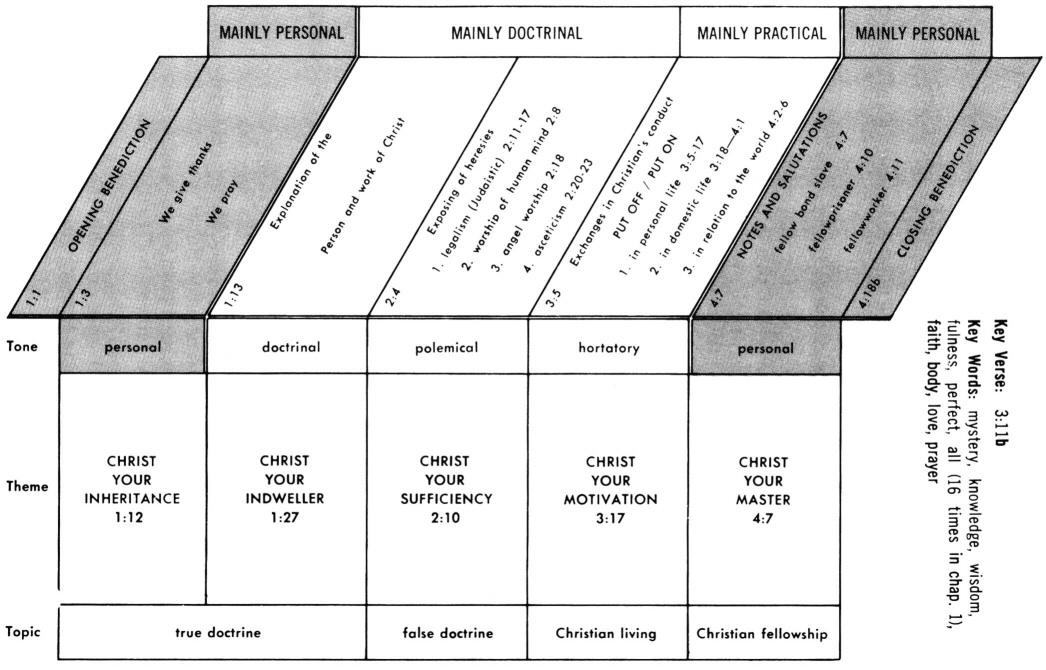
CHRIST IS ALL IN ALL
Click chart to enlarge
Charts from Jensen's Survey of the NT - used by permission
Colossians Overview - Click Chart on right side
| Christ Preeminent in All Things Supreme Lord - Sufficient Savior |
|||
| Colossians 1 | Colossians 2 | Colossians 3 | Colossians 4 |
| Supremacy of Christ |
Submission to Christ |
||
| Doctrinal and Corrective |
Practical and Reassuring |
||
| What Christ Did For Us |
What Christ Does Through Us |
||
| Christ Our Lord |
Christ Our Life |
Christ our Love |
|
| Christ the Head of the Body |
Christ the Lord of the Universe |
Christ the Head of the Home |
|
| Instruction | Warnings | Exhortations | Reminders |
| Reconciliation | Creation | Submission | Conversation |
| His Person and Word |
His Peace and Presence |
||
Colossians 1:21 And although you were (PAPMPA) formerly alienated (RPPMPA) and hostile in mind engaged in evil deeds (NASB: Lockman)
Greek: Kai humas pote ontas (PAPMPA) apellotriomenous (RPPMPA) kai ecthrous te dianoia| en tois ergois tois ponerois,
Amplified: And although you at one time were estranged and alienated from Him and were of hostile attitude of mind in your wicked activities, (Amplified Bible - Lockman)
KJV: And you, that were sometime alienated and enemies in your mind by wicked works, yet now hath he reconciled
NLT: This includes you who were once so far away from God. You were his enemies, separated from him by your evil thoughts and actions, (NLT - Tyndale House)
Phillips: And you yourselves, who were strangers to God, and, in fact, through the evil things you had done, his spiritual enemies (Phillips: Touchstone)
Wuest: And you who were at one time those who were in a settled state of alienation, and hostile with respect to your intents in the sphere of your works which were pernicious,
Weymouth: And you, estranged as you once were and even hostile in your minds, amidst your evil deeds,
Young's Literal: And you--once being alienated, and enemies in the mind, in the evil works, yet now did he reconcile
AND ALTHOUGH YOU WERE FORMERLY ALIENATED: Kai humas pote ontas (PAPMPA) apellotriomenous (RPPMPA):
- Col 2:13-note, Eph 2:1-note, Ep 2:12-note, Ep 4:18-note Ro 8:7,8-note 1Co 6:9, 10,11 Titus 3:3, 4-note,Titus 3:5, 6,7-note
- Colossians 1 Resources - Multiple Sermons and Commentaries
Were (5607) (on) is the present tense of eimi which means our state was one of continuous alienation from God. It means estranged, foreign; not belonging to the same country, land or government. not allied; adverse to.
In Romans Paul reminds the saints that "while we were enemies, we were reconciled to God through the death of His Son." (Ro 5:10). How easy it is for us to forget this great truth. O, how it should saturate our mind, that it might stimulate our love for Jesus and His eternal Gospel, motivating Spirit empowered obedience and pursuit of holiness for His great Name!
Alienated (526) (apallotrioo from apó = marker of dissociation implying rupture of former association -- emphasizes idea of separation + allotrióo = alienate) means to alienate entirely, be alien or estranged.
Webster adds that alienate means to to make unfriendly, hostile, or indifferent where attachment formerly existed (Ed: As it did in the Garden of Eden!0
Apallotrioo is in the perfect tense and passive voice and indicates that something happened to all men in the past to cause them to be estranged (cf Ps 51:5 - Spurgeon's note, Ro 5:12-note) from God and that condition has persisted (perfect tense). All men were born "little sinners" and persist in that condition because -- perfect tense speaks of permanence.
In other words we were in a continual state of separation, alienation and estrangement from God because of the "sin virus" we inherited from Adam. Paul explained how we contracted the "fatal" disease writing that "just as through one man sin entered into the world, and death through sin, and so death spread to all men, because all sinned. (Ro 5:12-note)
Now believers have been transferred to another Owner (Emphasis on the fact that Jesus now owns us! Does my life and my choices reflect His rightful ownership? 1Cor 6:19, 20, Titus 2:14, 1Pe 2:9)
Apallotrioo is used only two other times, both also by Paul...
Ephesians 2:12 (note) remember that you were at that time (as Gentiles, heathens, before you became believers) separate from (there was an infinite distance because we were unholy and He is holy) Christ, excluded (utterly alienated - apallotrioo) from the commonwealth of Israel, and strangers to the covenants of promise, having no hope and without God in the world"
Comment: An alien is one who does not “belong.” He is a stranger and foreigner, without the rights and privileges of citizenship. As far as the community of Israel was concerned, the Gentiles were on the outside, looking in.
Ephesians 4:18 (note) being darkened in their understanding, excluded from the life of God, because of the ignorance that is in them, because of the hardness of their heart
Belonging to the race of Adam, we are born alienated from God. Then as individuals, we each choose to accept and embrace that alienation with our wicked works.
Apallotrioo is used in the Septuagint (LXX) where David explains that "The wicked are estranged (apallotrioo) from the womb. These who speak lies go astray from birth." (Ps 58:3 - Spurgeon's note)
David's point is that their corruption is not a development of later life but can be traced back to their birth - they were alienated and estranged from birth. Their lawlessness and rebellion are inborn, so that as men begin to talk, they begin to lie! They don't have to be taught!
In Ezekiel God says that "the hearts of the house of Israel...are estranged (apallotrioo) from Me through all their idols. (Ezek 14:5-note)
Formerly (4218) (pote) means once or formerly. Once we were all alienated. Now that we are in Jesus, we are no longer alienated. The difference between a believer and a non-believer isn't merely forgiveness, but includes a complete change of status of the relationship between God and man.
AND HOSTILE IN MIND: kai echthrous te dianoia:
- Ro 5:10-note, Jas 4:4-note Titus 1:15-note, Titus 1:16-note
- Colossians 1 Resources - Multiple Sermons and Commentaries
Before we were saved by grace through faith...
(We were) enemies (echthros) (and) we were reconciled to God through the death of His Son, much more, having been reconciled, we shall be saved by His life. (Ro 5:10-note)
(We had our) mind set on the flesh (which) is hostile (echthra) toward God; for it does not subject itself to the law of God, for it is not even able to do so (Ro 8:7-note)
(We were friends) with the world (which) is hostility (echthra) toward God. Therefore whoever wishes to be a friend of the world makes himself an enemy of God. (James 4:4-note)
Hostile (2190) (echthros from échthos = hatred, enmity - [see also echthra = enmity]) means (in the active sense) to be hateful, hostile toward, at enmity with or adversary of someone. In the passive sense echthros pertains to being subjected to hostility, to be hated or to be regarded as an enemy. An enemy is one that is antagonistic to another; especially seeking to injure, overthrow, or confound the opponent. Scripture often uses echthros as a noun describing "the adversary", Satan! Like father like son!
Echthros - 32 times in the NT - Matt. 5:43, 44; 10:36; 13:25, 28, 39; 22:44; Mk. 12:36; Lk. 1:71, 74; 6:27, 35; 10:19; 19:27, 43; 20:43; Acts 2:35; 13:10; Rom. 5:10; 11:28; 12:20; 1 Co. 15:25f; Gal. 4:16; Phil. 3:18; Col. 1:21; 2 Thess. 3:15; Heb. 1:13; 10:13; Jas. 4:4; Rev. 11:5, 12
We were all enemies of God, we acted toward Him in rebellion, and therefore we all needed to be reconciled to God. There would be no hope without the removal of His wrath and our rebellion. Hostility must be removed from man if reconciliation is to be accomplished. God took the initiative in bringing this about through the death of his Son.
Jesus used echthros in the parable of the tares writing that "the enemy (echthros) who sowed them (referring to the "tares" --Satan has a counterfeit for every divine reality and sows the world with those who look, talk and act like disciples but who are not genuine followers of the King) is the devil, and the harvest is the end of the age (referring to the end of this present age and precedes the next age, the 1000 year reign of Messiah) and the reapers are angels." (Mt 13:28)
Mind (1271) (dianoia [word study] from from dianoéomai = to agitate in mind in turn from dia = separation + noeo = to think over from nous = the faculty of thinking) refers to the understanding or the the mind activated and refers to the higher intellectual nature, especially on the ethical side. It means thinking through something, meditating, reflecting. It refers to the intellect, moral understanding or the way of thinking. It is the faculty of thinking, comprehending, and reasoning. Dianoia is the seat of perception and thinking, the faculty of understanding, feeling, desiring. In the Septuagint dianoia is often used to translate heart. Cremer defines dianoia as "the faculty of moral reflection."
Cremer defines dianoia as “the faculty of moral reflection”.
Eadie says dianoia "represents the seat of thought, or rather of disposition. Luke 1:51; 1Chr 29:18." (Eadie)
Moule - The word rendered “mind” commonly denotes the rational powers in general; cp. e.g. Ephesians 4:17; 1 Peter 1:13. The Colossians in their heathen state had shown their “enmity” “in those powers,” inasmuch as the approved principles of their lives were contrary to the will of God. (Colossians 1 Cambridge Bible for Schools and Colleges)
Dianoia - 12 times in the NT - Mt. 22:37; Mk. 12:30; Lk. 1:51; 10:27; Eph. 2:3; 4:18; Col. 1:21; Heb. 8:10; 10:16; 1 Pet. 1:13; 2 Pet. 3:1; 1 Jn. 5:20
Paul uses this same noun dianoia to describe unbelievers in Ephesians writing that...
Ephesians 2:3 (note) Among them (unbelievers) we too all formerly lived in the lusts of our flesh, indulging the desires of the flesh and of the mind, and were by nature children of wrath, even as the rest
Ephesians 4:18 (note) being darkened in their understanding, excluded from the life of God, because of the ignorance that is in them, because of the hardness of their heart;
TDNT writes that dianoia is the "common word for “thought” has such varied senses as (1) thought as a function, (2) the power of thought, the thinking consciousness, (3) the way of thought, (4) the result of thought, e.g., thought, idea, opinion, or judgment, (5) resolve of intention, and (6) the meaning of words or statements. The LXX uses it as an equivalent of kardia, and the usage is much the same in other Jewish works. (Kittel, G., Friedrich, G., & Bromiley, G. W. Theological Dictionary of the New Testament. Eerdmans)
It is a tragedy to see men created in the image of God (Genesis 1:27, 9:6) use their minds actively against God. There was a time when all of us who are now Christians were alienated from God. We did not have any use for God. We did not take Him into our reckoning. We did not consider Him important. We started and ended each day without a thought of Him. We went about our own plans, lived for ourselves, and did what we felt like doing, never giving a thought to God. Or if we did think of Him, we regarded Him as merely a remote Being on the horizon of life, but we never expected anything from Him. Because we cut Him out of our thinking---even though He was sustaining our very life---we ended up, as Paul describes, "enemies in our minds," hostile toward God. We did not want anything to do with Him. You remember how that felt, don't you? We avoided God. We thought He would interfere with our plans or that He was a cosmic killjoy out to make us live uneventful and unhappy lives. We were not open to Him in any degree whatsoever. We were enemies of God, and as a result we expressed that enmity in evil deeds.
IN EVIL DEEDS: en tois ergois tois ponêrois:
- John 3:19, 20, Ro 1:21-note, Ro 1:22, 23-note, Ro 1:24, 25-note, Ro 1:26, 27-note, Ro 1:28-note, Ro 1:29, 30, 31-note, 32-notes
- Colossians 1 Resources - Multiple Sermons and Commentaries
Were...engaged in evil deeds - Literally we were continually in evil, engaged and deeds added by the translators for amplification. The preposition "in" (Gk = en) pictures our former unregenerate state as in the sphere of evil. Evil was the "air we inhaled" and "breathed out". Evil is the medium in which we conducted life and work. All our thoughts, words and deeds were permeated, even "marinated" as it were, in the elixir of evil! An ugly picture indeed! See Torrey's Topical list summarizing the Character of Evil people.
In (en) indicates the sphere in which they were thus estranged and enemies. Moule explains it - "More literally, in your wicked works; the orbit, so to speak, traced by their life of “enmity.”
Evil (4190) (poneros from ponos = labor, sorrow, pain) (see related word poneria) describes evil in active opposition to good and that which corrupts others. It means actively harmful, hurtful, evil in effect or influence.
In the parable of sower, Jesus used the word poneros to describe Satan, the evil one [who] comes and snatches away the good seed of the Word that is sown in the heart of a hearer (Mt 13:19)
Poneros was used by Jesus to describe the scribes and Pharisees (Mt 12:34). Jesus instructs disciples to pray for deliverance from evil (poneros) in Mt 6:13 (see note).
Poneros - 78x in the NT -
Mt. 5:11, 37, 39, 45; 6:13, 23; 7:11, 17f; 9:4; 12:34f, 39, 45; 13:19, 38, 49; 15:19; 16:4; 18:32; 20:15; 22:10; 25:26; Mk. 7:22f; Lk. 3:19; 6:22, 35, 45; 7:21; 8:2; 11:13, 26, 29, 34; 19:22; Jn. 3:19; 7:7; 17:15; Acts 17:5; 18:14; 19:12f, 15f; 25:18; 28:21; Rom. 12:9; 1 Co. 5:13; Gal. 1:4; Eph. 5:16; 6:13, 16; Col. 1:21; 1 Thess. 5:22; 2 Thess. 3:2f; 1 Tim. 6:4; 2 Tim. 3:13; 4:18; Heb. 3:12; 10:22; Jas. 2:4; 4:16; 1 Jn. 2:13f; 3:12; 5:18f; 2 Jn. 1:11; 3 Jn. 1:10; Rev. 16:2
That sounds as though evil behavior is the cause of inner alienation and hostility toward God. But it is quite the other way around. It is inner alienation, estrangement from God and hostility toward Him, that causes evil behavior. That is what the Greek text clearly states.
In short, Paul is indicating the avenue through which hostility in the mind is revealed and made known. Hostile purpose finds natural expression in evil deeds with a malicious intent! Satan is the Evil One (tou ponerou - Ep 6:16-note). And since we were in his family prior to being in Christ...like father, like son! We were only doing what ''pleased'' our father, so to speak, realizing that the flesh by itself has quite enough lust (epithumia) to carry out active evil (poneros) even w/o the Devil (Rev 20:8, 9, 10-see notes Re 20:8; 20:9; 20:10 regarding Gog and Magog)
AN EVIL DEED - In the movie The Passion of the Christ, produced by Mel Gibson, someone wrote to a movie critic asking why Gibson didn’t have a role in his own movie. The answer was, he did. It was a cameo role of sorts. It was evidently his hand that held the nail that was pounded into the hand of Jesus Christ, and it was Gibson’s way of saying, “It was my sin that sent Him to the cross.”
- Abominable -Revelation 21:8
- Alienated from God -Ephesians 4:18; Colossians 1:21
- Blasphemous -Luke 22:65; Revelation 16:9
- Blinded -2 Corinthians 4:4; Ephesians 4:18
- Boastful -Psalms 10:3; 49:6
- Conspiring against God’s people -Nehemiah 4:8; 6:2; Psalms 38:12
- Covetous -Micah 2:2; Romans 1:29
- Deceitful -Psalms 5:6; Romans 3:13
- Delighting in the iniquity of others -Proverbs 2:14; Romans 1:32
- Despising the works of the faithful -Nehemiah 2:19; 4:2; 2 Timothy 3:3,4
- Destructive -Isaiah 59:7
- Disobedient -Nehemiah 9:26; Titus 3:3; 1 Peter 2:7
- Enticing to evil -Proverbs 1:10-14; 2 Timothy 3:6
- Envious -Nehemiah 2:10; Titus 3:3
- Fearful -Proverbs 28:1; Revelation 21:8
- Fierce -Proverbs 16:29; 2 Timothy 3:3
- Foolish -Deuteronomy 32:6; Psalms 5:5
- Forgetting God -Job 8:13
- Fraudulent -Psalms 37:21; Micah 6:11
- Froward -Proverbs 21:8; Isaiah 57:17
- Glorying in their shame -Philippians 3:19
- Hard-hearted -Ezekiel 3:7
- Hating the light -Job 24:13; John 3:20
- Heady and high-minded -2 Timothy 3:4
- Hostile to God -Romans 8:7; Colossians 1:21
- Hypocritical -Isaiah 29:13; 2 Timothy 3:5
- Ignorant of God -Hosea 4:1; 2 Thessalonians 1:8
- Impudent -Ezekiel 2:4
- Incontinent -2 Timothy 3:3
- Infidel -Psalms 10:4; 14:1
- Loathsome -Proverbs 13:5
- Lovers of pleasure more than of God -2 Timothy 3:4
- Lying -Psalms 58:3; 62:4; Isaiah 59:4
- Mischievous -Proverbs 24:8; Micah 7:3
- Murderous -Psalms 10:8; 94:6; Romans 1:29
- Prayerless -Job 21:15; Psalms 53:4
- Persecuting -Psalms 69:26; 109:16
- Perverse -Deuteronomy 32:5
- Proud - Psalms 59:12; Obadiah 3:2; 2 Timothy 3:2
- Rejoicing in the affliction of saints -Psalms 35:15
- Reprobate -2 Corinthians 13:5; 2 Timothy 3:8; Titus 1:16
- Selfish -2 Timothy 3:2
- Sensual -Philippians 3:19; Jude 1:19
- Sold under sin -1 Kings 21:20; 2 Kings 17:17
- Stiff-hearted -Ezekiel 2:4
- Stiff-necked -Exodus 33:5; Acts 7:51
- Uncircumcised in heart -Jeremiah 9:26; Acts 7:51
- Unjust -Proverbs 11:7; Isaiah 26:10
- Unmerciful -Romans 1:31
- Ungodly -Proverbs 16:27
- Unholy -2 Timothy 3:2
- Unprofitable -Matthew 25:30; Romans 3:12
- Unruly Titus 1:10
- Unthankful -Luke 6:35; 2 Timothy 3:2
- Untoward Acts 2:40
- Unwise -Deuteronomy 32:6
Colossians 1:22 yet He has now reconciled (3SAAI) you in His fleshly body through death in order to present (AAN) you before Him holy and blameless and beyond reproach (NASB: Lockman)
Greek: nuni de apokatellaxen (3SAAI) en to somati tes sarkos autou dia tou thanatou, parastesai (AAN) humas Hagious kai amomous kai anegkletous katenopion autou,
Amplified: Yet now has [Christ, the Messiah] reconciled [you to God] in the body of His flesh through death, in order to present you holy and faultless and irreproachable in His [the Father’s] presence. (Amplified Bible - Lockman)
KJV: (Versification different than most modern translations) 21 And you, that were sometime alienated and enemies in your mind by wicked works, yet now hath he reconciled 22 In the body of his flesh through death, to present you holy and unblameable and unreproveable in his sight
NLT: yet now he has brought you back as his friends. He has done this through his death on the cross in his own human body. As a result, he has brought you into the very presence of God, and you are holy and blameless as you stand before him without a single fault. (NLT - Tyndale House)
Phillips: He has now reconciled through the death of his body on the cross, so that he might welcome you to his presence clean and pure, without blame or reproach. (Phillips: Touchstone)
Wuest: yet now He reconciled in the body of His flesh through His death, in order that He might present you holy and without blemish and unchargeable before His searching and penetrating gaze
Weymouth: He has now, in His human body, reconciled to God by His death, to bring you, holy and faultless and irreproachable, into His presence;
Young's Literal: in the body of his flesh through the death, to present you holy, and unblemished, and unblameable before himself,
YET HE HAS NOW RECONCILED YOU IN HIS FLESHLY BODY THROUGH (the) DEATH: nuni de apokatellaxen (3SAAI) en to somati tes sarkos autou dia tou thanatou:
- Col 2:11-note, Ro 5:10-note,Eph 2:15, 16-note, 1Pe 3:18-note
- Colossians 1 Resources - Multiple Sermons and Commentaries
RECONCILIATION: RIGHT
RELATIONSHIP RESTORED
In a Parallel passage in Romans Paul writes "For if while we were enemies we were reconciled to God through the death of His Son, much more, having been reconciled, we shall be saved by His life. 11 And not only this, but we also exult in God through our Lord Jesus Christ, through whom we have now received the reconciliation. (See discussion of reconciliation in Romans 5:10, 5:11)
Yet...now (contrasts with "formerly" in Col 1:20) - introduces a sharp contrast with the previous description. Compare similar contrasts - Colossians 1:26, Romans 5:11; Romans 7:6; Romans 11:30-31; Romans 16:26; Ephesians 2:13; Ephesians 3:5; 2 Timothy 1:10; 1 Peter 1:12; 1 Peter 2:10
He has reconciled - God has carried out this transaction. We are reconciled with Him. He has blessed us with the greatest blessing as believers because this reconciliation has given us a sure hope beyond human description. Reconciliation re right relationship with God. Things have now changed. An amazing fact is that the nations, not only Israel, are now part of God’s intimate circle.
Eadie - Man does not win his way back to the Divine favour by either costly offering or profound penitence. God reunites him to Himself; has not only provided for such an alliance, but actually forms and cements it. (Colossians 1 - Eadie's Commentary on Colossians)
He has reconciled (604) (apokatallasso from apó = from, state to be left behind + katallasso = reconcile <> katá = an intensifier + allásso = change) pictures the complete change or alteration of state. It means to exchange hostility for friendship. In context this "exchange" occurred on the Cross where the burden of my sin was rolled away (aorist tense = past completed action, historical event) for “God was in Christ reconciling the world to Himself” (2 Co 5:19-note). God did this, not us. It was a miracle of grace. Hallelujah!
Apokatallasso - 3x in 3v - Eph 2:16; Col 1:20, 22
It is imperative that all of us be reconciled to Christ. Without reconciliation we will remain spiritually lost and adrift, alienated from God. God's desire is that we be reconciled (cp His heart in 2Pe 3:9-note, 1Ti 2:2, 3, Re 22:17-note). God's Son endured the Cross “for the joy set before Him” (He 12:2-note). There is only one thing to do, and that is to say "Yes, Lord, I believe in Your Son's substitutionary, propitiatory death which makes possible my regeneration and reconciliation." The result of reconciliation is the restoration of peace (Ro 5:1-note) which had been disturbed (Ep 2:16-note; Col 1:20, cp Ge 3:11,24).
Through Christ's propitiatory sacrifice (Ro 3:24, 25-notes), God is reconciled because His demand for justice has been satisfied at Calvary. Sinful man is reconciled in that his attitude of enmity toward God is changed to one of friendship.
Reconciliation takes someone who is hostile towards someone else, and changes that into a friendly relationship. Unsaved man is hostile toward God and Jesus places us into a friendly relationship. Apokatallasso is stronger term for reconcile, then katallasso (set up a relationship of peace not existing before), in that apokatallasso is the restoration of a relationship of peace which has been disturbed.
Something has happened within us. It occurred when we saw that the death of Jesus was for us, that somehow he had done something to set aside our estrangement, our brokenness and hurt, and that if we came to him in faith he would deliver us. So we came. Something happened then to our inner attitude. We were changed in the way we thought. We no longer saw God as an enemy and a Judge, but as a loving Father. We recognized that the cross was not a symbol of failure in the life of a religious fanatic, but it was a moment when the great enemies all men face were conquered; when death was overcome and all the evil powers against mankind were set at naught. Thus our whole life was changed.
S Lewis Johnson adds this comment regarding reconciliation - In article two of the thirty-nine articles of religion of the church of England, there in a very excellent statement, concerning the Lord Jesus Christ, reference is made to the fact that the eternal Son, the word of the Father, very God and very man was crucified, and then these words follow, "To reconcile His father to us." Now I think that that is a fair statement, but I would like to make only one change which is not very significant. I would like to say to reconcile His God to us for the simple reason that reconciliation is judicial, not paternal in its significance. So we will take the position that it is not simply man that is reconciled, though that's the emphasis of the New Testament, we may also say God is reconciled in this sense, that He is propitiated by the saving work of the Lord Jesus Christ and thus reconciles, on that basis, man. Whether we agree or disagree on this, I think relatively minor point, we all can, I think, appreciate the importance of the doctrine of reconciliation, and we can sing together these marvelous little lines which we often sing in our meetings, "Sing it o'er and o'er again, Christ receiveth sinful men, make the message clear and plain, Christ receiveth sinful men." (Read or listen to Dr Johnson's entire message)
D A Carson makes statement which helps us understand how we as humans have difficulty resolving God's attributes of perfect anger and perfect love "Our problem in part is that in human experience wrath and love normally abide in mutually exclusive compartments. Love drives wrath out, or wrath drives love out. We come closest to bringing them together, perhaps, in our responses to a wayward act by one of our children, but normally we do not think that a wrathful person is loving. But this is not the way it is with God. God's wrath is not an implacable blind rage. However emotional it may be, it is an entirely reasonable and willed response to offenses against His holiness. At the same time His love wells up amidst His perfections and is not generated by the loveliness of the loved. Thus there is nothing intrinsically impossible about wrath and love being directed toward the same individual or people at once. God in His perfections must be wrathful against His rebel image-bearers, for they have offended Him; God in His perfections must be loving toward His rebel image-bearers, for He is that kind of God. (Bibliotheca Sacra Volume 156:389. Dallas Theological Seminary)
Illustration of "Reconcile all things to Himself" - In the closing scene in the motion picture, Ben Hur. The movie camera takes a long shot of three crosses rising out of a distant hill. Then the camera moves in close, closer, to the figure stretched out on the center cross. Lightning reveals a man squirming in silent agony to the rhythm of the flashes. It is raining hard. With each flash of light, the pool of rain water at the foot of the cross grows larger. Suddenly a single drop of blood drips into the pool and scatters. Then another drop falls. And then another. The pool is now tinted light red. The rain comes harder and the pool overflows into another pool immediately below it. The second pool reddens and enlarges, overflowing into still another pool which, in turn, overflows into a small stream. The blood-stained stream flows into a larger stream which meets a river which flows into an ocean.
A T Robertson reminds us that "The reconciliation was accomplished by means of Christ’s death on the cross and not just by the Incarnation (the body of His flesh) in which the death took place."
Related Resources on Reconciliation:
- Wayne House's article - Colossians - The Doctrine of Salvation in Colossians - Redemption, Reconciliation
- American Tract Society Reconciliation
- Bridgeway Bible Dictionary Reconciliation
- Baker Evangelical Dictionary Reconciliation
- Charles Buck Dictionary Reconciliation
- CARM Theological Dictionary Reconcile, reconciliation
- Fausset Bible Dictionary Reconciliation
- Hastings' Dictionary of the Bible Reconciliation
- Hastings' Dictionary of the NT Reconciliation Reconciliation
- Vines' Expository Dictionary Reconcile, Reconciliation Reconciliation
- Webster Dictionary Reconciliation
- Watson's Theological Dictionary Reconciliation
- International Standard Bible Encyclopedia Reconcile; Reconciliation
- McClintock and Strong's Bible Encyclopedia Reconciliation
- Torrey Topical Textbook Reconciliation with God
In His fleshly body - Literally "in the body of his flesh."
John Eadie - The clause has a remarkable distinctness. Reconciliation is effected in His body; that body is a genuine physical frame, for it is the body of His flesh; and there was an actual decease, as by His death peace was secured. They were reconciled in His body and by His death, a difference of relation being indicated by the prepositions in (en) and by (dia); the latter pointing out the instrumental cause, and the former describing the inner sphere of uniting operation which preceded that death. Without that fleshly body there could have been no death, and the assumption of humanity brought Jesus into a fraternal relationship with all His people. The apostle thus cautions against a spurious spiritualism, which seems to have endangered the Colossian church-as if without an atonement man could be redeemed. Marcion, in his quotation of the verse, omitted the words "the flesh." (Colossians 1 - Eadie's Commentary on Colossians)
Although not all commentators agree, some feel Paul combines both soma and sarx to make plain the actual humanity of Jesus in order to counter the heresy of Docetism, which says yes Christ was deity but that He was not really humanity but only appeared to be humanity, thus denying the incarnation. Docetism (see ref #1 or #2) (from Greek dokeo = to seem or appear) taught that Jesus was fully God but only "seemed" or "appeared" to have a human body and by extension He only "seemed" to suffer and die on the Cross. You can see the importance of this "small point" lest one preach another "gospel" and another "Jesus", neither of which are the truth and neither of which have the inherent saving power of the true gospel of Jesus Christ.
Calvin writes that "the body of His flesh means that human body, which the Son of God had in common with us. He meant, therefore, to intimate, that the Son of God had put on the same nature with us, that he took upon him this vile earthly body, subject to many infirmities, that he might be our Mediator. When he adds, by death, he again calls us back to sacrifice. For it was necessary that the Son of God should become man, and be a partaker of our flesh, that he might be our brother: it was necessary that he should by dying become a sacrifice, that he might make his Father propitious to us.
Eadie - The apostle has dwelt at length on the dignity and majesty of Jesus, but without hesitation he speaks here of His incarnate state (in His fleshly body), for in Him there was a union of extremes, of God and man-of earth and heaven. Indeed, the incarnation, rightly understood, enhances the Redeemer's greatness. The spiritually sublime is truly seen in His condescension and death. (Colossians 1 - Eadie's Commentary on Colossians)
Through death - The instrument or means by which God is able to bring about reconciliation with unholy men is through Christ's death, through the blood of His cross. Later in this letter (especially Col 3:5-15f) Paul exhorts (and commands) us to a conduct ourselves in a completely new lifestyle now that we are in Christ and no longer in Adam. As you begin to live our this new life in Christ, don't forget the great truth on the basis of which our new life has been possible. It is through death. Indeed, grace may be free, but it is by no means cheap! May this great truth constrain, impel, motivate and empower us to live out our new life, continually being transformed by His Word and His Spirit (2Cor 3:18).
Moule - The mysterious glory of the Atoning Death, dealt with as the central topic of teaching in Romans and Galatians, is never far from the foreground in these later Epistles, though their main work is to unfold other aspects of the truth. Cp. e.g. Ephesians 1:7; Ephesians 2:16; Ephesians 5:2; Ephesians 5:25; Php 2:8; Php 3:10; Php 3:18; Colossians 2:14. (Colossians 1 Cambridge Bible for Schools and Colleges)
Death (2288) (thanatos from thnesko = to die; origin of our word Thanatology) refers physically to the separation of soul from the body (physical) death and was a legal technical term for capital punishment. In the NT thanatos is often treated as a destroying power related to sin and its consequences.
See the discussion of the Death of Christ (Baker's Evangelical Dictionary).
Vine has this note on Thanatos - ""death," is used in Scripture of: (a) the separation of the soul (the spiritual part of man) from the body (the material part), the latter ceasing to function and turning to dust, e.g., John 11:13; Hebrews 2:15; 5:7; 7:23 . In Hebrews 9:15 , the AV, "by means of death" is inadequate; the RV, "a death having taken place" is in keeping with the subject. In Revelation 13:3,12 , the RV, "death-stroke" (AV, "deadly wound") is, lit., "the stroke of death:" (b) the separation of man from God; Adam died on the day he disobeyed God, Genesis 2:17 , and hence all mankind are born in the same spiritual condition, Romans 5:12,14,17,21 , from which, however, those who believe in Christ are delivered, John 5:24; 1 John 3:14 . "Death" is the opposite of life; it never denotes nonexistence. As spiritual life is "conscious existence in communion with God," so spiritual "death" is "conscious existence in separation from God." "Death, in whichever of the above-mentioned senses it is used, is always, in Scripture, viewed as the penal consequence of sin, and since sinners alone are subject to death, Romans 5:12 , it was as the Bearer of sin that the Lord Jesus submitted thereto on the Cross, 1 Peter 2:24 . And while the physical death of the Lord Jesus was of the essence of His sacrifice, it was not the whole. The darkness symbolized, and His cry expressed, the fact that He was left alone in the Universe, He was 'forsaken;' cp. Matthew 27:45,46 ." * [* From Notes on Thessalonians, by Hogg and Vine, p. 134.] (Death - Vine's Expository Dictionary of NT Words)
Hark! The Herald Angels Sing
by Charles Wesley
Click to play hymn
Hark! The herald angels sing,
“Glory to the newborn King;
Peace on earth, and mercy mild,
God and sinners reconciled!”
Veiled in flesh the Godhead see;
Hail th’ incarnate Deity,
Pleased with us in flesh to dwell,
Jesus our Emmanuel.
Hail the heav’nly Prince of Peace!
Hail the Sun of Righteousness!
Light and life to all He brings,
Ris’n with healing in His wings.
Now display Thy saving power,
Ruined nature now restore;
Now in mystic union join
Thine to ours, and ours to Thine.
Adam’s likeness, Lord, efface,
Stamp Thine image in its place:
Second Adam from above,
Reinstate us in Thy love.
Let us Thee, though lost, regain,
Thee, the Life, the inner man:
O, to all Thyself impart,
Formed in each believing heart.
IN ORDER TO PRESENT YOU BEFORE HIM: parastesai (AAN) katenopion autou:
- Col 1:28, 2Co 4:14, 11:2
- Colossians 1 Resources - Multiple Sermons and Commentaries
Eph 1:4-note just as He chose us in Him before the foundation of the world, that we should be holy and blameless before Him. In love
Jude 1:24-25-note Now to Him who is able to keep you from stumbling, and to make you stand in the presence of His glory blameless with great joy, to the only God our Savior, through Jesus Christ our Lord, [be] glory, majesty, dominion and authority, before all time and now and forever. Amen.
In order to - This term of purpose/result is not in the Greek but added by translators to emphasize that Paul is drawing a conclusion as he describes the ultimate purpose of reconciliation. Although this phrase is added by the translators, it does not diminish the importance of learning to recognize and interrogate these strategic Terms of purpose/result (see discussion).
When will this presentation take place? Most see this as an allusion to the future judgment, which for believers would be the Bema or Judgment Seat of Christ (2Cor 5:10-note). Who will make the presentation? From the context, it is God Who makes this presentation! What should be our attitude -- worry or worship? Clearly the latter, because our ability to stand before God in this awesome day will not depend on us but on God (cp Ro 11:36-note), for our position is firmly grounded on the blood of Christ and His finished work (See Jesus' cry "Tetelestai" = "It is Finished." "Paid in Full!) which guarantees that we are eternally holy, blameless and beyond reproach before Him!
Moule - The Father was “pleased to reconcile them” so that His purpose for them was to “present them to Himself” (see Ephesians 5:27-note for similar language about the work of the Son), in the great day of triumph and welcome (2Corinthians 4:14-note), when the “justified” shall be the “glorified” (Romans 8:30). (Colossians 1 Cambridge Bible for Schools and Colleges)
Present (3936) (paristemi from para = near + histemi = stand, place) literally means to place beside with the idea of exhibiting and of yielding to the disposal of another. In the Greek translation of the Hebrew (Septuagint) this verb is often used as a technical term for a priest’s placing an offering on the altar with the idea of surrendering or yielding up. (Meditate on that thought! And ponder the use of paristemi in Ro 12:1-2-note) The only acceptable worship under the New Covenant is the offering of oneself to God. The sacrifices of God are a broken spirit; a broken and a contrite heart, O God, Thou wilt not despise” (Ps 51:17-note, cp 1Pe 2:5-note).
Paristemi is in the aorist tense which signifies completed action at some time, past, present or future, primarily future in this context. However, Wayne Barber's thought is that the aorist tense signifies that in each and every situation of our life we will be found alongside Him, set apart for His use, absolutely blameless and beyond reproach. Jesus Christ is the supreme Lord of our life.
Writing to the saints at Corinth Paul declared "that He who raised the Lord Jesus will raise us also with Jesus and will present (paristemi) us with you. (2Co 4:14-note)
There is a future presentation when the Bride is presented by Himself to Himself "Christ also loved the church and gave Himself up for her; that (term of purpose) He might sanctify her, having cleansed her by the washing of water with the word, that (term of purpose) He might present to Himself the church in all her glory, having no spot or wrinkle or any such thing; but that she should be holy and blameless. (Eph 5:25-27-notes 5:25; 26; 27) It is not accident that the church that the church is described with the same phrase holy and blameless. That is our position in Christ, but in the meantime we need to ''make ourselves ready'' for the marriage of the Lamb -- "Let us rejoice and be glad and give the glory to Him, for the marriage of the Lamb has come and His bride has made herself ready." (Rev 19:7-note) And how does the church make herself ready? John explains "And it was given to her (the church) to clothe herself in fine linen, bright [and] clean; for the fine linen is the righteous acts of the saints." (Rev 19:8-note)
In a parallel passage Paul writes to the saints at Corinth that "I am jealous for you with a godly jealousy; for I betrothed you to one husband, that to Christ I might present (paristemi) you as a pure virgin. (2Cor 11:2)
Paul uses paristemi again in Colossians 1 writing that one of the great purposes of His ministry to the saints was to "proclaim Him (Christ in us the hope of glory), admonishing every man and teaching every man with all wisdom, that we may present (paristemi) every man complete in Christ." (Col 1:28-note)
Paristemi - 41 uses in NT -
Mt 26:53; Mk 4:29; 14:47, 69f; 15:35, 39; Lk. 1:19; 2:22; 19:24; Jn 18:22; 19:26; Acts 1:3, 10; 4:10, 26; 9:39, 41; 23:2, 4, 24, 33; 24:13; 27:23f; Ro 6:13, 16, 19; 12:1; 14:10; 16:2; 1Co. 8:8; 2Co. 4:14; 11:2; Eph. 5:27; Col. 1:22, 28; 2Ti 2:15; 4:17
CORAM DEO:
BEFORE THE FACE OF GOD
IN TIME AND ETERNITY
Before (2714) (katenopion from kata = down + en = in + ops = face, eye, the combination giving the picture of the saints holy/blameless) means right down in the eye of (God), and describes "a searching, penetrating gaze." (Wuest) Omniscient eyes searching us are unable to find fault! Amazing grace indeed!
The Latin term Coram Deo ("Before the face of God") is abundantly apropos. May God grant each of us such a supernatural awareness of our temporal and eternal position before Him in Christ that it becomes our abiding, motivating mindset to pursue holiness (2Cor 7:1-note, Heb 12:14-note) in "this present evil age" (Gal 1:4-note).
Katenopion - 3 times in the NT - Eph. 1:4; Col. 1:22; Jude 1:24
In his letter to the Ephesians Paul reiterates the truth that God "chose us in Him (See - "In Christ") before the foundation of the world (how much part did we play in that decision?!), that (term of purpose) we should be holy and blameless before (katenopion) Him... (Eph 1:4-note)
God now views believers as clothed with the righteousness of Christ (Phil 3:9-note, 1Cor 1:30). Isaiah exulted "I will rejoice greatly in the LORD, My soul will exult in my God; For He has clothed me with garments of salvation, He has wrapped me with a robe of righteousness, As a bridegroom decks himself with a garland, And as a bride adorns herself with her jewels." (Isaiah 61:10)
Now, as believers, the process of spiritual growth (our practice) involves becoming (enabled by the Holy Spirit) in practice (progressive sanctification) what we are in reality before God (our position - justified), working out our salvation in fear and trembling (Phil 2:12-note), enabled to do so by God giving us the "desire" and the power to accomplish it (Php 2:13-note). We “have put on the new self” and that new self "is being renewed to a true knowledge according to the image of the One who created him (Col 3:10-note).
HOLY AND BLAMELESS AND BEYOND REPROACH: meas hagious kai amomous kai anegkletous:
- 1Cor 1:8 Eph 1:4, 5:27, Php 2:15,1Thes 3:13 Jude 1:24, Rev 14:5 Ge 6:9, 17:1, Job 1:8, Ps 19:13 Ex 29:1
- Ro 8:1 ,33 Rev 12:10
- Colossians 1 Resources - Multiple Sermons and Commentaries
POSITIONAL HOLINESS
SHOULD BIRTH
PRACTICAL HOLINESS
Here Paul delineates some of the great results of the work of reconciliation.
Kent Hughes writes "Practical holiness should be our life’s business."
Holy (40) (hagios) means separated from sin and set apart unto God ("Characteristically godly. Character as well as condition is in view." - Vine). Wuest adds that "The fundamental idea in this word is separation to God and from worldly defilement." The idea of taking something filthy and washing it and setting it apart as something brand new and useful for different purpose. Holy has to do with the believer’s present relationship with God, because as a result of our faith, we are placed in union with Jesus Christ (see notes on in Christ or here) and God now sees every believer as holy as His Son.
He made Him who knew no sin to be sin on our behalf, that we might become the righteousness of God in Him” (2Cor 5:21-note).
THOUGHT - Since we are securely positionally holy in Christ, we should now live out this truth in our daily practice in order to enjoy the beauty and benefits of a holy life which is wholly His.
As Wayne Barber has often said a boat (Christian) in the water (in this world,) is by design, but water (the world) in the boat (Christian) is disaster. When you are living in this world, you are not a part of it, but you are set apart for the Master's use (2Ti 2:21-note). So our RECONCILIATION is not just to get us into heaven, but to BE SET APART FOR HIS USE ("to get heaven into us").
William Barclay - It is the simple fact of the matter that if enough Christians became hagios (Ed: That is, if their daily practice would match their eternal position in Christ), different, they would revolutionize society.
Paul writes that God "shall also confirm you to the end, blameless in the day of our Lord Jesus Christ." (1Cor 1:8)
Blameless (299) (amomos from a = without, not + momos = spot, blemish in physical sense or moral sense, blot, flaw, shame or disgrace {as a moral disgrace}) is literally without spot or blemish (blot, blight). It was used literally of the absence of defects in sacrificial animals. Figuratively, it means morally (spiritually) blameless, unblemished by the marring of sin, a perfect description of the Lamb of God. How incredibly incomprehensible that sinners such as we can be described with the same adjective (amomos) used to describe our incomparable, sinless Lord! O the wonder of the "cleansing power" of the Lamb's precious blood, which washes us Whiter than the Snow (Isa 1:18-note). Hallelujah. Thank You Jesus!
Amomos as used in this verse refers to blameless in a moral sense (irreproachable) Amomos is a cultic term in the Septuagint, denoting the physical perfection of the priest or offering (see Nu 6:14 below), but may also be used for the absolute blamelessness of God (see 1Sa 22:31)
Trench discusses four NT Words which mean "without blemish" - Amomos, amemptos, anenkletos, and anepileptos all refer to the Christian life and to what its character should be. Words that refer individually to the absence of blemish and blame are easily confused and their distinctiveness lost, though this is not to say that a word that has one of these meanings easily acquires another. For example, the King James Version's translation of amomos illustrates the frequently noted shortcoming of that version. The translators of the authorized Version failed to translate each Greek word by a fixed and corresponding English word. Although it is true that this cannot always be done, why, in this case, did the translators use six different translations for the six different occurrences of amomos? In Ephesians 1:4, amomos is translated "without blame." In Colossians 1:22, amomos is translated "unblamable." In Ephesians 5:27, amomos is translated "without blemish." In Hebrews 9:14, amomos is translated "without spot." In Judges 1:24, amomos is translated "faultless." And in Revelation 14:15, amomos is translated "without fault." In the first two instances, the authorized translators failed to grasp amomos' exact force. No such criticism may be made of the other four translations, since each one is sufficiently accurate, though one may be better than another. It is inaccurate, however, to translate amomos "without blame" or "unblamable," since in later Hellenistic Greek the meaning of momos (3470) changed from "blame" to that which is the subject of blame, a blot, spot, or blemish. In the same way, amomos became the technical term for the absence of anything amiss in a sacrifice, anything that would render it unworthy to be offered or that would make the sacrificing priest unworthy to offer it (1 Maccabees 4:42). When amomos is used with aspilos (784) in 1 Peter 1:19, amomos refers to the absence of internal blemish, and aspilos refers to the lack of external spot. In the Septuagint, amomos is used as an ethical term and consistently refers to the holy behavior of the faithful (Psalms 119:1; Proverbs 11:5) and, on occasion, is even applied as a title of honor to God himself (Psalms 18:30). In the Apocrypha, amomos is used with hosios and in the New Testament with anenkletos and hagios. Amomos depicts the complete absence of fault or blemish in whatever it describes. If amomos is the "unblemished," amemptos is the "unblamed." There is a difference between the two terms. Christ was amomos because there was no spot or blemish in him. Thus he could ask: "Which of you convicts Me of sin?" (John 8:46). But strictly speaking, Christ was not amemptos, nor is this term ever applied to him in the New Testament, since he endured the persecution of sinners who slandered him and made false charges against him. No matter how the saints of God may strive to be amemptoi, they certainly cannot attain it, for justly or unjustly, others will find fault in them. The amomos may be amemptos, but he does not always prove so. There is always a tendency to regard the inculpatus (blameless) as the inculpabilis (unblamable), so that in actual usage a breakdown occurs in the distinct and separate use of these words. The Old Testament uses of amemptos (as in Job 11:4) sufficiently prove this. (Without blemish - Trench's Synonyms of the New Testament)
Amomos is used times in the NT in the NASB translated: above reproach, 1; blameless, 5; unblemished, 1; without blemish, 1.
Ephesians 1:4 (note) just as He chose us in Him before the foundation of the world, that we should be holy and blameless before Him. In love
Ephesians 5:27 (note) that He might present to Himself the church in all her glory, having no spot or wrinkle or any such thing; but that she should be holy and blameless.
Philippians 2:15 (note) that you may prove yourselves to be blameless and innocent, children of God above reproach in the midst of a crooked and perverse generation, among whom you appear as lights in the world,
Colossians 1:22 yet He has now reconciled you in His fleshly body through death, in order to present you before Him holy and blameless and beyond reproach--
Hebrews 9:14 (note) how much more will the blood of Christ, who through the eternal Spirit offered Himself without blemish to God, cleanse your conscience from dead works to serve the living God?
1 Peter 1:19 (note) but with precious blood, as of a lamb unblemished and spotless, the blood of Christ.
Jude 1:24 Now to Him who is able to keep you from stumbling, and to make you stand in the presence of His glory blameless with great joy,
Revelation 14:5 (note) And no lie was found in their mouth; they are blameless.
Amomos is used 76 times in the Septuagint (LXX)
Ex 29:1, 38; Lev. 1:3, 10; 3:1, 6, 9; 4:3, 14, 23, 28, 32; 5:15, 18; 6:6; 9:2f; 12:6; 14:10; 22:19, 21; 23:12, 18; Num. 6:14; 7:88; 15:24; 19:2; 28:3, 9, 11, 19, 27, 31; 29:2, 8, 13, 17, 20, 23, 26, 29, 32, 36; 2 Sam. 22:24, 31, 33; Ps. 15:2; 18:23, 30, 32; 19:7, 13; 37:18; 64:4; 101:1, 6; 119:1, 80; Prov. 11:5, 20; 20:7; 22:11; Ezek. 28:15; 43:22f, 25; 45:18, 23; 46:4, 6, 13; Dan. 1:4
The picture of amomos reminds one of the Old Testament sacrificial animal which was required to be free of defects. Under Jewish law before an animal could be offered as a sacrifice it must be inspected and if any blemish was found it must be rejected as unfit for an offering to God. Only the best was fit to offer to God.
In the Septuagint (LXX) amomos is used three times in one verse noting that the Nazarite "shall present his offering to the LORD: one male lamb a year old without defect (amomos) for a burnt offering and one ewe-lamb a year old without defect (amomos) for a sin offering and one ram without defect (amomos) for a peace offering" (Nu 6:14)
Barclay - Blameless is the Greek word amomos. Its interest lies in the fact that it is a sacrificial word. Under Jewish law before an animal could be offered as a sacrifice it must be inspected, and if any blemish was found it must be rejected as unfit for an offering to God. Only the best was fit to offer to God. Amomos thinks of the whole man as an offering to God. It thinks of taking every part of our life, work, pleasure, sport, home life, personal relationships, and making them all such that they can be offered to God. This word does not mean that the Christian must be respectable; it means that he must be perfect. To say that the Christian must be amomos is to banish contentment with second bests; it means that the Christian standard is nothing less than perfection. (Ephesians 1 - William Barclay's Daily Study Bible)
Amomos is used by Peter to describe Christ's "precious blood, as of a lamb unblemished (amomos) and spotless, the blood of Christ." (1Pe 1:19-note)
God "chose (actually picked us out for Himself as His own) us in Him (our position) before the foundation of the world, that we should be holy and blameless (amomos) before Him" (see note Ephesians 1:4).
One day in eternity future Jesus will "present to Himself the church in all her glory, having no spot or wrinkle or any such thing; but that she should be holy and blameless (amomos)." (see note Ephesians 5:27)
As A T Pierson (in "The Work of Christ") says "Think of it—when the omniscient eye looks upon us at the last, He will not find anything that to His immaculate holiness can be so much as a pimple or a mole on a human face. How incredible!"
F W Grant (in his commentary on Ephesians) concurs adding that there will be "No sign of old age about it, no defect; nothing will suit Him then but the bloom and eternity of an eternal youth, the freshness of affections which will never tire, which can know no decay. The Church will be holy and blameless then. After all that we have known of her history, it would be strange to read that, if we did not know how gloriously God maintains His triumph over sin and evil.
As we work out our salvation in fear and trembling, not grumbling or disputing, we "prove yourselves to be blameless and innocent, children of God above reproach (amomos) in the midst of a crooked and perverse generation, among whom you appear as lights in the world." (Phil 2:15-note)
The children of God are to be free from defilement and so not chargeable with justifiable criticism even though we live in the midst of a twisted and perverted generation. By living lives above reproach and without blemish, God’s children will stand out all the more clearly against the dark background of this world (Mt 5:16-note). The darker the night, the brighter the light appears. We as believers cannot create light per se, but we can reflect the glory of Christ in us so that others may see Jesus in us. Like every other spiritual virtue, being blameless, faultless and above reproach is impossible in a believer’s own power. Such a practice is only possible in the power of the the unblemished and spotless Christ Himself (and especially His Spirit in us) Who "is able to keep (believers) from stumbling, and to make (them) stand in the presence of His glory blameless (amomos) with great joy” (Jude 1:24-note).
Remember too that God cannot shine through you until He works in you, so let Him have His way.
Beyond reproach (410) (anegkletos) means unaccused and goes beyond "blameless" to convey even more the idea of being "unaccusable"! It means not only that we are without blemish, but also that no one can bring a charge against us "Who will bring a charge against God's elect? God is the one who justifies." (Ro 8:33-note).
Vine anegkletos "signifies unimpeachable, not having the possibility of a charge being made."
Anegkletos - 5x in NT - 1Co 1:8; Col. 1:22; 1Ti 3:10; Titus 1:6, 7
Vincent affirms that anegkletos is "not only actually free from blemish, but from the charge of it." Elsewhere Vincent notes that the root word egkaleo means to accuse publicly and in context before the throne of God, something that can no longer transpire for saints because we are in Christ (or see note here). We are beneficiaries today and for all eternity of "No Condemnation" (Ro 8:1-note) and "No Separation." (Ro 8:38-39-note) This is an amazing truth that when a sinner surrenders to God, God's grace makes our lives nothing less than a sacrifice fit to offer to Him!
John writes about the fate of the Accuser of the brethren - "And I heard a loud voice in heaven, saying, "Now the salvation, and the power, and the kingdom of our God and the authority of His Christ have come, for the accuser of our brethren has been thrown down, who accuses (present tense = continuously) them before our God day and night. (Rev 12:10-note)
Satan however cannot make a charge stick against those whom Christ has reconciled. Believer's are washed in the blood of the Lamb (Rev 1:5-note, Rev 5:9-note) and made forever clean and able to stand before the Judge (He 12:23-note, James 5:9), with no accusations against him (Jude 1:23-note). This should make us shout "Hallelujah!"
Guzik - A desire to be saved means a desire to be made holy, and blameless, and above reproach; not merely a desire to escape the fires of hell on our own terms. (Colossians 1 - David Guzik Commentary on the Bible)
Alexander Maclaren has a powerful summation of Colossian 1:22 - We ought then to keep very clear before us this as the crowning object of Christianity: not to make men happy, except as a consequence of holiness; not to deliver from penalty, except as a means to holiness; but to make them holy, and being holy, to set them close by the throne of God. No man understands the scope of Christianity, or judges it fairly, who does not give full weight to that as its own statement of its purpose. The more distinctly we, as Christians, keep that purpose prominent in our thoughts, the more shall we have our efforts stimulated and guided, and our hopes fed, even when we are saddened by a sense of failure. We have a power working in us which can make us white as the angels, pure as our Lord is pure. If it, being able to produce perfect results, has produced only such imperfect ones, we may well ask where the reason for the partial failure lies. If we believed more vividly that the real purpose and use of Christianity was to make us good men, we should surely labour more earnestly to secure that end, should take more to heart our own responsibility for the incompleteness with which it has been attained in us, and should submit ourselves more completely to the operation of the "might of the power" which worketh in us. (Col 1:29-note)
Nothing less than our absolute purity will satisfy God about us. Nothing less should satisfy ourselves. The only worthy end of Christ’s work for us is to present us holy, in complete consecration, and without blemish, in perfect homogeneousness and uniformity of white purity and unreproachable in manifest innocence in His sight. If we call ourselves Christians let us make it our life’s business to see that that end is being accomplished in us in some tolerable and growing measure. (Colossians 1 Expositor's Bible Commentary)
Colossians 1:23 if indeed you continue in the faith firmly established (RPPMPN) and steadfast and not moved away (PPPMPN) from the hope of the gospel (see "Blessed Hope") that you have heard (2PAAI), which was proclaimed (AAPNSG) in all creation under heaven and of which I, Paul was made (1SAMI) a minister. (NASB: Lockman)
Greek: ei ge epimenete (2PPAI) te pistei tethemeliomenoi (RPPMPN) kai hedraioi kai me metakinoumenoi (PPPMPN) apo tes elpidos tou euaggeliou ou ekousate, (2PAAI) tou keruchthentos (AAPNSG) en pase ktisei te hupo ton ouranon, ou egenomen (1SAMI) ego Paulos diakonos.
Amplified: [And this He will do] provided that you continue to stay with and in the faith [in Christ], well-grounded and settled and steadfast, not shifting or moving away from the hope [which rests on and is inspired by] the glad tidings (the Gospel), which you heard and which has been preached [as being designed for and offered without restrictions] to every person under heaven, and of which [Gospel] I, Paul, became a minister. (Amplified Bible - Lockman)
KJV: If ye continue in the faith grounded and settled, and be not moved away from the hope of the gospel, which ye have heard, and which was preached to every creature which is under heaven; whereof I Paul am made a minister;
NLT: But you must continue to believe this truth and stand in it firmly. Don't drift away from the assurance you received when you heard the Good News. The Good News has been preached all over the world, and I, Paul, have been appointed by God to proclaim it. (NLT - Tyndale House)
Phillips: This reconciliation assumes, of course, that you maintain a firm position in the faith, and do not allow yourselves to be shifted away from the hope of the Gospel, which you have heard, and which, indeed, the whole world is now having an opportunity of hearing. (Phillips: Touchstone)
Wuest: Assuming indeed, that you are adhering to your faith, having been placed upon a foundation with the present result that you are on that foundation, firmly established, and that you are not continually being shifted away from your hope held out by the gospel which you heard, that gospel which was proclaimed in all creation, which is under heaven, of which I, Paul, became one who ministers.
Weymouth: if, indeed, you are still firmly holding to faith as your foundation, without ever shifting from your hope that rests on the Good News that you have heard, which has been proclaimed in the whole creation under Heaven, and in which I Paul have been appointed to serve.
Young's Literal: if also ye remain in the faith, being founded and settled, and not moved away from the hope of the good news, which ye heard, which was preached in all the creation that is under the heaven, of which I became -- I Paul -- a ministrant.
IF INDEED YOU CONTINUE IN THE FAITH: eige epimenete (2PPAI) te pistei:
- 1Sa 15:11, 1Ki 11:4, Ho 6:3, Zeph 1:6 Mt 7:22, 23,Jn 6:66, 1Jn 2:19, Mt 10:22, 24:13. Lk 8:15, 22:32. Jn 8:30, 31, 32; 15:4, 6, 9, 10, Acts 11:23; 14:22; Ro 2:6, 7, 1Co 9:27, 10:12. Gal 4:11; 5:7; 1Th 3:5; Heb 3:6, 14, 4:1, 11, 14, 10:35, 38; 2Pe 1:10; 2:18, 19, 20, 21, 22 1Jn 2:27 Re 2:10, 26
- Colossians 1 Resources - Multiple Sermons and Commentaries
PERSEVERANCE
OF THE SAINTS
This phrase represents what in Greek is known as a first class conditional statement which is determined as fulfilled (thus one could substitute the word "since"). There is an added touch of eagerness in the use of ge (at least).
Wuest has an excellent note on this section adding that "The word “if” here is not ean, an unfulfilled, hypothetical condition used with the subjunctive mode, presenting the possibility of a future realization, but ei with the indicative, having here the idea of “assuming that you continue in the faith.” That is, continuance in the gospel as it was preached by Paul would show that the person was saved (Ed: Same thought in 1 Cor 15:2-note = "by which also you are saved, if you hold fast the word which I preached to you, unless you believed in vain.") and thus would be presented holy, without blemish, and unchargeable before God. That is, Paul was here addressing truly born-again Colossians, not unsaved professors of Christianity who would follow the Colossian heresy. Heretics would not so be presented, only true believers. It is not the retention of salvation that is in the apostle’s mind, but the possession of it that would be shown by their continuance in the gospel. Expositors says; “This is directed against the false teacher’s assurance that the gospel they had heard needed to be supplemented if they wished to attain salvation. (Wuest's Word Studies from the Greek New Testament: Eerdmans )
Peter O’Brien paraphrases the idea "At any rate if you stand firm in the faith—and I am sure you will."
One's perseverance does not earn their salvation but it does show that person is saved because only a born again person could persevere to the end. To say it another way, there is NO WAY you or I, dear fellow follower of Christ, would persevere to the end unless the Holy Spirit did not give us the supernatural enablement to accomplish this supernatural goal! So the fact that one reaches that goal is clear evidence that they possess the Spirit of Christ.
O Lord, how this message needs to be sounded forth boldly from the pulpits across America as so many I fear are deceived by their profession as indicated by their absence of a changed life (see note Titus 1:16). J D Greear cuts to the chase in his book "Stop Asking Jesus into Your Heart." Here is a pithy snippet from Greear's book dealing with those who profess Christ at some point in their life but who show no demonstrable evidence that they "possess" Christ, that is that they are genuinely regenerate:
Jesus warned that there are a vast number of people who seem assured of a salvation they don’t actually possess. My Sunday school teacher was telling us the truth: according to Matthew 7 (Ed: Mt 7:21-23-note), Jesus will turn away “many” on that last day who thought they belonged to Him. There’s no doubt that many of those will have prayed a sinner’s prayer.
One afternoon I was at a local basketball court and started a pickup game with a guy I’d seen there a few times. He was quite a character—he cursed like a sailor and had so many tattoos on his body I wasn’t sure what the actual color of his skin was. He boasted continually about how many girls he was sleeping with. He wasn’t the kind of guy you’d suspect knew his way around the Bible.
As we played our game, I began to share my story of how I came to Christ. About three sentences into it, he stopped, grabbed the ball, and said, “Dude, are you trying to witness to me?” Surprised he even knew the term witness, I said, “Uhhh . . . well . . . yes.” He said, “That’s awesome. No one has tried to witness to me in a long time. . . . But don’t worry about me. I went to youth camp when I was thirteen and I asked Jesus to come into my heart. And I was legit. I became a super-Christian. I went to youth group every week, I did the “true love waits” commitment thing, I memorized verses, and I went on mission trips. I even led other friends to Jesus. “About two years after that, however, I ‘discovered’ sex. And I didn’t like the idea of a god telling me who I could have sex with. So I decided to put God on hold for a while, and after a while just quit believing in Him altogether. I’m a happy atheist now.” He then added: “But here’s what’s awesome: the church I grew up in was Southern Baptist, and they taught eternal security—that means ‘once saved, always saved.’ By the way, aren’t you a Baptist?” ****awkward silence from me**** He went on, “That means that my salvation at age thirteen still holds, even if I don’t believe in God anymore now. ‘Once saved, always saved,’ right? That means that even if you’re right, and God exists and Jesus is the only way, I’m safe! So either way, works out great for me. . . . If I’m right, then I haven’t wasted my life curbing my lifestyle because of a fairy tale. OK, it’s your shot.”
What do you say to a person like that? Consider the facts: He had indeed prayed to ask Jesus into his heart, and all indications were that he was very sincere. And it’s very possible for people to come to faith very early in life—Jesus, in fact, told adults to become like children if they want to be saved! Furthermore, this guy showed immediate “fruit” after his conversion, getting excited about Jesus and being busy for Him. And the Bible does indeed teach eternal security—once saved, always saved. So was he right? Can he, because he made a decision at some point in the past, live with the assurance that he is saved forever, regardless of how he lives now?
Here’s the short answer, one I’ll spend the rest of the book unpacking: he cannot. Salvation does indeed happen in a moment, and once you are saved you are always saved. The mark, however, of someone who is saved is that they maintain their confession of faith until the end of their lives. Salvation is not a prayer you pray in a one-time ceremony and then move on from; salvation is a posture of repentance and faith that you begin in a moment and maintain for the rest of your life. (Stop Asking Jesus into Your Heart)
On the other hand Paul directs his argument against the false teaching that the gospel they had believed was not sufficient and that they needed something in addition if they wanted to attain true salvation. They were adding to salvation by faith alone. They twisted the truth that faith alone saves (Col 2:6-note) but the faith that saves is not alone (but in fact is accompanied by fruit/deeds/works Ephesians 2:10 (note), Titus 2:14 (note); Ja 2:16-26 (see notes) When we were born from above, God placed us on the Cornerstone (Isa 28:16, 1Pe 2:6, 7-notes), Christ Jesus, and we are established for all eternity because of that union. All true believers have been placed (passive) upon (in the cleft of) the Rock of our salvation, the church's one Foundation, Jesus Christ our Lord.
John Phillips on if you continue in the faith - The word if is used in various ways in the New Testament. The force of the word is always determined by the mood of the verb with which it is used. Two Greek words are used for "if." One of them can be followed by a verb in the indicative mood or by a verb in the subjunctive mood; the other can be followed by a verb in either the indicative, the subjective, or the optative mood. Here the word for "if" can rightly be rendered "if so be," and it is followed by a verb in the indicative mood. In other words, there is no doubt about it. We can supply the ellipsis: "If ye continue in the faith (which you will assuredly do)." What we have here, then, is a definite loyalty. Paul is not casting doubt on our salvation; he is simply saying that a person who is genuinely saved will most assuredly continue in the faith. It is not a question of "if you do this or that," you will be saved; it is a question of "because you are saved," you will do this or that. (Exploring Colossians)
Continue (1961) (epimeno from epí = upon, in or at + méno = stay, remain, to persist in, adhere to, stay at or with, abide by) means to abide in, continue in, tarry (abide or stay in or at a place), linger in expectation, continue, persevere, persist (in), to stay at or with, to remain.
The present tense calls for a continual action - this should be our habitual practice or our lifestyle. See below for what "the faith" refers to.
Epi in epimeno adds to the force of the linear action of the present tense (continue and then some). So they are continually abiding, remaining, persevering, tarrying in the faith. The instruction in this verse is similar to that in Hebrews
Hebrews 3:6 (note) Christ was faithful as a Son over His house whose house we are, if we hold fast our confidence and the boast of our hope firm until the end."
Hebrews 3:14 (note) For we have become partakers of Christ, if we hold fast the beginning of our assurance firm until the end
The teaching is not that perseverance in the faith saves an individual but that one's perseverance to the end is evidence that that person is truly saved. While it is important for Christians to continually continue in godly conduct, we do so with the realization that we are not saved by our godly conduct.
Although you will read some commentaries which will state that although perseverance is preferred for genuine believers, it is not inevitable (e.g. Constable [Pdf]). This website does not espouse this interpretative view and agrees with men like John MacArthur (and others quoted below)
Of all the marks of a genuine Christian presented in Scripture, none is more significant than the one Paul mentions here. People give evidence of being truly reconciled when they continue in the faith firmly established and steadfast. The Bible repeatedly testifies that those who are truly reconciled will continue in the faith... Perseverance is the hallmark of the true saint...Lest there be any confusion about what they were to continue in, Paul specifies the content of their faith as the gospel that you have heard." (MacArthur, J. Colossians. Chicago: Moody Press )
Dr John Piper has a number of messages that deal with the perseverance of the saints (Click here)
F F Bruce writes that "If the gospel teaches the final perseverance of the saints, it teaches at the same time that the saints are those who finally persevere - in Christ. Continuance is the test of reality. (Bolding added)
Note that this website (and these commentaries quoted) is not saying that a believer will never "backslide" (frankly, most of us have backslidden to one degree or another) but according to this verse in Colossians (cf., Hebrews 3:6, 14, Mt 24:13, et al), the individual who backslides will not persevere or "continually continue" in their backslidden condition until the end. (see quotes on Backsliding or Drifting)
Hendriksen adds that "Divine preservation always presupposes human perseverance. Perseverance proves faith’s genuine character, and is therefore indispensable to salvation. To be sure, no one can continue in the faith in his own strength (Jn 15:5). The enabling grace of God is needed from start to finish (Php 2:12-note, Php 2:13-note). This, however, does not cancel human responsibility and activity. Yes, activity, continuous, sustained, strenuous effort (He 12:14-note). It should be noted, however, that this is distinctly the activity of faith (cf. 1Ti 2:15), a faith not in themselves but in God." (Bolding added) (Hendriksen, W., & Kistemaker, S. J. NT Commentary Set. Baker Book )
F F Bruce - If the gospel teaches the final perseverance of the saints, it teaches at the same time that the saints are those who finally persevere—in Christ. Continuance is the test of reality.
J Vernon McGee - Paul’s point is that we have been reconciled—it is an accomplished fact. So if you are a child of God today, you will continue in the faith grounded and settled. You will not be moved away from the hope of the gospel which you have heard. (McGee, J V: Thru the Bible Commentary: Thomas Nelson )
MacDonald gives a well reasoned comment writing that "the Scriptures...teach, as in this verse, that true faith always has the quality of permanence, and that one who has really been born of God will go on faithfully to the end. Continuance is a proof of reality. Of course there is always the danger of backsliding, but a Christian falls only to rise again (Pr 24:16). He does not forsake the faith." (Bolding added) (MacDonald, W & Farstad, A. Believer's Bible Commentary: Thomas Nelson )
Warren Wiersbe concurs explaining that in this verse "Paul was saying, “If you are truly saved, and built on the solid foundation, Jesus Christ, then you will continue in the faith and nothing will move you. You have heard the Gospel and trusted Jesus Christ, and He has saved you.” In other words, we are not saved by continuing in the faith. But we continue in the faith and thus prove that we are saved. It behooves each professing Christian to test his own faith and examine his own heart to be sure he is a child of God (2Cor 13:5; 2 Peter 1:10ff [note]). (Bolding added) (Wiersbe, W: Bible Exposition Commentary. 1989. Victor )
Melick - Paul taught that those who know the truth will continue in the truth. They will not fall away. Indeed, the personal commitments made at conversion naturally produce a positive, lifelong commitment to Jesus." (Bolding added) (Melick, R. R. Vol. 32: Philippians, Colossians, Philemon: The New American Commentary. Page 234. Nashville: Broadman & Holman Publishers)
Believer's Study Bible echoes the thought that "Every true believer in Christ will endure to the end. (Criswell, W A. Believer's Study Bible: New King James Version. 1991. Thomas Nelson)
Guzik - It is important for Christians to continue in godly conduct, but we are not saved by our godly conduct. So it is even more important for Christians to continue in the truth of the gospel because we are saved by grace through faith.
The Nelson Study Bible - The perseverance of the Colossians was proof of the reconciling work of Christ on their behalf. (Radmacher, E. D., Allen, R. B., & House, H. W. The Nelson Study Bible: NKJV. Nashville: Thomas Nelson)
The New Geneva Study Bible - Saving faith is persevering and enduring faith
Gerald Borchert on perseverance - Maintaining Christian faith through the trying times of life....The background setting for the idea of perseverance blossomed out of the context of persecution and temptation. The believer was expected faithfully to endure and to remain steadfast in the face of opposition, attack, and discouragement....They (NT writers) were committed to making absolutely clear that the requirements of Christian living were recognized as an essential element of Christian believing. Authentic life and true belief are both necessary parts of being a Christian. (Perseverance - Holman Bible Dictionary)
King James Version Study Bible - Perseverance in the Christian’s faith is a test of the reality of one’s trust in Christ. This verse implies that true believers will persevere." (King James Version study Bible. Nashville: Thomas Nelson)
Barton - Continue securely” means to remain stable, to persevere. The Colossians should not wander off into false teaching that contradicted the gospel they had heard and the hope they had believed for salvation. Paul urged all believers, like those in Colossae, to build carefully, persevering in their faith. (For more encouragement in perseverance, see Jn 8:31; 15:1, 2, 3, 4, 5, 6, 7, 8; Acts 14:21, 22; Jas 1:1, 2, 3, 4-note) Genuine faith perseveres to the end, focusing on the hope promised, which is the very content of the gospel. Hope is both the inward attitude of expectancy and the objective reality of the gospel. Christ is Lord, and he has promised that one day we will be with him." (Bolding added) (Barton, B, et al: The NIV Life Application Commentary Series: Tyndale)
The positive application of Paul’s words are this: the gospel does not work like magic. The mind, the heart, and the will must be involved. Our minds must feed on Christ and his Word. Our hearts are to focus on him in love. Our wills are to take their practice and pattern from him. Present faith leads to present results. Present drinking is for present thirst. We must fill our lives every day from Him.
Ray Stedman - It is continuing that is the proof of reality. Many people start out the Christian life, filled with joy because they have found a new sensation. But it does not last. Somewhere along the line it fades. Finally, they set it all aside and go back to the way they once were. That is a sign there was never real faith at the beginning. It is continuance that proves reality. Someone has well said, "If your faith fizzles before you finish, it is because it was faulty from the first!" You get an "F" for that performance! That does not mean that faith cannot waver and wobble at times. It does with all of us. Sometimes faith grows dim, but true faith never ceases. We never give up the realization that God has changed us. There is a new attitude, a new life imparted, and that is the sign that we cannot give up being a Christian. I received a phone call from a young man one day who said, "I'm going to quit being a Christian. It's too hard. I don't want to pay the price." I said to him, "I think that is what you ought to do." There was a long silence for a moment, then he said, "You know I can't do that." I knew he could not, and he did not, for it is continuing that is the proof of reality." (Read Dr Stedman's full sermon The Great Mystery)
Related Resources:
- Perseverance of the Saints - is it biblical?
- How can I keep the faith?
- Torrey Topical Textbook Perseverance
- Bridgeway Bible Dictionary Perseverance
- Baker Evangelical Dictionary Perseverance
- Charles Buck Dictionary Perseverance
- CARM Theological Dictionary Perseverance
- Easton's Bible Dictionary Perseverance of the Saints
- Spurgeon's Illustration Collection Perseverance
- Holman Bible Dictionary Perseverance
- Hastings' Dictionary of the NT Perseverance
- Webster Dictionary Perseverance
- International Standard Bible Encyclopedia Perseverance
- McClintock and Strong's Bible Encyclopedia Perseverance
In what are we to continue? The faith. But what is "the faith"? Is this our personal saving faith? Or does this phrase refer to something else? Study the text box below:
Before you read this note, click to study the 38 uses of the phrase "the faith" in the NT. Examine the context (what goes before and comes after the phrase "the faith") to distinguish between those uses that clearly refer to a personal faith which saves, eg, "the (personal) faith of Abraham" in Ro 4:18-note). In the present verse the Greek phrase is "têi pistei" or "the faith", where the Greek definite article ("têi") "the" identifies this a specific faith. After you've studied the verses on "the faith", read on...
"The faith" in the present verse is not a reference to the act of believing but rather to what is believed. From the 38 NT uses of "the faith" you can see that this phrase often refers to the the unchangeable message of the gospel, that body of Christian truth which brings salvation to the soul that receives it.
Beloved, while I was making every effort to write you about our common salvation, I felt the necessity to write to you appealing that you contend earnestly for the faith which was once for all delivered to the saints. (Jude 1:3-note)
In Jude this FAITH has been delivered to the saints once for all and these who have crept in have distorted "The faith". The descriptive modifying phrase, "which was once for all delivered to the saints," makes it obvious that the reference is not to the believers' subjective faith but to the objective truths to which believers firmly adhere.
He who once persecuted us is now preaching the faith which he once tried to destroy. (Gal 1:23-note)
Again from the context one can easily discern that "preaching the faith" clearly refers to the body of truth to be believed which corresponds to "the gospel".
The faith refers to that body of doctrine that was given by God through the Apostles to the church. Historically Christendom has resorted to many means in its conflicts with the enemies of the faith; it has used violence, anathemas added to creeds, denunciations, ostracism, and excommunication, as well as reasoning with those espousing heretical views. An effective defense of the gospel demands that God's truths must be embodied in the life of the defender of "the faith", the gospel. The most convincing argument for "the faith" is not the argument of one's words, but the argument of one's life. To contend effectively for the faith is costly and agonizing work. It is the duty of every believer to contribute toward the defense and preservation of the faith. To do so they must show themselves saintly or as Paul exhorts the Colossians to "continue in the faith."
**Click discussion of the meaning of the phrase "the faith"
For completeness, it should be noted that the NIV translates this phrase as “your” faith, which is an interpretative translation (which Kenneth Wuest agrees with), indicating that the translators felt Paul was referring to their personal faith. While one cannot be absolutely dogmatic, it is notable that most other modern translations (NAS, NAB, RSV, KJV, NKJV, etc) translate this phrase literally as "the faith." which makes it more likely to be a reference to the gospel or the body of doctrine believed.
All 38 uses of the phrase "the faith" in the NT - Acts 3:16; 6:7; 13:8; 14:22; 16:5; Rom. 4:11f, 16; 14:22; 1 Co. 16:13; 2 Co. 13:5; Gal. 1:23; 3:23; 6:10; Eph. 1:15; 4:13; Phil. 1:25, 27; Col. 1:23; 1 Tim. 1:2, 14; 3:9, 13; 4:1, 6; 5:8; 6:10, 21; 2 Tim. 1:13; 2:18; 3:8; 4:7; Tit. 1:1, 13; 3:15; Phlm. 1:5; Jude 1:3; Rev. 13:10
FIRMLY ESTABLISHED: tethemeliomenoi (RPPMPN):
- Col 2:7, Mt 7:25, Eph 3:17, 1Pe 5:10)
Spurgeon concludes that "This is a text that ought to be read and pondered every day by the many unstable professors who are in the church at this present time: “if ye continue in the faith grounded and settled,” like a building that will have no further settlements, no more starting of the stones, no more cracking of the walls, because your foundation is secure, and you are firmly built upon it.
Moule - Cp. Ephesians 3:17, where the basis is “love;” and Matthew 7:25, where it is “a rock,” the truth of Christ.
Firmly established (2311) (themelioo from the adjective themélios = describe that which lies beneath - the foundation referring to something secure and permanent) (Click word study of themelioo) means to lay a foundation or provide with a foundation, to place on a firm, secure foundation.
Themelioo - 5 times in the NT - Matt. 7:25; Eph. 3:17; Col. 1:23; Heb. 1:10; 1 Pet. 5:10
In masonry the "foundation" refers to the underlying base or support or the whole substructure of a building, providing a stable base for any superstructure. The radical notion of themelioo is to ground securely.
Figuratively, themelioo refers to providing a firm basis for belief or practice establish, strengthen, settle (place so as to stay, establish or secure permanently), cause to be firm and unwavering.
Paul uses themelioo to pray for the saints at Ephesus that "Christ may dwell in your hearts through faith; and that you, being rooted and grounded in love." (Eph 3:17-note).
The perfect tense speaks of an action completed in past time having present results and here conveys the idea of the permanence of this "establishment".
Wuest emphasizes the permanence effect of the perfect tense paraphrasing it as "having been placed upon a foundation with the present result that you are on that foundation."
Those Colossians who were saved, had been placed on the foundation, the Lord Jesus, (cf "And the rain descended, and the floods came, and the winds blew, and burst against that house; and yet it did not fall, for it had been founded upon THE ROCK" - Mt 7:25-note) with the result that they were grounded on Him. The picture conveyed by themelioo is that of a house which is so firmly fixed on a foundation that it is not moved by winds or floods or figuratively by the stormy waves of suffering or the loud howling roar of our adversary, the devil. This initial grounding is a once-for-all act on the part of God (occurring when we place our faith in Christ) which secures permanent results.
C H Spurgeon in his sermon Stand Fast (Colossians 1:23) writes that "the battle does not end when by a desperate rush a man has come to Christ. In many it assumes a new form; the enemy now attempts to drag the trembler from his refuge, and eject him from his stronghold. It is difficult to get at the hope of the gospel; but quite as difficult to keep it so as not to be moved away from it. If Satan spends great power in keeping us from the hope, he uses equal force in endeavoring to drag us away from it, and equal cunning in endeavoring to allure us from it. Hence the apostle tells us not to be moved away from the hope of the gospel: the exhortation is needful in presence of an imminent danger. Do not think that in the moment when you believe in Christ the conflict is over, or you will be bitterly disappointed. It is then that the battle renews itself, and every inch of the road swarms with foemen. Between here and heaven you will always have to fight more or less, and frequently the severest struggle will be at a time when you are least prepared for it. There may be smooth passages in your career, and you may for a while be like your Savior in the wilderness, of Whom it is said, “Then the devil departed from Him, and angels came and ministered unto Him”; but you may not therefore cry, “My mountain standeth firm, I shall never be moved”; for fair weather may not outlast a single day. Do not grow secure, or carnally presumptuous. There is but a short space between one battle and another in this world. It is a series of skirmishes even when it does not assume the form of a pitched battle. He that would win heaven must fight for it. He that would take the new Jerusalem must scale it, and if he has the wit to take Jacob’s ladder and set it against the wall and climb up that way, he will win the city. “The kingdom of heaven suffereth violence, and the violent take it by force” At this time our subject is not the winning, but the wearing; not the taking but the holding of the fort: “Be not moved away,” you that have come to it, “Be not moved away from the hope of the gospel.” (Ed note: If you are in need of encouragement to continue in the faith read Spurgeon's practical message - Stand Fast)
AND STEADFAST AND NOT MOVED AWAY: kai hedraioi kai me metakinoumenoi (PPPMPN) :
- 1Cor 15:58 1Th 3:3 Jn 10:27, 28, Gal 2:13, Eph 4:14, 2Pe 3:17
Steadfast (1476) (hedraios is from hedra = seat, chair) and means settled, steady, steadfast painting the picture of one firmly seated in a chair, settled in mind and purpose. Describes the saints as firmly or solidly in place.
Hedraios - 3 times in the NT - 1 Co. 7:37; 15:58; Col. 1:23
Moved away (3334) (metakineo from meta = denoting change of place or condition + kineo = to move, put in motion; English - kinesiology -science of human movement) means literally to move from one place to another and so to be shifted, stirred to a place elsewhere, removed, moved away. Metakineo is used figuratively in Col 1:23 = "not moved away from hope." The negative (me = not) preceding the present tense (continuous action) passive voice (subject affected by outside source or force) is literally "not continuously being moved or shifted from their" hope. The antonym is ametakinetos in 1Co 15:58-note - "Therefore, my beloved brethren, be steadfast (hedraios), immovable (ametakinetos), always abounding in the work of the Lord, knowing that your toil is not in vain in the Lord."
Friberg on metakineo - shift, remove; figuratively and passive, as being led to give up one's confidence in something be moved away from, be shifted away, be pushed from. (Analytical Lexicon)
Moule - The Greek (“moved away”) is a present participle, and suggests a state of chronic or frequent unsettlement, as new allurements away from the truth beset them. Cp. Ephesians 4:14. (Colossians 1 Cambridge Bible for Schools and Colleges)
The Septuagint (LXX) uses metakineo to describe Jehovah's promise to redeemed Israel in the Millennium, declaring that although "the mountains may be removed and the hills may shake (metakineo)...My lovingkindness will not be removed from you and My covenant of peace will not be shaken,” says Jehovah Who has compassion on you." (Isa 54:10) Here are all 5 uses of metakineo in the Septuagint:
Deuteronomy 19:14 "You shall not move your neighbor's boundary mark, which the ancestors have set, in your inheritance which you will inherit in the land that the LORD your God gives you to possess.
Deuteronomy 32:30 "How could one chase a thousand, And two put ten thousand to flight, Unless their Rock had sold them, And the LORD had given them up?
2 Samuel 15:20 "You came only yesterday, and shall I today make you wander with us, while I go where I will? Return and take back your brothers; mercy and truth be with you."
Ezra 9:11 which You have commanded by Your servants the prophets, saying, 'The land which you are entering to possess is an unclean land with the uncleanness of the peoples of the lands, with their abominations which have filled it from end to end and with their impurity.
LXE Ezra 9:11 which thou hast given us by the hand of thy servants the prophets, saying, The land, into which ye go to inherit it, is a land subject to disturbance by the removal of (moved, brought in commotion) the people of the nations for their abominations, wherewith they have filled it from one end to the other by their uncleanness.
Isaiah 54:10 "For the mountains may be removed and the hills may shake, But My lovingkindness will not be removed from you, And My covenant of peace will not be shaken," Says the LORD who has compassion on you.
Even as our "blessed hope (absolute assurance of future good)" is sure in Christ, in the Millennium topography ("mountains...hills" - see Millennium 3) will change but not God’s pledge of well-being for Israel as a result of the New Covenant.
Maclaren - negatively, they are not to be "moved away"; the word by its form conveying the idea that this is a process which may be continually going on, and in which, by some force constantly acting from without, they may be gradually and imperceptibly pushed off from the foundation-that foundation is the hope evoked or held out by the Gospel, a representation which is less familiar than that which makes the Gospel itself the foundation, but is substantially equivalent to it, though with a different colour. (Colossians 1 Expositor's Bible Commentary)
Grounded in Christ the Colossians would not be moved from one place to another, and specifically not moved away from their hope which in turn rests on the Gospel.
My God, I Know, I Feel Thee Mine
by Charles Wesley
(play hymn)
My God! I know, I feel Thee mine,
And will not quit my claim,
Till all I have is lost in Thine,
And all renewed I am.
I hold Thee with a trembling hand,
But will not let Thee go,
Till steadfastly by faith I stand,
And all Thy goodness know.
Jesus, Thine all victorious love
Shed in my heart abroad;
Then shall my feet no longer rove,
Rooted and fixed in God
O that in me the sacred fire
Might now begin to glow,
Burn up the dross of base desire,
And make the mountains flow!
FROM THE HOPE OF THE GOSPEL THAT YOU HAVE HEARD: apo tes elpidos tou euaggeliou ou ekousate (2PAAI)
From the hope of the Gospel - What does the Gospel birth in someone dead in their trespasses and sins? Hope. Not a hope so, but a hope sure! Why sure? Because the Gospel is true! Jesus really died, really rose and really is alive! And the best of this sure hope is yet to come -- Jesus! He is coming back! That's the hope birthed in a soul by the Gospel!
Moule on hope - “That blissful hope, even the appearing of the glory, &c.” (Titus 2:13-note); “the hope of glory” (below, Colossians 1:27-note).
Hope (1680) (elpis from elpo = anticipate usually with pleasure) is the desire of some good with the expectation of obtaining it. It is the absolute certainty of future good.
Elpis - 53 times in the NT - Acts 2:26; 16:19; 23:6; 24:15; 26:6f; 27:20; 28:20; Rom. 4:18; 5:2, 4f; 8:20, 24; 12:12; 15:4, 13; 1 Co. 9:10; 13:13; 2 Co. 1:7; 3:12; 10:15; Gal. 5:5; Eph. 1:18; 2:12; 4:4; Phil. 1:20; Col. 1:5, 23, 27; 1 Thess. 1:3; 2:19; 4:13; 5:8; 2 Thess. 2:16; 1 Tim. 1:1; Tit. 1:2; 2:13; 3:7; Heb. 3:6; 6:11, 18; 7:19; 10:23; 1 Pet. 1:3, 21; 3:15; 1 Jn. 3:3
So the gospel gives a person without Christ and without hope a sure Hope, an absolute assurance that God will do good in the future to and for the person who has received the Gospel (cp Jn 1:12, 13). This hope is now the anchor of one's soul in the midst of the difficulties of this present world, which is passing away. Believers now have something eternal to live for because they have hope!
Related Resource: Chart on the Blessed Hope
Gospel (2098)(euaggelion from eú = good + aggéllo = proclaim, tell) (Click word study of euaggelion) is literally good news or glad tidings.
In secular Greek the word euaggelion was commonly used as our words "good news" today. The idea then and now is something like this - “Have you any good news (euaggelion) for me today?” This was a common question in the ancient world. Our English word Gospel is from the Old English or Saxon word gōdspell (gōd = good + spell = message) which is literally "good tale, message". When I was a young man Godspell was actually the name of a popular musical play. I wonder if they really understood the meaning of this word which is the very bedrock of the Christian faith. In modern secular use gospel has an interesting meaning of something accepted as infallible truth or as a guiding principle (e.g., such and such is "the gospel truth"). This is not a bad Biblical definition either!
The writers of the New Testament adapted the term as God's message of salvation for lost sinners. Euaggelion is found in several combination phrases, each describing the gospel like a multifaceted jewel in various terms from a different viewpoint (from the NASB, 1977):
- the gospel of the kingdom (Mt 4:23)
- the gospel of Jesus Christ, the Son of God (Mk 1:1) because it centers in Christ
- the gospel of God (Mk 1:14) because it originates with God and was not invented by man
- the gospel of the kingdom of God (Lk 16:16)
- the gospel of the grace of God (Acts 20:24),
- the gospel of His Son (Ro 1:9-note)
- the gospel of Christ (Ro 15:19-note)
- the gospel of the glory of Christ (2Co 4:4-note)
- the gospel of your salvation (Ep 1:13-note)
- the gospel of peace (Ep 6:15- note)
- the gospel of our Lord Jesus (2Th 1:8)
- the glorious gospel of the blessed God (1Ti 1:11)
- In Ro 16:25, 26 (see note) Paul called it “my Gospel” indicating that the special emphasis he gave the gospel in his ministry.
Earlier Paul had reminded the Colossians "of the hope laid up for you in heaven, of which you previously heard in the word of truth, the gospel (see note Colossians 1:5). (What is a synonym for the gospel in this passage? How encouraging is this simple observation in a world that largely functions on lies and deception!)
The Hope that the Gospel provides believers is like a foundation or an anchor on which we can firmly plant our "spiritual" feet. The writer of Hebrews testified in view of the fact that "it is impossible for God to lie, we may have strong encouragement, we who have fled for refuge in laying hold of the hope set before us. This hope we have as an anchor of the soul, a hope both sure and steadfast and one which enters within the veil, where Jesus has entered as a forerunner for us, having become a high priest forever according to the order of Melchizedek. (Heb 6:18-20-see notes He 6:18; 19; 20)
Spurgeon addresses the question "And what is the ground of that hope?"
The ground of that hope is, first, the rich, free, sovereign grace of God, because he has said, “I will have mercy on whom I will have mercy, and I will have compassion on whom I will have compassion.” The Lord claims for himself the prerogative of mercy, and as he can exercise it without the violation of his justice through the atoning sacrifice of Christ, we joy and rejoice in the fact that men are not saved because of any natural goodness of disposition, or because of anything that they have done, or ever shall do. The children being not yet born, neither having done good nor evil, the divine decree stood fast fixed in the sovereign will and immutable counsels of Jehovah, and it is a good ground of hope for the very chief of sinners. If he has saved the dying thief,-if he has saved the adulterer,-if he has saved even the murderer, why should he not save me? He can if he will, and he is exceeding gracious, and infinite in compassion, willing not the deaths of any, but that all should come to repentance. It is in the mercy of our God that all our hopes begin, and the cause of that mercy is itself. The reason of divine love is divine love. Because God is gracious therefore he bestows his grace upon the undeserving and the lost. Be not moved away from this.
The ground of our salvation is, next, the merit of Christ-what Christ is-what Christ has done-what Christ has suffered. This is the ground upon which God saves the sons of men, Even Cardinal Bellarmin, the mighty opponent of Luther-perhaps the best opponent that he had, whose eyes saw much of gospel light, once said this, that albeit that good works are necessary unto salvation, yet, inasmuch as no man can be sure that he has performed as many good works as will save him, it is, upon the whole, safest to trust alone in the merits and sufferings of Christ. Cardinal! the safest way suits me. If that be the best and safest, what better do any of us want? Where is the rest for our soul if the ground of our hope is to be what we arc, or what we do, or what we feel? But when we fall back upon the finished work of Jesus Christ, and believe in him whom God has set forth to be a propitiation for sin, and not for ours only, but for the sins of the whole world,-I say, when we fall back on him, then we have something solid to rest upon. Our eyes cannot bear to look into eternity so long as we cling in the least degree to human merit; but when it is all put aside, and we look to him bleeding yonder on the cross, then is there a “peace that passeth all understanding,” filling our hearts by Christ Jesus. Brethren, if a man were to live in good works without a single sin for ten thousand years, he would be well recompensed for that by half-an-hour of heaven. How, then, can we expect to merit eternal bliss by any works of ours? Ah, no; the hope were vanity. Heaven is too precious a thing to be purchased by anything that we can by any possibility do; but it is not too great to be purchased by the blood of Christ; and when we come to his atonement our anchor holds abidingly. “Be not moved away from the hope of the gospel.”
Another ground of our hope is this,-that God has solemnly pledged that “ whosoever believeth in Christ shall not perish, but shall have everlasting life.” if, then, we do really and in very deed believe in Jesus Christ and rest on him, we cannot perish, for God cannot contradict himself. Thus it is written: hear it and accept it. “He that believeth and is baptized shall be saved.” Those of us, then, who do trust the Savior, and him only, and have made confession of that trust in his own appointed way, know of a surety that God’s eternal veracity is staked upon our salvation. It is not possible that the Lord should east away a believer. Is it not written, “The just shall live by faith”? We live because we believe in the ever living One. “ HE that believeth in him hath everlasting life,” Be not moved away from this gospel hope, which God that cannot lie has set before us.
The covenant of the King of kings
Shall stand for ever sure
Beneath the shadow of his wings
His saints repose secure.”
Another ground of our hope is the immutability of God. God changes not, and therefore the sons of Jacob are not consumed. The immutability of Christ also confirms our hope; for he is “ the same yesterday, and to-day, and for ever.” The unchanging power of his blood is a tower of strength to our faith.
“Dear dying Lamb, thy precious blood
Shall never lose its power,
Till all the ransomed church of God
Be saved to sin no more.”
If God be immutable, then those that believe in him have an immutable hope: be sure that you never east it away.
But, once again, our hope of the gospel is grounded in the infallibility of Scripture. The Papist has an infallible pope, but we have an infallible Bible. If that which is spoken in this Book be not true, neither is our hope sure. If these things be questionable, our confidence is questionable; but if this word of God abides fast for ever and ever, though heaven and earth should pass away, then he that believes and builds on this infallible truth may rejoice and stand fast. I beseech you, “be not moved away from the hope of the gospel.” (Read Spurgeon's message Stand Fast)
Have heard (191) (akouo) means to hear with attention, to hear with the ear of the mind (so to speak) or to hear effectually so as to respond to what is spoken. The Colossians had heard (aorist tense = past completed action, a historical fact) about this wonderful hope initially from Epaphras. Paul had just described the "the hope laid up for you in heaven, of which you previously heard in the word of truth, the gospel, which has come to you...since the day you heard of it and understood the grace of God in truth just as you learned it from Epaphras, our beloved fellow bond-servant, who is a faithful servant of Christ on our behalf" (see notes Colossians 1:5; 1:6; 1:7)
THE SOLID ROCK
by Edward Mote
Music by William Bradbury
Click to play
My Hope is built on nothing less
Than Jesus’ blood and righteousness.
I dare not trust the sweetest frame,
But wholly trust in Jesus’ Name
When darkness seems to hide His face,
I rest on His unchanging grace.
In every high and stormy gale,
My anchor holds within the veil
His oath, His Covenant, His blood,
Support me in the whelming flood.
When all around my soul gives way,
He then is all my Hope and Stay.
When He shall come with trumpet sound,
Oh may I then in Him be found.
Dressed in His righteousness alone,
Faultless to stand before the throne.
Refrain:
On Christ the solid Rock I stand,
All other ground is sinking sand;
All other ground is sinking sand
WHICH WAS PROCLAIMED IN ALL CREATION UNDER HEAVEN: tou keructhentosen (AAPNSG) pase ktisei te hupo ton ouranon:
- Col 1:6, Mt 24:14, Mk 16:15, Ro 10:18
Which - What is "which?" In context it is the Gospel gives hope that out of spiritual death can come eternal life through faith in the Living Redeemer.
Proclaimed (2784) (kerusso) (aorist tense = past completed action, a historical fact) (Click for study of closely related word kerugma = proclamation) means to herald (as a public crier), especially divine truth and always with the suggestion of formality, gravity and an authority which must be listened to and obeyed.
In Paul’s day, a ruler had a special herald who made announcements to the people. He was commissioned by the ruler to make his announcements in a loud, clear voice so everyone could hear. He was not an ambassador with the privilege of negotiating; he was a messenger with a proclamation to be heard and heeded. Not to heed the ruler’s messenger was serious; to abuse the messenger was even worse. To announce publicly but not to argue, reason, dispute, or convince by intellectual proof, against all of which a keen intellect may bring counter argument. We simply state in public or testify to all men the truth which God bids us speak. No argument can assail the Truth presented in the announcement of the GOSPEL. Men either believe the Truth, as all sane men should, or refuse to believe it, as only fools venture to do.
Kerusso - 61 times in the NT -
Mt. 3:1 (Mt 3:2); 4:17, 23; 9:35; 10:7, 27; 11:1; 24:14; 26:13; Mk. 1:4, 7, 14, 38f, 45; 3:14; 5:20; 6:12; 7:36; 13:10; 14:9; 16:15, 20; Lk. 3:3; 4:18f, 44; 8:1, 39; 9:2; 12:3; 24:47; Acts 8:5; 9:20; 10:37, 42; 15:21; 19:13; 20:25; 28:31; Ro 2:21; 10:8, 14f; 1 Co. 1:23; 9:27; 15:11f; 2 Co. 1:19; 4:5; 11:4; Gal. 2:2; 5:11; Phil. 1:15; Col. 1:23; 1 Thess. 2:9; 1 Tim. 3:16; 2 Tim. 4:2; 1 Pet. 3:19; Rev. 5:2. What does Matthew record as an intrinsic component of the proclamation in the first 2 occurrences in Scripture?
Alexander Whyte of Edinburgh wrote to a discouraged pastor "The angels around the throne envy you your great work.… Go on and grow in grace and power as a gospel preacher.”
W. E. Sangster - Called to preach! … commissioned of God to teach the word! A herald of the great King! A witness of the Eternal Gospel! Could any work be more high and holy! To this supreme task God sent his only begotten Son. In all the frustration and confusion of the times, is it possible to imagine a work comparable in importance with that of proclaiming the will of God to wayward men?
For those who have eyes to see and ears to hear, there can he found in every part of God's creation abundant testimony to His power and wisdom in creating and upholding all things. There is evidence of His curse upon the creation because of sin, evidence of His love in conserving and saving His creatures, and evidence of His purpose and future consummation. Truly the gospel is being preached in every creation under heaven.
Creation (2937) (ktisis from ktízo = create, form or found) refers to bringing something into existence which has not existed before and is generally used in the NT of God's creative action (creation)
Ktisis - 19 times in the NT - Mk. 10:6; 13:19; 16:15; Rom. 1:20, 25; 8:19, 20, 21, 39; 2 Co. 5:17; Gal. 6:15; Col. 1:15, 23; Heb. 4:13; 9:11; 1 Pet. 2:13; 2 Pet. 3:4; Rev. 3:14
AND OF WHICH I PAUL WAS MADE A MINISTER: ou egenomen (1SAMI) ego Paulos diakonos:
- Acts 1:17, 26:16, Ro 15:16, 1Co 4:1, 2, 3; 2Co 3:6; 4:1; 5:18, 19, 20; 2Co 6:1; 11:23; Eph 3:7,8; 1Ti 1:12; 2:7; 2Ti 1:10-11; 4:5,6
Paul (3972) is from Latin, Paulos meaning "little, small". Before his Damascus Road experience he was known by his Hebrew name Saul (Greek Saulos) which means "desired" or "ask" (derived from Hebrew word for "ask")
Was made (1096) (ginomai) means to begin to be, to come into existence or into any other state. Paul was not a self-made minister but a Christ commissioned one, Jesus Himself declaring "arise, and stand on your feet; for this purpose I have appeared to you, to appoint you a minister and a witness not only to the things which you have seen, but also to the things in which I will appear to you." (Acts 26:16) In his last known written communication Paul declared he "was appointed a preacher and an apostle and a teacher" of the Gospel (2Tim 1:11)
Spurgeon rightly declares "This is a wonderful expression, “made a minister.” The true minister is of God’s making; a man-made minister must be a poor creature, but a God made minister will prove his calling: “whereof I am made a minister,”
Peake - This phrase contains a certain stately self-assertion; the Apostle urges the fact that he is a minister of this Gospel as a reason why they should remain faithful to it. His apostolic authority, so far from being impugned by the false teachers, was more probably invoked; so Paul throws it in the balance against them. It is also true that the Gentile mission was so bound up in his own mind with his apostleship that a reference to the one naturally suggested a reference to the other. (Colossians 1 - The Expositor's Greek Testament)
Minister (1249) (diakonos from diako = run on errands) (Click word study of related word diakonia) refers to the rendering or assistance or help by performing certain duties, often of a humble or menial nature serve, including such mundane activities as waiting on tables or caring for household needs—activities without apparent dignity. Diakonos is similar to our verb minister which means to give aid or service (to those who need it).
Diakonos - 29 times in the NT - Matt. 20:26; 22:13; 23:11; Mk. 9:35; 10:43; Jn. 2:5, 9; 12:26; Rom. 13:4; 15:8; 16:1; 1 Co. 3:5; 2 Co. 3:6; 6:4; 11:15, 23; Gal. 2:17; Eph. 3:7; 6:21; Phil. 1:1; Col. 1:7, 23, 25; 4:7; 1 Tim. 3:8, 12; 4:6
Writing to the Corinthians Paul asks "What then is Apollos? And what is Paul? Servants (diakonos) through whom you believed, even as the Lord gave opportunity to each one." (1Cor 3:5)
Jesus used verbal form describing Himself in (Mk 10:45) declaring that "even the Son of Man did not come to be served, but to serve, and to give His life a ransom for many."). Jesus promised that "If anyone serves (verb diakoneo) Me, let him follow Me; and where I am, there shall My servant (diakonos) also be; if anyone serves Me, the Father will honor him." (Jn 12:26)
Christ is our Example. As Paul exhorted the saints at Corinth "Be imitators of me, just as I also am of Christ." (1Co 11:1) Paul is ever mindful of where his adequacy comes from writing "Not that we are adequate in ourselves to consider anything as coming from ourselves, but our adequacy is from God, Who also made us adequate as servants (diakonos) of a new covenant, not of the letter, but of the Spirit; for the letter kills, but the Spirit gives life." (2Cor 3:5, 6)
3 WAYS TO ASSESS
IF ONE HAS TRULY BEEN RECONCILED
1) CONTINUANCE IN THE FAITH:
CONTINUE = present tense = as a lifestyle. Some people say I was saved 30 years ago, not realizing that every time in Scripture you want to be assured as to whether or not you are truly saved, it is not what happened in the past, but it is what's going on in the present. (2Cor 13:5, Titus 1:16 [note]) This is what the letter of 1 John is all about - authentic saving faith manifests fruit of a new creation in Christ. Be careful! Don't go back and bank on your experience 30 years ago if you're not living that way now. If you're not believing Him now, you didn't believe Him back then! Don't misunderstand. This does not mean you can "lose your salvation" (you can't lose something you never possessed!!!) Also this doesn't mean you will never fail, but that you are constantly, consistently being wooed by the Spirit within, constantly being pulled back to the One that you committed to. (cp He 3:6, 14- notes He 3:6; 14, Mt 24:13, etc)
2) FIRMLY ESTABLISHED & STEADFAST:
PERFECT PASSIVE (perfect tense; passive voice) -- The passive voice indicates the subject receives the action or effect from an outside source (God did it = "Divine passive") So Paul says that something happened to you in the past to ground you and give you firm footing. (Ps 40:2 - Spurgeon's note) Now Who is the foundation, the only One Who can establish us? It is Christ. So we continue in the faith (see note Colossians 2:6), obeying Him and walking with Him because He is the object of our faith. He alone is our Foundation, the Solid Rock (Mt 7:25-note) on which we stand eternally righteous and beloved of the Father (cp holy, blameless, beyond reproach Col 1:22). Glory to God's great plan of the ages. To Him alone be all praise and honor. What a majestic Most High God Who is Sovereign Over All we are privileged to serve.
3) NOT MOVE AWAY FROM THE HOPE OF THE GOSPEL THAT YOU HAVE HEARD --
What or Who is the "hope of the gospel"? The Lord Jesus Christ. Then we focused on the Incomparable Christ: Who He is-He is God. What He alone can do. You are continuing in the faith obeying Him. Your foundation is Him because of something that happened to you in the past. You've not moved away from the hope of the gospel. Christ in you, the hope of glory. So Paul comes right back to being Christ-centered. So we see what Christ alone can do. Paul has been building doctrinal truth, but will soon begin to let loose with the exhortations which will all make sense, because you realize now WHO YOU ARE, WHAT YOU ARE, WHO'S YOU ARE & WHAT GOD WANTS IN YOUR LIFE and then you can better understand the things Paul under the moving of the Holy Spirit tells believers TO DO, that they may work out their salvation in fear & trembling (Php 2:12, 13 - see notes Philippians 2:12; 2:13)