Colossians 1:2
Colossians 1:3
Colossians 1:4
Colossians 1:5
Colossians 1:6
Colossians 1:7
Colossians 1:8
Colossians 1:9
Colossians 1:10
Colossians 1:11
Colossians 1:12
Colossians 1:13
Colossians 1:14
Colossians 1:15
Colossians 1:16
Colossians 1:17
Colossians 1:18
Colossians 1:19
Colossians 1:20
Colossians 1:21
Colossians 1:22
Colossians 1:23
Colossians 1:24
Colossians 1:25
Colossians 1:26
Colossians 1:27
Colossians 1:28
Colossians 1:29
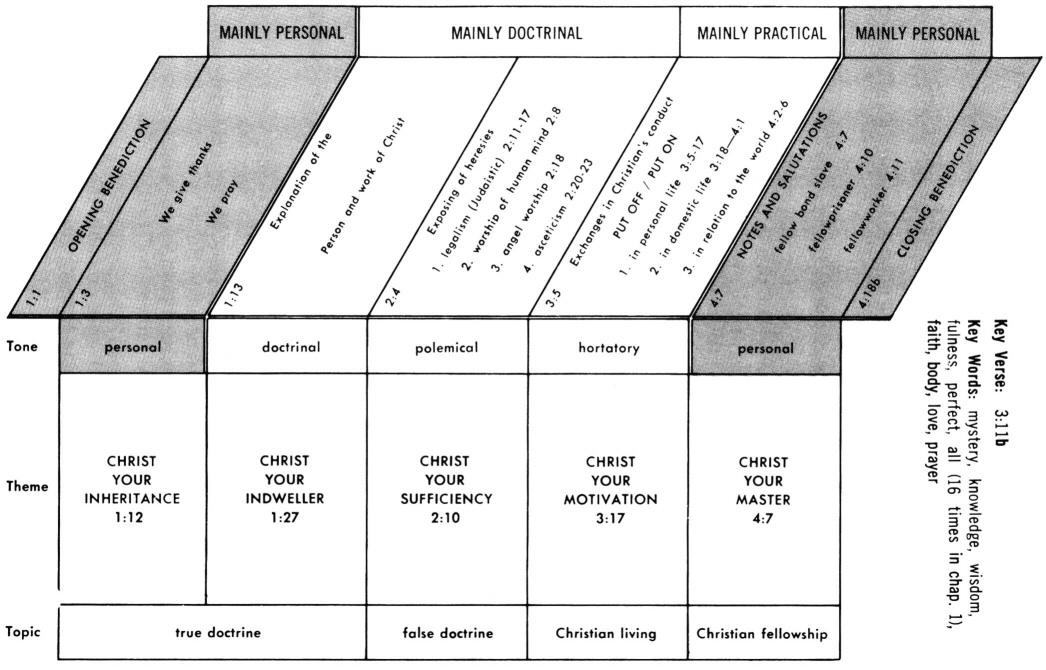
CHRIST IS ALL IN ALL
Click chart to enlarge
Charts from Jensen's Survey of the NT - used by permission
Colossians Overview - Click Chart on right side
| Christ Preeminent in All Things Supreme Lord - Sufficient Savior |
|||
| Colossians 1 | Colossians 2 | Colossians 3 | Colossians 4 |
| Supremacy of Christ |
Submission to Christ |
||
| Doctrinal and Corrective |
Practical and Reassuring |
||
| What Christ Did For Us |
What Christ Does Through Us |
||
| Christ Our Lord |
Christ Our Life |
Christ our Love |
|
| Christ the Head of the Body |
Christ the Lord of the Universe |
Christ the Head of the Home |
|
| Instruction | Warnings | Exhortations | Reminders |
| Reconciliation | Creation | Submission | Conversation |
| His Person and Word |
His Peace and Presence |
||
Colossians 1:24 Now I rejoice (1SPAI) in my sufferings for your sake & in my flesh I do my share on behalf of His body, which is (3SPAI) the church, in filling up (1SPAI) what is lacking in Christ's afflictions. (NASB: Lockman)
Greek: Nun chairo (1SPAI) en tois pathemasin huper humon, kai antanaplero (3SPAI) ta husteremata ton thlipseon tou Christou en te sarki mou huper tou somatos autou, o estin (3SPAI) e ekklesia,
Amplified: [Even] now I rejoice in the midst of my sufferings on your behalf. And in my own person I am making up whatever is still lacking and remains to be completed [] on our part] of Christ's afflictions, for the sake of His body, which is the church. (Amplified Bible - Lockman)
NLT: I am glad when I suffer for you in my body, for I am completing what remains of Christ's sufferings for his body, the church. (NLT - Tyndale House)
Phillips: I myself have been made a minister of this same Gospel, and though it is true at this moment that I am suffering on behalf of you who have heard the Gospel, yet I am far from sorry about it. Indeed, I am glad, because it gives me a chance to complete in my own sufferings something of the untold pains for which Christ suffers on behalf of his body, the Church. (Phillips: Touchstone)
Wuest: I now am rejoicing in my sufferings on your behalf, and on my part am filling up the things lacking of the afflictions of the Christ in my flesh for the sake of His Body which is the Church
Young's Literal: I now rejoice in my sufferings for you, and do fill up the things lacking of the tribulations of the Christ in my flesh for his body, which is the assembly,
NOW I (continually) REJOICE: Nun chairo (1SPAI):
- 2 Co 7:4, 2 Cor 11:16-33, Php 2:17-18, Mt 5:11 Ro 5:3
- Colossians 1 Resources - Multiple Sermons and Commentaries
Regarding the word "Now" W E Vine writes "The “now” looks back over the past of the Lord’s dealings with him. His sufferings were manifold and were more than that of imprisonment. While they were endured for Christ’s sake, they were for the benefit of the Colossian believers, who would not have received the spiritual help had it not been for what he had suffered and was suffering."
S. Lewis Johnson writes that "Now, in my present circumstances, Paul declares, there is a deep sense of joy in my personal sufferings for you Colossians. His general meaning is clear, but this verse, the twenty-fourth, is probably the most controversial in the letter. We may introduce the problem of the text by rejecting any suggestion to the effect that Paul implies there is any lack in the atonement of Christ. The gospel has an element of finality in it, if it has any element at all." (Bibliotheca Sacra: Page 235, 1996, Dallas Theological Seminary)
Maclaren - The very first word is significant: "Now I rejoice." Aye; it is easy to say fine things about patience in sufferings and triumph in sorrow when we are prosperous and comfortable; but it is different when we are in the furnace. This man, with the chain on his wrist, and the iron entering into his soul, with his life in danger, and all the future uncertain, can say, "Now I rejoice." This bird sings in a darkened cage. (Colossians 1 Expositor's Bible Commentary)
Rejoice (5463) (chairo) means to be glad and is present tense, active voice (this voice calling for a volitional choice of one's will) indicating that Paul continually made the choice to rejoice in the midst of his suffering for Christ. This word is used to describe a little lamb skipping around for joy. It describes a physical change in your countenance. You can't fake this. It is a physical expression of joy and something that radiates to people around you. You can walk around and say that you are rejoicing but if it's not seen then you are not rejoicing. This was a clear indication of Paul manifesting the fruit of the Spirit (joy Gal 5:22), supernatural joy which is independent of one's circumstances. Remember Paul's circumstances were a dank, dark prison cell (Col 4:18-note). In short, Paul's response to suffering is a visible expression of the outworking of the fruit of the Spirit. Only a Spirit filled and empowered Christian could truly rejoice under such circumstances. Indeed, the joy of the Lord was Paul's strength (Neh 8:10).
Whose strength do you rely on when suffering? Yours or His?
Paul had learned how to be content in whatever circumstances he was in (Php 4:11-note).
On another occasion, despite being in a Philippian jail "about midnight Paul and Silas were praying and singing hymns of praise to God, and the prisoners were listening to them" (Acts 16:25)
After being flogged for speaking in the name of Jesus, Peter and others were released from jail and "went on their way from the presence of the Council, rejoicing that they had been considered worthy to suffer shame for His name." (Acts 5:41)
These men had experienced suffering and used those times as a divine classroom to learn the secret it wasn't within their own power to suffer joyfully, but that they could do "all things through Him Who" strengthened them" (Php 4:13) in those times of suffering. Don't waste those times you suffer for Jesus. Learn the lessons He desires to teach you and you too will begin to rejoice in your suffering.
MacArthur on Joy in Ministry - As we serve the Lord Jesus Christ with the recognition that God has called us, what kind of attitude should we have? What spirit should we have? Paul answers this in the first three words of verse 24: "Who now rejoice...." What's the spirit of the ministry? Joy. The spirit of the ministry is joy. Whatever ministry you have been given is to be enjoyed. The Attitude of Joy 1. Its Cessation - It's a sad reality that many ministering Christians don't have the right attitude. There just aren't enough joyous, happy Christians. It's like the little girl who saw a mule and said, "With a long face like that, it must be a wonderful Christian." There are a lot of people who have been given a tremendous responsibility by God, but grudgingly carry it out. In fact, many pastors have lost the joy of the ministry. They don't have the right attitude. They become like Jonah, who, even when his ministry was going good, was hesitant, angry, reluctant, bitter, and resentful. You say, "Well, I've got it tough in my ministry. It's hard to have joy." Oh, really? If you ever think you've got it tough in your ministry and you can't find joy, just read these words: "...and let us run with patience the race that is set before us, looking unto Jesus, the author and finisher of our faith, who for the joy that was set before Him endured the cross, despising the shame..." (Heb. 12:1b-2a). Why did He endure the cross? "...for the joy that was set before Him...." Jesus never lost the joy, why should you? Further, in verse 4 it says, "Ye have not yet resisted unto blood...." In other words, "You haven't died in your service, have you?" Oftentimes, I'll talk to somebody, even another pastor, who'll say, "Oh, I've lost the joy of the ministry." Well, do you know what that means? That doesn't mean they have bad circumstances, it means they have bad connections. You see, a Christian doesn't lose his joy unless he loses touch with the Lord. There's to be joy in the ministry! 2. Its Constancy - Oh, it's easy to get discouraged with circumstances. It happened to Paul. Referring to Israel, Paul said, "...I have great heaviness and continual sorrow in my heart" (Rom. 9:2). But he never lost the internal joy. The element of personal joy was the spirit of his ministry. He was rejoicing everywhere he went. For example: a. Philippians 4:4--Do you realize that when Paul wrote Philippians, he was rejoicing...even though he was in jail? Not an ordinary jail, but a hole in the ground called the Mamertine Prison (picture of one of the dungeons - talk about claustrophobia!) In this particular prison, once a maximum of forty prisoners had been accumulated, the sewers were opened to drown all the prisoners. The water was then drained out (along with the drowned prisoners) and the process would be repeated. Well, Paul was in this place when he wrote, "Rejoice in the Lord always; and again I say, Rejoice." Someone might say, "This guy was out of his mind! What was he so happy about?" One thing is for sure, it had nothing to do with his circumstances, did it? He had a relationship with the living God that was perpendicular-- transcending all circumstances. Have you lost your joy? Joy is the deep-down confidence that God is in control of your life. That doesn't change. Whenever I encounter a Christian who has lost his joy, I don't want to talk about his circumstances, I want to talk about his relationship with the Lord. Why? Because joy is generated from a recognition of what Christ has done in a person's life. And I'll tell you something else: Humility also generates joy. For example, Paul always thought of himself as so unworthy, that the thought of dying for Jesus Christ gave him great joy. Why? Because he didn't even think he was worthy of that. You lose the joy when you start to think that you're too good to be suffering what you're suffering. But that's the wrong perspective. An attitude of humility generates joy. (Complete in Christ )

Macarthur goes on to describe 4 "Thieves Of Joy" in ministry (and every believer is in ministry) -- (1) circumstances, (2) people, (3) possessions and (4) worry. On the other hand he summarizes the three guardians that protect one's joy -- (1) humility, (2) devotion to Christ, and (3) trust in God.
IN MY SUFFERINGS FOR YOUR SAKE: en tois pathemasin huper humon:
- Jer 20:9 Acts 9:16, Col 4:18, 1Pe 2:21, 2Co 1:5
- Colossians 1 Resources - Multiple Sermons and Commentaries
I love what Andrew Bonar said - "We have got more from Paul’s prison house than from his visit to the third heavens."
Sufferings (3804) (pathema [word study] from páscho = suffer + suffix –ma = that which is suffered, experience a sensation/suffer pain) refers to the actual suffering itself (not suffering in general). In other words, it describes the very pain that one is experiencing right now, those very things that we can "see, touch & feel", those things that are causing us anguish and emotional trauma. A less common meaning of pathema (not the meaning in this context) is passions or impulses.
For your sake (5228) (huper) speaks of suffering in your place.
Have you ever asked yourself, how many prayers and tears, how much heartache and disappointment has someone gone through for you in order that you might come to Christ? We should never read the Scriptures without a momentary thought, at least, of what it cost others for us to have this Bible in our hand: the blood of martyrs, the fears and tears of persecuted people throughout centuries, the sweat and labor of translators, and the effort of teachers to make it plain and clear. Never read the Scriptures without remembering that someone has died to make it possible-their sufferings were for our sake!
John Bunyan said that "The Lord uses his flail of tribulation to separate the chaff from the wheat." Indeed, Bunyan's prison sufferings were for our sake, because out of his furnace of affliction was borne that timeless, precious classic "Pilgrim's Progress!" The prince of preachers, C H Spurgeon once said '“Next to the Bible, the book that I value most is John Bunyan’s, “Pilgrim’s Progress,” and I imagine I may have read that through perhaps a hundred times. It is a book of which I never seem to tire, but then the secret of that is, that John Bunyan’s, “Pilgrim’s Progress,” is the Bible in another shape. It is the same heavenly water taken out of this same well of the Gospel, yet you would tire even of that book at last.”
AND IN MY FLESH I DO MY SHARE ON BEHALF OF THE BODY WHICH IS THE CHURCH IN FILLING UP THAT WHICH IS LACKING IN CHRIST'S AFFLICTIONS: kai antanaplero (1SPAI) ta husteremata ton thlipseon tou Christou en te sarki mou huper tou somatos autou, o estin (3SPAI) e ekklesia ta husterêmata ton thlipseon tou Christou:
- 2Co 1:5-8, 4:8-12, 11:23-27 Php 3:10 2Ti 1:8, 2:9-10
- Colossians 1 Resources - Multiple Sermons and Commentaries
In my flesh - Paul is referring to his physical body. Paul boasted (2Cor 11:18) about his suffering in his flesh on behalf of the body of Christ. Read Paul's graphic description of some of his physical sufferings...
For just as the sufferings (pathema) of Christ are ours in abundance (perisseuo), so also our comfort (paraklesis) is abundant (perisseuo) through Christ (Ed: Note the "balance!"). 6 But if we are afflicted (thlibo), it is for your comfort (paraklesis) and salvation; or if we are comforted (parakaleo), it is for your comfort (paraklesis), which is effective in the patient enduring of the same sufferings (pathema) which we also suffer (pascho); 7 and our hope for you is firmly grounded, knowing that as you are sharers (koinonos) of our sufferings (pathema), so also you are [sharers] of our comfort (paraklesis). 8 For we do not want you to be unaware, brethren, of our affliction (thlipsis) which came [to us] in Asia, that we were burdened excessively, beyond our strength, so that we despaired even of life; 9 indeed, we had the sentence of death within ourselves in order that we should not trust in ourselves, but in God who raises the dead; (2 Cor 1:5-9, see also 2Cor 11:23-33, 2Cor 4:8-12)
Robertson adds "This is not a new note for Paul. See him in jail in Philippi (Acts 16:25) and in 2Cor. 11:16–33; Ro 5:3; Phil 2:18." (Also 2Ti 1:8, 2:9-10) (Colossians 1 - Robertson's Word Pictures of the New Testament)
Filling up (only use in Scripture) (466) (antanapleroo from antí = in turn or correspondent to + anapleróo = to fulfill from ana = again + pleroo [word study] = to fill) means to fill up instead of, to make good. This verb is used a secular Greek to describe a group of soldiers filling a road, and a second group forming another line. Notice the verb is in the present tense, indicating that this filling up is ongoing.
A T Robertson explains antanapleroo - "It is now Paul’s “turn” at the bat, to use a baseball figure. Christ had his “turn,” the grandest of all and suffered for us all in a sense not true of any one else. It is the idea of balance or correspondence in anti as seen in Demosthenes’s use of this verb (De Symm., p. 282), “the poor balancing the rich.” And yet Christ did not cause suffering to cease. There is plenty left for Paul and for each of us in his time." (Ed: I would add that Paul used the verb "fill up" meaning in essence "I take my turn in filling up. I take my turn in suffering." Each one of us takes our turn in suffering for our Covenant Partner, Christ Jesus, for the world hated Him, and it will likewise hate us! So don't act so surprised! Paul's picture here is like a relay race. He is saying that I will run this lap, and hand the baton off to you to run your lap (cp 2Ti 2:2-note), etc., etc.) (Colossians 1 - Robertson's Word Pictures of the New Testament)
Ryrie comments that "because of the union of believers with Christ (Ed: See study of The Oneness of Covenant), Paul's sufferings for the sake of the church can be called Christ's afflictions as well." (The Ryrie Study Bible)
At Paul's "commissioning ceremony" Jesus issued a prophetic declaration (to Ananias) promising "I will show him (Paul) how much he must suffer for My name's sake." (Acts 9:13, cp Acts 20:22-23, 21:11, etc) Paul was so identified with Christ ("If they persecuted Me, they will also persecute you" = Jn 15:20), that as he allowed Christ to live out His life through him (See Covenant), he experienced "persecutions, and sufferings" (2Ti 3:11-note) and promised Timothy (and all believers) that "all who desire to live godly in Christ Jesus will be persecuted." (2Ti 3:12-note)
Indeed, one of the purposes of Christ's body, the church, is to suffer for the sake of righteousness (1Pe 3:14-note). Christ suffered for believers and promised that in this world His disciples would have tribulation (Jn 16:33), so now as each believer imitates His Master (1Pe 2:21-note), he takes his turn suffering on behalf of the body (cp Php 1:29,30-note). Peter adds...
For this [finds] favor, if for the sake of conscience toward God a man bears up under sorrows when suffering unjustly. For what credit is there if, when you sin and are harshly treated, you endure it with patience? But if when you do what is right and suffer [for it] you patiently endure it, this [finds] favor with God. (1Pet 2:19-20-note)
To the degree that you share the sufferings of Christ, keep on rejoicing; so that also at the revelation of His glory, you may rejoice with exultation. 14 If you are reviled for the name of Christ, you are blessed, because the Spirit of glory and of God rests upon you. 15 By no means let any of you suffer as a murderer, or thief, or evildoer, or a troublesome meddler; 16 but if [anyone suffers] as a Christian, let him not feel ashamed, but in that name let him glorify God. (1Pet 4:13-16-note)
John MacArthur explains believers filling up what is lacking in Christ's afflictions - "The enemies of Christ were never satisfied with what they did to Jesus. They hated Jesus with an insatiable hate. They wanted to add to His suffering. So, as soon as Jesus ascended back into heaven and wasn't around any more, who did the world attack? The church! (Ed: See Acts 8:1-4+ - Note although persecuted, they continued preaching!) They began to persecute the church--whipping them, burning them at the stake, throwing them to the lions. Why? Was it because they hated them individually? No, it was because the church stood in the place of Christ. And since Christ wasn't around to hate, they hated the people who stood in His place." (Read Jn 15:18-25)
Paul is NOT saying that the redemptive suffering of Christ, His death on the Cross, is in any way lacking. With His dying breath, Jesus clearly testified "Tetelestai (It is Finished. Paid in Full)." The afflictions of believers add nothing to Christ's finished work of redemption. However, we will suffer afflictions as we make known Christ's finished work of redemption.
Guzik - "Notice that Paul didn't suffer for himself the way that an ascetic might. Instead he suffered for the sake of the body of Christ. Ascetics focus on their holiness, on their spiritual growth, and on their perfection. Paul followed in the footsteps of Jesus, and was an others-centered person. Instead, Paul found holiness, spiritual growth, and maturity when he pursued them for others.
Church (1577) (ekklesia from ek = out + kaleo = call) is literally the "called-out ones". Greeks used ekklesia for an assembly of citizens "called out" to transact city business. The church is not an organization but a living organism, Christ's body, composed of individual members (believers) joined together and in and through which Christ, the Head works, carries out His purposes and lives.
Robertson on "that which is lacking" - “The left-overs,” so to speak." (Ibid)
Lacking (5303) (husterema) is that which is comes behind, that which is left or that which is deficient (. The root verb hustereo [word study] pictures someone in a company marching together with others who march faster than he can. He cannot keep up, so he falls behind (he is "lacks" in the sense he cannot keep up).
Summary of husterema - (a) the lack of what is needed or desirable, frequently in contrast to abundance (need, want, shortcoming, deficiency, poverty, destitution - Lk 21:4) (b) a defect that must be removed so that perfection can be attained = lack, shortcoming (1Th 3:10-note) (c) With a person as the object = absence, not being present (1Cor 16.17)
Vine - husterema denotes (a) “that which is lacking, deficiency, shortcoming” (akin to hustereo, “to be behind, in want”), 1Cor. 16:17; Phil. 2:30; Col. 1:24, rv, “that which is lacking” [kjv, “that which is behind” (of the afflictions of Christ)], where the reference is not to the vicarious sufferings of Christ but to those which He endured previously, and those which must be endured by His faithful servants; 1Th 3:10, where “that which is lacking” means that which Paul had not been able to impart to them, owing to the interruption of his spiritual instruction among them; (b) “need, want, poverty,” Luke 21:4, rv, “want” (kjv, “penury”); 2 Cor. 8:14 (twice) “want;” 9:12, “wants” (kjv, “want”); 11:9, rv, “(the measure of my) want” [kjv, “that which was lacking (to me)”]. (Lack, Lacking - Vine's Expository Dictionary of NT Words)
To reiterate, Paul is not saying that Jesus' suffering on the Cross was in any way deficient to fully atone for the sins of the world because earlier (which accentuates the importance of carefully observing the context in order to arrive at the most accurate interpretation) Paul declared that reconciliation of all things was through Christ because He "made peace (aorist tense = past completed effective action) through the blood of His cross"... and that Christ "has now reconciled (aorist tense = past completed effective action) you in His fleshly body through death." (see notes Colossians 1:20; 1:21; 1:22)
Christ's sacrificial suffering on the Cross paid the price of redemption in full, John recording that "When Jesus therefore had received the sour wine, He said, "It is finished!" (Paid in full!) And He bowed His head, and gave up His spirit. (Jn 19:30).
Another thought to consider - Christ "is also the Head of the body, the church" (Col 1:18) and the church is to be "holding fast to the Head." (Col 2:19). It would seem reasonable to deduce that just as the head is aware of the affliction of the human body, our Head, Christ, is also aware of the afflictions of the members of His Body. When the body is persecuted, so is the Head, Christ, because of the oneness of the New Covenant which links Christ with His mystical body. In support of this premise, recall that when Saul persecuted the Church, Jesus appeared to him declaring "Saul, Saul, why are you persecuting Me?" And (Saul) said, "Who art Thou, Lord?" And He said," I am Jesus whom you are persecuting." (Acts 9:4-5). So because of the identification and communion of Jesus the Head with His body, the church, when one of them is persecuted and afflicted, so too is Jesus.
Afflictions (2347) (thlipsis from thlibo = to press together) conveys the basic idea of severe constriction, narrowing or pressing together (as of grapes) (cf Mt 7:14-note "the way is narrow [thlibo] that leads to life"). It is notable that the word thlipsis is never used in the New Testament of the atoning sufferings of Christ substantiating that the afflictions alluded to here have nothing to do with atonement.
Vincent - These afflictions do not include Christ’s vicarious sufferings, which are never denoted by tribulations (thlipsis). That which is lacking of the afflictions of Christ signifies that portion of Christ’s ministerial sufferings which was not endured by Him in person, but is endured in the suffering of Christians in all generations in carrying out Christ’s work." (Colossians 1 - Vincent's Word Studies)
S. Lewis Johnson has the following comments on the interpretation of this somewhat controversial passage writing
"I am inclined to see a much closer relationship between the apostle’s afflictions and Christ. From the day when Paul met the risen Messiah and heard His “Saul, Saul, why persecutest thou me” (Acts 9:4+), identification with Christ in mystical union (I use “mystical” in the true sense) dominated his theological thinking. Soon afterwards he heard of further words spoken by Him, “For I will shew him how great things he must suffer for my name’s sake” (Acts 9:16+). Paul had come to understand that everything done in and for the body of Christ was done in and for Christ Himself. He and the body were one. Thus, the sufferings of Paul were the afflictions of Christ, because He suffered in and with Paul (cf. 2Cor 1:5, 6, 7; 2Cor. 4:10, 11, 12). Lightfoot’s idea of continuity between His afflictions and the church’s is valid, too. In fact, the sufferings of Paul, which arose out of persecution, were simply the continuation of the world’s quarrel with Jesus Christ (cf. John 15:18, 19, 20, 21). It is a very immature theology, then, which claims that all suffering is alien to the will of God, and it reaches its ultimate expression in the blind and foolish request, “If thou be the Son of God, come down from the cross” (Matt. 27:40), and its shattering repudiation in the shout of suffering dereliction, “My God, my God, why hast thou forsaken me? (Matt. 27:46) It is no wonder, then, that Paul rejoiced in his sufferings. Seen in the light of his union with Christ, they were transfigured and made an occasion for fellowship with Him, as well as a benefit to the body, the church”. (S. Lewis Johnson, “Studies in the Epistle to the Colossians, Part V, The Minister of the Mystery,” Bibliotheca Sacra (Dallas Theological Seminary, # 119:475),
ED: See also Dr Johnson's sermon on Colossians 1:24
Hampton Keathley III adds that
These words (Col 1:24) have evoked a great amount of discussion. Many Roman Catholics, for instance, interpreting the “afflictions” of Christ as Christ’s redemptive sufferings, have used this verse as grounds for asserting that Christ’s atonement is defective and that the sufferings of the saints are needed to supplement his work on our behalf. But whatever is meant by “what is still lacking in regard to Christ’s afflictions,” we may be sure that Paul did not regard the death of Jesus as lacking in efficacy (cf. Col 2:11-15). That death was complete, once for all, and wholly adequate to meet man’s need. The Roman doctrine, as Lightfoot says, can be imported into this passage only “at the cost of a contradiction to the Pauline doctrine” of the satisfaction of Christ’s sacrifice (p. 167). (Vaughn Electronic Media) (The Supremacy of the Work of Christ - Part 3) (Bold added)
Johnson adds these helpful comments:
We may introduce the problem of the text by rejecting any suggestion to the effect that Paul implies there is any lack in the atonement of Christ. The gospel has an element of finality in it, if it has any element at all. It was the apostle himself who reminded the Corinthians of this when he said, “Paul was not crucified for you, was he?” (1 Cor 1:13). A Simon of Cyrene may carry the cross, but only Jesus of Nazareth may be nailed to it and victoriously cry, “It is finished” (John 19:30). Furthermore, the word thlipsis (AV, “afflictions”) is never used in the New Testament of the atoning sufferings of Christ. We, therefore, must reject any conception of a treasury of merit, such as Roman Catholics allow, composed of Christ’s sufferings plus the sufferings of the saints and dispensed as indulgences. (S. Lewis Johnson, “Studies in the Epistle to the Colossians, Part V, The Minister of the Mystery,” Bibliotheca Sacra (Dallas Theological Seminary, # 119:475),
ED: See also Dr Johnson's sermon on Colossians 1:24
What Paul is saying is that he knew suffering was inevitable and he took his turn to suffer not only for the body of believers at Colossae but for the whole body of Christ. Even today we read Colossians and gain encouragement from the example of Paul's suffering. That's what happens when we are willing to take our turn and suffer for the Lord Jesus Christ. The church is Christ's physical body on earth and as Christ manifests His presence in our life, we are going to go through the same type of suffering that He went through. This is what is left behind or "lacking in Christ's afflictions". As the result of what He did we are going through the same thing. If you let Jesus be the center of your life then look out! Love Jesus. Preach the Word and duck! You're going to catch flack. Christ in us is the same One that they persecuted while He was on the earth.
What does Paul mean "for your sake"? Our suffering for Christ is never isolated from our responsibility to the body of Christ around us. The way you are handling your suffering right now directly affects the body of Christ. It affects the testimony of other believers. When we are faithful to suffer with the same attitude that Paul had, it encourages and enhances the integrity of Christianity to the rest of the body of Christ. Paul also wrote from prison in (Php 1:12, 13-note) - "Now I want you to know, brethren, that my circumstances have turned out for the greater progress of the gospel so that my imprisonment in the cause of Christ has become well known throughout the whole praetorian guard (these guards were chained with Paul) and to everyone else. ." .
In Philippians 4:22 Paul wrote "All the saints greet you, especially those of Caesar's household." (see note) So clearly Paul's suffering in prison resulted in the spread of the Gospel.
Prison bars do not restrict the spread of the Gospel as Paul alludes to again in his last letter commanding Timothy to "Remember Jesus Christ, risen from the dead, descendant of David, according to my Gospel, for which I suffer hardship even to imprisonment as a criminal; but the word of God (the Gospel) is not imprisoned. For this reason I endure all things for the sake of those who are chosen, that they also may obtain the salvation which is in Christ Jesus [and] with [it] eternal glory. (2Ti 2:8-10)
Paul continues in (Philippians 1:14) "and that most of the brethren, trusting in the Lord because of my imprisonment, have far more courage to speak the word of God without fear." (see note)
Note that even though Paul was imprisoned at Rome, he never saw himself as a prisoner of Rome but constantly referred to being a prisoner of Jesus Christ. A proper perspective on suffering can makes the ordeal much easier to walk through. Do you see your suffering in the light of eternity? Ask God to give you His eternal perspective on your temporal suffering.
John MacArthur reminds believers why we can rejoice in suffering, writing that suffering "brings us nearer to Christ". Paul wanted to get as close to Christ as he could. In Philippians 3:10 he said, "That I may know Him, and the power of His resurrection, and the fellowship of His sufferings...." You see, when the world casts its slurs at us and mocks our Christ, that suffering, in a sense, helps us to understand what Jesus went through, doesn't it? In John 15 Jesus talks about the fact that since the world hated Him, it would hate us, too (Jn. 15:18). And He said that since the world persecuted Him, it would also persecute us (Jn. 15:20). Second Timothy 3:12 says, "Yea, and all that will live godly in Christ Jesus shall suffer persecution." So, suffering helps us to understand more about Him. Hebrews 13:13 says, "Let us go forth, therefore, unto Him outside the camp, bearing His reproach." There's joy in suffering because it brings us nearer to Christ. (Paul's Ministry- Fulfilling the Word of God)
Matthew Henry agreed writing "The injuries men do us should drive us to God, for to Him we may commit our cause."
Spurgeon - I am afraid that all the grace that I have got out of my comfortable and easy times and happy hours might almost lie on a penny. But the good that I have received from my sorrows, and pains, and griefs, is altogether incalculable. What do I not owe to the crucible and the furnace, the bellows that have blown up the coals, and the hand which has thrust me into the heat? I am sure I have derived more real benefit and permanent strength and growth in grace, and every precious thing, from the furnace of affliction, than I have ever derived from prosperity.
D. Martyn Lloyd-Jones said "Trials and tribulations are very good for us in that they help us to know ourselves better than we knew ourselves before."
Paul's desire in Php 3:10 (see note) was "That I may know Him, and the power of His resurrection, and the fellowship of His sufferings...." (cf Jn 15:20, 2Ti 3:12 - note, Heb13:13- note)
Suffering "brings us assurance of salvation" for as Peter writes (Amplified Version) "if you are censured and suffer abuse [because you bear] the name of Christ, blessed [are you--happy, fortunate, to be envied, with life-joy, and satisfaction in God's favor and salvation, regardless of your outward condition], because the Spirit of glory, the Spirit of God, is resting upon you. On their part He is blasphemed, but on your part He is glorified.." (1Pe 4:14-note) As someone has written the Spirit rests upon the Christian even as the Shechinah cloud of the glory of the LORD rested upon the tabernacle and over the Ark in the Holy of holies.
Barnes adds that "God would impart his Spirit...in proportion to their sufferings in behalf of (Christ)...and this is the secret reason why they are so sustained in their trials. Their persecutions are made the reason of a much more copious effusion of the Spirit on their souls. The same principle applies, doubtless, to all the forms of trial which the children of God pass through; and in sickness, bereavement, loss of property, disappointment in their worldly plans, and death itself, they may hope that larger measures of the Spirit’s influences will rest upon them. Hence, it is often gain to the believer to suffer."
MacArthur goes on to add that suffering "Brings Us Future Reward - When we're willing to boldly step out for Christ and speak the truth, regardless of the consequences, we are promised a reward. Romans 8:17-18-note says, "...if so be that we suffer with Him, that we may be also glorified together. For I reckon that the sufferings of this present time are not worthy to be compared with the glory which shall be revealed in us." There is a sense in which the suffering now will be rewarded in the day that we look forward to in the future. In fact, in 2 Corinthians 4:17 Paul says, "For momentary, light affliction is producing for us an eternal weight of glory far beyond all comparison." So, suffering can bring joy because it identifies us with Christ, because it brings assurance of salvation, and because it brings a future reward." (Ibid)
Suffering now will be rewarded in eternity future.
MacArthur says suffering "Results in the Salvation of Others - In Philippians 2:17-note Paul says, But even if I am being poured out as a drink offering upon the sacrifice and service of your faith, I rejoice and share my joy with you all." In other words, "If I offer my life and you get saved, that's cause for joy. There's a price to pay, but that's all right. The results are worth it." Suffering also encourages their faith for in (Php 2:17, 18-note) So, we can rejoice in suffering because it brings us nearer to Christ, it brings assurance of salvation, it brings a future reward, and it results in the salvation of others. Suffering also "results in the salvation of others" (Suffering) Frustrates Satan - When we rejoice in suffering, it leads to terrible frustration on the part of Satan. When he tries to discourage us and it produces good results, it puts a dent in the kingdom of darkness. In Acts 9:16 the Lord said, referring to Paul, "For I will show him how great things he must suffer for My name's sake." The way we respond to suffering reflects the glory of Christ." (Ibid)
Have you ever suffered or been persecuted for being a Christian?
If not, why not (2Ti 3:12 - note)? If you have, what was your attitude (1Pe 4:12, 13, 14, 15, 16, 19-see notes 1Pe 4:12; 13; 14; 15; 16; 19)?
When you suffer for the Gospel with a rejoicing attitude in your heart, you can do so knowing that you can are taking your turn, going through whatever you need to go through for the glory of God and that you are doing so on behalf of the body. This will in turn encourage other believers and adds integrity to the life changing message of the gospel of Jesus Christ. The blood of all the martyrs that has been shed taking their stand for the Lord Jesus Christ has added just one more level of integrity to what we profess to believe. Next time you are called to suffer for His sake, don't retreat...rejoice because you know that "momentary, light affliction is producing...an eternal weight of glory far beyond all comparison, while we look not at the things which are seen, but at the things which are not seen; for the things which are seen are temporal, but the things which are not seen are eternal." (2Co 4:17-18-note)
A FEW ADVANTAGES
OF AFFLICTIONS
Sufferings and afflictions while uncomfortable, play a vital role in the growth of a saint. Joseph Alleine wrote that "Times of affliction are usually gaining times to God’s people." As someone else has said "Affliction is God’s shepherd dog to drive us back to the fold."
Here are some other maxims dealing with the value of afflictions (all these from anonymous sources)...
- Affliction, like the iron-smith, shapes as it smites.
- Afflictions are often God’s best blessings sent in disguise.
- Crosses are ladders that lead to heaven.
- Fire is the test of gold, adversity of strong men.
- Our great Teacher writes many a bright lesson on the blackboard of affliction. Anon.
- Some hearts, like evening primroses, open more beautifully in the shadows of life.
- The Christian justifies tribulation. Ten thousand times ten thousand saints … are ready to witness that their most manifest and rapid spiritual growth is traceable to their periods of trial.
- The darker the night, the brighter the stars; the hotter the fire, the purer the gold.
- The gem cannot be polished without friction, nor man perfected without trials.
- The hammer shatters glass, but forges steel.
- The more a tree of righteousness is shaken by the wind, the more it is rooted in Christ.
- The water that dashes against the wheel keeps the mill going; so trial keeps grace in use and motion.
- Trial is the school of trust.
- God allows (sends) tests not to break us but to make us.
- Where there are no trials in life, there are no triumphs.
- Richard Baxter - Suffering so unbolts the door of the heart that the Word hath easier entrance.
- Thomas Brooks - Stars shine brightest in the darkest night. Torches are the better for beating. Grapes come not to the proof till they come to the press. Spices smell sweetest when pounded. Young trees root the faster for shaking. Vines are the better for bleeding. Gold looks the brighter for scouring; and juniper smells sweeter in the fire.
J R Miller - Who… fill up that which is behind of the afflictions of Christ. - Colossians 1:24
This is a strange saying of Paul's in our reading to-day - that he must fill up on his part the afflictions of Christ.
Was Christ's sacrifice insufficient for the redemption of the world? Was His work incomplete? Do others have to suffer also to fill up a lack in His atonement? No; on His cross He said, "It is finished." He paid the whole price.
What Paul meant was that while Christ had made a full and glorious redemption, His followers must enter into His experiences in order to present the benefits of His redemption.
We can make men believe in the love of Christ only by loving as He loved. We can show them the cross truly only in our own lives.
Christ gave Himself once to redeem the world; now we, His followers, must give ourselves to make His redemption real to the world. When we ask Christ to have compassion on men, His answer is: "I have had compassion - My part is finished. Now do you have compassion and reach and save men?"
Colossians 1:25 Of this church I was made (1SAMI) a minister according to the stewardship from God bestowed (APPFSA) on me for your benefit so that I might fully carry out (AAN) the preaching of the word of God, (NASB: Lockman)
Greek: hes egenomen (1SAMI) ego diakonos kata ten oikonomian tou Theou ten dotheisan (APPFSA) moi eis humas plerosai (AAN) ton logon tou Theou,
Amplified: In it I became a minister in accordance with the divine stewardship which was entrusted to me for you [as its object and for your benefit], to make the Word of God fully known [among you]-- (Amplified Bible - Lockman)
NLT: God has given me the responsibility of serving his church by proclaiming his message in all its fullness to you Gentiles. (NLT - Tyndale House)
Phillips: For I am a minister of the Church by divine commission, a commission granted to me for your benefit and for a special purpose: that I might fully declare God's word (Phillips: Touchstone)
Wuest: of which I became a servant according to the stewardship of God which was given to me for you, to fulfill the word of God,
Young's Literal: of which I -- I did become a ministrant according to the dispensation of God, that was given to me for you, to fulfil the word of God,
OF THIS CHURCH I WAS MADE A MINISTER: es egenomen (1SAMI) ego diakonos:
- Colossians 1 Resources - Multiple Sermons and Commentaries
"I became a servant of the church when God gave me the work of telling you his entire message" (GWT)
Of this - The word "church" is not in the Greek but added to aid the flow of the sentence.
Made (1096) (ginomai) means more literally that Paul became or was brought into existence (at a point in time) as a "minister". He didn't seek this job, but Jesus sought him one "Son-ny" day on the road to Damascus. (Acts 9:3-6)
Jesus went on to explain to Ananias that Saul (soon to be Paul) was "a chosen (ekloge - see study of related word eklego) instrument of Mine, to bear My name before the Gentiles and kings and the sons of Israel; for I will show him how much he must suffer for My name's sake." (Acts 9:15, 16) Comment: Jesus made the same point to His 12 disciples declaring that..."16 "You did not choose [eklego] Me, but I chose [eklego] you, and appointed (set you, placed you) you, that you should go and bear fruit, and that your fruit should remain, that whatever you ask of the Father in My name, He may give to you." John 15:16)
Minister (1249) (diakonos) (Related word diakonia) is the word used most frequently in the NT to describe the spiritual activity of believers and conveys the basic meaning of the performance of menial and mundane activities, such as waiting on tables or caring for household needs, activities without apparent dignity. Since such service necessarily involves dependence, submission, and constraints of time and freedom, the Greeks regarded a diakonos as a degrading and dishonorable position.
Service for the public good was honored, but voluntary giving of oneself in service of one’s fellow man is alien to Greek thought. In the Greek mindset, the highest goal before a man was the development of his own personality, a thought which is strikingly contemporary. Judaism adopted a philosophy of service not unlike that of the Greeks for if service was rendered at all, it was done as an act of social obligation or as an act to those more worthy. A superior would not stoop to become a servant! Such an attitude, which conforms so closely to man’s natural prejudices, causes the Paul’s example and teaching to stand out in brilliant contrast.
The New Testament introduces a radically new attitude toward ministry and so the diakonos is not reflective of the activity of a lesser to a greater, but is the lifestyle of a follower of the Lord Jesus. “Ministry” is not the activity of an elite class, but the mutual caring of a band of brothers. Such service is personal and practical, rather than institutional. Paul was a diakonos who had come to be under the authority of his Master and who therefore served others with the Master's attitude of love and gratitude.
According to Webster a minister is “one officiating…in church worship” or “a clergyman especially of a Protestant communion.”
While this undoubtedly reflects popular concept of a minister, it severely distorts biblical truth. Ministry is not the activity of a spiritual aristocracy or the work of a professional class but is the lifestyle, responsibility, and privilege of every believer. A philosophy of ministry that fails to recognize this fact cannot be truly biblical. On the other hand a rejection of a spiritual aristocracy must not lead to the opposite extreme: a spiritual anarchy that fails to recognize the differing gifts Christ has given to members of His body.
Paul states that the character of those who truly preach the gospel is that they are servants. They count it a delight and joy to be used of God. This is a major distinguishing mark by which you can tell whether a preacher is true or false - is the predominant element of his message that of trying to get something from God or trying to get God to work for us? How backwards can it be for we as mere mortals are given the privilege of ministry to the Living God, of God using us in our weakness, failure, folly and faultiness to live out and proclaim His truth to others. The realization that the God of Glory is willing to do that should create in us a deep sense of gratitude that we can be his servants. That is the difference between the false and true witnesses. The false think God works for them; the true delight in the fact that God is using them, and they they do not regard it as an intrusion or a burden, but the highest honor that could ever be given.
ACCORDING TO THE STEWARDSHIP FROM GOD BESTOWED ON ME FOR YOUR BENEFIT: kata tên oikonomian tou theou tou theou ten dotheisan (APPFSA) moi eis humas:
- Ro 15:15-18, 1Co 4:1-2, 1Co 9:17 Gal 2:7-8 Eph 3:2, 7-8, 1Pe 4:10
- Colossians 1 Resources - Multiple Sermons and Commentaries
MANAGEMENT OF
GOD'S HOUSEHOLD
Moule - The NT use of the figure of stewardship has regard to the minister’s duty to provide the household of God with the food of truth. (Colossians 1 Cambridge Bible for Schools and Colleges)
In Ephesians 3 Paul writes that "you have heard of the stewardship (oikonomia) of God's grace which was given to me for you (Gentile believers)" (Eph 3:2-note) Here oikonomia speaks of God giving Paul the responsibility of having oversight or management over the His grace. Paul was given the revelation of the grace of God and the responsibility of properly preaching and teaching it. Here in Col 1:25 it is used in "connection with the doctrines of the Scriptures." (Vine)
From God - "indicates that this office is held in the house of God, or that it has been entrusted to him by God." (Colossians 1 - The Expositor's Greek Testament)
Stewardship (3622) (oikonomia [word study] from oikonomeo = to be a manager of a household <> oíkos = house + némo = manage, distribute) in secular Greek referred literally to the management of a household by the oikonomos, the steward who manages the house and is accountable to the owner (which even involved a presentation and examination of records, receipts, disbursements, cash on hand and the settlement of accounts - our English words "economy", "economic" are derived from oikonomia and this background helps one see some association).
Clearly the "house" Paul was to manage was God's "house," the church.
MacArthur - All believers are responsible for managing the abilities and resources God gives them
Oikonomia describes the task given to responsible and faithful servants who were appointed over the economy or an area of responsibility in the household. Thus oikonomia stresses obligation, responsibility, and faithfulness of the servant to his master in carry out the entrusted task.
Wuest - Paul was given the responsibility of preaching the Word of God and seeing to it that it was guided rightly in its initial impact upon the Roman Empire.
Oikonomia - 9x NAS = Luke 16:2, 16:3, 16:4; 1Corinthians 9:17; Ephesians 1:10, 3:2, 3:9; Colossians 1:25; 1Timothy 1:4) and is translated in NAS as: administration, 3; management, 3; stewardship, 3. In the KJV it is also translated 4 times as dispensation.
In the ancient world the steward (oikonomos) was an individual appointed by and accountable to the owner who delegated to the steward the task of oversight of other servants as well as the management (stewardship - oikonomia) of the household business affairs (this idea is seen especially in Lk 16:2, 3, 4). Being a steward was a position of great trust and responsibility in the ancient world. The word oikonomia describes the activity of the steward.
Paul uses oikonomia in a figurative sense (figurative because he is not managing a literal household) in Colossians 1:25 to describe his office as an apostle, who has been entrusted with a commission (see similar meaning in Eph 3:2 - note). Oikonomia thus referred to those who managed spiritual truths on God’s behalf. In Titus Paul uses oikonomia with this meaning writing that "the overseer must be above reproach as God's steward (oikonomia) not self-willed, not quick-tempered, not addicted to wine, not pugnacious, not fond of sordid gain." (Titus 1:7-note)
Detzler - Greek writers about the time of the New Testament used oikonomia to describe the job of a household manager. In practice Greek slaves often managed the homes of wealthy landowners. Later this term came to describe the general work of administration. In the New Testament, and later, under the church father Ignatius, the word took on a theological twist. It came to mean the plan of God for redeeming people (Ed note: See discussion of this nuance below). (Detzler, Wayne: New Testament Words in Today's Language)
Oikonomia is also used in the NT to refer to the state of being arranged (an arrangement) and speaks of order (arrangement or disposition of people or things according to a particular sequence or method) or plan. Stated another way oikonomia refers to a plan which involves a set of arrangements. In Scripture this use of oikonomia refers to God's unique plan of salvation, His arrangement for redemption of sinful men. Specifically Paul uses oikonomia with this meaning to refer to the administration by God of a certain period of human history designated as “the fulness of times” when God gathers everything to Himself. Thus Paul writes "(God made known the mystery of His will, the church composed of believing Jews and Gentiles) with a view to an administration suitable to the fulness of the times, that is, the summing up of all things in Christ, things in the heavens and things upon the earth. (Eph 1:9-10-note)
Paul describes himself as a "house administrator" who takes care of "family affairs". Once Paul was in the family, through Jesus, Paul took over his assigned responsibilities (his stewardship), to be a proclaimer of the gospel of the Lord Jesus Christ. He didn't ask for it but it was given to him, the Father through Christ assigning Paul a specific role for Paul to manage or be steward over while he was here on earth.
Here is the point of application: Do you realize that God has assigned you a specific ministry and that in fact you are not in part time but in full-time ministry! In 1Corinthians 12 Paul affirms that God gave the spiritual gift, the ministry and the effect of that ministry. Each one of us has a specific spiritual gift which we are to "manage". One of the primary purposes of a believer on earth is to be a minister of the Most High God. How are you doing? Are you sitting and soaking (in the sermons) or are you selflessly serving and exercising your gift or gifts following the in the footsteps of your Example, Christ Jesus? If not, now is the time to begin to redeem the time -- it is a decision that you will be eternally grateful that you made. So don't procrastinate. Fulfill your purpose as Paul did with great zeal and joy.
Bestowed (didomi) describes the act of giving and reflects a decision of the will of giver (in this case God), not based on any presumed or real merit of the recipient. Paul was "formerly a blasphemer and a persecutor and a violent aggressor. And yet I was shown mercy, because I acted ignorantly in unbelief" (1Ti 1:13)
For your - Vincent says this is "more strictly, to youward. Connect with was given. The stewardship was assigned to me with you as its object. Compare Eph. 3; 2; Ro. 15:16."
THAT I MIGHT FULLY CARRY OUT THE PREACHING OF THE WORD OF GOD: plêrôsai (AAN) ton logon tou theou:
- Acts 20:27, Ro15:19, 2Th3:1
- Colossians 1 Resources - Multiple Sermons and Commentaries
See John MacArthur's excellent, practical discussion of Paul and Jesus' "Method" of fully carrying out the preaching of the Word. In summary, we are to take care of the "depth" of our ministry and God will take care of the "breadth". Good advice)
Paul is saying, "I just want to do what He called me to do. And I will rejoice in any suffering that comes my way because it's necessary in fulfilling the scope of the ministry" which include proclaiming fully the "Word of God", i.e., to as wide an audience as possible (cf. Col 4:17-note; Ro 15:19-note).
I Might fully carry out (4137)(pleroo) means to make complete in every particular.
Vincent adds that the idea is "Fully discharge my office, so that the divine intent shall be fully carried out in the preaching of the Gospel to the Gentiles no less than to the Jews. Compare fully preached, Ro 15:19." (Colossians 1 - Vincent's Word Studies)
A T Robertson on might fully carry out - a fine phrase for a God-called preacher, to fill full or to give full scope to the Word of God. The preacher is an expert on the word of God by profession. See Paul’s ideal about preaching in 2Th 3:1. (Colossians 1 - Robertson's Word Pictures of the New Testament)
Wiersbe - Paul was called to fulfill the Word of God. This can mean, “I must preach the Word fully and not compromise any truth.” It can also mean, “I am commissioned by God’s Word and I must be faithful to discharge my office.” (The Bible exposition commentary)
Vaughan- The purpose of the apostle’s stewardship was “to present the word of God in all its fullness.” Some understand this to refer to the geographical extension of the gospel (cf. Rom 15:19). But Paul probably means that his special ministry was to make clear the true nature of the gospel as a divine provision intended for all people. (The Expositor's Bible Commentary)
MacArthur on fully carry out - This refers to Paul’s single-minded devotion to completely fulfill the ministry God gave him to preach the whole counsel of God to those to whom God sent him (Ac 20:27; 2Ti 4:7). (MacArthur Study Bible)
The word of God in context is the "mystery which has been hidden" and here as elsewhere is often a synonym for the "gospel". All believers should be encouraged by Paul's example to be faithful witnesses, seeking to fully carrying out the preaching of the Word of God for this word is not...the word of men, but...the word of God, which also performs its work in you who believe." (1Th 2:13-note)
Word of God in Scripture (NAS) -
1Sa 9:27; 2Sa 16:23; 1Kgs 12:22; 1Chr 17:3; Pr 30:5; Mt 15:6; Mk 7:13; Lk 3:2; 5:1; 8:11, 21; 11:28; Jn 10:35; Acts 4:31; 6:2, 7; 8:14; 11:1; 13:5, 7, 46; 17:13; 18:11; Ro 9:6; 1Cor 14:36; 2 Cor 2:17; 4:2; Eph 6:17; Phil 1:14; Col 1:25; 1Th 2:13; 1Ti 4:5; 2Ti 2:9; Titus 2:5; Heb 4:12; 6:5; 11:3; 13:7; 1Pet 1:23; 2Pe 3:5; 1Jn 2:14; Rev 1:2, 9; 6:9; 19:13; 20:4
Related Resources on the Word of God:
- Scriptural Descriptions of Word of God
- Delighting in the Word of God
- Quotations related to the Word of God
- Inductive Study on the Power of God's Word
We are called to live out and speak forth the life changing message of the gospel fully confident that the "results" do not depend on our eloquence or perfect presentation for the gospel is "the power (inherent ability) of God for salvation to everyone who believes, to the Jew first and also to the Greek." (Ro 1:16-note)