Colossians 2:2
Colossians 2:3
Colossians 2:4
Colossians 2:5
Colossians 2:6
Colossians 2:7
Colossians 2:8
Colossians 2:9
Colossians 2:10
Colossians 2:11
Colossians 2:12
Colossians 2:13
Colossians 2:14
Colossians 2:15
Colossians 2:16
Colossians 2:17
Colossians 2:18
Colossians 2:19
Colossians 2:20
Colossians 2:21
Colossians 2:22
Colossians 2:23
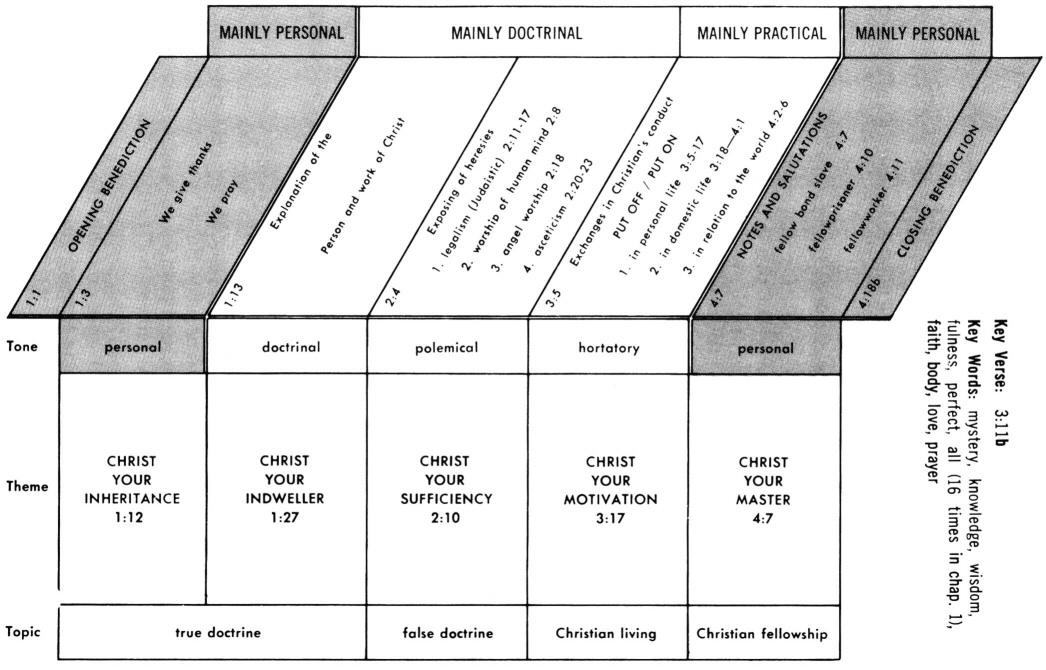
CHRIST IS ALL IN ALL
Click chart to enlarge
Charts from Jensen's Survey of the NT - used by permission
Colossians Overview - Click Chart on right side
| Christ Preeminent in All Things Supreme Lord - Sufficient Savior |
|||
| Colossians 1 | Colossians 2 | Colossians 3 | Colossians 4 |
| Supremacy of Christ |
Submission to Christ |
||
| Doctrinal and Corrective |
Practical and Reassuring |
||
| What Christ Did For Us |
What Christ Does Through Us |
||
| Christ Our Lord |
Christ Our Life |
Christ our Love |
|
| Christ the Head of the Body |
Christ the Lord of the Universe |
Christ the Head of the Home |
|
| Instruction | Warnings | Exhortations | Reminders |
| Reconciliation | Creation | Submission | Conversation |
| His Person and Word |
His Peace and Presence |
||
Colossians 2:16 Therefore no one is to act as your judge (3SPAM) in regard to food or drink or in respect to a festival or a new moon or a Sabbath day (NASB: Lockman)
Greek: Me oun tis humas krineto (3SPAM) en brosei kai en posei e en merei eortes e neomenias e sabbaton
Amplified: Therefore let no one sit in judgment on you in matters of food and drink, or with regard to a feast day or a New Moon or a Sabbath. (Amplified Bible - Lockman)
Barclay: Let no one take you to task in matters of food or drink, or with regard to yearly festivals and monthly new moons and weekly Sabbaths. (Westminster Press)
Lightfoot: ‘Seeing then that the bond is cancelled, that the law of ordinances is repealed, beware of subjecting yourselves to its tyranny again. Suffer no man to call you to account in the matter of eating or drinking, or again of the observance of a festival or a new moon or a Sabbath.
NLT: So don't let anyone condemn you for what you eat or drink, or for not celebrating certain holy days or new-moon ceremonies or Sabbaths. (NLT - Tyndale House)
Wuest: Stop therefore allowing anyone to be sitting in judgment upon you in eating or drinking or in the matter of a feast day or a new moon, or a Sabbath day (Eerdmans)
Young's Literal: Let no one, then, judge you in eating or in drinking, or in respect of a feast, or of a new moon, or of sabbaths,
THEREFORE: me oun:
TIME TO COME TO A
PROPER CONCLUSION
MacPhail writes that "There is strong emphasis on "therefore." It supports the following counsel by the all-sufficiency of the Cross and of the glorious triumph of the Christ. Thus Paul makes our completeness in Christ the sufficient reply to all false and futile aberrations, seducing men away from Him, either wholly or in part. (The Epistle of Paul to the Colossians)
Tim Schoap - "Therefore," points back to what Paul was just talking about. Because of all that Christ has done, because of all he is, because you are complete in him, "no one is to act as your judge..." "Let no one keep defrauding you..."
Steven Cole - “Therefore” connects our text to the previous paragraph. Paul is telling these new believers, under attack from these false teachers, “The law was merely the shadow which pointed toward the reality, which is Christ. He fulfilled the ceremonial laws of the Old Testament. We don’t grow as Christians by keeping those laws, but by holding fast to Christ.”
The famous pastor Joseph Parker wrote that…
A great amount of trouble is made possible by pedantic obedience to things which are in themselves at once transient and unprofitable. The Colossian Christians were troubled by teachers who had a most imperfect knowledge of the purpose of the great Redemption. There were slaves to the letter (law). They could not see that religion might be intensely spiritual, having rise far above all ceremony, and ritual, and elementary appointments of every kind. The Apostle bids the Colossians take heart in remembrance of the fact that they were living members of the living body of Christ (cp Ro 14:10, 11, 12, 13)… The Gospel has the great message which it would deliver to the inmost heart of the humblest believer: "The kingdom of God is not meat and drink; but righteousness, and peace, and joy in the Holy Ghost." Much of our religious trouble would be dried up if we attended to the main things and regulated our lives by the central and essential principles of the kingdom of Christ. The Apostle Paul gave great liberty to men, according to the degree of their faith and according to their spiritual capacity: "One believeth that may eat all things: another who is weak, eateth herbs. Let not him that eateth despise him that eateth not; and let not him which eateth not judge him that eateth: for God had received him (Ro 14:2, 3). There have always been clever people in the Church whose object has been to spoil the simplicity of faith. That have had fancies of their own respecting holydays, and new moons, and Sabbath days. They have had in their souls the very genius or demon of deception. They would not allow the simplicity of Christ to stand in its own majesty. The Apostle cautions Christian worshippers against all such foolishly inventive persons: This I say, lest any man should beguile you with enticing words" (Col 2:4).
The ritualism of faith has been its paralysis,
if not its absolute destruction.
Whatever these local references may mean, we have corresponding temptations in our own time by which souls are greatly troubled. One man has a garment, another a vessel, another a symbol, another a ritual, another a prejudice -- and so on almost endlessly, not knowing that the age of shadows has passed and the day of the abiding reality has dawned. In Colossians 2:19 the Apostle goes on the root of the matter "And not holding to the the Head… " (The Epistles to the Colossians and Thessalonians)
Since Christ is indeed God in the flesh and He is in you as your "hope of glory" and you are "complete in Him" with all that being complete in Christ (Col 2:10-note) entails (Col 2:11, 12, 13, 14,1 5-see notes Col 2:11; 12; 13; 14; 15)… then don't let someone try to bully you or say you are less spiritual because you don't keep "kosher" or keep certain days, etc. Christ has BLOTTED OUT the IOU against us and we are no longer under the curse of the law (Gal 3:13) but we are under grace and should so walk (Col 2:6-note).
Ray C. Stedman entitles Paul's warnings in (Col 2:16-23) "The Things that Can Ruin Your Faith", those dangerous traps that await us on every side as we journey… there are no new heresies. We find the same things that can derail the spiritual life, repeated… Bad theology always leads to bad practice! The mistaken ideas about the work of Christ (which Paul corrects in Col 2:8-15) and His sufficiency have corresponding errors on the practical side and the first one Paul warns against is
DON'T LET SOMEONE
PUT YOU UNDER THE LAW,
even the
CEREMONIAL LAW.
This is ritualism, just a variant form of legalism. (Jesus fulfilled the Law, both it's moral demands and it's ceremonial demands - Ro 8:3, 4-note).
So Paul says don't let anyone put you under legalism or by trying to make yourself acceptable to God on the basis of externals -- by keeping certain laws, rituals or decrees. God "made us accepted in the Beloved" (in Christ) (Ep 1:6KJV-note).
Legalism is bondage! Now that you are free in Christ, why would you want to be enslaved again? (cp Gal 4:9) Peter called such bondage a “yoke upon the neck” (Acts 15:10, cf. Mt 23:4, Gal 5:1, 2:4, Heb 9:8, 9, 10, 11). If keeping the Law could not make us spiritual before we received Christ as our fully sufficient Savior (fully and forever sufficient to save us the first time at regeneration, our new birth, and then by His Spirit in our daily sanctification), why do we think that keeping the law can make us spiritual after we are believers? Or as Paul rhetorically phrased it…
Are you so foolish? Having begun by the Spirit, are you now being perfected (see epiteleo) by the flesh (flesh)? (Gal 3:3) (See Chart contrasting in the flesh vs in the Spirit)
Sadly many genuine believers in America are living under some form of a yoke of bondage, thinking if I just do this or do that, I'll be more acceptable to God. They may not say this overtly but their actions betray them.
S Lewis Johnson introduces his article on the "Paralysis of Legalism" with these comments…
One of the most serious problems facing the orthodox Christian church today is the problem of legalism. One of the most serious problems facing the church in Paul’s day was the problem of legalism. In every day it is the same. Legalism wrenches the joy of the Lord from the Christian believer, and with the joy of the Lord goes His power for vital worship and vibrant service.
Nothing is left but cramped, somber,
dull and listless profession.
(Ed: Does this describe your Christian life beloved? It does not have to be so! Determine in your heart and mind to diligently study the book of Colossians, memorizing and meditating on the truths about Who Christ is and who you are in Christ [your privileged position] and Whose you now are [i.e., to Whom you now belong - cf. 1Co 6:19-note, 1Co 6:20-note, therefore 1Co 6:18-note], for this latter truth speaks of your present responsibility to live obediently in Christ, for Christ and through Christ - The truth of Colossians can/will set you free in Christ as you prayerfully, diligently seek Him [Mt 6:33-note, He 11:6-note] in this great epistle as if you were in a spiritual desert - see David's cry in Ps 63:1-Read Spurgeon's encouraging note, cp Pr 8:17, Isa 55:6)The truth is betrayed, and the glorious name of the Lord becomes a synonym for a gloomy kill-joy. The Christian under law is a miserable parody of the real thing. Ignatius was right when he said to the Magnesians, “It is absurd to talk of Jesus Christ and to practice Judaism.”1
At the heart of the problem of legalism is pride, a pride that refuses to admit spiritual bankruptcy. That is why the doctrines of grace stir up so much animosity. Donald Grey Barnhouse, a giant of a man in free grace, wrote: “It was a tragic hour when the Reformation churches wrote the Ten Commandments into their creeds and catechisms and sought to bring Gentile believers into bondage to Jewish law, which was never intended either for the Gentile nations or for the church.”2 He was right, too.
Of course, there is another side to this matter. It is not enough to be free of law. There must also be that which Thomas Chalmers called, “the expulsive power of a new affection.” Paul knew this for he not only wrote, “Ye are not under law,” but quickly he added that the Romans were “under grace” (Ro 6:14-note, cp Ro 7:6-note). Gratitude, the product of a Savior’s indescribable love, is the spiritual force that leads to fruitful contact with the outsiders.
“Ah, Mr. Spurgeon,” said an old woman whom the great-hearted preacher was visiting, “if Jesus Christ does save me, He shall never hear the last of it!” That is the spirit produced by grace.
“I’ve found a Friend, oh, such a Friend!
He loved me ere I knew Him;
He drew me with the cords of love,
And thus He bound me to Him:
And round my heart still closely twine
Those ties which nought can sever;
For I am His, and He is mine,
Forever and forever.”
The two sides are set forth by Paul in Colossians 2:16 through Col 3:4, the section to which we have come in our studies. The apostle, having so beautifully expounded the believer’s position in union with Christ (Colossians 2:9, 10, 11, 12, 13, 14, 15), naturally turns to the implications and obligations involved. Negatively, the believer has been emancipated from legalistic and Gnostic practices (Col 2:16, 17, 18, 19), and exempted from ascetic regulations (Col 2:20, 21, 22, 23). Positively, the new position is to be followed by a new affection for the heavenly life (Col 3:1, 2, 3, 4 ).
C. The Obligations of the True Teaching (Col 2:16 through Col 3:4).
1. Negative: emancipation from legalistic and Gnostic practices (Col 2:16, 17, 18, 19). (Studies in the Epistle to the Colossians Part VIII The Paralysis of Legalism -- By S. Lewis Johnson, Jr - $5 fee for one month but gives access to over 27 excellent journals that are fully searchable online!)
This area of "doing something" to become more acceptable to God is a persuasive ("red herring") argument (Col 2:4-note) that can derail your faith and rob you of your true spirituality. The flesh is weak when it comes to doing spiritual things truly pleasing to God (Mt 26:41), but it is very strong when it comes to practicing religion, especially religious rules and regulations. Somehow, adhering to the religious routine inflates the ego and makes a person content in his self-righteousness (cf. Paul's warning in Romans 10 where he is speaking of the Jews but speaks truth that is applicable to us all when we walk according to the flesh - Ro 10:2, 3, 4-note). And so as believers we must continually recall that truth that we…
are in Christ Jesus, who became to us wisdom from God, and righteousness and sanctification, and redemption (1Cor 1:30).
Christ's righteousness is the only basis of our acceptability when we stand one day before His holy throne (Jude 1:24,25). The false teachers were saying by their judging believers that Jesus Christ is not sufficient for all the spiritual needs of the Christian. They were claiming a “deeper spiritual life” for all who would practice the Law. Outwardly, their practice may seem spiritual; but in actual fact, these practices accomplish nothing spiritual, for Christ Alone is our "spirituality" and we please God by our faith and obedience (Heb 11:6-note, 1Sa 15:22).
Blaise Pascal rightly declared that…
Jesus Christ is the Center of everything and the Object of everything; and he who does not know Him knows nothing of the order of the world, and nothing of himself.
True Christianity is living under submission to and in the power of the Spirit of God and the grace of God and realizing that we are acceptable to God because of the internal change God has wrought in us when He caused us to be born again to a living hope (1Pe 1:3-note) - viz (to wit, namely) "Christ (is) in you (and He is) the hope of glory" (Col 1:27-note) and you are complete (completed filled to the brim) in Him (Col 2:10-note). So in the next section (cf. Col 2:20-note) Paul again points back to our position in Christ and says let no one put you under the law!
Beloved, if you are wrestling with the subtle snare of legalism, let me recommend Dr Ray Stedman's excellent message entitled Legalism (in transcript or Mp3 format)
Jesus dealt with the law when He canceled out the debt consisting of decrees against us, for as Paul reminds the Roman saints
"you also were made to die to the Law through the body of Christ, that you might be joined to another, to Him who was raised from the dead, that we might bear fruit for God. For while we were in the flesh (i.e., our physical bodies which are themselves not inherently sinful but in the unsaved state are subject to), the sinful passions (controlling propensities/passions emanating from our corrupt nature inherited from Adam), which were [aroused] by the Law (not created by the Law which is itself holy but excited, called up or inflamed by the Law which forbids their indulgence), were (constantly) at work (energized over and over again - imperfect tense) in the members of our body (referring to those sinful propensities made use of our members as instruments, (purpose clause) to secure gratification) to bear fruit for death ("Vivid picture of the seeds of sin working for death"). But now we have been released from the Law, having died to that by which we were bound, so that we serve in newness of the Spirit and not in oldness of the letter." (Ro 7:4, 5, 6-notes).
Why was the Law against us? Because we could not keep the law. Because you could not live up to them.
As James teaches
whoever keeps the whole law and yet stumbles in one point, he has become guilty of all. (Jas 2:10)
God's requires absolute righteousness but our corrupt nature inherited from Adam prevents us from keeping the law perfectly. God said
CURSED IS EVERYONE WHO DOES NOT ABIDE BY ALL THINGS WRITTEN IN THE BOOK OF THE LAW, TO PERFORM THEM. (Gal 3:10)
That curse is death, so we have to die. But Jesus took on flesh and blood and
redeemed us from the curse of the Law, having become a curse for us. (Gal 3:10)
For what the Law could not do, weak as it was through the flesh, God did: sending His own Son in the likeness of sinful flesh and as an offering for sin, He condemned sin in the flesh (Ro 8:3-note).
In light of what Christ has done on Calvary, the Colossians were to let no one "judge" their standing before God on the basis of their observance or nonobservance of the regulations of the Mosaic law. In such matters the principle of Christian liberty comes into play.
As Paul reminded the Galatians who were so prone to slip back into legalism
It was for freedom (see eleutheria) that Christ set us free (eleutheroo in the effective aorist tense, active voice, indicative mood = at the Cross He completely liberated us from the power of the Law); therefore keep standing firm (our daily choice is to remain unwavering since Christ has set us free) and do not be subject (hampered, ensnared by a trap or coming into submission) again to a yoke (don't let "Judaizers" lasso you into the old yoke of legalism) of slavery (douleia-do not again become slaves to any rites, and customs, and habits). (Gal 5:1).
Elsewhere Paul insists that under some circumstances Christian freedom should be voluntarily limited by one's respect for the tender conscience of a weaker brother or sister (see Ro 14:1, 2, 3, 4, 5, 6, 7, 8ff-note; 1Cor 8:1, 2, 3, 4, 5, 6, 7, 8, 9, 10, 11, 12, 13). This caution is necessary for those inclined to assert their liberty without regard of the potential damage their actions might bring to a "weaker" brother or sister in Christ. In the church at Colossae, it was actually Christian liberty that was to be asserted (albeit of course still with the weaker brethren in mind) in order to counter the subversive attempts of the false teaching that sought to undermine the believer's freedom in Christ.
EVERYTHING THAT
LOOKS SPIRITUAL
IS NOT!
You've probably heard the expression "red herring." This term was coined from a method of training hunting dogs to follow the scent of their prey. Once the dogs were following the proper scent, their trainers would draw red herrings (a stinky fish) across their paths. Initially, the dogs would be diverted by the scent of the herring. They had to be trained to ignore that scent and instead stay focused on the scent of their prey. So a "red herring" is something that is introduced which diverts our attention from what we should be pursuing. Paul's thesis is that the key to authentic spirituality is pursuing Jesus Christ, because He alone is the Source of all true spiritual knowledge,
in Whom are hidden all the treasures of wisdom and knowledge. (Col 2:3-note)
We pursue Him (Col 2:6-note) by "receiving Him" into our hearts (Jn 1:11, 12, 13), and by "walking in Him" (which practically means learning about Him [read, meditate and memorize the Book], following Him [obeying His Word] and enjoying Him - cp Gal 5:16-note).
The Amplified version says
As you have therefore received Christ, [even] Jesus the Lord, [so] walk (regulate your lives and conduct yourselves) in union with and conformity to Him. (Col 2:6-note)
In order to effectively pursue Christ, you have to be able to identify spiritual red herrings and turn away from them. Paul identifies some of them in this section, which is very apropos to the modern church for "stinking herrings" are still very much present today.
In summary, we note that in Col 2:16, 17, 18, 19, 20, 21, 22, 23 Paul take us from the truths primarily about Who Christ is and our POSITION in Him to our PRACTICE in Him and in this section he begins with the negative side of our spiritual practice by warning us about what not to do.
THE DANGER OF RITUALISM
IN THE CHURCH
G Campbell Morgan (From his notes on 2Chronicles) has a pithy description of the dangers of ritualism (formalism) in the modern church…
It is a warning to the spiritual Church lest she should become formal, and so fail to establish the nation. I have no desire to use any phrase in a controversial sense here, but I am bound, in the interpretation of truth as I see it in the Bible, to say this, the Bible knows nothing of the establishment of the Church by the State, but it teaches forevermore that the Church must establish the nation. In order to do this, formal religion is infinitely worse than none.
By formal religion: I mean high Church doctrine without full Church life. I mean Puritan philosophy without Puritan experience. I mean a Nonconformist conscience without conduct conformed to CHRIST. These things are the essence of ritualism.
What is high Church doctrine without full Church life? The doctrine of the Church that is forevermore arguing for the correctness of its views, and cursing the man who does not share them! That is a formalism which curses a nation.
What is Puritan philosophy without Puritan experience? There are some who think the Puritan philosophy consisted in a passion for destroying buildings. Nothing of the kind. The Puritan philosophy is that man is spiritual, and has the right of access to GOD who is Spirit, without the intervention of man or ceremony. Oh, the dignity of it! But if that is our philosophy, and we do not go to GOD, our philosophy becomes paralysis instead of power. Sometimes I am a little tired of hearing about the Puritanism of the Free Churches. I want to see it in the life of those who know what it is to have commerce with GOD. What do I care about the accidentals in the Puritan movements of long ago - the speech, the dress, the iconoclasm? If a man looks at these things only, he has never seen the Puritan movement. The Puritan movement was that of strenuous saints, who refused to let anyone come between themselves and GOD. Hold that philosophy to be a fine one, and live six days a week as though there were no GOD, and that is a ritualism which is a peril to a nation.
What is a Nonconformist conscience without Christian conduct? The presence of the crowd at the platform meeting when we show our superiority to other people, and its absence from the service of worship, and its neglect of the worship of work. We need the conscience sensitive to the call of CHRIST, the conscience that worships, and then strips itself to serve. If I am forevermore talking about my conscience, and boasting in my freedom, and fighting merely for the shibboleths of freedom; that is ritualism, and I have no room to criticize the man who is a ritualist in some other section of the Church.
The disaster of formalism. What is it? It is not merely that the Church is a failure. That, of course, is a disaster. I am not, however, prepared to shed tears over the failure of a system. I am prepared to shed them over the fact that when the system fails, the work is not done. That is the supreme and final agony. If the Church of GOD is not what it ought to be, we have a nation without salt and without light, a nation rushing headlong to Godlessness, characterized by base ideals and ignoble conduct; by cowardice in the presence of a wrong, and carelessness about the importance of right. If that be the national condition, the blame is with the Church of GOD. I do not say the churches, but the Church, which is the Temple of GOD. If she were instinct with the life of CHRIST, and allowed that life to fill and flood and flow through her, the nation could no longer be careless.
I go back to the creation of the temple, and what followed in Jerusalem. The multitudes were amazed, perplexed, critical. The tragedy of the hour is that the Church does not amaze London, does not perplex London, does not make London critical. Why not? Because of her formalism. The world has done with formalism. Whether it be her theatres, her public houses, or anything else, she means business; and a world that means business is never going to be influenced by a Church that is playing.
What we need is the Church, the Temple, filled with the Presence, flaming in its glory, flashing in its light, communicating its fire. Then we shall be able to say to the evil statesman, You dare not! We shall be able to say to vested interests, Disgorge! But formalism can do none of these things. What then is the message of the second book of Chronicles? What is the living word? "Strengthen the things that remain."
LET NO ONE ACT AS YOUR JUDGE (sit in judgment) IN REGARD TO FOOD OR DRINK : Me oun tis humas krineto (3SPAM) en brosei kai en posei:
- Ro 14:3, 14:10, 14:13 1Cor 10:28-31; Gal 2:12;13 Jas 4:11) (Lv 11:2-47; 17:10, 11, 12, 13, 14, 15; Dt 14:3-21; Ezek 4:14; Mt 15:11; Acts 11:3-18;15:20; Ro 14:2,6,14, 15, 16, 17,20,21; 1Cor 8:7, 8, 9, 10, 11, 12, 13; 1Ti 4:3, 4, 5; Heb 9:10;13:9
Related Passages:
Romans 14:3; The one who eats is not to regard with contempt the one who does not eat, and the one who does not eat is not to judge the one who eats, for God has accepted him.
Romans 14:10 But you, why do you judge your brother? Or you again, why do you regard your brother with contempt? For we will all stand before the judgment seat of God.
Romans 14:13 Therefore let us not judge one another anymore, but rather determine this–not to put an obstacle or a stumbling block in a brother’s way.
1 Corinthians 10:28-31 But if anyone says to you, “This is meat sacrificed to idols,” do not eat it, for the sake of the one who informed you, and for conscience’ sake; 29 I mean not your own conscience, but the other man’s; for why is my freedom judged by another’s conscience? 30 If I partake with thankfulness, why am I slandered concerning that for which I give thanks? 31 Whether, then, you eat or drink or whatever you do, do all to the glory of God.
DON'T LET OTHERS BE YOUR JUDGE
REGARDING FOODS
Lightfoot says let no one "take you to task".
Let (no one) act as… judge (2919)(krino) primarily signifies to distinguish, separate or discriminate; then, to distinguish between good and evil, right and wrong, without necessarily passing an adverse sentence, though this is usually involved and certainly is in the present context. The false teachers were judging the saints and passing judgment on whether they were truly "spiritual" or not. These false teachers used non-Biblical criteria (legalism, mysticism, ritualism) by which to judge the saints. Paul presents the truth about the saint's position in Christ in order to counter the lies of the adversaries.
Remember if you you don't stand on the truth, you're in danger of falling for the lie. Stated another way, keep the truth and the truth will keep you (from falling prey to the lie).
As John Blanchard says "Whatever you add to the truth subtracts from it… Truth is objective, not subjective, so sincerity or passion is no guarantee of a claim's validity."
A T Robertson says the Greek here is a "prohibition present active imperative third singular, forbidding the habit of passing judgment in such matters."
Stated another way, the negative particle ("me") used in combination with the present tense (continuous action) imperative mood (command) means they are to stop allowing this to happen, implying that some of the saints in Colossae were already recipients of and falling prey to this destructive judgmental attitude.
Paul says "Stop letting these certain ones keep judging you".
The false teachers were telling the Colossians the lie that CHRIST IS NOT ENOUGH but that they also needed to keep the Jewish ceremonial rituals and legalism, as commanded in the Mosaic Law.
We could paraphrase it this way - Paul counters false teaching with the argument that "since you have thus been delivered by Christ from the evils which surrounded you and since you have been freed from the observances of the law, let no one sit in judgment on you, or claim the right to decide for you in those matters. You are not responsible to man for your conduct, but to Christ; and no man has a right to impose that on you as a burden from which he has made you free.”
Paul conveys a similar idea to the Roman saints writing that "[there is] now no condemnation (no adjudging guilty of wrong) for those who are in Christ Jesus (denoting close and intimate union with Him, like that between the Vine and its branches) , who live [and] walk not after the dictates of the flesh (who do not live to gratify the corrupt desires and passions of the fallen flesh nature), but after the dictates of the Spirit" (Amp, Ro 8:1+)
As A T Robertson puts it "the fire (Ed note: of judgment) has burned on and around the Cross of Christ. There and there alone is safety. Those in Christ Jesus can lead the consecrated, the crucified, the baptized life.
Spurgeon comments…
Do not let anybody come in, and tell you that it is necessary for your salvation that you should abstain from this meat or that drink, that there is a merit in fasting for forty days in Lent, or that you cannot be saved without observing such and such a holy clay. Your salvation is in Christ. Keep you to that, and add nothing to this one foundation which is once for all laid in him.
Do not put yourself under the bondage of any rules and regulations that may be made by men. If you choose to do anything, or to abstain from something else, because you judge it to be right and beneficial, do so. Christ is your only Ruler and Leader; and if he does not command anything, let it not signify to you who does command, it
“Do not put yourselves under rules and regulations which God has not ordained. If you think it is right for you to abstain from certain drinks do so, but do not act thus simply because others do so. If you abstain from certain meats, because they have been offered to idols, and the consciences of others might be offended if you partook of them, do not act thus as though it would save you. Do not make yourself subject to the judgment of other men, for Christ is your Law-giver and Lord.”
The gospel of Christ does not pronounce condemnation like the Law. The function of the gospel is to pardon while the function of the Law is to condemn.
What Paul is warning about is still with us today. For example, some would say if you want to be "spiritual" then don't smoke, don't chew and don't go with folks that do.
Paul says don't let someone come along and say you need to keep certain laws, even "good" ones (like you must have a 15 minute devotional time every morning [it's not a bad idea but it won't make you any more acceptable to God for you are already "complete in Christ"], etc), if you want to be really spiritual.
Paul says these are "externals" but you have true spirituality already resident within, for you have Christ within "you the hope of glory" (Col 1:27b-note) and He is the only One Who is truly spiritual. Now put this truth into practice and walk by faith in the Spirit of Christ (Col 2:6-note, cp Gal 5:16-note) and He will daily set you apart from the world and unto Himself. (cp Ro 8:13-note, cp Php 2:12-note, Php 2:13-note)
The truth cannot be repeated too often that as a believer, you are now and forever complete in Christ (Col 2:9, 10-note). You possess all the "spirituality" (and all the resources to be spiritual) that you will ever receive or that you will ever need in this life or the one to come! Christ is totally and forever sufficient. Meditate on the great truth about Christ in Colossians 1 and Colossians 2, allowing the Spirit to transform and renew your thinking (2Cor 3:18, Ro 12:2-note), and practice walking forth in obedience to the truth, confident in our Lord's promise that the truth (Personified in Christ - see Jn 14:6, cp Rev 19:11-note - His name is called "Faithful and True") will set you free (Jn 8:31, 32) and when the Son sets you free, you are free indeed (Jn 8:36).
As Os Guinness says "We must not just debate the truth, we must know the truth. If we would live free, we must not just know the truth, we must live in truth and we must become people of truth."
The goal of spiritual discipline now is to
work out (present imperative = a command to continuously, daily, as your lifestyle carry it out “to the goal”, to cultivate and fully complete it, work on it all the way to the "finish line") your salvation (not your mate's, not your child's, but yours! It speaks of direction, not perfection!) with fear and trembling (not slavish terror, but wholesome, serious caution and a sense of self-distrust, with serious caution, tenderness of conscience, with watchfulness against temptation, always choosing to shrink from whatever might offend God and discredit the name of Christ) for it is God (THE HOLY SPIRIT) Who is (CONTINUALLY ENERGIZING) at work in you, both to will and to work for His good pleasure (GIVING YOU BOTH THE DESIRE AND THE POWER!). (Php 2:12+, Php 2:13+)
Lightfoot says believers should exhibit "a nervous and trembling anxiety to do right."
As A T Robertson quips "Paul has no sympathy with a cold and dead orthodoxy or formalism that knows nothing of struggle and growth.
Peter would add that
if you address as Father the One who impartially judges according to each man's work, conduct (aorist imperative see our need to depend on the Holy Spirit to obey) yourselves in fear during the time of your stay upon earth (1Pe 17+)
Our object is now not to please men by keeping certain externals but to please God by our obedience which is rooted in (motivated by) our filial love for Him and is enabled by His Spirit. Jesus summed it up by declaring that
If you love Me, you will keep My commandments. (John 14:15+)
COMMENT: If you keep reading in the context Jesus essentially tells the disciples how it will be possible to "keep" His commandments. It will not be by legalistic adherence. It will not be by "trying" but more by "dying." In other words they (and we) will not be able to keep His commandments by reliance on our own strength, our fleshly power or resolve. That's essentially a form of legalism. No, Jesus gives us the supernatural solution in John 14:16+ and it is the Spirit! "I will ask the Father, and He will give you another (allos = just like Jesus) Helper, that He may be with you forever." The Spirit will give us the desire and the power to keep the commandments (see Php 2:13NLT+). Paul picks up on this same thought in his warning against the legalism that was infiltrating the churches in Galatia by asking them a rhetorical question "Are you so foolish? Having begun by the Spirit, are you now being perfected (aka progressive sanctification, growing in Christlikeness) by the flesh?" (Gal 3:3+) And of course the answer is "No!" We keep on growing in grace the same way we entered the race, by faith, by believing and relying on the same Spirit Who saved us and Who now daily enables us to continue to run the race with endurance! Does that make sense? Does this help you understand why it is so important that we continually be filled with the Spirit (Eph 5:18+)?
True spirituality is obeying our Father as we are led by His Word and empowered by His Spirit. It is when we are walking "in a manner worthy of the Lord, to please Him in all respects, bearing fruit in every good work and increasing in the knowledge of God" (Col 1:10+).
God has taken the "IOU" representing our sin debt owed to God because we have broken His Law and nailed it to the Cross of Christ. Don't let anyone delude you about this glorious truth (Col 2:4). Remember that because you are complete in Him (Col 2:10) you don't need to "keep" certain days or "eat certain foods" to be "spiritual" or make yourself "acceptable" to God. Don't let someone come along and say that if you were really spiritual, you'd not eat meat on a certain day like those "men who forbid marriage and advocate abstaining from foods (1Ti 4:3+).
Regarding food and drink…
Jesus said to them (the Jews following Him), “I am the bread of life; he who comes to Me will not hunger, and he who believes in Me will never thirst. (Jn 6:35, 40+).
I am the living bread that came down out of heaven (Jn 6:51+, cp Jn 6:33, 35, 48, 50)
I am the bread of life. “Your fathers ate the manna in the wilderness, and they died. This is the bread which comes down out of heaven, so that one may eat of it and not die. “I am the living bread that came down out of heaven; if anyone eats of this bread, he will live forever; and the bread also which I will give for the life of the world is My flesh.” (Jn 6:48-51).
Then the Jews began to argue with one another, saying, “How can this man give us His flesh to eat?” (Jn 6:52+)
So Jesus said to them, “Truly, truly, I say to you, unless you eat the flesh of the Son of Man and drink His blood, you have no life in yourselves. He who eats My flesh and drinks My blood has eternal life, and I will raise him up on the last day. For My flesh is true food, and My blood is true drink. He who eats My flesh and drinks My blood abides in Me, and I in him. As the living Father sent Me, and I live because of the Father, so he who eats Me, he also will live because of Me. This is the bread which came down out of heaven; not as the fathers ate and died; he who eats this bread will live forever.” (Jn 6:53-58+).
Jesus explained to the woman at the well that the water men need to be "spiritual" is spiritual water declaring that…
Everyone who drinks of this water (physical) shall thirst again but whoever drinks of the water (spiritual water ~ spiritual life) that I shall give him shall never thirst; but the water that I shall give him shall become in him a well of water springing up to eternal life. (Jn 4:13, 14+)
Comment: When you have drunk of the "water" that Jesus gives, you have no further need to be concerned about what you physically eat or drink. Obviously gluttony and drunkenness sins we should guard ourselves from but that is not what the false teachers were talking about. They were trying to making abstaining from physical eating and drinking a "vehicle" by which one could "be more spiritual".
In regard - Literally "in" and here the idea is "in the matter of".
Food (1035) (brosis from bibrosko = to eat) literally means something that eats ("an eating") or gnaws. The main NT use refers to the act of partaking of food (eating) (Ro 14:17-note, 1Co 8:4, 2Co 9:10, Col 2:16-note). Brosis can refer to that which one eats (In Lxx - Ge 25:28, Jer 41:20, 2Sa 19:43), and thus can mean a "meal" as in (He 12:16-note). Jesus uses brosis to mean food but with a figurative meaning in Jn 4:32; 6:27, 55.
In Mt 6:19, 20-note brosis is used figuratively to describe that which causes erosion or corrosion (Compare the interesting derivation of the English word corrode from Latin rodo = to gnaw.)
Brosis - 11x in 10v - Matt 6:19, 20; John 4:32; 6:27, 55; Ro 14:17; 1 Cor 8:4; 2 Cor 9:10; Col 2:16; Heb 12:16 NAS = eating(2), food(6), meal(1), rust(2).
Brosis - 35x in non-apocryphal Lxx - Ge 1:29, 30; 2:9, 16; 3:6; 9:3; 25:28; 47:24; Lev 7:24; 19:7; 25:7; Deut 32:24; 1 Sam 2:28; 2 Sam 16:2; 19:42; 1 Kgs 19:8; Job 33:20; 34:3; Ps 14:4; 44:11; 53:4; 78:30; 104:21; Isa 55:10; Jer 7:33; 15:3; 19:7; 34:20; Lam 1:11, 19; 4:10; Ezek 47:12; Dan 1:10; Hab 3:17; Mal 3:11
David Holwick on food and drink…
1) Food long associated with religion.
a) Taboos on what you can eat or must avoid.
b) Most famous - kosher laws.
c) Muslims - daily fasting during month of Ramadan.
2) Early Christians.
a) Many followed Old Testament food rules.
b) Further issue - food offered to idols.
3) Paul's conclusion.
a) All food is good and from a good God. 1Timothy 4:3, 4
1> Eat anything, with thankfulness.
b) But if someone is offended, abstain. 1Cor 8:9
1> We are free, but we don't hammer people. (Colossians 216-23 Shadow or Substance)
Drink (4213) (posis) means the action of drinking or what one drinks (a drink).
There are only 3 uses of posis in the NT…
John 6:55 "For My flesh is true food, and My blood is true drink.
Romans 14:17 for the kingdom of God is not eating and drinking, but righteousness and peace and joy in the Holy Spirit.
Paul echoed the warning about foods in his letter to the saints at Rome writing…
I know and am convinced in the Lord Jesus that nothing is unclean in itself; but to him who thinks anything to be unclean, to him it is unclean. For if because of food your brother is hurt, you are no longer walking according to love. Do not destroy with your food him for whom Christ died. Therefore do not let what is for you a good thing be spoken of as evil for the kingdom of God is not [solid] meat and drink” means that the experience of the kingdom of God does not consist of eating or drinking, or through an act that is physical because the kingdom of God is spiritual and experienced by faith (Ro14:14, 15, 16, 17).
Many saints today practice giving up certain pleasurable activities (especially certain foods) during the 40 day period ( "Lent") preceding First Fruits (Easter), because they think that will improve their relationship with God. Some seek to become more acceptable to God by wearing special clothing or uniforms. Many Jews keep a kosher kitchen although many of them do not even know why.
When one Jewish woman was asked why she kept a kosher kitchen she replied,
"I don't know. It is just part of our religion."
The Mormon cult teaches that a person cannot be a member in good standing if he drinks tea or coffee.
Seventh Day Adventists, insist that a person must keep the Sabbath in order to please God.
Paul says don't let anyone judge your spirituality on the basis of these shadows because you have the "substance", the "body", Christ dwelling in you and He is your hope of glory.
What saith the Lord about food? Under the Mosaic Law certain foods were classified as “clean” or “unclean”
This is the law regarding the animal, and the bird, and every living thing that moves in the waters, and everything that swarms on the earth, to make a distinction between the unclean and the clean, and between the edible creature and the creature which is not to be eaten. (Lv 11:46,47+).
But Jesus made it clear that food was neutral. It was what came out of the heart that made a person spiritual or unspiritual, teaching that
"there is nothing outside the man which going into him can defile him but the things which proceed out of the man are what defile the man… for from within, out of the heart of men, proceed the evil thoughts, fornications, thefts, murders, adulteries, deeds of coveting and wickedness, as well as deceit, sensuality, envy, slander, pride and foolishness. All these evil things proceed from within and defile the man." (Mk 7:15, 21, 22, 23+)
Peter had to be told three times that
what God has cleansed (referring to the command to kill and eat all kinds of four-footed animals and crawling creatures of the earth and birds of the air), no longer consider unholy (Acts 10:9, 10, 11+).
People who religiously observe diets and days give an outward semblance of spirituality (before men but not before God), but these practices cannot change their hearts. Legalism is a popular thing because you can “measure” your spiritual life—and even brag about it!
God does not condemn those who eat everything (Ro 14:1, 2, 3, 4, 7-see notes Ro 14:1; 14:2; 14:3; 14:4; 14:7). In fact, God says that all foods may be eaten since they were
“created to be gratefully shared in by those who believe and know the truth.” (1Ti 4:3).
Paul describes such teaching that forbids certain foods as the "doctrines of demons” (1Ti 4:1) whom Christ has disarmed (Col 2:15).
Phillip Yancey, in his book "What's So Amazing About Grace," tells the story of a missionary family for whom peanut butter was a sinful luxury, and so they measured their devotion to Christ, and other's devotion, by what they did with peanut butter.
Self-denial can be merely a cover for self-promotion as the following true story illustrates: The proprietors of the “Worst Food in Oregon” restaurant say that what they serve in the “worst food you ever ate, and the service is even worse.” Actually, the restaurant is unusually clean and the food is very good. Diners are served generous portions, and the prices are very reasonable. The name is just a gimmick. It was the idea of the owner who, when tempted to call his food “the best,” figured he might get more attention by calling it “the worst.” His strategy worked. Customers who come the first time out of curiosity soon come back for more. They like the food so much that they even ask what the chef recommends. With a twinkle in his eye he tells them to “take their money and spend it at another restaurant down the road.”
John MacArthur says in this section what Paul is talking about is…
external religion. What he's talking here about is ceremony, ritual. And, I mean, it's characteristic of religion that it has its rituals. It was a characteristic of Judaism which Paul is primarily addressing. You see, they wanted to sit in judgment on people as to what they ate. Were they kosher or not in their diet? And did they observe the appropriate festival? And did they… did they maintain the Sabbath day? And then those special new moon Sabbaths? That was their big issue. Ritual, did they bow down? Did they genuflect? Did they participate in the mass? Did they light the candles? Did they say their beads? Did they go through whatever ritual they needed to go through? Did they have fastings? Did they go through ceremonial washings? Did they participate in rites and duties and behaviors that are intended somehow mechanically to convey some kind of divine connection?
Paul says, "Don't get led astray by that. Don't think for a minute that some external activity, some external event in which you participate is necessary." The Jews were even saying that, and some of them claimed to be Christians in the time of the New Testament, that look, if you're a Christian, God's not going to accept you even though you believe in His Son unless you're circumcised. And they were making issues out of being circumcised, as verse 11 in this passage mentions. They were saying, "Well, God's not going to accept you unless you've been circumcised." And Paul in other places says, "Forget circumcision, that had a place in the past, that was a picture, that was a shadow. Sabbath had a place, it was showing you something to come. Dietary laws had a place, they separated you from the nations around you to protect you from the intrusion of their false religious systems. All that God gave you had a place of protecting, preserving you and depicting the reality to come but the reality is here, Christ is here, set the shadow aside, the substance is here, you don't need the ritual." (The Sufficiency of Christ Alone)
OR IN RESPECT TO A FESTIVAL OR A NEW MOON OR A (the) SABBATH(s) DAY(s): e en merei eortes e neomenias e sabbaton:
- Lv 23:1-44; Nu 28:1-29; Dt 16:1-17; Neh 8:9; 10:31; Ps 42:4; Ro 14:5,6) (Nu 10:10; 28:11,14; 1Sa 20:5,18; 2Ki 4:23; 1Chr 23:31; Neh 10:33; Ps 81 3; Isa 1:13; Ezek 45:17; 46:1, 2, 3; Amos 8:5; Gal 4:10) (Lev 16:31; 23:3,24,32,39)
WHAT ABOUT THE
SABBATH?
All Jewish males were required to attend Passover, Pentecost, Tabernacles but there is no such stipulation under the New Covenant. On the other hand keep in mind that Paul is not forbidding us to have ''special days or diets'' but just that we don't rely on those to ''make us spiritual'' or do them to please (impress) men rather than God, no matter how sincere we might appear. (See Romans 14).
The reference to Sabbath day points clearly to the Jewish calendar, for only Jews kept the Sabbath. That being the case, "religious festival" and "New Moon celebration" must also point primarily to the ritual calendar of the Jews. Paul's thought is that the Christian is freed from obligations of this kind (Gal 4:9, 10, 11). No one, therefore, should be permitted to make such things a test of piety or fellowship (Ro 14:1ff-notes).
John Eadie comments on true Christianity that "Its feast is daily, for every day is holy; its moon never wanes, and its serene tranquility is an unbroken Sabbath." (Amen!) (Colossians 2)
In the early 1900's few Christians who were evangelicals would travel on Sunday because they were taught that Sunday was a carry-over of the Jewish Sabbath and that it was wrong to work or travel on that day.
The movie Chariots of Fire illustrates how strongly that view was held. These are modern day examples of what Paul is warning against (although clearly Eric Liddell's heart was right in refusing to race on the Sabbath). Any man-initiated performance that is done without meaning with the goal of seeking to please God or make one's self more spiritual is what Paul warns us about.
Commenting on the new moon, Vincent writes that
The festival of the new moon is placed beside the Sabbath (Is 1:13, Ezek 46:1). The day was celebrated by the blowing of trumpets, special sacrifice, feasting, and religious instruction. Labor was suspended, and no national or private feasts were permitted to take place. The authorities were at great pains to fix accurately the commencement of the month denoted by the appearance of the new moon. Messengers were placed at commanding heights to watch the sky, and as soon as the new moon appeared, they hastened to communicate it to the synod, being allowed even to travel on the Sabbath for this purpose. The witnesses were assembled and examined, and when the judges were satisfied, the president pronounced the words it is sanctified, and the day was declared new moon.
Those men who would bring Christians under the bondage of the Law make artificial distinctions between the “ceremonial” and “moral” law, and so they say the Sabbath has not passed away. That this is a false notion can be seen from the fact that
(1) The Sabbath command is the only one of the Ten Commandments not repeated in the NT.
(2) The early believers, following Christ’s resurrection and appearance on Sunday (Mk 16:1), met on Sundays (Acts 20:7).
(3) The Bible nowhere distinguishes between the so-called “moral” and “ceremonial” laws (this distinction was not made before the 13th century AD)
(4) This Colossian passage explicitly condemns those who command Sabbath obedience.
(5) As Paul put it, the OT Law (including the Sabbath) was only a shadow of the things that were to come. The reality or “substance” (“body”), is to be found in Christ (cf. Heb 8:5-note; He 10:1-note). What the OT foreshadowed, Christ fulfilled (cf. notes Matthew 5:17-note; Ro 8:3-note; Ro 8:4-note). A “shadow” is only an image cast by an object which represents its form. Once one finds Christ, he no longer needs to follow the shadow.
The devil wants our MINDS. He knows he can't have our HEARTS, because they already belong to Jesus (Col 2:15-note, Heb 2:14, 15-note, 1Cor 6:20, etc). He wants to distract our minds from the completeness we have in our Lord Jesus Christ.
Remember the enemy works upon the minds of those who are not FIXED UPON THE LORD JESUS CHRIST. Satan loves to get a Christian who is not in the WORD, not focused on the Lord and who does not understand that he's complete in Jesus. He can use such an individual to bring DIVISION to the body of Christ. So we've got to be SENSITIVE to his schemes ---- it may even be that Satan will use a Sunday School teacher, pastor, or someone else in leadership (cf Paul's solemn warning in Acts 20:28, 29, 30, 31, 32). The key is not so much what they look like or how they speak, but WHAT THEY ARE SAYING, is it "sound doctrine" (1Ti 4:6, 2Ti 4:3-note, Titus 1:9-note, Titus 2:1-note)? We need to be sensitive to the CONTENT (and the CONTEXT) of what they say… is what they are saying "according to Christ" Col 2:8-note) and what is ERROR.
THE KEY TO COUNTERING THE COLOSSIAN HERESIES THAT ARE "SLITHERING" INTO THE EVANGELICAL CHURCHES IN AMERICA IN THE 21ST CENTURY IS TO REMEMBER THAT IN CHRIST YOU HAVE BEEN MADE COMPLETE!
LEGALISM
In Col 2:14 (notes) we learned that Jesus
"canceled out the certificate of debt consisting of decrees against us".
He didn't do away with it, but He fulfilled the Law (Ro 8:3, 4-see notes Ro 8:3; 8:4, Gal 3:13) by putting Himself in the place of the Law. When I obey the Lord Jesus, the Law is being fulfilled, because He is the embodiment of the Law. Since He is, now I don't need to relate to a plan or a formula, but simply to Him and to walk worthy of Him, pleasing Him in all things. So that as you obey Him, the Law is being fulfilled through your obedience, which equates with righteousness. Remember that the Law itself cannot produce righteousness, but Jesus can for He became to us righteousness (1Cor 1:30) and through my obedience to Him the "fruit of righteousness" (Php 1:11-note) is worked out in my life.
Jesus has conquered all the forces of evil so it follows that no person has a right to JUDGE me as to whether I do or do not observe the tenets of the Law of Moses. No one can judge me, because the Law was already judged in Him. He became that curse for me (Gal 3:13) and when I receive Him, I receive what He did for me -- I died with Him, was buried with Him and was raised to walk in newness of life (Ro 6:3, 4-see notes Ro 6:3; 6:4) so that the Law no longer has claims on me (Ro 7:4,5,6-note). Jesus has claims over me, but the Law does not. Beware when you hear someone say "Jesus is not enough… you've got to do this or that." Your spiritual "antennae" should stand up as you recall that you have been made COMPLETE in the Lord Jesus Christ and as you obey Him, He takes care of the righteousness that the Law demands but could never produce in my life. Keep in mind Paul seems to be talking primarily to Gentile believers. It may be that some leader was trying to draw them under the Law.
The false philosophers were saying that you can only eat and drink certain things if you want to be really SPIRITUAL. Lev 11 describes foods that were clean and unclean. The LAW had a definite purpose for the Israelites----to keep them SEPARATE from the other nations. The LAW also probably had them eat certain things for nourishment reasons. The Israelites couldn't even associate with the people of other nations because their diet was so different. Look out when you're sitting down and eating with someone--watch how quickly your convictions go out the door. How quickly you can become one of them when you eat with them. When we come to Jesus we don't look at things as clean/unclean because that has been done away with in Christ.
The following Scriptures illustrate how in Christ dietary laws are done away with:
Mk 7:14-16 ''there is nothing outside the man which going into him can defile him; but the things which proceed out of the man are what defile the man. If any man has ears to hear, let him hear."
Acts 10:1ff re-iterates this principle when Peter had the vision of the "unclean" foods that showed him that there was nothing any longer that you could or could not eat.
Acts 15:1ff The Jerusalem Council concluded that there was no longer anything unclean and food had nothing to do with our standing with the Lord.
Ro 14:17, 18 "For the kingdom of God is not eating and drinking, but righteousness and peace and joy in the Holy Spirit. For he who in this way serves Christ is acceptable to God and approved by men." (see notes Romans 14:17; 14:18)
So what you eat no longer affects your standing with God. Now on the other hand "Rules" by themselves do not necessarily signify that something is LEGALISM. The problem is when the RULES become the mode, measure, method by which you come in right standing with God, by which you become "spiritual". Jesus is the means of our spirituality. Isn't it interesting that since Jesus is the Bread of Life, that we would need to eat and drink certain things. He is our food as He stated when He told them that He had food to eat that knew not of and that His food was to do the will of Him Who sent Jesus (Jn 4:34).
FESTIVALS
The FEASTS are listed in Lv 23:2ff "Speak to the sons of Israel, and say to them, 'The LORD'S appointed times which you shall proclaim as holy convocations-- My appointed times are these: SABBATH, PASSOVER, UNLEAVENED BREAD, FIRST FRUITS, WEEKS, ATONEMENT, BOOTHS. Paul teaches that the shadow of the feasts has become the substance in Christ in [1Co 5:7] "Christ our Passover" Jesus is the One to Whom all the OT feasts pointed. Festivals were celebration times pointing to what God had done and to what He was going to do. Today there is no specific day, but in fact we should celebrate Christ every moment of out life because He is the embodiment of all the feasts.
NEW MOON
1Chr 23:31 which in reference to when they gave their SACRIFICES- they were given "on the Sabbaths, the new moons and fixed festivals… " Here is what God thinks about KEEPING THE NEW MOON and W/O OBEDIENCE FORM THE HEART:
Isa1:13 "Bring your worthless offerings no longer, Incense is an abomination to Me. New moon and Sabbath, the calling of assemblies-- I cannot endure iniquity and the solemn assembly.14 "I hate your new moon festivals and your appointed feasts, They have become a burden to Me. I am weary of bearing them."
Christians can do the same thing by coming every Sunday to give their offering, unemotionally mouthing the words to the hymns, giving their token time to the church and leaving feeling that they've done all that God wants them to do. Remember all the SACRIFICIAL SYSTEM was pointing to the Lord Jesus Who has become a sacrifice for us. He reconciled us by the blood of His cross. He nailed those decrees to His cross.
So how do Christians now SACRIFICE and CELEBRATE? See Ro 12:1-note
"… your spiritual (logical) service of worship"
See spiritual sacrifices God desires today in [1Pe 2:5-note; Ps 50:14, 51:17, 107:22, Php 2:17-note, Php 4:17-note, Php 4:19-note, Heb13:15,16-note]
You don't just PRESENT your bodies once a month at the "new moon", but you do so moment by moment, (aorist active infinitive ) as a conscious attitude by one who has been made complete in the Lord Jesus Christ. Don't let anyone trap you into adding anything to Jesus.
John MacArthur - Are the Sabbath laws binding on Christians today?
We believe the Old Testament regulations governing Sabbath observances are ceremonial, not moral, aspects of the law. As such, they are no longer in force, but have passed away along with the sacrificial system, the Levitical priesthood, and all other aspects of Moses' law that prefigured Christ. Here are the reasons we hold this view.
1. In Colossians 2:16-17, Paul explicitly refers to the Sabbath as a shadow of Christ, which is no longer binding since the substance (Christ) has come. It is quite clear in those verses that the weekly Sabbath is in view. The phrase "a festival or a new moon or a Sabbath day" refers to the annual, monthly, and weekly holy days of the Jewish calendar (cf. 1 Chronicles 23:31; 2 Chronicles 2:4; 31:3; Ezekiel 45:17; Hosea 2:11). If Paul were referring to special ceremonial dates of rest in that passage, why would he have used the word "Sabbath?" He had already mentioned the ceremonial dates when he spoke of festivals and new moons.
2. The Sabbath was the sign to Israel of the Mosaic Covenant (Exodus 31:16-17; Ezekiel 20:12; Nehemiah 9:14). Since we are now under the New Covenant (Hebrews 8), we are no longer required to observe the sign of the Mosaic Covenant.
3. The New Testament never commands Christians to observe the Sabbath.
4. In our only glimpse of an early church worship service in the New Testament, the church met on the first day of the week (Acts 20:7).
5. Nowhere in the Old Testament are the Gentile nations commanded to observe the Sabbath or condemned for failing to do so. That is certainly strange if Sabbath observance were meant to be an eternal moral principle.
6. There is no evidence in the Bible of anyone keeping the Sabbath before the time of Moses, nor are there any commands in the Bible to keep the Sabbath before the giving of the law at Mt. Sinai.
7. When the Apostles met at the Jerusalem council (Acts 15), they did not impose Sabbath keeping on the Gentile believers.
8. The apostle Paul warned the Gentiles about many different sins in his epistles, but breaking the Sabbath was never one of them.
9. In Galatians 4:10-11, Paul rebukes the Galatians for thinking God expected them to observe special days (including the Sabbath).
10. In Romans 14:5, Paul forbids those who observe the Sabbath (these were no doubt Jewish believers) to condemn those who do not (Gentile believers).
11. The early church fathers, from Ignatius to Augustine, taught that the Old Testament Sabbath had been abolished and that the first day of the week (Sunday) was the day when Christians should meet for worship (contrary to the claim of many seventh-day sabbatarians who claim that Sunday worship was not instituted until the fourth century).
12. Sunday has not replaced Saturday as the Sabbath. Rather the Lord's Day is a time when believers gather to commemorate His resurrection, which occurred on the first day of the week. Every day to the believer is one of Sabbath rest, since we have ceased from our spiritual labor and are resting in the salvation of the Lord (Hebrews 4:9-11).
So while we still follow the pattern of designating one day of the week a day for the Lord's people to gather in worship, we do not refer to this as "the Sabbath."
Colossians 2:17 things which are (3SPAI) a mere shadow of what is to come (PAP); but to substance belongs to Christ. (NASB: Lockman)
Greek: a estin (3SPAI) skia ton mellonton, (PAPNPG) to de soma tou Christou.
Amplified: Such [things] are only the shadow of things that are to come, and they have only a symbolic value. But the reality (the substance, the solid fact of what is foreshadowed, the body of it) belongs to Christ (Amplified Bible - Lockman)
Barclay: These are only the shadow of things to come; the real substance belongs to Christ. (Westminster Press)
Lightfoot: These are only shadows thrown in advance, only types of things to come. The substance, the reality, in every case belongs to the Gospel of Christ.
NLT: So don't let anyone condemn you for what you eat or drink, or for not celebrating certain holy days or new-moon ceremonies or Sabbaths. (NLT - Tyndale House)
Wuest: which things are a shadow of those things about to come. But the body belongs to Christ. (Eerdmans)
Young's Literal: which are a shadow of the coming things, and the body is of the Christ;
THINGS WHICH ARE A MERE SHADOW OF WHAT IS TO COME (coming things): a estin (3SPAI) skia ton mellonton (PAPNPG):
- Jn 1:17; Heb 8:5; 9:9; 10:1
THE OLD IS SHADOW
JESUS IS SUBSTANCE
Things which are - Those things just mentioned in Col 2:16. Literally this reads "the coming things" -- these are the spiritual blessings made possible for all believers today (in this present life) by the New Covenant in Christ Jesus (i.e., Paul is not referring solely to blessings that are yet to come in the future at the Second Coming of Christ).
John wrote that…
the Law (shadow) was given through Moses; grace and truth were realized through Jesus Christ (substance). (Jn 1:17+)
In Hebrews we read these parallel passages…
(The Levitical priests, instituted under the Old Covenant) serve a copy and shadow of the heavenly things… (Hebrews 8:5-note)
For the Law, since it has only a shadow of the good things to come and not the very form of things, can never by the same sacrifices year by year, which they offer continually, make perfect those who draw near. (Hebrews 10:1-note)
A mere shadow (4639) (skia) refers to a pale shadow, as contrasted with a sharp, distinct one. Skia is used of a literal shadow (the shape cast by an object as it blocks rays of light) in Acts 5:15 and of literal shade in Mark 4:32 (Here skia refers to the shelter from light and any heat associated with it), but the other 5 NT uses are figurative. Two uses describe the "shadow" of death, that sphere of existence which of men in which they are alienated from God (Mt 4:16, Lk 1:79) and into which Messiah comes as the Light of the world. Poetically the OT Septuagint speaks of the sheltering shadow of God's wings. Other OT uses speak of human transitoriness (Job 8:9 and Psalm 102:11, 144:4). The Jewish historian Josephus uses skia to in his description of a besieged city in Jewish War 6.194 where only the shadow of food seemed to be available.
Skia - 7x in 7v - Matt 4:16; Mark 4:32; Luke 1:79; Acts 5:15; Col 2:17; Heb 8:5; 10:1
Eadie writes that…The noun skia may bear two different meanings. It may either signify a shadow projected from a body by its interception of the light; or it may signify, as here, a dim and shadowy sketch of an object, in contrast not only with a full and colored likeness, but with the object itself. (Colossians 2)
Wuest paraphrases Expositor's Greek Testament which explains that skia in Hebrews 8:4-note is "an adumbration (imperfect portrayal or representation of a thing) of a reality which it does not embody. A shadow has no substance in itself. It has no independent existence. It merely is proof of the fact that there is a reality back of it. It is not itself solid or real. Just so, the earthly tabernacle gave proof of the fact that there was a real one, the heavenly one where God Himself dwelt, where Messiah officiates as High Priest. The Aaronic priests performed their priestly rites in the representation of the heavenly tabernacle. (Eerdmans Publishing - used by permission)
Vincent - The Mosaic ritual system was to the great verities of the Gospel what the shadow is to the man, a mere general type or resemblance. The substance belongs to the Christian economy. It is derived from Christ, and can be realized only through union with Him.
Adam Clarke - All these things were types, and must continue in force till the Christ, whom they represented, came; the apostle therefore says that the body—the substance or design of them was of Christ—pointed him out, and the excellent blessings which he has procured. The word skia, shadow, is often used to express any thing imperfect or unsubstantial; while the term soma, body, was used in the opposite sense, and expressed any thing substantial, solid, and firm. The law was but the shadow or representation of good things to come; none should rest in it; all that it pointed out is to be sought and obtained in Christ
Albert Barnes - The reality, the substance. All that they signified is of or in Christ. Between those things themselves which are in Christ, and those which only represented or prefigured them, there is as much difference as there is between a body and a shadow-a solid substance and a mere outline. Having now, therefore, the thing itself, the shadow can be to us of no value; and that having come which was prefigured, that which was designed merely to represent it, is no longer binding.
Bible Background Commentary - Plato distinguished the “real” world of ideas from the shadow world of sense experience. Philo developed Plato’s concept to argue that the invisible God was known through “shadows,” or copies, of his character, rather than through sensory vision. Writers by this period distinguished substance or body, the original reality, from shadows or mere copies; adapting their language, Paul believes that the Old Testament prescriptions testified to genuine principles, but that those principles are fulfilled in Christ.
The Law was "weak" in regard to the flesh which is why Jesus took on the likeness of sinful flesh and allowed for the requirement of the Law to be met in believers (Ro 8:3,4-note). The Old Testament ritual observances were dim outlines of the redemptive truths that came to full light in the New Testament. The offerings were reflections of the one genuine saving offering at the cross, the priesthood was a foreshadowing of the priestly ministry of Christ, and the kings of Israel faintly suggested the coming King of kings and Lord of lords.
The problem we must always be alert to is the danger of performing "religious" rituals mechanically and simply going through the motions. Paul says in essence that this can destroy the true vitality of faith.
But someone will surely say,"Wait a minute. Aren't some of these observances given to us by God to remind us of truth? Isn't there some value to mental or physical health to be gained by doing them?" Paul addresses such an objection by emphasizing that rituals are mere "shadows" and that the reality is found in Christ. Once the reality has been realized, shadows are of no value whatsoever. Shadows are pictures, given in advance, designed to prepare us for something. But if you have found Christ, you do not need the shadows any more. Paul includes the Sabbath day as an example of a shadow.
Ray Stedman has an excellent exposition on this section writing…
I carry with me pictures of my wife, my children and my grandchildren. I take them along in order to be ready for people who try to show their pictures to me! I value these photographs and look at them occasionally when I am away from home. But what would you think if I propped up these pictures all over my house and talked to them and tried to relate to them? You would think I had lost my mind---and I probably would have. But, more than that, I would certainly soon lose touch with the very people whose pictures I treasure. They would feel ignored and would probably ultimately leave me and all relationship would cease. That is what Paul says is wrong with shadows. If you still place primary value on a shadow after the reality has come you destroy your participation in the value of that reality. Now the reality, here, is Jesus! He is the center of all life and the source of excitement in a Christian's experience. He is the One who accompanies us through life, to comfort in times of need and strengthen when we are being tempted. He is a place of refuge to run to when we are troubled or uncertain about life. To lose him is to lose all source of excitement and vitality in life. That is the danger in observing shadows. That is why this paragraph begins with the word "therefore." The previous section pointed out all that Christ is to us now. Thus Paul is saying, "Having him, therefore, do not let anyone spoil you by involving you in a mechanical performance that will cancel out the reality.
Joining a cult is not the only way to let ritualism ruin your life. You can do it right here at church on a Sunday morning. If you merely mouth the words of the hymns when you sing, you are doing this very thing. You are destroying something, entering into a religious mechanical performance that not only says nothing to God but destroys something in you. If you let your mind wander when someone is praying, if you do not follow along and silently say, "Amen," or let that prayer reflect what you are thinking, you will turn off much of truth and miss much. You are indulging in a form of hypocrisy; of looking like you are doing something valuable and helpful when actually you are not doing anything like that at all.
Turning your mind off during a message and failing to hear what is being said falls into the same category. When I look out from this platform you all appear to be listening. You look at me and your faces reflect interest in what I am saying. But I know from sad experience that that is not always true. Some of you are at home, worrying about how the roast is doing. Some of you are playing golf, or working out a business deal, or struggling with a problem with your children, or wondering about what someone else is wearing. It would be interesting to know at the end of a service where everybody has been! We all find our attention straying at times, but do not let yourself get into a habit of that because it is destructive; it is empty ritualism!
I would like to ask two questions before we pass on to the next point. First, do you really think God is fooled by that kind of performance? What a low view of God, to think that if we run through some religious fol-de-rol he is going to be pleased with us! There must be a dozen passages in the OT where God tells us what he thinks of that kind of thing. I do not have time to read them to you, but let me share one verse out of Isaiah which illustrates what God says (see Isa 1:13, 14, 15-note)
What an honest revelation that is of what we are doing to God when we act with thoughtless involvement with public worship.
My second question is: do you have any idea of what you lose by this kind of a performance? The thing that first becomes apparent is that the service itself grows dull and boring. You find yourself wanting to leave but you feel you have to stay because your mate or your family expects it, or you gain a reputation for piety by doing so. When a group of people do that, church does become terribly dull. A church service ought to be a tremendously exciting time. Here is where we ought to find ourselves stimulated afresh, awakened again to new vigor in our relationship with Christ. (Heb 10:24,25-note) But all that begins to dissipate when we became mechanical worshippers. And, more than that, Christ becomes distant and far off from us. We no longer walk with Him day by day or moment by moment. When you do not do that---since to lose God is to lose yourself---all of life becomes dull and empty. Tenseness, worry, guilt and loneliness begin to harry your footsteps. Eventually you succumb to the need for something to stimulate you. You fall in with the world's futile search for an anesthetic to deaden the pain of an empty life. is that happening to you? (Read the full sermon Colossians 2:16-23 Things that can Ruin your Faith)
Bob DeWaay in his section on Three Warnings about Spiritual Elitism writes…
The second warning is found in Colossians 2:16: “Therefore let no one act as your judge in regard to food or drink or in respect to a festival or a new moon or a Sabbath day.” The “therefore” refers back to the truth that Christ had, through the cross, resolved their greatest problems. These were their previous state of death in sin (Col 2:13) and their subjection to the powers of darkness (Col 2:15). Christ had canceled out their debt before God (Col 2:14) and defeated the principalities and powers (Col 2:15). In spite of all that, the spiritual elitists in Colossae insisted that the faith of the Colossian Christians was defective and lacking. So they wanted to set themselves up as judges. Paul warns that we do not let them do it!
The would-be judges wanted to tell the Colossian Christians how to eat, what religious festivals to keep, and evidently demanded Sabbath keeping. Here we see both pagan and Jewish elements. The Sabbath is the Jewish Sabbath and went from sundown Friday until sundown Saturday. As we saw earlier, the pagan mystery rites had to be kept on the new moon. The food issue could be Jewish or pagan. Jews did not have rules about beverages, so that was likely a pagan stipulation.20 They likely were requiring strict asceticism. Interestingly, In spite of this clear injunction to not allow anyone to be sit as judge in regard to Sabbath, there are many groups today who do just that! They try to use semantic sophistry to convince us that this passage is not talking about Sabbath. Do not listen to them.
In Galatians Paul gives a similar teaching, and mentions the stoicheia in doing so:
However at that time, when you did not know God, you were slaves to those which by nature are no gods. But now that you have come to know God, or rather to be known by God, how is it that you turn back again to the weak and worthless elemental things, to which you desire to be enslaved all over again? You observe days and months and seasons and years. I fear for you, that perhaps I have labored over you in vain (Galatians 4:8, 9, 10, 11).
The phrase “elemental things” here is stoicheia in the Greek. To return to religious practices of their previous lives, whether they be pagan or Jewish, is tantamount to returning to the domination of the stoicheia. Going back is slavery to “gods” who are not really gods, but spirit beings in the heavenlies, hostile forces who seek to enslave. Any denial of the sufficiency of Christ or adding to the finished work of Christ is seen by Paul as a return to enslavement.
The spiritual elitists delight in judging others. They claim to know how to find freedom and suggest to regenerate Christians that they are not really free. Their road to “freedom” is always bondage. Paul’s instruction is clear and simple: “do not let them act as your judge.” How sad that so many do.
The third warning is found in Colossians 2:18: “Let no one keep defrauding you of your prize by delighting in self-abasement and the worship of the angels, taking his stand on visions he has seen, inflated without cause by his fleshly mind.” Earlier we spent some time establishing the meaning of the phrase “taking his stand on visions he has seen” which uses a word with the technical meaning of entering a second stage in a pagan initiation rite. The would-be elitists in Colossae claimed special spiritual experiences which gave them supposed freedom from the stoicheia. They were promoting their experiences and the means to receive them to the Colossian Christians. F F Bruce comments on this passage, “They pretend to have found a way to a higher plane of spiritual experience, as though they had been initiated into sacred mysteries which give them an infinite advantage over the uninitiated.”21 If Arnold is correct, it is likely that they had actually participated in the initiation rites of one of the mysteries, and claimed that the insights and experiences gave them a special status vis-a-vis ordinary Christians.22
The phrase “keep defrauding you” comes from a rare Greek word which denotes a referee or judge in an athletic contest.23 Here it means “to disqualify.”24 The elitists take the role of referee and disqualify the true Christians. They claim to have experiences, visions, superior “humility,” (how ironic), and some special relationship to angels. The meaning of the phrase “worship of angels” has been disputed. The Greek construction can mean “angelic worship” or the “angels as objects of worship.” If one posits a Jewish source to the heresy, then the former is usually assumed. There were Jewish sects who claimed to have the secret to experiencing angelic worship, like that of the angels.25
On the other hand, Arnold gives many ancient Greek sources that use similar terminology and concludes that it means “angels as objects of veneration.”26 In the magical texts he references and translates, angels are named and called upon for protection from fate and the hostile powers. Some of them include Jewish and pagan names in the same text.27 Rather than directly worshiping angels as if they were the highest God, they “venerated” them and called upon them for help, as being a part of the series of intermediaries between them and God. Here is part of Arnolds summary:
The texts also are a good illustration of the religious syncretism of the time. Jewish angels, as well as the names and titles of Yahweh, are mixed up with pagan intermediaries and all referred to as “angels.” The personalities of the deities and the spirits are lost in favor of a pragmatic concern about which ones have power and which ones will help.28
If this was the issue in Colossae, then the “judges” claimed to have special knowledge of which angelic intermediaries (knowing their names was a key thing) could be called upon for help by using the correct formula, thus averting bad fate. Arnold presents a very compelling argument for his view.
This fits with the larger context of Colossians 1 & 2. Paul’s claim is that Christ is the Creator and sustainer of all, that He is above all powers, that in Him is all the fulness of deity, and that in Him the Colossian Christians had been made complete (see Colossians 2:9,10 and the Christ Hymn of Colossians 1:15-20). The would-be spiritual elitists denied that being in Christ was all that was necessary. They claimed that the stoicheia still had power over the ordinary Christians in Colossae and that their knowledge and experiences held the key to freedom. The “worship of angels” was likely a religious process of calling upon angels (by their secret names) as intermediaries who could thwart the influence of the hostile powers. This may seem odd, unless you consider millions of Roman Catholics (whose church has not allowed them to know that they can be truly complete in Christ by faith), who routinely call upon intermediaries such as Mary and various saints, to give help that they fear has not been provided by Christ. It is not hard to imagine that Christians who lived in the syncretistic culture of first century Asia Minor could believe in angelic intermediaries when Jews and pagans alike had similar teachings. The would-be “referees” set them selves up to judge this foolish process, calling those who truly and simply trust the finished work of Christ “disqualified.”
Further evidence that this involved a magic belief in intermediaries is found in the next verse: “and not holding fast to the head, from whom the entire body, being supplied and held together by the joints and ligaments, grows with a growth which is from God” (Colossians 2:19). The elitist judges take people away from that which only and truly can keep them, the finished work of Christ. The head and body analogy shows that Christian growth is not based on the work of intermediaries, be they human or angelic. The entire body receives everything needed directly from Christ. The whole view of life as being a huge gulf between them and God, filled with stoicheia, angels, fate, principalities and powers, was pressed upon the Colossians all their lives. Evidently the errorists had lowered Christ to a level of one of the intermediaries, who could possibly help them, but not directly or completely. Much more was necessary and the elitists alone supposedly knew the secrets. Paul says they are not holding onto the head.
Conclusion
Clinton Arnold summarizes the situation:
Referring to itself as ‘the philosophy,’ the leaders of this faction had adapted the Pauline gospel to aspects of Phrygian-Lydian beliefs and practices as well as to local Judaism. They advocated the invocation of angels for protection from the hostile powers. They appear to have overemphasized the transcendence of God and underemphasized the exalted position of Christ, functionally viewing him as a mediator, perhaps on the same level as angels. As a means of countering this teaching and giving the Colossians perspective on the relationship of Christ to the powers, Paul gives eloquent expression to a cosmic Christology. Jesus existed before the powers, he in fact created them, he defeated the hostile powers on the cross, and he will intervene in the future and bring about a universal peace in heaven as well as on earth.29
Christ is supreme over all powers, on heaven and on earth, friendly or hostile, and we are complete in Him. Therefore — see to it know one takes you captive (Col 2:8). Therefore — let no one act as your judge (Col 2:16). Therefore — let know one keep defrauding you of your prize (Col 2:18). There are various versions of the Colossian heresy popular today. These shall be the subject of our next article. May the Lord preserve each of us by His grace so richly provided in Christ. (For full article see Critical Issues Commentary Colossian Heresy Part 1)
BUT THE SUBSTANCE (body) BELONGS TO CHRIST: to de soma tou Christou:
- Mt 5:17, Ro 8:3, 8:4, Mt 11:28,29; Heb 4:1-11
Spurgeon - Christ is the real one thing needful. Mind that you have the substance, for then you can let the shadows go.
Literally the Greek can be read as "the body of the Christ".
Eadie says "The realities so long shadowed out are His—all that composes them belongs to Him. The clause then contains the great truth that the Mosaic economy was no empty congeries of useless and meaningless observances — infantine in character and design; but an organism at once Divine in its origin, and fraught with lessons of striking form. It was a dim outline—skia—of those substantial blessings which are of Christ, and it served a gracious purpose during its existence. It was a rudimentary sketch. Its temple with its apartments, vessels, and furniture; its priesthood, in their imposing robes and duties; its altar, with the fire on its hearth, and the cloud of smoke resting over it; its victims, in their age, kind, and qualifications; its rubric, with its holidays, and their special observances; its minute ritual in reference to diet, dress, and disease—all were the faint lines of a sketch which was limned by the Divine pencil for the guidance and government of Hebrew faith and worship. The eye of faith might, as it gazed, be able to fill in the picture, and see in distant perspective the sublime group of a tabernacle filled and inhabited by the Great Spirit; a Priest offering the most costly of victims—the God-man presenting Himself; an altar consecrated by blood precious beyond all parallel; and a sabbatism not only serene and joyous on earth, but stretching away into eternity as a “rest remaining to the people of God.” (He 4:9-note) Thus the hieroglyph and substance exactly correspond, though the former be only an adumbration and a miniature. (Colossians 2)
Substance (4983) (soma) can mean a literal living human body but here is used figuratively as the reality which stands in contrast to the shadow.
The Law of Moses and the Levitical sacrifices, rituals and feasts are all shadows pointing to Christ. The Colossians, who possess the reality as members of the body of Christ, would be foolish to return to the shadow. The ritualistic and ceremonial trappings of religion, the esoteric doctrinal extremes of cults, and the deceptive philosophies of secular faiths are not the essence of or basis for true faith. The reality is to be found only in Jesus Christ, Who is in us the Hope of glory. We are righteous (and spiritual) before a Holy God now not because of what we do or don't do but because we are COMPLETE IN CHRIST, Who has become to us Righteousness (1Co1:30). That is our position. We work out that "positional" righteousness by faith and obedience, motivated and empowered by His Spirit. Colossians 3-4 emphasizes the practical side of "righteousness", showing what a righteous life should look like in ways that can be applied to our everyday life.
H. C. G. Moule writes that (Colossians 2:17,18) is "an appeal for "Christian liberty," as earnest … as [Paul's] appeal to the Galatians "not to be entangled again in the yoke of bondage." (Gal 5:1) But let us note well that the "liberty" he means is the very opposite of license and has nothing in the world akin to the miserable individualism whose highest ambition is to do just what it likes. The whole aim of Paul is for the fullest, deepest and most watchful holiness. He wants his Colossian converts above all things to be holy; that is, to live a life yielded all through to their Redeemer, Who is also their Master
In a sense, the person who judges a believer because that believer is not living under Jewish laws is really judging Jesus Christ. He is saying that Christ did not finish the work of salvation on the cross (cp Jn 19:30), and that we must add something to it. He is also saying that Jesus Christ is not sufficient for all the spiritual needs of the Christian. The false teachers in Colossae were claiming a “deeper spiritual life” for all who would practice the Law, keep certain days, etc. Things haven't changed much in over 2000 years.
THE SABBATH
Let's look at a modern spiritual "Shadow", the Sabbath. Many Christians still ask "Aren't we still supposed to meet on the Sabbath?" Paul addresses this question in this section explaining in Colossians 2:17 the Sabbath is a Shadow which is just a picture of something else. When you see a shadow, you know that there is something behind that shadow and the bigger the shadow gets the closer you get to the substance of that shadow. When the person walks in you don't need the shadow anymore! The command to observe the Sabbath is the only one of the 10 Commandments not repeated after Pentecost.
Jesus is no shadow but is the Substance Who has in fact become our "Sabbath rest" and in that "Sabbath rest" moment by moment we can cease from fleshly works. Now our "works" come out of loving obedience to the One Who lives in us. The Sabbath was intended to be a day of rest, but the legalistic Pharisees perverted this day to mean that man was made to keep the Sabbath rather than the Sabbath being made for man (Mk 2:27). And to promote their false religion, they came up with over 600 laws including many that applied to the Sabbath.
In place of the joy, they imposed a yoke of slavish sabbatarianism which made the Sabbath an end instead of a means, hampered the spirit of true worship, and laid greater stress upon a punctilious obedience to human regulations ("according to the traditions of men" see note Colossians 2:8) than upon the commands of the Law.
Some of the ridiculous man made prohibitions included…
Walking in the grass on the Sabbath was forbidden because its bruising effect would constitute a kind of threshing!
The wearing of nailed shoes was forbidden because the individual who walked in these shoes would be viewed as carrying a burden, something that was forbidden on the Sabbath!
It was because of this perversion of the Sabbath Rest that the Lord Jesus refused to sanction such legalism and vigorously defended His Sabbath miracles.
In short, now that the Substance has come, there is no need for the shadow. Jesus has now become our "Sabbath Rest" (Mt 11:28, 29, 30).
What "Shadow" might be our "Sabbath" today (even in modern evangelicalism)? Many things could be turned into "modern day Sabbath keeping". For example, even going to church might become a person's "Sabbath", in the sense that they legalistically dare not miss that day! Sure it is best to try not to miss going to church on Sunday (cp Heb 10:24). But if you think that by your going to church on Sunday, you will be "more spiritual", then you need to reassess your motives. The point is that going to church does not make anyone spiritual. The point is what is your motive for going to church? Are you going because you love God and His people or are we going to prove that you are spiritual or to earn favor from God? Legalism says "Do This" so you can prove to others that you're spiritual. Grace says "Rest in Him", fully confident of the truth that you are complete in Christ (Col 2:10-note). When you come to Him and obey His Word, walk in a manner worthy of the Lord, you can rest assured that He will take care of the rest! (Col 1:10-note).
Do you know if you have your Rest in the Lord Jesus? You can tell in 5 minutes when a person is resting in Him. Rest is not passivity. In fact, Jesus may burn you out physically and you may be absolutely exhausted like Paul who said "I agonize". The Lord's "Rest" means you are occupied with His business and you are functioning in His spiritual strength with which He infuses you. You can be physically worn out, but inwardly rejoicing when you've found your rest in the Lord Jesus Christ (Mt 11:28, 29, 30). When you have one of those days in which inner turmoil dominates you, you have most likely lost your "Rest". Outside turmoil has nothing to do with your inner rest, for this inner rest is supernatural and is independent of your circumstances.
Remember that the whole Old Testament ritual system was a divinely inspired "multi-media" presentation which communicated "pictures" of God's desire to dwell in His people (Picture = the Tabernacle), pictured our sin preventing access and fellowship (Picture = the veil between the Holy Place and the Holy of holies), and pictured his future provision of forgiveness through Christ's death which would make it possible for him to dwell in us (Picture = the holy priesthood and the entire sacrificial system). God wanted His people to be constantly reminded of these vital central truths. (cp Gal 4:4, 5, 6) Through His death, Jesus has provided complete forgiveness and adoption into God's family so we can be indwelt by his Spirit and know him as "Abba." Once you receive Christ, you can relate to God wherever you are--heart to heart, sharing your problems and joys, asking Him for the help you need, thanking Him for His work in your life, etc. His Word comes alive to you as a personal love letter. His Spirit communicates God's love (Ro 5:5-note).
Paul goes on to say that for Christians to revert to ritualism is spiritual regression (Cp Gal 4:9, 10, 11). Imagine a girl separated from her father from birth. She has only pictures of him, which she treasures and looks at constantly. Then he returns. Will she relate to the pictures differently? She wouldn't hate them or throw them away, but she wouldn't relate to her father through them anymore. What if she still preferred her scrapbook to relating to her father?
So avoid the red herring of ritualism! This does not necessarily mean that people who practice ritualism cannot be Christians, but that ritualism is a red herring that draws us off the path to spiritual maturity.
Eadie elaborates on Colossians 2:17 explaining that the Old Covenant law and ritual
was a typical system (see also Typology - Study of Biblical types). Now, a type not only pictured out the nature of a future reality, but it foretold its certainty. It showed, and it foreshowed. The sacrifice not only showed that the offerer was under sentence of death, and that only by the substitutionary shedding of blood the awful sentence could be repealed; but it also foreshowed that the great and final oblation of infinite efficacy would assuredly be presented in “the fulness of the time.” It not only portrayed the mode, but it gave assurance of the fact—it was at once a symbol and a prophecy. The entire Jewish ritual was so organized, as not only to exhibit a faint and distant likeness to Christianity, but it established the certainty that the new dispensation of which it was an early and elementary copy should be at length organized in perfection and symmetry. The “figure for the time then present” guaranteed the introduction of the figured reality in the time to come. The sign not only preceded, but certified the advent of the thing signified.
Still, the shadow is in itself nothing—it is empty, baseless, and indistinct. The Hebrew ceremonial could not give full instruction by its symbols, and it could only purge “as pertaining to the flesh.” It had no power to enter into the conscience, and impart peace and the sense of forgiveness. The blood of an animal could not secure Divine favour. The thief, after restoring fourfold to the man whom he had wronged, and so satisfying him, must also offer a victim on the altar to God, in order that the penalty incurred from Him might be remitted. The man who had been contaminated by any ceremonial impurity, who had touched a corpse, or come into accidental contact with a leper, was by means of an appointed ordeal of ablution and sacrifice restored to his previous status.
But the whole apparatus was wanting in spiritual power, and its only virtue was in its connection with the substance to come.
That it was a shadow so designed, and not a fortuitous and unmeaning system, is plain from its correspondence with the body which is Christ's, and its consequent fulfilment in Him. The harmony is universal and complete. The great High Priest has come and clothed Himself in humanity—a living vestment far more costly than the robes of Aaron, “made for glory and for beauty;” and all other victims have been superseded by His oblation of Himself. Omniscience is His, and therefore no formal Urim and Thummim glitters on His breast. The Self-sacrifice He presented was pure as the fire from God by which it was consumed, and it has been visibly accepted. He has gone through the starry vail, and into heaven itself, with the names of all His clients inscribed upon His heart; and He pleads the merit of His blood before a mercy-seat not canopied by a cloud, but enveloped in the Majesty of Him who sits upon it. The woven and metallic cherubim disappear in the reality, for the angels having performed their allotted parts in the mystery of redempti on, are “ministering spirits to them who shall be heirs of salvation.” There is no need now that the law be engraved on stone, for it is written indelibly on “the fleshy tables of the heart.” It is no longer required that there be a bath, or a “sea of brass,” for believers are washed in the laver of regeneration. The golden lampstand has been extinguished, for the lustre of the Enlightening Spirit fills the House of God.
Nay, the entire church on earth is a spiritual priesthood, engaged in appropriate ministrations, serving now, indeed, in the outer court, but soon to be called up into the inner sanctuary.
The argument of the apostle, then, is—why go down to “the weak and beggarly elements”? Who would listen to any sophistry urging him to prefer the shadow to the substance?
Such a relapse would be an attempt to roll back the Divine purpose, and impede that religious progress which Christianity had introduced; an effort to restore an intolerable yoke, and rob the new religion of its spirituality and vigour. The result would be to stifle devotion by a periodical mechanism, and degrade obedience into a service of trifles.
And therefore the apostle solemnly warns the Colossians not to be imposed upon by such pretences, and not for a moment to submit to teaching which would supplant the real by the ritual, and give them a religion of obsolete externalities for one of vital freedom and spiritual jurisdiction. (Colossians 2)
Phil Newton has an excellent sermon on Colossian 2:16-19…
Spiritual growth, just like physical growth, is affected by one's surroundings. In the physical realm, if you live in a drought-stricken area with little food reserves, poor air quality, rampant disease, you can expect poor physical growth. It is not that the person has no potential for growth. Everything about him contributes to his failure to develop physically.
Every believer has potential for spiritual growth. While potential for growth is enormous due to the new nature in Christ and the indwelling Spirit, there are still factors outside the Christian that can have a negative affect on his growth. Maturity in Christ is directly related to one's grasp and application of the Word of God. When deception takes place that moves the believer away from the centrality of Scripture, his growth will be affected. The Christian must be aware of the dangers that threaten his spiritual growth and know how to avoid them.
This seems to be the focus of Paul at this point in the Colossian epistle. He emphasizes that the believer is "made complete" in Christ, so that there is no need for anything to be added for his justification (Col 2:10). Directly related to one's justification is sanctification, the process of growth in grace and maturity in the Christian life. The antagonists of Colossae intimidated the believers into thinking that something was lacking in their spirituality. They just did not have what it took to be really spiritual. But the antagonists had the answers! Through the means of legalism, mysticism, and asceticism they could enter into a deeper spirituality. But to all of this, Paul warns the believers not to be duped. For their completion in Christ includes their ongoing growth. They need not look outside of Jesus Christ and his sufficiency for their growth and maturity.
I believe we can see Paul's shift in emphasis upon spiritual growth by the phrases used in the next few verses. In verse 19 he explains how the believer "grows with a growth which is from God." The next verse speaks of the premise that they had "died with Christ to the elementary principles of the world," a phrase that points to the believer's identification with Christ in his death (Col 2:20). In Col 3:1, he speaks of the believer's identification with Christ in his resurrection, with the resulting effect that he can consider himself as dead to evil passions and now able to "put on the new self who is being renewed to a true knowledge according to the image of the One who created him" (Col 3:10). Finally, he adds that they were those "who have been chosen of God," so that they therefore can take action to add spiritual graces to their lives (Col 3:12ff).
Do we too need to be aware of the subtle dangers that the Colossians faced? What types of danger affect us spiritually? Let us consider how our spiritual growth can be threatened and more importantly, how it can be nurtured.
I. Growth threatened
It does not take a keen observer to discover that most professing Christians are doing a poor job at spiritual growth. We see this in the lack of biblical understanding and application to personal life. Programs and activities that do nothing to further one's sanctification have replaced growth.
Dozens of surveys over the past decade have demonstrated that most professing believers do not understand even the most elementary issues related to the Christian faith. One obvious problem is the lack of biblical exposition in the pulpit and ongoing instruction in small group settings. The emphasis in our day on fellowship and entertainment rather than the exposition of God's Word has left us in a dangerous condition. The hunger to grow spiritually is still there for the believer. So if he has not come to anchor himself in the truth of Scripture, he may find himself drifting into the subtle substitutes that Paul describes in our text.
1. By legalism
Legalism is the most natural substitute around for the gospel and for spiritual growth. Its essence can be seen in the things it forbids and the things it requires. By this, I mean that legalism has a list of do's and don'ts which promises the weary adherent certain spiritual attainment. Consider the Pharisees of Jesus' day. They believed that because of what they did and did not do, they were elevated to a new plateau spiritually. They scrupulously followed all of the laws relating to Sabbath observance because earlier legalists spelled these out as having promise. Even though the Pharisees neglected mercy and justice, as did their Old Testament counterparts, they believed that their rigid observance of Sabbath laws qualified them for super-spirituality.
After addressing the accomplishments of Christ for the believer, Paul writes, "Therefore no one is to act as your judge in regard to food or drink or in respect to a festival or a new moon or a Sabbath day-things which are a mere shadow of what is come; but the substance belongs to Christ." Here is what was happening. Rather than giving focused attention to the work of Christ accomplished for every believer, the Colossians were being duped into thinking that they were second-rate in their spirituality. Their antagonists were looking down their noses at them, eyebrows tightened with scowling looks, and telling them how unspiritual they were because they did not observe certain regulations or avoid other issues. The term "judge" implies that this action was already going on and needed to stop. The believers were being intimidated by the strong assertions being made to them.
Have you ever encountered a strong legalist? They may thunder law from the pulpit or use the printed media or radio to declare their rules and regulations. Their emphasis is on externals. They talk about places you cannot go, people you cannot be around, and activities you cannot be part of. They discuss the way you wear your clothes or the style of your hair or the kind of jewelry you wear. Please understand: there are some places Christians do not belong and things Christians have no business doing. But it is not the avoidance of these things that make you holy. The legalist insists that the way to holiness is following after their list of do's and don'ts.
a. The nature of legalism
In the setting of Colossae, Paul was dealing with a syncretistic type religious atmosphere. Syncretism implies that you bring a number of different elements into the picture to make the religion. In this case, there was a mixture of Judaism, local pagan religion, superstition, and homespun ideas. The "food or drink" Paul mentions could be a reference to Jewish dietary laws or it could be some of the local customs which believed that demons loved food and drink so much that they would invade peoples lives through the vehicle of food and drink. So, in order to avoid demons, the person was to fast or at minimum, restrain from eating certain foods. Others had the idea that a person could draw near to God and receive revelations from him if they abstained from food and drink. Some in this region held to the notion that fasting was a pre-condition for engaging in magical arts. Still others believed in the transmigration of the soul through certain foods-especially meat, so that in true spirituality you would avoid eating meat in order not to disturb someone else's soul. There was even the idea that you would become pure only if you rigidly restrained yourself from food and drink.
What is the appeal of such legalistic ideas? If someone with a convincing argument and persuasive personality tells another that he has gained spirituality through certain legalistic practices, then the other person might innocently enter into their trap. They will get caught up in a vicious cycle of trying to do better, failing, then trying again to maintain the level of spirituality demanded of them. Condemnation is the inevitable result.
The Jews were known for their strict observance of certain days on their calendars. This same "Old Testament" idea was passed along to the Colossians. Paul refers to "a festival or a new moon or a Sabbath day," events that were never meant to an end in themselves. The festival days were probably references to the annual festivals of Passover or Pentecost. Some writers also suggest that they refer to local pagan festivals as well. The new moon was a monthly festival that probably arose from local cults, carrying connotations of mysticism and magic in their celebration. Sabbath day observance could point to the sign of the old covenant. But being under the new covenant, the Christian is not bound by the legalisms of Sabbath observance. The early church shifted to Sunday as the day of gathering to worship and giving offerings for the Christian church.
b. The danger of legalism
Here is the danger of all these things. They are substitutes for your completion in Jesus Christ. They all insist that there is another level of spirituality beyond what Christ has done for you. Because of a dependence upon one's own performance, these legalisms leave the believer in bondage. They keep the Christian always looking somewhere else, to the next experience, to the next rigid observance of a law, to the next set of do's and don'ts to find joy. But it is never there. There may be a momentary sense of satisfaction because of their observance, perhaps even a little cheering on by their fellow legalists. But there is no deep, lasting satisfaction. And there cannot be, for it is an attempt to find satisfaction outside of Jesus Christ and the fullness of his work.
Paul reminds the Colossians that all of these things are "mere shadows of what is to come; but the substance belongs to Christ." The writer of Hebrews adds, "For the Law, since it has only a shadow of the good things to come and not the very form of things, can never, by the same sacrifices which they offer continually year by year, make perfect those who draw near" (Heb 10:1). The festivals, holy days, Sabbaths, and other events established by the law were never meant to be the grand finale. They only pointed to their fulfillment in Jesus Christ. "The substance belongs to Christ." So when you have received the substance, you no longer need the shadows. Are you clinging to a shadow for spirituality, rather than resting in the great sufficiency of Jesus Christ?
2. By mysticism
Legalism seems to have always been around. But so has mysticism. We may see more prominence given to mysticism in our day among evangelicals than even the attention of legalism. Paul writes, "Let no one keep defrauding you of your prize by delighting in self-abasement and the worship of the angels, taking his stand on visions he has seen, inflated without cause by his fleshly mind."
a. An explanation
The Apostle's description is that of mysticism's invasion of the Colossian church. What is mysticism? John MacArthur's explanation may be helpful:
Mysticism may be defined as the pursuit of a deeper or higher subjective religious experience. It is the belief that spiritual reality is perceived apart from the human intellect and natural senses. It looks for truth internally, weighing feelings, intuition, and other internal sensations more heavily than objective, observable, external data. Mysticism ultimately derives its authority from a self-actualized, self-authenticated light arising from within. This irrational and anti-intellectual approach is the antithesis of Christian theology [MacArthur NT Commentary: Colossians, 120].
What was happening at Colossae? The young believers were being looked down upon and even judged deficient because they had not had certain subjective experiences. So Paul tells them, "Don't let them act like an umpire for the way you conduct your spiritual lives; belittling you, condemning you, and trying to rob you of your own joy in Christ!" This was taking place, so Paul exhorts them to take action to stop the melee by the mystics.
Mysticism comes off as super spiritual. There is a show of spirituality through "self-abasement," which is often practiced in connection with fasting and other ascetic observances. They want you to know that they have been fasting or denying themselves some luxury in life. This can be seen in the television preacher, who announces, 'I've been fasting for two weeks about this and God told me to tell you_________'. I've found it interesting that Jesus taught that when you fast you are not to let anyone know. Yet on a number of occasions, I've received materials from noted religious leaders announcing that they had fasted for a certain length of time and consequently they have a greater authority to tell the church what it needs to do or what it needs to know. Some even make grand predictions concerning the return of Christ after such fasts. Paul's assessment is that we have no cause to be intimidated by such displays of false humility.
Others engage in "the worship of angels." This seems to be a repetitive issue the apostle seeks to address in this letter. When someone claims to have had an experience with angels and elevates this kind of experience above that of knowing Jesus Christ savingly, then it is not of God. Angels never draw attention to themselves. They are always giving glory to the Lord. I believe we need to regard with deep suspicion the whole lot in our day that are always wanting to talk about angels and who imply their spirituality is higher because of such experiences.
The next level of mysticism is a common one: "taking their stand on visions he has seen, inflated without cause by his fleshly mind." The movement in our day away from the authority of Scripture alone to that of embracing visions, prophecies, and words of knowledge is rampant. Is there a deficiency in the Scripture that causes us to need visions or words of prophecy? Has God failed to speak with finality in his Word? Are we to trust the word of man above the infallible Word of God? Those who embrace such visions have nothing for biblical doctrine. They are living on a different plane and find doctrine to be too confining, stuffy, and academic. They are following the Spirit, or so they say. With great confidence, those who announce visions or words of knowledge or prophecies seek to tower over the ordinary believer. The unsuspecting Christian is intimidated because he does not understand enough of the Bible to realize the hoax being perpetrated upon him. So he cowers before the convincing antics of these visionaries, hoping that one day he will achieve the same kind of spirituality.
b. A cause for vanity
But what is Paul's assessment of the mystics? They are full of hot air! Or to use the biblical language, he is "inflated without cause by his fleshly mind." The reason this person can continue with such confidence in his tactics is due to the condition of his mind. It is not steeped in the Word of God; it is not focused upon the sufficiency of Jesus Christ. It is a mind that has its bearings fixed on personal gain, popularity, power, and the satisfaction of lording over others. His mind is "fleshly" rather than spiritual. Consequently, he is puffed up by his claims to great spirituality.
You can be certain that when a person has a firm grasp of biblical truth it will humble him. If he is puffed up it is only because he does not grasp the very things he claims to understand. Truth brings us low, so that our confidence is not in ourselves but in Jesus Christ alone.
c. Its error
What is mysticism doing today? There are multitudes and I do mean, multitudes of believers who have been swept away from the only true source of spiritual contentment by modern-day mystics. They are in our churches, both charismatic and evangelical. They are on the television and radio. They make great claims for having heard the voice of God. They claim to have had unusual experiences with God, perhaps even having a personal appearance by Christ or an angel to instruct them. They typically denigrate the need for doctrine. 'Just give me Jesus' they claim. They push for the experiential without the corresponding doctrinal basis. And where does it lead? It is a pathway to bondage.
If it substitutes anything for the sufficiency of Jesus Christ, then turn away from it. Do not let it trap you beneath the rubble of visions, experiences, and inflated ideas. Christ alone can satisfy the Christian. Christ alone can meet the deepest longings of the believer's heart. Christ alone can give you lasting joy and contentment. So look to Christ!
II. Growth nurtured
The Bible not only exposes fakes who attempt to distort truth and deceive believers, but it also explains the way to press on in spiritual maturity. We find this in the message of verse 19.
1. Anchoring point
The mystics who claimed to have grand visions and encounters with angels in worship failed in the most basic issue of the Christian life: "holding fast to the head, from whom the entire body grows with a growth which is from God." The anchoring point for the believer is Jesus Christ. He is proclaimed to be "the head of the body," a metaphor that demonstrates the authority of Christ over the church as well as the dependence the church is to place in Christ (1:18). The believer is to never grow beyond his daily, ongoing relationship to Jesus Christ.
Here is one of the quickest ways to spot spiritual fakery. When the emphasis moves away from the simplicity of continuing to grow in your knowledge of Jesus Christ and to grow in your dependence upon him, then it bears the marks of a fake. Paul said that his whole aim in life was to "know Him" (Phil. 3:10) and the thrust of his ministry was to "present every man complete in Christ" (Col. 1:29). The writer of Hebrews goes to great lengths to show the superiority of Jesus Christ to all of the shadows of the Old Testament. We are not to content ourselves with shadows when we can fill ourselves with the Substance. "The substance belongs to Christ." All spiritual growth has its ultimate focus upon Jesus Christ the Lord.
2. Provisions
The believer's union with Jesus Christ and his body, the church, provides what he needs to maintain spiritual growth. This is the implication of "being supplied and held together by the joints and ligaments, grows with a growth which is from God." The words supplied and held together are both present passive verbs, which means that there is a continual provision and sustaining going on outside of the Christian that is being applied to strengthen his growth. It is not just what the Christian is doing that causes his growth; the body of believers around him challenging, exhorting, encouraging, and motivating his growth also affects him. The Christian life is never to be lived in isolation from the rest of the body. Growth is nurtured within the fellowship of the church. I will go so far to say that it is impossible to grow spiritually outside a healthy, ongoing relationship to a body of believers. Our text sustains such a strong statement. The church is "iron sharpening iron" as one believer presses the issues of truth in fellowship with another believer. Christ has so designed and equipped his body that each member has an affect upon the other for the purpose of spiritual growth.
3. Support
So you are not alone in spiritual growth! Each of the "joints and ligaments," that's your fellow members of the church, have a role in helping to support your spiritual growth. In the same way, you have a role in helping to support the growth of your fellow church members. Weymouth's translation captures this beautifully. "Such a one does not keep his hold upon Christ, the Head, from whom the body, in all its parts nourished and strengthened by its points of contact and its connexions, grows with a divine growth."
You are making points of contact today as you study the Word, as you fellowship, as you engage in prayer for one another, as you bear one another's burdens, as you offer encouragement, as you exhort someone to follow after Christ. All of these "connections" are gifts from the Lord so that your growth will ultimately be "from God." He provides for his children exactly what is needed for growth. May we avoid the fakes who would move us away from Christ and avail ourselves of the means God has given for growth.