Colossians 2:2
Colossians 2:3
Colossians 2:4
Colossians 2:5
Colossians 2:6
Colossians 2:7
Colossians 2:8
Colossians 2:9
Colossians 2:10
Colossians 2:11
Colossians 2:12
Colossians 2:13
Colossians 2:14
Colossians 2:15
Colossians 2:16
Colossians 2:17
Colossians 2:18
Colossians 2:19
Colossians 2:20
Colossians 2:21
Colossians 2:22
Colossians 2:23
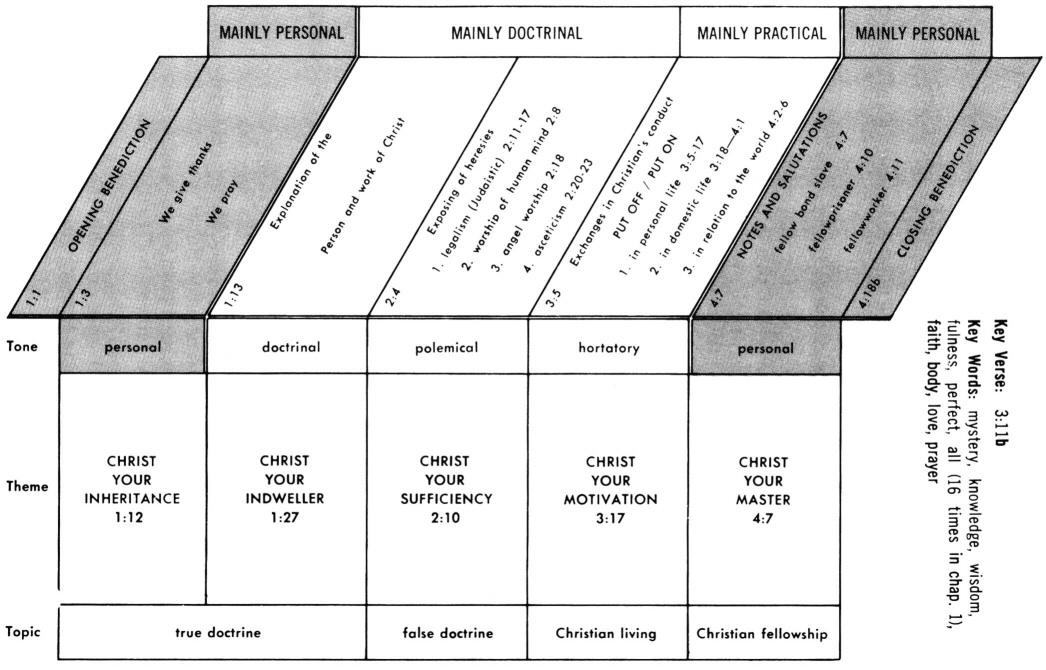
CHRIST IS ALL IN ALL
Click chart to enlarge
Charts from Jensen's Survey of the NT - used by permission
Colossians Overview - Click Chart on right side
| Christ Preeminent in All Things Supreme Lord - Sufficient Savior |
|||
| Colossians 1 | Colossians 2 | Colossians 3 | Colossians 4 |
| Supremacy of Christ |
Submission to Christ |
||
| Doctrinal and Corrective |
Practical and Reassuring |
||
| What Christ Did For Us |
What Christ Does Through Us |
||
| Christ Our Lord |
Christ Our Life |
Christ our Love |
|
| Christ the Head of the Body |
Christ the Lord of the Universe |
Christ the Head of the Home |
|
| Instruction | Warnings | Exhortations | Reminders |
| Reconciliation | Creation | Submission | Conversation |
| His Person and Word |
His Peace and Presence |
||
Colossians 2:18 Let no one keep defrauding you of your prize (3SPAM) by delighting (PAP) in self-abasement and the worship of the angels, taking his stand (PAP) on visions he has seen inflated (PPP) without cause by his fleshly mind (NASB: Lockman)
Greek: medeis humas katabrabeueto (3SPAM ) thelon (PAPMSN) en tapeinophrosune kai threskeia ton aggelon, a eoraken (3SRAI) embateuon, (PAPMSN) eike phusioumenos (PPPMSN) hupo tou noos tes sarkos autou
BGT μηδεὶς ὑμᾶς καταβραβευέτω θέλων ἐν ταπεινοφροσύνῃ καὶ θρησκείᾳ τῶν ἀγγέλων, ἃ ἑόρακεν ἐμβατεύων, εἰκῇ φυσιούμενος ὑπὸ τοῦ νοὸς τῆς σαρκὸς αὐτοῦ,
Amplified: Let no one defraud you by acting as an umpire and declaring you unworthy and disqualifying you for the prize, insisting on self-abasement and worship of angels, taking his stand on visions [he claims] he has seen, vainly puffed up by his sensuous notions and inflated by his unspiritual thoughts and fleshly conceit (Amplified Bible - Lockman)
Barclay: Let no one rob you of your prize by walking in ostentatious humility in the worship of angels, making a parade of the things he has seen, vainly inflated with pride because he is dominated by his sinful human nature (Westminster Press)
NET Let no one who delights in humility and the worship of angels pass judgment on you. That person goes on at great lengths about what he has supposedly seen, but he is puffed up with empty notions by his fleshly mind.
CSB Let no one disqualify you, insisting on ascetic practices and the worship of angels, claiming access to a visionary realm and inflated without cause by his unspiritual mind.
ESV Let no one disqualify you, insisting on asceticism and worship of angels, going on in detail about visions, puffed up without reason by his sensuous mind,
NIV Do not let anyone who delights in false humility and the worship of angels disqualify you for the prize. Such a person goes into great detail about what he has seen, and his unspiritual mind puffs him up with idle notions.
NLT Don't let anyone condemn you by insisting on pious self-denial or the worship of angels, saying they have had visions about these things. Their sinful minds have made them proud,
NRS Do not let anyone disqualify you, insisting on self-abasement and worship of angels, dwelling on visions, puffed up without cause by a human way of thinking,
NJB Do not be cheated of your prize by anyone who chooses to grovel to angels and worship them, pinning every hope on visions received, vainly puffed up by a human way of thinking;
NAB Let no one disqualify you, delighting in self-abasement and worship of angels, taking his stand on visions, inflated without reason by his fleshly mind,
MIT By delving into visions he has seen, let no one put something over on you, wanting to manipulate you into asceticism and adoration of angels. An egotist inflated without reason by his carnal mind,
GWN et no one who delights in false humility and the worship of angels tell you that you don't deserve a prize. Such a person, whose sinful mind fills him with arrogance, gives endless details of the visions he has seen.
BBE Let no man take your reward from you by consciously making little of himself and giving worship to angels; having his thoughts fixed on the things which he has seen, being foolishly lifted up in his natural mind,
RSV Let no one disqualify you, insisting on self-abasement and worship of angels, taking his stand on visions, puffed up without reason by his sensuous mind,
Lightfoot: The prize is now fairly within your reach. Do not suffer yourselves to be robbed of it by any stratagem of the false teachers. Their religion is an officious humility which displays itself in the worship of angels. They make a parade of their visions, but they are following an empty phantom. They profess humility, but they are puffed up with their vaunted wisdom, which is after all only the mind of the flesh.
Wuest: Let no one as a judge declare you unworthy of a reward, taking delight in a self-imposed humility and worship of the angels, scrutinizing minutely the things he has seen, being futilely puffed up by the mind of the flesh,
Young's Literal: let no one beguile you of your prize, delighting in humble-mindedness and in worship of the messengers, intruding into the things he hath not seen, being vainly puffed up by the mind of his flesh,
LET NO ONE KEEP DEFRAUDING (beguile, cheat, defraud, disqualify) YOU OF YOUR PRIZE: medeis humas katabrabeueto (3SPAM):
- Col 2:4,8; Ge 3:13; Nu 25:18; Mt 24:24; Ro 16:18; 2Cor 11:3; Ephesians 5:6+; 2Pe 2:14+; 1Jn 2:26; 1Jn 4:1-2; 2Jn 1:7-11; Rev 3:11; 12:9; Rev 13:8, 14
- Colossians 2 Resources - Multiple Sermons and Commentaries
Related Passages:
Colossians 2:4; 8+ I say this so that no one will delude you with persuasive argument..... 8 See to it (blepo present imperative see our need to depend on the Holy Spirit to obey) that no one takes you captive through philosophy and empty deception, according to the tradition of men, according to the elementary principles of the world, rather than according to Christ.
1 John 2:26+ These things I have written to you concerning those who are trying to deceive you.
2 Corinthians 11:3+ But I am afraid, lest as the serpent deceived Eve by his craftiness, your minds should be led astray from the simplicity and purity of devotion to Christ.
LOOK OUT!
DON'T LOSE YOUR REWARD!
Warren Wiersbe prefaces this section writing "How the flesh loves legalism: fasting, regulations about food, bodily disciplines. Special religious observances with their regulations make many people "feel spiritual." (BORROW Wiersbe's Expository Outlines on the New Testament )
Steven Cole asks "So what is legalism (see also)? The heart of legalism is an attitude of pride. The legalist prides himself for keeping certain standards and judges others who do not keep those standards. The legalist thinks that he is made acceptable to God, either for salvation or spirituality, by his conformity to certain rules that he picks and chooses. Invariably, those rules are not things like loving the Lord with all your heart or loving your neighbor as yourself. Rather, the legalist picks rules that he is able to keep and conveniently neglects or ignores the things he is not able to keep. The legalist often focuses on external conformity while neglecting the heart righteousness God requires (Matt. 23:23-28). Dr. Charles Ryrie (BORROW Balancing the Christian life, p. 159) defines legalism as “a fleshly attitude which conforms to a code for the purpose of exalting self.”
John MacArthur says "Legalism is the religion of human achievement. It argues that spirituality is based on Christ plus human works....Legalism is useless because it cannot restrain the flesh. It is also dangerously deceptive, because inwardly rebellious and disobedient Christians, or even non-Christians, can conform to a set of external performance standards or rituals." (See Colossians and Philemon Commentary)
Let no one keep defrauding you of your prize ("Let no one as a judge declare you unworthy of a reward" - Wuest, “disqualify you for the prize” - NIV, “rob you of your reward” - TNT, “cheat you out of your joy” - Phillips) - Some commentators say that verse 18 is the most difficult verse in Colossians to interpret. Another writer says the interpretation of nearly every word or phrase has been disputed! So the question arises as to what is the "prize?" Is it something in this life or in the life to come at the Judgment Seat of Christ (2Co 5:10+)? Or could it be both.
In regard to the present life, one aspect of the prize would be our sense of completion and sufficiency in Christ, our understanding that all that we need for life and godliness is ours in Christ even as described by Peter who wrote "seeing that His (CHRIST'S) divine power has granted to us everything pertaining to life and godliness, through the true knowledge of Him who called us by His own glory and excellence." (2Pe 1:3+).
Steven Cole - The first difficulty is what Paul meant by, “Let no one keep defrauding you of your prize.” He was probably using an athletic metaphor, saying that these false teachers set themselves up as judges, making up their own rules. If you didn’t play by their rules, they disqualified you from the contest (Douglas Moo, The Letters to the Colossians and Philemon [Eerdmans/Apollos], p. 224). They may have said that you were not saved, or at the very least, you lost your rewards in heaven.
H C G Moule says defrauding you of your prize "means the life eternal, “the crown of life” (Jas. 1:12; Rev. 2:10). The Colossians were tempted to forsake their position and privilege in Christ, found and retained by faith; and, so far, they were tempted to lose their “hold on the eternal life” (1 Tim. 6:12, 19) which is in Him alone (1 Joh. 5:12). (Cambridge Bible for Schools and Colleges)
Albert Barnes on defrauding you of your prize - It is a word which was employed with reference to the distribution of prizes at the Grecian games, and means, to give the prize against any one, to deprive of the palm. Hence it means to deprive of a due reward; and the sense here is, that they were to be on their guard lest the “reward”—the crown of victory to which they looked forward—should be wrested from them by the arts of others. That would be done if they should be persuaded to turn back, or to falter in the race. The only way to secure the prize was to hold on in the race which they were then running; but if they yielded to the philosophy of the Greeks, and the teachings of the Jews, they would be defrauded of this reward as certainly as a racer at the games would if the crown of victory should be unjustly awarded to another.
Richard Melick on defrauding you of your prize - If this meaning ( to umpire or award the prize) applies, the idea is that the Colossians were in danger of losing the prize of their commitment to Christ. Other commentators understand the word to mean put you under judgment. (NAC)
Bruce Barton on defrauding you of your prize - By turning the Colossian believers away from the reality back to the shadow, the false teachers served only to disqualify the believers. Paul did not mean that the believers would lose their salvation, but that they would lose their prize (that is, their rewards; see also 1 Corinthians 3:10–15). (Phillipians, Colossians, Philemon)
Homer Kent on defrauding you of your prize - The believers at Colosse were not to allow anyone to divert them with false teaching, and thus cause them to waste precious time that should have been spent in spiritual progress—progress that would ultimately bring its reward from Christ. (Treasures of Wisdom)
Paul warns the saints at Ephesus
"Let no one deceive (apatao in present imperative with a negative - See Need for Holy Spirit to obey) you with empty words, for because of these things the wrath of God comes upon the sons of disobedience." (Ephesians 5:6+, cf 1 Jn 2:26+, 1 Jn 4:1-2+, ultimate deceiver = devil - Rev 12:9+)
John has a similar warning
2 John 1:7-11+ For many deceivers have gone out into the world, those who do not acknowledge Jesus Christ as coming in the flesh. This is the deceiver and the antichrist. 8 Watch (blepo present imperative see our need to depend on the Holy Spirit to obey) yourselves, that you do not lose what we have accomplished, but that you may receive a full reward. 9 Anyone who goes too far and does not abide in the teaching of Christ, does not have God; the one who abides in the teaching, he has both the Father and the Son. 10 If anyone comes to you and does not bring this teaching, do not receive him into your house, and do not give him a greeting; 11 for the one who gives him a greeting participates in his evil deeds.
Later in this same book Paul gives a warning
"Say to Archippus, “Take heed (blepo in the present imperative - See Need for Holy Spirit to obey) to the ministry which you have received in the Lord (see locative of sphere), that you may fulfill it.” (Col 4:17+)
Paul writing to the spiritual gifted (1 Cor 1:5+) but fleshly Corinthians (1 Cor 3:1-3+) reminded them this one short life is like a race and is the only race that has eternal consequences. And so he gave them running instructions -
"Do you not know that those who run in a race all run, but only one receives the prize? Run (present imperative see our need to depend on the Holy Spirit to obey) in such a way that you may win. 25 Everyone who competes in the games exercises self-control in all things. They then do it to receive a perishable wreath, but we an imperishable. 26 Therefore I run in such a way, as not without aim; I box in such a way, as not beating the air; 27 but I discipline my body and make it my slave, so that, after I have preached to others, I myself will not be disqualified." (1 Cor 9:24-27+)
While the following passage is most applicable to teachers, pastors, etc, the principle is applicable to every believer -
According to the grace of God which was given to me, like a wise master builder I laid a foundation, and another is building on it. But each man must be careful how he builds on it. 11 For no man can lay a foundation other than the one which is laid, which is Jesus Christ (cf Jn 15:5). 12 Now if any man builds on the foundation with gold, silver, precious stones, wood, hay, straw, 13 each man’s work will become evident; for the day (2 Cor 5:10+) will show it because it is to be revealed with fire, and the fire itself will test the quality of each man’s work. 14 If any man’s work which he has built on it remains, he will receive a reward. 15 If any man’s work is burned up, he will suffer loss; but he himself will be saved, yet so as through fire. (1 Cor 3:10-15+)
No one (3367) (medeis from medé = and not, also not + heís = one) means not even one, no one, no one whoever he may be.
Keep defrauding you of your prize (2603) (katabrabeuo from katá = against + brabeuo = be a judge or umpire and thus award the prize in a public game) literally refers to an umpire who decides against one, declaring him unworthy of the prize and so defrauding him of the prize of victory. To decide against, to declare unworthy of the prize. Figuratively, as used in this verse, katabrabeuo refers to the depriving one of his or her spiritual reward. Katabrabeuō, combines brabeuō, which refers to awarding prizes in a contest and then, more commonly, evaluating, deciding, ruling, or presiding over (cf. Col 3:15) or judging, with an intensifier (kata) to shape the rule or judgment in a negative direction: hence, rule against, disqualify, or condemn. Katabrabeuo is translated "beguile" in several versions which stresses the use of charm and persuasion in deceiving. Whether the verb specifically contains the idea of denying the prize to someone, or is used more generally with the sense of “deciding against” is uncertain because of the rarity of the word.
The judge at athletic games was the brabeus and the prize was the brabeion. The Greek word describes a referee who excludes from competition any athlete who fails to follow the rules. The contestant did not cease to be a citizen of the land, but he forfeited the honor of winning the prize.
The verb is in the present imperative which when combined with a negative, calls for the hearer to stop an action already in progress (see present imperative with a negative and Need for the Holy Spirit to obey command). In other words...
Stop letting people act as your umpire to disqualify you or beguile you of your prize
Webster says that to "defraud" means to deprive of something by deception and stresses depriving one of their rights and usually connotes deliberate perversion of the truth [defrauded of her inheritance by an unscrupulous lawyer].
Paul is referring to a "disqualification" just as when a judge disqualifies those who run out of their designated lane in a race, etc. In the same way those believers who turn from faithfully following Christ will be “robbed” of their rewards from Him at the Judgment Seat (cp 2Co 5:10+, 1Cor 3:10, 11, 12, 13, 14, 15+, 2Jn 1:8+). These believers will not lose their salvation, but they will lose their rewards. Paul is warning against the false teachers who come in among the flock like savage wolves, bringing a persuasive, perverse message (Acts 20:29, 30, 31+) composed of false doctrines that would rob believers of their spiritual blessings, not only in this present life but in the life to come.
Specifically the Colossian saints were to be on guard for any teacher who came into their midst and began to teach that they were not saved because they were not delighting in false humility and in the worship of angels.
Paul's description helps us recognize what we should be alert for and avoid being beguiled by -- those who show "false humility", always talking about angels, grand visions. These people are not humble but in fact are puffed up and filled with hot air in their unregenerate minds.
Wuest - Vincent says: "The attitude of the false teachers would involve their sitting in judgment as to the future reward of those who refused their doctrine of angelic mediation. Paul speaks from the standpoint of their claim." We could go a step farther and say that these false teachers would actually deprive those Christians who would be led astray by them, of their reward at the Judgment Seat of Christ by reason of the fact that their Christian experience would be affected, and in a bad way. (Wuest's Word Studies from the Greek New Testament: Eerdmans)
Lightfoot writes: The Christian's career is the contest of the stadium...Christ is the umpire, the Dispenser of rewards ("Behold, I am coming quickly, and My reward is with Me, to render to every man according to what he has done." = Rev 22:12+, 2Ti 4:8+): life eternal is the bay wreath, the victor's prize. The Colossians were in a fair way to win this prize; they had entered the lists duly; they were running bravely: but the false teachers , thrusting themselves in the way, attempted to trip them up or otherwise impede them in the race, and thus to rob them of their just reward.
Vine adds that...A translation which is closer to the proper meaning of the word, as given above, is “let no man decide for or against you” (without any notion of a prize). This is in close agreement with the preceding exhortation, “let no man judge you,” and the meaning is “do not give yourselves up to the judgment and decision of any man”
Eadie explains that...The apostle warns them to listen to none of these instructors, for their design was to rob them of that prize, which, as the result of their spiritual victory, Christianity set before them. If they yielded to any of the practices referred to in this verse, then they followed the solicitation of one who would rob them of that “prize of their high calling” for which they had been pressing forward. It is thus a term of far deeper import than the preceding krineto (krino = let no one act as your judge - Col 2:16-note), For there is in it (katabrabeuo) not merely the giving of a wrong judgment, but a judgment which involves in it the loss of all that the gospel promises to the winner, a life of glory on high (Colossians 2)
F F Bruce - There are some people who love to make a parade of exceptional piety, and there are others who are over-prone to be taken in by them. They pretend to have found the way to a higher plane of spiritual experience, as though they had been initiated into sacred mysteries which give them an infinite advantage over the uninitiated. Naturally this kind of claim impresses those who always fall for the idea of an “inner ring.”85 But (says the apostle) don’t be misled by such people. For all their lofty pretension, for all the delight which they take in self-humiliation and angel-worship, for all their boasting of the special insight which they have received into divine reality, they are simply inflated by the pride of their own unspiritual minds, having lost contact with Him who is the true head and fount of life. (NICNT)
BY DELIGHTING IN SELF-ABASEMENT: thelon (PAPMSN) en tapeinophrosune:
- Colossians 2 Resources - Multiple Sermons and Commentaries
THE FIRST DECEPTION TO DEFRAUD:
FALSE HUMILITY
by delighting in self-abasement and the worship of the angels, taking his stand on visions he has seen inflated without cause by his fleshly mind - Paul now explains how they were in danger of being defrauded, in danger of allowing someone to cheat them out of their prize. Delighting in could be taken to describing the individual as taking pleasure in his humility or as “acting by his mere will.” They do their defrauding in two ways: (1) self-abasement - aka false humility, taking pride in their humility (!) and (2) worship of angels with mystical visions and inflated egos.
How were they delighting in self-abasement? While we cannot be dogmatic this could refer to ascetic practices (see note) of denying themselves certain things which the Bible does not forbid, taking pride in keeping their dietary rules (abstinence) and in their observance of religious days, and all the while judging those who did not comply.
F F Bruce - Humility is a Christian virtue,115 but the “humility” professed by the people here referred to is a counterfeit “humility.” The truly humble person is unconscious of his or her humility, let alone taking delight or pride in it.
Bruce Barton - The false humility, revealed by self-abasement and self-denial, came from observances of rituals and regulations that had no bearing on salvation. This sort of humility was self-absorbing and self-gratifying, a kind of pretentious piety. (Ibid)
Delighting (2309) (thelo) refers to a desire that comes from one’s emotions and represents an active decision of the will. Thus thelo implies volition and purpose and the verb in this passage is in the active voice, which emphasizes conscious, willful choice. The idea is that they are making a conscious choice. It is a conscious willing and denotes a more active resolution urging on to action. Note the present tense indicates this was their continual practice (and this should make them easy to recognize, especially if we know Biblical truth - cf Heb 5:14+, 1 Th 5:21-22+).
Eadie says...We give thelo its common meaning. Let no man beguile you—wishing to do it by his humility...The preposition en ("in" self-abasement) denotes the means of deception, or the sphere in which the deceiver moves. The humility referred to, as may be seen from the last verse of the chapter, is a spurious humility (see Col 2:23-note). Fanatical pride is often associated with this humility, as when, for show, the beggar's feet are washed; and the friar in his coarse rags walks barefooted and begs. And men become proud of their humility—glory in the feeling of "self-annihilation". The spirit of the false teacher, with all its professed lowliness, would not bend to the Divine revelation, but nursed its fallacies with a haughty tenacity, and preached them with an impious daring, for he was “vainly puffed up by his fleshly mind.” (Colossians 2)
The false teachers were proud of their humility!
Self abasement (5012) (tapeinophrosune from tapeinos = humble + phren = think) refers to a quality of voluntary submission and unselfishness. It represents self-effacement or humiliation of one's mind. This word always conveyed a negative meaning in classical Greek. Christianity and specifically Christ (cf Php 2:3, 4, 5-see notes Php 2:3; 4; 5) elevated this term to the supreme virtue - the antidote for the self-love that poisons relationships. However this particular context it is not a virtue but a vice!
Note that when one delights in humility it ceases to be genuine humility and becomes pride!
False humility is self-centered.
True humility is God-centered.
Tapeinophrosune was often used in connection with fasting and several Jewish Christian writings specify that the consequence of this ascetic practice is entrance into the heavenly realm. The idea in context seems to be that the individual in question loves to talk on and on about his spiritual experiences, but in reality they are only coming out of his own sinful flesh...
holding to (present tense = this is their "lifestyle" = they make "religious hypocrisy" their practice) a form (morphosis = speaks of an outward appearance, like a silhouette, like the Pharisees, who were lovers of self [flesh] and concerned only about the outward form, about “the outside of the cup and of the dish,” while “inside they are full of robbery and self-indulgence” =Mt 23:25) of godliness, although they have denied (perfect tense = speaks of a decision they have made at some point in the past to deny the power of true godliness, a decision which has become permanent) its power (Greek = dunamis; Ed: How can you tell? Watch their life - their moral/ethical conduct will clearly demonstrate they have no power over their evil flesh nature); and avoid (present imperative = not a suggestion but a continual command - Why? These men are "toxic". They are like "spiritual arsenic", like a highly infectious "spiritual plague".) such men as these. (2Ti 3:5+)
QUESTION - What is the Christian view of asceticism / monasticism?
WIKIPEDIA - Asceticism[a] is a lifestyle characterized by abstinence from worldly pleasures, often for the purpose of pursuing spiritual goals.[3] Ascetics may withdraw from the world for their practices or continue to be part of their society, but typically adopt a frugal lifestyle, characterised by the renunciation of material possessions and physical pleasures, and also spend time fasting while concentrating on the practice of religion, prayer, and/or meditation.[4] Some individuals have also attempted an ascetic lifestyle to free themselves from addictions to things such as alcohol, tobacco, drugs, entertainment, sex, food, etc.[5]
ANSWER - Asceticism and monasticism are two religious disciplines designed to de-emphasize the pleasures of the world so the practitioner can concentrate on the spiritual life. Both asceticism and monasticism have been adopted by worshipers of various faiths. In general, asceticism is the practice of strict self-denial as a means of attaining a higher spiritual plane. Monasticism is the state of being secluded from the world in order to fulfill religious vows. While most monks are ascetic, ascetics do not have to be monks.
Asceticism comes from the Greek word askesis, meaning "exercise, training, practice." Ascetics renounce worldly pleasures that distract from spiritual growth and enlightenment and live a life of abstinence, austerity, and extreme self-denial. Asceticism is common in Hinduism, Jainism, Buddhism, Judaism, and Islam. Asceticism is not to be confused with Stoicism (What is Stoicism?). Stoics believed that holiness can reside only in the spiritual realm, and all physical matter is evil. Ascetics do not necessarily believe that the flesh is evil, but they do go to great lengths to deny the flesh in order to transform the mind or “free” the spirit. Historically, asceticism has involved fasting, exposing oneself to heat or cold, sleep deprivation, flagellation, and even self-mutilation. Asceticism is usually associated with monks, priests, and yogis.
The voluntary Nazarite vow could be seen as a mild form of asceticism. People of the Old Testament who took the vow consecrated themselves to God and refrained from drinking wine and cutting their hair (Numbers 6:1-21). Modern Christian ascetics use passages such as 1 Peter 2:11 and 1 Corinthians 9:27 to support their lifestyle, and they exhibit their austerity in different ways. Some choose to be celibate. Others practice religious disciplines such as meditation, keeping vigil, and fasting.
Monasticism is similar to asceticism, but with a slightly different focus (SEE ALSO WIKIPEDIA). Whereas ascetics practice extreme self-denial, monks seclude themselves from all earthly influences in an attempt to live a godly life and to keep their personal religious vows. Christian monasticism is based on an extreme interpretation of Jesus’ teachings on perfection (Matthew 5:48), celibacy (Matthew 19:10-12), and poverty (Matthew 19:16-22). Monks and nuns attempt to control their environment and surround themselves with like-minded devotees. Many followers of Eastern religions also practice monasticism, the Buddhist monk perhaps being the most recognizable.
Christian monasticism draws from the influence of Judaic tradition. The Essenes, a Jewish mystical sect, were similar to monks. They were as devout as the Pharisees but lived in isolation, often in caves in the wilderness. It’s possible that John the Baptist was an Essene, and many scholars believe the Dead Sea Scrolls were written by Essenes. Monasticism in Christianity became popular during the time of Constantine. With the government’s endorsement of Christianity, many believers found it more difficult to live a godly lifestyle. Some of them turned their backs on society and fled to the desert, where they believed that quietude and self-induced hardship would make following Jesus easier. Today, most Western monks and nuns are Catholic, although there is a movement among Protestants for individuals and families to live communally.
Followers of Christ are told to deny self (Luke 9:23+), but asceticism takes this command to an extreme. The Bible never suggests that a Christian should purposely seek out discomfort or pain. On the contrary, God has richly blessed us “with everything for our enjoyment” (1 Timothy 6:17). The Bible warns of those who “forbid people to marry and order them to abstain from certain foods” (1 Timothy 4:3); thus, it is erroneous to believe that celibates who abstain from certain foods are “more holy” than other people. We are under grace, not under the law (Romans 6:14); therefore, the Christian does not live by a set of rules but by the leading of the Holy Spirit. Christ has set us free (John 8:36). In many cases, the ascetic practices self-denial in order to earn God’s favor or somehow purge himself from sin. This shows a misunderstanding of grace; no amount of austerity can earn salvation or merit God’s love (Ephesians 2:8-9).
Monasticism is not biblical in that it ignores our responsibility to go into all the world and preach the gospel (Matthew 28:19). While we are not part of the world, we are in it, and the church was never intended to be isolated from people in need of Christ (1 Corinthians 5:9-10).
QUESTION - What was the Colossian heresy? | GotQuestions.org
ANSWER - The Colossian heresy was the false teaching that was being propagated in the Colossian church and that caused Paul to write his epistle to the church. Paul never specifically says that there is a heresy that he is combating, but by reading the contents of his letter we can discern that there was a false teaching that some in the church were embracing or at least considering.
Paul begins the letter by emphasizing the superiority of Christ. Of course, this could be the subject of the epistle without being a response to a specific heresy, but the emphasis seems more pronounced than in any of his other letters, so most scholars assume that the Colossian heresy in some way diminished the person of Christ.
Colossians 1:15–20 says of Christ, “He is the image of the invisible God, the firstborn of all creation. For by him all things were created, in heaven and on earth, visible and invisible, whether thrones or dominions or rulers or authorities—all things were created through him and for him. And he is before all things, and in him all things hold together. And he is the head of the body, the church. He is the beginning, the firstborn from the dead, that in everything he might be preeminent. For in him all the fullness of God was pleased to dwell, and through him to reconcile to himself all things, whether on earth or in heaven, making peace by the blood of his cross” (ESV).
From there, Paul moves to the topic of the gospel, which is based on the person of Christ, and the proper response of faith. In Colossians 2, Paul warns the church against being fooled by human philosophy and tradition because it is in Christ that “all the fullness of deity dwells bodily” (Colossians 2:9ESV). It is in Christ that sins can be forgiven and a person be made right with God. Therefore, the church should not allow anyone to “pass judgment on you in questions of food and drink, or with regard to a festival or a new moon or a Sabbath. These are a shadow of the things to come, but the substance belongs to Christ. Let no one disqualify you, insisting on asceticism and worship of angels, going on in detail about visions, puffed up without reason by his sensuous mind, and not holding fast to the Head, from whom the whole body, nourished and knit together through its joints and ligaments, grows with a growth that is from God” (Colossians 2:16–19ESV).
Apparently, some who claimed to embrace Christ were allowing themselves to be controlled by legalistic principles. They may have been under pressure from Jewish sources or other groups promoting asceticism. “If with Christ you died to the elemental spirits of the world, why, as if you were still alive in the world, do you submit to regulations—‘Do not handle, Do not taste, Do not touch’ (referring to things that all perish as they are used)—according to human precepts and teachings? These have indeed an appearance of wisdom in promoting self-made religion and asceticism and severity to the body, but they are of no value in stopping the indulgence of the flesh” (Colossians 2:20–23ESV).
The rest of the epistle to the Colossians` gives practical instruction to Christians on good behavior. This behavior is based on their position in Christ and their desire to live a godly life, but it is not the basis of their acceptance before God. The Christian life does have principles for living, but these are based on love for God and neighbor, not on religious rules and rituals.
Drawing primarily on the information in the first part of Colossians, we surmise that the Colossian heresy diminished the preeminence of Christ and the sufficiency of His sacrifice on the cross to forgive sins. Instead, this false teaching emphasized adherence to rules and regulations that are powerless to truly change lives. Most modern cults also diminish Christ and emphasis rituals, so the message of Colossians is timely even now in the 21st century.
QUESTION - What does the Bible say about legalism?
ANSWER - The word “legalism” does not occur in the Bible. It is a term Christians use to describe a doctrinal position emphasizing a system of rules and regulations for achieving both salvation and spiritual growth. Legalists believe in and demand a strict literal adherence to rules and regulations. Doctrinally, it is a position essentially opposed to grace. Those who hold a legalistic position often fail to see the real purpose for law, especially the purpose of the Old Testament law of Moses, which is to be our “schoolmaster” or “tutor” to bring us to Christ (Galatians 3:24).
Even true believers can be legalistic. We are instructed, rather, to be gracious to one another: “Accept him whose faith is weak, without passing judgment on disputable matters” (Romans 14:1). Sadly, there are those who feel so strongly about non-essential doctrines that they will run others out of their fellowship, not even allowing the expression of another viewpoint. That, too, is legalism. Many legalistic believers today make the error of demanding unqualified adherence to their own biblical interpretations and even to their own traditions. For example, there are those who feel that to be spiritual one must simply avoid tobacco, alcoholic beverages, dancing, movies, etc. The truth is that avoiding these things is no guarantee of spirituality.
The apostle Paul warns us of legalism in Colossians 2:20-23: “Since you died with Christ to the basic principles of this world, why, as though you still belonged to it, do you submit to its rules: ‘Do not handle! Do not taste! Do not touch!’? These are all destined to perish with use, because they are based on human commands and teachings. Such regulations indeed have an appearance of wisdom, with their self-imposed worship, their false humility and their harsh treatment of the body, but they lack any value in restraining sensual indulgence.” Legalists may appear to be righteous and spiritual, but legalism ultimately fails to accomplish God’s purposes because it is an outward performance instead of an inward change.
To avoid falling into the trap of legalism, we can start by holding fast to the words of the apostle John, “For the law was given through Moses; grace and truth came through Jesus Christ” (John 1:17) and remembering to be gracious, especially to our brothers and sisters in Christ. “Who are you to judge someone else’s servant? To his own master he stands or falls. And he will stand, for the Lord is able to make him stand” (Romans 14:4). “You, then, why do you judge your brother? Or why do you look down on your brother? For we will all stand before God’s judgment seat” (Romans 14:10).
A word of caution is necessary here. While we need to be gracious to one another and tolerant of disagreement over disputable matters, we cannot accept heresy. We are exhorted to contend for the faith that was once for all entrusted to the saints (Jude 3). If we remember these guidelines and apply them in love and mercy, we will be safe from both legalism and heresy. “Dear friends, do not believe every spirit, but test the spirits to see whether they are from God, because many false prophets have gone out into the world” (1 John 4:1).
AND THE WORSHIP OF THE ANGELS TAKING HIS STAND ON VISIONS HE HAS SEEN: kai threskeia ton aggelon a heoraken (3SRAI) embateuon (PAPMSN):
- Ro 1:25; 1Cor 8:5,6; 1Ti 4:1;Rev 19:10; 22:8, 9) (Dt 29:29; Job 38:2; Ezek 13:3; 1Ti 1:7
- Colossians 2 Resources - Multiple Sermons and Commentaries
A SEDUCTIVE SNARE:
ANGEL WORSHIP
As this section seems to speak of mysticism, it is good to get a sense of what mysticism entails. John MacArthur writes "Mysticism may be defined as the pursuit of a deeper or higher subjective religious experience. It is the belief that spiritual reality is perceived apart from the human intellect and natural senses. It looks for truth internally, weighing feelings, intuition, and other internal sensations more heavily than objective, observable, external data." See also What is Christian mysticism?
And the worship (threskeia) of the angels (aggelos/angelos), taking his stand (embateuo) on visions he has seen inflated without cause by his fleshly mind - Note that visions is added by NASB and most other modern translations but is not in the Greek text. The verb seen would support this addition indicating that they saw something! It is uncertain exactly what the worship of angels entailed. Worship of angels is a practice which the Bible clearly prohibits (see Mt 4:10; Rev 19:10; 22:8, 9, 1Cor 6:3) The idea of taking his stand "in this context seems to be that the individual in question loves to talk on and on about his spiritual experiences, but in reality they are only coming out of his own sinful flesh." (NET) ESV has this person is "going on in detail about visions". NET says he "goes on at great lengths about what he has supposedly seen". Taking his stand is in present tense describing this as their continual practice. It follows that the idea seems to be that the individual in question loves to talk on and on about his spiritual experiences, but the reality is that these "mystical experiences" are coming out from their puffed up (prideful) sinful flesh.
Utley says that taking his stand "was used of initiates into the Mystery religions (cf. Moulton and Milligan, The Vocabulary of the Greek New Testament, p. 206). It refers to the so-called secret revelations or passwords of the Gnostics which they thought brought salvation through the angelic spheres so as to reach the presence of the high, holy god."
Vincent on He has seen - Which he imagines or professes that he has seen in vision. Ironical. “If, as we may easily imagine, these pretenders were accustomed to say with an imposing and mysterious air, ‘I have seen, ah! I have seen,’ — in relating alleged visions of heavenly things, the Colossians would understand the reference well enough” (Findlay).
Visions are an important element in Mormonism, Spiritism, Catholicism (apparitions of Mary, such as Lady of Fatima), and Swedenborgianism. Those who are members of these inner circles are naturally proud of their secret knowledge. Paul is warning against the false teachers in Colossae who had visions and made contact with angels (remembering that 1/3 of the angels are "fallen" and constitute the demons ruled by Satan). In bypassing the Word of God and the Spirit of God, they were opening themselves to all kinds of demonic activity because Satan is a liar (Jn 8:44+) and a deceiver (Rev 12:9+) who is a master at creating counterfeit experiences (2Cor 11:13-15+).
Paul's description in Romans 1 (written circa 57-58AD) aptly describes these self-deceived (cp 2Ti 3:13+) false teachers worshipping created beings "For they exchanged the truth of God for a lie, and worshiped and served the creature (ANGELS ARE CREATED CREATURES ) rather than the Creator, who is blessed forever. Amen." (Ro 1:25+)
Paul later (circa 67AD) warned Timothy that "the Spirit explicitly says that in later times some will fall away from the faith, paying attention to deceitful spirits and doctrines of demons (REMEMBER SATAN DISGUISES HIMSELF AS AN ANGEL OF LIGHT AND HIS SERVANTS DO THE SAME - 2Co 11:14-15+) (1Ti 4:1+)
Worship of a glorious created being or angel worship is to be sure quite "tempting", because even the apostle John (circa 90's AD) fell briefly into this attractive trap (the one he bowed down before was presumably an angel and a "good" angel at that)...
Then I fell at his feet to worship him. But he said to me, “Do not do that; I am a fellow servant of yours and your brethren who hold the testimony of Jesus; worship God. For the testimony of Jesus is the spirit of prophecy.” (Rev 19:10+, cp Rev 22:8+)
Vine: There was no doubt an appeal to the natural and sensuous mind in paying religious regard to angels in an outward show of humility, and being subject to the judgment of those who gloried in exerting an influence over their dupes and detracted from the direct appeal to the throne of grace. That is ever the tendency of external ritual.
In short, Paul is warning against seeking and depending upon extra-Biblical, ecstatic, non-rational visions for their "spirituality," instead of being satisfied with the truth that they are complete in Christ (Col 2:10)! Christ is sufficient.
THOUGHT - Is Christ enough for you? Remember that in Him are hidden all the treasures of wisdom and knowledge (Col 2:3+)! Why would be want to go anywhere else for truth that transforms us more and more into His image? (2Co 3:18+).
Brian Bell - Mysticism teaches that God can only be known through 2 methods: worship of angels & seeing visions. Truth: One can only know God through Christ who is the head of the body, the church.
Worship (threskeia) of the angels - Adoration of the angels. This happens when we forget truth. Truth like the writer of Hebrews had to remind the Hebrew Christians (and those Jews who were being drawn to Jesus) about, writing that JESUS has
"become as much better than the angels, as He has inherited a more excellent name than they. 5 For to which of the angels did He ever say, “YOU ARE MY SON, TODAY I HAVE BEGOTTEN YOU”? And again, “I WILL BE A FATHER TO HIM AND HE SHALL BE A SON TO ME”? 6 And when He again brings the firstborn into the world, He says, “AND LET ALL THE ANGELS OF GOD WORSHIP HIM.” 7 And of the angels He says, “WHO MAKES HIS ANGELS WINDS, AND HIS MINISTERS A FLAME OF FIRE.” 8 But of the Son He says, “YOUR THRONE, O GOD, IS FOREVER AND EVER, AND THE RIGHTEOUS SCEPTER IS THE SCEPTER OF HIS KINGDOM. 9 “YOU HAVE LOVED RIGHTEOUSNESS AND HATED LAWLESSNESS; THEREFORE GOD, YOUR GOD, HAS ANOINTED YOU WITH THE OIL OF GLADNESS ABOVE YOUR COMPANIONS.” 10 And, “YOU, LORD, IN THE BEGINNING LAID THE FOUNDATION OF THE EARTH, AND THE HEAVENS ARE THE WORKS OF YOUR HANDS; 11 THEY WILL PERISH, BUT YOU REMAIN; AND THEY ALL WILL BECOME OLD LIKE A GARMENT, 12 AND LIKE A MANTLE YOU WILL ROLL THEM UP; LIKE A GARMENT THEY WILL ALSO BE CHANGED. BUT YOU ARE THE SAME, AND YOUR YEARS WILL NOT COME TO AN END.” 13 But to which of the angels has He ever said, “SIT AT MY RIGHT HAND, UNTIL I MAKE YOUR ENEMIES A FOOTSTOOL FOR YOUR FEET”? " (Hebrews 1:4-13+)
John Eadie comments extensively on the "pathogenesis" of angelic worship noting first that...
This is another of the instruments of seduction. The genitive ton aggelon cannot be that of subject, as if the meaning were, a worship like that which angels present, or such as man may learn from them...The genitive is that of object. The attempt of the false teacher was not to get them into an ecstasy such as that felt by the “rapt seraph, who adores and burns,” but it was a positive inculcation of angel-worship. Threskeia is often followed by the genitive of object... The term, whatever its derivation, denotes devotional service.
How angels came to be worshipped we may not precisely know, though, certainly, it might not be difficult to account for it, when one sees how saint-worship has spread itself so extensively in one section of Christendom. The angels occupied the highest place which creatures could occupy under the Theocracy. They held lofty station and discharged important functions. The law was “ordained by angels, in the hands of a mediator,” (Gal 3:19), nay, the apostle calls it “the word spoken by angels.” (Heb 2:2) Jehovah descended with ten thousand of His holy ones, when “from His right hand went a fiery law.” (Dt 33:2KJV) The Jews, said Stephen, in his address, “received the law by the disposition of angels.” (Acts 7:53KJV) Whatever be the meaning of these declarations, there is no doubt that they indicate some special and important province of angelic operation. Josephus expresses the same opinion—the current one of his nation. No wonder that those beings, so sublimely commissioned by God, and burning in the reflection of His majesty, command human reverence, and are therefore themselves called “gods.” Ps 97:7, compared with Heb. 1:6.
Now, the step from respect to worship is at once short and easy, for it is but an exaggeration. The heart, not content with feeling that a being so near God and so like Him should be held in esteem and admiration, passes into excess, and worships where it had honored.
And to fortify itself in the practice, it perverted the angelic office. It raised those creatures from attendants to mediators—from messengers to interested protectors. It would seem that in the days of the patriarch Job such a feeling existed in the early world. “Call now,” is the challenge of Eliphaz, “if there be any that will answer thee; and to which of the saints wilt thou turn?” (Job 5:1KJV) and in another chapter mention is made of an angel interpreter. In the book of Tobit, the Jewish belief is incidentally brought out—that angels formally present prayers to God. In the imagery of the Apocalypse (Revelation), we find an angel at the altar, having in his hand a golden censer and much incense, that he should offer it with “the prayers of all saints.” (Rev 8:3) In the Testimony of the Twelve Patriarchs, and in the book of Enoch, the same notion is prominently exhibited. And thus the prayer offered through the angel, was by and by presented to him. It was first offered to him that he might carry it to God, and then it was offered to him without such ulterior reference or prospect. Again, that angels were entrusted with the presidency of various countries and nations, was another Jewish opinion; and it was with a superstitious people a matter of extreme facility to pass from that obeisance (a movement of the body made in token of respect or submission), which might be yielded to a representative of Divinity, to that veneration (respect or awe inspired by the dignity) which is due to Jehovah alone. If a man bent one knee in loyalty, he soon bent both knees in worship; and asked from the substitute what should be solicited from the principal.
That the worship of created spirits was widespread, thus admits of no doubt. The Fathers abundantly testify to it. Origen affirms it of the Jews, and Clement makes the same assertion; both of them, as well as the treatise called the “Preaching of Peter,” describing the Jews as latreuontes aggelois. An old Jewish liturgy distinctly contains angel worship, and exhibits one form of it. Celsus also avers it. The Platonic idea of demons—itself, in all probability, a relic of Eastern Theosophy—spread itself, in Asia Minor, and combined with the Jewish superstition. That such practices should take root in Phrygia is no marvel, for there they found a congenial soil. Theodoret testifies to their existence, and that they remained in Phrygia and Pisidia for a long time.
The thirty-fifth canon of the Council of Laodicea, a city in the vicinity, solemnly interdicted (gave a prohibitory decree of) the practice, but did not wholly eradicate it. In the days of Theodoret, the archangel Michael was worshipped at Colosse; and a naos archaggelikos (temple of the archangel) was built in his honor, and for a miracle alleged to be wrought by him. Though those historical quotations refer to post-apostolic periods, still they appear to describe the remnants of earlier practices, and they afford at least some analogies that help us to judge of the superstitions which the apostle mentions and reprobates. The Catholic interpreters, Estius and a-Lapide, make a strong effort to exclude this passage, from such as might be brought against the worship of saints.
The two nouns, “humility and worship of angels,” are closely connected, and mean a species of humility connected with angel-worship. It was out of a fanatical humility that service was offered to angels. It was thought that the great God was too majestic and distant to be addressed, and they therefore invented these internuncii (messengers or agents, "go-betweens"). (Colossians 2)
John Eadie has some interesting comments writing that...The reference in the clause—“intruding into what he has not seen”—appears to be the worship of angels. The current theosophy spent no little of its ingenuity upon the spirit-world. It wandered not only beyond the regions of sense, but even that of Scripture. It mustered into troops the heavenly orders. [Eph. 1:21.] This oriental propensity was a prevalent one. The inquisitive spirit pried into the invisible world around it and above it. It loved such phantasms, and lost itself in transcendental reveries. The creed of the Zendavesta had its Ormuzd, its six Amshaspands, its eight-and-twenty Izeds, and hosts of Feruers—all of them objects of worship and prayer. Augustine says, with justice, that many had tried the intercession of angels, but had failed; and not only so, but—inciderunt in desiderium curiosarum visionum. How the Jewish fancy strove to penetrate the curtain that conceals the unseen, may be learned from the following quotation from a rabbinical treatise. “As there are ten Sephiroth, so there are ten troops of angels, as follows:—the Erellim, Ishim, Benei-haelohim, Malachim, Hashmalim, Tarshishim, Shinanim, Cherubim, Ophanim, and the Seraphim. Captains are set over each of them—Michael over the Erellim, Zephaniah over the Ishim, Hophniel over the Benei-haelohim, Uzziel over the Malachim, Hashmal over the Hashmalim, Tarshish over the Tarshishim, Zadkiel over the Shinanim, Cherub over the Cherubim, Raphael over the Ophanim, and Jehuel over the Seraphim.” Tertullian mentions some who professed to divine their asceticism from angelic revelation, a remark which serves at least for illustration. (Colossians 2)
Ray Stedman has an excellent exposition of this verse noting that...
The key elements in this portion of Paul's warning are "false humility and worship of angels." Those are two invariable elements of false teaching in this context. In Colossae there was an ancient teaching (later called "Gnosticism," meaning knowledge) which held that there is a hierarchy of angels between all human beings and God which must be placated and acknowledged, and that one's knowledge, which began in virtual ignorance, increased with such contact until at last one entered into the fullness of understanding of the Oneness of all things. That ancient heresy is known as the New Age Movement in which adherents seek the true Oneness of things bc we are all part of the universe of created matter, and are united in Oneness with God. It claims to move you beyond self, but in actual practice, if you examine teachings like this, you discover that they focus on self; that the real goal is to develop all your self powers. That is why it is called the human potential movement --- the idea that everything is already there inside of you, and all you need to do is bring it out and develop your possibilities and full potential (Cp Col 1:27). It's like the sign on a wall "The Light you seek is in your own lantern." So the teaching is that you already have it all---now discover it.
Whitney Houston sings, "To love yourself is the greatest love there is." which could be the theme song for the human potential quest. What is the danger of that? The apostle puts it very plainly: it "disqualifies you for the prize."
He has been referring to this "prize" all through this letter. It will eliminate you from the race, removing you from the possibility of experiencing "Christ in you, the hope of glory." That is the great mystery which God himself has provided us, by which we have immediate and continual access to the fullness of deity in Christ, and by him, strength, help and comfort along our way. Such error will effectively remove all opportunity for the continued experience of love, joy and peace. If you observe Shirley MacLaine and other advocates of the New Age Movement you will discover there is very little evidence that they derive real satisfaction from their experiences. Fascination, yes; satisfaction, no! They are forever seeking. They are never at rest. They are on a quest for a will-o'-the-wisp, that seems to be further away from them the longer they pursue it. Such pursuit effectively removes one from experiencing the prize that God has in mind for his own: daily fellowship with a loving, living Lord!
We all remember the claim made by Oral Roberts that he had seen a nine hundred foot vision of Jesus who told him to build a hospital in Tulsa, Oklahoma. Now Roberts is under attack by the media because of his statement that unless people send him four and a half million dollars by March First, God is going to take his life! This ridiculous claim has turned many people away from Christian truth. But who are these strange creatures that are seen in these visions? According to the Bible they are fallen angels, otherwise known as demons, often masquerading as people who once lived on the earth. Thus, they give some degree of credence to the teaching of reincarnation, which is widespread in our day. (Read the full sermon Colossians 2:16-23 Things that can Ruin your Faith)
Worship (2356) (threskeia from threskos = religious, pious) refers to religion in its external aspect, worship especially ceremonial service of religion, external ceremonial observances or religious zeal Threskeia - 4x in 4v - Acts 26:5; Col 2:18; Jas 1:26, 27.
Lightfoot - This word threskeia (worship) is closely connected with the preceding by the bond of union of the same preposition. There was an officious parade of humility in selecting these lower beings as intercessors, rather than appealing directly to the throne of grace. The word refers properly to the external rites of religion, and so gets to signify an over-scrupulous devotion to external forms.
Angels (32) (aggelos/angelos) refers to one sent to tell or bring a message and so a messenger or envoy. Here Paul uses aggelos to refer to a transcendent power who carries out various missions or tasks.
Taking his stand (1687) (embateuo from en = in + bateuo = to step) means to set foot upon, enter, visit, intrude into. Figuratively as it appears to be used in this verse, embateuo means to go into a matter, investigating it with the idea of impertinence. The only other uses in Scripture are in the Septuagint in Joshua 19:49, 51. Wiersbe says embateuo was a technical term used by the mystical religions of that day and it meant “to set foot in the inner shrine, to be fully initiated into the mysteries of the religion.” Rienecker proposes embateuo here could refer to "the entering into heavenly spheres as a sort of super spiritual experience."
The TDNT summarizes embateuo as meaning...a. “To enter,” “go into,” usually military occupation in the LXX, entering on an inheritance in the papyri, also used of gods coming to a holy place or a demon indwelling a person. b. The word is used for initiation in the mysteries. c. “To approach with a view to examining,” i.e., “to inquire into” is also a possible meaning, as in 2 Mac 2:30; Philo On Noah’s Life as a Planter 80. The only NT instance is in Col. 2:18. Exegetes favor sense b. or sense c. Against b. it should be noted that the inscriptions never use embateúein alone (as here) and it always takes place in a sanctuary (unlike here). The sense, then, seems to be c. What the false teachers try to achieve by ecstasy and asceticism is opposed to adherence to the exclusiveness of Christ (Col 2:19). All wisdom is present in Christ, so that there is no need to enter by painful investigation into what is seen in ecstatic visions, as the false teachers require (BORROW Kittel's Theological Dictionary of the New Testament : abridged in one volume)
QUESTION - Does God still give visions to people today? | GotQuestions.org (WATCH VIDEO)
ANSWER - Can God give visions to people today? Yes! Does God give visions to people today? Possibly. Should we expect visions to be an ordinary occurrence? No. As recorded in the Bible, God spoke to people many times by means of visions. Examples are Joseph, son of Jacob; Joseph, the husband of Mary; Solomon; Isaiah; Ezekiel; Daniel; Peter; and Paul. The prophet Joel predicted an outpouring of visions, and this was confirmed by the apostle Peter in Acts chapter 2. It is important to note that the difference between a vision and a dream is that a vision is given when a person is awake while a dream is given when a person is asleep.
In many parts of the world, God seems to be using visions and dreams extensively. In areas where there is little or no gospel message available, and where people do not have Bibles, God is taking His message to people directly through dreams and visions. This is entirely consistent with the biblical example of visions being frequently used by God to reveal His truth to people in the early days of Christianity. If God desires to communicate His message to a person, He can use whatever means He finds necessary—a missionary, an angel, a vision, or a dream. Of course, God also has the ability to give visions in areas where the gospel message is already readily available. There is no limit to what God can do.
At the same time, we must be careful when it comes to visions and the interpretation of visions. We must keep in mind that the Bible is finished, and it tells us everything we need to know. The key truth is that if God were to give a vision, it would agree completely with what He has already revealed in His Word. Visions should never be given equal or greater authority than the Word of God. God’s Word is our ultimate authority for Christian faith and practice. If you believe you have had a vision and feel that perhaps God gave it to you, prayerfully examine the Word of God and make sure your vision is in agreement with Scripture. Then prayerfully consider what God would have you do in response to the vision (James 1:5). God would not give a vision to a person and then keep the meaning of the vision hidden. In Scripture, whenever a person asked God for the meaning of a vision, God made sure it was explained to the person (Daniel 8:15-17).
QUESTION - What is Christian mysticism? | GotQuestions.org
ANSWER - Christian mysticism is a difficult term to define. It is often thought of as the practice of the experiential knowledge of God. The term can also apply to the mystery of the Eucharist in Roman Catholicism as well as so-called hidden meanings of Scripture, such as in Gnosticism. The Bible does not have hidden meanings, nor do the elements of communion become Christ’s literal body and blood. Although it is true that Christians experience God, Christian mysticism tends to elevate experiential knowledge and revel in the mysterious, focusing on mysticism for spiritual growth. Biblical Christianity focuses on knowing God through His Word (the Bible) and communion with the Holy Spirit through prayer. Mysticism tends to be an individual, subjective practice whereas biblical Christianity is both an individual relationship with God and one that is necessarily lived out in community. There is no such thing as a solo Christian. Not all of what could be considered "Christian mysticism" is wrong, but much of it is, and a focus on mysticism can certainly lead one into error.
Mysticism can be found in many religions. Often it involves asceticism of some type and seeks union with God. It is certainly right to want to draw close to God, but mystical union with God is different from the type of intimacy with God to which Christians are called. Mysticism tends to seek out the experience and is sometimes seen as secretive or elitist. Christians are aware of and engaged in spiritual realities (Ephesians 1:3; 6:10–19) and biblical Christianity involves spiritual experience, but intimacy with God is intended for all Christians and is not veiled by any sort of mysterious practice. Drawing near to God is nothing mysterious or elitist but involves things like regular prayer, studying God’s Word, worshiping God, and fellowshipping with other believers. Our efforts pale in comparison to the work God Himself does in us. In fact, our efforts are more a response to His work than they are something that originates in us.
Christians do have what might be considered mystical experiences. When we accept Jesus as Savior, we are indwelled by the Holy Spirit. The Holy Spirit transforms us and enables us to live out God’s calling. Often, filled with the Holy Spirit, a Christian will demonstrate great wisdom or faith or spiritual discernment. A Christian filled with the Holy Spirit will also demonstrate things like love, joy, peace, patience, kindness, gentleness, faithfulness, and self-control (Galatians 5:22–23). The Holy Spirit helps believers understand truth and live it out (1 Corinthians 2:13–16). This is not the result of mystical practices but a sign of the indwelling Holy Spirit at work. Second Corinthians 3:18 talks about the Holy Spirit’s work in our lives: "And we all, who with unveiled faces contemplate the Lord’s glory, are being transformed into his image with ever-increasing glory, which comes from the Lord, who is the Spirit."
The Charismatic movement, with its emphasis on dreams and visions, feelings and experiences, and new revelation, is one form of Christian mysticism. Because we have God’s completed Word, we are not to seek after dreams and visions or extra revelation from God. While it is possible for God to reveal Himself in dreams and visions today, we should beware the subjective nature of feelings and spiritual impressions.
It is vital to remember that anything a Christian experiences must line up with the truth of the Bible. God will not contradict Himself. He is not the author of confusion (1 Corinthians 14:33). God is certainly beyond our full comprehension, and there is much that is mysterious about Him. But He has revealed Himself to us. Rather than seek out mystical experiences, we should involve ourselves in the things God has revealed to us (Deuteronomy 29:29). Ephesians 1:3–14 talks about spiritual blessings in Christ. In part, that passage says, "[God] made known to us the mystery of his will according to his good pleasure, which he purposed in Christ, to be put into effect when the times reach their fulfillment—to bring unity to all things in heaven and on earth under Christ" (v. 9–10). God has revealed mystery and calls us to faithfully walk in His ways as He completes His plan (John 15:1–17; Philippians 3:20–21; 2 Corinthians 5:16–21).
2 Peter 1:3–8 sums up our call nicely:
"His divine power has given us everything we need for a godly life through our knowledge of him who called us by his own glory and goodness. Through these he has given us his very great and precious promises, so that through them you may participate in the divine nature, having escaped the corruption in the world caused by evil desires. For this very reason, make every effort to add to your faith goodness; and to goodness, knowledge; and to knowledge, self-control; and to self-control, perseverance; and to perseverance, godliness; and to godliness, mutual affection; and to mutual affection, love. For if you possess these qualities in increasing measure, they will keep you from being ineffective and unproductive in your knowledge of our Lord Jesus Christ."
There is mystery, yet the way in which we are called to live is not at all mysterious. Study the Word, seek to honor God, and allow His Holy Spirit to work within you.
Related Resources:
David Jeremiah - ANGELS MUST NEVER RECEIVE WORSHIP COLOSSIANS 2:18
A desire for angels that is greater than a desire for the Creator will lead to trouble. One reason why angels are invisible to humans may be that, if they were seen, they would be worshiped. Man, who is so prone to idolatry as to worship the works of his own hands, would hardly be able to resist the worship of angels were they before his eyes.
Twice in the Book of Revelation, John was confronted by an angel and tried to worship him. Both times the angel told him not to worship the angel but to worship God. Karl Barth once wrote that it is inappropriate for people to talk of angels independent of their experience of God in Christ. While God may send you angels, gratitude must always be directed to God, the God we know in Christ.
It is wrong to “ask your angel” something. We are never told to pray to angels. We pray to God and He sends the help we need. (David Jeremiah Morning and Evening Devotions: Holy Moments)
INFLATED WITHOUT CAUSE BY HIS FLESHLY MIND: eike phusioumenos (PPPMSN) hupo tou noos tes sarkos autou:
- Col 2:8; 1Cor 4:18; 8:1; 13:4
- Ro 8:6, 7, 8; Gal 5:19;20 Jas 3:14, 15, 16; 4:1, 2, 3, 4, 5, 6
- Colossians 2 Resources - Multiple Sermons and Commentaries
PUFFED UP
CHARLATANS!
Taking his stand (embateuo) on visions he has seen inflated (phusioo) without cause (eike - only here - in vain, to no avail) by his fleshly (sarx - fallen, sinful fleshly) mind (nous) (lit - "the mind of his flesh") - This is a "Powerful picture of the self-conceit of these bombastic Gnostics." (Robertson)
Marvin Vincent on inflated without cause that "Vainly (eike) characterizes the emptiness of such pretension; puffed up (phusioo), the swelling intellectual pride of those who make it. See on 1Co 4:6; and compare 1Co 8:1. The humility is thus characterized as affected, and the teachers as charlatans. (Colossians 2)
The ever present danger of "gnosis" is that "Knowledge makes arrogant (puffs up = phusioo), but love edifies" (1Co 8:1+) Genuine Spirit wrought agape love "is not arrogant" or puffed up (phusioo) (1Cor 13:4+). Based on this description of knowledge and love we can say that those who indulge in the pride producing practices Paul warns against are devoid of genuine Christian love (cp 1Co 13:1-3+)
W E Vine quips that "The false teachers claimed that by their asceticism they purified themselves from the flesh, whereas they were actually governed by it!" (Ibid)
William Barclay - The Gnostic prided himself upon special visions of secret things which were not open to the eyes of ordinary men and women. No one will deny the visions of the mystics, but there is always danger when a man begins to think that he has attained a height of holiness which enables him to see what common men-as he calls them-cannot see; and the danger is that men will so often see, not what God sends them, but what they want to see. There is the worship of angels [2:20]. Jews had a highly-developed doctrine of angels and Gnostics believed in all kinds of intermediaries. They worshipped these, while the Christian knows that worship must be kept for God and for Jesus Christ." (Colossians 2)
They took a superior attitude toward others and created the impression that one could be happy only through entering into these deep secrets. Much of this behavior is characteristic of the secret fraternal organizations of our day. The Christian who is walking in fellowship with his Lord will have neither time nor sympathy for such organizations.
Paul clearly states that the basic problem of the false teachers in Colossae was their egoistic, fleshly minds. Their professed "humility" was a cloak for excessive pride!
Religious knowledge and spiritual experience can be occasions for sin when they lead to pride. Pride makes us concentrate on ourselves and our desires rather than on Christ and the needs of His church. The false teachers claimed that by their asceticism they purified themselves from the flesh, whereas they were actually governed by it!
G. K. Chesterton - The person who worships through angels or saints now in heaven does not prove his humility, for he is not submitting to the authority of God’s Word. Actually, he reveals a subtle kind of pride that substitutes man-made traditions for the Word of God. “His unspiritual mind puffs him up with idle notions” (Col 2:18).
True worship humbles one, for the mind that gets a glimpse of God is awed by His greatness and responds with a heart filled with love and a will submitted to His purposes. The ones who were defrauding by taking their stand on their “inner secrets” resulted in big heads, but not burning hearts or submissive wills (1Co 8:1). True worship always humbles a person. A true spiritual experience with God leads to submission and service. (Job 42:5,6, Isa 6:, Lu 5:8, Rev 1:17, etc).
F. F. Bruce writes: "Whatever may have been the precise nature of the spiritual experience which this teacher had undergone, his exploitation of it forms a remarkable contrast to Paul’s apologetic account of the strange thing that happened to him once when he was ‘caught up into Paradise, and heard unspeakable words, which it is not lawful for a man to utter’ (2Cor 12:4).”
But such is the difference between the spiritual man and the man puffed up by his fleshly mind.
One glorifies Christ, the other glorifies himself and his experiences.
Steven Cole - The point is, legalists don’t seek to exalt God; they exalt themselves. Legalists operate in the flesh, not the Spirit. Thus they take pride in external conformity which can be judged outwardly. The legalist is even proud about his own humility! By way of contrast, godly people become increasingly aware of their own propensity to sin. Thus they become more dependent on Christ, which is the mark of true humility. So Paul is saying, “Reject legalism as a way of Christian living.”
John Eadie on inflated without cause - One "discovers one prime ground of the heresy, and shows the principal reason why the gospel was not cordially received. It was not intricate enough, it did not deal in any vain speculations, but it claimed and commanded attention to the real and practical, and it showed not the way into the abstruse and recondite. It did not harmonize with current notions of angelology and asceticism, and it was outdone in those respects by Essene Gnosticism. It did not forbid the humble spirit to raise itself to the Divine throne; for it taught that the intervening distance was spanned by the mediatorial nature of Christ. It exhibited the angels as “ministering spirits,” or fellow-servants; but it held up no eccentric array of visions and phantasms, which might beguile men into fanatical worship and conceited contrition. In the fulness of its revelation it left to no man the claim of discovery, or the merit of invention. He, then, who did not receive it as presented to him, but wished to change its nature and supplement its oracles, so that it might have the air and the aspect of a transcendental theosophy, was “puffed up by his fleshly mind,”—thought himself possessed of a higher knowledge, and favored with profounder instruction than our Lord and His apostles...The heretic was blown up with his delusion, verifying the remark—“knowledge puffeth up.” (1Co 8:1) He was too proud to learn—too wise to acknowledge any instruction beyond himself. The source of inflation was a “fleshly mind,” “he was puffed up.” (Colossians 2)
Eadie on his fleshy mind - The expression ("by the mind of his flesh") is peculiar, but darkly emphatic. Nous is mind—not simply intellect, but mind as the region of thought and susceptibility; while sarx is, as in so many other places, the name of unregenerate humanity (flesh). The expression denotes something more than mens imbecilla. Nor is it enough to resolve the two genitives into the phrase—sarkikes dianoias, or with Usteri, into noh/mata sarkika/. The genitive is not a mere predicate, but is the genitive of possession. The “flesh” possesses and governs the “mind.” The mind did not struggle with the carnal principle, but succumbed to it. It was wholly under the sway of a nature unchanged by the grace of God, and which therefore exercised its predominance to serve and please itself. In all these mental efforts and sentiments concerning Christianity, the false teacher was guided not by any pure regard to the Divine revelation, or by a simple desire to bow to the Divine will; but his “mind” was influenced by motives, and determined by reasonings, which sprung from a (flesh) nature wholly under the empire of sense and fancy; a nature which was satisfied with an array of external puerilities—which preferred ascetic distinctions to spiritual self-denial—reveled in imaginations that at once sprung from it and lorded over it—and, in short, acting like itself and for itself, coveted and set up a religion of man, but spurned and thrust away that religion which is of God. And thus, in a later century, and in the same country, it was believed that the Holy Spirit communicated to Montanus (see Montanism) more and nobler revelations than Christ had delivered in the gospel. The “flesh” could not but have a sensuous system—one resembling itself; and the “mind,” acting under its sway, could not but devise a scheme in keeping with such governing and prompting influence. (1Co 2:14+) And, by this means, the abettor of error was “vainly puffed up” that he possessed a deeper enlightenment than the apostles, and a purer sanctity than the churches; and, in his vanity, he dreamed of being able, by his unhallowed reveries, to supply the defects and multiply the attractions of the gospel. The three participles of this verse, and that of the first clause of the following verse, have a close connection—thelon expressing the desire of the heresiarch (The founder or leader of a heretical movement) to make converts by a specious snare—embateuon portraying one special source and feature of his system—phusioumenos indicating his moral temperament—and, lastly, kraton pointin(Colossians 2)
Inflated (5448) (phusioo from phusia = a pair of bellows!) means literally to puff up, to inflate, to cause to swell up or blow up. Figuratively, as in the present passage phusioo means make proud or arrogant (active sense) or to become conceited, proud or haughty (passive sense as in this verse). To become puffed up or put on airs. In classic Greek phusioo was used to describe anger that swells (puffs up) the heart. Moulton and Milligan record an example of phusioo from ancient literature - "priding themselves on their birth". Phusioo describes one who has an exaggerated self-concept (as indicated by the adverb eike = there being no reason). The present tense pictures this self "inflation" as a continual practice.
Phusioo - 7x in 7v (not in Septuagint) - 1Cor 4:6, 18, 19; 5:2; 8:1; 13:4; Col 2:18. NAS = arrogant(5), inflated(1), makes arrogant(1). Clearly the concentration of phusioo in the first epistle to the Corinthians reflects that spiritual pride among the believers in Corinth was a serious spiritual problem. God is inveterately opposed to the self inflated mindset (Jas 4:6-note, cp Pr 6:16, 17, 29:23)
1 Corinthians 4:6 Now these things, brethren, I have figuratively applied to myself and Apollos for your sakes, so that in us you may learn not to exceed what is written, so that no one of you will become arrogant in behalf of one against the other.
1 Corinthians 4:18 Now some have become arrogant, as though I were not coming to you. 19 But I will come to you soon, if the Lord wills, and I shall find out, not the words of those who are arrogant but their power.
1 Corinthians 5:2 You have become arrogant and have not mourned instead, so that the one who had done this deed would be removed from your midst.
1 Corinthians 8:1 Now concerning things sacrificed to idols, we know that we all have knowledge. Knowledge makes arrogant, but love edifies.
Vincent rightly remarks: The contrast is striking between puffing up and building up — a bubble and a building.
1 Corinthians 13:4 Love is patient, love is kind and is not jealous; love does not brag and is not arrogant,
Colossians 2:18 Let no one keep defrauding you of your prize by delighting in self-abasement and the worship of the angels, taking his stand on visions he has seen, inflated without cause by his fleshly mind,
Without cause (1500) (eike) means in vain, without a cause or legitimate reason, without just cause, without reason, for no reason, for nothing. Eike - 6x in 5v - Ro 13:4-note; 1Cor 15:2-note; Gal 3:4; 4:11; Col 2:18. NAS = nothing(1), vain(4), without cause(1). Vincent - Vainly characterizes the emptiness of such pretension; puffed up, the swelling intellectual pride of those who make it. See 1Cor. 4:6; and compare 1Co 8:1. The humility is thus characterized as affected, and the teachers as charlatans.
Fleshly (4561) (sarx) has numerous somewhat subtle meanings in the NT (see word study on sarx) but in this verse is used in its ethical sense to refer to the sinful and sensual power tending toward sin and opposing the Spirit's working. It refers to life apart from the Spirit of God and controlled by Sin. Flesh is the principle of evil which dominates fallen man (and is still resident in saved men albeit it need not and should not dominate since it is a defeated enemy [cp Ro 6:6-note, Ro 6:12-note) Paul makes it very clear that genuine born again individuals walk (conduct their lives) not...
according to the flesh, but according to the Spirit. 5 For those who are (present tense = the dominant direction of their life) according to the flesh set their minds (present tense = the pattern of their life) on the things of the flesh (flesh), but those who are according to the Spirit, the things of the Spirit. 6 For the mind set on the flesh is death, but the mind set on the Spirit is life and peace, 7 because the mind set on the flesh is hostile toward God; for it does not subject itself to the law of God, for it is not even able to do so; 8 and those who are (present tense = the dominant direction of their life) in the flesh cannot (absolutely never can!) please God. 9 However, you are (absolutely) not in the flesh (unbelievers by definition) but in the Spirit, if indeed the Spirit of God dwells in you. But if anyone does not have the Spirit of Christ, he does not belong to Him. (Ro 8:4-note, Ro 8:5-note, Ro 8:6,7 ,8-note, Ro 8:9-note)
Mind (3563) (nous) refers to the faculty and seat of intellectual perception and understanding. The "thinking faculty". Vincent explains this mind as "The intellectual faculty in its moral aspects as determined by the fleshly, sinful nature. See on Ro 8:6 (note) ("the mind of the flesh" - "mind" here = phronema = inclination of the mind which includes act of understanding and of will) Compare Ro 7:22, 23, 24, 25-notes; Ro 8:7-note. The teachers boasted that they were guided by the higher reason. Paul describes their higher reason as carnal. (Word Studies)
Illustration entitled "The Worst Food You Ever Ate"...The proprietors of the “Worst Food in Oregon” restaurant say that what they serve in the “worst food you ever ate, and the service is even worse.” Actually, the restaurant is unusually clean and the food is very good. Diners are served generous portions, and the prices are very reasonable. The name is just a gimmick. It was the idea of the owner who, when tempted to call his food “the best,” figured he might get more attention by calling it “the worst.”Well, his strategy worked. Customers who come the first time out of curiosity soon come back for more. They like the food so much that they even ask what the chef recommends. With a twinkle in his eye he tells them to “take their money and spend it at another restaurant down the road.” Self-denial can be merely a cover for self-promotion. --Source unknown
MYSTICISM differs from legalism in that the mysticism is based on subjective experiences, which you think will make you more "spiritual" than someone else who has not had that experience. Mysticism is so subjective that no one can prove or disprove it. Paul's main point in these first 2 chapters of "sound doctrine" is all you need is Christ. You don't need experiences outside of Jesus to make yourself complete. Don't misunderstand, we are not saying believers will never have legitimate supernatural experiences serving Christ, but just that those experiences are not to become the focus of your spiritual life and you don't begin to depend on always having them to the point that when you don't experience them, you think you are not "spiritual".
If someone keeps on defrauding another believer, they are actually sitting in judgment as they make the determination that the one being judged does not "get the prize" unless they have a specific "experience". It's not so much that these "judges" are cheating you out of something, but it is more the idea of
"Who has a right to come into my life and say that I will not get the prize in the sense of my fulfillment in Jesus unless I have a certain subjective experience."
These "defrauders" rob one of his or her ability to walk worthy in the Lord, to share in the inheritance of the saints, etc. No human has the right to judge whether you get the prize for we all have one Judge, the Lord Jesus Christ, in Whom we have been made complete.
SELF-ABASEMENT is the Greek word tapeinophrosune which is the word for humility or humbling ones self. In the present context this word conveys the idea of false humility. For example, the person who says you don't get the prize, may try to show by his own example, how you should get the prize. This person says
"Look how humble I am. I'm not good enough to go to God so I have to go through angelic mediators."
Humility is a trait that can fool us and make us think that surely that person has got to be right with the Lord since they manifest such a spirit of humility. But in this case Paul says it is not genuine but false humility.
The word "intruding" was used in the Mystery Religions of Paul's day and when such a person was able to "intrude" into the heavenly sanctum of these spiritual beings, that meant that he had been initiated and passed the test so that he was now qualified to be "spiritual" in that mystery religion. The false teachers were saying that you don't get your prize if you don't get initiated into the inner sanctum, exalted into the heavens, communicate with the angels, etc.
Remember that the key problem is not holding fast tot he Head Christ Jesus. If one begins to hold to any experience outside of Christ, then they are inflating their ego, and "blowing smoke". Remember that the entire body of believers has access to Jesus, so don't listen to others who say only certain ones are allowed entry and that you don't qualify for the prize.
ASCETICISM is probably being alluded to in Col 2:20ff. Asceticism is the practice of extreme self-denial which becomes extreme when it is done to say something about your spirituality and your standing with God. There is a proper God ordained "self-denial" which Jesus taught in Lu 9:23
"If anyone wishes to come after Me, he must deny (aorist imperative~ do this now, conveys sense of urgency - See discussion of the Need for the Holy Spirit to obey) himself, & take up his cross daily and follow Me"
A key question to ask with any spiritual practice or spiritual discipline is
"What is my motive? Am I doing it out of loving obedience to my Lord?"
We tend to cross the line into asceticism when we begin to deny the body to prove to ourselves and to others that we are "spiritual".
FASTING: (see notes on fasting) Have you ever been around anyone who thought that fasting made them SPIRITUAL? Who do you let know about it? No one. Then how do they know you're spiritual? They won't unless you tell them! If you tell them, then they'll think you're not spiritual because you told them. Note that Fasting is not something that makes you more spiritual. (For an excellent treatment of the discipline of fasting see John Piper's free online book A Hunger for God)
Fasting describes the environment in which you prepare & thereby make yourself more sensitive to the things that God is trying to communicate. You can fast once a week & it may help your weight, but it has nothing to do with your standing with God and really nothing to do with your spirituality. Now if God tells you to fast, to prohibit certain things, that's different. You do so out of love and you don't talk about it. When a person does what does because he loves Jesus and he keeps silent about it letting God take care of the results, this is
" pure & undefiled religion in the sight of our God & Father" (Ja 1:27)
If you're in a church that has come up with certain "standards" which if you live by them, that makes you spiritual, then you're in bondage. It doesn't mean that you have to leave that church, but that if you're in Christ, you need to remember that you are complete in Him and are called to walk worthy of Him. Whatever Jesus tells you to do is right. Make sure you know His voice by constantly seeking of His word so that your mind is being renewed daily. Then if some of the practices in your own life suggest legalism to someone else, don't worry about it, if that is what God told you to do. You may have spiritual experiences in Jesus that you cannot really explain to others and in fact you shouldn't even try lest it foster spiritual pride in you and envy in your brother. Let that experience be between just you and Jesus. If you are led to to fast and/or to deny yourself material things, don't try to make anyone think you're spiritual because you don't have those things! There is the ever present danger of spiritual pride rearing its ugly head! Remember to keep the balance and you will be walking worthy.
Colossians 2:23 (see note) All the regulations we've looked at have a reputation for wisdom. A man keeps all the rules, has communication with angels, denies himself, all to only gratify his own flesh and to puff himself up, and is not in obedience to Jesus, it is absolutely of no value. Chapter 3 exhorts us to stop listening to what men are saying and to "set your mind on the things above..." and all these other things will take care of themselves. The message is to be very careful how you handle someone else's supposed unspiritual behavior, because we live in a very legalistic society. Remember that GRACE does not give us license but it does enable balance in our Christian lives.
Colossians 2:19 and not holding fast to (PAP) the Head from Whom the entire body , being supplied (PPP) and held together (PPP) by the joints and ligaments, grows (3SPAI) with a growth which is from God (NASB: Lockman)
Greek: kai ou kraton (PAPMSN) ten kephalen, ex ou pan to soma dia ton haphon kai sundesmon epichoregoumenon (PPPNSN) kai sumbibazomenon (PPPNSN) auxei (3SPAI) ten auxesin tou theou.
Amplified: And not holding fast to the Head, from Whom the entire body, supplied and knit together by means of its joints and ligaments, grows with a growth that is from God. (Amplified Bible - Lockman)
Barclay: and not holding fast to the head, from whom the whole body, supplied and held together by the joints and muscles, increases with the increase which only God can give. (Westminster Press)
Lightfoot: Meanwhile they have substituted inferior spiritual agencies for the One true Mediator, the Eternal Word. Clinging to these lower intelligences, they have lost their hold of the Head; they have severed their connexion with Him, on whom the whole body depends; from whom it derives its vitality, and to whom it owes its unity, being supplied with nourishment and knit together in one by means of the several joints and attachments, so that it grows with a growth which comes from God Himself.’
Wuest: and not holding fast the Head, out from whom all the body, through the instrumentality of the joints and ligaments being constantly supplied with nourishment and being constantly compacted together, increases with the increase wrought by God.
Young's Literal: and not holding the head, from which all the body -- through the joints and bands gathering supply, and being knit together -- may increase with the increase of God.
AND NOT HOLDING FAST TO THE HEAD: kai ou kraton (PAPMSN) ten kephalen:
- Col 2:6, 7, 8, 9; 1:18; Gal 1:6, 7, 8, 9; 5:2, 3, 4; 1Ti 2:4, 5, 6,
- Torrey's topic = Union with Christ
- Colossians 2 Resources - Multiple Sermons and Commentaries
CHRIST
THE HEAD
Not (ou) conveys the sense of absolute negation.
Not holding fast - The verb "holding fast" is in the present tense indicating that these false teachers are continually not holding fast to Christ and thus have no relationship with Christ. In short, these pseudo "humble" people who are having "spiritual" experiences were not genuine believers!
Eadie - The participle (kraton) describes a firm grasp—a tenacious hold. Song 3:4 (Lxx = krateo); Acts 3:11; Mt. 14:3; Mark 9:27. Those errorists did not hold the Head, and, indeed, the greater portion of their errors tended to this result. If they worshipped angels, they could not adore His person. If they insisted on circumcision and ascetic penances, they depreciated the merit of His work. If they preached the permanence of Mosaic ceremonies, they mistook the spirit and lost the benefit of the system which He had founded. They did not hold the truth as to His person or His work, His government or His dispensation. Those errors on vital points were fatal. So long as cardinal truths are held, many minor misconceptions may be tolerated; but when the former are lost, Christianity becomes a worthless and nominal profession. Bengel says truly, qui non unice Christum tenet, plane non tenet. (Colossians 2)
As A T Robertson observes not holding fast pictures their...actual case of deserting Christ as the Head. The Gnostics dethroned Christ from his primacy (Col 1:18-note) and placed him below a long line of aeons or angels. They did it with words of praise for Christ as those do now who teach Christ as only the noblest of men. The headship of Christ is the keynote of this Epistle to the Colossians and the heart of Paul’s Christology.
Joseph Parker notes that not holding fast the Head......is the great defect of the teaching upon which he has been commenting. All the inventions were clever enough, but they were rendered improper and nugatory (inconsequential, vain) by the fact that the inventors themselves did not hold the living Head. If we are wrong in the matter of the Headship of Christ, no marvel that we should try to make up the error or the deficiency by inventions and fantasies of our own. (Ed: Does the modern Church in America need to examine herself to see if she is truly holding fast to the Head in all her various workings, be they methods of worship, methods of prayer, "social activism", etc?!) The Church can never be right until it is right in relation to the Headship of Christ. Who is the Lord of the Church? Who redeemed it? Who has a right to control it? These are penetrating and all-determining questions. A beautiful figure is that which makes the Church part of the very body of Christ. "Grow up into him in all things, which is the head, even Christ: From whom the whole body fitly joined together and compacted by that which every joint supplieth, according to the effectual working in the measure of every part, maketh increase of the body unto the edifying of itself in love." (Eph 4:15, 16) As the branch is to the Vine, so are we to Christ. The limb that is severed from the body must decay and putrefy. This the basis of all that follows. (The Epistles to the Colossians and Thessalonians)
Holding fast (2902) (krateo from kratos = strength, dominion, might) means to take hold of forcibly and so to seize or grab. In this verse krateo is used with the figurative meaning of adhering strongly to the head.
Krateo - 47x in 46v - NAS = arrested(3), attained(1), clinging(1), held(1), hold(4), hold fast(4), holding back(1), holding fast(1), holds(1), laid hold(1), observe(1), observing(1), prevented(1), retain(1), retained(1), seize(8), seized(7), take custody(1), take hold(2), taking(2), took(3), took hold(1).Matt 9:25; 12:11; 14:3; 18:28; 21:46; 22:6; 26:4, 48, 50, 55, 57; 28:9; Mark 1:31; 3:21; 5:41; 6:17; 7:3f, 8; 9:10, 27; 12:12; 14:1, 44, 46, 49, 51; Luke 8:54; 24:16; John 20:23; Acts 2:24; 3:11; 24:6; 27:13; Col 2:19; 2 Thess 2:15; Heb 4:14; 6:18; Rev 2:1, 13ff, 25; 3:11; 7:1; 20:2.
CHRIST
THE HEAD
Head (2776) (kephale) is literally the part of the body that contains the brain. Figuratively as used in this verse, kephale refers to Christ as the head of the church which is His body (Col 1:18-note, Eph 1:22, 23-note, Ep 5:23-note)
Kephale speaks of the source, the origin, the leader, the one in authority. Christ controls every part of His body the church and is its inspiring, ruling, guiding, combining, sustaining power, the mainspring of its activity, the center of its unity, and the seat of its life. Is He Head in your local church body? We are members of His body and should look only to Him for guidance and provision! True spirituality comes from tenaciously holding on to Christ, the Head of His body. The KJV properly capitalizes "head".
Paul emphasizes that genuine growth in spirituality comes from holding onto Christ, the Head, drawing the supply of all our needs from His inexhaustible resources (cp Col 2:3-note). Since the loss of the head destroys life, this word is used in phrases relating to capital and extreme punishment.
There is "another Gospel" [Gal 1:6, 2Cor 11:4] "which is not another," but a perversion of the Gospel of the grace of God, against which Paul warns all believers. This perverted gospel has many seductive forms, but all will somehow fail the test. The perverted gospel invariably denies the sufficiency of grace (and the Sufficiency of Christ, Col 1:27-note; Col 2:10-note) which (Who) alone is able to save, to keep, and to perfect. Instead this false gospel intermingles some variety of human "merit" (works, Christ "plus" something else - works, law, circumcision, ritual, etc, etc). In Galatia it was law, in Colossae it was a combination of empty wise sayings including men's traditions, and some form of legalism, ritualism, ceremonialism, mysticism and asceticism. In any form its teachers lie under the awful anathema (curse) of God...
But even though we, or an angel from heaven, should preach to you a gospel contrary to that which we have preached to you, let him be accursed. As we have said before, so I say again now, if any man is preaching to you a gospel contrary to that which you received, let him be accursed. (Gal 1:8, 9)
Holding fast to the Head - This phrase although used in a negative sense in this verse, does serve to emphasize the necessity for the believer's great need for a moment-by-moment dependence on the Lord, the Source of wisdom and power (cp Jn 15:5). Yesterday’s help will not do for today, dear believer. As someone has well said, one cannot grind grain with the water that has passed over the dam. On the other hand, where Christians do hold fast (their general direction, not perfection) to the Head, the result will be spontaneous supernatural sequelae which will coordinate and interweave with the supernatural works of other members of the Body of Christ.
Someone who becomes involved in this kind of false teaching shows himself to be cut off from the Head, the only source of spiritual life and activity. When the head is cut off a human body, all life ceases. According to Paul, the same thing happens when anyone has lost contact with his Head! He also loses connection with the whole body, the church. He is no longer fed by teachers and by shepherds (cp the "ligaments and sinews"), and, therefore, he stops growing completely. Mysticism, following of spirit guides, avatars, etc, will always arrest spiritual growth. Don't be taken captive by these seductive specious speculations (Col 2:8-note). If you want to grow up and mature as a man or woman then follow the process which God has outlined -- "Follow me" says Jesus. He is the one and only Way to true maturity and spirituality. Or as Paul wrote to the saints at Ephesus...
And He gave some as apostles, and some as prophets, and some as evangelists, and some as pastors and teachers,12 for the equipping of the saints for the work of service, to the building up of the body of Christ;13 until we all attain to the unity of the faith, and of the knowledge of the Son of God, to a mature man, to the measure of the stature which belongs to the fulness of Christ.14 As a result, we are no longer to be children, tossed here and there by waves, and carried about by every wind of doctrine, by the trickery of men, by craftiness in deceitful scheming;15 but speaking the truth in love, we are to grow up in all aspects into Him, Who is the head, even Christ 16 from Whom the whole body, being fitted and held together by that which every joint supplies, according to the proper working of each individual part, causes the growth of the body for the building up of itself in love. (Eph 4:11-note, Ep 4:12, 13-note, Ep 4:14-note, Ep 4:15,16-note)
FROM WHOM THE ENTIRE BODY BEING SUPPLIED AND HELD TOGETHER BY THE JOINTS AND LIGAMENTS: ex ou pan to soma dia ton haphon (joints) kai sundesmon epichoregoumenon (PPPNSN) kai sumbibazomenon (PPPNSN):
- See above for the closely related passage = Eph 4:15, 16-note
- Jn 15:4, 5, 6; Ro 11:17; Ep 5:29) (Col 2:2; Jn 17:21; Acts 4:32; Ro 12:4,5; 1Cor 1:10; 10:16,17; 12:12-27; Eph 4:3; Php 1:27; 2:2, 3, 4, 5; 1Pet 3:8
- Colossians 2 Resources - Multiple Sermons and Commentaries
From whom the whole body, through joints and bands, supplied and compacted, groweth the growth of God (Eadie)
From Whom - From which Head as the Source of life and growth. Some manuscripts add "Christ" but this is not attested by most modern manuscripts.
Entire (3956) (pas) means all with no exceptions.
Body (4983) (soma) refers not to a literal physical body in this verse but to the figurative ("mystical") body of Christ, the church, the Bride of Christ.
Our nature tends to shift the focus from Christ to experience and this can intimidate weak believers threatening the unity. Christ is all sufficient Peter reminding us “that His divine power has granted (perfect tense here speaks of the permanence of this "grant") to us everything pertaining to life and godliness through the true knowledge of Him Who called us by His own glory and excellence” (2Pe 1:3-note)
This glorious truth should give us pause to consider the abiding relationship and unbroken fellowship we should strive to maintain with our Lord, Who is our Supply of all things spiritual. We need to remember the loss of fellowship and consequent "paralysis" of our spiritual life and service that occurs when we sin and refuse to confess and repent. Unless the members of the local assembly abide in Christ, yield to the Spirit, and obey the Word, they cannot experience the life of the Head, Jesus Christ.
Let's be honest. There is a fascination with “mysticism” that attracts most of us. Learning mysteries, being initiated into the inner secrets, and having contact with the spirit world all seem very exciting. But all these practices are soundly condemned by God. The genuine believer glories in Christ, not in his experience. He follows the Word, led by the Holy Spirit; and as he abides in Christ and as result he experiences every blessing in the heavenly places in Christ. Such an experience with the Head should quench any desire to seek any other experience that deviates him away from the Way, the Truth and the Life in Christ.
The entire body - Eadie explains this phrase as ...not this or that organ that grows from its vital connection with the head, while others unconnected perish and die; but the living energy of the head pervades the entire body—pervades it because it is an organic unity, supplied with conductors, and bound together by joints. Means are provided for distributing through it this vitality; there is no barrier to impede it—no point at which it stops. The body, so connected with the head, and so supplied and knit by internal structure and external bands, grows, and all grows, by Divine influence and blessing. The whole church of Christ depends on Him as its head—“out of Him” are derived organization, life, and growth. (Colossians 2)
Being supplied (2023) (epichoregeo from epi = upon + choregeo = supply) means literally to supply or to furnish upon. To furnish besides or in addition. To supply further. To add more unto. The idea is that of a generous and lavish provision.
Held together (4822) (sumbibazo from sun/syn = intimate union + bibazo = force) means to cause to be a unit or be brought together.
Joints (860) (aphe) is strictly a fastening and is a medical technical term for what binds the parts of the body together.
Ligaments (4886) (sundesmos from sun/syn= together, with, speaks of an intimate relationship + déo = bind) is that which holds something together
Spiritually the ministry of Christ consists in the communication of vitality and energy and the maintenance of unity and order, the means of the communication being the different members (pictured here by the joints & ligaments) in their relation to one another.
Eadie explains that joints and ligaments...
have been differently understood, and so have the supply and the symmetry. Bengel understands the first noun and participle of faith, and the second noun and participle of love and peace; this last view being held also by Zanchius, who gives it as—charitas inter membra. This is also Davenant's notion—“the first substantive represents what unites us to Christ, and the second what binds us to one another.” It is a strange idea of Theodoret, that the “joints and bands” are prophets, apostles, and teachers. Böhmer adds, in modification, “but yet as little do we exclude the laity”—“aber eben so wening excludiren wir die Laien.” Such an idea destroys the harmony of the figure. For teachers and taught compose the church, or the body and its organs, and they are held together by what the apostle calls joints and bands. To characterize minutely the spiritual elements of unity represented by these terms, would be pressing too much on the figure.
The question is, what power gives vitality and union to the mystical body of Christ? The reply must be, Divine influence communicated by the Spirit, and using as its instruments faith and love. The last grace is specially mentioned in the correspondent passage of the twin epistle (see use of "love" in Eph 4:15, 16).
The whole body, so pervaded and united, grows—all grows in perfect symmetry, and in connection with its Head. Without the head it dies—without “joints and bands” it falls into pieces, and each dissevered organ wastes away.
The application is obvious. The church can enjoy neither life nor growth, if, misunderstanding Christ's person or undervaluing His work, it have no vital union with Him. If the creed of any community supplant His mediatorship, and find no atoning merit in His blood; if its worship look up to angels, and not to Him to whom “all power is given in heaven and in earth;” if it place its trust in ritual observances and bodily service, it cannot be one either with Him or with other portions of His church.
Severed alike from head and trunk—from the vitality of the one and the support and sympathies of the other—it dies in isolation. So it was or would be with him or with them who threatened to disturb the Colossian Church. The entire figure and description are more fully presented in Eph. 4:15, 16. (Colossians 2)
Regarding our supply and growth Wayne Barber reminds us that...
We are rooted in Him and draw our nourishment from the Head, Christ Jesus, Who will give you anything you need for whatever function you have within His body. You don't need to go outside the Head. Hold on to the Head and whatever experience you need, he will enable you have. Don't put your experience on someone else and qualify it and say they cannot have the prize because they don't have your experience. You will have spiritual experiences when you walk with the Lord, but that does not mean that the person next to you can't also have experiences. Their experience may not be the same as yours, but this need not concern you for we don't measure "spirituality" by one's experiences. Can you imagine how insufficient you would feel at a testimonial meeting if everyone is telling about their wonderful experiences with Jesus and you begin to think
"I haven't had anything like that, so I must not be spiritual!".
Believers need to be careful sharing their "spiritual experiences". Did you notice how many times John mentioned his personal witness of the transfiguration of Christ in the book of John? Not one time! John wanted to talk about only one thing, one Person, Jesus Christ! Remember how often Jesus performed some miracle and then warned those who had witnessed or experienced it...
"Go and tell no one."
Why? There may be several reasons but one that would be very plausible is that the one to whom the experience is related may not think they're as close to God as the one who relates the experience. Mysticism is widespread in the Christian church in our day. We need to always remember Paul's teaching that JESUS IS ENOUGH!
S. Lewis Johnson writes that...
Paul does not define the “joints and bands” here, but in the parallel passage in [Ep 4:11, 12, 13, 14, 15, 16 - see notes Ep 4:11; 12; 13; 14; 15; 16] he refers to men given by Christ for the equipping of the saints for the work of ministry. The gifted men, apostles, prophets, evangelists, pastor-teachers, are the means of the equipping of the believers so that the believers may do the work of ministry. The “joints and ligaments,” then, probably refer to believers in the body of Christ, who are to exercise their spiritual gift in the church for the edification of the whole body. In line with this, the present participles emphasize the need for the continual exercise of spiritual gifts in the church if growth is to be obtained. The life comes from Him, the Head, but it is dispersed throughout the body by the members, the believers, all of whom are to exercise their spiritual gift in the assembly as they are prepared and equipped for it by the gifted men of the Word. Thus, we have this picture: God gives gifted men in the Word (apostles, prophets, evangelists, pastor-teachers) to equip the saints, each of whom has a gift also (1Co 12:7), so that the saints (not the gifted men) do the work of ministry. Then when the whole body is functioning, with every member doing his part...The growth of God is the growth of His own life in the church, and it results from holding fast to the Head.." The alternative is also true. To be occupied with legalistic practices and any other false doctrine in proud piety is to be out of healthy touch with the Head of the body. In the physical sphere paralysis is the loss of the power of voluntary movement. Muscular motion is caused by the stimulation of certain nerve cells in the brain and spinal cord. When the parts of the nervous system are not working properly, muscular movement is not normal. The seat of the disorder may be in the cells of the brain or the spinal cord, in their connecting pathways, or in the nerves leading to the muscles. Spiritual paralysis is caused by disorder, not in the head where there can be no disorder, but in the connecting pathways of the life of God, that is, in believers who are not holding fast the Head and drawing from Him the life and strength necessary for fruitful function in the church of Jesus Christ. (Studies in the Epistle to the Colossians — Part VIII: The Paralysis of Legalism)
GROWS WITH A GROWTH (increase) WHICH IS FROM GOD: auxei (3SPAI) ten auxesin tou theou :
- Col 1:10; Jn 3:30 1Cor 3:6; 2Cor 9:10 Eph 2:21 Eph 4:16; 1Th 3:12; 4:10; 2Th 1:3; 1Pe 2:2, 2Pe 3:18
- Colossians 2 Resources - Multiple Sermons and Commentaries
Eadie - The growth of that spiritual body corresponds with its nature—is the result of Divine influence and power. And the means of growth are stated in the intermediate clause ("being supplied..."). (Colossians 2)
Grows (837) (auxano) means literally to grow or cause to grow or increase. For someone or something to grow, it must be acted upon by an outside power or have the element of life within him or it.
Growth (838)(auxesis from auxano = to grow) is a noun that literally describes the action of growth or increase and is used only figuratively in the NT to refer to Christ's body, the church. It is also used in Ep 4:16 (note) Paul recording that from the Head, Christ...
the whole body, being fitted and held together by that which every joint supplies, according to the proper working of each individual part, causes the growth of the body for the building up of itself in love. (Ep 4:16-note)
Growth in Christ does not come from denying foods, keeping days, sighting "100 foot tall angels", etc. but true spiritual growth of a body of believers is engineered by God.
Here Paul contrasts flesh initiated self efforts (legalism, asceticism, mysticism) with true spiritual growth that is God initiated and God empowered. For something to grow it must be acted upon by an outside ''power'' and have the element of life within.
Spiritual growth is not an option for believers. For example in first Peter we read a warning followed by a command...
You therefore, beloved, knowing this beforehand, be on your guard (present imperative = keep watch continually) lest, being carried away by the error of unprincipled men, you fall from your own steadfastness, but grow (present imperative = keep on continually growing spiritually) in the grace and knowledge of our Lord and Savior Jesus Christ. To Him be the glory, both now and to the day of eternity. Amen. (2Pe 3:17-note, 2Pe 3:18-note).
One aspect of our growth is growth into conformity to the character of Christ, which can be developed only by holding fast to Him. There is no spiritual growth for the body (the church) apart from union with the Head, Christ, Who Himself instructed us...
Abide (aorist imperative - speaks of need to do this now! Do it effectively!) in Me, and I in you. As the branch cannot bear fruit of itself, unless it abides in the vine, so neither can you, unless you abide in Me. I am the vine, you are the branches; he who abides (present tense = habitually) in Me, and I in him, he bears (present tense = continually) much fruit; for apart (preposition signifies dissociation, indicates a separation from) from Me you can do nothing (absolutely nothing of eternal value!). (John 15:4, 5)
Every believer is important and forms a vital connection with Christ the Head. The pride filled, falsely humble person (God is opposed to the proud, but gives grace to the humble) has no contact with Christ cuts himself off from the source of spiritual vitality and he cannot contribute to their growth.
True spirituality does not come by compliance with laws (which are only a shadow) but by connection with the Life (who is the reality).
Vine writes "As the will, exercised in the brain, determines the condition and the actions of the members of the body, through the physical sympathy between the head and the members, and there is discontinuance of this activity where connection is weakened or paralyzed, so in the spiritual life of a company of believers, their spiritual vitality and efficiency are dependent upon the enjoyment of delighted submission to the will of Christ and conformity to His mind. (Vine, W. Collected writings of W. E. Vine. Nashville: Thomas Nelson)
Eadie - The apostle still presses home his doctrine. It was no abstract truth which he had enunciated, and he winds up the paragraph by a reference to its pervading lesson—exhibiting the care and caution which should prevent any ordinances of an ascetic nature—such as those which belonged to the Jewish ritual—from being superinduced on Christianity. (Colossians 2)