Colossians 2:2
Colossians 2:3
Colossians 2:4
Colossians 2:5
Colossians 2:6
Colossians 2:7
Colossians 2:8
Colossians 2:9
Colossians 2:10
Colossians 2:11
Colossians 2:12
Colossians 2:13
Colossians 2:14
Colossians 2:15
Colossians 2:16
Colossians 2:17
Colossians 2:18
Colossians 2:19
Colossians 2:20
Colossians 2:21
Colossians 2:22
Colossians 2:23
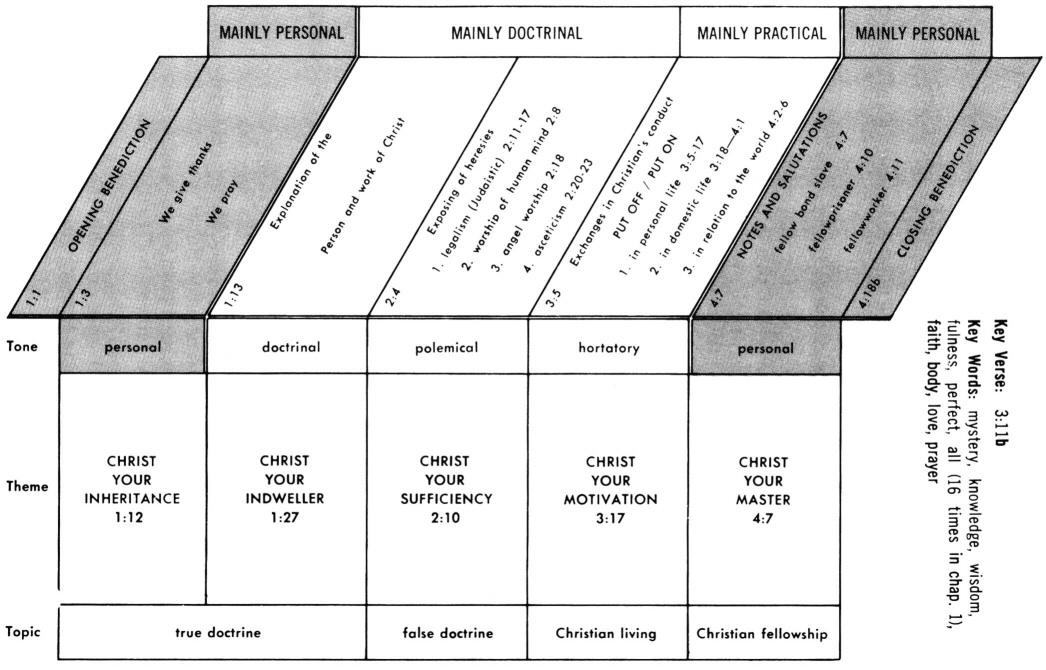
CHRIST IS ALL IN ALL
Click chart to enlarge
Charts from Jensen's Survey of the NT - used by permission
Colossians Overview - Click Chart on right side
| Christ Preeminent in All Things Supreme Lord - Sufficient Savior |
|||
| Colossians 1 | Colossians 2 | Colossians 3 | Colossians 4 |
| Supremacy of Christ |
Submission to Christ |
||
| Doctrinal and Corrective |
Practical and Reassuring |
||
| What Christ Did For Us |
What Christ Does Through Us |
||
| Christ Our Lord |
Christ Our Life |
Christ our Love |
|
| Christ the Head of the Body |
Christ the Lord of the Universe |
Christ the Head of the Home |
|
| Instruction | Warnings | Exhortations | Reminders |
| Reconciliation | Creation | Submission | Conversation |
| His Person and Word |
His Peace and Presence |
||
Colossians 2:20 If you have died with Christ to the elementary principles of the world why, as if you were living in the world do you submit yourself to decrees, such as (NASB: Lockman)
Greek: Ei apethanete (2PAAI) sun Christo apo ton stoicheion tou kosmou, ti os zontes (PAPMPN) en kosmo dogmatizesthe, (2PPPI)
Amplified: If then you have died with Christ to material ways of looking at things and have escaped from the world’s crude and elemental notions and teachings of externalism, why do you live as if you still belong to the world? [Why do you submit to rules and regulations?—such as] (Amplified Bible - Lockman)
Barclay: If you died with Christ to the elements of this world, why do you continue to submit yourselves to their rules and regulations, as if you were still living in a world without God? (Westminster Press)
Lightfoot: You died with Christ to your old life. All mundane relations have ceased for you. Why then do you—you who have attained your spiritual manhood—submit still to the rudimentary discipline of children? Why do you—you who are citizens of heaven—bow your necks afresh to the tyranny of material ordinances, as though you were still living in the world? It is the same old story again; the same round of hard, meaningless, vexatious prohibitions,
Phillips: So if, through your faith in Christ, you are dead to the principles of this world's life, why, as if you were still part and parcel of this world-wide system, do you take the slightest notice of these purely human prohibitions - (Phillips: Touchstone)
Wuest: In view of the fact that you died with Christ from the rudimentary things of the world, why, as living in the world, are you subjecting yourselves to ordinances [such as]
Young's Literal: If you have died with Christ to the elementary principles of the world, why, as if you were living in the world, do you submit yourself to decrees, such as
IF YOU HAVE DIED WITH CHRIST: Ei apethanete (2PAAI) sun Christo:
- Col 3:3, 1Pet 4:1, 2, 3 Died to sin Ro 6:2, self 2Cor 5:14, 15, the law Ro 7:4 7:6; Gal 2:19, the world Gal 6:14
- Col 2:8; Eph 2:15
BELIEVERS HAVE
DIED WITH CHRIST
If (since) you have died (apothnesko - aorist tense in the past) with (syn) Christ - IF is a first class condition which assumes that what follows is true and therefore could be translated SINCE you have died with Christ - When He died, we died (Ro 6:6+, cf Col 2:12+). This truth is so foundational to a life of freedom in Christ that Paul will repeat the truth in the next chapter declaring "you have died (aorist tense) and your life is hidden (perfect = permanently) with (syn = speaks of intimate union) Christ in God. (Col 3:3+)
When did we die? When we believed in Christ, we died with Him on the Cross. The picture Paul is painting is that of the believer's identification or union with Christ in His death, burial and resurrection. (Gal 2:20+). He is now our life. Our boast is now in that old rugged cross "through which the world has been crucified (perfect tense) to (us), and (us) to the world." (Gal 6:14+). The perfect tense indicates a past completed action at a specific point in time with continuing effect, and pictures the lasting effect of our death to the world. Why do so many believers continue to make friends with the world? (cf James 4:4+) And also remember that the word death speaks of separation, so believers now have been separated from this godless, fallen world system ruled by Satan (1Jn 5:19).
What else did the Colossians die to? The Law. Believers "are not under law, but under grace." (Ro 6:14+) If you practice legalism in any form (a list of do's and don'ts) then mark it down -- you have just placed yourself under the dominion of the law. And what does the law do to the fallen flesh (which is still present in believers)? It arouses it and stirs it up so that you commit sin (Ro 7:5+), for example, producing in Paul every kind of coveting (Ro 7:8+)! In Christ you are dead to the Law, having "been released from the Law, having died to that by which we were bound, so that we serve in newness of the Spirit and not in oldness of the letter." (Ro 7:6+)
So what is his point? Paul's reasoning is that because of these great liberating truths, a believer does not have to live like a spiritually dead man but can now live as one alive in Christ, empowered with His resurrection power (Ro 6:4+), energized by the indwelling Holy Spirit (Ep 5:18+, Eph 3:16+). In sum, dying with Christ means not only identification with Him but dying to something -- sin (Ro 6:2+), self (2Cor 5:14, 15+), the law (Ro 7:6+; cf Gal 2:19+). In each of these verses (Ro 6:2, 2Co 5:14-15, Ro 7:6) the tense of the verb apothnesko is aorist which signifies a decisive, final death (to sin, self, law, world). Death with Christ has released us from our previous slavery. Paul is asking the saints at Colossae why would ever think about submitting themselves again to things to which they are now dead?
John Eadie writes "Since ye died off with Christ from the rudiments (first principles, basic principles or elements) of the world” or, have been separated by such a death from the rudiments of the world. The phrase “rudiments of the world” has been already explained in Col 2:8. To be dead to them is to be done with them, or, to be in such a state that they have no longer any authority over us. Thus in Ro 7:3+, Ro 7:4+, the wife by the death of her husband is said to be so free from conjugal law, that she may marry another man. In Gal 2:19, the apostle speaks of being “dead to the law.” The dative is used in those two cases, as if there was a consciousness of complete deliverance. The preposition apo (Ed: conveys separation or dissociation) is here employed to intensify the idea, as if death were followed by distance or removal… They had nothing more to do with the rudiments of the world—and the rudiments of the world had nothing more to do with them. The apostle again introduces his favorite idea of union with Christ. The death of Christ abrogated the ritual law; and being one with Him in that death, they had died to that law—the apo denoting consequent separation. (Colossians 2)
Have died (599) (apothnesko from apo = marker of dissociation implying a rupture from a former association, separation, departure, cessation + thnesko = die) literally means to die off (that is, to die and thus be away from this earthly realm). Apothnesko speaks of literal physical death (Ro 6:9+) but figuratively (metaphorically) of a believer's death to sin (Ro 6:2+, Ro 6:7+, Ro 6:8+, Col 3:3+), self, Satan, the law (Ro 7:6+, Gal 2:19) and the world (Col 2:20+, cp Gal 6:14+ - crucified used instead of died) which was effected when Christ was crucified and when by faith we believed in Him and in God's reckoning (albeit a "mysterious" teaching) were crucified with Him (Ro 6:6+).
It is notable that as life was never meant to be merely existence, death which is the antonym of life does not mean non–existence. The important point is that to die does not mean one is annihilated as some would falsely teach. Everyone who has ever been born will continue to exist, either in the presence of God or to experience conscious existence in separation from God (see 2Th 1:9).
Summary of apothnesko
(1) Literally - To die referring to natural death (opposite of zao = to live), a permanent cessation of all vital functions resulting in the end of life, with a separation of one's soul from their physical body (Mt 8:32, 22:24, 27, 26:35, Heb 9:27, 1Co 15:32, 36; Paul in Php 1:21). Christ's death (Ro 5:6, Ro 5:8, Gal 2:21, 1Co 8:11, 15:3, 2Co 5:15, 1Th 4:14, 1Th 5:10). It should be emphasized that although these passages refer to literal physical death of Christ, they have profound spiritual implications. Note that literal death pictures a separation of the spiritual from the material part of man, the soul from the body.
Most of the uses of apothnesko in the gospels refer to literal physical death (exceptions include Jn 6:50 cp Jn 6:58 not die = live forever = speaks of spiritual rebirth, cp Jn 11:26)
(2) Figuratively - speaks of separation - of not responding to something due to separation from it (1Co 15:31). Separation from God because of sin (Adam died the day (i.e., when, cp. Ezek 33:12) he disobeyed God, Ge 2:17.), which speaks of spiritual death (Ro 7:9, 1Co 15:22 - Death in this sense describes the present condition of all men for all have sinned - see Ro 5:12). Ro 5:15 speaks of the spiritual death all men suffered because of Adam's sin (cp Ro 5:12).
(3) Mixture of literal and figurative - Christ's literal death (first use) and figuratively of death to rule and reign and power of sin (the second use of apothnesko in Ro 6:10, cp similar mixture in 2Co 5:14)
Apothnesko -111x in 100v - NAS = dead(5), death(1), death*(1), die(34), died(53), dies(12), dying(4), mortal(1), perished(1), put(1). Mt 8:32; 9:24; 22:24, 27; 26:35; Mk 5:35, 39; 9:26; 12:19, 20, 21; 15:44; Lk 8:42, 52, 53; 16:22; 20:28, 29, 31, 32, 36; Jn 4:47, 49; 6:49, 50, 58; 8:21, 24, 52, 53; 11:14, 16, 21, 25, 26, 32, 37, 5o, 51; 12:24, 33; 18:14, 32; 19:7; 21:23; Acts 7:4; 9:37; 21:13; 25:11; Ro 5:6, 7, 8, 15; 6:2, 7, 8, 9; 7:2, 3, 6, 10; 8:13, 34; 14:7, 8, 9, 15; 1Cor 8:11; 9:15; 15:3, 22, 31, 32, 36; 2Cor 5:14, 15; 6:9; Gal 2:19, 21; Phil 1:21; Col 2:20; 3:3; 1Thess 4:14; 5:10; Heb 7:8; 9:27; 10:28; 11:4, 13, 21, 37; Jude 1:12; Rev 3:2; 8:9, 11; 9:6; 14:13; 16:3.
Apothnesko occurs over 400x in the Septuagint, the first use being God's instruction to Adam…Genesis 2:17 but from the tree of the knowledge of good and evil you shall not eat, for in the day that you eat from it you will surely die (apothnesko)."
TO THE ELEMENTARY PRINCIPLES OF THE WORLD: apo ton stoicheion tou kosmou:
He has set you free from the evil powers of this world (NLT)
DON'T GO BACK TO
THE" ABC'S"
If (since) you have died with Christ to (apo) the elementary principles (stoicheion) of the world - To is the preposition apo which is a marker of dissociation and implies a rupture of a former association. What are the elementary principles of the world? Some believe this refers to demonic spirits who inspire the godless world to espouse these heretical false teachings. Others say these are "the commandments and teachings of men." (Col 2:22) In Col 2:8 Paul described the "the elementary principles (stoicheion) of the world" as those things which could takes one's mind captive.
Paul's point is that the lusts of this world (cf 1Jn 2:17+) which once held sway over us when we were lost and "in Adam" (Ep 2:2+) have been stripped of their power to control us as result of Christ's death on the Cross and our crucifixion with Him (Gal 6:14).
John MacArthur - Through their union with Christ, the redeemed are set free from man-made rules designed to promote spirituality. To practice asceticism, Paul writes, is to adopt a worldly system of religion, based on elementary principles. (See Colossians and Philemon Commentary)
Bruce Barton - Believers have died with Christ and are no longer under the power of the basic principles of this world—the evil spirits and demonic powers that work against Christ (see Col 2:8). When Christ died, he “disarmed the powers and authorities” (Col 2:15). Believers have died with Christ; thus, they are no longer under the control of those powers and authorities. Their “death” released them from their previous slavery. Paul wondered, somewhat incredulously, why these Colossian believers would even think about submitting themselves to a conquered power. (The verb implies not a reprimand for having done something, but a warning against doing it.) (See Philippians, Colossians, & Philemon - Page 192)
Paul did not say we would necessarily feel like we had died to these elementary principles. Feelings don't change what is now true of every saint in Christ. These truths define our position. Now our goal should be to practice our position each day (aka progressive sanctification). We should accept (believe) these things as true about us and to live accordingly by grace not law (and of course enabled by the Spirit of grace - Heb 10:29b).
The Colossian saints had been freed from the rudimentary things of the world, such as the elementary religious teachings advocating salvation by good works.
THOUGHT- Since the gospel has freed the believer from attempting to gain heaven by self-effort, he should never subject himself again to legalistic ordinances… don't try to gain God's acceptance and pleasure by self-effort. What motivates you to usher, to sing, to teach, to serve in any capacity at your church?
John MacArthur writes that "Through their union with Christ, the redeemed are set free from man-made rules designed to promote spirituality. To practice asceticism, Paul writes, is to adopt a worldly system of religion, based on elementary principles. As already noted, the false teachers taught a form of philosophical dualism. They practiced asceticism in an attempt to free the spirit from the prison of the body. The view that the body was evil eventually found its way into the church. According to the church Father Athanasius, Anthony, the founder of Christian monasticism, never changed his vest or washed his feet (Life of Anthony, para. 47). He was outdone, however, by Simeon Stylites (c. 390-459), who spent the last thirty-six years of his life atop a fifty-foot pillar. Simeon mistakenly thought the path to spirituality lay in exposing his body to the elements and withdrawing from the world. Their feats have been emulated by monks throughout church history. Even Martin Luther, before discovering the truth of justification by faith, nearly wrecked his health through asceticism. (MacArthur, J. Colossians. Chicago: Moody Press)
Adam Clarke feels the elementary principles refers to Jewish laws and ceremonies writing "Ye have renounced all hope of salvation from the observance of Jewish rites and ceremonies, which were only rudiments, first elements, or the alphabet, out of which the whole science of Christianity was composed. We have often seen that the world and this world signify the Jewish dispensation, or the rites, ceremonies, and services performed under it.
Paul addresses a similar issue in his letter to the Galatians writing that "while we were children ("Before our “coming of age” when we came to saving faith in Jesus Christ), were held in bondage under the elemental things (from Greek word meaning “row” or “rank” and used to speak of basic, foundational things like letters of the alphabet and here as reference to basic elements and rituals of human religion - they were elemental because they are merely human, never rising to the level of the divine) of the world. (Gal 4:3+)
Paul goes on to add the contrast that "But now that you have come to know God, or rather to be known by God (BELIEVERS), how is it that you turn back again to the weak and worthless elemental things (things connected with the law, such as circumcision, holy days, and rules of diet), to which you desire to be enslaved all over again? (Gal 4:9+)
Perhaps the question will arise in some minds: If a Christian is dead to ordinances, why does he still retain baptism and the Lord’s Supper? The most obvious answer is that these two ordinances of the Christian Church are taught in the NT. However, they are not “means of grace,” making us more fit for heaven or helping us to gain merit before God. Rather, they are simple acts of obedience to the Lord, indicating, respectively, identification with Christ and remembrance of Him in His death. They are not so much laws to be kept as privileges to be enjoyed, motivated by our love and respect for God and empowered by the Spirit.
Peter describes how a "dead" person in Christ should now live - Therefore, since Christ has suffered in the flesh, arm yourselves also with the same purpose, because he who has suffered in the flesh has ceased from sin, 2 so as to live the rest of the time in the flesh no longer for the lusts of men, but for the will of God. 3 For the time already past is sufficient for you to have carried out the desire of the Gentiles, having pursued a course of sensuality, lusts, drunkenness, carousing, drinking parties and abominable idolatries. 4In all this, they are surprised that you do not run with them into the same excesses of dissipation, and they malign you; (1Pe 4:1-4+).
Elementary principles (4747) (stoicheion from stoicheo = march in rank from stoíchos = row) describes something orderly in arrangement as for example one of a row (or like "ABC") and hence a component or element. In most of its uses, it denotes an elementary or fundamental principle in a subject or discipline. It refers to the first principles of something. Stoicheion means any first thing from which others in a series arise. The root meaning of these words is a row, rank or series. It is to walk or march in rank. It is also used of the letters of the alphabet, as elements of speech. It is used of the substance of the material world. Stoicheion refers to the basic components of something, as for example the basic elements from which everything in the world is made and of which it is composed. Stoicheion refers to the rudimentary elements of anything or what belongs to a basic series in any field of knowledge. For example, in grammar, the ABCs, in speech, basic sounds, in physics, the four basic elements (earth, air, fire, water), in geometry, the axioms and in philosophy, the givens.
Stoicheion - 7x in 7v - Gal 4:3, 9; Col 2:8, 20; Heb 5:12; 2Pet 3:10, 12. NAS = elemental things(2), elementary principles(2), elementary*(1), elements(2), principles(1).
World (2889) (kosmos from kosmeo = to order or adorn, to put in order [Mt 25:7 = "trimmed"], to adorn literally [1Ti 2:9], to adorn figuratively [Titus 2:9+]) means essentially something that is well-arranged, that which has order or something arranged harmoniously. Kosmos refers to an ordered system or a system where order prevails. In the New Testament, more often (as in Col 2:20), kosmos refers not to the physical earth or universe but to the man-centered (humanistic), Satanically directed system of this present evil age, which is alienated from and hostile toward God and God’s people. Kosmos represents the self-centered, godless value system and "ethical" mores of fallen mankind. The goal of the world is self-glory, self-fulfillment, self-indulgence, self-satisfaction, and every other form of self-serving.
WHY AS IF YOU WERE LIVING IN THE WORLD DO YOU SUBMIT YOURSELF TO DECREES SUCH AS: ti os zontes (PAPMPN) en kosmo dogmatizesthe (2PPPI):
- Jn 15:19; 17:14, 15, 16; 2Cor 10:3; Jas 4:4; 1Jn 5:19) (Col 2:14,16; Gal 4:3,9, 10, 11, 12 Heb 13:9
THE SUBTLE SNARE
OF LEGALISM/ASCETICISM
Why as if you were living in the world do you submit yourself to decrees such as - In other words Paul is saying why are you living as though you were finding all your interests, enjoyments and aims as those do who know not God and are without Christ.
Living (2198) (zao cp word study on zoe) is not merely existing or dwelling, but possessing a life the very essence of which is relationship with Christ, Who came to give life and to give it abundantly (Jn 10:10). This quality of life has moral associations which are inseparable from it, such as holiness and righteousness. As death and sin are associated in Scripture and in experience, so are life and holiness.
In the world - Believers are to be in the world but not "of" the world (in = Jn 17:11, not of = Jn 17:14, 15, 16, 18). We are to be lights in the world (Mt 5:14-16, 16, Php 2:15). We are not to "internalize" the world's godless (God hating), Christ-less philosophies. We are to be like boats in the water. That is our design. But when water (world) gets in the boat, that is disaster! This truth is illustrated by a submarine which is fully functional in water but is ruined if water comes within. A submarine on the ground (out of the water) is useless and is not accomplishing its mission. When it is in the water it must be insulated (not isolated) from the water. If the water ever gets into the submarine then there is cause to sound the alarm. Believers are to be insulated from the world (like Daniel in the midst of idol infested Babylon) but not isolated from the world. Are you in a holy huddle or are you actively pursuing your calling to be salt and light in the world among those who are dead in its trespasses and sins and need to be thrown the life saving Gospel, which they may grab hold of or sadly refuge and drown forever in the eternal abyss. We cannot save them but we can throw them a life preserver!
Submit… to decrees (1379) (dogmatizo from dogma = rule, decree, regulation, ordinance - a formalized rule or set of rules prescribing what one must do) means to put others under obligation by imposition of rules. In the passive sense as used in this passage the idea is to submit to rules and regulations ("dogma"). There are 3 uses in the Septuagint - Esther 3:9; Dan 2:13, 15.
The saints at Colossae were being told that it was wrong to eat certain foods, etc. They were told that keeping these man-made rules was the key to spirituality. The practices Paul is alluding to appear to be forms of asceticism and legalism.
IVP Background Commentary - The (Col 2:20) “decrees” (NASB) or “rules” (NIV, TEV) may be Jewish “regulations” (NRSV), as in Col. 2:14. (Although the language with which Paul describes them in Col. 2:21 has been compared to descriptions of Pythagorean asceticism, the language could fit Old Testament purity rules just as well.) Most Jews outside Palestine still kept the food laws, and some Jews forbade even touching particular foods (Letter of Aristeas 129); other Old Testament laws explicitly decreed one impure for touching some things. (This application would be especially appropriate if Paul thought of people adding to those rules, as Jewish teachers noted that Eve or Adam her tutor apparently added “Do not touch” to God’s “Do not eat”—Genesis 2:17; Genesis 3:3.)
Ironside…
In Colossians 2:20, 21, 22, 23 the apostle Paul warned against the folly of seeking holiness through asceticism. He connected ascetic practices with the philosophies alluded to in Col 2:8, which he designated "the rudiments of the world." Challenging the believer, who as a new man in Christ (see New Man or New Self) has died with Him to his old place and condition in the world, Paul asked, "Wherefore if ye be dead with Christ from the rudiments of the world, why, as though living in the world, are ye subject to ordinances… after the commandments and doctrines of men?" All these rules and regulations for the subduing of the body are based on the principles of the world. They take for granted that God is still trying to improve the flesh, and this we know is not His purpose.
Through John the Baptist, God said, "The ax is laid unto the root of the trees" (Mt 3:10). But from the early days of Christianity to modern times, men have used the ax, or the pruning knife, on the fruit of the trees, as though the trees might be improved if the bad fruit were cut off. Men say,
Get people to reform, to sign pledges, to put themselves under rules and regulations, to starve the body, to inflict physical suffering on it, and surely its vile propensities will be annulled if not eliminated. Little by little people will become spiritual and godlike.
Thousands have agreed with the one who said,
Every day, in every way
I am getting better and better.
But no amount of self-control, no physical suffering whatever can change the carnal mind, which Scripture emphatically calls the flesh.
Saint Jerome lived a lecherous life in his youth, but after he became a Christian he fled from all contact with the gross and vulgar world in which he had once sought to gratify every fleshly desire. He left Rome, wandered to Palestine, and lived in a cave near Bethlehem, where he sought to subdue his carnal nature by fasting almost to starvation. So he was greatly disappointed when, exhausted and weary, he fell asleep and dreamed he was still rioting among the dissolute companions of his godless days.
The flesh cannot be starved into subjection. It cannot be improved by subjecting it to ordinances, whether human or divine. But as we walk in the Spirit and fill our minds with thoughts of the risen Christ, we are delivered from the power of "fleshly lusts, which war against the soul" (1Peter 2:11+). (Commentary)
Eadie explains that since "the Colossians had been translated into the kingdom of God's dear Son, therefore the code of the realm which they had left had no more force upon them. A Russian naturalized in Britain need not trouble himself about any imperial ukase, as if he yet lived under the Autocrat. (Colossians 2)
Asceticism (Wikipedia, Memidex) is the teaching that spirituality is attained through renunciation of physical pleasures and personal desires while concentrating on “spiritual” matters. It describes the practicing of strict self-denial as a measure of personal and spiritual discipline. Asceticism often proceeds on the assumption that the physical body is evil and is ultimately the cause of sin but this is not a biblical concept.
The Columbia Encyclopedia says that asceticism involves "rejection of bodily pleasures through sustained self-denial and self-mortification, with the objective of strengthening spiritual life. Asceticism has been common in most major world religions, including Buddhism, Hinduism, Islam, Judaism, and Christianity: all of these have special ascetic cults or ascetic ideals. The most common ascetic practice is fasting, which is used for many purposes—to produce visions, as among the Crow; to mourn the dead, as among various African peoples; and to sharpen spiritual awareness, as among the early Christian saints. More extreme forms have been flagellation (see flagellants) and self-mutilation, usually intended to propitiate or reach accord with a god." (The Columbia Encyclopedia)
The International Standard Bible Encyclopedia adds that "Asceticism is not easily defined because of its diverse manifestations, but in general it involves self-deprivation and is usually pursued out of a desire to glorify God by avoiding what is harmful and by limiting oneself to what is necessary to maintain life. It is unfortunately susceptible to the danger that the pursuit may become subtly diverted to a desire to outstrip one’s fellows and to be credited with a holiness of life unattained by ordinary mortals. These spiritually elite, in turn, may seek to dominate other lives. “There is no pride like that which bases on ascetic austerity the claim to direct with authority the life and conduct of others” (James Denney). (Bromiley, G. W. The International Standard Bible Encyclopedia)
Legalism refers to an emphasis on man-made rules and prohibitions as the standard for spirituality. Have you been around people like this? The specific rules and prohibitions may be different today, but the error is the same. And so people come into the body of Christ and tell you how wrong it is to drink alcohol, to watch secular movies, to play cards, to wear make-up or fashionable clothes, to listen to secular music, to dance, and on and on. These individuals are not only convinced that these practices are wrong but consider it as their duty to judge you as unspiritual because you do them!
Nelson's New Christian Dictionary says that legalism is a…"Moral attitude that identifies Christian morality with the literal observance of biblical laws and claims superiority in so doing. The allegation of legalism is often leveled at Christians who believe that God’s Word in Scripture gives specific teaching against certain actions and behavior." (Kurian, G. T. Nelson's new Christian dictionary: Nashville, Tenn.: Thomas Nelson)
Legalism tends to promote self-righteousness and pride and hypocrisy, which are some of the most hateful attitudes to God (Mt 23:25,26)!
Legalism commonly denotes preoccupation with form at the expense of substance.
Legalism needlessly alienates non-Christians. It misrepresents God as a Cosmic Killjoy instead of the Giver of Abundant Life. It implies that we have to clean ourselves up morally before we can come to Christ, instead of coming to him as we are and allowing him to change us from the inside out. It creates ghettos of finger-pointers instead of people like Jesus, who never compromised morally, but loved lost people and became known as "the friend of sinners."
Legalism and asceticism do not work to make one more like Christ, Who was the epitome of "spirituality" and perfect righteousness! These genre of "religiosity" may look impressive, but they only manages the outside, the externals and fail to cleanse our inner heart and so fail to liberate us from the control of our sin nature inherited from Adam.
Jesus leveled some of His harshest criticism at the penultimate legalists of His day declaring
"Woe to you, scribes and Pharisees, hypocrites! For you are like whitewashed tombs which on the outside appear beautiful, but inside they are full of dead men's bones and all uncleanness. Even so you too outwardly appear righteous to men, but inwardly you are full of hypocrisy and lawlessness." (Mt 23:27-28)
How then can one achieve control his or her evil desires? The only thing that can control the depraved lusts that originate from our old sin nature inherited from Adam is death. Why? Because death separates. Death liberates. Death frees. In Romans 6 Paul explains that when Christ died, believers died to the power of sin once and for all. It does not matter whether we "feel" like we are dead to sin or not! Scripture teaches that this is now a believer's position (and possession) in Christ and nothing can change that truth. Now our goal is to work out that salvation truth in fear and trembling, knowing that it is still God Who is at work in us to give us the desire and the power to work it out! (Phil 2:12+, Phil 2:13NLT+) See notes on Ro 6:1,2, 3+ for discussion of how to walk in victory (Also see notes on Ro 6:4-14-- Ro 6:4-5, 6-7, 8-10, 11, 12-14)
Lightfoot paraphrases Colossians 2:20-23 - "You died with Christ to your old life. All mundane relations have ceased for you. Why then do you—you who have attained your spiritual manhood—submit still to the rudimentary discipline of children? Why do you—you who are citizens of heaven—bow your necks afresh to the tyranny of material ordinances as though you were still living in the world? It is the same old story again; the same round of hard, meaningless, vexatious prohibitions, “Handle not,” “Taste not,” “Touch not.” What folly! All these things—these meats and drinks and the like—are earthly, perishable, wholly trivial and unimportant! They have already been used, and there is an end of them. What is this but to draw down on yourselves the denunciations uttered by the prophet of old? What is this but to abandon God’s word for precepts which are issued by human authority and inculcated by human teachers? All such things have a show of wisdom, I grant. There is an officious parade of religious devotion, an eager affectation of humility; there is a stern ascetic rigor which ill-treats the body. But there is nothing of any real value to check indulgence of the flesh."
Aren't believers encouraged to fast? The answer of course is yes but it is a qualified "yes" even as our Lord Jesus warned…
And whenever you fast, do not put on a gloomy face as the hypocrites do, for they neglect their appearance in order to be seen fasting by men. Truly I say to you, they have their reward in full. But you, when you fast, anoint your head, and wash your face (Mt 6:16-18+)
There are a number of books available on this discipline but many are not biblically sound and border on the mystical. In his Preface to A Hunger for God (excellent resource available free for download as a Pdf) Dr John Piper gives believers wise counsel regarding the spiritual discipline of fasting writing…
Beware of books on fasting. The Bible is very careful to warn us about people who “advocate abstaining from foods, which God created to be gratefully shared in by those who believe and know the truth” (1Timothy 4:1, 2, 3). The apostle Paul asks with dismay, “Why … do you submit yourself to decrees, such as ‘Do not handle, do not taste, do not touch’?” (Colossians 2:20, 21). He is jealous for the full enjoyment of Christian liberty. Like a great declaration of freedom over every book on fasting flies the banner, “Food will not commend us to God; we are neither the worse if we do not eat, nor the better if we do eat” (1Corinthians 8:8). There once were two men. One said, “I fast twice a week”; the other said, “God be merciful to me a sinner.” Only one went down to his house justified (Luke 18:12, 13, 14).
The discipline of self-denial is fraught with dangers— perhaps only surpassed by the dangers of indulgence. These also we are warned about: “All things are lawful for me, but I will not be mastered by anything” (1Cor 6:12). What masters us has become our god; and Paul warns us about those “whose god is their appetite” (Php 3:19+). Appetite dictates the direction of their lives. The stomach is sovereign. This has a religious expression and an irreligious one. Religiously “persons … turn the grace of our God into licentiousness” (Jude 4) and tout the slogan, “Food is for the stomach and the stomach is for food” (1Corinthians 6:13). Irreligiously, with no pretext of pardoning grace, persons simply yield to “the desires for other things [that] enter in and choke the word” (Mark 4:19).
“Desires for other things”—there’s the enemy. And the only weapon that will triumph is a deeper hunger for God. The weakness of our hunger for God is not because he is unsavory, but because we keep ourselves stuffed with “other things.” Perhaps, then, the denial of our stomach’s appetite for food might express, or even increase, our soul’s appetite for God. (Piper, John. available in Pdf online - A Hunger for God)
Colossians 2:21 Do not handle, do not taste, do not touch)! (NASB: Lockman)
Greek: Me apse (2PAMS) mede geuse (2SAMS) mede thiges, (2SAAS)
Amplified: Do not handle [this], Do not taste [that], Do not even touch [them], (Amplified Bible - Lockman)
Barclay: “Handle not! Taste not! Touch not!” are their slogans. (Westminster Press)
Lightfoot: ‘Handle not,’ ‘Taste not,’ ‘Touch not.’ What folly!
Phillips: "Don't touch this," "Don't taste that" and "Don't handle the other"? (Phillips: Touchstone)
Wuest: do not begin to touch, neither begin to taste, nor begin to handle,
Young's Literal: "Do not handle, do not taste, do not touch!"
DO NOT HANDLE: HANDLE:me apse (2PAMS):
DO NOT
HANDLE!
Do not handle (hapto/haptomai) - This is the first of 3 man made rules, not God given rules, and the practice of any or all of these prohibitions will place a person under the law and will fail produce godly righteousness. Ray Stedman says it well that these are The Things that can Ruin your Faith.
Utley - Humans have always had an ascetic, legalistic tendency (cf. Isa. 29:13; Mt. 15:10-12; Mk 7:19; Ro 14:17,21), but it is a hollow religion of self effort, self glory and self sufficiency (cf. Col. 2:22-23).
Paul is describing the essence of the practice of asceticism, an over-developed zeal, a dedication that goes far beyond true Christian discipline and seeks to please God by extreme forms of self-denial. Dedication and discipline are a proper part of the Christian life. You must often make yourself (enabled by grace and the indwelling Spirit) do what God wants you to do, simply because you love him. Love is the proper motive for obedience and the Spirit and grace (in contrast to self effort) is the proper power.
Paul has already commended the Colossians because they led disciplined (Col 2:5+), well-ordered lives. But you can make a god of discipline. You can take perverse delight in making yourself do difficult things that win the approval of others, and (you deceptively imagine), of God as well. As a monk, Martin Luther fell into such empty practices before he became a believer. He would lie naked in his cell all night long in the bitter cold and he beat his body and tortured himself, trying to find peace of heart.
Ray Stedman writes:
"I grew up in Christian evangelical churches that taught there were certain things that Christians must always avoid, and if you observed these taboos you not only were acceptable to the religious community but you were actually pleasing God. I was taught that Christians never drink, never dance, never smoke, never go to movies, never play cards, and never read novels. These prohibitions were usually thundered at us! I do not deny that refraining from some of these things is a perfectly proper discipline of the spirit, but any idea that giving up of things of itself is pleasing to God, is wrong. Christianity is a positive faith. If you want to know what pleases God, read the last twelve verses of Ro 12. You will not find anything negative there. Rather, we are asked to "bless those who persecute you," to love the unlovely and minister to the strangers in our midst. Do things that other people cannot do; that is how true faith is demonstrated."
But what is wrong with fasting until one is close to death, wearing hair shirts, refusing to marry, eating only vegetables, praying by the clock, etc.? Three things:
First, it shows you do not understand your death with Christ. "Since you died with Christ to the basic principles of this world [or, as we saw earlier, "to the elemental spirits of the universe"], why, as though you still belonged to it, do you submit to its rules?" To do so is to return to childish behavior---thinking that God will be pleased by your negative approach to life.
In the church this becomes what we call "legalism," which is to pursue holiness by self-effort, instead of accepting the holiness that God freely gives, by faith, and then living it out in terms of experience. A legalist looks at life and says, "Everything is wrong unless you can prove by the Bible that it is right. Therefore, we must have nothing to do with anything that the Bible does not say is right." That reduces life to a very narrow range of activity. But the biblical Christian looks at life and says, "Everything is right! God has given us a world to enjoy and live in. Everything is right, unless the Bible specifically says it is wrong." Some things are wrong; they are harmful and dangerous. Adultery is always wrong. So is fornication. Sexual promiscuity is wrong. Lying and stealing are wrong. These things are never right. But there is so much that is left open to us. If we are willing to obey God in the areas that he designates as harmful and dangerous, then we have the rest of life to enter into in company with a Savior who loves us, and who guides and guards us in our walk with him.
Secondly, Paul says that whatever benefit these things may gain it is only temporary, it all ends at death.
"These are all destined to perish with use, because they are based on human commands and teachings."
That is why Jesus took the Pharisees to task:
"You observe these minute rituals, but inwardly you are tombs, filled with dead men's bones."
Outwardly you look good, but inwardly you are like a grave full of rotting bones. Your scrupulous refusal to live normal lives gives you certain status and privilege, but it will all prove worthless in the end.
Thirdly, the apostle declares these things are of no value in restraining the indulgence of the flesh. People may outwardly appear dedicated and disciplined, but inwardly sin rages unchecked. Inside they are angry, resentful, filled with vituperation and a spirit of vengeance. Many Christians have this problem. They are trying to regulate the externals instead of walking in the fullness and freshness of life with Jesus Christ, finding the inward purity and cleansing that He alone provides.
All of these errors have one thing in common---they lose the vital relationship we have "in Christ"! If you fall into any, you lose the vitality and vigor of your Christian walk. Life becomes dull and often desperate. Many Christians discover this has happened to them. What they need to do is to return to Jesus (Rev 2:4). When these things take over even here in this place, return to Him. We must take care that every day we are in touch (Col 2:19 "hold fast to the head") with our loving Lord and walking in fellowship with Him. He is the One who can develop the "self-life", and yet keep us from being captured by the great god, "Self". He will restore and comfort us when we fail and falter, and in submission to Him we will find the freedom we seek. (see full message The Things that can Ruin your Faith) (Bolding added)
Handle (681) (hapto/haptomai from from hapto = to fasten to, to connect, bind) means to make close contact and to touch or take hold of something or someone. Haptomai refers to such handling of an object as to exert a modifying influence upon it or upon oneself. Although Paul uses the verb literally in this verse, elsewhere he uses it figuratively meaning to not "touch a woman" sexual sense (see 1 Cor 7:1). Haptomai involves a conscious effort to touch, an idea that is absent from the other word for touch, thiggano (see below) The NAS picks up the sense translating it "handle". Think for a moment about the distinction between ''handling'' something versus simply ''touching'' it.
HAPTO - 37v - Matt. 8:3; Matt. 8:15; Matt. 9:20; Matt. 9:21; Matt. 9:29; Matt. 14:36; Matt. 17:7; Matt. 20:34; Mk. 1:41; Mk. 3:10; Mk. 5:27; Mk. 5:28; Mk. 5:30; Mk. 5:31; Mk. 6:56; Mk. 7:33; Mk. 8:22; Mk. 10:13; Lk. 5:13; Lk. 6:19; Lk. 7:14; Lk. 7:39; Lk. 8:16; Lk. 8:44; Lk. 8:45; Lk. 8:46; Lk. 8:47; Lk. 11:33; Lk. 15:8; Lk. 18:15; Lk. 22:51; Jn. 20:17; Acts 28:2; 1 Co. 7:1; 2 Co. 6:17; Col. 2:21; 1 Jn. 5:18
DO NOT TASTE: mede geuse (2SAMS):
DO NOT TASTE!
Do not taste - Christ had freed them from the taboos of asceticism, which can only give a pretense of wisdom, promote a self-made religion, and deal severely with the body. And as indicated in Col 2:23 cannot succeed in combating the desires of the flesh.
Taste (1089) (geuomai) means to taste with the mouth and is used literally in this verse. To cause to taste, to let taste. Geuomai is used figuratively in Hebrews 6:9 to mean to come to know, which conveys the idea of experiencing something to the full.
Friberg - (1) literally, as testing a liquid by sipping taste (Mt 27.34); as partaking of food eat, partake of, enjoy (Acts 10.10); (2) figuratively come to know, experience, partake of (Heb 2.9)
Gilbrant - In classical Greek the primary meaning of geuō is “to taste.” It normally appears in the middle voice, geuomai. It is used both literally, in the sense of tasting food, and metaphorically, in the sense of perceiving something or personally experiencing something (for example, to taste of death). The Septuagint has numerous references to the term geuō. For example, the hungry Esau desired to have a “taste” (or “swallow,”) of Jacob’s stew (Ge 25:30). Jonathan “tasted” the forbidden honey (1 Sa 14:24,29,43). Job compared the palate’s ability to “taste” food with the ear which discerns words (Job 12:11; 34:3). The king of Nineveh, as a result of Jonah’s preaching, declared that neither man nor beast should “taste” a thing while they humbled themselves before God (Jonah 3:7). The New Testament uses geuō (or geuomai) both literally and metaphorically. Examples of its literal usage include the instance on the cross when Jesus “tasted” but would not drink the wine mingled with gall (Matthew 27:34). The headwaiter of the marriage feast in Cana “tasted” the water that Jesus turned into wine (John 2:9). Also, the Jewish conspirators against the apostle Paul took an oath not to “taste” anything until they had killed Paul (Acts 23:14). Geuō is one of at least nine different verbs in the New Testament for tasting and/or eating food. Metaphorically, geuō is used several ways in the New Testament. For example, Jesus “tasted” death for all men (Heb 2:9). He personally experienced the painful reality of death so believers might not “taste” of death (John 8:52; see also Mt 16:28 = "who will not taste death"; Mark 9:1; Luke 9:27). In a more positive sense, believers have “tasted” of the heavenly gift and the good Word of God (Hebrews 6:4,5). All of these references indicate that believers can presently “experience” the benefits of Calvary and have a foretaste of the age to come. (Complete Biblical Library Greek-English Dictionary)
Geuomai - 15x in 15v - eat(1), eaten(1), taste(8), tasted(4), tasting(1). Matt. 16:28; 27:34; Mk. 9:1; Lk. 9:27; 14:24; Jn. 2:9; 8:52; Acts 10:10; 20:11; 23:14; Col. 2:21; Heb. 2:9; 6:4-5; 1 Pet. 2:3
Geuomai - 13x in 12v in the Septuagint - Gen. 25:30; 1 Sam. 14:24,29,43; 2 Sam. 3:35; 19:35; Job 12:11; 20:18; 34:3; Ps. 34:8; Prov. 31:18; Jon. 3:7
Genesis 25:30 and Esau said to Jacob, “Please let me have a swallow of (Lxx = geuomai) that red stuff there, for I am famished.” Therefore his name was called Edom.
Some would come along and say that if you smoke, you can't be spiritual. C. H. Spurgeon, the "prince of preachers" smoked a big cigar daily until the day he died. At Southwestern Seminary in Ft. Worth, there is a picture of Spurgeon with two fingers painted out because he was holding a stogie and that didn't look very "spiritual"!
ILLUSTRATION - One of Spurgeon's "spiritual" friends ask him when he was going to get right with God and stop smoking cigars to which Spurgeon replied:
"When I start smoking to excess."
The "legalist" queried him further:
"What is excess?" to which Spurgeon quipped
"Two at a time!"
The message is that we must be very careful how we handle someone else's supposedly non-conformity. We are all under grace not law (Ro 6:14, Gal 4:9) and grace is not license but balance. Legalism is largely negative in nature.
Christianity is balanced between God ordained (and empowered) negative and positive aspects.
Denying the body its desires merely arouses them, as is well known by many who have tried to lose weight by sticking to rigid diets. Neglecting the body, Paul argued, does not nourish the spirit. This principle is found in Romans 7 where Paul wrote…
while we were in the flesh, the sinful passions, which were aroused by the Law, were at work in the members of our body to bear fruit for death. (see note Romans 7:5)
DO NOT TOUCH: mede thiges (2SAAS):
- Ge 3:3; Isa 52:11; 2Cor 6:17; 1Ti 4:3
DO NOT TOUCH!
Do not touch - Each of theses negative statements speak of asceticism which is the extreme practice of self-denial. This can never succeed in combating the desires of the flesh. Only the Cross is able to do that, giving us the capacity to daily put to death the (evil) deeds of the body by the power of the Spirit (Ro 8:13+) Notice how these prohibitions progress from not handling to not even touching. This same legalism was manifest in Eve’s carnal exaggeration, “You must not touch it, or you will die” (Ge 3:3+; cf. Ge 2:16,17+). There is a legitimate "no touch" (2Co 6:17+ read context 2Co 6:14-18+ and 2Cor 7:1+). but this obedience from the heart (Ro 6:17+) is made possible because now we serve in newness of the Spirit (Ro 7:6+) in the atmosphere of grace (Titus 2:11+; Titus 2:12+).
But the Bible does talk about Self-denial and I would submit while it is the self that must deny, the desire and the power to do so comes from the indwelling Holy Spirit (Php 2:13NLT+). Self-denial becomes sin when driven by the flesh and carried out in an attempt to make a statement to ourselves or to others about our "high degree" of spiritual maturity and our high standing before God!
As those who have been bought with a price, all believers must remember that we were not saved by our fleshly deeds of righteousness (Titus 3:5+, 2Ti 1:9+, Ep 2:9+). We are not sanctified by our own deeds of righteousness. Self-denial can be extreme and still be right for our Lord Himself said that…
"If anyone wishes to come after Me, let him deny himself, and take up his cross daily and follow Me." (Lk 9:23+)
THOUGHT - So with every deed (every prayer, every day of fasting, etc), we need to ask the important question "What's my MOTIVE?" Am I doing this deed out of loving obedience to my Lord, my absolute Master? We cross the line into asceticism when we begin to deny the body to prove to others how spiritual we are -- this can be a subtle trap for us all. Be alert. Remember that one day even our motives will be brought to the light (1Cor 4:5+). Abide in the Vine (Jn 15:5+). Walk by faith (2Cor 5:7+, cp Col 2:6+). A good test to apply to our "deeds" is given by Paul in Galatians 1:10+ "For am I now seeking the favor of men, or of God? Or am I striving to please men? If I were still trying to please men, I would not be a bondservant of Christ." Let us all be "trying to learn what is pleasing to the Lord." (Ep 5:10+)
An ascetic individual practices rigorous self-denial and even self-mortification in order to become more spiritual. Ascetic practices were popular during the Middle Ages: wearing hair shirts next to the skin, sleeping on hard beds, whipping oneself, not speaking for days (maybe years), going without food or sleep, etc. Ascetics take something that is potentially good, pervert it and make it wrong and of no real spiritual or eternal value. They take legalism (which is simply adding works to God), and say that if you do these things, it makes you spiritual.
There is a definite relationship between legalism and asceticism, for the ascetic often subjects himself to rules and regulations. Certain foods or practices are unholy and must be avoided. Other practices are holy and must never be neglected. The ascetic’s entire life is wrapped up in a system of rules.
Remember that prohibitions from whatever these material things are, that the ascetics say is "unclean" has nothing to say to believers who have died to those kinds of decrees (dogma). In Col 2:14 (see note) Paul reminds us that Jesus has canceled out decrees.
A T Robertson has some insightful comments writing that "The Essenes took the Mosaic regulations and carried them much further and the Pharisees demanded ceremonially clean hands for all food. Later ascetics (the Latin commentators Ambrose, Hilary, Pelagius) regard these prohibitions as Paul's own instead of those of the Gnostics condemned by him. Even today men are finding that the noble prohibition law needs enlightened instruction to make it effective. (This is an excellent point… many evangelicals do not understand our relationship to the prohibitive commands in the NT , as well as those still relevant from the OT, and how we are now to carry them out… so sadly on one hand we see those who turn grace into LICENSE & on the other hand those who put us who are now under grace back up under the law ~ LEGALISM.) That is true of all law. The Pharisees, Essenes, Gnostics made piety hinge on outward observances and rules instead of inward conviction and principle. These three verbs are all in the aorist subjunctive second person singular with mê, a prohibition against handling or touching these forbidden things. Two of them do not differ greatly in meaning. Hapsêi is aorist middle subjunctive of haptô, to fasten to, middle, to cling to, to handle. Thigêis is second aorist active subjunctive of thigganô, old verb, to touch, to handle. In N.T. only here and Hebrews 11:28; 12:20 Geusêi is second aorist middle subjunctive of geuô, to give taste of, only middle in N.T. to taste as here.
Colossians 2:22 (which all refer to things [are] destined to perish with use) -in accordance with the commandments and teachings of men? (NASB: Lockman)
Greek: a estin (3SPAI) panta eis phthoran te apochresei, kata ta entalmata kai didaskalias ton anthropon?
Amplified: Referring to things all of which perish with being used. To do this is to follow human precepts and doctrines. (Amplified Bible - Lockman)
Barclay: These are rules which are humanly taught and humanly imposed, and they are rules which deal with things which are destined for decay as soon as they are used. (Westminster Press)
Phillips: "This", "that" and "the other" will all pass away after use! I know that these regulations look wise with their self-inspired efforts at worship, their policy of self-humbling, and their studied neglect of the body. But in actual practice they do honour, not to God, but to man's own pride. (Phillips: Touchstone)
Wuest: which things all are destined for corruption in their consumption; [ordinances] which are according to the precepts and teachings of men
Young's Literal: These are matters which have, to be sure, the appearance of wisdom in self-made religion and self-abasement and severe treatment of the body, but are of no value against fleshly indulgence.
ALL REFER TO THINGS DESTINED TO PERISH WITH THE USING IN ACCORDANCE WITH THE COMMANDMENTS AND TEACHINGS OF MEN: a estin (3SPAI) panta eis phthoran te apochresei kata ta entalmata kai didaskalias ton anthropon
- Mk 7:18,19;7:20, Jn 6:27; 1Cor 6:13
- Isa 29:13,18; Mt 15:3-9; Mk 7:7, 8, 9, 10, 11, 12, 13; Titus 1:14
- Colossians 2 Resources - Multiple sermons and commentaries
ALL PERISHABLE
which all refer to things [are] destined to perish with use - This points out the futility of asceticism, which is the attempt to achieve holiness by rigorous self-neglect (v23), self-denial (v21), and even self-infliction. Since asceticism focuses on temporal “things which perish with the using,” it is powerless to restrain the old flesh nature we all inherited from Adam and it is of no value in bringing us to God. While reasonable care and discipline of one’s body is of temporal value (1Ti 4:7, 8notes), it has no eternal value, and the extremes of asceticism serve only to gratify the flesh and bloat one's ego.
Ascetics often seek only to put on a public show of their supposed holiness. Jesus gave a stern warning against this type of "religious garb" warning men to "Beware of practicing your righteousness before men to be noticed by them; otherwise you have no reward with your Father who is in heaven. When therefore you give alms, do not sound a trumpet before you, as the hypocrites do in the synagogues and in the streets, that they may be honored by men. Truly I say to you, they have their reward in full." (Mt 6:1,2+)
Later in this same sermon He added that "whenever you fast, do not put on a gloomy face as the hypocrites do, for they neglect their appearance in order to be seen fasting by men. Truly I say to you, they have their reward in full. But you, when you fast, anoint your head, and wash your face, so that you may not be seen fasting by men, but by your Father who is in secret; and your Father who sees in secret will repay you." (Mt 6:16, 17, 18notes).
To perish with the using - Literally, "are for corruption". Paul is probably again talking about food/drink and denying yourself with fasting. There was a sect that believed that if they fasted enough, they could enter into the heavenly kingdom, into the presence of a spiritual being.
Perish (5356) (phthora from phtheíro = to shrivel or wither, spoil , ruin , deprave, corrupt , defile, to destroy by means of corrupting, to spoil as does milk. Ethically phtheiro was the opposite of sozo) refers to a state of ruin or destruction with the picture of deterioration, dissolution, disintegration, ruin, perishing, decay or rotting like organic matter (breakdown of organic matter). Phthora was sometimes used of decaying food, which turns from that which is beneficial to that which is harmful.
The basic idea of phthora is not a sudden destruction owing to external violence, but a dissolution brought about by internal decay. It describes decomposition which brings to mind the picture of loathsome decaying matter replete with maggots and other macabre microbes! Figuratively the idea is that of the horrible thought of the "rotting" of one's morals which become more depraved with greater loss of integrity as a result of "slow internal decay".
Phthora pictures a departure from the original or from what is pure or correct and aptly depicts the moral filth and pollution of the world without God! It is the very opposite of "the divine nature."
Vine comments that phthora is…the result of the withdrawal of life (which alone maintains the physical organism in effective being) is the dissolution of the body; this process is called corruption, and is attended by conditions repugnant to the senses of the living. This idea of repulsiveness is extended to the moral sphere… Apoleia and phthora signify not the destruction of being but of well-being, not an end of the existence of a person or thing. (Collected writings of W. E. Vine)
Phthora was used in Greek to refer to destruction of a fetus and thus to a miscarriage or abortion (Epistle of Barnabas 19:5), which was said to make the mother unclean for 40 days. It was used in Greek to describe the ruination of a person through an immoral act such as the seduction of a young woman.
Peter indicates this corruption is one of the effects of false teachers upon themselves (2Pe 2:12+)
But these, like unreasoning animals, born as creatures of instinct to be captured and killed, reviling where they have no knowledge, will in the destruction {phthora} of those creatures also be destroyed {verb form phtheiro]}.
Phthora is used 7 times in the Septuagint (LXX) (Exodus 18:18, Daniel 10:8). Here are some of the uses in the OT Greek…
Psalm 103:4 Who redeems your life from the pit (pit in Hebrew = destruction, decay as in Ps 16:10 and in several context pictures a state of death, in some context to Sheol - Job 33:24, Ezek 28:8) (LXX= phthora = corruption!). Who crowns you with lovingkindness and compassion
Isaiah 24:3 The earth will be completely laid waste (LXX= Greek literally reads corrupted [phtheiro] with corruption [phthora]!) and completely despoiled, for the LORD has spoken this word.
Daniel 3:25 He answered and said, "Look! I see four men loosed and walking about in the midst of the fire without harm (LXX= phthora = corruption!), and the appearance of the fourth is like a son of the gods!"
Jonah 2:6 "I descended to the roots of the mountains. The earth with its bars was around me forever, But Thou hast brought up my life from the pit (pit in Hebrew = destruction, decay as in Ps 16:10 and in several context pictures a state of death, in some context to Sheol - Job 33:24, Ezek 28:8) (LXX= phthora = corruption!), O LORD my God.
Micah 2:10 "Arise and go, For this is no place of rest Because of the uncleanness that brings on destruction, a painful destruction (LXX= phthora).
There are 8 uses of phthora in the NT…
Romans 8:21 (note) that the creation itself also will be set free from its slavery to corruption into the freedom of the glory of the children of God.
Comment: Corruption is here viewed as a evil power which effects all of creation as a result of Adam's sin in Romans 5:12)
Vine comments that phthora " is used in the New Testament either of decay and death, in the physical sphere (as here and in 1Cor 15:42, 50; 2 Pet 2:12), or of moral degeneracy (as in Col.2:22; Gal 6:8). The phrase “bondage of corruption” is taken by some in an objective sense, as signifying bondage which produces corruption, by others subjectively, as the bondage which consists in corruption. The latter seems to be the meaning - Vine, W. Collected writings of W. E. Vine. Nashville: Thomas Nelson
1 Corinthians 15:42 So also is the resurrection of the dead. It is sown a perishable body, it is raised an imperishable body… 50 Now I say this, brethren, that flesh and blood cannot inherit the kingdom of God; nor does the perishable inherit the imperishable. (Here phthora describes that which is subject to corruption, perishing or decay and stands opposite aphtharsia - that which is incorruptible or imperishable).
Galatians 6:8 For the one who sows to his own flesh shall from the flesh reap corruption, but the one who sows to the Spirit shall from the Spirit reap eternal life.
Comment: No one would bother to harvest a field of decaying matter. The deeds of the flesh are always corruptive and can only make a person progressively worse. The ultimate corruption is eternal death, the wages of sin.
John Stott writes that "Every time we allow our mind to harbor a grudge, nurse a grievance, entertain an impure fancy, wallow in self-pity, we are sowing to the flesh. Every time we linger in bad company whose insidious influence we know we cannot resist, every time we lie in bed when we ought to be up and praying, every time we read pornographic literature, every time we take a risk that strains our self-control we are sowing, sowing, sowing, to the flesh" (The Message of Galatians. Inter-Varsity Press. 1984).
Colossians 2:22 (note) (which all refer to things destined to perish with the using)-- in accordance with the commandments and teachings of men?
2 Peter 1:4 (note) For by these He has granted to us His precious and magnificent promises, in order that by them you might become partakers of the divine nature, having escaped the corruption that is in the world by lust. (Here phthora describes the total destruction of an entity).
2 Peter 2:12 (note) But these, like unreasoning animals, born as creatures of instinct to be captured and killed, reviling where they have no knowledge, will in the destruction of those creatures also be destroyed. (Clearly phthora here is used in an ethical sense and refers to moral decay.
2 Peter 2:19 (note) promising them freedom while they themselves are slaves of corruption; for by what a man is overcome, by this he is enslaved. (Here it refers to a general inward depravity)
Commandments (1778) (entalma from entéllomai = to charge, command) emphasizes the thing commanded and refers to that which is commanded as officially binding.
Teachings (1319) (didaskalia from didaskalos which is related to didasko which pictures the process of shaping one's will by by Word of mouth) refers to that which is taught. The content rather than the method of deliverance.
The commands in the preceding verse are "counterfeit commands". The "genuine" commands begin in chapter 3 and can now be carried out because we are new creatures in Christ indwelt by the Spirit and thus possessors of new motivation and a new power source.
Colossians 2:23 These are matters which have, to be sure, the appearance of wisdom in self-made religion and self-abasement and severe treatment of the body, but are of no * value against fleshly indulgence (NASB: Lockman)
Greek: hatina estin (3SPAI) logon men echonta (PAPNPN) sophias en ethelothreskia kai tapeinophrosune [kai] apheidia somatos, ouk en time tini pros plesmonen tes sarkos.
Amplified: Such [practices] have indeed the outward appearance [that popularly passes] for wisdom, in promoting self-imposed rigor of devotion and delight in self-humiliation and severity of discipline of the body, but they are of no value in checking the indulgence of the flesh (the lower nature). [Instead, they do not honor God but serve only to indulge the flesh.] (Amplified Bible - Lockman)
Barclay: These things have a reputation for wisdom, with their self-imposed devotion and their flaunting humility and their stern treatment of the body, but they have no kind of value in remedying the indulgence of sinful human nature. (Westminster Press)
Lightfoot: When all these things—these meats and drinks and the like—are earthly, perishable, wholly trivial and unimportant! They are used, and there is an end of them. What is this, but to draw down upon yourselves the denunciations uttered by the prophet of old? What is this but to abandon God’s word for precepts which are issued by human authority and inculcated by human teachers? All such things have a show of wisdom, I grant. There is an officious parade of religious devotion, an eager affectation of humility; there is a stern ascetic rigour, which ill-treats the body: but there is nothing of any real value to check indulgence of the flesh.’
NIV: Such regulations indeed have an appearance of wisdom, with their self-imposed worship, their false humility and their harsh treatment of the body, but they lack any value in restraining sensual indulgence. (NIV - IBS)
Wuest: which things as a class have a reputation for wisdom in a self-made, self-imposed worship and [an affected, hypocritical] humility and an unsparing and severe treatment of the body, [ordinances which are] not of any value as a remedy against the indulgence of the flesh?
Young's Literal: which are, indeed, having a matter of wisdom in will-worship, and humble-mindedness, and neglecting of body -- not in any honour, unto a satisfying of the flesh.
THESE ARE MATTERS WHICH HAVE, TO BE SURE THE APPEARANCE OF WISDOM: hatina estin (3SPAI) logon men echonta (PAPNPN) sophias:
"Such [practices] have indeed the outward appearance [that popularly passes] for wisdom" (Amp)
- Ge 3:5,6; Mt 23:27,28; 23:28 2Cor 11:13-15; 1Ti 4:3,4:8
- Colossians 2 Resources - Multiple sermons and commentaries
These - don't touch, etc (Col 2:22)
Vincent comments that "these" ("these things, which things") has the effect of putting these precepts and teachings, and all that are like them, in one category.
Appearance (3056) (logos) usually means word but is sometimes used of mere talk, the talk which a word occasions; hence the meaning “repute” or “reputation”.
Vincent adds that the literal phrase is "are having a reputation for wisdom. The finite verb 'are', with the participle having, denotes what is habitual, and marks the permanent quality of these precepts, etc." and he goes on to say that "appearance (logon) means "plausible reason, a show of reason, and hence a reputation. They pass popularly for wisdom."
What Paul is saying then is that these things have a "reputation" for wisdom but lack the reality of true religion.
As Spurgeon says "'Talk' is easy, but 'walk' is hard. (Ed: In fact it is more than just "hard!" It is IM-possible in our natural ability, but it is HIM-possible as one relies on the supernatural enablement of the Spirit) 'Speech' any man may attain unto, but 'act' is difficult. We must have grace within to make our life holy; but 'lip-piety' needs no grace. Some people I know of are like inns, which have an angel hanging outside for a sign, but they have a devil within for a landlord. There are many men of that kind; they take good care to have an excellent sign hanging out, they must be known by all men to be strictly religious; but within, which is the all-important matter, they are full of wickedness. There are many books which are excellently bound, but there is nothing within them; and there are many persons that have a very good spiritual exterior, but there is nothing whatever in the heart."
IN SELF-MADE RELIGION AND SELF-ABASEMENT: en ethelothreskia kai tapeinophrosune:
RELIGION LOOKS GOOD
BUT IT IS A RELIGION OF SELF!
Self made religion (self-imposed worship) (1479) (ethelothreskeia from thelo = to will + threskeía = religion or ceremonial observance) is literally "will worship". The idea is that these individuals practice a set of religious beliefs resulting from their own desire and initiative. This is a religion thought up by oneself. By one's own volition (will) he worships what seems best. This is self-made or "do-it-yourself" religion. How foolish for created men to establish their own ceremonial rites and call it true worship of the Creator!
Jesus made it clear that "God is spirit, and those who worship Him must worship in spirit and truth" (Jn 4:24) and truth is whatever God says.
Barnes describes this as "Voluntary worship; i.e., worship beyond what God strictly requires." He goes on to add that "There is much plausibility in this; and this has been the foundation of the appointment of the fasts and festivals of the church; of penances and self-inflicted tortures; of painful vigils and pilgrimages; of works of supererogation, and of the merits of the “saints.” A large part of the corruptions of religion have arisen from this plausible but deceitful argument. God knew best what things it was most conducive to piety for His people to observe; and we are most safe when we adhere most closely to what He has appointed, and observe no more days and ordinances than He has directed. There is much apparent piety about these things; but there is much wickedness of heart at the bottom, and there is nothing that more tends to corrupt pure religion."
Calvin defines it as "voluntary service, which men choose for themselves at their own option, without authority from God".
This class of "works" appeals to the flesh which indwells all men because of the sin of Adam and although our flesh has been crucified with Christ (believers), breaking its stranglehold, the flesh is still present in our physical flesh and seeks to reign over the members of our body and coerce us to use them as instruments of unrighteousness (Ro 6:11-14).
Some of the efforts of our fallen flesh in this area are very subtle, even appearing to be "good works" ("having the appearance") of religion. Jesus spoke harshly against religious hypocrisy declaring
"Woe to you, scribes and Pharisees, hypocrites! For you clean the outside of the cup and of the dish, but inside they are full of robbery (violent greed) and (grasping) self-indulgence. You blind Pharisee, first clean the inside of the cup and of the dish, so that the outside of it may become clean also. Woe to you, scribes and Pharisees, hypocrites! For you are like whitewashed tombs which on the outside appear beautiful, but inside they are full of dead men's bones and all uncleanness. Even so you too outwardly appear righteous to men, but inwardly you are full of hypocrisy and lawlessness." (Mt 23:25-28)!
Self abasement (5012) (tapeinophrosune from tapeinóphron = low-minded in turn from tapeinos = humble + phren = think) means thinking lowly of one's self. These "great pretenders" make a show of reverence for divine things, humbly complying with painful rites and ceremonies, etc, but under this humble facade lurks the worst kind of pride, the pride of hypocrisy.
Synonyms include "humble-mindedness", "false humility", "an affectation of humility"
In contrast to this "counterfeit" humility, Paul uses tapeinophrosune in the next chapter to describe "genuine" humility exhorting "those who have been chosen of God, holy and beloved (to) put on a heart of compassion, kindness, humility, gentleness and patience." (Col 3:12+)
In this setting the "putting on" of genuine humility is the result not of an external effort of showy piety but reflects the inward grace of the Spirit of Christ in us living His life through us in the every day choices we make to either serve self or submit to the Spirit's internal urging. Who did you yield to today?
AND SEVERE TREATMENT OF THE BODY: (kai) apheidia somatos:
SELF TORTURE
Severe treatment (“hard treatment of the body”) (857) (apheidia from a = without, + pheídomai = spare) is literally "not sparing" or holding nothing back. The inherent picture is that of severity or austerity and in context most probably alludes to ascetic discipline.
Body (4983) (soma) refers to the literal, physical body and introduces asceticism as a means to curry God's favor (which is futile).
Asceticism (see previous note) is the belief that through self-denial or self-torture, man can achieve a higher state of holiness. It is not uncommon in ancient as well as modern religions to find the fallacious principle that mortification of the body results in the purification of the soul. This is found in Hinduism and other mystical religions of the East. Paul reminded the Romans of the counter productive effect of such practices writing that
"while we were in the flesh, the sinful passions (passions marked by sins), which were (awakened, excited, called up, inflamed and) aroused by the Law (which forbids their indulgence), were at work in the members of our body to bear fruit for death." (Ro 7:5+)
Denying the body its desires merely arouses them, as is well known by many who have tried to lose weight by sticking to rigid diets. Luther beat himself in his room to try to bring his flesh under control but he found it could not be done. Paul also tried to kick against God's goads of the Law to no avail (Acts 26:14).
Scofield writes that "by creating a reputation for superior sanctity, as some did, they did not really honor God but only satisfied the flesh."
And this gave them something to boast in before men but not before God. Paul reminded the Romans that "if Abraham was justified by works, he has something to boast about; but not before God." (Ro 4:2+)
BUT ARE OF NO VALUE AGAINST FLESHLY INDULGENCE: ouk en time tini pros plesmonen tes sarkos:
"but they are of no value in checking the indulgence of the flesh (the lower nature). [Instead, they do not honor God but serve only to indulge the flesh.]" (Amp)
"but they have no kind of value in remedying the indulgence of sinful human nature" (Barclay)
"but they are of no value, they only pamper the flesh!" (Moffatt)
"but they are of no value in checking self-indulgence" (NLT)
FLESH CANNOT
TAME FLESH
No (3756) (ouk) signifies not relative but absolute negation. Absolutely no value is the idea.
Value (5092) (time) is basically the worth ascribed to a person or the value ascribed to a thing. In this context time is used figuratively to describe the (lack of) value, benefit, usefulness.
These sins can only be cut off on the inside,
that is where defilement begins.
These plausible pretentious practices are powerless to tame fallen flesh. Paul frequently encountered those who thought deprivation and other fleshly actions (even very pious appearing ones) was the way to fight fleshly indulgence. These deceived folks tend to approach their spiritual life with a “thou shall not” mentality.
Severe treatment (etc), while parading under the guise of humility, actually panders to human pride. Every false religious system utterly fails to make men better. While creating the impression that there is something the flesh can do to merit God’s favor, they are unable to restrain the passions and lusts of the flesh. The Christian's secret to the victorious life is living by faith in the truth that
those who belong to Christ Jesus have crucified the flesh with its passions and desires (Gal 5:24+)
and from then on living to the glory of God, not out of fear of punishment, but compelled by love for the One Who gave Himself for us.
A T Robertson explains the "right" motive for what we do writing that
It is love that makes us really free to do right. Love makes the choice easy. Love makes the face of duty beautiful. Love makes it sweet to keep up with Christ. Love makes the service of goodness freedom.
God "works in" believers the "want to" so that we might "work out" what He has put in.
Paul reminds the saints at Philippi that although they were to
work out (their) (present imperative = the direction, not perfection) salvation with fear and trembling" the only power to do so was because "it is God Who is at work in (them), both to will and to work for His good pleasure." (Php 2:12+; Php 2:13+)
Plumb lines are not meant to straighten the building but to tell one how crooked the structure is and where change is needed.
A T Robertson adds that
it is true that mere rules do not carry us very far in human conduct as every father or mother knows, though we must have some regulations in family and state and church. But they are not enough of themselves.
Fleshly (4561) (sarx) in this context refers to the evil disposition inherited from Adam and present in all men, including even believers (albeit believers can now say "no" to the flesh because they've said "yes" to Jesus. Don't reverse the order). Sarx in this context stands for the natural self, which thinks and wills and acts apart from God.
Vine - Asceticism practically treats the body as an enemy, whereas the apostle teaches that it should be the means of fulfilling the will of God (Ro 6:13, 19; 12:1; 1 Cor. 6:13, 20). The whole verse is probably to be understood as meaning that the ordinances mentioned have a specious show of wisdom (whereas there is no wisdom in them), as they inculcate the adoption of certain religious acts which involve a severe and harsh treatment of the body (whereas it should be used for the will of God), and therefore they do not help to resist the indulgence of the flesh....The merely religious world is content if professing Christianity becomes a religion of prohibitions and rites and ceremonies, but all manner of evil may thrive under these. The only power is the Holy Spirit, giving us to experience constantly the indwelling of Christ, and to obey the command, “Walk by the Spirit, and ye shall not fulfill the lust of the flesh” (Gal. 5:16+, cf Ro 8:13+).
Indulgence (4140) (plesmone from pletho = to fill) describes a filling up or satisfying (as with food) resulting in fullness or satiety. It conveys the idea of indulgence in this verse. In English the word indulgence means "an inability to resist the gratification of whims and desires." It refers to an undue fervor of a person’s desires and feelings and implies excessive compliance to and weakness in gratifying one’s own desires. BDAG - process of securing complete satisfaction, satiety esp. w. food and drink, but also w. other types of enjoyment, satisfaction, gratification
Richards writes that "God has a remedy when sensual impulses tug at us: “Clothe yourselves with the Lord Jesus Christ, and do not think about how to gratify the desires of the sinful nature” (Ro 13:14).
As as aside it is ironic that this same word indulgence was used to describe the propagation of a deadly false teaching regarding forgiveness of sins often in the history of the church being yoked with the payment of money! This is the type of yoke that "religion" (that lacks "relationship" with Christ by grace through faith ALONE!) will place on a human soul, and if that soul remains yoked to this works oriented system of salvation, it will drag the soul to straight to perdition!
Plesmone - 23x in 23v in the Septuagint - Ge 41:30; Ex. 16:3,8; Lev. 25:19; 26:5; Deut. 33:23; Ps. 78:25; 106:15; Pr 3:10; 26:16; 27:7; Isa. 1:14; 30:23; 55:2; 56:11; 65:15; Jer. 14:22; Lam. 5:6; Ezek. 16:49; 39:19; Hos. 13:6; Hab. 2:16; Hag. 1:6
Gilbrant - About 30 instances of plēsmonē occur in the Septuagint. It primarily translates a form of sāvā‛, “be satisfied” (especially in terms of food and drink). Thus it is used of Israel’s “being satisfied” after eating the food in Egypt (Exodus 16:3) and of Moses’ conviction that they would be filled after eating the manna and quail (Ex 16:8; cf. Dt 33:23; Lam 5:6; Hab 2:16). (Complete Biblical Library Greek-English Dictionary)
Vine on plesmone - "a filling up, satiety" is translated "indulgence (of the flesh)" in Col. 2:23, RV (AV, "satisfying"). Lightfoot translates the passage "yet not really of any value to remedy indulgence of the flesh."
Friberg on plēsmonē - (1) as a condition of fullness satisfaction, gratification; (2) in a negative sense, in combination with sa,rx (flesh) in its only occurrence in Col 2.23 indulgence; this admittedly obscure passage appears to be constructed as a concession-contra-expectation (see another technical discussion) in somewhat the following sense:
"Even though such rules and regulations (verses 20-22) have a reputation for wisdom because they advocate man-made religion, self-abasement, and severe asceticism, still they do not advocate anything worthwhile at all, since they only cause people to indulge their sensual desires."
Comment: This principle is seen in Romans 7:8+ "But sin, taking opportunity through the commandment, produced in me coveting of every kind; for apart from the Law sin is dead." There we see that when the flesh is told DO NOT COVET, how does it respond? COVET, COVET, COVET!!! Paul had just explained "For while we were in the flesh, the sinful passions, which were aroused by the Law, were at work in the members of our body to bear fruit for death." (Ro 7:5+). Do you see the dynamic? What arouses the sinful passions? The LAW!
ILLUSTRATION - The Flagship Hotel in Galveston is built right on the water. Large plate-glass windows adorn the dining room, which is on the lowest floor. However, the windows kept getting broken by guests fishing from the balconies above. Heavy sinkers had to be used to cast to the water, but the lines were often too short and so they would crash against the windows below. Finally, the management removed the "NO FISHING FROM BALCONY" signs from the rooms. The windows were safe at last because the people stopped fishing. The law to not fish stirred their flesh to rebel and fish from their rooms. Without the sign stating no fishing, there was nothing to disobey. The flesh is stirred into action by the law! If we try to not gratify our flesh, we will end us stirring up the flesh. Surrender to the Spirit and He (and He alone) will demolish (at least for the moment) the strong desires of our flesh.

The only effect of these "rules" is, to satisfy or please the flesh, our corrupt nature, but in fact they paradoxically can even stir up the flesh as described above. The effect of these religious exercises is merely to gratify pride, self-righteousness, the love of distinction, and the other selfish propensities of our fallen nature. There seems to be a great deal of humility and piety in them but there is really little else than pride, selfishness, and ambition.
Expositor's Bible Commentary in summarizes Paul admonition "that ascetic rules have the appearance of wisdom for many people in that they seem to be expressions of devotion to God, of humility, and of a commendable discipline of the body. Paul, however, declares that these regulations have nothing to do with real wisdom, and the worship and humility they seem to express are both spurious. His final appraisal is that asceticism is a dismal failure. On the surface it may appear to be the way to spiritual victory, but it actually is not. Christianity is not a religion of prescriptions but of a living relationship with Jesus Christ. This, of course, does not mean that once we are in Christ everything is permissible. That would amount to moral and spiritual anarchy, a thing contrary to the very nature of the new life in Christ. It does mean that the controls of the Christian life spring from within, that genuine piety grows out of inward conviction generated by a consciousness of union with Christ. Indwelt by the Spirit, we walk by the Spirit and thus avoid carrying out the desires of the lower nature (Gal 5:16+). (Gaebelein, F, Editor: Expositor's Bible Commentary)
The religious world is content if professing Christianity becomes a religion of prohibitions and rites and ceremonies, but all manner of evil may thrive under these as history has too painfully evidenced. The only power for a holy life in this unholy world is the Holy Spirit. Thus Paul exhorts the Galatians who were straying into legalism to continually "walk by the Spirit and you will not carry out the desire of the flesh (the flesh of redeemed men still has evil desires!)." (Gal 5:16+)
Alexander Maclaren summarizes the solution for fallen mankind's problem writing that "There is only one thing that will put the collar on the neck of the animal within us, and that is the power of the indwelling Christ". Amen. And so in the very next breath (there were no chapter breaks in the original Greek) Paul directs our eyes upward off of self and onto the Savior, Who is now our very life.
The following note is from a letter dated 1816 and written by a Christian who was traveling through the area of Colossae…
"About three miles from Laodicea is Denizli, which has been styled (but I am inclined to think erroneously) the ancient Colosse; it is a considerable town, with about four hundred Christians, Greeks, and Armenians, each of whom has a church. I regret however to say that here also the most extravagant tales of miracles, and fabulous accounts of angels, saints, and relics, had so usurped the place of the Scriptures as to render it very difficult to separate in their minds Divine truths from human inventions. I felt that here that unhappy time was come when men should ‘turn away their ears from the truth, and be turned unto fables.’ I had with me some copies of the gospels in ancient Greek which I distributed here, as in some other places through which I had passed. Eski-hisar, close to which are the remains of ancient Laodicea, contains about fifty poor inhabitants, in which number are but two Christians, who live together in a small mill; unhappily neither could read at all; the copy therefore of the New Testament, which I intended for this Church, I left with that of Denizli, the offspring and poor remains of Laodicea and Colosse. The prayers of the mosque are the only prayers which are heard near the ruins of Laodicea, on which the threat seems to have been fully executed in its utter rejection as a Church. “Thus, sir, I have left at least one copy of the unadulterated word of God at each of the seven Asiatic Churches of the Apocalypse, and I trust they are not utterly thrown away; but whoever may plant, it is God only who can give the increase, and from his goodness we may hope they will in due time bring forth fruit, ‘some thirty, some sixty, and some a hundred fold.’ HENRY LINDSAY.”