Colossians 2:2
Colossians 2:3
Colossians 2:4
Colossians 2:5
Colossians 2:6
Colossians 2:7
Colossians 2:8
Colossians 2:9
Colossians 2:10
Colossians 2:11
Colossians 2:12
Colossians 2:13
Colossians 2:14
Colossians 2:15
Colossians 2:16
Colossians 2:17
Colossians 2:18
Colossians 2:19
Colossians 2:20
Colossians 2:21
Colossians 2:22
Colossians 2:23

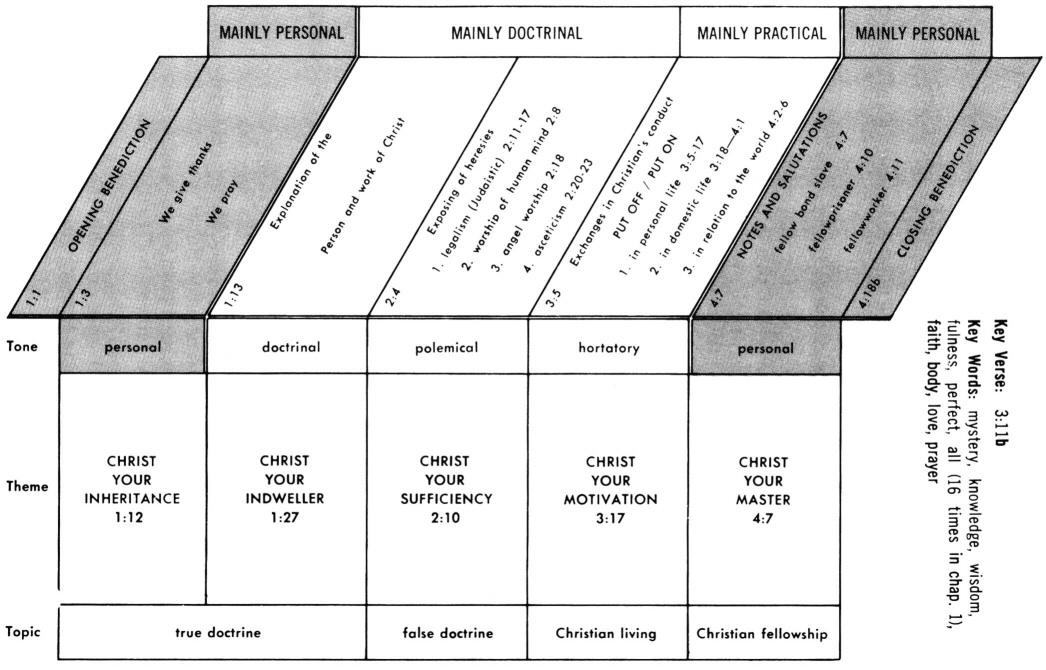
CHRIST IS ALL IN ALL
Click chart to enlarge
Charts from Jensen's Survey of the NT - used by permission
Colossians Overview - Click Chart on right side
| Christ Preeminent in All Things Supreme Lord - Sufficient Savior |
|||
| Colossians 1 | Colossians 2 | Colossians 3 | Colossians 4 |
| Supremacy of Christ |
Submission to Christ |
||
| Doctrinal and Corrective |
Practical and Reassuring |
||
| What Christ Did For Us |
What Christ Does Through Us |
||
| Christ Our Lord |
Christ Our Life |
Christ our Love |
|
| Christ the Head of the Body |
Christ the Lord of the Universe |
Christ the Head of the Home |
|
| Instruction | Warnings | Exhortations | Reminders |
| Reconciliation | Creation | Submission | Conversation |
| His Person and Word |
His Peace and Presence |
||
Colossians 2:4 I say (PAI), this so that no one will delude (PMS) you with persuasive argument. (NASB: Lockman)
Greek: Touto lego (1SPAI) hina medeis humas paralogizetai (3SPMS) en pithanologia
Amplified: I say this in order that no one may mislead and delude you by plausible and persuasive and attractive arguments and beguiling speech.
Lightfoot: I do not say this without a purpose. I wish to warn you against anyone who wants to lead you astray by specious argument and persuasive rhetoric.
NLT: I am telling you this so that no one will be able to deceive you with persuasive arguments. (NLT - Tyndale House)
Phillips: I write this to prevent you from being led astray by someone or other's attractive arguments. (Phillips: Touchstone)
Wuest: This I am saying in order that no one may be leading you astray by false reasoning in the sphere of specious discourse.
Young's Literal: and this I say, that no one may beguile you in enticing words,
I SAY THIS IN ORDER THAT NO ONE: Touto lego (1SPAI) hina medeis:
- Colossians 2 Resources - Multiple Sermons and Commentaries
- Colossians 2:2-7: Paul's Burden for the Church - John MacArthur
Paul explains why he has made this great claim for Christ at this point in his discussion. The treasures of genuine spiritual wisdom are in Christ and, therefore, to allow oneself to be deceived about this can produce profound disorder in the Christian’s life. We leave ourselves open for conquest by the persuasive speech of heretics. On the other hand, the conviction that all spiritual wisdom is found in Him dispels the false teaching. Paul’s burden is that the Colossians must not surrender to the glib and sometimes convincing arguments of false teachers, but remember that in Christ they have all the treasures of wisdom and knowledge. The heresies of the present century seem to be no less convincing to the ignorant and unwary!
S. Lewis Johnson comments on "I say this" - The apostle has just expressed his anxious concern for the Colossians (Colossians 2:1, 2, 3), and he now enlarges upon the reason for it. The touto lego (AV, “this I say”) makes the connection, the “this” referring to that which has preceded. The treasures of genuine spiritual wisdom are in Christ and, therefore, to allow oneself to be deceived about this can produce profound disorder in the Christian’s life. We leave ourselves open for conquest by the persuasive speech of the heretics. On the other hand, the conviction that all spiritual wisdom is found in Him dispels the false teaching." (Bibliotheca Sacra: Dallas Theological Seminary. page 309, 1962)
What is the great danger?
John MacArthur illustrates the danger of delusion and persuasive words writing ''There once was an old church in England. A sign on the front of the building read ''We preach Christ crucified.'' After a time, ivy grew up and obscured the last word… ''We preach Christ.'' The ivy grew some more, and motto read, 'We preach.'' Finally, ivy covered the entire sign, and the church died. Such is the fate of any church that fails to carry out its mission in the world.''
And such is the fate of any church that is deluded by persuasive arguments or taken captive by philosophy. And such a fate happened to the church at Colossae who began with "faith in Christ Jesus and… love for all the saints… in the Spirit". (Col 1:3, 8-See note Col 1:3; 1:8)
The Colossian church clearly manifested Christian love, but Paul is concerned about their ability to discern, something that seems to be a frequent thought in his mind for all the churches, writing for example to the church at Philippi "this I pray, that your love may abound still more and more in real knowledge and all discernment, so that you may approve the things that are excellent, in order to be sincere and blameless until the day of Christ." (Php 1:9, 10-See notes Ph 1:9; 10)
John Gill wrote that "Some Christians are more affectionate, and less knowing; others are more knowing, and less affectionate; it is well when love and knowledge go and keep pace together"
While it is true that we must manifest love and approach the Word of God with a non-critical spirit and an open mind, we also must recognize that God’s truth provides absolute boundaries.
As G. K. Chesterton once said, “Merely having an open mind is nothing. The object of opening the mind, as of opening the mouth, is to shut it again on something solid.” Paul would agree.
Calvin adds that "the knowledge of Christ is of itself amply sufficient. And, unquestionably, this is the key that can close the door against all base errors… those are out of danger who remain in Christ, but that those who are not satisfied with Christ are exposed to all fallacies and deceptions… it is a passage, certainly, that ought to be singularly esteemed. For as he who has taught men to know nothing except Christ, has provided against all wicked doctrines"
MAY DELUDE: humas paralogizetai (3SPMS):
- Mt 24:4, Ac 20:30, Ro 16:18, 2Cor 11:2, 11, 12, 13, Gal 1:8, 2:4, Ep 4:14, 5:6, 2Th 2:9, 10, 11, 1Ti 4:1, 2Ti 3:13, Titus 1:10, 11, 2Pe 2:1, 2, 3, 1Jn 2:18, 26, 4:1, 2Jn 1:7, Rev 12:9, 20:3,8
- Torrey's Topic "False Doctrine"
- Colossians 2 Resources - Multiple Sermons and Commentaries
- Colossians 2:2-7: Paul's Burden for the Church - John MacArthur
Delude (3884) (paralogizomai from para = beside, alongside + logizomai = to reason, to count) is literally to reason beside or alongside (think about it as reasoning with words "alongside" or "beside" Truth), to beguile by mere probability that something is true and so to mislead. It primarily means to reckon wrong, then to reason falsely, and so to deceive by false reasoning. Note the present tense which Wuest renders "may be leading you astray".
Paralogizomai is translated deceive, lead from truth to error, beguile, elude by craftiness. The preposition para conveys the idea (when combined with logizomai) of counting "beside" or counting "aside" with the idea of "miscalculating". If the target is the truth, there is something alongside it that looks very much like the truth, and these men focus upon that, rather than the truth. We've all met some artful person who initially deluded us with their false appearance and words, only later to be exposed.
Vincent - From para, beside, contrary to, and logizomai, to reckon, and hence to conclude by reasoning. The deception referred to is, therefore, that into which one betrays himself by false reasoning — reasoning beside the truth.
James has the only other NT use of this word…
But prove yourselves doers of the word, and not merely hearers who delude themselves. (James 1:22-note)
Comment: The idea of paralogizomai is that of incorrect reckoning or reasoning, often including the idea of deliberate false reasoning for the purpose of deceiving. In mathematics, the meaning is that of miscalculation. Professing Christians who hear the Word without obeying it make a serious "spiritual miscalculation", which causes them to delude themselves. Such a man does not delude anyone but himself! They are self-deceived. An old Scottish expression speaks of such false Christians as “sermon tasters who never tasted the grace of God.” Any response to the gospel that does not include obedience is self-deception. See discussion of the relationship of faith and obedience. If a profession of faith in Christ does not result in a changed life that hungers and thirsts for God’s Word and desires to obey that Word, the profession is only that—a mere profession. Satan, of course, loves such professions, because they give church members the damning notion that they are saved when they are not! He is still their spiritual father and not God. See discussion of Jesus' stern warning that "not everyone who says to Me Lord, Lord will enter the kingdom of heaven" Mt 4:21, 22, 23-see notes Mt 7:21; 22; 23)
Delusion is one of the favorite weapons of the old serpent, the devil, who
"was more crafty than any beast of the field which the LORD God had made. And he said to the woman, "Indeed, has God said, 'You shall not eat from any tree of the garden'?" (Gen 3:1)
To be deceived like Eve was is to think you know or are doing something right, but it is really wrong. A perfect illustration is seen in the 300+ year of the judges in Israel --
"In those days there was no king in Israel; everyone did what was right in his own eyes." (Jdg 21:25-note)
Truth and error may be made to look almost the same, but one is a counterfeit. In these days when we have so many counterfeit and imitation things around we are used to be being deceived and not even be alarmed at how easy we are "suckered". Plastic looks like metal. Flowers are made of silk. We are daily touching things that are imitations of the real thing. But imitations have limitations and if you start regarding them as real you are in trouble. That is why Paul is "struggling" for believers he has never seen. The specific delusions Paul has in mind are alluded to in the specific warnings that follow.
Jacob used paralogizomai when he reproached Laban for refusing to live up to his bargain with him concerning Rachel, saying,
“What is this thou hast done unto me? did I not serve with thee for Rachel? wherefore then hast thou beguiled (Greek translates the Hebrew with paralogizomai) me?” (Ge 29:25).
Paralogizomai was used in secular Greek writings of a keeper of a state library who had shown a willingness to "make a wrong use of" certain documents. Paul uses it to point to drawing an erroneous conclusion from the reasoning submitted. That which is logical after having reasoned about something. So they come alongside you with their very logical sounding reasoning and they cheat their hearers by the use of this false reasoning. These false teachers were seeking to mislead the mind or judgment of the Colossians in regard to Who Christ was and who they were in Christ. Nothing much new here! These heretics sought to deceive the Colossians so thoroughly with their false logic that the truth about Christ was obscured.
Clarke adds that paralogizomai means to "deceive by sophistry or subtle reasoning, in which all the conclusions appear to be fairly drawn from the premises, but the premises are either assumed without evidence, or false in themselves; but this not being easily discovered, the unthinking or unwary are carried away by the conclusions which are drawn from these premises."
Guzik comments that "Those who taught these dangerous things among the Colossian Christians were very persuasive. The lure of "hidden" and "deep" wisdom and knowledge can be strong, but still deceptive. Many today deceive with persuasive words by quoting a whole bunch of Bible verses. But the Devil himself quotes Scripture. We must compare everyone's teaching against all of God's Word. We should all have the spirit of the Bereans (Acts 17:11-note;), who compared even the teaching of Paul with Scripture… It might sound simple, but deceivers are deceivers. They won't announce their false doctrine as false doctrine, and it will often be similar enough to the truth to be dangerous." (Colossians 2 Commentary)
Paul gives a parallel warning in his letter to the Corinthians warning about "such men (who) are false apostles, deceitful workers, disguising themselves as apostles of Christ. And no wonder, for even Satan disguises himself as an angel of light. Therefore it is not surprising if his servants also disguise themselves as servants of righteousness; whose end shall be according to their deeds." (2 Cor 11:13, 14, 15)
WITH PERSUASIVE ARGUMENTS: en pithanologia:
- Colossians 2 Resources - Multiple Sermons and Commentaries
- Colossians 2:2-7: Paul's Burden for the Church - John MacArthur
Persuasive (4086) (pithanologia from peitho = to convince by argument, true or false [the stem "peith-" or "pith-" has the basic meaning of trust] + logia = logic, related to the logos, the "word", which is not just the word but the "reason", the "intelligence") refers to enticing words and is practically equivalent to the expression ''To talk someone into something.'' It refers to the art of persuasion which is the height of oratory, but it easily degenerates into trickery and deceit (which is how Paul uses it). The one speaking uses plausible but false arguments (another good reason to know the Truth!)
Paul claimed on the other hand that "my message and my preaching were not in persuasive (pithos = persuasive also from peitho) words of wisdom, but in demonstration of the Spirit and of power" (1Cor 2:4).
Paul warned his young protégée Timothy that "the time will come when they will not endure sound doctrine; but wanting to have their ears tickled, they will accumulate for themselves teachers in accordance to their own desires and will turn away their ears from the truth, and will turn aside to myths." (see notes 2 Timothy 4:3; 4:4)
Pithanologia was used in secular Greek of the law court and refers to the lawyer’s persuasive speech and its power to influence an audience towards an unjust verdict. In Classical Greek the word referred to the use of probable arguments as opposed to demonstrable arguments. Paul’s point is that even though the arguments seem to make sense (sound reasonable), they are in the end false and the Colossians must not surrender to the glib, sometimes convincing arguments of the false teachers, but remember that, in having Christ, they have all the treasures of wisdom and knowledge. The heresies of the present century seem to be no less convincing to the ignorant and unwary. Paul is not arguing against the study of philosophy or serious thinking, but is arguing against the uncritical adoption of a philosophy that is at odds with a proper view of Christ and the ethics of the Christian life.
Barclay adds that pithanologia "was a word of the law-courts; it was the word used for the persuasive power of a lawyer’s arguments, which could enable the criminal to escape his just punishment. The true Church should have such a grip of the truth that it is unmoved by seductive arguments. (Colossians 2 Commentary) ("Fine-sounding arguments"described language used of lawyers who got their clients off the hook.)
J. I. Packer warns that the "Sad experience shows that bad theology infects the heart with misbelief and unbelief, the spiritual equivalents of multiple sclerosis! Many who ran well have been progressively paralyzed through ingesting bad theology, and the danger remains. Theological expertise can feed intellectual pride, turning one into a person who cares more for knowing true notions than for knowing the true God, and that is disastrous, too.
So these false teachers will use "persuasive logic" as they come alongside. Wayne Barber tells about how he formerly got into the trap of "confessing his righteousness". He realizes now that you don't need to confess your righteousness because you are by His doing in Christ. The challenge for every blood bought, heaven bound believer is to discover and re-discover WHO YOU ARE in Christ and then in His power to conduct yourself thereafter on the basis of "WHOSE" you are! The reason Wayne got trapped in this subtle false teaching was that their was a lot about it which was RIGHT. (cp 2 Peter 2:1 "secretly introduce destructive heresies" - see note) Wayne was thinking that he could confess himself into the reality of being what he was confessing. It sounded so good and so much better than having to "go to the cross." Don't you hate to think about sin in your life? The false teaching was that he didn't have to deal with sin anymore. That was before the Cross. Now I can confess my righteousness. It's a trap. Look out when they tell you about a "new TEACHING" that they have. If you ever get away from your total sufficiency in Christ and His Word, then you're going to have your mind kidnapped by these people who so cleverly know how to come alongside you and bring the false doctrine and ease it in. So Paul prayed that they would be strengthened for the battle, the BATTLE OF THE MIND.
Colossians 2:5 For even though I am (PAI) absent in body, nevertheless I am (PAI) with you in spirit rejoicing (PAP) to see (PAP) your good discipline and the stability of your faith in Christ. (NASB: Lockman)
Greek: ei gar kai te sarki apeimi, (1SPAI) alla to pneumati sun humin eimi, (1SPAI) chairon (PAPMSN) kai blepon (PAPMSN) humon ten tachin kai to stereoma tes eis Christon pisteos humon
Barclay: For, even if I am absent from you in the body, I am with you in spirit, happy when I see you maintaining your ranks and the solid bulwark of your faith in Christ. (Colossians 2 Commentary)
Lightfoot: For I am not an indifferent spectator of your doings. I am absent from you in my body, but I am present with you in my spirit. I rejoice to behold the orderly array and the solid phalanx which your faith toward Christ presents against the assaults of the foe.
NLT: For though I am far away from you, my heart is with you. And I am very happy because you are living as you should and because of your strong faith in Christ. (NLT - Tyndale House)
Phillips: For though I am a long way away from you in body, in spirit I am by your side, watching like a proud father the solid steadfastness of your faith in Christ. (Phillips: Touchstone)
Wuest: For if, as is the case, I am in fact absent in my flesh, yet I am with you in my spirit, rejoicing and beholding your orderly array and the solid front of your faith in Christ.
Young's literal: for if even in the flesh I am absent -- yet in the spirit I am with you, joying and beholding your order, and the stedfastness of your faith in regard to Christ;
FOR EVEN THOUGH I AM ABSENT IN BODY NEVERTHELESS I AM WITH YOU IN SPIRIT: ei gar kai te sarki apeimi (1SPAI) alla to pneumati sun humin eimi (1SPAI):
- 1Co 5:3, 4, 1Th 2:17
- Colossians 2 Resources - Multiple Sermons and Commentaries
- Colossians 2:2-7: Paul's Burden for the Church - John MacArthur
For (gar) gives the reason for something (See value of pausing to ponder terms of explanation). In context Paul is explaining how even though he was unknown (by face) to the Colossians he was still able to give such a warning.
I am absent in body - How? Where? Obviously in prison in Rome. As Beet says "While the weak and mortal flesh of Paul lingered in prison at Rome, the eye of his spirit was fixed on the Christians at Colossae." (Colossians 2 Commentary)
I am with you in spirit - Paul's attitude of concern and in this case rejoicing is interesting considering that he may never have even seen the Colossian assembly face to face. This statement also underscores the living, dynamic aspect of the church, the body of Christ with one Head and many supernaturally inter-connected members.
John Calvin comments "Lest any one should object that the admonition was unseasonable, as coming from a place so remote, he says, that his affection towards them made him be present with them in spirit, and judge of what is expedient for them, as though he were present. By praising, also, their present condition, he admonishes them not to fall back from it, or turn aside.
Paul has a virtually identical description in his first epistle to the Corinthians writing…
For I, on my part, though absent in body but present in spirit, have already judged him who has so committed this (see 1Co 5:1,2), as though I were present. 4 In the name of our Lord Jesus, when you are assembled, and I with you in spirit, with the power of our Lord Jesus, 5 I have decided to deliver such a one to Satan for the destruction of his flesh, that his spirit may be saved in the day of the Lord Jesus. (1Cor 5:3, 4, 5)
And again in a similar phrase in his letter to the Thessalonians Paul wrote that
we, brethren, having been taken away from you for a short while—in person, not in spirit—were all the more eager with great desire to see your face. (1Th 2:17-note)
REJOICING TO SEE YOUR GOOD DISCIPLINE: chairon (PAPMSN) kai blepon (PAPMSN) humon ten taxin:
- Colossians 2 Resources - Multiple Sermons and Commentaries
- Colossians 2:2-7: Paul's Burden for the Church - John MacArthur
Literally the Greek reads "rejoicing and seeing"
Rejoicing (5463) (chairo) means to be glad or delighted in something. It was also used as a greeting (and so is rendered greet, greeting or hail in some passages, Mt 26:49, 27:29 contrasted with Mt 28:9). The present tense indicates that this Paul is continually rejoicing (sign of a man filled with the Spirit, the only way we can truly rejoice continually!) in their spiritual discipline and stability ("walking in the truth" - see below). Anyone who has discipled young men as I do understands the joy that Paul is describing (cp 2Ti 1:3, 4-note). It's a joy that literally brings tears to your eyes because you know it is another testimony of the faithfulness and supernatural power of a great God who desires to see His children continually growing in grace and the knowledge (and likeness) of His Son (cp 2Pe 3:18-note).
We see John's similar exclamation writing "I have no greater joy (chara) than this, to hear of my children walking in the truth." (3Jn 4+)
Remember that in his second letter John warned…
Watch (present imperative = commanding a continual awareness to take heed to avoid spiritual potholes, snares, etc - See discussion of the Need for the Holy Spirit to obey NT commands) yourselves, that (purpose clause - John explains why he command continual spiritual perception) you might not lose what we have accomplished, but that you may receive a full reward.
Comment: There is a future day of recompense (cp Re 22:12-note), the of Christ, when all believers will be assessed individually as to their works whether good (endure the fire) or bad (thrown out), this assessment even including a "motive check" (Woe! 1Cor 4:5) in addition to the "fiery judgment" described in 1Co 3:11, 12, 13, 14, 15).
Paul in his letter to the Romans expressed a similar sentiment for a similar reason "Now I urge you, brethren, keep your eye on those who cause dissensions and hindrances contrary to the teaching which you learned, and turn away from them. 18 For such men are slaves, not of our Lord Christ but of their own appetites; and by their smooth and flattering speech they deceive the hearts of the unsuspecting. 19 For the report of your obedience has reached to all; therefore I am rejoicing (chairo - again in the present tense) over you, but I want you to be wise in what is good, and innocent in what is evil." (Ro 16:17, 18+, Ro 16:19+)
Chairo - 74x in 68v An interesting mini-study - observe [and/or make a list of] what is associated with rejoicing or causes one to rejoice - note some verses as stated use chairo as a greeting -Matt. 2:10; 5:12; 18:13; 26:49; 27:29; 28:9; Mk. 14:11; 15:18; Lk. 1:14, 28; 6:23; 10:20; 13:17; 15:5, 32; 19:6, 37; 22:5; 23:8; Jn. 3:29; 4:36; 8:56; 11:15; 14:28; 16:20, 22; 19:3; 20:20; Acts 5:41; 8:39; 11:23; 13:48; 15:23, 31; 23:26; Rom. 12:12, 15; 16:19; 1 Co. 7:30; 13:6; 16:17; 2 Co. 2:3; 6:10; 7:7, 9, 13, 16; 13:9, 11; Phil. 1:18; 2:17f, 28; 3:1; 4:4, 10; Col. 1:24; 2:5; 1 Thess. 3:9; 5:16; Jas. 1:1; 1 Pet. 4:13; 2 Jn. 1:4, 10f; 3 Jn. 1:3; Rev. 11:10; 19:7 The NAS renders chairo as am glad(1), glad(7), gladly(1), greeted(1), greeting(2), greetings(3), hail(5),joyfully(1), rejoice(33), rejoiced(8), rejoices(2), rejoicing(10).
PAUL DESCRIBES SAINTS
WITH TWO MILITARY TERMS
Good discipline (5010) (taxis from tasso = to set or arrange in order) described the orderly array of soldiers with the line being unbroken and intact. In context, the idea may be that a few stragglers had been swayed by the persuasive arguments, but there was no panic, no breach in the line.
As an aside, we do well to remember that the spiritual war against our inveterate, mortal enemies (the world, the flesh and the devil) is not so much a power struggle but a battle over Truth and the "battlefield" is our mind and heart!
The following definitions of taxis are a summary of the nuances in the NT (adapted from BDAG)…
(1) an arrangement of things in sequence, fixed succession or fixed order (Lk 1:8 - describing the arrangement for Temple service, the fixed succession of the course of the priests) ("an arranging, arrangement, order" - Vine);
(2) a state of good order, order, proper procedure; regular arrangement, proper setting and thus order. (Col 2:5, 1Cor 14:40 = order in contrast to confusion in the gatherings of the local church. Let it be Lord. Amen!);
(3) an assigned station or rank, position, post (one has a responsibility in an ordered scheme of things)
(4) an arrangement in which someone or something functions (Heb 5:6, 10, 6:20, etc) ("A distinctive class" - Mounce). (In other words taxis described "a distinctive class characterized by fixed appointment and position." -Friberg)
The verb tasso primarily means arranging things in proper order or an orderly manner - There are a number of related words in that are derived from tasso - anatássomai (392), to compose in an orderly manner; anupotasso (506) unruly; antitasso (498), to resist; apotásso (657), to set in its proper category away from oneself; átaktos (813), disorderly, irregular; diatásso (1299), set in order, issue orderly and detailed instructions; epitásso (2004), to order; prostásso (4367), a specific command for a specific person; protásso (4384), to foreordain; suntásso (4929), to arrange or set in order together; tágma (5001), an order, regular method; taktós (5002), arranged, appointed; táxis (5010), an arrangement; hupotasso (5293), to place under. (From Zodhiates - The Complete Word Study Dictionary, New Testament).
Liddell-Scott emphasizes the military uses of taxis:
1. a drawing up, the order or disposition of an army, tactics (Xenophon - "Phalinus professed to be an expert in tactics.")
2. battle array, order of battle, (Herodotus = "Since the Hellenes fought in an orderly fashion by line, but the barbarians were no longer in position and did nothing with forethought, it was likely to turn out as it did.")
3. a single rank or line of soldiers, to be drawn up a few lines deep, (Plato = "when the Spartans came up to the men with wicker shields, they were not willing to stand and fight against these, but fled; when, however, the Persian ranks (taxis) were broken, the Spartans kept turning round and fighting like cavalry, and so won that great battle."
4. a body of soldiers, a squadron, Soph.: at Athens, the quota of infantry furnished by each nation, Lys.: of smaller bodies, a company, cohort, Xen.; so of ships, a squadron, Aesch.:-generally, a band, company, Id.
5. a post or place in the line of battle (Herodotus - "During the drawing up of battle formation there arose much dispute between the Tegeans and the Athenians, for each of them claimed that they should hold the second wing of the army, justifying themselves by tales of deeds new and old.")
Extra-biblical and apocryphal uses of taxis…
And the Elder said this also: Mark, having become the interpreter of Peter, wrote down accurately everything that he remembered, without however recording in order what was either said or done by Christ. (Papias -The Apostolic Fathers)
Since, therefore, these things are now clear to us and we have searched into the depths of the divine knowledge, we ought to do, in order, everything that the Master has commanded us to perform at the appointed times (Clement 40:1)
For God, the Master and Creator of the universe, who made all things and arranged them in order, was not only tender-hearted but also very patient. (7) For God, the Master and Creator of the universe, who made all things and arranged them in order, was not only tender-hearted but also very patient. (Letter of Diognetus)
(Apocrypha) The temple singers, the sons of Asaph, were in their place according to the arrangement made by David, and also Asaph, Zechariah, and Eddinus, who represented the king. (1 Esdras 1:15)
(Example of BDAG meaning #4 above) The basis of the foot on the ground consisted of a ruby and measured a hand’s breadth high all round. It had the appearance (taxis) of a shoe and was eight fingers broad. Upon it the whole expanse of the foot rested. (Pseudepigrapha of the Old Testament)
Taxis is transferred directly into English (taxis) where in rhetoric it refers to the arrangement of the parts of an argument.
Wayne A Detzler - The Greek verb which is translated "order" is tasso, and another form is taxis. This family of words is seen in such English terms as "taxidermy" (literally, "ordering the skin" of an animal so it looks lifelike and "taxonomy" (literally "ordering names," as this is the science of classification). In secular Greek the word (tasso) referred to appointing an officer. It also was used to describe the mustering of soldiers for battle. In civilian life it was used to describe the delegation of jobs to various people. Socrates found a larger meaning in this word, and he spoke of man in his proper place before God. Plato took this to mean that there was a divine order in the world. He thought that people filled certain roles in society by divine design. (New Testament Words in Today's Language)
Taxis - 9x in 8v- Lk. 1:8; 1Co. 14:40; Col. 2:5; Heb. 5:6, 10; 6:20; 7:11, 17 and is rendered by the NAS as good discipline(1), order(7), orderly manner(1).
Luke 1:8 Now it happened that while he was performing his priestly service before God in the appointed order of his division,
1 Corinthians 14:40 But all things must be done properly and in an orderly manner.
Comment: The Christian life is (or ideally should be) orderly, for God is a God of order (as is everywhere evident in His physical creation, see also 1Cor 14:33). So the body of believers in a given locale should be orderly for this reflects God's nature. God is not out of control, so a church that is being led by His Spirit should not be "out of control." Paul's exhortation to "let all things be done properly and in an orderly manner" alludes to the the order and regularity with which an army is drawn up. Undoubtedly most of his readers had witnessed the strict discipline and order that characterized the Roman army and thus they were able to comprehend this vivid word picture of the church as an orderly array of soldiers.
Colossians 2:5 For even though I am absent in body, nevertheless I am with you in spirit, rejoicing to see your good discipline and the stability of your faith in Christ.
Hebrews 5:6 just as He says also in another passage, "YOU ARE A PRIEST FOREVER ACCORDING TO THE ORDER OF MELCHIZEDEK." 10 being designated by God as a high priest according to the order of Melchizedek.
Comment: In each of reference to the priesthood the word means a particular group or class. The writer's point is that Jesus’ priesthood is classified not as Aaronic but in the division or order of Melchizedek.
Hebrews 6:20 where Jesus has entered as a forerunner for us, having become a high priest forever according to the order of Melchizedek.
BDAG comment: The reference is not only to the higher ‘rank’, but also to the entirely different nature of Melchizedek’s priesthood as compared w. that of Aaron
Comment: This verse presents a great word picture of Jesus as our "forerunner" or prodromos (see great word picture drawn by this great Greek word), which is the word Prodromos which A T Robertson says is "old word for a spy, a scout, only here in NT Jesus has shown us the way, has gone on ahead, and is the surety (egguos Heb 7:22)and guarantor of our own entrance later." (As Heb 9:15 adds we have "the promise of the eternal inheritance"). In point of fact, our anchor of hope with its two chains of God's promise and oath has laid hold of Jesus within the veil and beloved if you are struggling with your eternal security in Christ, you must know that this "divine rope" will hold fast and bring us safely into the "harbor" of the next life in eternity with our Forerunner and Friend Christ Jesus. Amen! Let us hold fast the confession of our faith firm until the end (Hebrews 3:6, Hebrews 4:14). Jesus is also a “forerunner” sets Him apart from the Levitical high priest who entered alone as the people waited outside. Jesus in contrast has gone before us to open up the way for His people to follow Him. And all God's people shouted "Hallelujah! Amen!"
Hebrews 7:11 Now if perfection was through the Levitical priesthood (for on the basis of it the people received the Law), what further need was there for another priest to arise according to the order of Melchizedek, and not be designated according to the order of Aaron?… 17 For it is attested of Him, "YOU ARE A PRIEST FOREVER ACCORDING TO THE ORDER OF MELCHIZEDEK."
Taxis - 9x in the non-apocryphal Septuagint - Nu 1:52; 1Ki 7:37; Job 16:3; 28:3; 36:28; 38:12; Ps 110:4; Pr 31:26; Hab 3:11. One use is quoted often in the book of Hebrews…
Psalm 110:4 The LORD has sworn and will not change His mind, "You are a priest forever According to the order (Hebrew = dibrah; Lxx = taxis) of Melchizedek."
Taxis - 10x in the Apocrypha - Jda. 5:20; 1 Esd 1:5, 15; 2 Macc 1:19; 8:22; 9:18; 10:36; 13:21; Odes 4:11, 19;
Monty Mills comments that "When these attractive but false arguments intrude into the Christian life, they destroy its orderliness and stability. (Colossians: A Study Guide to Paul's Epistle to the Saints at Colossae)
G Bertram writes that "Paul in Col. 2:5 shows concern for the order and firmness of the faith of the Colossians. As the term taxis suggests a military division drawn up in ranks, so stereoma hints perhaps at a castle or bulwark (cf. Col 1:23; Col 2:7). Again faith gives the terms their content. Believers are under assault, but they can stand fast in the stronghold of their faith. Grounded in Christ, they are enabled by faith to stand firm in their conflict with the world. (Kittel, G., Friedrich, G., & Bromiley, G. W. Theological Dictionary of the New Testament. Eerdmans)
Ralph Earle "Lightfoot feels that both "order" (taxis) and "steadfastness" are military terms. He suggests for the former "orderly array" and for the latter "solid front" or "close phalanx" (p. 176). Apparently this is the basis for the popular translation "solid front" (TCNT, Weymouth, Moffatt). For the two terms NEB has: "your orderly array and the firm front." (Earle, R. Word Meanings in the New Testament)
Vine on the good discipline of the Colossians "(Paul is) rejoicing in what he knows of them and his experience of being with them in spirit, and at the same time beholding their order (taxis, a military metaphor), that is to say, their freedom from disquiet, discord and disruption, their readiness to be subject to those whom God has set over them as spiritual overseers and to be subject to one another.
AND THE STABILITY: kai to stereoma:
- Colossians 2 Resources - Multiple Sermons and Commentaries
- Colossians 2:2-7: Paul's Burden for the Church - John MacArthur
Stability in the Christian life was important to Paul as seen in his command to the saints at Corinth (in the midst of gross paganism, idolatry and immorality - sounds like modern day America! This command is therefore clearly applicable to all believers today.)…
Therefore, my beloved brethren, be (present imperative) steadfast, immovable, always abounding in the work of the Lord, knowing that your toil (kopos = to the point of exhaustion) is not in vain in the Lord. (1Cor 15:58)
Comment: Note believers toil (our responsibility) but it is "in the Lord," ultimately in His strength, in the sphere ("atmosphere") of His omnipresent omnipotence! This "divine synergism" is indeed a mystery, but it is repeatedly taught in Scripture. The point is that believers can only toil successfully as they abide in the Vine (Jn 15:5) and lean on the power supplied by the indwelling Holy Spirit (Eph 3:16). Dear ministering saint, if you miss this vital truth that Jerry Bridges refers to as "dependent synergism", you may just flame out or burn out!
Be on the alert, stand firm in the faith, act like men, be strong. (1Co 16:13)
Comment: All four verbs = present imperative - calling for and showing the continual need for these spiritual attitudes and actions - They are to be a believer's lifestyle which is only possible in the saint who continually depends on the empowerment of the Holy Spirit.
And to the saints at Thessalonica Paul again emphasized spiritual stability…
for now we really live, if you stand firm in the Lord. (1Thes 3:8-note)
Stability (4733) (stereoma from stereoo = to strengthen, confirm, in turn from stereos = solid, stable - used only in this verse in the NT; Verb stereoo = to make solid) is used only here in the NT and refers to a solid body that has been made firm, strong and unchanging, and in the context describes the Colossian church's steadfastness despite the blustery winds of false doctrine (cp Ep 4:14-note, cp 1Cor 14:20, God speaking to Judah = Jer 4:22)
Stereoma - Firmness; steadiness; that which is solid and firm; figuratively as in Col 2:5 descriptive of a state of firm inner strength; steadfastness; constancy. Stereoma is used in the Septuagint in the creation story (Ge 1:6, 7, 8) where it describes the firmament. David adds "By the Word of the LORD the heavens were made (Lxx uses the related verb stereoo = made firm)." (Ps 33:6).
The related word stereos is used by Peter…
But resist (anthistemi = Do this now! Don't delay! This command is like a commander in chief barking orders to the soldiers under him in the midst of the heat of the battle which is raging around them! This is urgent!) him, firm (stereos) in your faith (Ed: Note what stabilizes us in times of suffering = our faith which comes by hearing and obeying the Word - Ro 10:17-note) - If you are not in the Word and the Word in you, that might explain your instability in various trials), knowing that the same experiences of suffering are being accomplished by your brethren who are in the world. (1Peter 5:9-note, also used in 2Ti 2:19-note = "firm", Heb 5:12-note, Heb 5:14-note = "solid")
Comment: Stereos means stable (firmly established), steadfast or solid like a foundation. In a physical sense this word describes something as firm, hard, solid and compact like a rock. It is used of food adults eat (solid) rather than milk, the former referring to advanced or deeper doctrine. The idea Peter is conveying is that his readers as Christ followers are to be steadfast (firmly fixed in place, not subject to change) immovable (not moving or not intended to be moved) in their faith.
Why were they orderly and stable? For one thing their hearts had been "knit together in love" (Col 2:2-note) and they had full assurance that came from a understanding of the full knowledge of what they possessed in Christ Who was in them. And of course they were stable because their faith was laid on a firm foundation of "in Christ", the unchanging Rock of our salvation (cp Ps 19:14-note). The writer of Hebrews uses the related adjective stereos to describe "solid (stereos) food" (Heb 5:12-note, Heb 5:14-note = "solid") which provides spiritual stability (but only if it is "eaten" and heeded or obeyed - cp warning of James 1:22-note) because it gives us Truth to counter the lies of the world, the flesh and the devil.
Regular intake of solid food
will lead to a solid faith!
Stereoma - 23 uses in 21 verses in the non-apocryphal Septuagint -
Ge 1:6, 7, 8, 14, 15, 17, 20; Ex 24:10; Dt 33:26; ; Esther 9:29; ; Ps 17:3-note; Ps 18:2-note; Ps 70:3-note; Ps 72:4-note; Ps 150:1-note; Ezek 1:22, 23, 25; 10:1; 13:5; Dan 3:56
Genesis 1:6 Then God said, "Let there be an expanse (Lxx = stereoma = firmament - Webster's Dictionary defines "firmament" as "the vault or arch of the sky") in the midst of the waters, and let it separate the waters from the waters." Genesis 1:7 God made the expanse, and separated the waters which were below the expanse from the waters which were above the expanse; and it was so. God called the expanse heaven. And there was evening and there was morning, a second day. (Expanse = stereoma in all these uses in the LXX).
Psalm 18:2-note The LORD is my rock (Lxx = stereoma "firm support" - This begs the question - Is He your firm support? He is. Do you believe it? Are you acting on this truth when affliction, trials, temptations, etc come at you? Spurgeon writes "The Lord is my rock and my fortress. Dwelling among the crags and mountain fastnesses of Judea David had escaped the malice of Saul, and here he compares his God to such a place of concealment and security. Believers are often hidden in their God from the strife of tongues and the fury of the storm of trouble. The clefts of the Rock of Ages are safe abodes.") and my fortress and my deliverer, My God, my rock, in whom I take refuge; My shield and the horn of my salvation, my stronghold.
Psalm 150:1 Praise the LORD! Praise God in His sanctuary; Praise Him in His mighty expanse (KJV = firmament; Lxx = stereoma).
Spurgeon - Praise him in the firmament of his power. It is a blessed thing that in our God holiness and power are united. Power without righteousness would be oppression, and righteousness without power would be too weak for usefulness; but put the two together in an infinite degree and we have God. What an expanse we have in the boundless firmament of divine power! Let it all be filled with praise. Let the heavens, so great and strong, echo with the praise of the thrice holy Jehovah, while the sanctuaries of earth magnify the Almighty One.
Stereoma - 7 uses in the Apocrypha - 1 Esd 8:78, 1 Macc 9:14, Odes 8:56; Sir 43:1, 8; Dat. 3:56; 12:3; Wuest notes that "First Maccabees has the verb; “he solidified the battle, massed his lines."
Barclay comments that taxis and stereoma "present a vivid picture, for they are both military words. The word translated order is taxis, which means a rank or an ordered arrangement. The Church should be like an ordered army, with every man in his appointed place, ready and willing to obey the word of command. The word translated firmness is stereoma, which means a solid bulwark, an immovable phalanx. It describes an army set out in an unbreakable square, solidly immovable against the shock of the enemy’s charge. Within the Church there should be disciplined order and strong steadiness, like the order and steadiness of a trained and disciplined body of troops. (Colossians 2 Commentary)
James Alexander - The study of God's Word, for the purpose of discovering God's will, is the secret discipline which has formed the greatest characters.
OF YOUR FAITH IN CHRIST: tes eis Christon pisteos humon:
- Ps 78:8,37 Ac16:5 1Co 15:58, 16:13 1Th 3:8 Heb 3:14 1Pe 5:9 2Pe 3:17, 18
- Colossians 2 Resources - Multiple Sermons and Commentaries
- Colossians 2:2-7: Paul's Burden for the Church - John MacArthur
Vincent comments that "Faith is represented as a host solidly drawn up: your solid front, close phalanx."
Expositor's Greek - It is clear that the Church as a whole remained true to the doctrine it had been taught. (Colossians - Expositor's Greek Testament)
Faith (4102) (pistis [word study]) is synonymous with trust or belief and is the conviction of the truth of anything, but in Scripture usually speaks of belief respecting man's relationship to God and divine things, generally with the included idea of trust and holy fervor born of faith and joined with it.
Beet writes that "The Christians at Colossae held their position as good soldiers: and their faith in Christ enabled them to present to every enemy an immoveable line of battle. The military tone of this verse suggests that looseness in faith exposes Christians to disastrous overthrow. The phrase rendered faith in Christ is not found elsewhere in the N.T.: but we have faith towards God in 1Th 1:8-note; Philemon 1:5; and a similar phrase believe in God or in Christ in Ro 10:14-note; Php 1:29-note; 1Pe 1:8-note, 1Pe 1:21-note, and frequently in the Fourth Gospel. The truthfulness of Paul compels us to accept these words as complete proof that the Christians at Colossae had not yet been actually led away by the delusion against which he now warns them. If so, this verse is not only a courteous, but a necessary, recognition, in view of the warnings which follow, of their loyal adherence to the truth. (Colossians 2 Commentary)
True faith that saves one's soul includes at least three elements (1) firm persuasion or firm conviction, (2) a surrender to that truth and (3) a conduct emanating from that surrender. In sum, faith shows itself genuine by a changed life. (Click here for W E Vine's definition)
William Barclay notes that "Faith begins with receptivity. It begins when a man is at least willing to listen to the message of the truth. It goes on to mental assent. A man first hears and then agrees that this is true. But mental assent need not issue in action. Many a man knows very well that something is true, but does not change his actions to meet that knowledge. The final stage is when this mental assent becomes total surrender. In full-fledged faith, a man hears the Christian message, agrees that it is true, and then casts himself upon it in a life of total yieldedness." (Colossians 2 Commentary)
Wayne Grudem defines faith that saves one's soul "Saving faith is trust in Jesus Christ as a living person for forgiveness of sins and for eternal life with God. This definition emphasizes that saving faith is not just a belief in facts but personal trust in Jesus to save me… The definition emphasizes personal trust in Christ, not just belief in facts about Christ. Because saving faith in Scripture involves this personal trust, the word “trust” is a better word to use in contemporary culture than the word “faith” or “belief.” The reason is that we can “believe” something to be true with no personal commitment or dependence involved in it. (Grudem, W. A. Systematic Theology: An Introduction to Biblical Doctrine Zondervan) (Bolding added)
The psalmist description of the OT Jews (most of whom were not saved!), speaks of the danger of a faith that is not stabilized…
Psalm 78:8 And not be like their fathers, a stubborn and rebellious generation, a generation that did not prepare its heart and whose spirit was not faithful to God… 37 For their heart was not steadfast toward Him, nor were they faithful in His covenant.
Comment: Note the adjectives that characterize unbelief - stubborn, rebellious, unprepared heart, unfaithful spirit, heart not steadfast, unfaithful to covenant. These are still some of the characteristics of unbelievers, whether they are Jew or Gentile.
Spurgeon: A generation that set not their heart aright. They had no decision for righteousness and truth. In them there was no preparedness, or willingness of heart, to entertain the Saviour; neither judgments, nor mercies could bind their affections to their God; they were fickle as the winds, and changeful as the waves.
And whose spirit was not steadfast with God. The tribes in the wilderness were constant only in their inconstancy; there was no depending upon them. It was, indeed, needful that their descendants should be warned, so that they might not blindly imitate them. How blessed it would be if each age improved upon its predecessor; but, alas! it is to be feared that decline is more general than progress, and too often the heirs of true saints are far more rebellious than even their fathers were in their unregeneracy. May the reading of this patriotic and divine song move many to labour after the elevation of themselves and their posterity.
For their heart was not right with him. There was no depth in their repentance, it was not heart work. They were fickle as a weathercock, every wind turned them, their mind was not settled upon God.
Neither were they steadfast in his covenant. Their promises were no sooner made than broken, as if only made in mockery. Good resolutions called at their hearts as men do at inns; they tarried awhile, and then took their leave. They were hot today for holiness, but cold towards it tomorrow. Variable as the hues of the dolphin, they changed from reverence to rebellion, from thankfulness to murmuring. One day they gave their gold to build a tabernacle for Jehovah, and the next they plucked off their earrings to make a golden calf. Surely the heart is a chameleon. Proteus had not so many changes. As in the ague we both burn and freeze, so do inconstant natures in their religion.
In Christ (See discussion of what it means to be In Christ and in Christ Jesus) Christ is the object of a faith that saves and stabilizes the soul of the saint.
ILLUSTRATION - HOW TO ESCAPE DECEPTION- I am… rejoicing the see your good order and the steadfastness of your faith in Christ.
Deception has always been part of military strategy. The British put it to good use during World War II in North Africa against German forces led by General Erwin Rommel.
They constructed pasteboard look-alikes of tanks and airplanes to deceive the Germans. From the air this fake equipment looked real enough to fool reconnaissance personnel, and it could be easily moved. Satan, whom Jesus referred to as "the ruler of this world" (Jn 16:11), is a master deceiver. He was the driving force behind the teachers who were trying to persuade the Colossians to accept heresy as truth (Col 2:4-note, Col 2:8-note). Followers of Christ today are in a similar battle. How do we defend ourselves against deceivers? Paul used military terms in his comments to the Colossians that can help us to know what to do. First, he commended them for their "good order," which refers to being battle-ready, disciplined soldiers. Second, he spoke of the "steadfastness" of their faith in Christ, which refers to having a solid front. They had an unshaken commitment to their Lord and the advance of His kingdom. Don't be fooled by Satan's lies. Know the truth of God's Word, and be battle-ready through a disciplined life and an unswerving commitment to Jesus Christ. --D C Egner (Our Daily Bread, Copyright RBC Ministries, Grand Rapids, MI. Reprinted by permission. All rights reserved)
The shield of faith protects us
From Satan's fiery darts;
And he cannot deceive us
With God's Word in our hearts. --Sper
God's truth is the best protection against Satan's lies.
Colossians 2:6 Therefore as you have received (the) Christ Jesus the Lord, so walk (PAM) in Him (NASB: Lockman)
Greek: Os oun parelabete (2PAAI) ton Christon Iesoun ton kurion, en auto peripateite, ( 2PPAM)
Lightfoot: I entreat you therefore not to abandon the Christ, as you learnt from Epaphras to know him, even Jesus the Lord, but to continue to walk in him as you have done so far.
NLT: And now, just as you accepted Christ Jesus as your Lord, you must continue to live in obedience to him. (NLT - Tyndale House)
Phillips: Just as you received Christ Jesus the Lord, so go on living in him - in simple faith. (Phillips: Touchstone)
Wuest: In the same manner, therefore, as you received the Christ, Jesus, the Lord, in Him be constantly ordering your behavior
Young's literal: as, then, ye did receive Christ Jesus the Lord, in him walk ye,
THEREFORE AS YOU HAVE RECEIVED: hôs oun parelabete (2PAAI):
- Mt 10:40, 18:5, Lk 9:48, John 1:12, 13, 13:20 Jude 1:3
- Colossians 2 Resources - Multiple Sermons and Commentaries
- Colossians 2:2-7: Paul's Burden for the Church - John MacArthur
The warning against defection through delusion is followed by exhortation to advance in the life of faith and the "therefore" marks the transition.
Have received (3880) (paralambano from para = beside + lambano = receive) means to receive to oneself what is imparted or delivered over. Paul is saying that at some point the Colossians by faith laid hold of and took possession of the Truth presented. Here paralambano means to receive something transmitted, as spiritual instruction or truth (1Cor 11:23, Gal 1:9) or a ministry (Col 4:17+)
The saints at Colossae had received the living Christ, just as the saints at Thessalonica had received God's living Word (He 4:12-note, 1Pe 1:23-note)…
And for this reason we also constantly thank God that when you received (paralambano) from us the word of God's message, you accepted (dechomai) it not as the word of men, but for what it really is, the word of God, which also performs its work in you who believe. (1Th 2:13-note)
John 1:11-12+ He came to His own, and those who were His own did not receive (paralambano) Him. 12 But as many as received Him, to them He gave the right to become children of God, even to those who believe in His name, (RECEIVING = BELIEVING)
Paralambano - 49x in NT - Matt. 1:20, 24; 2:13f, 20f; 4:5, 8; 12:45; 17:1; 18:16; 20:17; 24:40f; 26:37; 27:27; Mk. 4:36; 5:40; 7:4; 9:2; 10:32; 14:33; Lk. 9:10, 28; 11:26; 17:34f; 18:31; Jn. 1:11; 14:3; 19:16; Acts 15:39; 16:33; 21:24, 26, 32; 23:18; 1 Co. 11:23; 15:1, 3; Gal. 1:9, 12; Phil. 4:9; Col. 2:6; 4:17; 1 Thess. 2:13; 4:1; 2 Thess. 3:6; Heb. 12:28
CHRIST JESUS THE LORD: ton Christon Iesoun ton kurion:
- Colossians 2 Resources - Multiple Sermons and Commentaries
- Colossians 2:2-7: Paul's Burden for the Church - John MacArthur
This is the only occurrence of the specific name "Christ Jesus the Lord" in Scripture, which is no "accident".
Vine notes that "Jesus, the historic person, who, as His name signifies, is Jehovah the Savior by reason of what He accomplished by His expiatory death, and as Lord, the One whose authority and control of the life are joyously recognized."
Paul use therefore appears to address two forms of heresy about the Person of Christ. First, "Jesus" in His humanity stands opposed to Docetism (dokeo = to appear) the heresy that Christ’s human body was an illusion and His death was a dramatic “appearance”. They said that “If He suffered He was not God; if He was God He did not suffer.”
Docetism was popular among Greeks since its dismissal of Christ’s body helped remove the scandal Hellenistic thinkers found in the Incarnation. Second, the identification of Christ or Messiah with the historical Jesus countered the heresy Cerinthianism (ca. A.D. 100) separated Jesus from Christ. He taught that the Christ spirit came on the man Jesus, the son of Joseph and Mary, at His baptism and empowered His ministry, but left Him before His crucifixion. Thus Cerinthus taught the heresy that only the man Jesus died and rose again, rejecting the doctrine of the Incarnation and negating the Christian teaching of the atonement.
Paul’s point is that the Colossians had “received Christ Jesus as Lord” and that they would remain safe from spiritual seduction (apostasy) if they continued to walk in submission to him. We too will be resistant to the gnosticizing influences around us if we walk in the reality of “Christ Jesus as Lord.” The reason the major cults are cults is because they have defective doctrines of Christ. The Mormons, Jehovah’s Witnesses, Christian Science, etc., say, like the Gnostics, that they believe in Christ—but what kind of Christ? Certainly not the Christ of the Scriptures. This is also true of virulent forms of legalism and some of the extreme forms of the “prosperity gospel” which eat away at the fringes of evangelicalism. The safeguard against this is a perpetual bowing before Christ Jesus, the Lord, in line with our initial awareness that we are Christ’s and our sins are forgiven.
IN HIM WALK: en auto peripateite (2PPAM):
- Mic 4:2 Ro 6:4; 8:4; 13:13; 1Co 7:17; 2Co 5:7, 10:3; Gal 5:16, 25; Eph 2:10; 4:1, 17; 5:2, 8, 15; Php1:27, 3:16, 17, 18; 1Th 2:12; 4:1, 12; 1Jn 1:6; 2:6; 2Jn 6; 3Jn 1:3, 4
- Torrey's Topic Christian Conduct
- Colossians 2 Resources - Multiple Sermons and Commentaries
- Colossians 2:2-7: Paul's Burden for the Church - John MacArthur
See Exposition of Related Passage: Galatians 5:16-note
In Him (see discussion of what it means to be In Christ and in Christ Jesus). A supernatural "walk" is only possible "in Him"! If you don't believe this, then try to do it on your own and in your own power. Then watch God send you a "pop test" and listen to the words that fly out of your mouth before you can even "catch them"! We cannot walk as Christ walked (1Pe 2:21-note) in our own strength, but must continually (even moment by moment) maintain an attitude of humility manifest by a continual dependence upon the Spirit of Christ Who alone can enable us to walk (Php 2:12-note; Php 2:13NLT-note, Ezek 36:27+) as more than conquerors (Ro 8:37-note) in the face of the struggles, temptations or tests God allows in our lives.
Walk (4043) (peripateo from peri = around + pateo = walk) (Click word study of peripateo) literally means to walk around and figuratively to live or pass one’s life, "walking" in either the sphere of truth ("in Him") or darkness. Present tense calls for a habitual walk or way of life and imperative mood signifies a command (present imperative). The metaphor of a walk merely consists of two simple steps, repeated over and over again and thus Paul is commanding not a complicated thing but a necessary thing in order to be able to resist delusion. See discussion of the Need for the Holy Spirit to obey NT commands (or "How to Keep All 1642 Commandments in the New Testament!")
As A T Robertson puts it "Stick to your first lessons in Christ."
Barnes adds that "The object here is to induce them not to swerve from the views which they had of Christ when He was made known to them… Continue in those views of Christ; live in the maintenance of them; let them regulate your whole conduct… they should live and act wholly under the influence of the conceptions which they had of the Savior when they first embraced him… and do not permit yourselves to be turned aside by any Jewish teachers, or teachers of philosophy"
Other expositors explain the passages as if Paul were saying "You received Christ by the initial exercise of faith; now continue your Christian life by a trusting in Him."
Paul had prayed that spiritual knowledge would lead the Colossian saints to walk (peripateo) in a "manner worthy of the Lord to please Him in all respects bearing fruit in every good work and increasing in the knowledge of God" (Col 1:10+)
In exhorting the Colossians to live out Who was in them, Paul reminded them they "also once walked (peripateo)" in the things that are bringing the wrath of God (Col 3:7+)
Paul uses peripateo the fourth time in Colossians exhorting the saints --Conduct (peripateo in present imperative See discussion of the Need for the Holy Spirit to obey) yourselves with wisdom toward outsiders, making the most of the opportunity." (Col 4:5+)
To keep from being deluded keep walking the way you began. You are on a pilgrimage called "sanctification" heading for the land of glory. We need to continually walk in the sphere of the truth that is found only in Christ Jesus the Way. God did not just give us the map. He also gave us the Spirit of Christ, the Guide for our journey called life (Jn 16:13).
The Guide knows where you are headed, Paul recording that "all who are being led by the Spirit of God, these are sons of God." (Ro 8:14+)
Wayne Barber reminds us that disciplining our walk means that first
we need to "stay in bounds" and "walk in Him". Think of a sporting event without rules and the chaos that would result. Similarly is a saint is not walking in His will (according to the rules) then his mind is wide open for deception.
Secondly, Barber says we need to be trusting totally in Christ.
"As you therefore have received Him" Do you remember when you were saved and how you felt knowing you could not do anything to save yourself except to trust Christ. Now, how do you "walk in Him"? You stay in bounds. You love His Word ("the Shepherd's voice") You need the attitude of total trust in one Person, the Lord Jesus Christ. Paul reminded the saints at Philippi that he
"put no confidence in the flesh" (Php 3:3-note).
What if we would all have Paul's attitude in our daily walk, simply allowing the Spirit of Christ to do in and through us what we know we cannot do in our own strength. When you see someone who has stopped thinking about what God can do and started thinking about what he can do for God, he has entered out of the sphere of "in Him" and in essence into the sphere of "in Himself", walking in legalism. Be very careful in this area. It can be very subtle and sound very spiritual to say "I'm going to DO something for Jesus."
Dr Barber's point is that if it's not Jesus in you initiating the deed, empowering it and anointing it, you can "hang it up!" It may look like a "good" work in your eyes and the eyes of others, but will not bear fruit for eternity (Jn 15:16+). We call many things "good" that God calls "evil". Through Isaiah God warned faithless Israel "Woe to those who call evil good, and good evil; who substitute darkness for light and light for darkness; who substitute bitter for sweet, and sweet for bitter!" (Isa 5:20).
What God initiates is righteous and it all flows out of a continually dependent attitude which says…"Lord, I can't. You never said I could. You can and You always said You would." (Note this is not "let go, let God," but "Let God and let's go!") That's when you are walking daily in the same faith that saved you.
Paul commanded the saints at Ephesus to "be (present imperative see our need to depend on the Holy Spirit to obey) imitators of God, as beloved children and walk (present imperative see our need to depend on the Holy Spirit to obey) in love, just as Christ also loved you, and gave Himself up for us, an offering and a sacrifice to God as a fragrant aroma." (Eph 5:1, 1+, cp Ep 4:1+)
Writing to the church at Philippi Paul exhorted them to "conduct (present imperative see our need to depend on the Holy Spirit to obey) yourselves in a manner worthy of the gospel of Christ; so that whether I come and see you or remain absent, I may hear of you that you are standing firm in one spirit, with one mind striving together for the faith of the gospel." (Php 1:27-note)
John says our lips should match our life declaring that "the one who says he abides in Him ought himself to walk (peripateo) in the same manner as He walked. (peripateo) (1Jn 1:6+)
Guzik comments: This is a wonderful rule for Christian living. We cannot perfect in the flesh what was begun in the Spirit (Gal 3:3+), so just as you received Jesus, walk in Him in the same way. The simple things of the Christian life provide continually the reliable spiritual fuel for growth. We always have to be reminded of the things we have been taught. The Colossians were in danger of having started in the simplicity of Jesus, but thought they could be perfected by the search for hidden wisdom offered by the dangerous teachers among them… Paul uses a curious combination of metaphors. As Christians, we walk, but we are also rooted, and we are also built up. The metaphors are somewhat mixed, but the message is clear: be established and keep growing. (Colossians 2 Commentary)
Spurgeon writes…The life of faith is represented as receiving-an act which implies the very opposite of anything like merit. It is simply the acceptance of a gift. As the earth drinks in the rain, as the sea receives the streams, as night accepts light from the stars, so we, giving nothing, partake freely of the grace of God. The saints are not, by nature, wells, or streams, they are but cisterns into which the living water flows; they are empty vessels into which God pours his salvation. The idea of receiving implies a sense of realization, making the matter a reality. One cannot very well receive a shadow; we receive that which is substantial: so is it in the life of faith, Christ becomes real to us. While we are without faith, Jesus is a mere name to us-a person who lived a long while ago, so long ago that his life is only a history to us now! By an act of faith Jesus becomes a real person in the consciousness of our heart. But receiving also means grasping or getting possession of. The thing which I receive becomes my own: I appropriate to myself that which is given. When I receive Jesus, he becomes my Saviour, so mine that neither life nor death shall be able to rob me of him. All this is to receive Christ-to take him as God's free gift; to realize him in my heart, and to appropriate him as mine.
Salvation may be described as the blind receiving sight, the deaf receiving hearing, the dead receiving life; but we have not only received these blessings, we have received CHRIST JESUS himself. It is true that he gave us life from the dead. He gave us pardon of sin; he gave us imputed righteousness. These are all precious things, but we are not content with them; we have received Christ himself. The Son of God has been poured into us, and we have received him, and appropriated him. What a heartful Jesus must be, for heaven itself cannot contain him! (Spurgeon: Morning and Evening)
WALKING IN CHRIST
Spurgeon writes…
If we have received Christ himself in our inmost hearts, our new life will manifest its intimate acquaintance with Him by a walk of faith in Him.
Walking implies action. (See also Gal 5:16 exposition) Our religion is not to be confined to our closet; we must carry out into practical effect that which we believe. If a man walks in Christ, then he so acts as Christ would act; for Christ being in him (Ed: In the form of the Holy Spirit, the Spirit of Christ, see Ro 8:9-note), his hope, his love, his joy, his life, he is the reflex of the image of Jesus; and men say of that man, "He is like his Master; he lives like Jesus Christ."
Walking signifies progress. "So walk ye in him"; proceed from grace to grace, run forward until you reach the uttermost degree of knowledge that a man can attain concerning our Beloved.
Walking implies continuance. There must be a perpetual abiding in Christ. How many Christians think that in the morning and evening they ought to come into the company of Jesus, and may then give their hearts to the world all the day: but this is poor living; we should always be with Him, treading in His steps (1Jn 2:6, 1Pe 2:21-note) and doing His will.
Walking also implies habit. When we speak of a man's walk and conversation, we mean his habits, the constant tenor of his life. Now, if we sometimes enjoy Christ, and then forget Him; sometimes call Him ours, and anon lose our hold, that is not a habit; we do not walk in Him. We must keep to Him, cling to Him, never let Him go, but live and have our being in Him.
"As ye have received Christ Jesus the Lord, so walk ye in him"; persevere in the same way in which ye have begun, and, as at the first Christ Jesus was the trust of your faith, the Source of your life, the principle of your action, and the joy of your spirit, so let Him be the same till life's end; the same when you walk through the valley of the shadow of death, and enter into the joy and the rest which remain for the people of God.
O Holy Spirit, enable us to obey this heavenly precept. (Spurgeon: Morning and Evening)
CHRIST-CENTERED FAITH - Some Christians try to live from one dramatic mountaintop experience to another. Their relationship with the Lord is based on their feelings at the moment. They go from Bible conferences to seminars to Bible studies, trying to maintain an emotional high.
Author Creath Davis, referring to his early Christian life, wrote
I felt that if something spectacular was not transpiring, my faith was weakening. As a result, I missed most of what was going on in the valleys, waiting to get back to the mountain.
What's an effective antidote for a feelings-centered faith? According to the apostle Paul in Colossians 2, being Christ-centered is the answer. Having received Christ Jesus by faith, we are instructed to continue to "walk in Him" by faith (Col 2:6) through both the highs and lows of life. By walking in close fellowship with Him each day, we become "rooted and built up in Him and established in the faith" (Col 2:7). We grow steadily into maturity as we focus on Christ and what He has done for us, and not on our feelings. (Ed comment: Feelings can be and often are deceiving!)
Mountaintop experiences can be beneficial, but nothing is more profitable than an ongoing, Christ-centered life of faith. —Joanie Yoder (Reprinted by permission from Our Daily Bread Ministries. Please do not repost the full devotional without their permission.)
With faith in Christ we walk each day,
Accepting all that comes our way;
So let us view each task at hand
As being His divine command. —D. De Haan
True faith needs no feelings to rest upon
LEARNING TO WALK - Walking is just one step away from falling. That's why venturing out on two unsteady legs can be frightening to a very young child. Yet children keep at it until walking becomes second nature.
This is similar to learning to "walk" as a Christian. We put our faith into practice one step at a time. Pastor and author F. B. Meyer explains,
"We received Jesus into our hearts by faith… In the same manner we must live always and everywhere, receiving from Him, by faith, grace upon grace, and allowing what He works in to work out in all manner of godliness, tenderness, and Christlikeness. This practice of looking to Jesus for grace in every circumstance of life tends to become more and more habitual."
Paul urged believers to live by faith so they would become firmly established in their walk with Christ (Col. 2:6, 7). We do that by focusing our thoughts on Him: what He has done, what He is doing now, and what He will do for us. We take a risk by depending completely on Him, obeying His commands, and putting His teaching into practice.
Walking with Christ may sometimes be frightening, but it is the only way to make progress in our spiritual development. Are you walking by His Spirit today? (Gal 5:16) --D J De Haan (Reprinted by permission from Our Daily Bread Ministries. Please do not repost the full devotional without their permission.)
It is our Father's will,
And precious in His sight,
That Christians learn to walk
In wisdom, love, and light. --Hess
You cannot run the race until you learn to walk.
MY sixteen-month-old granddaughter and I were walking along the wide concrete channel in Muskegon, Michigan. I was trying to hurry, but Kelsey was not. She had seen a six inch-high ledge that ran the length of the walkway. Slowly and carefully she climbed on top of the ledge.
After standing there triumphantly for a moment, she cautiously stepped back down. It was quite an accomplishment for a little tyke. Then, perhaps to convince herself that she had mastered the skill, she tried it again. A few feet farther down the walk, she climbed back onto the ledge. I waited for her each time because I knew this was an important phase of her learning.
I also realized that I had something to learn from her.
Scripture portrays the Christian life as a process of growth in which we advance from one stage to the next: from spiritual infancy to maturity; from milk to strong meat; from being rooted in Christ to being firmly established. We may want to be grown up all at once, but we must learn to take one step at a time. That's how spiritual growth occurs.
Like Kelsey, I need to be sure I've mastered one discipline before proceeding to one that is more advanced. Allowing spiritual growth to occur one step at a time will keep me from becoming discouraged in my climb to maturity.—D C Egner (Reprinted by permission from Our Daily Bread Ministries. Please do not repost the full devotional without their permission.)
All About Gratitude
Read: Colossians 2:6-7; 3:12-17
Whatever you do in word or deed, do all in the name of the Lord Jesus. —Colossians 3:17
For centuries, people in many countries have held harvest festivals to celebrate the bounty of the land and the blessings of life. In 1863, President Abraham Lincoln established a national holiday in the United States as “a day of thanksgiving and praise to our beneficent Father.”
Washington Post columnist Richard Cohen thinks that most holidays have been corrupted by commercialism, while Thanksgiving Day has retained its intended purpose. He said, “This is a very rare day. It is wholly and entirely about gratitude.”
No matter what others do, we as followers of Christ have the privilege and responsibility to extend the spirit of thankfulness to every day of the year. Paul urged the Colossians to keep growing in Christ while overflowing with thankfulness (Col. 2:6-7). We are to do everything “in the name of the Lord Jesus, giving thanks to God the Father through Him” (3:17).
Abraham Lincoln’s proclamation also declared that all our blessings “are the gracious gifts of the Most High God, who, while dealing with us in anger for our sins, hath nevertheless remembered mercy.”
This is a fitting day to express gratitude to God. And so is tomorrow, and every day that follows. By David C. McCasland(Reprinted by permission from Our Daily Bread Ministries. Please do not repost the full devotional without their permission.)
Worthy is God of our worship,
Worthy is He of our praise,
Magnify Him with thanksgiving,
Gladly our voices we raise.
—Anon.
The joy of living comes from a heart of thanksgiving.
F B Meyer - Our Daily Homily - When we were first brought to Jesus, we received Him into our hearts by faith. Throwing open the door, we bade Him be welcome; and He came in never to depart again. Though he was viewless as the wind, and silent as light, He came. And there was a perfume as of myrrh, aloes, and cassia; like that which fills the ivory palaces of eternity.
Now the apostle says that all our after Christian life is to be lived on the same principle. The holy life is not an attainment, but an attitude. Holiness is not an acquirement of which we may make a boast, but an openness of soul towards the Lord Jesus, as of a window unshuttered and uncurtained to the light. The believer is never independent of Jesus; but at every moment he is receiving out of his fulness, and grace upon grace. He does not receive his qualities and attributes as things apart from the Lord Jesus; but receiving Him, he obtains them. The holy man is he who has learned the art of receiving Jesus; the holier, who has a greater capacity, through humility and faith; the holiest, he who can receive most of the life of the Son of God.
Our daily life is here compared to a walk. We cannot choose it. There is no alternative but to take what God has marked out for you; though you may choose your atmosphere, or, to use a modern word, your environment. Every step may be taken in Christ; rooted in Him as a tree in rich soil; builded up as a house on a rock; inhaling his very breath as the life of life. And whatever the need may be which the exigencies of the path suggest, there is always an abundant supply in the Lord Jesus, in whom all treasures are hid. He teaches us that we may know; He indwells that we may be.
WALKING WITH JESUS - THE DAILY walk of the Christian soul is so absolutely important because it is our witness to the world. Our character, as exemplified in our behaviour, is the world's only Bible and sermon (2Co 3:2, 3-note). Let us learn to walk so as to please God, and to bless mankind. To walk is at first a Matter of considering every little step, but afterwards it becomes the habit of the soul (Col 1:10-note).
We received Jesus into our hearts by faith. He entered through the open door and became our Lord and Master. In the same manner we must five always and everywhere, receiving from Him, by faith, grace upon grace, and allowing what He works in to work out in all manner of godliness, tenderness, and Christlikeness. This practice of looking to Jesus for grace in every circumstance of life tends to become more and more habitual--and this is what the Apostle means when he says, "Rooted and built up in Him, and stablished in the faith."
But such a walk is only possible when we have learned to "crucify the flesh with the affections and lusts" (Gal 5:24-note; Editorial caveat: I believe this crucifixion is a past tense action - at the time of belief we were co-crucified with Christ [cp Ro 6:6-note, Gal 2:20-note, Gal 6:14-note]. That is our position forevermore. Now however we are to work out our salvation daily by "killing" the fleshly impulses - eg, Col 3:5-note). The flesh is the assertion of our self-life, whether in lesser or grosser forms, but whenever self intrudes it exercises a baleful influence on our behavior and conversation. Just as the iron of the steamer will deflect the needle of the compass, so the intrusion of our self-life will act as a drag upon our character and walk. (Ed: It will "deflect" us away from the Spirit filled/empowered life. What is the antidote? Only one way - Walk by the Spirit [Gal 5:16-note] and then, and only then, you will not carry out the desire of the flesh. Never try to defeat the powerful flesh by using fleshly means such as rules, resolutions, restrictions, self-effort, etc. Only the Spirit can defeat and negate the effects of the flesh. Learn to walk with the Spirit of Christ daily for that alone is the path of victory over the flesh.)
How can we crucify the flesh? Only by allowing the Holy Spirit to have supreme control. He makes the Cross every day dearer and more effective. He will conquer evil habits in us and for us, while we stand by as more than conquerors through His grace. If we will be led by Him, there will not only be deliverance from the self-life, but He will produce in us the fruit of holy living (Gal 5:22-note, Gal 5:23-note) which will please God (Phil 2:13-note where "God Who is at work in" us is the Holy Spirit) and refresh men.
PRAYER - Let Thy Holy Spirit be continually with us, and may we feel the powerful effects of Thy Divine Grace constantly directing and supporting our steps. AMEN. F B Meyer. Our Daily Walk.
Andrew Murray (from Abide in Christ) has these devotional thoughts on Colossians 2:6-7…
IN THESE words the apostle teaches us the weighty lesson, that it is not only by faith that we first come to Christ and are united to Him, but that it is by faith that we are to be rooted and established in our union with Christ. Not less essential than for the commencement, is faith for the progress of the spiritual life. Abiding in Jesus can only be by faith.
There are earnest Christians who do not understand this; or, if they admit it in theory, they fail to realize its application in practice. They are very zealous for a free gospel, with our first acceptance of Christ, and justification by faith alone. But after this they think everything depends on our diligence and faithfulness. While they firmly grasp the truth, "The sinner shall be justified by faith," they have hardly found a place in their scheme for the larger truth, "The just shall live by faith." They have never understood what a perfect Saviour Jesus is, and how He will each day do for the sinner just as much as He did the first day when he came to Him. They know not that the life of grace is always and only a life of faith, and that in the relationship to Jesus the one daily and unceasing duty of the disciple is to believe, because believing is the one channel through which divine grace and strength flow out into the heart of man. The old nature of the believer remains evil and sinful to the last; it is only as he daily comes, all empty and helpless, to his Saviour to receive of His life and strength, that he can bring forth the fruits of righteousness to the glory of God. Therefore it is: "As ye have received Christ Jesus the Lord, so walk ye in Him: rooted in Him, and established in the faith, abounding therein." As you came to Jesus, so abide in Him, by faith.
And if you would know how faith is to be exercised in thus abiding in Jesus, to be rooted more deeply and firmly in Him, you have only to look back to the time when first you received Him. You remember well what obstacles at that time there appeared to be in the way of your believing. There was first your vileness and guilt: it appeared impossible that the promise of pardon and love could be for such a sinner. Then there was the sense of weakness and death: you felt not the power for the surrender and the trust to which you were called. And then there was the future: you dared not undertake to be a disciple of Jesus while you felt so sure that you could not remain standing, but would speedily again be unfaithful and fall. These difficulties were like mountains in your way. And how were they removed? Simply by the word of God. That word, as it were, compelled you to believe that, notwithstanding guilt in the past, and weakness in the present, and unfaithfulness in the future, the promise was sure that Jesus would accept and save you. On that word you ventured to come, and were not deceived: you found that Jesus did indeed accept and save.
Apply this, your experience in coming to Jesus, to the abiding in Him. Now, as then, the temptations to keep you from believing are many. When you think of your sins since you became a disciple, your heart is cast down with shame, and it looks as if it were too much to expect that Jesus should indeed receive you into perfect intimacy and the full enjoyment of His holy love. When you think how utterly, in times past, you have failed in keeping the most sacred vows, the consciousness of present weakness makes you tremble at the very idea of answering the Saviour's command with the promise, "Lord, from henceforth I will abide in Thee. " And when you set before yourself the life of love and joy, of holiness and fruitfulness, which in the future are to flow from abiding in Him, it is as if it only serves to make you still more hopeless: you, at least, can never attain to it. You know yourself too well. It is no use expecting it, only to be disappointed; a life fully and wholly abiding in Jesus is not for you.
Oh that you would learn a lesson from the time of your first coming to the Saviour! Remember, dear soul, how you then were led, contrary to all that your experience, and your feelings, and even your sober judgment said, to take Jesus at His word, and how you were not disappointed. He did receive you, and pardon you; He did love you, and save you--you know it. And if He did this for you when you were an enemy and a stranger, what think you, now that you are His own, will He not much more fulfill His promise? Oh that you would come and begin simply to listen to His word, and to ask only the one question: Does He really mean that I should abide in Him? The answer His word gives is so simple and so sure: By His almighty grace you now are in Him; that same almighty grace will indeed enable you to abide in Him. By faith you became partakers of the initial grace; by that same faith you can enjoy the continuous grace of abiding in Him.
Colossians 2:7 having been firmly rooted (RPP) and now being built up (PPP) in Him and established (PPP) in your faith, just as you were instructed (API) and overflowing (PAP) with gratitude. (NASB: Lockman)
Greek: errizomenoi (RPPMPN) kai epoikodomoumenoi (PPPMPN) en auto kai bebaioumenoi (PPPMPN) te pistei kathos edidachthete, (2PAPI) perisseuontes (2PPAPMN) en eucharistia|.
Amplified: Have the roots [of your being] firmly and deeply planted [in Him, fixed and founded in Him], being continually built up in Him, becoming increasingly more confirmed and established in the faith, just as you were taught, and abounding and overflowing in it with thanksgiving. (Amplified Bible - Lockman)
Lightfoot: I want you to be firmly rooted, once for all, in him. I desire to see you built up higher in him day by day, to see you growing even stronger and stronger through your faith, while you remain true to the lessons you have been taught, so that you may abound in it, and thus abounding may pour our your heart in gratitude to God, the giver of everything.
Phillips: Grow out of him as a plant grows out of the soil it is planted in, becoming more and more sure of the faith as you were taught it, and your lives will overflow with joy and thankfulness. (Phillips: Touchstone)
Wuest: having been rooted with the present result that you are firmly established, and constantly being built up in Him and constantly being established with reference to the Faith, even as you were instructed, abounding in it in the sphere of thanksgiving.
Young's literal: being rooted and built up in him, and confirmed in the faith, as ye were taught -- abounding in it in thanksgiving.
HAVING BEEN FIRMLY ROOTED: errizomenoi (RPPMPN):
- Col 1:23; Eze 17:23,24; Ro 11:17 18; Eph 2:21, 22; 3:17; Jude 1:12
- Colossians 2 Resources - Multiple Sermons and Commentaries
- Colossians 2:2-7: Paul's Burden for the Church - John MacArthur
Have the roots [of your being] firmly and deeply planted [in Him, fixed and founded in Him] (Amp)
having been rooted with the present result that you are firmly established (Wuest)
CHRISTIANS ARE NOT
TO BE "TUMBLEWEEDS"
Firmly rooted (4492) (rhizoo from rhiza = root) means to become stable, be rooted, strengthened with roots and figuratively to be firmly fixed, thoroughly grounded. The verb is in the passive voice indicating that this rooting has been done to you by God's act of sovereign grace. The perfect tense indicates past completed action with continuing effect and thus pictures the initial "rooting" the moment we trusted Christ with the result that we continue to be rooted because nothing can separate us from the love of God which is in Christ Jesus our Lord. (Ro 8:39+).
The only other NT uses of rhizoo is in Ephesians in the context of Paul's great prayer "so that Christ may dwell in your hearts through faith; and that you, being rooted and grounded in love, (Ep 3:17, context = Ep 3:14, 15+, Ep 3:16, 17+, Ep 3:18, 19+, Ep 3:20, 21+)
The Lord did the rooting when they were saved, Paul recording a similar truth in Romans declaring that "we have become (perfect tense = past completed action with ongoing result) planted together in the likeness of His death (Ro 6:5+).
The verb rhizoo suggests stability, nourishment and life derived from contact with Christ ("in Him"). As a trees roots sink deep into the earth for stability and nourishment, so too our faith should strike deep into the sound doctrine and solid food respecting the Messiah -- these strong roots will hold you forever and forever. Amen.
Scripture frequently alludes to saints as "plants", the psalmist recording that he whose
delight is in the law of the LORD and in His law he meditates day and night… will be like a tree firmly planted by streams of water, which yields its fruit in its season, and its leaf does not wither; and in whatever he does, he prospers. (Ps 1:2+, Ps 1:3+)
Planted in the house of the LORD, they will flourish in the courts of our God." (Ps 92:13+)
In Jeremiah God promises
Blessed is the man who trusts in the LORD and whose trust is the LORD for he will be like a tree planted by the water, that extends its roots by a stream and will not fear when the heat comes; but its leaves will be green, and it will not be anxious in a year of drought nor cease to yield fruit. (Jer 17:7, 8)
Comment: Don't read over this passage too quickly - especially if you wrestle with fear or anxiety. Take some time [see Biblical Meditation] to see God's "antidote" for these spiritual maladies.
Isaiah describes the purpose of those who are "called oaks of righteousness, the planting of the LORD, that He may be glorified." (Isa 61:3)
We should grow in order to glorify the Name of God "Not to us, O LORD, not to us, but to Thy name give glory because of Thy lovingkindness, because of Thy truth. (Ps 115:1+)
Guy King - I lived in a certain vicarage for fifteen years which had a pear tree in the garden; but never a respectable pear did it yield me all that time. I am no gardener; but my successor was - and, strange to relate, he had a bumper crop his very first year! Why? He went at the roots, which I was too ignorant to do. That's it! take care of the roots, the secret connection with the Soil - the Quiet Time with GOD, and the use of His appointed means of grace - the Word; the Footstool; the Table; the Worship; the Work, "that ye may grow thereby," I Peter 2:2, and "that He might be glorified": not we, but He! (Colossians 2:1-10 His Advice on Advance)
Max Anders - Steady progress is possible when we are grounded or rooted. Christians are not to be tumbleweeds with no roots, blown about by every wind of doctrine. We avoid this when we are firmly rooted in Jesus Christ. Roots don't exist for themselves: they exist to give the plant strength and help the plant grow. We are to be rooted and then built up and strengthened. We are to grow. How are we to grow? We are to grow in the faith [we] were taught. We have no need to seek secret or "higher" knowledge. We are to grow in knowledge of the truth already revealed in Christ. (Holman New Testament Commentary – Galatians, Ephesians, Philippians & Colossians)
BEING BUILT UP IN HIM: kai epoikodomoumenoi (PPPMPN):
- Lk 6:48; Jn 15:4, 15:5; Jude 1:20
- Colossians 2 Resources - Multiple Sermons and Commentaries
- Colossians 2:2-7: Paul's Burden for the Church - John MacArthur
"being in process of being built up" (Literal)
"constantly being built up in Him" (Wuest)
PROGRESSIVE
SANCTIFICATION
Paul now takes a turn from an agricultural/horticultural metaphor to a building/architectural metaphor (see discussion of importance of recognizing & assessing "terms of comparison").
Built up (2026) (epoikodomeo from epí = upon, Vincent says it indicates the placing of one layer upon another + oikodomeo [from oikos = house + domeo = to build] = build a house) literally means to build upon something already built, "adding to the foundation of a building" (Friberg-Analytical Lexicon), "to build further" (TDNT), to erect a superstructure (an entity, concept, or complex based on a more fundamental one) which is the metaphorical use in 1Co 3:10, Ep 2:20). Epoikodomeo is used figuratively meaning to build up spiritually, to edify or to promote the growth of Christian character (Col 2:7, Jude 1:20).
The papyri afford the following example, “build on it (a sound foundation) your firmness and unshaken resolve” (Moulton and Milligan).
Uses of epoikodomeo in Ancient Greek writings (from Liddell-Scott)…
Upon this foundation was built a wall of brick, fifty feet in breadth and a hundred in height; and the circuit of the wall was six parasangs (parasang = an ancient unit of about four miles). (Xenophon in Seven Volumes, 3)
And when the king had built an idol altar upon God’s Altar, he slew swine upon it, (Josephus Ant. 12, 253)
(of a tower) the building of it was to be continued (Hermas Similitude)
BDAG says here in Colossians (and Acts 20:32) the idea is "to engage in a building process of personal and corporate development."
Enhanced Strong's Lexicon…To finish the structure of which the foundation has already been laid, to give constant increase in Christian knowledge and in a life conformed thereto.
Louw Nida on the semantic domain consisting of oikodomeo, epoikodomeo, oikodome says the idea is…to increase the potential of someone or something, with focus upon the process involved—‘to strengthen, to make more able, to build up.’ (Greek-English Lexicon of the New Testament : Based on Semantic Domains)
Thayer's Lexicon…‘to finish the structure of which the foundation has already been laid,’ i.e. in plain language, to give constant increase in Christian knowledge and in a life conformed thereto (Acts 20:32)… with the pass., in fellowship with Christ to grow in spiritual life, (Col. 2:7)… Jude 20, where the sense is, ‘resting on your most holy faith as a foundation, make progress, rise like an edifice higher and higher.’
The 1828 Webster's says edify means to "To instruct and improve the mind in knowledge generally, and particularly in moral and religious knowledge, in faith and holiness."
Epoikodomeo - 7x in 6v - 1Co 3:10, 12, 14; Eph 2:20; Col 2:7; Jude 1:20 and is rendered by the NAS as building(2), builds(2), built(4). (Note Textus Receptus uses epoikodomeo in Acts 20:32)
GOD'S POWERFUL
WORD OF GRACE
Acts 20:32+ (Paul is addressing the Ephesian elders) And now I commend you (paratithemi = entrust you to care and protection) to God (Always first to God!) and to the Word of His grace, which is able (dunamai in the present tense = continually able) to build you up (epoikodomeo) and to give you the inheritance among all those who are sanctified.
Comment: Note that in the NASB (from NA27) the verb is oikodomeo, but in the KJV which uses the Textus Receptus the verb is epoikodomeo. Either way, the principle is powerful. What has the inherent power or ability to build up a saint? (in context Paul was addressing the elders at Ephesus but clearly the application is to all Christ followers) The "Word of His grace", a beautiful and poignant description of the precious and powerful logos from the lips of God to undeserving sinners like us! It bespeaks of His great grace. The logos speaks grace into our lives! No wonder grace is so amazing! Grace is a multicolored word with the divine blessings generally falling into one of two categories, either His privileges to saints or His power for saints, the power to live and grow in Christlikeness (transforming power as in 2Ti 2:1-note and 2Cor 12:9-note where the "power" is dunamis = inherent ability to accomplish some task; dunamis describes resurrection power [Ep 1:18, 19], the very power that is available to every believer through the "Spirit of grace" [Heb 10:29] Who indwells us [Ro 8:9] in order to give us power for living and ministry just as He did for Jesus in Luke 4:14!). So we are continually built up with His Word and thereby grow in grace and the knowledge of our Lord and Savior Christ Jesus. (2Pe 3:18-note, cp 1Pe 2:1-note, 1Pe 2, 3-note)
John R de Witt once said - The sermon which is the richest, most profitable, instructive and edifying is the one which is fullest of the Lord Jesus Christ.
Henry Law - Eternal love devised the plan; eternal wisdom drew the model; eternal grace comes down to build it.
1 Corinthians 3:10 According to the grace of God which was given to me, like a wise master builder I laid a foundation, and another is building on it. But each man must be careful (blepo in the present imperative = command to continually keep looking with the idea in this context of taking heed regarding one's Christian works or ministry) how he builds on it… 12 Now if any man builds on the foundation with gold, silver, precious stones, wood, hay, straw,… 14 If any man's work which he has built on it remains, he will receive a reward. 15 If any man's work is burned up, he shall suffer loss; but he himself shall be saved, yet so as through fire."
Comment: Here we see the vital truth that all our Christian work and ministry must be "built upon" Christ. Paul emphasizes the importance of the correct "building code" and the consequences of utilizing "cheap" building materials. While addressed primarily to preachers and evangelists, the principle is applicable to all believers and their work for the glory of the Lord. If our work is not built upon Christ, we will not be rewarded by Christ at the Bema Seat (2Cor 5:10-note). The truth of future reward was one a great motivation for Paul and should be for us as well. MacArthur qualifies this by noting that "It was not that he wanted glory or honor for himself, or wanted to prove himself better than other Christians, showing them up in Christian service. He wanted the Lord’s highest reward because that would be the most pleasing to the Lord Himself, and would most graphically demonstrate his grateful love." (See The Judgment of the Believer's Works) What does it mean to build on Christ? If we are abiding in the Vine (Jn 15:5), filled with, controlled by the Spirit of Christ (Eph 5:18-note), and walk by the Spirit (Gal 5:16-note), the Spirit will help us, lead us and guide us (Jn 14:16, 26, into those works which were prepared beforehand (Ep 2:10-note) and which will glorify Jesus Christ (Jn 16:14). Works that we do must point to Christ, elevate Christ, glorify Christ.
Ephesians 2:20-note (God's household ~ a family) having been built on (past completed action) the foundation of the apostles and prophets, Christ Jesus Himself being the corner stone (akrogoniaios)
Comment: Writing to the Ephesians Paul reminded them that the church was not a physical building but a body of individuals "having built upon (epoikodomeo) the foundation of the apostles and prophets, Christ Jesus Himself being the corner stone (akrogoniaios), in Whom the whole building, being fitted together is growing into a holy temple in the Lord; in Whom you also are being built together into a dwelling of God in the Spirit. (Ep 2:20-note, Eph 2:21, 22-note)
Fred Beck - You can't build a church with stumbling blocks. (Which are you in you to the body of Christ - an edifying block or a stumbling block?)
Donald Grey Barnhouse - (The household of God) The church of Jesus Christ is not a building where people come together for a religious service, but it is a gathering of people who come together in order to worship God and to build each other by mutual faith and strength.
D L Moody - The best way to revive a church is to build a fire in the pulpit.
Colossians 2:7 having been firmly rooted and now being built up in Him and (continually being) established in your faith, just as you were instructed, and overflowing with gratitude.
Comment: Note that firmly rooted is in the perfect tense, which describes past completed action with ongoing effect. They were "rooted" in Christ in the past and remain rooted in Him! The perfect tense speaks of permanence of their "rooting" which should encourage you if you wrestle with the teaching (with which I do not believe is Scripturally sound doctrine) that you can lose your salvation.
Jude 1:20 But (Jude contrasts believing readers with false teachers) you, beloved, building yourselves up on your most holy faith, praying in the Holy Spirit
Comment: Building up is in the present tense signifying continuous "edification" and the active voice identifies this as a choice we must make. The verb tense pictures the building as a process (not an arrival in this lifetime!), i.e., sanctification, progressive growth in Christ-like character. Note also our body is a "temple" of the Holy Spirit 1Cor 3:16. "Faith" in this context is not the faith we personally exercised in our salvation but "the faith" or Gospel teaching about Jesus and His gift of the Spirit, the truths were once for all delivered to the saints in Jude 1:3. This is the foundation upon which they [we] are building Regarding the description of the faith as "holy" Mayor says “The faith here is called ‘most holy’ because it comes to us from God, and reveals God to us, and because it is by its means that man is made righteous, and enabled to overcome the world.” In the Holy Spirit - contrast the description of false teachers as "devoid of the Spirit" Jude 1:19. In this lifelong "construction project", believers are in continual need of the help of the Helper, the Holy Spirit (Jn 14:16, 26, 15:26, 16:7), and one aspect of praying in the Spirit is crying out to Him in times of seemingly overwhelming trials/temptations. Remember that He is for us in the moments of great temptation - don't forget about His presence and His power to help you whether the "storm"! See notes on Heb 2:18 specifically the phrase "come to the aid of")
Being built up is present tense which pictures a continuous process (which would equate with "sanctification" or "present tense salvation" ~ being saved every day). The passive voice ("divine passive") pictures the effective force that brings about this "building up" as coming from without, specifically implying as from God's Spirit Who transforms us from glory to glory (2Cor 3:18-n_+e). Don't misunderstand - this truth of God growing us does not justify the phrase "Let go and Let God." It by no means liberates the saint from daily making "holy" decisions. This basic principle which regarding spiritual growth in grace and Christ likeness is summed up in the letter to the Philippians where Paul encourages them
So then (based upon the truths in (Phil 2:1-11) , my beloved, just as you have always obeyed, not as in my presence only, but now much more in my absence, work out your salvation with fear and trembling (man's responsibility) for it is God who is at work in you, (God's role) both to will and to work for His good pleasure." (Php 2:12, 13-see note Php 2:12; 13)
Jerry Bridges refers to the spiritual dynamic in verses such as Philippians 2:12-13 as "qualified synergism": The Bible teaches that the Spirit applies his power to our lives in two different ways. The first we call his synergistic work, which refers to occasions that combine our effort with his enabling power. But this isn’t a pure synergism, as if we and the Spirit each contributed equal power to the task. Rather, we work as he enables us to work, so we use the expression qualified synergism. We’re 100 percent dependent on his power in order to participate in the work, as the psalmist illustrated: “Unless the Lord builds the house, those who build it labor in vain. Unless the Lord watches over the city, the watchman stays awake in vain” (Psalm 127:1). Two activities are mentioned: building a house and watching over a city. The Lord’s involvement isn’t one of helping but of building the house and watching over the city. At the same time, the builder builds and the watchman watches. The verse’s message is that the Lord doesn’t merely help the builder and the watchman; he’s totally involved with them in this qualified synergism. He supplies all the enabling power, and they do all the tangible work. There are many such examples in the New Testament. We’re to “put to death the deeds of the body” —the sin that remains in us—yet we do so “by the Spirit” (Romans 8:13). We’re to use the spiritual gifts we’ve received to serve God and other people, yet we do so “by the strength that God supplies” (1Pe 4:10, 11). Perhaps we see this qualified synergism most clearly in Philippians 2:12–13… In this sentence, Paul refers to work three times. We are to work—to apply ourselves with utmost seriousness and vigilance. But we’re to do so with the recognition that God provides us with both the motivation (the will) and the power (the work) to obey. Toward the end of this letter, after describing how he’d learned to be content in any and every circumstance, Paul summed up the concept of qualified synergism with a sweeping, dramatic statement: “I can do all things through him who strengthens me” (Philippians 4:11-13). We’re fully and wholeheartedly engaged in the work as the Spirit’s enabling power works in us. (from The Bookends of the Christian Life [ebook] or Hardcover co-authored by Jerry Bridges and Bob Bevington - I highly recommend this excellent book which deals with the practical Christian life in easy to understand language which is also sound doctrinally!)
Jesus used a similar metaphor of building in the conclusion of His "Sermon on the Mount" declaring that
everyone who hears these words of Mine, and acts upon them, may be compared to a wise man, who built his house upon the rock. And the rain descended, and the floods came, and the winds blew, and burst against that house; and yet it did not fall, for it had been founded upon the rock. (Mt 7:24, 25-notes)
C S Lewis - Never, never pin your whole faith on any human being; not if he is the best and wisest in the whole world. There are lots of nice things you can do with sand; but do not try building a house on it.
Peter reminded the saints undergoing various trials that they had come
to Him (Jesus) as to a Living Stone, rejected by men, but choice and precious in the sight of God, you also, as living stones, are being built up (oikodomeo = present tense - continually, passive voice - being, action or power for building up coming from outside source, the Spirit of God) as a spiritual house for a holy priesthood, to offer up spiritual sacrifices acceptable to God through Jesus Christ. For this is contained in Scripture: "BEHOLD I LAY IN ZION A CHOICE STONE, A PRECIOUS CORNER stone, AND HE WHO BELIEVES IN HIM SHALL NOT BE DISAPPOINTED." (1Pe 2:4, 5, 6- notes 1Pe 2:4; 2:5; 2:6)
In Him - Christ is the solid rock, the firm foundation. (Related Resource: Scriptures & chart - Christ, the Rock, the Stone) In Him not "upon Him" as might have been expected. In this and in Ephesians (Eph 2:20), Christ is represented as the sphere within which the building goes on. (See comments on In Christ and in Christ Jesus)
John Eadie comments that "the main ideas are stability and growth—the root, “in Him,” beyond the possibility of eradication; and the growth that of a symmetrical structure, which, “in Him,” has its unshaken foundation." (Colossians 2 Commentary)
Vine comments "the distinct metaphors are those of planting and building ( cp. 1Cor 3:9; Eph 3:17-note). They suggest, (a) firmness, and fixity, (b) established development and coherence. There is a noticeable change of tenses in the two verbs in the original. That rendered “rooted” is in the perfect tense, lit. , “having been rooted,” an act accomplished once for all with permanent results; that rendered “builded up” is in the present tense, indicating a constant process from day to day. The “in Him” is repeated at the end of the whole clause as at the beginning, lit. , “in Him walk ye, rooted and builded up in Him,” thus laying stress upon what Christ is to be in our life. ( Collected writings of W. E. Vine. Nashville: Thomas Nelson )
Barclay adds that "there are two pictures here. The word used for rooted is the word which would be used of a tree with its roots deep in the soil. The word used for built is the word which would be used of a house erected on a firm foundation. Just as the great tree is deep-rooted in the soil and draws its nourishment from it, so the Christian is rooted in Christ, the source of his life and strength. Just as the house stands fast because it is built on strong foundations, so the Christian life is resistant to any storm because it is founded on the strength of Christ. Christ is alike the source of the Christian’s life and the foundation of his stability. (Colossians 2 Commentary)
AND ESTABLISHED IN YOUR FAITH: kai bebaioumenoi (PPPMPN) en te pistei:
- Col 1:23; 1Cor 15:58; ; 2Thes 2:17; 1Pe 5:10; 2Pe 3:17, 18; Jude 1:24
- Colossians 2 Resources - Multiple Sermons and Commentaries
- Colossians 2:2-7: Paul's Burden for the Church - John MacArthur
and constantly being established with reference to the Faith (Wuest)
becoming increasingly more confirmed and established in the faith (Amp)
Established (950)(bebaioo from bébaios = sure, fixed, standing firm on the feet, steadfast, maintaining firmness or solidity. In classical Greek from the 5th cent. B.C. bebaios acquires the meaning of firm, durable, unshakeable, sure, reliable, certain; and in the legal sphere, valid, legal <> bebaios is derived from baino = fit to tread on = having a firm foundation) is a verb which means to make sure or certain, to prove valid or reliable or to verify and (in legal language) to guarantee. In short, bebaioo was used in secular Greek as a legal technical term meaning "to designate properly guaranteed security". Bebaioo means to make firm or reliable so as to warrant security and inspire confidence. The passive voice indicates that the effect of establishing or confirming is the produced by an outside source (the "divine passive", the Holy Spirit). The present tense indicates that this is an ongoing process in every believer's. The more we walk in Him, totally trusting Him, nourished by His Word and our Teacher His Spirit, the more established in the faith we become.
Bebaioo - 8x in the NT - Mk. 16:20; Rom. 15:8; 1 Co. 1:6, 8; 2 Co. 1:21; Col. 2:7; Heb. 2:3; 13:9 The NAS renders bebaioo as confirm(2), confirmed(3), established(1), establishes(1), strengthened(1).
Paul explains that believers are established through the gospel of Jesus Christ writing to the Romans "Now to Him who is able to establish you according to my gospel and the preaching of Jesus Christ, according to the revelation of the mystery which has been kept secret for long ages past" (Ro 16:25-note)
Paul writes to the Corinthians that "He who establishes us with you in Christ and anointed us is God." (2Cor 1:21)
Wayne Barber relates his story about 10 individuals who were very instrumental in his early faith, 5 of whom have strayed from Christ being the central message of their preaching! We must all be alert to the danger that if we stop trusting Jesus and Him alone and stop obeying His Word, we too are at risk of straying into empty philosophies which is really just something added to Jesus and anything added to Jesus is heresy. He Alone is sufficient. We are complete in Christ and need to spend the remainder of our earthly existence seeking to know more and how that is worked out in practical Christian living. Why are we so easily swayed from this main goal… to know Him and the power of His resurrection (Php 3:10-note)?
Guzik comments: Paul uses a curious combination of metaphors. As Christians, we walk, but we are also rooted, and we are also built up. The metaphors are somewhat mixed, but the message is clear: be established and keep growing. (Colossians 2 Commentary)
Your faith - this is more literally "the faith" and probably does not refer to their subjective belief, their trust in Christ by which they were saved (although some commentaries interpret it that way). "The faith" probably instead refers to the object of their faith, what they believed, the Gospel of Jesus Christ. See study of the specific phrase "the faith (pistis)"
MacArthur explains that…The sense (of faith) here is objective, referring to the truth of Christian doctrine. Spiritual maturity develops upward from the foundation of biblical truth as taught and recorded by the apostles. Cf. Col 3:16. This rooting, building, and establishing is in sound doctrine (cf. 1Tim. 4:6; 2Ti 3:16, 17; Titus 2:1).
Melick adds that "Probably, as throughout this section, Paul did not mean the experience of faith, or “personal faith,” even though the Colossians’ personal faith was strong. The attack was against “the faith,” the system of Christian truth and its ramifications in life. The church was commended for its growing strength in Christian truth. (The New American Commentary)
JUST AS YOU WERE INSTRUCTED AND OVERFLOWING WITH GRATITUDE: kathos edidacthete (2PAPI) perisseuontes (PAPMN) en aute en eucharistia:
- Colossians 2 Resources - Multiple Sermons and Commentaries
- Colossians 2:2-7: Paul's Burden for the Church - John MacArthur
even as you were instructed, abounding in it in the sphere of thanksgiving (Wuest)
Paul has just used the term "the faith" which as noted speaks the doctrine that was believed upon, the content of the teachings, and now follows up with "just as you were instructed" in that sound Gospel doctrine. The importance of teaching is stressed emphatically.
Dunn -“As you were taught (instructed)” confirms the root-digging, foundation-laying, guarantee-providing character of the teaching in the establishing of a new church. The teaching was not something additional to or less important than the gospel. It was basic to and constitutive of a new community of faith. Hence its importance also in Col 1:28 and Col 3:16. (The Epistles to the Colossians and to Philemon : A Commentary on the Greek text.Paternoster Press)
Mills - This building up process, then, is founded on Christian teaching, so no believer will be built up in Christ apart from subjecting himself or herself to Christian teaching
Instructed (1321) (didasko from dáo= know or teach; English = didactic; see study of related noun didaskalia and the adjective didaktikos) means to provide instruction or information in a formal or informal setting.
It means to teach a student in such a way that the will of the student becomes conformed to the teaching taught. So the teacher teaches in such a way that as the student is taught, he now changes his mind saying in essence ''I won't do it this way (empowered by God's Spirit and under grace not law), but I will do it this way because I've learned this teaching.''
John MacArthur writes that didasko "refers to the passing on of information-often, but not necessarily, in a formal setting. It focused on content, with the purpose of discovering the truth-contrary to the forums so popular among Greeks, where discussion and the bantering about of various ideas and opinions was the primary concern (see Acts 17:21). Synagogue teaching, as illustrated by that of Jesus, was basically expository. Scripture was read and explained section by section, often verse by verse. (MacArthur, J: Matthew 1-7 Chicago: Moody Press)
The teaching which already has brought them out of darkness into light is to be the guide of their present faith. We find a parallel thought in Galatians where Paul writes
Are you so foolish? Having begun by the Spirit, are you now being perfected by the flesh? (Gal 3:3-note)
OVERFLOWING
WITH THANKFULNESS
Overflowing (4052) (perisseuo) (great quantities of, copiously supplied) (present tense = continually, as a habit of one's life) means super abounding, abounding richly in that which ought never to be absent from any of our devotions; namely, the grateful acknowledgment to God that they had been made acquainted with truths so precious and glorious respecting . As result of the fact that we are rooted and are being continually built up and established, we are to add be abounding with thankfulness.
THOUGHT - Are you overflowing with gratitude for what God has done for you or are you overwhelmed with the worries? Paul is describing the "victorious" Christian life, wherein you are expressing abundant thanks to God that the eyes of your heart have been opened to these great truths so precious and glorious and life changing. If there is any thing for which we ought to be thankful, it is for the knowledge of the great truths respecting our Lord and Saviour.
Perisseuo - 39x in 35v - abound(8), abounded(1), abounding(1), abundance(3), abundant(1), better(1), cause to abound(1), cause to abound*(1), excel(2), have an abundance(3), have more than enough(1), having abundance(1), increasing(1),lavished(m)(1), left over(4), leftover(1), live in prosperity(1), make abound(1), overflowed(1), overflowing(2),surpasses(1), surplus(2). Matt. 5:20; 13:12; 14:20; 15:37; 25:29; Mk. 12:44; Lk. 9:17; 12:15; 15:17; 21:4; Jn. 6:12f; Acts 16:5; Rom. 3:7; 5:15; 15:13; 1 Co. 8:8; 14:12; 15:58; 2 Co. 1:5; 3:9; 4:15; 8:2, 7; 9:8, 12; Eph. 1:8; Phil. 1:9, 26; 4:12, 18; Col. 2:7; 1 Thess. 3:12; 4:1, 10
Illustration of Overflowing with Thankfulness…
The great Bible commentator, Matthew Henry, once was robbed as he walked along a highway Afterwards he told his friends there were four things for which he gave thanks. First, he was grateful that he had never been robbed before. After many years of life this was the first time he had been robbed and for that he was grateful. Secondly, he said,
"Though they took all my money, I am glad they did not get very much."
That was something to be thankful for. Thirdly, he said,
"Though they took my money, they did not take my life, and I am grateful for that."
And finally, he suggested,
"I am thankful that it was I who was robbed, and not I who robbed."
There was a man who had learned how to be "overflowing with thankfulness!" Don't grumble because you don't get what you want; be grateful that you don't get what you deserve (or with Henry what you could have gotten!)
Thankfulness (2169) (eucharistia from eú = well + charizomai = to grant freely, bestow) describes (1) in essence an attitude of gratitude (Acts 24:3) or the (2) act of giving thanks (1Cor 14:16).
Eucharistia - 15x in 15v in the NAS translated - giving of thanks(3), gratefully*(1), gratitude(2), thankfulness(1), thanks(2), thanksgiving(4), thanksgivings(2).
Acts 24:3 we acknowledge this in every way and everywhere, most excellent Felix, with all (complete) thankfulness.
1 Corinthians 14:16 Otherwise if you bless in the spirit only, how will the one who fills the place of the ungifted (unlearned) say the "Amen " at your giving of thanks, since he does not know what you are saying?
2 Corinthians 4:15 For all things are for your sakes, so that the grace which is spreading to more and more people may cause the giving of thanks to abound (same verb as in Col 2:7 - perisseuo) to the glory of God.
2 Corinthians 9:11 you will be enriched in everything for all liberality, which through us is producing thanksgiving to God. 12 For the ministry of this service is not only fully supplying the needs of the saints, but is also overflowing through many thanksgivings to God.
Ephesians 5:4-note and there must be no filthiness and silly talk, or coarse jesting, which are not fitting, but rather giving of thanks.
Philippians 4:6-note Be anxious ( + negative = stop this or don't let this begin) for nothing, but in everything by prayer and supplication with thanksgiving let your requests be made known to God.
Colossians 2:7 having been firmly rooted and now being built up in Him and established in your faith, just as you were instructed, and overflowing with gratitude.
Colossians 4:2-note Devote (present imperative = command to continually persist in) yourselves to prayer, keeping alert in it with an attitude of thanksgiving;
1 Thessalonians 3:9-note For what thanks can we render to God for you in return for all the joy with which we rejoice before our God on your account,
1 Timothy 2:1 First of all, then, I urge that entreaties and prayers, petitions and thanksgivings, be made on behalf of all men,
1 Timothy 4:3 men who forbid marriage and advocate abstaining from foods which God has created to be gratefully shared in by those who believe and know the truth. 4 For everything created by God is good, and nothing is to be rejected if it is received with gratitude;
Revelation 4:9-note And when the living creatures give glory and honor and thanks to Him who sits on the throne, to Him who lives forever and ever,
Revelation 7:12-note saying, "Amen, blessing and glory and wisdom and thanksgiving and honor and power and might, be to our God forever and ever. Amen."
Paul reminds us that there are no exceptions to a thankful spirit but that we are to
in everything give (present imperative = not a suggestion by command to make it your lifestyle to give) thanks; for this is God's will for you in Christ Jesus." (1The 5:18-note)
The call for a thankful spirit permeates the Colossian epistle, Paul opening with a prayer that the saints might be strengthened and enabled to
joyously giving thanks to the Father, who has qualified us to share in the inheritance of the saints in light." (Col 1:11, 12-note)
In Colossians 3 Paul sums it up them that in
"whatever you do in word or deed, do all in the name of the Lord Jesus, giving thanks through Him to God the Father." (Col 3:17-note)
The writer of Hebrews adds that
Through Him (Jesus our mediatorial Great High Priest) then, let us continually offer up a sacrifice of praise to God, that is, the fruit of lips that give thanks to His name." (Heb 13:15-note)
AN ATTITUDE OF GRATITUDE
IS A "FRUIT" OF THE SPIRIT!
Paul explains how this attitude of gratitude is possible writing that we are to understand that this is will of the Lord" and "be (continually) filled (present imperative) = command to make this your moment by moment practice, not drunk with wine that controls you, but "drunk" with the "wine" of the Spirit Who controls you) with the Spirit… always giving thanks for all things (This is "fruit" of the Spirit - try to do this in your own strength! You cannot. But allow the Spirit to control you and walk by Him - see below - and He will bear the fruit for apart from Him you can do absolutely nothing - Jn 15:5) in the name of our Lord Jesus Christ to God, even the Father." (Ep 5:17, 18, 19, 20 -See notes Ep 5:17; 18; 19; 20)
Warren Wiersbe wrote that "A thankful spirit is a mark of Christian maturity. When a believer is abounding in thanksgiving, he is really making progress!"
THOUGHT - Have you learned to be thankful in everything? You can't do it can you? Neither can I. But God can and He has given us His Spirit. This attitude of gratitude is not just "grin and bear it" but involves prayer, the power of the Holy Spirit (His power is an absolute necessity) and finally a volitional choice in each situation or circumstance to submit to the leading of the Spirit Who will change our "don't want to" to a "want to" and enable us to speak and show gratitude. That means you do not grumble, complain and criticize. That's what the fallen flesh does! But as you are filled with/controlled by the Spirit and chose moment by moment to walk by the Spirit, then (and only then) will the temptation to grumble and complain be eradicated and replaced by gratitude. As Paul says in one of the most important passages in the NT in regard to Christian living
Walk (present imperative) by the Spirit, and you will (absolutely not = literally an impossibility!) not carry out the desire of the flesh (Warning: Do not try to control the flesh [rules, regulations, even "accountability" partners, making vows like "I will not grumble," etc] thinking by you doing these things [note "who" is doing them!] you are "walking in the Spirit". Only the Spirit is powerful enough to repress/suppress the strong cravings of the flesh for self gratification, so our job now is to daily practice walking by His Spirit and His power!). (Gal 5:16-note)
To be thankful means to find something in every situation for which you can genuinely be grateful, but to reiterate, you must beware of relying on your own intrinsic power to be grateful. Trust in the Lord and learn to lean on His Spirit Who alone can produce the supernatural fruit of this God glorifying, Christ exalting attitude of gratitude. Paul reminds the Christians at Colossae that they have already accepted Christ as their Lord, and bids them now walk in Him, to walk in the power of the Spirit of Christ.
Lightfoot - Thanksgiving is the end of all human conduct, whether observed in words or works.
GRATITUDE OR GRUMBLING - Imagine being given a bowl of sand containing tiny particles of iron, and you are told to remove the iron from the sand. You have two choices. You can pull your fingers through the sand, searching for specks of iron but finding very few. Or you can pull a magnet through the sand and watch it attract countless bits of iron.
Like the fingers in the sand, the grumbling heart finds very few mercies. But as the grateful heart moves through life, it finds countless blessings, just as the magnet finds iron.
Of all the choices we make in life, few affect us more powerfully than our choice between gratitude and grumbling. An honest look at our lives will reveal which choice we have made. If it's grumbling, we probably see few blessings. If it's gratitude, we not only find innumerable blessings—they seem to find us!
Paul taught that a heart overflowing with thankfulness comes from being grounded in faith (Colossians 2:7). In Philippians, he pled with the believers, even repeating himself: "Rejoice in the Lord always. Again I will say, rejoice!" (Php 4:4-note).
Which choice have you made? Grumbling or gratitude? (Ed comment: The Spirit is working in us to give us the will or want to and also the power to not grumble. Php 2:13-note. Depend on His power!) Grumbling overlooks blessings, but gratitude finds blessings everywhere—even in dry, sandy places! —J E Yoder (Our Daily Bread, Copyright RBC Ministries, Grand Rapids, MI. Reprinted by permission. All rights reserved)
A grumbling mood of discontent
Gives way to thankfulness
When we consider all God's gifts
And all that we possess. —SperWith a little practice,
anyone can master the art of thankfulness.
FINDING THE TRUTH- How would you answer the following questions:
1. Did Jesus ever sin?
2. Was Jesus resurrected?
3. Do all religions teach the same basic ideas?
According to George Barna and Mark Hatch in their book Boiling Point, many people who call themselves Christians have a hard time with questions like these. When Barna and Hatch surveyed professing believers, one-fourth said Jesus committed sins, one-third said He did not rise from the dead, and one-third said all religions are basically the same.
These are troubling statistics, for they reveal a serious lack of biblical understanding (Ed comment: Yes, that is true, but it could also signify that appreciable numbers of so-called "Christians" are not truly born again, new creatures in Christ). The answers to the questions above are concepts that are clearly defined in Scripture and are foundational to the truth of the Gospel.
So, what can we do to make sure that we are "established in the faith"? (Colossians 2:7). First, we must dedicate ourselves to read and study the Bible (Ed: Confess known sin which will quench your desire for anything holy, including the Holy Spirit and the Holy Word. See 1Pe 2:1-note noting what one must do before he is "like a newborn babe" in 1Pe 2:2-note. Note also that verse 2 clearly gives the "formula" for how one grows in respect to salvation and spiritual maturity! Note that it is not devotionals, not commentaries, not Christian novels but the "pure milk of the Word." cp Jesus' clear teaching Mt 4:4).
Second, we should seek the help of godly teachers and dependable resources (Ed: I strongly recommend that you consider learning how to "feed yourself" with inductive Bible study. The inductive technique takes some time to hone the skills of observation, but you will come to agree it is more than worth the time and effort! See an introductory power point I've put together - and try to view it in full screen Click here for Introduction to Inductive Bible Study using PowerPoint - - Hint: View in "Slide Show" mode [see icons at bottom of the Power Point frame - click the one that says "Slide Show" - you can hit your "Escape" key at any time to revert back to the normal screen] - each mouse click will progressively give more information on each slide and make your viewing more "interactive".)
Third, we must ask God to lead us to truth and to keep us from error (cp Jn 14:17, 15:26, 16:13, 14, cp 1Jn 2:20, 27 which is in the context of false teachers.)
As God's people, we must love the truth, look for the truth, and live by the truth. —Dave Branon (Our Daily Bread, Copyright RBC Ministries, Grand Rapids, MI. Reprinted by permission. All rights reserved)
FOR FURTHER STUDY
Jesus didn't sin: 2Cor 5:21; Heb 4:15; 1Pe. 1:19; 2:22.
Jesus was resurrected: John 20-21; 1Cor. 15:1-20.
Jesus is the only way to God: John 14:6; Acts 4:12.
Truth is not determined by how many people believe it.