Colossians 3:2
Colossians 3:3
Colossians 3:4
Colossians 3:5
Colossians 3:6
Colossians 3:7
Colossians 3:8
Colossians 3:9
Colossians 3:10
Colossians 3:11
Colossians 3:12
Colossians 3:13
Colossians 3:14
Colossians 3:15
Colossians 3:16
Colossians 3:17
Colossians 3:18
Colossians 3:19
Colossians 3:20
Colossians 3:21
Colossians 3:22
Colossians 3:23
Colossians 3:24
Colossians 3:25
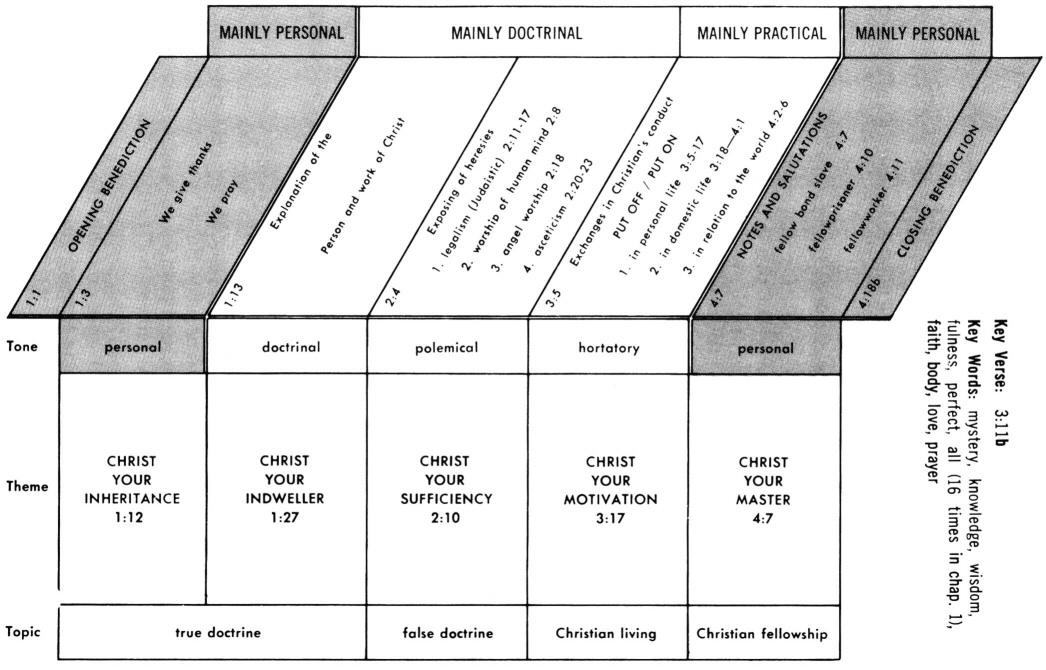
CHRIST IS ALL IN ALL
Click chart to enlarge
Charts from Jensen's Survey of the NT - used by permission
Colossians Overview - Click Chart on right side
| Christ Preeminent in All Things Supreme Lord - Sufficient Savior |
|||
| Colossians 1 | Colossians 2 | Colossians 3 | Colossians 4 |
| Supremacy of Christ |
Submission to Christ |
||
| Doctrinal and Corrective |
Practical and Reassuring |
||
| What Christ Did For Us |
What Christ Does Through Us |
||
| Christ Our Lord |
Christ Our Life |
Christ our Love |
|
| Christ the Head of the Body |
Christ the Lord of the Universe |
Christ the Head of the Home |
|
| Instruction | Warnings | Exhortations | Reminders |
| Reconciliation | Creation | Submission | Conversation |
| His Person and Word |
His Peace and Presence |
||
Colossians 3:11 a renewal in which there is (2SPAI) no distinction between Greek and Jew, circumcised and uncircumcised, barbarian, Scythian, slave and freeman, but Christ is all and in all.
Greek: hopou ouk eni (2SPAI) hellen kai Ioudaios, peritome kai akrobustia, barbaros, Skuthes, doulos, eleutheros, alla [ta] panta kai en pasin Christos
BGT ὅπου οὐκ ἔνι Ἕλλην καὶ Ἰουδαῖος, περιτομὴ καὶ ἀκροβυστία, βάρβαρος, Σκύθης, δοῦλος, ἐλεύθερος, ἀλλὰ [τὰ] πάντα καὶ ἐν πᾶσιν Χριστός. (Col 3:11 BGT)
ESV Here there is not Greek and Jew, circumcised and uncircumcised, barbarian, Scythian, slave, free; but Christ is all, and in all.
KJV Where there is neither Greek nor Jew, circumcision nor uncircumcision, Barbarian, Scythian, bond nor free: but Christ is all, and in all.
NET Here there is neither Greek nor Jew, circumcised or uncircumcised, barbarian, Scythian, slave or free, but Christ is all and in all.
NLT In this new life, it doesn't matter if you are a Jew or a Gentile, circumcised or uncircumcised, barbaric, uncivilized, slave, or free. Christ is all that matters, and he lives in all of us.
Phillips: In this new man of God's design there is no distinction between Greek and Hebrew, Jew or Gentile, foreigner or savage, slave or free man. Christ is all that matters for Christ lives in them all.
Wuest: in which state there cannot be Greek or Jew, circumcision or uncircumcision, Barbarian, Scythian, slave, or free man, but Christ is all things and in all things
YLT where there is not Greek and Jew, circumcision and uncircumcision, foreigner, Scythian, servant, freeman -- but the all and in all -- Christ.
A RENEWAL IN WHICH THERE IS NO DISTINCTION BETWEEN : hopou ouk eni (3SPAI):
- Ps 117:2; Isa 19:23, 24, 25; 49:6; 52:10; 66:18, 19, 20, 21, 22; Jer 16:19; Hos 2:23; Amos 9:12; Micah 4:2; Zec 2:11; 8:20, 21, 22, 23; Mal 1:11; Mt 12:18, 19, 20, 21; Acts 10:34,35; 13:46, 47, 48; 15:17; 26:17,18; Ro 3:29; 4:10,11; 9:24-26; Ro 9:30,31; 10:12; 15:9, 10, 11, 12, 13; 1Cor 12:13; Gal 3:28; Eph 3:6
- Colossians 3 Resources - Multiple Sermons and Commentaries
BARRIERS DIVIDING PEOPLE
ARE BROKEN DOWN IN CHRIST
A Renewal - Not in Greek text. Added for continuity of the previous description of the the old man who is abolished and the new man has been created. Paul's point is that not only are sinful habits and attitudes of the old man abolished, but the new man also results in breaking down of the the barriers that divide men in their unconverted state. Racial barriers are broken down in Christ. Cultural barriers are broken down in Christ. Social and religious barriers are broken down in Christ! The renewal is in essence all encompassing, for now all belong to ONE BODY, CHRIST.
In which (hópou compound relative adverb from poú = where) when used of place it means where, in which or what place. The "place" described is the renewed state of the "new man" in Christ, i.e., in Christ there are no class distinctions. People are not born equal in terms of mental capacity, physical capacity, etc, and so there is no such thing as true equality in this life. Christianity changes that because regeneration brings true equality to people.
There is (éni is the contraction of énesti = there is, third person singular present active indicative). The verb as used here signifies not only the fact but the impossibility. The thrust of the Greek is "in which state there continually cannot be".
Paul declared to the Galatians
"There is neither Jew nor Greek, there is neither slave nor free man, there is neither male nor female; for you are all one in Christ Jesus." (Gal 3:28)
All those who are one with Jesus Christ are one with each other. All believers share the same privilege and position. Within the body of Christ all have the same relationship to God. All are of equal value.
No is the Greek word ou signifying absolute negation. In other words "There absolutely does not exist… " is the force of this statement.
Spurgeon - In the new life there is no distinction of race and nationality. We are born into one family; we become members of Christ’s body; and this is the one thing we have got to keep up—separation from all the world beside: no separations in the church, no disunion, nothing that would cause it, for we are one in Christ, and Christ is all. Now, as we have to put off these things, that is the negative side: that is the law’s side, for the law says, “Thou shalt not”—“Thou shalt not.” But now look at the positive side. Whenever you hear certain very wise brethren say, “Such-and-such a promise in the Bible is for Israel, not for the Gentiles,” do not you be misled in the least by their assertion; but just quote this text to them: “There is neither Greek nor Jew, circumcision nor uncircumcision, Barbarian, Scythian, bond nor free: but Christ is all, and in all.” These distinctions all vanish when once we come to Christ; we are one in him, and every promise to believers is good to all who are in Christ Jesus, for “Christ is all, and in all.”
Lightfoot - “Not only does the distinction not exist, but it cannot exist. It is a mundane distinction, and therefore has disappeared.”
Regeneration brings true equality. People are not equal physically, mentally or economically in this life. Only the gospel can place people on equal footing with God and others.
The Christian church should have no barriers for Christ breaks down all barriers and accepts all people who come to Him. Christians should be building bridges, not walls.
In Christ all distinctions are transcended; at the foot of the cross the ground is level.
GREEK AND JEW CIRCUMCISED OR UNCIRCUMCISED BARBARIAN SCYTHIAN: Hellen kai Ioudaios peritoms kai akrobustia, barbaros skuthe:
- Circumcision 1 Corinthians 7:19; Galatians 5:6; 6:15
- Barbarian Acts 28:2,4; Romans 1:14; 1 Corinthians 14:11
- Colossians 3 Resources - Multiple Sermons and Commentaries
The Greek (Héllēn) when he is converted, becomes a new being, with a new citizenship, a new allegiance. Now he is not so much a Greek but is in fact a Christian. The same reasoning holds for each of the categories Paul lists. The result is a unity in one body with One Head, Christ Jesus.
The Greek and Jew (Ioudaíos), the latter circumcised (peritome) and the former, uncircumcised, (akrobustia) were separated by seemingly insurmountable racial and religious barriers. o label someone as uncircumcised means to designate somebody as not being a Jew and, therefore, outside of the promises.
Circumcised (4061)(peritome from perí = around + témno = cut off) refers literally to cutting and removal of the foreskin. As discussed below both the Old and New Testament also use the concept of circumcision in a figurative or metaphorical sense.
Uncircumcision (203)(akrobustia from ákron = the extreme + búo = cover) means uncircumcised (the foreskin not cut off) or uncircumcision and thus referred to the prepuce or foreskin.
The Jew and the Greek had nothing to do with each other. The world of the New Testament, as our day, was full of divisions between people. The Greek looked down on slaves and barbarians and Scythian. The Greek was the aristocrat of the Roman world and lauded it over anyone who was not Greek in his culture.
The Jew looked down on the Gentile. Jews refused to enter a Gentile house, would not eat a meal cooked by Gentiles and would not buy meat prepared by Gentile butchers. When Jews returned to Israel, they showed their disdain for Gentiles by shaking off the dust from their clothes and sandals. Even the apostles were reluctant to accept Gentiles as equal partners in the church (cf. Acts 10-11). The Pharisee would pray each morning,
“I thank Thee, God, that I am a Jew, not a Gentile; a man, not a woman; and a freeman, and not a slave.”
Yet all these distinctions are removed in Christ. (see note) (see also discussions of in Christ and in Christ Jesus) The gospel broke down every barrier, so that Jew and Gentile became one in Christ.
Paul described that supernatural transaction Ephesians writing that
"But now in Christ Jesus you who formerly were far off have been brought near by the blood of Christ. For He Himself is our peace, who made both groups into one, and broke down the barrier of the dividing wall, by abolishing in His flesh the enmity, which is the Law of commandments contained in ordinances, that in Himself He might make the two into one new man, thus establishing peace, and might reconcile them both in one body to God through the cross, by it having put to death the enmity. And He came and preached peace to you who were far away, and peace to those who were near; for through Him we both have our access in one Spirit to the Father." (Eph 2:13, 14,1 5, 16, 17, 18).
Barbarian (915) (barbaros) strictly means stammering, stuttering or uttering unintelligible sounds and so was used to describe strange speech or foreign language. The Greeks used the word of any foreigner ignorant of the Greek language and the Greek culture, whether mental or moral, with the added notion after the Persian war, of rudeness and brutality. When someone spoke in another language, it sounded to the Greeks like “bar-bar-bar,” or unintelligible chatter.
Paul’s point is that God is no respecter of persons—the gospel must reach both the world’s elite and its outcasts
Vine adds that barbaros
"properly meant one whose speech is rude, or harsh; the word is onomatopoeic, indicating in the sound the uncouth character represented by the repeated syllable bar–bar and hence, in the mouth of a Greek it meant anything that was not Greek, language, people or customs. With the spread of Greek language and culture, it came to be used generally for all that was non-Greek. In time it acquired the additional meaning of rude or uncivilized. Used pejoratively, ‘barbarian’ demeaned those lacking Hellenistic culture as crude, coarse, boorish, savage, or bestial "
And so as you can imagine a fellowship composed of all the people groups mentioned in this verse was unthinkable in the ancient world. Yet that is precisely what happened in the church. Christ demolished the cultural barriers separating men.
Scythian (4658) (skuthes) is used only here and describes a group , above all barbarians, were hated and feared. They were a nomadic, warlike people who invaded the Fertile Crescent in the seventh century before Christ. The Scythians were notorious for their savagery.
Vincent writes that Scythians (Skúthes)
"More barbarous than the barbarians” (Bengel). Hippocrates describes them as widely different from the rest of mankind, and like to nothing but themselves, and gives an absurd description of their physical peculiarities. Herodotus describes them as living in wagons, offering human sacrifices, scalping and sometimes flaying slain enemies, drinking their blood, and using their skulls for drinking-cups. When a king dies, one of his concubines is strangled and buried with him, and, at the close of a year, fifty of his attendants are strangled, disemboweled, mounted on dead horses, and left in a circle round his tomb." (Vincent, M. R. Word studies in the New Testament. Vol. 3, Page 1-504).
Robertson - a Scythian was simply the climax of barbarity (Word Pictures in the New Testament)
SLAVE, FREEMAN: doulos eleutheros:
- 1Cor 7:21,22; Eph 6:8
- Colossians 3 Resources - Multiple Sermons and Commentaries
Slave (1401) (doulos [word study] from deo = to bind giving a great picture of the sense of the noun doulos) a person held in servitude as the chattel of another and under their master's total control. A social barrier existed between the slave and the freeman.
Aristotle referred to a doulos as “a living tool.”
Both slaves and freemen were saved and became brothers in Christ because they
“were all baptized into one body, whether Jews or Greeks, whether slaves or free” (1Cor 12:13).
Paul told Philemon to view Onesimus, his runaway slave,
“no longer as a slave, but more than a slave, a beloved brother” (Philemon 16).
Freeman (1658) (eleutheros - verb form = eleutheroo) refers primarily to freedom to go wherever one likes and described a person in the Grecian culture who was capable of movement and so called "the free one". They were free socially and politically allowing for self-determination.
The unity of slave and freeman was dramatically demonstrated in the arena of Carthage in AD 202. Perpetua, a young woman from a noble family and Felicitas, a slave girl, faced martyrdom for Christ. As they faced the wild beasts, they joined hands. Slave and free woman died together for the love of the same Lord.
Grant Richison - "Regardless of the level of culture or civilization, each ethnic group seems to be able to point to some other group regarded as uncivilized. We cannot excuse racism on the basis of class or background. Jesus sets aside all our education, background, nationality and experience. Jesus breaks down social barriers. Jesus sets aside national, religious, cultural and social distinctions. God's Word says that there is one place where everyone is equal and that is at the foot of the cross. There is no ultimate answer to race problems because of the degeneracy of the human being. We can legislate rights but we cannot legislate the heart. Slavery was rampant in Paul's day. In the Devil's world there is no solution to the inequalities of life. There never will be an ultimate solution to the social and racial problems except the gospel… It comes as a shock to religious people that all they need to be acceptable to God is the Lord Jesus Christ. There is no need for catechism, baptism or joining a church. Christ is all we need for salvation. Moreover, Christ is all we need for the Christian life. We do not get more of him than we have. He is a person and we do not receive a person on the installment plan (Jn 1:16). Since we received new life in Christ we received Christ fully. All we need to do is learn to appropriate him personally to our experience (2Co 4:10; Phil 1:20,21)." (Today's Word)
BUT CHRIST IS ALL AND IN ALL: alla (ta) panta kai en pasin Christos:
- Col 2:10; 1Co 1:29,30; 3:21, 22, 23; Gal 3:29; 6:14; Php 3:7, 8, 9; 1Jn 5:11,12; 2Jn 1:9
- Jn 6:56,57; 14:23; 15:5; 17:23; Ro 8:10,11; Gal 2:20; Eph 1:23; 3:17; 1Jn 5:20
- Colossians 3 Resources - Multiple Sermons and Commentaries
All is the plural panta which is more inclusive than the singular pan would have been.
Lightfoot paraphrases this verse as follows…
Christ is all things and in all things. Christ has dispossessed and obliterated all distinctions of religious prerogative and intellectual preeminence and social caste; Christ has substituted Himself for all these; Christ occupies the whole sphere of human life and permeates all its developments.
Christ has obliterated the words barbarian, master, slave, all of them and has substituted the word adelphos (brother).
Matthew Henry explains all in all this way…
There is now no difference arising from different country or different condition and circumstance of life: it is as much the duty of the one as of the other to be holy, and as much the privilege of the one as of the other to receive from God the grace to be so. Christ came to take down all partition-walls, that all might stand on the same level before God, both in duty and privilege. And for this reason, because Christ is all in all.
Christ is a Christian's all, his only Lord and Saviour, and all his hope and happiness. And to those who are sanctified, one as well as another and whatever they are in other respects, he is all in all, the Alpha and Omega, the beginning and the end: he is all in all things to them.
MacDonald - For the Christian these worldly distinctions are no longer of importance. It is Christ who really counts. He is everything to the believer and in everything. He represents the center and circumference of the Christian’s life. (Believer's Bible Commentary : Old and New Testaments. Nashville: Thomas Nelson)
KJV Study Bible - To the redeemed Christ is all; that is, He is everything, and He is what matters most to them. And Christ is … in all; that is, He dwells in all believers." (KJV Study Bible. Nashville: Thomas Nelson)
Wuest - One heart now beats in all. The pulsating life of the Lord Jesus is the motive power. One mind guides all, the mind of Christ. One life is lived by all, the life of the Lord Jesus produced by the Holy Spirit in the various circumstances and relations of each individual believer’s experience." (Wuest, K. S. Wuest's Word Studies from the Greek New Testament: Studies in the Vocabulary of the Greek New Testament: Grand Rapids: Eerdmans)
Johnson writes in Bibliotheca Sacra (Jan, 64)
"The new man lives in a new environment where all racial, national, religious, cultural and social distinctions are no more. Rather, Christ is now all that matters and in all who believe. The statement is one of the most inclusive in the New Testament and is amply supported by the pre-eminence of Christ in New Testament theology. It is a particularly appropriate statement for the Colossians and affords an excellent summary statement of the teaching of the letter. There are three realms, relevant to the Colossians, in which He is all. He is everything in SALVATION; hence there is no place for angelic mediation in God's redemptive work (cf. Col 1:18, 19, 20, 21, 22; 2:18 ). He is everything in SANCTIFICATION; hence legality and asceticism are out of place in the Christian life (cf. Col 2:16-23). He is our life (Col 3:3, 4). Finally, He is everything necessary for human SATISFACTION; hence there is no need for philosophy, or the deeds of the old man (Col 1:26, 27, 28 ; 2:3, 9, 10). He fills the whole life, and all else is hindering and harmful." (Bibliotheca Sacra 121:481 Jan 1964 - Studies in the Epistle to the Colossians Part X: Christian Apparel)
Hendriksen sums this section up commenting that
Christ, as the all-sufficient Lord and Savior, is all that matters. His Spirit-mediated indwelling in all believers, of whatever racial-religious, cultural, or social background they be, guarantees the creation and gradual perfection in each and in all of “the new man, who is being renewed for full knowledge according to the image of him who created him.” Thus, most appropriately, the very theme of the entire letter, namely, “Christ, the Pre-eminent One, the Only and All-Sufficient Savior,” climaxes this passage. (Hendriksen, W., & Kistemaker, S. J. New Testament Commentary Set, 12 Volumes. Grand Rapids: Baker Book House)
><>><>><>
Octavius Winslow devotionals on Col 3:11…
JANUARY 15. "Christ is all, and in all." Colossians 3:11. -- Anything, even if it be the blessed production of the Eternal Spirit of God, which takes the place of Christ, which shuts out Christ from the soul, is dangerous. In the great work of salvation, Christ must be everything or nothing; from Him solely, from Him entirely, from Him exclusively, must pardon and justification be drawn. Whatever, then, rises between the soul and Christ- whatever would tend to satisfy the soul in His absence- whatever would take His place in the affections, must be surrendered. Is it as the plucking out of a right eye? It must be yielded. Is it as the cutting off of a right hand? Let it go. Christ in his Godhead, Christ in his humanity, Christ in his great and finished work, Christ in his mediatorial fullness, must be all in all to the believer. (Octavius Winslow. Daily Walking with God)
><>><>><>
CHRIST IS ALL, AND IN ALL - "The Lord is my portion, says my soul." "Christ is all, and in all."--Col. 3:11 We close these devout meditations with a magnificent Doxology--Christ all, and Christ in all! It is an epitome, the substance, the consummation and crown of the whole. Each theme has been a wider opening of the Divine jewel box, presenting another and a closer glimpse of the precious, priceless gem it contained. We now uplift and remove the lid, and, lo! it stands before us in all its grandeur, luster, and completeness--CHRIST, ALL AND IN ALL. Language is exhausted, imagery supplies its last symbol, imagination drops her wing, for inspiration can bear it no higher--Christ is all, and in all!
"Blessed Jesus! You are all in all, in creation and redemption, in pardon, grace, and glory. You are all in all in Your Church, and in the hearts of Your people--in all their joys, all their happiness, all their exercises, all their privileges. You are all in all in Your word, ordinances, means of grace, the sum and substance of the whole Bible. Do we speak of promises? You are the first promise in the sacred word, and the whole of every promise that follows; for all in You are 'Yes and Amen'. Do we speak of the law? You are the end of the law for righteousness to every one that believes. Do we speak of sacrifices? By Your one sacrifice You have for ever perfected those who are sanctified. Do we speak of the prophecies? To You give all the prophets witness, that whoever believes in You shall receive the remission of sins. Yes! blessed, blessed Jesus, You are all in all. May You be to me, Lord, the all in all I need in time, and then, surely, You will be my all in all to all eternity!"
My soul! all that Jesus has is yours! Every perfection of His nature, every throb of His heart, every thought of His mind, every drop of His blood, every shred of His righteousness, every atom of His merit, is yours! How rich and vast the inventory! How precious and boundless the wealth! Draw largely upon His opulence--He will honor every draft--sink deeply into His fullness--He will supply every need--"for all is yours."
But, my soul, Jesus is not only all to you, but He is in all that concerns you. He is in every event of your history, and He is in every circumstance of your life. He is in every affliction--sanctifying it; He is in every sorrow--sweetening it; He is in every cloud, brightening it--He is in every burden--sustaining it; He rides upon every storm and walks upon every billow, saying to the winds and the waves, "Peace! be still." Oh, never meet an event or a circumstance in your daily life, be it sad or joyous, but let your faith exclaim, "Jesus is in this! He sent it, He comes with it, He will control it, and I shall prove the all-sufficiency of His grace, and He shall have every ascription of my praise!" And if the Lord has seen fit to remove from you the one you loved--the blessing you prized--the supplies you needed--the prop upon which you leaned, it is only that He Himself should be your all in all. Jesus can fill every blank, replace every loss, and be infinitely more to you than the fondest and most essential treasures He ever gave or took away!
Christ will be all in all when eternity is nearing, and the eye is closing, and the heart is chilling, and the pulse is sinking, and the countenance is changing, and earth is disappearing, and heaven is opening, and friends are weeping--oh then, then, JESUS will be ALL AND IN ALL! Down the shaded valley--across the swelling flood--up the celestial hills--onward to the throne high and lifted up--glory bathing it, saints and angels circling it, anthems floating around it--Jesus will then appear as never before--THE ALL AND THE IN ALL of His Church. "My flesh and my heart fails; but God is the strength of my heart, and my portion forever." (Octavius Winslow. Miscellaneous)
Col 3:11
MEN are ever ready to value themselves upon their natural endowments, their civil distinctions, or their religious privileges; and to imagine that a preeminence in these things gives them some kind of claim to honour and respect, even from God himself. But nothing which a natural man can possess, will give him any such advantage over others as shall entitle him to boast, as though his salvation were in any measure of, or from, himself: the most learned “Greek” must be indebted to divine teaching as much as the unlettered “Scythian;” and the Jew that has been admitted into covenant with God by “circumcision,” be as much saved by the blood and righteousness of Christ as an “uncircumcised” or idolatrous “barbarian:” the “free-man” has no superiority above the “slave;” all stand upon the same footing with respect to salvation; all without exception are dependent upon Christ for all their mercies: in all cases, relating to all persons, and to all the circumstances of each, the creature is nothing, and Christ is all; “he is all in all.” We shall,
I. Illustrate this truth—
If we consult the Scriptures, or our own experience, Christ will be found all in procuring, imparting, maintaining, and completing our salvation.
1. In procuring it—
[Who amongst the sons of men first suggested to our Lord the plan of saving our ruined race through the sacrifice of himself? Who assisted him in performing the mighty work which he had undertaken? “Did he not tread the winepress of God’s wrath alone?” When he “finished transgression, made an end of sin, made reconciliation for iniquity, and brought in an everlasting righteousness,” “there was none with him;” “he looked and there was no man; therefore his own arm brought salvation.” Who can add to the work Which he has accomplished? Who can bring forth any works of supererogation or perfection that shall eke out his righteousness, or give weight and efficacy to his sacrifice? Surely Christ alone must be acknowledged as “the author of eternal salvation.”]
2. In imparting it—
[The state of mankind may be fitly compared to the dry bones in Ezekiel’s vision: they are altogether incapable of exerting themselves in the way of godliness, or of performing the functions of the spiritual life. He who commanded Lazarus to come forth from the grave, and who calls himself “the resurrection and the life,” must quicken them, or they will remain to all eternity “dead in trespasses and sins.” If “we choose him, and love him, it is because he has first chosen us, and loved us.” There is not a saint on earth that must not say, “By the grace of God, I am what I am.” “It is not of blood, or of the will of the flush, or of the will of man, that we are born, but of God.” Through the pride of our hearts indeed, we are too apt to boast: but “who amongst us has any thing which he has not received?” Who must not trace up to God both his “disposition to will, and his ability to do” what is right and good? Nothing but the most consummate pride can hinder us from confessing, that “salvation is, not of him that willeth, or of him that runneth, but of God that sheweth mercy:” and that, “if we have been saved and called with an holy calling, it has not been according to our works, but according to God’s eternal purpose and grace.”]
3. In maintaining it—
[Nothing is more evident than our inability to maintain our natural life: however careful we be in the use of means, we cannot secure our bodies against the effects of disease or accident. The preservation of our spiritual life is yet further beyond the reach of our foresight or our skill. If left by God for one moment, we shall fall. If Adam, even in Paradise, yielded to temptation, notwithstanding he was a perfect man, how much more shall we, who are full of evil? St. Paul acknowledges that, notwithstanding all the grace he had received, he “had not in himself a sufficiency even to think a good thought.” As water ceases to flow when its communication with the fountain is cut off, or as light is instantly extinguished as soon as the rays of the sun are intercepted, so all spiritual life would cease in us for ever, if “Christ, who is our life,” should for one instant withhold his quickening influence. From hence it is that we are necessitated to “live entirely by faith in the Son of God,” and to “receive continually out of his fulness.”]
4. In completing it—
[While we continue in the body, we shall be as dependent upon Christ for every thing, as we have been at any period of our existence. He who has been “the author, must also be the finisher of our faith:” the same “Zerubbabel who laid the foundation of this spiritual work, must finish it with his own hands, in order that, when the head-stone shall be brought forth with shoutings, we may cry, Grace, grace unto it for ever.” Indeed, it is not only to the end of life that Christ will carry on his work, but long after we have mouldered in the grave; “he will raise us up again at the last day,” appoint us our proper portion, exalt us to his throne of glory, and be the continued source of our happiness through all eternity.]
This being a truth of infinite importance, we shall endeavour to,
II. Improve it—
It is not a mere assent to this doctrine that will profit our souls, but the application of it to our hearts and consciences. Let us then apply it—
1. For reproof—
In how strong a light does the guilt of worldly men appear when viewed through the medium of this truth! God assures us that no distinctions of whatever kind will effectually make us happy; and that the happiness of all must be altogether in, and through Christ. The worldling, on the contrary, declares, by his practice at least, that the world, and not Christ, is the true source of rational enjoyment. What is this but to “make God a liar?” and shall this be deemed a light offence in the day of judgment? — — — But this subject more particularly condems the self-righteous. These, instead of looking to Christ for the free, unmerited, and continued exercise of his grace, are ready to boast that they are not as other men, and to go forth in a dependence on their own strength and goodness: instead of regarding him as their entire “wisdom, righteousness, sanctification, and redemption,” they transfer much of his glory to themselves; instead of making him their all, they make him almost nothing. Do such persons honour Christ? or can they expect to be honoured by him before the assembled universe? — — — Even true believers will see much cause to be ashamed, when they reflect how low their thoughts of Christ have been, and how cold their devoutest affections towards him — — — Above all, the ministers of the Gospel, even the most faithful amongst them, have reason to be ashamed. They know that they, who neglect Christ, neglect their all; and that the consequences of that neglect will be inexpressibly dreadful: should not then their “eyes run down with tears day and night for the pride” and ignorance of their people? Should they not “beseech them,” yea, and entreat God for them, with floods of tears, if that by any means they might prevail on some to embrace the Saviour? Have they not reason to tremble lest the blood of multitudes who perish should be required at their hands? Surely they, who are ready to condemn their zeal, should rather pity them, and pray for them, and encourage their activity to the utmost.]
2. For direction—
[They who are inquiring, what shall we do to be saved? have here the shortest and plainest direction that can be given them: if they remember that “Christ is all,” and heartily endeavour to make him their all, they can never perish. Their danger arises not less from their aversion to exalt the Saviour, than it does from the love of worldly and carnal lusts; yea, it is far easier to mortify any vicious habit whatever, than to bring the soul to an unfeigned acquiescence in Christ as our all: we are always wanting to retain some ground of self-preference, and self-complacency: but, if ever we be saved by him, we must lie in his hands as new-born infants, and be contented to be “washed, justified, and sanctified by him” alone — — — The drooping and doubting Christian may also find in these words the very direction which he most of all stands in need of. Doubts and fears arise, either from a defective view of Christ’ all-sufficiency, or from an apprehension of our own want of meetness to participate his benefits: we wish to see ourselves purified in some measure, in order that we may be warranted to lay hold on the promises: whereas the Scripture teaches us, first to lay hold on the promises as sinners, that “by them we may” become saints, and “cleanse ourselves from all filthiness both of flesh and spirit.” We mean not to encourage sin of any kind; God forbid: but we must go to Christ as having nothing in ourselves, that in him we may have all.]
3. For comfort—
[Doubtless, to those who determine to abide in sin, no consolation whatever can be administered, for “the wrath of God does, and ever will, abide upon them:” but to those who would forsake sin, though they be now the very chief of sinners, our text affords unspeakable comfort. They are not to heal themselves in part, and then to apply to the Physician, but to go to Christ just as they are, and to cast themselves entirely upon him. O that some might be encouraged to flee to him for refuge! for as he must be all in the very best of men, so he is willing to be all to the vilest of the human race: “him that goeth unto him he will in no wise cast out” — — — As for the true believer, the subject before us is the one ground of all his comfort: if Christ were not to be his all, he would absolutely despair; because he knows that “without Christ he can do nothing:” but. knowing also the all-sufficiency and faithfulness of Christ, he commits himself cheerfully into his hands, “confident that he who hath begun the good work in him, will perform it to the end,” and “preserve him blameless to his heavenly kingdom.”]
THE words of the text which heads this page are few, short, and soon spoken; but they contain great things. Like those golden sayings (see passages below) they are singularly rich and suggestive …
To me to live is Christ (Php 1:21-note)
I live; yet not I, but Christ lives in me (Gal 2:20-note)
These three words (Christ is all) are the essence and substance of Christianity. If our hearts can really go along with them, it is well with our souls; if not, we may be sure we have yet much to learn.
Christ is the mainspring both of doctrinal and practical Christianity. A right knowledge of Christ is essential to a right knowledge of sanctification as well as justification. He that follows after holiness will make no progress unless he gives to Christ His rightful place.
Let me try to set before my readers in what sense "Christ is all;" and let me ask them, as they read, to judge themselves honestly, that they may not make shipwreck in the judgment of the last day.
I. First of all let us understand that Christ is all, in all the counsels of God concerning man.
(a) There was a time when this earth had no being.
Solid as the mountains look, boundless as the sea appears, high as the stars in heaven look,-they once did not exist. And man, with all the high thoughts he now has of himself, was a creature unknown.
And where was Christ then?
Even then Christ was "with God, was God, and was equal with God." (Jn 1:1; Php 2:6-note) Even then He was the beloved Son of the Father: "Thou lovedst Me," He says, "before the foundation of the world."-"I had glory with Thee before the world began."-"I was set up from everlasting, from the beginning, or ever the earth was." (Jn 17:5, 24; Pr 8:23.) Even then He was the Saviour "for ordained before the foundation of the world" (1Pe 1:20-note), and believers were "chosen in Him." (Ep 1:4-note)
(b) There came a time when this earth was created in its present order.
Sun, moon, and stars,-sea, land, and all their inhabitants, were called into being, and made out of chaos and confusion. And, last of all, man was formed out of the dust of the ground.
And where was Christ then?
Hear what the Scripture says: "All things were made by Him, and without Him was not any thing made that was made." (Jn 1:3.) "By Him were all things created, that are in heaven and that are in earth." (Col 1:16-note) "And Thou, Lord, in the beginning hast laid the foundation of the earth; and the heavens are the works of Thine hands." (He 1:10-note) "When He prepared the heavens, I was there: when He set a compass upon the face of the depth: when He established the clouds above: when He strengthened the foundations of the deep: when He gave to the sea his decree, that the waters should not pass His commandment: when He appointed the foundations of the earth: then I was by Him, as one brought up with Him." (Pr 8:27, 28, 29, 30.) Can we wonder that the Lord Jesus, in His preaching, should continually draw lessons from the book of nature? When He spoke of the sheep, the fish, the ravens, the corn, the lilies, the fig-tree, the vine,-He spoke of things which He Himself had made.
(c) There came a day when sin entered the world.
Adam and Eve ate the forbidden fruit, and fell. They lost that holy nature in which they were first formed. They forfeited the friendship and favour of God, and became guilty, corrupt, helpless, hopeless sinners. Sin came as a barrier between themselves and their holy Father in heaven. Had He dealt with them according to their deserts, there had been nothing before them but death, hell, and everlasting ruin.
And where was Christ then?
In that very day He was revealed to our trembling parents, as the only hope of salvation. The very day they fell, they were told that "the seed of the woman should yet bruise the serpent's head,"-that a Saviour born of a woman should overcome the devil, and win for sinful man an entrance to eternal life. (Ge 3:15.) Christ was held up as the true light of the world, in the very day of the fall; and never has any name been made known from that day by which souls could be saved, excepting His. By Him all saved souls have entered heaven, from Adam downward; and without Him none have ever escaped hell.
(d) There came a time when the world seemed sunk and buried in ignorance of God.
After 4,000 years the nations of the earth appeared to have clean forgotten the God that made them. Egyptian, Assyrian, Persian, Grecian, and Roman empires, had done nothing but spread superstition and idolatry. Poets, historians, philosophers, had proved that, with all their intellectual powers, they had no right knowledge of God; and that man, left to himself, was utterly corrupt. "The world, by wisdom, knew not God." (1Co 1:21.) Excepting a few despised Jews in a corner of the earth, the whole world was dead in ignorance and sin.
And what did Christ do then?
He left the glory He had had from all eternity wits the Father, and came down into the world to provide a salvation. He took our nature upon Him, and was born as a man. As a man He did the will of God perfectly, which we all had left undone: as a man He suffered on the cross the wrath of God which we ought to have suffered. He brought in everlasting righteousness for us. He redeemed us from the curse of a broken law. He opened a fountain for all sin and uncleanness. He died for our sins. He rose again for our justification. He ascended to God's right hand, and there sat down, waiting till His enemies should be made His footstool. And there He sits now, offering salvation to all who will come to Him, interceding for all who believe in Him, and managing by God's appointment all that concerns the salvation of souls.
(e) There is a time coming when sin shall be cast out from this world.
Wickedness shall not always flourish unpunished,-Satan shall not always reign,-creation shall not always groan, being burdened. There shall be a time of restitution of all things. There shall be a new heaven and a new earth, wherein dwells righteousness, and the earth shall be full of the knowledge of the Lord as the waters cover the sea. (Ro 8:22-note; Acts 3:21; 2Pe 3:13-note; Is 11:9.)
And where shall Christ be then? And what shall He do?
Christ Himself shall be King. He shall return to this earth, and make all things new. He shall come in the clouds of heaven with power and great glory, and the kingdoms of the world shall become His. The heathen shall be given to Him for His inheritance, and the uttermost parts of the earth for His possession. To Him every knee shall bow, and every tongue shall confess that He is Lord. His dominion shall be an everlasting dominion, which shall not pass away, and His kingdom that which shall not be destroyed. (Mt 24:30; Re 11:15-note; Ps 2:8; Php 2:10, 11-note; Da 7:14.)
(f) There is a day coming when all men shall be judged.
The sea shall give up the dead which are in it, and death and hell shall deliver up the dead which are in them. All that sleep in the grave shall awake and come forth, and all shall be judged according to their works. (Re 20:13-note; Da 12:2)
And where will Christ be then?
Christ Himself will be the Judge. "The Father hath committed all judgment unto the Son."-"When the Son of man shall come in His glory, then shall He sit upon the throne of His glory:-and before Him shall be gathered all nations: and He shall separate them one from another, as a shepherd divides the sheep from the goats."-"We must all appear before the judgment seat of Christ: that every one may receive the things done in his body, according to that he hath done, whether it be good or bad." (Jn 5:22. Mt 25:32; 2Co 5:10)
Now if any reader of this paper thinks little of Christ, let him know this day that he is very unlike God! You are of one mind, and God is of another. You are of one judgment, and God is of another. You think it enough to give Christ a little honour,-a little reverence,-a little respect. But in all the eternal counsels of God the Father, in creation, redemption, restitution, and judgment,-in all these, Christ is "all."
Surely we shall do well to consider these things. Surely it is not written in vain, "He that honoureth not the Son, honoureth not the Father which hath sent Him." (Jn 5:23)
II. In the second place, let us understand that "Christ is all" in the inspired books which make up the Bible.
In every part of both Testaments Christ is to be found,-dimly and indistinctly at the beginning,-more clearly and plainly in the middle,-fully and completely at the end,-but really and substantially everywhere.
Christ's sacrifice and death for sinners, and Christ's kingdom and future glory, are the light we must bring to bear on any book of Scripture we read. Christ's cross and Christ's crown are the clue we must hold fast, if we would find our way through Scripture difficulties. Christ is the only key that will unlock many of the dark places of the Word. Some people complain that they do not understand the Bible. And the reason is very simple. They do not use the key. To them the Bible is like the hieroglyphics in Egypt. It is a mystery, just because they do not use the key.
It was Christ crucified who was set forth in every Old Testament sacrifice. Every animal slain and offered on an altar, was a practical confession that a Saviour was looked for who would die for sinners,-a Saviour who should take away man's sin, by suffering, as his Substitute and Sin-bearer, in his stead. (1Pe 3:18-note) It is absurd to suppose that an unmeaning slaughter of innocent beasts, without a distinct object in view, could please the eternal God!
It was Christ to whom Abel looked when he offered a better sacrifice than Cain. Not only was the heart of Abel better than that of his brother, but he showed his knowledge of vicarious sacrifice and his faith in an atonement. He offered the firstlings of his flock, with the blood thereof, and in so doing declared his belief that without shedding of blood there is no remission. (He 11:4-note)
It was Christ of whom Enoch prophesied in the days of abounding wickedness before the flood.-"Behold," he said, "the Lord cometh with ten thousand of His saints, to execute judgment upon all." (Jude 1:15)
It was Christ to whom Abraham looked when he dwelt in tents in the land of promise. He believed that in his Seed, in one born of his family, all the nations of the earth should be blessed. By faith he saw Christ's day, and was glad. (Jn 8:56)
It was Christ of whom Jacob spoke to his sons, as he lay dying. He marked out the tribe out of which He would be born, and foretold that "gathering together" unto Him which is yet to be accomplished. "The sceptre shall not depart from Judah, nor the law-giver from between his feet, until Shiloh come, and unto Him shall the gathering of the people be." (Ge 49:10.)
It was Christ who was the substance of the ceremonial law which God gave to Israel by the hand of Moses (See Typology-Study of Biblical types). The morning and evening sacrifice,-the continual shedding of blood,-the altar,-the mercy seat,-the high priest,-the Passover,-the day of atonement,-the scapegoat:-all these were so many pictures, types, and emblems of Christ and His work. (See Moral, ceremonial, and judicial law - a brief study or What happens to the Law in the NT? How does it relate to believers?) God had compassion upon the weakness of His people. He taught them "Christ" line upon line, and, as we teach little children, by similitudes. It was in this sense especially that "the law was a schoolmaster to lead" the Jews "unto Christ." (Gal 3:24.)
It was Christ to whom God directed the attention of Israel by all the daily miracles which were done before their eyes in the wilderness. The pillar of cloud and fire which guided them,-the manna from heaven which every morning fed them,-the water from the smitten rock which followed them,-all and each were figures of Christ. The brazen serpent, on that memorable occasion when the plague of fiery serpents was sent upon them, was an emblem of Christ. (1Co 10:4; Jn 3:14.)
It was Christ of whom all the Judges were types. Joshua, and David, and Gideon, and Jephthah, and Samson, and all the rest whom God raised up to deliver Israel from captivity,-all were emblems of Christ. Weak and unstable and faulty as some of them were, they were set for examples of better things in the distant future. All were meant to remind the tribes of that far higher Deliverer who was yet to come.
It was Christ of whom David the king was a type. Anointed and chosen when few gave him honour,-despised and rejected by Saul and all the tribes of Israel,-persecuted and obliged to flee for his life,-a man of sorrow all his life, and yet at length a conqueror;-in all these things David represented Christ.
It was Christ of whom all the prophets from Isaiah to Malachi spoke. They saw through a glass darkly. They sometimes dwelt on His sufferings, and some times on His glory that should follow. (1Pe 1:11-note) They did not always mark out for us the distinction between Christ's first coming and Christ's second coming. Like two candles in a straight line, one behind the other, they sometimes saw both the advents at the same time, and spoke of them in one breath. They were sometimes moved by the Holy Ghost to write of the times of Christ crucified, and sometimes of Christ's kingdom in the latter days. But Jesus dying or Jesus reigning, was the thought you will ever find uppermost in their minds.
It is Christ, I need hardly say, of whom the whole New Testament is full. The Gospels are "Christ" living, speaking, and moving among men. The Acts are "Christ" preached, published, and proclaimed. The Epistles are "Christ" written of, explained, and exalted. But all through, from first to last, there is but one Name above every other, and that is Christ.
I charge every reader of this paper to ask himself frequently what the Bible is to him. Is it a Bible in which you have found nothing more than good moral precepts and sound advice? Or is it a Bible in which you have found Christ? Is it a Bible in which "Christ is all" If not, I tell you plainly, you have hitherto used your Bible to very little purpose. You are like a man who studies the solar system, and leaves out in his studies the sun, which is the centre of all. It is no wonder if you find your Bible a dull book!
III. In the third place, let us understand that "Christ is all" in the religion of all true Christians on earth.
In saying this, I wish to guard myself against being misunderstood. I hold the absolute necessity of the election of God the Father, and the sanctification of God the Spirit, in order to effect the salvation of every one that is saved. I hold that there is a perfect harmony and unison in the action of the three Persons of the Trinity, in bringing any man to glory, and that all three co-operate and work a joint work in his deliverance from sin and hell. Such as the Father is, such is the Son, and such is the Holy Ghost. The Father is merciful, the Son is merciful, the Holy Ghost is merciful. The same Three who said at the beginning, "Let us create," said also, "Let us redeem and save." I hold that every one who reaches heaven will ascribe all the glory of his salvation to Father, Son, and Holy Ghost, three Persons in one God.
But, at the same time, I see clear proof in Scripture, that it is the mind of the blessed Trinity that Christ should be prominently and distinctly exalted, in the matter of saving souls. Christ is set forth as the "Word," through whom God's love to sinners is made known. Christ's incarnation and atoning death on the cross, are the great corner-stone on which the whole plan of salvation rests. Christ is the way and door, by which alone approaches to God are to be made. Christ is the root into which all elect sinners must be grafted. Christ is the only meeting-place between God and man, between heaven and earth, between the Holy Trinity and the poor sinful child of Adam. It is Christ whom God the Father has "sealed" and appointed to convey life to a dead. world. (John 6:27.) It is Christ to whom the Father has given a people to be brought to glory. It is Christ of whom the Spirit testifies, and to whom He always leads a soul for pardon and peace. In short, it has "pleased the Father that in Christ all fulness should dwell." (Col 1:19-note) What the sun is in the firmament of heaven, that Christ is in true Christianity.
I say these things by way of explanation. I want my readers clearly to understand, that in saying "Christ is all," I do not mean to shut out the work of the Father and of the Spirit. Now let me show what I do mean.
(a) Christ is all in a sinner's justification before God.
Through Him alone we can have peace with a Holy. God. By Him alone we can have admission into the presence of the Most High, and stand there without fear. "We have boldness and access with confidence by the faith of Him." In Him alone can God be just, and justify the ungodly. (Ep 3:12-note; Ro 3:26-note) (See study on through Him = through Christ)
Wherewith can any mortal man come before God? What can we bring as a plea for acquittal before that Glorious Being, in whose eyes the very heavens are not clean?
Shall we say that we have done our duty to God? Shall we say that we have done our duty to our neighbour? Shall we bring forward our prayers?-our regularity?-our morality?-our amendments?-our church going? Shall we ask to be accepted because of any of these?
Which of these things will stand the searching inspection of God's eye? Which of them will actually justify us? Which of them will carry us clear through judgment, and land us safe in glory?
None, none, none! Take any commandment of the ten, and let us examine ourselves by it. We have broken it repeatedly. We cannot answer God one of a thousand.-Take any of us, and look narrowly into our ways,-and we are nothing but sinners. There is but one verdict: we are all guilty,-all deserve hell,-all ought to die. Wherewith can we come before God?
We must come in the name of Jesus,-standing on no other ground,-pleading no other plea than this, "Christ died on the cross for the ungodly, and I trust in Him. Christ died for me, and I believe on Him."
The garment of our Elder Brother,-the righteousness of Christ,-this is the only robe which can cover us, and enable us to stand in the light of heaven without shame.
The name of Jesus is the only name by which we shall obtain an entrance through the gate of eternal glory. If we come to that gate in our own names, we are lost, we shall not be admitted, we shall knock in vain. If we come in the name of Jesus, it is a passport and Shibboleth, and we shall enter and live.
The mark of the blood of Christ is the only mark that can save us from destruction. When the angels are separating the children of Adam in the last day, if we are not found marked with that atoning blood, we had better never have been born.
Oh, let us never forget that Christ must be "all" to that soul who would be justified!-We must be content to go to heaven as beggars,-saved by free grace, simply as believers in Jesus,-or we shall never be saved at all.
Is there a thoughtless, worldly soul among the readers of this book? Is there one who thinks to reach heaven by saying hastily at the last, "Lord have mercy on me," without Christ? Friend, you are sowing misery for yourself, and unless you alter, you will awake to endless woe.
Is there a proud, formal soul among the readers of this book? Is there any one thinking to make him self fit for heaven, and good enough to pass muster by his own doings?-Brother, you are building a Babel, and you will never reach heaven in your present state.
But is there a laboring, heavy-laden one among the readers of this book? Is there one who wants to be saved, and feels a vile sinner? I say to such an one, "Come to Christ, and He shall save you. Come to Christ, and cast the burden of your soul on Him. Fear not: only believe."
Do you fear wrath? Christ can deliver you from the wrath to come.-Do you fear the curse of a broken law? Christ can redeem you from the curse of the law.-Do you feel far away? Christ has suffered, to bring you nigh to God.-Do you feel unclean? Christ's blood can cleanse all sin away!-Do you feel imperfect? You shall be complete in Christ.-Do you feel as if you were nothing? Christ shall be "all in all" to your soul.-Never did saint reach heaven with any tale but this, "I was washed and made white in the blood of the Lamb." (Re 7:14-note)
(b) But again, Christ is not only all in the justification of a true Christian, but He is also all in his sanctification.
I would not have any one misunderstand me. I do not mean for a moment to undervalue the work of the Spirit. But this I say, that no man is ever holy till he comes to Christ and is united to Him. Till then his works are dead works, and he has no holiness at all.-First you must be joined to Christ, and then you shall be holy. "Without Him,-separate from Him,-you can do nothing." (John 15:5)
And no man can grow in holiness except he abides in Christ. Christ is the great root from which every believer must draw his strength to go forward. The Spirit is His special gift, His purchased gift for His people. A believer must not only "receive Christ Jesus the Lord," but "walk in Him, and be rooted and built up in Him." (Col 2:6, 7-note)
Would you be holy? Then Christ is the manna you must daily eat, like Israel in the wilderness of old. Would you be holy? Then Christ must be the rock from which you must daily drink the living water. Would you be holy? Then you must be ever looking unto Jesus,-looking at His cross, and learning fresh motives for a closer walk with God,-looking at His example, and taking Him for your pattern. Looking at Him, you would become like Him. Looking at Him, your face would shine without your knowing it. Look less at yourself and more at Christ, and you will find besetting sins dropping off and leaving you, and your eyes enlightened more and more every day. (He 12:2-note; 2Co 3:18)
The true secret of coming up out of the wilderness, is to come up "leaning on the Beloved." (Song 8:5) The true way to be strong is to realize our weakness, and to feel that Christ must be all. The true way to grow in grace, is to make use of Christ as a fountain for every minute's necessities. We ought to employ Him as the prophet's wife employed the oil,-not only to pay our debts, but to live on also. We should strive to be able to say, "The life that I now live in the flesh I live by the faith of the Son of God, who loved me and gave Himself for me." (2Ki 4:7; Gal 2:20-note)
I pity those who try to be holy without Christ! Your labour is all in vain. You are putting money in a bag with holes. You are pouring water into a sieve. You are rolling a huge round stone uphill. You are building up a wall with untempered mortar. Believe me, you are beginning at the wrong end. You must come to Christ first, and He shall give you His sanctifying Spirit. You must learn to say with Paul, "I can do all things through Christ which strengtheneth me." (Php 4:13-note)
(c) But again, Christ is not only all in the sanctification of a true Christian, but all in his comfort in time present.
A saved soul has many sorrows. He has a body like other men,-weak and frail. He has a heart like other men,-and often a more sensitive one too. He has trials and losses to bear like others,-and often more. He has his share of bereavements, deaths, disappointments, crosses. He has the world to oppose,-a place in life to fill blamelessly,-unconverted relatives to bear with patiently,-persecutions to endure,-and a death to die.
And who is sufficient for these things? What shall enable a believer to bear all this? Nothing but "the consolation there is in Christ." (Php 2:1-note)
Jesus is indeed the brother born for adversity. He is the friend that sticketh closer than a brother, and He alone can comfort His people. He can be touched with the feeling of their infirmities, for He suffered Himself. (He 4:15-note) He knows what sorrow is, for He was a man of sorrows. He knows what an aching body is, for His body was racked with pain. He cried, "All my bones are out of joint." (Ps 22:14-note) He knows what poverty and weariness are, for He was often wearied and had not where to lay His head. He knows what family unkindness is, for even His brethren did not believe Him. He had no honour in His own house.
And Jesus knows exactly how to comfort His afflicted people. He knows how to pour in oil and wine into the wounds of the spirit,-how to fill up gaps in empty hearts,-how to speak a word in season to the weary,-how to heal the broken heart,-how to make all our bed in sickness,-how to draw nigh when we are faint, and say, "Fear not: I am thy salvation." (Lam 3:57)
We talk of sympathy being pleasant. There is no sympathy like that of Christ. In all our afflictions He is afflicted. He knows our sorrows. In all our pain He is pained, and like the good Physician, He will not measure out to us one drop of sorrow too much. David once said, "In the multitude of my thoughts within me, Thy comforts delight my soul." (Ps 94:19.) Many a believer, I am sure, could say as much. "If the Lord himself had not stood by me, the deep waters would have gone over my soul" (Ps 124:5-note)
How a believer gets through all his troubles appears wonderful. How he is carried through the fire and water he passes through seems past comprehension. But the true account of it is just this,-that Christ is not only justification and sanctification, but consolation also.
Oh, you who want unfailing comfort, I commend you to Christ! In Him alone there is no failure. Rich men are disappointed in their treasures. Learned men are disappointed in their books. Husbands are disappointed in their wives. Wives are disappointed in their husbands. Parents are disappointed in their children. Statesmen are disappointed when, after many a struggle, they attain place and power. They find out, to their cost, that it is more pain than pleasure,-that it is disappointment, annoyance, incessant trouble, worry, vanity, and vexation of spirit. But no man was ever disappointed in Christ.
(d) But as Christ is all in the comforts of a true Christian in time present, so Christ is all in his hopes for time to come.
Few men and women, I suppose, are to be found who do not indulge in hopes of some kind about their souls. But the hopes of the vast majority are nothing but vain fancies. They are built on no solid foundation. No living man but the real child of God,-the sincere, thorough-going Christian,-can give a reasonable account of the hope that is in him. No hope is reasonable which is not Scriptural.
A true Christian has a good hope when he looks forward: the worldly man has none. A true Christian sees light in the distance: the worldly man sees nothing but darkness. And what is the hope of a true Christian? It is just this,-that Jesus Christ is coming again, coming without sin,-coming with all His people,-coming to wipe away every tear,-coming to raise His sleeping saints from the grave,-coming to gather together all His family, that they may be for ever with Him.
Why is a believer patient? Because he looks for the coming of the Lord. He can bear hard things without murmuring. He knows the time is short. He waits quietly for the King.
Why is he moderate in all things? Because he expects his Lord soon to return. His treasure is in heaven: his good things are yet to come. The world is not his rest, but an inn; and an inn is not home. He knows that He that shall come will soon come, and will not tarry. Christ is coming, and that is enough.
This is indeed a "blessed hope!" (Titus 2:13-note) Now is the school-time,-then the eternal holiday. Now is the tossing on the waves of a troublesome world,-then the quiet harbor. Now is the scattering,-then the gathering. Now is the time of sowing,-then the harvest. Now is the working season,-then the wages. Now is the cross,-then the crown.
People talk of their "expectations" and hopes from this world. None have such solid expectations as a saved soul. He can say, "My soul, wait thou only upon God; my expectation is from Him." (Ps 62:5-note)
In all true saving religion Christ is all: all in justification,-all in sanctification,-all in comfort,-all in hope. Blessed is that mother's child that knows it, and far more blessed is he that feels it too. Oh, that men would prove themselves, and see what they know of it for their own souls!
IV. One thing more I will add, and then I have done. Let us understand that Christ will be all in heaven.
I cannot dwell long on this point. I have not power, if I had space and room. I can ill describe things unseen and a world unknown. But this I know, that all men and women who reach heaven will find that even there also "Christ is all."
Like the altar in Solomon's temple, Christ crucified will be the grand object in heaven. That altar struck the eye of every one who entered the temple gates. It was a great brazen altar, twenty cubits broad,-as broad as the front of the temple itself. (2Chr 3:4; 4:1.) So in like manner will Jesus fill the eyes of all who enter glory. In the midst of the throne, and surrounded by adoring angels and saints, there will be "the Lamb that was slain." And "the Lamb shall be the light" of the place. (Re 5:6-note; Re 21:23-note)
The praise of the Lord Jesus will be the eternal song of all the inhabitants of heaven. They will say with a loud voice, "Worthy is the Lamb that was slain. Blessing, and honour, and glory, and power, be to Him that sitteth on the throne, and to the Lamb for ever and ever." (Re 5:12-note, Re 5:13-note)
The service of the Lord Jesus will be one eternal occupation of all the inhabitants of heaven. We shall "serve Him day and night in His temple." (Re 7:13-note) Blessed is the thought that we shall at length attend on Him without distraction, and work for Him without weariness.
The presence of Christ Himself shall be one ever lasting enjoyment of the inhabitants of heaven. We shall "see His face," and hear His voice, and speak with Him as friend with friend. (Re 22:4-note) Sweet is the thought that whosoever may be wanting at the marriage supper, the Master Himself will be there. His presence will satisfy all our wants. (Ps 17:15-note)
What a sweet and glorious home heaven will be to those who have loved the Lord Jesus Christ in sincerity! Here we live by faith in Him, and find peace, though we see Him not. There we shall see Him face to face, and find He is altogether lovely. "Better" indeed will be the "sight of the eyes than the wandering of the desire!" (Eccl 6:9)
But alas, how little fit for heaven are many who talk of "going to heaven" when they die, while they manifestly have no saving faith, and no real acquaintance with Christ. You give Christ no honour here. You have no communion with Him. You do not love Him. Alas! what could you do in heaven? It would be no place for you. Its joys would be no joys for you. Its happiness would be a happiness into which you could not enter. Its employments would be a weariness and a burden to your heart. Oh, repent and change before it be too late!
I trust I have now shown how deep are the foundations of that little expression, "Christ is all."
I might easily add to the things I have said, if space permitted. The subject is not exhausted, I have barely walked over the surface of it There are mines of precious truth connected with it, which I have left unopened.
I might show how Christ ought to be all in a visible Church. Splendid religious buildings, numerous religious services, gorgeous ceremonies, troops of ordained men, all, all are nothing in the sight of God, if the Lord Jesus Himself in all His offices is not honoured, magnified, and exalted. That Church is but a dead carcass, in which Christ is not "all."
I might show how Christ ought to be all in a ministry. The great work which ordained men are intended to do, is to lift up Christ. We are to be like the pole on which the brazen serpent was hung. We are useful so long as we exalt the great object of faith, but useful no further. We are to be ambassadors to carry tidings to a rebellious world about the King's Son, and if we teach men to think more about us and our office than about Him, we are not fit for our place. The Spirit will never honour that minister who does not testify of Christ,-who does not make Christ "all."
I might show how language seems exhausted in the Bible, in describing Christ's various offices. I might describe how figures seem endless, which are employed in unfolding Christ's fulness. The High Priest, the Mediator, the Redeemer, the Saviour, the Advocate, the Shepherd, the Physician, the Bridegroom, the Head, the Bread of Life, the Light of the World, the Way, the Door, the Vine, the Rock, the Fountain, the Sun of Righteousness, the Forerunner, the Surety, the Captain, the Prince of Life, the Amen, the Almighty, the Author and Finisher of Faith, the Lamb of God, the King of Saints, the Wonderful, the Mighty God, the Counselor, the Bishop of Souls,-all these, and many more, are names given to Christ in Scripture. Each is a fountain of instruction and comfort for every one who is willing to drink of it. Each supplies matter for useful meditation.
But I trust I have said enough to throw light on the point I want to impress on the minds of all who read this paper. I trust I have said enough to show the immense importance of the practical conclusions with which I now desire to finish the subject.
(1) Is Christ all?
Then let us LEARN THE UTTER USELESSNESS OF A CHRISTLESS RELIGION.
There are only too many baptized men and women who practically know nothing at all about Christ. Their religion consists in a few vague notions and empty expressions. "They trust they are no worse than others. They keep to their church. They try to do their duty. They do nobody any harm. They hope God will be merciful to them. They trust the Almighty will pardon their sins, and take them to heaven when they die." This is about the whole of their religion
But what do these people know practically about Christ? Nothing: nothing at all! What experimental acquaintance have they with His offices and work, His blood, His righteousness, His mediation, His priesthood, His intercession? None: none at all! Ask them about a saving faith,-ask them about being born again of the Spirit,-ask them about being sanctified in Christ Jesus. What answer will you get? You are a barbarian to them. You have asked them simple Bible questions. But they know no more about them experimentally, than a Buddhist or a Turk. And yet this is the religion of hundreds and thousands of people who are called Christians, all over the world!
If any reader of this paper is a man of this kind, I warn him plainly that such Christianity will never take him to heaven. It may do very well in the eye of man. It may pass muster very decently at the vestry-meeting, in the place of business, in the House of Commons, or in the streets. But it will never comfort you. It will never Satisfy your conscience. It will never save your soul.
I warn you plainly, that all notions and theories about God being merciful without Christ, and excepting through Christ, are baseless delusions and empty fancies. Such theories are as purely an idol of man's invention as the idol of Juggernaut they are all of the earth, earthy. They never came down from heaven. The God of heaven has sealed and appointed Christ as the one only Saviour and way of life, and all who would be saved must be content to be saved by Him, or they will never be saved at all.
Let every reader take notice. I give you fair warning this day. A religion without Christ will never save your soul.
(2) Let me say another thing. Is Christ all?
Then LEARN THE ENORMOUS FOLLY OF JOINING ANYTHING WITH CHRIST IN THE MATTER OF SALVATION.
There are multitudes of baptized men and women who profess to honour Christ, but in reality do Him great dishonour. They give Christ a certain place in their system of religion, but not the place which God intended Him to fill. Christ alone is not "all in all" to their souls.-No! it is either Christ and the Church,-or Christ and the sacraments,-or Christ and His ordained ministers,-or Christ and their own repentance,-or Christ and their own goodness,-or Christ and their own prayers,-or Christ and their own sincerity and charity, on which they practically rest their souls.
If any reader of this paper is a Christian of this kind, I warn him also plainly, that his religion is an offence to God. You are changing God's plan of salvation into a plan of your own devising. You are in effect deposing Christ from His throne, by giving the glory due to Him to another.
I care not who it is that teaches such religion, and on whose word you build. Whether he be Pope or Cardinal, Archbishop or Bishop, Dean or Archdeacon, Presbyter or Deacon, Episcopalian or Presbyterian, Baptist or Independent, Wesleyan or Plymouth Brother, whosoever adds anything to Christ, teaches you wrong.
I care not what it is that you add to Christ. Whether it be the necessity of joining the Church of Rome, or of being an Episcopalian, or of becoming a Free Churchman, or of giving up the liturgy, or of being dipped,-whatever you may practically add to Christ in the matter of salvation, you do Christ an injury.
Take heed what you are doing. Beware of giving to Christ's servants the honour due to none but Christ. Beware of giving the Lord's ordinances the honour due unto the Lord. Beware of resting the burden of your soul on anything but Christ, and Christ alone.
(3) Let me say another thing. Is Christ all?
LET ALL WHO WANT TO BE SAVED, APPLY DIRECT TO CHRIST.
There are many who hear of Christ with the ear, and believe all they are told about Him. They allow that there is no salvation excepting in Christ. They acknowledge that Jesus alone can deliver them from hell, and present them faultless before God. But they seem never to get beyond this general acknowledgement. They never fairly lay hold on Christ for their own souls. They stick fast in a state of wishing, and wanting, and feeling, and intending' and never get any further. They see what we mean: they know it is all true. They hope one day to get the full benefit of it: but at present they get no benefit whatever. The world is their "all." Politics are their "all." Pleasure is their "all." Business is their "all." But Christ is not their all.
If any reader of this paper is a man of this kind, I warn him also plainly, he is in a bad state of soul. You are as truly in the way to hell in your present condition, as Judas Iscariot, or Ahab, or Cain. Believe me, there must be actual faith in Christ, or else Christ died in vain, so far as you are concerned. It is not looking at the bread that feeds the hungry man, but the actual eating of it. It is not gazing on the lifeboat that saves the shipwrecked sailor, but actual getting into it. It is not knowing and believing that Christ is a Saviour that can save your soul, unless there are actual transactions between you and Christ. You must be able to say, "Christ is my Saviour, because I have come to Him by faith, and taken Him for my own."-"Much of religion, said Luther, turns on being able to use possessive pronouns. Take from me the word 'my,' and you take from me God!"
Hear the advice I give you this day, and act upon it at once. Stand still no longer, waiting for some imaginary frames and feelings which will never come. Hesitate no longer, under the idea that you must first of all obtain the Spirit, and then come to Christ. Arise and come to Christ just as you are. He waits for you, and is as willing to save as He is mighty. He is the appointed Physician for sin-sick souls. Deal with Him as you would with your doctor about the cure of a disease of your body. Make a direct application to Him, and tell Him all your wants. Take with you words this day, and cry mightily to the Lord Jesus for pardon and peace, as the thief did on the cross. Do as that man did: cry, "Lord, remember me." (Luke 23:42) Tell Him you have heard that He receives sinners, and that you are such. Tell Him, you want to be saved, and ask Him to save you. Rest not till you have actually tasted for yourself that the Lord is gracious. Do this, and you shall find, sooner or later, if you are really in earnest, that "Christ is all."
(4) One more thing let me add. Is Christ all?
Then LET ALL HIS CONVERTED PEOPLE DEAL WITH HIM AS IF THEY REALLY BELIEVED IT. LET THEM LEAN ON HIM AND TRUST HIM FAR MORE THAN THEY HAVE EVER DONE YET.
Alas, there are many of the Lord's people who live far below their privileges! There are many truly Christian souls who rob themselves of their own peace and forsake their own mercies. There are many who insensibly join their own faith, or the work of the Spirit in their own hearts, to Christ, and so miss the fulness of Gospel peace. There are many who make little progress in their pursuit of holiness, and shine with a very dim light. And why is all this? Simply because in nineteen cases out of twenty men do not make Christ all in all.
Now I call on every reader of this paper who is a believer, I beseech him for his own sake, to make sure that Christ is really and thoroughly his all in all. Beware of allowing yourself to mingle anything of your own with Christ.
Have you faith? It is a priceless blessing. Happy indeed are they who are willing and ready to trust Jesus. But take heed you do not make a Christ of your faith. Rest not on your own faith, but on Christ.
Is the work of the Spirit in your soul? Thank God for it. It is a work that shall never over thrown. But oh, beware, lest, unawares to yourself, you make a Christ of the work of the Spirit! Rest not on the work of the Spirit, but on Christ.
Have you any inward feelings of religion, and experience of grace? Thank God for it. Thousands have no more religious feeling than a cat or log. But oh, beware lest you make a Christ of your feelings and sensations! They are poor, uncertain things, and sadly dependent on our bodies and outward circumstances. Rest not a grain of weight on your feelings. Rest only on Christ.
Learn, I entreat you, to look more and more at the great object of faith, Jesus Christ, and to keep your mind dwelling on Him. So doing you would find faith, and all the other graces grow, though the growth at the time might be imperceptible to yourself. He that would prove a skilful archer, must look not at the arrow, but at the mark.
Alas, I fear there is a great piece of pride and unbelief still sticking in the hearts of many believers. Few seem to realize how much they need a Saviour. Few seem to understand how thoroughly they are indebted to Him. Few seem to comprehend how much they need Him every day. Few seem to feel how simply and like a child they ought to hang their souls on Him. Few seem to be aware how full of love He is to His poor, weak people, and how ready to help them! And few therefore seem to know the peace, and joy, and strength, and power to live a godly life, which is to be had in Christ.
Change your plan, reader, if your conscience tells you you are guilty: change your plan, and learn to trust Christ more. Physicians love to see patients coming to consult them: it is their office to receive the sickly, and if possible to effect cures. The advocate loves to be employed: it is his calling. The husband loves his wife to trust him and lean upon him: it is his delight to cherish her, and promote her comfort. And Christ loves His people to lean on Him, to rest in Him, to call on Him, to abide in Him.
Let us all learn and strive to do so more and more. Let us live on Christ. Let us live in Christ. Let us live with Christ. Let us live to Christ. So doing we shall prove that we fully realize that "Christ is all." So doing, we shall feel great peace, and attain more of that "holiness without which no man shall see the Lord." (He 12:14-note) (This chapter is excerpted from his book on holiness which I highly recommend - Holiness)
"Where there is neither Greek nor Jew, circumcision nor uncir cumcision, Barbarian, Scythian, bond nor free: but Christ is all, and in all."—Col. 3:11
There are two worlds, the old and the new.
These are peopled by two sorts of manhood, the old man, and the new man, concerning whom, see Col 3:9, 10.
In the first are many things which are not in the second.
In the second are many things which are not in the first.
Our text tells us what there is not, and what there is, in the new man.
Let us begin by asking whether he knows where he is; for the text turns on that word "where."
I. What there is not in the new.
When we come to be renewed after the image of him that created us, we find an obliteration of—
1. National distinctions: "Where there is neither Greek nor Jew."
Jesus is a man. In the broadest sense he is neither Jew nor Gentile. We see in him no restrictive nationality: and our own peculiar nationality sinks before union with him.
Jesus is now our nationality, our charter, and our fatherland.
Jesus is our hero, legislator, ancestor, leader, etc.
Jesus gives us laws, customs, history, genealogy, prestige, privilege, reliance, power, heritage, conquest, etc.
Jesus furnishes us with a new patriotism, loyalty, and clanship, which we may safely indulge to the utmost.
2. Ceremonial distinctions: "There is neither circumcision nor uncircumcision." The typical separation is removed.
The separating rite is abolished, and the peculiar privilege of a nation born after the flesh is gone with it.
Those who were reckoned far off are brought nigh.
Both Jew and Gentile are united in one body by the cross.
3. Social distinctions: "There is neither bond nor free."
We are enabled through divine grace to see that—
These distinctions are transient.
These distinctions are superficial.
These distinctions are of small value.
These distinctions are non-existent in the spiritual realm.
What a blessed blending of all men in one body is brought about by our Lord Jesus! Let us all work in the direction of unity.
II. What there is in the new.
"Christ is all and in all"; and that in many senses.
1. Christ is all our culture.
In him we emulate and excel the "Greek."
2. Christ is all our revelation.
We glory in him even as the "Jew" gloried in receiving the oracles of God.
3. Christ is all our ritual.
We have no "circumcision," neither have we seven sacraments, nor a heap of carnal ordinances: he is far more than these. All Scriptural ordinances are of him.
4. Christ is all our simplicity.
We place no confidence in the bare Puritanism which may be called "uncircumcision."
5. Christ is all our natural traditions.
He is more to us than the freshest ideas which cross the mind of the "Barbarian."
6. Christ is all our unconquerableness and liberty.
The "Scythian" had not such boundless independence as we find in him.
7. Christ is all as our Master, if we be "bond."
Happy servitude of which he is the head!
8. Christ is our Magna Carta: yea, our liberty itself if we be "free."
In closing we will use the words "Christ is all and in all" as our text for application to ourselves. It furnishes a test question for us.
Is Christ so great with us that he is our all?
Is Christ so broadly and fully with us that he is all in our all?
Is he, then, all in our trust, our hope, our assurance, our joy, our aim, our strength, our wisdom—in a word, "all in all"?
If so, are we living in all for him?
Are we doing all for him, because he is all to us?
Embroideries
What a rich inheritance have all those who are truly interested in Jesus Christ! Christus meus et omnia. They possess him that is all in all, and in possessing him they possess all. "I have all things, my brother," saith Jacob to Esau: Gen. 33:11 (Margin). He that hath him that is all in all cannot want anything. "All things are yours," saith the apostle, "whether things present or things to come, and ye are Christ's": 1 Cor. 3:22, 23. A true believer, let him be never so poor outwardly, is in truth the richest man in all the world; he hath all in all, and what can be added to all?—Ralph Robinson.
Christ is not valued at all unless he be valued above all. —Augustine.
He is a path, if any be misled;
He is a robe, if any naked be;
If any chance to hunger, he is bread;
If any be a bondman, he is free;
If any be but weak, how strong is he!
To dead men life he is, to sick men health,
To blind men sight, and to the needy wealth;
A pleasure without loss, a treasure without stealth.
—Giles Fletcher.
All, then, let him be in all our desires and wishes. Who is that wise merchant that hath heart large enough to conceive and believe as to this? Let him go sell all his nothings, that he may compass this pearl, barter his bugles for this diamond. Verily, all the haberdash stuff the whole pack of the world hath, is not worthy to be valued with this jewel.
I cannot but reverence the memory of that reverend divine (Mr. Welsh) who, being in a deep muse after some discourse that had passed of Christ, and tears trickling abundantly from his eyes before he was aware, being urged for the cause thereof, he honestly confessed that he wept because he could not draw his dull heart to prize Christ aright. I fear this is a rare mind in Christians, for many think a very little to be quite enough for Jesus, and even too much for him!—Samuel Ward.
"At length, one evening, while engaged in a prayer-meeting, the great deliverance came. I received the full witness of the Spirit that the blood of Jesus had cleansed me from all sin. I felt I was nothing, and Christ was all in all. Him I now cheerfully received in all his offices: my Prophet, to teach me; my Priest, to atone for me; my King, to reign over me. Oh what boundless, boundless happiness there is in Christ, and all for such a poor sinner as I am! This happy change took place in my soul March 13th, 1772."—William Carvosso.
Dannecker, the German sculptor, spent eight years in producing a face of Christ; and at last wrought out one in which the emotions of love and sorrow were so perfectly blended that beholders wept as they looked upon it. Subsequently, being solicited to employ his great talent on a statue of Venus, he replied, "After gazing so long into the face of Christ, think you that I can now turn my attention to a heathen goddess?" Here is the true secret of weanedness from worldly-idols, "the expulsive power of a new affection."
I have heard the voice of Jesus,
Tell me not of aught beside;
I have seen the face of Jesus,
All my soul is satisfied.
—Dr. A. J. Gordon.