Colossians 3:2
Colossians 3:3
Colossians 3:4
Colossians 3:5
Colossians 3:6
Colossians 3:7
Colossians 3:8
Colossians 3:9
Colossians 3:10
Colossians 3:11
Colossians 3:12
Colossians 3:13
Colossians 3:14
Colossians 3:15
Colossians 3:16
Colossians 3:17
Colossians 3:18
Colossians 3:19
Colossians 3:20
Colossians 3:21
Colossians 3:22
Colossians 3:23
Colossians 3:24
Colossians 3:25

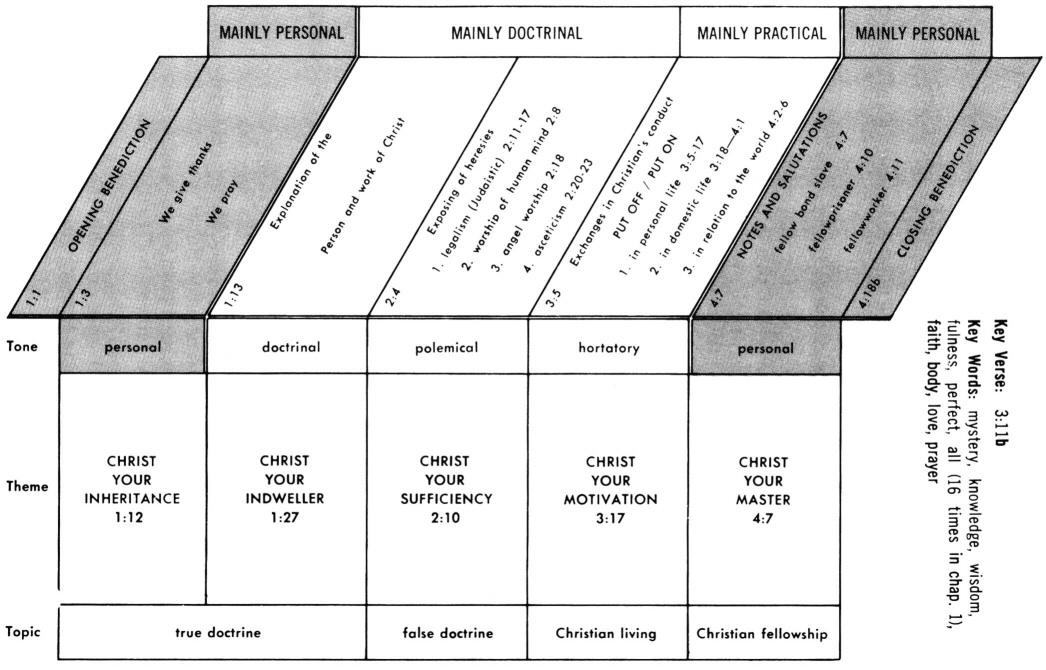
CHRIST IS ALL IN ALL
Click chart to enlarge
Charts from Jensen's Survey of the NT - used by permission
Colossians Overview - Click Chart on right side
| Christ Preeminent in All Things Supreme Lord - Sufficient Savior |
|||
| Colossians 1 | Colossians 2 | Colossians 3 | Colossians 4 |
| Supremacy of Christ |
Submission to Christ |
||
| Doctrinal and Corrective |
Practical and Reassuring |
||
| What Christ Did For Us |
What Christ Does Through Us |
||
| Christ Our Lord |
Christ Our Life |
Christ our Love |
|
| Christ the Head of the Body |
Christ the Lord of the Universe |
Christ the Head of the Home |
|
| Instruction | Warnings | Exhortations | Reminders |
| Reconciliation | Creation | Submission | Conversation |
| His Person and Word |
His Peace and Presence |
||
Colossians 3:2 Set your mind (2PPAM) on the things above , not on the things that are on earth. (NASB: Lockman)
Greek: ta ano phroneite, (2PPAM) me ta epi tes ges
Amplified: And set your minds and keep them set on what is above (the higher things), not on the things that are on the earth. (Amplified Bible - Lockman)
Lightfoot: All your thoughts must abide in heaven, not on the earth. For, I say it once again, you have nothing to do with mundane things: you died once for all to the world: you are living another life.
NET: Keep thinking about things above, not things on the earth, (NET Bible)
Phillips: Give your heart to the heavenly things, not to the passing things of earth. (Phillips: Touchstone)
TLB: Let heaven fill your thoughts; don’t spend your time worrying about things down here
Wuest: The things above be constantly setting your mind upon, not the things on the earth; (Eerdmans)
Young's Literal: the things above mind ye, not the things upon the earth,
Set your mind on the things above: ta ano phroneite (2PPAM):
- Ro 12:2-note, Ro 8:4-note; Ro 8:5-note, Ro 8:6-note; Php 2:5-note, Php 4:8-note, Php 2:12-note, Php 2:13-note Mt 5:8-note, 1Ch 22:19; 29:3; Ps 62:10; 91:14; 119:36,37; Pr 23:5; Eccl 7:14; Mt 16:23; Eph 4:23-note, Php 1:23-note; 1Jn 2:15, 16,17 contrast Mt 16:23
- Joshua 1:8-note, Ps 73:25, Ps 8:3,4,48:9, 119:148, 143:5
- Colossians 3 Resources - Multiple Sermons and Commentaries
- Colossians 3:1-4 Living the Risen Life - John MacArthur
EYES UPWARD
| COLOSSIANS 1-2 |
COLOSSIANS 3-4 |
| Sound Doctrine | Spiritual Duty |
| What we are to Believe |
How we are to Behave |
| Our Position in Christ |
Our Practice in Christ |
| Christ's Provision for Believers |
Christ's Work through Believers |
From the preceding simple tabular overview of Colossians, we can see that in chapter 3 we have entered into the practical side of this great letter. The danger is to begin in this more practical section (chapters 3-4) but neglecting to meditate on and master the profound positional truths and the glorious Christology of the first two chapters (eg, truths like Col 1:27-note, Col 2:10-note, Col 2:12, 13-note, etc). We must know who we are in union with Christ before we can practice and live like "Whose" we are. Sound doctrine is always the rock solid foundation for carrying out our spiritual duty. To attempt to practice the latter without a firm grasp of the former, leads to frustration, failure, legalism, etc. For example, before we can begin to put to death the seductive, attractive sins (attractive at least to the old nature, the flesh) in Colossians 3:5-note, we must understand our divine position (in Christ) and our divine provisions.
Along that same line, it is good to recall Paul's declaration in Galatians which explains how a believer can even possibly focus on heaven and not the passing pleasures of this world…
But may it never be that I should boast, except in the cross of our Lord Jesus Christ, through which the world (kosmos) has been crucified to me (Beloved believer - Take note - This is a past tense completed event!), and I to the world (I am "dead" to the world - now I need to live this truth out in everyday life in the power of the Spirit!). (Gal 6:14-note)
In short, the only reason we can even obey the commands in Colossians 3:1-2 is because we are now positionally dead to the world and its magnetic attractions. What believers must do now, enabled by the Holy Spirit, is to fight the good fight of faith by focusing upward rather than downward and "around-ward". If we launch each new day with this mindset, then our Father will enable us to view the "around-ward" people and events and things from a heavenly perspective and we will have His wisdom and guidance as to how we should interact and/or what we should say (Col 4:5, 6-note). Then each day becomes literally a "missionary" adventure as we navigate through this fallen world, seeing with eternal, heavenly vision and seeking with the Father's heart to rescue as many souls as He would allow (cp Jude 1:23).
Dearly We're Bought
J Hart
Play and ponder the lyrics — as you contemplate what it means to set your mind above -- Glory!
Purchase entire song [and other great God glorifying music] from Red Mountain Music
Come, raise your thankful voice,
Ye souls redeemed with blood;
Leave earth and all its toys,
And mix no more with mud.
Dearly we’re bought, highly esteemed;
Redeemed, with Jesus’ blood redeemed.
Christians are priests and kings,
All born of heavenly birth;
Then think on nobler things,
And grovel not on earth.
Dearly we’re bought, highly esteemed;
Redeemed, with Jesus’ blood redeemed.
With heart, and soul, and mind,
Exalt redeeming love;
Leave worldly cares behind,
And set your minds above.
Dearly we’re bought, highly esteemed;
Redeemed, with Jesus’ blood redeemed.
Lift up your ravished eyes,
And view the glory given;
All lower things despise,
Ye citizens of heaven.
Dearly we’re bought, highly esteemed;
Redeemed, with Jesus’ blood redeemed.
Be to this world as dead,
Alive to that to come;
Our life in Christ is hid,
Who soon shall call us home.
Dearly we’re bought, highly esteemed;
Redeemed, with Jesus’ blood redeemed.
The things above - Is literally "the above". So more accurately this reads
the things above, keep on setting your mind upon
Comment: J A Beet says the literal is "the things above, make these the objects of your thought." The repetition of the things above keeps conspicuously before us the new and lofty element just introduced.
UBS Handbook adds: It may be necessary to avoid a translation of things which would suggest only material objects.
Above (507)(ano) is an adverb of place and means higher in place, a position above another position, and used figuratively of heaven (Jn 8:23, Gal 4:26, Php 3:14, Col 3:1,2), of the direction upward (Lxx of Ex 20:4, Dt 4:39; when Jesus prayed Jn 11:41ESV, the sky Acts 2:19, figuratively of a root growing He 12:15). Ano is the root of the more "famous" adverb anothen (ano + -then = from) used by Jesus in John 3:3 speaking of men's need to be born "from above".
Ano - 9x in 9v -John 2:7; 8:23; 11:41; Acts 2:19; Gal 4:26; Phil 3:14; Col 3:1, 2; Heb 12:15. NAS = above(5), brim(1), upward(1).
Ano - 35x in 31v in the non-apocryphal Septuagint - Exod 20:4; Deut 4:39; 5:8; 28:43; 29:17; 30:12; Josh 2:11; 15:19; 16:5; 21:22; Judg 7:13; 1 Kgs 8:23; 10:22; 12:24; 2 Kgs 18:17; 19:30; 1 Chr 7:24; 22:5; 2 Chr 4:4; 8:5; 26:8; 32:30; Ps 49:4; 113:11; Prov 8:28; Eccl 3:21; Isa 7:3; 8:21; 34:10; 36:2; 37:31
Believers have had their unregenerate hearts of stone circumcised by the Spirit and have received a "heart transplant", a brand new heart, with new divine desires, a heart which now receives on the "FM Band" and enables them to be tuned into the "beautiful music" from above. Paul explained earlier in the sound doctrinal section that…
in Him you were also circumcised with a circumcision made without hands, in the removal of the body of the flesh by the circumcision of Christ (Col 2:11-note) (See also Excursus on Circumcision Of the Heart)
Comment: Beloved, our new heart enables a new aim and creates in us a desire for the things of heaven (cp Ps 51:10, Ezek 11:19, 20, 18:31), but this does not relinquish us from our obligation to work out that desire in fear and trembling (Our part = Php 2:12-note, God's part = provides the desire and the power in Php 2:13-note, cp the two clauses in Ezek 36:26, 27 and note God's part and man's responsibility in v27)
The… above - Note that these are the first words in the Greek which emphasizes that the direction is to be heavenward. Look to heavenly things first.
We note a dramatic contrast of "mindset" in the unregenerate man or woman…
whose end is destruction, whose god is their appetite ("belly"), and whose glory is in their shame, who set their minds (same verb used in Col 3:2 = phroneo in the present tense = continually, habitually, as their normal manner of life) on earthly things. (but) our citizenship is in heaven, from which also we eagerly wait for (present tense = our general attitude and affection) a Savior, the Lord Jesus Christ Who will transform the body of our humble state into conformity with the body of His glory, by the exertion of the power that He has even to subject all things to Himself. (Php 3:19-note, Php 3:20, 21-note)
Set you mind - Set your affection (KJV) is not a bad translation. Affection is defined as tender attachment, a propensity, a disposition, a feeling that includes an inclination or liking, a bent of the mind towards particular object. Webster's 1828 dictionary says affection holds a middle ground between disposition which is natural and passion which is excited by the presence of the exciting object. Other nuances of affection include a settled good will, love or zealous attachment or leaning. A feeling of fondness or tenderness or warmth. Now using these meanings of affection think about what it means to set our mind on the things that are above.
THOUGHT- Ask yourself "Is my mind bent toward heaven or toward earth?" "To what is my mind most tenderly attached - things of heaven or things on earth?" I think most of us would experience varying degrees of conviction that perhaps our tender feelings are focused far too often on the temporal and visible than on the eternal and invisible! (see 2Co 4:18+)
Spurgeon phrases it this way "Have a relish for things above, study industriously things above.
Spurgeon may have been quoting Johann Bengel who wrote "They who truly seek the things that are above, cannot but relish or set their affections on the things that are above.
The Williams translation says "Practice occupying your minds with the things above
This setting of one's mind, affection and heart calls for a definite act of our wills (not self effort but Spirit enabled - Php 2:13-note) to daily, continually, moment by moment be thinking about and directing our minds towards the things of heaven and eternity. In fact believers should "filter" everything they see and experience on earth through the lens of eternity. Believers are other worldly and are to be heavenly-minded, and not weighed down, worried and bothered (Lk 10:41) by the fleeting fancies of this material, mundane present passing age.
Spurgeon writes that "On board iron vessels (ships) it is a common thing to see a compass placed aloft, to be as much away from the cause of aberration as possible; a wise hint to us to elevate our affections and desires; the nearer to God, the less swayed by worldly influences." (Ed: Lord place the "compass" of our heart as near heaven as possible while our feet yet touch this decaying globe of dust. In Jesus' Name and for His fame. Amen) (cp David's prayer in 1Chr 29:18) The compass on board an iron vessel is very subject to aberrations; yet for all that, its evident desire is to be true to the pole. True hearts in this wicked world, and in this fleshly body, are all too apt to swerve, but still they show their inward and persistent tendency to point toward heaven and God. On board iron vessels it is a common thing to see the compass placed aloft, to be as far away from the cause of aberration as possible: a wise hint to us to elevate our affections and desires; the nearer to God, the less swayed by worldly influences.
A T Robertson makes the point that "It does matter what we think and we are responsible for our thoughts. Paul does not mean that we should never think the things upon the earth, but that these should not be our aim, our goal, our master. The Christian has to keep his feet upon the earth, but his head in the heavens. He must be heavenly-minded here on earth and so help to make earth like heaven.
Set your mind (5426) (phroneo from phren = mind) denotes the whole action of the affections and will as well as the reason. Phroneo refers to the basic orientation, bent, and thought patterns of the mind, rather than to the intellect per se, and thus it refers more to one's inner impulse or disposition, while keep seeking (Col 3:1) marks a practical pursuit or striving after. Both are to be upward focused. Indeed, a sure safeguard to impede seeking the things below, is a continual setting of our mind upon the things above!
"Desire what is in heaven”
“Desire what God has for you in heaven”
Vine adds that phroneo "signifies the whole action of the mind, not merely the thinking power, the reasoning, but the set purpose of the mind, and is thus used in a distinctly spiritual sense. There is an advance of expression from that in verse 1. Believers are to do more than seek the things above."
Turn your eyes upon Jesus,
Look full in His wonderful face,
And the things of earth will grow strangely dim,
In the light of His glory and grace.
(Play "Turn Your Eyes on Jesus")
Setting one's minds on things above involves an act of one's will (active voice) and is something we must choose to do (imperative mood = command, not optional) continually (present tense = habitual). Why? Because our mortal enemies the world, the flesh and the devil continually try to draw us back into the muck and mire of this sin filled world. And make no mistake about it, these mortal enemies want to control your mind, but God wants to transform your mind. And if we would experience the abundant life Jesus referred to in John 10:10, we must set our affections on that which is the source of true life, true joy, true peace, true contentment, etc.
David Guzik concludes that "The best Christian living comes from minds that are fixed on heaven. (Ed: cp 1Pe 1:13-note where "fix your hope" is aorist imperative = do this now - it is urgent). They realize that their lives are now hidden with Christ in God, and since Jesus is enthroned in heaven (Ed: And they're seated with Him in the heavenlies - Ep 2:6-note), their thoughts and hearts are connected to heaven also. We are told to seek those things which are above, and set our mind on things above. But how do we practically seek and set?
· By spending time in the Word of God.
· By spending time in prayer.
· By spending time with things that build us up in God instead of merely entertaining us.
· By gathering with others in the Lord.
The great Puritan writer John Owen has well said that "Fixing and filling your affections with heavenly things will mortify sin (Ed: At least it will facilitate a mindset and disposition that seeks to put sin to death by the power of the Spirit - Ro 8:13-note, Col 3:5KJV-note).
Comment: Seeking the things above is not mysticism or mere "positive thinking", "visualization" or "mind over matter". It is however true that as a man thinks in his heart, so he is. And so as he surrenders to the Spirit and partakes of grace to enable him to seek the heavenly things, his mind is renewed and is less likely to choose the base and profane things of this world. A powerful way to aid our seeking the things above is to memorize the Word of God which speaks about the things above. Then we will be able to recall those heavenly truths to mind no matter where we find ourselves during the day. (See related topics - Memorizing His Word; Memory Verses by Topic)
Willam Wilberforce - Mankind are in general deplorably ignorant of their true state; and there are few perhaps who have any adequate conception of the real strength of the ties by which they are bound to the several objects of their attachment, or who are aware how small a share of their regard is possessed by those concerns on which it ought to be supremely fixed. Except the affections of the soul be supremely fixed on God; unless it be the leading and governing desire and primary pursuit to possess his favour and promote his glory, we are considered as having transferred our fealty to an usurper, and as being in fact revolters from our lawful sovereign. God requires to set up his throne in the heart, and to reign in it without a rival.
Kenneth Wuest picks up on this tense and mood rendering it "The things above be constantly setting your mind upon, not the things on the earth."
Notice that in this case the imperative (command) precedes the indicative (the reality = who we are in Christ, Col 3:3, 4-note). What is the significance of this placement? The point is that we are commanded to have this heavenly mindset, based on the truth about our present (and eternal) position and our promised future. Paul wants not only our hearts in glory (Col 3:1-note), but he also wants our thoughts in glory.
Radmacher comments that "The false teachers were instructing the Colossians to concentrate on temporal observances; in contrast, Paul instructs them to concentrate on the eternal realities of heaven." (Nelson Study Bible: NKJV)
Joni Eraeckson Tada asks "Why all the verbs in the present tense? Because God wants to get your heart beating with a present-tense excitement, a right-around-the-corner anticipation of Heaven. Isn’t that the way strangers on foreign soil are supposed to feel about their homeland?
Vincent suggests that "Seek marks the practical striving; set your mind, the inward impulse and disposition. Both must be directed at things above.
As Lightfoot says "You must not only seek heaven, you must think heaven." What do you think about during the day? What you are going to eat for dinner? What NETFLIX series you will binge on tonight?
The believer’s whole disposition should orient itself toward heaven, where Christ is, just as a compass needle orients itself toward the north.
Philpot notes that on the other hand in our natural, fallen state in Adam…
we have no affection for anything else. There is no such thing as a spiritual desire or a heavenly affection in our soul when we are in a state of unregeneracy. So fallen are we that we love—and cannot but love the world, and the things of the world. We have no heart for anything but the things of time and sense—no, rather, as our carnal mind is enmity against God, we hate everything which is spiritual, heavenly, and holy (Ro 8:7-note). One main part, therefore, of the work of God upon the soul is to take off our affections from these earthly things, and to fix them upon Jesus where He sits enthroned above (Ed: And we sit with Him - Eph 2:6-note) —that we may love and hate those things which He loves and hates.
Our affections are not to be set upon things on the earth. Business, worldly cares, the interests of our family, the things of time and sense—in whatever form they come—whatever shape they may assume—must not so entwine themselves round our affections as to bind them down to the earth (cp 2Ti 2:4-note). We may use them for the support and sustentation of our life—but we must not abuse them.
We are not to set
our affections on them!
Houses, gardens, land, property, friends, family—all these earthly things—we are not to set our affections on them, so that they become idols. Thus any lovely object may be foul—because turned to an idol. It may be but a flower—and yet be an idol. It may be a darling child whom everybody admires for its beauty and attractiveness—yet it may be a defiling idol. A cherished project may be an idol. A crop of wheat—a flock of sheep—a good farm—a thriving business—respect of the world—may all be defiling idols—for all these things, when eagerly pursued and loved, draw the soul away from God, and by drawing it insensibly from Him, bring pollution and guilt into the conscience. Now we are, or by grace in due time shall be, weaned and divorced from earth with all its charms and pleasures and all its polluting idols. "Little children, keep (aorist imperative = Command to do this posthaste. It is urgent. It implies there is danger lurking if not obeyed!) yourselves from idols. " 1 John 5:21 (RICHES OF PHILPOT)
We need to continually remember that everything we allow into our mind will affect our pursuit of holiness either positively or negatively and thus it is imperative that we set a guard over our heart (Pr 4:23-note) and continually think on those things which are true, honorable, etc (Php 4:8-note)
Warren Wiersbe comments that "D. L. Moody used to scold Christians for being "so heavenly minded they were no earthly good," and that exhortation still needs to be heeded (Ed: But that is not a major problem with most believers today!). Christians have a dual citizenship—on earth and in heaven—and our citizenship in heaven ought to make us better people here on earth. The spiritually minded believer is not attracted by the "things" of this world. He makes his decisions on the basis of eternal values and not the passing fads of society. Lot chose the well-watered plain of Jordan because his values were worldly, and ultimately he lost everything. Moses refused the pleasures and treasures of Egypt because he had something infinitely more wonderful to live for (Heb 11:24, 25, 26-note). "What shall it profit a man, if he shall gain the whole world, and lose his own soul?" (Mk 8:36)
Morgan - The believer is to ‘seek the things . . . above.’ The word ‘seek’ marks aspiration, desire, and passion. . . . In order to seek these things the mind must be set on them.
Clarke - Love heavenly things; study them; let your hearts be entirely engrossed by them. Now, that you are converted to God, act in reference to heavenly things as ye did formerly in reference to those of earth.
Vaughan - ‘Earthly things’ are not all evil, but some of them are. Even things harmless in themselves become harmful if permitted to take the place that should be reserved for the things above.
Spurgeon comments…
You say that you were dead with Christ, and that you have risen with Christ. Live, then, the risen life, and not the life of those who have never undergone this matchless process. Live above.
How can we continually think heavenly thoughts
when we are continually bombarded with earthly "pollutants" ?
It is not easy but it is not impossible or otherwise God would not have commanded us to choose a heavenly mindset (God's commands always, always include His "enablements"!). Do you remember how you felt when you first fell in love with that person of your dreams? Your thoughts continually focused on that one who made your heart flutter. When you had free time your thoughts would drift in their direction. When you lay in bed at night you thought about them as you fell asleep. You'd spend hours together and the first thing you did when you got home was call them and talk until the wee hours of the morning. I've been married now 41 years and I still recall those "first love" days.
It is that "in love" (with God our eternal Father, with Jesus our beloved Bridegroom, with the Spirit our Teacher and Comforter) mindset which Paul wants us to cultivate so that we might put it into practice. Heavenly thinking is thinking about the One we love more than life itself because He first loved us so selflessly and sacrificially (1Jn 4:10, 19, Lk 7:47, Jn 3:16, 15:16, 2Co 5:14, 15). It is being so in love with our Lord that we think about Him all the time, contemplating His loveliness, His power, what it will be like spending an eternity with the One we love and Who loves us with a love indescribable and infinite.
You're thinking about Him now aren't you? Why? Because you are "in the book"… not these notes, for they are not "living and active" (He 4:12-note) but in the Living Word, the Word of Truth and Promise and Hope. Jesus in the beginning was the Word (Jn 1:1, 2), and in these last days God has spoken to us in His Son (He 1:1,2-note). It follows that the best way to "fertilize" our mind so that we "cultivate" a mind that is continually thinking of Jesus, is to be in the Word that speaks about His Person from Genesis to Revelation, and let that Word saturate and motivate and fill and empower us to choose Jesus and thoughts of heaven every time we come to a "fork in the road" so to speak.
We need to practice the "presence of God" rising early to meet Him in sweet communion, listening quietly as we read His love letter to us, and then obediently and lovingly (not under legalistic constraint) doing our Master's will. We need to emulate Mary and repose at His feet (Lk 10:39), rather than be Martha all busy and bothered about so many things (Lk 10:40, 41), forgetting that really only one thing is necessary (Lk 10:42).
Every time we look at that glitzy sports car commercial, we need to remind ourselves that shiny metal on wheels will never satisfy our innermost need, a need only Jesus can fully satisfy. And "things" will never make us more significant or valuable than we already are in Christ, our true Treasure in Whom are hidden all the riches of wisdom and knowledge (Col 2:3-note).
Every time we are tempted to compromise our ethics to make things comfortable we must remind ourselves that the impact of our action (1) grieves our Bridegroom (cp Ep 4:30-note, 1Th 5:19-note), (2) risks impugning His marvelous name among the non-believing world (who already think most Christians are blatant hypocrites) and/or (3) will effect your eternal rewards (see the Bema seat; 2Co 5:10-note; 1Ti 4:7, 8-note).
Every time we are tempted to choose a hedonistic activity over Spirit enabled obedience (Ro 8:13-note, Gal 5:16-note) need to remember that we are offending the God Whose Name is Jealous (Attributes) and the One Who loves us with an everlasting love (cf Ge 39:9).
In short, we must resist the notion that true happiness can be found in anything this world has to offer. It is not in a new car, a faster computer, a new mate, a bigger home, a highest salary, a vacation home, etc, etc. True happiness is found in holiness and maintenance of a heavenly mindset. Jesus alluded to an immutable axiom when He said that if our greatest desire is for the things of this earth, that is where our heart will be tethered (Mt 6:21-note). If our greatest desire is for the things of Heaven, then our heart will be in heaven and as a man thinks in his heart so he is.
Dr John MacArthur has a clarification concerning maintenance of a an "upward mindset"
Paul is not advocating a form of mysticism. Rather, he desires that the Colossians’ preoccupation with heaven govern their earthly responses. To be preoccupied with heaven is to be preoccupied with the One who reigns there and His purposes, plans, provisions, and power. It is also to view the things, people, and events of this world through His eyes and with an eternal perspective… When Christians begin to live in the heavenlies… they will live out their heavenly values in this world to the glory of God. (MacArthur, J. Colossians. Chicago: Moody Press)
Harry Ironside writes that…
It is of all importance that we realize that we do not stand before God on the ground of responsibility. The responsible man failed utterly to keep his obligations. There was nothing for him, therefore, but condemnation, but our Lord Jesus Christ has borne that condemnation; He voluntarily, in infinite grace, took the place of the sinner and bore his judgment upon the cross. Now in resurrection, as we have seen, all who believe are not only given a perfect representation by Him before the throne of God, but we are in Him in virtue of being partakers of His life.
It is when the soul enters into this experimentally, realizing that the death of Christ, in which faith has given him part, has severed the link that bound him to the world and all its purposes and has freed him from all necessity to be subject to sin in the flesh, that he will be free to glorify God as he walks in newness of life. Most theological systems fail to apprehend this great truth of the new man in Christ, hence so few believers have settled peace and realize their union with Him who sits at God's right hand, not only as the Head of the Church, but as the Head of every man who has found life through Him.
Occupation, then, with Christ risen in the energy of the Holy Spirit, is the power for holiness. We are called upon to seek those things which are above, where Christ sitteth on the right hand of God. Our real life is there, our truest, best interests are all identified with Him. Heavenly-mindedness is the natural, or I should say, spiritual outcome of this realization.
A story is told of a little girl many years ago in the slums who saw an object lesson using a beautiful white lily. The children gazed upon and touched the lovely lily. One little girl then looked upon herself and immediately fled to her garret home. She used soap she could find, and did her best to make herself more presentable. The lily had awakened her desire for cleanliness. So to look upon our great and holy God awakens within the child of God the desire to be more like Him."
The death of Philipp Melancthon — Is there anything else you want?” was asked Melancthon on his deathbed. “Nothing but heaven,” was the reply.
Spurgeon has an excellent illustration…
“Birds,” says Manton, “are seldom taken in their flight; the more we are upon the wing of heavenly thoughts the more we escape snares.”
Oh that we would remember this, and never tarry long on the ground lest the fowler ensnare us. We need to be much taken up with Divine things, rising in thought above these temporal matters, or else the world will entangle us, and we shall be like birds held with limed twigs, or encompassed in a net. Up, then, my heart. Up from the weedy ditches and briery hedges of the world into the clear atmosphere of heaven. There, were the dews of grace are born, and the Sun of Righteousness (Mal 4:2) is Lord paramount, and the blessed wind of the Spirit blows from the everlasting hills (Jn 3:3), thou wilt find rest on the wing, and sing for joy where thine enemies cannot even see thee (hidden with Christ in God = Col 3:3). (Colossians 3 Biblical Illustrator)
T. F. B. Tinling
The affections to be habitually heavenward:— After painting the Sistine ceiling, Michael Angelo found that the habit of looking upward, which that long-continued work rendered necessary, made it for some time impossible to read or to look carefully at a drawing except in the same attitude. So our converse with heaven should affect our attitude in looking at the things of earth. (Colossians 3 Biblical Illustrator)
T. De Witt Talmage
Drawings toward heaven: — A man was passing along the street, and saw a blind boy seated on his father’s knee, holding in his hand a kite-string, the kite flying away in the air. The man said, “Is it any satisfaction to you, my lad, to fly that kite, when you cannot see it?” “O yes, sir,” he replied, “I cannot see it, but I can feel it pull.” And so out of this dark world, and amid this blindness of sin, we feel something drawing us heavenwards; and though we cannot see the thrones, and the joy, and the coronation, blessed be God, we can feel them pull. (Colossians 3 Biblical Illustrator)
Thomas Watson asks…
Are we heavenly in our affections? Do we set our affections on the kingdom of heaven? Col 3:2. If we are heavenly, we despise all things below—in comparison with the kingdom of God; we look upon the world but as a beautiful prison; and we cannot be much in love with our fetters, though they are made of gold. Our hearts are in heaven. A stranger may be in a foreign land to gather up debts owing him—but he desires to be in his own kingdom and nation: so we are here awhile as in a strange land—but our desire is chiefly after the kingdom of heaven, where we shall be forever. The world is the place of a saint's abode, not his delight. Is it thus with us? Do we, like the patriarchs of old, desire a better country? Heb 11:16. This is the temper of a true saint, his affections are set on the kingdom of God: his anchor is cast in heaven, and he is carried there with the sails of desire…
There needs be no exhortation for us to set our hearts on things below. How is the curse of the serpent upon most men! " (Lords Prayer)
Puritan writer John Owen encourages us…
Fix your affections upon the things that are above, and this will enable you to mortify sin (Col 3:5). Heavenly things are blessed and suitable objects—God Himself, in His beauty and glory; the Lord Jesus Christ, who is 'altogether lovely,' the 'chief of ten thousand'; grace and glory; and the blessed promises of the gospel.
Were our affections filled, taken up, and possessed with these things, as it is our duty that they should be—and it is our happiness when they are—what access could sin, with its painted pleasures, with its sugared poisons, with its envenomed baits, have into our souls? How should we loathe all sin's proposals, and say unto them, "Away with you, you abominable thing!" For what are the vain, transitory pleasures of sin—in comparison to the heavenly glories which are proposed unto us?
Guthrie - He who has his affections set on things above is like one who hangs on by the skies; and, having a secure hold of these, could say, though he saw the world roll away from beneath his feet, “My heart is fixed; my heart is fixed; O Lord, I will sing and give praise!”
If we are to live separate from the world, how, since men only do well what they do with a will, are we, with affections fixed on things above, to perform aright the secular, ordinary duties of life? If our hearts are engrossed with heavenly things, how are we to obey this other and equally divine commandment, “Whatsoever thy hand findeth to do, do it with thy might?”
The two are perfectly consistent. Man standing between the celestial and terrestrial worlds is related to both; and resembling neither a flower, which, springing from the dust and returning to it, belongs altogether to the earth, nor a star which, shining far remote from its lower sphere, belongs altogether to the heavens, our hearts may be fitly likened to the rainbow that, rising into heaven but resting on earth, is connected both with the clods of the valley and the clouds of the sky.
John MacArthur - Where are your priorities? Are you focused on things of this world, or on spiritual issues? Would the coming of Jesus Christ tomorrow mess up your plans? Unfortunately, many Christians hope He doesn’t show up for a while. What a sad commentary! If you would rather stay on earth than be in Christ’s glorious home in heaven, then you don’t love His appearing. It grieves God when we don’t live in anticipation of His glorious presence and are more interested in the mundane passing things of this world. Where is your heart? It’s time to take a close look at your priorities. When you’re truly grateful for the salvation God has given, then you’re living in the hope of the fullness of that salvation yet to come. Make John’s desire your own: “Even so, come, Lord Jesus” (Rev. 22:20). (Truth for Today)
J C Philpot - Everything upon earth, as viewed by the eyes of the Majesty of heaven, is low and paltry. Earth is after all but a huge clod of dust, and as such, apart from its having been once the place of the Redeemer’s sufferings and sacrifice, being now the habitation of His suffering people, and to be hereafter the scene of His glory, as insignificant in the eyes of its Maker as the small dust of the balance or the drop of the bucket. When, then, are its highest objects, its loftiest aims, its grandest pursuits, its noblest employments, short of the grace of the gospel, in the sight of Him who inhabits eternity, but mean and worthless? Nay, even in our eyes is there not one consideration that when felt stamps vanity upon them all?—that all earth’s pursuits, whatever high attainments men may reach in this life, be it of wealth, rank, learning, power, or pleasure, end in death? The breath of God’s displeasure soon lays low in the grave all that is rich and mighty, high and proud; for “the day of the Lord of hosts shall be upon every one that is proud and lofty, and upon every one that is lifted up; and he shall be brought low.” Thus that effectual work of grace on the heart, whereby the chosen vessels of mercy are delivered from the power of darkness and translated into the kingdom of God’s dear Son, may well be termed a “high calling,” for it calls them out of those low, grovelling pursuits, those earthly toys, those base and sensual lusts in which the children of men seek at once their happiness and their ruin, unto the knowledge and enjoyment of those things which are above, where Christ sitteth on the right hand of God.
Jon Courson - For one week, I had a crush on Denise Fuller and wanted to take her to our church youth group’s spring banquet. In order to pay for it, however, I had to sell my one share of American Motors stock which I had bought for twelve bucks. Now, I was really into my one share of stock—so much so that, although I was a big San Francisco Giants fan, before I checked out the box scores to see how Mays, Cepeda, and McCovey were doing each day, I turned to the stock page to check on American Motors’ progress. But when this banquet came up, I sold my one share of stock. And guess what. Once I sold my share, I never turned to the stock page again. I just lost interest.
This is the proper order… upward focus, saying ''yes, Lord'' then ''No" to the world, the flesh and the devil. Have this mindset, this inner impulse and disposition. Things are not to master you. Motivated and empowered by His Spirit (Gal 5:16, 17, 18 -see series on walking in the Spirit beginning at Gal 5:16; 17; 18) we are to master ''things'' and not let our possessions ''possess'' us!
Feet on earth, mind in heaven but not ''so heavenly minded that we are of no earthly good.
This emphasis (too much on heaven) is not a problem for most believers. Many are so earthly minded that they are of no good to His heavenly cause on earth! The practical things of everyday life get their direction from Christ in heaven. In other words believers are to learn to look at earth from heaven's point of view. Pray (Mt 6:10 [note]) 'Thy kingdom come. Thy will be done, on earth as it is in heaven.'
Paul in Romans 8 (Ro 8:5, 6, 7-note) makes it clear that the way one thinks is intimately related to the way one lives, whether in Christ, in the Spirit and by faith, or alternatively in the flesh, in sin and in spiritual death. A man’s thinking and striving cannot be seen in isolation from the overall direction of his life. Our life will be reflected in the aims we set for ourselves. So let us set our mind on the the things above… it will affect the way we order our steps in our present earthly life.
Deep-seated, lasting lifestyle change is rooted in and flows from change in mental focus. How I live flows from how I think.
In (Acts 7:55, 56) Stephen's mental focus was manifest in his Spirit-filled godliness as He was about to be stoned to death. He choose not to look at his executioners but to look to Jesus and let all who were present know that he saw Christ standing at the right hand of God. Stephen did not chose to focus on his difficult situation but fixed his heart on the Lord, giving us an incredible example of heavenly thinking for all of us to imitate in our daily walk. (He 6:11,12-note)
A FEW WAYS TO
LOOK UP**
Pause often to look at the clouds (Ps 19:1-6 - Spurgeon's notes) and think of the day when Christ will come in the clouds (Re 1:7 - see note)
Hear the thunder (Ps 29:2,3-note v2 ; note v3) and rejoice that the God who made the powerful storms (Ps 107:25-note, Ps 107:29-note) is the God who holds your hand and loves you with an everlasting love (Ps 100:5-note).
See the people around you and remember that these are people that matter to God (1Ti 2:3, 4, Isa 45:22, Isa 55:1, Ezek 18:23).
See a hearse or cemetery and remember that death is not the end, but a beginning, a victory, a home going (Job 19:25, 26, 27).
Use the quiet moments in a waiting room to recount God's promises (2Pe 1:3,4-note) and to fellowship with Him in prayer (Ps 24:6- note, Ps 27:4 - note, Ps 27:8 - note).
In the times of conflict turn to Him before we respond in anger (Ps 37:8 - note, Pr 14:29, Pr 16:32, Ep 4:26, 27-notes; Ep 4:31-note, Jas 1:19, 20-note )
Pause to look at the day lilies (Ps 12:27) or a sunset (Ps 19:4, 5, 6-Spurgeon's notes), or a star-filled night and marvel at the creative splendor of God (Ps 8:3, 4 - Spurgeon's notes, Isa 40:26)
** (Modified with addition of cross references from a sermon by Bruce Goettsche) (Hold pointer over blue links for popups)
In short, the number one way to believers can "look up" is to fix their minds on the special revelation of God in His Word. It is practical but it is also supernatural for when you read the Bible, you are reading the actual Words of God, the One Who lives in the heavenlies and you have the Holy Spirit as your resident Teacher to illuminate the truth.
Albert Barnes - The thoughts should be occupied about the things where Christ now dwells, where our final home is to be, where our great interests are. Since we are raised from the death of sin, and are made to live anew, the great object of our contemplation should be the heavenly world. Not on things on the earth. Wealth, honour, pleasure. Our affections should not be fixed on houses and lands; on scenes of fashion and gaiety; on low and debasing enjoyments.
J C Philpot asks Where are your affections to be set?
Are they to be set on "things on the earth" … those perishing toys, those polluting vanities, those carking cares, which must ever dampen the life of God in the soul?
The expression, "things on the earth," takes in a wide scope. It embraces not only the vain toys, the ambitious hopes, the perishing pleasures in which a gay, unthinking world is sunk and lost—but even the legitimate calls of business, the claims of wife and home, family and friends, with every social tie that binds to earth. Thus … every object on which the eye can rest; every thought or desire that may spring up in the mind; every secret idol that lurks in the bosom; every care and anxiety that is not of grace; every fond anticipation of pleasure or profit that the world may hold out, or the worldly heart embrace—all, with a million pursuits in which man's fallen nature seeks employment or happiness—are "things on the earth" on which the affections are not to be set.
We may love our wives and children. We should pursue our lawful callings with diligence and industry. We must provide for our families according to the good providence of God. But we may not so set our affections on these things, that they pull us down from heaven to earth. He who is worthy of all our affections claims them all for Himself. He who is the Bridegroom of the soul demands, as He has fairly won, the unrivaled love of His bride.
But how are we to do this?
Can we do this great work by ourselves? No! it is only the Lord Himself, manifesting His beauty and blessedness to our soul, and letting down the golden cord of His love
into our bosom, that draws up our affections, and fixes them on Himself. In order to do this, He captivates the heart by … some look of love, some word of His grace, some sweet promise, or some divine truth spiritually applied. When He thus captivates the soul, and draws it up, then the affections flow unto Him as the source and fountain of all blessings.
We are not flogged into loving Him, but are drawn by love into love. Love cannot be bought or sold. It is an inward affection that flows naturally and necessarily towards its object, and all connected with it. And thus, as love flows out to Jesus, the affections instinctively and necessarily set themselves "on things above, and not on things on the earth."
Jesus must be revealed to our soul by the power of God before we can see His beauty and blessedness—and so fall in love with Him as "the chief among ten thousand, and the altogether lovely One." Then everything that … speaks of Christ, savors of Christ, breathes of Christ, becomes inexpressibly sweet and precious!
In no other way can our affections be lifted up from earth to heaven. We cannot control our affections—they will run out of their own accord. If then our affections are earthly, they will run towards earthly objects. If they are carnal and sensual, they will flow towards carnal and sensual objects.
But when the Lord Jesus Christ, by some manifestation of His glory and blessedness—or the Holy Spirit, by taking of the things of Christ and revealing them to the soul—sets Him before our eyes as the only object worthy of, and claiming every affection of our heart—then the affections flow out, I was going to say naturally, but most certainly spiritually, towards Him. And when this is the case, the affections are set on things above.
A W Pink writes that…
Endeavor to get your heart more weaned from this perishing world. "Set your affection on things above, not on things on the earth" (Col. 3:2). But we are slow to heed this exhortation, and often God has to use drastic means to bring us to a compliance with it. It is for our own good as well as His glory, that we do so. It is only the heavenly things which abide; then let us seek grace to have our hearts more and more set upon them. "Change and decay in all around I see; O You who change not, abide with me." (TO A STRICKEN SOUL)
(Pink) In the midst of so much that is depressing and saddening, it becomes the more necessary for the Christian's heart and mind to be occupied with that which is elevating and joy-producing, "Whatever is true, whatever is noble, whatever is right, whatever is pure, whatever is lovely, whatever is admirable—if anything is excellent or praiseworthy—think about such things" (Phil. 4:8). Instead of dwelling so much upon the evil fruits which sin bears—we need to be more engaged with the glorious things which Divine grace produces. This is what the editor has sought to keep before him from month to month, and year to year. He realizes that he has by no means fully succeeded, for here too it is no easy matter to preserve the balance of truth. There are alarms which need to be sounded, faults which need pointing out, diseases requiring to be ministered unto; yet the performance of such duties must not absorb the entire, or even principal, attention of God's servant. There is also good news to be proclaimed, a glorious Christ to delight our souls, precious promises to comfort, amazing grace to be extolled!
It is wrong for the Christian to dwell too much on the state of this poor world, the advancing apostasy in Christendom, the workings of Satan, and the depravity of his own heart. There is no food for the soul in such things, nothing that stimulates to praise and thanksgiving, nothing which lifts up above the things of time and sense. The heart needs to be more occupied with those things which will cause him to bring his "harp" into use, which will put a song into his mouth, which will send him on his way rejoicing. But where are such things to be found? Not in the doings of the creature, not in the achievements of art and science, not in any of the productions of man. No, we must look elsewhere, for that which will deliver us from gloom and despondency, "Set your affection on things above—not on things on the earth" (Col. 3:2). (Think about such things)
Isaac Watts
“Set your affection on things above.” Col. 3. 2
1 How vain are all things here below;
How false, and yet how fair!
Each pleasure has its poison too,
And every sweet a snare.2 The brightest things below the sky
Give but a flattering light;
We should suspect some danger nigh,
When we possess delight.3 Our dearest joys, and dearest friends,
The partners of our blood,
How they divide our wavering minds,
And leave but half for God!4 The fondness of a creature’s love,
How strong it strikes the sense!
Thither the warm affections move,
Nor can we call them thence.5 Dear Saviour, let thy beauties be
My soul’s eternal food;
And grace command my heart away
From all created good.
Things above: — It is implied in this exhortation that the things above are
I. KNOWN TO US. We may love the unseen, not the unknown. We know them through the Scriptures.
II. OURS. We may not set our hearts on what is not ours. But “all things are ours.”
III. IF WE DO NOT SET OUR AFFECTIONS UPON THEM WE SHALL ON THINGS BELOW. Empty man’s heart cannot be.
IV. THEY ARE THOSE AMID WHICH EVERY CHRISTIAN WILL SOON BE PLACED FOR ETERNITY. It becomes the pilgrims of time to visit by faith their future home.
V. THEY ARE FITTED AND WORTHY TO OCCUPY A CHRISTIAN’S SOUL. None else are.
VI. THEY HAVE A TRANSCENDENT EXCELLENCY. Note the Apocalyptic figures of them.
VII. THEY ENDURE FOR EVER. All else is perishable.
VIII. IN SETTING OUR AFFECTIONS ON THEM WE ARE CERTAIN OF SUCCESS. We can say this of nothing else.
IX. THEY BECOME DAILY MORE AND MORE IMPORTANT, WHILE THE THINGS OF EARTH GROW DAILY LESS SO. Every day lessens the duration of temporal things and brings us nearer to eternal things.
X. THEY CAST DOWN UPON US A TRANSFORMING BEAUTY. Man’s heart never acts without being acted upon. Contact with the good sanctifies; communion with the happy gladdens. Conclusion: Seek these things then
NOT ON THE THINGS THAT ARE ON THE EARTH: me ta epi tes ges:
- Ps 49:11, 12, 13, 14, 15,16, 17; Mt 6:19; Lk 12:15; 16:8,9,11,19-25; Php 3:19; 1Jn 2:15
- Pilgrims & Strangers
- Colossians 3 Resources - Multiple Sermons and Commentaries
- Colossians 3:1-4 Living the Risen Life - John MacArthur
REMEMBER THE EARTHLY
IS TEMPORAL!
The Scriptures repeatedly exhort and urge us not to become "tethered" to this passing world…
Do not trust in oppression, And do not vainly hope in robbery; If riches increase, do not set your heart upon them. (Ps 62:10) (Setting one's heart is similar to setting one's mind - here are Scriptures on setting one's heart - 1Chr 19:22, 2Chr 11:16, 2Chr 12:14, 2Chr 19:3, Ezra 7:10, Daniel 10:12, 2Chr 20:33)
Do not store up (present imperative plus a negative = command to stop doing this!) for yourselves treasures on earth, where moth and rust destroy, and where thieves break in and steal. (Matthew 6:19+)
Then He said to them, “Beware (present imperative = command to continually carry out the function of a sentinel at the guard post!), and be on your guard against every form of greed; for not even when one has an abundance does his life consist of his possessions.” (Luke 12:15+)
Instruct (present imperative = command to continually pass this on as one would strict orders from a commander to his soldiers in the field, his commands being such as to maximize the chances of victory and minimize the chances of defeat or death for his troops) those who are rich in this present world not to be conceited or to fix their hope on the uncertainty of riches, but on God, who richly supplies us with all things to enjoy. (1Ti 6:17)
Do not love (present imperative plus a negative = command to stop loving the world! cp Jas 4:4+) the world nor the things in the world. If anyone loves the world, the love of the Father is not in him. (1Jn 2:15+)
J A Beet has an insightful comment on not minding earthly things writing that…
This antithesis to the things above recalls the low aims of the false teachers. For their whole thought was, in spite of their religiousness, after the passing things of earth. (Colossians 3:1-4 Commentary)
Spurgeon once said…
Many of you know more about your magazines and novels—than what God has written! Many of you will read a novel from the beginning to the end, and what have you got? A head full of froth when you are done! But you cannot read the Bible—that solid, lasting, substantial, and satisfying food goes uneaten, locked up in the cupboard of neglect—while anything that man writes, a best-seller of the day—you greedily devour!
Believers need to be continually attentive to
look not at the things which are seen (the things that are on the earth), but at the things which are not seen; for the things which are seen are temporal, but the things which are not seen are eternal. (2Co 4:18+)
In context, the things “on the earth” are those things mentioned in the preceding chapter, which include "the elementary principles of the world" (Col 2:20+), legalistic decrees such as "Do not handle, do not taste, do not touch!… things destined to perish" (Col 2:21, 22+), as well as ascetic practices that have "the appearance of wisdom in self-made religion and self-abasement and severe treatment of the body." (Col 2:23+).
Tillotson adds that believers need to maintain
a clear preference of the things above to the things of the earth when they come in competition. “Set your mind” is often used for taking part with one side when two parties or interests come into competition. So when heaven and earth, the interests of your souls and of your bodies, a holy and a sinful course come into competition, choose the better part
D L Moody writes…
I have known men who have been up in balloons and they have told me that when they want to rise higher they just throw out some of the sand with which they ballast the balloon. Now, I believe one reason why so many people are earthly minded and have so little of the spirit of heaven, is that they have got too much ballast in the shape of love for earthly joys and gains; and what you want is to throw out some of the sand, and you will rise higher. (Ed: Do you have any "sand" you need to jettison, dear believing friend so that you might inclined to think more of heaven and less of earth?)
Spurgeon comments
That which is proper enough for a dead man is quite unsuitable for a risen one. Objects of desire which might suit us when we were sinners are not legitimate nor worthy objects for us when we are made saints. As we are quickened we must exercise life, and as we have ascended we must love higher things than those of earth.
Paul does not mean that we should never think about the things upon the earth, but that these should not be our aim, our goal, our idol, our master. The Christian has to keep his feet upon the earth, but his head in the heavens. He must be heavenly-minded while on terra firma and by so doing (enabled by the Spirit and grace) he helps to make earth like heaven as men see his good deeds and glorify His Father Who is in heaven (Mt 5:16-note). Note also that Paul was not advocating an other worldly asceticism. He had just condemned that approach to spirituality (Col 2:20-23). He was saying that life in this world will be better if it is lived by a power beyond this world, the indwelling power of the resurrected, ascended, glorified Christ.
Eadie notes that Paul
does not urge any transcendental contempt of things below, but simply asks that the heart be not set upon them in the same way, and to the same extent, in which it is set upon things above. The pilgrim is not to despise the comforts which he may meet with by the way, but he is not to tarry among them, or leave them with regret. “Things on earth” are only subordinate and instrumental—“things above” are supreme and final. Attachment to things on the earth is unworthy of one who has risen with Christ, for they are beneath him, and the love of them is not at all in harmony with his position and prospects. What can wealth achieve for him who has treasure laid up in heaven? Or honour for him who is already enthroned in the heavenly places? Or pleasure for him who revels in “newness of life”? Or power for him who is endowed with a moral omnipotence? Or fame for him who enjoys the approval of God? Nay, too often, when the “things on earth” are possessed, they concentrate the heart upon them, and the “look and thoughts are downward bent.” Bishop Wilson on this place observes—“for things on earth too naturally draw us down, attract us, fix us. Esau's red pottage prevails over the birthright. The guests in the parable turn away to their land, or oxen, or families. The Gadarene mind wishes Christ to depart from its coasts.” The things on earth are seen, therefore they are temporal; the things in heaven are unseen, and therefore they are eternal. If the mind be fully occupied with things above, things on earth will be barred out. (Colossians 3 Commentary)
Warren Doud:
God sees things differently than we do. God's viewpoint here is positional truth. God views us as already both dead (Col 2:20), buried (Col 2:12) and raised in Christ. God sees better than we do but he expects us to see what he has done in Christ with the eye of faith. This has nothing to do with our feelings. We cannot taste, feel or smell positional truth
Paul Apple -
Matter of Perspective – Interview with players on Loyola’s women’s lacrosse team – ranked #1 n nation – just beat Maryland a week ago – their coach is battling cancer – players have gained a new perspective: “Don’t sweat the small stuff” – they can deal with any minor adversity they face in the game of lacrosse. We should have perspective: “Don’t sweat the earthly stuff”
Paul described the character of those in Philippi who had set their mind (same verb as in Col 3:2) on earthly things
For many walk, of whom I often told you, and now tell you even weeping, that they are enemies of the cross of Christ whose end is destruction, whose god is their appetite, and whose glory is in their shame, who (present tense continually, habitually) set their minds on earthly things." (Php 3:18, 19-note)
What are " the things above" upon
Which we are to keep setting our focus?
Guy King…
"Set your affection" - rightly, for what we love we become like; and it is that likeness to Him that is destined to wield our greatest influence on others. But do you notice that the margin says this "set your mind," and it suggests the idea of setting our watch by the sun? Our clock may be fast or slow, or may even have stopped, and so we seek to put it right. It is not wise to make a guess, nor to follow other people's clocks; but the best way is to regulate it by Greenwich Mean Time, which ultimately means the sun. Yes, again, "the Sun of Righteousness," Malachi 4:2. If we want to keep our lives right, let us regularly regulate them by Him. Thus, if those others want to know the right time from us, we shall not lead them astray since we ourselves are right with Him - "ye became followers of us, and of the Lord," 1Th 1:6! Paul and his Lord blessedly synchronized, so that to go by him was tantamount to going by Him. May our behaviour be always so accurately adjusted that "we have the mind of Christ," 1Co 2:16. So, then, set your mind - "Not on things on the earth." There are those "who mind earthly things," Php 3:19. Strange as it may seem, some Christians are thus regulated. They just seem unable to rise above their conditions and circumstances - no resurrection life for them. Christians they are, but so low-level Christians, so incongruously dwelling all the time in the earthlies. One thinks of the occasion when a company of Israelites were forgathered with the Philistines, before a battle, when the princes of the latter asked, in surprise, "What do these Hebrews here?" 1Sa 29:3. One is inclined to ask concerning believers who are earthbound, "What do these Christians here?" Of course, we cannot ignore earthly things. When we became Christians, we were not at once transported to Heaven, but left here:
- to be a "Salt" of the earth, to stave off corruption,
- to be a "Light" of the world, to illumine the darkness,
- to be a "City" set on a hill, to guide people on to the city "whose builder and maker is God," Hebrews 11:10.
These three ministries are committed to us as part of the economy of the Kingdom, Matthew 5:13, 14. Yes, indeed, "in the world," but not "of the world," John 17:11, 16.
"On things above." There are the things which are to guide our life below.
We are to accumulate Possessions in Heaven - "lay up for yourselves treasures in Heaven, where neither moth nor rust doth corrupt, and where thieves do not break through nor steal," Matthew 6:20. So different from earth's treasures.
We are to value Popularity with Heaven - it is said of some that "they loved the praise of men more than the praise of God," John 12:43. How different is Paul's good soldier, "that he may please Him who hath chosen him to be a soldier," 2Ti 2:4.
We are to enjoy even here the Pleasures of Heaven - "in Thy presence is fulness of joy, at Thy right hand there are pleasures for evermore," Psalm 16:2. So different from "the pleasures of sin for a season," Hebrews 11:25.
We are to rejoice in a Position in Heaven - "but rather rejoice because your names are written in heaven," Luke 10:20. So different from those, however great and famous they may be, who are only "written in the earth," Jeremiah 17:13.
We are to endure and energize for the Prize of Heaven - "forgetting those things which are behind, and reaching forth unto those things which are before, I press toward the mark for the prize of the high ["upward[/b]," Gk.] calling of God in Christ Jesus," Php 3:13, 14. So different from the "corruptible crown," 1Co 9:25, which is the best that earth's striving can attain. We are to covet the Power of Heaven - "tarry ye … until ye be endued with power from on high," Lk 24:49. So different from man, who out of much failure has to confess "How frail I am," Ps 39:4.
Assuredly, it is our wisdom to set our minds thus "on things above". Such is the outlook of the resurrection life, always the uplook: to speak metaphorically, their habit is "Look from the top" Song 4:8KJV. (Colossians 3:1-4 His Encouragement of Ambition)
T. De Witt Talmage, D. D
I. THE FOLLY OF SETTING OUR AFFECTIONS ON THINGS ON THE EARTH.
1. They destroy while they please.
(a) Take riches; there is no harm in preferring them to poverty; but thousands are destroyed by the pleasure of their accumulation, bodily, spiritually, and eternally. Men demean themselves, defraud, and lie for money, and think of nothing else. You have not got so far as that? But you will acknowledge that during the week if you hewed away all that was given to earthly things there would not be much left.
(b) Take the approval of the world. A good name is, of course, an immense power for good: but thousands have gone down under worldly applause. Beauty, genius, everything that men and women have have been sacrificed for this, and as they went up in fame went down in character. Think of Byron, Sheridan, Burns, etc. The approval of the world while it pleases it damns.
3. They are unsatisfactory.
(a) Where is the man who has been made happy by temporal success. First a man wants to make a living, then a competency, then a superfluity, then he wants more. The husks of this wilderness can never satisfy the hunger of the soul. How is it with you now with your large house of twenty rooms sumptuously furnished; are you any happier than when you had only two?
If you have never found out the true secret of life — the love of God and His service, you are not so happy. Besides, if they had all that they profess, we cannot keep them. How many dollars is Croesus worth now?
(b) We cannot depend on friendships. Some play us false; the truest leave us.
(c) We cannot build on domestic enjoyments, pure and holy though they be.
II. TRANSFER, THEN, YOUR AFFECTIONS TO THINGS ABOVE.
1. We ought to do so. We have a throne there, a multitude to greet us, and Jesus.
2. If we did so it would change everything in us, and make us more gentle, loving, hopeful, and when we come to die we should need no Jacob’s ladder or angel’s wing.
3. The apostle had such an idea of heaven that it made the troubles of life seem insignificant. “This light affliction.” (2Co 4:17-note )
The following illustrations and anecdotes are from the Biblical Illustrator…
Not on things on the earth: — In return for his splendid services to China, Gordon would accept only the distinctions of the “Yellow Jacket” and the “Peacock’s Feather,” which correspond to our own orders of the Garter and the Bath. Of these rewards he wrote to his mother: “I do not care two pence about these things, but know that you and my father like them.” The Chinese Government twice offered him a fortune. On the first occasion ten thousand taels (part of the Chinese system of weights) were actually brought into his room, but he drove out the bearers of the treasure, and would not even look at it. On the second occasion the sum was still larger, but this also he declined, and afterwards he wrote home: — “I do not want anything, either money or honours, from either the Chinese Government or our own. As for the honours, I do not value them at all. I know that I am doing a great deal of good, and, liking my profession, do not mind going on with my work. Do not think I am ill-tempered, but I do not care one jot about my promotion, or what people may say. I know I shall leave China as poor as I entered it, but with the knowledge that through my weak instrumentality upwards of eighty to one hundred thousand lives have been spared.” (E. Hake.)
The heart misplaced: — To set the heart on the creature is to set a diamond in lead, or to lock coals in a cabinet and throw jewels into a cellar. (Bishop Reynolds.)
Vanity of earthly things: — Aesop's fable says: — “A pigeon oppressed by excessive thirst, saw a goblet of water painted on a sign-board. Not supposing it to be only a picture, she flew towards it with a loud whirr, and unwittingly dashed against the sign-board, and jarred herself terribly. Having broken her wings by the blow, she fell to the ground, and was killed by one of the bystanders.” The mockeries of the world are many, and those who are deluded by them not only miss the joys they looked for, but in their eager pursuit of vanity bring ruin upon their souls. We call the dove silly to be deceived by a picture, however cleverly painted, but what epithet shall we apply to those who are duped by the transparently false allurements of the world! (C. H. Spurgeon.)
Attractions of the world: — Nearly all can recall that favourite fiction of their childhood, the voyage of Sinbad the sailor into the Indian Sea. They will remember that magnetic rock that rose from the surface of the placid waters. Silently Sinbad’s vessel was attracted towards it; silently the bolts were drawn out of the ship’s side, one by one, through the subtle attraction of that magnetic rock. And when the fated vessel drew so near that every bolt and clamp was unloosed, the whole structure of bulwark, mast, and spars tumbled into ruin on the sea, and the sleeping sailors awoke to their drowning agonies. So stands the magnetic rock of worldliness athwart the Christian’s path. Its attraction is subtle, silent, slow, but fearfully powerful on every soul that floats within its range. Under its enchanting spell bolt after bolt of good resolution, clamp after clamp of Christian obligation, are stealthily drawn out. What matters it how long or how fair has been the man’s profession of religion, or how flauntingly the flag of his orthodoxy floats from the masthead? Let sudden temptation smite the unbolted professor, and in an hour he is a wreck. He cannot hold together in a tempest of trial, he cannot go out on any cruise of Christian service, because he is no longer held together by a Divine principle within. It has been drawn out of him by that mighty loadstone of attraction, a sinful, godless, self-pampering, Christ-rejecting world. (Cuyler.)
Earthly and heavenly things: — As it is but foolish childishness that makes children so delight in baubles that they would not leave them for all your lands, so it is but foolish worldliness, and fleshliness, and wickedness, that makes you so much delight in your houses, and lands, and meat, and drink, and ease, and honour, as that you would not part with them for heavenly delights. But what will you do for pleasure when these are gone? Do you not think of that? When your pleasures end in horror, and go out like a taper, the pleasures of the saints are then at their best. (Richard Baxter.)
Earthly-mindedness: — It is storied of Henry the Fourth of France, asking the Duke of Alva if he had observed the eclipses happening in that year, he answered, that he had so much business on earth, that he had no leisure to look up to heaven. A sad thing it is for men to be so bent, and their hearts so set on the things of this world, as not to cast up a look to the things that are in heaven; nay, not to regard though God brings heaven down to them in His Word and sacraments. Yet so it is: most men are of this Spanish general’s mind; witness the oxen, the farms, the pleasures, the profits and preferments, that men are so fast glued unto, that they have hardly leisure to entertain a thought of any goodness. (J. Spence.)
Love of the world: — A dervish (known for their extreme poverty and austerity) once went into a confectioner’s shop. The confectioner, to honour him, poured some honey into a dish before him. Immediately a swarm of flies settled, as was their wont, upon the honey; some upon the edge of the dish, but the greater number in the middle. The confectioner then took up his whisk to drive them off, when those upon the side flew away with ease, but the others were prevented from rising, the honey clinging to their wings, and were involved in ruin. The dervish noticed this, and remarked,
“That honey-dish is like the world, and the honey like its pleasures. Those who enjoy them with moderation and contentment, when the whisk of death approaches, not having their hearts filled with the love of them, can with ease escape its snare; while all who, like the .foolish flies, have given themselves wholly to their sweetness will meet with destruction.” (From the Hindustani.) (Colossians 3 Biblical Illustrator)
J C Philpot reminds us that…
Everything upon earth, as viewed by the eyes of the Majesty of heaven, is base and paltry. Earth is after all, nothing but a huge clod of dust, and as such, apart from its having been once the place of the Redeemer's sufferings and sacrifice, being now the habitation of his suffering people, and to be hereafter the scene of his glory, as insignificant in the eyes of its Maker as the small dust of the balance, or the drop of the bucket.
What, then, are its highest objects, its loftiest aims, its grandest pursuits, its noblest employments, short of the grace of the gospel, in the sight of him who inhabits eternity, but base and worthless? No, even in our eyes is there not one consideration that when felt stamps vanity upon them all?--that all earth's pursuits, whatever high accomplishments men may reach in this life, be it of wealth, rank, learning, power, or pleasure, end in death? The breath of God's displeasure soon lays low in the grave all that is rich and mighty, high and proud; for "the day of the Lord of hosts shall be upon every one that is proud and lofty, and upon every one that is lifted up; and he shall be brought low" (Isaiah 2:12).
Thus that effectual work of grace on the heart, whereby the chosen vessels of mercy are delivered from the power of darkness and translated into the kingdom of God's dear Son (Col 1:13), may well be termed a "high calling," for it calls them out of those low, groveling pursuits, those earthly toys, those base and sensual lusts in which the children of men seek at once their happiness and their ruin, unto the knowledge and enjoyment of those things which are above, where Christ sits on the right hand of God. (May 24)
J C Philpot
How are we to set our affections on things above? Can we do this great work of ourselves? No; it is only the Lord himself manifesting his beauty and blessedness to our soul, and letting down the golden cord of his love into our breast, that draws up our affections, and fixes them where he sits at God's right hand. In order to do this, he captivates the heart by some look of love, some word of his grace, some sweet promise, or some divine truth spiritually applied. When he thus captivates the soul, and draws it up, then the affections flow unto him as the source and fountain of all blessings. We are not flogged into loving him, but drawn by love into love. Love cannot be bought or sold; it is an inward affection that flows naturally and necessarily towards its object and all connected with it; and thus, as love flows out to Jesus, the affections instinctively and necessarily set themselves "on things above, and not on things on the earth."
But what are these "things above?" They are all things stored up in Christ, that breathe of Christ, and come out of Christ. Pardon, peace, righteousness, love, "joy unspeakable and full of glory," with strength against sin, victory over death and hell; power against besetting lusts and temptations; in a word, every blessing with which God has blessed his people "in heavenly places in Christ;" these are the "things above," that the soul has to set its affections upon. But we must have some view by faith of the Person of Christ, the eternal Son of the eternal Father; he must be revealed to our soul by the power of God before we can see his beauty and blessedness, and so fall in love with him as "the chief among ten thousand and altogether lovely." Then everything that speaks of Christ, savors of Christ, and breathes of Christ, becomes inexpressibly sweet and precious.
This is "the golden oil" that flows into the heart; this is the sweet-smelling myrrh which drops upon the handles of the lock; this is "the aloes and cassia out of the ivory palaces;" this is "the love which many waters cannot quench, nor the floods drown;" and by an experience of this the affections become set on things above.
And in no other way can they be lifted up from earth to heaven. We cannot control our affections; they will run out of their own accord. If then our affections be earthly, they will run towards the earth; if they be carnal and sensual, they will flow toward carnal and sensual objects. But when the Lord Jesus Christ, by some manifestation of his glory and blessedness, or the Holy Spirit, by taking of the things of Christ and revealing them to the soul, sets him before our eyes as the only object worthy of and claiming every affection of our heart, then the affections flow out, I was going to say naturally, but most certainly spiritually towards him; and when this is the case, the affections are set on things above. (December 17)
J C Ryle…
Humbling and painful as these truths may sound, it is good for all of us to realize them and take them to heart. The houses we live in, the homes we love, the riches we accumulate, the professions we follow, the plans we formulate, the relations we enter into—they are only for a time. "What is seen is temporary." "This world in its present form is passing away." (2Corinthians 4:18-note; 1Corinthians 7:31)
The thought is one that ought to awaken everyone who is living only for this world. If his conscience is not completely seared, it should stir in him a great searching of his heart.
Oh, be careful what you are doing!
Awake to see things in their true light before it is too late.
The things you live for now are all temporary and passing away. The pleasures, the amusements, the recreations, the profits, the earthly callings, which now absorb all your heart and drink up your entire mind, will soon be over. They are poor fleeting things that cannot last. Oh, do not love them too much; do not hold on to them too tightly; do not make them your idols! You cannot keep them, and you must leave them. Seek first the kingdom of God, and then everything else will be given to you (Mt 6:33-note). "Set your minds on things above, not on earthly things." Oh, you that love the world, get wisdom! Never, never forget that it is written, "The world and its desires pass away, but the man who does the will of God lives forever." (Colossians 3:2-note; 1John 2:17-note)
The same thought ought to cheer and comfort every true Christian. Your trials, crosses, and conflicts are all temporary. They will soon come to an end; and even now they are working for you "an eternal glory that far outweighs them all." (2Corinthians 4:17-note) Receive them patiently; bear them quietly; look upward, forward, onward, and far beyond them. Fight your daily fight (1Ti 1:18, 6:12) under a steadfast conviction that it is only for a little while, and that rest is not far off. Carry your daily cross always remembering that "what is seen is temporary." (2Corinthians 4:18-note) The cross will soon be exchanged for a crown, and you will sit down with Abraham, Isaac, and Jacob in the kingdom of God. (ETERNITY)
The apostle Peter warned that the earth, and all “the works that are in it, shall be burned up” (2Pe3:10-note). With this truth in mind, he went on to say, “Seeing, then, that all these things shall be dissolved, what manner of persons ought ye to be in all holy living and godliness.?” (2Pe 3:11-note). Because material things are transient, we ought to set our affection on “things above” (Col. 3:2, cp 2Co 4:18-note).
Winning And Losing
Read: Colossians 3:1-12
Set your mind on things above, not on things on the earth. —Colossians 3:2
The Masters Tournament is one of the most prestigious in professional golf. In 2009, Kenny Perry placed second after leading during the final round. Writing in The New York Times, Bill Pennington described Perry as “disappointed but not despondent” after the loss. “I’ll look back on it occasionally and wonder what I might have done differently, but I won’t dwell on it,” Perry said. “If this is the worst thing that happens in my life, I’ve got it pretty good. I won’t let it dog me. There are so many other things in life that matter more . . . . I’ll go home tonight with my family and we’ll have fun.”
The ability to look beyond our disappointments is essential for followers of Christ. Our focus determines how we face the victories and defeats in life. “If then you were raised with Christ, seek those things which are above, where Christ is, sitting at the right hand of God. Set your mind on things above, not on things on the earth” (Col. 3:1-2). This way of thinking looks to Christ, rather than our achievements, for significance and validation. We seek Him, not success.
When we strive for excellence and give our best effort, losing hurts, but it doesn’t have to harm us. The key is where we set our minds and hearts.
Lord, thank You that You are the one who measures
how we’ve done in life and determines
whether we’ve been successful. Help us to keep that
focus even in disappointments.
When Christ is the center of your focus, everything else comes into proper perspective.
By David C. McCasland - Our Daily Bread, Copyright RBC Ministries, Grand Rapids, MI. — Reprinted by permission. All rights reserved
Thomas Watson
You shall never go to heaven when you die—unless you begin heaven here. Grace puts high thoughts, divine affections, a kind of heavenly ambition into the soul.
Oh, how sordid is it for him who has his hope in heaven—to have his heart upon the earth! The 'lapwing' insect has a crown on her head—and yet feeds on dung. A fit emblem of those who have a crown of profession on their head—yet feed with eagerness on earthly vanities.
Let all the golden streams of worldly delights run into the heart of a man—yet the heart is not full. Strain out the quintessence of the creature—it turns to froth, "Vanity of vanities!" But in God is sweet satisfaction and contentment. He is a hive of sweetness, a mirror of beauty, a storehouse of riches! He is the river of pleasure, where the soul bathes with infinite delight!
The bird, the higher it takes its flight, the sweeter it sings. Just so, the higher the soul is raised above the world—the sweeter joy it has. How is the heart inflamed in prayer! How is it ravished in holy meditation! These joys are those honey-streams which flow out of the rock, Christ! He has those tastes of God's love—which are the beginnings of heaven. So sweet is this kind of life, that it can drop sweetness into our troubles and afflictions—that we shall be scarcely sensible of them. It can turn the prison into a paradise; the furnace into a festival; it can sweeten death. A soul elevated by grace, can rejoice to think of dying. Death will but cut the string, and the soul, that bird of paradise, shall fly away and be at rest. Happiness is but the cream of holiness! (A Christian on Earth, Still in Heaven)
C. H. Spurgeon offers a lengthy but picturesque reply which is worth pondering:
"First, there is God himself. Make him the subject of your thoughts, your desires, your emotions, your love (Study His Attributes). “Delight thyself also in the Lord, and he will give thee the desires of thine heart.” (Ps 37:4-note, Ps 37:5-note) “My soul, wait thou only upon God, for my expectation is from him.” (Ps 62:5-note) Call him “God my exceeding joy.” (Ps 43:4-note) Let nothing come between you and your heavenly Father. What is all the world if you have not God, and when you once have God, what matters it though all the world be gone? God is all things, and when thou canst say “God is mine,” thou art richer than Croesus. O to say, “Whom have I in heaven but thee? and there is none upon earth that I desire beside thee.” (Ps 73:25-note, Ps 73:26-note) O to love God with all our heart, and with all our soul, and with all our mind, and with all our strength: that is what the law required, it is what the gospel enables us to render… I see Jesus, who is God, but yet is truly man. Need I press upon you, beloved, to set your love upon the Well beloved? Has he not won your heart, and doth he not hold it now as under a mighty spell? I know you love him. Fix your mind on him then. Often meditate upon his divine person, his perfect work, his mediatorial glory, his second coming, his glorious reign, his love for you, your own security in him, your union with him. Oh let these sweet thoughts possess your breasts, fill your mouths, and influence your lives. Let the morning break with thoughts of Christ, and let your last thought at night be sweetened with his presence. Set your affection upon him who has set his affection upon you… I see the new Jerusalem, which is the mother of us all. I see the church of Christ triumphant in heaven, with which the church militant is one… And what else is there above that our hearts should love but heaven itself? It is the place of holiness; let us so love it that we begin to be holy here. It is the place of rest; let us so delight in it that by faith we enter into that rest. O my brethren, you have vast estates which you have never seen; and methinks if I had an estate on earth which was soon to be mine I should wish to take a peep over the hedge now and then. If I could not take possession, I should like to see what I had in reversion. I would make an excuse to pass that way and say to any who were with me, “That estate is going to be mine before long.” In your present poverty console yourselves with the many mansions. In your sickness delight much in the land where the inhabitants shall no more say, “I am sick.” In the midst of depression of spirit comfort your heart with the prospect of unmixed felicity… What! Are you fettered to earth? Can you not project yourself into the future? The stream of death is narrow; cannot your imagination and your faith leap over the brook to stand on the hither shore awhile and cry, “All is mine, and mine for ever. Where Jesus is there shall I be; where Jesus sits there shall I rest… Oh to get away at this present time from these dull cares which like a fog envelope us! Even we that are Christ’s servants, and live in his court, at times feel weary, and droop as if his service were hard… you who are in business, and mix with the world by the necessity of your callings, must find it difficult to keep quite clear of the down-dragging influences of this poor world; it will hamper you if it can. You are like a bird, which is always in danger when it alights on the earth. There are lime, twigs, and traps, and nets, and guns, and a poor bird is never safe except upon the wing and up aloft. Yet birds must come down to feed, and they do well to gather their meal in haste, and take to their wings again. When we come down among men we must speedily be up again. When you have to mix with the world, and see its sin and evil, yet take heed that you do not light on the ground without your Father: and then, as soon as ever you have picked up your barley, rise again, away, away, for this is not your rest. You are like Noah’s dove flying over the waste of waters, there is no rest for the sole of your feet but on the ark with Jesus. On this resurrection-day fence out the world, let us chase away the wild boar of the wood, and let the vines bloom, and the tender grapes give forth their good smell, and let the Beloved come and walk in the garden of our souls, while we delight ourselves in him and in his heavenly gifts. Let us not carry our burden of things below on this holy day, but let us keep it as a Sabbath unto the Lord. On the Sabbath we are no more to work with our minds than with our hands. Cares and anxieties of an earthly kind defile the day of sacred rest. The essence of Sabbath-breaking lies in worry, and murmuring, and unbelief, with which too many are filled. Put these away, beloved, for we are risen with Christ, and it is not meet that we should wander among the tombs. Nay, rather let us sing unto the Lord a new song, and praise him with our whole soul."
When life gets you down, remember to look up.
The master key to success is knowing the Master
The only way to see life clearly is to focus on Christ.
Only the mind that is set on things above can say "YES" to Christ-like holiness and "NO" to sin. The choice is ours. The power is His.
Just as pilots focus on their instruments even though they cannot see their destination and all their senses are telling them that they are going the wrong direction, so saints are to focus on "the instrument panel" of what God says is true about us even though it may not feel true at the time. Remember not home yet. As we focus on truth "our inner man is being renewed day by day" by the Holy Spirit (2Cor 4:16-note )
Temptation Too Great - In his book Hurrying Big for Little Reasons, Ronald Meredith spoke of a quiet spring night when the silence was broken by the sound of wild geese flying. “I ran to the house,” Meredith comments, “and breathlessly announced the excitement I felt. What is to compare with wild geese across the moon? It might have ended there, except for the sight of our tame mallards on the pond. They heard the wild call they had once known. The honking out of the night sent little arrows of prompting deep into their wild yesterdays. Their wings fluttered a feeble response. The urge to fly—to take their place in the sky for which God had made them—was sounding in those feathered breasts, but they never raised from the water. The matter had been settled long ago. The corn of the barnyard was too tempting!” (Our Daily Bread, Copyright RBC Ministries, Grand Rapids, MI. Reprinted by permission. All rights reserved)
Focus - Missionary pilot Bernie May writes, "One of the most difficult lessons to teach new pilots about landing on short, hazardous airstrips is to keep their eyes on the good part of the strip rather than on the hazard. The natural tendency is to concentrate on the obstacle, the danger, the thing he is trying to avoid. But experience teaches us that a pilot who keeps his eye on the hazard will sooner or later hit it dead center."
This makes me think of a spiritual principle in the Bible. Instead of concentrating on the sins we want to avoid, we are told to focus on the positive actions Christ desires for us. Paul told the Christians at Colosse: "Set your mind on things above, not on things on the earth" (Colossians 3:2). We are to discard old ways of thinking and acting (Colossians 3:5, 6, 7, 8, 9) and "put on" new ways of living (Colossians 3:10-17).
Bernie May sums it up by saying that experienced pilots focus their attention solidly on the track they want the plane to follow, keeping the hazards in their peripheral vision only.
When Christ and His interests are the focus of our lives, the lure of the old life remains in the corner of our eye, while we aim to land squarely in the center of God's will.—David C. McCasland (Our Daily Bread, Copyright RBC Ministries, Grand Rapids, MI. Reprinted by permission. All rights reserved)
THINKING IT OVER
What "hazards" sometimes divert
your attention from Jesus?
What positive, God-honoring actions
can you concentrate on doing instead?
Those who fix their eyes on heaven
will not be distracted by the things of earth.
RIPPLES ON THE POND - Colossians 3:2. A young boy made a toy boat and then went to sail it on a pond. While he was playing with it along the water's edge, the boat floated out beyond his reach. In his distress he asked an older boy to help him. Without saying a word, the older child picked up some stones and started to throw them toward the boat.
The little boy became upset, for he thought that the one he had turned to for help was being mean. Soon, though, he noticed that instead of hitting the boat, each stone was directed beyond it, making a small ripple that moved the vessel a little nearer to the shore. Every throw of the stone was planned, and at last the treasured toy was brought back to his waiting hands.
Sometimes it seems as if God allows circumstances into our lives that are harming us and are without sense or plan. We may be sure, though, that these waves of trial are intended to bring us nearer to Himself, to encourage us to set our minds "on things above, not on things on the earth" (Colossians 3:2). Because we are prone to drift away from Him, the Lord must discipline us to get us back on the right course (Hebrews 12:9, 10-note, He 12:11-note).
How are you responding to life's difficulties? They are God's loving way of drawing you closer to Him. —H G Bosch (Our Daily Bread, Copyright RBC Ministries, Grand Rapids, MI. Reprinted by permission. All rights reserved)
Lightly hold earth's joys so transient,
Lightly hold to things of clay,
Grasp perfections everlasting,
Where Christ dwells in heaven's day! —Bosch
God uses the waves of trial
to draw us closer to Himself.
The Cure for Greed - A man who lived with his elderly aunt expected to inherit her small fortune. But he didn’t wait for her to die naturally. The newspaper reported that he killed her by giving her an overdose of medication. He’s now in prison.
In 1Kings 21, we read about wealthy King Ahab, who wanted a vineyard so much that he allowed his wife to murder the owner. God was so displeased that He sent Elijah to tell Ahab that dogs would lick up his blood in the very place where Naboth had been murdered. Not only that, but his wife and every male descendant would be slaughtered. The terrifying prophecy was fulfilled 3 years later (2Ki 9:4-10:11).
We should fear the sin of greed because it leads people to do terrible things. We should hate it because it is idolatry (Col. 3:5), causing us to value earthly things above God.
The good news is that we can escape greed’s grip. In his letter to the Colossians, Paul wrote, “Set your mind on things above, not on things on the earth” (Col 3:2). He urged us to focus on our relationship with Christ and to look forward to meeting with Him when He returns (Col 3:1,2,3, 4).
Think of Christ and all that He has given you. That’s the cure for greed. by Herbert Vander Lugt (Our Daily Bread, Copyright RBC Ministries, Grand Rapids, MI. Reprinted by permission. All rights reserved)
Thinking It Over
Why is greed so pointless? (Mt. 6:19-24).
What's more important than possessions? (vv.25-34).
What do I desire most in life?
If we have Christ, what more do we need?
The Choice Is Ours - One summer afternoon I climbed a hill near my home. When I reached the top, I stretched out on the grass to relax.
Turning my head to one side, my eyes focused on some blades of grass within inches of my face. This short-range focus not only strained my eyes, but it blurred my view of anything beyond the end of my nose. So I began to adjust my focus, and then the distant city came into view instead. I found I could shift my sights from near to far at will. The choice was mine.
In today's Bible reading, the apostle Paul emphasized that followers of Christ need to keep eternity in view. He wrote, "Set your mind on things above, not on things on the earth" (Colossians 3:2). We can choose where to put our focus.
We can succumb to selfish, earthbound thoughts, blurring our view of anything beyond the end of our nose. Or we can gaze through this sinful scene and fix our attention on things above, where Christ is seated at God's right hand-and we with Him! Then, and only then, are we in a position to see what's most important in life.
Only the mind set on things above can say no to sin and yes to holiness. The choice is ours. —Joanie Yoder (Our Daily Bread, Copyright RBC Ministries, Grand Rapids, MI. Reprinted by permission. All rights reserved)
Help me to watch and pray,
And on Thyself rely;
And let me ne'er my trust betray,
But press to realms on high. -Wesley
The only way to see life clearly
is to focus on Christ
An Eternal Perspective - In the movie Gladiator, General Maximus Decimus Meridius seeks to stir his cavalry to fight well in the imminent battle against Germania. Addressing his troops, he challenges them to give their very best. He makes this profound statement: “What we do in life echoes in eternity.”
These words from a fictional military leader convey a powerful concept that is of particular significance to believers in Christ. We are not just taking up time and space on a rock that’s floating in the universe. We are here with the opportunity to make an eternal difference with our lives.
Jesus Himself said, “Lay up for yourselves treasures in heaven, where neither moth nor rust destroys and where thieves do not break in and steal” (Matt. 6:20). Having the perspective of living for eternity can make all the difference in this world.
How can we learn to set our minds “on things above”? (Col. 3:2). A good way to begin is to discover what our eternal God values. Throughout the pages of the Bible, He reminds us that He values people above possessions and our character above our performance. Those are the truths that last forever. Embracing them can bring an eternal perspective to our daily living. — by Bill Crowder (Our Daily Bread, Copyright RBC Ministries, Grand Rapids, MI. Reprinted by permission. All rights reserved)
For Further Thought
What is your purpose for living?
For help in focusing your life on eternity,
read Why In The World Am I Here?
What we do in this life echoes in eternity.
Vulture Appetites - While driving along a highway, I have often seen vultures soaring high overhead, swooping down, and then rising up again with the air currents. Every so often, a small group of them can be seen sitting right on the roadway, tearing apart and gobbling up the carcass of some unfortunate creature. I get the impression that these ugly birds are on the lookout continually for what is loathsome and repulsive!
Some people are like that. Nothing seems to satisfy them more than feasting on what is sinful, corrupt, and immoral. The books and magazines they read, the TV programs they watch, the conversations they engage in, and the activities they pursue reveal a vulture-like appetite.
How much better is the spiritual diet the Bible suggests: "Whatever things are true, whatever things are noble, whatever things are just, whatever things are pure, whatever things are lovely, whatever things are of good report, if there is any virtue and if there is anything praiseworthy -- meditate on these things" (Php 4:8-note).
What kind of "food" do you prefer? Don't be like the vulture. Rather, "as newborn babes, desire the pure milk of the word, that you may grow thereby" (1Pe 2:2-note). - Richard W. De Haan (Our Daily Bread, Copyright RBC Ministries, Grand Rapids, MI. Reprinted by permission. All rights reserved)
O child of God, guard well your eyes
From anything that stains the heart;
Forsake those things that soil the mind --
Your Father wants you set apart.--Fasick
The new birth creates a new appetite
and requires a new diet.
Fleeting Success - Having many friends and being rich are great blessings, but popularity and success do not guarantee a happy life. To make this point, Solomon called attention to an elderly king who ignored the wishes of his subjects and was replaced. His young successor was popular at first, but he also fell into disfavor. Solomon concluded, “Surely this also is vanity and grasping for the wind” (Eccl 4:16).
Life at the top is fleeting. Presidents and prime ministers may have extremely high approval ratings for a while, but they don’t last. About 20 years ago I knew several top executives who were highly successful because of their winning personalities and outstanding abilities. Yet they lost their high-salaried positions because they could not keep up with the rapid changes their jobs demanded. Today, because of company mergers and corporate downsizing, many of their replacements have also lost their positions.
How we view popularity and success depends on what we value most. If we set our hearts on earthly things, we will eventually be disappointed. But if we set our hearts on Christ and live for Him, we will find that He is faithful to provide for our every need. Many have made this discovery. Have you? — by Herbert Vander Lugt (Our Daily Bread, Copyright RBC Ministries, Grand Rapids, MI. Reprinted by permission. All rights reserved)
You will surely find at the journey's end,
Whatever the world may afford,
That things fade away, but success is seen
In the life that has served the Lord. —Anon.
The master key to success
is knowing the Master.
Heaven on Earth? - The Singapore developer of an extravagant condominium advertised its new project as, “Rediscover Heaven on Earth.” I suppose it meant to convey to prospective buyers that their purchase would be so luxurious that it would be like living in heaven while here on earth.
Solomon, the writer of Ecclesiastes, was an extremely wealthy man (Eccl 1:12). He tried to find heaven on earth and had the means to live as luxuriously as he could wish (Ec 2:1-10). Yet he wasn’t satisfied. So disillusioned was he with life, he described it with just one word—“vanity” (or “meaningless”). And he repeated the word eight times in chapter two alone. As long as he looked only at life “under the sun” (Ec 2:18), he felt hollow and dissatisfied. All of his striving was ultimately futile. There would come a day when he would have to relinquish his possessions and leave them to someone else (Ec 2:18).
If you are a Christian, you can look to Christ’s promise of a heavenly home He has gone to prepare (John 14:2). That’s why Paul advised those who are enjoying what God has given: “Set your mind on things above, not on things on the earth” (Col. 3:2). Don’t try to find heaven on earth. You won’t—no matter how hard you look! — by C. P. Hia (Our Daily Bread, Copyright RBC Ministries, Grand Rapids, MI. Reprinted by permission. All rights reserved)
Lightly hold earth’s joys so transient,
Loosely cling to things of clay,
Grasp perfections everlasting,
Where Christ dwells in heaven’s day! —Bosch
Those who have their hearts fixed on heaven
will hold loosely the things of earth.
Visible Reminders - What’s the first image you see when you turn on your computer? Maybe it’s a family portrait or a special vacation picture. Or perhaps your favorite pro athlete.
How about an artist’s rendition of Jesus? A man once wrote to me about his lengthy battle with pornography—a disheartening cycle that punctuated seasons of victory with crushing forays back into an online world of empty lust. Finally, he found that putting a visible reminder of Jesus in the corner of his computer screen helped him achieve lasting victory. That constant reminder of the One who set him free caused the offensive Web sites to lose their appeal. The man wasn’t tapping into some gigabyte good-luck charm. He was giving himself a simple reminder of the teaching of Colossians 3 where Paul says, “put to death… fornication, uncleanness, passion, evil desire, and covetousness” (Col 3:5).
When we turn our eyes toward Jesus, He becomes a powerful reminder that our old life “died, and [our] life is hidden with Christ in God” (Col 3:3). Whether it’s a verse taped to the dashboard of your car or a picture on your computer, choose a tangible way to lift your thoughts into the presence of Jesus. — by Joe Stowell
Turn your eyes upon Jesus,
Look full in His wonderful face;
And the things of earth will grow strangely dim
In the light of His glory and grace.
—Lemmel
The best way to keep sin at a distance
is to make sure Jesus stands between you and temptation.
Proper Priorities - In his classic spiritual allegory "Pilgrim's Progress," John Bunyan paints a word picture of a man "who looked no way but downward." This poor creature was on his knees in the dirt and filth, working constantly with a rake, trying to unearth some choice morsel that would enrich his life. Yet all the while a bright crown of immeasurable worth was within reach just above him.
Bunyan summarizes the tragedy:
"There stood One over his head with a celestial crown in His hand, and proffered him that crown for his muck rake; but the man never looked up as he continued gathering to himself the straw, the small sticks, and the dust of the floor!… Now whereas it was also shown thee (Interpreter to Christina) that the man could look no way but downwards; it is to let thee know that earthly things, when they are with power upon men's minds, quite carry their hearts away from God. Then said Christiana, O deliver me from this muck-rake." (See the picture of the man who failed to look up and see the celestial crown - Pilgrim's Progress)
Bunyan's words remind us that the rewards of heaven will have no appeal unless we set our mind "on things above, not on things on the earth" (Col. 3:2).
Although we who have trusted Christ as Savior have to live here in this world, we should not cling to material things. We must become so occupied with pleasing Him and working for the crowns of eternal reward that we have no desire to dig in the dirt of this fleeting world.
In the light of Colossians 3:2, isn't it time that you and I adjust our priorities?-- Henry G. Bosch (Our Daily Bread, Copyright RBC Ministries, Grand Rapids, MI. Reprinted by permission. All rights reserved)
I'm pressing on the upward way,
New heights I'm gaining every day --
Still praying as I'm onward bound,
"Lord, plant my feet on higher ground."
-- Oatman
The best way to live "in" the world
is to live "above" the world.
A Question Of Values - On a trip through Chicago, I saw a poster advertising a business management seminar. The poster’s message was intriguing: The Value of a Leader Is Directly Proportional to That Leader’s Values. The accuracy of that statement struck me. What we value shapes our character—and will ultimately define how we lead, or whether we can lead at all. This does not apply only to leaders, however.
For the follower of Christ, values are even more significant. When Paul wrote to the believers at Colosse, he said, “Set your mind on things above, not on things on the earth” (Col. 3:2). His point is that only as we allow our values to be motivated and shaped by the eternal (not the temporal) will we be effective ambassadors of Christ in the world. It is in the understanding that we are pilgrims in this world, not tourists, that we can keep a clear perspective and an undistracted heart—and can more effectively serve the Savior.
It has been said that we live in a world that knows the cost of everything but the value of nothing. In this world of the “here and now,” however, followers of Christ are called to build our values around what lasts forever. To say it another way: The Effectiveness of a Believer Is Directly Proportional to That Believer’s Values. — by Bill Crowder (Our Daily Bread, Copyright RBC Ministries, Grand Rapids, MI. — Reprinted by permission. All rights reserved)
O Lord, You see what’s in the heart—
There’s nothing hid from You,
So help us live the kind of life
That’s honest, good, and true.
—D. De Haan
Hold tightly to what is eternal,
but loosely to what is temporal.
The Far Side Of The World - Patrick O’Brian (1914-2000) is a celebrated author of historic novels. In 1969 he published Master And Commander: The Far Side Of The World, a novel (later turned into a successful movie) about naval warfare during the Napoleonic War. One reason for this book’s popularity is O’Brian’s careful attention to navy lore and natural history with penetrating insights into human nature.
In one stirring scene, Captain “Lucky Jack” Aubrey prepares his crew for battle. He tells them:
England is under threat of invasion, and though we be on the far side of the world, this ship is our home. This ship is England.
Captain Aubrey’s view of citizenship is based on loyalty, not location. And this conviction clearly illustrates a biblical principle. Paul wrote to the church at Philippi, a Roman colony: “Our citizenship is in heaven, from which we also eagerly wait for the Savior, the Lord Jesus Christ” (Philippians 3:20).
It is important for us to be reminded that though we are living on this side of heaven for now, our eternal home is the place where our loyalty should lie. We need to “set [our] mind on things above, not on things on the earth” (Colossians 3:2).— by Dennis Fisher (Our Daily Bread, Copyright RBC Ministries, Grand Rapids, MI. — Reprinted by permission. All rights reserved)
Beyond earth’s sorrows, the joys of heaven;
Beyond earth’s shadows, a glorious dawn;
Beyond earth’s battles, sweet peace unending;
Beyond earth’s sunset is heaven’s first morn.
—Gilmore
As you mind your earthly duties,
keep heaven in mind.
Things Above - Stepping outside and gazing heavenward on a star-studded evening always helps to soothe my soul after a trouble-filled day. When I peer into the night sky, I forget, at least for a moment, the cares of life on earth.
Ancient Israel’s prolific songwriter wrote a poem thousands of years ago that still rings true: “When I consider Your heavens, the work of Your fingers, the moon and the stars, which You have ordained, what is man that You are mindful of him, and the son of man that You visit him?” (Ps. 8:3-4).
When we try to imagine the immensity of God’s heavens, our problems indeed seem trivial. Yet God doesn’t think so! With all the galaxies He has to attend to, God is mindful of us. And not only are we on His mind, He cares for us.
No wonder the apostle Paul advised new believers to set their minds on things above (Col. 3:2). In doing so, we raise our thoughts above the level of earthly disputes and focus instead on our loving, heavenly Father, who wants us to know Him, to know how to live peacefully with one another, and to know that we can live eternally with Him in a place even more beautiful than the heavens.
“The heavens declare the glory of God” (Ps. 19:1). Let’s join creation in praise to Him. (Our Daily Bread, Copyright RBC Ministries, Grand Rapids, MI. — Reprinted by permission. All rights reserved)
Bless the Lord and sing His praises,
Bless the Lord now, O my soul;
Join the song all heaven raises,
Let the anthem loudly roll! —Peterson
© Renewal 1986, John W. Peterson Music Company.
Because God gives us everything,
we owe Him all our praise.
What's The Connection? - The image on the TV screen captures our attention and we sit down to watch. As we flip from channel to channel, is there any connection between what we decide to watch and what is in our heart? Does our faith in Christ have anything at all to do with our TV choices? In a world of falling standards, we must think through this question: How does our relationship with Christ affect our TV viewing habits?
One secular writer speaking about today's television programs said, "The notion of indecency has become obsolete." He is suggesting that a standard has been pushed aside. What is that standard? I believe it's the moral standard found in biblical teaching.
Most TV productions are not governed by the guidelines God wants us to follow. The Bible tells us, "Whatever things are true, whatever things are noble, whatever things are just, whatever things are pure, whatever things are lovely, whatever things are of good report, if there is any virtue and if there is anything praiseworthy—meditate on these things" (Php 4:8-note). It's hard to do that when we're being bombarded by the ungodly images presented on television. Let's ask God to help us make godly choices in what we watch on TV. —Dave Branon (Our Daily Bread, Copyright RBC Ministries, Grand Rapids, MI. Reprinted by permission. All rights reserved)
Sow a thought, and you reap an act;
Sow an act, and you reap a habit;
Sow a habit, and you reap a character;
Sow a character, and you reap a destiny. —Anon.
Character is formed by making choices in one direction.
FOOLISH EXCUSES (F B Meyer in Our Daily Walk) "Come; for all things are now ready. And they all with one consent began to make excuse."-- Luke 14:17, 18.
IN THIS parable our Lord seems to show that the temptations of life lie in three directions. Our Property. So long as we are pilgrims and strangers, with no settled piece of land to call our own, with no stake in the country, with no accumulation in the bank, we reach out our hands towards the city that hath foundations (He 11:10, 11, 12, 13, 14-see notes He 11:10; 11; 12; 13; 14). But when we buy a field, we are often preoccupied and engrossed with it, and all it stands for. We must lay it out for building, or plan the crops we are to raise; we think how we can sell it again at some advantage; we hope the railway company may need it. And so, though we may be outwardly punctilious in our religious observance, yet our affections are not set on things above (Col 3:1, 2, 3, 4 -see notes Col 3:1; 2; 3; 4).
Our Activities. There is nothing wrong in having a team of oxen; on the contrary, it is a great and noble thing to plough up the virgin soil, and to make corn grow for the sustenance of the toiling millions of our fellow men. The oxen of Christ's time have their counterpart in the machinery of to-day--the traction engine and the motor-car. All these things marvelously preoccupy our minds. Men become so deeply interested, that they have no time or energy for anything else. They may not give an absolute negative to the invitations of Christ, but their urbane and polite excuse covers a practical refusal--"I pray Thee have me excused."
Our Home and Family Life. Our Lord said no word against these. Did He not honour a wedding feast with His Presence and first miracle? But He knows that we are apt to set aside the claims of the spiritual life when we are surrounded by all the joys and comforts of Material happiness.
The excuses which were offered were very shallow--the land would not have disappeared if its owner had postponed visiting it for a day; the cattle had surely been proved already, or they would not have been bought. As to the newly-married wife, there was no reason why she should not have accompanied her husband, there was plenty of room for both. Let us respond to the love which Christ offers to us, lest we be refused by Him at the last (He 12:25-note).
PRAYER - We beseech Thee, our most gracious God, to preserve us from the cares of this life, lest we be too much entangled therein. AMEN.
The Narrow Way
by William Cowper
What thousands never knew the road!
What thousands hate it when ‘tis known!
None but the chosen tribes of God
Will seek or choose it for their own.
A thousand ways in ruin end,
One only leads to joys on high;
By that my willing steps ascend,
Pleased with a journey to the sky.
No more I ask or hope to find
Delight or happiness below;
Sorrow may well possess the mind
That feeds where thorns and thistles grow.
The joy that fades is not for me,
I seek immortal joys above;
There glory without end shall be
The bright reward of faith and love.
Cleave to the world, ye sordid worms,
Contented lick your native dust!
But God shall fight with all his storms,
Against the idol of your trust.
- See related topic Vertical Vision Empowers Horizontal Living
Charles Simeon's sermon on Colossians 3:2…
IT seems harsh and paradoxical, to say that Christianity is very imperfectly understood amongst us. Respecting its mysterious doctrines, perhaps, the allegation would be admitted without difficulty: but respecting its precepts, scarcely any one would suspect that the observation could have any foundation in truth. But it is to the preceptive part especially that I intend the remark to be applied: and I think that, before I have closed my present subject, the greater part of you will agree with me, that the sentiment is just. The morality of Christians in general goes only to the conduct of men so far as it is visible to those around us: but the Christian code extends to the inmost feelings of the soul; and requires a conformity to the Saviour himself, not only in the dispositions of his mind whilst he sojourned upon earth, but in the change wrought upon him in his exaltation to heaven: it requires us to be dead to sin as truly as ever he died for sin (Ro 6:11); and to live as truly and entirely to God as he did, and yet does, in his risen state in glory. The precept which you have just heard will fitly illustrate this truth. I will endeavour to mark,
I. Its import—
Directions in Scripture are often put in a way of contrast, when they are to be understood only in a way of comparison. Such, for instance, is the declaration, “I will have mercy, and not sacrifice.” We are not to understand that passage as prohibiting sacrifices, which had been expressly enjoined, and were yet of necessity to be offered; but only as expressing an approbation of acts of mercy, even though they should supersede the observance of some positive injunction. When our Lord says, “Labour not for the meat that perisheth, but for the meat that endureth unto everlasting life,” he must not be understood as discouraging an attention to worldly business: for God has authoritatively commanded, “Six days shalt thou labour.” It is in a comparative sense only that his words must be understood: and in the same manner must we interpret also the words before us. Mark,
1. The things here contrasted—
“The things which are on earth” are those which relate to this present life. Even intellectual pursuits must be included, no less than the pleasures, or riches, or honours, of the world.
On the other hand, by “the things which are above,” we must understand every thing relating to the soul, its first acceptance with God, its progressive restoration to the Divine image, and its final possession of the heavenly glory. The latter of these we are to pursue, if not exclusively, yet supremely, so as to shew that they have no rival whatever in our souls (cp Mt 6:24).
The term here translated “Set your affections on things above,” is more literally rendered, in the margin, “Mind the things that are above.” The term imports, not an exercise of the intellectual powers only, but also of the will and the affections; and such an exercise of them as demonstrates the supreme attachment of the soul. Perhaps it was on this account that our translators preferred the translation; which, though less proper in itself, more exactly conveyed the sense to those who were unacquainted with the original. But, not to separate the words, let us take them in their collective import; and consider,
2. The precept relating to them—
I have said, that all concern about earthly things is not forbidden: on the contrary, there are many things which require an ardour and intensity in the pursuit, and cannot be attained without. But they must not engage the affections of the soul; they must not be permitted to stand in competition with heaven and heavenly things. In comparison with the knowledge of Christ, all that the world contains must be in our eyes no better than “dung and dross.”
The favour of an offended God — — — the grace of our Lord Jesus Christ in all its sanctifying operations — — — the witness of the Holy Spirit testifying of our adoption into his family, and of our interest in Christ — — — and, finally, the eternal possession of his glory — — — What deserves to be sought after, like these? What will bear any comparison with these?
These, then, are to occupy our supreme regard; and every thing else must give way to them. Earthly satisfactions of any kind, if they stand in competition with them, must all be sacrificed without hesitation and without regret. So permanent must be the ascendency of these things in our minds, that no labour for them shall appear too great, and no suffering too intense. In comparison of them, even life itself must be of no value in our eyes, and the whole world be only as the small dust upon the balance.
This precept does indeed appear to impose a duty that is quite impracticable: but, to shew that it deserves our most attentive regards, I will display,
II. Its reasonableness—
Let us take a more distinct survey of the two different objects which are here contrasted; and the preference required in behalf of heavenly things will be found precisely such as it becomes us to manifest. For,
1. 1. They are more excellent in themselves—
What is there truly valuable in the things of this world? They have no intrinsic worth: they are only good as being high in the estimation of men: an angel would disregard them all, as much as we should the dirt under our feet. Crowns, kingdoms, empires, what are they all, but the baubles of children, which a man in his senses would despise? Beyond food and raiment there is nothing worth a thought: and they derive their value, not from any thing in themselves, but from the necessities of our nature, which render them important in our eyes. But is there nothing real in the favour of God, the grace of Christ, the witness of the Spirit, and the glory of heaven? Yes, verily: these elevate our nature, and ennoble it, and raise it to its primitive perfection and blessedness. These things the highest angel in heaven cannot but approve; yea, he must account them as objects on which it is impossible to bestow too great, or too undivided, an attention.
2. They are more satisfactory to our minds—
They who possess the most of this world are the very persons who most feel the emptiness and vanity of it all. Go to those who have attained all that their hearts could desire, and ask them whether they have not grasped a shadow? A name, a title, a ribbon of distinction, what contemptible things, in comparison of those which belong to the soul! Who that possesses them does not feel an aching void in his bosom, unless with them he possesses also the favour of God? “In the midst of his sufficiency, he is in straits.” But the blessings of which we have before spoken, are solid; and the person who enjoys them, possesses rest in his soul. “Having drunk of the living waters, he thirsts no more” for any thing besides.
3. They are more conducive to our happiness—
Are the rich and great happier than other people? Not a wit. A Lazarus, with God’s love shed abroad in his heart, is happier than the Rich Man amongst all his banquets. Search the Scriptures, and see whether those who have revelled most in their wealth, and drunk most deeply of the cup of pleasure, have not pronounced it all, not merely vanity, but vexation of spirit also? But look at the possessors of spiritual good: take them in their lowest state; view them poor, and weeping, and mourning, and hungering and thirsting after degrees of holiness unattained: what says the Scripture respecting them? What? Our Saviour himself declares them “blessed,” “blessed,” “blessed,” “blessed.” If, like Paul and Silas, they are reduced to the most pitiable condition that can be conceived, they have ample ground for the most exalted joy: and even in martyrdom itself they have no cause for any thing but self-congratulation, thanksgiving, and praise.
4. They are more easily to be attained—
Multitudes, however much they were to labour, could never gain earthly distinction: and multitudes who do labour for it with a reasonable hope of success, are left a prey to the most painful disappointments. But who that has the heart of a man is incapable of acquiring heavenly blessings? or who ever failed in attaining them, provided he only sought them in humility and faith? Me thinks this is one of the chief excellencies of spiritual things, that they are open alike to all, and never are sought in vain. Of them, in all their fulness, we may say, “Every one that asketh receiveth; and he that seeketh, findeth: and to him that knocketh, it shall be opened.”
5. They are more lasting—
Let a man possess the whole world; how long shall he retain it? Every moment his happiness is drawing nearer to a close: no sooner is the breath departed from his body, than he surrenders it all to some new possessor, who shall, like him also, retain it but a little time: for “we can carry nothing away with us when we die:” we came naked into the world, and naked must we depart from it. But is it thus with the man who has sought his happiness in God? No, verily: “he has treasures in heaven;” and at death he goes to the full possession of them. His happiness, instead of being terminated at death, is then consummated: he then, as it were, comes of age, and enters on the full possession of “his inheritance, which is incorruptible and undefiled, and fadeth not away, reserved in heaven for him.”
And now let me ask, Is it unreasonable that these things should occupy your minds, in preference to the vanities of time and sense? these things, which are so excellent in themselves, so satisfactory to us, so conducive to our happiness, so certain to be attained, and so lasting in the enjoyment? Surely the poor empty vanities of time and sense cannot, for a moment, stand in competition with these; nor do they deserve so much as a thought, in comparison of them.
Let me now commend this precept to you,
1. As a test to try your character—
In this view it is particularly set before us by St. Paul: “They that are of the flesh, do mind the things after the flesh; but they that are after the Spirit, the things of the Spirit.” Now, here the very same term is used as in our text: and it forms a line of distinction between the carnal and the spiritual man, between “him who is in a state of death, and him who is in the enjoyment of life and peace.” It may be thought, indeed, that the adoption of evangelical sentiments, and the making an open profession of piety, will supersede this test: but nothing can ever set it aside. The Philippian converts judged that they were in a state of acceptance with God, because they professed faith in Christ: but, respecting many of them, St. Paul said, “Many walk, of whom I have told you often, and tell you now even weeping, that they are the enemies of the cross of Christ, whose end is destruction;” and then, assigning the reasons for his judgment, he combines with other things this charge; “They mind earthly things.” I call every one of you, then, to try yourselves by this infallible mark. It is a point easily ascertained. You need only examine your lives from day to day; and see what it is that interests you most, and forms the leading objects of your pursuit. You may be deeply engaged about earthly things, and yet be right in the sight of God, provided heavenly things he regarded by you with supreme and paramount affection. Bring then, I pray you, this matter to a trial; and never cease to implore of God that spiritual discernment which He alone can give, and that uprightness of heart which is indispensable to the forming of a right judgment.
2. As a rule, to regulate your conduct—
Verily, this must distinguish every child of God: though in the world, we must not be of it: “our conversation must be in heaven.” This is our duty — — — our honour — — — our happiness — — — our security — — — There is no standing still in religion. If we advance not, we recede. Be not contented to rest in a low state, but “press forward for the highest attainments in holiness; forgetting all that is behind, and reaching forward to that which is before, till you have fully attained the prize of your high calling.” (Colossians 3:2 Heavenly-Mindedness)
The following chapter is from Richard Baxter's book THE SAINTS EVERLASTING REST and introduces his last 6 chapters which give instructions on how to set our minds on the things above…
The Suburbs of Heaven
If there is such a wonderful rest remaining for us, why don't we think about it more? Has the eternal God provided us such a hope, and promised to take us up to dwell with Himself; and is it not worth thinking about? Do we believe this, and yet forget it and neglect it? Why does God condemn earthly-mindedness and command, "Set your affection on things above"? (Col. 3:2). If God says, "Love not the world, neither the things that are in the world" (1 John 2:15), why then do we make earth our principal concern? Where is the Christian whose concentration is really on his rest? What is the matter—are we so full of joy that we need no more?
I urge you, reader, to bend your soul to study eternity. Busy it about the life to come. Make such meditation your habit. Bathe your soul in heaven's delights; and if your backward soul begins to drag its feet and your thoughts wander, call them back. Hold them to their work. Don't put up with their laziness. When you have, in obedience to God, tried this work, and kept a guard on your thoughts until they are accustomed to obey; then you will find yourself in the suburbs of heaven. Then the life of Christianity will be a life of joy.
The Value of a Heart Set Upon Heaven.
This is the way to live abundantly. It will be the best preventive against temptations. It will be your best comfort in troubles. It will make you most helpful to others. It will honor God.
A heart set upon heaven is an evidence of your sincerity. If you ask, "How can I know that I am truly sanctified?" this will provide a sure sign from the mouth of Jesus Christ himself—"Where your treasure is, there will your heart be also" (Matt. 6:21). God is the saints' treasure and happiness; heaven is the place where they must fully enjoy Him. A heart therefore set upon heaven, is a heart set upon God. That is good evidence of saving grace. Such a Christian considers it a day of imprisonment in a windowless dungeon when he has not had one refreshing view of eternity. Christians, if you would like a proof of your title to glory, keep your thoughts on heaven. If sin and Satan cannot keep your affections out of heaven, neither will they be able to keep you yourself out.
The noblest of Christians are they whose faces are set most directly for heaven. The heavenly mind is the best way to a life of comfort. The countries far north are cold and frozen because they are distant from the sun. What makes such frozen, uncomfortable Christians, but their living so far from heaven? And what makes others so warm, but their living higher, and having nearer access to God? When the sun in the spring draws nearer to our part of the earth, how do all things congratulate its approach? The earth looks green, the trees shoot forth, the plants revive, the birds sing, and all things smile upon us. If we would but try this life with God, and keep these hearts above, what a spring of joy would be within us; how we would forget our winter sorrows; and how we would praise our great Creator. O Christian, get above. Those who have been there have found it warmer!
Whom should we blame if we lack such joy, but our own negligent hearts? God has provided us with a crown of glory, and promised to set it soon upon our heads, but we will not so much as think about it. He invites us to behold and rejoice, but we will not so much as look at it. And yet we complain for lack of joy. It is by believing that we are "filled with joy and peace," and no longer than we continue believing.
As you would delight a covetous man by showing him gold, so God delights His people by leading them into heaven, and showing them Himself and their rest with Him. I urge you, reader, in the name of the Lord, and as you value the life of steady joy, to enter upon this work seriously, and learn the art of heavenly-mindedness.
A heart in heaven will be an excellent defense against temptations to sin. A heart in heaven can reply to the tempter, as Nehemiah did, "I am doing a great work, so that I cannot come down" (Neh. 6:3). A Christian, when he is taking a survey of his eternal rest, will not listen to the alluring charms of Satan. One with a heavenly mind is the freest from sin, because he has a clearer interest in spiritual things and deeper insight into the evil of sin. Therefore temptations have little power over him. "Surely in vain the net is spread in the sight of any bird," says Proverbs 1:17, and usually in vain does Satan lay his traps to catch the soul that plainly sees them. Earth is the place for his tempting bait, but how will these trap the Christian who has left the earth and walks with God? If conversation with wise men is the way to make one wise, how much more is conversation with God. If travelers return home with wisdom and experience, how much more he who travels to heaven!
A heavenly mind is also fortified against temptations, because love is increased. He who LOVES most, and not he who only KNOWS most, will most easily resist the allurements of sin. When you have had a fresh, delightful taste of heaven, you will not easily be led away from it. You cannot persuade a child to part with his candy while the taste is in his mouth. O that you would be frequently tasting the delights of heaven. How this would strengthen your faith and make you despise the foolishness of the world. If the devil had tried to trap Peter in the mount of transfiguration, when he saw Moses and Elijah talking with Christ, would Peter have so easily been tempted to deny his Lord? With all that glory in his eye? Never! So if Satan should attempt to snare a believing soul when he is on the mountaintop with Christ, such a soul would say, "Get behind me, Satan!" (Mark 8:33). If we could keep the taste of our souls continually delighted with the sweetness above, with what disdain would we spit out the baits of sin.
The heavenly Christian is the lively Christian. It is our strangeness to heaven that makes us so dull. When we frequently think of our everlasting treasure we are powerfully motivated in our Christian service. On the other hand, we run so slowly, and work so lazily, because we so lightly consider the prize. Observe the man who is much in heaven, and you will see that he is not like other Christians. Something of what he has seen above appears in all he does. If a preacher, how heavenly are his sermons. If a layman, how heavenly his prayers and behavior. Give yourself to this work and others will notice that you have been "with God on the mount" (Exodus 34:29). But if you complain of deadness and dullness—that you cannot love Christ as much as you should, nor rejoice in His love as you wish you could—then know that you are the cause of your own complaints. If you would have light and heat, why don't you spend more time in the sunshine? Where must you go but to heaven where Christ is?
Some people are motivated by books, others from the mouth of an inspiring preacher, and some by the spurs of trouble. But he who knows the way to heaven, derives from such meditation a continual refreshing from the divine fountain. Don't ask, "How can mortals ascend to heaven?" Faith has wings, and meditation is its propulsion. Set your soul conscientiously to this work, wash frequently in this Jordan, and your leprous, dead soul, will revive (2 Kings 5). You will find out that God can give you a vigorous and joyful life.
Frequent views of glory provide comfort in affliction. If the way be ever so rough, can it be boring if it leads to heaven? Our tastes of heaven keep the suffering from the soul, so that it can only touch the flesh. Had it not been for that little—unfortunately, too little—taste which I had of heaven, my sufferings would have been too much for me. I may say, "I had fainted, unless I had believed to see the goodness of the Lord in the land of the living" (Ps. 27:13). Again, with the Psalmist, I could say, that unless this promised rest "had been my delights, I should then have perished in my affliction" (Ps. 119:92).
"One thing have I desired of the Lord, that will I seek after; that I may dwell in the house of the Lord all the days of my life, to behold the beauty of the Lord, and to inquire in his temple. For in the time of trouble he shall hide me in his pavilion—in the secret of his tabernacle shall he hide me; he shall set me up upon a rock. And now shall my head be lifted up above my enemies round about me—therefore will I offer in his tabernacle sacrifices of joy; I will sing, yes, I will sing praises unto the Lord" (Ps. 27:4-6).
All sufferings are nothing to us, so far as we have these supporting joys. The reason we are impatient and complaining is that we gaze on some present evil but don't fix our thoughts on what is beyond it. Those who saw Christ on the cross, shook their heads and thought him defeated; but God saw him dying, buried, rising, glorified; and all this at one view. Faith will, in this, imitate God, so far as it has the telescope of a promise to help it. We see God burying us under the snow, but we fail to see the springtime when we shall revive. Could we only see heaven as the end of all God's dealings with us, surely none of His dealings could be grievous.
The Christian who concentrates on heaven is more useful to other people, and better company. When a man is in a strange country, how glad he is to meet someone from his own nation. How delightful it is to talk about their own country, their common acquaintances, and of interests back home. With what pleasure did Joseph talk with his brethren, and inquire about his father and his brother Benjamin. Is it not pleasurable also for a Christian to have fellowship with people who have likewise been meditating on their heavenly country, and to inquire about the Father and the Lord Jesus Christ? Such conversation is like perfume. All that are near may be made fragrant by it.
Happy the people who have a heavenly minister. Happy the children that have a heavenly father. Happy the man who has a heavenly wife. For my part, I would rather have the company of a heavenly-minded Christian, than that of the most learned or famous people.
When a Christian can live above, and rejoice in the things that are not seen, God is honored by such faith. The Lord will testify of him, "This man believes Me, and takes Me at my Word. He rejoices in My promise before he has the possession. He can be thankful for what his physical eyes never saw. His heart is with Me; he loves My presence, and he shall surely enjoy it in My kingdom forever!" "Blessed are those who have not seen, and yet have believed" (John 20:29).
The person who does not set his affection on things above, disobeys God and loses the most delightful discoveries of the Word of God. The same God who commanded you to believe, and to be a Christian, also commanded you to "seek those things which are above, where Christ sits on the right hand of God" (Col. 3:1), and to "set your affection on things above, not on things on the earth" (Col. 3:2). The same God who has forbidden you to murder, steal, or commit adultery, has forbidden you to neglect this great duty; and do you dare disobey Him?
The descriptions of heaven, the discoveries of our future blessedness, and the precious promises of our rest, are the stars in Scripture's sky. They are the golden lines in the Book of God. Do you neglect and overlook so many of them? Why should God reveal so much and tell us beforehand of the joys we shall possess, except to give us present joy? It has pleased our Father to let us know the very intent of His heart, that our joy might be full (John 15:11), and that we might live as the heirs of such a kingdom.
It is only fair that our hearts should be on God, when the heart of God is so much on us. If the Lord of glory can stoop so low as to set His heart on sinful dust, I think we should easily be persuaded to set our hearts on Christ and heaven, and ascend to Him in our daily meditations. When God speaks of our forgetfulness toward Him, He says, "Can a maid forget her ornaments, or a bride her attire? yet my people have forgotten me days without number" (Jer. 2:32). When you get up in the morning, you never go off forgetting to dress. Yet you can forget God and your eternal life, day after day. Is dressing more important? Let us get our souls up to God, and visit Him every morning, and let our thinking be directed toward Him every moment.
We call God "our Father, who is in heaven" (Matt. 6:9). Shall we be as children who are so absorbed in their play that they forget about their father? Friends and old acquaintances are in heaven. We delighted in their fellowship when they were on earth, and we grieved over their departure. If we could go to visit them on earth, we would do so. Why not rejoice now to think of meeting them in heaven? A believer should look to heaven, and contemplate the blessed state of the saints, and think with himself, "Though I am not yet so happy as to be with you, yet this is my daily comfort—you are my fellow-members in Christ, and therefore your joys are my joys. I rejoice in spirit with you, and congratulate your happiness in my daily meditations."
If you were deported to a foreign land, how frequently would your thoughts be at home? Why is it not like that in respect to heaven? Is that not more truly our home, where we will take up our everlasting abode?
Nothing below heaven is worth setting our hearts upon. Have you found eternal happiness on earth? Where is it? What is it made of? If Satan should take you up to the mountain of temptation, and show you "all the kingdoms of the world, and the glory of them" (Matt. 4:8), he could show you nothing that is better than your eternal rest. It is true that so far as duty and necessity require it, we must give some attention to earthly matters; but why limit ourselves to these confined quarters?
Now, reader, consider. Have I proved it to be your duty to keep your heart on things above, or have I not? If you acknowledge yourself convinced of the duty, then you condemn yourself if you willfully neglect such a confessed obligation; but if you be sincerely willing, the work is more than half done.
In the following chapters I have some plain directions to give you to help you in this great work; but there is no point in mentioning them unless you are willing to put them into practice. Nevertheless, I will propose them to you, and may the Lord persuade you to use them.
(The following chapters from Baxter's book go into greater detail on how to cultivate a heavenly mindset)…
- Hindrances to a Heavenly Life on Earth - 7 hindrances - do a personal inventory
- How to Seek the Saints' Rest While on Earth- Excellent - below is the outline
- Be convinced of the value of heaven
- Endeavor to remember how near your rest is.
- Let your eternal rest be the subject of your conversation (conduct)
- Let your spiritual experiences increase your interest in heaven
- Make every object and every event remind your soul of its approaching rest.
- Be much in the angelic work of praise.
- Keep your soul filled with believing thoughts of the infinite love of God
- Cherish the guidance of the Holy Spirit.
- Do not neglect the due care of your physical health
- Directions for Heavenly Contemplation
- Four Aids to Heavenly Contemplation
- How to Persevere in Heavenly Contemplation
- Heavenly Meditation
- Concluding Encouragements