Colossians 3:2
Colossians 3:3
Colossians 3:4
Colossians 3:5
Colossians 3:6
Colossians 3:7
Colossians 3:8
Colossians 3:9
Colossians 3:10
Colossians 3:11
Colossians 3:12
Colossians 3:13
Colossians 3:14
Colossians 3:15
Colossians 3:16
Colossians 3:17
Colossians 3:18
Colossians 3:19
Colossians 3:20
Colossians 3:21
Colossians 3:22
Colossians 3:23
Colossians 3:24
Colossians 3:25

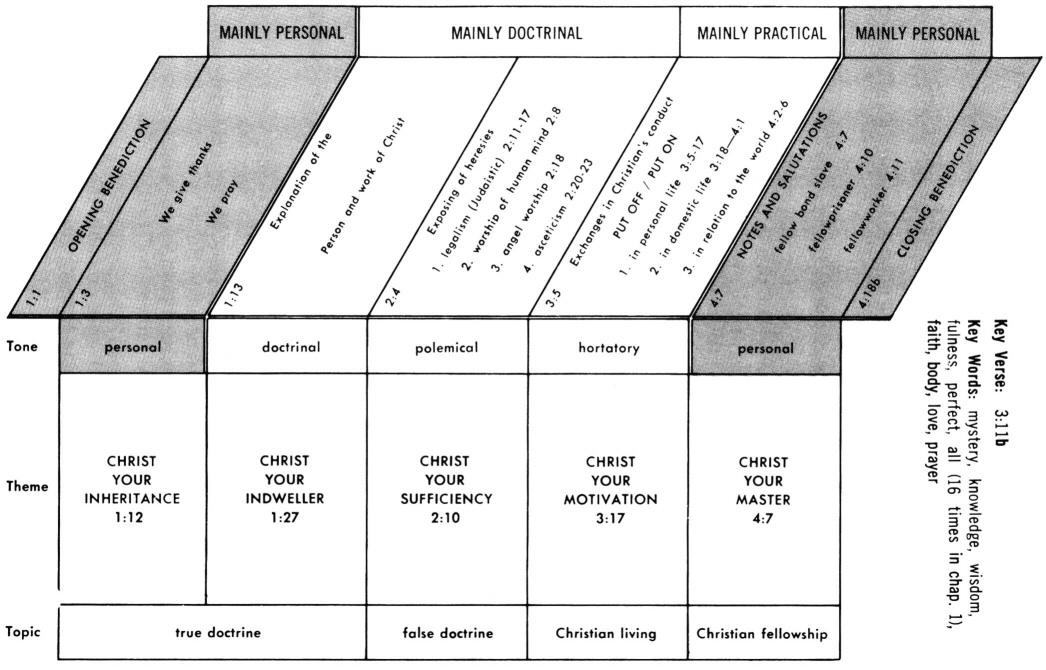
CHRIST IS ALL IN ALL
Click chart to enlarge
Charts from Jensen's Survey of the NT - used by permission
Colossians Overview - Click Chart on right side
| Christ Preeminent in All Things Supreme Lord - Sufficient Savior |
|||
| Colossians 1 | Colossians 2 | Colossians 3 | Colossians 4 |
| Supremacy of Christ |
Submission to Christ |
||
| Doctrinal and Corrective |
Practical and Reassuring |
||
| What Christ Did For Us |
What Christ Does Through Us |
||
| Christ Our Lord |
Christ Our Life |
Christ our Love |
|
| Christ the Head of the Body |
Christ the Lord of the Universe |
Christ the Head of the Home |
|
| Instruction | Warnings | Exhortations | Reminders |
| Reconciliation | Creation | Submission | Conversation |
| His Person and Word |
His Peace and Presence |
||
Colossians 3:20 Children, be obedient (2PPAM) to your parents in all things, for this is well-pleasing to the Lord. (NASB: Lockman)
Greek: Ta tekna, hupakouete (2PPAM) tois goneusin kata panta, touto gar euareston estin (3SPAI) en kurio
Amplified: Children, obey your parents in everything, for this is pleasing to the Lord. (Amplified Bible - Lockman)
KJV: Children, obey your parents in all things: for this is well pleasing unto the Lord.
NLT: You children must always obey your parents, for this is what pleases the Lord. (NLT - Tyndale House)
Wuest: Children, be obeying your parents in all things, for this is commendable in the Lord. (Eerdmans Publishing - used by permission)
Young's Literal: the children! obey the parents in all things, for this is well-pleasing to the Lord;
CHILDREN BE OBEDIENT TO YOUR PARENTS IN ALL THINGS: Ta tekna, hupakouete (2PPAM) tois goneusin kata panta:
- Genesis 28:7; Exodus 20:12; Leviticus 19:3; Deuteronomy 21:18, 19, 20, 21; 27:16; Proverbs 6:20; 20:20; Proverbs 30:11,17; Ezekiel 22:7; Malachi 1:6; Matthew 15:4, 5, 6; 19:19; Ephesians 6:1, 2, 3
- Ep 5:24; Titus 2:9
- Colossians 3 Resources - Multiple Sermons and Commentaries
CHILDREN:
LISTEN UP!
Remember that this command is in the context of Col 3:16, letting the Word of Christ richly indwell. As we discussed in that comment, being filled with God's Word is closely associated with being filled with God's Spirit. It is only the Spirit enabled believer who can truly keep these commands (wives submitting to husbands, husbands loving wives and here children obeying parents.) Given the close association of the Word and the Spirit, it behooves all parents to saturate their children's minds and hearts with God's Word, for they are much more likely to be able to obey these commands, although this of course is maximized if they are believers and are filled with His Spirit.
Eadie - The wife is generally to be submissive (a different verb - hupotasso), but children are to be obedient (hupakoe - see below), to listen and execute parental commands, and to exemplify a special form of submission for which the filial relation affords so many opportunities. [Ephesians 6:1-3.] The love of the child's heart naturally leads it to obedience (Ed: Yes, to a point, but I would qualify Eadie's comment with the reminder that the most complete loving obedience will be seen in the child who is a believer and who is filled with or controlled by the Holy Spirit.). Only an unnatural child (Ed: Not sure what Eadie means - does he mean unbelieving child? Even the best can still be quite rebellious -- I had 4 so speak from experience.) can be a domestic rebel. Where the parents are Christians, and govern their children in a Christian spirit, obedience should be without exception. (Colossians 3:20 Commentary)
Children (5043)(teknon from tikto = bring forth, bear children, be born) is strictly a child produced, male or female, son or daughter. Teknon is thus a child as viewed in relation to his or her parents or family. In the plural, teknon is used generically of descendants, posterity or children.
See related resource - In depth notes on parallel passages in Ephesians 6:1; Ephesians 6:2; Ephesians 6:3
Be obedient (5219) (hupakouo from from hupó = under + akoúo = hear) (Click for study of related word hupakoe) means literally to hear where the idea of "under" is consciously, volitionally (act of one's will) subordinating one’s self to the person or thing heard and hence “to obey” or to hearken (give respectful attention). It includes the idea of listening attentively, stillness, or attention.
The idea of hupakouo is that the one hearing is under the authority of another and thus conveys the meanings of calling for compliance (disposition to yield to another) with the demands or requests of another. Submitting to that which is heard involves a change of attitude, forsaking the tendency of the fallen nature to rebel against parental or Divine instructions and commands and seeking God's will, not self will.
The present imperative is a command calling for this attitude and action to be the child's lifestyle. As noted God's commandments necessitate reliance upon a supernatural enablement (especially given the clause "in all things"!), specifically the Spirit.
All things means no exceptions (as long of course as what the parents are asking is concordant with God's will and walking in a manner worthy of the Lord and is not sin. (see related sermon notes on Spirit filled families Ephesians 6:1-3) Eadie writes " The principle involved in his admonition (obedience expected from the children in absolutely "all things") is, that children are not the judges of what they should or should not obey in parental precepts."
Note that the parent-child relationship cannot be fully functional unless first the husband-wife relationship is right (see Col 3:18-19)!
In the ancient world children were very much under the domination of their parents. The supreme example was the Roman Patria Potestas, "the law of the father's power" which granted the parent the right to do anything he liked with his child - the parent could sell the child into slavery, could make him work like a laborer on his farm and even had the right to condemn his child to death and to carry out the execution! In short he was a legalistic dictator! Some modern dads do a excellent imitation of "Roman Patria Potestas!" Such is the perspective of the unbelieving depraved mind when the power of the Gospel of Jesus Christ has not delivered a pagan father! In pagan society, all the privileges and rights belonged to the parent and all the duties to the child.
FOR THIS IS WELL-PLEASING TO THE LORD: touto gar euareston estin (3SPAI) en kurio:
- Col 1:10; Php 4:18; Hebrews 13:21
- Colossians 3 Resources - Multiple Sermons and Commentaries
PAUSE AND PONDER
THE "FOR'S"
For (gar) - Don't overlook the little preposition "for" (there are over 7000 "for's" in Scripture) and if the context indicates (as it does in this passage) that the "for" is a term of explanation (read short discussion), pause and ask yourself what is the Spirit seeking to explain? Notice how pausing to ponder will always force you to examine the context. You can (and should) practice this simple discipline every time you encounter a for, and while not every instance is a term of explanation, a "for" at the beginning of a verse is almost always used in that grammatical sense. I guarantee that if you begin to "pause and ponder," you will radically rejuvenate your "Read Through the Bible in a Year" program! You might even consider keeping journal notes on what the Spirit illuminates and how this truth can be applied to your daily life. As you practice interrogating the text (for, therefore, but, so that, etc) with 5W/H questions (such as "What's the for explaining?"), you are in essence practicing the fruitful disciplines of (1) Reading the Bible inductively (See a simple power point overview) and of (2) Meditating (see also Primer on Biblical Meditation) on the Scripture. Meditation or "chewing the cud" (cf Mt 4:4, Job 23:12-note, Jer 15:16) so to speak is a vanishing discipline in our fast paced, hi tech, low touch society, but a spiritual discipline which God promises to greatly bless (See Ps 1:1-note, Ps 1:2-note, Ps 1:3-note, Joshua 1:8-note, cf Ps 4:4, 19:14, 27:4, 49:4, 63:6, Ps 77:6, 77:12, Ps 104:34, Ps 119:15, 119:23, 119:27, Ps 119:48, 119:78, Ps 119:97, 119:99, Ps 119:148, 143:5, Ps 145:5) From the preceding passages which "organ" of our being is most often involved/engaged in meditation? What are the subjects or the focus of meditation? Remember that reading the Bible without meditating (pausing to ponder) on it is like eating without chewing and that's not good for our digestion (and assimilation), be it physical or spiritual!
So here is a simple question that derives from observing this use of "for" - What is Paul explaining? He is explaining why it is advantageous for children to obey their parents. It pleases God! Throughout the Old and New Testaments, this is the highest goal of a believer, to obey (Read 1Sa 15:22-23, cp Ps 51:16-17). If we say we love God and don't obey Him, we are lying because Jesus said "If you love Me, you will keep My commandments." (Jn 14:15).
And so we see obedience pleases our Lord Jesus, the One Who appointed to exercise absolute ownership and supreme authority in every believer's life (both Christian parents and children). The way children obey their parent's authority reflects their obedience to Jesus and ultimately represents submission/acceptance of God's design for familial order (the opposite of order is chaos and because of rebellion we see that in so many families in our modern, "liberated, evolved" society)
Well pleasing (2101) (euarestos from eu = well + arésko = please) (Click for in depth study of euarestos) means that which causes someone to be pleased. It is something which is well approved, eminently satisfactory, or extra-ordinarily pleasing. It is possible to obey externally, but not “from the heart” (Ep 6:6). It is possible obey grudgingly.
In Romans we can see a sense of what euarestos means where Paul writes that the will of God is "good and acceptable (euarestos) and perfect." (Ro 12:2)
God's will is well-pleasing because you cannot add anything to the will of God and in any way improve it. You could not take anything away from it and make it better. God's will is totally acceptable. And this is the attitude and actions Paul is calling for in children as well as in every saint in Romans 12 where he exhorts us "by the mercies of God, to present your bodies a living and holy sacrifice, acceptable (euarestos) to God, which is your spiritual service of worship." (Ro 12:1)
In using euarestos Paul borrows from Old Testament sacrificial language to describe the kind of holy living that God approves, a “living sacrifice” that is morally and spiritually spotless and without blemish, and which He finds well-pleasing.
Lord (master, owner)(2962)(kurios from kuros = might or power) means the supreme one, one who is sovereign and possesses absolute authority, absolute ownership and uncontested power. Thayer adds that kurios is "he to whom a person or thing belongs, about which he has the power of deciding; master, lord." Lord is not merely a name that composes a title, but signifies a call to action so that every saint should willingly, reverently bow down to Jesus Christ. If Christ is our Lord, we are to live under Him, consciously, continually submitting our wills to him as His loyal, loving bondservants ("love slaves"), always seeking first His Kingdom and His righteousness (Mt 6:33-note). According to this practical working "definition" beloved we all need to ask ourselves "Is Jesus Christ my Lord?".
Colossians 3:21 Fathers, do not exasperate (2PPAM) your children, so that they will not lose heart (3PPAS) (NASB: Lockman)
Greek: Hoi pateres, me erethizete ( 2PPAM ) ta tekna humon, hina me athumosin. (3PPAS)
GWT: Fathers, don't make your children resentful, or they will become discouraged.
ICB: Fathers, do not nag your children. If you are too hard to please, they may want to stop trying.
KJV: Fathers, provoke not your children to anger, lest they be discouraged.
NLT: Fathers, don't aggravate your children. If you do, they will become discouraged and quit trying. (NLT - Tyndale House)
Amplified: Fathers, do not provoke or irritate or fret your children [do not be hard on them or harass them], lest they become discouraged and sullen and morose and feel inferior and frustrated. [Do not break their spirit.] (Amplified Bible - Lockman)
NLT: Fathers, don't aggravate your children. If you do, they will become discouraged and quit trying. (NLT - Tyndale House)
Wuest: Fathers, stop irritating your children, lest they become disheartened. (Eerdmans Publishing - used by permission)
Young's Literal: the fathers! vex not your children, lest they be discouraged.
- Ps 103:13; Proverbs 3:12; 4:1, 2, 3, 4; Ephesians 6:4; 1Th 2:11; Hebrews 12:5, 6, 7, 8, 9, 10, 11
- Colossians 3 Resources - Multiple Sermons and Commentaries
STOP NAGGING
YOUR KIDS!
Fathers, do not exasperate your children, so that they will not lose heart - Fathers First in the Greek for emphatic effect! This should get every father's attention!
Eadie says "Fathers are spoken to since training is their duty, and because this peculiar sin which the apostle condemns is one to which they, and not mothers, are peculiarly liable. The paternal government must be one of kindness, without caprice; and of equity, without favoritism." (Colossians 3:21 Commentary)
Spurgeon - The duties are mutual. Scripture maintains an equilibrium. It does not lay down commands for one class, and then leave the other to exercise whatever tyrannical oppression it may please. The child is to obey, but the father must not provoke.
Related resource
- See in depth notes on the parallel passage in Ep 6:4
Exasperate (2042) (erethizo from erétho = stir to anger) means "to cause someone to react in a way that suggests acceptance of a challenge, arouse, provoke mostly in bad sense and so to irritate, or embitter." (BDAG) "To arouse, excite, kindle; in a bad sense make resentful, irritate, rouse to anger (Col 3:21); in a good sense incite, stimulate (2Cor 9:2)." (Friberg). Note that Col 3:21 and 2Cor 9:2 are the only 2 NT uses of erethizo.
As noted in the only other NT use of erethizo, erethizo is used in a positive sense meaning to encourage or motivate (provoke positively stimulating a change in motivation or attitude. ).
For I know your readiness (eagerness), of which I boast about you to the Macedonians, namely, that Achaia has been prepared since last year, and your zeal has stirred up (erethizo) most of them. (2Cor 9:2)
There are 5 uses of erethizo in the non-apocryphal Septuagint - Dt 21:20 (describes "rebellious"); Pr 19:7 ("pursues them with words" - Lxx = "provoking words"); Pr 25:23; Dan 11:10, 25. To be quarrelsome or perverse
In context Paul commands fathers to stop provoking (present imperative with a negative = stop an action that may already be in process) your children to the point that they become bitter and resentful.
Our English word exasperate (from Latin exasperare = 'to make rough,' 'to irritate to anger’) means to make resentful, to cause annoyance, to irritate to a high degree, to provoke to anger, to rouse to rage, to inflame to an extreme degree, to irritate intensely, to infuriate. To cause (an unpleasant feeling or condition) to worsen or be aggravated. Exasperate suggests galling annoyance and the arousing of extreme impatience. Exasperate is used as an adjective in botany to describe something having a rough prickly surface because of the presence of hard projecting points. Interesting! Sounds like a few teenagers I've met in my lifetime!
In secular writings we find the sentence "a spark kindled (erethizo) by the bellows" which which gives us an accurate picture of the potential effect of a father inappropriately disciplining his children! In other words, this secular use helps understand the potential effect insensitive (flesh enabled, rather than Spirit empowered) punishment can have on a child, inciting them to at least resentment but even to bitterness and/or anger! Beware dads! This warning is one we must assiduously heed as we discipline our children in a Spirit enabled, God honoring manner.
Other secular Greek uses include "to provoke to curiosity", in the passive "to be provoked or excited".
Remember that the context is important to keep in mind lest we not discipline in our own strength. Going back to Colossians 3:16 (or go back to the beginning of the chapter for who we now are in Christ = Col 3:1, 2) which in turn is based on the truths in the first two chapters) the ideal father should "let the word of Christ richly dwell within...with all wisdom teaching and admonishing..." and so filled with the Word and the Spirit, training up his child in a godly way.
One can exasperate by...
(1) Overprotection--never allowing them any liberty, strict rules about everything. They do not trust their kids and the child despairs and can lead to rebellion. Parents must communicate that they trust.
(2) By showing favoritism, often unwittingly.
(3) By depreciating their worth. Many children are convinced that what they do and feel is not important. One way to decrease worth is by not LISTENING. These children may give up trying to communicate and become discouraged, shy, and withdrawn.
(4) By setting unrealistic goals--by never rewarding them. Nothing is enough so they never get full approval. Are you trying to make them into a person they are NOT? Some kids become so frustrated that they commit suicide.
(5) By failing to show affection (verbally & physically).
(6) By not providing for their legitimate needs.
(7) By lack of standards (the opposite of overprotection). These children are left to their own. They cannot handle that freedom and begin to feel insecure & unloved.
(8) By destructive criticism. "A child learns what he lives. If he lives with criticism he does not learn responsibility. He learns to condemn himself and to find fault with others. He learns to doubt his own judgment, to disparage his own ability, and to distrust the intentions of others. And above all, he learns to live with continual expectation of impending doom." Parents should seek to create in the home a positive, constructive environment.
(9) By neglect. David was indifferent to Absalom (and he failed to discipline Adonijah see 1Ki 1:6 who was put to death by his younger brother Solomon for probable treason).
(10) By excessive discipline. Never discipline in anger. (Abridged from MacArthur, J. Colossians. Chicago: Moody Press)
THAT THEY MAY NOT LOSE HEART: hina me athumosin (3PPAS):
- Colossians 3 Resources - Multiple Sermons and Commentaries
Related Passages:
Proverbs 19:18 "Discipline your son while there is hope and do not desire his death."
Proverbs 18:14 The spirit of a man can endure his sickness, But as for a broken spirit who can bear it? (COMMENT - This is a direct parallel to Paul's command in Colossians to the wise father.)
THE PURPOSE OF PROPER
SPIRIT ENABLED CORRECTION
So that (hina) they will not lose heart (athumeo) - So that (hina) introduces a purpose or result. It means in order that, for the purpose of, to the end that, these senses being associated with a verb in the subjunctive (mood of possibility). Hina is also used with indicative mood verbs marking the end or purpose. Like "for" discussed above, it behooves the diligent student of the Word, to pause and ponder when "that" (so that) is encountered. Learn to ask simple questions, like "What is the purpose?" which will force you to examine the preceding context to determine what had to occur in order to bring about the purpose.
In this verse the preceding text commands fathers not to exasperate their children and Paul now gives the purpose we (I have 4 children) should assiduously avoid this approach--the children might lose heart, a sad effect of fleshly discipline from fathers! In other words in this context, athumeo means that the child feels that he can never do anything right and so gives up trying. When children find that they can do nothing right because of constant fault finding with them, they are apt to become despondent.
Now, this may seem "simplistic" to you and you say "I knew that without pausing and pondering." That may be the case, but what you have been forced to do is slow down and more actively engage the living and active Word, rather that rapidly and rather passively reading it. As you slow down, you are giving your Teacher, the Spirit, greater opportunity to speak to your mind and your heart. For example, as you paused, He may have brought some forgotten instance from the past week in which you thought you were simply disciplining your children correctly, when in fact you may have crossed the line into exasperating them? Does this make sense? I can assure you, it is not a waste of time but to the contrary, an investment in time which can yield wonderful dividends as this practice becomes more natural and habitual.
The duty of the parent is discipline, but it is also encouragement. Paul's point is that children who grow up with parents who continually (present tense) provoke them will often become disheartened.
Paul wrote to his "spiritual children" reminding them "how we were exhorting and encouraging and imploring each one of you as a father would his own children." (1Th 2:11). Clearly he did not "exasperate" them, but sought to motivate them to press on in pursuit of Christ-likeness.
Eadie - The composition of the verb shows its strong signification. Children teazed and irritated lose heart, renounce every endeavor to please, or render at best but a soulless obedience. The verb occurs only here in the New Testament, but is found in the Septuagint, 1 Kings 1:16, etc., and in several of the classical authors. What the apostle guards against has been often witnessed, with its deplorable consequences. In the Epistle to the Ephesians, he speaks more fully, and enjoins the positive mode of tuition—“but bring them up in the nurture and admonition of the Lord.” The young spirit is to be carefully and tenderly developed, and not crushed by harsh and ungenerous treatment. Too much is neither to be demanded nor expected. The twig is to be bent with caution, not broken in the efforts of a rude and hasty zeal. Approbation is as necessary to the child as counsel, and promise as indispensable as warning and reproof. Gisborne on this place well says—“To train up children as servants of God, as soldiers of Jesus Christ, for a future existence in preference to the present life; to instruct and habituate them, in conformity with their baptismal vow, to renounce the world, the flesh, and the devil, and to live not unto themselves but to that Redeemer who died for them; this is universally the grand duty of a parent. This well-known duty the apostle, though he does not name it, presupposes as acknowledged and felt by the Colossians. In the discharge of this duty, and in every step of their proceedings, he directs them to beware, as parents, of provoking their children to anger; that is to say, as the original term evidently implies, of exercising their own authority with irritating unkindness, with needless and vexatious severity; of harassing their children by capricious commands and restrictions; of showing groundless dissatisfaction, and scattering unmerited reproof. To act thus, the apostle declares, would be so far from advancing the religious improvement of children, that it would discourage them. It would not only deaden their affections towards their parents, but would dispirit their exertions, and check their desires after holiness.” (Colossians 3:21 Commentary)
William Barclay writes this cautionary note...
The more conscientious a parent is, the more he is likely always to be correcting and rebuking the child. Simply because he wishes the child to do well, he is always on his top.
We remember, for instance, the tragic question of Mary Lamb, whose mind was ultimately unhinged:
“Why is it that I never seem to be able to do anything to please my mother?”
We remember the poignant statement of John Newton:
“I know that my father loved me—but he did not seem to wish me to see it.”
There is a certain kind of constant criticism which is the product of misguided love.
The danger of all this is that the child may become discouraged. Bengel speaks of
“the plague of youth, a broken spirit (Fractus animus pestis iuventutis).”
It is one of the tragic facts of religious history that Luther’s father was so stern to him that Luther all his days found it difficult to pray: “Our Father.” The word father in his mind stood for nothing but severity. The duty of the parent is discipline, but it is also encouragement. Luther himself said,
“Spare the rod and spoil the child. It is true. But beside the rod keep an apple to give him when he does well.”
Sir Arnold Lunn, in Memory to Memory, quotes an incident about Field-Marshal Montgomery from a book by M. E. Clifton James. Montgomery was famous as a disciplinarian—but there was another side to him. Clifton James was his official “double” and was studying him during a rehearsal for D-Day.
“Within a few yards of where I was standing, a very young soldier, still looking sea-sick from his voyage, came struggling along gamely trying to keep up with his comrades in front. I could imagine that, feeling as he did, his rifle and equipment must have been like a ton weight. His heavy boots dragged in the sand, but I could see that he was fighting hard to conceal his distress. Just when he got level with us he tripped up and fell flat on his face. Half sobbing, he heaved himself up and began to march off dazedly in the wrong direction. Monty went straight up to him and with a quick, friendly smile turned him round. ‘This way, sonny. You’re doing well—very well. But don’t lose touch with the chap in front of you.’ When the youngster realized who it was that had given him friendly help, his expression of dumb adoration was a study.”
It was just because Montgomery combined discipline and encouragement that a private in the Eighth Army felt himself as good as a colonel in any other army. The better a parent is the more he must avoid the danger of discouraging his child, for he must give discipline and encouragement in equal parts. (Letter to the Colossians)
Lose heart (120) athumeo from a = without + thumos = passions, desire, spirit) means to become disheartened to the point of losing motivation, to be dispirited or to be broken in spirit. To feel like giving up. To become discouraged or despondent (this latter word means to feel or show extreme discouragement or dejection, because of loss of nearly all hope! "Despondent implies a deep dejection arising from a conviction of the uselessness of further effort" - Webster) To dishearten means to weaken or destroy one's hope, courage, enthusiasm, determination, confidence, etc. Dishearten means to demoralize, to depress one's spirits, to cause one to lose spirit or morale, to cause one to be cast down. This is the only NT use of athumeo. Here are the 7 uses of athumeo in the Septuagint (LXX) (Deut. 28:65; 1Sam. 1:6f; 15:11; 2Sa 6:8; 1Chr. 13:11; Isa. 25:4 )
So that (2443)(hina) is a conjunction which is used as a marker of purpose, definition or result and is rendered in order that, that, so that. With the result or consequence that. With the particular aim or purpose of; in order that. See also Dana-Mantey Greek Grammar page 264
“So that” means “in order to” which answers the question “Why?” We use it to begin adverb clauses of purpose. Let’s hear an example: It helps to lower blood sugar so that you feel less hungry. The adverb clause is “so that you feel less hungry.” It shows the purpose for the action in the main clause. Why does it help to lower blood sugar? To feel less hungry. (LearnEnglish)
Friberg says hina is "used to introduce clauses that show a purpose or goal that, in order that, so that; (a) predominately with the present or aorist subjunctive."
Zodhiates adds that hina is "Also used to indicate the cause for, or on account of which anything is done. Can be translated, “to the end that,” “in order that it might [or may] be.” It may also be used simply to indicate a happening, event or result of anything, or that in which the action terminates. Hína can be translated “so that it was [is, or will be].”"
Colossians 3:22 Slaves, in all things obey (2PPAM) those who are your masters on earth, not with external service, as those who merely please men, but with sincerity of heart, fearing (PPPMPN) the Lord.
Greek: hoi douloi, hupakouete ( 2PPAM ) kata panta tois kata sarka (those according to flesh) kuriois, me en ophthalmodoulia (eye slavery) os anthropareskoi, (men pleasers) all' en haploteti kardias phoboumenoi (PPPMPN) ton kurion.
Amplified: Servants, obey in everything those who are your earthly masters, not only when their eyes are on you as pleasers of men, but in simplicity of purpose [with all your heart] because of your reverence for the Lord and as a sincere expression of your devotion to Him. (Amplified Bible - Lockman)
KJV: Servants, obey in all things your masters according to the flesh; not with eyeservice, as men pleasers; but in singleness of heart, fearing God:
NLT: You slaves must obey your earthly masters in everything you do. Try to please them all the time, not just when they are watching you. Obey them willingly because of your reverent fear of the Lord. (NLT - Tyndale House)
Wuest: Slaves, be constantly obedient in all things to your human masters, not with eye-service as men-pleasers, but with an undivided heart, fearing the Lord. (Eerdmans Publishing - used by permission)
Young's Literal: The servants! obey in all things those who are masters according to the flesh, not in eye-service as men-pleasers, but in simplicity of heart, fearing God;
SLAVES IN ALL THINGS OBEY THOSE WHO ARE YOUR MASTERS ON EARTH: hoi douloi, hupakouete (2PPAM) kata panta tois kata sarka kuriois:
- Col 3:20; Ps 123:2; Malachi 1:6; Matthew 8:9; Luke 6:46; 7:8; Ep 6:5, 6,7; 1Timothy 6:1,2; Titus 2:9,10; Philemon 1:16; 1Pe 2:18, 19
- Colossians 3 Resources - Multiple Sermons and Commentaries
Ephesians has a parallel discussion on slaves and masters...
- Ephesians 6:5 Slaves, be obedient to those who are your masters according to the flesh, with fear ( phobos ) and trembling ( tromos) , in the sincerity (haplotes) of your heart, as to Christ
- Eph 6:6 not by way of eyeservice, as men-pleasers, but as slaves of Christ, doing the will of God from the heart.
- Eph 6:7 With good will render service, as to the Lord, and not to men,
- Eph 6:8 knowing that whatever good thing each one does, this he will receive back from the Lord, whether slave or free.
Eadie - The master of the slave is only so (according to the flesh), the relationship is but corporeal and external, the contrast being-the real master is the Lord Christ....The principle of the obedience is all things (kata panta), as in Colossians 3:20. Refractoriness on the part of the slave would at once have embittered his life, and brought discredit on the new religion which he professed, but active and cheerful discharge of all duty would both benefit himself, promote his comfort, and recommend Christianity. (Ref)
Vaughn points out that "More than half the people seen on the streets of the great cities of the Roman world were slaves. And this was the status of the majority of ‘professional’ people such as teachers and doctors as well as that of menials and craftsmen.”
Slaves (1401) (doulos) is the Greek word which describes one who is bound to another in servitude. In the Greek culture doulos usually referred to the involuntary, permanent service of a slave. By Roman times, slavery was so extensive that in the early Christian period one out of every two people was a slave! From at least 3000 BC captives in war were the primary source of slaves. These were Christian slaves working for the most part for pagan masters.
Slaves - Although we do not have slaves per se in our modern culture (some of you would argue this point I'm sure!), the master-slave relationship clearly parallels the employer-employee relationship in our day. As in the relationships between husbands and wives and children and fathers, the principle Paul is emphasizing is that of authority and submission as a manifestation of one who is filled with and controlled by the Holy Spirit. Barclay has a note (although it is difficult to substantiate) that in the Romans Empire there were upwards to sixty million slaves, largely because the Roman citizen considered it beneath his dignity to work. Vincent adds that "in many of the cities of Asia Minor slaves outnumbered freemen". (Greek Word Studies) Thus practically all work was done by slaves. This was so pervasive that even doctors, teachers and secretaries of the Roman emperors were slaves! Although some masters were kind to their slaves, that appears to be the exception rather than the rule.
John Eadie - Christianity did not rudely assault the forms of social life, or seek to force even a justifiable revolution by external appliances. Such an enterprise would have quenched the infant religion in blood. The gospel achieved a nobler feat. It did not stand by in disdain, and refuse to speak to the slave till he gained his freedom, and the shackles fell from his arms, and he stood erect in his native independence. No; but it went down into his degradation, took him by the hand, uttered words of kindness in his ear, and gave him a liberty which fetters could not abridge and tyranny could not suppress. Aristotle had already described him as being simply a tool with a soul in it; and the Roman law had sternly told him he ha d no rights because he was not a person. He may have been placed on the “the auction block,” and sold like a chattel to the highest bidder; the brand—stigma, of his owner might be burned into his forehead, and he might bear the indelible scars of judicial torture—that basanos without which a slave's evidence was never received; but the gospel introduced him into the sympathies of a new brotherhood, elevated him to the consciousness of an immortal nature, and to the hope of eternal liberty and glory. Formerly he was taught to look for final liberation only in that world which never gave back a fugitive, and he might anticipate a melancholy release only in the grave, for “there the wicked cease from troubling, and there the weary be at rest; there the prisoners rest together; they hear not the voice of the oppressor; the small and great are there, and the servant is free from his master.” Now, not only was he to look beyond the sepulchre to a region of pure and noble enjoyments; but as he could even in his present servitude realize the dignity of a spiritual freeman in Christ, the friction of his chain was unfelt, and he possessed within him springs of exalted cheerfulness and contentment. Yes, as George Herbert sings—“Man is God's image, but a poor man is Christ's stamp to boot.” At the same time, Christianity lays down great principles by the operation of which slavery would be effectually abolished, and in fact, even in the Roman empire, it was suppressed in the course of three centuries. (A commentary on the Greek text of the Epistle of Paul to the Ephesians)
Be obedient (5219) (hupakouo from from hupó = under + akoúo = hear) (Click for study of related word hupakoe) means literally to hear where the idea of "under" is consciously, volitionally (act of one's will) subordinating one’s self to the person or thing heard and hence “to obey” or to hearken (give respectful attention). It includes the idea of listening attentively, stillness, or attention.
Note that Paul uses the same verb for children and slaves.
The idea of hupakouo is that the one hearing is under the authority of another and thus conveys the meanings of calling for compliance (disposition to yield to another) with the demands or requests of another. Submitting to that which is heard involves a change of attitude, forsaking the tendency of the fallen nature to rebel against parental or Divine instructions and commands and seeking God's will, not self will.
The present imperative is a command calling for this attitude and action to be the slave's lifestyle. It is important to keep in mind that God's commandments always include His enablements and so these commandments to slaves can only be fulfilled supernaturally by Spirit-filled slaves, who have cast off the filthy garment of the Old Man they were in Adam and put on the new garment of righteousness in Christ. Although at the moment of salvation every believer put aside the Old Man and put on the New Man positionally (justification, past tense salvation Col 3:10), for the rest of his and her earthly life there will be a daily (even moment by moment) need to cast aside the filthy garment of the old man and put on the garment of the new man (present tense salvation, progressive sanctification - Col 3:10 says "being renewed" = present tense = continually). If any man or woman thinks he stands, let them take heed lest they fall (1Cor 10:12).
Undesirable as slavery was, the NT does not promote or sanction revolt of slaves (1Co 7:20-24). Had it done so, many would doubtless have flocked to the antislavery cause and not to Christ.
Under Roman law the slave was a thing in the eyes of the law. There was no such thing as a code of working conditions. When the slave was past his work, he could be thrown out to die. He had not even the right to marry, and if he cohabited and there was a child, the child belonged to the master, just as the lambs of the flock belonged to the shepherd. All the rights belonged to the master and all the duties to the slave. And he could not inherit anything making Paul's statement in (v24) all the more powerful.
The apostle, somewhat surprisingly at first glance, uses more space for servants and masters than for the other relationships. The presence of Onesimus must have accounted for this. The relations of the slave to his master are identical with that of the child to the parents according to the apostle’s terminology (cf. Gal 4:1). The present tense of the verb hupakouo„ (AV, “obey”) in both cases stress the constant obedience expected. The use of the words kata sarka (AV, “according to the flesh”) with masters shows that in other realms the master and slave were on equality. In spiritual things the master and slave were brothers in the family of God.
NOT WITH EXTERNAL SERVICE AS THOSE WHO PLEASE MEN BUT WITH SINCERITY OF HEART FEARING THE LORD: me en ophthalmodoulia os anthropareskoi all en haploteti kardias phoboumenoi (PPPMPN) ton kurion:
- Galatians 1:10; 1Thes 2:4
- Mt 6:22; Acts 2:46; Ep 6:5
- Ge 42:18; Neh 5:9,15; Eccl 5:7; 8:12; 12:13; 2Co 7:1
Don't obey them only while you're being watched, as if you merely wanted to please people (GWT)
LET YOUR EXTERNAL REFLECT
YOUR INTERNAL
Spurgeon comments on men pleasers - "How much there is of that! How quickly the hands go when the master’s eye looks on! But the Christian servant remembers God’s eye, and is diligent always. “Not with eyeservice as men pleasers.”
Eadie - Slaves have usually but the one motive, and that is, to avoid punishment, and therefore they only labour to please the master when his eye is on them. They are disposed to trifle when he is absent, in the hope that their indolence may not be detected. But Christian slaves were to work on principle, were to do their duty at all times, and from a higher motive, conscious that another eye was upon them, and that their service was really rendered to another Master. (Ref)
This admonishment refers to working only when the master is watching, rather than recognizing the Lord is always watching, and how our work concerns Him (Col 3:23, 24).
External service (3787)(ophthalmodouleia from ophthalmos = eye + douleia = service) is literally "eye slavery" (!) which practically means working when the master is watching and loafing when he is gone. It is service rendered only for appearance sake, service rendered only when one is being scrutinized! Slaves were under more temptation in this respect than paid laborers, since they had nothing to gain materially from diligence. This is service that is performed only to make an impression in the owner’s presence. It describes work done without dedication or a sense of inner obligation but primarily to impress and to attract attention. Our English idiom "brown nosers" is appropriate epithet for those who perform their tasks in this manner only to curry favor or for appearances sake. Spirit filled believers steer clear of this subtle selfish attitude.
Paul is saying that Spirit filled slaves serve Christ on the job with a Coram Deo ("before the face of God" ~ fearing the Lord) attitude, fully aware that He is always watching us (cf Pr 15:3, 2Chr 16:9, Pr 5:21, Job 34:21, 22)! Work must not be done well and not with one eye on the clock or only when the overseer’s eye is on us but must be done in the awareness that God’s eye is on us. Paul is saying believing slaves must avoid eyeservice and pursue a deeper motive for "God sees not as man sees, for man looks at the outward appearance, but the LORD looks at the heart." (1Samuel 16:7)
Expositor's Greek Testament - It is the service that is done only when one is under the master’s eye—an obedience to save appearances and gain undeserved favor, which is not rendered when the master is absent as it is when his scrutiny is on us.” (Ephesians 6 Commentary)
Barclay - Every single piece of work the Christian produces must be good enough to show to God.
Men-pleasers (441)(anthropareskos from anthropos = man + arésko = to please) pertains to causing people to be pleased with the implication of being in contrast to God or at the sacrifice of some principle. This describes one who tries to make an impression on others. He acts merely to please men. He sacrifices principle to please someone of superior authority. In short, he's a people-pleaser. We are not to "butter up" the boss.
Confidential surveys reveal that one out four workers compromise their beliefs to get ahead on the job. A higher percentage justify unethical actions on the job for personal advantage. This is decades of moral relativism instruction coming home to roost.
The eye is to be upon the Lord in singleness of heart. A Christian servant owed complete obedience to his master as a ministry to the Lord. If a Christian servant had a believing master, that servant was not to take advantage of his master because they were brothers in the Lord. If anything, the servant strived to do a better job because he was a Christian. He showed singleness of heart and gave his full devotion to his master. His work was done heartily, not grudgingly, and as to the Lord and not to men.
Single and sincere hearts are necessary for Christian servants to please God and serve their masters acceptably. These instructions emphasized the positive side of obedience. Servants were to obey to please God, not just to avoid punishment. Even if the master did not commend them, they would have their reward from the Lord. In the same manner, if they disobeyed, the Lord would deal with them even if their master did not. God is no respecter of persons (Ac 10:34; Ro 2:11; Ep 6:9; Jas 2:1, 9). In our society we do not have slaves but these principles apply to any kind of honest employment. A Christian worker ought to be the best worker on the job. He ought to obey orders and not argue. He ought to serve Christ and not the boss only, and he ought to work whether anybody is watching or not. If he follows these principles, he will receive his reward from Christ even if his earthly master (his boss) does not recognize him or reward him. Pursue excellence in the way you work.
Sincerity (572)(haplotes from a = negation + pleko = twine, braid, weave, knit) means singleness, simplicity, uprightness, mental honesty; the virtue of one who is free from pretence and dissimulation. Haplotes pertains to being motivated by singleness of purpose so as to be open and aboveboard, without guile, and without a hidden agenda. The idea of haplotes is that of personal integrity expressed in word or action.
In the present verse haplotes means to obey with a heart fixed on pleasing Christ and not on worldly gain. What does haplotes heart look like in context? Paul tells us that their heart is sincere because they are not obeying as an outward show that would conceal an inner improper motivation. In other words, when the Spirit filled (and Word filled - Col 3:16) slave obeys, it is not feigned obedience but genuine obedience, obedience that comes from a transformed, grace energized new heart (Ezekiel 36:27). In other words haplotes means "what you see is what you get" (it is not hypocritical). Without pretense or ulterior motive. Not half-hearted.
Eadie - Singleness of heart (1Chronicles 29:17) is that sincerity which the heathen slave could scarcely possess, for he would often seem to work, and yet contrive to enjoy his ease under the semblance of activity. Duplicity (contradictory doubleness of thought, speech, or action; especially : the belying of one’s true intentions by deceptive words or action) is the vice which the slave uses as his shield. He professes anxiety when he feels none, and he exhibits a show of industry without the reality. For this singleness of heart could only be secured by such a motive as the Gospel presents—“fearing the Lord”-standing in awe of His authority over them (Ed Comment: And also the fact that the "Gospel is the power of God for salvation," not only the first moment we believed and were justified or declared righteous before God, but daily, moment by moment as we seek to walk by faith, not by sight, in the enabling power of the Holy Spirit). They would not be men-pleasers if they bowed to Christ's authority, for then their aim would be to please Him (cf 2Cor 5:9); nor would there be eye-service, if they wrought in singleness of heart, for such a feeling would lead them to conclude the task in hand, irrespectively of every minor and personal consideration ("as for the Lord rather than for men" Col 3:23). (Ref)
Expositor's Greek Testament on sincerity of heart - states the spirit in which the obedience was to be rendered,—not in formality, pretence, or hypocrisy, but in inward reality and sincerity, and with an undivided heart” (Ephesians 6 Commentary)
J Vernon McGee on sincerity of heart - (This phrase) means there should not be any taint of duplicity. There should be no two-facedness. There should not be the licking of the boots of the employer when he is around and then stabbing him in the back when he is away. Such action should never be in the life of a Christian. (Ephesians 6:5-9 Mp3 - Thru the Bible)
Heart (2588)( kardia) does not refer to the physical organ but is always used figuratively in Scripture to refer to the seat and center of human life. The heart is the center of the personality, and it controls the intellect, emotions, and will. No outward obedience is of the slightest value unless the heart turns to God.
Hughes (comment on Romans) - The heart is the wellspring of man’s spiritual life, and that is where the Roman Christians’ obedience was rooted. It was not just a formal obedience—it came from the center of their being. This is the example of slavery Paul holds up for us all: a heartfelt obedience to Christ and his Word. It is an obedience which brings liberation. (Romans: Righteousness from heaven. Preaching the Word)
Spurgeon has wise words for all slaves of Christ - A short life should be wisely spent. We have not enough time at our disposal to justify us in misspending a single quarter of an hour. Neither are we sure of enough life to justify us in procrastinating for a moment. If we were wise in heart we should see this, but mere head wisdom will not guide us aright."
Fear the Lord - Fear is in the present tense which signifies this is to be their lifestyle! Fear of the Lord is not a quaking, shaking fear (unless we are overtly, willfully rebellious) but a reverential awe, a sense of fear of displeasing Him mixed with a sense of the reality that we will one day stand before and give an account (Ro 14:12-Romans 14:12, 2Cor 5:10-2Cor 5:10 , cf 1Pe 1:17-1 Peter 1:17, 2Cor 7:1-2Cor 7:1). Holy fear is fear which motivates a holy walk!
Lord (master, owner)(2962)(kurios from kuros = might or power) means the supreme one, one who is sovereign and possesses absolute authority, absolute ownership and uncontested power. Thayer adds that kurios is "he to whom a person or thing belongs, about which he has the power of deciding; master, lord." Lord is not merely a name that composes a title, but signifies a call to action so that every saint should willingly, reverently bow down to Jesus Christ. If Christ is our Lord, we are to live under Him, consciously, continually submitting our wills to him as His loyal, loving bondservants ("love slaves"), always seeking first His Kingdom and His righteousness (Mt 6:33-note). According to this practical working "definition" beloved we all need to ask ourselves "Is Jesus Christ my Lord?".
Warren Wiersbe - "I have a friend who, years ago, was fired from his job for working too hard. He was earning money to go to college, and he wanted to give the employer a good day’s work each day. The trouble was, his zeal was showing up the laziness of some of the other employees—and they started fighting back. One of them falsely accused my friend of something, and he was fired. He lost his job but he kept his character, and the Lord rewarded him." (Wiersbe, W: Bible Exposition Commentary. 1989. Victor)
We should be industrious! Confidential surveys reveal that the average American worker goofs off 7 hrs per week--a de facto 4-day week. The same survey reveals that one-half of all American workers admit to chronic malingering (calling in sick when they're not), and that only one out of four give their best effort at work. Since we work for the Lord (IF we are followers of Christ), we should attack our work with zeal instead of dawdling over it and figuring out how little we can do and still get by--which is theft. We should cultivate being prompt and hard-working, whether the boss is watching or not. we should pursue quality in our work. Since we work ultimately for the Lord, our work should be the best we can offer rather than a crippled goat (Malachi 1:8,13). Dear believer, do you have a reputation for being conscientious and thorough in your work? Finally, it means that our ethical conduct should be high. Confidential surveys reveal that one out four workers compromise their beliefs to get ahead on the job. A higher percentage justify unethical actions on the job for personal advantage. This is decades of moral relativism instruction coming home to roost. Do we think we can teach children that ethics are relative to the individual and situation, and not experience this on the job?
Related Resource: Integrity - A Few Thoughts
Lying, theft, back-stabbing, sexual innuendo, etc. may be commonplace in the secular workplace, but they are incompatible with serving and representing Christ. What an opportunity to let our light shine (Mt 5:16). Sometimes this results in mistreatment from other workers, because it exposes their poor behavior. Sometimes this involves the vulnerability to apologize when you compromise your ethical standards. Do you have a reputation for having both integrity and humility? If you have these qualities, you can virtually write your own ticket in today's job-market. But more importantly, you can allow God to work through your job to build this kind of character that attracts others to him (cp the little servant girl and Naaman in 2Ki 5:1, 2, 3, 4,5ff, Da 1:8, 9, 10ff, Neh 2:1, 2,3, 4ff, Joseph, etc)
"When you get bogged down on a frustrating assignment, do you give up or do you see it as a chance to grow in perseverance? When tempted by an unethical practice, do you yield to it or do you see it as a chance to grow in honesty? When you hear a friend being slandered, do you give silent assent, or do you stand up for your friend and practice loyalty? When you become irritated by a coworker's idiosyncrasies, do you criticize and belittle him, or do you commit yourself to learning greater tolerance? When you're asked to stretch in an area of weakness, do you let fear stop you, or do you decide to muster courage and proceed?"
On Being a Good Employee -
1. Be loyal. Bosses will forgive carelessness, stupidity, tardiness and the occasional temper tantrum. These can be corrected, but disloyalty is a true character flaw. You cannot—and will not—be trusted.
2. Keep the boss informed. The boss should be informed about what you are doing, where you are, whom you are talking to and why. If you must err, err on the side of overkill. Bombard the boss with bulletins, memos, and FYI’s until he or she says, “Stop.” No one had ever lost a job because they told the boss too much.
3. Embrace change, even if you do not understand it. Any boss must, as part of his or her job, instigate change. It is not your job to resist.
4. Respect the boss’s time. If you need thirty minutes with him, don’t take sixty. Better yet, take twenty.
5. Don’t tread on his turf. At least, don’t do it without permission.
6. Follow up quickly. Bosses don’t pull out a stopwatch when they give a command. But their internal clock is ticking. (Bits & Pieces, May 27, 1993, pp. 2-3 quoted in 10000 Sermon Illustrations. Dallas: Biblical Studies Press)
No Vacancy- Fred, a clerk in a retail store, was rude to the customers and lazy. On several occasions his boss was about to fire him. But he didn't follow through because of his concern for Fred's wife and children, who would suffer from his dismissal.
One day a regular customer stopped in and noticed that Fred wasn't there. He asked the manager about him and was told that he had taken another job. The customer asked, "Are you planning to replace him?" The manager replied, "No, it isn't necessary. Fred didn't leave a vacancy."
Fred's work was of such poor quality that the business was better off without him. That should never be true of any employee, especially a Christian.
The apostle Paul told servants to be obedient to their masters "with goodwill doing service, as to the Lord, and not to men" (Ephesians 6:7).
God expected Christian servants in Paul's day to work diligently for their masters, and we too should give our employers an honest day's work. It's the right thing to do, and it strengthens our witness for Christ.
One good way to test the value of your work is to ask yourself this question: If I left my job, would it create a vacancy? —Richard De Haan
Some people stop looking for work
when they get a job.
Colossians 3:23 Whatever * you do (2PPAS) , do your work (2PPMM) heartily, as for the Lord rather than * for men,
Greek: o ean poiete, (2PPAS) ek psuches (out of soul) ergazesthe, ( 2PPMM ) os to kurio kai ouk anthropois
Amplified: Whatever may be your task, work at it heartily (from the soul), as [something done] for the Lord and not for men, (Amplified Bible - Lockman)
KJV: And whatsoever ye do, do it heartily, as to the Lord, and not unto men;
NLT: Work hard and cheerfully at whatever you do, as though you were working for the Lord rather than for people. (NLT - Tyndale House)
Wuest: Whatever you are doing, from your soul do it diligently as to the Lord and not to men, (Eerdmans Publishing - used by permission)
Young's Literal: and all, whatever ye may do--out of soul work--as to the Lord, and not to men,
WHATEVER YOU DO, DO YOUR WORK HEARTILY: ho ean poiete (2PPAS) ek psuches ergazesthe (2PPMM) os to kurio:
- Col 3:17; 2Chr 31:21; Ps 47:6,7; 103:1; 119:10,34,145; Ecclesiastes 9:10; Jeremiah 3:10; 1Pe 1:22
- Colossians 3 Resources - Multiple Sermons and Commentaries
WORK OUT YOUR
SALVATION HEARTILY
Eadie - They were, in any task that might be assigned them, to labour at it, to work it out, and that without grumbling or reluctance, not only doing it honestly but cheerfully
Lightfoot - “do it diligently.” By its use Paul gains a little more stress on the idea of whole-hearted service.
Do your work (2038) (ergazomai from érgon = work) means to work out, engage in an activity involving considerable expenditure of effort. It was used to describe one toiling energetically and diligently in the vineyard. The present imperative is a command calling for this as one's lifestyle or habitual practice, a commandment that can only be fully carried out by one full of the Spirit.
Ergazomai - 41x in 39v - Matt 7:23; 21:28; 25:16; 26:10; Mark 14:6; Luke 13:14; John 3:21; 5:17; 6:27f, 30; 9:4; Acts 10:35; 13:41; 18:3; Rom 2:10; 4:4f; 13:10; 1 Cor 4:12; 9:6, 13; 16:10; 2 Cor 7:10; Gal 6:10; Eph 4:28; Col 3:23; 1 Thess 2:9; 4:11; 2 Thess 3:8, 10ff; Heb 11:33; Jas 1:20; 2:9; 2 John 1:8; 3 John 1:5; Rev 18:17. NAS = accomplish, 1; accomplished, 1; accomplishing, 1; achieve, 1; committing, 1; do, 1; do ... work, 1; does, 3; doing, 1; doing ... work, 1; done, 2; make ... living, 1; perform, 4; performed, 1; performing, 1; practice, 1; produces, 1; traded, 1; work, 9; work be done, 1; work do ... perform, 1; working, 7; works, 1; wrought, 1;
All Christian endeavor ought to be characterized by an enthusiasm, confidence, and diligence not found in the attitude of the unsaved. Too often it seems as if it is the other way around.
H. A. Ironside, the late beloved pastor of the historic Moody Memorial Church in Chicago, Illinois, used to tell his students of the maid who was asked how she knew she had really become a Christian. She replied, “I know I’m a Christian because I sweep under the rugs now!”
The new aspect (Col 3:9, 10) about the Christian ethic and personal relationships is that all relationships are in the Lord. The whole of the Christian life is lived in Christ. In any home the tone of personal relationships must be dictated by the awareness that Jesus Christ is an unseen but ever-present guest. In any parent-child relationship the dominating thought must be the Fatherhood of God; and we must try to treat our children as God treats his sons and daughters. The thing which settles any master and servant relationship is that both are servants of the one Master, Jesus Christ.
Not with mere eye service. Whatever we do should be done with all your might (Eccl 9:10), "in the name of the Lord Jesus" (Col 3:17), "to the glory of God" (1Co 10:31).
The servant’s work shall also be done heartily, as if done for the Lord Himself. The added exhortation in this twenty-third verse seems designed to prevent any possibility of a mechanical perfunctory obedience.
AS FOR THE LORD RATHER THAN FOR MEN: os to kurio kai ouk anthropois:
- Zechariah 7:5, 6, 7; Mt 6:16; Ro 14:6, 8-see notes on Ro 14:6, 14:8; Ep 5:22 and Ep 6:6,7; 1Pe 2:13, 15-notes
- Colossians 3 Resources - Multiple Sermons and Commentaries
Eadie - The heathen slave might do everything with a grudge, for he had no interest in his labour, but the believing slave was to act with cordiality, plying his toil with alacrity, for he was serving in all this industry no human master, but the Lord, who had bought him with His precious blood. Let this be the feeling, and there would be no temptation to fall into eye-service, men-pleasing, and duplicity of heart or conduct. The apostle says without reservation—“as to the Lord, and not to men.”...The service, whatever its nature, or its relation to man, was ever to be felt and viewed as an act of obedience done to Christ. See under Colossians 3:17. In doing it to others, they did it to Him; and to Him, with such claims upon their love and fealty (as with the the fidelity of a vassal or feudal tenant to his lord), they could not but give suit and service heartily. (Ref)
It is said that Lord Melbourne once remarked in Parliament, after divine principles were injected into the midst of a lively debate, “Things have come to a pretty pass when religion has to affect our daily lives.” I fear that this absurd attitude is more prevalent in the genuine Christian community than we realize or care to admit. We are quite often pious and reverent on the Lord’s Day, but what a different person we become on Monday morning—especially behind the wheel of our automobiles when we are just a little late for work and the traffic is heavy and slow-moving!
It is remarkable how often the Word of God stresses the fact that there should be daily exercise in spiritual things on the part of the Christian. For instance, it is expected that he follow the example of the noble Bereans and “daily” search the Scripture (cf. Acts 17:10, 11, 12). The psalmist has spoken of daily prayer, too, for he wrote, “I cry unto thee daily” (Ps 86:3; cf. 1Th 5:17). The Lord Jesus Himself stressed the necessity of continuous discipleship, when He said, “If any man will come after me, let him deny himself, and take up his cross daily, and follow me” (Luke 9:23). The Christian’s week, in a sense, ought to be a week of Sundays, because all of the days are His days. This is the necessary correlative of the resurrection and His glorious promise, “Lo, I am with you alway, even unto the end of the world” (Matt 28:20).
GLORY IN THE GRIND - The life of slaves in the Roman Empire was not easy. They were regarded as "things," and they had no rights. Some had good masters and challenging work, but most were given menial tasks to perform. They worked long hours with little rest.
Christians, however, could catch a glimpse of glory in the grind. Whether slaves or masters, they could do their work with dignity. They were Christ's servants, and they represented Him in the marketplace or the home. Each worked for his Master, Jesus Christ, and labored for a commendation that would ultimately come from Him.
Someone captured the heart of this truth when he observed, "If a man is called to be a street sweeper, he should sweep streets even as Michelangelo painted, or Beethoven composed music, or Shakespeare wrote poetry. He should sweep streets so well that the hosts of heaven will pause to say, 'Here lived a great street sweeper who did his job well.'"
Your work may be tedious. You may have an employer who doesn't appreciate you or pay you what you're worth. You may want to quit. But you are working for Christ. Do your daily work so that your Master in heaven can one day say to you, "Good job. Well done." --H W Robinson (Our Daily Bread, Copyright RBC Ministries, Grand Rapids, MI. Reprinted by permission. All rights reserved)
To do our work as to the Lord
Gives us the motivation
To always do our best because
We want His commendation. --SperAll Christians have the same employer--
they just have different tasks.
TOMORROW TRAP - Sue Shellenbarger, "Work & Family" columnist for The Wall Street Journal, has encountered hundreds of people who, she says, "essentially live for the future, taking refuge in visions of a relaxed, rewarding personal and family life somewhere down the road." She calls this "the 'tomorrow trap'—a kind of mirage that people chase while in reality they are burying themselves in work and other pursuits."
Many of us who say our families are important don't live as if they are. Perhaps without realizing it, we have devalued today in favor of an imagined tomorrow that may never come.
As you read Colossians 3:12-25, try including the word today with each verse. "Let the peace of God rule in your hearts" today (Col 3:15). "Let the word of Christ dwell in you richly" today (Col 3:16). Along with the specific instructions given to wives, husbands, children, and fathers (Col 3:18, 19, 20, 21), include the word today. The Word of God comes to us with a sense of urgency and immediacy, calling us to obey now, rather than somewhere down the road of life.
The only way to escape the "tomorrow trap" is to begin following God's guidelines in our work and in our family relationships—today! —D C McCasland (Our Daily Bread, Copyright RBC Ministries, Grand Rapids, MI. Reprinted by permission. All rights reserved)
Today Christ calls, "Come, follow Me!"
Do not look back to yesterday;
Fresh grace He'll give to do His will,
His joy you'll find as you obey. —D. De HaanGod is looking for obedience,
not just good intentions.
"KEEP THE WORKDAY HOLY" - If you're into bumper-sticker philosophy, you've probably seen the axiom, "I owe, I owe, so off to work I go." For a vast portion of the workforce, that's the best reason they can muster for going to the job each day.
According to one poll, only 43 percent of American office workers are satisfied with their jobs. In Japan, the figure dips to 17 percent.
In the first century, Christian slaves had even less reason to be enthusiastic about their work. But Paul gave them a way to grasp a glimpse of glory amid the grind. He wanted them to "adorn the doctrine of God," that is, to show the beauty of their faith in Christby how they work (Titus2:10).
A significant and often overlooked way that we serve God is in our everyday tasks. Martin Luther understood this when he wrote, "The maid who sweeps her kitchen is doing the will of God just as much as the monk who prays - not because she may sing a Christian hymn as she sweeps but because God loves clean floors. The Christian shoemaker does his Christian duty not by putting little crosses on the shoes, but by making good shoes, because God is interested in good craftsmanship."
Today in the USA we honor labor. As Christians, whatever we do, let's remember the workday, to keep it holy.- Haddon W. Robinson (Our Daily Bread, Copyright RBC Ministries, Grand Rapids, MI. Reprinted by permission. All rights reserved)
They who tread the path of labor
Follow where Thy feet have trod;
They who work without complaining
Do they holy will of God. - van DykeDo good works for God
by doing good work for your employer.
MATTERS OF THE HEART - In a book called The Second Shift, Arlie Hochschild describes how working couples share home responsibilities. Husbands and wives who both have careers generally agree that it is only fair for them to divide household chores. Yet studies show that men tend to do less than their share.
Why? One possible reason is that a husband today compares his efforts to how much his father did around the house. But a working wife today is looking for more than that. As a result, roles become a source of conflict. Hochschild, however, directs us to a deeper issue. She writes, "When two-career families struggle, it is seldom simply over who does what. Far more often it is over the giving and receiving of gratitude. . . . In my interviews, a surprising number of women spoke of their fathers helping their mothers 'out of love' or consideration. . . . But not one man . . . made this link between help at home and love."
There's an important insight here. Good relationships are built not only on what is done but why. This is true of marriage, but it is even more important in our relationship with God. Love grows not only by what we do but also by our reason for doing it (Colossians 3:23). The Lord wants us to do what is right, and to do so out of love for Him. —M R De Haan II (Our Daily Bread, Copyright RBC Ministries, Grand Rapids, MI. Reprinted by permission. All rights reserved)
Lord, grant to me a loving heart,
A will to give and share,
A whispered prayer upon my lips
To show I really care. —BrandtWe may give without loving,
but we cannot love without giving.
MISTER ROGERS - The late Fred Rogers, creator and host of the much-loved children's television program Mister Rogers' Neighborhood, had a special understanding of his ministry and his work. His widow, Joanne, told a journalist: "I always remind people that he was an ordained Presbyterian minister and this was his ministry. His work was his ministry, and he loved his work; my, did he love his work. That's what makes me sad about losing him. Because I think he would have worked for a long time more if he could have, yet he accepted that with all of his heart and was ready to go to heaven."
We may feel that work is secular, but view leading a Bible study as spiritual. The Bible draws no such distinction, however. Paul instructed Christians to work "not with eyeservice, as men-pleasers, but in sincerity of heart, fearing God. And whatever you do, do it heartily, as to the Lord and not to men, knowing that from the Lord you will receive the reward of the inheritance; for you serve the Lord Christ" (Colossians 3:22, 23, 24).
When we honor God and help people, then our work and ministry blend together in pleasing service to the Lord. Mister Rogers showed us how we can do that in our own neighborhood.—David C. McCasland (Our Daily Bread, Copyright RBC Ministries, Grand Rapids, MI. Reprinted by permission. All rights reserved)
No matter what my daily chores might be
To earn my livelihood, still may I see
My job, the real position that I hold,
Is bringing others to the Master's fold. —StalterDaily work done for God
takes on eternal value.
COLOSSIANS 3:22-25-WHAT'S MY MINISTRY? - How is my life helping to spread the gospel? Does that question ever haunt you? Does it seem that day after day you slave away at a humdrum job, performing repetitious tasks?
If so, you may also feel you're in a chronic state of spiritual frustration. What you do might seem far removed from the grand design and purpose of God's kingdom.
But if God's purposes are to be fulfilled, we must not neglect the ordinary tasks in pursuit of the glorious ones. Meals must be cooked, trash must be collected, assembly lines must be manned, and children attended to.
We can profit by listening to Puritan preacher John Dod, who wrote, "Whatsoever our callings be, we serve the Lord Christ in them . . . . They are the most worthy servants, whatsoever their employment be, that . . . serve the Lord, where He hath placed them."
Does your work seem like a waste of time? Imagine what life would be like if nobody bothered to do the job you do. Consider your office to be a sanctuary, your home a place of ministry. Then, perform your duty as if you are doing it for Jesus Himself. After all, He's the One you're really serving (Col. 3:23). --V C Grounds (Our Daily Bread, Copyright RBC Ministries, Grand Rapids, MI. Reprinted by permission. All rights reserved)
Are you busy in the corner
God entrusted to your care?
One small portion of God's vineyard
Is appointed as your share. --HarringtonNo service for Christ is insignificant
HARD LABOR - It's one of life's ironies that on Labor Day in the US and Canada, most of the workers get the day off. But that's for good reason. What better way to reward a hard-working populace than to give the laborers a holiday!
Labor Day seems like a good time to take a closer look at what it takes to offer our employers our best.
1. No matter what our task, it's our duty to work for God's glory (Colossians 3:23). In this sense, no job is better than another. Each should result in honor to God.
2. The way we work can earn the respect of those who do not follow Christ (1Th 4:11, 12). A boss shouldn't have to tell a Christian to use time well or to work hard.
3. Our work is one way to fulfill our dual purpose: to love God and others. Showing love to our co-workers is a good way to show that we love God (Mt 22:37, 38, 39, 40).
4. We must work to provide for those who depend on us. Harsh words of criticism are reserved for those who don't take care of their family (1Ti 5:8).
Having a job can be hard work. Even for those who truly enjoy their jobs, it's nice to have a Labor Day breather. But until the day comes when our work is over, our task is to make our labor a testimony to God's glory. —Dave Branon (Our Daily Bread, Copyright RBC Ministries, Grand Rapids, MI. Reprinted by permission. All rights reserved)
Whatever you are working on,
Engage in it with zest,
Because your work is for the Lord,
And He expects your best. —SperIt's not the hours you put in that count, but what you put in the hours.
KEEP GOING FOR GOD! - They shall still bear fruit in old age; they shall be fresh and flourishing. —Psalm 92:14
A familiar saying goes something like this: “Old age is a matter of mind over matter. If you don’t mind, it doesn’t matter!”
That must have been John Kelley’s attitude. Kelley, who died in 2004 at the age of 96, ran in 58 Boston Marathons (that’s 26.2 miles each time)—including his last one in 1992 when he was 84 years old.
Kelley’s remarkable feat is a reminder to each of us that we must stay active as long as we can. Far too many folks hit middle age and put the body in neutral. And Christians too often put their service for Jesus Christ in the same inactive mode.
Each of us has a responsibility to God, as long as He gives us physical and mental strength, to work heartily “as to the Lord” (Colossians 3:23). We are never called to retire from life and coast home to heaven.
The psalmist said that the righteous “shall still bear fruit in old age” (Ps 92:14). For those who are physically able, that means continuing in active service. For those who can no longer move about, that means being active in prayer and in quiet service.
Let’s make sure old age doesn’t stop us from bearing fruit. We need to keep going for God. —Dave Branon (Our Daily Bread, Copyright RBC Ministries, Grand Rapids, MI. Reprinted by permission. All rights reserved)
Growing old but not retiring,
For the battle still is on;
Going on without relenting
Till the final victory’s won. —Anon.To stay youthful, stay useful
MOTIVES ARE ESSENTIAL - Proper motives are essential in Christian service. This is especially true in the giving of our money. The Lord is more concerned with why we give than with how much we give. We must have a right heart attitude. Therefore we should never give in order to receive the praise of others, but because we love God and desire to see His name honored and glorified.
An experience in the life of English preacher and theologian Andrew Fuller illustrates this truth. James Duff, in Flashes of Truth, told of a time when Fuller went back to his hometown to collect money for foreign missions. One of his contacts was an old friend. When presented with the need, the man said, “Well, Andrew, seeing it’s you, I’ll give you five dollars.” “No,” said Fuller, “I can’t take your money for my cause, seeing it is for me,” and he handed the money back. The man saw his point. “Andrew, you are right. Here’s ten dollars, seeing it is for Jesus Christ.” Duff concluded, “Let us remember, it is not the amount we give toward helping the Lord’s work; it is the motive He looks at. ”When we have the opportunity to contribute to some worthy Christian cause, may we do so with the right purpose in mind. We should never give just because we feel obligated to organizations or persons, nor because we desire to receive selfish recognition or reward. The apostle Paul said, “Every man according as he purposeth in his heart, so let him give, not grudgingly, or of necessity; for God loveth a cheerful giver” (2Co 9:7). We should honestly say, “It’s for the Lord!” - R W De Haan (Our Daily Bread, Copyright RBC Ministries, Grand Rapids, MI. Reprinted by permission. All rights reserved).
In all the daily tasks we do,
The Bible helps us clearly see
That if the Work is good and true,
We’re living for eternity.- DJD.
BE ALL THERE - A friend of mine has a view of life that is summed up in one of his favorite sayings: "Wherever you are, be all there." That is, whatever your situation, be the very best you can be.
During his college years, my friend got a job one summer at a resort. He expected it to be exciting, but when he arrived he was told that he would be washing dishes. He could see only two options–leave and be happy, or stay and be miserable. But a friend encouraged him to consider a third option: Stay and maintain the right attitude, then watch for positive results.
He decided to stay and be the best dishwasher he could be, concluding that he was really working for the Lord (Col. 3:22, 23). As a result, even in washing dishes, he was "all there."
In today's Scripture reading, God told the people of Israel, who were captive in Babylon, to "seek the peace of the city," and to "pray to the Lord for it; for in its peace you will have peace" (Jer 29:7). Instead of sitting around lamenting their fate and wishing they were somewhere else, they were told by the Lord to be faithful where He had sent them.
We can't always choose our circumstances in life. We may not be able to change our job or location. Our situation may be difficult. But we can "be all there." –D C McCasland (Our Daily Bread, Copyright RBC Ministries, Grand Rapids, MI. Reprinted by permission. All rights reserved)
Your work for God will always count,
Although it may be small;
For He marks well your faithfulness
When you have given all. –DJDWherever you are, be all there for God.
GOOD WORKERS - Do you see a man who excels in his work? He will stand before kings. —Proverbs 22:29
During the early years of our marriage, my wife and I attempted to wallpaper our dingy Chicago apartment. We completed the project, but not without a great deal of difficulty. At one point I even had to remove a poorly-hung section of paper and go to the store to buy more. I learned to appreciate someone who could do a job like wallpapering with skill.
I marvel when I see a carpenter make things fit without measuring and remeasuring again and again. I admire the truckdriver who masterfully backs his big rig into a tight space more easily than I do a small trailer on a 16-foot-wide driveway. I take my hat off to the plumber who so easily and good-naturedly installed a water heater in a small, seemingly inaccessible area—especially when I think of all the frustration I experienced when trying to attach a simple water filter.
We read in today's Scripture about the skilled designers and weavers who helped construct the tabernacle. Proverbs 22:29 says that a person who excels in his work "will stand before kings." And Paul wrote, "Whatever you do, do it heartily, as to the Lord" (Colossians 3:23).
God is pleased with work done well. He honors good workers, and so should we. —Herbert Vander Lugt
O Lord, I ask for strength to do
The task that You've assigned;
Help me to work with diligence,
Lest Your name be maligned. —FasickWork done well will receive God's "Well done!"
WORKING IN GOD'S GARDEN - Whatever you do, do it heartily, as to the Lord and not to men. --Colossians 3:23
Kemmons Wilson, founder of an international motel chain, quoted some advice for planting a "garden" that would enhance our work skills:
Five rows of "peas"--prayer, preparedness, promptness, perseverance, politeness.
Three rows of "squash"--squash gossip, criticism, and indifference.
Five rows of "lettuce"--let us love one another, let us be faithful, let us be loyal, let us be unselfish, let us be truthful.
Three rows of "turnips"--turn up for church, turn up with a new idea, turn up with the determination to do a better job today than you did yesterday.
Today let's evaluate our attitude toward our work. Do we see it as a necessary evil that deserves the least possible effort? As an unfortunate prerequisite to retirement? Or do we see it as an opportunity to serve God?
"Whatever you do," wrote Paul, "do it heartily, as to the Lord and not to men, knowing that from the Lord you will receive the reward of the inheritance; for you serve the Lord Christ" (Col. 3:23-24). With that attitude, we can work enthusiastically and wholeheartedly, not just for a paycheck but for the glory of God. --D C McCasland
If I have the gift of health,
No effort I must shirk;
I must give it back to God
In good and honest work. --StrongWork becomes worship when done for the Lord.
UNSUNG - She has been a helper of many, and of myself also. —Romans 16:2
James Deitz has produced paintings of airplanes and their crews that are so realistic they look like photographs. His works hang in many aviation galleries in the United States, including the Smithsonian Institution.
One of the paintings by Deitz, titled Unsung, depicts a crew of four mechanics who are working on a dive bomber. They are far below the flight deck of an aircraft carrier somewhere in the Pacific during World War II. The pale, serious-looking, grease-stained men are working tirelessly to get the plane ready to go back into battle.
We too may be performing unnoticed tasks as we support the church's mandate to spread the gospel and train believers. Without many volunteers, no church or mission agency could do its ministry effectively.
As the apostle Paul closed his letter to the believers in Rome, he listed several people who receive no other mention in Scripture. For example, Paul referred to Phoebe and said that she was "a helper of many" (Ro 16:2). Phoebe and the others were essential to the life and work of the early church.
Are you working "below the flight deck"? Remember, your service for Christ is essential. Even if no one shows appreciation for your hard work, you can be sure that one day the Lord will reward you (Colossians 3:23, 24). —David C. Egner (Our Daily Bread, Copyright RBC Ministries, Grand Rapids, MI. Reprinted by permission. All rights reserved)
Our works of service in Christ's name
May not be noticed by our peers;
But what we've done in love for Him
Will be revealed when He appears. —SperNo service for Christ goes unnoticed by Him.
MARY & GOD - Her bright smile and cheerful voice seemed unusual for someone working at a discount store checkout counter early in the morning. I glanced at her nametag, then looked more closely to make sure I had read it correctly. It said: MARY-N-GOD. So I asked her if she and the Lord were doing this job together. "Oh, yes!" she said, beaming. "He works with me and walks with me and talks with me, and we share the most wonderful life together. I couldn't do it without Him."
Mary was a winsome representative of Christ and a vivid illustration of Colossians 3:23, "Whatever you do, do it heartily, as to the Lord and not to men." Although not in the limelight, Mary, through her attitude and actions, witnessed to hundreds of people every day. Mary's pulpit was a checkout counter, and her smile was the opening sentence in a powerful sermon about the difference Christ makes in a life. If someone asked, she was happy to tell them more.
When I told my wife about Mary, she said, "I think she's one of those who seem to be last here on earth but will be first when they get to heaven." I had to agree.
You and I can also be effective witnesses if we know, love, and walk with Jesus the way Mary does. —David C. McCasland (Our Daily Bread, Copyright RBC Ministries, Grand Rapids, MI. Reprinted by permission. All rights reserved)
THINKING IT OVER - What kind of attitudes are revealed in my daily work? Does my fellowship with Christ shine through in my demeanor? For whom do I work? Christ or the boss?
Often it's the joy behind our words that makes our testimony ring true.
GIVE IT YOUR BEST! - Whether you eat or drink, or whatever you do, do all to the glory of God. --1 Corinthians 10:31
On the 80th birthday of the famous musician and conductor Arturo Toscanini, someone asked his son what he considered to be his father's greatest achievement. He replied, "For him there can be no such thing. Whatever he happens to be doing at any moment is the biggest undertaking in his life, whether it be conducting a symphony or peeling an orange."
We ought to have a similar attitude as we serve Christ. By yielding to the Holy Spirit, we can have such a strong assurance of doing the Father's will that we'll be able to engage in every endeavor with zest and enthusiasm.
Toscanini gave himself so completely to every task that he could become totally involved in peeling an orange or in conducting a symphony. How much more we as God's children should take continual delight in the deeds of love we do for the Lord and for others!
Whether we are engaged in a project of great magnitude or simply helping a neighbor, we must consider our responsibility to God and man. The apostle Paul said, "Whatever you do, do it heartily, as to the Lord" (Col. 3:23). Anything we do for Jesus, whether large or small, should be "the biggest thing" in our lives. --R W De Haan (Our Daily Bread, Copyright RBC Ministries, Grand Rapids, MI. Reprinted by permission. All rights reserved)
Whatever you are working on,
Engage in it with zest,
Because your work is for the Lord,
And He expects your best. --SperIt's a great thing to do a little thing well
A NEW JOB - A survey by the Families and Work Institute found that 70 percent of people in the United States often dream about doing something different for a living. Books, consultants, and employment agencies offer to help us land our dream job. But is finding a different occupation always the solution to job dissatisfaction? Or could the key be discovering a new approach to our present situation?
Twice in Colossians 3, Paul used the phrase "whatever you do" as a call for wholehearted service to the Lord. He wrote, "Whatever you do in word or deed, do all in the name of the Lord Jesus, giving thanks to God the Father through Him" (Col 3:17). And again, "Whatever you do, do it heartily, as to the Lord and not to men" (Col 3:23).
If we're working for a critical, ungrateful boss, we'll tend to put forth minimum effort. But if our work is done for Christ, we'll strive to do our best all the time. The boss may sign our paycheck, but the Savior issues our reward (Col 3:24).
It's not wrong to seek work that fits our skills and interests. But it's futile to move from one job to another without settling the issue of whom we are serving.
An old job can become new when we choose to do it for the Lord. —D C McCasland (Our Daily Bread, Copyright RBC Ministries, Grand Rapids, MI. Reprinted by permission. All rights reserved)
Thinking It Over
What is your dream job? What makes it hard to do your work with a good attitude? How will doing your work "as to the Lord" change your attitude and work habits?
Daily work takes on eternal value when it's done for God.
The Cobbler by Harry Ironside - When I was a boy, I felt it was both a duty and a privilege to help my widowed mother make ends meet by finding employment in vacation time, on Saturdays and other times when I did not have to be in school. For quite a while I worked for a Scottish shoemaker, or “cobbler,” as he preferred to be called, an Orkney man, named Dan Mackay. He was a forthright Christian and his little shop was a real testimony for Christ in the neighborhood. The walls were literally covered with Bible texts and pictures, generally taken from old-fashioned Scripture Sheet Almanacs, so that look where one would, he found the Word of God staring him in the face. There were John 3:16 and John 5:24, Romans 10:9, and many more. On the little counter in front of the bench on which the owner of the shop sat, was a Bible, generally open, and a pile of gospel tracts. No package went out of that shop without a printed message wrapped inside. And whenever opportunity offered, the customers were spoken to kindly and tactfully about the importance of being born again and the blessedness of knowing that the soul is saved through faith in Christ. Many came back to ask for more literature or to inquire more particularly as to how they might find peace with God, with the blessed results that men and women were saved, frequently right in the shoe shop. It was my chief responsibility to pound leather for shoe soles. A piece of cowhide would be cut to suit, then soaked in water. I had a flat piece of iron over my knees and, with a flat-headed hammer, I pounded these soles until they were hard and dry. It seemed an endless operation to me, and I wearied of it many times.
What made my task worse was the fact that, a block away, there was another shop that I passed going and coming to or from my home, and in it sat a jolly, godless cobbler who gathered the boys of the neighborhood about him and regaled them with lewd tales that made him dreaded by respectable parents as a menace to the community. Yet, somehow, he seemed to thrive and that perhaps to a greater extent than my employer, Mackay. As I looked in his window, I often noticed that he never pounded the soles at all, but took them from the water, nailed them on, damp as they were, and with the water splashing from them as he drove each nail in.
One day I ventured inside, something I had been warned never to do. Timidly, I said, “I notice you put the soles on while still wet. Are they just as good as if they were pounded?” He gave me a wicked leer as he answered, “They come back all the quicker this way, my boy!” “Feeling I had learned something, I related the instance to my boss and suggested that I was perhaps wasting time in drying out the leather so carefully. Mr. Mackay stopped his work and opened his Bible to the passage that reads, “Whatsoever ye do, do all to the glory of god.” “Harry,” he said, “I do not cobble shoes just for the four bits and six bits (50c or 75c) that I get from my customers. I am doing this for the glory of God. I expect to see every shoe I have ever repaired in a big pile at the judgment seat of Christ, and I do not want the Lord to say to me in that day, ‘Dan, this was a poor job. You did not do your best here.’ I want Him to be able to say, ‘Well done, good and faithful servant.’“ Then he went on to explain that just as some men are called to preach, so he was called to fix shoes, and that only as he did this well would his testimony count for God. It was a lesson I have never been able to forget. Often when I have been tempted to carelessness, and to slipshod effort, I have thought of dear, devoted Dan Mackay, and it has stirred me up to seek to do all as for Him who died to redeem me.
Colossians 3:24 knowing (RAPMPN) that from the Lord you will receive (2PFMI) the reward of the inheritance. It is the Lord Christ whom you serve (2PPAI).
Greek: eidotes (RAPMPN) hoti apo kuriou apolempsesthe (2PFMI) ten antapodosin tes kleronomias. to kurio Christo douleuete; (2PPAI)
Amplified: Knowing [with all certainty] that it is from the Lord [and not from men] that you will receive the inheritance which is your [real] reward. [The One Whom] you are actually serving [is] the Lord Christ (the Messiah). (Amplified Bible - Lockman)
KJV: Knowing that of the Lord ye shall receive the reward of the inheritance: for ye serve the Lord Christ.
NLT: Remember that the Lord will give you an inheritance as your reward, and the Master you are serving is Christ. (NLT - Tyndale House)
Wuest: knowing that from the Lord you will receive back the just recompense which consists of the inheritance. The [heavenly] Master, Christ, you are serving. (Eerdmans Publishing - used by permission)
Young's Literal: having known that from the Lord ye shall receive the recompense of the inheritance--for the Lord Christ ye serve;
KNOWING THAT FROM THE LORD YOU WILL RECEIVE: eidotes (RAPMPN) hoti apo kuriou apolempsesthe (2PFMI):
- Col 2:18; Genesis 15:1; Ruth 2:12; Proverbs 11:18; Mt 5:12, 46, 6:2, 5, 16-see notes Mt 5:12; 5:46; 6:1; 6:2; 6:5; 6:16; Mt 10:41; Lk 6:35; 14:14; Ro 2:6, 7; Ro 4:4,5; 1 Corinthians 3:8; 9:17,18; Ep 6:8; Hebrews 9:15; 10:35; 11:6
- Colossians 3 Resources - Multiple Sermons and Commentaries
PAY DAY
SOME DAY!
Eadie - “Knowing that from the Lord ye shall receive the reward of the inheritance.” With this persuasion within them, they should be able to follow out the inspired admonition, and such knowledge would form a motive of sufficient energy and life. Serving the Lord in serving man, they would receive their reward from Him. Apo (from) denotes that the recompense comes immediately from Christ, its possessor. Their masters are in no sense to be the dispensers of that reward. Christ Himself shall bestow it....Since the Lord gives such a reward so rich and blessed, serve ye Him. Look above and beyond human service, and with such a bright prospect in view, serve the Lord Christ. Your masters on earth have no absolute right over you: the shekels they may have paid for you can only give them power over your bodies, your time and your labour; but the Lord has bought you with His blood, and has therefore an indefeasible claim to your homage and service. (ref)
Knowing (1492) (eido) means knowing beyond a shadow of a doubt! The perfect tense emphasizes the lasting nature or permanence of this knowledge.
From the Lord is emphatic in the Greek sentence, which signifies that Paul is emphasizing to all slaves that the ultimate reward does not come from one's earthly master, but from one's heavenly Master!
You will receive (618) (apolambano from apo = from + lambáno = to receive, take) means to receive fully, receive in full what is one’s due, get back, recover fully what is promised or even to receive by way of retribution. This receipt can thus be good or bad news, depending upon how we live our Christian lives. But to the first-century Christian slave this was largely good news, because under Roman law a slave could inherit nothing.
Apolambano - (1) Receive in full what is due (Lk 16:25) (2) Receive back or obtain again (money - Lk 6:34, 15:27), reward. (3) To take to oneself as in Mk 7:33. Used twice in the non-apocryphal Septuagint - Nu 34:1, Isa 5:17.
Apolambano - 10x in 10v in NAS - receive(3), receive back(1), received(1), received...back(1), receiving(2), took...aside(1).
Mark 7:33 Jesus took him aside from the crowd, by himself, and put His fingers into his ears, and after spitting, He touched his tongue with the saliva;
Luke 6:34 "If you lend to those from whom you expect to receive, what credit is that to you? Even sinners lend to sinners in order to receive back the same amount.
Luke 15:27 "And he said to him, 'Your brother has come, and your father has killed the fattened calf because he has received him back safe and sound.'
Luke 16:25 "But Abraham said, 'Child, remember that during your life you received your good things, and likewise Lazarus bad things; but now he is being comforted here, and you are in agony.
Luke 18:30 who will not receive many times as much at this time and in the age to come, eternal life."
Luke 23:41 "And we indeed are suffering justly, for we are receiving what we deserve for our deeds; but this man has done nothing wrong."
Romans 1:27 and in the same way also the men abandoned the natural function of the woman and burned in their desire toward one another, men with men committing indecent acts and receiving in their own persons the due penalty of their error.
Galatians 4:5 so that He might redeem those who were under the Law, that we might receive the adoption as sons.
Colossians 3:24 knowing that from the Lord you will receive the reward of the inheritance. It is the Lord Christ whom you serve.
2 John 1:8 Watch (present imperative) yourselves, that (hina - so that - expresses purpose - always pause and ponder - "What is the purpose?" "What is necessary to fulfill this purpose?") you do not lose what we have accomplished, but that you may receive a full reward. (Woe! The implication is that we may not receive a full reward! This is not loss of salvation but loss of rewards! May God grant us all to be diligent to guard our heart Pr 4:23, by the power of the Spirit for the glory of the Lamb. Amen)
It is interesting that apolambano also conveys the thought of receiving back something which one had previously possessed. What did we possess at one time that we lost? In Hebrews 2:8 which in context most likely refers to mankind, not to Jesus we read...
But now we do not yet see all things subjected to him. (mankind)
Adam lost the right to rule planet earth to the squatter and deceiver Satan, but the day is coming when our Kinsman-Redeemer, our Blood Avenger will avenge the "murder" of mankind by Satan (Jn 8:44) and redeem the land from the curse and we will rule and reign with Him. That future day would certainly be one aspect of what we "will receive back" from the Lord something we originally were given dominion over.
THE REWARD OF THE INHERITANCE: ten antapodosin tes kleronomias:
- Colossians 3 Resources - Multiple Sermons and Commentaries
PAY DAY
SOME DAY
The reward is called “the inheritance.”
Eadie - The inheritance is heavenly glory, 1 Peter 1:4, and that is their prospective blessing. They had no inheritance on earth, nothing which they could call their own; they could not even realize property in themselves-but an inheritance rich and glorious awaited them. In the hope of it-and the enjoyment of it could not be very distant-they were to work, and suffer and wait, and in the possession of it they would find immediate and ample compensation. [Ephesians 6:8]
Reward (469) (antapodosis from antí = in turn + apodídomi = render. See verb antapodidomi = give back in return for something received) describes the action of recompensing, repaying or rewarding and stresses the action of giving back an equivalent. It is a recompense given to someone on basis of or in exchange for what has been done and can be positive or negative. In the present context it is used in a positive sense.
While antapodosis is used only here in the NT, there are 16 uses in the non-apocryphal Septuagint - Judg 9:16; 16:28; 2 Sam 19:36; Ps 19:11; 69:22; 91:8; 94:2; 103:2; 131:2; Isa 34:8; 59:18; 61:2; 63:4; 66:6; Jer 51:56; Hos 9:7
Inheritance (2817) (kleronomia from kleros = lot + némo = give or distribute) (Click for in depth study of kleronomia) is literally that which is distributed by lot and so refers to a portion which one receives by lot in a general distribution and then, in a more general sense means to possess oneself of, to receive as one's own, to obtain. In other words it can refer to a property already received as well as one that is expected. Although kleronomia is an inheritance which one receives by lot, in the NT the idea of chance associated with the lot is not found. Kleronomia becomes the portion or heritage which one receives by virtue of birth and in the present context by virtue of the "new birth".
What a paradox that a slave who was owned and owned nothing is pictured as receiving the reward of an inheritance because the slave is the freeman of the Lord and, therefore an heir of God. What wonderful grace, and how remarkable a reversal of fortune!
A believer's inheritance consists of eternal life which to be sure an endless existence but is even now received in part as a quality of life, Christ powerful life lived in and through us (Gal 2:20 cf. 1Jn 5:20). As alluded to above our inheritance also includes the earth for in the Sermon on the Mount, Jesus promised
"Blessed are the gentle, for they shall inherit the earth." (see notes on Matthew 5:5, cf Hebrews 2:8)
This beatitude focuses a the future aspect of our inheritance, when we will rule with Christ in the millennial kingdom (Rev 20:6). The knowledge that we will inherit the restored, rejuvenated earth (see the geographic, political, spiritual descriptions of the millennium) should free us from the present pursuit of material possessions. Someday we will receive far more than we could ever gain in this life. Finally, we inherit all the promises of God, by being “imitators of those who through faith and patience inherit the promises” (Heb 6:12).
Slaves must not be the kind of servant, who, as C. F. D. Moule puts it, does not dust behind the ornaments or sweep below the wardrobe. He must remember that he will receive his inheritance. Here was an amazing thing. Under Roman law a slave could not possess any property whatsoever and here he is being promised nothing less than the inheritance of God. He must remember that the time will come when the balance is adjusted and evil-doing will find its punishment and faithful diligence its reward.
Being a diligent servant, pleasing your Master, rather than be a man pleaser may open doors of opportunity & witness you never dreamed of...as this story from Reader's Digest in 1981 suggest: John Kenneth Galbraith, in his autobiography, A Life in Our Times, illustrates the devotion of Emily Gloria Wilson, his family’s housekeeper: It had been a wearying day, and I asked Emily to hold all telephone calls while I had a nap. Shortly thereafter the phone rang. Lyndon Johnson was calling from the White House.
“Get me Ken Galbraith. This is Lyndon Johnson.”
“He is sleeping, Mr. President. He said not to disturb him.”
“Well, wake him up. I want to talk to him.”
“No, Mr. President. I work for him, not you."
When I called the President back, he could scarcely control his pleasure.
“Tell that woman I want her here in the White House.”
Exhibiting integrity may lead to opportunities we never dreamed of...witness the life of one of the pinnacles of integrity, the man Daniel. (God gave him leadership roles in 3 different regimes, not to mention the role of scribe of one of the most outstanding prophetic writings in all of Scripture.). And we think of Joseph in prison. The point is whether we are ever made prime minister or simply stay on as the household servant, the Lord's eyes move to and fro to strong support those whose hearts are fully His no matter where they are employed (2Ch 16:9).
IT IS THE LORD CHRIST WHOM YOU SERVE (are continually a bondservant, a love slave) : to kurio Christo douleuete (2PPAI):
- John 12:26; Ro1:1 Ro 14:18; 1Co 7:22; Gal 1:10; Ep 6:6; 2Pe 1:1; Jude 1:1
- Colossians 3 Resources - Multiple Sermons and Commentaries
Related Passages:
John 12:26 “If anyone serves Me, he must follow Me; and where I am, there My servant will be also; if anyone serves Me, the Father will honor him.
Romans 14:18 For he who in this way serves Christ is acceptable to God and approved by men.
1 Corinthians 7:22 For he who was called in the Lord while a slave, is the Lord’s freedman; likewise he who was called while free, is Christ’s slave.
Galatians 1:10 For am I now seeking the favor of men, or of God? Or am I striving to please men? If I were still trying to please men, I would not be a bond-servant of Christ.
Ephesians 6:5-6 Slaves, be obedient (present imperative see need to depend on the Holy Spirit to obey) to those who are your masters according to the flesh, with fear and trembling, in the sincerity of your heart, as to Christ; not by way of eyeservice, as men-pleasers, but as slaves of Christ, doing the will of God from the heart.
BONDSERVANTS OF OUR
MASTER, JESUS
Lord Christ is the only occurrence of this specific designation for Jesus in Scripture.
You serve is the verb douleuo which depicts the saint as Christ's love slave, yielded to the Master's will, serving for His glory and honor. The verb douleuo is either in the present tense which pictures our habitual practice or it could be the present imperative which is a command for this to be our habitual practice. The NET translation for example has "because you know that you will receive your inheritance from the Lord as the reward. Serve the Lord Christ." (Col 3:24NET) Here is the technical explanation in the NET Notes...
The form of the term δουλεύετε (douleuete) is ambiguous; it can be read as either indicative or imperative. In favor of the indicative: (1) it seems to explain better the first part of v. 24, esp. “from the Lord” which would then read as: “because you know that you will receive your inheritance from the Lord as a reward for it is the Lord you are serving.” The “for” is supplied to make the relation explicit (it is actually added in many MSS—D1 Ψ 075 𝔐—but the best ms evidence is against its inclusion). (2) With the imperative, one might expect ὡς τῷ κυρίῳ (hōs tō kuriō), as for example in Eph 6:7. In favor of the imperative: (1) an imperative resumes the ἐργάζεσθε (ergazesthe) in Col 3:23a and forms a chiasm with it; (2) an imperative makes more sense of the γάρ (gar) in Col 3:25a; (3) an imperative relates equally well to the preceding statement; (4) a parallel can be found in Ro 12:11 which uses an imperatival participle δουλεύοντες (douleuontes) with the dative τῷ κυρίῳ. For an elaboration of these points see M. J. Harris, Colossians and Philemon (EGGNT), 185–86.
Spurgeon asks "To what choice order of officials was this word spoken? To kings who proudly boast a right divine? Ah, no! too often do they serve themselves or Satan, and forget the God whose sufferance permits them to wear their mimic majesty for their little hour. Speaks then the apostle to those so-called "right reverend fathers in God," the bishops, or "the venerable the archdeacons"? No, indeed, Paul knew nothing of these mere inventions of man. Not even to pastors and teachers, or to the wealthy and esteemed among believers, was this word spoken, but to servants, aye, and to slaves. Among the toiling multitudes, the journeymen, the day labourers, the domestic servants, the drudges of the kitchen, the apostle found, as we find still, some of the Lord's chosen, and to them he says, "Whatsoever ye do, do it heartily, as to the Lord, and not unto men; knowing that of the Lord ye shall receive the reward of the inheritance: for ye serve the Lord Christ." This saying ennobles the weary routine of earthly employments, and sheds a halo around the most humble occupations. To wash feet may be servile, but to wash his feet is royal work. To unloose the shoe-latchet is poor employ, but to unloose the great Master's shoe is a princely privilege. The shop, the barn, the scullery, and the smithy become temples when men and women do all to the glory of God! Then "divine service" is not a thing of a few hours and a few places, but all life becomes holiness unto the Lord, and every place and thing, as consecrated as the tabernacle and its golden candlestick.
"Teach me, my God and King, in all things thee to see;
And what I do in anything to do it as to thee.
All may of thee partake, nothing can be so mean,
Which with this tincture, for thy sake, will not grow bright and clean.
A servant with this clause makes drudgery divine;
Who sweeps a room, as for thy laws, makes that and the action fine."
Colossians 3:25 For he who does wrong (PAPMSN) will receive (3SFMI) the consequences of the wrong which he has done (3SAAI), and that without partiality (3SPAI)
Greek: o gar adikon (PAPMSN) komisetai (3SFMI) o edikesen, (3SAAI) kai ouk estin (3SPAI) prosopolempsia.
Amplified: For he who deals wrongfully will [reap the fruit of his folly and] be punished for his wrongdoing. And [with God] there is no partiality [no matter what a person’s position may be, whether he is the slave or the master]. (Amplified Bible - Lockman)
KJV: But he that doeth wrong shall receive for the wrong which he hath done: and there is no respect of persons.
NLT: But if you do what is wrong, you will be paid back for the wrong you have done. For God has no favorites who can get away with evil. (NLT - Tyndale House)
Wuest: For the one who is doing wrong will get back that which he did which is wrong. And there is no showing of partiality. (Eerdmans Publishing - used by permission)
Young's Literal: and he who is doing unrighteously shall receive what he did unrighteously, and there is no acceptance of persons.
FOR HE WHO DOES WRONG WILL RECEIVE THE CONSEQUENCES OF THE WRONG WHICH HE HAS DONE: o gar adikon (PAPMSN) komisetai (3SFMI) o edikesen (3SAAI):
- he who does wrong 1 Corinthians 6:7,8; 1 Thessalonians 4:6; Philemon 1:18
- will receive - 2 Corinthians 5:10; Hebrews 2:2
- Colossians 3 Resources - Multiple Sermons and Commentaries
Related Passages:
2 Corinthians 5:10 For we must all (BELIEVERS ONLY) appear before the judgment seat of Christ, so that each one may be recompensed for his deeds in the body, according to what he has done, whether good or bad (SIN HAS BEEN PAID FOR FULLY Jn 19:30. THIS REFERS TO WORKS THAT ARE FRUITLESS BECAUSE NOT ABIDING IN CHRIST - Jn 15:5).
Romans 14:10-12 But you, why do you judge your brother? Or you again, why do you regard your brother with contempt? For we will all stand before the judgment seat of God. 11 For it is written, “AS I LIVE, SAYS THE LORD, EVERY KNEE SHALL BOW TO ME, AND EVERY TONGUE SHALL GIVE PRAISE TO GOD.” 12 So then each one of us will give an account of himself to God.
Ephesians 6:7-8 With good will render service, as to the Lord, and not to men, 8 knowing that whatever good thing each one does, this he will receive back from the Lord, whether slave or free.
PAY BACK
SOME DAY!
For he who does (present tense - continually does) wrong (adikeo) - Does wrong means to act unjustly and in the present tense describes their habitual practice.
Will receive (komizo) the consequences of the wrong which he has done, and that without partiality - This is a prophetic (so to speak) promise from the non-lying God. One could say it parallels the principle of you will reap what you son (Gal 6:7-8+). God is the Guarantor of justice, whether in this present life or the day of judgments. What goes around, will come around. Paul gives a warning of pay back for wrongs or harm done. To whom is the warning directed? While there is some disagreement, Paul could be referring primarily to slaves in the previous section, but some think he looks also toward masters in Col 4:1.
THOUGHT - While the context is slaves and/or masters, the principle applies to all believers, for we are all bondservants of Christ Jesus (Ro 1:1) and will be held accountable as to how we served our Master in heaven! Sins are paid for, but rewards can be forfeited! So do all you do wholeheartedly. Indeed, Solomon's wise words come to mind - "Whatever your hand finds to do, do it with all your might; for there is no activity or planning or knowledge or wisdom in Sheol where you are going. ." (Eccl 9:10)
The consequences of - This phrase is not in the original Greek but is added by the translators. The text reads more literally...
For he who is continually doing wrong will receive back what he did wrong
Eadie - The predominant idea is not, to act unjustly, but to injure, and refers therefore more probably not to the slave forgetting his duty, but to his master, tempted by his station and power to do an act of injury towards his servile and helpless dependants.
As A T Robertson says "This is a general law of life and of God and it is fair and square."
John MacArthur comments - The Christian servant is not to presume on his Christianity to justify disobedience. Even if we are God's children, we will reap what we sow, because God is impartial (cf. Acts 10:34). (See Colossians Commentary)
John Eadie has an interesting thought - The connection of the thought seems to be—“you are Christ's servants, and you shall receive the reward from Him. Injustice you may in the meantime receive from your earthly masters, but they shall be judged for it, not at a human tribunal, where their rank may protect them, but before Him who in His decisions has no respect of persons. Therefore, ye masters, give your slaves what is just and equal.” There is, besides, a strong tendency in any one who owns slaves, and exercises irresponsible power over them, to treat them with capricious and heedless tyranny. The statement of the apostle, then, contains a general truth, with a special application to the proprietors of slaves, and is therefore the basis of the following admonition. (Ref)
J Vernon McGee - He is going to straighten out everything in your life and in my life that we don't straighten out down here. This is exactly what this means. It is a privilege to be in God's service. It is a privilege to teach a Sunday school class. But don't ever think that this makes you something special. When the Lord judges you, He will judge you on faithfulness. All will be judged alike. God is no respecter of persons. My friend, we are joined to a living Christ. How wonderful it is! I cannot attain to it in my own strength. But He says He is going to help me. Only the Holy Spirit working in me can attain this high and holy calling. He wants me to mirror Him in every relationship I have down here. What a glorious calling you and I have! Doesn't that give you enthusiasm today? Don't look to the Babe in Bethlehem. Go to the living Christ who is at God's right hand. (See Thru the Bible Vol. 48: The Epistles - Philippians/Colossians)
Does wrong (harm, injure, do wrong, offend, treat unjustly) (91) adikeo from adikos = unjust) means do wrong Col 3:25; the evildoer Rev 22:11. Be in the wrong Acts 25:11. Do wrong to someone, cheat someone Mt 20:13; Ac 7:26; Gal 4:12; 2 Pt 2:13. Injure, harm, damage, spoil Rev 9:4, 10, 19; if he has caused you any loss Philemon 1:18. Note 3 uses of adikeo in Acts 7:24, 26, 27 and two more in Acts 25:10; Acts 25:11.
ADIKEO - 24V - Matt. 20:13; Lk. 10:19; Acts 7:24; Acts 7:26; Acts 7:27; Acts 25:10; Acts 25:11; 1 Co. 6:7; 1 Co. 6:8; 2 Co. 7:2; 2 Co. 7:12; Gal. 4:12; Col. 3:25; Philemon 1:18; 2 Pet. 2:13; Rev. 2:11; Rev. 6:6; Rev. 7:2; Rev. 7:3; Rev. 9:4; Rev. 9:10; Rev. 9:19; Rev. 11:5; Rev. 22:11
Friberg - (1) intransitively, of acting unjustly be in the wrong (Rev 22.11); as violating law do wrong (Col 3.25); (2) transitively, with the accusative of a person do wrong to, act unjustly toward, injure ( Acts 7.26); passive suffer wrong or injustice (1 Co 6.7); with the accusative of the thing harm, damage, hurt (Rev 7.2); passive be harmed by, suffer damage (2 Pe 2.13). (BORROW Analytical Lexicon of the Greek New Testament)
Gilbrant - In classical Greek literature, adikeō’s usage includes “to do wrong,” “to injure or harm,” “to violate law or custom,” “to be in the wrong,” and “to be mistaken.In the Septuagint approximately 25 Hebrew words are translated using adikeō. The wrongdoing in view may be a sin only against God, as in 2 Sa 24:17. On the other hand, the word most often translated by adikeō is ’āshaq, which generally applies to the social realm, and which means “to oppress, extort, or exploit.” While adikeō is thus used of person-to-person relationships, the commands of God are never far away: injustice is not merely a matter between two people. (Complete Biblical Library)
Receive (2865) (komizo from komeo = tend, take care of) means receive back, recover, receive back what is one's own, to be recompensed or rewarded. Komizo conveys the thought of getting something for oneself and carrying it off as wages or a prize. The verb implies, not mere obtaining, but receiving and carrying away for use and enjoyment or in the present verse one's discomfort as brought out by the Amplified Version "For he who deals wrongfully will [reap the fruit of his folly and] be punished for his wrongdoing."
Vincent writes that komizo...originally means to take care of or provide for; thence to receive hospitably or entertain; to bring home with a view to entertaining or taking care of. Hence, to carry away so as to preserve, to save, rescue, and so to carry away as a prize or booty. Generally, to receive or acquire. Paul uses it of receiving the awards of judgment (2 Cor. 5:10; Eph. 6:8; Col. 3:25). In Hebrews it is used of receiving the promise (Hebrews 10:36; 11:39), and of Abraham receiving back Isaac (Hebrews 11:19). Peter uses it thrice, and in each case of receiving the rewards of righteousness or of iniquity. See 1 Peter 5:4; 2 Pet. 2:13. (Greek Word Studies)
KOMIZO - 11X/11V - brought(1), obtaining(1), receive(4), receive back(1), received...back(2), receiving(1), recompensed(1). Matt. 25:27; Lk. 7:37; 2 Co. 5:10; Eph. 6:8; Col. 3:25; Heb. 10:36; Heb. 11:13; Heb. 11:19; Heb. 11:39; 1 Pet. 1:9; 1 Pet. 5:4
AND THAT WITHOUT PARTIALITY: kai ouk estin (3SPAI) prosopolempsia:
- Col 4:1; Leviticus 19:15; Deuteronomy 1:17; 10:17; 2 Samuel 14:14; 2 Chronicles 19:7; Job 34:19; 37:24; Luke 20:21; Acts 10:34; Ro 2:11; Ep 6:9; 1Pe 1:17; Jude 1:16)
Related Passages:
Deuteronomy 10:17 “For the LORD your God is the God of gods and the Lord of lords, the great, the mighty, and the awesome God who does not show partiality nor take a bribe.Colossians 4:1 Masters, grant to your slaves justice and fairness, knowing that you too have a Master in heaven.
Romans 2:11 For there is no partiality with God.
Acts 10:34 Opening his mouth, Peter said: “I most certainly understand now that God is not one to show partiality,
Ephesians 6:9 And masters, do the same things to them, and give up threatening, knowing that both their Master and yours is in heaven, and there is no partiality with Him.
1 Peter 1:17 If you address as Father the One who impartially judges according to each one’s work, conduct yourselves in fear during the time of your stay on earth;
DISCIPLINE DISPENSED
WITHOUT PARTIALITY
And that without partiality (prosopolepsia) - God is no respecter of persons! Paul says God is not showing favoritism and that includes believers! Children of God do not get a pass, but get payback in this life including discipline (Heb 12:5-11). Our sins of course are covered by the blood of Christ, so there no punishment for sins in the future, but there could be loss of rewards at the Bema Seat Judgment (see 2 Corinthians 5:10).
God shows no favouritism, for His judgment on disobedience
is as sure as His reward for faithfulness.
The early Christians wore simple robes (an idea retained in the present-day use of choir robes) to show that cultural, social, and racial distinctions were no longer of importance in the body of Christ (Col 3:11). But just as there was no preference given to one Christian above another, neither was there given a privilege to commit sin.
John Eadie on Paul's comments in Col 4:1 - The division of chapters is here very unfortunate. The apostle, while he stooped to counsel the slave, was not afraid to speak to his master.
Partiality (4382) prosopolepsia derived from 2 root words, prosopon = face and lambáno = receive) literally means to “receive face”. The Oriental custom of greeting was to bow one's face to the ground. If the one greeted accepted the person, he was allowed to lift his head again. The accepting of the appearance of a person was a Hebraic term for "partiality". The idea behind prosopolepsia is that one judges on the basis of externals or preconceived notions, and shows partiality or favoritism.
PROSOPOLEPSIA - 4V - partiality(3), personal favoritism(1). Rom. 2:11; Eph. 6:9; Col. 3:25; Jas. 2:1