Colossians 3:2
Colossians 3:3
Colossians 3:4
Colossians 3:5
Colossians 3:6
Colossians 3:7
Colossians 3:8
Colossians 3:9
Colossians 3:10
Colossians 3:11
Colossians 3:12
Colossians 3:13
Colossians 3:14
Colossians 3:15
Colossians 3:16
Colossians 3:17
Colossians 3:18
Colossians 3:19
Colossians 3:20
Colossians 3:21
Colossians 3:22
Colossians 3:23
Colossians 3:24
Colossians 3:25

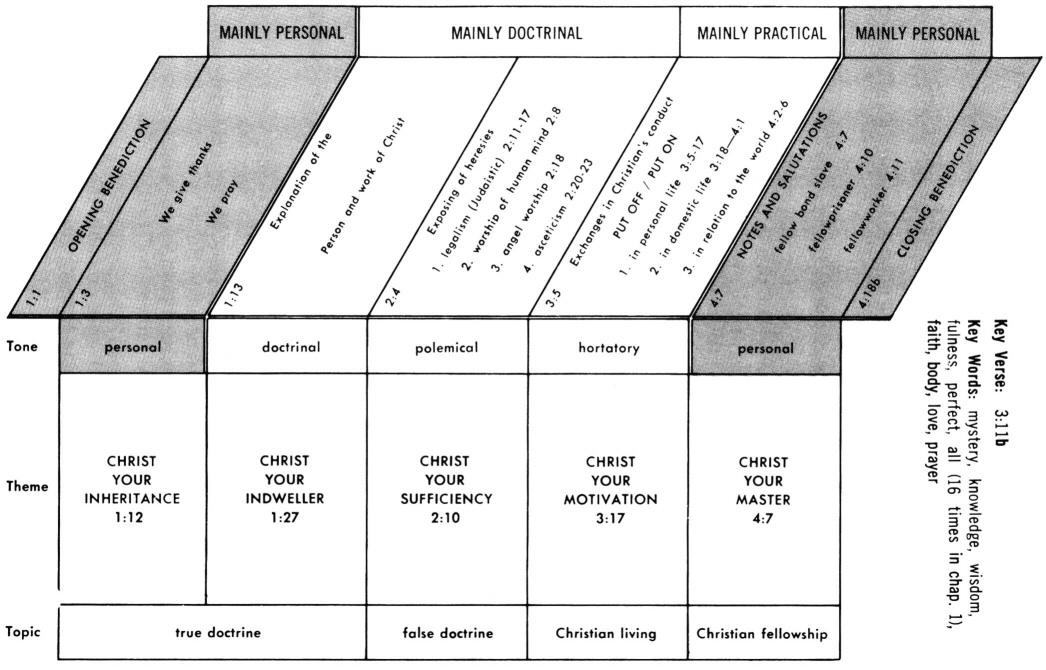
CHRIST IS ALL IN ALL
Click chart to enlarge
Charts from Jensen's Survey of the NT - used by permission
Colossians Overview - Click Chart on right side
| Christ Preeminent in All Things Supreme Lord - Sufficient Savior |
|||
| Colossians 1 | Colossians 2 | Colossians 3 | Colossians 4 |
| Supremacy of Christ |
Submission to Christ |
||
| Doctrinal and Corrective |
Practical and Reassuring |
||
| What Christ Did For Us |
What Christ Does Through Us |
||
| Christ Our Lord |
Christ Our Life |
Christ our Love |
|
| Christ the Head of the Body |
Christ the Lord of the Universe |
Christ the Head of the Home |
|
| Instruction | Warnings | Exhortations | Reminders |
| Reconciliation | Creation | Submission | Conversation |
| His Person and Word |
His Peace and Presence |
||
Colossians 3:3 For you have died (2PAAI) and your life is hidden (2SRPI) with Christ in God. (NASB: Lockman)
Greek: apethanete (2PAAI) gar, kai e zoe humon kekruptai (2SRPI) sun to Christo en to Theo
Amplified: For [as far as this world is concerned] you have died, and your [new, real] life is hidden with Christ in God. (Amplified Bible - Lockman)
Lightfoot: This life indeed is hidden now: it has no outward splendor as men count splendor; for it is a life with Christ, a life in God.
Message: Your old life is dead. Your new life, which is your real life—even though invisible to spectators—is with Christ in God. He is your life.
Phillips: For, as far as this world is concerned, you are already dead, and your true life is a hidden one in Christ. (Phillips: Touchstone)
Wuest: for you died, and your life has been hidden with Christ in God.
FOR YOU HAVE DIED: apethanete (2PAAI) gar:
- Col 2:12-note, Col 2:20-note, Ro 6:2, 7, 8, 9, 10, 11, 7, 4, 5, 6-see notes on Ro 6:2 , 6:7, 6:8-10, 6:11, 7:4-6, Gal 2:18, Gal 2:20-note ; Gal 5:24-note; Gal 6:14; 1Pe 2:24-note)
- Colossians 3 Resources - Multiple Sermons and Commentaries
- Colossians 3:1-4 Living the Risen Life - John MacArthur
Note "died" is first in Greek sentence to emphasize this life changing event.
"For [as far as this world is concerned] you have died" (Amp)
PAUSE AND PONDER
THE "FOR'S"
For (gar) - Notice the little preposition "for" (there are over 7000 "for's" in Scripture) and if the context indicates, as it does in this passage, that the "for" is a term of explanation, pause and ask yourself what is the Spirit seeking to explain? Notice how pausing to ponder will always force you to examine the context. You can (and should) practice this simple discipline every time you encounter a for, and while not every instance is a term of explanation, a "for" at the beginning of a verse is almost always used in that grammatical sense. I can assure you that if you begin to "pause and ponder," you will radically rejuvenate your "Read Through the Bible in a Year" program! You might even get a small journal and begin to keep notes on what the Spirit illuminates and how this truth can be applied to your daily life. As you practice interrogating the text (for, therefore, but, so that, etc) with 5W/H questions such as "What's the for explaining?", you will begin to learn to (1) Read the Bible inductively (power point overview) and to (2) Meditate (see also Primer on Biblical Meditation) on the Scripture. Meditation or "chewing the cud" of the Scripture (cf Mt 4:4, Job 23:12-note, Jer 15:16) so to speak is a vanishing discipline in our fast paced, hi tech, low touch society, but a spiritual discipline which God promises to greatly bless (See Ps 1:1-note, Ps 1:2-note, Ps 1:3-note, Joshua 1:8-note, cf Ps 4:4, 19:14, 27:4, 49:4, 63:6, Ps 77:6, 77:12, Ps 104:34, Ps 119:15, 119:23, 119:27, Ps 119:48, 119:78, Ps 119:97, 119:99, Ps 119:148, 143:5, Ps 145:5) From the preceding passages which "organ" of our being is most often involved/engaged in meditation? What are the subjects or the focus of meditation? Reading the Bible without meditating on it is like eating without chewing.
And so for in Col 3:3 introduces and explains the reason "living in the heavenlies" (seeking and thinking the things above) is to be the norm for each believer even though we are still on terra firma. Believers have died to the world system (Gal 6:14-note), through their faith and intimate union with Christ in His death and resurrection.
You have died (599) (apothnesko from apo = away from + thnesko = die) means literally to die off and so to cease to have vital functions, whether at an earthly or transcendent level.
Apothnesko is a very common verb in the NT used some 111 times -
Mt 8:32; 9:24; 22:24, 27; 26:35; Mk 5:35, 39; 9:26; 12:19, 20, 21; 15:44; Lk 8:42, 52, 53; 16:22; 20:28, 29, 31, 32, 36; Jn. 4:47, 49; 6:49, 50, 58; 8:21, 24, 52, 53; 11:14, 16, 21, 25, 26, 32, 37, 50, 51; 12:24, 33; 18:14, 32; 19:7; 21:23; Acts 7:4; 9:37; 21:13; 25:11; Ro 5:6, 7, 8, 15; 6:2, 7, 8, 9; 7:2, 3, 6, 10; 8:13, 34; 14:7, 8, 9, 15; 1Co 8:11; 9:15; 15:3, 22, 31, 32, 36; 2Co 5:14, 15; 6:9; Gal. 2:19, 21; Php 1:21; Col. 2:20; 3:3; 1Th 4:14; 5:10; He 7:8; 9:27; 10:28; 11:4, 13, 21, 37; Jude 1:12; Re 3:2; 8:9, 11; 9:6; 14:13; 16:3.
The tense of died is aorist which speaks of a past completed action -- the truth (as mysterious as it is) is that believers died with Christ the moment they placed their faith in. This same truth is taught elsewhere by Paul especially in Romans 6 (note the repetition of this truth in that section)…
Colossians 2:20 (see note) If (since) you have died with Christ to the elementary principles of the world, why, as if you were living in the world, do you submit yourself to decrees, such as
Romans 6:2 (see notes) May it never be! How shall we who died to sin (Sin) still live in it? 3 Or do you not know that all of us who have been baptized into Christ Jesus have been baptized (identified with) into His death? 4 Therefore we have been buried with Him through baptism into death, in order that as Christ was raised from the dead through the glory of the Father, so we too might walk in newness of life. 5 For if we have become united with Him in the likeness of His death, certainly we shall be also in the likeness of His resurrection, 6 knowing this, that our old self was crucified with Him, that our body of sin might be done away with, that we should no longer be slaves to sin; 7 for he who has died is freed from sin. 8 Now if we have died with Christ, we believe that we shall also live with Him (How many times does Paul state the believer has died with Christ? Why the repetition?)
Gal 2:20 (see note) "I have been crucified with (Word study) (perfect tense = past completed action with ongoing effect/results) Christ ; and it is no longer I who live, but Christ lives in me; and the life which I now live in the flesh I live by faith in the Son of God, who loved me, and delivered Himself up for me.
The mood of have died is indicative which is the mood of reality indicating that our death with Christ was a real event even though we cannot fully comprehend the nature of this supernatural transaction (cp 1Cor 13:12).
The practical truth is that when we died with Christ in the past, we died to the power, rule, mastery, enslavement to the old task master Sin, which has now been rendered inoperative (Ro 6:6-note "done away with" = Word study of this verb katargeo) by the death, burial and resurrection of Christ Jesus and our faith in His finished work has brought into this vital, eternal, new covenant union with Christ and His victory over sin and death.
To be sure the presence and power of SIN (see "the Sin") will continue to harangue us for the remainder of our physical earthly existence but it can no longer condemn us (eg, see Gal 5:16-note, Gal 5:17-note). The question that each of us must address to ourselves is "Am I living like one who has died with Christ?" Since we have died and have been raised with Christ, anything profane or offensive to Jesus should be profane or offensive to us. Although our co-crucifixion with Christ is a "done deal" so to speak, we still need to make daily daily choices in light of and consistent with this truth. Stated another way, our position is Christ is fixed forever, but this position should lead us to a practice commensurate with that position. We no longer have an excuse for "sloppy" Christian living. Now empowered by the Spirit of Christ we can practice "death to self" (and God will give us manifold opportunities each day!), a truth often emphasized by Jesus as a marker of those were His disciples (see Mt 16:25; Mk 8:35; Lk 9:24; 17:33; Jn 12:25 See Torrey's Topic on "Self Denial").
In this section of Colossians Paul is explaining what "death to self" should look like in our personal moral/ethical life, our speech, our interpersonal relationships, our marriages, our families and our jobs (Col 3:5-4:6). Dying to self and living to God (Christ increasing, us decreasing Jn 3:30) is the essence of the heavenly minded "much fruit" life (Jn 15:8) our Father desires for all His children to experience so that their joy might be full. But praise be to God it is no longer we who are "living" but Christ living His life in and through us (see Ga 2:20-note). Don't misunderstand for Paul is not absolving believers of personal responsibility. As discussed above, we must each continually make decisions that are God pleasing, but now we do so empowered by His Spirit (Gal 5:16-bite, Gal 5:18-note, Gal 5:25-note, Eph 5:18-note) and His provision of grace abundantly available to every yielded, humble saint ("the gravity of grace" - it flows down from on high! Cp 2Co 12:9, 10, Jas 4:6, 1Pe 5:5-note, Lk 1:52, 2Chr 32:26, 33:12, 19, 23, 34:27, Isa 57:15).
He giveth more grace when the burdens grow greater;
He sendeth more grace when the labours increase;
To added afflictions He addeth His mercy,
To multiplied trials His multiplied peace.
When we have exhausted our store of endurance,
When our strength has failed ere the day is half done:
When we reach the end of our hoarded resources,
Our Father’s full giving is only begun.
His love has no limits, His grace has no measure,
His power has no boundary known unto men;
For out of His infinite riches in Jesus,
He giveth, and giveth, and giveth again.
- Annie Johnson Flint
John Eadie - Neither “seek nor savour” the things of earth; for having died, and having been even buried with Christ, your sphere of being, action, and enjoyment, is totally different from your former state. As Luther says— “we live not in the flesh, but we dwell in the flesh.” When they did die, their death was but a birth into a new life. (Colossians 3 Commentary on the Greek Text)
Spurgeon (click complete text) has some insightful comments regarding the our death and new life in the Spirit:
Aforetime we were natural men and discerned not the things that be of the Spirit of God. We minded earthly things and were moved by carnal lustings after the things which are seen; but now through divine grace a spirit has been created in us which feeds on spiritual bread, lives for spiritual objects, is swayed by spiritual motives and rejoices in spiritual truth. This change from the natural to the spiritual is such as only God himself could have wrought, and yet we have experienced it. To God be the glory. So that by virtue of our rising in Christ we have received life and have become the subjects of a wondrous change,- “old things are passed away; behold, all things are become new. (2Cor 5:17)
MacArthur - "By using such phrases as with Christ (Col 3:1-note); where Christ (Col 3:1-note); with Christ (Col 3:3); when Christ (Col 3:4-note); and with Him (Col 3:4-note), he stresses again Christ’s total sufficiency (cf. Col 2:10-note). Unfortunately, many Christians fail to understand and pursue the fullness of Christ. Consequently, because of not knowing what Scripture says, or not applying it properly, they are intimidated into thinking they need something more than Him alone to live the Christian life. They fall prey to false philosophy, legalism, mysticism, or asceticism."
Rob Morgan commenting on Colossians 3:1-4 offers an interesting sermon title "The Best Christians are Dead Christians" noting that in Colossians 3:1-note Dead People Have a New Master, Colossians 3:2-note Dead People Have New Values, Colossians 3:3-note Dead People Have a New Perspective, and Colossians 3:4-note Dead People Have a New Future. (Morgan, R. J. Nelson's Annual Preacher's Sourcebook: 2002 Nashville: Thomas Nelson Publishers)
Spurgeon…
The old life is dead. You are dead to it. You will not be consumed by it; you cannot be controlled by it. You have a newer and higher life. Let it have full scope.
You have a new life now; it is up yonder, “where Christ sitteth on the right hand of God.” Do you not feel drawings upward? Are there no longings after the high and heavenly estate where Jesus is? Come, beloved, let your soul break loose for a while; and, like a lark that, having found its liberty, ascends with joyous wing, singing as it rises till it is out of mortal sight, so let it be with you.
You profess to be dead to the world; is that profession false? You have observed that Scriptural ordinance in which you profess to be buried with Christ; was that observance only an empty form?
AND YOUR LIFE IS HIDDEN WITH CHRIST IN GOD: sun to Christo en to theo kai e zoe humon kekruptai (2SRPI)::
- Jn 14:19, Php 4:7-note;1Jn 3:2
- Jn 4:14; 5:21,24,40; 6:39,40; 10:28, 29, 30; 14:19; Ro 5:10,21; 8:2,34, 35, 36, 37, 38, 39; 1Co 15:45
- Colossians 3 Resources - Multiple Sermons and Commentaries
- Colossians 3:1-4 Living the Risen Life - John MacArthur
and your [new, real] life is hidden with Christ in God (Amp)
you have a secret life with Christ (BBE) (Ed note: But He should show forth to those around you! Don't keep the secret to yourself!)
HIDDEN WITH CHRIST
FOREVER!
Your life is hidden with Christ in God - In a word, you are eternally secure. No caveats. No disclaimers. No asterisks. God says it. That settles it, whether we believe it or not. If we are truly in Christ, we are forever and ever in Christ, independent of our frequent failings in this present early existence. When Christ said "It is Finished," ( See "Tetelestai") He put His irrevocable stamp on our eternal security. No works we do can ever add to His finished work. No sins we commit, have not already been atoned for by His precious blood of the New Covenant. Our hidden life is eternally secure in Christ. May God grant us grace by His Spirit to fully rest in this incredible truth in Christ. Amen.
A T Robertson - (the believer's life) remains concealed, locked “together with” (sun) Christ, “in” (en) God. No hellish burglar can break that combination!
Life (2222) (zoe) in Scripture is used (1) to refer to physical life (Ro 8:38-note, 1Co 3:22, Php 1:20-note, James 4:14, etc) but more often to (2) to supernatural life (which is what Paul is emphasizing in this section of Colossians) in contrast to a life subject to eternal death (Jn 3:36). This quality of life speaks of fullness of life which alone belongs to God the Giver of life and is available to His children now (Ro 6:4-note, Ep 4:18-note) as well as in eternity future (Mk 10:30, Titus 1:2-note on Eternal Life). Rev 6:15-16 affirm the futility of seeking to hide from the judgment of God!
Hidden with Christ in the sense that our new spiritual life is no longer in the sphere of the earthly and sensual, but is with the life of the risen Christ, who is unseen with God. Krupto is in the perfect tense signifying that we were hidden with Christ at some point in time (day of your salvation) and remains hidden or concealed which conveys the ideas of permanency and irrevocability.
Hidden (2928)(krupto; English = crypt, cryptic) is a verb meaning to cover, to hide, to conceal, to keep secret (either protectively or for selfish reasons). To keep something from being seen. In some contexts krupto means to hide so as to keep secret (eg, Lk 19:42).
The first use in the Bible (Septuagint) is sad describing when Adam and Eve who had just committed the first sin "heard the sound of the LORD God walking in the garden in the cool of the day, and the man and his wife hid themselves from the presence of the LORD God among the trees of the garden." (Ge 3:8,10) In Ge 4:15 because of his sin of murdering Abel Cain cries“Behold, You have driven me this day from the face of the ground; and from Your face I will be hidden (Ge 4:14). In Ge 18:17 we see the first figurative use when God asked "Shall I hide from Abraham what I am about to do?"
Krupto speaks of literal hiding in many Gospel passages, but also of figurative hiding, as in Lk 18:34 (cp Lk 19:42) where the meaning of Jesus' words was "hidden from" the disciples (Cp Webster's definition of "cryptic" = having or seeming to have a hidden or ambiguous meaning). In Jn 19:38, krupto is used adverbially to refer to the “secret” (under cover, in hiding) discipleship of Joseph of Arimathea.
Gilbrant - In classical Greek kruptō means “to lay one on the other,” “to cover,” or “to conceal.” It carries with it the idea of keeping something secret or protected. It is often used in reference to things “hidden” for selfish reasons. The Septuagint uses kruptō to refer to the baby Moses being “concealed” from the Egyptians so his life might be spared (Ex 2:3). Jeremiah was commanded to “hide” or “bury” a linen girdle in the earth for a certain length of time causing it to decay and thus painting a graphic picture of God’s judgment on Judah (Jer 13:1-11). In the New Testament kruptō is often used of things which are hidden for the purpose of keeping them secret (Matthew 13:35,44; 25:25; John 19:38). Money is buried under the false notion that what is not used will not be wasted or lost (Matthew 25:18,25). Jesus used kruptō in Matthew 5:14 to teach that some things cannot be hidden and are simply not meant to be. Paul wrote that believers can have their lives hidden with Christ in God in the sense that they do not have to conform to the carnality of this present world (Colossians 3:3). John described the futile efforts of men to hide from the face and wrath of God when the Day of the Lord comes (Revelation 6:15,16). The contrast is obvious: Man can be hidden “safely” in God now, or he can try unsuccessfully to hide from God then. (The Complete Biblical Library Greek-English Dictionary).
Barclay - There may well be a word play here (with krupto) which a Greek would recognize at once. The false teachers called their books of so-called wisdom apokruphoi (Greek 614), the books that were hidden from all except from those who were initiated. Now the word which Paul uses to say that our lives are hidden with Christ in God is part of the verb apokruptein (Greek 613), from which the adjective apokruphos (Greek 614) comes. Undoubtedly the one word would suggest the other. It is as if Paul said, "For you the treasures of wisdom are hidden in your secret books; for us Christ is the treasury of wisdom and we are hidden in him." There is still another thought here. The life of the Christian is hidden with Christ in God. That which is hidden is concealed; the world cannot recognize the Christian. But Paul goes on: "The day is coming when Christ will return in glory and then the Christian, whom no one recognized, will share that glory and it will be plain for all to see." In a sense Paul is saying--and saying truly--that some day the verdicts of eternity will reverse the verdicts of time and the judgments of God will overturn the judgments of men. (Colossians 3 - William Barclay's Daily Study Bible)
The kryptoé were secret police in Sparta, and the word at times acquires a nuance of cunning. Secret sins are particularly shameful or abominable. kryphaéos is a rare word for “hidden,” kryphe means “secretly,” krypte is a “vault” or “cellar,” and apokryphos means “hidden” (e.g., treasure) or “secret.”
Vine - "to cover, conceal, keep secret" (Eng., "crypt," "cryptic," etc.), is used (a) in its physical significance, e.g., Mt 5:14; 13:44; 25:18 (some mss. have No. 2); (b) metaphorically, e.g., Mt 11:25 (some mss. have No. 2 here); Mt 13:35, RV, "(things) hidden;" AV, "(things) which have been kept secret;" Luke 18:34; 19:42; Jn 19:38 , "secretly." (Reference)
Zodhiates compares kalupto with krupto - The two verbs, kalúptō, to cover up, and krúptō, to conceal, essentially mean the same thing. The first means to put a cover or lid over something you do not want seen, and the second is to hide something for the same reason. The noun kálupsis (from kalúptō), something covered (hidden), is antithetical to apokálupsis (602]] , a revelation, an unveiling. From the verb krúptō, to hide, we have the adjectival noun kruptón, hidden or secret, and apókruphon (614]] , hid, which in the plural is the name given to non-canonical (extra-biblical) books from Hebrew-Christian tradition. In due time ("The Apocrypha"), God will reveal secret or hidden (kruptón) things to us. (Exegetical Commentary on Matthew)
In the present context krupto refers to hiding so as to provide protection, thus preventing one from being harmed. While we are hidden in Christ, we are not to the light of Christ in us hidden from the world that is dying in spiritual darkness (Mt 5:14).
NAS Usage: concealed(1), hid(7), hidden(8), hide(1), secret(1), things hidden(1).
Krupto is used 18 times in the NT -
Matthew 5:14-note "You are the light of the world. A city set on a hill cannot be hidden;
Matthew 11:25 At that time Jesus said, "I praise You, Father, Lord of heaven and earth, that You have hidden these things from the wise and intelligent and have revealed them to infants.
Matthew 13:35 This was to fulfill what was spoken through the prophet: "I WILL OPEN MY MOUTH IN PARABLES; I WILL UTTER THINGS HIDDEN SINCE THE FOUNDATION OF THE WORLD."
Matthew 13:44 "The kingdom of heaven is like a treasure hidden in the field, which a man found and hid again; and from joy over it he goes and sells all that he has and buys that field.
Matthew 25:18 "But he who received the one talent went away, and dug a hole in the ground and hid his master's money.
Matthew 25:25 'And I was afraid, and went away and hid your talent in the ground. See, you have what is yours.'
Luke 13:21 "It is like leaven, which a woman took and hid in three pecks of flour until it was all leavened."
Luke 18:34 But the disciples understood none of these things, and the meaning of this statement was hidden from them, and they did not comprehend the things that were said.
Luke 19:42 saying, "If you had known in this day, even you, the things which make for peace! But now they have been hidden from your eyes.
Comment: This is a fascinating statement by Jesus, for it clearly implies they could of and should of know about this day. This enigmatic declaration begs the question - when is this day? What day? Jesus explains in Lk 19:44 that destruction would fall on them "because you did not recognize the time of your visitation.” Why and/or how could the Jews have known this day, the day of the King's inauguration (read Lk 19:36-38)? If they had read and received and believed the prophecy of Daniel, they could have known this day (See discussion of Daniel 9:25-note and Daniel 9:26-note).
John 8:59 Therefore they picked up stones to throw at Him, but Jesus hid Himself and went out of the temple.
John 12:36 "While you have the Light, believe in the Light, so that you may become sons of Light." These things Jesus spoke, and He went away and hid Himself from them.
John 19:38 After these things Joseph of Arimathea, being a disciple of Jesus, but a secret one for fear of the Jews, asked Pilate that he might take away the body of Jesus; and Pilate granted permission. So he came and took away His body.
Colossians 3:3 For you have died and your life is hidden with Christ in God.
1 Timothy 5:25 Likewise also, deeds that are good are quite evident, and those which are otherwise cannot be concealed.
Hebrews 11:23-note By faith Moses, when he was born, was hidden for three months by his parents, because they saw he was a beautiful child; and they were not afraid of the king's edict.
Revelation 2:17-note 'He who has an ear, let him hear what the Spirit says to the churches. To him who overcomes, to him I will give some of the hidden manna, and I will give him a white stone, and a new name written on the stone which no one knows but he who receives it.'
Revelation 6:15-note Then the kings of the earth and the great men and the commanders and the rich and the strong and every slave and free man hid themselves in the caves and among the rocks of the mountains; 16 and they said to the mountains and to the rocks, "Fall on us and hide us from the presence of Him who sits on the throne, and from the wrath of the Lamb;
Krupto - 113x in the non-apocryphal Septuagint -
Ge 3:8, 10; 4:14; 18:17; 31:20; 37:26; Exod. 2:3, 12; Num. 5:13; Deut. 7:20; Jos. 2:4, 6, 16; 6:25; 7:19, 21; 10:17; Jdg. 9:5; 1 Sam. 3:17f; 10:22; 13:6; 14:11, 22; 19:2; 20:2, 5, 19, 24; 23:19; 2 Sam. 14:18; 17:9; 19:4; 1 Ki. 17:3; 18:4, 13; 22:25; 2 Ki. 6:9, 29; 7:12; 11:2f; 2 Chr. 22:11; Job 5:21; 13:20, 24; 14:13; 15:18; 17:4; 18:10; 20:12; 23:12; 24:4; 28:21; 29:8; 31:33; 34:22, 29; 38:2; 40:13; 42:3; Ps. 9:15; 17:14; 27:5; 31:4, 19; 35:7f; 38:9; 40:10; 54:1; 55:12; 64:5; 69:5; 78:4; 119:11; 139:15; 140:5; 142:3; Prov. 1:11; 2:1; 7:1; 10:14; 11:13; 12:16; 17:9; 25:2; 26:15, 26; 27:5; Isa. 2:10; 29:14; 32:2; 42:22; 49:2; Jer. 4:29; 13:5; 16:17; 18:20, 22; 23:24; 32:27; 38:14, 25; 42:4; 49:10; 50:2; Lam. 3:56; Ezek. 12:6f, 12; Hos. 6:9; 13:14; Obad. 1:6;
The death (aorist tense) is over, but the results of the hiding (perfect tense) of the life in Him abide. Safe in the arms of Jesus, the title of Fanny Crosby's hymn (which was played on August 8, 1885, when U.S. President Ulysses S. Grant was laid to rest in Riverside Park, on the banks of the Hudson River - but believers are safe not just in eternity future but eternity present!)…
Safe in the arms of Jesus
Play Vocal by Alton Beal
Safe in the arms of Jesus, safe on His gentle breast,
There by His love o’ershaded, sweetly my soul shall rest.
Hark! ’tis the voice of angels, borne in a song to me.
Over the fields of glory, over the jasper sea.
Refrain
Safe in the arms of Jesus, safe on His gentle breast
There by His love o’ershaded, sweetly my soul shall rest.
Safe in the arms of Jesus, safe from corroding care,
Safe from the world’s temptations, sin cannot harm me there.
Free from the blight of sorrow, free from my doubts and fears;
Only a few more trials, only a few more tears!
Refrain
Jesus, my heart’s dear Refuge, Jesus has died for me;
Firm on the Rock of Ages, ever my trust shall be.
Here let me wait with patience, wait till the night is over;
Wait till I see the morning break on the golden shore.
Refrain
As Handley Moule says, "The ‘death’ is fact accomplished, the resulting ‘life’ is fact continuing." (PTL!)
As missionary James Calvert approached the Fiji Islands, the captain of the ship tried to discourage him from setting ashore on a cannibal island. “You will lose your life and the lives of those with you if you go among such savages,” he said. Calvert only replied, “We died before we came here.” Clearly Calvert believed and lived out the truth that “For you died, and your life is hidden with Christ in God.” We do well to imitate the lives of godly men like James Calvert (cp Jn 13:15, 2Ti 3:10-note, Php 3:17-note, He 6:11,12-note, He 13:7-note, 1Th 1:6, 7-note, 2Th 3:7, 8, 9).
John Eadie explains our hidden life as the
"life is at once divine and mediatorial—God's gift to believers through Christ; and the gift, along with its medium and its destiny, are hidden in the Giver, as the infinite source. But this concealment is no argument against present and partial enjoyment; for one may drink of the stream and be unable either to detect its source, which hides itself far away and high among the mountains, or conjecture at what distant point its deepening current pours itself into the ocean. The life is not said, by the apostle, to be hidden in itself, either from the world or from believers themselves, as so many commentators suppose. True, indeed, it is mysterious. It is not among things of vulgar gaze. It is a strange experience; none can know it save he who has it. For Christians die and yet live; nay, the moment of death is that of life—the instant of expiry is that of birth. Yet this life is now enjoyed—is therefore now a matter of secret consciousness, though much about it is beyond inquiry and analysis. No one can lay bare the principle of physical life; the knife of the anatomist cannot uncover the cord which binds the conscious thinking essence to its material organ and habitation. But the special thought of the apostle is, that the ethereal nature of spiritual life eludes research, alike in its origin and destiny. Its source is too high for us to climb to it, and its destiny is too noble to be written in human language. As to the former, it is hidden with Christ in God; and as to the latter, it shall not be fully revealed till Christ come the second time in glory. But it shall be ultimately disclosed. For Christ, with whom our life is hidden, shall reveal Himself, and we whose life is so hidden with Him shall also appear with Him in glory. When its medium is revealed, its character and destiny shall also be laid bare." (Colossians 3 Commentary on the Greek Text)
Vincent notes that a believer's "new spiritual life is no longer in the sphere of the earthly and sensual, but is with the life of the risen Christ, who is unseen with God".
As Paul reminds the Philippians "our citizenship is in heaven, from which also we eagerly wait for a Savior, the Lord Jesus Christ." (Php 3:20-note)
Believers were a colony from heaven in Philippi! Christians are citizens of a kingdom not of this world for as our Lord has said "My kingdom is not of this world. If My kingdom were of this world, then My servants would be fighting so that I would not be handed over to the Jews; but as it is, My kingdom is not of this realm." (John 18:36)
Spurgeon in Morning and Evening writes that…
Regeneration is a subject which lies at the very basis of salvation, and we should be very diligent to take heed that we really are "born again," (Jn 3:3, Ga 6:15, Titus 3:5-note, Jas 1:18-note, 1Pe 1:3-note, 1Pe 1:23-note, 1Jn 2:29, 3:9, 5:1, 18) for there are many who fancy they are, who are not. Be assured that the name of a Christian is not the nature of a Christian; and that being born in a Christian land, and being recognized as professing the Christian religion is of no avail whatever, unless there be something more added to it--the being "born again," is a matter so mysterious, that human words cannot describe it. "The wind bloweth where it listeth, and thou hearest the sound thereof, but canst not tell whence it cometh, and whither it goeth: so is every one that is born of the Spirit." Nevertheless, it is a change which is known and felt: known by works of holiness, and felt by a gracious experience. This great work is supernatural. It is not an operation which a man performs for himself: a new principle is infused, which works in the heart, renews the soul, and affects the entire man. It is not a change of my name, but a renewal of my nature, so that I am not the man I used to be, but a new man in Christ Jesus.
To wash and dress a corpse is a far different thing from making it alive: man can do the one, God alone can do the other. If you have then, been "born again," your acknowledgment will be, "O Lord Jesus, the everlasting Father, Thou art my spiritual Parent; unless Thy Spirit had breathed into me the breath of a new, holy, and spiritual life, I had been to this day 'dead in trespasses and sins.' My heavenly life is wholly derived from Thee, to Thee I ascribe it. 'My life is hid with Christ in God.' It is no longer I who live, but Christ who liveth in me." May the Lord enable us to be well assured on this vital point, for to be unregenerate is to be unsaved, unpardoned, without God, and without hope.
Three thoughts are suggested by the verb hidden…
(1) Safety or security - Believers are permanently hidden, securely locked together with Christ. Satan can’t break the lock and no burglar (even false teachers) can break the combination. Thus a believer's salvation is safe & secure with Christ (Jn 10:28). Indeed as Paul writes elsewhere, who shall ''separate us from the love of God, which is in Christ Jesus our Lord.'' (Ro 8:35,36, 37, 38, 39-see notes vv35-36, 37-39)
(2) Identity - Believers are now intimately linked "together with" (sun) Christ in (en) God. This picture expresses the fellowship of the believer, his identity with his risen Lord. Ignatius wrote, “You are then all fellow travelers and carry with you God, and the Temple, and Christ, and holiness, and are in all ways adorned by commandments of Jesus Christ.” He used the word christophoroi, which means Christ-bearers, and it is a lovely description of a Christian identified with Christ, who is in the bosom of the Father (cf Jn 1:18, 10:27, 28, 29, 30).
(3). Secrecy - The believer’s life is nourished by secret springs and located “where the world sees Him no more” (cf. Jn 14:19). Thus, his bent of life is to be directed toward its source and away from the visible and carnal.
Oswald Chambers - The Spirit of God testifies to and confirms the simple, but almighty, security of the life that "is hidden with Christ in God." Paul continually brought this out in his New Testament letters. We talk as if living a sanctified life were the most uncertain and insecure thing we could do. Yet it is the most secure thing possible, because it has Almighty God in and behind it. The most dangerous and unsure thing is to try to live without God. For one who is born again, it is easier to live in a right-standing relationship with God than it is to go wrong, provided we heed God’s warnings and "walk in the light" (1John 1:7) (Read full devotional)
A B Simpson explains that our life "is hid from the world which cannot understand us. It is hid from the devil who cannot steal it. It is hid often from our own consciousness, and, when we think it gone and mourn our lack of feeling, we find that Christ is still there waiting till the eclipse is over to reveal Himself in unchanging love. The security of our life is not in our experience, but in Him. (A. B. Simpson. Christ in the Bible - Colossians)
T. R. Kelly has this devotional thought (entitled "Constant Presence") on a practical aspect of our lives being hidden with Christ in God "There is a way of life so hid with Christ in God that in the midst of the day's business one is inwardly lifting brief prayers, short sudden utterances of praise, subdued whispers of adoration and of tender love to the Beyond that is within. No one need know about it. I only speak to you because it is a sacred trust, not mine but to be given to others. One can live in a well-nigh continuous state of unworded prayer, directed toward God, directed toward people and enterprises we have on our heart. There is no hurry about it all; it is a life unspeakable and full of glory, an inner world of splendor within which we, unworthy may live. Some of you know it and live in it; others of you may wistfully long for it; it can be yours.
Larry Richards gives an interesting illustration of our new life with Christ - In Tarpon Springs, a little city about 10 miles from where we live, one of the major occupations is sponge diving. The sponge diver puts a helmet on his head, drops into the water, and as he gathers sponges he breathes through air lines fed by pumps in a boat far above him. Without that connection to a source of life far above him, the diver would be unable to survive. Paul is telling us that we too live this life in a dangerous and deadly environment. But we too are connected to a source of life far above us. Whenever we feel down, or get discouraged, or feel endangered, we’re to fix our minds not on what surrounds us, but on what sustains us. The very life force of Jesus flows into and through us. Because we are connected to Him, we will not only survive. We will triumph. (Ro 8:37-note)
WITH CHRIST IN GOD
No hellish burglar
can break that combination!
With is sun/syn which conveys the picture of intimate union, bringing out the truth that we are now in (new) covenant with Him and our oneness and identity with Christ.
As noted above and worth repeating A T Robertson adds that our life "remains concealed, locked “together with” (sun) Christ, “in” (en) God. No hellish burglar can break that combination." Hallelujah! Eternally Secure, held fast by His Nail Pierced Hands!
Wiersbe: When the sinner trusts Christ, he is born again and the Spirit immediately enters his body and bears witness that he is a child of God. The Spirit is resident and will not depart. But as the believer yields to the Father, loves the Word, prays, and obeys, there is a deeper relationship with the Father, Son, and Spirit. Salvation means we are going to heaven, but submission means that heaven comes to us!
Believers now share a common life with the Father, the Son and the Spirit (cf 1Co 6:17) that by the precious and magnificent promises we might become “partakers of the divine nature” (2Pe 1:4-note). Furthermore our new life with Christ in God is concealed from the world and unbelievers are unable to grasp the full import of the believer’s new life (1Co 2:14). The true manifestation of the sons of God is yet to come in the next world, so that people cannot see what believers really are like (Ro 8:19-note, Ga 5:5, Php 3:20, 21-note; 1Jn 3:2-note)
Wiersbe comments that
"While attending a convention in Washington, D.C., I watched a Senate committee hearing over television. I believe they were considering a new ambassador to the United Nations. The late Senator Hubert Humphrey was making a comment as I turned on the television set: “You must remember that in politics, how you stand depends on where you sit.” He was referring, of course, to the political party seating arrangement in the Senate, but I immediately applied it to my position in Christ. How I stand—and walk—depends on where I sit; and I am seated with Christ in the heavenlies! When the nation of Israel came to the border of the Promised Land, they refused to enter; and, because of their stubborn unbelief, they had to wander in the wilderness for forty years (Nu 13-14). That whole generation, starting with the twenty-year-olds, died in the wilderness, except for Caleb and Joshua, the only two spies who believed God. How were Caleb and Joshua able to “get the victory” during those forty difficult years in the wilderness? Their minds and hearts were in Canaan! They knew they had an inheritance coming, and they lived in the light of that inheritance. (cf Nu 14:23, 24 regarding Caleb)" (Wiersbe, W: Bible Exposition Commentary. 1989. Victor)
This verse reminds one of the beautiful phrase in the Song of Solomon and although I believe that it referred literally to a love relationship that Solomon was describing, by way of application, this phrase certainly would be applicable to all believers today…
"My Beloved is mine, and I am His!" Song 2:16
"I know," says the spouse (2Cor 11:2, Jn 3:29, Ep 5:31-note, Ep 5:32-note, Re 19:7, 8,9-note; Re 21:9-note), "that Jesus Christ is mine! I can with the greatest confidence and boldness (He 4:16-note, He 10:19, 20, 21-note, He 10:22-note) affirm it. He is …
my Head,
my Husband,
my Lord,
my Redeemer,
my Justifier,
my Savior.
And I am His!
I am sure that I am His.
I am His by purchase;
I am His by conquest;
I am His by election;
I am His by covenant;
I am His by marriage;
I am wholly His;
I am specially His;
I am universally His;
I am eternally His!"
A well-grounded assurance (1Jn 5:13, 14, 15) will make a man …
patient in waiting,
courageous in doing,
cheerful in suffering.
It will make a heaven in a man's heart—on this side heaven; and make him go singing into paradise, despite all of life's calamities and miseries—as he realizes that he is …
everlastingly chosen and beloved of God,
that God's heart is set upon him,
that his name is written in the book of life,
that there is laid up for him a crown of righteousness,
and that nothing shall be able to separate him from
Him who is his light, his life, his crown, his all in all.
Ah, Christians! only remember what Christ has done for you, and what He is still a-doing for you in heaven (Heb 7:25-note, He 9:24-note, Ro 8:34-note, 1Jn 2:1, 2), and what He will do for you to all eternity (Ep 2:7-note)—and you will not be able to spend your days in whining and whimpering.
Christians, your mercies are greater than your miseries! One hour's being in the bosom of Christ, will recompense you for all your trouble and travail on earth! Why, then, do you spend more time in sighing, than in rejoicing?
Safe in Christ - British clergyman F. B. Meyer wrote about two Germans who wanted to climb the Matterhorn. They hired three guides and began the steep and treacherous ascent. They roped themselves together in this order: guide, traveler, guide, traveler, guide.
They had gone only a little way when the last man lost his footing. He was held up by the other four, because each had a toehold in the niches they had cut in the ice. But then the next man slipped and pulled down the two above him. The only one to hold on was the first guide, who had driven a spike deep into the ice. Because he held on, all the men beneath him regained their footing.
Meyer concluded his story by drawing a spiritual application. He said, "I am like one of those men who slipped, but thank God, I am bound in a living partnership to Christ. And because He stands I will never perish."
All of us slip again and again as we walk the Christian pathway. But we are held securely by the Lord, and we can be restored to close fellowship with Him when we confess our sins (1 Jn. 1:9).
Yes, we are safe in Christ (Col. 3:3). We can have the confidence that He will keep us and bring us to our final destination. — Richard De Haan
Although we stumble every day,
The Lord is always there
To pick us up, forgive our sin,
And show His love and care. --SperOur salvation is secure
because God is doing the holding.
- As Head of the Church -Ephesians 1:22,23; 4:15,16; Colossians 1:18
- Christ prayed that all saints might have -John 17:21,23
DESCRIBED AS
- Christ being in us -Ephesians 3:17; Colossians 1:27
- Our being in Christ -2 Corinthians 12:2; 1 John 5:20
- Includes union with the Father -John 17:21; 1 John 2:24
- Is of God -1 Corinthians 1:30
MAINTAINED BY
- Faith -Galatians 2:20; Ephesians 3:17
- Abiding in him -John 15:4,7
- His word abiding in us -John 15:7; 1 John 2:24; 2 John 1:9
- Feeding on him -John 6:56
- Obeying him -1 John 3:24
- The Holy Spirit witnesses -1 John 3:24
- The gift of the Holy Spirit is an evidence of -1 John 4:13
SAINTS
- Have, in mind -1 Corinthians 2:16; Philippians 2:5
- Have, in spirit -1 Corinthians 6:17
- Have, in love -Song 2:16; 7:10
- Have, in sufferings -Philippians 3:10; 2 Timothy 2:12
- Have, in his death -Romans 6:3-8; Galatians 2:20
- Have assurance of -John 14:20
- Enjoy, in the Lord’s supper -1 Corinthians 10:16,17
- Identified with Christ by -Matthew 25:40,45; Acts 9:4; 8:1
- Are complete through -Colossians 2:10
- Exhorted to maintain -John 15:4; Acts 11:23; Colossians 2:7
- Necessary to growth in grace -Ephesians 4:15,16; Colossians 2:19
- Necessary to fruitfulness -John 15:4,5
BENEFICIAL RESULTS OF
- Righteousness imputed -2 Corinthians 5:21; Philippians 3:9
- Freedom from condemnation -Romans 8:1
- Freedom from dominion of sin -1 John 3:6
- Being created anew -2 Corinthians 5:17
- The spirit alive to righteousness -Romans 8:10
- Confidence at his coming -1 John 2:28
- Abundant fruitfulness -John 15:5
- Answers to prayer -John 15:7
- They who have, ought to walk as he walked -1 John 2:6
- False teachers have not -Colossians 2:18,19
- Is indissoluble -Romans 8:35
- Punishment of those who have not -John 15:6
Illustrated
- Vine and branches -John 15:1,5
- Foundation and building -1 Corinthians 3:10,11; Ephesians 2:20,21; 1 Peter 2:4, 5, 6
- Body and members -1 Corinthians 12:12,27; Ephesians 5:30
- Husband and wife -Ephesians 5:25-32
- The Doctrine of the New Covenant (Covenant = Oneness, Commingling of lives - see The Oneness of Covenant; Oneness Notes)
Colossians 3:4 When Christ, Who is our life is revealed (3SAPS) then you also will be revealed (2PFPI) with Him in glory. (NASB: Lockman)
Greek: hotan o Christos phanerothe, (3SAPS) e zoe humon, tote kai humeis sun auto phanerothesthe (2PFPI) en doxe
Amplified: When Christ, Who is our life, appears, then you also will appear with Him in [the splendor of His] glory. (Amplified Bible - Lockman)
Lightfoot: Christ, our life, will be manifested hereafter; then you also will be manifested with him and the world will see your glory."
Good News Bible: Your real life is Christ and when he appears, then you too will appear with him and share his glory!
Phillips: One day, Christ, the secret centre of our lives, will show himself openly, and you will all share in that magnificent dénouement. (Phillips: Touchstone)
Wuest: Whenever the Christ is made visible, our life, then also you with Him shall be manifested in glory.
WHEN CHRIST [WHO IS] OUR LIFE IS REVEALED: hotan o Christos phanerothe (3SAPS), e zoe humon hotan ho Christos phanerôthêi (1APS):
- Jn 11:25; 14:6; 14:19, 20:31; Ro 5:10, Ga 2:20;Php 1:21, 2Ti 1:1; 1Jo 1:1,2; 5:12; Rev 2:7; 22:1,14
- 1Ti 6:14; 2Ti 4:8; Titus 2:13; Heb 9:28; 1Pet 5:4; 1John 2:28; 3:2
- Colossians 3 Resources - Multiple Sermons and Commentaries
- Colossians 3:1-4 Living the Risen Life - John MacArthur
"when the Christ (Messiah)--our life--may be manifested… " (Young's Literal)
CHRIST OUR LIFE IS
NOT A METAPHOR BUT A REALITY!
John 11:25 Jesus said to her (Jn 11:24), “I am the resurrection and the life; he who believes in Me will live even if he dies,
Jn 14:6 Jesus *said to him, “I am the way, and the truth, and the life; no one comes to the Father but through Me.
John 20:31 but these have been written so that you may believe that Jesus is the Christ, the Son of God; and that believing you may have life in His name.
2 Timothy 1:1 Paul, an apostle of Christ Jesus by the will of God, according to the promise of life in Christ Jesus (Where is real life found? In what sphere? See in Christ; in Christ Jesus; in Christ -2)
1 John 1:1 What was from the beginning, what we have heard, what we have seen with our eyes, what we have looked at and touched with our hands, concerning the Word of Life—
1 John 5:12 He who has the Son has the life; he who does not have the Son of God does not have the life.
When - Not "if" but "when"! He will appear! Dear believer, that glorious event is more certain then the sun rising tomorrow! And His Second Coming could indeed be tomorrow! In light of the imminency of Christ's return, John gives us a wise word "Now, little children, abide (present imperative = Enabled by the Spirit, make abiding in Christ your lifestyle!) in Him, so that when He appears, we may have confidence (parrhesia) and not shrink away from Him in shame at His coming (parousia)." (1John 2:28) When a man realizes the nearness of Jesus Christ, he is bound to commit himself to a certain kind of life. If you knew that when you arise tomorrow morning you would see Jesus face to face in the evening, would it not affect the way you conducted yourself during the day? Remember, it is not "IF" but "WHEN"!
Christ Who is our life - As discussed below there is no verb "Who is." The text reads "Christ our life." O my, what an overwhelming, profound truth to ponder. It will take eternity to do so! John's purpose of his Gospel was "that you may believe that Jesus is the Christ (the Messiah), the Son of God, and that believing you may have LIFE in HIS NAME." (Jn 20:31). Jesus, the Word of Life (1Jn 1:1, Php 2:16) is the Source of all true life, life indeed, life in abundance!
Christ (5547) (Christos from chrio = to anoint, rub with oil, consecrate to an office) is the Anointed One, the Messiah, Christos being the Greek equivalent of the transliterated Hebrew word Messiah, the One Who fulfills the expectation of Israel of a deliverer.
Christos in Colossians -
(Col 1:1) Paul, an apostle of Jesus Christ by the will of God, and Timothy our brother,
(Col 1:2) To the saints and faithful brethren in Christ who are at Colossae: Grace to you and peace from God our Father.
(Col 1:3) We give thanks to God, the Father of our Lord Jesus Christ, praying always for you,
(Col 1:4) since we heard of your faith in Christ Jesus and the love which you have for all the saints;
(Col 1:7) just as you learned it from Epaphras, our beloved fellow bond-servant, who is a faithful servant of Christ on our behalf,
(Col 1:24) Now I rejoice in my sufferings for your sake, and in my flesh I do my share on behalf of His body, which is the church, in filling up what is lacking in Christ’s afflictions.
(Col 1:27) to whom God willed to make known what is the riches of the glory of this mystery among the Gentiles, which is Christ in you, the hope of glory.
(Col 1:28) We proclaim Him, admonishing every man and teaching every man with all wisdom, so that we may present every man complete in Christ.
(Col 2:2) that their hearts may be encouraged, having been knit together in love, and attaining to all the wealth that comes from the full assurance of understanding, resulting in a true knowledge of God’s mystery, that is, Christ Himself,
(Col 2:5) For even though I am absent in body, nevertheless I am with you in spirit, rejoicing to see your good discipline and the stability of your faith in Christ.
(Col 2:6) Therefore as you have received Christ Jesus the Lord, so walk in Him,
(Col 2:8) See to it that no one takes you captive through philosophy and empty deception, according to the tradition of men, according to the elementary principles of the world, rather than according to Christ.
(Col 2:11) and in Him you were also circumcised with a circumcision made without hands, in the removal of the body of the flesh by the circumcision of Christ;
(Col 2:17) things which are a mere shadow of what is to come; but the substance belongs to Christ.
(Col 2:20) If you have died with Christ to the elementary principles of the world, why, as if you were living in the world, do you submit yourself to decrees, such as,
(Col 3:1) Therefore if you have been raised up with Christ, keep seeking the things above, where Christ is, seated at the right hand of God.
(Col 3:3) For you have died and your life is hidden with Christ in God.
(Col 3:4) When Christ, who is our life, is revealed, then you also will be revealed with Him in glory.
(Col 3:11) a renewal in which there is no distinction between Greek and Jew, circumcised and uncircumcised, barbarian, Scythian, slave and freeman, but Christ is all, and in all.
(Col 3:15) Let the peace of Christ rule in your hearts, to which indeed you were called in one body; and be thankful.
(Col 3:16) Let the word of Christ richly dwell within you, with all wisdom teaching and admonishing one another with psalms and hymns and spiritual songs, singing with thankfulness in your hearts to God.
(Col 3:24) knowing that from the Lord you will receive the reward of the inheritance. It is the Lord Christ whom you serve.
(Col 4:3) praying at the same time for us as well, that God will open up to us a door for the word, so that we may speak forth the mystery of Christ, for which I have also been imprisoned;
(Col 4:12) Epaphras, who is one of your number, a bondslave of Jesus Christ, sends you his greetings, always laboring earnestly for you in his prayers, that you may stand perfect and fully assured in all the will of God.
The Christos was literally the one had been anointed, this anointing symbolizing his appointment to the task of fulfilling the role of the Messiah sent from God (eg, cp Ro 11:26-note)
Life (2222) (zoe) here refers to that supernatural life which includes a fullness of life which alone belongs to God the Giver of life and is available to His children now (Ro 6:4-note, Ep 4:18-note) forever, amen (Mk 10:30, Titus 1:2-note on Eternal Life).
The hidden life is not hidden forever. There shall be a glorious consummation at the manifestation of the Son. The writer of Hebrews expresses the aim of the Father as that of "bringing many sons to glory" (Heb 2:10 - note).
“Dying with Jesus, by death reckoned mine;
Living with Jesus, a new life divine;
Looking to Jesus till glory doth shine,
Moment by moment, O Lord, I am Thine”
Related Resources:
- The Oneness of Covenant; Oneness Notes
- The Holy Spirit-Walking Like Jesus Walked!
- Union with Christ - Baker's Evangelical Dictionary of Biblical Theology
- Life, Spiritual - Torrey's Topical Textbook
Revealed (5319) (phaneroo from phanerós = manifest, visible, conspicuous from phaino = give light; become visible from phos = light) describes an external manifestation to the senses which is open to all. The idea is to make visible that which has been hidden and the primary reference is to what is visible to sensory perception. To cause to become visible, to make appear, to cause to be seen, uncover, lay bare, reveal.
Phaneroo is used 49 times in the NT -
Mk 4:22; 16:12, 14; Jn 1:31; 2:11; 3:21; 7:4; 9:3; 17:6; 21:1, 14; Ro 1:19; 3:21; 16:26; 1Co. 4:5; 2Co. 2:14; 3:3; 4:10, 11; 5:10, 11; 7:12; 11:6; Eph. 5:13, 14; Col. 1:26; 3:4; 4:4; 1Ti 3:16; 2Ti 1:10; Titus 1:3; He 9:8, 26; 1Pe 1:20; 5:4; 1Jn. 1:2; 2:19, 28; 3:2, 5, 8; 4:9; Re 3:18; 15:4.
The point is that one day we will be seen externally as we really are & the lost world will see who we are in Christ for when we see Christ we shall be like Him. (1 John 3:2) This refers to Messiah's second coming, which in the meantime is to be earnestly expectantly looked for. The first "phase" of His return is what most evangelicals refer to as the 'Rapture" describe in (see notes on The Rapture - the Greek word harpazo) (See Table comparing Rapture vs Second Coming)
As the Bible Knowledge Commentary notes
Paul added a new direction to the believers’ focus of attention: they should look UPWARD to Christ’s reign over them in heaven and also FORWARD to His return for them in the clouds. (Walvoord, J. F., Zuck, R. B., & Dallas Theological Seminary. The Bible knowledge commentary).
Who is - This phrase is added by translators. The literal reading of Christ our life is even better! Christ does not merely give life; He is life. We as His bride are to be so focused on His return to take us home to His Father's house that we are motivated to lay aside our old filthy fleshly garments and put on His robe of righteous acts (Col 3:5, 10, 12-see notes 3:5, 3:10, 3:12 for what those ''acts'' consist of… they in fact constitute our wedding gowns that we are in the process of making ready cf. Re 19:7-note). See John 1:4. The life is not only "with" Christ, it "is" Christ. For the change of person, "our" for "your" [Col 2:13-note] (See related topic in Christ and in Christ Jesus)
Wiersbe - Eternal life is not some heavenly substance that God imparts when we, as sinners, trust the Saviour. Eternal life is Jesus Christ Himself.
Wuest: “not just the Giver of our eternal life but the Essence of that life”
Eadie comments that Christ "is our life, not simply because he reveals it, and He alone has “the words of eternal life;” nor yet because coming that we “might have life, and that we might have it more abundantly,” He “died that we might live,” and has given us this blessed pledge—“as I live, ye shall live also;” but specially, because by His Spirit, as His representative, He enters into the heart and gives it life—fans and fosters it by his continuous abode—gratifies all its instincts, and evokes all its susceptibilities by His word and His presence. “If Christ be in you, the body is dead because of sin, but the spirit is life because of righteousness.” (Colossians 3 Commentary on the Greek Text)
In his first epistle John affirms "the witness is this, that God has given us eternal life, and this life is in His Son. He who has the Son has the life; he who does not have the Son of God does not have the life." (1 John 5:11, 12)
Many believe that Christ gave us life as one would put a living seed into a flower pot. The pot would hold a detached thing—life. But Christ is more than that. He Himself is in the believer. The life that is in Christ is in the believer. To show His love, Jesus died for us; to show our love, we should live for Him! If your life does not demonstrate this NEW LIFE IN CHRIST you have missed the whole point about what this new life is about.
Wayne Barber - "Living the Christ life is daily surrendering to His will and Word which allows us to enter into His divine enablement. I must decrease and He must increase. (John 3:30) As I am willing to deny self, and surrender to Him, He takes it from there and energizes my very being, empowering me to do what He has commanded me to do. (Php 1:21-note) " For to me to live is Christ and to die is gain".
The key to living the risen life is to have a life centered on Christ (see Guy King's illustration below). The Son, not this present world, is the center of the believer’s universe.
Oswald Chambers - "God nowhere tells us TO GIVE UP THINGS for the sake of giving them up; He tells us to give them up for the sake of the only thing worth having, viz. LIFE WITH HIMSELF."
William Barclay- This is the kind of peak of devotion which we can only dimly understand and only haltingly and imperfectly express. Sometimes we say of a man, "Music is his life-Sport is his life-He lives for his work." Such a man finds life and all that it means in music, in sport, in work, as the case may be. For the Christian, Christ is his life. And here we come back to where this passage started-that is precisely why the Christian sets his mind and heart on the things which are above and not on the things of this world. He judges everything in the light of the Cross and in the light of the love which gave itself for him. In the light of that Cross the world's wealth and ambitions and activities are seen at their true value; and, the Christian is enabled to set his whole heart on the things which are above." (The Daily Study Bible Online)
Guy King…
"Christ who is our life," (Col 3:4). Not only brings, or gives, but "is," in Himself.
(1) Its Entrance - "He that hath the Son hath [the] life; he that hath not the Son of God hath not [the] life," 1Jn 5:12. This latter has a physical life; but he has not "the" (Gk.) life, the spiritual life. He is our life.
(2) Its Continuance - "I give unto them eternal life" John 10:28. Being eternal it continues: it lasts because He lasts.
(3) Its Abundance - "I am come that they might have life, and that they might have it more abundantly". Jn 10:10. There is a world of difference between the two qualities. The hospital patient in that bed, only just alive - like some Christians, who, while having life, because they have Him, are only just Christians. they haven't grown. The hospital nurse bustling about the ward, full of life - that is the kind of Christian we are meant to be.
(4) Its Influence - "By reason of him [Lazarus] many … believed on Jesus," John 12:11. His new life, because of the Saviour, made this man a real advertisement for the Master, and enabled him to wield a powerful influence for Him on others.
(5) Its Fragrance - "He could not be hid," Mark 7:24. If He be in our heart and life in any effective degree, the fact is sure to be noticed. A friend of mine speaks of having met one day a lot of girls emerging from a factory for their lunch break. He says that they carried a most attractive aroma. As he then passed the ga e he saw that it was a scent factory. Just so is it that if our life is "hid" in Him, something of His fragrance will be upon us - "the savour of life," 2Corinthians 2:16 calls it.
I fancy it is true that fragrance comes from sacrifice. Anyhow, that was so when "the house was filled with the odour of the ointment," John 12:3. When the box was broken, the fragrance was released.
Certainly it is true that when the self is broken, the savour of CHRIST is known - "not I, but Christ," Galatians 2:20. Well, all this that we have been saying is to emphasize the blessed truth that CHRIST Himself is the Living Centre of the resurrection life. Is He, then, the real centre of our life?
We are all aware of the teachings of old astronomers concerning our planetary universe. Ptolemy was the first in the field (A.D. 127-51), one of the most eminent of the scientific men of the ancient world. He taught that our earth was the centre of the universe, and that all else revolved around it. How grand to think of ourselves as the hub of the universe! It took something like thirteen hundred years to dispel the illusion. Copernicus (A.D. 1473-1543) demonstrated that the sun was the centre, with the earth and all else revolving around it. I wonder if we have changed our life's centre? Because we begin by giving self that position - everything turns round ourselves: what we wish, we think, we propose. It often takes a long time for us to see the falsity, and futility, of the idea that this self, this bit of earth is the hub. It is a happy moment when we alter the outlook, and recognise "the Sun of Righteousness," Malachi 4:2, as our new Centre. Thenceforward, every aspect of life rotates round Him. Such, then, is the resurrection life of Full Salvation. (Colossians 3:1-4 His Encouragement of Ambition)
Spurgeon's Devotional from Morning and Evening, August 10, AM… CHRIST WHO IS OUR LIFE - Paul's marvelously rich expression indicates, that Christ is the source of our life. "You hath He quickened who were dead in trespasses and sins." That same voice which brought Lazarus out of the tomb (Jn 11:43) raised us to newness of life (Ro 6:4, 11-see notes Ro 6:4,11). He is now the Substance of our spiritual life. It is by His life that we live; He is in us, the hope of glory (Col 1:27-note), the spring of our actions, the central thought which moves every other thought. Christ is the Sustenance of our life. What can the Christian feed upon but Jesus' flesh and blood? "This is the bread which cometh down from heaven, that a man may eat thereof, and not die." (Jn 6:50, cf 6:33) O way worn pilgrims (Heb 11:13-note, 1Pe 2:11-note both KJV) in this wilderness of sin, you never get a morsel to satisfy the hunger of your spirits, except ye find it in Him! (cf Mt 5:6-note) Christ is the Solace of our life. All our true joys come from Him; and in times of trouble, His presence is our consolation (He 13:5,6-see notes 13:5; 13:6). There is nothing worth living for but Him; and His lovingkindness is better than life! (Ps 63:3 - note) Christ is the Object of our life. As speeds the ship towards the port, so hastes the believer towards the haven of his Saviour's bosom. As flies the arrow to its goal, so flies the Christian towards the perfecting of his fellowship with Christ Jesus (Php 3:10,11-note v10; v11). As the soldier fights for his captain, and is crowned in his captain's victory, so the believer contends for Christ, and gets his triumph out of the triumphs of his Master. "For him to live is Christ." (Php 1:21-note and Spurgeon's Devotional) Christ is the Exemplar (one that serves as a model for another) of our life. Where there is the same life within, there will, there must be, to a great extent, the same developments without; and if we live in near fellowship with the Lord Jesus we shall grow like Him. We shall set Him before us as our Divine copy, and we shall seek to tread in His footsteps (1Pe 2:21-note), until He shall become the crown of our life in glory. Oh! how safe, how honored, how happy is the Christian, since Christ is our life!"
JESUS' REST
|
||
| MOSES | JOSHUA | JESUS |
| No Rest Nu 14:33, 34+ |
Rest from War Dt 12:10+, Josh 23:1+ |
Rest for soul Mt 11:28-30+ |
| Wandering Forty Years Nu 32:13+ |
Victory over Physical Enemies Josh 11:23+, Josh 12:1, 2+ |
Victory over Spiritual Enemies Ro 6:17,18+, He 2:14, 15+, Ga 6:14+ |
| Wilderness Death Nu 14:35+ |
Promised Land Josh 5:6NIV+ |
Promised Life Col 3:4+ |
Ruth Paxson (from her online book which is recommended reading - Rivers of Living Water: How Obtained - How Maintained: Studies Setting Forth the Believer's Possessions in Christ - Chapter 5 "Christ Our Life")
CHRIST is the Christian's center; CHRIST is the Christian's circumference; CHRIST is all in between. As Paul put it, "Christ IS all, and IN all." CHRIST is the Life of our life.
"When Christ, who is our life, shall appear, then shall ye also appear with him in glory" (Colossians 3:4).
Is He this to you?
A Perfect Oneness
The spiritual history of every Christian could be written in two phrases, "Ye in me" and "I in you." In GOD's reckoning CHRIST and the Christian become one in such a way that CHRIST is both in the heavenlies and upon earth and the Christian is both on earth and in the heavenlies.
CHRIST in the heavenlies is the invisible part of the Christian. The Christian on earth is the
visible part of CHRIST.
This is a staggering thought. Its plain import is that you and I are to bring CHRIST down from
Heaven to earth that men may see who He is and what He can do in a human life. It is to have CHRIST's life lived out in us in such fullness that seeing Him in us men are drawn to Him in faith and love.
But I can hear a doubting Thomas say, "Except I see some one living this CHRIST life I will not believe." Well, I believe because I have seen.
For several weeks I lived in a boarding house kept by a little woman who weighed only eighty-five pounds. She was kept from falling into a heap by a brace worn at her back. She had lived on the third floor for two years with no outlook but the blue sky above and a patch of green grass a few feet square below. But her eyes shone like stars, upon her face was a smile that the affliction and adversity she suffered could not remove, and mirrored in her countenance was a radiance that one never sees on land or sea except where the Light of the world dwells in undimmed brightness. CHRIST was the Life of her life.
A Christian business man lay dying of cancer. Friends called to comfort him and they left feeling that they had been taken to the very door of Heaven and had seen the King in His beauty. CHRIST was the Life of his life in sickness as He had been in health.
A young Chinese man who had been converted from a very godless, wicked life, and had been a Christian less than two years, came to call on me one day. After he left a gentleman who saw him for only a brief moment said, "Who was that young man? I never met anyone who so instantly compelled me to think of CHRIST as did he." CHRIST had become the Life of his life.
Is He the Life of your life? Can you truly say,
"Christ liveth in me"; "to me to live is Christ"?
"There's a Man in the Glory
Whose Life is for me,
He's pure and He's holy,
Triumphant and free.
He's wise and He's loving,
Tender is He;
And His Life in the Glory
My life must be.
"There's a Man in the Glory
Whose Life is for me,
He overcame Satan;
From bondage He's free.
In life He is reigning,
Kingly is He;
And His Life in the Glory
My life must be.
"There's a Man in the Glory
Whose Life is for me,
In Him is no sickness:
No weakness has He
He's strong and in vigor,
Buoyant is He;
And His Life in the Glory
My life may be.
"There's a Man in the Glory
Whose Life is for me.
His peace is abiding;
Patient is He.
He's joyful and radiant,
Expecting to see
His Life in the Glory
Lived out in me."
(from Ruth Paxson's online book which is recommended reading - Rivers of Living Water: How Obtained - How Maintained: Studies Setting Forth the Believer's Possessions in Christ - Chapter 5 "Christ Our Life")
THEN YOU ALSO (WITH HIM) WILL BE REVEALED IN GLORY: kai humeis sun autôi: phanerôthêsesthe (FPI) en doxêi:
- Ps 17:15; 73:24; Isa 25:8,9; Mt 13:43; Jn 6:39,40; 14:3; 17:24;Ro 5:2, Ro 8:18,24-25, 1Cor 15:43; 2Cor 4:17; Php 3:21; 1Thes 4:17; 2Thes 1:10-12; Titus 2:13,1Pet 5:10, Jude 1:24
- Colossians 3 Resources - Multiple Sermons and Commentaries
- Colossians 3:1-4 Living the Risen Life - John MacArthur
Then (5119) (tote) is an important time sensitive word or expression of time -and should always prompt the questions like "When is then?", etc.
David prophesied of this "glory" writing…
As for me, I shall behold Thy face (which is "glory") in righteousness; I will be satisfied with Thy likeness (which is "glory") when I awake. (Ps 17:15-note)
Asaph wrote
With Thy counsel Thou wilt guide me, and afterward receive me to glory. (Ps 73:24-note)
Isaiah spoke of this glorious day writing that God…
will swallow up death for all time, and the Lord GOD will wipe tears away from all faces, and He will remove the reproach of His people from all the earth; for the LORD has spoken. And it will be said in that day, "Behold, this is our God for whom we have waited that He might save us. This is the LORD for Whom we have waited. Let us rejoice and be glad in His salvation." (Isa 25:8,9)
Jesus declared that at His Second Coming…
Then THE RIGHTEOUS WILL SHINE FORTH AS THE SUN in the kingdom of their Father. He who has ears, let him hear. (Mt 13:43)
In a sense the fulfillment of this verse in Colossians is an answer to Jesus' prayer…
Father, I desire that they also, whom Thou hast given Me, be with Me where I am, in order that they may behold My glory, which Thou hast given Me; for Thou didst love Me before the foundation of the world. (John 17:24)
Paul explaining how this glory is now possible for believers concludes
Therefore having been justified (declared righteous) by faith, we have peace with God through our Lord Jesus Christ, through whom also we have obtained our introduction by faith into this grace in which we stand (perfect tense = speaks of the permanence = another verse refuting the idea one can lose genuine salvation); and we exult in hope of the glory of God. (Ro 5:1-2-note)
Paul described that our body…
is sown in dishonor, it is raised in glory; it is sown in weakness, it is raised in power (1Cor 15:43)
This certainty of future glory should encourage saints to remain steadfast in afflictions…
For momentary (in the context of eternity), light affliction is producing (Is achieving or working out in each of us to completion) for us an eternal weight of glory far beyond all comparison, while we look not at the things which are seen, but at the things which are not seen; for the things which are seen are temporal, but the things which are not seen are eternal. (2Cor 4:17-18-note)
Writing to the saints at Philippi Paul reiterates the truth of our future glory explaining to strangers and aliens on earth that…
our citizenship is in heaven, from which also we eagerly wait for a Savior, the Lord Jesus Christ Who will transform the body of our humble state into conformity with the body of His glory, by the exertion of the power that He has even to subject all things to Himself. (Php 3:20-note)
Then - Such a small word, but oh, the ramifications of this "time sensitive" word (see expressions of time). Whenever you spot a then (and the context indicates it is "time sensitive"), always pause and ponder, asking some of the 5W/H questions, such as the simple one "When is THEN?" (Answer - When Christ, Who is our life is revealed - at the Second Coming) "What happens THEN?" "Who is impacted by this THEN?" "What effect might this THEN have on our 'NOW' circumstances, especially if we are experiencing adversity or affliction?", etc. You will be amazed at the number of questions the Spirit your Teacher will stimulate you to ask! And as you do this simple "exercise," I submit that you are in essence practicing the blessed discipline of Biblical Meditation! John explains what happens THEN…
Beloved, now we are children of God, and it has not appeared as yet what we shall be. We know that, when He appears, we shall be like Him ( = "revealed in glory"), because we shall see Him just as He is. (1John 3:2-note)
Revealed (5319) (phaneroo see note above) means to be manifested or revealed as to one's true character.
That is the joy of this blessed hope (see notes on the "Blessed Hope" = Titus 2:13,14, 15-note; see study The Blessed Hope). For this the called (see note on "the called") are kept (Jude1:1) and though the adversaries and difficulties are many, “Faithful is He Who calls” (1Th 5:24-note). Our calling is accompanied with a great hope (Ep 4:4-note). Those that experience the call not only partake of justification, adoption, and sanctification in this life, but when Christ who is their life shall appear, they shall also appear with Him in glory.
John Eadie explains our "revelation" this way
"When it is said—Christ our life shall appear, the meaning is, that He shall appear in the character of our life. In this peculiar aspect of His operation shall He make Himself manifest. To appear as our life, implies our relation to Him as His living ones; and the unveiling of the Fountain shall allow the eye to discover the myriads of rivulets which issue out of it; or, as our life is hid with Christ, so, when Christ comes out of His hiding-place, our life shall accompany Him into openness and light. Nay more, as our life, He appears to perfect it, and to give it fulness and finality of development. At present it is checked by a variety of causes. It exists in a body “dead because of sin,” (Ep 2:1-note) and it feels the chill of a mortality that so closely envelops it. The distance, too, implied in the fact—that it is hidden with Christ in God—keeps it from its perfect strength, and induces occasional debility and lassitude; but the revelation of Christ brings it into nearness and vigour. Nay more, at that period, the body is to be brought into harmony with it, and mortality shall be swallowed up of life. For He who is our life shall diffuse life through us—change our vile body, and fashion it like unto His own glorious body. (Php 3:21-note) The physical frame then to be raised, spiritualized, and imbued with life, shall be a fit receptacle for the living soul within it, which shall then indulge its tastes without hindrance, feeling no barrier to activity in any of its occupations—no stint to capacity in any of its enjoyments. (Colossians 3 Commentary on the Greek Text)
Eadie continues, explaining that the phrase in glory means "It is here the result of life— vita gloriosa , of life in its highest form and fullest manifestation — life diffused through “spirit, soul, and body.” Nor is our appearance in glory with Christ a momentary gleam; it is rather the first burst of unending splendour. And it has, or shall have, for its elements— final freedom from the sins and sorrows of earth; perfect holiness beyond the possibility of loss, with unmingled felicity beyond the reach of forfeit; an endless abode in heaven, and in the brightest province of it; the rapturous adoration of God, and unbroken fellowship with Christ; the exalted companionship of angels and genial spirits of human kindred; and the successful pursuit of Divine knowledge in a realm where no shadow ever falls, but where is chanted the high halleluiah, welling out of the consciousness that all this ecstasy is of sovereign grace, ay, all of it sealed to us for eternity, in connection with Christ our life. (Eadie, John: Commentary on Paul's Epistle to the Colossians - 1884)
Life with Christ is an endless hope,
Without Him a hopeless end.
Then we will be manifested is to be revealed in one's true character. Paul’s teaching is that when Christ is thus manifested, believers also “will appear with him in glory.” “The veil which now shrouds your higher life from others, and even partly from yourselves, will be withdrawn. The world which persecutes, despises, ignores now, will then be blinded with the dazzling glory of the revelation” (Lightfoot).
Help me to watch and pray,
And on Thyself rely;
And let me ne'er my trust betray,
But press to realms on high.
--Wesley
Paul could think more deeply than any man who ever tried to express the Christian faith; he could travel along uncharted pathways of thought; he could scale the heights of the human mind, where even the best equipped theologian finds it hard to follow him; but always at the end of his letters he turns to the practical consequences of it all. He always ends with an uncompromising and crystal clear statement of the ethical demands of Christianity in the situation in which his friends are at the moment.
S Lewis Johnson sums up this section beautifully "There have been many attempts to describe heaven, but it, of course, is indescribable. The fact that it is a place is clear, but otherwise it is for the most part beyond us. Most of the Biblical statements about it are couched in negatives; it is not like things down here. For the believer the fundamental aspects of it are expressed in two simple phrases: “like Him” and “with Him.” Having these assurances, we are content to wait patiently for the complete manifestation. In the meantime, let us in the power of grace seek and set our affection on the things above and live in the power of the hidden life we have. The taboos are taboo!"
WE WERE THERE! - Christa McAuliffe was one of the seven astronauts who lost their lives in the explosion of the space shuttle Challenger on January 28, 1986. She had been selected from among many applicants to be the first teacher in space. Her commitment to education and the space program had captured the imagination of many. At a memorial service, one teacher said, "When Christa stepped onto that shuttle, we stepped on with her. And when she died, a part of us died too."
These comments about Christa remind me of a much deeper identification—the believer's spiritual union with Christ. Because of our relationship to Him, we can say, "When He was lifted up on that cross, we were there with Him. When He died, we died!" The apostle Paul said that we died with Christ (Col 2:20, 3:3-see notes 2:20; 3:3), and we were also raised with Him (Col 3:1-note). Therefore, in Him we are accepted and forgiven by God (Ep 1:6, 7-notes 1:6; 1:7).
What remains to be seen is whether our lives show that we really do believe we were united with Christ in His death and resurrection. Our confession of faith must be more than a memorial statement. It must show that we have put away our old life of sin and have set our mind on things above. —M R De Haan II (Our Daily Bread, Copyright RBC Ministries, Grand Rapids, MI. Reprinted by permission. All rights reserved)
I have been to the cross where my Savior died,
And all my life is made new—
In the person of Him I am crucified;
I have been to the cross—have you? —Anon.
To show His love, Jesus died for us;
To show our love, we must live for Him!
The Eagle - The Scottish preacher John McNeill liked to tell about an eagle that had been captured when it was quite young. The farmer who snared the bird put a restraint on it so it couldn’t fly, and then he turned it loose to roam in the barnyard. It wasn’t long till the eagle began to act like the chickens, scratching and pecking at the ground. This bird that once soared high in the heavens seemed satisfied to live the barnyard life of the lowly hen. One day the farmer was visited by a shepherd who came down from the mountains where the eagles lived. Seeing the eagle, the shepherd said to the farmer, “What a shame to keep that bird hobbled here in your barnyard! Why don’t you let it go?” The farmer agreed, so they cut off the restraint. But the eagle continued to wander around, scratching and pecking as before. The shepherd picked it up and set it on a high stone wall. For the first time in months, the eagle saw the grand expanse of blue sky and the glowing sun. Then it spread its wings and with a leap soared off into a tremendous spiral flight, up and up and up. At last it was acting like an eagle again. Perhaps you have let yourself be comfortable in the barnyard of the world—refusing to claim your lofty position as God’s child. He wants you to live in a higher realm. Confess your sins, and “seek those things which are above.” You will soon be longing to rise above the mundane things of this world. Like the eagle, it’s not too late to soar to greater heights again." (Our Daily Bread, Copyright RBC Ministries, Grand Rapids, MI. Reprinted by permission. All rights reserved)
HAPPY ENDING - When Christ who is our life appears, then you also will appear with Him in glory. --Colossians 3:4
By the end of his life, musician Giuseppe Verdi was recognized as a master of dramatic composition. But he didn't begin his career with such success. As a youth, he had obvious musical ability, but he was denied entrance to the Milan Conservatory because he lacked the required education and background. Yet time does strange things. After Verdi's fame had spread worldwide, the school was renamed the Verdi Conservatory of Music.
Verdi's experience reminds me of the experience of our Lord and of all who trust in Him. The Son of God was rejected by His countrymen because they didn't feel He had adequate training or the right family background (Mt. 13:53-58). Even though Jesus spoke the truth in a powerful, irrefutable way, and even though His works spoke for themselves, He did not receive the recognition He deserved. Yet someday everyone will bow before Him and give Him the honor due His name (Phil. 2:9, 10, 11).
We who have put our faith in Christ as our personal Savior will have a part in that great day, for He plans to share the honor with us (Ep 1:18; 2Ti 2:12; Re 22:5). Even though our beginnings may seem insignificant, we can look forward to a glorious, happy ending. --M R De Haan II
My Father's own Son, the Savior of men,
Once wandered o'er earth as the poorest of them;
But now He is reigning forever on high,
And will give me a home in heaven by and by. --Buell
All that we long to become
will find fulfillment when we see Jesus.