Colossians 3:2
Colossians 3:3
Colossians 3:4
Colossians 3:5
Colossians 3:6
Colossians 3:7
Colossians 3:8
Colossians 3:9
Colossians 3:10
Colossians 3:11
Colossians 3:12
Colossians 3:13
Colossians 3:14
Colossians 3:15
Colossians 3:16
Colossians 3:17
Colossians 3:18
Colossians 3:19
Colossians 3:20
Colossians 3:21
Colossians 3:22
Colossians 3:23
Colossians 3:24
Colossians 3:25

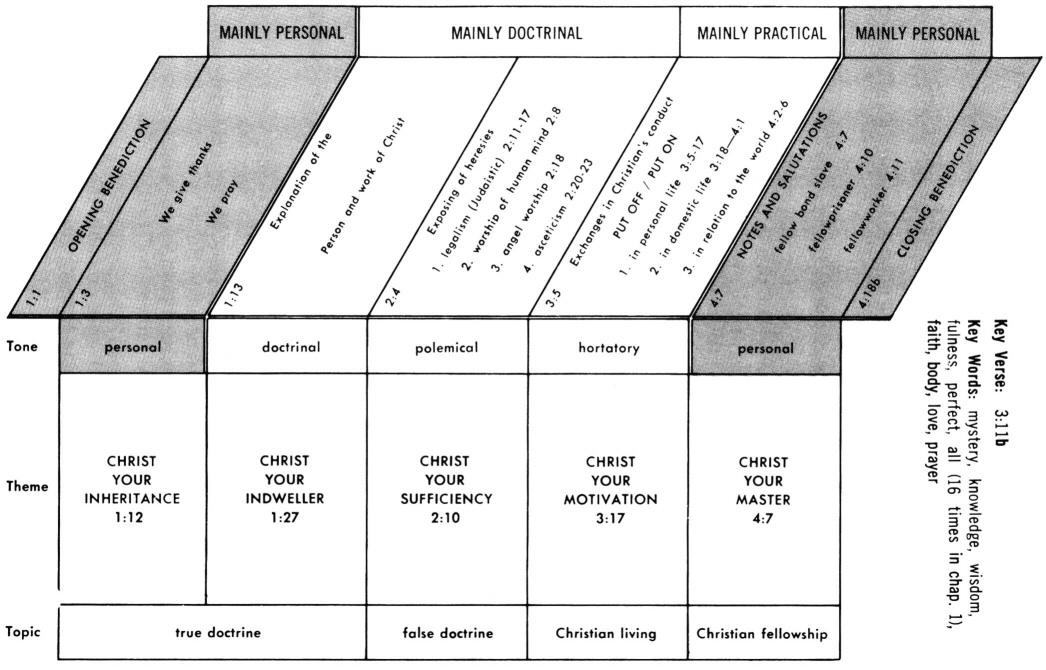
CHRIST IS ALL IN ALL
Click chart to enlarge
Charts from Jensen's Survey of the NT - used by permission
Colossians Overview - Click Chart on right side
| Christ Preeminent in All Things Supreme Lord - Sufficient Savior |
|||
| Colossians 1 | Colossians 2 | Colossians 3 | Colossians 4 |
| Supremacy of Christ |
Submission to Christ |
||
| Doctrinal and Corrective |
Practical and Reassuring |
||
| What Christ Did For Us |
What Christ Does Through Us |
||
| Christ Our Lord |
Christ Our Life |
Christ our Love |
|
| Christ the Head of the Body |
Christ the Lord of the Universe |
Christ the Head of the Home |
|
| Instruction | Warnings | Exhortations | Reminders |
| Reconciliation | Creation | Submission | Conversation |
| His Person and Word |
His Peace and Presence |
||
Colossians 3:5 Therefore consider the members of your earthly body as dead to immorality impurity passion, evil desire, and greed which amounts (is) to idolatry (NASB: Lockman)
Greek: Nekrosate (2PAAM) oun ta mele ta epi tes ges (Literally = members upon the earth) , porneian, akatharsian, pathos, epithumian kaken, kai ten pleonexian etis estin (3SPAI) eidololatria
Amplified: So kill (deaden, deprive of power) the evil desire lurking in your members [those animal impulses and all that is earthly in you that is employed in sin]: sexual vice, impurity, sensual appetites, unholy desires, and all greed and covetousness, for that is idolatry (the deifying of self and other created things instead of God) (Amplified Bible - Lockman)
Barclay: So, then, put to death these parts of you which are earthly-fornication, uncleanness, passion, evil desire, the desire to get more than you ought—for this is idol worship
GWT: Therefore, put to death whatever is worldly in you: your sexual sin, perversion, passion, lust, and greed (which is the same thing as worshiping wealth). (GWT)
GNB: You must put to death, then, the earthly desires at work in you, such as sexual immorality, indecency, lust, evil passions, and greed (for greed is a form of idolatry).
ISV: So put to death your worldly impulses: sexual sin, impurity, passion, evil desire, and greed (which is idolatry).
Lightfoot: So then realize this death to the world; kill all your earthly members. Is it fornication, impurity of whatever kind, passion, evil desire? Or again, is it that covetousness which makes a religion, an idolatry, of greed?
Montgomery: So slay your baser inclinations. fornication, impurity, appetite, unnatural desires, and the greed which is idolatry.
NCV: So put all evil things out of your life: sexual sinning, doing evil, letting evil thoughts control you, wanting things that are evil, and greed. This is really serving a false god. (NCV)
NET: So put to death whatever in your nature belongs to the earth: sexual immorality, impurity, shameful passion, evil desire, and greed which is idolatry. (NET Bible)
NIV: Put to death, therefore, whatever belongs to your earthly nature: sexual immorality, impurity, lust, evil desires and greed, which is idolatry. (NIV - IBS)
NLT: So put to death the sinful, earthly things lurking within you. Have nothing to do with sexual sin, impurity, lust, and shameful desires. Don't be greedy for the good things of this life, for that is idolatry. (NLT - Tyndale House)
Phillips: In so far, then, as you have to live upon this earth, consider yourselves dead to worldly contacts: have nothing to do with sexual immorality, dirty-mindedness, uncontrolled passion, evil desire, and the lust for other people's goods, which last, remember, is as serious a sin as idolatry.
RSV: Put to death therefore what is earthly in you: fornication, impurity, passion, evil desire, and covetousness, which is idolatry.
Weymouth: Therefore put to death your earthward inclinations--fornication, impurity, sensual passion, unholy desire, and all greed, for that is a form of idolatry.
Wuest: By a once-for-all act, and at once, put to death your members which are upon the earth: fornication, impurity, depraved passion, wicked craving, and avarice which is of such a nature as to be idolatry;
Young's Literal: Put to death, then, your members that are upon the earth--whoredom, uncleanness, passion, evil desire, and the covetousness, which is idolatry-
THEREFORE: oun:
- Colossians 3 Resources - Multiple Sermons and Commentaries
THE
RISEN SON
EXPOSES ALL ERROR
EMPOWERS ETHICAL EXCELLENCE
I like the picture of a "Rising Sun" (Son) alluded to in Joseph Beet's introductory comments on to this most practical section...
In the light of the glory of the Risen Lord, which shone upon us in Col 3:1,4, the errors prevalent at Colosse have utterly vanished. In the rest of the Epistle, no trace of them remains (Ed: In light of His glory and purity). But Paul remembers that his readers are still men on earth, exposed to the temptations incident to human life. Therefore, as he comes down from this "Mount of Transfiguration" (Ed: So to speak), he uses the brightness of the vision as a moral influence deterring from sin, and prompting every kind of excellence. In other words, the vision of Christ in Col 3:1–4 is a transition from the specific errors treated in Div. III. to the principles of general morality taught in Div. IV. In § 11 we have negative moral teaching, i.e. a warning against various forms of sin; in § 12, positive moral teaching, i.e. incentives to various kinds of excellence; in § 13, precepts for various classes of persons; and in § 14 sundry general exhortations. (Colossians 3:5-11 Commentary)
Therefore (oun) means "for that reason, consequently (in view of the foregoing), on that ground." (See discussion of terms of conclusion) So on the basis of the firm foundational truths in Colossians 1 and Colossians 2, describing our new identity and our new power in Christ...live it (Him) out!" (See Apple's discussion entitled "Focus and Follow Through") Therefore in the immediate context points to Colossians 3:1-4 where Paul sums up the first two chapters, reiterating the believer's identification with the risen and enthroned Christ. Knowing this is true about us, we understand that we can and should put to death the things in our life that are contrary to our identity with Jesus. Remember if we are are truly new creatures in Christ and yet choose to respond to Paul's command with rationalizations like "You don't understand my past. I can't kill that particular sin. It's too entrenched in my life!" what you are really saying is not "I can't" but "I won't"! Dear believer you now possess continual access to resurrection power (cp Eph 1:18, 19 [note] - note what this power accomplished! Ep 1:20, 21 [note]) and you even have the indwelling Holy Spirit Who prompts "holy thought patterns" which when birthed bring forth "holy practices" (cp Php 2:13-note; Ezek 36:26, 27 = describing the promised power inherent in the New Covenant).
H C G Moule on therefore...
Because of the possession of a hidden life and in its power, they were to put sin to death. Here is no mere assertion of duty, but an implied assurance of power, the power of life, life welcomed and developed. So, in nature, the rising sap of the tree makes the dead leaf fall. (Commentary on Colossians - Online)
Eadie - Since such are the peculiarities and prospects of your spiritual state, act in harmony with them; and since you have died, diffuse the process of death through all your members. If the heart is dead, let all the organs which it once vivified and moved die too— nay, put them to death. Let them be killed from want of nutriment and exercise. Similar language is found in Ro 8:13 (note), where thanatoute (thanatoo = to kill, put to death, mortify) is employed; and in Gal. 5:24-note, where occurs the modal verb stauroosate (stauroo = crucify)." (Colossians 3 Commentary - Recommended Reading - you will have to work through his arguments but you will discover nuggets of gold in his godly comments!)
To live this new life in Christ, Paul begins with 11 sins that in the power of the Spirit and under grace (not law) need to be "put off" (Col 3:5-11) and follows with ten positive virtues to be put on (Col 3:12-15). Paul had just emphasized (see notes Colossians 2:16-17, 2:18-19, 2:20-23) what the Colossians were not to do (legalism, mysticism, asceticism). In Col 3:1-4 Paul then explains summarizes their their new life in Christ discussed in the first two chapters.
Vine - "This part (Col 3:5-11) is, so to speak, negative in that it teaches what is to be put to death, what is to be put away, and from what we are to abstain. The next section (Col 3:12-17 ) gives instruction as to how to act. Having shown that the present hidden life is yet to be manifested, the apostle lays it down that these facts, present and future, are to have an effect in the daily life." (Vine, W. Collected Writings of W. E. Vine. Nashville: Thomas Nelson)
When someone restores an old car, it is not enough to simply paint over the rust. Even if the paint is of highest quality, the rust will soon reappear and if not quickly treated will destroy the car’s body. The rust must be removed and rusted parts replaced before the car is painted.
Theodore Epp summarizes some of the preceding thoughts in his devotional...
Practicing You Position based on Colossians 3:5-11: It is wonderful to realize that, as believers, we live by the power of Christ's resurrection life. As we do this, we are letting Christ live again in the sense that He is living out His life through us. This is what Paul desired for the Ephesian believers, for he prayed that they might know "what is the exceeding greatness of his power to us-ward who believe, according to the working of his mighty power, which he wrought in Christ, when he raised him from the dead, and set him at his own right hand in the heavenly places" (Eph. 1:19-note Ep 1:20-note). This ties in beautifully with Paul's statement in Colossians 1:27-note: "Christ in you, the hope of glory." It must be remembered that we are not robots, operated by push buttons. We are beings with the power of choice, and we must decide to apply these truths to ourselves. God wants us to surrender to Him as an act of faith. When we do this, God works on our behalf. This is not necessarily only a New Testament truth. The psalmist wrote: "Commit thy way unto the Lord; trust also in Him; and He shall bring it to pass" (Ps 37:5-note). Philippians 2:12-note and Galatians 5:16-note also indicate that we are to work out the salvation that has been worked within us and that we are to live by means of the Spirit. Paul stressed to the believers in Colosse--and to us--that, as a result of their standing in Christ, they had a great responsibility to "Seek (present imperative = command to do this as our lifestyle) those things which are above, where Christ sits on the right hand of God" (Col. 3:1-note). "For we walk by faith, not by sight" (2Co 5:7). (Back to the Bible) (Bolding and color added for emphasis)
CONSIDER...AS DEAD: nekrôsate [2PAAM]:
- Ro 6:6, 7-note; Ro 6:11-note, Ro 6:12, 13, 14-note, Ro 8:12, 13 -note ; Eph 5:3, 4-note, Eph 5:5, 6- note, Gal 5:24- note; 1 Peter 2:11, 12-note, 1Pe 4:2-note, Lk 21:34, Acts 15:20 Ro 13:12-note; Ro 13:13-note, Ro 13:14-note;2Cor 7:1-note, see 2Ti 2:22-note, Titus 2:12-note, 2Pe 1:3, 4-note,1Jn 2:15,17)
- Spurgeon's devotional
- Colossians 3 Resources - Multiple Sermons and Commentaries
- Related Resource: 1Thessalonians Commentary on 1Th 4:3
KILL SIN LEST IT
BE KILLING YOU
As Puritan John Owen asked “Do you mortify? Do you make it your daily work? Be always at it whilst you live; cease not a day from this work; be killing sin or it will be killing you” Why kill sin? He added that "Every unmortified sin will certainly do two things:-- [1.] It will weaken the soul, and deprive it of its vigour. [2.] It will darken the soul, and deprive it of its comfort and peace."
Consider...as dead (3499) (nekroo [word study) means literally to put to death, to slay utterly, to kill, to mortify. In the passive voice it spoke of a medical condition as of a part of the body, no longer useful because of illness or age (Ro 4:19). In the Latin Vulgate the verb is mortifico which is related to our English "mortify". Paul's use of nekroo in this verse is figurative and means to deprive the thing killed of its power and to destroy its strength. Stop the use of bodily members and functions for immoral purposes.
Moule - The plain meaning of this charge (to mortify) is to reduce to the state of death or like death; a state helpless, inoperative. The Christian, in the power of his hidden life in Christ, is thus to deal with his sins; entirely to renounce the thought of compromise or toleration, and to apply to them the might counter-agent of his union with his Head. The verb is in the aorist tense; decisive and critical action is in view. The believer, reminded of his resources and of the will of God, is now, with full purpose, to "give to death" (Conybeare) all his sins, and to carry that purpose out with critical decision at each moment of temptation in the power of his true (new) life. No assertions of an attained "sinless perfection" are warranted by such a word. The following context is enough to show that Paul views his converts as all along morally imperfect. But that side of truth is not in view here; the Christian is called here to an unreserved decision of will (Ed: Man's responsibility) and to a full use of Christ's power (Ed: God's sovereignty). In the closely parallel words, Ro 8:13 (see notes), the verb (another verb thanatoo [word study]) is in the present tense, indicating the need of continuous action after however critical a decision. (Commentary on Colossians - Online)
Nekroo = 3x in 3v in the NT and not in the Septuagint...
Romans 4:19 Without becoming weak in faith he (Abraham) contemplated (gave careful consideration and attention to the truth of the fact that) his own body, now as good as dead (nekroo) since he was about a hundred years old, and the deadness of Sarah's womb (cp Ge 16:1,2; 18:11)
Comment: Dead in context is used figuratively (for Abraham's literal body was still alive) refers to his lack of virility because of his advanced age (see Ge 17:17, 21:5)
Hebrews 11:12 Therefore there was born even of one man (Abraham), and him as good as dead at that, as many descendants AS THE STARS OF HEAVEN IN NUMBER, AND INNUMERABLE AS THE SAND WHICH IS BY THE SEASHORE.
Ebenezer Erskine said "The Christian mortifies sin because he is at peace with God. The legalist mortifies sin to try to be at peace with God.
William Law correctly observes that "If you attempt to talk with a dying man about sports or business, he is no longer interested. He now sees other things as more important. People who are dying recognize what we often forget, that we are standing on the brink of another world. (William Law in Christian Perfection - Online)
In Colossians 2:12 Paul taught the saints that they had
been buried with Him in baptism (speaking of identification with Christ in His death, burial and resurrection - Paul is not teaching that water baptism saves), in which you were also raised up with Him through faith (faith in Christ saved them, not water baptism) in the working of God, Who raised Him from the dead. (see note Colossians 2:12)
Now as believers Paul is saying that we should live in a manner consistent with our co-crucifixion with Christ and the resulting death we have experienced to sin (sin's power to rule over us and tell us what to do, specifically in context to gratify our physical bodies). Our members (eyes, hands, feet, etc) which in our former fallen state were ruled by the power of sin which brought forth unrighteousness acts, are now to be turned into instruments of righteousness to God.
The verb nekroo is aorist tense which means do it, do it effectively producing a definite result, active voice meaning you are to make a choice of your will to do it (implying a single decisive act) and imperative mood meaning you are to do it without hesitation because this is not a suggestion but an urgent order from a commanding general regarding the destruction of a sinister enemy within the camp that will destroy the power of the forces if given opportunity. The verb nekroo is placed first in the Greek construction for emphasis. You can almost hear Paul shouting out "KILL SIN!" (see discussion of personification of "the Sin")
Paul is emphasizing that "slaying" is so important that it calls for immediate attention and urgent action! Every time you sense these old "former life" inclinations, as the Nike commercial says "Just do it!" Slay the evil desires in your body.
Paul is commanding the Colossians to live a brand new (resurrection) lifestyle (Col 6:4-note). Cut the umbilical cord, the lifeline of those habits and practices that characterized your life before Christ. You no longer have to give in to these. You are liberated and true freedom is not the right to do as you please but the power to do as you should. You are not only identified with the death of Christ (Col 2:11, 20, 3:3, 3:9 - see notes Col 2:11; 20; 3:3; 9) but with His resurrected life (see note Colossians 3:1) The old saints would aptly pray
Resurrection power
Fill me this hour!
The choices we make each day determine the person we will be in the future. And remember that all biblical exhortations and commands to believers are based on the blessings and promises given by the Lord and thus mortification is possible because of Colossians 1:1-3:4. Stated in more "theological" verbiage, all of God's imperatives (commands) are based on, founded on, under girded by and empowered by His indicatives (mood of certainty or that which is really true)! Simply stated, without the sufficiency that is ours in Christ, we would be completely powerless and unable to fulfill the commands we receive from Him. We are in Christ and His Spirit is in us! O how we need to learn to depend on the Spirit of Jesus to kill sin! (Read Php 2:13NLT+ which enables us to obey Php 2:12+) See the discussion of the Need for the Holy Spirit to obey NT commands.
What God's law requires,
God's grace provides!
The word mortify comes from the same Latin word as mortuary—a place where you put dead people. That association alone should be enough to cause ever thinking person, saved or unsaved, to listen up to what Paul is saying. To mortify means to destroy the strength of something, to destroy its vitality, to subdue or deaden. The secular dictionary definition speaks of subduing our bodily appetites especially by fleshly acts such as abstinence or self-inflicted pain or discomfort! Now consider this logic - the flesh trying to kill the flesh! That is utterly absurd. It is total foolishness and ultimately total failure! Either we mortify the flesh in the grace and power of the Spirit of God or the resilient, depraved flesh will "kill" our spiritual life, removing the supernatural power, the inexpressible joy, the abundant fruit, the privilege of usefulness to God and the life of daily victory in Jesus and His cross (cp 1Cor 1:18).
The eloquent pastor Alexander Maclaren likens the action called for with the verb "mortify" to the picture of a man who while working at a machine gets his fingers caught between the rollers or the convey belt...
Another minute and he will be flattened to a shapeless bloody mass. He catches up an axe lying by and with his own arm hacks off his own hand at the wrist.... It is not easy nor pleasant, but it is the only alternative to a horrible death (cp Jesus' stern but loving warning - Mt 5:27, 28-note, Mt 5:29, 30-note)
Paul is painting a very strong picture here, one suggesting that we are not simply to suppress or control evil acts and attitudes. We are to wipe them out, completely exterminate the old way of life.
Slay utterly may express its force. As discussed earlier the form of the verb (aorist imperative) makes it clear that the action is to be undertaken decisively and with a sense of urgency. Both the meaning of the verb and the force of the tense suggest a vigorous, painful act of personal determination.
Rob Salvato. - We think that once we become Christians, it’ll all just come together eventually for us, and we’ll just suddenly arrive at Christ-likeness. Well, that isn’t totally accurate. You see, there are things that we must do. We must apply ourselves. We must apply the Word of God. We must exert ourselves. And we must exercise our will. IN order to put to death the flesh – The Flesh dies a slow death. In short the way that you put to death the flesh is to STARVE IT. The way to be transformed is to Feed the Spirit. You make the choice to Starve the flesh – Feed the Spirit and God does that work of Transformation in YOUR LIFE (cp 2Co 3:18, Ro 12:2-note) – It is really that simple. (Sermon Notes)
Paul Apple. - People talk a lot about the importance of Self Control – Paul chooses to pick on 2 key topics where control is the primary issue: Sexual Sins – How we respond to the temptation to lust instead of love. Social Sins – How we channel our emotions and use our tongue in terms of our relationships with others in the body of Christ as well as outside the church But it is not Self Control that we are after – It is the Spirit’s control as we live out our Union with Christ
Warren Doud - We died with Christ (Col 3:3). How can kill what is already dead? The members of our body are not evil in themselves as the Gnostics believed. Col 3:5-12 describe how we are to deal with the engine in us that produces sin: Col 3:5, "put to death" the capacity to sin; Col 3:9, strip off the old man; and in Col 3:10 and Col 3:12, put on the new man in order to represent the life of Christ. The imagery moves from death to takes clothes on and off. God wants us to put out of commission the strength of sin in our lives. God charges us with a mandate to radically deny the self-centered life.
Spurgeon comments...
Since you are dead, let all the lusts of the flesh be put to death. Kill those. They were once a part of you. Your nature lusted this way. Mortify them. Do not merely restrain them and try to keep them under. These things you are to have nothing to do with.
Kill all these evil things; do not let them live in you for a single moment. The command applies, not only to the grosser actions which are summed up under the head of fornication and uncleanness, but to all that leads to those foul sins; not only to the fire, but also to the sparks, such as “inordinate affection,” a sort of softness which is seen in some persons, men and women, too, and which often leads to something far worse; — and “evil concupiscence,” the first desires towards that which is unchaste. God give us grace to kill these loathsome things at once, for if thoughts of evil are indulged, they soon become acts of evil, and then who knows how far we may go in the way of unholiness? Sin, if allowed to grow in the heart, will soon take gigantic strides, and come out in the life. Depend upon it, whenever a professing Christian goes into overt sin of the kind mentioned here, he does not do it on a sudden. The evil has long been festering and fomenting within his heart, or it would not have manifested itself thus. Oh! if he had only watched, and destroyed the thief ere he broke open the house, what a mercy it would have been! You notice that covetousness is put down with the most filthy sins, and it is described as idolatry. The desire to possess the goods that belong to others, the lust to get gain at any price, this is idolatry. (Colossians 3 Expositional Commentary)
The KJV word mortify implies that sin will not die out of itself but that we must kill it and death can be a painful process. Put them to death. Kill them. Take no prisoners. Show no mercy. That's what Paul is commanding. This is not the self-denial of asceticism but because we now have a new heart, a new desire, a new power...Christ in us and we by His Spirit now kill those passions one by one. We are to show no more mercy to the “old man” than to the “right eye” or the “right hand” that offends us, for as our Lord Jesus warned...
You have heard that it was said, 'YOU SHALL NOT COMMIT ADULTERY'; but I say to you, that everyone who looks on a woman to lust for her has committed adultery with her already in his heart. (Mt 5:27, 28-note)
Barnes - Since you are dead to sin and the world, and are to appear with Christ in the glories of his kingdom, subdue every carnal and evil propensity of your nature. The word mortify means to put to death, and the meaning here is that they were entirely to subdue their evil propensities, so that they would have no remains of life; that is, they were not at all to indulge them.
Henry - The apostle exhorts the Colossians to the mortification of sin, the great hindrance to seeking the things which are above. Since it is our duty to set our affections upon heavenly things, it is our duty to mortify our members which are upon the earth, and which naturally incline us to the things of the world: “Mortify them, that is, subdue the vicious habits of mind which prevailed in your Gentile state. Kill them, suppress them, as you do weeds or vermin which spread and destroy all about them, or as you kill an enemy who fights against you and wounds you.” - Your members which are upon the earth; either the members of the body, which are the earthly part of us, and were curiously wrought in the lower parts of the earth (Ps 139:15-note), or the corrupt affections of the mind, which lead us to earthly things, the members of the body of death, Romans 7:24 note.
Puritan Richard Baxter - Use sin as it will use you; spare it not, for it will not spare you; it is your murderer, and the murderer of the world: use it, therefore, as a murderer should be used. Kill it before it kills you; and though it bring you to the grave, as it did your Head, it shall not be able to keep you there
No amount of positive talk about health will cure a ruptured appendix. The doctor will have to “get negative” and take out the appendix. No amount of lecturing on beauty will produce a garden. The gardener has to pull weeds!
Centuries ago in England, if a pickpocket was convicted, his right hand was cut off. If he was convicted a second time, his left hand was amputated. One pickpocket lost both hands and yet so strong was the power of sin in him that he continued his “trade” by using his teeth!
The choice to carry out this slaying is yours (active voice) and thus it is also your responsibility. Thank God though that Paul teaches in Philippians that although believers are now given the charge to work out their "salvation with fear and trembling", they now have the want to and the power to do so because
it is God who is at work in you, both to will and to work for His good pleasure. (see Php 2:12-note, Php 2:13-note)
Our death to sin is to be decisive and once for all (Ro 6:1-see notes Ro 6:1ff). But the living out of this reality involves a daily work of faith, manifest in the choices we make. We are to live out the reality that God has worked into us. We have died with Christ to sin.
Therefore do not let sin reign (present imperative = command + a negative particle = "Stop letting the Sin [personified as a harsh master or evil monarch!] continue to reign in your physical body.") in your mortal body that you should obey its lusts and do not go on presenting (see note on "do not let sin reign") the members of your body to sin as instruments of unrighteousness; but present (word study) (present imperative = positive command calling for continual decision of our will to offer our mind, our limbs, our eyes, our ears, our mouths even as one would do when bringing a sacrificial offering, cf Ro 12:1-note) yourselves to God as those alive from the dead, and your members as instruments of righteousness to God. (Ro 6:12, 13-note)
Be in practice what you are in position (in Christ) and by divine act (dead to sin, alive to God in Christ Jesus). Beloved, don't become discouraged when you fail. You are God's masterpiece (in Christ), a work in process (sanctification, making you holy, taking you from glory to glory) and God is able to complete the work He began in you. And in that future glorious day, you will then be free of not only the presence of sin but the pleasure of sin.
In the meantime, Paul is saying we need to be practicing for eternity, killing all that would corrupt and contaminate the holiness of God. Paul is not saying make yourself dead, but to make a determined refusal to submit to the power of sin. Sin is now a choice and a believer has God's power to refuse to obey it. Paul is saying deprive your members (physical members so far as they are employed in the service of sin) of power and strength. "
The ISBE has an excellent explanation of mortify writing that
The context (of Col 3:5) goes to the heart of Paul's doctrine of the union of the believer with Christ. This union has given the soul a new (Ed comment: qualitatively new, brand new) life, flowing (through the Spirit, cf Ro 8:1, 2, 3, 4, 5, 6, 7, 8, 9, 10, 11, 12, 13) from Christ in the heavenly world, so that the remnants of the old corrupt life-principle are now dangerous excrescences. Hence, they are to be destroyed, just as a surgeon removes the remnants of a diseased condition after the reestablishment of healthy circulation. The interpreter must guard against weakening Paul's language into some such phrase as “subdue all that is inconsistent with the highest ideals,” for Paul views the union with Christ as an intensely real, quasi-physical relation. (Orr, J, et al: The International Standard Bible Encyclopedia: 1915 Online)
On the opposite side of "killing" our fleshly desires is to gratify the sensual appetite by giving it the very food and nourishment by which it lives, thrives, and is active. The first brings life, the second approach death, for Paul warns us that
if (we) are living according to the flesh, (we) must die; but if by the Spirit (we) are putting to death the deeds of the body, (we) will live. (Ro 8:13-
THOUGHT - See the commentary on Romans 8:13 which Dr Martyn Lloyd-Jones called the most important verse in the Bible for Christian sanctification!).
John Piper - Do you hear what Paul is saying? He is saying: If you justify ongoing sin on the basis of abounding grace (Ro 6:1,2-note), if you minimize the seriousness of sin in the life of a Christian, you don't know what conversion to Christ means. (2Cor 13:5) It means death. Death to sin. (Ro 6:11-note, Ro 6:12, 13, 14-note) Conversion means death-not just decision for Jesus, but death with Jesus. One great problem in the church today - not the only one - is that we do not grasp the magnitude and depth and wonder and miracle of what happens in genuine conversion to Christ. And therefore we do not know how to live and work and fight for righteousness as Christians. (Class, Culture and Ethnic Identity in Christ - Colossians 3:5-17) (Bolding and References added)
The Old Testament account of Agag and the Amalekites (Ex 17:7, 8, 9, 10, 11, 12, 13, 14, 15, 16) (see exposition of Exodus 17:8-16) (1Samuel 15) is a good illustration of how Christians should deal with SIN (by "sin" I am referring to the evil propensity every human being inherited from Adam and which leads us all to commit "sins"). Believers should not try to co-exist with SIN for that root problems that led to the spiritual dark and depressing days of the the Judges. Again and again in Judges 1 (see notes) we see the phrase (or a variant thereof) "they did not drive out the" enemy (Jebusites, Canaanites, Astherites, etc). Our old sin nature inherited from Adam is the mortal enemy of believers just as the Canaanites, et al, were to Israel.
James explains that SIN (see discussion of personification of "the Sin") will "kill" us writing that
"each one is tempted when he is carried away and enticed by his own lust (lust takes it's orders from "SIN", our fallen flesh). Then when lust has conceived, it gives birth to sin (referring here to sins we commit because we have a "SIN" nature) and when sin is accomplished, it brings forth death." (Jas 1:14, 15-note)
Saul partially obeyed God’s directive, but Samuel obeyed it to the letter by killing King Agag. Christians obey God’s command to mortify sin by living a life in the Spirit ("by the Spirit you are putting to death the deeds of the body" Ro 8:13-note).
SIN IS LIKE
A BOA CONSTRICTOR!
Are you tolerating "pet" sins? If you are, then you need to remember the fate of the man with the "pet boa constrictor". After 15 years of living with his owner, one day the "pet boa" would not let its "owner" out of its grip resulting in the owner's tragic death. Wild animals remain wild and so does Sin.
The Amalekites are a perfect illustration of the sin nature (see related discussion on flesh) that remains in the believer’s life. That sin nature—already utterly defeated at the cross—must be dealt with ruthlessly and "hacked to pieces" so to speak or it will revive and continue to plunder and pillage our heart and sap our spiritual strength.
One cannot be merciful with his "Agag" or indwelling sin will turn and try to devour him. In fact, the sin remaining in Christians often becomes more fiercely determined after the gospel initially overthrows it. We dare not obey partially or halfheartedly as we seek to eliminate sin from our lives. We cannot stop while the task remains incomplete.
Sin, like the Amalekites, has a way of escaping the slaughter, breeding, reviving, regrouping, and launching new and unexpected assaults on their victims’ most vulnerable areas. Saul's disobedience proved very costly, Samuel declaring
Has the LORD as much delight in burnt offerings and sacrifices As in obeying the voice of the LORD? Behold, to obey is better than sacrifice, And to heed than the fat of rams. For rebellion is as the sin of divination, And insubordination is as iniquity and idolatry. Because you have rejected the word of the LORD, He has also rejected you from being king. (1Sa 15:22, 23).
John MacArthur writes that "Mortification is the believer's responsibility and includes such responsibilities as abstaining from fleshly lusts, making no provision for the flesh, fixing one's heart on Christ, meditating on God's Word, praying incessantly, exercising self-control, and being filled with the Spirit (Ed note: I would add confessing our sins 1Jn 1:9). Covering up sin, internalizing it, exchanging it for another sin, or merely repressing it do not equate to sin's mortification. Continuously and uncompromisingly removing sin resulting in a conscience free from guilt is what the process entails.
Puritan John Owen gives us a wise warning writing that "Mortification abates [sin's] force, but doth not change its nature. Grace changes the nature of man, but nothing can change the nature of sin... Destroyed it may be, it shall be, but cured it cannot be...If it be not overcome and destroyed, it will overcome and destroy the soul. And herein lies no small part of its power...It is never quiet, [whether it is] conquering [or] conquered. Do you mortify; do you make it your daily work; be always at it whilst you live; cease not a day from this work; be killing sin or it will be killing you."
In John Owen's classic work Of the Mortification of Sin in Believers he adds these pithy thoughts...
Every unmortified sin will certainly do two things:-- [1.] It will weaken the soul, and deprive it of its vigour. [2.] It will darken the soul, and deprive it of its comfort and peace.
[1.] It weakens the soul, and deprives it of its strength. When David had for a while harboured an unmortified lust in his heart, it broke all his bones, and left him no spiritual strength; hence he complained that he was sick, weak, wounded, faint. "There is," saith he, "no soundness in me," Ps 38:3-note; "I am feeble and sore broken," verse 8; "yea, I cannot so much as look up," Ps 40:12-note. An unmortified lust will drink up the spirit, and all the vigour of the soul, and weaken it for all duties. For, --
1st. It untunes and unframes the heart itself, by entangling its affections. It diverts the heart from the spiritual frame that is required for vigorous communion with God; it lays hold on the affections, rendering its object beloved and desirable, so expelling the love of the Father, 1Jn 2:15, 3:17; so that the soul cannot say uprightly and truly to God, "Thou art my portion," (Ps 119:57-note) having something else that it loves. Fear, desire, hope, which are the choice affections of the soul, that should be full of God, will be one way or other entangled with it.
2dly. It fills the thoughts with contrivances about it. Thoughts are the great purveyors of the soul to bring in provision to satisfy its affections; and if sin remain unmortified in the heart, they must ever and anon be making provision for the flesh, to fulfil the lusts thereof. They must glaze, adorn, and dress the objects of the flesh, and bring them home to give satisfaction; and this they are able to do, in the service of a defiled imagination, beyond all expression.
3dly. It breaks out and actually hinders duty. The ambitious man must be studying, and the worldling must be working or contriving, and the sensual, vain person providing himself for vanity, when they should be engaged in the worship of God.
Were this my present business, to set forth the breaches, ruin, weakness, desolations, that one unmortified lust will bring upon a soul, this discourse must be extended much beyond my intendment.
[2.] As sin weakens, so it darkens the soul. It is a cloud, a thick cloud, that spreads itself over the face of the soul, and intercepts all the beams of God's love and favour. It takes away all sense of the privilege of our adoption; and if the soul begins to gather up thoughts of consolation, sin quickly scatters them: of which afterward.
Now, in this regard doth the vigour and power of our spiritual life depend on our mortification: It is the only means of the removal of that which will allow us neither the one nor the other. Men that are sick and wounded under the power of lust make many applications for help; they cry to God when the perplexity of their thoughts overwhelms them, even to God do they cry, but are not delivered; in vain do they use many remedies, -- " they shall not be healed." So, Hos 5:13, "Ephraim saw his sickness, and Judah his wound," and attempted sundry remedies: nothing will do until they come (Hos 5:15) to "acknowledge their offence." Men may see their sickness and wounds, but yet, if they make not due applications, their cure will not be effected.
(2.) Mortification prunes all the graces of God, and makes room for them in our hearts to grow. The life and vigour of our spiritual lives consists in the vigour and flourishing of the plants of grace in our hearts. Now, as you may see in a garden, let there be a precious herb planted, and let the ground be untilled, and weeds grow about it, perhaps it will live still, but be a poor, withering, unuseful thing. You must look and search for it, and sometimes can scarce find it; and when you do, you can scarce know it, whether it be the plant you look for or no; and suppose it be, you can make no use of it at all. When, let another of the same kind be set in the ground, naturally as barren and bad as the other, but let it be well weeded, and every thing that is noxious and hurtful removed from it, -- it flourishes and thrives; you may see it at first look into the garden, and have it for your use when you please. So it is with the graces of the Spirit that are planted in our hearts. That is true; they are still, they abide in a heart where there is some neglect of mortification; but they are ready to die, Rev 3:2-note, they are withering and decaying. The heart is like the sluggard's field, -- so overgrown with weeds that you can scarce see the good corn. Such a man may search for faith, love, and zeal, and scarce be able to find any; and if he do discover that these graces are there yet alive and sincere, yet they are so weak, so clogged with lusts, that they are of very little use; they remain, indeed, but are ready to die. But now let the heart be cleansed by mortification, the weeds of lust constantly and daily rooted up (as they spring daily, nature being their proper soil), let room be made for grace to thrive and flourish, -- how will every grace act its part, and be ready for every use and purpose!
(3.) As to our peace; as there is nothing that hath any evidence of sincerity without it, so I know nothing that hath such an evidence of sincerity in it; -- which is no small foundation of our peace. Mortification is the soul's vigorous opposition to self, wherein sincerity is most evident. (Of the Mortification of Sin in Believers)
KILL
THE SPIDER
Have you heard about the man whose bad habit was hindering his fellowship with God and hurting his Christian testimony? He said he prayed that God would forgive him for his addiction—but he didn't stop! He is like the man who often went forward at the end of church services to kneel and pray,
"Lord, take the cobwebs out of my life."
One Sunday morning his pastor, tired of hearing the same old prayer, knelt beside him and cried out,
"Lord, kill the spider!"
Yes, sometimes it takes radical action to break a sinful habit. We need to do more than ask God for cleansing each time we succumb to temptation. We must take whatever steps are needed to get the cobwebs out of our life. We must confess our sin and determine to be done with it. Then we must feed our mind with God's Word and do all we can to stay away from the people and places that tempt us to sin. That's what Christ meant when He said, "If your right eye causes you to sin, pluck it out" (Mt 5:29-note). Kill the spider and you'll get rid of the cobwebs. Remember that admitting sin is no substitute for quitting sin.
It's not enough to say to God,
"I'm sorry, I repent,"
And then go on from day to day
The way I always went.
—Anon
THE MEMBERS OF YOUR EARTHLY BODY AS DEAD: ta mele ta epi tes ges:
- Ro 6:13; 7:5;23, Jas 4:1, Mt 5:29,30, 18:8, 9
- Colossians 3 Resources - Multiple Sermons and Commentaries
the evil desire lurking in your members [those animal impulses and all that is earthly in you that is employed in sin] (Amp)
Beware if you think you are "doing good" with a sin that so easily has entangled you. As Puritan John Owen warned sin "is never less quiet than when it seems to be most quiet, and its waters are for the most part deep when they are still. Satan is likely to attack when a believer is most satisfied with his spiritual life. That is when pride, the chief of sins, easily sneaks into our lives unnoticed and lead us to believe that contentment with ourselves is contentment in God."
In a parallel passage to the saints living in the "sin saturated" city of Corinth, Paul used the metaphor of boxing (which they would have understood because of the nearby Isthmian games) to emphasize the seriousness with which one needs to fight the battle with our mortal enemy sin which uses our physical body as "base camp"...
I discipline (buffet, pummel, batter, beat) my body and make it my slave, so that, after I have preached to others, I myself will not be disqualified (1Co 9:27-note)
Jesus also alluded to the serious need to mortify sin in the Sermon on the Mount...
You have heard that it was said, 'YOU SHALL NOT COMMIT ADULTERY'; but I say to you, that everyone who looks on a woman to lust for her has committed adultery with her already in his heart. And if your right eye makes you stumble, tear it out, and throw it from you; for it is better for you that one of the parts of your body perish, than for your whole body to be thrown into hell. And if your right hand makes you stumble, cut it off, and throw it from you; for it is better for you that one of the parts of your body perish, than for your whole body to go into hell. (Mt 5:27, 28-note, Mt 5:29, 30-note) (Note: All verbs in red = aorist imperative = Command to do this without delay! Do it effectively! It is serious and demands urgent attention!)
Comment: In the examples of Paul (1Co 9:27) and Jesus, neither was calling for a literal physical response as so many have misinterpreted over the centuries! Just as a physical beating of Paul's body could not bring the flesh into submission, neither could gouging out one's eye or cutting off one's hand. One would still have the other eye to view inappropriate content on television or the internet! The point is that both Jesus and Paul are calling for radical (grace infused, Spirit enabled) discipline (not physical mutilation or asceticism) in light of the deadly seriousness of sin. Do I really believe sin is that deadly? If we do, we will heed the warnings of Jesus and Paul to get serious about sin. If that means getting rid of your TV men, than let it be! Whatever keeps you from running the grace race and fighting the faith fight needs to be "jettisoned!" (cp He 12:1-note, As John Owen said [paraphrased] "Kill sin before it kills you." -
Related Resources:
- Owen's classic is not easy reading but it is worth the effort > Of the Mortification of Sin in Believersead
- John MacArthur's Master Seminary Journal 20 page article - Mortification of Sin
- Of the Mortification of Sin in Believers - An Outline, Exposition and Summary - Greg Herrick - Herrick's resource aids one to understand John Owen's treatise Of the Mortification of Sin in Believers which is difficult to read. Chapters are listed below:
- 1. John Owen—His Life and Work
- 2. A Look at Romans 8:13
- 3. Even the “Best of Us” Are Called to Mortify Sin
- 4. The Life Giving Spirit Authors the Work of Mortification
- 5. Power in the Christian Life Depends on Mortification
- 6. To Mortify Sin—Negatively Considered
- 7. To Mortify Sin—Positively Considered
- 8. General Rule #1: A Man Must Be A Believer
- 9. General Rule #2: There Must Be Universal Sincerity of Obedience
- 10. Particular Direction #1: Consider Dangerous Symptoms Attending Sin
- 11. Particular Direction #2: Get A Clear Sense of the Guilt of Sin
- 12. Particular Direction #3-7: Guilt, Disposition, and Desire for Deliverance
- 13. Particular Direction #8: Meditate on God’s Greatness
- 14. Particular Direction #9: How to Have Peace
- 15. The Actual Practice of Mortification
Members (3196) (melos) is literally a limb or member of the body. In the plural (as in this verse) "members" refers to the seat of the desires and passions.
Moule - Your limbs, as if of an invisible, no-material, body, viewed in separate organs. A bold but intelligible transition of thought thus speaks of the organ rather than of its action; giving a more concrete effect to the mental picture. (Commentary on Colossians - Online)
Vine explains is in the plural and "is used morally, our actual limbs being used as instruments either for the world, the things on the earth, instead of being put to death, or used for Christ and His glory, and the things in the heavens. We thus either identify ourselves with the old man, or with the new man. (Vine, W. Collected writings of W. E. Vine. Nashville: Thomas Nelson)
Paul speaks of their “earthly” body because the erring people influencing church members had adopted a Greek view in which one’s soul was heavenly and eternal but one’s body earthly, perishable and thus unimportant. Paul uses the own Greek language ironically, to emphasize that it does matter what one does with one’s body. Paul does not believe in “beating down the body” (Colossians 2:23-note), but he is willing to speak of amputating appendages or “putting them to death” in a figurative sense. Perhaps borrowing an image from Jesus (Mk 9:43, 45, 47),
Rienecker says that "The members of the body are the "vehicles" to carry out the desires of the body. According to the rabbis there are as many commandments and restraints in the law as the body has members and the "Evil Impulse" is said to be king over 248 members and the 2 great passions which the "Evil Inclination" plays the most upon are the passions of idolatry and adultery.
Moule - The Christian must kill self-centeredness and regard as dead all private desires and ambitions. There must be in his life a radical transformation of the will and a radical shift of the centre. Everything which would keep him from fully obeying God and fully surrendering to Christ must be surgically excised. Your earthly body - conversant, sympathetic, with "earth" as the scene of temptation, and not with heaven, where lies the Source of Victory (cp Col 3:1-note, Col 3:2-note). (Commentary on Colossians - Online)
Puritan John Owen discussing (Ro 8:13-note) in explaining Paul's metaphor of putting to death, says "To kill a man, or any other living thing, is to take away the principle of all his strength, vigour, and power, so that he cannot act or exert, or put forth any proper actings of his own; so it is in this case. Indwelling sin is compared to a person, a living person, called "the old man," with his faculties, and properties, his wisdom, craft, subtlety, strength; this, says the apostle, must be killed, put to death, mortified, i.e., have its power, life, vigour, and strength, to produce its effects, taken away by the Spirit.
Sow a thought, reap an action.
Sow an action, reap a habit.
Sow a habit, reap a character.
Sow a character, reap a destiny.
Character is revealed by what you do in secret,
when no one else is around to see.
The positional reality of Christ in us the hope of glory and Christ our life, must now be worked out in the everyday practical living. As circumstances arise in which we are tempted to indulge the flesh, we must make the definite decision (empowered by grace and the Spirit) to deny self. And don't forget Peter's "microwave prayer" (short and to the point) "Lord save me." God's will is our sanctification and He is bound thereby to answer our sincere cry for His help. Too often we either forget to cry out or even worse choose not to do so because the truth is we don't really want to mortify that sensual, seductive desire. We really want to gratify it. But remember that there can be no holiness or growth in Christ-like maturity when the power of sin is allowed to reign unhindered. We have died to sin’s penalty, but sin’s power still can be strong and our flesh is weak. Sin is like a deposed monarch who no longer reigns, nor has the ability to condemn, but works hard to debilitate and devastate all his former subjects. Sin is still potent, and success against it demands decisive action in dependence on God's grace and Spirit. It is “not by might nor by power, but by My Spirit.” (Zec 4:6)
Joel Beeke wrote... I once read of a missionary who had in his garden a shrub that bore poisonous leaves. At that time he had a child who was prone to put anything within reach into his mouth. Naturally he dug the shrub out and threw it away. The shrub’s roots, however, were very deep. Soon the shrub sprouted again. Repeatedly the missionary had to dig it out. There was no solution but to inspect the ground every day, and to dig up the shrub every time it surfaced. Indwelling sin is like that shrub. It needs constant uprooting. Our hearts need continual mortification. As John Owen warns us:
We must be exercising [mortification] every day, and in every duty. Sin will not die, unless it be constantly weakened. Spare it, and it will heal its wounds, and recover its strength. We must continually watch against the operations of this principle of sin: in our duties, in our calling, in conversation, in retirement, in our straits, in our enjoyments, and in all that we do. If we are negligent on any occasion, we shall suffer by it; every mistake, every neglect is perilous. (Reformation and Revival Journal, 4:2, Spring, 1995)
R M Edgar reminds us that "The process of mortification is painful in the extreme. The lusts of the flesh, the lusts of the mind and heart, cannot be mortified by magic. It is a slow undermining of the sinful nature, like the crucifixion of the body. But we must be prepared for it, and manfully must we sit, like executioners, beside our darling sins and nail them to Christ’s cross. (Colossians 3 Exposition)
IMMORALITY: porneian:
- Mt 15:19; Mk 7:21,22; Ro 1:29;1Co 6:9, 6:10, 11, 1Co 6:18; 2Cor 12:21; Gal 5:19, 20, 21; Eph 5:3; 1Th 4:3; Heb 12:16; 13:4; Rev 21:8; 22:15
- Colossians 3 Resources - Multiple Sermons and Commentaries
sexual vice (Amp)
desire for the wrong kind of sex (BBE)
Immorality (4202) (porneia from root verb pernao = to sell, porneuo = to play the harlot; pornos = male prostitute) originally referred to any excessive behavior or lack of restraint, but eventually became associated with sexual excess and indulgence, of every kind of extramarital, unlawful, or unnatural sexual intercourse. It refers to general sexual acts outside of legal marriage. Sex was often linked to pagan religious practice, with the idolatrous worship of false gods (TDNT) Loose morals were a continuous problem in the Greco-Roman world.
Zodhiates -
(I) Any sexual sin; coupled with moicheía <3430>, adultery (Mark 7:21), and other sins (Rom. 1:29). Used generally to refer to any sexual sin (1 Cor. 6:13, 18; 7:2; 2 Cor. 12:21; Gal. 5:19; Eph. 5:3; Col. 3:5; 1 Thess. 4:3; Rev. 9:21). In John 8:41, "We be not born of fornication" means, "We are not spurious children, born of a concubine, but are the true descendants of Abraham" (a.t. [Sept.: Gen. 38:24; Hos. 1:2]). Specifically of adultery (Matt. 5:32; 19:9); of incest (1 Cor. 5:1). Porneía may also refer to marriages within the degrees prohibited by the Law of Moses and generally to all such intercourse as prohibited in that Law (cf. Lev. 18; 20:10ff.).
(II) Symbolically it stands for idolatry, the forsaking of the true God in order to worship idols. Since God is said to be married to His Church through Christ, then any idolatry is unfaithfulness toward God equal to sexual unfaithfulness to one's marriage partner (Rev. 2:21; 14:8; 17:2, 4; 18:3; 19:2; Sept.: Jer. 3:9; Ezek. 16:15, 22; 23:27; Hos. 2:2; 4:12).
(III) Fornication as a sexual vice was common before the time of Moses and was grossly prevalent in Egypt (Gen. 39:7). Prostitution was not tolerated by the Sinaitical code, being an abomination in the sight of God (Lev. 19:29; Deut. 23:17, 18). Its price could not be accepted in the sanctuary (Mic. 1:7), and death by stoning was the penalty for an unmarried woman who had concealed her crime (Deut. 22:20, 21). The term "strange woman" in Prov. 2:16 probably referred to a harlot procured from foreigners. See also Prov. 2:16-19; 5:3-6; 7:5-27. God's displeasure was thus incited (Jer. 5:7; Amos 2:7; 7:17). Such excesses were very common among the heathen in the times of the Apostles (1 Cor. 5:1, 9, 10; 6:9). Israel is symbolically presented as a harlot (Isa. 1:21; Jer. 2:20; Ezek. 16; Hos. 1:2; 3:1). (The Complete Word Study Dictionary – New Testament)
Vine - metaphorically, of "the association of pagan idolatry with doctrines of, and professed adherence to, the Christian faith," Rev. 14:8; Rev. 17:2, 4; Rev. 18:3; Rev. 19:2 (Vine's Expository Dictionary of Old Testament and New Testament Words)
Porneia is used 25 times in the NAS (Where are most of the NT uses?) translated as: fornication, 4; fornications, 2; immoralities, 1; immorality, 16; sexual immorality, 1; unchastity, 1.
Matthew 5:32 (note) but I say to you that everyone who divorces his wife, except for the cause of unchastity, makes her commit adultery; and whoever marries a divorced woman commits adultery.
Matthew 15:19 "For out of the heart come evil thoughts, murders, adulteries, fornications, thefts, false witness, slanders.
Comment: Don't miss what Jesus is saying here - fornication or sexual immorality is a thought before it is an act! Guard your heart.
Matthew 19:9 "And I say to you, whoever divorces his wife, except for immorality, and marries another woman commits adultery."
Mark 7:21 "For from within, out of the heart of men, proceed the evil thoughts, fornications, thefts, murders, adulteries,
John 8:41 "You are doing the deeds of your father." They said to Him, "We were not born of fornication; we have one Father, even God."
Acts 15:20+ but that we write to them that they abstain from things contaminated by idols and from fornication and from what is strangled and from blood.
Comment: This command from the Jerusalem church was to be given to all the Gentile converts because they had been immersed in a sex saturated environment in paganism and idolatry.
Acts 15:29+ that you abstain from things sacrificed to idols and from blood and from things strangled and from fornication; if you keep yourselves free from such things, you will do well. Farewell."
Comment: Note the association of idolatry and sexual immorality.
Acts 21:25+ "But concerning the Gentiles who have believed, we wrote, having decided that they should abstain from meat sacrificed to idols and from blood and from what is strangled and from fornication." (Again note idolatry and immorality)
1 Corinthians 5:1 It is actually reported that there is immorality among you, and immorality of such a kind as does not exist even among the Gentiles, that someone has his father's wife.
1 Corinthians 6:13 Food is for the stomach, and the stomach is for food; but God will do away with both of them. Yet the body is not for immorality, but for the Lord; and the Lord is for the body.
1 Corinthians 6:18 Flee immorality. Every other sin that a man commits is outside the body, but the immoral man sins against his own body.
1 Corinthians 7:2 But because of immoralities, let each man have his own wife, and let each woman have her own husband.
2 Corinthians 12:21 I am afraid that when I come again my God may humiliate me before you, and I may mourn over many of those who have sinned in the past and not repented of the impurity, immorality and sensuality which they have practiced.
Galatians 5:19 Now the deeds of the flesh are evident, which are: immorality, impurity, sensuality,
Comment: Paul goes on to say in Gal 5:21 that one who habitually practices these sins is not saved!
Ephesians 5:3 (note) But do not let immorality or any impurity or greed even be named among you, as is proper among saints;
Colossians 3:5 (note) Therefore consider the members of your earthly body as dead to immorality, impurity, passion, evil desire, and greed, which amounts to idolatry.
1 Thessalonians 4:3 (note) For this is the will of God, your sanctification; that is, that you abstain from sexual immorality;
Revelation 2:21 (note) 'And I gave her time to repent; and she does not want to repent of her immorality.
Revelation 9:21 (note) and they did not repent of their murders nor of their sorceries (pharmakon = magic potions, charms, related to pharmakeia = employment of drugs for any purpose, especially sorcery, magic, enchantment) nor of their immorality nor of their thefts.
Comment: Drugs are used in association with sorcery because they place the practitioner into an altered state of consciousness whereby he or she becomes more open to contact with the demonic realm. It is not surprising that such a state predisposes to and is associated with sexual immorality!
Revelation 14:8 (note) And another angel, a second one, followed, saying, "Fallen, fallen is Babylon the great, she who has made all the nations drink of the wine of the passion of her immorality."
Revelation 17:2 (note) with whom the kings of the earth committed acts of immorality, and those who dwell on the earth were made drunk with the wine of her immorality."
Revelation 17:4 (note) And the woman was clothed in purple and scarlet, and adorned with gold and precious stones and pearls, having in her hand a gold cup full of abominations and of the unclean things of her immorality,
Revelation 18:3 (note) "For all the nations have drunk of the wine of the passion of her immorality, and the kings of the earth have committed acts of immorality with her, and the merchants of the earth have become rich by the wealth of her sensuality."
Revelation 19:2 (note) because His judgments are true and righteous; for He has judged the great harlot who was corrupting the earth with her immorality, and He has avenged the blood of His bond-servants on her.
Comment: See immoral in Rev 21:8-note - note again association with idolatry! Note the eternal destiny of the immoral, the one who habitually practices immorality!
Porneia is used 17 times (Note uses in Ezekiel 16, 23). in the Septuagint or LXX
Ge 38:24; Nu 14:33; 2Ki. 9:22; Is 47:10; 57:9; Je 2:20; 3:2, 9; 13:27; Ezek 16:15, 22, 25, 33, 34, 36, 41; 23:7, 8, 11, 14, 17, 18, 19, 27, 29, 35; 43:7, 9; Ho 1:2; 2:2, 4; 4:11, 12; 5:4; 6:10; Mic. 1:7; Nah 3:4
Our English word pornography is derived from porneia + graph = a writing and thus pornography (or colloquially "porn") is thus a writing (or picture) dealing with sexual sin.
Christianity brought chastity, a virtue that was foreign to the Greco-Roman world. Into this world of pagan idolatry where sexual immorality was not only condoned, but regarded as normal, the Christian faith came as a purifying fire. Twentieth-century America has reverted back to the “normality of sexual immorality” and the revival fire of the Christian faith is desperately needed.
Remember the context of the society Paul was addressing. In the Greek culture of that day, prostitution and fornication were considered permissible activities. A married man in Greece cold engage in extramarital sexual intercourse as much as he wished, but this practice was forbidden for the wife! Athenaeus, a writer in the second century AD, quotes from a speech of Demosthenes,
We keep mistresses for pleasure, concubines for daily concubinage, but wives we have in order to produce children legitimately and to have a trustworthy guardian of our domestic property.
Kenneth Wuest - The moral life of the Graeco-Roman world had sunk so low that, while protests against the prevailing corruption were never entirely wanting, fornication had long come to be regarded as a matter of moral indifference, and was indulged in without shame or scruple, not only by the mass, but by philosophers and men of distinction who in other respects led exemplary lives.
Porneia originally was used especially to describe the practice of consorting with prostitutes (porneis = “prostitute”) and eventually came to mean “habitual immorality.” Porneia is the opposite of the Greek word enkrateia/egkrateia (literally "holding oneself in"), which usually referred to sexual self-control (see Acts 24:25)
Porneia as used in the Scriptures describes any illicit sexual activity outside of the divine bounds established by marriage and thus includes the ideas of unlawful sexual intercourse, unchastity and fornication.
Porneia involves both an attitude and an overt sin. Cf Jimmy Carter’s famous and honest expression of confessing to struggling with the attitude of lust; compared to President Clinton’s blatant indiscretions.
Porneia includes including (but not limited to) adultery, premarital sex, homosexuality, bestiality, incest, and prostitution. As an aside, porneia refers primarily to sins of the flesh, but those sins can never be divorced from the sins of the mind or heart, because all sin is related. Sin in one area always makes us more susceptible to sin in other areas. Whenever the NT mentions immorality, there is at least an implied condemnation. Certainly no where does Scripture sanction the commitment of any form of extramarital sexual activity...a far cry from our modern American culture!
In Acts the early church condemned all sexual experimentation outside of marriage James declaring that the Gentiles who were turning to God from idols be instructive
that they abstain from things contaminated by idols and from fornication (porneia - in this context the reference is to sexual sins in general but orgies that were associated with the worship of the pagan idols) and from what is strangled and from blood. (Acts 15:20)
As discussed elsewhere the association of idolatry and immorality is frequently noted in Scripture.
In Romans 1 Paul clearly links idolatry with immorality writing...
Professing to be wise, they became fools, 23 and exchanged the glory of the incorruptible God for an image in the form of corruptible man and of birds and four-footed animals and crawling creatures (idolatry). 24 Therefore God gave them over (a judicial term in Gr., used for handing over a prisoner to his sentence. When men consistently abandon God, He will abandon them) in the lusts of their hearts to impurity (a general term describing decaying matter, like the contents of a grave and in context speaks of sexual immorality), that their bodies might be dishonored among them. 25 For they exchanged the truth of God for a lie (an idol is a lie, a false representation of God), and worshiped and served the creature (idolatry) rather than the Creator, who is blessed forever. Amen. 26 For this reason God gave them over (God's judicial sentence because of their idolatry was to deliverer them over to the power of) to degrading (dishonoring, disgracing, shameful) passions (which resulted in erotic activity with members of their own sex); for their women exchanged the natural function for that which is unnatural, 27 and in the same way also the men abandoned the natural function of the woman and burned in their desire toward one another, men with men committing indecent acts and receiving in their own persons the due penalty of their error. (Romans 1:22-27-note)
In Paul’s day Corinth was like much of our culture today, for people were strongly intent on having their own ways, doing what was right in their own eyes, and this aberrant behavior was especially manifest in fulfilling their physical lust. Corinth was so conspicuous for its immorality that to “corinthianize” was the term for reckless debauchery. And so sexual permissiveness was rampant and then, as now the church was not unaffected. Sensuality in the guise of religion was rife. And so Paul writing to the Corinthian church declares that
"It is actually reported that there is immorality (porneia) among you, and immorality (porneia) of such a kind as does not exist even among the Gentiles, that someone has (present tense = an ongoing, habitual activity) his father's wife." (1Cor 5:1 read the entire chapter which is devoted to immorality in the church - and by the way - this chapter is directed not so much to those committing immorality but to the church who stood by doing nothing about it and in fact arrogantly refusing to do anything about it!)
In this case it was a form of incest, because a man was living with his father’s wife, that is, his stepmother. Sexual relations between a man and his stepmother are in the same category as relations between him and his natural mother and anyone guilty of those or other sexual “abominations” was to be cut off from his people (Lev 18:7,8,29), a reference to capital punishment. From Cicero we know that such incest was even strictly forbidden by Roman law. Later in this same letter Paul gives his instruction to
Flee (present imperative = continually flee and keep fleeing until the danger is past - when the sensual commercial comes on at halftime of the game, excuse yourself and leave the room beloved!) immorality (porneia). Every other sin that a man commits is outside the body, but the immoral man sins against his own body (Porneia is more destructive to the sinner than other sins because the one who engages in it cannot undo their act. In the Screwtape Letters C. S. Lewis says that each time a man and a woman enter into a sexual relationship a spiritual bond is established between them which must be eternally enjoyed or eternally endured!) Or do you not know that your body is a temple of the Holy Spirit who is in you, whom you have from God, and that you are not your own? For you have been bought with a price: therefore glorify God in your body. (1Co 6:18-note, 1Co 6:19-note, 1Co 6:20-note)
Sexual sin not only is against God and other persons, it is also against ourselves. Part of our moral responsibility to ourselves is to be sexually pure. When Christians are immoral, the testimony of the gospel is polluted.
Don't dabble with porneia, (and "pornography") trifle with it, argue about it, debate it, explain it and certainly don't try to rationalize as a "spiritual challenge" to be met but as a "spiritual trap" to be escaped. Solomon tragically knew from personal experience that...
His own iniquities will capture the wicked, and he will be held with the cords of his sin. (Pr 5:22-note)
Comment: Divine justice is seen in that the wicked get ensnared in their own iniquities. This general principle is especially true of adultery. One act leads to another, especially if punishment for the sin is delayed. Each repetition of sin becomes like a strand in the rope with which a sinner is held in bondage.
Proverbs 22:8 makes it clear that He who sows iniquity will reap sorrow. Get away as fast as you can! God gives such a clear and strong command because porneia is so serious, corrupting and shattering spiritual relationships, both human and divine! So flee!
An excellent illustration of fleeing immorality is found in the account of Joseph when he was tempted to sin by Potiphar’s wife Joseph addressing her advances declared
There is no one greater in this house than I, and he has withheld nothing from me except you, because you are his wife. How then could I do this great evil, and sin against God? (Joseph feared Jehovah and so turned away from evil, cf Job 1:1 Why is there such a problem with porneia even in Christian circles? There is minimal to know healthy fear of God. See 2Cor 7:1-note) 10 And it came about as she spoke to Joseph day after day, that he did not listen to her to lie beside her, or be with her.11 Now it happened one day that he went into the house to do his work, and none of the men of the household was there inside.12 And she caught him by his garment, saying, “Lie with me!” And he left his garment in her hand and fled, and went outside.) (Genesis 39:9, 10, 11, 12)
While there may be safety in numbers, sometimes there is more safety in flight! It is like the pastor cautioned his handsome new assistant about the dangers of immorality in the ministry. The assistant said that he always did his socializing in a group setting and concluded that “there is safety in numbers.” The wise pastor replied, “Yes, that is so, but there is more safety in Exodus!”
How serious is immorality? Paul's rhetorical question indicates the consequences can be eternally serious asking...
Or do you not know that the unrighteous shall not inherit the kingdom of God? Do not be deceived; (present imperative + a negative = Stop being led astray by "politically correct", seemingly plausible reasoning that covers up these sins with such rationalizations like "Everyone's doing it" or "What we do behind closed doors is no one else's business" [Wrong! cp Ge 16:13, Pr 5:21-note, Pr 15:3, Heb 4:13-note Job 34:21 = there is no such thing as a "secret sin" with the all seeing God Je 16:17, 23:24 - Note the contrast = 2 Chr 16:9, 8, 10], implying that some already were deceiving themselves with the following false, deadly "doctrine" of demons) neither fornicators, nor idolaters, nor adulterers, nor effeminate, nor homosexuals, nor thieves, nor the covetous, nor drunkards, nor revilers, nor swindlers, shall inherit the kingdom of God. (1Co 6:9, 10)
William MacDonald commenting on the preceding passage in first Corinthians explaining that Paul...
does not mean to imply that Christians can practice such sins and be lost (cp eternal security in Jn 10:27, 28, 29), but rather he is saying that people who practice (present tense = habitually, as their lifestyle) such sins are not Christians. (Believer's Bible Commentary)
Comment: God is not saying anyone who has ever committed any of these sins is doomed and destined for eternal separation from Him, but He is saying that the one who practices these acts as their lifestyle should not be surprised at where they "wake up" after they've taken their last breath on this earth! Cp 1Jn 3:7, 8, 9, 10, where every the present tense is used repeatedly - e.g., "practices sin" means to continually, without ever experiencing any "change of direction". "Cannot sin" does not say a believer never sins but that he or she does not habitually practice sin as their lifestyle. If we are truly new creatures in Christ, we won't experience perfection in this life, but we certainly should (and must) experience a change of "direction" in our lives! Otherwise we need to seriously study 2Co 13:5, God's words of mercy, not judgment, so that we don't have to experience His wrath! God's desire is 2Pe 3:9-note) Dawson Trotman, founder of The Navigators (see Born to Reproduce), put it this way "You are going to be what you are now becoming." What are you "becoming" dear reader?
Porneia is the more general term for all kinds of sexual sins and encompasses the more specific sin of adultery (moichea [3430]) which describes sexual sin in at least one person who is married. Jesus used porneia to describe adultery in marriage, declaring
that everyone who divorces his wife, except for the cause of unchastity (porneia - fornication), makes her commit adultery (moichao = verb related to moichea); and whoever marries a divorced woman commits adultery (moichao = verb related to moichea) (Mt 5:32-note)
Porneia as used in this verse in the context of marriage always constituted adultery, which, by definition, is illicit sex by a married person. The verb form of porneia is used by Paul to describe the immorality for which 23,000 (of the total of 24,000) Israelites were killed by a plague in one day ("Nor let us act immorally [porneuo], as some of them did, and twenty-three thousand fell in one day.1Co 10:8; cf. Nu 25:9). Because the majority, if not all, of those slain were probably married, porneia clearly includes adultery.
Porneia is used most often with its lurid literal meaning but some NT uses (as well as uses in the Septuagint) utilize porneia in a figurative sense to picture idolatry or the forsaking of the true and living God to worship dead idols. Scripture describes God as married to His Church through Christ, so that any idolatry is unfaithfulness toward God and is often depicted as analogous to sexual unfaithfulness to one’s marriage partner!
In the OT God's relationship to Israel was pictured as that of a Husband to His wife (cf Is 54:5). And so in Jeremiah we see Jehovah describe His punishment of the adulterous northern kingdom of Israel by allowing her to be defeated and exiled into Assyria (He gave "her a writ of divorce"). In spite of God's clear warning, the southern kingdom described as Israel's
"treacherous sister Judah did not fear; but she went and was a harlot (Lxx = porneuo verbal root of porneia) also (why did she play the harlot? no reverential fear of the holy God). And it came about because of the lightness of her harlotry (Hebrew = zenut refers to sexual sin that violates the marriage covenant; and is used most often figuratively to describe the wickedness of the nation of Israel, this wickedness usually being associated with the worship of idols, and occasionally even descriptive of outright rebellion Nu 14:33; Lxx = porneia), that she polluted the land and committed adultery (Lxx = moicheuo verbal form of moicheia) with stones and trees." (Jer 3:8-9)
Addressing Jerusalem, Jehovah declares to her that
you trusted in your beauty and played the harlot (Hebrew = zanah = fornicate, prostitute, figuratively of Israel's illicit relationship with other so-called gods; Lxx = porneuo verbal root of porneia) because of your fame, and you poured out your harlotries (Lxx = porneia), that she polluted the land and committed adultery (Lxx = moicheuo verbal form of moicheia) on every passer-by who might be willing...and besides all your abominations and harlotries (Lxx = porneia) you did not remember the days of your youth, when you were naked and bare and squirming in your blood." 23 "Then it came about after all your wickedness ('Woe, woe to you!' declares the Lord GOD), 24 that you built yourself a shrine (Lxx says "a house of fornication" or for harlots) and made yourself a high place in every square. 25 "You built yourself a high place at the top of every street (Lxx has "on the head of every way thou didst set up thy fornications [porneia]") and made your beauty abominable; and you spread your legs to every passer-by to multiply your harlotry (Lxx = porneia). 26 "You also played the harlot ("go a whoring" Lxx = related verb ekporneuo = to be utterly unchaste, to give self over to fornication; to indulge in flagrant immorality) with the Egyptians, your lustful neighbors, and multiplied your harlotry (Lxx = related verb ekporneuo) to make Me angry....32 "You adulteress (Lxx = moichao) wife, who takes strangers instead of her husband! (Ezekiel 16:15,22, 23, 24, 25, 26, 32+ read all of chapter 16 to see how God feels about porneia!)
Sex is a gift of God which is like a great river flowing through life which, kept within its banks, is a source of pleasure and power. When it overflows its proper banks it becomes destructive and, ultimately, disastrous. In the ancient world (? our modern world also) sexual activity (physical unfaithfulness) was often connected with the idolatrous worship of false gods (spiritual unfaithfulness) (cf Nu 25:1, 2, 3, Rev 2:14, 20). Within marriage, sex is beautiful, fulfilling, creative and as noted above has protective effect against immorality. Outside marriage, sex is ugly, destructive, and like fire. In a fireplace, it’s warm and delightful. Outside the hearth, it’s destructive and uncontrollable.
As Billy Graham has observed...
Satan fails to speak of the remorse, the futility, the loneliness, and the spiritual devastation which go hand in hand with immorality.
Thus Paul warned the Ephesian saint to
not let immorality (porneia) or any impurity or greed even be named among you, as is proper among saints (Ep 5:3-note).
Jesus explained porneia declaring that
the things that proceed out of the mouth come from the heart, and those defile the man. For out of the heart come evil thoughts, murders, adulteries, fornications (porneia), thefts, false witness, slanders. (Mt 15:18,19)
Jesus' point is that the basis of all sin is the inner thought, not the outward act. Porneia begins in the heart. When a person is defiled on the inside, what he does on the outside is also defiled. And so beloved,
Watch over your heart with all diligence, for from it flow the springs of life. (Pr 4:23-note)
John records that in the last years just prior to our Lord's return indescribable sexual perversions will be running rampant. He writes that those who dwell upon the earth
did not repent of their murders nor of their sorceries nor of their immorality nor of their thefts." (Rev 9:21-note)
Porneia is an all-encompassing sensual or sexual immorality, a perfect description of modern day America. Let's be honest. Most men (even Christian men!) have problems with this area that they would not even dare tell anyone! When you realize that you are complete in Christ and can now say "no" to this sin, from that point on you are responsible what kind of mess you get yourself into by not saying "Yes" to Jesus and "No" to immorality. Remember that "victory" is not so much me overcoming the problem but it's me having been overcome by Christ and it's now Christ in me who can overcome. You don't have to live the way you did when you were dead in your trespasses and sin. Your body is now dead to sin (the power of sin) and alive to God in Christ Jesus.
Immorality is evidence of turning your back on God as (Ro 1:25-note, Ro 1:27, 28-note) teaches. God will judge illicit sexual sin (Heb 13:4-note) whether one in a believer or an unbeliever and Peter adds that but judgment begins at the household of God (1Pe 4:17-note) because believers are even more accountable in view of the fact that they have the power (Ro 6:11-note, Ro 8:13-note, Gal 5:24-note), to flee youthful lusts and to abstain from fleshly lusts (1Pet 2:11). As Paul explained to believers who thought that now that they were "covered" by grace and could sin with impunity since grace abounded where sin increased, he countered this deceptive teaching with horror
"May it never be! How shall we who died (dead men are positionally uninfluenced and unaffected pleasures of this life) to (the) sin (the power of sin inherited from Adam is broken along with the previous powerlessness to say "no" to it's reign and demands to be gratified) still live in it?" (Ro 6:2-note)
When we surrendered to Christ and took him as Lord and Saviour, not as our "fire insurance" policy!
Note the ORDER of these "vices" listed by Paul... flesh has not changed much since Paul wrote to Colossae. The Jerusalem Council ordered Gentile believers to avoid immorality (Acts 15:20, 29; 21:25). Paul was horrified to hear that it had surfaced in the Corinthian church (1Cor 5:1), and he told them to flee from it (1Co 6:18). Immorality heads the list of the deeds of the flesh (Gal 5:19) and is not proper behavior for the saints (Ep 5:3-note3).
The biblical view of immorality is summarized in 1Th 4:3 where Paul records that
this is the will of God, your sanctification (State of being set apart from sin and the world to deity God); that is, that you abstain (present tense = literally continually or as the habit of your life hold oneself away) from sexual immorality (porneia). (1Th 4:3-note)
Vine comments that Paul
puts at the beginning of the list the sins which set at defiance the primal laws of God which govern the continuation of the human race and are essential to its well-being, physical and moral...The first in this list is a specific sin; from this there is a transition to the moral general. (Vine, W. Collected Writings of W. E. Vine. Nashville: Thomas Nelson)
William Barclay has an interesting historical note to put Paul's teaching in the proper cultural context writing that
Chastity was the one completely new virtue which Christianity brought into the world. In the ancient world sexual relationships before marriage and outside marriage were the normal and accepted practice. The sexual appetite was regarded as a thing to be gratified, not to be controlled. That is an attitude which is not unfamiliar today, although often it is supported by specious arguments. The Christian ethic insists on chastity, regarding the physical relationship between the sexes as something so precious that indiscriminate use of it in the end spoils it." (Colossians 3 Commentary - Daily Study Bible)
Paul has another "vice" list in Galatians writing that
"the deeds of the flesh are evident, which are: immorality (porneia), impurity, sensuality, idolatry, sorcery, enmities, strife, jealousy, outbursts of anger, disputes, dissensions, factions, envying, drunkenness, carousing, and things like these, of which I forewarn you just as I have forewarned you that those who practice such things shall not inherit the kingdom of God." (Gal 5:19-note, Gal 5:20-note, Gal 5:21-note).
John records a similar warning writing that
"for the cowardly and unbelieving and abominable and murderers and immoral persons (related noun pornos) and sorcerers and idolaters and all liars, their part will be in the lake that burns with fire and brimstone, which is the second death." (Rev 21:8-note)
Neither Paul nor John is not saying that you won't go to heaven if you slip up and commit these sins from time to time. But they do indicate that if these sins are your lifestyle (and if there has never been a time in your life when you experienced a degree of freedom from them) then you will inherit not the kingdom of God but the lake of fire.
The Bible Knowledge Commentary adds this insight on Revelation 21:8...
It should be obvious that this passage is not affirming salvation by works, but rather is referring to works as indicative of whether one is saved or not. Obviously many will be in heaven who before their conversions were indeed guilty of these sins but who turned from them in the day of grace in trusting Christ as their Savior. Though works are the evidence of salvation or lack of it, they are never the basis or ground of it. (Walvoord, J. F., Zuck, R. B., & Dallas Theological Seminary. The Bible knowledge commentary : An Exposition of the Scriptures. Wheaton, IL: Victor Books)
Someone has written that immorality is like a cat’s paw. When lightly stroked, it is quite soft and pleasurable, but increased pressure brings out the claws of sin that will shred your very life.
Pastor Ray Stedman writes that
Words like immorality do not seem to register with many people. Let us put it plainly: Immorality means no sexual wrongdoing; no pre-marital sex (no fornication); no extra-marital sex (no messing around with someone else's wife or being faithless to your own husband or wife); No homosexual sex (that is very clear in Scripture in many places); No pornography (no standing in the news section at the airport and flipping through Penthouse or Playboy magazine and getting yourself turned on by looking at the pictures; that is sexual fantasy and that is wrong, too, as Jesus pointed out). So to "flee immorality" means to have none of those things going on in your life. (from Handling your Sex Drive)
See these excellent resources from John Piper:
- How to Deal with the Guilt of Sexual Failure for the Glory of Christ and His Global Cause
- Six Steps to Defeating Sexual Sin
- Two Strategies to Win the War on Lust
- Sexual Purity
- Avoid: The First Step to Defeating Lust
- Avoiding Sexual Sin
- How Not to Fight Pornography
- Free at Last: My Surprising Liberation from Porn
- Move: How Laziness Feeds Lust
- This Is the Will of God for You: That You Abstain from Sexual
- The Morning Before a Sexual Fall: How the Battle for Purity Is Lost
- The Real Battle for Sexual Purity
- Visualizing Christ to Battle Lust?
- Two Underused Strategies for Addiction
- Lust Defined
- Winning the War Against Lust
- Resources on Killing Sin
- Strategies for Fighting Sexual Sin
- Battling the Unbelief of Lust
- Two Strategies to Win the War on Lust
- Satan Uses Sexual Desire
- A Safe Place for Sexual Sinners
- Sexual Sin in the Ministry
- Sexual Sin Is a Corporate Affair
- Making All Things New: Restoring Pure Joy to the Sexually Broken
- Sex and the Single Person
- Sexual Relations in Marriage
- Sex and the Supremacy of Christ, Part 1
- Sex and the Supremacy of Christ, Part 2
- ANTHEM - Strategies for Fighting Lusts
- Avoiding Sexual Sin, Part 1
- Avoiding Sexual Sin, Part 2
- Avoiding Sexual Sin
- How to Deal with the Guilt of Sexual Failure for the Glory of Christ
- Christian Hedonists or Religious Prudes? The Puritans on Sex
- This Is the Will of God for You: That You Abstain from Sexual Immorality
- Missions and Masturbation
- If Your Right Hand Causes You to Sin
If you know someone "wrestling" and being continually defeated by Internet Immorality (and they want to be set free) have them check Covenant Eyes and then agree to be their accountability partner. Under grace and with the Holy Spirit's enablement, I have heard a number of men give testimony of the efficacy of this tool. The difference between Covenant Eyes and other "porneia" blocking software is that Covenant Eyes logs every place you visit and keeps that record on a separate computer at their headquarters. Your site visits are scored as to likelihood that they have porneia and your accountability partner receives a periodic report. Men need accountability in this day of widespread, seemingly "anonymous" access to internet pornography (Remember though my beloved brethren in Christ
The eyes of the LORD are in every place, watching the evil and the good. (Pr 15:3, cf 2Chr 16:9)
Thomas Jefferson although by all accounts not a born again believer recognized the destructive nature of immorality and advised one to...
Give up money, give up fame, give up science, give up the earth itself and all it contains, rather than do an immoral act.
Lawrence Richards writes that...
Because sexual relationships between a man and a woman are intended to reflect the intimate relationship between God and his people, a covenant of faithfulness between marriage partners is essential. Adultery and other sex relations outside of marriage violate something basic to the very nature of God and to our own nature as beings created in his image. (See SEX) (See MARRIAGE) Marriage, as an exclusive commitment, is the necessary context for sexual expression for God's people. Our faithfulness to that relationship is critical." (Richards, L O: Expository Dictionary of Bible Words: Regency)
William Jenkyn in describing immorality said that...
The unclean person makes himself a stigmatic (having or conveying a social stigma); he brands his body, and leaves upon it a loathsome stain. Other sins comparatively are without the body, by it, not in it; this is both.
Henrietta Mears (author of the famous work Understanding the Bible) quipped that...
Savanarola appealed to feelings and transformed Florence into a model of righteousness. But Robespierre appealed to feelings and turned Paris into a pandemonium of immorality. Feelings cannot be made moral absolutes.
Immorality and specifically sexual intercourse outside of marriage is always wrong because those who indulge in it are trying to isolate one aspect of union—the physical—from all the other aspects that were intended to make a total union of two people. There is nothing wrong with sexual pleasure, any more than there is with the pleasure of eating. However, just as attempting to enjoy the pleasures of eating and tasting without swallowing and digesting is abhorrent and wrong, so attempting to enjoy sex as an isolated physical sensation is wrong.
A poem on the dangers of immorality/fornication...
Vice is a monster of such terrible mien**
That to be hated needs but to be seen.
Yet seen too often, familiar her face
We first endure, then sanction, then embrace.
**Mien = air or bearing especially as expressive of attitude or personality
David Burnham in Discoveries, Volume 3, Number 1 list immorality as one of the major "Character Killers"
1. Self-centeredness.
2. Distorting the gospel to serve your agenda .
3. Using your verbal skills to control others.
4. Appetite for power and possessions.
5. Immorality.
IMPURITY: akatharsian:
- Mt 5:28, Mt 23:27,1Cor 12:21,1Th 4:7, Ro 1:24, 6:19, Eph 4:19
- Colossians 3 Resources - Multiple Sermons and Commentaries
Impurity (167) (akatharsia from a = without + kathaíro = cleanse) literally describes any substance that is filthy or dirty and cold refer to refuse or to the contents of graves, causing ceremonial impurity. Akatharsia is a broad term figuratively referring to moral uncleanness in thought, word, and deed. It describes a state of moral impurity, especially sexual sin.
Lexham Theological Wordbook - The noun akatharsia is related to the adjective akathartos, “unclean”. It can similarly refer either to a state of ritual impurity (Matt 23:27) or to a state of moral impurity or corruption (e.g., Rom 1:24; 2 Cor 12:21; Eph 4:19; Col 3:5).
Louw-Nida - 1. LN 88.261 immorality, sexual impurity (Ro 1:24; 6:19; 2Co 12:21; Gal 5:19; Eph 4:19; 5:3; Col 3:5; 4:7+); 2. LN 79.54 filth, impure, unclean things (Mt 23:27; 1Th 2:3+) note: some verses and entries may overlap
Akatharsia is used in 1 Th 4:7+ where Paul reminds the predominantly Gentile believers in Thessalonica (who had come out of abominable idolatry mixed with immorality - which is a common combination) that "God has not called us for the purpose of impurity, but in sanctification (holiness = hagiasmos also used in 1 Th 4:3, 7; Heb 12:14)." The antithesis of impurity is purity or holiness! And the only way a believer can be holy is by continual dependence on the Holy Spirit to energize the desire to be holy and the power to be holy (cf Php 2:13NLT+) There is ABSOLUTELY NO WAY a believer can be holy solely relying on his or her own strength. Note this is not "Let go, let God," but more accurately "Let God, let's go!" See the "Paradoxical Principle of 100% Dependent and 100% Responsible" (100/100)
J D Watson in Word for the Day has the following on akatharsia...
The second characteristic of counterfeit love is uncleanness (Eph. 5:3). The Greek akatharsia <G167> is a broader term than porneia (fornication). Paul uses this word in Ephesians 4:19 to show that man is so far gone, so past even feeling guilt for his sin, that he's totally given over to filthy living.
Akatharsia is actually tied in with the Old Testament concepts of "clean" and "unclean." One could become "unclean" in several ways—by eating unclean meat, for example—so Paul "borrows" the term, brings it into the Christian life, and shows that everything propagated by Satan's counterfeit love is unclean, impure, and polluted. Not only are immoral acts impure, but immoral thoughts and fantasies are impure. Today there are books written about people's sexual fantasies and the world has the audacity to call such things "love"! One insidious example of such uncleanness (if not outright fornication) is the vileness of pornography. In conjunction with the word graphē <1124>, which means "writing," it's from pornos that this term is derived, and which means a writing or picture of sexual sin and involves all the meanings listed yesterday. But while certain types of pornography are considered "bad," other types, such as Playboy magazine, actually have a certain degree of respectability and are not really considered pornography by some people, but rather "art." In recent years indescribably revolting paintings and sculptures have been displayed in art galleries and are even paid for with tax money. According to Forbes Magazine (5-25-01), pornographic magazines gross $1 billion annually, pornography on the Internet another $1 billion, pay-per-view movies $128 million, and adult videos add between $500 million and $1.8 billion, yielding a total of $2.6 to $3.9 billion per year. If that's not enough to appall us, how about the complicity of local and state governments that gather sales tax on such perversion? After all, it's argued, "It's just another business," and "We can't regulate morality." Many a man (even among Christians) has started with pornography and ended up not being able to have normal relations with his wife or even being transformed into a child molester. Such conduct must "not be once named among [Christians]" (Eph. 5:3). We must constantly be on guard against uncleanness and "abstain from all appearance of evil" (1 Thess. 5:22).
Akatharsia - 10x in 10v - = impurity(9), uncleanness(1).
Matt 23:27; Ro 1:24; 6:19; 2Co 12:21; Gal 5:19; Eph 4:19; 5:3; Col 3:5; 1 Th 2:3; 4:7.
The term akatharsia refers to filth or refuse. In castigating the hypocritical Pharisees Jesus used this word declaring
Woe to you, scribes and Pharisees, hypocrites! For you are like whitewashed tombs which on the outside appear beautiful, but inside they are full of dead men's bones and all uncleanness (akatharsia). (Mt 23:27)
In Romans when men exchange the glory of the incorruptible God for an image in the form of corruptible man, etc,
"God gave them over in the lusts of their hearts to impurity (akatharsia), that their bodies might be dishonored among them. For they exchanged the truth of God for a lie, and worshiped and served the creature rather than the Creator, who is blessed forever. Amen.." (Ro 1:23-25 - see notes Romans 1:23; 1:24-25)
Comment - And why did God do this? This gives us a clue of the antidote for impurity! Read Romans 1:18-22, especially the phrase in v21 "they did not honor Him as God or give thanks." It is fascinating that Paul repeats the "antidote" of giving thanks in Ephesians 5:3-4+ writing in verse 4 "but rather (see Eph 5:3-4 for what precedes the "but") giving of thanks." Beloved, look out when you begin to grumble instead of (by the Spirit) maintaining an attitude of gratitude. You are on a slippery slope and will soon slide into the cesspool of Romans 1:23-25!
In the NT akatharsia was also used in reference to unclean or demonic spirits. Akatharsia describes a filthiness of heart and mind that makes the person defiled. The unclean person sees dirt in everything. What a word picture one gets from the secular medical use where akatharsia described an infected, oozing wound. Akatharsia was also the general term often used of decaying matter, like the contents of a grave. As used in its moral or ethical sense, the word speaks more of an internal disposition. An immoral filthiness on the inside. Acts of ''immorality'' are on the outside. A "good" illustration is what transpires within the soul of one who looks at internet pornography.
William Barclay writes that akatharsia means...
everything which would unfit a man to enter into God’s presence. It describes the life muddied with wallowing in the world’s ways. Kipling prayed,
Teach us to rule ourselves always,
Controlled and cleanly night and dayAkatharsia is the very opposite of that clean purity...It can be used for the pus of an unclean wound, for a tree that has never been pruned, for material which has never been sifted. In its positive form (katharos, an adjective meaning pure) it is commonly used in housing contracts to describe a house that is left clean and in good condition. But its most suggestive use is that katharos is used of that ceremonial cleanness which entitles a man to approach his gods. Impurity, then, is that which makes a man unfit to come before God, the soiling of life with the things which separate us from him....Jesus used the word to describe the rottenness of decaying bodies in a tomb (Mt 23:27). The other ten times the word is used in the New Testament it is associated with sexual sin. It refers to immoral thoughts, passions, ideas, fantasies, and every other form of sexual corruption. (Daily Study Bible) (Bolding added)
In a parallel passage in Romans Paul declares to the Roman saints that
just as you presented your members as slaves to impurity (akatharsia) and to lawlessness, resulting in further lawlessness, so now present your members as slaves to righteousness, resulting in sanctification (to live holy lives) (Ro 6:19-note)
Writing to the Ephesians Paul says
do not let immorality or any impurity (akatharsia) or greed even be named among you, as is proper among saints...for this you know with certainty, that no immoral or impure (akathartos) person or covetous man, who is an idolater, has an inheritance in the kingdom of Christ and God. (Eph 5:3, 5-see notes Ep 5:3; 5:5)
Finally, Paul uses akatharsia in his letter to the Thessalonians reminding them that
God has not called us for the purpose of impurity (akatharsia), but in sanctification. (1Th 4:3-note)
Why do we evangelicals try to put on these airs that we don't deal with these problems? The key is that you can overcome these types of things, because you've understood Colossians and you've put this kind of lifestyle away from yourself. The problem is so severe that many true believers complete in Jesus, made alive in Him, have walked away from Him and are not walking worthy of Him, having fallen back into the trap of the sins Paul lists in Col 3:5. And after a while you fall even further into the trap so that you think you can no longer even get out of the particular behavior! Remember: When Christ died and you believed, you identified with His death and these sins no longer have any power over you, unless you allow play with them.
While driving along a highway, we often see vultures soaring high overhead, swooping down, and then rising up again with the air currents. Every so often, a small group of them can be seen sitting right on the roadway, tearing apart and gobbling up the carcass of some unfortunate creature. One gets the impression that these ugly birds are on the lookout continually for what is loathsome and repulsive!
THOUGHT - Does that describe your the desires of your heart? What kind of "food" do you prefer? Don't be like the vulture.
Rather, "as newborn babes, desire the pure milk of the word, that you may grow thereby" (1 Peter 2:2-note). The new birth creates a new appetite and requires a new diet.
O child of God, guard well your eyes
From anything that stains the heart;
Forsake those things that soil the mind--
Your Father wants you set apart.
--Fasick
PASSION: pathos:
- Colossians 3 Resources - Multiple Sermons and Commentaries
In Romans 1 Paul warns that when men and women exchange the truth of God for the lie, they will end up serving the creature rather than the Creator but this rejection of God's clear revelation would cause
God (to give) them over to degrading (dishonoring, shameful) passions; (pathos) for their women exchanged the natural function for that which is unnatural (see note Romans 1:26)
Passion (3806) (pathos [word study] from pascho = suffer, basic meaning is “to experience something that comes from outside, at first usually bad, idea of suffering evil remains) primarily denotes whatever one suffers or experiences in any way. That which is endured or experienced. Experience of a strong desire. Hence, an affection of the mind, a passionate desire. It is a drive or force that does not rest until satisfied. Used by Greeks of either good or bad desires.
Pathos - 3x in 3v - Ro 1:26; Col 3:5; 1Th 4:5.
Pathos describes an inward emotion aroused by some external object; in this case by an impure object prompting unchastity. It is a desire that does not rest until it is satisfied. There is a kind of person who is the slave of his or her passions and who is driven by his or her desires (epithumia) for the wrong things.
The passions of the old nature (see flesh) rise up and say "give me, give me, give me" but believers don't have to give in to them. Believers can now say "no". Is this abstinence a reflection of self-denial apart from Christ? No. This is operating, not in our strength but based on the truth that believers have died and our life is hidden with Christ. Therefore we have the inherent power to put aside any sexual activity that is not God permitted and God glorifying (see (see walking in the Spirit )
Commenting on passion (pathos) Trench states that it is the diseased condition out of which the epithumia or lust springs.
Fausset comments that passion...
implies that such a one is unconsciously the passive slave of lust.
Authentic Christianity is not just having a head full of knowledge but doing something with that knowledge. Remember that when believers "play" with sin they are not immune to the consequences thereof.
EVIL DESIRE: epithumian kakên:
- Colossians 3 Resources - Multiple Sermons and Commentaries
STRONG SIN FULL
DESIRES
Evil (2556) (kakia) is wickedness as an evil habit of the mind and is used 11 times in NT to describe the wickedness which comes from within a person.
Trench says that kakia is
“that peculiar form of evil which manifests itself in a malignant interpretation of the actions of others, an attributing of them all to the worst motive”
Desire (1939) (epithumia from epi = at, toward {the preposition "epi-" in the compound is directive conveying the picture of "having one’s passion toward"} + thumos = passion) in itself is a neutral term denoting the presence of strong desires or impulses, longings or passionate craving directed toward an object. Epithumia is used in a good sense referring to the natural, legitimate and necessary God given desires (eg, hunger, thirst, sex, etc) which are fulfilled in a God honoring way. Most uses (as in the present context) of epithumia in the New Testament describe strong desires which are perverted and unrestrained and which originate from our SIN (see related topic flesh) nature, which is corrupt and fallen.
Hiebert has an interesting note that the
"degeneration in the meaning of the term (epithumia from God given desires to perverted desires) is a revealing commentary on human nature. Left to himself, instead of gaining mastery over his base desires and steadfastly adhering to the good, the individual is characteristically overcome by his evil cravings, so that they become the dominating force of his life." (Hiebert, D. Edmond: 1 Peter. Page 94. Moody)
W. E. Vine summarizes epithumia as follows:
epithumia denotes "strong desire" of any kind, the various kinds being frequently specified by some adjective (see below). The word is used of a good desire only in Lu 22:15; Phil 1:23 [note]; 1Thes 2:17 [note]. Everywhere else it has a bad sense. In Ro 6:12 [note] the injunction against letting sin reign in our mortal body to obey the "lust" thereof, refers to those evil desires which are ready to express themselves in bodily activity. They are equally the "lusts" of the flesh, Ro 13:14 [note]; Gal 5:16 [note], Gal 5:24 note]; Eph 2:3 [note]; 2Pe 2:18 [note]; 1Jn 2:16, a phrase which describes the emotions of the soul, the natural tendency towards things evil. Such "lusts" are not necessarily base and immoral, they may be refined in character, but are evil if inconsistent with the will of God.
Other descriptions besides those already mentioned are: "of the mind," Ephesians 2:3 [note]; "evil (desire)," Colossians 3:5 [note]; "the passion of," 1Thessalonians 4:5 [note], RV; "foolish and hurtful," 1Ti 6:9; "youthful," 2Ti 2:22 [note]; "divers," 2Ti 3:6 [note]; Titus 3:3 [note]; "their own," 2Ti 4:3 [note]; 2Pe 3:3 [note]; Jude 1:16; "worldly," Titus 2:12 [note]; "his own," Jas 1:14 [note]; "your former," 1P 1:14 [note], RV; "fleshly," 1Pe 2:11 [note]; "of men," 1Pe 4:2 [note]; "of defilement," 2Pe 2:10 [note]; "of the eyes," 1Jn 2:16; of the world ("thereof"), 1Jn 2:17; "their own ungodly," Jude 1:18. In Re 18:14 [note] "(the fruits) which thy soul lusted after" is, lit., "of thy soul's lust." (Vine, W E: Vine's Complete Expository Dictionary of Old and New Testament Words. 1996. Nelson)
It is clear that desires lead to deeds, appetites lead to actions.
If we would purify our actions, then we must first purify our minds and hearts.
What we desire usually determines what we do. If I create in my children an appetite for candy, then I must satisfy that appetite. If they become overweight and unhealthy, then I must change their appetites, and I must teach them how to enjoy foods other than sweets.
Create in me a clean heart, O God (Ps 51:10-note) should be our prayer; for it is out of the heart that these evil desires come (Mark 7:21, 22, 23).
GREED WHICH (continually) AMOUNTS TO IDOLATRY: kai ten pleonexian hêtis estin (3SPAI) eidôlolatria:
- Ex 20:17, Dt 5:21, Lu 12:15, 2Pe 2:3,14) (1Co 6:10,1Co 10:14, Gal 5:20, 1Pet 4:3,
- Idolatry
- Colossians 3 Resources - Multiple Sermons and Commentaries
THE ROOT OF
IDOLATRY
envy, which is the worship of strange gods (BBE)
Remember that the context of Paul's use of these words is the pagan, Gentile lifestyle where sexual activity was often included as part of the idolatrous worship of false gods. Most of us today would think of idolatry as a pagan bowing down to an image carved from stone or wood, reciting mysterious incantations, and carrying out peculiar rituals. But Paul says that idolatry is much more familiar to us than we realize. All it takes is simple greed.
It is fitting to find greed in such a list of fleshly sins because gold makes these all possible, and thus the sin of greed.
Greed (4124) (pleonexia from pleíon = more + écho = have) means literally to have more and describes a strong desire to acquire more and more material possessions, especially that which is forbidden. It is a desire to have more irrespective of one's need and is always used in bad sense. It describes an insatiable selfishness.
Even a pagan like Plato had the sense to recognize "The desire of man is like a sieve or a pierced vessel which he ever tries to, and can never fill."
Louw-Nida says pleonexia is "a strong desire to acquire more and more material possessions or to possess more things than other people have, all irrespective of need."
Gilbrant - Classical Greek Pleonexia—from pleon, “more,” and echō (2174), “to have”—is a noun meaning “greediness” or “arrogance” in classical Greek. Generally pleonexia indicates an “excess” of any kind, but in its early occurrences it was not necessarily a negative term. It can indicate an “advantage,” such as a military or political advantage, the “spoils” of war, or the “gain” received from a legitimate enterprise (Liddell-Scott). Papyri show that in the common language of the people pleonexia generally assumed very negative connotations. It means “covetousness” or “grasping ambition.” Still, it retains its more positive sense in some cases (Moulton-Milligan). For the Septuagint translators pleonexia translated betsa‛, a term that can itself be a figurative expression for “making a profit” (literally “making one’s cut” from the language of weaving; Holladay, “betsa‛,” Concise Hebrew and Aramaic Lexicon). This can be the “profit” of war (Judges 5:19); but the negative sense of “selfish gain” (Psalm 119:36) or “unjust gain” accrued at the expense of others dominates (Habakkuk 2:9; cf. Jeremiah 22:17; Ezekiel 22:27). The apocryphal Wisdom of Solomon strengthens this negative aspect of pleonexia as an attitude of the heart (i.e., “covetousness”) in contrast to righteousness (Wisdom of Solomon 10:9-12; cf. 2 Maccabees 4:50, RSV “cupidity” [avarice, greediness for wealth]).Ten instances of pleonexia occur in the New Testament. Mark includes pleonexia in Jesus’ list of the unclean proceedings from the heart (Mark 7:22, no parallels; cf. Romans 1:29, a similar list). Luke more explicitly qualifies pleonexia as the desire to accumulate possessions and wealth (12:15; cf. 1 Thessalonians 2:5; 2 Peter 2:3). Such an attitude is contrary to the kingdom of God. The classical sense of the word continues in the New Testament. “Human frailty” was the focus in the classical period, but in the New Testament pleonexia is a manifestation of man’s fallenness and consequently is linked to idolatry, i.e., placing man ahead of the Creator. Ephesians shows that pleonexia is not restricted to monetary “greed”; it also suggests an “insatiable” appetite for other things (Ephesians 4:19 suggests a more sexual understanding; cf. Ephesians 5:3). The Colossians text (3:5) that lists pleonexia along with other sins to be put to death may also—but not necessarily—have sexual nuances (cf. 2 Peter 2:14). Covetousness (with regard to possessions) is probably preferred since Paul somewhat emphasized pleonexia and isolated it to a degree from the rest of the list. Paul did not pull his punches; “covetousness,” he said, is “idolatry”! “Covetousness” was regarded by Jews as an extremely heinous sin, a characteristic of pagans who were separated from God. Paul accented this same view in Colossians. Because pleonexia is an outcome of pure selfishness, it also leads easily to dishonesty and deceit. The man ruled by pleonexia considers his fellowman to exist solely for his own profit. The heart that is covetous lives for the present moment. The Christian, in contrast, lives for the future. (Complete Biblical Library Greek-English Dictionary)
See study of related word: Love of money (5365) philarguria (This note includes Bishop Trench's lengthy comparison of these two Greek words)
John Eadie writes that pleonexia "denotes avaricious greed. Luke 12:15; Ro 1:29-note; 2Co 9:5. And it is joined to these preceding words, as it springs from the same selfishness, and is but a different form of development from the same unholy root. It is a dreadful scourge—saeva cupido, as the Latin satirist names it. More and more yet, as the word denotes; more may be possessed, but more is still desired, without limit or termination...It is greed, avarice, unconquerable love of appropriation, morbid lust of acquisition, carrying in itself a violation of almost every precept of the Decalogue (10 Commandments)."" (John Eadie, D., LL.D. The Epistle of St Paul to the Ephesians)
Pleonexia -10 times in the NT translated as covetousness, 1; deeds of coveting, 1; greed, 7; greediness, 1. There are 5 uses in the Septuagint (LXX) (Ps. 119:36-note; Is 28:8; Jer. 22:17; Ezek. 22:27; Hab. 2:9)
Contentment is the opposite of covetousness. Attacking covetousness lays the ax to a root cause of sin because pleonexia is the root of the other sins listed in this verse. When contentment replaces covetousness, the latter cannot give rise to the process that culminates in an act of sin.
Greed is what you desire and what you desire more of becomes your ''god'' and you end up serving (latreuo) that ''god.'' In God's sight, greed is worshipping the god mammon, and "you cannot serve God and mammon" (see note Matthew 6:24)
Greed or coveting originates
from within out of the heart of men" and "defiles (profane, cause to become unclean, polluted, unholy) the man (Mk 7:21-23)
It is not surprising that Jesus warned
beware (gaze with wide-open eyes, stare at, discern clearly) and be on your guard (be on guard from being lost or perishing, protect from greed and so to keep in safe) against every form of greed for not even when one has an abundance does his life consist of his possessions (Luke 12:15).
When men do
not see fit to acknowledge God any longer, God (gives) them over to a depraved mind, to do those things which are not proper, being (completely) filled (totally permeated and controlled by) with all unrighteousness, wickedness, greed, evil; full of envy, murder, strife, deceit, malice; they are gossips (see note Romans 1:28, 1:29)
Not surprisingly Paul exhorts believers to
not let immorality or any impurity or greed even be named among you, as is proper among saints. (see notes Ephesians 5:3)
Teachers and leaders should never come "with a pretext for greed." (see note 1Thessalonians 2:5) for there would be teachers who
"in their greed ...exploit (their hearers) with false (Gk = plastos [cf "plastic"] = Artificial, feigned, false, hypocritical, deceitful) words; (but) their judgment from long ago is not idle, and their destruction is not asleep." (see note 2 Peter 2:3)
Peter went on to describe these teachers as men who have
"eyes full (replete, stuffed) of adultery and that never cease (unable to desist, cannot be restrained) from sin, enticing (catching by using bait; entrapping, deluding, alluring, beguiling) unstable (unsettled, unsteady) souls, having a heart trained (gymnazo - controlled by through discipline in this case not good but) in greed, accursed children." (see note 2 Peter 2:14)
William Barclay writes that the Greeks defined pleonexia "as “arrogant greediness,” as “the accursed love of possessing,” as “the unlawful desire for the things which belong to others.” It has been defined as the spirit in which a man is always ready to sacrifice his neighbour to his own desires. Pleonexia is the irresistible desire to have what we have no right to possess. It might issue in the theft of material things; it might issue in the spirit which tramples on other people to get its own way; it might issue in sexual sin....(pleonexia) is, therefore, a sin with a very wide range. If it is the desire for money, it leads to theft. If it is the desire for prestige, it leads to evil ambition. If it is the desire for power, it leads to sadistic tyranny. If it is the desire for a person, it leads to sexual sin (Colossians 3 Commentary - Daily Study Bible)
Here are all 10 NT uses of pleonexia...
Mark 7:21 (see above)
Luke 12:15 And He said to them, "Beware, and be on your guard against every form of greed; for not even when one has an abundance does his life consist of his possessions."
Romans 1:29 (note) (see above)
2 Corinthians 9:5 So I thought it necessary to urge the brethren that they would go on ahead to you and arrange beforehand your previously promised bountiful gift, that the same might be ready as a bountiful gift, and not affected by covetousness.
Ephesians 4:19 (note) and they, having become callous, have given themselves over to sensuality, for the practice of every kind of impurity with greediness.
Ephesians 5:3 (note) But do not let immorality or any impurity or greed even be named among you, as is proper among saints;
Colossians 3:5 Therefore consider the members of your earthly body as dead to immorality, impurity, passion, evil desire, and greed, which amounts to idolatry.
1Thessalonians 2:5 (note) For we never came with flattering speech, as you know, nor with a pretext for greed-- God is witness--
2 Peter 2:3 (note) and in their greed they will exploit you with false words; their judgment from long ago is not idle, and their destruction is not asleep.
2 Peter 2:14 (note) having eyes full of adultery and that never cease from sin, enticing unstable souls, having a heart trained in greed, accursed children;
Henrietta Mears discusses our new life in Christ, noting that according to Paul's "pattern," it is first put off's and then put on's. And remember although believers are called to make the conscious choice to put off and put on, this supernatural change of "clothes" can only be accomplished as we jettison self-reliance and learn daily to depend wholly on the Holy Spirit to give us both the motivation (will, desire) and the supernatural power to carry out this exchange of wardrobes - we work out what the Spirit of Christ works in - Php 2:12+, Php 2:13NLT+.
First we must rid ourselves of the old nature. Paul tells us to put it to death (see Colossians 3:5–9). After we receive our new life in Christ Jesus, we must “mortify therefore [our] members which are upon the earth” (Colossians 3:5). It should not be necessary to tell Christians that they must stop doing things that are more like the devil than the Savior!
Any self-denial or asceticism not built on our union with Christ—whether practiced by the priests of India or the Buddhists of Thailand or the monks of Catholicism or laypeople of Protestantism—is condemned at the start. Christianity is not about giving up a lot of things; it is a new life. Children do not give up playing jacks; they outgrow it. As we come to know Christ better, we find that some things no longer interest us. Christ adds so much to our lives that there is no room for our old interests. The first thing we know, we have lost interest in the old and are busy with the new in Christ.
Paul admonishes us to destroy our old nature and rid ourselves of all its vices. Read over Paul’s black catalogue: immorality, impurity, passion and greed, rage and wrath and the many sins of speech. Let us forever give up these sins. It is possible to do now that we are in Christ.
Can you imagine how ridiculous you would look if you went to buy a new suit but refused to take off the one you had on, insisting that the new one should be tried on without getting rid of the old one! This is what many Christians try to do. They try to put the garment of a new life on over their old nature. It just doesn’t fit. We must put aside sin first and then “put on the new person.”
A Christian’s conduct is what other people see you do. Just as clothes can indicate what kind of a person you are—careful or careless, a soldier or a civilian, a king or a commoner—so outward expression will show whose you are and whom you serve (see Acts 27:23).
Now Paul thinks of our new nature in Christ as putting “on the new man” (Colossians 3:10). This new nature we receive from Christ is always being renewed as we grow in the knowledge of our Lord and Savior. But we must not become so absorbed in our great privileges in Christ that we neglect our duty to our fellow humans. Our knowing Christ should make us much more thoughtful of others.
Thus the new Christian also puts on, or adds to, his or her life. Let us “put on” the virtues of this new life, such as tenderness, kindness, humility, patience, forgiveness and love (see Colossians 3:12–14). Yes, these are the things with which we are to adorn ourselves. If we lived clothed like this, we would find perfection on earth. Paul says that all these virtues are like pieces of clothing, all held in place by a belt of love. This fills our lives with the peace of God.
Did you know that Luther Burbank, an American horticulturist, took the little wild daisy and developed it into a bloom five to seven inches in diameter, and the little poppy was developed into a blossom 10 inches across? So our Christian graces must be cultivated and enlarged. Too often they perish for want of care. Too often the fruit of our lives looks only like the ordinary fruit of the world. We must grow into the full stature of the fullness of Christ. As long as we live, there is something new for us to learn. We should never stop growing.
Write down all the commands given to you in this chapter.....The Brown family lived in a house that was an eyesore in the neighborhood. Weeds grew over the porch; the shades were always torn; the curtains were sagging and soiled. One day when we passed the house, we saw the grass cut, fresh white curtains hanging at the windows, and the broken steps mended. “When did the Browns move?” we asked. “Why, they haven’t moved,” answered our neighbor. “Oh yes, they have. The Browns don’t live in that house anymore. A new family has moved in. We haven’t seen the people yet, but we know by the house’s appearance that a new owner is living there.” Yes, our outward life will be different. Others will see Christ living in us.
Illustration of Colossians 3:1-2 - the submarine is made to travel under the water, but every submarine is equipped with a periscope by which it seeks those things that are above. It travels in the water, but the well-being of those in it depends on a knowledge of what is above. (What the Bible is All About)
- Comes from the heart -Mark 7:21, 22,23, Mt 15:17, 18, 19, 20
- Engrosses the heart -Ezekiel 33:31; 2 Peter 2:14
- Is idolatry -Ephesians 5:5; Colossians 3:5
- Is the root of all evil -1 Timothy 6:10
- Is never satisfied -Ecclesiastes 5:10; Habakkuk 2:5
- Is vanity -Psalms 39:6-note; Ecclesiastes 4:8
IS INCONSISTENT
- In saints -Ephesians 5:3; Hebrews 13:5
- Specially in ministers -1 Timothy 3:3
LEADS TO
- Adultery (coveting another's wife Ex 20:17, 14) - 2Sa 12:1,2, 3, 4, 5
- Injustice and oppression -Proverbs 28:20; Micah 2:2
- Foolish and hurtful lusts -1 Timothy 6:9
- Departure from the faith -1 Timothy 6:10
- Lying -2 Kings 5:22, 23, 24, 25
- Murder -Proverbs 1:18,19; Ezekiel 22:12
- Theft -Joshua 7:21
- Poverty -Proverbs 28:22
- Misery -1 Timothy 6:10
- Domestic affliction -Proverbs 15:27
- Abhorred by God -Psalms 10:3-note
- Forbidden -Exodus 20:17
- A characteristic of the wicked -Romans 1:29
- A characteristic of the slothful -Proverbs 21:26
- Commended by the wicked alone -Psalms 10:3-note
- Hated by saints -Exodus 18:21; Acts 20:33
- To be mortified by saints -Colossians 3:5
- Woe denounced against -Isaiah 5:8; Habakkuk 2:9
- Punishment of -Job 20:15; Isaiah 57:17; Jeremiah 22:17-19; Micah 2:2,3
- Excludes from heaven -1 Corinthians 6:10; Ephesians 5:5
- Beware of -Luke 12:15
- Avoid those guilty of -1 Corinthians 5:11
- Pray against -Psalms 119:36-note
- Reward of those who hate -Proverbs 28:16
- Shall abound in the last days -2 Timothy 3:2; 2 Peter 2:1, 2, 3
EXEMPLIFIED
- Eve, in desiring the forbidden fruit, Ge 3:6.
- Lot, in choosing the plain of the Jordan, Ge 13:10, 11, 13.
- Laban -Genesis 31:41
- Laban, in giving Rebekah to be Isaac's wife, Ge 24:29-51;
- Laban deceiving Jacob when he served him 7 yrs for Rachel, Ge. 29:15-30;
- Laban deceiving Jacob in wages, Gen. 31:7, 15, 41, 42.
- Jacob defrauding Esau of his father's blessing, Ge 27:6-29
- Jacob defrauding Laban of his flocks and herds, Ge 30:35-43
- Jacob buying Esau's birthright, Ge 25:31.
- Balaam in loving the wages of unrighteousness, 2Pe 2:15 with Nu 22.
- Achan -Joshua 7:21
- Eli’s sons -1 Samuel 2:12, 13, 14, 15, 16, 17
- Samuel’s sons -1Samuel 8:3
- Saul -1Samuel 15:8, 9,19
- David, of Bath-sheba, 2Sa 11:1, 2, 3, 4, 5.
- Ahab -1 Kings 21:2, 3, 4, 5, 6, 7, 8, 9, 10, 11, 12, 13, 14, 15, 16
- Gehazi -2 Kings 5:20, 21, 22, 23, 24, 25, 26, 27
- Nobles of the Jews -Nehemiah 5:7; Isaiah 1:23
- Jewish people -Isaiah 56:11; Jeremiah 6:13
- Jews, in exacting usury of their brethren, Neh. 5:1, 2, 3, 4,5,6,7, 8, 9, 10, 11;
- Jews, in keeping back the portion of the Levites, Neh. 13:10;
- Jews, in building fine houses while the house of the Lord lay waste, Hag. 1:4, 5, 6, 7, 8, 9
- Jews, in following Jesus for the loaves and fishes, John 6:26.
- Babylon -Jeremiah 51:13
- Money changers in the temple, Mt. 21:12, 13; Lk 19:45, 46; Jn 2:14, 15, 16.
- Young man -Matthew 19:16, 17, 18, 19, 20, 21, 22
- The rich fool, Luke 12:15, 16, 17, 18, 19, 20, 21.
- Judas -Mt. 26:14, 15, 16; Mark 14:10, 11; Lk 22:3, 4, 5, 6; Jn 12:6.
- The unjust steward, Luke 16:1, 2, 3, 4, 5, 6, 7, 8.
- Pharisees -Luke 16:14
- Ananias and Sapphira -Acts 5:1, 2, 3, 4, 5, 6, 7, 8, 9, 10
- Simon Magus, in trying to buy gift of Holy Spirit, Acts 8:18, 19, 20, 21, 22, 23
- The sorceress filing complaint against Paul and Silas, Acts 16:19
- Demetrius raising a riot against Paul and Silas, Acts 19:24, 27.
- Felix in hoping for a bribe from Paul, -Acts 24:26
- Demas, in forsaking Paul for love of the world, 2 Ti 4:10.
- Balaam -2 Peter 2:15; Jude 1:11
Naves General Cross References on Greed (Some Repetition with above).
Ex. 18:21; Ex. 20:17 Deut. 5:21. Neh. 5:7; Job 20:15; Job 31:24, 25, 28; Ps 10:3; 119:36; Pr. 1:19; 11:24, 26; 15:27; 21:25, 26; 22:16; 23:4, 5; 30:8, 9; Eccl 1:2, 3, 4, 5, 6, 7, 8; 4:7, 8; 5:10, 11; Is 1:23; 5:8; 56:11; 57:17; Je 6:13; 8:10; 17:11; 22:17; 51:13; Ezek 22:12, 13; 33:31; Ho 4:18;10:1; Mic. 2:2; 3:11; 7:3; Hab 1:15, 16; 2:5, 6, 7, 8, 9; Hag 1:6; Mal 1:10; Mt 6:19, 20, 21, 24, 25, 31, 32,33; 13:22 Mark 4:19; Luke 7:14. Mt 16:26; 19:23, 24; Lk 18:24, 25. Mt 22:5, Mt 22:1-14.; Mark 7:21, 22, 23; Lk 12:15, 12:16, 17, 18, 19, 20, 21; Lk 12:33, 34 Mt. 6:21. Lk 14:18, Lk 14:16-24.; Jn 6:26, 27; Ro 1:29; Ro 13:9; 1Cor. 5:11; Ep 5:3, 5 1Co 6:10. Col 3:2, 5, 6; Phil. 3:18, 19; 1Th. 2:5; 1Ti 3:2, 3; 6:5, 6, 7, 8, 9, 10,11, 17; 2Ti 3:2; Titus 1:7; Heb 13:5; James 4:2,4, 13, 14, 15, 16, 17; 1Pe 5:2; 2Pe 2:3, 14, 15,16.; 1Jn 2:15, 16,17; Jude 11
Idolatry (1495) (eidololatreia from eidolon = idol, image + latreía = service, worship) describes an extreme attachment or devotion to something or someone and in the spiritual realm is anything or anyone that comes between you and God.
Eidololatreia - 4x in 4v - 1 Cor 10:14; Gal 5:20; Col 3:5; 1 Pet 4:3.
The essence of idolatry then is the desire to get. The lust for wealth places riches in the rightful place of God (cp Mt 6:24-note).
Bengel rightly quipped "Avarice most of all makes men cling to the earth". (Gnomon of the New Testament)
A man sets up an idol and worships it because he desires to get something from it. C. F. D. Moule explains that
idolatry is an attempt to use God for man's purposes, rather than to give oneself to God's service.
The essence of idolatry is, in fact, the desire to have more. Or to come at it another way, the man whose life is dominated by the desire to get things has set up things in the place of God-and that precisely is idolatry.
This verse also combats the teachings of Gnosticism which state that the physical body is evil. Since it is evil in itself and cannot be redeemed from its evil ways, it might as well do whatever it wants! This is the reason why Paul says, “Mortify therefore your members [‘bring them under control and treat them as though they were dead’.]
Matthew Henry adds that "Covetousness is spiritual idolatry: it is the giving of that love and regard to worldly wealth which are due to God only.
Joseph Beet - This double warning (greed = idolatry) is the more needful because the great evil of covetousness is not at once apparent. Both covetousness and sensuality are exact contraries, in different directions, to seeking the things at God’s right hand.
F B Meyer (Our Daily Walk) - Sensual appetite is an idol with many ("whose god is their appetite" see note Philippians 3:19). Eating and drinking, feasting and pleasure-seeking are idols before which many prostrate themselves. And there are other idols than these, for whenever any earthly object engrosses our soul, and intercepts the love and faith that should pass from us to God, it is an idol which must be overthrown. Whenever we can look up from anything that we possess into the face of God, and thank Him as its Giver, we may use and enjoy it without fear. We are not likely to make an idol of that which we receive direct from the hand of our Heavenly Father, whose good pleasure it is to give good gifts to His children (1Ti 4:4, 5). O Lord, the Portion of our Inheritance, give us grace, we pray Thee, never to aim at or desire anything out of Thee. What we can enjoy in Thee, give us according to Thy Will; what we cannot, deny us. AMEN."
Some final thoughts on how you going to PUT SIN TO DEATH --
It begins by having a high view of Christ and of your salvation in Christ (that's chapter 1 and 2 of Colossians). As a sampling Paul says that we are saints, set apart ones...faithful brethren in Christ... have others praying for us (as Paul prayed for the Colossian saints)...possess a hope laid up in heaven...have understood the grace of God...have love in the Spirit...are qualified to share in the inheritance of the saints in light...have been delivered from the right and might of the darkness...have been transferred into the kingdom of His beloved Son (NOW...and remember a KINGDOM has a KING...to not submit to HIS RULE IN MY LIFE IS FOOLISH BEYOND MEASURE!)...we are redeemed (bought off of the slave block to the power of sin and Satan...they are no longer our master)...we are forgiven (the Accuser cannot touch our confessed and repented sin...put it under the blood, don't sweep it under the rug...that's the trouble with most counseling today...how do you feel? Not ''What sins are you guilty of? What do you need to confess to God? What truth are you failing to obey/believe?, etc, etc.)...we have been reconciled and put at peace with the Father through blood of the Cross...we were formerly alienated/hostile/evil deeds but are now blameless and beyond reproach (forever beloved!)...we are to continue in the faith (firmly established, steadfast, not moved from hope of the gospel)...we have the mystery of Christ in us the hope of glory... we can strive now according to His power which mightily works within us (and this is just Chapter one! Go back and meditate on the truths of your salvation in Chapter 2)
Keep seeking things above and setting your mind on the power of the Cross and the resurrection power of the Risen CHRIST in you the hope of glory, the sure hope of triumphing over immorality, impurity, etc. in this life and perfectly in that to come. There is a trap to avoid. Don't ''keep setting your mind'' on the sin. Say ''yes'' to Jesus. You are in a new kingdom, which is light not darkness, and must SUBMIT to the new KING JESUS and because of a covenant contract, the KING is obligated to be your Defender and to protect and care for His obedient servants...obey Him out of love (Deut 15:12, 16) not fear of punishment remembering that perfect love casts out all fear (1John 4:18). As the Spirit progressively sanctifies you from glory to glory (2Cor 3:18), Christ will increase and you will decrease (John 3:30) (the ''you'' that decreases is the filthy rotten resident flesh within...which is in ''neutral'' until we present our members--eyes, ears, hands, feet-- to it for sin...as Christ increases, we grow in grace = His transforming power which is the only hope of ever mortifying our flesh. Not me trying harder...but me submitting completely, withholding nothing, picturing an absolute, total surrender like the burnt offerings of the old testament described by the Greek word holokautoma (our English = "holocaust" = a thorough destruction involving extensive loss of life especially through fire) which resulted in a soothing aroma to God (cf Ephesians 5:2-note) and maintaining a clean conscience (which is not even possible under the Law cf Hebrews 10:22-note) by quick confession of sins (1John 1:6, 7, 8, 9) walking in the light...foreshadowed by ready availability of the ashes of the Red Heifer in Numbers 19:17 which could be immediately mixed with water when someone came in contact with anything dead & would result in external cleansing of the flesh. This was the shadow of the substance of that future grace supplied by walking in the Light (1Jn 1:7) and allowing the blood of Jesus to cleanse internally us from all unrighteousness...all those things associated with "death". It's really not very tricky...it simply requires me yielding my rights...and that's what flesh simply does not want to do!
Victory is not you overcoming sin
Victory is Jesus overcoming you
- Forbidden -Exodus 20:2,3; Deuteronomy 5:7
CONSISTS IN
- Bowing down to images -Exodus 20:5; Deuteronomy 5:9
- Worshipping images -Isaiah 44:17; Daniel 3:5,10,15
- Sacrificing to images -Psalms 106:38-note; Acts 7:41
- Worshipping other gods -Deuteronomy 30:17; Psalms 81:9-note
- Swearing by other gods -Exodus 23:13; Joshua 23:7
- Walking after other gods -Deuteronomy 8:19
- Speaking in the name of other gods -Deuteronomy 18:20
- Looking to other gods -Hosea 3:1
- Serving other gods -Deuteronomy 7:4; Jeremiah 5:19
- Fearing other gods -2 Kings 17:35
- Sacrificing to other gods -Exodus 22:20
- Worshipping the true God by an image, -Ex 32:4, 5, 6; Ps 106:19-note, Ps 106:20-note
- Worshipping angels -Colossians 2:18
- Worshipping the host of heaven -Deuteronomy 4:19; 17:3
- Worshipping demons -Matthew 4:9-10; Revelation 9:20
- Worshipping dead men -Psalms 106:28-note
- Setting up idols in the heart -Ezekiel 14:3,4
- Covetousness -Ephesians 5:5; Colossians 3:5
- Sensuality -Philippians 3:19
- Is changing the glory of God into an image -Romans 1:23; Acts 17:29
- Is changing the truth of God into a lie -Romans 1:25; Isaiah 44:20
- Is a work of the flesh -Galatians 5:19,20
- Incompatible with the service of God -Ge 35:2,3; Josh 24:23; 1Sa 7:3; 1Ki 18:21; 2Co 6:15,16
DESCRIBED AS
- An abomination to God -Deuteronomy 7:25
- Hateful to God -Deuteronomy 16:22; Jeremiah 44:4
- Vain and foolish -Psalms 115:4-8-note; Isaiah 44:19; Jeremiah 10:3
- Bloody -Ezekiel 23:39
- Abominable -1 Peter 4:3
- Unprofitable -Judges 10:14; Isaiah 46:7
- Irrational -Acts 17:29; Romans 1:21, 22, 23
- Defiling -Ezekiel 20:7; 36:18
THEY WHO PRACTICE
- Forget God -Deuteronomy 8:19; Jeremiah 18:15
- Go astray from God- Ezekiel 44:10
- Pollute the name of God -Ezekiel 20:39
- Defile the sanctuary of God -Ezekiel 5:11
- Are estranged from God -Ezekiel 14:5
- Forsake God -2 Kings 22:17; Jeremiah 16:11
- Hate God -2 Chronicles 19:2,3
- Provoke God -Deuteronomy 31:20; Isaiah 65:3; Jeremiah 25:6
- Are vain in their imaginations -Romans 1:21
- Are ignorant and foolish -Romans 1:21,22
- Inflame themselves -Isaiah 57:5
- Hold fast their deceit -Jeremiah 8:5
- Carried away by it -1 Corinthians 12:2
- Go after it in heart -Ezekiel 20:16
- Are mad upon it -Jeremiah 50:38
- Boast of it -Psalms 97:7-note
- Have fellowship with devils -Hosea 4:12
- Ask counsel of their idols -Hosea 4:12
- Look to idols for deliverance -Isaiah 44:17; 45:20
- Swear by their idols -Amos 8:14
- Objects of, numerous -1 Corinthians 8:5
OBJECTS OF DESCRIBED AS
- Strange gods -Genesis 35:2,4; Joshua 24:20
- Other gods -Judges 2:12,17; 1 Kings 14:9
- New gods -Deuteronomy 32:17; Judges 5:8
- Gods that cannot save -Isaiah 45:20
- Gods that have not made the heavens -Jeremiah 10:11
- No gods -Jeremiah 5:7; Galatians 4:8
- Molten gods -Exodus 34:17; Leviticus 19:4
- Molten images -Deuteronomy 27:15; Habakkuk 2:18
- Graven images -Isaiah 45:20; Hosea 11:2
- Senseless idols -Deuteronomy 4:28; Ps 115:5-note, Ps 115:7-note
- Dumb idols -Habakkuk 2:18
- Dumb Stones -Habakkuk 2:19
- Stocks -Jeremiah 3:9; Hosea 4:12
- Abominations -Isaiah 44:19; Jeremiah 32:34
- Images of abomination -Ezekiel 7:20
- Idols of abomination -Ezekiel 16:36
- Stumbling blocks -Ezekiel 14:3
- Teachers of lies -Habakkuk 2:18
- Wind and confusion -Isaiah 41:29
- Nothing -Isaiah 41:24; 1Co 8:4
- Helpless -Jeremiah 10:5
- Vanity -Jeremiah 18:15
- Vanities of the Gentiles -Je 14:22
- Making idols for the purpose of, described and ridiculed -Is 44:10,11,12,13,14, 15, 16, 17, 18, 19, 20
- Obstinate sinners judicially given up to -Deut 4:28; 28:64; Ho 4:17
- Warnings against -Deuteronomy 4:15, 16, 17, 18, 19
- Exhortations to turn from -Ezekiel 14:6; 20:7; Acts 14:15
- Renounced on conversion -1Th 1:9
- Led to abominable sins -Ro 1:26-32; Acts 15:20
SAINTS SHOULD
- Keep from -Joshua 23:7; 1Jn 5:21
- Flee from -1 Corinthians 10:14
- Not have anything connected with in their houses -Deut 7:26
- Not partake of any thing connected with -1Co 10:19,20
- Not have religious intercourse with those who practise -Josh 23:7; 1Co 5:11
- Not covenant with those who practise -Ex 34:12,15; Deuteronomy 7:2
- Not intermarry with those who practise -Ex 34:16; Deut 7:3
- Testify against -Acts 14:15; 19:26
- Refuse to engage in, though threatened with death -Daniel 3:18
- Saints preserved by God from -1 Kings 19:18; Romans 11:4
- Saints refuse to receive the worship of -Acts 10:25,26; 14:11-15
- Angels refuse to receive the worship of -Revelation 22:8,9
- Destruction of, promised -Ezekiel 36:25; Zechariah 13:2
- Everything connected with, should be destroyed -Ex 34:13; Deut 7:5; 2Sa 5:21; 2Ki 23:14
- Woe denounced against -Habakkuk 2:19
- Curse denounced against -Deuteronomy 27:15
PUNISHMENT OF
- Judicial death -Deut 17:2, 3, 4, 5
- Dreadful judgments which end in death -Je 8:2; 16:1, 2, 3, 4, 5, 6, 7, 8, 9, 10, 11
- Banishment -Jeremiah 8:3; Hosea 8:5-8; Amos 5:26,27
- Exclusion from heaven -1Co 6:9,10; Ep 5:5; Re 22:15
- Eternal torments -Revelation 14:9-11; 21:8
EXEMPLIFIED
- Israel -Exodus 32:1; 2Ki 17:12
- Philistines -Judges 16:23
- Micah -Judges 17:4,5
- Jeroboam -1Kings 12:28
- Maachah -1Kings 15:13
- Ahab -1Kings 16:31
- Jezebel -1 Kings 18:19
- Sennacherib -2 Kings 19:37
- Manasseh -2 Kings 21:4, 5, 6, 7
- Amon -2 Kings 21:21
- Ahaz -2 Chronicles 28:3
- Judah -Jeremiah 11:13
- Nebuchadnezzar -Daniel 3:1
- Belshazzar -Daniel 5:23
- People of Lystra -Acts 14:11,12
- Athenians -Acts 17:16
- Ephesians -Acts 19:28
ZEAL AGAINST-EXEMPLIFIED
- Asa -1 Kings 15:12
- Josiah -2 Kings 23:5
- Jehoshaphat -2 Chronicles 17:6
- Israel -2 Chronicles 31:1
- Manasseh -2 Chronicles 33:15
- All forms of, forbidden by the law of Moses -Ex 20:4,5
- All heathen nations given up to -Ps 96:5-note; Ro 1:23,25; 1Co 12:2
- Led the heathen to think that their gods visited the earth in Bodily shapes -Acts 14:11
- Led the heathen to consider their gods to have but a local Influence -1Ki 20:23; 2Ki 17:26
OBJECTS OF
- The heavenly bodies -2 Kings 23:5; Acts 7:42
- Angels -Colossians 2:18
- Departed spirits -1 Samuel 28:14,15
- Earthly creatures -Romans 1:23
- Images -Deuteronomy 29:17; Ps 115:4-note; Isaiah 44:17
- Temples built for -Hosea 8:14
- Altars raised for -1 Kings 18:26; Hosea 8:11
- Accompanied by feasts -2 Kings 10:20; 1 Corinthians 10:27,28
OBJECTS OF, WORSHIPPED
- With sacrifices -Numbers 22:40; 2 Kings 10:24
- With libations -Isaiah 57:6; Jeremiah 19:13
- With incense -Jeremiah 48:35
- With prayer -1 Kings 18:26; Is 44:17
- With singing and dancing -Ex 32:18,19; 1Ki 18:26; 1Co 10:7
- By bowing to them -1 Kings 19:18; 2 Kings 5:18
- By kissing them -1 Kings 19:18; Hosea 13:2
- By kissing the hand to them -Job 31:26,27
- By cutting the flesh -1 Kings 18:28
- By burning children -Deut 12:31; 2Chr 33:6; Je 19:4,5; Ezek 16:21
- In temples -2 Kings 5:18
- On high places -Numbers 22:41; Jeremiah 2:20
- In groves -Exodus 34:13
- Under trees -Isaiah 57:5; Jeremiah 2:20
- In private houses -Judges 17:4,5
- On the tops of houses -2 Kings 23:12; Zephaniah 1:5
- In secret places -Isaiah 57:8
- Rites of, obscene and impure -Ex 32:25; Nu 25:1-3; 2Ki 17:9; Is 57:6,8,9; 1Pe 4:3
- Divination connected with -2 Chronicles 33:6
- Victims sacrificed in, often adorned with garlands -Acts 14:13
THE JEWS
- Practiced, in Egypt -Joshua 24:14; Ezekiel 23:3,19
- Brought, out of Egypt with them -Ezekiel 23:8; Acts 7:39, 40, 41
- Forbidden to practise -Exodus 20:1-5; 23:24
- Often mixed up, with God’s worship -Ex 32:1, 2, 3, 4, 5; 1Ki 12:27,28
- Followed the Canaanites in -Judges 2:11, 12, 13; 1 Chronicles 5:25
- Followed the Moabites in -Numbers 25:1, 2, 3
- Followed the Assyrians in -Ezekiel 16:28, 29, 30; 23:5, 6, 7
- Followed the Syrians in -Judges 10:6
- Adopted by Solomon -1 Kings 11:5-8
- Adopted by the wicked kings -1Ki 21:26; 2Ki 21:21; 2Chr 28:2, 3, 4; 33:3,7
- Example of the kings encouraged Israel in -1Ki 12:30; 2Ki 21:11; 2Chr 33:9
- Great prevalence of, in Israel -Isaiah 2:8; Je 2:28; Ezek 8:10
- A virtual forsaking of God -Jeremiah 2:9, 10, 11, 12, 13
- The good kings of Judah endeavored to destroy -2Chr 15:16; 34:7
- Captivity of Israel on account of -2 Kings 17:6-18
- Captivity of Judah on account of -2 Kings 17:19, 20, 21, 22, 23
The Bible is up-to-date on sexual matters. Long ago, God warned against adultery and fornication. In effect, He said, "Say no!" Now, in the 20th century with the awful threat of AIDS, many lawmakers, educators, and doctors are agreeing with the Almighty.
The Grand Rapids Press carried an article titled "Abstinence: The New Emphasis in Sex Education." It told of 16-year-old Will Heiss, a "peer educator" who challenges younger kids to say no to sexual activity--and they are listening.
Author and campus lecturer Josh McDowell reminded a college audience that the seventh commandment is a gracious provision by God, given for our protection. Josh told of a man who had several sexual relationships. The man later received Christ and met a wonderful woman whom he married. "She's precious," confided the man, "but in the intimacy of our marriage I'm haunted by the 'ghosts' of those previous affairs."
Abstinence until marriage is a sure safeguard. It protects the gift of sexual intimacy that is to be enjoyed within a lifelong relationship of commitment and trust. God hates sexual immorality because He has the highest good of men and women at heart. --D J De Haan (Our Daily Bread, Copyright RBC Ministries, Grand Rapids, MI. Reprinted by permission. All rights reserved)
Lord, grant me strength from day to day--
How prone I am to go astray!
The passions of my flesh are strong;
Be Thou, my God, a shield from wrong. --DJD
God's commandments were not given to frustrate us but to fulfill us.
Perfecting Holiness - I had not worked in my yard for several weeks, and I was amazed at how quickly weeds had sprung up and taken over. Weeds don't need tending; they seem to love to sprout up for anyone who just lets things go. A bed of beautiful flowers, however, takes watering, feeding, and of course, weeding. Flowers thrive under the care of one who is not afraid to get dirt under his fingernails.
The Christian life takes work too. It requires the commitment of one's whole being to Jesus—body, mind, emotions, and will—to have a life that is wholesome, attractive, uplifting to others, and fulfilling to oneself. Even then, weeds of selfishness and sinful attitudes can quickly spring up and overrun the fruit of the Spirit (Galatians 5:22-note, Ga 5:23-note).
That was the problem with many believers at Corinth. They had become overgrown with envy and divisiveness (1Co 3:1, 2, 3). So Paul told them to cleanse themselves from all "filthiness of the flesh and spirit, perfecting holiness in the fear of God" (2Corinthians 7:1-note). By "holiness" he didn't mean they could be sinless, but blameless.
Lord, help us uproot any weeds of the flesh and the spirit before they become ugly habits. May the beauty of Jesus' character be what others see in us.—Dennis J. De Haan (Our Daily Bread, Copyright RBC Ministries, Grand Rapids, MI. Reprinted by permission. All rights reserved)
The Weeding Process
1. Identify sins of the flesh or the spirit (Gal. 5:17, 18, 19, 20, 21-notes).
2. Call them sin and confess them (1Jn 1:9).
3. Stand firm in your position in Christ (Gal 2:20-note).
If you yield to God, you won't give in to sin.
The Right Light - Eating in the dark is no fun. Low light in a restaurant is one thing; eating in a room with no light at all is another. The same is true in our walk with God. Unless we take advantage of the light He gives, we will miss seeing what He is doing for us.
We have an Old Testament picture of this—the tabernacle. As the priest entered a room called the Holy Place, he could see only by the light of a golden lampstand (Exodus 25:31, 32, 33, 34, 35, 36, 37, 38, 39, 40). Like everything else in the room, it had been carefully fashioned according to the pattern God gave Moses (Ex 25:40).
The lampstand is a picture of spiritual light. The gold speaks of value. The oil symbolizes the Holy Spirit. The six branches coming out from the center shaft portray unity in plurality. The symbol of the almond blossom is linked to God's anointed priesthood (Numbers 17:1, 2, 3, 4, 5, 6, 7, 8). When all this is combined with a New Testament reference that uses a golden lampstand to represent the church (Revelation 1:20), we have the complete picture. God gives light through the Spirit, who works through His congregation of anointed people (1Peter 2:9-note).
Yes, the Holy Spirit provides us with the light we need. Are we daily spending time in prayer and reading God's Word so that we can take advantage of it?—Mart De Haan (Our Daily Bread, Copyright RBC Ministries, Grand Rapids, MI. Reprinted by permission. All rights reserved)
Holy Ghost, with light divine,
Shine upon this heart of mine;
Chase the shades of night away,
Turn my darkness into day. —Reed
The light of God's holiness convicts the sinner and guides the saint.
Housekeeping Of The Heart - As a young homemaker, I enjoyed cleaning our house from top to bottom. The trouble was, it never stayed clean for long. Eventually I discovered that if I kept our house reasonably tidy, it appeared to be clean even when it wasn’t. Gradually I concentrated more on the appearance of a clean house and neglected thorough cleaning. This compromise was not only convenient, it was convincing. Sometimes even I was fooled. But on sunny days my clean-looking house was revealed for what it was—dusty and dirty.
In Jesus’ day, the scribes and Pharisees were hypocrites who concentrated on the appearance of holiness while neglecting their heart-holiness (Mt 23:25). When the light of Jesus shined on them, He revealed the truth about their outwardly religious life. He didn’t say these external acts were necessarily wrong, but they were wrongfully used as a coverup for wickedness. For them, inner housecleaning was long overdue.
Keeping up appearances in our housework isn’t wrong, but pretending our hearts are clean is. Only those who are clean on the inside will welcome Jesus with confidence when He returns. Is your heart ready? Or is heart-cleaning needed? Now is the time to take care of it! —Joanie Yoder (Our Daily Bread, Copyright RBC Ministries, Grand Rapids, MI. Reprinted by permission. All rights reserved)
Thinking It Over
- What is the only way to get a clean heart? (Titus 3:3, 4, 5, 6).
- After we have put our faith in Jesus Christ (John 3:16),
- how do we keep our heart clean? (1Jn 1:9).
- At the heart of holiness is holiness of the heart.
Dirty Laundry - Whenever my husband and I leave the house, our dog Maggie goes sniffing for old shoes and dirty laundry. She surrounds herself with what she finds and then sleeps with it near her nose. The familiar smells comfort her until we return.
Of course Maggie doesn't realize she's following a Levitical command to "distinguish between . . . unclean and clean" (Lev 10:10). Nor does she know she's violating it.
In a world still swirling in sin long after its catastrophic collision with evil, God commanded His followers to live holy lives (Lev 11:45). Distinguishing between clean and unclean is essential to that task.
Such discernment requires more than finely tuned physical senses. The apostle Paul wrote that the "natural man"—that is, a human being in his sinful state—"does not receive the things of the Spirit of God...they are spiritually discerned" (1Co 2:14). It is the Holy Spirit who provides this wisdom (1Co 2:13).
Just as Maggie finds comfort in old shoes and socks, many people seek comfort in old dirty sins. We must be mindful that our comfort and consolation come from God, who loves us and who establishes us in "every good word and work" (2Th 2:16, 17).—Julie Ackerman Link (Our Daily Bread, Copyright RBC Ministries, Grand Rapids, MI. Reprinted by permission. All rights reserved)
Search me, O God, and know my heart today;
Try me, O Savior, know my thoughts, I pray.
See if there be some wicked way in me;
Cleanse me from every sin and set me free. —Orr
© 1966, Singspiration, Inc.
There is no true happiness apart from holiness,
and no holiness apart from Christ
A Walk In The Woods - A friend of mine wrote to me about certain "reservations" in his life—areas of secret sin that he reserved for himself and into which he frequently withdrew.
These "reserves" are like the large tracts of wilderness in my home state of Idaho. It may sound exciting to wander around these untamed regions by oneself, but it's dangerous.
So too, each journey into sin takes its toll. We sacrifice our closeness with God, forfeiting His blessing (Psalm 24:1, 2, 3, 4, 5-note), and we lose our influence on others that comes from purity of mind and body (1Ti 4:12).
The wild areas in us may never be fully tamed, but we can set up perimeters that keep us from wandering into them. One perimeter is to remember that we are dead to sin's power (Romans 6:1, 2, 3, 4, 5, 6, 7, 8, 9, 10, 11, 12, 13, 14). We do not have to give in to it.
The second perimeter is to resist temptation when it first attracts us. Initial temptation may not be strong, but if we entertain it, it will in time gain power and overwhelm us.
The third perimeter is accountability. Find a person who will commit to ask you each week, "Have you 'taken a hike in the wild'? Have you gone where you should not go?"
Impurity is ruinous, but if we long for holiness and ask God for help, He will give us victory. Press on!—David H. Roper (Our Daily Bread, Copyright RBC Ministries, Grand Rapids, MI. Reprinted by permission. All rights reserved)
O Lord, help us to recognize
When we begin to compromise;
And give us strength to follow through
With what we know is right and true. —Sper
Beware—
the more you look at temptation, the better it looks!
Just A Closer Walk with Thee - Nobel Prize-winning physicist Martin Perl was asked what he attributed his success to. “My mother,” he answered. “Every day when I came home from school she asked me, ‘So, Marty, did you ask any good questions today?’”
David asked the best question of all: “Lord, who may abide in Your tabernacle?” (Psalm 15:1-note). There are two words ancient Jews had for expressing the question “who?” One is similar to our usage. But David used another word here that asks, “What kind of person dwells close to God?”
The answer came in a series of character traits: “He who walks uprightly, and works righteousness, and speaks the truth in his heart” (Ps 15:2-note).
It’s one thing to know the truth; it’s another to obey it. God delights to live on His holy hill with those who are holy—who reflect the reality of the truth they believe. He loves men and women who “ring true.”
This psalm, however, is not about any holiness of our own that we think will qualify us to gain entrance to His presence. It is rather about the beauty of holiness that God forms in us as we dwell in fellowship with Him.
The closer we get to God, the more like Him we will become. —David H. Roper (Our Daily Bread, Copyright RBC Ministries, Grand Rapids, MI. Reprinted by permission. All rights reserved)
More purity give me, more strength to o’ercome,
More freedom from earth-stains, more longings for home;
More fit for the kingdom, more used would I be,
More blessed and holy—more, Savior, like Thee. —Bliss
Walk so close to God that nothing can come between.
A Lesson From the Oak Tree - Have you ever noticed that in winter some oak trees retain their crisp, dry leaves long after the maples, the elms, and the walnuts have become bare skeletons? Even the strong winter winds and the early spring rains do not completely strip the oak branches of all their old leaves. But as springtime progresses, warmer winds blow and something wonderful begins to happen. Tiny buds start appearing at the tips of the twigs, and the dried remnants of the preceding season fall off. New life replaces the old.
At times, old habits cling to our lives with the same tenacity as those oak leaves. Even the winds of adversity do not remove all the lifeless leftovers of our fallen human nature.
But Christ, who dwells in our hearts by the Holy Spirit, is at work. His life within us continually seeks to push off the old habits—renewing us when we confess our sins, steadying us when we falter, and strengthening us to do His will.
When every effort to cast off an old sinful habit ends in failure, remember the mighty oak. Thank God for His Spirit who lives in you. Keep saying yes to His gentle urging to be kind, loving, compassionate, honest, and faithful. Those “lifeless old leaves” will eventually drop off. —Dennis J. De Haan (Our Daily Bread, Copyright RBC Ministries, Grand Rapids, MI. Reprinted by permission. All rights reserved)
When stubborn sins tenaciously
Hold to their former place,
We must rely on Jesus’ strength
And His unfailing grace. —Sper
To get rid of a bad habit, start a good one—
TRUST GOD!
Let's Get Growing! - Several years ago my interest in flowers had our home resembling a nursery. There's something about the presence of growing plants that I find very enjoyable. As I daily inspected their progress, I gained from my little green friends a new appreciation of the joy and necessity of the wonderful process of growth.
As Christians, we too are like plants. We should put down our roots, break up through the earth, spread out our branches, and burst into blossom. Such a thriving condition, however, isn't always evident in our lives. It's so easy to become bored and listless in the bland routine of our daily activities. Often we just hang on and merely exist without moving steadily toward maturity and fruitfulness.
At such times we are at a spiritual standstill and must allow Jesus the "Sun of Righteousness" (Malachi 4:2) to warm our hearts anew with His love. We must send our roots deep into the Word of God by meditating on it day and night (Psalm 1:2-note). Then we will be like a fruitful tree planted by rivers of living water, and our branches will extend outward in an ever-increasing influence and witness. They will be filled with blossoms that reflect the beauty of righteous living.
If we've become dormant, let's get growing!—Mart De Haan (Our Daily Bread, Copyright RBC Ministries, Grand Rapids, MI. Reprinted by permission. All rights reserved)
If God can make a tiny seed
Into a bloom so fair,
What can He make, O soul, of you
Through study, faith, and prayer? —Anon.
Decay starts when growth stops.
Knowing God's Will - I tell my friends in jest that I make three difficult decisions every day: What should I eat for breakfast, lunch, and dinner? I live in Singapore, where we enjoy the food of the Chinese, Malay, and Indian cultures, to name just a few. We are spoiled by having so many choices.
Life is full of decisions—far more serious ones than choosing what to eat. Perhaps this explains why some people constantly wonder what God's will is for their lives.
Discovering God's will is not necessarily a complicated process. He has given us many simple and clearly stated principles for life. For example, we are told, "This is the will of God, that by doing good you may put to silence the ignorance of foolish men" (see 1 Peter 2:15-note). In 1Thessalonians 4:3 (note) we read, "This is the will of God, your sanctification: that you should abstain from sexual immorality." And in 1 Thessalonians 5:18 (note) we are told, "In everything give thanks; for this is the will of God in Christ Jesus for you."
As we live by faith and do what the Bible clearly tells us to do, we can be sure the Lord will lead us through the difficult decisions when the options may not be clear. Above all else, God's will is that we submit to Him and be willing to follow wherever He leads. —Albert Lee (Our Daily Bread, Copyright RBC Ministries, Grand Rapids, MI. Reprinted by permission. All rights reserved)
If you will choose to do God's will
And follow what is right,
God will confirm to you His truth
And give you greater light. —D. De Haan
The best way to know God's will is
to say "I will" to God.
Butterfly Man - The Internet is one of the most remarkable developments of our time. How astounding that with a few keystrokes you can find out the address of Uncle Frank in Schenectady, New York, or the recipe for a Brazilian fish dish, or the statistics for your favorite athlete.
Of course, the Internet opens up a whole world of sinful choices as well. That's why many Internet providers offer a service to protect a family's computer from sites that promote immorality. One company used a comical-looking man dressed as a butterfly to represent the service, and in an advertisement showed him shielding children from various immoral activities.
Christians already have a similar resource, and it doesn't cost us a monthly fee. It's not the butterfly man—it's the Holy Spirit, who lives in the heart of each believer. As we seek guidance from God's Word and pray, He will enable us to detect and filter out the immoral. He can help us to keep from going where we shouldn't go, doing what we shouldn't do, and saying what we shouldn't say.
The world, like the Internet, has much we need to avoid. As we daily seek to "walk in the Spirit," relying on His wisdom and power, we can stay clean.—Dave Branon (Our Daily Bread, Copyright RBC Ministries, Grand Rapids, MI. Reprinted by permission. All rights reserved)
The Spirit gives us power to live
A life that's pleasing to the Lord;
He also guides us and provides
Direction in God's holy Word. —Sper
The Holy Spirit is our ever-present Protector.
Take Action - Shameful behavior is being displayed in magazines, movies, and on television. Immorality is even joked about. The world is seeking to convince everyone that nothing is sinful anymore. So we must be on guard against any compromise in our hearts.
While I was in the military, I realized that I was becoming unmoved by the obscene words and conduct of some of my fellow soldiers. When I recognized what was happening, I asked the Lord to restore my sensitivity to the grievous nature of sin.
A permissive attitude toward evil will lead us to fall into sin. That's why we are to deal radically with every form of wickedness.
Jesus went so far as to say that we should pluck out our eye if it causes us to sin (Mt 5:29-note). He didn't mean we should maim our bodies, but rather we are to take strong action when tempted to sin. Books, magazines, or video images that arouse wrong desires must be deliberately avoided. This is also what Paul had in mind when he said we are to "put to death the deeds of the body" (Ro 8:13-note). Someone who is indifferent to the sin around him or trifles with it in his own life is in grave danger.
We cannot ignore the seriousness of this issue. It's time to take action! —Herbert Vander Lugt (Our Daily Bread, Copyright RBC Ministries, Grand Rapids, MI. Reprinted by permission. All rights reserved)
Leave no unguarded place,
No weakness of the soul,
Take every virtue, every grace,
And fortify the whole. —Wesley
To avoid being tempted by forbidden fruit,
stay away from the devil's orchard.
Remote Control - Flick. "That's tonight at 8 on ABC." Flick. "A high pressure system is moving in." Flick. "He kicked the ball wide of the goal!" Flick. "I'll take 'World History' for $600, Alex." Flick. "In the news today . . ." Flick!
What's happening? It's a TV viewer giving the thumb a good workout with the remote control, looking for something to watch, filtering through the maze of choices.
Each time we stop on a channel, we've made a choice. We've made a decision to allow that program to influence us in some way. But have we been discerning? Are we using our time wisely and beneficially? Will what we watch build us up or tear us down? These are vital questions for the Christian, for we have been told to do all things for God's glory (1Co 10:31).
One set of guidelines is outlined in Ephesians 5. We are to steer clear of immorality, filthiness, foolish talking, coarse jesting (Ep 5:3, 4-notes). And we are to have no "fellowship with the unfruitful works of darkness" nor "speak of those things which are done by them in secret" (Ep 5:11, 12-note).
We need to keep learning what is "acceptable to the Lord" (v.10). And sometimes that means taking the remote and clicking the TV off. —Dave Branon (Our Daily Bread, Copyright RBC Ministries, Grand Rapids, MI. Reprinted by permission. All rights reserved)
Take heed to what you see and hear,
For it affects your soul;
Be sure it's pleasing to the Lord
And that He's in control. —Fitzhugh
The best TV guide is the Bible.
DYING PROOF- While walking down a street in Long Beach, California, I was reminded how a person's behavior can misrepresent the message of the gospel and cause an unbelieving world to be confused. I met a man who asked what I had to show for myself in life. When I referred to my confidence in the Son of God, he became very excited. He said he also knew Christ as his Savior and quoted some Bible verses about eternal life.
As we parted, the man reminded me to preach the Word. I had a problem accepting his admonition, though, for he was roaring drunk. With slurred speech, several times he bounced "Praise the Lord!" off the concrete around us, drawing stares from passersby. His inebriated condition shouted a loud protest to the sober truths that echoed through the streets.
As I walked away, I was struck with the stark reality of how Christian credibility is lost when our behavior reveals that we are controlled by sinful desires rather than the Holy Spirit. We can't expect others to believe a message that is contradicted by our actions. Every day we must "put to death" those actions that would tarnish our testimony (Col. 3:5). Only then can we be sure of offering "dying proof" of living faith. --M R De Haan II (Our Daily Bread, Copyright RBC Ministries, Grand Rapids, MI. Reprinted by permission. All rights reserved)
May all I am and do and say
Give glory to my Lord alway,
And may no act of mine cause shame
Nor bring reproach upon His name. --Anon.
A bad example undermines good words.
Flee! - I didn't see the movie The Exorcist, but I do recall its impact on my community. It left a lasting impression on many people about Satan's power. Even many Christians began to live in fear, swayed by the vivid images of evil. It seemed as if the devil was almost as powerful as God.
Is this perspective biblically sound? Of course not. God is the Creator, and all others, including demons, are just created beings. Only God is almighty.
It's easy to blame the devil when things go wrong. Although he does propagate wickedness and sin, we must be careful not to conclude that we are powerless against him. We are told in the Bible that the Holy Spirit within us "is greater than he who is in the world" (1John 4:4).
The Bible also says we have a role to play in overcoming evil and doing what is good. We are to "flee sexual immorality" (1 Corinthians 6:18, 19, 20), "flee from idolatry" (1Co 10:14), "flee" from the love of money (1Ti 6:10, 11), and "flee also youthful lusts" (see 2 Timothy 2:22-note).
James said that our attitude toward the devil should be to "resist" him (James 4:7). How do we do this? By submitting ourselves to God, allowing Him to direct our lives. Then it will be the devil who will flee from us.—Albert Lee (Our Daily Bread, Copyright RBC Ministries, Grand Rapids, MI. Reprinted by permission. All rights reserved)
When Satan launches his attack,
We must take heart and pray;
If we submit ourselves to God,
He'll be our strength each day. —Sper
To defeat Satan...
Surrender to Christ