Colossians 4:2
Colossians 4:3
Colossians 4:4
Colossians 4:5
Colossians 4:6
Colossians 4:7
Colossians 4:8
Colossians 4:9
Colossians 4:10
Colossians 4:11
Colossians 4:12
Colossians 4:13
Colossians 4:14
Colossians 4:15
Colossians 4:16
Colossians 4:17
Colossians 4:18

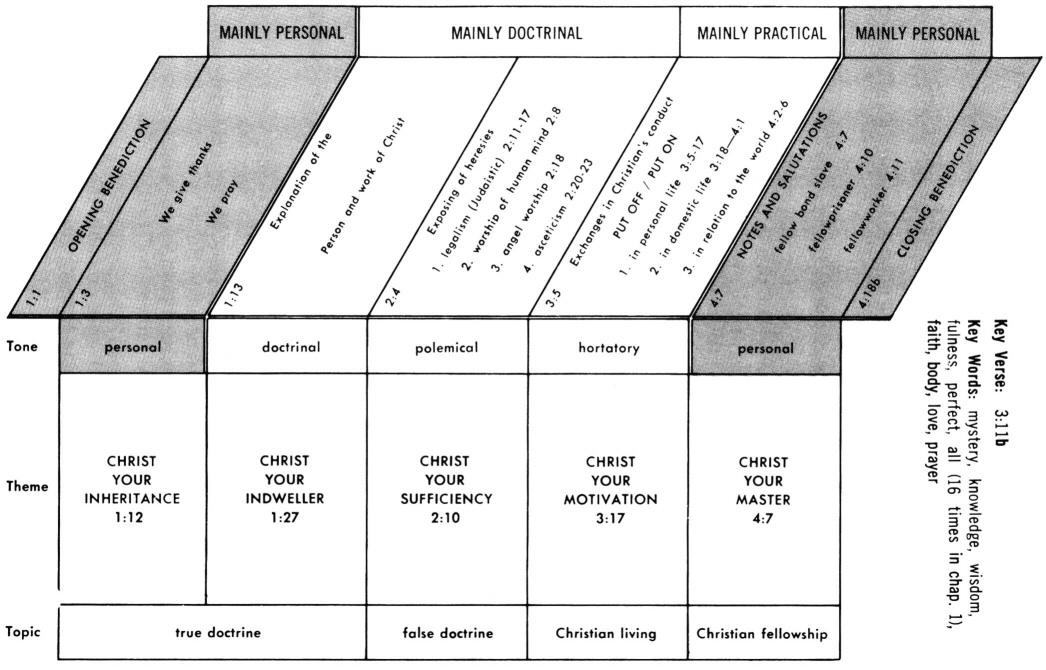
CHRIST IS ALL IN ALL
Click chart to enlarge
Charts from Jensen's Survey of the NT - used by permission
Colossians Overview - Click Chart on right side
| Christ Preeminent in All Things Supreme Lord - Sufficient Savior |
|||
| Colossians 1 | Colossians 2 | Colossians 3 | Colossians 4 |
| Supremacy of Christ |
Submission to Christ |
||
| Doctrinal and Corrective |
Practical and Reassuring |
||
| What Christ Did For Us |
What Christ Does Through Us |
||
| Christ Our Lord |
Christ Our Life |
Christ our Love |
|
| Christ the Head of the Body |
Christ the Lord of the Universe |
Christ the Head of the Home |
|
| Instruction | Warnings | Exhortations | Reminders |
| Reconciliation | Creation | Submission | Conversation |
| His Person and Word |
His Peace and Presence |
||
Colossians 4:5 Conduct yourselves with wisdom toward outsiders *, making the most of the opportunity. (NASB: Lockman)
Greek: En sophia peripateite (2PPAM) pros tous exo ton kairon exagorazomenoi. (PMPMPN) ton kairos
Amplified: Behave yourselves wisely [living prudently and with discretion] in your relations with those of the outside world (the non-Christians), making the very most of the time and seizing (buying up) the opportunity. (Amplified Bible - Lockman)
Barclay: Behave yourselves wisely to those who are outside the Church. Buy up every possible opportunity.
KJV: Walk in wisdom toward them that are without, redeeming the time.
NIV: Be wise in the way you act toward outsiders; make the most of every opportunity.
NLT: Let your conversation be gracious and effective so that you will have the right answer for everyone. (NLT - Tyndale House)
Phillips: Be wise in your behaviour towards non-Christians, and make the best possible use of your time. (New Testament in Modern English)
Wuest: In wisdom be ordering your behavior towards those on the outside, buying up for yourselves the strategic, opportune time.
Young's Literal: in wisdom walk ye toward those without, the time forestalling;
CONDUCT YOURSELVES WITH WISDOM: en sophia peripateite (2PPAM):
- Conduct yourselves - Col 3:16; Ps 90:12; Mt 10:16; Ro 16:19; 1Cor 14:19, 20, 21, 22, 23, 24, 25; Eph 5:15, 16, 17; Jas 1:5; 3:13,17. 1 Th 4:12; 1 Th 5:15; 1 Cor 10:32; 2 Cor 4:2; Titus 2:8; 1 Pe 2:12, 2:15; Mt 10:16
- Colossians 4 Resources - Multiple Sermons and Commentaries
- Colossians 4:2 The Speech of the New Man, Part 1 - John MacArthur
- Colossians 4:2-6 The Speech of the New Man, Part 2 - John MacArthur
- Colossians 4 Speech Seasoned with Salt - John MacArthur
WALK THE TALK
LIVE OUT THE GOSPEL
Outsiders (those who cannot legitimately call God "Father" - John 1:12, 1Jn 3:1, cp Mk 4:11, 1Cor 5:12-13) are more interested in our walk than in our talk. "This does not mean that the Christian should not also confess Christ with his lips, but the point is that his walk should correspond with his talk. It should never be said of him, “High talk, low walk.” (MacDonald)
Edgar Guest - I’d rather see a sermon, than hear one, any day.
James Sweeney - In these two verses (Col 4:5-6) Paul moved from the subject of prayer in Col 4:2–4 to the complementary topic of Christian witness. He stressed two related aspects of Christian witness, both of which imply communication. The first is behavioral, and the second is verbal… The responsibility to “walk” (peripateite) in a given manner is common in Paul’s descriptions of the ethical behavior he expected of fellow believers (Ro. 6:4; 8:4; 14:15)( See also Ro 13:13; Eph 4:1; 5:2, 8, 15; Php 3:17; Col 2:6; and 1Th 4:1.). Paul also reminded his readers that they were no longer to “walk” as they did before they became Christians (Eph. 2:2–3; 4:17; Col. 3:5–7)… In Galatians 5:16 Paul exhorted his readers to “walk by the Spirit” rather than to succumb to the pressure of the Judaizing opponents and return to the yoke of the Law (Gal 5:1) by submitting to circumcision (Gal 5:2). In Ephesians Paul exhorted his readers to “walk in love” (Eph 5:2) and to “walk as children of light” (Eph 5:8). (Guidelines on Christian Witness in Colossians 4:5-6 - $5/mo fee)
Conduct (4043) (peripateo [word study] from peri = about, around + pateo = walk, tread) (Used in Col 1:10; 2:6; 3:7; 4:5) means literally to go here and there in walking, to tread all around and most commonly in the NT is used figuratively meaning to conduct one's life ("the Christian walk"), to order one's behavior, to behave, to make one's way, to make due use of opportunities, to live or pass one’s life (with a connotation of spending some time in a place).
In Col 1:10 Paul had prayed that the saints at Colossae would "walk in a manner worthy of the Lord, to please Him in all respects, bearing fruit in every good work and increasing in the knowledge of God." (Col 1:10 )
Comment: Note the benefits of a worthy walk (of wise conduct) - (1) pleasing to God, (2) fruitful for God and (3) growth in the knowledge of God. Note also that this is something we can and should pray for ourselves and others. Finally note that the "secret" (like the secret of any great pie) is in the "filling!" = "filled with the knowledge of His will in all spiritual wisdom and understanding." (Col 1:9) Is this not essentially "equivalent" to being filled with the Spirit (Who is the Giver of divine Wisdom and Who enables us to understand - cf Acts 6:10, 1Cor 2:13, Eph 1:17)? (Eph 5:18)
Peripateo - 95x in 88v - AS renders peripateo = behave(2), conduct ourselves(1), conduct yourselves(1), leading… life(1), leads… life(1), prowls around(1), so occupied(1), walk(50), walk about(1), walk around(2), walked(7), walking(21), walking around(1), walks(5).
Matt 4:18; 9:5; 11:5; 14:25f, 29; 15:31; Mark 2:9; 5:42; 6:48f; 7:5; 8:24; 11:27; 12:38; 16:12; Luke 5:23; 7:22; 11:44; 20:46; 24:17; John 1:36; 5:8f, 11f; 6:19, 66; 7:1; 8:12; 10:23; 11:9f, 54; 12:35; 21:18; Acts 3:6, 8f, 12; 14:8, 10; 21:21; Rom 6:4; 8:4; 13:13; 14:15; 1 Cor 3:3; 7:17; 2 Cor 4:2; 5:7; 10:2f; 12:18; Gal 5:16; Eph 2:2, 10; 4:1, 17; 5:2, 8, 15; Phil 3:17f; Col 1:10; 2:6; 3:7; 4:5; 1 Thess 2:12; 4:1, 12; 2 Thess 3:6, 11; Heb 13:9; 1 Pet 5:8; 1 John 1:6f; 2:6, 11; 2 John 1:4, 6; 3 John 1:3f; Rev 2:1; 3:4; 9:20; 16:15; 21:24. N
Conduct is in the present tense (continual action) and imperative mood (command not a suggestion) which calls for believers to continually walk with wisdom. This is to be the habit of our new life in Christ (Col 2:6, Col 3:4), His life (His Spirit) in us making it possible for us to "strive (our part, our responsibility) according to His power which mightily works (The continual working of indwelling Spirit's enabling power) within" us. In other words, Paul is not commanding us to do anything that God's power has not provided the potential for us to accomplish. He is calling for a continuous, supernatural walk, which necessitates continual reliance on a Supernatural Source (The Holy Spirit - Eph 5:18, Gal 5:16). Our responsibility is to continually work out our salvation truth in fear and trembling (Php 2:12), as God in us continually gives us the desire and the power (Php 2:13NLT).
Paul is writing about the practical aspect of how we are to walk the talk before the skeptical, watching world. He explains how we are to "walk" before others, how we conduct ourselves. The old saying is true "People don't care how much you know until they know how much you care"! (Convicted? I am!)
S Lewis Johnson - It is said that Lord Melbourne once remarked in Parliament, after divine principles were injected into the midst of a lively debate, “Things have come to a pretty pass when religion has to affect our daily lives.” I fear that this absurd attitude is more prevalent in the genuine Christian community than we realize or care to admit. We are quite often pious and reverent on the Lord’s Day, but what a different person we become on Monday morning—especially behind the wheel of our automobiles when we are just a little late for work and the traffic is heavy and slow-moving! It is remarkable how often the Word of God stresses the fact that there should be daily exercise in spiritual things on the part of the Christian… The Christian’s week, in a sense, ought to be a week of Sundays, because all of the days are His days." (Studies in the Epistle to the Colossians Part XII- Paul’s Final Words to the Colossians -- By- S. Lewis Johnson, Jr - Annual fee to view full articles from over 30 major theological journals) (See also Paul's Last Words to the Colossians)
Ray Stedman - I like that figure because a walk, of course, merely consists of two simple steps, repeated over and over again. It is not a complicated thing. In the same way, the Christian life is a matter of taking two steps, one step after another. Then you are beginning to walk. Those two steps follow in this passage. Paul describes them as, "Put off the old man" (see Col 3:5, 6, 7, 8, 9, 10) and "put on the new." (see specific attitudes and actions in Col 3:12-25 thru Col 4:1-6) Then repeat them. That is all. Keep walking through every day like that. That is how Scripture exhorts us to live." (True Human Potential)
J Vernon McGee - Walking is not a balloon ascension. A great many people think the Christian life is some great, overwhelming experience and you take off like a rocket going out into space. That’s not where you live the Christian life. Rather, it is in your home, in your office, in the schoolroom, on the street. The way you get around in this life is to walk. You are to walk in Christ. God grant that you and I might be joined to Him in our daily walk. (McGee, J V: Thru the Bible Commentary: Thomas Nelson) (Listen to his Mp3 - Colossians 4:5-6)
Harrison - A Christian's conduct can have a powerful evangelizing influence on the unsaved; for, if these people see a type of life that is superior to their own, the chances are good that they will want to inquire after its secret. This will lead to conversation about Christ and His saving work.
1Pet 2:12 Keep your behavior excellent among the Gentiles, so that in the thing in which they slander you as evildoers, they may on account of your good deeds, as they observe them, glorify God in the day of visitation.
With wisdom (en sophia) - More literally this is rendered "in wisdom" and this phrase is placed first in the Greek for emphasis. Literally "in wisdom conduct yourselves".
Wiersbe - What does it mean to “walk in wisdom”? For one thing, it means that we are careful not to say or do anything that would make it difficult to share the Gospel. It also means we must be alert to use the opportunities God gives us for personal witnessing.
Guzik - The Christian life isn’t only lived in the prayer closet. There also must be “shoe-leather Christianity,” which lives wisely
Expositors - They must be wise in their relations with them so as not to give them an unfavorable impression of the gospel.
Radmacher - Early Christians were often viewed with suspicion, distrust, and disdain. They were considered atheists because they would not worship the gods of Rome and Greece. Many labeled them as unpatriotic because they would not burn incense before the image of the emperor. Some accused the early Christians of participating in orgies because of their talk of “love feasts” (Jude 12). Others harbored suspicions that Christians were really cannibals, who ate and drank the blood and the body of the Lord. With such misrepresentations of Christian belief and practice running rampant, it was very important for misunderstandings to be dispelled by the virtuous and impeccable lives of Christian believers.
Wisdom (4678) (sophia [word study]) (6x in Colossians = Col 1:9, 28; 2:3, 23; 3:16; 4:5) is mental excellence in its highest and fullest sense and includes the ability to judge correctly and to follow the best course of action, based on knowledge and understanding. In simple terms Biblical wisdom can be defined as skill for living. Wisdom is being able to take truth from the Word, which the Spirit of God has revealed to your heart and applying this truth in given situations in a practical way.
In the present context to conduct ourselves with wisdom it means that the unsaved outsiders who are closely, critically scrutinizing our lives, should see or hear nothing in our lives that would jeopardize our testimony of Jesus.
John Eadie - The world's Bible is the daily life of the church, every page of which its quick eye minutely scans, and every blot on which it detects with gleeful and malicious exactness.
Wisdom is the ability to properly apply the knowledge (which God has already revealed to their heart in answer to Paul's prayer in Col 1:9) to each given situation. Biblical wisdom does not allow for separation between learning and living. The wisdom which Paul speaks of is not simply a head knowledge of deep spiritual truths. True spiritual wisdom must affect our daily life. Biblical wisdom is practical, not theoretical.
Sophia - 51x in 49v - NAS = cleverness(1), learning(1), wisdom(49)
Matt 11:19; 12:42; 13:54; Mark 6:2; Luke 2:40, 52; 7:35; 11:31, 49; 21:15; Acts 6:3, 10; 7:10, 22; Rom 11:33; 1 Cor 1:17, 19ff, 24, 30; 2:1, 4ff, 13; 3:19; 12:8; 2 Cor 1:12; Eph 1:8, 17; 3:10; Col 1:9, 28; 2:3, 23; 3:16; 4:5; Jas 1:5; 3:13, 15, 17; 2 Pet 3:15; Rev 5:12; 7:12; 13:18; 17:9. .
The aspect of wisdom in view is that which buys up every opportunity to lead a lost soul to the Lord. Thus the Colossian's walk in wisdom is to have in view their Christian witness.
Alford - the practical wisdom of Christian prudence and sound sense
S. Lewis Johnson quipped that "Often the only version of the Bible the world reads is that of the believer's life, and, if that is true, in the light of the weakness of the church's testimony today surely the world could use a revised version!"
Warren Wiersbe reminds us that "Practical obedience means pleasing God, serving Him, and getting to know Him better. Any doctrine that isolates the believer from the needs of the world around him is not spiritual doctrine. Evangelist D. L. Moody often said, “Every Bible should be bound in shoe-leather." (Wiersbe, W: Bible Exposition Commentary. 1989. Victor)
John Eadie writes that Colossians 4:5-6 "refer to the outer aspects of Christian conduct or such aspects of it as present themselves to the world. While they were to set their affections on things above, and mortify their “members which are upon the earth;” while they were to put off certain vices, and assume certain virtues, culminating in love; while they were to be exemplary in every social relation—as husbands and wives, parents and children, masters and servants; and while they were to be instant in prayer for themselves and for the apostle, all this ethical code referred to personal and mutual spiritual duties within the church. They must, however, in ordinary circumstances, come in contact with unbelieving heathenism around them. If they shrank entirely from such company, the inference of the apostle would be realized—“for then must ye needs go out of the world.” But they were not to go out of the world because it was bad, they were to remain in it for the purpose of making it better. And that their conduct might exercise such a beneficial influence they were thus enjoined" to conduct themselves in truth and communicate the truth to a world steeped in lies and bound tight in sin." (A Commentary on the Greek Text of Colossians - Online)
TOWARD OUTSIDERS: pros tous exô:
- 1Co 5:12,13; 1Th 4:12; 1Ti 3:7; 1Pet 3:1
- Colossians 4 Resources - Multiple Sermons and Commentaries
- Colossians 4:2 The Speech of the New Man, Part 1 - John MacArthur
- Colossians 4:2-6 The Speech of the New Man, Part 2 - John MacArthur
- Colossians 4 Speech Seasoned with Salt - John MacArthur
Expositor's - demonstrate practical Christian wisdom in dealing with secular society. Paul’s words imply that believers are to be cautious and tactful so as to avoid needlessly antagonizing or alienating their pagan neighbors. In a positive sense, they also imply that believers should conduct themselves so that the way they live will attract, impress, and convict non-Christians and give the pagan community a favorable impression of the gospel. (See 1 Cor 5:12, 13; 1 Thess 4:12; 1 Tim 3:7 for other passages where unbelievers are designated as “outsiders.”)
Toward (4314) (pros from pro = in front of) can express motion or direction and thus "to" or "toward". Pros can convey the idea of nearness, of being or remaining near by or at. Pros can refer to a position near another location or object, often with the implication of facing toward the object. It is as if our lives are place toward or before the lost, that they might observe and examine and determine whether there is a difference in the way we conduct ourselves.
APPLICATION: If you were put on trial for being a Christian, would there be enough "evidence" to convict you?
Outsiders (exo) means literally out (as being outside a door and so out of doors). Figuratively as in this verse, exo speaks of those not belonging to one's society and specifically non-believers or non-Christians. Literally Paul says "those outside" (tous exo) an expression which is equivalent to the rabbinical term denoting those who belong to another religious group and in the present context refers to those outside the church, those who are not regenerate or born again. The unsaved are outside the family of God, and God has assigned us the privilege to be His ambassadors to proclaim the gospel of the kingdom to them. Effective witness involves walking wisely, being alert to every opportunity, and being careful in what we say and how we say it (1Pe 3:15).
Paul uses the same phrase toward outsiders (pros tous exo - literally toward those outside") in his letter to the Thessalonians writing that the believers should "make it your ambition to lead a quiet life and attend to your own business and work with your hands, just as we commanded you; so that you may behave properly toward outsiders and not be in any need." (1Thes 4:11-12)
What a sad thing to be those outside, those who are “without”… without Christ, without hope, without peace, without forgiveness! (cp Ep 2:12) It is important that believers live wisely among the lost, for unsaved people are looking at our lives and trying to find things to criticize.
We are to first speak the gospel clearly with our lives, which may open a door for us to speak the gospel with our lips.
Illustration - This story has often been told about Dr. William Henry Houghton, who pastored the Calvary Baptist Church in New York City and later served as president of Chicago’s Moody Bible Institute till his death in 1946. When Dr. Houghton became pastor of the Baptist Tabernacle in Atlanta, a man in that city hired a private detective to follow Dr. Houghton and report on his conduct. After a few weeks, the detective was able to report to the man that Dr. Houghton’s life matched his preaching. As a result, that man became a Christian.
Expositor's Greek - They must be wise in their relations with them so as not to give them an unfavorable impression of the Gospel.
Arnold - Outsiders is a Jewish manner of expression for those who are outside of the community of the covenant people of God. Here it refers to unbelievers in the city of Colosse and the surrounding countryside. Paul urges the Colossian believers to exercise God-given wisdom in their interactions with people they encounter at the marketplace, at work, and at civic functions. These new believers would be under scrutiny by people wondering why they have left the synagogue or have forsaken their allegiance to the local cults. (Zondervan Illustrated Bible Backgrounds Commentary Volume 3: Romans to Philemon)
MAKING THE MOST OF THE OPPORTUNITY: ton kairon exagorazomenoi (PMPMPN):
- Colossians 4 Resources - Multiple Sermons and Commentaries
- Colossians 4:2 The Speech of the New Man, Part 1 - John MacArthur
- Colossians 4:2-6 The Speech of the New Man, Part 2 - John MacArthur
- Colossians 4 Speech Seasoned with Salt - John MacArthur
SNAPPING UP
EVERY OPPORTUNITY
Related Resource:
Christians are called to continually buy up and make the most of every opportunity for witnessing to the faith once for all time delivered to the saints, the Gospel of their salvation.
Making the most (redeeming)(1805) (exagorazo from ek = out or from. If something is in something else, then ek describes separating it in respect to place, time, source or origin + agorazo = buy, acquire possessions or services in exchange for money with the result that whatever has been bought is the buyer's by right of possession <> from agora = market place where things were exposed for sale, a forum, a place in which the people assemble and where public trials were held) means literally to buy out of (the preposition "ek" = out of) the market place. The idea is not just to redeem but to completely redeem.
Exagorazo is used 4 times in the NT (Gal 3:13; 4:5; Eph 5:16; Col 4:5) and is translated: making the most, 2; redeem, 1; redeemed, 1.
John Phillips - We are stewards of our time. Time is a nonrenewable resource. It slips past us at an alarming rate. Once it's gone, it's gone. It can never be recalled. We invest each fleeting moment with something even if it is only idleness. Solomon had a well-developed appreciation of the value of time (Eccl 3:1-8). It was sad that he wasted so much of it in personal aggrandizement and desecrated even more of it by his carnality and worldliness! Solomon does not seem to have practiced much of what he preached. "Redeem the time," says Paul. Suppose that a wealthy man were to give someone $1440 a day to spend. He had to spend it. The gift did not allow him to save it, still less to hoard it. At the end of each day what was not spent was lost. The same sum would arrive every day until the end of life. Then an accounting would be made of what the recipient had done with the sum. There it was $1440 a day to spend or squander, to be used buying things for oneself or in helping others, to be wasted on trifles or invested for eternity. Every day God gives us 1440 minutes to be spent by us and us alone. We have to spend it. We cannot save up some of today's time for tomorrow. We have none of yesterday's time left over for today. All of these precious minutes are ours. However, when life is over, there will be a strict accounting of what we have done with that time. We, as Christians, will give our accounting at the judgment seat of Christ. The unsaved will render account at the Great White Throne. But an accounting will be made.
THE FIRST MEANING
OF EXAGORAZO
There are two basic uses of exagorazo in the NT, the first speaking of the believer's redemption from slavery to sin.
Paul uses exagorazo twice in Galatians with this meaning, writing that "Christ redeemed us (bought us out and out or fully from) from (ek = out of) the curse of the Law (which is death, the penalty for breaking the Law), having become a curse for (on behalf of ~ substitution) us-- for it is written, "CURSED IS EVERYONE WHO HANGS ON A TREE" (Gal 3:13)
The Welsh translation of this verse says that “Christ hath wholly purchased us from the curse of the law.” The Galatians imagined that Christ only half purchased them, and that they had to purchase the rest by their submission to circumcision and other Jewish rites and ceremonies. Hence their readiness to be led away by false teachers and to mix up Christianity and Judaism. Paul says in essence "No, you have been wholly purchased from the curse".
In the second similar use in of exagorazo in Galatians Paul explains that
when the fulness of the time came, God sent forth His Son, born of a woman, born under the Law, in order that He might redeem (exagorazo) those who were under the Law, that we might receive the adoption as sons. (Gal 4:4, 5)
Comment: Those who under the law are no better than slaves (cp Gal 4:1) will receive full and complete adoption as sons. It is worthy of noting that God's purpose in redemption is not just to rescue sinners from bondage to the power of Sin but to adopt them as His sons. Amazing grace indeed.
Long my imprisoned spirit lay
Fast bound in sin and nature’s night;
Thine eye diffused a quick’ning ray,
I woke, the dungeon flamed with light;
My chains fell off, my heart was free,
I rose, went forth and followed Thee.
And Can It Be That I Should Gain
Those who believe in Christ are bought out from their slavery to Sin, the payment price He paid being the only one high enough to redeem all of mankind, the "precious blood, as of a lamb unblemished and spotless, the blood of Christ (1Pe 1:19), context 1Pe 1:18).
Since Christ has purchased men out of the slave market of sin (sin caused us to be under the curse of the Law) by His own blood, believers now are His bondslaves and He has the right of possession. Paul using the root verb (agorazo) writes that believers "have been bought with a price (agorazo - a past completed transaction never to be repeated). Therefore glorify God in your body." (1Cor 6:20)
Stated another way, the redeemed are never again to be put up for sale in the slave market.
The root verb from which exagorazo is derived (agorazo - word study) is used frequently in the Septuagint (LXX, Greek of the Hebrew OT) with the idea that such deliverance involves cost of some kind, effort, suffering, or loss to the one who effects the deliverance.
MacArthur commenting on this verse writes that exagorazo "has the basic meaning of buying, especially of buying back or buying out. It was used of buying a slave in order to set him free; thus the idea of redemption is implied in this verse. We are to redeem, buy up, all the time that we have and devote it to the Lord. The Greek is in the middle voice, indicating that we are to buy the time up for ourselves—for our own use but in the Lord’s service. (MacArthur, J: Ephesians. Chicago: Moody Press)
THE SECOND MEANING
OF EXAGORAZO
The second meaning of exagorazo is to "buy up" and is the meaning here in Colossians and the parallel passage in Ephesians. It means to to gain something, especially an advantage or opportunity. To make the most of.
Exagorazo is used to translate the Aramaic in Daniel 2:8 where Nebuchadnezzar saw through his seers trickery (to entice him to tell them the dream, upon which they would tell him the interpretation) and answered "“I know for certain that you are bargaining for time, inasmuch as you have seen that the command from me is firm." (Daniel 2:8)
The phrase "bargaining for time" is translated in the Greek with exagorazo and kairos (see below) just as in Colossians and Ephesians.
BDAG notes that "the king’s oneiromancers (interpreters of dreams) face an hour of peril in which there are no options except to deliver what the monarch requests. The middle voice (ton kairon exagorazomenoi) in Col 4:5; Eph 5:16 appropriately expresses choice in perilous times" (Arndt, W., Danker, F. W., & Bauer, W. A Greek-English Lexicon of the New Testament and Other Early Christian Literature)
Making the most of the opportunity means to take advantage of any opportunity that comes your way, and in the context of this section in Colossians refers to an opportunity to speak the gospel.
In Ephesians Paul exhorts the saints to "Therefore be careful how you walk, not as unwise men, but as wise, making the most of (exagorazo - buying up each opportunity) your time (kairos) because the days are evil. So then do not be foolish, but understand what the will of the Lord is." (Ep 5:15, 16, 17-see notes Ep 5:15; 16; 17)
Hodge adds that (Eph 5:16) can be translated "availing yourselves of the occasion,” i.e. improving every opportunity for good." (Hodge, C. Commentary on Ephesians)
In both (Eph 5:16) and here in (Col 4:5) Paul uses the middle voice which conveys a "reflexive" sense to the verb - the idea then is of buying up for oneself (middle voice = "buying up for yourselves," "for your own advantage"), of buying up the opportunity, the season, the space of time in which something is seasonable, and of turning each opportunity to the best advantage for oneself.
Thayer says that exagorazo as used in (Eph 5:16) and (Col 4:5) means to "Buy up, buy up or out of for one's self and so to make wise and sacred use of every opportunity for doing good, so that zeal and well doing are as it were the purchase money by which we make the time our own."
The UBS Handbook Series adds that "The readers are being told to seize and use every opportunity to carry on their Christian witness, because these are evil days, In some languages it is necessary to specify what is involved in every opportunity. Accordingly, it may be necessary to translate make good use of every opportunity you have as “every time you can do something good you should” or “you should use every chance to do good”. (The United Bible Societies' New Testament Handbook Series)
The idea then is turning each season (kairos) to the best advantage since none can be recalled if missed. Every time you can do something good you should.
Kenneth Wuest translates Col 4:5 - "buying up for yourselves the strategic, opportune time." He translates Eph 5:16 similarly as "buying up for yourselves the opportune time, because the days are pernicious." The idea is to be habitually, continually ''buying up'' all that is anywhere to be bought and not allowing the moment (THE KAIROS) to pass by unheeded or unused but to make it one’s own.
Ironside - Time is given us to use in view of eternity.
As someone has said "Beware of wasting the present. Instead of killing time, redeem your spare moments today. Wasting the gift of time insults the Giver of time."
Redeem the time! God only knows
How soon our little life may close,
With all its pleasures and its woes,
Redeem the time!
— Anonymous
God set a goal, yet gave the choice
To mortals how time may be spent,
Admonishing that worth, not length,
Values time's accomplishment.
— Mortenson
The idea is not to make best use of time as such (although that is certainly advisable), which is what we should do in the sense of not wasting it, but of taking advantage of the opportunities that present themselves. God is a God of providence and He providentially gives/allows opportunities for which we must be spiritually alert and ready to redeem.
Daniel Whedon - Redeeming the time—Better, buying up for yourselves the opportunity. Olshausen remarks (from Beza) that “the phrase is taken from the figure of a provident merchant who uses everything for his ends.” We are to watch for the opportunity to commend the gospel and win a soul, seizing the right time to speak, in order that we may advance the Master’s cause.
John Trapp - Redeeming the time] Opportunities are headlong, and must be timously laid hold on, or all is lost. {See Trapp's comments below on Eph 5:16} It is said of Hooper the martyr, that he was spare of diet, sparer of words, and sparest of time. Latimer rose usually at two of the clock in a morning to his study. Bradford slept not commonly more than four hours in the night, and in his bed, till sleep came, his book went not out of his hand. He counted that hour not well spent wherein he did not some good, either with his pen, tongue, or study. These worthies well weighed what a modern writer hath well observed, that they that lose time are the greatest losers and wastefullest prodigals. For of all other possessions two may be had together, but two moments of time (much less two opportunities of time) cannot be possessed together.
Redeeming the time] As wise merchants, trading for the most precious commodity, and taking their best opportunity. The common complaint is, We lack time; but the truth is, we do not so much lack it as waste it. Non parum habemus temporis, sed multum perdimus. (Sen.) The men of Issachar were in great account with David, because they had understanding of the times, to know what Israel ought to do, 1 Chronicles 12:32. So are they in great account with God that regard and use the season of well doing. It is reported of holy Ignatius, that when he heard a clock strike, he would say, here is one hour more now past that I have to answer for. And of Mr Hooper the martyr, that he was spare of diet, sparer of words, and sparest of time; for he well knew that whereas of all other possessions a man might have two at once, he cannot have two moments of time at once, for any money.
WATCH FOR
OPPORTUNITIES
“Redeeming the time.” Chances must be sought for putting in the right word, and when God sends it we must make the most of it. We must go on the principle of now or never. This will make us eager to embrace opportunities; and in turn we must urge the undecided to embrace Christ at once. Every act of kindness to the unconverted will help us. (T. L. Cuyler, D. D.)
Redeeming the Time - As a wise mariner when the wind arises, and the waters threaten, and the presages of a tempest appear, hauls in his sails and prepares for the storm, then, accommodating himself to the violence of the waves, lets drive a little, not daring to bear up full against it, all to gain time and redeem himself by such care and conduct out of so sad and angry a season; so Paul would have us use the same industry to ward off the blows which are menaced by the unfavorable disposition towards us of those without.
- Redeeming the Time - In depth analysis of this important Christian discipline
Redeeming the time. Take a lesson from--
I. The merchant. How he redeems the time; by wise employment of capital, by sedulous attention to his business, by sagacious plans, watchfulness for openings, and correct balancing of his affairs from time to time. Here is an example for the Christian, who should augment and employ his spiritual capital of gifts and graces, by industry, intelligence, and self-denial, and know exactly how his soul stands with God.
II. The farmer. Note his knowledge and thrifty management of his stock and crops. How carefully he prepares the ground at the proper season, then sows the seed, then removes all obstructions from the soil, reaps and garners the harvest, and finally seeks the best market to sell it in. Where would the farmer be but for his constant and habitual redemption of time. The Christian should act like him in regard to the Divine seed-wheat in his own mind or that of others (Ecclesiastes 11:6; Isaiah 32:20; Psalms 126:6)
.
III. The student, philosopher, and statesman. No man ever rose to eminence who did not wisely employ his time. The student economizes every moment and never tires in his researches. The philosopher tests by science and reason the mysteries of nature, omitting no opportunity or detail. And thus the statesman studies the complicated problems of politics and provides for their solution in season and out. And so the Christian student, the eyes of whose understanding are opened, ponders Divine truth. The Christian philosopher here learns the origin, nature, and end of all things. And the Christian, being a statesman, too, feeds on schemes of advancement for the kingdom of God. But in each capacity he needs to redeem the time; and if any day passes without embracing some opportunity for learning new truth, or doing some fresh good, he should feel with that Roman Emperor who said, “I have lost a day.” (J. G. Angley, M. A.)
Alexander Maclaren - The duties of those within to these without - Those who are within are those who have “fled for refuge” to Christ, and are within the fold, the fortress, the ark. Men who sit safe within while the storm howls, may simply think with selfish complacency of those exposed to its fierceness. The phrase may express spiritual pride and even contempt. All close corporations tend to generate dislike and scorn of outsiders, and the Church has had its own share of such feeling; but there is no trace of anything of the sort here. Rather is there pathos and pity in the world, and a recognition that their sad condition gives these outsiders a claim on Christian men, who are bound to go out to their help to bring them in. Precisely because they are “without” do those within owe them a wise walk, that “if any will not hear the Word, they may without the Word be won.” We owe them such a walk as may tend to bring them in, and if our walk does not seem to them very attractive, small wonder if they prefer to remain where they are. Let us take care lest instead of being door-keepers to the house of the Lord, to beckon passers-by and draw them in, we block the doorway, and keep them from seeing the wonders within. (A. Maclaren, D. D.)
Redeeming the time - The wheels of nature are not made to roll backward; everything presses on towards eternity; from the birth of time, an impetuous current has set in, which bears all the sons of men towards that interminable ocean. Meanwhile, heaven is attracting to itself whatever is congenial to its nature, is enriching itself by the spoils of earth, and collecting within its capacious bosom whatever is pure, permanent, and Divine, leaving nothing for the last fire to consume but the objects and the slaves of concupiscence; while everything which grace has prepared and beautified shall be gathered, from the ruins of the world, to adorn the eternal city, “which hath no need of the sun, neither of the moon, to shine in it; for the glory of God doth enlighten it, and the Lamb is the light thereof.” Let us obey the voice that calls us thither, let us seek the things that are above, and no longer cleave to a world which must shortly perish, and which we must shortly quit, while we neglect to prepare for that in which we are invited to dwell for ever. (Robert Hall.)
The redemption of time
I. The importance of time. This may be inferred from the names given it in Scripture--“The day of salvation,” “The acceptable year of the Lord,” “An appointed time.” It is the season in which alone the business of religion can be transacted. Those advise badly who say “there is time enough yet,” for who knows what a day may bring forth. It may be longer or shorter, but the day of salvation, like any other, is limited, and must soon come to an end.
II. The rapidity of the flight of time. “Time and tide wait for no man.” The little we have on hand is all we have, and even this short space is hurrying on so fast that to catch it is like dipping your hand in a running stream which glides through the fingers that would detain it. The Egyptians represented it as a serpent creeping on silently and gliding away imperceptibly. And yet there are those who act as though it had no assignable limit.
III. The large portion of our time lost. The season of boyhood--much of which was wasted in indolence; the season of youth--much of which was simply dissipated; the season of riper years--how much of that is being lost in the pursuit of shadows. Some misspend time because they have no proper object to engage their attention. How many fashionable people there are who are quite at a loss what to make of themselves. Others lose much time in mere delays and in expecting what will never come.
IV. The best means of redeeming it.
1. Misspend no more. Treasure up scraps of time. He who is prodigal of a minute spends far above his estate.
2. Rise early.
3. Husband your time well during the day. (T. Watson, B. A.)
Time: A creation of God which marks the duration of life and which is measured by changes in the created order. The flow of time is directed by God who appoints particular “times” within his unfolding purposes. Because human life is brief, time should be used properly, making the most of every opportunity. (Manser, Martin H., Dictionary of Bible Themes)
If time is a ring of gold, opportunity is the rich diamond that gives it both its value and glory. (J. Flavel.)
ILLUSTRATION The value of time - The value set on time by the Duke of Wellington was one of his most marked characteristics. He once wrote to Dr. Hutton for information as to the scientific acquirements of a young officer who had been under his instructions. The doctor thought he could not do less than answer the question verbally, and made an appointment accordingly. Directly the Duke saw him he said, “I am obliged to you, doctor, for the trouble you have taken. Is--fit for the post?” Clearing his throat Dr. Hutton began, “No man more so; I can--” “That’s quite sufficient,” said Wellington, “I know how valuable your time is; mine just now is equally so. I will not detain you any longer. Good-morning.” On another occasion he made an appointment with a civic dignitary who was five minutes late, and on finding the Duke watch in hand and very angry, pleaded, “It is only five minutes, your grace.” “Only five minutes!” he replied, “five minutes unpunctuality would have before now lost me a battle.” Next time the magnate took care, as he thought, to be on the safe side. When the Duke appeared he greeted him rather triumphantly. “You see, your grace, I was five minutes before you this time.” “Shows how little you know time’s value,” said the old Field Marshal, “I am here to the moment. I cannot afford to waste five minutes.”
Wesley’s economy of time - The diligence of Mr. Wesley in redeeming time has often been noticed; but it is scarcely possible for those who were not intimate with him to have a just idea of his faithfulness in this respect. In many things he was gentle and easy to be entreated; in this, decided and inexorable. One day his chaise was delayed beyond the appointed time He had put up his papers and left the apartment. While waiting at the door he was heard to say, “I have lost ten minutes for ever.” (W. Baxendale.)
Christianity gives real value to life for it "is a life that impels the seizure of every opportunity for good-doing. “Redeeming the time “--buying up the opportunities. Opportunity is the flower of time which blooms for a moment and is gone for ever." (G Barlow)
WATCH FOR OPPORTUNITIES “Redeeming the time.” Chances must be sought for putting in the right word, and when God sends it we must make the most of it. We must go on the principle of now or never. This will make us eager to embrace opportunities; and in turn we must urge the undecided to embrace Christ at once. Every act of kindness to the unconverted will help us. (T. L. Cuyler, D. D.)
The redemption of time
I. Why time should be redeemed.
1. It is the most choice and precious thing in the world.
2. When once passed, it never returns.
3. It must be one day accounted for.
4. The shortness and uncertainty of human life.
5. Because of the work we have to do, and the difficulty of doing it.
6. Because we have already lost so large a proportion of the time allowed us.
II. How it may be redeemed.
1. Observe a method in the distribution of your time.
2. Be moderate in your recreations.
3. Cut off, as much as may he, unnecessary visits.
4. Examine, every evening, how you have spent the day. (Bishop Horne.)
P. Grant on The merchandise of time
The word here translated “redeem” literally means to purchase in the market, and is quite different from the theological term, which means to re-purchase. Time is thus presented to us as a precious commodity.
I. The obligations to the practice of making merchandise of time.
1. On the mode in which we employ our time our everlasting destiny depends. One of the plainest principles of commerce is that any commodity is desirable in proportion to the returns it is capable of securing. The same principle applies here. The everlasting consequences which flow from it give to time transcendent value. Were it not for these we might say, “Let us eat and drink,” etc. Just as a merchant, then, is most anxious about a profitable bargain so ought we to be about redeeming the time.
2. Time is short and uncertain. In commerce the rarity of an article enhances its value, and should any doubt exist as to another opportunity for procuring it the merchant is proportionately anxious to obtain it without delay. Had we for certain a considerable period to live in our neglect might be excused; but as it is we are bad spiritual merchants if we fail to redeem the time.
3. Unless you check the progress of sin now it will become every day more difficult, and eventually become impossible. What merchant would allow an unprofitable line of business to lengthen out as men do the life of sin. He stops promptly, lest by delay all chance of retrieving his fortune should be gone.
II. Directions for complying with the exhortation.
1. Have a plan or system for the distribution of time. Every man of business knows the importance of pre-arrangement and method. How much more so is this on which hang such infinite issues. In your plan set aside time for devotion.
2. Beware of those things which rob you of the best portion of it.
(1) Idleness.
3. Watch for and improve those occasions in which you can best promote not only your own eternal interests but those of others, and particularly of your family.
4. Accustom yourselves to serious and impartial self-examination. Take stock as men of business do.
The shortness of time
Time’s a hand’s breadth; ‘tis a tale;
’Tis a vessel under sail;
’Tis an eagle in its way,
Darting down upon its prey;
’Tis an arrow in its flight,
Mocking the pursuing sight;
’Tis a short-lived fading flower;
’Tis a rainbow on a shower;
’Tis a momentary ray
Smiling in a winter’s day;
’Tis a torrent’s rapid stream;
’Tis a shadow; ’tis a dream;
’Tis the closing watch of night,
Dying at the rising light;
’Tis a bubble; ’tis a sigh;
Be prepared, O man, to die.
(Quarles.)
L. O. Thompson - The right use of time
If this year is to be more valuable than the last, we must more carefully attend to the use of our time.
I. When to use time rightly.
1. Now. The present moment is a king in disguise.
2. While it is ours. The past is a memory; the future, an undivided inheritance.
3. The present is the only moment which can be used.
II. How to use time rightly.
1. By a circumspect walk.
2. By wisdom in its employment.
3. By helpful recreation. Avoid the two extremes of overwork and no work.
4. By the redemption of every fleeting moment. Take care of the seconds, and the hours will take care of themselves. Devote it all to God.
III. Why should we use time rightly?
1. Because of its value. The destiny of eternity hangs upon a moment of time.
2. The time is short.
3. When lost it can never be redeemed.
4. All that we have to do must be done quickly.
5. We shall have to account for our time.
IV. Lessons:
1. We shall make the most of time, if we work in it with zeal and diligence.
2. We should see to it that we are unreprovable in its use and in our work and recreation.
3. We should seek out, and not merely wait for, time in which to benefit others, or reprove the evils of our day. John the Baptist reproved Herod at the cost of his head; Jesus freely gave Himself for us all, and the disciples devoted their whole lifetime to teaching, preaching, exhorting, and re proving.
4. We should learn to be more faithful in the use of the present, because so much of the past has run to waste.
5. Avoid procrastination and building air castles.
6. Daily examine what use you have made of your time.
V. Illustrative scriptures. Ecclesiastes 8:5; Ecclesiastes 9:10; Ecclesiastes 12:1; Romans 12:11; 1 Corinthians 7:29; 2 Corinthians 6:2; Galatians 6:10; Ephesians 6:13; Colossians 4:5; James 4:13-15; 1 Peter 1:17; Revelation 22:20.
THE OPPORTUNITY: ton kairon:
- Colossians 4 Resources - Multiple Sermons and Commentaries
- Colossians 4:2 The Speech of the New Man, Part 1 - John MacArthur
- Colossians 4:2-6 The Speech of the New Man, Part 2 - John MacArthur
- Colossians 4 Speech Seasoned with Salt - John MacArthur
THE OPPORTUNE
SEASON
Christianity gives real value to life for it "is a life that impels the seizure of every opportunity for good-doing. “Redeeming the time “--buying up the opportunities. Opportunity is the flower of time which blooms for a moment and is gone for ever." (G Barlow)
Alford - The opportunity for what, will be understood in each case from the circumstances, and our acknowledged Christian position as watching for the cause of the Lord.
The opportunity - Note the Greek has the definite article (ton) preceding kairon, indicating the "specific" opportunity, implying the specific one that God's providence has arranged and to which the indwelling Spirit makes you sensitive. How critical then is it that we begin each day filled with (controlled by) the Holy Spirit that we might walk by the self-same Spirit, all through the day, ready to seize the opportunity He presents! (Eph 5:18 is intimately associated with "redeeming the time" in Eph 5:16) That is abundant life! That is a life of full joy! Enjoy! Are you arising each morning, aware of your great need for being filled with the Spirit all during your day? There is simply no other way to life a supernatural life! Like a spiritual pauper, seek the Spirit's filling each and every morning. Are you harboring some sin or are you unsure? They pray and ask the Spirit to search your heart as David did in Psalm 139:23-24. If there is some sin you need to confess because you sense it is grieving or quenching Him, then take it before the All Merciful God (1Jn 1:9).
Opportunity (2540) (kairos) refers to a strategic point of time. Kairos is distinct from the Greek chronos, which refers to time in general. Kairos on the other hand refers to a specific period of opportunity which when it passes by is irretrievable. Our English word opportunity comes from the Latin and means “toward the port.” It suggests a ship taking advantage of the wind and tide to arrive safely in the harbor. The brevity of life is a strong argument for making the best use of every opportunity God gives us.
Kairos then does not emphasize a point of time but rather a space of time filled with possibilities and opportunities. Paul tells the saints at Colossae and Ephesus to buy up every one of these opportunities for yourselves and ultimately for God's glory.
All believers are presented with opportunities to redeem. Paul exhorts us to go into the open market and buy up those opportunities by using them rightly. Remember that interruptions can be opportunities to serve.
As someone has accurately stated, the three most difficult things to do are : keep a secret, forget injury, and make good use of your leisure time (it's really not yours anyway but His… He's just "loaning" it to you.)
Many biblical texts stand as warning beacons to those who think they will always have time to do what they should. When Noah and his family entered the ark and shut the door, the opportunity for any other person to be saved from the flood was gone.
Because King Ahab disobeyed God by sparing the life of the wicked Ben–hadad, he was told by a prophet,
“Thus says the Lord, ‘Because you have let go out of your hand the man whom I had devoted to destruction, therefore your life shall go for his life, and your people for his people’ ” (1Ki 20:42).
Peter said, "If you address as Father the One who impartially judges according to each man’s work, conduct yourselves in fear during the time of your stay upon earth." (1Pe 1:17). (This is a "kairos" opportunity we dare not miss!)
In his farewell remarks to the Ephesian elders at Miletus, Paul said, "I do not consider my life of any account as dear to myself, in order that I may finish my course, and the ministry which I received from the Lord Jesus” (Acts 20:24).
Paul’s course was prescribed by God, and within that course he would minister to the utmost until his last breath. He was determined to run with endurance the race that was set before him (He 12:1). At the end of his life he therefore could say, "I have fought the good fight, I have finished the course, I have kept the faith." (2Ti 4:7).
APPLICATION: Your entire life should be built around looking for opportunities to present Christ, seizing the time and using it wisely. Evaluate all of your activities and determine how they affect your testimony for Christ. Ask yourself --
"Will any particular activity provide an opportunity to present Christ or will it make it more difficult for me to present Him?"
Grant Richison notes by way of application that "Time means opportunity. The Greek word here means a time in which something is seasonable. Evangelism is seasonable! We need to seize on the season! God wants us to take advantage of the opportunity when it comes along. We cannot recall the opportunity if we miss it. Are we making the most of every opportunity? There is a favorable time to preach the gospel. We can mark time, waste time and kill time. Only a Christian who walks in wisdom can redeem time. In sharing our faith, God wants us to "Strike while the iron is hot" or "Make hay while the sun is shining." We squander so many opportunities. God places opportunities at our disposal but we waste the moment." (Notes on Col 4:5)
Gil Rugh adds this interesting thought "It is interesting how Paul describes the opportunities. They do not just fall into our laps, but we must buy them up. This means we must look for them and use them. We are to make opportunities, humanly speaking. Our opportunities are the result of the Spirit working, but it is the Spirit working as we are willing to be biblical. As we approach our neighbors, friends and people we work with on our jobs, are we looking for opportunities to present Christ to them? Such an approach will affect our conduct. We would not want to say or do anything that would detract from the Gospel of Jesus Christ." (Colossians 4:2-6: Living the Life)
Wayne Barber's comments on Ephesian 5:16 (from his sermon on Eph 5:15-17 "Walking as Light in a World of Darkness") are apropos to Colossians 4:5. He writes that…
The word for "time" is an interesting word. It is the word kairos. It means season or opportunity. Now we know something about a season. A season comes in, but we also know something else about a season. A season goes away. There is going to come a summer time. But we are going to move out of that season into a time of barrenness. All of a sudden the leaves fall off the trees and it is just brown and dry. A season begins but a season ends.
Paul is saying, "Make the most of your time. If the season started when we received Christ, it is going to end when He comes for us. We only have one season. We only have one opportunity. You don’t get those choices over again." Many of us have made unwise choices. Many of us have not applied truth in our life. Already we are feeling it because we are getting older. Paul is trying to tell these Ephesians, "You had better wake up and get going, because you may not have that much longer. You only have one shot at it. Learn to make proper, biblically influenced choices in your life so that you can make the most of the time."
Making the most of the time means to redeem the time. To redeem the time means to purchase it. That is one thing that we all have in common. Every one of us has exactly the same amount of time. You’ve got 24 hours, and what you do with it is your business. You’ve got to make choices. But now wait a minute. He says, "Redeem the time." What do you mean, "redeem the time"? Purchase it. To purchase it, I have to have the collateral.
Not only do you have to have the collateral, you have to have the right kind of collateral if you are going purchase anything. So what is the collateral to purchase time? It is my choices. We have to understand this. Life is filled with one choice after another choice after another choice. It is not putting the garment on in the morning and thinking it is going to stay on you all day. You have to continue all day long to make those choices. What are those choices motivated by? They are motivated by what the Word of God has taught us. They are motivated by our respect of who God is. Now to be the right choice it has to be a choice that honors Christ and what His Word has to say. That is the way I purchase time. I have only got one time around, and I have to learn to make proper choices. How many choices did you make yesterday?
We have to learn that time is short. We only have one season. We only go around one time. Make those choices. Why? Because every time you choose, you are going to do something. That is called a deed and one day we will answer for those deeds at the Bema Seat of Christ. Are they wood, hay and stubble? What is wood, hay and stubble? They are stupid, fleshly, religious choices. Sometimes they are not even religious. What are precious stones? They are choices that were made based on God’s Word and my willingness to do what He tells me to do. We are making those choices, moment by moment by moment.
Kefa Sempangi (whose story is told in the book A Distant Grief, Regal Books) was a national pastor in Africa and barely escaped with his family from brutal oppression and terror in his home country of Uganda. They made their way to Philadelphia, where a group of Christians began caring for them. One day his wife said, “Tomorrow I am going to go and buy some clothes for the children,” and immediately she and her husband broke into tears. Because of the constant threat of death under which they had so long lived, that was the first time in many years they had dared even speak the word tomorrow. Their terrifying experiences forced them to realize what is true of every person: there is no assurance of tomorrow. The only time we can be sure of having is what we have at the moment. To the self–satisfied farmer who had grandiose plans to build bigger and better barns to store his crops, the Lord said, “You fool! This very night your soul is required of you” (Lk 12:20). He had already lived his last tomorrow.
There is a tide in the affairs of men,
Which, taken at the flood, leads on to fortune;
Omitted, all the voyage of their life
Is bound in shallows and in miseries.
Julius Caesar, 4.3.217 --Shakespeare
Napoleon illustrates the idea inherent in "kairos" (opportunity) noting that "There is in the midst of every great battle a ten to fifteen minute (this would equate with the idea inherent in the Greek word kairos) that is the crucial point. Take that period and you win the battle; lose it and you will be defeated."
Charles E. Hummel - Our greatest danger in life is in permitting the urgent things to crowd out the important.
The writer of Hebrews called these "urgent things" "encumbrances" or "weights" the Christian runner needs to cast aside, in order to be able to pursue the best.
The 16th-century reformer Philip Melanchthon kept a record of every wasted moment and took his list to God in confession at the end of each day. It is small wonder that God used him in such great ways.

An ancient Greek statue depicted a man with wings on his feet, a large lock of hair on the front of his head, and no hair at all on the back. Beneath was the inscription:
- "Who made thee? Lysippus made me.
- What is thy name? My name is OPPORTUNITY.
- Why hast thou wings on thy feet? That I may fly away swiftly.
- Why hast thou a great forelock? That men may seize me when I come.
- Why art thou bald in back? That when I am gone by, none can lay hold of me."
We need to live in such a way that we get the most for our time. We are to live as if every minute counts— because it does. We can always make more money, but we cannot make more time. Once it is gone, it is gone forever. And when our time on this earth is over, we will give an account to the One who gave us our allotment of this precious commodity. The Lord Jesus was sensitive about time. He began His ministry at age thirty and ended it a mere three years later. His life was jammed with people with immediate needs. Sick. Dead. Scared. People pushed through crowds to touch Him. In Mark 1:35, 36, 37, before sunrise, Christ spent time with the Father. Peter and his friends “searched for Him. When they found Him, they said to Him, ‘Everyone is looking for You.’ ”In Matthew 14:23, He spent time with the Father in the evening. In Luke 6:12, 13, He spent the night in prayer. And in Luke 5:15, 16, we see that He slipped away into the wilderness to spend time with the Father. He had three short years to teach, preach, heal, and lead. But the most important thing in His life was the time He spent with the Father. If it was that important for Him, as the God-man, what about you?
Consider praying a pray like that uttered by Moses the friend and servant of God who said
So teach us to number our days, that we may present to Thee a heart of wisdom. (Ps 90:12) (See Spurgeon's note)
Buying Up the Time - Consider this: “If we had to buy time, would there be any difference in how we would spend it? Would the days of our lives be used more wisely?” That’s what time management consultant Antonio Herrera asked the participants in a seminar he conducted on the subject. Then Dr. Herrera became more specific. He asked, “What if you had to pay in advance $100 an hour for the time allotted to you? Would you waste it?” The answer should be obvious. Of course, we can’t put a price tag on the minutes and hours we possess. They are given to us freely. But that doesn’t excuse us from using them conscientiously, carefully, and wisely. The giver of time is God Himself, and that places a far greater value upon it than any monetary figure could suggest. We must therefore use our time intelligently, taking advantage of opportunities it provides for us to serve the Lord and to do His will. - R W De Haan (Our Daily Bread, Copyright RBC Ministries, Grand Rapids, MI. Reprinted by permission. All rights reserved)
Time: Handle With Care - If you had to buy time, would there be any difference in the way you would spend it? Would you use the minutes, hours, and days of your life more wisely? Of course, we can’t put a price tag on the minutes and hours we possess. They are given to us freely. But that doesn’t excuse us from using them carefully and wisely. The giver of time is God Himself, and that places a far greater value on our time than any monetary figure could suggest. We must therefore take advantage of the opportunities time provides to serve the Lord and to do His will.
This doesn’t mean that we have to be working every single moment. It’s necessary to take a break every so often, to stop and smell the roses along the way, or to enjoy the beauty of a sunset. We use our time wisely when we combine the appropriate “stops” with the proper “steps.” According to Solomon, there is a time for all of God’s purposes to be accomplished (Ecclesiastes 3:1). I’m so grateful that the Lord doesn’t sell time. He provides it as a gift of His grace. So let’s spend our days “redeeming the time,” using the opportunities to live for God (Colossians 4:5). Yes, time is precious. Handle with care! —R W De Haan
We do not know how long we have
Till time for us is past,
So let us live as if this day
Is going to be our last. —D. De Haan
To spend time wisely, invest it in eternity.
LIFE'S COUNTDOWN - If we live 65 years, we have about 600,000 hours at our disposal. Assuming we are 18 when we complete high school, we have 47 years, or nearly 412,000 hours to live after graduation. If we spend 8 hours a day sleeping, 8 hours for personal, social, and recreational activities, and 8 hours for working, that amounts to 137,333 hours in each category When we think of the time we have to work and play in terms of hours, it doesn't seem like much. And when seen in the light of eternity, it's but a fleeting moment. How important, therefore, that we spend our waking hours wisely!
D. J. De Pree, a former member of the RBC Board of Directors always calculated his age in terms of days. If you asked him, "How old are you?" he answered immediately with the number of days. He based this practice on Psalm 90:12, "Teach us to number our days, that we may gain a heart of wisdom." Literally counting his days reminded him of the swift passage of time and the need to live with eternity's values in view. —R W De Haan
Future prospects bring present joys.
Time: Handle With Care - Of course, we can't put a price tag on the minutes and hours we possess. They are given to us freely. But that doesn't excuse us from using them carefully and wisely. The giver of time is God Himself, and that places a far greater value on our time than any monetary figure could suggest. We must therefore take advantage of the opportunities time provides to serve the Lord and to do His will. This doesn't mean that we have to be working every single moment. It's necessary to take a break every so often, to stop and smell the roses along the way, or to enjoy the beauty of a sunset. We use our time wisely when we combine the appropriate "stops" with the proper "steps." According to Solomon, there is a time for all of God's purposes to be accomplished (Ecc 3:1). I'm so grateful that the Lord doesn't sell time. He provides it as a gift of His grace. So let's spend our days "redeeming the time," using the opportunities to live for God (Colossians 4:5). Yes, time is precious. Handle with care! To spend time wisely, invest it in eternity —R W De Haan
We do not know how long we have
Till time for us is past,
So let us live as if this day
Is going to be our last.
—D. De Haan
To spend time wisely, invest it in eternity
BEE POLLEN AND THE GOSPEL - Nellie Pickard loves to tell people about Jesus Christ. She does it so often that she's written a series of books describing how she witnesses in everyday situations. In Just Say It! she tells about her phone call to a health-food store. She had noticed that bee pollen was on sale, so she asked the manager about the benefits of using it. "You'll live forever," he replied. To Nellie, the words live forever were an open invitation. "I know you're joking," she said, "but I know I'm going to live forever, and not because I buy your bee pollen." His response was encouraging. "I'd like to hear about it. I'm really interested in why you think you're going to live forever." Although he did not trust Jesus as Savior at that time, Nellie had planted the seed by being wise "toward those who are outside" (Col. 4:5).
Our opportunities are endless, yet our words are often powerless. Instead of directing our conversations with unbelievers toward spiritual matters, we tend to stay in the safe zone. Doing as Nellie does is a skill we need to develop and a challenge that comes straight from God's Word. We must look for those openings. With sincere kindness and genuine concern we can turn most conversations to eternal matters-even if the subject is bee pollen. -J D Branon
Take control of my words today,
May they tell of Your great love;
And may the story of Your grace
Turn some heart to You above.-Sees
The best place to witness is where God has placed you
DON'T KILL TIME - Author and lecturer John Erskine (1879–1951) declared that he learned the most valuable lesson of his life when he was 14 years old. His piano teacher asked him how much he practiced. He replied that he usually sat at the instrument for an hour or more at a time.
"Don't do that," warned the teacher. "When you grow up, time won't come to you in long stretches like that. Practice in minutes wherever you can find them—5 or 10 before school, a few after lunch. Sandwich them in between chores. Spread the practice throughout the day, and music will become a part of your life."
Erskine stated later that by following this advice he was able to live a fulfilled life as a creative writer, in addition to his regular duties as an instructor. He wrote nearly all of Helen of Troy, his most famous work, on streetcars while commuting between his home and the university.
Use your spare moments to read the Bible, or to pray, or to write a note of encouragement to a needy soul. —H G Bosch
Wasting time insults the Giver of time.
Colossians 4:6 Let your speech always be with grace, as though seasoned with salt, so that you will know how you should respond to each person. (NASB: Lockman)
Greek: o logos humon pantote en chariti, alati ertumenos, (RPPMSN) eidenai (RAN) pos dei (3SPAI) humas eni hekasto apokrinesthai. (PMN)
Amplified: Let your speech at all times be gracious (pleasant and winsome), seasoned [as it were] with salt, [so that you may never be at a loss] to know how you ought to answer anyone [who puts a question to you].(Amplified Bible - Lockman)
KJV - Let your speech be alway with grace, seasoned with salt, that ye may know how ye ought to answer every man.
NLT: Let your conversation be gracious and effective so that you will have the right answer for everyone. (NLT - Tyndale House)
Phillips: Speak pleasantly to them, but never sentimentally, and learn to give a proper answer to every questioner. (New Testament in Modern English)
Wuest: Your word, let it always be with graciousness, with salt thoroughly seasoned, to the end that you know how it is necessary in the nature of the case to answer everyone.
Young's Literal - your word always in grace -- with salt being seasoned -- to know how it behoveth you to answer each one.
LET YOUR SPEECH ALWAYS BE WITH GRACE : ho logos hume pantote en charit:
- Let your speech - Col 3:16; Deut 6:6,7; 11:19; 1Chr 16:24; Ps 37:30,31; 40:9,10; 45:2; 66:16; Ps 71:15, 16, 17, 18,23,24; 78:3,4; 105:2; 119:13,46; Pr 10:21; 15:4,7; Pr 16:21, 22, 23, 24; 22:17,18; 25:11,12; Eccl 10:12; Mal 3:16, 17, 18; Matt 12:34,35; Lk 4:22; Ep 4:29
- Colossians 4 Resources - Multiple Sermons and Commentaries
- Colossians 4:2 The Speech of the New Man, Part 1 - John MacArthur
- Colossians 4:2-6 The Speech of the New Man, Part 2 - John MacArthur
- Colossians 4 Speech Seasoned with Salt - John MacArthur
WINSOME
SPEECH
The adjective "winsome" means attractive or appealing in appearance or character. It is speech that is charming in an open and delightful way. It is derived from the Old English wynsum, from wyn (= joy, pleasure, delight) + -some. It is speech that is generally pleasing and engaging often because of a childlike charm and innocence. And so there is nothing hiding behind a winsome smile or winsome words. They can win over others in a fresh and honest way.
Now Paul turns from the believer's walk to his talk, from the behavioral to the verbal.
Speech (3055) (logos) in context refers to the speech of a Christian which among others things should be sound (Titus 2:8), edifying (Ep 4:29), meaningful (Mt 12:36), quiet (1Th 4:11), truthful ("do not lie") (Col 3:8).
Above all live in God's Word and you will always have a word from God. C H Spurgeon wrote that your "spiritual blood" should be "Bibline" as was the great puritan writer John Bunyan (Pilgrim's Progress). Remember what comes out is related to what goes in -- G.I.G.O. (garbage in, garbage out or "God's word In, God's word Out").
Paul turns from the believer’s walk (Col 3:1ff) to his talk. Our talk should match our walk and should be spiritual, winningly pure and apt. Our speech should be winsome which Webster says is attractive, appealing, generally pleasing and engaging often because of a childlike charm and innocence.
Alford says this grace is - the grace which is conferred on us from above, and which our words and actions should reflect:
Expositor's Greek - by the sweetness and courtesy of their conversation they are to impress favorably the heathen.
This speech "in grace" is antithesis of the speech described in Eph 4:29 (see discussion below under "Salt").
Guzik - If only Christians could speak with grace as well as they seem to speak with gossip!
With grace - literally "in grace" (en chariti) and can mean gracious or charming, as in classical Greek. However in the context of Colossians and the NT as a whole, this phrase surely has a deeper sense. "Graciously spiritual" might capture the force and intent of Paul.
Believers are those who go "from grace to grace" (John 1:16), beginning by being saved by grace through faith (Ep 2:8, 9-notes) and then continuing with sanctifying grace (Ro 5:17, Ro 6:17), serving grace (1Pe 4:10), sacrificing grace (2 Cor 8:1-9), singing grace (Col 3:16), speaking grace (Col 4:6), strengthening grace (2Ti 2:1), and suffering grace (2Co 12:9).
Grace (5485) (charis) speaks of unmerited favor. Gracious words build up rather than tear down.
Brief Grace Excursus
From Grace to Grace
Believers are aliens and strangers, not earth dwellers, and our citizenship not of this earthly kingdom but is in heaven, so it is reasonable to expect that our language or "accent" should give testimony to the kingdom (and King) to which we belong. Is there a better example of this than our Lord Jesus of Whom Luke wrote that
“all were speaking well of Him and wondering at the gracious words (charis logos = literally, words of grace) which were falling from His lips; and they were saying, "Is this not Joseph's son?" (Lk 4:22)
John records the testimony of those who heard Jesus speak, declaring that
"Never did a man speak the way this man speaks." (John 7:46)
Would it be true that others would say that about all believers as we leave a room or hang up the phone!
The wise person’s words are like silver (Pr 10:20), a tree of life (Pr 15:4), food (Pr 10:21), refreshing water (Pr 10:11; 18:4), and medicine (Pr 12:18).
Expositor's - “Grace” (charis), which in the NT usually denotes divine favor, seems here to be used in the broader sense of “pleasantness,” “attractiveness,” “charm,” “winsomeness.” These ideas are all implicit in the word.
Harrison - Although it is tempting to give grace its theological meaning, this is improbable here. More likely is the idea of beauty and winsomeness, such as that of our Lord, captivating those who listened (Lk 4:22).
SEASONED WITH SALT: ertumenos (RPPMSN) halati êrtumenos:
- Seasoned with salt - Lev 2:13; 2Ki 2:20, 21, 22; Matt 5:13; Mk 9:50
- Colossians 4 Resources - Multiple Sermons and Commentaries
- Colossians 4:2 The Speech of the New Man, Part 1 - John MacArthur
- Colossians 4:2-6 The Speech of the New Man, Part 2 - John MacArthur
- Colossians 4 Speech Seasoned with Salt - John MacArthur
Alford - not insipid and void of point, which can do no man any good: we must not forget that both these words have their spiritual meaning… (salt) symbolizing the unction, freshness, and vital briskness which characterizes the Spirit’s presence and work in a man.
Bengel on salty speech - Lest there should be anything corrupt and tainted under it.
Moule - "loyal godliness” is not to be confused “with a dull, graceless insipidity”
See exposition of "you are the salt of the earth" in Mt 5:13-note
Seasoned with salt - The ancient Romans, listening to one of their orators, would look at each other, smile, and say, “Cum grano salis” which means “Take it with a grain of salt.” But Christians are supposed to put the salt into their speech and keep their words pure and honest.
A great way to prepare your speech so that it is "well seasoned and palatable" is to begin each day with God, reading and praying His Word, and being filled with His Spirit Who goes out with us during the day giving us the desire the power to conduct ourselves in a manner pleasing to the Lord. (cp Php 2:13).
Seasoned (741)(artuo cf cognate artios = adequate, qualified for a function 2 Ti 3:17) means to make ready, to prepare (to fit), to set in order, to prepare with seasoning and so to season food as with salt to make it savory. In classical Greek the primary meaning of artuō is “to season, to prepare, to arrange, to make savory.” It is used in reference to seasoning foods with spices or of “seasoned” speech. In classical Greek the salt is used to used figuratively of the wit which characterizes one's speech. And so in Colossians 4:6 believers are exhorted to season (artuō) their conversation with grace (Word centered, Spirit enabled appropriate, proper responses) so they will know how to respond to others. Believers filled with the Spirit will manifest pleasant and wise conversation, speech that is seasoned as with salt.
Jesus used this verb in his teaching that "Salt is good; but if the salt becomes unsalty, with what will you make (artuo) it salty again? Have salt in yourselves, and be at peace with one another.” (Mk 9:50)
Comment: The application is that the Christian should season himself with a Christian character that enables him to live at peace with his brethren. Notice HAVE is in the present imperative which calls for this to be one's lifestyle, something only possible as we are continually filled with the Holy Spirit. (See discussion of the Need for the Holy Spirit to obey NT commands)
Here in Col 4:6 Paul uses the perfect tense for "seasoned" which speaks of a past completely action with continuing effect. The idea is that believers are made ready (their speech has been seasoned by grace, truth and the Spirit) and remains seasoned should the opportunity to speak occur and they recognize it. The perfect tense also speaks of permanence of this effect. Not salty one day, and sweet, sappy or superfluous the next, but salty every day, vessels of honor set apart by the Master, prepared (perfect tense - prepared in the past and remaining prepared) for every good work. (2Ti 2:21)
S Lewis Johnson notes that the phrase - "Seasoned with salt," is found in classical Greek in the sense of witty. If this is the apostle's meaning, believers are exhorted to season their speech with a dash of pungency. And one must grant that it is a sinful thing to bore those that are without with pious gospel platitudes. Something is radically wrong with the Christian church when it can talk interestingly and animatedly about everything-football, baseball, business, politics-but the Lord Jesus Christ. In Biblical thought, however, the word salt is often associated with resistance to corruption, or preservation of purity and retention of flavor (Mt 5:13; Mk 9:50). Furthermore, the parallel passage in Ep 4:29, in which Paul speaks of "corrupt speech," agrees with this sense. It is probable, then, that the apostle has in mind, not witty speech, but wholesome speech. It is that kind of language-wholesomely spiritual language-which is most likely to provide the most attractive apologetic for the Christian faith." (Bibliotheca Sacra: Volume 121: Issue 484, page 317, 1964)
Salt (217) (halas) refers to natural salt which purifies, cleanses, seasons, preserves from corruption
Salt retards rotting. Paul spoke of "rotten words" in Ephesians writing that believers are to…
Let no unwholesome (Greek = rotten) word proceed from your mouth, but only such a word as is good for edification according to the need of the moment, that it may give grace to those who hear. (Eph 4:29)
The best way to make sure rotten words do not proceed from our mouth is to always be sure to season them with salt (Col. 4:6). The best way to control the speech is to be continually surrendered to, filled with, walking by the Spirit, Who alone can tame our viper like tongues and sweeten our speech. Believers should never say, “Now take this with a grain of salt!” To the contrary we must put the “salt” into our speech by…
speaking the truth in love… (by) laying aside falsehood, (by speaking) truth each one with his neighbor (Ep 4:15, 25-See notes Ep 4:15, Ep 4:25)
Notice also that in both Ep 4:29 and Colossians 4:6 there is an emphasis on grace. Our words have power, either for good or evil. Paul tells us to speak in such a way that what we say will build up and not tear down. Our words should minister grace and thereby draw others toward Christ. The devil (dia = between + ballo = throw - throws between, seeks to cause division) encourages speech that will tear people down and destroy the work of Christ. Read James 3 for a reminder of the tremendous power of an unsalted, graceless tongue!
Every believer should seek to imitate the gracious words of our Lord, upon Whose lips God’s grace was poured, the psalmist recording that…
Thou art fairer than the sons of men (this supremely speaks of Christ). Grace is poured upon Thy lips. Therefore God has blessed Thee forever. (Ps 45:2)
Spurgeon's comment - Grace is poured into Thy lips. Beauty and eloquence make a man majestic when they are united; they both dwell in perfection in the all fair, all eloquent Lord Jesus. Grace of person and grace of speech reach their highest point in Him. Grace has in the most copious manner been poured upon Christ, for it pleased the Father that in Him should all fulness dwell, and now grace is in superabundance, poured forth from His lips to cheer and enrich His people. The testimony, the promises, the invitations, the consolations of our King pour forth from Him in such volumes of meaning that we cannot but contrast those cataracts of grace with the speech of Moses which did but drop as the rain, and distil as the dew. Whoever in personal communion with the Well Beloved has listened to His voice will feel that "never man spake like this Man." Well did the bride say of Him, "his lips are like lilies dropping sweet smelling myrrh." One word from Himself dissolved the heart of Saul of Tarsus, and turned him into an apostle, another word raised up John the Divine when fainting in the Isle of Patmos. Oftentimes a sentence from His lips has turned our own midnight into morning, our winter into spring.
Practically speaking, how can a believer "tap into" this God's reservoir of Grace? If we obey God's command to continually let the word of Christ dwell in us richly (Col 3:16), His indwelling words of grace and His indwelling Spirit season our speech and these gracious words will not lack God's salt (See Vital relation of indwelt by the Word and controlled by the Spirit). Remember that grace in your heart means grace on your lips…
For the mouth speaks out of that which fills the heart. (Mt 12:34)
Christians are to speaking heaven’s language which not only involves what we say, but also the way we say it. The spiritually minded Christian doesn’t go around quoting Bible verses all day! But he is careful to speak in a manner that glorifies God.
Remember that corruption from your lips means that there is corruption in your heart.
THOUGHT - What has come our of your mouth today, dearly beloved of the Father?
Salt was one of the earliest of all preservatives and was a valued commodity in the ancient world. Without any source of refrigeration, salt became the means of preserving meat from decaying, as the ancients rubbed down meat and fish to preserve it for regular use. Seafarers just a century ago would salt down their fish and meat to preserve them for the long transatlantic journeys. Salt was so important as a corruption preventative in the ancient world that wars were fought over it, and entire economies were based on it. In short, salt could literally make the difference between life and death in a time when fresh food was unavailable.
The Greek writer Plutarch said that meat is a dead body and part of a dead body, and will, if left to itself, go bad, but salt preserves it and keeps it fresh, and is therefore like a new soul inserted into a dead body. Dead meat left to itself went bad, but, pickled in salt, it retained its freshness. The salt seemed to put a kind of life into it. The point is that salt preserves corruption.
Salt was used as a figure of speech in the ancient world to describe "sparkling conversation" or of speech dotted with witty or clever remarks. Here in Colossians, salt indicates speech which gives a flavor to the discourse and recommends it to the pallet as well as speech which preserves from corruption and renders wholesome.
The Greeks called salt "charitas" (grace) because it gave flavor to things. Our speech must not be corrupt (Ep 4:29) and salt (God's grace) holds back corruption. A thoughtless word of criticism, a questionable remark, an angry word—any of these could tear down in a minute whatever Christian testimony others have tried to build up.
When we wish to stress a person's solid worth and usefulness we often say "That person is the salt of the earth." Salt was a valuable commodity in the dry Middle East and was used to barter. Our English word “salary” comes from the Latin salarius (“salt”). A person lacking integrity might have mixed white sand with the salt and then had more for trade. But salt mixed with sand lost some of its salty quality and became useless. Christians are to be the "salt of the earth".
Salt acts secretly. We know that it combats decay, though we cannot see it perform its task. Its influence is very real nonetheless.
Sodium is an extremely active element found naturally only in combined form; it always links itself to another element. Chlorine, on the other hand, is the poisonous gas that gives bleach it offensive odor. When sodium and chlorine are combined, the result is sodium chloride—common table salt—the substance we use to preserve meat and bring out its flavor. Love and truth can be like sodium and chlorine. Love without truth is flighty, sometimes blind, willing to combine with various doctrines. On the other hand, truth by itself can be offensive, sometimes even poisonous. Spoken without love, it can turn people away from the gospel. When truth and love are combined in an individual or a church, however, then we have what Jesus called “the salt of the earth,” and we’re able to preserve and bring out the beauty of our faith.
As the saying goes, you can lead a horse to water, but you can’t make him drink. What you can do, however, is salt his oats and make him thirsty!
YOU MAY KNOW HOW YOU SHOULD RESPOND TO EACH PERSON: eidenai (RAN) pos dei humas eni hekasto apokrinesthai (PMN):
- How to respond - Pr 26:4,5; Lk 20:20-40; 1Pet 3:15
- Colossians 4 Resources - Multiple Sermons and Commentaries
- Colossians 4:2 The Speech of the New Man, Part 1 - John MacArthur
- Colossians 4:2-6 The Speech of the New Man, Part 2 - John MacArthur
- Colossians 4 Speech Seasoned with Salt - John MacArthur
Pr 26:4 Do not answer a fool according to his folly, Lest you also be like him.
Pr 26:5 Answer a fool as his folly deserves, Lest he be wise in his own eyes.
KNOWING HOW TO RESPOND
TO OPPORTUNITIES
So that - Added by the translators as this last phrase is clearly expresses purpose or result (see discussion of terms of purpose) .
Paul explains why we should cultivate gracious speech - so that our conversation will be appropriate for each person we speak to.
You may know (eido) speaks of an intuitive knowing, a knowing God's Spirit implants in His children and which persists ("know" = perfect tense = speaks of permanence of this knowledge.)
Respond (611) (apokrinomai from apó = from + krino = separate, discern, judge) means to respond to a question asking for information and so to answer or reply. We must know how to say the right thing at the right time as Peter alludes to in the context of suffering persecution or opposition.
But even if you should suffer for the sake of righteousness, you are blessed. AND DO NOT FEAR THEIR INTIMIDATION, AND DO NOT BE TROUBLED, but sanctify Christ as Lord in your hearts, always being ready to make a defense to everyone who asks you to give an account for the hope that is in you, yet with gentleness and reverence (1 Pet 3:14-15 (note))
Psalm 141:3 (note) gives us a good "grid" by which we should filter how we respond to others - "Set a guard, O LORD, over my mouth. Keep watch over the door of my lips." This is a great prayer to pray! Clearly the Psalmist recognizes what centuries later James said about the tongue - "No one can tame the tongue; it is a restless evil and full of deadly poison." (James 3:8) Only as we yield to the control of the Spirit (Eph 5:18), will we be enabled (by the Spirit) to control our restless tongues!
In our responses to others we should imitate Paul who said "To the weak I became weak, that I might win the weak; I have become all things to all men, so that I may by all means save some." (1Co 9:22)
Each person - Literally heís hékastos (hekastos = every single one). The addition of the Greek "heis" (one) strongly singles out each one (cp same phrase heis hekastos = each one in Acts 2:6).
Barton has an excellent summary writing that "No Christian should have a dull, tiresome, know-it-all monologue of his faith. Instead, Christians, who have the most exciting news in the world to share, should be able to share that message with excitement, ability to invoke interest, an understanding of the basics, a willingness to listen and discuss, and a desire to answer everyone’s questions graciously. The way words are spoken is as important as the words themselves. When we tell others about Christ, we should always be gracious in what we say. No matter how much sense the message makes, we lose our effectiveness if we are not courteous. Just as we like to be respected, we must respect others if we want them to listen to what we have to say. (Barton, B. B., et al. Life Application Bible Commentary. Romans: Tyndale House Publishers)
William Barclay adds that "The Christian must have charm and wit in his speech so that he may know how to give the right answer in every case. (1Pe 3:15) Here is an interesting injunction. It is all too true that Christianity in the minds of many is connected with a kind of sanctimonious dullness and an outlook in which laughter is almost a heresy. As C. F. D. Moule says, this is “a warning not to confuse loyal godliness with graceless insipidity.” The Christian must commend his message with the charm and the wit which were in Jesus himself. There is too much of the Christianity which stodgily depresses a man and too little of the Christianity which scintillates with life. (Colossians 4 Commentary - William Barclay's Daily Study Bible)
THE GRACE OF CHRISTIAN SPEECH - "He that will love life, and see good days, let him refrain his tongue from evil, and his lips that they speak no guile."-- 1 Peter 3:10 (note)
THE IDEAL of Christian speech is given in the Apostle's words to the Colossians. Our speech should be always gracious; and grace stands for mercifulness, charity, the willingness to put the best constructions upon the words and actions of another. It is a great help in dealing with envy, jealousy, or unkind feeling to compel our lips to speak as Christ would have them. If you are jealous of another, the temptation is to say unkind or depreciating things, but if we live in the power of the Holy Spirit, He will enable us to check such words and replace them by those that suggest kindly consideration on the part of ourselves and others. Endeavour to say all the good that can be said, and none of the evil. It is remarkable that when we make the effort to speak kindly on behalf of those against whom we feel exasperated, the whole inward temper changes and takes on the tone of our voice.
There should be salt in our speech--purity, antiseptic, and sparkling like the Book of Proverbs. A playful wit, a bright repartee, are not inconsistent with the Apostle's standard, but whenever we mix in conversation with people, they should be aware of an element in us which makes it impossible for them to indulge in ill-natured gossip or coarse jokes.
We must continue in prayer that God would open to us doors of utterance, so that we may speak of the hidden beauty and glory of our Saviour. Sometimes, also, when we are hard pressed to know how to answer difficult questions, it is given to us in that same hour how we ought to speak, and we find that the Holy Spirit has found an utterance by our lips (Lk 12:12; 1Pe 3:15).
It is recorded of our Lord that during His trial He spoke not a word to Pilate or Herod, but as soon as He reached the Cross, He poured out His heart as their Intercessor, saying: "Father, forgive them: for they know not what they do!" Speak more to God than to men who may be reviling and threatening you. It is blessed to realize that He is able to guard the door of our lips, for probably there is no part of our nature that stands more in need of His keeping power.
PRAYER - Live in us, Blessed Lord, by Thy Holy Spirit, that our lives may be gospels of helpfulness and blessedness. May all foolish talking and covetousness, bitterness, wrath, and anger be put away from us, with all malice. AMEN. (F B Meyer. Our Daily Walk)
LIFE WORDS - "Death and life are in the power of the tongue." (Proverbs 18:21) Words of encouragement can be "life words," bringing new motivation to our lives. Mark Twain said that he could live for a whole month on one good compliment! Christian encouragement, however, is more than a compliment or a pat on the back, valuable as these can be. One writer described it as "the kind of expression that helps someone want to be a better Christian, even when life is rough."
As a youth, Larry Crabb had developed a stutter that humiliated him in a school assembly. A short time later when praying aloud in a church service, his stutter caused him to get both his words and theology mixed up in his prayer. Expecting stern correction, Larry slipped out of the service, resolving never to speak in public again. On his way out he was stopped by an older man who said, "Larry, there's one thing I want you to know. Whatever you do for the Lord, I'm behind you one thousand percent." Larry's resolve never again to speak publicly weakened instantly. Now, many years later, he addresses large crowds without stuttering.
Paul told us to season our speech "with grace" so that we may know how to answer others (Col 4:6). Then we will speak "life words" that bring encouragement.-- Joanie E. Yoder (Our Daily Bread, Copyright RBC Ministries, Grand Rapids, MI. Reprinted by permission. All rights reserved)
It may seem insignificant
To say a word or two,
But when it is encouragement,
What wonders it can do!
-K. DeHaan
Correction may mold us,
but encouragement will motivate us.
TURNING EVERYDAY CONVERSATION TO "ETERNAL MATTERS - Nellie Pickard loves to tell people about Jesus Christ. She does it so often that she's written a series of books describing how she witnesses in everyday situations. In Just Say It! she tells about her phone call to a health-food store. She had noticed that bee pollen was on sale, so she asked the manager about the benefits of using it. "You'll live forever," he replied. To Nellie, the words live forever were an open invitation. "I know you're joking," she said, "but I know I'm going to live forever, and not because I buy your bee pollen." His response was encouraging. "I'd like to hear about it. I'm really interested in why you think you're going to live forever." Although he did not trust Jesus as Savior at that time, Nellie had planted the seed by being wise "toward those who are outside" (Col. 4:5). Our opportunities are endless, yet our words are often powerless. Instead of directing our conversations with unbelievers toward spiritual matters, we tend to stay in the safe zone. Doing as Nellie does is a skill we need to develop and a challenge that comes straight from God's Word. We must look for those openings. With sincere kindness and genuine concern we can turn most conversations to eternal matters-even if the subject is bee pollen! -J D Branon (Bolding added)
WHAT'S YOUR SALT CONTENT? - IF you were to evaporate a ton of water from the Pacific Ocean, you would get approximately seventy-nine pounds of salt. A ton of Atlantic water would yield eighty-one pounds. And from the Dead Sea you would get almost five hundred pounds.
As these statistics demonstrate, the earth's bodies of water vary greatly in their degree of saltiness. So do Christians. Jesus said that we are "the salt of the earth" (see note Matthew 5:13). But we all have different levels of "salt content." A few Scripture verses tell what it means to be "salty."
Salt enhances flavor (Job 6:6).
Salt indicates purity in speech (Colossians 4:6).
Salt symbolizes keeping a promise (Numbers 18:19).
Salt speaks of goodness (Mark 9:50).
Now, check your salt content. Are you the kind of person who enhances the lives of those around you? Is your conversation pure? Do you keep promises? Are you characterized by goodness? An unbelieving world is watching and listening to you. What do they see and hear?
Perhaps your life needs more salt. Study Jesus' life for a pattern and rely on the Spirit for power. As you obey Christ, you will give the world a taste of a life "seasoned with salt"—and you will make people hunger and thirst for the same in their own lives. —P R Van Gorder
A MANNER OF SPEAKING - The powerful French statesman Richelieu (1585-1642) was also known as a man of great courtesy. On one occasion someone applied to him for a job, knowing that he would be turned down. Richelieu's manner of speech was so warm and accepting that it was worth having a request denied just to hear how graciously he expressed himself - even when he said no. We can all learn from that example.
In the early years of our marriage, my wife Margaret lovingly reminded me on occasion about my tendency to express my opinions a little too emphatically. In my enthusiasm to make a point, I was inclined to speak loudly and with great animation. As a result, I often appeared to be angry when actually I was not.
I wonder, what is your speech like? We as Christians ought to be so sensitive to the needs, hurts, and disappointments of others that no unkind words come from our lips and no harsh tone is heard in our voices - even when we find it necessary to be firm. We have Christ dwelling within us, and as we yield to His control His love will become evident not only in what we say but also in how we say it.
The difference between being an offense or a blessing is sometimes just a manner of speaking. -Richard W. De Haan
Words of kindness spread so gently,
They give volume to one's voice;
Words of joy and words of gladness
Make a humble heart rejoice. -Potts
Gentle words fall lightly
but carry great weight.
COMMUNICATING WITH CARE - I will guard my ways, lest I sin with my tongue. --Psalm 39:1
Human beings are more than mere animals; we have been made in God's image. As persons we can communicate with one another with words -- something animals cannot do. We use words like love and patriotism to share our ideas and emotions. Think of the hours we spend talking, whether in casual conversations about trivia or deep discussions about important issues.
We have all kinds of devices to help us communicate. We have telephones, fax machines, computer bulletin boards, voice mail, radios, TV sets, and of course, printed materials of every kind.
The Bible recognizes that communication, a central component of our lives, needs to be monitored with great care. For example, Paul urged that our "speech always be with grace, seasoned with salt, that you may know how you ought to answer each one" (Col 4:6). And James cautioned, "No man can tame the tongue. It is an unruly evil, full of deadly poison" (James 3:8).
We need to guard our lips, making David's prayer in Psalm 19:14 our daily prayer:
"Let the words of my mouth and the medication of my heart be acceptable in Your sight, O Lord, my strength and my Redeemer." (See Spurgeon's note) -- Vernon C. Grounds
Take my lips, and let them be
Filled with messages for Thee;
Take my voice and let me sing
Always, only, for my King. --Havergal
(Take My Life and Let It Be)
Mind what you say,
or you may say whatever comes to mind.
Stick Out Your Tongue
Your speech betrays you.—Matthew 26:73
One of the first things a physician says when he examines a patient is, “Let me see your tongue.” It is often possible to make a diagnosis just by looking inside a person’s mouth. Some diseases can be detected by the tongue’s appearance.
This is even more true as a test of spiritual health. A person’s speech reveals what is going on inside. Jesus said, “Out of the abundance of the heart the mouth speaks” (Mt. 12:34).
The apostle Peter, on the night Jesus was arrested, made the mistake of opening his mouth. When he spoke, some of the bystanders recognized his dialect and said, “Surely you also are one of them, for your speech betrays you” (Mt. 26:73). Although he tried to deny their accusation, his speech revealed who he really was.
Our speech tells much about us. Our accent indicates the country or region from which we came. Our words reveal education or refinement, or the lack of it. Our topics of discussion point to our chief interests in life, for we talk about the things we love the most. And our conversation reveals our eternal destination, for travelers to heaven will speak “the language of Glory,” while travelers to hell will speak “the language of the pit.”
What is your tongue saying about you? —M. R. De Haan, M.D. (founder of RBC Ministries)
Take my tongue, and bridled well
Words of truth it e'er may tell.
Take my heart, its wellspring deep,
Cleanse and purify and keep.
—Bosch
A word from our mouth speaks volumes about our heart.
Fiery Conversation - Let your speech always be with grace, seasoned with salt. —Colossians 4:6
Where I come from in northern Ghana, bush fires are regular occurrences in the dry season between December and March. I’ve witnessed many acres of farmland set ablaze when the winds carried tiny embers from fireplaces or from cigarette butts carelessly thrown by the roadside. With the dry grassland vegetation, all that is needed to start a devastating fire is a little spark.
That is how James describes the tongue, calling it “a world of evil among the parts of the body. It corrupts the whole body, sets the whole course of one’s life on fire, and is itself set on fire by hell” (James 3:6NIV). A false statement made here or backbiting there, a vicious remark somewhere else, and relationships are destroyed. “The words of the reckless pierce like swords,” says Proverbs 12:18, “but the tongue of the wise brings healing” (niv). Just as fire has both destructive and useful elements, so “death and life are in the power of the tongue” (Pr 18:21).
For conversation that reflects God’s presence in us and pleases Him, let it “always be with grace” (Col. 4:6). When expressing our opinions during disagreements, let’s ask God to help us choose wholesome language that brings honor to Him.
Guide my conversation today, Lord. May the words I choose bless and encourage others and build them up rather than tear them down. May You be pleased with what You hear.
Anger can make us speak our mind when we should be minding our speech.
INSIGHT: The book of James is often referred to as “the Proverbs of the New Testament.” The emphasis on wisdom and behavior throughout its five brief chapters makes the comparison understandable. James’s well-known warning about the explosive threat hiding behind our lips is sandwiched between verses about the relationship between faith and deeds (James 2:14-26) and between wisdom and deeds (James 3:13-18). It seems that James is suggesting that faith and wisdom are both significantly demonstrated in our ability to control our tongue. In other words, our speech puts our faith and our wisdom on display for everyone to see.
A Word From The Wise
Read: James 3:1-12
Whoever guards his mouth and tongue keeps his soul from troubles. —Proverbs 21:23
James, a “pillar in the early church” (Gal. 2:9), recognized the great destructive power and the danger of an uncontrolled tongue. He was not alone. Men and women in many cultures have warned us about the need to guard our speech. This bit of verse by an unknown writer says it well:
“The boneless tongue, so small and weak, can crush and kill,” declared the Greek.
The Persian proverb wisely saith, “A lengthy tongue, an early death.” Sometimes it takes this form instead: “Don’t let your tongue cut off your head.”
While Arab sages this impart: “The tongue’s great storehouse is the heart.”
From Hebrew wit, the maxim’s sprung: “Though feet should slip, don’t let the tongue.”
A verse from Scripture crowns the whole: “Who keeps the tongue doth keep his soul.”
Is it any wonder that James likened the tongue to a little fire that sets a great forest ablaze, or to the very small rudder that turns a mighty ship in a storm? (James 3:4-6).
O Lord, help us to learn a lesson from the wise. Help us to hold our tongue and not let it slip.
There are some silent people
Whose praises should be sung;
They preach a mighty sermon
By guarding well their tongue.
—Posegate
Wise is the person who knows what to say and when to say it.
Out Of Work
Read: Proverbs 10:18-22
For every idle word men may speak, they will give account. —Matthew 12:36
Economic recession inevitably leads to an increase in unemployment. And the higher the percentage of people out of work, the more problems our social agencies have to deal with. Alcohol and drug abuse increases. Domestic violence rises. Crime rates go up. Some people just can’t seem to stay out of trouble when they have idle time on their hands.
The same principle applies to our speech. In Jesus’ warning about “every idle word men may speak,” the word idle literally means “out of work.” When our tongue is out of work—not being used for constructive and useful purposes—we are more likely to get in trouble with it. We find it so easy to say the kinds of things that are disrespectful, slanderous, cruel, or immoral.
Warnings against the sinful use of words are numerous in the Bible. “In the multitude of words sin is not lacking” (Prov. 10:19). “Whoever spreads slander is a fool” (v.18). “Their throat is an open tomb; they flatter with their tongue” (Ps. 5:9).
If we keep our speech edifying, productive, and wholesome, we won’t have sinful words to account for—because our tongue won’t be “out of work.”
Lord, set a watch upon my lips—
My tongue control today;
Help me evaluate each thought,
And guard each word I say.
—Hess
Whoever guards his mouth and tongue keeps his soul from troubles. —Proverbs 21:23
The tongue of the wise brings healing. —Proverbs 12:18NIV
Talk Low, Talk Slow
Read: Judges 7:24–8:3
A soft answer turns away wrath. —Proverbs 15:1
John Wayne, famous American actor and film icon, once said, “Talk low, talk slow, and don’t say too much.” His advice is hard for me to follow since I’m a fast talker and I don’t always speak quietly or limit my words. However, this idea of controlling our speech can be a useful tool when dealing with anger. The Bible says we are supposed to be “slow to speak” (James 1:19), and that “a soft answer turns away wrath” (Pr 15:1).
Gideon gave a soft answer during a verbal scuffle with some fellow Israelites (Judg. 8). Just after his army defeated the Midianites, a group of his countrymen criticized him sharply (v.1). They were miffed because they missed out on the main part of the battle. Gideon did not fling back a rough response. Instead, he reminded them that they had captured and killed the Midianite princes. He also honored the men by asking, “What was I able to do in comparison with you?” Finally, “their anger toward him subsided when he said that” (v.3).
With the Lord’s help, we can defuse heated situations by reining in our words. Responding gently and carefully to angry people can promote unity, for God’s glory.
Lord, set a guard upon my lips,
My tongue control today;
Help me evaluate each thought
And watch each word I say.
—Hess
Bite your tongue before your tongue bites others.
A Stone In The Mouth
A fool's mouth is his destruction, and his lips are the snare of his soul. —Proverbs 18:7
We would all cringe at the thought of a mouth full of gravel. But a stone in the mouth can actually be desirable—at least that seems to be true for the cranes that inhabit the Taurus mountains of southern Turkey.
These cranes tend to cackle a lot, especially while flying. All that noise gets the attention of eagles, who swoop down and seize them for a meal. The experienced cranes avoid this threat by picking up stones large enough to fill their mouths. This prevents them from cackling—and from becoming lunch for the eagles.
People have a problem with their mouths too. The writer of Proverbs said, “He who guards his mouth preserves his life, but he who opens wide his lips shall have destruction” (Pr 13:3). “A fool’s lips enter into contention, and his mouth calls for blows” (Pr 18:6). How many of our troubles could be prevented if we would learn to control our tongues! How much of the heartache we cause others could be avoided if we would guard our speech!
Are you having a problem with your tongue? Try this: Ask the Lord for His help. Think before speaking. Let your words be few. Following that formula can be as effective as a stone in the mouth.
Lord, help me watch the words I say
And keep them few and sweet,
For I don't know from day to day
Which ones I'll have to eat.
—Anon.
Mind what you say, or you might say whatever comes to mind.
Greek Fire
Read: James 3:1-12
The tongue is a fire, a world of iniquity. The tongue is so set among our members that it defiles the whole body, and sets on fire the course of nature; and it is set on fire by hell. —James 3:6
Greek fire was a chemical solution that was used in ancient warfare by the Byzantine Empire against its enemies. According to one online source, it was developed around ad 672 and was used with devastating effect, especially in sea warfare because it could burn on water. What was Greek fire? Its actual chemical composition remains a mystery. It was such a valuable military weapon that the formula was kept an absolute secret—and was lost to the ravages of history. Today, researchers continue to try to replicate that ancient formula, but without success.
One source of catastrophic destruction among believers in Christ, however, is not a mystery. James tells us that the source of ruin in our relationships is often a very different kind of fire. He wrote, “The tongue is a fire, a world of iniquity. The tongue is so set among our members that it defiles the whole body” (James 3:6). Those strong words remind us how damaging unguarded words can be to those around us.
Instead of creating the kind of verbal “Greek fire” that can destroy relationships, families, and churches, let’s yield our tongue to the Holy Spirit’s control and allow our words to glorify the Lord.
It seems, Father, that sometimes we are our own worst enemies. Forgive us for speaking destructively to fellow Christians, and teach us to use wise words that can encourage and build their walk with You.
To bridle your tongue, give God the reins of your heart.
Tell Your Story
Your awe-inspiring deeds will be on every tongue; I will proclaim Your greatness. —Psalm 145:6NLT
Michael Dinsmore, a former prisoner and relatively new Christian, was asked to give his testimony in a prison. After he spoke, some inmates came to him and said, “This is the most exciting meeting we’ve ever been to!” Michael was amazed that God could use his simple story.
In 1 Timothy, after Paul had charged Timothy to stay the course preaching the gospel (1Ti 1:1-11), he shared his personal testimony to encourage the young man (Ti 1:12-16). He told about God’s mercy in his own life. Paul said that he had mocked the Lord, but He changed him. In His mercy, God not only counted him faithful and gave him a job to do, but He also enabled him to do His work (Ti 1:12). Paul considered himself the worst of sinners, but God saved him (Ti 1:15).
The Lord is able! That is what Paul wanted Timothy to see, and what we need to see too. Through Paul’s testimony, we see God’s mercy. If God could use someone like Paul, He can use us. If God could save the worst of sinners, then no one is beyond His reach.
Our story of God’s work in our lives can encourage others. Let those around you know that the God of the Bible is still at work today!
Father, thank You for the salvation You offer and that no one, including me, is beyond the reach of Your mercy, grace, and transforming power. Help me share my story with others so that people can see Your love.
No one is beyond the reach of God’s love.
INSIGHT: Before Paul’s conversion he put Christian believers in prison and was present for at least one murder—that of Stephen, who was stoned for preaching about Christ (Acts 7:59–8:1). Yet after his conversion Paul sums up his former life in just three words, telling Timothy that he was “a blasphemer, a persecutor, and an insolent man” (1 Tim. 1:13). He then tells what God has done for him (1Ti 1:13-17), reminding us that it is not who we were that is important; it is what God has done for us.
The Power of Words
Death and life are in the power of the tongue, and those who love it will eat its fruit. Proverbs 18:21
Nelson Mandela, who opposed the South African apartheid regime and was imprisoned for almost 3 decades, knew the power of words. He is often quoted today, but while in prison his words could not be quoted for fear of repercussion. A decade after his release he said: “It is never my custom to use words lightly. If 27 years in prison have done anything to us, it was to use the silence of solitude to make us understand how precious words are, and how real speech is in its impact on the way people live and die.”
King Solomon, author of most of the Old Testament book of Proverbs, wrote often about the power of words. He said, “Death and life are in the power of the tongue” (Pr. 18:21). Words have the potential to produce positive or negative consequences (Pr 18:20). They have the power to give life through encouragement and honesty or to crush and kill through lies and gossip. How can we be assured of producing good words that have a positive outcome? The only way is by diligently guarding our hearts: “Above all else, guard your heart, for everything you do flows from it” (Pr 4:23NIV).
Jesus can transform our hearts so that our words can truly be their best—honest, calm, appropriate, and suitable for the situation.
Let the words of my mouth and the meditation of my heart be acceptable in Your sight, O Lord, my strength and my Redeemer. Psalm 19:14
Our words have the power to build up or tear down.
INSIGHT: The Insight for August 4 discussed two Hebrew poetic devices that mark Jewish poetry. In Proverbs 18 we see another poetic device, synonymous parallelism, which repeats the same thing in a similar way. Proverbs 18:20 is an example of this. “Fruit of his mouth” parallels “produce of his lips,” while “shall be satisfied” lines up with “shall be filled.” As you read through the proverbs, see if you can find other examples of synonymous parallelism. Bill Crowder
A Battle Over Words
Read: James 3:1-12
Every idle word men may speak, they will give account of it in the day of judgment. —Matthew 12:36
Dictionary publisher Merriam-Webster recently came under attack. According to company president John M. Morse, protesters demanded that a specific word be deleted because it is derogatory and offensive. Morse pointed out that dictionary publishers don’t invent words or decide the meanings that words will have. A dictionary merely lists and defines the words of our language. Society does the inventing and reinventing of words.
Morse concluded by suggesting that rather than protesting the dictionary’s treatment of words, “We can choose our own words responsibly and protest the use of the word by those around us and by influential people in the media, the entertainment industry, and elsewhere.” That’s good advice!
Words are important to God. Jesus said that we will be judged for “every idle word” we speak (Mt. 12:36). And in the book of James, 15 of the 108 verses are devoted to the use of the tongue and the words we speak.
We are in a war over words. Let’s be on the defensive against any offensive or unloving terms in our own dictionary of usage. Remember, if God takes our words seriously, so should we. It’s a battle worth waging.
Lord, guard our tongues so what we say
Won't hurt and carelessly offend;
Give us the gracious speech of love,
With words that soothe and heal and mend.
—Sper
A well-chosen word can speak volumes.
Wholesome Words
Read: Ephesians 4:25-32
Let no corrupt word proceed out of your mouth, but what is good for necessary edification, that it may impart grace to the hearers. —Eph. 4:29
In November 2008, the US Supreme Court debated the constitutional limits on foul language. The Federal Communications Commission cited a national broadcasting company for allowing two entertainers to use two common profanities on the air. The broadcasting company argued that “fleeting” profanity that was not blatantly sexual should not be punished. Others countered that it is our duty to protect children from such language.
The issue of inappropriate language was not up for debate in the church at Ephesus. Paul instructed believers that one of the ways they were to respond to the blessings of redemption and being made alive in Christ was by guarding their speech (4:29).
Paul did not want them to be characterized by their old way of living, which included corrupt and unwholesome speech, profanity, malicious gossip, slander, or anything that injures another and sparks dissension. Instead, he wanted the Ephesians through their words to “impart grace” and encouragement, as the need arose.
As followers of Jesus Christ, we want the words that flow from our hearts and out of our mouths to be a life-giving spring. And may all who hear our words receive a blessing.
Lord, set a guard upon my lips,
My tongue control today;
Help me evaluate each thought
And watch each word I say.
—Hess
God’s Word should shape our words.
Word Watch
Read: James 3:1-12
Out of the same mouth proceed blessing and cursing. My brethren, these things ought not to be so. —James 3:10
Good grammar matters to me. As a writer and former English teacher, I’m bothered when I hear the wrong word used by people I think should know better. For instance, using “I” instead of “me” or “who” instead of “whom.” There’s a proper way to use the language, and it makes me cringe when the standard is violated.
There’s another kind of incorrect word usage that is far worse. It happens when Christians utter words that fall short of the standard God expects. Whenever we use words that are considered crude, profane, or obscene, we violate God’s clear standards.
Anytime we speak any form of God’s name irreverently or in a way that doesn’t honor Him, we displease Him (Exodus 20:7). If we joke about sinful practices, we are speaking in a way we shouldn’t (Ephesians 5:12). Or if we participate in coarse talk (Eph 5:4), we bring dishonor to the name of Christ.
James said, “Out of the same mouth proceed blessing and cursing… These things ought not to be so” (James 3:10). Such speech is hypocritical.
Controlling our tongue is difficult because it is an “unruly evil” (James 3:8). For the glory of God, and with respect for His standards, let’s watch our words.
A wise old owl sat on an oak;
The more he saw, the less he spoke;
The less he spoke, the more he heard—
Why aren't we like that wise old bird?
—Richards
On Listening
Read: Exodus 16:1-8
Do not be rash with your mouth, and let not your heart utter anything hastily before God. —Ecclesiastes 5:2
God gave you two ears and one mouth for a reason,” the saying goes. The ability to listen is an essential life skill. Counselors tell us to listen to each other. Spiritual leaders tell us to listen to God. But hardly anyone says, “Listen to yourself.” I’m not suggesting that we have an inner voice that always knows the right thing to say. Nor am I saying we should listen to ourselves instead of to God and others. I’m suggesting that we need to listen to ourselves in order to learn how others might be receiving our words.
The Israelites could have used this advice when Moses was leading them out of Egypt. Within days of their miraculous deliverance, they were complaining (Ex. 16:2). Although their need for food was legitimate, their way of expressing the need was not (v.3).
Whenever we speak out of fear, anger, ignorance, or pride—even if what we say is true—those who listen will hear more than our words. They hear emotion. But they don’t know whether the emotion comes from love and concern or disdain and disrespect, so we risk misunderstanding. If we listen to ourselves before speaking out loud, we can judge our hearts before our careless words harm others or sadden our God.
Lord, help me to think before I speak, to check my heart. Help me to control my tongue and to express myself clearly so that I won’t cause dissension. Set a guard on my lips.
Words spoken rashly do more harm than good.
Do You Talk Too Much?
Read: James 3:1-12
Let every man be swift to hear, slow to speak, slow to wrath. —James 1:19
We all talk too much! What heartaches are caused, homes broken up, friends estranged, wars incited by some hasty, angry word! Much of the conflict in the world is caused by a combination of a narrow mind and a wide mouth. You will seldom get in trouble by listening, and most of us can learn more from what others say than what we have to say.
Now, of course we should talk about our Savior and tell others about His love. But we must stop the idle chatter and hasty words that so often wound those around us. Someone has remarked, “If you talk when you’re angry, you’ll make the best speech you’ll always regret.”
I have a confession to make. Many of the troubles I’ve encountered in the past I brought on myself because I opened my mouth at the wrong time. Think back in your own life and consider how much heartache was caused because you were not “swift to hear, slow to speak” (Jas. 1:19). Nothing is opened by mistake more often than the mouth.
Jesus said, “For every idle word men may speak, they will give account of it in the day of judgment” (Mt. 12:36). Before you speak to others, ask the Lord to teach you when to speak and when to be silent. You will save yourself a lot of heartache.
There are some silent people
Whose praises should be sung;
They preach a mighty sermon
By guarding well their tongue.
—Posegate
If you don't hold your tongue, you may have to eat your words.
Careless Words
The tongue is a small part of the body, but it makes great boasts. James 3:5
My daughter has had a lot of ill health recently, and her husband has been wonderfully caring and supportive. “You have a real treasure there!” I said.
“You didn’t think that when I first knew him,” she said with a grin.
She was quite right. When Icilda and Philip got engaged, I was concerned. They were such different personalities. We have a large and noisy family, and Philip is more reserved. And I had shared my misgivings with my daughter quite bluntly.
I was horrified to realize that the critical things I said so casually 15 years ago had stayed in her memory and could possibly have destroyed a relationship that has proved to be so right and happy. It reminded me how much we need to guard what we say to others. So many of us are quick to point out what we consider to be weaknesses in family, friends, or work colleagues, or to focus on their mistakes rather than their successes. “The tongue is a small part of the body,” says James (3:5), yet the words it shapes can either destroy relationships or bring peace and harmony to a situation in the workplace, the church, or the family.
Perhaps we should make David’s prayer our own as we start each day: “Set a guard over my mouth, Lord; keep watch over the door of my lips” (Ps. 141:3).
Father, please curb my careless speech and put a guard on my tongue today and every day.
A word fitly spoken is like apples of gold in settings of silver. Proverbs 25:11NKJV
INSIGHT: Marion Stroud went to be with the Lord on August 8, 2015. Since 2014 she has been writing devotional articles for Our Daily Bread that have touched the lives of readers around the world. Marion worked as a cross-cultural trainer for Media Associates International, helping writers produce books for their own culture. She has been a role model for writers for many years and is missed by hundreds of friends.
The Tongue That Defiles
Read: James 3:5-12
He who guards his mouth preserves his life, but he who opens wide his lips shall have destruction. —Proverbs 13:3
My words have an effect on others; they also have an effect on me. When I speak evil, I not only reveal the sin in my own heart (Luke 6:45), I also reinforce that evil and cause it to grow. Jesus said it’s not what goes into my mouth that defiles me, but what comes out. James put it another way: “The tongue … defiles the whole body” (James 3:6). My untamed tongue corrupts me.
On the other hand, when I refuse to give expression to impure, unkind, ungodly thoughts, I begin to choke and strangle the evil in my soul.
That’s why the wise man said in Proverbs 13:3 that we must guard our mouth. When we do that, we starve the evil that is gnawing insidiously at the root of our soul. Do we want to put an end to the evil that so easily rises within us? With God’s help, we must learn to control our tongue.
You may say, “I’ve tried to, but I have no power to subdue it.” James agreed: “No man can tame the tongue” (James 3:8). But Jesus can. Ask Him to “keep watch” over your mouth (Psalm 141:3), and hand the bridle of your tongue to Him.
Let’s echo the prayer of the hymn by Frances Havergal: “Take my lips and let them be filled with messages for Thee.”
Lord, set a guard upon my lips,
My tongue control today;
Help me evaluate each thought
And watch each word I say.
—Hess
Whoever guards his mouth and tongue keeps his soul from troubles. —Proverbs 21:23
Taming the Untameable
No man can tame the tongue. —James 3:8
From Vietnamese pot-bellied pigs to Siberian foxes, humans have learned to tame wild animals. People enjoy teaching monkeys to “act” in commercials or training deer to eat out of their hands. As the apostle James put it, “Every kind of beast and bird, of reptile and creature of the sea, is tamed and has been tamed by mankind” (James 3:7).
But there is something we cannot tame. All of us have trouble getting a little thing called the tongue under control. “No man can tame the tongue,” James tells us (James 3:8).
Why? Because while our words may be on the tip of our tongue, they originate from deep within us. “Out of the abundance of the heart the mouth speaks” (Mt 12:34). And thus the tongue can be used for both good and evil (James 3:9). Or, as scholar Peter Davids put it, “On the one hand, [the tongue] is very religious, but, on the other, it can be most profane.”
If we cannot tame this unruly tongue of ours, is it destined to be a daily problem for us, always prone to speak evil? (James 3:10). By God’s grace, no. We are not left to our own devices. The Lord will “set a guard” over my mouth; He will “keep watch over the door of my lips” (Ps 141:3). He can tame the untamable.
Lord, my mouth sometimes speaks words that
don’t honor You. Thank You that by Your Spirit
my untamed tongue can be brought under divine
control. Please guard my mouth today.
To rule your tongue, let Christ rule in your heart.
INSIGHT: James’s letter is filled with practical wisdom that deals with responding to trials (James 1:1ff), living out our faith (James 2:1ff), taming the tongue (James 3:1ff), interpersonal conflict (James 4:1ff), and waiting on the Lord (James 5:1ff). James is sometimes called “the Proverbs of the New Testament.”
The Silent Pen
Read: James 3:1-12
The fruit of righteousness is sown in peace by those who make peace. —James 3:18
Former US President Harry Truman had a rule: Any letters written in anger had to sit on his desk for 24 hours before they could be mailed. If at the end of that “cooling off” period, he still felt the same sentiments, he would send the letter. By the end of his life, Truman’s unmailed letters filled a large desk drawer.
How often in this age of immediate communication would even 24 minutes of wise restraint spare us embarrassment! In his epistle, James addressed a universal theme in human history when he wrote about the damage an uncontrolled tongue can bring. “No man can tame the tongue,” he wrote. “It is an unruly evil, full of deadly poison” (3:8).
When we’re gossiping or speaking in anger, we find ourselves outside the lines of what God desires. Our tongues, our pens, and even our keyboards should more often fall silent with thanks in our hearts for the restraint God provides. All too often, when we speak we remind everyone of our brokenness as human beings.
When we want to surprise others with the difference Christ makes, we may need to look no further than restraining our tongue. Others can’t help but notice when we honor God with what we say—or don’t say.
Help me, Lord, to use my words not to tear down others or build up my own reputation, but to seek the good of others first, and in so doing to serve You and Your kingdom.
Whoever guards his mouth and tongue keeps his soul from troubles. —Proverbs 21:23
INSIGHT: In today’s passage, James writes about Christian maturity. One of the characteristics of maturity is self-control, particularly control of the tongue. Fortunately, we are not responsible for developing it by willpower alone. It is one of the fruits of the Spirit (Gal. 5:23).
WISE WORDS
The tongue of the wise brings healing. —Proverbs 12:18NIV
What is the strongest muscle in the human body? Some say it’s the tongue, but it’s hard to determine which muscle is the most powerful because muscles don’t work alone.
But we do know that the tongue is strong. For a small muscle, it can do a lot of damage. This active little muscular organ that helps us eat, swallow, taste, and begin digestion has a tendency to also assist us in saying things we shouldn’t. The tongue is guilty of flattery, cursing, lying, boasting, and harming others. And that’s just the short list.
It sounds like a pretty dangerous muscle, doesn’t it? But here’s the good thing: It doesn’t have to be that way. When we are controlled by the Holy Spirit, our tongues can be turned to great good. We can speak of God’s righteousness (Ps. 35:28) and justice (Ps 37:30). We can speak truth (Ps 15:2), show love (1 John 3:18), and confess sin (1 John 1:9).
The writer of Proverbs 12:18NIV spells out one of the best uses of the tongue: “The tongue of the wise brings healing”. Imagine how we could glorify the One who made our tongues when He helps us use it to bring healing—not harm—to everyone we talk to.
Please guard each word we say so we reflect You and Your love. Help our tongues speak words of healing and not harm.
Encourage one another and build each other up. 1 Thessalonians 5:11 niv
INSIGHT: Proverbs warns us of the consequences of our words (Pr. 10:20-21; 12:13,18; 13:3; 16:24,27-28; 18:7; 22:5; 25:11-12). Wrong words are likened to a powerful fire (Pr 16:27) and weapons of war (Pr 12:18; 25:18; 26:18). A wise person is one who is restrained and judicious in his speech. Interestingly, we are reminded that if we keep silent, we will never say the wrong thing (Pr 10:19) and we will even be thought to be wise (Pr 17:28).
Who's Got Your Tongue?
Read: Proverbs 12:17-25
The tongue of the wise promotes health. —Proverbs 12:18
It’s been estimated that a talkative person may speak 30,000 words a day! But the important question is, how do our words, whether many or few, affect others?
A Greek philosopher asked his servant to cook the best dish possible. The servant, who was very wise, prepared a dish of tongue, saying, “It’s the best of all dishes, for it reminds us that we may use the tongue to bless and express happiness, dispel sorrow, remove despair, and spread cheer.”
Later the servant was asked to cook the worst dish possible. Again, he prepared a dish of tongue, saying, “It’s the worst dish, for it reminds us that we may use the tongue to curse and break hearts, destroy reputations, create strife, and set families and nations at war.”
We don’t have to eat tongue to grasp that servant’s point. But we may have to “eat our own words” quite often before we learn to avoid saying things we’d like to retract. Solomon wrote: “The tongue of the wise promotes health” (Proverbs 12:18). It affirms and encourages others. The key word in that verse isn’t tongue but wise. The tongue is not in control, but the person behind it is.
If you want your tongue to build people up and not tear them down, ask God to make you wise.
A wise old bird sat on an oak—
The more he saw the less he spoke,
The less he spoke the more he heard;
Lord, make me like that wise old bird.
—Anon.
Wisdom is knowing when to speak your mind and when to mind your speech.
Some Talk About Talk
Set a guard, O Lord, over my mouth; keep watch over the door of my lips. —Psalm 141:3
A man attended a meeting where the guest lecturer was extremely long-winded. When the listener could stand it no longer, he got up and slipped out a side door. In the corridor he met a friend who asked, “Has he finished yet?”
“Yes,” the man replied, “he’s been through for a long time, but he’s not aware of it! He simply won’t stop!”
The idea of coming to the point and saying something worthwhile is also good counsel for us as we talk with others each day. If we are honest with ourselves, we must admit that some of our conversation is nothing more than careless talk. The Lord Jesus warned, “For every idle word men may speak, they will give account of it in the day of judgment” (Matthew 12:36).
Pause a minute and think about what your usual conversation is like. What is the subject of most of your discussions? Do you talk too much and not give opportunity for others to speak? Is your speech profitable to others? And above all, do your words glorify the Lord?
God can enable you to speak words that build up others and don’t just fill the air. Today, make the words of David your prayer: “Set a guard, O Lord, over my mouth; keep watch over the door of my lips” (Psalm 141:3).
How easy to use many words
When really we've nothing to say!
But when we are yielded to God,
Our words will bless hearts every day.
—D. De Haan
If your mind goes blank, don't forget to turn off the sound.
Something To Say
Read: Isaiah 50:4-10
The Lord God has given Me the tongue of the learned, that I should know how to speak a word in season to him who is weary. —Isaiah 50:4
I read that Albert Einstein was the featured speaker at a dinner given at Swarthmore College. When it came time for him to speak, he astonished everyone by standing up and announcing, “I have nothing to say.” Then he sat down.
A few moments later he stood up and added, “In case I have something to say, I will come back and say it.” Six months later he sent a message to the president of the college: “Now I have something to say.” Another dinner was held and he gave his speech.
Perhaps you have had opportunities “to speak a word in season” to those who are weary (Isaiah 50:4), but you didn’t feel as if you had anything to say. If so, follow the example of the Servant of the Lord, the promised Messiah, whom we read about in Isaiah 50:4-10. Because He listened and obeyed what He heard, He had a message to give to others.
Open God’s Word with an eagerness to learn and do what He tells you to do. Think of the Lord as present and speaking to you, disclosing His mind and emotions and will. Meditate on His words till you know what He is saying.
Then, as the Servant discovered, in time God will give you “the tongue of the learned” (v.4). If you listen to the Lord, you’ll have something worth saying.
Instill within my heart, dear Lord,
A deep desire to know Your Word,
I want to learn to hear Your voice
And always make Your will my choice.
—D. De Haan
Open your ears to God before you open your mouth to others.
RESPONDING WITH HOPE - When the people in Colorado Springs, Colorado, learned that Jed Jackson, a popular local TV sportscaster, was losing his battle with cancer, they sent thousands of e-mails, letters, and cards to him. In response to the outpouring of encouragement, Jed wrote an article that was printed on the front page of the newspaper the day after his death. In it he said:
"It has been my sincere privilege to serve this wonderful community, which has given me so much in return. The Lord has blessed my life in every possible way. He has given me my wife of 19 years, my three splendid children, and more friends than a man should be allowed to have. I am overwhelmed by the kind regards so many of you have sent. Truly, my cup runneth over. Never forget that, with Jesus, the best is yet to come."
As he spoke of his hope in Christ, Jed modeled what the apostle Paul had challenged every Christian to do: "Walk in wisdom toward those who are outside … Let your speech always be with grace, seasoned with salt, that you may know how you ought to answer each one" (Colossians 4:5-6).
Each day, we are to yield ourselves fully to Jesus, so that we may live wisely and respond graciously to others about the One who gives us the assurance of eternal life.—David C. McCasland
Oh, make me, Lord, so much like Thee,
My life controlled by power divine,
That I a shining light may be
From which Thy grace may ever shine.
—Robertson
A Christlike life can be a message of hope to a searching world.