Colossians 4:2
Colossians 4:3
Colossians 4:4
Colossians 4:5
Colossians 4:6
Colossians 4:7
Colossians 4:8
Colossians 4:9
Colossians 4:10
Colossians 4:11
Colossians 4:12
Colossians 4:13
Colossians 4:14
Colossians 4:15
Colossians 4:16
Colossians 4:17
Colossians 4:18

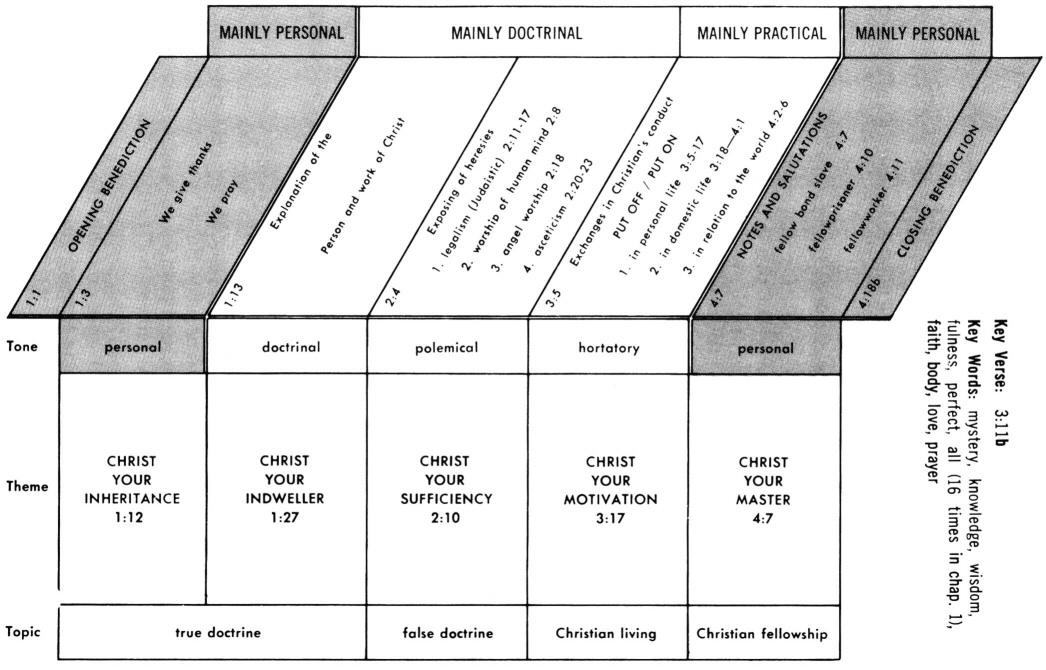
CHRIST IS ALL IN ALL
Click chart to enlarge
Charts from Jensen's Survey of the NT - used by permission
Colossians Overview - Click Chart on right side
| Christ Preeminent in All Things Supreme Lord - Sufficient Savior |
|||
| Colossians 1 | Colossians 2 | Colossians 3 | Colossians 4 |
| Supremacy of Christ |
Submission to Christ |
||
| Doctrinal and Corrective |
Practical and Reassuring |
||
| What Christ Did For Us |
What Christ Does Through Us |
||
| Christ Our Lord |
Christ Our Life |
Christ our Love |
|
| Christ the Head of the Body |
Christ the Lord of the Universe |
Christ the Head of the Home |
|
| Instruction | Warnings | Exhortations | Reminders |
| Reconciliation | Creation | Submission | Conversation |
| His Person and Word |
His Peace and Presence |
||
Colossians 4:7 As to all my affairs, Tychicus, our beloved brother and faithful servant and fellow bond-servant in the Lord, will bring you information (NASB: Lockman)
Greek: Ta kat' eme panta gnorisei (3SFAI) umin Tuchikos o agapetos adelphos kai pistos diakonos kai sundoulos en kurio
Amplified: Tychicus will give you full information about my affairs; [he is] a much-loved brother and faithful ministering assistant and fellow servant [with us] in the Lord. (Amplified Bible - Lockman)
Phillips: Tychicus (a well-loved brother, a faithful minister and a fellow-servant of the Lord) will tell you all about my present circumstances. (Phillips: Touchstone)
Wuest: All the things that relate to me, Tychicus will make known to you, the beloved brother and faithful servant and my fellow bondslave in the Lord,
AS TO ALL MY AFFAIRS: Ta kat eme panta:
- Eph 6:21, 22, 23
- Colossians 4 Resources - Multiple Sermons and Commentaries
All the things relating to me
In this final section of the letter we find the apostle revealing his great love and concern for the members of the body of Christ, a concern which vividly illustrates the statement made by the apostle in Colossians 1:24 (note), namely, that he fills up that which is lacking of the afflictions of Christ in his flesh "for his body's sake." Love for the brethren predominates.
Guy King has an interesting introduction to this next section in which Paul mentions numerous individuals by name…
I DARE say you have had the experience of receiving a letter from a friend, in which he has enclosed a group photograph of friends well-known to you both. Paul seems to have done here, in words, something of the same kind. He has grouped together, in thumbnail sketches, a number of people who are roundabout him in Rome, and who are all well-known to the church members in Colossae. How interested they will be in these glimpses, on that Sabbath morning, in the Assembly, of their far-off comrades in the Faith, brought so vividly to sight and memory by these spoken miniatures. I dare say that we, too, may gain interest and inspiration from a study of their features, for each has a characteristic profile of his own. Take a good look at them, there in the group, one by one. (His Enclosed Group Photograph)
TYCHICUS, OUR BELOVED BROTHER AND FAITHFUL SERVANT AND FELLOW BOND-SERVANT IN THE LORD: humin Tychikos o agapetos adelphos kai pistos diakonos:
- Tychicus - Acts 20:4; 2Ti 4:12; Titus 3:12
- Beloved - Col 4:9,12; Ep 6:21; Phil 2:25
- Faithful 1 Cor 4:1, 2, 3, 4
- Colossians 4 Resources - Multiple Sermons and Commentaries
Beloved brother… faithful servant… fellow bondservant in the Lord - This designation represents a beautiful threefold commendation of Tychicus.
THOUGHT: If Paul were writing a letter to your church, would he give a similar description of your Christian walk?
Beloved (27) (agapetos from agapao [word study] = love) means beloved, dear, very much loved. Agapetos is love called out of one’s heart by preciousness of the object loved. Agapetos is used only of Christians as united with God or with each other in love.
God the Father uses this same word describing Jesus declaring that
This is My beloved Son, in whom I am well-pleased." (Mt 3:17)
In fact the first 9 uses in the NT are of God the Father speaking of Christ, His beloved Son. This gives you some idea of the preciousness of the word "beloved"! This truth makes it even more incredible that Paul described the saints at Thessalonica (and by application all believers of all ages) as
brethren beloved (agapao ) by God, His choice" (1Th 1:4-note).
Brother (80) (adelphos from a = denoting unity + delphús = womb) is literally one born from same womb. Literally it is a male having the same father and mother. Adelphos describes a close association of a group of persons having well-defined membership. In the NT it often refers to fellow believers in Christ united by the bond of affection. It can also refer to a fellow countryman or a fellow Jew. In the present context it refers to a fellow believer.
Faithful (4103) (pistos [word study]) means trustworthy, dependable, reliable. Tychicus was faithful in duty to himself and to others. He was a man of true fidelity, which is a word we don't here much in our society any more but which is defined as
faithfulness to something to which one is bound by pledge or duty and implies strict and continuing faithfulness to an obligation, trust, or duty.
Fidelity is the degree to which an electronic device (CD, radio, television) accurately reproduces its effect (as sound or picture). Think about that for a moment!
Servant (1249) (diakonos see related words diakoneo, diakonia) is of uncertain origin. Some say it is from dia (through) + konis (dust) which denotes one who hurries through the dust to carry out his service. (Thayer and others doubt this derivation for technical reasons).
Vine says that diakonos is probably from diako which means to hasten after, to pursue and so to run on errands. "Then the root idea is one who reaches out with diligence and persistence to render a service on behalf of others. This would imply that the deacon reaches out to render love-prompted service to others energetically and persistently." (Hiebert)
This word group (diakonos, diakoneo, diakonia) focuses on the rendering or assistance or help by performing certain duties, often of a humble or menial nature, and including such mundane activities as waiting on tables or caring for household needs, activities that to many would seem to be without dignity (not true of course in God's eyes, Pr 15:3, Rev 22:12-note). In summary, the basic idea of this word group is that of humble, submissive, personal service, with less emphasis on a specific office or a particular function. As Matthew Henry once said…
Those whom God will employ are first struck with a sense of their unworthiness to be employed.
Diakonos - "Waiting Tables"
in God’s Household
John MacArthur adds that…
Diakonos has the idea of “serviceability,” or “usefulness.” Those who serve Christ are called to excellence in their usefulness to His cause.
Richards observes that…
A survey of NT passages using the diakoneo word group (diakonos, diakoneo, diakonia) reveals how we can serve others and what "ministry" involves. It will include the following activities: caring for those in prison (Mt 25:44), serving tables (i.e., meeting physical needs) (Ac 6:2), teaching the Word of God (Ac 6:4), giving money to meet others' needs (2Co 9:1), and all the service offered by Christians to others to build them up in faith (1Co 12:5; Ep 4:12-note). Although Paul and other apostles are called ministers, and although there was the office of deacon in the early church, there is a sense in which every believer is a minister and is to use his or her gifts to serve others
This call for every believer (note "each one" below) to be a minister is especially emphasized by Peter in his summation of spiritual gifts…
As each one has received a special gift, employ it in serving (diakoneo) one another, as good stewards of the manifold grace of God. Whoever speaks, let him speak, as it were, the utterances of God; whoever serves (diakoneo), let him do so as by the strength which God supplies; so that in all things God may be glorified through Jesus Christ, to whom belongs the glory and dominion forever and ever. Amen. (1Pe 4:10,11-note)
A good picture of the meaning of this word group is found in the use of diakoneo to describe Peter's mother-in-law who was healed by Jesus
and she immediately got up and waited (diakoneo) on them. (Lk 4:39)
Bridges rightly observes that…
Service to God through service to mankind is the only motivation acceptable to God for diligence and hard work in our vocational calling.
Were it not for Paul’s letter, we would never know that Onesiphorus had served Paul and the church (see 2Ti 1:16, 18-note). But the Lord knew and will reward him and He will reward you for your faithful service “on that day”
for God is not unjust so as to forget your work and the love which you have shown toward His name, in having ministered (diakoneo) and in still ministering (diakoneo) to the saints (Heb 6:10-note)
Hiebert writes that diakonos…
refers to a servant in relationship to his activity, one who renders a service to another for the benefit of the one being served. Unlike the word for slave (doulos) diakonos implies the thought of voluntary service. It is used of the “servants” at the wedding in Cana (John 2:5, 7, 9). They were individuals who had voluntarily assumed this activity out of good will for the bride and groom. Among these various Greek words this one has the. nearest approximation to the concept of a love-prompted service. Thus basically the word “deacon” denotes one who voluntarily serves others, prompted by a loving desire to benefit those served…
The non-technical usages of this word group (diakonos, diakoneo, diakonia) extend beyond the narrow limits implied in the English word “deacon,” which designates an ecclesiastical office. These Greek words provide a spiritually rich concept of service. For a true understanding of the biblical import of the term “deacon” this high concept of “deacon service” must be retained.
The basic concept underlying the word “deacon” is that of a voluntary, love-prompted service for the benefit of others. It is a service that desires the true welfare of those ministered to. “Deacon service” may well involve prosaic, material “table service,” but it should go beyond such service and seek to further the highest spiritual welfare of others.
The work of the deacon, related to the local church and to the whole cause of Christ, must be spiritually motivated and be Christ-centered. It finds its motivation and encouragement in the self-sacrificing example and call of Christ. “The diakonos is always one who serves on Christ’s behalf and continues Christ’s service for the outer and inner man; he is concerned with the salvation of men.” It is a demanding and consuming service, but it has Christ’s sure promise of reward: “If any one serves Me, the Father will honor him” (John 12:26).
Since service associated with the diakoneo word group (diakonos, diakoneo, diakonia) necessarily involved dependence, submission, and constraints of time and freedom, the Greeks regarded a diakonos, et al as a degrading and dishonorable occupation. Service for the public good was honored, but
voluntary giving of oneself in service of one’s fellow man is alien to Greek thought. The highest goal before a man was the development of his own personality.
That last sentence is strikingly contemporary, and is mindful of the fact that a culture that is largely focused on SELF (cp 2Ti 3:1,2-note) will find little value in menial, mundane servant hood.
To the Greeks, diakonia service was not dignified. Thus they lauded ruling and not service as the proper goal of man. The formula of the sophist ("wise man") expressed the basic Greek attitude
“How can a man be happy when he has to serve someone?”
Judaism had no philosophy of ministry involving the mundane, menial sense of a diakonos, instead adopting a philosophy of service similar to the Greeks. If service was rendered, it was done as an act of social obligation or as an act to those more worthy (this too sounds very "modern"). In short, a superior would not stoop to become a servant! Such an attitude, which conforms so closely to man’s natural prejudices, causes the Lord’s Servant attitude and actions to stand out even more (cp Jn 13:3, 4, 5). Clearly, Jesus' examples teach us that the word group diakonos, diakoneo, diakonia does not describe the activity of a lesser to a greater, but in fact is to be the lifestyle one privileged to be called a follower of the Lord Jesus Christ.
Jesus declared
If anyone serves (diakoneo) Me, let him follow Me; and where I am, there shall My servant (diakonos) also be; if anyone serves (diakoneo) Me, the Father will honor him. (John 12:26)
The word group (diakonos, diakoneo, diakonia) differs the other Greek word group, douleuo (doulos) which also means to serve, in that the former word group connotes “service” on behalf of someone while the latter speaks of “service” as a slave under or subordinate to someone (as a bondservant or bondslave to the “lord” or “master”). As Richards says…
In Greek thought, both types of service were shameful. The duty of the Greek person was to himself, to achieve his potential for excellence. To be forced to subject his will or surrender his time and efforts for the sake of others was intensely distasteful, even humiliating. But Jesus came to serve, not to be served. In giving Himself for others, Jesus set the pattern for a transformed value system. In Christ, serving is the highway to greatness. In Christ we achieve our full potential by giving, not by grasping. (Richards, L O: Expository Dictionary of Bible Words: Regency)
In fact, in the first five NT uses of diakonos (Mt 20:26, Mt 23:11, 23:11, Mk 9:35, Mk 10:45, cp Jn 12:26), Jesus counters the wisdom of the world, by elevating the menial role of the diakonos, declaring such a one to be on the pathway to greatness in His kingdom. As discussed, it is not surprising that servant hood would be associated with kingdom greatness for this was the goal of incarnation of the King Himself, as stated in Mk 10:45 (verb diakoneo). It follows that for a man or woman to be a servant is to be walk in the steps of the Lord. The corollary is that for one to achieve true greatness, he must humble himself and serve others.
John Calvin thus rightly noted that…
The highest honour in the church is not government but service. (adding)… We shall never be fit for the service of God if we look not beyond this fleeting life.
John Blanchard phrases it this way
Christian service has been dignified by Deity.
J C Ryle writes that
The world's idea of greatness is to rule, but Christian greatness consists in serving (cp Mk 10:45).
Vance Havner…
There are no trivial assignments in the work of the Lord.
Henrietta Mears…
Serving God with our little is the way to make it more; and we must never think that wasted with which God is honoured or men are blessed.
The the word group diakonos, diakoneo, diakonos differs the other Greek word group, douleuo (doulos) which also means to serve, in that the former word group connotes “service” on behalf of someone while the latter speaks of “service” as a slave under or subordinate to someone (as a bondservant or bondslave to the “lord” or “master”). As Richards says…
In Greek thought, both types of service were shameful. The duty of the Greek person was to himself, to achieve his potential for excellence. To be forced to subject his will or surrender his time and efforts for the sake of others was intensely distasteful, even humiliating. But Jesus came to serve, not to be served. In giving Himself for others, Jesus set the pattern for a transformed value system. In Christ, serving is the highway to greatness. In Christ we achieve our full potential by giving, not by grasping. (Richards, L O: Expository Dictionary of Bible Words: Regency)
Vine writes that…
Diakonos is, generally speaking, to be distinguished from doulos, a bondservant, slave; diakonos views a servant in relationship to his work; doulos views him in relationship to his master… As to synonymous terms, leitourgos denotes one who performs public duties; misthios and misthōtos, a hired servant; oiketes, a household servant; huperetes, a subordinate official waiting on his superior (originally an under–rower in a war–galley); therapon, one whose service is that of freedom and dignity.
The most common sense of diakonos in the NT is that of a servant in some capacity. (19/29x diakonos is rendered servant in NAS)
To summarize, diakonos is used to describe
(1) Domestic servants (Jn 2:5, 2:9)
(2) Civil (government) servants (Ro 13:4)
(3) Servants in a general spiritual sense (with some of the contexts suggesting specific duties)
(a) as servants of God (Jesus) (1Co 3:5, 2Co 3:6, 2Co 6:4, 2Co 11:23, Ep 3:7, Ep 6:21, Col 1:23, Col 1:27, Col 4:7, 1Ti 4:6) Tychicus is a lovely illustration of one serving the Lord in a lowly place (Lowly in the world's estimate, not God's!).
(b) as servants of Satan (2Co 11:15).
(4) In a technical sense of church officer (deacon) who exercises primarily a servant role (Php 1:1, 1Ti 3:8, 1Ti 3:12)
(5) The way to greatness in the Kingdom of God (which would clearly be interrelated with diakonos used above in #3a to describe servants of God or Jesus) (Mt 20:26, Mt 23:11, 23:11, Mk 9:35, Mk 10:45, cp Jn 12:26).
Ministry (including "mission" as shown in the reference below) is not the activity of an elite class, but the mutual caring of a band of brothers. Luke records that
Barnabas and Saul returned from Jerusalem when they had fulfilled their mission (diakonia), taking along with them John, who was also called Mark. (Acts 12:25)
Such service is personal and practical, rather than institutional. A diakonos is one who by choice and position has come to be under the authority of his Master and who therefore serves others in love and gratitude. Paul had been called and set apart to be a servant, Luke quoting Paul who testified…
I do not consider my life of any account as dear to myself, in order that I may finish my course, and the ministry (diakonia) which I received from the Lord Jesus, to testify solemnly of the gospel of the grace of God. (Acts 20:24)
Martha is an example of service of a menial nature but without the proper attitude, Luke recording that
Martha was distracted with all her preparations; and she came up to Him, and said, "Lord, do You not care that my sister has left me to do all the serving (diakonia) alone? Then tell her to help me. (Lk 10:40)
The word group diakonos, diakoneo, diakonia involves compassionate love towards the needy within the Christian community. Paul and Luke in the Acts use the word to designate those who preach the gospel and have care of the churches, even as Paul instructed Timothy to…
be sober in all things, endure hardship, do the work of an evangelist, fulfill your ministry (diakonia) (2Ti 4:5-note)
Therefore, the word group diakonos, diakoneo, diakonia describes an office or ministration in the Christian community viewed with reference to the labor needed for others.
What Paul said to Archippus in the closing section of Colossians applies to every believer…
Take heed (aorist imperative = Don't delay! Do this now! The charge is urgent!) to the ministry (diakonia) which you have received in the Lord, that you may fulfill it. (Col 4:17)
Every believer is called by His Lord to the role of a servant, and one of the surest ways we can serve Christ is to serve the saints in His behalf (see Mt. 25:34, 35, 36, 37, 38, 39, 40).
Diakonos - 29x in 27v - Mt 20:26; 22:13; 23:11; Mark 9:35; 10:43; John 2:5, 9; 12:26; Rom 13:4; 15:8; 16:1; 1Cor 3:5; 2 Cor 3:6; 6:4; 11:15, 23; Gal 2:17; Eph 3:7; 6:21; Phil 1:1; Col 1:7, 23, 25; 4:7; 1Ti 3:8, 12; 4:6. NAS = deacons(3), minister(7), servant(10), servants(9).
Matthew 20:26 "It is not this way among you, but whoever wishes to become great among you shall be your servant,
Greatness in the world is having many servants; greatness in God’s sight is serving (a majestic Savior). (John Butler) (Words in parentheses added).
Hiebert - Paul used the word diakonos of Christ Himself: “Christ has become a servant to the circumcision on behalf of the truth of God” (Ro 15:8). And Jesus said of Himself, “For even the Son of Man did not come to be served, but to serve (diakoneo), and to give His life a ransom for many” (Mk 10:45; Matt. 20:26). In the Upper Room, Jesus, the uncontested superior of His disciples, washed their feet (John 13:1–17) as a lesson of love-prompted service. Though the one being served is the accepted superior, He pointed them to “the actuality: I am among you as a servant. ƒ He is instituting in fact a new pattern of human relationships” through His personal example. And “this summons to service becomes binding because behind it stands the sacrifice of Jesus, who came ‘not to be served but to serve, and to give his life as a ransom for many’ (Mark 10:45).” In His earthly ministry Jesus Himself was the “Deacon” par excellence. He set the example not only for deacons but for all believers.
Jesus said, “If any one serves Me, let him follow Me, and where I am, there shall My servant also be” (John 12:26). When Jesus uttered those words He was facing the cross. He knew that for His incarnate ministry to be spiritually fruitful He must die (John 12:24). That imperative lies on all His followers: “Where I am, there shall my servant also be.” Believers too must be willing to die to self, if they are to be His fruitful servants.
Matthew 22:13 "Then the king said to the servants, 'Bind him hand and foot, and throw him into the outer darkness; in that place there will be weeping and gnashing of teeth.'
Hiebert - Rendering Service to Another = Often the scope of the service was broader than table service and denoted service generally for the benefit of another. Jesus used the noun diakonoi to denote the personal servants of a great king (Matt. 22:1–14). In the first part of the parable (Mt 22:3,4, 6, 8, 10) Jesus used the ordinary word for slaves (doulos), but later He changed to the word diakonos to denote those servants who stood in a close relationship to the king and served him personally in any desired capacity.
Jesus used these terms to depict the relationship of believers to Him: “If any one serve (diakone) Me, let him follow Me; and where I am, there shall My servant (diakonos) also be” (John 12:26). In this more general sense believers today are challenged to render “deacon service” to Christ Himself. Jesus added the encouraging assurance that such service will have its reward: “If any one serves Me, the Father will honor him” (John 12:26c). Such a love-prompted service to Him will express itself in service to others. Jesus taught that He would recognize such service as done unto Him (Matt. 25:40–45).
Jesus taught that believers must voluntarily serve other believers, motivated and inspired by His own example of service (Matt. 20:26–28; Mark 10:45). The terms thus came to denote loving service to brothers and neighbors, which is to be the distinguishing mark of Christ’s followers. Jesus taught His disciples that instead of lording it over others, they must be willing to serve others (Matt. 20:25–26). Such service was the way to greatness among them, “Whoever wishes to become great among you shall be your servant” (diakonos; Matt. 20:26). Those who aspire to be leaders must voluntarily stoop to serve.
Paul used the noun diakonia of the voluntary ministry which Stephanus and his family were rendering to the Corinthian church (1 Cor. 16:15). It involved a voluntary use of strength and possessions for the benefit of others, thus furthering the fellowship of the church. And in Hebrews 1:14 this term is used of the angels who are “sent out to render service (eis diakonian) for the sake of those who will inherit salvation.” This pictures angels divinely sent to render “deacon service” to the saints. This service involves protecting believers and furthering their well-being. Thus these terms for service are often used in a general sense to denote any kind of service rendered for the benefit of others.
Matthew 23:11 "But the greatest among you shall be your servant.
Mark 9:35 Sitting down, He called the twelve and said to them, "If anyone wants to be first, he shall be last of all and servant of all."
Mark 10:43 "But it is not this way among you, but whoever wishes to become great among you shall be your servant;
John 2:5 His mother said to the servants, "Whatever He says to you, do it."..9 When the headwaiter tasted the water which had become wine, and did not know where it came from (but the servants who had drawn the water knew), the headwaiter called the bridegroom,
Hiebert - Waiters at Tables - The original sense of the verb diakoneo, “to wait at tables,” is clear in Luke 17:8. Jesus spoke of a slave owner ordering his slave, returning from work in the field, to gird himself “and serve me until I have eaten and drunk.” This is also the meaning in Acts 6:2. It is also the obvious meaning of the noun diakonos in John 2:5, 9. This basic meaning of the cognate noun diakonia is evident in Luke 10:40 which uses it of Martha in whose home Jesus was a guest. While Mary sat at Jesus’ feet, Martha was “cumbered about much serving” (KJV). She was greatly concerned about getting an appropriate meal ready for Jesus; she was engaged in “deacon service” on behalf of Jesus personally. Peter’s mother-in-law, healed by Jesus, rendered a similar service in the privacy of her home (Matt. 8:15). These terms were often used of the domestic services of women. Also angels rendered such a service to Jesus at the end of His wilderness temptation Matt. 4:11). They were rendering “deacon service” to Him in supplying His physical needs after 40 days of fasting.
John 12:26 "If anyone serves (diakoneo) Me, he must follow Me; and where I am, there My servant will be also; if anyone serves (diakoneo) Me, the Father will honor him.
What work does Christ set his servants to do? The way that they serve him, he tells them, is by becoming the slaves of their fellow-servants and being willing to do literally anything, however costly, irksome, or undignified, in order to help them. This is what love means, as he himself showed at the Last supper when he played the slave’s part and washed the disciples’ feet. (From Your Father Loves You by James Packer)
Romans 13:4-note for it is a minister of God to you for good. But if you do what is evil, be afraid; for it does not bear the sword for nothing; for it is a minister of God, an avenger who brings wrath on the one who practices evil.
Romans 15:8-note For I say that Christ has become a servant to the circumcision on behalf of the truth of God to confirm the promises given to the fathers,
Romans 16:1-note I commend to you our sister Phoebe, who is a servant of the church which is at Cenchrea;
John MacArthur on deacon in Romans 16 - Servant translates diakonos, the term from which we get deacon. The Greek word here is neuter and was used in the church as a general term for servant before the offices of deacon and deaconess were developed. It is used of the household servants who drew the water that Jesus turned into wine (John 2:5, 9), and Paul has used the term earlier in this letter (Rom. 13:4, twice) to refer to secular government as “a minister of God to you for good” and even of Christ as “a servant to the circumcision,” that is, to Jews (15:8). When diakonos obviously refers to a church office, it is usually transliterated as “deacon” (see, e.g., Phil.1:1; 1Ti 3:10, 13).
In 1Ti 3:11, Paul declares that “women must likewise be dignified, not malicious gossips, but temperate, faithful in all things.” Some argue that he is referring to wives of deacons, rather than to an office of women deacons. But it makes no sense that high standards would be specified for the wives of deacons but not for wives of overseers (or bishops, who are also called elders, see Titus 1:5), whose qualifications he has just given in 1Ti 3:1-7. In this context (1Ti 3:1–10, 1Ti 3:12,13), the office of deaconess is clearly implied. The “likewise” in 1Ti 3:11 ties the qualifications of these women to those already given for the offices of overseer and deacon. In 1Ti 3:11, Paul did not refer to those women as deaconesses because diakonos has no feminine form.
During the first few centuries of the church, the role of a woman servant (diakonos) was to care for fellow believers who were sick, for the poor, for strangers passing through, and for the imprisoned. They also were responsible for helping baptize and disciple new women converts and to instruct children and other women. Whether or not Phoebe held some official title or not, Paul commended her as a highly-proven servant of Christ and implored the church at Rome to receive her in the Lord. (MacArthur, J: Romans 9-16. Chicago: Moody Press)
1Corinthians 3:5 What then is Apollos? And what is Paul? Servants through whom you believed, even as the Lord gave opportunity to each one.
Servants here signifies there were "conduits" or "instruments" through which the gospel flowed to the hearers, some of who received and believed the truth.
John MacArthur - His servants (diakonoi), or ministers (1Co 3:5KJV). It is not the same word (doulos) often translated “servant, slave, or bond–servant” (1Co 7:21, 22, 23; Ro 1:1; etc.), but simply meant a menial worker of any sort, free or slave. It was often used of a table waiter or what we would now call a busboy. Paul was saying in effect,
“No one builds a movement around a waiter or busboy, or erects monuments to them. Apollos and I are just waiters or busboys whom the Lord used as servants to bring you food. You do not please us by trying to honor us. Your honor, your glory, is misplaced. You are acting like the world, like mere men. Build your monuments, give your praise to the One who prepared the spiritual food we delivered.” (MacArthur, J: 1Corinthians. Chicago: Moody Press)
2 Corinthians 3:6 who also made us adequate as servants of a new covenant, not of the letter but of the Spirit; for the letter kills, but the Spirit gives life.
John MacArthur - True ministers, however, are servants of a new covenant. They do not mingle the old (the Mosaic covenant of law) and the new covenant, because the new covenant alone saves. The wonderful reality of the new covenant is that no one has to come to God via external Judaism. (MacArthur, J: 2Corinthians. Chicago: Moody Press)
2 Corinthians 6:4 but in everything commending ourselves as servants of God, in much endurance, in afflictions, in hardships, in distresses,
John MacArthur - Paul not only sought negatively to avoid putting up barriers to faith in Christ, but positively to be in everything commending himself as a servant of God. A minister is not commended by his seminary degree, theology, popularity, personality, or success. His life is the only letter of commendation that matters; the only one that people will read. (MacArthur, J: 2Corinthians. Chicago: Moody Press)
2 Corinthians 11:15 Therefore it is not surprising if his servants also disguise themselves as servants of righteousness, whose end will be according to their deeds.
2 Corinthians 11:23 Are they servants of Christ?-- I speak as if insane-- I more so; in far more labors, in far more imprisonments, beaten times without number, often in danger of death.
Galatians 2:17 "But if, while seeking to be justified in Christ, we ourselves have also been found sinners, is Christ then a minister of sin? May it never be!
Context - Paul is countering Peter and other Jewish believers who felt it was necessary for a Gentile believer to keep Jewish rituals. John MacArthur writes that Paul was saying in essence - “If you became sinners because of fellowshipping with your Gentile brothers,” he implies, “then Christ Himself became a minister of sin, did He not?” How? Jesus had clearly taught that no food can spiritually contaminate a person, because food cannot affect the heart (Mk 7:19). Through the vision of the unclean animals and the dramatic conversion and anointing of Cornelius, the Lord had given Peter direct evidence that Gentile believers are in every way equal to Jewish believers (Acts 10). On many other occasions and in many other ways Jesus had taught that all those who belong to Him are one with Him and therefore one with each other. Shortly before His arrest, trial, and crucifixion, Jesus earnestly and repeatedly prayed to His Father that those who believed in Him “may all be one; even as Thou, Father, art in Me, and I in Thee, that they also may be in Us … that they may be one, just as We are one; I in them and Thou in Me, that they may be perfected in unity” (John 17:21, 22, 23). But if the Judaizers were right, Paul pointed out, Jesus was wrong; if they taught the truth, He had taught falsehood and was thereby a minister of sin! Such an accusation must have shaken Peter to his bones. To be called a hypocrite stung enough, but to be called a sinner was unthinkable, and to be accused of making Jesus a minister of sin was shocking and repulsive. Yet the logic of Paul’s argument was inescapable. By his actions, Peter had in effect condemned Jesus Christ. He therefore had to forsake his Judaistic sympathies or continue to make His Lord a liar. (MacArthur, J. Galatians. Chicago: Moody Press)
Ephesians 3:7-note (Context - Ep 3:4, 5, 6) of which (referring to the Gospel) I was made a minister, according to the gift of God's grace which was given to me according to the working (energeia ~ English "energizing") of His power.
John Calvin said that "Whatever is laudable in our works proceeds from the grace of God."
Vance Havner put it this way "Our efficiency without God's sufficiency is only a deficiency… The first thing we need to do in the church these days is to discover that God's work must be done by God's people in God's way."
Notice that Paul functioned as a diakonos not in his own innate power but according to the working of His power. Paul affirmed his service to Christ as a minister or servant of Christ, a service which God granted (initiated) by His grace. Rather than fleshly laborious servitude, ministry for Christ brings joyful freedom as we depend on God's energizing power to accomplish the task He has assigned. In your sphere of work as a diakonos, a humble "table waiter" for Christ, are you learning the "secret" of depending on His power to accomplish His work through you? It was Paul's secret of supernatural, successful ministry and is still the "secret" for every fruitful servant of every age! John Bunyan (Pilgrim's Progress) put it this way
"I was but a pen in God's hand and what praise is due to a pen?"
Ephesians 6:21-note But that you also may know about my circumstances, how I am doing, Tychicus, the beloved brother and faithful minister in the Lord, will make everything known to you.
EBC - Eduard Schweizer has shown that the Greek language was particularly rich in the vocabulary of high office (Church Order in the New Testament, Eng. T. [London: S. C. M., 1961], pp. 171, 172). The NT rejects almost all such titles and fixes on a word altogether unassociated with prestige (cf. Eph 6:21). The servant (diakonos) is a table waiter who is always at the bidding of his customers (so in Xenophon, Polybius, Lucian, etc.; cf. BAG, p. 183). The term is used in the NT to denote one who lives and works in the service of Christ and the church.
Philippians 1:1-note Paul and Timothy, bond-servants of Christ Jesus, To all the saints in Christ Jesus who are in Philippi, including the overseers and deacons:
Hiebert - In addressing his letter to “all the saints in Christ Jesus who are in Philippi,” Paul added the unique expression “including the overseers and deacons.” This is the first certain occurrence of diakonos as a term of office in the New Testament. Mention of only these two offices in the salutation of the epistle implies that they were the only two officially established offices in the Philippian church. Though they constitute two distinct offices, they are closely related; Paul names both with one preposition. The order gives precedence to the overseers. Both terms are in the plural; neither office was confined to a single individual. The plurals leave undetermined how many overseers and deacons the Philippian church had. That, of course, would depend on the size and needs of the local church. The term “overseers” (or “bishops,” KJV) points to the basic duty of this office. The meaning of “deacons” simply points to a service function. No further hints of the respective duties of these two offices are given in this epistle. The order and basic meanings of the two terms suggest that the deacons somehow assisted the bishops in their ministries.
Colossians 1:7-note just as you learned it from Epaphras, our beloved fellow bond-servant, who is a faithful servant of Christ on our behalf,
Mark Hepner states that the concept of diakonos - ‘serves’ as an apt metaphor for Christian ministry since it denotes the taking of resources provided by the Master of the house and distributing them to those gathered around the Master’s table to sustain the physical and spiritual health and well-being of the Master’s family… The picture of Christian ministry distilled from Paul’s words to the Colossian believers may thus be summarized as “the living Christ active in each member of the family of God through the sensible, powerful presence of His Holy Spirit, working in and through them to form them individually and corporately into a body that looks like Him, loves like Him, perseveres like Him, obeys like Him, suffers like Him, relates to the Father like Him, and strives to see God’s purposes realized in the world like Him.” (Ashland Theological Journal Volume 37:51. 2005)
Colossians 1:23-note if indeed you continue in the faith firmly established and steadfast, and not moved away from the hope of the gospel that you have heard, which was proclaimed in all creation under heaven, and of which I, Paul, was made a minister.
Hiebert says this verse (among others) depicts diakonos as indicative of - Servants of a Spiritual Power - Diakonos is often used figuratively in the New Testament of one who is the servant of a mighty spiritual power. This power may be either good or bad.
Paul used the noun diakonos of false teachers who are the servants of Satan (2Cor. 11:15). Paul commented that it was no surprise that men should be the deceptive servants of Satan since Satan likewise transforms himself into an angel of light,
But in most instances the word denotes a good power, the God whom believers serve. Paul referred to his coworkers as diakonoi of God. Paul said Epaphras was ƒ a faithful servant of Christ” (Col. 1:7). The apostle also used this noun to describe Tychicus (Eph. 6:21; Col. 4:7), and he used the verbal form in referring to Timothy and Erastus (Acts 19:22) and of Onesiphorus (2Ti 1:16, 17, 18).
Paul also used diakonos of himself to describe his position as furthering the cause of God. He used the term to describe his relation to the gospel and its message of hope (Col 1:23) and of his relationship to the church (Col 1:25). As commissioned by Christ, he performed a deacon service in voluntarily furthering the interest of both. His God-given ministry (diakonia) was among the Gentiles (Acts 21:19, 1Ti 1:12). Paul described his God-given work as a “ministry of reconciliation” (2Co 5:18), a service that aimed at bringing men into spiritual reconciliation with God through the gospel.
Paul sent Archippus a special message: “Take heed to the ministry (diakonia) which you have received in the Lord, that you may fulfill it” (Col 4:17). It was a delegated ministry and in thought the usage approaches the concept of the office of the deacon. But the context suggests rather that he had been chosen for pastoral service to replace Epaphras, their minister, while he was with Paul at Rome. The ministry Archippus was to perform was pastoral in function, but as a voluntary service for the spiritual benefit of the church it had the character of deacon service.
Being used of God to convey His message to others is another phase of such a ministry. Peter referred to this ministry by the Old Testament prophets when they made known to New Testament believers the sufferings and glory of the Messiah (1Pe 1:12). To be the channels of making known to others the revealed message of God is a ministry in which deacons can freely share but it is not limited to the office of the deacon.
Colossians 1:25-note Of this church I was made a minister according to the stewardship from God bestowed on me for your benefit, so that I might fully carry out the preaching of the word of God,
Colossians 4:7-note As to all my affairs, Tychicus, our beloved brother and faithful servant and fellow bond-servant in the Lord, will bring you information.
1 Timothy 3:8 Deacons likewise must be men of dignity, not double-tongued, or addicted to much wine or fond of sordid gain,
Diakonos places emphasis upon the attitude that the leaders are to have in their leading. They are not to “lord it over” the flock, but are to realize that they are the ministers or servants to those whom the Lord has put under their care.
1 Timothy 3:12 Deacons must be husbands of only one wife, and good managers of their children and their own households.
ISBE Article - DEACON; DEACONESS - The term diakonos, and its cognates occur many times in the New Testament… Christianity has from the beginning stood for filial service to God and His kingdom and for brotherly helpfulness to man, and hence, terms expressive of these functions abound in the New Testament. It behooves us to inquire whether and where they occur in a technical sense sufficiently defined to denote the institution of a special ecclesiastical office, from which the historical diaconate may confidently be said to be derived.
Many have sought the origin of the diaconate in the institution of the Seven at Jerusalem (Acts 6), and this view was countenanced by many of the church Fathers. The Seven were appointed to "serve tables" (diakonein trapezais), in order to permit the Twelve to "continue stedfastly in prayer, and in the ministry (diakonia) of the word." They are not called deacons (diakonoi), and the qualifications required are not the same as those prescribed by Paul in 1Ti 3:8-12; furthermore, Stephen appears in Acts preeminently as a preacher, and Philip as an evangelist. Paul clearly recognizes women as deaconesses, but will not permit a woman to teach (1Ti 2:12). The obvious conclusion is that the Seven may be called the first deacons only in the sense that they were the earliest recorded helpers of the Twelve as directors of the church, and that they served in the capacity, among others, of specially appointed ministrants to the poor.
Paul says, "I commend unto you Phoebe our sister, who is a servant (the Revised Version, margin "or, deaconess") of the church that is at Cenchrea" (Ro 16:1). This is by many taken as referring to an officially appointed deaconess; but the fact that there is in the earlier group of Paul's epistles no clear evidence of the institution of the diaconate, makes against this interpretation. Phoebe was clearly an honored helper in the church closely associated with that at Corinth, where likewise evidence of special ecclesiastical organization is wanting.
In Phil 1:1 Paul and Timothy send greetings
"to all the saints … at Philippi, with the bishops and deacons."
Here then we find mention of "deacons" in a way to suggest a formal diaconate; but the want of definition as to their qualifications and duties renders it impossible to affirm with certainty the existence of the office.
In 1Ti 3:8, 9, 10, 11, 12, after prescribing the qualifications and the method of appointment of a bishop or overseer, Paul continues:
"Deacons in like manner must be grave, not double-tongued, not given to much wine, not greedy of filthy lucre; holding the mystery of the faith in a pure conscience. And let these also first be proved; then let them serve as deacons, if they be blameless. Women in like manner must be grave, not slanderers, temperate, faithful in all things. Let deacons be husbands of one wife, ruling their children and their own houses well."
Deacons and deaconesses are here provided for, and the character of their qualifications makes it clear that they were to be appointed as dispensers of alms, who should come into close personal relations with the poor.
We conclude, therefore, that the Seven and Phoebe did not exercise the diaconate in a technical sense, which appears first certainly in 1 Tim 3, although it is not improbably recognized in Phil 1:1, and was foreshadowed in the various agencies for the dispensing of alms and the care of the poor of the church instituted in various churches at an earlier date.
See also article by Daniel Akin in Baker's Evangelical Dictionary of Biblical Theology - Deacon, Deaconess
1 Timothy 4:6 In pointing out these things to the brethren, you will be a good servant of Christ Jesus, constantly nourished on the words of the faith and of the sound doctrine which you have been following.
Hiebert notes that this word group diakonos, diakoneo, diakonia also reflects
A Monetary Ministry (diakonos is not used with this sense) -This family of words is also used of serving others through monetary means. When Jesus was preaching in the cities of Galilee, He was accompanied by certain women whom He had healed, who “were helping to support them out of their own means” (Luke 8:3NIV). Out of love and gratitude they used their money to supply the material needs of Jesus and His disciples. They formed the first “Ladies Peripatetic Missionary Society” in that they used their material means to further missionary goals.
Paul used these terms in connection with the collection being raised for the poor saints at Jerusalem (2Cor. 8–9). In these chapters Paul did not use the word “money”; instead he used terms which characterized the collection as a spiritual service. By means of “this ministry to the saints” (2Co 9:1) the local churches reached out to believers elsewhere as a ministry in building up the whole body of Christ (Ep 4:12; cf. Acts 11:29; 12:29).
Dealing with money matters is commonly accepted as a phase of the work of church deacons. But when deacons deal with money, it should not be viewed simply in terms of cold cash; the money entrusted to them must be viewed as a means to minister to others for spiritual ends. When the Gentile believers sacrificially raised money for the Jewish believers in Jerusalem (2Co 8:1, 2, 3, 4, 5), they were rendering “deacon service” toward them. They desired the total welfare of their fellow believers in Judea. Thus all believers have the opportunity to render “deacon service” to others through their material means.
Diakonos - 3x in the non-apocryphal Septuagint - Esther 1:10; 2:2; 6:3, 5; Pr 10:4
Mark Hepner offers this summation of diakonos…
This third member of the NT “ministry” word group is used to designate the person who “serves” (diakoneō) by doing acts of “service” (diakonia) on behalf of a master. Here the emphasis is on the nature of ministry as discharging the duties laid upon the servant by a person of higher status and authority. As a king orders his servants and they obey (Mt. 22:13), so the servant-minister acts in strict accordance with the will of his or her Master (cf. 1Co 3:5NIV: “What, after all, is Apollos? And what is Paul? Only servants, through whom you came to believe—as the Lord has assigned to each his task.”). Thus believers are variously described as servants of Jesus (Jn. 12:26; cf. Col 1:7)), of God (2Cor. 6:4), of the new covenant (2Cor 3:6), of the gospel (Ep 3:7; cf. Col 1:23), and of the church (Ro 16:11; cf. Col. 1:25).
If believers are servants of Christ their Lord, they are also servants of Christ’s body, the church (Col 1:25). In the first instance believers serve the will of One who is infinitely superior in authority and status. In the church however, where all members (ideally) share the same status in Christ, ministry is carried on among equals. In this context the Christian minister is at heart one whose actions are dictated by the need-requirements of his or her brothers and sisters in Christ. Thus a minister in the household of God is one who makes the needs of the rest of the family equal to the command of Christ himself (Mt. 20:26; 23:11).
To sum up, this survey of the diakonia word group indicates that the core idea of ministry is supplying what people need to keep on living as Christ’s body in the world. Christian ministry is fundamentally a practical activity, consisting of acts of service to others for the purpose of sustaining their life as a community of faith, promoting their maturity and growth in Christ-likeness, and enhancing their ability to carry on the mission of Christ. Ministry is obedient service done on behalf of the Master for the benefit of his people. Ministry is making the needs of fellow believers equivalent to the command of the Lord himself and willingly distributing to them what the Master has placed in their hands to meet those needs. (Ashland Theological Journal Volume 37:51. 2005)
There are several synonyms used in the NT to describe service or ministry.
(1) Diakonos - a minister, waiter, attendant, servant (applied to a teacher, pastor or deacon), and speaks of service or ministry to other men and women "as objects of the loving services we extend to them for Jesus' sake". (Richards)
(2) Doulos - one who is in bondage and thus a servant related to the master as a slave who must at all times be subservient. In the NT doulos often speaks of a believer's submission to their Master Jesus, whereas diakonos (diakonia, diakoneo) speaks more about the "loving action on behalf of a brother or sister or neighbor" (Richards) a motif concerning which Jesus set the premier example (cp Mk 10:45, Mt 20:28).
Hiebert - Doulos carries the thought of one who belongs wholly to his master and is obligated to do his master’s will. The early church found it a fitting term to express the spiritual reality that a believer belongs wholly to his heavenly Lord and consequently must obey Him in total submission.
(3) Huperetes - literally an under-oarsman (originally an under–rower in a war galley ship) and so a subordinate servant, a subordinate official waiting to accomplish the commands of his superior (Mt 5:25, Lk 4:20, Jn 18:36, Acts 13:5)
Hiebert - It denotes one who works under the direction of another as his superior. It is the word used in the Gospels of the officers of the Jews, acting under the direction of the high priest, who arrested Jesus in the garden. The term implies the position of a “staff-officer” (cf. Acts 13:5). In John 18:36 Jesus used the term of His own disciples, implying their dignity. In 1 Corinthians 4:1 Paul uses this term in referring to a Christian minister in the widest sense.
(4) Leitourgos - in Classic Greek denotes one who a public servant or one who who discharges a public service on behalf of the people or the state. The term was used of the priests ministering in the temple. In Romans 13:6 Paul used it of pagan governmental officials, while in Philippians 2:25 he used it of the ministry of Epaphroditus to him on behalf of the Philippian church.
(5) Therapon - a menial attendant who shows serves voluntarily. Trench says therapon conveys "the sense of one whose services are tenderer, nobler, freer than those of the doulos." (Only used in Heb 3:5) Therapon is a willing servant who serves out of respect and concern for others; it carries a note of tenderness. As a technical term it was used to denote one who rendered a service of healing (cf. the English word “therapy”).
(6) Oiketes- a household or domestic servant (Lk 16:13; Ac 10:7; Ro 14:4; 1Pe 2:18) It portrays a closer and more intimate relationship between servant and master than doulos.
(7) Misthios and misthotos (see root misthos) - a hired servant, a hireling (in both good and bad sense), one working for pay. (misthios - Lk 15:17, 19) (misthotos - Mk 1:20; Jn 10:12, 13)
Fellow bondservant (4889) (sundoulos from sun = with + doulos [word study] = servant) refers to a fellow slave who is found in the same conditions as another. The noun doulos conveys the idea of the slave's close, binding ties with his master, belonging to him, obligated and desiring to do his will, in a permanent relation of servitude. The will of the doulos is altogether consumed in the will of another, in this case of the Lord Jesus Christ. They (Paul and Timothy - Col 1:1-note and Titus) were in bondage, bound by "chains of love" to their Master Jesus, willing to be completely controlled by Him and to obey His commands. They were living examples of the paradox of slaves who were free (in Christ - cp Jn 8:31, 32, 34, 36)! Remember that freedom in Christ is not the right to do as one desires, but the power to do (obey) as one should. This is true life, life which is abundant because it is in Him and from Him (cp Jn 15:5, "our life" Col 3:4-note).
Vincent says…
By this term he designates Tychicus as, in common with himself, a servant of Jesus Christ.
Tychicus is mentioned in in four other passages - Acts 20:4 Eph 6:21-note Col 4:7 2Ti 4:12-note Titus 3:12-note.
See Bible Dictionary discussion on Tychicus
WILL BRING YOU INFORMATION: gnorisei (3SFAI)… kai sundoulos en kurio:
- Colossians 4 Resources - Multiple Sermons and Commentaries
Will bring information (1107) (gnorizo from ginosko = acquire information by whatever means but often with the implication of personal involvement or experience) means to cause information to be known by someone, communicating things before unknown or reasserting things already known.
Paul is going to explain why God has done so much for us as He has just described.
John MacArthur has an excellent summary of Tychicus…
We first meet Tychicus in (Acts 20:4). Paul was in Ephesus near the end of his third missionary journey. He planned to return to Jerusalem via Macedonia, where he intended to collect an offering. With the offerings from Galatia and Achaia, he would present it to the needy believers at Jerusalem (cf. 1Co 16:1-9). By so doing, he hoped to cement the bond between the predominantly Gentile churches outside of Palestine, and the predominantly Jewish church at Jerusalem. He also planned to take some Gentile believers from Greece and Asia Minor as representatives of their churches to the Jerusalem church. Among them was Tychicus.
Tychicus’ willingness to travel with Paul to Jerusalem shows his servant’s heart. Such a journey was not to be undertaken lightly. Travel in the ancient world was far more difficult and dangerous than in our day. The trip to Jerusalem would be very arduous, and it would take Tychicus away from his family, friends, and church for a long time. Along the way, Paul was repeatedly warned that trouble awaited him in Jerusalem. Although Tychicus must certainly have heard those warnings, he remained with Paul.
As Paul wrote Colossians, it had been more than two years since his arrest at Jerusalem. Since then he had survived a plot by the Jewish leaders to murder him, trials before Felix, Festus, and Agrippa, and a harrowing voyage to Rome. Tychicus may have been with Paul through that entire time. He definitely was with him during his imprisonment at Rome. After Paul’s release, Tychicus remained with him. When Paul needed a temporary replacement for Titus as pastor of the church on Crete, Tychicus was one of the ones considered (Titus 3:12-note). Tychicus, who had begun as a messenger, was now a candidate to fill in for as great a man as Titus.
At the very end of Paul’s life, during his second Roman imprisonment, Tychicus was still with him. Facing imminent execution, Paul desired to see Timothy one last time. Because Timothy could not leave his congregation at Ephesus without a replacement, Paul sent Tychicus (2Ti 4:12-note). Once again, Tychicus’ name comes up as a replacement for one of Paul’s prominent associates. That speaks highly of his character.
The writing of Colossians finds Tychicus in Rome with Paul during his first imprisonment. By this time about four years have passed since Tychicus joined Paul in Ephesus. Because he is a man of proven loyalty, Paul has an important task for him: He is to deliver the letter to the Colossians. Not only does he carry Colossians, but Ephesians (cf. Ephesians 6:21-note) and probably Philemon as well (cf. Col 4:9-note). The trip from Rome to Colossae was a difficult one. Tychicus would first have to cross much of Italy on foot, then sail across the Adriatic Sea. After traversing Greece on foot, he would sail across the Aegean Sea to the coast of Asia Minor. After all that, he still faced a journey of nearly one hundred miles on foot to reach Colossae. That he was entrusted with delivering three inspired books of Scripture once again indicates Paul’s trust in him.}
Not only will Tychicus deliver the letter of Colossians, he will also bring the Colossians information about Paul’s affairs and update them on his circumstances. That would include bringing them information on Paul’s health, his hopes, and his future prospects. He would also encourage their hearts by adding a personal word of encouragement to what was written in the letter and answering their queries about Paul’s condition.
Paul next lists three credentials Tychicus possessed that qualified him to act as Paul’s personal envoy.
First, he was a beloved brother in the Lord. That Paul calls him a brother shows he was one of the family of believers. His personal character had earned him the designation beloved from no less than the apostle Paul himself.
Second, Paul describes him as a faithful servant. He never achieved prominence, but he served in an important capacity as Paul’s liaison to the churches. He was a faithful steward of his ministry—the highest commendation Paul could give (cf. 1Cor 4:2).
Finally, Paul calls him a fellow bond-servant in the Lord. He was a diakonos (servant) in relationship to Paul, but a sundoulos (fellow bond-servant) with Paul in relationship to the Lord. (MacArthur, J. Colossians. Chicago: Moody Press) (Bolding added)
Colossians 4:8 For I have sent him to you for this very purpose, that you may know about our circumstances * and that he may encourage your hearts; (NASB: Lockman)
Greek: on epempsa (1SAAI) pros umas eis auto touto, ina gnote (2PAAS) ta peri hemon kai parakalese (3SAAS) tas kardias humon
Amplified: I have sent him to you for this very purpose, that you may know how we are faring and that he may comfort and cheer and encourage your hearts. (Amplified Bible - Lockman)
Phillips: This is partly why I am sending him to you. The other reasons are that you may find out how we are all getting on, and that he may put new heart into you. (Phillips: Touchstone)
Wuest: whom I am sending to you for this same purpose, in order that you may come to know the things concerning us and in order that he may encourage your hearts;
FOR I HAVE SENT HIM TO YOU FOR THIS VERY PURPOSE: on epempsa (1SAAI) pros umas eis auto touto :
- I have sent - 1Co 4:17; 2Co 12:18; Eph 6:22; Phil 2:28; 1Thes 3:5
- Colossians 4 Resources - Multiple Sermons and Commentaries
I have sent (3992) (pempo) means to dispatch, send, thrust out. When used of persons, pempo means to cause to go. It is used to describe messengers, agents or ambassadors.
Vincent comments that pempo is in the so called…
Epistolary (relating to a letter) aorist. Tychicus carried the letter.
Wuest explains this further writing that “I have sent” is the epistolary aorist, in which the writer puts himself at the standpoint of the reader when he receives the letter, and looks at the writing of the letter which is a present event with him, as a past event. Paul sent this letter with Tychicus. (Wuest, K. S. Wuest's Word Studies from the Greek New Testament: Eerdmans)
In this concluding section, Paul commends the two bearers of the epistle, Tychicus and Onesimus. Tychicus is evidently the more prominent postman of the two. No doubt he would have been astonished to know that the letters he bore, Colossians and Ephesians (cf Ep 6:21, 22-notes), would outlast the power of the imperial city of the seven hills itself.
THAT YOU MAY KNOW ABOUT OUR CIRCUMSTANCES AND THAT HE MAY ENCOURAGE YOUR HEARTS: hina gnote (2PAAS) ta peri hemon kai parakalese (3SAAS) tas kardias humon:
- Col 2:2; Is 40:1; 61:2,3; 2Co 1:4; 2:7; 1Th 2:11; 3:2; 4:18; 5:11,14; 2Th 2:17
- Colossians 4 Resources - Multiple Sermons and Commentaries
That (hina) introduces a purpose clause. The idea is that you "may come to know".
Know (1097) (ginosko) means to acquire information by whatever means, but often with the implication of personal involvement or experience.
Encourage (3870) (parakaleo [word study] from para = side of, alongside, beside + kaleo [word study] = call) means literally to call one alongside, to call someone to oneself, to call for, to summon. Parakaleo can include the idea of giving help or aid but the primary sense in the NT is to urge someone to take some action, especially some ethical course of action.
Kent Hughes illustrates the root idea of parakaleo "to come alongside and encourage" with the following example
I see this exemplified every time my church has a roller skating party, and the parents put their little ones on skates for the first time. Mom and Dad skate with their child, holding on to his or her hands, sometimes with the child’s feet on the ground and sometimes in the air. But all the time the parents are alongside encouraging… [exhortation] is a wonderful gift, and we are to place it at Christ’s feet and be willing to be worn out in its use.
Encourage one another -
- Study the "one anothers" - most positive, some negative
- In Depth Discussion on Encouragement w/ Illustrations, Devotionals, etc
The English word encourage is derived from a root which means “with heart.” To encourage in a sense is to give a new heart. How interesting the use is in this verse which says something like "give heart to one's heart"! Shallow sympathy makes people feel worse but true spiritual encouragement makes them feel better. It builds up and brings out the best in people.
Hearts (2588) (kardia [word study] from a root word meaning to quiver or palpitate) describes the seat and center of human life and in the NT is used only figuratively.
The heart is the center of each person from which thoughts, emotions and affections flow. Figuratively the heart is often used in a more general way referring not only to the inner person and the center of life but also referring to the mind, where thinking occurs. For example Jesus describes an
evil slave (who) says in his heart, 'My master is not coming for a long time. (Mt 24:48)
In context the "evil slave" is clearly thinking plotting out what he will do indicating that heart in this verse is a reference to the mind. The emotions respond to what goes on in the heart and to what the mind perceives. The way to control the emotions, then, is through the mind. When the mind is filled with biblical truth (cf Php 4:8-note, Php 4:9-note), the emotions respond properly. For that reason the Bible counsels to
watch over your heart with all diligence, for from it flow the springs of life” (Pr 4:23-note)
Colossians 4:9 and with him Onesimus, our faithful and beloved brother, who is one of your number. They will inform you about the whole situation here. (NASB: Lockman)
Greek: sun Onesimo to pisto kai agapeto adelpho, os estin (3SPAI) ex humon; panta humin gnorisousin (3PFAI) ta ode.
Amplified: And with [him is] Onesimus, [our] faithful and beloved brother, who is [one] of yourselves. They will let you know everything that has taken place here [in Rome]. (Amplified Bible - Lockman)
Phillips: With him is Onesimus one of your own congregation (well-loved and faithful, too). Between them they will tell you of conditions and activities here. (Phillips: Touchstone)
Wuest: [sending him] with Onesimus the faithful and beloved brother who is one of you. All things to you they will make known, the things here.
AND WITH HIM ONESIMUS OUR FAITHFUL AND BELOVED BROTHER, WHO IS ONE OF YOUR NUMBER THEY WILL INFORM YOU ABOUT THE WHOLE SITUATION HERE: sun Onesimo to pisto kai agapeto adelpho os estin (3SPAI) ex humon panta humin gnorisousin (3PFAI) ta ode:
- Col 4:7; Phile1:10-19
- Colossians 4 Resources - Multiple Sermons and Commentaries
ONESIMUS SLAVE OF
PHILEMON
Onesimus (3682) (Onesimos from oninemi = to be of use, to profit) is the escaped slave of the Epistle to Philemon. Notice that Paul makes no reference to the offence he had committed against his Colossian master, Philemon, and no call for confession of it before the whole church. The sin's guilt had been forgiven by God and any consequences were a private matter between Philemon and him.
Onesimus , the man with the sinful past, is the runaway slave whose return to his master was the occasion for the book of Philemon. Philemon was one of the leaders of the Colossian church, and it is likely that the church met in his home. Onesimus had been a slave in Philemon’s household until he ran away and made his way to Rome. There he met the apostle Paul, who led him to Christ. Now he was returning to Colossae and his master. Paul wrote to urge Philemon to forgive Onesimus for running away and defrauding him and to welcome Onesimus as a brother in Christ.
Regarding Onesimus, Lightfoot writes
The man whom the Colossians had only known hitherto, if they knew him at all, is thus commended to them as no more slave but a brother, no more dishonest and faithless but trustworthy, no more an object of contempt but of love.
Onesimus was a living testimony to the power of the gospel to transform a life. Paul tells the Colossians that the man who left Colossae as a runaway slave now returns as "one of your number". Clearly he was to be treated as a member of the church, because in Christ
There is neither Jew nor Greek, there is neither slave nor free man, there is neither male nor female; for you are all one in Christ Jesus." (Gal 3:28).
In the present epistle Paul had reminded the saints at Colossae that the possess
a renewal in which there is no distinction between Greek and Jew, circumcised and uncircumcised, barbarian, Scythian, slave and freeman, but Christ is all, and in all." (Col 3:11-note)
Paul in fact shows his high regard for Onesimus by having him, along with Tychicus, inform the Colossians about Paul’s situation in Rome.
Vincent has the following lengthy note on Onesimus in his comments on Philemon…
Onesimus. The name is withheld until Paul has favorably disposed Philemon to his request. The word means helpful, and it was a common name for slaves. The same idea was expressed by other names, as Chresimus, Chrestus (useful); Onesiphorus (profit-bringer, 2Ti 1:16); Symphorus (suitable).
Onesimus was a runaway Phrygian slave, who had committed some crime and therefore had fled from his master and hidden himself in Rome. Under Roman law the slave was a chattel. Varro classified slaves among implements, which he classifies as vocalia, articulate speaking implements, as slaves; semivocalia, having a voice but not articulating, as oxen; muta, dumb, as wagons. The attitude of the law toward the slave was expressed in the formula servile caput nullum jus habet; the slave has no right. The master’s power was unlimited. He might mutilate, torture, or kill the slave at his pleasure. Pollio, in the time of Augustus, ordered a slave to be thrown into a pond of voracious lampreys. Augustus interfered, but afterward ordered a slave of his own to be crucified on the mast of a ship for eating a favorite quail. Juvenal describes a profligate woman ordering a slave to be crucified. Some one remonstrates. She replies: “So then a slave is a man, is he! ‘He has done nothing,’ you say. Granted. I command it. Let my pleasure stand for a reason” (6:219). Martial records an instance of a master cutting out a slave’s tongue. The old Roman legislation imposed death for killing a plough-ox; but the murderer of a slave was not called to account. Tracking fugitive slaves was a trade. Recovered slaves were branded on the forehead, condemned to double labor, and sometimes thrown to the beasts in the amphitheatre. The slave population was enormous. Some proprietors had as many as twenty thousand. (Vincent, M. R. Word studies in the New Testament 3:518-519).
Related Resources:
- Who was Onesimus in the Bible?
- American Tract Society Onesimus
- Bridgeway Bible Dictionary Onesimus
- Easton's Bible Dictionary Onesimus
- Fausset Bible Dictionary Onesimus
- Holman Bible Dictionary Onesimus
- Hitchcock Bible Names Onesimus
- Hastings' Dictionary of the Bible Onesimus
- Hastings' Dictionary of the NT Onesimus
- Morrish Bible Dictionary Onesimus
- Hawker's Poor Man's Dictionary Onesimus
- People's Dictionary of the Bible Onesimus
- Watson's Theological Dictionary Onesimus
- International Standard Bible Encyclopedia Onesimus
- Kitto Biblical Cyclopedia Onesimus
- McClintock and Strong's Bible Encyclopedia Onesimus
Colossians 4:10 Aristarchus, my fellow prisoner, sends you his greetings; and also Barnabas's cousin Mark (about whom you received instructions; if he comes to you, welcome him);
Greek: Aspazetai (3SPMI) umas Aristarchos o sunaichmalotos mou, kai Markos o anepsios Barnaba peri ou elabete (2PAAI) entolas, ean elthe (3SAAS) pros humas decasthe (2PAMM) auton,
Amplified: Aristarchus my fellow prisoner wishes to be remembered to you, as does Mark the relative of Barnabas. You received instructions concerning him; if he comes to you give him a [qhearty] welcome. (Amplified Bible - Lockman)
Phillips: Aristarchus, who is also in prison here, sends greetings, and so does Barnabas' cousin, Mark. I believe I told you before about him; if he does come to you, make him welcome. (Phillips: Touchstone)
Wuest: There greet you Aristarchus, my fellow prisoner, and Mark, the cousin of Barnabas, concerning whom you received orders; if he comes to you, receive him,
ARISTARCHUS, MY FELLOW PRISONER, SENDS YOU HIS GREETINGS: Aspazetai (3SPMI) humas Aristarchos o sunaichmalotos mou:
- Acts 19:29; 20:4; 27:2; Phile 1:24
- Colossians 4 Resources - Multiple Sermons and Commentaries
Aristarchus (708) whose name means "best ruler" was a Jewish believer (next verse) had a Greek name and was a Macedonian of Thessalonica (Acts 20:4; 27:2) who traveled with the Paul on his third missionary journey through Asia Minor (Acts 19:29; 20:4; 27:2). Aristarchus first appeared during Paul’s three year ministry at Ephesus. He was seized by the rioting mob, who recognized him as one of Paul’s companions (Acts 19:29) and later preceded Paul to Troas (Acts 20:4-6). A faithful companion and friend, Aristarchus accompanied Paul on his return trip to Jerusalem (Acts 20:4), and on his voyage to Rome (Acts 27:4) where he attended the apostle and shared his imprisonment. As Paul writes Colossians, Aristarchus is still beside him.
Fellow prisoner (4869) (sunaichmalotos from sun = with, together with + aichmalotos = literally taken captive by sword, a prisoner of war). Note that aichmalotos referred to prisoners of war. In a sense Paul is a prisoner in Rome as the result of "spiritual war".
Analytical Lexicon - sunaichmalotos from sun, aichme and alotos = literally taken with the spear, i.e. fellow prisoner (of war), fellow captive; in Pauline usage probably used figuratively to describe certain fellow workers who shared his hardships (Ro 16.7; Col 4.10; Phile 23); Paul always uses desmios (prisoner) of himself as a prisoner (Eph 3.1 ; Phile 1:1)
AND ALSO BARNABAS' COUSIN MARK (ABOUT WHOM YOU RECEIVED INSTRUCTIONS): kai Markos o anepsios Barnaba peri ou elabete (2PAAI) entolas:
- Acts 12:12; 13:5,13; 15:37-39; 2Ti 4:11; 1Pe 5:13
- Colossians 4 Resources - Multiple Sermons and Commentaries
Barnabas cousin Mark - John Mark had a very different career in the ministry than either Tychicus or Aristarchus. A companion of Paul and Barnabas on their first missionary journey (Acts 13:5), he deserted them when the going got tough. Acts 13:13 relates the story:
Paul and his companions put out to sea from Paphos and came to Perga in Pamphylia; and John left them and returned to Jerusalem.”
Mark’s desertion was later to become a source of friction between Paul and Barnabas. Barnabas wanted to take his cousin along on the second missionary journey, but Paul, not trusting Mark to be loyal, refused. That led to such a sharp disagreement between Paul and Barnabas that they separated from each other (Acts 15:37, 38, 39).
Fortunately, the story does not end there. By the time Paul wrote Colossians, Mark had become a changed man. He had been restored to usefulness, probably through the ministry of Peter (Himself no stranger to failure) in his life (cf. 1Pe 5:13-note). In Philemon 1:24, Paul names him among his fellow workers. The man whom Paul once rejected became one of his greatest helpers. In 2Ti 4:11 (note), Paul tells Timothy to “pick up Mark and bring him with you, for he is useful to me for service.”
Paul told the Colossians that if Mark came to them, they were to obey their instructions (Which may have come from Paul, Peter, or Barnabas) and welcome him. They were not to shun him because of his previous failure. We might also call Mark the man with a second chance. His life was a testimony to God’s ability to use failures. In fact, he later received a privilege shared by only three other men in history: writing one of the gospels.
The story of John Mark has become one of the telling illustrations of the fact that, for the believer who confesses sin, the path of the future
is as the shining light, that shineth more and more unto the perfect day” (Pr 4:18, cp Da 12:3).
Not meet for Paul’s use earlier, he is now profitable for Paul and meet for the Master’s use—the highest ultimate approval.
IF HE COMES TO YOU, WELCOME HIM: ean elthe (3SAAS) pros humas decasthe auton:
- Ro 16:2; 2Jn 1:8,9
- Colossians 4 Resources - Multiple Sermons and Commentaries
Welcome (1209) (dechomai [word study]) means to accept deliberately and readily, receive kindly or welcome as a teacher, friend, or guest into ones house. It means to to receive something offered or transmitted by another (Luke 2:28). To take something into one's hand and so to grasp (Luke 2:28, 22:17). To be receptive to someone (Mt 10:14, 40). To take a favorable attitude toward something (Mt 11:14). Paul issues this as a command (aorist imperative) to put out the "welcome mat"!
The picture here in Colossians is of one "putting out the welcome mat" for Mark as one would a good friend or guest, inviting him into one's house (Luke 10:8,10; Rahab welcomed the spies - He 11:3-note)
Two different verbs are rendered to receive lambano in the section above ("received instructions") which was the usual and general term and in this section "dechomai" which conveys the sense of receipt with a welcome.
Guy King comments on Mark writing that…
Yes, he had a past; but that is now all over. Largely, I suppose, he had a second chance through the kindly action of his uncle. Do you think that GOD ever judges a man on a first chance? I recollect how Peter, after his dismal failure, was graciously re-instated in his apostleship to "feed" the flock. I recall how Jonah ran away from GOD, rather than go to preach to the despised Gentiles, and how "the word of the Lord came unto Jonah the second time," Jonah 3:1.
And now, here is young Mark - such a disappointment, but GOD will not leave him there. A past, yes; but as we look at him there in the group, it is his future - of which, at the moment, he is wholly unaware - that strikes us. Listen: this is the man upon whom GOD has His hand for the writing of the Second Gospel. You and I are not given the honour of writing a Gospel, but we are privileged in being a Gospel - "You are writing a Gospel, a chapter each day, By all that you do, and all that you say. Men read what you write, whether faithless, or true. Say! What is the Gospel according to you?" So John Mark gets his second chance; and he is now back again with his old leader, and Paul rejoices to have him in the group of his now faithful friends…
If any of us have wandered, let us take heed and heart, in the knowledge that, if there is sincere repentance, there remains for us a future of boon and blessedness. I don't know what, but something, for Him and His glory. (Colossians 4:7-14 His Enclosed Group Photograph)
Colossians 4:11 and also Jesus who is called Justus; these are the only fellow workers for the kingdom of God who are from the circumcision, and they have proved to be an encouragement to me.
Greek: kai Iesous o legomenos (PPPMSN) Ioustos, oi ontes (PAPMPN) ek peritomes outoi monoi sunergoi eis ten basileian tou theou, oitines ethenethesan (3SAPI) moi paregoria.
Amplified: And [greetings also from] Jesus, who is called Justus. These [Hebrew Christians] alone of the circumcision are among my fellow workers for [the extension of] God’s kingdom, and they have proved a relief and a comfort to me.
Phillips: Jesus Justus, another Hebrew Christian, is here too. Only these few are working with me for the kingdom, but what a help they have been!
Wuest: and Joshua, the one called Justus, who are of the circumcision. These are my only fellow workers with respect to the kingdom of God who are of such a character as to have become a solace to me.
AND ALSO JESUS WHO IS CALLED JUSTUS THESE ARE THE ONLY FELLOW WORKERS FOR THE KINGDOM OF GOD WHO ARE FROM THE CIRCUMCISION: kai Iesous o legomenos (PPPMSN) Ioustos oi ontes (PAPMPN) ek peritomes outoi monoi sunergoi eis ten basileian tou theou:
- Col 4:7; 1Co 3:5, 6, 7, 8, 9; 2Co 6:1; Phil 4:3; 1 Th 3:2; Philemon 1,24
- Acts 10:45; 11:2; Ro 4:12; Gal 2:7,8; Eph 2:11; Titus 1:10
- Colossians 4 Resources - Multiple Sermons and Commentaries
Jesus (2424) (Iesous from Yeshu'a meaning Jehovah His help) was a quite common name in Palestine.
The only fellow workers… from the circumcision - The three who were ethnic Jews - Aristarchus … Mark … Jesus who is called Justus. But they were more than that for they were believing ethnic Jews and thus had not received not just external circumcision but internal circumcision of their heart by the Spirit of God. They composed the believing Jewish remnant of Israel or what Paul referred to in Galatians 6:16 as the Israel of God (note) (a synonym for NT believing Jews, not the NT church as tragically is so widely taught by those who hold to the false notion that God is finished with the nation of Israel and believe that the NT church has replaced Israel as the recipient of all the promises initially made by God to the literal nation of Israel. This is simply not what a literal, normative reading of Scripture teaches and the Spirit of God foreseeing that such a gross distortion would occur, inspires Paul to correct this aberration with the Word of Truth in Romans 9-11. Unfortunately, many churches tread rather lightly on these chapters with the result that few even with an evangelical persuasion are genuinely comfortable with these vitally important chapters. For an excellent audio discussion (the best discussion I have ever heard) of Romans 9-11, I highly recommend the studies by Tony Garland at spiritandtruth.org - they are balanced, richly interwoven with OT passages and doctrinally sound - Click here, then click on each of the 10 separate sessions and select the audio recording - these 12+ hours of lectures are superb, especially if you have only a vague understanding (or none at all) of God's plan for His chosen people, Israel. To aid your study I would also recommend downloading lesson 1 of Precept's inductive study on Romans 9-11 - Part 3, which is a 64 page Pdf with an overview study of the 3 chapters as well as the text of Romans 9-11 in NAS, double spaced and with wide margins to allow you to carry out your own observations and then take notes as you listen to the 12+ hours of lectures by Tony Garland. You will be equipped and edified and hopefully can pass this information on to others in your church, so that they are not driven and tossed by every wind of doctrine, especially the false doctrine of replacement theology which is blowing through much of the modern church.)
Fellow workers (4904) (sunergos from sun = together with, speaks of an intimate relationship + érgon = work) means literally working together with and thus refers to a companion in work, a colleague, a co-laborer, a fellow laborer or fellow helper. This word refers to someone who is a team player, who does not seek to run or control things on his own, nor serve for selfish or personal agendas.
Keathley says that sunergos…
refers to someone who is a team player. This is someone who does not seek to run or control things on his own, nor serve for selfish or personal agendas. There are two aspects of a team player in the body of Christ:
1.He or she is one who is a fellow worker with God. The head of the body is the Lord Jesus. The church belongs to Christ, not us. This means we are to get our orders and spiritual strength from the Lord and allow Him to work in and through us. We work as God’s fellow workers by submission to Him and by faith in His provision.
2.This also means we are to work together with our brethren in Christ as a part of God’s team. There is no such thing as a one-man team. We work to build up others and to help the body to function as a body. It means team work with each believer doing his share for the goals of the Head and the team.
In addition, sunergos brings out the fact that Timothy was a worker, which, in New Testament terms, means a minister or a servant of others. Selfish, self-centered agendas spoil our ability to not only be team players, but to work as servants. (1Thessalonians 3:1-13 )
Kingdom of God - Click to study the 65 uses in the NT. See also dictionary discussion (Kingdom of God • Kingdom Of God or Of Heaven, The • Kingdom of Heaven) ( KINGDOM OF GOD) This (and the essentially synonymous phrase "kingdom of heaven") refers most general to the realm where God rules. The proclamation of this coming Kingdom was the central element of the preaching and teaching of Jesus. There is a sense in which this Kingdom was initiated by the first advent of Christ the King, but because He was rejected, the Kingdom was not fully consummated at His first coming. Jesus Himself explained that the kingdom of God had come as evidenced by His demonstration of His power over Satan's kingdom of darkness (see Mt 12:28). Since the Kingdom of God (Heaven) is the sphere of God’s dominion over those who belong to Him, this kingdom is now "manifest" in King Jesus' spiritual rule over the hearts of His bondservants, those who have been saved by grace through faith (Luke 17:21 Jesus explained that "the Kingdom of God is in your midst"). The Kingdom of God (Heaven) will be fully established when Messiah, the King of kings returns at His Second Coming to take His royal throne in the literal 1000 year earthly (Millennial) kingdom (see notes Revelation 20:4; 20:5; 20:6).
Circumcision (4061) (peritome from perí = around + témno = cut off) literally refers to a physical cutting off of the prepuce but is used figuratively of the ethnic Jews.
In Romans Paul explains the true (spiritual) meaning of circumcision writing that
he is not a Jew who is one outwardly; neither is circumcision that which is outward in the flesh. But he is a Jew who is one inwardly; and circumcision is that which is of the heart, by the Spirit, not by the letter; and his praise is not from men, but from God." (see notes Romans 2:28; 2:29)
The circumcision that God has always desired is not some external, physical act any man can perform, but is an internal, spiritual act that only the Spirit of God can perform. Physical Jews who had experienced spiritual circumcision are regenerated Jews, true Jews in the richest way.
Paul explained to the saints at Colossae that in Christ
you were also circumcised with a circumcision made without hands, in the removal of the body of the flesh by the circumcision of Christ having been buried with Him in baptism, in which you were also raised up with Him through faith in the working of God, who raised Him from the dead." (see notes Colossians 2:11; 12)
The critical phrase to note is "made without hands" which clearly refers to a spiritual, supernatural circumcision by God as the result of their faith in Christ.
AND THEY HAVE PROVED TO BE AN ENCOURAGEMENT TO ME: hoitines ethenethesan (3SAPI) moi paregoria:
- 2Co 7:6,7; 1Th 3:7
- Colossians 4 Resources - Multiple Sermons and Commentaries
Encouragement (3931) (paregoria from parēgoréō = to speak with, to exhort, to console <> from para = beside + agora = assembly <> from ageirein = to gather) refers to consolation, comfort, solace. This is the only NT use.
Paregoria uses more than just words in contrast to a similar verb, paramuthia (para = near + muthéomai = to speak, consolation) which means to speak kindly, soothingly and so to comfort or pacify.
There is a medicine called Paregoric which is given to infants as a sedative (In old English usage "paregoric" was an adjective meaning mitigating, assuaging pain, soothing). It tends to soothe and quiet them. The manufacturers certainly chose the right Greek word to describe the medicinal effects of their product. How precious to think that while Paul was in prison, deprived of his liberty to preach, his fellow-workers by their activities in preaching the gospel, were a soothing, quieting influence to him. In that sense they were a comfort to him. The noun form means “comfort, solace, relief, alleviation, consolation.” We Christians, filled with the Holy Spirit, can be all that to our sorely-tried fellow-saints. The word is found in a pagan letter of consolation on the occasion of a death.