CLICK COLOSSIANS 3:1 COMMENTARY FOR MAJOR REVISIONS OF THE PAGE YOU ARE CURRENTLY VIEWING. IN OTHER WORDS COLOSSIANS 3:1 COMMENTARY REPLACES THIS PAGE. THE PAGE YOU ARE VIEWING WILL NO LONGER BE UPDATED.
Colossians 3:2
Colossians 3:3
Colossians 3:4
Colossians 3:5
Colossians 3:6
Colossians 3:7
Colossians 3:8
Colossians 3:9
Colossians 3:10
Colossians 3:11
Colossians 3:12
Colossians 3:13
Colossians 3:14
Colossians 3:15
Colossians 3:16
Colossians 3:17
Colossians 3:18
Colossians 3:19
Colossians 3:20
Colossians 3:21
Colossians 3:22
Colossians 3:23
Colossians 3:24
Colossians 3:25

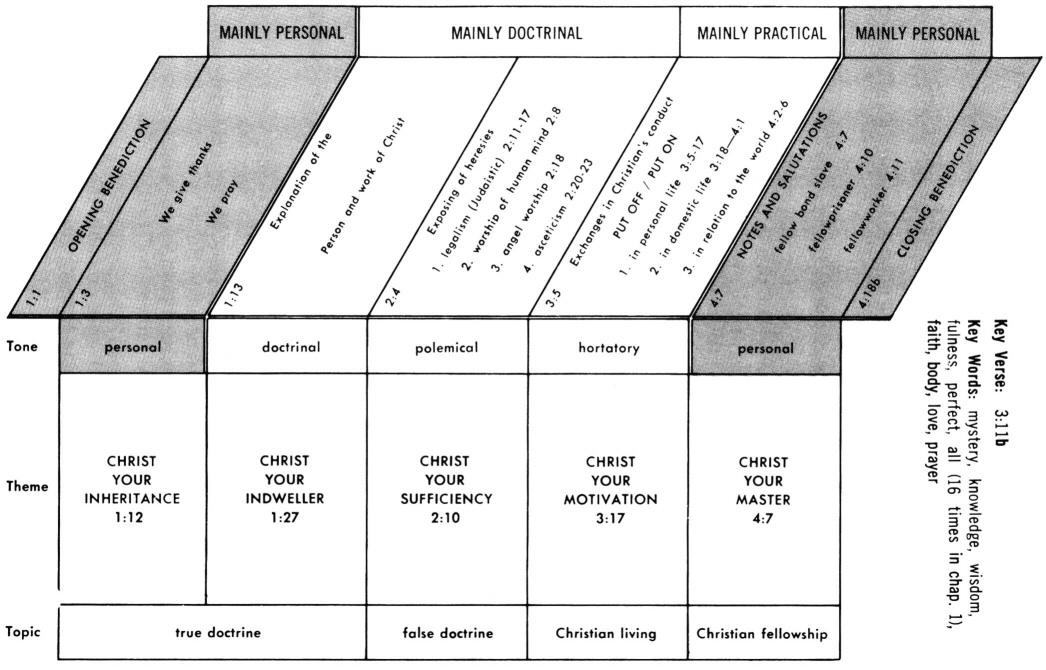
CHRIST IS ALL IN ALL
Click chart to enlarge
Charts from Jensen's Survey of the NT - used by permission
Colossians Overview - Click Chart on right side
| Christ Preeminent in All Things Supreme Lord - Sufficient Savior |
|||
| Colossians 1 | Colossians 2 | Colossians 3 | Colossians 4 |
| Supremacy of Christ |
Submission to Christ |
||
| Doctrinal and Corrective |
Practical and Reassuring |
||
| What Christ Did For Us |
What Christ Does Through Us |
||
| Christ Our Lord |
Christ Our Life |
Christ our Love |
|
| Christ the Head of the Body |
Christ the Lord of the Universe |
Christ the Head of the Home |
|
| Instruction | Warnings | Exhortations | Reminders |
| Reconciliation | Creation | Submission | Conversation |
| His Person and Word |
His Peace and Presence |
||
Colossians 3:1 Therefore if (if then) you have been raised up with (2PAPI) Christ keep seeking (2PPAM) the things above where Christ is (3SPAI) , seated (PMPMSN) at the right hand of God (NASB: Lockman)
Greek: Ei oun sunegerqete (2PAPI) to Christo, ta ano zeteite, (2PPAM) ou o Christos estin (3SPAI) en dexia tou Theou kathemenos; (PMPMSN)
Amplified: IF THEN you have been raised with Christ [to a new life, thus sharing His resurrection from the dead], aim at and seek the [rich, eternal treasures] that are above, where Christ is, seated at the right hand of God (Amplified Bible - Lockman)
BBE: If then you have a new life with Christ, give your attention to the things of heaven, where Christ is seated at the right hand of God.
KJV: If ye then be risen with Christ, seek those things which are above, where Christ sitteth on the right hand of God.
Lightfoot: If this be so, if you were raised with Christ, if you were translated into heaven, what follows? Why, you must realize the change. All your aims must center in heaven, where reigns the Christ who has thus exalted you, enthroned on God’s right hand.
NET: Therefore, if you have been raised with Christ, keep seeking the things above, where Christ is, seated at the right hand of God. (NET Bible)
NIV: Since, then, you have been raised with Christ, set your hearts on things above, where Christ is seated at the right hand of God. (NIV - IBS)
NLT: Since you have been raised to new life with Christ, set your sights on the realities of heaven, where Christ sits at God's right hand in the place of honor and power. (NLT - Tyndale House)
Phillips: If you are then "risen" with Christ, reach out for the highest gifts of Heaven, where your master reigns in power. (Phillips: Touchstone)
TEV: You have been raised to life with Christ, so set your hearts on the things that are in heaven, where Christ sits on his throne at the right side of God
TLB: Since you became alive again, so to speak, when Christ arose from the dead, now set your sights on the rich treasures and joys of heaven where he sits beside God in the place of honor and power.
Wuest: In view of the fact, therefore, that you were raised with Christ, the things above be constantly seeking, where Christ is, on the right hand of God, seated.
Young's Literal: If, then, ye were raised with the Christ, the things above seek ye, where the Christ is, on the right hand of God seated,
| COLOSSIANS 1-2 |
COLOSSIANS 3-4 |
| Sound Doctrine: Supremacy & Sufficiency of Christ |
Spiritual Duty: True Spirituality of Saints |
| What we are to Believe |
How we are to Behave |
| Our Position in Christ |
Our Practice in Christ |
| Christ's Provision for Believers |
Christ's Work through Believers |
| Belief | Behavior |
| Know Your Resources (Riches) In Christ |
Live by faith in the light of you Resources (Riches) In Christ |
| We In Christ |
Christ In Us |
| Work of Christ |
Walk of the Christian |
| Heavenly Standing |
Earthly Walk |
| Identity | Responsibility |
| Position | Practice |
| Privileges of the Believer |
Practice of the Believer |
| Doctrinal | Practical |
| Orthodoxy | Orthopraxy |
| Theology | Ethics |
Note: As you read the comments let me strongly encourage you to also read the Scripture references (popups) for they alone are living and active (He 4:12), they alone will nourish your soul (Mt 4:4, Job 23:12, Jer 15:16) and they alone are your very life (Dt 32:47, Php 2:16, 1Jn 1:1). Indeed, not a single Word of God is void of power (Lk 1:37ASV).
For two chapters Paul has told the Colossians about sound doctrine (mystery of Christ in them = Col 1:27, circumcision of their old flesh nature = Col 2:11, the fact that they had died with, were buried with and raised with Christ -Col 2:20, Col 2:12, 13, etc). Now he moves to the practical application of the doctrines he has just expounded. After all, it does little good if Christians declare and defend the truth, but fail to demonstrate the reality of that truth in their lives. The way you conduct yourself is determined by what your creed and the purer your doctrine (potentially) the purer your life. Our position (co-resurrected with Christ) needs to be put into practice in these last 2 chapters. How you live is determined by how you think for as a man "thinks within himself, so he is" (Pr 23:7).
The Doctrine: Resurrected with Christ
The Duty: Living in "Resurrection Power" of Christ
While the first part of Colossians is doctrinal (Col 1-2), the second part (Col 3-4) is practical, emphasizing the importance of walking in the power of the truth of the new man and our relationship to Christ as Head. In the second part, the first section in Colossians 3:1-17 deals with practical holiness in relation to ourselves (Col 3:5, 6, 7, 8, 9, 10, 11-see notes Col 3:5; 3:6; 3:7; 3:8; 3:9; 3:10; 3:11) and in relation to others (Col 3:12). Colossians 3:5-11 challenges us to “put off” the old ways in Adam and Col 3:12-17 calls us to live out the Christ life in the setting of fellowship with other saints. This sequence is significant, for we must be right in our own inner lives if we want to be right in our relationships with our brothers and sisters in Christ.
Jesus be Jesus in me,
No longer me but Thee.
Resurrection power,
Fill me this hour,
Jesus be Jesus in me.
Broadman Bible Commentary - Paul turns from expounding the fullness of Christ, sufficient answer to the doctrine of the heretics, to describing the fullness of the Christian life, sufficient antidote to their alluring promises. And first, he emphasizes that the full life is focused entirely upon the full Christ.
Recognizing our union with Christ (see also in Christ), we are called on to show forth His life which is an ongoing, daily process known as sanctification. As someone has said when we receive Christ, God's work isn't over—it has just begun! You can know Colossians 1-2 by memory and everyone knows you know it but if you don't work out your salvation in Colossians 3-4 you are all talk with no walk and the integrity of the Gospel is impugned before a watching world. (For more on sanctification see Phil Newton's excellent sermon entitled "Sanctification - A New Position")
THE BELIEVER'S NEW LIFE:
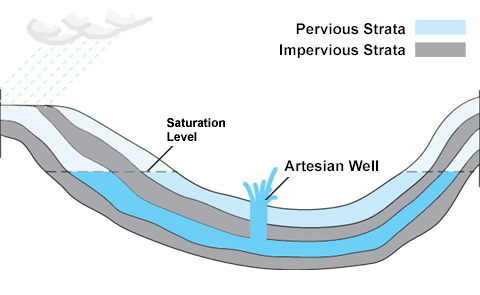
LIKE AN "ARTESIAN WELL"
IN UNION WITH CHRIST
We can think of our new life in union with Christ and His Spirit, as if it were a "well of water springing up to eternal life" (Jn 4:14), the Spirit of Christ (Gal 4:6) flowing supernaturally through us even as water flows effortlessly through an Artesian Well. Hallelujah!
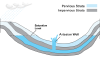
Click to enlarge
See - Spirit-Filled Believers Are Like Artesian Wells
THEREFORE IF (since) : ei oun:
- Colossians 3 Resources - Multiple Sermons and Commentaries
- Colossians 3:1-4 Living the Risen Life - John MacArthur
If this be so, if you were raised with Christ, if you were translated into heaven, what follows? Why, you must realize the change (Lightfoot)
Therefore (oun) (See the importance of evaluating terms of conclusion) - Paul has just explained the deception, frustration and futility of trying to live the "spiritual life", the "higher life", in reliance on the fallen flesh and legalistic, ascetic or mystic guidance. It cannot work. It won't work. It did not work before we were saved and it will not work after we are saved (see Col 2:23). Paul once again reminds them of their resurrection with Christ (which he had just mentioned in Col 2:12), which conveys a new (resurrection) power by which one can live the true spiritual life, the genuine higher life. With this therefore, Paul concludes that since the ways of legalism, asceticism and mysticism were unable to give us victory over "fleshy indulgence", the believer is to shift his or her focus from horizontal to vertical, if you will. Based on our high position, we need to work out a commensurate holy practice! In short in Colossians 3:1 through Colossians 4:6, Paul is challenging every believer to…
BE WHAT
YOU ARE!
In Colossians 3-4 Paul is exhorting his readers to be in practice what they are in position in Christ, resurrected with Him, empowered with the grand potential to live a brand new quality of life we could never have even imagined prior to our regeneration and resurrection.
Nicholson entitles this paragraph “the true asceticism” (contrasting with Col 2:23)
H G C Moule explains that therefore…
goes back to all the previous statements of the Christian's glorious position and privilege in Christ. In view of these Divine facts, the poor expedients of a mechanical religious routine are seen to be as needless as they are futile (Ed: Referring to legalism, asceticism). The secret of moral victory is opened, and it consists in using the powers conveyed to the believer through federal and vital oneness with his Head (cp Jn 8:31, 32, 36, 15:5)…
In Christ the Crucified they had "died to" the guilt, and so to the despotic claim of SIN (Sin as a "Master", not the evil deeds per se). In Christ the Risen they had "risen to" a life of full acceptance (Ep 1:6KJV), and also to life-power (Ep 1:19), and life-endowments, derived from His "indissoluble life" (He 7:16); in fact, to the possession of the indwelling Spirit which He, as Risen, "shed forth" (Acts 2:33, cp Ro 5:5, Jn 3:34, Ro 8:9, Gal 4:6, Titus 3:5,Titus 3:6), and which gives to the "limb" (believers) the strength and holiness of the Head, to be used and realized (Lev 11:44, 1Pe 1:14, 1Pe 1:15, 16) . (The Cambridge Bible for Schools and Colleges - The Epistles to the Colossians and to Philemon)
Albert Barnes explains that Paul's logic is…
that there was such an union between Christ and His people, that in virtue of His death they become dead to Sin (Ro 6:11); that in virtue of His resurrection they rise to spiritual life (Ro 6:4), and that, therefore, as Christ now lives in heaven, they should live for heaven (Eph 2:6), and fix their affections there (He 12:2, 1Pe 1:13).
Alexander Maclaren writes that…
We have now done with controversy. We hear no more about heretical teachers (eg Col 2:4, Col 2:8). The Apostle has cut his way through the tangled thickets of error (Col 2:23), and has said his say as to the positive truths with which he would hew them down. For the remainder of the letter, we have principally plain practical exhortations, and a number of interesting personal details.
The paragraph which we have now to consider is the transition from the controversial to the ethical portion of the Epistle. It touches the former by its first words, "If ye then were raised together with Christ," which correspond in form and refer in meaning to the beginning of the previous paragraph, "If ye died with Christ." (Col 2:20) It touches the latter because it embodies the broad general precept, "Seek the things that are above," of which the following practical directions are but varying applications in different spheres of duty…
There are here two similar exhortations, side by side. "Seek the things that are above." The first is preceded, and the second (Col 3:2) is followed by its reason. So the two laws of conduct are, as it were enclosed like a kernel in its shell, or a jewel in a gold setting, by encompassing motives. These considerations, in which the commandment are embedded, are the double thought of union with Christ in His resurrection, and in His death, and as consequent thereon, participation in His present hidden life (Col 3:3), and in His future glorious manifestation (Col 3:4). So we have here the present budding life of the Christian in union with the risen, hidden Christ; the future consummate flower of the Christian life in union with the glorious manifested Christ; and the practical aim and direction which alone is consistent with either bud or flower (Col 3:5ff). (Colossians 3:1-4 The Present Christian Life, A Risen Life - Recommended)
Colossians 3:1 can be outlined as follows (Adapted from Dr John MacArthur's commentary on Colossians)…
THE REMINDER
Therefore if you have been raised up with Christ
THE RESPONSIBILITY
Keep seeking the things above
THE RESOURCE
Where Christ is, seated at the right hand of God
AN "IF" THAT IS
A CERTAINTY
If (ei) is a particle indicating a fulfilled condition, followed by the indicative mood, the mood of reality (see notes on conditional clauses). "If" in this case does not convey uncertainty but is what is referred to as a first class conditional clause which assumes that the statement which follows is true (see similar use of "if" in Col 2:20). One can substitute Since or in view of the fact for if. In marked contrast to the mystical promises of achieving your "human potential" offered under the guise of the New Age Movement (or any other non-Biblical mystical method), Paul now unveils in clear language the true way to "be all that you can be". This is truly God's plan for the "human potential movement".
Spurgeon - The if is used logically, not theologically, by way of argument, and not by way of doubt. All who believe in Christ are risen with Christ. Let us meditate on this truth… Oh! how often we need to be called to this, for the flesh is groveling, and it holds down the spirit; and very often we are seeking the things below as if we had not yet attained to the new life, and did not know anything about the resurrection power of Christ within the soul. Now, if it be that you, believers, have risen with Christ, do not live as if you had never done so, but “seek those things which are above, where Christ sitteth on the right hand of God.”
Wuest emphasizes that the Colossians…
to whom he was writing, were saved. They had been identified with (baptizo) Christ in His resurrection (Ro 6:2, 3, Ro 6:4). His was a physical resurrection out from among the dead, theirs, a spiritual resurrection out from among the spiritually dead and from a state of spiritual death into that of spiritual life. This was potential at the time Christ died, and actual for them when they placed their faith in Him as Saviour. (Wuest, K. S. Wuest's Word Studies from the Greek New Testament: Eerdmans)
The word "if" is not, in this place, expressive of doubt. It does not imply that those "saints at Colosse" were uncertain as to whether they were risen with Christ. Rather, it is the apostle's way of denoting the surest of all certainties. Thus he uses it in Romans 5:10, "If when we were enemies we were reconciled to God;" and in Ro 5:15, "If through the offence of one many be dead." So that more truly it might be rendered "since," as assuming the fact, and setting it down as beyond all doubt…
The result of a believed gospel is not uncertainty--but certainty; not trouble--but peace; not the continuance--but the expulsion of all anxiety. The gospel presents me with that, in believing which I am entitled to say,
"I am a child;
forgiven, saved, risen."
Such is its nature that, in receiving it, so far from being brought into uncertainty, or kept in uncertainty, I am relieved from all uncertainty; my soul is set at rest. I am not only warranted--but commanded to claim my sonship. My not claiming it, my standing still in doubt as to reconciliation between me and God, shows that I have not yet fully understood the freeness and fitness of the grace which the gospel makes known. For God here presents to us such a gospel as to shut each hearer of it up to this alternative--either to doubt the good news, or enter into conscious friendship with Himself. (Colossians 3:1-4 The Risen Christ and the Things Above - read Bonar's excursus on the sad plight of so many saints who are unsure about their great inheritance and holy privileges in Christ).
Paul is reaffirming that our co-resurrection with Christ is a fact and is not in doubt. True spiritual life is nurtured in the "womb" of true doctrine. If you are going to live a holy life in an unholy world, your doctrine has got to be unadulterated, "pure milk" (1Pe 2:2, 3 ).
Spurgeon - Your Lord and Master has gone up to heaven. You profess that he represents you, and that you have gone up there in him and with him. Then do not seek the things that are down here below, the things of earth; but live where your life has gone. Where your treasure is, there let your heart be also. “Seek those things which are above.”
Ryrie - Paul's appeal is simple:
Become in experience
what you already are by God's grace.
The Christian is risen with Christ; let him exhibit that new life. (The Ryrie Study Bible: New American Standard Translation: 1995. Moody Publishers)
J Philip Arthur writes…
The apostle Paul wanted his first readers in first-century Colosse to realize that, in this world, Christians are indeed a kind of resident alien. Their real identity and origin are not earthly, but heavenly. As physical organisms we were born in this world but, having died with Christ (Col 2:20), we no longer belong to it. A second, spiritual birth means that our true citizenship is in heaven (Php 3:20) and something of the quality of that place ought to cling to us even as we live out our days in this present world.
The world needs heavenly people as never before, and
this is what Christians are when they live up to their true identity.
The message of this passage to Christians, whether in the first or twenty-first century, then, is:
'Be what you are!'
In calling upon Christians to be what they are, Paul set before the Colossians the challenge to live as heavenly people and, in doing so, to bring something of the quality of heaven to earth to irradiate and suffuse all their relationships and life situations (cp Mt 5:16, Php 2:14, 15). Some Christians have certainly achieved this. The Puritan Richard Sibbes (1577-1635), the Covenanter Samuel Rutherford (1600-1661) and Robert Murray McCheyne (18:13-1843) in nineteenth-century Scotland all brought the glow of heaven to this broken world and made it much the better for their passing. The world still needs people like that. (Christ All-Sufficient Colossians and Philemon Simply Explained)
Illustration of a heavenly life, a life seeking the things above - Adoniram Judson - Many years ago when the great missionary Adoniram Judson was home on furlough, he passed through the city of Stonington, Connecticut. A young boy playing about the wharves at the time of Judson’s arrival was struck by the man’s appearance. Never before had he seen such a light on any human face (cp 2Co 3:18, 1Co 15:49). He ran up the street to a minister to ask if he knew who the stranger was. The minister hurried back with him, but became so absorbed in conversation with Judson that he forgot all about the impatient youngster standing near him. Many years afterward that boy—who could never get away from the influence of that wonderful face—became the famous preacher Henry Clay Trumbull. (author of the insightful and fascinating book The Blood Covenant A Primitive Rite And Its Bearings on Scripture) In a book of memoirs he penned a chapter entitled: "What a Boy Saw in the Face of Adoniram Judson." That lighted countenance had changed his life. Even as flowers thrive when they bend to the light, so shining, radiant faces come to those who constantly turn toward Christ!
WHO ARE YOU…
Before God?
Before Others?
What I am when I am alone in the presence of God, is what I really am. What I am when I am with other people, should be the same or otherwise my public life is a veritable "spiritual charade". As someone has well said, reputation is what other people think about you. Character ("that which a person or thing really is") is what God knows to be true about you. In these last two chapters of Colossians, Paul is saying in essence that as believers (Colossians 3-4 is written to believers) we are to let our reputation match our new position, our new potential, our new character in Christ ("Christ in you the hope of glory" Col 1:27, "in Him you have been made complete" Col 2:10, "Christ your life" Col 3:4). Right belief is basic, but such belief, when not lived out in right behavior, is virtually meaningless at best and hypocrisy at worst! Right belief must and can be lived out successfully in "this present evil age" (Gal 1:4), but it can only be accomplished by continual dependence on God's grace (1Co 15:10, 2Co 12:9) and His Spirit's empowerment (Gal 5:16, Ro 8:13).
And so what are some of the effects of our new resurrection life, our supernatural union with Christ? Believers are no longer enslaved to and under the dominion of our inveterate mortal enemies - (1) The flesh (see old self = old man) (Ro 6:6, Col 3:9), (2) The world (Gal 6:14) and (3) The devil (Col 1:13, He 2:14, 15-notes) (See chart contrasting in the flesh vs in the Spirit)
John Eadie in his unique style explains that
If the Colossian believers should act in accordance with their privileges (Ed: And their position; i.e., in Christ) —if they understood how the charge preferred against them by the law had been met with a discharge on the cross of Calvary—if the process of sanctification beginning in their hearts should work outward, and hallow and adorn their lives—if they felt that whatever blessings they enjoyed in part, or anticipated in fulness, sprang from union with Christ, then should they be fortified against every effort to induce them to sever themselves from the Head (Col 1:18, Col 2:10, Col 2:19, Ep 2:22), and against every attempt to substitute reveries (revery = a loose or irregular train of thought) for truth, or human inventions for Divine enactments.
Then, too, should they learn that worship does not consist of superstitious invocations, and that sanctification is not identical with fanatical austerities. Let them move in a spiritual region lifted far above those earthly vanities (cp Ep 2:6), and let them look down on them as the offspring of a morbid and self-deceived imagination, or the craving and the nutriment of a self-satisfied pride… Union with Christ enjoys a peculiar and merited prominence—“risen with Christ.” Their new position laid them under a special obligation, and they are thus enjoined—“seek those things which are above” (Eadie, John: Commentary on Paul's Epistle to the Colossians - Online - 1884)
Ray Stedman commenting on this section emphasizes that
being a Christian means we have an extra dimension to life. There is a hidden resource, an invisible reality, which the world does not have and cannot see. This is not referring to Christ being "up in heaven," lost in space somewhere! Rather, this refers to what Paul has talked about earlier in this letter, "Christ in you, the hope of glory." (Col 1:27) This extra dimension is not far removed in the reaches of space; it is right within the heart, an untouchable, invisible dimension within us. This is the glory of the Christian life and the secret of its power, joy and courage.
If you have not discovered this yet as a Christian
you have not yet begun to live as you can and should.
This is what puts a smile on a Christian's face, even though he or she is in trouble.
Set your hearts on this hidden resource, is Paul's exhortation. He means our affections. Think with affectionate gratitude of what the Lord Jesus has already done for you and what He is to you now. This is not a form of escapism. It is not something you try to keep your mind on all day long, to the exclusion of business, family or home. It is rather something that when your mind is occupied with your family, work problems, or whatever, you also bring into it this extra dimension. Christ is part of that situation. That is what Paul means when he says, "your life is hid with Christ in God." (Col 3:3)
Christ is involved with your activities. Remind yourself that whatever you are involved in includes also the person of the Lord himself. His wisdom, power and knowledge are all available to you (cp 1Co 2:16, 1Co 15:10, 2Co 3:5, 6, Php 4:13, 2Co 12:9, 2Co 12:10). That is what Paul means. It ought to awaken our loving gratitude. We are not only to set our affections, but are also to "set our minds on things above." "Things within" would be a better translation.
Paul is talking about our wills, our choices. Decide to do what you know from your knowledge of the Word of the Lord He wants you to do.
That is the secret of a life
that has discovered how to really live.
Your life, your daily activity, your thoughts
are now tied to Christ.
You do wrong if you separate yourself from Him. You belong to Him (1Cor 6:19, 1Co 6:20,Titus 2:14, 1Pe 2:9, 2Co 5:15, Ro 14:7, 8, 9). The old godless, self-directed life is over, if you have become a Christian (cp 2Co 5:17). (Col 3:1-11 True Human Potential) (Bolding added)
John MacArthur has some interesting and practical thoughts on living life on earth with a proper perspective of our relationship to heaven…
I really believe with all my heart and I thought a lot about this, that before we can reach the world we have to leave it. And maybe that sounds paradoxical, but it really isn't. Before we reach the world we are going to have to leave the world. In John 8… Jesus said,
"Ye are from beneath, I am from above. Ye are of this world, I am not of this world." (Jn 8:23)
Jesus, even though He came into the world, He reached the world from the vantage point above the world. The only way to really reach the world is to leave the world or to be from without the world, and to bring to the world a divine dimension.
In John 18:36 Jesus answered,
My kingdom is not of this world, if my kingdom were of this world then would my servants fight that I should not be delivered to the Jews, but now is my kingdom not from here.
Again Jesus emphasized that the vantage point from which he reached the world was not the world, but above the world… Ro 12:1, 2 (12:1 note; 12:2 note)…
"I beseech you therefore brethren by the mercies of God that you present your body a living sacrifice, holy acceptable unto God which is your spiritual worship and be not conformed to this world but be ye transformed by the renewing of your mind."
Jesus reached the world from a vantage point beyond the world and The apostle Paul says that we are going to reach the world also when we are no longer of the world. (cp Jn 17:5, Titus 2:12, 1Jn 4:17)…
When John says, be Christ in the world, how can these two be brought together? It's very simple really? It isn't complicated. You know it already. It's simply this.
Your inside lives in heaven
and your outside lives here.
That's all. And I really am convinced, I know you are, you who know and love Christ, and know His word. I know you are equally convinced that until a Christian in his heart and his soul and his mind has learned to live his spiritual life in the heavenlies he will never be able to touch the earth with the truth of God. It won't happen.
I was reading about Robert Murray McCheyne as he was evaluated by some of the people who knew him and this is one man's comment, he said this of him:
The man of whom I speak seems to have got up to the full height and to have entered into the secret places of the holiness of God.
Here was a man who knew Robert Murray McCheyne the great preacher. He seemed to have dwelt in the secret places of the holiness of God. The man went on,
when he preached the gospel you could see strong men, hard and stern, melt like wax before the fire. Their breasts would swell and heave as if they would burst and the whole place became a place of weepers.
Now there is a man who touched the world. There is a man who reached the world, and the comment of a man who observed was, the reason he reached the world was because he lived in the presence of God (Living the Risen Life)
Note that Paul begins this section on "practical Christianity" by emphasizing the believer's relationship with Christ. He does not begin immediately with a list of prohibitions but with a command to maintain a heavenly, Christ-centered mind, a renewed mind which should motivate us to live a life of death to our passions and desires - to live no longer for self but to live for Christ. And so Paul first charges us to focus on what Christ has done for us. Then he gives us practical guidance on how to live out this truth enabled by the Spirit and grace of Christ.
So Colossians 3:1 first points the reader back (therefore) to the "sound doctrine" which describes the present possession of every believer -- "Christ in (us) the hope of glory" (Col 1:27) which is one way of describing every believer's intimate union with the risen Christ [cf Col 2:11, 12, Col 2:19]. This living and active truth makes it possible for us to now live the supernatural life Paul describes in Colossians 3:5-4:6.
I like how S Lewis Johnson describes the juncture between the first 2 doctrinal chapters and the last 2 "duty" chapters:
The CROSS, the focus of history, redemption and the godly life, has two sides: it involves a death, and it was followed by a resurrection. Both of these aspects are related to the believer. The one serves his connection with the past life, the other introduces him to a new life in union with Christ. Not only are we, by God’s grace, to abandon the pre-death life, but we are to aspire to the post-resurrection life… The age to which believers belong by virtue of the CROSS is really the coming age, and that age is to be the center of their life. The Forerunner, who has accomplished the work which guarantees the coming of the new age, now sits to dispense the blessings of it. (Studies in the Epistle to the Colossians Part IX: Human Taboos and Divine Redemption)
Warren Wiersbe makes an excellent point that…
We must keep in mind that the pagan religions of Paul’s day said little or nothing about personal morality. A worshiper could bow before an idol, put his offering on the altar, and go back to live the same old life of sin. What a person believed had no direct relationship with how he behaved, and no one would condemn a person for his behavior. But the Christian faith brought a whole new concept into pagan society:
What we believe
has a very definite connection
with how we behave!
After all, faith in Christ means being united to Christ; and if we share His life, we must follow His example. He cannot live in us by His Spirit and permit us to live in sin (cp 1Jn 3:7, 8, 9 where "cannot sin" = cannot sin as a lifestyle). (Wiersbe, W: Bible Exposition Commentary. 1989. Victor)
Darrell Bock adds that…
Paul's attitude to (the false teacher's) invitation to super spirituality (Ed: The false teacher's were exhorting the saints to pursue legalism, asceticism and mysticism) is condemnation. He says that this road really is a disqualification of what Christ gained (Col 2:18). It is a shadow (Col 2:17), not the substance of life. In fact, it fails to check the flesh and is of no value (Col 2:23). It ignores Christ, who is the source of growth for the body (Col 2:19). That is why Paul calls it a philosophy that comes from human tradition and the world, a philosophy that is really deceitful (Col 2:8). It is important to observe that Paul's complaint about philosophy is not an attack on the syllogisms of atheism, but on a movement that had God and divine things in view, but in a way that distorted what Christ provided.
This desire "to experience heaven" also explains why Paul uses so much heavenly language in describing what Christ has done.
The concept of being raised with Christ and setting one's mind on the things above means that the believer already has established a relationship with the divine forces of heaven, so that a trip into God's presence is unnecessary.
God has not called His church to withdraw and await a great future experience of Himself, but to engage the world with the (supernatural) kind of life that reflects the attributes that reflect the character and righteous morality of those who know God (Col 3:1-17). They can do this boldly, because they know that one day God will complete what he has started (Php 1:6) and will take them to Himself in glory (Jn 14:3, 1Th 4:17, 18, 1Co 15:51, 52, 53).
Asceticism is not the way to heaven:
faith in Jesus is.
Thus Paul comes to focus on the call of the church to know God's will and to reflect what it means to belong to the "new man (see note)."…
So ultimately Colossians is about the work of the Father in the Son on behalf of a people He calls to manifest His message and presence on earth. This new community is to realize that all the benefits God has already given are all that is needed to accomplish the task of living a life that is honoring to God (cp 2Pe 1:3, 4). Any suggestion that someone needs anything more than to appropriate what Christ already makes available is a delusion (Col 2:4). Blessing comes from God through the Lord Jesus Christ alone, and a life that pleases God draws on what the Mediator (1Ti 2:5, He 8:6, He 9:15, He 12:24) and Enabler (cp Php 4:13) provides. (Colossians, Theology of - Baker's Evangelical Dictionary of Biblical Theology)
Paul Apple introduces Colossians 3:1-11 which he entitles
Focus on Follow Through.
Big Idea: The key to spirituality is living out our union with Christ.
Today we come to a very exciting section of the Book of Colossians and yet a very humbling section. It is exciting because Paul is ready to unfold for us the True Key to Spirituality. He is making the transition from the more doctrinal section of Colossians 1-2 where he had been teaching the Supremacy and Sufficiency of Christ and warning against false approaches to spirituality to the more practical section of Colossians 3-4. It is humbling because we are brought face to face with the simplicity of the Christian life and feel exposed by the large gap between our positional sanctification and our practical sanctification … between how God views us in Christ and how consistently we are actually living… when we come face to face with the simplicity of True Spirituality in terms of living out our union with Christ in His death and His resurrection we are exposed and humbled … and yet excited at the same time
- We are already positionally sanctified
- We are destined for glory – no doubt about it
- We have the opportunity today to live out the life of Christ within us
But we are in the midst of a constant Struggle (Gal 5:17, 2Cor 10:3, 4, 5, 2Cor 6:7, 1Pe 2:11, 1Ti 1:18, 6:12) that Requires Focus and Follow Through. It requires a Putting off of the Old Man and a Putting on of the New Man (Colossians)
YOU HAVE BEEN RAISED UP WITH CHRIST: sunegerthete (2PAPI) to Christoi:
- Col 2:12;13, Col 2:20 Ro 6:4, Ro 6:5, Ro 6:9, 10, Ro 6:11 Gal 2:19, Gal 2:20, Gal 5:24, 2Cor 5:14 Eph 1:19, Ep 1:20, Ep 2:5, Ep 2:6
- Colossians 3 Resources - Multiple Sermons and Commentaries
- Colossians 3:1-4 Living the Risen Life - John MacArthur
THE TRANSFORMING TRUTH OF
OUR CO-RESURRECTION
Notice that in Colossians 3:1 the indicative mood (of the verb "raised" = this is a fact) precedes the imperative mood ("keep seeking" = this is a command). The former (indicative) describes the reality a believer's life, a truth which should motivate the keeping of the command (imperative). Right belief is always a firm foundation for right (righteous) behavior. An understanding and appropriation of a believer's death, burial and resurrection with Christ is crucial to living out the supernatural Christ life (cp Gal 2:20). It is not just "Let go and let God". Believers have a "holy debt" if you will, a solemn responsibility (Php 2:12) because of what Christ has accomplished on our behalf on the "Old Rugged Cross". And so here at the beginning of the practical section Paul in essence summarizes the sound doctrine which he had explained earlier…
(Believers) having been buried with Him (Christ) in baptism (not speaking of water, but of our identification with Christ-see baptizo), in which you were also raised up with Him through faith (i.e., when you first believed in Christ) in the working of God, Who raised Him from the dead. And when you were (spiritually) dead in your transgressions (Ep 2:1) and the uncircumcision of your flesh, He made you alive together with Him (past tense event), having forgiven us all our transgressions, having canceled out the certificate of debt consisting of decrees against us and which was hostile to us; and He has taken it out of the way, having nailed it to the cross… you have died with Christ to the elementary principles ("ABC's") of the world… (Col 2:12,13, Col 2:20)
Writing to the Roman saints Paul declared…
Therefore (because you have been "baptized into Christ Jesus [and] have been baptized into His death" Ro 6:3) we have been buried with Him through baptism into death, in order that as Christ was raised from the dead through the glory of the Father, so we too might walk in newness of life. (Ro 6:4)
In his letter to the Ephesian saints Paul explained that…
even when we were dead in our transgressions (before we believed in Christ), (God) made us alive together with Christ (by grace you have been saved), and raised us up with Him, and seated us with Him in the heavenly places, in Christ Jesus (Ep 2:5, Ep 2:6)
Horatius Bonar in his excellent sermon on Colossians 3:1-4 says…
The condition, then, of a saint, is one of certainty (Ed: "If" = certainty). That certainty is this--he is risen with Christ. It is not that he ought to be risen, or that he hopes to be risen--but that he has risen. This is the blessed fact that forms the commencement of his history as a saint. This event stands at the very threshold of his career; no, constitutes its outset.
His life is the life of a risen One.
His story is that of one who has risen. He cannot tell of his change without telling of resurrection. He cannot speak of his new course and conversation, without referring to resurrection. He cannot account for the high level on which he stands, or the privileges which encompass him, or the hopes that rise before him, save by tracing all these back to this one fountain-head, resurrection.
What, then, is the meaning of this fact or event in the life of a saint, which forms the commencement of his history? It cannot in any way be understood of the resurrection of the body, which is the Church's hope. For that is altogether future; and is, besides, connected with the second coming of the Lord (see 1Th 4:16, 1Co 15:51,52, See discussion of The Two Resurrections - "First" and "Second" - on a timeline), whereas this is connected with His first. The privilege or blessing, pointed at by the apostle here, is something past, something which had commenced when they believed (Ro 6:4, 5, Ep 2:5, Ep 2:6, Col 2:12, 13); whereas the resurrection of the body is still a thing for which we wait and long. (Colossians 3:1-4 The Risen Christ and the Things Above).
Go up, reluctant heart,
Take up thy rest above;
Arise, earth-clinging thoughts;
Ascend, my lingering love.
BONAR
LOOKING up for the Spirit through Jesus Christ
is the only effectual attitude for obtaining love to God.
CHALMERS
Raised up with (4891)(sungeiro from sun = together + egeiro = to raise) which means to raise together (used also in Col 2:12; Eph 2:6).
Aorist tense indicates our resurrection with Christ is a past tense, completed action, which was reckoned true in our life the moment we by grace thru faith received Christ Jesus as Savior and Lord (Col 2:12). We were raised spiritually when Christ was raised physically and this identification (because we are now in an everlasting, unbreakable covenant with our Lord) is the foundation truth for our new spiritual position and our new power to walk in newness of life (Ro 6:4). Have been raised up with is also in the passive voice which signifies the power to bring about our resurrection was from outside of us, specifically from God.
Note that sunegeiro uses the prefix sun not meta. This may seem to be a small point but it conveys a profound truth because sun [word study] in contrast with meta speaks of an intimate and irrevocable association with another, in this case with the risen and exalted Christ. Can you see the implications if our life is intimately bound with Christ? Clearly His infinite, inexhaustible resurrection power is available to all believers! Oh, how often do we life like spiritual paupers, when we are children of the Almighty God and have access to all the resources of the King of kings!
Lord we pray that "the eyes of (our) heart may be enlightened, so that (we) may know what is… the surpassing greatness of (Your) power (see what this power did in Ep 1:20, 21) toward us who believe." Amen (Eph 1:18, 19)
The internal (eternal) change wrought by our co-resurrection with Christ should lead to an external change. If not then perhaps we need to ponder 2Cor 13:5. Our holy position should show itself to be the "real thing" by our holy practice (direction not perfection).
Emphasizing our new life in Christ Paul explained to the Galatians that…
through the Law I died to the Law, that I might live to God. I have been crucified with Christ (perfect tense = past completed act with present continuing effect/result connoting permanence of our co-crucifixion. In short, we cannot be "un" crucified! Another strong evidence against the false teaching that you can lose your salvation!); and it is no longer I who live, but Christ lives in me; and the life which I now live in the flesh I live by faith in the Son of God, who loved me, and delivered Himself up for me. (Gal 2:19,20)
Spurgeon compares our co-resurrection to the metaphor of a seed
The buried seed rises from the ground, but not as a seed, for it puts forth green leaf, and bud, and stem, and gradually develops expanding flower and fruit, and even so we wear a new form (2Cor 5:17-note), for we are renewed after the image of him that created us in righteousness and holiness… There was corruption in our mind and it was working irresistibly towards every evil and offensive thing. In many the corruption did not appear upon the surface, but it worked within; in others it was conspicuous and fearful to look upon. How great the change! For now the power of corruption within us is broken, the new life has overcome it, for it is a living and incorruptible seed which liveth and abideth for ever (1Pe 1:23). Corruption is upon the old nature, but it cannot touch the new, which is our true and real self.
Is it not a great thing to be purged of the filthiness which would have ultimately brought us down to Tophet where the fire unquenchable burns, and the worm undying feeds upon the corrupt?…
Let us think of this (our spiritual resurrection with Christ), for our Lord did not have his head quickened while his feet remained in the sepulcher; but he rose a perfect and entire man, alive throughout. Even so have we been renewed in every part (Ed: Our position). We have received, though it be but in its infancy, a perfect spiritual life: we are perfect in Christ Jesus (Positionally speaking - cp Col 2:10). In our inner man our eye is opened, our ear is awakened, our hand is active, our foot is nimble: our every faculty is there, though as yet immature, and needing development, and having the old dead nature to contend with…
On the day of our quickening (our new birth, our regeneration) we bid farewell to spiritual death, and to the sepulcher wherein we slept under sin’s dominion (Ro 6:11).
Farewell, thou deadly love of sin;
we have done with thee!
Farewell, dead world, corrupt world;
we have done with thee!
Christ has raised us. Christ has given us eternal life. We forsake for ever the dreary abodes of death, and seek the heavenly places. Our Jesus lives, and because he lives we shall live also, world without end. (References added) (Excerpt from Following the Risen Christ)
Spurgeon goes on to describe the implications of our resurrection with Christ…
I. OUR SPIRITUAL RISING WITH CHRIST.
The “if” is used logically, not theologically, by way of argument, and not by way of doubt.
1. We were dead in sin, but having believed in Christ we have been quickened by the Holy Ghost, and we are dead no longer. We remember the first sensation of life, how it seemed to tingle just as drowning persons when coming back to life suffer great pain. Conviction was wrought in us, and a dread of judgment, and a sense of condemnation, but these were tokens of life, but that life gradually deepened until the eye was opened, and the restored hand stretched itself out, the foot began to move in the way of obedience, and the heart felt the sweet glow of love within.
2. There has been wrought in us a wonderful change. Before regeneration our soul was as our body will be when it dies.
(1) Sown in corruption. In some cases it did not appear on the surface; in others it was something fearful to look upon. Now the new life has overcome it, for it is an incorruptible seed, and liveth for ever.
(2) In dishonour. Sin is a shameful thing; but “behold what manner of love” (1Jn 3:1). “Since thou wast precious in my sight,” etc. “Unto you which believe He is an honour.”
(3) In weakness. When we were the captives of sin we could do nothing good; but “when we were without strength in due time Christ died for the ungodly. Now we know the power of His resurrection” (John 1:12; Php 4:13).
(4) A natural body. Aforetime we were natural men, and discerned not the things of the Spirit of God. Now a spirit has been created in us which lives for spiritual objects.
3. In consequence of receiving this life and undergoing this change the things of the world become a tomb to us. To a dead man a tomb is as good a dwelling as he can want; but the moment he lives he cannot endure it.. So when we were natural men earthly things contented us.
(1) A merely outward religion satisfied us; a dead form suited a dead soul. Judaism pleased those who put themselves under its yoke; traditions, ordinances make pretty furniture for a dead man’s chamber; but when eternal life enters the soul they are flung off. A living man demands such garments as are suitable for life.
2. Merely carnal objects become as the grave to us, whether sinful pleasures or selfish gains. They are as a coffin to the renewed man: he cries for liberty.
4. We are wholly raised from the dead in a spiritual sense. Our Lord did not have His head quickened while His feet were in the sepulchre. So we have been renewed in every part. We have received, although it be in its infancy, a perfect life in Christ Jesus; our ear is awakened, our eye opened, our feet nimble.
5. We are so raised that we shall die no more. “Christ being raised, death hath no more dominion,” etc. So we.
II. LET US EXERCISE THE NEW MAN IN SUITABLE PURSUITS.
1. Let us leave the sepulchre.
(1) The vault of a mere outward religion, and worship God in Spirit and in truth.
(2) The vault of carnal enjoyments. These ought to be as dead things to the man who is risen with Christ.
2. Let us hasten to forget every evil as our Lord hastened to leave the tomb. He made the three days as short as possible;. so let there be no lingering and hankering after the flesh.
3. As our Lord spent a short season with His disciples, we are to spend our forty days in holy service.
(1) In greater seclusion from the world and greater nearness to heaven.
(2) In testimony, even as He manifested Himself, to the resurrection power of God.
(3) In comforting the saints.
(4) In setting everything in order for the furtherance of His kingdom.
4. Let our whole minds ascend to heaven with Christ; not a stray thought.
(1) Because we need heavenly things, prize them, and hope to gain them.
(2) After heavenly things, faith, hope, etc.
(3) Heavenly objects — the glory of God, not your own; the good of man.
(4) Heavenly joys. Your treasure is above, let your hearts be with it.
5. What a magnet Christ should be. Where should the wife’s thoughts be but with her absent and beloved one?
(1) Christ is sitting, for His work is done; rise and rest with Him.
(2) At the right hand of God, in the place of honour and favour.
III. LET THE NEW LIFE DELIGHT ITSELF WITH SUITABLE OBJECTS.
“Have a relish for things above”; “study them industriously”; “set your mind on them.”
What are they?
1. God Himself. “Delight thyself in the Lord.” What is all the world if He be gone; and if you have Him, what though all the world be gone?
2. Jesus who is God, but truly man. Meditate on His Divine Person, His perfect work, etc.
3. The New Jerusalem of the Church triumphant.
4. Heaven, the place of holiness after sin, of rest after work, of riches after poverty, of health and life after sickness and death. (Read Spurgeon's full sermon on Col 3:1-2 Following the Risen Christ)
Everett Harrison entitles this section "ATTACHMENT TO CHRIST (Col 3:1–4)"
Although the watershed of the epistle has been reached, a hinge, then, binds what follows to what has gone before. Not without justice W. R. Nicholson entitles this paragraph “the true asceticism.” As pointed out in chapter 2, the false asceticism finds its fleshly gratification in its rigors toward the body; and this gratification, as an expression of pride and superiority, is just as reprehensible as the baser forms of physical indulgence. In the proper sense of the term, Christian life is the other-worldly life, for it finds in the contemplation of the celestial the inspiration and strength to manifest a transformed experience while still a part of the terrestrial scene. But this celestial outlook is no mere stargazing. It is the uplifting of the eyes of the heart to Christ, who has now returned to His heavenly home. This preoccupation with “things which are above” is not born of wistfulness, as though one can find relief from the pressures of the world only by looking to a better world. It is not an effort to detach oneself, to find escape. Rather, it is the attitude found in Christ during the days of His flesh, who lived in the bosom of the Father even as He continued His strenuous labors among the children of men. The heavenly realm belongs to the saints; they have their citizenship there (Phil 3:20ASV). Their resurrection with Christ, which Paul states as a fact rather than something clouded by uncertainty (cf. Col 2:12), would be meaningless if it did not involve participation in the heavenly, glorified life of the Saviour with ultimate union in the future, despite the present separation. But life in this world is not conducive to the maintenance of this heavenly tie, so that some resolution is needed—“seek those things which are above.” Lest one stray into contemplation of glories not yet revealed, rivaling the false teachers in their visions, the apostle at once directs attention to Christ seated “on the right hand of God.” His position attests His finished work (Heb 1:3) and proclaims His dignity and power (Ps 110:1–2; Phil 2:9–11). So the seeking of things above is not to be confused with aspiration after the so-called higher things of life idealistically considered, however legitimate they may be; but rather it points to the things that belong to resurrection life. (Ed: "the highest life!") Christians are not immune to the pull of the temporal and material. They need to be seeking all the time the things that belong to the kingdom of God and His righteousness lest they be caught up in worldly pursuits that rob them of spiritual peace and power. (Colossians- Everyman's Bible Commentary- Christ All-Sufficient - page 74)
><>><>><>
D L Moody - I have known men who have been up in balloons, and they have told me that when they want to rise higher they just throw out some of the sand with which they ballast the balloon. Now, I believe one reason why so many people are earthly-minded and have so little of the spirit of heaven, is that they have got too much ballast in the shape of love for earthly joys and gains; and what you want is to throw out some of the sand, and you will rise higher.
><>><>><>
C. H. Spurgeon - On board iron vessels it is a common thing to see a compass placed aloft, to be as much away from the cause of aberration as possible; a wise hint to us to elevate our affections and desires; the nearer to God, the less swayed by worldly influences.
><>><>><>
In his devotional entitled RISEN WITH CHRIST from Our Daily Walk F B Meyer writes…
IF! SOME one will say, "He, there's the rub! I'm afraid that is not true of me; my life is sinful and sorrowful; there are no Easter chimes in my soul, no glad fellowship with the Risen Lord; no victory over dark and hostile powers." But if you are Christ's disciple, you may affirm that you are risen in Him! With Christ you lay in the grave, and with Christ you have gone forth, according to the thought and purpose of God, if not in your feelings and experience. This is distinctly taught in Eph 2:1-10 and Romans 6:1-10. The whole Church (including all who believe in our Lord Jesus) has passed into the light of the Easter dawn (Ed: raised to walk in a brand new way of life they had heretofore never been able to experience!); and the one thing for you and me, and all of us, is to begin from this moment to act as if it were a conscious experience, and as we dare to do so we shall have the experience.
Notice how the Apostle insists on this: "You died, you were raised with Christ, your life is hid with Christ. Give yourself time to think about it and realize it."
The Cross of Jesus stands between you and the constant appeal of the world, as when the neighbours of Christian tried to induce him to return to the City of Destruction. This does not mean that we are to be indifferent to all that is fair and lovely in the life which God has given us, but that the Cross is to separate us from all that is selfish, sensual, and savoring of the lust of the flesh, the lust of the eyes, and the pride of life (1John 2:15, 1Jn 2:16, 1Jn 2:17).
Set your mind (present imperative) on things above (Col 3:2).
"As a man thinks in his heart, so is he." (Pr 23:7KJV)
How many of us even try to guard our thoughts. The door of our heart stands wide open to the world, the flesh and the devil, with no control of what comes into our mind. Have we ever considered asking God by His Holy Spirit to help us control our thoughts, so that we might think upon holy things, the things that are true and honorable and of good report, a wonderful change would pass over our life (Php 4:7, Php 4:8).
Realize that Christ is your life
He is in you!
See to it that nothing hinders the output of His glorious indwelling. Never mind if the world of men misunderstand you. Some day your motives and reasons Hill be manifested (Col 3:4).
PRAYER - Grant, most gracious God, that we may love and seek Thee always and everywhere, and may at length find Thee and for ever hold Thee fast in the life to come. AMEN.
><>><>><>
THE RESURRECTION IN THE NT:
A PROOF, A PATTERN, A POWER, A PROMISE, A PLEDGE
W. H. Griffith Thomas summarizes Colossians 3:1ff
The apostle first calls attention to his readers having been "raised together with Christ" (ASV). The English word "if" is employed here in its sense of "since"--"in view of," and the verb is in the indicative mood, so that Paul is clearly assuming this resurrection as a fact, admissive of no doubt. That is to say, these Christians were raised spiritually when Christ was raised physically; and this identification was the foundation of their spiritual position. The resurrection is variously presented in the New Testament as at once a proof, a pattern, a power, a promise, and a pledge. It is the proof of our acceptance of Christ's death and of our acceptance with Him (Ro 4:24, 25-notes): it is to be the pattern of our holy life (Ro 6:4); it is also the power for Christian character and service (Eph 1:18, 19, 20- see notes Ep 1:18; 19; 20); it contains the promise of our own physical resurrection (1Th 4:14); and it is the pledge of our life hereafter (Jn 14:19). In the present passage our resurrection is associated with Christ's because we are united with Him in such a way that, whatever He did, we are regarded by God the Father as having done also (Col 2:12; Ro 6:8).
THE POWER TO
DIE DAILY!
Death to self occurred in Romans 6 (Ro 6:6) yet the call is to daily death to self as a lifestyle. Death to self is emphasized by the Lord Jesus often (Mt 16:25; Mk 8:35; Lk 9:24;17:33; Jn 12:25). The same truth is also stressed by Paul (Ro 12:1, Ro 12:2; Ga 2:20; 2Ti 2:11, 12; Php 2:5, 6, 7, 8, 9, 10, 12- see notes Php 2:5; 2:6; 2:7; 2:8; 2:9; 10; 11; 2Co 5:14).
Dying to self and living unto God is the very essence of a truly blessed and fulfilling life in this world and that to come. Paul is teaching that death with Christ involves also participation in His resurrection life which releases into the believer’s life a power that is more than adequate as a check against the appetites and attitudes of the lower nature (contrast Col 2:23).
C. H. Spurgeon in a sermon on Colossians 3:1 entitled "Following the Risen Christ" emphasizes the critical importance of the resurrection of Christ
"THE resurrection of our divine Lord from the dead is the corner-stone of Christian doctrine. Perhaps I might more accurately call it the key-stone of the arch of Christianity, for if that fact could be disproved the whole fabric of the gospel would fall to the ground. If Jesus Christ be not risen then is our preaching vain, and your faith is also vain; ye are yet in your sins. If Christ be not risen, then they which have fallen asleep in Christ have perished, and we ourselves, in missing so glorious a hope as that of resurrection, are of all men the most miserable… Never let us forget that all who are in him rose from the dead in his rising. Next in importance to the fact of the resurrection is the doctrine of the federal headship of Christ, and the unity of all his people with him. It is because we are in Christ that we become partakers of everything that Christ did,-we are circumcised with him, dead with him, buried with him, risen with him, because we cannot be separated from him. We are members of his body, and not a bone of him can be broken. Because that union is most intimate, continuous, and indissoluble, therefore all that concerns him concerns us, and as he rose so all his people have arisen in him… our spiritual resurrection (Col 2:12, 13, Ro 6:4,5)… is ours as soon as we are led by faith to believe in Jesus Christ… The resurrection blessing is to be perfected by-and-by at the appearing of our Lord and Savior (1Jn 3:2, 3), for then our bodies shall rise again (1Co 15:50ff Torrey's topic "Resurrection"), if we fall asleep before his coming. He redeemed our manhood in its entirety, spirit, soul, and body, and he will not be content until the resurrection which has passed upon our spirit shall pass upon our body too. These dry bones shall live; together with his dead body they shall rise… The buried seed rises from the ground, but not as a seed, for it puts forth green leaf, and bud, and stem, and gradually develops expanding flower and fruit, and even so we wear a new form, for we are renewed after the image of him that created us in righteousness and holiness." (References added) (References added) (CLICK HERE for complete sermon)
KEEP SEEKING THE THINGS ABOVE: ta ano zeteite (2PPAM):
- John 8:23, Gal 4:26, Php 3:14, Mt 6:20, Ro 12:1,2 Mt 6:33, Mt 7:7 Mt 13:45,Ps 16:11; 17:14,15; 25:14, 73:25,26; Pr 15:24; Lk 12:33; Ro 8:6; 2Co 4:18; Php 3:20,21 Heb 11:13,14, 15,16
- Colossians 3 Resources - Multiple Sermons and Commentaries
- Colossians 3:1-4 Living the Risen Life - John MacArthur
All your aims must center in heaven, where reigns the Christ who has thus exalted you, enthroned on God’s right hand (Lightfoot)
THE THINGS
ABOVE
The things above (507)(ta ano) is an adverb of place and means higher in place, a position above another position, and used figuratively of heaven (Jn 8:23, Gal 4:26, Php 3:14, Col 3:1,2), of the direction upward (Lxx of Ex 20:4, Dt 4:39; when Jesus prayed Jn 11:41ESV, the sky Acts 2:19, figuratively of a root growing He 12:15). Ano is the root of the more "famous" adverb anothen (ano + -then = from) used by Jesus in John 3:3 speaking of men's need to be born "from above".
Notice that this phrase is placed first in the Greek sentence for emphasis (and to contrast with the earthly things the false teachers were propagating). In addition Paul repeats this phrase the things above (ta ano) in the next verse (Col 3:2) (See more discussion of things above). Clearly, he wants believers to view all of life from a heavenly perspective rather than earthly perspective. The text is more literally rendered…
"the things above, keep on seeking".
The direction of our life is now to be heavenward.
In giving the cure for anxiety and worry Jesus told His listeners to…
seek (same verb as in Col 3:1 - zeteo - also in the present imperative = calls for this to be one's lifestyle) first His kingdom (and by implication the "King"!) and His righteousness (for believers who have His imputed righteousness, this refers to "imparted" righteousness, or right living before God and man), and all these things will be added to you. (Matthew 6:33)
Hold tightly to what is eternal,
but loosely to what is temporal.
And so believers are first and foremost to seek Christ (in His Word) and then to seek to be pleasing to Him in thought, word and deed.
As the fire mounts upwards to its proper place, and as the needle still trembles till it stands at the north; so the soul, once inflamed with the heavenly fire, and acquainted with her first original, cannot be at rest until it finds itself in that comfortable way which certainly leads homewards. (T. H. Leary.)
A T Robertson commenting on the things above notes that these are…
The upward things" (cf. Php 3:14), the treasure in heaven (Mt 6:20). Paul gives this ideal and goal in place of merely ascetic rules.
Kenneth Wuest - The word "above" is anō. Kata means "down," and, "above, a higher place." The reference is to heavenly things. The word is defined as to the location to which it refers by the words, "where Christ sitteth on the right hand of God." That is a place, heaven itself, where a glorified Man, Himself God the Son, is seated, His work of salvation finished. (Wuest, K. S. Wuest's Word Studies from the Greek New Testament: Eerdmans)
R Kent Hughes points out that…
Things above" were not material, but rather have to do with Christ's sovereign reign over the universe as he fills the universe with his power. They include his character, his presence, his heavenly joys. We are not to be seeking heavenly geography, but the One who dwells there. (Hughes, R. K. Colossians and Philemon: The Supremacy of Christ: Crossway Books).
Phil Newton alludes to the things above asking…
Does Paul suggest that the Christian is to become heavenly minded, losing sight of anything on earth? Does he mean that the Christian is to stretch his mind in contemplation of what might be present in heaven? The language is quite clear. Your pursuit is above, that is, it is to be spiritual in nature. You are to be living with an eye toward eternity. But the focal point of all of your life is to be Him who is seated at the Father's right hand, Jesus Christ. The Christian's active pursuit in sanctification is for his life to be shaped by the life of Christ, his tongue to reflect the gracious speech of Christ, and his service to be selfless like that of Christ. (Sermons from the Epistle to the Colossians)
H C G Moule comments on seeking those things above…
As the exile seeks home (Heb 11:14), or as a thing gravitating seeks its center. The precept bears full on the problem last in view, how to meet "the indulgence of the flesh." It is best met by the looking-away of the soul, heavenward, Christ-ward, in the recollection of its new and eternal life in Him. The "Things above" are thus sought both as the goal of hope and the antidote to temptation.
John MacArthur explains the things above this way…
The things above refers to the heavenly realm and hones in on the spiritual values that characterize Christ, such as tenderness, kindness, meekness, patience, wisdom, forgiveness, strength, purity, and love.
When believers focus on the realities of heaven, they can then truly enjoy the world their heavenly Father has created. As the writer of the hymn "I Am His, and He Is Mine" expressed it,
Heav'n above is softer blue
Earth around is sweeter green!
Something lives in every hue
Christless eyes have never seen:
Birds with gladder songs o'erflow
Flow'rs with deeper beauties shine,
Since I know, as now I know,
I am His, and He is mine.
When Christians begin to live in the heavenlies, when they commit themselves to the riches of the Jerusalem above (Gal. 4:26), they will live out their heavenly values in this world to the glory of God. (MacArthur, J. Colossians. Chicago: Moody Press)
The Wycliffe Bible Commentary says…
Above and below (or on the earth) in the writings of Paul and John do not primarily indicate spatial contrasts, although this mode of expression naturally is involved in reference to Christ and to heaven. The terms express a crucial contrast in the temporal relationship—the old age and the new age. In a.d. 30 the new age burst into history in Christ's resurrection. But Christ, in whom the new age presently inheres, is above, whereas the world continues in the death grip of the old age. Christians at present exist "above," that is, in the new age, only "in Christ" and through the indwelling Holy Spirit. But their corporate existence in Christ is no less a reality than their individual existence. A Christian's citizenship is in the "Jerusalem which is above" (Gal 4:26), and this demands a continuing transformation of his mind and will to that reality. Conformation to the ritual, the ceremony, the mediatorial 'powers' of the old age is a denial of one's corporate resurrected life with Christ.
Wiersbe writes…
"Since you are risen with Christ, set your mind (affection) on things above!" (Col 3:1) In other words, let your earthly practice be worthy of your heavenly position. Once you were dead in sin (Ep 2:1, 2 Ep 2:3), but now you are dead to sin. Christ is in you, the hope of glory (Col 1:27), and someday soon that glory will be revealed (Col 3:4). In brief, Paul says,
"Live up to what Christ has done for you!"
This simple principle of Christian living is more powerful than all the rules and regulations men can devise. "You are made full in Him" (Col 2:10); now live out that fullness in daily life.
Oriental, Greek, and Roman religions said little or nothing about personal holiness. A person could bring sacrifices, say prayers, and go away from the altar to commit terrible sins, and nobody would think he or she was inconsistent. Not so with Christianity!
The new life within
demands a new life without.
Since we have died with Christ, we should put to death ("mortify," Col 3:5) impure behavior (see Ro 6:10, Ro 6:11, Ro 6:12, 13). "Don't live the way you used to live," Paul cautions, "the way the unsaved crowd lives. Christ is your life, and you died with Him. Now, let His life show through you day by day. (Wiersbe, W. W. Wiersbe's Expository Outlines on the New Testament. Wheaton, Ill.: Victor Books) (Bolding added)
Spurgeon declares…
Oh! how often we need to be called to this, for the flesh is groveling, and it holds down the spirit; and very often we are seeking the things below as if we had not yet attained to the new life and did not know anything about the resurrection power of Christ within the soul. Now, if it is that you, believers, have risen with Christ, do not live as if you had never done so, but “seek those things which are above, where Christ sitteth on the right hand of God.”
Your Lord and Master has gone up to heaven. You profess that he represents you, and that you have gone up there in him and with him. Then do not seek the things that are down here below, the things of earth; but live where your life has gone. Where your treasure is, there let your heart be also. “Seek those things which are above.”
The NLT Study Bible reminds us that
Christians live on earth, but because they have been raised with Christ, their true being is oriented to the spiritual realm over which Christ rules. In contrast, the rules and regulations of the false teachers focused on the earthly realm (Col 2:22).
Turn Your Eyes Upon Jesus has become a familiar hymn, that has been widely used in Christian circles to challenge believers musically, with the necessity of making Christ the paramount priority in their lives, and then living each day with eternity's values in view.
Helen H. Lemmel (See Hymn Stories - Turn Your Eyes Upon Jesus) the writer of the great hymn Turn Your Eyes upon Jesus (sung by Alan Jackson) wrote that one day in 1918 a missionary friend gave her a tract entitled "Focused." The pamphlet contained these words:
"So then, turn your eyes upon Him, look full into His face and you will find that the things of earth will acquire a strange new dimness"
These words so deeply impacted Helen Lemmel that she was unable to dismiss them from her mind. She goes on to explain…
Suddenly, as if commanded to stop and listen, I stood still, and singing in my soul and spirit was the chorus, with not one conscious moment of putting word to word to make rhyme, or note to note to make melody. The verses (play the hymn below) were written the same week, after the usual manner of composition, but none the less dictated by the Holy Spirit.
It is easy for those who profess to be faithful followers of Christ to get caught up in the "things of earth" so that our heavenly vision and values become dim and dull. This even when we are active in our Christian activities, because we become so involved in "doing" for God rather than "being" with Him. Perhaps you need to take a moment, to reread these opening verses of Colossians 3 and then as an act of worship sing the hymn below to your Lord…
O soul, are you weary and troubled?
No light in the darkness you see?
There’s a light for a look at the Savior,
And life more abundant and free!Refrain
Turn your eyes upon Jesus,
Look full in His wonderful face,
And the things of earth will grow strangely dim,
In the light of His glory and grace.Through death into life everlasting
He passed, and we follow Him there;
Over us sin no more hath dominion—
For more than conquerors we are!His Word shall not fail you—He promised;
Believe Him, and all will be well:
Then go to a world that is dying,
His perfect salvation to tell!
Related Resource: See Anne Ortlund's 40+ topics in her devotional Fix Your Eyes on Jesus Ann Ortlund's wonderful devotional
Rich Cathers - There’s an old phrase, “Don’t be so heavenly-minded that you’re no earthly good”. I think that there can be a time when a person gets caught up in religiousness so much that this can be true. But I think that if we are going to be “heavenly-minded” in the way that Paul is talking about, we’ll be extremely good on earth. I think that too often we’re simply too “earthly-minded” to be of any “heavenly-good”
Doud - "Seek" means to pursue, search for, endeavor to obtain, desire to possess. If a legalist were writing this he would write "Don't … " but Paul writes "Seek … Talk about a true "Seeker Service": not a bunch of lost, dead, sinners separated from God with no inclination towards God unless in His grace and mercy He sovereignly draws them to Himself …No we believers are here today in the true Seeker Service: those with the life of Christ within us seeking to lay hands in our experience on those precious spiritual truths and relationships that we have full rights to by virtue of our resurrection with Christ
Lucas counters the contemporary idea of "seeking":
It has been customary to speak of the concerned unbeliever as a ‘seeker’. But the normal biblical perspective is to see unbelievers, in relation to the things of God as characteristically seeking after either ‘wisdom’, or ‘signs’, as means of establishing their own righteousness before God. These searches are not likely to succeed! In biblical teaching there is no human ‘search for God’; the story is, from the beginning, that of a divine search for those who hide from their Maker. When men and women begin their search for God and his forgiveness, it is evidence of a prior work of God.”
The symbol of a Christian's life ought to be "thumbs up". Not only does this symbol mean "all is well," but it also, by it's very direction (up), is a reminder to us all of where our true resource is to be found.
O the things of this world are a will-o'-the-wisp,
Having values that tarnish and fade;
But true treasures of joy with abundant reward,
Are the ones which in Heaven are laid!
—G.W.
He weighs things well, and makes decisions wise,
Who keeps eternity before his eyes!
—Bosch
Keep seeking (2212) (zeteo) means to seek after and strive for earnestly, to strive to find something, to devote serious effort to realize one’s desire or objective, to aim at, to try to obtain some state or condition (cf Re 9:6)
Lightfoot sums up Paul's commands to keep seeking and setting…
You must not only SEEK heaven;
you must also THINK heaven.
Keep seeking is present tense calling for continual action or a lifestyle of seeking the things above. Active voice indicates that this seeking is a choice of our will and God will not force us to take this action. Imperative mood indicates we are commanded to exhibit this attitude of seeking, remembering that God never commands us to do that He does not also enable us to perform. And how are we enabled? The indwelling Holy Spirit is our ever present Source of power. We need to arise each morning and jettison all semblance of reliance on self-effort and throw ourselves on the supernatural power provided by the Spirit. There is no other way to obey the "imperatives" (see related discussion) in Scripture. Indeed, every imperative (specifically those directed to believers) is our "invitation" to trust in God's provision of the Spirit of His Son, Who alone can cause us to obey the commands. The road to the heavenly realm is through Christ, not through asceticism or mysticism. It is only because we have been actually raised with Christ that we can now seek those things which are above. Preoccupation with the eternal realities that are ours in Christ is to be the pattern of the believer’s life and implies it will not be "easy" or "automatic" but requires diligence and persevering effort.
Practically to seek the things above involves giving your attention to Jesus, giving Him first place in everything, giving Him priority, desiring Him above anything on earth, continually making a deliberate choice to follow Him, to obey Him, to think about Him, to meditate on His life giving Word, in order to find Him. (Proverbs 8:17) The things of Christ and of heaven are to consume our life and mind. The new life in Christ requires a completely new mental orientation.
Paul's command begs the question - Upon what are you setting your heart and mind beloved? The passing things of this world (1Jn 2:17-note)? A futile, empty, vapid, temporal, earthly focused way of life (1Pe 1:18-note)? For a believer to live like this amounts to "spiritual insanity" for as my wife so frequently reminds me when we break or lose something material - "It's all going to burn anyway!" None of us is immune to the deception of becoming so focused on earthly things that we begin to lose sight of heavenly things.
Barclay writes that…
the Christian (should) see everything in the light and against the background of eternity… He (should) no longer live as if this world was all that mattered (Ed: Excepting of course the souls of men still in the world); he (should) see this world against the background of the large world of eternity.
Arthur says…
Those who have been raised with Christ must 'seek those things which are above'. Only a person who has died and been born again can do that. It is a very persistent cliché in Christian circles to refer to people who have not yet come to faith in Christ as 'seekers'. This is not a biblically informed way to describe such people. Paul writes elsewhere that, by nature, 'There is none who seeks after God' (Ro 3:11). If anything, rather than searching for God, unbelievers run away from Him and search for excuses (cp Jn 3:19, 20, 21). Some go looking for miraculous signs, while others seek wisdom (1Co 1:22, Jn 2:28, Mk 8:11, Mt 12:39, 40), but this is often a ploy to avoid real contact with God. Ever since the first man hid himself in the garden (Ge 3:8) and God came looking for him (Ge 3:9), mankind has been lost (Ro 5:12). It is God who does the seeking (cp Lk 19:10). For those who are trying to hide, spirituality can be a very effective smokescreen. But once a person has been taught by grace to value Christ, he will seek more contact with Him.
Incidentally, it is also worth noting that Paul did not encourage his readers to 'seek those things which are within'. It is often supposed that the way to enlightenment involves looking inside ourselves. The way of the mystic can seem very attractive. But the only light that it offers is like those lanterns that used to be hung out on the cliff tops of the Cornish coast by wreckers to lure ships into danger. That way lies shipwreck. The human heart, human instincts and motives have all been fatally skewed by the Fall. There is no hope of spiritual enlightenment or safety for those who go looking in that direction. We must steer our course in the direction of the only true and safe light, 'where Christ is'. In the Greek, the verb translated 'seek' means that we are to seek continually, with determination and consistency. Sporadic and fitful seeking will not suffice. (Christ All Sufficient: Colossians and Philemon Simply Explained)
Wayne House:
This continual, ongoing process of seeking, suggested by the present imperative, is to be the consequence of having "been raised up with Christ." For Paul there was no reason for anyone to be "seeking the things above" if he had not been raised with Christ. The road to the heavenly realm was through Christ, not through asceticism or mysticism. (House-Colossians)
Barnes says that
The argument here is, that since Christ is there, and since He is the object of our supreme attachment, we should fix our affections on heavenly things, and seek to be prepared to dwell with him.
F B Hole writes that
The counterpart to our identification with Christ in His death is our identification with Him in His resurrection. The effect of the first is to disconnect us from man’s world, man’s religion, man’s wisdom. The effect of the other is to put us into touch with God’s world and with all that is there. The first four verses of chapter III unfold the blessedness into which we are introduced. (Hole, F B, Colossians)
Matthew Henry…
The apostle, having described our privileges by Christ in the former part of the epistle, and our discharge from the yoke of the ceremonial law, comes here to press upon us our duty as inferred thence. Though we are made free from the obligation of the ceremonial law, it does not therefore follow that we may live any way we wish. We must walk the more closely with God in all the instances of evangelical obedience. He begins with exhorting them to set their hearts on heaven, and take them off from this world:
If you then have risen with Christ. It is our privilege that we have risen with Christ; that is, have benefit by the resurrection of Christ, and by virtue of our union and communion with Him are justified and sanctified, and shall be glorified. Hence he infers that we must seek those things which are above.
We must mind the concerns of another world
more than the concerns of this.
We must make heaven our scope and aim, seek the favour of God above, keep up our communion with the upper world by faith, and hope, and holy love, and make it our constant care and business to secure our title to and qualifications for the heavenly bliss.
And the reason is because Christ sits at the right hand of God. He who is our best friend and our head is advanced to the highest dignity and honour in heaven, and has gone before to secure to us the heavenly happiness; and therefore we should seek and secure what he has purchased at so vast an expense, and is taking so much care about. We must live such a life as Christ lived here on earth and lives now in heaven, according to our capacities.
The question we each need to ask ourselves is "What are we seeking?" If for example you say you are too busy to do any regular Bible Study, then you are too busy! Something is wrong with your priorities. Parenthetically Paul is not referring to seeking the way the classic Greeks sought… their search was for ''knowledge'' and involved a philosophical investigation. The Gnostics would teach yes we are to pursue "gnosis" but it doesn't necessarily make any difference how one conducts their life.
What are you seeking?
Test Yourself
Here's a three part test that will give a succinct summary of what you are really seeking. The three part test involves your checkbook, your calendar and your home.
The Checkbook Test - This shows what you do with your money, and therefore shows what you truly value.
The Calendar Test - What do you do with time? Your "day timer", outlook express or calendar will very likely demonstrate that no matter how "busy" you are, there are certain people or things for which you are still able to find time.
The Home Test - Look at the items you have accumulated over the years. What are the things you have displayed?
The point is that the things that we devote time and money to have captured our minds and our hearts. Thinking about and being involved in those things results in habit trails developing in our souls. We keep returning to those thoughts. Do those thoughts take you to the divine things, the things above? Obviously it is easier and more natural to think about and love earthly things because we can see them, hold them, collect them, etc. Yet that is exactly what we are to do with the things of God… to prioritize the thoughts about the things above. We must discipline ourselves for godliness (1Ti 4:7, 8), so that cultivate a mindset which loves and thinks about what God Word, about which the psalmist writes "Forever, O LORD, Thy word is settled in heaven." (Ps 119:89). As we let the Word of Christ dwell in us richly (Col 3:16) we do we will find the Spirit renews our thinking focusing it more and more on eternal things, not on the things on this earth which is passing away (1Jn 2:17).
Teacher's Outline and Study Bible emphasizes our need to comprehend the truth of our risen life in Christ, reasoning that this is the only way we will ever be able to truly live the Christian life…
How many times have you heard the expression: "Don't put the cart before the horse"? This is a clever saying telling us to do things in the right order. There are many Christians who put the cart before the horse in their relationship with Christ. They work towards the cross of Christ instead of working away from it. (Ed: Jesus has obtained the Victory at the Cross. Our goal and challenge is to learn to live in light of His Victory). This kind of mindset boils down to this simple formula:
My work (my obligation to God)
+ God's provision for me (His grace)
= The basis of Christianity
This is a false basis for Christianity. This kind of life is simply based upon works. God has a better plan for life than this. The basis of the believer's new life is this:
God's provision for me (through His work on the cross)
+ My gratitude (I serve Him)
= The true basis of the believer's new life
Moule on "seek those things which are above" - As the exile seeks home (He 11:14), or as a thing gravitating seeks its centre. The precept bears full on the problem last in view, how to meet "the indulgence of the flesh." It is best met by the looking-away of the soul, heavenward, Christ-ward, in the recollection of its new and eternal life in Him. The "things above" are thus "sought" both as the goal of hope and the antidote to temptation… Grace only can fix the "affection" heavenward; but the Christian, none the less, is to use thought and will in the matter. (Online)
“Seek those things which are above” - from sermon by C H Spurgeon
Oh seek to know on earth the peace of heaven, the rest of heaven, the victory of heaven, the service of heaven, the communion of heaven, the holiness of heaven: you may have foretastes of all these; seek after them. Seek, in a word, to be preparing for the heaven which Christ is preparing for you. You are soon to dwell above; robe yourselves for the great festival. Your treasure is above, let your hearts be with it. All that you are to possess in eternity is above, where Christ is; rise, then, and enjoy it. Let hope anticipate the joys which are reserved, and so let us begin our heaven here below. If ye then be risen with Christ, live according to your risen nature, for your life is hid with Christ in God. (CLICK FOR SERMON)
The submarine is made to travel under the water. Yet, every submarine is equipped with a periscope by which it seeks those things that are above. It travels in the water, but the well-being of those in it depends on a knowledge of what is above. We live in the world, but we must set our minds (affections) on things above, for we are citizens of a heavenly country. Look upon Christ and He will draw you upward.
J C Philpot Devotional - How many there are even of those who desire to fear God who are kept down by the world, and to whom it has not lost its attractive power; who are held fast, at least for a time, by worldly business, or entangled by worldly people or worldly engagements. Their partners in business or their partners in life; their carnal relatives or their worldly children; their numerous connections or their social habits; their strong passions or their deep-rooted prejudices, all bind and fetter them down to earth. There they grovel and lie amid, what Milton terms, "The smoke and stir of this dim spot which men call earth;" and so bound are they with the cords of their sins that they scarcely seek deliverance from them, or ever desire to rise beyond the mists and fogs of this dim spot into a purer air, so as to breathe a heavenly atmosphere, and rise up with Jesus from the grave of their corruptions. But if, as members of his mystical body, they are already risen with Christ, as it was not possible for the Head to be held by death when God loosed the pains thereof (Acts 2:24), so neither shall they ever be buried in the grave of carnality and worldliness. They must rise spiritually if they rose mystically. If interested in the reality of Christ's resurrection, they must know the power of Christ's resurrection.
Looking Down - An article in a San Francisco newspaper reported that a young man who once found a $5 bill on the street resolved that from that time on he would never lift his eyes while walking. The paper went on to say that over the years he accumulated, among other things, 29,516 buttons, 54,172 pins, 12 cents, a bent back, and a miserly disposition. But he also lost something—the glory of sunlight, the radiance of the stars, the smiles of friends, and the freshness of blue skies. I’m afraid that some Christians are like that man. While they may not walk around staring at the sidewalk, they are so engrossed with the things of this life that they give little attention to spiritual and eternal values. Perhaps they’ve gotten a taste of some fleeting pleasure offered by the world and they’ve been spending all their time pursuing it. But that is dangerous. When God’s children, who are “seated with Christ in the heavenlies,” [Ep 2:6] give their affection and attention to a world that is passing away [1Jn 2:17 ], they lose the upward look. Their perspective becomes distorted, and they fail to bask in heaven’s sunlight. Taken up with the baubles of this world, they become beaten down by the lusts of this world & end up as defeated, delinquent Christians. Some like Demas who loved this present world (2Ti 4:10, cp Jas 4:4) proved by their love of this world where their true love lay! Our temporal affections give a definite clue to our eternal destiny. Do not be deceived! Buttons, pins, and pennies, but no treasures laid up in heaven (Mt 6:24). The apostle Paul said, “If ye, then, be risen with Christ, seek those things which are above” (Col. 3:1). To live for the things of this world is to miss life’s best. Let’s set our sights on the heights! (Our Daily Bread, Copyright RBC Ministries, Grand Rapids, MI. Reprinted by permission. All rights reserved)
Barclay writes "He is certainly not pleading for an other worldliness in which the Christian withdraws himself from all the work and activities of this world and does nothing but contemplate eternity. Immediately after this Paul goes on to lay down a series of ethical principles which make it quite clear that he expects the Christian to go on with the work of this world and to maintain all its normal relationships. But there will be this difference-from now on the Christian will view everything against the background of eternity and no longer live as if this world was all that mattered. This will obviously give him a new set of values. Things which the world thought important, he will no longer worry about. Ambitions which dominated the world, will be powerless to touch him. He will go on using the things of the world but he will use them in a new way. He will, for instance, set giving above getting, serving above ruling, forgiving above avenging. The Christian's standard of values will be God's not men's.
Look …
Look around & be distressed.
Look inside & be depressed.
Look at Jesus & be at rest.
---Corrie Ten Boom
Commanded -Isaiah 55:6; Matthew 7:7
INCLUDES SEEKING
- His Name -Psalms 83:16
- His word -Isaiah 34:16
- His face -Psalms 27:8; 105:4
- His strength -1 Chronicles 16:11; Psalms 105:4
- His commandments -1 Chronicles 28:8; Malachi 2:7
- His precepts -Psalms 119:45,94
- His kingdom -Matthew 6:33; Luke 12:31
- His righteousness -Matthew 6:33
- Christ -Malachi 3:1; Luke 2:15,16
- Honour which comes from him -John 5:44
- Justification by Christ -Galatians 2:16,17
- The city which God has prepared -Hebrews 11:10,16; 13:14
- By prayer -Job 8:5; Daniel 9:3
- In his house -Deuteronomy 12:5; Psalms 27:4
SHOULD BE
- Immediate -Hosea 10:12
- Evermore -Psalms 105:4
- While he may be found -Isaiah 55:6
- With diligence -Hebrews 11:6
- With the heart -Deuteronomy 4:29; 1Chr 22:19
- In the day of trouble -Psalms 77:2
Ensures
- His being found -Dt 4:29; 1Chr 28:9; Pr 8:17; Je 29:13
- His favour -Lamentations 3:25
- His protection -Ezra 8:22
- His not forsaking us -Psalms 9:10
- Life -Psalms 69:32; Amos 5:4,6
- Prosperity -Job 8:5,6; Psalms 34:10
- Being heard of him -Psalms 34:4
- Understanding all things -Proverbs 28:5
- Gifts of righteousness -Hosea 10:12
- Imperative upon all -Isaiah 8:19
- Afflictions designed to lead to -Psalms 78:33,34; Hosea 5:15
- None, by nature, are found to be engaged in -Ps 14:2; Ro 3:11; Lk 12:23,30
SAINTS
- Specially exhorted to -Zephaniah 2:3
- Desirous of -Job 5:8
- Purpose, in heart -Psalms 27:8
- Prepare their hearts for -2 Chronicles 30:19
- Set their hearts to -2 Chronicles 11:16
- Engage in, with the whole heart -2 Chronicles 15:12; Psalms 119:10
- Early in -Job 8:5; Psalms 63:1; Isaiah 26:9
- Earnest in -Solomon 3:2,4
- Characterised by -Psalms 24:6
- Is never in vain -Isaiah 45:19
- Blessedness of -Psalms 119:2
- Leads to joy -Psalms 70:4; 105:3
- Ends in praise -Psalms 22:26
- Promise connected with -Psalms 69:32
- Shall be rewarded -Hebrews 11:6
THE WICKED
- Are gone out of the way of -Psalms 14:2,3; Romans 3:11,12
- Prepare not their hearts for -2 Chronicles 12:14
- Refuse, through pride -Psalms 10:4
- Not led to, by affliction Isaiah 9:13
- Sometimes pretend to -Ezra 4:2; Isaiah 58:2
- Rejected, when too late in -Proverbs 1:28
- They who neglect denounced -Isaiah 31:1
- Punishment of those who neglect -Zephaniah 1:4-6
Exemplified
- Asa -2 Chronicles 14:7
- Jehoshaphat -2 Chronicles 17:3,4
- Uzziah -2 Chronicles 26:5
- Hezekiah -2 Chronicles 31:21
- Josiah -2 Chronicles 34:3
- Ezra -Ezra 7:10
- David -Psalms 34:4
- Daniel -Daniel 9:3,4
WHERE CHRIST IS SEATED AT THE RIGHT HAND OF GOD: hou o Christos estin (3SPAI) en dexia tou theou kathemenos (PMPMSN):
- Ps 110:1; Mt 22:44; 26:64; Mk 16:19; Lk 22:69; Ac 7:55; Ro 8:34; Ep 1:20; 4:10; He 1:3,13;1:13, 8:1; 10:12; 12:2; 1Pet 3:22
- Colossians 3 Resources - Multiple Sermons and Commentaries
- Colossians 3:1-4 Living the Risen Life - John MacArthur
WHERE IS CHRIST
TODAY?
Christ is seated, - Both verbs "is" and "seated" are present tense, indicating that this is Christ's continual position, the position of supreme privilege and authority. Christ is ever dwelling, abiding at the right hand of His Father, where He is ever ready to intercede for us (Ro 8:34; Heb 7:25). And since we are seated in the heavenly places in Christ Jesus (Ep 2:6), in some inexplicably "mystical" way we too are seated at the right hand of God the Father -- above all rule and authority and power and dominion (which speaks of the demonic hierarchy) in this age and the one to come (Ep 1:21 )
Eadie adds that
The region of spiritual death is a nether-world, that of life is an elevated realm—the living not only rise, but they sit with Christ “in the heavenly places… The image seems to be—the region of the dead is beneath; they are let down to their final resting-place. Should, then, a man rise from this dark and deep receptacle, and ascend to the living world, would he set his desires on the gloom, and chill, and rottenness, he had left behind him? Would he place the objects of his search among the coffins, and the mean and creeping things that live on putrefaction? Would he still seek for things below? At the very idea and memory of that locality would not his spirit shudder? (Eadie, John: Commentary on Paul's Epistle to the Colossians - Online - 1884)
Spurgeon comments on Christ seated at the right hand of God:
What a magnet to draw us towards heaven should this fact be, -that Christ sitteth at God’s right hand. Where should the wife’s thoughts be when her husband is away but with the absent and beloved one? You know, brethren, it is not otherwise with us: the objects of our affection are always followed by our thoughts. Let Jesus, then, be as a Great Loadstone (Ed note: lodestone: a naturally occurring rock consisting of nearly pure magnetite & thus naturally magnetic) drawing our meditations and affections towards Himself. Let us rise and rest with Him. He is sitting on a throne. Observe His majesty, delight in His power, and trust in His dominion. He is sitting at the right hand of God in the place of honor and favor. This is a proof that we are beloved and favored of God, for our Representative has the choicest place, at God’s right hand. Let your hearts ascend and enjoy that love and favor with Him. Take wing, my thoughts, and fly away to Jesus. My soul, hast thou not often said, “Woe’s me that I dwell in Meshach, and tabernacle in the tents of Kedar: Oh that I had wings like a dove, that I might flee away and be at rest” (Ps 55:6 - Spurgeon's note)? Now, then, my soul, here are wings for thee. Jesus draws thee upward. Thou hast a right to be where Jesus is, for thou art married to Him; therefore let thy thoughts abide with Him, rest in Him, delight in Him, rejoice in Him, and yet again rejoice. The sacred ladder is before us; let us climb it until by faith we sit in the heavenlies with Him. (Eph 2:6) May the Spirit of God bless these words to you.." (Read Spurgeon's entire sermon)
The right hand of - See the following passages…
Matthew 26:64 Jesus said to him, "You have said it yourself; nevertheless I tell you, hereafter you shall see the Son of Man sitting at the right hand of Power, and coming on the clouds of heaven."
Mark 14:62 And Jesus said, "I am; and you shall see the Son of Man sitting at the right hand of Power, and coming with the clouds of heaven."
Mark 16:19 So then, when the Lord Jesus had spoken to them, He was received up into heaven, and sat down at the right hand of God.
Luke 22:69 "But from now on the Son of Man will be seated at the right hand of the power of God."
Acts 2:33 "Therefore having been exalted to the right hand of God, and having received from the Father the promise of the Holy Spirit, He has poured forth this which you both see and hear.
Acts 7:55 But being full of the Holy Spirit, he gazed intently into heaven and saw the glory of God, and Jesus standing at the right hand of God; (This is an incredible passage - surely it implies Jesus rising from His seated position to welcome His bondservant into glory!)
Acts 7:56 and he said, "Behold, I see the heavens opened up and the Son of Man standing at the right hand of God."
Romans 8:34 who is the one who condemns? Christ Jesus is He who died, yes, rather who was raised, who is at the right hand of God, who also intercedes for us.
Hebrews 1:3 And He is the radiance of His glory and the exact representation of His nature, and upholds all things by the word of His power. When He had made purification of sins, He sat down at the right hand of the Majesty on high;
Hebrews 8:1 Now the main point in what has been said is this: we have such a high priest, who has taken His seat at the right hand of the throne of the Majesty in the heavens,
Hebrews 10:12 but He, having offered one sacrifice for sins for all time, sat down at the right hand of God,
Hebrews 12:2 fixing our eyes on Jesus, the author and perfecter of faith, who for the joy set before Him endured the cross, despising the shame, and has sat down at the right hand of the throne of God.
1Peter 3:22 who is at the right hand of God, having gone into heaven, after angels and authorities and powers had been subjected to Him.
Christ is at God's right hand, the place of honor. The OT high priest could never sit in the Holy Place or the Holy of holies because there was no chair. His work was never done because it is impossible for the blood of bulls and goats to take away sins (He 10:4).
Larry Richards has an interesting thought on the possible practical implications of the fact that Christ is at the right hand of God and believers are seated with Christ in the heavenlies (right now) stating that "This is the traditional symbol of royal power. In being raised with Christ we have been given vast power for godly living."
><> ><> ><>
Heavenly People - Christians are a "heavenly" people. That's what Paul meant when he told the Ephesians that God has "raised us up together, and made us sit together in the heavenly places in Christ Jesus" (Eph. 2:6). We live on earth, but "our citizenship is in heaven" (Phil. 3:20). We should therefore "seek those things which are above," and store up treasures in heaven. We see a graphic difference between an earthly minded person and a heavenly minded person when we look at two Middle Eastern tombs. The first is the burial place of King Tut in Egypt. Inside, precious metal and blue porcelain cover the walls. The mummy of the king is en-closed in a beautifully inscribed, gold-covered sarcophagus. Although King Tut apparently believed in an afterlife, he thought of it in terms of this world's possessions, which he wanted to take with him.
The other tomb, in Palestine, is a simple rock-hewn cave believed by many to be Jesus' burial site. Inside, there is no gold, no earthly treasure, and no body. Jesus had no reason to store up this world's treasures. His goal was to fulfill all righteousness by doing His Father's will. His was a spiritual kingdom of truth and love. The treasures we store up on earth will all stay behind when this life ends. But the treasures we store up in heaven we'll have for eternity. When we seek to be Christ-like in thought, word, and deed, we will live like "heavenly" people. —P R Van Gorder (Our Daily Bread, Copyright RBC Ministries, Grand Rapids, MI. Reprinted by permission. All rights reserved)
Wise are those who gear their goals to heavenly gains.
><> ><> ><>
Celebrating the Resurrection - One Monday morning, following an Easter Sunday, I picked up a newspaper and saw this headline: Entire World Celebrates the Risen Christ. On the same page a number of smaller head-lines appeared, and some of them read as follows: "Trouble in Vietnam." "Blacks and Whites Clash in Chicago." "Egypt Issues Ultimatum to Israel." There were also others equally discouraging. As I saw this, I thought, how ironic! The major head-line declares: Entire World Celebrates the Risen Christ, and then the balance of the page tells how men and nations go on disregarding the blessings and grace which Christ by His death and resurrection provides. What a way to "celebrate the risen Christ!" Of course, the headline meant by "celebrate" the fact that millions had flocked to churches all over the world in a ritualistic and traditional manner; yet, that's just what is wrong with the world today. There are great numbers who go through the motions of religion, claiming to honor the risen Christ, and yet they don't really believe in Him, either in the significance of His death or in the literalness of His resurrection. It all becomes a mockery. As a result, the world is slipping even farther on its way to judgment.
But let's make this even more practical. Do you really believe that Christ arose from the dead? It will make a difference in how you act, what you say, and where you go. That's why Paul says in Colossians 3:1, 2, "If ye, then, be risen with Christ, set your affection on things above, not on things on the earth."
The best way for true believers to "celebrate" the resurrection is to realize that we not only have died with Christ, but also have risen with Him, and that therefore — now that we are living with Him— it is only natural that we should live for Him. (Our Daily Bread, Copyright RBC Ministries, Grand Rapids, MI. Reprinted by permission. All rights reserved)
Yes, I'm saved, but do I know Him
In His resurrection power?
Does some brightness of His glory
Fill me every day and hour? — I. G. Hallan
So let the resurrected Christ live in you
that your life will be a rebuke to sin wherever you go!
><> ><> ><>
THE VALUE OF SEEKING "HIGHER GROUND" - A pilot was flying over the Arabian Desert and landed at an oasis to refuel his plane. After taking to the air again, he was soon over a mountainous area when he heard a scratching noise behind him. It sounded as if some animal had gotten into the fuselage of the plane. He became quite alarmed, for he knew if an animal gnawed away at the electrical wiring it could cause a serious malfunction. But there was no place to land in that rugged territory. Then the pilot had an idea. He accelerated the plane and nosed it upward. Higher and higher into the sky he took it until the gnawing and scratching ceased. Later, when he landed at an airport, he found a huge desert rat that had crawled in unnoticed when he had refueled at the oasis. But the unwanted stowaway was dead! Accustomed as it was to the desert, it could not live when the plane climbed to the higher altitude.
So it is in our spiritual life. As we "draw near to God" (Jas. 4:8), we put to death our mean, selfish, and sinful ways (Col 3:5). The old patterns of living cannot survive. "Seek those things which are above" (Col 3:1). The closer you draw in your relationship to the Lord, the more you will leave the world behind! (Our Daily Bread, Copyright RBC Ministries, Grand Rapids, MI. Reprinted by permission. All rights reserved)
We live in the world,
but we must not let the world live in us.
><>><>><>
The Eagle - The Scottish preacher John McNeill liked to tell about an eagle that had been captured when it was quite young. The farmer who snared the bird put a restraint on it so it couldn’t fly, and then he turned it loose to roam in the barnyard. It wasn’t long till the eagle began to act like the chickens, scratching and pecking at the ground. This bird that once soared high in the heavens seemed satisfied to live the barnyard life of the lowly hen.
One day the farmer was visited by a shepherd who came down from the mountains where the eagles lived. Seeing the eagle, the shepherd said to the farmer, “What a shame to keep that bird hobbled here in your barnyard! Why don’t you let it go?” The farmer agreed, so they cut off the restraint. But the eagle continued to wander around, scratching and pecking as before. The shepherd picked it up and set it on a high stone wall. For the first time in months, the eagle saw the grand expanse of blue sky and the glowing sun. Then it spread its wings and with a leap soared off into a tremendous spiral flight, up and up and up. At last it was acting like an eagle again.
Perhaps you have let yourself be comfortable in the barnyard of the world—refusing to claim your lofty position as God’s child. He wants you to live in a higher realm. Confess your sins, and “seek those things which are above.” You will soon be longing to rise above the mundane things of this world. Like the eagle, it’s not too late to soar to greater heights again. – P R Van Gorder (Our Daily Bread, Copyright RBC Ministries, Grand Rapids, MI. Reprinted by permission. All rights reserved)
Christ set an example of -Mt 4:8, 9, 10; 8:20; John 6:38; Romans 15:3; Philippians 2:6, 7, 8
A test of devotedness to Christ -Matthew 10:37,38; Luke 9:23,24
NECESSARY
- In following Christ -Luke 14:27-33
- In the warfare of saints -2 Timothy 2:4
- To the triumph of saints -1 Corinthians 9:25, 26, 27
- Ministers especially called to exercise -2 Corinthians 6:4,5
SHOULD BE EXERCISED IN
- Denying ungodliness and worldly lusts -Romans 6:12; Titus 2:12
- Controlling the appetite -Proverbs 23:2
- Abstaining from fleshly lusts -1Peter 2:11
- No longer living to lusts of men -1Peter 4:2
- Mortifying sinful lusts -Mark 9:43; Colossians 3:5
- Mortifying deeds of the body -Romans 8:13
- Not pleasing ourselves -Romans 15:1-3
- Not seeking out own profit -1Corinthians 10:24,33; 13:5; Philippians 2:4
- Preferring the profit of others -Romans 14:20,21; 1 Corinthians 10:24,33
- Assisting others -Luke 3:11
- Even lawful things -1 Corinthians 10:23
- Forsaking all -Luke 14:33
- Taking up the cross and following Christ -Matthew 10:38; 16:24
- Crucifying the flesh -Galatians 5:24
- Being crucified with Christ -Romans 6:6
- Being crucified to the world -Galatians 6:14
- Putting off the old man which is corrupt -Ephesians 4:22; Colossians 3:9
- Preferring Christ to all earthly relations -Matthew 8:21,22; Luke 14:26
- Becomes strangers and pilgrims -Hebrews 11:13, 14, 15; 1 Peter 2:11
- Danger of neglecting -Matthew 16:25,26; 1 Corinthians 9:27
- Reward of -Matthew 19:28,29; Romans 8:13
- Happy result -2 Peter 1:4
Exemplified
- Abraham -Genesis 13:9; Hebrews 11:8,9
- Widow of Zarephath -1 Kings 17:12, 13, 14, 15
- Esther -Esther 4:16
- Rechabites -Jeremiah 35:6,7
- Daniel -Daniel 1:8, 9, 10, 11, 12, 13, 14, 15, 16
- Apostles -Matthew 19:27
- Simon, Andrew, James, and John -Mark 1:16, 17, 18, 19, 20
- Poor Widow -Luke 21:4
- The Christians -Acts 2:45; 4:34
- Barnabas -Acts 4:36,37
- Paul -Acts 20:24; 1 Corinthians 9:19,27
- Moses -Hebrews 11:24,25
Home Improvement - We are His workmanship, created in Christ Jesus for good works. --Ephesians 2:10
If you've ever wanted to live in a castle, this is your chance. The state of Saxony in eastern Germany has a dozen castles for sale, each priced at one German mark (which is just over half a US dollar). There is a catch, however. According to a New York Times article, the historic structures are in advanced stages of disrepair, and buyers must restore each property "consistent with its historical architecture." Estimates for restoration run from $7 million to $60 million per castle.
It has occurred to me that buying a fixer-upper's nightmare gives us a picture of what God has done for each of us in Jesus. Ephesians 2:1 bluntly states our condition without Christ--"dead in trespasses and sins." But the hopelessness of the human condition never deters God's love. The renovation and renewal the Father carries out in all who receive His Son begins with new life. "But God, … even when we were dead in trespasses, made us alive together with Christ" (Ep 2:4, 5). And what God purchased at the great cost of His only Son, He gives to us freely (Ep 2:5, 6, 7, 8, 9).
Like derelict castles restored far beyond their former glory, our transformed lives point others to God, who is rich in mercy, grace, and love. --D C McCasland
Putting It Into Practice - Colossians 3:1 tells us we were "raised with Christ." Because of that, what are some of the practical instructions we are given on how to live? (Col 3:5-17).
When we receive Christ, God's work isn't over--it has just begun.
Guy King agrees with the preceding devotional noting that…
IT IS very evident that life for the Christian is intended to be very different from that of the worldling (Ed: Is my life really different? I'm not speaking of "weird" but different? How? If not, why not?) - different in nature, different in outlook, different in interests, different in aim. His (the Christian's) rightful ambition is indicated in our present passage. It is described here as a resurrection life - "If ye then be risen with Christ," Col 3:1; and in Philippians 3:10 it is perfected in "the power of His resurrection".
Grant Richison comments on Col 3:1…
Non-Christians are earth-bound, secular, materialists. They operate in a world of taste, see and feel. They spend all their time trying to keep body and soul together. That is life to them. They do not know that there is more to life than that. For the Christian, his life is Christ (Col 3:4). This is far more than existence. When we center our lives on Christ, life takes on a purpose, a life worth living.
The Bible is the mind of God reduced to writing. We have what we need for the Christian life in writing. We have the Holy Spirit to help us dig it out.
Principle: Every spiritual position is for the taking by faith and every spiritual function is for the action of faith.
Application: God grounds our holy walk in two spheres: 1. Godly living grounds in faith in Christ’s accomplishments. 2. Godly living is governed by a continual exercise of faith in Christ’s accomplishments. God wants us to rest on what Christ has done, not on what we do. Everything we have before God is because we have been incorporated in Christ at our salvation. The Christian experience must relate to our position in Christ. (Colossians 31b Bible Exposition Commentary)
J R Miller's devotional on Colossians 3:1,2…
Paul reminds us that those who believe on Christ—should live a risen life.
We live on the earth at present. We walk on earth's streets. We live in material houses, built of stones, bricks, or wood. We eat earth's fruits, gathering our food from earth's fields, orchards and gardens. We wear clothes woven of earthly fabrics. We adorn our homes with works of art that human hands make. We engage in the business of earth. We find our happiness in the things of this life.
But there will be a life after this! We call it heaven. We cannot see it. There is never a rift in the sky, through which we can get even a glimpse of it. We have in the Scriptures hints of its beauty, its happiness, its blessedness. We know it is a world without sorrow, without sin, without death. Paul's teaching is that the Christian, while living on the earth—ought to begin to live this heavenly life.
One day a friend sent me a splendid butterfly, artistically mounted, known as the Lima Moth. This little creature is said to be the most beautiful of North American insects. Its color is light green with variegated spots. In its caterpillar state, it was only a worm. It died and entered its other or higher state, as we would say—and then the worm became a splendid butterfly.
This illustrates the two stages of a Christian's life. Here we are in our earthly state. After this will come the heavenly condition. "The things that are above" belong to this higher, spiritual life. But the Christian is exhorted to seek these higher things—while living in this lower world. We belong to heaven, although we are not yet living in heaven.
Paul presents the same truth in another form, when he says, "Our citizenship is in heaven." Though we are in this earthly world—but we do not belong here. We are only strangers and pilgrims.
Since, then, you have been raised with Christ, set your hearts on things above, where Christ is seated at the right hand of God. Set your minds on things above, not on earthly things." Colossians 3:1-2
It is good always to look up. Thousands of people dwarf their lives, and hinder the possibilities of growth in their souls—by looking downward. They keep their eyes ever entangled in mere earthly sights, and miss the glories of the hills that pierce the clouds, and of the heavens that bend over them!
A story is told of a boy who one day found a gold coin on the street. Ever after this—he kept his eyes on the ground as he walked, watching for coins. During a long lifetime, he found a good number of coins—but meanwhile he never saw the flowers and the trees which grew in such wondrous beauty everywhere; he never saw the hills, the mountains, the sweet valleys, the picturesque landscapes; he never saw the blue sky. To him, this lovely world meant only a dusty road, dreary and unbeautiful, merely a place in which to look for coins.
This really is the story of the life of most people (Ed: And sadly even the lives of many believers!). They never (Ed: Or only rarely) lift their eyes off the earth! They live only to gather money, to add field to field, to scheme for power or to find pleasure. Or, if their quest is a little higher, it is still only for earthly things. They never lift up their eyes to God! There is no blue sky in their picture. They cherish no heavenly visions. They are without God in the world.
Colossians 3:1-4 The Far Side Of The World
Our citizenship is in heaven. —Philippians 3:20
Patrick O’Brian (1914-2000) is a celebrated author of historic novels. In 1969 he published Master And Commander: The Far Side Of The World, a novel (later turned into a successful movie) about naval warfare during the Napoleonic War. One reason for this book’s popularity is O’Brian’s careful attention to navy lore and natural history with penetrating insights into human nature.In one stirring scene, Captain “Lucky Jack” Aubrey prepares his crew for battle. He tells them: “England is under threat of invasion, and though we be on the far side of the world, this ship is our home. This ship is England.”
Captain Aubrey’s view of citizenship is based on loyalty, not location. And this conviction clearly illustrates a biblical principle. Paul wrote to the church at Philippi, a Roman colony: “Our citizenship is in heaven, from which we also eagerly wait for the Savior, the Lord Jesus Christ” (Philippians 3:20).
It is important for us to be reminded that though we are living on this side of heaven for now, our eternal home is the place where our loyalty should lie. We need to “set [our] mind on things above, not on things on the earth” (Colossians 3:2). By Dennis Fisher
Beyond earth’s sorrows, the joys of heaven;
Beyond earth’s shadows, a glorious dawn;
Beyond earth’s battles, sweet peace unending;
Beyond earth’s sunset is heaven’s first morn. —GilmoreAs you mind your earthly duties, keep heaven in mind.
ANTIDOTE FOR THE DIZZINESS OF LIFE - In the early days when people were crossing America on horseback, a party of explorers came to the Susquehanna River. It was the spring of the year and the waters were turbulent and deep. Surveying the situation they decided they would have to ford the river in spite of the flood. As their horses waded out toward midstream, one of the riders was almost overcome with dizziness. Seeing the swirling waters on all sides, he began to sway in the saddle. His companion, noting his plight—and fearful lest he should fall from his mount—shouted, "Look up, man! Look up!" The dizzy traveler heeded the command and regained his balance.
How much we are like that rider! Instead of resting on the promises of God, we start viewing the boisterous billows of life, the treacherous winds of adversity, and our own inadequacy to cope with our problems. The result? We become panic-stricken. As soon as we look at anything else but the Lord and His Word, we are hound to sink beneath the waves of circumstances. The essential thing is to keep looking up—to keep our eyes on Jesus. —H. G. Bosch
If you can't find a way out
Try looking up!
We must be always making choices in this world. We cannot take up everything that lies in our path—and we ought to choose the best things. Even among 'right things' there is room for choice, for some right things are better than others.
There are many Christians, however, who do not habitually choose the best things—but second-rate things. They labor for the food that perishes—when they might labor for the food that endures unto everlasting life. Even in their prayers, they ask for temporal blessings, when they might ask for spiritual treasures!
They are like "the man with the muck-rake", in Bunyan's 'Pilgrim's Progress'—who only looks 'down' and drags his rake among the weeds and worthless rubbish—while over his head are crowns which he might take into his hands! They are like Esau, who sold his valuable birthright, for some lentil stew. They toil for this world's vain things—when they might have been laying up treasures in heaven!
We only have one life to live—and we ought therefore to do the best we possibly can with it. We pass through this world only once—and we ought to gather up and take with us the things that will truly enrich us—things we can keep forever!
It is not worth our while, to toil and moil, and strive and struggle—to do things that will leave no lasting results when our life is done—while there are things we can do which have eternal significance!
Thomas Watson…
Keep your heart HEAVENLY. Colossians 3:1-2: "Seek those things which are above." Keep your heart down with the weight of humility—yet mount it up with the wing of heavenly-mindedness. When the heart is touched with the influence of the Spirit, it ascends. (From his paper The Spiritual Watch)
><>><>><>
(Commenting on Colossians 3:1,2 Watson writes) You shall never go to heaven when you die—unless you begin heaven here. Grace puts high thoughts, divine affections, a kind of heavenly ambition into the soul.
Oh, how sordid is it for him who has his hope in heaven—to have his heart upon the earth! The 'lapwing' insect has a crown on her head—and yet feeds on dung. A fit emblem of those who have a crown of profession on their head—yet feed with eagerness on earthly vanities.
Let all the golden streams of worldly delights run into the heart of a man—yet the heart is not full. Strain out the quintessence of the creature—it turns to froth, "Vanity of vanities!" But in God is sweet satisfaction and contentment. He is a hive of sweetness, a mirror of beauty, a storehouse of riches! He is the river of pleasure, where the soul bathes with infinite delight!
The bird, the higher it takes its flight, the sweeter it sings. Just so, the higher the soul is raised above the world—the sweeter joy it has. How is the heart inflamed in prayer! How is it ravished in holy meditation! These joys are those honey-streams which flow out of the rock, Christ! He has those tastes of God's love—which are the beginnings of heaven. So sweet is this kind of life, that it can drop sweetness into our troubles and afflictions—that we shall be scarcely sensible of them. It can turn the prison into a paradise; the furnace into a festival; it can sweeten death. A soul elevated by grace, can rejoice to think of dying. Death will but cut the string, and the soul, that bird of paradise, shall fly away and be at rest. Happiness is but the cream of holiness! (A Christian on Earth, Still in Heaven)
J C Ryle sees a heavenly uplook as one sign of genuine conversion…
The fourth mark of the new birth is spiritual-mindedness. We learn this from Paul's words to the Colossians:
"If then you were raised together with Christ, seek the things that are above, where Christ is, seated on the right hand of God. Set your mind on the things that are above, not on the things that are on the earth. For you died, and your life is hidden with Christ in God." (Colossians 3:1-3)
He who is born again thinks first about the things which are eternal; he no longer gives up the best of his heart to this perishable world's concerns. He looks on earth as a place of pilgrimage, he looks on heaven as his home. And even as a child remembers with delight its absent parents, and hopes to be one day with them, so does the Christian think of his God and long for that day when he shall stand in His presence and go no more out. He cares not for the pleasures and amusements of the world around him. He minds not the things of the flesh—but the things of the Spirit. He feels that he has a house not made with hands eternal in the heavens, and he earnestly desires to be there. "Lord," he says, "whom have I in heaven but You? and there is nothing on earth that I desire beside You." (Regeneration - Part 3 - Click to read Ryle's eight "Marks of the New Birth")
From Col 3:1-4 (Colossians Commentary)…
IT IS very evident that life for the Christian is intended to be very different from that of the worldling - different in nature, different in outlook, different in interests, different in aim. His rightful ambition is indicated in our present passage. It is described here as a resurrection life - "If ye then be risen with Christ," 1; and in Philippians 3:10 it is perfected in "the power of His resurrection". See first -
THE CERTAINTY OF IT
"If ye then be risen with CHRIST," just as truly, "Since, then, you have been raised with CHRIST". There is no doubt about it. The apostle is writing to these people as Christians; and of all such it is indubitably true that these two basic certitudes abide. in view of their union with CHRIST, thank GOD, they are dead men; and, praise GOD, they are risen men. There is no "if" about either case, in the sense that it is in question, but the consequential "as," and "since".
But what is this "union with Christ" that we speak of? It results from an exercise of Identification by Faith. We go, for elucidation, away back to Leviticus 1:4, "He shall put his hand upon the head of the burnt offering, and it shall be accepted for him to make atonement for him". The same transaction is in Lev 4:24. Under the Old Covenant to which we have already referred in these Studies, GOD made special arrangements for the temporary dealing with men's sins until the time came when it would be possible to deal with them permanently and eternally. "For it is not possible that the blood of bulls and of goats should take away sins," Hebrews 10:4 - those sacrifices were ordained to cover sins, hence, "Blessed is he whose transgression is forgiven, whose sin is covered," Psalm 32:1. That is as far as the Psalmist could go, until "now once in the end of the age hath He appeared to put away sin by the sacrifice of Himself," Hebrews 9:26.
Those oft-repeated offerings of the Old Testament pointed on to, and drew their significance from, the once-for-all Sacrifice of CHRIST in the New Testament. We shall meet those Old Testament believers on exactly the same ground. We believers will be there - the Cross of Calvary. "That by means of [His] death, for the redemption of the transgressions that were under the first testament," as Hebrews 9:15 has it. Or, as in Romans 3:25, "Whom GOD hath set forth to be a propitiation through faith in His Blood, to declare His righteousness for the remission of sins that are past, through the forbearance of God".
Well now, to come back to Leviticus. By Divine appointment the transgressor brought his animal victim as his offering for sin. The priest will have most carefully scrutinized the beast, to make sure that there was no spot or blemish. The offerer would now stand, and, placing his hand upon its head, confess his sin. In that moment the Great Transference would take place. GOD reckoned as if the sin of the man were laid on the beast, and the spotlessness of the animal accounted to him. The victim is then put to death as bearing the man's sin, and suffering in his stead. He left the scene a forgiven man. It was all a GOD-given, GOD-ordained, prophetic picture of what was afterwards to be; and old Isaac Watts has captured its significance for us in his great hymn -
My faith would lay her hand
On that dear head of Thine,
While like a penitent I stand,
And there confess my sin.
Thus, by this heavenly Identification by Faith, we are joined to Him as ourselves dead to sin, and, moreover, as being alive in resurrection to "newness of life," Romans 6:4, Ro 6:11. This, be it ever remembered, not for any merit of ours, and quite independently of our understanding. Christian, as a matter of complete certainty, you are risen with CHRIST. The only question - for you and me - is whether we are living up to our high privilege, whether walking after "the power of His resurrection". Let us go on to another aspect of this truth.
THE CENTRE OF IT
Notice these phrases in our brief verses.
"With Christ," (Col 3:1);
"where Christ," (Col 3:1);
"with Christ," (Col 3:3);
"when Christ," (Col 3:4).
It is pretty evident, isn't it, where the centre of the resurrection life lies. When all our life revolves around Him as our Living Centre, then we know resurrection life in happy truth. This indeed is Full Salvation. Mark here three statements that have an intimate bearing upon our relationship with Him.
"Christ sits at the right hand of God," (Col 3:1).
The Epistle to the Hebrews shows us that three things are implied in this posture of the Master.
(1) Rest - "when He had by Himself purged our sins, sat down on the right hand of the Majesty on high," Hebrews 1:3. In amazing grace, He undertook the plan of our salvation, till, on its completion, He was able to say, "It is finished," John 19:30- .
He undertook to pay in full the enormous debt of our sin, till, on its complete cancellation, He was free to say, "It is finished". The Cross was the payment in full; the Resurrection was GOD's receipt. He undertook, at the Father's will, to drink our cup of woe, till, on His drinking to the last bitter dregs, He handed back the cup to the Father, and said "It is finished". The plan that He came to earth to accomplish is now fully carried out, and He has gone back to Heaven to take His seat of rest at GOD's right hand.
(2) Intercession - "seeing He ever liveth to make intercession for them," Hebrews 7:25. Can we ever assess what we owe to our Saviour's prayers? Why, after his base denial, did not Peter fall away entirely? Listen: "I have prayed for thee, that thy faith fail not [utterly]," Luke 22:32. If anyone be so ill and weak that they cannot pray for themselves; or, if anyone be so lonely that there is no one they can ask to pray for them, what a deep comfort, in each case, to know that JESUS is there to pray for them. We say again that down here we shall never be able to estimate what we owe to His prayers for us.
On one occasion, He looked into a house, and said of a man there, "Behold, he prayeth," Acts 9:11. When we are in need of comfort and strength, may we not look into Heaven, and say, "Behold, He prayeth"?
(3) Sovereignty - "we see JESUS… crowned," Hebrews 2:9. One day He is going to return to this earth to assume the Kingdom, which, on His present rejection, is in abeyance, when "the kingdoms of this world are become the kingdoms of our Lord and of His Christ, and He shall reign for ever and ever," Revelation 11:15. But even now He reigns on high; and by reason of our union with Him, we, too, are entitled to reign with Him - in that one day of His millennial glory, "they shall reign with Him a thousand years". Revelation 20:6.
"We shall reign on the earth," Revelation 5:10, yes; but even now He "hath made us kings and priests," Revelation 1:6, in our degree to share in His present Sovereignty. and in His present Intercession. If only we would put into practical daily use our exalted position in Him!
"Your life is hid with Christ in God," (Col 3:3). Who, then, will say that our life, once hid, can ever be lost? The Son and the Father are pledged to its security - "I give unto them eternal life, and they shall never perish, neither shall anyone pluck them out of My hand. My Father which gave them Me is greater than all, and no one is able to pluck them out of My Father's hand" John 10:28, 29.
"With Christ, in God" - what blessed safety: hidden as treasure deposited in a bank, the impregnable vaults of the Bank of Heaven, Matthew 6:20; hidden as a root planted in a fertile soil to bring forth the rich fruit of good seed, Matthew 13:38a.
Incidentally, how important it is that we should cultivate the hidden life. The harvest of the fruit depends so much on the health of the root. Earlier in these Studies, I have told the story of the pear tree from which I got practically nothing for fifteen years - "nothing but leaves," Mark 11:13. The very first year of his occupancy. and ever after my successor had an abundant crop - the simple secret was that he treated the roots of the tree.
Even the old prophet knew that way to the spiritual welfare of a nation, let alone to the life of an individual - "the remnant that is escaped of the house of Judah shall again take root downward, and bear fruit upward" Isaiah 37:31. So, to be hidden in Him is to be fruitful for Him. as well as to be safe, in His keeping power.
Now consider
THE CIRCUMFERENCE OF IT
This resurrection life, centered in Him, not being self-centered, has a magnificent wide sweep. The risen life will never forget that while "He is the propitiation for our sins," it is "not for ours only, but also for the sins of the whole world," 1John 2:2. Do you know that story of a great Salvation Army conference that met in America a number of years ago, attended by delegates from all over the world? All were thrilled when they knew that the Old General himself was to be there. Near the date, however, his doctors forbade him to travel; but he promised to send a cable to open the conference. When the time came, there was anxiety in the assembly, for the message hadn't arrived; but then, just in the nick of time, it was brought. It consisted of one word - "Others". What a start, what a theme, for any Christian conference. How like the Saviour, of whom even His enemies had to acknowledge that "He saved others, not Himself," Matthew 27:42. So it is that if He be our Centre, others will be our Circumference - "the whole world" of others, whom we may be able, by our prayers, our example, our testimony, to reach, to touch, and to fetch for Him.
And now, to conclude, look at -:
THE CIRCLE OF IT
"When Christ, who is our life, shall appear, then shall ye also appear with Him in glory."
So the fact of our union with CHRIST, through the Identification by Faith, has now come round full circle:
- we died in Him,
- we were buried with Him,
- we have been raised with Him,
- we are ascended with Him,
- we are seated with Him,
- we now anticipate the time when we shall return and reign with Him.
Such is the glorious teaching of all these Pauline Letters - Romans, Galatians, Ephesians, Colossians.
Thus we observe the Resurrection Life - from the root, in the Cross, to the Fruit, in the Coming. This is Full Salvation.
"Life immortal, heaven descending,
Lo! my heart the Spirits shrine:
GOD and man in oneness blending,
Oh, what fellowship is mine!
Full salvation!
Raised in CHRIST to life divine!"
Colossians 3:1-4 Set your hearts on things above, where Christ is seated at the right hand of God. - Colossians 3:1 TODAY IN THE WORD
Before playing for a major league ball club, almost every professional baseball player in the United States has to spend some time in the minor leagues. They spend long trips on buses, stay in hotels apart from their families, and play in less-than-ideal conditions on the field. And when the month of September arrives and the minor-league championship playoffs begin, some of the best players are promoted to their respective major league teams. Many of these players only see limited playing time, being used as last-minute substitutions in meaningless games. One might think that a player would rather compete in intense playoff games in the minors, but that isn't how the players feel about it.
In the words of former pitcher and current baseball commentator Steve Stone, 'When you're in the minors, all you're thinking about is wearing a big-league uniform and playing in a big-league ballpark.' Every player has his mind set on advancing to the next level.
Paul tells us to have a similar mindset towards our life on earth. He tells us to set our hearts, minds, emotions, and thoughts on 'things above.' We can't do that if we're busy getting upset about events, real and imagined, going on around us.
Focusing on eternity is a great formula for a healthy spiritual life, but it's possible to read these verses and go off in one of two extreme directions.
The first is to assume that the apostle is talking about some kind of dreamy, hazy 'other worldly' state of mind in which we float around in the clouds. The other extreme is to assume that Paul is advocating a grit-your-teeth, hard-nosed kind of Christianity you grind out in your own strength.
Both extremes are far-removed from reality. Paul is telling us to live in a manner consistent with who we already are, citizens of heaven. He's saying that since reality for us is located 'in the heavenly realms' (Eph. 2:6) where the risen Christ is seated in power, we need to take our cues and commands for life from heaven.
Focusing on things above makes perfect sense for people who have died to their old way of life, and who now draw their life from Jesus Christ. You don't have to ignore earthly concerns to anchor your mind on the things of Christ. But it does mean that daily concerns don't drive or control you Christ does.
TODAY ALONG THE WAY
If our minds and hearts are set on the things of Christ, this ought to be evident in some very practical ways.
Consider your checkbook and your schedule, for example. It can be very enlightening to go back through your check register for the last six months or so and see how much your use of money reflects a Christ-first focus. It's also revealing to step back and look at your schedule for the upcoming week or month in the same light. Take time to review both of these today.
Colossians 3:1–4
In the middle of Hebrews 11, popularly dubbed “Faith’s Hall of Fame,” the writer paused to summarize the lives of such heroes as Enoch, Noah, and Abraham. What set their faith apart? “Admitting that they were foreigners and strangers on earth, people who say such things show that they are looking for a country of their own. If they had been thinking of the country they had left, they would have had opportunity to return. Instead, they were longing for a better country—a heavenly one. Therefore God is not ashamed to be called their God, for he has prepared a city for them” (Heb. 11:13–16).
To live as “foreigners and strangers on earth” and to be “longing for a better country” is exactly what it means to set our hearts on Christ (v. 1). Up to this point in Colossians, Paul had laid a powerful doctrinal foundation, explaining clearly and beautifully the person of Christ and the message of the gospel. He had also used that doctrine to expose and condemn the syncretism and false teaching that was infiltrating the Colossian church. Now he turned his full attention to the flip side. If the heresy had gotten it all wrong, then what is an authentic godly lifestyle?
The rest of the book answers this question. An authentic godly lifestyle—that is to say, how people who have “died with Christ” should live—starts with us setting our hearts and minds on Him. This means our whole person, including thoughts, feelings, choices (our will), and creativity (our imagination). The weak alternative is to be preoccupied with and live for things that are only temporal, earthly, and human (v. 2).
To set our sights on “things above” is to live every moment in light of the beauty of Christ (v. 4). Faith that strives for this orientation is the surest path to spiritual growth. Thankfully, we don’t have to (and can’t!) do this in our own strength. Christ, whose redemptive mission is complete (that’s why He’s pictured as seated at God’s right hand), will empower us because our life is now actually hidden in Him (v. 3).
Apply the Word
Living as “foreigners and strangers” can wear us down. We would rather be home (v. 4). The road can seem long, even when we’re walking with the Lord. A good book, some good music, or time with Christian friends might be the spiritual pick-me-up we need. Some recommended books in this regard are Hunger for Reality, by George Verwer; Don’t Waste Your Life, by John Piper; and Eternity: Reclaiming a Passion for What Endures, by Joseph Stowell.
Colossians 3:1 Ephesians 1:15-23
Set your hearts on things above, where Christ is seated at the right hand of God. - Colossians 3:1
TODAY IN THE WORD
Some of you may remember the TV game show, Let’s Make a Deal. Contestants had to choose one of three doors, all of which concealed various prizes. Suspense mounted as a contestant deliberated between a known prize and the possibility of a better one behind Door Number One, Door Number Two, or Door Number Three.
Sometimes life can feel a bit like this game show. As believers, we are asked to give up attachments to this world for the “prizes” God promises in the world to come, which we have never seen. It can be hard to forsake what’s so familiar and comfortable without a clear idea of what’s behind the next door.
Maybe that’s why Paul spent so much time talking about the glorious inheritance of believers. He wanted believers to be so focused on what was eternally theirs through their relationship with Christ, that they would become less distracted by things that would eventually pass away.
Paul wrote Ephesians from a prison in Rome. It increases our appreciation for his heavenly focus and his prayer that believers would also be focusing upward. Paul’s prayer for the Ephesians is rooted in his praise for the work of God through His Son. In Christ, we have been chosen and called as believers (Eph. 1:3–14). It is the key starting place for any prayer--God’s plan of redemption.
TODAY ALONG THE WAY
Paul’s prayer not only shows us how we can pray for our needs; it is also an example of how we can pray for others.
Colossians 3:1-4
Set your hearts on things above, where Christ is seated at the right hand of God. - Colossians 3:1
TODAY IN THE WORD
Before playing for a major league ball club, almost every professional baseball player in the United States has to spend some time in the minor leagues. They spend long trips on buses, stay in hotels apart from their families, and play in less-than-ideal conditions on the field. And when the month of September arrives and the minor-league championship playoffs begin, some of the best players are promoted to their respective major league teams. Many of these players only see limited playing time, being used as last-minute substitutions in meaningless games. One might think that a player would rather compete in intense playoff games in the minors, but that isn't how the players feel about it.
In the words of former pitcher and current baseball commentator Steve Stone, 'When you're in the minors, all you're thinking about is wearing a big-league uniform and playing in a big-league ballpark.' Every player has his mind set on advancing to the next level.
Paul tells us to have a similar mindset towards our life on earth. He tells us to set our hearts, minds, emotions, and thoughts on 'things above.' We can't do that if we're busy getting upset about events, real and imagined, going on around us.
Focusing on eternity is a great formula for a healthy spiritual life, but it's possible to read these verses and go off in one of two extreme directions.
The first is to assume that the apostle is talking about some kind of dreamy, hazy 'other worldly' state of mind in which we float around in the clouds. The other extreme is to assume that Paul is advocating a grit-your-teeth, hard-nosed kind of Christianity you grind out in your own strength.
Both extremes are far-removed from reality. Paul is telling us to live in a manner consistent with who we already are, citizens of heaven. He's saying that since reality for us is located 'in the heavenly realms' (Eph. 2:6) where the risen Christ is seated in power, we need to take our cues and commands for life from heaven.
Focusing on things above makes perfect sense for people who have died to their old way of life, and who now draw their life from Jesus Christ. You don't have to ignore earthly concerns to anchor your mind on the things of Christ. But it does mean that daily concerns don't drive or control you Christ does.
TODAY ALONG THE WAY
If our minds and hearts are set on the things of Christ, this ought to be evident in some very practical ways.
Consider your checkbook and your schedule, for example. It can be very enlightening to go back through your check register for the last six months or so and see how much your use of money reflects a Christ-first focus. It's also revealing to step back and look at your schedule for the upcoming week or month in the same light. Take time to review both of these today.
Colossians 3:1-4
Set your hearts on things above, where Christ is seated at the right hand of God. - Colossians 3:1
TODAY IN THE WORD
Before playing for a major league ball club, almost every professional baseball player in the United States has to spend some time in the minor leagues. They spend long trips on buses, stay in hotels apart from their families, and play in less-than-ideal conditions on the field. And when the month of September arrives and the minor-league championship playoffs begin, some of the best players are promoted to their respective major league teams. Many of these players only see limited playing time, being used as last-minute substitutions in meaningless games. One might think that a player would rather compete in intense playoff games in the minors, but that isn't how the players feel about it.
In the words of former pitcher and current baseball commentator Steve Stone, 'When you're in the minors, all you're thinking about is wearing a big-league uniform and playing in a big-league ballpark.' Every player has his mind set on advancing to the next level.
Paul tells us to have a similar mindset towards our life on earth. He tells us to set our hearts, minds, emotions, and thoughts on 'things above.' We can't do that if we're busy getting upset about events, real and imagined, going on around us.
Focusing on eternity is a great formula for a healthy spiritual life, but it's possible to read these verses and go off in one of two extreme directions.
The first is to assume that the apostle is talking about some kind of dreamy, hazy 'other worldly' state of mind in which we float around in the clouds. The other extreme is to assume that Paul is advocating a grit-your-teeth, hard-nosed kind of Christianity you grind out in your own strength.
Both extremes are far-removed from reality. Paul is telling us to live in a manner consistent with who we already are, citizens of heaven. He's saying that since reality for us is located 'in the heavenly realms' (Eph. 2:6) where the risen Christ is seated in power, we need to take our cues and commands for life from heaven.
Focusing on things above makes perfect sense for people who have died to their old way of life, and who now draw their life from Jesus Christ. You don't have to ignore earthly concerns to anchor your mind on the things of Christ. But it does mean that daily concerns don't drive or control you Christ does.
TODAY ALONG THE WAY
If our minds and hearts are set on the things of Christ, this ought to be evident in some very practical ways.
Consider your checkbook and your schedule, for example. It can be very enlightening to go back through your check register for the last six months or so and see how much your use of money reflects a Christ-first focus. It's also revealing to step back and look at your schedule for the upcoming week or month in the same light. Take time to review both of these today.
Colossians 3:1-4 1 Peter 2:4-9; Colossians 3:1-4
You also, like living stones, are being built into a spiritual house. - 1 Peter 2:5
TODAY IN THE WORD
One of the world’s most famous gems is the Hope Diamond. The story goes that a French merchant purchased an enormous 112-3/16-carat diamond. The diamond, most likely from India, was described as having a “beautiful violet” color. The merchant sold the diamond to King Louis XIV of France in 1668. Many of its owners experienced bad luck and even death, which led to the association of the gem with its unfortunate legend. Over the years, the diamond passed through the hands of royalty and wealthy businessmen, and along the way, it was recut and shaped to its present 45.52 carats. Although now a fraction of its original weight, the diamond is still a magnificent treasure on permanent display in the Smithsonian.
Precious stones do not go unnoticed. They are valued, displayed, treasured, and fought over. They are used as a tribute to one’s love when placed in an engagement or anniversary band. So it is noticeable that God compares us, as well as His Son, to living stones “chosen by God and precious to him” (1 Peter 2:4).
In Colossians, our value is linked to Christ. Paul explains that since we have been raised with Christ into a new life (v. 1), our focus should not be on things here on earth, but on eternal things. Our new life, says Paul, is “hidden with Christ in God” (v. 3). To be hidden means that our own selfish desires are submitted to Christ. We are invisible, so that Christ can become visible in our lives.
The word hidden also carries with it the idea of protection. When a gem is very valuable, it is often hidden to protect it from theft or destruction. Our lives, our very identity, is hidden safely in Christ. No one can take or destroy what is safely hidden with God. Scripture tells us that our one gem becomes part of a larger dwelling, “a spiritual house” offering sacrifices acceptable to God. Together, our precious gem becomes transformed into something immensely valuable to our Creator.
TODAY ALONG THE WAY
Our lives and our identities are hidden in Christ—protected and being transformed to be more like Him. Spend time in prayer today asking the Holy Spirit to show you any areas where you are tempted to shine your own light or promote your own identity. Sometimes we do this out of fear or in order to feel in control. Ask the Lord to help you remember that when you are hidden in Christ, you are safe and fully loved.