Colossians 4:2
Colossians 4:3
Colossians 4:4
Colossians 4:5
Colossians 4:6
Colossians 4:7
Colossians 4:8
Colossians 4:9
Colossians 4:10
Colossians 4:11
Colossians 4:12
Colossians 4:13
Colossians 4:14
Colossians 4:15
Colossians 4:16
Colossians 4:17
Colossians 4:18

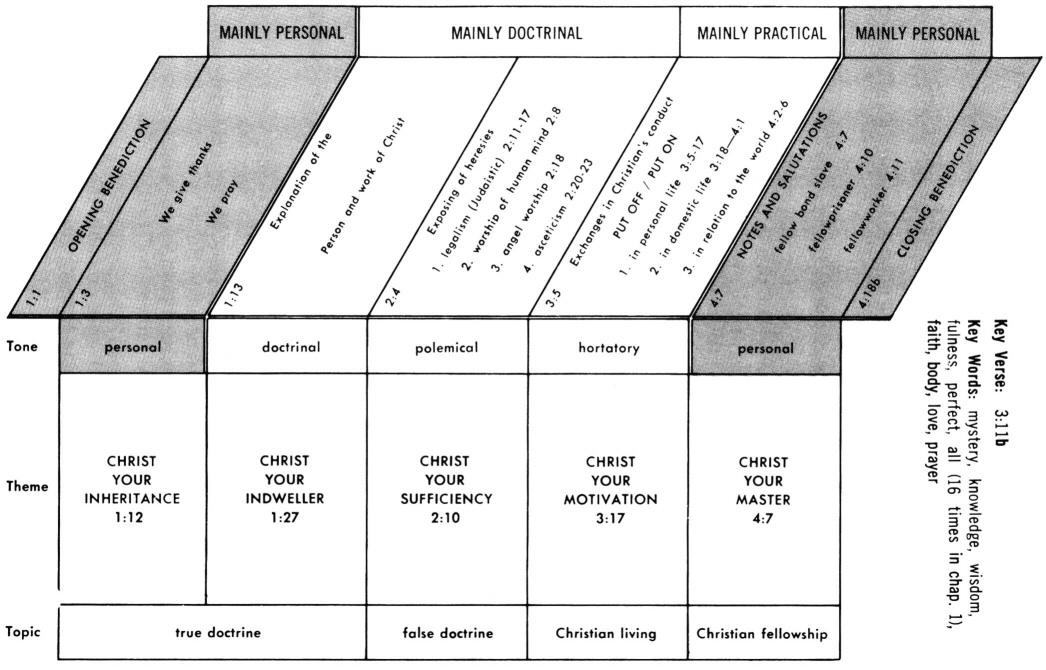
CHRIST IS ALL IN ALL
Click chart to enlarge
Charts from Jensen's Survey of the NT - used by permission
Colossians Overview - Click Chart on right side
| Christ Preeminent in All Things Supreme Lord - Sufficient Savior |
|||
| Colossians 1 | Colossians 2 | Colossians 3 | Colossians 4 |
| Supremacy of Christ |
Submission to Christ |
||
| Doctrinal and Corrective |
Practical and Reassuring |
||
| What Christ Did For Us |
What Christ Does Through Us |
||
| Christ Our Lord |
Christ Our Life |
Christ our Love |
|
| Christ the Head of the Body |
Christ the Lord of the Universe |
Christ the Head of the Home |
|
| Instruction | Warnings | Exhortations | Reminders |
| Reconciliation | Creation | Submission | Conversation |
| His Person and Word |
His Peace and Presence |
||
Colossians 4:1 Masters, grant (2PPMM) to your slaves justice and fairness, knowing (RAPMPN) that you too have (2PPAI) a Master in heaven. (NASB: Lockman)
Greek: Oi kurioi, to dikaion kai ten isoteta tois doulois parechesthe, (2PPMM) eidotes (RAPMPN) hoti kai umeiv echete (2PPAI) kurion en ourano
Amplified: MASTERS, [on your part] deal with your slaves justly and fairly, knowing that also you have a Master in heaven. [Lev. 25:43, 53.] (Amplified Bible - Lockman)
KJV: Masters, give unto your servants that which is just and equal; knowing that ye also have a Master in heaven.
Phillips: Remember, then, you employers, that your responsibility is to be fair and just towards those whom you employ, never forgetting that you yourselves have a heavenly employer. (Phillips: Touchstone)
Wuest: Masters, that which is just and equitable be rendering on your part to your slaves, knowing that you also have a Master in heaven.
Young's Literal: Masters, grant to your slaves justice and fairness, knowing that you too have a Master in heaven.
MASTERS GRANT TO YOUR SLAVES JUSTICE AND FAIRNESS KNOWING THAT YOU TOO HAVE A MASTER IN HEAVEN: i kurioi, to dikaion kai ten isoteta tois doulois parechesthe, (2PPMM) eidotes (RAPMPN) hoti kai umeiv echete (2PPAI) kurion en ourano:
- Lv 19:13; 25:39, 40, 41, 42, 43; Deut 15:12, 13, 14, 15; 24:14,15; Neh 5:5-13; Job 24:11,12; Job 31:13, 14, 15; Isa 58:3,5, 6, 7, 8, 9; Jer 34:9-17; Mal 3:5; Jas 2:13; 5:4
- you too have a Master Eccl 5:8; Matt 23:8,9; 24:48, 49, 50, 51; Lk 16:1-13; 19:15; Eph 6:8,9-20; Rev 17:14; 19:16
- Colossians 4 Resources - Multiple Sermons and Commentaries
After a careful reading of the previous section, you will also likely agree that this verse goes better with the preceding section. Remember that the chapter breaks are not inspired!
Spurgeon - I sometimes think that the good men who chopped the Bible up into chapters—for it is not in chapters in the original,—must have hoped that we should not read this message to the masters, as he had put it in another chapter. But I never like to read about the servants without also reading about the masters. There is six for one, and half-a-dozen for the other; and, as is usual, in the Scriptures, there are balanced duties. If there is an exhortation to the children, there is generally one to the parents close by; and if there is a word to wives, there is one for husbands, too.
Masters (2962)(kurios) is normally rendered "Lord" and describes one who is sovereign and possesses absolute authority, absolute ownership and uncontested power. In classical Greek kurios was used of the pagan gods. Kurios in the present context is one having legal power and control over his own property.
Slaves (1401) (doulos) is one who is in bondage or bound to another. He is in the state of being completely controlled by his master, his will being encompassed by the will of his master. He is not his own but is the property of his master. Doulos was the most abject, servile term of the six Greek words for "slave".
A businessman asked his Bible study group, “How can you tell if you have a servant attitude?” The answer? “By the way you react when you are treated like one.”
Grant (3930) (parecho from pará = unto, at, near + écho = to have, hold) means literally to hold near. It means to hold out toward someone, to present or to offer. In the present context parecho means to cause something to happen to someone. It means to to render, and is in the present (continual action called for) tense, imperative (command not a suggestion) mood. The middle voice conveys the idea that the master is commanded to continually "render on your part". (present imperative calls for continued dependence on the Holy Spirit to obey)
W E Vine suggests "that they should do it with a real good will."
Justice (1342) (dikaios from díke = custom, rule, right, especially in the fulfilment of duties towards gods and men, and of things that were in accordance with right) in the context of the NT usages, describes that which is in accordance with what God requires or in accordance with God's compelling standards.
Fairness (isotes from ísos = equal, like) means likeness or equality. The idea is treating employees equally or of equal value. It signifies what is equitable (dealing fairly and equally with all concerned).
W E Vine says the masters "are to render what is equal as well as just, does not mean they are to treat them as equals socially. (Collected writings of W. E. Vine)
J Vernon McGee agrees that isotes "means not to level down but to level up. The master is to do right by his servant. (Thru the Bible Commentary)
Wuest adds that Paul does not refer to "equality of condition, but the brotherly equality growing out of the Christian relation, in which there is neither bond nor free.” Expositors says: “The master should regulate his treatment of his slave, not by caprice, but by equity.” It should be kept in mind that these masters were Christians."
The Phillips paraphrase emphasizes the motivation for being godly masters, "never forgetting you have a Heavenly Master"!
While some of us may be masters on earth, we must exercise this function with the full understanding that we too are but servants of the Lord Who is Master over all. Our conduct must be just and equitable toward those who we have charge over. This view should transform how they regard and treat their slaves and was a radical departure from the practice of pagan Roman masters who considered their slaves as little more than property and not as men and women made in the image of God. Under Roman law, slave masters had almost total control over their slaves and could do with them whatever they pleased. Few unsaved Roman masters ever thought of treating their slaves with fairness, for in their estimation, slaves deserved nothing. On the other hand, it is notable that wherever Christians have constituted a significant segment of the population and have followed Paul’s directions here, the slave system has died.
The admonition brings to mind the teaching of the Sermon on the Mount in which Jesus warned that "in the way you judge, you will be judged; and by your standard of measure, it will be measured to you (Mt 7:2)
God will judge masters who mistreat their slaves, as He will slaves who fail to serve their masters.
Courson paraphrases this verse writing - Bosses, make sure you’re acting justly, lovingly, equitably. Sure, you might be in a place of power and prominence now, but never forget you will one day stand before your Master and give account of what went on through your life and in your heart.” (Jon Courson's Application Commentary: NT)
APPLICATION: Are you treating your employees like you would desire the Lord Jesus to treat you?
Even masters are to "Do nothing from selfishness or empty conceit, but with humility of mind let each of you regard one another as more important than himself. (Php 2:3)
Note the repetition of Lord in Colossians and especially in the last half of the letter (Col 1:3, 10; 2:6; 3:13, 17, 18, 20, 22 [2x], Col 3:23, 24 [2x], Col 4:1 [2x], Col 4:7, 17 - see notes Col 3:18; 20; 22; 24; 4:1).
MacDonald makes the point that "Paul repeatedly brings these matters of everyday life under the searchlight of the lordship of Christ as follows: (1) Wives—as is fitting in the Lord (Col 3:18). (2) Children—well-pleasing to the Lord (Col 3:20). (3) Servants—fearing the Lord (Col 3:22). (4) Servants—as to the Lord (Col 3:23). (A. Believer's Bible Commentary)
The structure of delegated authority is needed because we live in a fallen world, but as discussed above, the master's role does not make him or her superior in any way.
Christians must realize these issues such as how we supervise and how we serve in the work place are a crucial part of our spiritual life. We are called to be ambassadors and must represent Christ well at our jobs (or schools, etc) during the weekdays, as well as at church on Sunday! In fact, Christians should be known as the best workers at their work-places. They should be the most respectful and obedient to supervisors, the most industrious and conscientious and honest, and the most loving and genuinely interested in people. Such Christ like behavior will open doors to the most rewarding occupation anyone could ever hope for, the privilege of sharing the Person Who enables you to live and work "right side" up in a "post-Christian" society which is for the most part "upside down."
People Over Profits - READ: Colossians 3:22-4:1 - When Truett Cathy started his first restaurant in 1946, it was closed on Sundays to give his employees time to be with their families and to attend church. It's still true today of the more than 1,000 Chick-fil-A fast-food outlets franchised by his company.
Cathy's slogan is: "Put people and principles before profit." It's a motto each of us can make our own, whether we give orders or take them on the job.
The apostle Paul had a word for employers and employees in Colossians 3:22-4:1. He said we need to remember that we have a Master in heaven (Col 4:1), and we are to work from our hearts to please Him, not just the person watching us (Col 3:22, 23, 24).
Truett Cathy strives to remain true to biblical principles in his business. Larry Julian, author of God Is My CEO, a book about Cathy and other business leaders, says: "God doesn't promise a tangible return on investments, but He promises the fruits of the Spirit, love and peace and joy, on a personal level. Cathy is not only experiencing peace and joy and love in his life personally, but he's also making a difference to his foster children, his own children and grandchildren, and his employees. He's leaving a legacy on how you can do things the right way."
That's an example we can take to work. —David C. McCasland (Our Daily Bread, Copyright RBC Ministries, Grand Rapids, MI. Reprinted by permission. All rights reserved)
Lord, teach me how to love and work,
That everything I do
May be to someone in its turn
A service good and true. —Anon.
When people are more important than profits,
everyone profits.
Colossians 4:2 Devote (2PPAM) yourselves to prayer, keeping alert (PAPMPN) in it with an attitude of thanksgiving (NASB: Lockman)
Greek: Te proseuche proskartereite, ( 2PPAM ) gregorountes (PAPMPN) en aute en eucharistia
Amplified: Be earnest and unwearied and steadfast in your prayer [life], being [both] alert and intent in [your praying] with thanksgiving. (Amplified Bible - Lockman)
KJV: Continue in prayer, and watch in the same with thanksgiving;
Phillips: Always maintain the habit of prayer: be both alert and thankful as you pray. Include us in your prayers, please, that God may open for us a door for the entrance of the Gospel.
Wuest: Be giving constant attention to prayer, constantly vigilant in it with thanksgiving
Young's Literal: Devote yourselves to prayer, keeping alert in it with an attitude of thanksgiving;
DEVOTE YOURSELF TO PRAYER: Te proseuche proskartereite (2PPAM):
- Col 4:12; 1:9; 1Sa 12:23; Job 15:4; 27:8, 9, 10; Ps 55:16,17; 109:4; Lk 18:1; Ro 12:12; Eph 6:18; Phil 4:6; 1Th 5:17,18
- Colossians 4 Resources - Multiple Sermons and Commentaries
Related Passages:
Luke 18:1 Now He was telling them a parable to show that at all times they ought (MUST) to pray and not to lose heart,
Romans 12:12+ rejoicing in hope, persevering in tribulation, devoted to prayer, (ALL THREE verbs are in the present tense - calling for dependence on the Holy Spirit)
Ephesians 6:18 (ONE OF THE MOST POWERFUL WEAPONS IN SPIRITUAL WARFARE!) With all prayer and petition pray (present tense - calls for dependence on the Holy Spirit) at all times in the Spirit, and with this in view, be on the alert with all perseverance and petition for all the saints,
Philippians 4:6 Be anxious for nothing (present imperative with a negative see our need to depend on the Holy Spirit to obey), but in everything by prayer and supplication with thanksgiving let your requests be made known (present imperative see our need to depend on the Holy Spirit to obey) to God.
TO PRAYER
DEVOTE YOURSELF
Devote yourselves to prayer - Literally Greek reads "the prayer devoted" so that prayer is emphasized! This does not mean that all you do is pray all day long, but it does mean that one's devotion to prayer affects everything in one's life. Think of a husband devoted to his wife or vice versa. The idea is that one dedicates himself or herself to the other. Devotion implies a strong attachment, allegiance, ardour or affection for some one or some thing, in this case prayer and the act of praying. To devote one's self involves allocation of ones' time and resources. There is a giving of one's self. One who is devoted is ardent, caring, committed, concerned, constant, dedicated, loyal, staunch, steadfast and true. One who is devoted is not disloyal, inconstant, indifferent or uncommitted. These are some of the ideas involved in the picture of one who is devoted to prayer.
THOUGHT - How does your prayer life compare with these descriptions? Would you say you are devoted to prayer? If not, then to what are you devoting your life… to things temporal or things eternal? What needs to change, so that you might joyfully fulfill the command to continually devote yourself to the high and holy privilege of prayer to the Almighty?
How should we pray? Observe Paul's simple instructions in this passage on how to pray - (1) Persistently - devote yourselves (2) Watchfully - keeping alert and (3) Thankfully
One thing is abundantly clear from this passage - God's will is that we pray! We all struggle to know the will of God in this area or that area of our life. This passage makes it clear that there are some things that you don't have to struggle to know His will. And one of those things that should be crystal clear is that God’s will is for us to persistently practice praying to Him. One wonders how our fulfilling of this aspect of the will of God, would make His will more easily discernible in other (all) areas of our life?
In Paul's letter to the Thessalonians he writes a parallel pithy passage in which believers are commanded to…
Pray (present imperative = command to continue in prayer) without ceasing (See discussion in notes on 1Thessalonians 5:17)
Devote (4342) (proskartereo from prós = in compound Greek words prós implies motion, direction = toward, to + karteréo = be strong, steadfast, firm, endure, hold out, bear the burden) means to be earnest towards, to persevere. It describes a steadfast single-minded fidelity to a certain course of action. It means to persist obstinately in a task, to keep on with devotion, to continue to do something with intense effort, to be steadfastly attentive unto, to give unremitting care to a thing, to continue all the time in a place, to persevere and not to faint, to be constantly diligent, to attend assiduously all the exercises, to adhere closely to, to attend continually or wait on continually, to tarry or remain somewhere.
Proskartereo - 10x in 10v - continually devoting themselves, 2; continued, 1; continuing, 1; devote ourselves, 1; devote yourselves, 1; devoted, 1; devoting themselves, 1; personal attendants, 1; stand ready, 1. Mk. 3:9; Acts 1:14; Acts 2:42; Acts 2:46; Acts 6:4; Acts 8:13; Acts 10:7; Rom. 12:12; Rom. 13:6; Col. 4:2 There is one use in the Lxx in Nu 13:20.
Devote in the present verse is a command (imperative mood) in the present tense, calling for continual devotion to prayer (present imperative calls for continued dependence on the Holy Spirit to obey). One thing is crystal clear from this passage and that is that it is God's will that we pray to Him. We all struggle to know the will of God for our lives, but there are some things that you do not have to struggle to know. One of them is that God's will is that you pray to him. Paul is exhorting the Colossian saints (and us) to pray often and regularly. He is saying that prayer is not to be infrequent, "hit or miss" activity (for if we do not "hit", it is us who will "miss" out beloved). Devoted means we are not to be haphazard and forgetful of our grand privilege of prayer as high priests of the Living God. Devoted means that (under grace not law) we must take steps to ensure that prayer with thanksgiving is a central part of our spiritual life, even as are eating and sleeping. Seek times of quiet communion with God. Early in the morning is one Biblical motif. Then you are prepared to walk with God in continual conversation throughout the day, moment by moment, hour by hour. Do not neglect Scripture memorization and meditation, for these friends will serve you well, as they goad and guide your prayers throughout the day.
Daniel was a man "highly esteemed" by God and thus it should come as no surprise that he was "devoted to prayer", Scripture recording that even in the face of certain punishment "when Daniel knew that the document (prohibiting prayer to God) was signed, he entered his house (now in his roof chamber he had windows open toward Jerusalem); and he continued kneeling on his knees three times a day, praying and giving thanks before his God, as he had been doing previously." (Da 6:10)
Psalm 119:164 says, "Seven times a day I praise You, because of Your righteous ordinances."
Jesus speaking to His disciples told them "that a boat should stand ready (proskartereo) for Him because of the multitude, in order that they might not crowd Him." (Mk 3:9)
Note that 6 of the 10 uses of proskartereo are associated with prayer!
Luke for example records prior to the selection of a replacement for Judas "all with one mind were continually devoting (proskartereo) themselves to prayer, along with the women, and Mary the mother of Jesus, and with His brothers." (Acts 1:14)
He later uses this same verb to describe the early church in Jerusalem as "continually devoting (proskartereo) themselves to the apostles' teaching and to fellowship, to the breaking of bread and to prayer." (Acts 2:42)
Again we find the verb describing the early church "Day by day continuing (proskartereo) with one mind in the temple, and breaking bread from house to house… taking their meals together with gladness and sincerity of heart." (Acts 2:46)
The 12 apostles of the early church declared that "we will devote (proskartereo) ourselves to prayer, and to the ministry of the word." (Acts 6:4)
Paul uses this verb in the practical section of Romans exhorting the saints to be "rejoicing in hope, persevering in tribulation, devoted (proskartereo) to prayer." (Ro 12:12)
In Romans 13 Paul writes "for because of this (i.e., God ordained human government and demands submission to it) you also pay taxes (Greek word refers specifically to taxes paid by individuals, especially those in a conquered nation as tribute to foreign rulers which makes the tax even more onerous), for rulers are servants of God, devoting (proskartereo) themselves to this very thing." (Ro 13:6)
Here proskartereo is taken by some as referring to the unceasing activity of the tax collector, a picture illustrating the continuous energy implied by the verb proskartereo. If the church demonstrated in its prayer life the dedication and persistence of the government in its collection of revenue, then the church would indeed have little to fear from the gates of hell! There would be no question of the truthfulness of the stanza,
“Satan trembles when he sees the weakest saint upon his knees.”
-- William Cowper
Proskartereo then means to attend constantly upon a person or thing.
Proskartereo implies intensification of strength and persistent devotion. We are to be strong in our devotion to prayer, making it a priority nothing can dislodge.
Only after you talk to God about needy people are you ready to talk to needy people about God.
Even for the best of us, there come times when prayer seems to be unavailing and to penetrate no farther than the walls of the room in which we pray. At such a time the remedy is not to stop but to go on praying. Spiritual dryness cannot last the man who prays. Don't give up!
John Piper - I have often said that one of the reasons we feel so weak in our prayer lives is that we have tried to make a domestic intercom out of a wartime walkie talkie. Prayer is not designed as an intercom between us and God to serve the domestic comforts of the saints. It's designed as a walkie talkie for spiritual battlefields. It's the link between active soldiers and their command headquarters, with its unlimited fire-power and air cover and strategic wisdom.
Prayer (4335) (proseuche) is the most frequent NT word for prayer, stresses fervency, always refers to prayer to God and to praying with a definite aim.
Solomon writes that "the prayer of the upright is His delight." (Pr 15:8)
Beloved, do you desire to delight your heavenly Father? Then "devote yourself to prayer".
Fill to the brim the "golden bowls full of incense (fragrant spices and gums for burning), which are the prayers (all the prayers ever prayed) of the saints. (see note Revelation 5:8)
APPLICATION: Courson commenting on (Rev 5:8) has written "according to our text, our prayers are kept in vials or bowls. How full is yours?" (Jon Courson's Application Commentary: NT. Nelson. 2004 )
John Piper writes of "a story about D. L. Moody making a visit to Scotland in the 1800's and opening one of his talks at a local grade school with the rhetorical question, What is prayer? To his amazement, hundreds of children's hands went up. So he decided to call on a lad near the front, who promptly stood up and said, "Prayer is an offering up of our desires unto God, in the name of Christ, by the help of his Spirit, with confession of our sins, and thankful acknowledgment of his mercies." This is the answer to question #98 in the Westminster Catechism. To this Moody responded by saying, "Be thankful, son, that you were born in Scotland." (Devote Yourselves to Prayer, a sermon by John Piper)
A similar exhortation is to pray without ceasing, (1Th 5:17), which enjoins, not uninterrupted, but constantly recurring prayer. Like every other spiritual activity, such a devoted attitude toward prayer calls for diligence, lest its power be forgotten and its occasions and opportunities be allowed to slip away. The maintenance of an effective spiritual life depends upon intercourse with the God of our salvation. Steadfastness in prayer is to be our continual mindset because of the many hindrances to fervent prayer which are inherent in the nature (saved but still weak in these bodies of flesh) and in the surroundings (busyness) of believers.
While the chief emphasis of this last chapter of Colossians is upon the Christian’s life in the world, Paul fittingly begins with prayer since it is the foundation and source of power for such a life.
John MacArthur records the following story illustrating the boldness believers should have when wrestling with God in prayer - In 1540 Luther’s great friend and assistant, Friedrich Myconius, became sick and was expected to die within a short time. On his bed he wrote a loving farewell note to Luther with a trembling hand. Luther received the letter and sent back a reply: “I command thee in the name of God to live because I still have need of thee in the work of reforming the church… The Lord will never let me hear that thou art dead, but will-permit thee to survive me. For this I am praying, this is my will, and may my will be done, because I seek only to glorify the name of God.”Those words are shocking to us, but they were certainly heartfelt. Although Myconius had already lost the ability to speak when Luther’s letter came, he recovered completely and lived six more years to survive Luther himself by two months. (MacArthur, J. Colossians. Chicago: Moody Press )
Piper writes that prayer is "A Wartime Walkie-Talkie, Not a Domestic Intercom. Prayer is the walkie-talkie on the battlefield of the world. It calls on God for courage (Ephesians 6:19). It calls in for troop deployment and target location (Acts 13:1, 2, 3). It calls in for protection and air cover (Matthew 6:13; Luke 21:36). It calls in for firepower to blast open a way for the Word (Colossians 4:3). It calls in for the miracle of healing for the wounded soldiers (James 5:16). It calls in for supplies for the forces (Matthew 6:11; Philippians 4:6). And it calls in for needed reinforcements (Matthew 9:38). This is the place of prayer—on the battlefield of the world. It is a wartime walkie-talkie for spiritual warfare, not a domestic intercom to increase the comforts of the saints. And one of the reasons it malfunctions in the hands of so many Christian soldiers is that they have gone AWOL. (Piper, J. The Pleasures of God: Meditations on God's delight in Being God. Page 343-372. Sisters, Or.: Multnomah Publishers)
Spurgeon - It is interesting to remark how large a portion of Sacred Writ is occupied with the subject of prayer, either in furnishing examples, enforcing precepts, or pronouncing promises. We scarcely open the Bible before we read, "Then began men to call upon the name of the Lord;" and just as we are about to close the volume, the "Amen" of an earnest supplication meets our ear. Instances are plentiful. Here we find a wrestling Jacob-there a Daniel who prayed three times a day-and a David who with all his heart called upon his God. On the mountain we see Elias; in the dungeon Paul and Silas. We have multitudes of commands, and myriads of promises. What does this teach us, but the sacred importance and necessity of prayer? We may be certain that whatever God has made prominent in his Word, he intended to be conspicuous in our lives. If he has said much about prayer, it is because he knows we have much need of it. So deep are our necessities, that until we are in heaven we must not cease to pray. Dost thou want nothing? Then, I fear thou dost not know thy poverty. Hast thou no mercy to ask of God? Then, may the Lord's mercy show thee thy misery! A prayerless soul is a Christless soul. Prayer is the lisping of the believing infant, the shout of the fighting believer, the requiem of the dying saint falling asleep in Jesus. It is the breath, the watchword, the comfort, the strength, the honour of a Christian. If thou be a child of God, thou wilt seek thy Father's face, and live in thy Father's love. Pray that this year thou mayst be holy, humble, zealous, and patient; have closer communion with Christ, and enter oftener into the banqueting-house of his love. Pray that thou mayst be an example and a blessing unto others, and that thou mayst live more to the glory of thy Master. The motto for this year must be, "Continue in prayer." (Morning and Evening)
KEEPING ALERT IN IT: gregorountes (PAPMPN) en aute:
- Matthew 26:41; Mark 13:33; Luke 21:36; 1 Peter 4:7
- Colossians 4 Resources - Multiple Sermons and Commentaries
MAINTAINING A
"DEFCON 1 MINDSET!"
Keeping alert in it - You are in a continual spiritual war and as you would in the military when the battle is imminent you maintain a "DEFCON 1 MINDSET!" (DEFCON 1 being the highest alert level)
Keeping alert (1127) (gregoreuo from egeiro = waken, rouse from sleep) means to keep awake, refrain from sleep and so to remain alert, watchful and ready to meet danger or emergency. It means to be quick to perceive and act; being on the lookout. The idea of alert stresses readiness or promptness in meeting danger or in seizing opportunity. The picture is of a sleeping man rousing himself and of being wide-awake and fully alert. Gregoreuo is present tense with pictures one continually in a state of "high alert", ready to pray anywhere, anytime, for any need and any one. Although keeping alert is not a command, the fact that it is present tense calls for continued dependence on the Holy Spirit to obey! Our fallen flesh fights to keep us the opposite of alert!
THOUGHT - Are you to be continually on high alert to intercede for others - in the midst of a phone call, in the supermarket, in the hall after the church service, etc. In sum, in all places, at all times, always alert to pray! Keeping alert conveys the idea of "praying with your eyes open" as we see in Nehemiah where Nehemiah records that when the enemy threatened the rebuilding of the wall "We made our prayer… and set a watch!" (Neh 4:9) I like to call those "arrow prayers." Shoot them up in a heartbeat! God hears. God responds according to His good will.
Gregoreuo gives the sense of to wake from sleep and suggests the aroused conscience and the keen attention to the task that ought to characterize the one who prays.
Our Lord told two parables illustrating the importance of persistent prayer both recorded by Luke. Read and study (Luke 18:1, 2, 3, 4, 5, 6, 7, 8, Luke 11:5, 6, 7, 8, 9,10) The point of both those parables is that if unwilling and sinful humans will honor persistence, how much more will our holy, loving heavenly Father?
In the present context gregoreuo conveys the demand for morally and spiritually wakeful activity, being alert against the assaults of temptations to sin and the lust of the flesh. In Gethsemane, deeply grieved to the point of death, our Lord found the disciples "sleeping and said to Peter,
"So, you men could not keep watch (gregoreuo) with Me for one hour? Keep watching (gregoreuo) and praying, that you may not enter into temptation; the spirit is willing, but the flesh is weak." (Mt 26:38,40, 41)
Keep watching and praying are both present tense (calling for continuous action) imperatives (commands - calling for continued dependence on the Holy Spirit to obey) indicating that the need for spiritual vigilance and readiness to pray is not an occasional occurrence but is to be our habit and lifestyle.
In his letter to the Thessalonians Paul reminded the brethren
you are not in darkness, that the day should overtake you like a thief for you are all sons of light and sons of day (believers who are children of God, Who is light and in Whom is no darkness at all). We are not of night nor of darkness. So then let us not sleep as others do, but let us (continually) be alert (keep wide awake, cautious, on our guard, watchful against temptation, laziness, lethargy and distraction and for our Lord's return- gregoreuo - present tense - calls for continued dependence on the Holy Spirit to obey) and sober (calm, collected, circumspect, sane, steady, not complacent, not frustrated and not afraid knowing our future is secure)." (see notes 1Th 5:4; 5:5; 5:6)
John MacArthur comments that "Because believers have been delivered from the domain of darkness, they are taken out of the night of sin and ignorance and put into the light of God. Because Christians are in the light, they should not sleep in spiritual indifference and comfort, but be alert to the spiritual issues around them. They are not to live like the sleeping, darkened people who will be jolted out of their coma by the Day of the Lord , but to live alert, balanced, godly lives under control of the truth." (Borrow The MacArthur Study Bible)
Peter commands (both verbs are aorist imperative = this is urgent! Do it now!) his tried and tested brethren to
Be of sober spirit, be on the alert. (gregoreuo)(both commands call for dependence on the Holy Spirit to obey) Your adversary (Greek word for a legal opponent in a lawsuit), the devil, prowls about like a roaring lion, seeking someone to devour (looking for opportunities to overwhelm the believer with temptation, persecution, and discouragement). But resist (aorist imperative calls for dependence on the Holy Spirit to obey) him, firm in your faith, knowing that the same experiences of suffering are being accomplished by your brethren who are in the world." (1Pe 5:8,9)
The following article has some sobering thoughts we all need to contemplate regarding prayer…
DEVOTED TO PRAYER: WRESTLING WITH GOD IN EARNEST PRAYER by Virginia Stem Owens - Christians have always interpreted the splitting of the temple veil during the crucifixion as symbolic of their liberation from the mediated presence of God. Henceforth they were “free” to approach Him directly—which is almost like telling someone he is “free” to stick his head in the lion’s jaws. For once you start praying there is no guarantee that you won’t find yourself before Pharaoh, shipwrecked on a desert island, or in a lion’s den.
This is no cosmic teddy bear we are cuddling up to. As one of the children describes him in C. S. Lewis’s Chronicles of Narnia, “he’s not a tame lion.” [Jacques] Ellul is convinced that prayer for persons living in the technological age must be combat, and not just combat with the Evil One, with one’s society, or even one’s divided self, though it is also all of these; it is combat with God. We too must struggle with him just as Jacob did at Peniel where he earned his name Israel—“he who strives with God.” We too must be prepared to say, “I will not let you go till you bless me.”
Consider Moses, again and again intervening between the Israelites and God’s wrath; Abraham praying for Sodom; the widow demanding justice of the unjust judge. But in this combat with God, Ellulcautions, we must be ready to bear the consequences:… “Jacob’s thigh was put out of joint, and he went away lame. However, the most usual experience will be God’s decision to put to work the person who cried out to him… Whoever wrestles with God in prayer puts his whole life at stake.”
Awful things happen to people who pray. Their plans are frequently disrupted. They end up in strange places. Abraham “went out, not knowing where he was to go”… After Mary’s magnificent prayer at the annunciation, she finds herself the pariah of Nazareth society… How tempting to up the stakes, making prayer merely another consumer product. How embarrassing to have to admit not only that prayer may get you into a prison, as it did Jeremiah, but also that while you’re moldering away in a miry pit there, you may have a long list of lamentations and unanswered questions to present to your Lord. How are we going to tell them they may end up lame and vagrant if they grasp hold of this God?" (“Prayer—Into the Lion’s Jaws” Christianity Today Magazine, November 19, 1976, pp. 222–23)
Today in the Word - According to a recent newspaper article, people are returning to the habit of praying in restaurants. The article cited a poll by the Princeton Survey Research Associates which found that sixty percent of people surveyed said they pray aloud before eating in public.
We should applaud any sign that people are practicing prayer in greater numbers. Those who regularly offer thanks for their food, no matter where they are, reveal a habit of the heart that Paul commands in these familiar verses.
But ""Pray continually"" (v. 17) seems like a stretch when you read it, doesn't it? The text does not, of course, demand us to spend twenty-four hours of every day on our knees.
But in seeking God's will for us in prayer, we need to be careful not to weaken the force of Paul's words. Verse 17 comes in the middle of a string of rapid-fire exhortations that help us understand his intent. We can pray continually in the same way that we can always be joyful.
We don't have to be smiling all the time to be characterized by joy. We all know people who emit joy the way the sun emits rays. They choose to live this way. The joy of Christ is the atmosphere that sustains them.
In the same way, God wants prayer to be the atmosphere we breathe, the attitude of our hearts. A person who lives in a continual attitude of prayer is someone who can give thanks in all circumstances (v. 18).
Does today's text suggest anything about how much we should pray? It sure does. Giving thanks in everything by itself is going to consume a good part of your time! And in special times of need or concern, you may literally find yourself praying continually in the sense that your prayer burden is never more than a heartbeat from your conscious thoughts.
Let's face it. Praying too much isn't a big problem for most of us. It's all that we can handle just to cultivate the prayer habit that God wants of us. But we have a prayer Helper in the Holy Spirit. Let's not ""put out"" the prayer fire He wants to kindle in us.
TODAY ALONG THE WAY - One way to help develop a habit of prayer is to change some of our standard thinking. For example, we usually treat the ""Amen"" at the end of our prayers like a period at the end of a sentence. In other words, prayer is over, so let's move on to the next thing. But instead of a period, try thinking of your ""amen"" as a comma--simply a pause in the conversation. You may have to go on to work or to your duties at home, but you can bring the atmosphere of your prayer place with you.
WITH AN ATTITUDE OF THANKSGIVING: en eucharistia:
- Col 2:7; Col 3:15,17
- Colossians 4 Resources - Multiple Sermons and Commentaries
Related Passages:
Colossians 2:7 having been firmly rooted and now being built up in Him and established in your faith, just as you were instructed, and overflowing with gratitude.
Colossians 3:15; 17 Let the peace of Christ rule in your hearts, to which indeed you were called in one body; and be thankful....17 Whatever you do in word or deed, do all in the name of the Lord Jesus, giving thanks through Him to God the Father.
AN ATTITUDE OF
GRATITUDE
With an attitude of thanksgiving - The word attitude is added by the translators. With is literally "in" which gives us the picture as if we are "immersed" in (locative of sphere) an attitude of thanksgiving, so to speak.
THOUGHT - How can you maintain an attitude of gratitude? You (I) cannot! At least we cannot in dependence on our fallen flesh (which too often defaults to grumbling or complaining)! We must continually be filled with (controlled by, energized by) the Holy Spirit for in Eph 5:18 Paul writes that one of the first "fruits" of the filling/control of the Spirit is "always (try that by depending on flesh) giving thanks for all things (HOW MANY?)." (Eph 5:20).
Thanksgiving (2169) (eucharista from eú = well, + charízomai = to grant, give) literally means something like "giving good" and thus expresses gratitude, that which ought never to be absent from any of our devotions (or anything else in our life!). The idea is grateful acknowledgment of past (present and future) mercies. (cf Eph 5:20).
In the Revelation we find the last NT use of eucharista, John recording that "all the angels were standing around the throne and around the elders and the four living creatures; and they fell on their faces before the throne and worshiped God, saying,
Amen, blessing and glory and wisdom and thanksgiving and honor and power and might, be to our God forever and ever. Amen (Rev 7:11, 12)
Paul's injunctions are given in the present tense (calling for this to be our lifestyle! Is it yours beloved?), and as in this verse touch first the inward life of prayer and then the outward life of testimony. When Christ touches the life of a man, the whole life is touched, and every believer becomes a full-time servant of the Lord, whether, housewife, student, lawyer, doctor, etc.
Another thing that one notices here is the obvious importance of the little things in the Christian life, such as the exchange of information, prayer requests, encouragement and exhortation, commendation of believers to one another, and personal greetings. Hardly any aspect of the daily life of the Christian is so insignificant that it does not find place in the apostle’s correspondence. This will find illustration in the section of Colossians to which we have come in our studies.
C H Spurgeon comments "See how he keeps putting that in—“Be ye thankful”—“with thanksgiving.” Why, that is the oil that makes the machinery go around without its causing obstruction. May we have much of that thanksgiving
John Piper calls us to "Notice the connection between watchfulness and gratitude. “Continue steadfastly in prayer, being watchful in it with thanksgiving.” Or, more literally, “Being watchful in it BY thanksgiving.” The idea of watchfulness is vigilance and alertness. You recall in the Garden of Gethsemane how Jesus admonished the sleepy disciples (Matthew 26:41), “Watch and pray that you may not enter into temptation.” In other words guard yourself from temptation by watching in your prayer, by being alert and vigilant. But now Colossians 4:2 says that the way we watch is “with thanksgiving.” Guard yourselves with gratitude! (See full sermon Guard Yourself with Gratitude)
John Courson writes that "A few months ago, I saw a billboard that said: Pray. It works. And I thought, True—but what if it doesn’t work? Most of the time we pray small prayers like, “Get me out of here.” And when they don’t work, we stop praying instead of learning what prayer really is. Prayer is not to get God to see things our way, but rather to get us to see things His way. (Courson, J. Jon Courson's Application Commentary. Page 1326. Nashville, TN: Thomas Nelson)
John Piper drives home Paul's point about the need to continually devote yourselves to prayer writing that "prayer is not some small thing. It is not some marginal thing. It is not some incidental thing in the Christian life. Prayer is at the heart of why God created the universe. You may have the modern, secular notion that the universe is really about great galactic events and supernovas and remarkable expanses of time and space and energy. But in reality the center of the created universe is man created in the image of God. And the meaning of man in the image of God is to display God's glory. And the way God delights to display His glory in man is by being depended on through prayer. (Devote Yourselves to Prayer, a sermon by John Piper)
Why Pray? READ: Luke 11:1-13 - Continue earnestly in prayer, being vigilant in it with thanksgiving. --Colossians 4:2
One of the great paradoxes of the Christian faith is that God wants us to talk to Him about everything that is going on in our lives, even though He already knows everything. So why pray?
If you've ever wrestled with that question, perhaps the thoughts of the 19th-century preacher R. A. Torrey can help. Among the reasons he gave for prayer are these:
Because there is a devil, and prayer is a God-appointed way to resist Him (Eph. 6:12, 13,18).
Because prayer is God's way for us to obtain what we need from Him (Lk. 11:3-13; Jas. 4:2).
Because prayer is the means God has appointed for us to find "grace to help in time of need" (Heb. 4:16).
Because prayer with thanksgiving is God's way for us to obtain freedom from anxiety and to receive "the peace of God" (Phil. 4:6, 7).
Besides these reasons, it's enough to read the command in 1 Thessalonians 5:17, "Pray without ceasing," and realize that God wants us to talk with Him. Yes, He is all-knowing, but He also desires our fellowship. When we seek God's face in prayer, we strengthen our relationship with Him. That's the most important reason to pray. —Dave Branon (Our Daily Bread, Copyright RBC Ministries, Grand Rapids, MI. Reprinted by permission. All rights reserved)
Since prayer is God's most gracious plan
Whereby He links Himself with man,
Should not His own more often say
To one another, "Let us pray"?
--Sterling
Our highest privilege is to talk to God.
Watch What Happens! READ: Colossians 4:2-13 - Continue earnestly in prayer, being vigilant in it with thanksgiving. --Colossians 4:2
A missionary to Haiti was told by a doctor that she might have cancer. A biopsy was performed and sent away for analysis. As she waited for the results, she was filled with fear and could find no peace of mind.
Then one evening her anxiety suddenly lifted like a cloud. She had a deep and inexpressible awareness that the Lord would take care of her husband and children and their emotional needs, regardless of the outcome.
As she reflected on all of this, it occurred to her that it was Wednesday evening--prayer meeting night in her home church back in the United States. She also realized that it was the first Wednesday night after friends had been notified of the potential crisis. These facts convinced this faithful missionary that God had given her an opportunity to sense His answer to the prayers of others on her behalf. In addition, the medical report soon came back with the welcome news that there was no cancer.
This true incident carries a needed reminder to all of us who are Christians. The emphasis given to prayer in Colossians 4 highlights the kind of support we should be giving one another. Let's pray for the needs of others and then watch to see what the Lord does. —Mart De Haan (Our Daily Bread, Copyright RBC Ministries, Grand Rapids, MI. Reprinted by permission. All rights reserved)
When earthly help is of no avail,
There is one Friend who will never fail;
Just lift your eyes--the answer is there,
For nobody knows the power of prayer! --Kenny
To influence people for God, pray to God for people.
IT'S THE KNEES. READ: James 5:13, 14,15, 16, 17, 18 - Continue earnestly in prayer. —Both of my knees were hurting, and I could not figure out why. I hadn't done anything to damage them or put undo pressure on them.
Or had I? I recalled that over the previous few days I had been working on the walls in our house, scrubbing them and getting them ready for painting. And then I had painted them. All the while, as I stood on the short ladder to reach the top, I had been pressing my knees against the ladder for balance. I was, in effect, being supported by my knees.
Then a new thought came to mind: When was the last time my knees hurt because I was on them praying? It had been a while.
Although it's true that people pray all the time without kneeling, the question I asked myself is a convicting one. Whether we are on our knees, standing up, or seated, how often do we use prayer to support ourselves? We can find help from many sources—friends, counselors, books—but there's nothing better than the support and strength we get from God when we pray.
"The effective, fervent prayer of a righteous man avails much" (James 5:16). Prayer has power. We are to "continue earnestly in prayer, being vigilant" (Colossians 4:2).
How are your knees? —Dave Branon (Our Daily Bread, Copyright RBC Ministries, Grand Rapids, MI. Reprinted by permission. All rights reserved)
When I kneel before my Master,
I can feel His presence there,
And the load of care and sorrow
Seems much easier to bear. —Anon
Prayer does not require eloquence but earnestness.
Colossians 4:3 praying at the same time for us as well, that God will open up to us a door for the word, so that we may speak forth the mystery of Christ, for which I have also been imprisoned; (NASB: Lockman)
Greek: proseuchomenoi (PMPMPN) ama kai peri hemon, hina o Theos anoixe (3SAAS) hemin thuran tou logou, lalesai (AAN) to musterion tou Christou, di' o kai dedemai, (1SRPI)
Amplified: And at the same time pray for us also, that God may open a door to us for the Word (the Gospel), to proclaim the mystery concerning Christ (the Messiah) on account of which I am in prison; (Amplified Bible - Lockman)
KJV: Withal praying also for us, that God would open unto us a door of utterance, to speak the mystery of Christ, for which I am also in bonds:
Phillips: Pray that we may talk freely of the mystery of Christ (for which I am at present in chains) (Phillips: Touchstone)
Wuest: praying at the same time also for us, that God would open for us a door for the Word, that we may speak the mystery of the Christ, because of which [mystery] also I have been bound,
Young's Literal: praying at the same time for us as well, that God may open up to us a door for the word, so that we may speak forth the mystery of Christ, for which I have also been imprisoned;
PRAYING AT THE SAME TIME FOR US AS WELL THAT GOD MAY OPEN UP TO US A DOOR FOR THE WORD : proseuchomenoi (PMPMPN) ama kai peri hemon hina ho theos anoixêi (AAS) thuran tou logou:
- Ro 15:30, 31, 32; Eph 6:19; Phil 1:19; 1Th 5:25; Philemon 1:22; Heb 13:18,19
- 1Cor 16:9; 2Cor 2:12; 2Th 3:1,2; Rev 3:7,8
- Colossians 4 Resources - Multiple Sermons and Commentaries
PRAYING FOR OPEN DOORS &
HEARTS TO THE GOSPEL
Open doors for the spread of the gospel come in answer to prayer. Therefore, in the life of Paul it is plain that prayer is God’s way of gospel victory.
Praying (4336) (proseuchomai noun = proseuche) is derived from prós = to, toward + eúchomai = wish, pray. The prefixed preposition pros meaning towards adds the idea of definiteness, of a conscious direction of one’s prayer toward or to God, and a consciousness on the part of the one praying, of God’s presence and attention.
Proseuchomai is in the present tense calling for continual activity. Make habitual prayer your "lifestyle". The middle voice indicates you initiate the prayer but that you yourself participate in the process.
Prayer involves a persevering will, an alert mind, and a grateful heart; and our requests should be specific and related to the ministry of the Word.
Paul asked not for an open prison door but for an open door of ministry.
Open (455) (anoigo from ana = up or again + oigo = open) is literally to open up again. In its literal use anoigo speaks of opening what is closed by a cover or a door
And they came into the house and saw the Child with Mary His mother; and they fell down and worshiped Him; and opening their treasures they presented to Him gifts of gold and frankincense and myrrh." (Mt 2:11)
Matthew records that in association with Jesus' resurrection
the tombs (around Jerusalem) were opened and many bodies of the saints who had fallen asleep were raised. (Mt 27:52)
Paul uses this same picture of opening a door elsewhere writing to the Corinthians that
a wide door for effective service has opened to me (he remained at Ephesus 3 years to redeem the opportunity), and there are many adversaries." (1Cor 16:9)
Again Paul writes that
when I came to Troas for the gospel of Christ and when a door was opened for me in the Lord" (2Cor 2:12)
Is it not striking that Paul, imprisoned, bound under Roman authority, is more concerned about getting out the message of Christ than about getting out of prison? This is a man with an "eternal mindset", one who has practiced what he preached ("Set your mind on the things above… ")
Door (2374) (thura) is a literal door but Paul uses this word metaphorically meaning access or opportunity. Luke records that when Paul and Barnabas returned from the first missionary journey, they
gathered the church together (and) began to report all things that God had done with them and how He had opened a door of faith to the Gentiles (Acts 14:27)
Notice that they did not report so much what they had done for God, but what He had been pleased to accomplish through them. Beloved, the door is still open, to Jews and Gentiles alike and to a whole world! Walk through the open door and take the Gospel to others, in prayer, in giving or in going. Be daring!
Invisible People - I'll never forget the feeling. It was as if I suddenly had become invisible. I had gone into a major department store in a large mall to purchase a gift for my wife. I made my way to the proper section and stood by the counter. Nothing happened. I moved around and tried to look eager to buy. Still nothing happened. I could not get waited on.
The store was not busy. I could see two or three clusters of clerks engaged in conversation. Others were straightening racks. But no one even acknowledged that I was there. I finally went to another store.
Many people around us have an even greater need--to know about Jesus Christ and His gift of salvation. Some are yearning for us to acknowledge them and reach out to them. Others would respond to a kind deed done in Jesus' name. Still others may require gentle persuasion to accept the offer of salvation. But none of them will respond if we do not see them as people in need of Christ and make the effort to witness to them.
Paul prayed for an open door to proclaim the gospel (Col. 4:3). If we do the same, we will find genuine seekers of spiritual help all around us. Let's show them by our words and actions that they are not invisible. --D C Egner
Help me to see the tragic plight
Of souls far off in sin;
Help me to love, to pray, and go
To bring the wandering in. --Harrison
Do you see a needy world through the eyes of Jesus?
Word (3056) (lógos) (Click study of lógos) (Click for 7 uses in Colossians) in the present context undoubtedly a reference to the gospel of God, which frees men from the prison of sin, self and Satan.
SO THAT WE MAY SPEAK FORTH THE MYSTERY OF CHRIST : hina… lalesai (AAN) to musterion tou Christou:
- Col 1:26; Col 2:2,3; Matt 13:11; 1Cor 4:1; Eph 6:19
- Colossians 4 Resources - Multiple Sermons and Commentaries
Related Passages:
Colossians 1:25-26 Of this church I was made a minister according to the stewardship from God bestowed on me for your benefit, so that I might fully carry out the preaching of the word of God, that is, the mystery which has been hidden from the past ages and generations, but has now been manifested to His saints,
Colossians 2:2; 3 that their hearts may be encouraged, having been knit together in love, and attaining to all the wealth that comes from the full assurance of understanding, resulting in a true knowledge of God’s mystery, that is, Christ Himself, 3 in whom are hidden all the treasures of wisdom and knowledge.
Matthew 13:11 Jesus answered them, “To you (DISCIPLES OF JESUS) it has been granted to know the mysteries of the kingdom of heaven, but to them it has not been granted (SO WE MUST TELL THEM).
1 Corinthians 4:1 Let a man regard us in this manner, as servants of Christ and stewards of the mysteries of God. (HAVING BEEN ENTRUSTED WITH THIS "PEARL OF GREAT PRICE," ARE YOU BEING A GOOD STEWARD? ARE YOU SHARING IT?)
Ephesians 6:19 and pray on my behalf, that utterance may be given to me in the opening of my mouth, to make known with boldness the mystery of the gospel,
OUR PRIVILEGE IS
TO PROCLAIM THE MYSTERY!
So that (term of purpose) we may speak forth the mystery of Christ - The purpose of the preceding prayer is that the Spirit of the Living God might open spiritual doors and hearts and ears to hear and receive the Word implanted which is able to say their souls (James 1:21). To the lost (Eph 2:1), the Gospel is foolishness and a complete mystery to their mind no matter how high their I.Q.! In context the mystery of Christ refers to the gospel of Jesus Christ.
Mystery (3466) (musterion from mustes = one initiated [as into the Greco-Roman religious "mystery" cults] from mueo = to close or shut) refers to the revealed truth about the Messiah that by comparison shows the foolishness of the "mysteries" of the Gnostics!
Musterion - 28x in 28v - Matt 13:11; Mark 4:11; Luke 8:10; Rom 11:25; 16:25; 1 Cor 2:1, 7; 4:1; 13:2; 14:2; 15:51; Eph 1:9; 3:3f, 9; 5:32; 6:19; Col 1:26f; 2:2; 4:3; 2 Thess 2:7; 1 Tim 3:9, 16; Rev 1:20; 10:7; 17:5, 7
AN EXAMPLE OF AN OPEN DOOR Cornelia Dalenberg (50 year missionary to the Muslim world) -One day, nurse Cornelia Dalenberg walked down a street in Chicago, and stopped to read the bulletin on a church door. She read that a missionary nurse would be coming to speak, and also noticed the name of Samuel Zwemer, famous missionary to Arabia. Cornelia was delighted, for she still remembered the account of his work, Arabia, the Cradle of Islam. "My coming this way is no accident," she mused. During the meeting, Cornelia felt the Lord's call to service in Arabia, and afterward spoke of it to her denomination's board of missions. "Don't tell them where you want to go," the pastor advised her. "See if God confirms His call through them." She followed his advice, and was amazed when a few weeks later she was officially accepted "for service in Arabia, after a period of special training." At the Board's suggestion, Cornelia immediately enrolled for further training at the Hartford Seminary School of Missions. After reaching her assigned post in Muscat, Arabia, Cornelia Dalenberg visited a cemetery. There, as she gazed upon the graves of missionaries, she remembered Dr. Zwemer's words: "The evangelization of the Muslim world is no light phrase. It is a deep life purpose, a work of faith, a labor of love, and a patience of hope." She prayed, "Equip me, Lord!" Equip Your workers in the Middle East today, Lord! In retirement Miss Cornelia Dalenberg missionary to the Muslims in the Middle East wrote: "I hope that missions would attract many good men and women-but I know that a few is all it will take. A life set on fire by the Lord is an awesome thing. It sends out sparks. The sparks light other fires. The fires can sweep through entire nations!". Light more fires, Lord!" (From The Global Prayer Digest, 2000) (Click for speech by Cornelia Dalenberg in 1936)
FOR WHICH I HAVE ALSO BEEN IMPRISONED: di o kai dedemai (1SRPI):
- Eph 3:1; 4:1; 6:20; Phil 1:7,13,14; 2Ti 1:16; 2:9
- Colossians 4 Resources - Multiple Sermons and Commentaries
Imprisoned (1210) (deo) means to bind, make secure by tying, confine, restrain or restrict as if with bonds, and as here to confine to prison, the very place he himself had thrown believers.
The perfect tense means he has been bound at some point in the past with the result that he is still in that condition.
Wuest translates it
I have been bound with the present result that I am in a bound condition."
Paul was a prisoner of the Roman empire, handcuffed to a Roman soldier 24 hours a day.
Luke records that
Saul began ravaging the church, entering house after house; and dragging off men and women, he would put them in prison. (Acts 8:3)
And yet Paul was not in fact saw his imprisonment as a platform to proclaim the Gospel of Christ.
And so he writes to his young disciple exhorting him to
Remember Jesus Christ, risen from the dead, descendant of David, according to my gospel, for which I suffer hardship even to imprisonment as a criminal; but the word of God is not imprisoned. (deo) (see notes 2 Timothy 2:8; 2:9)
In other words literal prisons cannot hinder or restrain the proclamation of the Gospel through any person who testifies as did Paul
I do not consider my life of any account as dear to myself, in order that I may finish my course, and the ministry which I received from the Lord Jesus, to testify solemnly of the gospel of the grace of God." (Acts 20:24)
Make It Clear. READ: Colossians 4:1-6. [Pray] that I may make it manifest, as I ought to speak. --Colossians 4:4
I was teaching a group of prisoners about prayer, using what is commonly called The Lord's Prayer as a model (Matthew 6:9, 10, 11, 12, 13). I was explaining the opening words, "Our Father," telling the men that though they are God's "offspring" because He created them (Acts 17:28, 29), they can become God's "children" only when they place their trust in His Son, Jesus Christ (Ro 8:14, 15,16, 17). Then God truly becomes their heavenly Father.
As I struggled to get the point across, one of the men said, "Let me tell it." He said, "Listen up! God made you, okay? But that doesn't mean you aren't going to hell. You can only become God's child if He saves you. To get that, you gotta trust in Jesus. If you haven't done that, you better get it done now." After the lesson, three prisoners trusted in Christ.
I learned a lesson that day. When we present the gospel, we need to use terms and concepts that are familiar to our audience. We must express it clearly, simply, accurately, and in ways that our listeners will be able to comprehend.
Whether presenting the gospel to prisoners, teenagers, shop workers, or stockbrokers, we must communicate it plainly. That's not always easy, so we need to ask God to help us make the message clear (Colossians 4:4). —David C. Egner (Our Daily Bread, Copyright RBC Ministries, Grand Rapids, MI. Reprinted by permission. All rights reserved)
We must preach the gospel clear and bright
In a way that's plainly understood;
We must speak the truth and shine Christ's light
To our world for their eternal good. —Fitzhugh
The truth of the gospel is as clear as a bell, but it isn't always tolled!
Colossians 4:4 in order that I may make it clear in the way I ought to speak. (NASB: Lockman)
Greek: hina phaneroso (1SAAS) auto os dei (3SPAI) me lalesai. (AAN)
Amplified: That I may proclaim it fully and make it clear [speak boldly and unfold that mystery], as is my duty. (Amplified Bible - Lockman)
KJV: That I may make it manifest, as I ought to speak.
Phillips: and that I may make that mystery plain to men, which I know is my duty. (Phillips: Touchstone)
Wuest: in order that I may make it plain as it is necessary in the nature of the case for me to speak.
Young's Literal: in order that I may make it clear in the way I ought to speak.
IN ORDER THAT I MAY MAKE IT CLEAR IN THE WAY I OUGHT TO SPEAK : hina phaneroso (1SAAS) auto hos dei (3SPAI) me lalesai (AAN):
- Mt 10:26,27; Acts 4:29; 2 Cor 3:12; 4:1, 2, 3, 4) (Ep 3:1; 4:1; 6:20; Phil 1:7,13,14; 2Ti 1:16; 2:9
- Colossians 4 Resources - Multiple Sermons and Commentaries
In order that (2443) (hina) expresses purpose and in context refers to the purpose of their prayers for Paul. Paul wanted people to pray that he would speak as he ought to speak, as God wanted him to speak. This should be our prayer for everyone who proclaims Christ.
May make it clear (5319) (phaneroo [word study] from phanerós = manifest, visible, conspicuous <> from phaino = give light; become visible <> from phos = light) refers to an external manifestation to senses which is open to all. It means to make visible that which has been hidden and the primary reference is to what is visible to sensory perception. It means to cause to become visible, cause to be seen, make known, cause to be seen.
Phaneroo - 49x in 49v in the NAS - appear(1), appeared(6), appears(3), become visible(1), becomes visible(1), disclose(1), disclosed(1), displayed(1), made… evident(2), made known(1), made manifest(2), make… clear(1), manifested(18), manifests(1), revealed(7), show(1), shown(1).
Mark 4:22; 16:12, 14; John 1:31; 2:11; 3:21; 7:4; 9:3; 17:6; 21:1, 14; Ro 1:19; 3:21; 16:26; 1Co 4:5; 2Co 2:14; 3:3; 4:10f; 5:10f; 7:12; 11:6; Ep 5:13f; Col 1:26; 3:4; 4:4; 1Ti 3:16; 2Ti 1:10; Titus 1:3; He 9:8, 26; 1Pe 1:20; 5:4; 1Jn 1:2; 2:19, 28; 3:2, 5, 8; 4:9; Re 3:18; 15:4.
Phaneroo means to render apparent, to make manifest or visible, to make known what has been hidden or unknown, whether by words, or deeds, or in any other way. To make known by teaching. To expose to view. To be plainly recognized or thoroughly understood.
Paul's desire was that he preach plain and in such a clear manner that the gospel would be readily understood all who had ears to hear and such should be the desire of every Christian who speaks forth the mystery of Christ in us the hope of glory and Jew and Gentile believer now one in Christ.
Ought (1163) (dei from deo = to bind, tie objects together) means that it is necessary (binding) or needful.
How must we proclaim the gospel? Clearly,
boldly - pray on my behalf, that utterance may be given to me in the opening of my mouth, to make known with boldness (fearless, confident freedom in speaking) the mystery of the gospel (Ephesians 6:19)
wisely - Like apples of gold in settings of silver Is a word spoken in right circumstances." Pr 25:11)
graciously - "speaking the truth in love" (Ep 4:15)
Writing to the Ephesians Paul reminds them that he is "an ambassador in chains (for the gospel and asks) that in proclaiming it I may speak boldly, as I ought to speak (Ephesians 6:20)
Eadie translates this verse well writing that Paul is "A legate (a usually official emissary, an ambassador) from the mightiest Sovereignty, charged with an embassy of unparalleled nobleness and urgency, and bearing with him credentials of unmistakable authenticity, is detained in captivity.
Speak (2980) (laleo) means to make a sound and then to utter words and is used of speaking.