|
As background look at Genesis 12:1, 2, 3+ - What had God promised Abram at age 75?
A Land (cp Ge 13:15)
A Great Nation
A Blessing
"in you all the families
of the earth shall be blessed"
|
Compare Ge 22:18 God speaking to Abraham promises that "in your seed (singular in Hebrew) all the nations of the earth shall be blessed, because you have obeyed My voice."
|
Where is first record in Scripture of cutting covenant by passing through pieces of flesh, which we have referred to as a "walk into death"?
Genesis 15:18+
What were
the circumstances?
In Ge 12:2+ we see that God promised that Abraham will be the father of a great nation. At this time in his life Abram still has no heir.
|
Explanatory Note:
Chronology of Abram/Abraham:
Age 75 (Ge 12:4+) (Sarai = 65). God told him He would make Abram a father of many nations.
Age 86 (Ge 16:16) Abram was 86 years old when Hagar bore Ishmael to him. Still no child of promise.
Age 99 (Ge 17:1,17) Now when Abram was 99yo Jehovah appeared to Abram and said to him, "I am God Almighty; Walk before Me and be blameless. Isaac the child of promise would be born one year later (Ge 17:21)
At age 86 Abraham went into Hagar who gave birth to Ishmael, the product of the flesh not of the promise--the flesh can never please God! So God appears to Abram whose body was as good as dead and He tells him that He is his El Shaddai and ''I will establish My covenant. I am your all sufficient One. Quit seeking other ways. Rest in Me. Trust Me.'' Where do you run when you need help? Run to the Rock that is higher than you and exchange your weakness for the strength of El Shaddai - God Almighty.
|
What is Abram's question and then his immediate answer (before God even had time to answer) to the fact that God's promise was not yet fulfilled?
Genesis 15:2, 3+
Q: O Lord GOD what wilt Thou give me since I am childless
A: Eliezer born in my house is my heir
|
Explanatory Note: One of the customs of that time was for a childless couple to adopt a trusted slave to be their heir. Eliezer was born in Abram's house, but was of Damascus.
|
What is God's answer in
(Genesis 15:4+)?
Eliezer will not be your heir; but one who shall come forth from your own body, he shall be your heir
GOD'S PROVISION
BEGINS WITH GOD'S PROMISE
What does God promise in
(Genesis 15:5+)?
"Count the stars, if you are able to count them.
So shall your descendants be."
Who initiated the Covenant
with Abraham?
(Genesis 15:18+)
On that day the LORD made a covenant with Abram
God initiated the covenant
Who walked between
the pieces of flesh?
(Genesis 15:17+)
God walked between the pieces
symbolized by
"a smoking oven & a flaming torch"
God Alone made
"The Walk into Death"
|
Explanatory Note:
"Smoking oven & a flaming torch" in context clearly symbolizes Jehovah by Himself taking the "walk into death" because Abram was asleep! In another passage symbolic of the presence of God Moses records that Jehovah "was going before (Israel in their wilderness wanderings) in a pillar of cloud by day to lead them on the way, and in a pillar of fire by night to give them light, that they might travel by day and by night." (Ex 13:21). Moses associates the presence of God with smoke in his description of Mt Sinai writing that the mountain "was all in smoke because Jehovah descended upon it in fire and its smoke ascended like the smoke of a furnace, and the whole mountain quaked violently" (Ex 19:18)
|
What is the significance of the fact that it was God Alone Who cut covenant?
God Alone binds Himself
Unconditional
Immutable
To summarize, what was God's provision in the OT?
HIS PROMISE of a SEED who Paul explained is the CHRIST or the MESSIAH
ABE BELIEVED IN THE MESSIAH
LOOKING FORWARD
to the fulfillment of God's
PROPHETIC PROMISE
on the Cross
|
Does a believer ever pass thru the "pieces of flesh" symbolically taking a "Walk into Death"?
(First we must understand the provision in order to understand if and when we walked thru the pieces)
Who is our Provision
according to (Is 42:6) and (Mal 3:1+)
Jesus = Covenant
Messenger of the Covenant
How did John the Baptist
describe our Provision?
(Jn 1:29 cf prophecy Is 53:7+)
Jesus = Lamb of God
Who takes away the sin of the world = Savior
|
Explanatory Note:
Here we find the fulfillment of the answer that Abraham had given to Isaac many years earlier when Isaac asked “Behold the fire and the wood: but where is the lamb for a burnt offering?" And Abraham said "God will provide Himself the lamb for the burnt offering my son” (Ge 22:7,8) John recognizes the Messiah as the prophesied Lamb of God, the Sacrificial Lamb Who is the Savior of the World for He takes away the Sin of the world.
|
How does Paul identify the Lamb of God (1Co 5:7)?
Jesus = Passover (Lamb)
Jesus = Sacrifice
|
Note: Passover is Greek pascha, which is the transliteration of the Hebrew word pesach (from verb pasah meaning to leap or to pass over as God passed over and spared from death the houses marked by the blood of the Passover lamb Ex 12:13) ("Pesach" is the name Jews ascribe to the Passover feast) and depending on the context signifies (1) the festival commemorating Israel's exodus and liberation from Egyptian bondage (King Josiah "commanded all the people saying, "Celebrate the Passover to the LORD your God as it is written in this book of the covenant." (2Ki 23:21) (2) the lamb sacrificed for observance of the Passover (Ex 12:21) (3) the Passover meal and (4) in later Christian usage the Easter festival. See table on Passover Lamb
|
When did Jesus the Covenant and the Messenger of the Covenant institute the New Covenant (Mt 26:17, Lk 22:7+)?
The Passover Meal
(His "Last Supper")
1st day of Unleavened Bread
Explanatory Note:
The instructions for the first Passover were that "they shall eat the flesh (of the lamb) that same night, roasted with fire and they shall eat it with unleavened bread and bitter herbs." (Ex 12:8, 12:15, 12:20,13:3,6, 7) Moses (Ex 12:46) said that the Passover was "to be eaten in a single house; you are not to bring forth any of the flesh outside of the house, nor are you to break any bone of it", This was fulfilled in the crucifixion - "these things came to pass, that the Scripture might be fulfilled, "NOT A BONE OF HIM SHALL BE BROKEN." (Jn 19:46 cf Ps 34:20) |
How did Jesus symbolize the institution of the New Covenant (Mt 26:26, 27, 28)?
Bread Broken = "My body"
Wine = "My blood of the covenant"
Poured out for many for the forgiveness of sins
New Covenant in My blood
|
Explanatory Note:
Jesus in a sense "transformed" the Passover Meal into the New Covenant meal using the bread that had represented the Exodus in the Passover supper celebration to symbolize His body. The Passover meal normally consisted of 4 separate cups of wine, each with specific significance. Jesus took the third cup, the "cup of thanksgiving" using it to represent His blood, specifically the "blood of the new covenant". So just as this third cup represented the blood of the Passover lamb (that had been smeared on the doorposts and lintels of the Israelite's homes), this cup Jesus now used to represent the blood of the Passover Lamb of God, Who takes away the sin of the world. While, the Passover meal symbolized deliverance from bondage in Egypt to freedom in Canaan, the New Covenant meal signified deliverance from bondage to Sin to salvation, from death to life, from Satan’s domain of darkness to Christ's kingdom of light. In initiating the New Covenant, Jesus transformed the Passover meal into the Lord’s Supper.
|
When did Jesus die?
When did the sacrifice for the New Covenant take place?
At the Passover:
Jesus is the Passover Lamb and the Sacrifice of the New Covenant
|
Note: The Lamb of God transcends time and eternity…
1) Ge 22:7 ‘Where is the lamb?’
2) Jn 1:29 "Behold the Lamb!"
3) Rev 5:12 "Worthy is the Lamb!"
|
Now for background let's look at the Holy of holies in the Old Testament.
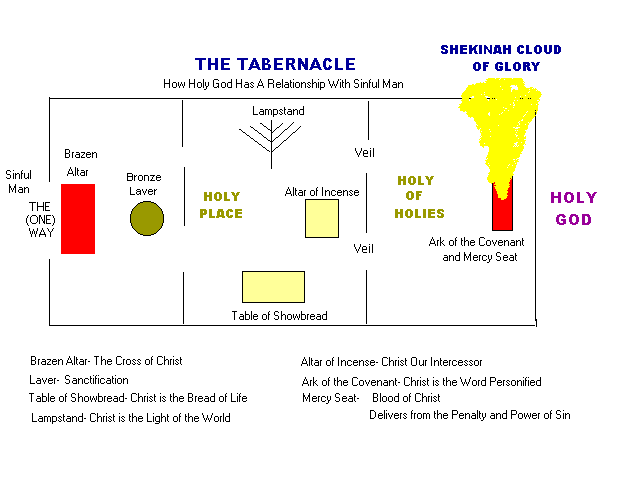
What separated the "Holy Place" from the "Holy of holies"? (Diagram)
The Veil
For over a 1500 years, the veil had separated the priests and the people from the Holy of Holies and the Ark of the covenant, which represented the presence of God. The fact that the veil was torn from top to bottom now indicated that God had made a way through the veil, "the Way" opened by the tearing of the flesh of His precious Son, Jesus Christ!
|
Note: According to He 8:1, 2, 3, 4, 5 the tabernacle was made according to the pattern of the real sanctuary of God in heaven. Only once each year on the Day of Atonement (Lev 16:34) was the high priest allowed to go into the Holy of Holies and put the blood of the sacrifice on the Mercy-seat (or click here, literally "the place of atonement" = place where God was propitiated or satisfied by the blood which "covered over" the sins of the people) of the Ark of the Covenant (Lev 16:14). The Ark of the Covenant represented the THRONE OF GOD. The people themselves could never enter into the Holy of holies into the very presence of God as manifest by the "Shekinah" glory cloud, for the VEIL shut them out.
|
What happened the moment Jesus "yielded up His spirit" on the Cross (Mt 27:50, 51)?
Behold ("Pay Attention")
The Veil (katapetasma [word study]) of the temple was torn in two from top to bottom
The earth shook
The rocks were split
How did Jesus describe Himself in (John 14:6)?
"I am the WAY
and the truth, and the life
Note: Greek has definite article before "way", "truth" and "life". So what? Point is that Christ is not just "a" way (not one of many ways as Jehovah's Witnesses teach, but "the [only] way" - this is clear from an honest appraisal of the Greek. Note also "no one" = Greek word meaning "absolutely no one" = in other words there are no exceptions. Jesus is the exclusive, the only Way to the Father.
No one comes to the Father but through Me.
|
Explanatory Note:
He 9:8 is a parallel verse adding that "The Holy Spirit is signifying this, that THE WAY (same Greek word hodos as in Jn 14:6) into the holy place (in context this refers to the holy of holies into the very presence of Almighty God) has not yet been disclosed, while the outer tabernacle is still standing"
At the time Hebrews was written (before destruction of Temple in 70AD), the worship of God was limited & common folk had no immediate access to God. The people could come only so close. The whole picture was meant to prove that without a Redeemer, without a Messiah, without a Savior, there was no access to God. The Holy Spirit was teaching the impossibility of access to God without a perfect priest, a perfect sacrifice, and a perfect covenant. By allowing the people to go no further than the outer court, He was illustrating that thru Judaism there was no access to Him, only a symbol of access. As long as that part of the Levitical institution was still in effect, Israel was to understand that the way into the presence of God had not yet been opened. The division of the tabernacle into the Holy Place and the Holy of Holies showed the limitations of the Levitical system, and kept the people from coming directly to God. The Holy Place barred both priests and people from the Holy of Holies.
|
How can a sinner now enter into the presence of a Holy God (He 10:19, 20, cf Heb 6:19)?
By entering thru the
Veil = Jesus' Flesh
The veil that hung in the temple represented the Lamb of God - the Covenant Sacrifice slain, laid out, divided for you and for me!
A New & Living Way
(Way = hodos same as Jn 14:6)
|
Explanatory Note:
Arthur writes: "As I read this passage in Hebrews through the understanding of covenant, my heart shouted a holy YES! It is a covenant walk into death that leads to life, bringing us into oneness with God-uniting us with Him in His death and resurrection to walk in newness of life, "having our hearts sprinkled clean from an evil conscience." (Hebrews 10:22) (Our Covenant God)
There are some fascinating Greek words in Hebrews 10:19, 20:
Confidence = literally "all speech" and describes the attitude of openness that stems from freedom and lack of fear. Now we can boldly enter His Holy presence into the very Throne Room of Almighty God!
"New" originally referred to a newly–killed animal or man; hence, of flesh just killed, fresh meat, or of fresh vegetables just picked. Here it is figurative and indicates "fresh" not only in the sense that it is a way which was before unknown but also one that retains its freshness and cannot grow old.
"Inaugurated" conveys the idea of introducing something new, to initiate with the ideas of inauguration and dedication being closely related. When Jesus entered the "walk into death" He opened or dedicated THE WAY, treading it Himself for the first time, that we might follow in His steps!
In a parallel passage, Paul explained that when we are "justified by faith (when we entered the New Covenant), we have peace with God through our Lord Jesus Christ through Whom ("the way" in is "through" His "flesh"!) also we have obtained our (hold pointer over) introduction by faith into this grace in which we stand; and we exult in hope of the glory of God." (Ro 5:1, 2)
|
How might you describe this entering bolding by the new and living way, through the veil which is our Lord's flesh?
Our Walk into Death
When did you walk through the pieces of His flesh?
When you entered into the New Covenant
You walked through the Veil
His flesh
When did this event take place?
The moment you placed your faith in Christ
|
What was Abraham’s response?
(Genesis 15:6+)
Abram believed in the LORD and He reckoned it to him as righteousness
|
Explanatory Note:
The righteousness of God could be succinctly stated as all that God is, all that He commands, all that He demands, all that He approves, all that He provides (through Christ cf 2 Cor 5:21+, 1Co 1:30)
|
Abraham did not simply give assent intellectually or mentally to God - He made an unqualified commitment
|
Explanatory Note:
"Believed" = Hebrew verb 'aman (see word study) has a root meaning which conveys the idea of certainty. Therefore in Genesis 15:6 'aman conveys the notion of being certain of what God had promised. It's the idea of an unqualified committal of oneself to another. Belief, contrary to popular opinion, is not a blind leap into the dark but a confident commitment to the One about Whom abundant evidence bears ample testimony of His absolute trustworthiness in regard to His promise to justify (declare righteous) those who believe in Him. It is interesting to see how the Rabbis have twisted the truth of this Scripture, remarking that Abraham’s faith is better translated as “faithfulness” which they ascribe to him as one of his "works".
|
What does Ro 4:1, 2, 3 teach?
Abraham believed God
Was justified by faith
Not by works
He was declared righteous
|
Explanatory Note:
"Believed" is pisteuo (verb used in the LXX translation of believed in Ge15:6, and for believed in Gal 3:6+, Ro 4:3+) which is more than mere mental assent. According to W E Vine Biblical belief [genuine saving belief] has 3 main components (from Vine's definition [ref] of the related noun Faith = pistis)
(1) Firm conviction producing a full acknowledgement of God's revelation or truth
(2) Personal surrender to Him
(3) Conduct inspired by such surrender.
The Greek translation of Hebrew OT (Septuagint = LXX) with rare exception uses pisteuo to translate the Hebrew verb 'aman.
|
What did Abraham believe?
(Remember that the best commentary on Scripture = Scripture)? What was the object of his belief in Galatians 3:8+?
The gospel
Abram believed the "good news" that all the nations would be blessed in him
"And the Scripture, (personified as a preacher) foreseeing that God would justify (declare righteous) the Gentiles by faith (pistis), preached the gospel beforehand to Abraham, saying, "ALL THE NATIONS SHALL BE BLESSED IN YOU."
What is Abraham called
in Galatians 3:9+?
Abraham, the believer
(Believer = trustworthy, dependable, reliable, faithful)
What additional truth does Ge 22:18 add in regard to God's promise to Abraham in Genesis 12:3?
"In you" is expanded to "in your seed (singular in the Hebrew) all the nations of the earth shall be blessed, because you have obeyed My voice." (Note once again the association of faith with obedience)
What is meant by this promise of the Seed according to Galatians 3:16+?
Christ = Seed of Abraham
|
Explanatory Note:
Paul explains that "the promises were spoken to Abraham and to his Seed. He does not say, "And to seeds (plural)," as referring to many, but rather to One, "And to your Seed (singular)," that is, Christ".
"Christ" = Greek "Christos" corresponds to the Hebrew word Mashiyach transliterated into English as "Messiah", the Anointed One. The Seed was the Messiah first prophesied in God's promise to Adam & Eve in Genesis 3:15+ to bring forth the Messiah Who would bruise the head of Satan.
When God made a covenant with Abraham, He promised him a Seed (Ge 22:18) explaining that through his Seed all the nations of the world would be blessed. So the promise that God made to Abraham was ultimately the promise of a Savior Christ Jesus, and this is the One in Whom Abram placed His faith.
Salvation in the OT was always by faith looking forward to the Cross. In the NT it is by faith looking back to the Cross.
OT look > # < NT look
|
What is faith inseparably related to in the Scriptures?
Faith is related to obedience
What one Believes is
demonstrated by how one Behaves
For example:
"obedience that comes from faith" (NIV) Romans 1:5+
(cf disobedient and unbelief in Heb 3:18, 19+)
Faith that saves is faith that brings a response to what one hears. Faith takes God at His Word, believes Him, and responds accordingly. Where there is true faith, there is a commitment of oneself to what one believes. Note that faith alone saves, but the faith that saves is not alone!
To reiterate, how can a sinner walk through the veil, His flesh?
All must walk through, the way, the veil, His flesh
BY FAITH
No one comes into the Father's presence without going through this Veil (cf John 14:6)
What have we learned about the commitment that entering into a covenant calls for in Scripture?
Death to all relationships
Death to our own life
Death to our own interests
Death to independent living
Our covenant relationship with God supersedes all other relationships
How does Jesus address this issue of commitment in (Mt 10:37, 38 39)?
We must love Him more than any other relationship
We must be willing to take His cross and follow Him
We must be willing to lose our life for His sake in order to find it
The Cross is speaks of shame and death
Death is a self-denial
Having entered by the "walk of death" we are now called to daily "die to self" in the the everyday circumstances of our life.
How does Jesus address this issue of commitment in (Mark 8:34, 35, 36, 37)?
Note Jesus was addressing not just His disciples but the multitude
Jesus calls us to
Deny self
Take up His Cross
Follow Him
If we try to save our life we will be lost
Now comes the most remarkable profit and loss statement in history!
If we lose our life (in His life) for His sake and the gospel's we shall save it
The context is that Jesus is speaking of the eternal destiny of our soul
It is a bad bargain to gain the whole world, and forfeit one's soul
|
Explanatory Note:
Be aware that some commentators like Constable attempt to "soften" Jesus' stern warning explaining that He is saying "that living for oneself now will result in a leaner life later whereas denying oneself now for Jesus’ sake will result in a fuller life later" (Expository Notes on the Bible)
J. Vernon McGee on the other hand interprets it more literally warning that… "The person who will not assume the risks involved in becoming a disciple of the Lord Jesus Christ will, in the long run, lose his life eternally. The opposite is also true. At Christ’s second coming all accounts will be settled and everyone will receive his proper rewards." (Thru the Bible commentary)
Wycliffe Bible Commentary agrees…
"He who is unwilling to assume the hazards involved in being a disciple of Christ will ultimately lose his life eternally."
KJV Bible commentary:
"Lose his own soul means to lose one’s life and perish."
Bible Knowledge Commentary (Dallas Theological Seminary)… "One who decides to maintain a self-centered life in this world by refusing Jesus’ requirements (Mk 8:34) will ultimately lose his life to eternal ruin. Conversely a person who will “lose” (give over, “deny himself”) his life… in loyalty to Jesus and the gospel by accepting His requirements (Mk 8:34) will actually preserve it forever"
|
Who is Jesus addressing issue in (Lk 14:25+)? Is He addressing just His disciples?
He addresses "great multitudes… going along with Him"
How does Jesus address this issue of commitment in (Lk 14:25, 26, 27+)? What does He mean by "hate his… " relatives, his life?
Love for Christ must surpass all other loves which are hatred by comparison
Christ-centered lives must replace selfish lives
Jesus adds in Luke 14:33+ that "no one of you can be My disciple who does not give up all his own possessions."
Do your possessions in fact possess you?
Death takes place when we enter the New Covenant
How did Paul describe His walk into death in (Gal 2:20) and his commitment to live in spite of death?
When Christ was crucified, he was crucified (Ro 6:6).
He gave us his right to independent living ("it is no longer I who live")
He acknowledged that he now wore Christ's robe of identity ("Christ lives in me; and the life which I now live in the flesh I live by faith in the Son of God"
In covenant you no longer live for yourself. There is a Covenant Partner to consider, and you must be true to that Covenant Partner. Covenant is a bond that commits you to another.
In order for us to have this new life a death had to take place… this is a picture of our so great a salvation as viewed through the lens of covenant.
|
The goal is to give each person a deeper understanding of their salvation.
What are the two Hebrew words for cutting covenant? Can you see how this week's lesson intertwines with these definitions?
Beriyth = agreement made by walking between pieces of flesh
What did the exchange of robes between Jonathan and David symbolize in regard to their identity?
Exchange of Robes
Symbolically taking on the identity of your covenant partner =
Death to self
Two become one
End to independent living
Covenant was..
the closest,
the most indissoluble
compact known
What did the covenant between Jonathan and David involve?
Absolute surrender
Merging of one with other
How do we see this truth paralleled in this weeks study?
Absolute Surrender
Indissoluble merging
Beloved, have you walked through the veil of His flesh?
Are you daily, boldly walking through His veil into God's Throne Room?
Are you reflecting your covenant partner by your attitudes and your actions?
Will you give your Covenant Partner your strength -- live for Him?
Will you stand against His enemies?
Are you willing to die to independent living, to lose your life for His sake and the gospel's?
Do you have a better grasp of the serious, binding nature of the covenant commitment that results from entering into the New Covenant by grace through faith?
|
Explanatory Note:
George Barna has a word of warning writing that in… "Studies we have conducted over the past year indicate that a majority of the people who made a first-time "decision for Christ were no longer connected to a Christian church within just eight weeks of having made such a decision!" (The Second Coming Of The Church) In this same section of his book Barna goes on to say that in most cases these people are not moving from "decision" to "conversion."
The question one dare not ignore asking is "Are those who make "decisions" really entering the small gate, the narrow way into the new covenant by walking through the rent veil of Jesus' flesh or are they among the "many" Jesus warned would be on the broad way that leads to destruction?" (Mt 7:13, 14+) and who would one day hear the somber words "I never knew you; DEPART FROM ME, YOU WHO PRACTICE (present tense = habitually, as a lifestyle) LAWLESSNESS." (Mt 7:23+)
|
In light of the entree provided by the rent veil of Jesus' flesh, "let us draw near with a sincere heart in full assurance of faith, having our hearts sprinkled clean from an evil conscience and our bodies washed with pure water. Let us hold fast the confession of our hope without wavering, for He who promised is faithful; and let us consider how to stimulate one another to love and good deeds, not forsaking our own assembling together, as is the habit of some, but encouraging one another; and all the more, as you see the day drawing near." (Hebrews 10:22, 23, 24, 25)
My Hope Is Built
(The Solid Rock)
1My hope is built on nothing less
Than Jesus’ blood and righteousness;
I dare not trust the sweetest frame,
But wholly lean on Jesus’ name.
2 When darkness veils His lovely face,
I rest on His unchanging grace;
In ev’ry high and stormy gale,
My anchor holds within the veil.
3 His oath, His covenant, His blood,
Support me in the whelming flood;
When all around my soul gives way,
He then is all my hope and stay.
4 When He shall come w trumpet sound,
O may I then in Him be found,
Dressed in His righteousness alone,
Faultless to stand before the throne.
Chorus
On Christ, the Solid Rock, I stand; (Mt 7:24, 25, 26)
All other ground is sinking sand,
All other ground is sinking sand.
"Christ died that I might live. I must die that Christ might live in me." (First part = position; Second part = practice (Bob Roe, Peninsula Bible Church)
|