
RELATED RESOURCES
- Prophecy Primer - Why interpret Da 9:24-27 literally?
- Daniel 9:24-27 One of Most Significant Passages in Scripture
- Daniel Commentaries by interpretative approach to Da 9:24-27
- Anecdotal Stories related to Daniel 9:24-27
- Evidence Supporting Unit of Time in Daniel 9:24-27 as Years
- Daniel Commentaries from a literal, usually futuristic perspective
- Youtube video I did on Daniel 9:24-27 God's Prophetic Plan for the Ages
- Summary Chart of Daniel's Seventieth Week
- Daniel's Seventieth Week Charted Parallel with other Daniel prophecies
- Timeline of Jewish and Gentile History According to Daniel - Pdf Chart
- Kay Arthur on Daniel 9:24-27 Part 1, Part 2, Part 3
- John Walvoord: Daniel: The key to Prophetic Revelation (online)
- Millennium 1 - Early Church drift from literal interpretation of Rev 20
- Millennium 2 - Context & events leading up to Millennium
- Millennium 3 - How OT describes Millennial Messianic Age
1) When an OT prophet spoke, it generally is in reference to one of four time periods: (Click notes)
a) The prophet's own time
b) Israel's captivity in Babylon (605, 598, 586 BC) or their restoration to the land of Israel after 70 years of Babylonian exile
c) The Messiah's first coming (see Messianic Prophecies) (See also A Ready Defense-Old Testament Prophecy Fulfilled in History. See original resource for excellent summary of the 70 weeks of Daniel - A Ready Defense: The Best of Josh McDowell or Borrow A Ready Defense page 58 cf Chronological Aspects of the Life of Christ - Harold Hoehner - can be borrowed)
d) The Messiah's Second Coming (see Messianic Prophecies; Table comparing Rapture versus Second Coming)
2) A single prophecy may have more than one fulfillment
Partial fulfillment in the near future
Complete and final fulfillment in the distant future
Without going into a lengthy discussion, the principle of near/partial and distant/complete fulfillment is seen in God's teaching on the Day of the Lord, a phrase mentioned at least 19 times in the OT and 4 times in the NT. From the context of these passages it is clearly not a literal 24 hour day. The Day of the Lord was partially fulfilled in Israel's (more accurately Judah's) Babylonian captivity but awaits complete fulfillment when the Lord pours out His final wrath upon all of mankind (including Israel) who continue to reject His offer of salvation by grace through faith in the Messiah (we read about this fulfillment most clearly in the Revelation of Jesus Christ).
TECHNICAL NOTE: Day of the Lord, in the NASB -23x in 21v - Isa. 13:6; Isa. 13:9; Isa. 58:13; Ezek. 13:5; Joel 1:15; Joel 2:1; Joel 2:11; Joel 2:31; Joel 3:14; Amos 5:18; Amos 5:20; Obad. 1:15; Zeph. 1:7; Zeph. 1:14; Zech. 14:1; Mal. 4:5; Acts 2:20; 1 Co. 5:5; 1 Thess. 5:2; 2 Thess. 2:2; 2 Pet. 3:10
3) A single prophecy may have a significant GAP in time between as to when different aspects are fulfilled. (The so-called "Law of Double Reference")
The idea is that a passage can be speaking of two different events separated by a long period of time. In the passage these two events are "blended" into one picture, with no apparent time gap. It is only by comparing Scripture with Scripture that a time gap is uncovered. Here is a schematic illustration of a "time gap"
Near and far fulfillment schematic diagram
THE DOUBLE PROPHECY
OF ISAIAH 61:1-2
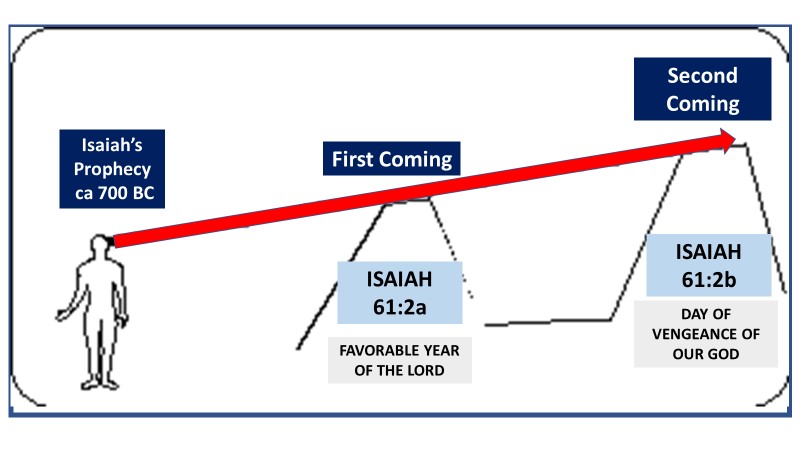
One of the best examples of a TIME GAP in the Bible was taught by our Lord Jesus Christ at His first "sermon." The prophet Isaiah records the following prophecy -- (See related resource The Incredible Prophecy of Isaiah 61:1-3)
"The Spirit of the Lord GOD is upon me, because the LORD has anointed me to bring good news to the afflicted. He has sent me to bind up the brokenhearted, to proclaim liberty to captives, and freedom to prisoners, (2a) to proclaim the favorable year of the LORD (ED: COMPARE THE YEAR OF JUBILEE - SEE NOTE), (2b) and the day of vengeance of our God, to comfort all who mourn." Isaiah 61:1, 2+
After His baptism (Lk 3:21-23+), Jesus began His ministry in the Jewish synagogue in Nazareth by reading in the Scroll from the prophet Isaiah and this is what He read to the Jewish audience:
"THE SPIRIT OF THE LORD IS UPON ME, BECAUSE HE ANOINTED ME TO PREACH THE GOSPEL TO THE POOR. HE HAS SENT ME TO PROCLAIM RELEASE TO THE CAPTIVES, AND RECOVERY OF SIGHT TO THE BLIND, TO SET FREE THOSE WHO ARE DOWNTRODDEN, 19 TO PROCLAIM THE FAVORABLE YEAR OF THE LORD." 20 And He closed the book, and gave it back to the attendant, and sat down; and the eyes of all in the synagogue were fixed upon Him. 21 And He began to say to them, "Today this Scripture has been fulfilled (perfect tense = past completed action which endures thereafter) in your hearing." (Luke 4:18, 19, 20, 21+)
Jesus stated that the Messianic prophecy in Isaiah 61:1, 2a+ was fulfilled in His First Coming (literally "in your hearing"). Note that He stopped reading in the middle of Isaiah 61:2, not reading the words "the day of vengeance" (Isaiah 61:2b). Why did He stop? The key word is "vengeance" (naqam; Lxx = antapodosis = in a negative sense = pay back ~ retribution) which in English is defined as "retribution exacted for an injury or wrong." And so the phrase "the day of vengeance" refers to His Second Coming which will terminate the "seven year tribulation" described in Revelation 6-19, at which time, Jesus will fulfill the prophecy of "the day of vengeance" dealing out retribution on all of His enemies including the Anti-christ and the armies of the nations arrayed against Him (Rev 19:15, 19-21+). Jesus' First Coming was to fulfill His role as the Redeemer and Savior of all who would believe in Him (Jn 3:16,17+). Jesus' Second Coming will be as King of kings (Rev 19:16+) and Righteous Judge (Ps 7:11, 2Ti 4:1, 8+) to extract the retribution due Him by all the sins that have been committed against God! So it is clear that Isaiah 61:1-2 records two prophecies, the fulfillment of which is separated by almost 2000 years (I write in 2024).
THE DOUBLE PROPHECY
OF ZECHARIAH 9:9-10
Zechariah records a prophecy that calls for the interpretation of a "gap" of time between verse 9 and verse 10...
(9) Rejoice greatly, O daughter of Zion! Shout in triumph, O daughter of Jerusalem! Behold, your king is coming to you; He is just and endowed with salvation, humble, and mounted on a donkey, even on a colt, the foal of a donkey. (10) And I will cut off the chariot from Ephraim, and the horse from Jerusalem; and the bow of war will be cut off. And He will speak peace to the nations; and His dominion will be from sea to sea, and from the River to the ends of the earth. (Zechariah 9:9, 10)
Zechariah 9:9 is quoted in part by Matthew and was fulfilled when Jesus rode into Jerusalem on "Palm Sunday". Matthew records
Now this took place that what was spoken through the prophet might be fulfilled, saying, SAY TO THE DAUGHTER OF ZION, 'BEHOLD YOUR KING IS COMING TO YOU, GENTLE, AND MOUNTED ON A DONKEY, EVEN ON A COLT, THE FOAL OF A BEAST OF BURDEN. (Mt 21:4, 5, see also John 12:14,15+)
Zechariah 9:10 refers to a time yet future when at the Second Coming the King of kings will put an end to war and establish peace as He rules from "sea to sea, and from the River (Euphrates) to the ends of the earth". This prophecy refers to the Messianic Kingdom which Christ will set up after He has defeated His enemies.
THE DOUBLE PROPHECY
OF ISAIAH 9:6-7
Isaiah 9:6, 7 also exhibits a "time gap," Isaiah recording....
For a child will be born to us (MESSIAH), a son will be given to us; And the government will rest on His shoulders; And His name will be called Wonderful Counselor, Mighty God, Eternal Father, Prince of Peace. (TIME GAP) (9:7) There will be no end to the increase of His (MESSIAH'S) government or of peace, On the throne of David and over his kingdom (MESSIANIC KINGDOM), To establish it and to uphold it with justice and righteousness From then on and forevermore. The zeal of the LORD of hosts will accomplish this. (Isaiah 9:6; 7+ )
Lehman Strauss adds this note on the prophecy in Daniel 9:24-27 which demonstrates a time gap between Da 9:24-26 and Da 9:27 - "Should anyone regard the idea of a gap between the sixty-ninth and seventieth weeks as forced, let him consider that such instances are common in the prophetic Scriptures. For example, David wrote, "The face of the Lord is against them that do evil, to cut off the remembrance of them from the earth" (Psalm 34:16). Did you ever take note of the prophetic gap in this verse? You see it clearly when you read Peter's quotation of it. Peter wrote, "The face of the Lord is against them that do evil" (1Peter 3:12). But the Holy Spirit prevented Peter from adding the last part of Psalm 34:16, namely "to cut off the remembrance of them from the earth," for the reason that this act of God is one of future judgment." (The Prophecies of Daniel)
And for good measure here is another time gap recorded in the Gospel of Luke...
Luke 20:42-43+ (QUOTING Ps 110:1) - For David himself says in the book of Psalms, ‘THE LORD SAID TO MY LORD, “SIT AT MY RIGHT HAND, 43 (TIME GAP) UNTIL I MAKE YOUR ENEMIES A FOOTSTOOL FOR YOUR FEET.”’
Comment - When Christ ascended in Acts 1:9-11, He sat down a the right hand of God (Heb 10:12) which is where He is today. He is awaiting the the time when He returns to defeat His enemies for that is when they in effect will be a footstool for His feet! And that will occur at the end of the 7 years of Daniel's Seventieth Year, at His Second Coming (see Rev 19:16-21+).
4) This website advocates and practices a literal approach to the interpretation all Scripture, including prophetic Scripture. (Click discussion of interpretation in section on inductive study)
Succinctly and simply stated if the plain sense makes good sense in context, then refrain from trying to make some other sense out of the passage or you may end up with nonsense.
For example, if a text says 1000 and there is no clear reason from the context that would suggest it should be interpreted any other way, then it will be interpreted as literal 1000. The same rule applies to numbers like 42 months and 1260 days. If one fails to interpret the plain language literally, one opens the door to the interpreter's imagination. To say it another way, if a verse or phrase that could be interpreted literally is deemed by someone as a passage that should not be interpreted literally, it opens any and every verse of Scripture to the inherent danger of non-literal interpretation. In fact, in Second Timothy, a spiritual (non-literal) interpretation of the bodily resurrection of believers had the effect that a spiritualizing or non-literal interpretation will almost always have on believers -- confusion and disturbance, as Paul explained to Timothy....
Men (teachers or leaders such as Hymenaeus and Philetus - whose "talk" which could have included non-literal "interpretation")...have gone astray from the truth saying that the resurrection has already taken place, and thus they upset the faith of some. (2Ti 2:18+)
How might the resurrection have already taken place? In First Thessalonians (1Th 4:16, 17-see notes 1Th 4:16; 4:17) Paul had clearly taught that there would be a bodily resurrection, but these men took a non-literal approach and "spiritualized" or "allegorically interpreted" the resurrection (allegory = form of literature in which a story points to a hidden or symbolic parallel meaning). What was the result? Upsetting of the faith of some of the believers. And do we not see the same effect of non-literal handling of the Scriptures today? Indeed we do -- witness for example the many genuine believers who do not even want to read the book of the Revelation simply because of the widely divergent, confusing interpretations that have arisen from the profusion of non-literal interpretations which have opened the door wide to allegorization and/or spiritualization of the truth of God's final victory.
Listen to the sage advice of William Tyndale a man who was literally martyred for translating the Bible literally into English...
Thou shalt understand, therefore, that the Scripture hath but one sense, which is the literal sense. And that literal sense is the root and ground of all and the anchor that never faileth, whereunto if thou cleave thou canst never err nor go out of the way. And if thou leave the literal sense, thou canst not but go out of the way. (Watch part of Tyndale's story in one of the most incredible stories you will ever watch entitled The Indestructible Book - How We Got our English Bible - 3 hours, 37 minutes - It will make you weep!)
Joel Rosenberg a Jewish Messianic believer in his address to a large group of pastors in early 2012 on the topic “The Pastor and the Future” had some interesting comments regarding paucity of preaching of prophecy...
You and I are living in one of the most dangerous moments in the history of the United States….in the history of Israel and the Middle East….in the history of the Church. Yet at this very moment when so many people are so anxious about the future, too many pastors are shying away from teaching Bible prophecy.
• Some, because prophecy has been sensationalized in the past and they rightly resist such cheapening of God’s Holy Word.
• Some, because they’ve never really carefully studied Bible prophecy and feel unprepared to teach it to their congregations.
• Some, because they’ve lost sight of the power of prophecy – prophecy is an intercept from the mind of the all-seeing, all-knowing, all-powerful God….prophecies are storm warnings from the future….not to frighten us but to motivate us – to get us ready for what is coming, and to help get others ready…..prophecy is given to encourage and exhort the Church to repentance….to holiness and purity….to prayer and fasting….to sharing the Gospel and making disciples….to pastor training and church planting….prophecy tells us we are going to be shaken….why?….to wake up the Church….to wake up the nations….to wake up Israel….because the Day of the Lord is coming, and surely it is near….and God loves us and He wants us to be ready. In Luke 12:54-56, Jesus rebuked His disciples for not understanding the Word of God and not analyzing the times in which they lived.... (THE HANDWRITING ON THE WALL Lessons from Daniel 5 on the future of America)
Dr Charles Ryrie reasons that...
If God be the originator of language and if the chief purpose of originating it was to convey His message to humanity, then it must follow that He, being all-wise and all-loving, originated sufficient language to convey all that was in His heart to tell mankind. Furthermore, it must also follow that He would use language and expect people to understand it in its literal, normal, and plain sense. The Scriptures, then, cannot be regarded as an illustration of some special use of language so that in the interpretation of these Scriptures some deeper meaning of the words must be sought.
As Andy Woods explains...
literalism resists going beyond what is written. Because literalism resists “going beyond the facts,” when interpreting a given text, literal interpreters resist the temptation to import foreign ideas from outside the text. A classic example of going beyond what the text says is the ancient interpretation that the four rivers in Genesis 2, the Pishon, Havilah, Tigris, and Euphrates, represent the body, soul, spirit, and mind (One need only examine the works of Philo to find numerous examples of such a hermeneutical methodology.). Such an idea is not readily apparent from studying the text in Genesis 2. One must go outside the text of Genesis 2 and bring into it foreign concepts in order to arrive at this conclusion. (Paper by Andy Woods) (Bolding added)
For example, it is not intellectually honest or consistent to simply classify the book of Revelation as "prophecy" or apocalyptic literature (which of course it is) and on the basis of that classification to change the rules of interpretation from literal to allegorical/symbolical as does the following commentator...
A failure to take full account of [the apocalyptic or prophetic] feature has led to some of the most outlandish teachings on this book by some whose rule of interpretation is "literal, unless absurd." Though this is a good rule when dealing with literature written in a literal genre, it is the exact opposite in the case of apocalyptic literature, where symbolism is the rule, and literalism the exception. (Gregg, S: Revelation Four Views: A Parallel Commentary. Page 11. Nashville, TN: Thomas Nelson, 1997)
Some attack the principle of literal interpretation by stating that this method denies the Bible's use of figurative language (including types, symbols, figures of speech, etc). Dr Charles Ryrie counters such fallacious arguments noting specifically that literalism
does not preclude or exclude correct understanding of types, illustrations, apocalypses, and other genres within the basic framework of literal interpretation… (Literal interpretation) might also be called plain interpretation so that no one receives the mistaken notion that the literal principle rules out figures of speech.
E R Craven - The Literalist (so called) is not one who denies that figurative language, that symbols are used in prophecy, nor does he deny the great spiritual truths are set forth therein; his position is, simply, that the prophecies are to be normally interpreted (i.e., according to received laws of language) as any other utterances are interpreted–that which is manifestly literal being regarded as literal, that which is manifestly figurative being so regarded. (Lange, J. P., Schaff, P., Moore, E., Craven, E. R., & Woods, J. H. A Commentary on the Holy Scriptures : Revelation NY: Scribner, 1872 - Online Original Quotation in full)
5) A clear understanding of the history of Israel is the key to unlocking prophecy
From Genesis to Revelation, the Word of God centers on Israel and the Jew. If you want to accurately interpret prophecy you must understand how God deals with Israel in both Testaments. Israel is God's timepiece and is the key to unlocking the prophetic Scriptures. If you "replace" the Jew with the church in your interpretative scheme, you will fail to understand God's prophetic timetable for His chosen people, and thus fail to understand much of prophecy, especially that relating to Israel. You must receive the word of God in its literal, natural sense, allowing scripture to interpret scripture and refraining from interpreting a passage with based on a brand of theology you have been taught (be it dispensationalist, reformed, etc), and then you will see clearly that God is not yet finished with Israel or the Jew.
6) Keep in mind that every prophecy is related to other prophecies like threads in a finely woven tapestry. In short, God's prophecy is His divine tapestry!
No single chapter has all the prophecies but predictive prophecies are interspersed throughout Scripture from Genesis to Revelation. This fact alone indicates that it is mandatory that study of prophecy calls for the student to be diligent to rightly divide the Word of truth, interpreting literally and logically, avoiding a given "brand" of "systematic theology" in which one interprets passages in a way that "fits" one's system.
Dr John Walvoord - In the history of the church the eschatological or prophetic portions of Scripture have suffered more from inadequate interpretation than any other major theological subject. The reason for this is that the church turned aside from a normal and grammatical literal interpretation of prophecy to one that is nonliteral and subject to the caprice of the interpreter. (Walvoord, J. F. The Prophecy Knowledge Handbook. Wheaton, Ill.: Victor Books. 1990)
7) Fulfilled predictive prophecy serves to increase our faith and resolve to hold fast to the certainty that those aspects of God's prophetic program which are as yet unfulfilled will surely come to pass just as He has sovereignly ordained.
For example in the study of Daniel 9:24-27, literal interpretation gives a very specific time for the arrival or First Coming of Messiah (Da 9:25-note) and then accurately predicts His Crucifixion (Da 9:26-note). Both of these events are now history and thus sound forth a clear, reliable testimony that not one good word of God has ever failed, and assure us (literalists) that the literal fulfillment of Da 9:27-note is just as certain. The result is that our faith is strengthened to fight the good fight.
I hear many people, especially the younger generation of pastors in the reformed tradition, say "I don't think we need to spend much time studying Bible prophecy. It's too controversial. There are so many interpretations. And after all, its not very practical for our Christian life." What is the result of this philosophy? Simply put, they don't teach or preach much on prophecy. And the problem (with which I have personal experience) when they do preach on it, they are doing so without having carried out their own personal study of eschatology. Therefore they are forced to rely on other people's interpretations and have no compass by which to discern whether their favorite expert's interpretation is really accurate or is just his opinion based on his particular system of theological interpretation. Prophecy is difficult, but I have been assiduously studying it (with the same zeal and attention to detail that I did to obtain my medical doctorate and subspecialist certification in anatomic and clinical pathology) for over 30 years, focusing on a literal approach and emphasizing observation before interpretation. While there are many prophetic passages that remain somewhat enigmatic to me even after 30+ years of study, God's basic grand plan for the ages is very clear including His wonderful plan for the literal nation of Israel. (See study of Zechariah 12-14 which summarizes God's "burden" for the nation of Israel.)
So with that background, let me quote Dr Adrian Rogers' who addresses the question "What Profit is Prophecy?"
I am always amazed by people who say we shouldn't study prophecy. Some fear we will go off into fanaticism. Others think prophecy is simply "pie in the sky by and by." Still others feel prophecy is unrelated to reality. But one-fourth of the Bible is given over to prophecy! Did the Holy Spirit make a mistake? Of course not! There is an incredible, wonderful blessing in the study of prophecy. Here are six benefits of prophecy:
Prophecy Will Lead You to Praise
Revelation 1:3 says, "Blessed is he that readeth, and they that hear the words of this prophecy, and keep those things which are written therein: for the time is at hand." In a world that seems to be filled with random acts of violence and terrorism, we need to see that God has a plan and the God of that plan is worthy to be praised.If you know prophecy, you can sit back and say, "I've already looked in the back of the book for the answers. The kingdoms of this world will become the kingdoms of our Lord and His Christ."
Prophecy Will Help You Make Sense Out of Suffering
If you get all of your theology from your circumstances, you'll be hopelessly confused. Romans 8:18 says, "For I reckon that the sufferings of this present time are not worthy to be compared with the glory which shall be revealed to us."Through prophecy, we understand that God is not finished yet. The tragedies of this earth will be turned into the triumphs of heaven.
Prophecy Will Lead You to Rejoice in God's Justice
Paul wrote, "Judge nothing before the time, until the Lord come, who both will bring to light the hidden things of darkness, and will make manifest the counsels of the hearts" (1 Corinthians 4:5).If you are a student of prophecy, you understand that things don't end here on earth with man's judgment. God will have the last word in the judgment halls of eternity.
Prophecy allows us to understand the mystery of history, make sense of our suffering, and rejoice in God's justice as prophetic events unfold.
Prophecy Will Cause You to Pray
Prophecy leads to intercession. The last prayer in the Bible is Revelation 22:20+: "even so, come, Lord Jesus." Jesus taught us to pray, "Thy kingdom come. Thy will be done in earth, as it is in heaven" (Matthew 6:10). When God prophecies that something is going to happen, somehow we see those events unfold as His children pray. I cannot explain how God's ultimate sovereignty works with our prayers, but I know it does from the pages of His Word.Prophecy Will Lead You to Purity
1 John 3:2-3+ says, "Beloved, now are we the sons of God, and it doth not yet appear what we shall be: but we know that, when he shall appear, we shall be like him; for we shall see him as he is." That is prophecy! If you really believe that Jesus Christ is coming again, you are going to live a clean life. We ought never to take our eyes off the fact that Jesus is coming.Prophecy Will Lead You to Proclamation
Revelation 19:10c+ says, "the testimony of Jesus is the spirit of prophecy." All prophecy is a witness to the truth that Jesus is coming back — that people need to be ready for His return.What are you doing to warn people to flee from the wrath to come? Paul knew that there was an everlasting hell (see 2 Corinthians 5:10-11). It's not enough for us to sit around and try to discover the divine mysteries of prophecy. We need to bring people to Jesus Christ!
The real test of whether you believe Bible prophecy is if you have your feet on the sidewalk of soul-winning instead of your head in the clouds of prophecy. If you believe Jesus is coming back, you will have a burning passion to bring people to Him.
Jesus came as an evangelist. And He's called you to do the same. Will you pray, "Lord, lay some soul upon my heart and win that soul through me"?
Is there profit in prophecy? Praise the Lord, there is! What a wonderful thing to know that we are soon going to meet the King of kings and Lord of lords.
1) Daniel 9:24-27- Represents one of the key verses regarding "end times" prophecy
Daniel 9:24-27 holds the key to all prophetic interpretation and as such is the backbone of biblical prophecy.
Miss this, and Revelation will be a mystery to you
Ray Pritchard - If you understand what these verses mean, you will have a good framework for understanding all that the Bible says about the future. Miss this, and Revelation will be a mystery (ED: "MISS THIS AND REVELATION WILL BE A MISS!") to you…. What is presented here in a condensed form is greatly expanded in the New Testament. This passage is the key that unlocks many other biblical prophecies." Pritchard goes on to add that "If you have wondered where certain popular writers get the concept of a future seven-year Tribulation period, you will find the answer in this passage. Jesus refers to it in Mt 24:15+ as does Paul in 2Th 2:1-4+. And the amazing events of Revelation 6-19+ are simply an expansion of Da 9:27+. What is presented here in a condensed form is greatly expanded in the New Testament. This passage is the key that unlocks many other biblical prophecies." (from A Peek Into God's Calendar)
Chuck Swindoll says that "the vision of the seventy weeks revealed in Daniel 9:24, 25, 26, 27 (notes) is undoubtedly "the backbone of Biblical prophecy" concerning Israel, Christ, and the Antichrist. It is also true that fewer predictions in Scripture have been interpreted in as many ways as have the seventy weeks of Daniel.
John Walvoord - The interpretation of the revelation given to Daniel concerning the seventy weeks (Daniel 9:24–27) constitutes one of the determining factors in the whole system of prophecy. The attention given to it by all schools of interpretation, and the attacks upon the authenticity of the book itself combine to focus the white light of investigation upon it. The interpretation of this passage inevitably colors all other prophetic views, and a proper understanding of it is the sine qua non of any student of prophecy." (Bolding added; Seventy Weeks of Daniel - originally published in Bibliotheca Sacra, volume 101, page 30, Jan-Mar, 1944)
2) Daniel 9:24-27 - Outlines the future history of Israel
As will be discussed below, Daniel 9:24-27 lays out in summary form a timetable of the events that will impact Israel. There is no reference whatsoever to "the church" in this passage, although some commentators still imagine some reference to "the church."
a) The Jews could have known the time of the Messiah's arrival even as Jesus' declared in Luke 19:42 "saying, “If you had known in this day, even you, the things which make for peace! But now they have been hidden from your eyes."
Henry Morris - "This day" was the day when the Scriptures had said that Messiah would present Himself to Judah and Jerusalem as their promised King. The time of His coming had been foretold in Daniel 9:25+, and the manner of His coming in Zechariah 9:9. A believing remnant had recognized Him (e.g., Simeon - Lk 2:25, Anna the Prophetess - Lk 2:36-38, Joseph of Arimathea - Mk 15:43, Lk 23:51), but the leaders and most of the people did not. On the very day when they should have crowned Him King, they set about to destroy Him (Luke 19:47+)! (Bolding added - Defender's Study Bible notes)
Jesus went on in Luke 19:43-44+ - “For the days shall come upon you when your enemies will throw up a bank before you, and surround you, and hem you in on every side, 44 and will level you to the ground and your children within you, and they will not leave in you one stone upon another, because (TERM OF EXPLANATION) you did not recognize the time of your visitation.”
Henry Morris - This terrible prophecy was fulfilled in A.D. 70 when the Roman army under Titus destroyed the temple completely. The destruction of the city and dispersion of its people was completed in A.D. 135. If the Jewish scribes had really searched and studied the Scriptures (especially Daniel 9:24,25), they could have known "the time of your visitation." (ED: THIS TRUTH WAS USED TO SAVED LEOPOLD COHEN) (Defender's Study Bible notes)
b) The Jews will be able to know the time of the "Anti-Messiah's" ("Antichrist") arrival (cf Mt 24:15+, 2Th 2:1, 2, 3, 4+).
3) Provides clear evidence that the Bible is inspired by God
The accuracy of the prediction of the coming of Messiah, Prince, is indisputable evidence of that the Bible is not a book inspired by man but could only have been inspired by God Who Alone knows the future.
Respected pastor and author Ray Stedman writes that Daniel 9:24-27 is "one of the strongest evidences to prove the divine inspiration of the Bible. Many (believers) are frequently asked why (they) believe the Bible to be the Word of God, and it is helpful to know certain passages which clearly set forth predictive elements that are unmistakable and which do indicate the ability of the Bible to predict events far in the distant future. This could only be by divine power....(Da 9:24, 25, 26, 27) pinpoints the exact moment in history when the Jewish Messiah would present Himself to the Jewish people, and it does so over five hundred years before the event took place. It is so plain and detailed that it has always been an acute embarrassment to Jewish commentators." (AND JEWS SHY AWAY FROM READING DANIEL 9:24-27!) (God's Countdown)
4) Substantiates the truth that God is completely sovereign
The prophecy in Daniel 9:24-27 is so compellingly accurate, that it leaves no doubt that God is sovereign and in full control over time and the affairs of men. This grand truth should encourage the saint and frighten the sinner who is not yet saved to consider the veracity of the claims of the Bible.
5) Has spurred many (Jews and Gentiles) to consider the claims of the Messiah
Although many of the stories are anecdotal (see below), the truth in Daniel 9:24-27 has caused many who seek to refute these prophecies find that they are confronted with indisputable evidence of the Messiah.
6) Refutes the attempt by many to question the date of writing of Daniel's prophecies
Liberal scholars, both Gentile and Jew, have tried to late-date Daniel in order to remove the onus of predictive prophecy. They say the book was written after the events occurred but in such a way as to appear that it was written beforehand. Daniel 9:24-27 is an irrefutable witness that the prophecy of the Messiah's coming and being cut off is true. Since, no one "late-dates" Daniel to the time of Christ, Daniel 9:24-27 is one clear case of predictive prophecy, which establishes the credibility of everything else. This observation also explains why the critics try so hard to debunk this passage.
Henry Morris adds that Daniel's "prophecy was given...well over half a millennium before its fulfillment. The probability that Daniel could guess the date of the manifestation and crucifixion of the Messiah is essentially zero. Only supernatural inspiration can account for fulfilled prophecies like this. In fact, these events were fulfilled almost two centuries even after the date assigned to Daniel by scholars who deny that such prophecies can valid!" (The Defender's Study Bible - an excellent resource from a conservative, literal viewpoint by one of the world's leading scholars on creationism)
7) Stimulates a heightened expectation of the imminent return of the Messiah
This statement applies to Daniel in general also, for no book in the Bible says more about the so called "end times" than Daniel. Many orthodox and conservative Jews believe the time is ripe for the coming of Messiah. They see Israel's return to her homeland after more than 1,900 years of national dispersion as having great prophetic significance. They believe the May, 1948 rebirth of Israel and waves of immigration (which is the meaning of the Hebrew word aliyah) from all over the world are converging with many other factors to set the stage for the predicted coming of a national Deliverer. They see the coming of this Messiah as being good not only for Israel but for the whole earth. According to the prophet Isaiah, He will cause the nations to "beat their swords into plowshares, and their spears into pruning hooks; nation shall not lift up sword against nation, neither shall they learn war anymore" (Isaiah 2:4).
Comment: If you are a born again believer who loves Israel and would like to watch a stirring account of the birth of Israel in May, 1948 (albeit from a secular perspective), I highly recommend the 6 hour epic on DVD narrated by the legendary Israeli Abba Eban (you will be mesmerized as you see the sovereign hand of the Almighty God at work "behind the scenes") Israel: Nation Is Born
To quote from an email received February 4, 2004 from "The Temple Mount and Land of Israel Faithful Movement" (an Orthodox Jewish group based in Jerusalem)
"The Hand of G_d appears again and again in Jerusalem and the Temple Mount...to purify the Temple Mount and immediately rebuild the house of G_d as the climax of the exciting redemptional times in which we are now living in Israel which will open the Eastern Gate for the coming of Mashiach ben David", this latter name of course referring to the expected Messiah Son of David. Interestingly, both Jews and Christians share the belief that a period of turmoil and distress will precede the coming of Messiah. The Jewish document called "Talmudic Sages" draws a dark picture of this time. Accordingly, one of these Jewish sages wrote, "Let Him [Messiah] come, but let me not see Him" (Sanh. 98b).
One of the most respected names in the study of Bible prophecy, Dr. John Walvoord, writes some wise remarks regarding the interpretative difficulties of Daniel 9:24-27:
In the concluding four verses of Daniel 9, one of the most important prophecies of the Old Testament is contained....Although many divergent interpretations have been advanced in explanation of this prophecy, they may first be divided into two major divisions, namely, the Christological and the non‑Christological views. The non‑Christological approach may be subdivided into the liberal critical view and the conservative amillennial view.
The Christological camp interprets the first sixty-nine weeks of Daniel as culminating in Christ while the non‑Christological camp finds fulfillment of Daniel’s prophecy in events before or after Christ.
The non-Christological group attempts to find fulfillment of the Daniel's 70 Weeks in the events leading up to the persecution of Antiochus Epiphanes (see Daniel notes and additional discussion). In 168 B.C., a pagan altar was constructed on top of the great altar of burnt sacrifices, and a pagan sacrifice was offered under the reign of Antiochus Epiphanes. This act precipitated the Maccabean revolt which Antiochus attempted unsuccessfully to put down with great cruelty (167-164 B.C.).
Disclaimer: Categorizing can be somewhat subjective and variable so if you see a commentary that you think is inappropriately classified, please email your concern and it will be researched and corrected if necessary.
This group seeks the normal, literal (and futuristic) interpretation (See literal interpretation) and thus sees both a Christological interpretation and a time gap.
- Anderson, Sir Robert: Daniel in the Critics Den and The Coming Prince
- Archer, Gleason L., Jr: Expositor's Bible Commentary: Zondervan Publishing
- Arthur, Kay: 19 Part Lecture Series on Daniel (Precept Ministries International)
- Boice, J M: Daniel: An Expositional Commentary
- Campbell, Donald: BORROW Daniel: God's Man in a Secular Society (Previously "Daniel Decoder of Dreams") (Excellent)
- Constable, Thomas: Expository Notes
- Culver, Robert D: BORROW Daniel and the Latter Days. (Moody Press, 1977)
- Deffinbaugh, Bob: Daniel: Relating Prophecy to Piety
- Guzik, Dave: Expository Notes
- Ice, Thomas: Daniel's Seventy Weeks
- Ironside, H. A.: BORROW The Great Parenthesis (Grand Rapids: Zondervan, 1943)
- Ironside, H. A.: Daniel Expository Commentary (Loizeaux Brothers, 1911)
- Kelly, William: Daniel's Seventy Weeks (Colorado: Wilson Foundation)
- KJV Bible Commentary.BORROW Nashville: Thomas Nelson, 1994)
- Larkin, Clarence: The Book of Daniel (Larkin Estate, 1929)
- MacArthur, John: MacArthur Study Bible (click here also)
- McClain, Alva J: Daniel's Prophecy of the Seventy Weeks (Zondervan, 1960)
- Miller, S. R: Daniel: The New American Commentary 1994 - Wordsearch (Logos)
- Mills, M: Daniel: A study guide to the book of Daniel (Dallas: 3E Ministries. 1999)
- Pentecost, J. Dwight: Things to Come: A Study in Biblical Eschatology (Zondervan, 1971)
- Pentecost, J. Dwight: Bible Knowledge Commentary (Victor Books, 1985)
- Pritchard, Ray: Courageous Living in Turbulent Times
- Price, Randall: Three Part Series on Daniel 9:27
- Radio Bible Class: Daniel's 70th Wk: What Can We Know about Antichrist?
- Radio Bible Class: The Daniel Papers: Daniel's Prophecy of Seventy Weeks
- Richison, Grant: Devotional Series on Daniel
- Stedman, Ray: Expository Series on Daniel
- Strauss, Lehman: The Prophecies of Daniel -Wordsearch- Very well written
- Verse by Verse Notes: On Daniel 9:24-27 on this website
- Walvoord, John: Daniel: The key to Prophetic Revelation Online - Recommended
- Whitcomb, John: Daniel: Everyman's Bible Commentary
- Wood, Leon: A Commentary on Daniel. (Regency Reference Library, 1973)
- Zeisler, Steve: Expository Sermon Series
This group sees a Christological Interpretation but no time gap. Most of these works interpret the 70th week as literally following the 69th week and interpret the "he" in Daniel 9:27 as the Messiah or Christ and not as the Antichrist. Most of these writers do not accept the 1000 year reign of Messiah on earth (i.e., they are Amillennialists) (See related topic = Millennium)
- Baldwin, Joyce G: Daniel: An Introduction and Commentary. (Inter-Varsity Press, 1978). (Baldwin makes an odd comment that "The numbers are symbolic and not arithmetical; by the time 69 sevens have passed, God's allotted seventy is almost complete" She goes on to add that "to him (Daniel) the 70 years covered the whole of future time, and the coming of the kingdom looked from his vantage-point like one event."
- Barnes, Albert: Barnes Notes on the Old Testament (ca 1942)
- Calvin, John: Calvin's Commentaries (mid 1500's)
- Clarke, A: Clarke's Commentary: Daniel (ca 1850's)
- Ferguson, Sinclair: New Bible Commentary
- Gill, John: Exposition of the Old and New Testaments (ca mid-1700's)
- Henry, Matthew: Matthew Henry's commentary on the whole Bible (1706)
- Jamieson, R., Fausset, & Brown: A commentary, critical and explanatory (1871)
- Keil, C. F., & Delitzsch, F: Commentary on the Old Testament (1866-1891) (Presents a difficult to follow discussion which seems to conclude the 70th week correlates with the end times in which Antichrist is exterminated, but they interpret the "seven's" symbolically and thus do not formally espouse a "gap")
- Young, E J: The Prophecy of Daniel (1949)
- Geneva Study Bible: Study Notes (1599)
- Mauro, Philip: The Seventy Weeks and the Great Tribulation (1921)
- Leupold, H. C.: Exposition of Daniel (Baker Book House, 1949)
This group generally argues that Daniel was written in the second century (late date) after all the historical events prophesied had come to pass and thus they conclude that the entire book represents the author's (not the original Daniel) interpretation of past history. In general the commentators this non-Christological group attempts to find fulfillment of the Daniel's 70 Weeks in the events leading up to the persecution of Antiochus Epiphanes (See related discussion on Antiochus Epiphanes - Da 8:9-note, Da 8:17-note, Da 8:19-note; see also Daniel notes and additional discussion). In 168 B.C., a pagan altar was constructed on top of the great altar of burnt sacrifices, and a pagan sacrifice was offered under the reign of Antiochus Epiphanes. This act precipitated the Maccabean revolt which Antiochus attempted unsuccessfully to put down with great cruelty (167-164 B.C.)
The works below are NOT recommended by this website, and if you must consult do so cautiously and "be a Berean"! (Acts 17:11-note) Note that several of these works are published by companies that one normally considers conservative evangelical sources, but clearly that does not guarantee that the contents is thoroughly conservative and evangelical. Examine every commentary (including the notes you are now reading!) carefully. Hold fast to those that are true (cf 1Th 5:21-note). The only way you will personally be able to achieve this goal is to learn to study the Scriptures inductively (Click here for introduction to inductive Bible study). "Solid food (as prepared by careful inductive study) is for the mature, who because of practice have their senses trained to discern good and evil." (Heb 5:14-note)
- Goldingay, John E: Daniel. Word Biblical Commentary. Volume 30 (Dallas: Word Books, 1989) (For example he writes that "There is no reason to refer it exegetically to the first or second coming of Christ.", page 260)
- Brown, R. E., Fitzmyer, J. A., & Murphy, R. E: The Jerome Biblical commentary (1968)
- Matthews, V. h., Chavalas, M. W., & Walton, J. H: The IVP Bible Background Commentary: Old Testament (InterVarsity Press, 2000)
- Montgomery, James A: A Critical and Exegetical Commentary on the Book of Daniel. The International Critical Commentary. (1964)
- F F Bruce: A popular commentary series edited by F. F. Bruce and William Barclay (Abingdon Press) is full of modernistic thought and historical-critical discussion and specifically in the volume dealing with Daniel, the book of Daniel is said to have been written after the fulfillment of the events prophesied therein. In the same volume we are told that we cannot know who authored the book of Daniel (though Jesus Christ said Daniel wrote it).
John Walvoord (See his excellent online book at Daniel: The key to Prophetic Revelation) writes that the
"Liberal critics, assuming that Daniel is a forgery written in the second century B.C., find in this chapter that the pseudo‑Daniel confuses the seventy years of Israel's captivity with the seventy sevens of Gabriel's vision...Montgomery (representative of the Liberal Critical school for example says)... that this is not prophecy at all but is presented by the pseudo‑Daniel as if it were. Whatever fulfillment there is, is a fulfillment in history already accomplished at the time this Scripture was written. In his extended note on the interpretation of the seventy weeks, Montgomery in general attempts to support the idea that the details of the prophecy are to a large extent fulfilled in the life and persecutions of Antiochus Epiphanes... Montgomery, for all of his scholarship and knowledge of the history of interpretation, ends up with no reasonable interpretation at all. Some conservative scholars have done no better, however, as illustrated in the commentary of Edward Young (Conservative Amillennial and not seeing a gap between Daniel's 69th and 70th weeks). Although treating the Scriptures with reverence, he finds no satisfactory conclusion for the seventy sevens of the prophecy and leaves it more or less like Montgomery without a satisfactory explanation."
As discussed earlier to misunderstand Daniel 9:24-27 is to misunderstand the backbone of all Bible prophecy and God's future dealing with Israel as a nation, the details of which are described in the the Revelation. Little wonder than that there is so much confusion and frustration by various commentaries (especially those that don't accept a time gap between Daniel's 69th and 70th Weeks or a literal 1000 year reign of Christ on earth in Revelation 20.)
John Walvoord adds that "There are few passages of Scripture which have occasioned a greater variety of interpretation than Daniel 9:24–27. A comparison of commentaries reveals that seldom can two be found with exactly the same exegesis." (Bibliotheca Sacra, volume 101, page 31, 1944).
Albert Barnes, although not accepting a time gap between Daniel's 69th and 70th Weeks, has an insightful comment writing that
It is undeniable that, whichever reckoning be correct, or whatever computation we may suppose to have been employed by the Jews, the expectation would have been excited in the public mind that the Messiah was about to appear at that time. Perhaps the real truth may be seen in a stronger light still by supposing that if a sagacious impostor had resolved to take upon himself the office of the Messiah, and had so shaped his plans as to meet the national expectations growing out of this prediction of Daniel, he would have undoubtedly set up his claims at about the time when the Lord Jesus publicly appeared as the Messiah. (Barnes)
As one of the leading voices against a Messianic interpretation of Daniel 9:24-27, Montgomery writes that
The history of the exegesis of the 70 Weeks is the Dismal Swamp of 0T criticism. The difficulties that beset any "rationalistic" treatment of the figures are great enough, but the critics on this side of the fence do not agree among themselves; but the trackless wilderness of assumptions and theories and efforts to obtain an exact chronology fitting into the history of Salvation, after these 2,000 years of infinitely varied interpretations, would seem to preclude any use of the 70 Weeks for the determination of a definite prophetic chronology."
Comment: How tragic that Montgomery, despite showing considerable knowledge of the history of interpretation, ends up with no reasonable interpretation at all!
Young for example concludes after some discussion that Keil is correct in his interpretation that the word "7's" is not a literal "7's" of years, but refers to
an intentionally indefinite designation of a period of time measured by the number seven, which chronological duration must be determined on other grounds.
And so in refusing to interpret the time phrases literally, the only recourse is to interpret them symbolically, which logically leads to a diversity of opinions depending on one's symbolic approach. The resulting morass of interpretative schemes once again indicates that the most logical way to interpret Scripture in general and prophecy in particular is to interpret literally if that is at all possible.
Leupold who takes an approach similar to Young explains his "symbolic" approach writing that
"Since the week of creation, 'seven' has always been the mark of divine work in the symbolism of numbers. 'Seventy' contains seven multiplied by ten, which being a round number, signifies perfection, completion. Therefore, seventy heptads'‑ 7 x 7 x 10 ‑ is the period in which the divine work of greatest moment is brought to perfection. There is nothing fantastic...about this to the interpreter who has seen how frequently the symbolism of numbers plays a significant part in the Scriptures."
I disagree and think it is a "fantastic" and confusing approach to a passage that can be interpreted literally, especially in the context of a literal "70 years" mentioned in in the same context in Daniel 9:2!
In the seventeenth century a very learned Jew published a book in which he set forth the claims of Jesus Christ to be the Jewish Messiah. In the preface to the book he told how he himself had been converted by listening to a debate between a knowledgeable Jew and a Christian convert from Judaism over the meaning of Daniel 9:24-27. The moderator of the debate was a learned rabbi, and as the Christian pressed the claims of this passage home it became so clear that the passage was pointing to Jesus Christ that the rabbi closed the debate with these words
Let us shut up our books, for if we go on examining the prophecy we shall all become Christians.

Leopold Cohn (pictured above- Addition notes; Brief Wikipedia article) was born into an Orthodox Jewish community in Berezna, a small town in eastern Hungary in 1862. At age 18 he graduated with high marks from the Talmudic academy and became a rabbi. One of his rituals was to daily repeat the 12th article of the Jewish creed:
I believe with a perfect faith in the coming of the Messiah,
and though he tarry, yet will I wait daily for His coming.
Cohn however wondered why Messiah tarried, but was unsettled by the "answers" he able to find. While reading the Talmud (collected writings of rabbis commenting on the Torah or Old Testament), he discovered that other rabbis had also wrestled with this question. But as he continued to study he discovered that the Messiah should have come long ago. This prompted him to study the Hebrew prophets for himself, and as he studied Daniel’s prophecy of the "70 weeks" in Daniel 9:24-27, it became clear that Daniel had predicted the coming of Messiah some 400-500 years after the prophecy was given. But that was 2500 years ago and the rabbis said that Messiah had not yet come. How could he resolve this contradiction? An older rabbi who served as Cohn's mentor advised him to drop the subject altogether or he might lose his rabbinical career because such questions were not to be asked. The rabbi further explained that he could not discuss the matter without losing his own job. He even advised Cohn to go to America where, he said, people knew more about the Messiah. Later, Leopold Cohn recalled this incident and felt that the rabbi knew something about the Messiah, Jesus. And so in 1892 Cohn left Hungary for New York City in search of the truth about the Messiah prompted by his study of Daniel's "Seventy weeks". On one providential day, Cohn happened to pass by a church in the Jewish section of the city and noticed a small sign advertising "Meetings for Jews." It was at that meeting that Cohn met another Jewish man also trained in the Talmud. It was there that Leopold Cohn was given a copy of the New Testament which he read straight though beginning at 11:00 one morning and finishing at 1:00 AM the next day, upon which he concluded that Yeshua (Jesus) was indeed the promised Messiah prophesied by Daniel to come and be cut off. Soon thereafter he received Yeshua, Jesus, as his Messiah, Savior and Lord. With his new found faith, he begin to go to his people, the Jews, and in Cohn's words
I showed them from the Scriptures that to believe in Yeshua was Jewish faith, real Jewish faith.
What followed was sorrow, travail and persecution from other Jews because of his presumed "betrayal" of their orthodox faith. In 1894 Cohn set up a storefront mission in a renovated horse stable in the Brownsville section of Brooklyn, New York for the sole purpose of telling others that the Messiah had come and that his name was Yeshua, Jesus. The first Bible meeting was attended by eight Jewish people. The Lord continued to bless this work, and in the course of his lifetime, Leopold Cohn led over 1,000 people to the Lord. His local mission eventually became the American Board of Missions to the Jews, which was later re-named Chosen People Ministries. Over 50 years later a man named Moishe Rosen left that ministry to form what eventually became Jews for Jesus. This one passage, Daniel 9:24-27, radically changed an Orthodox Jewish rabbi and led to the birthing of ministries that have touched literally thousands of Jewish and Gentile lives around the world!
Note from Donald Campbell: Leopold Cohn a European rabbi, studied the prophecy of the 70 weeks and came to the conclusion, based on verse 26, that Messiah had already come because His coming was to be before the destruction had taken place in A.D. 70! Approaching an older rabbi, he asked where Messiah was. The rabbi said, "Go to New York and you will find Messiah there." Selling most of his belongings to buy passage to America, Mr. Cohn came to this country and wandered the streets of New York City, looking for Messiah. One day he heard singing coming from a building and went in, only to hear a clear gospel message. That night he received the Lord Jesus Christ as Messiah and Savior. Shortly after, Mr. Cohn bought a stable, swept it out, set up some chairs, and began to hold gospel meetings, the first outreach of what was to become the American Board of Missions to the Jews. (BORROW Daniel God's Man in a Secular Society = Daniel Decoder of Dreams)
Marcus Bergmann translated the Scriptures into Yiddish, which is understood by most European Jews. Mr. Bergmann's conversion, as told by himself, is exceedingly interesting. Born in Germany, his father belonged to the strictest sect of Jews, the Chasidim, and died when Marcus was but a year old. Six years after his father's decease, his mother and he went to reside with an uncle, the lad being brought up strictly. At the age of twenty, Mr. Bergmann arrived in England, and established a small synagogue in the city of London, where he officiated for a time. Owing to an attack of illness, he went to the German hospital to be treated. One day he found a Hebrew Bible in the ward, and commenced to study it. Whilst reading the ninth chapter of the book of Daniel, his eye caught the prophecy contained in Da 9:26
And after three score and two weeks shall Messiah be cut off, but not for Himself.
He had never noticed that expression, as the Rabbis discouraged the reading of the Messianic prophecies, the fifty-third chapter of Isaiah not being read in the synagogues. Mr. Bergmann threw down the Book saying to himself, "Oh, this is one of the mission Bibles." But do what he might, he could not get rid of the words, "Messiah shall be cut off, but not for Himself." Why, then, would He be "cut off?" Why should He die if not for Himself? And the thought was suggested by the Holy Spirit: "Might not Jesus of Nazareth be the Messiah?" He did his utmost to get rid of the words, "Messiah shall be cut off, but not for Himself," but they would not be buried. One morning he took up the Bible, and as he read part of the fifty-third chapter of Isaiah, his eye fell on the words,
For He was cut off out of the land of the living; for the transgression of My people was He stricken (Isa 53:8).
The soul saving truth of the Gospel was laid hold of, and for the first time he understood that the Lord Jesus Christ was the promised Messiah; that
He was wounded for his transgressions and bruised for his iniquities, that the chastisement of (or with the view to) his peace was upon Him, and with His stripes he was healed (Isa. 53:5).
(From "Twice Born Men" by Hy Pickering - online)
Commenting on Daniel 9:24-27 Matthew Henry writes that
We have here the answer that was immediately sent to Daniel's prayer, and it is a very memorable one, as it contains the most illustrious prediction of Christ and gospel-grace that is extant in all the Old Testament. If John Baptist was the morning-star, this was the day-break to the Sun of righteousness, the Day-spring from on high.
Reginald Showers of the Friends of Israel Gospel Ministry writes that Daniel 9:24-27 is
one of the most significant prophecies in all the Old Testament Scriptures" and is also "one of the strongest biblical evidences to the effect that Jesus of Nazareth is the Messiah. (The Most High God: Commentary on the book of Daniel)
Larry Richards notes that
"Daniel’s prophecies of the “seventy ‘sevens’ " is one of the most intently studied in the entire Scripture." (The 365 day devotional commentary. Wheaton, Ill.: Victor Books)
C H Spurgeon writes in his sermon on Daniel 9:24-27 that
The Lord God appointed a set time for the coming of His Son into the world; nothing was left to chance. Infinite wisdom dictated the hour at which the Messiah should be born, and the moment at which He should be cut off. His advent and His work are the highest point of the purpose of God, the hinge of history, the center of providence, the crowning of the edifice of grace, and therefore peculiar care watched over every detail. Once in the end of the world hath the Son of God appeared to put away sin by the sacrifice of Himself, and this is the event before which all other events must bow. The studious mind will be delighted to search out the reasons why the Messiah came not before, and why He did not tarry till yet later ages. Prophecies declared the date; but long before infallible wisdom had settled it for profoundest reasons. It was well that the Redeemer came: it was well that He came in what Scripture calls the fullness of time, even in these last days.
Donald Campbell former president of Dallas Theological Seminary has an interesting anecdotal story:
"Two Christians, observing the model of first-century Jerusalem at the Holy Land Hotel in that city, were discussing in particular the future rebuilding of the temple. A stranger stood nearby listening to their conversation and then introduced himself as a New York rabbi. He asked in amazement,
"Do Christians really believe in the rebuilding of a temple in Jerusalem?"
"Haven't you read your prophets, Ezekiel and Daniel? one of the Christians replied.
"No," the rabbi admitted, "because when I was studying to be a rabbi I was told not to read Daniel and was particularly forbidden to compute the prophecy of the seventy weeks in Daniel, chapter 9!"
The reason for such a prohibition? Because the prophetic books, especially Daniel 9, show that Messiah has already come.
An ancient rabbi said,
"Let the bones of those who reckon the times tremble."
(To which Campbell responds)
"Rather may it be said, "let the hearts of those who reckon the times rejoice! For Messiah has come and provided salvation for all who believe."
(Daniel: God's Man in a Secular Society)
Joseph Samuel Christian Frederick Frey, a born again Jew (who some have labeled "the father of modern Jewish Missions"), has an interesting note that one reason so many of the children of Israel do not know anything of the most useful parts of the Scriptures (such as the book of Daniel and Daniel 9:24-27) is because of...
the impious circumstance recorded by several Jewish writers, that a curse is denounced in the name of Rabbi Jonathan, a great man among the Jews, against the computers of the seventy weeks in the 9th chapter of Daniel.
"Let their bones rot, who compute the times of the end."
(Frey exhorts his fellow Jews writing) Dear brethren, I beseech you, if you love your souls, if you wish to be really happy, let nothing hinder you from "searching the Scriptures, for in them you think you have eternal life, and they are they which testify of the Messiah." (Judah & Israel)
(Frey adds that) It is an ancient custom among the Jews to read in the synagogue, every Sabbath-day, a section of the five books of Moses, ie., law, so as to read the whole once every year; and as their leap-year explanation of Rashee, i.e , Rabbi, Solomon Yarchi, and was also taught a chapter every day out of the former prophets, and writings or Hagiographa, but never was any part of the latter prophets (Isaiah, Jeremiah, Ezekiel, and the 12 minor prophets, which are considered as one book), except what is contained in the Haphtoroth (A selection from the Prophets, read in synagogue services on the Sabbath following each lesson from the Torah.) explained to me; no wonder, therefore, that I was ignorant of what they had written concerning the Messiah. I have often been surprised that, in the choice of these Haphtoroth, those parts which speak the plainest of Immanuel are left out, especially as the 52nd and 54th chapters of Isaiah are appointed, but the last three verses of the 52d chapter (Isa 53:13, 14, 15) and the whole of the 53d (Isa 53:1, 2, 3, 4, 5, 6, 7, 8, 9, 10, 11, 12) are skipped over. The only reason I can assign is, that the people may be kept in ignorance of the Messiah. The omission of so many precious and most important portions of the writings of the holy prophets, such as the 7th, 9th, and 53d chapters of Isaiah; the 23rd chapter of Jeremiah (Jer 23:1-40), and the whole book of Daniel, particularly the 9th chapter (Da 9:24, 25, 26, 27), has led me, among other reasons taken notice of by Vitringa, to suspect the truth of the antiquity of the choice of the present Haphtoroth. I am rather inclined to think, that at a much latter date, to prevent the people from reading the whole Bible, this method has been adopted. (Judah & Israel)
1) Using Context: (see note)
Context is always "king" in regard to accurate interpretation and thus this is the single most important piece of evidence for the "seventy units of sevens" being a reference to "years". From the context of chapter 9, Daniel had been thinking in terms of seventy years having just read in Jeremiah about the "seventy years" of punishment (Da 9:2-note), Here God's answer to Daniel's prayer is in terms of seventy "sevens" of years. (Click here for discussion by Thomas Ice)
The Theological Wordbook of the OT for example explains that the use of shabua' in Daniel 9:24-note as a specific reference to years
is proven by the context wherein Daniel recognizes that the seventy-year period of captivity is almost over. The land had been fallow for seventy years and thus repaid the Lord the seventy sabbatical years owed to Him for the prior seventy periods of seven years (Da 9:2-note; Jer 25:12; cf. 2Chr 36:21). Just as Daniel is in prayer concerning this matter, the angel Gabriel appears and informs him that Israel’s restoration will not be complete until she goes through another seventy periods-of-seven, shabua' (Da 9:24, 25, 26, 27)!...Thus here it means years." (Harris, R L, Archer, G L & Waltke, B K Theological Wordbook of the Old Testament. Moody Press)
2) Interpreting Literally: (Click note)
This line of evidence obviously overlaps somewhat with (#1) but is still important to emphasize. If Daniel 9:24, 25, 26, 27 is interpreted literally, it is impossible to fit the events, specifically the cutting off of the Messiah, into periods of days, weeks or months. It is a historic fact that Messiah was not present in Israel within 490 days (about one and one-third years), 490 weeks (about nine and one-half years) or 490 months (about 41 years) after the decree to rebuild the city (assuming as the most likely date 444/445 BC - see discussion). The literal interpretation of this passage and the historical fulfillment of the first part of the prophecy demands that one interpret the "70 units of seven" in terms of years.
3) Seven Times More:
Leviticus 26 helps understand Daniel's "seventy units of sevens" as referring to years . In Lev 26:14, 15, 16, 17 God had warned Israel she would be punished from breaking the Mosaic covenant. Although there were many "lesser" punishments for Israel over the centuries the prime example of punishment was the destruction of Jerusalem, the Holy Temple and the 70 years of exile. In Lev 26:18 God had warned them that "if also after these things, you do not obey Me, then I will punish you seven times more for your sins."
How long would seven times more be? Seven times seventy years more would be 490 years. God through his messenger Gabriel was explaining to Daniel that although the Jews would return to Jerusalem after the 70 years, the full restoration of the nation would not be realized until 490 more years had passed. (See also the table under point #5 which overlaps somewhat with point #3)
This line of reasoning is also suggested in "The Nelson Study Bible" where we read that the note that
Leviticus 25:8 speaks of “seven sabbaths of years”; Lev 26:18, 21 (which) implies that Israel’s punishment would be multiplied sevenfold. Therefore, a seventy “week” exile would be expected to last for seven times seventy years. (The Nelson study Bible : NKJV: T. Nelson Publishers. 1997).
4) Other Prophetic Time Phrases:
In Da 9:27-note there is a separate seven or week during which time a covenant is made and broken in the middle. If one accepts the "seven" as seven years, this would mean that the covenant would be broken at the three and one-half year point, and this description correlates with Jesus' warning in Mt 24:15,21 that when the Jews
see the ABOMINATION OF DESOLATION which was spoken of through Daniel the prophet, standing in the holy place (let the reader understand)...then there will be a Great Tribulation, such as has not occurred since the beginning of the world until now, nor ever shall.
This midpoint then marks a time of great distress for the Jews and correlates with the variations of this same time period, referred to as "time, times, half a time" (Da 7:25-note, Da 12:7-note), "forty two months" (Rev 13:5-note and "one thousand two hundred and sixty days" (Rev 12:6-note), all of these time phrases in their original context referring to the Great Tribulation.
5) The Law of Moses and Israel's Failure to Keep Past "Sabbath rests":
The following makes several assumptions, so you may find it to be a weaker argument for "years" as the appropriate unit of time. Read it critically and accept it if you will, but if not, do not let it detract from the merits of the other lines of logic, especially the argument from context. Daniel was a man of the Book, and would likely have had access to the "Pentateuch", the first five books of Moses. Daniel as a student of the Scriptures was surely familiar with the law relating to the required rest for the land. For example, notice in his prayer he says
"Indeed all Israel has transgressed Thy law and turned aside, not obeying Thy voice; so the curse (e.g., see Lev 26:14, 15, 16, 17) has been poured out on us, along with the oath which is written in the law of Moses the servant of God, for we have sinned against Him. Thus He has confirmed His words which He had spoken against us and against our rulers who ruled us, to bring on us great calamity; for under the whole heaven there has not been done anything like what was done to Jerusalem. As it is written in the law of Moses, all this calamity has come on us; yet we have not sought the favor of the LORD our God by turning from our iniquity and giving attention to Thy truth. "Therefore, the LORD has kept the calamity in store and brought it on us; for the LORD our God is righteous with respect to all His deeds which He has done, but we have not obeyed His voice." (Da 9:11, 12, 13, 14-note)
Specifically Daniel knew from reading the "law of Moses" that
Six years you shall sow your field, and six years you shall prune your vineyard and gather in its crop, but during the seventh year the land (of Israel) shall have a sabbath rest, a sabbath to the Lord; you shall not sow your field nor prune your vineyard." (Lev 25:3, 4)
In the Leviticus 26 Daniel knew the blessings of obedience but the punishment for breaking the sabbath rest, for God declared
"I will scatter among the nations (fulfilled the first time in the exile to Babylon) and will draw out a sword after you, as your land becomes desolate and your cities become waste (which is what happened to Judah, Jerusalem and the Temple). Then the land will enjoy (Hebrew can mean satisfy a debt) its sabbaths all the days of the desolation, (cf Jer 2:12; 4:9; 10:25; 12:11; 18:16; 19:8; 33:10; 49:17, 20; 50:13, 45; Lam 1:4, 13, 16; 3:11; 4:5; 5:18; Ezek 3:15; 4:17; 6:4, 6; 20:26; 25:3; 26:16; 27:35; 28:19; 29:12; 30:7, 12, 14; 32:10, 15; 33:28; 35:12, 15; 36:3f, 34, 35, 36 - thus 11x in Jeremiah 23x in Ezekiel both prophesying of the Babylonian captivity) while you are in your enemies’ land; then the land will rest and enjoy (satisfy the debt of) its sabbaths. All the days of its desolation it will observe the rest which it did not observe on your sabbaths, while you were living on it." (Lev 26:33, 34, 35)
How many sabbath rests were to be "paid back"? Seventy years, the time specified in Jeremiah (Jer 25:11, 12, 29:10) and explained in Second Chronicles where we read that
those who had escaped from the sword he (Nebuchadnezzar) carried away to Babylon and they were servants to him and to his sons until the rule of the kingdom of Persia, to fulfill the word of the LORD by the mouth of Jeremiah, until the land had enjoyed (satisfy the debt of) its sabbaths. All the days of its desolation it kept sabbath until seventy years were complete. (2Chr 36:20, 21)
The 70 years in captivity was not chosen arbitrarily but was directly related to the number of "Sabbath Years" Israel had not kept. So for how many years had Israel not kept the 70 cycles of "sabbath rests"?
One answer might be 70 years but in fact their disobedience covers seventy cycles of seven years or 490 years. Each year of captivity represented one seven-year cycle. So for a total of 490 years of Israel's approximately 800 year history (to 605BC when the 70 years exile began), the nation had failed to keep the "sabbath rest" for the land! Now look at the diagram below.
|
70 x 7 Sabbatical |
|
70 x 7 Sabbatical |
|
|
490 Years |
490 Years |
||
|
PAST <<<<<<<<<<<<<<<<<<<<<<<<< Daniel's Day >>>>>>>>>>>>>>>>>>>>>>>>>>> FUTURE |
|||
As Gabriel revealed Israel's future to Daniel, it would reasonable for Daniel to conclude that the future prophecy of "seventy units of seven" most logically also be in terms of years for that is what he had been thinking in terms of in Da 9:2-note. There would be 490 years before Israel would experience restoration to their land and reconciliation with their God as summarized in Ro 11:25, 26, 27-note (cf Zechariah 13:8, 9).
6) Use in Rabbinic Literature:
Although shabua' (unit of seven) does not refer to years anywhere else in Scripture, shabua' does have this meaning in the Mishnah (Baba Metzia ix. 10; Sanhedrin v1), a collection of rabbinic laws compiled about 200AD.
Analysis of Evidence for a "Parenthesis"
Between Daniel's Week 69 and Week 70
This discussion presents evidence favoring the interpretation of a time gap between Daniel's 69th and 70th Weeks (Schematic of "Time Gap"). This time gap is contemporaneous with the church age which was not revealed in the Old Testament, but has been revealed in the New Testament (Eph 3:2, 3, 4, 5, 6, 7, 8, 9-note). Scholars who do not accept a time gap are primarily those who take the approach that God is finished with Israel, having "transferred" the OT promises to the church (which some refer to as "spiritual Israel" - see Israel of God).
1) The six conditions (Note) in Daniel 9:24 must be fulfilled within the 70 "7's" and these have not been accomplished historically.
For example, to anoint the most holy most likely refers to the Jewish Temple (See note), which was not anointed within 490 years. In fact if one postulates a continuous 490 year period without a time gap, the "holy place" was destroyed after the 490 years. Stated another way, the Temple was destroyed in Da 9:26-note, yet in Da 9:27-note sacrifices are being allowed under the "firm covenant". It follows, that for this condition to be fulfilled, there has to be a rebuilt Temple and yet such an entity does not presently exist. One must postulate a future fulfillment during the Seventieth Week of Daniel 9:27-note and this interpretation necessitates a "time gap" which corresponds to the "church age".
Kenneth Baker points out that...
All the remaining unfulfilled prophecies (Ed: The Six Infinitives of Daniel 9:24-note) become unintelligible unless the present church age is regarded as a distinct period of time of unknown duration in God’s prophetic program (e.g., Israel’s great unconditional covenants; Matthew 24-25; 2 Thessalonians 2; Revelation 6-20; etc) (The Master's Journal. 1998. Sun Valley, CA: Master's Seminary) (Bolding added)
2) The text specifies that Messiah will be cut off AFTER the 69 weeks.
It does not state that He is cut off DURING or IN THE MIDST of the 70th week. (Click for events of 70th week). In fact it should be noted that at least three events occur after the 69 weeks and before the 70th week...
(a) The cutting off or crucifixion of the Messiah (33AD although some date it at 30AD)
(b) The destruction of Jerusalem and the Holy Temple (70AD)
(c) War and desolation until the decreed end (cf. Mt 24:6-30; Revelation 6-20).
3) The "HE" in Daniel 9:27 appears to best parallel the nearest antecedent "the prince who is to come" in Daniel 9:26.
This person parallels the description of the "little horn" in Daniel 7:25, the individual described in Daniel 11:36ff, the beast in Revelation 11 and 13, the man of lawlessness in 2Thessalonians 2:3-4, and the description by Jesus in Matthew 24:15. Clearly the Lord Jesus Himself placed the seventieth seven, with his reference to “the abomination of desolation” at the end of the age just before His second advent to earth and identified this event as the signal for the onset of the Great tribulation (Mt 24:21).
4) Daniel 9:27 describes the fact that the "HE" will "put a stop to sacrifice and grain offering".
If "he" is Christ as some propose, the fact is that the Crucifixion of Messiah put an end to the need for sacrifice (cf "It is Finished" in Jn 19:30-note), and yet the Temple sacrifices continued until 70AD, over 30 years after His crucifixion (33AD).
5) The scenario pictured in the last 3.5 years of Da 9:27 fits well with the events described in Revelation.
6) One would expect a literal fulfillment of the events in the 70th "seven" in view of the fact that the events in the first 69 weeks were fulfilled literally.
Christ's first coming and presentation as Israel's king occurred just as predicted in Daniel 9:25. Christ's crucifixion occurred just as predicted in Daniel 9:26a. Jerusalem and the Temple were destroyed just as predicted in Daniel 9:26b. It follows that if God was literally correct on these events which are now history, surely the events of the Seventieth Week which are yet future will also be literally fulfilled.
In other words if the Seventieth Week of Daniel 9:27 is taken as literal and one does not accept a time gap, it is very difficult to explain the events of these last seven years in terms of known historical events. It follows that the literal interpretation most plausibly describes a seven year period in which the events have not yet occurred.
7) There is ample precedent from Scripture and other passages in Daniel to support a TIME GAP between prophecies which are grammatically contiguous. Here are a few examples:
A) Isaiah 61:1, 2 (See also The Incredible Prophecy of Isaiah 61:1-3)
The Spirit of the Lord GOD is upon me, because the LORD has anointed me to bring good news to the afflicted. He has sent me to bind up the brokenhearted, to proclaim liberty to captives, and freedom to prisoners 2 To proclaim the favorable year of the LORD, and the day of vengeance of our God
In Luke 4 Jesus opened His ministry in the Jewish synagogue in Nazareth quoting from Isaiah 61...
THE SPIRIT OF THE LORD IS UPON ME, BECAUSE HE ANOINTED ME TO PREACH THE GOSPEL TO THE POOR. HE HAS SENT ME TO PROCLAIM RELEASE TO THE CAPTIVES, AND RECOVERY OF SIGHT TO THE BLIND, TO SET FREE THOSE WHO ARE DOWNTRODDEN, 19 TO PROCLAIM THE FAVORABLE YEAR OF THE LORD."
And He closed the book, and gave it back to the attendant, and sat down; and the eyes of all in the synagogue were fixed upon Him. 21 And He began to say to them, "Today this Scripture has been fulfilled in your hearing." (Luke 4:18, 19, 20, 21)
Note that Jesus stopped reading after the phrase to proclaim the favorable year of the LORD. The first portion of Isaiah's prophecy was fulfilled in Messiah's first coming (Lk 4:21). The day of vengeance of our God awaits a future fulfillment of the outpouring God's righteous wrath which reaches its climax at the Second Coming of Christ as King of kings (cf Rev 19:11, 12, 13, 14, 15-note, Rev 19:16-note).
Paul sums up this time, writing of the day of vengeance
when the Lord Jesus shall be revealed from heaven with His mighty angels in flaming fire, dealing out retribution ("vengeance" NKJV) to those who do not know God and to those who do not obey the gospel of our Lord Jesus. And these will pay the penalty of eternal destruction, away from the presence of the Lord and from the glory of His power, when He comes to be glorified in His saints on that day, and to be marveled at among all who have believed-- for our testimony to you was believed." (2Th 1:7, 8, 9, 10)
B) Zechariah 9:9, 10
Rejoice greatly, O daughter of Zion! Shout in triumph, O daughter of Jerusalem! Behold, your king is coming to you; He is just and endowed with salvation, humble, and mounted on a donkey, even on a colt, the foal of a donkey. 10 And I will cut off the chariot from Ephraim, and the horse from Jerusalem; and the bow of war will be cut off. And He will speak peace to the nations; and His dominion will be from sea to sea, and from the River to the ends of the earth.
Zechariah 9:9 was fulfilled at His "Triumphal" entry as Jesus rode into Jerusalem to be presented to the nation of Israel as their King (also a fulfillment of Daniel 9:25-note)
Now this took place that what was spoken through the prophet might be fulfilled, saying, SAY TO THE DAUGHTER OF ZION, 'BEHOLD YOUR KING IS COMING TO YOU, GENTLE, AND MOUNTED ON A DONKEY, EVEN ON A COLT, THE FOAL OF A BEAST OF BURDEN. (Mt 21:4, 5, see also John 12:14,15.)
Zechariah 9:10 will not be fulfilled until the Second Coming of the King of kings at which time He will establish peace "from sea to sea, and from the River to the ends of the earth".
C) Isaiah 9:6, 7-note
For a child will be born to us, a son will be given to us; and the government will rest on His shoulders; and His name will be called Wonderful Counselor, Mighty God, Eternal Father, Prince of Peace. 7 There will be no end to the increase of His government or of peace, on the throne of David and over His kingdom, to establish it and to uphold it with justice and righteousness from then on and forevermore. The zeal of the LORD of hosts will accomplish this.
Comment: Isaiah 9:6 was historically fulfilled at Christ's first coming but the everlasting rule of Messiah on the throne of David prophesied in Isaiah 9:7 will not be fulfilled until His Second Coming. Thus there is a clear "time gap" between these two consecutive verses.
D) A literal interpretation of the prophecies in Daniel 2, 7 and 11 is impossible unless one invokes a time gap. (See these time gaps charted out - Daniel 2, 7, 11).
1) Daniel 2 - There is a "time gap" between the old Roman empire and the "revived Roman Empire" in its 10 Toe Stage. The 10 Toe Stage has no historical counterpart and can only be explained as a yet to be fulfilled prophecy (See Daniel 2:24-49 Commentary)
2) Daniel 7 - The fourth beastly kingdom (Rome) in Da 7:7a has a 10 Horn stage (Da 7:7b, Da 7:8, Da 7:20, 21, Da 7:23, 24) which like the 10 Toe Stage of Daniel 2 has not yet been historically fulfilled.
3) Daniel 11 - Da 11:35 and Daniel 11:36 support a time gap...
Ryrie Comments: This section gives details of Antichrist's future career. Though some refer the section entirely to Antiochus, the scope also requires reference to some details of Israel's last days (Da 10:14 and Da 12:1, 2). (The Ryrie Study Bible: New American Standard Translation: 1995. Moody Publishers or Wordsearch)
Albert Barnes comments: It should be said, however, here, that most Christian interpreters suppose that the allusion here to Antiochus ceases, and that henceforward, it refers to Antichrist. So Jerome, Gill, Bp. Newton, and others; and so Jerome says many of the Jews understood it. The only reason alleged for this is, that there are things affirmed here of the “king” which could not be true of Antiochus. (Barnes' Notes on the Old Testament - Volume IX)
R. Gundry observes:
The possibility of a gap between the sixty-ninth and the seventieth weeks is established by the well-accepted OT phenomenon of prophetic perspective, in which gaps such as that between the first and second advents were not perceived. (Miller, S. R. Daniel: The New American Commentary. Nashville: Broadman & Holman, 1994)
The following discussion presents a number of points (some points overlap) that favor interpretation of a time "gap" between weeks 69 and 70. The church age, which is a mystery—that is, something not specifically foreseen in the OT, but now fully revealed in the NT (see Eph 3:2, 3, 4, 5, 6, 7, 8, 9)—fills that gap perfectly.
The detractors go to great lengths to try to disparage or denigrate these points, the sum total of which forms the basis of strong substantiation of a time gap. Those who do so seem to be primarily those who take the approach that God is finished with Israel, having "transferred" the promises from Israel to the church (which some go so far as to call "spiritual Israel"), and that the 1000 year reign of Messiah (Millennial Reign) on earth is a figment of an overactive theological imagination.
1) The six conditions in Daniel 9:24 must be fulfilled within the 70 "7's" and have not been accomplished historically.
For example, "to anoint the most holy", as discussed uses a Hebrew word for holy that is most often used of a place or thing and not of a person. The holy place therefore appears to most reasonably refer to the Jewish Temple, which was not anointed within 490 years. In fact the "holy place" was destroyed after, not during, the 490 years if one interprets them as literal years. So for this condition to be fulfilled, there has to be a rebuilt holy place or Temple and that does not exist during this "gap" or "parenthesis" in time.
Kenneth Baker points out that...
All the remaining unfulfilled prophecies become unintelligible unless the present church age is regarded as a distinct period of time of unknown duration in God’s prophetic program (e.g., Israel’s great unconditional covenants; Matthew 24-25; 2 Thessalonians 2; Revelation 6-20; etc) (The Master's Journal. 1998. Sun Valley, CA: Master's Seminary)
2) The text specifies that Messiah will be cut off AFTER the 69 weeks.
It does not state that He is cut off DURING or IN THE MIDST of the 70th week. (Click for events of 70th week in chart format). In fact it should be noted that at least three events occur after the 69 weeks and before the 70th week...
(a) the cutting off of the Messiah (A.D. 30 or 33)
(b) the destruction of the city and temple of Jerusalem (A.D. 70)
(c) war and desolation until the decreed end (cf. Mt 24:6-30; Revelation 6-20).
3) Although not agreed upon by everyone, the "he" in Daniel 9:27 appears to best parallel the nearest antecedent "the prince who is to come" in Daniel 9:26.
This person parallels the description of a similar personage ("little horn") in Daniel 7:25, the individual described in Daniel 11:36ff, the beast in Revelation 11 and 13, the man of lawlessness in 2Thessalonians 2:3,4, and the description by Jesus in Matthew 24:15.
Clearly the Lord Jesus Himself placed the seventieth seven, with its reference to “the abomination of desolation,” at the end of the age just before His second advent to earth and identified it as the Great tribulation period (Matthew 24:21).
4) Daniel 9:27 describes the fact that the "he" will "put a stop to sacrifice and grain offering".
But if the "he" is Christ as some detractors to the time gap interpretation propose, the fact is that the Crucifixion of Messiah, although certainly putting an end to the NEED for Temple sacrifices (as shown by the veil of the Temple being torn in two and the statement, among others, in Hebrews that "we have confidence to enter the holy place by the blood of Jesus, by a new and living way which He inaugurated for us through the veil, that is, His flesh" Hebrews 10:19, 20), it is a fact that the sacrifices continued for over 30 years after the crucifixion, up to the time of the Roman destruction of Jerusalem and the Temple.
5) The scenario pictured in the last 3.5 years of Da 9:27 fits well with the events described in Revelation.
6) One of the strongest arguments for the literal fulfillment of the events in the 70th "seven" is that the events in the first 69 weeks were fulfilled literally.
If the 70th week is taken as literal and one does not accept a gap of time, it is very difficult to virtually impossible to explain the events and the specific time break at the midpoint of the 7 years in terms of known past historical event. By "default" a literal interpretation most logically favors a 7 year period the events of which have not yet occurred.
7) There is ample precedent from Scripture and other passages in Daniel to support a TIME GAP between prophecies which are grammatically contiguous. Here are a few examples:
A) Isaiah 61:1-2: (See also study on Is 61:1,2, 3 - The Incredible Prophecy of Isaiah 61:1-
The Spirit of the Lord GOD is upon me, because the LORD has anointed me to bring good news to the afflicted. He has sent me to bind up the brokenhearted, to proclaim liberty to captives, and freedom to prisoners 2 To proclaim the favorable year of the LORD, and the day of vengeance of our God
In Luke 4:18,19 Jesus opened His ministry in the Jewish synagogue in Nazareth quoting from Isaiah but stopping after "to proclaim the favorable year of the LORD" The first portion of Isaiah's prophecy was fulfilled in Messiah's first coming. "The day of vengeance of our God" summarizes the the end time outpouring of God's righteous wrath as described for example in Revelation 6-19, and which culminates with His Second Coming.
Paul sums up this time, writing of the "day of vengeance"
"when the Lord Jesus shall be revealed from heaven with His mighty angels in flaming fire, dealing out retribution ("vengeance" NKJV) to those who do not know God and to those who do not obey the gospel of our Lord Jesus. And these will pay the penalty of eternal destruction, away from the presence of the Lord and from the glory of His power, when He comes to be glorified in His saints on that day, and to be marveled at among all who have believed-- for our testimony to you was believed." (2Th 1:7, 8, 9, 10)
B) Zechariah 9:9, 10:
"Rejoice greatly, O daughter of Zion! Shout in triumph, O daughter of Jerusalem! Behold, your king is coming to you; He is just and endowed with salvation, humble, and mounted on a donkey, even on a colt, the foal of a donkey. 10 And I will cut off the chariot from Ephraim, and the horse from Jerusalem; and the bow of war will be cut off. And He will speak peace to the nations; and His dominion will be from sea to sea, and from the River to the ends of the earth.
Zechariah 9:9 is quoted in part by Matthew and as described below was fulfilled when Jesus rode into Jerusalem on "Palm Sunday".
Matthew records
Now this took place that what was spoken through the prophet might be fulfilled, saying, SAY TO THE DAUGHTER OF ZION, 'BEHOLD YOUR KING IS COMING TO YOU, GENTLE, AND MOUNTED ON A DONKEY, EVEN ON A COLT, THE FOAL OF A BEAST OF BURDEN. (Mt 21:4, 5, see also Jn 12:14,15.)
The following verse, Zechariah 9:10 refers a time yet future, the Second Coming of the King of kings (Re 19:16-note) at which time Messiah will establish peace and will rule from "sea to sea, and from the River to the ends of the earth".
Compare Isaiah 9:6 and Luke 1:31, 32, 33 which shows another significant "gap" in prophecy regarding the coming of the Messiah.
Zechariah 9:9 is a very important passage for it described how the "King" would enter Jerusalem, which should have allowed anyone familiar with the book of Zechariah to identify Jesus as that "King" when He entered Jerusalem on the back of a colt exactly as prophesied by Zechariah. It was only as that time that the Messiah allowed Himself to be referred to as a "King", because He understood that His hour had come and that this was the perfect fulfillment of Zechariah's prophecy. This day was also prophesied by Daniel 9:25, which would have given the Jews two "prophetic opportunities" to recognize their Messiah! Luke records the events associated with the King's arrival in Jerusalem...
Luke 19:29 And it came about that when He approached Bethphage and Bethany, near the mount that is called Olivet, He sent two of the disciples, 30 saying, "Go into the village opposite you, in which as you enter you will find a colt tied, on which no one yet has ever sat; untie it, and bring it here. 31 "And if anyone asks you, 'Why are you untying it?' thus shall you speak, 'The Lord has need of it.'"
Lk 19:32 And those who were sent went away and found it just as He had told them. 33 And as they were untying the colt, its owners said to them, "Why are you untying the colt?" 34 And they said, "The Lord has need of it."
Lk 19:35 And they brought it to Jesus, and they threw their garments on the colt, and put Jesus on it. 36 And as He was going, they were spreading their garments in the road. 37 And as He was now approaching, near the descent of the Mount of Olives, the whole multitude of the disciples began to praise God joyfully with a loud voice for all the miracles which they had seen, 38 saying,
"BLESSED IS THE KING
WHO COMES IN THE NAME OF THE LORD;
Peace in heaven and glory in the highest!"
39 And some of the Pharisees in the multitude said to Him, "Teacher, rebuke Your disciples." 40 And He answered and said, "I tell you, if these become silent, the stones will cry out!" (Because Jesus knew His "hour" had come! E.g., Observe His refusal to allow them to make Him king in Jn 6:15) 41 And when He approached, He saw the city and wept over it, 42 saying, "If you had known in this day (Literally "the day" = a very specific day, the very day predicted by Zech 9:9 and Da 9:26! They should have recognized the day of His inauguration!), even you, the things which make for peace! But now they have been hidden from your eyes....(44b) you did not recognize the time of your visitation."
Note that the "time gap" separating the fulfillment of these prophecies (Isa 61:1, 2a and Isa 61:2b; Zech 9:9 and Zech 9:10) has been almost 2000 years, which is essentially the same time gap which is encountered when one interprets Daniel 9:27 literally.
C) See the chart below for time gaps in Daniel 2, 7 and 11, which furnish ample evidence that the a TIME GAP between Daniel's 69th and 70th week is not at all unreasonable.
R. Gundry observes:
“The possibility of a gap between the sixty-ninth and the seventieth weeks is established by the well-accepted OT phenomenon of prophetic perspective, in which gaps such as that between the first and second advents were not perceived.” (Miller, S. R. - Daniel - New American Commentary)
Guzik sums up the idea of a "time gap" with the observation that...
God has appointed 490 years of special focus on Israel in His redemptive plan. The years were "paused" by Israel's rejection of Jesus. Now (Ed: In the "time gap", often referred to as the "church age"), there is no special focus on Israel in God's redemptive plan because this is the time of the Church. God's focus will return to Israel when the Church is taken away (at the Rapture) and the last seven years of man's (Ed: Gentile) rule on this earth begin.
Timeline of Jewish and Gentile History According to Daniel - Pdf Chart - Printable chart which summarizes Daniel 2, 7, 8, 9, 10-12 on a timeline in relation to the Four World Empires (Babylon, Medo-Persia, Greece, Rome) that impact the nation of Israel, followed by the return of Jesus as the Stone to Crush the Gentile empires and bring to an end forever their dominion over the nation of Israel
Related Resource:
- The Time of Messiah's Arrival in Jerusalem - scroll to page 220 in Josh McDowell's online book New Evidence that Demands a Verdict for discussion of the Prophecy of Daniel in Daniel 9:24-27. Below is an excerpt...
The Sanhedrin, however, retained certain rights: 1. Excommunication (John 9:22) 2. Imprisonment (Acts 5:17, 18) 3. Corporal punishment (Acts 16:22) The Talmud itself admits that “a little more than forty years before the destruction of the Temple, the power of pronouncing capital sentences was taken away from the Jews.” (Talmudy Jerusalem, Sanhedrin, fol. 24, recto.) However, it hardly seems possible that the jus gladii remained in the Jewish hands until that time. It probably had ceased at the time of Coponius, 7 a.d. (Essai sur Vhistoire et la geographie de la Palestine, d'apres les Talmuds et la geographie de la Palestiney d'apres les Talmuds et les autres sources Rabbinique, p. 90: Paris, 1867.) Rabbi Rachmon says, “When the members of the Sanhedrin found themselves deprived of their right over life and death, a general con¬ sternation took possession of them; they covered their heads with ashes, and their bodies with sackcloth, exclaiming: ‘Woe unto us, for the scepter has departed from Judah, and the Messiah has not come!’” (LeMann, JBS, 28-30)
Once the judicial power was suppressed, the Sanhedrin ceased to be. Yes, the scepter was removed and Judah lost its royal or legal power. And the Jews knew it themselves! “Woe unto us, for the scepter has been taken from Judah, and the Messiah has not appeared!” —THE TALMUD
| SCRIPTURE | TIME PHRASE | WHAT THIS TIME IS ASSOCIATED WITH |
| Da 9:27 note |
Middle of the week |
The time initiated by the prince who is to come breaking the covenant with Israel and carrying out the abomination of desolation |
| Da 7:25 note |
Time, times and half a time |
The time during which the saints (Jews) will be given into Little Horn's (Antichrist's) hand (power). |
| Da 12:7 note |
Time, times and half a time |
The time required to shatter the power of the holy people (the Jews) and the completion of the events described in Daniel 10-12. |
| Rev 11:2 note |
42 months |
The time period during which the Gentile nations will be given the outside court of the Temple and will trample down Jerusalem. |
| Rev 11:3 note |
1260 days |
Comment: The interpretation of the timing of this verse is less clear. I personally favor this as a reference to the first 3.5 years. Excellent commentators can be quoted in favor of first or second 3.5 years (be a Berean - Acts 17:11-note) |
| Rev 12:6 note |
1260 days |
The time period when Israel flees into the wilderness to a place prepared by God so that she might be nourished. |
| Rev 12:14 note |
Time and times and half a time |
The time during which Israel is nourished in the wilderness from the presence of the serpent |
| Mt 24:15-note Mt 24:21-note |
Great tribulation |
The time begins when the abomination of desolation takes His place in the holy place of the Temple as prophesied in Daniel this event inaugurating "a great tribulation, such as has not occurred since the beginning of the world until now, nor ever shall." |
| Da 11:36 note |
Indignation |
"he (Antichrist) will prosper until the indignation is finished (at the end of the 70th week), for that which is decreed will be done." |
| Da 12:1 note |
Time of distress |
The time "such as never occurred since there was a nation until that time and at that time your people, everyone who is found written in the book, will be rescued." |
| Isa 26:20 | Indignation |
Come, my people, enter into your rooms, and close your doors behind you. Hide for a little while, until indignation (Hebrew = intense anger, wrath) runs its course. (See discussion in commentary on Da 11:36) |
| Jer 30:7 note |
Time of Jacob's distress |
A time like none other, but a time from which Jacob will be saved. |