Daniel 9:2
Daniel 9:3
Daniel 9:4
Daniel 9:5
Daniel 9:6
Daniel 9:7
Daniel 9:8
Daniel 9:9
Daniel 9:10
Daniel 9:11
Daniel 9:12
Daniel 9:13
Daniel 9:14
Daniel 9:15
Daniel 9:16
Daniel 9:17
Daniel 9:18
Daniel 9:19
Daniel 9:20
Daniel 9:21
Daniel 9:22
Daniel 9:23
Daniel 9:24
Daniel 9:25
Daniel 9:26
Daniel 9:27
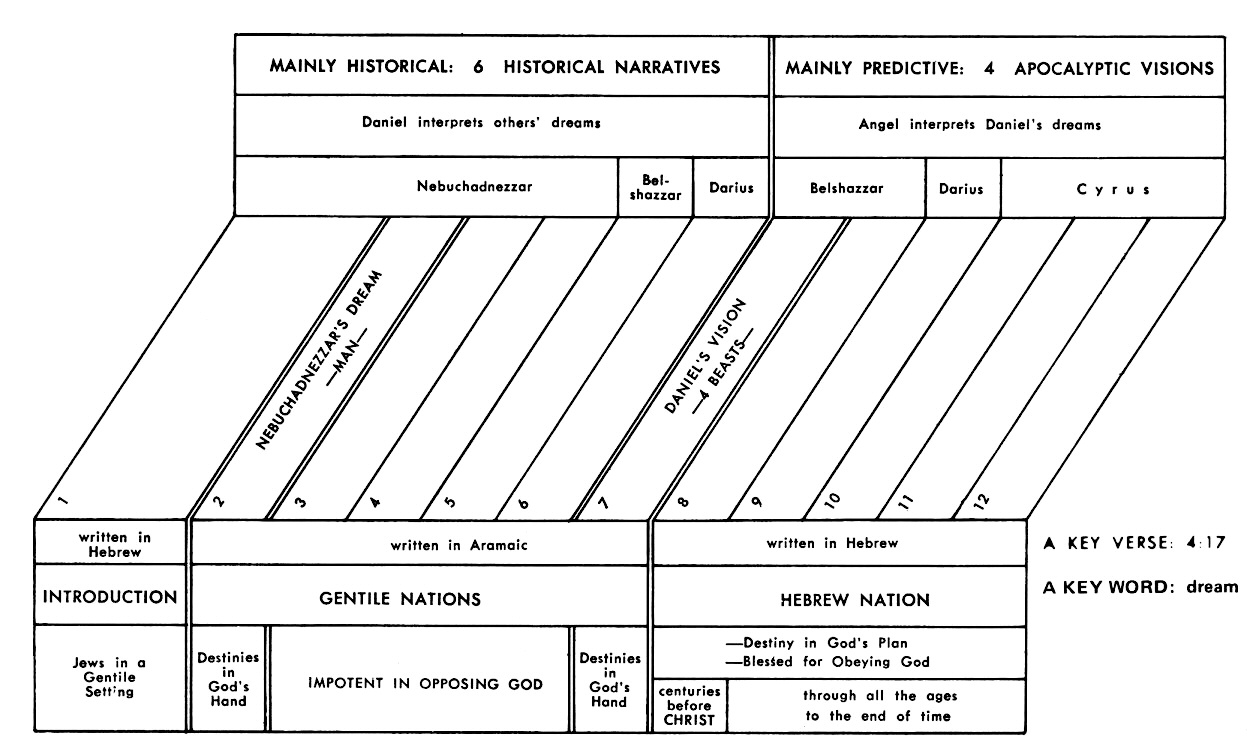 Click chart to enlarge
Charts from recommended resource Jensen's Survey of the OT - used by permission
Daniel 9:24 "Seventy weeks have been decreed for your people and your holy city, to finish the transgression, to make an end of sin, to make atonement for iniquity, to bring in everlasting righteousness, to seal up vision and prophecy and to anoint the most holy place. (NASB: Lockman)
Amplified: Seventy weeks [of years, or 490 years] are decreed upon your people and upon your holy city [Jerusalem], to finish and put an end to transgression, to seal up and make full the measure of sin, to purge away and make expiation and reconciliation for sin, to bring in everlasting righteousness (permanent moral and spiritual rectitude in every area and relation) to seal up vision and prophecy and prophet, and to anoint a Holy of Holies. (Amplified Bible - Lockman)
KJV: Seventy weeks are determined upon thy people and upon thy holy city, to finish the transgression, and to make an end of sins, and to make reconciliation for iniquity, and to bring in everlasting righteousness, and to seal up the vision and prophecy, and to anoint the most Holy.
NLT: A period of seventy sets of seven has been decreed for your people and your holy city to put down rebellion, to bring an end to sin, to atone for guilt, to bring in everlasting righteousness, to confirm the prophetic vision, and to anoint the Most Holy Place. (NLT - Tyndale House)
Young's Literal: Seventy weeks are determined for thy people, and for thy holy city, to shut up the transgression, and to seal up sins, and to cover iniquity, and to bring in righteousness age-during, and to seal up vision and prophet, and to anoint the holy of holies.
BACKGROUND
INFORMATION
Before we begin these commentary notes on the most profound predictive prophecy in all of Scripture it would be good to first review some basic guidelines for interpretation of prophecy or eschatology (eschatos = last, last things + -ology = study of), the study of last things, especially but not exclusively, the study of the "end times" (because much of prophecy has already been fulfilled). Click the brief Prophecy Primer for an explanation of why one should seek to interpret Daniel 9:24, 25, 26, 27 literally, which is the approach taken by this commentary on Daniel. Note that in one sense all of God's word is prophecy or a speaking forth, but the Prophecy Primer deals specifically with that portion of God's Word which is predictive of future events. Remember that approximately 25% of the Bible was predictive prophecy at the time it was written and about 50% of those prophecies have already been literally fulfilled. You can "stake your life" on the fact that God will fulfill the other 50% without exception.
For background see -
- Daniel 9:24-27 One of Most Significant Passages in Scripture
- Daniel Commentaries by interpretative approach to Da 9:24-27
- Anecdotal Stories related to Daniel 9:24-27
- Evidence Supporting Unit of Time in Daniel 9:24-27 as Years
- Daniel Commentaries from a literal, usually futuristic perspective
1) Daniel 9:24-27- One of the key Scriptures regarding "end times" prophecy
Daniel 9:24-27 holds the key to all prophetic interpretation and as such is the backbone of biblical prophecy.
Well known pastor and author Ray Pritchard writes that
If you understand what these verses mean, you will have a good framework for understanding all that the Bible says about the future.
Miss this, and Revelation
will be a mystery to you
If you have wondered where certain popular writers get the concept of a future seven-year Tribulation period, you will find the answer in this passage. Jesus refers to it in Mt 24:15 as does Paul in 2Th 2:1, 2, 3, 4. And the amazing events of Rev 6-19 are simply an expansion of Daniel 9:27. What is presented here in a condensed form is greatly expanded in the New Testament. This passage is the key that unlocks many other biblical prophecies. (A Peek into God's Calendar)
Well known pastor Chuck Swindoll says that
the vision of the seventy weeks revealed in Daniel 9:24-27 is undoubtedly "the backbone of Biblical prophecy" concerning Israel, Christ, and the Antichrist. It is also true that fewer predictions in Scripture have been interpreted in as many ways as have the seventy weeks of Daniel.
The fact that much of this prophecy has literally been fulfilled is
support for the interpretation that the remaining portion will be literally fulfilled in the future.
In regard to the numerous interpretations of Daniel 9:24-27, the reader should keep in mind that fortunately God is not a God of confusion (1Cor 14:33+) and thus God's Word has one intended meaning (although prophecy can occasionally have a "double fulfillment") and that meaning is most advantageously assessed by interpreting the passage as literally as possible. The moment one begins to "see" figurative or symbolic language in passages that can otherwise be interpreted literally, is the moment that speculation and imagination began to incubate, eventually giving birth to erroneous, even absurd interpretations. We will not attempt to review the numerous interpretations as in our opinion that would be a profitless exercise in light of the fact that the plain sense of this great passage makes good sense when viewed in the light of historical fulfillment. The fact that much of this prophecy has literally been fulfilled is support for the interpretation that the remaining portion will be literally fulfilled in the future.
John Walvoord, former president of Dallas Theological Seminary, writes that "The interpretation of the revelation given to Daniel concerning the seventy weeks (Daniel 9:24-27) constitutes one of the determining factors in the whole system of prophecy. The attention given to it by all schools of interpretation, and the attacks upon the authenticity of the book itself combine to focus the white light of investigation upon it. The interpretation of this passage inevitably colors all other prophetic views, and a proper understanding of it is the sine qua non of any student of prophecy. (Chapter 5 The Seventieth Week of Daniel) (Bolding added)
Dr Charles Ray notes that "Regardless of one’s theological persuasion, Daniel 9:24-27 is one of the most difficult passages to interpret. Challenges arise both in the area of linguistics and in theology, specifically eschatology. Some of the verbs are somewhat obscure, the chronological framework is not particularly easy to establish, and a dash of symbolism is thrown in the mix for good measure. The effort to unravel these four verses is worth it, however. Eschatological details are packed in them like sardines. A proper understanding of this highly scrutinized pericope will make end-time events less confusing. An overview of the passage reveals that Da 9:24 summarizes all four verses, Da 9:25 concerns the 69 “sevens,” and Da 9:27 describes the 70th “seven.” (Ed: Da 9:26 = Time Between 69th and 70th Weeks) (A Study of Daniel 9:24 - 27 - Part I)
2) Daniel 9:24-27 - Outlines the future history of Israel
As will be discussed below, Daniel 9:24-27 lays out in summary form a timetable of the events that will impact Israel. There is no reference whatsoever to "the church" in this passage, although some commentators still imagine some reference to "the church."
a) The Jews could have known the time of the Messiah's arrival (cf Jesus' declaration Lk 19:44).
b) The Jews will be able to know the time of the "Anti-Messiah's" (Antichrist) arrival (cf Mt 24:15, 2Th 2:1, 2, 3, 4).
Dr Harold Hoehner - Daniel had asked about Israel’s imminent return to their land, but instead God gave him the revelation of the seventy weeks which was to assure Daniel that God will fulfill His covenant promises to the nation (See Covenant: Abrahamic versus Mosaic; New Covenant in the Old Testament; Abrahamic vs Old vs New). Gabriel informed Daniel that God would bring Israel back into their land and set up the Messianic Kingdom (Millennial Kingdom). However, Gabriel went on to say that this would not be ultimately fulfilled at the end of the seventy-year captivity in Babylon but at the end of the seventy-week period stated in Da 9:24–27 . (Chronological Aspects of the...Seventy Weeks)
3) Provides clear evidence that the Bible is inspired by God
The accuracy of the prediction of the coming of Messiah, Prince, is indisputable evidence of that the Bible is not a book inspired by man but could only have been inspired by God Who Alone knows the future.
Sir Isaac Newton, who wrote a discourse on the topic, said we could stake the truth of Christianity on that prophecy alone, made five centuries before Christ.
Respected pastor and author Ray Stedman writes that Daniel 9:24-27 is
one of the strongest evidences to prove the divine inspiration of the Bible. Many (believers) are frequently asked why (they) believe the Bible to be the Word of God, and it is helpful to know certain passages which clearly set forth predictive elements that are unmistakable and which do indicate the ability of the Bible to predict events far in the distant future. This could only be by divine power....(Daniel 9:24-27) pinpoints the exact moment in history when the Jewish Messiah would present Himself to the Jewish people, and it does so over five hundred years before the event took place. It is so plain and detailed that it has always been an acute embarrassment to Jewish commentators.
4) Substantiates the truth that God is completely sovereign
The prophecy in Daniel 9:24-27 is so compellingly accurate, that it leaves no doubt that God is sovereign and in full control over time and the affairs of men. This grand truth should encourage the saint and frighten the sinner who is not yet saved to consider the claims.
5) Has spurred many (Jews and Gentiles) to consider the claims of the Messiah
Although many of the stories are anecdotal (see below), the truth in Daniel 9:24-27 has caused many who seek to refute these prophecies find that they are confronted with indisputable evidence of the Messiah.
6) Refutes the attempt by many to question the date of writing of Daniel's prophecies
Liberal scholars, both Gentile and Jew, have tried to late-date Daniel in order to remove the onus of predictive prophecy. They say the book was written after the events occurred but in such a way as to appear that it was written beforehand. Daniel 9:24-27 is an irrefutable witness that the prophecy of the Messiah's coming and being cut off is true. Since, no one "late-dates" Daniel to the time of Christ, Daniel 9:24-27 is one clear case of predictive prophecy, which establishes the credibility of everything else. This observation also explains why the critics try so hard to debunk this passage.
Henry Morris adds that Daniel's "prophecy was given...well over half a millennium before its fulfillment. The probability that Daniel could guess the date of the manifestation and crucifixion of the Messiah is essentially zero. Only supernatural inspiration can account for fulfilled prophecies like this. In fact, these events were fulfilled almost two centuries even after the date assigned to Daniel by scholars who deny that such prophecies can valid!" (See Defenders Study Bible - or borrow - excellent resource from a conservative, literal viewpoint by one of the world's leading scholars on creationism)
Ray Pritchard writes that Daniel 9:24-27 is "the rock on which naturalistic theories have foundered. For generations liberal scholars have tried to late-date Daniel in order to remove the onus of predictive prophecy. They say the book was written after the events occurred but in such a way as to appear that it was written beforehand. However, no one late-dates the book to the time of Christ. This leaves us with one clear case of predictive prophecy, which establishes the credibility of everything else. No wonder the critics try so hard to debunk this passage." (A Peek into God's Calendar)
7) Stimulates a heightened expectation of the imminent return of the Messiah (see Titus 2:13-note and word study on prosdechomai = looking for expectantly)
This statement applies to Daniel in general also, for no book in the Bible says more about the so called end times than Daniel. Many orthodox and conservative Jews believe the time is ripe for the coming of Messiah. They see Israel's return to her homeland after more than 1,900 years of national dispersion as having great prophetic significance. They believe the May, 1948 rebirth of Israel and waves of immigration (which is the meaning of the Hebrew word aliyah) from all over the world are converging with many other factors to set the stage for the predicted coming of a national Deliverer. They see the coming of this Messiah as being good not only for Israel but for the whole earth. According to the prophet Isaiah, He will cause the nations to
beat their swords into plowshares, and their spears into pruning hooks; nation shall not lift up sword against nation, neither shall they learn war anymore (Is 2:4-see notes)
A C Gaebelein, a careful scholar who spent much of his life studying and comparing prophetic portions of the Bible wrote that "The prophetic message Gabriel brought from the throne of God to Daniel is perhaps the most important not only in the Book of Daniel, but in the whole Bible. The clear understanding of it is indispensable to every reader of God's Word, who wants to know God's purposes concerning the future. In the few verses which contain the words of Gabriel, events relating to Jewish future history are predicted. The return of the Jews from the Babylonian captivity, the rebuilding of the city in time of distress, the coming of Christ in humiliation, his death, the destruction of the temple and the city by the Romans, the desolations and wars which were to follow, all this is prewritten in this great prophecy. The final end of the time of the Gentiles, the great eventful week of seven years is revealed in the last verse." (The Prophet Daniel: A Key to the Visions and Prophecies).
To quote from an email received February 4, 2004 from "The Temple Mount and Land of Israel Faithful Movement" (an Orthodox Jewish group based in Jerusalem)
"The Hand of G_d appears again and again in Jerusalem and the Temple Mount...to purify the Temple Mount and immediately rebuild the house of G_d as the climax of the exciting redemptional times in which we are now living in Israel which will open the Eastern Gate for the coming of Mashiach ben David", this latter name of course referring to the expected Messiah. Interestingly, both Jews and Christians share the belief that a period of turmoil and distress will precede the coming of Messiah. The Jewish document called "Talmudic Sages" draws a dark picture of this time. Accordingly, one of these Jewish sages wrote, "Let him [Messiah] come, but let me not see him" (Sanh. 98b).
See Also Related Resource: Prophecy Primer
One of the most respected names in the study of Bible prophecy, Dr. John Walvoord, writes some sage remarks regarding the interpretative difficulties of Daniel 9:24-27:
In the concluding four verses of Daniel 9, one of the most important prophecies of the Old Testament is contained...Although many divergent interpretations have been advanced in explanation of this prophecy, they may first be divided into two major divisions, namely, the Christological and the non‑Christological views. The non‑Christological approach may be subdivided into the liberal critical view and the conservative amillennial view.
The Christological camp interprets the first sixty-nine weeks of Daniel as culminating in Christ while the non‑Christological camp finds fulfillment of Daniel’s prophecy in events before or after Christ. (See list of Christological and Non-Christological Interpreters)
The non-Christological group (Ref) attempts to find fulfillment of the Daniel's 70 Weeks in the events leading up to the persecution of Antiochus Epiphanes (see Daniel notes and additional discussion). In 168BC, a pagan altar was constructed on top of the great altar of burnt sacrifices, and a pagan sacrifice was offered under the reign of Antiochus Epiphanes. This act precipitated the Maccabean revolt which Antiochus attempted unsuccessfully to put down with great cruelty (167-164 B.C.).
Recall that Daniel was written in two languages, Hebrew and Aramaic. From Daniel 2:4b to Da 7:28, the language is Aramaic because the focus is on the Gentile world powers that would interact with Israel, and from Daniel 8:1 onward the focus of the book turns from the future of the Gentile world powers to the future of Israel.
Another interesting observation is that in Daniel 9 Yahweh or Jehovah is used seven times but nowhere else in the entire book! Why would the Spirit inspire the usage in this chapter? Jehovah is God's covenant name and this chapter preeminently emphasizes that He will keep His promise to bring the Jews back to their land, the land He promised in covenant to Abraham, Isaac and Jacob (Note Abraham's question in Ge 15:7 then God's answer in Ge 15:8, 9, 10, 11, 12, 13, 14, 15, 16, 17 and especially Ge 15:18, 19, 20, 21).
Daniel wrote chapter 9 about 538 BC and had lived long enough to have witnessed the fulfillment of the prophecy in Daniel 2 that predicted Babylon would give way to another kingdom the Medo-Persians. It is worth remembering that Daniel would be about 82 years old and yet he is still standing fast as a man of the Word and of prayer. What Daniel discovered as he read Jeremiah's prophecy (Jer 25:11,12 or a letter Jeremiah wrote to the exiles = Jer 29:10) provoked him to prayer, which presents a basic principle that the foundation of prayer is the Word of God.
Jesus taught that
If you abide in Me, and My words abide in you, ask whatever you wish, and it shall be done for you.' (Jn15:7, cp Jas 5:15, 16, 1Jn 5:14, 15)
So as we look at the Word of God, we know how to pray. In prayer we align ourselves, our desires, our actions, our petitions, with the Word of God . And we align our lives with the word of God.
It was C H Spurgeon who said
Oh! That you studied your Bibles more! Oh! That we all did! How we could plead the promises! How often we should prevail with God when we could hold Him to His word, and say, 'Fulfill this Word unto Thy servant, whereon Thou hast caused me to hope.' Oh! It is grand praying when our mouth is full of God's Word, for there is no word that can prevail with Him like His own.
At the time the prophecy recorded in Daniel 9 was given, the Babylonian Empire had fallen to the Medo-Persian Empire. Cyrus (also referred to as Darius) was in power. Although the Jewish exiles were now the captives of the Medo-Persians, Daniel retained his position as prime minister because of his integrity. Daniel received his revelation in the year 538 BC, about 67 years after he had been taken captive.
Keil and Delitzsch commenting on Daniel 9:24 says that...
This message of the angel relates to the most important revelations regarding the future development of the kingdom of God. (Note: I think they stop somewhat short - Yes, it refers to the "Kingdom of God" but especially deals with God's King and His future plan for Israel, not the Gentiles.)
Resources to Aid Study of Daniel 9:24-27
Click listing of commentaries categorized by their interpretative approach to the book of Daniel and especially Daniel 9:24-27 so that you can be a Berean (Acts 17:11-note)
Click brief refresher on some basic principles of interpreting Bible prophecy.
Daniel 9:24 “Seventy weeks have been decreed for your people and your holy city, to finish the transgression, to make an end of sin, to make atonement for iniquity, to bring in everlasting righteousness, to seal up vision and prophecy and to anoint the most holy place.
SEVENTY WEEKS
- Lv 25:8; Nu 14:34; Ezek 4:6
- Youtube video I did on Daniel 9:24-27 God's Prophetic Plan for the Ages
Literally this reads 70 sevens or 70 units of seven. (Click discussion of why the number 70 and its relationship to Sabbath rests). The NIV ("seventy 'sevens' are decreed") is actually more literal than and therefore easier to understand than the KJV and NAS which translate "seven" as "weeks" which naturally congers up the thought of a "week of days". In fairness to the NAS, the 95 version does have a marginal note that says "Or units of seven, and so throughout the chapter".
In Daniel 9:24 Gabriel gives Daniel a general summary of what will be accomplished during the seventy weeks.
Seventy (shibim) is used 91x in 90v in the NAS - Ge 4:24; 5:12, 31; 11:26; 12:4; 25:7; 46:27; 50:3; Exod 1:5; 15:27; 24:1, 9; 38:25, 28f; Num 1:27, 29; 2:4; 3:43, 46; 7:13, 19, 25, 31, 37, 43, 49, 55, 61, 67, 73, 79, 85; 11:16, 24f; 26:22; 31:32f, 37f; 33:9; Dt 10:22; Jdg 1:7; 8:14, 30; 9:2, 4f, 18, 24, 56; 12:14; 1 Sam 6:19; 2 Sam 24:15; 1 Kgs 5:15; 2Kgs 10:1, 6f; 1Chr 21:5, 14; 2 Chr 2:2, 18; 29:32; 36:21; Ezra 2:3ff, 36, 40; 8:7, 14, 35; Neh 7:9, 39, 43; 11:19; Esth 9:16; Ps 90:10; Isa 23:15, 17; Jer 25:11,12; Jer 29:10; Ezek 8:11; 41:12; Da 9:2, 24; Zech 1:12; 7:5. Shibim is translated seventy some 53 times.
Seventy is used to describe the number of years Judah was to be in exile in Babylon (2Chr 36:21, Jer 25:11,12; Jer 29:10, Da 9:2)
Weeks (07620) (shabuwa', sabua' or shabua') is found 6x in the four verses of Da 9:24-27. In simple terms shabua' means a "unit of seven" and could refer to seven of anything. It is simply a numerical measure. Our English equivalent is "heptad" which means "a group of seven". Daniel as well as all of the Jews would have been quite familiar with the concept of "sevens of years" from the Mosaic law stipulating that ever seventh year was to be a sabbatical or rest year for the land during which time they were to plant no crops (Lev 25:1, 2, 3, 4, 5, 6). The reason Daniel was praying in fact was because he had read in Jeremiah that Judah was in exile so that the land would be allowed to keep its sabbath rests (for 490 years they had failed to keep every seventh year as a sabbath!) (cf 2Chr 36:21). The only other type of weeks or sevens mentioned in Scripture are sevens of days (Sabbath rest each week). As Miller says "The burden of proof rests squarely upon anyone who would take the sevens in any other sense (other than days or years)." (New American Commentary: Daniel).
Miller also counters the interpretation that seeks to try to interpret these numbers symbolically noting...
those who contend that the sevens are symbolic must account for the fact that specific numbers are used and for division of the seventy sevens into units of seven, sixty-two, and one. Why would such definite numbers be employed to represent periods of indefinite length? (Ibid).
Shabua' - 20x in 17v in NAS - Ge 29:27, 28; Ex 34:22; Lv 12:5; Nu 28:26; Dt. 16:9, 10, 16; 2Chr. 8:13; Je 5:24; Ezek 45:21; Da 9:24, 25, 26, 27; 10:2, 3
Related Resource: John Whitcomb's analysis of the Hebrew word "weeks" - Daniel's Great Seventy-Weeks Prophecy An Exegetical Insight
The Theological Wordbook adds that in all 20 OT uses of shabua' indicates
a period of seven. Indeed, the word obviously comes to us from sheba' and could literally be translated always as "seven-period." (Harris, R L, Archer, G L & Waltke, B K Theological Wordbook of the Old Testament. Moody Press)
Three times in the OT, shabua' is modified by the Hebrew word for days, with the "seven days" referring to a literal week (Ezek 45:21, Da 10:2, 3), 6 times in Daniel 9:24, 25, 26, 27 shabua' is used as a unit of seven without an added unit of time and 11 times it is used to mean a literal week of seven days (Ge 29:27,28, Lev 12:5) with 8 of 11 uses referring to the Jewish Feast of Weeks or Pentecost (Ex 34:22, Nu 28:26, Dt 16:9 [x2], Dt 16:10, 16, 2Chr 8:13, Jer 5:24). Note for example Leviticus 12:5 which describes the length of time a mother shall remain unclean declaring
she shall be unclean for two weeks... (literally "two sevens" or "two units of seven")
Comment: Observe that the context most naturally leads to the interpretation as "two units of seven" days. By comparison the Hebrew of Da 9:24, 25, 26, 27 omits the unit of time, because in context the time is most naturally understood as "years".
Assuming a literal interpretation, seventy weeks or units of seven (seventy heptads, units of measure) can be divided as follows...
- Daniel 9:24 - a comprehensive picture of the entire prophecy
- Daniel 9:25 - the first 69 sevens (483 years)
- Daniel 9:26 - the events between the 69th and 70th sevens
- Daniel 9:27 - conclusion punctuated by the 70th seven of 7 years.
Note that Daniel’s use of definite numbers such as seventy, seven, sixty-two, and one makes it very difficult to imagine that this passage is to be interpreted symbolically as indefinite periods of time. Remember one of our simple but foundational "rules" in interpreting prophecy is that...
If the plain sense makes good sense ,
don't try to make some other sense
or it may result in no sense ( nonsense ).
To say that the events described in Da 9:24, 25, 26, 27 occurred in 490 days, 490 weeks or 490 months makes no sense ("nonsense") from the context! Even older commentaries see this as only making sense if it is interpreted as years.
For example Gill writes that
this space of "seventy" weeks is not to be understood of weeks of days; which is too short a time for the fulfillment of so many events as are mentioned; nor were they fulfilled within such a space of time; but of weeks of years, and make up four hundred and ninety years. (Bolding added)
It is often said that in interpretation of Scripture, "context is king" and the verses that follow (Da 9:25, 26) that predict the timing of the First Advent of Christ, the Crucifixion of Christ, and the Destruction of Jerusalem demand that the only unit of time that would make sense is years. that the most appropriate unit of time one should use to modify the "seventy units of seven". The rationale for interpreting the unit as years is discussed in more detail elsewhere (click here).
Adam Clarke notes that...
The Jews had Sabbatic years, by which their years were divided into weeks of years, as in this important prophecy, each week containing seven years.
BKC adds that...
Also if days were intended one would expect Daniel to have added “of days” after “70 sevens” for in Da 10:2, 3 he wrote literally, “three sevens of days” (Ed: See Young's Literal = "three weeks of days" Da 10:2, 3YLT).
In summary, the context leads one to conclude that Daniel is referring to "seventy sevens" of "years" for a total of 490 years (70 x "7" years = 490 years).
Click for more detailed discussion of why "years" is the most appropriate unit of time regarding the interpretation of the 70 x 7's.
HOW MANY DAYS
IN ONE YEAR?
The next question is whether the year is 360 days (lunar) or 365 days (solar)?
First, observe the Genesis record regarding the beginning and end of the Flood...
BEGIN = In the six hundredth year of Noah’s life, in the second month, on the seventeenth day of the month, on the same day all the fountains of the great deep burst open, and the floodgates of the sky were opened. (Genesis 7:11)
END = In the seventh month, on the seventeenth day of the month, the ark rested upon the mountains of Ararat. (Genesis 8:4)
Thus we can conclude the flood lasted 5 months. Now compare Moses record of this time period...
The water prevailed upon the earth one hundred and fifty days. (Genesis 7:24 )
and the water receded steadily from the earth, and at the end of one hundred and fifty days the water decreased. (Genesis 8:3)
Thus the flood lasted for 150 days or 5 months, which yields 30 days/month.
Now compare Daniel 7:25 which records the little horn's power will last for "time, times and half a time" which equates with three and one-half. And comparing with Revelation 13:5 we note the Little Horn or Antichrist is granted authority for 42 months or 3.5 years. Thus "time, times and half a time" equates with 3.5 years. When we compare Daniel 7:25 with Revelation 12:6 and Revelation 12:14, we note that "time, times and half a time" equates with 1260 days which equates with 30 days/month for the 3.5 year period. In sum, examination of the Scripture reveals that from Genesis to Revelation the Biblical month is thirty day. Therefore, the time period indicated by the seventy sevens is a period of 490 years of 360 days each.
30 DAYS/MONTH
360 DAYS/YEAR
Although many if not most of the older commentaries are woefully inadequate when it comes to the interpretation of prophecy (primarily because they have fallen into the "abyss" of replacing Israel with the Church in their interpretation of Old Testament prophecies - see Israel of God), there are a few relatively good older commentaries, and one is by Jamieson-Fausset-Brown which was published in 1871. It is refreshing to read their clear and cogent literal interpretation of Daniel 9:24...
Seventy weeks -- namely, of years; literally, "Seventy sevens"; seventy heptads or hebdomads; four hundred ninety years; expressed in a form of "concealed definiteness" [Hengstenberg], a usual way with the prophets.
The Babylonian captivity is a turning point in the history of the kingdom of God. It terminated the free Old Testament theocracy. Up to that time Israel, though oppressed at times, was; as a rule, free.
From the Babylonian captivity the theocracy never recovered its full freedom down to its entire suspension by Rome; and this period of Israel's subjection to the Gentiles is to continue till the millennium (Re 20:1, 2, 3, 4, 5, 6, 7, 8, 9, 10, 11, 12, 13, 14, 15) (Ed: "The Times of the Gentiles" Lk 21:24), when Israel shall be restored as head of the New Testament theocracy, which will embrace the whole earth. The free theocracy ceased in the first year of Nebuchadnezzar, and the fourth of Jehoiakim; the year of the world 3338, the point at which the seventy years of the captivity. begin. Heretofore Israel had a right, if subjugated by a foreign king, to shake off the yoke (Jdg 4:1-5:31 2Ki 18:7) as an unlawful one, at the first opportunity. But the prophets (Jer 27:9, 10, 11) declared it to be God's will that they should submit to Babylon. Hence every effort of Jehoiakim, Jeconiah, and Zedekiah to rebel was vain. The period of the world times, and of Israel's depression, from the Babylonian captivity to the millennium, though abounding more in afflictions (for example, the two destructions of Jerusalem, Antiochus' persecution, and those which Christians suffered), contains all that was good in the preceding ones, summed up in Christ, but in a way visible only to the eye of faith. Since He came as a Servant, He chose for His appearing the period darkest of all as to His people's temporal state. Always fresh persecutors have been rising, whose end is destruction, and so it shall be with the last enemy, Antichrist. As the Davidic epoch is the point of the covenant-people's highest glory, so the captivity is that of their lowest humiliation. Accordingly, the people's sufferings are reflected in the picture of the suffering Messiah. He is no longer represented as the theocratic King, the Antitype of David, but as the Servant of God and Son of man; at the same time the cross being the way to glory (compare Da 9:1-27 with Da 2:34, 35, 44 Da 12:7). In the second and seventh chapters (of Daniel), Christ's first coming is not noticed, for Daniel's object was to prophesy to his nation as to the whole period from the destruction to the re-establishment of Israel; but this ninth chapter minutely predicts Christ's first coming... (Commentary Critical and Explanatory on the Whole Bible — Jamieson-Fausset-Brown Bible Commentary)
|
SEVENTY SEVENS: |
||
|
Division I |
7 SEVENS |
Rebuilding of Jerusalem |
| Division II (Da 9:25) |
62 SEVENS (49 + 434 = 483 years) |
First Advent of |
| (Da 9:26) | GAP Between 69- 70th Seven |
Messiah Cut Off City Destroyed |
| Division III (Da 9:27) |
1 SEVEN (7 years) |
"The Tribulation" |
HAVE BEEN DECREED
- determined (KJV),
- settled (Berkley),
- marked out (New English Bible),
- commanded (TLB),
- God has set (GNB),
- weeks have been fixed (BBE),
- assigned (GWT),
- God has ordered (NCV)
Decreed (02852) (chathak/hatak) means something determined. This verb is in the perfect mood which expresses a completed action. "God said it, so that settles it" is the idea! The Hebrew root word basically means to "cut or divide", "to cut off" and hence to decree or determine.
Our English word decree means to give an order usually with the force of law. The 1828 Webster (speaking of the noun form) writes that a decree is a "predetermined purpose of God; the purpose or determination of an immutable Being, Whose plan of operations is, like Himself, unchangeable."
The picture conveyed by chathak/hatak is of a settled decree by the LORD or Jehovah (Jehovah is always identified by LORD in all caps in the NAS = which distinguishes it from "Lord" = Adonai), the name Jehovah emphasizing that He is the covenant keeping God. In fact, in Daniel God's covenant name, Jehovah, is used only in Daniel 9 (Da 9:2, 9:4, 9:10, 9:13, 9:14, 9:20). This passage speaking of what God determines will come to pass emphasizes that He is sovereign and in complete control of the history of His Chosen People (history is "His-story"!). The Sovereign One has marked out, ordained or predetermined a 490 year period that directly impacts the nation of Israel (and He does so without violating Israel's free will which reminds us of God's attribute = Incomprehensible)! Stated another way, it is as if God has "cut off" a 490 year segment of time and assigned it as the time during which He will bring about the deliverance and restoration of His people, Israel, and His holy city, Jerusalem. What God prophesies, He fulfills and thus His plan will be completed in each of the 6 specific predictions in this verse (cp Is 43:13, 44:7, 45:21, 46:10).
The Hebrew verb chathak/hatak is translated in the Greek Septuagint (LXX) with the Greek verb suntemno that means to cut short, to put a limit to something, to bring to an end or to accomplish speedily (as in Ro 9:28). Figuratively, suntemno means to decide, determine, decree (cp the Eternal God's perspective on time - Ps 90:4-note).
Gill also observes that the Hebrew verb chathak/hatak is especially apropos for
the word...to cut aptly expresses the division, or section of these weeks into distinct periods, as seven, sixty two, and one.
Jamieson adds that the meaning is...
literally, "cut out," namely, from the whole course of time, for God to deal in a particular manner with Jerusalem. (Ed: And this 490 year period of dealing with the Jews was predicted in Leviticus - see Seven Times Seventy)
Barnes writes...
The meaning would seem to be, that this portion of time — the seventy weeks — was “cut off” from the whole of duration, or cut out of it, as it were, and set by itself for a definite purpose. It does not mean that it was cut off from the time which the city would naturally stand, or that this time was “abbreviated,” but that a portion of time — to wit, four hundred and ninety years — was designated or appointed with reference to the city, to accomplish the great and important object which is immediately specified. A certain, definite period was fixed on, and when this was past, the promised Messiah would come. (Barnes' Notes on the Old Testament - Volume IX)
Ray observes that...
Daniel asks the Lord about ending the exile, but His response looks to the future instead. That is not to say the answer had nothing to do with his petitions. For example, the first triad of phrases (Da 9:24) addresses the wording of Da 9:5, and the last three his request of Da 9:7. (A Study of Daniel 9:24 - 27 - Part I)
FOR YOUR PEOPLE AND YOUR HOLY CITY
Notice that just before Gabriel interrupted Daniel's prayer he had specifically cried out...
O Lord, hear! O Lord, forgive! O Lord, listen and take action! For Your own sake, O my God, do not delay, because Your city and Your people are called by Your name. Now while I was speaking and praying, and confessing my sin and the sin of my people Israel (Notice Daniel is not just praying for Judah but for all Israel), and presenting my supplication before the LORD my God in behalf of the holy mountain of my God (Which is in the holy city) (Da 9:19, 20)
And so Gabriel brings an answer that is specifically related to your people and your holy city, which leaves little doubt as to the identification of the two recipients of the great prophecy - Israel and Jerusalem, not the church and the "new Jerusalem"!
Your People - Recall that the one announcing this prophecy is the angel Gabriel (4x in Scripture - Da 8:16, 9:21, Lk 1:19, 26) who addresses Daniel, a Jew. It follows the phrase your people refers to the Jews. If one misses (or misinterprets) this important phrase (as for example "the church" or "God's people in general"), the entire prophecy will make absolutely no sense!
Your people - This specific phrase occurs 126x in 119 verses and if one examines the uses in the OT prophets, the context always refers to Israel (See Isa 2:6; 7:17; 10:22; 14:20; 60:21; 63:14; 64:9; Jer 22:2; 27:13; 31:7; 32:21; Ezek 3:11; 13:17; 26:11; 33:2; 37:18; Da 9:15, 16, 19, 24; 10:14; 11:14; 12:1; Hos 4:4; 10:14; Joel 2:17; Mic 7:14; Nah 3:13, 18; Hab 3:13). Note especially that in Daniel 9 the three previous uses of "your people" (Da 9:15, 16, 19) clearly referring to the Jewish People and not to the church.
Unlike the prophecies in Daniel 2 (cp Da 2:44, 45-note) and Daniel 7 (Da 7:3, 4, 5, 6, 7-note) describing the God's plan for the Gentiles (which helps explain why Da 2:4b thru Da 7:28 are written in Aramaic the "lingua franca" or world's common language rather than Hebrew), Daniel 9:24, 25, 26, 27 (and Daniel 10-12) lays out God's specific program for His chosen people, the Jews, and for His holy city, Jerusalem.
It is surprising that some scholars who seem to be generally "conservative" (e.g., Young, Keil, Leupold) interpret your people symbolically (allegorically, spiritually) as a reference to so called "spiritual Israel", the church (which even the New Testament says is not revealed in the Old Testament-- e.g., see Ep 3:1,2, 3-note, Ep 3:4, 5-note, Ep 3:6-note).
Ray comments that...
Men such as Keil, Leupold, and Young believe “your people” refers to “spiritual Israel,” and “your holy city” is the heavenly Jerusalem. Both are modified by “your” because Daniel was praying for both and because he belonged to both. Again, some logic-defying mistakes are made.
The text does not lend
itself to such a speculation.
This passage (Da 9:24-27) is the answer to Daniel’s prayer, a prayer in which he was petitioning Yahweh about the Jews and Jerusalem, not some entities unknown to him. In Da 10:14, “your people” clearly means Abraham’s descendants; nothing else would make sense in that verse. The same reasoning applies to Da 11:14. Indeed, how could a people destroy the heavenly Jerusalem (Da 9:26)? The term “holy city” denotes literal Jerusalem in Neh 11:1,18; Is 48:2, 52:11; Mt. 4:5, 27:53, and possibly Rev 11:2) (A Study of Daniel 9:24-27-Part 1)
If you begin the interpretation of what has to be one of the greatest, if not the greatest, prophecies of all prophecies by misinterpreting to whom it is addressed, you are destined to miss the great jewels of truth that lay hidden to an honest, literal interpretation of this passage. For an excellent synopsis of the use and dangers of allegorical interpretation see Dr Tony Garland's articles (from his verse by verse study of the Revelation - which I highly recommend = A Testimony of Jesus Christ)...
- Art and Science of Interpretation
- The Rise of Allegorical Interpretation
- Understanding Symbols and Figures
- Understanding Numbers
Your holy city - In context this is clearly a reference to the holy city of Jerusalem (cf references to holy city - Neh 11:1; 11:18; Is 48:2; Isa 52:1; Da 9:24; Mt 4:5; 27:53).
Related Resource: God's Plan For Jerusalem: A Timeline
Daniel prayed specifically for the holy city and God answered specifically (a good principle whenever we pray - be specific - e.g., not just "Lord bless the missionaries")...
"let now Thine anger and wrath turn away from Thy city Jerusalem, Thy holy mountain ("Temple Mount" the site of the Holy Temple - cf Da 9:20) (Da 9:16)
"O my God, incline Thine ear and hear! Open Thine eyes and see our desolations and the city which is called by Thy name (God's glory is "at stake");
"O Lord, hear! O Lord, forgive! O Lord, listen and take action! For Thine own sake, O my God, do not delay, because Thy city and Thy people are called by Thy name (It was God's Name that was "at stake" for the pagans associated God with His city and His people)." (Da 9:19)
Guzik - Talbot calls the seventy weeks "God's calendar for Israel" (Ed Note: And I would add His Timetable for Jerusalem - see my study God's Plan for Jerusalem: Five Prophetic Mountain Peaks) in that it does not focus on the Gentiles or the church.
Similar to their incorrect allegorical interpretation of your people, the same group of commentators (e.g., Young, Keil, Leupold) interpret your holy city as a reference to the heavenly Jerusalem (cp Re 21:2-note) despite the fact that there is nothing stated in the immediate context which supports such an imaginative interpretation! This is why the wise Bible student holds fast to the maxim that context is always king in interpretation. Nowhere is this maxim more important to apply than in the interpretation of Biblical prophecies. As stated earlier, if the plain sense of the passage makes good sense, don't try to make some other sense or it's potentially nonsense!
By the time these 490 years run their course, God will have accomplished all 6 predictions, and in fact all will be literally realized by Israel at the Second Coming of Messiah (See Table comparing Rapture vs Second Coming) when...
all Israel will be saved; just as it is written, "THE DELIVERER (the Messiah) WILL COME FROM ZION, HE WILL REMOVE UNGODLINESS FROM JACOB. AND THIS IS MY COVENANT WITH THEM, WHEN I TAKE AWAY THEIR SINS. (Ro 11:26, 27-see notes)
At that time the elect (chosen) of Israel (the remnant) will recognize the Messiah and will repent and will turn to Him as their national (and personal) Deliverer, Savior and King. At this time Israel will be restored to the land (a common phrase in the OT which most often refers to the "promised land" - but always check the context) in fulfillment of God's promise to Abraham (Ge 15:18 - a promise never completely fulfilled but never revoked). Observe that in a sense the final future restoration of Israel is the answer to Daniel’s prayer.
Walvoord observes that...
Even in ruins, Jerusalem remains the city set apart in the heart of God (cf. Da 9:20) and Daniel shared this love for the city which is central in God's program for His kingdom both in the past and the future. Unlike the prophecies of Daniel 2, 7, and 8, which primarily related to the Gentiles, this chapter is specifically God's program for the people of Israel, as Daniel would obviously interpret it. To make this equivalent to the church composed of both Jews and Gentiles is to read into the passage something foreign to the whole thinking of Daniel. The church as such has no relation to the city nor to the promises given specifically to Israel relating to their restoration and repossession of the land. (Daniel: The key to Prophetic Revelation -- free online)
Wiersbe points out that...
The first three (of the six infinitives) have to do with sin and the last three with righteousness. The Lord would "finish the transgression," that is, the transgression of the Jewish people, and "make an end of" Israel's national sins.
This was one of the main burdens
of Daniel's prayer.
Israel was a scattered suffering nation because she was a sinful nation. How would the Lord accomplish this? By making "reconciliation (atonement) for iniquity," that is, by offering a sacrifice that would atone for their sin. Here we come to the cross of Jesus Christ, Israel's Messiah. (Bible Exposition Commentary - Old Testament)
Note that although the six accomplishments listed in this verse are addressed primarily to Israel, clearly all of humanity will be radically impacted by the fulfillment, some to the eternal praise of the glory of God's grace and some to eternal punishment away from the presence of the Lord (cp Mt 25:41, Mt 7:21-note, Mt 7:22, 23-note, 2Th 1:7, 8, 9, 10)
(1) TO FINISH THE TRANSGRESSION:
- Mt 1:21; 1Jn 3:8
- "to let wrongdoing be complete" (BBE),
- Literally "to restrain firmly the transgression ";
- My paraphrase = "Bring the rebellion by Israel against divine authority to completion",
- "to consummate transgression"
The idea is to bring the transgression of "Thy people" and "Thy holy city" to a final stopping point during or at the end of the 490 years. Note that even after 70 years in captivity, the Jews had not repented and become obedient to Jehovah and the Mosaic Covenant. Furthermore,
MacArthur writes that this phrase...
literally means "to restrain firmly the transgression." Today sin expresses itself freely, but a day will come when that will not be true (Ed Comment: Speaking in particular of the nation of Israel, but to be generally true of the entire world in the Millennial Kingdom). Jesus will rule with a rod of iron (Ps 2:6, 7, 8, 9) and every expression of evil--"transgression"--will be immediately restrained by His divine power. (Israel's Future--Part 1)
S Lewis Johnson has an interesting interpretation of this infinitive...
Israel’s rebellion against the Lord God will be brought to an end with the four hundred and ninety years.... there is an article with “transgression.” The transgression. It’s almost as if there is anticipated in this the crucifixion of our Lord and Savior Jesus Christ because that is “the transgression” of the children of Israel.
Jamieson adds that...
The seventy years exile (in Babylon) was a punishment, but not a full atonement, for the sin of the people (Israel); this would come only after seventy prophetic weeks, through Messiah. (See note on Seven Times More)
Israel's rebellion as a nation will be finally restrained at the Second Coming of the Messiah when a remnant will turn to Him in faith and the nation’s transgression and sins will be forgiven (see more detail in the related discussion below by Lehman Strauss). And so the post-exilic prophet Zechariah records God's promise that when the Messiah returns after the decreed 490 years...
it will come about in all the land (of Israel)...that two parts in it will be cut off (karath = same verb used in Da 9:26 to describe the crucifixion of Messiah) and perish, but the third will be left in it (the "elect" and believing remnant). And I will bring the third part through the fire, refine them as silver is refined, and test them as gold is tested. They will call on My name, and I will answer them; I will say, 'They are My people,' (a component of the New Covenant promised to Israel - see Jer 31:33, 32:38) and they will say, 'The LORD is my God.' (Zech 13:8, 9)
Finish (03615) (kalah') conveys the basic meaning of bringing a process to completion or consummation (eg, creation Ge 2:1, 2, high priest's atoning for the holy place Lev 16:20, referring to the spring harvest Ru 2:21, 23, Solomon finishing the Temple 1Ki 6;14, to fulfill the word of Jehovah - 2Chr 36:22). The Septuagint (LXX) uses the verb sunteleo which means to complete something that has been in process, to finish it, to bring it to an end. In context the idea is that the transgression of Israel and Judah will come to an end when Messiah, their Deliverer, returns and saves all (the 1/3 of Israel who is alive and who believes in Messiah at His Second Coming, cf Zech 13:8,9).
Moses' illustrates the meaning of kalah' describing the ending of the flood when
the fountains of the deep and the floodgates of the sky were closed, and the rain from the sky was restrained (kalah') (Ge 8:2).
For completeness, it should be noted that there are two Hebrew verbs which are used to translate the phrase finish (click explanation).
Transgression (06588) (pesha' - word study') means to rebel, revolt or to rise up in clear defiance to authority by violation of a law, command, or duty. The fundamental idea is a breach of relationship (civil or religious) between two parties. Pesha' speaks of willful sins. And so the first item in God's program is to bring Israel's rebellion against Him to an end.
Vine says that pesha' basically "signifies willful deviation from, and therefore rebellion against, the path of godly living.
Mounce adds that pesha'...
is one of the three primary words for sin in the OT. While sin is any act of offense against God, from willful rebellion to unintentional sin, pesha' normally denotes intentional disobedience, especially against God’s law. The prophecy of Amos makes this clear, as he speaks out first against Judah (Amos 2:4 = transgressions) and then against Israel (Amos 2:6 = transgressions). To the latter he declares, “For I know how many are your offenses and how great your sins. You oppress the righteous and take bribes and you deprive the poor of justice in the courts” (Amos 5:12 = transgression). Committing pesha' may involve social, political, or cultic acts and can occur on an interpersonal level (e.g., Ex 22:9; Amos 5:12), a political level (1Ki 12:19), or a religious level (Isa 1:2 = "revolted against"). In all occurrences of pesha' the common thread is the breach of a covenant responsibility. To trespass God’s instruction is to rebel against God. On the annual Day of Atonement the pesha' of Israel is atoned (Lev 16:16, 21). (Mounce's Complete Expository Dictionary of Old and New Testament Words )
Transgression (pesha' - word study) in the present context speaks of a definite rebellion against (divine) authority and was the same Hebrew word used by Daniel in chapter 8 to describe the actions of the apostate Jews in the days of Antiochus Epiphanes (see pesha' = transgression in Da 8:12, 13-note where "host" refers to Jews, not stars or angels). Furthermore, the grammatical construction used here in Daniel 9:24 suggests that a specific transgression was intended (see note by Strauss below) and this seems to be a reference to the rebellion by Israel specifically against God and His Word.
Isaiah uses pesha' twice in his description of the Messiah in chapter 53 declaring that...
But He was pierced through for our transgressions, He was crushed for our iniquities; the chastening for our well-being fell upon Him, and by His scourging we are healed. (Isa 53:5)
By oppression and judgment He was taken away; and as for His generation, who considered that He was cut off out of the land of the living, for the transgression of my people (Israel) to whom the stroke was due? (Isa 53:8)
Showers adds that
this rebellion was the root sin which prompted all of Israel’s other sins. Gabriel was saying that
Israel would not stop its rebellion against God’s rule
until these 490 years would run their course.
In agreement with this, other Scriptures indicate that Israel will not repent, turn to God and be saved until the Second Coming of the Messiah at the end of these 490 years (Zech 12:10,11, 12, 13, 14, 13:1, 2, 3, 4, 5, 6, 7, 8, 9; Ro 11:25, 26, 27-note). (The Most High God: Commentary on the Book of Daniel. Bellmawr, NJ: Friends of Israel Gospel Ministry, Inc)
Lehman Strauss goes to some length to emphasize (correctly) that this first (actually all) of the six summary purposes for the Seventy Sevens is specifically directed toward Israel ("your people" - which of course does negate the application of this truth to Gentiles) noting that...
This (finish the transgression) was the first and most important item on the list. Keep in mind the fact that this was a national "transgression" since the prophecy has to do with Daniel's "people." Observe also that the definite article (Ed: "the") appeared in the text: "the transgression." The central theme in Daniel's prayer was the transgression of his people, a transgression which was to culminate in "the transgression." The word "transgression" combines the idea of rejection and apostasy (Ed: "In classical Greek, apostasy signified revolt from a military commander"), so that the transgression would be Israel's final rejection of Messiah. The final putting away or "finishing" this transgression is still future for the Jews.
While it is true that the atonement (see esp ISBE) of Christ is sufficient for the whole world, Israel continues to reject Him and thereby remains even now in disfavor with God. But when Christ comes to earth again, at the end of the seventieth week, and the Jews are in their own land, they will recognize and receive Him as their Messiah and shall experience the forgiveness and cleansing which He alone can provide. In that day the people will (quote Isaiah 53:4, 5,6).
God said
"And it shall come to pass in that day (Ed: What day? The Second Coming and specifically Rev 19:11-21-see notes), that I will seek to destroy all the nations (~Gentiles) that come against Jerusalem. And I will pour upon the house of David, and upon the inhabitants of Jerusalem, the spirit of grace and of supplications: and they shall look upon Me Whom they have pierced (So Who is speaking?), and they shall mourn for Him, as one mourns for his only son, and shall be in bitterness for Him, as one that is in bitterness for his firstborn.... In that day (same day as above) there shall be a fountain opened to the house of David and to the inhabitants of Jerusalem for sin and for uncleanness" (Zech 12:9, 10; 13:1).
A Redeemer (Ed: Hebrew = Ga'al - see Goel = Kinsman Redeemer) will come to Zion, and to those who turn from transgression (06588 = pesha'; Septuagint = asebeia) in Jacob," declares the LORD. (Isa 59:20).
(EDITORIAL COMMENT: Note that the Messiah is qualified to be Israel's Redeemer because He has made atonement for their iniquity = "Infinitive #3". They must still receive by grace through faith His redemption - 2/3's of Israel will refuse His gracious offer while 1/3 will receive Him and "come through the fire" so to speak - see Zech 13:8, 9.)
Paul, when quoting Isaiah 59:20, said
And so all Israel will be saved; just as it is written, "THE DELIVERER WILL COME FROM ZION, HE WILL REMOVE UNGODLINESS (asebeia) FROM JACOB." (Ro 11:26-note)
(EDITORIAL COMMENT: Notice that "all caps" in NT verses in NAS = OT quotations. In this quotation, note that ungodliness [asebeia] corresponds to transgression [pesha'] in Isaiah 59:20.)
The perfect consummation of Messiah's redeeming work will be realized when He comes again at the end of the seventy weeks. At that time the whole course of Israel's transgression will have come to an end. (Borrow The Prophecies of Daniel - Excellent work)
John Walvoord adds that
The expression to finish is derived from the piel verb form of the root kālâ meaning “to finish” in the sense of bringing to an end. The most obvious meaning is that Israel's course of apostasy and sin and wandering over the face of the earth will be brought to completion within the seventy sevens. The restoration of Israel which Daniel sought in his prayer would ultimately have its fulfillment in this concept. (Daniel: The key to Prophetic Revelation -- online)
Gleason Archer comments that finish the transgression...
seems to require nothing less than the inauguration of the kingdom of God on earth. Certainly the crucifixion of Christ in a.d. 30 did not put an end to man’s (Ed: "Israel's") iniquity or rebellion on earth, as the millennial kingdom of Christ promises to do. (Ed: But even this is not the perfect state as discussed below) (Expositor's Bible Commentary)
In regard to the phrase finish the transgression in Daniel 9:24, the New American Commentary (Daniel: Broadman & Holman Publishers) has this note
Most authorities (eg KJV, NASB, NIV), taking the qere reading, have understood the Hebrew verb in this first phrase as kālâ, “be complete, at an end, finished, accomplished, spent.” Others (e.g., kethiv, Wood, Young) have taken the word to be kālā, “shut up, restrain, withhold.” If the latter is correct, the idea could be that transgression is not completely stopped but lessened. Yet it could also mean that transgression is restrained completely, at least for a time. Thus the meaning would be very similar to that of kālâ.
Comment: This is a somewhat technical note on Kethiv versus Qere {explained below} in Daniel 9:24. Keep in mind that in copying the Hebrew Bible, the scribes did not alter any text they felt had been copied incorrectly. In the Masoretic Text they noted in the margin what they thought the written text should be and this was designated a Kethiv (or Kethib or Ketib) which literally means "what is written" and the marginal note is called the Qere (Kere) an anglicized Aramaic word which means "what is read". Until the time of the Masoretes, the Hebrew Bible was written only with consonants. The Masoretes (the name of the scholars whose work it was to maintain the tradition which governed the production of copies of the biblical text, referred to as the Masoretic Text) thought that vowels would clarify the Scriptures and therefore began to copy the Hebrew texts with the addition of vowels. When they came across a word they thought was unclear by its normal vowels, they would put the word in the margin with other vowels, changing the meaning or intent. The word that was written in the text was called the Kethiv and what was to be read was called the Qere which represented the variant marginal reading. There are about 1300 instances of Kethiv-Qere in the Masoretic Text. This note would lead a person reading the text to pronounce the Qere rather than the Kethiv. Qere readings were intended either to correct the Kethiv or to preserve variant manuscript traditions. Now are you totally confused?
To reiterate, the main idea of finish transgression as discussed is that Israel's transgression against God will end at the Second Coming of Christ and only those Jews (and Gentiles) who are genuine believers in the Messiah will enter into the Messianic Kingdom on earth. Note that although peace and righteousness will be the order in the Christ's Millennial Kingdom, at the end of this 1000 years there will be a brief time of final rebellion which John describes in Revelation 20...
And when the thousand years are completed, Satan will be released from his prison, 8 and will come out to deceive the nations which are in the four corners of the earth, Gog and Magog, to gather them together for the war; the number of them is like the sand of the seashore (those who have been born during the Millennium). 9 And they came up on the broad plain of the earth and surrounded the camp of the saints and the beloved city (Jerusalem), and fire came down from heaven and devoured them. (presumably they go to Hades and will be shortly judged at the Great White Throne, Rev 20:11, 12, 13, 14, 15 -note) 10 And the devil who deceived them was thrown into the lake of fire and brimstone, where the beast and the false prophet are also; and they will be tormented day and night forever and ever. (see Rev 20:7-note; Re 20:8-note; Re 20:9-note; Re 20:10-note)
Comment: See the notes on the Revelation for a more detailed discussion. In short, observe that (1) this rebellion is at the end of the 1000 years, (2) that Satan has been bound, and (3) that men and women who are sinners have been born to the original inhabitants of the Messianic Kingdom all of whom were believers. This is one of the most incredible teachings in the Bible in my opinion, because it leaves no doubt that Adam's seed infects all (Ro 5:12-note) and we do not need the devil to deceive us and cause us to be unbelievers as testified by the numerical estimate of "like the sand of the seashore"! It is almost beyond comprehension to realize that the Messiah Himself if reigning on earth and nevertheless these men and women refuse to believe in Him!
- Lam 4:22; Col 2:14; Heb 9:26; 10:14
- Ezek 28:12
- to seal up sins (Young's Literal).
To reiterate, note that the first three "infinitives" in Daniel 9:24 deal with sin of Israel. (transgression, sin, iniquity).
MacArthur feels that to make an end of sin means to judge sin with finality as described in Hebrews 9:26-note where Jesus "has been manifested to put away sin by the sacrifice of Himself".
Make an end (08552) (tamam) basically means to restrict the flow or movement of (see this sense illustrated in Ge 8:2) or to interrupt what is in progress or would naturally be in progress (in this case Israel's committing of individual "sins"). The basic meaning of tamam speaks of completeness, of being complete or finished, with nothing else expected or intended. The idea is to bring something to closure (e.g., 1Ki 6:22 = a building project) or to a successful end.
So the idea of to make an end of sin is to bring (Israel's) sins under full restraint (as will occur when all Israel is saved at the end of the Great Tribulation punctuated by the return of the Messiah - Rev 19:11-21-note) Thus only redeemed, regenerate, born again Jewish men and women will enter the Messianic Kingdom (Millennial Kingdom) and although they will not be perfect (they are not yet glorified), because they are all saved, they will demonstrate restraint of sins (cp Ezek 36:26, 27 - the Spirit will give them the power to say "no" to sins).
Daniel uses this same verb in the fifth "infinitive" statement "to seal up (tamam) vision and prophecy."
Tamam - 62v in the OT - Ge. 47:15, 18; Lev. 25:29; 26:20; Num. 14:33, 35; 17:13; 32:13; Deut. 2:14ff; 31:24, 30; 34:8; Jos. 3:16f; 4:1, 10f; 5:6, 8; 8:24; 10:20; 1 Sam. 16:11; 2 Sam. 15:24; 20:18; 22:26; 1 Ki. 6:22; 7:22; 14:10; 2 Ki. 7:13; 22:4; Job 22:3; 31:40; Ps. 9:6; 18:25; 19:13; 64:6; 73:19; 102:27; 104:35; Isa. 16:4; 18:5; 33:1; Jer. 1:3; 6:29; 14:15; 24:10; 27:8; 36:23; 37:21; 44:12, 18, 27; Lam. 3:22; 4:22; Ezek. 22:15; 24:10f; 47:12; Dan. 8:23; 9:24 and is rendered in the NAS as all(1), all gone(1), all spent(2), been completed(1), blameless(1), blossoms(1), boil well(1), came to an end(1), cease(1), come to an end(2), complete(2), completed(1), completely(3), consume(1), consumed(4), count(1), destroyed(6), end(2), ended(3), fail(1), finally perished*(1), finish(1), finished(7), full(1), gone(1), lie(1), make perfect(1), meet an end(4), met an end(1), perished(4), ready(1), run(1), show blameless(2), spent(1), utterly(1).
Note the other 2 uses of tamam by Daniel:
(1) Daniel 11:36 where "he will prosper until the indignation is finished" refers to the Antichrist and the indignation is synonymous with the Great Tribulation
(2) Daniel 12:7 where "finish shattering the power of the holy people" refers to the end of the time of Jacob's distress (Jer 30:7, 8, 9-note) or the Great Tribulation.
In short, this "infinitival" statement is saying that sins will be controlled during the Millennium and cease completely during the succeeding eternal state in the New Heaven and New Earth. (Re 21:1, 2-note, Re 21:8-note, Re 22:15-note). The Millennium will be characterized by a "sealing up" of sin indicating that among the citizens of the Millennium, sin will be rare and judgment for wrongdoing will be swift and just (see Walvoord's comments below).
Sin (02403) (chattat/chattath - word study) describes a missing of the mark or a falling short of the God's perfect standard of righteousness (see literal use Jdg 20:16 - "miss"). Contrast the previous Hebrew word for transgression (pesha) which signifies willful revolt against the divine standard.
When will God make an end of sin in regard to Israel? The prophet Zechariah refers to the return of Messiah declaring...
In that day (of the Second Coming) a fountain will be opened for the house of David and for the inhabitants of Jerusalem (Observe the "Jewish" flavor of this passage) , for sin (02403 = chata) and for impurity (figurative usage of the more literal meaning of a woman's menstrual flow of blood). It will come about in that day," declares the LORD of hosts, "that I will cut off the names of the idols from the land (Promised Land) (Contrary to what many teach, it looks like idolatry persists in Israel until the very end of the age!), and they will no longer be remembered; and I will also remove the prophets and the unclean spirit from the land. (Zech 13:1, 2)
Strauss comments that to make an end of sin will take place...
When God puts a new Spirit within His people (Israel), He will "shut up" or "seal up" her sins so that they will not break forth again (Ezekiel 36:26, 27).
"Neither shall they defile themselves any more with their idols, nor with their detestable things, nor with any of their transgressions: but I will save them out of all their dwelling-places, wherein they have sinned, and will cleanse them: so shall they be My people, and I will be their God" (Ezekiel 37:23).
"By this therefore shall the iniquity of Jacob be purged; and this is all the fruit to take away his sin" (Isaiah 27:9).
"For this is My covenant unto them, when I shall take away their sins" (Romans 11:27).
During Christ's reign on earth, which follows immediately after the seventieth week, the devil himself is "shut up" or sealed in the bottomless pit (Revelation 20:1, 2, 3). In that day sin will have run its course in Israel and will be locked up, never to do its evil work again. Thank God for that coming day when sin shall not break forth again. (Ibid)
John Walvoord writes that to make an end of sin...
may be taken either in the sense of taking away sins or bringing sin to final judgment. Due to a variation in textual reading, another possibility is to translate it “to seal up sin." (Daniel: The key to Prophetic Revelation)
Miller feels that...
Just as in the first case (“to finish transgression”), this prophecy cannot be fulfilled in any real sense until Christ personally returns to earth. Sin will be controlled during the millennium and cease completely during the eternal state. The future kingdom of God includes both periods.
Ezekiel records that when Christ returns and inaugurates His New Covenant with Israel, they
will no longer defile themselves with their idols, or with their detestable things, or with any of their transgressions; but I will deliver them from all their dwelling places in which they have sinned, and will cleanse them. And they will be My people, and I will be their God. (Ezekiel 37:23)
At the termination of these 490 years God adds
Moreover, I will give you a new heart and put a new spirit within you; and I will remove the heart of stone from your flesh and give you a heart of flesh. And I will put My Spirit within you and cause you to walk in My statutes, (God's empowerment and enablement) and you will be careful to observe My ordinances (Israel's responsibility). (Ezekiel 36:26, 27)
At that time, the Jews entering the Millennial Kingdom with a "new heart" will have the supernatural "power" to restrain their sins in everyday life. Matthew had prophesied that a virgin named Mary would
bear a Son; and you shall call His name Jesus, for it is He who will save His people from their sins. (Mt 1:21)
J Vernon McGee phrases it this way
The national sins of Israel will come to an end at the Second Coming of Christ. They are just like any other people or any other nation. They are sinners as individuals and as a nation. They have made many mistakes as a nation (so have we), but God will make an end to that. (McGee, J V: Thru the Bible Commentary: Thomas Nelson)
(3) TO MAKE ATONEMENT FOR INIQUITY:
- Lv 8:15; 2Chr 29:24; Is 53:10; Ro 5:10; 2Co 5:18, 19, 20; Col 1:20; He 2:17)
Other Translations: to make reconciliation for iniquity (KJV, NKJV), to atone for wickedness (NIV), to cover iniquity (Young's Literal), to make expiation for iniquity (Darby), "To seal up or shut sins in prison"
Make atonement (03722) (kapar - detailed word study = related word [03725] kippur/kippurim gives us "Yom Kippur" or Jewish Day of Atonement) is a verb that has reference to sin and means to cover or make a covering, This clearly points to the Crucifixion of Christ as the event that made atonement for Israel's (and all mankind's) iniquity. While the once and for all time sacrifice of the Lamb of God on Calvary (Jn 1:29) is a past historical event, there will be a time in the future when the believing remnant of Israel will appropriate (by grace through faith - cf Zech 12:10) the finished work of Christ.
Andrew Trotter - That the Bible's central message is atonement, that is, that God has provided a way for humankind to come back into harmonious relation with Him, is everywhere apparent in Scripture. From the first stories in Genesis to the last visions of Revelation, God seeks to reconcile His people to Himself. (See full article on atonement - Baker's Evangelical Dictionary)
William Owen Carver writes that...
However much theologians may disagree as to the rationale of the Atonement, there is, as there can be, no question that Jesus and all His interpreters in the New Testament represent the Atonement between God and men as somehow accomplished through Jesus Christ. It is also an agreed fact in exegesis that Jesus and His apostles understood His death to be radically connected with this Atonement. (International Standard Bible Encyclopedia)
Driver adds that kaphar means...
to make...as harmless, non-existent, or inoperative, to annul (so far as God's notice or regard is concerned), to withdraw from God's sight, with the attached ideas of reinstating in His favour, freeing from sin, and restoring to holiness. (Driver, S R: A Dictionary of the Bible)
In short, the idea is to cover sin by making a sacrifice.
Keil says the form of the verb indicates that it means "to cover so thoroughly that the sin is obliterated."
Kaphar is used in most of the OT with the theological meaning of to “cover over”, usually with the blood of a sacrifice, and thus covering over sin in order to atone for sin (make reparation, amends or satisfaction for an offense or a crime, by which reconciliation is procured between the offended and offending parties). This symbolism is drawn from the OT sacrificial system in which the blood was sprinkled over the mercy seat in the temple, depicting that the sin of the people was forgiven because it was covered by the blood (cf. Lev 16:15, 16) (See much more detailed study on kapar)
Iniquity (05771) ('avon) expresses the concept of to bend, twist or distort and in this context refers a twisting of the standard or deviation from it. It is behavior that is perverted, and thus indicates that genre of sin which deviates from God’s righteous design. Two times in his great prayer Daniel had used 'avon - (1) Da 9:13 ("yet we have not sought the favor of the LORD our God by turning from our iniquity" - i.e., they had not repented of their 'avon!) (2) Da 9:16 ("iniquities of our fathers")
On the Day of Atonement In the Old Testament sacrificial system the blood of a sacrificial goat was sprinkled upon the mercy seat overlying the ark of the covenant in the holy of holies, symbolically depicting that the sins of the people were atoned for or covered by the blood of the animal. In Leviticus we read that
"on exactly the tenth day of this seventh month is the day of atonement; it shall be a holy convocation for you, and you shall humble your souls and present an offering by fire to the LORD. Neither shall you do any work on this same day, for it is a day of atonement (kippur), to make atonement (kaphar) on your behalf before the LORD your God." (Lev 23:27, 28)
Moses describing the actions of the Jewish High Priest on the annual
Day of Atonement records that "he shall slaughter the goat of the sin offering which is for the people, and bring its blood inside the veil, and do with its blood as he did with the blood of the bull, and sprinkle it on the mercy seat and in front of the mercy seat. And he shall make atonement for the holy place, because of the impurities of the sons of Israel, and because of their transgressions, in regard to all their sins; and thus he shall do for the tent of meeting which abides with them in the midst of their impurities." (Lev 16:15, 16).
In the New Testament parallel passages we read that Jesus
had to be made like His brethren in all things, so that He might become a merciful and faithful High Priest in things pertaining to God, to make propitiation (an appeasing sacrifice which was the Perfect fulfillment to which all the OT sacrifices had pointed) for the sins of the people. (He 2:17-note)
Paul adds of Christ that
God displayed (Him) publicly (before the eyes of all) as a propitiation (to render God propitious to us or disposed to be gracious or merciful; ready to forgive sins and bestow blessings) in His blood through faith. This was to demonstrate His righteousness, because in the forbearance of God He passed over the sins previously committed (Ro 3:25-note)
John adds that Jesus
Himself is the propitiation (the atoning sacrifice offered once for all time to God to assuage His wrath and render Him propitious to sinners) for our sins; and not for ours only, but also for those of the whole world. (1Jn 2:2-note)
Jesus, Messiah the Prince, made His atonement available for the sin of Israel when He died on the Cross, but the efficacy of His atonement will not actually be realized by Israel as a nation until the individual Jews in Israel personally appropriate God's gracious gift by receiving Jesus as their Messiah, Redeemer and Savior. When will this great event occur?
In Hosea God says...
I will go away and return to My place until they acknowledge their guilt and seek My face; In their affliction (Hos 5:15)
Comment: What affliction? In a general sense affliction is one of God's ways to drive us to seek Him. In a more specific sense regarding Israel, the affliction surely speaks of the coming time of Jacob's distress Jer 30:7-note synonymous with the Great Tribulation Mt 24:21) they will earnestly seek Me (Genuine Repentance - cf Hos 6:1,2, 3). (compare with Jesus' words in Mt 23:39)
Henry Morris: Because of the sin of both Israel and Judah, God will "go away" (Hosea 5:14). When Israel finally acknowledges her great offense in rejecting Messiah, then He will return and establish His kingdom in Jerusalem (Ps 110:1, 2,3; Mt 23:39; Zech 12:10, 13:1). (Defenders Study Bible)
Leon Wood: The language would appear to reach into the Millennium, when the Israelites will indeed repent before God and seek his face (cf. Hos 1:10,11; 2:14-23).”
In Jeremiah we read...
Alas! for that day is great, There is none like it; and it is the time of Jacob's distress, but he will be saved from it. (Jeremiah 30:7-note)
Paul writes
All Israel will be saved" when "THE DELIVERER WILL COME FROM ZION, HE WILL REMOVE UNGODLINESS FROM JACOB" (Ro 11:26-note)
This event will not transpire until the 490 years that have been decreed have run their full course. In the intervening period (the so called "church age") leading up to the termination of the 490 years, Daniel's Seventieth Week, the so-called "Tribulation", individual Jews have received and will continue to receive Jesus as their Great High Priest Who has finished His work of atonement on their behalf. Praise the Lord for the increasing number of Jews who are turning to their Messiah and Redeemer as we draw nearer and nearer to the end of the age punctuated by His glorious return as King. Gentile believers must therefore remember and practice Paul's affirmation...
For I am not ashamed of the gospel, for it is the power of God for salvation to everyone who believes, to the Jew first and also to the Greek. (See note Romans 1:16)
May God grant that many Jews seek the Way, the Truth and the Life, be drawn to Daniel 9:24-27, have the eyes enlightened and their hearts and mind opened by the Holy Spirit to the truth that their Messiah has come as the perfect sacrificial Lamb (Jn 1:29), once for all time, and may they by grace through faith be saved to the glory of the ever compassionate God Who has prepared His marvelous plan of salvation for Jews and Gentiles alike even before the foundation of the world. "Amen. Come, Lord Jesus" (Rev 22:20)
(4) TO BRING IN EVERLASTING RIGHTEOUSNESS:
- Isaiah 51:6,8; 53:11; 56:1; Je 23:5,6; Ro 3:21,22; 1Co 1:30; 2Co 5:21; Php 3:9; He 9:12, 13, 14; 2Pe 1:1; Re 14:6
- "righteousness of ages" (Literal)
As Ray says...
People cannot make themselves righteous or establish the kingdom; that is God’s doing. Indeed, Daniel had earlier prayed, “Righteousness belongs to Thee, O Lord..” (Da 9:7). “The essential idea in the language is, that this would be introduced by the Messiah [by His appearance and being cut off- Da 9:25, 26]; that is, that He would be its author.” (A Study of Daniel 9:24-27-Part II)
This divine purpose points to the justice and peace of the new order which will prevail in the Millennium inaugurated by Christ's return, when man (and in context especially applicable to "your people" = Israel) will be put in right (righteousness) relationship with God.
Isaiah records...
Then all your people will be righteous; They will possess the land forever, The branch of My planting, The work of My hands, That I may be glorified. (Isaiah 60:21)
After centuries of apostasy, the redeemed nation of Israel ("all...saved" - Ro 11:25, 26, 27-note) will practice righteousness under the leadership of their Righteous Branch, the Messiah (Jer 23:5, 33:15, Isa 51:6, 7, 8, read Ps 85:13, Ps 96:13, Ps 97:2)
As Seiss says the seventy weeks will
set human life into thorough accord with Jehovah's will and law, induce a condition of moral rectitude, which thence forward shall never again be interrupted, but endure for all the ages. (Ref)
In Isaiah "the Mighty One of Israel" (Is 1:24) offered this same prophetic hope (mercy) to Israel even in the midst of His righteous wrath (Is 1:25)...
Then I will restore your judges as at the first, and your counselors as at the beginning; After that you (Jerusalem in the Millennium) will be called the city of righteousness, a faithful city. (Isaiah 1:26-note)
To bring in (0935) means literally "to cause to come in" and as Barnes notes "refers to some direct agency by which righteousness would be introduced into the world." There is a sense in which this was accomplished by Christ in His first coming, providing the righteous ground by which God would justify (declare righteous) a believing sinner. The complete fulfillment in regard to Israel however awaits the return of the Righteous One, Who
will crush and put an end to all these kingdoms (including the final unrighteous Gentile world power headed by the Antichrist), but it (Messiah's righteous kingdom) will itself endure forever. (everlasting) (Da 2:44)
Then the sovereignty, the dominion, and the greatness of all the kingdoms under the whole heaven will be given to the people of the saints of the Highest One; His kingdom will be an everlasting kingdom, and all the dominions will serve and obey Him. (Da 7:27)
God promised through His prophet Jeremiah (who promised hope while the nation was yet in a hopeless condition in Babylon) that
days are coming...when I will fulfill the good word which I have spoken concerning the house of Israel and the house of Judah (some of that "good word" is promised here in Daniel 9:24-27). In those days and at that time (at the end of the 490 years) I will cause (emphasizing that God is sovereign and in total control of history) a righteous Branch of David (Messiah the Prince) to spring forth (cf Rev 19:11, 12, 13, 14, 15); and He shall execute justice and righteousness on the earth (cf 2Th 2:8). In those days Judah shall be saved (At the termination of the 490 years of Daniel 9 - see Ro 11:26, 27-note), and Jerusalem (referring to "your people and your holy city") shall dwell in safety; and this is the name by which she (referring to Jerusalem who will take on the same righteous character as the Messiah Who dwells within her) shall be called: the LORD is our righteousness.’ (Jer 33:14, 15, 16).
Everlasting (05769) (olam) means forever, eternity, i.e., pertaining to an unlimited duration of time, usually with a focus on the future.
The Amplified Bible serves as a "mini" commentary adding that the seventy sevens will...
bring in everlasting righteousness (permanent moral and spiritual rectitude in every area and relation)
Righteousness (06664) (tsedeq) is a root which basically connotes conformity to an ethical or moral standard. The idea is of doing what is required according to a standard.
Tsedeq - 112v in the OT -
Lev. 19:15, 36; Deut. 1:16; 16:18, 20; 25:15; 33:19; Job 6:29; 8:3, 6; 29:14; 31:6; 35:2; 36:3; Ps. 4:1, 5; 7:8, 17; 9:4, 8; 15:2; 17:1, 15; 18:20, 24; 23:3; 35:24, 27f; 37:6; 40:9; 45:4, 7; 48:10; 50:6; 51:19; 52:3; 58:1; 65:5; 72:2; 85:10f, 13; 89:14; 94:15; 96:13; 97:2, 6; 98:9; 118:19; 119:7, 62, 75, 106, 121, 123, 138, 142, 144, 160, 164, 172; 132:9; Prov. 1:3; 2:9; 8:8, 15f; 12:17; 16:13; 25:5; 31:9; Eccl. 3:16; 5:8; 7:15; Isa. 1:21, 26; 11:4f; 16:5; 26:9f; 32:1; 41:2, 10; 42:6, 21; 45:8, 13, 19; 51:1, 5, 7; 58:2, 8; 59:4; 61:3; 62:1f; 64:5; Jer. 11:20; 22:13; 23:6; 31:23; 33:16; 50:7; Ezek. 3:20; 45:10; Dan. 9:24; Hos. 2:19; 10:12; Zeph. 2:3
Messianic passages in the OT envision righteousness as being applied to the earth at the time of the Second Coming of the Messiah (Millennium).
Jeremiah for example writes
Behold, the days are coming," declares the LORD, "When I shall raise up for David a righteous Branch; And He will reign as king and act wisely And do justice and righteousness in the land. In His days Judah will be saved, And Israel will dwell securely; And this is His name by which He will be called, 'The LORD our righteousness.' (Jer 23:5, 6)
Comment: Compare other passages which picture the righteous character of the Messianic kingdom -- Je 33:15, 16, 17, 18.- note
At Messiah's return the "elect" in Israel will believe in the Messiah and will receive His righteousness by faith and will be enabled by virtue of their New Covenant relationship (promised initially to Israel during Babylonian captivity - see Jer 31:31, 32, 33, 34, compare Ezek 36:26, 27 = new heart, etc = to be fulfilled when Israel enters new covenant) to live in a right (righteous) relationship with God, according to His good and acceptable and perfect will. Messiah's return will usher in the promised and long awaited Messianic Kingdom (Millennial Kingdom) which will be characterized by righteousness. Isaiah describing Messiah's reign declared that
with righteousness He will judge the poor, and decide with fairness for the afflicted of the earth; and He will strike the earth with the rod of His mouth, and with the breath of His lips He will slay the wicked. Also righteousness will be the belt about His loins, and faithfulness the belt about His waist." (Isa 11:4, 5+)
Peter writes that
according to His promise (one of those promises being found here in Daniel 9:24) we are looking for new heavens and a new earth, in which righteousness dwells." (2 Pe 3:13+)
Comment: This passage indicates that the righteousness will be an everlasting righteousness which will begin in the 1000 year reign of Messiah on earth and continue into eternity in the New Heaven and New Earth, the age that follows the Messianic age.
(5) TO SEAL UP VISION AND PROPHECY:
- Mt 11:13; Lk 24:25, 26, 27,44,45; Jn 19:28, 29, 30
- Acts 3:22
to put a seal on a prophet’s vision (GWT),
to make the vision and prophecy come true (International Children's Bible),
so that the vision and the prophecy will come true (TEV),
vision and prophecy may be fulfilled (Darby),
to put a seal on a prophet's vision (GWT),
to confirm the prophetic vision (NLT)
Walvoord - The fifth aspect of the program, to seal up the vision and prophecy, is probably best understood to mean the termination of unusual direct revelation by means of vision and oral prophecy. The expression to seal up indicates that no more is to be added and that what has been predicted will receive divine confirmation and recognition in the form of actual fulfillment. Once a letter is sealed, its contents are irreversible (cf. Da 6:8). (Ibid)
Wiersbe feels that "When Jesus returns...in that day, the Old Testament prophecies of Israel's glorious kingdom will be fulfilled, and there will be no need for visions or prophets. (Ibid)
John Whitcomb explains that "Since Christ, in all His glory, will be present with His people, there will be no further need for visions and prophecies. Similarly, in the post-apostolic phase of church history, we have no further need of such ministries, possessing as we do the completed revelation of God in Holy Scripture. During the first half of the Seventieth Week of Daniel two witnesses will prophesy to Israel... (Rev 11:3-note, Rev 11:4, 5, 6, 7, 8, 9, 10, 11, 12-note). But all such prophetic ministries will end forever at our Lord's return to earth. (Daniel, Everyman's Bible Commentary)
I agree with the interpretation that this phrase conveys the truth that no more revelation is needed once the Sun (Son) of Righteousness arises with healing in His wings (Mal 4:2).
As Campbell says...
an age in which there is everlasting righteousness, the fulfillment of all prophecy, and the presence of a restored temple must be future. History knows no such age. This age coincides with what the Scriptures elsewhere predict about conditions that will prevail when Christ returns.
Seal up (02856) (chatham/hatam - word study) means to set a seal on, to close. It indicates the act of affixing an impression to serve as a seal on something, then sealing it up as well. It can mean to stop, hinder, i.e., stop an event as a figurative extension of sealing up a document.
NIDOTT - Sealing was a means of closing something from interference, authoritatively when the royal seal was applied, as at the lions’ den, only to be opened at the royal command (Da 6:17), and in the metaphor of God’s punishment stored as poisonous wine in his cellar (Dt 32:34). What is sealed may be taken as ended, so sins are sealed (Dan 9:24), and sealed in a bag, not to be reopened (Job 14:17). (VanGemeren, W. New International Dictionary of Old Testament Theology & Exegesis 2:324. Grand Rapids, MI: Zondervan Publishing House)
Chatham - 24v in the OT - Lev. 15:3; Deut. 32:34; 1 Ki. 21:8; Neh. 9:38; 10:1; Est. 3:12; 8:8, 10; Job 9:7; 14:17; 24:16; 33:16; 37:7; Cant. 4:12; Isa. 8:16; 29:11; Jer. 32:10f, 14, 44; Ezek. 28:12; Dan. 9:24; 12:4, 9
Some have interpreted the phrase (seal up) to suggest that prophecy is to be sealed up and be kept silent through the 490 year period (Keil), but even common sense does not support this interpretation. On the other hand, the legitimate interpretation of this phrase varies somewhat among conservative scholars, in part because there are 2 Hebrew verbs depending on the manuscript one favors. The NASB and KJV translate the manuscript with the Hebrew verb (chatham) for seal up, and can mean to authenticate a document (as when one finishes a letter and stamps it with a personal seal) or to seal it up and make it securely enclosed under the seal. This action therefore seems to have a two fold purpose of authenticating (the prophecy will be shown to be true and will be completely fulfilled) and of bringing prophecy to a close for when the prophecy is fulfilled and Messiah has returned after the 490 years, there will no no longer be needed for vision and prophecy.
Ray adds that...
In the ancient world, a seal, usually of wax, kept a scroll closed, and signified ownership, authenticity, and security. Much like a letter today, it was unlawful for anyone to open it (break the seal) except the person to whom it was addressed. However, the nuances of this term cannot be captured in a simple sentence for it is a multifaceted gem.
The implications of this phrase may include all of the following:
(1) God will put His seal of authentication on all true revelations,
(2) These forms of revelation will cease,
(3) Prophecies will be fulfilled, and
(4) Nothing else is to be added to His plans and revelations (as implied by the seal).[12]
When Christ comes back,
there will be no more need
for visions and prophecies.
Feinberg elaborates,
the thought was to seal up the prophecy and make a permanent record of it, so that when it is fulfilled the event can be compared to the prophecy to show how completely the one corresponds to the other. [Charles Feinberg, A Commentary on Daniel, p. 128]
As a side note, since this sealing up won’t come to pass until the kingdom is established, Daniel 9:24-27 by necessity involves both advents. [Stephen R. Miller, Daniel. New American Commentary, p. 261]
Wood remarks,
The premillennial view…sees the relation between the response of God to Daniel’s prayer as follows: that, whereas Daniel had been concerned regarding an early return of the Jews from their captivity to Babylon, God was interested in, first, their deliverance from a far more serious bondage to sin (which had caused their Babylonian captivity) through Christ’s work at His first coming and, second, their final release from earthly oppression through the power of Christ at His second coming. [Leon Wood, A Commentary on Daniel, p. 244] (A Study of Daniel 9:24-27 - Part 2I)
Vision (02377) (chazown/chazon from chazah = to see, behold, envision, forsee, perceive) means revelation or a communication to others. It refers to a communication from God to be communicated to others (e.g., 1Sa 3:1; 1Ch 17:15; 2Ch 32:32; Ps 89:20; Pr 29:18; Is 1:1; 29:7; Je 14:14; 23:16; La 2:9; Ezek 7:13, 26; 12:22, 23, 24, 27; 13:16; Da 1:17). In 1Sa 3:1 vision parallels a "word from the Lord." Nathan the prophet spoke to David "according to all this vision" - in other words Nathan did not add to or take away from what the Lord gave him to give to David (1Chr 17:15) (and dear teacher and preacher of the Word of Truth, neither should we add to nor detract from the Word of God! - Pr 30:6, cp 2Ti 2:15-note). Isaiah's prophecy was given in a vision (2Chr 32:32). God gave Daniel the ability to understand visions (Da 1:17-note), so it is not surprising that the most concentrated use of chazon is in the prophetic book of Daniel. In Da 10:14-note the vision is very significant as it tells "what will happen to" the Jews ("your people") in the latter days, for the vision pertains to the days yet future."
One of my favorite uses of chazon is Pr 29:18-note "When there is no vision ("prophetic vision"; Lxx = exegetes = literally one who leads on [great description of pastors, teachers!], expounder, interpreter - only 2 other uses in Bible - Ge 41:8, 24; related verb exegeomai of Jesus - Jn 1:18-note), the people are unrestrained, ("run wild!" which is what is transpiring in America circa 2016!), but happy (better "blessed") is he who keeps (observes) the law." The NET Note on Pr 29:18 says "The Hebrew word “vision” (from the verb חָזָה [khazah, “to see”]) refers to divine communication to prophets (as in 1 Sa 3:1) and not to individual goals or plans. C. H. Toy sees a problem here: The most calamitous period of Israel’s history was when prophetic vision was at its height, whereas people were often more obedient when God was silent. He also notes that in the book of Proverbs there is no mention of prophetic teaching with wisdom as a guide. So he emends the word to “guidance” following the LXX (see Proverbs [ICC], 512). The TEV has “guidance”; the NIV retains “revelation.” It must be stated that the prophetic ministry was usually in response to the calamitous periods, calling the people back to God. Without them the downward rush to anarchy and destruction would have been faster than with these prophetic calls from God.
Jeremiah 23:16 is instructive "Thus says the LORD of hosts, "Do not listen to the words of the prophets who are prophesying to you. They are leading you into futility; They speak a vision of their own imagination, Not from the mouth of the LORD." False prophets give a message from human origin (cp Ezek 13:16), not the Lord and the result is not surprising - futility!
Vine writes that...
Chazon almost always signifies a means of divine revelation.
First, it refers to the means itself, to a prophetic “vision” by which divine messages are communicated (Ezek 12:22).
Second, this word represents the message received by prophetic “vision”: “Where there is no vision, the people perish: but he that keeps the law, happy is he” (Pr 29:18).
Finally, chazon can represent the entirety of a prophetic or prophet’s message as it is written down: “The vision of Isaiah the son of Amoz …” (Is 1:1).
Thus the word inseparably related to the content of a divine communication focuses on the means by which that message is received: “And the word of the Lord was precious in those days; there was no open vision” (1Sa 3:1— the first occurrence of the word). In Is 29:7 this word signifies a non-prophetic dream. (Vine, W E: Vine's Complete Expository Dictionary of Old and New Testament Words. 1996. Nelson)
Chazown/chazon - 35x in 34v in OT - Usage: vision(31), visions(4).
1 Samuel 3:1 Now the boy Samuel was ministering to the LORD before Eli. And word from the LORD was rare in those days, visions were infrequent.
1 Chronicles 17:15 According to all these words and according to all this vision, so Nathan spoke to David.
2 Chronicles 32:32 Now the rest of the acts of Hezekiah and his deeds of devotion, behold, they are written in the vision of Isaiah the prophet, the son of Amoz, in the Book of the Kings of Judah and Israel.
Psalm 89:19 Once You spoke in vision to Your godly ones, And said, "I have given help to one who is mighty; I have exalted one chosen from the people.
Proverbs 29:18 Where there is no vision, the people are unrestrained, But happy is he who keeps the law.
Isaiah 1:1 The vision of Isaiah the son of Amoz concerning Judah and Jerusalem, which he saw during the reigns of Uzziah, Jotham, Ahaz and Hezekiah, kings of Judah.
Isaiah 29:7 And the multitude of all the nations who wage war against Ariel, Even all who wage war against her and her stronghold, and who distress her, Will be like a dream, a vision of the night.
Jeremiah 14:14 Then the LORD said to me, "The prophets are prophesying falsehood in My name. I have neither sent them nor commanded them nor spoken to them; they are prophesying to you a false vision, divination, futility and the deception of their own minds.
Jeremiah 23:16 Thus says the LORD of hosts, "Do not listen to the words of the prophets who are prophesying to you. They are leading you into futility; They speak a vision of their own imagination, Not from the mouth of the LORD.
Lamentations 2:9 Her gates have sunk into the ground, He has destroyed and broken her bars. Her king and her princes are among the nations; The law is no more. Also, her prophets find No vision from the LORD.
Ezekiel 7:13 'Indeed, the seller will not regain what he sold as long as they both live; for the vision regarding all their multitude will not be averted, nor will any of them maintain his life by his iniquity.
26 'Disaster will come upon disaster and rumor will be added to rumor; then they will seek a vision from a prophet, but the law will be lost from the priest and counsel from the elders.
Ezekiel 12:22 "Son of man, what is this proverb you people have concerning the land of Israel, saying, 'The days are long and every vision fails '?
23 "Therefore say to them, 'Thus says the Lord GOD, "I will make this proverb cease so that they will no longer use it as a proverb in Israel." But tell them, "The days draw near as well as the fulfillment of every vision.
24 "For there will no longer be any false vision or flattering divination within the house of Israel.
27 "Son of man, behold, the house of Israel is saying, 'The vision that he sees is for many years from now, and he prophesies of times far off.'
Ezekiel 13:16 along with the prophets of Israel who prophesy to Jerusalem, and who see visions of peace for her when there is no peace,' declares the Lord GOD.
Daniel 1:17 As for these four youths, God gave them knowledge and intelligence in every branch of literature and wisdom; Daniel even understood all kinds of visions and dreams.
Daniel 8:1-note In the third year of the reign of Belshazzar the king a vision appeared to me, Daniel, subsequent to the one which appeared to me previously.
2 I looked in the vision, and while I was looking I was in the citadel of Susa, which is in the province of Elam; and I looked in the vision and I myself was beside the Ulai Canal.
13-note Then I heard a holy one speaking, and another holy one said to that particular one who was speaking, "How long will the vision about the regular sacrifice apply, while the transgression causes horror, so as to allow both the holy place and the host to be trampled?"
15 When I, Daniel, had seen the vision, I sought to understand it; and behold, standing before me was one who looked like a man.
17 So he came near to where I was standing, and when he came I was frightened and fell on my face; but he said to me, "Son of man, understand that the vision pertains to the time of the end."
26-note "The vision of the evenings and mornings Which has been told is true; But keep the vision secret, For it pertains to many days in the future."
Daniel 9:21 while I was still speaking in prayer, then the man Gabriel, whom I had seen in the vision previously, came to me in my extreme weariness about the time of the evening offering.
24 "Seventy weeks have been decreed for your people and your holy city, to finish the transgression, to make an end of sin, to make atonement for iniquity, to bring in everlasting righteousness, to seal up vision and prophecy and to anoint the most holy place.
Daniel 10:14 "Now I have come to give you an understanding of what will happen to your people in the latter days, for the vision pertains to the days yet future."
Daniel 11:14 "Now in those times many will rise up against the king of the South; the violent ones among your people will also lift themselves up in order to fulfill the vision, but they will fall down.
Hosea 12:10 I have also spoken to the prophets, And I gave numerous visions, And through the prophets I gave parables.
Obadiah 1:1 The vision of Obadiah. Thus says the Lord GOD concerning Edom-- We have heard a report from the LORD, And an envoy has been sent among the nations saying, "Arise and let us go against her for battle "--
Micah 3:6 Therefore it will be night for you-- without vision, And darkness for you-- without divination. The sun will go down on the prophets, And the day will become dark over them.
Nahum 1:1 The oracle of Nineveh. The book of the vision of Nahum the Elkoshite.
Habakkuk 2:2-note Then the LORD answered me and said, "Record the vision And inscribe it on tablets, That the one who reads it may run.
3 "For the vision is yet for the appointed time; It hastens toward the goal and it will not fail. Though it tarries, wait for it; For it will certainly come, it will not delay.
Prophecy (05030) (nabiy) is the word for one who speaks or proclaims the message of a deity (1Sa 3:20, 1Ki 18:20, La 2:14).
To reiterate the point of this infinitival statement is to make clear that no more revelation is needed once Christ comes back (cf God's final Word was when He spoke in His Son = Heb 1:1, 2-note)
Charles Feinberg adds that the idea is "to giving the seal of confirmation to Daniel and his vision by fulfilling his predictions. In Isaiah 8:16, this phrase meant that the prophecy was complete, and the command was given to bind it up, to roll it up like a scroll and seal it. Again, in Daniel 8:26 the thought was to seal up the prophecy and make a permanent record of it, so that when it is fulfilled the event can be compared to the prophecy to show how completely the one corresponds to the other."
(6) TO ANOINT THE MOST HOLY PLACE:
- Ps 2:6; 45:7; Isa 61:1; Luke 4:18-21; John 1:41; 3:34; Hebrews 1:8,9; 9:11
- Mark 1:24; Luke 1:35; Acts 3:14; Hebrews 7:26; Revelation 3:7
To anoint the most holy place - More literally the Hebrew reads anoint "the holy of holies". As discussed below most interpret this as the Holy Temple which will be rebuilt in the Millennium. It could hardly refer to the eternal state, for there will be no temple (Rev 21:22-note).
Recall Daniel's specific petition...
So now, our God, listen to the prayer of Your servant and to his supplications, and for Your sake, O Lord, let Your face shine on Your desolate sanctuary (miqdash from qodesh). (Da 9:17)
Comment: It would be reasonable to consider the anointing of the holy place as God's specific answer to this petition, for when the Messiah returns and takes His rightful place on His throne in the Holy Place (which the Antichrist had just attempted to usurp - cf 2Th 2:3,4), surely God's face will smile on the Holy of holies!
Anoint (04886) (masah/maschah which is the root verb for mashiach/masiyah the word which is transliterated into English as Messiah, "the anointed One") conveys the basic meaning of to smear something on. The OT uses of anointing included the setting apart for an office (prophet, priest or king) or a function and thus to consecrate.
Mashach - 66v in OT - rendered in NAS as anoint(21), anointed(42), anointing(1), oil(1), painting(1), spread(4).
Ge 31:13; Ex 28:41; 29:2, 7, 36; 30:26, 30; 40:9, 10, 11, 13, 15; Lv 2:4; 6:20; 7:12, 36; 8:10, 11, 12; 16:32; Nu 3:3; 6:15; 7:1, 10, 84, 88; 35:25; Jdg 9:8, 15; 1Sa 9:16; 10:1; 15:1, 17; 16:3, 12f; 2Sa 2:4, 7; 3:39; 5:3, 17; 12:7; 19:10; 1Ki. 1:34, 39, 45; 5:1; 19:15, 16; 2 Ki. 9:3, 6, 12; 11:12; 23:30; 1Chr 11:3; 14:8; 29:22; 2Chr 22:7; 23:11; Ps. 45:7; 89:20; Is 21:5; 61:1; Je 22:14; Da 9:24; Amos 6:6
Holy (06944) (qodes/qodesh) is a noun which identifies that which has been consecrated and set aside to be used only for sacred purposes. That which was qodesh was not to be put to common use lest it become profaned and rendered "not holy". Qodesh is used some 468 times in 382 verses in the KJV and is translated as -- holy 262, sanctuary 68, (holy, hallowed,...) things 52, most 44, holiness 30, dedicated 5, hallowed 3, consecrated 1. Notice that 68 times qodesh refers to the Holy Sanctuary.
The word place is in italics in the NAS, indicating (in NAS, KJV, NKJV but the ESV does not use italics to identify words added by the translators) that it has been added by the translators. In other words the original Hebrew text literally reads anoint the holy of holies with no word for "place". The added word place assumes this to be a reference to a place rather than to a person (such as "holy one"). The Septuagint (LXX = Greek translation of the Hebrew) supports the interpretation as referring to a place, translating the Hebrew with the Greek phrase holy of holies, which is interpreted most naturally as a reference to the inner sanctuary of the Jewish Temple in Jerusalem. Elsewhere in the OT, this phrase most holy is used (37 of 39 occurrences - see also comment by Dr Ray below) as a description of a place or an object and not a person, which is further support that the text is referring to anointing of the holy place in the Temple and not to the Holy One, the Messiah.
Ray - Each of the 39 occurrences of qödeš qodäšîm ("most holy") pertains to the Tabernacle, Temple (specifically the Holy of Holies), or the things in the Temple. Those things include the altar (Ex 29:37), holy incense (Ex 30:36), the showbread (Lev 24:9), and even a sin offering (Lev 6:18). A reasonable deduction from that fact is “a most holy” is the Temple. The allusion is not likely to be the Holy of Holies proper because that term almost always has the article with it...In what sense will it be anointed? Probably by the presence of the Messiah (Hag 2:7, 8, 9). In the OT, only God’s Shekinah Glory (see notes) is said to fill the Temple. The Messiah’s presence gives the Temple “a sacredness to that edifice which nothing else did give or could give, and, therefore, as meeting all the proper force of the language used here.” (Barnes) (A Study of Daniel 9:24-27 - Part II)
At the end of the 490 years, the holy of holies in the Temple on Temple Mount in Jerusalem will be anointed once again for God’s service (cf other prophecies of the future Temple - Joel 3:18, Is 60:7, Jer 33:20, 21, 22, Ezek 37:26, 27, 28).
The prophet Ezekiel records that the Temple will be rebuilt and this will occur during the time immediately following the Second Coming of Christ, commonly referred to as the Millennial (1000 year), when Messiah will reign for 1000 years on earth (Ezek 40-48). This 1000 year period is based primarily on the repeated phrase 1000 years (6 times) in Revelation 20. Many who refuse to interpret the Scriptures literally (where that interpretation is quite reasonable), take the 1000 years as symbolic, an interpretation generally referred to as amillennial. It is interesting that many of those who hold this position, also hold the position that God is finished with Israel and that the promises made to Israel in the OT have been "defaulted" to the Church. They base this specious interpretation on a misinterpretation of Galatians 6:16 (see discussion of the phrase Israel of God). Those who assume this non-literal interpretation, not surprisingly have considerable difficulty interpreting the book of the Revelation, which if taken literally, chronicles the final dealing of God with His chosen people Israel. It is little wonder (and very sad) that there are such a plethora of confusing interpretations on the great book of the Revelation.
Ezekiel records that (after the 490 years are completed)
the glory of the God of Israel (Shekinah Glory - see study on The Glory of the LORD) ) was coming from the way of the east (which retraces the departure of the glory of the LORD as recorded by Ezekiel - Ezek 9:3-note, Ezek 10:4, 18, 19-note, Ezek 11:23-note, this last location being the Mount of Olives, directly east of the Eastern Gate and the Holy of holies on Temple Mount). And His voice was like the sound of many waters (cp John's description of the glorified Jesus in Re 1:15-note); and the earth shone with His glory (cp Hab 2:14-note). And it was like the appearance of the vision which I saw, like the vision which I saw when He came to destroy the city. And the visions were like the vision which I saw by the river Chebar; and I fell on my face. And the glory of the Lord came into the house (the Holy Temple) by the way of the gate facing toward the east (if you visit Jerusalem today, the Eastern Gate is bricked shut, but one day in the future it will be opened again to welcome the return of the Messiah to His holy place!). And the Spirit lifted me up and brought me into the inner court; and behold, the glory of the Lord filled the house (the Millennial Temple). Then I heard one speaking to me from the house, while a man was standing beside me. And He (Messiah is speaking) said to me, "Son of man, this is the place of My throne and the place of the soles of My feet, where I will dwell among the sons of Israel forever.... (Ezek 43:2, 3, 4, 5, 6, 7)
Pfeiffer - Most commentators, even many Amillennialists (those who do note accept a literal 1000 year reign of Messiah on earth) (see related topic: Millennium), to whom this passage is somewhat of an embarrassment, feel that this refers to a renewed Temple, anointed like the Tabernacle of old.... (Pfeiffer, C F: Wycliffe Bible Commentary. 1981. Moody)
Not everyone agrees that holy place precludes the idea of holy person, Mills for example writing that...
The superlative construction translated ‘the most holy’ is literally ‘holy of holy,’ and while it is frequently interpreted as meaning the holy place (in the temple), this is not necessarily correct. The noun’s basic idea is to express the nuance of soundness, wholeness; the Old Testament uses it of God, of places, of things, of times and of persons, and it is particularly used of the altar. However, as the preceding parts of God’s program refer to the eternal state, it seems unlikely that this clause returns to the mundane and temporal; I am thus persuaded that this clause refers to the Most Holy person, the Lamb of God (Revelation 5) Who will be anointed God’s eternal prince, the King of Kings and Lord of Lords (Rev 19:16), for in the eternal state there will be no temple and thus no altar (Rev 21:22). (Mills, M. Daniel: A Study Guide to the Book of Daniel. Dallas: 3E Ministries)
Beware that some commentaries put forward the misleading interpretation that the holy place refers to the consecration of the church at the end of the age (Keil). To reiterate, the intended recipient of this prophecy is not the church but "your people", the nation of Israel, a fact which should silence all such spurious spiritualization.
Augustus Seiss, was born into a family that worshipped in the Moravian denomination, and later joined the Lutheran Church in which he became a pastor despite having very minimal formal theological education. His commentary on the book the Revelation, entitled "The Apocalypse" (The Apocalypse: Lectures on the Book of Revelation), is one of the best old commentaries available as he held generally to a literal interpretation of the Scriptures. He also published lectures on Daniel in which he offered a somewhat novel interpretation of the phrase "to anoint the most holy"...
To anoint — consecrate, put into place and effectiveness—"a holiness of holinesses" which is the literal sense of the words in this last clause. It has been applied to the baptism or christening of Jesus, to the rededication of the temple and to various other things, one as impossible as the other if the actual wording and connection is adequately observed. It can refer to nothing less than the completed outcome of the redemptive administrations as a whole—the ultimate result and crown of grace and providence, of which all the prophets speak. Zechariah sings of this " holiness of holinesses " where he says,
In that day there shall be upon the bells [or bridles] of the horses, Holiness Unto The Lord ; and the pots in the Lord's house shall be like the bowls before the altar; yea, every pot in Jerusalem and in Judea shall be holiness unto the Lord of hosts. (Zech. 14:20, 21 cf also Isa. 11:4, 5, 6,7, 8, 9)
It is not the consecration of a person, an altar or a house, but the consecration of the whole nation and of everything pertaining to them. Everything promised, prophesied or ever to be hoped for Israel is thus summed up in what these seventy sevens are to bring. It is said by the angel that they reach to " the consummation," and hence to the fulfilment of all Scripture and prophecy, otherwise called " the regeneration," " the restitution of all things." (Voices from Babylon or, The records of Daniel)
Seiss notes that "Everything promised, prophesied or ever to be hoped for Israel is thus summed up in what these seventy sevens are to bring."
Richison sums up this introductory verse writing that...
God will accomplish these six things in anticipation of the Millennial kingdom. These things summarize God’s program to be true to His unconditional covenants such as the Abrahamic Covenant (see Abrahamic versus Mosaic), the Davidic Covenant and the New Covenant (see New Covenant in the Old Testament or Why the New is Better or Covenant: Abrahamic vs Old vs New). God already fulfilled some of these purposes. God will complete His program for these six purposes when the 490 years run their course. This program involves: (1) delivering Jews from the Babylonian captivity, (2) delivering them from sin at the Messiah’s advent, and (3) complete deliverance from oppression at the Second Coming of Christ.
Whitcomb sums up this section noting that...
The first three goals involve the divine and global control of human rebellion in all its forms, based upon the defeat of Satan at the cross (Ro 16:20; Heb 2:14; Rev. 20:1, 2, 3). First, all rebels will be eliminated from the nation of Israel (Ezek 20:34, 35, 36, 37, 38; Mal. 3:1, 2, 3, 4) and then from all Gentile nations (Mt. 24:37-44; 25:31-46), with the unique result that "the earth will be full of the knowledge of the Lord as the waters cover the sea" (Is 11:9, cf Ps 72:19, Is 6:3, Is 66:18, 19, Hab 2:14, Nu 14:21). Sin will be suppressed and controlled, but not totally eliminated, for as the Millennium continues and children are born to the regenerate parents who enter it, the "rod of iron" aspect of Messiah's rule will become more evident (Ps 2:9; Rev 2:27; 12:5; 19:15). Rare cases of open rebellion will be dealt with suddenly and supernaturally (Isa. 11:3, 2, 5; 65:20). Thus, Christ will "finish [literally 'restrain/ the transgression" on planet Earth in answer to the prayers of His people and "bring in everlasting righteousness" to the glory of His Father. (Whitcomb, J. Daniel Everyman's Bible Commentary)
Ray comments that first...
Jesus’ sacrifice made these six tasks possible but the benefits (Ed: At least the "consummation" or complete fulfillment of these benefits) will not be applied until He returns and Israel repents. Second, when these six items are evident, all doubters will have to acknowledge that Yahweh never did forget Israel, for all of His covenant promises (Ge 15:8, 9, 10, 11, 12, 13, 14, 15, 16, 17, 18, 19, 20, 21; 2Sa 7:12, 13; Jer 31:31, 32, 33, 34, etc.) will be “sealed up” in the kingdom. (Daniel 9:24 - Part 1)
Franz Delitzsch observes that
The hope of salvation from evil, atonement for sin, provision of an eternal righteousness, stand here in close connection with the Messianic hope. (Old Testament history of redemption lectures)
Scofield sums it up writing that...
Within these (seventy) "weeks" the national chastisement must be ended and the nation re-established in everlasting righteousness
MacArthur adds that of the 6 purposes for the "seventy weeks"...
the first 3 are fulfilled in principle at Christ’s first coming, in full at His return (Ed: The first 3 purposes pertain in some way to sin, which was dealt with initially on the Cross when Messiah was cut off). The last 3 (purposes in of the "seventy weeks") complete the plan at His Second Advent.
The six purposes that God will accomplish for Israel and Jerusalem (Dan. 9:24-27; see pp. 10-12) can be reduced to one negative and one positive. God has dealt with man's greatest negative: sin. And He has provided men and women with a great positive: righteousness. (Israel's Future--Part 1)
><>><>><>
In the seventeenth century a very learned Jew published a book in which he set forth the claims of Jesus Christ to be the Jewish Messiah. In the preface to the book he told how he himself had been converted by listening to a debate between a knowledgeable Jew and a Christian convert from Judaism over the meaning of Daniel 9:24-27. The moderator of the debate was a learned rabbi, and as the Christian pressed the claims of this passage home it became so clear that the passage was pointing to Jesus Christ that the rabbi closed the debate with these words
Let us shut up our books, for if we go on examining the prophecy we shall all become Christians. (Amen and Amen!)
><>><>><>
The seventy weeks prophecy of Daniel 9:24-27 was originally regarded by the rabbis as one of the most important predictive texts in the Bible. This significance was testified to by the first-century Jewish historian Flavius Josephus
He [Daniel] not only predicted the future, like the other prophets, but specified when the events would happen (Antiquities x. 268). (Click and scroll down for Randall Price's history of rabbinic interpretation of Daniel's Seventieth Week)

Leopold Cohn (pictured above - Brief Wikipedia article) was born into an Orthodox Jewish community in Berezna, a small town in eastern Hungary in 1862. At age 18 he graduated with high marks from the Talmudic academy and became a rabbi. One of his rituals was to daily repeat the 12th article of the Jewish creed:
I believe with a perfect faith in the coming of the Messiah, and though he tarry, yet will I wait daily for his coming.
Cohn however wondered why Messiah tarried, but was unsettled by the "answers" he able to find. While reading the Talmud (collected writings of rabbis commenting on the Torah or Old Testament), he discovered that other rabbis had also wrestled with this question. But as he continued to study he discovered that the Messiah should have come long ago. This prompted him to study the Hebrew prophets for himself, and as he studied Daniel’s prophecy of the "70 weeks" in Daniel 9:24-27, it became clear that Daniel had predicted the coming of Messiah some 400-500 years after the prophecy was given. But that was 2500 years ago and the rabbis said that Messiah had not yet come. How could he resolve this contradiction? An older rabbi who served as Cohn's mentor advised him to drop the subject altogether or he might lose his rabbinical career because such questions were not to be asked. The rabbi further explained that he could not discuss the matter without losing his own job. He even advised Cohn to go to America where, he said, people knew more about the Messiah. Later, Leopold Cohn recalled this incident and felt that the rabbi knew something about the Messiah, Jesus. And so in 1892 Cohn left Hungary for New York City in search of the truth about the Messiah prompted by his study of Daniel's "Seventy weeks". On one providential day, Cohn happened to pass by a church in the Jewish section of the city and noticed a small sign advertising "Meetings for Jews." It was at that meeting that Cohn met another Jewish man also trained in the Talmud. It was there that Leopold Cohn was given a copy of the New Testament which he read straight though beginning at 11:00 one morning and finishing at 1:00 AM the next day, upon which he concluded that Yeshua (Jesus) was indeed the promised Messiah prophesied in Daniel 9:25, the Messiah who would come and be cut off. Soon thereafter he received Yeshua, Jesus, as his Messiah, Savior and Lord (cp Jn 1:9-12). With his new found faith, he begin to go to his people, the Jews, and in Cohn's words
I showed them from the Scriptures that to believe in Yeshua was Jewish faith, real Jewish faith.
What followed was sorrow, travail and persecution from other Jews because of his presumed "betrayal" of their orthodox faith. In 1894 Cohn set up a storefront mission in a renovated horse stable in the Brownsville section of Brooklyn, New York for the sole purpose of telling others that the Messiah had come and that his name was Yeshua, Jesus. The first Bible meeting was attended by eight Jewish people. The Lord continued to bless this work, and in the course of his lifetime, Leopold Cohn led over 1,000 people to the Lord. His local mission eventually became the American Board of Missions to the Jews, which was later re-named Chosen People Ministries. Over 50 years later a man named Moishe Rosen left that ministry to form what eventually became Jews for Jesus. This one passage, Daniel 9:24-27, radically changed an Orthodox Jewish rabbi and led to the birthing of ministries that have touched literally thousands of Jewish and Gentile lives around the world.. (Read the full testimony)(Another testimony of Leopold Cohn)
Donald Campbell former president of Dallas Theological Seminary has an interesting anecdotal story
Two Christians, observing the model of first-century Jerusalem at the Holy Land Hotel in that city, were discussing in particular the future rebuilding of the temple. A stranger stood nearby listening to their conversation and then introduced himself as a New York rabbi. He asked in amazement,
"Do Christians really believe in the rebuilding of a temple in Jerusalem?"
"Haven't you read your prophets, Ezekiel and Daniel? one of the Christians replied.
"No," the rabbi admitted, "because when I was studying to be a rabbi I was told not to read Daniel and was particularly forbidden to compute the prophecy of the seventy weeks in Daniel, chapter 9!"
The reason for such a prohibition? Because the prophetic books, especially Daniel 9, show that Messiah has already come.
An ancient rabbi said,
"Let the bones of those who reckon the times tremble."
(To which Campbell responds)
Rather may it be said, "let the hearts of those who reckon the times rejoice! For Messiah has come and provided salvation for all who believe. (Daniel: God's Man in a Secular Society: Discovery House Publishing, 198)
1) Using Context: (see note)
Context is always "king" in regard to accurate interpretation and thus this is the single most important piece of evidence for the "seventy units of sevens" being a reference to "years". From the context of chapter 9, Daniel had been thinking in terms of years (not days, weeks or months) having just read in Jeremiah about the "seventy years" of punishment
in the first year of his reign I, Daniel, observed in the books the number of the years which was revealed as the word of the LORD to Jeremiah the prophet for the completion of the desolations of Jerusalem (see phrase "seventy years" in Jer 25:11, 12, 29:10), namely, seventy years. (Da 9:2-note)
Here God's answer to Daniel's prayer is in terms of seventy "sevens" of years. (Click here for discussion by Thomas Ice)
The Theological Wordbook of the OT adds that the 6 uses of shabua' in Daniel 9:24-27 all refer to years as
is proven by the context wherein Daniel recognizes that the seventy-year period of captivity is almost over. The land had been fallow for seventy years and thus repaid the Lord the seventy sabbatical years owed to Him for the prior seventy periods of seven years (Da 9:2; Jer 25:12; cf. 2Chr 36:21). Just as Daniel is in prayer concerning this matter, the angel Gabriel appears and informs him that Israel’s restoration will not be complete until she goes through another seventy periods-of-seven, shabua' (Da 9:24-27)! ... Thus here it means years.
In the next two (near) uses of shabua' in Daniel 10:2, 3 both uses are "qualified" with the specific time unit of days. Thus Young's Literal reads "three weeks of days" (Da 10:2, 3YLT). Since the context of Daniel 9:24-27 so clearly supports "years" as the unit of time, if Daniel had intended any other unit of time, surely he would have so specified.
2) Interpreting Literally: (Click note)
This line of evidence obviously overlaps somewhat with (#1) but is still important to emphasize. If Daniel 9:24-27 is interpreted literally, it is impossible to fit the events, specifically the cutting off of the Messiah, into periods of days, weeks or months. It is a historic fact that Messiah was not present in Israel within 490 days (about one and one-third years), 490 weeks (about nine and one-half years) or 490 months (about 41 years) after the decree to rebuild the city (assuming as the most likely date 444/445 BC - see discussion). The literal interpretation of this passage and the historical fulfillment of the first part of the prophecy demands that one interpret the "70 units of seven" in terms of years.
Leviticus 26 helps understand Daniel's "seventy units of sevens" as referring to years. In Lev 26:14, 15, 16, 17 God had issued a general warning to Israel that she would be punished for breaking the Mosaic covenant. Although there were many "lesser" punishments for Israel over the centuries (e.g., see the Book of Judges) the "summa cum laude" (with highest distinction) example of punishment was the Babylonian destruction of Jerusalem, the Holy Temple and the 70 years of exile in the land of Babylon while the land rested for 70 years to make up the 70 missed Sabbath years (which covered the previous 490 years). In Leviticus 26:18 God added the warning to Israel that "if also after these things, you do not obey Me, then I will punish you seven times more for your sins." While seven is certainly a symbolic number indicating completeness (Rev 3:1), in this case it may also convey a literal meaning (Observe that the first 10 uses of "seven times" in Leviticus all reflect a literal use of this number, usually sprinkling of blood - Lev 4:6, 17, 8:11, 14:7, 16, 27, 51, 16:14, 19, 25:8, then the next 4 refer to Israel's sin - Lev 26:18, 21, 24, 28! 24x seven refers to a specific unit of time - days! - Lev 8:33, 35; 12:2; 13:4, 21, 26, 31, 50; 14:8, 38; 15:13, 19, 24, 28; 22:27; 23:6, 8, 34, 36, 39, 40, 41, 42). In short, seven times more is almost assuredly meant to be taken literally not figuratively. How long would seven times more be? Seven times seventy years more would be 490 years. God through His messenger Gabriel was explaining to Daniel that although the Jews would return to Jerusalem after the 70 years, the full restoration of the nation would not be realized until 490 more years had passed.
This line of reasoning is also suggested in The Nelson Study Bible where we read that the note that
Leviticus 25:8 speaks of “seven sabbaths of years”; Lev 26:18, 21 (which) implies that Israel’s punishment would be multiplied sevenfold. Therefore, a seventy “week” exile would be expected to last for seven times seventy years. (The Nelson Study Bible : NKJV: T. Nelson Publishers. 1997).
4) Other Prophetic Time Phrases:
In Da 9:27 there is a separate "seven" or "week" during which time a covenant is made and broken in the middle. If one accepts the "seven" as seven years, this would mean that the covenant would be broken at the three and one-half year point, and this description correlates with Jesus' warning in Mt 24:15,21 that when the Jews
see the ABOMINATION OF DESOLATION which was spoken of through Daniel the prophet, standing in the holy place (let the reader understand)...then there will be a great tribulation, such as has not occurred since the beginning of the world until now, nor ever shall.
This midpoint of the last 7 year period then marks a three and one-half year period of great distress for the Jews which Jesus called the great tribulation and correlates with the other descriptions of this same time period ...
- one thousand two hundred and sixty days (Rev 12:6-note)
- time, times, half a time (Da 7:25-note , Da 12:7-note; Rev 12:14-note)
- forty two months (Rev 13:5-note)
5) The Law of Moses and Israel's Failure to Keep Past "Sabbath rests":
The following makes several assumptions, so you may find it to be a weaker argument for "years" as the appropriate unit of time. Read it critically and accept it if you will, but if not, do not let it detract from the merits of the other lines of logic, especially the argument from context. Daniel was a man of the Book, and would likely have had access to the "Pentateuch", the first five books of Moses. Daniel as a student of the Scriptures was surely familiar with the law relating to the required rest for the land. For example, notice in his prayer he says
Indeed all Israel has transgressed Thy law and turned aside, not obeying Thy voice; so the curse (e.g., see Lev 26:14, 15, 16, 17) has been poured out on us, along with the oath which is written in the law of Moses the servant of God, for we have sinned against Him. Thus He has confirmed His words which He had spoken against us and against our rulers who ruled us, to bring on us great calamity; for under the whole heaven there has not been done anything like what was done to Jerusalem. As it is written in the law of Moses, all this calamity has come on us; yet we have not sought the favor of the LORD our God by turning from our iniquity and giving attention to Thy truth. "Therefore, the LORD has kept the calamity in store and brought it on us; for the LORD our God is righteous with respect to all His deeds which He has done, but we have not obeyed His voice. (Da 9:11, 12, 14)
Specifically Daniel knew from reading the law of Moses that
Six years you shall sow your field, and six years you shall prune your vineyard and gather in its crop, but during the seventh year the land (of Israel) shall have a sabbath rest, a sabbath to the Lord; you shall not sow your field nor prune your vineyard. (Lev 25:3, 4)
In the following chapter (Leviticus 26:1-46) Daniel knew the blessings of obedience but the punishment for breaking the sabbath rest, for God declared
I will scatter among the nations (fulfilled the first time in the exile to Babylon) and will draw out a sword after you, as your land becomes desolate and your cities become waste (which is what happened to Judah, Jerusalem and the Temple). Then the land will enjoy (Hebrew can mean satisfy a debt) its sabbaths all the days of the desolation, (11x in Jeremiah 23x in Ezekiel both prophesying of the Babylonian captivity) while you are in your enemies’ land; then the land will rest and enjoy (satisfy the debt of) its sabbaths. All the days of its desolation it will observe the rest which it did not observe on your sabbaths, while you were living on it. (Lev 26:33, 34, 35, 35)
How many sabbath rests were to be "paid back"? Seventy years, the time specified in Jeremiah (Jer 25:11, 12, 29:10) and explained in Second Chronicles where we read that
those who had escaped from the sword he (Nebuchadnezzar) carried away to Babylon and they were servants to him and to his sons until the rule of the kingdom of Persia, to fulfill the word of the LORD by the mouth of Jeremiah, until the land had enjoyed (satisfy the debt of) its sabbaths. All the days of its desolation it kept sabbath until seventy years were complete. (2Chr 36:20, 21)
The 70 years in captivity was not chosen arbitrarily but was directly related to the number of "Sabbath Years" Israel had not kept. So for how many years had Israel not kept the 70 cycles of "sabbath rests"?
One answer might be 70 years but in fact their disobedience covers seventy cycles of seven years or 490 years. Each year of captivity represented one seven-year cycle. So for a total of 490 years of Israel's approximately 800 year history (to 605BC when the 70 years exile began), the nation had failed to keep the "sabbath rest" for the land! Now look at the diagram below.
|
70 x 7 Sabbatical |
|
70 x 7 Sabbatical |
|
|
490 Years |
490 Years |
||
|
PAST <<<<<<<<<<<<<<<<<<<<< Daniel's Day >>>>>>>>>>>>>>>>>>>> FUTURE |
|||
As Gabriel revealed Israel's future to Daniel, it would be reasonable for Daniel to conclude that the future prophesy of "seventy units of seven" also referred to years. There would be 490 years before Gods people would experience restoration of their holy city and holy temple and reconciliation with their holy God (See Ro 11:25, 26, 27-note and Zec 13:8, 9)
6) Use in Rabbinic Literature:
Although shabua' (unit of seven) does not refer to years anywhere else in Scripture, shabua' does have this meaning in the Mishnah (Baba Metzia ix. 10; Sanhedrin v1), a collection of rabbinic laws compiled about 200AD.
7) Simple logic
If the prophecy was in days, weeks or months, it would have been of little comfort to Daniel to know that Jerusalem would be destroyed again in a relatively short time (Da 9:26).
Barnes notes that Gabriel...
comes to bring him [Daniel] consolation…But what consolation would it be to be told that the city would indeed be rebuilt, and that it would continue seventy ordinary weeks - that is, a little more than a year, before a new destruction would come upon it? (Notes on the Old Testament)
The four major interpretations of the ‘seventy sevens’:
(1) The seventy sevens are consecutive years and they end at the time of Antiochus Epiphanes (about 163 BC). (See related discussion on Antiochus Epiphanes - Da 8:9-note, Da 8:17-note, Da 8:19-note; see also Daniel notes and additional discussion)
(2) Symbolic interpretation of the seventy sevens ending in the first century AD.
(3) Symbolic interpretation that sees the sevens as unspecified eras beginning in 538 BC and ending at Jesus' return at the end of the age.
(4) The literal interpretation which sees the 490 years as occurring in 3 divisions, with a gap between the 69th and 70th week.
For more detailed discussion regarding the first 3 interpretations see Dr. Charles Ray's paper on a Study of Daniel 9:24-27-Part 1
Ray for example has the following note quoting Edward Young who...
claims (p.206), “The burden of proof rests with those who insist that (literal) sevens of years are intended. Of this I am not convinced. If the sevens be regarded merely as a symbolic number, the difficulty disappears.” On the contrary, it is magnified. By not taking the numbers at face value, one can assign any value to them. The burden of proof rests on those who want to impute a special or unusual meaning to a phrase. (Ref)
Daniel 9:24-27 RELATED RESOURCES
- Summary Chart of Daniel's Seventieth Week
- Daniel's Seventieth Week Charted Parallel with other Daniel prophecies
- Kay Arthur on Daniel 9:24-27 Part 1, Part 2, Part 3
- John Walvoord: Daniel: The key to Prophetic Revelation (online)
- Millennium 1 - Early Church drift from literal interpretation of Rev 20
- Millennium 2 - Context & events leading up to Millennium
- Millennium 3 - How OT describes Millennial Messianic Age