Daniel 9:2
Daniel 9:3
Daniel 9:4
Daniel 9:5
Daniel 9:6
Daniel 9:7
Daniel 9:8
Daniel 9:9
Daniel 9:10
Daniel 9:11
Daniel 9:12
Daniel 9:13
Daniel 9:14
Daniel 9:15
Daniel 9:16
Daniel 9:17
Daniel 9:18
Daniel 9:19
Daniel 9:20
Daniel 9:21
Daniel 9:22
Daniel 9:23
Daniel 9:24
Daniel 9:25
Daniel 9:26
Daniel 9:27
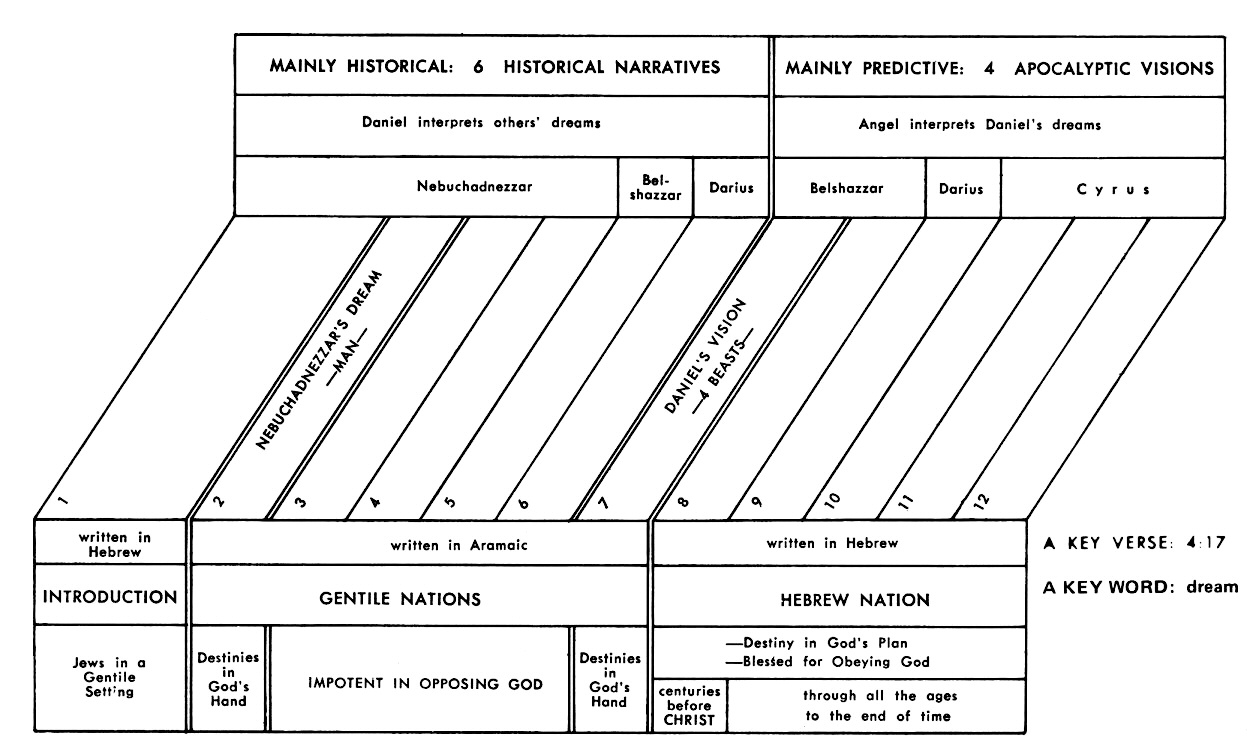 Click chart to enlarge
Charts from recommended resource Jensen's Survey of the OT - used by permission
Daniel 9:25 So you are to know and discern that from the issuing of a decree to restore and rebuild Jerusalem until Messiah the Prince there will be seven weeks and sixty-two * weeks; it will be built again, with plaza and moat, even in times of distress. (NASB: Lockman)
Amplified: Know therefore and understand that from the going forth of the commandment to restore and to build Jerusalem until [the coming of] the Anointed One, a Prince, shall be seven weeks [of years] and sixty-two weeks [of years]; it shall be built again with [city] square and moat, but in troublous times. (Amplified Bible - Lockman)
KJV: Know therefore and understand, that from the going forth of the commandment to restore and to build Jerusalem unto the Messiah the Prince shall be seven weeks, and threescore and two weeks: the street shall be built again, and the wall, even in troublous times.
NLT: Now listen and understand! Seven sets of seven plus sixty-two sets of seven will pass from the time the command is given to rebuild Jerusalem until the Anointed One comes. Jerusalem will be rebuilt with streets and strong defenses, despite the perilous times. (NLT - Tyndale House)
Young's Literal: And thou dost know, and dost consider wisely, from the going forth of the word to restore and to build Jerusalem till Messiah the Leader is seven weeks, and sixty and two weeks: the broad place hath been built again, and the rampart, even in the distress of the times.
SO YOU ARE TO KNOW AND DISCERN
- Da 9:23; Matthew 13:23; 24:15; Mark 13:14; Acts 8:30
- Youtube video I did on Daniel 9:24-27 God's Prophetic Plan for the Ages
Know and discern - Gabriel begins with an exhortation to Daniel ("you") and is an extension of the earlier exhortation to "give heed to the message and gain understanding of the vision." (Da 9:23, cf Da 9:22)
Ice asks "Why Gabriel’s exhortation to Daniel? (Ed: That is why use two words that are similar both alluding to intelligent thought) "The history of the interpretation of these verses is confirmation of the fact that this prophecy is difficult and requires spiritual discernment." (Ref)
Comment: Compare John's declaration "Here is the mind which has wisdom" in the difficult to understand prophetic description in Rev 17:9ff-note.
Know (03045) (perceive, understand, ponder, be prudent) (yada') by observing, reflecting upon and becoming "intimately" acquainted with the important truth and timing of events to follow. Yada was the Hebrew word used to express the experiencing of intimate relations between a man and woman and thus speaks of an intimate, even experiential knowledge. The Greek Septuagint (LXX) translates know with ginosko meaning to "know by experience" which also refers to an intimate knowledge that goes beyond the accumulation of facts.
Discern (07919) (have insight or comprehension, be prudent or circumspect, give attention to or ponder) (sakal) is somewhat synonymous with "know" but expresses the idea of knowing the reason for something by looking at it or giving attention to it.
Daniel and his friends had been endowed by God with sakal in Da 1:4 ("showing intelligence") and Da 1:17 ("intelligence").
Sakal implies the process of thinking through a complex arrangement of thoughts (for which Daniel 9:24-27 certainly qualifies!) resulting in a wise dealing and use of good practical common sense with the end result that one is successful.
In English to understand describes the capacity to apprehend general relationships of particulars. Webster's 1828 dictionary says that understanding is "The faculty of the human mind by which it apprehends the real state of things presented to it, or by which it receives or comprehends the ideas which others express and intend to communicate. The understanding is called also the intellectual faculty. It is the faculty by means of which we obtain a great part of our knowledge."
The TWOT says that sakal...also involves one in what he considers, or pays attention to.
Discern is translated with the Greek verb suniemi which entails the assembling of individual facts into an organized whole, as collecting the pieces of a puzzle and putting them together. The mind grasps concepts and sees the proper relationship between them.
Commenting on Daniel 9:24-27 Matthew Henry writes that
We have here the answer that was immediately sent to Daniel's prayer, and it is a very memorable one, as it contains the most illustrious prediction of Christ and gospel-grace that is extant in all the Old Testament. If John Baptist was the morning-star, this was the day-break to the Sun of righteousness, the Day-spring from on high.
Reginald Showers of the Friends of Israel Gospel Ministry writes that Daniel 9:24-27 is "one of the most significant prophecies in all the Old Testament Scriptures" and is also "one of the strongest biblical evidences to the effect that Jesus of Nazareth is the Messiah." (The Most High God: Commentary on the book of Daniel)
As Walvoord says "The history of the interpretation of these verses (Da 9:24-27) is confirmation of the fact that this prophecy is difficult and requires spiritual discernment."
One needs to be aware that there are several approaches to the interpretation of Daniel's prophecy, especially the three "stage" that are outlined beginning in Daniel 9:25 - (1) literal interpretation with a gap between the 69th and 70th seven year period (the approach taken by this website), (2) symbolic interpretation (which several variations) and (3) literal interpretation of the seventy weeks as 490 consecutive years (see discussion of this interpretation).
For a comparison of the approaches to interpretation of Daniel 9:24-27 see Dr Randall Price's discussion Interpretation of the Seventy Weeks (including the Jewish or rabbinical interpretation).
THAT FROM THE ISSUING OF A DECREE TO RESTORE AND REBUILD JERUSALEM:
- Click additional notes
- Ezra 4:24; 6:1-15; 7:1,8,11-26; Nehemiah 2:1, 2, 3, 4, 5, 6, 7, 8; 3:1
- 2Samuel 15:25; Psalms 71:10
Jerusalem will be rebuilt with streets and strong defenses (CSB)
Streets will be built in Jerusalem, and a trench will be dug around the city for protection (CEV)
the street shall be built, and the wall (Brenton's English of Greek Septuagint)
from the going forth of the word
From the issuing of a decree to restore and rebuild Jerusalem - This is the key to the interpretation of this entire passage and obviously the critical determinant is when does the "countdown" begin in history (the so-called "terminus a quo")
The decree (dabar = literally "word", cf use in 2Chr 30:5 = "decree", Est 1:19 = "edict") although made in heaven, would be made manifest on earth which would have been wonderful news to Daniel. The important question is which "decree" marks the commencement of the 490 years? There are 4 possible "candidate" decrees (listed below):
WHICH DECREE
MARKS BEGINNING
OF THE SEVENTY SEVENS?
Below are the 4 most frequently mentioned possible candidates for the inception of the Seventy Sevens or 490 years.
As an aside, the prophecy of Jeremiah concerning the seventy weeks (Da 9:2) although not considered by most commentators as a candidate for the terminus a quo is held by a few Gentile writers (eg, Edward Young) and also by Jewish apologists, this latter group clearly seeking to remove the possibility of any Christological interpretation in Da 9:24-27. John Walvoord writes that "Young himself admits, however, that this explanation simply does not satisfy the passage as the word of the Lord did not go forth in 586BC when Jerusalem was destroyed. As Young states, “However, it is perfectly clear that in 586BC, no word went forth to restore and to build Jerusalem.” (nor was there any "word" or decree in 605BC the beginning of the times of the Gentiles - Lk 21:24).
(1) 538 BC - Decree of Cyrus
Now in the first year of Cyrus king of Persia, in order to fulfill the word of the Lord by the mouth of Jeremiah, the Lord stirred up the spirit of Cyrus king of Persia, so that he sent a proclamation (a decree) throughout all his kingdom, and also [put it] in writing, saying, 2 "Thus says Cyrus king of Persia, 'The Lord, the God of heaven, has given me all the kingdoms of the earth, and He has appointed me to build Him a house in Jerusalem, which is in Judah. 3 'Whoever there is among you of all His people, may his God be with him! Let him go up to Jerusalem which is in Judah, and rebuild the house of the LORD, the God of Israel; He is the God who is in Jerusalem." (Ezra 1:1, 2, 3, cf 2Chr 36:22, 23, Ezra 5:13, 6:1, 2, 3, 4, 5)
Comment: Cyrus' decree was for rebuilding of the house of the Lord, not the city, Jerusalem, so the date of this decree is not the beginning of the countdown of the 490 years.
John MacArthur comments - "Some scholars think that (Ezra 1:1,2, 3) must be the decree mentioned in Daniel's prophecy because God said of Cyrus through Isaiah, "He is my shepherd, and shall perform all my pleasure; even saying to Jerusalem, Thou shalt be built; and to the temple, Thy foundation shall be laid" (Isa 44:28). But 483 years subtracted from 536 BC (Ed: or 538BC listed by other scholars) takes us to 53 BC, many years before the birth of Christ and still more from the inception of His ministry--a discrepancy of over eighty years. Over the span of hundreds of years eighty years or so may seem close, but our God isn't close--He's exact! Some have proposed a revision of the Ptolemaic calendar (commonly used before the time of Copernicus) to account for the discrepancy, but that seems an inadequate solution because we can't prove a discrepancy. Also, the actual decree of Cyrus provided only for building the Temple in Jerusalem--not for rebuilding Jerusalem's walls (a necessary part of restoring the city). Thus Cyrus's decree is an unlikely candidate for the command of Daniel 9:25. (Israel's Future-Part 2)
Walvoord adds that...beginning it with the decree of Cyrus in 538 BC does not permit any reasonably literal interpretation of this prophecy. The 483 years which would then begin in 538 BC, anticipated in the sixty-nine times seven years, would end in the middle of the first century BC when there was no significant event whatever to mark its close.
(2) 519/520 BC - Decree of Darius I (Darius Hystaspes)
Darius "issued a decree: ‘Concerning the house of God at Jerusalem" (Ezra 6:3 cf Ezra 6:6, 7, 8, 9, 10, 11, 12). This decree was a confirmation of decree #1 and again does not refer specifically to the city of Jerusalem.
(3) 457/458 BC - Decree of Artaxerxes Longimanus
Now this is the copy of the decree which King Artaxerxes gave to Ezra the priest, the scribe, learned in the words of the commandments of the Lord and His statutes to Israel: "Artaxerxes, king of kings, to Ezra the priest, the scribe of the law of the God of heaven, perfect peace. And now I have issued a decree that any of the people of Israel and their priests and the Levites in my kingdom who are willing to go to Jerusalem, may go with you." (Ezra 7:11, 12, 13)
Ezra's response to the decree of Artaxerxes was...
Blessed be the Lord, the God of our fathers, who has put such a thing as this in the king’s heart, to adorn the house of the Lord which is in Jerusalem (Ezra 7:27)
Comment: This decree says nothing of the rebuilding of the city of Jerusalem.
John MacArthur adds...The first decree of Artaxerxes in 458 BC (Ezra 7:11-26) is considered a possibility. However, 483 years from 458BC takes us to AD 26. But the only event of significance in the life of Christ remotely close to AD 26 is His baptism. However that wasn't His presentation to the nation as the Messiah (nor as "Prince" or "King"), but to the Father for approval. It was a transaction between the Son and the Father, and there's no indication that the people understood what happened at Jesus' baptism (Mt 3:13, 14, 15, 16, 17). Also, the first decree of Artaxerxes did not provide for the rebuilding of Jerusalem. (Israel's Future-Part 2)
Artaxerxes (some sources such as Sir Robert Anderson list 445 BC because of differences in the way the beginning of the king's reign is dated) issued a decree to rebuild the city (not the house or temple as in the other decrees), with plaza and moat (see below for discussion of Nehemiah 2).
In conclusion, of the four "candidate" decrees, the one which most closely fulfills the specific requirements of Daniel 9:25 is that found in Nehemiah chapter 2 which records that
it came about in the month Nisan (March-April), in the 20th year of King Artaxerxes. (444/445BC). 3 (Nehemiah) said to the king, "Let the king live forever. Why should my face not be sad when the city, the place of my fathers' tombs, lies desolate and its gates have been consumed by fire (which would make the city defenseless)?" 4 Then the king said to me, "What would you request?" So I prayed to the God of heaven. 5 And I said to the king, "If it please the king, and if your servant has found favor before you, send me to Judah, to the city of my fathers' tombs, that I may rebuild it." ... 8 and a letter to Asaph the keeper of the king's forest, that he may give me timber to make beams for the gates of the fortress which is by the temple, for the wall of the city, and for the house to which I will go." And the king granted them to me because the good hand of my God was on me (Nehemiah, cf "good hand of Jehovah" on Ezra = Ezra 7:9,10-note). (Neh 2:1, 2, 3, 4, 5, 6, 7, 8)
Then I (Nehemiah) said to them ("the Jews, the priests, the nobles, the officials, or the rest who did the work" Neh 2:16), "You see the bad situation we are in, that Jerusalem is desolate and its gates burned by fire. Come, let us rebuild the wall (Hebrew = chomah, Lxx = teichos) of Jerusalem that we may no longer be a reproach (Neh 1:3). And I told them how the hand of my God had been favorable to me, and also about the king's words which he had spoken to me. Then they said, "Let us arise and build." So they put their hands to the good work. (Neh 2:17, 18).
Dr Harold Hoehner explains that...The date of this decree (#4) is given in the biblical record. Nehemiah 1:1 states that Nehemiah heard of Jerusalem’s desolate conditions in the month of Chislev (November/December) in Artaxerxes’ twentieth year (See Jewish Calendar - scroll down for months). Then later in Artaxerxes’ twentieth year in the month of Nisan (March/April) Nehemiah reports that he was granted permission to restore the city and build its walls (Neh 2:1). To have Nisan later than Chislev (in the same year) may seem strange until one realizes that Nehemiah was using a Tishri-to-Tishri (September/October) dating method rather than the Persian Nisanto-Nisan method. Nehemiah was following what was used by the kings of Judah earlier in their history. This method used by Nehemiah is confirmed by Jews in Elephantine who also used this method during the same time period as Nehemiah. Next, one needs to establish the beginning of Artaxerxes’ rule. His father Xerxes died shortly after December 17, 465BC and Artaxerxes immediately succeeded him. Since the accession-year system was used the first year of Artaxerxes’ reign according to the Persian Nisan-to-Nisan reckoning would be Nisan 464 to Nisan 463 and according to the Jewish Tishri-to-Tishri reckoning would be Tishri 464 to Tishri 463....In conclusion the report to Nehemiah (Neh 1:1) occurred in Chislev (November/December) of 445 B.C. and the decree of Artaxerxes (Neh 2:1) occurred in Nisan (March/April) of 444 B.C. Therefore, Nisan 444 B.C. marks the terminus a quo of the seventy weeks of Daniel 9:24-27. (Chronological Aspects of Daniel’s 70 Weeks or see here Chronological Aspects of the Life of Christ - Page 127)
Plaza (07339) (rehob) refers to an "open place" which came to mean a public square, city-hub, central part of city where people met and civic activity occurred. Rehob was first used in Genesis 19:2 when the angels told Lot "we shall spend the night in the square". In summary, rehob, describes the broad spaces, generally just inside the city gates where one see the center of city life. The Greek Septuagint (LXX) translates rehob with plateia (10x in NT, 9 translated as "street", eg, Mt 6:5, 12:19, Lk 13:26, 14:21, etc) and describes a wide or broad street or way.
Moat (02742) (charuts/harus = a passive participle of charats/harats = to cut) is used only here in the OT and conveys the basic sense of "to cut or sharpen". In Hebrew charuts/harus means to cut in or dig, and in context refers to a "defensive trench, ditch, i.e., a moat as a defense feature of a rampart." (Swanson, J.. Dictionary of Biblical Languages with Semantic Domains: Hebrew -Old Testament,1997). The idea is that a trench or ditch is dug or "cut out" around a city for the purpose of fortification. This same word in Aramaic refers to a trench, in Akkadian to a city moat, and in the Qumran it referred to a “moat of the rampart or bulwark”.
The Greek Septuagint (LXX) translates charuts/harus with the Greek word teichos which describes a wall, especially a wall of a city or town which was used to provide strong fortification. Teichos is also used in the rabbinic literature to mean a wall, frequently one designed for defense.
Hoehner notes that... Commentators are divided on how to apply the two words (rehob and harus) to Daniel 9:25, but it is best to take the first word plaza as referring to the interior of the city and the second word trench as referring to a moat going around the outside of the city. Part of Jerusalem’s natural defenses consisted of a great cutting in the rock along the northern wall, which is still visible, for the purpose of building a defense wall. Montgomery states that these “two items present a graphic picture of the complete restoration.” (Chronological Aspects of Daniel’s 70 Weeks)
Some argue that the word for moat is not the same Hebrew word used for wall in Nehemiah 2:8, but they miss the point that both have a similar function and they also disregard the use of the same Greek word teichos in both passages as described in the following comment.
Nehemiah 2:8 "the wall (Hebrew = chomah, Lxx = teichos) of the city" (cf Neh 2:17)
Daniel 9:25 "plaza and moat (Hebrew = harus; Lxx = teichos)"
Comment: The Septuagint (Specifically the translation by Theodotion - see note) translates wall in Nehemiah 2:8 with the Greek noun teichos (used 31x in 28v in Nehemiah) the same Greek word used in Daniel 9:25 to translate "moat". Teichos virtually always means a wall especially the wall around a city or town (e.g., cf Acts 9:25; 2Co 11:33; He 11:30), and this supports the premise that the "moat" or trench described by Gabriel was meant to function as a defensive barrier. In Ancient times a "city" without such a defensive protection was not a functional "city" and could be much more easily attacked and defeated.
In summary, the evidence is convincing that the starting date for the countdown of the 490 years is found in Nehemiah 2.
Prior to Artaxerxes' decree in 444/445 BC, the Temple rebuilding had begun but the city itself was still unprotected. Nehemiah was charged by the king to restore the raised city to its former defensible state, which is the decree that is compatible with the prophetic description in Daniel 9:25.
In regard to the date of Artaxerxes' decree Dr. Harold Hoehner goes through a discussion (too detailed for these notes) and concludes that "Nisan 444 BC (March 5, 444BC) marks the terminus a quo (point of origin) of the seventy weeks of Daniel 9:24-27" rather than the 445BC date found in many texts. (For detailed discussion see Chronological Aspects of Daniel’s 70 Weeks)
It is interesting that this decree in Nehemiah was also the one favored even as early as the second to third century AD by Africanus, one of the so called "early church fathers".
Dr Charles Ray writes that a 444/445 BC inception point for the seventy sevens is confirmed by the following considerations...
(1) The most severe “times of distress” took place during Nehemiah’s day.
(2) No decrees were later issued by Persian monarchs concerning the rebuilding of the Israelite city.
(3) It is not probable the parties involved in the first three decrees would assume rebuilding Jerusalem was part of the deal.
(4) This interpretation comes closest to the literal method since it alone specifies the restoration of Jerusalem as delineated in Da 9:25.
(5) All three stages are readily harmonized with known historical incidents.
(6) The 4th decree best explains Luke 19:42. As He enters Jerusalem for the last week of His earthly ministry, Jesus says, “If you had known in this day, even you, the things which make for peace!”
(7) Therefore, a final factor favoring this position is that the math works out to the day. The Messiah is “cut off” after the 483 lunar years, which is 173,880 days. From March 5, 444 B.C. to March 30, A.D. 33 on the Gregorian/Julian calendar is likewise 173,880 days. (A Study of Daniel 9:24-27-Part II)
Dr Harold Hoehner sums up his arguments that favor the decree in Neh 2:1-8 in 444/445BC as the starting point for the seventy sevens...
First, there is a direct reference to the restoration of the city (Neh 2:3, 5) and of the city gates and walls (Neh 2:3, 8).
Second, Artaxerxes wrote a letter to Asaph to give materials to be used specifically for the walls (Neh 2:8).
Third, the book of Nehemiah and Ezra 4:7-23 indicate that certainly the restoration of the walls was done in the most distressing circumstances, as predicted by Daniel (Da 9:25).
Fourth, no later decrees were given by the Persian kings pertaining to the rebuilding of Jerusalem. (BORROW Chronological Aspects of Daniel’s 70 Weeks)
UNTIL MESSIAH THE PRINCE
- John 1:41; 4:25
- Da 8:11,25; Isaiah 9:6; 55:4; Micah 5:2; Acts 3:15; 5:31; Revelation 1:5; 19:16
Other Translations: Messiah the Leader (Young's Literal), the Anointed One, a Prince (Amplified), Christ the Prince (English of Greek Septuagint), the Anointed One, the ruler (NIV), an anointed prince (NRSV), an Anointed Prince (NJB), God's chosen leader (TEV), the appointed leader (NCV), one who is anointed and a leader (NAB), a prince, on whom the holy oil has been put (BBE)
WHEN IS THE
"UNTIL"?
Until - This is an important word which marks a change of time, as it signifies up to the time that, up to the point in time or the event mentioned, up to a stipulated time, in this case the appearance of Messiah the Prince.
Although the opinions are nearly unanimous among evangelical conservative scholars that this phrase is a clear prophetic reference to the first coming of the Messiah, it must be kept in mind (especially if discussing this passage with someone who may not believe in the literal interpretation of Scripture) that there are some who will see the prophecy as fulfilled in the lives of other individuals (click here to see why some Bible versions also do not support the Messianic interpretation).
As will be discussed later several well known Bible commentators such as Edward Young, H C Leupold and C F Keil conclude that the seventy weeks were consecutive, thus postulating that the seventieth week immediately followed the sixty-ninth week. This interpretation however is not compatible with the Biblical and historical evidence as discussed here.
Until (05704) signifies that following 69 seven's or 483 years Messiah the Prince will come and then be cut off.
HOW MANY DAYS
IN A BIBLICAL YEAR?
From Genesis - In the Flood account in Genesis we observe that comparison of Ge 7:11 to Ge 8:4 indicates that the flood lasted 5 months. Genesis 7:24 and Genesis 8:3 specify that this same time period lasted 150 days. Thus by simple calculation, one can determine that there were 30 days per month.
From Daniel and Revelation - Comparing Daniel and Revelation we note the following specific time phrases which enumerations -
One half week (middle of week = 3.5 years) = Da 9:27
Time, times, half a time = Da 7:25, Rev 12:14
1260 days = Rev 12:6 and Rev 12:14 = Describe the same event - persecution of the "woman", Israel
42 months = Rev 13:5 - Antichrist given power parallels "time, times, half a time" Da 7:25
Now when we carefully compare the events associate with each time phrase, we see that one month equates with 30 days and therefore one year is 360 days. In conclusion, in Genesis, Daniel and Revelation, the Scripture utilizes a 360 day year.
Now, assuming there are 483 literal years (69 sevens) specified in Daniel 9:25, the next question would be how many days are in each year, 360 days (lunar) or 365 days (solar)? If we take the beginning of the "countdown" of the 69 weeks as 444 BC and subtract that from 483 years without any adjustments, we would have a time of about 38AD, which is clearly too late for the Messiah's appearance. However, the Biblical evidence supports the use of a 360 day year as explained above and when this is factored into the calculation we can reduce the number of years so that the terminating point is between 32-33BC. This is a very rough calculation, just to make the point that if one begins "counting down" at 444BC, the time is very compatible with the Messiah's appearance in Jerusalem in the last week of His life. See discussion below for more detailed calculations
WITH WHAT EVENT DOES THE
SIXTY-NINE SEVENS TERMINATE?
First, in general terms, all literalists conclude that the 483 years terminates with the appearance of Christ, the Messiah.
Joseph Augustus Seiss (1823-1904 - Lutheran minister who interpreted the Scriptures literally not allegorically and who wrote an excellent generally literal commentary on the Revelation in the mid-1800's - The Apocalypse: Lectures on the Book of Revelation) observed that in regard to the interpretation of the phrase until Messiah the Prince...
As Christians, with the New Testament in our hands, we can have no difficulty in determining who is to be understood by this Messiah Prince. It is here for the first time in the Bible that we find the word Messiah put thus absolutely (Ed: This is true of NAS and KJV but see Ps 2:2YLT for first use in that version). It was applied to Cyrus in Isaiah to designate him as a chosen instrument of God for the deliverance of His people from their long captivity (see Is 44:28, 45:1, 2, 3, 4), but only in so far as he was a type of that greater Deliverer promised from the beginning and looked for by believers of every age. At the time Jesus appeared in our world the Israelitish people everywhere were speaking of that coming Deliverer as Messias or Messiah, meaning He Who should come as the anointed and sent of God to accomplish eternal redemption in Israel. (See Jn 4:25, 41, Mt 2:4, Lk 2:26, 3:15, Jn 1:20, 3:28, 7:26, 10:24). And to the promised and expected Redeemer the reference here must needs be. (Voices from Babylon or, The records of Daniel)
Second, in regard to the specific event in the life of Messiah, as indicated in the chart below (click countdown) there are two major views as to one which favors the termination as coinciding with the baptism of Christ, while the majority of modern, conservative, evangelical commentators favor the termination as coinciding with the triumphal entry of Messiah into Jerusalem. (Click here for discussion by John MacArthur)
Next, let's address the possibility that the sixty-nine sevens terminate with the baptism of Christ. The strongest argument against this premise is that at Christ's baptism He was not presented to Israel as their Prince or King. Matthew records...
And after being baptized, Jesus went up immediately from the water; and behold, the heavens were opened, and he saw the Spirit of God descending as a dove, and coming upon Him, and behold, a voice out of the heavens, saying, "This is My beloved Son, in whom I am well-pleased." (Mt. 3:16, 17, cf Lk 3:21, 22, Mk 1:9, 10, 11)
John MacArthur comments that Christ's baptism was not "His presentation to the nation as the Messiah, but to the Father for approval. It was a transaction between the Son and the Father, and there's no indication that the people at large understood what happened at Jesus' baptism." (Israel's Future--Part 2) (Bolding added)
Taking the degree of Artaxerxes in Nehemiah 2 as the starting point Sir Robert Anderson (See his calculations in The Coming Prince - 1894) and Dr. Harold Hoehner (BORROW Chronological Aspects of Daniel’s 70 Weeks) have independently calculated that following the decree to rebuild Jerusalem (Neh 2:1-8) until Messiah the Prince, terminates with Christ's presentation as the "King of Israel" on the day traditionally referred to as His Triumphal Entry into Jerusalem marking the beginning of "Passion Week".
Messiah (04899) (mashiach/masiyah from the verb mashach which conveys the basic meaning of to smear something on and the anointing serving as act of consecration) is a noun which can function as an adjective. (While you are studying about the timing of the first coming of the Messiah, listen to the timeless masterpiece
- Handel's Messiah - 1 Intro,
- 2 All flesh shall see the glory of the Lord;
- 3 of 6-Unto Us,
- 4 Surely He hath borne our griefs;
- 5 My Redeemer liveth;
- 6- Worthy is the Lamb that was slain
An "anointed one" would have sacred oil poured on their head, which set them apart as an individual with a special authority and/or function. And so we see that patriarchs, priests (Lev 4:3, 5, 16, 6:22).
Mashiach - 38x in 38v - NAS translates it = Anointed(1), anointed(34), anointed ones(2), Messiah(2). Lev 4:3, 5, 16; 6:22; 1Sa 2:10, 35; 12:3, 5; 16:6; 24:6, 10; 26:9, 11, 16, 23; 2 Sam 1:14, 16, 21; 19:21; 22:51; 23:1; 1 Chr 16:22; 2 Chr 6:42; Ps 2:2; 18:50; 20:6; 28:8; 84:9; 89:38, 51; 105:15; 132:10, 17; Isa 45:1; Lam 4:20; Dan 9:25f; Hab 3:13.
W E Vine writes that "as is true of the verb, mashiach implies an anointing for a special office or function. Thus, David refused to harm Saul because Saul was “the Lord’s anointed” (1Sa 24:6). The Psalms often express the messianic ideals attached to the Davidic line by using the phrase “the Lord’s anointed” (Ps 2:2; 18:50; 89:38, 51). Interestingly enough, the only person named “messiah” (Editorial note: In the KJV, eg, see Ps 2:2YLT) in the Old Testament was Cyrus, the pagan king of Persia, who was commissioned by God to restore Judah to her homeland after the Exile (Isa 45:1). The anointing in this instance was more figurative than literal, since Cyrus was not aware that he was being set apart for such a divine purpose (Ed note: I do not agree - read Cyrus' own words in Ezra 1:1,2,3!). The New Testament title of Christ is derived from the Greek Christos which is exactly equivalent to the Hebrew mashiach, for it is also rooted in the idea of “to smear with oil.” So the term Christ emphasizes the special anointing of Jesus of Nazareth for His role as God’s chosen one." (Vine's Expository Dictionary of Old Testament and New Testament Words)
FIRST USE OF MASHIACH
REFERRING TO A KING
Hannah's prayer records the first use of mashiach in the Bible in reference to a king as an anointed one...
Those who contend with the Lord will be shattered; Against them He will thunder in the heavens, The Lord will judge the ends of the earth; And He will give strength to His king,
And will exalt the horn of His anointed.” (1Samuel 2:10+).
The KJV Bible commentary notes that: (Mashiach - Anointed) is probably used in a general or ideal sense in this passage, but it should be kept in mind that the idea of the “anointed” one is a major theological motif of the period. The predictive element in Hannah’s song is most apparent in this word, and it is obvious from Luke’s quotation of this verse (Lk 1:69) that he regards the song as predictive prophecy finding its ultimate fulfillment in Jesus Christ, God’s King in the line of David, God’s Servant who finally accomplishes salvation for His people. It would seem impossible to overstress the predictive and messianic motif introduced here by the use of this word, since Luke plays upon so many of the parallels in the birth narratives of Samuel and Jesus (Lk 1:46, 47, 48; 1:53; 1:69; 2:52) and since the very word “Christ” is the Greek or New Testament equivalent to this Hebrew word which is transliterated into English as “Messiah.”
Albert Barnes: This is a most remarkable passage, containing a clear and distinct prophecy of the Kingdom and glory of the Christ of God. (Barnes' Notes on the Old Testament)
David Guzik: At this time, Israel did not have a king, and seems to have not even wanted one. So when Hannah speaks of His king, she is looking ahead to the Messiah, who will finally set all wrongs right. He is His anointed.
Adam Clarke: His empire shall be extended over all mankind by the preaching of the everlasting Gospel, for to this the afterpart of the verse seems to apply: He shall give strength unto his king, and shall exalt the horn of his Christ, or, as the Targum says, וירבי מלכות משיציה viribbey malcuth Meshicheyh, "he shall multiply the kingdom of the Messiah." Here the horn means spiritual as well as secular dominion.
Warren Wiersbe: In many respects, King David fulfilled this prophecy; but the ultimate fulfillment is in Jesus the Christ (“Anointed One”) who will one day sit on David’s throne and rule over His glorious kingdom (Luke 1:32, 33, 69-75). (Wiersbe, W. W. Be Successful)
Here is the use of mashiach which has led some to misinterpret Da 9:25 as a reference to the Persian King Cyrus and not Yeshua (Jesus)...
Thus says the LORD to Cyrus His anointed (mashiach), whom I have taken by the right hand, to subdue nations before him, and to loose the loins of kings; to open doors before him so that gates will not be shut: (Isa 45:1, cf Is 44:28, 45:1,2, 3, 4, 5, 6)
Comment: Cyrus is postulated as the "anointed one" especially by those who date the "decree" with Jeremiah's prophecy (even though it said nothing about rebuilding the plaza and moat of the city).
It should not be surprising that some Jewish sources in an attempt to "expunge" (efface completely) any Messianic connotations in Daniel 9:25 by cross referencing Isaiah 45:1 (cf 2 Chr 34:22, 23). They insist that the messiah or anointed one in Daniel 9:25 is reference to the Persian King Cyrus, who conquered Babylon and eventually gave the Jews permission to return their promised land.
Here is a quote from Jewish Rabbi Shlomo Ben-Yohanah (Brooklyn, New York) in a letter he wrote to me, in an attempt to refute the clear Messianic interpretation of Daniel 9:25...
He (Daniel) also knows that Cyrus of Persia will be the vehicle through which the Temple will be rebuilt (2Chr 34:22,23)...(Now paraphrasing verse 26) "And know and calculate, from the emanation of the word (of G-d as spoken by Jeremiah, over which you have been praying) regarding the restoration and rebuilding of Jerusalem until an anointed prince (whom you await, namely, Cyrus of Persia) will be 7 sabbatical periods (or 49 years. This is the answer to your question [Ed: Referring to yours truly], sometime after the 49th year but before the 56th, the vehicle of redemption will be revealed). (PERIOD. Nothing more is said of Cyrus here. It is interesting to note the reference to Cyrus as G-d's anointed in Isa. 45:1 as well.) (Source: Personal communication to me from Rabbi Shlomo Ben-Yohanah received 9/5/1989)
Mounce writes that mashiach "usually refers to pouring or smearing sacred oil on a person in a ceremony of dedication, possibly symbolizing divine empowering to accomplish the task or office; the Anointed One, the Messiah, God’s ultimate chosen one, identified in the NT as Jesus (Mounce's Complete Expository Dictionary of Old & New Testament Words. Grand Rapids, MI: Zondervan)
In Psalm 2 mashiach clearly refers to the Messiah, Jesus the Christ...
Psalm 2:2 The kings of the earth take their stand, And the rulers take counsel together Against the LORD and against His Anointed (Hebrew = Mashiach > "Messiah"; Lxx = Christos = one who has been anointed, Young's Literal renders it "Messiah" Ps 2:2YLT).
John is the only NT writer to use the word Messiah...
He found first his own brother Simon, and said to him, "We have found the Messiah" (which translated means Christ). (John 1:41)
The woman said to Him, "I know that Messiah is coming (He who is called Christ); when that One comes, He will declare all things to us." (John 4:25)
Prince (05057)(nagid/nagiyd) while not the usual Hebrew word for king (melek), is notable in that the first use in Scripture of nagiyd is a reference to Saul, God informing His prophet Samuel that
I will send you a man from the land of Benjamin, and you shall anoint him to be prince (nagiyd) over My people Israel; and he shall deliver My people from the hand of the Philistines... (1Sa 9:16)
There are numerous other OT examples where nagiyd is used as a synonym for the one who would rule over Israel as king (David in 1Sa 13:14, 25:30 = "ruler"; Solomon 1Ki 1:35 = "ruler"), so although some argue that the specific Hebrew word for "king" (malak) is not used in this prophecy, nagiyd clearly conveys the same idea as king. It follows that it is reasonable to interpret Daniel 9:25 as a reference to Messiah as King of Israel.
Nagiyd - chief(2), chief officer(3), commander(1), leader(14), noble things(1), nobles(1), officer(3), officers(1), officials(1), Prince(1), prince(5), princes(1), ruler(11).45x in 45v - 1Sa 9:16; 10:1; 13:14; 25:30; 2 Sam 5:2; 6:21; 7:8; 1Ki 1:35; 14:7; 16:2; 2Ki 20:5; 1Chr 5:2; 9:11, 20, 26; 11:2; 12:27; 13:1; 17:7; 26:24; 27:4, 16; 28:4; 29:22; 2Chr 6:5; 11:11, 22; 19:11; 28:7; 31:12, 13; 32:21; 35:8; Neh 11:11; Job 29:10; 31:37; Ps 76:12; Pr 8:6; 28:16; Isa 55:4; Jer 20:1; Ezek 28:2; Da 9:25, Da 9:26; Da 11:22
The Greek translates prince with the Greek hegeomai which speaks of one who leads out and is the same word in Matthew used quoting Micah's prophecy that "out of you (Bethlehem) shall come forth a Ruler (hegeomai), Who will shepherd My people Israel" (Mt 2:6), which is clearly a reference to the Messiah Who came to lead and rule Israel.
In Isaiah we see references to God as King...
I am the LORD, your Holy One, The Creator of Israel, your King. (Isa 43:15)
Thus says the LORD, the King of Israel and his Redeemer, the LORD of hosts: 'I am the first and I am the last, And there is no God besides Me. (Isa 44:6)
As Pfeiffer says there is no doubt that this time refers to "Some official presentation, such as his baptism and the formal beginning of his ministry, or His triumphal entry. (The Wycliffe Bible Commentary: Old Testament Chicago: Moody Press)
Joseph Augustus Seiss (1823-1904 - Lutheran minister who interpreted the Scriptures literally not allegorically) offers a more incisive analysis which addresses which "official presentation" of the Messiah would be most compatible with His appearance as Prince ("King"), first asking...
To what point in the life of Christ, then, does the angel refer?
Some say to His birth; but Jesus was not then presented to the Jewish nation as their Prince or King, though called "king of the Jews" by the Magi (Mt 2:2).
Some say the reference is to His baptism or His anointing by the Holy Ghost immediately after His baptism (Mt 3:13,14, 15, 16, 17, 21:11), or both; but not a word was then said to the people about His being King, but only of His being the Son (Mt 3:17) and Prophet of God (Mt 10:41, 13:57, 14:5), to Whom they should give audience.
And for more than three years of His ministry, in all His authoritative teaching and miraculous healing, He did not once make the slightest pretensions to being a king. On the contrary, when the people would willingly have crowned Him, and insisted on making Him their king, He peremptorily refused to take any such place, honor or title. But the time came when He did make profession and claim to be the rightful King of the Jews, and so presented Himself to the Jewish nation at one of the greatest of their national festivals at Jerusalem (Passover). It occurred but a few days prior to His Passion, and was one of the principal and most direct causes of His condemnation and crucifixion.
For the first time in His career we behold Him mounted as a king (Jn 12:12-19, Mt 21:1-9, Lk 19:33-40-note) with multitudes doing honor to Him and hailing Him with Hosannas ("Save us now") as the Prince of the house of David (Mt 21:15, 16). In the midst of the loud-sounding proclamations of Him as the King, He triumphantly rode into Jerusalem, entered the Temple, cast out all them that sold and bought in the Temple, overthrew the tables of the money changers and the seats of them that sold doves, and took to Himself all the authority and majesty of the rightful King and Lord of the chosen people, their Temple and their state (Mt 21:12, 13, Mk 11:15-18, Lk 19:45, 46-note).
And when the officials came to Him, insinuating treasonableness in these pretensions, particularly in the outcries which hailed Him as the blessed King, the Davidic Prince, He promptly answered, If these should hold their peace, the stones would immediately cry out. (Lk 19:40-note)
He had to be presented to the nation as its rightful and anointed King; and this is when and how it was done. We make mistake on this point. Ancient prophecy foretold that the Messiah King should come to Jerusalem sitting upon an ass, even a colt the foal of an ass; and inspiration under the New Testament narrates this very scene, and says,
"This was done that it might be fulfilled which was spoken by the prophet, saying, Tell ye the daughter of Zion, Behold, Thy King cometh unto thee." (Mt 21:4)
It was here specially, emphatically and for the first time that Jesus presented Himself to the Jewish people as their Messiah Prince; and only to this point in His earthly history can the words of the angel literally and fully apply, for not till then did He come as the Ruler, the King.
We thus find the exact terminating-point of the angel's four hundred and eighty-three years. (Voices from Babylon or, The Records of Daniel - Online)
As discussed more detail below (see notes) Sir Robert Anderson (1881) and Dr Harold Hoehner (1976) independently calculated that following the decree to rebuild Jerusalem (Neh 2:1-8) until Messiah the Prince there would be an interval of 177,880 days which by their detailed calculations coincided with the very day Jesus entered Jerusalem riding on a donkey in perfect fulfillment of the prophecies of Daniel and Zechariah, the latter prophesying
Rejoice greatly, O daughter of Zion! Shout in triumph, O daughter of Jerusalem! Behold, your King is coming to you; He is just and endowed with salvation, humble, and mounted on a donkey, even on a colt, the foal of a donkey. 10 And I will cut off the (battle) chariot from Ephraim (Israel), and the horse from Jerusalem and the bow of war will be cut off. And He (Who? "Your King", Israel's Messiah) will speak peace to the nations (Gentiles) and His dominion will be from sea to sea and from the river to the ends of the earth. (Zech 9:9, 10)
Comment: Note that while Zech 9:9 has been literally fulfilled at Christ's first coming, Zech 9:10 will not be fulfilled until His Second Coming. Thus, once again we see an indisputable, unequivocal "time gap" in juxtaposed passages, emphasizing that the premise of a time gap between the 69th and 70th Weeks of Daniel is not without precedent in the Scripture.
Lehman Strauss adds that: When the Incarnation had been announced, there came wise men from the east to Jerusalem, saying, "Where is He that is born king of the Jews? For we have seen His star in the east, and are come to worship Him" (Matthew 2:1, 2). They were wise men indeed, for they were followers of the truth of God. When the Old Testament prophets wrote of Messiah's offices, they included that of King. "Rejoice greatly, O daughter of Zion; shout, O daughter of Jerusalem: behold, thy king cometh unto thee: He is just, and having salvation: lowly, and riding upon an ass, and upon a colt the foal of a donkey" (Zechariah 9:9). David wrote of Christ and His kingdom when he recorded the words of God, "Yet have I set My king upon My holy hill of Zion" (Psalm 2:6). Our Lord is not only Prophet, and Priest, but also Potentate. (Why God Became Man)
Read these Old Testament prophecies of the coming King and compare them with the New Testament fulfillment: (2Sa 7:8, 16 and Mt. 1:6, 16, 17) (Micah 5:2 and Mt. 2:1, 2, 3, 4, 5, 6) (Isa 7:14 and Lk 1:26, 27, 28, 29, 30, 31, 32, 33) (Zec 9:9 and John 12:12, 13, 14, 15) (Isa 9:6, 7 and Rev. 19:11, 12, 13, 14, 15, 16)
We will glorify the King of Kings
We will glorify the Lamb
We will glorify the Lord of Lords
Who is the great I AmLord Jehovah reigns in majesty
We will bow before His throne
We will worship Him in righteousness
We will worship Him aloneHe is Lord of heaven, Lord of earth
He is Lord of all who live
He is Lord of all the universe
All praise to Him we give
We see the fulfillment of Zechariah in Jesus' triumphal entry described in all the gospels but most fully by Luke...
Luke 19:28+ And after He had said these things, He was going on ahead, ascending to Jerusalem. 29 And it came about that when He approached Bethphage and Bethany, near the mount that is called Olivet (Mount of Olives), He sent two of the disciples, 30 saying, "Go into the village opposite you, in which as you enter you will find a colt tied, on which no one yet has ever sat; untie it, and bring it here.
(Matthew adds) Now this took place that what was spoken through the prophet might be fulfilled, saying, 5 SAY TO THE DAUGHTER OF ZION, 'BEHOLD YOUR KING IS COMING TO YOU, GENTLE, AND MOUNTED ON A DONKEY, EVEN ON A COLT, THE FOAL OF A BEAST OF BURDEN.' (Mt 21:4, 5)
Comment: Remember in the NAS, NT passages in all caps signify direct quotations from the OT (See OT Passages in NT). Note also that Matthew excluded several phrases in Zechariah's prophecy - "Rejoice greatly...Shout in triumph, O daughter of Jerusalem!...He is just and endowed with salvation." It would not be true rejoicing, triumph, nor salvation for most of Israel, for most rejected His rule (Jn 1:11, 12, 13-note).
Note also that the donkey was used by kings who were bringing peace, while the horse was used when the kings rode into battle.
Lk 19:35+ And they brought it to Jesus, and they threw their garments on the colt, and put Jesus on it. 36 And as He was going, they were spreading their garments in the road. 37 And as He was now approaching, near the descent of the Mount of Olives, the whole multitude of the disciples began to praise God joyfully with a loud voice for all the miracles which they had seen, 38 saying, "BLESSED IS THE KING WHO COMES IN THE NAME OF THE LORD (Ps 118:26); Peace in heaven and glory in the highest!" 39 And some of the Pharisees in the multitude said to Him, "Teacher, rebuke Your disciples." 40 And He answered and said, "I tell you, if these become silent, the stones will cry out!"
Lk 19:41+ And when He approached, He saw the city and wept over it (Note: Instead of rejoicing because He knew they would reject Him), 42 saying, "If you had known in this day, even you, the things which make for peace!
Comment: The definite article "the" is present in the Greek before "day" which clearly singles this out as not just "any" day, but the specific day - "The day" which the Jews could have and should have known from their study and knowledge of the Old Testament -
[1] Zechariah 9:9 prophesied of this very day, the day the city of Jerusalem hailed Jesus as "the King".
[2] Da 9:25 begins "know and discern" and allows one to calculate "the day"
But now (contrast) they have been hidden from your eyes.
Comment: Woe! Oh, what a horrible conjunction..."but now" - May it never be said of you dear Jewish or Gentile reader "but now" as might occur if you have been blessed with a clear presentation of the Gospel of the King and refused or rejected it...lest the truth be hidden from your eyes! In humility receive the Word of the Gospel of the King implanted which is able to save your soul! (Jas 1:21-note) Believe in the King, the Lord Jesus Christ, and you will be saved (Acts 16:31). Confess with your mouth Jesus as Lord and believe in your heart that God raised Him from the dead (Ro 10:9-note) and God's promise is that you will be saved eternally! Amen. Hallelujah!
Lk 19:43+ For the days shall come upon you when your enemies will throw up a bank before you, and surround you, and hem you in on every side (cf Lk 21:20, 21+ - Eusebius reports that before the destruction of Jerusalem by the Roman general Titus in 70AD, Jewish Christians, apparently following this warning, left the city and took refuge at Pella, a little town east of the Jordan near the Sea of Galilee) and will level you to the ground and your children within you, and they will not leave in you one stone upon another (Note: Describes the destruction of Jerusalem by the Roman General Titus in 70AD. And why was Jerusalem to be destroyed?), because you did not recognize the time (kairos = opportunity - Israel's "opportunity" as a nation to receive their Messiah as King had now passed!) of your visitation. (the "visitation" of the Messiah in His first advent - they could have calculated His arrival date from Daniel's prophecy but instead they obscured the truth and even refused to read or discuss Daniel 9:24-27 giving evidence of their rebellious hearts!)."
John records a parallel account...
On the next day the great multitude who had come to the feast, when they heard that Jesus was coming to Jerusalem, 13 took the branches of the palm trees, and went out to meet Him, and began to cry out, "Hosanna! (Means "Save us now") BLESSED IS HE WHO COMES IN THE NAME OF THE LORD, even the King of Israel." 14 And Jesus, finding a young donkey, sat on it; as it is written, 15 "FEAR NOT, DAUGHTER OF ZION; BEHOLD, YOUR KING IS COMING, SEATED ON A DONKEY'S COLT." (John 12:12-15+)
THOUGHT - Dear believer in the King of kings, consider pausing for a moment to praise Him by singing along with this great chorus...Crown Him With Many Crowns
Two observations are significant regarding the Jewish crowd's quotation from Ps 118:26:
(1). The original Psalm (in Hebrew and the Greek) does not have the word king (Hebrew = melek, Greek = basileus) which is used only in Luke's account (but not in Mt 21:9 or Mk 11:9). Mark however does follow the quotation from Ps 118:26 with the "kingly" declaration...
Blessed is the coming kingdom (basileia related to basileus = king) of our father David; Hosanna in the highest! (Mk 11:10)
(2) Jesus even when he was admonished to rebuke the crowd for calling Him King, refused to do so, declaring in fact that
if these become silent, the stones will cry out! (Luke 19:40)
What would they cry out? That the King of the Jews had arrived, just as had been precisely prophesied by Daniel 9:24-25, 173,880 days earlier! Only on this day did our Lord offer Himself publicly and officially as Israel's Messiah and this was the day Anderson and Hoehner calculated had been prophesied by in Daniel 9! It is also noteworthy that all four gospels record the inscription above Jesus' head on the cross as the King of the Jews.
Sir Robert Anderson (The Coming Prince) adds that "No student of the Gospel narrative can fail to see that the Lord's last visit to Jerusalem was not only in fact, but in the purpose of it, the crisis of His ministry, the goal towards which it had been directed. After the first tokens had been given that the nation would reject His Messianic claims, He had shunned all public recognition of them. But now the twofold testimony of His words and His works had been fully rendered, and His entry into the Holy City was to proclaim His Messiahship and to receive His doom. Again and again His apostles even had been charged that they should not make Him known. But now He accepted the acclamations of "the whole multitude of the disciples," and silenced the remonstrance of the Pharisees with the indignant rebuke, "I tell you if these should hold their peace, the stones would immediately cry out. (Luke 19:39, 40)
C H Spurgeon writes that "The Lord God appointed a set time for the coming of His Son into the world; nothing was left to chance. Infinite wisdom dictated the hour at which the Messiah should be born, and the moment at which He should be cut off. His advent and His work are the highest point of the purpose of God, the hinge of history, the center of providence, the crowning of the edifice of grace, and therefore peculiar care watched over every detail. Once in the end of the world hath the Son of God appeared to put away sin by the sacrifice of Himself, and this is the event before which all other events must bow. The studious mind will be delighted to search out the reasons why the Messiah came not before, and why He did not tarry till yet later ages. Prophecies declared the date; but long before infallible wisdom had settled it for profoundest reasons. It was well that the Redeemer came: it was well that He came in what Scripture calls the fullness of time, even in these last days."
THERE WILL BE SEVEN WEEKS AND SIXTY-TWO WEEKS IT WILL BE BUILT AGAIN WITH PLAZA AND MOAT EVEN IN TIMES OF DISTRESS
- Neh 4:8,16, 17, 18; Eph 5:16
- Neh 6:15
ACCURATE INTERPRETATION:
IMPORTANCE OF YOUR BIBLE VERSION
The reader must be aware of the two ways in which this section of Daniel 9:25 is translated as the translation can significantly impact one's interpretation. See the example below...
|
NASB |
So you are to know and discern that from the issuing of a decree to restore and rebuild Jerusalem until Messiah the Prince there will be seven weeks and sixty-two weeks; it will be built again, with plaza and moat, even in times of distress. |
|
ESV |
Know therefore and understand that from the going out of the word to restore and build Jerusalem to the coming of an anointed one, a prince, there shall be seven weeks. Then for sixty-two weeks it shall be built again with squares and moat, but in a troubled time. |
Notice that the NAS connects the seven weeks and sixty-two weeks while the ESV places a period after seven weeks and in effect separates this time period from the sixty-two weeks, the significance of which is discussed in more detail in the following section. Below are some common translations which are grouped together based upon how they render these two time phrases.
TRANSLATIONS SEPARATING
7 WEEKS AND 62 WEEKS
English Standard Version (ESV) - there shall be seven weeks. Then for sixty-two weeks it shall be built again with squares and moat, but in a troubled time.
Revised Standard Version (RSV) - there shall be seven weeks. Then for sixty-two weeks it shall be built again with squares and moat, but in a troubled time.
New Revised Standard Version (NRSV) - there shall be seven weeks; and for sixty-two weeks it shall be built again with streets and moat, but in a troubled time. (Comment: No period but the rendering "and for" leads to the same interpretation as if there were a period.)
The Message - there will be seven sevens. The rebuilding will take sixty-two sevens, including building streets and digging a moat. Those will be rough times.
New American Bible (NAB) - there shall be seven weeks. During sixty-two weeks it shall be rebuilt, With streets and trenches, in time of affliction.
Bible in Basic English (BBE) - will be seven weeks: in sixty-two weeks its building will be complete, with square and earthwork.
TRANSLATIONS CONNECTING
7 WEEKS AND 62 WEEKS
Amplified Version - shall be seven weeks [of years] and sixty-two weeks [of years]; it shall be built again with [city] square and moat, but in troublous times.
Authorized Standard Version (ASV) - shall be seven weeks, and threescore and two weeks: it shall be built again, with street and moat, even in troublous times.
Darby 1890 - are seven weeks, and sixty-two weeks. The street and the moat shall be built again, even in troublous times.
God's Word Translation (GWT) - seven sets of seven time periods and sixty-two sets of seven time periods will pass. Jerusalem will be restored and rebuilt with a city square and a moat during the troubles of those times.
Holman CSB - will be seven weeks and 62 weeks. It will be rebuilt with a plaza and a moat, but in difficult times.
King James Version - shall be seven weeks, and threescore and two weeks: the street shall be built again, and the wall, even in troublous times.
New English Translation (NET) - there will be a period of seven weeks and sixty-two weeks. It will again be built, with plaza and moat, but in distressful times.
New International Version (NIV) - there will be seven 'sevens,' and sixty-two 'sevens.' It will be rebuilt with streets and a trench, but in times of trouble.
New Jerusalem Bible (NJB) - seven weeks and sixty-two weeks, with squares and ramparts restored and rebuilt, but in a time of trouble.
New King James Version (NKJV) - There shall be seven weeks and sixty-two weeks; The street shall be built again, and the wall, Even in troublesome times.
New Living Translation (NLT) - Seven sets of seven plus sixty-two sets of seven (Translation note: Hebrew = Seven sevens plus sixty-two sevens)
Septuagint (LXX) - hebdomades hepta kai hebdomades ezekonta duo (Literally reads "seven sevens and sevens sixty two")
Vulgate (Latin) - hebdomades septem, et hebdomades sexaginta duae erunt (Literally reads "seven sevens and sevens sixty two will be")
Young's Literal Translation (YLT) - seven weeks, and sixty and two weeks: the broad place hath been built again, and the rampart, even in the distress of the times.
Now let's take a closer look at the popular ESV translation and how this translation might affect one's interpretation of this section...
Know therefore and understand that from the going out of the word to restore and build Jerusalem to the coming of an anointed one, a prince, there shall be seven weeks. Then for sixty-two weeks it shall be built again with squares and moat, but in a troubled time.
Comment: If one attempts to interpret the ESV literally, the "plain sense" makes no sense ("nonsense"), for then Gabriel is saying it would take 434 years to build the plaza and moat! To get around this one might say that the passages (seven weeks and 62 weeks) are contemporaneous, but there is simply no indication of this as confirmed by the Septuagint, Theodotion, the Syriac, and the Vulgate versions all of which treat these 69 weeks as consecutive! Besides one would still have to conclude that it took several hundred years to finish restoring the city which is not true from history (cf the completion of the wall of Jerusalem in 52 days - Nehemiah 6:15, which Ryrie dates as occurring in Sept 21, 444 BC).
The ESV and RSV (click for another discussion of different versions) base their English rendering of this verse on the translation of the original manuscript by a group of Hebrew scholars known as the Masoretes. The Masoretes added an accent (called a "atnach") to the original Hebrew manuscripts, the accent in this case being placed between the two time phrases "seven weeks" and "sixty-two weeks". The ESV and RSV translators felt that this Masoretic accent justified placing a period at the end of "seven weeks" and beginning another sentence to which they added the word "then".
Below is another translation from a Jewish source the stated goal of which is to provide indisputable evidence that Daniel 9:25 does not foretell of the coming of the Messiah, Yeshua (Jesus)...
Know and understand from the going forth of the word to restore and rebuild Jerusalem until an anointed prince will be 7 weeks; and 62 weeks will the street be rebuilt and the wall, even troublesome times.
Comment: And here is the accompanying note in this apologetic against a Messianic interpretation of this passage...
"Going forth...until an anointed prince is 7 weeks": A week in Hebrew is a group of seven. Thus, the week is actually seven years. Thus, 49 years after the prophecy of Jeremiah (Ed: This paper postulates this is the inception of the Seventy Sevens)
So as you share Daniel 9:24-27 your Jewish friends and co-workers (you are sharing this truth aren't you?) be aware that many Jewish rabbis reference the Masoretic "accent" as a major line of evidence to refute the fact that Daniel 9:24-27 is referring to the coming Messiah.
Indeed, if we read the ESV literally, we are forced to interpret Daniel 9:25 as a reference to an anointed one, a prince, as coming on the scene after seven weeks (49 years), an interpretation which clearly excludes the interpretation of the anointed one as a reference to the Messiah. And so reliance on the ESV forces one into a non-messianic interpretation of one of several (historically possible) individuals, including King Cyrus (Isa 45:1 = "anointed" one), Zerubbabel or Joshua the post-exilic high priest (priests were anointed). Then these commentators are forced to interpret the second anointed one in Daniel 9:26 as a reference to Onias III, (apparently the same as Oniah) a Jewish high priest (anointed) who was displaced and then killed (cut off) about 171BC) during the reign of Antiochus IV Epiphanes (reigned from 175-164BC - See related discussion on Antiochus Epiphanes - Da 8:9-note, Da 8:17-note, Da 8:19-note; see also Daniel notes and additional discussion).
The upshot is that the passage has then been emptied of any valid Messianic interpretation! It is not surprising that the liberal, critical school of interpretation follows this line of reasoning and similarly it is not surprising that many in this school even deny that Daniel wrote Daniel! They postulate that Daniel was written some time in between 200-100 BC, after the events had historically taken place. Jesus clearly disagrees, quoting from Daniel the prophet in Mt 24:15.
ARGUMENTS AGAINST
THE ESV/RSV RENDERING
Arguments against the ESV/RSV rendering...
(1) The Greek translation of the Hebrew (Septuagint or Lxx) is an older manuscript than the Masoretic additions and does not support the translation in the ESV/RSV. The Septuagint or Lxx reads "until Christ the prince there shall be seven weeks, and (the Greek conjunction "kai" = "and" is present in the Greek) sixty-two weeks" (Brenton's English Translation). The Greek reading allows for the interpretation of consecutive time periods which allows a Messianic interpretation.
(2) The ESV/RSV forces a cumbersome translation which reads as if it will take 62 "sevens" or 434 years to rebuild the plaza and moat, which clearly is nonsense!
(3) Regarding the insertion of this accent (atnach) mark by the Masoretes, even Old Testament scholars Keil and Delitzsch remark that
the atnach does not always separate clauses, but frequently also shows only the point of rest within a clause; besides, it first was adopted by the Masoretes, and only shows the interpretation of these men, without at all furnishing any guarantee for its correctness.
(4) The Hebrew Masoretes added their interpretative marks hundreds of years after the original Hebrew manuscript (probably around the 9th or 10th century AD which is hundreds of years after the Greek translation, the Septuagint or Lxx) leading some to suggest that they may have had a possible anti-Christian bias.
Dr. Harold Hoehner adds that...
The athnach was a Massoretic addition of probably around the ninth or tenth century A.D. which "only shows the interpretation of these men, without at all furnishing any guarantee for its correctness." (Keil - Daniel) Second, it is not unusual for the Masoretes to place a major disjunctive mark such as an athnach where normally one would not expect it. Wickes speaks of this when he states:
In cases of specification, we often find the proper logical or syntactical division -- particularly the latter -- neglected, and the main musical pause introduced between the details or particulars given. Distinctness of enunciation, and emphasis (where necessary), were thus secured. The pause was introduced where it seemed likely to be most effective. Thus the logical division is disregarded:...
...Syntactical clauses are treated in the same way, and subject, object, etc. are cut in two -- or members that belong together, separated -- by the dichotomy. (A logical pause may occur in the verse or not.) (William Wickes, A Treatise on the Accentuation of the Twenty-one So-called Prose Books of the Old Testament - Oxford, 1887)
Wickes cites several examples of this phenomenon (Ge 7:13, 25:20, Ex 35:23, Lev 16:2, Isa 49:21; 66:19) but the most relevant passage he cites is Nu 28:19: "And ye shall offer a burn-offering unto Jehovah, two young bullocks and one ram,|[=an athnach] and seven he-lambs of the first year; they shall be unto you without blemish." In this verse one sees no logical reason for the athnach there. Third, to place a break between the seven weeks and the sixty-two weeks is foreign to the context and makes no sense. (Hengstenberg, III, 123; Young, Daniel, p. 205). This means that it took 434 years to build the plaza and moat, which does not fit historically nor what was intended by Daniel in the context. In conclusion, then, the seven weeks and sixty-two weeks need to be considered cumulative or continuous and not parallel or contemporaneous. (BORROW Chronological Aspects of Daniel’s 70 Weeks)
Note: Dr. William Barrick explains in his comments on accents in non-poetic books, the disjunctive accent 'athnach marks "’the principal division of the verse—the logical mid-point." (Hebrew Accents)
What a difference a single accent mark makes in the interpretation of this important prophecy! Now are you totally confused? I pray not and in fact as you read this my prayer is that of Paul "that the eyes of your heart may be enlightened, so that you may know what is the hope of His calling, what are the riches of the glory of His inheritance in the saints." (Eph 1:18-note)
Please do not let this discussion shake your confidence in the truth that God's Word is fully inspired and inerrant. If you would like to read a more detailed discussion, click this link for Randall Price's analysis and scroll down the page to section subtitled "Question of the Division of the Seven and Sixty-two Weeks".
Pfeiffer comments that...The reasoning and evidence behind the RSV, (Ed: and ESV) which renders this clause quite incomprehensible, is most obscure, though the effect—to make the prophecy focus on Antiochus rather than on Christ—is plain enough. The Berkeley Version is no better. Both seem to destroy the essential reference to Christ in this verse. As a matter of fact, 7 plus 62 equals 69; 69 x 7 = 483. From 444 B.C. to about 30 A.D., the general period of Christ’s ministry is 470 plus years—so close to the specified 483 that without further refinement the correspondence is quite convincing.... Inasmuch as Christ presented Himself officially as “Messiah-Prince” only once (Zech 9:9; cf. Mt 21:5. Contrast Mt 16:20; Lk 9:20, 21) at the beginning of his last week, those interpreters who favor the Triumphal Entry for the close of the 69 weeks appear to be on the right track. (BORROW Wycliffe Bible Commentary. 1981. Moody page 794)
Seven weeks - The text does not associate a specific event with the first seven "seven's", (49 years) but the two most frequent events mentioned are (1) the time to completely rebuild Jerusalem or (2) the time at which the Old Testament canon was completed. While I favor the former, one should not be dogmatic.
Some commentators such as M R DeHaan state that...
It is a matter of history that the rebuilding of the walls of Jerusalem and the Temple and all of the streets, and so forth, took exactly forty-nine years, fulfilling the first division of the seventy weeks of Daniel which was up to the completion of the Temple in the city of Jerusalem. (De Haan, M. R. Daniel the prophet. Originally published: Grand Rapids, Mich. : Zondervan, 1947. Grand Rapids, MI: Kregel Publications)
Comment: In fact this terminus cannot be historically verified with absolute certainty so we had best avoid dogmatism. In any event the fulfillment pales in comparison to the fulfillments in the following sections!
It will be built again with plaza and moat - See preceding discussion of plaza and moat.
Harry Bultema writes that...The entire book of Nehemiah is proof that this godly governor built Jerusalem and its streets and walls, and that, as this prophecy says, in troublous times ("in times of distress"). According to qualified chronologists this also agrees with the needed chronology set forth in Daniel.
Times (06256) ('eth; Lxx = kairos) refers to a time, such as a season or the proper time. Their efforts to rebuild the city of Jerusalem would be associated with a "season" of trouble as discussed below.
Distress (06695) (tsoq) describes oppression, trouble, i.e., a state of hardship, trouble, and distress brought on by external pressure. For example this word is used in of God "distressing" His people in an attempt to bring them to repentance and salvation, Isaiah recording...
Isaiah 29:2 And I will bring distress (tsoq) to Ariel ("lion of God" = name applied to Jerusalem), and she shall be a city of lamenting and mourning; and she shall be like an Ariel to me (NIV = "and she will be to me like an altar hearth.").
Comment: In this passage Jerusalem would be turned into an altar hearth because of the death and devastation to come.
The book of Nehemiah gives ample testimony to the fact that the rebuilding of the city and the wall was associated with vigorous, even vicious opposition. Nehemiah records for example that
it came about when the Jews who lived near them came and told us ten times, “They will come up against us from every place where you may turn, ”then I stationed men in the lowest parts of the space behind the wall, the exposed places, and I stationed the people in families with their swords, spears, and bows. When I saw their fear, I rose and spoke to the nobles, the officials, and the rest of the people: “Do not be afraid of them; remember the Lord who is great and awesome, and fight for your brothers, your sons, your daughters, your wives, and your houses.” And it happened when our enemies heard that it was known to us, and that God had frustrated their plan, then all of us returned to the wall, each one to his work." (Neh 4:12, 13, 14, 15). Nehemiah later wrote that "it came about when it was reported to Sanballat, Tobiah, to Geshem the Arab, and to the rest of our enemies that I had rebuilt the wall, and that no breach remained in it, (so that now when the gates were set up it would be a "city" that could be defended thus fulfilling the specific details in Daniel 9:25) although at that time I had not set up the doors in the gates, that Sanballat and Geshem sent a message to me, saying, "Come, let us meet together at Chephirim in the plain of Ono." But they were planning to harm me. (Neh 6:1, 2)
DANIEL’S 69 WEEKS &
CHRIST'S TRIUMPHAL ENTRY
While there is not complete agreement, the consensus of conservative evangelical writers is that the historical fulfillment which is most compatible with Daniel’s prophecy in chapter 9 is the triumphal entry of Jesus into Jerusalem. It was at that time Jesus was presented to the Jewish people as the Messianic Prince/King. Prior to that He had refused any attempts to make Him King. A few commentaries feel Jesus’ baptism was the historical event that marked the fulfillment of this prophecy, but He was not presented as King on that day. And so, the ultimate test of this interpretation is whether Jesus’ triumphal entry occurred 173,880 days after the second decree of Artaxerxes, which is the number of days between Artaxerxes’ decree in Nehemiah 2 and Jesus’ Triumphal entry. This number can be calculated using either a “Biblical Year” or a 365 Day year as follows.
The following calculations are discussed from the viewpoint of the "biblical" year (360 days) and the solar year (365 days). In regard to the solar year ("man's" year), we need to take into consideration that this year is slightly longer then 365, so that the more accurate value is 365.25 days. Now divide the biblical year by the solar year and multiply by the 483 years of Daniel's prophecy...
360/365.25 x 483 = 476.0575 years
476 years matches the number of years that elapsed between Artaxerxes’ decree in 444BC and Jesus’ triumphal entry into Jerusalem in 33AD. Here is the calculation from “God’s” point of view and “Man’s” point of view...
"GOD'S CLOCK"
483 years x 360 days/year = 173,880 days
"MAN'S CLOCK"
476.0575 years x 365.25 days/year = 173,880 days
RESULT?
The Same number of days!
GOD'S SURE WORD OF
PROPHECY IS WORTHY OF OUR TRUST!
Now let’s take a brief look at how two Biblical scholars, Sir Robert Anderson and Dr Harold Hoehner have independently handled the specific calculations of the prophecy in Daniel 9:25 arriving at very the same conclusion! While we have to cautious in being too dogmatic regarding these specific calculations (because of some question about the exact dates in Jesus’ life), we must not miss the great truth that Jesus’ First Coming was clearly predicted and has been completed fulfilled regardless of whether you accept the Triumphal entry as the fulfillment.
Sir Robert Anderson, assistant commissioner of Scotland Yard (See Robert Anderson Scotland Yard official) and member of the Plymouth Brethren church, in his famous 1881 publication “The Coming Prince” (Chap 8 = "Messiah the Prince"; Chap 10 = Fulfillment of the Prophecy) began the countdown of Daniel’s 70 Weeks on March 14, 445BC (Latin - terminus a quo = literally means “the end from which”) which he identified as the date of Artaxerxes' second decree according to our calendar. Using astronomical calendars and charts (he actually wrote to the leading astronomers of his day for the information), Anderson determined that the culmination of the 173,880 days was April 6, AD32 (Using a 360 day "Prophetic "year), at which time the Messiah made His so-called “Triumphal Entry” into Jerusalem to inaugurate His last week of life contemporaneous with the celebration of the Passover during which He would accomplish His prophetic work (cf Jn 4:34, 17:4, 19:30-notes on "It is Finished") as the Kinsman-Redeemer and the Passover "Lamb of God Who takes away the sin of the world" (Jn 1:29, 36). The astronomical data helped Anderson determine the timing of the Jewish new moons which in turn was used by the Jews to determine the date of the Passovers.
John MacArthur writes that…One of the problems Anderson had to resolve in his calculations was that between the decree of Artaxerxes and the triumphal entry of Jesus into Jerusalem is a period of 477 years and 24 days. After deducting one year to account for the fact that 1 BC and AD 1 are not two years but one, this left Anderson with a total of 476 years 24 days or a total of 173,764 days--not the necessary 173,880 days. That's close--but our God is precise! Anderson next added 119 days to his figure for the 119 leap years represented by 476 years. That results in a figure of 173,883 days--three days too many! But realizing that the Julian calendar (Ed: Instituted by Julius Caesar in 46BC and averaging 365.25 days per year. The Gregorian calendar is a modification of the Julian calendar) on which our 365 day year is based is slightly inaccurate compared to an actual solar year, Anderson checked with the Royal Observatory in London and found that a 365 day year exceeds a solar year by 1/128th of a day. That fraction of 476 years is three days, which when subtracted from 173,883 yields a difference of 173,880 days--precisely the number of days predicted in Daniel 9:25! (The Future of Israel)
Dr Harold Hoehner professor of New Testament studies at Dallas Theological Seminary using more modern astronomical data confirmed the validity of Anderson’s detailed chronology, although Hoehner arrived at a different beginning point (terminus a quo) for the Seventy Sevens. Using the knowledge that many ancient kings, including those of Medo-Persia did not equate their accession year with the first year of their reign, Hoehner concluded that Artaxerxes was not officially identified as king until 464BC which made his 20th year (the date in Neh 2:1) the year 444 BC instead of 445 BC and that the first of Nisan was on March 30 (according to the new moons of 444BC) not March 5 (Anderson’s terminus a quo). (BORROW Chronological Aspects of Daniel’s 70 Weeks)
Using the same adjustments as Anderson, Hoehner multiplied 476 years (years between decree of Artaxerxes and Triumphal entry of the Prince or King in Jerusalem) by 365.24219879 (the decimal equivalent of 365 days, five hours, forty-eight minutes, and forty-four seconds--which accounts for the 1/128 difference between calendar and solar days observed by Anderson) and obtained a product of 173,855.28662404 days (173,855 days, six hours, fifty-two minutes, and forty-four seconds) which is 25 days longer than the 173,880 days calculated by Anderson. But Hoehner was able to adjust that amount by the difference between Anderson’s terminus a quo of March 5 and his date of March 30 which is 25 days which when added to 173, 855 days gives the same number of days as Anderson.
Therefore regardless of the terminus a quo used, both Anderson (in the 1880’s) and Hoehner (in the 1970’s) were able to show the accuracy with which God’s word through Gabriel to Daniel predicted and fulfilled the presentation of Jesus Christ to Israel as Messiah the “King of the Jews” (Mt 27:11, 29, 37) (the terminus ad quem = literally “the end to which)
When Jesus entered Jerusalem mounted on a donkey He did so in full awareness of the timing of “the day” of His royal presentation. Prior to this He had declared "My hour has not yet come," (Jn 2:4, 7:3, 4, 5, 6) and dismissed any attempts to make Him King as in John 6:15 where the crowd’s intention was make Him king because He had healed and fed them! Jesus Christ, the perfect God Man knew perfect timing for He knew "the end from the beginning, and from ancient times the things that are not yet done" (Isa 46:10, cf Isa 45:21). Shortly after John’s description of Jesus’ triumphal entry (Jn 12:12, 13, 14, 15), our Lord finally acknowledged “The hour has come for the Son of Man to be glorified” (Jn 12:23, 24, 13:1 cf “cut off” Da 9:25), in perfect fulfillment of God’s prophecy in Daniel 9:24-27.
Sir Robert Anderson's work The Coming Prince studied Daniel's prophecy of Seventy Weeks applying mathematical precision which showed that the prophecy actually predicted the time of the Lord's triumphal entry into Jerusalem. Sir Robert Anderson's work, The Coming Prince, which seeks to explain Daniel's prophecy mathematically although not without fault is very convincing.
Pfeiffer comments that "In view, however, of the present state of NT studies in relation to the chronology of the life of our Lord and especially the date of the crucifixion, commitment to that view is a most risky matter. Anderson’s evidences for the termini a quo and ad quem are still most respectable even if his mathematics is less than absolute demonstrative proof of inspiration." (Pfeiffer, C F: Wycliffe Bible Commentary. 1981. Moody)
Dr. Harold Hoehner, using a different beginning date (444 BC) and ending date (33 AD), also arrived at similar conclusion. Thus it appears that the Jews should have known the time of the first advent of their Messiah and as alluded to above, God has used the truth of this incredible prophecy as an "catalyst" to bring about the salvation of a number of Jews. May their tribe be greatly multiplied in Christ. Amen.
Related Resources on the Interpretation of Daniel 9:25 and the 70 Weeks...
- The Seventy Weeks of Daniel - Dr Thomas Ice
- Daniel 9:20-27 The Arrival of the King - Dr John MacArthur
- The Coming Prince - Sir Robert Anderson
- Interpretation of 70 Weeks - Randall Price- 3 interpretations - literal, Jewish, non-literal
- Chronological Aspects of Daniel’s 70 Weeks - Dr Harold Hoehner
- Daniel 9:24b, 25 - Dr Charles Ray
- Daniel 9:25b, 26, 27a - Dr Charles Ray
- Daniel 9:20-24 Israel's Future, Part 1 - Dr John MacArthur
- Daniel 9:24-25 Israel's Future, Part 2 - Dr John MacArthur
|
COUNTDOWN |
|||
|
RESOURCE |
COUNTDOWN BEGINS “terminus a quo” |
COUNTDOWN ENDS “terminus ad quem” |
EXPLANATORY NOTE |
|
RESOURCES THAT FAVOR |
|||
|
Sir Robert Anderson (1894) |
March 14, 445 BC Nehemiah 2:1-8 |
Triumphal Entry into Jerusalem April 6, 32AD |
|
|
Dr. Harold Hoehner (1976) In his book: |
March 5, 444 BC Nehemiah 2:1-8 |
Triumphal Entry into Jerusalem March 30, 33AD |
Assumes a 360 day year but calculates the start and end dates differently. (Chronological Aspects of Daniel’s 70 Weeks - Hoehner) (See paper on correcting of Hoehner's chronology) |
|
RESOURCES THAT FAVOR |
|||
|
Gleason Archer Expositor's Commentary Leon Wood New Am Com (Miller) |
457/458 BC Artaxerxes' decree Ezra 7:11, 12, 13 |
26/27 AD |
26AD is the year many believe Jesus was baptized Gleason Archer says that a 360 day year is not found in any other country around Israel but make no reference to it's use in Genesis. |
|
Most Early Church fathers, older orthodox interpreters such as Matthew Henry |
Christ first coming, His death & destruction of Jerusalem | ||
|
RESOURCES THAT INTERPRET DANIEL 9:24-27 |
|||
|
E J Young John Calvin Keil & Delitzsch Leupold Philip Mauro |
538 BC Cyrus Decree in Ezra Ezra 1:3, 5:3 2 Chr 36:22, 23 |
Christ's First Coming |
These writers in general find great difficulty in interpreting the 70 x 7's and choose to interpret them symbolically and as indicative of indefinite periods of time. Somehow they still manage to conclude that the passage predicts Messiah's first coming |
|
RESOURCES THAT DO NOT INTERPRET DANIEL 9:24-27 |
|||
|
Montgomery |
605 BC |
Cleansing of Temple in 164 BC or Death of Antiochus in 163 BC |
Although this period of time is far short of 490 years Montgomery declares, “We can meet this objection only by surmising a chronological miscalculation on the part of the writer.”Wrong! The Scriptures are inerrant! |
|
Daniel: Word Biblical Commentary |
-- |
-- |
"There is no reason to refer it exegetically to the first or second coming of Christ." (J E Goldingay Vol. 30: Word Biblical Commentary, page 260) (I do not recommend anything written by Goldingay on eschatology) |
|
Orthodox Jewish Interpretation |
-- |
Destruction of Jerusalem in 70AD |
Concludes the period ends with destruction of Jerusalem in A. D. 70. This, of course, also does not give an adequate explanation of the text. |
Daniel Verse by Verse Daniel Commentary - Links to every verse
|