Daniel 9:2
Daniel 9:3
Daniel 9:4
Daniel 9:5
Daniel 9:6
Daniel 9:7
Daniel 9:8
Daniel 9:9
Daniel 9:10
Daniel 9:11
Daniel 9:12
Daniel 9:13
Daniel 9:14
Daniel 9:15
Daniel 9:16
Daniel 9:17
Daniel 9:18
Daniel 9:19
Daniel 9:20
Daniel 9:21
Daniel 9:22
Daniel 9:23
Daniel 9:24
Daniel 9:25
Daniel 9:26
Daniel 9:27
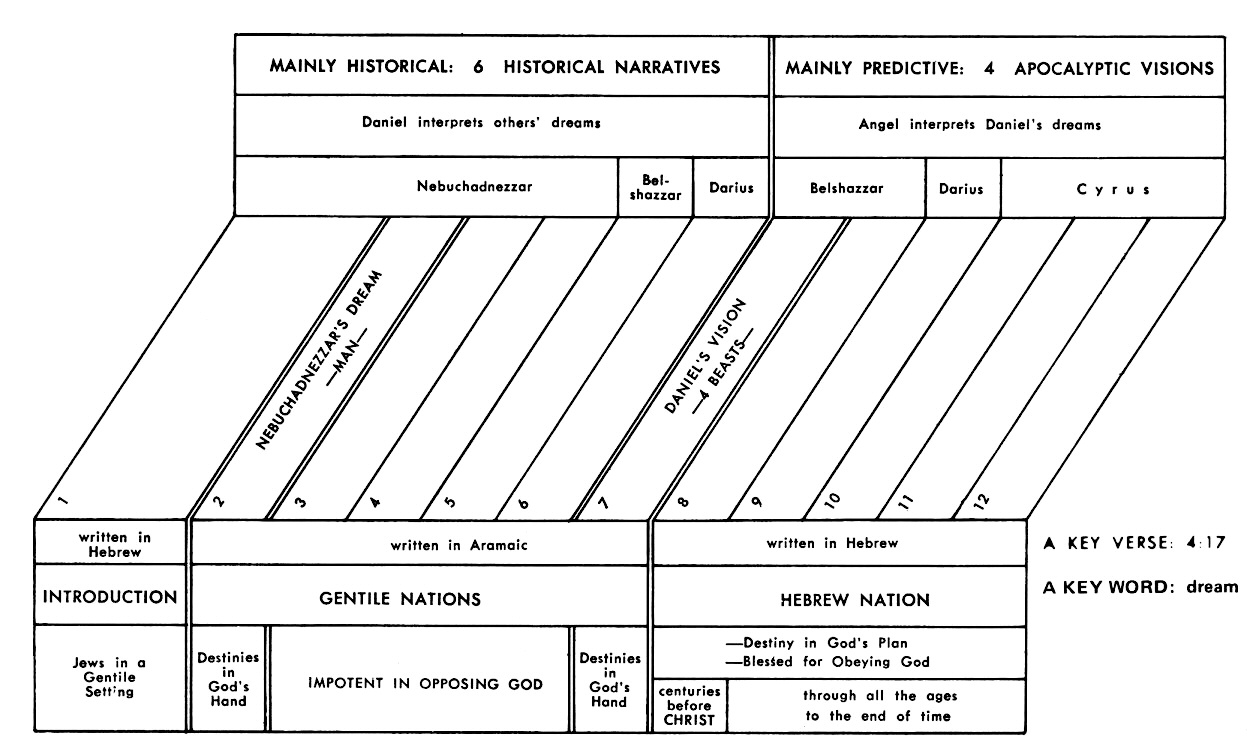 Click chart to enlarge
Charts from recommended resource Jensen's Survey of the OT - used by permission
Daniel 9:26 Then after the sixty-two * weeks the Messiah will be cut off and have nothing, and the people of the prince who is to come will destroy the city and the sanctuary. And its end will come with a flood; even to the end there will be war; desolations are determined (NASB: Lockman)
Amplified: And after the sixty-two weeks [of years] shall the Anointed One be cut off or killed and shall have nothing [and no one] belonging to [and defending] Him. And the people of the [other] prince who will come will destroy the city and the sanctuary. Its end shall come with a flood; and even to the end there shall be war, and desolations are decreed. (Amplified Bible - Lockman)
KJV: And after threescore and two weeks shall Messiah be cut off, but not for himself: and the people of the prince that shall come shall destroy the city and the sanctuary; and the end thereof shall be with a flood, and unto the end of the war desolations are determined.
NLT: "After this period of sixty-two sets of seven, the Anointed One will be killed, appearing to have accomplished nothing, and a ruler will arise whose armies will destroy the city and the Temple. The end will come with a flood, and war and its miseries are decreed from that time to the very end. (NLT - Tyndale House)
Young's Literal: And after the sixty and two weeks, cut off is Messiah, and the city and the holy place are not his, the Leader who hath come doth destroy the people; and its end is with a flood, and till the end is war, determined are desolations.
THEN AFTER THE SIXTY-TWO WEEKS THE MESSIAH WILL BE CUT OFF AND HAVE NOTHING:
- Ps 22:15; Isaiah 53:8; Mark 9:12; Luke 24:26,46; John 11:51,52; 12:32, 33, 34; 2Corinthians 5:21; Galatians 3:13; 1Peter 2:21,24; 3:18)
- Youtube video I did on Daniel 9:24-27 God's Prophetic Plan for the Ages
|
SEVENTY SEVENS |
|
|
7 SEVENS |
Rebuilding of Jerusalem |
| 62 SEVENS (434 years) (49 + 434 = 483 years) |
First Advent of |
| After 483 Years |
(1) Messiah Crucified (2) Jerusalem & Temple Destroyed |
| GAP (see explanation) between 69th and 70th Weeks | |
| 1 SEVEN (7 years) |
"The Tribulation" |
Then after (expression of time) - As discussed below this time phrase marks sequence. The events described in this passage are after the 69 Weeks or 483 years but not not during the seventieth week.
Remember the context of Gabriel's message - this decree is for Israel and Jerusalem.
John MacArthur rightly reminds us that God is not finished with Israel as is taught in a surprising number of otherwise conservative churches...
Israel remains at the center stage of redemptive history. Despite the many issues facing modern society our focus is constantly drawn to the Middle East and the nation of Israel--a country smaller than the state of New Jersey. Yet despite its importance, when a well-known Bible teacher was asked about the significance of the modern state of Israel not long ago, he replied, "It has utterly no significance at all because God is finished with Israel as of the crucifixion of their Messiah. " (Ed: Dear reader, you can mark it down - God is NOT finished with the nation of Israel!) (Ref)
According to God's writing of truth (Da 10:21-note, cf Da 10:1-note, Da 11:2-note), He is not finished with His chosen people, despite the fact that the majority of Jews continue in unbelief and do not accept Jesus as the Messiah. Hear God's testimony to His faithfulness to keep His covenant promises...
For the LORD will not abandon His people on account of His great name (His name is everything He is, His attributes, His character, etc), because the LORD has been pleased to make you a people for Himself. (1Samuel 12:22)
Comment: "This crucial declaration makes abundantly clear the principle by which God was operating in behalf of Israel. God's program for the nation of Israel was never based upon the inherent worth or loveliness of Israel, but rather upon the sovereign disposition of God. God's continuing program for Israel is not dependent upon Israel's faithfulness to God, but upon God's faithfulness to His Word and to His purposes {Deut 7:6, 8}. Because of "His great name's sake," God will not forsake His people. In other words, God has announced a plan for Israel which He must accomplish, or else disparage His name by faithlessness {cf. Ezek 37:11} (Ref).
(The psalmist records God's affirmation) Ps 89:31 If they violate My statutes, And do not keep My commandments, 32 Then I will visit their transgression with the rod, And their iniquity with stripes. 33 "But I will not break off My lovingkindness from him, Nor deal falsely in My faithfulness. 34 "My covenant (see notes on Abrahamic Covenant - although in context this may refer specifically to the Davidic Covenant) I will not violate, Nor will I alter the utterance of My lips. 35 "Once I have sworn by My holiness; I will not lie to David. 36 "His descendants (remnant = those Jews who place their faith in Messiah) shall endure forever, And his throne (Jesus as David's greatest "Son" - in the lineage of David - will reign but Scripture also teaches that David himself will reign - see Ezek 34:24 which describes the "Greater David" and David who God will resurrect - Jer 30:9) as the sun before Me. 37 "It shall be established forever like the moon, And the witness in the sky is faithful." Selah. (Psalm 89:31-37)
For the LORD will not abandon His people (Israel), Nor will He forsake His inheritance (see Dt 4:20 where this same Hebrew word is used to refer to Israel as "His own possession"). (Psalm 94:14)
(God's faithfulness to keep His promises to Israel are repeated in the NT, Paul writing) I say then, God has not rejected His people, has He? May it never be! (the strongest negative statement possible = no way, not ever!) For I too am an Israelite, a descendant of Abraham, of the tribe of Benjamin. God has not rejected His people whom He foreknew. Or do you not know what the Scripture says in the passage about Elijah, how he pleads with God against Israel? (Ro 11:1, 2 -See notes Ro 11:1; 2)
Comment: To take "Israel" out of the NT and "replace" it with the Church contradicts God's clear word of promise. See the related discussion of The Israel of God. The book of Revelation is all about God's promise to purge and restore Israel and it follows that if one says the NT Church is the "spiritual Israel", then it should come as no surprise that interpretation of that blessed last record of God's faithfulness becomes a virtual quagmire of gnarled incomprehensible comments that attempt to "wash" this final prophecy clean of a literal fulfillment. Little wonder that so many find themselves "dazed and confused" by a book, the very title of which signifies it is to be a "taking of the lid off". This "God is finished with Israel" approach also explains why the single greatest prophecy in the OT here in Daniel 9:24-27 is also one of the most fiercely debated and challenged passages in the entire Old Testament. To reiterate God is not finished with Israel and Daniel 9:24-27 and the book of Revelation both bear dramatic testimony of this truth! Let God's faithfulness to His rebellious people Israel give each of us encouragement and hope in our daily walks which are not always as "holy" as we would like them to be.
For a more in depth answer to the question "What will happen to Israel? See excellent off site resource by Dr Tony Garland...
- Romans 9:1-5 Paul's Sorrow Concerning Israel
- Romans 9:6-13 Children of the Promise
- Romans 9:14-24 The Potter and the Clay
- Romans 9:25-33 A Remnant Will be Saved
- Romans 10:1-13 The Righteousness of God
- Romans 10:14-21 Has Israel Not Heard?
- Romans 11:1-6 God Has Not Cast Away The Jews
- Romans 11:7-15 Life from the Dead
- Romans 11:16-24 Two Olive Trees
- Romans 11:25-36 The Salvation of Israel
After ('achar) means afterward, later, some time later or following in time and pertains to a time subsequent to another time, in this case Messiah's being cut off subsequent to the 483 years, not during the Seventieth Week which refers to a time yet future and implies an interlude (See "Time Gap").
For example, 'achar is used this way in Genesis where Abraham says to his three visitors at Mamre
I will bring a piece of bread, that you may refresh yourselves; after that ('achar) you may go on... (Genesis 18:5)
Tony Garland writes that "then after" signifies...
After the seven and sixty-two sevens (sixty-nine total), “Messiah shall be cut off” (Da 9:26). Thus the sixty-ninth week is seen to come to an end before the crucifixion of Christ. Several events are seen to transpire after the sixty-ninth week, but before the last week begins. These include the cutting off of Messiah and the destruction of Jerusalem by Rome. (A Testimony of Jesus Christ - The Final Week)
The sixty two weeks - Since this reference is to Messiah, Who came after 7 weeks plus 62 weeks (483 years) in Da 9:25. The sixty two weeks clearly includes the seven weeks even though they are not specifically repeated. After this time has passed the Messiah will be cut off which is clearly a reference to His crucifixion. Note that Gabriel does not say the Messiah will be cut off "at that time" nor does he say it occurs during the seventieth "seven" but "after" the sixty-ninth "seven".
Some versions, such as The New Century Version (a paraphrase - paraphrases should be avoided when performing "serious" Bible study) renders this phrase "after the four hundred thirty-four years" which while technically accurate might be somewhat confusing for as noted above the cutting off actually occurs after a total of 483 years.
And have nothing - The NLT paraphrase has an interesting "interpretation" rendering it as "appearing to have accomplished nothing" reflecting what the spiritually blind would perceive regarding the Crucifixion which in fact accomplished "everything" (cf Jn 4:34, Jn 17:4, Jn 19:30-note).
J Dwight Pentecost explains this somewhat enigmatic phrase as...
At His crucifixion He would “have nothing” in the sense that Israel had rejected Him and the kingdom could not be instituted at that time. Therefore He did not then receive the royal glory as the King on David’s throne over Israel. John referred to this when he wrote, “He came to that which was His own [i.e., the throne to which He had been appointed by the Father] but His own [i.e., His own people] did not receive Him” (Jn 1:11, 12, 13). Daniel’s prophecy, then, anticipated Christ’s offer of Himself to the nation Israel as her Messiah, the nation’s rejection of Him as Messiah, and His crucifixion. (Walvoord, J. F., Zuck, R. B., et al: The Bible Knowledge Commentary. 1985. Victor )
Messiah (04899) (Mashiyach/Mashiach from mashach = basic meaning is to smear something on and conveys the idea of anointing something as act of consecration) is an adjective often used as a noun and is one of the most important words in the OT. An "anointed one" would have sacred oil poured on their head, which set them apart as an individual with a special authority and/or function. And so we see that patriarchs, priests (Lev 4:3), or kings (Cyrus Isa 45:1) were anointed ones. (While you are studying about the timing of the first coming of the Messiah, listen to the timeless masterpiece Handel's Messiah - 1 Intro, 2 All flesh shall see the glory of the Lord; 3 of 6-Unto Us, 4 Surely He hath borne our griefs; 5 My Redeemer liveth; 6- Worthy is the Lamb that was slain)
Mashiach - 39x in 38v in the NAS = Anointed(1), anointed(34), anointed ones(2), Messiah(2).
Lev 4:3, 5, 16; 6:22; 1Sa 2:10, 35; 12:3, 5; 16:6; 24:6, 10; 26:9, 11, 16, 23; 2Sa 1:14, 16, 21; 19:21; 22:51; 23:1; 1Chr 16:22; 2Chr 6:42; Ps 2:2; 18:50; 20:6; 28:8; 84:9; 89:38, 51; 105:15; 132:10, 17; Isa 45:1; Lam 4:20; Da 9:25, 26; Hab 3:13.
In Psalm 2 Mashiyach clearly refers to the Messiah, the Christ...
Psalm 2:2 The kings of the earth take their stand, And the rulers take counsel together Against the LORD and against His Anointed (Hebrew = Mashiyach > "Messiah"; Septuagint -LXX = Christos = one who has been anointed).
Cut off (03772) (karath) is a common verb in the OT (some 283 verses) and it means to sever an object from its source or cut into parts and implies a violent action. The Septuagint (LXX) translates karath in Daniel 9:27 with the verb exolothreuo which means to extirpate, to wipe out, to utter destroy (only NT use is Acts 3:23, also used in Lxx of Ex 30:33; 31:14; Dt 7:10)
The first OT use of karath gives us a good sense of the meaning...
And I establish My covenant with you; and all flesh shall never again be cut off by the water of the flood, neither shall there again be a flood to destroy (karath) the earth." (Genesis 9:11) (see also similar use in Lev 7:20, Deut 20:20; Je 11:19; Ps 37:9 = fate of all evil doers; In Jer 11:19 what the prophet's enemies sought to do to him!)
Moses records God's instructions regarding idolatry writing that...
you are to tear down their altars and smash their sacred pillars and cut down (karath) their Asherim (Exodus 34:13)
MacArthur adds that...
Karath is used a number of times in the Old Testament to describe the execution of a criminal (Lev 7:20; Ps 37:9; Pr 2:22). Daniel's usage of the term implies the Messiah would die a criminal's death--a prophecy so specific,
it seems incomprehensible that when Jesus was presented in triumph in precise accord with Daniel's timetable but then crucified, the Jewish people would not immediately recognize who He was.
They waited for centuries for their Messiah to come and then missed Him through hate and despite. And if it is argued that Daniel 9 is somewhat obscure and easily misunderstood, one need only turn to Psalm 22 (which describes the crucifixion in detail) or Isaiah 53 (which describes the suffering and death of the Messiah) to understand that the Old Testament clearly declares the Messiah would die. (Ref)
Almost every conservative evangelical source agrees this verse is clearly a reference to the crucifixion of Christ. Christ was indeed not only "cut off" from man and from life, but on the cross indicated that He was forsaken of God, crying out
My God, my God, why hast thou forsaken me? (Mt 27:46)
Isaiah records that
By oppression and judgment He was taken away; and as for His generation, who considered that He was cut off out of the land of the living, for the transgression of my people to whom the stroke was due? (Isaiah 53:8)
Nothing either `nothing' or `no one'. The exact meaning of this phrase is uncertain. Some interpret this as the desertion by His disciples (who fled at the time of his arrest and trial). Others feel that nothing that rightly belonged to Him as Messiah the Prince was given to Him at that time. In other words, He did not come into His full reward nor the exercise of His Kingly authority.
Heslop aptly pictures how Christ's might be viewed as having been cut off and having nothing...
Born in another man's stable, cradled in another man's manger with nowhere to lay his head during his life on earth, and buried in another man's tomb after dying on a cursed cross, the Christ of God and the Friend of the friendless was indeed cut off and had nothing.
MacArthur explains this difficult to understand phrase this way...
When Jesus died on the cross He received nothing that was due Him: no honor, respect, love, or acceptance. "He was in the world, and the world was made by him, and the world knew him not. He came unto his own, and his own received him not" (John 1:10, 11). Instead He received what He didn't deserve: the sins of the world. (Ref)
Walvoord adds that...
Christ was indeed not only “cut off” from man and from life, but in His cry on the cross indicated that He was forsaken of God. The plaintive cry “My God, my God, why hast thou forsaken me?” (Mt 27:46, Mk 15:34, quoting Ps 22:1) reveals not only the awfulness of separation from God but points also to the answer—the redemptive purpose. Although the additional explanation but not for himself is probably best translated, “There is nothing for him,” it is nevertheless true that He died for others. Nothing that rightly belonged to Him as Messiah the Prince was given to Him at that time. He had not come into His full reward nor the exercise of His regal authority. He was the sacrificial lamb of God sent to take away the sins of the world. Outwardly it appeared that evil had triumphed. (Online - Daniel the Key to Prophetic Revelation: Chapter 9 -The Prophecy Of The Seventy Weeks)
THE PEOPLE OF THE PRINCE WHO IS TO COME WILL DESTROY THE CITY AND THE SANCTUARY:
The people - Who are the people? Recall that Daniel has previously revealed four Gentile world empires that would have a great impact on the fate of Israel - Babylon, Medo-Persia, Greece, and Rome (see Daniel 2:31-43-notes; Da 7:1-6-notes, Da 7:7, 8-notes - click to study these passages charted out in parallel with Daniel 9:24-27). As discussed in those passages it becomes obvious that the Roman Empire will be revived ("Revived Roman Empire" - this term per se does not appear in the Bible) again as a ten-nation confederacy during the last days. Thus the people of the prince to come will have some connection with the Romans and a revived Roman Empire.
How do we know? If one looks at the action of these people in destroying the city (Jerusalem) and the sanctuary (the Holy Jewish Temple in Jerusalem), the most obvious conclusion from history is that this event was fulfilled in the sacking and destruction of Jerusalem and the Temple in 70AD, which would identify the people as the Roman Empire led by the Roman General Titus. The prince who is to come would then be associated somehow with the Roman Empire or what has been designated by most evangelical commentaries as the "Revived Roman Empire". Observe carefully that this verse does not state that the prince comes at this time nor that the city is destroyed by him but by his people.
Donald Campbell notes that...
Leopold Cohn (additional note), a European rabbi, studied the prophecy of the 70 weeks and came to the conclusion, based on verse 26, that Messiah had already come because His coming was to be before the destruction had taken place in A.D. 70! Approaching an older rabbi, he asked where Messiah was. The rabbi said, "Go to New York and you will find Messiah there." Selling most of his belongings to buy passage to America, Mr. Cohn came to this country and wandered the streets of New York City, looking for Messiah. One day he heard singing coming from a building and went in, only to hear a clear gospel message. That night he received the Lord Jesus Christ as Messiah and Savior. Shortly after, Mr. Cohn bought a stable, swept it out, set up some chairs, and began to hold gospel meetings, the first outreach of what was to become the American Board of Missions to the Jews. (Campbell, D. Daniel God's Man in a Secular Society)
Spurgeon has the following devotional on Daniel 9:26...
"The Messiah shall be cut off, but not for Himself." - Daniel 9:26 - Blessed be His name, there was no cause of death in Him. Neither original nor actual sin had defiled Him, and therefore death had no claim upon Him. No man could have taken His life from Him justly, for He had done no man wrong, and no man could even have lain Him by force unless He had been pleased to yield Himself to die. But lo, one sins and Another suffers. Justice was offended by us, but found its satisfaction in Him. Rivers of tears, mountains of offerings, seas of the blood of bullocks, and hills of frankincense, could not have availed for the removal of sin; but Jesus was cut off for us, and the cause of wrath was cut off at once, for sin was put away for ever. Herein is wisdom, whereby substitution, the sure and speedy way of atonement, was devised! Herein is condescension, which brought Messiah, the Prince, to wear a crown of thorns, and die upon the Cross! Herein is love, which led the Redeemer to lay down His life for His enemies!
It is not enough, however, to admire the spectacle of the innocent bleeding for the guilty, we must make sure of our interest therein. The special object of the Messiah's death was the salvation of His church; have we a part and a lot among those for whom He gave His life a ransom? Did the Lord Jesus stand as our representative? Are we healed by His stripes? It will be a terrible thing indeed if we should come short of a portion in His sacrifice; it were better for us that we had never been born. Solemn as the question is, it is a joyful circumstance that it is one which may be answered clearly and without mistake. To all who believe on Him the Lord Jesus is a present Saviour, and upon them all the blood of reconciliation has been sprinkled. Let all who trust in the merit of Messiah's death be joyful at every remembrance of Him, and let their holy gratitude lead them to the fullest consecration to His cause.
The people of the prince who is to come - Note that it is not “the prince who is to come” that does the destroying, but “the people” of that prince. "The city and the sanctuary" in context is clearly a reference to Jerusalem and the Temple, which were destroyed in 70AD by Roman troops led by Titus Vespasian. Thus "the people" are identified as Roman and "the prince" will arise from the Roman empire.
As discussed in notes on Daniel 9:27 this prince is identical to the future Antichrist (the best known title of this individual and a title used only by John) and since Rome has long disappeared from world history, his origin must be from a revived Roman empire (See Dr Walvoord's article - Revival of Rome).
|
THE PRINCE |
|
| TITLE | SCRIPTURE |
|
Prince who is to come |
Daniel 9:26 |
| little horn | Daniel 7:8 note |
| insolent king (Foreshadowing, Type) |
Daniel 8:23 note |
| one who makes desolate | Daniel 9:27 note |
| despicable person | Daniel 11:21 note |
| king who will do as he pleases | Daniel 11:36 note |
| worthless shepherd | Zech 11:16-17 |
| man of lawlessness | 2Thes 2:3 |
| son of destruction | 2Thes 2:3 |
| the lawless one | 2Thes 2:8 |
| the beast | Rev 11:7 note |
| the Antichrist | 1John 2:18, 22, 4:3 2Jn 1:7 |
Beloved, though believers are instructed not to ignorant of the evil one's schemes lest we be taken advantage of, we as the Bride of Christ must not become side-tracked or distracted from our call to continually, eagerly, longingly be on the look out for the imminent return of our Bridegroom, the Lord Jesus Christ. Believers are to be looking for the Christ, not the Antichrist!
An older commentary from the 1800's by Adam Clarke (1762-1832) gives the following interpretation of the prince who is to come...
By the "prince" Titus, the son of Vespasian, is plainly intended; and "the people of that prince" are no other than the Romans, who, according to the prophecy, destroyed the sanctuary.
Comment: Clearly I disagree with Clarke's rather dogmatic interpretation, but present it so that the discerning reader is alerted to the fact that many of the "older" commentaries are often not good resources to aid one's interpretation of Bible prophecy. And yet since these are virtually all public domain, they are the most common free resources on the Internet. Be a Berean!
Pfeiffer sums this up commenting that
These considerations show that the idea of a gap in the weeks at this point is a matter of exegesis (from Greek exegeomai meaning "to draw out" and so is the process of careful, analytical study of the biblical text, usually verse by verse, phrase by phrase, in order to explain or interpret the passage). Considerations of theology are not primarily involved...Let us stay by what the passage says." (Ed comment: Amen!) (Pfeiffer, C F: Wycliffe Bible Commentary. 1981. Moody)
Destroy the city and the sanctuary - The city is Jerusalem. The sanctuary is the Holy Temple, both of which were destroyed by the Romans in 70AD.
In Luke 21 Jesus had given a prophetic warning concerning the coming destruction of Jerusalem declaring...
But when you see Jerusalem surrounded by armies, then recognize that her desolation is at hand. 21 Then let those who are in Judea flee to the mountains, and let those who are in the midst of the city depart, and let not those who are in the country enter the city 22 because these are days of vengeance (Lev 26:25 'I will also bring upon you a sword which will execute vengeance for the covenant; and when you gather together into your cities, I will send pestilence among you, so that you shall be delivered into enemy hands...28 then I will act with wrathful hostility against you; and I, even I, will punish you seven times for your sins. 29 'Further, you shall eat the flesh of your sons and the flesh of your daughters you shall eat. {This prophecy was literally fulfilled in the lengthy siege of Jerusalem. Josephus gives a dreadful detail of a woman named Mary, who in the extremity of the severe famine killed her nursing baby and had cannibalized a part when discovered by Roman soldiers!}), in order that all things which are written may be fulfilled. 23 Woe to those who are with child and to those who nurse babes in those days for there will be great distress upon the land and wrath to this people (Those who tried to escape or terrorize the enemy were frequently captured and crucified--often 500 were nailed to crosses on a given day. The forests {"distress upon the land"} around Jerusalem were completely destroyed to supply the wood necessary for battering rams, ramps, catapults, camp fires, ladders, and the many crosses that rose outside the city. See note below regarding believers who did escape.), 24 and they will fall by the edge of the sword and will be led captive into all the nations; and Jerusalem will be trampled under foot by the Gentiles until the times of the Gentiles be fulfilled. (Luke 21:20-24-commentary)
Comment: See "Times of the Gentiles" in the chart entitled "God's Plan for Jerusalem". In context, the sign of Jerusalem surrounded by armies was a warning of the future siege {which apparently went on for some 143 days} of Jerusalem by the Roman General Titus in A.D. 70, a siege which would preface the complete destruction of Jerusalem and the Temple. Unbelief might have argued that with a besieging army outside the walls, escape would be impossible; but God's Word never fails. As recorded by Josephus {Wars 2.539-540}, the Roman armies withdrew for a short season {Josephus says "without any just cause" expressing some confusion as to why the withdrawal - of course God is sovereign and by faith we see that surely He orchestrated this brief hiatus allowing believers to escape!}, thus giving the believing Jews the opportunity to escape. For those who heeded Jesus' warning this was clearly the signal to flee the city. This they did and went out to a place called Pella, a little town east of the Jordan near the Sea of Galilee, where they were preserved as recorded by the historian Eusebius. The Jewish historian Josephus recorded that nearly a million people were killed by the Romans, and over 100,000 taken captive. This historically verifiable "holocaust" is but a faint picture of the yet future "holocaust", that Jesus explained in Matthew 24:15 concerning the abomination of desolation standing in the Jewish Temple.) (For an even more detailed description of the horrific scene in Jerusalem in 70AD click here for John MacArthur's discussion).
As an aside, recall God's warning in Leviticus 26:28 of seven times more punishment. The Babylonian exile lasted 70 years and yet even after returning to Jerusalem, the post-exilic Jews continued in rebellion. So here in Daniel 9:24-27, we see the fulfillment of God's prophecy of judgment in that seven times seventy (years in Babylonian exile) is 490 years, the exact number specified in Daniel 9:24-note for the Jews and Jerusalem ("your people and your holy city")! And when this final indignation and purging of Israel has run its full course, all of saved Israel will enter the promised Messianic Kingdom. This is a succinct recap of God's Plan for Israel!
AND ITS END WILL COME WITH A FLOOD; EVEN TO THE END THERE WILL BE WAR; DESOLATIONS ARE DETERMINED:
- Mt 24:6, 7, 8, 9, 10, 11, 12, 13, 14; Mark 13:7
- Da 11:10; Is 8:7; Je 46:7; Amos 8:8; 9:5; Nah 1:8
Dr S Lewis Johnson writes that this is...
a difficult text to translate and convince everyone of your translation. There are three or four different translations. Essentially, they all mean the same thing; that there is going to be continuous desolation from that time on. (Prophecy of the Seventy Sevens, part II)
And its end will come with a flood - The desolations to be visited on Jerusalem will be as destructive as a raging flood, which is probably being used metaphorically (symbolically), picturing either a sudden or overwhelming destruction (cf similar language using words like "overflow" and "flood" in context of war in Da 11:10-note, Da 11:22-note, Da 11:26-note, Da 11:40-note, Isa 8:8)
End (07093) (qets) is a noun which refers to an end of a period of time (Ge. 8:6; 41:1 or space) and thus signifies the finish or the final point. It can mean the cessation of a state (Ge 6:13). This noun is frequently used by Daniel (see all uses below) especially in passages that have eschatological (prophetic, future) implications - see Da 8:19-note; Da 9:26-note; Da 11:27-note, Da 11:35-note, Da 11:40-note, Da 11:45-note; Da 12:4-note, Da 12:6-note, Da 12:9-note. See below for a compilation of verses in Daniel which use the English phrase "the end".
Qets - 67x in 61v in the NAS -
Gen 4:3; 6:13; 8:6; 41:1; Exod 12:41; Num 13:25; Deut 9:11; 15:1; 31:10; Judg 11:39; 2 Sam 14:26; 15:7; 1 Kgs 2:39; 17:7; 2 Kgs 19:23; 2 Chr 8:1; 18:2; 21:19; Neh 13:6; Esth 2:12; Job 6:11; 16:3; 22:5; 28:3; Ps 39:4; 119:96; Eccl 4:8, 16; 12:12; Isa 9:7; 13:5; 23:15, 17; 37:24; Jer 34:14; 42:7; 50:26; 51:13; Lam 4:18; Ezek 7:2f, 6; 21:25, 29; 29:13; 35:5; Da 8:17, 19; 9:26; 11:6, 13, 27, 35, 40, 45; 12:4, 6, 9, 13; Amos 8:2; Hab 2:3. NAS = after(3), after*(1), course*(1), end(52), endless*(1), farthest(2), farthest border(1), goal(1), highest peak(1), interval*(1), later(1), limit(2).
Even to the end there will be war; desolations are determined - Israel has experienced a steady stream of desolations that began with the destruction of Jerusalem in 70AD, including the Medieval Crusades (tragically many of these were more like "mid-evil" for they frequently persecuted Jews and challenged them at sword point to convert or die! - Click article on Anti-Semitism and scroll down to "Crusades"), the Spanish Inquisition, the Russian pogroms, Hitler's demonic Nazi holocaust. (And yet the rise of the Antichrist will commence a Satanically inspired and empowered holocaust beyond any that Israel has previously experienced. See Re 12:13-note, Re 12:14-note, Re 12:15-note, Re 12:16-note, Re 12:17-note where the woman is clearly Israel). The final desolation by the Antichrist is soberly foreshadowed by the first Roman "holocaust" in 70AD.
Desolations (08074)(shamen/samen) refers to ruin, waste or desolation caused by some great disaster, usually a result of divine judgment. This word stresses the horror caused by the desolation of judgment.
Shamem is used 8 times in Daniel - Da 8:13 Da 8:27 Da 9:17 Da 9:18 Da 9:26 Da 9:27 Dan 11:31 Da 12:11. It is interesting that shamem is used in the warning passage Lev 26:22 ("deserted") which is followed up by additional warnings in Lev 26:23, 24, this last verse prophesying that if Israel refuses to repent and return to God after the first punishment (70 years in exile in Babylon is the prime example), she would be struck "seven times more for" her sins (7 times 70 is 490 at the end of which Israel will repent and return, cf Dt 4:30)
Walvoord explains that even to the end...
seems to be a general reference to the fact that from the time of the destruction of the city of Jerusalem, trouble, war, and desolation will be the normal experience of the people of Israel and will end only at "the consummation" mentioned in Da 9:27-note, that is, the end of the seventieth seven. History has certainly corroborated this prophecy, for not only was Jerusalem destroyed but the entire civilization of the Jews in Palestine ceased to exist soon after the end of the sixty-ninth seven, and that desolation continued until recent times. (Daniel 9:24-27 The Seventieth Week of Daniel) (Bolding added)
"THE END"
The end is a phrase that is used numerous times in Daniel to refer to the end of this age (see below) and therefore comparing Scripture with Scripture, it seems very appropriate to take the use in this verse as a reference to the end of this age.
Da 8:17-note So he came near to where I was standing, and when he came I was frightened and fell on my face; but he said to me, "Son of man, understand that the vision pertains to the time of the end."
Da 8:19-note And he said, "Behold, I am going to let you know what will occur at the final period of the indignation (cf Da 11:36-note), for it pertains to the appointed time of the end.
Da 11:27-note "As for both kings, their hearts will be intent on evil, and they will speak lies to each other at the same table; but it will not succeed, for the end is still to come at the appointed time.
Da 11:35-note "And some of those who have insight will fall (in context the faithful Jews represented by the Maccabeans), in order to refine, purge, and make them pure, until the end time; because it is still to come at the appointed time.
Da 11:40-note "And at the end time the king of the South will collide with him (the Antichrist), and the king of the North will storm against him with chariots, with horsemen, and with many ships; and he will enter countries, overflow them, and pass through.
Da 12:4-note "But as for you, Daniel, conceal these words and seal up the book until the end of time; many will go back and forth, and knowledge will increase."
Da 12:9-note And he said, "Go your way, Daniel, for these words are concealed and sealed up until the end time.
Da 12:13-note "But as for you, go your way to the end (refers to the end of his life); then you will enter into rest and rise again for your allotted portion at the end of the age."
Here are some other relatively similar time phrases in the eschatological sections of Daniel
Da 8:26-note = pertains to many days in the future
Da 10:14-note = in the latter days...pertains to the days yet future
Da 12:6-note = until the end of these wonders
Harry Ironside feels that
These words briefly describe the history of Palestine from the coming of the Roman armies under Titus to the present time. Jerusalem, and Palestine as a whole, have been trodden down of all nations, and shall be, ‘until the times of the Gentiles be fulfilled (cf Lk 21:24b, Rev 11:2-note). (Daniel - H A Ironside)
Determined (02782) (charats/haras) means first to cut or sharpen, then to decide (1Ki 20:40), determine or decree and is the same word used in Da 9:27-note (decreed) and Da 11:36-note (decreed). The context of the three uses in Daniel refer to something that cannot be changed or altered (= fixed, settled, resolved, decided, concluded, ended). This verb clearly conveys the sense that God knows where history is going and that He is sovereign over human affairs and clearly able to bring about the perfect fulfillment of these prophecies.
Charats/haras - 12x in 12v - Ex 11:7; Lev 22:22; Josh 10:21; 2Sa 5:24; 1Kgs 20:40; Job 14:5; Isa 10:22, 23, 28:22; Da 9:26, Da 9:27; Da 11:36. NAS = act promptly(1), bark*(1), decided(1), decisive(1), decreed(3), determined(3), maimed(1), uttered(1).
IMPORTANCE OF
FULFILLED PROPHECY
TO FUTURE PROPHECY
The importance of Daniel 9:25 and Daniel 9:26 cannot be over stated, for the prophecies in these verses predicted the occurrence of three events which have been perfectly fulfilled: (1) Messiah's first coming (2) Messiah's crucifixion and (3) Destruction of Jerusalem and the Temple. These historical fulfillments constitute clear evidence of the accuracy of God's prophetic word and undergird the certainty that the unfulfilled prophecy in Daniel 9:27, the seventieth "seven", will come to pass just as God has determined!
Analysis of Evidence for a "Parenthesis" Between Daniel's Week 69 and Week 70
This discussion presents evidence favoring the interpretation of a time gap between Daniel's 69th and 70th Weeks (Schematic of "Time Gap"). This time gap is contemporaneous with the church age which was not revealed in the Old Testament, but has been revealed in the New Testament (Eph 3:2, 3, 4, 5, 6, 7, 8, 9-note). Scholars who do not accept a time gap are primarily those who take the approach that God is finished with Israel, having "transferred" the OT promises to the church (which some refer to as "spiritual Israel" - see Israel of God).
1) The six conditions (Note) in Daniel 9:24 must be fulfilled within the 70 "7's" and these have not been accomplished historically.
For example, to anoint the most holy most likely refers to the Jewish Temple (See note), which was not anointed within 490 years. In fact if one postulates a continuous 490 year period without a time gap, the "holy place" was destroyed after the 490 years. Stated another way, the Temple was destroyed in Da 9:26-note, yet in Da 9:27-note sacrifices are being allowed under the "firm covenant". It follows, that for this condition to be fulfilled, there has to be a rebuilt Temple and yet such an entity does not presently exist. One must postulate a future fulfillment during the Seventieth Week of Daniel 9:27-note and this interpretation necessitates a "time gap" which corresponds to the "church age".
Kenneth Baker points out that...
All the remaining unfulfilled prophecies (Ed: The Six Infinitives of Daniel 9:24-note) become unintelligible unless the present church age is regarded as a distinct period of time of unknown duration in God’s prophetic program (e.g., Israel’s great unconditional covenants; Matthew 24-25; 2 Thessalonians 2; Revelation 6-20; etc) (The Master's Journal. 1998. Sun Valley, CA: Master's Seminary) (Bolding added)
2) The text specifies that Messiah will be cut off AFTER the 69 weeks.
It does not state that He is cut off DURING or IN THE MIDST of the 70th week. (Click for events of 70th week). In fact it should be noted that at least three events occur after the 69 weeks and before the 70th week...
(a) The cutting off or crucifixion of the Messiah (33AD although some date it at 30AD)
(b) The destruction of Jerusalem and the Holy Temple (70AD)
(c) War and desolation until the decreed end (cf. Mt 24:6-30; Revelation 6-20).
3) The "HE" in Daniel 9:27 appears to best parallel the nearest antecedent "the prince who is to come" in Daniel 9:26.
This person parallels the description of the "little horn" in Daniel 7:25, the individual described in Daniel 11:36ff, the beast in Revelation 11 and 13, the man of lawlessness in 2Thessalonians 2:3-4, and the description by Jesus in Matthew 24:15. Clearly the Lord Jesus Himself placed the seventieth seven, with his reference to “the abomination of desolation” at the end of the age just before His second advent to earth and identified this event as the signal for the onset of the Great tribulation (Mt 24:21).
4) Daniel 9:27 describes the fact that the "HE" will "put a stop to sacrifice and grain offering".
If "he" is Christ as some propose, the fact is that the Crucifixion of Messiah put an end to the need for sacrifice (cf "It is Finished" in Jn 19:30-note), and yet the Temple sacrifices continued until 70AD, over 30 years after His crucifixion (33AD).
5) The scenario pictured in the last 3.5 years of Da 9:27 fits well with the events described in Revelation.
6) One would expect a literal fulfillment of the events in the 70th "seven" in view of the fact that the events in the first 69 weeks were fulfilled literally.
Christ's first coming and presentation as Israel's king occurred just as predicted in Daniel 9:25. Christ's crucifixion occurred just as predicted in Daniel 9:26a. Jerusalem and the Temple were destroyed just as predicted in Daniel 9:26b. It follows that if God was literally correct on these events which are now history, surely the events of the Seventieth Week which are yet future will also be literally fulfilled.
In other words if the Seventieth Week of Daniel 9:27 is taken as literal and one does not accept a time gap, it is very difficult to explain the events of these last seven years in terms of known historical events. It follows that the literal interpretation most plausibly describes a seven year period in which the events have not yet occurred.
7) There is ample precedent from Scripture and other passages in Daniel to support a TIME GAP between prophecies which are grammatically contiguous. Here are a few examples:
A) Isaiah 61:1, 2 (See also The Incredible Prophecy of Isaiah 61:1-3)
The Spirit of the Lord GOD is upon me, because the LORD has anointed me to bring good news to the afflicted. He has sent me to bind up the brokenhearted, to proclaim liberty to captives, and freedom to prisoners 2 To proclaim the favorable year of the LORD, and the day of vengeance of our God.
In Luke 4 Jesus opened His ministry in the Jewish synagogue in Nazareth quoting from Isaiah 61+...
THE SPIRIT OF THE LORD IS UPON ME, BECAUSE HE ANOINTED ME TO PREACH THE GOSPEL TO THE POOR. HE HAS SENT ME TO PROCLAIM RELEASE TO THE CAPTIVES, AND RECOVERY OF SIGHT TO THE BLIND, TO SET FREE THOSE WHO ARE DOWNTRODDEN, 19 TO PROCLAIM THE FAVORABLE YEAR OF THE LORD."
And He closed the book, and gave it back to the attendant, and sat down; and the eyes of all in the synagogue were fixed upon Him. 21 And He began to say to them, "Today this Scripture has been fulfilled in your hearing." (Luke 4:18, 19, 20, 21+)
Note that Jesus stopped reading after the phrase to proclaim the favorable year of the LORD. The first portion of Isaiah's prophecy was fulfilled in Messiah's first coming (Lk 4:21). The day of vengeance of our God awaits a future fulfillment of the outpouring God's righteous wrath which reaches its climax at the Second Coming of Christ as King of kings (cf Rev 19:11, 12, 13, 14, 15+, Rev 19:16+).
Paul sums up this time, writing of the day of vengeance
when the Lord Jesus shall be revealed from heaven with His mighty angels in flaming fire, dealing out retribution ("vengeance" NKJV) to those who do not know God and to those who do not obey the gospel of our Lord Jesus. And these will pay the penalty of eternal destruction, away from the presence of the Lord and from the glory of His power, when He comes to be glorified in His saints on that day, and to be marveled at among all who have believed-- for our testimony to you was believed." (2Th 1:7, 8, 9, 10)
B) Zechariah 9:9, 10
Rejoice greatly, O daughter of Zion! Shout in triumph, O daughter of Jerusalem! Behold, your king is coming to you; He is just and endowed with salvation, humble, and mounted on a donkey, even on a colt, the foal of a donkey. 10 And I will cut off the chariot from Ephraim, and the horse from Jerusalem; and the bow of war will be cut off. And He will speak peace to the nations; and His dominion will be from sea to sea, and from the River to the ends of the earth.
Zechariah 9:9 was fulfilled at His "Triumphal" entry as Jesus rode into Jerusalem to be presented to the nation of Israel as their King (also a fulfillment of Daniel 9:25-note)
Now this took place that what was spoken through the prophet might be fulfilled, saying, SAY TO THE DAUGHTER OF ZION, 'BEHOLD YOUR KING IS COMING TO YOU, GENTLE, AND MOUNTED ON A DONKEY, EVEN ON A COLT, THE FOAL OF A BEAST OF BURDEN. (Mt 21:4, 5, see also John 12:14,15.)
Zechariah 9:10 will not be fulfilled until the Second Coming of the King of kings at which time He will establish peace "from sea to sea, and from the River to the ends of the earth".
Comment - Even the ESV Study Bible (which often minimizes literal fulfillment of future prophecies related to Israel) makes this comment on Zechariah 9:10 - "The Lord will bring to an end Israel’s need (ED: THIS SURE SOUNDS LIKE THE WRITER IS DESCRIBING A LITERAL NATION OF ISRAEL!) for the traditional instruments of war: chariot, war horse, and battle bow. The coming ruler will rule the whole earth, from sea to sea and from the Euphrates River to the ends of the earth, just as Ps. 72:8 anticipated. The result of his rule will be universal peace." To that comment I shout "HALLELUJAH! AMEN!" John MacArthur (who is clearly a "literalist" on prophecies related to Israel) writes "Zechariah (Zech 9:10) moves to the Second Advent of Christ and the establishment of His universal kingdom (Zech 9:9, 10; Zech 11:15, 16). Not characterized by bloodshed, Messiah's rule will be a kingdom of peace in which weapons of warfare will be destroyed or converted to peaceful uses (cf. Isa 2:4; Isaiah 9:5-7; 11:1-10; Micah 5:2, 10-15), and peace spreads from the Euphrates River (the terminus of civilization) to the world. (MacArthur Study Bible)
C) Isaiah 9:6, 7-note
For a child will be born to us, a son will be given to us; and the government will rest on His shoulders; and His name will be called Wonderful Counselor, Mighty God, Eternal Father, Prince of Peace. 7 There will be no end to the increase of His government or of peace, on the throne of David and over His kingdom, to establish it and to uphold it with justice and righteousness from then on and forevermore. The zeal of the LORD of hosts will accomplish this.
Comment: Isaiah 9:6 was historically fulfilled at Christ's first coming but the everlasting rule of Messiah on the throne of David prophesied in Isaiah 9:7 will not be fulfilled until His Second Coming. Thus there is a clear "time gap" between these two consecutive verses.
D) A literal interpretation of the prophecies in Daniel 2, 7 and 11 is impossible unless one invokes a time gap. (See these time gaps charted out - Daniel 2, 7, 11).
1) Daniel 2 - There is a "time gap" between the old Roman empire and the "revived Roman Empire" in its 10 Toe Stage. The 10 Toe Stage has no historical counterpart and can only be explained as a yet to be fulfilled prophecy (See Daniel 2:24-49 Commentary)
2) Daniel 7 - The fourth beastly kingdom (Rome) in Da 7:7a has a 10 Horn stage (Da 7:7b, Da 7:8, Da 7:20, 21, Da 7:23, 24) which like the 10 Toe Stage of Daniel 2 has not yet been historically fulfilled.
3) Daniel 11 - Da 11:35 and Daniel 11:36 support a time gap...
Ryrie Comments: This section gives details of Antichrist's future career. Though some refer the section entirely to Antiochus, the scope also requires reference to some details of Israel's last days (Da 10:14 and Da 12:1, 2). (The Ryrie Study Bible: New American Standard Translation: 1995. Moody Publishers or Wordsearch)
Albert Barnes comments: It should be said, however, here, that most Christian interpreters suppose that the allusion here to Antiochus ceases, and that henceforward, it refers to Antichrist. So Jerome, Gill, Bp. Newton, and others; and so Jerome says many of the Jews understood it. The only reason alleged for this is, that there are things affirmed here of the “king” which could not be true of Antiochus. (Barnes' Notes on the Old Testament - Volume IX)
R. Gundry observes:
The possibility of a gap between the sixty-ninth and the seventieth weeks is established by the well-accepted OT phenomenon of prophetic perspective, in which gaps such as that between the first and second advents were not perceived. (Miller, S. R. Daniel: The New American Commentary. Nashville: Broadman & Holman, 1994)
The following discussion presents a number of points (some points overlap) that favor interpretation of a time "gap" between weeks 69 and 70. The church age, which is a mystery—that is, something not specifically foreseen in the OT, but now fully revealed in the NT (see Eph 3:2, 3, 4, 5, 6, 7, 8, 9)—fills that gap perfectly.
The detractors go to great lengths to try to disparage or denigrate these points, the sum total of which forms the basis of strong substantiation of a time gap. Those who do so seem to be primarily those who take the approach that God is finished with Israel, having "transferred" the promises from Israel to the church (which some go so far as to call "spiritual Israel"), and that the 1000 year reign of Messiah (Millennial Reign) on earth is a figment of an overactive theological imagination.
1) The six conditions in Daniel 9:24 must be fulfilled within the 70 "7's" and have not been accomplished historically.
For example, "to anoint the most holy", as discussed uses a Hebrew word for holy that is most often used of a place or thing and not of a person. The holy place therefore appears to most reasonably refer to the Jewish Temple, which was not anointed within 490 years. In fact the "holy place" was destroyed after, not during, the 490 years if one interprets them as literal years. So for this condition to be fulfilled, there has to be a rebuilt holy place or Temple and that does not exist during this "gap" or "parenthesis" in time.
Kenneth Baker points out that...
All the remaining unfulfilled prophecies become unintelligible unless the present church age is regarded as a distinct period of time of unknown duration in God’s prophetic program (e.g., Israel’s great unconditional covenants; Matthew 24-25; 2 Thessalonians 2; Revelation 6-20; etc) (The Master's Journal. 1998. Sun Valley, CA: Master's Seminary)
2) The text specifies that Messiah will be cut off AFTER the 69 weeks.
It does not state that He is cut off DURING or IN THE MIDST of the 70th week. (Click for events of 70th week in chart format). In fact it should be noted that at least three events occur after the 69 weeks and before the 70th week...
(a) the cutting off of the Messiah (A.D. 30 or 33)
(b) the destruction of the city and temple of Jerusalem (A.D. 70)
(c) war and desolation until the decreed end (cf. Mt 24:6-30; Revelation 6-20).
3) Although not agreed upon by everyone, the "he" in Daniel 9:27 appears to best parallel the nearest antecedent "the prince who is to come" in Daniel 9:26.
This person parallels the description of a similar personage ("little horn") in Daniel 7:25, the individual described in Daniel 11:36ff, the beast in Revelation 11 and 13, the man of lawlessness in 2Thessalonians 2:3,4, and the description by Jesus in Matthew 24:15.
Clearly the Lord Jesus Himself placed the seventieth seven, with its reference to “the abomination of desolation,” at the end of the age just before His second advent to earth and identified it as the Great tribulation period (Matthew 24:21).
4) Daniel 9:27 describes the fact that the "he" will "put a stop to sacrifice and grain offering".
But if the "he" is Christ as some detractors to the time gap interpretation propose, the fact is that the Crucifixion of Messiah, although certainly putting an end to the NEED for Temple sacrifices (as shown by the veil of the Temple being torn in two and the statement, among others, in Hebrews that "we have confidence to enter the holy place by the blood of Jesus, by a new and living way which He inaugurated for us through the veil, that is, His flesh" Hebrews 10:19, 20), it is a fact that the sacrifices continued for over 30 years after the crucifixion, up to the time of the Roman destruction of Jerusalem and the Temple.
5) The scenario pictured in the last 3.5 years of Da 9:27 fits well with the events described in Revelation.
6) One of the strongest arguments for the literal fulfillment of the events in the 70th "seven" is that the events in the first 69 weeks were fulfilled literally.
If the 70th week is taken as literal and one does not accept a gap of time, it is very difficult to virtually impossible to explain the events and the specific time break at the midpoint of the 7 years in terms of known past historical event. By "default" a literal interpretation most logically favors a 7 year period the events of which have not yet occurred.
7) There is ample precedent from Scripture and other passages in Daniel to support a TIME GAP between prophecies which are grammatically contiguous. Here are a few examples:
A) Isaiah 61:1-2: (See also study on Is 61:1,2, 3 - The Incredible Prophecy of Isaiah 61:1-3)
The Spirit of the Lord GOD is upon me, because the LORD has anointed me to bring good news to the afflicted. He has sent me to bind up the brokenhearted, to proclaim liberty to captives, and freedom to prisoners 2 To proclaim the favorable year of the LORD, and the day of vengeance of our God
In Luke 4:18,19 Jesus opened His ministry in the Jewish synagogue in Nazareth quoting from Isaiah but stopping after "to proclaim the favorable year of the LORD" The first portion of Isaiah's prophecy was fulfilled in Messiah's first coming. "The day of vengeance of our God" summarizes the the end time outpouring of God's righteous wrath as described for example in Revelation 6-19, and which culminates with His Second Coming.
Paul sums up this time, writing of the "day of vengeance"
"when the Lord Jesus shall be revealed from heaven with His mighty angels in flaming fire, dealing out retribution ("vengeance" NKJV) to those who do not know God and to those who do not obey the gospel of our Lord Jesus. And these will pay the penalty of eternal destruction, away from the presence of the Lord and from the glory of His power, when He comes to be glorified in His saints on that day, and to be marveled at among all who have believed-- for our testimony to you was believed." (2Th 1:7, 8, 9, 10)
B) Zechariah 9:9, 10:
"Rejoice greatly, O daughter of Zion! Shout in triumph, O daughter of Jerusalem! Behold, your king is coming to you; He is just and endowed with salvation, humble, and mounted on a donkey, even on a colt, the foal of a donkey. 10 And I will cut off the chariot from Ephraim, and the horse from Jerusalem; and the bow of war will be cut off. And He will speak peace to the nations; and His dominion will be from sea to sea, and from the River to the ends of the earth.
Zechariah 9:9 is quoted in part by Matthew and as described below was fulfilled when Jesus rode into Jerusalem on "Palm Sunday".
Matthew records
Now this took place that what was spoken through the prophet might be fulfilled, saying, SAY TO THE DAUGHTER OF ZION, 'BEHOLD YOUR KING IS COMING TO YOU, GENTLE, AND MOUNTED ON A DONKEY, EVEN ON A COLT, THE FOAL OF A BEAST OF BURDEN. (Mt 21:4, 5, see also Jn 12:14,15.)
The following verse, Zechariah 9:10 refers a time yet future, the Second Coming of the King of kings (Re 19:16-note) at which time Messiah will establish peace and will rule from "sea to sea, and from the River to the ends of the earth".
Compare Isaiah 9:6 and Luke 1:31, 32, 33 which shows another significant "gap" in prophecy regarding the coming of the Messiah.
Zechariah 9:9 is a very important passage for it described how the "King" would enter Jerusalem, which should have allowed anyone familiar with the book of Zechariah to identify Jesus as that "King" when He entered Jerusalem on the back of a colt exactly as prophesied by Zechariah. It was only as that time that the Messiah allowed Himself to be referred to as a "King", because He understood that His hour had come and that this was the perfect fulfillment of Zechariah's prophecy. This day was also prophesied by Daniel 9:25, which would have given the Jews two "prophetic opportunities" to recognize their Messiah! Luke records the events associated with the King's arrival in Jerusalem...
Luke 19:29 And it came about that when He approached Bethphage and Bethany, near the mount that is called Olivet, He sent two of the disciples, 30 saying, "Go into the village opposite you, in which as you enter you will find a colt tied, on which no one yet has ever sat; untie it, and bring it here. 31 "And if anyone asks you, 'Why are you untying it?' thus shall you speak, 'The Lord has need of it.'"
Lk 19:32 And those who were sent went away and found it just as He had told them. 33 And as they were untying the colt, its owners said to them, "Why are you untying the colt?" 34 And they said, "The Lord has need of it."
Lk 19:35 And they brought it to Jesus, and they threw their garments on the colt, and put Jesus on it. 36 And as He was going, they were spreading their garments in the road. 37 And as He was now approaching, near the descent of the Mount of Olives, the whole multitude of the disciples began to praise God joyfully with a loud voice for all the miracles which they had seen, 38 saying,
"BLESSED IS THE KING
WHO COMES IN THE NAME OF THE LORD;
Peace in heaven and glory in the highest!"
39 And some of the Pharisees in the multitude said to Him, "Teacher, rebuke Your disciples." 40 And He answered and said, "I tell you, if these become silent, the stones will cry out!" (Because Jesus knew His "hour" had come! E.g., Observe His refusal to allow them to make Him king in Jn 6:15) 41 And when He approached, He saw the city and wept over it, 42 saying, "If you had known in this day (Literally "the day" = a very specific day, the very day predicted by Zech 9:9 and Da 9:26! They should have recognized the day of His inauguration!), even you, the things which make for peace! But now they have been hidden from your eyes....(44b) you did not recognize the time of your visitation."
Note that the "time gap" separating the fulfillment of these prophecies (Isa 61:1, 2a and Isa 61:2b; Zech 9:9 and Zech 9:10) has been almost 2000 years, which is essentially the same time gap which is encountered when one interprets Daniel 9:27 literally.
C) See the chart below for time gaps in Daniel 2, 7 and 11, which furnish ample evidence that the a TIME GAP between Daniel's 69th and 70th week is not at all unreasonable.
R. Gundry observes:
“The possibility of a gap between the sixty-ninth and the seventieth weeks is established by the well-accepted OT phenomenon of prophetic perspective, in which gaps such as that between the first and second advents were not perceived.” (Miller, S. R. - Daniel - New American Commentary)
Guzik sums up the idea of a "time gap" with the observation that...
God has appointed 490 years of special focus on Israel in His redemptive plan. The years were "paused" by Israel's rejection of Jesus. Now (Ed: In the "time gap", often referred to as the "church age"), there is no special focus on Israel in God's redemptive plan because this is the time of the Church. God's focus will return to Israel when the Church is taken away (at the Rapture) and the last seven years of man's (Ed: Gentile) rule on this earth begin.
- Daniel 9:24-27: Introductory Comments
- Prophecy Primer - Why interpret Da 9:24-27 literally?
- Daniel 9:24-27 One of Most Significant Passages in Scripture
- Daniel Commentaries by interpretative approach to Da 9:24-27
- Anecdotal Stories related to Daniel 9:24-27
- Evidence Supporting Unit of Time in Daniel 9:24-27 as Years
- Daniel Commentaries from a literal, usually futuristic perspective
- Daniel Verse by Verse Daniel Commentary - Links to every verse
- Daniel 9:24 Commentary
- Daniel 9:25 Commentary
- Daniel 9:26 Commentary
- Daniel 9:27 Commentary
- Summary Chart of Daniel's Seventieth Week
- Daniel's Seventieth Week Charted Parallel with other Daniel prophecies
- Kay Arthur on Daniel 9:24-27 Part 1, Part 2, Part 3
- John Walvoord: Daniel: The key to Prophetic Revelation (online)
- Related Resource
- Millennium 1 - Early Church drift from literal interpretation of Rev 20
- Millennium 2 - Context & events leading up to Millennium
- Millennium 3 - How OT describes Millennial Messianic Age