Daniel 9:2
Daniel 9:3
Daniel 9:4
Daniel 9:5
Daniel 9:6
Daniel 9:7
Daniel 9:8
Daniel 9:9
Daniel 9:10
Daniel 9:11
Daniel 9:12
Daniel 9:13
Daniel 9:14
Daniel 9:15
Daniel 9:16
Daniel 9:17
Daniel 9:18
Daniel 9:19
Daniel 9:20
Daniel 9:21
Daniel 9:22
Daniel 9:23
Daniel 9:24
Daniel 9:25
Daniel 9:26
Daniel 9:27
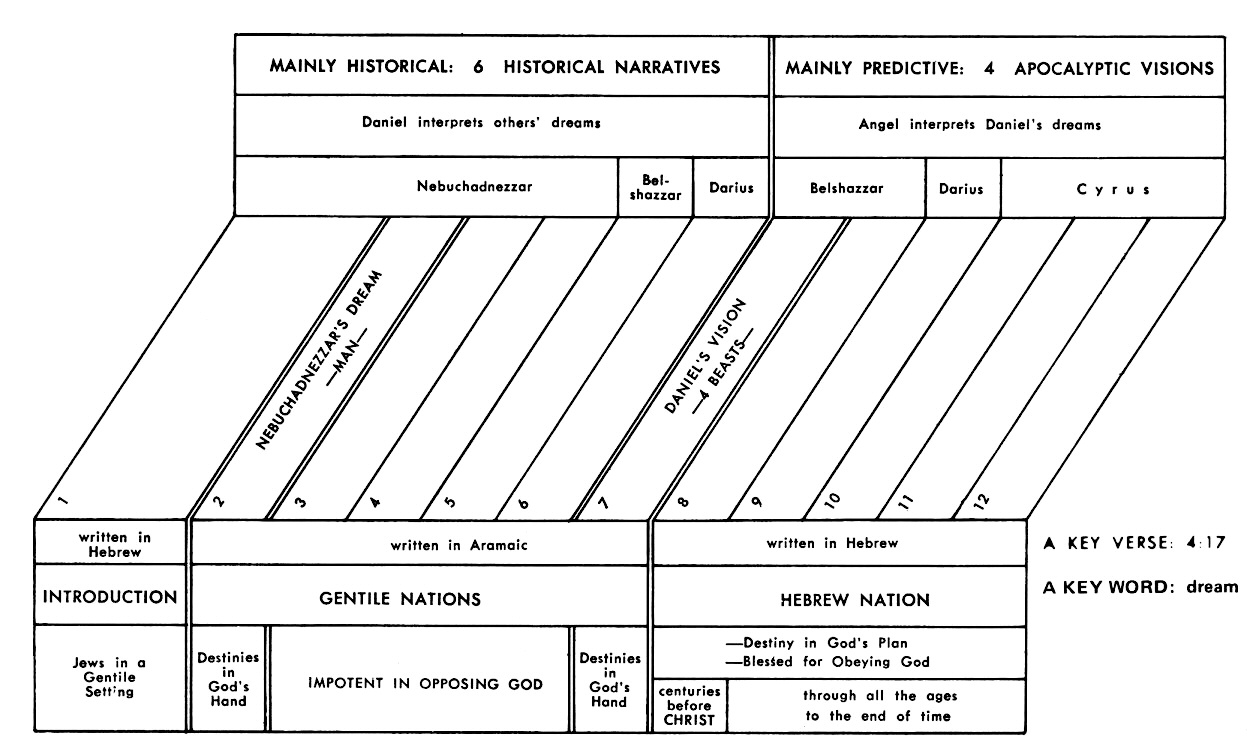 Click chart to enlarge
Charts from recommended resource Jensen's Survey of the OT - used by permission
Daniel 9:27 And he will make a firm covenant with the many for one week, but in the middle of the week he will put a stop to sacrifice and grain offering; and on the wing of abominations will come one who makes desolate, even until a complete destruction, one that is decreed, is poured out on the one who makes desolate (NASB: Lockman)
Amplified: And he shall enter into a strong and firm covenant with the many for one week [seven years]. And in the midst of the week he shall cause the sacrifice and offering to cease [for the remaining three and one-half years]; and upon the wing or pinnacle of abominations [shall come] one who makes desolate, until the full determined end is poured out on the desolator. (Amplified Bible - Lockman)
ESV: And he shall make a strong covenant with many for one week, and for half of the week he shall put an end to sacrifice and offering. And on the wing of abominations shall come one who makes desolate, until the decreed end is poured out on the desolator. (ESV)
KJV: And he shall confirm the covenant with many for one week: and in the midst of the week he shall cause the sacrifice and the oblation to cease, and for the overspreading of abominations he shall make it desolate, even until the consummation, and that determined shall be poured upon the desolate.
Net: And he will make a firm covenant with the many for one week, but in the middle of the week he will put a stop to sacrifice and grain offering; and on the wing of abominations will come one who makes desolate, even until a complete destruction, one that is decreed, is poured out on the one who makes desolate. (NET Bible)
Montgomery: And he shall make strong a covenant for the many for one week. And for half of the week he shall cause to cease sacrifice and oblation, and upon the wing [i.e., of the temple] shall be an Abomination-Appalling, even until end and determination shall pour upon the Appaller.
NLT: He will make a treaty with the people for a period of one set of seven, but after half this time, he will put an end to the sacrifices and offerings. Then as a climax to all his terrible deeds, he will set up a sacrilegious object that causes desecration, until the end that has been decreed is poured out on this defiler." (NLT - Tyndale House)
Young's Literal: And he hath strengthened a covenant with many--one week, and in the midst of the week he causeth sacrifice and present to cease, and by the wing of abominations he is making desolate, even till the consummation, and that which is determined is poured on the desolate one.'
John Walvoord writes that...
The interpretation of the revelation given to Daniel concerning the seventy weeks (Daniel 9:24–27) constitutes one of the determining factors in the whole system of prophecy. The attention given to it by all schools of interpretation, and the attacks upon the authenticity of the book itself combine to focus the white light of investigation upon it. The interpretation of this passage inevitably colors all other prophetic views, and a proper understanding of it is the sine qua non of any student of prophecy. The importance of the revelation of Daniel nine lies first of all in the chronology which it establishes. Properly understood, we have here the major outline of the period from Daniel to Christ and from the rapture of the Church to the second coming of Christ in glory. Certainly, no other Old Testament passage does as much for ordering events future from Daniel’s point of view as does the passage under consideration.
Properly interpreted, the prophecy of Daniel furnishes an excellent example of the principle that prophecy is subject to literal interpretation. Practically all expositors, however opposed to prophecy per se (Ed: That is those who do not generally accept a literal, futuristic interpretation), agree that at least part of the seventy weeks of Daniel is to be interpreted literally. In fact, such is the force of the literal interpretation that those who deny the possibility of accurate prophecy are compelled to move the date of the writing of Daniel until after the events which they believe fulfilled it. From the standpoint of this article, if the first sixty-nine weeks of Daniel were subject to literal fulfillment, it is a powerful argument that the final seventieth week will have a similar fulfillment.
...The seventy weeks of Daniel are totally in reference to Israel and her relation to Gentile powers and the rejection of Israel’s Messiah. The peculiar purpose of God in calling out a people from every nation to form the church...(is) nowhere in view in this prophecy. (Is the Seventieth Week of Daniel Future? Bibliotheca Sacra Volume 101. 1944)
Daniel 9:27 is known as the Seventieth Week of Daniel (summary diagram), the seventieth seven or the "Tribulation". As with all Scripture, this important passage should be interpreted in its plain, natural, literal sense, taking care to avoid speculation, allegorization, application of symbolism or spiritualization. Any other interpretative schema other than literal leaves this critical passage and this entire section (Da 9:24-27) open to a variety of interpretations limited only by the expositor's imagination. As discussed below, the natural and most logical interpretation is to take Daniel 9:27 literally. The literal interpretation indicates the events described are yet future, for one cannot identify a historical 7 year period which completely explains all the events (e.g., the Jewish Temple is currently non-existent, but must be present for sacrifices to be terminated!). This verse describes what expositors have referred to as The Tribulation but it should be noted that there is not specific Scripture that designates this entire seven year period as the tribulation. On the other hand, the term "Great Tribulation" is a very specific term which was used by Jesus to designate the last 3.5 years of Daniel's Seventieth Week (cf Mt 24:15+ which occurs at midpoint of the seven years and Mt 24:21+). The Old Testament term for this last 3.5 years is the time of Jacob's distress (Jer 30:7+ - see other synonyms).
And so the Seventieth Week of Daniel focuses future attention on the nation of Israel and the fate the Jews, as God allows His Chosen People to experience one last refining fire which results in a remnant of the nation of Israel who place their faith in Messiah. Daniel 9:27 is the backbone of all prophecy and as such serves as the skeleton on which one can superimpose the events of Revelation 6-19. It follows that the majority of the events of the Revelation are deal with the nation of Israel and not the Church. Below is a schematic summary that reflects the literal (futuristic) interpretation of Daniel 9:24-27).
Recommended Resource: Three part series on Daniel 9:24-27 by Charles Ray, Thd - includes over 200 footnotes!
|
After 69th Week |
"Time Gap" |
Daniel's 70th Week |
1000 Years |
|||
|
Cross |
The Church Age |
Tribulation* |
||||
|
Daniel 9:25, 26 |
Daniel 9:27 |
Rev 20 |
||||
*Note: The word "Tribulation" is never specifically used in Scripture to designate the last 7 years, Daniel's 70th week, but will be used in these notes because the term is so firmly entrenched in Christian jargon.
Dwight Pentecost addresses the argument of amillennialists who do not accept a literal 1000 year earthly reign of the Messiah and who do not accept a time gap between Daniel 9:26 and Daniel 9:27 writing that...
Amillenarians teach that Christ’s First Advent ministry was in the 70th “seven,” that there was no interval between the 69th and 70th “sevens,” and that the six actions predicted in Daniel 9:24 are being fulfilled today in the church. This view, however,
(a) ignores the fact that Da 9:26 says “after the 62 sevens,” not “in the 70th seven, ‘
(b) overlooks the fact that Christ’s ministry on earth was three and one-half years in length, not seven (Ed: This line of evidence is against the interpretation of some amillennialists who feel the "he" who makes a covenant with the many is the Christ rather than the Antichrist) , and
(c) ignores the fact that God’s six actions pertain to Daniel’s “people” (Israel) and His “Holy City” (Jerusalem), not the church. (Walvoord, J. F., Zuck, R. B., et al: The Bible Knowledge Commentary. 1985. Victor)
Click for a more detailed discussion of the rationale for the interpretation of the gap between the 69th and 70th weeks and the conclusion that the 70th has to be a yet future time period. As discussed in the explanatory notes it is not uncommon for prophetic passages to demonstrate a significant "pause" or "gap" between near and future fulfillments, and as discussed this is especially seen in the first and second comings of Christ.
Walvoord explains the interpretation of Daniel 9:27 this way...
If the expositor desires to follow the text meticulously, however, there is really no alternative but to declare the entire seventieth seven future, for there has been no seven-year period fulfilling the events of prophecy, however labored the interpretation. This is usually conceded by those who make the last seven years an indefinite period which allows for still future interpretation. (John Walvoord: Daniel: The key to Prophetic Revelation)
WHY NOT 490
CONSECUTIVE YEARS?
A number of commentators (Keil, Young, Jewish sources, et al) interpret the Seventy Weeks as consecutive weeks with no break or gap. There are a number of arguments that make this interpretation very unlikely...
(1) SIX GOALS: The 6 "goals" of Daniel 9:24 have not been fulfilled. Some attempt to say that these 6 "goals" have been fulfilled in Christ’s death, but this is not a logical nor a reasonable interpretation. For example, to say that Israel ("your people) has finished the transgression and made an end of sin is not accurate, nor has everlasting righteousness been brought into existence (it will be but it is not at the present time). This point alone is strong evidence against the interpretation that the Seventy Sevens or 490 years are consecutive weeks and have been historically fulfilled. To be fair, the fulfillment of these 6 "goals" will only come about because of the foundation laid by Christ's having been "cut off", but at present they await a future fulfillment.
(2) TEMPLE SACRIFICES: Although Messiah's death in 33AD made sacrifices unnecessary, Temple sacrifices were not stopped until 70AD when the Temple was destroyed by the Romans under general Titus.
(3) TEMPLE DESTRUCTION: The "cutting off" of Messiah and the destruction of the city and the sanctuary (Temple) would have to have taken place before the end of the 490 years. Historically, Messiah was crucified in 33AD and Jerusalem and the Temple destroyed in 70AD (not in 40AD) and thus strongly argues against a consecutive interpretation of the seventy sevens.
Reginald Showers notes that...
Only if there were a gap of time between the end of the first sixty-nine sevens of years and the beginning of the seventieth seven of years could this destruction have taken place so late and still be within the scope of the 490 year prophecy. (The Most High God)
(4) MESSIAH CUT OFF "AFTER" NOT "DURING": Gabriel prophesied "then after the 62 weeks" (the 69 weeks) Messiah would be "cut off". He did not say this event would occur during the seventieth week.
Although I disagree with Robert H Gundry's post-tribulation stance, he does explain this point well noting that...
If the cutting off of the Messiah occurred in the middle of the seventieth week, it is very strange that the cutting off is said to be “after” the sixty-nine weeks (figuring the sum of the seven and the sixty-two weeks). Much more naturally the text would have read “during” or “in the midst of” the seventieth week, as it does in verse twenty-seven concerning the stoppage of the sacrifices. The only adequate explanation for this unusual turn of expression is that the seventieth week did not follow on the heels of the sixty-ninth, but that an interval separates the two. The crucifixion then comes shortly “after” the sixty-ninth but not within the seventieth because of an intervening gap. The possibility of a gap between the sixty-ninth and the seventieth weeks is established by the well-accepted OT phenomenon of prophetic perspective, in which gaps such as that between the first and second advents were not perceived (Ed: See Discussion of "Time Gap"). (Robert H. Gundry, The Church and the Tribulation Grand Rapids: Zondervan Publishing House, 1973)
AND HE WILL MAKE A FIRM COVENANT WITH THE MANY
- Isaiah 42:6; 53:11; 55:3; Jeremiah 31:31, 32, 33, 34; 32:40, 41, 42; Ezekiel 16:60, 61, 62, 63; Mt 26:28; Ro 5:15,19; 15:8,9; Gal 3:13, 14, 15, 16, 17; He 6:13, 14, 15, 16, 17, 18; 8:8, 9, 10, 11, 12, 13; He 9:15, 16, 17, 18, 19, 20,28; 10:16, 17, 18; 13:20,21) (Mt 27:51; He 10:4-22
And he will make a firm covenant with the many - This monumental event will mark the beginning ("terminus a quo") of the Seventieth Week of Daniel!
TWO MAIN CHARACTERS
IN DANIEL 9:24-27
CHRIST & ANTICHRIST
He - Who is he? Interpretations have included (1)Antichrist, (2) Christ, (3) Antiochus Epiphanes, (4) A time unit of a week.
WHO IS "HE"?
(1) ANTICHRIST: Applying the accepted rule of interpretation and observing the text for the nearest antecedent of the pronoun he (without bias or influence by other "experts"), this he most closely parallels the prince who is to come in the previous passage (Daniel 9:26). This is the conclusion reached by most conservative evangelical commentaries, who go on to identify him as the Little Horn (Antichrist) who "came up among the (10) horns" of the fourth beast (fourth kingdom ~ "Revived Rome") chapter 7 of Daniel (Da 7:8,11-note Da 7:20, 21-note).
It is interesting that both Christ and Antichrist are referred to as "prince" (synonymous with "king"), for the prefix "anti-" means the regal imposter is not only opposed to or against Christ, but "instead of" or a substitute for the real Christ.
We know that the prince's people (Rome) destroyed Jerusalem in 70 A.D., and can deduce that this coming prince has his ancestral roots in the ancient Roman Empire and is thus part of what is often referred to as "the revived Roman Empire", the final Gentile world government described in Romans 7 (see Da 7:7-note, Da 7:19-note). In the Revelation of Jesus Christ, John records this vision...
And he stood on the sand of the seashore. And I saw a beast coming up out of the sea, having ten horns and seven heads, and on his horns were ten diadems ("ten king stage" of the beast in Da 7), and on his heads were blasphemous names. 2 And the beast which I saw was like a leopard, and his feet were like those of a bear, and his mouth like the mouth of a lion (Ed: Note how this is the reverse of the sequence of same beasts in Da 7:1, 2, 3, 4, 5, 6-note - John is looking back in time and sees the leopard first = Greece, bear = Medo-Persia, Lion = Babylon). And the dragon (Satan) gave him (Antichrist) his power and his throne and great authority. (Notice how the term "beast" merges subtlety from a beastly kingdom to the king of that kingdom in the latter part of the verse) (Re 13:1-note; Re 13:2-note; see also study of The Beast; and Beasts, Heads, and Horns)
(2) CHRIST: Some such as Edward Young and Phillip Mauro interpret the "He" as a reference to the Messiah primarily because the entire prophecy is about the Messiah and the premise that there is no (to use their words) "future 'prince' making a covenant with" Israel. This interpretation makes little sense because the new covenant in His blood is an everlasting covenant, not a seven year covenant and not a covenant which He will ever break. God is a covenant keeping God! How can the reference be to Christ when we have just been introduced to the prince who is to come which describes one out of the Roman empire? Christ did not come from the Roman Empire but from Israel. Furthermore, when did Christ make a firm covenant with many Jews for one week (seven year period)? And how can it be said of Christ that “in the midst of the week” He caused the sacrifices to cease? Sacrifices continued in the Temple some 40 years after Messiah was cut off, well past the 7 years of the 70th Week. Clearly, the "he" is not Christ.
Harry Ironside agrees that "He" is not the Messiah writing...
Ere closing I briefly notice a rather peculiar interpretation which is frequently given to the 27th verse. It is said that the Lord Jesus is Himself to be the prince that shall come who confirms the covenant for one week. His own crucifixion is supposed to be the event which caused the sacrifice and oblation to cease. But neither chronologically nor doctrinally will this stand for a moment, if examined in the light of other scriptures. With whom did the Lord Jesus ever confirm a covenant for seven years? His precious blood is called ”the blood of the everlasting covenant;” not a covenant for one week of years. We may rest assured it is not Messiah at all, but the blasphemous prince who is yet to come, who will fulfil what is predicted in this verse.
How near this world may be to the actual entering upon all these things no man can say, but it is the part of wisdom to learn from the prophetic Scriptures, and to turn now to Him who alone can save; to own Him as Redeemer and Lord, and thus be certain of being caught up to meet Him when He comes in the clouds, ere the time comes for His righteous judgment to be poured out upon this poor world. (Daniel - H A Ironside)
Ray adds...
In deciding between the Messiah or the “prince to come” as the antecedent, Barnes contends “it is not reasonable to suppose that the latter is referred to, because it is said (Da 9:26) that the effect and the purpose of his coming would be to ‘destroy the city and the sanctuary.’ In other words Barnes is saying the prince is coming to make peace. He is wrong on two accounts. Da 9:26 says it is the people of the prince, not the prince himself, who execute the destruction. Too, he is implying it is reasonable to suppose the Messiah would bring about the devastation. To assume Da 9:27 deals with Christ is presumptuous, for that is the very question for which interpreters are seeking an answer. Lastly, it is not unthinkable a future leader would bring about such an agreement with Israel; people will do almost anything to have peace in the Middle East....Leupold and Keil are some of the few non-pre-millenarians who admit the “he” is the antichrist. (A Study of Daniel 9:24 - 27, Part III)
(3) ANTIOCHUS EPIPHANES: (See related discussion on Antiochus Epiphanes - Da 8:9-note, Da 8:17-note, Da 8:19-note; see also Daniel notes and additional discussion) The liberal commentator Montgomery (who to my utter amazement does not even interpret Da 9:25, 26 as a prophecy of Christ's first coming - See list of other Non-Christological Interpreters) identifies the "He" as Antiochus Epiphanes. Montgomery feels that this prophecy was fulfilled in the second century before Christ noting how apostate Jews cooperated with Antiochus (see 1Mac 1:11, 12, 13, 14, 15).
(4) A WEEK: The pronoun He has even been interpreted as a week by some who take he as neuter (not masculine), but such an interpretation of makes absolutely no sense in context. It does emphasize how far some commentators are willing to go in an attempt to "jettison" a literal, futuristic interpretation.
In summary, even applying the elementary grammatical rule of examination of the context for the nearest antecedent noun ("prince" in Da 9:26), there is little question that the pronoun He in Da 9:27 is the future Antichrist, the evil end times anti-Semitic leader who is known by many names in Scripture (see table). And as you review the list of the names of the Antichrist, remember that in Scripture one's name speaks of one's character.
| ALIASES OF ANTICHRIST |
|
| Daniel 7:8 (Note) |
THE LITTLE HORN |
| Daniel 8:23 (Note) |
A KING... INSOLENT AND SKILLED IN INTRIGUE (Primarily fulfilled in Antiochus Epiphanes but serves as a "Type" of the Antichrist) |
| Daniel 9:26 (Note) |
PRINCE WHO IS TO COME... |
| Daniel 9:27 (Walvoord note) |
HE... ONE WHO MAKES DESOLATE |
| Daniel 11:36 (Walvoord note) |
THE KING... EXALT AND MAGNIFY HIMSELF |
| 2Th 2:3+ (Walvoord note) (Keathley Note) |
MAN OF LAWLESSNESS |
| 2Th 2:3 | SON OF DESTRUCTION |
| 2Th 2:8 | THE LAWLESS ONE |
| 1Jn 2:18+ 1Jn 2:22+ |
THE ANTICHRIST |
| Rev 11:7, 13:3, 13:4, 13:11, 12, 14, 15, 17, 18, 14:9, 11, 15:2, 16:2, 10, 13, 17:3, 17:7, 17:8, 11, 12, 13, 16, 17, 19:19, 20, 20:4, 10 (Notes: Re 11:7, 13:3, 13:4, 13:11, 12, 14, 15, 17, 18, 14:9, 11, 15:2, 16:2, 10, 13, 17:3, 17:7, 17:8, 11, 12, 13, 16, 17, 19:19, 20, 20:4, 10) |
THE — BEAST |
| Micah 5:5-6-note Isaiah 10:5-note |
The Assyrian (Included for completeness but this title is questionable) |
PARALLEL PASSAGE IN
THE REVELATION
If Daniel 9:27 is the "outline" of the future of Israel, the Revelation fills in the details of this final seven year period in Rev 6:1 through Rev 18:24. In the Revelation, the apostle John gives us a fascinating description of an individual who is revealed at the opening of the first seal...
And I looked, and behold, a white horse, and he who sat on it had a bow (a symbol of strength - Job 29:20, 30:11, but note his has no arrows); and a crown was given to him; and he went out conquering, and to conquer. (Rev 6:2-note)
Note that there are some similarities of this man and Christ which has led some (even Henry Morris in his literal commentary "The Revelation Record") to identify the rider in Revelation 6:2 as Christ...
(1) He rides a white horse (Re 19:11-note)
(2) He wears a crown (a stephanos {note} - Not a diadema = a royal crown, although Christ did wear a stephanos in Mt 27:29, Jn 19:2, 5) (Re 19:12-note)
(3) He overcomes - Both this man and Christ are "overcomers" (Jesus said "take courage, I have overcome the world" in Jn 16:33, cf 1Jn 4:4, Re 3:21-note, Rev 17:14-note)
The identity of the rider on the white horse in Re 6:2 (note) is definitely not Christ , for it is the Lamb (Christ) Who was found worthy to open this first seal (Re 5:2, 4, 7, 9, 12, 6:1 - see notes Re 5:2; 5:4; 5:7; 5:9; 12; 6:1) and He must open the remaining seals. This man carries a bow, whereas Christ carries a sword (Re 2:12-note, Rev 19:15-note). This rider is alone, whereas "the armies which are in heaven, clothed in fine linen, white and clean, were following Him (Christ) on white horses." (Re 19:14-note) Finally, notice that Christ rides forth on a white horse at the end of the Great Tribulation, but this rider comes forth at the beginning of the Seventieth Week of Daniel (although exactly when during the first 3.5 years cannot be determined from Scripture). While the unbelieving world might think this rider is the Christ, the evidence suggest just the opposite; i.e., this rider is most likely the Antichrist, the "he" of Daniel 9:27, the Beast of Revelation, who we know arrives on the world scene at the beginning of Daniel's Seventieth Week to make a covenant with Israel (cf Jesus' words in John 5:43)
Notice that although the man in Re 6:2 (note) is said "to conquer", he has a bow but no arrows which could indicate that during the first 3.5 year period, the Antichrist will conquer more by shrewd statesmanship or deceptive diplomacy than by brute force. Daniel in fact describes him as a man possessing "a mouth speaking great things" (Da 7:8-note), yet with an intimidating force at his back. He will be able to negotiate concessions for Israel - security, permission to rebuild their beloved Temple, and the right to worship with Temple sacrifices.
The Antichrist will orchestrate a covenant (most likely a peace treaty) with Israel for seven years and thus will initially be a hero to the Jews. Without speculating too much, it is very easy to see how this might transpire in our day (2010AD) for Israel is internationally isolated and is desperately seeking support against the jihadist pressure of their anti-Semitic Muslim neighbors.
FIRM
COVENANT
Make a firm covenant - What is the idea of make...firm? Daniel could have recorded the usual OT phrase "cut a covenant" but as discussed below the use of this phrase gives some insight into the Antichrist's modus operandi.
Ray comments that...
The first two Hebrew words are literally, “shall cause a covenant to be strong”...whose root can mean “prevail, have strength, be great, have stability, make firm.” The potency of this wording may imply the Jews are forced to accept the agreement because of the antichrist’s superior power...
It is interesting to speculate on the details of this agreement. One can make educated guesses as to what some of the clauses in the contract stipulated. The antichrist may promise to protect Israel in exchange for money. 1Th 5:3 makes it clear people will be content with the peace and safety just before the judgment. That the second half of the “seven” is a time of horror likewise indicates it is a peace treaty of some sort. Another possible clause may have permitted the Jews to resume their Temple rituals, for later the antichrist has to force them to stop. In other words, the Levitical system didn’t just start up again but it was by the consent of the antichrist. These events precipitate other implications. Since the Jews are looking for a “Prince of Peace” (Isa 9:6), they will be that more easily taken in by the antichrist. They will quickly discover, however, he is their destroyer, not their deliverer. (A Study of Daniel 9:24-27 Part IV)
Make a firm (01396) (gabar) is a primary verb commonly associated with warfare and with strength and vitality of a successful warrior. Some OT uses of gabar convey the sense of showing oneself as arrogant, overbearing, displaying attitudes and actions which reflect pride (cf the Antichrist's "boastful words" {although not the word gabar} in Da 7:11-note , Da 7:20-note, see also Rev 13:5-note). The idea inherent in gabar is to be strong, to triumph over or to prevail, thus picturing superior strength over someone or something. For example, gabar in Exodus 17 vividly portrays this idea...
So it came about when Moses held his hand up, that Israel prevailed (gabar), and when he let his hand down, Amalek prevailed (gabar). (Ex 17:11)
Covenant (01285) (berit/berith/beriyth) (see Covenant in the Bible) (Septuagint translates covenant with Greek diatheke {see study}) as discussed elsewhere is the most solemn and binding agreement known in the ancient world. Someone has written that there is no firmer guarantee of legal security peace or personal loyalty than the covenant. Of course ultimately the integrity of the covenant depends on the integrity of the parties who cut the covenant! In this case one party's father is a liar (Jn 8:44), so he (the Antichrist) is the penultimate liar! (see example of Hitler below).
The greatest tool for covenant making came to be the written document on which the words of the covenant, its terms in the form of promises and stipulations, were spelled out, witnessed to, signed and sealed. Such covenant documents abound in ancient records.
THE MANY:
THE JEWS
With the many - In context refers to the Jews (or Israel) and is not a general reference to any group. Furthermore, because these Jews will carry out sacrifices, the implication is that these are unbelieving Jews. Jews who are genuine believers will recognize that Jesus' once for all time sacrificial offering on the Cross fulfilled the need for Temple sacrifices (John 19:30+, Heb 10:12+ cf Heb 10:14+, Heb 9:12+). The sacrificial system was in essence one of the "things which (were) a mere shadow of what is to come; but the substance belongs to Christ." (Col 2:17+)
Comparing with other passages one notes that this same phrase the many refers to Jews in Da 11:33, 39+ (Walvoord's comments) and Da 12:3+ (Walvoord's comments). Note also the context allows for sacrifices (implying a rebuilt Temple) something the Jews have longed to do for almost 2000 years. With the destruction of the Temple in 70AD, the Jews were left with no acceptable place to perform sacrifices. The Antichrist will at least initially fulfill the desire of every Jewish heart, but he will do so deceptively.
What will the many do? Covenant in our modern world has lost much of its Biblical meaning (cf how tragically frequent marital partners break their covenant - see Covenant: As It Relates to Marriage) but in the context of the Bible, covenant has always signified a solemn, binding agreement and as such represented the entering of two parties into an intimate, ostensibly indissoluble agreement. And so by entering into this covenant with the Antichrist, Israel will embrace the this prince who is to come as a veritable "savior" who has been able to accomplish what heretofore all others have failed to produce - "Peace" in the Middle East. This prince becomes their "political messiah". Israel's desperate desire for peace, security and safety will play into the hands of Antichrist, who will convince them and the world that he can provide this peace.
And yet one still has to wonder, how can the world and Israel be so totally deceived, especially in light of the fact that we hear many non-believers talking about the Antichrist. But if we recall from history, this scenario is precisely what happened before the outbreak of World War II. Adolph Hitler had even spelled out in detail his plans for conquest in his book Mein Kampf, which had been published more than a decade before World War II began. Yet, incredibly, Britain and France persisted in believing Hitler’s false claim to be a man of peace, passively standing by as he reoccupied the Rhineland (demilitarized after World War I) and thus abrogated the Versailles Treaty. Desperate to appease Hitler and avoid war, British Prime Minister Neville Chamberlain met with the Nazi dictator at Munich in 1938. Upon his return to England, Chamberlain triumphantly waved a piece of paper containing a worthless pledge of peace from Hitler which he claimed guaranteed “peace with honor … peace for our time.” When Winston Churchill (one of the few never taken in by Hitler) rose in the House of Commons to declare that England had suffered a total, unmitigated defeat he was shouted down by angry members of Parliament. The deception was nearly universal as almost everyone misread Hitler’s intentions. Only after he had invaded Poland in September, 1939 did the allies finally acknowledge the truth of his evil plan to conquer the world, but by then it was too late to avoid the catastrophe of the Second World War.
The Bible repeatedly warns of the deadly lure of false peace offered by false prophets, God declaring...
they have healed the brokenness of My people superficially, Saying, 'Peace, peace,' But there is no peace. (Jer 6:14, cp Jer 8:11, 14:13)
False prophets spoke of peace in Jerusalem even while faced with the threat of Babylon. In this setting...
The Lord replied, “The prophets are prophesying falsehood in My name. I have neither sent them nor commanded them nor spoken to them; they are prophesying to you a false vision, divination, futility and the deception of their own minds” (Jer 14:14)
Paul describes the deceitfulness of this future false peace that is a harbinger of the Day of the Lord writing...
While they (unbelievers) are saying, "Peace and safety!" then (when? while they are saying "peace and safety") destruction will come upon them suddenly like birth pangs upon a woman with child; and they shall not escape. (1Th 5:3-note).
In John 5, Jesus predicted this Jewish "apostasy" (which I think correlates well with "the apostasy" that Paul describes in 2Thes 2:1-4 (Dr Walvoord's comments) that precedes the Antichrist's claim of deity in the midst of the Temple in Jerusalem)...
I have come in My Father's name, and you do not receive Me; if another shall come in his own name, you will receive him. (John 5:43)
Comment: This was partially and literally fulfilled in the first century, as the Jewish historian Josephus, recorded a string of messianic pretenders in the years before 70AD, the fall of Jerusalem and sacking of the Temple. Jesus was predicting that though the Jews would not follow Him, they sadly and somewhat ironically would follow false messiahs, the final prince who is to come being the ultimate false messiah, which of accounts in part for his name of Antichrist = instead of Christ, in place of Christ, against Christ
Now one should understand that while most of Israel at this time is still unbelieving, God always has a faithful Jewish remnant, who confess their sin, and place their faith in the Messiah.
Harry Ironside explains that...
The many, that is the apostate mass of the (Jewish) people, will enter into covenant relations with the prince whose people formerly were the instruments of the destruction of their city. That is, this great blasphemous Roman leader will guarantee protection and freedom of religious worship to them for seven years, in return for which they will promise allegiance to him as their sovereign. In the midst of the week (that is, after three years and a half) he will violate his part of the covenant, and cause the sacrifices and oblations to Jehovah to cease. Idolatry of the most dreadful kind will be forced upon them. The direct result of which will be to distinguish the remnant from the mass, and thus to bring in the Great Tribulation which will continue for forty-two months,—“a time, times, and half a time,” or 1260 days.(Daniel - H A Ironside)
To reiterate, the Covenant the Antichrist makes with Israel marks the onset of the Seven Year period referred to as "The Tribulation" (Daniel's Seventieth Week) and is evidently a covenant of protection and of religious freedom under which Israel is free to re-establish their system of sacrifices.
Where will the Jews perform the sacrifices? The answer is that sometime either before or during this first 3.5 years of Daniel's Seventieth Week (Scripture is not dogmatic) the Jewish Temple will be rebuilt on the Temple Mount in Jerusalem and sacrifices are resumed. The only acceptable site for the Jewish Temple is "Temple Mount", which in 2010 is the site of the Dome of the Rock and under Muslim control. Clearly there must be a radical shift in policy to allow the Temple to be rebuilt, and this may be one of the Antichrist's first major breakthrough, as he is able to bring about "peace" in the Middle East, something the world is now crying for almost daily in newspapers and newscasts. John clearly indicates the presence of a Jewish Temple in the end times recording that...
There was given me (John) a measuring rod like a staff; and someone said, "Rise and measure the Temple of God, and the altar, and those who worship in it. And leave out the court which is outside the Temple, and do not measure it, for it has been given to the nations; and they will tread under foot the holy city for forty-two months. (See notes Rev 11:1; 11:2).
Note that Revelation 11 and 12 are vitally important chapters regarding the timing of events in Daniel's Seventieth Week and should be carefully studied by all believers so that we might be able to give unbelievers an account of the hope that we possess (1Pe 3:15-note). As you read these chapters you will observe repeated references to a 3.5 year period, one reference referring to events that occur in the first 3.5 years of the Tribulation but most referring to events in the second half of the Tribulation. Below is a table summarizing the various time phrases representing either the first half or second half of this last Seven Year Period. The discerning reader should examine these passages in context, and interpret literally where possible (John's language in Revelation 12 is very figurative, but do not forget the basic principle that even figurative passages have a "literal" meaning and cannot be wildly spiritualized or allegorized!) allowing the Spirit to lead you into all the truth (see 1John 2:27 where "anointing" is a reference to the Spirit indwelling every believer, see Ro 8:9 -note)
Arnold Fruchtenbaum has an interesting note regarding "the four groups of Jews" during Daniel's Seventieth Week...
During the Great Tribulation period four distinct groups of Jews will exist.
The first group can be called the Apostate Jews. These are the many of Daniel 9:27 who will enter the seven-year covenant that will begin the Tribulation. They will comprise about two-thirds of the nation, and will die in the worldwide persecution in the Tribulation (cf Zech 13:8,9).
The second group is known as the 144,000 Jews. They are part of the one-third that will survive the Tribulation. These are the Jews who will be saved and sealed sometime after the Rapture of the Church. They will be evangelists during the first half of the Tribulation, conducting a worldwide revival. (Ed: Although the 144K is almost always referred to as evangelists, the Scripture does not state specifically that this is their function. Nevertheless, it seems to be a reasonable supposition.)
The third group can be designated as Other Hebrew Christians. These are Jews who will receive the Messiah via the preaching of the 144,000, the Two Witnesses or some other way.
The fourth group is called the Faithful Remnant. They are the key group involved in the second half of the Tribulation, so they require separate discussion. (See Reference)
FOR ONE WEEK:
"ONE HISTORIC WEEK"
SEVEN YEARS
One week - Literally "for one seven" which in context is one seven year period, which from other passages is "cut short" (Mt 24:22+) by the Triumphal Return of the King (Rev 19:11-note, Re 19:16-note), the Second Coming of Christ.
John MacArthur discusses the gap between the 69th and 70th weeks writing...
There is a gap between the sixty-ninth and seventieth weeks prophesied in Daniel 9:24-27. During that gap Christ was crucified and the Temple destroyed--a period of approximately forty years. Scripture does not indicate the length of the gap, though we do know it will last until the Antichrist comes to confirm a covenant with Israel (Da 9:27). Its undetermined length ought not to trouble us: many prophecies in Scripture contain such gaps.
1. Isaiah 9:6--"Unto us a child is born, unto us a son is given, and the government shall be upon His shoulder. " While that prophecy speaks both of Christ's birth and right to govern, a gap exists between the two.
2. 1Peter 1:10, 11 (note)--A great period of time exists between the first and second comings of Christ--a period unperceived by the Old Testament prophets.
3. Luke 4:18, 19--In those verses Jesus quoted the portion of Isaiah 61:1-2 that applies to His first advent, but not that which applies to His return as Judge. He recognized the gap between those two appearances.
4. Eph 3:9 (note)--That gap is identified as the Church Age, which Paul called "the mystery, which from the beginning of the ages hath been hidden in God. " It's a historical parenthesis within the seventy weeks determined for Israel.
If the seventy weeks of Daniel were 490 consecutive years, there would be no question when our Lord would come again. But because it was intended to be of indeterminate length our Lord said, "Of that day and hour knoweth no man, no, not the angels of heaven, but my Father only" (Mt. 24:36; cf. Acts 1:7+). (Ref)
Click for more discussion of the interpretation of a "gap" between the 69th and 70th weeks and the conclusion that the 70th has to be a yet future time period.
David Guzik - We can think of it in this way: God has appointed 490 years of special focus on Israel in His redemptive plan. The years were "paused" by Israel's rejection of Jesus. Now, there is no special focus on Israel in God's redemptive plan because this is the time of the church. God's focus will return to Israel when the church is taken away (at the rapture) and the last seven years of man's rule on this earth begin.
Harry Ironside...When the 70th week begins to run, and God once more takes up the nation of Israel and begins to fulfil the promises made through the prophets. He will touch the pendulum of that great prophetic clock, as it were, and set it once more ticking off the years preparatory to ushering in the glorious kingdom of the Son of Man (cp Millennium), when Jerusalem shall become the capital city of the world, and Palestine be again the garden of the Lord. (Daniel - H A Ironside)
BUT IN THE MIDDLE OF THE WEEK:
But - This contrast word highlights an abrupt end to the false peace in Israel. The middle of the seven-year period marks the beginning of the Great Tribulation. The Antichrist will break the covenant. That future desolation was previewed in history by the Greek ruler Antiochus Epiphanes (see Daniel lecture and additional discussion), who desecrated the Temple by slaughtering a pig on the altar and forcing the priests to eat pork resulting in the Jewish Maccabean revolt (168-165 BC) which was but a preview of what the Antichrist will do.
The middle of the week - 3.5 years exactly in the middle of the seven.
Middle (chetsiy) means half of something (Ex 27:5) or the middle of something such as time in this verse (cf Ps 102:24, Jer 17:11, Ex 12:29).
Gleason Archer - All pretense of religious toleration will be dropped, for the ‘ruler’ ("prince" in NAS, "ruler" in NIV = Da 9:26NIV) will aspire to absolute authority and complete control over the life and thought of all mankind.
Ray - In many ways this step-by-step progression of tyranny here described bears a remarkable resemblance to the development of the Nazi tyranny in Germany; those of strong religious convictions were at first lulled into a false sense of security till Hitler had consolidated his power through the whole security system of the German Reich. (A Study of Daniel 924 - 27 Part IV)
EVENTS ASSOCIATED
WITH THE MIDDLE OF THE WEEK
And so in the middle of the 7 years, the prince, the Antichrist will break his covenant with Israel. This event is associated with a number of other Scriptures describing several other dramatic "mid-tribulation" events.
Clarence Larkin rightly observes the integral relationship of Daniel, Matthew and the Revelation writing that...we see that Daniel's seventieth week (Daniel 9:24-27), Jesus' Olivet Discourse (Matthew 24), and John's seals, trumpets, and vials (Revelation 6:1 to Rev 18:24) cover the same period, and are Jewish and have no reference to the Christian Church. Daniel draws the outline in his seventieth week, Jesus roughs in the picture in His Olivet Discourse, and John fills in the details in the book of Revelation.
Lehman Strauss adds that...When the seventieth week begins, God will once again take up His dealings with the nation of Israel, fulfilling the prophecy of Daniel 9:27 through the appearing of the Antichrist. When the seventieth week has ended, Christ will return, Israel will recognize and receive Him, and then the nation will enter the millennial rest. (Lehman Strauss – The Prophecies of Daniel well written. Literalist/Futurist.)
TWO WITNESSES:
Revelation 11:3-12+
Murder and Resurrection of God's Two Witnesses
Earthquake in Jerusalem
The appearance of God's two witnesses during the first half of the Seven Year Tribulation is followed by their assassination, resurrection and ascension.
3 And I will grant authority to my two witnesses, and they will prophesy for twelve hundred and sixty days (3.5 years = See Tony Garland's reasons for placing this event in the first half of Daniel's Seventieth Week) clothed in sackcloth."
4 These are the two olive trees and the two lampstands that stand before the Lord of the earth.
5 And if anyone desires to harm them, fire proceeds out of their mouth and devours their enemies; and if anyone would desire to harm them, in this manner he must be killed.
6 These have the power to shut up the sky, in order that rain may not fall during the days of their prophesying; and they have power over the waters to turn them into blood, and to smite the earth with every plague, as often as they desire.
7 And when they have finished their testimony, the beast (the Antichrist) that comes up out of the abyss will make war with them, and overcome them and kill them. (Assuming these two witnesses prophesy in the first 3.5 years, their assassination occurs near the midpoint of the Seven Year Tribulation)
8 And their dead bodies will lie in the street of the great city which mystically is called Sodom and Egypt (Ed: referring to Jerusalem as the next fact indicates), where also their Lord was crucified.
9 And those from the peoples and tribes and tongues and nations will look at their dead bodies for three and a half days, and will not permit their dead bodies to be laid in a tomb.
10 And those who dwell on the earth will rejoice over them and make merry; and they will send gifts to one another, because these two prophets tormented those who dwell on the earth.
11 And after the three and a half days the breath of life from God came into them, and they stood on their feet; and great fear fell upon those who were beholding them.
12 And they heard a loud voice from heaven saying to them, "Come up here." And they went up into heaven in the cloud, and their enemies beheld them. (see notes Revelation 11:3; 11:4; 11:5; 11:6; 11:7; 11:8; 11:9; 11:10; 11:11; 11:12)
Then God brings about another dramatic event which punctuates this miraculous resurrection and ascension...
And in that hour (What hour? The ascension of the two witnesses) there was a great earthquake, and a tenth of the city (of Jerusalem) fell; and seven thousand people were killed in the earthquake, and the rest were terrified and gave glory to the God of heaven. (Re 11:13-note)
Comment: Note the specific details of "in that hour" and the numerical details of 1/10th of the city fallen and 7000 people killed. These details should allow anyone alive during this tumultuous time to come to their senses and realize that the event being broadcasts on the worldwide news corresponds exactly to the prophetic events described in Revelation 11 (Revelation 11 note)
THE THIRD WOE
Revelation 11:14-15+
The Sounding of the Seventh Trumpet
The second woe is past; behold, the third woe is coming quickly. And the seventh angel sounded (his Trumpet); and there arose loud voices in heaven, saying, "The kingdom of the world has become (This is the prophetic or proleptic aorist = describes a future event which is so certain as if it has already transpired) the kingdom of our Lord, and of His Christ; and He will reign forever and ever." (Rev 11:14, 15-See notes Re 11:14; 11:15)(See also Revelation 11 note)
Comment: This trumpet is sounded in the midpoint of the Seventieth Week. It is a "woe" because out of this last Trumpet come Bowls in which we see intensification of the judgment.
THE GREAT TRIBULATION
Matthew 24:15ff+, Matthew 24:21+
The Abomination of Desolation in the Holy Place
Matthew records...
And as He was sitting on the Mount of Olives, the disciples came to Him privately, saying, "Tell us, when will these things be, and what will be the sign of Your coming, and of the end of the age (referring to the age after "the church age" which = the Messianic Age = Millennium)?" (Mt 24:3+)
In addressing His disciple's question, Jesus gave a clear prophetic warning sign directed specifically at the Jews who be would be alive when these future events transpired...
Therefore when you (especially to Jews living in Jerusalem) see the ABOMINATION OF DESOLATION (abomination = bdelugma = an object of disgust, repulsion, abhorrence used primarily to denote things associated with idolatry and gross ungodliness) which was spoken of through Daniel the prophet (This is strong support for the fact that Jesus accepted Daniel as a true prophet), standing in the holy place (The Jewish Temple = which is the meaning of "this holy place" in Acts 21:28+, the only other NT use of hagios in a similar context) (let the reader understand), 16 then let those who are in Judea flee to the mountains; 17 let him who is on the housetop not go down to get the things out that are in his house; 18 and let him who is in the field not turn back to get his cloak. 19 But woe to those who are with child and to those who nurse babes in those days! 20 But pray that your flight may not be in the winter, or on a Sabbath; 21 for then (explanation and time phrase marking sequence) there will be a great tribulation, such as has not occurred since the beginning of the world until now, nor ever shall. (Matthew 24:15-21+)
Jesus' words abomination of desolation may also be translated, “the abomination which makes desolate, or lays waste” indicating the abomination causes the desolation. As noted Daniel referred to the abomination of desolation three times, two describing the Antichrist (Daniel 9:27; 12:11) and one (Da 11:31) referring to Antiochus Epiphanes (cf 1Macc 1:54, 6:7 - See Antiochus-Da 8:9-note, Da 8:17-note, Da 8:19-note; Da notes; Da notes 2).
KJV Bible Commentary: The abomination of desolation refers to Daniel 9:27; 11:31; 12:11; (Da 11:31 refers to)...Antiochus Epiphanes’ profanation of the Jewish Temple worship (which) would foreshadow a similar and more severe act by the eschatological Antichrist. Whereas Antiochus offered a pig on the sacred altar of the Temple, the Antichrist will offer himself (2Th 2:3, 4+)!...This cancels limitation of Daniel’s prophecy to just the days of Antiochus (Allen, p. 256) since Jesus, in His day, was still awaiting further fulfillment, and it likewise goes beyond the catastrophe of a.d. 70 (Stagg, p. 200), since it is called the greatest tribulation of all time (Mt 24:21+).
| SCRIPTURE | TIME PHRASE | DESCRIPTION |
| Matthew 24:15+ Matthew 24:21+ |
Great Tribulation |
The time begins when the abomination of desolation takes His place in the holy place of the Temple as prophesied in Daniel this event inaugurating "a great tribulation, such as has not occurred since the beginning of the world until now, nor ever shall." |
| Deut 4:29, 30+ | Distress |
"But from there you (Israel) will seek the LORD your God and you will find Him if you search for Him with all your heart and all your soul. When you are in distress ("tribulation" KJV) and all these things have come upon you in the latter days you will return to the LORD your God & listen to His voice." |
| Daniel 11:36+ | Indignation |
"he (Antichrist) will prosper until the indignation is finished (end of 70th week) for that which is decreed will be done." |
| Daniel 12:1+ | Time of distress |
"There will be a time of distress such as never occurred since there was a nation until that time and at that time your people (Israel) everyone who is found written in the book will be rescued" |
| Isa 26:20, 21 | Indignation |
"Come, my people (Jews), enter into your rooms, and close your doors behind you. Hide for a little while, until indignation (Hebrew = intense anger, wrath) runs its course." |
| Jer 30:7+ | Time of Jacob's distress |
"Alas! for that day is great, there is none like it (it is distinct) and it is the time of Jacob's distress but he (Israel) will be saved from it." |
| Rev 7:14+ | Great Tribulation |
And I said to him, "My lord, you know." And he said to me, "These (Re 7:9-note) are the ones who come out of the great tribulation, and they have washed their robes and made them white in the blood of the Lamb." |
ANTICHRIST'S
CLAIM OF DEITY
2 Thessalonians 2:3-4+
When does the the Abomination of desolation stand in the holy place of the Jewish Temple? Paul answers this question in quieting the fears of the Thessalonian believers that they had entered into the Day of the Lord (which God had stated believers were not destined for - cf 1Th 5:9+) writing...
Let no one in any way deceive you, for it (Day of the Lord) will not come unless the apostasy (apostasia = revolt, rebellion - marks a deliberate defection from a formerly held religious position. This is a general event but a specific identifiable event, and in context is connected with the Antichrist. Therefore it naturally follows that this specific event most likely refers to unbelieving Jews who turn away from their former allegiance or presumed allegiance to Jehovah God and give their allegiance to the Antichrist in exchange for the covenant he makes on their behalf) comes first, and the man of lawlessness (Antichrist) is revealed (apokalupto = means to cause something to fully known. The aorist tense points to a specific time when Antichrist will be revealed. This implies he was previously present and known, but in committing the blasphemous act described in this verse, his full orbed evil character will be apparent to all.), the son of destruction ("son of" is a Hebraism describing one as "closely related" {like a son} to something in this case destruction = apoleia = ruin not annihilation. cp same title for Judas in John 17:12), who opposes and exalts himself above every so-called god or object of worship, so that he takes his seat in the Temple of God, displaying himself as being God. (2Th 2:3-4+)
SATAN
CAST DOWN
Revelation 12:7-10+
In Revelation 12 John records other events that are associated with the middle of Daniel's Seventieth Week...
And there was war in heaven, Michael and his angels waging war with the dragon. And the dragon and his angels waged war, 8 and they were not strong enough, and there was no longer a place found for them in heaven. 9 And the great dragon was thrown down, the serpent of old who is called the devil and Satan, who deceives the whole world; he was thrown down to the earth, and his angels were thrown down with him. 10 And I heard a loud voice in heaven, saying, "Now the salvation, and the power, and the kingdom of our God and the authority of His Christ have come, for the accuser of our brethren has been thrown down, who accuses them before our God day and night. (See notes Revelation 12:7; 12:8; 12:9; 12:10)
SATAN
PERSECUTES ISRAEL
Revelation 12:6, 13, 14+
John records that beginning at the midpoint and concurrent with the Antichrist breaking his covenant with Israel, instead of their friend, he becomes their arch enemy...
And the woman (from the context this symbol can be interpreted as a reference to Israel) fled into the wilderness (this explains why Jesus had told the Jews to flee from Jerusalem when they saw the Abomination of Desolation standing in the holy place) where she had a place prepared by God, so that there she might be nourished for one thousand two hundred and sixty days (How long? For 3.5 years, from the midpoint to the terminus of the Seventieth Year, which Jesus called "The Great Tribulation"). (See note Revelation 12:6)...
John goes on to explain why Israel ("the woman") fled into the wilderness writing...
And when the dragon saw that he was thrown down to the earth, he persecuted the woman who gave birth to the male child. 14 And the two wings of the great eagle were given to the woman, in order that she might fly into the wilderness to her place, where she was nourished for a time (1) and times (2) and half a time (0.5), (Sums up to 3.5 "x's" = 1260 days from Revelation 12:6) from the presence of the serpent. (See notes Revelation 12:13; 12:14)
SATAN
"ENERGIZES" ANTICHRIST
Revelation 13:5+
Daniel 7:25
Finally John records that Satan energizes the Antichrist (Rev 13:4+) for the last half of the Seventieth Seven Years...
And there was given to him (the beast = the Antichrist) a mouth speaking arrogant words and blasphemies; and authority to act for forty-two months was given to him. (Rev 13:5+)
So again John associates this description of the Antichrist's authority to act with the midpoint of the Tribulation.
Daniel's prophecy in chapter 7 also predicted this event...
And he (Antichrist = Little Horn = comes from the 10 horned beast, the "Revived Roman Empire", compare Daniel ) will speak out against the Most High and wear down the saints (remember Daniel is describing what happens to Israel and therefore "saints" in this context refers primarily to the Jews) of the Highest One, and he will intend to make alterations in times and in law; and they will be given into his hand for a time, times, and half a time (3.5 "x's" = 3.5 years = 1260 days = 42 months). (Da 7:25+)
|
PARALLEL TIME PHRASES |
|||||||||||||||||||||||||||
|
HE WILL PUT A STOP TO SACRIFICE AND GRAIN OFFERING -
He will put a stop to sacrifice - The implication of this description is that in the future, the Jewish Temple must be rebuilt in order for Levitical sacrifices to be reinstituted. He, the Antichrist, breaks the covenant with Israel and prevents the Jews from carrying out sacrifices in the Temple in Jerusalem.
The he who causes a cessation of sacrifices could not refer to Jesus Christ's crucifixion in 33AD, because the Temple sacrifices continued until 70AD, the date of the destruction of the Temple by the Romans.
AND ON THE WING OF ABOMINATIONS WILL COME ONE WHO MAKES DESOLATE -
- Da 8:13; 11:36; 12:11; Is 10:22,23; 28:22; Mt 24:15+; Mk 13:14; Lk 21:20,24; Ro 11:26
Compare different translations of this difficult to translate Hebrew phrase...
And on a wing [of the Temple] he will set up an abomination that causes desolation (NIV) (NIV Note re alternate translation: And one who causes desolation will come upon the pinnacle of the abominable [Temple])
and on the wing of the Temple will be the appalling abomination (NJB)
Then as a climax to all his terrible deeds, he will set up a sacrilegious object that causes desecration (Note: Hebrew = an abomination of desolation) (NLT)
The Awful Horror (the awful horror: A pagan image set up in the Jerusalem Temple by foreign conquerors - see 1 Mac 1:54-61) will be placed on the highest point of the Temple (TEV)
Comment: Notice how this the translation note becomes a commentary to the unwary reader, this comment indicating that the translators of the TEV clearly did not accept a literal interpretation of this passage and incorrectly [in my opinion] concluded that it was fulfilled by Antiochus Epiphanes. This example makes the point that the discerning Berean will chose his or her translation with care being especially wary of paraphrases. Be aware that even the popular NIV is not literal but is called a dynamic paraphrase and as such offers "significant" commentary by virtue of the way it renders some passages of Scripture. I would encourage you to learn to read the original Greek text and/or to utilize a literal translation such as NAS, ESV, KJV, NKJV and Young's Literal although latter is not recommended for reading but for reference - see Bible translation comparison chart for additional comments.
Wing (03671) (kanaph) describes the outermost edge or an extreme part, and thus an edge or extremity and thus has the basic meaning of a wing, such as the wing of a bird (Ge 1:21) but also cherubim (Ex 25:20), seraphim (Is 6:2+), et al. Kanaph is used to describe the "wings of the earth", indicating the extremities of the earth (Job 37:3, 38:13, Is 24:16, corners Is 11:12+), of a garment or bed-clothing flap, of the earth, of a pinnacle of a building.
The Septuagint (LXX) (as well as Theodotion; Note in Jewish Encyclopedia) translates Daniel's use of kanaph with the Greek word hieros, which describes that which is sacred and is used in the NT for the Holy Temple of God (Mt 12:6, 21:12, 23, 24:1, Lk 2:46, Lk 20:1, Lk 21:4, Jn 8:20, 11:56, 18:20, Acts 24:6, Acts 25:8), where it described essentially the whole Temple precinct with its buildings, courts, etc. This may account for the NIV paraphrase of "wing" as “a wing of the Temple” which may in fact be the original intent although the meaning of still not absolutely certain.
Abominations (08251)(shiqquts from the shaqats = to detest - Lev 11:11, 13, 43+, Lev 20:25+, Dt 7:26, Ps 22:24) means disgusting, filthy, detestable, detestable thing. Shiqquts is a generic term for anything that is reprehensible to Yahweh because of its nature or effects. It refers especially to an idol per se (Jer 16:18, 2 Ki 23:13, 24) or to practices associated with idolatry (especially in Ezekiel 5:11+, Ezek 7:20+, Ezek 11:18, 21+ which led to the departure of the Shekinah glory of God from His Temple - He will never share His glory with another so called god!). Jesus commented on this prophetic event (which was still a prophecy at the time He spoke and as of 2015 is still prophetic) - "Therefore when you see the ABOMINATION OF DESOLATION which was spoken of through Daniel the prophet, standing in the holy place (let the reader understand)." (Mt 24:15+)
In one of the more incredible uses of this word in the OT we see the wisest man in the OT is described as "going after" the detestable idols (1Ki 11:5) and even building a high place for them (1Ki 11:7). Woe! Before you cast a stone read 1 Cor 10:12!
Shiqquts is the second most common Hebrew term for abominations - toebah being the most common word. Sad, isn't it, that God needed two words for abomination! Such is the depraved nature of our hearts!
Webster's 1828 dictionary defines abomination as - defilement, pollution, in a physical sense, or evil doctrines and practices, which are moral defilements, idols and idolatry, are called abominations. The Jews were an abomination to the Egyptians; and the sacred animals of the Egyptians were an abomination to the Jews....In short, whatever is an object of extreme hatred, is called an abomination.
The Septuagint (LXX) translates shiqquts with the noun bdelugma (from bdelusso [word study] = emit foul odor, turn away thru loathing or disgust, abhor in turn related to bdeo = stink) describes that which is extremely hated or abhorred. These Bdelugma is the very word Jesus used in Mt 24:15+ to describe the "abomination", the future abomination which causes (spiritual) desolation, i.e. it creates either a horror in the mind of the beholders or an objective condition of spiritual devastation. Millard Ericsson commenting on the uses of shiqquts and toebah as well as the Septuagint uses of bdelugma says "These terms generally describe an act particularly reprehensible to God, such as idolatry (Deut. 7:25–26), homosexuality (Lev. 18:22+; Lev 20:13+), wearing clothing of the opposite sex (Deut. 22:5) (Ed: It is the year 2015 and in America a former Olympic champion Bruce Jenner is being widely lauded and applauded by the general public for "coming clean" as a transvestite! Woe! Revive us O Lord according to Thy Word!), sacrificing sons and daughters (Deut. 12:31) or blemished animals (Deut. 17:1), and witchcraft (Deut. 18:9–12). These practices virtually nauseate God. The term abomination indicates that these sins are not simply something that God peevishly objects to, but that produces revulsion in him.
Herman Austel writes that the noun shiqquts - This noun is always used in connection with idolatrous practices, either referring to the idols themselves as being abhorrent and detestable in God’s sight, or to something associated with the idolatrous ritual. Idols generally are referred to as an abomination (Jer 16:18; Ezek 5:11; 7:20; 2Chr 15:8, etc). Not only are the idols an abomination, but they that worship them “become detestable like that which they love” (Hos 9:10), for they identify themselves with the idols. Antiochus Epiphanes, as prophesied in Da 11:31, and who is typical of Antichrist, set up an altar to, and image of, Zeus in the Temple. This is called the “abomination that causes desolation,” a desecration of the altar which destroys its true purpose. Just so will Antichrist establish an abomination in the sanctuary, a demonic counterfeit worship (Da 9:27, 12:11). The “abominable filth” of Nah 3:6 is shiqquts. It seems likely that, since shiqquts is everywhere else clearly related to idolatrous worship, the same would be true here. It is important to recognize that by the use of such a strong word as shiqquts God wants his people to recognize the extreme seriousness and wickedness of this sin, however attractive and popular it might be. God’s own people need to view sin from God’s perspective (Dt 7:26). (Harris, R L, Archer, G L & Waltke, B K Theological Wordbook of the Old Testament. Moody Press)
Shiqquts - 28x in 26v - NAS = abominable idols(1), abomination(4), abominations(5), detestable(1), detestable idol(3), detestable idols(2), detestable things(10), detested things(1), filth(1).
Deuteronomy 29:17 moreover, you have seen their abominations and their idols of wood, stone, silver, and gold, which they had with them);
1 Kings 11:5 For Solomon went after Ashtoreth the goddess of the Sidonians and after Milcom the detestable idol of the Ammonites.
7 Then Solomon built a high place for Chemosh the detestable idol of Moab, on the mountain which is east of Jerusalem, and for Molech the detestable idol of the sons of Ammon.
Comment: This chapter marks one of the watershed events in the OT as Jehovah stripped the united kingdom from Solomon's son and created a divided kingdom, Northern (Israel - 10 tribes) and Southern (Judah - 2 tribes). It is intriguing that 3 times the Hebrew word for abomination is used to describe the wisest man who lived commit an unthinkable sin of gross idolatry for both Chemosh and Molech promoted child sacrifice (? abortions in America!!!). And so the nation of Israel was in essence destroyed (for a time), in a sense foreshadowing the end times nation of Israel who the Antichrist who commits the abomination of desolation will seek to destroy!
2 Kings 23:13 The high places which were before Jerusalem, which were on the right of the mount of destruction which Solomon the king of Israel had built for Ashtoreth the abomination of the Sidonians, and for Chemosh the abomination of Moab, and for Milcom the abomination of the sons of Ammon, the king defiled.
24 Moreover, Josiah (note the effect of finding the book of the Law which had been lost in the house of God and then being confronted with its truth - Repentance and Revival in this godly king!!! Can you see the principle for your life?) removed the mediums and the spiritists and the teraphim and the idols and all the abominations that were seen in the land of Judah and in Jerusalem, that he might confirm the words of the law which were written in the book that Hilkiah the priest found in the house of the LORD.
Comment - A cleansing and purging of the abominations (which included perverted sexual practices, cf modern day pornography which has entangled so many Christian men in America in 2020!) was clearly linked to the discovery of the Word of God which had been lost in the Temple of all places
THOUGHT - Is this not what we see in many, probably most, modern churches which have jettisoned sound expository preaching of sound doctrine and replaced it with a plethora of spiritually useless palaver resulting in spiritually anemic saints and thus a church that is virtually powerless to confront the rampant erosion of God honoring morals!) The take home message is if you are dealing with idols in your life and/or are entrapped by idolatrous practices, know first of all that this "stinks" in the nostrils of a Holy God. But know that there is a way out, the way of rediscovery of the power of the Word of life, leading to Spirit wrought genuine repentance and Spirit empowered revival! This begs the question dear reader - Are you entangled with abominations? Will you run to take refuge in the Word of God, bow to its authority and experience its purging, cleansing effect to make you "whiter than show?")
2 Chronicles 15:8 Now when Asa heard these words and the prophecy which Azariah the son of Oded the prophet spoke, he took courage and removed the abominable idols from all the land of Judah and Benjamin and from the cities which he had captured in the hill country of Ephraim. He then restored the altar of the LORD which was in front of the porch of the LORD.
Comment: Do you see the pattern? As just discussed above, when the Word of Truth is lifted high the lies of the idols are demolished. Are you in the Word daily, so that you might be prepared for the attacking temptations when (not if) they come?
Isaiah 66:3 "But he who kills an ox is like one who slays a man; He who sacrifices a lamb is like the one who breaks a dog's neck; He who offers a grain offering is like one who offers swine's blood; He who burns incense is like the one who blesses an idol. As they have chosen their own ways, And their soul delights in their abominations,
Comment: Notice that idolatry does not just distort and pervert our thinking (intellectual), but it pollutes our very soul! O my! Forgive us and cleanse us O Lord, for Thy Name's sake. Amen.
Jeremiah 4:1 "If you will return, O Israel," declares the LORD, "Then you should return to Me. And if you will put away your detested things from My presence, And will not waver,
Comment: O how great the mercies of God!
Jeremiah 7:30 "For the sons of Judah have done that which is evil in My sight," declares the LORD, "they have set their detestable things in the house which is called by My name, to defile it (see especially parallel passages in Ezekiel).
Jeremiah 13:27 "As for your adulteries and your lustful neighings, The lewdness of your prostitution On the hills in the field, I have seen your abominations. Woe to you, O Jerusalem! How long will you remain unclean?"
Comment: Note the clear association of sexual immorality with idolatry (a common pattern from Genesis to Revelation)! It follows that in order to have victory over the strong desires of the fallen flesh, is to lift high the Name of Jesus, to have His Name, His Person, His Love for us magnified more and more, so that these lesser, lower affections are replaced by a loftier, lovelier desire for Christ and Him Alone! Thomas Chalmers called it the Expulsive Power of a New Affection! (The Expulsive Power of a New Affection)
Jeremiah 16:18 "I will first doubly repay their iniquity and their sin, because they have polluted My land; they have filled My inheritance with the carcasses of their detestable idols and with their abominations (toebah)."
Jeremiah 32:34 "But they put their detestable things in the house which is called by My name, to defile it.
Ezekiel 5:11 'So as I live,' declares the Lord GOD, 'surely, because you have defiled My sanctuary with all your detestable idols and with all your abominations (toebah), therefore I will also withdraw, and My eye will have no pity and I will not spare.
Ezekiel 7:20 'They transformed the beauty of His ornaments into pride, and they made the images of their abominations (toebah) and their detestable things with it; therefore I will make it an abhorrent thing to them.
Ezekiel 11:18 "When they come there, they will remove all its detestable things and all its abominations (toebah) from it.
21 "But as for those whose hearts go after their detestable things and abominations, I will bring their conduct down on their heads," declares the Lord GOD.
Ezekiel 20:7 "I said to them, 'Cast away, each of you, the detestable things of his eyes, and do not defile yourselves with the idols of Egypt; I am the LORD your God.'
8 "But they rebelled against Me and were not willing to listen to Me; they did not cast away the detestable things of their eyes, nor did they forsake the idols of Egypt. Then I resolved to pour out My wrath on them, to accomplish My anger against them in the midst of the land of Egypt.
30 "Therefore, say to the house of Israel, 'Thus says the Lord GOD, "Will you defile yourselves after the manner of your fathers and play the harlot after their detestable things?
Comment: Note Ezek 20:8 "of their eyes!" Surely a modern day equivalent of these OT abominations is pornography which virtually always enters one's mind and heart via the eye gate!
Ezekiel 37:23 "They will no longer defile themselves with their idols, or with their detestable things, or with any of their transgressions; but I will deliver them from all their dwelling places in which they have sinned, and will cleanse them. And they will be My people, and I will be their God.
Comment: This is covenant language and reflects the "new covenant" that will be effected when Jesus returns in Ro 11:26-27-note and saves the believing just prior to the Messiah's righteous reign during the Millennium.
Daniel 9:27 And he (Antichrist) will make a firm covenant with the many for one week (Seven years), but in the middle of the week (At 3.5 years, 42 months, 1260 days or "time, times, half a time") he will put a stop to sacrifice and grain offering; and on the wing of abominations will come one who makes desolate, even until a complete destruction, one that is decreed, is poured out on the one who makes desolate."
Daniel 11:31+ "Forces from him will arise, desecrate the sanctuary fortress, and do away with the regular sacrifice. And they will set up the abomination of desolation.
Daniel 12:11+ "From the time that the regular sacrifice is abolished and the abomination of desolation is set up, there will be 1,290 days.
Hosea 9:10 I found Israel like grapes in the wilderness; I saw your forefathers as the earliest fruit on the fig tree in its first season. But they came to Baal-peor and devoted themselves to shame, And they became as detestable as that which they loved.
Comment: Mark it down -- idols will "stick" like glue to your heart and mind! The corollary is that those who love abominations will become like the unclean practices they love. You (I) may want to read that warning again!
Nahum 3:6 "I will throw filth on you And make you vile, And set you up as a spectacle.
Comment: Those who continue to love abominations will experience the filth of that perverted love.
Zechariah 9:7 And I will remove their blood from their mouth And their detestable things from between their teeth. Then they also will be a remnant for our God, And be like a clan in Judah, And Ekron like a Jebusite.
Walvoord notes (ref) that the Hebrew in this section of the verse "is rendered abomination of desolation in 1Maccabees 1:54
Now the fifteenth day of the month Casleu, in the hundred forty and fifth year, they set up the abomination of desolation upon the altar, and builded idol altars throughout the cities of Juda on every side
(This rendering)...is supported by the most ancient translations including the Septuagint, Theodotion, and the Vulgate. The identification of the expression in Daniel 9:27 with these other references as well as Da 11:31 and Da 12:11 make the meaning here clear.
Ray - The word “abomination” is often associated with idol worship (Jer. 16:18; Ezek 5:11). The NASB translates the noun as “detestable” (Hos 9:10) and as “filth” (Nah 3:6). Keil (p372) states the wing represents the power of idolatry that conveys the desolator over the whole world to bring about ruination. “Wing” is used in a similar way by Matthew (Mt 4:5) and Luke (Lk 4:9) in their accounts of the temptation. Jesus is taken to “the pinnacle (pterugion, “wing”) of the Temple.” Hence, the drift here in Daniel 9:27 is the Temple has become thoroughly saturated by the filth of idolatry. (A Study of Daniel 9:24-27 Part IV)
EVEN UNTIL A COMPLETE DESTRUCTION, ONE THAT IS DECREED IS POURED OUT ON THE ONE WHO MAKES DESOLATE
- Lev 26:14-46; Dt 4:26, 27, 28; 28:15-68; 29:18-29; 30:17,18; 31:28,29; Dt 32:19-44; Ps 69:22, 23, 24, 25, 28; 1Th 2:15,16)
until the decreed end is poured out on the desolator (ESV)
until the decreed end is poured out on the one who destroys. (NET)
until the full determined end is poured out on the desolator. (Amplified)
until the end that has been decreed is poured out on this defiler. (NLT)
Even until - At the end of the Antichrist's 42 months of absolute tyranny (Rev 13:5-note) a complete destruction will be poured out on him, a theme repeated in Daniel and in the NT.
Daniel had earlier spoken of the complete destruction of the Antichrist...
Then I kept looking because of the sound of the boastful words which the (Little) horn (The Antichrist) was speaking; I kept looking until the beast (The Antichrist) was slain, and its body was destroyed and given to the burning fire. (Da 7:11-note)
But the court will sit for judgment, and his (Antichrist) dominion (Da 7:25-note) will be taken away, annihilated (Aramaic word shemad related to Hebrew shamad which always expresses complete destruction) and destroyed ('abad not kalah) forever. (Da 7:26-note)
John also describes the final destruction of the Antichrist when the King returns (Re 19:11-note, Re 19:15-note, Re 19:16-note)...
And the beast (Antichrist) was seized, and with him the false prophet who performed the signs in his presence, by which he deceived those who had received the mark of the beast and those who worshiped his image; these two were thrown alive into the lake of fire (cf Da 7:11-note) which burns with brimstone. (Re 19:21-note)
Paul gives a pithy parallel description of this "Desolater's" demise...
And then that lawless one will be revealed whom the Lord will slay with the breath of His mouth and bring to an end by the appearance of His coming (2Th 2:7)
Complete destruction (03617)(kalah from the verb kalah = to cease or stop; see discussion of verb below) means a full end, consummation (the ultimate end) is a "feminine noun meaning completion, complete destruction, annihilation. In the sense of completion, God told Moses that Pharaoh would let the Israelites go by driving them completely out of Egypt (Ex. 11:1). Complete destruction or annihilation was most often attributed to God. Isaiah prophesied that the Lord would make a determined end to Israel (Isa. 10:23); Nahum spoke of God’s judgment by which He made an utter end of His enemies (Nah. 1:8). Destruction of such massive quantity is attributed to humans in Daniel’s prophecy of Greece (Dan. 11:16)." (Zodhiates)
If one considers the Antichrist as the ultimate Gentile anti-Semitic ruler, then the end of his reign represents the consummation of the "times of the Gentiles" (Lk 21:24)."
Semantic Domains - 1. (qal) finish, complete, i.e., come to the end of an event (Ge 41:53); (piel) finish, complete (Ge 2:2); (pual) be completed, be concluded (Ge 2:1; Ps 72:20+); 2. (qal) be gone, used up, vanish, i.e., to no longer exist (Ge 21:15); (piel) be all gone, spend (Ge 43:2; Dt 32:23); 3. (qal) wear out, fail, i.e., no longer be in an able or capable condition (Dt 28:32); (piel) grow weary (Job 31:16); 4. (qal) be determined, decide, intend, i.e., have a feeling of focus and eagerness to accomplish a task (1Sa 20:7; Est 7:7); (piel) be bent on (Pr 16:30); 5. (qal) perish, i.e., be in a state of ruin or destruction, with a focus on a lack of state of existence (Job 4:9; Pr 22:8); (piel) destroy, end, wipe out, ravage, eliminate, consume (2Sa 21:5); 6. (qal) fulfill, hanging over, i.e., to make an event happen (2Ch 36:22); 7. (qal) yearn, long for, i.e., have a very strong desire for an object (2Sa 13:39; Job 19:27); 8. (piel) be full, i.e., have a quantity of space completely occupied (2Ch 24:10)
Kalah - 22x in 18v - NAS = annihilation(1), complete destruction(5), complete end(4), completely(4), destroy*(2), destruction(2), end(1), entirely(1), full end(2).
Genesis 18:21 "I will go down now, and see if they have done entirely according to its outcry, which has come to Me; and if not, I will know."
Exodus 11:1 Now the LORD said to Moses, "One more plague I will bring on Pharaoh and on Egypt; after that he will let you go from here. When he lets you go, he will surely drive you out from here completely.
2 Chronicles 12:12 And when he humbled himself, the anger of the LORD turned away from him, so as not to destroy him completely; and also conditions were good in Judah.
Nehemiah 9:31 "Nevertheless, in Your great compassion You did not make an end of them or forsake them, For You are a gracious and compassionate God.
Isaiah 10:23 For a complete destruction, one that is decreed, the Lord GOD of hosts will execute in the midst of the whole land.
Isaiah 28:22 And now do not carry on as scoffers, Or your fetters will be made stronger; For I have heard from the Lord GOD of hosts Of decisive destruction on all the earth.
Jeremiah 4:27 For thus says the LORD, "The whole land shall be a desolation, Yet I will not execute a complete destruction.
Jeremiah 5:10 "Go up through her vine rows and destroy, But do not execute a complete destruction; Strip away her branches, For they are not the LORD'S.
18 "Yet even in those days," declares the LORD, "I will not make you a complete destruction.
Jeremiah 30:11 'For I am with you,' declares the LORD, 'to save you; For I will destroy completely all the nations where I have scattered you, Only I will not destroy you completely. But I will chasten you justly And will by no means leave you unpunished.'
Jeremiah 46:28 "O Jacob My servant, do not fear," declares the LORD, "For I am with you. For I will make a full end of all the nations Where I have driven you, Yet I will not make a full end of you; But I will correct you properly And by no means leave you unpunished."
Ezekiel 11:13 Now it came about as I prophesied, that Pelatiah son of Benaiah died. Then I fell on my face and cried out with a loud voice and said, "Alas, Lord GOD! Will You bring the remnant of Israel to a complete end?"
Ezekiel 20:17 "Yet My eye spared them rather than destroying them, and I did not cause their annihilation in the wilderness.
Daniel 9:27 "And he will make a firm covenant with the many for one week, but in the middle of the week he will put a stop to sacrifice and grain offering; and on the wing of abominations will come one who makes desolate, even until a complete destruction, one that is decreed, is poured out on the one who makes desolate."
Daniel 11:16 "But he who comes against him will do as he pleases, and no one will be able to withstand him; he will also stay for a time in the Beautiful Land, with destruction in his hand.
Nahum 1:8 But with an overflowing flood He will make a complete end of its site, And will pursue His enemies into darkness.
9 Whatever you devise against the LORD, He will make a complete end of it. Distress will not rise up twice.
Zephaniah 1:18 Neither their silver nor their gold Will be able to deliver them On the day of the LORD'S wrath; And all the earth will be devoured In the fire of His jealousy, For He will make a complete end, Indeed a terrifying one, Of all the inhabitants of the earth.
Kalah is used to describe Antiochus Epiphanes in chapter 11 - But he who comes against him will do as he pleases, and no one will be able to withstand him; he will also stay for a time in the Beautiful Land, with destruction in his hand. (Da 11:16)
W E Vine has the following note on the verb kalah (03615) (כָּלָה), “to cease, be finished, perish, be completed.” This verb occurs in most Semitic languages and in all periods. In Hebrew, it occurs both in the Bible (about 210 times) and in post-biblical literature. The word does not appear in biblical Aramaic. Basically, the word means “to cease or stop.” Kalah may refer to the “end” of a process or action, such as the cessation of God’s creating the universe: (Gen. 2:2—first occurrence). The word can also refer to the “disappearance” of something: (Ge 21:15). Finally, kalah can be used of “coming to an end” or “the process of ending”: “The bowl of flour shall not be exhausted” (1Ki 17:14). Kalah can have the more positive connotation of “successfully completing” something. 1Ki 6:38 says that the house of the Lord was “finished throughout all the parts thereof, and according to all [its plans].” In this same sense, the word of the Lord “is fulfilled”: “Now in the first year of Cyrus king of Persia, that the word of the Lord by the mouth of Jeremiah might be fulfilled, the Lord stirred up the spirit of Cyrus king of Persia, that he made a proclamation …” (Ezra 1:1). Kalah sometimes means “making a firm decision.” David tells Jonathan that if Saul is very angry, “be sure that evil is determined by him” (1Sa 20:7). Negatively, “to complete” something may mean “to make it vanish” or “go away.” Kalah is used in this sense in Dt. 32:23, when God says: “I will heap mischiefs upon them; I will spend mine arrows upon them.” In other words, His arrows will “vanish” from His possession. This nuance is used especially of clouds: “As the cloud is consumed and vanishes away" (Job 7:9). Another negative nuance is to “destroy” something or someone (Ge 41:30). Along this same line is the use of kalah in Isa. 1:28: “… They that forsake the Lord shall be consumed”; here, however, the verb is a synonym for “dying” or “perishing.” One’s sight may also “vanish” and one may go blind (Job 11:20). An altogether different emphasis appears when one’s heart comes “to an end” or “stops within” (Ps. 84:2); the psalmist probably meant that his desire for God’s presence was so intense that nothing else had any meaning for him—he “died” to be there.
One that is decreed - This is God's decree, for He is in full control even in the face of the incredible death and destruction caused by the Antichrist.
Decreed (02782) (charats/haras) means to cut, sharpen, decide, decree, determine. In Da 9:26 it is translated determined speaking of the fate of Jerusalem until the end. See similar use in Isa 10:22, 23.
Decree - 12x in 12v - Ex 11:7; Lev 22:22; Josh 10:21; 2Sa 5:24; 1Kgs 20:40; Job 14:5; Isa 10:22, 23; 28:22; Da 9:26, 27; 11:36. NAS = act promptly(1), bark*(1), decided(1), decisive(1), decreed(3), determined(3), maimed(1), uttered(1).
In Daniel 11 charats/haras is used in the description of the future Antichrist...
Then the king (Antichrist) will do as he pleases, and he will exalt and magnify himself above every god (cf 2Th 2:3,4+) and will speak monstrous things against the God of gods (cf Da 7:25-note "speak out against the Most High", Rev 13:5-note, Rev 13:6-note); and he will prosper until the indignation is finished (The time of Jacob's distress - Jer 30:7, the Great Tribulation - Mt 24:15+), for that which is decreed will be done. (Da 11:36)
Comment: That which is decreed (cut) indicates once again that God is in control of time and all history. These events that will transpire during the last 3.5 years of Daniel's Seventieth Week will come to pass because this is God's will and plan for Israel at the end of this present age.
The one who makes desolate - This is the Antichrist and describes his defilement of the Holy Temple either by declaring himself God and/or placing an image of himself in the Holy of Holies and commanding the world to worship him as divine.
Desolated (08074) (shamen/samen) is a verb meaning describes desolated or to be destroyed and refers to people (2Sa 13:20, Lam 1:13) and places (Lev 26:31, 32).
Shamem/samem is used repeatedly in this last section of Daniel in which God presents His "outline" for the nation of Israel - See Da 8:13, 27; Da 9:18, 26, Da 9:27; Da 11:31; Da 12:11
How does Antichrist make desolate? We have already seen that he stands in the Temple and blasphemously declares himself to be god (2Th 2:3, 4+and thus he becomes the ultimate abomination (idol). Furthermore, the Antichrist makes desolate by desecrating the Temple as he sets up an idol of himself in the holy place reserved solely for Jehovah (Rev 13:4-15-notes- Rev 13:4; 5; 6; 7; 8; 9; 10; 11; 12; 13; 14; 15)
From this verse we can see that the one who makes desolate is the same one who made and then broke the seven year covenant, the Antichrist whom Jesus warned (Mt 24:15+, Mt 24:21+) The breaking of the covenant and desolation of the Temple will signal the beginning of the end of this age, the times of the Gentiles and the onset of the last three and one-half years of God's wrath as described in Revelation, beginning in Re 11:14 through Revelation 19:21+.
It is worthy of notice that Sir Isaac Newton, in his “Observations on the Prophecies of Daniel,” etc., quotes Hippolytus thus, — “If divers of the ancients, as Irenaeus, Julius Africanus, Hippolytus the martyr, and Apollinaris bishop of Laodicea, applied the half week to the times of Antichrist, why may not we, by the same liberty of interpretation, apply the seven weeks to the time when Antichrist shall be destroyed by the brightness of Christ’s coming."
Dr Charles Ray offers this summary of the events in verse 27 noting first that...
Daniel 9:24-27 primarily concerns the Jews. At some point in history, a dynamic ruler will emerge who will woo the Israelites, even to the degree they will entrust their well-being to him. His biblical title is appropriate, for the people will think he is their long-awaited deliverer. That infamous title is Antichrist. Although he will betray the children of Abraham, the Lord will take vengeance. The finale will be as a fairy tale, but in this case it will be reality. Transgressions will never again be a problem, for they will be replaced by everlasting righteousness...
In the last days, the Antichrist will sign an accord with Israel promising to protect them for seven years. However, after only three and one-half years he will turn on them. The Jews will no longer be allowed to carry out their Temple rituals, and the Beast will swiftly (“on a wing”) make Jerusalem detestable. It seems he will do that by setting up an idol of himself in the Temple, but that likely scenario is not explicit in Da 9:27. By this time, the Beast will have obtained worldwide authority, and now he will style himself as the earth’s religious leader. God has assured His people though that the enemy will be judged at an appointed moment in history. (A Study of Daniel 9:24 - 27 Part IV)
John MacArthur sums up this incredible prophecy in Daniel 9:24-27 noting that...
As bleak a picture as that is, history will not end with the worship of the Antichrist. Daniel 9:24 says that at the end of Israel's seventieth week God will "finish the transgression, and...make an end of sins." That includes the destruction of the Antichrist. Then God will "make reconciliation for iniquity...bring in everlasting righteousness...seal up the vision and prophecy, and...anoint the most holy" (Da 9:24-note). That speaks of the Millennial Kingdom (Rev 20:4-see notes) (See also the Millennial Kingdom; Millennial Reign of the Saints).
It is an amazing thought that the future history of the world has been hidden "from the wise and prudent...[yet] revealed...unto babes" (Mt 11:25). We ought to be deeply grateful that God has given us the privilege of knowing His plans for the future.
And so now as a "babe" to whom these "earth shaking" events have been revealed by the Spirit of Truth, go and make disciples. Go and tell the lost world about God's Plan for the Ages. Remember that most unbelievers are usually interested in hearing about prophecy and the future, but sadly so few prophecy teachers accurately divide the Word of Truth (or are so sensationalistic that they derive more of their "prophetic" teaching from the newspaper than from the Scriptures and/or are more interested in discovering who the Antichrist is then in looking for the Christ!) and a number are clearly false teachers. Therefore, beloved of God, if you have read this far in these notes, you are more knowledgeable regarding the future of the world than the most intelligent, worldly wise non-believer. What are you going to do with the incredible truth you now possess? Please consider engaging friends, relatives and acquaintances in conversations on prophecy, and as you do open your Bible and sketch out on a timeline the prophetic events so clearly laid in God's Word. They will either be amazed or dismayed. You are not responsible for their response, but you will be held accountable for "setting the table" before them! (see note 1 Peter 3:15)
Once again MacArthur says...
God's plan for history may seem like one of those stories that ends with the familiar phrase, "And they lived happily ever after. " As terrible as the tribulation will be, the rebellion of man against God under the Antichrist will be climaxed by "an end of sins" that establishes "everlasting righteousness" (Da 9:24). With that kind of outcome, Christians ought to live lives that demonstrate an established hope and trust in God for the future--the kind described in Edward Mote's hymn The Solid Rock (My Hope is Built):
My hope is built on nothing less
Than Jesus' blood and righteousness;
I dare not trust the sweetest frame,
But wholly lean on Jesus' name.
How does your life demonstrate what you're hoping for and trusting in?
Analysis of Evidence for a "Parenthesis"
Between Daniel's Week 69 and Week 70
This discussion presents evidence favoring the interpretation of a time gap between Daniel's 69th and 70th Weeks (Schematic of "Time Gap"). This time gap is contemporaneous with the church age which was not revealed in the Old Testament, but has been revealed in the New Testament (Eph 3:2, 3, 4, 5, 6, 7, 8, 9-note). Scholars who do not accept a time gap are primarily those who take the approach that God is finished with Israel, having "transferred" the OT promises to the church (which some refer to as "spiritual Israel" - see Israel of God).
1) The six conditions (Note) in Daniel 9:24 must be fulfilled within the 70 "7's" and these have not been accomplished historically.
For example, to anoint the most holy most likely refers to the Jewish Temple (See note), which was not anointed within 490 years. In fact if one postulates a continuous 490 year period without a time gap, the "holy place" was destroyed after the 490 years. Stated another way, the Temple was destroyed in Da 9:26, yet in Da 9:27 sacrifices are being allowed under the "firm covenant". It follows, that for this condition to be fulfilled, there has to be a rebuilt Temple and yet such an entity does not presently exist. One must postulate a future fulfillment during the Seventieth Week of Daniel 9:27 and this interpretation necessitates a "time gap" which corresponds to the "church age".
Kenneth Baker points out that...All the remaining unfulfilled prophecies (Ed: The Six Infinitives of Daniel 9:24) become unintelligible unless the present church age is regarded as a distinct period of time of unknown duration in God’s prophetic program (e.g., Israel’s great unconditional covenants; Matthew 24-25; 2 Thessalonians 2; Revelation 6-20; etc) (The Master's Journal. 1998. Sun Valley, CA: Master's Seminary) (Bolding added)
2) The text specifies that Messiah will be cut off AFTER the 69 weeks.
It does not state that He is cut off DURING or IN THE MIDST of the 70th week. (Click for events of 70th week). In fact it should be noted that at least three events occur after the 69 weeks and before the 70th week...
(a) The cutting off or crucifixion of the Messiah (33AD although some date it at 30AD)
(b) The destruction of Jerusalem and the Holy Temple (70AD)
(c) War and desolation until the decreed end (cf. Mt 24:6-30; Revelation 6-20).
3) The "HE" in Daniel 9:27 appears to best parallel the nearest antecedent "the prince who is to come" in Daniel 9:26.
This person parallels the description of the "little horn" in Daniel 7:25, the individual described in Daniel 11:36ff, the beast in Revelation 11 and 13, the man of lawlessness in 2 Thessalonians 2:3-4+, and the description by Jesus in Matthew 24:15+. Clearly the Lord Jesus Himself placed the seventieth seven, with his reference to “the abomination of desolation” at the end of the age just before His second advent to earth and identified this event as the signal for the onset of the Great tribulation (Mt 24:21+).
4) Daniel 9:27 describes the fact that the "HE" will "put a stop to sacrifice and grain offering".
If "he" is Christ as some propose, the fact is that the Crucifixion of Messiah put an end to the need for sacrifice (cf "It is Finished" in Jn 19:30-note), and yet the Temple sacrifices continued until 70AD, over 30 years after His crucifixion (33AD).
5) The scenario pictured in the last 3.5 years of Da 9:27 fits well with the events described in Revelation.
6) One would expect a literal fulfillment of the events in the 70th "seven" in view of the fact that the events in the first 69 weeks were fulfilled literally.
Christ's first coming and presentation as Israel's king occurred just as predicted in Daniel 9:25. Christ's crucifixion occurred just as predicted in Daniel 9:26a. Jerusalem and the Temple were destroyed just as predicted in Daniel 9:26b. It follows that if God was literally correct on these events which are now history, surely the events of the Seventieth Week which are yet future will also be literally fulfilled.
In other words if the Seventieth Week of Daniel 9:27 is taken as literal and one does not accept a time gap, it is very difficult to explain the events of these last seven years in terms of known historical events. It follows that the literal interpretation most plausibly describes a seven year period in which the events have not yet occurred.
7) There is ample precedent from Scripture and other passages in Daniel to support a TIME GAP between prophecies which are grammatically contiguous. Here are a few examples:
A) Isaiah 61:1, 2+ (See also The Incredible Prophecy of Isaiah 61:1-3)
The Spirit of the Lord GOD is upon me, because the LORD has anointed me to bring good news to the afflicted. He has sent me to bind up the brokenhearted, to proclaim liberty to captives, and freedom to prisoners 2 To proclaim the favorable year of the LORD, and the day of vengeance of our God
In Luke 4 Jesus opened His ministry in the Jewish synagogue in Nazareth quoting from Isaiah 61...
THE SPIRIT OF THE LORD IS UPON ME, BECAUSE HE ANOINTED ME TO PREACH THE GOSPEL TO THE POOR. HE HAS SENT ME TO PROCLAIM RELEASE TO THE CAPTIVES, AND RECOVERY OF SIGHT TO THE BLIND, TO SET FREE THOSE WHO ARE DOWNTRODDEN, 19 TO PROCLAIM THE FAVORABLE YEAR OF THE LORD."
And He closed the book, and gave it back to the attendant, and sat down; and the eyes of all in the synagogue were fixed upon Him. 21 And He began to say to them, "Today this Scripture has been fulfilled in your hearing." (Luke 4:18, 19, 20, 21)
Note that Jesus stopped reading after the phrase to proclaim the favorable year of the LORD. The first portion of Isaiah's prophecy was fulfilled in Messiah's first coming (Lk 4:21). The day of vengeance of our God awaits a future fulfillment of the outpouring God's righteous wrath which reaches its climax at the Second Coming of Christ as King of kings (cf Rev 19:11, 12, 13, 14, 15-note, Rev 19:16-note).
Paul sums up this time, writing of the day of vengeance
when the Lord Jesus shall be revealed from heaven with His mighty angels in flaming fire, dealing out retribution ("vengeance" NKJV) to those who do not know God and to those who do not obey the gospel of our Lord Jesus. And these will pay the penalty of eternal destruction, away from the presence of the Lord and from the glory of His power, when He comes to be glorified in His saints on that day, and to be marveled at among all who have believed-- for our testimony to you was believed." (2Th 1:7, 8, 9, 10)
B) Zechariah 9:9, 10
Rejoice greatly, O daughter of Zion! Shout in triumph, O daughter of Jerusalem! Behold, your king is coming to you; He is just and endowed with salvation, humble, and mounted on a donkey, even on a colt, the foal of a donkey. 10 And I will cut off the chariot from Ephraim, and the horse from Jerusalem; and the bow of war will be cut off. And He will speak peace to the nations; and His dominion will be from sea to sea, and from the River to the ends of the earth.
Zechariah 9:9 was fulfilled at His "Triumphal" entry as Jesus rode into Jerusalem to be presented to the nation of Israel as their King (also a fulfillment of Daniel 9:25-note)
Now this took place that what was spoken through the prophet might be fulfilled, saying, SAY TO THE DAUGHTER OF ZION, 'BEHOLD YOUR KING IS COMING TO YOU, GENTLE, AND MOUNTED ON A DONKEY, EVEN ON A COLT, THE FOAL OF A BEAST OF BURDEN. (Mt 21:4, 5, see also John 12:14,15.)
Zechariah 9:10 will not be fulfilled until the Second Coming of the King of kings at which time He will establish peace "from sea to sea, and from the River to the ends of the earth".
C) Isaiah 9:6, 7+
For a child will be born to us, a son will be given to us; and the government will rest on His shoulders; and His name will be called Wonderful Counselor, Mighty God, Eternal Father, Prince of Peace. 7 There will be no end to the increase of His government or of peace, on the throne of David and over His kingdom, to establish it and to uphold it with justice and righteousness from then on and forevermore. The zeal of the LORD of hosts will accomplish this.
Comment: Isaiah 9:6 was historically fulfilled at Christ's first coming but the everlasting rule of Messiah on the throne of David prophesied in Isaiah 9:7 will not be fulfilled until His Second Coming. Thus there is a clear "time gap" between these two consecutive verses.
D) A literal interpretation of the prophecies in Daniel 2, 7 and 11 is impossible unless one invokes a time gap. (See these time gaps charted out - Daniel 2, 7, 11).
1) Daniel 2+ - There is a "time gap" between the old Roman empire and the "revived Roman Empire" in its 10 Toe Stage. The 10 Toe Stage has no historical counterpart and can only be explained as a yet to be fulfilled prophecy (See Daniel 2:24-49 Commentary)
2) Daniel 7+ - The fourth beastly kingdom (Rome) in Da 7:7a has a 10 Horn stage (Da 7:7b, Da 7:8, Da 7:20, 21, Da 7:23, 24) which like the 10 Toe Stage of Daniel 2 has not yet been historically fulfilled.
3) Daniel 11+ - Da 11:35 and Daniel 11:36 support a time gap...
Ryrie Comments: This section gives details of Antichrist's future career. Though some refer the section entirely to Antiochus, the scope also requires reference to some details of Israel's last days (Da 10:14 and Da 12:1, 2). (The Ryrie Study Bible: New American Standard Translation: 1995. Moody Publishers)
Albert Barnes comments: ...Most Christian interpreters suppose that the allusion here to Antiochus ceases, and that henceforward, it refers to Antichrist. So Jerome, Gill, Bp. Newton, and others; and so Jerome says many of the Jews understood it. The only reason alleged for this is, that there are things affirmed here of the “king” which could not be true of Antiochus. (Barnes' Notes on the Old Testament - Volume IX)
E) Malachi 3:1+ speaks of Christ's first coming while Malachi 3:2, 3, 4 speaks of Christ's second coming.
R. Gundry observes: “The possibility of a gap between the sixty-ninth and the seventieth weeks is established by the well-accepted OT phenomenon of prophetic perspective, in which gaps such as that between the first and second advents were not perceived.” (Miller, S. R. Daniel: The New American Commentary. Nashville: Broadman & Holman, 1994)
Guzik sums up the idea of a "time gap" with the observation that...God has appointed 490 years of special focus on Israel in His redemptive plan. The years were "paused" by Israel's rejection of Jesus. Now (Ed: In the "time gap", often referred to as the "church age"), there is no special focus on Israel in God's redemptive plan because this is the time of the Church. God's focus will return to Israel when the Church is taken away (at the Rapture) and the last seven years of man's (Ed: Gentile) rule on this earth begin.
- Daniel 9:24-27: Introductory Comments
- Prophecy Primer - Why interpret Da 9:24-27 literally?
- Daniel 9:24-27 One of Most Significant Passages in Scripture
- Daniel Commentaries by interpretative approach to Da 9:24-27
- Anecdotal Stories related to Daniel 9:24-27
- Evidence Supporting Unit of Time in Daniel 9:24-27 as Years
- Daniel Commentaries from a literal, usually futuristic perspective
Verse by Verse Commentary on Daniel 9:24-27
- Daniel 9:24
- Daniel 9:25
- Daniel 9:26
- Daniel 9:27
- Summary Chart of Daniel's Seventieth Week
- Daniel's Seventieth Week Charted Parallel with other Daniel prophecies
Verse by Verse on Jesus' Great Olivet Discourse (first part)
- Matthew 24:1
- Matthew 24:2
- Matthew 24:3
- Matthew 24:4
- Matthew 24:5
- Matthew 24:6
- Matthew 24:7
- Matthew 24:8
- Matthew 24:9
- Matthew 24:10
- Matthew 24:11
- Matthew 24:12
- Matthew 24:13
- Matthew 24:14
- Matthew 24:15
- Matthew 24:16
- Matthew 24:17
- Matthew 24:18
- Matthew 24:19
- Matthew 24:20
- Matthew 24:21
- Matthew 24:22
- Matthew 24:23
- Matthew 24:24
- Matthew 24:25
- Matthew 24:26
- Matthew 24:27
- Matthew 24:28
- Matthew 24:29
- Matthew 24:30
- Matthew 24:31
- Matthew 24:32
- Matthew 24:33
- Matthew 24:34
Verse by Verse
Verse by verse Zechariah 12-14
Kay Arthur on Daniel 9:24-27 Part 1, Part 2, Part 3
Related Resources
- Millennium 1 - Early Church drift from literal interpretation of Rev 20
- Millennium 2 - Context & events leading up to Millennium
- Millennium 3 - How OT describes Millennial Messianic Age